EP3423445B1 - Novel compounds and pharmaceutical compositions thereof for the treatment of fibrosis - Google Patents
Novel compounds and pharmaceutical compositions thereof for the treatment of fibrosis Download PDFInfo
- Publication number
- EP3423445B1 EP3423445B1 EP17706783.2A EP17706783A EP3423445B1 EP 3423445 B1 EP3423445 B1 EP 3423445B1 EP 17706783 A EP17706783 A EP 17706783A EP 3423445 B1 EP3423445 B1 EP 3423445B1
- Authority
- EP
- European Patent Office
- Prior art keywords
- independently selected
- alkyl
- compound
- optionally substituted
- alkoxy
- Prior art date
- Legal status (The legal status is an assumption and is not a legal conclusion. Google has not performed a legal analysis and makes no representation as to the accuracy of the status listed.)
- Active
Links
- 0 *1N=Nc2ccccc12 Chemical compound *1N=Nc2ccccc12 0.000 description 10
- ISQYHIVTGMTLNQ-UHFFFAOYSA-N Cc1cc(CN)nnc1-c1c[n](C)nc1C(F)(F)F Chemical compound Cc1cc(CN)nnc1-c1c[n](C)nc1C(F)(F)F ISQYHIVTGMTLNQ-UHFFFAOYSA-N 0.000 description 3
- FYJACZCRVQBTLW-UHFFFAOYSA-N Cc1cc(C#N)nnc1Cl Chemical compound Cc1cc(C#N)nnc1Cl FYJACZCRVQBTLW-UHFFFAOYSA-N 0.000 description 2
- KRXWLIJASWPAQD-UHFFFAOYSA-N CC(C)(CCOCN(C(C(Br)=C1)=O)N=C1C#N)S(C)C Chemical compound CC(C)(CCOCN(C(C(Br)=C1)=O)N=C1C#N)S(C)C KRXWLIJASWPAQD-UHFFFAOYSA-N 0.000 description 1
- UIQLNQJKXBVHDX-UHFFFAOYSA-N CC1(C#N)NN=C(c2c[n](C)nc2C(F)(F)F)C(CBr)=C1 Chemical compound CC1(C#N)NN=C(c2c[n](C)nc2C(F)(F)F)C(CBr)=C1 UIQLNQJKXBVHDX-UHFFFAOYSA-N 0.000 description 1
- XNZNGEGNXHZLQH-UHFFFAOYSA-N CC1(N)NN=C(c2c[n](C)nc2C(F)(F)F)C(C)=C1 Chemical compound CC1(N)NN=C(c2c[n](C)nc2C(F)(F)F)C(C)=C1 XNZNGEGNXHZLQH-UHFFFAOYSA-N 0.000 description 1
- WFVMUEHCHSRKIR-UHFFFAOYSA-N CCOc(nc(C(F)(F)F)cc1NC(NCc2nnc(-c3c[n](C)nc3C(F)(F)F)c(C)c2)=O)c1Br Chemical compound CCOc(nc(C(F)(F)F)cc1NC(NCc2nnc(-c3c[n](C)nc3C(F)(F)F)c(C)c2)=O)c1Br WFVMUEHCHSRKIR-UHFFFAOYSA-N 0.000 description 1
- DAIZHHMPKTVVJV-UHFFFAOYSA-N CCOc(nc(C)cc1NC(NCc2nnc(-c3c[n](C)nc3C(F)(F)F)c(C)c2)=O)c1Cl Chemical compound CCOc(nc(C)cc1NC(NCc2nnc(-c3c[n](C)nc3C(F)(F)F)c(C)c2)=O)c1Cl DAIZHHMPKTVVJV-UHFFFAOYSA-N 0.000 description 1
- TYBWJLJSSHPOPO-UHFFFAOYSA-N CCOc1cc(C)cc(C(F)(F)F)n1 Chemical compound CCOc1cc(C)cc(C(F)(F)F)n1 TYBWJLJSSHPOPO-UHFFFAOYSA-N 0.000 description 1
- SENWUVTXTBOGHQ-UHFFFAOYSA-N CCOc1cc(N)cc(C#N)n1 Chemical compound CCOc1cc(N)cc(C#N)n1 SENWUVTXTBOGHQ-UHFFFAOYSA-N 0.000 description 1
- WOMCVZKTPXWGFM-UHFFFAOYSA-N CCOc1cc(N)cc(Cl)n1 Chemical compound CCOc1cc(N)cc(Cl)n1 WOMCVZKTPXWGFM-UHFFFAOYSA-N 0.000 description 1
- AMNVBQPYABXDIE-UHFFFAOYSA-N CCOc1cc(N)nc(OCC)n1 Chemical compound CCOc1cc(N)nc(OCC)n1 AMNVBQPYABXDIE-UHFFFAOYSA-N 0.000 description 1
- SMSHJLIOVRGMOO-UHFFFAOYSA-N CCOc1cc(N/C(/Oc2ccccc2)=N/C#N)cc(C(F)(F)F)n1 Chemical compound CCOc1cc(N/C(/Oc2ccccc2)=N/C#N)cc(C(F)(F)F)n1 SMSHJLIOVRGMOO-UHFFFAOYSA-N 0.000 description 1
- QSQUVXDVUGPNQC-UHFFFAOYSA-N CCOc1nc(C(F)(F)F)cc(N/C(/NCc2nnc(-c3c[n](C)nc3C(F)(F)F)c(C)c2)=N\C#N)c1 Chemical compound CCOc1nc(C(F)(F)F)cc(N/C(/NCc2nnc(-c3c[n](C)nc3C(F)(F)F)c(C)c2)=N\C#N)c1 QSQUVXDVUGPNQC-UHFFFAOYSA-N 0.000 description 1
- LBKGUHCMCIHWKG-ZIAGYGMSSA-N CCOc1nc(C(F)(F)F)cc(NC(NCc(cc2C)nnc2N2C[C@@H](C)O[C@H](C)C2)=O)c1 Chemical compound CCOc1nc(C(F)(F)F)cc(NC(NCc(cc2C)nnc2N2C[C@@H](C)O[C@H](C)C2)=O)c1 LBKGUHCMCIHWKG-ZIAGYGMSSA-N 0.000 description 1
- HYLBGFHDRMQZQO-UHFFFAOYSA-N CCOc1nc(C(F)(F)F)cc(NC(NCc2nnc(-c3c[n](CC(C)O)nc3C(F)(F)F)c(C)c2)=O)c1 Chemical compound CCOc1nc(C(F)(F)F)cc(NC(NCc2nnc(-c3c[n](CC(C)O)nc3C(F)(F)F)c(C)c2)=O)c1 HYLBGFHDRMQZQO-UHFFFAOYSA-N 0.000 description 1
- CMYSISKTHQLTGO-UHFFFAOYSA-N CCOc1nc(C)cc(N)c1C Chemical compound CCOc1nc(C)cc(N)c1C CMYSISKTHQLTGO-UHFFFAOYSA-N 0.000 description 1
- INJNPBGIABRRRS-UHFFFAOYSA-N CN(C)c1c(-c2c[n](C)nc2C(F)(F)F)nnc(CNC(Nc2cc(OCC(F)F)nc(Cl)c2)=O)c1 Chemical compound CN(C)c1c(-c2c[n](C)nc2C(F)(F)F)nnc(CNC(Nc2cc(OCC(F)F)nc(Cl)c2)=O)c1 INJNPBGIABRRRS-UHFFFAOYSA-N 0.000 description 1
- REYKVZJYIFOXTI-UHFFFAOYSA-N COC(C(C=C1)=NNC1=O)=O Chemical compound COC(C(C=C1)=NNC1=O)=O REYKVZJYIFOXTI-UHFFFAOYSA-N 0.000 description 1
- QMFWQVODXGJTJG-UHFFFAOYSA-N COC(C(C=C1Br)=NNC1=O)=O Chemical compound COC(C(C=C1Br)=NNC1=O)=O QMFWQVODXGJTJG-UHFFFAOYSA-N 0.000 description 1
- MZUIWDIZGXVCQQ-UHFFFAOYSA-N COCCOc1nc(Cl)cc(N)c1 Chemical compound COCCOc1nc(Cl)cc(N)c1 MZUIWDIZGXVCQQ-UHFFFAOYSA-N 0.000 description 1
- MUAFGXSKNPULQN-UHFFFAOYSA-N CSCCOCN(C(C(C1CC1)=C1)=O)N=C1C#N Chemical compound CSCCOCN(C(C(C1CC1)=C1)=O)N=C1C#N MUAFGXSKNPULQN-UHFFFAOYSA-N 0.000 description 1
- FMKYYAHJGPCNDA-UHFFFAOYSA-N C[n]1nc(C(F)(F)F)c(-c(c(C2CC2)c2)nnc2C#N)c1 Chemical compound C[n]1nc(C(F)(F)F)c(-c(c(C2CC2)c2)nnc2C#N)c1 FMKYYAHJGPCNDA-UHFFFAOYSA-N 0.000 description 1
- GFHQSBMZSZVYLI-UHFFFAOYSA-N Cc(nc1C)c[n]1-c(c(C)c1)nnc1C#N Chemical compound Cc(nc1C)c[n]1-c(c(C)c1)nnc1C#N GFHQSBMZSZVYLI-UHFFFAOYSA-N 0.000 description 1
- ATIOZVJPADAYBF-UHFFFAOYSA-N Cc1cc(C#N)nnc1-c1c[n](C)nc1C(F)(F)F Chemical compound Cc1cc(C#N)nnc1-c1c[n](C)nc1C(F)(F)F ATIOZVJPADAYBF-UHFFFAOYSA-N 0.000 description 1
- VOQBSGOHHKQNCI-UHFFFAOYSA-N Cc1cc(C#N)nnc1N(CC1)CC1(F)F Chemical compound Cc1cc(C#N)nnc1N(CC1)CC1(F)F VOQBSGOHHKQNCI-UHFFFAOYSA-N 0.000 description 1
- QUHJAINZIZNWQN-UHFFFAOYSA-N Cc1cc(CN)nnc1-c1c[n](CCOC)nc1C(F)(F)F Chemical compound Cc1cc(CN)nnc1-c1c[n](CCOC)nc1C(F)(F)F QUHJAINZIZNWQN-UHFFFAOYSA-N 0.000 description 1
- YWCYHWCVVNGBJP-UHFFFAOYSA-N Cc1cc(CN)nnc1N(C1)CC1(F)F Chemical compound Cc1cc(CN)nnc1N(C1)CC1(F)F YWCYHWCVVNGBJP-UHFFFAOYSA-N 0.000 description 1
- IBWJAFIQOPYBDF-UHFFFAOYSA-N Cc1cc(CN)nnc1N(CC1)CC1(F)F Chemical compound Cc1cc(CN)nnc1N(CC1)CC1(F)F IBWJAFIQOPYBDF-UHFFFAOYSA-N 0.000 description 1
- OEUKRTBLCWQOPZ-WXMNJIDLSA-N Cc1cc(CNC(Nc2cc(Cl)cc(Cl)c2)=O)nnc1/C(/C(C(F)(F)F)=N)=C/NC Chemical compound Cc1cc(CNC(Nc2cc(Cl)cc(Cl)c2)=O)nnc1/C(/C(C(F)(F)F)=N)=C/NC OEUKRTBLCWQOPZ-WXMNJIDLSA-N 0.000 description 1
- LXQOWIPANOSRHG-UHFFFAOYSA-N Cc1cc(CNC(Nc2cc(Cl)nc(Cl)c2)=O)nnc1-c1c[n](C)nc1C(F)(F)F Chemical compound Cc1cc(CNC(Nc2cc(Cl)nc(Cl)c2)=O)nnc1-c1c[n](C)nc1C(F)(F)F LXQOWIPANOSRHG-UHFFFAOYSA-N 0.000 description 1
- NCCQTYBQRBGKJI-UHFFFAOYSA-N Cc1cc(CNC(Nc2cc(OCC(F)F)nc(Cl)c2)=O)nnc1N(CC1)CC1(CO)F Chemical compound Cc1cc(CNC(Nc2cc(OCC(F)F)nc(Cl)c2)=O)nnc1N(CC1)CC1(CO)F NCCQTYBQRBGKJI-UHFFFAOYSA-N 0.000 description 1
- IAGVVEUTUOQMRU-UHFFFAOYSA-N Cc1n[n](C)cc1-c(c(C)c1)nnc1C#N Chemical compound Cc1n[n](C)cc1-c(c(C)c1)nnc1C#N IAGVVEUTUOQMRU-UHFFFAOYSA-N 0.000 description 1
- KIBPSFCMPMIWHS-UHFFFAOYSA-N Cc1n[n](C)cc1-c(c(C)c1)nnc1Cl Chemical compound Cc1n[n](C)cc1-c(c(C)c1)nnc1Cl KIBPSFCMPMIWHS-UHFFFAOYSA-N 0.000 description 1
- KVSRCOPSWFGYRS-UHFFFAOYSA-N Nc1cc(C#N)nc(OCC(F)F)c1 Chemical compound Nc1cc(C#N)nc(OCC(F)F)c1 KVSRCOPSWFGYRS-UHFFFAOYSA-N 0.000 description 1
- AXHLCCHKTFIRMR-UHFFFAOYSA-N Nc1cc(OCC2OCCOC2)nc(C(F)(F)F)c1 Chemical compound Nc1cc(OCC2OCCOC2)nc(C(F)(F)F)c1 AXHLCCHKTFIRMR-UHFFFAOYSA-N 0.000 description 1
- XSCHRSMBECNVNS-UHFFFAOYSA-N c1cc2nccnc2cc1 Chemical compound c1cc2nccnc2cc1 XSCHRSMBECNVNS-UHFFFAOYSA-N 0.000 description 1
- PBMFSQRYOILNGV-UHFFFAOYSA-N c1ccnnc1 Chemical compound c1ccnnc1 PBMFSQRYOILNGV-UHFFFAOYSA-N 0.000 description 1
- CZPWVGJYEJSRLH-UHFFFAOYSA-N c1cncnc1 Chemical compound c1cncnc1 CZPWVGJYEJSRLH-UHFFFAOYSA-N 0.000 description 1
- KYQCOXFCLRTKLS-UHFFFAOYSA-N c1nccnc1 Chemical compound c1nccnc1 KYQCOXFCLRTKLS-UHFFFAOYSA-N 0.000 description 1
Classifications
-
- A—HUMAN NECESSITIES
- A61—MEDICAL OR VETERINARY SCIENCE; HYGIENE
- A61K—PREPARATIONS FOR MEDICAL, DENTAL OR TOILETRY PURPOSES
- A61K31/00—Medicinal preparations containing organic active ingredients
- A61K31/33—Heterocyclic compounds
- A61K31/395—Heterocyclic compounds having nitrogen as a ring hetero atom, e.g. guanethidine or rifamycins
- A61K31/495—Heterocyclic compounds having nitrogen as a ring hetero atom, e.g. guanethidine or rifamycins having six-membered rings with two or more nitrogen atoms as the only ring heteroatoms, e.g. piperazine or tetrazines
- A61K31/50—Pyridazines; Hydrogenated pyridazines
- A61K31/501—Pyridazines; Hydrogenated pyridazines not condensed and containing further heterocyclic rings
-
- A—HUMAN NECESSITIES
- A61—MEDICAL OR VETERINARY SCIENCE; HYGIENE
- A61K—PREPARATIONS FOR MEDICAL, DENTAL OR TOILETRY PURPOSES
- A61K31/00—Medicinal preparations containing organic active ingredients
- A61K31/33—Heterocyclic compounds
- A61K31/395—Heterocyclic compounds having nitrogen as a ring hetero atom, e.g. guanethidine or rifamycins
- A61K31/495—Heterocyclic compounds having nitrogen as a ring hetero atom, e.g. guanethidine or rifamycins having six-membered rings with two or more nitrogen atoms as the only ring heteroatoms, e.g. piperazine or tetrazines
- A61K31/505—Pyrimidines; Hydrogenated pyrimidines, e.g. trimethoprim
- A61K31/506—Pyrimidines; Hydrogenated pyrimidines, e.g. trimethoprim not condensed and containing further heterocyclic rings
-
- A—HUMAN NECESSITIES
- A61—MEDICAL OR VETERINARY SCIENCE; HYGIENE
- A61K—PREPARATIONS FOR MEDICAL, DENTAL OR TOILETRY PURPOSES
- A61K31/00—Medicinal preparations containing organic active ingredients
- A61K31/33—Heterocyclic compounds
- A61K31/395—Heterocyclic compounds having nitrogen as a ring hetero atom, e.g. guanethidine or rifamycins
- A61K31/535—Heterocyclic compounds having nitrogen as a ring hetero atom, e.g. guanethidine or rifamycins having six-membered rings with at least one nitrogen and one oxygen as the ring hetero atoms, e.g. 1,2-oxazines
- A61K31/5375—1,4-Oxazines, e.g. morpholine
- A61K31/5377—1,4-Oxazines, e.g. morpholine not condensed and containing further heterocyclic rings, e.g. timolol
-
- A—HUMAN NECESSITIES
- A61—MEDICAL OR VETERINARY SCIENCE; HYGIENE
- A61P—SPECIFIC THERAPEUTIC ACTIVITY OF CHEMICAL COMPOUNDS OR MEDICINAL PREPARATIONS
- A61P29/00—Non-central analgesic, antipyretic or antiinflammatory agents, e.g. antirheumatic agents; Non-steroidal antiinflammatory drugs [NSAID]
-
- A—HUMAN NECESSITIES
- A61—MEDICAL OR VETERINARY SCIENCE; HYGIENE
- A61P—SPECIFIC THERAPEUTIC ACTIVITY OF CHEMICAL COMPOUNDS OR MEDICINAL PREPARATIONS
- A61P3/00—Drugs for disorders of the metabolism
-
- A—HUMAN NECESSITIES
- A61—MEDICAL OR VETERINARY SCIENCE; HYGIENE
- A61P—SPECIFIC THERAPEUTIC ACTIVITY OF CHEMICAL COMPOUNDS OR MEDICINAL PREPARATIONS
- A61P35/00—Antineoplastic agents
-
- A—HUMAN NECESSITIES
- A61—MEDICAL OR VETERINARY SCIENCE; HYGIENE
- A61P—SPECIFIC THERAPEUTIC ACTIVITY OF CHEMICAL COMPOUNDS OR MEDICINAL PREPARATIONS
- A61P37/00—Drugs for immunological or allergic disorders
-
- A—HUMAN NECESSITIES
- A61—MEDICAL OR VETERINARY SCIENCE; HYGIENE
- A61P—SPECIFIC THERAPEUTIC ACTIVITY OF CHEMICAL COMPOUNDS OR MEDICINAL PREPARATIONS
- A61P37/00—Drugs for immunological or allergic disorders
- A61P37/02—Immunomodulators
- A61P37/06—Immunosuppressants, e.g. drugs for graft rejection
-
- A—HUMAN NECESSITIES
- A61—MEDICAL OR VETERINARY SCIENCE; HYGIENE
- A61P—SPECIFIC THERAPEUTIC ACTIVITY OF CHEMICAL COMPOUNDS OR MEDICINAL PREPARATIONS
- A61P9/00—Drugs for disorders of the cardiovascular system
-
- C—CHEMISTRY; METALLURGY
- C07—ORGANIC CHEMISTRY
- C07D—HETEROCYCLIC COMPOUNDS
- C07D401/00—Heterocyclic compounds containing two or more hetero rings, having nitrogen atoms as the only ring hetero atoms, at least one ring being a six-membered ring with only one nitrogen atom
- C07D401/02—Heterocyclic compounds containing two or more hetero rings, having nitrogen atoms as the only ring hetero atoms, at least one ring being a six-membered ring with only one nitrogen atom containing two hetero rings
- C07D401/04—Heterocyclic compounds containing two or more hetero rings, having nitrogen atoms as the only ring hetero atoms, at least one ring being a six-membered ring with only one nitrogen atom containing two hetero rings directly linked by a ring-member-to-ring-member bond
-
- C—CHEMISTRY; METALLURGY
- C07—ORGANIC CHEMISTRY
- C07D—HETEROCYCLIC COMPOUNDS
- C07D401/00—Heterocyclic compounds containing two or more hetero rings, having nitrogen atoms as the only ring hetero atoms, at least one ring being a six-membered ring with only one nitrogen atom
- C07D401/14—Heterocyclic compounds containing two or more hetero rings, having nitrogen atoms as the only ring hetero atoms, at least one ring being a six-membered ring with only one nitrogen atom containing three or more hetero rings
-
- C—CHEMISTRY; METALLURGY
- C07—ORGANIC CHEMISTRY
- C07D—HETEROCYCLIC COMPOUNDS
- C07D403/00—Heterocyclic compounds containing two or more hetero rings, having nitrogen atoms as the only ring hetero atoms, not provided for by group C07D401/00
- C07D403/02—Heterocyclic compounds containing two or more hetero rings, having nitrogen atoms as the only ring hetero atoms, not provided for by group C07D401/00 containing two hetero rings
- C07D403/04—Heterocyclic compounds containing two or more hetero rings, having nitrogen atoms as the only ring hetero atoms, not provided for by group C07D401/00 containing two hetero rings directly linked by a ring-member-to-ring-member bond
-
- C—CHEMISTRY; METALLURGY
- C07—ORGANIC CHEMISTRY
- C07D—HETEROCYCLIC COMPOUNDS
- C07D403/00—Heterocyclic compounds containing two or more hetero rings, having nitrogen atoms as the only ring hetero atoms, not provided for by group C07D401/00
- C07D403/14—Heterocyclic compounds containing two or more hetero rings, having nitrogen atoms as the only ring hetero atoms, not provided for by group C07D401/00 containing three or more hetero rings
-
- C—CHEMISTRY; METALLURGY
- C07—ORGANIC CHEMISTRY
- C07D—HETEROCYCLIC COMPOUNDS
- C07D405/00—Heterocyclic compounds containing both one or more hetero rings having oxygen atoms as the only ring hetero atoms, and one or more rings having nitrogen as the only ring hetero atom
- C07D405/14—Heterocyclic compounds containing both one or more hetero rings having oxygen atoms as the only ring hetero atoms, and one or more rings having nitrogen as the only ring hetero atom containing three or more hetero rings
-
- C—CHEMISTRY; METALLURGY
- C07—ORGANIC CHEMISTRY
- C07D—HETEROCYCLIC COMPOUNDS
- C07D413/00—Heterocyclic compounds containing two or more hetero rings, at least one ring having nitrogen and oxygen atoms as the only ring hetero atoms
- C07D413/14—Heterocyclic compounds containing two or more hetero rings, at least one ring having nitrogen and oxygen atoms as the only ring hetero atoms containing three or more hetero rings
-
- C—CHEMISTRY; METALLURGY
- C07—ORGANIC CHEMISTRY
- C07D—HETEROCYCLIC COMPOUNDS
- C07D471/00—Heterocyclic compounds containing nitrogen atoms as the only ring hetero atoms in the condensed system, at least one ring being a six-membered ring with one nitrogen atom, not provided for by groups C07D451/00 - C07D463/00
- C07D471/02—Heterocyclic compounds containing nitrogen atoms as the only ring hetero atoms in the condensed system, at least one ring being a six-membered ring with one nitrogen atom, not provided for by groups C07D451/00 - C07D463/00 in which the condensed system contains two hetero rings
- C07D471/04—Ortho-condensed systems
Definitions
- the present invention relates to compounds useful in the prophylaxis and/or treatment of fibrotic diseases, inflammatory diseases, autoimmune diseases, metabolic diseases, cardiovascular diseases, and/or proliferative diseases.
- the compounds of the invention may be sphingosine 1-phosphate (S1P) receptor antagonists, a family of sphingosine receptors that are involved in fibrotic diseases, inflammatory diseases, autoimmune diseases, metabolic diseases, cardiovascular diseases, and/or proliferative diseases.
- S1P sphingosine 1-phosphate
- the present invention also provides methods for the production of the compounds of the invention, pharmaceutical compositions comprising the compounds of the invention, and methods for the prophylaxis and/or treatment of fibrotic diseases, inflammatory diseases, autoimmune diseases, metabolic diseases, cardiovascular diseases, and/or proliferative diseases by administering the compounds of the invention.
- Sphingolipids are structural components of all eukaryotic cell membranes. In the plasma membrane, they are commonly believed to protect the cell surface by forming the mechanically stable and chemically resistant outer leaflet of the lipid bilayer. All sphingolipids contain a sphingoid long-chain base (sphingosine) backbone, linked to a fatty acid molecule through an amide bond. Sphingosine-1-phosphate (SIP) is produced from sphingosine (2-amino-4-octadecene-1,3-diol; an aliphatic 18-carbon amino alcohol with an unsaturated hydrocarbon chain), by sphingosine kinases (Takabe et al., 2008).
- SIP Sphingosine-1-phosphate
- SIP is a potent bioactive sphingolipid involved in cell proliferation, angiogenesis, inflammation and malignant transformation among other functions. SIP binds with low nano-molar affinity to five related G protein-coupled receptors, named SIP receptors (S1PR1, S1PR2, S1PR3, S1PR4, and S1PR5) (Adada et al., 2013; Milstien and Spiegel, 2006).
- S1PR1, S1PR2, and S1PR3 subtypes are widely expressed within the human body, whereas S1PR4 and S1PR5 show much more restricted tissue expression (Sobel et al., 2013).
- S1PR2 appears to be particularly critical in the immune, nervous, metabolic, cardiovascular, musculoskeletal, and renal systems (Adada et al., 2013; Blankenbach et al., 2016).
- SIP and S1PR signalling generally plays a role in pro-fibrotic responses in various tissues and isolated cells. Indeed, using various SIP receptor agonists in normal lung fibroblasts, pro-fibrotic responses were observed via activation of S1PR2 and S1PR3, which suggests that antagonists of the specific SIP receptors S1P2R and S1P3R may be particularly beneficial in reducing fibrosis (Sobel et al., 2013).
- Fibrosis is a process that can be triggered by chronic tissue damage because of toxic substances, viral infection, inflammation, or mechanical stress (Nanthakumar et al., 2015); and may be defined as the abnormal or excessive production and accumulation of extracellular matrix (ECM).
- ECM extracellular matrix
- fibrosis is a key driver of progressive organ dysfunction in many inflammatory and metabolic diseases, including idiopathic pulmonary fibrosis, advanced liver disease (e.g. non-alcoholic steatohepatitis (NASH)) and advanced kidney disease.
- idiopathic pulmonary fibrosis e.g. advanced liver disease (e.g. non-alcoholic steatohepatitis (NASH))
- advanced kidney disease e.g. non-alcoholic steatohepatitis (NASH)
- NASH non-alcoholic steatohepatitis
- novel modulators of SIPR and in particular S1PR2 would be particularly beneficial for the prevention and or treatment of fibrotic diseases, inflammatory diseases, autoimmune diseases, metabolic diseases, cardiovascular diseases, and/or proliferative diseases.
- the present invention relates to compounds of the invention useful in the prophylaxis and/or treatment of fibrotic diseases, inflammatory diseases, autoimmune diseases, metabolic diseases, cardiovascular diseases, and/or proliferative diseases.
- the present invention also provides methods for the production of these compounds, pharmaceutical compositions comprising these compounds and methods for the prophylaxis and/or treatment of fibrotic diseases, inflammatory diseases, autoimmune diseases, metabolic diseases, cardiovascular diseases, and/or proliferative diseases by administering the compounds of the invention.
- the compounds of the invention are provided for use in the prophylaxis and/or treatment of fibrosis.
- the compounds of the invention are sphingosine 1-phosphate receptor (S1PR) modulators.
- the compounds of the invention are sphingosine 1-phosphate receptor 2 (S1PR2) antagonists.
- the compounds of the invention may show selectivity towards S1PR2, which in turn may be beneficial in reducing off-target related side effects.
- the compounds of the invention may surprisingly show good ADME properties, in particular good metabolic stability which may result in improved oral bioavailability.
- the present invention provides pharmaceutical compositions comprising a compound of the invention, and a pharmaceutical carrier, excipient or diluent.
- the pharmaceutical composition may additionally comprise further therapeutically active ingredients suitable for use in combination with the compounds of the invention.
- the further therapeutically active ingredient is an agent for the treatment of fibrotic diseases, inflammatory diseases, autoimmune diseases, metabolic diseases, cardiovascular diseases, and/or proliferative diseases.
- the compounds of the invention useful in the pharmaceutical compositions and treatment methods disclosed herein, are pharmaceutically acceptable as prepared and used.
- this invention provides a method of treating a mammal, in particular humans, afflicted with a condition selected from among those listed herein, and particularly fibrotic diseases, inflammatory diseases, autoimmune diseases, metabolic diseases, cardiovascular diseases, and/or proliferative diseases, which method comprises administering an effective amount of the pharmaceutical composition or compounds of the invention as described herein.
- the present invention also provides pharmaceutical compositions comprising a compound of the invention, and a suitable pharmaceutical carrier, excipient or diluent for use in medicine.
- the pharmaceutical composition is for use in the prophylaxis and/or treatment of fibrotic diseases, inflammatory diseases, autoimmune diseases, metabolic diseases, cardiovascular diseases, and/or proliferative diseases.
- this invention provides methods for synthesizing the compounds of the invention, with representative synthetic protocols and pathways disclosed later on herein.
- the articles 'a' and 'an' may be used herein to refer to one or to more than one (i.e. at least one) of the grammatical objects of the article.
- analogue' means one analogue or more than one analogue.
- 'Alkyl' means straight or branched aliphatic hydrocarbon having the specified number of carbon atoms. Particular alkyl groups have 1 to 6 carbon atoms or 1 to 4 carbon atoms. Branched means that one or more alkyl groups such as methyl, ethyl or propyl is attached to a linear alkyl chain.
- alkyl groups are methyl (-CH 3 ), ethyl (-CH 2 -CH 3 ), n-propyl (-CH 2 -CH 2 -CH 3 ), isopropyl (-CH(CH 3 ) 2 ), n-butyl (-CH 2 -CH 2 -CH 2 -CH 3 ), tert-butyl (-CH 2 -C(CH 3 ) 3 ), sec-butyl (-CH 2 -CH(CH 3 ) 2 ), n-pentyl (-CH 2 -CH 2 -CH 2 -CH 2 -CH 3 ), n-hexyl (-CH 2 -CH 2 -CH 2 -CH 2 -CH 2 -CH 3 ), and 1,2-dimethylbutyl (-CHCH 3 )-C(CH 3 )H 2 -CH 2 -CH 3 ).
- Particular alkyl groups have between 1 and 4 carbon atoms.
- alkoxy' refers to the group O-alkyl, where the alkyl group has the number of carbon atoms specified. In particular the term refers to the group -O-C 1-6 alkyl.
- Particular alkoxy groups are methoxy, ethoxy, n-propoxy, isopropoxy, n-butoxy, tert-butoxy, sec-butoxy, n-pentoxy, n-hexoxy, and 1,2-dimethylbutoxy.
- Particular alkoxy groups are lower alkoxy, i.e. with between 1 and 6 carbon atoms. Further particular alkoxy groups have between 1 and 4 carbon atoms.
- 'Aryl' refers to a monovalent aromatic hydrocarbon group derived by the removal of one hydrogen atom from a single carbon atom of a parent aromatic ring system.
- aryl refers to an aromatic ring structure, monocyclic or fused polycyclic, with the number of ring atoms specified.
- the term includes groups that include from 6 to 10 ring members.
- Particular aryl groups include phenyl, and naphthyl.
- 'Cycloalkyl' refers to a non-aromatic hydrocarbyl ring structure, monocyclic, fused polycyclic, bridged polycyclic, or spirocyclic, with the number of ring atoms specified.
- a cycloalkyl may have from 3 to 12 carbon atoms, in particular from 3 to 10, and more particularly from 3 to 7 carbon atoms.
- Such cycloalkyl groups include, by way of example, single ring structures such as cyclopropyl, cyclobutyl, cyclopentyl, cyclohexyl, and cycloheptyl.
- 'Cyano' refers to the radical -CN.
- 'Halo' or 'halogen' refers to fluoro (F), chloro (CI), bromo (Br) and iodo (I). Particular halo groups are either fluoro or chloro.
- Hetero when used to describe a compound or a group present on a compound means that one or more carbon atoms in the compound or group have been replaced by a nitrogen, oxygen, or sulfur heteroatom. Hetero may be applied to any of the hydrocarbyl groups described above such as alkyl, e.g. heteroalkyl, cycloalkyl, e.g. heterocycloalkyl, aryl, e.g. heteroaryl, and the like having from 1 to 4, and particularly from 1 to 3 heteroatoms, more typically 1 or 2 heteroatoms, for example a single heteroatom.
- Heteroaryl' means an aromatic ring structure, monocyclic or fused polycyclic, that includes one or more heteroatoms independently selected from O, N and S and the number of ring atoms specified.
- the aromatic ring structure may have from 5 to 9 ring members.
- the heteroaryl group can be, for example, a five membered or six membered monocyclic ring or a fused bicyclic structure formed from fused five and six membered rings or two fused six membered rings or, by way of a further example, two fused five membered rings. Each ring may contain up to four heteroatoms typically selected from nitrogen, sulphur and oxygen.
- the heteroaryl ring will contain up to 4 heteroatoms, more typically up to 3 heteroatoms, more usually up to 2, for example a single heteroatom.
- the heteroaryl ring contains at least one ring nitrogen atom.
- the nitrogen atoms in the heteroaryl rings can be basic, as in the case of an imidazole or pyridine, or essentially non-basic as in the case of an indole or pyrrole nitrogen. In general the number of basic nitrogen atoms present in the heteroaryl group, including any amino group substituents of the ring, will be less than five.
- Examples of five membered monocyclic heteroaryl groups include but are not limited to pyrrolyl, furanyl, thiophenyl, imidazolyl, furazanyl, oxazolyl, oxadiazolyl, oxatriazolyl, isoxazolyl, thiazolyl, isothiazolyl, pyrazolyl, triazolyl and tetrazolyl groups.
- Examples of six membered monocyclic heteroaryl groups include but are not limited to pyridinyl, pyrazinyl, pyridazinyl, pyrimidinyl and triazinyl.
- bicyclic heteroaryl groups containing a five membered ring fused to another five-membered ring include but are not limited to imidazothiazolyl and imidazoimidazolyl.
- bicyclic heteroaryl groups containing a six membered ring fused to a five membered ring include but are not limited to benzofuranyl, benzothiophenyl, benzoimidazolyl, benzoxazolyl, isobenzoxazolyl, benzisoxazolyl, benzothiazolyl, benzoisothiazolyl, isobenzofuranyl, indolyl, isoindolyl, indolizinyl, purinyl ( e.g. adenine, guanine), indazolyl, pyrazolopyrimidinyl, triazolopyrimidinyl, and pyrazolopyridinyl groups.
- bicyclic heteroaryl groups containing two fused six membered rings include but are not limited to quinolinyl, isoquinolinyl, pyridopyridinyl, quinoxalinyl, quinazolinyl, cinnolinyl, phthalazinyl, naphthyridinyl, and pteridinyl groups.
- Particular heteroaryl groups are those derived from thiophenyl, pyrrolyl, benzothiophenyl, benzofuranyl, indolyl, pyridinyl, quinolinyl, imidazolyl, oxazolyl and pyrazinyl.
- Heterocycloalkyl means a non-aromatic fully saturated ring structure, monocyclic, fused polycyclic, spirocyclic, or bridged polycyclic, that includes one or more heteroatoms independently selected from O, N and S and the number of ring atoms specified.
- the heterocycloalkyl ring structure may have from 4 to 12 ring members, in particular from 4 to 10 ring members and more particularly from 4 to 7 ring members.
- Each ring may contain up to four heteroatoms typically selected from nitrogen, sulphur and oxygen.
- the heterocycloalkyl ring will contain up to 4 heteroatoms, more typically up to 3 heteroatoms, more usually up to 2, for example a single heteroatom.
- heterocyclic rings include, but are not limited to azetidinyl, oxetanyl, thietanyl, pyrrolidinyl (e.g. 1-pyrrolidinyl, 2-pyrrolidinyl and 3-pyrrolidinyl), tetrahydrofuranyl (e.g. 1-tetrahydrofuranyl, 2-tetrahydrofuranyl and 3-tetrahydrofuranyl), tetrahydrothiophenyl ( e.g. 1-tetrahydrothiophenyl, 2-tetrahydrothiophenyl and 3-tetrahydrothiophenyl), piperidinyl ( e.g.
- each W and Y is independently selected from -CH 2 -, -NH-, -O- and -S-.
- fused bicyclic rings are shown in the following illustrative examples: wherein each W and Y is independently selected from -CH 2 -, -NH-, -O- and -S-.
- bridged bicyclic rings are shown in the following illustrative examples: wherein each W and Y is independently selected from -CH 2 -, -NH-, -O- and -S-, and Z is selected from N and CH
- each Y is selected from -CH 2 -, -NH-, -O- and -S-.
- 'Hydroxyl' refers to the radical -OH.
- 'Substituted' refers to a group in which one or more hydrogen atoms are each independently replaced with the same or different substituent(s).
- 'Sulfo' or 'sulfonic acid' refers to a radical such as -SO 3 H.
- 'Thiol' refers to the group -SH.
- term 'substituted with one or more' refers to one to four substituents. In one embodiment it refers to one to three substituents. In further embodiments it refers to one or two substituents. In a yet further embodiment it refers to one substituent.
- 'Thioalkoxy' refers to the group -S-alkyl where the alkyl group has the number of carbon atoms specified. In particular the term refers to the group -S-C 1-6 alkyl.
- Particular thioalkoxy groups are thiomethoxy, thioethoxy, n-thiopropoxy, isothiopropoxy, n-thiobutoxy, tert-thiobutoxy, sec-thiobutoxy, n-thiopentoxy, n-thiohexoxy, and 1,2-dimethylthiobutoxy.
- Particular thioalkoxy groups are lower thioalkoxy, i.e. with between 1 and 6 carbon atoms. Further particular alkoxy groups have between 1 and 4 carbon atoms.
- heterocyclic ring may have one to four heteroatoms so long as the heteroaromatic ring is chemically feasible and stable.
- 'Pharmaceutically acceptable means approved or approvable by a regulatory agency of the Federal or a state government or the corresponding agency in countries other than the United States, or that is listed in the U.S. Pharmacopoeia or other generally recognized pharmacopoeia for use in animals, and more particularly, in humans.
- 'Pharmaceutically acceptable salt' refers to a salt of a compound of the invention that is pharmaceutically acceptable and that possesses the desired pharmacological activity of the parent compound.
- such salts are non-toxic may be inorganic or organic acid addition salts and base addition salts.
- such salts include: (1) acid addition salts, formed with inorganic acids such as hydrochloric acid, hydrobromic acid, sulfuric acid, nitric acid, phosphoric acid, and the like; or formed with organic acids such as acetic acid, propionic acid, hexanoic acid, cyclopentanepropionic acid, glycolic acid, pyruvic acid, lactic acid, malonic acid, succinic acid, malic acid, maleic acid, fumaric acid, tartaric acid, citric acid, benzoic acid, 3-(4-hydroxybenzoyl) benzoic acid, cinnamic acid, mandelic acid, methanesulfonic acid, ethanesulfonic acid, 1,2-ethane-disulfonic acid, 2-hydroxyethanesulfonic acid, benzenesulfonic acid, 4-chlorobenzenesulfonic acid, 2-naphthalenesulfonic acid, 4-toluenesulfonic acid
- Salts further include, by way of example only, sodium, potassium, calcium, magnesium, ammonium, tetraalkylammonium, and the like; and when the compound contains a basic functionality, salts of non-toxic organic or inorganic acids, such as hydrochloride, hydrobromide, tartrate, mesylate, acetate, maleate, oxalate and the like.
- the term 'pharmaceutically acceptable cation' refers to an acceptable cationic counter-ion of an acidic functional group. Such cations are exemplified by sodium, potassium, calcium, magnesium, ammonium, tetraalkylammonium cations, and the like.
- 'Pharmaceutically acceptable vehicle' refers to a diluent, adjuvant, excipient or carrier with which a compound of the invention is administered.
- Prodrugs' refers to compounds, including derivatives of the compounds of the invention,which have cleavable groups and become by solvolysis or under physiological conditions the compounds of the invention which are pharmaceutically active in vivo.
- Such examples include, but are not limited to, choline ester derivatives and the like, N-alkylmorpholine esters and the like.
- 'Solvate' refers to forms of the compound that are associated with a solvent, usually by a solvolysis reaction. This physical association includes hydrogen bonding.
- Conventional solvents include water, EtOH, acetic acid and the like.
- the compounds of the invention may be prepared e.g. in crystalline form and may be solvated or hydrated.
- Suitable solvates include pharmaceutically acceptable solvates, such as hydrates, and further include both stoichiometric solvates and non-stoichiometric solvates. In certain instances the solvate will be capable of isolation, for example when one or more solvent molecules are incorporated in the crystal lattice of the crystalline solid.
- 'Solvate' encompasses both solution-phase and isolable solvates.
- Representative solvates include hydrates, ethanolates and methanolates.
- 'Subject' includes humans.
- the terms 'human', 'patient' and 'subject' are used interchangeably herein.
- 'Effective amount means the amount of a compound of the invention that, when administered to a subject for treating a disease, is sufficient to effect such treatment for the disease.
- the "effective amount” can vary depending on the compound, the disease and its severity, and the age, weight, etc., of the subject to be treated.
- 'Preventing' or 'prevention' refers to a reduction in risk of acquiring or developing a disease or disorder (i.e. causing at least one of the clinical symptoms of the disease not to develop in a subject that may be exposed to a disease-causing agent, or predisposed to the disease in advance of disease onset.
- 'prophylaxis' is related to 'prevention', and refers to a measure or procedure the purpose of which is to prevent, rather than to treat or cure a disease.
- prophylactic measures may include the administration of vaccines; the administration of low molecular weight heparin to hospital patients at risk for thrombosis due, for example, to immobilization; and the administration of an anti-malarial agent such as chloroquine, in advance of a visit to a geographical region where malaria is endemic or the risk of contracting malaria is high.
- 'Treating' or 'treatment' of any disease or disorder refers, in one embodiment, to ameliorating the disease or disorder (i.e. arresting the disease or reducing the manifestation, extent or severity of at least one of the clinical symptoms thereof).
- 'treating' or 'treatment' refers to ameliorating at least one physical parameter, which may not be discernible by the subject.
- 'treating' or 'treatment' refers to modulating the disease or disorder, either physically, ( e.g. stabilization of a discernible symptom), physiologically, ( e.g. stabilization of a physical parameter), or both.
- "treating" or "treatment” relates to slowing the progression of the disease.
- 'asthma' refers to any disease of the lungs characterized by variations in pulmonary gas flow associated with airway constriction of whatever cause (intrinsic, extrinsic, or both; allergic or non-allergic).
- the term asthma may be used with one or more adjectives to indicate the cause.
- fibrotic diseases refers to diseases characterized by excessive scarring due to excessive production, deposition, and contraction of extracellular matrix, and are that are associated with the abnormal accumulation of cells and/or fibronectin and/or collagen and/or increased fibroblast recruitment and include but are not limited to fibrosis of individual organs or tissues such as the heart, kidney, liver, joints, lung, pleural tissue, peritoneal tissue, skin, cornea, retina, musculoskeletal and digestive tract.
- fibrotic diseases refers to idiopathic pulmonary fibrosis (IPF); cystic fibrosis, other diffuse parenchymal lung diseases of different etiologies including iatrogenic drug-induced fibrosis, occupational and/or environmental induced fibrosis, granulomatous diseases (sarcoidosis, hypersensitivity pneumonia), collagen vascular disease, alveolar proteinosis, langerhans cell granulomatosis, lymphangioleiomyomatosis, inherited diseases (Hermansky-Pudlak Syndrome, tuberous sclerosis, neurofibromatosis, metabolic storage diseases, familial interstitial lung disease); radiation induced fibrosis; chronic obstructive pulmonary disease; scleroderma; bleomycin induced pulmonary fibrosis; chronic asthma; silicosis; asbestos induced pulmonary fibrosis; acute respiratory distress syndrome (ARDS); kidney fibrosis; tubulointerstitium fibrosis; glomerular
- fibrotic diseases refers to idiopathic pulmonary fibrosis (IPF), Dupuytren disease, nonalcoholic steatohepatitis (NASH), portal hypertension, systemic sclerosis, renal fibrosis, and cutaneous fibrosis.
- IPF idiopathic pulmonary fibrosis
- NASH nonalcoholic steatohepatitis
- portal hypertension systemic sclerosis
- renal fibrosis renal fibrosis
- cutaneous fibrosis fibrosis
- the term 'inflammatory disease(s)' refers to the group of conditions including, rheumatoid arthritis (RA), osteoarthritis (OA), juvenile idiopathic arthritis, psoriasis, psoriatic arthritis, ankylosing spondylitis, allergic airway disease (e.g. asthma, rhinitis), chronic obstructive pulmonary disease (COPD), inflammatory bowel diseases (IBD) (e.g. Crohn's disease, ulcerative colitis), endotoxin-driven disease states (e.g. complications after bypass surgery or chronic endotoxin states contributing to e.g. chronic cardiac failure), and related diseases involving cartilage, such as that of the joints.
- RA rheumatoid arthritis
- OA osteoarthritis
- juvenile idiopathic arthritis e.g. asthma, rhinitis
- COPD chronic obstructive pulmonary disease
- IBD inflammatory bowel diseases
- endotoxin-driven disease states
- the term refers to rheumatoid arthritis, osteoarthritis, allergic airway disease (e.g. asthma), chronic obstructive pulmonary disease and inflammatory bowel diseases. More particularly the term refers to rheumatoid arthritis, osteoarthritis, allergic airway disease, chronic obstructive pulmonary disease and inflammatory bowel diseases.
- autoimmune disease(s)' refers to the group of diseases including obstructive airways disease, including conditions such as chronic obstructive pulmonary disease (COPD), asthma (e.g intrinsic asthma, extrinsic asthma, dust asthma, infantile asthma) particularly chronic or inveterate asthma (for example late asthma and airway hyperreponsiveness), bronchitis, including bronchial asthma, systemic lupus erythematosus (SLE), cutaneous lupus erythematosus, lupus nephritis, dermatomyositis, Sjogren's syndrome, multiple sclerosis, psoriasis, dry eye disease, type I diabetes mellitus and complications associated therewith, atopic eczema (atopic dermatitis), thyroiditis (Hashimoto's and autoimmune thyroiditis), contact dermatitis and further eczematous dermatitis, inflammatory bowel disease ( e.
- COPD chronic
- the term refers to chronic obstructive pulmonary disease, asthma, systemic lupus erythematosus, type I diabetes mellitus and inflammatory bowel disease. More particularly, the term refers to chronic obstructive pulmonary disease, asthma, systemic lupus erythematosus, type I diabetes mellitus and inflammatory bowel disease.
- the term 'proliferative disease(s)' refers to conditions such as cancer (e.g. uterine leiomyosarcoma or prostate cancer), myeloproliferative diseases (e.g. polycythemia vera, essential thrombocytosis and myelofibrosis), leukemia (e.g. acute myeloid leukaemia, acute and chronic lymphoblastic leukemia), multiple myeloma, psoriasis, restenosis, scleroderma or fibrosis.
- cancer e.g. uterine leiomyosarcoma or prostate cancer
- myeloproliferative diseases e.g. polycythemia vera, essential thrombocytosis and myelofibrosis
- leukemia e.g. acute myeloid leukaemia, acute and chronic lymphoblastic leukemia
- multiple myeloma psoriasis
- restenosis scleroderma or
- the term 'cancer' refers to a malignant or benign growth of cells in skin or in body organs, for example but without limitation, breast, prostate, lung, kidney, pancreas, stomach or bowel.
- a cancer tends to infiltrate into adjacent tissue and spread (metastasise) to distant organs, for example to bone, liver, lung or the brain.
- cancer includes both metastatic tumour cell types (such as but not limited to, melanoma, lymphoma, leukaemia, fibrosarcoma, rhabdomyosarcoma, and mastocytoma) and types of tissue carcinoma (such as but not limited to, colorectal cancer, prostate cancer, small cell lung cancer and non-small cell lung cancer, breast cancer, pancreatic cancer, bladder cancer, renal cancer, gastric cancer, glioblastoma, primary liver cancer, ovarian cancer, prostate cancer and uterine leiomyosarcoma).
- metastatic tumour cell types such as but not limited to, melanoma, lymphoma, leukaemia, fibrosarcoma, rhabdomyosarcoma, and mastocytoma
- types of tissue carcinoma such as but not limited to, colorectal cancer, prostate cancer, small cell lung cancer and non-small cell lung cancer, breast cancer, pancreatic cancer, bladder cancer, renal cancer, gastric cancer, glioblastoma
- the term 'cancer' refers to acute lymphoblastic leukemia, acute myeloidleukemia, adrenocortical carcinoma, anal cancer, appendix cancer, astrocytomas, atypical teratoid/rhabdoid tumor, basal cell carcinoma, bile duct cancer, bladder cancer, bone cancer (osteosarcoma and malignant fibrous histiocytoma), brain stem glioma, brain tumors, brain and spinal cord tumors, breast cancer, bronchial tumors, Burkitt lymphoma, cervical cancer, chronic lymphocytic leukemia, chronic myelogenous leukemia, colon cancer, colorectal cancer, craniopharyngioma, cutaneous T -Cell lymphoma, embryonal tumors, endometrial cancer, ependymoblastoma, ependymoma, esophageal cancer, ewing sarcoma family of tumors, eye
- leukemia refers to neoplastic diseases of the blood and blood forming organs. Such diseases can cause bone marrow and immune system dysfunction, which renders the host highly susceptible to infection and bleeding.
- leukemia refers to acute myeloid leukaemia (AML), and acute lymphoblastic leukemia (ALL) and chronic lymphoblastic leukaemia (CLL).
- 'metabolic disease(s)' refers to the group of conditions affecting the body's ability to process certain nutrients and vitamins.
- Some examples of metabolic disease include cystic fibrosis, phenylketonuria (PKU), diabetes, hyperlipidemia, gout, and rickets.
- PKU phenylketonuria
- a particular example of metabolic disorders is obesity and/or diabetes.
- cardiovascular diseases refers to diseases affecting the heart or blood vessels or both.
- cardiovascular disease includes arrhythmia (atrial or ventricular or both); atherosclerosis and its sequelae; angina; cardiac rhythm disturbances; myocardial ischemia; myocardial infarction; cardiac or vascular aneurysm; vasculitis, giant cell arteritis, stroke; peripheral obstructive arteriopathy of a limb, an organ, or a tissue; reperfusion injury following ischemia of the brain, heart, kidney or other organ or tissue; endotoxic, surgical, or traumatic shock; hypertension, valvular heart disease, heart failure, abnormal blood pressure; shock; vasoconstriction (including that associated with migraines); vascular abnormality, inflammation, insufficiency limited to a single organ or tissue.
- arrhythmia atrial or ventricular or both
- angina cardiac rhythm disturbances
- myocardial ischemia myocardial infarction
- Prodrugs include acid derivatives well known to practitioners of the art, such as, for example, esters prepared by reaction of the parent acid with a suitable alcohol, or amides prepared by reaction of the parent acid compound with a substituted or unsubstituted amine, or acid anhydrides, or mixed anhydrides. Simple aliphatic or aromatic esters, amides and anhydrides derived from acidic groups pendant on the compounds of this invention are particularly useful prodrugs.
- double ester type prodrugs such as (acyloxy)alkyl esters or ((alkoxycarbonyl)oxy)alkylesters.
- Particular such prodrugs are the C 1-8 alkyl, C 2-8 alkenyl, C 6-10 optionally substituted aryl, and (C 6-10 aryl)-(C 1-4 alkyl) esters of the compounds of the invention.
- the term 'isotopic variant' refers to a compound that contains unnatural proportions of isotopes at one or more of the atoms that constitute such compound.
- an 'isotopic variant' of a compound can contain one or more non-radioactive isotopes, such as for example, deuterium ( 2 H or D), carbon-13 ( 13 C), nitro ( 15 N), or the like.
- non-radioactive isotopes such as for example, deuterium ( 2 H or D), carbon-13 ( 13 C), nitro ( 15 N), or the like.
- the following atoms, where present may vary, so that for example, any hydrogen may be 2 H/D, any carbon may be 13 C, or any nitrogen may be 15 N, and that the presence and placement of such atoms may be determined within the skill of the art.
- the invention may include the preparation of isotopic variants with radioisotopes, in the instance for example, where the resulting compounds may be used for drug and/or substrate tissue distribution studies.
- the radioactive isotopes tritium, i.e. 3 H, and carbon-14, i.e. 14 C, are particularly useful for this purpose in view of their ease of incorporation and ready means of detection.
- compounds may be prepared that are substituted with positron emitting isotopes, such as 11 C, 18 F, 15 O and 13 N, and would be useful in Positron Emission Topography (PET) studies for examining substrate receptor occupancy.
- PET Positron Emission Topography
- Stereoisomers that are not mirror images of one another are termed 'diastereomers' and those that are non-superimposable mirror images of each other are termed 'enantiomers'.
- a compound has an asymmetric center, for example, it is bonded to four different groups, a pair of enantiomers is possible.
- An enantiomer can be characterized by the absolute configuration of its asymmetric center and is described by the R- and S-sequencing rules of Cahn and Prelog, or by the manner in which the molecule rotates the plane of polarized light and designated as dextrorotatory or levorotatory (i.e. as (+) or (-)-isomers respectively).
- a chiral compound can exist as either individual enantiomer or as a mixture thereof. A mixture containing equal proportions of the enantiomers is called a 'racemic mixture'.
- 'Tautomers' refer to compounds that are interchangeable forms of a particular compound structure, and that vary in the displacement of hydrogen atoms and electrons. Thus, two structures may be in equilibrium through the movement of ⁇ electrons and an atom (usually H).
- enols and ketones are tautomers because they are rapidly interconverted by treatment with either acid or base.
- Another example of tautomerism is the aci- and nitro- forms of phenylnitromethane, that are likewise formed by treatment with acid or base.
- Tautomeric forms may be relevant to the attainment of the optimal chemical reactivity and biological activity of a compound of interest.
- the compounds of the invention may possess one or more asymmetric centers; such compounds can therefore be produced as individual (R)- or (S)- stereoisomers or as mixtures thereof.
- the present invention is based on the identification of novel compounds, and their ability to act as sphingosine 1-phosphate (SIP) receptor antagonists, which may be useful in the prophylaxis and/or treatment of fibrotic diseases, inflammatory diseases, autoimmune diseases, metabolic diseases, and/or proliferative diseases.
- SIP sphingosine 1-phosphate
- the present invention also provides methods for the production of these compounds, pharmaceutical compositions comprising these compounds and methods for the prophylaxis and/or treatment of inflammatory diseases, autoimmune diseases, metabolic diseases, and/or proliferative diseases by administering the compounds of the invention.
- the compound of the invention is according to Formula Ia, wherein Cy 1 is 4-7 membered monocyclic heterocycloalkyl ring comprising one, two, or three heteroatoms independently selected from N, O, or S.
- Cy 1 is azetidinyl, pyrolidinyl, piperidinyl, piperazinyl, or morpholinyl.
- the compound of the invention is according to Formula Ia, wherein Cy 1 is 4-7 membered monocyclic heterocycloalkyl ring comprising one, two, or three heteroatoms independently selected from N, O, or S, fused to a 5-6 membered heteroaryl ring comprising one, two, or three heteroatoms independently selected from N, O, or S, which heteroaryl may optionally substituted with one C 1-4 alkyl.
- Cy 1 is 4-7 membered monocyclic heterocycloalkyl ring comprising one, two, or three heteroatoms independently selected from N, O, or S, fused to a 5-6 membered heteroaryl ring comprising one, two, or three heteroatoms independently selected from N, O, or S, which heteroaryl may optionally substituted with one -CH 3 .
- Cy1 is tetrahydroimidazopyridinyl, or tetrahydropyrazolopyridinyl, each of which may optionally substituted with one -CH 3 .
- the compound of the invention is according to Formula Ia, wherein R 1b is H.
- the compound of the invention is according to Formula Ia, wherein R 1b is C 1-4 alkyl. In a particular embodiment, R 1b is -CH 3 .
- the compound of the invention is according to Formula Ia, wherein Cy 1 is a 5-membered monocyclic heteroaryl ring, comprising one, two, or three heteroatoms independently selected from N, O, or S.
- Cy 1 is imidazolyl, pyrazolyl, oxazolyl, isoxazolyl, thiazolyl, isothiazolyl.
- Cy 1 is imidazolyl.
- Cy 1 is pyrazolyl.
- the compound of the invention is according to Formula II: wherein R 1a , R 2a , R 2b , R 3 , R 4 , R 5 , Cy 2 , the subscripts n and m are as previously described.
- the compound of the invention is according to Formula Ia, Ib or II wherein R 1a is C 1-4 alkyl. In a particular embodiment, R 1a is -CH 3 .
- the compound of the invention is according to Formula Ia, Ib or II wherein R 1a is C 1-4 alkyl substituted with one or more independently selected OH; C 1-4 alkoxy optionally substituted with one or more independently selected OH, or C 1-4 alkoxy; -SO 2 -C 1-4 alkyl; -O-C 3-7 monocyclic cycloalkyl; and -O-heterocycloalkyl wherein said heterocycloalkyl is a 4-7 membered monocyclic heterocycloalkyl comprising one, two, or three heteroatoms independently selected from N, O, and S.
- R 1a is C 1-4 alkyl substituted with one OH; C 1-4 alkoxy optionally substituted with one or more independently selected OH, or C 1-4 alkoxy;-SO 2 -C 1-4 alkyl; -O-C 3-7 monocyclic cycloalkyl; or -O-heterocycloalkyl wherein said heterocycloalkyl is a 4-7 membered monocyclic heterocycloalkyl comprising one, two, or three heteroatoms independently selected from N, O, and S.
- R 1a is -CH 3 substituted with one OH; C 1-4 alkoxy optionally substituted with one or more independently selected OH, or C 1-4 alkoxy; -SO 2 -C 1-4 alkyl; -O-C 3-7 monocyclic cycloalkyl; or -O-heterocycloalkyl wherein said heterocycloalkyl is a 4-7 membered monocyclic heterocycloalkyl comprising one, two, or three heteroatoms independently selected from N, O, and S.
- the compound of the invention is according to Formula Ia, Ib or II wherein R 1a is -NR 6a R 6b , and wherein each R 6a and R 6b is independently selected from H and C 1-4 alkyl.
- each R 6a and R 6b is independently selected from H, -CH 3 , and -CH 2 CH 3 .
- R 6a is H and R 6b is H, or C 1-4 alkyl.
- R 6a is H and R 6b is selected from H, -CH 3 , and -CH 2 CH 3 .
- both R 6a and R 6b are C 1-4 alkyl.
- R 1a is -NHCH 3 , or -N(CH 3 ) 2 .
- the compound of the invention is according to Formula Ia, Ib or II wherein R 1a is C 1-4 alkoxy.
- R 1a is -OCH 3 , or -OCH 2 CH 3 .
- R 1a is -OCH 3 .
- the compound of the invention is according to Formula Ia, Ib or II wherein R 1a is C 3-7 monocyclic cycloalkyl.
- R 1a is cyclopropyl, cyclobutyl, cyclopentyl, or cyclohexyl.
- R 1a is cyclopropyl.
- the compound of the invention is according to Formula Ia, Ib or II wherein R 1a is 4-7 membered monocyclic heterocycloalkyl comprising one, two, or three heteroatoms independently selected from N, O, or S.
- R 1a is azetidinyl, pyrrolidinyl, piperazinyl, piperidinyl, morpholinyl, tetrahydrofuranyl, or tetrahydropyranyl.
- R 1a is morpholinyl.
- the compound of the invention is according to Formula Ia, Ib or II wherein R 1a is 4-7 membered monocyclic heterocycloalkyl comprising one, two, or three heteroatoms independently selected from N, O, or S, substituted with one or more halo.
- R 1a is 4-7 membered monocyclic heterocycloalkyl comprising one, two, or three heteroatoms independently selected from N, O, or S, substituted with one or more fluoro.
- R 1a is azetidinyl, pyrrolidinyl, piperazinyl, piperidinyl, morpholinyl, tetrahydrofuranyl, or tetrahydropyranyl, each of which is substituted with one or more halo. In a more particular embodiment, R 1a is azetidinyl substituted with one or more fluoro.
- the compound of the invention is according to Formula Ia, Ib or II wherein R 1a is -O-C 3-7 monocyclic cycloalkyl.
- R 1a is -O-cyclopropyl, -O-cyclobutyl, -O-cyclopentyl, or -O-cyclohexyl.
- R 1a is -O-cyclopropyl.
- the compound of the invention is according to Formula Ia, Ib or II wherein R 1a is -O-heterocycloalkyl, wherein said heterocycloalkyl is a 4-7 membered monocyclic heterocycloalkyl comprising one, two, or three heteroatoms independently selected from N, O, and S.
- R 1a is -O-oxetanyl, or -O-tetrahydrofuranyl.
- the compound of the invention is according to Formula III: wherein R 2a , R 2b , R 3 , R 4 , R 5 , Cy 2 , and the subscript m and n are as previously described.
- the compound of the invention is according to any one of Formulae Ia-III wherein each R 2a and R 2b is independently selected from H, and C 1-4 alkyl optionally substituted with one or more independently -OH, or C 1-4 alkoxy.
- R 2a is H
- R 2b is selected from H
- C 1-4 alkyl optionally substituted with one or more groups independently selected from -OH, and C 1-4 alkoxy.
- R 2a is H
- R 2b is selected from H, and -CH 3 , -CH 2 CH 3 , each of which is optionally substituted with one or more groups independently selected from -OH, and C 1-4 alkoxy.
- R 2a is H
- R 2b is selected from H, and -CH 3 .
- R 2a and R 2b are H.
- the compound of the invention is according to Formula IV: wherein R 3 , R 4 , R 5 , Cy 2 , and the subscript m and n are as previously described.
- the compound of the invention is according to any one of Formulae Ia-IV, wherein R 3 is C 1-4 alkyl.
- R 3 is -CH 3 , -CH 2 CH 3 , or -(CH 2 ) 2 CH 3 .
- R 3 is -CH 3 .
- the compound of the invention is according to any one of Formulae Ia-IV, wherein R 3 is C 1-4 alkyl substituted with one or more independently selected halo, -CN, -C 1-4 alkoxy, or -NR 7a R 7b .
- R 3 is -CH 3 , -CH 2 CH 3 , or -(CH 2 ) 2 CH 3 , each of which is substituted with one or more independently selected halo, -CN, -C 1-4 alkoxy, or -NR 7a R 7b .
- R 3 is C 1-4 alkyl substituted with one, two or three independently selected halo, -CN, -C 1-4 alkoxy, or -NR 7a R 7b .
- R 3 is -CH 3 , -CH 2 CH 3 , or -(CH 2 ) 2 CH 3 , substituted with one, two or three independently selected halo, -CN, -C 1-4 alkoxy, or -NR 7a R 7b .
- R 3 is C 1-4 alkyl substituted with one halo, -CN, -C 1-4 alkoxy, or -NR 7a R 7b .
- R 3 is -CH 3 , -CH 2 CH 3 , or -(CH 2 ) 2 CH 3 , substituted with one halo, -CN, -C 1-4 alkoxy, or -NR 7a R 7b .
- R 7a is H
- R 7b is H or C 1-4 alkyl.
- R 7a and R 7b are C 1-4 alkyl.
- each R 7a and R 7b is independently selected from H,-CH 3 , and -CH 2 CH 3 .
- R 7a and R 7b are -CH 3 .
- R 3 is -CF 3 .
- the compound of the invention is according to any one of Formulea Ia-IV wherein R 3 is C 1-4 alkoxy substituted with one or more halo.
- R 3 is -OCH 3 , -OCH 2 CH 3 , or -OCH 2 CH 2 CH 3 , each of is substituted with one or more halo.
- R 3 is -OCF 3 , -OCH 2 CHF 2 or -OCH 2 CF 3 .
- the compound of the invention is according to any one of Formulae Ia-IV wherein R 3 is C 3-7 monocyclic cycloalkyl. In a particular embodiment, R 3 is cyclopropyl.
- the compound of the invention is according to any one of Formulae Ia-IV wherein R 3 is 4-7-membered monocyclic heterocycloalkyl comprising one, two or three heteroatoms independently selected from N, O, and S.
- R 3 is oxetanyl, tetrahydrofuranyl, tetrahydropyranyl, pyrolidinyl, piperidinyl, piperazinyl, morpholinyl, or thiomorpholinyl.
- the compound of the invention is according to any one of Formulae Ia-IV wherein R 3 is -NR 8a R 8b wherein each R 8a and R 8b is independently selected from H, and C 1-4 alkyl.
- R 8a is H
- R 8b is H or C 1-4 alkyl.
- R 8a and R 8b are C 1-4 alkyl.
- each R 8a and R 8b is independently selected from H, -CH 3 , and -CH 2 CH 3 .
- R 3 is -N(CH 3 ) 2 .
- R 8c is H
- R 8d is H or C 1-4 alkyl.
- R 8c and R 8d are C 1-4 alkyl.
- each R 8c and R 8d is independently selected from H, -CH 3 , and -CH 2 CH 3 .
- the compound of the invention is according to any one of Formulae Ia-IV wherein the subscript n is 0.
- the compound of the invention is according to any one of Formulae Ia-IV wherein the subscript n is 1 or 2. In a particular embodiment, n is 1.
- the compound of the invention is according to Formula Va or Vb wherein R 4 , R 5 , Cy 2 , and the subscript m are as previously described.
- the compound of the invention is according to any one of Formulae Ia-Vb wherein R 4 is C 1-4 alkyl.
- R 4 is -CH 3 , -CH 2 CH 3 , -(CH 2 ) 2 CH 3 , or -CH(CH 3 ) 2 .
- R 4 is -CH 3 .
- the compound of the invention is according to any one of Formulae Ia-Vb wherein R 4 is C 1-4 alkyl substituted with one or more independently selected R 12 groups.
- R 4 is -CH 3 , -CH 2 CH 3 , -(CH 2 ) 2 CH 3 , or -CH(CH 3 ) 2 each of which is substituted with one or more independently selected R 12 groups.
- R 4 is C 1-4 alkyl substituted with one, two, or three independently selected R 12 groups.
- R 4 is -CH 3 , -CH 2 CH 3 , -(CH 2 ) 2 CH 3 , or -CH(CH 3 ) 2 each of which is substituted with one, two or three independently selected R 12 groups.
- R 4 is C 1-4 alkyl substituted with one R 12 group.
- R 4 is -CH 3 , -CH 2 CH 3 , -(CH 2 ) 2 CH 3 , or -CH(CH 3 ) 2 each of which is substituted with one independently selected R 12 group.
- R 4 is -CH 2 -R 12 .
- the compound of the invention is according to any one of Formulae Ia-Vb wherein R 12 is halo.
- R 12 is F, or Cl.
- R 12 is F.
- the compound of the invention is according to any one of Formulae Ia-Vb wherein R 12 is OH.
- the compound of the invention is according to any one of Formulae Ia-Vb wherein R 12 is C 1-4 alkoxy.
- R 12 is -OCH 3 , or -OCH 2 CH 3 .
- R 12 is -OCH 3 .
- the compound of the invention is according to any one of Formulae Ia-Vb wherein R 12 is -SO 2 -C 1-4 alkyl. In a particular embodiment, R 12 is -SO 2 -CH 3 .
- the compound of the invention is according to any one of Formulae Ia-Vb wherein R 12 is C 3-7 monocyclic cycloalkyl.
- R 12 is cyclopropyl, cyclobutyl, or cyclopentyl.
- R 12 is cyclopropyl.
- the compound of the invention is according to any one of Formulae Ia-Vb wherein R 12 is 4-7 membered monocyclic heterocycloalkyl, comprising one, two, or three heteroatoms independently selected from N, O, and S.
- R 12 is azetidinyl, pyrrolidinyl, or tetrahydrofuranyl.
- the compound of the invention is according to any one of Formulae Ia-Vb wherein R 12 is -NR 9a R 9b , wherein each R 9a and R 9b is independently selected from H and C 1-4 alkyl.
- R 9a and R 9b are H, and the other is C 1-4 alkyl.
- R 9a and R 9b are independently selected C 1-4 alkyl.
- R 9a and R 9b are independently selected from H, and -CH 3 .
- R 12 is -N(CH 3 ) 2 .
- the compound of the invention is according to any one of Formulae Ia-Vb wherein R 12 is -CN.
- the compound of the invention is according to any one of Formulae Ia-Vb wherein R 4 is C 3-7 monocyclic cycloalkyl.
- R 4 is cyclopropyl, cyclobutyl, cyclopentyl, or cyclohexyl.
- R 4 is cyclopropyl.
- the compound of the invention is according to any one of Formulae Ia-Vb wherein R 4 is 4-7 membered monocyclic heterocycloalkyl comprising one, two, or three heteroatoms independently selected from N, O, or S.
- R 4 is azetidinyl, pyrrolidinyl, piperazinyl, piperidinyl, morpholinyl, tetrahydrofuranyl, or tetrahydropyranyl.
- R 4 is tetrahydrofuranyl.
- the compound of the invention is according to Formula VIa, or VIb: wherein R 5 , Cy 2 , and the subscript m are as previously described.
- the compound of the invention is according to any one of Formulae Ia-VIb, wherein Cy 2 is phenyl.
- the compound of the invention is according to any one of Formulae Ia-YIb, wherein Cy 2 is 5-6 membered heteroaryl comprising one or two heteroatoms independently selected from N, O, and S. In a particular embodiment, Cy 2 is pyridinyl.
- the compound of the invention is according to any one of Formulae VIIa, VIIb, VIIc or VIId: wherein R 5 and the subscript m are as previously described.
- the compound of the invention is according to any one of Formulae Ia-VIId, wherein the subscript m is 0.
- the compound of the invention is according to any one of Formulae Ia-VIId, wherein the subscript m is 1, 2, 3, or 4. In a particular embodiment, the subscript m is 2, or 3.
- the compound of the invention is according to any one of Formulae Ia-VIId, wherein R 5 is selected from halo, CN, selected from OH. In a particular embodiment, R 5 is F, Cl, CN or OH. In a more particular embodiment, R 5 is F, Cl or CN.
- the compound of the invention is according to any one of Formulae Ia-VIId, wherein R 5 is C 1-4 alkyl. In a particular embodiment, R 5 is -CH 3 , or -CH 2 CH 3 .
- the compound of the invention is according to any one of Formulae Ia-VIId, wherein R 5 is C 1-4 alkyl substituted with one or more independently selected R 13 .
- R 5 is -CH 3 , or -CH 2 CH 3 , each of which is substituted with one or more independently selected R 13 .
- R 5 is C 1-4 alkyl substituted with one, two or three independently selected R 13 .
- R 5 is -CH 3 , or -CH 2 CH 3 , each of which is substituted with one, two or three independently selected R 13 groups.
- R 5 is C 1-4 alkyl substituted with one R 13 group.
- R 5 is -CH 3 , or -CH 2 CH 3 , each of which is substituted with one R 13 group.
- the compound of the invention is according to any one of Formulae Ia-VIId, wherein R 5 is C 1-4 alkoxy substituted with one or more independently selected R 13 groups.
- R 5 is -OCH 3 , or -OCH 2 CH 3 , each of which is substituted with one or more independently selected R 13 groups.
- R 5 is C 1-4 alkoxy substituted with one, two or three independently selected R 13 groups.
- R 5 is -OCH 3 , or -OCH 2 CH 3 , each of which is substituted with one, two or three independently selected R 13 groups.
- R 5 is C 1-4 alkoxy substituted with one R 13 group.
- R 5 is -OCH 3 , or -OCH 2 CH 3 , each of which is substituted with one R 13 group.
- the compound of the invention is according to any one of Formulae Ia-VIId, wherein R 13 is halo, -CN, or -OH. In a particular embodiment, R 13 is F, -CN, or -OH.
- the compound of the invention is according to any one of Formulae Ia-VIId, wherein R 13 is C 1-4 alkoxy optionally substituted with one or more independently selected OH, C 1-4 alkoxy, or halo.
- R 13 is -OCH 3 , or -OCH 2 CH 3 , each of which is substituted with one or more groups independently selected from OH, C 1-4 alkoxy, and halo.
- R 13 is C 1-4 alkoxy optionally substituted with one or more groups independently selected from -OH, -OCH 3 , and F.
- R 13 is -OCH 3 , or -OCH 2 CH 3 , each of which is substituted with one or more groups independently selected from -OH, -OCH 3 , and F.
- R 13 is -OCH 3 , -OCF 3 , -OCH 2 CH 3 , -OCH 2 CF 3 , -OCH 2 CH 2 OH, or -OCH 2 CH 2 OCH 3 .
- the compound of the invention is according to any one of Formulae Ia-VIId, wherein R 13 is -SO 2 -C 1-4 alkyl. In a particular embodiment, R 13 is -SO 2 -CH 3 , or -SO 2 -CH 2 CH 3 .
- the compound of the invention is according to any one of Formulae Ia-VIId, wherein R 13 is -SO 2 NR 16e R 16f , wherein each R 16e and R 16f is independently selected from H, and C 1-4 alkyl. In a particular embodiment, each R 16e and R 16f is independently selected from H, -CH 3 , and -CH 2 CH 3 . In a more particular embodiment, R 16e is H and R 16f is selected from H, -CH 3 , and -CH 2 CH 3 . In a most particular embodiment, R 13 is -SO 2 NH 2 , -SO 2 NHCH 3 , -SO 2 N(CH 3 ) 2 , or -SO 2 N(CH 3 )(CH 2 CH 3 ).
- the compound of the invention is according to any one of Formulae Ia-VIId, wherein R 13 is -NR 16g SO 2 -C 1-4 alkyl, wherein R 16g is independently selected from H, -CH 3 , and -CH 2 CH 3 .
- R 13 is -NR 16g SO 2 -CH 3 , or -NR 16g SO 2 -CH 2 CH 3 , wherein R 16g is independently selected from H, -CH 3 , and -CH 2 CH 3 .
- the compound of the invention is according to any one of Formulae Ia-VIId, wherein R 13 is C 3-7 monocyclic cycloalkyl.
- R 13 is cyclopropyl, cyclobutyl, cyclopentyl, or cyclohexyl.
- R 13 is cyclopropyl, or cyclobutyl.
- the compound of the invention is according to any one of Formulae Ia-VIId, wherein R 13 is C 3-7 monocyclic cycloalkyl substituted with one or more independently selected halo, or C 1-4 alkyl optionally substituted with one or more halo.
- R 13 is cyclopropyl, cyclobutyl, cyclopentyl, or cyclohexyl, each of which is substituted with one or more independently selected halo, or C 1-4 alkyl optionally substituted with one or more halo.
- R 13 is C 3-7 monocyclic cycloalkyl substituted with one or more independently selected F, -CH 3 , -CH 2 CH 3 .
- R 13 is cyclopropyl, cyclobutyl, cyclopentyl, or cyclohexyl, each of which is substituted with one or more independently selected F, -CH 3 , -CH 2 CH 3 . -CF 3 , and -CH 2 CF 3 .
- R 13 is cyclopropyl substituted with one or more independently selected F, -CH 3 , -CH 2 CH 3 . -CF 3 , and -CH 2 CF 3 .
- R 13 is 4-7 membered monocyclic heterocycloalkyl comprising one, two, or three heteroatoms independently selected from N, O, and S, optionally substituted with one or more independently selected F, -CH 3 , -CH 2 CH 3 .
- R 13 is 4-7 membered monocyclic heterocycloalkyl comprising one, two, or three heteroatoms independently selected from O, and S, optionally substituted with one or more independently selected F, -CH 3 , -CH 2 CH 3 . -CF 3 , and -CH 2 -CF 3 .
- R 13 is oxetanyl, tetrahydrofuranyl, or tetrahydropyranyl, each of which is optionally substituted with one or more independently selected F, -CH 3 , -CH 2 CH 3 . -CF 3 , and -CH 2 CF 3 .
- R 13 is oxetanyl, tetrahydrofuranyl, dioxanyl or tetrahydropyranyl.
- the compound of the invention is according to any one of Formulae Ia-VIId, wherein R 5 is -CF 3 .
- the compound of the invention is according to any one of Formulae Ia-VIId, wherein R 5 is -OCF 3 , -OCH2CH2F, -OCH 2 CH 2 OCH 3 , -OCH 2 CH 2 OH, or -OCH 2 CHF 2 .
- the compound of the invention is according to any one of Formulae Ia-VIId, wherein R 5 is
- the compound of the invention is according to any one of Formulae Ia-VIId, wherein R 5 is C 3-7 monocyclic cycloalkyl.
- R 5 is cyclopropyl, cyclobutyl, cyclopentyl, or cyclohexyl.
- R 5 is cyclopropyl, or cyclobutyl.
- R 5 is cyclopropyl.
- the compound of the invention is according to any one of Formulae Ia-VIId, wherein R 5 is C 3-7 monocyclic cycloalkyl substituted with one or more independently selected R 14 group.
- R 5 is cyclopropyl, cyclobutyl, cyclopentyl, or cyclohexyl, each of which is substituted with one or more independently selected R 14 group.
- R 5 is C 3-7 monocyclic cycloalkyl substituted with one, two, or three independently selected R 14 group.
- R 5 is cyclopropyl, cyclobutyl, cyclopentyl, or cyclohexyl, each of which is substituted with one, two, or three independently selected R 14 group.
- R 5 is C 3-7 monocyclic cycloalkyl substituted with one or two independently selected R 14 group.
- R 5 is cyclopropyl, cyclobutyl, cyclopentyl, or cyclohexyl, each of which is substituted with one or two independently selected R 14 group.
- the compound of the invention is according to any one of Formulae Ia-VIId, wherein R 5 is 4-11 membered monocyclic, or fused or spiro bicyclic heterocycloalkyl comprising one, two, or three heteroatoms independently selected from N, O, and S.
- R 5 is azetidinyl, oxetanyl, tetrahydrofuranyl, pyrolidinyl, tetrahydropyranyl, piperidininyl, piperazinyl, morpholinyl, thiomorpholinyl, dioxanyl.
- the compound of the invention is according to any one of Formulae Ia-VIId, wherein R 5 is 4-11 membered monocyclic, or fused or spiro bicyclic heterocycloalkyl comprising one, two, or three heteroatoms independently selected from N, O, and S, substituted with one or more independently selected R 14 group.
- R 5 is azetidinyl, oxetanyl, tetrahydrofuranyl, pyrolidinyl, tetrahydropyranyl, piperidininyl, piperazinyl, morpholinyl, thiomorpholinyl, dioxanyl, each of which is substituted with one or more independently selected R 14 group.
- R 5 is 4-11 membered monocyclic, or fused or spiro bicyclic heterocycloalkyl comprising one, two, or three heteroatoms independently selected from N, O, and S substituted with one, two, or three independently selected R 14 group.
- R 5 is azetidinyl, oxetanyl, tetrahydrofuranyl, pyrolidinyl, tetrahydropyranyl, piperidininyl, piperazinyl, morpholinyl, thiomorpholinyl, dioxanyl, each of which is substituted with one, two, or three independently selected R 14 group.
- R 5 is 4-11 membered monocyclic, or fused or spiro bicyclic heterocycloalkyl comprising one, two, or three heteroatoms independently selected from N, O, and S, substituted with one or two independently selected R 14 group.
- R 5 is azetidinyl, oxetanyl, tetrahydrofuranyl, pyrolidinyl, tetrahydropyranyl, piperidininyl, piperazinyl, morpholinyl, thiomorpholinyl, dioxanyl, each of which is substituted with one or two independently selected R 14 group.
- the compound of the invention is according to any one of Formulae Ia-VIId, wherein R 5 is -O-C 3-7 monocyclic cycloalkyl.
- R 5 is -O-cyclopropyl, -O-cyclobutyl, -O-cyclopentyl, or -O-cyclohexyl.
- R 5 is -O-cyclopropyl, -O-cyclobutyl.
- R 5 is -O-cyclopropyl.
- the compound of the invention is according to any one of Formulae Ia-VIId, wherein R 5 is -O-C 3-7 monocyclic cycloalkyl substituted with one or more independently selected R 14 group.
- R 5 is -O-cyclopropyl, -O-cyclobutyl, -O-cyclopentyl, or -O-cyclohexyl, each of which is substituted with one or more independently selected R 14 group.
- R 5 is -O-C 3-7 monocyclic cycloalkyl substituted with one, two, or three independently selected R 14 groups.
- R 5 is -O-cyclopropyl, -O-cyclobutyl, -O-cyclopentyl, or -O-cyclohexyl, each of which is substituted with one, two, or three independently selected R 14 groups.
- R 5 is -O-C 3-7 monocyclic cycloalkyl substituted with one or two independently selected R 14 group.
- R 5 is -O-cyclopropyl, -O-cyclobutyl, -O-cyclopentyl, or -O-cyclohexyl, each of which is substituted with one or two independently selected R 14 groups.
- R 5 is -O-heterocycloalkyl, wherein said heterocycloalkyl is a 4-7 membered monocyclic heterocycloalkyl comprising one, two, or three heteroatoms independently selected from O, and S.
- R 5 is -O-oxetanyl, -O-tetrahydrofuranyl, -O-tetrahydropyranyl, or -O-dioxanyl.
- R 5 is -O-oxetanyl, -O-tetrahydrofuranyl or -O-dioxanyl.
- R 5 is -O-heterocycloalkyl, wherein said heterocycloalkyl is a 4-7 membered monocyclic heterocycloalkyl comprising one, two, or three heteroatoms independently selected from O, and S, substituted with one or more independently selected R 14 groups.
- R 5 is -O-oxetanyl, -O-tetrahydrofuranyl, -O-tetrahydropyranyl, or -O-dioxanyl, each of which is substituted with one or more independently selected R 14 group.
- R 5 is -O-heterocycloalkyl, wherein said heterocycloalkyl is a 4-7 membered monocyclic heterocycloalkyl comprising one, two, or three heteroatoms independently selected from O, and S, substituted with one, two, or three independently selected R 14 groups.
- R 5 is -O-oxetanyl, -O-tetrahydrofuranyl, -O-tetrahydropyranyl, or -O-dioxanyl, each of which is substituted with one, two, or three independently selected R 14 groups.
- R 5 is -O-heterocycloalkyl, wherein said heterocycloalkyl is a 4-7 membered monocyclic heterocycloalkyl comprising one, two, or three heteroatoms independently selected from O, and S, substituted with one R 14 group.
- R 5 is -O-oxetanyl, -O-tetrahydrofuranyl, -O-tetrahydropyranyl, or -O-dioxanyl, each of which is substituted with one R 14 group.
- the compound of the invention is according to any one of Formulae Ia-VIId, wherein R 14 is selected from halo, CN, OH, C 1-4 alkoxy optionally substituted with one or more halo, and C 1-4 alkyl optionally substituted with one or more halo.
- R 14 is F, Cl, -OH, -CN, -CH 3 , -CH 2 CH 3 , -CF 3 , -CH 2 CHF 2 , -OCH 3 , -OCH 2 CH 3 , -OCF 3 , or -OCH 2 CHF 2 .
- the compound of the invention is according to any one of Formulae Ia-VIId, wherein R 5 is -SO 2 -C 1-4 alkyl. In a particular embodiment, R 5 is -SO 2 -CH 3 .
- the compound of the invention is according to any one of Formulae Ia-VIId, wherein R 5 is -SO 2 -NR 15a R 15b , wherein each R 15a and R 15b is independently selected from H and C 1-4 alkyl. In a particular embodiment, R 5 is -SO 2 -NR 15a R 15b , wherein each R 15a and R 15b is independently selected from H and -CH 3 .
- the compound of the invention is according to any one of Formulae Ia-VIId, wherein R 5 is -NR 17a R 17b , wherein each R 17a and R 17b is independently selected from H and C 1-4 alkyl which alkyl is optionally substituted with one or more independently selected halo, OH or C 1-4 alkoxy.
- R 5 is -NR 17a R 17b , wherein each R 17a and R 17b is independently selected from H, -CH 3 , -CH 2 CH 3 , -CH 2 CF 3 , -CH 2 CHF 2 , -CH 2 CH 2 OH and -CH 2 CH 2 OCH 3 .
- the compound of the invention is selected from:
- the compound of the invention is selected from:
- the compound of the invention is 1-(2-Ethoxy-6-trifluoromethyl-pyridin-4-yl)-3-[5-methyl-6-(1-methyl-3-trifluoromethyl-1H-pyrazol-4-yl)-pyridazin-3-ylmethyl]-urea, 1-(2-ethoxy-3,6-dimethyl-4-pyridyl)-3-[[5-methyl-6-[1-methyl-3-(trifluoromethyl)pyrazol-4-yl]pyridazin-3-yl]methyl]urea, or 2-cyano-1-[2-ethoxy-6-(trifluoromethyl)-4-pyridyl]-3-[[5-methyl-6-[1-methyl-3-(trifluoromethyl)pyrazol-4-yl]pyridazin-3-yl]methyl]guanidine.
- the compound of the invention is not 1-(2-Ethoxy-6-trifluoromethyl-pyridin-4-yl)-3-[5-methyl-6-(1-methyl-3-trifluoromethyl-1H-pyrazol-4-yl)-pyridazin-3-ylmethyl]-urea 1-(2-ethoxy-3,6-dimethyl-4-pyridyl)-3-[[5-methyl-6-[1-methyl-3-(trifluoromethyl)pyrazol-4-yl]pyridazin-3-yl]methyl]urea, and/or 2-cyano-1-[2-ethoxy-6-(trifluoromethyl)-4-pyridyl]-3-[[5-methyl-6-[1-methyl-3-(trifluoromethyl)pyrazol-4-yl]pyridazin-3-yl]methyl]guanidine.
- a compound of the invention is not an isotopic variant.
- a compound of the invention according to any one of the embodiments herein described is present as the free base.
- a compound of the invention according to any one of the embodiments herein described is a pharmaceutically acceptable salt.
- a compound of the invention according to any one of the embodiments herein described is a solvate of the compound.
- a compound of the invention according to any one of the embodiments herein described is a solvate of a pharmaceutically acceptable salt of a compound.
- a compound of the invention may be one for which one or more variables (for example, R groups) is selected from one or more embodiments according to any of the Formula(e) listed above. Therefore, the present invention is intended to include all combinations of variables from any of the disclosed embodiments within its scope.
- the present invention provides prodrugs and derivatives of the compounds according to the formulae above.
- Prodrugs are derivatives of the compounds of the invention, which have metabolically cleavable groups and become by solvolysis or under physiological conditions the compounds of the invention, which are pharmaceutically active, in vivo.
- Such examples include, but are not limited to, choline ester derivatives and the like, N-alkylmorpholine esters and the like.
- Prodrugs include acid derivatives well known to practitioners of the art, such as, for example, esters prepared by reaction of the parent acid with a suitable alcohol, or amides prepared by reaction of the parent acid compound with a substituted or unsubstituted amine, or acid anhydrides, or mixed anhydrides. Simple aliphatic or aromatic esters, amides and anhydrides derived from acidic groups pendant on the compounds of this invention are preferred prodrugs.
- double ester type prodrugs such as (acyloxy)alkyl esters or ((alkoxycarbonyl)oxy)alkylesters.
- Particularly useful are the C 1 to C 8 alkyl, C 2 -C 8 alkenyl, aryl, C 7 -C 12 substituted aryl, and C 7 -C 12 arylalkyl esters of the compounds of the invention.
- a compound of the invention according to one or more of the embodiments described above may show a good ADME profile.
- a compound of the invention according to one or more of the embodiments described above may show a low plasma protein binding (PPB).
- PPB plasma protein binding
- ADME profile of a compound of the invention according to any one of the embodiments described above may allow for a lower dose regimen and good compliance with dose regimen.
- a compound of the invention When employed as a pharmaceutical, a compound of the invention is typically administered in the form of a pharmaceutical composition. Such compositions can be prepared in a manner well known in the pharmaceutical art and comprise at least one active compound of the invention according to Formula Ia or Ib. Generally, a compound of the invention is administered in a pharmaceutically effective amount. The amount of compound of the invention actually administered will typically be determined by a physician, in the light of the relevant circumstances, including the condition to be treated, the chosen route of administration, the actual compound of the invention administered, the age, weight, and response of the individual patient, the severity of the patient's symptoms, and the like.
- compositions of this invention can be administered by a variety of routes including oral, rectal, transdermal, subcutaneous, intra-articular, intravenous, intramuscular, and intranasal.
- routes including oral, rectal, transdermal, subcutaneous, intra-articular, intravenous, intramuscular, and intranasal.
- a compound of the invention is preferably formulated as either injectable or oral compositions or as salves, as lotions or as patches all for transdermal administration.
- compositions for oral administration can take the form of bulk liquid solutions or suspensions, or bulk powders. More commonly, however, the compositions are presented in unit dosage forms to facilitate accurate dosing.
- unit dosage forms refers to physically discrete units suitable as unitary dosages for human subjects and other mammals, each unit containing a predetermined quantity of active material calculated to produce the desired therapeutic effect, in association with a suitable pharmaceutical excipient, vehicle or carrier.
- Typical unit dosage forms include prefilled, premeasured ampules or syringes of the liquid compositions or pills, tablets, capsules or the like in the case of solid compositions.
- the compound of the invention according to Formula I is usually a minor component (from about 0.1 to about 50% by weight or preferably from about 1 to about 40% by weight) with the remainder being various vehicles or carriers and processing aids helpful for forming the desired dosing form.
- Liquid forms suitable for oral administration may include a suitable aqueous or non-aqueous vehicle with buffers, suspending and dispensing agents, colorants, flavors and the like.
- Solid forms may include, for example, any of the following ingredients, or compound of the inventions of a similar nature: a binder such as microcrystalline cellulose, gum tragacanth or gelatin; an excipient such as starch or lactose, a disintegrating agent such as alginic acid, Primogel, or corn starch; a lubricant such as magnesium stearate; a glidant such as colloidal silicon dioxide; a sweetening agent such as sucrose or saccharin; or a flavoring agent such as peppermint or orange flavoring.
- a binder such as microcrystalline cellulose, gum tragacanth or gelatin
- an excipient such as starch or lactose, a disintegrating agent such as alginic acid, Primogel, or corn starch
- a lubricant
- Injectable compositions are typically based upon injectable sterile saline or phosphate-buffered saline or other injectable carriers known in the art.
- the active compound of the invention according to Formula I in such compositions is typically a minor component, often being from about 0.05 to 10% by weight with the remainder being the injectable carrier and the like.
- Transdermal compositions are typically formulated as a topical ointment or cream containing the active ingredient(s), generally in an amount ranging from about 0.01 to about 20% by weight, preferably from about 0.1 to about 20% by weight, preferably from about 0.1 to about 10% by weight, and more preferably from about 0.5 to about 15% by weight.
- the active ingredients When formulated as an ointment, the active ingredients will typically be combined with either a paraffinic or a water-miscible ointment base. Alternatively, the active ingredients may be formulated in a cream with, for example an oil-in-water cream base.
- Such transdermal formulations are well-known in the art and generally include additional ingredients to enhance the dermal penetration of stability of the active ingredients or the formulation. All such known transdermal formulations and ingredients are included within the scope of this invention.
- a compound of the invention can also be administered by a transdermal device. Accordingly, transdermal administration can be accomplished using a patch either of the reservoir or porous membrane type, or of a solid matrix variety.
- a compound of the invention can also be administered in sustained release forms or from sustained release drug delivery systems.
- sustained release materials can be found in Remington's Pharmaceutical Sciences.
- a compound of the invention according to Formula I may be admixed as a dry powder with a dry gelatin binder in an approximate 1:2 weight ratio.
- a minor amount of magnesium stearate may be added as a lubricant.
- the mixture may be formed into 240-270 mg tablets (80-90 mg of active compound of the invention according to Formula I per tablet) in a tablet press.
- a compound of the invention according to Formula I may be admixed as a dry powder with a starch diluent in an approximate 1:1 weight ratio.
- the mixture may be filled into 250 mg capsules (125 mg of active compound of the invention according to Formula I per capsule).
- a compound of the invention according to Formula I may be admixed with sucrose (1.75 g) and xanthan gum (4 mg) and the resultant mixture may be blended, passed through a No. 10 mesh U.S. sieve, and then mixed with a previously made solution of microcrystalline cellulose and sodium carboxymethyl cellulose (11:89, 50 mg) in water.
- Sodium benzoate (10 mg) flavor, and color may be diluted with water and added with stirring. Sufficient water may then be added with stirring. Further sufficient water may be then added to produce a total volume of 5 mL.
- a compound of the invention according to Formula I may be admixed as a dry powder with a dry gelatin binder in an approximate 1:2 weight ratio.
- a minor amount of magnesium stearate may be added as a lubricant.
- the mixture may be formed into 450-900 mg tablets (150-300 mg of active compound of the invention according to Formula I) in a tablet press.
- a compound of the invention according to Formula I may be dissolved or suspended in a buffered sterile saline injectable aqueous medium to a concentration of approximately 5 mg/mL.
- Stearyl alcohol (250 g) and a white petrolatum (250 g) may be melted at about 75°C and then a mixture of A compound of the invention according to Formula I (50 g) methylparaben (0.25 g), propylparaben (0.15 g), sodium lauryl sulfate (10 g), and propylene glycol (120 g) dissolved in water (about 370 g) may be added and the resulting mixture may be stirred until it congeals.
- a compound of the invention according to Formula I 50 g) methylparaben (0.25 g), propylparaben (0.15 g), sodium lauryl sulfate (10 g), and propylene glycol (120 g) dissolved in water (about 370 g) may be added and the resulting mixture may be stirred until it congeals.
- the present invention provides compounds of the invention, or pharmaceutical compositions comprising a compound of the invention, for use in medicine.
- the present invention provides compounds of the invention or pharmaceutical compositions comprising a compound of the invention, for use in the prophylaxis and/or treatment of fibrotic diseases, inflammatory diseases, autoimmune diseases, metabolic diseases, cardiovascular diseases, and/or proliferative diseases.
- the present invention provides compounds of the invention, or pharmaceutical compositions comprising a compound of the invention for use in the manufacture of a medicament for use in the prophylaxis and/or treatment of fibrotic diseases, inflammatory diseases, autoimmune diseases, metabolic diseases, cardiovascular diseases, and/or proliferative diseases.
- this invention provides methods of prophylaxis and/or treatment of a mammal afflicted with fibrotic diseases, inflammatory diseases, autoimmune diseases, metabolic diseases, cardiovascular diseases, and/or proliferative diseases, which methods comprise the administration of an effective amount of a compound of the invention or one or more of the pharmaceutical compositions herein described for the treatment or prophylaxis of said condition.
- the present invention provides pharmaceutical compositions comprising a compound of the invention, and another therapeutic agent.
- the other therapeutic agent is a fibrotic diseases, inflammatory diseases, autoimmune diseases, metabolic diseases, cardiovascular diseases, and/or proliferative diseases treatment agent.
- the present invention provides compounds of the invention or pharmaceutical compositions comprising a compound of the invention, for use in the prophylaxis and/or treatment of fibrotic diseases.
- the fibrotic disease is selected from idiopathic pulmonary fibrosis, Dupuytren disease, nonalcoholic steatohepatitis, portal hypertension, systemic sclerosis, renal fibrosis, and cutaneous fibrosis.
- the fibrotic disease is idiopathic pulmonary fibrosis.
- the present invention provides compounds of the invention, or pharmaceutical compositions comprising a compound of the invention for use in the manufacture of a medicament for use in the prophylaxis and/or treatment of fibrotic diseases.
- the fibrotic disease is selected from idiopathic pulmonary fibrosis, Dupuytren disease, nonalcoholic steatohepatitis, portal hypertension, systemic sclerosis, renal fibrosis, and cutaneous fibrosis.
- the fibrotic disease is idiopathic pulmonary fibrosis.
- this invention provides methods of prophylaxis and/or treatment of a mammal afflicted with fibrotic diseases, which methods comprise the administration of an effective amount of a compound of the invention or one or more of the pharmaceutical compositions herein described for the treatment or prophylaxis of said condition.
- the fibrotic disease is selected from idiopathic pulmonary fibrosis, Dupuytren disease, nonalcoholic steatohepatitis, portal hypertension, systemic sclerosis, renal fibrosis, and cutaneous fibrosis.
- the fibrotic disease is idiopathic pulmonary fibrosis.
- the present invention provides pharmaceutical compositions comprising a compound of the invention, and another therapeutic agent.
- the other therapeutic agent is a fibrotic diseases treatment agent.
- the fibrotic disease is selected from idiopathic pulmonary fibrosis, Dupuytren disease, nonalcoholic steatohepatitis, portal hypertension, systemic sclerosis, renal fibrosis, and cutaneous fibrosis.
- the fibrotic disease is idiopathic pulmonary fibrosis.
- the present invention provides compounds of the invention or pharmaceutical compositions comprising a compound of the invention, for use in the prophylaxis and/or treatment of inflammatory diseases.
- the inflammatory disease is selected from rheumatoid arthritis, osteoarthritis, allergic airway disease, chronic obstructive pulmonary disease and inflammatory bowel diseases.
- the present invention provides compounds of the invention, or pharmaceutical compositions comprising a compound of the invention for use in the manufacture of a medicament for use in the prophylaxis and/or treatment of inflammatory diseases.
- the inflammatory disease is selected from rheumatoid arthritis, osteoarthritis, allergic airway disease, chronic obstructive pulmonary disease and inflammatory bowel diseases.
- this invention provides methods of prophylaxis and/or treatment of a mammal afflicted with inflammatory diseases, which methods comprise the administration of an effective amount of a compound of the invention or one or more of the pharmaceutical compositions herein described for the treatment or prophylaxis of said condition.
- the inflammatory disease is selected from rheumatoid arthritis, osteoarthritis, allergic airway disease, chronic obstructive pulmonary disease and inflammatory bowel diseases.
- the present invention provides pharmaceutical compositions comprising a compound of the invention, and another therapeutic agent.
- the other therapeutic agent is an agent for the prophylaxis and/or treatment of inflammatory diseases.
- the inflammatory disease is selected from rheumatoid arthritis, osteoarthritis, allergic airway disease, chronic obstructive pulmonary disease and inflammatory bowel diseases.
- the present invention provides compounds of the invention or pharmaceutical compositions comprising a compound of the invention, for use in the prophylaxis and/or treatment of autoimmune diseases.
- the autoimmune disease is selected from chronic obstructive pulmonary disease, asthma, systemic lupus erythematosus, type I diabetes mellitus and inflammatory bowel disease.
- the present invention provides compounds of the invention, or pharmaceutical compositions comprising a compound of the invention for use in the manufacture of a medicament for use in the prophylaxis and/or treatment of autoimmune diseases.
- the autoimmune disease is selected from chronic obstructive pulmonary disease, asthma, systemic lupus erythematosus, type I diabetes mellitus and inflammatory bowel disease.
- this invention provides methods of prophylaxis and/or treatment of a mammal afflicted with autoimmune diseases, which methods comprise the administration of an effective amount of a compound of the invention or one or more of the pharmaceutical compositions herein described for the treatment or prophylaxis of said condition.
- the autoimmune disease is selected from chronic obstructive pulmonary disease, asthma, systemic lupus erythematosus, type I diabetes mellitus and inflammatory bowel disease.
- the present invention provides pharmaceutical compositions comprising a compound of the invention, and another therapeutic agent.
- the other therapeutic agent is an autoimmune diseases treatment agent.
- the autoimmune disease is selected from chronic obstructive pulmonary disease, asthma, systemic lupus erythematosus, type I diabetes mellitus and inflammatory bowel disease.
- the present invention provides compounds of the invention or pharmaceutical compositions comprising a compound of the invention, for use in the prophylaxis and/or treatment of metabolic diseases.
- the metabolic disease is selected from cystic fibrosis, phenylketonuria (PKU), diabetes, hyperlipidemia, gout, and rickets.
- the cardiovascular disease is diabetes or hyperlidemia.
- the present invention provides compounds of the invention, or pharmaceutical compositions comprising a compound of the invention for use in the manufacture of a medicament for use in the prophylaxis and/or treatment of metabolic diseases.
- the metabolic disease is selected from cystic fibrosis, phenylketonuria (PKU), diabetes, hyperlipidemia, gout, and rickets.
- the cardiovascular disease is diabetes or hyperlidemia.
- this invention provides methods of prophylaxis and/or treatment of a mammal afflicted with metabolic diseases, which methods comprise the administration of an effective amount of a compound of the invention or one or more of the pharmaceutical compositions herein described for the treatment or prophylaxis of said condition.
- the metabolic disease is selected from cystic fibrosis, phenylketonuria (PKU), diabetes, hyperlipidemia, gout, and rickets.
- the cardiovascular disease is diabetes or hyperlidemia.
- the present invention provides pharmaceutical compositions comprising a compound of the invention, and another therapeutic agent.
- the other therapeutic agent is a metabolic diseases treatment agent.
- the metabolic disease is selected from cystic fibrosis, phenylketonuria (PKU), diabetes, hyperlipidemia, gout, and rickets.
- the cardiovascular disease is diabetes or hyperlidemia.
- the present invention provides compounds of the invention or pharmaceutical compositions comprising a compound of the invention, for use in the prophylaxis and/or treatment of cardiovascular diseases.
- the cardiovascular disease is selected from stroke, vasculitis, angina, atherosclerosis, and peripheral obstructive arteriopathy.
- the cardiovascular disease is stroke, or vasculitis.
- the cardiovascular disease is atherosclerosis or reperfusion injury following ischemia.
- the present invention provides compounds of the invention, or pharmaceutical compositions comprising a compound of the invention for use in the manufacture of a medicament for use in the prophylaxis and/or treatment of cardiovascular diseases.
- the cardiovascular disease is selected from stroke, vasculitis, angina, atherosclerosis, and peripheral obstructive arteriopathy.
- the cardiovascular disease is stroke, or vasculitis.
- the cardiovascular disease is atherosclerosis or reperfusion injury following ischemia.
- this invention provides methods of prophylaxis and/or treatment of a mammal afflicted with cardiovascular diseases, which methods comprise the administration of an effective amount of a compound of the invention or one or more of the pharmaceutical compositions herein described for the treatment or prophylaxis of said condition.
- the cardiovascular disease is selected from stroke, vasculitis, angina, atherosclerosis, and peripheral obstructive arteriopathy.
- the cardiovascular disease is stroke, or vasculitis.
- the cardiovascular disease is atherosclerosis or reperfusion injury following ischemia.
- the present invention provides pharmaceutical compositions comprising a compound of the invention, and another therapeutic agent.
- the other therapeutic agent is a cardiovascular diseases treatment agent.
- the cardiovascular disease is selected from stroke, vasculitis, angina, atherosclerosis, and peripheral obstructive arteriopathy.
- the cardiovascular disease is stroke, or vasculitis.
- the cardiovascular disease is atherosclerosis or reperfusion injury following ischemia.
- the present invention provides compounds of the invention or pharmaceutical compositions comprising a compound of the invention, for use in the prophylaxis and/or treatment of proliferative diseases.
- the proliferative disease is selected from Wilm's tumor, glioblastoma, lung cancer, breast cancer, ovarian cancer, and melanoma.
- the present invention provides compounds of the invention, or pharmaceutical compositions comprising a compound of the invention for use in the manufacture of a medicament for use in the prophylaxis and/or treatment of proliferative diseases.
- the proliferative disease is selected from Wilm's tumor, glioblastoma, lung cancer, breast cancer, ovarian cancer, and melanoma.
- this invention provides methods of prophylaxis and/or treatment of a mammal afflicted with proliferative diseases, which methods comprise the administration of an effective amount of a compound of the invention or one or more of the pharmaceutical compositions herein described for the treatment or prophylaxis of said condition.
- the proliferative disease is selected from Wilm's tumor, glioblastoma, lung cancer, breast cancer, ovarian cancer, and melanoma.
- the present invention provides pharmaceutical compositions comprising a compound of the invention, and another therapeutic agent.
- the other therapeutic agent is a proliferative diseases treatment agent.
- the proliferative disease is selected from Wilm's tumor, glioblastoma, lung cancer, breast cancer, ovarian cancer, and melanoma.
- Injection dose levels range from about 0.1 mg/kg/h to at least 10 mg/kg/h, all for from about 1 to about 120 h and especially 24 to 96 h.
- a preloading bolus of from about 0.1 mg/kg to about 10 mg/kg or more may also be administered to achieve adequate steady state levels.
- the maximum total dose is not expected to exceed about 1 g/day for a 40 to 80 kg human patient.
- the regimen for treatment usually stretches over many months or years so oral dosing is preferred for patient convenience and tolerance.
- one to four (1-4) regular doses daily especially one to three (1-3) regular doses daily, typically one to two (1-2) regular doses daily, and most typically one (1) regular dose daily are representative regimens.
- dosage regimen can be every 1-14 days, more particularly 1-10 days, even more particularly 1-7 days, and most particularly 1-3 days.
- each dose provides from about 1 to about 1000 mg of a compound of the invention, with particular doses each providing from about 10 to about 500 mg and especially about 30 to about 250 mg.
- Transdermal doses are generally selected to provide similar or lower blood levels than are achieved using injection doses.
- a compound of the invention When used to prevent the onset of a condition, a compound of the invention will be administered to a patient at risk for developing the condition, typically on the advice and under the supervision of a physician, at the dosage levels described above.
- Patients at risk for developing a particular condition generally include those that have a family history of the condition, or those who have been identified by genetic testing or screening to be particularly susceptible to developing the condition.
- a compound of the invention can be administered as the sole active agent or it can be administered in combination with other therapeutic agents, including other compound of the inventions that demonstrate the same or a similar therapeutic activity and that are determined to be safe and efficacious for such combined administration.
- co-administration of two (or more) agents allows for significantly lower doses of each to be used, thereby reducing the side effects seen.
- a compound of the invention or a pharmaceutical composition comprising a compound of the invention is administered as a medicament.
- said pharmaceutical composition additionally comprises a further active ingredient.
- a compound of the invention is co-administered with one or more further therapeutic agents for the treatment and/or prophylaxis of a fibrotic disease.
- a compound of the invention is co-administered with one or two further therapeutic agents for the treatment and/or prophylaxis of a fibrotic disease.
- a compound of the invention is co-administered with one further therapeutic agent for the treatment and/or prophylaxis of a fibrotic disease.
- the further therapeutic agent for the treatment and/or prophylaxis of a fibrotic disease include, but are not limited to 5-methyl-1-phenyl-2-(1H)-pyridone (Pirfenidone®); Nintedanib (Ofev® or Vargatef®); STX-100 (ClinicalTrials.gov Identifier NCT01371305), FG-3019 (ClinicalTrials.gov Identifier NCT01890265), Lebrikizumab (CAS n# 953400-68-5); Tralokinumab (CAS n# 1044515-88-9).
- the further therapeutic agent for the treatment and/or prophylaxis of a fibrotic disease is an autotaxin (or ectonucleotide pyrophosphatase/phosphodiesterase 2 or NPP2 or ENPP2) inhibitor.
- a compound of the invention is co-administered with another therapeutic agent for the treatment and/or prophylaxis of a disease involving inflammation
- agents include, but are not limited to, immunoregulatory agents e.g. azathioprine, corticosteroids (e.g. prednisolone or dexamethasone), cyclophosphamide, cyclosporin A, tacrolimus, mycophenolate, mofetil, muromonab-CD3 (OKT3, e.g. Orthocolone®), ATG, aspirin, acetaminophen, ibuprofen, naproxen, and piroxicam.
- immunoregulatory agents e.g. azathioprine, corticosteroids (e.g. prednisolone or dexamethasone), cyclophosphamide, cyclosporin A, tacrolimus, mycophenolate, mofetil, muromonab-CD3 (
- a compound of the invention is co-administered with another therapeutic agent for the treatment and/or prophylaxis of arthritis (e.g. rheumatoid arthritis), particular agents include but are not limited to analgesics, non-steroidal anti-inflammatory drugs (NSAIDS), steroids, synthetic DMARDS (for example but without limitation methotrexate, leflunomide, sulfasalazine, auranofin, sodium aurothiomalate, penicillamine, chloroquine, hydroxychloroquine, azathioprine, tofacitinib, baricitinib, fostamatinib, and cyclosporin), and biological DMARDS (for example but without limitation infliximab, etanercept, adalimumab, rituximab, and abatacept).
- analgesics for example but without limitation methotrexate, leflunomide, sulfasalazin
- a compound of the invention is co-administered with another therapeutic agent for the treatment and/or prophylaxis of proliferative diseases
- therapeutic agents include but are not limited to: methotrexate, leukovorin, adriamycin, prednisone, bleomycin, cyclophosphamide, 5-fluorouracil, paclitaxel, docetaxel, vincristine, vinblastine, vinorelbine, doxorubicin, tamoxifen, toremifene, megestrol acetate, anastrozole, goserelin, anti-HER2 monoclonal antibody (e.g.
- the compound of the invention according to Formula I may be administered in combination with other therapies including, but not limited to, radiotherapy or surgery.
- the proliferative disease is selected from cancer, myeloproliferative disease or leukaemia.
- a compound of the invention is co-administered with another therapeutic agent for the treatment and/or prophylaxis of autoimmune diseases
- agents include but are not limited to: glucocorticoids, cytostatic agents (e.g. purine analogs), alkylating agents, (e.g nitrogen mustards (cyclophosphamide), nitrosoureas, platinum compound of the inventions, and others), antimetabolites (e.g. methotrexate, azathioprine and mercaptopurine), cytotoxic antibiotics (e.g. dactinomycin anthracyclines, mitomycin C, bleomycin, and mithramycin), antibodies (e.g.
- anti-CD20, anti-CD25 or anti-CD3 (OTK3) monoclonal antibodies Atgam® and Thymoglobuline®
- cyclosporin tacrolimus, rapamycin (sirolimus), interferons (e.g. IFN- ⁇ ), TNF binding proteins (e.g. infliximab, etanercept, or adalimumab), mycophenolate, fingolimod and myriocin.
- tacrolimus rapamycin (sirolimus)
- interferons e.g. IFN- ⁇
- TNF binding proteins e.g. infliximab, etanercept, or adalimumab
- mycophenolate fingolimod and myriocin.
- a compound of the invention is co-administered with another therapeutic agent for the treatment and/or prophylaxis of transplant rejection
- agents include but are not limited to: calcineurin inhibitors (e.g. cyclosporin or tacrolimus (FK506)), mTOR inhibitors (e.g. sirolimus, everolimus), anti-proliferatives (e.g. azathioprine, mycophenolic acid), corticosteroids (e.g. prednisolone, hydrocortisone), antibodies (e.g. monoclonal anti-IL-2R ⁇ receptor antibodies, basiliximab, daclizumab), polyclonal anti-T-cell antibodies (e.g. anti-thymocyte globulin (ATG), anti-lymphocyte globulin (ALG)).
- calcineurin inhibitors e.g. cyclosporin or tacrolimus (FK506)
- mTOR inhibitors e.g. sirol
- a compound of the invention is co-administered with another therapeutic agent for the treatment and/or prophylaxis of asthma and/or rhinitis and/or chronic obstructive pulmonary disease
- particular agents include but are not limited to: beta2-adrenoceptor agonists (e.g. salbutamol, levalbuterol, terbutaline and bitolterol), epinephrine (inhaled or tablets), anticholinergics (e.g. ipratropium bromide), glucocorticoids (oral or inhaled).
- beta2-adrenoceptor agonists e.g. salbutamol, levalbuterol, terbutaline and bitolterol
- epinephrine inhaled or tablets
- anticholinergics e.g. ipratropium bromide
- glucocorticoids oral or inhaled.
- Long-acting ⁇ 2-agonists e.g.
- salmeterol, formoterol, bambuterol, and sustained-release oral albuterol combinations of inhaled steroids and long-acting bronchodilators (e.g. fluticasone/salmeterol, budesonide/formoterol), leukotriene antagonists and synthesis inhibitors (e.g. montelukast, zafirlukast and zileuton), inhibitors of mediator release (e.g. cromoglycate and ketotifen), biological regulators of IgE response (e.g. omalizumab), antihistamines (e.g. ceterizine, cinnarizine, fexofenadine) and vasoconstrictors (e.g. oxymethazoline, xylomethazoline, nafazoline and tramazoline).
- bronchodilators e.g. fluticasone/salmeterol, budesonide/formote
- a compound of the invention may be administered in combination with emergency therapies for asthma and/or chronic obstructive pulmonary disease, such therapies include oxygen or heliox administration, nebulized salbutamol or terbutaline (optionally combined with an anticholinergic (e.g. ipratropium), systemic steroids (oral or intravenous, e.g. prednisone, prednisolone, methylprednisolone, dexamethasone, or hydrocortisone), intravenous salbutamol, non-specific beta-agonists, injected or inhaled (e.g.
- epinephrine isoetharine, isoproterenol, metaproterenol
- anticholinergics IV or nebulized, e.g. glycopyrrolate, atropine, ipratropium
- methylxanthines theophylline, aminophylline, bamiphylline
- inhalation anesthetics that have a bronchodilatory effect (e.g. isoflurane, halothane, enflurane), ketamine and intravenous magnesium sulfate.
- a compound of the invention is co-administered with another therapeutic agent for the treatment and/or prophylaxis of inflammatory bowel disease (IBD), particular agents include but are not limited to: glucocorticoids (e.g. prednisone, budesonide) synthetic disease modifying, immunomodulatory agents (e.g. methotrexate, leflunomide, sulfasalazine, mesalazine, azathioprine, 6-mercaptopurine and cyclosporin) and biological disease modifying, immunomodulatory agents (infliximab, adalimumab, rituximab, and abatacept).
- glucocorticoids e.g. prednisone, budesonide
- immunomodulatory agents e.g. methotrexate, leflunomide, sulfasalazine, mesalazine, azathioprine, 6-mercaptopurine and
- a compound of the invention is co-administered with another therapeutic agent for the treatment and/or prophylaxis of SLE
- particular agents include but are not limited to: human monoclonal antibodies (belimumab (Benlysta)), Disease-modifying antirheumatic drugs (DMARDs) such as antimalarials (e.g. plaquenil, hydroxychloroquine), immunosuppressants (e.g. methotrexate and azathioprine), cyclophosphamide and mycophenolic acid, immunosuppressive drugs and analgesics, such as nonsteroidal anti-inflammatory drugs, opiates (e.g. dextropropoxyphene and co-codamol), opioids (e.g. hydrocodone, oxycodone, MS Contin, or methadone) and the fentanyl duragesic transdermal patch.
- DMARDs Disease-modifying antirheumatic drugs
- antimalarials e.g. plaquen
- a compound of the invention is co-administered with another therapeutic agent for the treatment and/or prophylaxis of psoriasis
- particular agents include but are not limited to: topical treatments such as bath solutions, moisturizers, medicated creams and ointments containing coal tar, dithranol (anthralin), corticosteroids like desoximetasone (TopicortTM), fluocinonide, vitamin D3 analogues (for example, calcipotriol), argan oil and retinoids (etretinate, acitretin, tazarotene), systemic treatments such as methotrexate, cyclosporine, retinoids, tioguanine, hydroxyurea, sulfasalazine, mycophenolate mofetil, azathioprine, tacrolimus, fumaric acid esters or biologics such as AmeviveTM, EnbrelTM, HumiraTM, Remicade
- a compound of the invention is co-administered with another therapeutic agent for the treatment and/or prophylaxis of allergic reaction
- therapeutic agents include but are not limited to: antihistamines (e.g. cetirizine, diphenhydramine, fexofenadine, levocetirizine), glucocorticoids (e.g. prednisone, betamethasone, beclomethasone, dexamethasone), epinephrine, theophylline or anti-leukotrienes (e.g. montelukast or zafirlukast), anti-cholinergics and decongestants.
- antihistamines e.g. cetirizine, diphenhydramine, fexofenadine, levocetirizine
- glucocorticoids e.g. prednisone, betamethasone, beclomethasone, dexamethasone
- epinephrine e
- any means of delivering two or more therapeutic agents to the patient as part of the same treatment regime is included any means of delivering two or more therapeutic agents to the patient as part of the same treatment regime, as will be apparent to the skilled person.
- the two or more agents may be administered simultaneously in a single formulation, i.e. as a single pharmaceutical composition, this is not essential.
- the agents may be administered in different formulations and at different times.
- the compound of the invention can be prepared from readily available starting materials using the following general methods and procedures. It will be appreciated that where typical or preferred process conditions (i.e. reaction temperatures, times, mole ratios of reactants, solvents, pressures, etc.) are given, other process conditions can also be used unless otherwise stated. Optimum reaction conditions may vary with the particular reactants or solvent used, but such conditions can be determined by one skilled in the art by routine optimization procedures.
- a compound of the invention may be prepared from known or commercially available starting materials and reagents by one skilled in the art of organic synthesis.
- tert-butyl N-[2-chloro-6-(2,2,2-trifluoroethoxy)-4-pyridyl]carbamate (1.23 mmol, 1.0 equiv) is stirred at room temperature for 6 h in TFA (1 mL, 1M) and DCM (10 mL, 0.1 M). The mixture is diluted with DCM and 1 M HCl solution is added. The two phases are separated and the aqueous phase is basified and extracted with DCM/iPrOH (4/1). The combined organic phase is filtered through a phase separator and concentrated under vacuum to afford the desired compound.
- LCMS MW (calcd): 227; m/z MW (obsd): 227 (M+H).
- t BuOK 1.2 equiv.
- the resulting mixture is stirred at room temperature for 15 min, then the solution of the nitro derivative (1.0 equiv) in dry THF (1 M) is added at 0°C.
- the resulting mixture is stirred at room temperature for 10 min and heated at 50°C for 3 h.
- the mixture is diluted with DCM and saturated NaHCO 3 solution.
- the aqueous phase is extracted with DCM.
- the combined organic phase is filtered through a phase separator and concentrated under vacuum to afford the desired compound.
- t BuOK 208.7 mg, 1.86 mmol, 1.2 equiv
- ethanol 0.45 mL, 7.77 mmol, 5.0 equiv
- the resulting mixture is stirred at room temperature for 15 min, then the solution of 2,3-dichloro-5-nitro-pyridine (300 mg, 1.55 mmol, 1.0 equiv) in dry THF (1.5 mL, 1 M) is added at 0°C.
- the resulting mixture is stirred at room temperature for 10 min, then heated at 50°C for 3 h.
- the mixture is diluted with DCM and saturated NaHCO 3 solution.
- the aqueous phase is extracted with DCM.
- the combined organic phase is filtered through a phase separator and concentrated under vacuum to afford the desired compound.
- diphenyl phosphoryl azide (1.27 g, 4.61 mmol, 1.5 equiv) is added to a solution of 2-chloro-6-(2-fluoroethoxy)pyridine-4-carboxylic acid (3.07 mmol, 1.0 equiv) in trimethylamine (1.29 mL, 9.21 mmol, 3.0 equiv), dry tert butanol (12 mL, 0.25 M) and dry toluene (12 mL, 0.25M). The resulting mixture is stirred at 100°C for 2 h. The mixture is diluted with DCM and water. The aqueous phase is extracted with DCM. The combined organic phase is filtered through a phase separator and concentrated under vacuum to afford the desired compound.
- LCMS MW (calcd): 291; m/z MW (obsd): 291 (M+H).
- tert -butyl N-[2-(2,2-difluoroethoxy)-6-(trifluoromethyl)-4-pyridyl]carbamate (1.33 mmol, 1.0 equiv) is stirred at room temperature for 6 h in TFA (2 mL, 1M) and DCM (20 mL, 0.1 M). The mixture is diluted with DCM and 1 M HCl solution is added. The two phases are separated and the aqueous phase is basified and extracted with DCM/iPrOH (4/1). The combined organic phase is filtered through a phase separator and concentrated under vacuum to afford the desired compound.
- LCMS MW (calcd): 242; m/z MW (obsd): 243 (M+H).
- Pd(dppf)Cl 2 (118 mg, 0.145 mmol, 0.1 equiv) is added to a degassed suspension of 2-chloro-6-ethoxy-pyridin-4-amine (250 mg, 1.45 mmol, 1.0 equiv), cyclopropylboronic acid (149 mg, 1.74 mmol, 1.2 equiv) and Cs 2 CO 3 (1.18 g, 3.63 mmol, 2.5 equiv) in 1,4-dioxane/water (4/1 mL, 0.30 M). The resulting mixture is stirred at 95°C for 24 h. The mixture is diluted with DCM and water. The aqueous phase is extracted with DCM.
- 2-chloro-6-ethoxy-pyridin-4-amine 500 mg, 2.90 mmol, 1.0 equiv
- Zn(CN) 2 341 mg, 2.90 mmol, 1.0 equiv
- Pd(PPh 3 ) 4 335 mg, 0.290 mmol, 0.1 equiv
- the mixture is diluted with EtOAc and saturated NaHCO 3 solution.
- the aqueous phase is extracted with EtOAc.
- the combined organic phase is washed with brine, dried over sodium sulfate and concentrated under vacuum.
- Pd(dppf)Cl 2 (118 mg, 0.145 mmol, 0.1 equiv) is added to a degassed suspension of 2-chloro-6-ethoxy-pyridin-4-amine (250 mg, 1.45 mmol, 1.0 equiv), methylboronic acid (260 mg, 4.35 mmol, 3.0 equiv) and Cs 2 CO 3 (2.36 g, 7.25 mmol, 5.0 equiv) in dry 1,4-dioxane (3.6 mL, 0.40 M). The resulting mixture is stirred at 105°C for 24 h. The mixture is diluted with DCM and water. The aqueous phase is extracted with DCM.
- Pd(dppf)Cl 2 (16 mg, 0.020 mmol, 0.1 equiv) is added to a degassed suspension of 3-bromo-6-chloro-2-ethoxy-pyridin-4-amine (50 mg, 0.199 mmol, 1.0 equiv), methylboronic acid (35 mg, 0.596 mmol, 3.0 equiv) and Cs 2 CO 3 (324 mg, 0.995 mmol, 5.0 equiv) in dry 1,4-dioxane (0.5 mL, 0.40 M). The resulting mixture is stirred at 105°C for 4 h. The mixture is diluted with DCM and water. The aqueous phase is extracted with DCM.
- 2-chloro-6-(2,2-difluoroethoxy)pyridin-4-amine 250 mg, 1.20 mmol, 1.0 equiv
- Zn(CN) 2 183 mg, 1.56 mmol, 1.3 equiv
- Pd 2 (dba) 3 335 mg, 0.290 mmol, 0.05 equiv
- dppf 53 mg, 0.096 mmol, 0.08 equiv
- Pd(dppf)Cl 2 (98 mg, 0.120 mmol, 0.1 equiv) is added to a degassed suspension of 2-chloro-6-(2,2-difluoroethoxy)pyridin-4-amine (250 mg, 1.20 mmol, 1.0 equiv), cyclopropylboronic acid MIDA ester (283.7 mg, 1.44 mmol, 1.2 equiv) and Cs 2 CO 3 (977 mg, 3.0 mmol, 2.5 equiv) in 1,4-dioxane/water (4/1 mL, 0.30 M). The resulting mixture is stirred at 95°C for 24 h. The mixture is diluted with DCM and water. The aqueous phase is extracted with DCM.
- Pd 2 (dba) 3 (0.1 equiv) is added to a degassed suspension of the iodo derivative (1.0 equiv), Xantphos (0.3 equiv), tertbutyl carbamate (1.2 equiv) and Cs 2 CO 3 (1.5 equiv) in dry 1,4-dioxane (0.25 M).
- the resulting mixture is stirred at 100°C for 3 h.
- the mixture is filtered over celite, the filtrate is diluted with EtOAc and water.
- the aqueous phase is extracted with EtOAc.
- the combined organic phase is washed with brine, dried over sodium sulfate and concentrated under vacuum to afford the desired compound.
- tert -butyl N-[2-ethoxy-6-(trifluoromethyl)-4-pyridyl]carbamate (1.0 equiv) is stirred at 40°C for 18 h in 1/1 TFA/DCM (0.5 M). The mixture is diluted with DCM and 2 M HCl solution is added. The two phases are separated and the aqueous phase is basified and extracted with DCM/iPrOH (4/1). The combined organic phase is filtered through a phase separator and concentrated under vacuum to afford the desired compound.
- t BuOK (8.76 g, 78.06 mmol, 1.2 equiv) is added to the ethanol (19 mL, 325.25 mmol, 5.0 equiv), the resulting mixture is stirred at room temperature for 15 min, then the solution of 2-chloro-4-iodo-6-(trifluoromethyl)pyridine (20 g, 65.05 mmol, 1.0 equiv) in dry THF (65 mL, 1 M) is added at 0°C. The resulting mixture is stirred at room temperature for 10 min, then heated at 50°C for 3 h. The mixture is diluted with EtOAc and water. The aqueous phase is extracted with EtOAc.
- Pd 2 (dba) 3 (4.10 g, 4.48 mmol, 0.1 equiv) is added to a degassed suspension of 2-ethoxy-4-iodo-6-(trifluoromethyl)pyridine (14.2 g, 44.8 mmol, 1.0 equiv), Xantphos (7.78 g, 13.4 mmol, 0.3 equiv), tertbutyl carbamate (6.30 g, 53.7 mmol, 1.2 equiv) and Cs 2 CO 3 (21.9 g, 67.2 mmol, 1.5 equiv) in dry 1,4-dioxane (180 mL, 0.25 M). The resulting mixture is stirred at 100°C for 3 h.
- tert -butyl N-[2-ethoxy-6-(trifluoromethyl)-4-pyridyl]carbamate (44 mmol, 1.0 equiv) is stirred at 40°C for 18 h in TFA (40 mL) and DCM (40 mL). The mixture is diluted with DCM and 2 M HCl solution is added. The two phases are separated and the aqueous phase is basified and extracted with DCM/iPrOH (4/1). The combined organic phase is filtered through a phase separator and concentrated under vacuum to afford the desired compound.
- LCMS MW (calcd): 206; m/z MW (obsd): 207 (M+H).
- N -bromosuccinimide (216 mg, 1.21 mmol, 1.0 equiv) and 2-ethoxy-6-(trifluoromethyl)pyridin-4-amine (250 mg, 1.21 mmol, 1.0 equiv) are stirred at room temperature in dry DCM for 1 h. The mixture is diluted with DCM and water. The aqueous phase is extracted with DCM. The combined organic phase is filtered through a phase separator and concentrated under vacuum to afford the desired compound.
- LCMS MW (calcd): 285; m/z MW (obsd): 287 (M+H).
- Pd(dppf)Cl 2 (29 mg, 0.035 mmol, 0.1 equiv) is added to a degassed suspension of 3-bromo-2-ethoxy-6-(trifluoromethyl)pyridin-4-amine (100 mg, 0.35 mmol, 1.0 equiv), methylboronic acid (63 mg, 1.05 mmol, 3.0 equiv) and Cs 2 CO 3 (570 mg, 1.75 mmol, 5.0 equiv) in dry 1,4-dioxane (1.0 mL, 0.40 M). The resulting mixture is stirred at 105°C for 5 h. The mixture is diluted with DCM and water. The aqueous phase is extracted with DCM.
- Pd(dppf)Cl 2 (29 mg, 0.035 mmol, 0.1 equiv) is added to a degassed suspension of 3-bromo-2-ethoxy-6-(trifluoromethyl)pyridin-4-amine (100 mg, 0.35 mmol, 1.0 equiv), triethyl broane (0.46 mL, 0.46 mmol, 1.3 equiv, 1M in hexane) and Cs 2 CO 3 (572 mg, 1.75 mmol, 5.0 equiv) in dry dimethylformamide (2.0 mL, 0.20 M). The resulting mixture is stirred at 80°C for 4 h. The mixture is diluted with DCM and water.
- LCMS MW (calcd): 234; m/z MW (obsd): 235 (M+H).
- Acetyl chloride (0.20 mL, 2.79 mmol, 1.1 equiv) is added to N-[2-chloro-6-(trifluoromethyl)-4-pyridyl]acetamide (500 mg, 2.54 mmol, 1.0 equiv), dimethylaminopyridine (31 mg, 0.254 mmol, 0.1 equiv) and trimethylamine (0.39 mL, 2.79 mmol, 1.1 equiv) at 0°C in dry DCM (6 mL, 0.4 M). The resulting mixture is stirred at room temperature for 20 h. The mixture is diluted with DCM and water.
- Pd 2 (dba) 3 (19 mg, 0.051 mmol, 0.05 equiv) and Xantphos (24 mg, 0.042 mmol, 0.1 equiv) are added to a degassed suspension of N-[2-chloro-6-(trifluoromethyl)-4-pyridyl]acetamide (100 mg, 0.419 mmol, 1.0 equiv), 3,3-difluoroazetidine (54 mg, 0.419 mmol, 1.0 equiv) and Cs 2 CO 3 (410 mg, 1.26 mmol, 3.0 equiv) in dry 1,4-dioxane (1.7 mL, 0.25 M).
- N-[2-(3,3-difluoroazetidin-1-yl)-6-(trifluoromethyl)-4-pyridyl]acetamide (0.419 mmol, 1.0 equiv) is stirred at 50°C in sodium hydroxide (0.8 mL, 2.0 equiv, 1M in H 2 O) and ethanol (1.5 mL, 0.25 M) for 24 h.
- the mixture is diluted with DCM and 1 M HCl solution is added.
- the two phases are separated, the aqueous phase is basified and extracted with DCM/ iPrOH (4/1).
- the combined organic phase is filtered through a phase separator and concentrated under vacuum to afford the desired compound.
- Acetyl chloride (0.19 mL, 2.64 mmol, 1.1 equiv) is added to 2-chloro-6-(2,2-difluoroethoxy)pyridin-4-amine (500 mg, 2.40 mmol, 1.0 equiv), dimethylaminopyridine (29 mg, 0.240 mmol, 0.1 equiv) and trimethylamine (0.37 mL, 2.64 mmol, 1.1 equiv) at 0°C in dry DCM (6 mL, 0.4 M). The resulting mixture is stirred at room temperature for 20 h. The mixture is diluted with DCM and water.
- N-[2-(3,3-difluoroazetidin-1-yl)-6-(2,2-difluoroethoxy)-4-pyridyl]acetamide (0.798 mmol, 1.0 equiv) is stirred at 50°C in sodium hydroxide (1.60 mL, 2.0 equiv, 1M in H 2 O) and ethanol (3.2 mL, 0.25 M) for 24 h. The mixture is diluted with DCM and 1 M HCl solution is added. The two phases are separated, the aqueous phase is basified and extracted with DCM/ iPrOH (4/1). The combined organic phase is filtered through a phase separator and concentrated under vacuum to afford the desired compound.
- LCMS MW (calcd): 265; m/z MW (obsd): 266 (M+H).
- Palladium acetate (27 mg, 0.12 mmol, 0.05 equiv) is added to a degassed suspension of 5-bromo-2-chloro-3-ethoxy-pyridine (2.40 mmol, 1.0 equiv), benzophenone imine (435 mg, 2.40 mmol, 1.0 equiv), BINAP (2,2'-Bis(diphenylphosphino)-1,1'-binaphthyl) (112 mg, 0.18 mmol, 0.075 equiv) and t BuONa (299 mg, 3.12 mmol, 1.3 equiv) in dry toluene (10 mL, 0.25 M).
- N-(6-chloro-5-ethoxy-3-pyridyl)-1,1-diphenyl-methanimine (2.40 mmol, 1.0 equiv) is stirred at room temperature in 2 M HCl solution (5 mL, 0.5M) and THF (5 mL, 0.5 M) for 30 min.
- the mixture is diluted with DCM and 1 M HCl solution is added.
- the two phases are separated and the aqueous phase is basified and extracted with DCM/ iPrOH (4/1).
- the combined organic phase is filtered through a phase separator and concentrated under vacuum.
- the crude is purified by flash chromatography on silica gel (eluting with petroleum ether/EtOAc 4/1) to afford the desired compound.
- LCMS MW (calcd): 173; m/z MW (obsd): 173 (M+H).
- Palladium acetate (27 mg, 0.12 mmol, 0.05 equiv) is added to a degassed suspension of 5-bromo-2-chloro-3-(2,2-difluoroethoxy)pyridine (2.40 mmol, 1.0 equiv), benzophenone imine (435 mg, 2.40 mmol, 1.0 equiv), BINAP (2,2'-Bis(diphenylphosphino)-1,1'-binaphthyl) (112 mg, 0.18 mmol, 0.075 equiv) and t BuONa (299 mg, 3.12 mmol, 1.3 equiv) in dry toluene (10 mL, 0.25 M).
- N-[6-chloro-5-(2,2-difluoroethoxy)-3-pyridyl]-1,1-diphenyl-methanimine (2.40 mmol, 1.0 equiv) is stirred at room temperature in 2 M HCl solution (5 mL, 0.5M) and THF (5 mL, 0.5 M) for 30 min.
- the mixture is diluted with DCM and 1 M HCl solution is added.
- the two phases are separated, the aqueous phase is basified and extracted with DCM/ iPrOH (4/1).
- the combined organic phase is filtered through a phase separator and concentrated under vacuum.
- a degassed mixture of 2-chloro-6-ethoxy-pyridin-4-amine (1.0 eq, 500 mg), Tetrakis(triphenylphosphine)palladium(0) (0.1 eq, 335 mg) and zinc cyanide (1.0 eq, 340 mg) in anhydrous N,N- dimethylformamide (12 mL) is heated at 150 °C for 5 min under microwave irradiation.
- the reaction mixture is diluted with EtOAc and washed with a saturated solution of NaHCO 3 .
- the organic layer is washed with brine, dried over sodium sulfate and concentrated in vacuo.
- N -bromosuccinimide (0.85 eq, 297 mg) in a mixture of anhydrous DCM (3 mL) and anhydrous acetonitrile (1.5 mL) is added dropwise at 0°C and under inert atmosphere to a solution of 4-amino-6-ethoxy-pyridine-2-carbonitrile (1.0 eq, 320 mg) in anhydrous DCM (7 mL). After 10 min at 0°C, the mixture is stirred at room temperature for 3 h. Then, a solution of N -bromosuccinimide (0.15 eq, 52 mg) is again added at 0°C to the mixture and the mixture is stirred at room temperature.
- N -bromosuccinimide (0.85 eq, 293 mg) in a mixture of anhydrous DCM (2.0 mL) and anhydrous acetonitrile (2.0 mL) is added dropwise at 0°C and under inert atmosphere to a solution of 4-amino-6-(2,2-difluoroethoxy)pyridine-2-carbonitrile (1.0 eq, 385 mg) in anhydrous DCM (6 mL). After 10 min at 0°C, the mixture is stirred at room temperature for 2 h. Then, a solution of N -bromosuccinimide (0.15 eq, 52 mg) is again added at 0°C to the mixture and the mixture is stirred at room temperature.
- a degassed mixture of 3-bromo-6-chloro-2-(2,2-difluoroethoxy)pyridin-4-amine (138 mg, 0.48 mmol, 1.0 equiv), methylboronic acid (86 mg, 1.44 mmol, 3.0 equiv), Cs 2 CO 3 (782 mg, 2.4 mmol, 5.0 equiv) and Pd(dppf)Cl 2 .DCM (39 mg, 0.048 mmol, 0.1 equiv) in dry dioxane (1.2 mL) is heated at 100°C for 1 h. The reaction mixture is diluted with DCM and water. The organic layer is filtered through a phase separator and concentrated in vacuo.
- POCl 3 (3 to 6 equiv) is added to 6-hydroxy-pyridazine derivative (1 equiv) in acetonitrile (0.1 to 0.6 M) and the resulting mixture is heated at reflux temperature until completion of the reaction. The cooled mixture is concentrated under reduced pressure and the residue diluted in DCM. This solution is poured in a stirred mixture of ice cold DCM and aqueous NaHCO 3 until pH of approximately 7. Both layers are separated and the aqueous layer extracted with DCM. The combined organic layer is dried (Na 2 SO 4 ), filtered and concentrated to afford the desired compound.
- Pd(PPh 3 ) 4 (7.44 g, 6.64 mmol, 0.1 equiv) is added to a degassed suspension of 6-chloro-5-methylpyridazine-3-carbonitrile (64 mmol, 1.0 equiv), 1-methyl-4-(4,4,5,5-tetramethyl-[1,3,2]dioxaborolan-2-yl)-3-trifluoromethyl-1H-pyrazole (12.4 g, 45 mmol, 0.7 equiv) in DMF (275 mL) and the resulting mixture is stirred at room temperature for 1 h. A 2.5M aq. Na 2 CO 3 solution (64 mL) is added and the resulting mixture is stirred at 85°C until completion.
- NaBH 4 (5 equiv) is added portionwise to a mixture of the nitrile derivative (1.0 equiv), TFA (5 equiv) and NiCl 2 .6H 2 O (0.4 equiv) in methanol (0.2-0.3 M) at 0°C. After 3 h, NaBH 4 (2.5 equiv) is added. The resulting mixture is stirred at room temperature for 3 h. The mixture is filtered over celite and concentrated under reduced pressure. Purification by SCX column chromatography affords the desired compound. Alternatively, the reaction mixture is diluted in DCM and compound is purified by extraction into a 1 M HCl solution. The aqueous solution is basified and extracted with 4:1 DCM / iPrOH and filtered through a phase separator. Concentration in vacuum gives the desired product.
- a degassed suspension of 5-cyclopropyl-6-[1-methyl-3-(trifluoromethyl)pyrazol-4-yl]pyridazine-3-carbonitrile (67 mg, 1.0 eq, 0.228 mmol, 100 %), palladium on charcoal, 10 %, Pd/C (25 mg, 0.1 eq, 98 %) and hydrochloric acid, 6N water solution (84 ⁇ L, 2.2 eq) in 3 mL of methanol is stirred under hydrogen atmosphere for 90 min. The mixture is filtered over a celite pad and the pad is rinsed with 10 mL of methanol.
- NaBH 4 (5 equiv) is added portionwise to a mixture of the nitrile derivative (1.0 equiv), TFA (5 equiv) and NiCl 2 .6H 2 O (0.4 equiv) in methanol (0.1 M) at 0°C. After 3 h, NaBH 4 (2.5 equiv) is added. The resulting mixture is stirred at room temperature for 3 h. The mixture is filtered over celite and concentrated under reduced pressure.
- NaBH 4 (5 equiv) is added portionwise to a mixture of the nitrile derivative (1.0 equiv), TFA (5 equiv) and NiCl 2 .6H 2 O (0.4 equiv) in methanol (0.1 M) at 0°C. After 3 h, NaBH 4 (2.5 equiv) is added. The resulting mixture is stirred at room temperature for 3 h. The mixture is filtered over celite and concentrated under reduced pressure.
- the organic layer is dried on sodium sulfate, filtered then concentrated in vacuo.
- the residue is dissolved in Et 2 O and washed with a solution of IN NaOH till pH 10.
- the organic layer is back-extracted several times with IN NaOH solution.
- the combined aqueous layers are acidified with 1M HCl till pH 2-3 then extracted with Et 2 O (4x50 mL).
- the resulting organic layer is dried on sodium sulfate, filtered then concentrated in vacuo to yield the desired compound.
- Methyl 5-bromo-6-oxo-1H-pyridazine-3-carboxylate (2.48 g, 1.0 eq, 10.64 mmol, 99 %) is stirred in ammonia 25 % water solution (30 mL) for 16 h (overnight). Volatiles are evaporated to dryness. The residue is suspended in methanol and the solvent is evaporated once again to afford the desired compound.
- LCMS MW (calcd): 218; m/z MW (obsd): 220 (M+H).
- the reaction mixture is poured into 60 mL of water and extracted with Et 2 O (2x40 mL). The gathered organic layers are washed with water (100 mL) and brine (100 mL). The organic layer is dried over Na 2 SO 4 and concentrated. The crude is purified by flash column chromatography (SiO 2 , cyclohexane / EtOAc 100:0 to 0:100) to afford the desired compound.
- a degassed solution of 5-bromo-6-oxo-1-(2-trimethylsilylethoxymethyl)pyridazine-3-carbonitrile (700 mg, 1.0 eq, 2.01 mmol, 95 %), potassium phosphate, tribasic, K3PO4 (880 mg, 2.0 eq), cyclopropylboronic acid (273 mg, 1.5 eq, 95 %), tricyclohexylphosphine (91 mg, 0.15 eq) and Pd(OAc) 2 (37 mg, 0.08 eq) in a toluene (10 mL)/water (1 mL) solvent mixture is stirred in a sealed vial, under argon atmosphere, at 100 °C for approximately 24 h.
- a degassed solution of 5-bromo-6-oxo-1-(2-trimethylsilylethoxymethyl)pyridazine-3-carbonitrile (700 mg, 1.0 eq, 2.01 mmol, 95 %), potassium acetate, KOAc (598 mg, 3.0 eq, 99 %), bis(pinacolatodiboron) (547 mg, 1.05 eq, 98 %) and [1,1'-bis(diphenylphosphino)ferrocene]dichloropalladium(II), complex with DCM, PdCl 2 (dppf).DCM (83 mg, 0.05 eq) in 12 mL of dry 1,4-dioxane is put under argon atmosphere and stirred in a sealed vial at 90 °C for 2.0 h.
- a solution of 5-bromo-6-oxo-1H-pyridazine-3-carbonitrile (1 eq) triethylamine, TEA (3.5 eq) and the appropriate amine (free base or HCl salt, 1.5 to 2 eq) in dry DMF or THF (0.3 M) is stirred in a sealed vial at 80 °C for 2 h.
- the mixture is cooled to room temperature and poured into water.
- pH of the solution is adjusted to around 4.5.
- the aqueous solution is extracted with an organic solvent. After work up, the organic solution is dried over Na 2 SO 4 and the solvent is removed to afford the desired compound.
- N -chlorosuccinimide (88 mg, 0.657 mmol, 1.0 equiv) and 2-ethoxy-6-methylpyridin-4-amine (100 mg, 0.657 mmol, 1.0 equiv) are stirred in DCM (3 ml) at room temperature. After 6 h, the reaction mixture is partitioned between dichloromethane and water. The aqueous phase was extracted with DCM. The combined organic phase was filtered through a phase separator and concentrated under vacuum to afford the desired compound.
- N -bromosuccinimide (1.17 g, 6.57 mmol, 1.0 equiv) and 2-ethoxy-6-methyl-pyridin-4-amine (1.0 g, 6.57 mmol, 1.0 equiv) are stirred at room temperature in dry DCM (33 ml) for 1 h.
- the mixture is diluted with DCM and water.
- the aqueous phase is extracted with DCM.
- the combined organic phase is filtered through a phase separator and concentrated under vacuum to afford the desired compound.
- N -bromosuccinimide 56 mg, 0.32 mmol, 1.0 equiv
- 2-[2-[tert-butyl(dimethyl)silyl]oxyethoxy]-6-(trifluoromethyl)pyridin-4-amine 106 mg, 0.32 mmol, 1.0 equiv
- the mixture is diluted with DCM and water.
- the aqueous phase is extracted with DCM.
- the combined organic phase is filtered through a phase separator and concentrated under vacuum.
- the crude is purified by flash chromatography.
- LCMS MW (calcd): 415; m/z MW (obsd): 417 (M+H).
- a degassed mixture of 3-bromo-2-[2-[tert-butyl(dimethyl)silyl]oxyethoxy]-6-(trifluoromethyl)pyridin-4-amine (0.315 mmol, 1.0 equiv), methylboronic acid (57 mg, 0.945 mmol, 3.0 equiv), Cs 2 CO 3 (513 mg, 1.58 mmol, 5.0 equiv) and SPhos Pd G2 (22 mg, 0.032 mmol, 0.10 equiv) in dry dioxane (3 mL, 0.1M) is heated at 90°C for 24 h.
- the reaction mixture is diluted with DCM and water.
- the organic layer is filtered through a phase separator and concentrated in vacuum.
- N -bromosuccinimide (427 mg, 2.40 mmol, 1.0 equiv) and 2-chloro-6-(2,2-difluoroethoxy)pyridin-4-amine (500 mg, 2.40 mmol, 1.0 equiv) are stirred at room temperature in dry DCM (12 ml) for 2 h.
- the mixture is diluted with DCM and water.
- the aqueous phase is extracted with DCM.
- the combined organic phase is filtered through a phase separator and concentrated under vacuum to afford the desired compound.
- acetyl chloride (0.25 mL, 3.6 mmol, 1.5 equiv) is added to a mixture of 2 chloro 6 (2,2-difluoroethoxy)pyridin-4-amine (500 mg, 2.40 mmol, 1.0 equiv), triethyl amine (1 mL, 7.2 mmol, 3.0 equiv) and DMAP (29 mg, 0.240 mmol, 0.1 equiv) in dichloromethane (6 mL, 0.4 M). After 24 h, starting material is still present. At 0°C, acetyl chloride (0.25 mL, 3.6 mmol, 1.5 equiv) is added.
- N-[2-(2,2-difluoroethoxy)-6-methyl-4-pyridyl]acetamide (1.96 mmol, 1.0 equiv) is heated at 50°C in a solution of NaOH (4 mL, 3.92 mmol, 2.0 equiv, 1M in water) in ethanol (8 mL, 0.25 M).
- the reaction mixture is diluted with DCM and water.
- the aqueous phase was extracted with DCM.
- the organic layer is filtered through a phase separator and concentrated in vacuum.
- the residue is purified by silica chromatography (Petroleum ether/EtOAc: 9/1) to afford the desired compound.
- LCMS MW (calcd):188; m/z MW (obsd): 189 (M+H).
- CD 3 CD 2 OH (2eq, 65.05 mmol, 3.32g) is diluted with dioxane (30mL).
- NaH 60% in oil (2eq, 65.05 mmol, 2.6g) by portion and the resulting mixture is stirred at room temperature for 30 minutes.
- a solution of 2-Chloro-4-iodo-6-(trifluoromethyl)pyridine (10g, 32.53mmol) in dioxane (40 mL) is added portion wise into the previous mixture. The heterogeneous mixture is stirred at room temperature until complete conversion.
- 1,1'-carbonyl-di-(1,2,4-triazole) (1 to 2 equiv) is added to the aniline (1 to 2 equiv) in dry pyridine (1.5 to 3 equiv) and dry DCM (0.2 M).
- the resulting mixture is stirred at 45°C for 30 min and added to a mixture of the benzylamine hydrochloride salt (or trifuloroacetic acid salt, 1.0 equiv) and diisopropylthylamine (4 to 5 equiv) in dry THF (0.1 to 0.3 M).
- the resulting mixture is stirred at room temperature for 30 min.
- the mixture is diluted with DCM and water.
- the organic phase is washed with 1 M HCl solution or sat. NH 4 Cl, filtered through a phase separator and concentrated under reduced pressure.
- the residue is purified by flash column chromatography or preparatory HPLC to afford the desired compound.
- Carbonyltriimidazole (1.14 g, 6.97 mmol, 1.2 equiv) is added to a mixture of 2-ethoxy-6-(trifluoromethyl)pyridin-4-amine (1.44 g, 6.97 mmol, 1.2 equiv) in dry pyridine (1.41 mL, 17.4 mmol, 3.0 equiv) and dry DCM (29.0 mL, 0.2 M). The resulting mixture is stirred at 45°C for 30 min.
- Carbonyltriimidazole (726 mg, 4.42 mmol, 1.5 equiv) is added to 2-chloro-6-ethoxy-pyridin-4-ylamine (356 mg, 2.07 mmol, 0.7 equiv) in pyridine (0.71 mL, 8.85 mmol, 3 equiv) and DCM (15 mL).
- the reaction mixture is stirred at 45°C for 30 min.
- [5-methyl-6-[1-methyl-3-(trifluoromethyl)pyrazol-4-yl]pyridazin-3-yl]methanamine 800 mg, 2.95 mmol, 1.0 equiv
- the resulting mixture is stirred at room temperature for 1 h.
- 1,1'-carbonyl-di-(1,2,4-triazole) (534 mg, 3.26 mmol, 1.1 equiv) is added to 2-ethoxy-3,6-dimethyl-pyridin-4-amine (492 mg, 2.96 mmol, 1.0 equiv) in pyridine (0.72 mL, 8.88 mmol, 3 equiv) and DCM (15 mL). The reaction mixture is stirred at 45°C for 30 min.
- Step i 1-[2-[(2,2-dimethyl-1,3-dioxolan-4-yl)methoxyl-6-(trifluoromethyl)-4-pyridyl]-3-[[5-methyl-6-[1-methyl-3-(trifluoromethyl)pyrazol-4-yl]pyridazin-3-yl]methyl]urea
- Step i 1-[2-[2-[tert-butyl(dimethyl)silyl]oxyethoxy]-3-methyl-6-(trifluoromethyl)-4-pyridyl]-3-[[5-methyl-6-[1-methyl-3-(trifluoromethyl)pyrazol-4-yl]pyridazin-3-yl]methyl]urea
- H1 503 504 2 1-(2-Chloro-6-ethoxy-pyridin-4-yl)-3-[5-methyl-6-(1-methyl-3-trifluoromethyl-1H-pyrazol-4-yl)-pyridazin-3-ylmethyl]-urea Int. 49 & 2-chloro-6-ethoxy-pyridin-4-ylamine H2 470 470 3 1-(2-chloro-6-ethoxy-4-pyridyl)-3-[1-[5-methyl-6-[1-methyl-3-(trifluoromethyl)pyrazol-4-yl]pyridazin-3-yl]ethyl]urea Int.
- NA 519 520 5 1-[2-(2,3-dihydroxypropoxy)-6-(trifluoromethyl)-4-pyridyl]-3-[[5-methyl-6-[1-methyl-3-(trifluoromethyl)pyrazol-4-yl]pyridazin-3-yl]methyl]urea Int. 49 & Int. 18 NA 549 550 6 1-(3,5-dichlorophenyl)-3-[[5-methyl-6-[1-methyl-3-(trifluoromethyl)pyrazol-4-yl]pyridazin-3-yl]methyl]urea Int.
- H2 470 470 9 1-[5-chloro-6-(2,2-difluoroethoxy)-3-pyridyl]-3-[[5-methyl-6-[1-methyl-3-(trifluoromethyl) pyrazol-4-yl]pyridazin-3-yl]methyl]urea Int. 50 & Int. 3 H2 506 506 10 1-[6-ethoxy-5-(trifluoromethyl)-3-pyridyl]-3-[[5-methyl-6-[1-methyl-3-(trifluoromethyl)pyrazol-4-yl]pyridazin-3-yl]methyl]urea Int. 50 & Int.
- H2 503 504 11 1-[6-(cyclopropylmethoxy)-5-(trifluoromethyl)-3-pyridyl]-3-[[5-methyl-6-[1-methyl-3-(trifluoromethyl)pyrazol-4-yl]pyridazin-3-yl]methyl]urea Int. 50 & Int. 6 H2 529 530 12 1-[[5-methyl-6-[1-methyl-3-(trifluoromethyl)pyrazol-4-yl]pyridazin-3-yl]methyl]-3-[6-(2,2,2-trifluoroethoxy)-5-(trifluoromethyl)-3-pyridyl]urea Int. 50 & Int.
- H2 524 524 15 1-(2-chloro-6-ethoxy-4-pyridyl)-3-[[6-[1-(methoxymethyl)-3-(trifluoromethyl)pyrazol-4-yl]-5-methyl-pyridazin-3-yl]methyl]urea Int. 68 & 2-chloro-6-ethoxy-pyridin-4-amine H2 500 500 16 1-[2-chloro-6-(2-fluoroethoxy)-4-pyridyl]-3-[[5-methyl-6-[1-methyl-3-(trifluoromethyl)pyrazol-4-yl]pyridazin-3-yl]methyl]urea Int. 49 & Int.
- H1 488 488 17 1-[2-chloro-6-(2,2-difluoroethoxy)-4-pyridyl]-3-[[5-methyl-6-[1-methyl-3-(trifluoromethyl)pyrazol-4-yl]pyridazin-3-yl]methyl]urea Int. 49 & Int. 11 H1 506 506 18 1-(2-cyano-6-ethoxy-4-pyridyl)-3-[[5-methyl-6-[1-methyl-3-(trifluoromethyl)pyrazol-4-yl]pyridazin-3-yl]methyl]urea Int. 49 & Int.
- H1 460 461 19 1-[2-(2,2-difluoroethoxy)-6-(trifluoromethyl)-4-pyridyl]-3-[[5-methyl-6-[1-methyl-3-(trifluoromethyl)pyrazol-4-yl]pyridazin-3-yl]methyl]urea Int. 49 & Int. 10 H1 539 540 20 1-(6-chloro-2-ethoxy-3-methyl-4-pyridyl)-3-[[5-methyl-6-[1-methyl-3-(trifluoromethyl)pyrazol-4-yl]pyridazin-3-yl]methyl]urea Int. 49 & Int.
- H1 484 484 21 1-(2,6-dichloro-4-pyridyl)-3-[[5-methyl-6-[1-methyl-3-(trifluoromethyl)pyrazol-4-yl]pyridazin-3-yl]methyl]urea Int. 49 & 4-amino-2,6-dichloropyridine H1 460 460 22 1-(2-cyclopropyl-6-ethoxy-4-pyridyl)-3-[[5-methyl-6-[1-methyl-3-(trifluoromethyl)pyrazol-4-yl]pyridazin-3-yl]methyl]urea Int. 49 & Int.
- H1 475 476 23 1-[6-chloro-5-(2,2-difluoroethoxy)-3-pyridyl]-3-[[5-methyl-6-[1-methyl-3-(trifluoromethyl)pyrazol-4-yl]pyridazin-3-yl]methyl]urea Int. 49 & Int. 39 H1 506 506 24 1-(6-chloro-5-ethoxy-3-pyridyl)-3-[[5-methyl-6-[1-methyl-3-(trifluoromethyl)pyrazol-4-yl]pyridazin-3-yl]methyl]urea Int. 49 & Int.
- H1 470 470 25 1-[2-(2-methoxyethoxy)-6-(trifluoromethyl)-4-pyridyl]-3-[[5-methyl-6-[1-methyl-3-(trifluoromethyl)pyrazol-4-yl]pyridazin-3-yl]methyl]urea Int. 49 & Int. 32 H1 533 534 26 1-[[5-methyl-6-[1-methyl-3-(trifluoromethyl)pyrazol-4-yl]pyridazin-3-yl]methyl]-3-[2-tetrahydrofuran-3-yloxy-6-(trifluoromethyl)-4-pyridyl]urea Int. 49 & Int.
- H1 545 546 27 1-[2-chloro-6-(2-methoxyethoxy)-4-pyridyl]-3-[[5-methyl-6-[1-methyl-3-(trifluoromethyl)pyrazol-4-yl]pyridazin-3-yl]methyl]urea Int. 50 & Int. 12 H2 500 500 28 1-[2-cyano-6-(2,2-difluoroethoxy)-4-pyridyl]-3-[[5-methyl-6-[1-methyl-3-(trifluoromethyl)pyrazol-4-yl]pyridazin-3-yl]methyl]urea Int. 50 & Int.
- H2 496 497 29 H2 496 497 29 1-[2-cyclopropyl-6-(2,2-difluoroethoxy)-4-pyridyl]-3-[[5-methyl-6-[1-methyl-3-(trifluoromethyl)pyrazol-4-yl]pyridazin-3-yl]methyl]urea Int. 50 & Int. 30 H2 511 512 30 1-[2-ethoxy-3-methyl-6-(trifluoromethyl)-4-pyridyl]-3-[[5-methyl-6-[1-methyl-3-(trifluoromethyl)pyrazol-4-yl]pyridazin-3-yl]methyl]urea Int. 49 & Int.
- H1 517 518 31 1-(2,6-diethoxypyrimidi n-4-yl)-3-[[5-methyl-6-[1-methyl-3-(trifluoromethyl)pyrazol-4-yl]pyridazin-3-yl]methyl]urea Int. 49 & Int. 24 H1 480 481 32 1-(3,5-dichloro-4-fluoro-phenyl)-3-[[5-methyl-6-[1-methyl-3-(trifluoromethyl)pyrazol-4-yl]pyridazin-3-yl]methyl]urea Int.
- H1 565 566 34 1-[2-(2,2-difluoropropoxy)-6-(trifluoromethyl)-4-pyridyl]-3-[[5-methyl-6-[1-methyl-3-(trifluoromethyl)pyrazol-4-yl]pyridazin-3-yl]methyl]urea Int. 49 & Int. 14 H1 553 554 35 1-(2-ethoxy-6-methyl-4-pyridyl)-3-[[5-methyl-6-[1-methyl-3-(trifluoromethyl)pyrazol-4-yl]pyridazin-3-yl]methyl]urea Int. 49 & Int.
- H1 575 576 38 1-(6-chloro-2-ethoxy-pyrimidin-4-yl)-3-[[5-methyl-6-[1-methyl-3-(trifluoromethyl)pyrazol-4-yl]pyridazin-3-yl]methyl]urea Int. 49 & Int. 40 H1 471 471 39 1-[[5-methyl-6-[1-methyl-3-(trifluoromethyl)pyrazol-4-yl]pyridazin-3-yl]methyl]-3-[2-(trifluoromethyl)-6-[[1-(trifluoromethyl)c yclopropyl]methoxy]-4-pyridyl]urea Int. 49 & Int.
- H1 597 598 40 1-[[5-methyl-6-[1-methyl-3-(trifluoromethyl)pyrazol-4-yl]pyridazin-3-yl]methyl]-3-[2-tetrahydropyran-4-yloxy-6-(trifluoromethyl)-4-pyridyl]urea Int. 49 & Int. 15 H1 559 560 41 1-[2-(2-methoxy-1-methyl-ethoxy)-6-(trifluoromethyl)-4-pyridyl]-3-[[5-methyl-6-[1-methyl-3-(trifluoromethyl)pyrazol-4-yl]pyridazin-3-yl]methyl]urea Int. 49 & Int.
- H1 547 548 42 1-[2-[(3,3-difluorocyclobutyl)methoxy]-6-(trifluoromethyl)-4-pyridyl]-3-[[5-methyl-6-[1-methyl-3-(trifluoromethyl)pyrazol-4-yl]pyridazin-3-yl]methyl]urea Int. 49 & Int. 22 H1 579 580 43 1-[[5-methyl-6-[1-methyl-3-(trifluoromethyl)pyrazol-4-yl]pyridazin-3-yl]methyl]-3-[2-(trifluoromethyl)-4-pyridyl]urea Int.
- H2 531 532 46 1-[2-ethoxy-3-ethyl-6-(trifluoromethyl)-4-pyridyl]-3-[[5-methyl-6-[1-methyl-3-(trifluoromethyl)pyrazol-4-yl]pyridazin-3-yl]methyl]urea Int. 49 & Int. 35 H1 531 532 47 1-[2-(3,3-difluoroazetidin-1-yl)-6-(trifluoromethyl)-4-pyridyl]-3-[[5-methyl-6-[1-methyl-3-(trifluoromethyl)pyrazol-4-yl]pyridazin-3-yl]methyl]urea Int.
- H1 582 584 50 1-[6-chloro-2-(2,2-difluoroethoxy)-3-methyl-4-pyridyl]-3-[[5-methyl-6-[1-methyl-3-(trifluoromethyl)pyrazol-4-yl]pyridazin-3-yl]methyl]urea Int. 49 & Int. 44 H1 520 520 51 1-[2-ethoxy-6-(trifluoromethyl)-4-pyridyl]-3-[[5-methyl-6-[3-(trifluoromethyl)-1H-pyrazol-4-yl]pyridazin-3-yl]methyl]urea Int. 67 & Int.
- 31 H1 489 490 52 1-[2-ethoxy-6-(trifluoromethyl)-4-pyridyl]-3-[[5-methyl-6-[1-tetrahydrofuran-3-(trifluoromethyl)pyrazol-4-yl]pyridazin-3-yl]methyl]urea Int. 73 & Int. 31 H1 560 560 53 1-[2-ethoxy-6-(trifluoromethyl)-4-pyridyl]-3-[[6-[1-(2-methoxyethyl)-3-(trifluoromethyl)pyrazol-4-yl]-5-methyl-pyridazin-3-yl]methyl]urea Int. 72 & Int.
- 31 H1 548 548 54 1-[[6-(3-cyclopropyl-1-methyl-pyrazol-4-yl)-5-methyl-pyridazin-3-yl]methyl]-3-[2-ethoxy-6-(trifluoromethyl)-4-pyridyl]urea Int. 69 & Int. 31 H1 476 476 55 1-[[6-[1-(1,4-dioxan-2-ylmethyl)-3-(trifluoromethyl)pyrazol-4-yl]-5-methyl-pyndazm-3-yl]methyl]-3-[2-ethoxy-6-(trifluoromethyl)-4-pyridyl]urea Int. 71 & Int.
- H1 590 590 56 1-[2-ethoxy-6-(trifluoromethyl)-4-pyridyl]-3-[[6-[1-(2-hydroxypropyl)-(trifluoromethyl)pyrazol-4-yl]-5-methyl-pyridazin-3-yl]methyl]urea Int. 70 & Int.31 H1 548 548 57 1-(6-cyano-2-ethoxy-3-methyl-4-pyridyl)-3-[[5-methyl-6-[1-methyl-3-(trifluoromethyl)pyrazol-4-yl]pyridazin-3-yl]methyl]urea Int. 49 & Int.
- H1 474 475 58 1-(6-cyano-3-cyclopropyl-2-ethoxy-4-pyridyl)-3-[[5-methyl-6-[1-methyl-3-(trifluoromethyl)pyrazol-4-yl]pyridazin-3-yl]methyl]urea Int. 49 & Int. 42 H1 501 501 59 1-[6-cyano-2-(2,2-difluoroethoxy)-3-methyl-4-pyridyl]-3-[[5-methyl-6-[1-methyl-3-(trifluoromethyl)pyrazol-4-yl]pyridazin-3-yl]methyl]urea Int. 49 & Int.
- 11 H2 583 583 61 1-[2-chloro-6-(2,2-difluoroethoxy)-4-pyridyl]-3-[[5-cyclopropyl-6-[1-methyl-3-(trifluoromethyl)pyrazol-4-yl]pyridazin-3-yl]methyl]urea Int. 51 & Int. 11 H2 532 533 62 1-[2-chloro-6-(2,2-difluoroethoxy)-4-pyridyl]-3-[[6-[1-methyl-3-(trifluoromethyl)pyrazol-4-yl]-5-morpholino-pyridazin-3-yl]methyl]urea Int. 99 & Int.
- 11 H2 577 578 63 1-[2-chloro-6-(2,2-difluoroethoxy)-4-pyridyl]-3-[[5-(dimethylamino)-6-[1-methyl-3-(trifluoromethyl)pyrazol-4-yl]pyridazin-3-yl]methyl]urea Int. 103 & Int. 11 H2 535 536 64 1-[2-chloro-6-(2,2-difluoroethoxy)-4-pyridyl]-3-[[5-methoxy-6-[1-methyl-3-(trifluoromethyl)pyrazol-4-yl]pyridazin-3-yl]methyl]urea Int. 91 & Int.
- 11 H2 522 522 65 1-[2-chloro-6-(2,2-difluoroethoxy)-4-pyridyl]-3-[[5-(dimethylaminomethyl)-6-[1-methyl-3-(trifluoromethyl)pyrazol-4-yl]pyridazin-3-yl]methyl]urea Int. 85 & Int. 11 H2 549 550 66 1-[[4,5-dimethyl-6-[1-methyl-3-(trifluoromethyl)pyrazol-4-yl]pyridazin-3-yl]methyl]-3-[2-ethoxy-6-(trifluoromethyl)-4-pyridyl]urea Int. 108 & Int.
- H2 416 416 69 1-[[6-(1,5-dimethylpyrazol-4-yl)-5-methyl-pyridazin-3-yl]methyl]-3-[2-ethoxy-6-(trifluoromethyl)-4-pyridyl]urea Int. 114 & Int. 31
- H1 449 450 70 1-[2-chloro-6-(2,2-difluoroethoxy)-4-pyridyl]-3-[[6-(2,4-dimethylimidazol-1-yl)-5-methyl-pyridazin-3-yl]methyl]urea Int. 116 & Int.
- H2 463 464 73 1-[2-(2-hydroxyethoxy)-3-methyl-6-(trifluoromethyl)-4-pyridyl]-3-[[5-methyl-6-[1-methyl-3-(trifluoromethyl)pyrazol-4-yl]pyridazin-3-yl]methyl]urea Int. 49 & Int. 121 H1 533 534 74 1-[2-(2,2-difluoroethoxy)-3,6-dimethyl-4-pyridyl]-3-[[5-methyl-6-[1-methyl-3-(trifluoromethyl)pyrazol-4-yl]pyridazin-3-yl]methyl]urea Int. 49 & Int.
- H2 413 413 84 1-[5-chloro-6-(2,2-difluoroethoxy)-3-pyridyl]-3-[[6-(2,6-dimethylmorpholin-4-yl)-5-methyl-pyridazin-3-yl]methyl]urea Int. 133 & Int. 3
- H2 471 471 85 1-[[6-(2,6-dimethylmorpholin-4-yl)-5-methyl-pyridazin-3-yl]methyl]-3-[6-ethoxy-5-(trifluoromethyl)-3-pyridyl]urea Int. 133 & Int.
- H2 468 469 86 1-(5-chloro-6-ethoxy-3-pyridyl)-3-[[6-(2,6-dimethylmorpholin-4-yl)-5-methyl-pyridazin-3-yl]methyl]urea Int. 133 & Int. 2 H2 435 435 87 1-[[6-(2,6-dimethylmorpholi n-4-yl)-5-methyl-pyridazin-3-yl]methyl]-3-[2-ethoxy-6-(trifluoromethyl)-4-pyridyl]urea Int. 133 & Int.
- H2 468 469 88 1-[5-chloro-6-(cyclopropylmethoxy)-3-pyridyl]-3-[[6-(2,6-dimethylmorpholin-4-yl)-5-methyl-pyridazin-3-yl]methyl]urea Int. 133 & Int. 4 H2 461 461 89 1-[2-chloro-6-(2,2-difluoroethoxy)-4-pyridyl]-3-[[5-methyl-6-[2-(trifluoromethyl)morpholin-4-yl]pyridazin-3-yl]methyl]urea Int. 147 & Int.
- 11 H1 511 511 90 1-[2-chloro-6-(2,2-difluoroethoxy)-4-pyridyl]-3-[[6-[3-fluoro-3-(hydroxymethyl)pyrrolidin-1-yl]-5-methyl-pyridazin-3-yl]methyl]urea Int. 149 & Int. 11 H1 475 475 91 1-[2-chloro-6-(2,2-difluoroethoxy)-4-pyridyl]-3-[[5-methyl-6-(3-methylsulfonylpyrrolidin-1-yl)pyridazin-3-yl]methyl]urea Int. 151 & Int.
- H1 415 415 94 1-(3-chloro-2-ethoxy-6-methyl-4-pyridyl)-3-[[6-[(2R,6S)-2,6-dimethylmorpholin-4-yl]-5-methyl-pyridazin-3-yl]methyl]urea Int. 141 & Int. 117 H1 449 449 95 1-[[6-[(2R,6S)-2,6-dimethylmorpholin-4-yl]-5-methyl-pyridazin-3-yl]methyl]-3-(2-ethoxy-3,6-dimethyl-4-pyridyl)urea Int. 141 & Int.
- H1 429 429 96 1-[2-ethoxy-6-(trifluoromethyl)-4-pyridyl]-3-[[5-methyl-6-(2-methyl-6,7-dihydro-5H-pyrazolo[4,3-b]pyridin-4-yl)pyridazin-3-yl]methyl]urea Int. 144 & Int. 31 H1 490 491 97 1-[2-chloro-6-(2,2-difluoroethoxy)-4-pyridyl]-3-[[6-[2-[(dimethylamino)methyl]morpholin-4-yl]-5-methyl-pyridazin-3-yl]methyl]urea Int. 155 & Int.
- H1 500 500 98 1-(2-Ethoxy-6-trifluoromethyl-pyridin-4-yl)-3-[5-methyl-6-(1-methyl-3-trifluoromethyl-1H-pyrazol-4-yl)-pyridazin-3-ylmethyl]-C14 urea Int. 49 & Int. 31 H1 505 506 99 1-[[5-methyl-6-[1-methyl-3-(trifluoromethyl)pyrazol-4-yl]pyridazin-3-yl]methyl]-3-[2-(1,1,2,2,2-pentadeuterioethoxy)-6-(trifluoromethyl)-4-pyridyl]urea Int. 50 & Int.
- NMR data of illustrative compounds of the invention Cpd# NMR 1 1 H NMR (400MHz, DMSO-d 6 , ppm) ⁇ 9.65 (1H, s), 8.29 (1H, s), 7.57 (1H, s), 7.52 (1H, d), 7.33 (1H, t), 7.04 (1H, d), 4.62 (2H, d), 4.28 (2H, q), 4.02 (3H, s), 2.26 (3H, s), 1.30 (3H, t).
- the Ca 2+ flux assays are measuring the release of Ca 2+ intracellularly by use of a Ca 2+ sensitive fluorescent dye.
- the assay is firstly run in agonist mode (incubation of compounds alone) to ensure that the Ca 2+ released measured is not caused by the test compound having an agonistic effect. Then the assay is continued in antagonist mode (Sphingosine-1-Phosphate added to incubated medium containing the test compounds).
- CHO cells stably overexpressing human GPCR sphingosine 1-phosphate receptor 2 (CHO-S1PR2 Perkin Elmer; ES-594-A) are seeded from a frozen stock in 384 wells sterile microplates (50 ⁇ L; 7,500 cells/well) and are incubated overnight at 37°C and 5% CO 2 . The next day cells are washed twice with starvation medium (F-12 Ham's medium containing 0.1% BSA (Fatty acid free: FAF)) and left in 25 ⁇ L starvation medium for 1 h at 37°C, 5% CO 2 .
- starvation medium F-12 Ham's medium containing 0.1% BSA (Fatty acid free: FAF)
- S1P Sphingosine-1-Phosphate
- FDSS/ ⁇ CELL reader The ratio of the maximal fluorescence over the background fluorescence before compound injection is used to determine compound response.
- the obtained ratio's for agonist and antagonist readout were normalized versus vehicle and EC100 of SIP as controls for agonist mode and versus vehicle and EC 50 of SIP for antagonist mode. From these normalized data EC 50 of the compounds are derived. Table V.
- S1P2 antagonist EC 50 of illustrative compounds of the invention Cpd# S1P2 EC 50 (nM) 1 9.5 2 8.5 3 26.0 4 348.0 5 6610.0 6 16.9 7 17.8 8 22.0 9 23.7 10 15.0 11 49.6 12 11.7 13 40.3 14 24.2 15 9.2 16 10.8 17 8.6 18 10.9 19 17.1 20 8.8 21 17.3 22 17.3 23 10.6 24 8.7 25 792.0 26 110.0 27 414.0 28 16.0 29 27.3 30 6.1 31 3140.0 32 11.1 33 37.1 34 65.8 35 74.5 36 791.0 37 5430.0 38 40.2 39 219.0 40 291.0 41 101.0 42 292.0 43 6030.0 44 4500.0 45 19.7 46 17.2 47 9.3 48 27.1 49 11.5 50 8.0 51 86.7 52 11.4 53 10.0 54 15.3 55 16.9 56 11.2 57 7.6 58 69.6 59 7.2 60 3280.0 61 14.0 62 3130.0 63 66.8 64 8.5 65 1620.0 66 42
- S1P1 antagonist EC 50 of illustrative compounds of the invention Cpd# S1P1 EC 50 (nM) 1 5971.3 2 4543 3 19800 4 19800 5 19800 7 19800 8 19800 9 19800 10 19800 15 6610 17 4936 18 6610 20 3866.3 22 6610 23 19800 24 19800 25 19800 26 19800 27 19800 28 6610 30 4478 34 2023 35 19800 37 19800 38 19800 39 6610 40 5153 41 19800 43 19800 44 19800 45 19800 46 6610 47 6610 48 5096 50 5921 52 5891 53 4023 54 2484.5 55 19800 57 6610 58 19800 59 6610 60 2800 61 918.633 62 344.733 63 2084.5 64 1623 65 6610 68 19800 69 19800 70 19800 71 6610 72 16503 73 19800 74 12997 75 19800 76 13205 78 19800 79 19800 80 19800 81 6610 82 6610 87 1398 89 37
- S1P5 antagonist EC 50 of illustrative compounds of the invention Cpd# S1P5 EC 50 (nM) 1 6610 2 4599 3 6610 4 19800 5 19800 7 19800 8 19800 9 19800 10 19800 15 19800 17 6610 18 19800 20 2103.5 22 19800 23 19800 24 19800 25 19800 26 19800 27 19800 28 6610 30 3277 34 6610 35 19800 37 19800 38 19800 39 6610 40 6610 41 19800 43 19800 44 19800 45 6610 46 6610 47 19800 48 19800 50 3649 52 6615 53 6610 54 4579 55 6610 57 4620 58 19800 59 5497 60 6610 61 4044.3 62 11010 63 11007 64 4384.5 65 19800 69 19800 70 19800 71 6610 72 11007 74 19800 75 2888 76 6610 78 19800 79 19800 80 6610 81 3767.5 82 340.6 87 249.2 89 839.4 90 2092 91 19800 92 19800
- the following assay can be used for determination of S1PR2 binding.
- the binding assay measures the potential to compete with radioactively labeled SIP for binding to the receptor.
- the assay is performed in a 96 well plate where the following reagents are added. First 50 ⁇ L compound is added into the assay plate, followed by addition of 100 ⁇ L of a mixture consisting of membrane and Scintillation proximity Assay (SpA) beads [mixture consists of 20 ⁇ g/well membranes derived from stable cell line over expressing S1PR2, 0.5 mg/well Polyvinyltoluene-Wheat Germ-Agglutinin (PVT-WGA) beads (Perkin Elmer, RPNQ0001)].
- SpA membrane and Scintillation proximity Assay
- the following assay can be used for determination of S1PR2 activation.
- the [ 35 S] GTP ⁇ S assay measures the level of G protein activation following agonist occupation of a GPCR, by determining the binding of the non-hydrolysable analog [ 35 S] GTP ⁇ S to G ⁇ subunits.
- the assay is performed in a 96 well plate where the following reagents are added. First 50 ⁇ L compound is added into the assay plate, followed by addition of 20 ⁇ L SIP at EC80 concentration (concentration which gives 80% of the activity of S1PR2).
- S1PR2 binding EC 50 for illustrative compounds of the invention Cpd# S1PR2 EC (nM) 1 33.2 2 22.4 3 115.0 4 873.0 5 11100.0 6 50.2 7 330.0 8 306.0 9 532.0 10 281.0 11 716.0 12 590.0 13 1120.0 14 225.0 15 91.6 16 62.9 17 36.1 18 35.8 19 88.7 20 15.2 21 135.5 22 86.0 23 74.5 24 53.8 25 2030.0 26 770.0 27 641.0 28 89.7 29 275.0 30 26.2 31 1650.0 32 164.0 33 164.0 34 408.0 35 242.0 36 1800.0 37 9580.0 38 109.0 39 1040.0 40 1080.0 41 542.0 42 604.0 43 4650.0 44 4150.0 45 211.0 46 97.0 47 3
- SIP is able to induce cytokines such as IL-8 in a process that is S1PR2 dependent (O'Sullivan et al, 2014; Bruennert et al, 2015).
- This assay is designed to test inhibitory activity of compounds on SIP induced IL-8 on HFL-1 cells, a human fetal lung fibroblast cell line.
- HFL-1 Human Fetal Lung cells (HFL-1) are seeded in 96 well plates in growth medium (F12K + 10% heat inactivated FBS + 1% Pen/strep). After overnight incubation at 37°C, 5% CO 2 cells are refreshed with starvation medium without HSA (F12K + 1% FBS + 1% Pen/strep). On day three, compounds are added (10 point serial dilution, 30 ⁇ M highest concentration, 1/3 dilution, 0.3% DMSO final) and plates are incubated for one hour at 37°C, 5% CO 2 . Subsequently SIP at 1 ⁇ M final concentration is added and plates are incubated for 16 to 24 hours at 37°C, 5% CO 2 after which the supernatant was collected.
- IL-8 levels in the supernatant are determined with the IL-8 ELISA of R&D systems.
- Table VIII. IL8 production assay for illustrative compounds of the invention Cpd# IL8 EC 50 (nM) 1 2.2 2 1.5 3 22.0 4 234.0 5 1540.0 8 82.9 16 4.6 18 4.6 21 11.3 30 1.5 35 61.9 38 31.8 39 122.0 40 142.0 41 48.9 42 50.9 45 41.1 46 25.6 47 4.6 48 23.9 50 1.5 51 29.5 52 7.8 53 6.6 54 11.6 55 35.8 56 4.6 57 0.9 59 0.9 60 166.0 63 55.4 64 16.6 65 2632 66 996 67 2180 68 153.3 69 107.9 71 2 72 2 73 51 74 15 75 38 76 8 77 2741 78 1091 79 439 80 3 81 32 82 53.5 83 66 85 427 87 82 89 33 90 244 91 1246 92 432 93 753 94 102 96 44
- HSA Human Serum Albumin
- HFL-1 Human Fetal Lung cells (HFL-1) are seeded in 96 well plates in growth medium (F12K + 10% heat inactivated FBS + 1% Pen/strep). After overnight incubation at 37°C, 5% CO 2 cells are refreshed with starvation medium with HSA (F12K + 1% FBS + 1% Pen/strep+1.95% HSA). On day three, compounds are added (10 point serial dilution, 30 ⁇ M highest concentration, 1/3 dilution, 0.3% DMSO final) and plates are incubated for 1 h at 37°C, 5% CO 2 .
- IL8 production assay with HSA for illustrative compounds of the invention Cpd # HSA IL8 EC 50 (nM) 1 61.5 2 25.1 3 478.0 4 652.0 5 9950.0 8 169.0 16 74.9 18 29.0 21 393.0 30 37.9 35 185.0 38 198.0 39 9950.0 40 3860.0 41 597.0 42 1240.0 45 84.2 46 9950.0 47 42.4 48 104.0 50 74.0 51 758.0 52 79.3 53 51.2 54 278.0 55 179.0 56 98.5 57 17.3 59 116.0 60 4340.0 63 829.0 64 119.0 65 10000 66 29900 67 9950 68 3457 69 9950 71 56 72 47 73 256 74 118 75 223 76 111 77 29900 78 1249 79 7036 80 239 81 10000 82 730.5 83 30000 85 9950 87 2172 89 1578 90 30000 91 2838 92 10000 93 2202 94 5953 96
- the aim of the study is to test the efficacy of a test compound at three different doses in a 14-day model of bleomycin induced pulmonary fibrosis in mice.
- mice supplied by Charles River, Italy, which are acclimatized for at least 5 days in an environment maintained at 22°C, at 55% relative humidity, with 15-20 air changes per hour under light cycles of 12 h. Mice pelleted food and water are provided ad libitum.
- the solvent for the test solutions is prepared by adding 0.5 g of hydroxyethylcellulose (Natrosol) into 500 mL Aqua distillate (0.1 %) under continuous stirring without heating for 5 h on a magnetic stirrer.
- Anesthetic solution is prepared by adding 1 mL of Narketan (Narketan 10, Vetoquinol, Bern, Switzerland, 03605877535982) and 0.5 mL of Rompun (Rompun, 2%: Bayer, Leverkusen, Germany) into 9 mL saline. The resulting solution is administered at 10 mL/kg.
- mice Prior to i.n administration, mice are anesthetized i.p. with the anesthetic solution described above.
- Fresh pirfenidone formulation is prepared daily in 0.1% Natrosol formulations to a final concentration of 5 mg/mL. Before dosing, animals are weighed and the Pirfenidone amount administered is adjusted accordingly to individual weights corresponding to 10 mL/kg body weight, twice daily p.o., with 7.5 h interval between two administrations.
- test compound solutions are prepared by dissolving the suitable amount of said test compound in PEG 400 (20% of the final volume) then MC 0.5% (80% of the final volume) to reach final concentrations of 1 mg/mL, 0.3 mg/mL and 0.1 mg/mL, thus yielding compound for a doses of 10 mg/kg, 3 mg/kg and 1 mg/kg.
- animals Prior to dosing, animals are weighed and the amount administered adjusted accordingly to individual weights.
- the application volume of the test doses corresponds to 10 mL/kg body weight, and is the test compounds are administered p.o. twice daily, with 7.5 h interval between two administrations.
- mice are sacrificed by anesthetic overdose.
- the lungs are excised and weighed individually.
- the whole superior right lung lobe is placed into a Precellys tube containing silica beads and immediately snap frozen in liquid nitrogen and subjected to gene expression analysis.
- Body weight data and lung weight data are processed using MS Excel. Statistical analysis and graphical presentation are performed using GraphPad Prism software (version 5.04).
- One-way ANOVA or Mann-Whitney test are employed for lung weights.
- Two-way ANOVA are employed for body weight changes.
- Pulmonary histological changes are assessed using Matsuse modification of Ashcroft score (Ashcroft et al., 1988; Matsuse et al., 1999). Statistical analysis and graphical presentation is performed using GraphPad Prism software (version 5.04). Mann-Whitney test is employed.
- Ashcroft Score 1 Normal lungs (no fibrosis) 2 Minimal fibrotic thickening of alveolar or bronchial walls (network of fine collagen fibrils) 3 Moderate fibrotic thickening of walls without obvious damage to lung architecture 4 Fibrosis with damage of pulmonary structure (coarse fibrous bands or small fibrous masses, intra-alveolar collagen fibrils) 5 Large fibrous area with svere distortion of lung structure
- a blood sample (50 ⁇ L) is collected from the tail vein into Li-heparin anticoagulant tubes for each time point and kept on ice until separation. Within maximum 30 min after collection, blood samples are centrifuged at 2000 g for 10 min at 4°C and the resulting plasma samples are aliquoted into polypropylene tubes (1x 25 ⁇ L). The samples are stored frozen at -20°C until analysis.
- the lung tissue is collected at sacrifice after blood sampling for each animal, then weighed and placed into polypropylene tubes prior to freezing. The samples are stored frozen at -80°C until analysis.
- Plasma and lung concentrations are measured via LC-MS/MS. Samples are prepared for LC-MS/MS analysis via protein precipitation. The plasma concentrations measured below the lower limit of quantification (LLOQ) are reported as below the limit of quantification (BLQ).
- LLOQ lower limit of quantification
- test compound concentrations in plasma are expressed in ng/mL.
- Mean plasma concentrations are calculated. For mean calculation, the concentrations below the LLOQ are set to zero. Therefore, mean values may be BLQ. Standard deviation (SD), standard error of the mean (SE) and coefficient of variation (CV, %) are tabulated when at least three plasma concentration values are above the LLOQ.
- SD standard deviation
- SE standard error of the mean
- CV coefficient of variation
- Non-compartmental analysis on individual plasma concentrations is performed using PhoenixTM WinNonlin® 6.3 (Pharsight Corporation) to determine at least, the following pharmacokinetic parameters:
- Thermodynamic solubility of a compound is determined in water, phosphate or citrate buffer with pH of choice or biologically relevant gastrointestinal media (FaSSIF, FeSSIF, SGF). Dry matter of the compound is added to the medium of choice and incubated for 24 h at room temperature. The concentration of compound in the supernatant is analyzed by LC/MS-MS and the signal is plotted against the linear standard curve of that compound.
- test compound 2.5-3 mg dry matter of test compound is dissolved in water, phosphate or citrate buffer with pH of choice or biologically relevant gastrointestinal media (FaSSIF, FeSSIF, SGF) in a glass vial. After addition of a magnetic stirrer, the samples are stirred for 24 h at room temperature. The vials are then centrifuged shortly and the supernatant is filtered. Each sample is diluted by a factor of 100 and a 10 in DMSO. A final 100 fold dilution in 70/30 water/acetonitrile is used for LCMS-MS analysis.
- aSSIF phosphate or citrate buffer with pH of choice or biologically relevant gastrointestinal media
- a standard curve is made starting from a 10 mM stock in DMSO, freshly prepared from dry matter. From this 10 mM DMSO stock solution, intermediate working solutions of 200, 50 and 10 ⁇ g/mL in DMSO are made and used to prepare 40, 20, 10, 5, 1, 0.2, 0.1 and 0.04 ⁇ g/mL solutions in DMSO. Two quality control samples are made: one of 15 ⁇ g/mL and one of 0.5 ⁇ g/mL in DMSO, also starting from the DMSO working stock solutions.
- the standard curve and quality controls are diluted by a factor of 100 in 70/30 water/acetonitrile and analyzed on LC/MS-MS.
- the peak areas of the standard curve are plotted in a graph and a linear or polynomial of the second order equation is used to calculate the unknown concentrations of the test compound.
- Solubility values are reported in ⁇ M or ⁇ g/mL.
- a 10 mM stock solution of compound in DMSO is 1,668 fold diluted in a 105 mM phosphate buffer pH 7.4.
- 50 ⁇ L is transferred in two 96-well plates: one for time point 0 min (T0 plate) and one for time point 30 min (T30 plate) and pre-warmed at 37 °C.
- T0 plate 100 ⁇ L MeOH (1:1) is added to the wells. In each assay plate (T0 and T30 min), 50 ⁇ L of microsomal mix is then added.
- Final reaction concentrations are: 3 ⁇ M compound, 0.5 mg/mL microsomes, 0.4 U/mL GDPDH, 3.3 mM MgCl 2 , 3.3 mM glucose-6-phosphate and 1.3 mM NADP+.
- the T30 plate is incubated at 37 °C, 300 rpm and after 30 min of incubation the reaction is stopped with MeOH (1:1). The samples are mixed, centrifuged and the supernatant is harvested for analysis on LC-MS/MS (API2000 from Applied Biosystems).
- the samples are analyzed on LC-MS/MS with a flow rate of 0.5mL/min.
- Solvent A is 0.1% Formic Acid in water and solvent B is 0.1% Formic Acid in methanol.
- the sample is run under positive ion spray on a Pursuit 5 C18 2.0mm column (Varian).
- the solvent gradient has a total run time of 1.4 min and ranges from 10% B to 100% B. Peak area from the parent compound at time 0 is considered to be 100% remaining. The percentage remaining after 30 min incubation is calculated from time 0.
- the solubility of the compound in the final test concentration in buffer is inspected by microscope and results are also reported.
- the incubations are performed at 37 °C in a shaking water bath with 100 ⁇ L samples taken from the incubation at 0, 10, 20, 45 and 90 min, and reactions terminated by addition of 100 ⁇ L of acetonitrile containing carbamazepine as analytical internal standard. Samples are centrifuged and the supernatant fractions analysed by LC-MS/MS.
- the instrument responses i.e.
Landscapes
- Chemical & Material Sciences (AREA)
- Organic Chemistry (AREA)
- Health & Medical Sciences (AREA)
- Public Health (AREA)
- Pharmacology & Pharmacy (AREA)
- Veterinary Medicine (AREA)
- General Health & Medical Sciences (AREA)
- Medicinal Chemistry (AREA)
- Animal Behavior & Ethology (AREA)
- Life Sciences & Earth Sciences (AREA)
- Nuclear Medicine, Radiotherapy & Molecular Imaging (AREA)
- General Chemical & Material Sciences (AREA)
- Chemical Kinetics & Catalysis (AREA)
- Bioinformatics & Cheminformatics (AREA)
- Engineering & Computer Science (AREA)
- Immunology (AREA)
- Epidemiology (AREA)
- Transplantation (AREA)
- Heart & Thoracic Surgery (AREA)
- Pain & Pain Management (AREA)
- Rheumatology (AREA)
- Diabetes (AREA)
- Hematology (AREA)
- Obesity (AREA)
- Cardiology (AREA)
- Pharmaceuticals Containing Other Organic And Inorganic Compounds (AREA)
- Nitrogen Condensed Heterocyclic Rings (AREA)
- Plural Heterocyclic Compounds (AREA)
Description
- The present invention relates to compounds useful in the prophylaxis and/or treatment of fibrotic diseases, inflammatory diseases, autoimmune diseases, metabolic diseases, cardiovascular diseases, and/or proliferative diseases. In particular, the compounds of the invention may be sphingosine 1-phosphate (S1P) receptor antagonists, a family of sphingosine receptors that are involved in fibrotic diseases, inflammatory diseases, autoimmune diseases, metabolic diseases, cardiovascular diseases, and/or proliferative diseases. The present invention also provides methods for the production of the compounds of the invention, pharmaceutical compositions comprising the compounds of the invention, and methods for the prophylaxis and/or treatment of fibrotic diseases, inflammatory diseases, autoimmune diseases, metabolic diseases, cardiovascular diseases, and/or proliferative diseases by administering the compounds of the invention.
- Sphingolipids are structural components of all eukaryotic cell membranes. In the plasma membrane, they are commonly believed to protect the cell surface by forming the mechanically stable and chemically resistant outer leaflet of the lipid bilayer. All sphingolipids contain a sphingoid long-chain base (sphingosine) backbone, linked to a fatty acid molecule through an amide bond. Sphingosine-1-phosphate (SIP) is produced from sphingosine (2-amino-4-octadecene-1,3-diol; an aliphatic 18-carbon amino alcohol with an unsaturated hydrocarbon chain), by sphingosine kinases (Takabe et al., 2008).
- SIP is a potent bioactive sphingolipid involved in cell proliferation, angiogenesis, inflammation and malignant transformation among other functions. SIP binds with low nano-molar affinity to five related G protein-coupled receptors, named SIP receptors (S1PR1, S1PR2, S1PR3, S1PR4, and S1PR5) (Adada et al., 2013; Milstien and Spiegel, 2006).
- The S1PR1, S1PR2, and S1PR3 subtypes are widely expressed within the human body, whereas S1PR4 and S1PR5 show much more restricted tissue expression (Sobel et al., 2013).
- However, whereas S1PR1, S1PR2, S1PR3, S1PR4, and S1PR5 are all involved in human physiology, S1PR2 appears to be particularly critical in the immune, nervous, metabolic, cardiovascular, musculoskeletal, and renal systems (Adada et al., 2013; Blankenbach et al., 2016).
- In addition, there appears to be growing evidence that SIP and S1PR signalling generally plays a role in pro-fibrotic responses in various tissues and isolated cells. Indeed, using various SIP receptor agonists in normal lung fibroblasts, pro-fibrotic responses were observed via activation of S1PR2 and S1PR3, which suggests that antagonists of the specific SIP receptors S1P2R and S1P3R may be particularly beneficial in reducing fibrosis (Sobel et al., 2013).
- Fibrosis is a process that can be triggered by chronic tissue damage because of toxic substances, viral infection, inflammation, or mechanical stress (Nanthakumar et al., 2015); and may be defined as the abnormal or excessive production and accumulation of extracellular matrix (ECM).
- In particular, fibrosis is a key driver of progressive organ dysfunction in many inflammatory and metabolic diseases, including idiopathic pulmonary fibrosis, advanced liver disease (e.g. non-alcoholic steatohepatitis (NASH)) and advanced kidney disease. These conditions remain poorly treated despite advances in the understanding of the disease mechanism and, more recently, an increase in the number of clinical trials reflecting the need to identify new treatments, particularly in IPF (Nanthakumar et al., 2015). In the case of IPF for example, only two drugs have been approved therefore there is clear room for improved therapies (Raghu, 2015).
- Therefore, current therapies are not satisfactory and in developing an effective therapeutic arsenal, novel modulators of SIPR, and in particular S1PR2 would be particularly beneficial for the prevention and or treatment of fibrotic diseases, inflammatory diseases, autoimmune diseases, metabolic diseases, cardiovascular diseases, and/or proliferative diseases.
- The present invention relates to compounds of the invention useful in the prophylaxis and/or treatment of fibrotic diseases, inflammatory diseases, autoimmune diseases, metabolic diseases, cardiovascular diseases, and/or proliferative diseases. The present invention also provides methods for the production of these compounds, pharmaceutical compositions comprising these compounds and methods for the prophylaxis and/or treatment of fibrotic diseases, inflammatory diseases, autoimmune diseases, metabolic diseases, cardiovascular diseases, and/or proliferative diseases by administering the compounds of the invention.
- Accordingly, in a first aspect of the invention, the compounds of the invention are provided having a Formula Ia:

- X is =O, or =N-CN;
- R1a is selected from:
- C1-4 alkyl optionally substituted with one or more groups independently selected from
- ∘ OH,
- ∘ C1-4 alkoxy optionally substituted with one or more independently selected OH, or C1-4 alkoxy,
- ∘ -SO2-C1-4 alkyl,
- ∘ -O-C3-7 monocyclic cycloalkyl, and
- ∘ -O-heterocycloalkyl wherein said heterocycloalkyl is a 4-7 membered monocyclic heterocycloalkyl comprising one, two, or three heteroatoms independently selected from N, O, and S;
- -NR6aR6b,
- C1-4 alkoxy,
- C3-7 monocyclic cycloalkyl,
- 4-7 membered monocyclic heterocycloalkyl comprising one, two, or three heteroatoms independently selected from N, O, and S, optionally substituted with one or more halo,
- -O-C3-7 monocyclic cycloalkyl, and
- -O-heterocycloalkyl wherein said heterocycloalkyl is a 4-7 membered monocyclic heterocycloalkyl comprising one, two, or three heteroatoms independently selected from N, O, and S;
- C1-4 alkyl optionally substituted with one or more groups independently selected from
- R1b is H, or C1-4 alkyl;
- Cy1 is a 5 membered monocyclic heteroaryl ring, comprising one, two, or three heteroatoms independently selected from N, O, or S, or
- Cy1 is 4-7 membered monocyclic heterocycloalkyl ring comprising one, two, or three heteroatoms independently selected from N, O, or S, or 4-7 membered monocyclic heterocycloalkyl ring comprising one, two, or three heteroatoms independently selected from N, O, or S, fused to a 5-6 membered heteroaryl ring comprising one, two, or three heteroatoms independently selected from N, O, or S, which heteroaryl may optionally substituted with one C1-4 alkyl;
- each R2a and R2b is independently selected from H, and C1-4 alkyl optionally substituted with one or more independently selected -OH, or C1-4 alkoxy;
- R3 is selected from:
- C1-4 alkyl optionally substituted with one or more independently selected:
- ∘ halo,
- ∘ -CN,
- ∘ -OH,
- ∘ -C1-4 alkoxy, or
- ∘ -NR7aR7b;
- C1-4 alkoxy substituted with one or more halo,
- C3-7 monocyclic cycloalkyl,
- 4-7-membered monocyclic heterocycloalkyl comprising one, two or three heteroatoms independently selected from N, O, and S,
- -CN,
- -S(O)2-C1-4 alkyl,
- -NR8aR8b, and
- -C(=O)NR8cR8d;
- C1-4 alkyl optionally substituted with one or more independently selected:
- each R4 is independently selected from:
- C1-4 alkyl optionally substituted with one or more independently selected R12 groups,
- C3-7 monocyclic cycloalkyl, and
- 4-7 membered monocyclic heterocycloalkyl comprising one, two, or three heteroatoms independently selected from N, O, and S;
- Cy2 is phenyl or 5-6 membered monocyclic heteroaryl comprising one or two heteroatoms independently selected from N, O, and S;
- each R5 is independently selected from:
- halo,
- -CN,
- -OH,
- C1-4 alkyl optionally substituted with one or more independently selected R13groups,
- C1-4 alkoxy optionally substituted with one or more independently selected R13groups,
- C3-7 monocyclic cycloalkyl optionally substituted with one or more independently selected R14 groups,
- 4-11 membered monocyclic, or fused or spiro bicyclic heterocycloalkyl comprising one, two, or three heteroatoms independently selected from N, O, and S, optionally substituted with one or more independently selected R14 groups,
- -O-C3-7 monocyclic cycloalkyl optionally substituted with one or more independently selected R14 groups,
- -O-heterocycloalkyl wherein said heterocycloalkyl is a 4-7 membered monocyclic heterocycloalkyl comprising one, two, or three heteroatoms independently selected from N, O, and S, optionally substituted with one or more independently selected R14 groups, and wherein if a N heteroatom is present, said N heteroatom, is further substituted with one -C(=O)-C1-4 alkyl, -C(=O)-C1-4 alkoxy, -SO2-C1-4 alkyl, -C(=O)-NH2, -C(=O)NHC1-4 alkyl, or -C(=O)N(C1-4 alkyl)2,
- -SO2-C1-4 alkyl,
- -SO2NR15aR15b,
- -C(=O)NR15cR15d, and
- -NR17aR17b;
- each R12 is independently selected from:
- halo,
- OH,
- C1-4 alkoxy,
- -SO2-C1-4 alkyl,
- C3-7 monocyclic cycloalkyl optionally substituted with one or more independently selected -OH, halo, -CN, C1-4 alkyl, C1-4 alkoxy or =O,
- 4-7 membered monocyclic heterocycloalkyl, comprising one, two, or three heteroatoms independently selected from N, O, and S, optionally substituted with one or more independently selected -OH, halo, -CN, C1-4 alkyl, C1-4 alkoxy or =O,
- -NR9aR9b, and
- -CN;
- each R13 is independently selected from:
- halo,
- -CN,
- -OH,
- C1-4 alkoxy optionally substituted with one or more independently selected OH, C1-4 alkoxy, or halo,
- -C(=O)NR16aR16b,
- -NR16cC(=O)-C1-4 alkyl,
- -NR16dC(=O)-C1-4 alkoxy,
- -SO2-C1-4 alkyl
- -SO2NR16eR16f,
- -NR16gSO2-C1-4 alkyl,
- C3-7 monocyclic cycloalkyl optionally substituted with one or more independently selected halo, or C1-4 alkyl optionally substituted with one or more halo, and
- 4-7 membered monocyclic heterocycloalkyl comprising one, two, or three heteroatoms independently selected from N, O, and S, optionally substituted with one or more independently selected halo, or C1-4 alkyl optionally substituted with one or more halo, and wherein if a N heteroatom is present, said N heteroatom, is further substituted with one -C(=O)-C1-4 alkyl, -C(=O)-C1-4 alkoxy, -SO2-C1-4 alkyl, -C(=O)-NH2, -C(=O)NHC1-4 alkyl, or -C(=O)N(C1-4 alkyl)2;
- each R14 is independently selected from:
- halo,
- -CN,
- -OH,
- C1-4 alkoxy optionally substituted with one or more halo, and
- C1-4 alkyl optionally substituted with one or more halo;
- each R6a, R6b, R7a, R6b, R8a, R8b, R8c, R8d, R9a, R9b, R15a, R15b, R15c, R15d, R16a, R16b, R16c, R16d, R16e, R16f, and R16g is independently selected from H and C1-4 alkyl;
- each R17a and R17b is independently selected from H and C1-4 alkyl optionally substituted with one or more independently selected halo, OH, or C1-4 alkoxy;
- the subscript n is 0, 1, 2, or 3; and
- the subscript m is 0, 1, 2, 3 or 4;
- In a further aspect of the invention, the compounds of the invention are provided having a Formula Ib:

- R1a is selected from:
- C1-4 alkyl optionally substituted with one or more groups independently selected from:
- ∘ OH,
- ∘ C1-4 alkoxy optionally substituted with one or more independently selected OH, or C1-4 alkoxy,
- ∘ -SO2-C1-4 alkyl,
- ∘ -O-C3-7 monocyclic cycloalkyl, and
- ∘ -O-heterocycloalkyl wherein said heterocycloalkyl is a 4-7 membered monocyclic heterocycloalkyl comprising one, two, or three heteroatoms independently selected from N, O, and S;
- -NR6aR6b,
- C1-4 alkoxy,
- C3-7 monocyclic cycloalkyl,
- 4-7 membered monocyclic heterocycloalkyl comprising one, two, or three heteroatoms independently selected from N, O, or S, optionally substituted with one or more halo,
- -O-C3-7 monocyclic cycloalkyl, and
- -O-heterocycloalkyl wherein said heterocycloalkyl is a 4-7 membered monocyclic heterocycloalkyl comprising one, two, or three heteroatoms independently selected from N, O, and S;
- C1-4 alkyl optionally substituted with one or more groups independently selected from:
- R1b is H, or C1-4 alkyl;
- Cy1 is a 5 membered monocyclic heteroaryl ring, comprising one, two, or three heteroatoms independently selected from N, O, and S;
- each R2a and R2b is independently selected from H, and C1-4 alkyl optionally substituted with one or more independently selected -OH, or C1-4 alkoxy;
- R3 is selected from:
- C1-4 alkyl optionally substituted with one or more groups independently selected from:
- ∘ halo,
- ∘ -CN,
- ∘ -C1-4 alkoxy, and
- ∘ -NR7aR7b;
- C1-4 alkoxy substituted with one or more halo,
- C3-7 monocyclic cycloalkyl,
- 4-7-membered monocyclic heterocycloalkyl comprising one, two or three heteroatoms independently selected from N, O, and S,
- -CN,
- -NR8aR8b, and
- -CONR8cR8d;
- C1-4 alkyl optionally substituted with one or more groups independently selected from:
- each R4 is independently selected from:
- C1-4 alkyl optionally substituted with one or more independently selected R12 groups,
- C3-7 monocyclic cycloalkyl, and
- 4-7 membered monocyclic heterocycloalkyl comprising one, two, or three heteroatoms independently selected from N, O, and S;
- Cy2 is phenyl or 5-6 membered monocyclic heteroaryl comprising one or two heteroatoms independently selected from N, O, and S;
- each R5 is independently selected from:
- halo,
- -CN,
- -OH,
- C1-4 alkyl optionally substituted with one or more independently selected R13 groups,
- C1-4 alkoxy optionally substituted with one or more independently selected R13groups,
- C3-7 monocyclic cycloalkyl optionally substituted with one or more independently selected R14 groups,
- 4-11 membered monocyclic, or fused or spiro bicyclic heterocycloalkyl comprising one, two, or three heteroatoms independently selected from N, O, and S, optionally substituted with one or more independently selected R14 groups,
- -O-C3-7 monocyclic cycloalkyl optionally substituted with one or more independently selected R14 groups,
- -O-heterocycloalkyl wherein said heterocycloalkyl is a 4-7 membered monocyclic heterocycloalkyl comprising one, two, or three heteroatoms independently selected from N, O, and S, optionally substituted with one or more independently selected R14 groups, and wherein if a N heteroatom is present, said N heteroatom, is further substituted with one -C(=O)-C1-4 alkyl, -C(=O)-C1-4 alkoxy, -SO2-C1-4 alkyl, -C(=O)-NH2, -C(=O)NHC1-4 alkyl, or -C(=O)N(C1-4 alkyl)2,
- -SO2-C1-4 alkyl,
- -SO2NR15aR15b,
- -C(=O)NR15eR15d, and
- -NR17aR17b;
- each R12 is independently selected from:
- halo,
- OH,
- C1-4 alkoxy,
- -SO2-C1-4 alkyl,
- C3-7 monocyclic cycloalkyl optionally substituted with one or more independently selected -OH, halo, -CN, C1-4 alkyl, C1-4 alkoxy or =O,
- 4-7 membered monocyclic heterocycloalkyl, comprising one, two, or three heteroatoms independently selected from N, O, and S, optionally substituted with one or more independently selected -OH, halo, -CN, C1-4 alkyl, C1-4 alkoxy or =O,
- -NR9aR9b, and
- -CN;
- each R13 is independently selected from:
- halo,
- -CN,
- -OH,
- C1-4 alkoxy optionally substituted with one or more independently selected OH, C1-4 alkoxy, or halo
- -C(=O)NR16aR16b,
- -NR16cC(=O)-C1-4 alkyl,
- -NR16dC(=O)-C1-4 alkoxy,
- -SO2-C1-4 alkyl
- -SO2NR16eR16f,
- -NR16gSO2-C1-4 alkyl,
- C3-7 monocyclic cycloalkyl optionally substituted with one or more independently selected halo, or C1-4 alkyl optionally substituted with one or more halo, and
- 4-7 membered monocyclic heterocycloalkyl comprising one, two, or three heteroatoms independently selected from N, O, and S, optionally substituted with one or more independently selected halo, or C1-4 alkyl optionally substituted with one or more halo, and wherein if a N heteroatom is present, said N heteroatom, is further substituted with one -C(=O)-C1-4 alkyl, -C(=O)-C1-4 alkoxy, -SO2-C1-4 alkyl, -C(=O)-NH2, -C(=O)NHC1-4 alkyl, or -C(=O)N(C1-4 alkyl)2;
- each R14 is independently selected from:
- halo,
- -CN,
- -OH,
- C1-4 alkoxy optionally substituted with one or more halo, and
- C1-4 alkyl optionally substituted with one or more halo;
- each R6a, R6b, R7a, R6b, R8a, R8b, R8c, R8d, R9a, R9b, R15a, R15b, R15c, R15d, R16a, R16b, R16c, R16d, R16e, R16f, and R16g is independently selected from H and C1-4 alkyl;
- each R17a and R17b is independently selected from H and C1-4 alkyl optionally substituted with one or more independently selected halo, OH, or C1-4 alkoxy;
- the subscript n is 0, 1, 2, or 3; and
- the subscript m is 0, 1, 2, 3 or 4.
- In a particular aspect, the compounds of the invention are provided for use in the prophylaxis and/or treatment of fibrosis.
- In a particular aspect the compounds of the invention are sphingosine 1-phosphate receptor (S1PR) modulators. In a more particular embodiment, the compounds of the invention are sphingosine 1-phosphate receptor 2 (S1PR2) antagonists. In a most particular embodiment, the compounds of the invention may show selectivity towards S1PR2, which in turn may be beneficial in reducing off-target related side effects.
- In yet another aspect, the compounds of the invention may surprisingly show good ADME properties, in particular good metabolic stability which may result in improved oral bioavailability.
- In a further aspect, the present invention provides pharmaceutical compositions comprising a compound of the invention, and a pharmaceutical carrier, excipient or diluent. In a particular aspect, the pharmaceutical composition may additionally comprise further therapeutically active ingredients suitable for use in combination with the compounds of the invention. In a more particular aspect, the further therapeutically active ingredient is an agent for the treatment of fibrotic diseases, inflammatory diseases, autoimmune diseases, metabolic diseases, cardiovascular diseases, and/or proliferative diseases.
- Moreover, the compounds of the invention, useful in the pharmaceutical compositions and treatment methods disclosed herein, are pharmaceutically acceptable as prepared and used.
- In a further aspect of the invention, this invention provides a method of treating a mammal, in particular humans, afflicted with a condition selected from among those listed herein, and particularly fibrotic diseases, inflammatory diseases, autoimmune diseases, metabolic diseases, cardiovascular diseases, and/or proliferative diseases, which method comprises administering an effective amount of the pharmaceutical composition or compounds of the invention as described herein.
- The present invention also provides pharmaceutical compositions comprising a compound of the invention, and a suitable pharmaceutical carrier, excipient or diluent for use in medicine. In a particular aspect, the pharmaceutical composition is for use in the prophylaxis and/or treatment of fibrotic diseases, inflammatory diseases, autoimmune diseases, metabolic diseases, cardiovascular diseases, and/or proliferative diseases.
- In additional aspects, this invention provides methods for synthesizing the compounds of the invention, with representative synthetic protocols and pathways disclosed later on herein.
- Other objects and advantages will become apparent to those skilled in the art from a consideration of the ensuing detailed description.
- It will be appreciated that compounds of the invention may be metabolized to yield biologically active metabolites.
- The following terms are intended to have the meanings presented therewith below and are useful in understanding the description and intended scope of the present invention.
- When describing the invention, which may include compounds, pharmaceutical compositions containing such compounds and methods of using such compounds and compositions, the following terms, if present, have the following meanings unless otherwise indicated. It should also be understood that when described herein any of the moieties defined forth below may be substituted with a variety of substituents, and that the respective definitions are intended to include such substituted moieties within their scope as set out below. Unless otherwise stated, the term "substituted" is to be defined as set out below. It should be further understood that the terms "groups" and "radicals" can be considered interchangeable when used herein.
- The articles 'a' and 'an' may be used herein to refer to one or to more than one (i.e. at least one) of the grammatical objects of the article. By way of example 'an analogue' means one analogue or more than one analogue.
- 'Alkyl' means straight or branched aliphatic hydrocarbon having the specified number of carbon atoms. Particular alkyl groups have 1 to 6 carbon atoms or 1 to 4 carbon atoms. Branched means that one or more alkyl groups such as methyl, ethyl or propyl is attached to a linear alkyl chain. Particular alkyl groups are methyl (-CH3), ethyl (-CH2-CH3), n-propyl (-CH2-CH2-CH3), isopropyl (-CH(CH3)2), n-butyl (-CH2-CH2-CH2-CH3), tert-butyl (-CH2-C(CH3)3), sec-butyl (-CH2-CH(CH3)2), n-pentyl (-CH2-CH2-CH2-CH2-CH3), n-hexyl (-CH2-CH2-CH2-CH2-CH2-CH3), and 1,2-dimethylbutyl (-CHCH3)-C(CH3)H2-CH2-CH3). Particular alkyl groups have between 1 and 4 carbon atoms.
- 'Alkoxy' refers to the group O-alkyl, where the alkyl group has the number of carbon atoms specified. In particular the term refers to the group -O-C1-6 alkyl. Particular alkoxy groups are methoxy, ethoxy, n-propoxy, isopropoxy, n-butoxy, tert-butoxy, sec-butoxy, n-pentoxy, n-hexoxy, and 1,2-dimethylbutoxy. Particular alkoxy groups are lower alkoxy, i.e. with between 1 and 6 carbon atoms. Further particular alkoxy groups have between 1 and 4 carbon atoms.
- 'Aryl' refers to a monovalent aromatic hydrocarbon group derived by the removal of one hydrogen atom from a single carbon atom of a parent aromatic ring system. In particular aryl refers to an aromatic ring structure, monocyclic or fused polycyclic, with the number of ring atoms specified. Specifically, the term includes groups that include from 6 to 10 ring members. Particular aryl groups include phenyl, and naphthyl.
- 'Cycloalkyl' refers to a non-aromatic hydrocarbyl ring structure, monocyclic, fused polycyclic, bridged polycyclic, or spirocyclic, with the number of ring atoms specified. A cycloalkyl may have from 3 to 12 carbon atoms, in particular from 3 to 10, and more particularly from 3 to 7 carbon atoms. Such cycloalkyl groups include, by way of example, single ring structures such as cyclopropyl, cyclobutyl, cyclopentyl, cyclohexyl, and cycloheptyl.
- 'Cyano' refers to the radical -CN.
- 'Halo' or 'halogen' refers to fluoro (F), chloro (CI), bromo (Br) and iodo (I). Particular halo groups are either fluoro or chloro.
- 'Hetero' when used to describe a compound or a group present on a compound means that one or more carbon atoms in the compound or group have been replaced by a nitrogen, oxygen, or sulfur heteroatom. Hetero may be applied to any of the hydrocarbyl groups described above such as alkyl, e.g. heteroalkyl, cycloalkyl, e.g. heterocycloalkyl, aryl, e.g. heteroaryl, and the like having from 1 to 4, and particularly from 1 to 3 heteroatoms, more typically 1 or 2 heteroatoms, for example a single heteroatom.
- 'Heteroaryl' means an aromatic ring structure, monocyclic or fused polycyclic, that includes one or more heteroatoms independently selected from O, N and S and the number of ring atoms specified. In particular, the aromatic ring structure may have from 5 to 9 ring members. The heteroaryl group can be, for example, a five membered or six membered monocyclic ring or a fused bicyclic structure formed from fused five and six membered rings or two fused six membered rings or, by way of a further example, two fused five membered rings. Each ring may contain up to four heteroatoms typically selected from nitrogen, sulphur and oxygen. Typically the heteroaryl ring will contain up to 4 heteroatoms, more typically up to 3 heteroatoms, more usually up to 2, for example a single heteroatom. In one embodiment, the heteroaryl ring contains at least one ring nitrogen atom. The nitrogen atoms in the heteroaryl rings can be basic, as in the case of an imidazole or pyridine, or essentially non-basic as in the case of an indole or pyrrole nitrogen. In general the number of basic nitrogen atoms present in the heteroaryl group, including any amino group substituents of the ring, will be less than five.
- Examples of five membered monocyclic heteroaryl groups include but are not limited to pyrrolyl, furanyl, thiophenyl, imidazolyl, furazanyl, oxazolyl, oxadiazolyl, oxatriazolyl, isoxazolyl, thiazolyl, isothiazolyl, pyrazolyl, triazolyl and tetrazolyl groups.
- Examples of six membered monocyclic heteroaryl groups include but are not limited to pyridinyl, pyrazinyl, pyridazinyl, pyrimidinyl and triazinyl.
- Particular examples of bicyclic heteroaryl groups containing a five membered ring fused to another five-membered ring include but are not limited to imidazothiazolyl and imidazoimidazolyl.
- Particular examples of bicyclic heteroaryl groups containing a six membered ring fused to a five membered ring include but are not limited to benzofuranyl, benzothiophenyl, benzoimidazolyl, benzoxazolyl, isobenzoxazolyl, benzisoxazolyl, benzothiazolyl, benzoisothiazolyl, isobenzofuranyl, indolyl, isoindolyl, indolizinyl, purinyl (e.g. adenine, guanine), indazolyl, pyrazolopyrimidinyl, triazolopyrimidinyl, and pyrazolopyridinyl groups.
- Particular examples of bicyclic heteroaryl groups containing two fused six membered rings include but are not limited to quinolinyl, isoquinolinyl, pyridopyridinyl, quinoxalinyl, quinazolinyl, cinnolinyl, phthalazinyl, naphthyridinyl, and pteridinyl groups. Particular heteroaryl groups are those derived from thiophenyl, pyrrolyl, benzothiophenyl, benzofuranyl, indolyl, pyridinyl, quinolinyl, imidazolyl, oxazolyl and pyrazinyl.
- Examples of representative heteroaryls include the following:


- 'Heterocycloalkyl' means a non-aromatic fully saturated ring structure, monocyclic, fused polycyclic, spirocyclic, or bridged polycyclic, that includes one or more heteroatoms independently selected from O, N and S and the number of ring atoms specified. The heterocycloalkyl ring structure may have from 4 to 12 ring members, in particular from 4 to 10 ring members and more particularly from 4 to 7 ring members. Each ring may contain up to four heteroatoms typically selected from nitrogen, sulphur and oxygen. Typically the heterocycloalkyl ring will contain up to 4 heteroatoms, more typically up to 3 heteroatoms, more usually up to 2, for example a single heteroatom. Examples of heterocyclic rings include, but are not limited to azetidinyl, oxetanyl, thietanyl, pyrrolidinyl (e.g. 1-pyrrolidinyl, 2-pyrrolidinyl and 3-pyrrolidinyl), tetrahydrofuranyl (e.g. 1-tetrahydrofuranyl, 2-tetrahydrofuranyl and 3-tetrahydrofuranyl), tetrahydrothiophenyl (e.g. 1-tetrahydrothiophenyl, 2-tetrahydrothiophenyl and 3-tetrahydrothiophenyl), piperidinyl (e.g. 1-piperidinyl, 2-piperidinyl, 3-piperidinyl and 4-piperidinyl), tetrahydropyranyl (e.g. 4-tetrahydropyranyl), tetrahydrothiopyranyl (e.g. 4-tetrahydrothiopyranyl), morpholinyl, thiomorpholinyl, dioxanyl, or piperazinyl.
- Particular examples of monocyclic rings are shown in the following illustrative examples:


- Particular examples of fused bicyclic rings are shown in the following illustrative examples:


- Particular examples of bridged bicyclic rings are shown in the following illustrative examples:

- Particular examples of spirocyclic rings are shown in the following illustrative examples:

- 'Hydroxyl' refers to the radical -OH.
- 'Oxo' refers to the radical =O.
- 'Substituted' refers to a group in which one or more hydrogen atoms are each independently replaced with the same or different substituent(s).
- 'Sulfo' or 'sulfonic acid' refers to a radical such as -SO3H.
- 'Thiol' refers to the group -SH.
- As used herein, term 'substituted with one or more' refers to one to four substituents. In one embodiment it refers to one to three substituents. In further embodiments it refers to one or two substituents. In a yet further embodiment it refers to one substituent.
- 'Thioalkoxy' refers to the group -S-alkyl where the alkyl group has the number of carbon atoms specified. In particular the term refers to the group -S-C1-6 alkyl. Particular thioalkoxy groups are thiomethoxy, thioethoxy, n-thiopropoxy, isothiopropoxy, n-thiobutoxy, tert-thiobutoxy, sec-thiobutoxy, n-thiopentoxy, n-thiohexoxy, and 1,2-dimethylthiobutoxy. Particular thioalkoxy groups are lower thioalkoxy, i.e. with between 1 and 6 carbon atoms. Further particular alkoxy groups have between 1 and 4 carbon atoms.
- One having ordinary skill in the art of organic synthesis will recognize that the maximum number of heteroatoms in a stable, chemically feasible heterocyclic ring, whether it is aromatic or non-aromatic, is determined by the size of the ring, the degree of unsaturation and the valence of the heteroatoms. In general, a heterocyclic ring may have one to four heteroatoms so long as the heteroaromatic ring is chemically feasible and stable.
- 'Pharmaceutically acceptable' means approved or approvable by a regulatory agency of the Federal or a state government or the corresponding agency in countries other than the United States, or that is listed in the U.S. Pharmacopoeia or other generally recognized pharmacopoeia for use in animals, and more particularly, in humans.
- 'Pharmaceutically acceptable salt' refers to a salt of a compound of the invention that is pharmaceutically acceptable and that possesses the desired pharmacological activity of the parent compound. In particular, such salts are non-toxic may be inorganic or organic acid addition salts and base addition salts. Specifically, such salts include: (1) acid addition salts, formed with inorganic acids such as hydrochloric acid, hydrobromic acid, sulfuric acid, nitric acid, phosphoric acid, and the like; or formed with organic acids such as acetic acid, propionic acid, hexanoic acid, cyclopentanepropionic acid, glycolic acid, pyruvic acid, lactic acid, malonic acid, succinic acid, malic acid, maleic acid, fumaric acid, tartaric acid, citric acid, benzoic acid, 3-(4-hydroxybenzoyl) benzoic acid, cinnamic acid, mandelic acid, methanesulfonic acid, ethanesulfonic acid, 1,2-ethane-disulfonic acid, 2-hydroxyethanesulfonic acid, benzenesulfonic acid, 4-chlorobenzenesulfonic acid, 2-naphthalenesulfonic acid, 4-toluenesulfonic acid, camphorsulfonic acid, 4-methylbicyclo[2.2.2]-oct-2-ene-1-carboxylic acid, glucoheptonic acid, 3-phenylpropionic acid, trimethylacetic acid, tertiary butylacetic acid, lauryl sulfuric acid, gluconic acid, glutamic acid, hydroxynaphthoic acid, salicylic acid, stearic acid, muconic acid, and the like; or (2) salts formed when an acidic proton present in the parent compound either is replaced by a metal ion, e.g. an alkali metal ion, an alkaline earth ion, or an aluminum ion; or coordinates with an organic base such as ethanolamine, diethanolamine, triethanolamine, N-methylglucamine and the like. Salts further include, by way of example only, sodium, potassium, calcium, magnesium, ammonium, tetraalkylammonium, and the like; and when the compound contains a basic functionality, salts of non-toxic organic or inorganic acids, such as hydrochloride, hydrobromide, tartrate, mesylate, acetate, maleate, oxalate and the like. The term 'pharmaceutically acceptable cation' refers to an acceptable cationic counter-ion of an acidic functional group. Such cations are exemplified by sodium, potassium, calcium, magnesium, ammonium, tetraalkylammonium cations, and the like.
- 'Pharmaceutically acceptable vehicle' refers to a diluent, adjuvant, excipient or carrier with which a compound of the invention is administered.
- 'Prodrugs' refers to compounds, including derivatives of the compounds of the invention,which have cleavable groups and become by solvolysis or under physiological conditions the compounds of the invention which are pharmaceutically active in vivo. Such examples include, but are not limited to, choline ester derivatives and the like, N-alkylmorpholine esters and the like.
- 'Solvate' refers to forms of the compound that are associated with a solvent, usually by a solvolysis reaction. This physical association includes hydrogen bonding. Conventional solvents include water, EtOH, acetic acid and the like. The compounds of the invention may be prepared e.g. in crystalline form and may be solvated or hydrated. Suitable solvates include pharmaceutically acceptable solvates, such as hydrates, and further include both stoichiometric solvates and non-stoichiometric solvates. In certain instances the solvate will be capable of isolation, for example when one or more solvent molecules are incorporated in the crystal lattice of the crystalline solid. 'Solvate' encompasses both solution-phase and isolable solvates. Representative solvates include hydrates, ethanolates and methanolates.
- 'Subject' includes humans. The terms 'human', 'patient' and 'subject' are used interchangeably herein.
- 'Effective amount' means the amount of a compound of the invention that, when administered to a subject for treating a disease, is sufficient to effect such treatment for the disease. The "effective amount" can vary depending on the compound, the disease and its severity, and the age, weight, etc., of the subject to be treated.
- 'Preventing' or 'prevention' refers to a reduction in risk of acquiring or developing a disease or disorder (i.e. causing at least one of the clinical symptoms of the disease not to develop in a subject that may be exposed to a disease-causing agent, or predisposed to the disease in advance of disease onset.
- The term 'prophylaxis' is related to 'prevention', and refers to a measure or procedure the purpose of which is to prevent, rather than to treat or cure a disease. Non-limiting examples of prophylactic measures may include the administration of vaccines; the administration of low molecular weight heparin to hospital patients at risk for thrombosis due, for example, to immobilization; and the administration of an anti-malarial agent such as chloroquine, in advance of a visit to a geographical region where malaria is endemic or the risk of contracting malaria is high.
- 'Treating' or 'treatment' of any disease or disorder refers, in one embodiment, to ameliorating the disease or disorder (i.e. arresting the disease or reducing the manifestation, extent or severity of at least one of the clinical symptoms thereof). In another embodiment 'treating' or 'treatment' refers to ameliorating at least one physical parameter, which may not be discernible by the subject. In yet another embodiment, 'treating' or 'treatment' refers to modulating the disease or disorder, either physically, (e.g. stabilization of a discernible symptom), physiologically, (e.g. stabilization of a physical parameter), or both. In a further embodiment, "treating" or "treatment" relates to slowing the progression of the disease.
- As used herein the term 'asthma' as used herein refers to any disease of the lungs characterized by variations in pulmonary gas flow associated with airway constriction of whatever cause (intrinsic, extrinsic, or both; allergic or non-allergic). The term asthma may be used with one or more adjectives to indicate the cause.
- As used herein the term 'fibrotic diseases' refers to diseases characterized by excessive scarring due to excessive production, deposition, and contraction of extracellular matrix, and are that are associated with the abnormal accumulation of cells and/or fibronectin and/or collagen and/or increased fibroblast recruitment and include but are not limited to fibrosis of individual organs or tissues such as the heart, kidney, liver, joints, lung, pleural tissue, peritoneal tissue, skin, cornea, retina, musculoskeletal and digestive tract. In particular, the term fibrotic diseases refers to idiopathic pulmonary fibrosis (IPF); cystic fibrosis, other diffuse parenchymal lung diseases of different etiologies including iatrogenic drug-induced fibrosis, occupational and/or environmental induced fibrosis, granulomatous diseases (sarcoidosis, hypersensitivity pneumonia), collagen vascular disease, alveolar proteinosis, langerhans cell granulomatosis, lymphangioleiomyomatosis, inherited diseases (Hermansky-Pudlak Syndrome, tuberous sclerosis, neurofibromatosis, metabolic storage diseases, familial interstitial lung disease); radiation induced fibrosis; chronic obstructive pulmonary disease; scleroderma; bleomycin induced pulmonary fibrosis; chronic asthma; silicosis; asbestos induced pulmonary fibrosis; acute respiratory distress syndrome (ARDS); kidney fibrosis; tubulointerstitium fibrosis; glomerular nephritis; diabetic nephropathy, focal segmental glomerular sclerosis; IgA nephropathy; hypertension; Alport; gut fibrosis; liver fibrosis; cirrhosis; alcohol induced liver fibrosis; toxic/drug induced liver fibrosis; hemochromatosis; nonalcoholic steatohepatitis (NASH); cholestasis, biliary duct injury; primary biliary cirrhosis; infection induced liver fibrosis; viral induced liver fibrosis; and autoimmune hepatitis; corneal scarring; hypertrophic scarring; Dupuytren disease, keloids, cutaneous fibrosis; cutaneous scleroderma; systemic sclerosis, spinal cord injury/fibrosis; myelofibrosis; Duchenne muscular dystrophy (DMD) associated musculoskeletal fibrosis, vascular restenosis; atherosclerosis; arteriosclerosis; Wegener's granulomatosis; Peyronie's disease, or chronic lymphocytic. More particularly, the term "fibrotic diseases" refers to idiopathic pulmonary fibrosis (IPF), Dupuytren disease, nonalcoholic steatohepatitis (NASH), portal hypertension, systemic sclerosis, renal fibrosis, and cutaneous fibrosis.
- As used herein the term 'inflammatory disease(s)' refers to the group of conditions including, rheumatoid arthritis (RA), osteoarthritis (OA), juvenile idiopathic arthritis, psoriasis, psoriatic arthritis, ankylosing spondylitis, allergic airway disease (e.g. asthma, rhinitis), chronic obstructive pulmonary disease (COPD), inflammatory bowel diseases (IBD) (e.g. Crohn's disease, ulcerative colitis), endotoxin-driven disease states (e.g. complications after bypass surgery or chronic endotoxin states contributing to e.g. chronic cardiac failure), and related diseases involving cartilage, such as that of the joints. Particularly the term refers to rheumatoid arthritis, osteoarthritis, allergic airway disease (e.g. asthma), chronic obstructive pulmonary disease and inflammatory bowel diseases. More particularly the term refers to rheumatoid arthritis, osteoarthritis, allergic airway disease, chronic obstructive pulmonary disease and inflammatory bowel diseases.
- As used herein the term 'autoimmune disease(s)' refers to the group of diseases including obstructive airways disease, including conditions such as chronic obstructive pulmonary disease (COPD), asthma (e.g intrinsic asthma, extrinsic asthma, dust asthma, infantile asthma) particularly chronic or inveterate asthma (for example late asthma and airway hyperreponsiveness), bronchitis, including bronchial asthma, systemic lupus erythematosus (SLE), cutaneous lupus erythematosus, lupus nephritis, dermatomyositis, Sjogren's syndrome, multiple sclerosis, psoriasis, dry eye disease, type I diabetes mellitus and complications associated therewith, atopic eczema (atopic dermatitis), thyroiditis (Hashimoto's and autoimmune thyroiditis), contact dermatitis and further eczematous dermatitis, inflammatory bowel disease (e.g. Crohn's disease and ulcerative colitis), atherosclerosis and amyotrophic lateral sclerosis. Particularly the term refers to chronic obstructive pulmonary disease, asthma, systemic lupus erythematosus, type I diabetes mellitus and inflammatory bowel disease. More particularly, the term refers to chronic obstructive pulmonary disease, asthma, systemic lupus erythematosus, type I diabetes mellitus and inflammatory bowel disease.
- As used herein the term 'proliferative disease(s)' refers to conditions such as cancer (e.g. uterine leiomyosarcoma or prostate cancer), myeloproliferative diseases (e.g. polycythemia vera, essential thrombocytosis and myelofibrosis), leukemia (e.g. acute myeloid leukaemia, acute and chronic lymphoblastic leukemia), multiple myeloma, psoriasis, restenosis, scleroderma or fibrosis. In particular the term refers to cancer, leukemia, multiple myeloma and psoriasis.
- As used herein, the term 'cancer' refers to a malignant or benign growth of cells in skin or in body organs, for example but without limitation, breast, prostate, lung, kidney, pancreas, stomach or bowel. A cancer tends to infiltrate into adjacent tissue and spread (metastasise) to distant organs, for example to bone, liver, lung or the brain. As used herein the term cancer includes both metastatic tumour cell types (such as but not limited to, melanoma, lymphoma, leukaemia, fibrosarcoma, rhabdomyosarcoma, and mastocytoma) and types of tissue carcinoma (such as but not limited to, colorectal cancer, prostate cancer, small cell lung cancer and non-small cell lung cancer, breast cancer, pancreatic cancer, bladder cancer, renal cancer, gastric cancer, glioblastoma, primary liver cancer, ovarian cancer, prostate cancer and uterine leiomyosarcoma). In particular, the term 'cancer' refers to acute lymphoblastic leukemia, acute myeloidleukemia, adrenocortical carcinoma, anal cancer, appendix cancer, astrocytomas, atypical teratoid/rhabdoid tumor, basal cell carcinoma, bile duct cancer, bladder cancer, bone cancer (osteosarcoma and malignant fibrous histiocytoma), brain stem glioma, brain tumors, brain and spinal cord tumors, breast cancer, bronchial tumors, Burkitt lymphoma, cervical cancer, chronic lymphocytic leukemia, chronic myelogenous leukemia, colon cancer, colorectal cancer, craniopharyngioma, cutaneous T -Cell lymphoma, embryonal tumors, endometrial cancer, ependymoblastoma, ependymoma, esophageal cancer, ewing sarcoma family of tumors, eye cancer, retinoblastoma, gallbladder cancer, gastric (stomach) cancer, gastrointestinal carcinoid tumor, gastrointestinal stromal tumor (GIST), gastrointestinal stromal cell tumor, germ cell tumor, glioma, hairy cell leukemia, head and neck cancer, hepatocellular (liver) cancer, hodgkin lymphoma, hypopharyngeal cancer, intraocular melanoma, islet cell tumors (endocrine pancreas), Kaposi sarcoma, kidney cancer, Langerhans cell histiocytosis, laryngeal cancer, leukemia, Acute lymphoblastic leukemia, acute myeloid leukemia, chronic lymphocytic leukemia, chronic myelogenous leukemia, hairy cell leukemia, liver cancer, non-small cell lung cancer, small cell lung cancer, Burkitt lymphoma, cutaneous T-celllymphoma, Hodgkin lymphoma, non-Hodgkin lymphoma, lymphoma, Waldenstrom macroglobulinemia, medulloblastoma, medulloepithelioma, melanoma, mesothelioma, mouth cancer, chronic myelogenous leukemia, myeloid leukemia, multiple myeloma, asopharyngeal cancer, neuroblastoma, non-Hodgkin lymphoma, non-small cell lung cancer, oral cancer, oropharyngeal cancer, osteosarcoma, malignant fibrous histiocytoma of bone, ovarian cancer, ovarian epithelial cancer, ovarian germ cell tumor, ovarian low malignant potential tumor, pancreatic cancer, papillomatosis, parathyroid cancer, penile cancer, pharyngeal cancer, pineal parenchymal tumors of intermediate differentiation, pineoblastoma and supratentorial primitive neuroectodermal tumors, pituitary tumor, plasma cell neoplasm/multiple myeloma, pleuropulmonary blastoma, primary central nervous system lymphoma, prostate cancer, rectal cancer, renal cell (kidney) cancer, retinoblastoma, rhabdomyosarcoma, salivary gland cancer, sarcoma, Ewing sarcoma family of tumors, sarcoma, kaposi, Sezary syndrome, skin cancer, small cell Lung cancer, small intestine cancer, soft tissue sarcoma, squamous cell carcinoma, stomach (gastric) cancer, supratentorial primitive neuroectodermal tumors, T -cell lymphoma, testicular cancer, throat cancer, thymoma and thymic carcinoma, thyroid cancer, urethral cancer, uterine cancer, uterine sarcoma, vaginal cancer, vulvar cancer, Waldenstrom macroglobulinemia, and Wilms tumor.
- As used herein the term 'leukemia' refers to neoplastic diseases of the blood and blood forming organs. Such diseases can cause bone marrow and immune system dysfunction, which renders the host highly susceptible to infection and bleeding. In particular the term leukemia refers to acute myeloid leukaemia (AML), and acute lymphoblastic leukemia (ALL) and chronic lymphoblastic leukaemia (CLL).
- As used herein the term 'metabolic disease(s)' refers to the group of conditions affecting the body's ability to process certain nutrients and vitamins. Some examples of metabolic disease include cystic fibrosis, phenylketonuria (PKU), diabetes, hyperlipidemia, gout, and rickets. A particular example of metabolic disorders is obesity and/or diabetes.
- As used herein the term "cardiovascular diseases" refers to diseases affecting the heart or blood vessels or both. In particular, cardiovascular disease includes arrhythmia (atrial or ventricular or both); atherosclerosis and its sequelae; angina; cardiac rhythm disturbances; myocardial ischemia; myocardial infarction; cardiac or vascular aneurysm; vasculitis, giant cell arteritis, stroke; peripheral obstructive arteriopathy of a limb, an organ, or a tissue; reperfusion injury following ischemia of the brain, heart, kidney or other organ or tissue; endotoxic, surgical, or traumatic shock; hypertension, valvular heart disease, heart failure, abnormal blood pressure; shock; vasoconstriction (including that associated with migraines); vascular abnormality, inflammation, insufficiency limited to a single organ or tissue. In particular the term refers to stroke, vasculitis, angina, atherosclerosis, or peripheral obstructive arteriopathy. More particularly, the term refers to stroke, or vasculitis.
- 'Compound(s) of the invention', and equivalent expressions, are meant to embrace compounds of the Formula(e) as herein described, which expression includes the pharmaceutically acceptable salts, and the solvates, e.g. hydrates, and the solvates of the pharmaceutically acceptable salts where the context so permits. Similarly, reference to intermediates, whether or not they themselves are claimed, is meant to embrace their salts, and solvates, where the context so permits.
- When ranges are referred to herein, for example but without limitation, C1-8 alkyl, the citation of a range should be considered a representation of each member of said range.
- Other derivatives of the compounds of this invention have activity in both their acid and acid derivative forms, but in the acid sensitive form often offers advantages of solubility, tissue compatibility, or delayed release in the mammalian organism (Bundgard, H, 1985). Prodrugs include acid derivatives well known to practitioners of the art, such as, for example, esters prepared by reaction of the parent acid with a suitable alcohol, or amides prepared by reaction of the parent acid compound with a substituted or unsubstituted amine, or acid anhydrides, or mixed anhydrides. Simple aliphatic or aromatic esters, amides and anhydrides derived from acidic groups pendant on the compounds of this invention are particularly useful prodrugs. In some cases it is desirable to prepare double ester type prodrugs such as (acyloxy)alkyl esters or ((alkoxycarbonyl)oxy)alkylesters. Particular such prodrugs are the C1-8 alkyl, C2-8 alkenyl, C6-10 optionally substituted aryl, and (C6-10 aryl)-(C1-4 alkyl) esters of the compounds of the invention.
- As used herein, the term 'isotopic variant' refers to a compound that contains unnatural proportions of isotopes at one or more of the atoms that constitute such compound. For example, an 'isotopic variant' of a compound can contain one or more non-radioactive isotopes, such as for example, deuterium (2H or D), carbon-13 (13C), nitro (15N), or the like. It will be understood that, in a compound where such isotopic substitution is made, the following atoms, where present, may vary, so that for example, any hydrogen may be 2H/D, any carbon may be 13C, or any nitrogen may be 15N, and that the presence and placement of such atoms may be determined within the skill of the art. Likewise, the invention may include the preparation of isotopic variants with radioisotopes, in the instance for example, where the resulting compounds may be used for drug and/or substrate tissue distribution studies. The radioactive isotopes tritium, i.e. 3H, and carbon-14, i.e. 14C, are particularly useful for this purpose in view of their ease of incorporation and ready means of detection. Further, compounds may be prepared that are substituted with positron emitting isotopes, such as 11C, 18F, 15O and 13N, and would be useful in Positron Emission Topography (PET) studies for examining substrate receptor occupancy.
- It is also to be understood that compounds that have the same molecular formula but differ in the nature or sequence of bonding of their atoms or the arrangement of their atoms in space are termed 'isomers'. Isomers that differ in the arrangement of their atoms in space are termed 'stereoisomers'.
- Stereoisomers that are not mirror images of one another are termed 'diastereomers' and those that are non-superimposable mirror images of each other are termed 'enantiomers'. When a compound has an asymmetric center, for example, it is bonded to four different groups, a pair of enantiomers is possible. An enantiomer can be characterized by the absolute configuration of its asymmetric center and is described by the R- and S-sequencing rules of Cahn and Prelog, or by the manner in which the molecule rotates the plane of polarized light and designated as dextrorotatory or levorotatory (i.e. as (+) or (-)-isomers respectively). A chiral compound can exist as either individual enantiomer or as a mixture thereof. A mixture containing equal proportions of the enantiomers is called a 'racemic mixture'.
- 'Tautomers' refer to compounds that are interchangeable forms of a particular compound structure, and that vary in the displacement of hydrogen atoms and electrons. Thus, two structures may be in equilibrium through the movement of π electrons and an atom (usually H). For example, enols and ketones are tautomers because they are rapidly interconverted by treatment with either acid or base. Another example of tautomerism is the aci- and nitro- forms of phenylnitromethane, that are likewise formed by treatment with acid or base.
- Tautomeric forms may be relevant to the attainment of the optimal chemical reactivity and biological activity of a compound of interest.
- The compounds of the invention may possess one or more asymmetric centers; such compounds can therefore be produced as individual (R)- or (S)- stereoisomers or as mixtures thereof.
- Unless indicated otherwise, the description or naming of a particular compound in the specification and claims is intended to include both individual enantiomers and mixtures, racemic or otherwise, thereof. The methods for the determination of stereochemistry and the separation of stereoisomers are well-known in the art.
- It will be appreciated that compounds of the invention may be metabolized to yield biologically active metabolites.
- The present invention is based on the identification of novel compounds, and their ability to act as sphingosine 1-phosphate (SIP) receptor antagonists, which may be useful in the prophylaxis and/or treatment of fibrotic diseases, inflammatory diseases, autoimmune diseases, metabolic diseases, and/or proliferative diseases.
- The present invention also provides methods for the production of these compounds, pharmaceutical compositions comprising these compounds and methods for the prophylaxis and/or treatment of inflammatory diseases, autoimmune diseases, metabolic diseases, and/or proliferative diseases by administering the compounds of the invention.
- Accordingly, in a first aspect of the invention, the compounds of the invention are provided having a Formula Ia:

- X is =O, or =N-CN;
- R1a is selected from:
- C1-4 alkyl optionally substituted with one or more groups independently selected from
- ∘ OH,
- ∘ C1-4 alkoxy optionally substituted with one or more independently selected OH, or C1-4 alkoxy,
- ∘ -SO2-C1-4 alkyl,
- ∘ -O-C3-7 monocyclic cycloalkyl, and
- ∘ -O-heterocycloalkyl wherein said heterocycloalkyl is a 4-7 membered monocyclic heterocycloalkyl comprising one, two, or three heteroatoms independently selected from N, O, and S;
- -NR6aR6b,
- C1-4 alkoxy,
- C3-7 monocyclic cycloalkyl,
- 4-7 membered monocyclic heterocycloalkyl comprising one, two, or three heteroatoms independently selected from N, O, and S, optionally substituted with one or more halo,
- -O-C3-7 monocyclic cycloalkyl, and
- -O-heterocycloalkyl wherein said heterocycloalkyl is a 4-7 membered monocyclic heterocycloalkyl comprising one, two, or three heteroatoms independently selected from N, O, and S;
- C1-4 alkyl optionally substituted with one or more groups independently selected from
- R1b is H, or C1-4 alkyl;
- Cy1 is a 5 membered monocyclic heteroaryl ring, comprising one, two, or three heteroatoms independently selected from N, O, or S, or
- Cy1 is 4-7 membered monocyclic heterocycloalkyl ring comprising one, two, or three heteroatoms independently selected from N, O, or S, or 4-7 membered monocyclic heterocycloalkyl ring comprising one, two, or three heteroatoms independently selected from N, O, or S, fused to a 5-6 membered heteroaryl ring comprising one, two, or three heteroatoms independently selected from N, O, or S, which heteroaryl may optionally substituted with one C1-4 alkyl;
- each R2a and R2b is independently selected from H, and C1-4 alkyl optionally substituted with one or more independently selected -OH, or C1-4 alkoxy;
- R3 is selected from:
- C1-4 alkyl optionally substituted with one or more independently selected:
- ∘ halo,
- ∘ -CN,
- ∘ -OH,
- ∘ -C1-4 alkoxy, or
- ∘ -NR7aR7b;
- C1-4 alkoxy substituted with one or more halo,
- C3-7 monocyclic cycloalkyl,
- 4-7-membered monocyclic heterocycloalkyl comprising one, two or three heteroatoms independently selected from N, O, and S,
- -CN,
- -S(O)2-C1-4 alkyl,
- -NR8aR8b, and
- -C(=O)NR8cR8d;
- C1-4 alkyl optionally substituted with one or more independently selected:
- each R4 is independently selected from:
- C1-4 alkyl optionally substituted with one or more independently selected R12 groups,
- C3-7 monocyclic cycloalkyl, and
- 4-7 membered monocyclic heterocycloalkyl comprising one, two, or three heteroatoms independently selected from N, O, and S;
- Cy2 is phenyl or 5-6 membered monocyclic heteroaryl comprising one or two heteroatoms independently selected from N, O, and S;
- each R5 is independently selected from:
- halo,
- -CN,
- -OH,
- C1-4 alkyl optionally substituted with one or more independently selected R13groups,
- C1-4 alkoxy optionally substituted with one or more independently selected R13groups,
- C3-7 monocyclic cycloalkyl optionally substituted with one or more independently selected R14 groups,
- 4-11 membered monocyclic, or fused or spiro bicyclic heterocycloalkyl comprising one, two, or three heteroatoms independently selected from N, O, and S, optionally substituted with one or more independently selected R14 groups,
- -O-C3-7 monocyclic cycloalkyl optionally substituted with one or more independently selected R14 groups,
- -O-heterocycloalkyl wherein said heterocycloalkyl is a 4-7 membered monocyclic heterocycloalkyl comprising one, two, or three heteroatoms independently selected from N, O, and S, optionally substituted with one or more independently selected R14 groups, and wherein if a N heteroatom is present, said N heteroatom, is further substituted with one -C(=O)-C1-4 alkyl, -C(=O)-C1-4 alkoxy, -SO2-C1-4 alkyl, -C(=O)-NH2, -C(=O)NHC1-4 alkyl, or -C(=O)N(C1-4 alkyl)2,
- -SO2-C1-4 alkyl,
- -SO2NR15aR15b,
- -C(=O)NR15cR15d, and
- -NR17aR17b;
- each R12 is independently selected from:
- halo,
- OH,
- C1-4 alkoxy,
- -SO2-C1-4 alkyl,
- C3-7 monocyclic cycloalkyl optionally substituted with one or more independently selected -OH, halo, -CN, C1-4 alkyl, C1-4 alkoxy or =O,
- 4-7 membered monocyclic heterocycloalkyl, comprising one, two, or three heteroatoms independently selected from N, O, and S, optionally substituted with one or more independently selected -OH, halo, -CN, C1-4 alkyl, C1-4 alkoxy or =O,
- -NR9aR9b, and
- -CN;
- each R13 is independently selected from:
- halo,
- -CN,
- -OH,
- C1-4 alkoxy optionally substituted with one or more independently selected OH, C1-4 alkoxy, or halo,
- -C(=O)NR16aR16b,
- -NR16cC(=O)-C1-4 alkyl,
- -NR16dC(=O)-C1-4 alkoxy,
- -SO2-C1-4 alkyl
- -SO2NR16eR16f,
- -NR16gSO2-C1-4 alkyl,
- C3-7 monocyclic cycloalkyl optionally substituted with one or more independently selected halo, or C1-4 alkyl optionally substituted with one or more halo, and
- 4-7 membered monocyclic heterocycloalkyl comprising one, two, or three heteroatoms independently selected from N, O, and S, optionally substituted with one or more independently selected halo, or C1-4 alkyl optionally substituted with one or more halo, and wherein if a N heteroatom is present, said N heteroatom, is further substituted with one -C(=O)-C1-4 alkyl, -C(=O)-C1-4 alkoxy, -SO2-C1-4 alkyl, -C(=O)-NH2, -C(=O)NHC1-4 alkyl, or -C(=O)N(C1-4 alkyl)2;
- each R14 is independently selected from:
- halo,
- -CN,
- -OH,
- C1-4 alkoxy optionally substituted with one or more halo, and
- C1-4 alkyl optionally substituted with one or more halo;
- each R6a, R6b, R7a, R7b, R8a, R8b, R8c, R8d, R9a, R9b, R15a, R15b, R15c, R15d, R16a, R16b, R16c, R16d, R16e, R16f, and R16g is independently selected from H and C1-4 alkyl;
- each R17a and R17b is independently selected from H and C1-4 alkyl optionally substituted with one or more independently selected halo, OH, or C1-4 alkoxy;
- the subscript n is 0, 1, 2, or 3; and
- the subscript m is 0, 1, 2, 3 or 4.
- In one embodiment, the compound of the invention is according to Formula Ia, wherein X is =N-CN.
- In one embodiment, the compound of the invention is according to Formula Ia, wherein X is =O.
- In one embodiment, the compound of the invention is according to Formula Ia, wherein Cy1 is 4-7 membered monocyclic heterocycloalkyl ring comprising one, two, or three heteroatoms independently selected from N, O, or S. In a particular embodiment, Cy1 is azetidinyl, pyrolidinyl, piperidinyl, piperazinyl, or morpholinyl.
- In another particular embodiment, the compound of the invention is according to Formula Ia, wherein Cy1 is 4-7 membered monocyclic heterocycloalkyl ring comprising one, two, or three heteroatoms independently selected from N, O, or S, fused to a 5-6 membered heteroaryl ring comprising one, two, or three heteroatoms independently selected from N, O, or S, which heteroaryl may optionally substituted with one C1-4 alkyl. In a particular embodiment, Cy1 is 4-7 membered monocyclic heterocycloalkyl ring comprising one, two, or three heteroatoms independently selected from N, O, or S, fused to a 5-6 membered heteroaryl ring comprising one, two, or three heteroatoms independently selected from N, O, or S, which heteroaryl may optionally substituted with one -CH3. In a more particular embodiment, Cy1 is tetrahydroimidazopyridinyl, or tetrahydropyrazolopyridinyl, each of which may optionally substituted with one -CH3.
- In a further aspect of the invention, the compounds of the invention are provided having a Formula Ib:

- R1a is selected from:
- C1-4 alkyl optionally substituted with one or more groups independently selected from:
- ∘ OH,
- ∘ C1-4 alkoxy optionally substituted with one or more independently selected OH, or C1-4 alkoxy,
- ∘ -SO2-C1-4 alkyl,
- ∘ -O-C3-7 monocyclic cycloalkyl, and
- ∘ -O-heterocycloalkyl wherein said heterocycloalkyl is a 4-7 membered monocyclic heterocycloalkyl comprising one, two, or three heteroatoms independently selected from N, O, and S;
- -NR6aR6b,
- C1-4 alkoxy,
- C3-7 monocyclic cycloalkyl,
- 4-7 membered monocyclic heterocycloalkyl comprising one, two, or three heteroatoms independently selected from N, O, or S, optionally substituted with one or more halo,
- -O-C3-7 monocyclic cycloalkyl, and
- -O-heterocycloalkyl wherein said heterocycloalkyl is a 4-7 membered monocyclic heterocycloalkyl comprising one, two, or three heteroatoms independently selected from N, O, and S;
- C1-4 alkyl optionally substituted with one or more groups independently selected from:
- R1b is H, or C1-4 alkyl;
- Cy1 is a 5 membered monocyclic heteroaryl ring, comprising one, two, or three heteroatoms independently selected from N, O, and S;
- each R2a and R2b is independently selected from H, and C1-4 alkyl optionally substituted with one or more independently selected -OH, or C1-4 alkoxy;
- R3 is selected from:
- C1-4 alkyl optionally substituted with one or more groups independently selected from:
- ∘ halo,
- ∘ -CN,
- ∘ -C1-4 alkoxy, and
- ∘ -NR7aR7b;
- C1-4 alkoxy substituted with one or more halo,
- C3-7 monocyclic cycloalkyl,
- 4-7-membered monocyclic heterocycloalkyl comprising one, two or three heteroatoms independently selected from N, O, and S,
- -CN,
- -NR8aR8b, and
- -C(=O)NR8cR8d;
- C1-4 alkyl optionally substituted with one or more groups independently selected from:
- each R4 is independently selected from:
- C1-4 alkyl optionally substituted with one or more independently selected R12 groups,
- C3-7 monocyclic cycloalkyl, and
- 4-7 membered monocyclic heterocycloalkyl comprising one, two, or three heteroatoms independently selected from N, O, and S;
- Cy2 is phenyl or 5-6 membered monocyclic heteroaryl comprising one or two heteroatoms independently selected from N, O, and S;
- each R5 is independently selected from:
- halo,
- -CN,
- -OH,
- C1-4 alkyl optionally substituted with one or more independently selected R13groups,
- C1-4 alkoxy optionally substituted with one or more independently selected R13groups,
- C3-7 monocyclic cycloalkyl optionally substituted with one or more independently selected R14 groups,
- 4-11 membered monocyclic, or fused or spiro bicyclic heterocycloalkyl comprising one, two, or three heteroatoms independently selected from N, O, and S, optionally substituted with one or more independently selected R14 groups,
- -O-C3-7 monocyclic cycloalkyl optionally substituted with one or more independently selected R14 groups,
- -O-heterocycloalkyl wherein said heterocycloalkyl is a 4-7 membered monocyclic heterocycloalkyl comprising one, two, or three heteroatoms independently selected from N, O, and S, optionally substituted with one or more independently selected R14 groups, and wherein if a N heteroatom is present, said N heteroatom, is further substituted with one -C(=O)-C1-4 alkyl, -C(=O)-C1-4 alkoxy, -SO2-C1-4 alkyl, -C(=O)-NH2, -C(=O)NHC1-4 alkyl, or -C(=O)N(C1-4 alkyl)2,
- -SO2-C1-4 alkyl,
- -SO2NR15aR15b,
- -C(=O)NR15cR15d, and
- -NR17aR17b;
- each R12 is independently selected from:
- halo,
- OH,
- C1-4 alkoxy,
- -SO2-C1-4 alkyl,
- C3-7 monocyclic cycloalkyl optionally substituted with one or more independently selected -OH, halo, -CN, C1-4 alkyl, C1-4 alkoxy or =O,
- 4-7 membered monocyclic heterocycloalkyl, comprising one, two, or three heteroatoms independently selected from N, O, and S, optionally substituted with one or more independently selected -OH, halo, -CN, C1-4 alkyl, C1-4 alkoxy or =O,
- -NR9aR9b, and
- -CN;
- Each R13 is independently selected from:
- halo,
- -CN,
- -OH,
- C1-4 alkoxy optionally substituted with one or more independently selected OH, C1-4 alkoxy, or halo,
- -C(=O)NR16aR16b,
- -NR16cC(=O)-C1-4 alkyl,
- -NR16dC(=O)-C1-4 alkoxy,
- -SO2-C1-4 alkyl
- -SO2NR16eR16f,
- -NR16gSO2-C1-4 alkyl,
- C3-7 monocyclic cycloalkyl optionally substituted with one or more independently selected halo, or C1-4 alkyl optionally substituted with one or more halo, and
- 4-7 membered monocyclic heterocycloalkyl comprising one, two, or three heteroatoms independently selected from N, O, and S, optionally substituted with one or more independently selected halo, or C1-4 alkyl optionally substituted with one or more halo, and wherein if a N heteroatom is present, said N heteroatom, is further substituted with one -C(=O)-C1-4 alkyl, -C(=O)-C1-4 alkoxy, -SO2-C1-4 alkyl, -C(=O)-NH2, -C(=O)NHC1-4 alkyl, or -C(=O)N(C1-4 alkyl)2;
- each R14 is independently selected from:
- halo,
- -CN,
- -OH,
- C1-4 alkoxy optionally substituted with one or more halo, and
- C1-4 alkyl optionally substituted with one or more halo;
- each R6a, R6b, R7a, R6b, R8a, R8b, R8c, R8d, R9a, R9b, R15a, R15b, R15c, R15d, R16a, R16b, R16c, R16d, R16e, R16f, and R16g is independently selected from H and C1-4 alkyl;
- each R17a and R17b is independently selected from H and C1-4 alkyl optionally substituted with one or more independently selected halo, OH, or C1-4 alkoxy;
- the subscript n is 0, 1, 2, or 3; and
- the subscript m is 0, 1, 2, 3 or 4.
- In one embodiment, the compound of the invention is according to Formula Ia, wherein R1b is H.
- In one embodiment, the compound of the invention is according to Formula Ia, wherein R1b is C1-4 alkyl. In a particular embodiment, R1b is -CH3.
- In one embodiment, the compound of the invention is according to Formula Ia, wherein Cy1 is a 5-membered monocyclic heteroaryl ring, comprising one, two, or three heteroatoms independently selected from N, O, or S. In a particular embodiment, Cy1 is imidazolyl, pyrazolyl, oxazolyl, isoxazolyl, thiazolyl, isothiazolyl. In a more particular embodiment, Cy1 is imidazolyl. In another more particular embodiment, Cy1 is pyrazolyl.
- In one embodiment, the compound of the invention is according to Formula II:
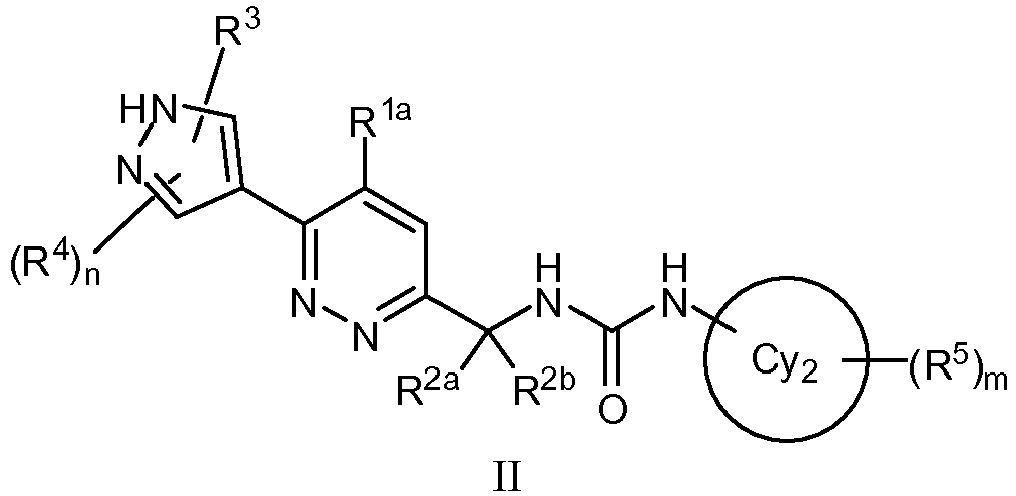
- In one embodiment, the compound of the invention is according to Formula Ia, Ib or II wherein R1a is C1-4 alkyl. In a particular embodiment, R1a is -CH3.
- In one embodiment, the compound of the invention is according to Formula Ia, Ib or II wherein R1a is C1-4 alkyl substituted with one or more independently selected OH; C1-4 alkoxy optionally substituted with one or more independently selected OH, or C1-4 alkoxy; -SO2-C1-4 alkyl; -O-C3-7 monocyclic cycloalkyl; and -O-heterocycloalkyl wherein said heterocycloalkyl is a 4-7 membered monocyclic heterocycloalkyl comprising one, two, or three heteroatoms independently selected from N, O, and S. In a particular embodiment, R1a is C1-4 alkyl substituted with one OH; C1-4 alkoxy optionally substituted with one or more independently selected OH, or C1-4 alkoxy;-SO2-C1-4 alkyl; -O-C3-7 monocyclic cycloalkyl; or -O-heterocycloalkyl wherein said heterocycloalkyl is a 4-7 membered monocyclic heterocycloalkyl comprising one, two, or three heteroatoms independently selected from N, O, and S. In a more particular embodiment, R1a is -CH3 substituted with one OH; C1-4 alkoxy optionally substituted with one or more independently selected OH, or C1-4 alkoxy; -SO2-C1-4 alkyl; -O-C3-7 monocyclic cycloalkyl; or -O-heterocycloalkyl wherein said heterocycloalkyl is a 4-7 membered monocyclic heterocycloalkyl comprising one, two, or three heteroatoms independently selected from N, O, and S.
- In one embodiment, the compound of the invention is according to Formula Ia, Ib or II wherein R1a is -NR6aR6b, and wherein each R6a and R6b is independently selected from H and C1-4 alkyl. In a particular embodiment, each R6a and R6b is independently selected from H, -CH3, and -CH2CH3. In a further particular embodiment, R6a is H and R6b is H, or C1-4 alkyl. In more particular embodiment, R6a is H and R6b is selected from H, -CH3, and -CH2CH3. In a further more particular embodiment, both R6a and R6b are C1-4 alkyl. In a most particular embodiment, R1a is -NHCH3, or -N(CH3)2.
- In one embodiment, the compound of the invention is according to Formula Ia, Ib or II wherein R1a is C1-4 alkoxy. In a particular embodiment, R1a is -OCH3, or -OCH2CH3. In a more particular embodiment, R1a is -OCH3.
- In one embodiment, the compound of the invention is according to Formula Ia, Ib or II wherein R1a is C3-7 monocyclic cycloalkyl. In a particular embodiment, R1a is cyclopropyl, cyclobutyl, cyclopentyl, or cyclohexyl. In a more particular embodiment, R1a is cyclopropyl.
- In one embodiment, the compound of the invention is according to Formula Ia, Ib or II wherein R1a is 4-7 membered monocyclic heterocycloalkyl comprising one, two, or three heteroatoms independently selected from N, O, or S. In a particular embodiment, R1a is azetidinyl, pyrrolidinyl, piperazinyl, piperidinyl, morpholinyl, tetrahydrofuranyl, or tetrahydropyranyl. In a particular embodiment, R1a is morpholinyl.
- In one embodiment, the compound of the invention is according to Formula Ia, Ib or II wherein R1a is 4-7 membered monocyclic heterocycloalkyl comprising one, two, or three heteroatoms independently selected from N, O, or S, substituted with one or more halo. In a particular embodiment, R1a is 4-7 membered monocyclic heterocycloalkyl comprising one, two, or three heteroatoms independently selected from N, O, or S, substituted with one or more fluoro. In a more particular embodiment, R1a is azetidinyl, pyrrolidinyl, piperazinyl, piperidinyl, morpholinyl, tetrahydrofuranyl, or tetrahydropyranyl, each of which is substituted with one or more halo. In a more particular embodiment, R1a is azetidinyl substituted with one or more fluoro.
- In one embodiment, the compound of the invention is according to Formula Ia, Ib or II wherein R1a is -O-C3-7 monocyclic cycloalkyl. In a particular embodiment, R1a is -O-cyclopropyl, -O-cyclobutyl, -O-cyclopentyl, or -O-cyclohexyl. In a more particular embodiment, R1a is -O-cyclopropyl.
- In one embodiment, the compound of the invention is according to Formula Ia, Ib or II wherein R1a is -O-heterocycloalkyl, wherein said heterocycloalkyl is a 4-7 membered monocyclic heterocycloalkyl comprising one, two, or three heteroatoms independently selected from N, O, and S. In a particular embodiment, R1a is -O-oxetanyl, or -O-tetrahydrofuranyl.
- In one embodiment, the compound of the invention is according to Formula III:

- In one embodiment, the compound of the invention is according to any one of Formulae Ia-III wherein each R2a and R2b is independently selected from H, and C1-4 alkyl optionally substituted with one or more independently -OH, or C1-4 alkoxy. In a particular embodiment, R2a is H, and R2b is selected from H, and C1-4 alkyl optionally substituted with one or more groups independently selected from -OH, and C1-4 alkoxy. In a more particular embodiment, R2a is H, and R2b is selected from H, and -CH3, -CH2CH3, each of which is optionally substituted with one or more groups independently selected from -OH, and C1-4 alkoxy. In a further more particular embodiment, R2a is H, and R2b is selected from H, and -CH3. In a most particular embodiment, R2a and R2b are H.
- In one embodiment, the compound of the invention is according to Formula IV:

- In one embodiment, the compound of the invention is according to any one of Formulae Ia-IV, wherein R3 is C1-4 alkyl. In a particular embodiment, R3 is -CH3, -CH2CH3, or -(CH2)2CH3. In a more particular embodiment, R3 is -CH3.
- In one embodiment, the compound of the invention is according to any one of Formulae Ia-IV, wherein R3 is C1-4 alkyl substituted with one or more independently selected halo, -CN, -C1-4 alkoxy, or -NR7aR7b. In a particular embodiment, R3 is -CH3, -CH2CH3, or -(CH2)2CH3, each of which is substituted with one or more independently selected halo, -CN, -C1-4 alkoxy, or -NR7aR7b. In another particular embodiment, R3 is C1-4 alkyl substituted with one, two or three independently selected halo, -CN, -C1-4 alkoxy, or -NR7aR7b. In a more particular embodiment, R3 is -CH3, -CH2CH3, or -(CH2)2CH3, substituted with one, two or three independently selected halo, -CN, -C1-4 alkoxy, or -NR7aR7b. In a further more particular embodiment, R3 is C1-4 alkyl substituted with one halo, -CN, -C1-4 alkoxy, or -NR7aR7b. In a more particular embodiment, R3 is -CH3, -CH2CH3, or -(CH2)2CH3, substituted with one halo, -CN, -C1-4 alkoxy, or -NR7aR7b. In a particular embodiment, R7a is H, and R7b is H or C1-4 alkyl. In another particular embodiment, R7a and R7b are C1-4 alkyl. In a more particular embodiment, each R7a and R7b is independently selected from H,-CH3, and -CH2CH3. In a further more particular embodiment, R7a and R7b are -CH3. In a most particular embodiment, R3 is -CF3.
- In one embodiment, the compound of the invention is according to any one of Formulea Ia-IV wherein R3 is C1-4 alkoxy substituted with one or more halo. In a particular embodiment, R3 is -OCH3, -OCH2CH3, or -OCH2CH2CH3, each of is substituted with one or more halo. In a more particular embodiment, R3 is -OCF3, -OCH2CHF2 or -OCH2CF3.
- In one embodiment, the compound of the invention is according to any one of Formulae Ia-IV wherein R3 is C3-7 monocyclic cycloalkyl. In a particular embodiment, R3 is cyclopropyl.
- In one embodiment, the compound of the invention is according to any one of Formulae Ia-IV wherein R3 is 4-7-membered monocyclic heterocycloalkyl comprising one, two or three heteroatoms independently selected from N, O, and S. In a particular embodiment, R3 is oxetanyl, tetrahydrofuranyl, tetrahydropyranyl, pyrolidinyl, piperidinyl, piperazinyl, morpholinyl, or thiomorpholinyl.
- In one embodiment, the compound of the invention is according to any one of Formulae Ia-IV wherein R3 is -NR8aR8b wherein each R8a and R8b is independently selected from H, and C1-4 alkyl. In a particular embodiment, R8a is H, and R8b is H or C1-4 alkyl. In another particular embodiment, R8a and R8b are C1-4 alkyl. In a more particular embodiment, each R8a and R8b is independently selected from H, -CH3, and -CH2CH3. In a further more particular embodiment, R3 is -N(CH3)2.
- In one embodiment, the compound of the invention is according to any one of Formulae Ia-IV wherein R3 is -C(=O)NR8cR8d wherein each R8c and R8d is independently selected from H, and C1-4 alkyl. In a particular embodiment, R8c is H, and R8d is H or C1-4 alkyl. In another particular embodiment, R8c and R8d are C1-4 alkyl. In a more particular embodiment, each R8c and R8d is independently selected from H, -CH3, and -CH2CH3. In a further more particular embodiment, R3 is -C(=O)N(CH3)2.
- In one embodiment, the compound of the invention is according to any one of Formulae Ia-IV wherein the subscript n is 0.
- In another embodiment, the compound of the invention is according to any one of Formulae Ia-IV wherein the subscript n is 1 or 2. In a particular embodiment, n is 1.
- In one embodiment, the compound of the invention is according to Formula Va or Vb

- In one embodiment, the compound of the invention is according to any one of Formulae Ia-Vb wherein R4 is C1-4 alkyl. In a particular embodiment, R4 is -CH3, -CH2CH3, -(CH2)2CH3, or -CH(CH3)2. In a more particular embodiment, R4 is -CH3.
- In another embodiment, the compound of the invention is according to any one of Formulae Ia-Vb wherein R4 is C1-4 alkyl substituted with one or more independently selected R12 groups. In another embodiment, R4 is -CH3, -CH2CH3, -(CH2)2CH3, or -CH(CH3)2 each of which is substituted with one or more independently selected R12 groups. In a particular embodiment, R4 is C1-4 alkyl substituted with one, two, or three independently selected R12 groups. In another particular embodiment, R4 is -CH3, -CH2CH3, -(CH2)2CH3, or -CH(CH3)2 each of which is substituted with one, two or three independently selected R12 groups. In a more particular embodiment, R4 is C1-4 alkyl substituted with one R12 group. In a more particular embodiment, R4 is -CH3, -CH2CH3, -(CH2)2CH3, or -CH(CH3)2 each of which is substituted with one independently selected R12 group. In a most particular embodiment, R4 is -CH2-R12.
- In another embodiment, the compound of the invention is according to any one of Formulae Ia-Vb wherein R12 is halo. In a particular embodiment R12 is F, or Cl. In a more particular embodiment, R12 is F.
- In one embodiment, the compound of the invention is according to any one of Formulae Ia-Vb wherein R12 is OH.
- In one embodiment, the compound of the invention is according to any one of Formulae Ia-Vb wherein R12 is C1-4 alkoxy. In a particular embodiment, R12 is -OCH3, or -OCH2CH3. In a more particular embodiment, R12 is -OCH3.
- In one embodiment, the compound of the invention is according to any one of Formulae Ia-Vb wherein R12 is -SO2-C1-4 alkyl. In a particular embodiment, R12 is -SO2-CH3.
- In one embodiment, the compound of the invention is according to any one of Formulae Ia-Vb wherein R12 is C3-7 monocyclic cycloalkyl. In a particular embodiment, R12 is cyclopropyl, cyclobutyl, or cyclopentyl. In a more particular embodiment, R12 is cyclopropyl.
- In one embodiment, the compound of the invention is according to any one of Formulae Ia-Vb wherein R12 is C3-7 monocyclic cycloalkyl, substituted with one or more independently selected -OH, halo, -CN, C1-4 alkyl, C1-4 alkoxy or =O. In a particular embodiment, R12 is C3-7 monocyclic cycloalkyl, substituted with one or more independently selected -OH, F, -CN, -CH3, -OCH3 or =O.In a more particular embodiment, R12 is cyclopropyl, cyclobutyl, or cyclopentyl, each of which is substituted with one or more independently selected -OH, halo, -CN, C1-4 alkyl, C1-4 alkoxy or =O. In a further more particular embodiment, R12 is cyclopropyl, cyclobutyl, or cyclopentyl, each of which is substituted with one or more independently selected -OH, F, -CN, -CH3, -OCH3 or =O.
- In one embodiment, the compound of the invention is according to any one of Formulae Ia-Vb wherein R12 is 4-7 membered monocyclic heterocycloalkyl, comprising one, two, or three heteroatoms independently selected from N, O, and S. In a particular embodiment, R12 is azetidinyl, pyrrolidinyl, or tetrahydrofuranyl.
- In one embodiment, the compound of the invention is according to any one of Formulae Ia-Vb wherein R12 is 4-7 membered monocyclic heterocycloalkyl, comprising one, two, or three heteroatoms independently selected from N, O, and S, substituted with one or more independently selected -OH, halo, -CN, C1-4 alkyl, C1-4 alkoxy or =O. In a particular embodiment, R12 is 4-7 membered monocyclic heterocycloalkyl, comprising one, two, or three heteroatoms independently selected from N, O, and S, substituted with one or more independently selected -OH, F, -CN, -CH3, -OCH3 or =O. In a more particular embodiment, R12 is azetidinyl, pyrrolidinyl, or tetrahydrofuranyl, each of which is substituted with one or more independently selected -OH, halo, -CN, C1-4 alkyl, C1-4 alkoxy or =O. In a further more particular embodiment, R12 is azetidinyl, pyrrolidinyl, or tetrahydrofuranyl, each of which is substituted with one or more independently selected -OH, F, -CN, -CH3, -OCH3 or =O.
- In one embodiment, the compound of the invention is according to any one of Formulae Ia-Vb wherein R12 is -NR9aR9b, wherein each R9a and R9b is independently selected from H and C1-4 alkyl. In a particular embodiment, one of R9a and R9b is H, and the other is C1-4 alkyl. In another embodiment, R9a and R9b are independently selected C1-4 alkyl. In a particular embodiment, R9a and R9b are independently selected from H, and -CH3. In a most particular embodiment, R12 is -N(CH3)2.
- In one embodiment, the compound of the invention is according to any one of Formulae Ia-Vb wherein R12 is -CN.
- In one embodiment, the compound of the invention is according to any one of Formulae Ia-Vb wherein R4 is C3-7 monocyclic cycloalkyl. In a particular embodiment, R4 is cyclopropyl, cyclobutyl, cyclopentyl, or cyclohexyl. In a more particular embodiment, R4 is cyclopropyl.
- In one embodiment, the compound of the invention is according to any one of Formulae Ia-Vb wherein R4 is 4-7 membered monocyclic heterocycloalkyl comprising one, two, or three heteroatoms independently selected from N, O, or S. In a particular embodiment, R4 is azetidinyl, pyrrolidinyl, piperazinyl, piperidinyl, morpholinyl, tetrahydrofuranyl, or tetrahydropyranyl. In a more particular embodiment, R4 is tetrahydrofuranyl.
- In one embodiment, the compound of the invention is according to Formula VIa, or VIb:

- In one embodiment, the compound of the invention is according to any one of Formulae Ia-VIb, wherein Cy2 is phenyl.
- In one embodiment, the compound of the invention is according to any one of Formulae Ia-YIb, wherein Cy2 is 5-6 membered heteroaryl comprising one or two heteroatoms independently selected from N, O, and S. In a particular embodiment, Cy2 is pyridinyl.
- In one embodiment, the compound of the invention is according to any one of Formulae VIIa, VIIb, VIIc or VIId:


- In one embodiment, the compound of the invention is according to any one of Formulae Ia-VIId, wherein the subscript m is 0.
- In one embodiment, the compound of the invention is according to any one of Formulae Ia-VIId, wherein the subscript m is 1, 2, 3, or 4. In a particular embodiment, the subscript m is 2, or 3.
- In one embodiment, the compound of the invention is according to any one of Formulae Ia-VIId, wherein R5 is selected from halo, CN, selected from OH. In a particular embodiment, R5 is F, Cl, CN or OH. In a more particular embodiment, R5 is F, Cl or CN.
- In one embodiment, the compound of the invention is according to any one of Formulae Ia-VIId, wherein R5 is C1-4 alkyl. In a particular embodiment, R5 is -CH3, or -CH2CH3.
- In one embodiment, the compound of the invention is according to any one of Formulae Ia-VIId, wherein R5 is C1-4 alkyl substituted with one or more independently selected R13. In a particular embodiment, R5 is -CH3, or -CH2CH3, each of which is substituted with one or more independently selected R13. In a more particular embodiment, R5 is C1-4 alkyl substituted with one, two or three independently selected R13. In another more particular embodiment, R5 is -CH3, or -CH2CH3, each of which is substituted with one, two or three independently selected R13 groups. In a most particular embodiment, R5 is C1-4 alkyl substituted with one R13 group. In another most particular embodiment, R5 is -CH3, or -CH2CH3, each of which is substituted with one R13 group.
- In one embodiment, the compound of the invention is according to any one of Formulae Ia-VIId, wherein R5 is C1-4 alkoxy substituted with one or more independently selected R13 groups. In a particular embodiment, R5 is -OCH3, or -OCH2CH3, each of which is substituted with one or more independently selected R13 groups. In a more particular embodiment, R5 is C1-4 alkoxy substituted with one, two or three independently selected R13 groups. In another more particular embodiment, R5 is -OCH3, or -OCH2CH3, each of which is substituted with one, two or three independently selected R13 groups. In a most particular embodiment, R5 is C1-4 alkoxy substituted with one R13 group. In another most particular embodiment, R5 is -OCH3, or -OCH2CH3, each of which is substituted with one R13 group.
- In one embodiment, the compound of the invention is according to any one of Formulae Ia-VIId, wherein R13 is halo, -CN, or -OH. In a particular embodiment, R13 is F, -CN, or -OH.
- In one embodiment, the compound of the invention is according to any one of Formulae Ia-VIId, wherein R13 is C1-4 alkoxy optionally substituted with one or more independently selected OH, C1-4 alkoxy, or halo. In a particular embodiment, R13 is -OCH3, or -OCH2CH3, each of which is substituted with one or more groups independently selected from OH, C1-4 alkoxy, and halo. In another particular embodiment, R13 is C1-4 alkoxy optionally substituted with one or more groups independently selected from -OH, -OCH3, and F. In a more particular embodiment, R13 is -OCH3, or -OCH2CH3, each of which is substituted with one or more groups independently selected from -OH, -OCH3, and F. In a most particular embodiment, R13 is -OCH3, -OCF3, -OCH2CH3, -OCH2CF3, -OCH2CH2OH, or -OCH2CH2OCH3.
- In one embodiment, the compound of the invention is according to any one of Formulae Ia-VIId, wherein R13 is -C(=O)NR16aR16b, wherein each R16a and R16b is independently selected from H, and C1-4 alkyl. In a particular embodiment, each R16a and R16b is independently selected from H, -CH3, and -CH2CH3. In a more particular embodiment, R16a is H and R16b is selected from H, -CH3, and -CH2CH3. In a most particular embodiment, R13 is -C(=O)NH2, -C(=O)NHCH3, -C(=O)N(CH3)2, or -C(=O)N(CH3)(CH2CH3).
- In one embodiment, the compound of the invention is according to any one of Formulae Ia-VIId, wherein R13 is -NR16cC(=O)-C1-4 alkyl, wherein R16c is independently selected from H, -CH3, and -CH2CH3. In a particular embodiment, R13 is -NR16cC(=O)-CH3, or -NR16cC(=O)-CH2CH3, wherein R16c is independently selected from H, -CH3, and -CH2CH3.
- In one embodiment, the compound of the invention is according to any one of Formulae Ia-VIId, wherein R13 is -NR16dC(=O)-C1-4 alkoxy, wherein R16d is independently selected from H, -CH3, and -CH2CH3. In a particular embodiment, R13 is -NR16dC(=O)-OCH3, or -NR16dC(=O)-OCH2CH3, wherein R16d is independently selected from H, -CH3, and -CH2CH3.
- In one embodiment, the compound of the invention is according to any one of Formulae Ia-VIId, wherein R13 is -SO2-C1-4 alkyl. In a particular embodiment, R13 is -SO2-CH3, or -SO2-CH2CH3.
- In one embodiment, the compound of the invention is according to any one of Formulae Ia-VIId, wherein R13 is -SO2NR16eR16f, wherein each R16e and R16f is independently selected from H, and C1-4 alkyl. In a particular embodiment, each R16e and R16f is independently selected from H, -CH3, and -CH2CH3. In a more particular embodiment, R16e is H and R16f is selected from H, -CH3, and -CH2CH3. In a most particular embodiment, R13 is -SO2NH2, -SO2NHCH3, -SO2N(CH3)2, or -SO2N(CH3)(CH2CH3).
- In one embodiment, the compound of the invention is according to any one of Formulae Ia-VIId, wherein R13 is -NR16gSO2-C1-4 alkyl, wherein R16g is independently selected from H, -CH3, and -CH2CH3. In a particular embodiment, R13 is -NR16gSO2-CH3, or -NR16gSO2-CH2CH3, wherein R16g is independently selected from H, -CH3, and -CH2CH3.
- In one embodiment, the compound of the invention is according to any one of Formulae Ia-VIId, wherein R13 is C3-7 monocyclic cycloalkyl. In a particular embodiment, R13 is cyclopropyl, cyclobutyl, cyclopentyl, or cyclohexyl. In a more particular embodiment, R13 is cyclopropyl, or cyclobutyl.
- In one embodiment, the compound of the invention is according to any one of Formulae Ia-VIId, wherein R13 is C3-7 monocyclic cycloalkyl substituted with one or more independently selected halo, or C1-4 alkyl optionally substituted with one or more halo. In a particular embodiment, R13 is cyclopropyl, cyclobutyl, cyclopentyl, or cyclohexyl, each of which is substituted with one or more independently selected halo, or C1-4 alkyl optionally substituted with one or more halo.. In another more particular embodiment, R13 is C3-7 monocyclic cycloalkyl substituted with one or more independently selected F, -CH3, -CH2CH3. -CF3, and -CH2CF3. In a most particular embodiment, R13 is cyclopropyl, cyclobutyl, cyclopentyl, or cyclohexyl, each of which is substituted with one or more independently selected F, -CH3, -CH2CH3. -CF3, and -CH2CF3. In a most particular embodiment, R13 is cyclopropyl substituted with one or more independently selected F, -CH3, -CH2CH3. -CF3, and -CH2CF3.
- In one embodiment, the compound of the invention is according to any one of Formulae Ia-VIId, wherein R13 is 4-7 membered monocyclic heterocycloalkyl comprising one, two, or three heteroatoms independently selected from N, O, and S, optionally substituted with one or more independently selected halo, or C1-4 alkyl optionally substituted with one or more halo, and wherein if a N heteroatom is present, said N heteroatom, is further substituted with one -C(=O)-C1-4 alkyl, -C(=O)-C1-4 alkoxy, -SO2-C1-4 alkyl, -C(=O)-NH2, -C(=O)NHC1-4 alkyl, or -C(=O)N(C1-4 alkyl)2. In a particular embodiment, R13 is 4-7 membered monocyclic heterocycloalkyl comprising one, two, or three heteroatoms independently selected from N, O, and S, optionally substituted with one or more independently selected F, -CH3, -CH2CH3. -CF3, and -CH2-CF3, and wherein if a N heteroatom is present, said N heteroatom, is further substituted with one -C(=O)-C1-4 alkyl, -C(=O)-C1-4 alkoxy, -SO2-C1-4 alkyl, -C(=O)-NH2, -C(=O)NHC1-4 alkyl, or -C(=O)N(C1-4 alkyl)2. In a further particular embodiment, R13 is 4-7 membered monocyclic heterocycloalkyl comprising one, two, or three heteroatoms independently selected from N, O, and S, optionally substituted with one or more independently selected F, -CH3, -CH2CH3. -CF3, and -CH2-CF3, and wherein if a N heteroatom is present, said N heteroatom, is further substituted with one -C(=O)CH3, -C(=O)OCH3, -SO2CH3, -C(=O)NH2, -C(=O)NHCH3, or -C(=O)N(CH3)2. In a further more particular embodiment, R13 is 4-7 membered monocyclic heterocycloalkyl comprising one, two, or three heteroatoms independently selected from O, and S, optionally substituted with one or more independently selected F, -CH3, -CH2CH3. -CF3, and -CH2-CF3. In a most particular embodiment, R13 is oxetanyl, tetrahydrofuranyl, or tetrahydropyranyl, each of which is optionally substituted with one or more independently selected F, -CH3, -CH2CH3. -CF3, and -CH2CF3. In a further most particular embodiment, R13 is oxetanyl, tetrahydrofuranyl, dioxanyl or tetrahydropyranyl.
- In one embodiment, the compound of the invention is according to any one of Formulae Ia-VIId, wherein R5 is -CF3.
- In one embodiment, the compound of the invention is according to any one of Formulae Ia-VIId, wherein R5 is -OCF3, -OCH2CH2F, -OCH2CH2OCH3, -OCH2CH2OH, or -OCH2CHF2.
- In one embodiment, the compound of the invention is according to any one of Formulae Ia-VIId, wherein R5 is

- In one embodiment, the compound of the invention is according to any one of Formulae Ia-VIId, wherein R5 is C3-7 monocyclic cycloalkyl. In a particular embodiment, R5 is cyclopropyl, cyclobutyl, cyclopentyl, or cyclohexyl. In a more particular embodiment, R5 is cyclopropyl, or cyclobutyl. In a most particular embodiment, R5 is cyclopropyl.
- In one embodiment, the compound of the invention is according to any one of Formulae Ia-VIId, wherein R5 is C3-7 monocyclic cycloalkyl substituted with one or more independently selected R14 group. In a particular embodiment, R5 is cyclopropyl, cyclobutyl, cyclopentyl, or cyclohexyl, each of which is substituted with one or more independently selected R14 group. In more particular embodiment, R5 is C3-7 monocyclic cycloalkyl substituted with one, two, or three independently selected R14 group. In another more particular embodiment, R5 is cyclopropyl, cyclobutyl, cyclopentyl, or cyclohexyl, each of which is substituted with one, two, or three independently selected R14 group. In most particular embodiment, R5 is C3-7 monocyclic cycloalkyl substituted with one or two independently selected R14 group. In another more particular embodiment, R5 is cyclopropyl, cyclobutyl, cyclopentyl, or cyclohexyl, each of which is substituted with one or two independently selected R14 group.
- In one embodiment, the compound of the invention is according to any one of Formulae Ia-VIId, wherein R5 is 4-11 membered monocyclic, or fused or spiro bicyclic heterocycloalkyl comprising one, two, or three heteroatoms independently selected from N, O, and S. In a particular embodiment, R5 is azetidinyl, oxetanyl, tetrahydrofuranyl, pyrolidinyl, tetrahydropyranyl, piperidininyl, piperazinyl, morpholinyl, thiomorpholinyl, dioxanyl.
- In one embodiment, the compound of the invention is according to any one of Formulae Ia-VIId, wherein R5 is 4-11 membered monocyclic, or fused or spiro bicyclic heterocycloalkyl comprising one, two, or three heteroatoms independently selected from N, O, and S, substituted with one or more independently selected R14 group. In a particular embodiment, R5 is azetidinyl, oxetanyl, tetrahydrofuranyl, pyrolidinyl, tetrahydropyranyl, piperidininyl, piperazinyl, morpholinyl, thiomorpholinyl, dioxanyl, each of which is substituted with one or more independently selected R14 group. In more particular embodiment, R5 is 4-11 membered monocyclic, or fused or spiro bicyclic heterocycloalkyl comprising one, two, or three heteroatoms independently selected from N, O, and S substituted with one, two, or three independently selected R14 group. In another more particular embodiment, R5 is azetidinyl, oxetanyl, tetrahydrofuranyl, pyrolidinyl, tetrahydropyranyl, piperidininyl, piperazinyl, morpholinyl, thiomorpholinyl, dioxanyl, each of which is substituted with one, two, or three independently selected R14 group. In most particular embodiment, R5 is 4-11 membered monocyclic, or fused or spiro bicyclic heterocycloalkyl comprising one, two, or three heteroatoms independently selected from N, O, and S, substituted with one or two independently selected R14 group. In another more particular embodiment, R5 is azetidinyl, oxetanyl, tetrahydrofuranyl, pyrolidinyl, tetrahydropyranyl, piperidininyl, piperazinyl, morpholinyl, thiomorpholinyl, dioxanyl, each of which is substituted with one or two independently selected R14 group.
- In one embodiment, the compound of the invention is according to any one of Formulae Ia-VIId, wherein R5 is -O-C3-7 monocyclic cycloalkyl. In a particular embodiment, R5 is -O-cyclopropyl, -O-cyclobutyl, -O-cyclopentyl, or -O-cyclohexyl. In a more particular embodiment, R5 is -O-cyclopropyl, -O-cyclobutyl. In a most particular embodiment, R5 is -O-cyclopropyl.
- In one embodiment, the compound of the invention is according to any one of Formulae Ia-VIId, wherein R5 is -O-C3-7 monocyclic cycloalkyl substituted with one or more independently selected R14 group. In a particular embodiment, R5 is -O-cyclopropyl, -O-cyclobutyl, -O-cyclopentyl, or -O-cyclohexyl, each of which is substituted with one or more independently selected R14 group. In more particular embodiment, R5 is -O-C3-7 monocyclic cycloalkyl substituted with one, two, or three independently selected R14 groups. In another more particular embodiment, R5 is -O-cyclopropyl, -O-cyclobutyl, -O-cyclopentyl, or -O-cyclohexyl, each of which is substituted with one, two, or three independently selected R14 groups. In most particular embodiment, R5 is -O-C3-7 monocyclic cycloalkyl substituted with one or two independently selected R14 group. In another more particular embodiment, R5 is -O-cyclopropyl, -O-cyclobutyl, -O-cyclopentyl, or -O-cyclohexyl, each of which is substituted with one or two independently selected R14 groups.
- In one embodiment, the compound of the invention is according to any one of Formulae Ia-VIId, wherein R5 is -O-heterocycloalkyl, wherein said heterocycloalkyl is a 4-7 membered monocyclic heterocycloalkyl comprising one, two, or three heteroatoms independently selected from N, O, and S, and wherein if a N heteroatom is present, said N heteroatom, is further substituted with one -C(=O)-C1-4 alkyl, -C(=O)-C1-4 alkoxy, -SO2-C1-4 alkyl, -C(=O)-NH2, -C(=O)NHC1-4 alkyl, or -C(=O)N(C1-4 alkyl)2. In a particular embodiment, R5 is -O-heterocycloalkyl, wherein said heterocycloalkyl is a 4-7 membered monocyclic heterocycloalkyl comprising one, two, or three heteroatoms independently selected from N, O, and S, and wherein if a N heteroatom is present, said N heteroatom, is further substituted with one -C(=O)CH3, -C(=O)OCH3, -SO2CH3, -C(=O)NH2, -C(=O)NHCH3, or -C(=O)N(CH3)2. In a more particular embodiment, R5 is -O-heterocycloalkyl, wherein said heterocycloalkyl is a 4-7 membered monocyclic heterocycloalkyl comprising one, two, or three heteroatoms independently selected from O, and S. In a more particular embodiment, R5 is -O-oxetanyl, -O-tetrahydrofuranyl, -O-tetrahydropyranyl, or -O-dioxanyl. In a most particular embodiment, R5 is -O-oxetanyl, -O-tetrahydrofuranyl or -O-dioxanyl.
- In one embodiment, the compound of the invention is according to any one of Formulae Ia-VIId, wherein R5 is -O-heterocycloalkyl, wherein said heterocycloalkyl is a 4-7 membered monocyclic heterocycloalkyl comprising one, two, or three heteroatoms independently selected from N, O, and S, substituted with one or more independently selected R14 groups and wherein if a N heteroatom is present, said N heteroatom, is further substituted with one -C(=O)-C1-4 alkyl, -C(=O)-C1-4 alkoxy, -SO2-C1-4 alkyl, -C(=O)-NH2, -C(=O)NHC1-4 alkyl, or -C(=O)N(C1-4 alkyl)2. In a particular embodiment, R5 is -O-heterocycloalkyl, wherein said heterocycloalkyl is a 4-7 membered monocyclic heterocycloalkyl comprising one, two, or three heteroatoms independently selected from N, O, and S, substituted with one or more independently selected R14 groups and wherein if a N heteroatom is present, said N heteroatom, is further substituted with one -C(=O)CH3, -C(=O)OCH3, -SO2CH3, -C(=O)NH2, -C(=O)NHCH3, or -C(=O)N(CH3)2. In a more particular embodiment, R5 is -O-heterocycloalkyl, wherein said heterocycloalkyl is a 4-7 membered monocyclic heterocycloalkyl comprising one, two, or three heteroatoms independently selected from O, and S, substituted with one or more independently selected R14 groups. In a further more particular embodiment, R5 is -O-oxetanyl, -O-tetrahydrofuranyl, -O-tetrahydropyranyl, or -O-dioxanyl, each of which is substituted with one or more independently selected R14 group. In a more particular embodiment, R5 is -O-heterocycloalkyl, wherein said heterocycloalkyl is a 4-7 membered monocyclic heterocycloalkyl comprising one, two, or three heteroatoms independently selected from O, and S, substituted with one, two, or three independently selected R14 groups. In a further more particular embodiment, R5 is -O-oxetanyl, -O-tetrahydrofuranyl, -O-tetrahydropyranyl, or -O-dioxanyl, each of which is substituted with one, two, or three independently selected R14 groups. In a most particular embodiment, R5 is -O-heterocycloalkyl, wherein said heterocycloalkyl is a 4-7 membered monocyclic heterocycloalkyl comprising one, two, or three heteroatoms independently selected from O, and S, substituted with one R14 group. In a further most particular embodiment, R5 is -O-oxetanyl, -O-tetrahydrofuranyl, -O-tetrahydropyranyl, or -O-dioxanyl, each of which is substituted with one R14 group.
- In one embodiment, the compound of the invention is according to any one of Formulae Ia-VIId, wherein R14 is selected from halo, CN, OH, C1-4 alkoxy optionally substituted with one or more halo, and C1-4 alkyl optionally substituted with one or more halo. In a particular embodiment, R14 is F, Cl, -OH, -CN, -CH3, -CH2CH3, -CF3, -CH2CHF2, -OCH3, -OCH2CH3, -OCF3, or -OCH2CHF2.
- In one embodiment, the compound of the invention is according to any one of Formulae Ia-VIId, wherein R5 is -SO2-C1-4 alkyl. In a particular embodiment, R5 is -SO2-CH3.
- In one embodiment, the compound of the invention is according to any one of Formulae Ia-VIId, wherein R5 is -SO2-NR15aR15b, wherein each R15a and R15b is independently selected from H and C1-4 alkyl. In a particular embodiment, R5 is -SO2-NR15aR15b, wherein each R15a and R15b is independently selected from H and -CH3.
- In one embodiment, the compound of the invention is according to any one of Formulae Ia-VIId, wherein R5 is -C(=O)NR15cR15d, wherein each R15c and R15d is independently selected from H and C1-4 alkyl. In a particular embodiment, R5 is -C(=O)NR15cR15d, wherein each R15c and R15d is independently selected from H and -CH3.
- In one embodiment, the compound of the invention is according to any one of Formulae Ia-VIId, wherein R5 is -NR17aR17b, wherein each R17a and R17b is independently selected from H and C1-4 alkyl which alkyl is optionally substituted with one or more independently selected halo, OH or C1-4 alkoxy. In a particular embodiment, R5 is -NR17aR17b, wherein each R17a and R17b is independently selected from H, -CH3, -CH2CH3, -CH2CF3, -CH2CHF2, -CH2CH2OH and -CH2CH2OCH3.
- In one embodiment, the compound of the invention is selected from:
- 1-(2-Ethoxy-6-trifluoromethyl-pyridin-4-yl)-3-[5-methyl-6-(1-methyl-3-trifluoromethyl-1H-pyrazol-4-yl)-pyridazin-3-ylmethyl]-urea,
- 1-(2-Chloro-6-ethoxy-pyridin-4-yl)-3-[5-methyl-6-(1-methyl-3-trifluoromethyl-1H-pyrazol-4-yl)-pyridazin-3-ylmethyl]-urea,
- 1-(2-chloro-6-ethoxy-4-pyridyl)-3-[1-[5-methyl-6-[1-methyl-3-(trifluoromethyl)pyrazol-4-yl]pyridazin-3-yl]ethyl]urea,
- 1-[2-(2-hydroxyethoxy)-6-(trifluoromethyl)-4-pyridyl]-3-[[5-methyl-6-[1-methyl-3-(trifluoromethyl)pyrazol-4-yl]pyridazin-3-yl]methyl]urea,
- 1-[2-(2,3-dihydroxypropoxy)-6-(trifluoromethyl)-4-pyridyl]-3-[[5-methyl-6-[1-methyl-3-(trifluoromethyl)pyrazol-4-yl]pyridazin-3-yl]methyl]urea,
- 1-(3,5-dichlorophenyl)-3-[[5-methyl-6-[1-methyl-3-(trifluoromethyl)pyrazol-4-yl]pyridazin-3-yl]methyl]urea,
- 1-[6-(2,2-difluoroethoxy)-5-(trifluoromethyl)-3-pyridyl]-3-[[5-methyl-6-[1-methyl-3-(trifluoromethyl)pyrazol-4-yl]pyridazin-3-yl]methyl]urea,
- 1-(5-chloro-6-ethoxy-3-pyridyl)-3-[[5-methyl-6-[1-methyl-3-(trifluoromethyl)pyrazol-4-yl]pyridazin-3-yl]methyl]urea,
- 1-[5-chloro-6-(2,2-difluoroethoxy)-3-pyridyl]-3-[[5-methyl-6-[1-methyl-3-(trifluoromethyl)pyrazol-4-yl]pyridazin-3-yl]methyl]urea,
- 1-[6-ethoxy-5-(trifluoromethyl)-3-pyridyl]-3-[[5-methyl-6-[1-methyl-3-(trifluoromethyl)pyrazol-4-yl]pyridazin-3-yl]methyl]urea,
- 1-[6-(cyclopropylmethoxy)-5-(trifluoromethyl)-3-pyridyl]-3-[[5-methyl-6-[1-methyl-3-(trifluoromethyl)pyrazol-4-yl]pyridazin-3-yl]methyl]urea,
- 1-[[5-methyl-6-[1-methyl-3-(trifluoromethyl)pyrazol-4-yl]pyridazin-3-yl]methyl]-3-[6-(2,2,2-trifluoroethoxy)-5-(trifluoromethyl)-3-pyridyl]urea,
- 1-[5-chloro-6-(cyclopropylmethoxy)-3-pyridyl]-3-[[5-methyl-6-[1-methyl-3-(trifluoromethyl)pyrazol-4-yl]pyridazin-3-yl]methyl]urea,
- 1-[2-chloro-6-(2,2,2-trifluoroethoxy)-4-pyridyl]-3-[[5-methyl-6-[1-methyl-3-(trifluoromethyl)pyrazol-4-yl]pyridazin-3-yl]methyl]urea,
- 1-(2-chloro-6-ethoxy-4-pyridyl)-3-[[6-[1-(methoxymethyl)-3-(trifluoromethyl)pyrazol-4-yl]-5-methyl-pyridazin-3-yl]methyl]urea,
- 1-[2-chloro-6-(2-fluoroethoxy)-4-pyridyl]-3-[[5-methyl-6-[1-methyl-3-(trifluoromethyl)pyrazol-4-yl]pyridazin-3-yl]methyl]urea,
- 1-[2-chloro-6-(2,2-difluoroethoxy)-4-pyridyl]-3-[[5-methyl-6-[1-methyl-3-(trifluoromethyl)pyrazol-4-yl]pyridazin-3-yl]methyl]urea,
- 1-(2-cyano-6-ethoxy-4-pyridyl)-3-[[5-methyl-6-[1-methyl-3-(trifluoromethyl)pyrazol-4-yl]pyridazin-3-yl]methyl]urea,
- 1-[2-(2,2-difluoroethoxy)-6-(trifluoromethyl)-4-pyridyl]-3-[[5-methyl-6-[1-methyl-3-(trifluoromethyl)pyrazol-4-yl]pyridazin-3-yl]methyl]urea,
- 1-(6-chloro-2-ethoxy-3-methyl-4-pyridyl)-3-[[5-methyl-6-[1-methyl-3-(trifluoromethyl)pyrazol-4-yl]pyridazin-3-yl]methyl]urea,
- 1-(2,6-dichloro-4-pyridyl)-3-[[5-methyl-6-[1-methyl-3-(trifluoromethyl)pyrazol-4-yl]pyridazin-3-yl]methyl]urea,
- 1-(2-cyclopropyl-6-ethoxy-4-pyridyl)-3-[[5-methyl-6-[1-methyl-3-(trifluoromethyl)pyrazol-4-yl]pyridazin-3-yl]methyl]urea,
- 1-[6-chloro-5-(2,2-difluoroethoxy)-3-pyridyl]-3-[[5-methyl-6-[1-methyl-3-(trifluoromethyl)pyrazol-4-yl]pyridazin-3-yl]methyl]urea,
- 1-(6-chloro-5-ethoxy-3-pyridyl)-3-[[5-methyl-6-[1-methyl-3-(trifluoromethyl)pyrazol-4-yl]pyridazin-3-yl]methyl]urea,
- 1-[2-(2-methoxyethoxy)-6-(trifluoromethyl)-4-pyridyl]-3-[[5-methyl-6-[1-methyl-3-(trifluoromethyl)pyrazol-4-yl]pyridazin-3-yl]methyl]urea,
- 1-[[5-methyl-6-[1-methyl-3-(trifluoromethyl)pyrazol-4-yl]pyridazin-3-yl]methyl]-3-[2-tetrahydrofuran-3-yloxy-6-(trifluoromethyl)-4-pyridyl]urea,
- 1-[2-chloro-6-(2-methoxyethoxy)-4-pyridyl]-3-[[5-methyl-6-[1-methyl-3-(trifluoromethyl)pyrazol-4-yl]pyridazin-3-yl]methyl]urea,
- 1-[2-cyano-6-(2,2-difluoroethoxy)-4-pyridyl]-3-[[5-methyl-6-[1-methyl-3-(trifluoromethyl)pyrazol-4-yl]pyridazin-3-yl]methyl]urea,
- 1-[2-cyclopropyl-6-(2,2-difluoroethoxy)-4-pyridyl]-3-[[5-methyl-6-[1-methyl-3-(trifluoromethyl)pyrazol-4-yl]pyridazin-3-yl]methyl]urea,
- 1-[2-ethoxy-3-methyl-6-(trifluoromethyl)-4-pyridyl]-3-[[5-methyl-6-[1-methyl-3-(trifluoromethyl)pyrazol-4-yl]pyridazin-3-yl]methyl]urea,
- 1-(2,6-diethoxypyrimidin-4-yl)-3-[[5-methyl-6-[1-methyl-3-(trifluoromethyl)pyrazol-4-yl]pyridazin-3-yl]methyl]urea,
- 1-(3,5-dichloro-4-fluoro-phenyl)-3-[[5-methyl-6-[1-methyl-3-(trifluoromethyl)pyrazol-4-yl]pyridazin-3-yl]methyl]urea,
- 1-[2-[(2,2-difluorocyclopropyl)methoxy]-6-(trifluoromethyl)-4-pyridyl]-3-[[5-methyl-6-[1-methyl-3-(trifluoromethyl)pyrazol-4-yl]pyridazin-3-yl]methyl]urea,
- 1-[2-(2,2-difluoropropoxy)-6-(trifluoromethyl)-4-pyridyl]-3-[[5-methyl-6-[1-methyl-3-(trifluoromethyl)pyrazol-4-yl]pyridazin-3-yl]methyl]urea,
- 1-(2-ethoxy-6-methyl-4-pyridyl)-3-[[5-methyl-6-[1-methyl-3-(trifluoromethyl)pyrazol-4-yl]pyridazin-3-yl]methyl]urea,
- 1-[[5-methyl-6-[1-methyl-3-(trifluoromethyl)pyrazol-4-yl]pyridazin-3-yl]methyl]-3-[2-(tetrahydrofuran-3-ylmethoxy)-6-(trifluoromethyl)-4-pyridyl]urea,
- 1-[2-(1,4-dioxan-2-ylmethoxy)-6-(trifluoromethyl)-4-pyridyl]-3-[[5-methyl-6-[1-methyl-3-(trifluoromethyl)pyrazol-4-yl]pyridazin-3-yl]methyl]urea,
- 1-(6-chloro-2-ethoxy-pyrimidin-4-yl)-3-[[5-methyl-6-[1-methyl-3-(trifluoromethyl)pyrazol-4-yl]pyridazin-3-yl]methyl]urea,
- 1-[[5-methyl-6-[1-methyl-3-(trifluoromethyl)pyrazol-4-yl]pyridazin-3-yl]methyl]-3-[2-(trifluoromethyl)-6-[[1-(trifluoromethyl)cyclopropyl]methoxy]-4-pyridyl]urea,
- 1-[[5-methyl-6-[1-methyl-3-(trifluoromethyl)pyrazol-4-yl]pyridazin-3-yl]methyl]-3-[2-tetrahydropyran-4-yloxy-6-(trifluoromethyl)-4-pyridyl]urea,
- 1-[2-(2-methoxy-1-methyl-ethoxy)-6-(trifluoromethyl)-4-pyridyl]-3-[[5-methyl-6-[1-methyl-3-(trifluoromethyl)pyrazol-4-yl]pyridazin-3-yl]methyl]urea,
- 1-[2-[(3,3-difluorocyclobutyl)methoxy]-6-(trifluoromethyl)-4-pyridyl]-3-[[5-methyl-6-[1-methyl-3-(trifluoromethyl)pyrazol-4-yl]pyridazin-3-yl]methyl]urea,
- 1-[[5-methyl-6-[1-methyl-3-(trifluoromethyl)pyrazol-4-yl]pyridazin-3-yl]methyl]-3-[2-(trifluoromethyl)-4-pyridyl]urea,
- 1-(2-chloro-4-pyridyl)-3-[[5-methyl-6-[1-methyl-3-(trifluoromethyl)pyrazol-4-yl]pyridazin-3-yl]methyl]urea,
- 1-[2-ethoxy-3-methyl-6-(trifluoromethyl)-4-pyridyl]-3-[1-[5-methyl-6-[1-methyl-3-(trifluoromethyl)pyrazol-4-yl]pyridazin-3-yl]ethyl]urea,
- 1-[2-ethoxy-3-ethyl-6-(trifluoromethyl)-4-pyridyl]-3-[[5-methyl-6-[1-methyl-3-(trifluoromethyl)pyrazol-4-yl]pyridazin-3-yl]methyl]urea,
- 1-[2-(3,3-difluoroazetidin-1-yl)-6-(trifluoromethyl)-4-pyridyl]-3-[[5-methyl-6-[1-methyl-3-(trifluoromethyl)pyrazol-4-yl]pyridazin-3-yl]methyl]urea,
- 1-[2-(3,3-difluoroazetidin-1-yl)-6-(2,2-difluoroethoxy)-4-pyridyl]-3-[[5-methyl-6-[1-methyl-3-(trifluoromethyl)pyrazol-4-yl]pyridazin-3-yl]methyl]urea
- 1-[3-bromo-2-ethoxy-6-(trifluoromethyl)-4-pyridyl]-3-[[5-methyl-6-[1-methyl-3-(trifluoromethyl)pyrazol-4-yl]pyridazin-3-yl]methyl]urea,
- 1-[6-chloro-2-(2,2-difluoroethoxy)-3-methyl-4-pyridyl]-3-[[5-methyl-6-[1-methyl-3-(trifluoromethyl)pyrazol-4-yl]pyridazin-3-yl]methyl]urea,
- 1-[2-ethoxy-6-(trifluoromethyl)-4-pyridyl]-3-[[5-methyl-6-[3-(trifluoromethyl)-1H-pyrazol-4-yl]pyridazin-3-yl]methyl]urea,
- 1-[2-ethoxy-6-(trifluoromethyl)-4-pyridyl]-3-[[5-methyl-6-[1-tetrahydrofuran-3-yl-3-(trifluoromethyl)pyrazol-4-yl]pyridazin-3-yl]methyl]urea,
- 1-[2-ethoxy-6-(trifluoromethyl)-4-pyridyl]-3-[[6-[1-(2-methoxyethyl)-3-(trifluoromethyl)pyrazol-4-yl]-5-methyl-pyridazin-3-yl]methyl]urea,
- 1-[[6-(3-cyclopropyl-1-methyl-pyrazol-4-yl)-5-methyl-pyridazin-3-yl]methyl]-3-[2-ethoxy-6-(trifluoromethyl)-4-pyridyl]urea,
- 1-[[6-[1-(1,4-dioxan-2-ylmethyl)-3-(trifluoromethyl)pyrazol-4-yl]-5-methyl-pyridazin-3-yl]methyl]-3-[2-ethoxy-6-(trifluoromethyl)-4-pyridyl]urea,
- 1-[2-ethoxy-6-(trifluoromethyl)-4-pyridyl]-3-[[6-[1-(2-hydroxypropyl)-3-(trifluoromethyl)pyrazol-4-yl]-5-methyl-pyridazin-3-yl]methyl]urea,
- 1-(6-cyano-2-ethoxy-3-methyl-4-pyridyl)-3-[[5-methyl-6-[1-methyl-3-(trifluoromethyl)pyrazol-4-yl]pyridazin-3-yl]methyl]urea,
- 1-(6-cyano-3-cyclopropyl-2-ethoxy-4-pyridyl)-3-[[5-methyl-6-[1-methyl-3-(trifluoromethyl)pyrazol-4-yl]pyridazin-3-yl]methyl]urea,
- 1-[6-cyano-2-(2,2-difluoroethoxy)-3-methyl-4-pyridyl]-3-[[5-methyl-6-[1-methyl-3-(trifluoromethyl)pyrazol-4-yl]pyridazin-3-yl]methyl]urea,
- 1-[2-chloro-6-(2,2-difluoroethoxy)-4-pyridyl]-3-[[5-(3,3-difluoroazetidin-1-yl)-6-[1-methyl-3-(trifluoromethyl)pyrazol-4-yl]pyridazin-3-yl]methyl]urea,
- 1-[2-chloro-6-(2,2-difluoroethoxy)-4-pyridyl]-3-[[5-cyclopropyl-6-[1-methyl-3-(trifluoromethyl)pyrazol-4-yl]pyridazin-3-yl]methyl]urea,
- 1-[2-chloro-6-(2,2-difluoroethoxy)-4-pyridyl]-3-[[6-[1-methyl-3-(trifluoromethyl)pyrazol-4-yl]-5-morpholino-pyridazin-3-yl]methyl]urea,
- 1-[2-chloro-6-(2,2-difluoroethoxy)-4-pyridyl]-3-[[5-(dimethylamino)-6-[1-methyl-3-(trifluoromethyl)pyrazol-4-yl]pyridazin-3-yl]methyl]urea,
- 1-[2-chloro-6-(2,2-difluoroethoxy)-4-pyridyl]-3-[[5-methoxy-6-[1-methyl-3-(trifluoromethyl)pyrazol-4-yl]pyridazin-3-yl]methyl]urea,
- 1-[2-chloro-6-(2,2-difluoroethoxy)-4-pyridyl]-3-[[5-(dimethylaminomethyl)-6-[1-methyl-3-(trifluoromethyl)pyrazol-4-yl]pyridazin-3-yl]methyl]urea,
- 1-[[4,5-dimethyl-6-[1-methyl-3-(trifluoromethyl)pyrazol-4-yl]pyridazin-3-yl]methyl]-3-[2-ethoxy-6-(trifluoromethyl)-4-pyridyl]urea
- N,N-dimethyl-2-[[4-[[5-methyl-6-[1-methyl-3-(trifluoromethyl)pyrazol-4-yl]pyridazin-3-yl]methylcarbamoylamino]-6-(trifluoromethyl)-2-pyridyl]oxy]acetamide,
- 1-(2-chloro-6-ethoxy-4-pyridyl)-3-[[6-(1,3-dimethylpyrazol-4-yl)-5-methyl-pyridazin-3-yl]methyl]urea, and
- 1-[[6-(1,5-dimethylpyrazol-4-yl)-5-methyl-pyridazin-3-yl]methyl]-3-[2-ethoxy-6-(trifluoromethyl)-4-pyridyl]urea.
- In another embodiment, the compound of the invention is selected from:
- 1-(3-chloro-2-ethoxy-6-methyl-4-pyridyl)-3-[[5-methyl-6-[1-methyl-3-(trifluoromethyl)pyrazol-4-yl]pyridazin-3-yl]methyl]urea,
- 1-(2-ethoxy-3,6-dimethyl-4-pyridyl)-3-[[5-methyl-6-[1-methyl-3-(trifluoromethyl)pyrazol-4-yl]pyridazin-3-yl]methyl]urea,
- 1-[2-(2-hydroxyethoxy)-3-methyl-6-(trifluoromethyl)-4-pyridyl]-3-[[5-methyl-6-[1-methyl-3-(trifluoromethyl)pyrazol-4-yl]pyridazin-3-yl]methyl]urea,
- 1-[2-(2,2-difluoroethoxy)-3,6-dimethyl-4-pyridyl]-3-[[5-methyl-6-[1-methyl-3-(trifluoromethyl)pyrazol-4-yl]pyridazin-3-yl]methyl]urea,
- 1-[2-(2,2-difluoroethoxy)-6-methyl-4-pyridyl]-3-[[5-methyl-6-[1-methyl-3-(trifluoromethyl)pyrazol-4-yl]pyridazin-3-yl]methyl]urea,
- 2-cyano-1-[2-ethoxy-6-(trifluoromethyl)-4-pyridyl]-3-[[5-methyl-6-[1-methyl-3-(trifluoromethyl)pyrazol-4-yl]pyridazin-3-yl]methyl]guanidine,
- 1-(3-cyano-2-ethoxy-6-methyl-4-pyridyl)-3-[[5-methyl-6-[1-methyl-3-(trifluoromethyl)pyrazol-4-yl]pyridazin-3-yl]methyl]urea,
- 2-cyano-1-(2-ethoxy-3,6-dimethyl-4-pyridyl)-3-[[5-methyl-6-[1-methyl-3-(trifluoromethyl)pyrazol-4-yl]pyridazin-3-yl]methyl]guanidine,
- 2-cyano-1-[2-(2,2-difluoroethoxy)-3,6-dimethyl-4-pyridyl]-3-[[5-methyl-6-[1-methyl-3-(trifluoromethyl)pyrazol-4-yl]pyridazin-3-yl]methyl]guanidine,
- 2-cyano-1-[2-ethoxy-3-methyl-6-(trifluoromethyl)-4-pyridyl]-3-[[5-methyl-6-[1-methyl-3-(trifluoromethyl)pyrazol-4-yl]pyridazin-3-yl]methyl]guanidine,
- 1-(2-chloro-6-ethoxy-4-pyridyl)-3-[[6-(3,3-difluoropyrrolidin-1-yl)-5-methyl-pyridazin-3-yl]methyl]urea,
- 1-(2-chloro-6-ethoxy-4-pyridyl)-3-[[6-(2,6-dimethylmorpholin-4-yl)-5-methyl-pyridazin-3-yl]methyl]urea,
- 1-(2-chloro-6-ethoxy-4-pyridyl)-3-[[6-(3,3-difluoroazetidin-1-yl)-5-methyl-pyridazin-3-yl]methyl]urea,
- 1-[5-chloro-6-(2,2-difluoroethoxy)-3-pyridyl]-3-[[6-(2,6-dimethylmorpholin-4-yl)-5-methyl-pyridazin-3-yl]methyl]urea,
- 1-[[6-(2,6-dimethylmorpholin-4-yl)-5-methyl-pyridazin-3-yl]methyl]-3-[6-ethoxy-5-(trifluoromethyl)-3-pyridyl]urea,
- 1-(5-chloro-6-ethoxy-3-pyridyl)-3-[[6-(2,6-dimethylmorpholin-4-yl)-5-methyl-pyridazin-3-yl]methyl]urea,
- 1-[[6-(2,6-dimethylmorpholin-4-yl)-5-methyl-pyridazin-3-yl]methyl]-3-[2-ethoxy-6-(trifluoromethyl)-4-pyridyl]urea,
- 1-[5-chloro-6-(cyclopropylmethoxy)-3-pyridyl]-3-[[6-(2,6-dimethylmorpholin-4-yl)-5-methyl-pyridazin-3-yl]methyl]urea,
- 1-[2-chloro-6-(2,2-difluoroethoxy)-4-pyridyl]-3-[[5-methyl-6-[2-(trifluoromethyl)morpholin-4-yl]pyridazin-3-yl]methyl]urea,
- 1-[2-chloro-6-(2,2-difluoroethoxy)-4-pyridyl]-3-[[6-[3-fluoro-3-(hydroxymethyl)pyrrolidin-1-yl]-5-methyl-pyridazin-3-yl]methyl]urea,
- 1-[2-chloro-6-(2,2-difluoroethoxy)-4-pyridyl]-3-[[5-methyl-6-(3-methylsulfonylpyrrolidin-1-yl)pyridazin-3-yl]methyl]urea,
- 1-[2-chloro-6-(2,2-difluoroethoxy)-4-pyridyl]-3-[[5-methyl-6-(3-methylsulfonylazetidin-1-yl)pyridazin-3-yl]methyl]urea,
- 1-[[6-[(2R,6S)-2,6-dimethylmorpholin-4-yl]-5-methyl-pyridazin-3-yl]methyl]-3-(2-ethoxy-6-methyl-4-pyridyl)urea,
- 1-(3-chloro-2-ethoxy-6-methyl-4-pyridyl)-3-[[6-[(2R,6S)-2,6-dimethylmorpholin-4-yl]-5-methyl-pyridazin-3-yl]methyl]urea,
- 1-[[6-[(2R,6S)-2,6-dimethylmorpholin-4-yl]-5-methyl-pyridazin-3-yl]methyl]-3-(2-ethoxy-3,6-dimethyl-4-pyridyl)urea,
- 1-[2-ethoxy-6-(trifluoromethyl)-4-pyridyl]-3-[[5-methyl-6-(2-methyl-6,7-dihydro-5H-pyrazolo[4,3-b]pyridin-4-yl)pyridazin-3-yl]methyl]urea,
- 1-[2-chloro-6-(2,2-difluoroethoxy)-4-pyridyl]-3-[[6-[2-(dimethylaminomethyl)morpholin-4-yl]-5-methyl-pyridazin-3-yl]methyl]urea,
- 1-(2,6-dimethyl-4-pyridyl)-3-[[5-methyl-6-[1-methyl-3-(trifluoromethyl)pyrazol-4-yl]pyridazin-3-yl]methyl]urea, and
- 1-[[5-methyl-6-[1-methyl-3-(trifluoromethyl)pyrazol-4-yl]pyridazin-3-yl]methyl]-3-[2-(1,1,2,2,2-pentadeuterioethoxy)-6-(trifluoromethyl)-4-pyridyl]urea
- In one embodiment, the compound of the invention is 1-(2-Ethoxy-6-trifluoromethyl-pyridin-4-yl)-3-[5-methyl-6-(1-methyl-3-trifluoromethyl-1H-pyrazol-4-yl)-pyridazin-3-ylmethyl]-urea, 1-(2-ethoxy-3,6-dimethyl-4-pyridyl)-3-[[5-methyl-6-[1-methyl-3-(trifluoromethyl)pyrazol-4-yl]pyridazin-3-yl]methyl]urea, or 2-cyano-1-[2-ethoxy-6-(trifluoromethyl)-4-pyridyl]-3-[[5-methyl-6-[1-methyl-3-(trifluoromethyl)pyrazol-4-yl]pyridazin-3-yl]methyl]guanidine.
- In another embodiment the compound of the invention is not 1-(2-Ethoxy-6-trifluoromethyl-pyridin-4-yl)-3-[5-methyl-6-(1-methyl-3-trifluoromethyl-1H-pyrazol-4-yl)-pyridazin-3-ylmethyl]-urea 1-(2-ethoxy-3,6-dimethyl-4-pyridyl)-3-[[5-methyl-6-[1-methyl-3-(trifluoromethyl)pyrazol-4-yl]pyridazin-3-yl]methyl]urea, and/or 2-cyano-1-[2-ethoxy-6-(trifluoromethyl)-4-pyridyl]-3-[[5-methyl-6-[1-methyl-3-(trifluoromethyl)pyrazol-4-yl]pyridazin-3-yl]methyl]guanidine.
- In one embodiment, a compound of the invention is not an isotopic variant.
- In one aspect a compound of the invention according to any one of the embodiments herein described is present as the free base.
- In one aspect a compound of the invention according to any one of the embodiments herein described is a pharmaceutically acceptable salt.
- In one aspect a compound of the invention according to any one of the embodiments herein described is a solvate of the compound.
- In one aspect a compound of the invention according to any one of the embodiments herein described is a solvate of a pharmaceutically acceptable salt of a compound.
- While specified groups for each embodiment have generally been listed above separately, a compound of the invention includes one in which several or each embodiment in the above Formula, as well as other formulae presented herein, is selected from one or more of particular members or groups designated respectively, for each variable. Therefore, this invention is intended to include all combinations of such embodiments within its scope.
- While specified groups for each embodiment have generally been listed above separately, a compound of the invention may be one for which one or more variables (for example, R groups) is selected from one or more embodiments according to any of the Formula(e) listed above. Therefore, the present invention is intended to include all combinations of variables from any of the disclosed embodiments within its scope.
- Alternatively, the exclusion of one or more of the specified variables from a group or an embodiment, or combinations thereof is also contemplated by the present invention.
- In certain aspects, the present invention provides prodrugs and derivatives of the compounds according to the formulae above. Prodrugs are derivatives of the compounds of the invention, which have metabolically cleavable groups and become by solvolysis or under physiological conditions the compounds of the invention, which are pharmaceutically active, in vivo. Such examples include, but are not limited to, choline ester derivatives and the like, N-alkylmorpholine esters and the like.
- Other derivatives of the compounds of this invention have activity in both their acid and acid derivative forms, but the acid sensitive form often offers advantages of solubility, tissue compatibility, or delayed release in the mammalian organism (Bundgard, H, 1985). Prodrugs include acid derivatives well known to practitioners of the art, such as, for example, esters prepared by reaction of the parent acid with a suitable alcohol, or amides prepared by reaction of the parent acid compound with a substituted or unsubstituted amine, or acid anhydrides, or mixed anhydrides. Simple aliphatic or aromatic esters, amides and anhydrides derived from acidic groups pendant on the compounds of this invention are preferred prodrugs. In some cases it is desirable to prepare double ester type prodrugs such as (acyloxy)alkyl esters or ((alkoxycarbonyl)oxy)alkylesters. Particularly useful are the C1 to C8 alkyl, C2-C8 alkenyl, aryl, C7-C12 substituted aryl, and C7-C12 arylalkyl esters of the compounds of the invention.
- In a further aspect, a compound of the invention according to one or more of the embodiments described above may show a good ADME profile. In a particular aspect, a compound of the invention according to one or more of the embodiments described above may show a low plasma protein binding (PPB).
- In a further aspect, the ADME profile of a compound of the invention according to any one of the embodiments described above may allow for a lower dose regimen and good compliance with dose regimen.
-
- 1. A compound according to Formula Ia:

- X is =O, or =N-CN;
- R1a is selected from:
- C1-4 alkyl optionally substituted with one or more groups independently selected from
- ∘ OH,
- ∘ C1-4 alkoxy optionally substituted with one or more independently selected OH, or C1-4 alkoxy,
- ∘ -SO2-C1-4 alkyl,
- ∘ -O-C3-7 monocyclic cycloalkyl, and
- ∘ -O-heterocycloalkyl wherein said heterocycloalkyl is a 4-7 membered monocyclic heterocycloalkyl comprising one, two, or three heteroatoms independently selected from N, O, and S;
- -NR6aR6b,
- C1-4 alkoxy,
- C3-7 monocyclic cycloalkyl,
- 4-7 membered monocyclic heterocycloalkyl comprising one, two, or three heteroatoms independently selected from N, O, and S, optionally substituted with one or more halo,
- -O-C3-7 monocyclic cycloalkyl, and
- -O-heterocycloalkyl wherein said heterocycloalkyl is a 4-7 membered monocyclic heterocycloalkyl comprising one, two, or three heteroatoms independently selected from N, O, and S;
- C1-4 alkyl optionally substituted with one or more groups independently selected from
- R1b is H, or C1-4 alkyl;
- Cy1 is a 5 membered monocyclic heteroaryl ring, comprising one, two, or three heteroatoms independently selected from N, O, or S, or
- Cy1 is 4-7 membered monocyclic heterocycloalkyl ring comprising one, two, or three heteroatoms independently selected from N, O, or S, or 4-7 membered monocyclic heterocycloalkyl ring comprising one, two, or three heteroatoms independently selected from N, O, or S, fused to a 5-6 membered heteroaryl ring comprising one, two, or three heteroatoms independently selected from N, O, or S, which heteroaryl may optionally substituted with one C1-4 alkyl;
- each R2a and R2b is independently selected from H, and C1-4 alkyl optionally substituted with one or more independently selected -OH, or C1-4 alkoxy;
- R3 is selected from:
- C1-4 alkyl optionally substituted with one or more independently selected:
- ∘ halo,
- ∘ -CN,
- ∘ -OH,
- ∘ -C1-4 alkoxy, or
- ∘ -NR7aR7b;
- C1-4 alkoxy substituted with one or more halo,
- C3-7 monocyclic cycloalkyl,
- 4-7-membered monocyclic heterocycloalkyl comprising one, two or three heteroatoms independently selected from N, O, and S,
- -CN,
- -S(O)2-C1-4 alkyl,
- -NR8aR8b, and
- -C(=O)NR8cR8d;
- C1-4 alkyl optionally substituted with one or more independently selected:
- each R4 is independently selected from:
- C1-4 alkyl optionally substituted with one or more independently selected R12 groups,
- C3-7 monocyclic cycloalkyl, and
- 4-7 membered monocyclic heterocycloalkyl comprising one, two, or three heteroatoms independently selected from N, O, and S;
- Cy2 is phenyl or 5-6 membered monocyclic heteroaryl comprising one or two heteroatoms independently selected from N, O, and S;
- each R5 is independently selected from:
- halo,
- -CN,
- -OH,
- C1-4 alkyl optionally substituted with one or more independently selected R13 groups,
- C1-4 alkoxy optionally substituted with one or more independently selected R13 groups,
- C3-7 monocyclic cycloalkyl optionally substituted with one or more independently selected R14 groups,
- 4-11 membered monocyclic, or fused or spiro bicyclic heterocycloalkyl comprising one, two, or three heteroatoms independently selected from N, O, and S, optionally substituted with one or more independently selected R14 groups,
- -O-C3-7 monocyclic cycloalkyl optionally substituted with one or more independently selected R14 groups,
- -O-heterocycloalkyl wherein said heterocycloalkyl is a 4-7 membered monocyclic heterocycloalkyl comprising one, two, or three heteroatoms independently selected from N, O, and S, optionally substituted with one or more independently selected R14 groups, and wherein if a N heteroatom is present, said N heteroatom, is further substituted with one -C(=O)-C1-4 alkyl, -C(=O)-C1-4 alkoxy, -SO2-C1-4 alkyl, -C(=O)-NH2, -C(=O)NHC1-4 alkyl, or -C(=O)N(C1-4 alkyl)2,
- -SO2-C1-4 alkyl,
- -SO2NR15aR15b,
- -C(=O)NR15cR15d, and
- -NR17aR17b;
- each R12 is independently selected from:
- halo,
- OH,
- C1-4 alkoxy,
- -SO2-C1-4 alkyl,
- C3-7 monocyclic cycloalkyl optionally substituted with one or more independently selected -OH, halo, -CN, C1-4 alkyl, C1-4 alkoxy or =O,
- 4-7 membered monocyclic heterocycloalkyl, comprising one, two, or three heteroatoms independently selected from N, O, and S, optionally substituted with one or more independently selected -OH, halo, -CN, C1-4 alkyl, C1-4 alkoxy or =O,
- -NR9aR9b, and
- -CN;
- each R13 is independently selected from:
- halo,
- -CN,
- -OH,
- C1-4 alkoxy optionally substituted with one or more independently selected OH, C1-4 alkoxy, or halo,
- -C(=O)NR16aR16b,
- -NR16cC(=O)-C1-4 alkyl,
- -NR16dC(=O)-C1-4 alkoxy,
- -SO2-C1-4 alkyl
- -SO2NR16eR16f,
- -NR16gSO2-C1-4 alkyl,
- C3-7 monocyclic cycloalkyl optionally substituted with one or more independently selected halo, or C1-4 alkyl optionally substituted with one or more halo, and
- 4-7 membered monocyclic heterocycloalkyl comprising one, two, or three heteroatoms independently selected from N, O, and S, optionally substituted with one or more independently selected halo, or C1-4 alkyl optionally substituted with one or more halo, and wherein if a N heteroatom is present, said N heteroatom, is further substituted with one -C(=O)-C1-4 alkyl, -C(=O)-C1-4 alkoxy, -SO2-C1-4 alkyl, -C(=O)-NH2, -C(=O)NHC1-4 alkyl, or -C(=O)N(C1-4 alkyl)2;
- each R14 is independently selected from:
- halo,
- -CN,
- -OH,
- C1-4 alkoxy optionally substituted with one or more halo, and
- C1-4 alkyl optionally substituted with one or more halo;
- each R6a, R6b, R7a, R7b, R8a, R8b, R8c, R8d, R9a, R9b, R15a, R15b, R15c, R15d, R16a, R16b, R16c, R16d, R16e, R16f, and R16g is independently selected from H and C1-4 alkyl;
- each R17a and R17b is independently selected from H and C1-4 alkyl optionally substituted with one or more independently selected halo, OH, or C1-4 alkoxy;
- the subscript n is 0, 1, 2, or 3; and
- the subscript m is 0, 1, 2, 3 or 4;
- 2. A compound or a pharmaceutically acceptable salt thereof, according to clause 1, wherein the compound is not an isotopic variant.
- 3. A compound or a pharmaceutically acceptable salt thereof according to clause 1 or 2, wherein X is =N-CN.
- 4. A compound or a pharmaceutically acceptable salt thereof according to clause 1 or 2, wherein X is =O.
- 5. A compound or a pharmaceutically acceptable salt thereof according to any one of clause 1, 2, 3 or 4, wherein Cy1 is 4-7 membered monocyclic heterocycloalkyl ring comprising one, two, or three heteroatoms independently selected from N, O, or S.
- 6. A compound or a pharmaceutically acceptable salt thereof according to any one of clause 1, 2, 3 or 4, wherein Cy1 is azetidinyl, pyrolidinyl, piperidinyl, piperazinyl, or morpholinyl.
- 7. A compound or a pharmaceutically acceptable salt thereof according to any one of clause 1, 2, 3 or 4, wherein Cy1 is 4-7 membered monocyclic heterocycloalkyl ring comprising one, two, or three heteroatoms independently selected from N, O, or S, fused to a 5-6 memebered heteroaryl ring comprising one, two, or three heteroatoms independently selected from N, O, or S, which heteroaryl may optionally substituted with on C1-4 alkyl.
- 8. A compound or a pharmaceutically acceptable salt thereof according to any one of clause 1, 2, 3 or 4, wherein Cy1 is tetrahydroimidazopyridinyl, or tetrahydropyrazolopyridinyl.
- 9. A compound or a pharmaceutically acceptable salt thereof according to clause 1 or 2, wherein the compound is according to Formula Ib

- R1a is selected from:
- C1-4 alkyl optionally substituted with one or more groups independently selected from
- ∘ OH,
- ∘ C1-4 alkoxy optionally substituted with one or more independently selected OH, or C1-4 alkoxy,
- ∘ -SO2-C1-4 alkyl,
- ∘ -O-C3-7 monocyclic cycloalkyl, and
- ∘ -O-heterocycloalkyl wherein said heterocycloalkyl is a 4-7 membered monocyclic heterocycloalkyl comprising one, two, or three heteroatoms independently selected from N, O, and S;
- -NR6aR6b,
- C1-4 alkoxy,
- C3-7 monocyclic cycloalkyl,
- 4-7 membered monocyclic heterocycloalkyl comprising one, two, or three heteroatoms independently selected from N, O, or S, optionally substituted with one or more halo,
- -O-C3-7 monocyclic cycloalkyl, and
- -O-heterocycloalkyl wherein said heterocycloalkyl is a 4-7 membered monocyclic heterocycloalkyl comprising one, two, or three heteroatoms independently selected from N, O, and S;
- C1-4 alkyl optionally substituted with one or more groups independently selected from
- R1b is H, or C1-4 alkyl;
- Cy1 is a 5 membered monocyclic heteroaryl ring, comprising one, two, or three heteroatoms independently selected from N, O, or S;
- each R2a and R2b is independently selected from H, and C1-4 alkyl optionally substituted with one or more independently selected -OH, or C1-4 alkoxy;
- R3 is selected from:
- C1-4 alkyl optionally substituted with one or more independently selected:
- ∘ halo,
- ∘ -CN,
- ∘ -C1-4 alkoxy, or
- ∘ -NR7aR7b;
- C1-4 alkoxy substituted with one or more halo,
- C3-7 monocyclic cycloalkyl,
- 4-7-membered monocyclic heterocycloalkyl comprising one, two or three heteroatoms independently selected from N, O, and S,
- -CN,
- -NR8aR8b, and
- -C(=O)NR8cR8d;
- C1-4 alkyl optionally substituted with one or more independently selected:
- each R4 is independently selected from:
- C1-4 alkyl optionally substituted with one or more independently selected R12 groups,
- C3-7 monocyclic cycloalkyl, and
- 4-7 membered monocyclic heterocycloalkyl comprising one, two, or three heteroatoms independently selected from N, O, and S;
- Cy2 is phenyl or 5-6 membered monocyclic heteroaryl comprising one or two heteroatoms independently selected from N, O, and S;
- each R5 is independently selected from:
- halo,
- -CN,
- -OH,
- C1-4 alkyl optionally substituted with one or more independently selected R13 groups,
- C1-4 alkoxy optionally substituted with one or more independently selected R13 groups,
- C3-7 monocyclic cycloalkyl optionally substituted with one or more independently selected R14 groups,
- 4-11 membered monocyclic, or fused or spiro bicyclic heterocycloalkyl comprising one, two, or three heteroatoms independently selected from N, O, and S, optionally substituted with one or more independently selected R14 groups,
- -O-C3-7 monocyclic cycloalkyl optionally substituted with one or more independently selected R14 groups,
- -O-heterocycloalkyl, wherein said heterocycloalkyl is a 4-7 membered monocyclic heterocycloalkyl comprising one, two, or three heteroatoms independently selected from N, O, and S, optionally substituted with one or more independently selected R14 groups, and wherein if a N heteroatom is present, said N heteroatom, is further substituted with one -C(=O)-C1-4 alkyl, -C(=O)-C1-4 alkoxy, -SO2-C1-4 alkyl, -C(=O)-NH2, -C(=O)NHC1-4 alkyl, or -C(=O)N(C1-4 alkyl)2,
- -SO2-C1-4 alkyl,
- -SO2NR15aR15b,
- -C(=O)NR15cR15d, and
- -NR17aR17b;
- each R12 is independently selected from:
- halo,
- OH,
- C1-4 alkoxy,
- -SO2-C1-4 alkyl,
- C3-7 monocyclic cycloalkyl optionally substituted with one or more independently selected -OH, halo, -CN, C1-4 alkyl, C1-4 alkoxy or =O,
- 4-7 membered monocyclic heterocycloalkyl comprising one, two, or three heteroatoms independently selected from N, O, and S, optionally substituted with one or more independently selected -OH, halo, -CN, C1-4 alkyl, C1-4 alkoxy or =O,
- -NR9aR9b, and
- -CN;
- Each R13 is independently selected from:
- halo,
- -CN,
- -OH,
- C1-4 alkoxy optionally substituted with one or more independently selected OH, C1-4 alkoxy, or halo,
- -C(=O)NR16aR16b,
- -NR16cC(=O)-C1-4 alkyl,
- -NR16dC(=O)-C1-4 alkoxy,
- -SO2-C1-4 alkyl
- -SO2NR16eR16f,
- -NR16gSO2-C1-4 alkyl,
- C3-7 monocyclic cycloalkyl optionally substituted with one or more independently selected halo, or C1-4 alkyl optionally substituted with one or more halo, and
- 4-7 membered monocyclic heterocycloalkyl comprising one, two, or three heteroatoms independently selected from N, O, and S, optionally substituted with one or more independently selected halo, or C1-4 alkyl optionally substituted with one or more halo, and wherein if a N heteroatom is present, said N heteroatom, is further substituted with one -C(=O)-C1-4 alkyl, -C(=O)-C1-4 alkoxy, -SO2-C1-4 alkyl, -C(=O)-NH2, -C(=O)NHC1-4 alkyl, or -C(=O)N(C1-4 alkyl)2;
- each R14 is independently selected from:
- halo,
- -CN,
- -OH,
- C1-4 alkoxy optionally substituted with one or more halo, and
- C1-4 alkyl optionally substituted with one or more halo;
- each R6a, R6b, R7a, R7b, R8a, R8b, R8c, R8d, R9a, R9b, R15a, R15b, R15c, R15d, R16a, R16b, R16c, R16d, R16e, R16f, and R16g is independently selected from H and C1-4 alkyl;
- each R17a and R17b is independently selected from H and C1-4 alkyl optionally substituted with one or more independently selected halo, OH or C1-4 alkoxy;
- the subscript n is 0, 1, 2, or 3; and
- the subscript m is 0, 1, 2, 3 or 4;
- R1a is selected from:
- 10. A compound or a pharmaceutically acceptable salt thereof according to any one of clauses 1-9, wherein R1b is H.
- 11. A compound or a pharmaceutically acceptable salt thereof according to any one of clauses 1-9, wherein R1b is -CH3.
- 12. A compound or a pharmaceutically acceptable salt thereof according to any one of clauses 1-10, wherein Cy1 is 5-membered monocyclic heteroaryl ring, comprising one, two, or three heteroatoms independently selected from N, O, or S.
- 13. A compound or a pharmaceutically acceptable salt thereof according to any one of clauses 1-10, wherein Cy1 is imidazolyl.
- 14. A compound or a pharmaceutically acceptable salt thereof according to any one of clauses 1-10, wherein Cy1 is pyrazolyl.
- 15. A compound or a pharmaceutically acceptable salt thereof according to clause 1 or 2, wherein the compound or pharmaceutically acceptable salt is according to Formula II:

- 16. A compound or a pharmaceutically acceptable salt thereof according to any one of clauses 1-15, wherein R1a is C1-4 alkyl.
- 17. A compound or a pharmaceutically acceptable salt thereof according to clause 16, wherein R1a is -CH3.
- 18. A compound or a pharmaceutically acceptable salt thereof according to any one of clauses 1-15, wherein R1a is C1-4 alkyl substituted with one OH; C1-4 alkoxy optionally substituted with one or more independently selected OH, or C1-4 alkoxy; -SO2-C1-4 alkyl; -O-C3-7 monocyclic cycloalkyl; or -O-Heterocycloalkyl wherein said heterocycloalkyl is a 4-7 membered monocyclic heterocycloalkyl comprising one, two, or three heteroatoms independently selected from N, O, and S.
- 19. A compound or a pharmaceutically acceptable salt thereof according to any one of clauses 1-15, wherein R1a is -CH3 substituted with one OH; C1-4 alkoxy optionally substituted with one or more independently selected OH, or C1-4 alkoxy; -SO2-C1-4 alkyl; -O-C3-7 monocyclic cycloalkyl; or -O-Heterocycloalkyl wherein said heterocycloalkyl is a 4-7 membered monocyclic heterocycloalkyl comprising one, two, or three heteroatoms independently selected from N, O, and S.
- 20. A compound or a pharmaceutically acceptable salt thereof according to any one of clauses 1-15, wherein R1a is -NR6aR6b.
- 21. A compound or a pharmaceutically acceptable salt thereof according to clause 20, wherein each R6a and R6b is independently selected from H, -CH3, and -CH2CH3.
- 22. A compound or a pharmaceutically acceptable salt thereof according to any one of clauses 1-15, wherein R1a is -NHCH3, or -N(CH3)2.
- 23. A compound or a pharmaceutically acceptable salt thereof according to any one of clauses 1-15, wherein R1a is C1-4 alkoxy.
- 24. A compound or a pharmaceutically acceptable salt thereof according to clause 23, wherein R1a is -OCH3, or -OCH2CH3.
- 25. A compound or a pharmaceutically acceptable salt thereof according to any one of clauses 1-15, wherein R1a is C3-7 monocyclic cycloalkyl.
- 26. A compound or a pharmaceutically acceptable salt thereof according to clause 25, wherein R1a is cyclopropyl, cyclobutyl, cyclopentyl, or cyclohexyl.
- 27. A compound or a pharmaceutically acceptable salt thereof according to clause 25, wherein R1a is cyclopropyl.
- 28. A compound or a pharmaceutically acceptable salt thereof according to any one of clauses 1-15, wherein R1a is 4-7 membered monocyclic heterocycloalkyl comprising one, two, or three heteroatoms independently selected from N, O, or S, optionally substituted with one or more halo.
- 29. A compound or a pharmaceutically acceptable salt thereof according to clause 28, wherein R1a is azetidinyl, pyrrolidinyl, piperazinyl, piperidinyl, morpholinyl, tetrahydrofuranyl, or tetrahydropyranyl, each of which is optionally substituted with one or more halo.
- 30. A compound or a pharmaceutically acceptable salt thereof according to clause 28, wherein R1a is morpholinyl.
- 31. A compound or a pharmaceutically acceptable salt thereof according to any one of clauses 1-15, wherein R1a is -O-C3-7 monocyclic cycloalkyl.
- 32. A compound or a pharmaceutically acceptable salt thereof according to clause 31, wherein R1a is -O-cyclopropyl, -O-cyclobutyl, -O-cyclopentyl, or -O-cyclohexyl.
- 33. A compound or a pharmaceutically acceptable salt thereof according to any one of clauses 1-15, wherein R1a is -O-heterocycloalkyl wherein said heterocycloalkyl is a 4-7 membered monocyclic heterocycloalkyl comprising one, two, or three heteroatoms independently selected from N, O, and S.
- 34. A compound or a pharmaceutically acceptable salt thereof according to clause 33, wherein R1a is -O-oxetanyl, or -O-tetrahydrofuranyl.
- 35. A compound or a pharmaceutically acceptable salt thereof according to clause 1 or 2, wherein the compound is according to Formula III:

- 36. A compound or a pharmaceutically acceptable salt thereof according to any one of clauses 1-35, wherein each R2a and R2b is independently selected from H, and C1-4 alkyl optionally substituted with one or more independently selected -OH, or C1-4 alkoxy.
- 37. A compound or a pharmaceutically acceptable salt thereof according to any one of clauses 1-35, wherein R2a is H and R2b is C1-4 alkyl.
- 38. A compound or a pharmaceutically acceptable salt thereof according to any one of clauses 1-35, wherein R2a is H and R2b is -CH3.
- 39. A compound or a pharmaceutically acceptable salt thereof according to any one of clauses 1-35, wherein R2a and R2b are H.
- 40. A compound or a pharmaceutically acceptable salt thereof according to clause 1 or 2, wherein the compound is according to Formula IV:
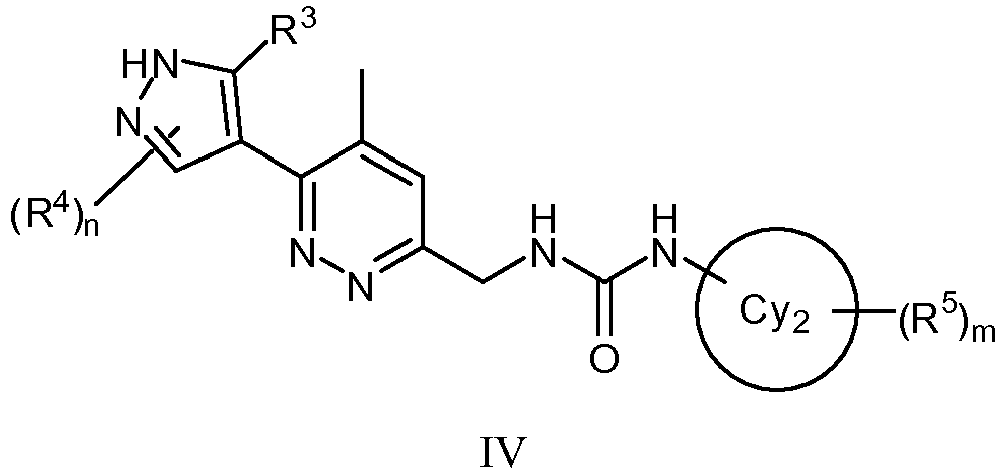
- 41. A compound or a pharmaceutically acceptable salt thereof according to any one of clauses 1-40, wherein R3 is C1-4 alkyl.
- 42. A compound or a pharmaceutically acceptable salt thereof according to any one of clauses 1-40, wherein R3 is -CH3.
- 43. A compound or a pharmaceutically acceptable salt thereof according to any one of clauses 1-40, wherein R3 is C1-4 alkyl substituted with one or more independently selected halo, -CN, -C1-4 alkoxy, or -NR7aR7b.
- 44. A compound or a pharmaceutically acceptable salt thereof according to any one of clauses 1-40, wherein R3 is -CH3, -CH2CH3, or -(CH2)2CH3, each of which is substituted with one, two or three independently selected halo, -CN, -C1-4 alkoxy, or -NR7aR7b.
- 45. A compound or a pharmaceutically acceptable salt thereof according to clause 44, wherein each each R7a and R7b is independently selected from H,-CH3, and -CH2CH3.
- 46. A compound or a pharmaceutically acceptable salt thereof according to any one of clauses 1-40, wherein R3 is -CF3.
- 47. A compound or a pharmaceutically acceptable salt thereof according to any one of clauses 1-40, wherein R3 is C1-4 alkoxy substituted with one or more halo.
- 48. A compound or a pharmaceutically acceptable salt thereof according to any one of clauses 1-40, wherein R3 is -OCH3, -OCH2CH3, or -OCH2CH2CH3, each of is substituted with one or more halo.
- 49. A compound or a pharmaceutically acceptable salt thereof according to any one of clauses 1-40, wherein R3 is -OCF3, -OCH2CHF2 or -OCH2CF3.
- 50. A compound or a pharmaceutically acceptable salt thereof according to any one of clauses 1-40, wherein R3 is C3-7 monocyclic cycloalkyl.
- 51. A compound or a pharmaceutically acceptable salt thereof according to any one of clauses 1-40, wherein R3 is cyclopropyl.
- 52. A compound or a pharmaceutically acceptable salt thereof according to any one of clauses 1-40, wherein R3 is 4-7-membered monocyclic heterocycloalkyl comprising one, two or three heteroatoms independently selected from N, O, and S.
- 53. A compound or a pharmaceutically acceptable salt thereof according to any one of clauses 1-40, wherein R3 is oxetanyl, tetrahydrofuranyl, tetrahydropyranyl, pyrolidinyl, piperidinyl, piperazinyl, morpholinyl, or thiomorpholinyl.
- 54. A compound or a pharmaceutically acceptable salt thereof according to any one of clauses 1-40, wherein R3 is -NR8aR8b wherein each R8a and R8b is independently selected from H, and C1-4 alkyl.
- 55. A compound or a pharmaceutically acceptable salt thereof according to any one of clauses 1-40, wherein R3 is -NR8aR8b wherein each R8a and R8b is independently selected from H,-CH3, and -CH2CH3.
- 56. A compound or a pharmaceutically acceptable salt thereof according to any one of clauses 1-40, wherein R3 is -CONR8cR8d wherein each R8c and R8d is independently selected from H, and C1-4 alkyl.
- 57. A compound or a pharmaceutically acceptable salt thereof according to any one of clauses 1-40, wherein R3 is -CONR8cR8d wherein each R8c and R8d is independently selected from H,-CH3, and -CH2CH3.
- 58. A compound or a pharmaceutically acceptable salt thereof according to any one of clauses 1-57, wherein the subscript n is 0.
- 59. A compound or a pharmaceutically acceptable salt thereof according to any one of clauses 1-57, wherein the subscript n is 1.
- 60. A compound or a pharmaceutically acceptable salt thereof according to clause 1 or 2, wherein the compound or pharmaceutically acceptable salt is according to any one of Formula Va-Vb:

- 61. A compound or a pharmaceutically acceptable salt thereof according to any one of clauses 1-60, wherein R4 is C1-4 alkyl.
- 62. A compound or a pharmaceutically acceptable salt thereof according to any one of clauses 1-60, wherein R4 is -CH3.
- 63. A compound or a pharmaceutically acceptable salt thereof according to any one of clauses 1-60, wherein R4 is C1-4 alkyl substituted with one or more independently selected R12 groups.
- 64. A compound or a pharmaceutically acceptable salt thereof according to any one of clauses 1-60, wherein R4 is -CH3, -CH2CH3, -(CH2)2CH3, or -CH(CH3)2 each of which is substituted with one or more independently selected R12 groups.
- 65. A compound or a pharmaceutically acceptable salt thereof according to any one of clauses 1-60, wherein R4 is C1-4 alkyl substituted with one R12 group.
- 66. A compound or a pharmaceutically acceptable salt thereof according to any one of clauses 1-60, wherein R4 is -CH3, -CH2CH3, -(CH2)2CH3, or -CH(CH3)2 each of which is substituted with one R12 group.
- 67. A compound or a pharmaceutically acceptable salt thereof according to any one of clauses 1-60, wherein R4 is -CH2-R12.
- 68. A compound or a pharmaceutically acceptable salt thereof according to any one of clauses 63-67, wherein R12 is OH, F, or Cl.
- 69. A compound or a pharmaceutically acceptable salt thereof according to any one of clauses 63-67, wherein R12 is C1-4 alkoxy.
- 70. A compound or a pharmaceutically acceptable salt thereof according to any one of clauses 63-67, wherein R12 is -OCH3, or -OCH2CH3.
- 71. A compound or a pharmaceutically acceptable salt thereof according to any one of clauses 63-67, wherein R12 is -SO2-C1-4 alkyl.
- 72. A compound or a pharmaceutically acceptable salt thereof according to any one of clauses 63-67, wherein R12 is -SO2-CH3.
- 73. A compound or a pharmaceutically acceptable salt thereof according to any one of clauses 63-67, wherein R12 is C3-7 monocyclic cycloalkyl.
- 74. A compound or a pharmaceutically acceptable salt thereof according to any one of clauses 63-67, wherein R12 is cyclopropyl, cyclobutyl, or cyclopentyl.
- 75. A compound or a pharmaceutically acceptable salt thereof according to any one of clauses 63-67, wherein R12 is C3-7 monocyclic cycloalkyl substituted with one or more independently selected -OH, halo, -CN, C1-4 alkyl, C1-4 alkoxy or =O.
- 76. A compound or a pharmaceutically acceptable salt thereof according to any one of clauses 63-67, wherein R12 is cyclopropyl, cyclobutyl, or cyclopentyl, each of which is substituted with one or more independently selected -OH, halo, -CN, C1-4 alkyl, C1-4 alkoxy or =O.
- 77. A compound or a pharmaceutically acceptable salt thereof according to any one of clauses 63-67, wherein R12 is cyclopropyl, cyclobutyl, or cyclopentyl, each of which is substituted with one or more independently selected -OH, F, -CN, -CH3, -OCH3 or =O.
- 78. A compound or a pharmaceutically acceptable salt thereof according to any one of clauses 63-67, wherein R12 is 4-7 membered monocyclic heterocycloalkyl, comprising one, two, or three heteroatoms independently selected from N, O, and S.
- 79. A compound or a pharmaceutically acceptable salt thereof according to any one of clauses 63-67, wherein R12 is azetidinyl, pyrrolidinyl, or tetrahydrofuranyl.
- 80. A compound or a pharmaceutically acceptable salt thereof according to any one of clauses 63-67, wherein R12 is 4-7 membered monocyclic heterocycloalkyl, comprising one, two, or three heteroatoms independently selected from N, O, and S, substituted with one or more independently selected -OH, halo, -CN, C1-4 alkyl, C1-4 alkoxy or =O.
- 81. A compound or a pharmaceutically acceptable salt thereof according to any one of clauses 63-67, wherein R12 is azetidinyl, pyrrolidinyl, or tetrahydrofuranyl, each of which is substituted with one or more independently selected -OH, halo, -CN, C1-4 alkyl, C1-4 alkoxy or =O.
- 82. A compound or a pharmaceutically acceptable salt thereof according to any one of clauses 63-67, wherein R12 is azetidinyl, pyrrolidinyl, or tetrahydrofuranyl, each of which is substituted with one or more independently selected -OH, F, -CN, -CH3, -OCH3 or =O.
- 83. A compound or a pharmaceutically acceptable salt thereof according to any one of clauses 63-67, wherein R12 is -NR9aR9b, wherein each R9a and R9b is independently selected from H and C1-4 alkyl.
- 84. A compound or a pharmaceutically acceptable salt thereof according to any one of clauses 63-67, wherein R12 is -NMe2.
- 85. A compound or a pharmaceutically acceptable salt thereof according to any one of clauses 63-67, wherein R12 is -CN.
- 86. A compound or a pharmaceutically acceptable salt thereof according to any one of clauses 1-60, wherein R4 is C3-7 monocyclic cycloalkyl.
- 87. A compound or a pharmaceutically acceptable salt thereof according to any one of clauses 1-60, wherein R4 is cyclopropyl, cyclobutyl, cyclopentyl, or cyclohexyl.
- 88. A compound or a pharmaceutically acceptable salt thereof according to any one of clauses 1-60, wherein R4 is cyclopropyl.
- 89. A compound or a pharmaceutically acceptable salt thereof according to any one of clauses 1-60, wherein R4 is 4-7 membered monocyclic heterocycloalkyl comprising one, two, or three heteroatoms independently selected from N, O, or S.
- 90. A compound or a pharmaceutically acceptable salt thereof according to any one of clauses 1-60, wherein R4 is azetidinyl, pyrrolidinyl, piperazinyl, piperidinyl, morpholinyl, tetrahydrofuranyl, or tetrahydropyranyl.
- 91. A compound or a pharmaceutically acceptable salt thereof according to clause 1 or 2, wherein the compound or pharmaceutically acceptable salt is according to any one of Formula VIa, or VIb:

- 92. A compound or a pharmaceutically acceptable salt thereof according to any one of clauses 1-91, wherein Cy2 is phenyl.
- 93. A compound or a pharmaceutically acceptable salt thereof according to any one of clauses 1-91, wherein Cy2 is 5-6 membered heteroaryl comprising one or two heteroatoms independently selected from N, O, and S.
- 94. A compound or a pharmaceutically acceptable salt thereof according to any one of clauses 1-91, wherein Cy2 is pyridinyl.
- 95. A compound or a pharmaceutically acceptable salt thereof according to clause 1 or 2, wherein the compound or pharmaceutically acceptable salt is according to any one of Formula VIIa, VIIb, VIIc or VIId:


- 96. A compound or a pharmaceutically acceptable salt thereof according to any one of clauses 1-95, wherein the subscript m is 1, 2, 3, or 4.
- 97. A compound or a pharmaceutically acceptable salt thereof according to any one of clauses 1-95, wherein the subscript m is 0.
- 98. A compound or a pharmaceutically acceptable salt thereof according to any one of clauses 1-96, wherein R5 is selected from halo, CN, selected from OH.
- 99. A compound or a pharmaceutically acceptable salt thereof according to any one of clauses 1-96, wherein R5 is selected from F, Cl or CN.
- 100.A compound or a pharmaceutically acceptable salt thereof according to any one of clauses 1-96, wherein R5 is C1-4 alkyl.
- 101. A compound or a pharmaceutically acceptable salt thereof according to any one of clauses 1-96, wherein R5 is -CH3, or -CH2CH3.
- 102.A compound or a pharmaceutically acceptable salt thereof according to any one of clauses 1-96, wherein R5 is C1-4 alkyl substituted with one or more independently selected R13.
- 103.A compound or a pharmaceutically acceptable salt thereof according to any one of clauses 1-96, wherein R5 is -CH3, or -CH2CH3, each of which is substituted with one or more independently selected R13.
- 104.A compound or a pharmaceutically acceptable salt thereof according to any one of clauses 1-96, wherein R5 is C1-4 alkoxy.
- 105.A compound or a pharmaceutically acceptable salt thereof according to any one of clauses 1-96, wherein R5 is -OCH3, or -OCH2CH3.
- 106.A compound or a pharmaceutically acceptable salt thereof according to any one of clauses 1-96, wherein R5 is C1-4 alkoxy substituted with one or more independently selected R13.
- 107.A compound or a pharmaceutically acceptable salt thereof according to any one of clauses 1-96, wherein R5 is -OCH3, or -OCH2CH3s, each of which is substituted with one or more independently selected R13.
- 108.A compound or a pharmaceutically acceptable salt thereof according to any one of clauses 102, 103, 106 or 107, wherein R13 is F, -CN, -OH, -OCH3, -OCF3, -OCH2CH3, -OCH2CF3, -OCH2CH2OH, or -OCH2CH2OCH3.
- 109.A compound or a pharmaceutically acceptable salt thereof according to any one of clauses 102, 103, 106 or 107, wherein R13 is C3-7 monocyclic cycloalkyl substituted with one or more independently selected F, -CH3, -CH2CH3. -CF3, and -CH2CF3.
- 110.A compound or a pharmaceutically acceptable salt thereof according to any one of clauses 102, 103, 106 or 107, wherein R13 is cyclopropyl, cyclobutyl, cyclopentyl, or cyclohexyl, each of which is substituted with one or more independently selected F, -CH3, -CH2CH3. -CF3, and -CH2CF3.
- 111.A compound or a pharmaceutically acceptable salt thereof according to any one of clauses 1-96, wherein R5 is -CF3.
- 112.A compound or a pharmaceutically acceptable salt thereof according to any one of clauses 1-96, wherein R5 is -OCF3, -OCH2CH2F, -OCH2CH2OCH3, -OCH2CH2OH, or -OCH2CHF2.
- 113.A compound or a pharmaceutically acceptable salt thereof according to any one of clauses 1-96, wherein R5 is C3-7 monocyclic cycloalkyl.
- 114.A compound or a pharmaceutically acceptable salt thereof according to any one of clauses 1-96, wherein R5 is cyclopropyl, or cyclobutyl.
- 115.A compound or a pharmaceutically acceptable salt thereof according to any one of clauses 1-96, wherein R5 is C3-7 monocyclic cycloalkyl substituted with one or more independently selected R14 group.
- 116.A compound or a pharmaceutically acceptable salt thereof according to any one of clauses 1-96, wherein R5 is cyclopropyl, cyclobutyl, cyclopentyl, or cyclohexyl, each of which is substituted with one or more independently selected R14 group.
- 117.A compound or a pharmaceutically acceptable salt thereof according to any one of clauses 1-96, wherein R5 is 4-11 membered monocyclic, or fused or spiro bicyclic heterocycloalkyl comprising one, two, or three heteroatoms independently selected from N, O, and S.
- 118.A compound or a pharmaceutically acceptable salt thereof according to any one of clauses 1-96, wherein R5 is azetidinyl, oxetanyl, tetrahydrofuranyl, pyrolidinyl, tetrahydropyranyl, piperidininyl, piperazinyl, morpholinyl, thiomorpholinyl, dioxanyl.
- 119.A compound or a pharmaceutically acceptable salt thereof according to any one of clauses 1-96, wherein R5 is 4-11 membered monocyclic, or fused or spiro bicyclic heterocycloalkyl comprising one, two, or three heteroatoms independently selected from N, O, and S, substituted with one or more independently selected R14 group.
- 120.A compound or a pharmaceutically acceptable salt thereof according to any one of clauses 1-96, wherein R5 is azetidinyl, oxetanyl, tetrahydrofuranyl, pyrolidinyl, tetrahydropyranyl, piperidininyl, piperazinyl, morpholinyl, thiomorpholinyl, dioxanyl, each of which is substituted with one or more independently selected R14 group.
- 121.A compound or a pharmaceutically acceptable salt thereof according to any one of clauses 1-96, wherein R5 is -O-C3-7 monocyclic cycloalkyl.
- 122.A compound or a pharmaceutically acceptable salt thereof according to any one of clauses 1-96, wherein R5 is -O-cyclopropyl, -O-cyclobutyl, -O-cyclopentyl, or -O-cyclohexyl.
- 123.A compound or a pharmaceutically acceptable salt thereof according to any one of clauses 1-96, wherein R5 is -O-C3-7 monocyclic cycloalkyl substituted with one or more independently selected R14 group.
- 124.A compound or a pharmaceutically acceptable salt thereof according to any one of clauses 1-96, wherein R5 is -O-cyclopropyl, -O-cyclobutyl, -O-cyclopentyl, or -O-cyclohexyl, each of which is substituted with one or more independently selected R14 group.
- 125.A compound or a pharmaceutically acceptable salt thereof according to any one of clauses 1-96, wherein R5 is -O-heterocycloalkyl, wherein said heterocycloalkyl is a 4-7 membered monocyclic heterocycloalkyl comprising one, two, or three heteroatoms independently selected from O, and S.
- 126.A compound or a pharmaceutically acceptable salt thereof according to any one of clauses 1-96, wherein R5 is -O-oxetanyl, -O-tetrahydrofuranyl, -O-tetrahydropyranyl, or -O-dioxanyl.
- 127.A compound or a pharmaceutically acceptable salt thereof according to any one of clauses 1-96, wherein R5 is -O-heterocycloalkyl, wherein said heterocycloalkyl is a 4-7 membered monocyclic heterocycloalkyl comprising one, two, or three heteroatoms independently selected from O, and S, substituted with one or more independently selected R14 group.
- 128.A compound or a pharmaceutically acceptable salt thereof according to any one of clauses 1-96, wherein R5 is -O-oxetanyl, -O-tetrahydrofuranyl, -O-tetrahydropyranyl, or -O-dioxanyl, each of which is substituted with one or more independently selected R14 group.
- 129.A compound or a pharmaceutically acceptable salt thereof according to any one of clauses 115, 116, 119, 120, 123, 124, 127, or 128, wherein R14 is F, Cl, -OH, -CN, -CH3, -CH2CH3, -CF3, -CH2CHF2, -OCH3, -OCH2CH3, -OCF3, -OCH2CHF2.
- 130.A compound or a pharmaceutically acceptable salt thereof according to any one of clauses 1-96, wherein R5 is -SO2-CH3.
- 131.A compound or a pharmaceutically acceptable salt thereof according to any one of clauses 1-96, wherein R5 is -SO2-NR15aR15b, wherein each R15a and R15b is independently selected from H and -CH3.
- 132.A compound or a pharmaceutically acceptable salt thereof according to any one of clauses 1-96, wherein R5 is -C(=O)NR15cR15d, wherein each R15c and R15d is independently selected from H and -CH3.
- 133.A compound or a pharmaceutically acceptable salt thereof according to any one of clauses 1-96, wherein R5 is -NR17aR17b, wherein each R17a and R17b is independently selected from H, -CH3, -CH2CH3, -CH2CF3, -CH2CHF2, -CH2CH2OH and -CH2CH2OCH3.
- When employed as a pharmaceutical, a compound of the invention is typically administered in the form of a pharmaceutical composition. Such compositions can be prepared in a manner well known in the pharmaceutical art and comprise at least one active compound of the invention according to Formula Ia or Ib. Generally, a compound of the invention is administered in a pharmaceutically effective amount. The amount of compound of the invention actually administered will typically be determined by a physician, in the light of the relevant circumstances, including the condition to be treated, the chosen route of administration, the actual compound of the invention administered, the age, weight, and response of the individual patient, the severity of the patient's symptoms, and the like.
- The pharmaceutical compositions of this invention can be administered by a variety of routes including oral, rectal, transdermal, subcutaneous, intra-articular, intravenous, intramuscular, and intranasal. Depending on the intended route of delivery, a compound of the invention is preferably formulated as either injectable or oral compositions or as salves, as lotions or as patches all for transdermal administration.
- The compositions for oral administration can take the form of bulk liquid solutions or suspensions, or bulk powders. More commonly, however, the compositions are presented in unit dosage forms to facilitate accurate dosing. The term 'unit dosage forms' refers to physically discrete units suitable as unitary dosages for human subjects and other mammals, each unit containing a predetermined quantity of active material calculated to produce the desired therapeutic effect, in association with a suitable pharmaceutical excipient, vehicle or carrier. Typical unit dosage forms include prefilled, premeasured ampules or syringes of the liquid compositions or pills, tablets, capsules or the like in the case of solid compositions. In such compositions, the compound of the invention according to Formula I is usually a minor component (from about 0.1 to about 50% by weight or preferably from about 1 to about 40% by weight) with the remainder being various vehicles or carriers and processing aids helpful for forming the desired dosing form.
- Liquid forms suitable for oral administration may include a suitable aqueous or non-aqueous vehicle with buffers, suspending and dispensing agents, colorants, flavors and the like. Solid forms may include, for example, any of the following ingredients, or compound of the inventions of a similar nature: a binder such as microcrystalline cellulose, gum tragacanth or gelatin; an excipient such as starch or lactose, a disintegrating agent such as alginic acid, Primogel, or corn starch; a lubricant such as magnesium stearate; a glidant such as colloidal silicon dioxide; a sweetening agent such as sucrose or saccharin; or a flavoring agent such as peppermint or orange flavoring.
- Injectable compositions are typically based upon injectable sterile saline or phosphate-buffered saline or other injectable carriers known in the art. As before, the active compound of the invention according to Formula I in such compositions is typically a minor component, often being from about 0.05 to 10% by weight with the remainder being the injectable carrier and the like.
- Transdermal compositions are typically formulated as a topical ointment or cream containing the active ingredient(s), generally in an amount ranging from about 0.01 to about 20% by weight, preferably from about 0.1 to about 20% by weight, preferably from about 0.1 to about 10% by weight, and more preferably from about 0.5 to about 15% by weight. When formulated as an ointment, the active ingredients will typically be combined with either a paraffinic or a water-miscible ointment base. Alternatively, the active ingredients may be formulated in a cream with, for example an oil-in-water cream base. Such transdermal formulations are well-known in the art and generally include additional ingredients to enhance the dermal penetration of stability of the active ingredients or the formulation. All such known transdermal formulations and ingredients are included within the scope of this invention.
- A compound of the invention can also be administered by a transdermal device. Accordingly, transdermal administration can be accomplished using a patch either of the reservoir or porous membrane type, or of a solid matrix variety.
- The above-described components for orally administrable, injectable or topically administrable compositions are merely representative. Other materials as well as processing techniques and the like are set forth in Part 8 of Remington's Pharmaceutical Sciences, 17th edition, 1985, Mack Publishing Company, Easton, Pennsylvania, which is incorporated herein by reference.
- A compound of the invention can also be administered in sustained release forms or from sustained release drug delivery systems. A description of representative sustained release materials can be found in Remington's Pharmaceutical Sciences.
- The following formulation examples illustrate representative pharmaceutical compositions that may be prepared in accordance with this invention. The present invention, however, is not limited to the following pharmaceutical compositions.
- A compound of the invention according to Formula I may be admixed as a dry powder with a dry gelatin binder in an approximate 1:2 weight ratio. A minor amount of magnesium stearate may be added as a lubricant. The mixture may be formed into 240-270 mg tablets (80-90 mg of active compound of the invention according to Formula I per tablet) in a tablet press.
- A compound of the invention according to Formula I may be admixed as a dry powder with a starch diluent in an approximate 1:1 weight ratio. The mixture may be filled into 250 mg capsules (125 mg of active compound of the invention according to Formula I per capsule).
- A compound of the invention according to Formula I (125 mg), may be admixed with sucrose (1.75 g) and xanthan gum (4 mg) and the resultant mixture may be blended, passed through a No. 10 mesh U.S. sieve, and then mixed with a previously made solution of microcrystalline cellulose and sodium carboxymethyl cellulose (11:89, 50 mg) in water. Sodium benzoate (10 mg), flavor, and color may be diluted with water and added with stirring. Sufficient water may then be added with stirring. Further sufficient water may be then added to produce a total volume of 5 mL.
- A compound of the invention according to Formula I may be admixed as a dry powder with a dry gelatin binder in an approximate 1:2 weight ratio. A minor amount of magnesium stearate may be added as a lubricant. The mixture may be formed into 450-900 mg tablets (150-300 mg of active compound of the invention according to Formula I) in a tablet press.
- A compound of the invention according to Formula I may be dissolved or suspended in a buffered sterile saline injectable aqueous medium to a concentration of approximately 5 mg/mL.
- Stearyl alcohol (250 g) and a white petrolatum (250 g) may be melted at about 75°C and then a mixture of A compound of the invention according to Formula I (50 g) methylparaben (0.25 g), propylparaben (0.15 g), sodium lauryl sulfate (10 g), and propylene glycol (120 g) dissolved in water (about 370 g) may be added and the resulting mixture may be stirred until it congeals.
- In one embodiment, the present invention provides compounds of the invention, or pharmaceutical compositions comprising a compound of the invention, for use in medicine. In a particular embodiment, the present invention provides compounds of the invention or pharmaceutical compositions comprising a compound of the invention, for use in the prophylaxis and/or treatment of fibrotic diseases, inflammatory diseases, autoimmune diseases, metabolic diseases, cardiovascular diseases, and/or proliferative diseases.
- In another embodiment, the present invention provides compounds of the invention, or pharmaceutical compositions comprising a compound of the invention for use in the manufacture of a medicament for use in the prophylaxis and/or treatment of fibrotic diseases, inflammatory diseases, autoimmune diseases, metabolic diseases, cardiovascular diseases, and/or proliferative diseases.
- In additional method of treatment aspects, this invention provides methods of prophylaxis and/or treatment of a mammal afflicted with fibrotic diseases, inflammatory diseases, autoimmune diseases, metabolic diseases, cardiovascular diseases, and/or proliferative diseases, which methods comprise the administration of an effective amount of a compound of the invention or one or more of the pharmaceutical compositions herein described for the treatment or prophylaxis of said condition.
- In one embodiment, the present invention provides pharmaceutical compositions comprising a compound of the invention, and another therapeutic agent. In a particular embodiment, the other therapeutic agent is a fibrotic diseases, inflammatory diseases, autoimmune diseases, metabolic diseases, cardiovascular diseases, and/or proliferative diseases treatment agent.
- In one embodiment, the present invention provides compounds of the invention or pharmaceutical compositions comprising a compound of the invention, for use in the prophylaxis and/or treatment of fibrotic diseases. In a more particular embodiment, the fibrotic disease is selected from idiopathic pulmonary fibrosis, Dupuytren disease, nonalcoholic steatohepatitis, portal hypertension, systemic sclerosis, renal fibrosis, and cutaneous fibrosis. In a most particular embodiment, the fibrotic disease is idiopathic pulmonary fibrosis.
- In another embodiment, the present invention provides compounds of the invention, or pharmaceutical compositions comprising a compound of the invention for use in the manufacture of a medicament for use in the prophylaxis and/or treatment of fibrotic diseases. In a more particular embodiment, the fibrotic disease is selected from idiopathic pulmonary fibrosis, Dupuytren disease, nonalcoholic steatohepatitis, portal hypertension, systemic sclerosis, renal fibrosis, and cutaneous fibrosis. In a most particular embodiment, the fibrotic disease is idiopathic pulmonary fibrosis.
- In additional method of treatment aspects, this invention provides methods of prophylaxis and/or treatment of a mammal afflicted with fibrotic diseases, which methods comprise the administration of an effective amount of a compound of the invention or one or more of the pharmaceutical compositions herein described for the treatment or prophylaxis of said condition. In a more particular embodiment, the fibrotic disease is selected from idiopathic pulmonary fibrosis, Dupuytren disease, nonalcoholic steatohepatitis, portal hypertension, systemic sclerosis, renal fibrosis, and cutaneous fibrosis. In a most particular embodiment, the fibrotic disease is idiopathic pulmonary fibrosis.
- In one embodiment, the present invention provides pharmaceutical compositions comprising a compound of the invention, and another therapeutic agent. In a particular embodiment, the other therapeutic agent is a fibrotic diseases treatment agent. In a more particular embodiment, the fibrotic disease is selected from idiopathic pulmonary fibrosis, Dupuytren disease, nonalcoholic steatohepatitis, portal hypertension, systemic sclerosis, renal fibrosis, and cutaneous fibrosis. In a most particular embodiment, the fibrotic disease is idiopathic pulmonary fibrosis.
- In a particular embodiment, the present invention provides compounds of the invention or pharmaceutical compositions comprising a compound of the invention, for use in the prophylaxis and/or treatment of inflammatory diseases. In a particular embodiment, the inflammatory disease is selected from rheumatoid arthritis, osteoarthritis, allergic airway disease, chronic obstructive pulmonary disease and inflammatory bowel diseases.
- In another embodiment, the present invention provides compounds of the invention, or pharmaceutical compositions comprising a compound of the invention for use in the manufacture of a medicament for use in the prophylaxis and/or treatment of inflammatory diseases. In a particular embodiment, the inflammatory disease is selected from rheumatoid arthritis, osteoarthritis, allergic airway disease, chronic obstructive pulmonary disease and inflammatory bowel diseases.
- In additional method of treatment aspects, this invention provides methods of prophylaxis and/or treatment of a mammal afflicted with inflammatory diseases, which methods comprise the administration of an effective amount of a compound of the invention or one or more of the pharmaceutical compositions herein described for the treatment or prophylaxis of said condition. In a particular embodiment, the inflammatory disease is selected from rheumatoid arthritis, osteoarthritis, allergic airway disease, chronic obstructive pulmonary disease and inflammatory bowel diseases.
- In one embodiment, the present invention provides pharmaceutical compositions comprising a compound of the invention, and another therapeutic agent. In a particular embodiment, the other therapeutic agent is an agent for the prophylaxis and/or treatment of inflammatory diseases. In a particular embodiment, the inflammatory disease is selected from rheumatoid arthritis, osteoarthritis, allergic airway disease, chronic obstructive pulmonary disease and inflammatory bowel diseases.
- In a particular embodiment, the present invention provides compounds of the invention or pharmaceutical compositions comprising a compound of the invention, for use in the prophylaxis and/or treatment of autoimmune diseases. In a particular embodiment, the autoimmune disease is selected from chronic obstructive pulmonary disease, asthma, systemic lupus erythematosus, type I diabetes mellitus and inflammatory bowel disease.
- In another embodiment, the present invention provides compounds of the invention, or pharmaceutical compositions comprising a compound of the invention for use in the manufacture of a medicament for use in the prophylaxis and/or treatment of autoimmune diseases. In a particular embodiment, the autoimmune disease is selected from chronic obstructive pulmonary disease, asthma, systemic lupus erythematosus, type I diabetes mellitus and inflammatory bowel disease.
- In additional method of treatment aspects, this invention provides methods of prophylaxis and/or treatment of a mammal afflicted with autoimmune diseases, which methods comprise the administration of an effective amount of a compound of the invention or one or more of the pharmaceutical compositions herein described for the treatment or prophylaxis of said condition. In a particular embodiment, the autoimmune disease is selected from chronic obstructive pulmonary disease, asthma, systemic lupus erythematosus, type I diabetes mellitus and inflammatory bowel disease.
- In one embodiment, the present invention provides pharmaceutical compositions comprising a compound of the invention, and another therapeutic agent. In a particular embodiment, the other therapeutic agent is an autoimmune diseases treatment agent. In a particular embodiment, the autoimmune disease is selected from chronic obstructive pulmonary disease, asthma, systemic lupus erythematosus, type I diabetes mellitus and inflammatory bowel disease.
- In a particular embodiment, the present invention provides compounds of the invention or pharmaceutical compositions comprising a compound of the invention, for use in the prophylaxis and/or treatment of metabolic diseases. In a particular embodiment, the metabolic disease is selected from cystic fibrosis, phenylketonuria (PKU), diabetes, hyperlipidemia, gout, and rickets. In a more particular embodiment, the cardiovascular disease is diabetes or hyperlidemia.
- In another embodiment, the present invention provides compounds of the invention, or pharmaceutical compositions comprising a compound of the invention for use in the manufacture of a medicament for use in the prophylaxis and/or treatment of metabolic diseases. In a particular embodiment, the metabolic disease is selected from cystic fibrosis, phenylketonuria (PKU), diabetes, hyperlipidemia, gout, and rickets. In a more particular embodiment, the cardiovascular disease is diabetes or hyperlidemia.
- In additional method of treatment aspects, this invention provides methods of prophylaxis and/or treatment of a mammal afflicted with metabolic diseases, which methods comprise the administration of an effective amount of a compound of the invention or one or more of the pharmaceutical compositions herein described for the treatment or prophylaxis of said condition. In a particular embodiment, the metabolic disease is selected from cystic fibrosis, phenylketonuria (PKU), diabetes, hyperlipidemia, gout, and rickets. In a more particular embodiment, the cardiovascular disease is diabetes or hyperlidemia.
- In one embodiment, the present invention provides pharmaceutical compositions comprising a compound of the invention, and another therapeutic agent. In a particular embodiment, the other therapeutic agent is a metabolic diseases treatment agent. In a particular embodiment, the metabolic disease is selected from cystic fibrosis, phenylketonuria (PKU), diabetes, hyperlipidemia, gout, and rickets. In a more particular embodiment, the cardiovascular disease is diabetes or hyperlidemia.
- In a particular embodiment, the present invention provides compounds of the invention or pharmaceutical compositions comprising a compound of the invention, for use in the prophylaxis and/or treatment of cardiovascular diseases. In a particular embodiment, the cardiovascular disease is selected from stroke, vasculitis, angina, atherosclerosis, and peripheral obstructive arteriopathy. In a more particular embodiment, the cardiovascular disease is stroke, or vasculitis. In another more particular embodiment, the cardiovascular disease is atherosclerosis or reperfusion injury following ischemia.
- In another embodiment, the present invention provides compounds of the invention, or pharmaceutical compositions comprising a compound of the invention for use in the manufacture of a medicament for use in the prophylaxis and/or treatment of cardiovascular diseases. In a particular embodiment, the cardiovascular disease is selected from stroke, vasculitis, angina, atherosclerosis, and peripheral obstructive arteriopathy. In a more particular embodiment, the cardiovascular disease is stroke, or vasculitis. In another more particular embodiment, the cardiovascular disease is atherosclerosis or reperfusion injury following ischemia.
- In additional method of treatment aspects, this invention provides methods of prophylaxis and/or treatment of a mammal afflicted with cardiovascular diseases, which methods comprise the administration of an effective amount of a compound of the invention or one or more of the pharmaceutical compositions herein described for the treatment or prophylaxis of said condition. In a particular embodiment, the cardiovascular disease is selected from stroke, vasculitis, angina, atherosclerosis, and peripheral obstructive arteriopathy. In a more particular embodiment, the cardiovascular disease is stroke, or vasculitis. In another more particular embodiment, the cardiovascular disease is atherosclerosis or reperfusion injury following ischemia.
- In one embodiment, the present invention provides pharmaceutical compositions comprising a compound of the invention, and another therapeutic agent. In a particular embodiment, the other therapeutic agent is a cardiovascular diseases treatment agent. In a particular embodiment, the cardiovascular disease is selected from stroke, vasculitis, angina, atherosclerosis, and peripheral obstructive arteriopathy. In a more particular embodiment, the cardiovascular disease is stroke, or vasculitis. In another more particular embodiment, the cardiovascular disease is atherosclerosis or reperfusion injury following ischemia.
- In a particular embodiment, the present invention provides compounds of the invention or pharmaceutical compositions comprising a compound of the invention, for use in the prophylaxis and/or treatment of proliferative diseases. In a particular embodiment, the proliferative disease is selected from Wilm's tumor, glioblastoma, lung cancer, breast cancer, ovarian cancer, and melanoma.
- In another embodiment, the present invention provides compounds of the invention, or pharmaceutical compositions comprising a compound of the invention for use in the manufacture of a medicament for use in the prophylaxis and/or treatment of proliferative diseases. In a particular embodiment, the proliferative disease is selected from Wilm's tumor, glioblastoma, lung cancer, breast cancer, ovarian cancer, and melanoma.
- In additional method of treatment aspects, this invention provides methods of prophylaxis and/or treatment of a mammal afflicted with proliferative diseases, which methods comprise the administration of an effective amount of a compound of the invention or one or more of the pharmaceutical compositions herein described for the treatment or prophylaxis of said condition. In a particular embodiment, the proliferative disease is selected from Wilm's tumor, glioblastoma, lung cancer, breast cancer, ovarian cancer, and melanoma.
- In one embodiment, the present invention provides pharmaceutical compositions comprising a compound of the invention, and another therapeutic agent. In a particular embodiment, the other therapeutic agent is a proliferative diseases treatment agent. In a particular embodiment, the proliferative disease is selected from Wilm's tumor, glioblastoma, lung cancer, breast cancer, ovarian cancer, and melanoma.
- Injection dose levels range from about 0.1 mg/kg/h to at least 10 mg/kg/h, all for from about 1 to about 120 h and especially 24 to 96 h. A preloading bolus of from about 0.1 mg/kg to about 10 mg/kg or more may also be administered to achieve adequate steady state levels. The maximum total dose is not expected to exceed about 1 g/day for a 40 to 80 kg human patient.
- For the prophylaxis and/or treatment of long-term conditions, such as degenerative conditions, the regimen for treatment usually stretches over many months or years so oral dosing is preferred for patient convenience and tolerance. With oral dosing, one to four (1-4) regular doses daily, especially one to three (1-3) regular doses daily, typically one to two (1-2) regular doses daily, and most typically one (1) regular dose daily are representative regimens. Alternatively for long lasting effect drugs, with oral dosing, once every other week, once weekly, and once a day are representative regimens. In particular, dosage regimen can be every 1-14 days, more particularly 1-10 days, even more particularly 1-7 days, and most particularly 1-3 days.
- Using these dosing patterns, each dose provides from about 1 to about 1000 mg of a compound of the invention, with particular doses each providing from about 10 to about 500 mg and especially about 30 to about 250 mg.
- Transdermal doses are generally selected to provide similar or lower blood levels than are achieved using injection doses.
- When used to prevent the onset of a condition, a compound of the invention will be administered to a patient at risk for developing the condition, typically on the advice and under the supervision of a physician, at the dosage levels described above. Patients at risk for developing a particular condition generally include those that have a family history of the condition, or those who have been identified by genetic testing or screening to be particularly susceptible to developing the condition.
- A compound of the invention can be administered as the sole active agent or it can be administered in combination with other therapeutic agents, including other compound of the inventions that demonstrate the same or a similar therapeutic activity and that are determined to be safe and efficacious for such combined administration. In a specific embodiment, co-administration of two (or more) agents allows for significantly lower doses of each to be used, thereby reducing the side effects seen.
- In one embodiment, a compound of the invention or a pharmaceutical composition comprising a compound of the invention is administered as a medicament. In a specific embodiment, said pharmaceutical composition additionally comprises a further active ingredient.
- In one embodiment, a compound of the invention is co-administered with one or more further therapeutic agents for the treatment and/or prophylaxis of a fibrotic disease. In a particular embodiment, a compound of the invention is co-administered with one or two further therapeutic agents for the treatment and/or prophylaxis of a fibrotic disease. In a more particular embodiment, a compound of the invention is co-administered with one further therapeutic agent for the treatment and/or prophylaxis of a fibrotic disease.
- In one embodiment, the further therapeutic agent for the treatment and/or prophylaxis of a fibrotic disease include, but are not limited to 5-methyl-1-phenyl-2-(1H)-pyridone (Pirfenidone®); Nintedanib (Ofev® or Vargatef®); STX-100 (ClinicalTrials.gov Identifier NCT01371305), FG-3019 (ClinicalTrials.gov Identifier NCT01890265), Lebrikizumab (CAS n# 953400-68-5); Tralokinumab (CAS n# 1044515-88-9). In another particular embodiment, the further therapeutic agent for the treatment and/or prophylaxis of a fibrotic disease is an autotaxin (or ectonucleotide pyrophosphatase/phosphodiesterase 2 or NPP2 or ENPP2) inhibitor.
- In one embodiment, a compound of the invention is co-administered with another therapeutic agent for the treatment and/or prophylaxis of a disease involving inflammation, particular agents include, but are not limited to, immunoregulatory agents e.g. azathioprine, corticosteroids (e.g. prednisolone or dexamethasone), cyclophosphamide, cyclosporin A, tacrolimus, mycophenolate, mofetil, muromonab-CD3 (OKT3, e.g. Orthocolone®), ATG, aspirin, acetaminophen, ibuprofen, naproxen, and piroxicam.
- In one embodiment, a compound of the invention is co-administered with another therapeutic agent for the treatment and/or prophylaxis of arthritis (e.g. rheumatoid arthritis), particular agents include but are not limited to analgesics, non-steroidal anti-inflammatory drugs (NSAIDS), steroids, synthetic DMARDS (for example but without limitation methotrexate, leflunomide, sulfasalazine, auranofin, sodium aurothiomalate, penicillamine, chloroquine, hydroxychloroquine, azathioprine, tofacitinib, baricitinib, fostamatinib, and cyclosporin), and biological DMARDS (for example but without limitation infliximab, etanercept, adalimumab, rituximab, and abatacept).
- In one embodiment, a compound of the invention is co-administered with another therapeutic agent for the treatment and/or prophylaxis of proliferative diseases, particular agents include but are not limited to: methotrexate, leukovorin, adriamycin, prednisone, bleomycin, cyclophosphamide, 5-fluorouracil, paclitaxel, docetaxel, vincristine, vinblastine, vinorelbine, doxorubicin, tamoxifen, toremifene, megestrol acetate, anastrozole, goserelin, anti-HER2 monoclonal antibody (e.g. HerceptinTM), capecitabine, raloxifene hydrochloride, EGFR inhibitors (e.g. lressa®, Tarceva™, Erbitux™), VEGF inhibitors (e.g. Avastin™), proteasome inhibitors (e.g. Velcade™), Glivec® and hsp90 inhibitors (e.g. 17-AAG). Additionally, the compound of the invention according to Formula I may be administered in combination with other therapies including, but not limited to, radiotherapy or surgery. In a specific embodiment the proliferative disease is selected from cancer, myeloproliferative disease or leukaemia.
- In one embodiment, a compound of the invention is co-administered with another therapeutic agent for the treatment and/or prophylaxis of autoimmune diseases, particular agents include but are not limited to: glucocorticoids, cytostatic agents (e.g. purine analogs), alkylating agents, (e.g nitrogen mustards (cyclophosphamide), nitrosoureas, platinum compound of the inventions, and others), antimetabolites (e.g. methotrexate, azathioprine and mercaptopurine), cytotoxic antibiotics (e.g. dactinomycin anthracyclines, mitomycin C, bleomycin, and mithramycin), antibodies (e.g. anti-CD20, anti-CD25 or anti-CD3 (OTK3) monoclonal antibodies, Atgam® and Thymoglobuline®), cyclosporin, tacrolimus, rapamycin (sirolimus), interferons (e.g. IFN-β), TNF binding proteins (e.g. infliximab, etanercept, or adalimumab), mycophenolate, fingolimod and myriocin.
- In one embodiment, a compound of the invention is co-administered with another therapeutic agent for the treatment and/or prophylaxis of transplant rejection, particular agents include but are not limited to: calcineurin inhibitors (e.g. cyclosporin or tacrolimus (FK506)), mTOR inhibitors (e.g. sirolimus, everolimus), anti-proliferatives (e.g. azathioprine, mycophenolic acid), corticosteroids (e.g. prednisolone, hydrocortisone), antibodies (e.g. monoclonal anti-IL-2Rα receptor antibodies, basiliximab, daclizumab), polyclonal anti-T-cell antibodies (e.g. anti-thymocyte globulin (ATG), anti-lymphocyte globulin (ALG)).
- In one embodiment, a compound of the invention is co-administered with another therapeutic agent for the treatment and/or prophylaxis of asthma and/or rhinitis and/or chronic obstructive pulmonary disease, particular agents include but are not limited to: beta2-adrenoceptor agonists (e.g. salbutamol, levalbuterol, terbutaline and bitolterol), epinephrine (inhaled or tablets), anticholinergics (e.g. ipratropium bromide), glucocorticoids (oral or inhaled). Long-acting β2-agonists (e.g. salmeterol, formoterol, bambuterol, and sustained-release oral albuterol), combinations of inhaled steroids and long-acting bronchodilators (e.g. fluticasone/salmeterol, budesonide/formoterol), leukotriene antagonists and synthesis inhibitors (e.g. montelukast, zafirlukast and zileuton), inhibitors of mediator release (e.g. cromoglycate and ketotifen), biological regulators of IgE response (e.g. omalizumab), antihistamines (e.g. ceterizine, cinnarizine, fexofenadine) and vasoconstrictors (e.g. oxymethazoline, xylomethazoline, nafazoline and tramazoline).
- Additionally, a compound of the invention may be administered in combination with emergency therapies for asthma and/or chronic obstructive pulmonary disease, such therapies include oxygen or heliox administration, nebulized salbutamol or terbutaline (optionally combined with an anticholinergic (e.g. ipratropium), systemic steroids (oral or intravenous, e.g. prednisone, prednisolone, methylprednisolone, dexamethasone, or hydrocortisone), intravenous salbutamol, non-specific beta-agonists, injected or inhaled (e.g. epinephrine, isoetharine, isoproterenol, metaproterenol), anticholinergics (IV or nebulized, e.g. glycopyrrolate, atropine, ipratropium), methylxanthines (theophylline, aminophylline, bamiphylline), inhalation anesthetics that have a bronchodilatory effect (e.g. isoflurane, halothane, enflurane), ketamine and intravenous magnesium sulfate.
- In one embodiment, a compound of the invention is co-administered with another therapeutic agent for the treatment and/or prophylaxis of inflammatory bowel disease (IBD), particular agents include but are not limited to: glucocorticoids (e.g. prednisone, budesonide) synthetic disease modifying, immunomodulatory agents (e.g. methotrexate, leflunomide, sulfasalazine, mesalazine, azathioprine, 6-mercaptopurine and cyclosporin) and biological disease modifying, immunomodulatory agents (infliximab, adalimumab, rituximab, and abatacept).
- In one embodiment, a compound of the invention is co-administered with another therapeutic agent for the treatment and/or prophylaxis of SLE, particular agents include but are not limited to: human monoclonal antibodies (belimumab (Benlysta)), Disease-modifying antirheumatic drugs (DMARDs) such as antimalarials (e.g. plaquenil, hydroxychloroquine), immunosuppressants (e.g. methotrexate and azathioprine), cyclophosphamide and mycophenolic acid, immunosuppressive drugs and analgesics, such as nonsteroidal anti-inflammatory drugs, opiates (e.g. dextropropoxyphene and co-codamol), opioids (e.g. hydrocodone, oxycodone, MS Contin, or methadone) and the fentanyl duragesic transdermal patch.
- In one embodiment, a compound of the invention is co-administered with another therapeutic agent for the treatment and/or prophylaxis of psoriasis, particular agents include but are not limited to: topical treatments such as bath solutions, moisturizers, medicated creams and ointments containing coal tar, dithranol (anthralin), corticosteroids like desoximetasone (Topicort™), fluocinonide, vitamin D3 analogues (for example, calcipotriol), argan oil and retinoids (etretinate, acitretin, tazarotene), systemic treatments such as methotrexate, cyclosporine, retinoids, tioguanine, hydroxyurea, sulfasalazine, mycophenolate mofetil, azathioprine, tacrolimus, fumaric acid esters or biologics such as Amevive™, Enbrel™, Humira™, Remicade™, Raptiva™ and ustekinumab (a IL-12 and IL-23 blocker). Additionally, a compound of the invention may be administered in combination with other therapies including, but not limited to phototherapy, or photochemotherapy (e.g. psoralen and ultraviolet A phototherapy (PUVA)).
- In one embodiment, a compound of the invention is co-administered with another therapeutic agent for the treatment and/or prophylaxis of allergic reaction, particular agents include but are not limited to: antihistamines (e.g. cetirizine, diphenhydramine, fexofenadine, levocetirizine), glucocorticoids (e.g. prednisone, betamethasone, beclomethasone, dexamethasone), epinephrine, theophylline or anti-leukotrienes (e.g. montelukast or zafirlukast), anti-cholinergics and decongestants.
- By co-administration is included any means of delivering two or more therapeutic agents to the patient as part of the same treatment regime, as will be apparent to the skilled person. Whilst the two or more agents may be administered simultaneously in a single formulation, i.e. as a single pharmaceutical composition, this is not essential. The agents may be administered in different formulations and at different times.
- The compound of the invention can be prepared from readily available starting materials using the following general methods and procedures. It will be appreciated that where typical or preferred process conditions (i.e. reaction temperatures, times, mole ratios of reactants, solvents, pressures, etc.) are given, other process conditions can also be used unless otherwise stated. Optimum reaction conditions may vary with the particular reactants or solvent used, but such conditions can be determined by one skilled in the art by routine optimization procedures.
- Additionally, as will be apparent to those skilled in the art, conventional protecting groups may be necessary to prevent certain functional groups from undergoing undesired reactions. The choice of a suitable protecting group for a particular functional group as well as suitable conditions for protection and deprotection are well known in the art (Greene, T W; Wuts, P G M;, 1991).
- The following methods are presented with details as to the preparation of a compound of the invention as defined hereinabove and the comparative examples. A compound of the invention may be prepared from known or commercially available starting materials and reagents by one skilled in the art of organic synthesis.
- All reagents were of commercial grade and were used as received without further purification, unless otherwise stated. Commercially available anhydrous solvents were used for reactions conducted under inert atmosphere. Reagent grade solvents were used in all other cases, unless otherwise specified. Column chromatography was performed on silica gel 60 (35-70 µm). Thin layer chromatography was carried out using pre-coated silica gel F-254 plates (thickness 0.25 mm). 1H NMR spectra were recorded on a Bruker DPX 400 NMR spectrometer (400 MHz or a Bruker Advance 300 NMR spectrometer (300 MHz). Chemical shifts (δ) for 1H NMR spectra are reported in parts per million (ppm) relative to tetramethylsilane (δ 0.00) or the appropriate residual solvent peak, i.e. CHCl3 (δ 7.27), as internal reference. Multiplicities are given as singlet (s), doublet (d), triplet (t), quartet (q), quintuplet (quin), multiplet (m) and broad (br). Electrospray MS spectra were obtained on a Waters platform LC/MS spectrometer or with Waters Acquity H-Class UPLC coupled to a Waters Mass detector 3100 spectrometer. Columns used: Waters Acquity UPLC BEH C18 1.7µm, 2.1mm ID x 50mm L, Waters Acquity UPLC BEH C18 1.7 µm, 2.1mm ID x 30 mm L, or Waters Xterra MS 5µm C18, 100 x 4.6mm. The methods are using either MeCN/H2O gradients (H2O contains either 0.1% TFA or 0.1% NH3) or MeOH /H2O gradients (H2O contains 0.05% TFA). Microwave heating was performed with a Biotage Initiator.
Table I. List of abbreviations used in the experimental section: Abbréviation Definition µL microliter ALL acute lymphoblastic leukemia AML acute myeloid leukaemia aq aqueous br s broad singlet BLM Bleomycin bt Broad triplet Cat. Catalytic amount CLL chronic lymphoblastic leukaemia COPD chronic obstructive pulmonary disease Cpd Compound d doublet DCM Dichloromethane eq. Equivalent EtOAc Ethyl acetate g gram GTPγS guanosine 5'-O-[gamma-thio]triphosphate) h hour Int Intermediate IPF idiopathic pulmonary fibrosis iPrOH Isopropanol L liter m multiplet MeCN Acetonitrile MeOH Methanol mg milligram min minute mL millilitre MTBE Methyl tButyl ether MW Molecular weight NASH nonalcoholic steatohepatitis PBS Phosphate buffered saline Pd/C Palladium on Carbon 10% Pd2(dba)3 Tris(dibenzylideneacetone) dipalladium(0) PdCl2(dppf).D CM [1,1'-Bis(diphenylphosphino)ferrocene]dichloropalladium(II), complex with dichloromethane PdCl2dppf [1,1'-Bis(diphenylphosphino)ferrocene] dichloropalladium(II) ppm part-per-million PK Pharmacokinetic q quadruplet s singlet sat saturated SCX column ion exchange sulfonic acid cross linked columns SLE systemic lupus erythematosus SPhos Pd G2 Chloro(2-dicyclohexylphosphino-2',6'-dimethoxy-1,1'-biphenyl)[2-(2'-amino-1,1'-biphenyl)]palladium(II) t triplet TFA Trifluoroacetic acid THF Tetrahydrofuran XantPhos 4,5-Bis(diphenylphosphino)-9,9-dimethylxanthene MW (calc) molecular weight calculated MW (obs) molecular weight observed -

- To 2,6-dichloropyridine-4-carboxylic acid (200 mg, 1.23 mmol, 1.0 equiv) in dry THF (1.2 mL, 1M) at 0°C is added a solution of tBuOK (345 mg, 3.08 mmol, 2.5 equiv) in dry THF (3 mL, 1M). The resulting mixture is stirred at 0°C for 5 min. Trifluoroethanol (185 mg, 1.85 mmol, 1.5 equiv) is added dropwise. The resulting mixture is stirred at room temperature for 24 h. To the reaction mixture acid in dry THF at 0°C is added a solution of tBuOK (1.0 equiv) in dry THF. The resulting mixture is stirred at 0°C for 5 min. Trifluoroethanol (1.5 equiv) is added dropwise. The resulting mixture is stirred at room temperature for 24 h. The mixture is diluted with DCM and 1M HCl solution is added. The aqueous phase is extracted with DCM. The combined organic phase is filtered through a phase separator and concentrated under vacuum to afford the desired compound. LCMS: MW (calcd): 256; m/z MW (obsd): 256 (M+H).
- Under N2, diphenyl phosphoryl azide (0.40 mL, 1.85 mmol, 1.5 equiv) is added to a solution of 2-chloro-6-(2,2,2-trifluoroethoxy)pyridine-4-carboxylic acid (1.23 mmol, 1.0 equiv) in trimethylamine (0.52 mL, 3.69 mmol, 3.0 equiv), dry tert-butanol (5 mL, 0.25 M) and dry toluene (5 mL, 0.25M). The resulting mixture is stirred at 100°C for 2 h. The mixture is diluted with DCM and water. The aqueous phase is extracted with DCM. The combined organic phase is filtered through a phase separator and concentrated under vacuum to afford the desired compound. LCMS: MW (calcd): 327; m/z MW (obsd): 327 (M+H).
- The tert-butyl N-[2-chloro-6-(2,2,2-trifluoroethoxy)-4-pyridyl]carbamate (1.23 mmol, 1.0 equiv) is stirred at room temperature for 6 h in TFA (1 mL, 1M) and DCM (10 mL, 0.1 M). The mixture is diluted with DCM and 1 M HCl solution is added. The two phases are separated and the aqueous phase is basified and extracted with DCM/iPrOH (4/1). The combined organic phase is filtered through a phase separator and concentrated under vacuum to afford the desired compound. LCMS: MW (calcd): 227; m/z MW (obsd): 227 (M+H).
-

- At 0°C, tBuOK (1.2 equiv.) is added to the alcohol (5.0 equiv.), the resulting mixture is stirred at room temperature for 15 min, then the solution of the nitro derivative (1.0 equiv) in dry THF (1 M) is added at 0°C. The resulting mixture is stirred at room temperature for 10 min and heated at 50°C for 3 h. The mixture is diluted with DCM and saturated NaHCO3 solution. The aqueous phase is extracted with DCM. The combined organic phase is filtered through a phase separator and concentrated under vacuum to afford the desired compound.
- To the nitro derivative from step i above (1.0 equiv) in methanol (0.15 M) at 0°C, zinc (12.0 equiv), NH4Cl (12.0 equiv) and formic acid (2 drops) are added. The resulting mixture is stirred at room temperature for 6 h. The mixture is filtered over celite and concentrated. The residue is diluted with DCM and 1 M HCl solution is added. The two phases are separated and the aqueous phase is basified and extracted with DCM/iPrOH (4/1). The combined organic phase is filtered through a phase separator and concentrated under vacuum to afford the desired compound.
-

- At 0°C, tBuOK (208.7 mg, 1.86 mmol, 1.2 equiv) is added to ethanol (0.45 mL, 7.77 mmol, 5.0 equiv), the resulting mixture is stirred at room temperature for 15 min, then the solution of 2,3-dichloro-5-nitro-pyridine (300 mg, 1.55 mmol, 1.0 equiv) in dry THF (1.5 mL, 1 M) is added at 0°C. The resulting mixture is stirred at room temperature for 10 min, then heated at 50°C for 3 h. The mixture is diluted with DCM and saturated NaHCO3 solution. The aqueous phase is extracted with DCM. The combined organic phase is filtered through a phase separator and concentrated under vacuum to afford the desired compound.
- To 3-chloro-2-ethoxy-5-nitro-pyridine (1.55 mmol, 1.0 equiv) in methanol (10 mL, 0.15 M) at 0°C, are added zinc (1.21 g, 18.6 mmol, 12.0 equiv), NH4Cl (995 mg, 18.6 mmol, 12.0 equiv) and formic acid (2 drops). The resulting mixture is stirred at room temperature for 6 h. The mixture is filtered over celite and concentrated. The residue is diluted with DCM and 1 M HCl solution is added. The two phases are separated and the aqueous phase is basified and extracted with DCM/iPrOH (4/1). The combined organic phase is filtered through a phase separator and concentrated under vacuum to afford the desired compound. LCMS: MW (calcd): 173; m/z MW (obsd): 173 (M+H).
-

- At 0°C, NaH (141 mg, 3.53 mmol, 2.0 equiv) is added to 2-chloro-5-nitro-3-(trifluoromethyl)pyridine (400 mg, 1.77 mmol, 1.0 equiv) in ethanol (6 mL, 0.3 M), the resulting mixture is stirred at 85°C for 2 h. The mixture is diluted with DCM and water. The aqueous phase is extracted with DCM. The combined organic phase is filtered through a phase separator and concentrated under vacuum to afford the desired compound.
- To 2-ethoxy-5-nitro-3-(trifluoromethyl)pyridine (1.77 mmol, 1.0 equiv) in methanol (12 mL, 0.15 M) at 0°C, are added zinc (1.39 g, 21.0 mmol, 12.0 equiv), NH4Cl (1.12 g, 21.0 mmol, 12.0 equiv) and formic acid (2 drops). The resulting mixture is stirred at room temperature for 6 h. The mixture is filtered over celite and concentrated. The residue is diluted with DCM and 1 M HCl solution is added. The two phases are separated and the aqueous phase is basified and extracted with DCM/iPrOH (4/1). The combined organic phase is filtered through a phase separator and concentrated under vacuum to afford the desired compound. LCMS: MW (calcd): 206; m/z MW (obsd): 207 (M+H).
-

- To 2,6-dichloropyridine-4-carboxylic acid (500 mg, 3.07 mmol, 1.0 equiv) in dry THF (3 mL, 1M) at 0°C is added a solution of tBuOK (1.72 g, 15.35 mmol, 5.0 equiv) in dry THF (15 mL, 1M). The resulting mixture is stirred at 0°C for 5 min. Fluoroethanol (0.54 mL, 4.61 mmol, 3.0 equiv) is added dropwise. The resulting mixture is stirred at room temperature for 24 h. The mixture is diluted with DCM and 1M HCl solution is added. The aqueous phase is extracted with DCM. The combined organic phase is filtered through a phase separator and concentrated under vacuum to afford the desired compound. LCMS: MW (calcd): 220; m/z MW (obsd): 220 (M+H).
- Under N2, diphenyl phosphoryl azide (1.27 g, 4.61 mmol, 1.5 equiv) is added to a solution of 2-chloro-6-(2-fluoroethoxy)pyridine-4-carboxylic acid (3.07 mmol, 1.0 equiv) in trimethylamine (1.29 mL, 9.21 mmol, 3.0 equiv), dry tert butanol (12 mL, 0.25 M) and dry toluene (12 mL, 0.25M). The resulting mixture is stirred at 100°C for 2 h. The mixture is diluted with DCM and water. The aqueous phase is extracted with DCM. The combined organic phase is filtered through a phase separator and concentrated under vacuum to afford the desired compound. LCMS: MW (calcd): 291; m/z MW (obsd): 291 (M+H).
- Tert-butyl N-[2-chloro-6-(2-fluoroethoxy)-4-pyridyl]carbamate (3.07 mmol, 1.0 equiv) is stirred at room temperature for 6 h in TFA (3 mL, 1M) and DCM (30 mL, 0.1 M). The mixture is diluted with DCM and 1 M HCl solution is added. The two phases are separated and the aqueous phase is basified and extracted with DCM/iPrOH (4/1). The combined organic phase is filtered through a phase separator and concentrated under vacuum to afford the desired compound. LCMS: MW (calcd): 191; m/z MW (obsd): 191 (M+H).
-

- To 2-chloro-6-(trifluoromethyl)pyridine-4-carboxylic acid (300 mg, 1.33 mmol, 1.0 equiv) in dry THF (1.3 mL, 1M) at 0°C is added a solution of tBuOK (746 mg, 6.65 mmol, 5.0 equiv) in dry THF (7 mL, 1M). The resulting mixture is stirred at 0°C for 5 min. Fluoroethanol (0.25 mL, 3.99 mmol, 3.0 equiv) is added dropwise. The resulting mixture is stirred at room temperature for 24 h. The mixture is diluted with DCM and 1M HCl solution is added. The aqueous phase is extracted with DCM. The combined organic phase is filtered through a phase separator and concentrated under vacuum to afford the desired compound. LCMS: MW (calcd): 271; m/z MW (obsd): 272 (M+H).
- Under N2, diphenyl phosphoryl azide (0.43 mL, 1.99 mmol, 1.5 equiv) is added to a solution of 2-(2,2-difluoroethoxy)-6-(trifluoromethyl)pyridine-4-carboxylic acid (1.33 mmol, 1.0 equiv) in trimethylamine (0.56 mL, 3.99 mmol, 3.0 equiv), dry tertbutanol (5 mL, 0.25 M) and dry toluene (5 mL, 0.25M). The resulting mixture is stirred at 100°C for 2 h. The mixture is diluted with DCM and water. The aqueous phase is extracted with DCM. The combined organic phase is filtered through a phase separator and concentrated under vacuum to afford the desired compound. LCMS: MW (calcd): 342; m/z MW (obsd): 343 (M+H).
- tert-butyl N-[2-(2,2-difluoroethoxy)-6-(trifluoromethyl)-4-pyridyl]carbamate (1.33 mmol, 1.0 equiv) is stirred at room temperature for 6 h in TFA (2 mL, 1M) and DCM (20 mL, 0.1 M). The mixture is diluted with DCM and 1 M HCl solution is added. The two phases are separated and the aqueous phase is basified and extracted with DCM/iPrOH (4/1). The combined organic phase is filtered through a phase separator and concentrated under vacuum to afford the desired compound. LCMS: MW (calcd): 242; m/z MW (obsd): 243 (M+H).
-
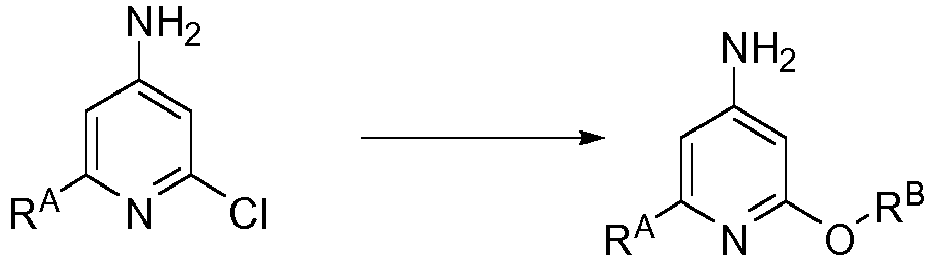
- At 0°C, alcohol (3.0 equiv) is slowly added to NaH (3.0 equiv) in suspension in dry THF (0.3 M). The resulting mixture is stirred for 20 min at room temperature. The aryl halide (1.0 equiv) is added, the resulting mixture is stirred at 85°C for approximately 16 h. The mixture is diluted with DCM and water. The aqueous phase is extracted with DCM. The combined organic phase is filtered through a phase separator and concentrated under vacuum to afford the desired compound, which can be used as such or further purified by flash column chromatography.
-

- At 0°C, difluoroethanol (11.7 mL, 183.9 mmol, 3.0 equiv) is slowly added to NaH (7.35 g, 183.9 mmol, 3.0 equiv) in suspension in dry THF (200 mL, 0.3 M). The resulting mixture is stirred for 20 min at room temperature. The 2,6-dichloropyridin-4-amine (10 g, 61.3 mmol, 1.0 equiv) is added, the resulting mixture is stirred at 85°C for 15 h. The mixture is diluted with DCM and water. The aqueous phase is extracted with DCM. The combined organic phase is filtered through a phase separator and concentrated under vacuum. The crude is purified by flash chromatography on silica gel (eluting with petroleum ether/EtOAc 95/5) to afford the desired compound. LCMS: MW (calcd): 209; m/z MW (obsd): 209 (M+H).
-

- Ethanol (0.27 mL, 4.56 mmol, 3 eq) is added dropwise at 0° C to a suspension of NaH (60% mineral oil, 182 mg, 4.56 mmol, 3 eq) in dry THF (4 mL). 4-Amino-2,6-dichloropyrimidine (250 mg, 1.52 mmol, 1 eq) is added and the reaction is stirred at 85° C for approximately 16 h. The mixture is partitioned between water and DCM. The aqueous layer is extracted with DCM. the organic layers are dried (Na2SO4) and concentrated to afford the desired compound. LCMS: MW (calcd): 183; m/z MW (obsd): 184 (M+H).
-

- Pd(dppf)Cl2 (118 mg, 0.145 mmol, 0.1 equiv) is added to a degassed suspension of 2-chloro-6-ethoxy-pyridin-4-amine (250 mg, 1.45 mmol, 1.0 equiv), cyclopropylboronic acid (149 mg, 1.74 mmol, 1.2 equiv) and Cs2CO3 (1.18 g, 3.63 mmol, 2.5 equiv) in 1,4-dioxane/water (4/1 mL, 0.30 M). The resulting mixture is stirred at 95°C for 24 h. The mixture is diluted with DCM and water. The aqueous phase is extracted with DCM. The combined organic phase is filtered through a phase separator and concentrated under vacuum. The crude is purified by flash chromatography on silica gel (eluting with petroleum ether/EtOAc 4/1) to afford the desired compound. LCMS: MW (calcd): 178; m/z MW (obsd): 179 (M+H).
-

- 2-chloro-6-ethoxy-pyridin-4-amine (500 mg, 2.90 mmol, 1.0 equiv), Zn(CN)2 (341 mg, 2.90 mmol, 1.0 equiv) and Pd(PPh3)4 (335 mg, 0.290 mmol, 0.1 equiv) are heated in dry DMF (12 mL, 0.25 M) at 150°C for 5 min under microwave conditions. The mixture is diluted with EtOAc and saturated NaHCO3 solution. The aqueous phase is extracted with EtOAc. The combined organic phase is washed with brine, dried over sodium sulfate and concentrated under vacuum. The crude is purified by flash chromatography on silica gel (eluting with petroleum ether/EtOAc 4/1) to afford the desired compound. LCMS: MW (calcd): 163; m/z MW (obsd): 164 (M+H).
-

- Pd(dppf)Cl2 (118 mg, 0.145 mmol, 0.1 equiv) is added to a degassed suspension of 2-chloro-6-ethoxy-pyridin-4-amine (250 mg, 1.45 mmol, 1.0 equiv), methylboronic acid (260 mg, 4.35 mmol, 3.0 equiv) and Cs2CO3 (2.36 g, 7.25 mmol, 5.0 equiv) in dry 1,4-dioxane (3.6 mL, 0.40 M). The resulting mixture is stirred at 105°C for 24 h. The mixture is diluted with DCM and water. The aqueous phase is extracted with DCM. The combined organic phase is filtered through a phase separator and concentrated under vacuum. The crude is purified by flash chromatography on silica gel (eluting with petroleum ether/EtOAc 4/1) to afford the desired compound. LCMS: MW (calcd): 152; m/z MW (obsd): 153 (M+H).
-

- 2-chloro-6-ethoxy-pyridin-4-amine (500 mg, 2.90 mmol, 1.0 equiv) and potassium acetate (284.3 mg, 2.90 mmol, 1.0 equiv) are stirred at room temperature for 1 h in acetic acid (2.90 mL, 1 M). At 0°C, Br2 (0.15 mL, 2.90 mmol, 1.0 equiv) is slowly added. The reaction mixture is concentrated and the residue is dissolved in EtOAc, washed with saturated NaHCO3 solution and Na2S2O3 solution, dried over sodium sulfate and concentrated under vacuum. The crude is purified by flash chromatography on silica gel (eluting with petroleum ether) to afford the desired compound. LCMS: MW (calcd): 252; m/z MW (obsd): 253 (M+H).
- Pd(dppf)Cl2 (16 mg, 0.020 mmol, 0.1 equiv) is added to a degassed suspension of 3-bromo-6-chloro-2-ethoxy-pyridin-4-amine (50 mg, 0.199 mmol, 1.0 equiv), methylboronic acid (35 mg, 0.596 mmol, 3.0 equiv) and Cs2CO3 (324 mg, 0.995 mmol, 5.0 equiv) in dry 1,4-dioxane (0.5 mL, 0.40 M). The resulting mixture is stirred at 105°C for 4 h. The mixture is diluted with DCM and water. The aqueous phase is extracted with DCM. The combined organic phase is filtered through a phase separator and concentrated under vacuum. The crude is purified by flash chromatography on silica gel (eluting with petroleum ether/EtOAc 9/1) to afford the desired compound. LCMS: MW (calcd): 187; m/z MW (obsd): 187 (M+H).
-

- 2-chloro-6-(2,2-difluoroethoxy)pyridin-4-amine (250 mg, 1.20 mmol, 1.0 equiv), Zn(CN)2 (183 mg, 1.56 mmol, 1.3 equiv), Pd2(dba)3 (335 mg, 0.290 mmol, 0.05 equiv) and dppf (53 mg, 0.096 mmol, 0.08 equiv) are heated in dry DMF (1.2 mL, 1.0 M) at 135°C for 24 h. The mixture is diluted with EtOAc and saturated NaHCO3 solution. The aqueous phase is extracted with EtOAc. The combined organic phase is washed with brine, dried over sodium sulfate and concentrated under vacuum. The crude is purified by flash chromatography on silica gel (eluting with petroleum ether/EtOAc 4/1) to afford the desired compound. LCMS: MW (calcd): 199; m/z MW (obsd): 200 (M+H).
-

- Pd(dppf)Cl2 (98 mg, 0.120 mmol, 0.1 equiv) is added to a degassed suspension of 2-chloro-6-(2,2-difluoroethoxy)pyridin-4-amine (250 mg, 1.20 mmol, 1.0 equiv), cyclopropylboronic acid MIDA ester (283.7 mg, 1.44 mmol, 1.2 equiv) and Cs2CO3 (977 mg, 3.0 mmol, 2.5 equiv) in 1,4-dioxane/water (4/1 mL, 0.30 M). The resulting mixture is stirred at 95°C for 24 h. The mixture is diluted with DCM and water. The aqueous phase is extracted with DCM. The combined organic phase is filtered through a phase separator and concentrated under vacuum. The crude is purified by flash chromatography on silica gel (eluting with petroleum ether/EtOAc 4/1) to afford the desired compound. LCMS: MW (calcd): 214; m/z MW (obsd): 215 (M+H).
-

- At 0°C, tBuOK (1.2 equiv) is added to the alcohol (5.0 equiv), the resulting mixture is stirred at room temperature for 15 min, then the solution of 2-chloro-4-iodo-6-(trifluoromethyl)pyridine (1.0 equiv) in dry THF (1 M) is added at 0°C. The resulting mixture is stirred at room temperature for 10 min and heated at 50°C for 3 h. The mixture is diluted with EtOAc and water. The aqueous phase is extracted with EtOAc. The combined organic phase is washed with brine, dried over sodium sulfate and concentrated under vacuum. The crude is purified by flash chromatography on silica gel to afford the desired compound.
- Pd2(dba)3 (0.1 equiv) is added to a degassed suspension of the iodo derivative (1.0 equiv), Xantphos (0.3 equiv), tertbutyl carbamate (1.2 equiv) and Cs2CO3 (1.5 equiv) in dry 1,4-dioxane (0.25 M). The resulting mixture is stirred at 100°C for 3 h. The mixture is filtered over celite, the filtrate is diluted with EtOAc and water. The aqueous phase is extracted with EtOAc. The combined organic phase is washed with brine, dried over sodium sulfate and concentrated under vacuum to afford the desired compound.
- tert-butyl N-[2-ethoxy-6-(trifluoromethyl)-4-pyridyl]carbamate (1.0 equiv) is stirred at 40°C for 18 h in 1/1 TFA/DCM (0.5 M). The mixture is diluted with DCM and 2 M HCl solution is added. The two phases are separated and the aqueous phase is basified and extracted with DCM/iPrOH (4/1). The combined organic phase is filtered through a phase separator and concentrated under vacuum to afford the desired compound.
-

- At 0°C, tBuOK (8.76 g, 78.06 mmol, 1.2 equiv) is added to the ethanol (19 mL, 325.25 mmol, 5.0 equiv), the resulting mixture is stirred at room temperature for 15 min, then the solution of 2-chloro-4-iodo-6-(trifluoromethyl)pyridine (20 g, 65.05 mmol, 1.0 equiv) in dry THF (65 mL, 1 M) is added at 0°C. The resulting mixture is stirred at room temperature for 10 min, then heated at 50°C for 3 h. The mixture is diluted with EtOAc and water. The aqueous phase is extracted with EtOAc. The combined organic phase is washed with brine, dried over sodium sulfate and concentrated under vacuum. The crude is purified by flash chromatography on silica gel (eluting with petroleum ether) to afford the desired compound. LCMS: MW (calcd): 317; m/z MW (obsd): 318 (M+H).
- Pd2(dba)3 (4.10 g, 4.48 mmol, 0.1 equiv) is added to a degassed suspension of 2-ethoxy-4-iodo-6-(trifluoromethyl)pyridine (14.2 g, 44.8 mmol, 1.0 equiv), Xantphos (7.78 g, 13.4 mmol, 0.3 equiv), tertbutyl carbamate (6.30 g, 53.7 mmol, 1.2 equiv) and Cs2CO3 (21.9 g, 67.2 mmol, 1.5 equiv) in dry 1,4-dioxane (180 mL, 0.25 M). The resulting mixture is stirred at 100°C for 3 h. The mixture is filtered over celite, the filtrate is diluted with EtOAc and water. The aqueous phase is extracted with EtOAc. The combined organic phase is washed with brine, dried over sodium sulfate and concentrated under vacuum to afford the desired compound. LCMS: MW (calcd): 306; m/z MW (obsd): 307 (M+H).
- tert-butyl N-[2-ethoxy-6-(trifluoromethyl)-4-pyridyl]carbamate (44 mmol, 1.0 equiv) is stirred at 40°C for 18 h in TFA (40 mL) and DCM (40 mL). The mixture is diluted with DCM and 2 M HCl solution is added. The two phases are separated and the aqueous phase is basified and extracted with DCM/iPrOH (4/1). The combined organic phase is filtered through a phase separator and concentrated under vacuum to afford the desired compound. LCMS: MW (calcd): 206; m/z MW (obsd): 207 (M+H).
-

- N-bromosuccinimide (216 mg, 1.21 mmol, 1.0 equiv) and 2-ethoxy-6-(trifluoromethyl)pyridin-4-amine (250 mg, 1.21 mmol, 1.0 equiv) are stirred at room temperature in dry DCM for 1 h. The mixture is diluted with DCM and water. The aqueous phase is extracted with DCM. The combined organic phase is filtered through a phase separator and concentrated under vacuum to afford the desired compound. LCMS: MW (calcd): 285; m/z MW (obsd): 287 (M+H).
- Pd(dppf)Cl2 (29 mg, 0.035 mmol, 0.1 equiv) is added to a degassed suspension of 3-bromo-2-ethoxy-6-(trifluoromethyl)pyridin-4-amine (100 mg, 0.35 mmol, 1.0 equiv), methylboronic acid (63 mg, 1.05 mmol, 3.0 equiv) and Cs2CO3 (570 mg, 1.75 mmol, 5.0 equiv) in dry 1,4-dioxane (1.0 mL, 0.40 M). The resulting mixture is stirred at 105°C for 5 h. The mixture is diluted with DCM and water. The aqueous phase is extracted with DCM. The combined organic phase is filtered through a phase separator and concentrated under vacuum. The crude is purified by flash chromatography on silica gel (eluting with petroleum ether/EtOAc 9/1) to afford the desired compound. LCMS: MW (calcd): 220; m/z MW (obsd): 221 (M+H).
-

- As described in synthesis of intermediate 34.
- Pd(dppf)Cl2 (29 mg, 0.035 mmol, 0.1 equiv) is added to a degassed suspension of 3-bromo-2-ethoxy-6-(trifluoromethyl)pyridin-4-amine (100 mg, 0.35 mmol, 1.0 equiv), triethyl broane (0.46 mL, 0.46 mmol, 1.3 equiv, 1M in hexane) and Cs2CO3 (572 mg, 1.75 mmol, 5.0 equiv) in dry dimethylformamide (2.0 mL, 0.20 M). The resulting mixture is stirred at 80°C for 4 h. The mixture is diluted with DCM and water. The aqueous phase is extracted with DCM. The combined organic phase is filtered through a phase separator and concentrated under vacuum to afford the desired compound. LCMS: MW (calcd): 234; m/z MW (obsd): 235 (M+H).
-

- Acetyl chloride (0.20 mL, 2.79 mmol, 1.1 equiv) is added to N-[2-chloro-6-(trifluoromethyl)-4-pyridyl]acetamide (500 mg, 2.54 mmol, 1.0 equiv), dimethylaminopyridine (31 mg, 0.254 mmol, 0.1 equiv) and trimethylamine (0.39 mL, 2.79 mmol, 1.1 equiv) at 0°C in dry DCM (6 mL, 0.4 M). The resulting mixture is stirred at room temperature for 20 h. The mixture is diluted with DCM and water. The organic phase is washed with saturated NaHCO3 solution and filtered through a phase separator and concentrated under vacuum to afford the desired compound. LCMS: MW (calcd): 239; m/z MW (obsd): 239 (M+H).
- Pd2(dba)3 (19 mg, 0.051 mmol, 0.05 equiv) and Xantphos (24 mg, 0.042 mmol, 0.1 equiv) are added to a degassed suspension of N-[2-chloro-6-(trifluoromethyl)-4-pyridyl]acetamide (100 mg, 0.419 mmol, 1.0 equiv), 3,3-difluoroazetidine (54 mg, 0.419 mmol, 1.0 equiv) and Cs2CO3 (410 mg, 1.26 mmol, 3.0 equiv) in dry 1,4-dioxane (1.7 mL, 0.25 M). The resulting mixture is stirred at 85°C for 4 h. The mixture is diluted with DCM and water. The aqueous phase is extracted with DCM. The combined organic phase is filtered through a phase separator and concentrated under vacuum to afford the desired compound. LCMS: MW (calcd): 295; m/z MW (obsd): 296 (M+H).
- N-[2-(3,3-difluoroazetidin-1-yl)-6-(trifluoromethyl)-4-pyridyl]acetamide (0.419 mmol, 1.0 equiv) is stirred at 50°C in sodium hydroxide (0.8 mL, 2.0 equiv, 1M in H2O) and ethanol (1.5 mL, 0.25 M) for 24 h. The mixture is diluted with DCM and 1 M HCl solution is added. The two phases are separated, the aqueous phase is basified and extracted with DCM/ iPrOH (4/1). The combined organic phase is filtered through a phase separator and concentrated under vacuum to afford the desired compound. LCMS: MW (calcd): 253; m/z MW (obsd): 254 (M+H).
-

- Acetyl chloride (0.19 mL, 2.64 mmol, 1.1 equiv) is added to 2-chloro-6-(2,2-difluoroethoxy)pyridin-4-amine (500 mg, 2.40 mmol, 1.0 equiv), dimethylaminopyridine (29 mg, 0.240 mmol, 0.1 equiv) and trimethylamine (0.37 mL, 2.64 mmol, 1.1 equiv) at 0°C in dry DCM (6 mL, 0.4 M). The resulting mixture is stirred at room temperature for 20 h. The mixture is diluted with DCM and water. The organic phase is washed with saturated NaHCO3 solution and filtered through a phase separator and concentrated under vacuum to afford the desired compound. LCMS: MW (calcd): 251; m/z MW (obsd): 251 (M+H).
- Pd2(dba)3 (37 mg, 0.010 mmol, 0.05 equiv) and Xantphos (46 mg, 0.080 mmol, 0.1 equiv) are added to a degassed suspension of N-[2-chloro-6-(2,2-difluoroethoxy)-4-pyridyl]acetamide (200 mg, 0.798 mmol, 1.0 equiv), 3,3-difluoroazetidine (103 mg, 0.798 mmol, 1.0 equiv) and Cs2CO3 (780 mg, 2.39 mmol, 3.0 equiv) in dry 1,4-dioxane (3.0 mL, 0.25 M). The resulting mixture is stirred at 85°C for 4 h. The mixture is diluted with DCM and water. The aqueous phase is extracted with DCM. The combined organic phase is filtered through a phase separator and concentrated under vacuum to afford the desired compound. LCMS: MW (calcd): 307; m/z MW (obsd): 308 (M+H).
- N-[2-(3,3-difluoroazetidin-1-yl)-6-(2,2-difluoroethoxy)-4-pyridyl]acetamide (0.798 mmol, 1.0 equiv) is stirred at 50°C in sodium hydroxide (1.60 mL, 2.0 equiv, 1M in H2O) and ethanol (3.2 mL, 0.25 M) for 24 h. The mixture is diluted with DCM and 1 M HCl solution is added. The two phases are separated, the aqueous phase is basified and extracted with DCM/ iPrOH (4/1). The combined organic phase is filtered through a phase separator and concentrated under vacuum to afford the desired compound. LCMS: MW (calcd): 265; m/z MW (obsd): 266 (M+H).
-

- To 5-bromo-2-chloro-pyridin-3-ol (500 mg, 2.40 mmol, 1.0 equiv), potassium iodide (319 mg, 1.92 mmol, 0.8 equiv) and potassium carbonate (398 mg, 2.88 mmol, 1.2 equiv) in dry dimethylformamide (12 mL, 0.2 M), ethyl iodide is added (411.8 mg, 2.64 mmol, 1.1 equiv). The resulting mixture is stirred at 50°C for 20 h. The mixture is diluted with DCM and water. The aqueous phase is extracted with DCM. The combined organic phase is filtered through a phase separator and concentrated under vacuum to afford the desired compound. LCMS: MW (calcd): 237; m/z MW (obsd): 238 (M+H).
- Palladium acetate (27 mg, 0.12 mmol, 0.05 equiv) is added to a degassed suspension of 5-bromo-2-chloro-3-ethoxy-pyridine (2.40 mmol, 1.0 equiv), benzophenone imine (435 mg, 2.40 mmol, 1.0 equiv), BINAP (2,2'-Bis(diphenylphosphino)-1,1'-binaphthyl) (112 mg, 0.18 mmol, 0.075 equiv) and tBuONa (299 mg, 3.12 mmol, 1.3 equiv) in dry toluene (10 mL, 0.25 M). The resulting mixture is stirred at 80°C for 3 h. The mixture is diluted with DCM and water. The aqueous phase is extracted with DCM. The combined organic phase is filtered through a phase separator and concentrated under vacuum to afford the desired compound. LCMS: MW (calcd): 337; m/z MW (obsd): 337 (M+H).
- N-(6-chloro-5-ethoxy-3-pyridyl)-1,1-diphenyl-methanimine (2.40 mmol, 1.0 equiv) is stirred at room temperature in 2 M HCl solution (5 mL, 0.5M) and THF (5 mL, 0.5 M) for 30 min. The mixture is diluted with DCM and 1 M HCl solution is added. The two phases are separated and the aqueous phase is basified and extracted with DCM/ iPrOH (4/1). The combined organic phase is filtered through a phase separator and concentrated under vacuum. The crude is purified by flash chromatography on silica gel (eluting with petroleum ether/EtOAc 4/1) to afford the desired compound. LCMS: MW (calcd): 173; m/z MW (obsd): 173 (M+H).
-

- To 5-bromo-2-chloro-pyridin-3-ol (500 mg, 2.40 mmol, 1.0 equiv), potassium iodide (319 mg, 1.92 mmol, 0.8 equiv) and potassium carbonate (398 mg, 2.88 mmol, 1.2 equiv) in dry dimethylformamide (12 mL, 0.2 M), 2-Iodo-1,1-difluoroethane is added (506.7 mg, 2.64 mmol, 1.1 equiv). The resulting mixture is stirred at 50°C for 20 h. The mixture is diluted with DCM and water. The aqueous phase is extracted with DCM. The combined organic phase is filtered through a phase separator and concentrated under vacuum to afford the desired compound. LCMS: MW (calcd): 273; m/z MW (obsd): 273 (M+H).
- Palladium acetate (27 mg, 0.12 mmol, 0.05 equiv) is added to a degassed suspension of 5-bromo-2-chloro-3-(2,2-difluoroethoxy)pyridine (2.40 mmol, 1.0 equiv), benzophenone imine (435 mg, 2.40 mmol, 1.0 equiv), BINAP (2,2'-Bis(diphenylphosphino)-1,1'-binaphthyl) (112 mg, 0.18 mmol, 0.075 equiv) and tBuONa (299 mg, 3.12 mmol, 1.3 equiv) in dry toluene (10 mL, 0.25 M). The resulting mixture is stirred at 80°C for 3 h. The mixture is diluted with DCM and water. The aqueous phase is extracted with DCM. The combined organic phase is filtered through a phase separator and concentrated under vacuum to afford the desired compound. LCMS: MW (calcd): 373; m/z MW (obsd): 373 (M+H).
- N-[6-chloro-5-(2,2-difluoroethoxy)-3-pyridyl]-1,1-diphenyl-methanimine (2.40 mmol, 1.0 equiv) is stirred at room temperature in 2 M HCl solution (5 mL, 0.5M) and THF (5 mL, 0.5 M) for 30 min. The mixture is diluted with DCM and 1 M HCl solution is added. The two phases are separated, the aqueous phase is basified and extracted with DCM/ iPrOH (4/1). The combined organic phase is filtered through a phase separator and concentrated under vacuum. The crude is purified by flash chromatography on silica gel (eluting with petroleum ether/EtOAc 4/1) to afford the desired compound. LCMS: MW (calcd): 209; m/z MW (obsd): 209 (M+H).
-

- At 0°C, ethanol (0.13 mL, 2.28 mmol, 1.5 equiv) is slowly added to NaH (91 mg, 2.28 mmol, 1.5 equiv) in suspension in dry THF (4 mL, 0.4 M). The resulting mixture is stirred for 20 min at room temperature. 4-Amino-2,6-dichloropyrimidine (250 mg, 1.52 mmol, 1.0 equiv) is added, the resulting mixture is stirred at 50°C for 3 h. The mixture is diluted with DCM and water. The aqueous phase is extracted with DCM. The combined organic phase is filtered through a phase separator and concentrated under vacuum to afford the desired compound. LCMS: MW (calcd): 174; m/z MW (obsd): 174 (M+H).
-
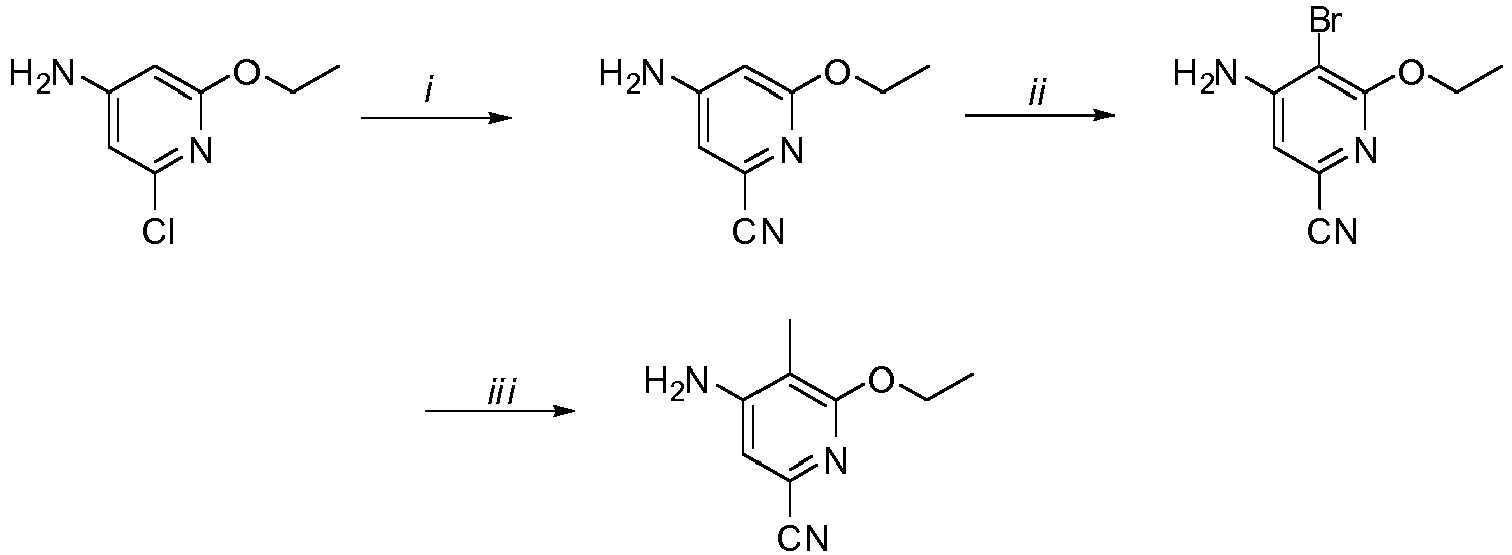
- A degassed mixture of 2-chloro-6-ethoxy-pyridin-4-amine (1.0 eq, 500 mg), Tetrakis(triphenylphosphine)palladium(0) (0.1 eq, 335 mg) and zinc cyanide (1.0 eq, 340 mg) in anhydrous N,N-dimethylformamide (12 mL) is heated at 150 °C for 5 min under microwave irradiation. The reaction mixture is diluted with EtOAc and washed with a saturated solution of NaHCO3. The organic layer is washed with brine, dried over sodium sulfate and concentrated in vacuo. The residue is purified by silica chromatography (petroleum ether/EtOAc: 100/0 to 80/20) to afford the desired compound. LCMS: MW (calcd): 163; m/z MW (obsd): 164 (M+H).
- A solution of N-bromosuccinimide (0.85 eq, 297 mg) in a mixture of anhydrous DCM (3 mL) and anhydrous acetonitrile (1.5 mL) is added dropwise at 0°C and under inert atmosphere to a solution of 4-amino-6-ethoxy-pyridine-2-carbonitrile (1.0 eq, 320 mg) in anhydrous DCM (7 mL). After 10 min at 0°C, the mixture is stirred at room temperature for 3 h. Then, a solution of N-bromosuccinimide (0.15 eq, 52 mg) is again added at 0°C to the mixture and the mixture is stirred at room temperature. When the reaction is complete, the mixture diluted with DCM and washed with water. The aqueous layer is backwashed with DCM. The combined organic layers are dried over sodium sulfate and are concentrated in vacuo to afford the desired compound. LCMS: MW (calcd): 242; m/z MW (obsd): 244 (M+H).
- A degassed mixture of 4-amino-5-bromo-6-ethoxy-pyridine-2-carbonitrile (1.0 eq, 250 mg), methyl boronic acid (3.0 eq, 185 mg), Cs2CO3 (3.0 eq, 1.68 g) and Pd(dppf)Cl2 (0.1 eq, 84 mg) in anhydrous 1,4-dioxane (2.6 mL) is heated at 100 °C for 2 h. The mixture is diluted with DCM and water. The two phases are separated; the organic layer is filtered through a phase separator and concentrated. The residue is purified by silica chromatography (petroleum ether/EtOAc: 90/10 to 80/20) to afford the desired compound. LCMS: MW (calcd): 177; m/z MW (obsd): 178 (M+H).
-

- A degassed mixture of 4-amino-5-bromo-6-ethoxy-pyridine-2-carbonitrile (1.0 eq, 210 mg), cyclopropyl boronic acid (2.5 eq, 186 mg), K3PO4 (6.0 eq, 1.10 g), tricyclohexylphosphine (0.2 eq, 49 mg), and palladium(II) acetate (0.2 eq, 39 mg) in a mixture of toluene/water (10 mL/0.045 mL) is heated at 100 °C for 3 h. The mixture is diluted with EtOAc and water. The two phases are separated; the organic layer is dried over Na2SO4 and concentrated. The residue is purified by silica chromatography (petroleum ether/EtOAc: 65/35 to 50/50) to afford the desired compound. LCMS: MW (calcd): 203; m/z MW (obsd): 204 (M+H).
-
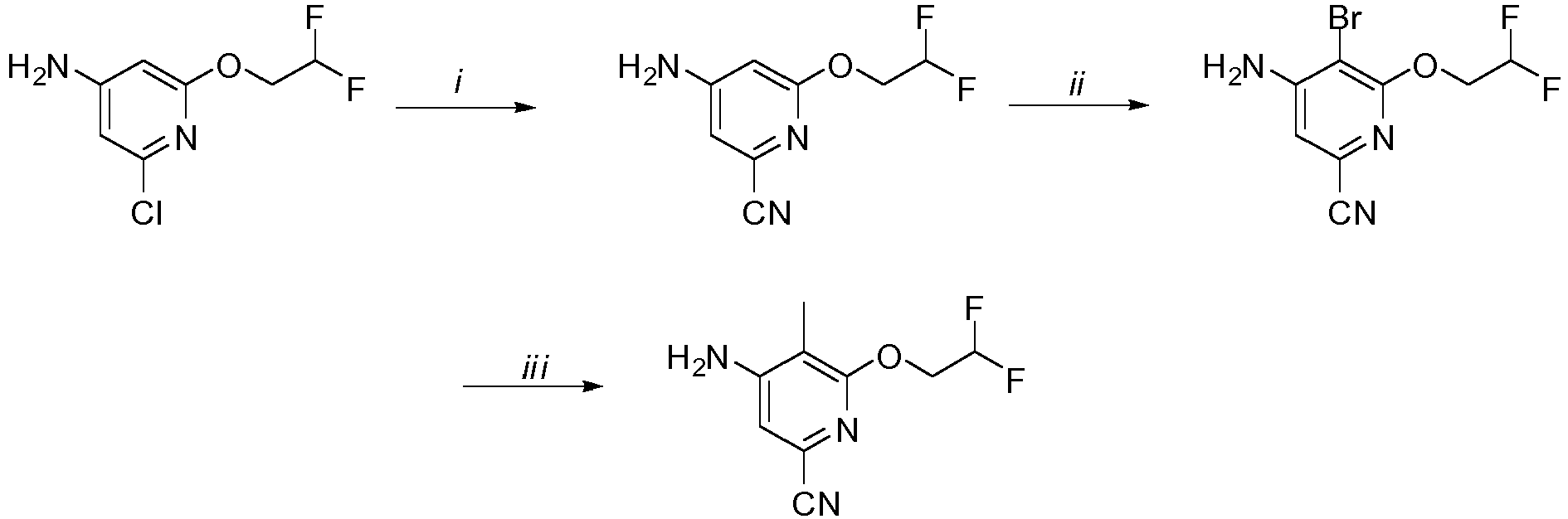
- A degassed mixture of 2-chloro-6-(2,2-difluoroethoxy)pyridin-4-amine (1.0 eq, 450 mg), Tetrakis(triphenylphosphine)palladium(0) (0.1 eq, 249 mg) and zinc cyanide (1.0 eq, 253 mg) in anhydrous N,N-dimethylformamide (9 mL) is heated at 150 °C for 5 min under microwave irradiation. The reaction mixture is diluted with EtOAc and washed with a saturated solution of NaHCO3. The organic layer is washed with brine, dried over sodium sulfate and concentrated in vacuo. The residue is purified by silica chromatography (petroleum ether/EtOAc: 100/0 to 80/20) to afford the desired compound. LCMS: MW (calcd): 199; m/z MW (obsd): 200 (M+H).
- A solution of N-bromosuccinimide (0.85 eq, 293 mg) in a mixture of anhydrous DCM (2.0 mL) and anhydrous acetonitrile (2.0 mL) is added dropwise at 0°C and under inert atmosphere to a solution of 4-amino-6-(2,2-difluoroethoxy)pyridine-2-carbonitrile (1.0 eq, 385 mg) in anhydrous DCM (6 mL). After 10 min at 0°C, the mixture is stirred at room temperature for 2 h. Then, a solution of N-bromosuccinimide (0.15 eq, 52 mg) is again added at 0°C to the mixture and the mixture is stirred at room temperature. When the reaction is complete, the mixture diluted with DCM and washed with water. The aqueous layer is backwashed with DCM. The combined organic layers are dried over sodium sulfate and are concentrated in vacuo to afford the desired compound. LCMS: MW (calcd): 278; m/z MW (obsd): 279 (M+H).
- A degassed mixture of 4-amino-5-bromo-6-(2,2-difluoroethoxy)pyridine-2-carbonitrile (1.0 eq, 239 mg), methyl boronic acid (3.0 eq, 154 mg), Cs2CO3 (3.0 eq, 1.40 g) and Pd(dppf)Cl2 (0.1 eq, 70 mg) in anhydrous 1,4-dioxane (2.2 mL) is heated at 100 °C for 2 h. The mixture is diluted with DCM and water. The two phases are separated; the organic layer is filtered through a phase separator and concentrated. The residue is purified by silica chromatography (petroleum ether/EtOAc: 90/10 to 80/20) to afford the desired compound. LCMS: MW (calcd): 278; m/z MW (obsd): 279 (M+H).
-

- To a solution of 2-chloro-6-(2,2-difluoroethoxy)pyridin-4-amine (100 mg, 0.48 mmol, 1.0 equiv) in dry DCM (2.5 mL) is added N-Bromosuccinimide (68 mg, 0.38 mmol, 0.8 equiv). The reaction is stirred at room temperature for 25 min. The mixture is diluted with DCM and washed with water and brine. The organic layer is filtered through a phase separator and concentrated in vacuo. LCMS: MW (calcd): 288; m/z MW (obsd): 289 (M+H).
- A degassed mixture of 3-bromo-6-chloro-2-(2,2-difluoroethoxy)pyridin-4-amine (138 mg, 0.48 mmol, 1.0 equiv), methylboronic acid (86 mg, 1.44 mmol, 3.0 equiv), Cs2CO3 (782 mg, 2.4 mmol, 5.0 equiv) and Pd(dppf)Cl2.DCM (39 mg, 0.048 mmol, 0.1 equiv) in dry dioxane (1.2 mL) is heated at 100°C for 1 h. The reaction mixture is diluted with DCM and water. The organic layer is filtered through a phase separator and concentrated in vacuo. The residue is purified by flash chromatography (Petroleum ether/EtOAc 7:3) to afford the desired compound. LCMS: MW (calcd): 223; m/z MW (obsd): 223 (M+H).
-

- 3,6-Dichloro-4-methyl-pyridazine (2.97 g, 18.2 mmol, 1 equiv) in aq. 3.3M NaOH (30 mL) is stirred at reflux temperature for 1 h. Once cooled at room temperature, aq. 50% acetic acid (10 mL) is added to pH∼6 and the resulting solid filtered and washed with water. Purification by silica chromatography (EtOAc/petroleum ether; 25:75 to 100:0) affords the desired compound. LCMS: MW (calcd): 145; m/z MW (obsd): 145 (M+H).
-

- A mixture of 6-chloro-4-methyl-pyridazin-3-ol (21.7 g, 150 mmol, 1 equiv), Zn(CN)2 (22.9 g, 195 mmol, 1.3 equiv), Pd2dba3 (6.87 g, 7.5 mmol, 0.05 equiv) and 1,1'-bis(diphenylphosphino)ferrocene (6.64 g, 12 mmol, 0.08 equiv) in DMF (150 mL) is degassed under nitrogen and heated at 120 °C for 1 h. The resulting mixture is diluted with DCM and aq. sat. NaHCO3. The aqueous layer is separated and extracted with DCM, DCM/iPrOH (4:1), dried (Na2SO4), filtered and concentrated. The residue is triturated with a mixture of petroleum ether/EtOAc (3:1), filtered, washed with petroleum ether and dried to afford the desired compound. LCMS: MW (calcd): 135; m/z MW (obsd): 136 (M+H).
-

- POCl3 (3 to 6 equiv) is added to 6-hydroxy-pyridazine derivative (1 equiv) in acetonitrile (0.1 to 0.6 M) and the resulting mixture is heated at reflux temperature until completion of the reaction. The cooled mixture is concentrated under reduced pressure and the residue diluted in DCM. This solution is poured in a stirred mixture of ice cold DCM and aqueous NaHCO3 until pH of approximately 7. Both layers are separated and the aqueous layer extracted with DCM. The combined organic layer is dried (Na2SO4), filtered and concentrated to afford the desired compound.
-

- POCl3 (18 mL, 193 mmol, 3 equiv) is added to 6-hydroxy-5-methyl-pyridazine-3-carbonitrile (8.7 g, 64 mmol, 1 equiv) in acetonitrile (120 mL) and the resulting mixture is heated at reflux temperature until completion of the reaction. The cooled mixture is concentrated under reduced pressure and the residue diluted in DCM. This solution is poured in a stirred mixture of ice cold DCM and aq. NaHCO3. Solid NaHCO3 is added in portions to attain a pH of approximately 7. Both layers are separated and the aqueous extracted with DCM. The combined organic layer is dried (Na2SO4), filtered and concentrated to afford the desired compound. LCMS: MW (calcd): 154; m/z MW (obsd): 154 (M+H).
-

- To a degassed solution of heteroaryl chloride (1.0 eq) and the boronic acid or ester (0.5 to 1.5 eq) in dry DMF (0.15 to 0.3 M), which is put under argon atmosphere, tetrakis(triphenylphosphine)palladium(0), Pd(PPh3)4 (0.1 eq) is added and the mixture is stirred at room temperature for 1 to 2 h. Sodium carbonate, Na2CO3, 2.5 N (2.5 to 4 eq) is added to the mixture. The mixture is stirred at 80 to 90 °C for approximately 16 h. The mixture is cooled to room temperature, diluted with water and extracted with an organic solvent. After work up, the organic layers are dried over Na2SO4 and concentrated. The crude is purified by flash column chromatography to afford the desired compound.
-
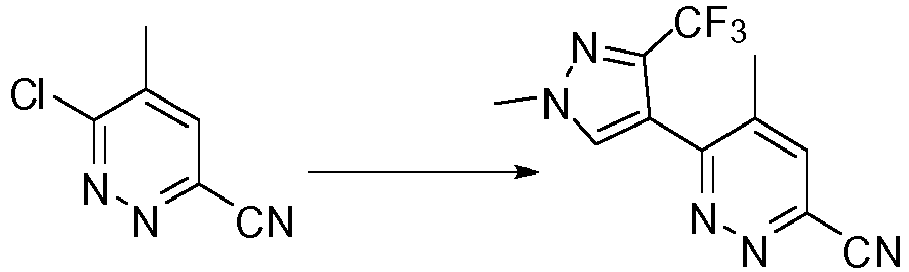
- Pd(PPh3)4 (7.44 g, 6.64 mmol, 0.1 equiv) is added to a degassed suspension of 6-chloro-5-methylpyridazine-3-carbonitrile (64 mmol, 1.0 equiv), 1-methyl-4-(4,4,5,5-tetramethyl-[1,3,2]dioxaborolan-2-yl)-3-trifluoromethyl-1H-pyrazole (12.4 g, 45 mmol, 0.7 equiv) in DMF (275 mL) and the resulting mixture is stirred at room temperature for 1 h. A 2.5M aq. Na2CO3 solution (64 mL) is added and the resulting mixture is stirred at 85°C until completion. The cooled mixture is filtered on Celite and washed with EtOAc. The organic extract is washed 3 times with brine, dried (Na2SO4) and concentrated. Purification by silica chromatography (column: 120 g silica 25 µm; EtOAc/DCM; 0:100 to 10:90) affords the desired compound. LCMS: MW (calcd): 267; m/z MW (obsd): 268 (M+H).
-

- Pd (10% on charcoal, 0.15 equiv) is added to a degassed mixture of the nitrile derivative (1 equiv) and aq. 6M HCl (2.2 equiv) in methanol (0.1-0.3 M).The mixture is stirred at room temperature under hydrogen (1 atm) until completion of the reaction. The resulting mixture is filtered on Celite, washed with methanol, acetonitrile and the filtrate is concentrated under reduced pressure. The residue is triturated with Et2O to afford the hydrochloride salt of the desired compound.
-
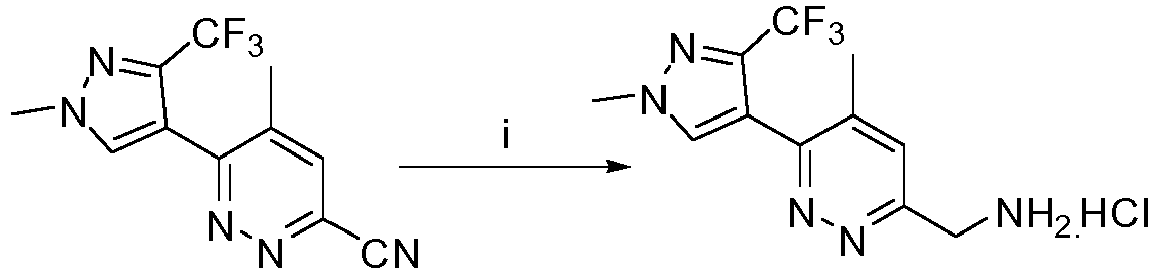
- Pd (10% on charcoal, 4.25 g, 4 mmol, 0.15 equiv) is added to a degassed mixture of 5-methyl-6-(1-methyl-3-trifluoromethyl-1H-pyrazol-4-yl)-pyridazine-3-carbonitrile (7.3 g, 27.3 mmol, 1 equiv) and aq. 6M HCl (10 mL, 60 mmol, 2.2 equiv) in methanol (180 mL). The mixture is stirred at room temperature under hydrogen (1 atm) until completion of the reaction. The resulting mixture is filtered on Celite, washed with methanol, acetonitrile and the filtrate is concentrated under reduced pressure. The residue is triturated with Et2O to afford the hydrochloride salt of the desired compound. LCMS: MW (calcd): 271; m/z MW (obsd): 272 (M+H).
-

- NaBH4 (5 equiv) is added portionwise to a mixture of the nitrile derivative (1.0 equiv), TFA (5 equiv) and NiCl2.6H2O (0.4 equiv) in methanol (0.2-0.3 M) at 0°C. After 3 h, NaBH4 (2.5 equiv) is added. The resulting mixture is stirred at room temperature for 3 h. The mixture is filtered over celite and concentrated under reduced pressure. Purification by SCX column chromatography affords the desired compound. Alternatively, the reaction mixture is diluted in DCM and compound is purified by extraction into a 1 M HCl solution. The aqueous solution is basified and extracted with 4:1 DCM / iPrOH and filtered through a phase separator. Concentration in vacuum gives the desired product.
-

- NaBH4 (462 mg, 12.2 mmol, 5 equiv) is added portionwise to a mixture of 5-methyl-6-(1-methyl-3-trifluoromethyl-1H-pyrazol-4-yl)-pyridazine-3-carbonitrile (2.44 mmol, 1.0 equiv), TFA (0.94 mL, 12.2 mmol, 5 equiv) and NiCl2.6H2O (233 mg, 0.98 mmol, 0.4 equiv) in methanol (10 mL) at 0°C. After 3 h, NaBH4 (230 mg, 6.1 mmol, 2.5 equiv) is added. The resulting mixture is stirred at room temperature for 3 h. The mixture is filtered over celite and concentrated under reduced pressure. Purification by SCX column chromatography affords the desired compound. LCMS: MW (calcd): 271; m/z MW (obsd): 272 (M+H).
-

- To a solution of nitrile derivative (1 eq) in methanol (0.15 M), HCl 6.0 N (2.5 eq) is added followed by the addition of Pd/C (0.1 eq). Reaction mixture is stirred under hydrogen (1 atm) at room temperature. After 1 h the reaction mixture is filtered through Celite and the pad is further washed with methanol. The filtrate is loaded onto an SCX column. Methanol is passed through the column and the compound is eluted with 7 N NH3 in methanol /methanol 1:4. The filtrate is concentrated under reduced pressure to give the desired compound.
-

- A degassed suspension of 5-cyclopropyl-6-[1-methyl-3-(trifluoromethyl)pyrazol-4-yl]pyridazine-3-carbonitrile (67 mg, 1.0 eq, 0.228 mmol, 100 %), palladium on charcoal, 10 %, Pd/C (25 mg, 0.1 eq, 98 %) and hydrochloric acid, 6N water solution (84 µL, 2.2 eq) in 3 mL of methanol is stirred under hydrogen atmosphere for 90 min. The mixture is filtered over a celite pad and the pad is rinsed with 10 mL of methanol. Methanol solution is applied on a 2 g SCX column and the column is washed with 10 mL of methanol. The compound is washed from the column with IN NH3 (Methanol) solution. The solvent is evaporated to afford the desired compound. LCMS: MW (calcd): 297; m/z MW (obsd): 299 (M+H).
-

- NaBH4 (5 equiv) is added portionwise to a mixture of the nitrile derivative (1.0 equiv), TFA (5 equiv) and NiCl2.6H2O (0.4 equiv) in methanol (0.1 M) at 0°C. After 3 h, NaBH4 (2.5 equiv) is added. The resulting mixture is stirred at room temperature for 3 h. The mixture is filtered over celite and concentrated under reduced pressure.
-

- NaBH4 (462 mg, 12.2 mmol, 5 equiv) is added portionwise to a mixture of 6-(3,3-difluoro-pyrrolidin-1-yl)-5-methyl-pyridazine-3-carbonitrile (0.38 mmol, 1.0 equiv), TFA (0.13 mL, 1.7 mmol, 5 equiv) and NiCl2.6H2O (36 mg, 0.15 mmol, 0.4 equiv) in methanol (4 mL) at 0°C. After 3 h, NaBH4 (36 mg, 0.95 mmol, 2.5 equiv) is added. The resulting mixture is stirred at room temperature for 3 h. The mixture is filtered over celite and concentrated under reduced pressure to afford the desired compound. LCMS: MW (calcd): 228; m/z MW (obsd): 229 (M+H).
-

- To a solution of 4-iodo-3-trifluoromethyl-1H-pyrazole (1 g, 3.8 mmol, 1.0 equiv) in dry THF (6 mL) at 0°C is added K2CO3 (1.6 g, 11.4 mmol, 3.0 equiv). The reaction is stirred at room temperature for 10 min before adding 1-chloropropan-2-ol (1.1 g, 11.4 mmol, 3.0 equiv). The reaction is heated at 80°C overnight. The mixture is diluted with EtOAc and washed with brine. The organic layer is dried over sodium sulfate, filtered and concentrated in vacuo. The residue is purified by automated flash chromatography by using Petroleum ether/EtOAc 80/20 to 0/100) to obtain the desired compound. LCMS: MW (calcd): 320; m/z MW (obsd): 321 (M+H).
-
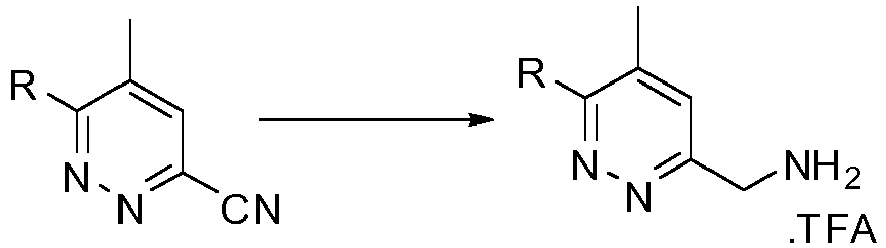
- NaBH4 (5 equiv) is added portionwise to a mixture of the nitrile derivative (1.0 equiv), TFA (5 equiv) and NiCl2.6H2O (0.4 equiv) in methanol (0.1 M) at 0°C. After 3 h, NaBH4 (2.5 equiv) is added. The resulting mixture is stirred at room temperature for 3 h. The mixture is filtered over celite and concentrated under reduced pressure.
-

- NaBH4 (462 mg, 12.2 mmol, 5 equiv) is added portionwise to a mixture of 6-(3,3-difluoro-pyrrolidin-1-yl)-5-methyl-pyridazine-3-carbonitrile (0.38 mmol, 1.0 equiv), TFA (0.13 mL, 1.7 mmol, 5 equiv) and NiCl2.6H2O (36 mg, 0.15 mmol, 0.4 equiv) in methanol (4 mL) at 0°C. After 3 h, NaBH4 (36 mg, 0.95 mmol, 2.5 equiv) is added. The resulting mixture is stirred at room temperature for 3 h. The mixture is filtered over celite and concentrated under reduced pressure to afford the desired compound. LCMS: MW (calcd): 228; m/z MW (obsd): 229 (M+H).
-

- To a solution of 4-iodo-3-trifluoromethyl-1H-pyrazole (350 mg, 1.3 mmol, 1.0 equiv) in dry DMF (2 mL) at 0°C is added K2CO3 (359 mg, 2.6 mmol, 2.0 equiv). The reaction is stirred at room temperature for 10 min before adding 2-(chloromethyl)-1,4-dioxane (355 mg, 2.6 mmol, 2.0 equiv). The reaction is heated at 80°C over the weekend. The mixture is diluted with EtOAc and washed with brine. The organic layer is dried over sodium sulfate, filtered and concentrated in vacuo. The residue is purified by automated flash chromatography by using petroleum ether / EtOAc 90/10 to 0/100) to obtain the desired compound. LCMS: MW (calcd): 362; m/z MW (obsd): 363 (M+H).
-

- To a solution of 4-iodo-3-trifluoromethyl-1H-pyrazole (1 g, 3.8 mmol, 1.0 equiv) in dry THF (6 mL) at 0°C is added K2CO3 (1.3 g, 9.5 mmol, 2.5 equiv). The reaction is stirred at room temperature for 10 min before adding 2-chloroethyl methyl ether (0.87 mL, 9.5 mmol, 2.5 equiv). The reaction is heated at 80°C over the weekend. The mixture is diluted with EtOAc and washed with brine. The organic layer is dried over sodium sulfate, filtered and concentrated in vacuo. The residue is purified by automated flash chromatography by using petroleum ether/EtOAc 90/10 to 0/100) to obtain the desired compound. LCMS: MW (calcd): 320; m/z MW (obsd): 321 (M+H).
-

- To a solution of 4-iodo-3-trifluoromethyl-1H-pyrazole (1 g, 3.8 mmol, 1.0 equiv) in dry DMF (6 mL) at 0°C is added sodium hydride (228 mg, 5.7 mmol, 1.5 equiv). The reaction is stirred at room temperature for 20 min before adding 3-furanol-tetrahydromethanesulfonate (947 mg, 5.7 mmol, 1.5 equiv). The reaction is heated at 80°C for 2h. The mixture is diluted with EtOAc and washed with brine. The organic layer is dried over sodium sulfate, filtered and concentrated in vacuo. The residue is purified by automated flash chromatography by using petroleum ether/EtOAc 90/10 to 0/100) to obtain the desired compound. LCMS: MW (calcd): 332; m/z MW (obsd): 333 (M+H).
-

- To an oven dried microwave tube charged with lithium chloro(isopropyl)magnesium chloride (1.3 M in THF, 1.8 equiv), a solution of the iodo-derivative (1.0 equiv) in dry THF (2 M) is added dropwise at 0°C under nitrogen. The reaction is stirred at room temperature. After 24h, the reaction mixture is cooled to -20°C then 2-isopropoxy-4,4,5,5-tetramethyl-1,3,2-dioxa-borolane (2.4 equiv) is added. The cold bath is removed and the reaction is stirred at room temperature for 2 h followed by the addition of a saturated solution of ammonium chloride. The mixture is diluted with EtOAc. The organic layer is dried on sodium sulfate, filtered then concentrated in vacuo. The residue is dissolved in Et2O and washed with a solution of IN NaOH till pH 10. The organic layer is back-extracted several times with IN NaOH solution. The combined aqueous layers are acidified with 1M HCl till pH 2-3 then extracted with Et2O (4x50 mL). The resulting organic layer is dried on sodium sulfate, filtered then concentrated in vacuo to yield the desired compound.
-

- To an oven dried microwave tube charged with lithium chloro(isopropyl)magnesium chloride (1.3 M in THF, 3.1 mL, 4.05 mmol, 1.8 equiv), a solution of 1-[4-iodo-3-(trifluoromethyl)pyrazol-1-yl]propan-2-ol (720 mg, 2.25 mmol, 1.0 equiv) in dry THF (1 mL) is added dropwise at 0°C under nitrogen. The reaction is stirred at room temperature. After 24h, the reaction mixture is cooled to -20°C then 2-isopropoxy-4,4,5,5-tetramethyl-1,3,2-dioxa-borolane (1 mL, 5.4 mmol, 2.4 equiv) is added. The cold bath is removed and the reaction is stirred at room temperature for 2 h followed by the addition of a saturated solution of ammonium chloride (3 mL). The mixture is diluted with EtOAc (100 mL). The organic layer is dried on sodium sulfate, filtered then concentrated in vacuo. The residue is redissolved in Et2O (50 mL) and washed with a solution of IN NaOH till pH 10. The organic layer is back-washed several times with IN NaOH solution. The combined aqueous layers are acidified with 1M HCl till pH2-3 then extracted with Et2O (4x50 mL). The resulting organic layer is dried on sodium sulfate, filtered then concentrated in vacuo to yield the desired compound which is used as such in the next step. LCMS: MW (calcd): 320; m/z MW (obsd): 321 (M+H).
-

- To a solution of 1 (100.0 mg, 0.374 mmol) in dry THF (1.40 mL), MeMgBr (3.0 M in Et2O, 137.2 µL, 0.412 mmol) is added dropwise at - 20°C. The resulting mixture is stirred for 30 min at room temperature. The suspension is then treated with methanol (1.40 mL) and NaBH4 (34.0 mg, 0.898 mmol) and left to stir at room temperature. After 90 min the reaction mixture is diluted with 1.0 N NaOH (1.4 mL), and extracted with a mixture of DCM/i-PrOH (2:1) (3×15 mL). The combined organic layers are dried over Na2SO4 and concentrated under reduced pressure. The crude is purified by flash column chromatography (SiO2, DCM / methanol / NH4OH 100:0:0 to 93:6.5:1) to afford the desired compound. LCMS: MW (calcd): 285; m/z MW (obsd): 286 (M+H).
-

- To a solution of methyl 6-oxo-1H-pyridazine-3-carboxylate (2.59 g, 1.0 eq, 16.64 mmol, from Combi-Blocks) and potassium acetate, KOAc (6.60 g, 4.0 eq) in 50 mL of acetic acid, glacial, cooled at 0 °C, bromine, Br2 (2.54 mL, 2.96 eq), is added. After the addition the mixture is stirred at 80 °C for 5 h. The mixture is poured on 200 mL of saturated Na2S2O3 water solution. The mixture is extracted with EtOAc (10 % THF, 3 times, 150 mL in total). The gathered organic layers are washed with 200 mL of 0.01 N HCl water solution and 200 mL of brine and dried over Na2SO4. After filtration the solvent is evaporated and the resulting crude is purified by flash column chromatography (SiO2, DCM / EtOAc 95:5 to 0:100) to afford the desired compound. LCMS: MW (calcd): 233; m/z MW (obsd): 235 (M+H).
-
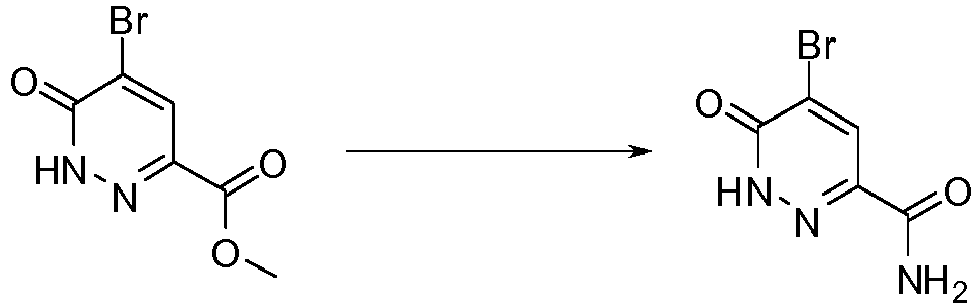
- Methyl 5-bromo-6-oxo-1H-pyridazine-3-carboxylate (2.48 g, 1.0 eq, 10.64 mmol, 99 %) is stirred in ammonia 25 % water solution (30 mL) for 16 h (overnight). Volatiles are evaporated to dryness. The residue is suspended in methanol and the solvent is evaporated once again to afford the desired compound. LCMS: MW (calcd): 218; m/z MW (obsd): 220 (M+H).
-

- To a solution of 5-bromo-6-oxo-1H-pyridazine-3-carboxamide (2.32 g, 1.0 eq, 10.64 mmol) in 25 mL of dry DMF, cooled at 0 °C, is added phosphorus(V) oxychloride, POCl3 (2.0 mL, 2.0 eq) and the mixture is stirred at room temperature for 1 h and quenched by pouring it on 200 mL of ice. Using 50 % NaOH water solution pH of the mixture is adjusted to around 2.5. The mixture is extracted with EtOAc (10 % THF, twice, 300 mL use in total). The gathered organic layers are washed with 200 mL of HCl (around pH 3) water solution and 200 mL of brine and dried over Na2SO4 and concentrated to afford the desired compound. LCMS: MW (calcd): 200; m/z MW (obsd): 198 (M-H).
-
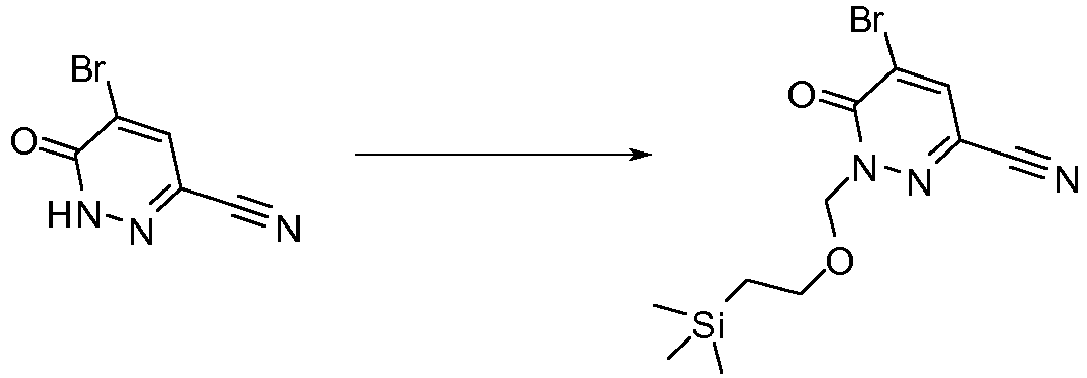
- To a stirred solution of 5-bromo-6-oxo-1H-pyridazine-3-carbonitrile (270 mg, 1.0 eq, 1.24 mmol, 91 %) in 4 mL of dry DMF, cooled at 0 °C is added sodium hydride, 60 % mineral oil dispersion (65 mg, 1.1 eq, 60 %) and the mixture is warmed-up to room temperature within 15 min and is stirred for 30 min. The mixture is then cooled to 0 °C and 2-(chloromethoxy)ethyl-trimethyl-silane (245 µL, 1.1 eq) is added. After the addition the mixture is left to be warmed-up to room temperature and it is stirred for approximately 16 h. The reaction mixture is poured into 60 mL of water and extracted with Et2O (2x40 mL). The gathered organic layers are washed with water (100 mL) and brine (100 mL). The organic layer is dried over Na2SO4 and concentrated. The crude is purified by flash column chromatography (SiO2, cyclohexane / EtOAc 100:0 to 0:100) to afford the desired compound.
-

- A degassed solution of 5-bromo-6-oxo-1-(2-trimethylsilylethoxymethyl)pyridazine-3-carbonitrile (700 mg, 1.0 eq, 2.01 mmol, 95 %), potassium phosphate, tribasic, K3PO4 (880 mg, 2.0 eq), cyclopropylboronic acid (273 mg, 1.5 eq, 95 %), tricyclohexylphosphine (91 mg, 0.15 eq) and Pd(OAc)2 (37 mg, 0.08 eq) in a toluene (10 mL)/water (1 mL) solvent mixture is stirred in a sealed vial, under argon atmosphere, at 100 °C for approximately 24 h. The hot reaction is filtered over a celite pad and the pad is rinsed with 50 mL of EtOAc. To obtained organic solution is then washed with 70 mL of water and 70 mL of brine, dried over Na2SO4 and concentrated. The crude is purified by flash column chromatography (SiO2, cyclohexane / EtOAc 100:0 to 85:15) to afford the desired compound.
-

- To a solution of 5-cyclopropyl-6-oxo-1-(2-trimethylsilylethoxymethyl)pyridazine-3-carbonitrile (260 mg, 1.0 eq, 0.874 mmol, 98 %) in 10 mL of dry DCM is added TFA, TFA (1.35 mL, 20 eq) and the mixture is stirred at room temperature for approximately 60 h. The reaction is concentrated and the residue taken up in 15 mL of water. The mixture is extracted with 2x15 mL of EtOAc. The gathered organic layers are dried over Na2SO4 and concentrated. The residue is dissolved in 5 mL of dry methanol and to the solution is added 1 mL of 7 N NH3 in methanol solution. The reaction mixture is stirred for 2 h at room temperature. Volatiles are evaporated and the residue is suspended in 10 mL of 0.01 N HCl. The mixture is extracted with DCM (2x10 mL). The gathered organic layers are dried over Na2SO4. Filtration and evaporation of the solvent affords the desired compound. LCMS: MW (calcd): 161; m/z MW (obsd): 162 (M+H).
-

- To a solution of 5-methyl-6-[1-methyl-3-(trifluoromethyl)pyrazol-4-yl]pyridazine-3-carbonitrile (300 mg, 1.0 eq, 1.11 mmol) in 6 mL of dry carbon tetrachloride, CCl4 is added N-bromosuccinimide, NBS (204 mg, 1.0 eq) followed by 2,2'-azobis(2-methylpropionitrile), AIBN (19 mg, 0.1 eq). The mixture is flushed with argon and stirred in a sealed vial at 115 °C for 6 h. The reaction is diluted with 20 mL of DCM and poured in 30 mL of water. Using phase separator cartridge layers are separated. Solvent from the organic layer is evaporated. The resulting crude is purified by flash column chromatography (SiO2, DCM / EtOAc100:0 to 80:20) to afford the desired compound. LCMS: MW (calcd): 346; m/z MW (obsd): 346 (M+H).
-

- To a solution of 5-(bromomethyl)-6-[1-methyl-3-(trifluoromethyl)pyrazol-4-yl]pyridazine-3-carbonitrile (100 mg, 1.0 eq, 0.286 mmol, 90 %) in 1.0 mL of dry THF dimethylamine, 2N THF solution (429 µL, 3.0 eq, 99 %) is added and the mixture is stirred in a sealed vial at room temperature for 30 min. Volatiles are evaporated and the rest is portioned between DCM (20 mL) and saturated Na2CO3 water solution (20 mL). Extraction is performed once more with additional 15 mL of DCM. The gathered organic layers are dried over Na2SO4 and concentrated. The organic layers are concentrated and the residue purified by flash column chromatography (SiO2, DCM / methanol 100:0 to 93.5:6.5) to afford the desired compound. LCMS: MW (calcd): 310; m/z MW (obsd): 311 (M+H).
-

- A degassed solution of 5-bromo-6-oxo-1-(2-trimethylsilylethoxymethyl)pyridazine-3-carbonitrile (700 mg, 1.0 eq, 2.01 mmol, 95 %), potassium acetate, KOAc (598 mg, 3.0 eq, 99 %), bis(pinacolatodiboron) (547 mg, 1.05 eq, 98 %) and [1,1'-bis(diphenylphosphino)ferrocene]dichloropalladium(II), complex with DCM, PdCl2(dppf).DCM (83 mg, 0.05 eq) in 12 mL of dry 1,4-dioxane is put under argon atmosphere and stirred in a sealed vial at 90 °C for 2.0 h. The reaction mixture is cooled to 0 °C. Hydrogen peroxide, 30 % water solution (716 µL, 3.5 eq) is added. The reaction is left to warm up to room temperature and stirred for 90 min and diluted with 80 mL of EtOAc and 100 mL of water. The layers are separated and the water layer is extracted with 35 mL of EtOAc which is gathered with the first organic layer. The resulting organic phase is washed with 80 mL of brine and dried over Na2SO4. The solvent is removed to afford the desired compound. LCMS: MW (calcd): 267; m/z MW (obsd): 266 (M-H).
-

- Iodomethane (128 µL, 1.1 eq, 99 %) is added to a suspension of 5-hydroxy-6-oxo-1-(2-trimethylsilylethoxymethyl)pyridazine-3-carbonitrile (440 mg, 1.0 eq, 0.90 mmol) and potassium carbonate, K2CO3 (263 mg, 1.3 eq, 99 %) in 5 mL of dry DMF and the suspension is stirred in a sealed vial at 65 °C for 1 h. The reaction mixture is cooled to room temperature and poured into 70 mL of water. The mixture is extracted with EtAOc (2x30 mL). The gathered organic layers are washed with 40 mL of water and 40 mL of brine. After drying over Na2SO4 and evaporation of the solvent the resulting crude is purified by flash column chromatography (SiO2, cyclohexane / EtOAc 100:0 to 50:50) to afford the desired compound.
-

- To a solution of 5-methoxy-6-oxo-1-(2-trimethylsilylethoxymethyl)pyridazine-3-carbonitrile (248 mg, 1.0 eq, 0.881 mmol, 100 %) in 10 mL of dry DCM is added TFA (1.02 mL, 15 eq) and the mixture is stirred at room temperature for 4 h. Volatiles are evaporated. Dry methanol (10 mL) and IN NH3 in methanol (1 mL) are added to the residue. The mixture is stirred at room temperature for 2 h. The volatiles are evaporated. The residue is suspended in 7 mL of Et2O and after evaporation the desired compound is obtained. LCMS: MW (calcd): 151; m/z MW (obsd): 152 (M+H).
-

- A solution of 5-bromo-6-oxo-1H-pyridazine-3-carbonitrile (1 eq) triethylamine, TEA (3.5 eq) and the appropriate amine (free base or HCl salt, 1.5 to 2 eq) in dry DMF or THF (0.3 M) is stirred in a sealed vial at 80 °C for 2 h. The mixture is cooled to room temperature and poured into water. Using IN HCl water solution pH of the solution is adjusted to around 4.5. The aqueous solution is extracted with an organic solvent. After work up, the organic solution is dried over Na2SO4 and the solvent is removed to afford the desired compound.
-
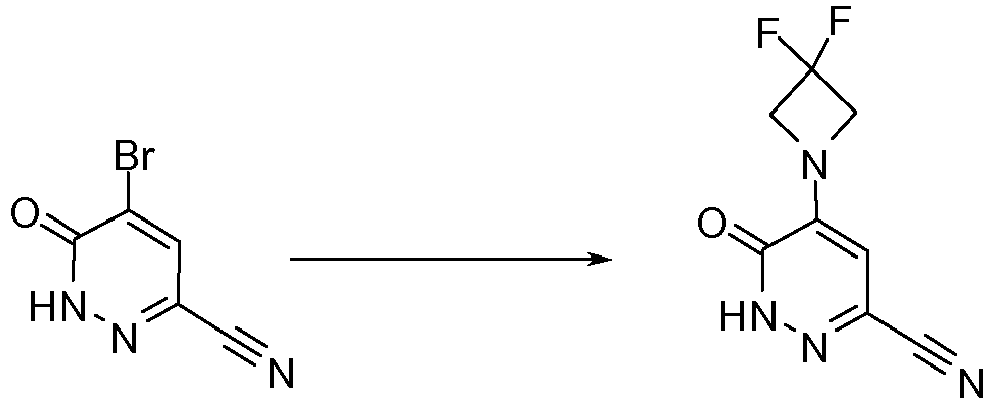
- A solution of 5-bromo-6-oxo-1H-pyridazine-3-carbonitrile (300 mg, 1.0 eq, 1.35 mmol, 90 %), triethylamine, TEA (666 µL, 3.5 eq, 99 %) and 3,3-difluoroazetidine hydrochloride (271 mg, 1.5 eq) in 5 mL of dry DMF is stirred in a sealed vial at 80 °C for 90 min. The mixture is cooled to room temperature and poured to 70 mL of water. Using IN HCl water solution pH of the solution is adjusted to around 4.5. The aqueous solution is extracted with EtOAc (3 times, 100 mL is used in total). The gathered organic layer is washed with water (40 mL) and brine (40 mL). The organic solution is dried over Na2SO4 and the solvent is removed to afford the desired compound. LCMS: MW (calcd): 344; m/z MW (obsd): 345 (M+H).
-

- A suspension of 3,6-dichloro-4,5-dimethyl-pyridazine (3.0 g, 17 mmol) in aqueous NaOH (3.3 N, 28 mL) is stirred at reflux for 2 h. The reaction is cooled to room temperature and acetic acid (50% solution in water, 19 mL) is added. The formed precipitate is extracted with 9:1 ethyl acetate:THF (3×100 mL). The combined organic extracts are dried over Na2SO4 and concentrated under reduced pressure to afford the desired compound.
LCMS: MW (calcd): 159; m/z MW (obsd): 160 (M+H). -
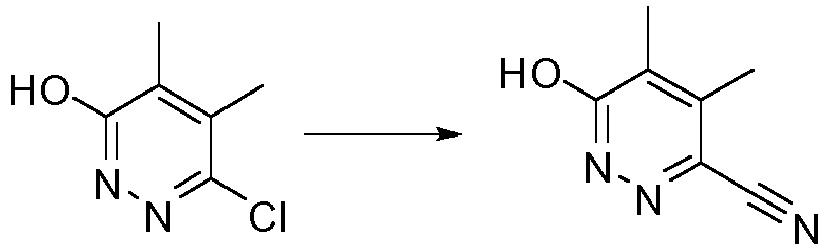
- A mixture of 6-chloro-4,5-dimethyl-pyridazin-3-ol (2.7 g, 17 mmol), Zn(CN)2 (1.23 g, 10.3 mmol), dppf, 1,1'-Bis(diphenylphosphino)ferrocene, (784 mg, 1.37 mmol) in dimethylformamide (38 mL) is flushed three times with argon. Pd2(dba)3 (641 mg, 0.686 mmol) is added and the reaction is stirred at 135°C in a sealed vessel for 2 h. The mixture is filtered through a Celite pad. The filtrate is diluted with water (100 mL) and extracted with ethyl acetate (3×50 mL). The combined organic extracts are washed with water (100 mL) and brine (100 mL). The organic layer is dried over Na2SO4 and concentrated under reduced pressure to afford the desired compound.
LCMS: MW (calcd): 149; m/z MW (obsd): 150 (M+H). -

- A mixture of 6-chloro-4,5-dimethyl-pyridazin-3-ol (2.7 g, 17 mmol), Zn(CN)2 (1.23 g, 10.3 mmol), dppf, 1,1'-Bis(diphenylphosphino)ferrocene, (784 mg, 1.37 mmol) in dimethylformamide (38 mL) is flushed three times with argon. Pd2(dba)3 (641 mg, 0.686 mmol) is added and the reaction is stirred at 135°C in a sealed vessel for 2 h. The mixture is filtered through a Celite pad. The filtrate is diluted with water (100 mL) and extracted with ethyl acetate (3×50 mL). The combined organic extracts are washed with water (100 mL) and brine (100 mL). The organic layer is dried over Na2SO4 and concentrated under reduced pressure to afford the desired compound.
LCMS: MW (calcd): 149; m/z MW (obsd): 150 (M+H). -

- A mixture of 3,6-dichloro-4-methyl-pyridazine (500 mg, 3.0 mmol, 1 equiv), 1,3-dimethyl-4-(4,4,5,5-tetramethyl-1,3,2-dioxaborolan-2-yl)pyrazole (668 mg, 3.0 mmol, 1 equiv), K2CO3 (1.04 g, 7.53 mmol, 2.5 equiv) and Pd(dppf)Cl2 (245 mg, 0.30 mmol, 0.1 equiv) in 1,4-dioxane:H2O 4:1 is stirred at 80 °C. After 4 h the mixture is partitioned between dichloromethane and saturated NaHCO3. The mixture is filtered through a phase separator and the organic layer is concentrated under reduced pressure. The residue is purified by silica column chromatography (SiO2, methanol/dichloromethane 0:100 to 2:98) to afford the desired compound.
LCMS: MW (calcd): 223; m/z MW (obsd): 223 (M+H). -

- A mixture of 6-chloro-3-(1,3-dimethylpyrazol-4-yl)-4-methyl-pyridazine (100 mg, 0.45 mmol, 1 equiv), Zn(CN)2 (52 mg, 0.45 mmol, 1 equiv), and Pd(PPh3)4 (57 mg, 0.05 mmol, 0.1 equiv) in dimethylformamide (2 mL) is stirred at 150°C in a microwave reactor for 5 min. The mixture is diluted with ethyl acetate, washed with saturated NaHCO3 and concentrated to afford the desired compound.
LCMS: MW (calcd): 213; m/z MW (obsd): 214 (M+H). -

- A mixture of 6-chloro-5-methyl-pyridazine-3-carbonitrile (120 mg, 0.78 mmol, 1 equiv), 2,4-dimethyl-1H-imidazole (112 mg, 1.17 mmol, 1.5 equiv) and N,N-diisopropylethylamine (0.27 mL, 1.56 mmol, 2 equiv) in THF (0.72 mL) is stirred at 50 °C for 24 h. The mixture was partitioned between DCM and saturated ammonium chloride. The two layers were separated. The organic layer was washed (brine and H2O), dried (Na2SO4) and concentrated to yield the desired compound. LCMS: MW (calcd): 213; m/z MW (obsd): 214 (M+H).
-

- N-chlorosuccinimide (88 mg, 0.657 mmol, 1.0 equiv) and 2-ethoxy-6-methylpyridin-4-amine (100 mg, 0.657 mmol, 1.0 equiv) are stirred in DCM (3 ml) at room temperature. After 6 h, the reaction mixture is partitioned between dichloromethane and water. The aqueous phase was extracted with DCM. The combined organic phase was filtered through a phase separator and concentrated under vacuum to afford the desired compound. LCMS: MW (calcd): 187; m/z MW (obsd): 187 (M+H).
-

- N-bromosuccinimide (1.17 g, 6.57 mmol, 1.0 equiv) and 2-ethoxy-6-methyl-pyridin-4-amine (1.0 g, 6.57 mmol, 1.0 equiv) are stirred at room temperature in dry DCM (33 ml) for 1 h. The mixture is diluted with DCM and water. The aqueous phase is extracted with DCM. The combined organic phase is filtered through a phase separator and concentrated under vacuum to afford the desired compound. LCMS: MW (calcd): 231; m/z MW (obsd): 233 (M+H).
-

- A degassed mixture of 3-bromo-2-ethoxy-6-methyl-pyridin-4-amine (1 g, 4.33 mmol, 1.0 equiv), methylboronic acid (777 mg, 13.0 mmol, 3.0 equiv), Cs2CO3 (7.05 g, 21.7 mmol, 5.0 equiv) and SPhos Pd G2 (155 mg, 0.22 mmol, 0.05 equiv) in dry dioxane (40 mL, 0.1M) is heated at 100°C for 5 h. The reaction mixture is diluted with DCM and water. The organic layer is filtered through a phase separator and concentrated under vacuum. The residue is purified by flash chromatography (Petroleum ether/EtOAc 9/1) to afford the desired compound. LCMS: MW (calcd): 166; m/z MW (obsd): 167 (M+H).
-

- N-bromosuccinimide (56 mg, 0.32 mmol, 1.0 equiv) and 2-[2-[tert-butyl(dimethyl)silyl]oxyethoxy]-6-(trifluoromethyl)pyridin-4-amine (106 mg, 0.32 mmol, 1.0 equiv) are stirred at room temperature in dry DCM (1.6 ml) for 30 min. The mixture is diluted with DCM and water. The aqueous phase is extracted with DCM. The combined organic phase is filtered through a phase separator and concentrated under vacuum. The crude is purified by flash chromatography. LCMS: MW (calcd): 415; m/z MW (obsd): 417 (M+H).
-

- A degassed mixture of 3-bromo-2-[2-[tert-butyl(dimethyl)silyl]oxyethoxy]-6-(trifluoromethyl)pyridin-4-amine (0.315 mmol, 1.0 equiv), methylboronic acid (57 mg, 0.945 mmol, 3.0 equiv), Cs2CO3 (513 mg, 1.58 mmol, 5.0 equiv) and SPhos Pd G2 (22 mg, 0.032 mmol, 0.10 equiv) in dry dioxane (3 mL, 0.1M) is heated at 90°C for 24 h. The reaction mixture is diluted with DCM and water. The organic layer is filtered through a phase separator and concentrated in vacuum. The residue is purified by flash chromatography (Petroleum ether/EtOAc 9/1) to afford the desired compound. LCMS: MW (calcd): 350; m/z MW (obsd): 351 (M+H).
-

- N-bromosuccinimide (427 mg, 2.40 mmol, 1.0 equiv) and 2-chloro-6-(2,2-difluoroethoxy)pyridin-4-amine (500 mg, 2.40 mmol, 1.0 equiv) are stirred at room temperature in dry DCM (12 ml) for 2 h. The mixture is diluted with DCM and water. The aqueous phase is extracted with DCM. The combined organic phase is filtered through a phase separator and concentrated under vacuum to afford the desired compound. LCMS: MW (calcd): 288; m/z MW (obsd): 289 (M+H).
-

- A degassed mixture of 3-bromo-6-chloro-2-(2,2-difluoroethoxy)pyridin-4-amine (2.40 mmol, 1.0 equiv), methylboronic acid (718 mg, 12.0 mmol, 5.0 equiv), Cs2CO3 (3.91 g, 12.0 mmol, 5.0 equiv) and SPhos Pd G2 (173 mg, 0.24 mmol, 0.10 equiv) in dry dioxane (18 mL, 0.15M) is heated at 90°C for 16 h. The reaction mixture is diluted with DCM and water. The aqueous phase was extracted with DCM. The organic layer is filtered through a phase separator and concentrated in vacuum to afford the desired compound. LCMS: MW (calcd): 202; m/z MW (obsd): 203 (M+H).
-

- At 0°C, acetyl chloride (0.25 mL, 3.6 mmol, 1.5 equiv) is added to a mixture of 2 chloro 6 (2,2-difluoroethoxy)pyridin-4-amine (500 mg, 2.40 mmol, 1.0 equiv), triethyl amine (1 mL, 7.2 mmol, 3.0 equiv) and DMAP (29 mg, 0.240 mmol, 0.1 equiv) in dichloromethane (6 mL, 0.4 M). After 24 h, starting material is still present. At 0°C, acetyl chloride (0.25 mL, 3.6 mmol, 1.5 equiv) is added. After 2 h, the reaction mixture is diluted with DCM and water. The organic layer is filtered through a phase separator and concentrated in vacuum to afford the desired compound. LCMS: MW (calcd): 251; m/z MW (obsd): 251 (M+H).
-
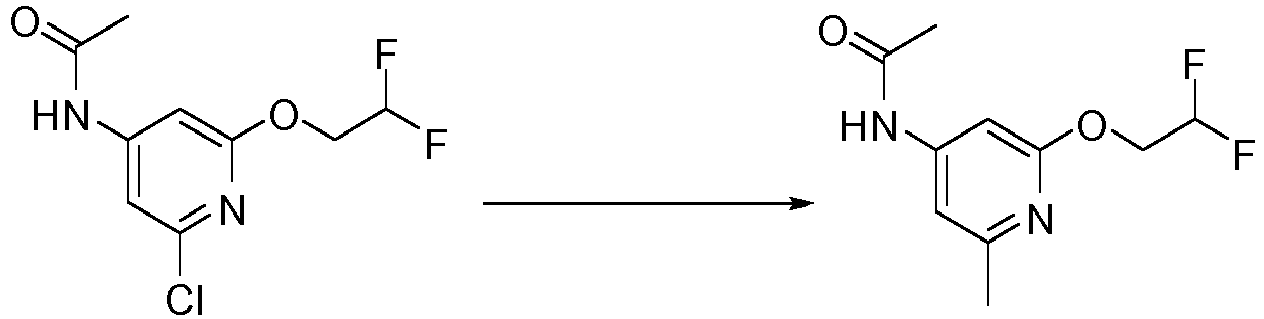
- A degassed mixture of N-[2-chloro-6-(2,2-difluoroethoxy)-4-pyridyl]acetamide (1.96 mmol, 1.0 equiv), methylboronic acid (351 mg, 5.87 mmol, 3.0 equiv), Cs2CO3 (3.2 g, 9.8 mmol, 5.0 equiv) and SPhos Pd G2 (141 mg, 0.196 mmol, 0.10 equiv) in dry dioxane (18 mL, 0.1M) is heated at 90°C for 24 h. The reaction mixture is diluted with DCM and water. The organic layer is filtered through a phase separator and concentrated in vacuum to afford the desired compound. LCMS: MW (calcd): 230; m/z MW (obsd): 231 (M+H).
-
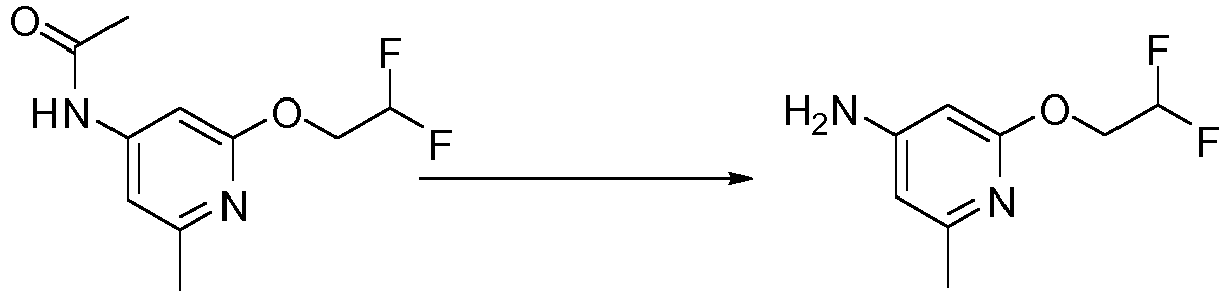
- N-[2-(2,2-difluoroethoxy)-6-methyl-4-pyridyl]acetamide (1.96 mmol, 1.0 equiv) is heated at 50°C in a solution of NaOH (4 mL, 3.92 mmol, 2.0 equiv, 1M in water) in ethanol (8 mL, 0.25 M). The reaction mixture is diluted with DCM and water. The aqueous phase was extracted with DCM. The organic layer is filtered through a phase separator and concentrated in vacuum. The residue is purified by silica chromatography (Petroleum ether/EtOAc: 9/1) to afford the desired compound. LCMS: MW (calcd):188; m/z MW (obsd): 189 (M+H).
-

- A mixture of 3-bromo-2-ethoxy-6-methyl-pyridin-4-amine (100 mg, 0.433 mmol, 1.0 equiv), tetrakis(triphenylphosphine)palladium(0) (40 mg, 0.034 mmol, 0.08 equiv) and zinc cyanide (50 mg, 0.433 mmol, 1.0 equiv) in anhydrous N,N-dimethylformamide (2 mL, 0.2 M) is heated at 150 °C for 5 min under microwave irradiation. The reaction mixture is diluted with EtOAc and washed with a saturated solution of NaHCO3. The organic layer is washed with brine, dried over sodium sulfate and concentrated in vacuo. The residue is purified by silica chromatography (petroleum ether/EtOAc: 9/1) to afford the desired compound. LCMS: MW (calcd): 177; m/z MW (obsd): 178 (M+H).
-

- Pyridine (3.0 equiv) and diphenyl n-cyanocarbonimidate (1.0 equiv) are added to aminopyridine (1.0 equiv) in dichloromethane (0.4 M). The resulting mixture is stirred at 70°C. After 16 h the reaction mixture is partitioned between dichloromethane and water. The aqueous phase is extracted with DCM. The combined organic phase was filtered through a phase separator and concentrated under vacuum to afford the desired compound.
-

- Pyridine (0.2 mL, 2.48 mmol, 3.0 equiv) and diphenyl n-cyanocarbonimidate (197 mg, 0.826 mmol, 1.0 equiv) are added to 2-ethoxy-3-methyl-6-(trifluoromethyl)pyridin-4-amine (200 mg, 0.908 mmol, 1.0 equiv) in dichloromethane (2 mL, 0.4 M). The resulting mixture is stirred at 70°C. After 16 h, the reaction mixture is partitioned between dichloromethane and water. The aqueous phase is extracted with DCM. The combined organic phase was filtered through a phase separator and concentrated under vacuum to afford the desired compound. LCMS: MW (calcd): 364; m/z MW (obsd): 365 (M+H).
-

- Pyridine (0.12 ml, 1.45 mmol, 3.0 equiv) and diphenyl n-cyanocarbonimidate (105 mg, 0.441mmol, 1.0 equiv) are added to 2-ethoxy-6-(trifluoromethyl)pyridin-4-amine (100 mg, 0.485 mmol, 1.1 equiv) in dichloromethane (1.2 ml). The resulting mixture is stirred at 70°C. After 16 h, the reaction mixture is partitioned between dichloromethane and water. The aqueous phase was extracted with DCM. The combined organic phase was filtered through a phase separator and concentrated under vacuum to afford the desired compound. The solid so obtained was trituared with MTBE. LCMS: MW (calcd): 350; m/z MW (obsd): 351 (M+H).
-

- A mixture of the chloro-pyridazine derivative (1.0 equiv), the corresponding amine (1.5 equiv) and DIPEA (1.5 to 2 equiv) in DMSO or DMF (1 to 2 M) is stirred at RT overnight. The resulting mixture is diluted with EtOAc, washed with aq. sat. NaHCO3, brine, dried and concentrated to afford the desired compound.
-

- A mixture of 6-chloro-5-methyl-pyridazine-3-carbonitrile (100 mg, 0.65 mmol, 1.0 equiv), 3,3-difluoro-pyrrolidine hydrochloride (141 mg, 0.98 mmol, 1.5 equiv) and DIPEA (0.17 mL, 0.98 mmol, 1.5 equiv) in DMSO (0.5 mL) is stirred at RT overnight. The resulting mixture is diluted with EtOAc, washed with aq. sat. NaHCO3, brine, dried and concentrated to afford the desired compound. LCMS: MW (calcd): 224; m/z MW (obsd): 225 (M+H).
-

- A mixture of the chloro-pyridazine derivative (1.0 equiv), the corresponding amine (1.5 equiv) and DIPEA (3 equiv) in DMSO (0.3 to 2 M) is heated at 40°C. After 4h, pyridine (1 equiv) is added and the resulting mixture heated at 70°C overnight. The resulting mixture is diluted with EtOAc, washed with aq. sat. NH4Cl, brine, dried and concentrated to afford the desired compound.
-

- A mixture of 6-chloro-5-methyl-pyridazine-3-carbonitrile (crude, 1.85 mmol, 1.0 equiv), 3,3-difluoro-azetidine hydrochloride (360 mg, 2.78 mmol, 1.5 equiv) and DIPEA (0.97 mL, 5.55 mmol, 3 equiv) in DMSO (2 mL) is stirred at 40°C. After 4h, pyridine (0.15 mL, 1.85 mmol, 1 equiv) is added and the resulting mixture heated at 70°C overnight. The resulting mixture is diluted with EtOAc, washed with aq. sat. NH4Cl, brine, dried and concentrated to afford the desired compound. LCMS: MW (calcd): 214; m/z MW (obsd): 215 (M+H).
-

- To a solution of 6-chloro-5-methyl-pyridazine-3-carbonitrile (1.0 equiv) in dry THF (0.3 to 1M) is added aminoderivative (1 to 1.5 equiv) and N,N-Diisopropylethylamine (2.0-3.0 equiv). The reaction is stirred at 50°C-80°C for 16 to 24 h. The mixture is diluted with DCM and is washed with NH4Cl. The organic layer is dried over sodium sulfate, filtered and concentrated in vacuo. The residue is used as such in the next step.
-

- DIPEA (0.5 mL, 2.93 mmol, 3.0 equiv) is added to 6-chloro-5-methyl-pyridazine-3-carbonitrile (150 mg, 0.976 mmol, 1.0 equiv) and (2S,6S)-2,6-dimethyl-morpholine, (135 mg, 1.17 mmol, 1.2 equiv) in THF (3 mL, 0.3 M). The resulting mixture is heated at 55°C. After 24 h, the reaction mixture is diluted with DCM and saturated NH4Cl solution. The aqueous phase was extracted with DCM. The organic layer is filtered through a phase separator and concentrated in vacuum to afford the desired compound. LCMS: MW (calcd):232; m/z MW (obsd): 233 (M+H).
-

- To a solution of tert-butyl 2-methyl-6,7-dihydro-5H-pyrazolo[4,3-b]pyridine-4-carboxylate (150 mg, 0.63 mmol, 1.0 equiv) in dry DCM (1.9 mL) is added trifluoroacetic acid (1.2 mL, 10 mmol, 25 equiv). The reaction was stirred at 40°C for 2 h. The reaction was coevaporated with toluene (3x) to give the desired product. LCMS: MW (calcd): 137; m/z MW (obsd): 138 (M+H).
- To a solution of 6-chloro-5-methyl-pyridazine-3-carbonitrile (75 mg, 0.49 mmol, 1.0 equiv) in dry THF (0.49 mL) is added 2-methyl-4,5,6,7-tetrahydropyrazolo[4,3-b]pyridine (82 mg, 0.74 mmol, 1.5 equiv) and N,N-Diisopropylethylamine (0.17 mL, 0.98 mmol, 2.0 equiv). The reaction is stirred at 50°C overnight then at 100°C for 60h. The mixture is diluted with DCM and washed with NH4Cl. The organic layer is dried over sodium sulfate, filtered and concentrated in vacuum. LCMS: MW (calcd): 254; m/z MW (obsd): 255 (M+H).
-

- i) Under nitrogen, in a flask at 0°C, CD3CD2OH (2eq, 65.05 mmol, 3.32g) is diluted with dioxane (30mL). To the solution is added NaH 60% in oil (2eq, 65.05 mmol, 2.6g) by portion and the resulting mixture is stirred at room temperature for 30 minutes. A solution of 2-Chloro-4-iodo-6-(trifluoromethyl)pyridine (10g, 32.53mmol) in dioxane (40 mL) is added portion wise into the previous mixture. The heterogeneous mixture is stirred at room temperature until complete conversion.
- ii) To the reaction mixture are added directly BocNH2 (1.2eq, 39.03 mmol, 4.573g), Pd2(dba)3 (0.5%, 0.163mmol, 149mg), Xantphos (1.5%, 0.488mmol, 282mg) and Cs2CO3 (1.1eq, 35.78 mmol, 11.658g) and dioxane (30mL). The reaction mixture is stirred at 85°C until complete conversion. The reaction mixture is filtered over a pad of Celite, rinsed with dioxane and concentrated partially.
- To the previous mixture is added HCl 4N in dioxane (100mL) at room temperature and the reaction mixture is stirred at 60°C until complete conversion. Then the reaction mixture is cooled down to room temperature and DCM is added (100mL). The suspension is stirred at room temperature for 1 hour and the solid formed is filtered. The precipitate is rinsed with DCM to afford the desired product as hydrochloride salt. The filtrate is evaporated, re-slurried in DCM and the solid formed is filtered to afford a second crop of expected product as hydrochloride salt.
- The 2 batches are combined and added by portion into a solution of NaOH 2N under stirring. The product is extracted with DCM and is passed through a phase separator. The organic layer is concentrated to give the expected product. LCMS: MW (calcd): 211; m/z MW (obsd): 212 (M+H).
-

- 1,1'-carbonyl-di-(1,2,4-triazole) (1 to 2 equiv) is added to the aniline (1 to 2 equiv) in dry pyridine (1.5 to 3 equiv) and dry DCM (0.2 M). The resulting mixture is stirred at 45°C for 30 min and added to a mixture of the benzylamine hydrochloride salt (or trifuloroacetic acid salt, 1.0 equiv) and diisopropylthylamine (4 to 5 equiv) in dry THF (0.1 to 0.3 M). The resulting mixture is stirred at room temperature for 30 min. The mixture is diluted with DCM and water. The organic phase is washed with 1 M HCl solution or sat. NH4Cl, filtered through a phase separator and concentrated under reduced pressure. The residue is purified by flash column chromatography or preparatory HPLC to afford the desired compound.
-

- Carbonyltriimidazole (1.14 g, 6.97 mmol, 1.2 equiv) is added to a mixture of 2-ethoxy-6-(trifluoromethyl)pyridin-4-amine (1.44 g, 6.97 mmol, 1.2 equiv) in dry pyridine (1.41 mL, 17.4 mmol, 3.0 equiv) and dry DCM (29.0 mL, 0.2 M).The resulting mixture is stirred at 45°C for 30 min. The above mentioned mixture is added to a suspension of [5-methyl-6-[1-methyl-3-(trifluoromethyl)pyrazol-4-yl]pyridazin-3-yl]methanamine hydrochloride salt (2.0 g, 5.81 mmol, 1.0 equiv) and diisopropylthylamine (4.0 mL, 4.0 equiv) in dry THF (8.0 mL, 0.3 M). The resulting mixture is stirred at room temperature for 30 min. The mixture is diluted with DCM and water. The organic phase is washed with 1 M HCl solution, filtered through a phase separator and concentrated under reduced pressure. These operations are repeated four times. The crudes are gathered and purified by flash chromatography on silica gel (eluting with Et2O/Acetone 95/5 to 90/10) to give, after trituration in MTBE/MeCN, the desired compound. LCMS: MW (calcd): 503; m/z MW (obsd): 504 (M+H).
-

- To a solution of aniline (0.7 to 1.5 eq) in dry DCM (0.1 M) and pyridine (2 to 3 eq), 1,1'-carbonyl-di-(1,2,4-triazole) (1 to 1.5 eq) is added. The resulting mixture is stirred at 50 °C. After 30 to 90 min, the reaction mixture is cooled to room temperature and a solution of benzylamine (1 eq) in dry DCM or THF (0.1 to 0.5 M) is added. The resulting mixture is left to stir at room temperature. After 1 to approximately 16 h the reaction mixture is quenched with water or sat. NH4Cl and extracted with an organic solved. After work up, the organic layers are dried over Na2SO4 and concentrated under reduced pressure. The crude is purified by flash column chromatography or preparative HPLC to afford the desired compound.
-

- Carbonyltriimidazole (726 mg, 4.42 mmol, 1.5 equiv) is added to 2-chloro-6-ethoxy-pyridin-4-ylamine (356 mg, 2.07 mmol, 0.7 equiv) in pyridine (0.71 mL, 8.85 mmol, 3 equiv) and DCM (15 mL). The reaction mixture is stirred at 45°C for 30 min. Once cooled to room temperature, [5-methyl-6-[1-methyl-3-(trifluoromethyl)pyrazol-4-yl]pyridazin-3-yl]methanamine (800 mg, 2.95 mmol, 1.0 equiv) is added and the resulting mixture is stirred at room temperature for 1 h. The mixture is diluted with DCM, washed with aq. sat. NH4Cl and aq. sat. NaHCO3. The organic phase is filtered through a phase separator and concentrated under reduced pressure. The residue is purified by silica chromatography (methanol/DCM; 0:100 to 4:96) followed by triturated in a mixture of methyl tert-butyl ether/petroleum ether to afford the desired compound. LCMS: MW (calcd): 470; m/z MW (obsd): 470 (M+H).
-

- To a solution of 2-chloro-6-ethoxy-pyridin-4-ylamine (23.5 mg, 0.136 mmol) in dry DCM (900 µL) and pyridine (43.1 µL, 0.585 mmol), 1,1'-carbonyl-di-(1,2,4-triazole) (48.0 mg, 0.292 mmol) is added. The resulting mixture is stirred at 50 °C. After 90 min, the reaction mixture is cooled to room temperature and a solution of 1-[5-methyl-6-[1-methyl-3-(trifluoromethyl)pyrazol-4-yl]pyridazin-3-yl]ethanamine (55.6 mg, 0.195 mmol) in dry DCM (250 µL) is added. The resulting mixture is left to stir at room temperature. After 5 h the reaction mixture is quenched with water (30 mL) and extracted with DCM (3 × 10 mL). Combined organic layers are washed with brine (30 mL), dried over Na2SO4 and concentrated under reduced pressure. The crude is purified by flash column chromatography (SiO2, EtOAc / cyclohexane 9:100 to 10:1) to afford the desired compound. LCMS: MW (calcd): 484; m/z MW (obsd): 484 (M+H).
-

- 1,1'-carbonyl-di-(1,2,4-triazole) (534 mg, 3.26 mmol, 1.1 equiv) is added to 2-ethoxy-3,6-dimethyl-pyridin-4-amine (492 mg, 2.96 mmol, 1.0 equiv) in pyridine (0.72 mL, 8.88 mmol, 3 equiv) and DCM (15 mL). The reaction mixture is stirred at 45°C for 30 min. Once cooled to room temperature, [5-methyl-6-[1-methyl-3-(trifluoromethyl)pyrazol-4-yl]pyridazin-3-yl]methanamine (802 mg, 2.96 mmol, 1.0 equiv) is added and the resulting mixture is stirred at room temperature for 1 h. The mixture is diluted with DCM and water. The aqueous phase is extracted with DCM. The combined organic phase is filtered through a phase separator and concentrated under vacuum. The precipitate is triturated in MTBE and filtered to afford the desired compound. The solid is divided in two batches. One is dissolved in EtOAc and MeOH and concentrated again under vacuum. The other is dissolved in DCM and MeOH and concentrated again under vacuum. LCMS: MW (calcd): 463; m/z MW (obsd): 464 (M+H).
-

- General method H1 using [5-methyl-6-[1-methyl-3-(trifluoromethyl)pyrazol-4-yl]pyridazin-3-yl]methanamine HCl and 2-[2-[tert-butyl(dimethyl)silyl]oxyethoxy]-6-(trifluoromethyl)pyridin-4-amine. LCMS: MW (calcd): 634; m/z MW (obsd): 634 (M+H).
- 1-[2-[2-[tert-butyl(dimethyl)silyl]oxyethoxy]-6-(trifluoromethyl)-4-pyridyl]-3-[[5-methyl-6-[1-methyl-3-(trifluoromethyl)pyrazol-4-yl]pyridazin-3-yl]methyl]urea (0.232 mmol, 1.0 equiv) is stirred in concentrated HCl (0.5 mL, 0.5 M) and methanol (0.5 mL, 0.5 M) at room temperature for 45 min. The mixture is diluted with DCM and water. The aqueous phase is basified and extracted with DCM. The combined organic phase is filtered through a phase separator and concentrated under vacuum. The crude is purified by preparative HPLC to afford the desired compound. LCMS: MW (calcd): 519; m/z MW (obsd): 520 (M+H).
-

- General method H1 using [5-methyl-6-[1-methyl-3-(trifluoromethyl)pyrazol-4-yl]pyridazin-3-yl]methanamine HCl and 2-[(2,2-dimethyl-1,3-dioxolan-4-yl)methoxy]-6-(trifluoromethyl)pyridin-4-amine. LCMS: MW (calcd): 590; m/z MW (obsd): 590 (M+H).
- 1-[2-[(2,2-dimethyl-1,3-dioxolan-4-yl)methoxy]-6-(trifluoromethyl)-4-pyridyl]-3-[[5-methyl-6-[1-methyl-3-(trifluoromethyl)pyrazol-4-yl]pyridazin-3-yl]methyl]urea (0.232 mmol, 1.0 equiv) is stirred in 2 M HCl (0.5 mL, 0.5 M) and THF (0.5 mL, 0.5 M) at room temperature for 2 h. The mixture is diluted with DCM and water. The aqueous phase is basified and extracted with DCM. The combined organic phase is filtered through a phase separator and concentrated under vacuum. The crude is purified by trituration in MeCN/MTBE to afford the desired compound. LCMS: MW (calcd): 549; m/z MW (obsd): 550 (M+H).
-

- At room temperature, [5-methyl-6-[1-methyl-3-(trifluoromethyl)pyrazol-4-yl]pyridazin-3-yl]methanamine hydrochloride (80 mg, 0.232 mmol, 1.0 equiv) and 1,3-dichloro-5-isocyanato-benzene (44 mg, 0.232 mmol, 1.0 equiv) are stirred in DIPEA (0.16 mL, 0.928 mmol, 4.0 equiv) and THF (1.2 mL, 0.2 M). The mixture is diluted with DCM and water. The aqueous phase is extracted with DCM. The combined organic phase is filtered through a phase separator and concentrated under vacuum. The crude is purified by trituration in MeCN/MTBE to afford the desired compound. LCMS: MW (calcd): 459; m/z MW (obsd): 459 (M+H).
-

- General method H1 using [5-methyl-6-[1-methyl-3-(trifluoromethyl)pyrazol-4-yl]pyridazin-3-yl]methanamine HCl and 2-[2-[tert-butyl(dimethyl)silyl]oxyethoxy]-3-methyl-6-(trifluoromethyl)pyridin-4-amine. LCMS: MW (calcd): 648; m/z MW (obsd): 648 (M+H).
- 1-[2-(2-hydroxyethoxy)-3-methyl-6-(trifluoromethyl)-4-pyridyl]-3-[[5-methyl-6-[1-methyl-3-(trifluoromethyl)pyrazol-4-yl]pyridazin-3-yl]methyl]urea (0.114 mmol, 1.0 equiv) is stirred in concentrated HCl (0.25 mL, 0.5 M) and methanol (0.25 mL, 0.5 M) at room temperature for 45 min. The mixture is diluted with DCM and water. The aqueous phase is basified and extracted with DCM. The combined organic phase is filtered through a phase separator and concentrated under vacuum. The crude is purified by preparative HPLC to afford the desired compound. LCMS: MW (calcd): 533; m/z MW (obsd): 534 (M+H).
-

- To [5-methyl-6-[1-methyl-3-(trifluoromethyl)pyrazol-4-yl]pyridazin-3-yl]methanamine (free base or HCl salt) (2.2 equiv) is added to cynaguanidine (1.0 equiv), trimethylamine (3.0 equiv) in acetonitrile (0.5 M). The resulting mixture is stirred at 85°C. After 16 h the reaction mixture is partitioned between dichloromethane and water. The aqueous phase was extracted with DCM. The combined organic phase was filtered through a phase separator and concentrated under vacuum. The residue is purified by preparatory HPLC or by silica gel chromatography to afford the desired compound.
-

- [5-methyl-6-[1-methyl-3-(trifluoromethyl)pyrazol-4-yl]pyridazin-3-yl]methanamine (117.0 mg, 0.431 mmol, 2.2 equiv) is added to 3-cyano-1-[2-ethoxy-3-methyl-6-(trifluoromethyl)-4-pyridyl]-2-phenyl-isourea (67.5 mg, 0.194 mmol, 1.0 equiv), trimethylamine (0.08 mL, 0.588 mmol, 3.0 equiv) in acetonitrile (0.4 mL, 0.5M). The resulting mixture is stirred at 85°C. After 16 h the reaction mixture is partitioned between dichloromethane and water. The aqueous phase was extracted with DCM. The combined organic phase was filtered through a phase separator and concentrated under vacuum. The residue is purified by preparatory HPLC to afford the desired compound. LCMS: MW (calcd): 541; m/z MW (obsd): 542 (M+H).
-

- [5-methyl-6-[1-methyl-3-(trifluoromethyl)pyrazol-4-yl]pyridazin-3-yl]methanamine HCl salt (77 mg, 0.25 mmol, 2.2 equiv) is added to 3-cyano-1-[2-ethoxy-6-(trifluoromethyl)-4-pyridyl]-2-phenyl-isourea (40 mg, 0.114 mmol, 1.0 equiv), trimethylamine (0.05 mL, 0.342 mmol, 3.0 equiv) in acetonitrile (0.2 mL, 0.5M). The resulting mixture is stirred at 85°C. After 16 h the reaction mixture is partitioned between dichloromethane and water. The aqueous phase was extracted with DCM. The combined organic phase was filtered through a phase separator and concentrated under vacuum. The residue is purified by flash column chromatography (SiO2, DCM / MeOH 98:2 to 95:5) and recrystallization (MTBE / petroleum ether) to afford the desired compound. LCMS: MW (calcd): 527; m/z MW (obsd): 528 (M+H).
-

- 2-(1,1,2,2,2-pentadeuterioethoxy)-6-(trifluoromethyl)pyridin-4-amine (1.0g, 4.85 mmol) is dissolved in dry DCM (5 mL) and pyridine (2eq, 9.70 mmol, 0.78 mL) is added. To the clear solution is added 1,1'-Carbonyl-di-(1,2,4-triazole) (1.25eq, 6.06 mmol, 1g) and the reaction mixture is stirred at room temperature for 15 minutes. Then a solution of [5-methyl-6-[1-methyl-3-(trifluoromethyl)pyrazol-4-yl]pyridazin-3-yl]methanamine (1.2 eq, 5.82 mmol, 1.58g) in anhydrous DCM (9mL) is added slowly. The reaction mixture is stirred at room temperature until complete conversion. At room temperature and under stirring, the reaction mixture is added to HCl 1N solution (14 mL). DCM is evaporated under reduced pressure and the aqueous layer is extracted with EtOAc. The organic layer is washed with brine, dried over Na2SO4, filtered and concentrated under reduced pressure. The crude is purified by chromatography on SiO2 (eluted with DCM/ Ethyl acetate from 100/0 to 30/70) to afford the desired product. LCMS: MW (calcd): 508; m/z MW (obsd): 509 (M+H).
Table II. Intermediates towards illustrative compounds of the invention Int # Structure Starting material Mtd MW (calc) MW (obs) Int. 1 
2,6-dichloropyridine-4-carboxylic acid NA 256 256 Int. 2 
2,3-dichloro-5-nitropyridine A 173 173 Int. 3 
2,3-dichloro-5-nitropyridine A 209 209 Int. 4 
2,3-dichloro-5-nitropyridine A 199 199 Int. 5 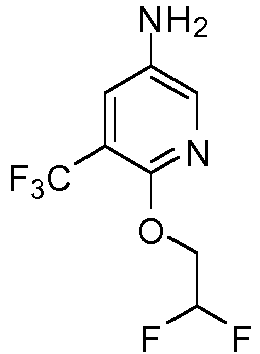
2-chloro-5-nitro-3-(trifluoromethyl)pyridine A 242 243 Int. 6 
2-chloro-5-nitro-3-(trifluoromethyl)pyridine A 232 233 Int. 7 
2-chloro-5-nitro-3-(trifluoromethyl)pyridine A 260 261 Int. 8 
2-chloro-5-nitro-3-(trifluoromethyl)pyridine NA 206 207 Int. 9 
2,6-dichloropyridine-4-carboxylic acid NA 191 191 Int. 10 
2-chloro-6-(trifluoromethyl)pyridine-4-carboxylic acid NA 242 243 Int. 11 
2,6-Dichloropyridin-4-amine B 209 209 Int. 12 
2,6-Dichloropyridin-4-amine B 203 203 Int. 13 
2,6-Dichloropyridin-4-amine B 223 223 Int. 14 
2-chloro-6-(trifluoromethyl)pyridin-4-amine B 256 257 Int. 15 
2-chloro-6-(trifluoromethyl)pyridin-4-amine B 262 263 Int. 16 
2-chloro-6-(trifluoromethyl)pyridin-4-amine B 262 263 Int. 17 
2-chloro-6-(trifluoromethyl)pyridin-4-amine B 278 279 Int. 18 
2-chloro-6-(trifluoromethyl)pyridin-4-amine B 292 293 Int. 19 
2-chloro-6-(trifluoromethyl)pyridin-4-amine B 268 269 Int. 20 
2-chloro-6-(trifluoromethyl)pyridin-4-amine B 250 251 Int. 21 
2-chloro-6-(trifluoromethyl)pyridin-4-amine B 300 301 Int. 22 
2-chloro-6-(trifluoromethyl)pyridin-4-amine B 282 283 Int. 23 
2-chloro-6-(trifluoromethyl)pyridin-4-amine B 336 337 Int. 24 
4-Amino-2,6-dichloropyrimidine NA 183 184 Int. 25 
2-chloro-6-ethoxy-pyridin-4-amine NA 178 179 Int. 26 
2-chloro-6-ethoxy-pyridin-4-amine NA 163 164 Int. 27 
2-chloro-6-ethoxy-pyridin-4-amine NA 152 153 Int. 28 
2-chloro-6-ethoxy-pyridin-4-amine NA 187 187 Int. 29 
Int. 11 NA 199 200 Int. 30 
Int. 11 NA 214 215 Int. 31 
2-chloro-4-iodo-6-(trifluoromethyl)pyridine C 206 207 Int. 32 
2-chloro-4-iodo-6-(trifluoromethyl)pyridine C 236 237 Int. 33 
2-chloro-4-iodo-6-(trifluoromethyl)pyridine C 248 249 Int. 34 
Int. 31 NA 220 221 Int. 35 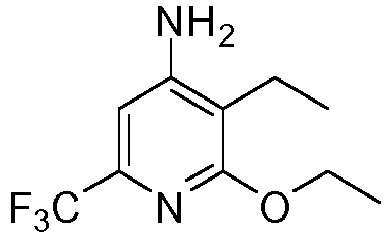
Int. 31 NA 234 235 Int. 36 
2-chloro-6-(trifluoromethyl)pyridin-4-amine NA 253 254 Int. 37 
Int. 11 NA 265 266 Int. 38 
5-bromo-2-chloro-pyridin-3-ol NA 173 173 Int. 39 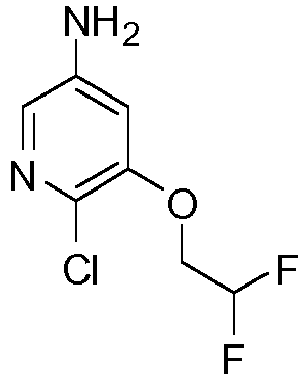
5-bromo-2-chloro-pyridin-3-ol NA 209 209 Int. 40 
4-Amino-2,6-dichloropyrimidine NA 174 174 Int. 41 
2-chloro-6-ethoxy-pyridin-4-amine NA 177 178 Int. 42 
4-amino-5-bromo-6-ethoxy-pyridine-2-carbonitrile NA 203 204 Int. 43 
Int. 11 NA 177 178 Int. 44 
Int. 11 NA 223 223 Int. 45 
3,6-Dichloro-4-methylpyridazine NA 145 145 Int. 46 
Int. 45 NA 135 136 Int. 47 
Int. 46 D 154 154 Int. 48 
Int. 47 E 267 268 Int. 49 
Int. 48 F1 271 272 Int. 50 
Int. 48 F2 271 272 Int. 51 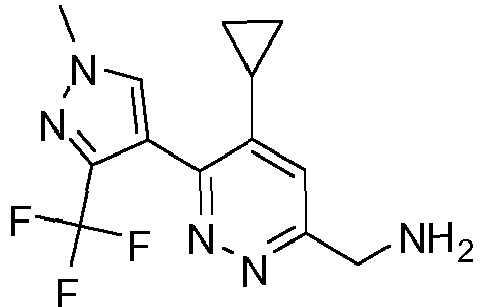
Int. 82 F3 297 299 Int. 52 
4-iodo-3-trifluoromethyl-1H-pyrazole NA 320 321 Int. 53 
4-iodo-3-trifluoromethyl-1H-pyrazole NA 362 363 Int. 54 
4-iodo-3-trifluoromethyl-1H-pyrazole NA 320 321 Int. 55 
4-iodo-3-trifluoromethyl-1H-pyrazole NA 332 333 Int. 56 
Int. 52 G 320 321 Int. 57 
Int. 53 G 362 363 Int. 58 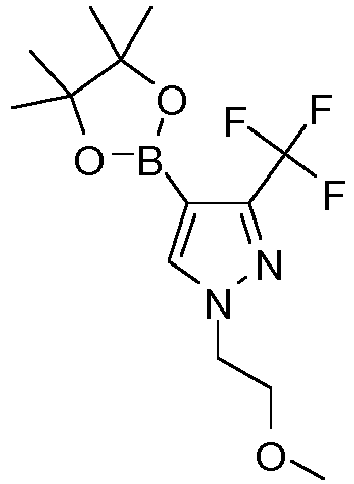
Int. 54 G 320 321 Int. 59 
Int. 55 G 332 333 Int. 60 
Int. 47 & 1-(methoxymethyl)-4-(4,4,5,5-tetramethyl-1,3,2-dioxaborolan-2-yl)-3-(trifluoromethyl)pyrazole E 297 298 Int. 61 
Int. 47 & 4-(4,4,5,5-tetramethyl-1,3,2-dioxaborolan-2-yl)-3-(trifluoromethyl)-1H-pyrazole E 253 254 Int. 62 
Int. 47 & 3-cyclopropyl-1-methyl-4-(4,4,5,5-tetramethyl-1,3,2-dioxaborolan-2-yl)pyrazole E 239 240 Int. 63 
Int. 47 & Int. 56 E 311 312 Int. 64 
Int. 47 & Int. 57 E 353 354 Int. 65 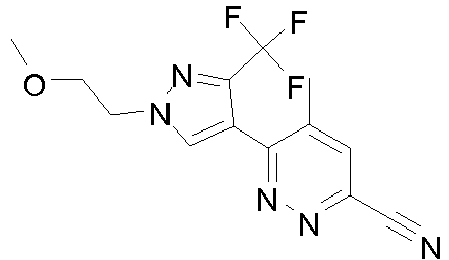
Int. 47 & Int. 58 E 311 312 Int. 66 
Int. 47 & Int. 59 E 323 324 Int. 67 
Int. 61 F1 257 258 Int. 68 
Int. 60 F2 301 302 Int. 69 
Int. 62 F1 243 244 Int. 70 
Int. 63 F1 315 316 Int. 71 
Int. 64 F1 357 358 Int. 72 
Int. 65 F1 315 316 Int. 73 
Int. 66 F1 332 333 Int. 74 
Int. 48 NA 285 286 Int. 75 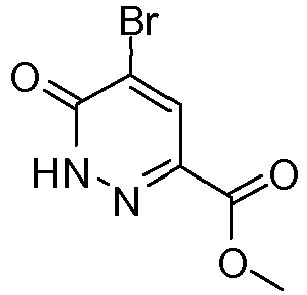
6-oxo-1H-pyridazine-3-carboxylate NA 233 235 Int. 76 
Int. 75 NA 218 220 Int. 77 
Int. 76 NA 200 197.86 [M-1] Int. 78 
Int. 77 NA 330 NA Int. 79 
Int. 78 NA 291 NA Int. 80 
Int. 79 NA 161 162 Int. 81 
Int. 80 D 180 180 Int. 82 
Int. 81 E 293 294 Int. 83 
Int. 48 NA 346 346 Int. 84 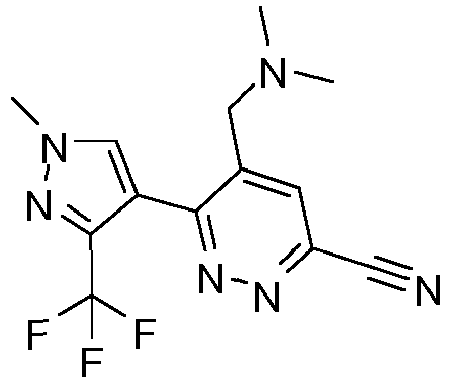
Int. 83 NA 310 311 Int. 85 
Int. 84 F3 314 316 Int. 86 
Int. 78 NA 267 266.09 (negative mode) Int. 87 
Int. 86 NA 281 NA Int. 88 
Int. 87 NA 151 152 Int. 89 
Int. 88 D 170 170 Int. 90 
Int. 89 E 283 284 Int. 91 
Int. 90 F3 287 288 Int. 92 
Int. 77 G 212 213 Int. 93 
Int. 92 D 231 231 Int. 94 
Int. 93 E 344 345 Int. 95 
Int. 94 F3 348 349 Int. 96 
Int. 77 G 206 207 Int. 97 
Int. 96 D 225 225 Int. 98 
Int. 97 E 338 340 Int. 99 
Int. 98 F3 342 344 Int. 100 
Int. 77 G 164 165 Int. 101 
Int. 100 D 183 183 Int. 102 
Int. 101 E 296 297 Int. 103 
Int. 102 F3 300 302 Int. 104 
3,6-dichloro-4,5-dimethyl-pyridazine NA 159 160 Int. 105 
Int. 104 NA 149 150 Int. 106 
Int. 105 D 168 168 Int. 107 
Int. 106 & 1-methyl-4-(4,4,5,5-tetramethyl-1,3,2-dioxaborolan-2-yl)-3-(trifluoromethyl)pyrazole E 281 282 Int. 108 
Int. 107 F3 285 286 Int. 109 
2-chloro-6-(trifluoromethyl)pyridin-4-amine B 263 264 Int. 110 
3,6-dichloro-4-methylpyridazine & 1,3-dimethyl-4-(4,4,5,5-tetramethyl-1,3,2-dioxaborolan-2-yl)pyrazole NA 223 223 Int. 111 
Int. 110 & 2-chloro-6-ethoxy-pyridin-4-ylamine NA 213 214 Int. 112 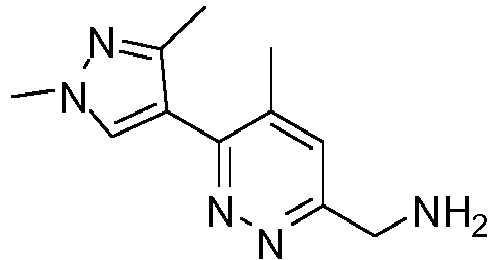
Int. 111 F2 217 218 Int. 113 
Int. 47 & (1,5-dimethylpyrazol-4-yl)boronic acid E 213 214 Int. 114 
Int. 113 F1 217 218 Int. 115 
Int. 47 & 2,4-dimethyl-1H-imidazole NA 213 214 Int. 116 
Int. 115 F1 217 218 Int. 117 
Int. 27 NA 187 187 Int. 118 
Int. 27 NA 231 233 Int. 119 
Int. 118 NA 166 167 Int. 120 
Int. 23 NA 415 417 Int. 121 
Int. 120 NA 350 351 Int. 122 
Int. 11 NA 288 289 Int. 123 
Int. 122 NA 202 203 Int. 124 
Int. 11 NA 251 251 Int. 125 
Int. 124 NA 230 231 Int. 126 
Int. 125 NA 188 189 Int. 127 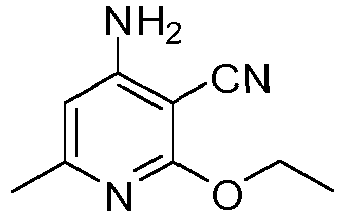
Int. 118 NA 177 178 Int. 128 
Int. 34 I 364 365 Int. 129 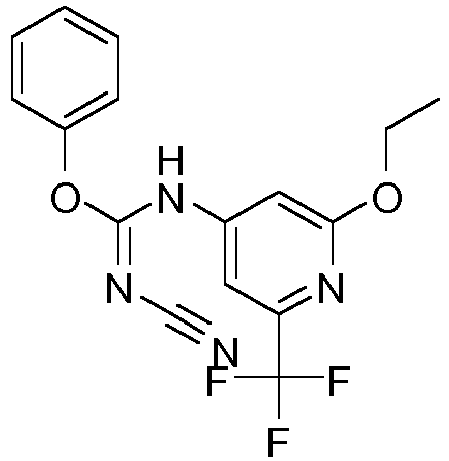
Int. 31 I 350 351 Int. 130 
Int. 119 I 310 331 Int. 131 
Int. 123 I 346 347 Int. 132 
Int. 47 K1 224 225 Int. 133 
Int. 47 K2 232 233 Int. 134 
Int. 47 K2 210 211 Int. 135 
Int. 132 F4 228 229 Int. 136 
Int. 133 F2 236 237 Int. 137 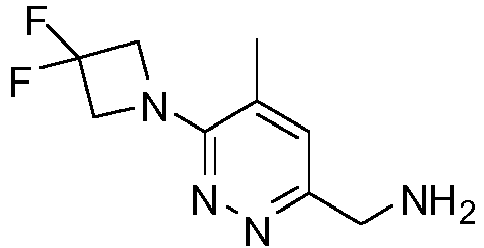
Int. 134 F2 214 215 Int. 138 
Int. 47 K3 232 233 Int. 139 
Int. 138 F1 236 237 Int. 140 
Int. 47 K3 232 233 Int. 141 
Int. 140 F1 236 237 Int. 142 
Int. 47 K3 232 233 Int. 143 
Int. 142 F1 236 237 Int. 144 
Int. 47 NA 254 255 Int. 145 
Int. 144 F1 258 259 Int. 146 
Int. 47 K3 272 273 Int. 147 
Int. 146 F1 276 277 Int. 148 
Int. 47 K3 236 237 Int. 149 
Int. 148 F1 240 241 Int. 150 
Int. 47 K3 266 267 Int. 151 
Int. 150 F1 270 271 Int. 152 
Int. 47 K3 252 253 Int. 153 
Int. 152 F1 256 258 Int. 154 
Int. 47 K3 261 262 Int. 155 
Int. 154 K3 265 266 Int. 156 
2-chloro-4-iodo-6-(trifluoromethyl)pyridine NA 211 212 Table III. Illustrative compounds of the invention Cpd # Structure Name Int Mtd MW (calc) MW (obs) 1 
1 -(2-Ethoxy-6-trifluoromethyl-pyridin-4-yl)-3-[5-methyl-6-(1-methyl-3-trifluoromethyl-1H-pyrazol-4-yl)-pyridazin-3-ylmethyl]-urea Int. 49 & Int. 31 H1 503 504 2 
1-(2-Chloro-6-ethoxy-pyridin-4-yl)-3-[5-methyl-6-(1-methyl-3-trifluoromethyl-1H-pyrazol-4-yl)-pyridazin-3-ylmethyl]-urea Int. 49 & 2-chloro-6-ethoxy-pyridin-4-ylamine H2 470 470 3 
1-(2-chloro-6-ethoxy-4-pyridyl)-3-[1-[5-methyl-6-[1-methyl-3-(trifluoromethyl)pyrazol-4-yl]pyridazin-3-yl]ethyl]urea Int. 74 & 2-chloro-6-ethoxy-pyridin-4-ylamine H2 484 484 4 
1-[2-(2-hydroxyethoxy)-6-(trifluoromethyl)-4-pyridyl]-3-[[5-methyl-6-[1-methyl-3-(trifluoromethyl)pyrazol-4-yl]pyridazin-3-yl]methyl]urea Int. 49 & Int. 23 NA 519 520 5 
1-[2-(2,3-dihydroxypropoxy)-6-(trifluoromethyl)-4-pyridyl]-3-[[5-methyl-6-[1-methyl-3-(trifluoromethyl)pyrazol-4-yl]pyridazin-3-yl]methyl]urea Int. 49 & Int. 18 NA 549 550 6 
1-(3,5-dichlorophenyl)-3-[[5-methyl-6-[1-methyl-3-(trifluoromethyl)pyrazol-4-yl]pyridazin-3-yl]methyl]urea Int. 49 & 1,3-dichloro-5-isocyanato-benzene, NA 459 459 7 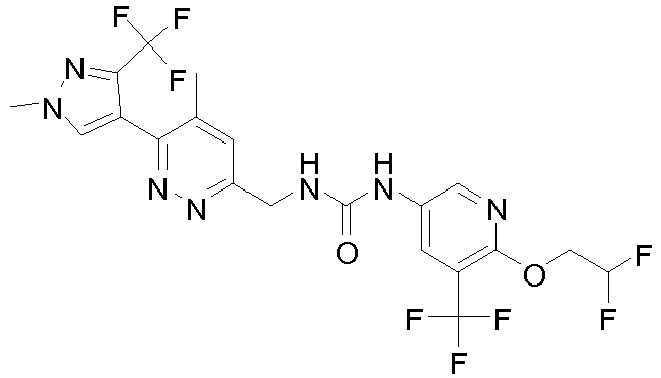
1-[6-(2,2-difluoroethoxy)-5-(trifluoromethyl)-3-pyridyl]-3-[[5-methyl-6-[1-methyl-3-(trifluoromethyl) pyrazol-4-yl]pyridazin-3-yl]methyl]urea Int. 50 & Int. 5 H2 539 540 8 
1-(5-chloro-6-ethoxy-3-pyridyl)-3-[[5-methyl-6-[1-methyl-3-(trifluoromethyl)pyrazol-4-yl]pyridazin-3-yl]methyl]urea Int. 50 & Int. 2 H2 470 470 9 
1-[5-chloro-6-(2,2-difluoroethoxy)-3-pyridyl]-3-[[5-methyl-6-[1-methyl-3-(trifluoromethyl) pyrazol-4-yl]pyridazin-3-yl]methyl]urea Int. 50 & Int. 3 H2 506 506 10 
1-[6-ethoxy-5-(trifluoromethyl)-3-pyridyl]-3-[[5-methyl-6-[1-methyl-3-(trifluoromethyl)pyrazol-4-yl]pyridazin-3-yl]methyl]urea Int. 50 & Int. 8 H2 503 504 11 
1-[6-(cyclopropylmethoxy)-5-(trifluoromethyl)-3-pyridyl]-3-[[5-methyl-6-[1-methyl-3-(trifluoromethyl)pyrazol-4-yl]pyridazin-3-yl]methyl]urea Int. 50 & Int. 6 H2 529 530 12 
1-[[5-methyl-6-[1-methyl-3-(trifluoromethyl)pyrazol-4-yl]pyridazin-3-yl]methyl]-3-[6-(2,2,2-trifluoroethoxy)-5-(trifluoromethyl)-3-pyridyl]urea Int. 50 & Int. 7 H2 557 558 13 
1-[5-chloro-6-(cyclopropylmethoxy)-3-pyridyl]-3-[[5-methyl-6-[1-methyl-3-(trifluoromethyl)pyrazol-4-yl]pyridazin-3-yl]methyl]urea Int. 50 & Int. 4 H2 496 496 14 
1-[2-chloro-6-(2,2,2-trifluoroethoxy)-4-pyridyl]-3-[[5-methyl-6-[1-methyl-3-(trifluoromethyl)pyrazol-4-yl]pyridazin-3-yl]methyl]urea Int. 50 & Int. 1 H2 524 524 15 
1-(2-chloro-6-ethoxy-4-pyridyl)-3-[[6-[1-(methoxymethyl)-3-(trifluoromethyl)pyrazol-4-yl]-5-methyl-pyridazin-3-yl]methyl]urea Int. 68 & 2-chloro-6-ethoxy-pyridin-4-amine H2 500 500 16 
1-[2-chloro-6-(2-fluoroethoxy)-4-pyridyl]-3-[[5-methyl-6-[1-methyl-3-(trifluoromethyl)pyrazol-4-yl]pyridazin-3-yl]methyl]urea Int. 49 & Int. 9 H1 488 488 17 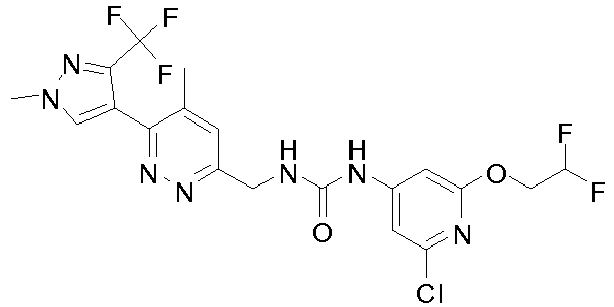
1-[2-chloro-6-(2,2-difluoroethoxy)-4-pyridyl]-3-[[5-methyl-6-[1-methyl-3-(trifluoromethyl)pyrazol-4-yl]pyridazin-3-yl]methyl]urea Int. 49 & Int. 11 H1 506 506 18 
1-(2-cyano-6-ethoxy-4-pyridyl)-3-[[5-methyl-6-[1-methyl-3-(trifluoromethyl)pyrazol-4-yl]pyridazin-3-yl]methyl]urea Int. 49 & Int. 26 H1 460 461 19 
1-[2-(2,2-difluoroethoxy)-6-(trifluoromethyl)-4-pyridyl]-3-[[5-methyl-6-[1-methyl-3-(trifluoromethyl)pyrazol-4-yl]pyridazin-3-yl]methyl]urea Int. 49 & Int. 10 H1 539 540 20 
1-(6-chloro-2-ethoxy-3-methyl-4-pyridyl)-3-[[5-methyl-6-[1-methyl-3-(trifluoromethyl)pyrazol-4-yl]pyridazin-3-yl]methyl]urea Int. 49 & Int. 28 H1 484 484 21 
1-(2,6-dichloro-4-pyridyl)-3-[[5-methyl-6-[1-methyl-3-(trifluoromethyl)pyrazol-4-yl]pyridazin-3-yl]methyl]urea Int. 49 & 4-amino-2,6-dichloropyridine H1 460 460 22 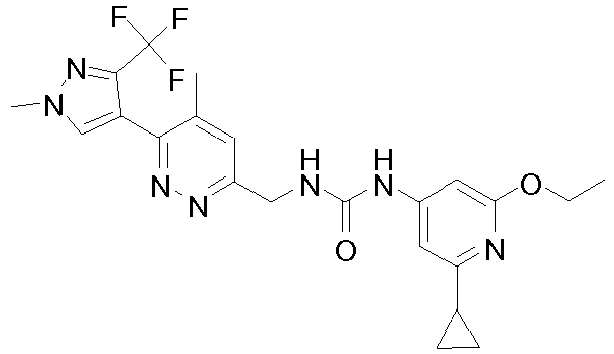
1-(2-cyclopropyl-6-ethoxy-4-pyridyl)-3-[[5-methyl-6-[1-methyl-3-(trifluoromethyl)pyrazol-4-yl]pyridazin-3-yl]methyl]urea Int. 49 & Int. 25 H1 475 476 23 
1-[6-chloro-5-(2,2-difluoroethoxy)-3-pyridyl]-3-[[5-methyl-6-[1-methyl-3-(trifluoromethyl)pyrazol-4-yl]pyridazin-3-yl]methyl]urea Int. 49 & Int. 39 H1 506 506 24 
1-(6-chloro-5-ethoxy-3-pyridyl)-3-[[5-methyl-6-[1-methyl-3-(trifluoromethyl)pyrazol-4-yl]pyridazin-3-yl]methyl]urea Int. 49 & Int. 38 H1 470 470 25 
1-[2-(2-methoxyethoxy)-6-(trifluoromethyl)-4-pyridyl]-3-[[5-methyl-6-[1-methyl-3-(trifluoromethyl)pyrazol-4-yl]pyridazin-3-yl]methyl]urea Int. 49 & Int. 32 H1 533 534 26 
1-[[5-methyl-6-[1-methyl-3-(trifluoromethyl)pyrazol-4-yl]pyridazin-3-yl]methyl]-3-[2-tetrahydrofuran-3-yloxy-6-(trifluoromethyl)-4-pyridyl]urea Int. 49 & Int. 33 H1 545 546 27 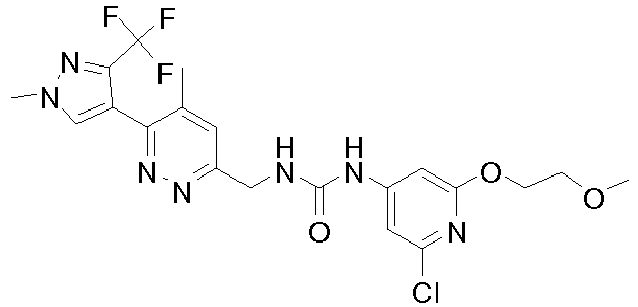
1-[2-chloro-6-(2-methoxyethoxy)-4-pyridyl]-3-[[5-methyl-6-[1-methyl-3-(trifluoromethyl)pyrazol-4-yl]pyridazin-3-yl]methyl]urea Int. 50 & Int. 12 H2 500 500 28 
1-[2-cyano-6-(2,2-difluoroethoxy)-4-pyridyl]-3-[[5-methyl-6-[1-methyl-3-(trifluoromethyl)pyrazol-4-yl]pyridazin-3-yl]methyl]urea Int. 50 & Int. 29 H2 496 497 29 
1-[2-cyclopropyl-6-(2,2-difluoroethoxy)-4-pyridyl]-3-[[5-methyl-6-[1-methyl-3-(trifluoromethyl)pyrazol-4-yl]pyridazin-3-yl]methyl]urea Int. 50 & Int. 30 H2 511 512 30 
1-[2-ethoxy-3-methyl-6-(trifluoromethyl)-4-pyridyl]-3-[[5-methyl-6-[1-methyl-3-(trifluoromethyl)pyrazol-4-yl]pyridazin-3-yl]methyl]urea Int. 49 & Int. 34 H1 517 518 31 
1-(2,6-diethoxypyrimidi n-4-yl)-3-[[5-methyl-6-[1-methyl-3-(trifluoromethyl)pyrazol-4-yl]pyridazin-3-yl]methyl]urea Int. 49 & Int. 24 H1 480 481 32 
1-(3,5-dichloro-4-fluoro-phenyl)-3-[[5-methyl-6-[1-methyl-3-(trifluoromethyl)pyrazol-4-yl]pyridazin-3-yl]methyl]urea Int. 49 & 3,5-dichloro-4-fluoro aniline H1 477 477 33 
1-[2-[(2,2-difluorocyclopropyl)methoxy]-6-(trifluoromethyl)-4-pyridyl]-3-[[5-methyl-6-[1-methyl-3-(trifluoromethyl)pyrazol-4-yl]pyridazin-3-yl]methyl]urea Int. 49 & Int. 19 H1 565 566 34 
1-[2-(2,2-difluoropropoxy)-6-(trifluoromethyl)-4-pyridyl]-3-[[5-methyl-6-[1-methyl-3-(trifluoromethyl)pyrazol-4-yl]pyridazin-3-yl]methyl]urea Int. 49 & Int. 14 H1 553 554 35 
1-(2-ethoxy-6-methyl-4-pyridyl)-3-[[5-methyl-6-[1-methyl-3-(trifluoromethyl)pyrazol-4-yl]pyridazin-3-yl]methyl]urea Int. 49 & Int. 27 H1 449 450 36 
1-[[5-methyl-6-[1-methyl-3-(trifluoromethyl)pyrazol-4-yl]pyridazin-3-yl]methyl]-3-[2-(tetrahydrofuran-3-ylmethoxy)-6-(trifluoromethyl)-4-pyridyl]urea Int. 49 & Int. 16 H1 559 560 37 
1-[2-(1,4-dioxan-2-ylmethoxy)-6-(trifluoromethyl)-4-pyridyl]-3-[[5-methyl-6-[1-methyl-3-(trifluoromethyl)pyrazol-4-yl]pyridazin-3-yl]methyl]urea Int. 49 & Int. 17 H1 575 576 38 
1-(6-chloro-2-ethoxy-pyrimidin-4-yl)-3-[[5-methyl-6-[1-methyl-3-(trifluoromethyl)pyrazol-4-yl]pyridazin-3-yl]methyl]urea Int. 49 & Int. 40 H1 471 471 39 
1-[[5-methyl-6-[1-methyl-3-(trifluoromethyl)pyrazol-4-yl]pyridazin-3-yl]methyl]-3-[2-(trifluoromethyl)-6-[[1-(trifluoromethyl)c yclopropyl]methoxy]-4-pyridyl]urea Int. 49 & Int. 21 H1 597 598 40 
1-[[5-methyl-6-[1-methyl-3-(trifluoromethyl)pyrazol-4-yl]pyridazin-3-yl]methyl]-3-[2-tetrahydropyran-4-yloxy-6-(trifluoromethyl)-4-pyridyl]urea Int. 49 & Int. 15 H1 559 560 41 
1-[2-(2-methoxy-1-methyl-ethoxy)-6-(trifluoromethyl)-4-pyridyl]-3-[[5-methyl-6-[1-methyl-3-(trifluoromethyl)pyrazol-4-yl]pyridazin-3-yl]methyl]urea Int. 49 & Int. 20 H1 547 548 42 
1-[2-[(3,3-difluorocyclobutyl)methoxy]-6-(trifluoromethyl)-4-pyridyl]-3-[[5-methyl-6-[1-methyl-3-(trifluoromethyl)pyrazol-4-yl]pyridazin-3-yl]methyl]urea Int. 49 & Int. 22 H1 579 580 43 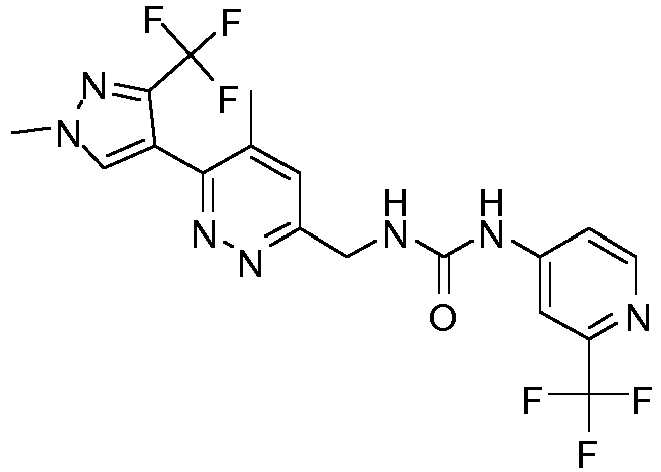
1-[[5-methyl-6-[1-methyl-3-(trifluoromethyl)pyrazol-4-yl]pyridazin-3-yl]methyl]-3-[2-(trifluoromethyl)-4-pyridyl]urea Int. 49 & 4-amino-2-trifluoromethylpyridine H1 459 460 44 
1-(2-chloro-4-pyridyl)-3-[[5-methyl-6-[1-methyl-3-(trifluoromethyl)pyrazol-4-yl]pyridazin-3-yl]methyl]urea Int. 49 & 2-chloro-4-aminopyridine H1 426 426 45 
1-[2-ethoxy-3-methyl-6-(trifluoromethyl)-4-pyridyl]-3-[1-[5-methyl-6-[1-methyl-3-(trifluoromethyl)pyrazol-4-yl]pyridazin-3-yl]ethyl]urea Int. 74 & Int.34 H2 531 532 46 
1-[2-ethoxy-3-ethyl-6-(trifluoromethyl)-4-pyridyl]-3-[[5-methyl-6-[1-methyl-3-(trifluoromethyl)pyrazol-4-yl]pyridazin-3-yl]methyl]urea Int. 49 & Int. 35 H1 531 532 47 
1-[2-(3,3-difluoroazetidin-1-yl)-6-(trifluoromethyl)-4-pyridyl]-3-[[5-methyl-6-[1-methyl-3-(trifluoromethyl)pyrazol-4-yl]pyridazin-3-yl]methyl]urea Int. 49 & Int. 36 H1 550 551 48 
1-[2-(3,3-difluoroazetidin-1-yl)-6-(2,2-difluoroethoxy)-4-pyridyl]-3-[[5-methyl-6-[1-methyl-3-(trifluoromethyl)pyrazol-4-yl]pyridazin-3-yl]methyl]urea Int. 49 & Int. 37 H1 562 563 49 
1-[3-bromo-2-ethoxy-6-(trifluoromethyl)-4-pyridyl]-3-[[5-methyl-6-[1-methyl-3-(trifluoromethyl)pyrazol-4-yl]pyridazin-3-yl]methyl]urea Int. 49 & 3-bromo-2-ethoxy-6-(trifluoro methyl)py ndm-4-amine (described in synthesis in Int. 34) H1 582 584 50 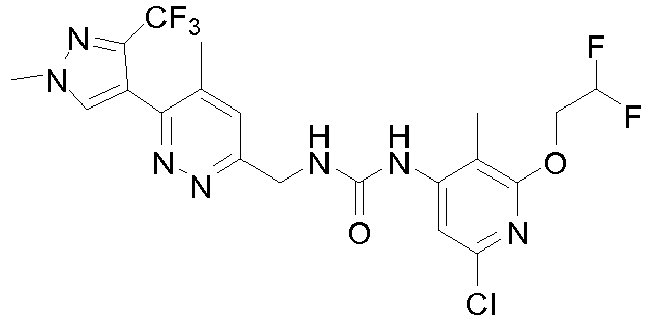
1-[6-chloro-2-(2,2-difluoroethoxy)-3-methyl-4-pyridyl]-3-[[5-methyl-6-[1-methyl-3-(trifluoromethyl)pyrazol-4-yl]pyridazin-3-yl]methyl]urea Int. 49 & Int. 44 H1 520 520 51 
1-[2-ethoxy-6-(trifluoromethyl)-4-pyridyl]-3-[[5-methyl-6-[3-(trifluoromethyl)-1H-pyrazol-4-yl]pyridazin-3-yl]methyl]urea Int. 67 & Int. 31 H1 489 490 52 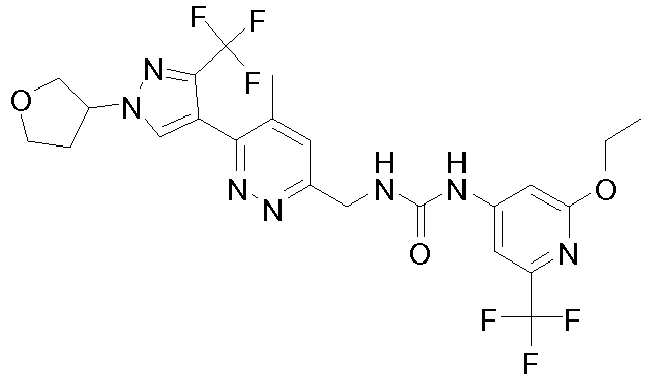
1-[2-ethoxy-6-(trifluoromethyl)-4-pyridyl]-3-[[5-methyl-6-[1-tetrahydrofuran-3-(trifluoromethyl)pyrazol-4-yl]pyridazin-3-yl]methyl]urea Int. 73 & Int. 31 H1 560 560 53 
1-[2-ethoxy-6-(trifluoromethyl)-4-pyridyl]-3-[[6-[1-(2-methoxyethyl)-3-(trifluoromethyl)pyrazol-4-yl]-5-methyl-pyridazin-3-yl]methyl]urea Int. 72 & Int. 31 H1 548 548 54 
1-[[6-(3-cyclopropyl-1-methyl-pyrazol-4-yl)-5-methyl-pyridazin-3-yl]methyl]-3-[2-ethoxy-6-(trifluoromethyl)-4-pyridyl]urea Int. 69 & Int. 31 H1 476 476 55 
1-[[6-[1-(1,4-dioxan-2-ylmethyl)-3-(trifluoromethyl)pyrazol-4-yl]-5-methyl-pyndazm-3-yl]methyl]-3-[2-ethoxy-6-(trifluoromethyl)-4-pyridyl]urea Int. 71 & Int. 31 H1 590 590 56 
1-[2-ethoxy-6-(trifluoromethyl)-4-pyridyl]-3-[[6-[1-(2-hydroxypropyl)-(trifluoromethyl)pyrazol-4-yl]-5-methyl-pyridazin-3-yl]methyl]urea Int. 70 & Int.31 H1 548 548 57 
1-(6-cyano-2-ethoxy-3-methyl-4-pyridyl)-3-[[5-methyl-6-[1-methyl-3-(trifluoromethyl)pyrazol-4-yl]pyridazin-3-yl]methyl]urea Int. 49 & Int. 41 H1 474 475 58 
1-(6-cyano-3-cyclopropyl-2-ethoxy-4-pyridyl)-3-[[5-methyl-6-[1-methyl-3-(trifluoromethyl)pyrazol-4-yl]pyridazin-3-yl]methyl]urea Int. 49 & Int. 42 H1 501 501 59 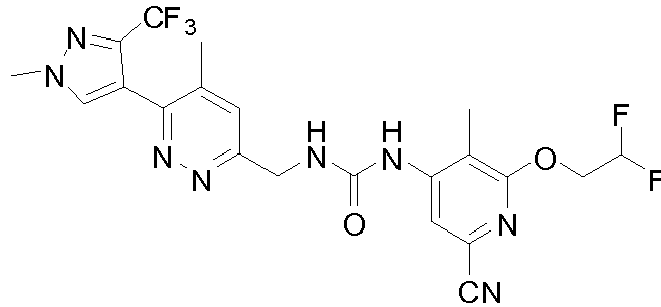
1-[6-cyano-2-(2,2-difluoroethoxy)-3-methyl-4-pyridyl]-3-[[5-methyl-6-[1-methyl-3-(trifluoromethyl)pyrazol-4-yl]pyridazin-3-yl]methyl]urea Int. 49 & Int. 43 H1 510 511 60 
1-[2-chloro-6-(2,2-difluoroethoxy)-4-pyridyl]-3-[[5-(3,3-difluoroazetidin-1-yl)-6-[1-methyl-3-(trifluoromethyl)pyrazol-4-yl]pyridazin-3-yl]methyl]urea Int. 95 & Int. 11 H2 583 583 61 
1-[2-chloro-6-(2,2-difluoroethoxy)-4-pyridyl]-3-[[5-cyclopropyl-6-[1-methyl-3-(trifluoromethyl)pyrazol-4-yl]pyridazin-3-yl]methyl]urea Int. 51 & Int. 11 H2 532 533 62 
1-[2-chloro-6-(2,2-difluoroethoxy)-4-pyridyl]-3-[[6-[1-methyl-3-(trifluoromethyl)pyrazol-4-yl]-5-morpholino-pyridazin-3-yl]methyl]urea Int. 99 & Int. 11 H2 577 578 63 
1-[2-chloro-6-(2,2-difluoroethoxy)-4-pyridyl]-3-[[5-(dimethylamino)-6-[1-methyl-3-(trifluoromethyl)pyrazol-4-yl]pyridazin-3-yl]methyl]urea Int. 103 & Int. 11 H2 535 536 64 
1-[2-chloro-6-(2,2-difluoroethoxy)-4-pyridyl]-3-[[5-methoxy-6-[1-methyl-3-(trifluoromethyl)pyrazol-4-yl]pyridazin-3-yl]methyl]urea Int. 91 & Int. 11 H2 522 522 65 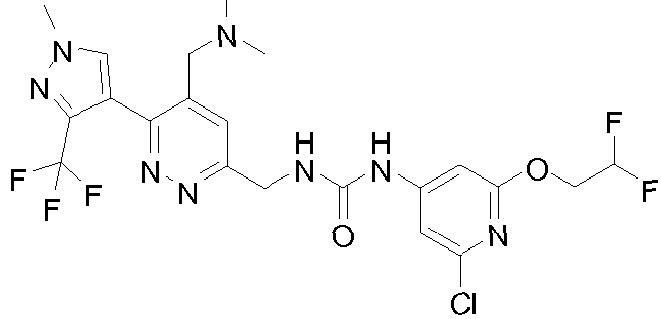
1-[2-chloro-6-(2,2-difluoroethoxy)-4-pyridyl]-3-[[5-(dimethylaminomethyl)-6-[1-methyl-3-(trifluoromethyl)pyrazol-4-yl]pyridazin-3-yl]methyl]urea Int. 85 & Int. 11 H2 549 550 66 
1-[[4,5-dimethyl-6-[1-methyl-3-(trifluoromethyl)pyrazol-4-yl]pyridazin-3-yl]methyl]-3-[2-ethoxy-6-(trifluoromethyl)-4-pyridyl]urea Int. 108 & Int. 31 H2 517 518 67 
N,N-dimethyl-2-[[4-[[5-methyl-6-[1-methyl-3-(trifluoromethyl)pyrazol-4-yl]pyridazin-3-yl]methylcarbamo ylamino]-6-(trifluoromethyl)-2-pyridyl] oxy] aceta mide Int. 49 & Int. 109 H1 560 561 68 
1-(2-chloro-6-ethoxy-4-pyridyl)-3-[[6-(1,3-dimethylpyrazol-4-yl)-5-methyl-pyridazin-3-yl]methyl]urea Int. 112 & 2-chloro-6-ethoxy-pyridin-4-ylamine H2 416 416 69 
1-[[6-(1,5-dimethylpyrazol-4-yl)-5-methyl-pyridazin-3-yl]methyl]-3-[2-ethoxy-6-(trifluoromethyl)-4-pyridyl]urea Int. 114 & Int. 31 H1 449 450 70 
1-[2-chloro-6-(2,2-difluoroethoxy)-4-pyridyl]-3-[[6-(2,4-dimethylimidazol-1-yl)-5-methyl-pyridazin-3-yl]methyl]urea Int. 116 & Int. 11 HI 452 452 71 
1-(3-chloro-2-ethoxy-6-methyl-4-pyridyl)-3-[[5-methyl-6-[1-methyl-3-(trifluoromethyl)pyrazol-4-yl]pyridazin-3-yl]methyl]urea Int. 49 & Int. 117 H1 484 484 72 
1-(2-ethoxy-3,6-dimethyl-4-pyridyl)-3-[[5-methyl-6-[1-methyl-3-(trifluoromethyl)pyrazol-4-yl]pyridazin-3-yl]methyl]urea Int. 50 & Int. 119 H2 463 464 73 
1-[2-(2-hydroxyethoxy)-3-methyl-6-(trifluoromethyl)-4-pyridyl]-3-[[5-methyl-6-[1-methyl-3-(trifluoromethyl)pyrazol-4-yl]pyridazin-3-yl]methyl]urea Int. 49 & Int. 121 H1 533 534 74 
1-[2-(2,2-difluoroethoxy)-3,6-dimethyl-4-pyridyl]-3-[[5-methyl-6-[1-methyl-3-(trifluoromethyl)pyrazol-4-yl]pyridazin-3-yl]methyl]urea Int. 49 & Int. 123 H1 499 500 75 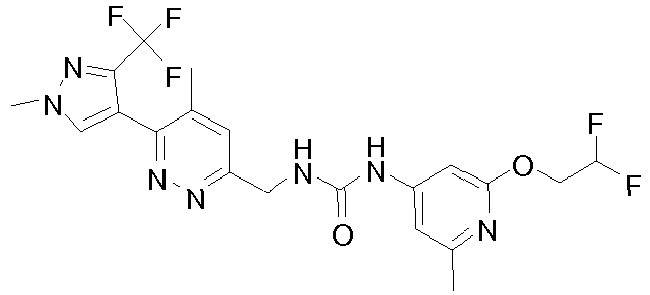
1-[2-(2,2-difluoroethoxy)-6-methyl-4-pyridyl]-3-[[5-methyl-6-[1-methyl-3-(trifluoromethyl)pyrazol-4-yl]pyridazin-3-yl]methyl]urea Int. 49 & Int. 126 H1 485 486 76 
2-cyano-1-[2-ethoxy-6-(trifluoromethyl)-4-pyridyl]-3-[[5-methyl-6-[1-methyl-3-(trifluoromethyl)pyrazol-4-yl]pyridazin-3-yl]methyl]guanidine Int. 49 & Int. 129 J 527 528 77 
1-(3-cyano-2-ethoxy-6-methyl-4-pyridyl)-3-[[5-methyl-6-[1-methyl-3-(trifluoromethyl)pyrazol-4-yl]pyridazin-3-yl]methyl]urea Int. 49 & Int. 127 H1 474 475 78 
2-cyano-1-(2-ethoxy-3,6-dimethyl-4-pyridyl)-3-[[5-methyl-6-[1-methyl-3-(trifluoromethyl)pyrazol-4-yl]pyridazin-3-yl]methyl]guanidine Int. 50 & Int. 130 J 487 488 79 
2-cyano-1-[2-(2,2-difluoroethoxy)-3,6-dimethyl-4-pyridyl]-3-[[5-methyl-6-[1-methyl-3-(trifluoromethyl)pyrazol-4-yl]pyridazin-3-yl]methyl]guanidine Int. 50 & Int. 131 J 523 524 80 
2-cyano-1-[2-ethoxy-3-methyl-6-(trifluoromethyl)-4-pyridyl]-3-[[5-methyl-6-[1-methyl-3-(trifluoromethyl)pyrazol-4-yl]pyridazin-3-yl]methyl]guanidine Int. 50 & Int. 128 J 541 542 81 
1-(2-Chloro-6-ethoxy-pyridin-4-yl)-3-[6-(3,3-difluoro-pyrrolidin-1-yl)-5-methyl-pyridazin-3-ylmethyl]-urea Int. 135 & 2-chloro-6-ethoxy-pyridin-4-ylamine H1 427 427 82 
1-(2-Chloro-6-ethoxy-pyridin-4-yl)-3-[6-(2,6-dimethyl-morpholin-4-yl)-5-methyl-pyridazin-3-ylmethyl]-urea Int. 136 & 2-chloro-6-ethoxy-pyridin-4-ylamine H2 435 435 83 
1-(2-Chloro-6-ethoxy-pyridin-4-yl)-3-[6-(3,3-difluoro-azetidin-1-yl)-5-methyl-pyridazin-3-ylmethyl]-urea Int. 137 & 2-chloro-6-ethoxy-pyridin-4-ylamine H2 413 413 84 
1-[5-chloro-6-(2,2-difluoroethoxy)-3-pyridyl]-3-[[6-(2,6-dimethylmorpholin-4-yl)-5-methyl-pyridazin-3-yl]methyl]urea Int. 133 & Int. 3 H2 471 471 85 
1-[[6-(2,6-dimethylmorpholin-4-yl)-5-methyl-pyridazin-3-yl]methyl]-3-[6-ethoxy-5-(trifluoromethyl)-3-pyridyl]urea Int. 133 & Int. 8 H2 468 469 86 
1-(5-chloro-6-ethoxy-3-pyridyl)-3-[[6-(2,6-dimethylmorpholin-4-yl)-5-methyl-pyridazin-3-yl]methyl]urea Int. 133 & Int. 2 H2 435 435 87 
1-[[6-(2,6-dimethylmorpholi n-4-yl)-5-methyl-pyridazin-3-yl]methyl]-3-[2-ethoxy-6-(trifluoromethyl)-4-pyridyl]urea Int. 133 & Int. 31 H2 468 469 88 
1-[5-chloro-6-(cyclopropylmethoxy)-3-pyridyl]-3-[[6-(2,6-dimethylmorpholin-4-yl)-5-methyl-pyridazin-3-yl]methyl]urea Int. 133 & Int. 4 H2 461 461 89 
1-[2-chloro-6-(2,2-difluoroethoxy)-4-pyridyl]-3-[[5-methyl-6-[2-(trifluoromethyl)morpholin-4-yl]pyridazin-3-yl]methyl]urea Int. 147 & Int. 11 H1 511 511 90 
1-[2-chloro-6-(2,2-difluoroethoxy)-4-pyridyl]-3-[[6-[3-fluoro-3-(hydroxymethyl)pyrrolidin-1-yl]-5-methyl-pyridazin-3-yl]methyl]urea Int. 149 & Int. 11 H1 475 475 91 
1-[2-chloro-6-(2,2-difluoroethoxy)-4-pyridyl]-3-[[5-methyl-6-(3-methylsulfonylpyrrolidin-1-yl)pyridazin-3-yl]methyl]urea Int. 151 & Int. 11 H1 505 505 92 
1-[2-chloro-6-(2,2-difluoroethoxy)-4-pyridyl]-3-[[5-methyl-6-(3-methylsulfonylazetidin-1-yl)pyridazin-3-yl]methyl]urea Int. 153 & Int. 11 H1 491 491 93 
1-[[6-[(2R,6S)-2,6-dimethylmorpholin-4-yl]-5-methyl-pyridazin-3-yl]methyl]-3-(2-ethoxy-6-methyl-4-pyridyl)urea Int. 141 & Int. 27 H1 415 415 94 
1-(3-chloro-2-ethoxy-6-methyl-4-pyridyl)-3-[[6-[(2R,6S)-2,6-dimethylmorpholin-4-yl]-5-methyl-pyridazin-3-yl]methyl]urea Int. 141 & Int. 117 H1 449 449 95 
1-[[6-[(2R,6S)-2,6-dimethylmorpholin-4-yl]-5-methyl-pyridazin-3-yl]methyl]-3-(2-ethoxy-3,6-dimethyl-4-pyridyl)urea Int. 141 & Int. 119 H1 429 429 96 
1-[2-ethoxy-6-(trifluoromethyl)-4-pyridyl]-3-[[5-methyl-6-(2-methyl-6,7-dihydro-5H-pyrazolo[4,3-b]pyridin-4-yl)pyridazin-3-yl]methyl]urea Int. 144 & Int. 31 H1 490 491 97 
1-[2-chloro-6-(2,2-difluoroethoxy)-4-pyridyl]-3-[[6-[2-[(dimethylamino)methyl]morpholin-4-yl]-5-methyl-pyridazin-3-yl]methyl]urea Int. 155 & Int. 11 H1 500 500 98 
1-(2-Ethoxy-6-trifluoromethyl-pyridin-4-yl)-3-[5-methyl-6-(1-methyl-3-trifluoromethyl-1H-pyrazol-4-yl)-pyridazin-3-ylmethyl]-C14 urea Int. 49 & Int. 31 H1 505 506 99 
1-[[5-methyl-6-[1-methyl-3-(trifluoromethyl)pyrazol-4-yl]pyridazin-3-yl]methyl]-3-[2-(1,1,2,2,2-pentadeuterioethoxy)-6-(trifluoromethyl)-4-pyridyl]urea Int. 50 & Int. 156 NA 508 509 100 
1-[[6-[(2R,6R)-2,6-dimethylmorpholin-4-yl]-5-methyl-pyridazin-3-yl]methyl]-3-[2-ethoxy-6-(trifluoromethyl)-4-pyridyl]urea Int. 143 & Int. 31 H1 468 469 101 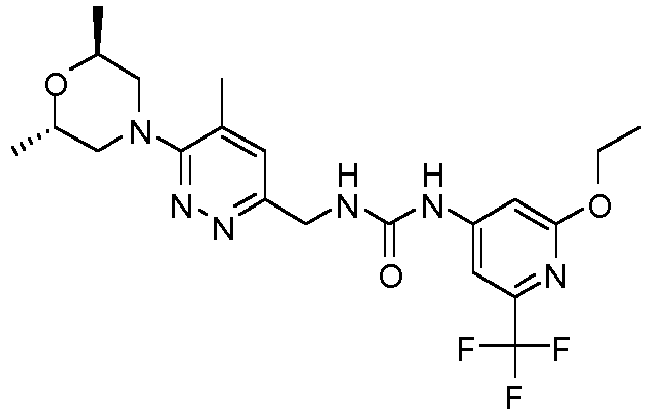
1-[[6-[(2S,6S)-2,6-dimethylmorpholin-4-yl]-5-methyl-pyridazin-3-yl]methyl]-3-[2-ethoxy-6-(trifluoromethyl)-4-pyridyl]urea Int. 139 & Int. 31 H2 468 469 Table IV. NMR data of illustrative compounds of the invention Cpd# NMR 1 1H NMR (400MHz, DMSO-d6, ppm) δ 9.65 (1H, s), 8.29 (1H, s), 7.57 (1H, s), 7.52 (1H, d), 7.33 (1H, t), 7.04 (1H, d), 4.62 (2H, d), 4.28 (2H, q), 4.02 (3H, s), 2.26 (3H, s), 1.30 (3H, t). 2 1H NMR (400MHz, DMSO-d6, ppm) δ 9.46 (1H, s), 8.29 (1H, s), 7.56 (1H, s), 7.28 (1H, t), 7.12 (1H,d), 6.77 (1H, d), 4.60 (2H, d), 4.21 (2H, q), 4.01 (3H, s), 2.26 (3H, s), 1.28 (3H, t) 3 1H NMR (600 MHz, DMSO-d6, ppm) δ 9.33 (s, 1H), 8.29 (s, 1H), 7.65 (s, 1H), 7.41 (d, 1H), 7.08 (d, 1H), 6.72 (d, 1H), 5.07 (quint, 1H), 4.20 (q, 2H), 4.00 (s, 3H), 2.26 (s, 3H), 1.48 (d, 3H), 1.26 (t, 3H). 4 1H NMR (400MHz, DMSO-d6, ppm) δ 9.66 (1H, s), 8.29 (1H, s), 7.56 (1H, s), 7.52 (2H, d), 7.33 (1H, t), 7.08 (1H, d), 4.81 (1H, bs), 4.62 (2H, d), 4.25 (2H, t), 4.02 (3H, s), 3.69 (2H, bs), 2.26 (3H, s). 5 1H NMR (400MHz, DMSO-d6, ppm) δ 9.70 (1H, s), 8.30 (1H, s), 7.57 (1H, s), 7.50 (1H, s), 7.37 (1H, t), 7.010 (1H, s), 5.13-5.09 (1H, m), 4.94 (1H, d), 4.68 (1H, t), 4.62 (2H, d), 4.24 (1H, dd), 4.11 (1H, dd), 4.01 (3H, s), 3.78 (1H, p), 3.42 (2H, t), 2.26 (3H, s). 6 1H NMR (400MHz, DMSO-d6, ppm) δ 9.28 (1H, s), 8.30 (1H, s), 7.56 (1H, s), 7.50 (2H, d), 7.19 (1H, t), 7.10 (1H, t), 4.60 (2H, d), 4.01 (3H, s), 2.26 (3H, s). 8 1H NMR (400MHz, DMSO-d6, ppm) δ 8.97 (1H, s), 8.28 (1H, s), 8.08 (1H, d), 8.05 (1H, d), 7.55 (1H, s), 7.12 (1H, t), 4.59 (2H, d), 4.32 (2H, q), 4.02 (3H, s), 2.26 (3H, s), 1.32 (3H, t). 13 1H NMR (400MHz, DMSO-d6, ppm) δ 8.96 (1H, s), 8.28 (1H, s), 8.08 (1H, d), 8.03 (1H, d), 7.55 (1H, s), 7.09 (1H, t), 4.59 (2H, d), 4.12 (2H, d), 4.02 (3H, s), 2.26 (3H, s), 1.27-1.21 (1H, m), 0.57-0.52 (2H, m), 0.35-0.31 (2H, m). 14 1H NMR (400MHz, CDCl3, ppm) δ 9.25 (1H, s), 8.86 (1H, bs), 7.79 (1H, s), 7.64 (1H, s), 6.79 (1H, s), 6.64 (1H, s), 4.75 (2H, bs), 4.65 (2H, q), 4.07 (3H, s), 2.33 (3H, s). 15 1H NMR (400MHz, CDCl3, ppm) δ 9.05 (1H, s), 8.54 (1H, bs), 7.86 (1H, s), 7.78 (1H, s), 6.74 (1H, s), 6.52 (1H, s), 5.51 (2H, s), 4.76 (2H, s), 4.24 (2H, q), 3.42 (3H, s), 2.32 (3H, s), 1.31 (3H, t). 16 1H NMR (400MHz, DMSO-d6, ppm) δ 9.54 (1H, s), 8.29 (1H, s), 7.56 (1H, s), 7.33 (1H, t), 7.17 (1H, d), 6.85 (1H, d), 4.76 (1H, t), 4.64 (1H, t), 4.61 (2H, d), 4.46 (1H, t), 4.39 (1H, t), 4.01 (3H, s), 2.26 (3H, s). 17 1H NMR (400MHz, DMSO-d6, ppm) δ 9.56 (1H, s), 8.29 (1H, s), 7.56 (1H, s), 7.34 (1H, t), 7.20 (1H, d), 6.90 (1H, d), 6.34 (1H, tt), 4.61 (2H, d), 4.50 (2H, dt), 4.02 (3H, s), 2.26 (3H, s). 18 1H NMR (400MHz, DMSO-d6, ppm) δ 9.62 (1H, s), 8.30 (1H, s), 7.57 (2H, d), 7.41 (1H, t), 7.14 (1H, d), 4.62 (2H, d), 4.28 (1H, q), 4.02 (3H, s), 2.27 (3H, s), 1.30 (3H, t). 19 1H NMR (400MHz, DMSO-d6, ppm) δ 9.76 (1H, s), 8.29 (1H, s), 7.59 (1H, d), 7.57 (1H, s), 7.40 (1H, t), 7.17 (1H, d), 6.36 (1H, tt), 4.62 (2H, d), 4.56 (2H, dt), 4.02 (3H, s), 2.26 (3H, s). 25 1H NMR (400MHz, DMSO-d6, ppm) δ 9.66 (1H, s), 8.28 (1H, s), 7.57 (1H, s), 7.53 (1H, s), 7.35 (1H, t), 7.07 (1H, d), 4.62 (2H, d), 4.37-4.34 (2H, m), 4.01 (3H, s), 3.65-3.63 (2H, m), 3.29 (3H, s), 2.26 (3H, s). 27 1H NMR (400MHz, DMSO-d6, ppm) δ 9.49 (1H, s), 8.29 (1H, s), 7.56 (1H, s), 7.30 (1H, t), 7.14 (1H, d), 6.80 (1H, d), 4.60 (2H, d), 4.30-4.28 (2H, m), 4.01 (3H, s), 3.62-3.60 (2H, m), 3.28 (3H, s), 2.26 (3H, s). 28 1H NMR (400MHz, DMSO-d6, ppm) δ 9.76 (1H, s), 8.29 (1H, s), 7.64 (1H, d), 7.57 (1H, s), 7.50 (1H, t), 7.26 (1H, d), 6.37 (1H, tt), 4.62 (2H, d), 4.55 (2H, dt), 4.02 (3H, s), 2.26 (3H, s). 30 1H NMR (400MHz, DMSO-d6, ppm) δ 8.64 (1H, s), 8.33 (1H, s), 8.30 (1H, s), 7.86 (1H, t), 7.61 (1H, s), 4.64 (2H, d), 4.32 (2H, q), 4.02 (3H, s), 2.27 (3H, s), 2.11 (3H, s), 1.33 (3H, t) 32 1H NMR (400MHz, DMSO-d6, ppm) δ 9.18 (1H, s), 8.28 (1H, s), 7.62 (1H, s), 7.61 (1H, s), 7.55 (1H, s), 7.17 (1H, t), 4.60 (2H, d), 4.02 (3H, s), 2.26 (3H, s). 33 1H NMR (400MHz, DMSO-d6, ppm) δ 9.73 (1H, s), 8.31 (1H, s), 7.56 (2H, t), 7.39 (1H, t), 7.11 (1H, s), 4.62 (2H, d), 4.47-4.42 (1H, m), 4.20-4.15 (1H, m), 4.01 (3H, s), 2.26 (3H, s), 2.26-2.17 (1H, m), 1.72-1.70 (1H, m), 1.57-1.52 (1H, m). 38 1H NMR (400MHz, DMSO-d6, ppm) δ 10.08 (1H, s), 8.31 (1H, s), 8.12 (1H, s), 7.59 (1H, s), 7.33 (1H, s), 4.67 (2H, d), 4.31 (2H, q), 4.02 (3H, s), 2.26 (3H, s), 1.29 (3H, t). 40 1H NMR (400MHz, DMSO-d6, ppm) δ 9.69 (1H, s), 8.29 (1H, s), 7.56 (1H, s), 7.49 (1H, d), 7.40 (1H, t), 7.07 (1H, d), 5.13-5.09 (1H, m), 4.62 (2H, d), 4.02 (3H, s), 3.86-3.81 (2H, m), 3.52-3.46 (2H, m), 2.26 (3H, s), 2.01-1.96 (1H, m), 1.67-1.58 (1H, m). 43 1H NMR (400MHz, DMSO-d6, ppm) δ 9.86 (1H, s), 8.47 (1H, d), 8.29 (1H, s), 8.03 (1H, d), 7.57-7.53 (1H, 3), 4.63 (2H, d), 4.01 (3H, s), 2.26 (3H, s). 45 1H NMR (400MHz, DMSO-d6, ppm) δ 8.58 (1H, s), 8.32 (1H, s), 8.30 (1H, s), 7.99 (1H, d), 7.67 (1H, s), 5.14-5.07 (1H, m), 4.31 (2H, q), 4.02 (3H, s), 2.28 (3H, s), 2.10 (3H, s), 1.51 (3H, d), 1.32 (3H, t). 47 1H NMR (400MHz, DMSO-d6, ppm) δ 9.60 (1H, s), 8.29 (1H, s), 7.55 (1H, s), 7.29 (2H, d), 6.82 (1H, s), 4.61 (2H, d), 4.39 (4H, t), 4.02 (3H, s), 2.26 (3H, s). 48 1H NMR (400MHz, DMSO-d6, ppm) δ 9.21 (1H, s), 8.28 (1H, s), 7.54 (1H, s), 7.14 (1H, t), 6.94-6.20 (3H, m), 4.59 (2H, d), 4.45 (2H, dt), 4.32 (4H, t), 4.01 (3H, s), 2.26 (3H, s). 49 1H NMR (400MHz, DMSO-d6, ppm) δ 8.84 (1H, s), 8.46 (1H, t), 8.42 (1H, s), 8.30 (1H, s), 7.61 (1H, s), 4.65 (2H, d), 4.39 (2H, q), 4.02 (3H, s), 2.27 (3H, s), 1.35 (3H, t). 50 1H NMR (400 MHz, DMSO-d6, ppm) δ 8.59 (1H, s), 8.29 (1H, s), 7.98 (1H, s), 7.88 (1H, t), 7.60 (1H, s), 6.50-6.22 (1H, m), 4.63 (2H, d), 4.51 (2H, td), 4.01 (3H, s), 2.27 (3H, d), 2.05 (3H, s). 52 1H NMR (400 MHz, DMSO-d6, ppm) δ 9.66 (1H, s), 8.38 (1H, s), 7.57 (1H, s), 7.51 (1H, d), 7.34 (1H, t), 7.03 (1H, s), 5.22-5.19 (1H, m), 4.62 (2H, d), 4.27 (2H, q), 4.04-3.99 (3H, m), 3.87-3.81 (1H, m), 2.47-2.34 (2H, m), 2.27 (3H, d), 1.30 (3H, t). 53 1H NMR (400 MHz, DMSO-d6, ppm) δ 9.68 (1H, s), 8.31 (1H, s), 7.56 (1H, s), 7.51 (1H, s), 7.36 (1H, t), 7.04 (1H, s), 4.62 (2H, d), 4.44 (2H, t), 4.28 (2H, q), 3.77 (2H, t), 3.26 (3H, s), 2.26 (3H, s), 1.29 (3H, t). 54 1H NMR (400 MHz, DMSO-d6, ppm) δ 9.62 (1H, s), 7.95 (1H, s), 7.51 (2H, d), 7.31 (1H, t), 7.04 (1H, s), 4.59 (2H, d), 4.26 (2H, q), 3.80 (3H, s), 2.33 (3H, s), 2.08-2.01 (1H, m), 1.29 (3H, t), 0.78-0.74 (4H, m). 56 1H NMR (400 MHz, DMSO-d6, ppm) δ 9.69 (1H, s), 8.25 (1H, s), 7.56 (1H, s), 7.51 (1H, s), 7.37 (1H, t), 7.04 (1H, s), 5.07 (1H, d), 4.62 (2H, d), 4.28-4.09 (5H, m), 2.27 (3H, d), 1.29 (3H, t), 1.11 (3H, d). 57 1H NMR (400MHz, DMSO-d6, ppm) δ 8.68 (1H, s), 8.34 (1H, s), 8.30 (1H, s), 7.87 (1H, t), 7.61 (1H, s), 4.65 (2H, d), 4.30 (1H, q), 4.02 (3H, s), 2.27 (3H, s), 2.11 (3H, s), 1.32 (3H, t). 58 1H NMR (400MHz, DMSO-d6, ppm) δ 8.69 (1H, s), 8.36 (1H, s), 8.31 (1H, s), 8.26 (1H, t), 7.61 (1H,s), 4.64 (2H, d), 4.28 (2H, q), 4.02 (3H, s), 2.28 (3H, s), 1.51-1.44 (1H, m), 1.32 (3H, t), 1.12-1.07 (2H, m), 0.62-0.58 (2H, m). 59 1H NMR (400MHz, DMSO-d6, ppm) δ 8.79 (1H, s), 8.44 (1H, s), 8.30 (1H, s), 7.94 (1H, t), 7.61 (1H, t), 6.40 (1H, tt), 4.66 (2H, d), 4.57 (2H, dt), 4.02 (3H, s), 2.27 (3H, s), 2.15 (3H, s). 60 1H NMR (500 MHz, DMSO-d6, ppm) δ 9.54 (s, 1H), 8.14 (s, 1H), 7.29 (t, 1H), 7.19 (d, 1H), 6.89 (d, 1H), 6.75 (s, 1H), 6.35 (tt, 1H), 4.55-4.45 (m, 4H), 4.12 (t, 4H), 4.01 (s, 3H). 61 1H NMR (300 MHz, DMSO-d6, ppm) δ 9.55 (s, 1H), 8.28 (s, 1H), 7.32 (t, 1H), 7.16-7.21 (m, 2H), 6.89 (d, 1H), 6.35 (tt, 1H), 4.57 (d, 2H), 4.49 (dt, 2H), 4.03 (s, 3H), 1.70-1.82 (m, 1H), 1.01-1.11 (m, 2H), 0.79-0.88 (m, 2H). 62 1H NMR (300 MHz, DMSO-d6, ppm) δ 9.56 (s, 1H), 8.37 (s, 1H), 7.32 (t, 1H), 7.19 (d, 1H), 7.13 (s, 1H), 6.90 (d, 1H), 6.35 (tt, 1H), 4.43-4.58 (m, 4H), 4.02 (s, 3H), 3.56-3.66 (m, 4H), 2.87-2.97 (m, 2H). 63 1H NMR (400 MHz, DMSO-d6, ppm) δ 9.55 (s, 1H), 8.17 (s, 1H), 7.30 (t, 1H), 7.19 (s, 1H), 6.96 (s, 1H), 6.89 (s, 1H), 6.35 (tt, 1H), 4.43-4.55 (m, 4H), 3.99 (s, 3H), 2.67 (s, 6H). 64 1H NMR (400 MHz, DMSO-d6, ppm) δ 9.59 (s, 1H), 8.37 (s, 1H), 7.36 (t, 1H), 7.33 (s, 1H), 7.20 (d, 1H), 6.90 (d, 1H), 6.35 (tt, 1H), 4.60 (d, 2H), 4.49 (dt, 2H), 4.00 (s, 3H), 3.93 (s, 3H). 65 1H NMR (400 MHz, DMSO-d6, ppm) δ 9.60 (s, 1H), 8.25 (s, 1H), 7.69 (s, 1H), 7.39 (t, 1H), 7.20 (d, 1H), 6.90 (d, 1H), 6.35 (tt, 1H), 4.66 (d, 2H), 4.49 (dt, 2H), 4.02 (s, 3H), 3.33 (s, 2H), 2.11 (s, 6H). 66 1H NMR (400 MHz, DMSO-d6, ppm) δ 9.74 (s, 1H), 8.21 (s, 1H), 7.47 - 7.52 (m, 2H), 7.03 (s, 1H), 4.66 (d, 2H), 4.28 (q, 2H), 4.02 (s, 3H), 2.30 (s, 3H), 2.20 (s, 3H), 1.30 (t, 2H). 67 1H NMR (400 MHz, DMSO-d6, ppm) δ 10.03 (1H, s), 8.30 (1H, s), 7.56 (1H, br s), 7.55 (2H, d), 7.14 (1H, s), 4.98 (2H, s), 4.61 (2H, d), 4.01 (3H, s), 2.99 (3H, s), 2.81 (3H, s), 2.26 (2H, s). 68 1H NMR (400 MHz, DMSO-d6, ppm) δ 9.45 (1H, s), 8.05 (1H, s), 7.47 (1H, s), 7.27 (1H, t), 7.12 (1H, s), 6.77 (1H, s), 4.56 (2H, d), 4.21 (2H, q), 3.84 (3H, s), 2.33 (3H, s), 2.26 (3H, s), 1.28 (3H, t). 70 1H NMR (400MHz, DMSO-d6, ppm) δ 9.69 (1H, s), 7.76 (1H, s), 7.45 (1H, t), 7.21 (1H, s), 7.08 (1H, s), 6.91 (1H, s), 6.34 (1H, tt), 4.65 (2H, d), 4.49 (2H, dt), 2.17 (3H, s), 2.12 (3H, s), 2.11 (3H, s). 71 1H NMR (400MHz, DMSO, ppm) δ 8.61 (1H, s), 8.29 (1H, s), 8.14 (1H, t), 7.81 (1H, s), 7.58 (1H, s), 4.62 (2H, d), 4.35 (2H, q), 4.02 (3H, s), 2.30 (3H, s), 2.27 (3H, s), 1.31 (3H, t). 72 1H NMR (400MHz, DMSO, ppm) δ 8.30 (1H, s), 8.22 (1H, s), 7.68 (1H, t), 7.61 (1H, s), 7.59 (1H, s), 4.62 (2H, d), 4.26 (2H, q), 4.03 (3H, s), 2.28 (3H, s), 2.27 (3H, s), 2.00 (3H, s), 1.30 (3H, t). 73 1H NMR (400MHz, DMSO, ppm) δ 8.68 (1H, s), 8.34 (1H, s), 8.31 (1H, s), 7.91 (1H, t), 7.61 (1H, s), 4.82 (1H, t), 4.65 (2H, d), 4.28 (2H, t), 4.02 (3H, s), 3.72 (2H, q), 2.27 (3H, s), 2.13 (3H, s). 74 1H NMR (400MHz, DMSO, ppm) δ 8.31 (1H, s), 8.29 (1H, s), 7.74 (1H, t), 7.71 (1H, s), 7.58 (1H, s), 6.36 (1H, tt), 4.62 (2H, d), 4.50 (2H, dt), 4.02 (3H, s), 2.28 (3H, s), 2.27 (3H, s), 2.03 (3H, s). 75 1H NMR (400MHz, DMSO, ppm) δ 9.25 (1H, s), 8.30 (1H, s), 7.57 (1H, s), 7.71 (1H, t), 7.58 (1H, s), 6.34 (1H, tt), 4.60 (2H, d), 4.48 (2H, dt), 4.02 (3H, s), 2.30 (3H, s), 2.26 (3H, s). 76 1H NMR (400MHz, DMSO, ppm) δ 9.97 (1H, s), 8.64 (1H, s), 8.30 (1H, s), 7.63 (1H, s), 7.41 (1H, s), 6.99 (1H, s), 4.81 (2H, d), 4.31 (2H, q), 4.02 (3H, s), 2.28 (3H, s), 1.31 (3H, t). 77 1H NMR (400MHz, DMSO, ppm) δ 9.03 (1H, s), 8.25 (1H, s), 7.47 (1H, s), 6.53 (1H, s), 5.43 (2H,s), 4.46 (2H, q), 4.00 (3H, s), 2.35 (3H, s), 2.20 (3H, s), 1.37 (3H, t). 78 1H NMR (400MHz, DMSO, ppm) δ 9.20 (1H, s), 8.30 (1H, s), 7.73 (1H, s), 7.51 (1H, s), 6.71 (1H, s), 4.66 (2H, d), 4.30 (2H, q), 4.02 (3H, s), 2.32 (3H,s), 2.28 (3H, s), 1.32 (3H, t). 79 1H NMR (400MHz, DMSO, ppm) δ 9.27 (1H, s), 8.31 (1H, s), 7.84 (1H, s), 7.53 (1H, s), 6.82 (1H, s), 6.40 (1H, tt), 4.68 (2H, d), 4.548 (2H, dt), 4.02 (3H, s), 2.34 (3H,s), 2.28 (3H, s), 1.97 (3H, s). 80 1H NMR (400MHz, DMSO, ppm) δ 9.59 (1H, s), 8.32 (1H, s), 8.06 (1H, s), 7.58 (1H, s), 7.38 (1H, s), 4.71 (2H, d), 4.36 (2H, q), 4.03 (3H, s), 2.28 (3H,s), 2.05 (3H, s), 1.36 (3H, t). 81 1H NMR (400MHz, DMSO, ppm) δ 9.36 (1H, s), 7.24 (1H, d), 7.13 (1H, t), 7.10 (1H, d), 6.75 (1H, d), 4.41 (2H, d), 4.21 (2H, q), 3.94 (2H, t), 3.76 (2H, t), 2.49-2.42 (2H, m) 2.32 (3H, s), 1.26 (3H, t). 82 1H NMR (400MHz, DMSO, ppm) δ 9.37 (1H, s), 7.32 (1H, d), 7.14 (1H, t), 7.11 (1H, d), 6.76 (1H, d), 4.45 (2H, d), 4.21 (2H, q), 3.78-3.74 (2H, m), 3.40 (2H, d), 2.55 (2H, dd) 2.27 (3H, s), 1.27 (3H, t), 1.12 (6H, s) 83 1H NMR (400MHz, DMSO, ppm) δ 9.39 (1H, s), 7.26 (1H, d), 7.18 (1H, t), 7.11 (1H, d), 6.76 (1H, d), 4.59 (4H, t), 4.42 (2H, d), 4.21 (2H, q), 2.19 (3H, s), 1.27 (3H, t). 84 1H NMR (400MHz, DMSO, ppm) δ 8.71 (1H, s), 8.18 (1H, s), 8.06 (1H, s), 6.39 (1H, tt), 4.59 (2H, dt), 3.97-3.94 (2H, m), 3.55-3.49 (2H, m), 2.48-2.44 (2H, m), 1.12 (3H, s), 1.10 (3H, s). 87 1H NMR (400MHz, DMSO, ppm) δ 9.69 (1H, s), 7.51 (1H, s), 7.33 (2H, s), 7.03 (1H, s), 4.47 (2H, s), 4.27 (2H, q), 3.80-3.73 (2H, m), 3.42-3.39 (2H, m), 2.58-2.52 (2H, m), 2.27 (3H, s), 1.30 (3H, t), 1.13 (3H, s), 1.12 (3H, s). 91 1H NMR (400MHz, DMSO-d6, ppm) δ 9.58 (1H, s), 7.29 (1H, t), 7.22 (1H, s), 7.18 (1H, s), 6.89 (1H, s), 6.49-6.20 (1H, m), 4.52-4.50 (4H, m), 4.05-4.03 (1H, m), 3.87-3.86 (2H, d), 3.73-3.58 (2H, m), 3.05 (3H, s), 2.34-2.27 (5H, m). 93 1H NMR (400MHz, DMSO, ppm) δ 9.11 (1H, s), 7.32 (1H, s), 7.10 (1H, t), 6.73 (1H, s), 6.71 (1H, s), 4.44 (2H, d), 4.21 (2H, q), 3.78-3.72 (2H, m), 3.42-3.38 (2H, m), 2.57-2.52 (2H, m), 2.27 (3H, s), 2.28 (3H,s), 1.26 (3H, t), 1.13 (3H, s), 1.12 (3H, s). 94 1H NMR (400MHz, DMSO, ppm) δ 8.53 (1H, s), 8.00 (1H, t), 7.81 (1H, s), 7.35 (1H, s), 4.47 (2H, d), 4.34 (2H, q), 3.81-3.73 (2H, m), 3.42-3.39 (2H, m), 2.58-2.52 (2H, m), 2.29 (3H, s), 2.28 (3H,s), 1.31 (3H, t), 1.14 (3H, s), 1.12 (3H, s). 96 1H NMR (400MHz, DMSO, ppm) δ 8.11 (1H, s), 7.59 (1H, s), 7.53 (1H, t), 7.34 (1H, s), 4.45 (2H, d), 4.25 (2H, q), 3.78-3.74 (2H, m), 3.42-3.39 (2H, m), 2.58-2.54 (2H, m), 2.28 (3H, s), 2.25 (3H,s), 1.97 (3H,s), 1.28 (3H, t), 1.14 (3H, s), 1.12 (3H, s). 97 1H NMR (400MHz, DMSO-d6, ppm) δ 9.69 (1H, s), 7.52 (1H, d), 7.42 (1H, s), 7.36 (1H, t), 7.04 (1H, d), 6.99 (1H, s), 4.51 (2H, d), 4.28 (2H, q), 3.65 (3H, s), 3.58-3.55 (2H, m), 2.69 (2H, t), 2.23 (3H, s), 2.06-2.00 (2H, m), 1.30 (3H, t). 99 1H NMR (400 MHz, DMSO-d6) δ ppm 9.65 (1H, s), 8.29 (1H, s), 7.57 (1H, s), 7.51 (1H, d), 7.34 (1H, t), 7.04 (1H, br s), 4.62 (2H, d), 4.02 (3H, s), 2.26 (3H, s). 100 1H NMR (400MHz, DMSO, ppm) δ 9.57 (1H, s), 7.50 (1H, s), 7.33 (1H, s), 7.22 (1H, t), 7.02 (1H, d), 4.47 (2H, d), 4.28 (2H, q), 4.11-4.07 (2H, m), 3.19-3.16 (2H, m), 2.95-2.91 (2H, m), 2.29 (3H, s), 1.30 (3H, t), 1.25 (3H, s), 1.23 (3H, s). 101 1H NMR (400MHz, DMSO, ppm) δ 9.56 (1H, s), 7.50 (1H, s), 7.33 (1H, s), 7.21 (1H, t), 7.03 (1H, s), 4.47 (2H, d), 4.28 (2H, q), 4.11-4.07 (2H, m), 3.19-3.16 (2H, m), 2.95-2.91 (2H, m), 2.29 (3H, s), 1.30 (3H, t), 1.25 (3H, s), 1.23 (3H, s). - Triggering of S1PR2 by administration of Sphingosine-1-phosphate leads to a transient increase in intracellular Ca2+. The Ca2+ flux assays are measuring the release of Ca2+ intracellularly by use of a Ca2+ sensitive fluorescent dye. The assay is firstly run in agonist mode (incubation of compounds alone) to ensure that the Ca2+ released measured is not caused by the test compound having an agonistic effect. Then the assay is continued in antagonist mode (Sphingosine-1-Phosphate added to incubated medium containing the test compounds).
- CHO cells stably overexpressing human GPCR sphingosine 1-phosphate receptor 2 (CHO-S1PR2 Perkin Elmer; ES-594-A) are seeded from a frozen stock in 384 wells sterile microplates (50 µL; 7,500 cells/well) and are incubated overnight at 37°C and 5% CO2. The next day cells are washed twice with starvation medium (F-12 Ham's medium containing 0.1% BSA (Fatty acid free: FAF)) and left in 25µL starvation medium for 1 h at 37°C, 5% CO2. After this starvation cells are incubated with 25µL buffer containing the Ca2+-sensitive fluorescent dye (0.5mg Fluo8 + 125mg Allura Red in 100 ml of 1% DMSO, in HBSS+20 mM Hepes + 5mM probenecid). The cells are incubated for an additional 1 hour after which 10 µL compounds, diluted in HBSS buffer with 20mM Hepes and 0.1% BSA (FAF), are added to the cells and intracellular Ca2+ changes are immediately measured by reading fluorescence during 3 min (FDSS/µCELL reader). The ratio of the maximal fluorescence over the background fluorescence before compound injection is used to determine compound response.
- After readout of the agonist activity, the plates are incubated for 15 min at 37°C and 5% CO2. Then, cells are stimulated with 10 µL Sphingosine-1-Phosphate (S1P) (Avanti Polar lipids-860492P) at its EC80 concentration. Intracellular Ca2+ changes are immediately measured by reading fluorescence during 3 min (FDSS/µCELL reader). The ratio of the maximal fluorescence over the background fluorescence before compound injection is used to determine compound response.
- For EC50 determination, a 10 point dilution series of compounds starting from 23.3µM and 20µM highest final concentration for agonist and antagonist respectively, 1/3 dilution was performed.
- The obtained ratio's for agonist and antagonist readout were normalized versus vehicle and EC100 of SIP as controls for agonist mode and versus vehicle and EC50 of SIP for antagonist mode. From these normalized data EC50 of the compounds are derived.
Table V. S1P2 antagonist EC50 of illustrative compounds of the invention Cpd# S1P2 EC50 (nM) 1 9.5 2 8.5 3 26.0 4 348.0 5 6610.0 6 16.9 7 17.8 8 22.0 9 23.7 10 15.0 11 49.6 12 11.7 13 40.3 14 24.2 15 9.2 16 10.8 17 8.6 18 10.9 19 17.1 20 8.8 21 17.3 22 17.3 23 10.6 24 8.7 25 792.0 26 110.0 27 414.0 28 16.0 29 27.3 30 6.1 31 3140.0 32 11.1 33 37.1 34 65.8 35 74.5 36 791.0 37 5430.0 38 40.2 39 219.0 40 291.0 41 101.0 42 292.0 43 6030.0 44 4500.0 45 19.7 46 17.2 47 9.3 48 27.1 49 11.5 50 8.0 51 86.7 52 11.4 53 10.0 54 15.3 55 16.9 56 11.2 57 7.6 58 69.6 59 7.2 60 3280.0 61 14.0 62 3130.0 63 66.8 64 8.5 65 1620.0 66 4246 67 19800 68 25.428 69 945 70 903.8 71 9 72 9 73 84 74 22 75 59 76 17 77 19800 78 106 79 546 80 13 81 6 82 6 83 11 84 6511 85 487 86 1358 87 42 88 4507 89 34 90 452 91 529 92 188 93 1051 94 27 96 33 97 81 98 19800 - To evaluate the selectivity of the compounds for S1PR2 over S1PR1 and S1PR5, a similar assay set up as described above for the S1PR2 calcium flux assays was performed: CHO cells stably overexpressing human GPCR sphingosine 1-phosphate receptor 1 and Gq protein (Euroscreen, FAST-0197A) or overexpressing human GPCR sphingosine 1-phosphate receptor 5 and Gq protein were used (Perkin Elmer, ES-593-A). In case of the S1PR5 assay triggering was done with an S1PR5 specific agonist instead of with SIP (Hobson et al., 2015).
S1P1 antagonist EC50 of illustrative compounds of the invention Cpd# S1P1 EC50 (nM) 1 5971.3 2 4543 3 19800 4 19800 5 19800 7 19800 8 19800 9 19800 10 19800 15 6610 17 4936 18 6610 20 3866.3 22 6610 23 19800 24 19800 25 19800 26 19800 27 19800 28 6610 30 4478 34 2023 35 19800 37 19800 38 19800 39 6610 40 5153 41 19800 43 19800 44 19800 45 19800 46 6610 47 6610 48 5096 50 5921 52 5891 53 4023 54 2484.5 55 19800 57 6610 58 19800 59 6610 60 2800 61 918.633 62 344.733 63 2084.5 64 1623 65 6610 68 19800 69 19800 70 19800 71 6610 72 16503 73 19800 74 12997 75 19800 76 13205 78 19800 79 19800 80 19800 81 6610 82 6610 87 1398 89 3795 90 6610 91 19800 92 19800 95 6610 96 6610 100 6610 Table VI. S1P5 antagonist EC50 of illustrative compounds of the invention Cpd# S1P5 EC50 (nM) 1 6610 2 4599 3 6610 4 19800 5 19800 7 19800 8 19800 9 19800 10 19800 15 19800 17 6610 18 19800 20 2103.5 22 19800 23 19800 24 19800 25 19800 26 19800 27 19800 28 6610 30 3277 34 6610 35 19800 37 19800 38 19800 39 6610 40 6610 41 19800 43 19800 44 19800 45 6610 46 6610 47 19800 48 19800 50 3649 52 6615 53 6610 54 4579 55 6610 57 4620 58 19800 59 5497 60 6610 61 4044.3 62 11010 63 11007 64 4384.5 65 19800 69 19800 70 19800 71 6610 72 11007 74 19800 75 2888 76 6610 78 19800 79 19800 80 6610 81 3767.5 82 340.6 87 249.2 89 839.4 90 2092 91 19800 92 19800 93 6610 94 478.9 95 809.4 96 626.5 100 2477 - The following assay can be used for determination of S1PR2 binding. The binding assay measures the potential to compete with radioactively labeled SIP for binding to the receptor.
- The assay is performed in a 96 well plate where the following reagents are added. First 50 µL compound is added into the assay plate, followed by addition of 100 µL of a mixture consisting of membrane and Scintillation proximity Assay (SpA) beads [mixture consists of 20 µg/well membranes derived from stable cell line over expressing S1PR2, 0.5 mg/well Polyvinyltoluene-Wheat Germ-Agglutinin (PVT-WGA) beads (Perkin Elmer, RPNQ0001)]. All components are diluted in assay buffer containing 20mM Tris pH 7.5; 10mM MgCl2; 100mM NaCl; 0.4% BSA FAF; 1 mM Na3VO4) and incubated for 15 min until addition to the assay plate. Subsequently, 50 ul of radioactively labeled SIP is added to the wells (Sphingosine, D-erythro-[3-3H] 1-phosphate; ARC; ART0778). After an incubation for 2h at room temperature, plates are centrifuged at 2000 rpm during 20 min. Plates are read on a Topcount reader (Perkin Elmer) immediately after centrifugation (readout time, 1 min/well).
- The following assay can be used for determination of S1PR2 activation. The [35S] GTPγS assay measures the level of G protein activation following agonist occupation of a GPCR, by determining the binding of the non-hydrolysable analog [35S] GTPγS to Gα subunits.
- The assay is performed in a 96 well plate where the following reagents are added. First 50 µL compound is added into the assay plate, followed by addition of 20 µL SIP at EC80 concentration (concentration which gives 80% of the activity of S1PR2). Then, 30 µL of a mixture consisting of membranes-GTPγS-SpA beads is added [mixture consists of 2.5 µg/well membranes derived from stable cell line over expressing S1PR2 (membranes are pre-incubated with 1 µM GDP for 15 min at 4°C), 0.1 nM [35S]GTPγS (Perkin Elmer, NEG030) and 0.5 mg/well PVT-WGA SpA beads (Perkin Elmer, RPNQ0001)]. All components are diluted in assay buffer containing 20mM Tris pH 7.5; 10mM MgCl2; 100mM NaCl; 0.1% BSA FAF; 50ug/ml saponin. After an incubation for 4h at room temperature, plates are centrifuged at 2000 rpm during 20 min. Plates are read on a Topcount reader (Perkin Elmer) immediately after centrifugation (readout time, 1 min/well).
Table VII. S1PR2 binding EC50 for illustrative compounds of the invention Cpd# S1PR2 EC (nM) 1 33.2 2 22.4 3 115.0 4 873.0 5 11100.0 6 50.2 7 330.0 8 306.0 9 532.0 10 281.0 11 716.0 12 590.0 13 1120.0 14 225.0 15 91.6 16 62.9 17 36.1 18 35.8 19 88.7 20 15.2 21 135.5 22 86.0 23 74.5 24 53.8 25 2030.0 26 770.0 27 641.0 28 89.7 29 275.0 30 26.2 31 1650.0 32 164.0 33 164.0 34 408.0 35 242.0 36 1800.0 37 9580.0 38 109.0 39 1040.0 40 1080.0 41 542.0 42 604.0 43 4650.0 44 4150.0 45 211.0 46 97.0 47 34.5 48 154.0 49 #N/A 50 24.1 51 473.0 52 70.2 53 52.4 54 151.0 55 338.0 56 129.0 57 24.4 58 223.0 59 38.5 60 1520.0 61 193.0 62 2370.0 63 298.0 64 48.7 65 1470.0 66 #N/A 67 28700 68 110.54 69 751.2 70 903.8 71 25 72 25 73 160 74 81 75 282 76 62 77 20000 78 863 79 2132 80 45 81 197 82 156 83 160 85 3564 87 331 89 422 90 1174 91 919 92 469 93 2172 94 509 96 302 97 274 98 16270 - SIP is able to induce cytokines such as IL-8 in a process that is S1PR2 dependent (O'Sullivan et al, 2014; Bruennert et al, 2015). This assay is designed to test inhibitory activity of compounds on SIP induced IL-8 on HFL-1 cells, a human fetal lung fibroblast cell line.
- Human Fetal Lung cells (HFL-1) are seeded in 96 well plates in growth medium (F12K + 10% heat inactivated FBS + 1% Pen/strep). After overnight incubation at 37°C, 5% CO2 cells are refreshed with starvation medium without HSA (F12K + 1% FBS + 1% Pen/strep). On day three, compounds are added (10 point serial dilution, 30µM highest concentration, 1/3 dilution, 0.3% DMSO final) and plates are incubated for one hour at 37°C, 5% CO2. Subsequently SIP at 1µM final concentration is added and plates are incubated for 16 to 24 hours at 37°C, 5% CO2 after which the supernatant was collected. IL-8 levels in the supernatant are determined with the IL-8 ELISA of R&D systems.
Table VIII. IL8 production assay for illustrative compounds of the invention Cpd# IL8 EC50 (nM) 1 2.2 2 1.5 3 22.0 4 234.0 5 1540.0 8 82.9 16 4.6 18 4.6 21 11.3 30 1.5 35 61.9 38 31.8 39 122.0 40 142.0 41 48.9 42 50.9 45 41.1 46 25.6 47 4.6 48 23.9 50 1.5 51 29.5 52 7.8 53 6.6 54 11.6 55 35.8 56 4.6 57 0.9 59 0.9 60 166.0 63 55.4 64 16.6 65 2632 66 996 67 2180 68 153.3 69 107.9 71 2 72 2 73 51 74 15 75 38 76 8 77 2741 78 1091 79 439 80 3 81 32 82 53.5 83 66 85 427 87 82 89 33 90 244 91 1246 92 432 93 753 94 102 96 44 97 62 - To evaluate the influence of plasma protein binding of SIP as well as compound, the SIP induced IL-8 levels were evaluated in presence of 2% Human Serum Albumin (HSA, equivalent to 40% human serum). By adding 2% HSA, which affects both the activity of the compounds as well as the SIP potency, the physiological condition are reproduced and the shift in potency expected under in vivo serum conditions can be measured.
- Human Fetal Lung cells (HFL-1) are seeded in 96 well plates in growth medium (F12K + 10% heat inactivated FBS + 1% Pen/strep). After overnight incubation at 37°C, 5% CO2 cells are refreshed with starvation medium with HSA (F12K + 1% FBS + 1% Pen/strep+1.95% HSA). On day three, compounds are added (10 point serial dilution, 30µM highest concentration, 1/3 dilution, 0.3% DMSO final) and plates are incubated for 1 h at 37°C, 5% CO2. Subsequently SIP at 5 µM final concentration is added and plates are incubated for 16 to 24 h at 37°C, 5% CO2 after which the supernatant was collected. IL-8 levels in the supernatant are determined with the IL-8 ELISA of R&D systems.
Table IX. IL8 production assay with HSA for illustrative compounds of the invention Cpd # HSA IL8 EC50 (nM) 1 61.5 2 25.1 3 478.0 4 652.0 5 9950.0 8 169.0 16 74.9 18 29.0 21 393.0 30 37.9 35 185.0 38 198.0 39 9950.0 40 3860.0 41 597.0 42 1240.0 45 84.2 46 9950.0 47 42.4 48 104.0 50 74.0 51 758.0 52 79.3 53 51.2 54 278.0 55 179.0 56 98.5 57 17.3 59 116.0 60 4340.0 63 829.0 64 119.0 65 10000 66 29900 67 9950 68 3457 69 9950 71 56 72 47 73 256 74 118 75 223 76 111 77 29900 78 1249 79 7036 80 239 81 10000 82 730.5 83 30000 85 9950 87 2172 89 1578 90 30000 91 2838 92 10000 93 2202 94 5953 96 2273 97 1795 - The aim of the study is to test the efficacy of a test compound at three different doses in a 14-day model of bleomycin induced pulmonary fibrosis in mice.
- This study is carried out on C527BL/6N male mice, supplied by Charles River, Italy, which are acclimatized for at least 5 days in an environment maintained at 22°C, at 55% relative humidity, with 15-20 air changes per hour under light cycles of 12 h. Mice pelleted food and water are provided ad libitum.
- At least one day prior to start of experiment, all animals are allocated randomly into groups as indicated in the table below.
- All animal related research is conducted in accordance with 2010/63/EU and National legislation regulating the use of laboratory animals in scientific research and for other purposes (Official Gazette 55/13).
Table X. Study groups Groups Purpose n Dose Treatment schedule Days (Frequency) Route Vehicle 1 PBS+Vehicle control 15 - D0-D14 (BID) NA NA 2 BLM+Vehicle control 15 - D0-D14 (BID) PO PEG/MC 3 BLM+ Pirfenidone control 15 50 mg/kg D0-D14 (BID) PO 0.1% Natrosol 4 BLM+ test compound Active 15 1 mg/kg D0-D14 (BID) PO PEG400/MC 0.5% 20/80 (v/v) 5 BLM+ test compound Active 15 3 mg/kg D0-D14 (BID) PO PEG400/MC 0.5% 20/80 (v/v) 6 BLM+ test compound Active 15 10 mg/kg D0-D14 (BID) PO PEG400/MC 0.5% 20/80 (v/v) 7 BLM+ test compound satellite for PK Active 10 10 mg/kg D0-D7 (BID) PO PEG400/MC 0.5% 20/80 (v/v) - The solvent for the test solutions is prepared by adding 0.5 g of hydroxyethylcellulose (Natrosol) into 500 mL Aqua distillate (0.1 %) under continuous stirring without heating for 5 h on a magnetic stirrer.
- Anesthetic solution is prepared by adding 1 mL of Narketan (Narketan 10, Vetoquinol, Bern, Switzerland, 03605877535982) and 0.5 mL of Rompun (Rompun, 2%: Bayer, Leverkusen, Germany) into 9 mL saline. The resulting solution is administered at 10 mL/kg.
- To prepare a solution for intranasal challenge (i.n.) challenge, 0.8 mg/mL stock solutions of bleomycin (Bleomycin sulphate, Enzo Life Sciences, Inc., USA; CAS No. 9041-93-4; Cat. No. BML-AP302-0010) are thawn and diluted in 330 µL of saline.
- Prior to i.n administration, mice are anesthetized i.p. with the anesthetic solution described above.
- Fresh pirfenidone formulation is prepared daily in 0.1% Natrosol formulations to a final concentration of 5 mg/mL. Before dosing, animals are weighed and the Pirfenidone amount administered is adjusted accordingly to individual weights corresponding to 10 mL/kg body weight, twice daily p.o., with 7.5 h interval between two administrations.
- Finally, test compound solutions are prepared by dissolving the suitable amount of said test compound in PEG 400 (20% of the final volume) then MC 0.5% (80% of the final volume) to reach final concentrations of 1 mg/mL, 0.3 mg/mL and 0.1 mg/mL, thus yielding compound for a doses of 10 mg/kg, 3 mg/kg and 1 mg/kg. Prior to dosing, animals are weighed and the amount administered adjusted accordingly to individual weights.
- The application volume of the test doses corresponds to 10 mL/kg body weight, and is the test compounds are administered p.o. twice daily, with 7.5 h interval between two administrations.
- Animals are examined clinically twice daily. List of clinical signs and parameters are indicated in human endpoints table. Animals are weighed daily starting from D0.
- On day 14, two hours post dosing with pirfenidone or test compound, mice are sacrificed by anesthetic overdose.
- The lungs are excised and weighed individually. For the all groups: the whole superior right lung lobe is placed into a Precellys tube containing silica beads and immediately snap frozen in liquid nitrogen and subjected to gene expression analysis.
- All remaining lungs are placed into marked bottles containing 10% buffered formalin for further histopathological evaluation.
- Body weight data and lung weight data are processed using MS Excel. Statistical analysis and graphical presentation are performed using GraphPad Prism software (version 5.04).
- One-way ANOVA or Mann-Whitney test are employed for lung weights.
- Two-way ANOVA are employed for body weight changes.
- Differences between groups will be considered statistically significant when p<0.05.
- For histopathological evaluation, whole lungs (except sampled superior right lung) are embedded in paraffin and stained with Mallory's trichrome.
- Pulmonary histological changes are assessed using Matsuse modification of Ashcroft score (Ashcroft et al., 1988; Matsuse et al., 1999). Statistical analysis and graphical presentation is performed using GraphPad Prism software (version 5.04). Mann-Whitney test is employed.
- Differences between groups will be considered statistically significant when p<0.05.
Ashcroft Score 1 Normal lungs (no fibrosis) 2 Minimal fibrotic thickening of alveolar or bronchial walls (network of fine collagen fibrils) 3 Moderate fibrotic thickening of walls without obvious damage to lung architecture 4 Fibrosis with damage of pulmonary structure (coarse fibrous bands or small fibrous masses, intra-alveolar collagen fibrils) 5 Large fibrous area with svere distortion of lung structure - Animals in group 7 (n=10) are included for PK study only and are not be subjected to clinical sign scoring.
- These animals are induced with the disease at the start of treatment at day 0 and are sequentially sacrificed on day 7 at 1 h, 3 h, 6 h, 8 h, 24 h after the first administration of test compound.
- A blood sample (50 µL) is collected from the tail vein into Li-heparin anticoagulant tubes for each time point and kept on ice until separation. Within maximum 30 min after collection, blood samples are centrifuged at 2000 g for 10 min at 4°C and the resulting plasma samples are aliquoted into polypropylene tubes (1x 25 µL). The samples are stored frozen at -20°C until analysis.
- The lung tissue is collected at sacrifice after blood sampling for each animal, then weighed and placed into polypropylene tubes prior to freezing. The samples are stored frozen at -80°C until analysis.
- Plasma and lung concentrations are measured via LC-MS/MS. Samples are prepared for LC-MS/MS analysis via protein precipitation. The plasma concentrations measured below the lower limit of quantification (LLOQ) are reported as below the limit of quantification (BLQ).
- The test compound concentrations in plasma are expressed in ng/mL.
- Mean plasma concentrations are calculated. For mean calculation, the concentrations below the LLOQ are set to zero. Therefore, mean values may be BLQ. Standard deviation (SD), standard error of the mean (SE) and coefficient of variation (CV, %) are tabulated when at least three plasma concentration values are above the LLOQ.
- Non-compartmental analysis on individual plasma concentrations is performed using PhoenixTM WinNonlin® 6.3 (Pharsight Corporation) to determine at least, the following pharmacokinetic parameters:
- Maximum plasma concentration, Cmax (µg/mL) with the corresponding time, tmax (h),
- Area under the plasma concentration versus time curve up to the last quantifiable concentration AUC0-t or up to 24 h AUC0-24h (µg.h/mL) (if compound is quantifiable up to 24h postdose), and/or up to infinity AUC0-∞, (µg.h/mL) is calculated according to the linear up/log down trapezoidal rule. Partial AUC may be calculated if deemed necessary. Concentrations below the limit of quantification (BLQ) are set to zero. No AUC is calculated if there are less than three quantifiable time points. AUC0-∞ is considered if %AUCextra < 20%,
- Apparent terminal elimination half-life, t1/2 (h) is only reported if three or more time points, excluding tmax is used for linear regression, and if the adjusted R2 > 0.80.
- Normalized AUC and Cmax dose.
- Mean pharmacokinetic parameters are calculated. Standard deviation (SD) and coefficient of variation (CV, %) are tabulated if at least three values are available.
- Thermodynamic solubility of a compound is determined in water, phosphate or citrate buffer with pH of choice or biologically relevant gastrointestinal media (FaSSIF, FeSSIF, SGF). Dry matter of the compound is added to the medium of choice and incubated for 24 h at room temperature. The concentration of compound in the supernatant is analyzed by LC/MS-MS and the signal is plotted against the linear standard curve of that compound.
- 2.5-3 mg dry matter of test compound is dissolved in water, phosphate or citrate buffer with pH of choice or biologically relevant gastrointestinal media (FaSSIF, FeSSIF, SGF) in a glass vial. After addition of a magnetic stirrer, the samples are stirred for 24 h at room temperature. The vials are then centrifuged shortly and the supernatant is filtered. Each sample is diluted by a factor of 100 and a 10 in DMSO. A final 100 fold dilution in 70/30 water/acetonitrile is used for LCMS-MS analysis.
- A standard curve is made starting from a 10 mM stock in DMSO, freshly prepared from dry matter. From this 10 mM DMSO stock solution, intermediate working solutions of 200, 50 and 10 µg/mL in DMSO are made and used to prepare 40, 20, 10, 5, 1, 0.2, 0.1 and 0.04 µg/mL solutions in DMSO. Two quality control samples are made: one of 15 µg/mL and one of 0.5 µg/mL in DMSO, also starting from the DMSO working stock solutions.
- The standard curve and quality controls are diluted by a factor of 100 in 70/30 water/acetonitrile and analyzed on LC/MS-MS. The peak areas of the standard curve are plotted in a graph and a linear or polynomial of the second order equation is used to calculate the unknown concentrations of the test compound.
- Solubility values are reported in µM or µg/mL.
- A 10 mM stock solution of compound in DMSO is 1,668 fold diluted in a 105 mM phosphate buffer pH 7.4. Of this compound dilution, 50 µL is transferred in two 96-well plates: one for time point 0 min (T0 plate) and one for time point 30 min (T30 plate) and pre-warmed at 37 °C.
- In the time zero reference sample (T0 plate), 100 µL MeOH (1:1) is added to the wells. In each assay plate (T0 and T30 min), 50 µL of microsomal mix is then added.
- Final reaction concentrations are: 3 µM compound, 0.5 mg/mL microsomes, 0.4 U/mL GDPDH, 3.3 mM MgCl2, 3.3 mM glucose-6-phosphate and 1.3 mM NADP+.
- The T30 plate is incubated at 37 °C, 300 rpm and after 30 min of incubation the reaction is stopped with MeOH (1:1). The samples are mixed, centrifuged and the supernatant is harvested for analysis on LC-MS/MS (API2000 from Applied Biosystems).
- The samples are analyzed on LC-MS/MS with a flow rate of 0.5mL/min. Solvent A is 0.1% Formic Acid in water and solvent B is 0.1% Formic Acid in methanol. The sample is run under positive ion spray on a Pursuit 5 C18 2.0mm column (Varian). The solvent gradient has a total run time of 1.4 min and ranges from 10% B to 100% B. Peak area from the parent compound at time 0 is considered to be 100% remaining. The percentage remaining after 30 min incubation is calculated from time 0. The solubility of the compound in the final test concentration in buffer is inspected by microscope and results are also reported.
- Test compounds (1 µM initial concentration, n=2) are incubated in Williams' Medium E, containing 4 mM L-glutamine and 2 mM magnesium sulphate, with pooled cryopreserved hepatocytes (Celsis International) in suspension at cell densities of 0.25-0.5 million viable cells/mL. The incubations are performed at 37 °C in a shaking water bath with 100 µL samples taken from the incubation at 0, 10, 20, 45 and 90 min, and reactions terminated by addition of 100 µL of acetonitrile containing carbamazepine as analytical internal standard. Samples are centrifuged and the supernatant fractions analysed by LC-MS/MS. The instrument responses (i.e. peak heights) are referenced to the zero time-point samples (as 100%) in order to determine the percentage of compound remaining. Ln plots of the % remaining for each compound are used to determine the half-life for the hepatocyte incubations. Half-life values are calculated from the relationship: T1/2 (min) = -0.693/λ, where λ is the slope of the Ln concentration vs time curve. Standard compounds testosterone, midazolam, and 4-methylumbelliferone are included in the assay design.
- It will be appreciated by those skilled in the art that the foregoing descriptions are exemplary and explanatory in nature, and intended to illustrate the invention and its preferred embodiments.
- It should be understood that factors such as the differential cell penetration capacity of the various compounds can contribute to discrepancies between the activity of the compounds in the in vitro biochemical and cellular assays.
- At least some of the chemical names of compound of the invention as given and set forth in this application, may have been generated on an automated basis by use of a commercially available chemical naming software program, and have not been independently verified. Representative programs performing this function include the Lexichem naming tool sold by Open Eye Software, Inc. and the Autonom Software tool sold by MDL, Inc. In the instance where the indicated chemical name and the depicted structure differ, the depicted structure will control.
-
- Adada, M., Canals, D., Hannun, Y.A., Obeid, L.M., 2013. Sphingosine-1-phosphate receptor 2. FEBS J. 280, 6354-6366. doi:10.1111/febs.12446
- Ashcroft, T., Simpson, J.M., Timbrell, V., 1988. Simple method of estimating severity of pulmonary fibrosis on a numerical scale. J. Clin. Pathol. 41, 467-470.
- Blankenbach, K.V., Schwalm, S., Pfeilschifter, J., Meyer Zu Heringdorf, D., 2016. Sphingosine-1-Phosphate Receptor-2 Antagonists: Therapeutic Potential and Potential Risks. Front. Pharmacol. 7, 167. doi:10.3389/fphar.2016.00167
- Hobson, A.D., Harris, C.M., van der Kam, E.L., Turner, S.C., Abibi, A., Aguirre, A.L., Bousquet, P., Kebede, T., Konopacki, D.B., Gintant, G., Kim, Y., Larson, K., Maull, J.W., Moore, N.S., Shi, D., Shrestha, A., Tang, X., Zhang, P., Sarris, K.K., 2015. Discovery of A-971432, An Orally Bioavailable Selective Sphingosine-1-Phosphate Receptor 5 (S1P5) Agonist for the Potential Treatment of Neurodegenerative Disorders. J. Med. Chem. 58, 9154-9170. doi:10.1021/acs.jmedchem.5b00928
- Matsuse, T., Teramoto, S., Katayama, H., Sudo, E., Ekimoto, H., Mitsuhashi, H., Uejima, Y., Fukuchi, Y., Ouchi, Y., 1999. ICAM-1 mediates lung leukocyte recruitment but not pulmonary fibrosis in a murine model of bleomycin-induced lung injury. Eur. Respir. J. 13, 71-77.
- Milstien, S., Spiegel, S., 2006. Targeting sphingosine-1-phosphate: A novel avenue for cancer therapeutics. Cancer Cell 9, 148-150. doi:10.1016/j.ccr.2006.02.025
- Nanthakumar, C.B., Hatley, R.J.D., Lemma, S., Gauldie, J., Marshall, R.P., Macdonald, S.J.F., 2015. Dissecting fibrosis: therapeutic insights from the small-molecule toolbox. Nat. Rev. Drug Discov. 14, 693-720. doi:10.1038/nrd4592
- Sobel, K., Menyhart, K., Killer, N., Renault, B., Bauer, Y., Studer, R., Steiner, B., Bolli, M.H., Nayler, O., Gatfield, J., 2013. Sphingosine 1-Phosphate (S1P) Receptor Agonists Mediate Pro-fibrotic Responses in Normal Human Lung Fibroblasts via S1P2 and S1P3 Receptors and Smad-independent Signaling. J. Biol. Chem. 288, 14839-14851. doi:10.1074/jbc.M112.426726
- Takabe, K., Paugh, S.W., Milstien, S., Spiegel, S., 2008. "Inside-Out" Signaling of Sphingosine-1-Phosphate: Therapeutic Targets. Pharmacol. Rev. 60, 181-195. doi:10.1124/pr.107.07113
Claims (17)
- A compound according to Formula Ia:
 X is =O, or =N-CN;R1a is selected from:- C1-4 alkyl optionally substituted with one or more groups independently selected from∘ OH,∘ C1-4 alkoxy optionally substituted with one or more independently selected OH, or C1-4 alkoxy,∘ -SO2-C1-4 alkyl,∘ -O-C3-7 monocyclic cycloalkyl, and∘ -O-heterocycloalkyl wherein said heterocycloalkyl is a 4-7 membered monocyclic heterocycloalkyl comprising one, two, or three heteroatoms independently selected from N, O, and S;- -NR6aR6b,- C1-4 alkoxy,- C3-7 monocyclic cycloalkyl,- 4-7 membered monocyclic heterocycloalkyl comprising one, two, or three heteroatoms independently selected from N, O, and S, optionally substituted with one or more halo,- -O-C3-7 monocyclic cycloalkyl, and- -O-heterocycloalkyl wherein said heterocycloalkyl is a 4-7 membered monocyclic heterocycloalkyl comprising one, two, or three heteroatoms independently selected from N, O, and S;R1b is H, or C1-4 alkyl;Cy1 is a 5 membered monocyclic heteroaryl ring, comprising one, two, or three heteroatoms independently selected from N, O, or S, orCy1 is 4-7 membered monocyclic heterocycloalkyl ring comprising one, two, or three heteroatoms independently selected from N, O, or S, or 4-7 membered monocyclic heterocycloalkyl ring comprising one, two, or three heteroatoms independently selected from N, O, or S, fused to a 5-6 membered heteroaryl ring comprising one, two, or three heteroatoms independently selected from N, O, or S, which heteroaryl may optionally substituted with one C1-4 alkyl;each R2a and R2b is independently selected from H, and C1-4 alkyl optionally substituted with one or more independently selected -OH, or C1-4 alkoxy;R3 is selected from:- C1-4 alkyl optionally substituted with one or more independently selected:∘ halo,∘ -CN,∘ -OH,∘ -C1-4 alkoxy, or∘ -NR7aR7b;- C1-4 alkoxy substituted with one or more halo,- C3-7 monocyclic cycloalkyl,- 4-7-membered monocyclic heterocycloalkyl comprising one, two or three heteroatoms independently selected from N, O, and S,- -CN,- -S(O)2-C1-4 alkyl,- -NR8aR8b, and- -C(=O)NR8cR8d;each R4 is independently selected from:- C1-4 alkyl optionally substituted with one or more independently selected R12 groups,- C3-7 monocyclic cycloalkyl, and- 4-7 membered monocyclic heterocycloalkyl comprising one, two, or three heteroatoms independently selected from N, O, and S;Cy2 is phenyl or 5-6 membered monocyclic heteroaryl comprising one or two heteroatoms independently selected from N, O, and S;each R5 is independently selected from:- halo,- -CN,- -OH,- C1-4 alkyl optionally substituted with one or more independently selected R13groups,- C1-4 alkoxy optionally substituted with one or more independently selected R13groups,- C3-7 monocyclic cycloalkyl optionally substituted with one or more independently selected R14 groups,- 4-11 membered monocyclic, or fused or spiro bicyclic heterocycloalkyl comprising one, two, or three heteroatoms independently selected from N, O, and S, optionally substituted with one or more independently selected R14 groups,- -O-C3-7 monocyclic cycloalkyl optionally substituted with one or more independently selected R14 groups,- -O-heterocycloalkyl wherein said heterocycloalkyl is a 4-7 membered monocyclic heterocycloalkyl comprising one, two, or three heteroatoms independently selected from N, O, and S, optionally substituted with one or more independently selected R14 groups, and wherein if a N heteroatom is present, said N heteroatom, is further substituted with one -C(=O)-C1-4 alkyl, -C(=O)-C1-4 alkoxy, -SO2-C1-4 alkyl, -C(=O)-NH2, -C(=O)NHC1-4 alkyl, or -C(=O)N(C1-4 alkyl)2,- -SO2-C1-4 alkyl,- -SO2NR15aR15b,- -C(=O)NR15cR15d, and- -NR17aR17b;each R12 is independently selected from:- halo,- OH,- C1-4 alkoxy,- -SO2-C1-4 alkyl,- C3-7 monocyclic cycloalkyl optionally substituted with one or more independently selected -OH, halo, -CN, C1-4 alkyl, C1-4 alkoxy or =O,- 4-7 membered monocyclic heterocycloalkyl, comprising one, two, or three heteroatoms independently selected from N, O, and S, optionally substituted with one or more independently selected -OH, halo, -CN, C1-4 alkyl, C1-4 alkoxy or =O,- -NR9aR9b, and- -CN;each R13 is independently selected from:- halo,- -CN,- -OH,- C1-4 alkoxy optionally substituted with one or more independently selected OH, C1-4 alkoxy, or halo,- -C(=O)NR16aR16b,- -NR16cC(=O)-C1-4 alkyl,- -NR16dC(=O)-C1-4 alkoxy,- -SO2-C1-4 alkyl- -SO2NR16eR16f,- -NR16gSO2-C1-4 alkyl,- C3-7 monocyclic cycloalkyl optionally substituted with one or more independently selected halo, or C1-4 alkyl optionally substituted with one or more halo, and- 4-7 membered monocyclic heterocycloalkyl comprising one, two, or three heteroatoms independently selected from N, O, and S, optionally substituted with one or more independently selected halo, or C1-4 alkyl optionally substituted with one or more halo, and wherein if a N heteroatom is present, said N heteroatom, is further substituted with one -C(=O)-C1-4 alkyl, -C(=O)-C1-4 alkoxy, -SO2-C1-4 alkyl, -C(=O)-NH2, -C(=O)NHC1-4 alkyl, or -C(=O)N(C1-4 alkyl)2;each R14 is independently selected from:- halo,- -CN,- -OH,- C1-4 alkoxy optionally substituted with one or more halo, and- C1-4 alkyl optionally substituted with one or more halo;each R6a, R6b, R7a, R7b, R8a, R8b, R8c, R8d, R9a, R9b, R15a, R15b, R15c, R15d, R16a, R16b, R16e, R16d, R16e, R16f, and R16g is independently selected from H and C1-4 alkyl;each R17a and R17b is independently selected from H and C1-4 alkyl optionally substituted with one or more independently selected halo, OH, or C1-4 alkoxy;the subscript n is 0, 1, 2, or 3; andthe subscript m is 0, 1, 2, 3 or 4;or a pharmaceutically acceptable salt thereof, or the solvate or the salt of a solvate thereof.
 - A compound or a pharmaceutically acceptable salt thereof according to claim 1, wherein the compound is according to Formula Ib:
 R1a is selected from:- C1-4 alkyl optionally substituted with one or more groups independently selected from∘ OH,∘ C1-4 alkoxy optionally substituted with one or more independently selected OH, or C1-4 alkoxy,∘ -SO2-C1-4 alkyl,∘ -O-C3-7 monocyclic cycloalkyl, and∘ -O-heterocycloalkyl wherein said heterocycloalkyl is a 4-7 membered monocyclic heterocycloalkyl comprising one, two, or three heteroatoms independently selected from N, O, and S;- -NR6aR6b,- C1-4 alkoxy,- C3-7 monocyclic cycloalkyl,- 4-7 membered monocyclic heterocycloalkyl comprising one, two, or three heteroatoms independently selected from N, O, and S, optionally substituted with one or more halo,- -O-C3-7 monocyclic cycloalkyl, and- -O-heterocycloalkyl wherein said heterocycloalkyl is a 4-7 membered monocyclic heterocycloalkyl comprising one, two, or three heteroatoms independently selected from N, O, and S;R1b is H, or C1-4 alkyl;Cy1 is a 5 membered monocyclic heteroaryl ring, comprising one, two, or three heteroatoms independently selected from N, O, or S;each R2a and R2b is independently selected from H, and C1-4 alkyl optionally substituted with one or more independently selected -OH, or C1-4 alkoxy;R3 is selected from:- C1-4 alkyl optionally substituted with one or more independently selected:∘ halo,∘ -CN,∘ -C1-4 alkoxy, or∘ -NR7aR7b;- C1-4 alkoxy substituted with one or more halo,- C3-7 monocyclic cycloalkyl,- 4-7-membered monocyclic heterocycloalkyl comprising one, two or three heteroatoms independently selected from N, O, and S,- -CN,- -NR8aR8b, and- -C(=O)NR8cR8d;each R4 is independently selected from:- C1-4 alkyl optionally substituted with one or more independently selected R12 groups,- C3-7 monocyclic cycloalkyl, and- 4-7 membered monocyclic heterocycloalkyl comprising one, two, or three heteroatoms independently selected from N, O, and S;Cy2 is phenyl or 5-6 membered monocyclic heteroaryl comprising one or two heteroatoms independently selected from N, O, and S;each R5 is independently selected from:- halo,- -CN,- -OH,- C1-4 alkyl optionally substituted with one or more independently selected R13 groups,- C1-4 alkoxy optionally substituted with one or more independently selected R13 groups,- C3-7 monocyclic cycloalkyl optionally substituted with one or more independently selected R14 groups,- 4-11 membered monocyclic, or fused or spiro bicyclic heterocycloalkyl comprising one, two, or three heteroatoms independently selected from N, O, and S, optionally substituted with one or more independently selected R14 groups,- -O-C3-7 monocyclic cycloalkyl optionally substituted with one or more independently selected R14 groups,- -O-heterocycloalkyl wherein said heterocycloalkyl is a 4-7 membered monocyclic heterocycloalkyl comprising one, two, or three heteroatoms independently selected from N, O, and S, optionally substituted with one or more independently selected R14 groups, and wherein if a N heteroatom is present, said N heteroatom, is further substituted with one -C(=O)-C1-4 alkyl, -C(=O)-C1-4 alkoxy, -SO2-C1-4 alkyl, -C(=O)-NH2, -C(=O)NHC1-4 alkyl, or -C(=O)N(C1-4 alkyl)2,- -SO2-C1-4 alkyl,- -SO2NR15aR15b,- -C(=O)NR15cR15d, and- -NR17aR17b;each R12 is independently selected from:- halo,- OH,- C1-4 alkoxy,- -SO2-C1-4 alkyl,- C3-7 monocyclic cycloalkyl optionally substituted with one or more independently selected -OH, halo, -CN, C1-4 alkyl, C1-4 alkoxy or =O,- 4-7 membered monocyclic heterocycloalkyl, comprising one, two, or three heteroatoms independently selected from N, O, and S, optionally substituted with one or more independently selected -OH, halo, -CN, C1-4 alkyl, C1-4 alkoxy or =O,- -NR9aR9b, and- -CN;each R13 is independently selected from:- halo,- -CN,- -OH,- C1-4 alkoxy optionally substituted with one or more independently selected OH, C1-4 alkoxy, or halo,- -C(=O)NR16aR16b,- -NR16cC(=O)-C1-4 alkyl,- -NR16dC(=O)-C1-4 alkoxy,- -SO2-C1-4 alkyl- -SO2NR16eR16f,- -NR16gSO2-C1-4 alkyl,- C3-7 monocyclic cycloalkyl optionally substituted with one or more independently selected halo, or C1-4 alkyl optionally substituted with one or more halo, and- 4-7 membered monocyclic heterocycloalkyl comprising one, two, or three heteroatoms independently selected from N, O, and S, optionally substituted with one or more independently selected halo, or C1-4 alkyl optionally substituted with one or more halo, and wherein if a N heteroatom is present, said N heteroatom, is further substituted with one -C(=O)-C1-4 alkyl, -C(=O)-C1-4 alkoxy, -SO2-C1-4 alkyl, -C(=O)-NH2, -C(=O)NHC1-4 alkyl, or -C(=O)N(C1-4 alkyl)2;each R14 is independently selected from:- halo,- -CN,- -OH,- C1-4 alkoxy optionally substituted with one or more halo, and- C1-4 alkyl optionally substituted with one or more halo;each R6a, R6b, R7a, R7b, R8a, R8b, R8c, R8d, R9a, R9b, R15a, R15b, R15c, R15d, R16a, R16b, R16c, R16d, R16e, R16f, and R16g is independently selected from H and C1-4 alkyl;each R17a and R17b is independently selected from H and C1-4 alkyl optionally substituted with one or more independently selected halo, OH, or C1-4 alkoxy;the subscript n is 0, 1, 2, or 3; andthe subscript m is 0, 1, 2, 3 or 4;or a pharmaceutically acceptable salt thereof, or the solvate or the salt of a solvate thereof.
 - A compound or a pharmaceutically acceptable salt thereof according to claim 1 or 2, wherein the compound is according to Formula IV:

- A compound or a pharmaceutically acceptable salt thereof according to claim 1, 2 or 3, wherein R3 is -CH3, -CH2CH3, or -(CH2)2CH3, each of which is substituted with one, two or three independently selected halo, -CN, -C1-4 alkoxy, or -NR7aR7b.
- A compound or a pharmaceutically acceptable salt thereof according to claim 1, 2 or 3, wherein R3 is C3-7 monocyclic cycloalkyl.
- A compound or a pharmaceutically acceptable salt thereof according to claim 1, 2 or 3, wherein the compound is according to any one of Formula Va-Vb:

- A compound or a pharmaceutically acceptable salt thereof according to any one of claims 1-6, wherein R4 is C1-4 alkyl.
- A compound or a pharmaceutically acceptable salt thereof according to any one of claims 1-7, wherein Cy2 is pyridinyl.
- A compound or a pharmaceutically acceptable salt thereof according to any one of claims 1-8, wherein the subscript m is 1, 2, 3, or 4.
- A compound or a pharmaceutically acceptable salt thereof according to any one of claims 1-9, wherein R5 is C1-4 alkyl substituted with one or more independently selected R13 groups.
- A compound or a pharmaceutically acceptable salt thereof according to claim 10, wherein R13 is F, -CN, -OH, -OCH3, -OCF3, -OCH2CH3, -OCH2CF3, -OCH2CH2OH, or -OCH2CH2OCH3.
- A compound or a pharmaceutically acceptable salt thereof according to any one of claims 1-11, wherein R5 is C1-4 alkoxy.
- A pharmaceutical composition comprising a compound or a pharmaceutically acceptable salt thereof according to any one of claims 1-12, and a pharmaceutically acceptable carrier.
- A pharmaceutical composition according to claim 13 comprising a further therapeutic agent.
- A compound or a pharmaceutically acceptable salt thereof, according to any one of claims 1-12, or a pharmaceutical composition according to claim 13 or 14 for use in medicine.
- A compound or a pharmaceutically acceptable salt thereof according to any one of claims 1-12, or a pharmaceutical composition according to claim 13 or 14 for use in the prophylaxis and/or treatment of fibrotic diseases, inflammatory diseases, autoimmune diseases, metabolic diseases, cardiovascular diseases, and/or proliferative diseases.
- A pharmaceutical composition according to claim 14, wherein the further therapeutic agent is an agent for the prophylaxis and/or treatment of fibrotic diseases, inflammatory diseases, autoimmune diseases, metabolic diseases, cardiovascular diseases, and/or proliferative diseases.
Applications Claiming Priority (2)
| Application Number | Priority Date | Filing Date | Title |
|---|---|---|---|
| GBGB1603745.9A GB201603745D0 (en) | 2016-03-04 | 2016-03-04 | Novel compounds and pharmaceutical compositions thereof for the treatment of fibrosis |
| PCT/EP2017/054139 WO2017148787A1 (en) | 2016-03-04 | 2017-02-23 | Novel compounds and pharmaceutical compositions thereof for the treatment of fibrosis |
Publications (2)
| Publication Number | Publication Date |
|---|---|
| EP3423445A1 EP3423445A1 (en) | 2019-01-09 |
| EP3423445B1 true EP3423445B1 (en) | 2020-04-01 |
Family
ID=55858990
Family Applications (1)
| Application Number | Title | Priority Date | Filing Date |
|---|---|---|---|
| EP17706783.2A Active EP3423445B1 (en) | 2016-03-04 | 2017-02-23 | Novel compounds and pharmaceutical compositions thereof for the treatment of fibrosis |
Country Status (19)
| Country | Link |
|---|---|
| US (1) | US20190388421A1 (en) |
| EP (1) | EP3423445B1 (en) |
| JP (1) | JP2019507766A (en) |
| KR (1) | KR20180118752A (en) |
| CN (1) | CN108699037A (en) |
| AR (1) | AR107798A1 (en) |
| AU (1) | AU2017227900A1 (en) |
| BR (1) | BR112018067312A2 (en) |
| CA (1) | CA3016185A1 (en) |
| CO (1) | CO2018009876A2 (en) |
| GB (1) | GB201603745D0 (en) |
| IL (1) | IL261444A (en) |
| MX (1) | MX2018010218A (en) |
| PH (1) | PH12018501849A1 (en) |
| RU (1) | RU2018134780A (en) |
| SG (1) | SG11201807540UA (en) |
| TW (1) | TW201734005A (en) |
| WO (1) | WO2017148787A1 (en) |
| ZA (1) | ZA201805601B (en) |
Families Citing this family (14)
| Publication number | Priority date | Publication date | Assignee | Title |
|---|---|---|---|---|
| US20210038502A1 (en) | 2017-11-08 | 2021-02-11 | INSERM (Institut National de la Santé et de la Recherche Médicale) | S1pr2 antagonists for treating diseases involving abnormal immune responses |
| CN111343986A (en) | 2017-11-15 | 2020-06-26 | 加拉帕戈斯股份有限公司 | Compounds and pharmaceutical compositions thereof for the treatment of fibrotic diseases |
| CN110878086B (en) * | 2018-09-06 | 2024-06-07 | 青岛清原化合物有限公司 | Five-membered ring substituted pyridazinol compound and derivative, preparation method, weeding composition and application thereof |
| US12024500B2 (en) * | 2018-02-02 | 2024-07-02 | Qingdao Kingagroot Chemical Compound Co., Ltd. | Five-membered ring-substituted pyridazinol compounds and derivatives, preparation methods, herbicidal compositions and applications thereof |
| WO2019148850A1 (en) | 2018-02-02 | 2019-08-08 | 青岛清原化合物有限公司 | Pyridine ring-substituted pyridazinol compound and derivatives thereof, preparation method, herbicidal composition, and application |
| CA3094167A1 (en) | 2018-03-22 | 2019-09-26 | Viking Therapeutics, Inc. | Crystalline forms and methods of producing crystalline forms of a compound |
| CN109053693B (en) * | 2018-09-20 | 2021-02-05 | 顺毅股份有限公司 | Preparation and application of pyridazine amine compound |
| WO2020117962A1 (en) * | 2018-12-05 | 2020-06-11 | Viking Therapeutics, Inc. | Compositions for the treatment of fibrosis and inflammation |
| CN110128457B (en) * | 2019-05-24 | 2022-05-03 | 宁波瑞奇医药科技有限公司 | Preparation method of heterocyclic small molecule compound |
| DK4003978T3 (en) | 2019-07-22 | 2024-07-22 | Boehringer Ingelheim Int | N-METHYL, N-(6-(METHOXY)PYRIDAZIN-3-YL) AMINIDE DERIVATIVES AS AUTOTAXIN (ATX) MODULATORS FOR THE TREATMENT OF INFLAMMATORY AIRWAY OR FIBROTIC DISEASES |
| US11485727B2 (en) * | 2019-07-22 | 2022-11-01 | Boehringer Ingelheim International Gmbh | N-methyl, n-(6-(methoxy)pyridazin-3-yl) amine derivatives as autotaxin (ATX) modulators |
| US11465982B2 (en) * | 2019-07-22 | 2022-10-11 | Boehringer Ingelheim International Gmbh | Pyridazines |
| CN111777549A (en) * | 2020-07-07 | 2020-10-16 | 中瀚(齐河县)生物医药科技有限公司 | Synthesis process of 2-methoxy-3-bromo-5-fluoropyridine |
| WO2023069721A2 (en) * | 2021-10-22 | 2023-04-27 | Carmot Therapeutics, Inc. | Oxazole, oxadiazole, and indole derivatives for the inhibition of usp28 |
Family Cites Families (2)
| Publication number | Priority date | Publication date | Assignee | Title |
|---|---|---|---|---|
| US6297233B1 (en) * | 1999-02-09 | 2001-10-02 | Bristol-Myers Squibb Company | Lactam inhibitors of FXa and method |
| CN101918360A (en) * | 2007-09-24 | 2010-12-15 | 阿勒根公司 | Indole compounds with aryl or heteroaryl groups having 1-phosphate-sphingosine (S1P) receptor biological activity |
-
2016
- 2016-03-04 GB GBGB1603745.9A patent/GB201603745D0/en not_active Ceased
-
2017
- 2017-02-23 MX MX2018010218A patent/MX2018010218A/en unknown
- 2017-02-23 EP EP17706783.2A patent/EP3423445B1/en active Active
- 2017-02-23 JP JP2018546507A patent/JP2019507766A/en active Pending
- 2017-02-23 RU RU2018134780A patent/RU2018134780A/en not_active Application Discontinuation
- 2017-02-23 US US16/081,797 patent/US20190388421A1/en not_active Abandoned
- 2017-02-23 CA CA3016185A patent/CA3016185A1/en not_active Abandoned
- 2017-02-23 SG SG11201807540UA patent/SG11201807540UA/en unknown
- 2017-02-23 AU AU2017227900A patent/AU2017227900A1/en not_active Abandoned
- 2017-02-23 BR BR112018067312A patent/BR112018067312A2/en not_active Application Discontinuation
- 2017-02-23 CN CN201780015118.3A patent/CN108699037A/en active Pending
- 2017-02-23 KR KR1020187028440A patent/KR20180118752A/en not_active Withdrawn
- 2017-02-23 WO PCT/EP2017/054139 patent/WO2017148787A1/en not_active Ceased
- 2017-03-03 AR ARP170100536A patent/AR107798A1/en unknown
- 2017-03-03 TW TW106107104A patent/TW201734005A/en unknown
-
2018
- 2018-08-22 ZA ZA2018/05601A patent/ZA201805601B/en unknown
- 2018-08-29 IL IL261444A patent/IL261444A/en unknown
- 2018-08-30 PH PH12018501849A patent/PH12018501849A1/en unknown
- 2018-09-19 CO CONC2018/0009876A patent/CO2018009876A2/en unknown
Non-Patent Citations (1)
| Title |
|---|
| None * |
Also Published As
| Publication number | Publication date |
|---|---|
| IL261444A (en) | 2018-10-31 |
| EP3423445A1 (en) | 2019-01-09 |
| AU2017227900A1 (en) | 2018-10-25 |
| CA3016185A1 (en) | 2017-09-08 |
| MX2018010218A (en) | 2018-11-09 |
| CO2018009876A2 (en) | 2018-10-10 |
| TW201734005A (en) | 2017-10-01 |
| SG11201807540UA (en) | 2018-09-27 |
| AR107798A1 (en) | 2018-06-06 |
| WO2017148787A1 (en) | 2017-09-08 |
| RU2018134780A (en) | 2020-04-06 |
| JP2019507766A (en) | 2019-03-22 |
| US20190388421A1 (en) | 2019-12-26 |
| GB201603745D0 (en) | 2016-04-20 |
| PH12018501849A1 (en) | 2019-01-28 |
| KR20180118752A (en) | 2018-10-31 |
| CN108699037A (en) | 2018-10-23 |
| BR112018067312A2 (en) | 2018-12-26 |
| ZA201805601B (en) | 2019-06-26 |
Similar Documents
| Publication | Publication Date | Title |
|---|---|---|
| US10723711B2 (en) | 1,1,1-trifluoro-3-hydroxypropan-2-yl carbamate derivatives and 1,1,1-trifluoro-4-hydroxybutan-2-yl carbamate derivatives as MAGL inhibitors | |
| EP3717471B1 (en) | Novel compounds and pharmaceutical compositions thereof for the treatment of diseases | |
| JP7208142B2 (en) | Tyrosinamide derivatives as RHO kinase inhibitors | |
| EP3423445A1 (en) | Novel compounds and pharmaceutical compositions thereof for the treatment of fibrosis | |
| EP3649119B1 (en) | Novel compounds and pharmaceutical compositions thereof for the treatment of fibrosis | |
| AU2024227155A1 (en) | Carboxy-benzimidazole GLP-1R modulating compounds. | |
| US10568879B2 (en) | Dihydropyridoisoquinolinones and pharmaceutical compositions thereof for the treatment of inflammatory disorders | |
| US20240366598A1 (en) | Glucose-dependent insulinotropic polypeptide receptor antagonists and uses thereof | |
| KR20140026627A (en) | Indazoles | |
| JP2015500861A (en) | Novel dihydropyrimidinoisoquinolinones and pharmaceutical compositions thereof for the treatment of inflammatory disorders | |
| JP2020506899A (en) | 1,1,1-trifluoro-3-hydroxypropan-2-ylcarbamate derivatives as MAGL inhibitors | |
| WO2022008383A1 (en) | Isoquinoline derivatives and pharmaceutical compositions thereof for the treatment of diseases | |
| CN102656172B (en) | 8-oxodihydropurine derivatives | |
| EP4263547B1 (en) | Dihydrofuropyridine derivatives as rho- kinase inhibitors | |
| WO2022128850A1 (en) | Novel isoquinoline derivatives and pharmaceutical copositions thereof for the treatment of diseases | |
| Bhalay | Preparation of tyrosine amide derivatives as Rho- kinase inhibitors |
Legal Events
| Date | Code | Title | Description |
|---|---|---|---|
| STAA | Information on the status of an ep patent application or granted ep patent |
Free format text: STATUS: UNKNOWN |
|
| STAA | Information on the status of an ep patent application or granted ep patent |
Free format text: STATUS: THE INTERNATIONAL PUBLICATION HAS BEEN MADE |
|
| PUAI | Public reference made under article 153(3) epc to a published international application that has entered the european phase |
Free format text: ORIGINAL CODE: 0009012 |
|
| STAA | Information on the status of an ep patent application or granted ep patent |
Free format text: STATUS: REQUEST FOR EXAMINATION WAS MADE |
|
| 17P | Request for examination filed |
Effective date: 20181001 |
|
| AK | Designated contracting states |
Kind code of ref document: A1 Designated state(s): AL AT BE BG CH CY CZ DE DK EE ES FI FR GB GR HR HU IE IS IT LI LT LU LV MC MK MT NL NO PL PT RO RS SE SI SK SM TR |
|
| AX | Request for extension of the european patent |
Extension state: BA ME |
|
| DAV | Request for validation of the european patent (deleted) | ||
| DAX | Request for extension of the european patent (deleted) | ||
| GRAP | Despatch of communication of intention to grant a patent |
Free format text: ORIGINAL CODE: EPIDOSNIGR1 |
|
| STAA | Information on the status of an ep patent application or granted ep patent |
Free format text: STATUS: GRANT OF PATENT IS INTENDED |
|
| INTG | Intention to grant announced |
Effective date: 20191024 |
|
| GRAS | Grant fee paid |
Free format text: ORIGINAL CODE: EPIDOSNIGR3 |
|
| GRAA | (expected) grant |
Free format text: ORIGINAL CODE: 0009210 |
|
| STAA | Information on the status of an ep patent application or granted ep patent |
Free format text: STATUS: THE PATENT HAS BEEN GRANTED |
|
| REG | Reference to a national code |
Ref country code: HK Ref legal event code: DE Ref document number: 40002183 Country of ref document: HK |
|
| AK | Designated contracting states |
Kind code of ref document: B1 Designated state(s): AL AT BE BG CH CY CZ DE DK EE ES FI FR GB GR HR HU IE IS IT LI LT LU LV MC MK MT NL NO PL PT RO RS SE SI SK SM TR |
|
| REG | Reference to a national code |
Ref country code: GB Ref legal event code: FG4D |
|
| REG | Reference to a national code |
Ref country code: AT Ref legal event code: REF Ref document number: 1251207 Country of ref document: AT Kind code of ref document: T Effective date: 20200415 Ref country code: CH Ref legal event code: EP |
|
| REG | Reference to a national code |
Ref country code: DE Ref legal event code: R096 Ref document number: 602017013976 Country of ref document: DE |
|
| REG | Reference to a national code |
Ref country code: IE Ref legal event code: FG4D |
|
| REG | Reference to a national code |
Ref country code: NL Ref legal event code: FP |
|
| PG25 | Lapsed in a contracting state [announced via postgrant information from national office to epo] |
Ref country code: BG Free format text: LAPSE BECAUSE OF FAILURE TO SUBMIT A TRANSLATION OF THE DESCRIPTION OR TO PAY THE FEE WITHIN THE PRESCRIBED TIME-LIMIT Effective date: 20200701 |
|
| REG | Reference to a national code |
Ref country code: LT Ref legal event code: MG4D |
|
| PG25 | Lapsed in a contracting state [announced via postgrant information from national office to epo] |
Ref country code: FI Free format text: LAPSE BECAUSE OF FAILURE TO SUBMIT A TRANSLATION OF THE DESCRIPTION OR TO PAY THE FEE WITHIN THE PRESCRIBED TIME-LIMIT Effective date: 20200401 Ref country code: PT Free format text: LAPSE BECAUSE OF FAILURE TO SUBMIT A TRANSLATION OF THE DESCRIPTION OR TO PAY THE FEE WITHIN THE PRESCRIBED TIME-LIMIT Effective date: 20200817 Ref country code: LT Free format text: LAPSE BECAUSE OF FAILURE TO SUBMIT A TRANSLATION OF THE DESCRIPTION OR TO PAY THE FEE WITHIN THE PRESCRIBED TIME-LIMIT Effective date: 20200401 Ref country code: GR Free format text: LAPSE BECAUSE OF FAILURE TO SUBMIT A TRANSLATION OF THE DESCRIPTION OR TO PAY THE FEE WITHIN THE PRESCRIBED TIME-LIMIT Effective date: 20200702 Ref country code: NO Free format text: LAPSE BECAUSE OF FAILURE TO SUBMIT A TRANSLATION OF THE DESCRIPTION OR TO PAY THE FEE WITHIN THE PRESCRIBED TIME-LIMIT Effective date: 20200701 Ref country code: IS Free format text: LAPSE BECAUSE OF FAILURE TO SUBMIT A TRANSLATION OF THE DESCRIPTION OR TO PAY THE FEE WITHIN THE PRESCRIBED TIME-LIMIT Effective date: 20200801 Ref country code: SE Free format text: LAPSE BECAUSE OF FAILURE TO SUBMIT A TRANSLATION OF THE DESCRIPTION OR TO PAY THE FEE WITHIN THE PRESCRIBED TIME-LIMIT Effective date: 20200401 Ref country code: CZ Free format text: LAPSE BECAUSE OF FAILURE TO SUBMIT A TRANSLATION OF THE DESCRIPTION OR TO PAY THE FEE WITHIN THE PRESCRIBED TIME-LIMIT Effective date: 20200401 |
|
| REG | Reference to a national code |
Ref country code: AT Ref legal event code: MK05 Ref document number: 1251207 Country of ref document: AT Kind code of ref document: T Effective date: 20200401 |
|
| PG25 | Lapsed in a contracting state [announced via postgrant information from national office to epo] |
Ref country code: RS Free format text: LAPSE BECAUSE OF FAILURE TO SUBMIT A TRANSLATION OF THE DESCRIPTION OR TO PAY THE FEE WITHIN THE PRESCRIBED TIME-LIMIT Effective date: 20200401 Ref country code: HR Free format text: LAPSE BECAUSE OF FAILURE TO SUBMIT A TRANSLATION OF THE DESCRIPTION OR TO PAY THE FEE WITHIN THE PRESCRIBED TIME-LIMIT Effective date: 20200401 Ref country code: LV Free format text: LAPSE BECAUSE OF FAILURE TO SUBMIT A TRANSLATION OF THE DESCRIPTION OR TO PAY THE FEE WITHIN THE PRESCRIBED TIME-LIMIT Effective date: 20200401 |
|
| PG25 | Lapsed in a contracting state [announced via postgrant information from national office to epo] |
Ref country code: AL Free format text: LAPSE BECAUSE OF FAILURE TO SUBMIT A TRANSLATION OF THE DESCRIPTION OR TO PAY THE FEE WITHIN THE PRESCRIBED TIME-LIMIT Effective date: 20200401 |
|
| REG | Reference to a national code |
Ref country code: DE Ref legal event code: R097 Ref document number: 602017013976 Country of ref document: DE |
|
| PG25 | Lapsed in a contracting state [announced via postgrant information from national office to epo] |
Ref country code: RO Free format text: LAPSE BECAUSE OF FAILURE TO SUBMIT A TRANSLATION OF THE DESCRIPTION OR TO PAY THE FEE WITHIN THE PRESCRIBED TIME-LIMIT Effective date: 20200401 Ref country code: AT Free format text: LAPSE BECAUSE OF FAILURE TO SUBMIT A TRANSLATION OF THE DESCRIPTION OR TO PAY THE FEE WITHIN THE PRESCRIBED TIME-LIMIT Effective date: 20200401 Ref country code: ES Free format text: LAPSE BECAUSE OF FAILURE TO SUBMIT A TRANSLATION OF THE DESCRIPTION OR TO PAY THE FEE WITHIN THE PRESCRIBED TIME-LIMIT Effective date: 20200401 Ref country code: IT Free format text: LAPSE BECAUSE OF FAILURE TO SUBMIT A TRANSLATION OF THE DESCRIPTION OR TO PAY THE FEE WITHIN THE PRESCRIBED TIME-LIMIT Effective date: 20200401 Ref country code: DK Free format text: LAPSE BECAUSE OF FAILURE TO SUBMIT A TRANSLATION OF THE DESCRIPTION OR TO PAY THE FEE WITHIN THE PRESCRIBED TIME-LIMIT Effective date: 20200401 Ref country code: SM Free format text: LAPSE BECAUSE OF FAILURE TO SUBMIT A TRANSLATION OF THE DESCRIPTION OR TO PAY THE FEE WITHIN THE PRESCRIBED TIME-LIMIT Effective date: 20200401 Ref country code: EE Free format text: LAPSE BECAUSE OF FAILURE TO SUBMIT A TRANSLATION OF THE DESCRIPTION OR TO PAY THE FEE WITHIN THE PRESCRIBED TIME-LIMIT Effective date: 20200401 |
|
| PLBE | No opposition filed within time limit |
Free format text: ORIGINAL CODE: 0009261 |
|
| STAA | Information on the status of an ep patent application or granted ep patent |
Free format text: STATUS: NO OPPOSITION FILED WITHIN TIME LIMIT |
|
| PG25 | Lapsed in a contracting state [announced via postgrant information from national office to epo] |
Ref country code: SK Free format text: LAPSE BECAUSE OF FAILURE TO SUBMIT A TRANSLATION OF THE DESCRIPTION OR TO PAY THE FEE WITHIN THE PRESCRIBED TIME-LIMIT Effective date: 20200401 Ref country code: PL Free format text: LAPSE BECAUSE OF FAILURE TO SUBMIT A TRANSLATION OF THE DESCRIPTION OR TO PAY THE FEE WITHIN THE PRESCRIBED TIME-LIMIT Effective date: 20200401 |
|
| 26N | No opposition filed |
Effective date: 20210112 |
|
| PG25 | Lapsed in a contracting state [announced via postgrant information from national office to epo] |
Ref country code: SI Free format text: LAPSE BECAUSE OF FAILURE TO SUBMIT A TRANSLATION OF THE DESCRIPTION OR TO PAY THE FEE WITHIN THE PRESCRIBED TIME-LIMIT Effective date: 20200401 |
|
| PG25 | Lapsed in a contracting state [announced via postgrant information from national office to epo] |
Ref country code: MC Free format text: LAPSE BECAUSE OF FAILURE TO SUBMIT A TRANSLATION OF THE DESCRIPTION OR TO PAY THE FEE WITHIN THE PRESCRIBED TIME-LIMIT Effective date: 20200401 |
|
| GBPC | Gb: european patent ceased through non-payment of renewal fee |
Effective date: 20210223 |
|
| PG25 | Lapsed in a contracting state [announced via postgrant information from national office to epo] |
Ref country code: LU Free format text: LAPSE BECAUSE OF NON-PAYMENT OF DUE FEES Effective date: 20210223 Ref country code: LI Free format text: LAPSE BECAUSE OF NON-PAYMENT OF DUE FEES Effective date: 20210228 Ref country code: CH Free format text: LAPSE BECAUSE OF NON-PAYMENT OF DUE FEES Effective date: 20210228 |
|
| PG25 | Lapsed in a contracting state [announced via postgrant information from national office to epo] |
Ref country code: GB Free format text: LAPSE BECAUSE OF NON-PAYMENT OF DUE FEES Effective date: 20210223 Ref country code: IE Free format text: LAPSE BECAUSE OF NON-PAYMENT OF DUE FEES Effective date: 20210223 |
|
| PG25 | Lapsed in a contracting state [announced via postgrant information from national office to epo] |
Ref country code: CY Free format text: LAPSE BECAUSE OF FAILURE TO SUBMIT A TRANSLATION OF THE DESCRIPTION OR TO PAY THE FEE WITHIN THE PRESCRIBED TIME-LIMIT Effective date: 20200401 |
|
| PG25 | Lapsed in a contracting state [announced via postgrant information from national office to epo] |
Ref country code: HU Free format text: LAPSE BECAUSE OF FAILURE TO SUBMIT A TRANSLATION OF THE DESCRIPTION OR TO PAY THE FEE WITHIN THE PRESCRIBED TIME-LIMIT; INVALID AB INITIO Effective date: 20170223 |
|
| PG25 | Lapsed in a contracting state [announced via postgrant information from national office to epo] |
Ref country code: MK Free format text: LAPSE BECAUSE OF FAILURE TO SUBMIT A TRANSLATION OF THE DESCRIPTION OR TO PAY THE FEE WITHIN THE PRESCRIBED TIME-LIMIT Effective date: 20200401 |
|
| PG25 | Lapsed in a contracting state [announced via postgrant information from national office to epo] |
Ref country code: MT Free format text: LAPSE BECAUSE OF FAILURE TO SUBMIT A TRANSLATION OF THE DESCRIPTION OR TO PAY THE FEE WITHIN THE PRESCRIBED TIME-LIMIT Effective date: 20200401 |
|
| PG25 | Lapsed in a contracting state [announced via postgrant information from national office to epo] |
Ref country code: TR Free format text: LAPSE BECAUSE OF FAILURE TO SUBMIT A TRANSLATION OF THE DESCRIPTION OR TO PAY THE FEE WITHIN THE PRESCRIBED TIME-LIMIT Effective date: 20200401 |
|
| PGFP | Annual fee paid to national office [announced via postgrant information from national office to epo] |
Ref country code: FR Payment date: 20251231 Year of fee payment: 10 |
|
| PGFP | Annual fee paid to national office [announced via postgrant information from national office to epo] |
Ref country code: NL Payment date: 20260106 Year of fee payment: 10 |
|
| PGFP | Annual fee paid to national office [announced via postgrant information from national office to epo] |
Ref country code: DE Payment date: 20260102 Year of fee payment: 10 |
|
| PGFP | Annual fee paid to national office [announced via postgrant information from national office to epo] |
Ref country code: BE Payment date: 20260105 Year of fee payment: 10 |