EP3423441B1 - Iodinated analogs of choline, methods of preparation thereof, and use thereof as medicaments - Google Patents
Iodinated analogs of choline, methods of preparation thereof, and use thereof as medicaments Download PDFInfo
- Publication number
- EP3423441B1 EP3423441B1 EP17713146.3A EP17713146A EP3423441B1 EP 3423441 B1 EP3423441 B1 EP 3423441B1 EP 17713146 A EP17713146 A EP 17713146A EP 3423441 B1 EP3423441 B1 EP 3423441B1
- Authority
- EP
- European Patent Office
- Prior art keywords
- hydroxyethyl
- dimethylammonium
- group
- ethyl
- bromide
- Prior art date
- Legal status (The legal status is an assumption and is not a legal conclusion. Google has not performed a legal analysis and makes no representation as to the accuracy of the status listed.)
- Active
Links
- 0 CC(CC=C1)C(*)=C1OCCCC[N+](C)(C)CCO Chemical compound CC(CC=C1)C(*)=C1OCCCC[N+](C)(C)CCO 0.000 description 2
- BKPJWWWQHHNITF-UHFFFAOYSA-N C[N+](C)(CCO)CCOc1cc(I)ccc1 Chemical compound C[N+](C)(CCO)CCOc1cc(I)ccc1 BKPJWWWQHHNITF-UHFFFAOYSA-N 0.000 description 1
- FIJCMUKRCSEDFT-UHFFFAOYSA-N C[N+](CCc(cc1)ccc1I)(CCC1)CC1O Chemical compound C[N+](CCc(cc1)ccc1I)(CCC1)CC1O FIJCMUKRCSEDFT-UHFFFAOYSA-N 0.000 description 1
- FNWVODZYQWVHHP-UHFFFAOYSA-O Cc1cc(CC[NH+](C)C)ccc1OC Chemical compound Cc1cc(CC[NH+](C)C)ccc1OC FNWVODZYQWVHHP-UHFFFAOYSA-O 0.000 description 1
- DYYQJOHRBRIPFK-UHFFFAOYSA-N Cc1ccc(C[N+](C)(C)CCO)cc1 Chemical compound Cc1ccc(C[N+](C)(C)CCO)cc1 DYYQJOHRBRIPFK-UHFFFAOYSA-N 0.000 description 1
Images

Classifications
-
- C—CHEMISTRY; METALLURGY
- C07—ORGANIC CHEMISTRY
- C07D—HETEROCYCLIC COMPOUNDS
- C07D295/00—Heterocyclic compounds containing polymethylene-imine rings with at least five ring members, 3-azabicyclo [3.2.2] nonane, piperazine, morpholine or thiomorpholine rings, having only hydrogen atoms directly attached to the ring carbon atoms
- C07D295/04—Heterocyclic compounds containing polymethylene-imine rings with at least five ring members, 3-azabicyclo [3.2.2] nonane, piperazine, morpholine or thiomorpholine rings, having only hydrogen atoms directly attached to the ring carbon atoms with substituted hydrocarbon radicals attached to ring nitrogen atoms
- C07D295/06—Heterocyclic compounds containing polymethylene-imine rings with at least five ring members, 3-azabicyclo [3.2.2] nonane, piperazine, morpholine or thiomorpholine rings, having only hydrogen atoms directly attached to the ring carbon atoms with substituted hydrocarbon radicals attached to ring nitrogen atoms substituted by halogen atoms or nitro radicals
- C07D295/073—Heterocyclic compounds containing polymethylene-imine rings with at least five ring members, 3-azabicyclo [3.2.2] nonane, piperazine, morpholine or thiomorpholine rings, having only hydrogen atoms directly attached to the ring carbon atoms with substituted hydrocarbon radicals attached to ring nitrogen atoms substituted by halogen atoms or nitro radicals with the ring nitrogen atoms and the substituents separated by carbocyclic rings or by carbon chains interrupted by carbocyclic rings
-
- A—HUMAN NECESSITIES
- A61—MEDICAL OR VETERINARY SCIENCE; HYGIENE
- A61P—SPECIFIC THERAPEUTIC ACTIVITY OF CHEMICAL COMPOUNDS OR MEDICINAL PREPARATIONS
- A61P25/00—Drugs for disorders of the nervous system
- A61P25/22—Anxiolytics
-
- A—HUMAN NECESSITIES
- A61—MEDICAL OR VETERINARY SCIENCE; HYGIENE
- A61P—SPECIFIC THERAPEUTIC ACTIVITY OF CHEMICAL COMPOUNDS OR MEDICINAL PREPARATIONS
- A61P35/00—Antineoplastic agents
-
- A—HUMAN NECESSITIES
- A61—MEDICAL OR VETERINARY SCIENCE; HYGIENE
- A61P—SPECIFIC THERAPEUTIC ACTIVITY OF CHEMICAL COMPOUNDS OR MEDICINAL PREPARATIONS
- A61P37/00—Drugs for immunological or allergic disorders
-
- A—HUMAN NECESSITIES
- A61—MEDICAL OR VETERINARY SCIENCE; HYGIENE
- A61P—SPECIFIC THERAPEUTIC ACTIVITY OF CHEMICAL COMPOUNDS OR MEDICINAL PREPARATIONS
- A61P9/00—Drugs for disorders of the cardiovascular system
- A61P9/12—Antihypertensives
-
- C—CHEMISTRY; METALLURGY
- C07—ORGANIC CHEMISTRY
- C07C—ACYCLIC OR CARBOCYCLIC COMPOUNDS
- C07C211/00—Compounds containing amino groups bound to a carbon skeleton
- C07C211/62—Quaternary ammonium compounds
-
- C—CHEMISTRY; METALLURGY
- C07—ORGANIC CHEMISTRY
- C07C—ACYCLIC OR CARBOCYCLIC COMPOUNDS
- C07C215/00—Compounds containing amino and hydroxy groups bound to the same carbon skeleton
- C07C215/02—Compounds containing amino and hydroxy groups bound to the same carbon skeleton having hydroxy groups and amino groups bound to acyclic carbon atoms of the same carbon skeleton
- C07C215/40—Compounds containing amino and hydroxy groups bound to the same carbon skeleton having hydroxy groups and amino groups bound to acyclic carbon atoms of the same carbon skeleton with quaternised nitrogen atoms bound to carbon atoms of the carbon skeleton
-
- C—CHEMISTRY; METALLURGY
- C07—ORGANIC CHEMISTRY
- C07C—ACYCLIC OR CARBOCYCLIC COMPOUNDS
- C07C217/00—Compounds containing amino and etherified hydroxy groups bound to the same carbon skeleton
- C07C217/02—Compounds containing amino and etherified hydroxy groups bound to the same carbon skeleton having etherified hydroxy groups and amino groups bound to acyclic carbon atoms of the same carbon skeleton
- C07C217/04—Compounds containing amino and etherified hydroxy groups bound to the same carbon skeleton having etherified hydroxy groups and amino groups bound to acyclic carbon atoms of the same carbon skeleton the carbon skeleton being acyclic and saturated
- C07C217/06—Compounds containing amino and etherified hydroxy groups bound to the same carbon skeleton having etherified hydroxy groups and amino groups bound to acyclic carbon atoms of the same carbon skeleton the carbon skeleton being acyclic and saturated having only one etherified hydroxy group and one amino group bound to the carbon skeleton, which is not further substituted
- C07C217/14—Compounds containing amino and etherified hydroxy groups bound to the same carbon skeleton having etherified hydroxy groups and amino groups bound to acyclic carbon atoms of the same carbon skeleton the carbon skeleton being acyclic and saturated having only one etherified hydroxy group and one amino group bound to the carbon skeleton, which is not further substituted the oxygen atom of the etherified hydroxy group being further bound to a carbon atom of a six-membered aromatic ring
- C07C217/18—Compounds containing amino and etherified hydroxy groups bound to the same carbon skeleton having etherified hydroxy groups and amino groups bound to acyclic carbon atoms of the same carbon skeleton the carbon skeleton being acyclic and saturated having only one etherified hydroxy group and one amino group bound to the carbon skeleton, which is not further substituted the oxygen atom of the etherified hydroxy group being further bound to a carbon atom of a six-membered aromatic ring the six-membered aromatic ring or condensed ring system containing that ring being further substituted
- C07C217/20—Compounds containing amino and etherified hydroxy groups bound to the same carbon skeleton having etherified hydroxy groups and amino groups bound to acyclic carbon atoms of the same carbon skeleton the carbon skeleton being acyclic and saturated having only one etherified hydroxy group and one amino group bound to the carbon skeleton, which is not further substituted the oxygen atom of the etherified hydroxy group being further bound to a carbon atom of a six-membered aromatic ring the six-membered aromatic ring or condensed ring system containing that ring being further substituted by halogen atoms, by trihalomethyl, nitro or nitroso groups, or by singly-bound oxygen atoms
-
- C—CHEMISTRY; METALLURGY
- C07—ORGANIC CHEMISTRY
- C07C—ACYCLIC OR CARBOCYCLIC COMPOUNDS
- C07C217/00—Compounds containing amino and etherified hydroxy groups bound to the same carbon skeleton
- C07C217/54—Compounds containing amino and etherified hydroxy groups bound to the same carbon skeleton having etherified hydroxy groups bound to carbon atoms of at least one six-membered aromatic ring and amino groups bound to acyclic carbon atoms or to carbon atoms of rings other than six-membered aromatic rings of the same carbon skeleton
- C07C217/56—Compounds containing amino and etherified hydroxy groups bound to the same carbon skeleton having etherified hydroxy groups bound to carbon atoms of at least one six-membered aromatic ring and amino groups bound to acyclic carbon atoms or to carbon atoms of rings other than six-membered aromatic rings of the same carbon skeleton with amino groups linked to the six-membered aromatic ring, or to the condensed ring system containing that ring, by carbon chains not further substituted by singly-bound oxygen atoms
- C07C217/60—Compounds containing amino and etherified hydroxy groups bound to the same carbon skeleton having etherified hydroxy groups bound to carbon atoms of at least one six-membered aromatic ring and amino groups bound to acyclic carbon atoms or to carbon atoms of rings other than six-membered aromatic rings of the same carbon skeleton with amino groups linked to the six-membered aromatic ring, or to the condensed ring system containing that ring, by carbon chains not further substituted by singly-bound oxygen atoms linked by carbon chains having two carbon atoms between the amino groups and the six-membered aromatic ring or the condensed ring system containing that ring
-
- C—CHEMISTRY; METALLURGY
- C07—ORGANIC CHEMISTRY
- C07C—ACYCLIC OR CARBOCYCLIC COMPOUNDS
- C07C217/00—Compounds containing amino and etherified hydroxy groups bound to the same carbon skeleton
- C07C217/54—Compounds containing amino and etherified hydroxy groups bound to the same carbon skeleton having etherified hydroxy groups bound to carbon atoms of at least one six-membered aromatic ring and amino groups bound to acyclic carbon atoms or to carbon atoms of rings other than six-membered aromatic rings of the same carbon skeleton
- C07C217/56—Compounds containing amino and etherified hydroxy groups bound to the same carbon skeleton having etherified hydroxy groups bound to carbon atoms of at least one six-membered aromatic ring and amino groups bound to acyclic carbon atoms or to carbon atoms of rings other than six-membered aromatic rings of the same carbon skeleton with amino groups linked to the six-membered aromatic ring, or to the condensed ring system containing that ring, by carbon chains not further substituted by singly-bound oxygen atoms
- C07C217/62—Compounds containing amino and etherified hydroxy groups bound to the same carbon skeleton having etherified hydroxy groups bound to carbon atoms of at least one six-membered aromatic ring and amino groups bound to acyclic carbon atoms or to carbon atoms of rings other than six-membered aromatic rings of the same carbon skeleton with amino groups linked to the six-membered aromatic ring, or to the condensed ring system containing that ring, by carbon chains not further substituted by singly-bound oxygen atoms linked by carbon chains having at least three carbon atoms between the amino groups and the six-membered aromatic ring or the condensed ring system containing that ring
-
- C—CHEMISTRY; METALLURGY
- C07—ORGANIC CHEMISTRY
- C07D—HETEROCYCLIC COMPOUNDS
- C07D213/00—Heterocyclic compounds containing six-membered rings, not condensed with other rings, with one nitrogen atom as the only ring hetero atom and three or more double bonds between ring members or between ring members and non-ring members
- C07D213/02—Heterocyclic compounds containing six-membered rings, not condensed with other rings, with one nitrogen atom as the only ring hetero atom and three or more double bonds between ring members or between ring members and non-ring members having three double bonds between ring members or between ring members and non-ring members
- C07D213/04—Heterocyclic compounds containing six-membered rings, not condensed with other rings, with one nitrogen atom as the only ring hetero atom and three or more double bonds between ring members or between ring members and non-ring members having three double bonds between ring members or between ring members and non-ring members having no bond between the ring nitrogen atom and a non-ring member or having only hydrogen or carbon atoms directly attached to the ring nitrogen atom
- C07D213/60—Heterocyclic compounds containing six-membered rings, not condensed with other rings, with one nitrogen atom as the only ring hetero atom and three or more double bonds between ring members or between ring members and non-ring members having three double bonds between ring members or between ring members and non-ring members having no bond between the ring nitrogen atom and a non-ring member or having only hydrogen or carbon atoms directly attached to the ring nitrogen atom with hetero atoms or with carbon atoms having three bonds to hetero atoms with at the most one bond to halogen, e.g. ester or nitrile radicals, directly attached to ring carbon atoms
- C07D213/62—Oxygen or sulfur atoms
- C07D213/63—One oxygen atom
- C07D213/65—One oxygen atom attached in position 3 or 5
-
- C—CHEMISTRY; METALLURGY
- C07—ORGANIC CHEMISTRY
- C07D—HETEROCYCLIC COMPOUNDS
- C07D295/00—Heterocyclic compounds containing polymethylene-imine rings with at least five ring members, 3-azabicyclo [3.2.2] nonane, piperazine, morpholine or thiomorpholine rings, having only hydrogen atoms directly attached to the ring carbon atoms
- C07D295/04—Heterocyclic compounds containing polymethylene-imine rings with at least five ring members, 3-azabicyclo [3.2.2] nonane, piperazine, morpholine or thiomorpholine rings, having only hydrogen atoms directly attached to the ring carbon atoms with substituted hydrocarbon radicals attached to ring nitrogen atoms
- C07D295/08—Heterocyclic compounds containing polymethylene-imine rings with at least five ring members, 3-azabicyclo [3.2.2] nonane, piperazine, morpholine or thiomorpholine rings, having only hydrogen atoms directly attached to the ring carbon atoms with substituted hydrocarbon radicals attached to ring nitrogen atoms substituted by singly bound oxygen or sulfur atoms
- C07D295/084—Heterocyclic compounds containing polymethylene-imine rings with at least five ring members, 3-azabicyclo [3.2.2] nonane, piperazine, morpholine or thiomorpholine rings, having only hydrogen atoms directly attached to the ring carbon atoms with substituted hydrocarbon radicals attached to ring nitrogen atoms substituted by singly bound oxygen or sulfur atoms with the ring nitrogen atoms and the oxygen or sulfur atoms attached to the same carbon chain, which is not interrupted by carbocyclic rings
-
- C—CHEMISTRY; METALLURGY
- C07—ORGANIC CHEMISTRY
- C07D—HETEROCYCLIC COMPOUNDS
- C07D333/00—Heterocyclic compounds containing five-membered rings having one sulfur atom as the only ring hetero atom
- C07D333/02—Heterocyclic compounds containing five-membered rings having one sulfur atom as the only ring hetero atom not condensed with other rings
- C07D333/04—Heterocyclic compounds containing five-membered rings having one sulfur atom as the only ring hetero atom not condensed with other rings not substituted on the ring sulphur atom
- C07D333/26—Heterocyclic compounds containing five-membered rings having one sulfur atom as the only ring hetero atom not condensed with other rings not substituted on the ring sulphur atom with hetero atoms or with carbon atoms having three bonds to hetero atoms with at the most one bond to halogen, e.g. ester or nitrile radicals, directly attached to ring carbon atoms
- C07D333/28—Halogen atoms
-
- C—CHEMISTRY; METALLURGY
- C07—ORGANIC CHEMISTRY
- C07D—HETEROCYCLIC COMPOUNDS
- C07D453/00—Heterocyclic compounds containing quinuclidine or iso-quinuclidine ring systems, e.g. quinine alkaloids
- C07D453/02—Heterocyclic compounds containing quinuclidine or iso-quinuclidine ring systems, e.g. quinine alkaloids containing not further condensed quinuclidine ring systems
Definitions
- the present invention relates to novel aromatic analogs of choline, to synthesis of these analogs, preparation of radiolabeled forms thereof and the medical use thereof as imaging agents and therapeutics, especially in oncological and inflammatory diseases.
- Theranostic approach allows a significantly more accurate monitoring of dosage, of distribution of the radiopharmaceutical in the organism, and of the results of the treatment [ Velikyan I. (2012), Theranostics 2, 424-426 ; Del Vecchio S. et al. (2007) J. Nucl. Med. Mol. Imaging 51, 152-63 ].
- Examples of medicaments which enable the theranostic approach include several radioiodinated pharmaceuticals that are commonly labeled by 123 I or 131 I for diagnostic purposes and by 131 I for therapeutic purposes [ Giammearliest F. et al. (2008), Eur. J. Nucl. Med. Mol. Imaging 35, 1039-1047 ].
- Choline transporters represent a molecular structure suitable for targeting diagnostic and therapeutic radiopharmaceuticals, as they are overexpressed on the surface of certain types of tumor cells, in particular prostate carcinoma, small-cell lung carcinoma, and glioma [ Hara T. et al. (2006), Mol. Imaging 5, 498-509 ; Inazu M. et al. (2013), Pharmacol. Res. 76, 119-131 ]. This fact is already exploited in the clinical practice for visualization of certain types of tumor focuses, particularly prostate carcinoma. Three radiolabeled derivatives of choline - [ 18 F]fluoromethylcholine, [ 18 F]fluoroethylcholine, and [ 11 C]-choline - are currently employed in tumor imaging [ Umbehr M. H.
- choline transporters are also increased in a number of other tissues - in myocardium, digestive tract, neural tissue, in endocrine glands, in bone marrow and blood, in the skin, and in the lungs.
- Pathological function or expression of the choline transporters thus accompanies a number of human diseases - not only tumors, but for example also neuro-muscular diseases [ Barwick K. E. S. et al. (2012), Am. J. Hum. Genet. 91, 1103-1107 ], atherosclerosis [ Neumann S. A. et al. (2012), Int. J. Cardiovasc. Imaging 28, 243-250 ], alcohol addiction [ Stankiewitz A. M. et al. (2015), Pharmacol. Biochem. Behav.
- the image quality is significantly decreased by background activity accumulated in the bladder and the short half-life does not allow acquiring the image after most of the radioactivity has been eliminated from the bladder. Due to the characteristics of the emitted radiation [ 18 F]fluoromethylcholine, [ 18 F]fluoroethylcholine, and [ 11 C]choline are applicable only for diagnostic purposes, and they cannot be used in therapy.
- the general formula I of the present invention is meant to include all enantiomers and diastereomers.
- R 7 and R 8 together with the nitrogen atom form a four- to seven-membered ring
- this ring is substituted by OH or C 1 -C 4 hydroxyalkyl group in the position 3 or 4.
- R 7 and R 8 together with the nitrogen atom for a five- to six-membered ring.
- R 6 , R 7 and R 8 together with the nitrogen atom form a bicyclic group
- this group is substituted by OH or C 1 -C 4 hydroxyalkyl group in the position 3 or 4.
- the alkyl chains comprise 1 to 10 carbon atoms, or 1 to 8 carbon atoms, or 1 to 6 carbon atoms, or 1 to 4 carbon atoms.
- the alkenyl or alkynyl chains comprise 2 to 10 carbon atoms, or 2 to 8 carbon atoms, or 2 to 6 carbon atoms, or 2 to 4 carbon atoms.
- Y is a linear or branched hydrocarbon chain having 1 to 10 carbon atoms, whereas 1 carbon atom is replaced by oxygen; or wherein Y is linear hydrocarbon chain containing 1 to 3 carbon atoms.
- substituents R are independently selected from the group consisting of H; 123 I; 124 I; 125 I; 127 I; 131 I; C 6 to C 10 aryl; C 1 to C 14 alkoxy; benzyloxy; NO 2 .
- Pharmaceutically acceptable salts include inorganic or organic anions, inorganic or organic cations, addition salts with inorganic or organic acids or bases, co-crystals, inclusion compounds and other salts suitable for physiological administration [ Stahl P. H., Wermuth, C. G. (Ed.) (2011), Pharmaceutical Salts: Properties, Selection, and Use, Wiley-VCH, 2. Vydán ⁇ , ISBN 978-3-90639-051-2 ].
- Suitable pharmaceutically acceptable anions according to the present invention preferably include anions derived from inorganic acids such as hydrochloric acid, hydrobromic acid, hydrofluoric acid, boric acid, tetrafluoroboric acid, phosphoric acid, nitric acid, carbonic acid, sulfuric acid, sulfurous acid; and from organic acids including alifatic, cycloalifatic, aromatic, arylalifatic, heterocyclic, carboxylic and sulfonic acids.
- inorganic acids such as hydrochloric acid, hydrobromic acid, hydrofluoric acid, boric acid, tetrafluoroboric acid, phosphoric acid, nitric acid, carbonic acid, sulfuric acid, sulfurous acid
- organic acids including alifatic, cycloalifatic, aromatic, arylalifatic, heterocyclic, carboxylic and sulfonic acids.
- Suitable organic anions are preferably selected from the group comprising acetate, isethionate, lactobionate, methanesulfonate, trifluoromethanesulfonate, 4-methylbenzenesulfonate, trifluoroacetate, formiate, propionate, succinate, glycolate, gluconate, digluconate, lactate, malate, tartrate, citrate, ascorbate, glucuronate, maleate, fumarate, pyruvate, aspartate, glutamate, benzoate, anthranilate, stearate, salicylate, 4-hydroxybenzoate, phenylacetate, mandelate, pamoate, ethanesulfonate, benzenesulfonate, panthotenate, 2-hydroxyethanesulfonate, sulfanilate, N -cyclohexylsulfamate, 3-hydroxybutyrate, galactarate, galacturonate,
- the invention relates to the following derivatives of general formula I:
- object of the present invention are compounds of general formula I for use as medicaments and/or diagnostic agents, preferably for use as theranostic agents.
- Object of the present invention is also a medical preparation comprising at least one compound of general formula I according to the present invention, optionally in the form of a pharmaceutically acceptable salt or solvate, and at least one pharmaceutically acceptable carrier, filler and/or diluent.
- a further object of the present invention are compounds of general formula Ia wherein
- the general fonnula Ia is meant to include all enantiomers and diastereomers.
- the preferred embodiments listed for formula I are applicable also for formula Ia.
- choline transporters disorders involving pathological function or expression of choline transporters include in particular oncologic diseases, such as prostate carcinoma, lung carcinoma, glioma; inflammatory, neurological and neuromuscular disorders; and atherosclerosis.
- Another object of the present invention is use of the compounds of general formula Ia according to the present invention for in vitro diagnostics.
- the compounds of the present invention may be prepared by alkylation of a tertiary amine using a corresponding alkylation agent.
- the present invention provides a novel group of aromatic choline analogs which may be radiolabeled by various iodine isotopes.
- the novel choline analogs overcome the drawbacks of [ 18 F]fluoromethylcholine, [ 18 F]fluoroethylcholine, and [ 11 C]choline as described above, because they use pharmaceutically relevant iodine radioisotopes with significantly longer half-lives.
- radiopharmaceuticals applicable not only for positron emission tomography ( 124 I) but also for single-photon computed emission tomography ( 123 I, 125 I, 131 I), planar scintigraphy ( 123 I, 125 I, 131 I), as well as for therapy ( 131 I) can be obtained.
- the compounds of general formula I or Ia comprising iodine radioisotopes are particularly suitable for use in radiodiagnostics and radiotherapy.
- the compounds of general formula I or Ia comprising stable iodine isotope 127 I are particularly suitable for use as precursors of these radiopharmaceuticals and radiodiagnostics, or as medicaments.
- the preparation of a radiopharmaceutical according to this invention is substantially facilitated by the fact that a non-radioactive pharmaceutical comprising 127 I can be converted to radiolabeled pharmaceutical by a simple palladium-catalysed isotopic exchange. This isotopic exchange can take place also in aqueous media under mild conditions, and with short reaction times.
- the preparation of a radiopharmaceutical can be performed also directly at the clinical department in an easy and advantageous manner with employment of a radiopharmaceutical kit.
- novel iodinated choline derivatives according to the present invention exhibit a higher affinity to choline transporters than the currently medically utilized fluoromethylcholine (or [ 18 F]fluoromethylcholine, respectively), and some of them even possess a higher affinity than the natural ligand of the transporters - choline (or [ 11 C]choline, respectively).
- the derivatives of the present invention are more advantageous than the currently used imaging agents. Moreover, they can also be applied in the therapy of disorders involving an increased expression of choline transporters in the target tissue.
- NMR spectra were recorded on Bruker DPX 300 (300 MHz for 1 H, 75 MHz for 13 C) and Bruker Avance-III 600 (600 MHz for 1 H, 150 MHz for 13 C) NMR spectrometers (Bruker Daltonik, Germany). Elemental analyses for C, H, N were performed on the instrument PE 2400 Series II Analyzer (Perkin Elmer, USA). Elemental analyses for sulfur and iodine were performed on the X-ray fluorescence spectrometer SPECTRO iQ II (Spectro Analytical Instruments, Germany).
- the product was purified by re-precipitation, which was done as follows: the evaporated residue was dissolved in a minimal quantity of MeOH, transferred into a centrifugation tube, precipitated with a mixture of Et 2 O and hexane, or with pure Et 2 O, and the resulting suspension was centrifuged and decanted. The product was then dissolved in MeOH, transferred to a 25 mL pear-shaped flask using a Pasteur pipette, and the solvent was subsequently removed on a rotary evaporator by co-evaporation with toluene. The residual volatiles were finally removed under high vacuum.
- the alkylating agent A 200 mg, 0.463 mmol, 1 eq.
- DMF 2 mL
- 2-(dimethylamino)ethanol 140 ⁇ L, 1 .39 mmol, 3 eq.
- the reaction time was 3 h at the temperature of 80 °C.
- the precipitation was done twice using a mixture of Et 2 O and hexane (1:1 v/v, 45 mL).
- the product was obtained as a white solid (137 mg, 0.263 mmol, 57 %).
- IR diamond-ATR: ⁇ (cm -1 ) 3300m,br, 3081vw, 3036vw, 3006vw, 2946w, 2918vw, 2867vw, 2840vw, 1981vw, 1912vw, 1598w, 1566vw, 1491m, 1461m, 1439m, 1407w, 1394w, 1356w, 1280m, 1254m, 1217s, 1194s, 1178s, 1170s, 1119s, 1102m, 1052m, 1032s, 1018m, 1008s, 939w, 923m, 895w, 882w, 856w, 821s, 798w, 780w, 748w, 713w, 680s, 662m, 564s, 551s, 516w, 496w.
- the alkylating agent A 200 mg, 0.463 mmol, 1 eq.
- DMF 2 mL
- quinuclidin-3-ol 178 mg, 1.400 mmol, 3 eq.
- the reaction time was 3 h at the temperature of 80 °C.
- the precipitation was done first using a mixture of Et 2 O and hexane (1:1 v/v, 45 mL), and subsequently with pure Et 2 O (45 mL).
- the product was obtained as an off-white solid (238 mg, 0.425 mmol, 92 %). M.p. 173-176 °C.
- IR diamond-ATR: ⁇ (cm -1 ) 3274m,br, 3014w, 2938w, 2918w, 2885w, 2840w, 1662vw, 1600w, 1570vw, 1491m, 1461w, 1421w, 1392w, 1363w, 1338w, 1324w, 1284w, 1254m, 1212s, 1180s, 1168s, 1119s, 1098m.1049m . , 1032m, 1008s, 975w, 946w, 923w, 906w, 884w, 820m, 761w, 710w, 682s, 664m, 638w, 563s, 492w, 468w.
- the alkylating agent B (350 mg, 0.627 mmol, 1 eq.), DMF (3 mL), and 2-(dimethylamino)ethanol (190 ⁇ L, 1.888 mmol, 3 eq.) were used for the synthesis of compound 3 .
- the reaction time was 4 h at the temperature of 85 °C.
- the precipitation was done once using a mixture of Et 2 O and hexane (1:1 v/v, 45 mL), and subsequently with pure Et 2 O (40 mL).
- the product was obtained as a white solid (258 mg, 0.399 mmol, 64 %). M.p.
- IR diamond-ATR: ⁇ (cm -1 ) 3322m,br, 3032w, 2999vw, 2948vw, 2934vw, 2915vw, 2870vw, 2850vw, 2817vw, 1991vw, 1980vw, 1930vw, 1911vw, 1893vw, 1803vw, 1752vw, 1599vw, 1581w, 1536w, 1493w, 1480w, 1461m, 1414m, 1396w, 1377w, 1360w, 1337w, 1326w, 1306w, 1248m, 1207m, 1196s, 1173s, 1150m, 1122s, 1102m, 1094m, 1054w, 1032s, 1009s, 996s, 978w, 961w, 938m, 911w, 889w, 869w, 854w, 840w, 812m, 799w, 772w, 742w, 706m, 682s, 6
- the alkylating agent C was used (342 mg, 0.766 mmol, 1 eq.), DMF (3 mL), and 2-(dimethylamino)ethanol (190 ⁇ L, 1.888 mmol, 3 eq.) were used for the synthesis of compound 4 .
- the reaction time was 2 h at the temperature of 80 °C.
- the product was purified by chromatography on C 18 -silica gel (eluent 4:6 MeOH:water v/v). The product was obtained as a white solid (354 mg, 0.661 mmol, 86 %). M.p. 120-122 °C.
- IR diamond-ATR: ⁇ (cm -1 ) 3324m,br, 3035vw, 3021vw, 3000vw, 2972vw, 2958vw, 2937w, 2862vw, 2840vw, 1981vw, 1915vw, 1655vw, 1598w, 1562vw, 1486m, 1474w, 1459w, 1441w, 1418w, 1400w, 1362w, 1290w, 1278w, 1253m, 1227m, 1214m, 1173s, 1150m, 1118s, 1096m, 1073m, 1048m, 1030s, 1020w, 1008s, 968w, 944w, 893w, 846w, 814s, 800w, 756w, 712w, 680s, 663m, 598w, 562s, 540m, 512w, 494w.
- the alkylating agent D was used (400 mg, 0.99 mmol, 1 eq.), DMF (5 mL), and 2-(dimethylamino)ethanol (300 ⁇ L, 2.98 mmol, 3 eq.) were used for the synthesis of compound 5 .
- the reaction time was 2 h at the temperature of 60 °C and 2 h at the temperature of 80 °C.
- the precipitation was done once using the mixture of Et 2 O and hexane (1:1 v/v, 45 mL) and subsequently twice with pure Et 2 O (40 mL).
- the product was obtained as a white solid (270 mg, 0.55 mmol, 56 %). M.p. 204-206 °C.
- the alkylating agent D 400 mg, 0.99 mmol, 1 eq.
- DMF 5 mL
- 1-methylpiperidine-3-ol 344 ⁇ L, 2.98 mmol, 3 eq.
- the alkylating agent D 400 mg, 0.99 mmol, 1 eq.
- DMF 5 mL
- 2-(pyrrolidin-1-yl)ethanol 350 ⁇ L, 2.99 mmol, 3 eq.
- the reaction time was 2 h at the temperature of 60 °C, 2 h at the temperature of 80 °C, and 2 h at the temperature of 90 °C.
- IR diamond-ATR: ⁇ (cm -1 ) 3314m,br, 3064vw, 3040vw, 3021vw, 3007vw, 2978vw, 2965vw, 2916vw, 2890vw, 2862vw, 1995vw, 1981vw, 1935vw, 1912vw, 1823vw, 1795vw, 1670vw, 1598w, 1484m, 1468w, 1443w, 1418w, 1402w, 1389w, 1379w, 1359w, 1346w, 1321w, 1307w, 1212s, 1200m, 1184s, 1168s, 1120s, 1104m, 1086m, 1060w, 1032s, 1007s, 973w, 941w, 908w, 884w, 835m, 822m, 800m, 724w, 712w, 682m, 655m, 641m, 562s, 553s,sh, 524w,
- the alkylating agent D 400 mg, 0.99 mmol, 1 eq.
- DMF 5 mL
- quinuclidin-3-ol 380 mg, 2.99 mmol, 3 eq.
- the reaction time was 3 h at the temperature of 60 °C.
- the precipitation was done once using a mixture of Et 2 O and hexane (1:1 v/v, 45 mL), and twice with pure Et 2 O (40 mL).
- the product was obtained as an off-white solid (425 mg, 0.80 mmol, 80 %). M.p. 217-218 °C.
- IR diamond-ATR: ⁇ (cm -1 ) 3259m,br, 3061vw, 3036vw, 3020vw, 3011vw, 2956w, 2920vw, 2879vw, 1991vw, 1980vw, 1920vw, 1899vw, 1802vw, 1655vw, 1596vw, 1486m, 1456w, 1386w, 1360w, 1338w, 1323w, 1306w, 1217s, 1184s, 1137w, 1120s, 1096m, 1060m, 1031s, 1006s, 969w, 954w, 944w, 922w, 906w, 884w, 841w, 816m, 806m,sh, 720w, 711w, 680s, 639w, 564s, 551m,sh, 508m, 485w.
- the alkylating agent E 200 mg, 0.67 mmol, 1 eq.
- DMF 1.5 mL
- 2-(dimethylamino)ethanol 134 ⁇ L, 1.33 mmol, 2 eq.
- the reaction time was 1 h at the temperature of 80 °C.
- the the product was precipitated once from a dichloromethane solution with a mixture of Et 2 O and hexane (2:1 v/v, 45 mL) and once from MeOH solution by a mixture of Et 2 O and hexane (2:1 v/v, 45 mL).
- the product was obtained in as a colorless viscous liquid (259 mg, 0.67 mmol, 100 %).
- the alkylating agent E 400 mg, 1.27 mmol, 1 eq.
- DMF 2.0 mL
- 2-(pyrrolidin-1-yl)ethanol (223 ⁇ L, 1.91 mmol, 1.5 eq.) were used for the synthesis of compound 10 .
- the reaction time was 1 h at the temperature of 75 °C.
- the product was precipitated from a MeOH solution once with a mixture of Et 2 O and hexane (2:1 v/v, 45 mL) and once with pure Et 2 O (45 mL).
- the product was obtained as a yellowish viscous liquid (500 mg, 1.16 mmol, 91 %).
- the alkylating agent F 400 mg, 1.35 mmol, 1 eq.
- DMF 2 mL
- 2-(dimethylamino)ethanol 303 ⁇ L, 3.01 mmol, 2.2 eq.
- the reaction time was 30 min at the temperature of 75 °C.
- the from the product was precipitated from a MeOH solution once with a mixture of Et 2 O and hexane (3:1 v/v, 40 mL) and once with pure Et 2 O (40 mL).
- the product was obtained as a white solid (472 mg, 1.22 mmol, 91 %).
- the alkylating agent F 400 mg, 1.35 mmol, 1 eq.
- DMF 2 mL
- 2-(diethylamino)ethanol 268 ⁇ L, 2.02 mmol, 1.5 eq.
- the reaction time was 30 min at the temperature of 75 °C.
- the precipitation was performed from a MeOH solution once with the mixture of Et 2 O and hexane (3:1 v/v, 40 mL) and once with pure Et 2 O (40 mL).
- the product was obtained as a white solid (459 mg, 1.11 mmol, 82 %).
- the alkylating agent F 400 mg, 1.35 mmol, 1 eq.
- DMF 2 mL
- 2-(pyrrolidin-1-yl)ethanol 236 ⁇ L, 2.02 mmol, 1.5 eq.
- the reaction time was 30 min at the temperature of 75 °C.
- the product was precipitated from a MeOH solution once with a mixture of Et 2 O and hexane (3:1 v/v, 40 mL) and once with pure Et 2 O (40 mL).
- the product was obtained as a white solid(484 mg, 1.17 mmol, 87 %).
- the alkylating agent G 600 mg, 2.38 mmol, 1 eq.
- 1-(2-hydroxyethyl)piperidine (4 mL, 30 mmol, 12.5 eq.) without any additional solvent were used for the synthesis of compound 14 .
- the reaction was carried out for 18 h at the temperature of 80 °C.
- the reaction mixture was diluted with water (50 mL) and the residual amine was removed by extraction with ethyl acetate (4 ⁇ 40 mL).
- the aqueous phase was concentrated, the oily residue was dissolved in MeOH and was slowly passed through a column containing a strong anion exchange resin (30 mL, particle size 650 - 820 ⁇ m, 1 mekv.
- IR diamond-ATR: ⁇ (cm -1 ) 3343m,br, 3086vw, 3063vw, 3023w, 2960w, 2918vw, 2884w, 1982vw, 1967vw, 1953vw, 1916vw, 1660vw, 1598vw, 1586vw, 1492w, 1465w, 1455m, 1436w, 1400w, 1346w, 1315w, 1290w, 1213s, 1178s, 1120s, 1103m, 1052m, 1034s, 1010s, 990w, 946w, 932w, 908w, 868w, 818m, 798w, 763s, 726w, 712w, 679s, 650m, 623w, 561s, 464w.
- a magnetic stir bar, alkylating agent H (400 mg, 1.16 mmol, 1 eq.), DMF (5 mL), and an appropriate amine (3.49 mmol, 3 eq.) were put into a pear-shaped flask.
- the flask was flushed with argon, closed by a rubber septum, immersed into an oil bath heated to 50 °C, and the reaction mixture was stirred for 2 h. The course of the reaction was monitored by TLC.
- the solvent was removed on a rotary evaporator by co-evaporation with toluene.
- IR diamond-ATR: ⁇ (cm -1 ) 3270m,br, 3010w, 2990vw, 2972w, 2916vw, 2889vw, 2870vw, 1990vw, 1980vw, 1646vw, 1596vw, 1581vw, 1567vw, 1494w, 1468w, 1457w, 1443w, 1424w, 1402w, 1382w, 1357w, 1304w, 1274w, 1215m, 1186s, 1160m, 1116m, 1090m, 1052w, 1033m, 1010s, 982w, 963w, 934w, 890w, 858w, 820m, 802w, 785w, 760m, 730w, 721m, 713m, 678s, 648m, 624w, 562s, 526w, 496w, 458w.
- IR diamond-ATR: ⁇ (cm -1 ) 3352m,br, 3082vw, 3056vw, 3018vw, 2937w, 2920w, 2869vw, 2834w, 1993vw, 1966vw, 1925vw, 1904vw, 1654vw, 1598w, 1584w, 1562w, 1494w, 1453m, 1360w, 1283w, 1207s, 1173s, 1120s, 1081w, 1053w, 1031s, 1008s, 988w, 944w, 932w, 888w, 855w, 816m, 800w, 764m, 728w, 711w, 680s, 648w, 633w, 601w, 563s, 493w, 450w.
- HRMS m/z: [M + ] (C 15 H 24 IN 2 O 2 + ) calculated: 391.087697, found: 391.08771.
- IR diamond-ATR: ⁇ (cm -1 ) 3185m,br, 3088w, 3060w, 3052w, 3013w, 2982w, 2946w, 2888w, 1931vw, 1855vw, 1826vw, 1664vw, 1598w, 1586w, 1560w, 1490w, 1460m, 1436w, 1425w, 1412w, 1385w, 1347w, 1318w, 1279w, 1217m, 1171s, 1133m,sh, 1119s, 1092m, 1070w, 1048w, 1032s, 1010s, 997m, 966w, 940w, 910w, 889w, 852w, 827m, 802w, 774m, 733w, 714w, 678s, 648w, 619w, 601w, 560s, 550m,sh, 484w, 469w.
- IR diamond-ATR: ⁇ (cm -1 ) 3321m,br, 3082w, 3046w, 3024w, 2965w, 2919w, 2868w, 1970vw, 1965vw, 1941vw, 1912vw, 1641w, 1598w, 1584w, 1563w, 1467m, 1434m, 1382w, 1354w, 1278w, 1206s, 1174s, 1119s, 1106m, 1093m, 1052w, 1032s, 1009s, 978w, 953w, 912w, 860w, 816m, 767m, 741m, 711w, 680s, 648m, 562s, 494w, 466w.
- HRMS m/z: [M + ] (C 11 H 17 INO + ) calculated: 306.034934, found: 306.03521.
- IR diamond-ATR: ⁇ (cm -1 ) 3356m,br, 3038vw, 3021vw, 2982vw, 2965vw, 2916vw, 2902vw, 2874vw, 2849vw, 1978vw, 1965vw, 1954vw, 1923vw, 1900vw, 1668vw, 1646vw, 1598vw, 1585vw, 1598vw, 1585vw, 1562vw, 1496w, 1470w, 1457m, 1438w, 1356w, 1306w, 1277w, 1256vw, 1214m, 1186s, 1120s, 1106m, 1075m, 1051w, 1036s, 1013s, 993m, 959m, 908w, 892w, 875w, 822m, 799w, 765m, 730w, 713w, 696w, 681s, 649w, 626w, 590w, 563s, 547
- the alkylating agent I (338 mg, 0.655 mmol, 1 eq.), DMF (0.8 mL), and 2-(dimethylamino)ethanol (350 ⁇ L, 3.48 mmol, 5.3 eq.) were used for the synthesis of compound 21 .
- the reaction time was 2 h at the temperature of 75 °C.
- Precipitation was performed from a dichloromethane solution with hexane (45 mL), the product was then re-dissolved in a mixture of dichloromethane and MeOH (2 mL, 9:1 v/v) and precipitated with a mixture of Et 2 O and hexane.
- the alkylating agent J 250 mg, 0.504 mmol, 1 eq.
- DMF 0.7 mL
- 2-(dimethylamino)ethanol 200 ⁇ L, 1.99 mmol, 3.9 eq.
- the reaction was run 1 h at the temperature of 65 °C, the temperature was then for increased to 75 °C for 45 min. However, as the conversion was still not complete, the temperature was increased to 82 °C for additional 30 min.
- the product was purified by precipitation from a MeOH solution using a mixture of Et 2 O and hexane (1:4 v/v). The product was obtained as a white waxy solid (186 mg, 0.318 mmol, 63 %).
- the alkylating agent K (350 mg, 1.07 mmol, 1 eq.), DMF (1 mL), and 2-(dimethylamino)ethanol (646 ⁇ L, 6.42 mmol, 6.0 eq.) were used for the synthesis of compound 23 .
- the reaction time was 1 h at the temperature of 67 °C.
- the product was obtained as a white solid (398 mg, 0.96 mmol, 90 %).
- the alkylating agent K (350 mg, 1.07 mmol, 1 eq.), DMF (1 mL), and 2-(pyrrolidin-1-yl)ethanol (376 ⁇ L, 3.21 mmol, 3.0 eq.) were used for the synthesis of compound 24 .
- the reaction time was 90 min at the temperature of 77 °C.
- the product was obtained as a pale-yellow viscous liquid (331 mg, 0.75 mmol, 70 %).
- the alkylating agent L 350 mg, 1.07 mmol, 1 eq.
- DMF 1 mL
- 2-(dimethylamino)ethanol 646 ⁇ L, 6.42 mmol, 6.0 eq.
- the reaction time was 3 h at the temperature of 70 °C.
- the product was obtained as a white solid (384 mg, 0.92 mmol, 86 %).
- the alkylating agent L 350 mg, 1.07 mmol, 1 eq.
- DMF 1 mL
- 2-(pyrrolidin-1-yl)ethanol 376 ⁇ L, 3.21 mmol, 3.0 eq.
- the reaction time was 3 h at the temperature of 70 °C.
- the product was obtained as a pale-yellow solid (380 mg, 0.86 mmol, 80 %).
- the alkylating agent M 300 mg, 0.918 mmol, 1 eq.
- DMF 1 mL
- 2-(dimethylamino)ethanol 554 ⁇ L, 5.51 mmol, 6.0 eq.
- the reaction time was 2 h at the temperature of 70 °C.
- the product was obtained as a white solid (368 mg, 0.88 mmol, 96 %).
- the alkylating agent M 300 mg, 0.918 mmol, 1 eq.
- DMF 1 mL
- 2-(pyrrolidin-1-yl)ethanol 322 ⁇ L, 2.75 mmol, 3.0 eq.
- the reaction time was 2 h at the temperature of 70 °C.
- the product was obtained as a yellow viscous liquid which crystallized upon cooling (380 mg, 0.86 mmol, 80 %).
- the alkylating agent N 350 mg, 0.914 mmol, 1 eq.
- DMF 1 mL
- 2-(dimethylamino)ethanol 552 ⁇ L, 5.48 mmol, 6.0 eq.
- the reaction time was 2 h at the temperature of 70 °C.
- the product was obtained as a white solid (395 mg, 0.84 mmol, 92 %).
- the alkylating agent N 350 mg, 0.914 mmol, 1 eq.
- DMF 1 mL
- 2-(pyrrolidin-1-yl)ethanol 320 ⁇ L, 2.74 mmol, 3.0 eq.
- the reaction time was 2 h at the temperature of 70 °C.
- the product was obtained as a pale-yellow solid (399 mg, 0.88 mmol, 80 %).
- the alkylating agent O (355 mg, 1.00 mmol, 1 eq.), DMF (1 mL), and 2-(dimethylamino)ethanol (604 ⁇ L, 6.00 mmol, 6.0 eq.) were used for the synthesis of compound 31 .
- the reaction time was 2.5 h at the temperature of 70 °C.
- the product was obtained as a colorless viscous liquid (418 mg, 0.94 mmol, 94 %).
- the alkylating agent O (355 mg, 1.00 mmol, 1 eq.), DMF (1 mL), and 2-(pyrrolidin-1-yl)ethanol (468 ⁇ L, 4.00 mmol, 4.0 eq.) were used for the synthesis of compound 32 .
- the reaction time was 2.5 h at the temperature of 70 °C.
- the product was obtained as a yellow viscous liquid (388 mg, 0.83 mmol, 83 %).
- the alkylating agent P 250 mg, 0.612 mmol, 1 eq.
- DMF 1 mL
- 2-(dimethylamino)ethanol 370 ⁇ L, 3.67 mmol, 6.0 eq.
- the reaction time was 2 h at the temperature of 65 °C.
- the product was obtained as a white solid (273 mg, 0.55 mmol, 90 %).
- the alkylating agent P 250 mg, 0.612 mmol, 1 eq.
- DMF 1 mL
- 2-(pyrrolidin-1-yl)ethanol 358 ⁇ L, 3.06 mmol, 5.0 eq.
- the reaction time was 2 h at the temperature of 65 °C.
- the product was obtained as brown solid (120 mg, 0.23 mmol, 37 %).
- the alkylating agent F 300 mg, 1.01 mmol, 1 eq.
- 4-(2-hydroxyethyl)morpholine (4.00 mL, 33,0 mmol, 32.7 eq.) were used for the synthesis of compound 35 .
- the reaction time was 18 h at the temperature of 72 °C.
- the product was obtained as an amorphous pink solid (418 mg, 0.98 mmol, 97 %).
- the alkylating agent G 300 mg, 1.19 mmol, 1 eq.
- 4-(2-hydroxyethyl)morpholine (4.00 mL, 33,0 mmol, 27.7 eq.) were used for the synthesis of compound 36 .
- the reaction time was 18 h at the temperature of 72 °C.
- the product was obtained as an amorphous brown solid (364 mg, 0.948 mmol, 80 %).
- the alkylating agent Q 200 mg, 0.521 mmol, 1 eq.
- 2-(dimethylamino)ethanol (2.00 mL, 19.9 mmol, 38.2 eq.) were used for the synthesis of compound 37 .
- the reaction time was 40 min at the temperature of 75 °C.
- the product was obtained as a colorless viscous liquid (240 mg, 0.51 mmol, 97 %).
- the alkylating agent R 200 mg, 0.540 mmol, 1 eq.
- 2-(dimethylamino)ethanol (2.00 mL, 19.9 mmol, 36.9 eq.) were used for the synthesis of compound 38 .
- the reaction time was 40 min at the temperature of 75 °C.
- the product was obtained as a colorless viscous liquid (246 mg, 0.54 mmol, 99 %).
- the alkylating agent S 200 mg, 0.464 mmol, 1 eq.
- 2-(dimethylamino)ethanol (2.00 mL, 19.9 mmol, 42.9 eq.) were used for the synthesis of compound 39 .
- the reaction time was 40 min at the temperature of 75 °C.
- the product was obtained as a colorless viscous liquid which crystallized upon cooling (238 mg, 0.46 mmol, 99 %).
- the alkylating agent T 300 mg, 0.700 mmol, 1 eq.
- 2-(dimethylamino)ethanol 2.00 mL, 19.9 mmol, 28.4 eq.
- the reaction time was 40 min at the temperature of 75 °C.
- the product was obtained as a bright yellow solid (362 mg, 0.70 mmol, 100 %).
- the solutions A (4 ⁇ L), B (2 ⁇ L), and C (1 ⁇ L) were put into a 0.5 mL microcentrifuge tube.
- the tube was gently shaken, the mixture was left for 15 min at the room temperature and was subsequently centrifuged. Then, an aqueous solution of Na 125 I (8 ⁇ L, 74.0 MBq) was added, and the reaction mixture was gently shaken.
- the tube was sealed by a plastic film, centrifuged, and subsequently it was immersed into a water bath preheated to 75 °C. After 1 h, the tube was removed from the bath, centrifuged, and immersed into the bath again so that the solvent vaporized at the top of the tube was returned back into the remaining solution.
- the tube was removed, cooled to room temperature, and the reaction mixture was diluted with deionized water (100 ⁇ L).
- Strong anion exchange resin in the TsO - cycle (5 grains, particle size 650 - 820 ⁇ m, 1 meq. mL -1 ) was inserted to the tube to remove most of the free 125 I - .
- the grains of anion exchange resin were subsequently decanted, the solution was transferred into a clean centrifugation tube, and the grains of the anion exchange resin were rinsed with deionized water (2 ⁇ 50 ⁇ L), which was then added to the first solution.
- the resulting solution was filtered through a 0.20 ⁇ m syringe filter.
- the radio-labeled substance 4 55.8 MBq, 75 %) was obtained in a good radiochemical purity according to the radio-HPLC analysis ( Figure 1 ).
- IC 50 value corresponds to a concentration of the given analog of choline which reduces the accumulation of choline chloride, the natural ligand of choline transporterss, to 50 % of the maximum value.
- the tritium labeled choline chloride i.e. [ 3 H]choline chloride
- the assay was performed in vitro on the cell line PC-3 derived from a human prostate carcinoma, which is known to overexpress choline transporters.
- the PC-3 cells were cultivated in 24-well cultivation plates to confluence of 90 %.
- As the negative control a cell line of human ovarian carcinoma SKOV3 prepared to the confluence of 90 % in 24-well plates was used.
- the cultivation medium was removed from the thus prepared cells in cultivation plates and the cells were rinsed with phosphate buffered saline (PBS). Subsequently, 0.3 mL of "incubation buffer” (25 mM Tris/HCl, 5.4 mM KCl, 1.8 mM CaCl 2 , 0.8 mM MgSO 4 , 5 mM glucose, 140 mM NaCl, pH adjusted to 7.4) was added to the cells.
- "incubation buffer” 25 mM Tris/HCl, 5.4 mM KCl, 1.8 mM CaCl 2 , 0.8 mM MgSO 4 , 5 mM glucose, 140 mM NaCl, pH adjusted to 7.4
- 0.1 mL of the tested compound (analog of choline) solution in the incubation buffer was added in such concentrations, that after the addition of [ 3 H]choline chloride the concentrations of the analog of choline in the medium with cells were 0 M and 10 -4 M. Each concentration was tested in triplicate.
- the remaining lysate (180 ⁇ L) was quantitatively transferred into scintillation vials containing a previously prepared scintillation solution (2 mL of the solution in each vial). Each well was then additionally rinsed with 0.2 mL of pure water and this solution was added to the corresponding scintillation vials. Scintillation vials were closed and their content was stirred on a shaker.
- the IC 50 values were determined for 40 analogs of choline according to the present invention, and also for hemicholinium-3, fluoromethylcholine, and choline (refer to Table 1).
- Choline was chosen as it is a natural ligand of choline transporters
- hemicholinium-3 was chosen as a classic representative of the inhibitors of choline transporters
- the radioactive fluorine ( 18 F) labeled fluoromethylcholine is routinely used in nuclear medicine to diagnose prostate carcinoma.
- the IC 50 values determined for hemicholinium-3 and choline were in accordance with the published data (7.3 ⁇ 10 -6 mol . L- 1 for choline and 1.7 ⁇ 10 -5 mol .
- Example 1 4.7 ⁇ 10 -5
- Example 2 9.2 ⁇ 10 -5
- Example 3 2.5 ⁇ 10 -5
- Example 4 1.9 ⁇ 10 -5
- Example 5 7.4 ⁇ 10 -6
- Example 6 8.3 ⁇ 10 -5
- Example 7 1.6 ⁇ 10 -5
- Example 8 1.2 ⁇ 10 -4
- Example 9 9.9 ⁇ 10 -5
- Example 10 1.3 ⁇ 10 -5
- Example 11 1.5 ⁇ 10 -4
- Example 12 8.0 ⁇ 10 -5
- Example 13 2.9 ⁇ 10 -5
- Example 14 1.9 ⁇ 10 -4
- Example 15 8.4 ⁇ 10 -6
- Example 16 2.4 ⁇ 10 -4
- Example 17 7.4 ⁇ 10 -4
- Example 18 1.8 ⁇ 10 -4
- Example 19 1.6 ⁇ 10 -4
- Example 20 6.3 ⁇ 10 -6
- Example 21 4.3 ⁇ 10 -7
- Example 22 1.9 ⁇ 10 -6
- Example 23 2.5-10 -5
- Example 24 4.7 ⁇ 10 -6
- Example 27 2.2 ⁇ 10 -5
- Example 28 1.5 ⁇ 10 -5
- the invention can be used in medicine for localization and treatment of several types of tumorous diseases and other disorders characterized by pathological function or expression of choline transporters.
Landscapes
- Chemical & Material Sciences (AREA)
- Organic Chemistry (AREA)
- Health & Medical Sciences (AREA)
- Pharmacology & Pharmacy (AREA)
- Animal Behavior & Ethology (AREA)
- Chemical Kinetics & Catalysis (AREA)
- General Chemical & Material Sciences (AREA)
- Medicinal Chemistry (AREA)
- Nuclear Medicine, Radiotherapy & Molecular Imaging (AREA)
- Veterinary Medicine (AREA)
- Public Health (AREA)
- Life Sciences & Earth Sciences (AREA)
- General Health & Medical Sciences (AREA)
- Engineering & Computer Science (AREA)
- Bioinformatics & Cheminformatics (AREA)
- Immunology (AREA)
- Cardiology (AREA)
- Heart & Thoracic Surgery (AREA)
- Biomedical Technology (AREA)
- Neurology (AREA)
- Neurosurgery (AREA)
- Pharmaceuticals Containing Other Organic And Inorganic Compounds (AREA)
Description
- The present invention relates to novel aromatic analogs of choline, to synthesis of these analogs, preparation of radiolabeled forms thereof and the medical use thereof as imaging agents and therapeutics, especially in oncological and inflammatory diseases.
- The treatment of tumorous diseases greatly profits from the tools of nuclear medicine, including functional imaging methods; such as planar scintigraphy, positron emission tomography (PET), and single-photon emission computed tomography (SPECT) [Zaidi H. (Ed.) (2006), Quantitative Analysis in Nuclear Medicine Imaging, Springer US, 1st Issue, ISBN 978-0-387-25444-9; Welch M. J., Redvanly C. S. (2003), Handbook of Radiopharmaceuticals: Radiochemistry and Applications, John Wiley & Sons, Ltd. ISBN: 0-471-49560-3]. The above-mentioned functional imaging methods, in contrast to anatomical imaging methods (computer tomography - CT, magnetic resonance - MRI), allow visualization of biochemical changes in tissues, and are therefore used for diagnosis of various diseases [Pimlott S. L., Sutherland A. (2011), Chem. Soc. Rev. 40, 149-162].
- Planar scintigraphy, positron emission tomography, and single-photon emission computed tomography all rely on radioactively labeled imaging agents. Unfortunately, many imaging agents suffer from drawbacks, such as a very short half-life of the used radioisotopes, complicated synthesis, or unsuitable distribution in the organism [Pimlott S. L., Sutherland A. (2011), Chem. Soc. Rev. 40, 149-162]. Only a few radiopharmaceuticals that are used for example in oncology allow a theranostic approach, which means that the same molecule can be used for both diagnostic and therapeutic purposes. Theranostic approach allows a significantly more accurate monitoring of dosage, of distribution of the radiopharmaceutical in the organism, and of the results of the treatment [Velikyan I. (2012), Theranostics 2, 424-426; Del Vecchio S. et al. (2007) J. Nucl. Med. Mol. Imaging 51, 152-63]. Examples of medicaments which enable the theranostic approach include several radioiodinated pharmaceuticals that are commonly labeled by 123I or 131I for diagnostic purposes and by 131I for therapeutic purposes [Giammarile F. et al. (2008), Eur. J. Nucl. Med. Mol. Imaging 35, 1039-1047]. Choline transporters represent a molecular structure suitable for targeting diagnostic and therapeutic radiopharmaceuticals, as they are overexpressed on the surface of certain types of tumor cells, in particular prostate carcinoma, small-cell lung carcinoma, and glioma [Hara T. et al. (2006), Mol. Imaging 5, 498-509; Inazu M. et al. (2013), Pharmacol. Res. 76, 119-131]. This fact is already exploited in the clinical practice for visualization of certain types of tumor focuses, particularly prostate carcinoma. Three radiolabeled derivatives of choline - [18F]fluoromethylcholine, [18F]fluoroethylcholine, and [11C]-choline - are currently employed in tumor imaging [Umbehr M. H. et al. (2013), Eur. Urol. 64, 106-117; Evangelista L. et al. (2015), Nucl. Med. Biol. 42, 340-348]. These compounds preferentially accumulate in tumor cells which overexpress choline transporters. [18F]Fluoromethylcholine, [18F]fluoroethylcholine, and [11C]choline contain positron emitters in their molecules. The emitted positron provides - by annihilation with an electron - an antiparallel pair of photons. These antiparallel photons are captured by a detector, and the resulting data are then used for reconstruction of the three-dimensional image of the tumor focus [Pimlott S. L., Sutherland A. (2011), Chem. Soc. Rev. 40, 149-162].
- Expression of choline transporters is also increased in a number of other tissues - in myocardium, digestive tract, neural tissue, in endocrine glands, in bone marrow and blood, in the skin, and in the lungs. Pathological function or expression of the choline transporters thus accompanies a number of human diseases - not only tumors, but for example also neuro-muscular diseases [Barwick K. E. S. et al. (2012), Am. J. Hum. Genet. 91, 1103-1107], atherosclerosis [Neumann S. A. et al. (2012), Int. J. Cardiovasc. Imaging 28, 243-250], alcohol addiction [Stankiewitz A. M. et al. (2015), Pharmacol. Biochem. Behav. 139 Part A, 27-38], and psychiatric disorders, such as depression [Hahn M. K. et al. (2008), Genes Brain Behav. 7, 487-495] or attention deficit disorder [English B. A. et al. (2009), J. Neurodev. Disord. 1, 252-263].
- However, the above-mentioned choline derivatives used in clinical practice, suffer from serious drawbacks. Due to the very short half-life of 11C (t1l2 = 20 min) and 18F (t 1/2 = 110 min) an on-site cyclotron is necessary for a successful application of such medicaments to the patient. The short half-life also imposes strict requirements on the synthesis of the radiopharmaceutical and on the production quality control. Furthermore, in the visualization of prostate carcinoma, the short half-life of [18F]fluoromethylcholine, [18F]fluoroethylcholine, and [11C]-choline causes problems in combination with rapid renal excretion [Bauman G. et al. 2012, Prostate Cancer Prostatic Dis. 15, 45-55]. The image quality is significantly decreased by background activity accumulated in the bladder and the short half-life does not allow acquiring the image after most of the radioactivity has been eliminated from the bladder. Due to the characteristics of the emitted radiation [18F]fluoromethylcholine, [18F]fluoroethylcholine, and [11C]choline are applicable only for diagnostic purposes, and they cannot be used in therapy.
- Object of the present invention are compounds of general formula I:

- the ring containing Z atoms is selected from benzene ring or thiophene ring;
- R are independently selected from the group consisting of H; 123I; 124I; 125I; 127I; 131I; C1 to C14 alkyl; C2 to C14 alkenyl; C2 to C14 alkynyl; C6 to C10 aryl; C3 to C6 heteroaryl comprising at least one heteroatom selected from O, S, N; C3 to C6 heterocyclyl comprising one to two heteroatoms selected from O, S, N; C1 to C14 alkoxy; C6 to C10 aryloxy; C3 to C6 heteroaryloxy comprising at least one heteroatom selected from O, S, N; C3 to C6 heterocyclyloxy comprising one to two heteroatoms selected from O, S, N; benzyloxy; C1 to C14 alkylthio; halogen; OH; SH; NH2; C1 to C14 alkylamino; C6 to C10 arylamino; C1 to C14 acylamino; di(C1 to C14 alkyl)amino, wherein the alkyls are the same or different; di(C6 to C10 aryl)amino, wherein the aryls are the same or different; di(C1 to C14 acyl)amino, wherein the acyls are the same or different; CN; nitro and COORn, wherein Rn is H or C1 to C14 alkyl or aryl;
- whereas at least one of the substituents R is 123I; 124I; 125I; or 131I,
- R6 is 2-hydroxyethyl, 3-hydroxypropyl, or 4-hydroxybutyl;
- R7 and R8 are independently selected from the group consisting of C1 to C6 alkyl; C2 to C6 alkenyl; C2 to C6 alkynyl; C3 to C8 cycloalkyl; C3 to C8 cycloalkenyl; C6 to C10 aryl; C3 to C6 heteroaryl comprising at least one heteroatom selected from O, S, N; C3 to C6 heterocyclyl comprising one or two heteroatoms selected from O, S, N; whereas R7 and R8 can optionally be substituted by OH group or C1-C4 hydroxyalkyl group; or
- R7 and R8 together with the nitrogen atom form a four- to seven-membered ring, optionally comprising at least one further heteroatom selected from O, S, N, a optionally substituted by OH group or C1-C4 hydroxyalkyl group; or
- whereas at least one, preferably exactly one, of substituents R6, R7 and R8 is substituted by OH group or by C1-C4 hydroxyalkyl group;
- Y is a linker formed by a linear or branched hydrocarbon chain having 1 to 10 carbon atoms, whereas optionally 1 to 2 carbon atoms can be replaced by oxygen and/or sulfur atoms; and
- X- is a pharmaceutically acceptable anion;
- when exactly one of the substituents R is 123I; 124I; 125I; 127I or 131I, and is in the ortho position, and all other substituents R are hydrogen atoms, Y is -CH2-, R6 is 2-hydroxyethyl, then NR7R8 is not dimethylamino or pyrrolidino group,
- when exactly one of the substituents R is 123I; 124I; 125I; 127I or 131I and is in the ortho position, and all other substituents R are hydrogen atoms, Y is -CH2-, R6 is 2-hydroxyethyl, R7 is ethyl or 2-hydroxyethyl, then R8 is not methyl.
- The general formula I of the present invention is meant to include all enantiomers and diastereomers.
- Preferably, when R7 and R8 together with the nitrogen atom form a four- to seven-membered ring, this ring is substituted by OH or C1-C4 hydroxyalkyl group in the position 3 or 4.
- Preferably, R7 and R8 together with the nitrogen atom for a five- to six-membered ring.
- Preferably, when R6, R7 and R8 together with the nitrogen atom form a bicyclic group, this group is substituted by OH or C1-C4 hydroxyalkyl group in the position 3 or 4.
- Preferably, the alkyl chains comprise 1 to 10 carbon atoms, or 1 to 8 carbon atoms, or 1 to 6 carbon atoms, or 1 to 4 carbon atoms.
- Preferably, the alkenyl or alkynyl chains comprise 2 to 10 carbon atoms, or 2 to 8 carbon atoms, or 2 to 6 carbon atoms, or 2 to 4 carbon atoms.
- Preferably, Y is a linear or branched hydrocarbon chain having 1 to 10 carbon atoms, whereas 1 carbon atom is replaced by oxygen; or wherein Y is linear hydrocarbon chain containing 1 to 3 carbon atoms.
- Preferably, substituents R are independently selected from the group consisting of H; 123I; 124I; 125I; 127I; 131I; C6 to C10 aryl; C1 to C14 alkoxy; benzyloxy; NO2.
- Pharmaceutically acceptable salts (anions, cations) include inorganic or organic anions, inorganic or organic cations, addition salts with inorganic or organic acids or bases, co-crystals, inclusion compounds and other salts suitable for physiological administration [Stahl P. H., Wermuth, C. G. (Ed.) (2011), Pharmaceutical Salts: Properties, Selection, and Use, Wiley-VCH, 2. Vydání, ISBN 978-3-90639-051-2].
- Suitable pharmaceutically acceptable anions according to the present invention preferably include anions derived from inorganic acids such as hydrochloric acid, hydrobromic acid, hydrofluoric acid, boric acid, tetrafluoroboric acid, phosphoric acid, nitric acid, carbonic acid, sulfuric acid, sulfurous acid; and from organic acids including alifatic, cycloalifatic, aromatic, arylalifatic, heterocyclic, carboxylic and sulfonic acids. Suitable organic anions are preferably selected from the group comprising acetate, isethionate, lactobionate, methanesulfonate, trifluoromethanesulfonate, 4-methylbenzenesulfonate, trifluoroacetate, formiate, propionate, succinate, glycolate, gluconate, digluconate, lactate, malate, tartrate, citrate, ascorbate, glucuronate, maleate, fumarate, pyruvate, aspartate, glutamate, benzoate, anthranilate, stearate, salicylate, 4-hydroxybenzoate, phenylacetate, mandelate, pamoate, ethanesulfonate, benzenesulfonate, panthotenate, 2-hydroxyethanesulfonate, sulfanilate, N-cyclohexylsulfamate, 3-hydroxybutyrate, galactarate, galacturonate, adipate, alginate, butyrate, camphorate, camphorsulfonate, cyclopentanepropionate, dodecylsulfate, glycoheptanoate, glycerolfosfate, heptanoate, hexanoate, nicotinate, 2-naphthalenesulfonate, oxalate, pectinate, 3-phenylpropionate, picrate, pivalate, thiocyanate, octanoate, decanoate, undecanoate, oxoglutarate, cinnamate, 1-hydroxy-2-naphthoate, 4-acetamidobenzoate, gentisate, glucoheptanoate, hippurate, isobutyrate, undecylenate, pyroglutamate, naphthalene-1,5-disulfonate, laurate, oleate, sebacate, pentanoate and palmitate.
- In a preferred embodiment, the invention relates to the following derivatives of general formula I:
- (2-hydroxyethyl)-[2-(3-iodo-4-methoxyphenyl)ethyl]-dimethylammonium
- 4-methylbenzenesulfonate (1),
- (2-hydroxyethyl)-[2-(3,5-diiodo-4-methoxyphenyl)ethyl]-dimethylammonium 4-methylbenzenesulfonate (3),
- (2-hydroxyethyl)-[3-(3-iodo-4-methoxyphenyl)propyl]-dimethylammonium 4-methylbenzenesulfonate (4),
- (2-hydroxyethyl)-[2-(4-iodophenyl)ethyl] -dimethylammonium 4-methylbenzenesulfonate (5),
- 1-(2-hydroxyethyl)-1-[2-(4-iodophenyl)ethyl]pyrrolidin-1-ium 4-methylbenzenesulfonate (7),
- (2-hydroxyethyl)-(3-iodobenzyl)-dimethylammonium methanesulfonate (9),
- 1-(2-hydroxyethyl)-1-(3-iodobenzyl)pyrrolidin-1-ium methanesulfonate (10),
- (2-hydroxyethyl)-(4-iodobenzyl)-dimethylammonium bromide (11),
- diethyl-(2-hydroxyethyl)-(4-iodobenzyl)ammonium bromide (12),
- 1-(2-hydroxyethyl)-1-(4-iodobenzyl)pyrrolidin-1-ium bromide (13),
- 1-(2-hydroxyethyl)-1-(2-iodobenzyl)piperidin-1-ium 4-methylbenzenesulfonate (14),
- diethyl-(2-hydroxyethyl)-(2-iodobenzyl)ammonium 4-methylbenzenesulfonate (15),
- 1,4-bis(2-hydroxyethyl)-1-(2-iodobenzyl)piperazin-1-ium 4-methylbenzenesulfonate (17),
- [3-(4-hexyloxy-3-iodophenyl)propyl]-(2-hydroxyethyl)-dimethylammonium 4-methylbenzensulfonate (21),
- [3-(4-decyloxy-3-iodophenyl)propyl]-(2-hydroxyethyl)-dimethylammonium methanesulfonate (22),
- (2-hydroxyethyl)-[2-(2-iodophenoxy)ethyl]-dimethylammonium bromide (23),
- 1-(2-hydroxyethyl)-1-[2-(2-iodophenoxy)ethyl]pyrrolidin-1-ium bromide (24),
- (2-hydroxyethyl)-[2-(4-iodophenoxy)ethyl]-dimethylammonium bromide (25),
- 1-(2-hydroxyethyl)-1-[2-(4-iodophenoxy)ethyl]pyrrolidin-1-ium bromide (26),
- (2-hydroxyethyl)-[2-(3-iodophenoxy)ethyl]-dimethylammonium bromide (27),
- 1-(2-hydroxyethyl)-1-[2-(3-iodophenoxy)ethyl]pyrrolidin-1-ium bromide (28),
- (2-hydroxyethyl])-[6-(3-iodophenoxy)hexyl)-dimethylammonium bromide (29),
- 1-(2-hydroxyethyl)-1-[6-(3-iodophenoxy)hexyl]pyrrolidin-1-ium bromide (30),
- (2-hydroxyethyl)-[4-(2-iodophenoxy)butyl]-dimethylammonium bromide (31),
- 1-(2-hydroxyethyl)-1-[4-(2-iodophenoxy)butyl]pyrrolidin-1-ium bromide (32),
- (2-hydroxyethyl)-[2-(5-iodothiophen-2-yl)ethyl]-dimethylammonium 4-methylbenzenesulfonate (33),
- 1-(2-hydroxyethyl)-1-[2-(5-iodothiophen-2-yl)ethyl]pyrrolidin-1-ium 4-methylbenzenesulfonate (34),
- 4-(2-hydroxyethyl)-4-(4-iodobenzyl)morpholin-4-ium bromide (35),
- 4-(2-hydroxyethyl)-4-(2-iodobenzyl)morpholin-4-ium bromide (36),
- (2-hydroxyetliyl)-[6-(4-iodo-3-nitrophenoxy)hexyl]-dimethylammonium bromide (40).
- In another aspect, object of the present invention are compounds of general formula I for use as medicaments and/or diagnostic agents, preferably for use as theranostic agents.
- Object of the present invention is also a medical preparation comprising at least one compound of general formula I according to the present invention, optionally in the form of a pharmaceutically acceptable salt or solvate, and at least one pharmaceutically acceptable carrier, filler and/or diluent.
- A further object of the present invention are compounds of general formula Ia

- the ring containing Z atoms is selected from benzene ring or thiophene ring;
- R are independently selected from the group consisting of H; 127I; C1 to C14 alkyl; C2 to C14 alkenyl; C2 to C14 alkynyl; C6 to C10 aryl; C3 to C6 heteroaryl comprising at least one heteroatom selected from O, S, N; C3 to C6 heterocyclyl comprising one to two heteroatoms selected from O, S, N; C1 to C14 alkoxy; C6 to C10 aryloxy; C3 to C6 heteroaryloxy comprising at least one heteroatom selected from O, S, N; C3 to C6 heterocyclyloxy comprising one to two heteroatoms selected from O, S, N; benzyloxy; C1 to C14 alkylthio; halogen; OH; SH: NH2; C1 to C14 alkylamino; C6 to C10 arylamino; C1 to C14 acylamino; di(C1 to C14 alkyl)amino, wherein the alkyls are the same or different; di(C6 to C10 aryl)amino, wherein the aryls are the same or different; di(C1 to C14 acyl)amino, wherein the acyls are the same or different; CN; nitro and COORn, wherein Rn is H or C1 to C14 alkyl or aryl;
- whereas at least one of the substituents R is 127I,
- R6 is 2-hydroxyethyl, 3-hydroxypropyl, or 4-hydroxybutyl,
- R7 and R8 are independently selected from the group consisting of C1 to C6 alkyl; C2 to C6 alkenyl; C2 to C6 alkynyl; C3 to C8 cycloalkyl; C3 to C8 cycloalkenyl; C6 to C10 aryl; C3 to C6 heteroaryl comprising at least one heteroatom selected from O, S, N; C3 to C6 heterocyclyl comprising one or two heteroatoms selected from O, S, N; whereas R7 and R8 can optionally be substituted by OH group or C1-C4 hydroxyalkyl group; or
- R7 and R8 together with the nitrogen atom form a four- to seven-membered ring, optionally comprising at least one further heteroatom selected from O, S, N, and optionally substituted by OH group or C1-C4 hydroxyalkyl group; or
- whereas at least one, preferably exactly one, of substituents R6, R7 and R8 is substituted by OH group or by C1-C4 hydroxyalkyl group;
- Y is a linker formed by a linear or branched hydrocarbon chain having 1 to 10 carbon atoms, whereas optionally 1 carbon atom can be replaced by an oxygen or sulfur atom; and
- X- is a pharmaceutically acceptable anion;
- - when exactly one of the substituents R is 127I, and is in the ortho position, and all other substituents R are hydrogen atoms, Y is -CH2-, R6 is 2-hydroxyethyl, then NR7R8 is not dimethylamino or pyrrolidino group,
- - when exactly one of the substituents R is 127I and is in the ortho position, and all other substituents R are hydrogen atoms, Y is -CH2-, R6 is 2-hydroxyethyl, R7 is ethyl or 2-hydroxyethyl, then R8 is not methyl.
- The general fonnula Ia is meant to include all enantiomers and diastereomers. The preferred embodiments listed for formula I are applicable also for formula Ia.
- Disorders involving pathological function or expression of choline transporters include in particular oncologic diseases, such as prostate carcinoma, lung carcinoma, glioma; inflammatory, neurological and neuromuscular disorders; and atherosclerosis.
- Another object of the present invention is use of the compounds of general formula Ia according to the present invention for in vitro diagnostics.
- The compounds of the present invention may be prepared by alkylation of a tertiary amine using a corresponding alkylation agent.
- The present invention provides a novel group of aromatic choline analogs which may be radiolabeled by various iodine isotopes. The novel choline analogs overcome the drawbacks of [18F]fluoromethylcholine, [18F]fluoroethylcholine, and [11C]choline as described above, because they use pharmaceutically relevant iodine radioisotopes with significantly longer half-lives. By an appropriate selection of the iodine isotope [Coenen H. H. et al. (2006), Radioiodination Reactions for Pharmaceuticals: Compendium for Effective Synthesis Strategies, Springer Netherlands, 1st Ed.], radiopharmaceuticals applicable not only for positron emission tomography (124I) but also for single-photon computed emission tomography (123I, 125I, 131I), planar scintigraphy (123I, 125I, 131I), as well as for therapy (131I) can be obtained.
- The compounds of general formula I or Ia comprising iodine radioisotopes (123I, 124I, 125I, 131I) are particularly suitable for use in radiodiagnostics and radiotherapy. The compounds of general formula I or Ia comprising stable iodine isotope 127I are particularly suitable for use as precursors of these radiopharmaceuticals and radiodiagnostics, or as medicaments.
- The preparation of a radiopharmaceutical according to this invention is substantially facilitated by the fact that a non-radioactive pharmaceutical comprising 127I can be converted to radiolabeled pharmaceutical by a simple palladium-catalysed isotopic exchange. This isotopic exchange can take place also in aqueous media under mild conditions, and with short reaction times. Thus, the preparation of a radiopharmaceutical can be performed also directly at the clinical department in an easy and advantageous manner with employment of a radiopharmaceutical kit.
- The novel iodinated choline derivatives according to the present invention exhibit a higher affinity to choline transporters than the currently medically utilized fluoromethylcholine (or [18F]fluoromethylcholine, respectively), and some of them even possess a higher affinity than the natural ligand of the transporters - choline (or [11C]choline, respectively). The derivatives of the present invention are more advantageous than the currently used imaging agents. Moreover, they can also be applied in the therapy of disorders involving an increased expression of choline transporters in the target tissue.
-
-
Fig. 1 represents a radiochromatogram of compound 4 labeled with the radioactive isotope 125I prepared by the procedure described in example 23. -
Fig. 2 represents an example of an inhibition curve of choline as described in Biological Assays for Examples 1-40 (inhibition of the uptake of [3H]choline by non-radioactive choline). - The invention is further illustrated by the following examples, which should not be construed as limiting the claimed scope.
- Chemical shifts in the NMR spectra are given in ppm.
- The notation in the NMR spectra: s (singlet), d (doublet), t (triplet), m (multiplet), br (broad signal). Abbreviations in the infrared spectra (IR): sh (shoulder in the absorption band), br (broadened band). The following abbreviations describe the intensity of the bands in the IR spectra: vs (very strong), s (strong), m (medium), w (weak), vw (very weak).
- NMR spectra were recorded on Bruker DPX 300 (300 MHz for 1H, 75 MHz for 13C) and Bruker Avance-III 600 (600 MHz for 1H, 150 MHz for 13C) NMR spectrometers (Bruker Daltonik, Germany). Elemental analyses for C, H, N were performed on the instrument PE 2400 Series II Analyzer (Perkin Elmer, USA). Elemental analyses for sulfur and iodine were performed on the X-ray fluorescence spectrometer SPECTRO iQ II (Spectro Analytical Instruments, Germany). For chromatographic analyses, HPLC chromatograph Dionex Ultimate 3000 (Dionex, USA) with in-line measurement of radioactivity (FlowStar LB 513 Radio Flow Detector, Berthold Technologies, Germany) and a reverse-phase column (Chromolith Performance RP-18e 100 × 4.6 mm, Merck, Germany) was used. As elution mixture acetonitrile and water with 0.1 % of trifluoroacetic acid was used at a flow rate of 4 mL min-1. Infrared spectra were obtained on the spectrometer Specac MKII Golden Gate Single Reflection ATR System, with a diamond crystal and ray incident angle of 45°.
-
- BCA
- Bicinchoninic acid assay
- IR
- Infrared spectrum
- NMR
- Nuclear magnetic resonance
- eq.
- Equivalent
- meq.
- Milliequivalent (amount of substance multiplied by the ion charge)
- DMF
- N,N-dimethylformamide
- DMSO
- Dimethyl sulfoxide
- v/v
- Volume to volume ratio
- MeOH
- Methanol
- Et2O
- Diethyl ether
- EtOAc
- Ethyl acetate
- Ms
- Methanesulfonyl
- MsO-
- Methanesulfonate anion
- M
- mol. L-1
- Tris
- 2-Amino-2-hydroxymethyl-propane-1,3-diol
- Ts
- 4-Methylbenzenesulfonyl
- TsO-
- 4-Methylbenzenesulfonate anion
- m.p.
- Melting point
- ATR
- Attenuated total reflectance
- ESI
- Electrospray ionization
- HRMS
- High resolution mass spectrometry
- PBS
- Phosphate buffered saline
- cps
- Counts per second (number of registered radionuclide decays per second)
- HPLC
- High-performance liquid chromatography
- TLC
- Thin-layer chromatography
- General procedure for the preparation of compounds 1 to 40 using alkylating agents A to T and the corresponding amines:
Magnetic stirrer, a corresponding alkylating agent, and a corresponding amine were put into a flask. Unless otherwise indicated, DMF was used as a solvent. The flask was flushed with argon, sealed with a rubber septum, immersed into a heated oil bath, and the reaction mixture was stirred. The course of the reaction was monitored by TLC. The solvent was subsequently removed in vacuo by co-evaporation with toluene. Unless otherwise indicated, the product was purified by re-precipitation, which was done as follows: the evaporated residue was dissolved in a minimal quantity of MeOH, transferred into a centrifugation tube, precipitated with a mixture of Et2O and hexane, or with pure Et2O, and the resulting suspension was centrifuged and decanted. The product was then dissolved in MeOH, transferred to a 25 mL pear-shaped flask using a Pasteur pipette, and the solvent was subsequently removed on a rotary evaporator by co-evaporation with toluene. The residual volatiles were finally removed under high vacuum. - Formulae of alkylating agents:


- The alkylating agent A (200 mg, 0.463 mmol, 1 eq.), DMF (2 mL), and 2-(dimethylamino)ethanol (140 µL, 1 .39 mmol, 3 eq.) were used for the synthesis of compound 1. The reaction time was 3 h at the temperature of 80 °C. The precipitation was done twice using a mixture of Et2O and hexane (1:1 v/v, 45 mL). The product was obtained as a white solid (137 mg, 0.263 mmol, 57 %).

- The alkylating agent A (200 mg, 0.463 mmol, 1 eq.), DMF (2 mL), and quinuclidin-3-ol (178 mg, 1.400 mmol, 3 eq.) were used for the synthesis of
compound 2. The reaction time was 3 h at the temperature of 80 °C. The precipitation was done first using a mixture of Et2O and hexane (1:1 v/v, 45 mL), and subsequently with pure Et2O (45 mL). The product was obtained as an off-white solid (238 mg, 0.425 mmol, 92 %).
- The alkylating agent B (350 mg, 0.627 mmol, 1 eq.), DMF (3 mL), and 2-(dimethylamino)ethanol (190 µL, 1.888 mmol, 3 eq.) were used for the synthesis of compound 3. The reaction time was 4 h at the temperature of 85 °C. The precipitation was done once using a mixture of Et2O and hexane (1:1 v/v, 45 mL), and subsequently with pure Et2O (40 mL). The product was obtained as a white solid (258 mg, 0.399 mmol, 64 %).

- The alkylating agent C was used (342 mg, 0.766 mmol, 1 eq.), DMF (3 mL), and 2-(dimethylamino)ethanol (190 µL, 1.888 mmol, 3 eq.) were used for the synthesis of compound 4. The reaction time was 2 h at the temperature of 80 °C. The product was purified by chromatography on C18-silica gel (eluent 4:6 MeOH:water v/v). The product was obtained as a white solid (354 mg, 0.661 mmol, 86 %).

- The alkylating agent D was used (400 mg, 0.99 mmol, 1 eq.), DMF (5 mL), and 2-(dimethylamino)ethanol (300 µL, 2.98 mmol, 3 eq.) were used for the synthesis of compound 5. The reaction time was 2 h at the temperature of 60 °C and 2 h at the temperature of 80 °C. The precipitation was done once using the mixture of Et2O and hexane (1:1 v/v, 45 mL) and subsequently twice with pure Et2O (40 mL). The product was obtained as a white solid (270 mg, 0.55 mmol, 56 %).

- The alkylating agent D (400 mg, 0.99 mmol, 1 eq.), DMF (5 mL), and 1-methylpiperidine-3-ol (344 µL, 2.98 mmol, 3 eq.) were used for the synthesis of compound 6. The reaction time was 2 h at the temperature of 60 °C, 2 h at the temperature of 80 °C, and 2 h at the temperature of 90 °C.
- The precipitation was done three times using a mixture of Et2O and hexane (1:1 v/v, 45 mL). The product was obtained as a mixture of two diastereomers (1 : 1 ratio according to the NMR analysis) as a pale-yellow solid(269 mg, 0.52 mmol, 53 %).

- The alkylating agent D (400 mg, 0.99 mmol, 1 eq.), DMF (5 mL), and 2-(pyrrolidin-1-yl)ethanol (350 µL, 2.99 mmol, 3 eq.) were used for the synthesis of compound 7. The reaction time was 2 h at the temperature of 60 °C, 2 h at the temperature of 80 °C, and 2 h at the temperature of 90 °C.
- The precipitation was done three-times using a mixture of Et2O and hexane (1:2 v/v, 45 mL). The product was obtained in as a pale-yellow solid (165 mg, 0.32 mmol, 32 %).

- The alkylating agent D (400 mg, 0.99 mmol, 1 eq.), DMF (5 mL), and quinuclidin-3-ol (380 mg, 2.99 mmol, 3 eq.) were used for the synthesis of compound 8. The reaction time was 3 h at the temperature of 60 °C. The precipitation was done once using a mixture of Et2O and hexane (1:1 v/v, 45 mL), and twice with pure Et2O (40 mL). The product was obtained as an off-white solid (425 mg, 0.80 mmol, 80 %).

- The alkylating agent E (200 mg, 0.67 mmol, 1 eq.), DMF (1.5 mL), and 2-(dimethylamino)ethanol (134 µL, 1.33 mmol, 2 eq.) were used for the synthesis of compound 9. The reaction time was 1 h at the temperature of 80 °C. The the product was precipitated once from a dichloromethane solution with a mixture of Et2O and hexane (2:1 v/v, 45 mL) and once from MeOH solution by a mixture of Et2O and hexane (2:1 v/v, 45 mL). The product was obtained in as a colorless viscous liquid (259 mg, 0.67 mmol, 100 %).

- The alkylating agent E (400 mg, 1.27 mmol, 1 eq.), DMF (2.0 mL), and 2-(pyrrolidin-1-yl)ethanol (223 µL, 1.91 mmol, 1.5 eq.) were used for the synthesis of
compound 10. The reaction time was 1 h at the temperature of 75 °C. The product was precipitated from a MeOH solution once with a mixture of Et2O and hexane (2:1 v/v, 45 mL) and once with pure Et2O (45 mL). The product was obtained as a yellowish viscous liquid (500 mg, 1.16 mmol, 91 %).
- The alkylating agent F (400 mg, 1.35 mmol, 1 eq.), DMF (2 mL), and 2-(dimethylamino)ethanol (303 µL, 3.01 mmol, 2.2 eq.) were used for the synthesis of compound 11. The reaction time was 30 min at the temperature of 75 °C. The from the product was precipitated from a MeOH solution once with a mixture of Et2O and hexane (3:1 v/v, 40 mL) and once with pure Et2O (40 mL). The product was obtained as a white solid (472 mg, 1.22 mmol, 91 %).

- The alkylating agent F (400 mg, 1.35 mmol, 1 eq.), DMF (2 mL), and 2-(diethylamino)ethanol (268 µL, 2.02 mmol, 1.5 eq.) were used for the synthesis of compound 12. The reaction time was 30 min at the temperature of 75 °C. The precipitation was performed from a MeOH solution once with the mixture of Et2O and hexane (3:1 v/v, 40 mL) and once with pure Et2O (40 mL). The product was obtained as a white solid (459 mg, 1.11 mmol, 82 %).

- The alkylating agent F (400 mg, 1.35 mmol, 1 eq.), DMF (2 mL), and 2-(pyrrolidin-1-yl)ethanol (236 µL, 2.02 mmol, 1.5 eq.) were used for the synthesis of compound 13. The reaction time was 30 min at the temperature of 75 °C. The product was precipitated from a MeOH solution once with a mixture of Et2O and hexane (3:1 v/v, 40 mL) and once with pure Et2O (40 mL). The product was obtained as a white solid(484 mg, 1.17 mmol, 87 %).

- The alkylating agent G (600 mg, 2.38 mmol, 1 eq.) and 1-(2-hydroxyethyl)piperidine (4 mL, 30 mmol, 12.5 eq.) without any additional solvent were used for the synthesis of compound 14. The reaction was carried out for 18 h at the temperature of 80 °C. The reaction mixture was diluted with water (50 mL) and the residual amine was removed by extraction with ethyl acetate (4 × 40 mL). The aqueous phase was concentrated, the oily residue was dissolved in MeOH and was slowly passed through a column containing a strong anion exchange resin (30 mL, particle size 650 - 820 µm, 1 mekv. mL-1) in TsO- cycle. The solvent from the collected solution was removed in vacuo.The product was obtained in the form of brown viscous liquid, which subsequently crystallized upon cooling (938 mg, 1.81 mmol, 76%).

- A magnetic stir bar, alkylating agent H (400 mg, 1.16 mmol, 1 eq.), DMF (5 mL), and an appropriate amine (3.49 mmol, 3 eq.) were put into a pear-shaped flask. The flask was flushed with argon, closed by a rubber septum, immersed into an oil bath heated to 50 °C, and the reaction mixture was stirred for 2 h. The course of the reaction was monitored by TLC. The solvent was removed on a rotary evaporator by co-evaporation with toluene. The residue was then dissolved in a minimum amount of MeOH, transferred into a centrifugation tube, precipitated with a mixture of Et2O and hexane (1:1 v/v, 45 mL), centrifuged and decanted. The resulting pellet was then re-dissolved in a minimal volume of MeOH, precipitated with pure Et2O, centrifuged and decanted (this procedure was repeated two times). The obtained product was dissolved in MeOH and was passed slowly through a column containing a strong anion exchange resin (15 mL, particle size 650 - 820 µm, 1 meq. mL-1) in TsO- cycle. The solvent was removed from the solution on a rotary evaporator. In the case of liquid samples, solvent were removed by co-evaporation with toluene. Residual solvents were then removed under high vacuum.
- A colorless viscous liquid, which crystallized upon cooling (477 mg, 0.94 mmol, 81 %).
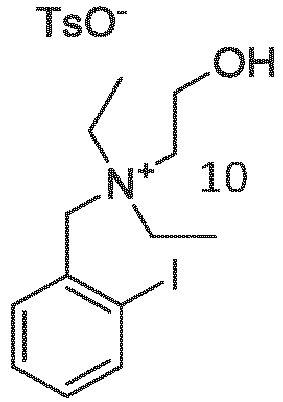
- Mixture of diastereomers (2:1 ratio according to the NMR analysis) in the form of an off-white hygroscopic solid (424 mg, 0.84 mmol, 73 %).

- White amorphous highly hygroscopic solid (502 mg, 0.89 mmol, 77 %).

- White solid (496 mg, 0.96 mmol, 83 %).

- Colorless viscous liquid (500 mg, 1.05 mmol, 90%).
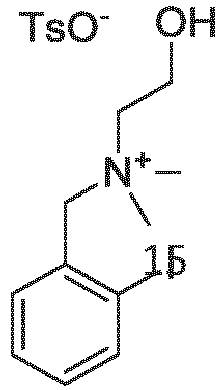
- Pale-yellow viscous liquid which crystallized upon cooling (453 mg, 0.90 mmol, 78 %).

- The alkylating agent I (338 mg, 0.655 mmol, 1 eq.), DMF (0.8 mL), and 2-(dimethylamino)ethanol (350 µL, 3.48 mmol, 5.3 eq.) were used for the synthesis of compound 21. The reaction time was 2 h at the temperature of 75 °C. Precipitation was performed from a dichloromethane solution with hexane (45 mL), the product was then re-dissolved in a mixture of dichloromethane and MeOH (2 mL, 9:1 v/v) and precipitated with a mixture of Et2O and hexane. The product was then once more re-dissolved in pure dichloromethane and precipitated with pure hexane (45 mL). The product was obtained as a white solid (391 mg, 0.65 mmol, 99 %).

- The alkylating agent J (250 mg, 0.504 mmol, 1 eq.), DMF (0.7 mL), and 2-(dimethylamino)ethanol (200 µL, 1.99 mmol, 3.9 eq.) were used for the synthesis of compound 22. The reaction was run 1 h at the temperature of 65 °C, the temperature was then for increased to 75 °C for 45 min. However, as the conversion was still not complete, the temperature was increased to 82 °C for additional 30 min. The product was purified by precipitation from a MeOH solution using a mixture of Et2O and hexane (1:4 v/v). The product was obtained as a white waxy solid (186 mg, 0.318 mmol, 63 %).

- The alkylating agent K (350 mg, 1.07 mmol, 1 eq.), DMF (1 mL), and 2-(dimethylamino)ethanol (646 µL, 6.42 mmol, 6.0 eq.) were used for the synthesis of compound 23. The reaction time was 1 h

- The alkylating agent K (350 mg, 1.07 mmol, 1 eq.), DMF (1 mL), and 2-(pyrrolidin-1-yl)ethanol (376 µL, 3.21 mmol, 3.0 eq.) were used for the synthesis of compound 24. The reaction time was 90 min at the temperature of 77 °C. The product was obtained as a pale-yellow viscous liquid (331 mg, 0.75 mmol, 70 %).

- The alkylating agent L (350 mg, 1.07 mmol, 1 eq.), DMF (1 mL), and 2-(dimethylamino)ethanol

-

- The alkylating agent M (300 mg, 0.918 mmol, 1 eq.), DMF (1 mL), and 2-(dimethylamino)ethanol

- The alkylating agent M (300 mg, 0.918 mmol, 1 eq.), DMF (1 mL), and 2-(pyrrolidin-1-yl)ethanol (322 µL, 2.75 mmol, 3.0 eq.) were used for the synthesis of compound 28. The reaction time was 2 h at the temperature of 70 °C. The product was obtained as a yellow viscous liquid which crystallized upon cooling (380 mg, 0.86 mmol, 80 %).

- The alkylating agent N (350 mg, 0.914 mmol, 1 eq.), DMF (1 mL), and 2-(dimethylamino)ethanol

- The alkylating agent N (350 mg, 0.914 mmol, 1 eq.), DMF (1 mL), and 2-(pyrrolidin-1-yl)ethanol

- The alkylating agent O (355 mg, 1.00 mmol, 1 eq.), DMF (1 mL), and 2-(dimethylamino)ethanol (604 µL, 6.00 mmol, 6.0 eq.) were used for the synthesis of compound 31. The reaction time was 2.5 h at the temperature of 70 °C. The product was obtained as a colorless viscous liquid (418 mg, 0.94 mmol, 94 %).

- The alkylating agent O (355 mg, 1.00 mmol, 1 eq.), DMF (1 mL), and 2-(pyrrolidin-1-yl)ethanol (468 µL, 4.00 mmol, 4.0 eq.) were used for the synthesis of compound 32. The reaction time was 2.5 h

- The alkylating agent P (250 mg, 0.612 mmol, 1 eq.), DMF (1 mL), and 2-(dimethylamino)ethanol (370 µL, 3.67 mmol, 6.0 eq.) were used for the synthesis of compound 33. The reaction time was 2 h at the temperature of 65 °C. The product was obtained as a white solid (273 mg, 0.55 mmol, 90 %). 1H NMR (300 MHz, DMSO-d6) δ 7.48 (d, J = 8.0 Hz, 2H), 7.22 (d, J = 3.6 Hz, 1H), 7.11 (d, J = 8.0

- The alkylating agent P (250 mg, 0.612 mmol, 1 eq.), DMF (1 mL), and 2-(pyrrolidin-1-yl)ethanol (358 µL, 3.06 mmol, 5.0 eq.) were used for the synthesis of compound 34. The reaction time was 2 h at the temperature of 65 °C. The product was obtained as brown solid (120 mg, 0.23 mmol, 37 %).

- The alkylating agent F (300 mg, 1.01 mmol, 1 eq.) and 4-(2-hydroxyethyl)morpholine (4.00 mL, 33,0 mmol, 32.7 eq.) were used for the synthesis of compound 35. The reaction time was 18 h at the

- The alkylating agent G (300 mg, 1.19 mmol, 1 eq.) and 4-(2-hydroxyethyl)morpholine (4.00 mL, 33,0 mmol, 27.7 eq.) were used for the synthesis of compound 36. The reaction time was 18 h at the temperature of 72 °C. The product was obtained as an amorphous brown solid (364 mg, 0.948 mmol, 80 %).

-

-

- The alkylating agent S (200 mg, 0.464 mmol, 1 eq.) and 2-(dimethylamino)ethanol (2.00 mL, 19.9 mmol, 42.9 eq.) were used for the synthesis of compound 39. The reaction time was 40 min at the temperature of 75 °C. The product was obtained as a colorless viscous liquid which crystallized upon

-

-
- Solution A: PdCl2 (1 mg) and acetonitrile (1 mL) were put into 2 mL micro-centrifugation tube, the resulting suspension was agitated in an ultrasonic bath for 15 min. The obtained suspension was then centrifuged and decanted from the non-dissolved solid PdCl2.
- Solution B: Ascorbic acid (30 mg) in deionized water (1 mL)
- Solution C: Compound 4 (1 mg) in deionized water (100 µL)
- The solutions A (4 µL), B (2 µL), and C (1 µL) were put into a 0.5 mL microcentrifuge tube. The tube was gently shaken, the mixture was left for 15 min at the room temperature and was subsequently centrifuged. Then, an aqueous solution of Na125I (8 µL, 74.0 MBq) was added, and the reaction mixture was gently shaken. The tube was sealed by a plastic film, centrifuged, and subsequently it was immersed into a water bath preheated to 75 °C. After 1 h, the tube was removed from the bath, centrifuged, and immersed into the bath again so that the solvent vaporized at the top of the tube was returned back into the remaining solution. After another 1 h, the tube was removed, cooled to room temperature, and the reaction mixture was diluted with deionized water (100 µL). Strong anion exchange resin in the TsO- cycle (5 grains, particle size 650 - 820 µm, 1 meq. mL-1) was inserted to the tube to remove most of the free 125I-. The grains of anion exchange resin were subsequently decanted, the solution was transferred into a clean centrifugation tube, and the grains of the anion exchange resin were rinsed with deionized water (2 × 50 µL), which was then added to the first solution. The resulting solution was filtered through a 0.20 µm syringe filter. The radio-labeled substance 4 (55.8 MBq, 75 %) was obtained in a good radiochemical purity according to the radio-HPLC analysis (
Figure 1 ). - IC50 value corresponds to a concentration of the given analog of choline which reduces the accumulation of choline chloride, the natural ligand of choline transporterss, to 50 % of the maximum value. For the assay, the tritium labeled choline chloride, i.e. [3H]choline chloride, was used. The assay was performed in vitro on the cell line PC-3 derived from a human prostate carcinoma, which is known to overexpress choline transporters. For the determination of IC50, the PC-3 cells were cultivated in 24-well cultivation plates to confluence of 90 %. As the negative control, a cell line of human ovarian carcinoma SKOV3 prepared to the confluence of 90 % in 24-well plates was used.
- The cultivation medium was removed from the thus prepared cells in cultivation plates and the cells were rinsed with phosphate buffered saline (PBS). Subsequently, 0.3 mL of "incubation buffer" (25 mM Tris/HCl, 5.4 mM KCl, 1.8 mM CaCl2, 0.8 mM MgSO4, 5 mM glucose, 140 mM NaCl, pH adjusted to 7.4) was added to the cells. Then 0.1 mL of the solution of the tested substance (analog of choline) in the incubation buffer was added to the PC-3 cells in such concentrations, that after adding [3H]choline chloride the resulting concentrations of the tested analog would be following: 0 M, 10-8 M, 10-7 M, 10-6 M, 5 × 10⁻⁶ M, 10-5 M, 10-4 M, 5 × 10⁻⁴ M, 10-3 M, 5×10⁻³ M. Each concentration was tested in triplicate.
- To the SKOV3 cells, 0.1 mL of the tested compound (analog of choline) solution in the incubation buffer was added in such concentrations, that after the addition of [3H]choline chloride the concentrations of the analog of choline in the medium with cells were 0 M and 10-4 M. Each concentration was tested in triplicate.
- Subsequently, all cells prepared in this manner (PC-3 and SKOV3) were incubated with the analogs of choline for 15 minutes at the temperature of 37 °C.
- Then 0.1 mL of the solution of the [3H]choline chloride in the incubation buffer was added to all cell-containing wells, so that 0.1 mL of the solution had the activity of 15 kBq and that the final concentration of the [3H]choline chloride in the medium with the cells was 0.81 × 10⁻⁶ M. The cells were then incubated at 37 °C for a period of 60 min. After the incubation, all buffer solution was removed from the cells. The cells were rinsed with PBS, which was subsequently removed, and 0.2 mL of aqueous NaOH solution (0.1 M) was added to each well. The cells were incubated with sodium hydroxide for 30 min at 37 °C. The lysate was then homogenized with a pipette and 10 µL of the lysate were used for the determination of protein concentration by bicinchonic acid assay (BCA).
- The remaining lysate (180 µL) was quantitatively transferred into scintillation vials containing a previously prepared scintillation solution (2 mL of the solution in each vial). Each well was then additionally rinsed with 0.2 mL of pure water and this solution was added to the corresponding scintillation vials. Scintillation vials were closed and their content was stirred on a shaker.
- To another three scintillation vials containing scintillation solution (2 mL of the solution in each vial) the standard samples of [3H]choline chloride were added (i.e. 10 µ1 of the [3H]choline chloride solution together with 180 µl of aqueous NaOH solution (0.1 M) and 200 µl of water). The vials were closed and their content was stirred on the shaker.
- Subsequently, radioactivity of each scintillation vial was measured using a liquid scintillation counter (Tri-Carb 2910TR Liquid Scintillation Counter, PerkinElmer). The recorded counts per second (cps) were then used to calculate the accumulation of [3H]choline chloride in the individual cell samples. These results were corrected to the applied amount of radioactivity ([3H]choline chloride standards) and the quantity of proteins in each cell samples. These values were used to construct a sigmoid curve of dependence between the rate of [3H]choline chloride accumulation and the competing ligand (analog of choline) concentration(inhibition curve,
Figure 2 ). The IC50 values were calculated from these inhibition curves. - Using the above-described method, the IC50 values were determined for 40 analogs of choline according to the present invention, and also for hemicholinium-3, fluoromethylcholine, and choline (refer to Table 1). Choline was chosen as it is a natural ligand of choline transporters, hemicholinium-3 was chosen as a classic representative of the inhibitors of choline transporters, and the radioactive fluorine (18F) labeled fluoromethylcholine is routinely used in nuclear medicine to diagnose prostate carcinoma. The IC50 values determined for hemicholinium-3 and choline were in accordance with the published data (7.3 × 10⁻⁶ mol . L-1 for choline and 1.7 × 10⁻⁵ mol . L-1 for hemicholinium-3 [Müller S. A. et al. (2009), Eur. J. Nucl. Med. Mol. Imaging 36, 1434-1442]). Twenty-six derivatives of choline according to the the present invention possessed the same or higher IC50 values than hemicholinium-3, and eighteen derivatives of choline according to the present invention exhibited higherIC50 values than fluoromethylcholine, which is routinely used in nuclear medicine to diagnose prostate carcinoma. In the case of eight derivatives according to the present invention, the IC50 values were even higher than the IC50 value determined for choline (natural ligand).
- For twenty of the tested analogs of choline, stability in the plasma, binding to plasmatic proteins, microsomal stability and the permeability through artificial membrane (PAMPA) (Table 2) were determined. Most of the analogs of choline under study have demonstrated sufficient stability in plasma after two-hour incubation (> 70 to 80 % of the original quantity of the substance). The binding to plasmatic proteins influences mainly the distribution of the drug in the organism. Plasma protein binding has shown relatively higher values (> 20 % bound to plasmatic proteins) for six analogs of choline under study. More than a half of the tested derivatives of choline was quite quickly (internal clearance > 50 µL . min-1 . mg-1) metabolized by hepatic microsomes. All studied compounds under exhibited a low ability to pass across the artificial membrane by passive diffusion. This is a desirable property, which enables a specific distribution of these substances and further supports their planned diagnostic or therapeutic use (choline transporters are localized on the plasmatic membrane of the cells). In general, the substances have shown suitable pharmacological properties for both diagnostic and therapeutic applications.
Table 1. IC50 of the novel derivatives Choline analog IC50 (mol. L-1) Example 1 4.7×10⁻⁵ Example 2 9.2×10⁻⁵ Example 3 2.5×10⁻⁵ Example 4 1.9×10⁻⁵ Example 5 7.4×10⁻⁶ Example 6 8.3×10⁻⁵ Example 7 1.6×10⁻⁵ Example 8 1.2×10⁻⁴ Example 9 9.9×10⁻⁵ Example 10 1.3×10⁻⁵ Example 11 1.5×10⁻⁴ Example 12 8.0×10⁻⁵ Example 13 2.9×10⁻⁵ Example 14 1.9×10⁻⁴ Example 15 8.4×10⁻⁶ Example 16 2.4×10⁻⁴ Example 17 7.4×10⁻⁴ Example 18 1.8×10⁻⁴ Example 19 1.6×10⁻⁴ Example 20 6.3×10⁻⁶ Example 21 4.3×10⁻⁷ Example 22 1.9×10⁻⁶ Example 23 2.5-10-5 Example 24 4.7×10⁻⁶ Example 25 2.3×10⁻⁵ Example 26 1.8×10⁻⁵ Example 27 2.2×10⁻⁵ Example 28 1.5×10⁻⁵ Example 29 4.4×10⁻⁸ Example 30 9.1×10⁻⁷ Example 31 1.1×10⁻⁵ Example 32 5.1×10⁻⁶ Example 33 4.5×10⁻⁷ Example 34 1.0×10⁻⁵ Example 35 2.7×10⁻⁴ Example 36 4.3×10⁻⁵ Example 37 1.4×10⁻⁶ Example 38 1.8×10⁻⁵ Example 39 1.3×10⁻⁶ Example 40 1.4×10⁻⁷ Hemicholinium-3 2.9×10⁻⁵ Fluoromethylcholine 1.6×10⁻⁵ Choline 3.7×10⁻⁶ Table 2. In vitro pharmacokinetic properties of derivatives 1-8 and 14-20 Choline analog of Example Plasma stability (120 min) Plasmatic protein binding Microsomal stability "Parallel Artificial Membrane Permeability Assay" (PAMPA) [%] [%] t1l2 [min] Internal clearance [µL . min-1 . mg-1] log Pe 1 28.4 19.5 165.0 8.4 -9.88 2 59.0 25.2 97.6 14.2 -9.98 3 76.4 48.8 1.3 1035.8 -10.20 4 63.9 28.5 1.2 1123.6 -10.50 5 43.0 34.7 15.6 88.6 -10.26 6 81.3 26.5 1.1 1232.0 -8.48 7 97.6 16.7 15.3 90.6 -8.49 8 89.9 28.3 34.8 39.8 -9.04 14 80.7 16.9 61.3 22.6 -9.49 15 84.9 18.6 18.8 73.6 -7.74 16 79.0 4.4 119.5 11.6 -8.30 17 58.4 5.7 1732.5 0.8 -7.75 18 73.4 9.7 22.0 63.0 -7.55 19 91.3 33.9 8.3 166.4 -10.12 20 81.3 7.88 4.5 310 -8.44 - The invention can be used in medicine for localization and treatment of several types of tumorous diseases and other disorders characterized by pathological function or expression of choline transporters.
Claims (13)
- Iodinated aromatic choline analogs of general formula I
 - the ring containing Z atoms is selected from benzene ring and thiophene ring;- R are independently selected from the group consisting of H; 123I; 124I; 125I; 127I; 131I; C1 to C14 alkyl; C2 to C14 alkenyl; C2 to C14 alkynyl; C6 to C10 aryl; C3 to C6 heteroaryl comprising at least one heteroatom selected from O, S, N; C3 to C6 heterocyclyl comprising one to two heteroatoms selected from O, S, N; C1 to C14 alkoxy; C6 to C10 aryloxy; C3 to C6 heteroaryloxy comprising at least one heteroatom selected from O, S, N; C3 to C6 heterocyclyloxy comprising one to two heteroatoms selected from O, S, N; benzyloxy; C1 to C14 alkylthio; halogen; OH; SH; NH2; C1 to C14 alkylamino; C6 to C10 arylamino; C1 to C14 acylamino; di(C1 to C14 alkyl)amino, wherein the alkyls are the same or different; di(C6 to C10 aryl)amino, wherein the aryls are the same or different; di(C1 to C14 acyl)amino, wherein the acyls are the same or different; CN; nitro and COORn, wherein Rn is H or C1 to C14 alkyl or aryl;- whereas at least one of the substituents R is 123I; 124I; 125I or 131I,- R6 is 2-hydroxyethyl, 3-hydroxypropyl, or 4-hydroxybutyl;- R7and R8 are independently selected from the group consisting of C1 to C6 alkyl; C2 to C6 alkenyl; C2 to C6 alkynyl; C3 to C8 cycloalkyl; C3 to C8 cycloalkenyl; C6 to C10 aryl; C3 to C6 heteroaryl comprising at least one heteroatom selected from O, S, N; C3 to C6 heterocyclyl comprising one or two heteroatoms selected from O, S, N; whereas R7 and R8 can optionally be substituted by OH group or C1-C4 hydroxy alkyl group; or- R7and R8 together with the nitrogen atom form a four- to seven-membered ring, optionally comprising at least one further heteroatom selected from O, S, N, a optionally substituted by OH group or C1-C4 hydroxy alkyl group;- whereas at least one, preferably exactly one, of substituents R6, R7 and R8 is substituted by OH group or by C1-C4 hydroxy alkyl group;- Y is a linker formed by a linear or branched hydrocarbon chain having 1 to 10 carbon atoms, whereas optionally 1 to 2 carbon atoms can be replaced by oxygen and/or sulfur atoms; and- X- is a pharmaceutically acceptable anion;with the proviso that:- when exactly one of the substituents R is 123I; 124I; 125I or 131I, and is in the ortho position, and all other substituents R are hydrogen atoms, Y is ―CH2-, R6 is 2-hydroxyethyl, then NR7R8 is not dimethylamino or pyrrolidino group,- when exactly one of the substituents R is 123I; 124I; 125I or 131I and is in the ortho position, and all other substituents R are hydrogen atoms, Y is ―CH2-, R6 is 2-hydroxyethyl, R7 is ethyl or 2-hydroxyethyl, then R8 is not methyl.
 - Compounds according to claim 1, wherein Y is a linear or branched hydrocarbon chain having 1 to 10 carbon atoms, whereas 1 carbon atom is replaced by oxygen; or wherein Y is linear hydrocarbon chain containing 1 to 3 carbon atoms.
- Compounds according to any one of the preceding claims, wherein substituents R are independently selected from the group consisting of H; 123I; 124I; 125I; 127I; 131I; C6 to C10 aryl; C1 to C14 alkoxy; benzyloxy; NO2.
- Iodinated aromatic choline analogs of general formula Ia
 - the ring containing Z atoms is selected from benzene ring and thiophene ring;- R are independently selected from the group consisting of H; 127I; C1 to C14 alkyl; C2 to C14 alkenyl; C2 to C14 alkynyl; C6 to C10 aryl; C3 to C6 heteroaryl comprising at least one heteroatom selected from O, S, N; C3 to C6 heterocyclyl comprising one to two heteroatoms selected from O, S, N; C1 to C14 alkoxy; C6 to C10 aryloxy; C3 to C6 heteroaryloxy comprising at least one heteroatom selected from O, S, N; C3 to C6 heterocyclyloxy comprising one to two heteroatoms selected from O, S, N; benzyloxy; C1 to C14 alkylthio; halogen; OH; SH; NH2; C1 to C14 alkylamino; C6 to C10 arylamino; C1 to C14 acylamino; di(C1 to C14 alkyl)amino, wherein the alkyls are the same or different; di(C6 to C10 aryl)amino, wherein the aryls are the same or different; di(C1 to C14 acyl)amino, wherein the acyls are the same or different; CN; nitro and COORn, wherein Rn is H or C1 to C14 alkyl or aryl;- whereas at least one of the substituents R is 127I;- R6 is 2-hydroxyethyl, 3-hydroxypropyl, or 4-hydroxybutyl;- R7and R8 are independently selected from the group consisting of C1 to C6 alkyl; C2 to C6 alkenyl; C2 to C6 alkynyl; C3 to C8 cycloalkyl; C3 to C8 cycloalkenyl; C6 to C10 aryl; C3 to C6 heteroaryl comprising at least one heteroatom selected from O, S, N; C3 to C6 heterocyclyl comprising one or two heteroatoms selected from O, S, N; whereas R7 and R8 can optionally be substituted by OH group or C1-C4 hydroxy alkyl group; or- R7and R8 together with the nitrogen atom form a four- to seven-membered ring, optionally comprising at least one further heteroatom selected from O, S, N, a optionally substituted by OH group or C1-C4 hydroxy alkyl group; or- whereas at least one, preferably exactly one, of substituents R6, R7 and R8 is substituted by OH group or by C1-C4 hydroxy alkyl group;- Y is a linker formed by a linear or branched hydrocarbon chain having 1 to 10 carbon atoms, whereas optionally 1 carbon atom can be replaced by oxygen or sulfur atom; and- X- is a pharmaceutically acceptable anion;with the proviso that:- when exactly one of the substituents R is 127I, and is in the ortho position, and all other substituents R are hydrogen atoms, Y is ―CH2-, R6 is 2-hydroxyethyl, then NR7R8 is not dimethylamino or pyrrolidino group,- when exactly one of the substituents R is 127I and is in the ortho position, and all other substituents R are hydrogen atoms, Y is ―CH2-, R6 is 2-hydroxyethyl, R7 is ethyl or 2-hydroxyethyl, then R8 is not methyl.
 - Compounds according to claim 4, wherein Y is a linear or branched hydrocarbon chain having 1 to 10 carbon atoms, whereas 1 carbon atom is replaced by oxygen.
- Compounds according to claim 4, wherein Y is linear hydrocarbon chain containing 1 to 3 carbon atoms.
- Compounds according to any one of the claims 4 to 7, wherein substituents R are independently selected from the group consisting of H; 127I; C6 to C10 aryl; C1 to C14 alkoxy; benzyloxy; NO2.
- Compounds according to claim 4, selected from the group comprising: (2-hydroxyethyl)-[2-(3-iodo-4-methoxyphenyl)ethyl]-dimethylammonium 4-methylbenzenesulfonate, (2-hydroxyethyl)-[2-(3.5-diiodo-4-methoxyphenyl)ethyl]-dimethylammonium 4-methylbenzenesulfonate, (2-hydroxyethyl)-[3-(3-iodo-4-methoxyphenyl)propyl]-dimethylammonium 4-methylbenzenesulfonate, (2-hydroxyethyl)-[2-(4-iodophenyl)ethyl]-dimethylammonium 4-methylbenzenesulfonate, 1-(2-hydroxyethyl)-1-[2-(4-iodophenyl)ethyl]pyrrolidin-1-ium 4-methylbenzenesulfonate, (2-hydroxyethyl)-(3-iodobenzyl)-dimethylammonium methanesulfonate, 1-(2-hydroxyethyl)-1-(3-iodobenzyl)pyrrolidin-1-ium methanesulfonate, (2-hydroxyethyl)-(4-iodobenzyl)-dimethylammonium bromide, diethyl-(2-hydroxyethyl)-(4-iodobenzyl)ammonium bromide, 1-(2-hydroxyethyl)-1-(4-iodobenzyl)pyrrolidin-1-ium bromide, 1-(2-hydroxyethyl)-1-(2-iodobenzyl)piperidin-1-ium 4-methylbenzenesulfonate, diethyl-(2-hydroxyethyl)-(2-iodobenzyl)ammonium 4-methylbenzenesulfonate, 1,4-bis(2-hydroxyethyl)-1-(2-iodobenzyl)piperazin-1-ium 4-methylbenzenesulfonate, [3-(4-hexyloxy-3-iodophenyl)propyl]-(2-hydroxyethyl)-dimethylammonium 4-methylbenzensulfonate, [3-(4-decyloxy-3-iodophenyl)propyl]-(2-hydroxyethyl)-dimethylammonium methanesulfonate, (2-hydroxyethyl)-[2-(2-iodophenoxy)ethyl]-dimethylammonium bromide, 1-(2-hydroxyethyl)-1-[2-(2-iodophenoxy)ethyl]pyrrolidin-1-ium bromide, (2-hydroxyethyl)-[2-(4-iodophenoxy)ethyl]-dimethylammonium bromide, 1-(2-hydroxyethyl)-1-[2-(4-iodophenoxy)ethyl]pyrrolidin-1-ium bromide, (2-hydroxyethyl)-[2-(3-iodophenoxy)ethyl]-dimethylammonium bromide, 1-(2-hydroxyethyl)-1-[2-(3-iodophenoxy)ethyl]pyrrolidin-1-ium bromide, (2-hydroxyethyl)-[6-(3-iodophenoxy)hexyl]-dimethylammonium bromide, 1-(2-hydroxyethyl)-1-[6-(3-iodophenoxy)hexyl]pyrrolidin-1-ium bromide, (2-hydroxyethyl)-[4-(2-iodophenoxy)butyl]-dimethylammonium bromide, 1-(2-hydroxyethyl)-1-[4-(2-iodophenoxy)butyl]pyrrolidin-1-ium bromide, (2-hydroxyethyl)-[2-(5-iodothiophen-2-yl)ethyl]-dimethylammonium 4-methylbenzenesulfonate, 1-(2-hydroxyethyl)-1-[2-(5-iodothiophen-2-yl)ethyl]pyrrolidin-1-ium 4-methylbenzenesulfonate, 4-(2-hydroxyethyl)-4-(4-iodobenzyl)morpholin-4-ium bromide, 4-(2-hydroxyethyl)-4-(2-iodobenzyl)morpholin-4-ium bromide, (2-hydroxyethyl)-[6-(4-iodo-3-nitrophenoxy)hexyl]-dimethylammonium bromide.
- A pharmaceutical preparation comprising at least one compound of general formula I according to any one of claims 1 to 3, optionally in the form of pharmaceutically acceptable salt or solvate, and at least one pharmaceutically acceptable carrier, filler and/or diluent.
- Compounds according to any one of claims 1 to 3 for use as medicaments and/or diagnostic agents.
- Iodinated aromatic choline analogs of general formula I according to claim 1 for use in a method for radiotherapy and/or radiodiagnostics of disorders involving pathological function or expression of choline transporters selected from the group consisting of oncologic diseases, such as prostate carcinoma, lung carcinoma, glioma; inflammatory disorders; atherosclerosis.
- Use of the compounds of general formula I according to claim 1 for in vitro radiodiagnostics.
- Iodinated aromatic choline analogs of general formula Ia according to claim 4, selected from the group consisting of: [3-(4-hexyloxy-3-iodophenyl)propyl]-(2-hydroxyethyl)-dimethylammonium 4-methylbenzensulfonate, [3-(4-decyloxy-3-iodophenyl)propyl]-(2-hydroxyethyl)-dimethylammonium methanesulfonate, (2-hydroxyethyl)-[6-(3-iodophenoxy)hexyl]-dimethylammonium bromide, 1-(2-hydroxyethyl)-1-[6-(3-iodophenoxy)hexyl]pyrrolidin-1-ium bromide, (2-hydroxyethyl)-[2-(5-iodothiophen-2-yl)ethyl]-dimethylammonium 4-methylbenzenesulfonate, (2-hydroxyethyl)-{4-[(3-iodo-[1,1'-biphenyl]-4-yl)oxy]butyl}-dimethylammonium bromide, (2-hydroxyethyl)-[6-(4-iodo-3-nitrophenoxy)hexyl]-dimethylammonium bromide, for use as medicaments.
Priority Applications (1)
| Application Number | Priority Date | Filing Date | Title |
|---|---|---|---|
| PL17713146T PL3423441T3 (en) | 2016-02-29 | 2017-02-28 | Iodinated analogs of choline, methods of preparation thereof, and use thereof as medicaments |
Applications Claiming Priority (2)
| Application Number | Priority Date | Filing Date | Title |
|---|---|---|---|
| CZ2016-117A CZ2016117A3 (en) | 2016-02-29 | 2016-02-29 | An iodinated radiolabelled choline analogue, their preparation and use as a pharmaceutical |
| PCT/CZ2017/050010 WO2017148455A1 (en) | 2016-02-29 | 2017-02-28 | Iodinated analogs of choline, methods of preparation thereof, and use thereof as medicaments |
Publications (2)
| Publication Number | Publication Date |
|---|---|
| EP3423441A1 EP3423441A1 (en) | 2019-01-09 |
| EP3423441B1 true EP3423441B1 (en) | 2021-10-27 |
Family
ID=58410054
Family Applications (1)
| Application Number | Title | Priority Date | Filing Date |
|---|---|---|---|
| EP17713146.3A Active EP3423441B1 (en) | 2016-02-29 | 2017-02-28 | Iodinated analogs of choline, methods of preparation thereof, and use thereof as medicaments |
Country Status (6)
| Country | Link |
|---|---|
| EP (1) | EP3423441B1 (en) |
| CZ (1) | CZ2016117A3 (en) |
| DK (1) | DK3423441T3 (en) |
| ES (1) | ES2905785T3 (en) |
| PL (1) | PL3423441T3 (en) |
| WO (1) | WO2017148455A1 (en) |
Family Cites Families (3)
| Publication number | Priority date | Publication date | Assignee | Title |
|---|---|---|---|---|
| GB881265A (en) * | 1958-06-13 | 1961-11-01 | Wellcome Found | Quaternary ammonium compounds and their preparation |
| FR2857360B1 (en) * | 2003-07-09 | 2009-07-17 | Centre Nat Rech Scient | USE OF FUNCTIONALIZED ONIUM SALTS AS A SOLUBLE CARRIER FOR ORGANIC SYNTHESIS |
| AU2011305661A1 (en) * | 2010-09-21 | 2013-03-28 | Ge Healthcare Limited | Novel precursors of radiolabelled choline analog compounds |
-
2016
- 2016-02-29 CZ CZ2016-117A patent/CZ2016117A3/en unknown
-
2017
- 2017-02-28 ES ES17713146T patent/ES2905785T3/en active Active
- 2017-02-28 DK DK17713146.3T patent/DK3423441T3/en active
- 2017-02-28 PL PL17713146T patent/PL3423441T3/en unknown
- 2017-02-28 WO PCT/CZ2017/050010 patent/WO2017148455A1/en not_active Ceased
- 2017-02-28 EP EP17713146.3A patent/EP3423441B1/en active Active
Non-Patent Citations (1)
| Title |
|---|
| None * |
Also Published As
| Publication number | Publication date |
|---|---|
| EP3423441A1 (en) | 2019-01-09 |
| PL3423441T3 (en) | 2022-02-21 |
| CZ2016117A3 (en) | 2017-09-13 |
| ES2905785T3 (en) | 2022-04-12 |
| DK3423441T3 (en) | 2022-02-07 |
| WO2017148455A1 (en) | 2017-09-08 |
Similar Documents
| Publication | Publication Date | Title |
|---|---|---|
| JP6524046B2 (en) | PSMA binders and their use | |
| US7408079B2 (en) | Imaging agents and methods of imaging NAALADase or PSMA | |
| US20080124273A1 (en) | Novel cationic metal complex radiopharmaceuticals | |
| WO2023170164A1 (en) | Method for providing a labeled single isomeric chemical entity targeting vector based on the use of a symmetrical diene | |
| Modemann et al. | 2-[18F] Fluorophenylalanine: Synthesis by nucleophilic 18F-fluorination and preliminary biological evaluation | |
| EA019093B1 (en) | NEW BENZOFURANES, SUITABLE AS PRECIOUS OF COMPOUNDS, WHICH ARE USEFUL FOR VISUALIZATION OF AMYLOID SEDIMENTS | |
| Kim et al. | A 18F-labeled glucose analog: Synthesis using a click labeling method and in vitro evaluation | |
| Li et al. | Synthesis and biological evaluation of novel 99mTc labeled ornidazole xanthate complexes as potential hypoxia imaging agents | |
| Ghandi et al. | Synthesis, characterization and in vivo evaluation of [62Zn]–benzo-δ-sultam complex as a possible pet imaging agent | |
| Kumata et al. | Radiosynthesis of [13N] dantrolene, a positron emission tomography probe for breast cancer resistant protein, using no-carrier-added [13N] ammonia | |
| ES2905785T3 (en) | Iodinated choline analogs, methods of preparing them and their use as medicaments | |
| Kimura et al. | Synthesis and biological evaluation of Tc-99m-cyclopentadienyltricarbonyl-technetium-labeled A-85380: An imaging probe for single-photon emission computed tomography investigation of nicotinic acetylcholine receptors in the brain | |
| Hammerschmidt et al. | Improved Synthesis of No-Carrier-Added [* I] MIBG and Its Precursor | |
| Nandy et al. | Simple, column purification technique for the fully automated radiosynthesis of [18F] fluoroazomycinarabinoside ([18F] FAZA) | |
| US20230158178A1 (en) | Radionuclide Tracers of 1-Amino-3,4-Difluorocyclopentane-1-Carboxylic Acid, Derivatives, and Uses Thereof | |
| CN104168924A (en) | Synthon composition | |
| Lakshminarayanan et al. | Improved method for preparing Ni (II) complex of (S)-tyrosine Schiff base and its use in the automated synthesis of O-(2′-[18F] fluoroethyl)-L-tyrosine using solid-phase extraction purification | |
| US10633396B2 (en) | [18F] fluoride cryptate complexes for radiolabeling fluorinations | |
| Elsner | Novel covalent FAP inhibitors: preparation and validation of target binding by 18F release | |
| Mandaric | Development of an 18F radiolabeling method using solid phase chemistry | |
| Donovan | The Flourous Labelling Strategy: A New Paradigm in Preparing Radiolabelled Compounds in High Effective Specific Activity | |
| Assaad et al. | Synthesis and biodistribution of both (±)-5-[18F]-fluoroethoxy and (±)-5-[18F]-fluoropropoxy piperazine analogs of benzovesamicol as vesicular acetylcholine transporter ligands (VAChT) | |
| WO2009141137A2 (en) | New molecule [124i][2-(3'-iodo-4'-methylaminophenyl)-6-hydroxy-benzothialzole] for pet investigations and radiotherapy | |
| Malik | Radiofluorinations in Homo-and Heteroaromatic Systems with Application in Two New Types of Metabolic PET-Tracers | |
| Schönbächler | Evaluation of three cocaine analogues as PET tracers for the dopamine transport and synthetic approaches to F-18-DFMO |
Legal Events
| Date | Code | Title | Description |
|---|---|---|---|
| STAA | Information on the status of an ep patent application or granted ep patent |
Free format text: STATUS: UNKNOWN |
|
| STAA | Information on the status of an ep patent application or granted ep patent |
Free format text: STATUS: THE INTERNATIONAL PUBLICATION HAS BEEN MADE |
|
| PUAI | Public reference made under article 153(3) epc to a published international application that has entered the european phase |
Free format text: ORIGINAL CODE: 0009012 |
|
| STAA | Information on the status of an ep patent application or granted ep patent |
Free format text: STATUS: REQUEST FOR EXAMINATION WAS MADE |
|
| 17P | Request for examination filed |
Effective date: 20180928 |
|
| AK | Designated contracting states |
Kind code of ref document: A1 Designated state(s): AL AT BE BG CH CY CZ DE DK EE ES FI FR GB GR HR HU IE IS IT LI LT LU LV MC MK MT NL NO PL PT RO RS SE SI SK SM TR |
|
| AX | Request for extension of the european patent |
Extension state: BA ME |
|
| DAV | Request for validation of the european patent (deleted) | ||
| DAX | Request for extension of the european patent (deleted) | ||
| STAA | Information on the status of an ep patent application or granted ep patent |
Free format text: STATUS: EXAMINATION IS IN PROGRESS |
|
| 17Q | First examination report despatched |
Effective date: 20201125 |
|
| GRAP | Despatch of communication of intention to grant a patent |
Free format text: ORIGINAL CODE: EPIDOSNIGR1 |
|
| STAA | Information on the status of an ep patent application or granted ep patent |
Free format text: STATUS: GRANT OF PATENT IS INTENDED |
|
| INTG | Intention to grant announced |
Effective date: 20210628 |
|
| GRAS | Grant fee paid |
Free format text: ORIGINAL CODE: EPIDOSNIGR3 |
|
| GRAA | (expected) grant |
Free format text: ORIGINAL CODE: 0009210 |
|
| STAA | Information on the status of an ep patent application or granted ep patent |
Free format text: STATUS: THE PATENT HAS BEEN GRANTED |
|
| RAP3 | Party data changed (applicant data changed or rights of an application transferred) |
Owner name: UNIVERZITA PALACKEHO V OLOMOUCI |
|
| AK | Designated contracting states |
Kind code of ref document: B1 Designated state(s): AL AT BE BG CH CY CZ DE DK EE ES FI FR GB GR HR HU IE IS IT LI LT LU LV MC MK MT NL NO PL PT RO RS SE SI SK SM TR |
|
| REG | Reference to a national code |
Ref country code: GB Ref legal event code: FG4D |
|
| REG | Reference to a national code |
Ref country code: CH Ref legal event code: EP |
|
| REG | Reference to a national code |
Ref country code: AT Ref legal event code: REF Ref document number: 1441701 Country of ref document: AT Kind code of ref document: T Effective date: 20211115 |
|
| REG | Reference to a national code |
Ref country code: DE Ref legal event code: R096 Ref document number: 602017048224 Country of ref document: DE |
|
| REG | Reference to a national code |
Ref country code: IE Ref legal event code: FG4D |
|
| REG | Reference to a national code |
Ref country code: DK Ref legal event code: T3 Effective date: 20220202 |
|
| REG | Reference to a national code |
Ref country code: SE Ref legal event code: TRGR |
|
| REG | Reference to a national code |
Ref country code: LT Ref legal event code: MG9D |
|
| REG | Reference to a national code |
Ref country code: NL Ref legal event code: MP Effective date: 20211027 |
|
| REG | Reference to a national code |
Ref country code: NO Ref legal event code: T2 Effective date: 20211027 |
|
| REG | Reference to a national code |
Ref country code: ES Ref legal event code: FG2A Ref document number: 2905785 Country of ref document: ES Kind code of ref document: T3 Effective date: 20220412 |
|
| PG25 | Lapsed in a contracting state [announced via postgrant information from national office to epo] |
Ref country code: RS Free format text: LAPSE BECAUSE OF FAILURE TO SUBMIT A TRANSLATION OF THE DESCRIPTION OR TO PAY THE FEE WITHIN THE PRESCRIBED TIME-LIMIT Effective date: 20211027 Ref country code: LT Free format text: LAPSE BECAUSE OF FAILURE TO SUBMIT A TRANSLATION OF THE DESCRIPTION OR TO PAY THE FEE WITHIN THE PRESCRIBED TIME-LIMIT Effective date: 20211027 Ref country code: FI Free format text: LAPSE BECAUSE OF FAILURE TO SUBMIT A TRANSLATION OF THE DESCRIPTION OR TO PAY THE FEE WITHIN THE PRESCRIBED TIME-LIMIT Effective date: 20211027 Ref country code: BG Free format text: LAPSE BECAUSE OF FAILURE TO SUBMIT A TRANSLATION OF THE DESCRIPTION OR TO PAY THE FEE WITHIN THE PRESCRIBED TIME-LIMIT Effective date: 20220127 |
|
| PG25 | Lapsed in a contracting state [announced via postgrant information from national office to epo] |
Ref country code: IS Free format text: LAPSE BECAUSE OF FAILURE TO SUBMIT A TRANSLATION OF THE DESCRIPTION OR TO PAY THE FEE WITHIN THE PRESCRIBED TIME-LIMIT Effective date: 20220227 Ref country code: PT Free format text: LAPSE BECAUSE OF FAILURE TO SUBMIT A TRANSLATION OF THE DESCRIPTION OR TO PAY THE FEE WITHIN THE PRESCRIBED TIME-LIMIT Effective date: 20220228 Ref country code: NL Free format text: LAPSE BECAUSE OF FAILURE TO SUBMIT A TRANSLATION OF THE DESCRIPTION OR TO PAY THE FEE WITHIN THE PRESCRIBED TIME-LIMIT Effective date: 20211027 Ref country code: LV Free format text: LAPSE BECAUSE OF FAILURE TO SUBMIT A TRANSLATION OF THE DESCRIPTION OR TO PAY THE FEE WITHIN THE PRESCRIBED TIME-LIMIT Effective date: 20211027 Ref country code: HR Free format text: LAPSE BECAUSE OF FAILURE TO SUBMIT A TRANSLATION OF THE DESCRIPTION OR TO PAY THE FEE WITHIN THE PRESCRIBED TIME-LIMIT Effective date: 20211027 Ref country code: GR Free format text: LAPSE BECAUSE OF FAILURE TO SUBMIT A TRANSLATION OF THE DESCRIPTION OR TO PAY THE FEE WITHIN THE PRESCRIBED TIME-LIMIT Effective date: 20220128 |
|
| REG | Reference to a national code |
Ref country code: DE Ref legal event code: R097 Ref document number: 602017048224 Country of ref document: DE |
|
| PG25 | Lapsed in a contracting state [announced via postgrant information from national office to epo] |
Ref country code: SM Free format text: LAPSE BECAUSE OF FAILURE TO SUBMIT A TRANSLATION OF THE DESCRIPTION OR TO PAY THE FEE WITHIN THE PRESCRIBED TIME-LIMIT Effective date: 20211027 Ref country code: SK Free format text: LAPSE BECAUSE OF FAILURE TO SUBMIT A TRANSLATION OF THE DESCRIPTION OR TO PAY THE FEE WITHIN THE PRESCRIBED TIME-LIMIT Effective date: 20211027 Ref country code: RO Free format text: LAPSE BECAUSE OF FAILURE TO SUBMIT A TRANSLATION OF THE DESCRIPTION OR TO PAY THE FEE WITHIN THE PRESCRIBED TIME-LIMIT Effective date: 20211027 Ref country code: EE Free format text: LAPSE BECAUSE OF FAILURE TO SUBMIT A TRANSLATION OF THE DESCRIPTION OR TO PAY THE FEE WITHIN THE PRESCRIBED TIME-LIMIT Effective date: 20211027 |
|
| PLBE | No opposition filed within time limit |
Free format text: ORIGINAL CODE: 0009261 |
|
| STAA | Information on the status of an ep patent application or granted ep patent |
Free format text: STATUS: NO OPPOSITION FILED WITHIN TIME LIMIT |
|
| PG25 | Lapsed in a contracting state [announced via postgrant information from national office to epo] |
Ref country code: MC Free format text: LAPSE BECAUSE OF FAILURE TO SUBMIT A TRANSLATION OF THE DESCRIPTION OR TO PAY THE FEE WITHIN THE PRESCRIBED TIME-LIMIT Effective date: 20211027 |
|
| 26N | No opposition filed |
Effective date: 20220728 |
|
| REG | Reference to a national code |
Ref country code: BE Ref legal event code: MM Effective date: 20220228 |
|
| PG25 | Lapsed in a contracting state [announced via postgrant information from national office to epo] |
Ref country code: LU Free format text: LAPSE BECAUSE OF NON-PAYMENT OF DUE FEES Effective date: 20220228 Ref country code: AL Free format text: LAPSE BECAUSE OF FAILURE TO SUBMIT A TRANSLATION OF THE DESCRIPTION OR TO PAY THE FEE WITHIN THE PRESCRIBED TIME-LIMIT Effective date: 20211027 |
|
| PG25 | Lapsed in a contracting state [announced via postgrant information from national office to epo] |
Ref country code: SI Free format text: LAPSE BECAUSE OF FAILURE TO SUBMIT A TRANSLATION OF THE DESCRIPTION OR TO PAY THE FEE WITHIN THE PRESCRIBED TIME-LIMIT Effective date: 20211027 |
|
| PG25 | Lapsed in a contracting state [announced via postgrant information from national office to epo] |
Ref country code: IE Free format text: LAPSE BECAUSE OF NON-PAYMENT OF DUE FEES Effective date: 20220228 |
|
| PG25 | Lapsed in a contracting state [announced via postgrant information from national office to epo] |
Ref country code: BE Free format text: LAPSE BECAUSE OF NON-PAYMENT OF DUE FEES Effective date: 20220228 |
|
| REG | Reference to a national code |
Ref country code: AT Ref legal event code: UEP Ref document number: 1441701 Country of ref document: AT Kind code of ref document: T Effective date: 20211027 |
|
| PG25 | Lapsed in a contracting state [announced via postgrant information from national office to epo] |
Ref country code: HU Free format text: LAPSE BECAUSE OF FAILURE TO SUBMIT A TRANSLATION OF THE DESCRIPTION OR TO PAY THE FEE WITHIN THE PRESCRIBED TIME-LIMIT; INVALID AB INITIO Effective date: 20170228 |
|
| PGFP | Annual fee paid to national office [announced via postgrant information from national office to epo] |
Ref country code: AT Payment date: 20240219 Year of fee payment: 8 |
|
| PG25 | Lapsed in a contracting state [announced via postgrant information from national office to epo] |
Ref country code: MK Free format text: LAPSE BECAUSE OF FAILURE TO SUBMIT A TRANSLATION OF THE DESCRIPTION OR TO PAY THE FEE WITHIN THE PRESCRIBED TIME-LIMIT Effective date: 20211027 Ref country code: CY Free format text: LAPSE BECAUSE OF FAILURE TO SUBMIT A TRANSLATION OF THE DESCRIPTION OR TO PAY THE FEE WITHIN THE PRESCRIBED TIME-LIMIT Effective date: 20211027 |
|
| PGFP | Annual fee paid to national office [announced via postgrant information from national office to epo] |
Ref country code: DE Payment date: 20240219 Year of fee payment: 8 Ref country code: CZ Payment date: 20240202 Year of fee payment: 8 Ref country code: GB Payment date: 20240216 Year of fee payment: 8 Ref country code: CH Payment date: 20240301 Year of fee payment: 8 |
|
| PGFP | Annual fee paid to national office [announced via postgrant information from national office to epo] |
Ref country code: SE Payment date: 20240219 Year of fee payment: 8 Ref country code: PL Payment date: 20240205 Year of fee payment: 8 Ref country code: NO Payment date: 20240221 Year of fee payment: 8 Ref country code: IT Payment date: 20240219 Year of fee payment: 8 Ref country code: FR Payment date: 20240215 Year of fee payment: 8 Ref country code: DK Payment date: 20240219 Year of fee payment: 8 |
|
| PG25 | Lapsed in a contracting state [announced via postgrant information from national office to epo] |
Ref country code: TR Free format text: LAPSE BECAUSE OF FAILURE TO SUBMIT A TRANSLATION OF THE DESCRIPTION OR TO PAY THE FEE WITHIN THE PRESCRIBED TIME-LIMIT Effective date: 20211027 |
|
| PGFP | Annual fee paid to national office [announced via postgrant information from national office to epo] |
Ref country code: ES Payment date: 20240328 Year of fee payment: 8 |
|
| PG25 | Lapsed in a contracting state [announced via postgrant information from national office to epo] |
Ref country code: MT Free format text: LAPSE BECAUSE OF FAILURE TO SUBMIT A TRANSLATION OF THE DESCRIPTION OR TO PAY THE FEE WITHIN THE PRESCRIBED TIME-LIMIT Effective date: 20211027 |
|
| REG | Reference to a national code |
Ref country code: DE Ref legal event code: R119 Ref document number: 602017048224 Country of ref document: DE |
|
| REG | Reference to a national code |
Ref country code: DK Ref legal event code: EBP Effective date: 20250228 |
|
| REG | Reference to a national code |
Ref country code: CH Ref legal event code: PL |
|
| PG25 | Lapsed in a contracting state [announced via postgrant information from national office to epo] |
Ref country code: NO Free format text: LAPSE BECAUSE OF NON-PAYMENT OF DUE FEES Effective date: 20250228 |
|
| REG | Reference to a national code |
Ref country code: AT Ref legal event code: MM01 Ref document number: 1441701 Country of ref document: AT Kind code of ref document: T Effective date: 20250228 |
|
| PG25 | Lapsed in a contracting state [announced via postgrant information from national office to epo] |
Ref country code: AT Free format text: LAPSE BECAUSE OF NON-PAYMENT OF DUE FEES Effective date: 20250228 |
|
| PG25 | Lapsed in a contracting state [announced via postgrant information from national office to epo] |
Ref country code: CH Free format text: LAPSE BECAUSE OF NON-PAYMENT OF DUE FEES Effective date: 20250228 |
|
| PG25 | Lapsed in a contracting state [announced via postgrant information from national office to epo] |
Ref country code: CZ Free format text: LAPSE BECAUSE OF NON-PAYMENT OF DUE FEES Effective date: 20250228 |
|
| REG | Reference to a national code |
Ref country code: SE Ref legal event code: EUG |
|
| GBPC | Gb: european patent ceased through non-payment of renewal fee |
Effective date: 20250228 |
|
| PG25 | Lapsed in a contracting state [announced via postgrant information from national office to epo] |
Ref country code: DE Free format text: LAPSE BECAUSE OF NON-PAYMENT OF DUE FEES Effective date: 20250902 |
|
| PG25 | Lapsed in a contracting state [announced via postgrant information from national office to epo] |
Ref country code: GB Free format text: LAPSE BECAUSE OF NON-PAYMENT OF DUE FEES Effective date: 20250228 |
|
| PG25 | Lapsed in a contracting state [announced via postgrant information from national office to epo] |
Ref country code: DK Free format text: LAPSE BECAUSE OF NON-PAYMENT OF DUE FEES Effective date: 20250228 |
|
| PG25 | Lapsed in a contracting state [announced via postgrant information from national office to epo] |
Ref country code: IT Free format text: LAPSE BECAUSE OF NON-PAYMENT OF DUE FEES Effective date: 20250228 Ref country code: FR Free format text: LAPSE BECAUSE OF NON-PAYMENT OF DUE FEES Effective date: 20250228 |
|
| PG25 | Lapsed in a contracting state [announced via postgrant information from national office to epo] |
Ref country code: SE Free format text: LAPSE BECAUSE OF NON-PAYMENT OF DUE FEES Effective date: 20250301 |
|
| REG | Reference to a national code |
Ref country code: ES Ref legal event code: FD2A Effective date: 20260407 |
|
| PG25 | Lapsed in a contracting state [announced via postgrant information from national office to epo] |
Ref country code: ES Free format text: LAPSE BECAUSE OF NON-PAYMENT OF DUE FEES Effective date: 20250301 |
|
| PG25 | Lapsed in a contracting state [announced via postgrant information from national office to epo] |
Ref country code: PL Free format text: LAPSE BECAUSE OF NON-PAYMENT OF DUE FEES Effective date: 20250228 |