EP3422737A1 - Audio device and method for generating a flat acoustic response - Google Patents
Audio device and method for generating a flat acoustic response Download PDFInfo
- Publication number
- EP3422737A1 EP3422737A1 EP17178377.2A EP17178377A EP3422737A1 EP 3422737 A1 EP3422737 A1 EP 3422737A1 EP 17178377 A EP17178377 A EP 17178377A EP 3422737 A1 EP3422737 A1 EP 3422737A1
- Authority
- EP
- European Patent Office
- Prior art keywords
- room
- dominant frequency
- dimension
- dominant
- generating
- Prior art date
- Legal status (The legal status is an assumption and is not a legal conclusion. Google has not performed a legal analysis and makes no representation as to the accuracy of the status listed.)
- Withdrawn
Links
Images

Classifications
-
- H—ELECTRICITY
- H04—ELECTRIC COMMUNICATION TECHNIQUE
- H04R—LOUDSPEAKERS, MICROPHONES, GRAMOPHONE PICK-UPS OR LIKE ACOUSTIC ELECTROMECHANICAL TRANSDUCERS; ELECTRIC HEARING AIDS; PUBLIC ADDRESS SYSTEMS
- H04R3/00—Circuits for transducers
- H04R3/04—Circuits for transducers for correcting frequency response
-
- G—PHYSICS
- G10—MUSICAL INSTRUMENTS; ACOUSTICS
- G10H—ELECTROPHONIC MUSICAL INSTRUMENTS; INSTRUMENTS IN WHICH THE TONES ARE GENERATED BY ELECTROMECHANICAL MEANS OR ELECTRONIC GENERATORS, OR IN WHICH THE TONES ARE SYNTHESISED FROM A DATA STORE
- G10H2250/00—Aspects of algorithms or signal processing methods without intrinsic musical character, yet specifically adapted for or used in electrophonic musical processing
- G10H2250/471—General musical sound synthesis principles, i.e. sound category-independent synthesis methods
- G10H2250/511—Physical modelling or real-time simulation of the acoustomechanical behaviour of acoustic musical instruments using, e.g. waveguides or looped delay lines
- G10H2250/531—Room models, i.e. acoustic physical modelling of a room, e.g. concert hall
-
- H—ELECTRICITY
- H04—ELECTRIC COMMUNICATION TECHNIQUE
- H04S—STEREOPHONIC SYSTEMS
- H04S7/00—Indicating arrangements; Control arrangements, e.g. balance control
- H04S7/30—Control circuits for electronic adaptation of the sound field
- H04S7/305—Electronic adaptation of stereophonic audio signals to reverberation of the listening space
Definitions
- This invention refers to an audio device adapted to be placed in a room according to claim 1, a method for generating a flat acoustic response from the audio device for a dominant frequency of the room according to claim 11, and a computer program product according to claim 12.
- An audio system when placed in a room generally produces standing waves due to reflection of sound waves by the walls of the room, and further produces resonance due to superimposition of the reflected waves and originating waves of the same frequency. These standing waves are produced at specific frequencies only, which are called dominant frequencies. At dominant frequencies, a distortion is produced in acoustic response due to which a dip or a peak in acoustic response is felt.
- dominant frequencies a distortion is produced in acoustic response due to which a dip or a peak in acoustic response is felt.
- One way to deal with such dominant frequency is to change room dimensions to deal with particular frequencies, however room dimension cannot be changes to counted the dominant frequencies, which can keep on changing throughout an audio programme running on the audio system.
- US Patent Application No. 10/465,644 discloses a system and a method for correcting, simultaneously at multiple-listener positions, distortions introduced by the acoustical characteristics includes intelligently weighing the room acoustical responses to form a room acoustical correction filter.
- US Patent No. US 7,529,377 discloses a loudspeaker, such as a subwoofer, is provided which automatically calibrates itself when placed in a room to optimize an output signal of the loudspeaker for the room in which the loudspeaker is placed.
- Japanese Patent Publication No. JP2007251484 discloses a sound field correction apparatus and method capable of calculating a correction value for generating a proper sound field at a listening position by avoiding expense in time and labor of output of a test sound from speakers and measurement of a test sound by a microphone at the listening position.
- a manufacturer or a user select a model 1 or 2 for an audio system. The presence/absence and a size of each speaker are cross-referenced with the model.
- the user sets a size of a room wherein the audio system is located, and establishes the listening position.
- a delay time of an audio signal of each channel is calculated on the bass of the model, the size of the room and the listening position.
- the user has to choose one of 3 different room size options (small, medium, large), which means that there is a serious acoustic estimation here.
- the object of the present invention is to overcome room modes by providing a flat acoustic response from an audio device at dominant frequecy of a room.
- the before mentioned object is solved by an audio device adapted to be placed in a room according to claim 1, a method for generating a flat acoustic response from an audio device for a dominant frequency for the room according to claim 11, and a computer program product according to claim 12.
- An audio device adapted to be placed in a room, the device comprising an input unit adapted to receive at least one of the dimension of the room, a processing unit adapted to process the dimension and generate a dominant frequency for the room, and a parametric equalizer adapted to receive the dominant frequency and to process the dominant frequency using a negative gain and generating a flat acoustic response for the dominant frequency for the room.
- This provides for a mechanism for identifying dominant frequencies for the room which are producing resonance in the room and producing accoustic distortion due to a dip or a peak in acoustic response of the room.
- the parametric equalizer counters this dominant frequency, so that flat acoustic response can be received.
- the device comprises a graphical user interface adapted to show options to provide the dimension of the room, and to further show the dimensions received from the input unit.
- This embodiment is beneficial as it provides for a visual display to an user of the device for rightly identifying which dimension options are being filled, and what all dimension inputs are provided by him.
- the input unit is adapted to be remotely connected to the device and to be in communication coupling to the device.
- This embodiment is helpful, as it provides for an user friendly and convinient option for remotely providing dimensions as input to the device.
- the device is a part of a video display system
- This embodiment is beneficial, as it provides an application for the device where video is being displayed.
- Video generally have sound, and the sounds makes an user to comprehend the video properly.
- utility of the audio device for video display helps in providing for flat acoustic response while viewing and hearing contents of a video, and thus helps an user to properly comprehend the video.
- the audio device is having a stereo sound system.
- This embodiment is beneficial, as it provides for the device, which works for at least two audio channels.
- the room is a rectangular room, and the dimension to be provided using the input unit are at least one of the length, breath, or height of the room.
- Rectangular rooms are generally standard rooms, which are usually found in houses and apartments, and making the audio device ready for rectangular rooms provides for efficient solution for room modes in audio devices.
- the processing unit is adapted to generate the dominant frequency based on at least one of an axial room mode, a tangential room mode, or an oblique room mode, or combination thereof.
- This embodiment is beneficial, as it helps to provide solution for various types of room modes individually or in composite.
- the processing unit is adapted to generate the dominant frequency based on an order of at least one of the room modes.
- This embodiment is beneficial, as it provides for generating various harmonics for the dominant frequency which shall also affect the acoustic response of the room.
- the processing unit is adapted to generate a frequency response curve based on dominant frequencies for the room.
- This embodiment is beneficial, as it provides for the audio device to be available and aware of various dominant frequencies, which can affect the acoustic response behavior of the audio device. This frequency curve can further help in countering the complete set of dominant frequencies.
- the parametric equalizer is adapted to process the dominant frequencies, which are in range of 20 Hz to 500 Hz.
- This embodiment is beneficial, as it optimizes the device for specifically countering bass effect produced due to the room dimensions.
- the before mentioned object is also solved by a method of claim 11.
- the method for generating a flat acoustic response from an audio device for a dominant frequency of a room comprising steps of:
- the before mentioned object is also solved by a computer program poduct of claim 12.
- the computer program product stored on a computer readable medium within an audio device and adapted to be executed on one or more processors, wherein the computer readable medium and the one or more processors are adapted to be coupled to a communication network interface, the computer program product on execution to enable the one or more processors to perform following steps comprising:
- Current invention focuses on providing flat acoustic response with respect to a room in which an audio device is placed.
- Certain sound waves with particular frequencies produces standing waves due to reflection of the sound waves from the walls of the room and thereafter superimposition of the reflected waves onto the emitted sound waves from the audio device. This superimposition results in producing of standing waves due to resonance.
- These specific frequencies are also known as dominant frequencies or room modes. These dominant frequencies generate distortion in the waves and creates dip or peaks in the sound waves. For a proper audible sound, these dominant frequencies are required to be compensated for producing a flat acoustic response to overcome distortion in the sound waves.
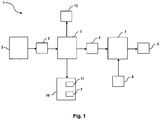
- Fig. 1 shows a schematic diagram of the audio device according to one embodiment of the invention.
- the audio device 1 is shown which can be kept in a room for being used by an user for hearing a program running on the audio device 1 such as for example music.
- the audio device 1 includes an input unit 2, a processing unit 5, a graphical user interface 10, and a parametric equalizer 7 to generate a flat acoustic response for a dominant frequency 6 of a room.
- the input unit 2 is any kind of input device like keyboard, mouse, joystick, touchscreen, etc. which has availability to enable user for entering at least one of the dimension 3 of the room 4.
- the dimensions to be entered are length, height and breadth of the room.
- non-standard room, like oval, L-shaped room, etc. different dimensions have to be entered to get a sense of complete geometric shape of the room.
- This input unit 2 can also be part of a remote control for remotely entering the dimensions 3 of the room.
- the remote control can be handled using infrared technology, Bluetooth technology, other Computer related network technologies, like LAN, WAN, etc.
- the dimensions 3 received from the user, are further provided to the processing unit 5.
- the processing unit 5 processes the dimension 3 and generates a dominant frequency 6 for the room.
- the processing unit 5 also generates a frequency response curve 12 based on dominant frequencies 6 for the room 4.
- the frequency response curve 12 determines how the audio device 1 performs at various dominant frequencies 6 of sound waves.
- the processing unit 5 need not generate a frequency response curve, rather a particular dominant frequency 6 is of concern, and is only identified or generated by the processing unit 5.
- Room modes are caused by sound reflecting off of various room surfaces. Generally, there are three types of modes in a room, i.e., axial mode, tangential mode, and oblique mode. Modal activity occurs at dominant frequencies 6. These dominant frequencies 6 are directly related to the dimensions of the room. Axial room modes are the strongest and many times, the only ones that are considered. Tangential room mode and oblique room mode have less impact per mode but are also more prevalent. And a combination of tangential mode and oblique mode can cause just as many issues as axial mode alone. Room modes can cause both peaks and nulls (dips) in frequency response. When two or more waves meet and are in phase with each other at a specific frequency, a peak in acoustic response is experienced. When they meet and are out of phase with each other, they cancel and a dip or null in the acoustic response is experienced.
- the processing unit 5 generates the dominant frequency 6 based on at least one of the axial room mode, the tangential room mode, or the oblique room mode, or combination thereof.
- the processing unit 5 is generates the dominant frequency 6 based on an order of at least one of the room modes.
- the order of room modes helps to determine harmonics of the dominant frequencies.
- the parametric equalizer 7 receives the dominant frequency 6 and processes the dominant frequency 6 using a negative gain 8. On processing the dominant frequency 6, the parametric equalizer 7 generates a flat acoustic response 9 for the dominant frequency 6 for the room 4.
- the parametric equalizer 7 processes the dominant frequencies 6 which are in range of 20 Hz to 500 Hz. This shall help to handle bass effect of the audio device 1. However, the parametric equalizer 7 can work for different frequency range too.
- the audio device also includes the graphical user interface 10 onto which the option 11 for entering dimensions 3 of the room are shown. Once the options 11 appear, the user uses the input unit 2 to enter the dimensions 3 of the room for the provided options 11.
- the graphical user interface 10 is illustrated in Fig 2 .
- One representation of the graphical user interface 10 is shown, where on left hand side a graphical representation of geometrics of the room 4 is shown, and on the right-hand side, there are three text boxes 11 shown, which are the options 11, for entering Length, Height and Width of the room 4, where the user shall be entering these dimensions 3 of the room 4.
- the option 11 are appropriately shown for collecting relevant geometric dimensions 3 of the room 4.
- the text box 11 shall accept only numerals, with or without decimals.
- the option can be provided for the user to provide the dimensions 3 in alphanumeric form too.
- the box 11 can be a drop-down box, where the user can select the dimensions 3 by selecting an element from the drop-down list.
- the selection for the dimensions 3 can be done by clicking various radio buttons provided as options 11.
- the graphical user interface 10 is not provided, rather the user can be prompted for providing dimensions in any other way, like by prompting option 11 through audio to enter each of the dimension 3.
- the configuration of the room can be a one-time affair, and need not be processed every-time when the audio box is switched on. However, when the audio device 1 is switched on after delivering from the factory, the configuration of the room 4 can be shown as part of the installation procedure. In case, if the room 4 is changed, the user of the audio device 1 can use the input unit 2 provided to again enter the dimensions 3 of the room 4 to reconfigure the room 4 for the audio device 1. This reconfiguration can automatically be prompted when the audio device 1 detects a change of the room 4.
- the detection of room change can be understood by use of any location based technologies, or wave reflection technologies like ultrasonic, infrared etc.
- the audio device 1 can periodically prompt the user for his interest for reconfigure the room dimensions 3.
- the technique of the invention can be implemented by a computer program product, which can be stored on a computer readable medium of the audio device.
- the computer program product when executed on one or more processors, it enables the processor to display options for providing at least one of dimension of the room onto a graphical user interface, receiving at least one of the dimensions of the room using an input unit, processing the dimension of the room and generating a dominant frequency for the room, and receiving the dominant frequency, processing the dominant frequency using a negative gain and generating a flat acoustic response for the dominant frequency for the room.
- the present invention provides an efficient mechanism for providing a flat acoustic response for room modes while using an audio device.
- the parametric equalizer effectively deals with the dominant frequencies once identified by appropriately compensating the dips or peaks of the frequency by applying appropriate negative gain.
- the audio device 1 adapted to be placed in a room 4, the device 1 comprises an input unit 2 adapted to receive at least one of the dimension 3 of the room 4, a processing unit 5 adapted to process the dimension 3 and generate a dominant frequency 6 for the room 4, and a parametric equalizer 7 adapted to receive the dominant frequency 6 and to process the dominant frequency 6 using a negative gain 8 and generating a flat acoustic response 9 for the dominant frequency 6 for the room 4.
- the audio device 1 has applications in television or any other video display having audio output. Also, the audio device works well for stereoscopic sound system or device with one or two audio channels, as well as for multi-audio channels.
Landscapes
- Physics & Mathematics (AREA)
- Engineering & Computer Science (AREA)
- Acoustics & Sound (AREA)
- Signal Processing (AREA)
- Stereophonic System (AREA)
- Circuit For Audible Band Transducer (AREA)
Abstract
An audio device (1) adapted to be placed in a room (4), the device comprising an input unit (2) adapted to receive at least one of the dimension (3) of the room (4), a processing unit (5) adapted to process the dimension (3) and generate a dominant frequency (6) for the room (4), and a parametric equalizer (7) adapted to receive the dominant frequency (6) and to process the dominant frequency (6) using a negative gain (8) and generating a flat acoustic response (9) for the dominant frequency (6) for the room (4).
Description
- This invention refers to an audio device adapted to be placed in a room according to
claim 1, a method for generating a flat acoustic response from the audio device for a dominant frequency of the room according toclaim 11, and a computer program product according toclaim 12. - An audio system when placed in a room generally produces standing waves due to reflection of sound waves by the walls of the room, and further produces resonance due to superimposition of the reflected waves and originating waves of the same frequency. These standing waves are produced at specific frequencies only, which are called dominant frequencies. At dominant frequencies, a distortion is produced in acoustic response due to which a dip or a peak in acoustic response is felt. One way to deal with such dominant frequency is to change room dimensions to deal with particular frequencies, however room dimension cannot be changes to counted the dominant frequencies, which can keep on changing throughout an audio programme running on the audio system.
-
US Patent Application No. 10/465,644 - US Patent No.
US 7,529,377 discloses a loudspeaker, such as a subwoofer, is provided which automatically calibrates itself when placed in a room to optimize an output signal of the loudspeaker for the room in which the loudspeaker is placed. - Japanese Patent Publication No.
JP2007251484 model - It is therefore the object of the present invention is to overcome room modes by providing a flat acoustic response from an audio device at dominant frequecy of a room.
- The before mentioned object is solved by an audio device adapted to be placed in a room according to
claim 1, a method for generating a flat acoustic response from an audio device for a dominant frequency for the room according toclaim 11, and a computer program product according toclaim 12. - An audio device adapted to be placed in a room, the device comprising an input unit adapted to receive at least one of the dimension of the room, a processing unit adapted to process the dimension and generate a dominant frequency for the room, and a parametric equalizer adapted to receive the dominant frequency and to process the dominant frequency using a negative gain and generating a flat acoustic response for the dominant frequency for the room.
- This provides for a mechanism for identifying dominant frequencies for the room which are producing resonance in the room and producing accoustic distortion due to a dip or a peak in acoustic response of the room. The parametric equalizer counters this dominant frequency, so that flat acoustic response can be received.
- Further preferred embodiments are subject-matter of dependent claims and/or of the following specification parts.
- According to a preferred embodiment of the device, the device comprises a graphical user interface adapted to show options to provide the dimension of the room, and to further show the dimensions received from the input unit.
- This embodiment is beneficial as it provides for a visual display to an user of the device for rightly identifying which dimension options are being filled, and what all dimension inputs are provided by him.
- According to a further preferred embodiment of the device, the input unit is adapted to be remotely connected to the device and to be in communication coupling to the device.
- This embodiment is helpful, as it provides for an user friendly and convinient option for remotely providing dimensions as input to the device.
- According to a further preferred embodiment of the device, the device is a part of a video display system
- This embodiment is beneficial, as it provides an application for the device where video is being displayed. Video, generally have sound, and the sounds makes an user to comprehend the video properly. Hence, utility of the audio device for video display helps in providing for flat acoustic response while viewing and hearing contents of a video, and thus helps an user to properly comprehend the video.
- According to another embodiment of the device, the audio device is having a stereo sound system.
- This embodiment is beneficial, as it provides for the device, which works for at least two audio channels.
- According to a further preferred embodiment of the device, the room is a rectangular room, and the dimension to be provided using the input unit are at least one of the length, breath, or height of the room.
- This embodiment is beneficial, as it provides for receiving relevant dimension details for a rectangular room. Rectangular rooms are generally standard rooms, which are usually found in houses and apartments, and making the audio device ready for rectangular rooms provides for efficient solution for room modes in audio devices.
- According to a further embodiment of the device, the processing unit is adapted to generate the dominant frequency based on at least one of an axial room mode, a tangential room mode, or an oblique room mode, or combination thereof.
- This embodiment is beneficial, as it helps to provide solution for various types of room modes individually or in composite.
- According to another embodiment of the device, the processing unit is adapted to generate the dominant frequency based on an order of at least one of the room modes.
- This embodiment is beneficial, as it provides for generating various harmonics for the dominant frequency which shall also affect the acoustic response of the room.
- According to a further embodiment of the device, the processing unit is adapted to generate a frequency response curve based on dominant frequencies for the room.
- This embodiment is beneficial, as it provides for the audio device to be available and aware of various dominant frequencies, which can affect the acoustic response behavior of the audio device. This frequency curve can further help in countering the complete set of dominant frequencies.
- According to a further preferred embodiment of the device, wherein the parametric equalizer is adapted to process the dominant frequencies, which are in range of 20 Hz to 500 Hz.
- This embodiment is beneficial, as it optimizes the device for specifically countering bass effect produced due to the room dimensions.
- The before mentioned object is also solved by a method of
claim 11. The method for generating a flat acoustic response from an audio device for a dominant frequency of a room comprising steps of: - displaying options to provide at least one of dimension of the room onto a graphical user interface;
- receiving at least one of the dimensions of the room using an input unit;
- processing the dimension of the room by a processing unit and generating a dominant frequency for the room;
- receiving the dominant frequency, processing the dominant frequency using a negative gain by a parametric equalizer and generating a flat acoustic response for the dominant frequency for the room.
- The before mentioned object is also solved by a computer program poduct of
claim 12. The computer program product stored on a computer readable medium within an audio device and adapted to be executed on one or more processors, wherein the computer readable medium and the one or more processors are adapted to be coupled to a communication network interface, the computer program product on execution to enable the one or more processors to perform following steps comprising: - displaying options to provide at least one of dimension of the room onto a graphical user interface;
- receiving at least one of the dimensions of the room using an input unit;
- processing the dimension of the room and generating a dominant frequency for the room;
- receiving the dominant frequency, processing the dominant frequency using a negative gain and generating a flat acoustic response for the dominant frequency for the room.
- Further benefits, goals and features of the present invention will be described by the following specification of the attached figures, in which components of the invention are exemplarily illustrated. Components of the devices and method according to the inventions, which match at least essentially with respect to their function, can be marked with the same reference sign, wherein such components do not have to be marked or described in all figures.
- The invention is just exemplarily described with respect to the attached figure in the following.
-
-
Fig. 1 illustrates a schematic diagram of the audio device according to one embodiment of the invention. -
Fig. 2 illustrates a graphical user interface of the audio device. - Current invention focuses on providing flat acoustic response with respect to a room in which an audio device is placed. Certain sound waves with particular frequencies produces standing waves due to reflection of the sound waves from the walls of the room and thereafter superimposition of the reflected waves onto the emitted sound waves from the audio device. This superimposition results in producing of standing waves due to resonance. These specific frequencies are also known as dominant frequencies or room modes. These dominant frequencies generate distortion in the waves and creates dip or peaks in the sound waves. For a proper audible sound, these dominant frequencies are required to be compensated for producing a flat acoustic response to overcome distortion in the sound waves.
-
Fig. 1 shows a schematic diagram of the audio device according to one embodiment of the invention. Theaudio device 1 is shown which can be kept in a room for being used by an user for hearing a program running on theaudio device 1 such as for example music. - The
audio device 1 includes aninput unit 2, aprocessing unit 5, agraphical user interface 10, and aparametric equalizer 7 to generate a flat acoustic response for a dominant frequency 6 of a room. - The
input unit 2 is any kind of input device like keyboard, mouse, joystick, touchscreen, etc. which has availability to enable user for entering at least one of thedimension 3 of the room 4. For a rectangular room, the dimensions to be entered are length, height and breadth of the room. For non-standard room, like oval, L-shaped room, etc., different dimensions have to be entered to get a sense of complete geometric shape of the room. Thisinput unit 2 can also be part of a remote control for remotely entering thedimensions 3 of the room. The remote control can be handled using infrared technology, Bluetooth technology, other Computer related network technologies, like LAN, WAN, etc. - The
dimensions 3 received from the user, are further provided to theprocessing unit 5. Theprocessing unit 5 processes thedimension 3 and generates a dominant frequency 6 for the room. Theprocessing unit 5 also generates afrequency response curve 12 based on dominant frequencies 6 for the room 4. Thefrequency response curve 12 determines how theaudio device 1 performs at various dominant frequencies 6 of sound waves. In alternate embodiment, theprocessing unit 5 need not generate a frequency response curve, rather a particular dominant frequency 6 is of concern, and is only identified or generated by theprocessing unit 5. - Room modes are caused by sound reflecting off of various room surfaces. Generally, there are three types of modes in a room, i.e., axial mode, tangential mode, and oblique mode. Modal activity occurs at dominant frequencies 6. These dominant frequencies 6 are directly related to the dimensions of the room. Axial room modes are the strongest and many times, the only ones that are considered. Tangential room mode and oblique room mode have less impact per mode but are also more prevalent. And a combination of tangential mode and oblique mode can cause just as many issues as axial mode alone. Room modes can cause both peaks and nulls (dips) in frequency response. When two or more waves meet and are in phase with each other at a specific frequency, a peak in acoustic response is experienced. When they meet and are out of phase with each other, they cancel and a dip or null in the acoustic response is experienced.
- The
processing unit 5 generates the dominant frequency 6 based on at least one of the axial room mode, the tangential room mode, or the oblique room mode, or combination thereof. - The
processing unit 5 is generates the dominant frequency 6 based on an order of at least one of the room modes. The order of room modes helps to determine harmonics of the dominant frequencies. - One way to generate the dominant frequencies 6 by the
processing unit 5 shall be based on the following formula:
- f = Frequency of the mode in Hz
- c = Speed of sound 343 m/s at 20 °C (68 °F)
- nx, ny, nz = Order of the mode of the room length
- L, W, H = Length, width, and height of the room in meters
- The
parametric equalizer 7 receives the dominant frequency 6 and processes the dominant frequency 6 using anegative gain 8. On processing the dominant frequency 6, theparametric equalizer 7 generates a flat acoustic response 9 for the dominant frequency 6 for the room 4. - In one embodiment, the
parametric equalizer 7 processes the dominant frequencies 6 which are in range of 20 Hz to 500 Hz. This shall help to handle bass effect of theaudio device 1. However, theparametric equalizer 7 can work for different frequency range too. - The audio device also includes the
graphical user interface 10 onto which theoption 11 for enteringdimensions 3 of the room are shown. Once theoptions 11 appear, the user uses theinput unit 2 to enter thedimensions 3 of the room for the providedoptions 11. - The
graphical user interface 10 is illustrated inFig 2 . One representation of thegraphical user interface 10 is shown, where on left hand side a graphical representation of geometrics of the room 4 is shown, and on the right-hand side, there are threetext boxes 11 shown, which are theoptions 11, for entering Length, Height and Width of the room 4, where the user shall be entering thesedimensions 3 of the room 4. In case, where the room is a non-standard room, which is not rectangular, theoption 11 are appropriately shown for collecting relevantgeometric dimensions 3 of the room 4. Thetext box 11 shall accept only numerals, with or without decimals. However, in one embodiment, the option can be provided for the user to provide thedimensions 3 in alphanumeric form too. In one embodiment, thebox 11 can be a drop-down box, where the user can select thedimensions 3 by selecting an element from the drop-down list. In one embodiment, the selection for thedimensions 3 can be done by clicking various radio buttons provided asoptions 11. - In one embodiment, the
graphical user interface 10 is not provided, rather the user can be prompted for providing dimensions in any other way, like by promptingoption 11 through audio to enter each of thedimension 3. - The configuration of the room can be a one-time affair, and need not be processed every-time when the audio box is switched on. However, when the
audio device 1 is switched on after delivering from the factory, the configuration of the room 4 can be shown as part of the installation procedure. In case, if the room 4 is changed, the user of theaudio device 1 can use theinput unit 2 provided to again enter thedimensions 3 of the room 4 to reconfigure the room 4 for theaudio device 1. This reconfiguration can automatically be prompted when theaudio device 1 detects a change of the room 4. The detection of room change can be understood by use of any location based technologies, or wave reflection technologies like ultrasonic, infrared etc. In one embodiment, theaudio device 1 can periodically prompt the user for his interest for reconfigure theroom dimensions 3. - In one embodiment, the technique of the invention can be implemented by a computer program product, which can be stored on a computer readable medium of the audio device. The computer program product when executed on one or more processors, it enables the processor to display options for providing at least one of dimension of the room onto a graphical user interface, receiving at least one of the dimensions of the room using an input unit, processing the dimension of the room and generating a dominant frequency for the room, and receiving the dominant frequency, processing the dominant frequency using a negative gain and generating a flat acoustic response for the dominant frequency for the room.
- Thus, the present invention provides an efficient mechanism for providing a flat acoustic response for room modes while using an audio device. The parametric equalizer effectively deals with the dominant frequencies once identified by appropriately compensating the dips or peaks of the frequency by applying appropriate negative gain. The
audio device 1 adapted to be placed in a room 4, thedevice 1 comprises aninput unit 2 adapted to receive at least one of thedimension 3 of the room 4, aprocessing unit 5 adapted to process thedimension 3 and generate a dominant frequency 6 for the room 4, and aparametric equalizer 7 adapted to receive the dominant frequency 6 and to process the dominant frequency 6 using anegative gain 8 and generating a flat acoustic response 9 for the dominant frequency 6 for the room 4. - The
audio device 1 has applications in television or any other video display having audio output. Also, the audio device works well for stereoscopic sound system or device with one or two audio channels, as well as for multi-audio channels. -
- 1
- audio device
- 2
- input unit
- 3
- dimension of the room
- 4
- room
- 5
- processing unit
- 6
- dominant frequency
- 7
- parametric equalizer
- 8
- negative gain
- 9
- flat acoustic response
- 10
- graphical user interface
- 11
- options to provide the dimension of the room
- 12
- frequency response curve
Claims (12)
- An audio device (1) adapted to be placed in a room (4), the device comprising:- an input unit (2) adapted to receive at least one of the dimension (3) of the room (4);- a processing unit (5) adapted to process the dimension (3) and generate a dominant frequency (6) for the room (4);- a parametric equalizer (7) adapted to receive the dominant frequency (6) and to process the dominant frequency (6) using a negative gain (8) and generating a flat acoustic response (9) for the dominant frequency (6) for the room (4).
- The device (1) according to the claim 1 comprising:- a graphical user interface (10) adapted to show options (11) to provide the dimension (3) of the room (4), and to further show the dimensions (3) received from the input unit (2).
- The device (1) according to any of the claims 1 or 2, wherein the input unit (2) is adapted to be remotely connected to the device (1) and to be in communication coupling to the device (1).
- The device (1) according to any of the claims 1 to 4, wherein the device (1) is a part of a video display system.
- The device (1) according to any of the claims 1 to 4, wherein the audio device (1) is having a stereo sound system.
- The device (1) according to any of the claims 1 to 5, wherein the room (1) is a rectangular room, and the dimension (3) to be provided using the input unit (2) are at least one of the length, breath, or height of the room (4).
- The device (1) according to the claim 6, wherein the processing unit (5) is adapted to generate the dominant frequency (6) based on at least one of an axial room mode, a tangential room mode, or an oblique room mode, or combination thereof.
- The device (1) according to the claim 7, wherein the processing unit (5) is adapted to generate the dominant frequency (6) based on an order of at least one of the room modes.
- The device (1) according to any of the claims 1 to 8, wherein the processing unit (5) is adapted to generate a frequency response curve (12) based on dominant frequencies (6) for the room (4).
- The device (1) according to any of the claims 1 to 9, wherein the parametric equalizer (7) is adapted to process the dominant frequencies (6) which are in range of 20 Hz to 500 Hz.
- A method for generating a flat acoustic response (9) from an audio device (1) for a dominant frequency (6) of a room (4) comprising steps of:- displaying options (11) to provide at least one of dimension (3) of the room onto a graphical user interface (10);- receiving at least one of the dimensions (3) of the room (4) using an input unit (2);- processing the dimension (3) of the room (4) by a processing unit (5) and generating a dominant frequency (6) for the room (4);- receiving the dominant frequency (6), processing the dominant frequency (6) using a negative gain (8) by a parametric equalizer (7) and generating a flat acoustic response (9) for the dominant frequency (6) for the room (4).
- A computer program product stored on a computer readable medium within an audio device (1) and adapted to be executed on one or more processors, wherein the computer readable medium and the one or more processors are adapted to be coupled to a communication network interface, the computer program product on execution to enable the one or more processors (5, 7) to perform following steps comprising:- displaying options (11) to provide at least one of dimension (3) of the room (4) onto a graphical user interface (10);- receiving at least one of the dimensions (3) of the room (4) using an input unit (2);- processing the dimension (3) of the room (4) and generating a dominant frequency (6) for the room (4);- receiving the dominant frequency (6), processing the dominant frequency (6) using a negative gain (8) and generating a flat acoustic response (9) for the dominant frequency (6) for the room (4).
Priority Applications (2)
| Application Number | Priority Date | Filing Date | Title |
|---|---|---|---|
| EP17178377.2A EP3422737A1 (en) | 2017-06-28 | 2017-06-28 | Audio device and method for generating a flat acoustic response |
| TR2017/16815A TR201716815A2 (en) | 2017-06-28 | 2017-10-30 | AUDIO DEVICE AND METHOD FOR GENERATING A FLAT ACOUSTIC RESPONSE |
Applications Claiming Priority (1)
| Application Number | Priority Date | Filing Date | Title |
|---|---|---|---|
| EP17178377.2A EP3422737A1 (en) | 2017-06-28 | 2017-06-28 | Audio device and method for generating a flat acoustic response |
Publications (1)
| Publication Number | Publication Date |
|---|---|
| EP3422737A1 true EP3422737A1 (en) | 2019-01-02 |
Family
ID=59258011
Family Applications (1)
| Application Number | Title | Priority Date | Filing Date |
|---|---|---|---|
| EP17178377.2A Withdrawn EP3422737A1 (en) | 2017-06-28 | 2017-06-28 | Audio device and method for generating a flat acoustic response |
Country Status (2)
| Country | Link |
|---|---|
| EP (1) | EP3422737A1 (en) |
| TR (1) | TR201716815A2 (en) |
Cited By (1)
| Publication number | Priority date | Publication date | Assignee | Title |
|---|---|---|---|---|
| CN110971213A (en) * | 2019-12-11 | 2020-04-07 | 易兆微电子(杭州)有限公司 | 10-section parameter equalizer |
Citations (4)
| Publication number | Priority date | Publication date | Assignee | Title |
|---|---|---|---|---|
| JP2007251484A (en) | 2006-03-15 | 2007-09-27 | Kenwood Corp | Sound field correction apparatus and method |
| US7529377B2 (en) | 2005-07-29 | 2009-05-05 | Klipsch L.L.C. | Loudspeaker with automatic calibration and room equalization |
| US20150149943A1 (en) * | 2010-11-09 | 2015-05-28 | Sony Corporation | Virtual room form maker |
| US20160061597A1 (en) * | 2013-05-16 | 2016-03-03 | Koninklijke Philips N.V. | Determination of a room dimension estimate |
-
2017
- 2017-06-28 EP EP17178377.2A patent/EP3422737A1/en not_active Withdrawn
- 2017-10-30 TR TR2017/16815A patent/TR201716815A2/en unknown
Patent Citations (4)
| Publication number | Priority date | Publication date | Assignee | Title |
|---|---|---|---|---|
| US7529377B2 (en) | 2005-07-29 | 2009-05-05 | Klipsch L.L.C. | Loudspeaker with automatic calibration and room equalization |
| JP2007251484A (en) | 2006-03-15 | 2007-09-27 | Kenwood Corp | Sound field correction apparatus and method |
| US20150149943A1 (en) * | 2010-11-09 | 2015-05-28 | Sony Corporation | Virtual room form maker |
| US20160061597A1 (en) * | 2013-05-16 | 2016-03-03 | Koninklijke Philips N.V. | Determination of a room dimension estimate |
Cited By (2)
| Publication number | Priority date | Publication date | Assignee | Title |
|---|---|---|---|---|
| CN110971213A (en) * | 2019-12-11 | 2020-04-07 | 易兆微电子(杭州)有限公司 | 10-section parameter equalizer |
| CN110971213B (en) * | 2019-12-11 | 2020-08-14 | 易兆微电子(杭州)股份有限公司 | 10-section parameter equalizer |
Also Published As
| Publication number | Publication date |
|---|---|
| TR201716815A2 (en) | 2019-01-21 |
Similar Documents
| Publication | Publication Date | Title |
|---|---|---|
| US20210084420A1 (en) | Automated Fitting of Hearing Devices | |
| US10045131B2 (en) | System and method for automated hearing aid profile update | |
| US8582790B2 (en) | Hearing aid and computing device for providing audio labels | |
| US9042574B2 (en) | Processing audio signals | |
| US20150098596A1 (en) | Handheld interface for speaker location | |
| EP3198721B1 (en) | Mobile cluster-based audio adjusting method and apparatus | |
| US11900016B2 (en) | Multi-frequency sensing method and apparatus using mobile-clusters | |
| CN110012406A (en) | Acoustic signal processing method, device, processor and ossiphone | |
| CN105554602A (en) | Sound reproduction system with a tactile interface for equalization selection and setting | |
| CN103680549B (en) | A kind of audio-frequency processing method and electronics | |
| US11882412B2 (en) | Audition of hearing device settings, associated system and hearing device | |
| CN114747196B (en) | Terminal and method for outputting multi-channel audio using a plurality of audio devices | |
| CN109005486A (en) | The audition of hearing device setting, related system and hearing device | |
| CN111800699B (en) | Volume adjustment prompting method and device, earphone equipment and storage medium | |
| US12604141B2 (en) | Ultra-low frequency sound compensation method and system based on haptic feedback, and computer-readable storage medium | |
| CN108574914B (en) | Method and device for adjusting multicast playback file of sound box and receiving end | |
| CN103002171A (en) | Processing audio signals | |
| US11722814B2 (en) | Sound output apparatus | |
| US20230050136A1 (en) | Audio device and operation method thereof | |
| CN104637495B (en) | electronic device and audio signal processing method | |
| JP2019140503A (en) | Information processing device, information processing method, and information processing program | |
| KR20140087104A (en) | Audio Equipment Installation Information Providing System and Method, Personalized Audio Providing Server | |
| JP2008177893A (en) | Multi-screen display television receiver, remote control device and headphone device | |
| CN121645114A (en) | Methods, apparatus, equipment and storage media for determining vehicle tuning parameters | |
| JP6033152B2 (en) | Reception quality measurement method, reception quality measurement device, and program |
Legal Events
| Date | Code | Title | Description |
|---|---|---|---|
| PUAI | Public reference made under article 153(3) epc to a published international application that has entered the european phase |
Free format text: ORIGINAL CODE: 0009012 |
|
| AK | Designated contracting states |
Kind code of ref document: A1 Designated state(s): AL AT BE BG CH CY CZ DE DK EE ES FI FR GB GR HR HU IE IS IT LI LT LU LV MC MK MT NL NO PL PT RO RS SE SI SK SM TR |
|
| AX | Request for extension of the european patent |
Extension state: BA ME |
|
| STAA | Information on the status of an ep patent application or granted ep patent |
Free format text: STATUS: THE APPLICATION IS DEEMED TO BE WITHDRAWN |
|
| 18D | Application deemed to be withdrawn |
Effective date: 20190703 |