EP3421463A1 - New toxin and method for preparing intermediate thereof - Google Patents
New toxin and method for preparing intermediate thereof Download PDFInfo
- Publication number
- EP3421463A1 EP3421463A1 EP17755844.2A EP17755844A EP3421463A1 EP 3421463 A1 EP3421463 A1 EP 3421463A1 EP 17755844 A EP17755844 A EP 17755844A EP 3421463 A1 EP3421463 A1 EP 3421463A1
- Authority
- EP
- European Patent Office
- Prior art keywords
- formula
- compound
- protecting group
- preparing
- group
- Prior art date
- Legal status (The legal status is an assumption and is not a legal conclusion. Google has not performed a legal analysis and makes no representation as to the accuracy of the status listed.)
- Withdrawn
Links
- 238000000034 method Methods 0.000 title claims abstract description 25
- 239000003053 toxin Substances 0.000 title abstract description 6
- 231100000765 toxin Toxicity 0.000 title abstract description 6
- 150000001875 compounds Chemical class 0.000 claims abstract description 162
- 238000006243 chemical reaction Methods 0.000 claims abstract description 79
- 125000006239 protecting group Chemical class 0.000 claims abstract description 50
- -1 hydroxy, amino Chemical group 0.000 claims description 93
- 125000000753 cycloalkyl group Chemical group 0.000 claims description 42
- 125000000623 heterocyclic group Chemical group 0.000 claims description 41
- 125000003178 carboxy group Chemical group [H]OC(*)=O 0.000 claims description 33
- JGFZNNIVVJXRND-UHFFFAOYSA-N N,N-Diisopropylethylamine (DIPEA) Chemical compound CCN(C(C)C)C(C)C JGFZNNIVVJXRND-UHFFFAOYSA-N 0.000 claims description 28
- WMFOQBRAJBCJND-UHFFFAOYSA-M Lithium hydroxide Chemical compound [Li+].[OH-] WMFOQBRAJBCJND-UHFFFAOYSA-M 0.000 claims description 27
- 125000000217 alkyl group Chemical group 0.000 claims description 27
- 238000004519 manufacturing process Methods 0.000 claims description 27
- 239000003795 chemical substances by application Substances 0.000 claims description 22
- ZMANZCXQSJIPKH-UHFFFAOYSA-N Triethylamine Chemical compound CCN(CC)CC ZMANZCXQSJIPKH-UHFFFAOYSA-N 0.000 claims description 21
- 125000000999 tert-butyl group Chemical group [H]C([H])([H])C(*)(C([H])([H])[H])C([H])([H])[H] 0.000 claims description 21
- VEXZGXHMUGYJMC-UHFFFAOYSA-N Hydrochloric acid Chemical compound Cl VEXZGXHMUGYJMC-UHFFFAOYSA-N 0.000 claims description 20
- DTQVDTLACAAQTR-UHFFFAOYSA-N Trifluoroacetic acid Chemical compound OC(=O)C(F)(F)F DTQVDTLACAAQTR-UHFFFAOYSA-N 0.000 claims description 20
- KWYUFKZDYYNOTN-UHFFFAOYSA-M Potassium hydroxide Chemical compound [OH-].[K+] KWYUFKZDYYNOTN-UHFFFAOYSA-M 0.000 claims description 18
- HEMHJVSKTPXQMS-UHFFFAOYSA-M Sodium hydroxide Chemical group [OH-].[Na+] HEMHJVSKTPXQMS-UHFFFAOYSA-M 0.000 claims description 18
- 125000003088 (fluoren-9-ylmethoxy)carbonyl group Chemical group 0.000 claims description 17
- 125000003118 aryl group Chemical group 0.000 claims description 17
- 125000001072 heteroaryl group Chemical group 0.000 claims description 17
- QOSSAOTZNIDXMA-UHFFFAOYSA-N Dicylcohexylcarbodiimide Chemical compound C1CCCCC1N=C=NC1CCCCC1 QOSSAOTZNIDXMA-UHFFFAOYSA-N 0.000 claims description 16
- HPNMFZURTQLUMO-UHFFFAOYSA-N diethylamine Chemical compound CCNCC HPNMFZURTQLUMO-UHFFFAOYSA-N 0.000 claims description 16
- 230000002862 amidating effect Effects 0.000 claims description 14
- 125000002924 primary amino group Chemical group [H]N([H])* 0.000 claims description 13
- CDBYLPFSWZWCQE-UHFFFAOYSA-L Sodium Carbonate Chemical compound [Na+].[Na+].[O-]C([O-])=O CDBYLPFSWZWCQE-UHFFFAOYSA-L 0.000 claims description 12
- 229910052736 halogen Inorganic materials 0.000 claims description 12
- 150000002367 halogens Chemical group 0.000 claims description 12
- 229910052739 hydrogen Inorganic materials 0.000 claims description 12
- 239000001257 hydrogen Substances 0.000 claims description 12
- BWHMMNNQKKPAPP-UHFFFAOYSA-L potassium carbonate Chemical compound [K+].[K+].[O-]C([O-])=O BWHMMNNQKKPAPP-UHFFFAOYSA-L 0.000 claims description 12
- 239000003153 chemical reaction reagent Substances 0.000 claims description 11
- 125000002496 methyl group Chemical group [H]C([H])([H])* 0.000 claims description 10
- 125000003545 alkoxy group Chemical group 0.000 claims description 9
- 125000004093 cyano group Chemical group *C#N 0.000 claims description 9
- 125000004435 hydrogen atom Chemical group [H]* 0.000 claims description 9
- 125000000449 nitro group Chemical group [O-][N+](*)=O 0.000 claims description 9
- BDNKZNFMNDZQMI-UHFFFAOYSA-N 1,3-diisopropylcarbodiimide Chemical compound CC(C)N=C=NC(C)C BDNKZNFMNDZQMI-UHFFFAOYSA-N 0.000 claims description 8
- ASOKPJOREAFHNY-UHFFFAOYSA-N 1-Hydroxybenzotriazole Chemical compound C1=CC=C2N(O)N=NC2=C1 ASOKPJOREAFHNY-UHFFFAOYSA-N 0.000 claims description 8
- FPIRBHDGWMWJEP-UHFFFAOYSA-N 1-hydroxy-7-azabenzotriazole Chemical compound C1=CN=C2N(O)N=NC2=C1 FPIRBHDGWMWJEP-UHFFFAOYSA-N 0.000 claims description 8
- FPQQSJJWHUJYPU-UHFFFAOYSA-N 3-(dimethylamino)propyliminomethylidene-ethylazanium;chloride Chemical group Cl.CCN=C=NCCCN(C)C FPQQSJJWHUJYPU-UHFFFAOYSA-N 0.000 claims description 8
- MZRVEZGGRBJDDB-UHFFFAOYSA-N N-Butyllithium Chemical compound [Li]CCCC MZRVEZGGRBJDDB-UHFFFAOYSA-N 0.000 claims description 8
- NBIIXXVUZAFLBC-UHFFFAOYSA-N Phosphoric acid Chemical compound OP(O)(O)=O NBIIXXVUZAFLBC-UHFFFAOYSA-N 0.000 claims description 8
- JUJWROOIHBZHMG-UHFFFAOYSA-N Pyridine Chemical compound C1=CC=NC=C1 JUJWROOIHBZHMG-UHFFFAOYSA-N 0.000 claims description 8
- QAOWNCQODCNURD-UHFFFAOYSA-N Sulfuric acid Chemical compound OS(O)(=O)=O QAOWNCQODCNURD-UHFFFAOYSA-N 0.000 claims description 8
- 230000002378 acidificating effect Effects 0.000 claims description 8
- RROBIDXNTUAHFW-UHFFFAOYSA-N benzotriazol-1-yloxy-tris(dimethylamino)phosphanium Chemical compound C1=CC=C2N(O[P+](N(C)C)(N(C)C)N(C)C)N=NC2=C1 RROBIDXNTUAHFW-UHFFFAOYSA-N 0.000 claims description 8
- 150000007529 inorganic bases Chemical class 0.000 claims description 8
- 150000007530 organic bases Chemical class 0.000 claims description 8
- 229910052760 oxygen Chemical group 0.000 claims description 8
- 229910052717 sulfur Inorganic materials 0.000 claims description 8
- JOXIMZWYDAKGHI-UHFFFAOYSA-N toluene-4-sulfonic acid Chemical compound CC1=CC=C(S(O)(=O)=O)C=C1 JOXIMZWYDAKGHI-UHFFFAOYSA-N 0.000 claims description 8
- KEAYESYHFKHZAL-UHFFFAOYSA-N Sodium Chemical compound [Na] KEAYESYHFKHZAL-UHFFFAOYSA-N 0.000 claims description 7
- IXCSERBJSXMMFS-UHFFFAOYSA-N hydrogen chloride Substances Cl.Cl IXCSERBJSXMMFS-UHFFFAOYSA-N 0.000 claims description 7
- 229910000041 hydrogen chloride Inorganic materials 0.000 claims description 7
- 239000012312 sodium hydride Substances 0.000 claims description 7
- 229910000104 sodium hydride Inorganic materials 0.000 claims description 7
- LJCZNYWLQZZIOS-UHFFFAOYSA-N 2,2,2-trichlorethoxycarbonyl chloride Chemical compound ClC(=O)OCC(Cl)(Cl)Cl LJCZNYWLQZZIOS-UHFFFAOYSA-N 0.000 claims description 6
- 125000003903 2-propenyl group Chemical group [H]C([*])([H])C([H])=C([H])[H] 0.000 claims description 6
- WOJKKJKETHYEAC-UHFFFAOYSA-N 6-Maleimidocaproic acid Chemical compound OC(=O)CCCCCN1C(=O)C=CC1=O WOJKKJKETHYEAC-UHFFFAOYSA-N 0.000 claims description 6
- UIIMBOGNXHQVGW-DEQYMQKBSA-M Sodium bicarbonate-14C Chemical compound [Na+].O[14C]([O-])=O UIIMBOGNXHQVGW-DEQYMQKBSA-M 0.000 claims description 6
- 239000002168 alkylating agent Substances 0.000 claims description 6
- 229940100198 alkylating agent Drugs 0.000 claims description 6
- FJDQFPXHSGXQBY-UHFFFAOYSA-L caesium carbonate Chemical compound [Cs+].[Cs+].[O-]C([O-])=O FJDQFPXHSGXQBY-UHFFFAOYSA-L 0.000 claims description 6
- 229910000024 caesium carbonate Inorganic materials 0.000 claims description 6
- 125000001736 nosyl group Chemical group S(=O)(=O)(C1=CC=C([N+](=O)[O-])C=C1)* 0.000 claims description 6
- 239000011736 potassium bicarbonate Substances 0.000 claims description 6
- 229910000028 potassium bicarbonate Inorganic materials 0.000 claims description 6
- 235000015497 potassium bicarbonate Nutrition 0.000 claims description 6
- 229910000027 potassium carbonate Inorganic materials 0.000 claims description 6
- 235000011181 potassium carbonates Nutrition 0.000 claims description 6
- TYJJADVDDVDEDZ-UHFFFAOYSA-M potassium hydrogencarbonate Chemical compound [K+].OC([O-])=O TYJJADVDDVDEDZ-UHFFFAOYSA-M 0.000 claims description 6
- 229910000029 sodium carbonate Inorganic materials 0.000 claims description 6
- 235000017550 sodium carbonate Nutrition 0.000 claims description 6
- 125000002088 tosyl group Chemical group [H]C1=C([H])C(=C([H])C([H])=C1C([H])([H])[H])S(*)(=O)=O 0.000 claims description 6
- FTVLMFQEYACZNP-UHFFFAOYSA-N trimethylsilyl trifluoromethanesulfonate Chemical compound C[Si](C)(C)OS(=O)(=O)C(F)(F)F FTVLMFQEYACZNP-UHFFFAOYSA-N 0.000 claims description 6
- PXGOKWXKJXAPGV-UHFFFAOYSA-N Fluorine Chemical compound FF PXGOKWXKJXAPGV-UHFFFAOYSA-N 0.000 claims description 5
- 229910052731 fluorine Inorganic materials 0.000 claims description 5
- 239000011737 fluorine Substances 0.000 claims description 5
- GRYLNZFGIOXLOG-UHFFFAOYSA-N Nitric acid Chemical compound O[N+]([O-])=O GRYLNZFGIOXLOG-UHFFFAOYSA-N 0.000 claims description 4
- 229910000147 aluminium phosphate Inorganic materials 0.000 claims description 4
- IJOOHPMOJXWVHK-UHFFFAOYSA-N chlorotrimethylsilane Chemical compound C[Si](C)(C)Cl IJOOHPMOJXWVHK-UHFFFAOYSA-N 0.000 claims description 4
- 125000001188 haloalkyl group Chemical group 0.000 claims description 4
- 125000002768 hydroxyalkyl group Chemical group 0.000 claims description 4
- 229910017604 nitric acid Inorganic materials 0.000 claims description 4
- LPNYRYFBWFDTMA-UHFFFAOYSA-N potassium tert-butoxide Chemical compound [K+].CC(C)(C)[O-] LPNYRYFBWFDTMA-UHFFFAOYSA-N 0.000 claims description 4
- UMJSCPRVCHMLSP-UHFFFAOYSA-N pyridine Natural products COC1=CC=CN=C1 UMJSCPRVCHMLSP-UHFFFAOYSA-N 0.000 claims description 4
- WRIKHQLVHPKCJU-UHFFFAOYSA-N sodium bis(trimethylsilyl)amide Chemical compound C[Si](C)(C)N([Na])[Si](C)(C)C WRIKHQLVHPKCJU-UHFFFAOYSA-N 0.000 claims description 4
- JRMUNVKIHCOMHV-UHFFFAOYSA-M tetrabutylammonium bromide Chemical compound [Br-].CCCC[N+](CCCC)(CCCC)CCCC JRMUNVKIHCOMHV-UHFFFAOYSA-M 0.000 claims description 4
- WKBOTKDWSSQWDR-UHFFFAOYSA-N Bromine atom Chemical compound [Br] WKBOTKDWSSQWDR-UHFFFAOYSA-N 0.000 claims description 3
- ZAMOUSCENKQFHK-UHFFFAOYSA-N Chlorine atom Chemical compound [Cl] ZAMOUSCENKQFHK-UHFFFAOYSA-N 0.000 claims description 3
- GDTBXPJZTBHREO-UHFFFAOYSA-N bromine Substances BrBr GDTBXPJZTBHREO-UHFFFAOYSA-N 0.000 claims description 3
- 229910052794 bromium Inorganic materials 0.000 claims description 3
- 229910052801 chlorine Inorganic materials 0.000 claims description 3
- 239000000460 chlorine Substances 0.000 claims description 3
- INQOMBQAUSQDDS-UHFFFAOYSA-N iodomethane Chemical compound IC INQOMBQAUSQDDS-UHFFFAOYSA-N 0.000 claims description 3
- 150000001350 alkyl halides Chemical class 0.000 claims description 2
- 230000002152 alkylating effect Effects 0.000 claims description 2
- IEJIGPNLZYLLBP-UHFFFAOYSA-N dimethyl carbonate Chemical compound COC(=O)OC IEJIGPNLZYLLBP-UHFFFAOYSA-N 0.000 claims description 2
- VAYGXNSJCAHWJZ-UHFFFAOYSA-N dimethyl sulfate Chemical compound COS(=O)(=O)OC VAYGXNSJCAHWJZ-UHFFFAOYSA-N 0.000 claims description 2
- 230000003301 hydrolyzing effect Effects 0.000 claims description 2
- PNDPGZBMCMUPRI-UHFFFAOYSA-N iodine Chemical compound II PNDPGZBMCMUPRI-UHFFFAOYSA-N 0.000 claims description 2
- BDHFUVZGWQCTTF-UHFFFAOYSA-M sulfonate Chemical compound [O-]S(=O)=O BDHFUVZGWQCTTF-UHFFFAOYSA-M 0.000 claims description 2
- WVLBCYQITXONBZ-UHFFFAOYSA-N trimethyl phosphate Chemical compound COP(=O)(OC)OC WVLBCYQITXONBZ-UHFFFAOYSA-N 0.000 claims description 2
- NINIDFKCEFEMDL-UHFFFAOYSA-N Sulfur Chemical group [S] NINIDFKCEFEMDL-UHFFFAOYSA-N 0.000 claims 1
- QVGXLLKOCUKJST-UHFFFAOYSA-N atomic oxygen Chemical group [O] QVGXLLKOCUKJST-UHFFFAOYSA-N 0.000 claims 1
- 239000001301 oxygen Chemical group 0.000 claims 1
- 239000011593 sulfur Substances 0.000 claims 1
- 239000000543 intermediate Substances 0.000 abstract description 9
- 230000002194 synthesizing effect Effects 0.000 abstract description 7
- 230000008901 benefit Effects 0.000 abstract description 5
- 238000002360 preparation method Methods 0.000 abstract description 5
- 230000003287 optical effect Effects 0.000 abstract description 3
- 238000007112 amidation reaction Methods 0.000 abstract description 2
- 238000011031 large-scale manufacturing process Methods 0.000 abstract description 2
- 230000009435 amidation Effects 0.000 abstract 1
- YMWUJEATGCHHMB-UHFFFAOYSA-N Dichloromethane Chemical compound ClCCl YMWUJEATGCHHMB-UHFFFAOYSA-N 0.000 description 126
- 239000000243 solution Substances 0.000 description 73
- 239000000047 product Substances 0.000 description 41
- XEKOWRVHYACXOJ-UHFFFAOYSA-N Ethyl acetate Chemical compound CCOC(C)=O XEKOWRVHYACXOJ-UHFFFAOYSA-N 0.000 description 36
- XLYOFNOQVPJJNP-UHFFFAOYSA-N water Substances O XLYOFNOQVPJJNP-UHFFFAOYSA-N 0.000 description 30
- 238000004949 mass spectrometry Methods 0.000 description 24
- 238000010828 elution Methods 0.000 description 23
- 238000010898 silica gel chromatography Methods 0.000 description 23
- PMZURENOXWZQFD-UHFFFAOYSA-L Sodium Sulfate Chemical compound [Na+].[Na+].[O-]S([O-])(=O)=O PMZURENOXWZQFD-UHFFFAOYSA-L 0.000 description 22
- ZMXDDKWLCZADIW-UHFFFAOYSA-N N,N-Dimethylformamide Chemical compound CN(C)C=O ZMXDDKWLCZADIW-UHFFFAOYSA-N 0.000 description 21
- 239000000706 filtrate Substances 0.000 description 21
- 239000012074 organic phase Substances 0.000 description 21
- OKKJLVBELUTLKV-UHFFFAOYSA-N Methanol Chemical compound OC OKKJLVBELUTLKV-UHFFFAOYSA-N 0.000 description 18
- FAPWRFPIFSIZLT-UHFFFAOYSA-M Sodium chloride Chemical class [Na+].[Cl-] FAPWRFPIFSIZLT-UHFFFAOYSA-M 0.000 description 18
- 239000012071 phase Substances 0.000 description 16
- 239000007787 solid Substances 0.000 description 16
- 125000004432 carbon atom Chemical group C* 0.000 description 15
- 239000000203 mixture Substances 0.000 description 15
- 125000002619 bicyclic group Chemical group 0.000 description 12
- 239000012300 argon atmosphere Substances 0.000 description 11
- OKKJLVBELUTLKV-MZCSYVLQSA-N Deuterated methanol Chemical compound [2H]OC([2H])([2H])[2H] OKKJLVBELUTLKV-MZCSYVLQSA-N 0.000 description 10
- 125000004414 alkyl thio group Chemical group 0.000 description 10
- 125000005842 heteroatom Chemical group 0.000 description 10
- 125000003367 polycyclic group Chemical group 0.000 description 10
- 239000007858 starting material Substances 0.000 description 10
- 125000006413 ring segment Chemical group 0.000 description 9
- RTZKZFJDLAIYFH-UHFFFAOYSA-N Diethyl ether Chemical compound CCOCC RTZKZFJDLAIYFH-UHFFFAOYSA-N 0.000 description 8
- 239000008346 aqueous phase Substances 0.000 description 8
- 125000004429 atom Chemical group 0.000 description 8
- 239000011259 mixed solution Substances 0.000 description 8
- 238000000746 purification Methods 0.000 description 8
- 125000001424 substituent group Chemical group 0.000 description 8
- APKWHWIZNTXZIV-WURWIOEBSA-N tert-butyl (1S,3S,5S)-3-[(1R,2R)-1-hydroxy-2-methyl-3-[(4R,5S)-4-methyl-2-oxo-5-phenyl-1,3-oxazolidin-3-yl]-3-oxopropyl]-2-azabicyclo[3.1.0]hexane-2-carboxylate Chemical compound O[C@H]([C@H](C(=O)N1C(O[C@H]([C@H]1C)C1=CC=CC=C1)=O)C)[C@H]1N([C@H]2C[C@H]2C1)C(=O)OC(C)(C)C APKWHWIZNTXZIV-WURWIOEBSA-N 0.000 description 8
- RYHBNJHYFVUHQT-UHFFFAOYSA-N 1,4-Dioxane Chemical compound C1COCCO1 RYHBNJHYFVUHQT-UHFFFAOYSA-N 0.000 description 7
- UIIMBOGNXHQVGW-UHFFFAOYSA-M Sodium bicarbonate Chemical compound [Na+].OC([O-])=O UIIMBOGNXHQVGW-UHFFFAOYSA-M 0.000 description 7
- 230000015572 biosynthetic process Effects 0.000 description 7
- 239000012043 crude product Substances 0.000 description 7
- 125000002887 hydroxy group Chemical group [H]O* 0.000 description 7
- 238000003786 synthesis reaction Methods 0.000 description 7
- WEVYAHXRMPXWCK-UHFFFAOYSA-N Acetonitrile Chemical compound CC#N WEVYAHXRMPXWCK-UHFFFAOYSA-N 0.000 description 6
- MHAJPDPJQMAIIY-UHFFFAOYSA-N Hydrogen peroxide Chemical compound OO MHAJPDPJQMAIIY-UHFFFAOYSA-N 0.000 description 6
- WYURNTSHIVDZCO-UHFFFAOYSA-N Tetrahydrofuran Chemical compound C1CCOC1 WYURNTSHIVDZCO-UHFFFAOYSA-N 0.000 description 6
- YXFVVABEGXRONW-UHFFFAOYSA-N Toluene Chemical compound CC1=CC=CC=C1 YXFVVABEGXRONW-UHFFFAOYSA-N 0.000 description 6
- 229910052757 nitrogen Inorganic materials 0.000 description 6
- 239000000126 substance Substances 0.000 description 6
- SMVBIYSFDNRJJI-FCUBIXSHSA-N (3r,4s,5s)-4-[[(2s)-2-[[(2s)-2-[9h-fluoren-9-ylmethoxycarbonyl(methyl)amino]-3-methylbutanoyl]amino]-3-methylbutanoyl]-methylamino]-3-methoxy-5-methylheptanoic acid Chemical compound C1=CC=C2C(COC(=O)N(C)[C@@H](C(C)C)C(=O)N[C@H](C(=O)N(C)[C@H]([C@@H](CC(O)=O)OC)[C@@H](C)CC)C(C)C)C3=CC=CC=C3C2=C1 SMVBIYSFDNRJJI-FCUBIXSHSA-N 0.000 description 5
- UFHFLCQGNIYNRP-UHFFFAOYSA-N Hydrogen Chemical compound [H][H] UFHFLCQGNIYNRP-UHFFFAOYSA-N 0.000 description 5
- VYPSYNLAJGMNEJ-UHFFFAOYSA-N Silicium dioxide Chemical compound O=[Si]=O VYPSYNLAJGMNEJ-UHFFFAOYSA-N 0.000 description 5
- 125000003342 alkenyl group Chemical group 0.000 description 5
- 125000004453 alkoxycarbonyl group Chemical group 0.000 description 5
- 125000003282 alkyl amino group Chemical group 0.000 description 5
- 125000000304 alkynyl group Chemical group 0.000 description 5
- 125000000000 cycloalkoxy group Chemical group 0.000 description 5
- 125000005366 cycloalkylthio group Chemical group 0.000 description 5
- 238000004128 high performance liquid chromatography Methods 0.000 description 5
- 239000000758 substrate Substances 0.000 description 5
- ALSWDUAITSMXMK-IUAIVACJSA-N tert-butyl (1S,3S,5S)-3-[(1R,2R)-1-methoxy-2-methyl-3-[(4R,5S)-4-methyl-2-oxo-5-phenyl-1,3-oxazolidin-3-yl]-3-oxopropyl]-2-azabicyclo[3.1.0]hexane-2-carboxylate Chemical compound CO[C@H]([C@H](C(=O)N1C(O[C@H]([C@H]1C)C1=CC=CC=C1)=O)C)[C@H]1N([C@H]2C[C@H]2C1)C(=O)OC(C)(C)C ALSWDUAITSMXMK-IUAIVACJSA-N 0.000 description 5
- NVJAIWUTTPYRKD-OYXDYEMPSA-N tert-butyl (1S,3S,5S)-3-[(1R,2R)-3-[[(2S)-3-(2-fluorophenyl)-1-[(2-methylpropan-2-yl)oxy]-1-oxopropan-2-yl]amino]-1-methoxy-2-methyl-3-oxopropyl]-2-azabicyclo[3.1.0]hexane-2-carboxylate Chemical compound C(C)(C)(C)OC([C@H](CC1=C(C=CC=C1)F)NC([C@@H]([C@@H](OC)[C@H]1N([C@H]2C[C@H]2C1)C(=O)OC(C)(C)C)C)=O)=O NVJAIWUTTPYRKD-OYXDYEMPSA-N 0.000 description 5
- 238000004809 thin layer chromatography Methods 0.000 description 5
- 125000003396 thiol group Chemical group [H]S* 0.000 description 5
- 239000011345 viscous material Substances 0.000 description 5
- ZMRFZBKROHCLIL-BXKDBHETSA-N (4r,5s)-4-methyl-5-phenyl-3-propanoyl-1,3-oxazolidin-2-one Chemical compound O1C(=O)N(C(=O)CC)[C@H](C)[C@@H]1C1=CC=CC=C1 ZMRFZBKROHCLIL-BXKDBHETSA-N 0.000 description 4
- CSCPPACGZOOCGX-UHFFFAOYSA-N Acetone Chemical compound CC(C)=O CSCPPACGZOOCGX-UHFFFAOYSA-N 0.000 description 4
- 238000005481 NMR spectroscopy Methods 0.000 description 4
- 229910052799 carbon Inorganic materials 0.000 description 4
- 238000005984 hydrogenation reaction Methods 0.000 description 4
- 239000007788 liquid Substances 0.000 description 4
- VLKZOEOYAKHREP-UHFFFAOYSA-N n-Hexane Chemical compound CCCCCC VLKZOEOYAKHREP-UHFFFAOYSA-N 0.000 description 4
- 125000004043 oxo group Chemical group O=* 0.000 description 4
- 239000000741 silica gel Substances 0.000 description 4
- 229910002027 silica gel Inorganic materials 0.000 description 4
- GEHJYWRUCIMESM-UHFFFAOYSA-L sodium sulfite Chemical compound [Na+].[Na+].[O-]S([O-])=O GEHJYWRUCIMESM-UHFFFAOYSA-L 0.000 description 4
- 239000002904 solvent Substances 0.000 description 4
- 238000001308 synthesis method Methods 0.000 description 4
- KGWICYYYJSWDRU-VGMNWLOBSA-N tert-butyl (1s,3s,5s)-3-formyl-2-azabicyclo[3.1.0]hexane-2-carboxylate Chemical compound C1[C@@H](C=O)N(C(=O)OC(C)(C)C)[C@H]2C[C@H]21 KGWICYYYJSWDRU-VGMNWLOBSA-N 0.000 description 4
- FCBZDFSTTHCQTA-IGRKRLTGSA-N tert-butyl (2S)-2-[[(2R,3R)-3-[(1S,3S,5S)-2-azabicyclo[3.1.0]hexan-3-yl]-3-methoxy-2-methylpropanoyl]amino]-3-(2-fluorophenyl)propanoate Chemical compound CO[C@H]([C@@H](C)C(=O)N[C@@H](Cc1ccccc1F)C(=O)OC(C)(C)C)[C@@H]1C[C@@H]2C[C@@H]2N1 FCBZDFSTTHCQTA-IGRKRLTGSA-N 0.000 description 4
- VHNKTELRHPVQCK-NSHDSACASA-N tert-butyl (2s)-2-amino-3-(2-fluorophenyl)propanoate Chemical compound CC(C)(C)OC(=O)[C@@H](N)CC1=CC=CC=C1F VHNKTELRHPVQCK-NSHDSACASA-N 0.000 description 4
- 125000000335 thiazolyl group Chemical group 0.000 description 4
- 238000005160 1H NMR spectroscopy Methods 0.000 description 3
- QTBSBXVTEAMEQO-UHFFFAOYSA-N Acetic acid Chemical compound CC(O)=O QTBSBXVTEAMEQO-UHFFFAOYSA-N 0.000 description 3
- NLXLAEXVIDQMFP-UHFFFAOYSA-N Ammonia chloride Chemical class [NH4+].[Cl-] NLXLAEXVIDQMFP-UHFFFAOYSA-N 0.000 description 3
- IAZDPXIOMUYVGZ-WFGJKAKNSA-N Dimethyl sulfoxide Chemical compound [2H]C([2H])([2H])S(=O)C([2H])([2H])[2H] IAZDPXIOMUYVGZ-WFGJKAKNSA-N 0.000 description 3
- HEDRZPFGACZZDS-MICDWDOJSA-N Trichloro(2H)methane Chemical compound [2H]C(Cl)(Cl)Cl HEDRZPFGACZZDS-MICDWDOJSA-N 0.000 description 3
- RBHJBMIOOPYDBQ-UHFFFAOYSA-N carbon dioxide;propan-2-one Chemical compound O=C=O.CC(C)=O RBHJBMIOOPYDBQ-UHFFFAOYSA-N 0.000 description 3
- 125000003226 pyrazolyl group Chemical group 0.000 description 3
- YLQBMQCUIZJEEH-UHFFFAOYSA-N tetrahydrofuran Natural products C=1C=COC=1 YLQBMQCUIZJEEH-UHFFFAOYSA-N 0.000 description 3
- ARHOAMSIDCQWEW-QFIPXVFZSA-N (2s)-2-(9h-fluoren-9-ylmethoxycarbonylamino)-3-(2-fluorophenyl)propanoic acid Chemical compound C([C@@H](C(=O)O)NC(=O)OCC1C2=CC=CC=C2C2=CC=CC=C21)C1=CC=CC=C1F ARHOAMSIDCQWEW-QFIPXVFZSA-N 0.000 description 2
- 125000005918 1,2-dimethylbutyl group Chemical group 0.000 description 2
- GJFNRSDCSTVPCJ-UHFFFAOYSA-N 1,8-bis(dimethylamino)naphthalene Chemical compound C1=CC(N(C)C)=C2C(N(C)C)=CC=CC2=C1 GJFNRSDCSTVPCJ-UHFFFAOYSA-N 0.000 description 2
- 125000006176 2-ethylbutyl group Chemical group [H]C([H])([H])C([H])([H])C([H])(C([H])([H])*)C([H])([H])C([H])([H])[H] 0.000 description 2
- NYCRCTMDYITATC-QMMMGPOBSA-N 2-fluoro-L-phenylalanine Chemical compound OC(=O)[C@@H](N)CC1=CC=CC=C1F NYCRCTMDYITATC-QMMMGPOBSA-N 0.000 description 2
- 125000004493 2-methylbut-1-yl group Chemical group CC(C*)CC 0.000 description 2
- 125000005916 2-methylpentyl group Chemical group 0.000 description 2
- 125000003542 3-methylbutan-2-yl group Chemical group [H]C([H])([H])C([H])(*)C([H])(C([H])([H])[H])C([H])([H])[H] 0.000 description 2
- 125000005917 3-methylpentyl group Chemical group 0.000 description 2
- XKRFYHLGVUSROY-UHFFFAOYSA-N Argon Chemical compound [Ar] XKRFYHLGVUSROY-UHFFFAOYSA-N 0.000 description 2
- IJGRMHOSHXDMSA-UHFFFAOYSA-N Atomic nitrogen Chemical compound N#N IJGRMHOSHXDMSA-UHFFFAOYSA-N 0.000 description 2
- XBDQKXXYIPTUBI-UHFFFAOYSA-N Propionic acid Chemical compound CCC(O)=O XBDQKXXYIPTUBI-UHFFFAOYSA-N 0.000 description 2
- 239000002253 acid Substances 0.000 description 2
- 125000002393 azetidinyl group Chemical group 0.000 description 2
- 238000004440 column chromatography Methods 0.000 description 2
- 238000001816 cooling Methods 0.000 description 2
- 229940127089 cytotoxic agent Drugs 0.000 description 2
- 239000002254 cytotoxic agent Substances 0.000 description 2
- MVLMPMUGCWJDLE-UHFFFAOYSA-M dibutylboron trifluoromethanesulfonate Chemical compound [O-]S(=O)(=O)C(F)(F)F.CCCC[B+]CCCC MVLMPMUGCWJDLE-UHFFFAOYSA-M 0.000 description 2
- 239000003814 drug Substances 0.000 description 2
- 125000001495 ethyl group Chemical group [H]C([H])([H])C([H])([H])* 0.000 description 2
- 150000002430 hydrocarbons Chemical group 0.000 description 2
- 125000002883 imidazolyl group Chemical group 0.000 description 2
- 238000009776 industrial production Methods 0.000 description 2
- 125000000959 isobutyl group Chemical group [H]C([H])([H])C([H])(C([H])([H])[H])C([H])([H])* 0.000 description 2
- 125000004491 isohexyl group Chemical group C(CCC(C)C)* 0.000 description 2
- 125000001972 isopentyl group Chemical group [H]C([H])([H])C([H])(C([H])([H])[H])C([H])([H])C([H])([H])* 0.000 description 2
- 125000001449 isopropyl group Chemical group [H]C([H])([H])C([H])(*)C([H])([H])[H] 0.000 description 2
- 239000012046 mixed solvent Substances 0.000 description 2
- 125000002950 monocyclic group Chemical group 0.000 description 2
- 125000002757 morpholinyl group Chemical group 0.000 description 2
- 125000004108 n-butyl group Chemical group [H]C([H])([H])C([H])([H])C([H])([H])C([H])([H])* 0.000 description 2
- 125000001280 n-hexyl group Chemical group C(CCCCC)* 0.000 description 2
- 125000000740 n-pentyl group Chemical group [H]C([H])([H])C([H])([H])C([H])([H])C([H])([H])C([H])([H])* 0.000 description 2
- 125000004123 n-propyl group Chemical group [H]C([H])([H])C([H])([H])C([H])([H])* 0.000 description 2
- 125000001971 neopentyl group Chemical group [H]C([*])([H])C(C([H])([H])[H])(C([H])([H])[H])C([H])([H])[H] 0.000 description 2
- 239000012299 nitrogen atmosphere Substances 0.000 description 2
- 125000003538 pentan-3-yl group Chemical group [H]C([H])([H])C([H])([H])C([H])(*)C([H])([H])C([H])([H])[H] 0.000 description 2
- VLTRZXGMWDSKGL-UHFFFAOYSA-N perchloric acid Chemical compound OCl(=O)(=O)=O VLTRZXGMWDSKGL-UHFFFAOYSA-N 0.000 description 2
- 125000001997 phenyl group Chemical group [H]C1=C([H])C([H])=C(*)C([H])=C1[H] 0.000 description 2
- 239000008363 phosphate buffer Substances 0.000 description 2
- 125000003386 piperidinyl group Chemical group 0.000 description 2
- 239000000843 powder Substances 0.000 description 2
- 125000004309 pyranyl group Chemical group O1C(C=CC=C1)* 0.000 description 2
- 125000000714 pyrimidinyl group Chemical group 0.000 description 2
- 229920006395 saturated elastomer Polymers 0.000 description 2
- 125000002914 sec-butyl group Chemical group [H]C([H])([H])C([H])([H])C([H])(*)C([H])([H])[H] 0.000 description 2
- 229910000030 sodium bicarbonate Inorganic materials 0.000 description 2
- 235000017557 sodium bicarbonate Nutrition 0.000 description 2
- 235000010265 sodium sulphite Nutrition 0.000 description 2
- 125000003003 spiro group Chemical group 0.000 description 2
- 238000010189 synthetic method Methods 0.000 description 2
- 125000001973 tert-pentyl group Chemical group [H]C([H])([H])C([H])([H])C(*)(C([H])([H])[H])C([H])([H])[H] 0.000 description 2
- PSWUMDUMTGAVFS-PMERELPUSA-N (2,4-dimethoxyphenyl)methyl (2S)-2-(9H-fluoren-9-ylmethoxycarbonylamino)-3-(2-fluorophenyl)propanoate Chemical compound COc1ccc(COC(=O)[C@H](Cc2ccccc2F)NC(=O)OCC2c3ccccc3-c3ccccc23)c(OC)c1 PSWUMDUMTGAVFS-PMERELPUSA-N 0.000 description 1
- HDQZYSYUXFUBEH-WFAXCEJASA-N (2,4-dimethoxyphenyl)methyl (2S)-2-[[(2R,3R)-3-[(1S,3S,5S)-2-azabicyclo[3.1.0]hexan-3-yl]-3-methoxy-2-methylpropanoyl]amino]-3-(2-fluorophenyl)propanoate Chemical compound CO[C@H]([C@@H](C)C(=O)N[C@@H](Cc1ccccc1F)C(=O)OCc1ccc(OC)cc1OC)[C@@H]1C[C@@H]2C[C@@H]2N1 HDQZYSYUXFUBEH-WFAXCEJASA-N 0.000 description 1
- JFJMWDVYOKZUFC-INIZCTEOSA-N (2,4-dimethoxyphenyl)methyl (2S)-2-amino-3-(2-fluorophenyl)propanoate Chemical compound COc1ccc(COC(=O)[C@@H](N)Cc2ccccc2F)c(OC)c1 JFJMWDVYOKZUFC-INIZCTEOSA-N 0.000 description 1
- WMSUFWLPZLCIHP-UHFFFAOYSA-N (2,5-dioxopyrrolidin-1-yl) 9h-fluoren-9-ylmethyl carbonate Chemical compound C12=CC=CC=C2C2=CC=CC=C2C1COC(=O)ON1C(=O)CCC1=O WMSUFWLPZLCIHP-UHFFFAOYSA-N 0.000 description 1
- GIFKSXLGWITUFG-GGZTXQDMSA-N (2R,3R)-3-[(1S,3S,5S)-2-(9H-fluoren-9-ylmethoxycarbonyl)-2-azabicyclo[3.1.0]hexan-3-yl]-3-methoxy-2-methylpropanoic acid Chemical compound CO[C@H]([C@@H](C)C(O)=O)[C@@H]1C[C@@H]2C[C@@H]2N1C(=O)OCC1c2ccccc2-c2ccccc12 GIFKSXLGWITUFG-GGZTXQDMSA-N 0.000 description 1
- AIHOFKLRFLQLKG-ORMBPQIASA-N (2R,3R)-3-hydroxy-2-methyl-3-[(1S,3S,5S)-2-[(2-methylpropan-2-yl)oxycarbonyl]-2-azabicyclo[3.1.0]hexan-3-yl]propanoic acid Chemical compound C(C)(C)(C)OC(=O)N1[C@H]2C[C@H]2C[C@H]1[C@@H]([C@H](C(=O)O)C)O AIHOFKLRFLQLKG-ORMBPQIASA-N 0.000 description 1
- GJDBULWKYSXYHY-WTPMCQDGSA-N (2R,3R)-3-methoxy-2-methyl-3-[(1S,3S,5S)-2-[(2-methylpropan-2-yl)oxycarbonyl]-2-azabicyclo[3.1.0]hexan-3-yl]propanoic acid Chemical compound C(C)(C)(C)OC(=O)N1[C@H]2C[C@H]2C[C@H]1[C@@H]([C@H](C(=O)O)C)OC GJDBULWKYSXYHY-WTPMCQDGSA-N 0.000 description 1
- 125000006570 (C5-C6) heteroaryl group Chemical group 0.000 description 1
- 125000004506 1,2,5-oxadiazolyl group Chemical group 0.000 description 1
- 125000003562 2,2-dimethylpentyl group Chemical group [H]C([H])([H])C([H])([H])C([H])([H])C(C([H])([H])[H])(C([H])([H])[H])C([H])([H])* 0.000 description 1
- 125000003660 2,3-dimethylpentyl group Chemical group [H]C([H])([H])C([H])([H])C([H])(C([H])([H])[H])C([H])(C([H])([H])[H])C([H])([H])* 0.000 description 1
- 125000003764 2,4-dimethylpentyl group Chemical group [H]C([H])([H])C([H])(C([H])([H])[H])C([H])([H])C([H])(C([H])([H])[H])C([H])([H])* 0.000 description 1
- 125000003229 2-methylhexyl group Chemical group [H]C([H])([H])C([H])([H])C([H])([H])C([H])([H])C([H])(C([H])([H])[H])C([H])([H])* 0.000 description 1
- 125000004336 3,3-dimethylpentyl group Chemical group [H]C([H])([H])C([H])([H])C(C([H])([H])[H])(C([H])([H])[H])C([H])([H])C([H])([H])* 0.000 description 1
- 125000004337 3-ethylpentyl group Chemical group [H]C([H])([H])C([H])([H])C([H])(C([H])([H])C([H])([H])[H])C([H])([H])C([H])([H])* 0.000 description 1
- 125000003469 3-methylhexyl group Chemical group [H]C([H])([H])C([H])([H])C([H])([H])C([H])(C([H])([H])[H])C([H])([H])C([H])([H])* 0.000 description 1
- GGHVZKXIPULPLP-UHFFFAOYSA-N 6-(2,5-dioxopyrrol-1-yl)hexanoyl chloride Chemical compound ClC(=O)CCCCCN1C(=O)C=CC1=O GGHVZKXIPULPLP-UHFFFAOYSA-N 0.000 description 1
- ZCYVEMRRCGMTRW-UHFFFAOYSA-N 7553-56-2 Chemical compound [I] ZCYVEMRRCGMTRW-UHFFFAOYSA-N 0.000 description 1
- RHMHDLWTMWNKAF-VINWQNLFSA-N C(C1=CC=CC=C1)OC([C@@H]([C@@H](OC)[C@H]1N([C@H]2C[C@H]2C1)C(=O)OC(C)(C)C)C)=O Chemical compound C(C1=CC=CC=C1)OC([C@@H]([C@@H](OC)[C@H]1N([C@H]2C[C@H]2C1)C(=O)OC(C)(C)C)C)=O RHMHDLWTMWNKAF-VINWQNLFSA-N 0.000 description 1
- 125000001313 C5-C10 heteroaryl group Chemical group 0.000 description 1
- 0 CC[C@](C)[C@@]([C@@](CC(N(C1C(C2)CC(C)=CCC1)[C@@]2[C@@](C(C(N[C@@](CC1=CC=CC(C)(*)C=C1)C(O)=O)=O)=C)OC)=O)OC)N(C)C([C@](C(C)C)NC([C@@](CN(C)C(CCCCCN(C(C=C1)=O)C1=O)=O)C(C)C)=O)=O Chemical compound CC[C@](C)[C@@]([C@@](CC(N(C1C(C2)CC(C)=CCC1)[C@@]2[C@@](C(C(N[C@@](CC1=CC=CC(C)(*)C=C1)C(O)=O)=O)=C)OC)=O)OC)N(C)C([C@](C(C)C)NC([C@@](CN(C)C(CCCCCN(C(C=C1)=O)C1=O)=O)C(C)C)=O)=O 0.000 description 1
- WUNJHUKPDJKYQG-MMPQJCFJSA-N Cl.CO[C@H]([C@@H](C)C(O)=O)[C@@H]1C[C@@H]2C[C@@H]2N1 Chemical compound Cl.CO[C@H]([C@@H](C)C(O)=O)[C@@H]1C[C@@H]2C[C@@H]2N1 WUNJHUKPDJKYQG-MMPQJCFJSA-N 0.000 description 1
- 238000002965 ELISA Methods 0.000 description 1
- 239000007821 HATU Substances 0.000 description 1
- 101000801643 Homo sapiens Retinal-specific phospholipid-transporting ATPase ABCA4 Proteins 0.000 description 1
- ZSXGLVDWWRXATF-UHFFFAOYSA-N N,N-dimethylformamide dimethyl acetal Chemical compound COC(OC)N(C)C ZSXGLVDWWRXATF-UHFFFAOYSA-N 0.000 description 1
- SECXISVLQFMRJM-UHFFFAOYSA-N N-Methylpyrrolidone Chemical compound CN1CCCC1=O SECXISVLQFMRJM-UHFFFAOYSA-N 0.000 description 1
- 206010028980 Neoplasm Diseases 0.000 description 1
- 108091000080 Phosphotransferase Proteins 0.000 description 1
- 102100033617 Retinal-specific phospholipid-transporting ATPase ABCA4 Human genes 0.000 description 1
- 239000012445 acidic reagent Substances 0.000 description 1
- 125000001931 aliphatic group Chemical group 0.000 description 1
- 238000004458 analytical method Methods 0.000 description 1
- 239000007864 aqueous solution Substances 0.000 description 1
- 229910052786 argon Inorganic materials 0.000 description 1
- 239000012298 atmosphere Substances 0.000 description 1
- AGEZXYOZHKGVCM-UHFFFAOYSA-N benzyl bromide Chemical compound BrCC1=CC=CC=C1 AGEZXYOZHKGVCM-UHFFFAOYSA-N 0.000 description 1
- 125000001797 benzyl group Chemical group [H]C1=C([H])C([H])=C(C([H])=C1[H])C([H])([H])* 0.000 description 1
- 230000033228 biological regulation Effects 0.000 description 1
- 201000011510 cancer Diseases 0.000 description 1
- 125000002837 carbocyclic group Chemical group 0.000 description 1
- 150000001721 carbon Chemical group 0.000 description 1
- 238000006555 catalytic reaction Methods 0.000 description 1
- PBAYDYUZOSNJGU-UHFFFAOYSA-N chelidonic acid Natural products OC(=O)C1=CC(=O)C=C(C(O)=O)O1 PBAYDYUZOSNJGU-UHFFFAOYSA-N 0.000 description 1
- 238000004296 chiral HPLC Methods 0.000 description 1
- 125000001995 cyclobutyl group Chemical group [H]C1([H])C([H])([H])C([H])(*)C1([H])[H] 0.000 description 1
- 125000002188 cycloheptatrienyl group Chemical group C1(=CC=CC=CC1)* 0.000 description 1
- 125000000582 cycloheptyl group Chemical group [H]C1([H])C([H])([H])C([H])([H])C([H])([H])C([H])(*)C([H])([H])C1([H])[H] 0.000 description 1
- 125000003678 cyclohexadienyl group Chemical group C1(=CC=CCC1)* 0.000 description 1
- 125000000596 cyclohexenyl group Chemical group C1(=CCCCC1)* 0.000 description 1
- 125000000113 cyclohexyl group Chemical group [H]C1([H])C([H])([H])C([H])([H])C([H])(*)C([H])([H])C1([H])[H] 0.000 description 1
- 125000000640 cyclooctyl group Chemical group [H]C1([H])C([H])([H])C([H])([H])C([H])([H])C([H])(*)C([H])([H])C([H])([H])C1([H])[H] 0.000 description 1
- 125000002433 cyclopentenyl group Chemical group C1(=CCCC1)* 0.000 description 1
- 125000001511 cyclopentyl group Chemical group [H]C1([H])C([H])([H])C([H])([H])C([H])(*)C1([H])[H] 0.000 description 1
- 125000001559 cyclopropyl group Chemical group [H]C1([H])C([H])([H])C1([H])* 0.000 description 1
- 125000004852 dihydrofuranyl group Chemical group O1C(CC=C1)* 0.000 description 1
- 125000005047 dihydroimidazolyl group Chemical group N1(CNC=C1)* 0.000 description 1
- 125000005052 dihydropyrazolyl group Chemical group N1(NCC=C1)* 0.000 description 1
- 125000005054 dihydropyrrolyl group Chemical group [H]C1=C([H])C([H])([H])C([H])([H])N1* 0.000 description 1
- 229940079593 drug Drugs 0.000 description 1
- 230000000694 effects Effects 0.000 description 1
- PQVSTLUFSYVLTO-UHFFFAOYSA-N ethyl n-ethoxycarbonylcarbamate Chemical compound CCOC(=O)NC(=O)OCC PQVSTLUFSYVLTO-UHFFFAOYSA-N 0.000 description 1
- 238000002474 experimental method Methods 0.000 description 1
- 239000012065 filter cake Substances 0.000 description 1
- 125000002541 furyl group Chemical group 0.000 description 1
- 125000002632 imidazolidinyl group Chemical group 0.000 description 1
- 125000003392 indanyl group Chemical group C1(CCC2=CC=CC=C12)* 0.000 description 1
- 230000005764 inhibitory process Effects 0.000 description 1
- 239000011630 iodine Substances 0.000 description 1
- 229910052740 iodine Inorganic materials 0.000 description 1
- GLXDVVHUTZTUQK-UHFFFAOYSA-M lithium hydroxide monohydrate Substances [Li+].O.[OH-] GLXDVVHUTZTUQK-UHFFFAOYSA-M 0.000 description 1
- 229940040692 lithium hydroxide monohydrate Drugs 0.000 description 1
- UKVIEHSSVKSQBA-UHFFFAOYSA-N methane;palladium Chemical compound C.[Pd] UKVIEHSSVKSQBA-UHFFFAOYSA-N 0.000 description 1
- 230000004048 modification Effects 0.000 description 1
- 238000012986 modification Methods 0.000 description 1
- 239000002808 molecular sieve Substances 0.000 description 1
- 125000003136 n-heptyl group Chemical group [H]C([H])([H])C([H])([H])C([H])([H])C([H])([H])C([H])([H])C([H])([H])C([H])([H])* 0.000 description 1
- 125000001624 naphthyl group Chemical group 0.000 description 1
- 238000005580 one pot reaction Methods 0.000 description 1
- 125000002971 oxazolyl group Chemical group 0.000 description 1
- 125000000538 pentafluorophenyl group Chemical group FC1=C(F)C(F)=C(*)C(F)=C1F 0.000 description 1
- 239000003208 petroleum Substances 0.000 description 1
- 239000008194 pharmaceutical composition Substances 0.000 description 1
- UYWQUFXKFGHYNT-UHFFFAOYSA-N phenylmethyl ester of formic acid Natural products O=COCC1=CC=CC=C1 UYWQUFXKFGHYNT-UHFFFAOYSA-N 0.000 description 1
- 102000020233 phosphotransferase Human genes 0.000 description 1
- 125000004193 piperazinyl group Chemical group 0.000 description 1
- 238000000039 preparative column chromatography Methods 0.000 description 1
- 125000003373 pyrazinyl group Chemical group 0.000 description 1
- 125000004076 pyridyl group Chemical group 0.000 description 1
- 125000000719 pyrrolidinyl group Chemical group 0.000 description 1
- 125000000168 pyrrolyl group Chemical group 0.000 description 1
- 238000010791 quenching Methods 0.000 description 1
- 239000013557 residual solvent Substances 0.000 description 1
- URGAHOPLAPQHLN-UHFFFAOYSA-N sodium aluminosilicate Chemical compound [Na+].[Al+3].[O-][Si]([O-])=O.[O-][Si]([O-])=O URGAHOPLAPQHLN-UHFFFAOYSA-N 0.000 description 1
- 238000006467 substitution reaction Methods 0.000 description 1
- JGLARDHRPRXNHL-NBZXXOOGSA-N tert-butyl (1S,3S,5S)-3-[(1R,2R)-1-hydroxy-2-methyl-3-oxo-3-phenylmethoxypropyl]-2-azabicyclo[3.1.0]hexane-2-carboxylate Chemical compound C[C@H]([C@@H](O)[C@@H]1C[C@@H]2C[C@@H]2N1C(=O)OC(C)(C)C)C(=O)OCc1ccccc1 JGLARDHRPRXNHL-NBZXXOOGSA-N 0.000 description 1
- 125000003718 tetrahydrofuranyl group Chemical group 0.000 description 1
- 125000001712 tetrahydronaphthyl group Chemical group C1(CCCC2=CC=CC=C12)* 0.000 description 1
- 125000003507 tetrahydrothiofenyl group Chemical group 0.000 description 1
- CZDYPVPMEAXLPK-UHFFFAOYSA-N tetramethylsilane Chemical group C[Si](C)(C)C CZDYPVPMEAXLPK-UHFFFAOYSA-N 0.000 description 1
- 125000003831 tetrazolyl group Chemical group 0.000 description 1
- VLLMWSRANPNYQX-UHFFFAOYSA-N thiadiazole Chemical compound C1=CSN=N1.C1=CSN=N1 VLLMWSRANPNYQX-UHFFFAOYSA-N 0.000 description 1
- 125000001544 thienyl group Chemical group 0.000 description 1
- 125000004568 thiomorpholinyl group Chemical group 0.000 description 1
- 239000003643 water by type Substances 0.000 description 1
Classifications
-
- C—CHEMISTRY; METALLURGY
- C07—ORGANIC CHEMISTRY
- C07D—HETEROCYCLIC COMPOUNDS
- C07D209/00—Heterocyclic compounds containing five-membered rings, condensed with other rings, with one nitrogen atom as the only ring hetero atom
- C07D209/02—Heterocyclic compounds containing five-membered rings, condensed with other rings, with one nitrogen atom as the only ring hetero atom condensed with one carbocyclic ring
-
- C—CHEMISTRY; METALLURGY
- C07—ORGANIC CHEMISTRY
- C07D—HETEROCYCLIC COMPOUNDS
- C07D209/00—Heterocyclic compounds containing five-membered rings, condensed with other rings, with one nitrogen atom as the only ring hetero atom
- C07D209/56—Ring systems containing three or more rings
- C07D209/80—[b, c]- or [b, d]-condensed
- C07D209/94—[b, c]- or [b, d]-condensed containing carbocyclic rings other than six-membered
-
- C—CHEMISTRY; METALLURGY
- C07—ORGANIC CHEMISTRY
- C07D—HETEROCYCLIC COMPOUNDS
- C07D403/00—Heterocyclic compounds containing two or more hetero rings, having nitrogen atoms as the only ring hetero atoms, not provided for by group C07D401/00
- C07D403/02—Heterocyclic compounds containing two or more hetero rings, having nitrogen atoms as the only ring hetero atoms, not provided for by group C07D401/00 containing two hetero rings
- C07D403/12—Heterocyclic compounds containing two or more hetero rings, having nitrogen atoms as the only ring hetero atoms, not provided for by group C07D401/00 containing two hetero rings linked by a chain containing hetero atoms as chain links
-
- A—HUMAN NECESSITIES
- A61—MEDICAL OR VETERINARY SCIENCE; HYGIENE
- A61K—PREPARATIONS FOR MEDICAL, DENTAL OR TOILETRY PURPOSES
- A61K35/00—Medicinal preparations containing materials or reaction products thereof with undetermined constitution
-
- Y—GENERAL TAGGING OF NEW TECHNOLOGICAL DEVELOPMENTS; GENERAL TAGGING OF CROSS-SECTIONAL TECHNOLOGIES SPANNING OVER SEVERAL SECTIONS OF THE IPC; TECHNICAL SUBJECTS COVERED BY FORMER USPC CROSS-REFERENCE ART COLLECTIONS [XRACs] AND DIGESTS
- Y02—TECHNOLOGIES OR APPLICATIONS FOR MITIGATION OR ADAPTATION AGAINST CLIMATE CHANGE
- Y02P—CLIMATE CHANGE MITIGATION TECHNOLOGIES IN THE PRODUCTION OR PROCESSING OF GOODS
- Y02P20/00—Technologies relating to chemical industry
- Y02P20/50—Improvements relating to the production of bulk chemicals
- Y02P20/55—Design of synthesis routes, e.g. reducing the use of auxiliary or protecting groups
Definitions
- the present invention relates to a new toxin and a method for preparing an intermediate thereof.
- the inventors disclose a novel type of ligand-cytotoxic drug conjugates in WO2016/127790 .
- the ligand-cytotoxic drug conjugates and the pharmaceutical composition comprising the same have good effects in the use for preparing a medicament for treating cancer by receptor regulation.
- the compound of formula (I) of the present invention is an important intermdiate.
- This intermediate has a similar structure to Mc-MMAF disclosed for the first time in the patent application WO2005/038392 by Seattle Genetics (U.S.A.), which disclosed the synthetic route of Mc-MMAF, however, in the synthetic route, there is no detailed disclosure of specific preparation process of Fmoc-Dolaproine (Fmoc-Dap) and the starting materials.
- Fmoc-Dolaproine (Fmoc-Dap) has a similar chemical structure to the key intermediate of formula (IV), which is used in synthesizing the compound of formula (I) of the present invention.
- the present invention provides a new route for synthesizing the compound of formula (I), which comprises using a chiral compound of formula (III) to carry out a series of adding protecting groups, removing protecting groups and amidation reactions to obtain the compound of formula (I).
- the method overcomes the limitations of the prior art on the substrate, has the advantages of mild reaction conditions, simple operation, high optical purity and high synthetic yield, and is suitable for large-scale production.
- the present invention relates to a compound of formula (III), wherein:
- the present invention also relates to a method for preparing a compound of formula (III), characterized in that a chiral compound of formula (II) comprising a chiral auxiliary group (R 3 ) is hydrolyzed under an alkaline condition or optionally followed by addition of a carboxyl protecting group to obtain the compound of formula (III), wherein:
- the present invention also relates to a compound of formula (IV), wherein:
- the present invention also relates to a process for preparing a compound of formula (IV), characterized in that a compound of formula (III) is reacted with an alkylating agent to obtain the compound of formula (IV), wherein:
- the present invention also relates to a method for preparing a compound of formula (V) from a compound of formula (IV), characterized in that the carboxyl protecting group on the compound of formula (IV) is removed to obtain the compound of formula (V), wherein: A, R 1 , R 2 and R x are as defined in formula (IV).
- the present invention also relates to the process for preparing a compound of formula (V), characterized by further comprising a step of preparing a compound of formula (IV), wherein: A, R 1 , R 2 and R x are as defined in formula (IV).
- the present invention also relates to the process for preparing a compound of formula (V), characterized by further comprising a step of preparing a compound of formula (III), wherein: A, R 1 , R 2 and R x are as defined in formula (IV).
- the present invention also relates to a process for preparing a compound of formula (I), n is 1; 2; 3; 4 or 5; characterized in that, the process comprises the steps of hydrolyzing a chiral compound of formula (II) comprising a chiral auxiliary group (R 3 ) under an alkaline condition or optionally followed by addition of a carboxyl protecting group to obtain a compound of formula (III); alkylating the compound of formula (III) with an alkylating agent to obtain a compound of formula (IV); removing the carboxyl protecting group on the compound of formula (IV) to obtain a compound of formula (V); and carrying out a series of reactions with the compound of formula (V) to obtain the compound of formula (I), wherein:
- the present invention also relates to a process for preparing a compound of formula (I), characterized by further comprising a step of removing the amino protecting group on a compound of formula (V) to obtain a compound of formula (VI), wherein: A, R 1 and R x are as defined in formula (I).
- the present invention also relates to a process for preparing a compound of formula (I), characterized by further comprising a step of adding a protecting group of Fmoc to a compound of formula (VI) to obtain a compound of formula (VIII), wherein: A and R x are as defined in formula (I).
- the present invention also relates to a process for preparing a compound of formula (I), characterized by further comprising the following steps of: adding a carboxyl protecting group to a compound of formula (IX) to obtain a compound of formula (X), and removing the Fmoc on the compound of formula (X) to obtain a compound of formula (XI),
- the present invention also relates to a process for preparing a compound of formula (I), characterized by further comprising the following steps of: amidating a compound of formula (VIII) with a compound of formula (XI) in the presence of a condensing agent to obtain a compound of formula (XII),
- the present invention also relates to a process for preparing a compound of formula (I), characterized by further comprising the following steps of: wherein:
- the present invention also relates to a process for preparing a compound of formula (I), wherein the reagent that provides an alkaline condition in step 1) or step 3) includes an organic base and inorganic base, wherein the organic base is preferably triethylamine, diethylamine, N,N-diisopropylethylamine, pyridine, sodium bis(trimethylsilyl)amide, n-butyllithium, potassium tert-butoxide or tetrabutylammonium bromide, and the inorganic base is preferably lithium hydroxide, sodium hydroxide, potassium hydroxide, sodium hydride, sodium carbonate, sodium bicarbonate, potassium carbonate, potassium bicarbonate or cesium carbonate, and more preferably diethylamine.
- the organic base is preferably triethylamine, diethylamine, N,N-diisopropylethylamine, pyridine, sodium bis(trimethylsilyl)amide, n-buty
- the present invention also relates to a process for preparing a compound of formula (I), wherein the condensing agent in step 2) or step 4) is preferably 1-(3-dimethylaminopropyl)-3-ethylcarbodiimide hydrochloride; N,N'-dicyclohexylcarbodiimide; N,N'-diisopropylcarbodiimide; O-benzotriazole-N,N,N',N'-tetramethyluronium tetrafluoroborate; 1-hydroxybenzotriazole; 1-hydroxy-7-azabenzotriazole; O-benzotriazole-N,N,N',N'-tetramethyluronium hexafluorophosphate; 2-(7-azabenzotriazol)-N,N,N',N'-tetramethyluronium hexafluorophosphate; benzotriazol-1-yloxytris(dimethylamino)-phospho
- the present invention also relates to a process for preparing a compound of formula (I), wherein the reagent that provides an acidic condition in step 5) is preferably hydrogen chloride solution, hydrochloric acid, nitric acid, phosphoric acid, p-toluenesulfonic acid, Me 3 SiCl, TMSOTf, trifluoroacetic acid or sulfuric acid, and more preferably trifluoroacetic acid.
- the reagent that provides an acidic condition in step 5 is preferably hydrogen chloride solution, hydrochloric acid, nitric acid, phosphoric acid, p-toluenesulfonic acid, Me 3 SiCl, TMSOTf, trifluoroacetic acid or sulfuric acid, and more preferably trifluoroacetic acid.
- the present invention also relates to a process for preparing a compound of formula (I), characterized by further comprising a step of amidating a compound of formula (V) with a compound of formula (XI) in the presence of a condensing agent to obtain a compound of formula (VII), wherein:
- the present invention also relates to a process for preparing a compound of formula (I), characterized by further comprising the following steps of:
- a compound of formula (VIII) in the present invention can be synthesized by one-pot method, comprising the steps of removing the carboxyl and amino protecting groups on a compound of formula (IV) and then adding a protecting group of Fmoc to obtain the compound of formula (VIII), wherein: A, R 1 , R 2 and R x are as defined in formula (I).
- novel toxin of formula (I) has the characteristics of simple operation, mild reaction conditions, high optical purity, high synthesis efficiency, high synthesis yield, suitability for industrial production, significant social and economic benefits.
- ring A has the same structure, selected from a 3 to 8 membered ring, preferably 3 membered ring; in particular, the ring is a cycloalkyl ring.
- Alkyl refers to a saturated aliphatic hydrocarbon group including C 1 to C20 straight chain and branched chain groups, preferably an alkyl having 1 to 12 carbon atoms, and more preferably an alkyl having 1 to 6 carbon atoms.
- Non-limiting examples include methyl, ethyl, n-propyl, isopropyl, n-butyl, isobutyl, tert-butyl, sec-butyl, n-pentyl, 1,1-dimethylpropyl, 1,2-dimethylpropyl, 2,2-dimethylpropyl, 1-ethylpropyl, 2-methylbutyl, 3-methylbutyl, n-hexyl, 1-ethyl-2-methylpropyl, 1,1,2-trimethylpropyl, 1,1-dimethylbutyl, 1,2-dimethylbutyl, 2,2-dimethylbutyl, 1,3-dimethylbutyl, 2-ethylbutyl, 2-methylpentyl, 3-methylpentyl, 4-methylpentyl, 2,3-dimethylbutyl, n-heptyl, 2-methylhexyl, 3-methylhexyl, 4-methylhexyl, 5-methylhexyl,
- an alkyl group is a lower alkyl having 1 to 6 carbon atoms, and non-limiting examples include methyl, ethyl, n-propyl, isopropyl, n-butyl, isobutyl, tert-butyl, sec-butyl, n-pentyl, 1,1-dimethylpropyl, 1,2-dimethylpropyl, 2,2-dimethylpropyl, 1-ethylpropyl, 2-methylbutyl, 3-methylbutyl, n-hexyl, 1-ethyl-2-methylpropyl, 1,1,2-trimethylpropyl, 1,1-dimethylbutyl, 1,2-dimethylbutyl, 2,2-dimethylbutyl, 1,3-dimethylbutyl, 2-ethylbutyl, 2-methylpentyl, 3-methylpentyl, 4-methylpentyl, 2,3-dimethylbutyl and etc.
- the alkyl group can be substituted or unsubstituted.
- the substituent group(s) can be substituted at any available connection point, preferably the substituent group(s) is one or more groups independently selected from the group consisting of alkyl, alkenyl, alkynyl, alkyxoy, alkylthio, alkylamino, halogen, thiol, hydroxy, nitro, cyano, cycloalkyl, heterocyclyl, aryl, heteroaryl, cycloalkoxy, heterocylic alkoxy, cycloalkylthio, heterocylic alkylthio, oxo group, carboxyl and alkoxycarbonyl.
- Cycloalkyl refers to a saturated and/or partially unsaturated monocyclic or polycyclic hydrocarbon group having 3 to 20 carbon atoms, preferably 3 to 12 carbon atoms, and more preferably 3 to 6 carbon atoms.
- monocyclic cycloalkyl include cyclopropyl, cyclobutyl, cyclopentyl, cyclopentenyl, cyclohexyl, cyclohexenyl, cyclohexadienyl, cycloheptyl, cycloheptatrienyl, cyclooctyl and the like.
- Polycyclic cycloalkyl includes a cycloalkyl having a spiro ring, fused ring or bridged ring.
- Spiro cycloalkyl refers to 5 to 20 membered polycyclic group with rings connected through one common carbon atom (called as spiro atom), wherein one or more rings can contain one or more double bonds, but none of the rings has a completely conjugated pi-electron system, preferably 6 to 14 membered spiro cycloalkyl, and more preferably 7 to 10 membered spiro cycloalkyl.
- spiro cycloalkyl can be divided into mono-spiro cycloalkyl, di-spiro cycloalkyl, or poly-spiro cycloalkyl, preferably a mono-spiro cycloalkyl or di-spiro cycloalkyl, and more preferably 4-membered/4-membered, 4-membered/5-membered, 4-membered/6-membered, 5-membered/5-membered, or 5-membered/6-membered mono-spiro cycloalkyl.
- spiro cycloalkyl include:
- “Fused cycloalkyl” refers to a 5 to 20 membered full-carbon polycyclic group, wherein each ring in the system shares an adjacent pair of carbon atoms with another ring, wherein one or more rings can contain one or more double bonds, but none of the rings has a completely conjugated pi-electron system, preferably 6 to 14 membered fused cycloalkyl, more preferably 7 to 10 membered fused cycloalkyl.
- fused cycloalkyl can be divided into bicyclic, tricyclic, tetracyclic or polycyclic fused cycloalkyl, preferably bicyclic or tricyclic fused cycloalkyl, and more preferably 5-membered/5-membered, or 5-membered/6-membered bicyclic fused cycloalkyl.
- fused cycloalkyl include:
- “Bridged cycloalkyl” refers to a 5 to 20 membered full-carbon polycyclic group, wherein every two rings in the system share two disconnected carbon atoms, wherein the rings can have one or more double bonds, but none of the rings has a completely conjugated pi-electron system, preferably6 to 14 membered bridged cycloalkyl, and more preferably 7 to 10 membered bridged cycloalkyl.
- bridged cycloalkyl can be divided into bicyclic, tricyclic, tetracyclic or polycyclic bridged cycloalkyl, preferably bicyclic, tricyclic or tetracyclic bridged cycloalkyl, and more preferably bicyclic or tricyclic bridged cycloalkyl.
- bridged cycloalkyl include:
- the aforementioned cycloalkyl can be fused to the ring of aryl, heteroaryl or heterocyclyl, wherein the ring bound to the parent structure is cycloalkyl.
- Non-limiting examples include indanyl, tetrahydronaphthyl, benzocydoheptyl and on the like.
- the cycloalkyl can be optionally substituted or unsubstituted.
- the substituent group(s) is preferably one or more groups independently selected from the group consisting of alkyl, alkenyl, alkynyl, alkyxoy, alkylthio, alkylamino, halogen, thiol, hydroxy, nitro, cyano, cycloalkyl, heterocyclyl, aryl, heteroaryl, cycloalkoxy, heterocylic alkoxy, cycloalkylthio, heterocylic alkylthio, oxo group, carboxyl or alkoxycarbonyl.
- Heterocyclyl refers to a 3 to 20 membered saturated and/or partially unsaturated monocyclic or polycyclic hydrocarbon group having one or more heteroatoms selected from the group consisting of N, O, and S(O) m (wherein m is an integer of 0 to 2) as ring atoms, but excluding -O-O-, -O-S- or -S-S- in the ring, with the remaining ring atoms being carbon atoms.
- heterocyclyl is 3 to 12 atoms wherein 1 to 4 atoms are heteroatoms, more preferably 3 to 8 atoms wherein 1 to 3 atoms are heteroatoms, and most preferably 5 to 6 atoms wherein 1 to 2 or 1 to 3 atoms are heteroatoms.
- Non-limiting examples of monocyclic heterocyclyl include, pyrrolidyl, imidazolidinyl, tetrahydrofuranyl, tetrahydrothiophenyl, dihydroimidazolyl, dihydrofuranyl, dihydropyrazolyl, dihydropyrrolyl, piperidinyl, piperazinyl, morpholinyl, thiomorpholinyl, homopiperazinyl, pyranyl, azetidinyl and on the like, preferably 1,2,5-oxadiazolyl, pyranyl, piperidinyl, azetidinyl, pyrrolidinyl or morpholinyl.
- Polycyclic heterocyclyl includes a heterocyclyl having a spiro ring, fused ring or bridged ring.
- “Spiro heterocyclyl” refers to a 5 to 20 membered polycyclic heterocyclyl with rings connected through one common atom (called as a spiro atom), wherein said rings have one or more heteroatoms selected from the group consisting of N, O, and S(O) m (wherein m is an integer of 0 to 2) as ring atoms, with the remaining ring atoms being carbon atoms, wherein one or more rings can contain one or more double bonds, but none of the rings has a completely conjugated pi-electron system, preferably 6 to 14 membered spiro heterocyclyl, and more preferably 7 to 10 membered spiro heterocyclyl.
- spiro heterocyclyl can be divided into mono-spiro heterocyclyl, di-spiro heterocyclyl, or poly-spiro heterocyclyl, preferably mono-spiro heterocyclyl or di-spiro heterocyclyl, and more preferably 4-membered/4-membered, 4-membered/5-membered, 4-membered/6-membered, 5-membered/5-membered, or 5-membered/6-membered mono-spiro heterocyclyl.
- spiro heterocyclyl include:
- “Fused heterocyclyl” refers to a 5 to 20 membered polycyclic heterocyclyl group, wherein each ring in the system shares an adjacent pair of carbon atoms with other ring, wherein one or more rings can contain one or more double bonds, but none of the rings has a completely conjugated pi-electron system, and wherein the rings have one or more heteroatoms selected from the group consisting of N, O, and S(O) p (wherein p is an integer of 0 to 2) as ring atoms, with the remaining ring atoms being carbon atoms, preferably 6 to 14 membered fused heterocyclyl, and more preferably 7 to 10 membered fused heterocyclyl.
- fused heterocyclyl can be divided into bicyclic, tricyclic, tetracyclic or polycyclic fused heterocyclyl, preferably bicyclic or tricyclic fused heterocyclyl, and more preferably 5-membered/5-membered, or 5-membered/6-membered bicyclic fused heterocyclyl.
- fused heterocyclyl include:
- “Bridged heterocyclyl” refers to a 5 to 14 membered polycyclic heterocyclyl group, wherein every two rings in the system share two disconnected atoms, wherein the rings can have one or more double bonds, but none of the rings has a completely conjugated pi-electron system, and the rings have one or more heteroatoms selected from the group consisting of N, O, and S(O) m (wherein m is an integer of 0 to 2) as ring atoms, with the remaining ring atoms being carbon atoms, preferably 6 to 14 membered bridged heterocyclyl, and more preferably 7 to 10 membered bridged heterocyclyl.
- bridged heterocyclyl can be divided into bicyclic, tricyclic, tetracyclic or polycyclic bridged heterocyclyl, preferably bicyclic, tricyclic or tetracyclic bridged heterocyclyl, and more preferably bicyclic or tricyclic bridged heterocyclyl.
- bridged heterocyclyl include:
- the heterocyclyl ring can be fused to the ring of aryl, heteroaryl or cycloalkyl, wherein the ring bound to the parent structure is heterocyclyl.
- Non-limiting examples include etc.
- the heterocyclyl can be optionally substituted or unsubstituted.
- the substituent group(s) is preferably one or more group(s) independently selected from the group consisting of alkyl, alkenyl, alkynyl, alkyxoy, alkylthio, alkylamino, halogen, thiol, hydroxy, nitro, cyano, cycloalkyl, heterocyclyl, aryl, heteroaryl, cycloalkoxy, heterocylic alkoxy, cycloalkylthio, heterocylic alkylthio, oxo group, carboxyl or alkoxycarbonyl.
- Aryl refers to a 6 to 14 membered full-carbon monocyclic ring or polycyclic fused ring (i.e., each ring in the system shares an adjacent pair of carbon atoms with another ring in the system) having a conjugated pi-electron system, preferably 6 to 10 membered aryl, for example, phenyl and naphthyl, and most preferably phenyl.
- the aryl ring can be fused to the ring of heteroaryl, heterocyclyl or cycloalkyl, wherein the ring bound to the parent structure is aryl ring.
- Non-limiting examples include:
- the aryl group can be optionally substituted or unsubstituted.
- the substituent group(s) is preferably one or more groups independently selected from the group consisting of alkyl, alkenyl, alkynyl, alkyxoy, alkylthio, alkylamino, halogen, thiol, hydroxy, nitro, cyano, cycloalkyl, heterocyclyl, aryl, heteroaryl, cycloalkoxy, heterocylic alkoxy, cycloalkylthio, heterocylic alkylthio, carboxyl or alkoxycarbonyl.
- Heteroaryl refers to a 5 to 14 membered heteroaromatic system having 1 to 4 heteroatoms selected from the group consisting of O, S and N as ring atoms, preferably 5 to 10 membered heteroaryl having 1 to 3 eteroatoms, more preferably 5 or 6 membered heteroaryl having 1 to 2 said heteroatoms, for example, imidazolyl, furyl, thienyl, thiazolyl, pyrazolyl, oxazolyl, pyrrolyl, tetrazolyl, pyridinyl, pyrimidinyl, thiadiazole, pyrazinyl and the like, preferably imidazolyl, thiazolyl, pyrazolyl or pyrimidinyl, thiazolyl, and more preferably pyrazolyl or thiazolyl.
- the heteroaryl can be fused with the ring of aryl, heterocyclyl or cycloalkyl, wherein the
- the heteroaryl can be optionally substituted or unsubstituted.
- the substituent group(s) is preferably one or more groups independently selected from the group consisting of alkyl, alkenyl, alkynyl, alkyxoy, alkylthio, alkylamino, halogen, thiol, hydroxy, nitro, cyano, cycloalkyl, heterocyclyl, aryl, heteroaryl, cycloalkoxy, heterocylic alkoxy, cycloalkylthio, heterocylic alkylthio, carboxyl or alkoxycarbonyl.
- Hydrophilicity refers to an -OH group.
- Halogen refers to fluorine, chlorine, bromine or iodine.
- Amino refers to a -NH 2 group.
- the 3 to 8 membered ring is selected from the group consisting of carbocyclic and heterocyclic ring, wherein the heterocyclic ring comprises several heteroatoms such as N, O and S.
- the heterocyclyl group optionally substituted by an alkyl means that an alkyl group can be, but need not be, present, and such a description includes the situation of the heterocyclyl group being substituted by an alkyl and the heterocyclyl group being not substituted by an alkyl.
- Substituted refers to one or more hydrogen atoms in a group, preferably up to 5, and more preferably 1 to 3 hydrogen atoms, independently substituted by a corresponding number of substituents. It goes without saying that the substituents only exist in their possible chemical position. The person skilled in the art is able to determine whether the substitution is possible or impossible by experiments or theory without paying excessive efforts. For example, the combination of amino or hydroxy group having free hydrogen and carbon atoms having unsaturated bonds (such as olefinic) can be unstable.
- X is selected from the group consisting of A, B or C
- X is selected from the group consisting of A, B and C
- X is A, B or C
- X is A, B and C
- X is A, B and C
- NMR nuclear magnetic resonance
- MS mass spectrometry
- ⁇ NMR chemical shifts ( ⁇ ) are given in 10 -6 (ppm).
- NMR is determined by a Bruker AVANCE-400 machine.
- the solvents for determination are deuterated-dimethyl sulfoxide (DMSO- d 6 ), deuterated-chloroform (CDCl 3 ) and deuterated-methanol (CD 3 OD), and the internal standard is tetramethylsilane (TMS).
- DMSO- d 6 deuterated-dimethyl sulfoxide
- CDCl 3 deuterated-chloroform
- CD 3 OD deuterated-methanol
- TMS tetramethylsilane
- MS is determined by a FINNIGAN LCQAd (ESI) mass spectrometer (manufacturer: Thermo, type: Finnigan LCQ advantage MAX).
- HPLC High performance liquid chromatography
- Chiral HPLC analysis is determined on a LC-10A vp (Shimadzu) or SFC-analytical (Berger Instruments Inc.).
- Yantai Huanghai HSGF254 or Qingdao GF254 silica gel plate is used for thin-layer silica gel chromatography (TLC).
- TLC thin-layer silica gel chromatography
- the dimension of the silica gel plate used in TLC is 0.15 mm to 0.2 mm, and the dimension of the silica gel plate used in product purification is 0.4 mm to 0.5 mm.
- Yantai Huanghai 200 to 300 mesh silica gel is used as a carrier for column chromatography.
- Prep Star SD-1 (Varian Instruments Inc.) or SFC-multigram (Berger Instruments Inc.) is used for chiral preparative column chromatography.
- the average kinase inhibition rates and IC 50 values are determined by a NovoStar ELISA (BMG Co., Germany).
- the known starting materials of the present invention can be prepared by the conventional synthesis methods in the art, or can be purchased from ABCR GmbH & Co. KG, Acros Organnics, Aldrich Chemical Company, Accela ChemBio Inc., or Dari chemical Company, etc.
- the reactions are carried out under nitrogen atmosphere or argon atmosphere.
- nitrogen atmosphere or "argon atmosphere” means that a reaction flask is equipped with a 1 L nitrogen or argon balloon.
- hydrogen atmosphere means that a reaction flask is equipped with a 1 L hydrogen balloon.
- reaction system In hydrogenation reactions, the reaction system is generally vacuumed and filled with hydrogen, with the above operations repeated three times.
- CEM Discover-S 908860 type microwave reactor is used in microwave reaction.
- the solution used in the reactions refers to an aqueous solution.
- reaction temperature in the reactions refers to room temperature, ranging from 20°C to 30°C.
- the reaction process is monitored by thin layer chromatography (TLC), and the developing solvent system includes: A: dichloromethane and methanol system, B: n -hexane and ethyl acetate system, C: petroleum ether and ethyl acetate system, D: acetone.
- TLC thin layer chromatography
- the ratio of the volume of the solvent can be adjusted according to the polarity of the compounds.
- the elution system for purification of the compounds by column chromatography, thin layer chromatography and CombiFlash flash rapid preparation instrument includes: A: dichloromethane and methanol system, B: n -hexane and ethyl acetate system, C: dichloromethane and acetone system.
- C dichloromethane and acetone system.
- the ratio of the volume of the solvent can be adjusted according to the polarity of the compounds, and sometimes a little alkaline reagent such as triethylamine or acidic reagent such as acetic acid can be added.
- the crude product 1g (8.3 g, 27.7 mmol) was dissolved in a solution of hydrochloric acid in 1,4-dioxane (5.0 M , 50 mL), and stirred for 30 minutes. The reaction solution was concentrated under reduced pressure and dried to obtain the crude title product 1h (8.2 g, light yellow liquid) in a crude yield of about 100%. The product was used directly in the next step without further purification.
- the crude product 1h (8.2 g, 41.2 mmol) was dissolved in 70 mL of water, and 70 mL of 1,4-dioxane was added. After cooling to 0°C in an ice bath, N, N -diisopropylethylamine (31.9 g, 247.2 mmol) was added to the above reaction. N -(9-Fluorenylmethoxycarbonyloxy)succinimide (18.06 g, 53.56 mmol) was dissolved in 70 mL of 1,4-dioxane. The above solution was added into the reaction solution. After completion of the addition, the ice bath was removed, and the reaction solution was naturally warmed up to room temperature.
- 6-maleimidocaproic acid (3.8 g, 17.98 mmol) was dissolved in 200 mL of anhydrous acetonitrile. The temperature of the reaction solution was controlled to -5-0°C in an ice-salt bath. 2-(7-azabenzotriazol)- N , N , N' , N' -tetramethyluronium hexafluorophosphate (7.8 g, 20.68 mmol) and N,N -diisopropylethylamine (7.0g, 53.34 mmol) were slowly added and stirred for 15 minutes. 1q (15.4 g, 17.98 mmol) was added and stirred for 1 hour.
- the crude product 1r (12 g, 10.86 mmol) was dissolved in 50 mL of anhydrous dichloromethane. A solution of trifluoroacetic acid in dichloromethane (2.5%, 150 mL) was added in an ice bath and stirred for 3 hours. The reaction solution was concentrated under reduced pressure at low temperature, and the residue was purified by silica gel column chromatography with elution system A to obtain the title product 1 (5.5g, white solid) in a yield of 53.4%.
- the reaction system was stirred at room temperature for 1 hours under an argon atmosphere. After the reaction was completed, 10 mL of waterwas added and stirred, and two phases were separated. The dichloromethane phase was washed with saturated sodium chloride solution (10 mL) solution, dried over anhydrous sodium sulfate, and filtered.
- the mixture was stirred for 1 hour at room temperature under an argon atmosphere, and then placed in a refrigerator for 12 hours at 0°C. After the reaction was completed, the reaction solution was concentrated under reduced pressure, added with 5 mL dichloromethane and then 10 mL saturated sodium bicarbonate solution, stirred for 10 minutes, and two phases were separated. The aqueous phase was extracted with dichloromethane (5 mL ⁇ 3). The dichloromethane phases were combined, washed with saturated sodium chloride solution (10 mL), dried over anhydrous sodium sulfate, and filtered.
- the reaction system was stirred for 1 hour at room temperature under an argon atmosphere. After the reaction was completed, 10 mL of water was added and stirred, and two phases were separated. The dichloromethane phase was washed with saturated sodium chloride solution (10 mL), dried over anhydrous sodium sulfate, and filtered.
- the starting material (4 R ,5 S )-4-methyl-5-phenyl-3-propionyloxazolidin-2-one 1b (1.96 g, 9.26 mmol, prepared by a method disclosed in " Journal of the American Chemical Society, 2003, 125(50), 15512-15520 ") was dissolved in 25 mL of dichloromethane, then the mixture was cooled to 0°C under an argon atmosphere. Triethylamine (1.49 mL, 10.93 mmol) and then dibutylboron trifluoromethanesulfonate (9.7 mL, 9.72 mmol) were added dropwise into the reaction solution at 0°C, and stirred for 50 minutes at 0°C.
- reaction solution was cooled to -75°C in a dry ice-acetone bath, followed by addition of a solution of (1 S ,3 S ,5 S )-tert-butyl 3-formyl-2-azabicyclo[3.1.0]hexane-2-carboxylate 1a (2.16 g, 9.26 mmol, prepared by a method disclosed in the patent application " US20100249190 ”) in 7 mL of dichloromethane. The mixture was stirred for 1.5 hours at -75°C, stirred for 2 hours at 0°C, and stirred for 1 hour at room temperature.
- the reaction was protected from light and stirred for 40 hours at room temperature. After the reaction was completed, the mixture was filtered, and the filter cake is washed with dichloromethane. The filtrate was washed with saturated ammonium chloride solution (50 mL ⁇ 4) to remove excess 1,8-bis(dimethylamino)naphtalene, and then washed with saturated sodium chloride solution (120 mL), dried over anhydrous sodium sulfate, and filtered.
- the method of the present invention firstly protects the carboxyl and then adds methyl. Although the synthesis route is longer than that of the prior art, the total yield is greatly increased by about 3 times.
- the method of this the present invention has characteristics suitable for industrial production and so on, and has significant social and economic benefits.
Landscapes
- Chemical & Material Sciences (AREA)
- Organic Chemistry (AREA)
- Organic Low-Molecular-Weight Compounds And Preparation Thereof (AREA)
- Pharmaceuticals Containing Other Organic And Inorganic Compounds (AREA)
- Peptides Or Proteins (AREA)
- Nitrogen Condensed Heterocyclic Rings (AREA)
- Indole Compounds (AREA)
Abstract
Description
- The present invention relates to a new toxin and a method for preparing an intermediate thereof.
- The inventors disclose a novel type of ligand-cytotoxic drug conjugates in
WO2016/127790 . The ligand-cytotoxic drug conjugates and the pharmaceutical composition comprising the same have good effects in the use for preparing a medicament for treating cancer by receptor regulation. In the synthesis of such ligand-cytotxic drug conjugates, the compound of formula (I) of the present invention is an important intermdiate.
- This intermediate has a similar structure to Mc-MMAF disclosed for the first time in the patent application
WO2005/038392 by Seattle Genetics (U.S.A.), which disclosed the synthetic route of Mc-MMAF, however, in the synthetic route, there is no detailed disclosure of specific preparation process of Fmoc-Dolaproine (Fmoc-Dap) and the starting materials. Fmoc-Dolaproine (Fmoc-Dap) has a similar chemical structure to the key intermediate of formula (IV), which is used in synthesizing the compound of formula (I) of the present invention.
- Therefore, the inventors found related synthetic route in the prior art of synthesizing Fmoc-Dolaproine (Fmoc-Dap) at present. For example, George R. Pettit and Matthew P. Grealish reported a synthesis method of adding methyl directly in J. Org. Chem. 2001, 66, 8964-8642 (see Scheme 1), and a method of adding methyl after

- When synthesizing the fused ring substrate of formula (IV) of the present invention, the inventors used the above synthetic method of synthesizing Fmoc-Dolaproine (Fmoc-Dap), which had a relatively high yield in the premise of original substrate. However, when the fused ring substrate of formula (IV) of the present invention was prepared, the yield of the target product was low yield and a large amount of racemates were produced. Therefore, there are still a lot of difficulties and shortcomings in using the existing synthetic methods to synthesize the compound of formula (I) in a large scale. It is necessary to develop a method with a high yield and suitable for the large-scale synthesis of the compound of formula (I).
- In view of the disadvantages of the synthetic process of the new toxin and its intermediate, the present invention provides a new route for synthesizing the compound of formula (I), which comprises using a chiral compound of formula (III) to carry out a series of adding protecting groups, removing protecting groups and amidation reactions to obtain the compound of formula (I). The method overcomes the limitations of the prior art on the substrate, has the advantages of mild reaction conditions, simple operation, high optical purity and high synthetic yield, and is suitable for large-scale production.
- The present invention relates to a compound of formula (III),

- A is a 3 to 8 membered ring, preferably a 3 membered ring;
- R1 is hydrogen or an amino protecting group, preferably Boc, Fmoc, Alloc, Troc, Teoc, CBz, Tosyl, Nosyl and t-Bu; and
- R2 is hydrogen or a carboxyl protecting group, preferably DMB, Bn, Allyl, PfP, Me, PMB, MEM and t-Bu.
- The present invention also relates to a method for preparing a compound of formula (III), characterized in that a chiral compound of formula (II) comprising a chiral auxiliary group (R3) is hydrolyzed under an alkaline condition or optionally followed by addition of a carboxyl protecting group to obtain the compound of formula (III),

- the chiral auxiliary group (R3) is selected from the group consisting of:


- X is S or O;
- the alkaline reagent is preferably sodium hydroxide, potassium hydroxide, sodium hydride, sodium carbonate, sodium bicarbonate, potassium carbonate, potassium bicarbonate, cesium carbonate or lithium hydroxide, and more preferably lithium hydroxide; and
- R1 to R2 are as defined in formula (III).
- The present invention also relates to a compound of formula (IV),

- A is a 3 to 8 membered ring, preferably a 3 membered ring;
- R1 is hydrogen or an amino protecting group, preferably Boc, Fmoc, Alloc, Troc, CBz, Teoc, Tosyl, Nosyl and t-Bu;
- R2 is a carboxyl protecting group, preferably DMB, Bn, Allyl, PfP, Me, PMB, MEM and t-Bu; and
- Rx is selected from the group consisting of alkyl and cycloalkyl, wherein the alkyl and cycloalkyl are each independently and optionally substituted by one or more groups selected from the group consisting of alkyl, haloalkyl, halogen, hydroxy, amino, nitro, cyano, alkoxy, hydroxyalkyl, cycloalkyl, heterocyclyl, aryl, and heteroaryl; preferably methyl.
- The present invention also relates to a process for preparing a compound of formula (IV), characterized in that a compound of formula (III) is reacted with an alkylating agent to obtain the compound of formula (IV),

- the alkylating agent is selected from the group consisting of alkyl halide, dimethyl sulfate, dimethyl carbonate, sulfonate, trimethyl phosphate and Me3 +BF4 -; preferably methyl iodide and Me3 +BF4 -; and
- A, R1, R2 and Rx are as defined in formula (IV).
- The present invention also relates to a method for preparing a compound of formula (V) from a compound of formula (IV), characterized in that the carboxyl protecting group on the compound of formula (IV) is removed to obtain the compound of formula (V),

A, R1, R2 and Rx are as defined in formula (IV). - The present invention also relates to the process for preparing a compound of formula (V), characterized by further comprising a step of preparing a compound of formula (IV),

A, R1, R2 and Rx are as defined in formula (IV). - The present invention also relates to the process for preparing a compound of formula (V), characterized by further comprising a step of preparing a compound of formula (III),

A, R1, R2 and Rx are as defined in formula (IV). - The present invention also relates to a process for preparing a compound of formula (I),

characterized in that, the process comprises the steps of hydrolyzing a chiral compound of formula (II) comprising a chiral auxiliary group (R3) under an alkaline condition or optionally followed by addition of a carboxyl protecting group to obtain a compound of formula (III); alkylating the compound of formula (III) with an alkylating agent to obtain a compound of formula (IV); removing the carboxyl protecting group on the compound of formula (IV) to obtain a compound of formula (V); and carrying out a series of reactions with the compound of formula (V) to obtain the compound of formula (I),
- A is a 3 to 8 membered ring, preferably a 3 membered ring;
- R is halogen, preferably fluorine, chlorine, bromine or iodine, and most preferably fluorine;
- R1 is an amino protecting group, preferably Boc, Fmoc, Alloc, Troc, CBz, Teoc, Tosyl, Nosyl and t-Bu;
- R2 is a carboxyl protecting group, preferably DMB, Bn, Allyl, PfP, Me, PMB, MEM and t-Bu;
- Rx is selected from the group consisting of alkyl and cycloalkyl, wherein the alkyl and cycloalkyl are each independently and optionally substituted by one or more groups selected from the group consisting of alkyl, haloalkyl, halogen, hydroxy, amino, nitro, cyano, alkoxy, hydroxyalkyl, cycloalkyl, heterocyclyl, aryl, and heteroaryl; preferably Rx is methyl; and
- n is 1, 2, 3, 4 or 5.
- The present invention also relates to a process for preparing a compound of formula (I), characterized by further comprising a step of removing the amino protecting group on a compound of formula (V) to obtain a compound of formula (VI),

A, R1 and Rx are as defined in formula (I). - The present invention also relates to a process for preparing a compound of formula (I), characterized by further comprising a step of adding a protecting group of Fmoc to a compound of formula (VI) to obtain a compound of formula (VIII),

A and Rx are as defined in formula (I). - The present invention also relates to a process for preparing a compound of formula (I), characterized by further comprising the following steps of: adding a carboxyl protecting group to a compound of formula (IX) to obtain a compound of formula (X), and removing the Fmoc on the compound of formula (X) to obtain a compound of formula (XI),

- wherein R4 is a carboxyl protecting group, preferably DMB; and
- R and n are as defined in formula (I).
- The present invention also relates to a process for preparing a compound of formula (I), characterized by further comprising the following steps of: amidating a compound of formula (VIII) with a compound of formula (XI) in the presence of a condensing agent to obtain a compound of formula (XII),

- wherein the condensing agent is preferably 1-(3-dimethylaminopropyl)-3-ethylcarbodiimide hydrochloride, N,N'-dicyclohexylcarbodiimide, N,N'-Diisopropylcarbodiimide, O-benzotriazole-N,N,N',N'-tetramethyluronium tetrafluoroborate, 1-hydroxybenzotriazole, 1-hydroxy-7-azabenzotriazole, O-benzotriazole-N,N,N',N'-tetramethyluronium hexafluorophosphate, 2-(7-azabenzotriazol)-N,N,N',N'-tetramethyluronium hexafluorophosphate, benzotriazol-1-yloxytris(dimethylamino)-phosphonium hexafluorophosphate or Benzotriazole-1-yl-oxytripyrrolidino-phosphonium hexafluorophosphate; and more preferably 2-(7-azabenzotriazol)-N,N,N',N'-tetramethyluronium hexafluorophosphate; and
- A, R, R4, Rx and n are as defined in formula (I).
- The present invention also relates to a process for preparing a compound of formula (I), characterized by further comprising the following steps of:

- 1) removing the protecting group of Fmoc on a compound of formula (XII) under an alkaline condition to obtain a compound of formula (I-E);
- 2) amidating the compound of formula (I-E) with a compound of formula (I-D) in the presence of a condensing agent to obtain a chiral intermediate of formula (I-C);
- 3) removing the protecting group of Fmoc on the compound of formula (I-C) under an alkaline condition to obtain a chiral compound of formula (I-B);
- 4) amidating the compound of formula (I-B) with 6-maleimidocaproic acid in the presence of a condensing agent to obtain a compound of formula (I-A);
- 5) removing the carboxyl protecting group on the compound of formula (I-A) under an acidic condition to obtain the target compound of formula (I);
R4 is a carboxyl protecting group, preferably DMB;
A, R, Rx and n are as defined in formula (I). - The present invention also relates to a process for preparing a compound of formula (I), wherein the reagent that provides an alkaline condition in step 1) or step 3) includes an organic base and inorganic base, wherein the organic base is preferably triethylamine, diethylamine, N,N-diisopropylethylamine, pyridine, sodium bis(trimethylsilyl)amide, n-butyllithium, potassium tert-butoxide or tetrabutylammonium bromide, and the inorganic base is preferably lithium hydroxide, sodium hydroxide, potassium hydroxide, sodium hydride, sodium carbonate, sodium bicarbonate, potassium carbonate, potassium bicarbonate or cesium carbonate, and more preferably diethylamine.
- The present invention also relates to a process for preparing a compound of formula (I), wherein the condensing agent in step 2) or step 4) is preferably 1-(3-dimethylaminopropyl)-3-ethylcarbodiimide hydrochloride; N,N'-dicyclohexylcarbodiimide; N,N'-diisopropylcarbodiimide; O-benzotriazole-N,N,N',N'-tetramethyluronium tetrafluoroborate; 1-hydroxybenzotriazole; 1-hydroxy-7-azabenzotriazole; O-benzotriazole-N,N,N',N'-tetramethyluronium hexafluorophosphate; 2-(7-azabenzotriazol)-N,N,N',N'-tetramethyluronium hexafluorophosphate; benzotriazol-1-yloxytris(dimethylamino)-phosphonium hexafluorophosphate or Benzotriazole-1-yl-oxytripyrrolidino-phosphonium hexafluorophosphate; and more preferably 2-(7-azabenzotriazol)-N,N,N',N'-tetramethyluronium hexafluorophosphate.
- The present invention also relates to a process for preparing a compound of formula (I), wherein the reagent that provides an acidic condition in step 5) is preferably hydrogen chloride solution, hydrochloric acid, nitric acid, phosphoric acid, p-toluenesulfonic acid, Me3SiCl, TMSOTf, trifluoroacetic acid or sulfuric acid, and more preferably trifluoroacetic acid.
- The present invention also relates to a process for preparing a compound of formula (I), characterized by further comprising a step of amidating a compound of formula (V) with a compound of formula (XI) in the presence of a condensing agent to obtain a compound of formula (VII),

- the condensing agent is preferably 1-(3-dimethylaminopropyl)-3-ethylcarbodiimide hydrochloride; N,N'-dicyclohexylcarbodiimide, N,N'-diisopropylcarbodiimide, O-benzotriazole-N,N,N',N'-tetramethyluronium tetrafluoroborate, 1-hydroxybenzotriazole, 1-hydroxy-7-azabenzotriazole, O-benzotriazole-N,N,N',N'-tetramethyluronium hexafluorophosphate, 2-(7-azabenzotriazol)-N,N,N',N'-tetramethyluronium hexafluorophosphate, benzotriazol-1-yloxytris(dimethylamino)-phosphonium hexafluorophosphate or benzotriazole-1-yl-oxytripyrrolidino-phosphonium hexafluorophosphate, and more preferably 2-(7-azabenzotriazol)-N,N,N',N'-tetramethyluronium hexafluorophosphate; and
- A, R1, R, R4, Rx and n are as defined in formula (I).
- The present invention also relates to a process for preparing a compound of formula (I), characterized by further comprising the following steps of:

- 1) amidating a compound of formula (V) with a compound of formula (XI) in the presence of a condensing agent to obtain a compound of formula (VII);
- 2) removing the amino protecting group on the compound of formula (VII) under an alkaline condition to obtain a compound of formula (I-E);
- 3) amidating the compound of formula (I-E) with a compound of formula (I-D) in the presence of a condensing agent to obtain a chiral intermediate of formula (I-C);
- 4) removing the protecting group of Fmoc on the compound of formula (I-C) under an alkaline condition to obtain a chiral compound of formula (I-B);
- 5) amidating the compound of formula (I-B) with 6-maleimidocaproic acid in the presence of a condensing agent to obtain a compound of formula (I-A);
- 6) removing the carboxyl protecting group on compound of formula (I-A) under an acidic condition to obtain the target compound of formula (I);
- the condensing agent in step 1), step 3) or step 5 is preferably 1-(3-dimethylaminopropyl)-3 -ethylcarbodiimide hydrochloride, N,N'-dicyclohexylcarbodiimide, N,N'-diisopropylcarbodiimide, O-benzotriazole-N,N,N',N'-tetramethyluronium tetrafluoroborate, 1-hydroxybenzotriazole, 1-hydroxy-7-azabenzotriazole, O-benzotriazole-N,N,N',N'-tetramethyluronium hexafluorophosphate, 2-(7-azabenzotriazol)-N,N,N' ,N' -tetramethyluronium hexafluorophosphate, benzotriazol-1-yloxytris(dimethylamino)-phosphonium hexafluorophosphate or benzotriazole-1-yl-oxytripyrrolidino-phosphonium hexafluorophosphate, and more preferably 2-(7-azabenzotriazol)-N,N,N' ,N'-tetramethyluronium hexafluorophosphate;
- the reagent that provides an alkaline condition in step 2) or step 4) includes an organic base and inorganic base, wherein the organic base is preferably triethylamine, diethylamine, N,N-diisopropylethylamine, pyridine, sodium bis(trimethylsilyl)amide, n-butyllithium, potassium tert-butoxide or tetrabutylammonium bromide, and the inorganic base is preferably lithium hydroxide, sodium hydroxide, potassium hydroxide, sodium hydride, sodium carbonate, sodium bicarbonate, potassium carbonate, potassium bicarbonate or cesium carbonate, and more preferably diethylamine,
- the reagent that provides an acidic condition in step 6) is preferably hydrogen chloride solution, hydrochloric acid, nitric acid, phosphoric acid, p-toluenesulfonic acid, Me3SiCl, TMSOTf, trifluoroacetic acid or sulfuric acid, and more preferably trifluoroacetic acid;
- R4 is a carboxyl protecting group, preferably DMB; and
- A, R1, R, Rx and n are as defined in formula (I).
- A compound of formula (VIII) in the present invention can be synthesized by one-pot method, comprising the steps of removing the carboxyl and amino protecting groups on a compound of formula (IV) and then adding a protecting group of Fmoc to obtain the compound of formula (VIII),

A, R1, R2 and Rx are as defined in formula (I). - The preparation process of novel toxin of formula (I) according to the present invention has the characteristics of simple operation, mild reaction conditions, high optical purity, high synthesis efficiency, high synthesis yield, suitability for industrial production, significant social and economic benefits.
- In a preferred embodiment of the present invention, in the compounds of each formula, ring A has the same structure, selected from a 3 to 8 membered ring, preferably 3 membered ring; in particular, the ring is a cycloalkyl ring.
- Unless otherwise stated, the terms used in the specification and claims have the meanings described below.
- "Alkyl" refers to a saturated aliphatic hydrocarbon group including C1 to C20 straight chain and branched chain groups, preferably an alkyl having 1 to 12 carbon atoms, and more preferably an alkyl having 1 to 6 carbon atoms. Non-limiting examples include methyl, ethyl, n-propyl, isopropyl, n-butyl, isobutyl, tert-butyl, sec-butyl, n-pentyl, 1,1-dimethylpropyl, 1,2-dimethylpropyl, 2,2-dimethylpropyl, 1-ethylpropyl, 2-methylbutyl, 3-methylbutyl, n-hexyl, 1-ethyl-2-methylpropyl, 1,1,2-trimethylpropyl, 1,1-dimethylbutyl, 1,2-dimethylbutyl, 2,2-dimethylbutyl, 1,3-dimethylbutyl, 2-ethylbutyl, 2-methylpentyl, 3-methylpentyl, 4-methylpentyl, 2,3-dimethylbutyl, n-heptyl, 2-methylhexyl, 3-methylhexyl, 4-methylhexyl, 5-methylhexyl, 2,3-dimethylpentyl, 2,4-dimethylpentyl, 2,2-dimethylpentyl, 3,3-dimethylpentyl, 2-ethylpentyl, 3-ethylpentyl, n-octyl, 2,3-dimethylhexyl, 2,4-dimethylhexyl, 2,5-dimethylhexyl, 2,2-dimethylhexyl, 3,3-dimethylhexyl, 4,4-dimethylhexyl, 2-ethylhexyl, 3-ethylhexyl, 4-ethylhexyl, 2-methyl-2-ethylpentyl, 2-methyl-3-ethylpentyl, n-nonyl, 2-methyl-2-ethylhexyl, 2-methyl-3-ethylhexyl, 2,2-diethylpentyl, n-decyl, 3,3-diethylhexyl, 2,2-diethylhexyl, and branched isomers chain thereof. More preferably, an alkyl group is a lower alkyl having 1 to 6 carbon atoms, and non-limiting examples include methyl, ethyl, n-propyl, isopropyl, n-butyl, isobutyl, tert-butyl, sec-butyl, n-pentyl, 1,1-dimethylpropyl, 1,2-dimethylpropyl, 2,2-dimethylpropyl, 1-ethylpropyl, 2-methylbutyl, 3-methylbutyl, n-hexyl, 1-ethyl-2-methylpropyl, 1,1,2-trimethylpropyl, 1,1-dimethylbutyl, 1,2-dimethylbutyl, 2,2-dimethylbutyl, 1,3-dimethylbutyl, 2-ethylbutyl, 2-methylpentyl, 3-methylpentyl, 4-methylpentyl, 2,3-dimethylbutyl and etc. The alkyl group can be substituted or unsubstituted. When substituted, the substituent group(s) can be substituted at any available connection point, preferably the substituent group(s) is one or more groups independently selected from the group consisting of alkyl, alkenyl, alkynyl, alkyxoy, alkylthio, alkylamino, halogen, thiol, hydroxy, nitro, cyano, cycloalkyl, heterocyclyl, aryl, heteroaryl, cycloalkoxy, heterocylic alkoxy, cycloalkylthio, heterocylic alkylthio, oxo group, carboxyl and alkoxycarbonyl.
- "Cycloalkyl" refers to a saturated and/or partially unsaturated monocyclic or polycyclic hydrocarbon group having 3 to 20 carbon atoms, preferably 3 to 12 carbon atoms, and more preferably 3 to 6 carbon atoms. Non-limiting examples of monocyclic cycloalkyl include cyclopropyl, cyclobutyl, cyclopentyl, cyclopentenyl, cyclohexyl, cyclohexenyl, cyclohexadienyl, cycloheptyl, cycloheptatrienyl, cyclooctyl and the like. Polycyclic cycloalkyl includes a cycloalkyl having a spiro ring, fused ring or bridged ring.
- "Spiro cycloalkyl" refers to 5 to 20 membered polycyclic group with rings connected through one common carbon atom (called as spiro atom), wherein one or more rings can contain one or more double bonds, but none of the rings has a completely conjugated pi-electron system, preferably 6 to 14 membered spiro cycloalkyl, and more preferably 7 to 10 membered spiro cycloalkyl. According to the number of the spiro atoms shared between the rings, spiro cycloalkyl can be divided into mono-spiro cycloalkyl, di-spiro cycloalkyl, or poly-spiro cycloalkyl, preferably a mono-spiro cycloalkyl or di-spiro cycloalkyl, and more preferably 4-membered/4-membered, 4-membered/5-membered, 4-membered/6-membered, 5-membered/5-membered, or 5-membered/6-membered mono-spiro cycloalkyl. Non-limiting examples of spiro cycloalkyl include:

- "Fused cycloalkyl" refers to a 5 to 20 membered full-carbon polycyclic group, wherein each ring in the system shares an adjacent pair of carbon atoms with another ring, wherein one or more rings can contain one or more double bonds, but none of the rings has a completely conjugated pi-electron system, preferably 6 to 14 membered fused cycloalkyl, more preferably 7 to 10 membered fused cycloalkyl. According to the number of membered rings, fused cycloalkyl can be divided into bicyclic, tricyclic, tetracyclic or polycyclic fused cycloalkyl, preferably bicyclic or tricyclic fused cycloalkyl, and more preferably 5-membered/5-membered, or 5-membered/6-membered bicyclic fused cycloalkyl. Non-limiting examples of fused cycloalkyl include:

- "Bridged cycloalkyl" refers to a 5 to 20 membered full-carbon polycyclic group, wherein every two rings in the system share two disconnected carbon atoms, wherein the rings can have one or more double bonds, but none of the rings has a completely conjugated pi-electron system, preferably6 to 14 membered bridged cycloalkyl, and more preferably 7 to 10 membered bridged cycloalkyl. According to the number of membered ring, bridged cycloalkyl can be divided into bicyclic, tricyclic, tetracyclic or polycyclic bridged cycloalkyl, preferably bicyclic, tricyclic or tetracyclic bridged cycloalkyl, and more preferably bicyclic or tricyclic bridged cycloalkyl. Non-limiting examples of bridged cycloalkyl include:


- The aforementioned cycloalkyl can be fused to the ring of aryl, heteroaryl or heterocyclyl, wherein the ring bound to the parent structure is cycloalkyl. Non-limiting examples include indanyl, tetrahydronaphthyl, benzocydoheptyl and on the like. The cycloalkyl can be optionally substituted or unsubstituted. When substituted, the substituent group(s) is preferably one or more groups independently selected from the group consisting of alkyl, alkenyl, alkynyl, alkyxoy, alkylthio, alkylamino, halogen, thiol, hydroxy, nitro, cyano, cycloalkyl, heterocyclyl, aryl, heteroaryl, cycloalkoxy, heterocylic alkoxy, cycloalkylthio, heterocylic alkylthio, oxo group, carboxyl or alkoxycarbonyl.
- "Heterocyclyl" refers to a 3 to 20 membered saturated and/or partially unsaturated monocyclic or polycyclic hydrocarbon group having one or more heteroatoms selected from the group consisting of N, O, and S(O)m (wherein m is an integer of 0 to 2) as ring atoms, but excluding -O-O-, -O-S- or -S-S- in the ring, with the remaining ring atoms being carbon atoms. Preferably, heterocyclyl is 3 to 12 atoms wherein 1 to 4 atoms are heteroatoms, more preferably 3 to 8 atoms wherein 1 to 3 atoms are heteroatoms, and most preferably 5 to 6 atoms wherein 1 to 2 or 1 to 3 atoms are heteroatoms. Non-limiting examples of monocyclic heterocyclyl include, pyrrolidyl, imidazolidinyl, tetrahydrofuranyl, tetrahydrothiophenyl, dihydroimidazolyl, dihydrofuranyl, dihydropyrazolyl, dihydropyrrolyl, piperidinyl, piperazinyl, morpholinyl, thiomorpholinyl, homopiperazinyl, pyranyl, azetidinyl and on the like, preferably 1,2,5-oxadiazolyl, pyranyl, piperidinyl, azetidinyl, pyrrolidinyl or morpholinyl. Polycyclic heterocyclyl includes a heterocyclyl having a spiro ring, fused ring or bridged ring.
- "Spiro heterocyclyl" refers to a 5 to 20 membered polycyclic heterocyclyl with rings connected through one common atom (called as a spiro atom), wherein said rings have one or more heteroatoms selected from the group consisting of N, O, and S(O)m (wherein m is an integer of 0 to 2) as ring atoms, with the remaining ring atoms being carbon atoms, wherein one or more rings can contain one or more double bonds, but none of the rings has a completely conjugated pi-electron system, preferably 6 to 14 membered spiro heterocyclyl, and more preferably 7 to 10 membered spiro heterocyclyl. According to the number of the spiro atoms shared between the rings, spiro heterocyclyl can be divided into mono-spiro heterocyclyl, di-spiro heterocyclyl, or poly-spiro heterocyclyl, preferably mono-spiro heterocyclyl or di-spiro heterocyclyl, and more preferably 4-membered/4-membered, 4-membered/5-membered, 4-membered/6-membered, 5-membered/5-membered, or 5-membered/6-membered mono-spiro heterocyclyl. Non-limiting examples of spiro heterocyclyl include:

- "Fused heterocyclyl" refers to a 5 to 20 membered polycyclic heterocyclyl group, wherein each ring in the system shares an adjacent pair of carbon atoms with other ring, wherein one or more rings can contain one or more double bonds, but none of the rings has a completely conjugated pi-electron system, and wherein the rings have one or more heteroatoms selected from the group consisting of N, O, and S(O)p (wherein p is an integer of 0 to 2) as ring atoms, with the remaining ring atoms being carbon atoms, preferably 6 to 14 membered fused heterocyclyl, and more preferably 7 to 10 membered fused heterocyclyl. According to the number of membered rings, fused heterocyclyl can be divided into bicyclic, tricyclic, tetracyclic or polycyclic fused heterocyclyl, preferably bicyclic or tricyclic fused heterocyclyl, and more preferably 5-membered/5-membered, or 5-membered/6-membered bicyclic fused heterocyclyl. Non-limiting examples of fused heterocyclyl include:


- "Bridged heterocyclyl" refers to a 5 to 14 membered polycyclic heterocyclyl group, wherein every two rings in the system share two disconnected atoms, wherein the rings can have one or more double bonds, but none of the rings has a completely conjugated pi-electron system, and the rings have one or more heteroatoms selected from the group consisting of N, O, and S(O)m (wherein m is an integer of 0 to 2) as ring atoms, with the remaining ring atoms being carbon atoms, preferably 6 to 14 membered bridged heterocyclyl, and more preferably 7 to 10 membered bridged heterocyclyl. According to the number of membered rings, bridged heterocyclyl can be divided into bicyclic, tricyclic, tetracyclic or polycyclic bridged heterocyclyl, preferably bicyclic, tricyclic or tetracyclic bridged heterocyclyl, and more preferably bicyclic or tricyclic bridged heterocyclyl. Non-limiting examples of bridged heterocyclyl include:


- The heterocyclyl ring can be fused to the ring of aryl, heteroaryl or cycloalkyl, wherein the ring bound to the parent structure is heterocyclyl. Non-limiting examples include

- The heterocyclyl can be optionally substituted or unsubstituted. When substituted, the substituent group(s) is preferably one or more group(s) independently selected from the group consisting of alkyl, alkenyl, alkynyl, alkyxoy, alkylthio, alkylamino, halogen, thiol, hydroxy, nitro, cyano, cycloalkyl, heterocyclyl, aryl, heteroaryl, cycloalkoxy, heterocylic alkoxy, cycloalkylthio, heterocylic alkylthio, oxo group, carboxyl or alkoxycarbonyl.
- "Aryl" refers to a 6 to 14 membered full-carbon monocyclic ring or polycyclic fused ring (i.e., each ring in the system shares an adjacent pair of carbon atoms with another ring in the system) having a conjugated pi-electron system, preferably 6 to 10 membered aryl, for example, phenyl and naphthyl, and most preferably phenyl. The aryl ring can be fused to the ring of heteroaryl, heterocyclyl or cycloalkyl, wherein the ring bound to the parent structure is aryl ring. Non-limiting examples include:


- The aryl group can be optionally substituted or unsubstituted. When substituted, the substituent group(s) is preferably one or more groups independently selected from the group consisting of alkyl, alkenyl, alkynyl, alkyxoy, alkylthio, alkylamino, halogen, thiol, hydroxy, nitro, cyano, cycloalkyl, heterocyclyl, aryl, heteroaryl, cycloalkoxy, heterocylic alkoxy, cycloalkylthio, heterocylic alkylthio, carboxyl or alkoxycarbonyl.
- "Heteroaryl" refers to a 5 to 14 membered heteroaromatic system having 1 to 4 heteroatoms selected from the group consisting of O, S and N as ring atoms, preferably 5 to 10 membered heteroaryl having 1 to 3 eteroatoms, more preferably 5 or 6 membered heteroaryl having 1 to 2 said heteroatoms, for example, imidazolyl, furyl, thienyl, thiazolyl, pyrazolyl, oxazolyl, pyrrolyl, tetrazolyl, pyridinyl, pyrimidinyl, thiadiazole, pyrazinyl and the like, preferably imidazolyl, thiazolyl, pyrazolyl or pyrimidinyl, thiazolyl, and more preferably pyrazolyl or thiazolyl. The heteroaryl can be fused with the ring of aryl, heterocyclyl or cycloalkyl, wherein the ring bound to the parent structure is heteroaryl ring. Non-limiting examples include:


- The heteroaryl can be optionally substituted or unsubstituted. When substituted, the substituent group(s) is preferably one or more groups independently selected from the group consisting of alkyl, alkenyl, alkynyl, alkyxoy, alkylthio, alkylamino, halogen, thiol, hydroxy, nitro, cyano, cycloalkyl, heterocyclyl, aryl, heteroaryl, cycloalkoxy, heterocylic alkoxy, cycloalkylthio, heterocylic alkylthio, carboxyl or alkoxycarbonyl.
- "Hydroxy" refers to an -OH group.
- "Halogen" refers to fluorine, chlorine, bromine or iodine.
- "Amino" refers to a -NH2 group.
- "Oxo group" refers to a =O group.
- The 3 to 8 membered ring is selected from the group consisting of carbocyclic and heterocyclic ring, wherein the heterocyclic ring comprises several heteroatoms such as N, O and S.
- "Optional" or "optionally" means that the event or circumstance described subsequently can, but need not, occur, and such a description includes the situation in which the event or circumstance does or does not occur. For example, "the heterocyclyl group optionally substituted by an alkyl" means that an alkyl group can be, but need not be, present, and such a description includes the situation of the heterocyclyl group being substituted by an alkyl and the heterocyclyl group being not substituted by an alkyl.
- "Substituted" refers to one or more hydrogen atoms in a group, preferably up to 5, and more preferably 1 to 3 hydrogen atoms, independently substituted by a corresponding number of substituents. It goes without saying that the substituents only exist in their possible chemical position. The person skilled in the art is able to determine whether the substitution is possible or impossible by experiments or theory without paying excessive efforts. For example, the combination of amino or hydroxy group having free hydrogen and carbon atoms having unsaturated bonds (such as olefinic) can be unstable.
- In the present invention, different terms, such as "X is selected from the group consisting of A, B or C", "X is selected from the group consisting of A, B and C", "X is A, B or C" and "X is A, B and C", are the same meaning. It means that X can be any one or more of A, B, and C.
Abbreviation table: Abbreviation Full name Me Methyl Boc Tert-butyloxycarbonyl t-Bu Tert-butyl Bn Benzyl Ph Phenyl Tosyl p-Toluenesulfonyl Fmoc 9-Fluorenylmethoxycarbonyl Alloc Allyloxycarbonyl Troc Trichloroethoxycarbonyl Teoc Trimethylsilyl ethoxycarbonyl Nosyl p-Nitrophenylsulfonyl TMSOTf Trimethylsilyl trifluoromethanesulfonate Cbz Benzyloxycarbonyl PfP Pentafluorophenyl PMB p-Methylbenzyl MEM Methoxyethoxymethyl Allyl Allyl DMB 2,4-Dimethoxybenzyl - The present invention will be further described with reference to the following examples so that the person skilled in the art can understand the present invention more completely. The specific examples are only used to illustrate the technical solutions of the present invention, and do not limit the present invention in any way.
- The structures of the compounds are identified by nuclear magnetic resonance (NMR) and/or mass spectrometry (MS). NMR chemical shifts (δ) are given in 10-6 (ppm). NMR is determined by a Bruker AVANCE-400 machine. The solvents for determination are deuterated-dimethyl sulfoxide (DMSO-d6 ), deuterated-chloroform (CDCl3) and deuterated-methanol (CD3OD), and the internal standard is tetramethylsilane (TMS).
- MS is determined by a FINNIGAN LCQAd (ESI) mass spectrometer (manufacturer: Thermo, type: Finnigan LCQ advantage MAX).
- High performance liquid chromatography (HPLC) is determined on an Agilent 1200DAD high pressure liquid chromatography spectrometer (Sunfire C18 150×4.6 mm chromatographic column) and a Waters 2695-2996 high pressure liquid chromatography spectrometer (Gimini C18 150×4.6 mm chromatographic column).
- Chiral HPLC analysis is determined on a LC-10A vp (Shimadzu) or SFC-analytical (Berger Instruments Inc.).
- Yantai Huanghai HSGF254 or Qingdao GF254 silica gel plate is used for thin-layer silica gel chromatography (TLC). The dimension of the silica gel plate used in TLC is 0.15 mm to 0.2 mm, and the dimension of the silica gel plate used in product purification is 0.4 mm to 0.5 mm.
- Yantai Huanghai 200 to 300 mesh silica gel is used as a carrier for column chromatography.
- Prep Star SD-1 (Varian Instruments Inc.) or SFC-multigram (Berger Instruments Inc.) is used for chiral preparative column chromatography.
- The average kinase inhibition rates and IC50 values are determined by a NovoStar ELISA (BMG Co., Germany).
- The known starting materials of the present invention can be prepared by the conventional synthesis methods in the art, or can be purchased from ABCR GmbH & Co. KG, Acros Organnics, Aldrich Chemical Company, Accela ChemBio Inc., or Dari chemical Company, etc.
- Unless otherwise stated, the reactions are carried out under nitrogen atmosphere or argon atmosphere.
- The term "nitrogen atmosphere" or "argon atmosphere" means that a reaction flask is equipped with a 1 L nitrogen or argon balloon.
- The term "hydrogen atmosphere" means that a reaction flask is equipped with a 1 L hydrogen balloon.
- Pressurized hydrogenation reactions are performed with a Parr 3916EKX hydrogenation instrument and a QL-500 hydrogen generator or HC2-SS hydrogenation instrument.
- In hydrogenation reactions, the reaction system is generally vacuumed and filled with hydrogen, with the above operations repeated three times.
- CEM Discover-S 908860 type microwave reactor is used in microwave reaction.
- Unless otherwise stated, the solution used in the reactions refers to an aqueous solution.
- Unless otherwise stated, the reaction temperature in the reactions refers to room temperature, ranging from 20°C to 30°C.
- The reaction process is monitored by thin layer chromatography (TLC), and the developing solvent system includes: A: dichloromethane and methanol system, B: n-hexane and ethyl acetate system, C: petroleum ether and ethyl acetate system, D: acetone. The ratio of the volume of the solvent can be adjusted according to the polarity of the compounds.
- The elution system for purification of the compounds by column chromatography, thin layer chromatography and CombiFlash flash rapid preparation instrument includes: A: dichloromethane and methanol system, B: n-hexane and ethyl acetate system, C: dichloromethane and acetone system. The ratio of the volume of the solvent can be adjusted according to the polarity of the compounds, and sometimes a little alkaline reagent such as triethylamine or acidic reagent such as acetic acid can be added.
-

- (4R,5S)-4-methyl-5-phenyl-3-propionyloxazolidin-2-one 1b (14.7 g, 63.1 mmol) was dissolved in 120 mL dichloromethane, and cooled to 0°C in an ice bath. Triethylamine (9.7 mL, 72.6 mmol) and dibutylboron trifluoromethanesulfonate (65 mL, 65 mmol) was added. After completion of the addition, the reaction was stirred for 1 hour. The reaction solution was cooled to -78°C in a dry ice-acetone bath. (1S,3S,5S)-tert-butyl 3-formyl-2-azabicyclo[3.1.0]hexane-2-carboxylate 1a (12 g, 56.8 mmol, prepared by a method disclosed in the patent application "
WO2008081399 ") was dissolved in 10 mL of dichloromethane, and the above solution was added into the reaction solution. After completion of the addition, the reaction was stirred for 2 hours. The dry ice-acetone bath was removed, and the reaction solution was naturally warmed up to 0°C and reacted for 1.5 hours at 0°C. 100 mL of a mixed solution of phosphate buffer (pH=7.0) and methanol (V:V=1:3) was added into the reaction solution, followed by addition of 100 mL of a mixed solution of methanol and hydrogen peroxide (30%) (V:V=2:1). The reaction solution was stirred for 30 minutes, then the organic phase was evaporated off under reduced pressure. The remaining aqueous phase was extracted with dichloromethane (150 mL×3). The organic phases were combined, washed with water (100 mL×2) and saturated sodium chloride solution (100 mL×2), dried over anhydrous sodium sulfate, and filtered. The filtrate was concentrated under reduced pressure, and the resulting residue was purified by silica gel column chromatography with elution system C to obtain the title product 1c (15.6 g, white powder) in a yield of 72.3%.
MS m/z (ESI): 445.4 [M+1] - 1c (15.7 g, 35.3mmol) was added into 500 mL tetrahydrofuran. Hydrogen peroxide (15.3 g, 134 mmol) was slowly added in an ice bath and the temperature of the reaction solution was controlled at 0°C, followed by addition of lithium hydroxide (2.5 g, 60 mmol). After completion of the addition, the ice bath was removed and the reaction solution was naturally warmed up to room temperature. The reaction was stirred for 16 hours. Sodium sulfite (17.8 g, 141.2 mmol) was slowly added to the above reaction in batches in an ice bath. After completion of the addition, the reaction was stirred for 30 minutes and 150 mL of water was added. The ice bath was removed and the organic phase was evaporated off under reduced pressure. The remaining aqueous phase was washed with dichloromethane (150 mL×3). 2N of hydrochloric acid was added dropwise in an ice bath to adjust the pH to 2-3. The mixture was extracted with ethyl acetate (100 mL×3), washed with water (500 mL) and saturated sodium chloride solution (500 mL), dried over anhydrous sodium sulfate, and filtered. The filtrate was concentrated under reduced pressure to obtain the title product 1d (9.3 g, white solid) in a yield of 92%.
MS m/z (ESI): 284.3 [M-1] - 1d (9.3 g, 32.6 mmol) was dissolved in 120 mL of N,N-dimethylformamide. After cooling to 0°C in an ice bath, sodium bicarbonate (15.06 g, 179.3 mmol) and benzyl bromide (27.9 g, 163.1 mmol) was added. After completion of the addition, the ice bath was removed, and the reaction was stirred at 20°C for 16 hours. 200 mL of saturated ammonium chloride solution was added to quench the reaction in an ice bath. The reaction solution was extracted with ethyl acetate (150 mL×3). The organic phase was washed with water (200 mL) and saturated sodium chloride solution (150 mL) successively, dried over anhydrous sodium sulfate, and filtered. The filtrate was concentrated under reduced pressure, and the resulting residue was purified by silica gel column chromatography with elution system C to obtain the title product 1e (10.3g, oil) in a yield of 84.2%.
MS m/z (ESI): 376.4 [M+1] - 1e (10.3 g, 27.4 mmol) was dissolved in 90 mL of N-methyl pyrrolidone. Methyl iodide (18 mL, 234 mmol) was added, and 60% sodium hydride (1.28 g, 32.1 mmol) was added in batches, and the reaction was stirred for 30 minutes. 200 mL of saturated ammonium chloride solution was cooled to 0°C in an ice bath, added into the reaction solution and stirred for 10 minutes. The reaction was extracted with ethyl acetate (300 mL×3). The organic phase was washed with water (200 mL×2) and saturated sodium chloride solution (200 mL) successively, dried over anhydrous sodium sulfate, and filtered. The filtrate was concentrated, and the resulting residue was purified by silica gel column chromatography with elution system C to obtain the title product 1f (9.3g, oil) in a yield of 87.2%.
MS m/z (ESI): 390.4 [M+1] - 1f (9.3 g, 23.88 mmol) was dissolved in 90 mL of tetrahydrofuran, and palladium-carbon (10%, 1.86 g) was added. The reaction system was purged three times with hydrogen. The reaction solution was heated to 35°C and stirred for 30 minutes. The reaction solution was filtered through celite. The filtrate was concentrated and dried to obtain the crude title product 1g (8.2 g, oil) in a crude yield of about 100%. The product was used directly in the next step without further purification.
- The crude product 1g (8.3 g, 27.7 mmol) was dissolved in a solution of hydrochloric acid in 1,4-dioxane (5.0 M, 50 mL), and stirred for 30 minutes. The reaction solution was concentrated under reduced pressure and dried to obtain the crude title product 1h (8.2 g, light yellow liquid) in a crude yield of about 100%. The product was used directly in the next step without further purification.
- The crude product 1h (8.2 g, 41.2 mmol) was dissolved in 70 mL of water, and 70 mL of 1,4-dioxane was added. After cooling to 0°C in an ice bath, N, N-diisopropylethylamine (31.9 g, 247.2 mmol) was added to the above reaction. N-(9-Fluorenylmethoxycarbonyloxy)succinimide (18.06 g, 53.56 mmol) was dissolved in 70 mL of 1,4-dioxane. The above solution was added into the reaction solution. After completion of the addition, the ice bath was removed, and the reaction solution was naturally warmed up to room temperature. The reaction was then stirred for 2.5 hours. The organic phase was evaporated off under reduced pressure, and then 100 mL of water was added to the reaction solution. 1N of hydrochloride acid was added dropwise until the pH of the reaction solution was 2. The mixture was extracted with dichloromethane (300 mL×3). The organic phase was washed with water (300 mL×2) and saturated sodium chloride solution (300 mL) successively, dried over anhydrous sodium sulfate, and filtered. The filtrate was concentrated under reduced pressure, and the resulting residue was purified by silica gel column chromatography with elution system A to obtain the title product 1i (8.7 g, white foamy solid) in a yield of 85%.
MS m/z (ESI): 422.4 [M+1] - (S)-2-((((9H-fluoren-9-yl)methoxy)carbonyl)amino)-3-(2-fluorophenyl)propanoic acid 1j (13 g, 32.6 mmol) was dissolved in 50 mL of dichloromethane, and 3,5-dimethanoxybenzyl alcohol (5.93 g, 35.27 mmol) was added, followed by dropwise addition of N,N-dimethylformamide dimethyl acetal (8.9 mL, 36.8 mmol). After completion of the addition, the reaction was stirred for 40 hours. The reaction solution was washed with water (50 mL) and saturated sodium chloride solution (50 mL) successively, dried over anhydrous sodium sulfate, and filtered. The filtrate was concentrated under reduced pressure, and the resulting residue was purified by silica gel column chromatography with elution system C to obtain the title product 1k (34.2 g, white solid) in a crude yield of about 100%. The product was used directly in the next step without further purification.
MS m/z (ESI): 556.4 [M+1] - 1k (17 g, 30.6 mmol) was dissolved in 40 mL of dichloromethane, then diethylamine (80 mL, 0.78 mmol) was added and stirred for 3 hours. The reaction solution was concentrated under reduced pressure, and the resulting residue was purified by silica gel column chromatography with elution system A to obtain the title product 11 (7.8 g, white viscous material) in a yield of 76.4%. MS m/z (ESI): 334.3 [M+1]
- 1i (2.5 g, 5.94 mmol) and 1l (2.04 g, 5.94 mmol) were dissolved in 36 mL of a mixed solution of dichloromethane and N,N-dimethylformamide (V:V=5:1), followed by addition of 2-(7-azabenzotriazol)-N,N,N',N'-tetramethyluronium hexafluorophosphate (2.7 g, 7.13 mmol) and N,N-diisopropylethylamine (3.1 mL, 17.8 mmol). After completion of the addition, the reaction was stirred for 1 hour at 20°C. 100 mL of water was added into the reaction solution. The mixture was then stirred, and two phases were separated. The organic phase was washed with water (100 mL×2) and saturated sodium chloride solution (100 mL) successively, dried over anhydrous sodium sulfate, and filtered. The filtrate was concentrated under reduced pressure, and the resulting residue was purified by silica gel column chromatography with elution system C to obtain the title product 1m (3.9 g, white foamy solid) in a yield of 89.2%.
- 1i (9.1 g, 21.62 mmol), 1l (7.5 g, 22.69 mmol) and HATU [2-(7-azabenzotriazol)-N,N,N'N'-tetramethyluronium hexafluorophosphate] (9.9 g, 25.94 mmol) were dissolved in 120 mL of a mixed solution of dichloromethane and N,N-dimethylformamide (V:V=5:1), followed by addition of N,N-diisopropylethylamine (8.4 g, 64.89 mmol). The reaction was stirred for 1 hour at 20°C. 80 mL of water was added into the reaction solution. The mixture was then stirred, and two phases were separated. The aqueous phase was extracted with dichloromethane (100 mL×2), and the organic phases were combined, dried over anhydrous sodium sulfate, and concentrated under reduced pressure. The resulting residue was purified by silica gel column chromatography with elution system C to obtain the title product 1m (15.7 g, white solid) in a yield of 98%.
MS m/z (ESI): 737.5 [M+1] - 1m (3.9 g, 5.29 mmol) was dissolved in 20 mL of dichloromethane, then diethylamine was added, and stirred for 2 hours at 20°C. Most of diethylamine was evaporated off under reduced pressure. 10 mL of toluene was added, and the mixture was concentrated under reduced pressure and dried. The resulting residue was dissolved in 100 mL of dichloromethane, washed with water (100 mL×2) and saturated sodium chloride solution (100 mL) successively, dried over anhydrous sodium sulfate, and filtered. The filtrate was concentrated under reduced pressure, and the residue was purified by silica gel column chromatography with elution system A to obtain the title product 1n (2.31 g, orange solid) in a yield of 84.9%.
- 1m (15.7g, 21.3 mmol) was dissolved in 100 mL of dichloromethane, then diethylamine (150 mL, 1.5 mmol) was slowly added at 10-15°C, and stirred for 3 hours. The reaction solution was concentrated under reduced pressure, and the resulting residue was purified by silica gel column chromatography with elution system A to obtain the title product 1n (10 g, yellow oil) in a yield of 91.7%.
MS m/z (ESI): 515.4 [M+1] - 1n (2.15 g, 4.18 mmol) and (5S,8S,11S,12R)-11-((S)-sec-butyl)-1-(9H-fluoren-9-yl)-5,8-diisopropyl-12-methoxy-4,10-dimethyl-3,6,9-trioxo-2-oxa-4,7,10-triazatetradeca n-14-oic acid 1o (2.66 g, 4.18 mmol, prepared by a method disclosed in the patent application "
WO 2013072813 ") were dissolved in 36 mL of a mixed solution of dichloromethane and N,N-dimethylformamide (V:V=5:1), followed by addition of 2-(7-azabenzotriazol)-N,N,N',N'-tetramethyluronium hexafluorophosphate (1.9 g, 5.01 mmol) and N,N-diisopropylethylamine (2.18 mL, 12.54 mmol). The mixture was stirred for 1 hour at 20°C. 100 mL of water was added, and two phases were separated. The organic phase was washed with water (100 mL×2) and saturated sodium chloride solution (100 mL) successively, dried over anhydrous sodium sulfate, and filtered. The filtrate was concentrated under reduced pressure, and the residue was purified by silica gel column chromatography with elution system A to obtain the title product 1p (3.55 g, white foamy solid) in a yield of 75.8%. - 1n (12.41 g, 19.46 mmol) was dissolved in 100 mL of anhydrous acetonitrile, then 2-(7-azabenzotriazol)-N,N,N',N'-tetramethyluronium hexafluorophosphate (8.8 g, 23.35 mmol) and N,N-diisopropylethylamine (7.6 g, 58.38 mmol) were added in an ice bath and stirred for 10 minutes at 0-5°C. (5S,8S,11S,12R)-11 -((S)-sec-butyl)-1-(9H-fluoren-9-yl)-5,8-diisopropyl-12-methoxy-4,10-dimethyl-3,6,9-tr ioxo-2-oxa-4,7,10-triazatetradecan-14-oic acid 1o was added and stirred for 1 hour. 100 mL of water and 100 mL of ethyl acetate were added into the reaction solution, and two phases were separated. The organic phase was washed with 50 mL of water, and the aqueous phase was extracted with ethyl acetate (100 mL×2). The organic phases were combined, dried over anhydrous sodium sulfate, and concentrated under reduced pressure. The residue was purified by silica gel column chromatography with elution system A to obtain the title product 1p (21.7 g, yellow oil) in a crude yield of about 100%. The product was used directly in the next step.
MS m/z (ESI): 1151.6 [M+18] - 1p (3.86 g, 3.4 mmol) was dissolved in 20 mL of dichloromethane, then diethylamine (40 mL, 0.39 mmol) was added, and stirred for 2 hours at 20°C. Most of diethylamine was evaporated off under reduced pressure, and 10 mL of toluene was added into the resulting residue, and the mixture was concentrated under reduced pressure and dried. 100 mL of water and 100 mL of dichloromethane was added into the resulting residue and stirred, and two phases were separated. The organic phase was washed with water (100 mL×2) and saturated sodium chloride solution (100 mL) successively, dried over anhydrous sodium sulfate, and filtered. The filtrate was concentrated under reduced pressure, and the residue was purified by silica gel column chromatography with elution system A to obtain the title product 1q (2.73 g, yellow foamy solid) in a yield of 87%.
- The crude product 1p (21.7 g, 19.1 mmol) was dissolved in 100 mL of anhydrous dichloromethane, then diethylamine (150 mL, 1.5 mmol) was added and stirred for 3 hours at 10-15°C. The reaction solution was concentrated under reduced pressure. The residue was purified by silica gel column chromatography with elution system A to obtain the title product 1q (15.4 g, yellow viscous material) in a yield of 89%.
MS m/z (ESI): 912.9 [M+1] - 1q (1.22 g, 1.34 mmol) was dissolved in 24 mL of a mixed solution of dichloromethane and N,N-dimethylformamide (V:V=5:1). 6-Maleimidocaproic acid (282 mg, 1.34 mmol), 2-(7-azabenzotriazol)-N,N,N',N'-tetramethyluronium hexafluorophosphate (310 mg, 1.61 mmol) and N,N-diisopropylethylamine (0.7 mL, 4.02 mmol) were added successively and stirred for 1 hour. 50 mL of water was added into the reaction solution, which was then stirred. Two phases were separated, and the organic phase was washed with water (50 mL×2) and saturated sodium chloride solution (50 mL) successively, dried over anhydrous sodium sulfate, and filtered. The filtrate was concentrated under reduced pressure, and the residue was purified by silica gel column chromatography with elution system A to obtain the title product 1r (780 mg, white foamy solid) in a yield of 52.8%.
- 6-maleimidocaproic acid (3.8 g, 17.98 mmol) was dissolved in 200 mL of anhydrous acetonitrile. The temperature of the reaction solution was controlled to -5-0°C in an ice-salt bath. 2-(7-azabenzotriazol)-N,N,N',N'-tetramethyluronium hexafluorophosphate (7.8 g, 20.68 mmol) and N,N-diisopropylethylamine (7.0g, 53.34 mmol) were slowly added and stirred for 15 minutes. 1q (15.4 g, 17.98 mmol) was added and stirred for 1 hour. 100 mL of water and 100 mL of ethyl acetate were added into the reaction solution, and two phases were separated. The organic phase was washed with 50 mL of water, and the aqueous phase was extracted with ethyl acetate (100 mL×2), and then the organic phases were combined, dried over anhydrous sodium sulfate, and concentrated under reduced pressure. The residue was purified by silica gel column chromatography with elution system A to obtain the title product 1r (12 g, white solid) in a yield of 60%. The product was used directly in the next step.
MS m/z (ESI): 1122.7 [M+18] - 1r (1.56 g, 1.41 mmol) was dissolved in a solution of trifluoroacetic acid in dichloromethane (2.5%, 40 mL) and stirred for 20 minutes. Dichloromethane was evaporated off under reduced pressure in an ice bath. The resulting residue was dried under reduced pressure, then dissolved in dichloromethane. The mixture was wet loaded and purified by silica gel column chromatography with elution system A to obtain the title product 1 (960 mg, white foamy solid) in a yield of 71.1%.
- The crude product 1r (12 g, 10.86 mmol) was dissolved in 50 mL of anhydrous dichloromethane. A solution of trifluoroacetic acid in dichloromethane (2.5%, 150 mL) was added in an ice bath and stirred for 3 hours. The reaction solution was concentrated under reduced pressure at low temperature, and the residue was purified by silica gel column chromatography with elution system A to obtain the title product 1 (5.5g, white solid) in a yield of 53.4%.
MS m/z (ESI): 956.0 [M+1]
1H NMR (400 MHz, CD3OD): δ 7.36-7.30(m, 1H), 7.29-7.21(m, 1H), 7.17-7.02(m, 2H), 6.83-6.79(m, 2H), 4.81-4.71(m, 2H), 4.69-4.55 (m, 2H), 4.25-4.15(m, 1H), 4.13-4.04(m, 1H), 3.96-3.85(m, 2H), 3.70-3.61(m, 1H), 3.55-3.46(m, 3H), 3.40-3.21 (m, 4H), 3.18-3.10(m, 2H), 3.07-2.96(m, 4H), 2.67-2.56(m, 2H), 2.54-2.34(m, 3H), 2.29-2.17(m, 2H), 2.10-1.99(m, 1H), 1.89-1.57(m, 7H), 1.52-1.28(m, 6H), 1.21-1.11 (m, 4H), 1.07-0.96(m, 6H), 0.95-0.81(m, 12H), 0.80-0.69(m, 1H). -


- The starting material (S)-2-amino-3-(2-fluorophenyl)propanoic acid 1s (400 mg, 2.18 mmol, prepared by a method disclosed in "Advanced Synthesis & Catalysis, 2012, 354(17), 3327-3332") was dissolved in 10 mL of TBA, then perchloric acid (300 mg (70%), 3.3 mmol) was added, and stirred for 16 hours at room temperature. After the reaction was completed, 6 mL of water was added, and two phases were separated. The organic phase was washed with saturated sodium bicarbonate solution (5 mL). The aqueous phase was adjusted to pH=8 with saturated sodium bicarbonate solution and extracted with dichloromethane (5 mL×3). The organic phases were combined, washed with water (3mL) and saturated sodium chloride solution (5 mL) successively, dried over anhydrous sodium sulfate, and filtered. The filtrate was concentrated under reduced pressure to obtain the crude title product (S)-tert-butyl 2-amino-3-(2-fluorophenyl)propanoate 1t (390 mg, yellow oil). The product was used directly in the next step without further purification.
- The starting material (2R,3R)-3-((1S,3S,5S)-2-(tert-butoxycarbonyl)-2-azabicyclo[3.1.0]hexan-3-yl)-3-metho xy-2-methylpropanoic acid 1g (100 mg, 0.334 mmol) was dissolved in 6 mL of a mixed solvent of dichloromethane and dimethylformamide (V/V=5:1), then the crude product (S)-tert-butyl 2-amino-3-(2-fluorophenyl)propanoate It (80 mg, 0.334 mmol) was added, followed by addition of N,N-diisopropylethylamine (0.29 mL, 1.67 mmol) and 2-(7-azabenzotiiazol)-N,N,N',N'-tetramethyluronium hexafluorophosphate (152.3 mg, 0.40 mmol). The reaction system was stirred at room temperature for 1 hours under an argon atmosphere. After the reaction was completed, 10 mL of waterwas added and stirred, and two phases were separated. The dichloromethane phase was washed with saturated sodium chloride solution (10 mL) solution, dried over anhydrous sodium sulfate, and filtered. The filtrate was concentrated under reduced pressure, and the resulting residue was purified by silica gel column chromatography with elution system B to obtain the title product (1S,3S,5S)-tert-butyl 3-((1R,2R)-3-(((S)-1-(tert-butoxy)-3-(2-fluorophenyl)-1-oxopropan-2-yl)amino)-1-methoxy-2-methyl-3-oxopropyl)-2-azabicyclo[3.1.0]hexane-2 -carboxylate 1u (173 mg, colorless liquid) in a yield of 99.5%.
MS m/z (ESI): 521.2 [M+1] - The starting material (1S,3S,5S)-tert-butyl 3-((1R,2R)-3-(((S)-1-(tert-butoxy) -3-(2-fluorophenyl)-1-oxopropan-2-yl)amino)-1-methoxy-2-methyl-3 -oxopropyl)-2-aza bicyclo[3.1.0]hexane-2-carboxylate 1u (173 mg, 0.33 mmol) was dissolved in 2 mL of 1,4-dioxane, then a 5.6 M solution of hydrogen chloride in dioxane (0.21 mL, 1.16 mmol) was added. The mixture was stirred for 1 hour at room temperature under an argon atmosphere, and then placed in a refrigerator for 12 hours at 0°C. After the reaction was completed, the reaction solution was concentrated under reduced pressure, added with 5 mL dichloromethane and then 10 mL saturated sodium bicarbonate solution, stirred for 10 minutes, and two phases were separated. The aqueous phase was extracted with dichloromethane (5 mL×3). The dichloromethane phases were combined, washed with saturated sodium chloride solution (10 mL), dried over anhydrous sodium sulfate, and filtered. The filtrate was concentrated under reduced pressure to obtain the crude title product (S)-tert-butyl 2-((2R,3R)-3-((1S,3S,5S)-2-azabicyclo[3.1.0]hexan-3-yl)-3-methoxy-2-methylpropanamido)-3-(2-fluorophenyl)propanoate 1v (77 mg, yellow liquid). The product was used directly in the next step without further purification.
MS m/z (ESI): 421.2 [M+1] - The crude product (S)-tert-butyl 2-((2R,3R)-3-((1S,3S,5S)-2-azabicyclo[3.1.0]hexan-3-yl)-3-methoxy-2-methylpropanamido)-3-(2-fluorophenyl)pro panoate 1v (77 mg, 0.183 mmol), and (5S,8S,11S,12R)-11-((S)-sec-butyl)-1-(9H-fluoren-9-yl)-5,8-diisopropyl-12-methoxy-4, 10-dimethyl-3,6,9-trioxo-2-oxa-4,7,10-triazatetradecan-14-oic acid 1o (116.8 mg, 0.183 mmol) were dissolved in 6 mL of a mixed solvent of dichloromethane and dimethylformamide (V/V=5:1), then N,N-diisopropylethylamine (0.16 mL, 0.915 mmol) and 2-(7-azabenzotriazol)-N,N,N',N'-tetramethyluronium hexafluorophosphate (84 mg, 0.22 mmol) were added. The reaction system was stirred for 1 hour at room temperature under an argon atmosphere. After the reaction was completed, 10 mL of water was added and stirred, and two phases were separated. The dichloromethane phase was washed with saturated sodium chloride solution (10 mL), dried over anhydrous sodium sulfate, and filtered. The filtrate was concentrated under reduced pressure, and the residue was purified by silica gel column chromatography with elution system B to obtain the title product (S)-tert-butyl 2-((2R,3R)-3-((1S,3S,5S)-2-((5S,8S,11S,12R)-11-((S)-sec-butyl)-1-(9H-fluoren-9-yl) -5,8-diisopropyl-12-methoxy-4,10-dimethyl-3,6,9-trioxo-2-oxa-4,7,10-triazatetradecan-14-oyl)-2-azabicyclo[3.1.0]hexan-3-yl)-3-methoxy-2-methylpropanamido)-3-(2-fluorop henyl)propanoate 1w (190.5 mg, yellow viscous material) in a yield of 100%.
MS m/z (ESI): 1040.6 [M+1] - The starting material (S)-tert-butyl 2-((2R,3R)-3-((1S,3S,5S)-2-((5S,8S,11S,12R)-11-((S)-sec-butyl)-1-(9H-fluoren-9-yl)-5,8 -diisopropyl-12-methoxy-4,10-dimethyl-3,6,9-trioxo-2-oxa-4,7,10-triazatetradecan-14-o yl)-2-azabicyclo[3.1.0]hexan-3-yl)-3-methoxy-2-methylpropanamido)-3-(2-fluoropheny l)propanoate 1w (190.5 mg, 0.183 mmol) was dissolved in 1.5 mL of dichloromethane, then 2 mL of diethylamine was added. The reaction system was stirred for 3 hours at room temperature under an argon atmosphere. After the reaction was completed, the reaction solution was concentrated under reduced pressure to obtain the crude title product (S)-tert-butyl 2-((2R,3R)-3-((1S,3S,5S)-2-((3R,4S,5S)-4-((S) -N,3-dimethyl-2-((S)-3-methyl-2-(methylamino)butanamido)butanamido)-3-methoxy-5-methylheptanoyl)-2-azabicyclo[3.1.0]hexan-3-yl)-3-methoxy-2-methylpropanamido)-3-(2-fluorophenyl)propanoate 1x (150 mg, yellow viscous material). The product was used directly in the next step without further purification.
MS m/z (ESI): 818.5 [M+1] - The crude product (S)-tert-butyl 2-((2R,3R)-3-((1S,3S,5S)-2-((3R,4S,5S)-4-((S)-N,3-dimethyl-2-((S)-3-methyl-2-(methyla mino)butanamido)butanamido)-3-methoxy-5-methylheptanoyl)-2-azabicyclo[3.1.0]hexa n-3-yl)-3-methoxy-2-methylpropanamido)-3-(2-fluorophenyl)propanoate 1x (150 mg, 0.183 mmol) was dissolved in 1 mL of 1,4-dioxane, then 3 mL of a 5.6 M solution of hydrogen chloride in dioxane was added. The mixture was stirred for 12 hours at room temperature under an argon atmosphere. After the reaction was completed, the reaction solution was concentrated under reduced pressure, and the residual solvent was rotary evaporated with diethyl ether. The resulting residue was purified by high performance liquid chromatography to obtaine the title product (S)-2-((2R,3R)-3-((1S,3S,5S)-2-((3R,4S,5S)-4-((S)-N,3-dimethyl-2-((S)-3-methyl-2-(met hylamino)butanamido)butanamido)-3-methoxy-5-methylheptanoyl)-2-azabicyclo[3.1.0] hexan-3-yl)-3 -methoxy-2-methylpropanamido)-3 -(2-fluorophenyl)propanoic acid 1y (28 mg, white powder solid) in a yield of 20%.
MS m/z (ESI): 762.7 [M+1]
1H NMR (400 MHz, CD3OD): δ 7.38-7.18(m, 2H), 7.13-7.01(m, 2H), 4.80-4.67(m, 2H), 4.30-4.15(m, 1H), 4.13-4.01(m, 1H), 3.96-3.83(m, 2H), 3.75-3.60(m, 2H), 3.42-3.11(m, 9H), 3.06-2.95(m, 1H), 2.70-2.58(m, 4H), 2.28-2.01 (m, 4H), 1.88-1.70(m, 3H), 1.57-1.25 (m, 4H), 1.22-0.95(m, 18H), 0.92-0.80(m, 4H), 0.78-0.65(m, 1H). - The starting material (S)-2-((2R,3R)-3-((1S,3S,5S)-2-((3R,4S,5S)-4-((S)-N,3-dimethyl-2-((S)-3-methyl-2-(methylamino)butanamido)butanamido)-3-methoxy-5-methylheptanoyl)-2-azabicyclo[3.1.0]hexan-3-yl)-3-methoxy-2-methylpropanamido)-3-(2-fluorophenyl)propanoic acid 1y (25 mg, 0.033 mmol) was dissolved in 3 mL of dichloromethane, then N,N-diisopropylethylamine (0.029 mL, 0.164 mmol) was added. A preformed solution of 6-(2,5-dioxo-2,5-dihydro-1H-pyrrol-1-yl)hexanoyl chloride (11.3 mg, 0.049 mmol) in dichloromethane was added dropwise to the reaction system under an argon atmosphere in an ice bath, and stirred at room temperature for 3 hours. After the reaction was completed, 5 mL of water was added and stirred for 20 minutes, and two phases were separated. The organic phase was dried over anhydrous sodium sulfate, and filtered. The filtrate was concentrated under reduced pressure, and the residue was purified by high performance liquid chromatography to obtain the title product (S)-2-((2R,3R)-3-((1S,3S,5S)-2-((3R,4S,5S)-4-((S)-2-((S)-2-(6-(2,5-dioxo-2,5-dihydro-1 H-pyrrol-1-yl)-N-methylhexanamido)-3-methylbutanamido)-N,3-dimethylbutanamido)-3-methoxy-5-methylheptanoyl)-2-azabicyclo[3.1.0]hexan-3-yl)-3-methoxy-2-methylpro panamido)-3-(2-fluorophenyl)propanoic acid 1 (7 mg, yellow viscous material) in a yield of 22.4%.
MS m/z (ESI): 955.4 [M+1]
1H NMR (400 MHz, CD3OD): δ 7.36-7.30(m, 1H), 7.29-7.21(m, 1H), 7.17-7.02(m, 2H), 6.83-6.79(m, 2H), 4.81-4.71(m, 2H), 4.69-4.55 (m, 2H), 4.25-4.15(m, 1H), 4.13-4.04(m, 1H), 3.96-3.85(m, 2H), 3.70-3.61(m, 1H), 3.55-3.46(m, 3H), 3.40-3.21 (m, 4H), 3.18-3.10(m, 2H), 3.07-2.96(m, 4H), 2.67-2.56(m, 2H), 2.54-2.34(m, 3H), 2.29-2.17(m, 2H), 2.10-1.99(m, 1H), 1.89-1.57(m, 7H), 1.52-1.28(m, 6H), 1.21-1.11 (m, 4H), 1.07-0.96(m, 6H), 0.95-0.81(m, 12H), 0.80-0.69(m, 1H). - The Specific steps for preparing the substrate compound of the present invention using the prior art preparation method have been described in
WO2016/127790 by the inventors as follows: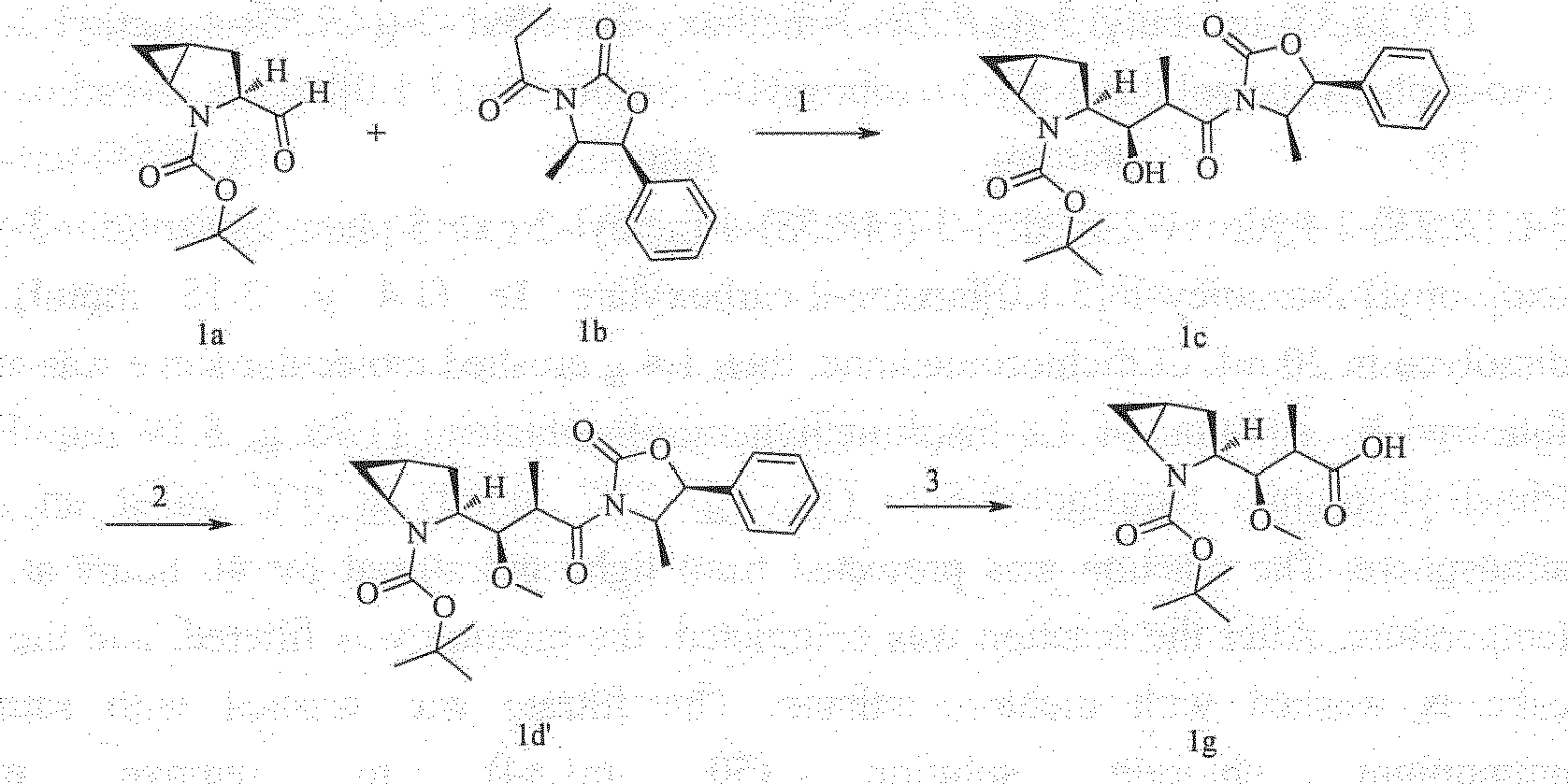
- The starting material (4R,5S)-4-methyl-5-phenyl-3-propionyloxazolidin-2-one 1b (1.96 g, 9.26 mmol, prepared by a method disclosed in "Journal of the American Chemical Society, 2003, 125(50), 15512-15520") was dissolved in 25 mL of dichloromethane, then the mixture was cooled to 0°C under an argon atmosphere. Triethylamine (1.49 mL, 10.93 mmol) and then dibutylboron trifluoromethanesulfonate (9.7 mL, 9.72 mmol) were added dropwise into the reaction solution at 0°C, and stirred for 50 minutes at 0°C. The reaction solution was cooled to -75°C in a dry ice-acetone bath, followed by addition of a solution of (1S,3S,5S)-tert-butyl 3-formyl-2-azabicyclo[3.1.0]hexane-2-carboxylate 1a (2.16 g, 9.26 mmol, prepared by a method disclosed in the patent application "
US20100249190 ") in 7 mL of dichloromethane. The mixture was stirred for 1.5 hours at -75°C, stirred for 2 hours at 0°C, and stirred for 1 hour at room temperature. After the reaction was completed, 36 mL of a mixed solution of phosphate buffer (pH=7.0) and methanol (V/V=1:3) was added, followed by addition of 36 mL of a mixed solution of methanol and hydrogen peroxide (30%) (V/V=2:1), and stirred for 1 hour at room temperature. The organic phase was removed by concentration under reduced pressure, then a small amount of water was added. The mixture was extracted with diethyl ether (50 mL×3), washed with 5% sodium bicarbonate solution and saturated sodium chloride solution (150 mL) successively, dried over anhydrous sodium sulfate, and filtered. The filtrate was concentrated under reduced pressure, and the residue was purified by silica gel column chromatography with elution system B to obtain the title product (1S,3S,5S)-tert-butyl 3-((1R,2R)-1-hydroxy-2-methyl-3-((4R,5S)-4-methyl-2-oxo-5-phenyloxazolidin-3-yl)-3-oxopropyl)-2-azabicyclo[3.1.0]hexane-2-carboxylate 1c (2.4 g, white foamy solid) in a yield of 58.5%.
MS m/z (ESI): 345.1 [M-100+1] - The starting material (1S,3S,5S)-tert-butyl 3-((1R,2R)-1-hydroxy-2-methyl-3-((4R,5S)-4-methyl-2-oxo-5-phenyloxazolidin-3-yl)-3-oxopropyl)-2-azabicyclo[3.1.0]hexane-2-carboxylate 1c (1.4 g, 3.15 mmol) was dissolved in 20 mL of dichloromethane, then 1.4 g crushed molecular sieve was added, followed by addition of 1,8-bis(dimethylamino)naphtalene (1.75 g, 8.19 mmol) and trimethyloxonium tetrafluoroborate (1.16 g, 7.87 mmol) at 0°C under an argon atmosphere. The reaction was protected from light and stirred for 40 hours at room temperature. After the reaction was completed, the mixture was filtered, and the filter cake is washed with dichloromethane. The filtrate was washed with saturated ammonium chloride solution (50 mL×4) to remove excess 1,8-bis(dimethylamino)naphtalene, and then washed with saturated sodium chloride solution (120 mL), dried over anhydrous sodium sulfate, and filtered. The filtrate was concentrated under reduced pressure, and the resulting residue was purified by silica gel column chromatography with elution system B to obtain the title product (1S,3S,5S)-tert-butyl 3-((1R,2R)-1-methoxy-2-methyl-3-((4R,5S)-4-methyl-2-oxo-5-phenyloxazolidin-3-yl)-3 -oxopropyl)-2-azabicyclo[3.1.0]hexane-2-carboxylate 1d' (400 mg, white solid) in a yield of 27.8%.
MS m/z (ESI): 459.4 [M+1] - The starting material (1S,3S,5S)-tert-butyl 3-((1R,2R)-1-methoxy-2-methyl-3-((4R,5S)-4-methyl-2-oxo-5-phenyloxazolidin-3-yl)-3 -oxopropyl)-2-azabicyclo[3.1.0]hexane-2-carboxylate 1d' (400 mg, 0.87 mmol) was dissolved in 24 mL of tetrahydrofuran and cooled to 0°C under an argon atmosphere. 30% hydrogen peroxide (0.34 mL/0.38 g, 3.31 mmol) was added dropwise and slowly, followed by addition of lithium hydroxide monohydrate (62 mg, 1.48 mmol). The reaction system was stirred for 20 hours at room temperature. After the reaction was completed, sodium sulfite solid (440 mg, 3.48 mmol) was added to the reaction solution and stirred for 1 hour at room temperature. 10 mL of water was added, and the organic phase was removed by concentration under reduced pressure. The resulting residue was extracted with dichloromethane (40 mL×2). The aqueous phase was added with 2N hydrogen chloride until the pH of the reaction solution is 3-4. The mixture was extracted with ethyl acetate (25 mL×3). The ethyl acetate phase was washed with water (50 mL) and saturated sodium chloride solution (50 mL) successively, dried over anhydrous sodium sulfate and filtered. The filtrate was concentrated under reduced pressure to obtain the title product (2R,3R)-3-((1S,3S,5S)-2-(tert-butoxycarbonyl)-2-azabicyclo[3.1.0]hexan-3-yl)-3-metho xy-2-methylpropanoic acid 1g (230 mg, colorless liquid) in a yield of 88.0%.
MS m/z (ESI): 200.1 [M-100+1] - The yields of intermediate 1g prepared by the two methods are compared and shown in the following table:
Yield of step 1 Yield of step 2 Yield of step 3 Yield of step 4 Yield of step 5 Total yield Synthesis method of WO2016/127790 58.5% 27.8% 88.0% 14.3% Synthesis method of the present inventation 72.3% 92% 84.2% 87.2% 100% 48.8% - It can be seen from the above table that:
The method of the present invention firstly protects the carboxyl and then adds methyl. Although the synthesis route is longer than that of the prior art, the total yield is greatly increased by about 3 times. The method of this the present invention has characteristics suitable for industrial production and so on, and has significant social and economic benefits. - Since the present invention has been discribed in accordance with its specific embodiments, some modifications and equivalents are apparent to the person skilled in the art and are included in the scope of the present invention.
Claims (15)
- A compound of formula (III),
 A is a 3 to 8 membered ring, preferably a 3 membered ring;R1 is hydrogen or an amino protecting group, preferably Boc, Fmoc, Alloc, Troc, Teoc, CBz, Tosyl, Nosyl and t-Bu; andR2 is hydrogen or a carboxyl protecting group, preferably DMB, Bn, Allyl, PfP, Me, PMB, MEM and t-Bu.
 - A process for preparing the compound of formula (III) according to claim 1, characterized in that a chiral compound of formula (II) comprising a chiral auxiliary group (R3) is hydrolyzed under an alkaline condition or optionally followed by addition of a carboxyl protecting group to obtain the compound of formula (III),
 the chiral auxiliary group (R3) is selected from the group consisting of:

 X is sulfur or oxygen;the alkaline reagent is preferably sodium hydroxide, potassium hydroxide, sodium hydride, sodium carbonate, sodium bicarbonate, potassium carbonate, potassium bicarbonate, cesium carbonate or lithium hydroxide, and more preferably lithium hydroxide; andR1 to R2 are as defined in claim 1.
 - A compound of formula (IV),
 A is a 3 to 8 membered ring, preferably a 3 membered ring;R1 is hydrogen or an amino protecting group, preferably Boc, Fmoc, Alloc, Troc, Teoc, CBz, Tosyl, Nosyl and t-Bu;R2 is a carboxyl protecting group, preferably DMB, Bn, Allyl, PfP, Me, PMB, MEM and t-Bu; andRx is selected from the group consisting of alkyl and cycloalkyl, wherein the alkyl and cycloalkyl are each independently and optionally substituted by one or more groups selected from the group consisting of alkyl, haloalkyl, halogen, hydroxy, amino, nitro, cyano, alkoxy, hydroxyalkyl, cycloalkyl, heterocyclyl, aryl and heteroaryl; preferably Rx is methyl.
 - A process for preparing the compound of formula (IV) according to claim 3, characterized in that a compound of formula (III) is reacted with an alkylating agent to obtain the compound of formula (IV),
 the alkylating agent is selected from the group consisting of alkyl halide, dimethyl sulfate, dimethyl carbonate, sulfonate, trimethyl phosphate and Me3 +BF4 -; preferably methyl iodide and Me3 +BF4 -; andA, R1, R2 and Rx are as defined in claim 3.
 - A process for preparing a compound of formula (V) using the compound of formula (IV) according to claims 3, characterized in that, the carboxyl protecting group on the compound of formula (IV) is removed to obtain the compound of formula (V),

A, R1, R2 and Rx are as defined in claim 3. - The process for preparing the compound of formula (V) according to claim 5, characterized by further comprising a step of preparing the compound of formula (IV) from a compound of formula (III),

A, R1, R2 and Rx are as defined in claim 3. - The process for preparing the compound of formula (V) according to claim 5, characterized by further comprising a step of preparing a compound of formula (III) from a compound of formula (II),

A, R1, R2 and Rx are as defined in claim 3. - A process for preparing a compound of formula (I),

 A is a 3 to 8 membered ring, preferably a 3 membered ring;R is halogen, preferably fluorine, chlorine, bromine or iodine, and most preferably fluorine;R1 is an amino protecting group, preferably Boc, Fmoc, Alloc, Troc, Teoc, CBz, Tosyl, Nosyl and t-Bu;R2 is a carboxyl protecting group, preferably DMB, Bn, Allyl, PfP, Me, PMB, MEM and t-Bu;Rx is selected from the group consisting of alkyl and cycloalkyl, wherein the alkyl and cycloalkyl are each independently and optionally substituted by one or more groups selected from the group consisting of alkyl, haloalkyl, halogen, hydroxy, amino, nitro, cyano, alkoxy, hydroxyalkyl, cycloalkyl, heterocyclyl, aryl and heteroaryl; preferably Rx is methyl; andn is 1, 2, 3, 4 or 5.
 - The process for preparing the compound of formula (I) according to claim 8, characterized by further comprising a step of removing the amino protecting group on the compound of formula (V) to obtain a compound of formula (VI),

A, R1 and Rx are as defined in claim 8. - The process for preparing the compound of formula (I) according to claim 8 or 9, characterized by further comprising a step of adding a protecting group of Fmoc to the compound of formula (VI) to obtain a compound of formula (VIII),

A and Rx are as defined in claim 8. - The process for preparing the compound of formula (I) according to any one of claims 8 to 10, characterized by further comprising the following steps of: adding a carboxyl protecting group to a compound of formula (IX) to obtain a compound of formula (X), and removing the Fmoc on the compound of formula (X) to obtain a compound of formula (XI),
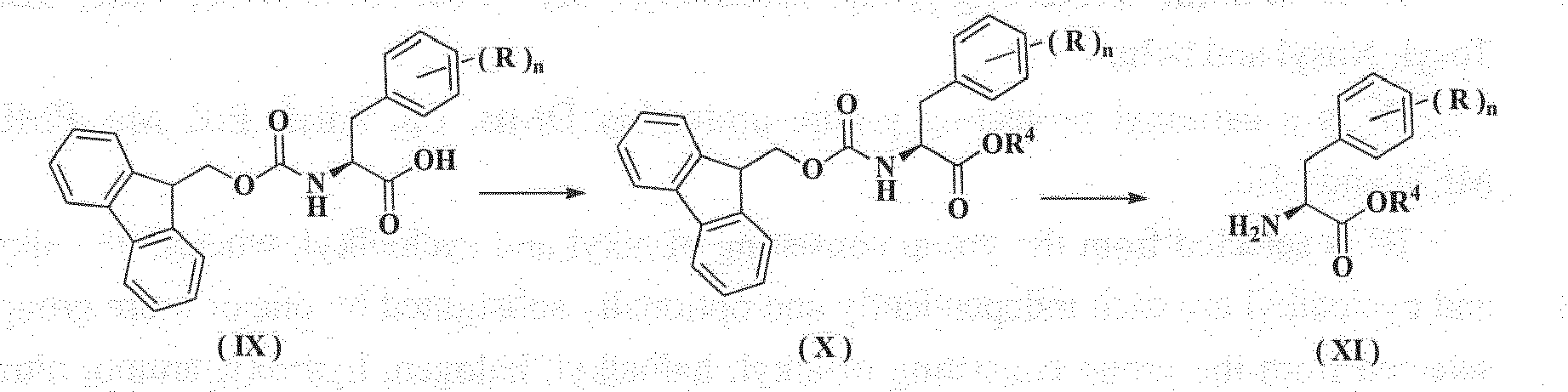 R4 is a carboxyl protecting group, preferably DMB; andR and n are as defined in claim 8.
 - The process for preparing the compound of formula (I) according to any one of claims 8 to 11, characterized by further comprising the following steps of: amidating the compound of formula (VIII) with the compound of formula (XI) in the presence of a condensing agent to obtain a compound of formula (XII),
 the condensing agent is preferably 1-(3-dimethylaminopropyl)-3-ethylcarbodiimide hydrochloride, N,N'-dicyclohexylcarbodiimide, N,N'-diisopropylcarbodiimide, O-benzotriazole-N,N,N',N'-tetramethyluronium tetrafluoroborate, 1-hydroxybenzotriazole, 1-hydroxy-7-azabenzotriazole, O-benzotriazole-N,N,N',N'-tetramethyluronium hexafluorophosphate, 2-(7-azabenzotriazol)-N,N,N',N'-tetramethyluronium hexafluorophosphate, benzotriazol-1-yloxytris(dimethylamino)-phosphonium hexafluorophosphate or benzotriazole-1-yl-oxytripyrrolidino-phosphonium hexafluorophosphate, and more preferably 2-(7-azabenzotriazol)-N,N,N',N'-tetramethyluronium hexafluorophosphate; andA, R, R4, Rx and n are as defined in claim 8.
 - The process for preparing the compound of formula (I) according to any one of claims 8 to 12, characterized by further comprising the following steps of:
 1) removing the protecting group of Fmoc on a compound of formula (XII) under an alkaline condition to obtain a compound of formula (I-E);2) amidating the compound of formula (I-E) with a compound of formula (I-D) in the presence of a condensing agent to obtain a chiral intermediate of formula (I-C);3) removing the protecting group of Fmoc on the compound of formula (I-C) under an alkaline condition to obtain a chiral compound of formula (I-B);4) amidating the compound of formula (I-B) with 6-maleimidocaproic acid in the presence of a condensing agent to obtain a compound of formula (I-A);5) removing the carboxyl protecting group on compound of formula (I-A) under an acidic condition to obtain the target compound of formula (I);wherein:R4 is a carboxyl protecting group, preferably DMB;the reagent that provides an alkaline condition in step 1) or step 3) includes an organic base and inorganic base, wherein the organic base is preferably triethylamine, diethylamine, N,N-diisopropylethylamine, pyridine, sodium bis(trimethylsilyl)amide, n-butyllithium, potassium tert-butoxide or tetrabutylammonium bromide, and the inorganic base is preferably lithium hydroxide, sodium hydroxide, potassium hydroxide, sodium hydride, sodium carbonate, sodium bicarbonate, potassium carbonate, potassium bicarbonate or cesium carbonate, and more preferably diethylamine;the condensing agent in step 2) or step 4) is preferably 1-(3-dimethylaminopropyl)-3 -ethylcarbodiimide hydrochloride, N,N'-dicyclohexylcarbodiimide, N,N' -diisopropylcarbodiimide, O-benzotriazole-N,N,N',N'-tetramethyluronium tetrafluoroborate, 1-hydroxybenzotriazole, 1-hydroxy-7-azabenzotriazole, O-benzotriazole-N,N,N',N'-tetramethyluronium hexafluorophosphate, 2-(7-azabenzotriazol)-N,N,N',N'-tetramethyluronium hexafluorophosphate, benzotriazol-1-yloxytris(dimethylamino)-phosphonium hexafluorophosphate or benzotriazole-1-yl-oxytripyrrolidino-phosphonium hexafluorophosphate, and more preferably 2-(7-azabenzotriazol)-N,N,N',N'-tetramethyluronium hexafluorophosphate;the reagent that provides an acidic condition in step 5) is preferably hydrogen chloride solution, hydrochloric acid, nitric acid, phosphoric acid, p-toluenesulfonic acid, Me3SiCl, TMSOTf, trifluoroacetic acid or sulfuric acid, and more preferably trifluoroacetic acid; andA, R, Rx and n are as defined in claim 8.
 - The process for preparing the compound of formula (I) according to claim 8, characterized by further comprising a step of amidating the compound of formula (V) with a compound of formula (XI) in the presence of a condensing agent to obtain a compound of formula (VII),
 the condensing agent is preferably 1-(3-dimethylaminopropyl)-3-ethylcarbodiimide hydrochloride, N,N'-dicyclohexylcarbodiimide, N,N' -diisopropylcarbodiimide, O-benzotriazole-N,N,N',N'-tetramethyluronium tetrafluoroborate, 1 -hydroxybenzotriazole, 1-hydroxy-7-azabenzotriazole, O-benzotriazole-N,N,N',N'-tetramethyluronium hexafluorophosphate, 2-(7-azabenzotriazol)-N,N,N' ,N' -tetramethyluronium hexafluorophosphate, benzotriazol-1-yloxytris(dimethylamino)-phosphonium hexafluorophosphate or benzotriazole-1-yl-oxytripyrrolidino-phosphonium hexafluorophosphate, and more preferably 2-(7-azabenzotriazol)-N,N,N',N'-tetramethyluronium hexafluorophosphate; andA, R, R1, R4, RX and n are as defined in claim 8.
 - The process for preparing the compound of formula (I) according to any one of claim 8 or 14, characterized by further comprising the following steps of:
 1) amidating the compound of formula (V) with a compound of formula (XI) in the presence of a condensing agent to obtain a compound of formula (VII);2) removing the amino protecting group on the compound of formula (VII) under an alkaline condition to obtain a compound of formula (I-E);3) amidating the compound of formula (I-E) with a compound of formula (I-D) in the presence of a condensing agent to obtain a chiral intermediate of formula (I-C);4) removing the protecting group of Fmoc on the compound of formula (I-C) under an alkaline condition to obtain a chiral compound of formula (I-B);5) amidating the compound of formula (I-B) with 6-maleimidocaproic acid in the presence of a condensing agent to obtain a compound of formula (I-A);6) removing the carboxyl protecting group on the compound of formula (I-A) under an acidic condition to obtain the target compound of formula (I);wherein:the condensing agent in step 1), step 3), or step 5) is preferably 1-(3-dimethylaminopropyl)-3-ethylcarbodiimide hydrochloride, N,N'-dicyclohexylcarbodiimide, N,N'-diisopropylcarbodiimide, O-benzotriazole-N,N,N',N'-tetramethyluronium tetrafluoroborate, 1-hydroxybenzotriazole, 1-hydroxy-7-azabenzotriazole, O-benzotriazole-N,N,N',N'-tetramethyluronium hexafluorophosphate, 2-(7-azabenzotriazol)-N,N,N',N'-tetramethyluronium hexafluorophosphate, benzotriazol-1-yloxytris(dimethylamino)-phosphonium hexafluorophosphate or benzotriazole-1-yl-oxytripyrrolidino-phosphonium hexafluorophosphate, and more preferably 2-(7-azabenzotriazol)-N,N,N',N'-tetramethyluronium hexafluorophosphate;the reagent that provides an alkaline condition in step 2) or step 4) includes an organic base and inorganic base, wherein the organic base is preferably, triethylamine, diethylamine, N,N-diisopropylethylamine, pyridine, sodium bis(trimethylsilyl)amide, n-butyllithium, potassium tert-butoxide or tetrabutylammonium bromide, and the inorganic base is preferably lithium hydroxide, sodium hydroxide, potassium hydroxide, sodium hydride, sodium carbonate, sodium bicarbonate, potassium carbonate, potassium bicarbonate or cesium carbonate, and more preferably diethylamine;the reagent that provides an acidic condition in step 6) is preferably hydrogen chloride solution, hydrochloric acid, nitric acid, phosphoric acid, p-toluenesulfonic acid, Me3SiCl, TMSOTf, trifluoroacetic acid or sulfuric acid, and more preferably trifluoroacetic acid;R4 is a carboxyl protecting group, preferably DMB; andA, R, R1, RX and n are as defined in claim 8.
Applications Claiming Priority (2)
| Application Number | Priority Date | Filing Date | Title |
|---|---|---|---|
| CN201610107901 | 2016-02-26 | ||
| PCT/CN2017/074756 WO2017144015A1 (en) | 2016-02-26 | 2017-02-24 | New toxin and method for preparing intermediate thereof |
Publications (2)
| Publication Number | Publication Date |
|---|---|
| EP3421463A1 true EP3421463A1 (en) | 2019-01-02 |
| EP3421463A4 EP3421463A4 (en) | 2019-10-23 |
Family
ID=59685835
Family Applications (1)
| Application Number | Title | Priority Date | Filing Date |
|---|---|---|---|
| EP17755844.2A Withdrawn EP3421463A4 (en) | 2016-02-26 | 2017-02-24 | New toxin and method for preparing intermediate thereof |
Country Status (13)
| Country | Link |
|---|---|
| US (1) | US10513510B2 (en) |
| EP (1) | EP3421463A4 (en) |
| JP (1) | JP2019510000A (en) |
| KR (1) | KR20180115743A (en) |
| CN (1) | CN107531680B (en) |
| AU (1) | AU2017223532A1 (en) |
| BR (1) | BR112018016983A2 (en) |
| CA (1) | CA3015098A1 (en) |
| HK (1) | HK1244805A1 (en) |
| MX (1) | MX2018010128A (en) |
| RU (1) | RU2018132749A (en) |
| TW (1) | TWI732826B (en) |
| WO (1) | WO2017144015A1 (en) |
Families Citing this family (3)
| Publication number | Priority date | Publication date | Assignee | Title |
|---|---|---|---|---|
| CN109963835B (en) * | 2017-09-04 | 2022-10-21 | 江苏恒瑞医药股份有限公司 | Preparation method of neotoxin and intermediate thereof |
| CN112390853A (en) * | 2019-08-11 | 2021-02-23 | 复旦大学 | Dolastatin 10 analogue and preparation method thereof |
| TWI888610B (en) | 2020-07-27 | 2025-07-01 | 大陸商上海拓界生物醫藥科技有限公司 | Anti-cd79b antibody-drug conjugate, preparation method and pharmaceutical use thereof |
Family Cites Families (12)
| Publication number | Priority date | Publication date | Assignee | Title |
|---|---|---|---|---|
| FR2861170B1 (en) | 2003-10-16 | 2006-01-20 | Tijani Gharbi | OPTICAL DEVICE FOR DETERMINING AT LEAST ONE DIMENSIONAL CHARACTERISTIC OF A LIQUID DROP |
| EP2478912B1 (en) * | 2003-11-06 | 2016-08-31 | Seattle Genetics, Inc. | Auristatin conjugates with anti-HER2 or anti-CD22 antibodies and their use in therapy |
| DK1791565T3 (en) * | 2004-09-23 | 2016-08-01 | Genentech Inc | Cysteingensplejsede antibodies and conjugates |
| TW200833328A (en) * | 2006-12-28 | 2008-08-16 | Actelion Pharmaceuticals Ltd | 2-aza-bicyclo[3.1.0]hexane derivatives |
| TWI476190B (en) * | 2009-03-30 | 2015-03-11 | 必治妥美雅史谷比公司 | Hepatitis c virus inhibitors |
| BR112013027119A8 (en) | 2011-04-21 | 2018-03-06 | Seattle Genetics Inc | new ligand-drug conjugates (adcs) and their use |
| CN104185477B (en) | 2011-11-17 | 2017-05-24 | 辉瑞公司 | Cytotoxic peptides and their antibody-drug conjugates |
| SG11201403085PA (en) * | 2011-12-14 | 2014-10-30 | Seattle Genetics Inc | Fgfr antibody drug conjugates (adcs) and the use thereof |
| FR3005051A1 (en) * | 2013-04-25 | 2014-10-31 | Pf Medicament | DERIVATIVES OF DOLASTATIN 10 AND AURISTATINES |
| HUE047952T2 (en) * | 2014-04-25 | 2020-05-28 | Pf Medicament | Antibody-drug-conjugate and its use for the treatment of cancer |
| WO2016127790A1 (en) | 2015-02-15 | 2016-08-18 | 江苏恒瑞医药股份有限公司 | Ligand-cytotoxicity drug conjugate, preparing method therefor, and application thereof |
| CN106188293A (en) * | 2015-04-17 | 2016-12-07 | 江苏恒瑞医药股份有限公司 | Anti-C-met antibodies and anti-C-met antibodies-cytotoxic drug conjugate and medical usage thereof |
-
2017
- 2017-02-24 CA CA3015098A patent/CA3015098A1/en not_active Abandoned
- 2017-02-24 AU AU2017223532A patent/AU2017223532A1/en not_active Abandoned
- 2017-02-24 EP EP17755844.2A patent/EP3421463A4/en not_active Withdrawn
- 2017-02-24 US US16/078,396 patent/US10513510B2/en not_active Expired - Fee Related
- 2017-02-24 RU RU2018132749A patent/RU2018132749A/en not_active Application Discontinuation
- 2017-02-24 MX MX2018010128A patent/MX2018010128A/en unknown
- 2017-02-24 WO PCT/CN2017/074756 patent/WO2017144015A1/en not_active Ceased
- 2017-02-24 KR KR1020187026912A patent/KR20180115743A/en not_active Withdrawn
- 2017-02-24 JP JP2018544080A patent/JP2019510000A/en active Pending
- 2017-02-24 BR BR112018016983-8A patent/BR112018016983A2/en not_active IP Right Cessation
- 2017-02-24 CN CN201780001254.7A patent/CN107531680B/en active Active
- 2017-02-24 TW TW106106404A patent/TWI732826B/en not_active IP Right Cessation
- 2017-02-24 HK HK18104330.1A patent/HK1244805A1/en unknown
Also Published As
| Publication number | Publication date |
|---|---|
| CN107531680B (en) | 2020-09-11 |
| TWI732826B (en) | 2021-07-11 |
| CN107531680A (en) | 2018-01-02 |
| BR112018016983A2 (en) | 2018-12-26 |
| AU2017223532A1 (en) | 2018-08-30 |
| KR20180115743A (en) | 2018-10-23 |
| US10513510B2 (en) | 2019-12-24 |
| US20190055223A1 (en) | 2019-02-21 |
| RU2018132749A3 (en) | 2020-04-14 |
| CA3015098A1 (en) | 2017-08-31 |
| WO2017144015A1 (en) | 2017-08-31 |
| MX2018010128A (en) | 2019-01-21 |
| JP2019510000A (en) | 2019-04-11 |
| EP3421463A4 (en) | 2019-10-23 |
| TW201730185A (en) | 2017-09-01 |
| RU2018132749A (en) | 2020-03-26 |
| HK1244805A1 (en) | 2018-08-17 |
Similar Documents
| Publication | Publication Date | Title |
|---|---|---|
| CN110831936B (en) | Substituted cyanopyrrolidines with DUB inhibitor activity | |
| CA3130253C (en) | Cd73 inhibitor, preparation method therefor and application thereof | |
| BR112019023918A2 (en) | KINASE INHIBITORS AND USES OF THE SAME | |
| WO2013178570A1 (en) | Substituted pyrrolidine-2-carboxamides | |
| CN109111385B (en) | 5-HT2A receptor inhibitor and its preparation method and application | |
| AU2020405536B2 (en) | Benzimidazole derivatives | |
| KR20140054288A (en) | Inhibitors of NEDD8-Activating Enzymes | |
| DE69418978T2 (en) | Synthesis of bisindolylmaleimides | |
| EP4605391A1 (en) | 4,5,6,7-tetrahydro-1-pyrazolo[4,3-c]pyridine compounds and derivatives as usp1 inhibitors | |
| EP3421463A1 (en) | New toxin and method for preparing intermediate thereof | |
| WO2023086498A1 (en) | Protein tyrosine phosphatase inhibitors and methods of use thereof | |
| JPWO2016121777A1 (en) | Method for producing pyrazinecarboxamide compound and synthetic intermediate thereof | |
| EP4282868B1 (en) | Substituted pyrazolo[1,5-a]pyrimidine-7-amine derivative, and compositions and medical use thereof | |
| CN119775277A (en) | Compounds as modulators of LRRK2, NUAK1 and/or TYK2 kinases for the treatment of, for example, autoimmune diseases | |
| CN116322692A (en) | Autotaxin inhibitor compounds | |
| Govdi et al. | 1, 3-Cycloaddition synthesis of 1, 2, 3-triazole conjugates of betulonic acid with peptides | |
| WO2021207210A1 (en) | Methods for synthesis of chk1 inhibitors | |
| RU2803284C1 (en) | Benzimidazole derivatives | |
| JP4491104B2 (en) | Method for producing carbonyl compound | |
| WO2023187670A1 (en) | Diazabicyclooctane derivatives useful as matrix metalloproteinase inhibitors | |
| WO2025052649A1 (en) | Method for selective production of single axially chiral compound | |
| Oxford et al. | Furanylidene systems from a tosylic acid-mediated, tandem desilylation-cyclization reaction of silyl ethers of monoalkynylated β-keto carbonyls | |
| KR20160008873A (en) | Novel beta-sulfinamino malonate derivatives and process for preparing the same, and process for preparing sitagliptin using the same | |
| HK40009383A (en) | Novel toxin and method for preparing intermediate thereof | |
| Noheda Marín et al. | Synthesis of ttx intermediates |
Legal Events
| Date | Code | Title | Description |
|---|---|---|---|
| STAA | Information on the status of an ep patent application or granted ep patent |
Free format text: STATUS: THE INTERNATIONAL PUBLICATION HAS BEEN MADE |
|
| PUAI | Public reference made under article 153(3) epc to a published international application that has entered the european phase |
Free format text: ORIGINAL CODE: 0009012 |
|
| STAA | Information on the status of an ep patent application or granted ep patent |
Free format text: STATUS: REQUEST FOR EXAMINATION WAS MADE |
|
| 17P | Request for examination filed |
Effective date: 20180918 |
|
| AK | Designated contracting states |
Kind code of ref document: A1 Designated state(s): AL AT BE BG CH CY CZ DE DK EE ES FI FR GB GR HR HU IE IS IT LI LT LU LV MC MK MT NL NO PL PT RO RS SE SI SK SM TR |
|
| AX | Request for extension of the european patent |
Extension state: BA ME |
|
| DAV | Request for validation of the european patent (deleted) | ||
| DAX | Request for extension of the european patent (deleted) | ||
| A4 | Supplementary search report drawn up and despatched |
Effective date: 20190920 |
|
| RIC1 | Information provided on ipc code assigned before grant |
Ipc: C07D 209/94 20060101AFI20190914BHEP Ipc: C07D 403/12 20060101ALI20190914BHEP |
|
| GRAP | Despatch of communication of intention to grant a patent |
Free format text: ORIGINAL CODE: EPIDOSNIGR1 |
|
| STAA | Information on the status of an ep patent application or granted ep patent |
Free format text: STATUS: GRANT OF PATENT IS INTENDED |
|
| INTG | Intention to grant announced |
Effective date: 20200515 |
|
| STAA | Information on the status of an ep patent application or granted ep patent |
Free format text: STATUS: THE APPLICATION IS DEEMED TO BE WITHDRAWN |
|
| 18D | Application deemed to be withdrawn |
Effective date: 20200926 |