EP3419983B1 - Process for the preparation of sofosbuvir - Google Patents
Process for the preparation of sofosbuvir Download PDFInfo
- Publication number
- EP3419983B1 EP3419983B1 EP17705157.0A EP17705157A EP3419983B1 EP 3419983 B1 EP3419983 B1 EP 3419983B1 EP 17705157 A EP17705157 A EP 17705157A EP 3419983 B1 EP3419983 B1 EP 3419983B1
- Authority
- EP
- European Patent Office
- Prior art keywords
- formula
- process according
- compound
- reaction
- butanol
- Prior art date
- Legal status (The legal status is an assumption and is not a legal conclusion. Google has not performed a legal analysis and makes no representation as to the accuracy of the status listed.)
- Active
Links
Classifications
-
- C—CHEMISTRY; METALLURGY
- C07—ORGANIC CHEMISTRY
- C07H—SUGARS; DERIVATIVES THEREOF; NUCLEOSIDES; NUCLEOTIDES; NUCLEIC ACIDS
- C07H19/00—Compounds containing a hetero ring sharing one ring hetero atom with a saccharide radical; Nucleosides; Mononucleotides; Anhydro-derivatives thereof
- C07H19/02—Compounds containing a hetero ring sharing one ring hetero atom with a saccharide radical; Nucleosides; Mononucleotides; Anhydro-derivatives thereof sharing nitrogen
- C07H19/04—Heterocyclic radicals containing only nitrogen atoms as ring hetero atom
- C07H19/06—Pyrimidine radicals
- C07H19/10—Pyrimidine radicals with the saccharide radical esterified by phosphoric or polyphosphoric acids
-
- C—CHEMISTRY; METALLURGY
- C07—ORGANIC CHEMISTRY
- C07H—SUGARS; DERIVATIVES THEREOF; NUCLEOSIDES; NUCLEOTIDES; NUCLEIC ACIDS
- C07H1/00—Processes for the preparation of sugar derivatives
-
- C—CHEMISTRY; METALLURGY
- C12—BIOCHEMISTRY; BEER; SPIRITS; WINE; VINEGAR; MICROBIOLOGY; ENZYMOLOGY; MUTATION OR GENETIC ENGINEERING
- C12P—FERMENTATION OR ENZYME-USING PROCESSES TO SYNTHESISE A DESIRED CHEMICAL COMPOUND OR COMPOSITION OR TO SEPARATE OPTICAL ISOMERS FROM A RACEMIC MIXTURE
- C12P19/00—Preparation of compounds containing saccharide radicals
- C12P19/26—Preparation of nitrogen-containing carbohydrates
- C12P19/28—N-glycosides
- C12P19/30—Nucleotides
- C12P19/305—Pyrimidine nucleotides
Definitions
- the present invention relates to a process for the synthesis of Sofosbuvir.
- Sofosbuvir is a prodrug used for the treatment of hepatitis C.
- Hepatitis C is an infectious disease caused by the Hepatitis C virus (HCV), which primarily affects the liver.
- HCV Hepatitis C virus
- the infection is often asymptomatic, but its chronicity can lead to scarring of the liver and, finally, to cirrhosis, which generally becomes evident several years later.
- hepatic cirrhosis may lead to develop liver failure, liver cancer, esophageal and gastric varices.
- HCV is spread primarily through direct contact with infected blood, often associated with intravenous drugs use, poorly sterilized medical equipments, and blood transfusions.
- Hepatitis C virus leads to a chronic infection in 50-80% of HCV-positive people, 40-80% of which are treated.
- the pharmacological treatment is recommended in patients with hepatic alterations caused by the virus; the reference treatment is a combination of pegylated interferon alfa and ribavirin, to be taken for a period of 24 or 48 weeks, depending on the HCV virus genotype.
- Sofosbuvir is an EMA and FDA approved drug for the treatment of hepatitis C, it is taken orally and it acts with a mechanism of action directed to the virus life cycle by disrupting its replication, since, being a pan-genotypic inhibitor of HCV RNA-dependent RNA polymerase NS5B prodrug, it can be folded into the HCV RNA of the polymerase NS5B and it can act as a chain terminator. Sofosbuvir has also shown a reduced number of liver disease complications and a reduced number of side effects, compared with patients treated with other treatments.
- Sofosbuvir is a compound of formula (I) chemically known as isopropyl (2S)-2-[[[(2R,3R,4R,5R)-5-(2,4-dioxopyrimidin-1-yl)-4-fluoro-3-hydroxy-4-methyl-tetrahydrofuran-2-yl]methoxy-phenoxy-phosphoryl]amino]propanoate, marketed as Sovaldi ® and disclosed in US 7,964,580 .
- WO2015/017713 relates to a process for preparing Sofosbuvir, but it does not foresee the use of the intermediate of formula ( IV ) according to the present invention in the preparation of Sofosbuvir.
- WO2015/123352 implicitly discloses the intermediate of formula ( IV ) used in the process of the present invention, but it gives no hint to use this intermediate for the synthesis of derivatives of Sofosbuvir unprotected at the 3' position.
- the inventors of the present invention have now found a new process for the synthesis of Sofosbuvir of formula ( I ), which overcomes all the drawbacks of the processes known in the art.
- the process of the present invention proves to be surprisingly advantageous since it is selective and, in particular, during said process no reaction by-products are formed such as Sofosbuvir 3' isomer and/or the di-substituted compound in 3' and 5' position. Therefore the process of the present invention allows for easily purifying and obtaining Sofosbuvir of formula (I) in high yield and purity.
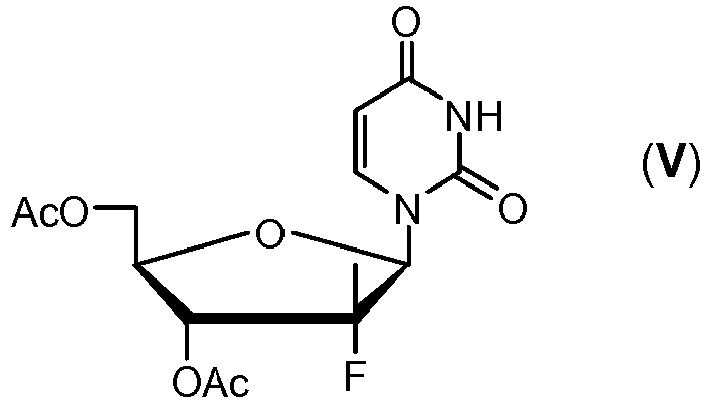
- an object of the present invention is a process for the synthesis of Sofosbuvir of formula ( I ) comprising the selective mono-deacetylation reaction of a compound of formula ( V ) to obtain a compound of formula ( IV )
- the selective mono-deacetylation reaction of the process object of the present invention can be carried out enzymatically using a resin supported lipase, preferably deriving from Candida Antarctica, more preferably lipase B deriving from Candida Antarctica (such as for example CALB) in a polar protic solvent at a temperature from about 40°C to about 70°C, preferably at a temperature of about 60°C.
- a resin supported lipase preferably deriving from Candida Antarctica, more preferably lipase B deriving from Candida Antarctica (such as for example CALB) in a polar protic solvent at a temperature from about 40°C to about 70°C, preferably at a temperature of about 60°C.
- the polar protic solvent is typically an alkanol, preferably a straight or branched C 1 -C 6 alkanol selected among methanol, ethanol, isopropanol and n-butanol or a substituted alkanol selected among methoxyethanol, methoxypropanol, methoxybutanol, preferably methoxypropanol and mixtures of said solvents with water.
- alkanol preferably a straight or branched C 1 -C 6 alkanol selected among methanol, ethanol, isopropanol and n-butanol or a substituted alkanol selected among methoxyethanol, methoxypropanol, methoxybutanol, preferably methoxypropanol and mixtures of said solvents with water.
- the polar protic solvent is isopropanol, methoxypropanol or a mixture of ethanol and water.
- the compound of formula ( IV ), thus obtained, can be converted to a compound of formula ( II ) by reaction of said compound of formula ( IV ) with a compound of formula ( III ) wherein F 5 indicates that the aromatic ring is pentafluoro substituted.
- the reaction of a compound of formula ( IV ) with a compound of formula ( III ) can be carried out in the presence of a base selected among 1,5-diazabicyclo[5.4.0]undec-5-ene (DBU), 1,5,7-triazabicyclo[4.4.0]dec-5-ene (TBD), 1,4-diazabicyclo[2.2.2]octane (DABCO), preferably the base is 1,5-diazabicyclo[5.4.0]undec-5-ene (DBU).
- DBU 1,5-diazabicyclo[5.4.0]undec-5-ene
- TBD 1,5,7-triazabicyclo[4.4.0]dec-5-ene
- DABCO 1,4-diazabicyclo[2.2.2]octane
- DBU 1,5-diazabicyclo[5.4.0]undec-5-ene
- reaction of the compound of formula ( IV ) with a compound of formula ( III ) can be carried out in the presence of an aprotic solvent, preferably selected among dichloromethane, acetonitrile, tetrahydrofuran, acetone, dimethyl sulfoxide, more preferably tetrahydrofuran.
- an aprotic solvent preferably selected among dichloromethane, acetonitrile, tetrahydrofuran, acetone, dimethyl sulfoxide, more preferably tetrahydrofuran.
- Said reaction can be carried out at a temperature from about -40°C to about 40°C, preferably from about -10°C to about 10°C, more preferably at a temperature of about 0°C.
- the resultant compound of formula ( II ) can be then converted to Sofosbuvir of formula ( I ) by deacetylation reaction.
- the deacetylation reaction of a compound of formula ( II ) can be carried out at a temperature from about -5°C to about 25°C, preferably at a temperature from about - 5°C to about 5°C.
Landscapes
- Chemical & Material Sciences (AREA)
- Organic Chemistry (AREA)
- Life Sciences & Earth Sciences (AREA)
- Engineering & Computer Science (AREA)
- Health & Medical Sciences (AREA)
- Biochemistry (AREA)
- Biotechnology (AREA)
- General Health & Medical Sciences (AREA)
- Genetics & Genomics (AREA)
- Molecular Biology (AREA)
- Wood Science & Technology (AREA)
- Zoology (AREA)
- Chemical Kinetics & Catalysis (AREA)
- Microbiology (AREA)
- General Chemical & Material Sciences (AREA)
- Bioinformatics & Cheminformatics (AREA)
- General Engineering & Computer Science (AREA)
- Pharmaceuticals Containing Other Organic And Inorganic Compounds (AREA)
- Low-Molecular Organic Synthesis Reactions Using Catalysts (AREA)
- Organic Low-Molecular-Weight Compounds And Preparation Thereof (AREA)
- Saccharide Compounds (AREA)
Description
- The present invention relates to a process for the synthesis of Sofosbuvir. Sofosbuvir is a prodrug used for the treatment of hepatitis C.
- Hepatitis C is an infectious disease caused by the Hepatitis C virus (HCV), which primarily affects the liver. The infection is often asymptomatic, but its chronicity can lead to scarring of the liver and, finally, to cirrhosis, which generally becomes evident several years later. In some cases, hepatic cirrhosis may lead to develop liver failure, liver cancer, esophageal and gastric varices. HCV is spread primarily through direct contact with infected blood, often associated with intravenous drugs use, poorly sterilized medical equipments, and blood transfusions.
- Hepatitis C virus leads to a chronic infection in 50-80% of HCV-positive people, 40-80% of which are treated. Generally, the pharmacological treatment is recommended in patients with hepatic alterations caused by the virus; the reference treatment is a combination of pegylated interferon alfa and ribavirin, to be taken for a period of 24 or 48 weeks, depending on the HCV virus genotype.
- It was observed that this therapy leads to improvements in 50-60% of the cases.
- In the most difficult phenotypes to treat, these two drugs are used together with boceprevir and telaprevir, bringing the healing rate from 40% to 70%.
- Side effects of the treatment are frequent, half of the patients feels flu-like symptoms and a third shows emotional problems, moreover treatment during the first six months proves to be more effective than when hepatitis C becomes chronic. Sofosbuvir is an EMA and FDA approved drug for the treatment of hepatitis C, it is taken orally and it acts with a mechanism of action directed to the virus life cycle by disrupting its replication, since, being a pan-genotypic inhibitor of HCV RNA-dependent RNA polymerase NS5B prodrug, it can be folded into the HCV RNA of the polymerase NS5B and it can act as a chain terminator. Sofosbuvir has also shown a reduced number of liver disease complications and a reduced number of side effects, compared with patients treated with other treatments.
- Sofosbuvir is a compound of formula (I)

isopropyl (2S)-2-[[[(2R,3R,4R,5R)-5-(2,4-dioxopyrimidin-1-yl)-4-fluoro-3-hydroxy-4-methyl-tetrahydrofuran-2-yl]methoxy-phenoxy-phosphoryl]amino]propanoate, marketed as Sovaldi® and disclosed inUS 7,964,580 . -
US 7,964,580 discloses a process for the preparation of Sofosbuvir of formula (I) by the reaction of a compound of formula 4", wherein X' is a leaving group, with a nucleoside analogue of formula 5'
- J. Org. Chem., (2011), 76, 8311-8319 discloses the following process for the synthesis of Sofosbuvir, shown in Scheme 1 and in Scheme 2:

- The processes disclosed in the the art show several drawbacks due to the presence of two hydroxyl groups in the nucleosidic intermediates reported above, particularly when a Grignard reagent was used for their salification. Said salification reaction, in fact, is non selective and therefore the reaction requires at least two equivalents of Grignard reagent resulting in a double salt which is almost insoluble in the reaction environment and which in turn makes the reaction run and its work up more difficult. Moreover, double salification leads to obtain moderate amounts of two main by-products, such as Sofosbuvir 3' isomer and the di-substituted compound in 3' and 5' position. These two by-products are difficult to separate from Sofosbuvir of formula (I) and, in order to obtain Sofosbuvir of formula (I) having a purity in compliance with the regulatory requirements, long-lasting manufacturing and purification processes are needed.
-
WO2015/017713 relates to a process for preparing Sofosbuvir, but it does not foresee the use of the intermediate of formula (IV) according to the present invention in the preparation of Sofosbuvir. -
WO2015/123352 implicitly discloses the intermediate of formula (IV) used in the process of the present invention, but it gives no hint to use this intermediate for the synthesis of derivatives of Sofosbuvir unprotected at the 3' position. - Journal of Molecular Catalysis. B, Enzymatic, (2004), 29, 129 - 132 discloses the selective deprotection of the 5'-O-acetyl of different nucleosides. However, these compounds are not used in the preparation of Sofosbuvir or analogous compound thereof and, in addition, 2'-fluoro ribosides were not tested as possible substrates in D3.
- The inventors of the present invention have now found a new process for the synthesis of Sofosbuvir of formula (I), which overcomes all the drawbacks of the processes known in the art. The process of the present invention proves to be surprisingly advantageous since it is selective and, in particular, during said process no reaction by-products are formed such as Sofosbuvir 3' isomer and/or the di-substituted compound in 3' and 5' position. Therefore the process of the present invention allows for easily purifying and obtaining Sofosbuvir of formula (I) in high yield and purity.
- Therefore an object of the present invention is a process for the synthesis of Sofosbuvir of formula (I)


- The selective mono-deacetylation reaction of the process object of the present invention can be carried out enzymatically using a resin supported lipase, preferably deriving from Candida Antarctica, more preferably lipase B deriving from Candida Antarctica (such as for example CALB) in a polar protic solvent at a temperature from about 40°C to about 70°C, preferably at a temperature of about 60°C.
- The polar protic solvent is typically an alkanol, preferably a straight or branched C1-C6 alkanol selected among methanol, ethanol, isopropanol and n-butanol or a substituted alkanol selected among methoxyethanol, methoxypropanol, methoxybutanol, preferably methoxypropanol and mixtures of said solvents with water.
- In a particularly preferred embodiment of the invention, the polar protic solvent is isopropanol, methoxypropanol or a mixture of ethanol and water.
- The compound of formula (IV), thus obtained, can be converted to a compound of formula (II)


- The reaction of a compound of formula (IV) with a compound of formula (III) can be carried out in the presence of a base selected among 1,5-diazabicyclo[5.4.0]undec-5-ene (DBU), 1,5,7-triazabicyclo[4.4.0]dec-5-ene (TBD), 1,4-diazabicyclo[2.2.2]octane (DABCO), preferably the base is 1,5-diazabicyclo[5.4.0]undec-5-ene (DBU).
- In addition, the reaction of the compound of formula (IV) with a compound of formula (III) can be carried out in the presence of an aprotic solvent, preferably selected among dichloromethane, acetonitrile, tetrahydrofuran, acetone, dimethyl sulfoxide, more preferably tetrahydrofuran.
- Said reaction can be carried out at a temperature from about -40°C to about 40°C, preferably from about -10°C to about 10°C, more preferably at a temperature of about 0°C.
- The resultant compound of formula (II) can be then converted to Sofosbuvir of formula (I) by deacetylation reaction.
- The deacetylation reaction of a compound of formula (II) can be carried out:
- a) under basic catalysis conditions, with a base selected among triethylamine (TEA), 1,5-diazabicyclo[5.4.0]undec-5-ene (DBU), ethanolamine, sodium carbonate, sodium bicarbonate, or a mixture thereof, in a polar protic solvent selected among water, methanol, ethanol, propanol, isopropanol, butanol, sec-butanol and tert-butanol, or in a polar aprotic or protic solvent selected among ethyl acetate, tetrahydrofuran, dichloromethane, acetonitrile, isopropanol and a mixture of two or more of said solvents; preferably in the deacetylation reaction under basic catalysis conditions sodium carbonate in a mixture of methanol and water or ethanolamine in one or more of the above mentioned polar protic solvents is used; or
- b) under acid catalysis conditions, with an acid selected among hydrochloric acid, sulfuric acid, methanesulfonic acid, trifluoroacetic acid, or with catalytic acyl chloride, for example acetyl chloride, in a polar protic solvent selected among methanol, ethanol, propanol, isopropanol, butanol, sec-butanol and tert-butanol; preferably in the deacetylation reaction under acid catalysis conditions hydrochloric acid in isopropanol is used.
- The deacetylation reaction of a compound of formula (II) can be carried out at a temperature from about -5°C to about 25°C, preferably at a temperature from about - 5°C to about 5°C.
- It should be noted that the compound of formula (III) is known from J. Org. Chem., (2011), 76, 8311-8319, while the compound of formula (V) is known from
CN 104327138 A . - All the terms used in the present application, unless otherwise indicated, must be understood in their common meaning as known in the state of the art. The term "about" comprises the experimental error range which may occur in a measurement.
- Hereinafter, the present invention is shown through some examples, which are to be intended as limiting the scope of the invention.
- ((2R,3S,5R)-3-acetoxy-5-(2,4-dioxo-3,4-dihydropyrimidin-1(2H)-yl)-4-fluoro-4-methyltetrahydrofuran-2-yl)methyl acetate (500 g, 1.45 mol) of formula (V) and isopropanol (5000 mL) were loaded into a reaction flask. The temperature was raised to about 60°C, CALB lipases (100 g) were added and the reaction mixture was maintained under these conditions for about forty-eight hours. When the reaction was completed, the temperature was brought to about 25°C, the CALB lipases were removed by filtration, the solvent was removed by vacuum distillation till a residual volume of about 900 mL and the temperature was cooled to about 0°C. The mixture was filtered, washed with isopropanol (1 × 250 mL) and reduced till residue by vacuum distillation to give 354 g of (2R,3S,5R)-5-(2,4-dioxo-3,4-dihydropyrimidin-1(2H)-yl)-4-fluoro-2-(hydroxymethyl)-4-methyltetrahydrofuran-3-yl acetate of formula (IV) having a HPLC purity of 99.2%.
- 1H-NMR (DMSO, 300 MHz): δ 11.52 (s, 1H), 8.00 (d, 1H), 6.06 (d, 1H), 5.73 (d, 1H), 5.34-5.19 (m, 2H), 4.11 (d, 1H), 3.80 (d, 1H), 3.58 (d, 1H), 2.11 (s, 3H), 1.29 (d, 3H) 13C-NMR (DMSO, 300MHz): δ 170.2 (C), 163.4 (C), 151.1 (C), 140.7 (C), 103.0 (CH), 100.7 (C), 80.3 (CH), 71.4 (CH), 71.2 (CH), 59.0 (CH2), 21.0 (CH3), 17.7 (CH3).
- ((2R,3S,5R)-3-acetoxy-5-(2,4-dioxo-3,4-dihydropirimidin-1(2H)-yl-4-fluoro-4-methyltetrahydrofuran-2-yl)methyl acetate (500g, 1.45 mol) of formula (V) and methoxypropanol (5000 mL) were loaded into a reaction flask. The temperature was raised to about 60°C, CALB lipases (100g) were added and the reaction mixture was maintained under these conditions for about forty-eight hours. When the reaction was completed, the temperature was brought to about 25°C, CALB lipases were removed by filtration, the solvent was removed by vacuum distillation till a residual volume of about 900 mL and the temperature was brought to about 0°C. The mixture was filtered, washed with methoxypropanol (1X250 mL) and reduced till residue by vacuum distillation to give 346 g (2R,3S,5R)-5-(2,4-dioxo-3,4-dihydropyrimidin-1(2H)-yl)-4-fluoro-2-(hydroxymethyl)-4-methyltetrahydrofuran-3-yl acetate of formula (IV) having a HPLC purity of 99.5%.
- 1H-NMR (DMSO, 300 MHz): δ 11.52 (s, 1H), 8.00 (d, 1H), 6.06 (d, 1H), 5.73 (d, 1H), 5.34-5.19 (m, 2H), 4.11 (d, 1H), 3,80 (d. 1H), 3.58 (d, 1H), 2.11 (s, 3H), 1.29 (d, 3H) 13C-NMR (DMSO, 300MHz): δ 170.2 (C), 163.4 (C), 151.1 (C), 140.7 (C), 103.0 (CH), 100.7 (C), 80.3 (CH), 71.4 (CH), 71.2 (CH), 59.0 (CH2), 21.0 (CH3), 17.7 (CH3).
- ((2R,3S,5R)-3-acetoxy-5-(2,4-dioxo-3,4-dihydropyrimidin-1(2H)-yl-4-fluoro-4-methyltetrahydrofuran-2-yl)methyl acetate (500g, 1.45 mol) of formula (V), ethanol (5000 mL) and water (500 mL) were loaded into a reaction flask. The temperature was brought to about 60°C, CALB lipases (100g) were added and the reaction mixture was maintained in these conditions for about forty-eight hours. When the reaction was completed, the temperature was brought to about 25°C, CALB lipases were removed by filtration, the solvent was removed by vacuum distillation till a residual volume of about 900 mL and the temperature was brought to about 0°C.
- The mixture was filtered, washed with methoxypropanol (1X250 mL) and reduced till residue by vacuum distillation to give 331 g of (2R,3S,5R)-5-(2,4-dioxo-3,4-dihydropyrimidin-1(2H)-yl)-4-fluoro-2-(hydroxymethyl)-4-methyltetrahydrofuran-3-yl acetate of formula (IV), having a HPLC purity of 99.6%.
- 1H-NMR (DMSO, 300 MHz): δ 11.52 (s, 1H), 8.00 (d, 1H), 6.06 (d, 1H), 5.73 (d, 1H), 5.34-5.19 (m, 2H), 4.11 (d, 1H), 3.80 (d, 1H), 3.58 (d, 1H), 2.11 (s, 3H), 1.29 (d, 3H) 13C-NMR (DMSO, 300MHz): δ 170.2 (C), 163.4 (C), 151.1 (C), 140.7 (C), 103.0 (CH), 100.7 (C), 80.3 (CH), 71.4 (CH), 71.2 (CH), 59.0 (CH2), 21.0 (CH3), 17.7 (CH3).
- (2R,3S,5R)-5-(2,4-dioxo-3,4-dihydropyrimidin-1(2H)-yl)-4-fluoro-2-(hydroxymethyl)-4-methyltetrahydrofuran-3-yl acetate (300 g, 0.992 mol) of formula (IV) as obtained in example 1, tetrahydrofuran (2000 mL), (2S)-isopropyl-2-((perfluorophenoxy)(phenoxy)phosphorylamino)propanoate (495 g, 1.091 mol) of formula (III) were loaded into a reaction flask, the temperature was brought to about 0°C, 1,5-diazabicycle[5.4.0]undec-5-ene (DBU, 166 g, 1.091 mol) was added and the reaction mixture was maintained in these conditions for about three hours. When the reaction was completed, the temperature was brought to 20°C, the solvent was removed by vacuum distillation, dichloromethane was added (3000 mL) and the mixture was washed with a solution of 1N hydrochloric acid (2 × 1000 mL). The organic layers were washed with an aqueous solution of 10% sodium carbonate (4 × 1000 mL), a solution of 1N hydrochloric acid (1 × 1000 mL), water (1 × 1000 mL), filtered and the aqueous layer was extracted with dichloromethane (1 × 1000 mL). The combined organic layers were reduced to residue by vacuum distillation to give 510.5 g of (2S)-isopropyl-2-((((2R,3S,5R)-3-acetoxy-5-(2,4-dioxo-3,4-dihydropyrimidin-1(2H)-yl)-4-fluoro-4-methyltetrahydrofuran-2-yl)methoxy) (phenoxy)phosphorylamino)propanoate of formula (II) having a HPLC purity of 89.2%.
- 1H-NMR (DMSO, 300 MHz): δ 9.50 (s, 1H), 7.52 (d, 1H), 7.32-7.28 (m, 2H), 7.22-7.19 (m, 3H), 6.18 (d, 1H), 5.52 (d, 1H), 5.21-5.12 (m, 1H), 5.04-4.93 (m, 1H), 4.56-4.48 (m, 1H), 4.31-4.18 (m, 2H), 4.15-3.94 (m, 2H), 2.16 (s, 3H), 1.43-1.29 (m, 6H), 1.21 (d, 6H).
- (2S)-isopropyl-2-((((2R,3S,5R)-3-acetoxy-5-(2,4-dioxo-3,4-dihydropyrimidin-1(2H)-yl)-4-fluoro-4-methyltetrahydrofuran-2-yl)methoxy)(phenoxy) phosphorylamino) propanoate (100 g, 0.175 mol) of formula (II) as obtained in example 4, methanol (300 mL), water (300 mL) were loaded into a reaction flask and the temperature was brought to about 5°C. Sodium carbonate (20.85 g, 0.197 mol) was added and the mixture was maintained under these conditions for about twenty hours.
- When the reaction was completed, water (200 mL), dichloromethane (250 mL) were added, the temperature was brought to about 25°C and the aqueous layers were extracted with dichloromethane (2 × 250 mL). The combined organic layers were washed with a solution of 2% sodium bicarbonate (1 × 200 mL), hydrochloride acid (1 × 200 mL), water (1 × 200 mL), filtered and distilled under vacuum till an internal volume of about 350 mL. The temperature was brought to about 0°C, the solid formed was filtered, cold washed with dichloromethane (2 × 30 mL) and dried in vacuum oven at 40°C to give 71 g of Sofosbuvir of formula (I) having a HPLC purity of 99.6%.
- (2S)-isopropyl-2-((((2R,3S,5R)-3-acetoxy-5-(2,4-dioxo-3,4-dihydropyrimidin-1(2H)-yl)-4-fluoro-4-methyltetrahydrofuran-2yl)methoxy)(phenoxy)phosphorylamino) propanoate (556.9 g, 0.992 mol) of formula (II) as obtained in example 4, isopropanol (5670 mL) were loaded into a reaction flask and the temperature was brought to about 22°C. Ethanolamine was added (605.9 g, 9.920 mol) and the mixture was left under these conditions for about fourteen hours. When the reaction was completed, the temperature was brought to about 0°C, water (2830 mL), 37% hydrochloric acid (745.6 mL), were added, the temperature was brought to about 25°C and the solvent was removed by vacuum distillation. Dichloromethane (3400 mL) was added, the organic layer was washed with a solution of 2% sodium bicarbonate (1×1200 mL), a solution of 2N sodium chloride (1×1200 mL), filtered and distilled under vacuum till an internal volume of about 2500 mL. The temperature was brought to about 0°C, the solid formed was filtered, cold washed with dichloromethane (2X300 mL) and dried in vacuum oven at 40°C to give 324.9 g of Sofosbuvir of formula (I) having a HPLC purity of 99.5%.
- (2S)-isopropyl-2-((((2R,3S,5R)-3-acetoxy-5-(2,4-dioxo-3,4-dihydropyrimidin-1(2H)-yl)-4-fluoro-4-methyltetrahydrofuran-2yl) methoxy) (phenoxy) phosphorylamino) propanoate (100 g, 0.175 mol) of formula (II) as obtained in example 4, isopropanol (1000 mL) were loaded into a reaction flask, the temperature was brought to about-5°C, hydrochloridric acid was added (172 g, 1.750 mol) and the reaction mixture was maintained under these conditions for about twenty-four hours.
- When the reaction was completed, water (300 mL), sodium carbonate (111 g) were added, the solvent was removed by vacuum distillation and dichloromethane was added (600 mL). The organic layer was washed with a solution of 2% sodium bicarbonate (1 × 200 mL) and the aqueous layers were extracted with dichloromethane (1 × 250 mL). The combined organic layers were washed with, hydrochloric acid (1 × 200 mL), water (1 × 200 mL), filtered and extracted with dichloromethane (3 × 50 mL), filtered and distillated under vacuum till an internal volume of about 350 mL. The temperature was raised to about 0°C, the solid formed was filtrated, cold washed with dichloromethane (2 × 30 mL) and dried in vacuum oven at 40°C to give 69 g of Sofosbuvir of formula (I) having a 99.7% purity.
Claims (20)
- A process for the synthesis of Sofosbuvir of formula (I)


- A process according to claim 1 wherein the selective mono-deacetylation reaction is carried out enzymatically using a resin supported lipase, in a polar protic solvent at a temperature from 40°C to 70°C.
- A process according to claim 2 wherein the lipase is derived from Candida Antarctica.
- A process according to claim 3 wherein the lipase is lipase B derived from Candida Antarctica.
- A process according to claim 2 wherein the temperature is 60°C.
- A process according to claim 2 wherein the polar protic solvent is an alkanol or a substituted alkanol selected among methoxyethanol, methoxypropanol, methoxybutanol, and mixtures of said solvents with water.
- A process according to claim 2 wherein the polar protic solvent is a straight or branched C1-C6 alkanol selected among methanol, ethanol, isopropanol and n-butanol.
- A process according to claim 6 wherein the substituted alkanol is methoxypropanol.
- A process according to claim 2 wherein the polar protic solvent is selected among isopropanol, methoxypropanol or a mixture of ethanol and water.
- A process according to claim 1 which further comprises the conversion of the compound of formula (IV) to a compound of formula (II)


- A process according to claim 10 wherein the reaction of a compound of formula (IV) with a compound of formula (III) is carried out in the presence of a base selected among 1,5-diazabicyclo[5.4.0]undec-5-ene (DBU), 1,5,7-triazabicyclo[4.4.0]dec-5-ene (TBD), 1,4-diazabicyclo[2.2.2]octane (DABCO).
- A process according to claim 10 wherein the reaction of a compound of formula (IV) with a compound of formula (III) is carried out in the presence of an aprotic solvent.
- A process according to claim 12 wherein the reaction of a compound of formula (IV) with a compound of formula (III) is carried out in the presence of an aprotic solvent selected among dichloromethane, acetonitrile, tetrahydrofuran, acetone, dimethyl sulfoxide.
- A process according to claim 13 wherein the aprotic solvent is tetrahydrofuran.
- A process according to claim 10 wherein the reaction of the compound of formula (IV) with the compound of formula (III) is carried out at a temperature from -40°C to 40°C.
- A process according 15 wherein the temperature is from -10°C to 10°C.
- A process according to claim 10 which further comprises the conversion of the compound of formula (II) to Sofosbuvir of formula (I) by deacetylation reaction.
- A process according to claim 17 wherein the deacetylation reaction of a compound of (II) is carried out:a) under basic catalysis conditions, with a base selected among triethylamine (TEA), 1,5-diazabicyclo[5.4.0]undec-5-ene (DBU), ethanolamine, sodium carbonate, sodium bicarbonate, or a mixture thereof, in a polar protic solvent selected among water, methanol, ethanol, propanol, isopropanol, butanol, sec-butanol and tert-butanol, or in a polar aprotic or protic solvent selected among ethyl acetate, tetrahydrofuran, dichloromethane, acetonitrile, isopropanol and a mixture or two or more of said solvents; orb) under acid catalysis conditions with an acid selected among hydrochloric acid, sulfuric acid, methanesulfonic acid, trifluoroacetic acid, or with catalytic acyl chloride, in a polar protic solvent selected among methanol, ethanol, propanol, isopropanol, butanol, sec-butanol and tert-butanol.
- A process according to claim 18 wherein the deacetylation reaction is carried out under acid catalysis conditions with hydrochloric acid in isopropanol.
- A process according to claims 18 wherein the deacetylation reaction is carried out at a temperature from -5°C to 25°C.
Applications Claiming Priority (2)
| Application Number | Priority Date | Filing Date | Title |
|---|---|---|---|
| ITUB2016A001079A ITUB20161079A1 (en) | 2016-02-25 | 2016-02-25 | PROCEDURE FOR THE PREPARATION OF SOFOSBUVIR |
| PCT/EP2017/053815 WO2017144423A1 (en) | 2016-02-25 | 2017-02-20 | Process for the preparation of sofosbuvir |
Publications (2)
| Publication Number | Publication Date |
|---|---|
| EP3419983A1 EP3419983A1 (en) | 2019-01-02 |
| EP3419983B1 true EP3419983B1 (en) | 2022-10-26 |
Family
ID=56134469
Family Applications (1)
| Application Number | Title | Priority Date | Filing Date |
|---|---|---|---|
| EP17705157.0A Active EP3419983B1 (en) | 2016-02-25 | 2017-02-20 | Process for the preparation of sofosbuvir |
Country Status (6)
| Country | Link |
|---|---|
| US (1) | US10112967B2 (en) |
| EP (1) | EP3419983B1 (en) |
| AR (1) | AR107712A1 (en) |
| ES (1) | ES2936819T3 (en) |
| IT (1) | ITUB20161079A1 (en) |
| WO (1) | WO2017144423A1 (en) |
Family Cites Families (5)
| Publication number | Priority date | Publication date | Assignee | Title |
|---|---|---|---|---|
| US7964580B2 (en) | 2007-03-30 | 2011-06-21 | Pharmasset, Inc. | Nucleoside phosphoramidate prodrugs |
| WO2015017713A1 (en) | 2013-08-01 | 2015-02-05 | Idenix Pharmaceuticals, Inc. | D-amino acid phosphoramidate pronucleotides of halogeno pyrimidine compounds for liver disease |
| US10449210B2 (en) | 2014-02-13 | 2019-10-22 | Ligand Pharmaceuticals Inc. | Prodrug compounds and their uses |
| WO2015123353A1 (en) | 2014-02-14 | 2015-08-20 | Kci Licensing, Inc. | Systems and methods for increasing absorbent capacity of a dressing |
| CN104327138B (en) | 2014-10-21 | 2017-05-10 | 齐鲁制药有限公司 | Preparation method of PSI-7977 intermediate compound |
-
2016
- 2016-02-25 IT ITUB2016A001079A patent/ITUB20161079A1/en unknown
- 2016-11-22 US US15/358,850 patent/US10112967B2/en active Active
-
2017
- 2017-02-20 WO PCT/EP2017/053815 patent/WO2017144423A1/en not_active Ceased
- 2017-02-20 EP EP17705157.0A patent/EP3419983B1/en active Active
- 2017-02-20 ES ES17705157T patent/ES2936819T3/en active Active
- 2017-02-23 AR ARP170100460A patent/AR107712A1/en unknown
Also Published As
| Publication number | Publication date |
|---|---|
| WO2017144423A1 (en) | 2017-08-31 |
| ES2936819T3 (en) | 2023-03-22 |
| US20170247404A1 (en) | 2017-08-31 |
| ITUB20161079A1 (en) | 2017-08-25 |
| US10112967B2 (en) | 2018-10-30 |
| EP3419983A1 (en) | 2019-01-02 |
| AR107712A1 (en) | 2018-05-23 |
Similar Documents
| Publication | Publication Date | Title |
|---|---|---|
| CA2871547C (en) | Uracyl spirooxetane nucleosides | |
| CN111171078B (en) | A kind of synthetic method of Remdesivir | |
| AU2010302971B2 (en) | Phosphoramidate derivatives of nucleosides | |
| EP1773355B1 (en) | Nucleoside aryl phosphoramidates for the treatment of rna-dependent rna viral infection | |
| US7879815B2 (en) | Nucleoside aryl phosphoramidates for the treatment of RNA-dependent RNA viral infection | |
| CA2899763C (en) | Nucleoside phosphoramidate compound and use thereof | |
| EP2124555B1 (en) | Nucleoside aryl phosphoramidates for the treatment of rna-dependent rna viral infection | |
| JP2009513564A (en) | Ribonucleoside cyclic acetal derivatives for the treatment of RNA-dependent RNA virus infection | |
| EP3235824B1 (en) | Mixture of rp/sp gemcitabine-[phenyl-(benzyloxy-l-alaninyl)]-phosphate | |
| MXPA04012802A (en) | 2aCOE-C-METHYL-3aCOE-O-L-VALINE ESTER RIBOFURANOSYL CYTIDINE FOR TREATMENT OF FLAVIVIRIDAE INFECTIONS. | |
| JP7151956B2 (en) | Nucleoside phosphate compounds and methods of preparing and using such nucleoside phosphate compounds | |
| JP2008517912A (en) | Fluorinated pyrrolo [2,3-d] pyrimidine nucleosides for the treatment of RNA-dependent RNA viral infections | |
| RS62943B1 (en) | 2'-substituted-n6-substituted purine nucleotides for rna virus treatment | |
| MXPA04007876A (en) | Modified fluorinated nucleoside analogues. | |
| PT2855497T (en) | Process for the preparation of 2-deoxy-2-fluoro-2-methyl-d-ribofuranosyl nucleoside compounds | |
| JP7004480B2 (en) | Improved manufacturing method for the preparation of sofosbuvir | |
| US10112967B2 (en) | Process for the preparation of sofosbuvir | |
| WO2022229980A1 (en) | A process for preparation of anti viral drug molnupiravir (eidd 2801) from d-ribose | |
| ITUB20150009A1 (en) | PROCESS FOR THE PREPARATION OF SOFOSBUVIR | |
| CN115894588A (en) | L-2 '-deoxy-2' -beta-fluorothymidine prodrug derivative and application thereof | |
| EP3115461A1 (en) | Method for the synthesis of pentostatin | |
| ITUB20150064A1 (en) | PROCESS FOR THE PREPARATION OF SOFOSBUVIR |
Legal Events
| Date | Code | Title | Description |
|---|---|---|---|
| STAA | Information on the status of an ep patent application or granted ep patent |
Free format text: STATUS: UNKNOWN |
|
| STAA | Information on the status of an ep patent application or granted ep patent |
Free format text: STATUS: THE INTERNATIONAL PUBLICATION HAS BEEN MADE |
|
| PUAI | Public reference made under article 153(3) epc to a published international application that has entered the european phase |
Free format text: ORIGINAL CODE: 0009012 |
|
| STAA | Information on the status of an ep patent application or granted ep patent |
Free format text: STATUS: REQUEST FOR EXAMINATION WAS MADE |
|
| 17P | Request for examination filed |
Effective date: 20180912 |
|
| AK | Designated contracting states |
Kind code of ref document: A1 Designated state(s): AL AT BE BG CH CY CZ DE DK EE ES FI FR GB GR HR HU IE IS IT LI LT LU LV MC MK MT NL NO PL PT RO RS SE SI SK SM TR |
|
| AX | Request for extension of the european patent |
Extension state: BA ME |
|
| DAV | Request for validation of the european patent (deleted) | ||
| DAX | Request for extension of the european patent (deleted) | ||
| GRAP | Despatch of communication of intention to grant a patent |
Free format text: ORIGINAL CODE: EPIDOSNIGR1 |
|
| STAA | Information on the status of an ep patent application or granted ep patent |
Free format text: STATUS: GRANT OF PATENT IS INTENDED |
|
| INTG | Intention to grant announced |
Effective date: 20220511 |
|
| GRAS | Grant fee paid |
Free format text: ORIGINAL CODE: EPIDOSNIGR3 |
|
| GRAA | (expected) grant |
Free format text: ORIGINAL CODE: 0009210 |
|
| STAA | Information on the status of an ep patent application or granted ep patent |
Free format text: STATUS: THE PATENT HAS BEEN GRANTED |
|
| AK | Designated contracting states |
Kind code of ref document: B1 Designated state(s): AL AT BE BG CH CY CZ DE DK EE ES FI FR GB GR HR HU IE IS IT LI LT LU LV MC MK MT NL NO PL PT RO RS SE SI SK SM TR |
|
| REG | Reference to a national code |
Ref country code: GB Ref legal event code: FG4D |
|
| REG | Reference to a national code |
Ref country code: CH Ref legal event code: EP |
|
| REG | Reference to a national code |
Ref country code: DE Ref legal event code: R096 Ref document number: 602017062973 Country of ref document: DE |
|
| REG | Reference to a national code |
Ref country code: AT Ref legal event code: REF Ref document number: 1526986 Country of ref document: AT Kind code of ref document: T Effective date: 20221115 |
|
| REG | Reference to a national code |
Ref country code: IE Ref legal event code: FG4D |
|
| REG | Reference to a national code |
Ref country code: LT Ref legal event code: MG9D |
|
| REG | Reference to a national code |
Ref country code: NL Ref legal event code: MP Effective date: 20221026 |
|
| REG | Reference to a national code |
Ref country code: AT Ref legal event code: MK05 Ref document number: 1526986 Country of ref document: AT Kind code of ref document: T Effective date: 20221026 |
|
| REG | Reference to a national code |
Ref country code: ES Ref legal event code: FG2A Ref document number: 2936819 Country of ref document: ES Kind code of ref document: T3 Effective date: 20230322 |
|
| PG25 | Lapsed in a contracting state [announced via postgrant information from national office to epo] |
Ref country code: NL Free format text: LAPSE BECAUSE OF FAILURE TO SUBMIT A TRANSLATION OF THE DESCRIPTION OR TO PAY THE FEE WITHIN THE PRESCRIBED TIME-LIMIT Effective date: 20221026 |
|
| PG25 | Lapsed in a contracting state [announced via postgrant information from national office to epo] |
Ref country code: SE Free format text: LAPSE BECAUSE OF FAILURE TO SUBMIT A TRANSLATION OF THE DESCRIPTION OR TO PAY THE FEE WITHIN THE PRESCRIBED TIME-LIMIT Effective date: 20221026 Ref country code: PT Free format text: LAPSE BECAUSE OF FAILURE TO SUBMIT A TRANSLATION OF THE DESCRIPTION OR TO PAY THE FEE WITHIN THE PRESCRIBED TIME-LIMIT Effective date: 20230227 Ref country code: NO Free format text: LAPSE BECAUSE OF FAILURE TO SUBMIT A TRANSLATION OF THE DESCRIPTION OR TO PAY THE FEE WITHIN THE PRESCRIBED TIME-LIMIT Effective date: 20230126 Ref country code: LT Free format text: LAPSE BECAUSE OF FAILURE TO SUBMIT A TRANSLATION OF THE DESCRIPTION OR TO PAY THE FEE WITHIN THE PRESCRIBED TIME-LIMIT Effective date: 20221026 Ref country code: FI Free format text: LAPSE BECAUSE OF FAILURE TO SUBMIT A TRANSLATION OF THE DESCRIPTION OR TO PAY THE FEE WITHIN THE PRESCRIBED TIME-LIMIT Effective date: 20221026 Ref country code: AT Free format text: LAPSE BECAUSE OF FAILURE TO SUBMIT A TRANSLATION OF THE DESCRIPTION OR TO PAY THE FEE WITHIN THE PRESCRIBED TIME-LIMIT Effective date: 20221026 |
|
| PG25 | Lapsed in a contracting state [announced via postgrant information from national office to epo] |
Ref country code: RS Free format text: LAPSE BECAUSE OF FAILURE TO SUBMIT A TRANSLATION OF THE DESCRIPTION OR TO PAY THE FEE WITHIN THE PRESCRIBED TIME-LIMIT Effective date: 20221026 Ref country code: PL Free format text: LAPSE BECAUSE OF FAILURE TO SUBMIT A TRANSLATION OF THE DESCRIPTION OR TO PAY THE FEE WITHIN THE PRESCRIBED TIME-LIMIT Effective date: 20221026 Ref country code: LV Free format text: LAPSE BECAUSE OF FAILURE TO SUBMIT A TRANSLATION OF THE DESCRIPTION OR TO PAY THE FEE WITHIN THE PRESCRIBED TIME-LIMIT Effective date: 20221026 Ref country code: IS Free format text: LAPSE BECAUSE OF FAILURE TO SUBMIT A TRANSLATION OF THE DESCRIPTION OR TO PAY THE FEE WITHIN THE PRESCRIBED TIME-LIMIT Effective date: 20230226 Ref country code: HR Free format text: LAPSE BECAUSE OF FAILURE TO SUBMIT A TRANSLATION OF THE DESCRIPTION OR TO PAY THE FEE WITHIN THE PRESCRIBED TIME-LIMIT Effective date: 20221026 Ref country code: GR Free format text: LAPSE BECAUSE OF FAILURE TO SUBMIT A TRANSLATION OF THE DESCRIPTION OR TO PAY THE FEE WITHIN THE PRESCRIBED TIME-LIMIT Effective date: 20230127 |
|
| REG | Reference to a national code |
Ref country code: DE Ref legal event code: R097 Ref document number: 602017062973 Country of ref document: DE |
|
| PG25 | Lapsed in a contracting state [announced via postgrant information from national office to epo] |
Ref country code: SM Free format text: LAPSE BECAUSE OF FAILURE TO SUBMIT A TRANSLATION OF THE DESCRIPTION OR TO PAY THE FEE WITHIN THE PRESCRIBED TIME-LIMIT Effective date: 20221026 Ref country code: RO Free format text: LAPSE BECAUSE OF FAILURE TO SUBMIT A TRANSLATION OF THE DESCRIPTION OR TO PAY THE FEE WITHIN THE PRESCRIBED TIME-LIMIT Effective date: 20221026 Ref country code: EE Free format text: LAPSE BECAUSE OF FAILURE TO SUBMIT A TRANSLATION OF THE DESCRIPTION OR TO PAY THE FEE WITHIN THE PRESCRIBED TIME-LIMIT Effective date: 20221026 Ref country code: DK Free format text: LAPSE BECAUSE OF FAILURE TO SUBMIT A TRANSLATION OF THE DESCRIPTION OR TO PAY THE FEE WITHIN THE PRESCRIBED TIME-LIMIT Effective date: 20221026 Ref country code: CZ Free format text: LAPSE BECAUSE OF FAILURE TO SUBMIT A TRANSLATION OF THE DESCRIPTION OR TO PAY THE FEE WITHIN THE PRESCRIBED TIME-LIMIT Effective date: 20221026 |
|
| PG25 | Lapsed in a contracting state [announced via postgrant information from national office to epo] |
Ref country code: SK Free format text: LAPSE BECAUSE OF FAILURE TO SUBMIT A TRANSLATION OF THE DESCRIPTION OR TO PAY THE FEE WITHIN THE PRESCRIBED TIME-LIMIT Effective date: 20221026 Ref country code: AL Free format text: LAPSE BECAUSE OF FAILURE TO SUBMIT A TRANSLATION OF THE DESCRIPTION OR TO PAY THE FEE WITHIN THE PRESCRIBED TIME-LIMIT Effective date: 20221026 |
|
| PLBE | No opposition filed within time limit |
Free format text: ORIGINAL CODE: 0009261 |
|
| REG | Reference to a national code |
Ref country code: DE Ref legal event code: R119 Ref document number: 602017062973 Country of ref document: DE |
|
| STAA | Information on the status of an ep patent application or granted ep patent |
Free format text: STATUS: NO OPPOSITION FILED WITHIN TIME LIMIT |
|
| PG25 | Lapsed in a contracting state [announced via postgrant information from national office to epo] |
Ref country code: MC Free format text: LAPSE BECAUSE OF FAILURE TO SUBMIT A TRANSLATION OF THE DESCRIPTION OR TO PAY THE FEE WITHIN THE PRESCRIBED TIME-LIMIT Effective date: 20221026 |
|
| REG | Reference to a national code |
Ref country code: CH Ref legal event code: PL |
|
| 26N | No opposition filed |
Effective date: 20230727 |
|
| REG | Reference to a national code |
Ref country code: BE Ref legal event code: MM Effective date: 20230228 |
|
| GBPC | Gb: european patent ceased through non-payment of renewal fee |
Effective date: 20230220 |
|
| PG25 | Lapsed in a contracting state [announced via postgrant information from national office to epo] |
Ref country code: LU Free format text: LAPSE BECAUSE OF NON-PAYMENT OF DUE FEES Effective date: 20230220 Ref country code: LI Free format text: LAPSE BECAUSE OF NON-PAYMENT OF DUE FEES Effective date: 20230228 Ref country code: CH Free format text: LAPSE BECAUSE OF NON-PAYMENT OF DUE FEES Effective date: 20230228 |
|
| PG25 | Lapsed in a contracting state [announced via postgrant information from national office to epo] |
Ref country code: SI Free format text: LAPSE BECAUSE OF FAILURE TO SUBMIT A TRANSLATION OF THE DESCRIPTION OR TO PAY THE FEE WITHIN THE PRESCRIBED TIME-LIMIT Effective date: 20221026 |
|
| REG | Reference to a national code |
Ref country code: IE Ref legal event code: MM4A |
|
| PG25 | Lapsed in a contracting state [announced via postgrant information from national office to epo] |
Ref country code: GB Free format text: LAPSE BECAUSE OF NON-PAYMENT OF DUE FEES Effective date: 20230220 |
|
| PG25 | Lapsed in a contracting state [announced via postgrant information from national office to epo] |
Ref country code: IT Free format text: LAPSE BECAUSE OF NON-PAYMENT OF DUE FEES Effective date: 20230220 Ref country code: IE Free format text: LAPSE BECAUSE OF NON-PAYMENT OF DUE FEES Effective date: 20230220 Ref country code: GB Free format text: LAPSE BECAUSE OF NON-PAYMENT OF DUE FEES Effective date: 20230220 Ref country code: FR Free format text: LAPSE BECAUSE OF NON-PAYMENT OF DUE FEES Effective date: 20230228 Ref country code: DE Free format text: LAPSE BECAUSE OF NON-PAYMENT OF DUE FEES Effective date: 20230901 |
|
| PG25 | Lapsed in a contracting state [announced via postgrant information from national office to epo] |
Ref country code: BE Free format text: LAPSE BECAUSE OF NON-PAYMENT OF DUE FEES Effective date: 20230228 |
|
| REG | Reference to a national code |
Ref country code: ES Ref legal event code: FD2A Effective date: 20240405 |
|
| PG25 | Lapsed in a contracting state [announced via postgrant information from national office to epo] |
Ref country code: ES Free format text: LAPSE BECAUSE OF NON-PAYMENT OF DUE FEES Effective date: 20230221 |
|
| PG25 | Lapsed in a contracting state [announced via postgrant information from national office to epo] |
Ref country code: ES Free format text: LAPSE BECAUSE OF NON-PAYMENT OF DUE FEES Effective date: 20230221 |
|
| PG25 | Lapsed in a contracting state [announced via postgrant information from national office to epo] |
Ref country code: BG Free format text: LAPSE BECAUSE OF FAILURE TO SUBMIT A TRANSLATION OF THE DESCRIPTION OR TO PAY THE FEE WITHIN THE PRESCRIBED TIME-LIMIT Effective date: 20221026 |
|
| PG25 | Lapsed in a contracting state [announced via postgrant information from national office to epo] |
Ref country code: BG Free format text: LAPSE BECAUSE OF FAILURE TO SUBMIT A TRANSLATION OF THE DESCRIPTION OR TO PAY THE FEE WITHIN THE PRESCRIBED TIME-LIMIT Effective date: 20221026 |
|
| PG25 | Lapsed in a contracting state [announced via postgrant information from national office to epo] |
Ref country code: CY Free format text: LAPSE BECAUSE OF FAILURE TO SUBMIT A TRANSLATION OF THE DESCRIPTION OR TO PAY THE FEE WITHIN THE PRESCRIBED TIME-LIMIT; INVALID AB INITIO Effective date: 20170220 |
|
| PG25 | Lapsed in a contracting state [announced via postgrant information from national office to epo] |
Ref country code: HU Free format text: LAPSE BECAUSE OF FAILURE TO SUBMIT A TRANSLATION OF THE DESCRIPTION OR TO PAY THE FEE WITHIN THE PRESCRIBED TIME-LIMIT; INVALID AB INITIO Effective date: 20170220 |
|
| PG25 | Lapsed in a contracting state [announced via postgrant information from national office to epo] |
Ref country code: TR Free format text: LAPSE BECAUSE OF FAILURE TO SUBMIT A TRANSLATION OF THE DESCRIPTION OR TO PAY THE FEE WITHIN THE PRESCRIBED TIME-LIMIT Effective date: 20221026 |