EP3419587B1 - Hair conditioning compositions comprising alkyl ethers/esters of polyethylene glycol, polypropylene glycol, and/or polyglycerin - Google Patents
Hair conditioning compositions comprising alkyl ethers/esters of polyethylene glycol, polypropylene glycol, and/or polyglycerin Download PDFInfo
- Publication number
- EP3419587B1 EP3419587B1 EP17710083.1A EP17710083A EP3419587B1 EP 3419587 B1 EP3419587 B1 EP 3419587B1 EP 17710083 A EP17710083 A EP 17710083A EP 3419587 B1 EP3419587 B1 EP 3419587B1
- Authority
- EP
- European Patent Office
- Prior art keywords
- alkyl
- acid
- ionic
- hair conditioning
- composition
- Prior art date
- Legal status (The legal status is an assumption and is not a legal conclusion. Google has not performed a legal analysis and makes no representation as to the accuracy of the status listed.)
- Active
Links
Classifications
-
- A—HUMAN NECESSITIES
- A61—MEDICAL OR VETERINARY SCIENCE; HYGIENE
- A61K—PREPARATIONS FOR MEDICAL, DENTAL OR TOILETRY PURPOSES
- A61K8/00—Cosmetics or similar toiletry preparations
- A61K8/18—Cosmetics or similar toiletry preparations characterised by the composition
- A61K8/30—Cosmetics or similar toiletry preparations characterised by the composition containing organic compounds
- A61K8/33—Cosmetics or similar toiletry preparations characterised by the composition containing organic compounds containing oxygen
- A61K8/36—Carboxylic acids; Salts or anhydrides thereof
- A61K8/368—Carboxylic acids; Salts or anhydrides thereof with carboxyl groups directly bound to carbon atoms of aromatic rings
-
- A—HUMAN NECESSITIES
- A61—MEDICAL OR VETERINARY SCIENCE; HYGIENE
- A61K—PREPARATIONS FOR MEDICAL, DENTAL OR TOILETRY PURPOSES
- A61K8/00—Cosmetics or similar toiletry preparations
- A61K8/18—Cosmetics or similar toiletry preparations characterised by the composition
- A61K8/72—Cosmetics or similar toiletry preparations characterised by the composition containing organic macromolecular compounds
- A61K8/84—Cosmetics or similar toiletry preparations characterised by the composition containing organic macromolecular compounds obtained by reactions otherwise than those involving only carbon-carbon unsaturated bonds
- A61K8/89—Polysiloxanes
- A61K8/891—Polysiloxanes saturated, e.g. dimethicone, phenyl trimethicone, C24-C28 methicone or stearyl dimethicone
-
- A—HUMAN NECESSITIES
- A61—MEDICAL OR VETERINARY SCIENCE; HYGIENE
- A61K—PREPARATIONS FOR MEDICAL, DENTAL OR TOILETRY PURPOSES
- A61K8/00—Cosmetics or similar toiletry preparations
- A61K8/02—Cosmetics or similar toiletry preparations characterised by special physical form
- A61K8/04—Dispersions; Emulsions
- A61K8/042—Gels
-
- A—HUMAN NECESSITIES
- A61—MEDICAL OR VETERINARY SCIENCE; HYGIENE
- A61K—PREPARATIONS FOR MEDICAL, DENTAL OR TOILETRY PURPOSES
- A61K8/00—Cosmetics or similar toiletry preparations
- A61K8/02—Cosmetics or similar toiletry preparations characterised by special physical form
- A61K8/04—Dispersions; Emulsions
- A61K8/06—Emulsions
-
- A—HUMAN NECESSITIES
- A61—MEDICAL OR VETERINARY SCIENCE; HYGIENE
- A61K—PREPARATIONS FOR MEDICAL, DENTAL OR TOILETRY PURPOSES
- A61K8/00—Cosmetics or similar toiletry preparations
- A61K8/18—Cosmetics or similar toiletry preparations characterised by the composition
- A61K8/19—Cosmetics or similar toiletry preparations characterised by the composition containing inorganic ingredients
-
- A—HUMAN NECESSITIES
- A61—MEDICAL OR VETERINARY SCIENCE; HYGIENE
- A61K—PREPARATIONS FOR MEDICAL, DENTAL OR TOILETRY PURPOSES
- A61K8/00—Cosmetics or similar toiletry preparations
- A61K8/18—Cosmetics or similar toiletry preparations characterised by the composition
- A61K8/30—Cosmetics or similar toiletry preparations characterised by the composition containing organic compounds
- A61K8/33—Cosmetics or similar toiletry preparations characterised by the composition containing organic compounds containing oxygen
- A61K8/34—Alcohols
- A61K8/342—Alcohols having more than seven atoms in an unbroken chain
-
- A—HUMAN NECESSITIES
- A61—MEDICAL OR VETERINARY SCIENCE; HYGIENE
- A61K—PREPARATIONS FOR MEDICAL, DENTAL OR TOILETRY PURPOSES
- A61K8/00—Cosmetics or similar toiletry preparations
- A61K8/18—Cosmetics or similar toiletry preparations characterised by the composition
- A61K8/30—Cosmetics or similar toiletry preparations characterised by the composition containing organic compounds
- A61K8/33—Cosmetics or similar toiletry preparations characterised by the composition containing organic compounds containing oxygen
- A61K8/36—Carboxylic acids; Salts or anhydrides thereof
- A61K8/365—Hydroxycarboxylic acids; Ketocarboxylic acids
-
- A—HUMAN NECESSITIES
- A61—MEDICAL OR VETERINARY SCIENCE; HYGIENE
- A61K—PREPARATIONS FOR MEDICAL, DENTAL OR TOILETRY PURPOSES
- A61K8/00—Cosmetics or similar toiletry preparations
- A61K8/18—Cosmetics or similar toiletry preparations characterised by the composition
- A61K8/30—Cosmetics or similar toiletry preparations characterised by the composition containing organic compounds
- A61K8/33—Cosmetics or similar toiletry preparations characterised by the composition containing organic compounds containing oxygen
- A61K8/37—Esters of carboxylic acids
-
- A—HUMAN NECESSITIES
- A61—MEDICAL OR VETERINARY SCIENCE; HYGIENE
- A61K—PREPARATIONS FOR MEDICAL, DENTAL OR TOILETRY PURPOSES
- A61K8/00—Cosmetics or similar toiletry preparations
- A61K8/18—Cosmetics or similar toiletry preparations characterised by the composition
- A61K8/30—Cosmetics or similar toiletry preparations characterised by the composition containing organic compounds
- A61K8/40—Cosmetics or similar toiletry preparations characterised by the composition containing organic compounds containing nitrogen
- A61K8/41—Amines
-
- A—HUMAN NECESSITIES
- A61—MEDICAL OR VETERINARY SCIENCE; HYGIENE
- A61K—PREPARATIONS FOR MEDICAL, DENTAL OR TOILETRY PURPOSES
- A61K8/00—Cosmetics or similar toiletry preparations
- A61K8/18—Cosmetics or similar toiletry preparations characterised by the composition
- A61K8/30—Cosmetics or similar toiletry preparations characterised by the composition containing organic compounds
- A61K8/40—Cosmetics or similar toiletry preparations characterised by the composition containing organic compounds containing nitrogen
- A61K8/41—Amines
- A61K8/416—Quaternary ammonium compounds
-
- A—HUMAN NECESSITIES
- A61—MEDICAL OR VETERINARY SCIENCE; HYGIENE
- A61K—PREPARATIONS FOR MEDICAL, DENTAL OR TOILETRY PURPOSES
- A61K8/00—Cosmetics or similar toiletry preparations
- A61K8/18—Cosmetics or similar toiletry preparations characterised by the composition
- A61K8/30—Cosmetics or similar toiletry preparations characterised by the composition containing organic compounds
- A61K8/40—Cosmetics or similar toiletry preparations characterised by the composition containing organic compounds containing nitrogen
- A61K8/42—Amides
-
- A—HUMAN NECESSITIES
- A61—MEDICAL OR VETERINARY SCIENCE; HYGIENE
- A61K—PREPARATIONS FOR MEDICAL, DENTAL OR TOILETRY PURPOSES
- A61K8/00—Cosmetics or similar toiletry preparations
- A61K8/18—Cosmetics or similar toiletry preparations characterised by the composition
- A61K8/72—Cosmetics or similar toiletry preparations characterised by the composition containing organic macromolecular compounds
- A61K8/84—Cosmetics or similar toiletry preparations characterised by the composition containing organic macromolecular compounds obtained by reactions otherwise than those involving only carbon-carbon unsaturated bonds
- A61K8/86—Polyethers
-
- A—HUMAN NECESSITIES
- A61—MEDICAL OR VETERINARY SCIENCE; HYGIENE
- A61K—PREPARATIONS FOR MEDICAL, DENTAL OR TOILETRY PURPOSES
- A61K8/00—Cosmetics or similar toiletry preparations
- A61K8/18—Cosmetics or similar toiletry preparations characterised by the composition
- A61K8/72—Cosmetics or similar toiletry preparations characterised by the composition containing organic macromolecular compounds
- A61K8/84—Cosmetics or similar toiletry preparations characterised by the composition containing organic macromolecular compounds obtained by reactions otherwise than those involving only carbon-carbon unsaturated bonds
- A61K8/89—Polysiloxanes
- A61K8/896—Polysiloxanes containing atoms other than silicon, carbon, oxygen and hydrogen, e.g. dimethicone copolyol phosphate
- A61K8/898—Polysiloxanes containing atoms other than silicon, carbon, oxygen and hydrogen, e.g. dimethicone copolyol phosphate containing nitrogen, e.g. amodimethicone, trimethyl silyl amodimethicone or dimethicone propyl PG-betaine
-
- A—HUMAN NECESSITIES
- A61—MEDICAL OR VETERINARY SCIENCE; HYGIENE
- A61Q—SPECIFIC USE OF COSMETICS OR SIMILAR TOILETRY PREPARATIONS
- A61Q5/00—Preparations for care of the hair
- A61Q5/12—Preparations containing hair conditioners
-
- A—HUMAN NECESSITIES
- A61—MEDICAL OR VETERINARY SCIENCE; HYGIENE
- A61K—PREPARATIONS FOR MEDICAL, DENTAL OR TOILETRY PURPOSES
- A61K2800/00—Properties of cosmetic compositions or active ingredients thereof or formulation aids used therein and process related aspects
- A61K2800/40—Chemical, physico-chemical or functional or structural properties of particular ingredients
- A61K2800/52—Stabilizers
- A61K2800/524—Preservatives
Definitions
- the present invention relates to a hair conditioning composition
- a hair conditioning composition comprising: a cationic surfactant; a high melting point fatty compound; an ionic benefit agent, wherein the ionic benefit agents are those excluding ionic dyes, precursors thereof, and anionic surfactants; an alkyl ether and/or alkyl ester of at least one of the following: polyethylene glycol, polypropylene glycol, polyglycerin, and mixtures thereof, and wherein the alkyl ether and/or alkyl ester has from 100 to 200 units of ethylene glycol, propylene glycol, glycerin and mixtures thereof; and an aqueous carrier.
- the composition of the present invention provides benefits from ionic benefit agents while maintaining stability and wet conditioning of the composition.
- a variety of approaches have been developed to condition the hair.
- a common method of providing conditioning benefit is through the use of conditioning agents such as cationic surfactants and polymers, high melting point fatty compounds, low melting point oils, silicone compounds, and mixtures thereof.
- Most of these conditioning agents are known to provide various conditioning benefits.
- a variety of approaches have been developed to provide other benefits in addition to such conditioning benefits and/or to provide further improved conditioning benefits.
- conditioning compositions comprise ionic agents to provide such additional benefits and/or improved conditioning benefits.
- the conditioning compositions when containing such ionic agents especially at higher concentrations in conditioner compositions, especially the conditioner compositions comprising cationic surfactants and high melting point fatty compounds which form an emulsion like gel matrix, the conditioning compositions often shows: significantly reduced viscosity which causes reduced wet conditioning benefit; and/or reduced stability such as phase separation starting immediately or starting in a few days to few weeks.
- WO 01/17502 A1 is related to a hair care composition includes a polypropylene glycol and a gel matrix.
- WO 2009/158438 A2 is about a hair conditioning composition comprising: (a) a cationic surfactant; (b) a high melting point fatty compound; and (c) an aqueous carrier; wherein the cationic surfactant, the high melting point fatty compound, and the aqueous carrier form a gel matrix; wherein the composition has from 90% to 100% of a conversion rate of the high melting point fatty compound to the gel matrix; and wherein the composition has a yield point of 33 Pa or more.
- US 2005/0063934 A1 refers to a conditioning composition containing an aminosilicone having a viscosity of from 1,000 cs to 1,000,000 cs, and less than 0.5% nitrogen by weight of the aminosilicone, a cationic surfactant, a high melting point fatty compound, and an aqueous carrier.
- WO 2017/106401 A1 sets out a method of treating the hair including providing a concentrated hair care composition in an aerosol foam dispenser.
- WO 97/25973 A1 concerns compositions useful for treating hair or skin.
- the present invention is directed to a hair conditioning composition
- a hair conditioning composition comprising:
- composition of the present invention provides benefits from ionic benefit agents, while maintaining stability and wet conditioning of the composition.
- mixtures is meant to include a simple combination of materials and any compounds that may result from their combination.
- molecular weight or "M.Wt.” as used herein refers to the weight average molecular weight unless otherwise stated.
- the weight average molecular weight may be measured by gel permeation chromatography.
- QS means sufficient quantity for 100%.
- the hair conditioning composition of the present invention comprises: a cationic surfactant; a high melting point fatty compound; an ionic benefit agent, wherein the ionic benefit agents are those excluding ionic dyes, precursors thereof, and anionic surfactants; an alkyl ether and/or alkyl ester of at least one of the following: polyethylene glycol, polypropylene glycol, polyglycerin, and mixtures thereof, and wherein the alkyl ether and/or alkyl ester has from 100 to 200 units of ethylene glycol, propylene glycol, glycerin and mixtures thereof; and an aqueous carri er.
- composition of the present invention provides benefits from ionic benefit agents, while maintaining stability and wet conditioning of the composition.
- the ionic benefit agents useful herein are those excluding ionic dyes, its precursors, and anionic surfactants. More preferably, the ionic benefit agents useful herein are those excluding any ionic surfactants other than cationic surfactants, in addition to the above ionic dyes, its precursors, anionic surfactants.
- the ionic benefit agents useful herein are, for example: acids and salts thereof; chelants such as EDTA and EDDS; alkalines and salts thereof, for example, those comprising mineral ions such as Mg, Zn, K, Na, Ca, ions coming with OH, HCO 3 and/or CO 3 counter ions; and mixtures thereof.
- the ionic benefit agents useful herein are water soluble.
- Such water soluble ionic benefit agents are selected from the group consisting of: salicylic acid, 5-chlorosalicylic acid, 2,4-dihydroxybenzoic acid, citric acid, ascorbic acid, benzoic acid, ethylenediamine disuccinic acid (EDDS), ethylene diamine tetraacetic acid (EDTA), and various amino acids such as arginine, histidine, lysine, aspartic acid, glutamic acid, serine, threonine, asparagine, glutamine, glycine, proline, alanine, valine, isoleucine leucine, phenylalanine, tyrosine, tryptophane, and salts thereof.
- salicylic acid preferred are salicylic acid, ethylenediamine disuccinic acid (EDDS), 5-chlorosalicylic acid, 2,4-dihydroxybenzoic acid, citric acid, ascorbic acid, benzoic acid, some amino acid (glutamic acid, histidine, etc.). More preferred are salicylic acid and ethylenediamine disuccinic acid (EDDS).
- EDDS ethylenediamine disuccinic acid
- the ionic benefit agent can be included in the hair conditioning composition at a level of from 0.1%, preferably from 0.2%, more preferably from 0.5%, still more preferably from 1%, and to 15%, preferably to 10%, more preferably from to 8%, still more preferably to 5%, even more preferably to 3%. It is believed that higher levels of such benefit agent tend to provide more impact to the stability and/or wet conditioning of the composition without the alkyl ether/esters of the present invention, thus, with the alkyl ether/esters, the benefit of the present invention can be observed more clearly.
- the pH of a composition of the present invention is in the range of from 1 to 9, preferably from 2 to 8.5, more preferably from 3 to 8.5.
- the pH of the composition is 3 and above, or more preferably 4 and above. At such pH, salicylic acid tends to become highly soluble and tends to provide more impact to the stability of the composition without the alkyl ether/esters of the present invention. Thus, at such pH, the benefit of the present invention can be observed more clearly when the ionic benefit agent is salicylic acid.
- the pH of the composition is 6.8 and above, or more preferably 7.2 and above, by having pH adjuster such as NaOH in the composition.
- pH adjuster such as NaOH
- compositions of the present invention comprise alkyl ethers and/or alkyl esters, preferably alkyl ethers, of at least one of the followings: polyethylene glycol, polypropylene glycol, polyglycerin, and mixtures thereof, preferably polyethylene glycol, polyglycerin, and mixtures thereof, more preferably polyethylene glycol.
- the alkyl ethers/esters is included in the composition at a level of from 0.8% in view of maintaining stability and wet conditioning of the composition comprising cationic surfactants and high melting point fatty compounds even when the composition containing ionic benefit agents, especially in view of maintaining stability and wet conditioning of a gel matrix formed by cationic surfactants and high melting point fatty compounds.
- the alkyl ethers/esters can be included in the composition at a level of to 10%, preferably to 5%, more preferably to 4%, still more preferably to 3% by weight of the composition, in view of maintaining wet conditioning especially spreadability on wet hair, especially those of a gel matrix formed by cationic surfactants and high melting point fatty compounds.
- the weight ratio of the alkyl ethers/esters to a total weight of cationic surfactants and high melting point fatty compounds is preferably from 2% to 40%, more preferably from 3% to 30%, still more preferably from 2% to 20%.
- alkyl ethers/esters useful herein are those having: from 100 to 200 units of ethylene glycol, propylene glycol, glycerin and mixtures thereof, preferably of ethylene glycol, polyglycerin, and mixtures thereof, more preferably of ethylene glycol, in view of maintaining stability and wet conditioning of the composition comprising cationic surfactants and high melting point fatty compounds even when the composition containing ionic benefit agents, especially in view of maintaining stability and wet conditioning of a gel matrix formed by cationic surfactants and high melting point fatty compounds.
- alkyl ethers/esters having smaller numbers of units of ethylene glycol, propylene glycol, glycerin and mixtures thereof are more hydrophobic compared to the above alkyl ethers/esters of the present invention, and may not sufficiently maintain stability and/or wet conditioning of the conditioning compositions when the compositions contains ionic benefit agents.
- the alkyl groups of the alkyl ethers/esters useful herein are those having from 10 to 30 carbon atoms, more preferably those having from 14 to 30 carbon atoms, still more preferably those having from 16 to 22 carbon atoms. Also preferably, the alkyl groups of the alkyl ethers/esters useful herein are straight (non-branched), saturated alkyl groups.
- compositions of the present invention comprise a cationic surfactant.
- the cationic surfactant can be included in the composition at a level of from 0.1%, preferably from 0.5%, more preferably from 0.8%, still more preferably from 1.0%, and to 20%, preferably to 10%, more preferably to 8.0%, still more preferably to 6.0% by weight of the composition, in view of providing the benefits of the present invention.
- the surfactant is water-insoluble.
- water-insoluble surfactants means that the surfactants have a solubility in water at 25°C of preferably below 0.5g/100g (excluding 0.5g/100g) water, more preferably 0.3g/100g water or less.
- Cationic surfactant useful herein can be one cationic surfactant or a mixture of two or more cationic surfactants.
- the cationic surfactant is selected from: a mono-long alkyl quaternized ammonium salt; a combination of a mono-long alkyl quaternized ammonium salt and a di-long alkyl quaternized ammonium salt; a mono-long alkyl amine; a combination of a mono-long alkyl amine and a di-long alkyl quaternized ammonium salt; and a combination of a mono-long alkyl amine and a mono-long alkyl quaternized ammonium salt.
- behenyl trimethyl ammonium salt such as BTMAC and BTMS; stearamidopropyldimethylamine (SAPDMA).
- Mono-long alkyl amine useful herein are those having one long alkyl chain of preferably from 12 to 30 carbon atoms, more preferably from 16 to 24 carbon atoms, still more preferably from 18 to 22 alkyl group.
- Mono-long alkyl amines useful herein also include mono-long alkyl amidoamines.
- Primary, secondary, and tertiary fatty amines are useful.
- tertiary amido amines having an alkyl group of from 12 to 22 carbons.
- exemplary tertiary amido amines include: stearamidopropyldimethylamine, stearamidopropyldiethylamine, stearamidoethyldiethylamine, stearamidoethyldimethylamine, palmitamidopropyldimethylamine, palmitamidopropyldiethylamine, palmitamidoethyldiethylamine, palmitamidoethyldimethylamine, behenamidopropyldimethylamine, behenamidopropyldiethylamine, behenamidoethyldiethylamine, behenamidoethyldimethylamine, arachidamidopropyldimethylamine, arachidamidopropyl diethyl amine, arachidamidoethyldiethylamine,
- amines are used in combination with acids such as f-glutamic acid, lactic acid, hydrochloric acid, malic acid, succinic acid, acetic acid, fumaric acid, tartaric acid, citric acid, l-glutamic hydrochloride, maleic acid, and mixtures thereof; more preferably f-glutamic acid, lactic acid, citric acid, at a molar ratio of the amine to the acid of from 1 : 0.3 to 1 : 2, more preferably from 1 : 0.4 to 1 : 1.
- acids such as f-glutamic acid, lactic acid, hydrochloric acid, malic acid, succinic acid, acetic acid, fumaric acid, tartaric acid, citric acid, l-glutamic hydrochloride, maleic acid, and mixtures thereof; more preferably f-glutamic acid, lactic acid, citric acid, at a molar ratio of the amine to the acid of from 1 : 0.3 to 1 : 2, more
- the mono-long alkyl quaternized ammonium salts useful herein are those having one long alkyl chain which has from 12 to 30 carbon atoms, preferably from 16 to 24 carbon atoms, more preferably C18-22 alkyl group.
- the remaining groups attached to nitrogen are independently selected from an alkyl group of from 1 to 4 carbon atoms or an alkoxy, polyoxyalkylene, alkylamido, hydroxyalkyl, aryl or alkylaryl group having up to 4 carbon atoms.
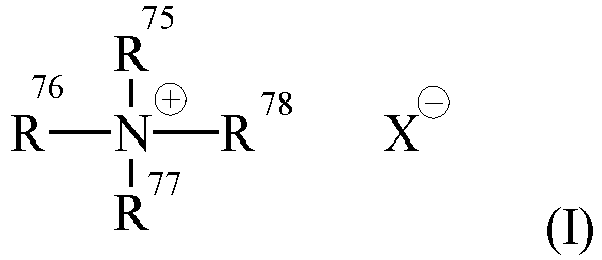
- Mono-long alkyl quaternized ammonium salts useful herein are those having the formula (I): wherein one of R 75 , R 76 , R 77 and R 78 is selected from an alkyl group of from 12 to 30 carbon atoms or an aromatic, alkoxy, polyoxyalkylene, alkylamido, hydroxyalkyl, aryl or alkylaryl group having up to 30 carbon atoms; the remainder of R 75 , R 76 , R 77 and R 78 are independently selected from an alkyl group of from 1 to 4 carbon atoms or an alkoxy, polyoxyalkylene, alkylamido, hydroxyalkyl, aryl or alkylaryl group having up to 4 carbon atoms; and X - is a salt-forming anion such as those selected from halogen, (e.g.
- alkyl groups can contain, in addition to carbon and hydrogen atoms, ether and/or ester linkages, and other groups such as amino groups.
- the longer chain alkyl groups e.g., those of 12 carbons, or higher, can be saturated or unsaturated.
- one of R 75 , R 76 , R 77 and R 78 is selected from an alkyl group of from 12 to 30 carbon atoms, more preferably from 16 to 24 carbon atoms, still more preferably from 18 to 22 carbon atoms, even more preferably 22 carbon atoms; the remainder of R 75 , R 76 , R 77 and R 78 are independently selected from CH 3 , C 2 H 5 , C 2 H 4 OH, and mixtures thereof; and X is selected from the group consisting of Cl, Br, CH 3 OSO 3 , C 2 H 5 OSO 3 , and mixtures thereof.
- Nonlimiting examples of such mono-long alkyl quaternized ammonium salt cationic surfactants include: behenyl trimethyl ammonium salt; stearyl trimethyl ammonium salt; cetyl trimethyl ammonium salt; and hydrogenated tallow alkyl trimethyl ammonium salt.
- di-long alkyl quaternized ammonium salts are preferably combined with a mono-long alkyl quaternized ammonium salt and/or mono-long alkyl amine salt, at the weight ratio of from 1:1 to 1:5, more preferably from 1:1.2 to 1:5, still more preferably from 1:1.5 to 1:4, in view of stability in rheology and conditioning benefits.
- Di-long alkyl quaternized ammonium salts useful herein are those having two long alkyl chains of from 12 to 30 carbon atoms, more preferably from 16 to 24 carbon atoms, still more preferably from 18 to 22 carbon atoms.
- Such di-long alkyl quaternized ammonium salts useful herein are those having the formula (I): wherein two of R 71 , R 72 , R 73 and R 74 are selected from an aliphatic group of from 12 to 30 carbon atoms, preferably from 16 to 24 carbon atoms, more preferably from 18 to 22 carbon atoms or an aromatic, alkoxy, polyoxyalkylene, alkylamido, hydroxyalkyl, aryl or alkylaryl group having up to 30 carbon atoms; the remainder of R 71 , R 72 , R 73 and R 74 are independently selected from an aliphatic group of from 1 to 8 carbon atoms, preferably from 1 to 3 carbon atoms or an aromatic, alkoxy,
- the aliphatic groups can contain, in addition to carbon and hydrogen atoms, ether linkages, and other groups such as amino groups.
- the longer chain aliphatic groups e.g., those of 16 carbons, or higher, can be saturated or unsaturated.
- two of R 71 , R 72 , R 73 and R 74 are selected from an alkyl group of from 12 to 30 carbon atoms, preferably from 16 to 24 carbon atoms, more preferably from 18 to 22 carbon atoms; and the remainder of R 71 , R 72 , R 73 and R 74 are independently selected from CH 3 , C 2 H 5 , C 2 H 4 OH, CH 2 C 6 H 5 , and mixtures thereof.
- Such preferred di-long alkyl cationic surfactants include, for example, dialkyl (14-18) dimethyl ammonium chloride, ditallow alkyl dimethyl ammonium chloride, dihydrogenated tallow alkyl dimethyl ammonium chloride, distearyl dimethyl ammonium chloride, and dicetyl dimethyl ammonium chloride.
- the composition of the present invention comprises a high melting point fatty compound.
- the high melting point fatty compound can be included in the composition at a level of from 1.0%, preferably from 1.5%, more preferably from 2.0%, still more preferably from 2.5%, even more preferably from 3%, and to 30%, preferably to 15%, more preferably to 8.0%, still more preferably to 7% by weight of the composition, in view of providing the benefits of the present invention.
- the high melting point fatty compound useful herein have a melting point of 25°C or higher, preferably 40°C or higher, more preferably 45°C or higher, still more preferably 50°C or higher, in view of stability of the emulsion especially the gel matrix.
- such melting point is up to 90°C, more preferably up to 80°C, still more preferably up to 70°C, even more preferably up to 65°C, in view of easier manufacturing and easier emulsification.
- the high melting point fatty compound can be used as a single compound or as a blend or mixture of at least two high melting point fatty compounds. When used as such blend or mixture, the above melting point means the melting point of the blend or mixture.
- the high melting point fatty compound useful herein is selected from the group consisting of fatty alcohols, fatty acids, and mixtures thereof. Further, it is understood by the artisan that, depending on the number and position of double bonds, and length and position of the branches, certain compounds having certain required carbon atoms may have a melting point of less than the above preferred in the present invention. Such compounds of low melting point are not intended to be included in this section. Nonlimiting examples of the high melting point compounds are found in International Cosmetic Ingredient Dictionary, Fifth Edition, 1993 , and CTFA Cosmetic Ingredient Handbook, Second Edition, 1992 .
- fatty alcohols are preferably used in the composition of the present invention.
- the fatty alcohols useful herein are those having from 14 to 30 carbon atoms, preferably from 16 to 22 carbon atoms. These fatty alcohols are saturated and can be straight or branched chain alcohols.
- Preferred fatty alcohols include, for example, cetyl alcohol (having a melting point of 56°C), stearyl alcohol (having a melting point of 58-59°C), behenyl alcohol (having a melting point of 71°C), and mixtures thereof. These compounds are known to have the above melting point. However, they often have lower melting points when supplied, since such supplied products are often mixtures of fatty alcohols having alkyl chain length distribution in which the main alkyl chain is cetyl, stearyl or behenyl group.
- more preferred fatty alcohol is a mixture of cetyl alcohol and stearyl alcohol.
- the weight ratio of cetyl alcohol to stearyl alcohol is preferably from 1:9 to 9:1, more preferably from 1:4 to 4:1, still more preferably from 1:2.3 to 1.5:1.
- the mixture has the weight ratio of cetyl alcohol to stearyl alcohol of preferably from 1: 1 to 4:1, more preferably from 1:1 to 2:1, still more preferably from 1.2:1 to 2:1, in view of avoiding to get too thick for spreadability. It may also provide more conditioning on damaged part of the hair.
- composition of the present invention comprises an aqueous carrier.
- level and species of the carrier are selected according to the compatibility with other components, and other desired characteristic of the product.
- the carrier useful in the present invention includes water and water solutions of lower alkyl alcohols.
- the lower alkyl alcohols useful herein are monohydric alcohols having 1 to 6 carbons, more preferably ethanol and isopropanol.
- the aqueous carrier is substantially water.
- Deionized water is preferably used.
- Water from natural sources including mineral cations can also be used, depending on the desired characteristic of the product.
- the compositions of the present invention comprise from 40% to 99%, preferably from 50% to 95%, and more preferably from 70% to 90%, and more preferably from 80% to 90% water.
- a gel matrix is formed by the cationic surfactant, the high melting point fatty compound, and an aqueous carrier.
- the gel matrix is suitable for providing various conditioning benefits, such as slippery feel during the application to wet hair and softness and moisturized feel on dry hair.
- the cationic surfactant and the high melting point fatty compound are contained at a level such that the weight ratio of the cationic surfactant to the high melting point fatty compound is in the range of, preferably from 1:1 to 1:10, more preferably from 1:1.5 to 1:7, still more preferably from 1:2 to 1:6, in view of providing improved wet conditioning benefits.
- the composition of the present invention is substantially free of anionic surfactants, in view of stability of the gel matrix.
- the composition being substantially free of anionic surfactants means that: the composition is free of anionic surfactants; or, if the composition contains anionic surfactants, the level of such anionic surfactants is very low.
- compositions of the present invention may further contain a silicone compound. It is believed that the silicone compound can provide smoothness and softness on dry hair.
- the silicone compounds herein can be used at levels by weight of the composition of preferably from 0.1% to 20%, more preferably from 0.5% to 10%, still more preferably from 1% to 8%.
- the silicone compounds have an average particle size of from -0.01 microns to 50 microns, in the composition.
- the silicone compounds useful herein, as a single compound, as a blend or mixture of at least two silicone compounds, or as a blend or mixture of at least one silicone compound and at least one solvent, have a viscosity of preferably from 1 to 2,000,000mPa ⁇ s, more preferably from 100 to 2,000,000mPa ⁇ s at 25°C.
- Suitable silicone fluids include polyalkyl siloxanes, polyaryl siloxanes, polyalkylaryl siloxanes, polyether siloxane copolymers, amino substituted silicones, quaternized silicones, and mixtures thereof. Other nonvolatile silicone compounds having conditioning properties can also be used.
- Preferred polyalkyl siloxanes include, for example, polydimethylsiloxane, polydiethylsiloxane, and polymethylphenylsiloxane.
- Polydimethylsiloxane which is also known as dimethicone, is especially preferred.
- the above polyalkylsiloxanes are available, for example, as a mixture with silicone compounds having a lower viscosity.
- Such mixtures have a viscosity of preferably from 1,000mPa ⁇ s to 100,000mPa ⁇ s, more preferably from 5,000mPa ⁇ s to 50,000mPa ⁇ s.
- Such mixtures preferably comprise: (i) a first silicone having a viscosity of from 100,000mPa ⁇ s to 30,000,000mPa ⁇ s at 25°C, preferably from 100,000mPa ⁇ s to 20,000,000mPa ⁇ s; and (ii) a second silicone having a viscosity of from 5mPa ⁇ s to 10,000mPa ⁇ s at 25°C, preferably from 5mPa ⁇ s to 5,000mPa ⁇ s.
- Such mixtures useful herein include, for example, a blend of dimethicone having a viscosity of 18,000,000mPa ⁇ s and dimethicone having a viscosity of 200mPa s available from GE Toshiba, and a blend of dimethicone having a viscosity of 18,000,000mPa ⁇ s and cyclopentasiloxane available from GE Toshiba.
- the silicone compounds useful herein also include a silicone gum.
- silicone gum means a polyorganosiloxane material having a viscosity at 25°C of greater than or equal to 1,000,000 centistokes. It is recognized that the silicone gums described herein can also have some overlap with the above-disclosed silicone compounds. This overlap is not intended as a limitation on any of these materials.
- the "silicone gums” will typically have a mass molecular weight in excess of 200,000, generally between 200,000 and 1,000,000.
- silicone gums are available, for example, as a mixture with silicone compounds having a lower viscosity.
- Such mixtures useful herein include, for example, Gum/Cyclomethicone blend available from Shin-Etsu.
- Silicone compounds useful herein also include amino substituted materials.
- Preferred aminosilicones include, for example, those which conform to the general formula (I): (R 1 ) a G 3-a -Si-(-OSiG 2 ) n -(-OSiG b (R 1 ) 2-b ) m -O-SiG 3-a (R 1 ) a
- G is hydrogen, phenyl, hydroxy, or C 1 -C 8 alkyl, preferably methyl;
- a is 0 or an integer having a value from 1 to 3, preferably 1;
- b is 0, 1 or 2, preferably 1;
- n is a number from 0 to 1,999;
- m is an integer from 0 to 1,999; the sum of n and m is a number from 1 to 2,000; a and m are not both 0;
- R 1 is a monovalent radical conforming to the general formula CqH 2q L, wherein q is an integer having
- Such highly preferred amino silicones can be called as terminal aminosilicones, as one or both ends of the silicone chain are terminated by nitrogen containing group.
- the above aminosilicones when incorporated into the composition, can be mixed with solvent having a lower viscosity.
- solvents include, for example, polar or non-polar, volatile or non-volatile oils.
- oils include, for example, silicone oils, hydrocarbons, and esters.
- preferred are those selected from the group consisting of non-polar, volatile hydrocarbons, volatile cyclic silicones, non-volatile linear silicones, and mixtures thereof.
- the non-volatile linear silicones useful herein are those having a viscosity of from 1 to 20,000 centistokes, preferably from 20 to 10,000 centistokes at 25°C.
- non-polar, volatile hydrocarbons especially non-polar, volatile isoparaffins
- Such mixtures have a viscosity of preferably from 1,000mPa ⁇ s to 100,000mPa ⁇ s, more preferably from 5,000mPa ⁇ s to 50,000mPa ⁇ s.
- alkylamino substituted silicone compounds include those having alkylamino substitutions as pendant groups of a silicone backbone. Highly preferred are those known as "amodimethicone". Commercially available amodimethicones useful herein include, for example, BY16-872 available from Dow Corning.
- the silicone compounds may further be incorporated in the present composition in the form of an emulsion, wherein the emulsion is made my mechanical mixing, or in the stage of synthesis through emulsion polymerization, with or without the aid of a surfactant selected from anionic surfactants, nonionic surfactants, cationic surfactants, and mixtures thereof.
- a surfactant selected from anionic surfactants, nonionic surfactants, cationic surfactants, and mixtures thereof.
- Commercially available silicone emulsions useful herein include, for example, Belsil ADM 8301E, Belsil ADM 6300E available from Wacker, Silsoft 253 available from Momentive
- Silicone compounds useful herein include, for example, a Silicone Polymer Containing Quaternary Groups comprising terminal ester groups, having a viscosity up to 100,000 mPa ⁇ s and a D block length of greater than 200 D units. Without being bound by theory, this low viscosity silicone polymer provides improved conditioning benefits such as smooth feel, reduced friction, and prevention of hair damage, while eliminating the need for a silicone blend.
- the silicone polymer is a polyorganosiloxane compound comprising one or more quaternary ammonium groups, at least one silicone block comprising greater than 200 siloxane units, at least one polyalkylene oxide structural unit, and at least one terminal ester group.
- the silicone block may comprise between 300 to 500 siloxane units.
- the silicone polymer is present in an amount of from 0.05% to 15%, preferably from 0.1% to 10%, more preferably from 0.15% to 5%, and even more preferably from 0.2% to 4% by weight of the composition.
- the polyorganosiloxane compounds may have the general formulas (Ia) and (Ib): M-Y-[-(N + R 2 -T-N + R 2 )-Y-] m -[-(NR 2 -A-E-A'-NR 2 )-Y-] k -M (Ia) M-Y-[-(N + R 2 -T-N + R 2 )-Y-] m -[-(N + R 2 2 -A-E-A'-N + R 2 2 )-Y-] k -M (Ib) wherein:
- the residues K may be identical or different from each other.
- the residue K is bound to the silicon atom of the residue S via a C-Si-bond.
- amine groups (-(NR 2 -A-E-A'-NR 2 )-) in the polyorganosiloxane compounds, they may have protonated ammonium groups, resulting from the protonation of such amine groups with organic or inorganic acids. Such compounds are sometimes referred to as acid addition salts of the polyorganosiloxane compounds.
- the molar ratio of the quaternary ammonium groups b) and the terminal ester groups c) may be less than 100 : 20, even more preferred is less than 100 : 30 and is most preferred less than 100 : 50.
- the ratio can be determined by 13 C-NMR.
- the polyorganosiloxane composition may comprise:
- the polyorganosiloxane compound B) differs from the polyorganosiloxane compound A) preferably in that it does not comprise quaternary ammonium groups.
- Preferred polyorganosiloxane compounds B) result from the reaction of monofunctional organic acids, in particular carboxylic acids, and polyorganosiloxane containing bisepoxides.
- the weight ratio of compound A) to compound B) is preferably less than 90 : 10. Or in other words, the content of component B) is at least 10 weight percent.
- the molar ratio of the quaternary ammonium groups b) and the terminal ester groups c) may be less than 100 : 10, even more preferred is less than 100 : 15 and is most preferred less than 100 : 20.
- the silicone polymer has a viscosity at 20°C and a shear rate of 0.1s -1 (plate-plate system, plate diameter 40mm, gap width 0.5mm) of less than 100,000 mPa•s (100 Pa•s).
- the viscosities of the neat silicone polymers may range from 500 to 100,000 mPa•s, or preferably from 500 to 70,000 mPa•s, or more preferably from 500 to 50,000 mPa•s, or even more preferably from 500 to 20,000 mPa•s.
- the viscosities of the neat polymers may range from 500 to 10,000 mPa•s, or preferably 500 to 5000 mPa•s determined at 20 °C and a shear rate of 0.1 s -1 .
- R 1 may be C 1 -C 18 alkyl, C 1 -C 18 fluoroalkyl and aryl. Furthermore, R 1 is preferably C 1 -C 18 alkyl, C 1 -C 6 fluoroalkyl and aryl. Furthermore, R 1 is more preferably C 1 -C 6 alkyl, C 1 -C 6 fluoroalkyl, even more preferably C 1 -C 4 fluoroalkyl, and phenyl. Most preferably, R 1 is methyl, ethyl, trifluoropropyl and phenyl.
- C 1 -C 22 alkyl means that the aliphatic hydrocarbon groups possess from 1 to 22 carbon atoms which can be straight chain or branched.
- Methyl, ethyl, propyl, n-butyl, pentyl, hexyl, heptyl, nonyl, decyl, undecyl, isopropyl, neopentyl and 1,2,3-trimethyl hexyl moieties serve as examples.
- C 1 -C 22 fluoroalkyl means aliphatic hydrocarbon compounds with 1 to 22 carbon atoms which can be straight chain or branched and are substituted with at least one fluorine atom.
- Monofluoromethyl, monofluoroethyl, 1,1,1-trifluorethyl, perfluoroethyl, 1,1,1-trifluoropropyl, 1,2,2-trifluorobutyl are suitable examples.
- aryl means unsubstituted or phenyl substituted once or several times with OH, F, Cl, CF 3 , C 1 -C 6 alkyl, C 1 -C 6 alkoxy, C 3 -C 7 cycloalkyl, C 2 -C 6 alkenyl or phenyl.
- Aryl may also mean naphthyl.
- the positive charges resulting from the ammonium group(s) may be neutralized with inorganic anions such as chloride, bromide, hydrogen sulfate, sulfate, or organic anions, like carboxylates deriving from C 1 -C 30 carboxylic acids, for example acetate, propionate, octanoate, especially from C 10 -C 18 carboxylic acids, for example decanoate, dodecanoate, tetradecanoate, hexadecanoate, octadecanoate and oleate, alkylpolyethercarboxylate, alkyl sulphonate, aryl sulphonate, alkylaryl sulphonate, alkylsulphate, alkylpolyethersulphate, phosphates derived from phosphoric acid mono alkyl/aryl ester and phosphoric acid dialkyl/aryl ester.
- inorganic anions such as chloride, bromide, hydrogen
- the quaternary ammonium groups are usually generated by reacting the di-tertiary amines with an alkylating agents, selected from in particular di-epoxides (sometimes referred to also as bis-epoxides) in the presence of mono carboxylic acids and difunctional dihalogen alkyl compounds.
- an alkylating agents selected from in particular di-epoxides (sometimes referred to also as bis-epoxides) in the presence of mono carboxylic acids and difunctional dihalogen alkyl compounds.
- the polyorganosiloxane compounds may be of the general formulas (Ia) and (Ib): M-Y-[-(N + R 2 -T-N + R 2 )-Y-] m -[-(NR 2 -A-E-A'-NR 2 )-Y-] k -M (Ia) M-Y-[-(N + R 2 -T-N + R 2 )-Y-] m -[-(N + R 2 2 -A-E-A'-N + R 2 2 )-Y-] k -M (Ib) wherein each group is as defined above; however, the repeating units are in a statistical arrangement (i.e., not a block-wise arrangement).
- the polyorganosiloxane compounds may be also of the general formulas (IIa) or (IIb): M-Y-[-N + R 2 -Y-] m -[-(NR 2 -A-E-A'-NR 2 )-Y-] k -M (IIa) M-Y-[-N + R 2 -Y-] m -[-(N + R 2 2 -A-E-A'-N + R 2 2 )-Y-] k -M (IIb)
- the molar ratio of the polyorganosiloxane-containing repeating group —K—S—K—and the polyalkylene repeating group —A—E—A'— or —A'—E—A— may be between 100:1 and 1:100, or preferably between 20:1 and 1:20, or more preferably between 10:1 and 1:10.
- R may represent a monovalent straight chain, cyclic or branched C 1 -C 20 hydrocarbon radical, which can be interrupted by one or more —O— ,-C(O)- and can be substituted by-OH
- T may represent a divalent straight-chain, cyclic, or branched C 1 -C 20 hydrocarbon radical, which can be interrupted by —O— , —C(O)— and can be substituted by hydroxyl.
- the above described polyorganosiloxane compounds comprising quaternary ammonium functions and ester functions may also contain: 1) individual molecules which contain quaternary ammonium functions and no ester functions; 2) molecules which contain quaternary ammonium functions and ester functions; and 3) molecules which contain ester functions and no quaternary ammonium functions. While not limited to structure, the above described polyorganosiloxane compounds comprising quaternary ammonium functions and ester functions are to be understood as mixtures of molecules comprising a certain averaged amount and ratio of both moieties.
- esters may be utilized to yield the esters.
- exemplary aspects include C 1 -C 30 carboxylic acids, for example C 2 , C 3 , C 8 acids, C 10 -C 18 carboxylic acids, for example C 12 , C 14 , C 16 acids, saturated, unsaturated and hydroxyl functionalized C 18 acids, alkylpolyethercarboxylic acids, alkylsulphonic acids, arylsulphonic acids, alkylarylsulphonic acids, alkylsulphuric acids, alkylpolyethersulphuric acids, phosphoric acid mono alkyl/aryl esters and phosphoric acid dialkyl/aryl esters.
- composition of the present invention may include other additional components, which may be selected by the artisan according to the desired characteristics of the final product and which are suitable for rendering the composition more cosmetically or aesthetically acceptable or to provide them with additional usage benefits.
- additional components generally are used individually at levels of from 0.001% to 10%, preferably up to 5% by weight of the composition.
- compositions can be formulated into the present compositions.
- conditioning agents such as hydrolyzed collagen with tradename Peptein 2000 available from Hormel, vitamin E with tradename Emix-d available from Eisai, panthenol available from Roche, panthenyl ethyl ether available from Roche, hydrolyzed keratin, proteins, plant extracts, and nutrients; preservatives such as benzyl alcohol, methyl paraben, propyl paraben and imidazolidinyl urea; pH adjusting agents, such as citric acid, sodium citrate, succinic acid, phosphoric acid, sodium hydroxide, sodium carbonate; coloring agents, such as any of the FD&C or D&C dyes; perfumes; ultraviolet and infrared screening and absorbing agents such as benzophenones; and antidandruff agents such as zinc pyrithione; non-ionic surfactant such as mono-9-octadecanoate poly(oxy-1,2-ethan
- compositions of the present invention can be in the form of rinse-off products or leave-on products, and can be formulated in a wide variety of product forms, including but not limited to creams, gels, emulsions, mousses and sprays.
- the composition of the present invention is especially suitable for hair conditioners especially rinse-off hair conditioners.
- compositions (wt.%)
- compositions (wt%)
- compositions (wt%)
- compositions (wt%)
- compositions of "Ex. 1" through “Ex. 10" of the present invention and those of “CEx. i” through “CEx. vii” as comparative examples can be prepared by any conventional method well known in the art.
- compositions For some of the above compositions, properties and conditioning benefits are evaluated by the following methods. Results of the evaluation are also shown above.
- Stability is evaluated by a visual investigation for phase separation.
- Texture is evaluated by a panelist test. 5 to 7 panelists evaluated samples as follows: "Good” texture means the product remains mounding when dispensed, and is easily spreadable on wet hair and penetrates to the gaps between hair fibers.
- Wet conditioning benefit is evaluated by a panelist test. 5 to 7 panelists evaluated samples prepared by applying 0.1ml of the above compositions per 1g of wet hair. Panelists evaluated each sample from 1 (very poor) to 5 (very good) to be able to apply and spread evenly on hair. The data from the panelists were gathered, averaged, and scored, and compared.
Landscapes
- Health & Medical Sciences (AREA)
- Life Sciences & Earth Sciences (AREA)
- General Health & Medical Sciences (AREA)
- Veterinary Medicine (AREA)
- Public Health (AREA)
- Animal Behavior & Ethology (AREA)
- Birds (AREA)
- Epidemiology (AREA)
- Emergency Medicine (AREA)
- Chemical & Material Sciences (AREA)
- Dispersion Chemistry (AREA)
- Dermatology (AREA)
- Inorganic Chemistry (AREA)
- Cosmetics (AREA)
Description
- The present invention relates to a hair conditioning composition comprising: a cationic surfactant; a high melting point fatty compound; an ionic benefit agent, wherein the ionic benefit agents are those excluding ionic dyes, precursors thereof, and anionic surfactants; an alkyl ether and/or alkyl ester of at least one of the following: polyethylene glycol, polypropylene glycol, polyglycerin, and mixtures thereof, and wherein the alkyl ether and/or alkyl ester has from 100 to 200 units of ethylene glycol, propylene glycol, glycerin and mixtures thereof; and an aqueous carrier. The composition of the present invention provides benefits from ionic benefit agents while maintaining stability and wet conditioning of the composition.
- A variety of approaches have been developed to condition the hair. A common method of providing conditioning benefit is through the use of conditioning agents such as cationic surfactants and polymers, high melting point fatty compounds, low melting point oils, silicone compounds, and mixtures thereof. Most of these conditioning agents are known to provide various conditioning benefits. Furthermore, a variety of approaches have been developed to provide other benefits in addition to such conditioning benefits and/or to provide further improved conditioning benefits.
- For example, some conditioning compositions comprise ionic agents to provide such additional benefits and/or improved conditioning benefits.
- However, when containing such ionic agents especially at higher concentrations in conditioner compositions, especially the conditioner compositions comprising cationic surfactants and high melting point fatty compounds which form an emulsion like gel matrix, the conditioning compositions often shows: significantly reduced viscosity which causes reduced wet conditioning benefit; and/or reduced stability such as phase separation starting immediately or starting in a few days to few weeks.
-
WO 01/17502 A1 WO 2009/158438 A2 is about a hair conditioning composition comprising: (a) a cationic surfactant; (b) a high melting point fatty compound; and (c) an aqueous carrier; wherein the cationic surfactant, the high melting point fatty compound, and the aqueous carrier form a gel matrix; wherein the composition has from 90% to 100% of a conversion rate of the high melting point fatty compound to the gel matrix; and wherein the composition has a yield point of 33 Pa or more..US 2005/0063934 A1 refers to a conditioning composition containing an aminosilicone having a viscosity of from 1,000 cs to 1,000,000 cs, and less than 0.5% nitrogen by weight of the aminosilicone, a cationic surfactant, a high melting point fatty compound, and an aqueous carrier.WO 2017/106401 A1 sets out a method of treating the hair including providing a concentrated hair care composition in an aerosol foam dispenser.WO 97/25973 A1 - Thus, there is still a need for conditioning compositions to provide benefits from ionic benefit agents, while maintaining stability and wet conditioning of the composition.
- None of the existing art provides all of the advantages and benefits of the present invention.
- The present invention is directed to a hair conditioning composition comprising:
- a cationic surfactant;
- a high melting point fatty compound, wherein the high melting point fatty compound has a melting point of 25°C or higher;
- an ionic benefit agent, wherein the ionic benefit agents are those excluding ionic dyes, precursors thereof, and anionic surfactants;
- wherein the ionic benefit agent is water soluble,
- wherein the water-soluble ionic benefit agents is selected from the group consisting of salicylic acid, 5-chlorosalicylic acid, 2,4-dihydroxybenzoic acid, citric acid, ascorbic acid, benzoic acid, ethylenediamine disuccinic acid (EDDS), ethylene diamine tetraacetic acid (EDTA), arginine, histidine, lysine, aspartic acid, glutamic acid, serine, threonine, asparagine, glutamine, glycine, proline, alanine, valine, isoleucine leucine, phenylalanine, tyrosine, tryptophane, and salts thereof; an alkyl ether and/or alkyl ester included in the composition at a level of from about 0.8%, wherein the alkyl ether and/or alkyl ester is at least one of the following: polyethylene glycol, polypropylene glycol, polyglycerin, and mixtures thereof, and wherein the alkyl ether and/or alkyl ester has from 100 to 200 units of ethylene glycol, propylene glycol, glycerin and mixtures thereof; and
- an aqueous carrier.
- The composition of the present invention provides benefits from ionic benefit agents, while maintaining stability and wet conditioning of the composition.
- While the specification concludes with claims particularly pointing out and distinctly claiming the invention, it is believed that the present invention will be better understood from the following description.
- Herein, "comprising" means that other steps and other ingredients which do not affect the end result can be added. This term encompasses the terms "consisting of" and "consisting essentially of".
- All percentages, parts and ratios are based upon the total weight of the compositions of the present invention, unless otherwise specified. All such weights as they pertain to listed ingredients are based on the active level and, therefore, do not include carriers or by-products that may be included in commercially available materials.
- Herein, "mixtures" is meant to include a simple combination of materials and any compounds that may result from their combination.
- The term "molecular weight" or "M.Wt." as used herein refers to the weight average molecular weight unless otherwise stated. The weight average molecular weight may be measured by gel permeation chromatography.
- "QS" means sufficient quantity for 100%.
- The hair conditioning composition of the present invention comprises: a cationic surfactant; a high melting point fatty compound; an ionic benefit agent, wherein the ionic benefit agents are those excluding ionic dyes, precursors thereof, and anionic surfactants; an alkyl ether and/or alkyl ester of at least one of the following: polyethylene glycol, polypropylene glycol, polyglycerin, and mixtures thereof, and wherein the alkyl ether and/or alkyl ester has from 100 to 200 units of ethylene glycol, propylene glycol, glycerin and mixtures thereof; and an aqueous carri er.
- The composition of the present invention provides benefits from ionic benefit agents, while maintaining stability and wet conditioning of the composition.
- It is believed that the above specific alkyl ether/esters maintain stability and wet conditioning of the compositions comprising a cationic surfactant and a high melting point fatty compound, even when the conditioning compositions contain ionic benefit agents.
- The ionic benefit agents useful herein are those excluding ionic dyes, its precursors, and anionic surfactants. More preferably, the ionic benefit agents useful herein are those excluding any ionic surfactants other than cationic surfactants, in addition to the above ionic dyes, its precursors, anionic surfactants.
- The ionic benefit agents useful herein are, for example: acids and salts thereof; chelants such as EDTA and EDDS; alkalines and salts thereof, for example, those comprising mineral ions such as Mg, Zn, K, Na, Ca, ions coming with OH, HCO3 and/or CO3 counter ions; and mixtures thereof.
- The ionic benefit agents useful herein are water soluble. Such water soluble ionic benefit agents are selected from the group consisting of: salicylic acid, 5-chlorosalicylic acid, 2,4-dihydroxybenzoic acid, citric acid, ascorbic acid, benzoic acid, ethylenediamine disuccinic acid (EDDS), ethylene diamine tetraacetic acid (EDTA), and various amino acids such as arginine, histidine, lysine, aspartic acid, glutamic acid, serine, threonine, asparagine, glutamine, glycine, proline, alanine, valine, isoleucine leucine, phenylalanine, tyrosine, tryptophane, and salts thereof. Among them, preferred are salicylic acid, ethylenediamine disuccinic acid (EDDS), 5-chlorosalicylic acid, 2,4-dihydroxybenzoic acid, citric acid, ascorbic acid, benzoic acid, some amino acid (glutamic acid, histidine, etc.). More preferred are salicylic acid and ethylenediamine disuccinic acid (EDDS).
- The ionic benefit agent can be included in the hair conditioning composition at a level of from 0.1%, preferably from 0.2%, more preferably from 0.5%, still more preferably from 1%, and to 15%, preferably to 10%, more preferably from to 8%, still more preferably to 5%, even more preferably to 3%. It is believed that higher levels of such benefit agent tend to provide more impact to the stability and/or wet conditioning of the composition without the alkyl ether/esters of the present invention, thus, with the alkyl ether/esters, the benefit of the present invention can be observed more clearly.
- The pH of a composition of the present invention is in the range of from 1 to 9, preferably from 2 to 8.5, more preferably from 3 to 8.5.
- When the ionic benefit agent is salicylic acid, it is preferred that the pH of the composition is 3 and above, or more preferably 4 and above. At such pH, salicylic acid tends to become highly soluble and tends to provide more impact to the stability of the composition without the alkyl ether/esters of the present invention. Thus, at such pH, the benefit of the present invention can be observed more clearly when the ionic benefit agent is salicylic acid.
- When the ionic benefit agent is ZnCO3, it is preferred that the pH of the composition is 6.8 and above, or more preferably 7.2 and above, by having pH adjuster such as NaOH in the composition. Such pH due to alkaline material tends to provide impact to the stability of the composition without the alkyl ether/esters of the present invention. Thus, at such pH, the benefit of the present invention can be observed more clearly.
- The compositions of the present invention comprise alkyl ethers and/or alkyl esters, preferably alkyl ethers, of at least one of the followings: polyethylene glycol, polypropylene glycol, polyglycerin, and mixtures thereof, preferably polyethylene glycol, polyglycerin, and mixtures thereof, more preferably polyethylene glycol.
- The alkyl ethers/esters is included in the composition at a level of from 0.8% in view of maintaining stability and wet conditioning of the composition comprising cationic surfactants and high melting point fatty compounds even when the composition containing ionic benefit agents, especially in view of maintaining stability and wet conditioning of a gel matrix formed by cationic surfactants and high melting point fatty compounds. The alkyl ethers/esters can be included in the composition at a level of to 10%, preferably to 5%, more preferably to 4%, still more preferably to 3% by weight of the composition, in view of maintaining wet conditioning especially spreadability on wet hair, especially those of a gel matrix formed by cationic surfactants and high melting point fatty compounds.
- In the present invention, the weight ratio of the alkyl ethers/esters to a total weight of cationic surfactants and high melting point fatty compounds is preferably from 2% to 40%, more preferably from 3% to 30%, still more preferably from 2% to 20%.
- The alkyl ethers/esters useful herein are those having: from 100 to 200 units of ethylene glycol, propylene glycol, glycerin and mixtures thereof, preferably of ethylene glycol, polyglycerin, and mixtures thereof, more preferably of ethylene glycol, in view of maintaining stability and wet conditioning of the composition comprising cationic surfactants and high melting point fatty compounds even when the composition containing ionic benefit agents, especially in view of maintaining stability and wet conditioning of a gel matrix formed by cationic surfactants and high melting point fatty compounds.
- Without being bound to theory, it is believed that alkyl ethers/esters having smaller numbers of units of ethylene glycol, propylene glycol, glycerin and mixtures thereof are more hydrophobic compared to the above alkyl ethers/esters of the present invention, and may not sufficiently maintain stability and/or wet conditioning of the conditioning compositions when the compositions contains ionic benefit agents.
- Preferably, the alkyl groups of the alkyl ethers/esters useful herein are those having from 10 to 30 carbon atoms, more preferably those having from 14 to 30 carbon atoms, still more preferably those having from 16 to 22 carbon atoms. Also preferably, the alkyl groups of the alkyl ethers/esters useful herein are straight (non-branched), saturated alkyl groups.
- The compositions of the present invention comprise a cationic surfactant. The cationic surfactant can be included in the composition at a level of from 0.1%, preferably from 0.5%, more preferably from 0.8%, still more preferably from 1.0%, and to 20%, preferably to 10%, more preferably to 8.0%, still more preferably to 6.0% by weight of the composition, in view of providing the benefits of the present invention.
- Preferably, in the present invention, the surfactant is water-insoluble. In the present invention, "water-insoluble surfactants" means that the surfactants have a solubility in water at 25°C of preferably below 0.5g/100g (excluding 0.5g/100g) water, more preferably 0.3g/100g water or less.
- Cationic surfactant useful herein can be one cationic surfactant or a mixture of two or more cationic surfactants. Preferably, the cationic surfactant is selected from: a mono-long alkyl quaternized ammonium salt; a combination of a mono-long alkyl quaternized ammonium salt and a di-long alkyl quaternized ammonium salt; a mono-long alkyl amine; a combination of a mono-long alkyl amine and a di-long alkyl quaternized ammonium salt; and a combination of a mono-long alkyl amine and a mono-long alkyl quaternized ammonium salt. Among them, behenyl trimethyl ammonium salt such as BTMAC and BTMS; stearamidopropyldimethylamine (SAPDMA).
- Mono-long alkyl amine useful herein are those having one long alkyl chain of preferably from 12 to 30 carbon atoms, more preferably from 16 to 24 carbon atoms, still more preferably from 18 to 22 alkyl group. Mono-long alkyl amines useful herein also include mono-long alkyl amidoamines. Primary, secondary, and tertiary fatty amines are useful.
- Particularly useful are tertiary amido amines having an alkyl group of from 12 to 22 carbons. Exemplary tertiary amido amines include: stearamidopropyldimethylamine, stearamidopropyldiethylamine, stearamidoethyldiethylamine, stearamidoethyldimethylamine, palmitamidopropyldimethylamine, palmitamidopropyldiethylamine, palmitamidoethyldiethylamine, palmitamidoethyldimethylamine, behenamidopropyldimethylamine, behenamidopropyldiethylamine, behenamidoethyldiethylamine, behenamidoethyldimethylamine, arachidamidopropyldimethylamine, arachidamidopropyl diethyl amine, arachidamidoethyldiethylamine, arachidamidoethyldimethylamine, diethylaminoethylstearamide. Useful amines in the present invention are disclosed in
U.S. Patent 4,275,055, Nachtigal, et al. - These amines are used in combination with acids such as f-glutamic acid, lactic acid, hydrochloric acid, malic acid, succinic acid, acetic acid, fumaric acid, tartaric acid, citric acid, ℓ-glutamic hydrochloride, maleic acid, and mixtures thereof; more preferably f-glutamic acid, lactic acid, citric acid, at a molar ratio of the amine to the acid of from 1 : 0.3 to 1 : 2, more preferably from 1 : 0.4 to 1 : 1.
- The mono-long alkyl quaternized ammonium salts useful herein are those having one long alkyl chain which has from 12 to 30 carbon atoms, preferably from 16 to 24 carbon atoms, more preferably C18-22 alkyl group. The remaining groups attached to nitrogen are independently selected from an alkyl group of from 1 to 4 carbon atoms or an alkoxy, polyoxyalkylene, alkylamido, hydroxyalkyl, aryl or alkylaryl group having up to 4 carbon atoms.
- Mono-long alkyl quaternized ammonium salts useful herein are those having the formula (I):
- Nonlimiting examples of such mono-long alkyl quaternized ammonium salt cationic surfactants include: behenyl trimethyl ammonium salt; stearyl trimethyl ammonium salt; cetyl trimethyl ammonium salt; and hydrogenated tallow alkyl trimethyl ammonium salt.
- When used, di-long alkyl quaternized ammonium salts are preferably combined with a mono-long alkyl quaternized ammonium salt and/or mono-long alkyl amine salt, at the weight ratio of from 1:1 to 1:5, more preferably from 1:1.2 to 1:5, still more preferably from 1:1.5 to 1:4, in view of stability in rheology and conditioning benefits.
- Di-long alkyl quaternized ammonium salts useful herein are those having two long alkyl chains of from 12 to 30 carbon atoms, more preferably from 16 to 24 carbon atoms, still more preferably from 18 to 22 carbon atoms. Such di-long alkyl quaternized ammonium salts useful herein are those having the formula (I):

- Such preferred di-long alkyl cationic surfactants include, for example, dialkyl (14-18) dimethyl ammonium chloride, ditallow alkyl dimethyl ammonium chloride, dihydrogenated tallow alkyl dimethyl ammonium chloride, distearyl dimethyl ammonium chloride, and dicetyl dimethyl ammonium chloride.
- The composition of the present invention comprises a high melting point fatty compound. The high melting point fatty compound can be included in the composition at a level of from 1.0%, preferably from 1.5%, more preferably from 2.0%, still more preferably from 2.5%, even more preferably from 3%, and to 30%, preferably to 15%, more preferably to 8.0%, still more preferably to 7% by weight of the composition, in view of providing the benefits of the present invention.
- The high melting point fatty compound useful herein have a melting point of 25°C or higher, preferably 40°C or higher, more preferably 45°C or higher, still more preferably 50°C or higher, in view of stability of the emulsion especially the gel matrix. Preferably, such melting point is up to 90°C, more preferably up to 80°C, still more preferably up to 70°C, even more preferably up to 65°C, in view of easier manufacturing and easier emulsification. In the present invention, the high melting point fatty compound can be used as a single compound or as a blend or mixture of at least two high melting point fatty compounds. When used as such blend or mixture, the above melting point means the melting point of the blend or mixture.
- The high melting point fatty compound useful herein is selected from the group consisting of fatty alcohols, fatty acids, and mixtures thereof. Further, it is understood by the artisan that, depending on the number and position of double bonds, and length and position of the branches, certain compounds having certain required carbon atoms may have a melting point of less than the above preferred in the present invention. Such compounds of low melting point are not intended to be included in this section. Nonlimiting examples of the high melting point compounds are found in International Cosmetic Ingredient Dictionary, Fifth Edition, 1993, and CTFA Cosmetic Ingredient Handbook, Second Edition, 1992.
- Among a variety of high melting point fatty compounds, fatty alcohols are preferably used in the composition of the present invention. The fatty alcohols useful herein are those having from 14 to 30 carbon atoms, preferably from 16 to 22 carbon atoms. These fatty alcohols are saturated and can be straight or branched chain alcohols.
- Preferred fatty alcohols include, for example, cetyl alcohol (having a melting point of 56°C), stearyl alcohol (having a melting point of 58-59°C), behenyl alcohol (having a melting point of 71°C), and mixtures thereof. These compounds are known to have the above melting point. However, they often have lower melting points when supplied, since such supplied products are often mixtures of fatty alcohols having alkyl chain length distribution in which the main alkyl chain is cetyl, stearyl or behenyl group.
- In the present invention, more preferred fatty alcohol is a mixture of cetyl alcohol and stearyl alcohol.
- Generally, in the mixture, the weight ratio of cetyl alcohol to stearyl alcohol is preferably from 1:9 to 9:1, more preferably from 1:4 to 4:1, still more preferably from 1:2.3 to 1.5:1.
- When using higher level of total cationic surfactant and high melting point fatty compounds, the mixture has the weight ratio of cetyl alcohol to stearyl alcohol of preferably from 1: 1 to 4:1, more preferably from 1:1 to 2:1, still more preferably from 1.2:1 to 2:1, in view of avoiding to get too thick for spreadability. It may also provide more conditioning on damaged part of the hair.
- The composition of the present invention comprises an aqueous carrier. The level and species of the carrier are selected according to the compatibility with other components, and other desired characteristic of the product.
- The carrier useful in the present invention includes water and water solutions of lower alkyl alcohols. The lower alkyl alcohols useful herein are monohydric alcohols having 1 to 6 carbons, more preferably ethanol and isopropanol.
- Preferably, the aqueous carrier is substantially water. Deionized water is preferably used. Water from natural sources including mineral cations can also be used, depending on the desired characteristic of the product. Generally, the compositions of the present invention comprise from 40% to 99%, preferably from 50% to 95%, and more preferably from 70% to 90%, and more preferably from 80% to 90% water.
- Preferably, in the present invention, a gel matrix is formed by the cationic surfactant, the high melting point fatty compound, and an aqueous carrier. The gel matrix is suitable for providing various conditioning benefits, such as slippery feel during the application to wet hair and softness and moisturized feel on dry hair.
- Preferably, when the gel matrix is formed, the cationic surfactant and the high melting point fatty compound are contained at a level such that the weight ratio of the cationic surfactant to the high melting point fatty compound is in the range of, preferably from 1:1 to 1:10, more preferably from 1:1.5 to 1:7, still more preferably from 1:2 to 1:6, in view of providing improved wet conditioning benefits.
- Preferably, when the gel matrix is formed, the composition of the present invention is substantially free of anionic surfactants, in view of stability of the gel matrix. In the present invention, "the composition being substantially free of anionic surfactants" means that: the composition is free of anionic surfactants; or, if the composition contains anionic surfactants, the level of such anionic surfactants is very low. In the present invention, a total level of such anionic surfactants, if included, preferably 1% or less, more preferably 0.5% or less, still more preferably 0.1% or less by weight of the composition. Most preferably, the total level of such anionic surfactants is 0% by weight of the composition.
- The compositions of the present invention may further contain a silicone compound. It is believed that the silicone compound can provide smoothness and softness on dry hair. The silicone compounds herein can be used at levels by weight of the composition of preferably from 0.1% to 20%, more preferably from 0.5% to 10%, still more preferably from 1% to 8%.
- Preferably, the silicone compounds have an average particle size of from -0.01 microns to 50 microns, in the composition.
- The silicone compounds useful herein, as a single compound, as a blend or mixture of at least two silicone compounds, or as a blend or mixture of at least one silicone compound and at least one solvent, have a viscosity of preferably from 1 to 2,000,000mPa·s, more preferably from 100 to 2,000,000mPa·s at 25°C.
- The viscosity can be measured by means of a glass capillary viscometer as set forth in Dow Corning Corporate Test Method CTM0004, July 20, 1970. Suitable silicone fluids include polyalkyl siloxanes, polyaryl siloxanes, polyalkylaryl siloxanes, polyether siloxane copolymers, amino substituted silicones, quaternized silicones, and mixtures thereof. Other nonvolatile silicone compounds having conditioning properties can also be used.
- Preferred polyalkyl siloxanes include, for example, polydimethylsiloxane, polydiethylsiloxane, and polymethylphenylsiloxane. Polydimethylsiloxane, which is also known as dimethicone, is especially preferred.
- The above polyalkylsiloxanes are available, for example, as a mixture with silicone compounds having a lower viscosity. Such mixtures have a viscosity of preferably from 1,000mPa·s to 100,000mPa·s, more preferably from 5,000mPa·s to 50,000mPa·s. Such mixtures preferably comprise: (i) a first silicone having a viscosity of from 100,000mPa ·s to 30,000,000mPa·s at 25°C, preferably from 100,000mPa·s to 20,000,000mPa·s; and (ii) a second silicone having a viscosity of from 5mPa·s to 10,000mPa·s at 25°C, preferably from 5mPa·s to 5,000mPa·s. Such mixtures useful herein include, for example, a blend of dimethicone having a viscosity of 18,000,000mPa·s and dimethicone having a viscosity of 200mPa s available from GE Toshiba, and a blend of dimethicone having a viscosity of 18,000,000mPa·s and cyclopentasiloxane available from GE Toshiba.
- The silicone compounds useful herein also include a silicone gum. The term "silicone gum", as used herein, means a polyorganosiloxane material having a viscosity at 25°C of greater than or equal to 1,000,000 centistokes. It is recognized that the silicone gums described herein can also have some overlap with the above-disclosed silicone compounds. This overlap is not intended as a limitation on any of these materials. The "silicone gums" will typically have a mass molecular weight in excess of 200,000, generally between 200,000 and 1,000,000. Specific examples include polydimethylsiloxane, poly(dimethylsiloxane methylvinylsiloxane) copolymer, poly(dimethylsiloxane diphenylsiloxane methylvinylsiloxane) copolymer and mixtures thereof. The silicone gums are available, for example, as a mixture with silicone compounds having a lower viscosity. Such mixtures useful herein include, for example, Gum/Cyclomethicone blend available from Shin-Etsu.
- Silicone compounds useful herein also include amino substituted materials. Preferred aminosilicones include, for example, those which conform to the general formula (I):
(R1)aG3-a-Si-(-OSiG2)n-(-OSiGb(R1)2-b)m-O-SiG3-a(R1)a
wherein G is hydrogen, phenyl, hydroxy, or C1-C8 alkyl, preferably methyl; a is 0 or an integer having a value from 1 to 3, preferably 1; b is 0, 1 or 2, preferably 1; n is a number from 0 to 1,999; m is an integer from 0 to 1,999; the sum of n and m is a number from 1 to 2,000; a and m are not both 0; R1 is a monovalent radical conforming to the general formula CqH2qL, wherein q is an integer having a value from 2 to 8 and L is selected from the following groups: -N(R2)CH2-CH2-N(R2)2; -N(R2)2; -N(R2)3A-; -N(R2)CH2-CH2-NR2H2A ; wherein R2 is hydrogen, phenyl, benzyl, or a saturated hydrocarbon radical, preferably an alkyl radical from C1 to C20; A is a halide ion. - Highly preferred amino silicones are those corresponding to formula (I) wherein m=0, a=1, q=3, G=methyl, n is preferably from 1500 to 1700, more preferably 1600; and L is -N(CH3)2 or - NH2, more preferably -NH2. Another highly preferred amino silicones are those corresponding to formula (I) wherein m=0, a=1, q=3, G=methyl, n is preferably from 400 to 600, more preferably 500; and L is -N(CH3)2 or -NH2, more preferably -NH2. Such highly preferred amino silicones can be called as terminal aminosilicones, as one or both ends of the silicone chain are terminated by nitrogen containing group.
- The above aminosilicones, when incorporated into the composition, can be mixed with solvent having a lower viscosity. Such solvents include, for example, polar or non-polar, volatile or non-volatile oils. Such oils include, for example, silicone oils, hydrocarbons, and esters. Among such a variety of solvents, preferred are those selected from the group consisting of non-polar, volatile hydrocarbons, volatile cyclic silicones, non-volatile linear silicones, and mixtures thereof. The non-volatile linear silicones useful herein are those having a viscosity of from 1 to 20,000 centistokes, preferably from 20 to 10,000 centistokes at 25°C. Among the preferred solvents, highly preferred are non-polar, volatile hydrocarbons, especially non-polar, volatile isoparaffins, in view of reducing the viscosity of the aminosilicones and providing improved hair conditioning benefits such as reduced friction on dry hair. Such mixtures have a viscosity of preferably from 1,000mPa·s to 100,000mPa·s, more preferably from 5,000mPa·s to 50,000mPa·s.
- Other suitable alkylamino substituted silicone compounds include those having alkylamino substitutions as pendant groups of a silicone backbone. Highly preferred are those known as "amodimethicone". Commercially available amodimethicones useful herein include, for example, BY16-872 available from Dow Corning.
- The silicone compounds may further be incorporated in the present composition in the form of an emulsion, wherein the emulsion is made my mechanical mixing, or in the stage of synthesis through emulsion polymerization, with or without the aid of a surfactant selected from anionic surfactants, nonionic surfactants, cationic surfactants, and mixtures thereof. Commercially available silicone emulsions useful herein include, for example, Belsil ADM 8301E, Belsil ADM 6300E available from Wacker, Silsoft 253 available from Momentive
- Silicone compounds useful herein include, for example, a Silicone Polymer Containing Quaternary Groups comprising terminal ester groups, having a viscosity up to 100,000 mPa·s and a D block length of greater than 200 D units. Without being bound by theory, this low viscosity silicone polymer provides improved conditioning benefits such as smooth feel, reduced friction, and prevention of hair damage, while eliminating the need for a silicone blend.
- Structurally, the silicone polymer is a polyorganosiloxane compound comprising one or more quaternary ammonium groups, at least one silicone block comprising greater than 200 siloxane units, at least one polyalkylene oxide structural unit, and at least one terminal ester group. The silicone block may comprise between 300 to 500 siloxane units.
- The silicone polymer is present in an amount of from 0.05% to 15%, preferably from 0.1% to 10%, more preferably from 0.15% to 5%, and even more preferably from 0.2% to 4% by weight of the composition.
- The polyorganosiloxane compounds may have the general formulas (Ia) and (Ib):
M-Y-[-(N+R2-T-N+R2)-Y-]m-[-(NR2-A-E-A'-NR2)-Y-]k-M (Ia)
M-Y-[-(N+R2-T-N+R2)-Y-]m-[-(N+R2 2-A-E-A'-N+R2 2)-Y-]k-M (Ib)
wherein: - m is > 0, preferred 0.01 to 100, more preferred 0.1 to 100, even more preferred 1 to 100, specifically 1 to 50, more specifically 1 to 20, even more specifically 1 to 10,
- k is 0 or an average value of from >0 to 50, or preferably from 1 to 20, or even more preferably from 1 to 10,
- M represents a terminal group, comprising terminal ester groups selected from
- -OC(O)-Z
- -OS(O)2-Z
- -OS(O2)O-Z
- -OP(O)(O-Z)OH
- -OP(O)(O-Z)2
- wherein Z is selected from monovalent organic residues having up to 40 carbon atoms, optionally comprising one or more hetero atoms.
- A and A' each are independently from each other selected from a single bond or a divalent organic group having up to 10 carbon atoms and one or more hetero atoms, and
- E is a polyalkylene oxide group of the general formula:
-[CH2CH2O]q-[CH2CH(CH3)O]r-[CH2CH(C2H5)O]s-
- wherein q=0 to 200, r=0 to 200, s=0 to 200, and q+r+s = 1 to 600.
- R2 is selected from hydrogen or R,
- R is selected from monovalent organic groups having up to 22 carbon atoms and optionally one or more heteroatoms, and wherein the free valencies at the nitrogen atoms are bound to carbon atoms, Y is a group of the formula:
—K—S—K— and -A-E-A'-or-A'-E-A-,
- with

- wherein R1 = C1-C22-alkyl, C1-C22-fluoralkyl or aryl; n=200 to 1000, and these can be identical or different if several S Groups are present in the polyorganosiloxane compound.
- K is a bivalent or trivalent straight chain, cyclic and/or branched C2-C40 hydrocarbon residue which is optionally interrupted by—O—,—NH—, trivalent N, -NR1-,-C(O)-, -C(S)-, and optionally substituted with-OH, wherein R1 is defined as above,
- T is selected from a divalent organic group having up to 20 carbon atoms and one or more hetero atoms.
- The residues K may be identical or different from each other. In the —K—S—K— moiety, the residue K is bound to the silicon atom of the residue S via a C-Si-bond.
- Due to the possible presence of amine groups (-(NR2-A-E-A'-NR2)-) in the polyorganosiloxane compounds, they may have protonated ammonium groups, resulting from the protonation of such amine groups with organic or inorganic acids. Such compounds are sometimes referred to as acid addition salts of the polyorganosiloxane compounds.
- The molar ratio of the quaternary ammonium groups b) and the terminal ester groups c) may be less than 100 : 20, even more preferred is less than 100 : 30 and is most preferred less than 100 : 50. The ratio can be determined by 13C-NMR.
- The polyorganosiloxane composition may comprise:
- A) at least one polyorganosiloxane compound, comprising a) at least one polyorganosiloxane group, b) at least one quaternary ammonium group, c) at least one terminal ester group, and d) at least one polyalkylene oxide group (as defined before),
- B) at least one polyorganosiloxane compound, comprising at least one terminal ester group, different from compound A).
- In the definition of component A) it can be referred to the description of the polyorganosiloxane compounds of the invention. The polyorganosiloxane compound B) differs from the polyorganosiloxane compound A) preferably in that it does not comprise quaternary ammonium groups. Preferred polyorganosiloxane compounds B) result from the reaction of monofunctional organic acids, in particular carboxylic acids, and polyorganosiloxane containing bisepoxides.
- In the polyorganosiloxane compositions the weight ratio of compound A) to compound B) is preferably less than 90 : 10. Or in other words, the content of component B) is at least 10 weight percent. In a further aspect of the polyorganosiloxane compositions in compound A) the molar ratio of the quaternary ammonium groups b) and the terminal ester groups c) may be less than 100 : 10, even more preferred is less than 100 : 15 and is most preferred less than 100 : 20.
- The silicone polymer has a viscosity at 20°C and a shear rate of 0.1s-1 (plate-plate system, plate diameter 40mm, gap width 0.5mm) of less than 100,000 mPa•s (100 Pa•s). The viscosities of the neat silicone polymers may range from 500 to 100,000 mPa•s, or preferably from 500 to 70,000 mPa•s, or more preferably from 500 to 50,000 mPa•s, or even more preferably from 500 to 20,000 mPa•s. The viscosities of the neat polymers may range from 500 to 10,000 mPa•s, or preferably 500 to 5000 mPa•s determined at 20 °C and a shear rate of 0.1 s-1.
- In addition to the above listed silicone polymers, the following preferred compositions are provided below. For example, in the polyalkylene oxide group E of the general formula:
-[CH2CH2O]q-[CH2CH(CH3)O]r-[CH2CH(C2H5)O]s-
wherein the q, r, and s indices may be defined as follows: - q=0 to 200, or preferably from 0 to 100, or more preferably from 0 to 50, or even more preferably from 0 to 20,
- r=0 to 200, or preferably from 0 to 100, or more preferably from 0 to 50, or even more preferably from 0 to 20,
- s=0 to 200, or preferably from 0 to 100, or more preferably from 0 to 50, or even more preferably from 0 to 20,
- and q+r+s = 1 to 600, or preferably from 1 to 100, or more preferably from 1 to 50, or even more preferably from 1 to 40.
- For polyorganosiloxane structural units with the general formula S:
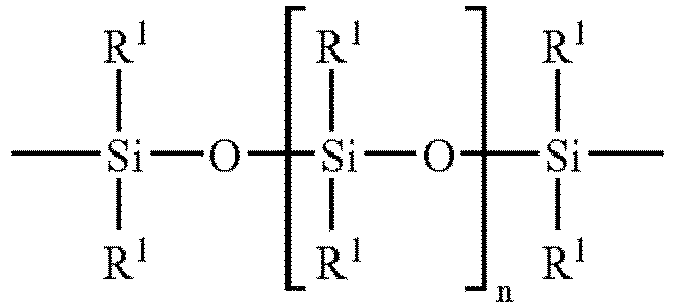
- R1 may be C1-C18 alkyl, C1-C18 fluoroalkyl and aryl. Furthermore, R1 is preferably C1-C18 alkyl, C1-C6 fluoroalkyl and aryl. Furthermore, R1 is more preferably C1-C6 alkyl, C1-C6 fluoroalkyl, even more preferably C1-C4 fluoroalkyl, and phenyl. Most preferably, R1 is methyl, ethyl, trifluoropropyl and phenyl.
- As used herein, the term "C1-C22 alkyl" means that the aliphatic hydrocarbon groups possess from 1 to 22 carbon atoms which can be straight chain or branched. Methyl, ethyl, propyl, n-butyl, pentyl, hexyl, heptyl, nonyl, decyl, undecyl, isopropyl, neopentyl and 1,2,3-trimethyl hexyl moieties serve as examples.
- Further as used herein, the term "C1-C22 fluoroalkyl" means aliphatic hydrocarbon compounds with 1 to 22 carbon atoms which can be straight chain or branched and are substituted with at least one fluorine atom. Monofluoromethyl, monofluoroethyl, 1,1,1-trifluorethyl, perfluoroethyl, 1,1,1-trifluoropropyl, 1,2,2-trifluorobutyl are suitable examples.
- Moreover, the term "aryl" means unsubstituted or phenyl substituted once or several times with OH, F, Cl, CF3, C1-C6 alkyl, C1-C6 alkoxy, C3-C7 cycloalkyl, C2-C6 alkenyl or phenyl. Aryl may also mean naphthyl.
- For the polyorganosiloxanes, the positive charges resulting from the ammonium group(s), may be neutralized with inorganic anions such as chloride, bromide, hydrogen sulfate, sulfate, or organic anions, like carboxylates deriving from C1-C30 carboxylic acids, for example acetate, propionate, octanoate, especially from C10-C18 carboxylic acids, for example decanoate, dodecanoate, tetradecanoate, hexadecanoate, octadecanoate and oleate, alkylpolyethercarboxylate, alkyl sulphonate, aryl sulphonate, alkylaryl sulphonate, alkylsulphate, alkylpolyethersulphate, phosphates derived from phosphoric acid mono alkyl/aryl ester and phosphoric acid dialkyl/aryl ester. The properties of the polyorganosiloxane compounds can be, inter alia, modified based upon the selection of acids used.
- The quaternary ammonium groups are usually generated by reacting the di-tertiary amines with an alkylating agents, selected from in particular di-epoxides (sometimes referred to also as bis-epoxides) in the presence of mono carboxylic acids and difunctional dihalogen alkyl compounds.
- The polyorganosiloxane compounds may be of the general formulas (Ia) and (Ib):
M-Y-[-(N+R2-T-N+R2)-Y-]m-[-(NR2-A-E-A'-NR2)-Y-]k-M (Ia)
M-Y-[-(N+R2-T-N+R2)-Y-]m-[-(N+R2 2-A-E-A'-N+R2 2)-Y-]k-M (Ib)
wherein each group is as defined above; however, the repeating units are in a statistical arrangement (i.e., not a block-wise arrangement). - The polyorganosiloxane compounds may be also of the general formulas (IIa) or (IIb):
M-Y-[-N+R2-Y-]m-[-(NR2-A-E-A'-NR2)-Y-]k-M (IIa)
M-Y-[-N+R2-Y-]m-[-(N+R2 2-A-E-A'-N+R2 2)-Y-]k-M (IIb)
- wherein each group is as defined above. Also in such formula the repeating units are usually in a statistical arrangement (i.e not a block-wise arrangement).
- wherein, as defined above, M is
- -OC(O)-Z,
- -OS(O)2-Z
- -OS(O2)O-Z
- -OP(O)(O-Z)OH
- -OP(O)(O-Z)2
- Z is a straight chain, cyclic or branched saturated or unsaturated C1-C20, or preferably C2 to C18, or even more preferably a hydrocarbon radical, which can be interrupted by one or more —O— , or —C(O)— and substituted with -OH. M may be -OC(O)-Z resulting from normal carboxylic acids in particular with more than 10 carbon atoms like for example dodecanoic acid.
- The molar ratio of the polyorganosiloxane-containing repeating group —K—S—K—and the polyalkylene repeating group —A—E—A'— or —A'—E—A— may be between 100:1 and 1:100, or preferably between 20:1 and 1:20, or more preferably between 10:1 and 1:10.
- In the group -(N+R2-T-N+R2)-, R may represent a monovalent straight chain, cyclic or branched C1-C20 hydrocarbon radical, which can be interrupted by one or more —O— ,-C(O)- and can be substituted by-OH, T may represent a divalent straight-chain, cyclic, or branched C1-C20 hydrocarbon radical, which can be interrupted by —O— , —C(O)— and can be substituted by hydroxyl.
- The above described polyorganosiloxane compounds comprising quaternary ammonium functions and ester functions may also contain: 1) individual molecules which contain quaternary ammonium functions and no ester functions; 2) molecules which contain quaternary ammonium functions and ester functions; and 3) molecules which contain ester functions and no quaternary ammonium functions. While not limited to structure, the above described polyorganosiloxane compounds comprising quaternary ammonium functions and ester functions are to be understood as mixtures of molecules comprising a certain averaged amount and ratio of both moieties.
- Various monofunctional organic acids may be utilized to yield the esters. Exemplary aspects include C1-C30 carboxylic acids, for example C2, C3, C8 acids, C10-C18 carboxylic acids, for example C12, C14, C16 acids, saturated, unsaturated and hydroxyl functionalized C18 acids, alkylpolyethercarboxylic acids, alkylsulphonic acids, arylsulphonic acids, alkylarylsulphonic acids, alkylsulphuric acids, alkylpolyethersulphuric acids, phosphoric acid mono alkyl/aryl esters and phosphoric acid dialkyl/aryl esters.
- The composition of the present invention may include other additional components, which may be selected by the artisan according to the desired characteristics of the final product and which are suitable for rendering the composition more cosmetically or aesthetically acceptable or to provide them with additional usage benefits. Such other additional components generally are used individually at levels of from 0.001% to 10%, preferably up to 5% by weight of the composition.
- A wide variety of other additional components can be formulated into the present compositions. These include: other conditioning agents such as hydrolyzed collagen with tradename Peptein 2000 available from Hormel, vitamin E with tradename Emix-d available from Eisai, panthenol available from Roche, panthenyl ethyl ether available from Roche, hydrolyzed keratin, proteins, plant extracts, and nutrients; preservatives such as benzyl alcohol, methyl paraben, propyl paraben and imidazolidinyl urea; pH adjusting agents, such as citric acid, sodium citrate, succinic acid, phosphoric acid, sodium hydroxide, sodium carbonate; coloring agents, such as any of the FD&C or D&C dyes; perfumes; ultraviolet and infrared screening and absorbing agents such as benzophenones; and antidandruff agents such as zinc pyrithione; non-ionic surfactant such as mono-9-octadecanoate poly(oxy-1,2-ethanediyl) supplied as, for example, Tween 20; and buffer such as aminomethyl propanol.
- The compositions of the present invention can be in the form of rinse-off products or leave-on products, and can be formulated in a wide variety of product forms, including but not limited to creams, gels, emulsions, mousses and sprays. The composition of the present invention is especially suitable for hair conditioners especially rinse-off hair conditioners.
- The following examples further describe and demonstrate aspects within the scope of the present invention. The examples are given solely for the purpose of illustration and are not to be construed as limitations of the present invention. Where applicable, ingredients are identified by chemical or CTFA name, or otherwise defined below.
-
Component Ex. 1 CEx. i Ex.2 CEx. ii BTMS/IPA (80% BTMS and 20% IPA) 2.96 2.96 2.96 2.96 Cetyl Alcohol 1.18 1.18 1.18 1.18 Stearyl Alcohol 2.83 2.94 2.83 2.94 Stearth-200 3.50 0 3.50 0 Citric Acid 6.0 6.0 0 0 NaHCO3 0 0 7.8 7.8 Disodium EDTA 0.13 0.13 0.13 0.13 Benzyl Alcohol 0.40 0.40 0.40 0.40 Kathon CG 0.03 0.03 0.03 0.03 Deionized Water q.s. to 100% of the composition Stability Stable Stable Stable Immediate Phase Separation Texture Good Runny Good Runny Wet conditioning 4.2 2.4 4.0 2.6 -
Ex. 3 Ex. 4 Ex. 5 Ex. 6 CEx. iii BTMS/IPA (80% BTMS and 20% IPA) 4.36 4.36 4.36 4.36 4.36 Cetyl Alcohol 1.73 1.73 1.73 1.73 1.73 Steary Alcohol 4.17 4.25 4.29 4.26 4.32 Stearth-200 5.14 2.57 1.04 0 0 Steareth-100 0 0 0 1.06 0 Hexyldecanol 5 5 5 5 5 Isostearyl Isostearate 1 1 1 1 1 Salicylic Acid 2.0 2.0 2.0 2.0 2.0 NaOH 0.58 0.58 0.58 0.58 0.58 Disodium EDTA 0.13 0.13 0.13 0.13 0.13 Benzyl Alcohol 0.40 0.40 0.40 0.40 0.40 Kathon CG 0.03 0.03 0.03 0.03 0.03 Amodimethicone 7.00 7.00 7.00 7.00 7.00 Perfume 0.50 0.50 0.50 0.50 0.50 Deionized Water q.s. to 100% of the composition Stability Stable Stable Stable Stable Immediate Phase Separation Texture Good Good Good Good Runny Wet conditioning 3.7 4.0 4.3 4.3 1.9 -
CEx. iv Ex.7 BTMS/IPA (80% BTMS and 20% IPA) 3.27 3.27 Cetyl Alcohol 1.30 1.30 Stearyl Alcohol 3.24 3.21 Stearth-200 0 1.00 Hexyldecanol 5 5 Isostearyl Isostearate 1 1 Disodium EDTA 0.13 0.13 Benzyl Alcohol 0.40 0.40 Kathon CG 0.03 0.03 Silicone Emulsion *1 25 25 Perfume 0.50 0.50 Deionized Water q.s. to 100% of the composition Stability Stable Stable Texture Runny Good Wet conditioning 2.6 4.8 -
CEx. v Ex. 8 CEx.vi Ex. 9 CEx. vii Ex. 10 Stearamidopropyl Dimethylamine 1.06 1.06 0 0 0 0 Behentrimonium Methosulfate/IPA (80/20) 0 0 3.19 3.19 2.49 2.49 Dicetyldimonium Chloride/PG (68/32) 0.51 0.51 0 0 0.84 0.84 Steareth-200 0 1.00 0 1.00 0 1.00 Cetyl alcohol 1.58 1.58 0.98 0.98 1.31 1.31 Stearyl alcohol 2.84 2.81 2.46 2.43 3.29 3.26 Disodium EDTA 0.13 0.13 0.13 0.13 0.13 0.13 EDDS 0.30 0.30 0.30 0.30 0.30 0.30 Benzyl Alcohol 0.40 0.40 0.40 0.40 0.40 0.40 Kathon CG 0.03 0.03 0.03 0.03 0.03 0.03 Amodimethicone 0.50 0.50 3.5 3.5 2.5 2.5 Perfume 0.50 0.50 0.50 0.50 0.50 0.50 Deionized Water q.s. to 100% of the composition Stability Immediate phase separation Stable Immediate phase separation Stable Immediate phase separation Stable Texture Runny Good Runny Good Runny Good Wet conditioning 1.2 4.0 1.4 4.4 1.4 4.2 -
- *1 Silicone emulsion: Belsil ADM 8301 E available from Wacker, Germany.
- The above hair care compositions of "Ex. 1" through "Ex. 10" of the present invention and those of "CEx. i" through "CEx. vii" as comparative examples can be prepared by any conventional method well known in the art.
- For some of the above compositions, properties and conditioning benefits are evaluated by the following methods. Results of the evaluation are also shown above.
- The aspects disclosed and represented by "Ex. 1" through "Ex. 10" are hair conditioning compositions of the present invention which are particularly useful for rinse-off use. Such aspects have many advantages. For example, they provide stability and wet conditioning while containing ionic benefit agents.
- Stability is evaluated by a visual investigation for phase separation.
- Texture is evaluated by a panelist test. 5 to 7 panelists evaluated samples as follows: "Good" texture means the product remains mounding when dispensed, and is easily spreadable on wet hair and penetrates to the gaps between hair fibers.
- "Runny" texture means the product does not retain the same shape on hand when dispensed, thus tend to flow out from palm.
- Wet conditioning benefit is evaluated by a panelist test. 5 to 7 panelists evaluated samples prepared by applying 0.1ml of the above compositions per 1g of wet hair. Panelists evaluated each sample from 1 (very poor) to 5 (very good) to be able to apply and spread evenly on hair. The data from the panelists were gathered, averaged, and scored, and compared.
Claims (6)
- A hair conditioning composition comprising:a cationic surfactant;a high melting point fatty compound, wherein the high melting point fatty compound has a melting point of 25°C or higher;an ionic benefit agent, wherein the ionic benefit agents are those excluding ionic dyes, precursors thereof, and anionic surfactants,wherein the ionic benefit agent is water soluble,wherein the water-soluble ionic benefit agents is selected from the group consisting of salicylic acid, 5-chlorosalicylic acid, 2,4-dihydroxybenzoic acid, citric acid, ascorbic acid, benzoic acid, ethylenediamine disuccinic acid (EDDS), ethylene diamine tetraacetic acid (EDTA), arginine, histidine, lysine, aspartic acid, glutamic acid, serine, threonine, asparagine, glutamine, glycine, proline, alanine, valine, isoleucine leucine, phenylalanine, tyrosine, tryptophane, and salts thereof; an alkyl ether and/or alkyl ester included in the composition at a level of from about 0.8%, wherein the alkyl ether and/or alkyl ester is at least one of the following: polyethylene glycol, polypropylene glycol, polyglycerin, and mixtures thereof, and wherein the alkyl ether and/or alkyl ester has from 100 to 200 units of ethylene glycol, propylene glycol, glycerin and mixtures thereof; andan aqueous carrier.
- The hair conditioning composition of Claim 1, wherein the alkyl ether and/or alkyl ester is an alkyl ether and/or alkyl ester of at least one of the following: polyethylene glycol, polyglycerin, and mixtures thereof, preferably wherein the alkyl ether and/or alkyl ester is an alkyl ether and/or alkyl ester of polyethylene glycol.
- The hair conditioning composition of any of the preceding claims, wherein the alkyl group of the alkyl ether and/or ester has from 10 to 30 carbon atoms, preferably from 14 to 30 carbon atoms, more preferably from 16 to 22 carbon atoms.
- The hair conditioning composition of any of the preceding claims, wherein the alkyl group of the alkyl ether and/or ester is a straight, saturated alkyl group.
- The hair conditioning composition of any of the preceding claims, wherein the ionic benefit agent is selected from salicylic acid, EDDS and mixtures thereof.
- The hair conditioning composition of any of the preceding claims, wherein the ionic benefit agent is included in the hair conditioning composition at a level of from 0.1%, preferably from 0.2%, more preferably from 0.5%, still more preferably from 1% based upon the total weight of the hair conditioning composition.
Applications Claiming Priority (2)
| Application Number | Priority Date | Filing Date | Title |
|---|---|---|---|
| US201662299564P | 2016-02-25 | 2016-02-25 | |
| PCT/US2017/018610 WO2017147030A1 (en) | 2016-02-25 | 2017-02-21 | Hair conditioning compositions comprising alkyl ethers/esters of polyethylene glycol, polypropylene glycol, and/or polyglycerin |
Publications (2)
| Publication Number | Publication Date |
|---|---|
| EP3419587A1 EP3419587A1 (en) | 2019-01-02 |
| EP3419587B1 true EP3419587B1 (en) | 2023-09-20 |
Family
ID=58266196
Family Applications (1)
| Application Number | Title | Priority Date | Filing Date |
|---|---|---|---|
| EP17710083.1A Active EP3419587B1 (en) | 2016-02-25 | 2017-02-21 | Hair conditioning compositions comprising alkyl ethers/esters of polyethylene glycol, polypropylene glycol, and/or polyglycerin |
Country Status (6)
| Country | Link |
|---|---|
| US (1) | US10765618B2 (en) |
| EP (1) | EP3419587B1 (en) |
| JP (1) | JP6788021B2 (en) |
| CN (1) | CN108697588B (en) |
| MX (1) | MX378327B (en) |
| WO (1) | WO2017147030A1 (en) |
Families Citing this family (14)
| Publication number | Priority date | Publication date | Assignee | Title |
|---|---|---|---|---|
| US10952950B2 (en) | 2015-04-23 | 2021-03-23 | The Procter And Gamble Company | Concentrated personal cleansing compositions and methods |
| EP3285725B1 (en) | 2015-04-23 | 2019-12-04 | The Procter and Gamble Company | Concentrated personal cleansing compositions |
| US11202746B2 (en) | 2015-04-23 | 2021-12-21 | The Procter And Gamble Company | Concentrated personal cleansing compositions and methods |
| US20160310387A1 (en) | 2015-04-23 | 2016-10-27 | The Procter & Gamble Company | Concentrated Personal Cleansing Compositions and Methods |
| JP2019513774A (en) * | 2016-04-22 | 2019-05-30 | ザ プロクター アンド ギャンブル カンパニー | How to form a silicone layer |
| US10835480B2 (en) * | 2016-04-22 | 2020-11-17 | The Procter And Gamble Company | Method of forming a silicone layer |
| US11179301B2 (en) | 2016-10-21 | 2021-11-23 | The Procter And Gamble Company | Skin cleansing compositions and methods |
| US11185486B2 (en) | 2016-10-21 | 2021-11-30 | The Procter And Gamble Company | Personal cleansing compositions and methods |
| US10675231B2 (en) | 2017-02-17 | 2020-06-09 | The Procter & Gamble Company | Packaged personal cleansing product |
| US10806686B2 (en) | 2017-02-17 | 2020-10-20 | The Procter And Gamble Company | Packaged personal cleansing product |
| MX2021004954A (en) | 2018-11-08 | 2021-06-15 | Procter & Gamble | Low shear stress conditioner composition with spherical gel network vesicles. |
| WO2020099316A1 (en) * | 2018-11-14 | 2020-05-22 | Sika Technology Ag | Solvent for aromatic carboxylic or sulfonic acids |
| US20230050775A1 (en) * | 2019-12-23 | 2023-02-16 | Kao Corporation | Hair cosmetic composition |
| WO2025085270A1 (en) * | 2023-10-19 | 2025-04-24 | L'oreal | Hair treatment composition with cationic surfactant, fatty alcohols, and low polar oil |
Citations (2)
| Publication number | Priority date | Publication date | Assignee | Title |
|---|---|---|---|---|
| WO1997025973A1 (en) * | 1996-01-12 | 1997-07-24 | The Procter & Gamble Company | Compositions for treating hair or skin |
| WO2017106401A1 (en) * | 2015-12-15 | 2017-06-22 | The Procter & Gamble Company | Method of treating hair |
Family Cites Families (19)
| Publication number | Priority date | Publication date | Assignee | Title |
|---|---|---|---|---|
| US4275055A (en) | 1979-06-22 | 1981-06-23 | Conair Corporation | Hair conditioner having a stabilized, pearlescent effect |
| US5641480A (en) * | 1994-12-08 | 1997-06-24 | Lever Brothers Company, Division Of Conopco, Inc. | Hair care compositions comprising heteroatom containing alkyl aldonamide compounds |
| TW449485B (en) * | 1995-03-31 | 2001-08-11 | Colgate Palmolive Co | Skin care products containing anti itching/anti irritant agents |
| MXPA02002363A (en) * | 1999-09-03 | 2002-07-30 | Procter & Gamble | Hair care composition comprising a polypropylene glycol. |
| JP2002003343A (en) * | 2000-06-26 | 2002-01-09 | Shiseido Co Ltd | Hair-treating agent composition |
| MXPA06002322A (en) | 2003-09-24 | 2006-05-22 | Procter & Gamble | Conditioning composition comprising aminosilicone. |
| EP1878469B1 (en) | 2006-07-12 | 2010-09-01 | The Procter & Gamble Company | Gel network surfactant based thickening systems for hair colourant and bleaching compositions |
| JP2011525540A (en) | 2008-06-25 | 2011-09-22 | ザ プロクター アンド ギャンブル カンパニー | Hair conditioning composition with higher yield point and higher conversion of aliphatic compounds to gel matrix |
| FR2938763B1 (en) * | 2008-11-24 | 2012-09-28 | Oreal | SOLID COSMETIC COMPOSITION FOR APPLICATION TO KERATIN FIBERS |
| EP2308564B1 (en) | 2009-09-18 | 2018-12-19 | Noxell Corporation | Thickened hair colourant and bleaching compositions |
| GB201013355D0 (en) * | 2010-08-09 | 2010-09-22 | Lehane Patrick | Improved cleaning and conditioning agents |
| JP5827497B2 (en) | 2011-05-18 | 2015-12-02 | ヘンケルジャパン株式会社 | Two-component oxidative hair dye |
| IN2014DN06559A (en) | 2012-02-24 | 2015-05-22 | Procter & Gamble | |
| JP5655127B2 (en) * | 2012-10-29 | 2015-01-14 | 株式会社 資生堂 | Hair conditioner composition |
| MX362126B (en) | 2013-08-23 | 2019-01-07 | Noxell Corp | Hair colouring method. |
| BR112016003784B1 (en) | 2013-08-23 | 2020-07-14 | Noxell Corporation | METHODS FOR HAIR DYEING AND ITS KITS |
| JP6414594B2 (en) | 2013-08-23 | 2018-10-31 | ノクセル・コーポレーション | Hair dyeing method and kit |
| JP6245979B2 (en) * | 2013-12-26 | 2017-12-13 | クラシエホームプロダクツ株式会社 | Hair cosmetics |
| EP2974712B1 (en) | 2014-07-14 | 2018-02-14 | Noxell Corporation | Hair treatment composition, kit and method thereof |
-
2017
- 2017-02-21 JP JP2018542195A patent/JP6788021B2/en active Active
- 2017-02-21 CN CN201780013313.2A patent/CN108697588B/en active Active
- 2017-02-21 EP EP17710083.1A patent/EP3419587B1/en active Active
- 2017-02-21 MX MX2018010182A patent/MX378327B/en unknown
- 2017-02-21 WO PCT/US2017/018610 patent/WO2017147030A1/en not_active Ceased
- 2017-02-21 US US15/437,816 patent/US10765618B2/en active Active
Patent Citations (2)
| Publication number | Priority date | Publication date | Assignee | Title |
|---|---|---|---|---|
| WO1997025973A1 (en) * | 1996-01-12 | 1997-07-24 | The Procter & Gamble Company | Compositions for treating hair or skin |
| WO2017106401A1 (en) * | 2015-12-15 | 2017-06-22 | The Procter & Gamble Company | Method of treating hair |
Non-Patent Citations (3)
| Title |
|---|
| DATABASE GNPD MINTEL; "Conditioner", XP093169440, Database accession no. 3282709 |
| DATABASE GNPD MINTEL; "Conditioner", XP093169441, Database accession no. 3553843 |
| DATABASE GNPD MINTEL; "Conditioner", XP093169442, Database accession no. 1228699 |
Also Published As
| Publication number | Publication date |
|---|---|
| MX2018010182A (en) | 2018-11-09 |
| JP6788021B2 (en) | 2020-11-18 |
| EP3419587A1 (en) | 2019-01-02 |
| US10765618B2 (en) | 2020-09-08 |
| WO2017147030A1 (en) | 2017-08-31 |
| CN108697588A (en) | 2018-10-23 |
| JP2019508412A (en) | 2019-03-28 |
| US20170246101A1 (en) | 2017-08-31 |
| CN108697588B (en) | 2021-09-14 |
| MX378327B (en) | 2025-03-10 |
Similar Documents
| Publication | Publication Date | Title |
|---|---|---|
| US10765618B2 (en) | Hair conditioning compositions comprising alkyl ethers/esters of polyethylene glycol, polypropylene glycol, and/or polyglycerin | |
| US11083676B2 (en) | Method of preparing a product composition comprising a discrete particle and an aqueous base composition | |
| US20070298004A1 (en) | Conditioning composition comprising asymmetric dialkyl quaternized ammonium salt | |
| US20080019935A1 (en) | Conditioning composition comprising silicone agent for ease-to-rinse feel and/or clean feel | |
| US20170290755A1 (en) | Hair conditioning composition comprising two cationic surfactants and benefit material such as salicylic acid and 2-hexyl-1-decanol | |
| US20260069526A1 (en) | Hair conditioning product comprising first and second compositions | |
| US10226404B2 (en) | Method for preparing antidandruff hair care compositions comprising a step of injecting antidandruff agents, perfumes and/or silicones | |
| US20180200171A1 (en) | Hair care composition comprising cationic surfactant system, silicone, and metal salt | |
| US20150374608A1 (en) | Hair conditioning composition comprising amidoamine cationic surfactant and deposition polymer and having lower ph | |
| US9974718B2 (en) | Method for preparing hair care compositions comprising a step of adding perfumes and/or silicones before antidandruff agents | |
| US20150216777A1 (en) | Method For Preparing Hair Care Compositions Comprising a Step of Controlling Temperature to Add Antidandruff Agents | |
| EP3373900B1 (en) | Hair conditioning composition comprising cyclic compounds and compounds having at least three head groups | |
| EP3280383A1 (en) | Hair conditioning composition comprising two cationic surfactants and benefit material such as salicylic acid and 2-hexyl-1-decanol | |
| EP3996665B1 (en) | Hair conditioning composition comprising branched fatty alcohol and triester | |
| EP2953607B1 (en) | Method for preparing antidandruff hair care compositions comprising a step of injecting antidandruff agents, perfumes and/or silicones | |
| EP2953608B1 (en) | Method for preparing hair care compositions comprising a step of adding perfumes and/or silicones before antidandruff agents |
Legal Events
| Date | Code | Title | Description |
|---|---|---|---|
| STAA | Information on the status of an ep patent application or granted ep patent |
Free format text: STATUS: UNKNOWN |
|
| STAA | Information on the status of an ep patent application or granted ep patent |
Free format text: STATUS: THE INTERNATIONAL PUBLICATION HAS BEEN MADE |
|
| PUAI | Public reference made under article 153(3) epc to a published international application that has entered the european phase |
Free format text: ORIGINAL CODE: 0009012 |
|
| STAA | Information on the status of an ep patent application or granted ep patent |
Free format text: STATUS: REQUEST FOR EXAMINATION WAS MADE |
|
| 17P | Request for examination filed |
Effective date: 20180719 |
|
| AK | Designated contracting states |
Kind code of ref document: A1 Designated state(s): AL AT BE BG CH CY CZ DE DK EE ES FI FR GB GR HR HU IE IS IT LI LT LU LV MC MK MT NL NO PL PT RO RS SE SI SK SM TR |
|
| AX | Request for extension of the european patent |
Extension state: BA ME |
|
| DAV | Request for validation of the european patent (deleted) | ||
| DAX | Request for extension of the european patent (deleted) | ||
| STAA | Information on the status of an ep patent application or granted ep patent |
Free format text: STATUS: EXAMINATION IS IN PROGRESS |
|
| 17Q | First examination report despatched |
Effective date: 20210504 |
|
| GRAP | Despatch of communication of intention to grant a patent |
Free format text: ORIGINAL CODE: EPIDOSNIGR1 |
|
| STAA | Information on the status of an ep patent application or granted ep patent |
Free format text: STATUS: GRANT OF PATENT IS INTENDED |
|
| INTG | Intention to grant announced |
Effective date: 20230417 |
|
| P01 | Opt-out of the competence of the unified patent court (upc) registered |
Effective date: 20230429 |
|
| GRAS | Grant fee paid |
Free format text: ORIGINAL CODE: EPIDOSNIGR3 |
|
| GRAA | (expected) grant |
Free format text: ORIGINAL CODE: 0009210 |
|
| STAA | Information on the status of an ep patent application or granted ep patent |
Free format text: STATUS: THE PATENT HAS BEEN GRANTED |
|
| AK | Designated contracting states |
Kind code of ref document: B1 Designated state(s): AL AT BE BG CH CY CZ DE DK EE ES FI FR GB GR HR HU IE IS IT LI LT LU LV MC MK MT NL NO PL PT RO RS SE SI SK SM TR |
|
| REG | Reference to a national code |
Ref country code: GB Ref legal event code: FG4D |
|
| REG | Reference to a national code |
Ref country code: CH Ref legal event code: EP |
|
| REG | Reference to a national code |
Ref country code: DE Ref legal event code: R096 Ref document number: 602017074385 Country of ref document: DE |
|
| REG | Reference to a national code |
Ref country code: IE Ref legal event code: FG4D |
|
| REG | Reference to a national code |
Ref country code: LT Ref legal event code: MG9D |
|
| PG25 | Lapsed in a contracting state [announced via postgrant information from national office to epo] |
Ref country code: GR Free format text: LAPSE BECAUSE OF FAILURE TO SUBMIT A TRANSLATION OF THE DESCRIPTION OR TO PAY THE FEE WITHIN THE PRESCRIBED TIME-LIMIT Effective date: 20231221 |
|
| REG | Reference to a national code |
Ref country code: NL Ref legal event code: MP Effective date: 20230920 |
|
| PG25 | Lapsed in a contracting state [announced via postgrant information from national office to epo] |
Ref country code: SE Free format text: LAPSE BECAUSE OF FAILURE TO SUBMIT A TRANSLATION OF THE DESCRIPTION OR TO PAY THE FEE WITHIN THE PRESCRIBED TIME-LIMIT Effective date: 20230920 Ref country code: RS Free format text: LAPSE BECAUSE OF FAILURE TO SUBMIT A TRANSLATION OF THE DESCRIPTION OR TO PAY THE FEE WITHIN THE PRESCRIBED TIME-LIMIT Effective date: 20230920 Ref country code: NO Free format text: LAPSE BECAUSE OF FAILURE TO SUBMIT A TRANSLATION OF THE DESCRIPTION OR TO PAY THE FEE WITHIN THE PRESCRIBED TIME-LIMIT Effective date: 20231220 Ref country code: LV Free format text: LAPSE BECAUSE OF FAILURE TO SUBMIT A TRANSLATION OF THE DESCRIPTION OR TO PAY THE FEE WITHIN THE PRESCRIBED TIME-LIMIT Effective date: 20230920 Ref country code: LT Free format text: LAPSE BECAUSE OF FAILURE TO SUBMIT A TRANSLATION OF THE DESCRIPTION OR TO PAY THE FEE WITHIN THE PRESCRIBED TIME-LIMIT Effective date: 20230920 Ref country code: HR Free format text: LAPSE BECAUSE OF FAILURE TO SUBMIT A TRANSLATION OF THE DESCRIPTION OR TO PAY THE FEE WITHIN THE PRESCRIBED TIME-LIMIT Effective date: 20230920 Ref country code: GR Free format text: LAPSE BECAUSE OF FAILURE TO SUBMIT A TRANSLATION OF THE DESCRIPTION OR TO PAY THE FEE WITHIN THE PRESCRIBED TIME-LIMIT Effective date: 20231221 Ref country code: FI Free format text: LAPSE BECAUSE OF FAILURE TO SUBMIT A TRANSLATION OF THE DESCRIPTION OR TO PAY THE FEE WITHIN THE PRESCRIBED TIME-LIMIT Effective date: 20230920 |
|
| REG | Reference to a national code |
Ref country code: AT Ref legal event code: MK05 Ref document number: 1612864 Country of ref document: AT Kind code of ref document: T Effective date: 20230920 |
|
| PG25 | Lapsed in a contracting state [announced via postgrant information from national office to epo] |
Ref country code: NL Free format text: LAPSE BECAUSE OF FAILURE TO SUBMIT A TRANSLATION OF THE DESCRIPTION OR TO PAY THE FEE WITHIN THE PRESCRIBED TIME-LIMIT Effective date: 20230920 |
|
| PG25 | Lapsed in a contracting state [announced via postgrant information from national office to epo] |
Ref country code: IS Free format text: LAPSE BECAUSE OF FAILURE TO SUBMIT A TRANSLATION OF THE DESCRIPTION OR TO PAY THE FEE WITHIN THE PRESCRIBED TIME-LIMIT Effective date: 20240120 |
|
| PG25 | Lapsed in a contracting state [announced via postgrant information from national office to epo] |
Ref country code: AT Free format text: LAPSE BECAUSE OF FAILURE TO SUBMIT A TRANSLATION OF THE DESCRIPTION OR TO PAY THE FEE WITHIN THE PRESCRIBED TIME-LIMIT Effective date: 20230920 |
|
| PG25 | Lapsed in a contracting state [announced via postgrant information from national office to epo] |
Ref country code: ES Free format text: LAPSE BECAUSE OF FAILURE TO SUBMIT A TRANSLATION OF THE DESCRIPTION OR TO PAY THE FEE WITHIN THE PRESCRIBED TIME-LIMIT Effective date: 20230920 |
|
| PG25 | Lapsed in a contracting state [announced via postgrant information from national office to epo] |
Ref country code: SM Free format text: LAPSE BECAUSE OF FAILURE TO SUBMIT A TRANSLATION OF THE DESCRIPTION OR TO PAY THE FEE WITHIN THE PRESCRIBED TIME-LIMIT Effective date: 20230920 Ref country code: RO Free format text: LAPSE BECAUSE OF FAILURE TO SUBMIT A TRANSLATION OF THE DESCRIPTION OR TO PAY THE FEE WITHIN THE PRESCRIBED TIME-LIMIT Effective date: 20230920 Ref country code: IS Free format text: LAPSE BECAUSE OF FAILURE TO SUBMIT A TRANSLATION OF THE DESCRIPTION OR TO PAY THE FEE WITHIN THE PRESCRIBED TIME-LIMIT Effective date: 20240120 Ref country code: ES Free format text: LAPSE BECAUSE OF FAILURE TO SUBMIT A TRANSLATION OF THE DESCRIPTION OR TO PAY THE FEE WITHIN THE PRESCRIBED TIME-LIMIT Effective date: 20230920 Ref country code: EE Free format text: LAPSE BECAUSE OF FAILURE TO SUBMIT A TRANSLATION OF THE DESCRIPTION OR TO PAY THE FEE WITHIN THE PRESCRIBED TIME-LIMIT Effective date: 20230920 Ref country code: CZ Free format text: LAPSE BECAUSE OF FAILURE TO SUBMIT A TRANSLATION OF THE DESCRIPTION OR TO PAY THE FEE WITHIN THE PRESCRIBED TIME-LIMIT Effective date: 20230920 Ref country code: AT Free format text: LAPSE BECAUSE OF FAILURE TO SUBMIT A TRANSLATION OF THE DESCRIPTION OR TO PAY THE FEE WITHIN THE PRESCRIBED TIME-LIMIT Effective date: 20230920 Ref country code: SK Free format text: LAPSE BECAUSE OF FAILURE TO SUBMIT A TRANSLATION OF THE DESCRIPTION OR TO PAY THE FEE WITHIN THE PRESCRIBED TIME-LIMIT Effective date: 20230920 Ref country code: PT Free format text: LAPSE BECAUSE OF FAILURE TO SUBMIT A TRANSLATION OF THE DESCRIPTION OR TO PAY THE FEE WITHIN THE PRESCRIBED TIME-LIMIT Effective date: 20240122 |
|
| PG25 | Lapsed in a contracting state [announced via postgrant information from national office to epo] |
Ref country code: PL Free format text: LAPSE BECAUSE OF FAILURE TO SUBMIT A TRANSLATION OF THE DESCRIPTION OR TO PAY THE FEE WITHIN THE PRESCRIBED TIME-LIMIT Effective date: 20230920 Ref country code: IT Free format text: LAPSE BECAUSE OF FAILURE TO SUBMIT A TRANSLATION OF THE DESCRIPTION OR TO PAY THE FEE WITHIN THE PRESCRIBED TIME-LIMIT Effective date: 20230920 |
|
| REG | Reference to a national code |
Ref country code: DE Ref legal event code: R026 Ref document number: 602017074385 Country of ref document: DE |
|
| PLBI | Opposition filed |
Free format text: ORIGINAL CODE: 0009260 |
|
| PLAX | Notice of opposition and request to file observation + time limit sent |
Free format text: ORIGINAL CODE: EPIDOSNOBS2 |
|
| 26 | Opposition filed |
Opponent name: HENKEL AG & CO. KGAA Effective date: 20240603 |
|
| PG25 | Lapsed in a contracting state [announced via postgrant information from national office to epo] |
Ref country code: DK Free format text: LAPSE BECAUSE OF FAILURE TO SUBMIT A TRANSLATION OF THE DESCRIPTION OR TO PAY THE FEE WITHIN THE PRESCRIBED TIME-LIMIT Effective date: 20230920 |
|
| PG25 | Lapsed in a contracting state [announced via postgrant information from national office to epo] |
Ref country code: DK Free format text: LAPSE BECAUSE OF FAILURE TO SUBMIT A TRANSLATION OF THE DESCRIPTION OR TO PAY THE FEE WITHIN THE PRESCRIBED TIME-LIMIT Effective date: 20230920 |
|
| PG25 | Lapsed in a contracting state [announced via postgrant information from national office to epo] |
Ref country code: MC Free format text: LAPSE BECAUSE OF FAILURE TO SUBMIT A TRANSLATION OF THE DESCRIPTION OR TO PAY THE FEE WITHIN THE PRESCRIBED TIME-LIMIT Effective date: 20230920 |
|
| REG | Reference to a national code |
Ref country code: CH Ref legal event code: PL |
|
| PG25 | Lapsed in a contracting state [announced via postgrant information from national office to epo] |
Ref country code: LU Free format text: LAPSE BECAUSE OF NON-PAYMENT OF DUE FEES Effective date: 20240221 |
|
| PG25 | Lapsed in a contracting state [announced via postgrant information from national office to epo] |
Ref country code: CH Free format text: LAPSE BECAUSE OF NON-PAYMENT OF DUE FEES Effective date: 20240229 |
|
| PG25 | Lapsed in a contracting state [announced via postgrant information from national office to epo] |
Ref country code: SI Free format text: LAPSE BECAUSE OF FAILURE TO SUBMIT A TRANSLATION OF THE DESCRIPTION OR TO PAY THE FEE WITHIN THE PRESCRIBED TIME-LIMIT Effective date: 20230920 |
|
| PLBB | Reply of patent proprietor to notice(s) of opposition received |
Free format text: ORIGINAL CODE: EPIDOSNOBS3 |
|
| PG25 | Lapsed in a contracting state [announced via postgrant information from national office to epo] |
Ref country code: SI Free format text: LAPSE BECAUSE OF FAILURE TO SUBMIT A TRANSLATION OF THE DESCRIPTION OR TO PAY THE FEE WITHIN THE PRESCRIBED TIME-LIMIT Effective date: 20230920 Ref country code: LU Free format text: LAPSE BECAUSE OF NON-PAYMENT OF DUE FEES Effective date: 20240221 Ref country code: CH Free format text: LAPSE BECAUSE OF NON-PAYMENT OF DUE FEES Effective date: 20240229 |
|
| PG25 | Lapsed in a contracting state [announced via postgrant information from national office to epo] |
Ref country code: BG Free format text: LAPSE BECAUSE OF FAILURE TO SUBMIT A TRANSLATION OF THE DESCRIPTION OR TO PAY THE FEE WITHIN THE PRESCRIBED TIME-LIMIT Effective date: 20230920 |
|
| PG25 | Lapsed in a contracting state [announced via postgrant information from national office to epo] |
Ref country code: BG Free format text: LAPSE BECAUSE OF FAILURE TO SUBMIT A TRANSLATION OF THE DESCRIPTION OR TO PAY THE FEE WITHIN THE PRESCRIBED TIME-LIMIT Effective date: 20230920 |
|
| REG | Reference to a national code |
Ref country code: BE Ref legal event code: MM Effective date: 20240229 |
|
| PG25 | Lapsed in a contracting state [announced via postgrant information from national office to epo] |
Ref country code: BE Free format text: LAPSE BECAUSE OF NON-PAYMENT OF DUE FEES Effective date: 20240229 |
|
| PG25 | Lapsed in a contracting state [announced via postgrant information from national office to epo] |
Ref country code: IE Free format text: LAPSE BECAUSE OF NON-PAYMENT OF DUE FEES Effective date: 20240221 |
|
| PG25 | Lapsed in a contracting state [announced via postgrant information from national office to epo] |
Ref country code: IE Free format text: LAPSE BECAUSE OF NON-PAYMENT OF DUE FEES Effective date: 20240221 Ref country code: BE Free format text: LAPSE BECAUSE OF NON-PAYMENT OF DUE FEES Effective date: 20240229 |
|
| PG25 | Lapsed in a contracting state [announced via postgrant information from national office to epo] |
Ref country code: CY Free format text: LAPSE BECAUSE OF FAILURE TO SUBMIT A TRANSLATION OF THE DESCRIPTION OR TO PAY THE FEE WITHIN THE PRESCRIBED TIME-LIMIT; INVALID AB INITIO Effective date: 20170221 |
|
| PG25 | Lapsed in a contracting state [announced via postgrant information from national office to epo] |
Ref country code: HU Free format text: LAPSE BECAUSE OF FAILURE TO SUBMIT A TRANSLATION OF THE DESCRIPTION OR TO PAY THE FEE WITHIN THE PRESCRIBED TIME-LIMIT; INVALID AB INITIO Effective date: 20170221 |
|
| PG25 | Lapsed in a contracting state [announced via postgrant information from national office to epo] |
Ref country code: TR Free format text: LAPSE BECAUSE OF FAILURE TO SUBMIT A TRANSLATION OF THE DESCRIPTION OR TO PAY THE FEE WITHIN THE PRESCRIBED TIME-LIMIT Effective date: 20230920 |
|
| PGFP | Annual fee paid to national office [announced via postgrant information from national office to epo] |
Ref country code: FR Payment date: 20251231 Year of fee payment: 10 |
|
| PGFP | Annual fee paid to national office [announced via postgrant information from national office to epo] |
Ref country code: GB Payment date: 20260106 Year of fee payment: 10 |
|
| PGFP | Annual fee paid to national office [announced via postgrant information from national office to epo] |
Ref country code: DE Payment date: 20251230 Year of fee payment: 10 |