EP3419356A1 - Selecting a bandwidth of a communication link - Google Patents
Selecting a bandwidth of a communication link Download PDFInfo
- Publication number
- EP3419356A1 EP3419356A1 EP17176553.0A EP17176553A EP3419356A1 EP 3419356 A1 EP3419356 A1 EP 3419356A1 EP 17176553 A EP17176553 A EP 17176553A EP 3419356 A1 EP3419356 A1 EP 3419356A1
- Authority
- EP
- European Patent Office
- Prior art keywords
- bandwidth
- distance
- potential
- communication link
- database
- Prior art date
- Legal status (The legal status is an assumption and is not a legal conclusion. Google has not performed a legal analysis and makes no representation as to the accuracy of the status listed.)
- Withdrawn
Links
- 238000004891 communication Methods 0.000 title claims abstract description 50
- 238000000034 method Methods 0.000 claims description 16
- 230000003247 decreasing effect Effects 0.000 claims description 7
- 238000004590 computer program Methods 0.000 claims description 4
- 238000012545 processing Methods 0.000 claims description 2
- 238000005457 optimization Methods 0.000 description 7
- 230000007246 mechanism Effects 0.000 description 5
- 238000013459 approach Methods 0.000 description 3
- 230000003068 static effect Effects 0.000 description 3
- 239000013598 vector Substances 0.000 description 3
- 230000005540 biological transmission Effects 0.000 description 2
- 238000004364 calculation method Methods 0.000 description 2
- 230000008859 change Effects 0.000 description 2
- 230000004807 localization Effects 0.000 description 2
- 238000012935 Averaging Methods 0.000 description 1
- 230000009471 action Effects 0.000 description 1
- 238000013473 artificial intelligence Methods 0.000 description 1
- 230000006399 behavior Effects 0.000 description 1
- 230000008901 benefit Effects 0.000 description 1
- 239000004020 conductor Substances 0.000 description 1
- 230000001419 dependent effect Effects 0.000 description 1
- 238000009826 distribution Methods 0.000 description 1
- 238000005516 engineering process Methods 0.000 description 1
- 238000001914 filtration Methods 0.000 description 1
- 230000006870 function Effects 0.000 description 1
- 230000006872 improvement Effects 0.000 description 1
- 230000003993 interaction Effects 0.000 description 1
- 230000002452 interceptive effect Effects 0.000 description 1
- 238000012986 modification Methods 0.000 description 1
- 230000004048 modification Effects 0.000 description 1
- 230000003287 optical effect Effects 0.000 description 1
- 230000008447 perception Effects 0.000 description 1
- 239000007787 solid Substances 0.000 description 1
Images



Classifications
-
- H—ELECTRICITY
- H04—ELECTRIC COMMUNICATION TECHNIQUE
- H04W—WIRELESS COMMUNICATION NETWORKS
- H04W72/00—Local resource management
- H04W72/50—Allocation or scheduling criteria for wireless resources
- H04W72/51—Allocation or scheduling criteria for wireless resources based on terminal or device properties
Definitions
- the present invention generally relates to the field of channel bonding as specified in IEEE 802.11ac. More specifically it relates to the determination of a link bandwidth in a channel bonding arrangement.
- Channel bonding is a new feature in the IEEE 802.11ac specification. It is used to increase a link's bandwidth and thus its capacity. Two or more channels may be bounded resulting in a bandwidth of, for example, 20, 40, 80 or even 160 MHz.
- Two strategies are available to select a bonding configuration, namely a static and a dynamic one.
- the first strategy two or more channels are bonded and used throughout the entire communication.
- the dynamic strategy the bandwidth of the link is adapted during transmission, for example, at every transmission of a frame.
- the environment wherein a network device operates is scanned and based on this the channel bonding configuration is set.
- a communication link operating in bonded channels may suffer from interfering signals originating from other devices, especially when the bandwidth of the link is high compared to the total available bandwidth.
- increasing the bandwidth of the link may increase the probability of packet collisions. Therefore, a trade-off needs to be made between the bandwidth and the hindrance caused by interference.
- the neighboring interference originates from, among others, other access points and associated devices operating in the same and/or adjacent environment. Therefore, the communication links mutually interfere with each other. Thus, the determination of optimal bandwidths in a channel bonding arrangement needs to be performed in a coordinated way in order to optimize the overall performance of all networks.
- an access point may adapt its modulation and coding scheme, MCS, in order to adapt its throughput based on the changed interference.
- a device for selecting a bandwidth of a communication link between an access point, AP, and an associated device, STA, in a wireless network comprising:
- the observation module may collect different parameters such as, for example, received signal strength indicators, RSSI, and/or round trip times.
- the distance is calculated, e.g. by using localization techniques such as an RSSI localization technique.
- This distance may correspond to the physical distance between the AP and the STA, but may also correspond to an electromagnetic distance. The latter may, for example, be longer than the physical distance if obstacles are located in the line of sight between the AP and the STA, especially if these obstacles attenuate waves used by the link to communicate.
- the system also comprises a database.
- a set of distances are each related to an optimal bandwidth. These distances are potential distances since they correspond to possible or potential distances between the AP and the STA located in the environment.
- the optimal bandwidth related to a potential distance is then that bandwidth which is preferably used for the communication link between the AP and STA with that given distance between each other.
- the channel bonding module matches the distance of the communication link with one of the potential distances of the database.
- the optimal bandwidth of that matched potential distance is selected and used by the communication link.
- the interference will change with the distance. Furthermore, as the interference may be different within different channels, the optimal bandwidth may differ depending on the distance. Therefore, it is an advantage that an optimal bandwidth can be selected, i.e. one the doesn't necessarily correspond to the largest bandwidth.
- the optimal bandwidth corresponds to a bandwidth with a highest throughput for the potential distance.
- the STA is offered the highest throughput which does not necessarily correspond to the largest bandwidth. For example at a certain distance, a smaller bandwidth may result to a higher modulation and coding scheme which outperforms a higher bandwidth that would result in a lower modulation and coding scheme due to the increased interference.
- each potential distance is further related to a potential throughput achievable when selecting the bandwidth according to the potential distance.
- a potential distance is related to an optimal bandwidth, and further related to a potential throughput.
- This potential throughput is that one that potentially may be obtained when the optimal bandwidth is selected.
- the communication link between the AP and the STA is associated to the potentially highest throughput for a given channel bonding configuration.
- the device further comprises an updating module configured to update in the database the potential throughput by the achieved throughput at the selected bandwidth.
- the desired achievable throughput differs from the achieved one due to, for example, changing interference in the network. This means that the achieved throughput may be less than the potential throughput.
- the database represents the network in a more accurate way.
- the updating module is further configured to add in the database a new potential distance when a difference between the determined distance and the nearest potential distance is greater than a predefined value.
- the difference between the determined distance and a nearest potential one in the database may thus be greater than a predefined value.
- the optimal bandwidth may in a first place be the same as the nearest potential distance, or an interpolated value of the nearest higher and nearest lower one.
- the updating module is further configured to relate as the bandwidth of the new potential distance the highest possible bandwidth of the communication link.
- the device further comprises a learning module configured to optimize the selected optimal bandwidth when the achieved throughput is less than a predefined threshold.
- the learning module adapts the bandwidth in order to increase the throughput. In that way, the bandwidth related to a potential distance in the database is optimized.
- the learning module is further configured to optimize the bandwidth by:
- the bandwidth is decreased. In the other situation, the bandwidth is increased. By doing so, the bandwidth is adapted to the location of the devices in the environment.
- the disclosure relates to a method for selecting a bandwidth of a communication link between an access point, AP, and an associated device, STA, in a wireless network, the method comprising the steps of:
- a computer program product comprising computer-executable instructions for performing the method according to the second aspect when the program is run on a computer.
- a computer readable storage medium comprising the computer program product according to the third aspect.
- a data processing system programmed for carrying out the method according to the second aspect.
- Fig. 1 illustrates an environment wherein different access points, APs, and associated devices, STAs, are operating.
- APs 100 and 101 are operating and STAs 110 and 111 are linked to AP 100.
- the communication link of STA 110 with AP 100 is illustrated by the link 120 and the communication link between STA 111 and AP 100 is illustrated by the link 121.
- the region wherein AP 101 broadcasts is illustrated by region 102.
- the STAs 110 and 111 may be moved in the environment 140.
- STA 110 may be moved from its current location to location 132. The movement is illustrated by the vector 130.
- the STA 111 may be moved as well from its current location to location 133 and illustrated by the vector 131.
- the disclosure relates to a system for selecting a bandwidth of a communication link.
- Fig. 2 illustrates such a device 200.
- the device 200 selects an optimal bandwidth in a channel bonding configuration.
- the device 200 comprises, according to an embodiment, an observation module 201, a database 202, a channel bonding module 203, an updating module 204 and a learning module 205.
- the observation module 201 is configured to determine a communication link, for example link 120. This distance may correspond to the distance between the AP 100 and the STA 110, but may also be the electromagnetic distance which takes into account obstacles which attenuate the waves used by the communication link.
- the determination of the distance of the link 120 may be performed by WLAN location determination techniques, such as, for example, a WLAN location determination via clustering and probability distributions as published in Pervasive Computing and Communications, 2003, Proceedings of the First IEEE International Conference on IEEE, 2003 .
- the device 200 further comprises a database 202.
- a database 202 case tuples are stored which comprises potential distances, bandwidths and throughputs. Through learning, reasoning and optimization approaches, these tuples are constructed in the database 202 and used by the device 200 in selecting the optimal bandwidth in a channel bonding configuration.
- the distance determined by the observation module 201 is matched with one of the potential distances in the database 202.
- the related bandwidth is this potential distance is selected and the channel bonding module sets this bandwidth as the optimal bandwidth of the communication link 120.
- the same procedure may be followed to determine the bandwidth of the communication link 121.
- the distances between the STAs and the AP 100 and the corresponding distance of the communication links changes well. Again, the distance is determined by the observation module 201, the database is consulted 202 and the optimal bandwidth is selected by the channel bonding module 203.
- the throughput may be, according to an embodiment, the potential throughput achievable when selecting the bandwidth with the matched potential distance. This potential throughput may however not be achieved.
- the updating module 204 will then updated this throughput in the tuple by the achieved throughput.
- the update module 204 is also configured to add in the database 202 a new tuple. This may be done when the distance determined by the observation module doesn't match with a potential distance in the database 202. The lack of a match occurs, for example, if the difference between the nearest potential distance and the determined distance is greater than a predefined value.
- the device 200 further comprises a learning module 205.
- This learning module 205 is configured to optimize the selected bandwidth when the achieved band is less than a predefined threshold.
- Case based reasoning is an artificial intelligence approach to populate the database 202 and used for reconfiguring the channel bonding configuration and to select the optimal bandwidth.
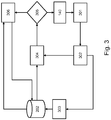
- the main case based reasoning approach is illustrated in Fig. 3 and comprises six main steps. These six steps are sensing 301, perception 302, learning 303, reasoning 304, decision making 305 and optimization 306. Each of these steps are now discussed in more detail.
- the device 200 collects the necessary information that describes the current situation of the environment 140. This information is collected by the observation module 201.
- parameters such as received signal strength indicator, RSSI, and/or round trip time, RTT, are collected.
- other metrics for determining a throughput are collected as well. This may be done by collecting the total transmitted and received bytes by the STAs 110 and 111 and/or the selected modulation and coding scheme, MCS, values.
- the collected information is transformed into network metrics that by the decision maker in the fifth step 205.
- the collected information is used to calculate the location of both the STAs 110 and 111 and the AP 100. These calculations may thus be used to populate the first column of the tuples in the database 202.
- the second metric calculated in this step 202 is the throughput.
- the resulted throughput is calculated and later used to update a third column in a tuple in the next step, namely the learning step 303.
- the calculated throughput may, for example, be interpolate based on the sensed channel information.
- the learning step 303 is responsible for updating the throughput values in the database 202 and other parameters required in the optimization step 306.
- the corresponding throughput can vary over time.
- existing throughput values of tuples in the database 202 have to be updated. If the existing stored throughput in the database is denoted as R and the instantaneous calculated throughput in the previous step 302 is denoted as R', then the throughput may be updated by value (R + R') / 2 .
- Other filtering or averaging techniques may also be applied such as a moving average.
- optimization parameters may also be linked to tuples in the database 202. These optimization parameters may be updated in the learning step 303 as well.
- An optimization parameter is, for example the bandwidth update factor and denoted as ⁇ a.
- This parameter is used by the optimizer in step 306 in order to gradually search for an optimal bandwidth configuration.
- the learning module 205 starts by a small value for ⁇ a, such as for example 20MHz,and if there is no improvement in the throughput or the throughput is decreasing, then this factor is increased to provide exploration in the search.
- ⁇ a' ⁇ a. ⁇ where ⁇ is the ⁇ a updating factor and equals, for example, to two.
- the next step namely reasoning 304, is used to match the determined distance of the communication link with the potential distances in the database 202.
- the matching of the distances is done by two substages.
- the determined distance is matched by the potential distance through the calculation of a matching factor M.
- the vectors of the stored potential distance in the database 202 are denoted as P, wherein each distance p i ⁇ P.
- the corresponding throughput of this best matching case is denoted as R i * .
- the fifth step decides whether the best matching case is similar to a potential distance based on the matching factor calculated in the previous step 304. If not, a new potential distance is created in the database 202. Accordingly, a minimum matching factor M min is defined. Besides, a minimum throughput value is also defined and denoted as R min which depends on the user demand.
- case i* is greater than the minimum matching factor, or M i * > M min , and at the same time the throughput of case i* is greater than the minimum throughput value, or R i* > R min , then the potential distance with case i* is retrieved from the database 202. If the above condition is not fulfilled, the optimization step 306 is performed.
- the optimizer is executed to calculate a new potential distance with a new bandwidth configuration.
- the maximum bandwidth is selected.
- either the selected bandwidth is optimal, thus the optimizer 306 will not be executed again.
- Fig. 4 shows a suitable computing system 400 for hosting the application component according to the present invention and suitable for implementing the method for selecting a bandwidth in a channel bonding configuration according to the present invention, embodiments of which are illustrated by Fig. 2 and Fig 3 .
- Computing system 400 may in general be formed as a suitable general purpose computer and comprise a bus 410, a processor 402, a local memory 404, one or more optional input interfaces 414, one or more optional output interfaces 416, a communication interface 412, a storage element interface 406 and one or more storage elements 408.
- Bus 410 may comprise one or more conductors that permit communication among the components of the computing system.
- Processor 402 may include any type of conventional processor or microprocessor that interprets and executes programming instructions.
- Local memory 404 may include a random access memory, RAM, or another type of dynamic storage device that stores information and instructions for execution by processor 402 and/or a read only memory, ROM, or another type of static storage device that stores static information and instructions for use by processor 404.
- Input interface 414 may comprise one or more conventional mechanisms that permit an operator to input information to the computing device 400, such as a keyboard 420, a mouse 430, a pen, voice recognition and/or biometric mechanisms, etc.
- Output interface 416 may comprise one or more conventional mechanisms that output information to the operator, such as a display 440, a printer 450, a speaker, etc.
- Communication interface 412 may comprise any transceiver-like mechanism such as for example two 1Gb Ethernet interfaces that enables computing system 400 to communicate with other devices and/or systems, for example mechanisms for communicating with one or more other computing systems.
- the communication interface 412 of computing system 400 may be connected to such another computing system 460 by means of a local area network, LAN, or a wide area network, WAN, such as for example the internet, in which case the other computing system may for example comprise a suitable web server.
- Storage element interface 406 may comprise a storage interface such as for example a Serial Advanced Technology Attachment, SATA, interface or a Small Computer System Interface, SCSI, for connecting bus 410 to one or more storage elements 408, such as one or more local disks, for example 1 TB SATA disk drives, and control the reading and writing of data to and/or from these storage elements 408.
- SATA Serial Advanced Technology Attachment
- SCSI Small Computer System Interface
- storage elements 408 above is described as a local disk, in general any other suitable computer-readable media such as a removable magnetic disk, optical storage media such as a CD or DVD, -ROM disk, solid state drives, flash memory cards, ... could be used.
- the steps executed in the method for selecting a bandwidth in a channel bonding configuration according to the present invention may be implemented as programming instructions stored in local memory 404 of the computing system 400 for execution by its processor 402.
- the instructions may be stored on the storage element 408 or be accessible from another computing system through the communication interface 412.
- top, bottom, over, under, and the like are introduced for descriptive purposes and not necessarily to denote relative positions. It is to be understood that the terms so used are interchangeable under appropriate circumstances and embodiments of the invention are capable of operating according to the present invention in other sequences, or in orientations different from the one(s) described or illustrated above.
Landscapes
- Engineering & Computer Science (AREA)
- Computer Networks & Wireless Communication (AREA)
- Signal Processing (AREA)
- Mobile Radio Communication Systems (AREA)
Abstract
Description
- The present invention generally relates to the field of channel bonding as specified in IEEE 802.11ac. More specifically it relates to the determination of a link bandwidth in a channel bonding arrangement.
- Channel bonding is a new feature in the IEEE 802.11ac specification. It is used to increase a link's bandwidth and thus its capacity. Two or more channels may be bounded resulting in a bandwidth of, for example, 20, 40, 80 or even 160 MHz.
- Two strategies are available to select a bonding configuration, namely a static and a dynamic one. In the first strategy, two or more channels are bonded and used throughout the entire communication. In the dynamic strategy, the bandwidth of the link is adapted during transmission, for example, at every transmission of a frame. In both strategies, the environment wherein a network device operates is scanned and based on this the channel bonding configuration is set.
- Nevertheless, a communication link operating in bonded channels may suffer from interfering signals originating from other devices, especially when the bandwidth of the link is high compared to the total available bandwidth. Thus, increasing the bandwidth of the link may increase the probability of packet collisions. Therefore, a trade-off needs to be made between the bandwidth and the hindrance caused by interference.
- Efficient bonding will be highly dependent on the current network state, which further depends on the type of users, an access point location, neighboring interference and other parameters. Existing bandwidth configuration strategies therefore rely on interference metrics to select the optimal bandwidth.
- The neighboring interference originates from, among others, other access points and associated devices operating in the same and/or adjacent environment. Therefore, the communication links mutually interfere with each other. Thus, the determination of optimal bandwidths in a channel bonding arrangement needs to be performed in a coordinated way in order to optimize the overall performance of all networks.
- This is however a problem since in most practical cases, neighboring access points are mostly not managed by only one operator. A change in the channel bonding configuration at one access point will thus impact the performance of other access points. Furthermore, when a channel bonding configuration is changed, an access point may adapt its modulation and coding scheme, MCS, in order to adapt its throughput based on the changed interference.
- In other words, an increase in the channel bandwidth will not necessarily lead to an increase in performance due to the above identified interaction and vice versa.
- It is an object of the present disclosure to alleviate the above problem and to provide, among others, a device for selecting a bandwidth of a communication link in a channel bonding arrangement in a more optimal and efficient way.
- This object is achieved, according to a first aspect, by a device for selecting a bandwidth of a communication link between an access point, AP, and an associated device, STA, in a wireless network, the device comprising:
- an observation module configured to determine a distance of the communication link; and
- a database comprising a set of potential distances; and wherein each potential distance is related to an optimal bandwidth; and
- a channel bonding module configured to select from the set the optimal bandwidth of the communication link for the determined distance.
- In order to determine the distance of the communication link, the observation module may collect different parameters such as, for example, received signal strength indicators, RSSI, and/or round trip times. Next, the distance is calculated, e.g. by using localization techniques such as an RSSI localization technique. This distance may correspond to the physical distance between the AP and the STA, but may also correspond to an electromagnetic distance. The latter may, for example, be longer than the physical distance if obstacles are located in the line of sight between the AP and the STA, especially if these obstacles attenuate waves used by the link to communicate.
- By determining the distance of the communication link, and thus the distance between the AP and the STA, the configuration of the environment wherein the link operates is described.
- Next to the observation module, the system also comprises a database. In this database, a set of distances are each related to an optimal bandwidth. These distances are potential distances since they correspond to possible or potential distances between the AP and the STA located in the environment. The optimal bandwidth related to a potential distance is then that bandwidth which is preferably used for the communication link between the AP and STA with that given distance between each other.
- Finally, the channel bonding module matches the distance of the communication link with one of the potential distances of the database. The optimal bandwidth of that matched potential distance is selected and used by the communication link.
- Because the distance is a measure of the position of the STA, the interference will change with the distance. Furthermore, as the interference may be different within different channels, the optimal bandwidth may differ depending on the distance. Therefore, it is an advantage that an optimal bandwidth can be selected, i.e. one the doesn't necessarily correspond to the largest bandwidth.
- According to an embodiment, the optimal bandwidth corresponds to a bandwidth with a highest throughput for the potential distance.
- Thus, depending on the location of a STA within the network, the STA is offered the highest throughput which does not necessarily correspond to the largest bandwidth. For example at a certain distance, a smaller bandwidth may result to a higher modulation and coding scheme which outperforms a higher bandwidth that would result in a lower modulation and coding scheme due to the increased interference.
- According to an embodiment, each potential distance is further related to a potential throughput achievable when selecting the bandwidth according to the potential distance.
- Thus, in the database a potential distance is related to an optimal bandwidth, and further related to a potential throughput. This potential throughput is that one that potentially may be obtained when the optimal bandwidth is selected. Thus, the communication link between the AP and the STA is associated to the potentially highest throughput for a given channel bonding configuration.
- According to an embodiment, the device further comprises an updating module configured to update in the database the potential throughput by the achieved throughput at the selected bandwidth.
- In most practical cases the desired achievable throughput differs from the achieved one due to, for example, changing interference in the network. This means that the achieved throughput may be less than the potential throughput. By updating the database in this way, the database represents the network in a more accurate way.
- According to an embodiment, the updating module is further configured to add in the database a new potential distance when a difference between the determined distance and the nearest potential distance is greater than a predefined value.
- The difference between the determined distance and a nearest potential one in the database may thus be greater than a predefined value. By updating the database with a new potential distance, it will thus more accurately model the network by a learning behaviour.
- When the database is updated with a new potential distance, the optimal bandwidth may in a first place be the same as the nearest potential distance, or an interpolated value of the nearest higher and nearest lower one.
- According to an embodiment the updating module is further configured to relate as the bandwidth of the new potential distance the highest possible bandwidth of the communication link.
- According to an embodiment, the device further comprises a learning module configured to optimize the selected optimal bandwidth when the achieved throughput is less than a predefined threshold.
- If the achieved throughput of the communication link is insufficient, meaning that it is less than a predefined threshold, the learning module adapts the bandwidth in order to increase the throughput. In that way, the bandwidth related to a potential distance in the database is optimized.
- According to an embodiment, the learning module is further configured to optimize the bandwidth by:
- decreasing the bandwidth when the determined distance is less than or equal to the potential distance; and/or
- increasing the bandwidth when the determined distance is greater than the potential distance.
- If the STA is located closer to the AP compared to the potential distance, the bandwidth is decreased. In the other situation, the bandwidth is increased. By doing so, the bandwidth is adapted to the location of the devices in the environment.
- According to a second aspect, the disclosure relates to a method for selecting a bandwidth of a communication link between an access point, AP, and an associated device, STA, in a wireless network, the method comprising the steps of:
- determining a distance of the communication link; and
- selecting from a database an optimal bandwidth of the communication link for the determined distance; and wherein the database comprises a set of potential distances; and wherein each potential distance is related to a respective optimal bandwidth.
- According to a third aspect, a computer program product is disclosed comprising computer-executable instructions for performing the method according to the second aspect when the program is run on a computer.
- According to a fourth aspect, a computer readable storage medium is disclosed comprising the computer program product according to the third aspect.
- According to a fifth aspect, a data processing system is disclosed programmed for carrying out the method according to the second aspect.
-
-
Fig. 1 illustrates an environment comprising access points and associated devices; and -
Fig. 2 illustrates a device for selecting a bandwidth of a communication link according to an embodiment of the disclosure; and -
Fig. 3 illustrates steps performed to select a bandwidth of a communication link according to an embodiment of the disclosure; and -
Fig. 4 illustrates a computer system that can be configured to execute one or more embodiments of the method for selecting a bandwidth of a communication link. -
Fig. 1 illustrates an environment wherein different access points, APs, and associated devices, STAs, are operating. For example, in thisenvironment 140APs AP 100. The communication link ofSTA 110 withAP 100 is illustrated by thelink 120 and the communication link betweenSTA 111 andAP 100 is illustrated by thelink 121. The region whereinAP 101 broadcasts is illustrated byregion 102. - The
STAs environment 140. For example,STA 110 may be moved from its current location tolocation 132. The movement is illustrated by thevector 130. TheSTA 111 may be moved as well from its current location tolocation 133 and illustrated by thevector 131. - According to an embodiment, the disclosure relates to a system for selecting a bandwidth of a communication link.
Fig. 2 illustrates such adevice 200. For thecommunication links device 200 selects an optimal bandwidth in a channel bonding configuration. - In order to determine this bandwidth, the
device 200 comprises, according to an embodiment, anobservation module 201, adatabase 202, achannel bonding module 203, an updatingmodule 204 and alearning module 205. - The
observation module 201 is configured to determine a communication link, forexample link 120. This distance may correspond to the distance between theAP 100 and theSTA 110, but may also be the electromagnetic distance which takes into account obstacles which attenuate the waves used by the communication link. - The determination of the distance of the
link 120 may be performed by WLAN location determination techniques, such as, for example, a WLAN location determination via clustering and probability distributions as published in Pervasive Computing and Communications, 2003, Proceedings of the First IEEE International Conference on IEEE, 2003 . - The
device 200 further comprises adatabase 202. In thisdatabase 202 case tuples are stored which comprises potential distances, bandwidths and throughputs. Through learning, reasoning and optimization approaches, these tuples are constructed in thedatabase 202 and used by thedevice 200 in selecting the optimal bandwidth in a channel bonding configuration. - The distance determined by the
observation module 201 is matched with one of the potential distances in thedatabase 202. Next, the related bandwidth is this potential distance is selected and the channel bonding module sets this bandwidth as the optimal bandwidth of thecommunication link 120. - The same procedure may be followed to determine the bandwidth of the
communication link 121. - When a STA moves in the
environment 140, forexample STA 110 moves tolocation 132 and/orSTA 111 moves tolocation 133, then the distances between the STAs and theAP 100 and the corresponding distance of the communication links changes well. Again, the distance is determined by theobservation module 201, the database is consulted 202 and the optimal bandwidth is selected by thechannel bonding module 203. - In each tuple of the database, the throughput may be, according to an embodiment, the potential throughput achievable when selecting the bandwidth with the matched potential distance. This potential throughput may however not be achieved. The updating
module 204 will then updated this throughput in the tuple by the achieved throughput. - The
update module 204 is also configured to add in the database 202 a new tuple. This may be done when the distance determined by the observation module doesn't match with a potential distance in thedatabase 202. The lack of a match occurs, for example, if the difference between the nearest potential distance and the determined distance is greater than a predefined value. - The
device 200 further comprises alearning module 205. Thislearning module 205 is configured to optimize the selected bandwidth when the achieved band is less than a predefined threshold. - The steps performed to select, update and optimize a bandwidth are, according to an embodiment, based on case based reasoning. These steps are illustrated in
Fig. 3 are now further discussed. - Case based reasoning is an artificial intelligence approach to populate the
database 202 and used for reconfiguring the channel bonding configuration and to select the optimal bandwidth. The main case based reasoning approach is illustrated inFig. 3 and comprises six main steps. These six steps are sensing 301,perception 302, learning 303, reasoning 304, decision making 305 andoptimization 306. Each of these steps are now discussed in more detail. - In the first step, namely sensing 301, the
device 200 collects the necessary information that describes the current situation of theenvironment 140. This information is collected by theobservation module 201. - In order to measure distances of the
communication links STAs - In the
next step 202, the collected information is transformed into network metrics that by the decision maker in thefifth step 205. The collected information is used to calculate the location of both the STAs 110 and 111 and theAP 100. These calculations may thus be used to populate the first column of the tuples in thedatabase 202. - The second metric calculated in this
step 202 is the throughput. When an optimal bandwidth is selected for a communication link, the resulted throughput is calculated and later used to update a third column in a tuple in the next step, namely thelearning step 303. The calculated throughput may, for example, be interpolate based on the sensed channel information. - The learning
step 303 is responsible for updating the throughput values in thedatabase 202 and other parameters required in theoptimization step 306. - For a certain distance and related optimal bandwidth, the corresponding throughput can vary over time. Thus, existing throughput values of tuples in the
database 202 have to be updated. If the existing stored throughput in the database is denoted as R and the instantaneous calculated throughput in theprevious step 302 is denoted as R', then the throughput may be updated by value (R+R')/2. Other filtering or averaging techniques may also be applied such as a moving average. - According to an embodiment, optimization parameters may also be linked to tuples in the
database 202. These optimization parameters may be updated in thelearning step 303 as well. - An optimization parameter is, for example the bandwidth update factor and denoted as ∂a. This parameter is used by the optimizer in
step 306 in order to gradually search for an optimal bandwidth configuration. Thelearning module 205 starts by a small value for ∂a, such as for example 20MHz,and if there is no improvement in the throughput or the throughput is decreasing, then this factor is increased to provide exploration in the search. As such, ∂a' = ∂a.α where α is the ∂a updating factor and equals, for example, to two. - The next step, namely reasoning 304, is used to match the determined distance of the communication link with the potential distances in the
database 202. The matching of the distances is done by two substages. - In a first stage of the
reasoning step 304, the determined distance is matched by the potential distance through the calculation of a matching factor M. The determined distance is denoted by p' = [location AP, location STA], while the vectors of the stored potential distance in thedatabase 202 are denoted as P, wherein each distance pi ∈ P. In order to calculate the matching factor M between p' and each pi , the Euclidian distance is calculated by
- In the second stage, the index of the best matching case is calculated as


- The fifth step, namely decision making 305, decides whether the best matching case is similar to a potential distance based on the matching factor calculated in the
previous step 304. If not, a new potential distance is created in thedatabase 202. Accordingly, a minimum matching factor Mmin is defined. Besides, a minimum throughput value is also defined and denoted as Rmin which depends on the user demand. - If the matching factor of case i* is greater than the minimum matching factor, or Mi* > Mmin , and at the same time the throughput of case i* is greater than the minimum throughput value, or Ri* > Rmin , then the potential distance with case i* is retrieved from the
database 202. If the above condition is not fulfilled, theoptimization step 306 is performed. - In case of a non-matching case or a low throughput value of best matching cases, the optimizer is executed to calculate a new potential distance with a new bandwidth configuration.
- In case of a matching case, i.e. Mi* > Mmin , while the throughput is not satisfactory, i.e. Ri* > Rmin , then the action of this case can be used by the optimizer 605 as following:
- if the determined distance is greater than the potential distance of case i*, then the bandwidth is decreased by a' = a[i*] - ∂a; and
- if the determined distance is less than the potential distance of case i*, then the bandwidth is increased by a' = a[i*] + ∂a; and
- if the determined distance is equal to the potential distance of case i*, then the bandwidth is decreased by a' = a[i*] - ∂a.
- In case of a non-matching case, the maximum bandwidth is selected. Next, either the selected bandwidth is optimal, thus the
optimizer 306 will not be executed again. In the other condition, the bandwidth is decreased by a' = a[i*] - ∂a. -
Fig. 4 shows asuitable computing system 400 for hosting the application component according to the present invention and suitable for implementing the method for selecting a bandwidth in a channel bonding configuration according to the present invention, embodiments of which are illustrated byFig. 2 andFig 3 .Computing system 400 may in general be formed as a suitable general purpose computer and comprise abus 410, aprocessor 402, alocal memory 404, one or more optional input interfaces 414, one or moreoptional output interfaces 416, acommunication interface 412, astorage element interface 406 and one ormore storage elements 408.Bus 410 may comprise one or more conductors that permit communication among the components of the computing system.Processor 402 may include any type of conventional processor or microprocessor that interprets and executes programming instructions.Local memory 404 may include a random access memory, RAM, or another type of dynamic storage device that stores information and instructions for execution byprocessor 402 and/or a read only memory, ROM, or another type of static storage device that stores static information and instructions for use byprocessor 404.Input interface 414 may comprise one or more conventional mechanisms that permit an operator to input information to thecomputing device 400, such as akeyboard 420, amouse 430, a pen, voice recognition and/or biometric mechanisms, etc.Output interface 416 may comprise one or more conventional mechanisms that output information to the operator, such as adisplay 440, a printer 450, a speaker, etc.Communication interface 412 may comprise any transceiver-like mechanism such as for example two 1Gb Ethernet interfaces that enablescomputing system 400 to communicate with other devices and/or systems, for example mechanisms for communicating with one or more other computing systems. Thecommunication interface 412 ofcomputing system 400 may be connected to such another computing system 460 by means of a local area network, LAN, or a wide area network, WAN, such as for example the internet, in which case the other computing system may for example comprise a suitable web server.Storage element interface 406 may comprise a storage interface such as for example a Serial Advanced Technology Attachment, SATA, interface or a Small Computer System Interface, SCSI, for connectingbus 410 to one ormore storage elements 408, such as one or more local disks, for example 1 TB SATA disk drives, and control the reading and writing of data to and/or from thesestorage elements 408. Although thestorage elements 408 above is described as a local disk, in general any other suitable computer-readable media such as a removable magnetic disk, optical storage media such as a CD or DVD, -ROM disk, solid state drives, flash memory cards, ... could be used. - The steps executed in the method for selecting a bandwidth in a channel bonding configuration according to the present invention, illustrated by the above embodiments, may be implemented as programming instructions stored in
local memory 404 of thecomputing system 400 for execution by itsprocessor 402. Alternatively, the instructions may be stored on thestorage element 408 or be accessible from another computing system through thecommunication interface 412. - Although the present invention has been illustrated by reference to specific embodiments, it will be apparent to those skilled in the art that the invention is not limited to the details of the foregoing illustrative embodiments, and that the present invention may be embodied with various changes and modifications without departing from the scope thereof. The present embodiments are therefore to be considered in all respects as illustrative and not restrictive, the scope of the invention being indicated by the appended claims rather than by the foregoing description, and all changes which come within the scope of the claims are therefore intended to be embraced therein.
- It will furthermore be understood by the reader of this patent application that the words "comprising" or "comprise" do not exclude other elements or steps, that the words "a" or "an" do not exclude a plurality, and that a single element, such as a computer system, a processor, or another integrated unit may fulfil the functions of several means recited in the claims. Any reference signs in the claims shall not be construed as limiting the respective claims concerned. The terms "first", "second", third", "a", "b", "c", and the like, when used in the description or in the claims are introduced to distinguish between similar elements or steps and are not necessarily describing a sequential or chronological order. Similarly, the terms "top", "bottom", "over", "under", and the like are introduced for descriptive purposes and not necessarily to denote relative positions. It is to be understood that the terms so used are interchangeable under appropriate circumstances and embodiments of the invention are capable of operating according to the present invention in other sequences, or in orientations different from the one(s) described or illustrated above.
Claims (12)
- A device for selecting a bandwidth of a communication link between an access point, AP, and an associated device, STA, in a wireless network, the device comprising:- an observation module configured to determine a distance of the communication link; and- a database comprising a set of potential distances; and wherein each potential distance is related to an optimal bandwidth; and- a channel bonding module configured to select from the set the optimal bandwidth of the communication link for the determined distance.
- Device according to claim 1, wherein the optimal bandwidth corresponds to a bandwidth with a highest throughput for the potential distance.
- Device according to claim 2, wherein each potential distance is further related to a potential throughput achievable when selecting the bandwidth according to the potential distance.
- Device according to claim 3, further comprising an updating module configured to update in the database the potential throughput by the achieved throughput at the selected bandwidth.
- Device according to claim 4, wherein the updating module is further configured to add in the database a new potential distance when a difference between the determined distance and the nearest potential distance is greater than a predefined value.
- Device according to claim 5, wherein the updating module is further configured to relate as the bandwidth of the new potential distance the highest possible bandwidth of the communication link.
- Device according to claim 6, further comprising a learning module configured to optimize the selected optimal bandwidth when the achieved throughput is less than a predefined threshold.
- Device according to claim 7, wherein the learning module is further configured to optimize the bandwidth by:- decreasing the bandwidth when the determined distance is less than or equal to the potential distance; and/or- increasing the bandwidth when the determined distance is greater than the potential distance.
- Method for selecting a bandwidth of a communication link between an access point, AP, and an associated device, STA, in a wireless network, the method comprising the steps of:- determining a distance of the communication link; and- selecting from a database an optimal bandwidth of the communication link for the determined distance; and wherein the database comprises a set of potential distances; and wherein each potential distance is related to a respective optimal bandwidth.
- A computer program product comprising computer-executable instructions for performing the method according to claim 9 when the program is run on a computer.
- A computer readable storage medium comprising the computer program product according to claim 10.
- A data processing system programmed for carrying out the method according to claim 9.
Priority Applications (1)
| Application Number | Priority Date | Filing Date | Title |
|---|---|---|---|
| EP17176553.0A EP3419356A1 (en) | 2017-06-19 | 2017-06-19 | Selecting a bandwidth of a communication link |
Applications Claiming Priority (1)
| Application Number | Priority Date | Filing Date | Title |
|---|---|---|---|
| EP17176553.0A EP3419356A1 (en) | 2017-06-19 | 2017-06-19 | Selecting a bandwidth of a communication link |
Publications (1)
| Publication Number | Publication Date |
|---|---|
| EP3419356A1 true EP3419356A1 (en) | 2018-12-26 |
Family
ID=59091369
Family Applications (1)
| Application Number | Title | Priority Date | Filing Date |
|---|---|---|---|
| EP17176553.0A Withdrawn EP3419356A1 (en) | 2017-06-19 | 2017-06-19 | Selecting a bandwidth of a communication link |
Country Status (1)
| Country | Link |
|---|---|
| EP (1) | EP3419356A1 (en) |
Citations (2)
| Publication number | Priority date | Publication date | Assignee | Title |
|---|---|---|---|---|
| EP2129019A1 (en) * | 2007-01-09 | 2009-12-02 | NTT DoCoMo, Inc. | Method for controlling transmission of signal for measuring quality of base station, user terminal, and reception channel |
| US20120051371A1 (en) * | 2010-08-30 | 2012-03-01 | Oki Electric Industry Co., Ltd. | Dynamic bandwidth allocating control apparatus with bandwidth usability improved |
-
2017
- 2017-06-19 EP EP17176553.0A patent/EP3419356A1/en not_active Withdrawn
Patent Citations (2)
| Publication number | Priority date | Publication date | Assignee | Title |
|---|---|---|---|---|
| EP2129019A1 (en) * | 2007-01-09 | 2009-12-02 | NTT DoCoMo, Inc. | Method for controlling transmission of signal for measuring quality of base station, user terminal, and reception channel |
| US20120051371A1 (en) * | 2010-08-30 | 2012-03-01 | Oki Electric Industry Co., Ltd. | Dynamic bandwidth allocating control apparatus with bandwidth usability improved |
Non-Patent Citations (2)
| Title |
|---|
| "Pervasive Computing and Communications", PROCEEDINGS OF THE FIRST IEEE INTERNATIONAL CONFERENCE ON IEEE, 2003 |
| OFUJI Y ET AL: "Frequency Domain Channel-Dependent Scheduling Employing an Adaptive Transmission Bandwidth for Pilot Channel in Uplink Single-Carrier-FMDA Radio Access", VEHICULAR TECHNOLOGY CONFERENCE, 2006. VTC 2006-SPRING. IEEE,, vol. 1, 1 January 2006 (2006-01-01), pages 334 - 338, XP008100831, DOI: 10.1109/VETECS.2006.1682831 * |
Similar Documents
| Publication | Publication Date | Title |
|---|---|---|
| CN114269007A (en) | Method, device and method storage medium for determining energy-saving strategy of base station | |
| RU2544792C2 (en) | Method and device for implementing cognitive network | |
| Berthold et al. | Detection of spectral resources in cognitive radios using reinforcement learning | |
| CN113037410B (en) | Channel identification method, device, transmission method, transmission equipment, base station and medium | |
| CN108768695B (en) | KQI problem location method and device | |
| CN109640340A (en) | Base station data processing method, device, equipment and computer readable storage medium | |
| CN110702986B (en) | A real-time dynamic generation method and system for adaptive signal search threshold | |
| KR101009827B1 (en) | Speed estimation device and method of mobile terminal in mobile communication system | |
| EP3435731A1 (en) | A system for optimizing quality of experience of a user device of a multi-radio multi-channel wireless network | |
| CN118802737B (en) | Routing control method and system for multi-protocol data stream | |
| CN121547403B (en) | Gray scale release and flow control method and device for large model service | |
| CN103249050B (en) | Based on the multiple dimensioned frequency spectrum access method of business demand | |
| EP1691572B1 (en) | Method and system for training a hearing aid using a self-organising map | |
| Aref et al. | Replicated Q-learning based sub-band selection for wideband spectrum sensing in cognitive radios | |
| CN102870447A (en) | Method and device for microwave network planning | |
| Alshawaqfeh et al. | A survey of machine learning algorithms and their applications in cognitive radio | |
| EP3337220B1 (en) | A system for evaluating performance of a wireless access point | |
| KR102247696B1 (en) | Node state predictin system and method | |
| CN119582802A (en) | A deep learning-based intelligent filtering method and system | |
| CN118317318A (en) | Wireless ad hoc network automatic frequency selection method and system based on wide and narrow band fusion | |
| KR20210076440A (en) | Method and apparatus for regeneration and prediction of tree map | |
| KR101522650B1 (en) | Method, apparatus and computer readable recording medium for transmission parameter optimization using cognitive radio system | |
| EP3337251A1 (en) | Adapting the transmission power of a wireless access point | |
| KR101788439B1 (en) | Communication scheme in cognitive radio networks based on coorperative sensing | |
| CN118200953B (en) | Wireless ad hoc network fault self-checking method and system |
Legal Events
| Date | Code | Title | Description |
|---|---|---|---|
| PUAI | Public reference made under article 153(3) epc to a published international application that has entered the european phase |
Free format text: ORIGINAL CODE: 0009012 |
|
| STAA | Information on the status of an ep patent application or granted ep patent |
Free format text: STATUS: THE APPLICATION HAS BEEN PUBLISHED |
|
| AK | Designated contracting states |
Kind code of ref document: A1 Designated state(s): AL AT BE BG CH CY CZ DE DK EE ES FI FR GB GR HR HU IE IS IT LI LT LU LV MC MK MT NL NO PL PT RO RS SE SI SK SM TR |
|
| AX | Request for extension of the european patent |
Extension state: BA ME |
|
| STAA | Information on the status of an ep patent application or granted ep patent |
Free format text: STATUS: REQUEST FOR EXAMINATION WAS MADE |
|
| 17P | Request for examination filed |
Effective date: 20190626 |
|
| RBV | Designated contracting states (corrected) |
Designated state(s): AL AT BE BG CH CY CZ DE DK EE ES FI FR GB GR HR HU IE IS IT LI LT LU LV MC MK MT NL NO PL PT RO RS SE SI SK SM TR |
|
| RAP1 | Party data changed (applicant data changed or rights of an application transferred) |
Owner name: NOKIA SOLUTIONS AND NETWORKS OY |
|
| STAA | Information on the status of an ep patent application or granted ep patent |
Free format text: STATUS: EXAMINATION IS IN PROGRESS |
|
| 17Q | First examination report despatched |
Effective date: 20191028 |
|
| STAA | Information on the status of an ep patent application or granted ep patent |
Free format text: STATUS: THE APPLICATION IS DEEMED TO BE WITHDRAWN |
|
| 18D | Application deemed to be withdrawn |
Effective date: 20200310 |