EP3419217A1 - Network of nodes and method of operation - Google Patents
Network of nodes and method of operation Download PDFInfo
- Publication number
- EP3419217A1 EP3419217A1 EP17176712.2A EP17176712A EP3419217A1 EP 3419217 A1 EP3419217 A1 EP 3419217A1 EP 17176712 A EP17176712 A EP 17176712A EP 3419217 A1 EP3419217 A1 EP 3419217A1
- Authority
- EP
- European Patent Office
- Prior art keywords
- node
- data element
- network
- database
- nodes
- Prior art date
- Legal status (The legal status is an assumption and is not a legal conclusion. Google has not performed a legal analysis and makes no representation as to the accuracy of the status listed.)
- Granted
Links
Images

Classifications
-
- H—ELECTRICITY
- H04—ELECTRIC COMMUNICATION TECHNIQUE
- H04W—WIRELESS COMMUNICATION NETWORKS
- H04W4/00—Services specially adapted for wireless communication networks; Facilities therefor
- H04W4/30—Services specially adapted for particular environments, situations or purposes
- H04W4/38—Services specially adapted for particular environments, situations or purposes for collecting sensor information
-
- G—PHYSICS
- G06—COMPUTING OR CALCULATING; COUNTING
- G06F—ELECTRIC DIGITAL DATA PROCESSING
- G06F16/00—Information retrieval; Database structures therefor; File system structures therefor
- G06F16/20—Information retrieval; Database structures therefor; File system structures therefor of structured data, e.g. relational data
- G06F16/27—Replication, distribution or synchronisation of data between databases or within a distributed database system; Distributed database system architectures therefor
Definitions
- the present disclosure relates to a network of nodes and a method of operating a network of nodes.
- Networks are used to connect devices together, for example to enable the devices to communicate with each other.
- Networks may be wired and/or wireless.
- it is useful or necessary to have a database.
- Such databases are often held centrally, by some "master" node or server, etc. However, failure of that master node or server, or failure of a network connection to that master node or server, means that the database may be inaccessible.
- a network of nodes wherein the network is a wireless network in which data is wirelessly transmitted between nodes, at least some of the nodes comprising:
- At least one node comprises a sensor for taking a measurement and producing a data element corresponding to the measurement.
- a block of the blockchain corresponds to the data element.
- a block may correspond to plural data elements, which for example may be plural measurements taken by one or more sensors of a node.
- the network is a mesh network.
- the network is a Low Rate Wireless Personal Area Network (LR-WPAN) network
- LR-WPAN Low Rate Wireless Personal Area Network
- a method of operating a network of nodes wherein the network is a wireless network in which data is wirelessly transmitted between nodes, the method comprising storing a new data element in a database at at least some of the nodes, wherein:
- At least one node comprises a sensor, wherein the sensor takes a measurement and produces a data element corresponding to the measurement.
- networks are used to connect various devices and appliances, referred to herein as "nodes", to each other.
- nodes In some networks, it is useful or necessary to have a database.
- databases are often held centrally, by some "master” node or server, etc.
- failure of that master node or server, or failure of a network connection to that master node or server means that the database may be inaccessible, at least to some nodes. Failure of a network connection between that master node or server and a node also means that the node may not be able to update the database held by the master node or server.
- a database may be stored locally, at the node itself or at a storage location associated with and typically located close to the node.
- the database may be automatically updated by the node as data is generated or obtained by the node.
- the nodes in the network may be arranged such that they each have a copy of the database. This in turn means that as one node generates data, and updates its own database with the data, the databases held by other nodes must also be updated with the new data. Transmitting an entire new database from one node to another can be cumbersome, time consuming and power- and resource-intensive..
- a node that has generated or obtained new data may transmit the new data to other nodes for the other nodes to add to their copy of the database.
- nodes are relatively simple and low cost devices, with for example low processing power and low (electrical) power supply resources.
- nodes can be arranged to generate or obtain data, for example by taking sensor readings of the environment or locality of the sensor node.
- a network of nodes may be arranged to take measurements of pollution or contaminant levels or of temperature or humidity at various locations across a city or other geographically spaced environment, or in a manufacturing facility, etc. Sensor nodes in such cases are often battery-powered, and this have low power supply resources.
- At least some of the nodes of a wireless network of nodes each have a transceiver for transmitting and receiving data packets and data storage for storing a database. If a node generates its own new data element, the node updates its own stored database with the data element, and transmits the data element to at least one other node. If a node receives a data element transmitted by another node, the node updates its own database with the received data element.
- the database may therefore be regarded as a distributed database in which (in principle) each of said nodes has a copy of the database.
- the databases held by each of said nodes is stored in the form of a blockchain.
- Each block of the database is or corresponds to a data element.
- the updating by a node of its own stored database is by adding a block corresponding to the data element to the blockchain database of the node, and the transmission of a data element from one node to another node is a transmission of a block corresponding to the data element to be added to the blockchain database of the other node.
- a blockchain is a series of connected "blocks" of data.
- a "block” is created to store a new item of data, which is added to an existing blockchain.
- a block may have a timestamp, indicating for example when the block was created.
- a block may also contain information regarding a previous block of the blockchain, such as the block immediately before it. This may be in the form of a link to a previous block of the blockchain. The link may be in the form of a hash of the previous block.
- An example of a suitable hashing algorithm is the SHA-2 (Secure Hash Algorithm 2). The effect of this is that the data contained or represented by the blockchain is permanent and cannot be amended, at least without being detected. If for example the data in a block of a blockchain is changed, the hashing algorithm used to generate the blocks would show this as the hash generated from the changed block will be different from the hash of the original block.
- Blockchains are most often used in the context of financial transactions.
- the blockchain acts like a financial ledger, and a component block represents an authorised transactions.
- a blockchain of this type can be used in online transactions for cryptocurrency.
- a user may request a transaction.
- the network validates the user requesting the transaction in order to assure another user that they can safely issue the transaction.
- the blockchain is a ledger of transactions, wherein each block is an individual transaction.
- the chain can be updated without requiring all other transaction related to the chain to be halted.
- Bitcoin One specific example embodiment of blockchain technology in cryptocurrency is Bitcoin.
- traditional banking a customer requests a transaction from an account.
- the account can be likened to a centralised database.
- Such a transaction requires a trusted third party (the bank) to authorise the transaction, and to confirm that a transaction has been made.
- the bank a trusted third party
- Bitcoin makes use of blockchain technology, in which the blockchain is a shared public ledger of transactions.
- the blockchain is updated with blocks associated with every transaction.
- a user may wish to withdraw an amount from their Bitcoin account. The user can enter this value into a personal computer, smartphone, or any such device which has enabled on it an application that facilitates Bitcoin transactions for that user. Private keys and hashing algorithms can be used to authorise the transaction.
- Transactions are "mined", whereby they are placed in a chronological queue to be authorised. Once authorised, the transaction is added as a block to an existing blockchain, like an entry to a financial ledger.
- the nature of the block is such that any attempt to alter the information would be immediately detectable.
- Individual users are not able to amend blocks or the blockchain, and any attempt to would be detected by way of inconsistencies in hashed values associated with each block.
- Mining is therefore a way of checking and authenticating a block, which is a financial transaction in the example of banking or Bitcoin. Accordingly, mining is necessary in context of financial transactions For the purposes of security and accuracy.
- a high level of security and stringent authentication is typically not required, as the database may be "just" a record of sensor readings or the like. Accordingly, blockchain technology can be implemented without requiring mining. A distributed database can be dynamically updated without using mining.
- Blockchain databases can be implemented over both star and mesh topology networks. However, due to the decentralised nature of a mesh network, a blockchain database may be of most benefit in a mesh networks.
- Star networks use a centralised entity to connect nodes in a network. These connections can be wired or wireless.
- a router may provide a Wi-Fi connection for a number of devices smartphones and personal computers (including tablet computers, laptops, etc.) in which each device connects directly to the router, which may for example provide internet access for each of the connected devices.
- Figure 1 shows schematically an example of nodes connected in a star network 100.
- the star network 100 has several nodes 102 which are each connected directly to a central or master node 104 (indicated by shading in the figure).
- One or more of the connected nodes 102 may be or have a sensor 106, an antenna 108 for wireless communication with the central node 104, a processor, transceiver, data storage, etc.
- Mesh networks on the other hand are decentralised networks in which each component node is connected to others in the network, typically in a peer-to-peer fashion, without the aid of a centralised node. These connections can be wired or wireless.
- Figure 2 shows an example of nodes connected in a mesh network 200.
- the mesh network 200 has several nodes 202 which can communicate directly with one or more other nodes 202 of the network 200 via links.
- One or more of the connected nodes 202 may be or have a sensor 206, an antenna 208 for wireless communication with other nodes 202, a processor, transceiver, data storage, etc.
- One node 202 can in principle communicate with any other node in a multi-hop manner by sending a message to a connected node 202, which then passes on the message to another connected node 202, and this is repeated until the message reaches the destination node 202.
- a major advantage of mesh network topology is that there is no single point of failure which could compromise the entire network. For example, if a connection between two nodes fails, it is likely there they are able to communicate via another route. In contrast, in networks which require a central entity to provide connections between nodes, if the central entity fails, the entire network fails.
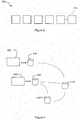
- FIG. 3 shows schematically an example embodiment of a blockchain database 300.
- the blockchain database 300 is made of several connected blocks 310. Each block 310 may correspond to one or more data elements.
- the blocks 310 are connected or linked by for example one block 310 containing a hash of the previous block 310.
- an IoT device is a device that has an addressable interface (e.g. an Internet protocol (IP) address, a Bluetooth identifier (ID), a near-field communication (NFC) ID, etc.) and can transmit information to one or more other devices over a wired or wireless connection.
- IoT devices may in general include or be incorporated in for example refrigerators, ovens, microwaves, freezers, dishwashers, clothes washing machines, clothes dryers, furnaces, air conditioners, thermostats, televisions and other consumer electronic devices, light fixtures, vacuum cleaners, sprinklers, electricity meters, gas meters, etc.
- IoT devices may be deployed in locations or situations where there is no mains powers supply or the IoT device may not suitable for a mains power supply, including in for example the case that the IoT device is a sensor for temperature, humidity, pressure, light levels, pollution levels, etc.
- a node may generate its own new data element by for example the node being a sensor and obtaining a sensor reading.
- Sensor data is typically very small and can be sent in small data packages, with very little usage of memory and energy resources.
- the sensor may be arranged to taken environmental readings at regular intervals of time.
- the sensor may only be arranged to "wake up" to take the reading, and then return to an inactive state, until a subsequent reading is to be taken.
- Figure 4 shows schematically nodes obtaining or generating data and transmitting data elements in the form of blocks to other nodes for the other nodes to update their own local copy of the database.
- a first node 402 obtains or generates a data element.
- the data element may be a sensor reading.
- the node 402 updates its locally stored database 410 by writing that data element in the form of a block which is added to the locally stored database 410, which in turn is in the form of a blockchain.
- the locally stored database 410 may verify that the block can be added, by for example verifying that the new block contains a hash of the previous block of the blockchain database 410.
- the new block is also transmitted to another database 410" in the network.
- That other database 410" may also be associated with a node (not shown) and may also verify that the block can be added to that other database 410".
- another node 402' obtains or generates a data element.
- the data element may be a sensor reading.
- the other node 402' updates its locally stored database 410' by writing that data element in the form of a block which is added to the locally stored database 410', which in turn is again in the form of a blockchain.
- the locally stored database 410' may verify that the block can be added, by for example verifying that the new block contains a hash of the previous block of the blockchain database 410.
- the new block is also transmitted to the or another database 410", 410''' in the network. It is also indicated that the other databases 410", 410''' can also update other databases associated with other nodes, by transmitting blocks to other databases.
- new data elements generated or obtained by nodes are transmitted in the form of blocks to all other nodes in the network, so that each node can update its own local copy of the database with the new data elements, all in a peer-to-peer manner.
- the copies of the database that are local to the nodes will be identical.
- the nodes are or have sensors that take readings, it is often the case that the readings are taken relatively infrequently, whereas the databases are updated relatively frequently. Accordingly, over a sufficient period of time, the databases will be practically identical across the nodes.
- LR-WPAN low-rate wireless personal area network
- the channel data rates i.e. the amount of data transmitted per second say
- a LR-WPAN may in general use a star topology or a mesh topology, but a mesh topology has advantages for a number of applications, as discussed above.
- processor or processing system or circuitry referred to herein may in practice be provided by a single chip or integrated circuit or plural chips or integrated circuits, optionally provided as a chipset, an application-specific integrated circuit (ASIC), field-programmable gate array (FPGA), digital signal processor (DSP), graphics processing units (GPUs), etc.
- the chip or chips may comprise circuitry (as well as possibly firmware) for embodying at least one or more of a data processor or processors and a digital signal processor or processors, which are configurable so as to operate in accordance with the exemplary embodiments.
- the exemplary embodiments may be implemented at least in part by computer software stored in (non-transitory) memory and executable by the processor, or by hardware, or by a combination of tangibly stored software and hardware (and tangibly stored firmware).
Landscapes
- Engineering & Computer Science (AREA)
- Databases & Information Systems (AREA)
- Theoretical Computer Science (AREA)
- Computer Networks & Wireless Communication (AREA)
- Signal Processing (AREA)
- Computing Systems (AREA)
- Data Mining & Analysis (AREA)
- Physics & Mathematics (AREA)
- General Engineering & Computer Science (AREA)
- General Physics & Mathematics (AREA)
- Mobile Radio Communication Systems (AREA)
Abstract
Description
- The present disclosure relates to a network of nodes and a method of operating a network of nodes.
- Networks are used to connect devices together, for example to enable the devices to communicate with each other. Networks may be wired and/or wireless. In some networks, it is useful or necessary to have a database. Such databases are often held centrally, by some "master" node or server, etc. However, failure of that master node or server, or failure of a network connection to that master node or server, means that the database may be inaccessible.
- According to a first aspect disclosed herein, there is provided a network of nodes, wherein the network is a wireless network in which data is wirelessly transmitted between nodes, at least some of the nodes comprising:
- a transceiver for transmitting and receiving data packets; and
- data storage for storing a database;
- wherein at least some of the nodes are arranged such that:
- if a node generates its own new data element, the node updates its own stored database with the data element, and transmits the data element to at least one other node; and
- if a node receives a data element transmitted by another node, the node updates its own database with the received data element;
- wherein the database stored in each node is in the form of a blockchain, the updating by a node of its own stored database is by adding a block corresponding to the data element to the blockchain database of the node, and the transmission of a data element from one node to another node is a transmission of a block corresponding to the data element to be added to the blockchain database of the other node.
- In an example, at least one node comprises a sensor for taking a measurement and producing a data element corresponding to the measurement. A block of the blockchain corresponds to the data element. A block may correspond to plural data elements, which for example may be plural measurements taken by one or more sensors of a node.
- In an example, the network is a mesh network.
- In an example, the network is a Low Rate Wireless Personal Area Network (LR-WPAN) network
- According to a second aspect disclosed herein, there is provided a method of operating a network of nodes, wherein the network is a wireless network in which data is wirelessly transmitted between nodes, the method comprising storing a new data element in a database at at least some of the nodes, wherein:
- if a node generates a data element, the node updates its own stored database with the data element, and transmits the data element to at least one other node; and
- if a node receives a data element transmitted by another node, the node updates its own database with the received data element;
- wherein the database stored in each node is in the form of a blockchain, the updating by a node of its own stored database is by adding a block corresponding to the data element to the blockchain database of the node, and the transmission of a data element from one node to another node is a transmission of a block corresponding to the data element to be added to the blockchain database of the other node.
- In an example, at least one node comprises a sensor, wherein the sensor takes a measurement and produces a data element corresponding to the measurement.
- To assist understanding of the present disclosure and to show how embodiments may be put into effect, reference is made by way of example to the accompanying drawings in which:
- Figure 1
- shows schematically an example of a star network topology;
- Figure 2
- shows schematically an example of a mesh network topology;
- Figure 3
- shows schematically an example of a blockchain; and
- Figure 4
- shows schematically an example of a node.
- As mentioned, networks are used to connect various devices and appliances, referred to herein as "nodes", to each other. In some networks, it is useful or necessary to have a database. Such databases are often held centrally, by some "master" node or server, etc. However, failure of that master node or server, or failure of a network connection to that master node or server, means that the database may be inaccessible, at least to some nodes. Failure of a network connection between that master node or server and a node also means that the node may not be able to update the database held by the master node or server.
- Alternatively, a database may be stored locally, at the node itself or at a storage location associated with and typically located close to the node. The database may be automatically updated by the node as data is generated or obtained by the node. The nodes in the network may be arranged such that they each have a copy of the database. This in turn means that as one node generates data, and updates its own database with the data, the databases held by other nodes must also be updated with the new data. Transmitting an entire new database from one node to another can be cumbersome, time consuming and power- and resource-intensive.. As an alternative, a node that has generated or obtained new data may transmit the new data to other nodes for the other nodes to add to their copy of the database. However, that in turn typically requires synchronisation between databases and cross-checking or verification, etc. to avoid duplication of entries. This is often complicated and/or not feasible. This is a particular problem where the nodes are relatively simple and low cost devices, with for example low processing power and low (electrical) power supply resources.
- As a particular example, nodes can be arranged to generate or obtain data, for example by taking sensor readings of the environment or locality of the sensor node. In an example of a network of sensor nodes, a network of nodes may be arranged to take measurements of pollution or contaminant levels or of temperature or humidity at various locations across a city or other geographically spaced environment, or in a manufacturing facility, etc. Sensor nodes in such cases are often battery-powered, and this have low power supply resources.
- To overcome one or more of the problems discussed above, in accordance with some examples of the present disclosure, at least some of the nodes of a wireless network of nodes each have a transceiver for transmitting and receiving data packets and data storage for storing a database. If a node generates its own new data element, the node updates its own stored database with the data element, and transmits the data element to at least one other node. If a node receives a data element transmitted by another node, the node updates its own database with the received data element. The database may therefore be regarded as a distributed database in which (in principle) each of said nodes has a copy of the database. (The "identicality" of the databases held by each of said nodes at any particular time will be discussed further below.) The databases held by each of said nodes is stored in the form of a blockchain. Each block of the database is or corresponds to a data element. The updating by a node of its own stored database is by adding a block corresponding to the data element to the blockchain database of the node, and the transmission of a data element from one node to another node is a transmission of a block corresponding to the data element to be added to the blockchain database of the other node.
- This means that the databases can be synchronised between the nodes across the network, without the need for an intermediate or "central" server. Moreover, unlike in the case of cryptocurrency discussed further below, "miners" are not required (see further below).
- A blockchain is a series of connected "blocks" of data. In a blockchain system, a "block" is created to store a new item of data, which is added to an existing blockchain. A block may have a timestamp, indicating for example when the block was created. A block may also contain information regarding a previous block of the blockchain, such as the block immediately before it. This may be in the form of a link to a previous block of the blockchain. The link may be in the form of a hash of the previous block. An example of a suitable hashing algorithm is the SHA-2 (Secure Hash Algorithm 2). The effect of this is that the data contained or represented by the blockchain is permanent and cannot be amended, at least without being detected. If for example the data in a block of a blockchain is changed, the hashing algorithm used to generate the blocks would show this as the hash generated from the changed block will be different from the hash of the original block.
- Blockchains are most often used in the context of financial transactions. Here, the blockchain acts like a financial ledger, and a component block represents an authorised transactions. A blockchain of this type can be used in online transactions for cryptocurrency. In a peer-to-peer network, a user may request a transaction. The network validates the user requesting the transaction in order to assure another user that they can safely issue the transaction. Once the transaction is verified, a digital record is made of it, in the form of a block added to an existing blockchain of transactions. Effectively, the blockchain is a ledger of transactions, wherein each block is an individual transaction. The chain can be updated without requiring all other transaction related to the chain to be halted.
- One specific example embodiment of blockchain technology in cryptocurrency is Bitcoin. In traditional banking, a customer requests a transaction from an account. The account can be likened to a centralised database. Such a transaction requires a trusted third party (the bank) to authorise the transaction, and to confirm that a transaction has been made. In contrast, Bitcoin makes use of blockchain technology, in which the blockchain is a shared public ledger of transactions. The blockchain is updated with blocks associated with every transaction. In an example transaction scenario, a user may wish to withdraw an amount from their Bitcoin account. The user can enter this value into a personal computer, smartphone, or any such device which has enabled on it an application that facilitates Bitcoin transactions for that user. Private keys and hashing algorithms can be used to authorise the transaction. Transactions are "mined", whereby they are placed in a chronological queue to be authorised. Once authorised, the transaction is added as a block to an existing blockchain, like an entry to a financial ledger. The nature of the block is such that any attempt to alter the information would be immediately detectable. Individual users are not able to amend blocks or the blockchain, and any attempt to would be detected by way of inconsistencies in hashed values associated with each block. Mining is therefore a way of checking and authenticating a block, which is a financial transaction in the example of banking or Bitcoin. Accordingly, mining is necessary in context of financial transactions For the purposes of security and accuracy.
- However, in the present disclosure, a high level of security and stringent authentication is typically not required, as the database may be "just" a record of sensor readings or the like. Accordingly, blockchain technology can be implemented without requiring mining. A distributed database can be dynamically updated without using mining.
- Blockchain databases can be implemented over both star and mesh topology networks. However, due to the decentralised nature of a mesh network, a blockchain database may be of most benefit in a mesh networks.
- Star networks use a centralised entity to connect nodes in a network. These connections can be wired or wireless. For example, a router may provide a Wi-Fi connection for a number of devices smartphones and personal computers (including tablet computers, laptops, etc.) in which each device connects directly to the router, which may for example provide internet access for each of the connected devices.
Figure 1 shows schematically an example of nodes connected in astar network 100. Thestar network 100 hasseveral nodes 102 which are each connected directly to a central or master node 104 (indicated by shading in the figure). One or more of theconnected nodes 102 may be or have asensor 106, anantenna 108 for wireless communication with thecentral node 104, a processor, transceiver, data storage, etc. - Mesh networks on the other hand are decentralised networks in which each component node is connected to others in the network, typically in a peer-to-peer fashion, without the aid of a centralised node. These connections can be wired or wireless.
Figure 2 shows an example of nodes connected in amesh network 200. Themesh network 200 hasseveral nodes 202 which can communicate directly with one or moreother nodes 202 of thenetwork 200 via links. One or more of theconnected nodes 202 may be or have asensor 206, anantenna 208 for wireless communication withother nodes 202, a processor, transceiver, data storage, etc. Onenode 202 can in principle communicate with any other node in a multi-hop manner by sending a message to aconnected node 202, which then passes on the message to anotherconnected node 202, and this is repeated until the message reaches thedestination node 202. - A major advantage of mesh network topology is that there is no single point of failure which could compromise the entire network. For example, if a connection between two nodes fails, it is likely there they are able to communicate via another route. In contrast, in networks which require a central entity to provide connections between nodes, if the central entity fails, the entire network fails.
-
Figure 3 shows schematically an example embodiment of ablockchain database 300. Theblockchain database 300 is made of several connectedblocks 310. Eachblock 310 may correspond to one or more data elements. Theblocks 310 are connected or linked by for example oneblock 310 containing a hash of theprevious block 310. - Sensor data is particularly commonplace in "Internet of Things" (IoT) devices. In general, as used herein, an IoT device is a device that has an addressable interface (e.g. an Internet protocol (IP) address, a Bluetooth identifier (ID), a near-field communication (NFC) ID, etc.) and can transmit information to one or more other devices over a wired or wireless connection. IoT devices may in general include or be incorporated in for example refrigerators, ovens, microwaves, freezers, dishwashers, clothes washing machines, clothes dryers, furnaces, air conditioners, thermostats, televisions and other consumer electronic devices, light fixtures, vacuum cleaners, sprinklers, electricity meters, gas meters, etc. IoT devices may be deployed in locations or situations where there is no mains powers supply or the IoT device may not suitable for a mains power supply, including in for example the case that the IoT device is a sensor for temperature, humidity, pressure, light levels, pollution levels, etc. In the present context, a node may generate its own new data element by for example the node being a sensor and obtaining a sensor reading.
- Sensor data is typically very small and can be sent in small data packages, with very little usage of memory and energy resources. The sensor may be arranged to taken environmental readings at regular intervals of time. Optionally, the sensor may only be arranged to "wake up" to take the reading, and then return to an inactive state, until a subsequent reading is to be taken.
-
Figure 4 shows schematically nodes obtaining or generating data and transmitting data elements in the form of blocks to other nodes for the other nodes to update their own local copy of the database. In particular, inFigure 4 , afirst node 402 obtains or generates a data element. In the case that thenode 402 is a sensor, the data element may be a sensor reading. Thenode 402 updates its locally storeddatabase 410 by writing that data element in the form of a block which is added to the locally storeddatabase 410, which in turn is in the form of a blockchain. The locally storeddatabase 410 may verify that the block can be added, by for example verifying that the new block contains a hash of the previous block of theblockchain database 410. In addition, the new block is also transmitted to anotherdatabase 410" in the network. Thatother database 410" may also be associated with a node (not shown) and may also verify that the block can be added to thatother database 410". Likewise, anothernode 402' obtains or generates a data element. In the case that theother node 402' is a sensor, the data element may be a sensor reading. Theother node 402' updates its locally stored database 410' by writing that data element in the form of a block which is added to the locally stored database 410', which in turn is again in the form of a blockchain. The locally stored database 410' may verify that the block can be added, by for example verifying that the new block contains a hash of the previous block of theblockchain database 410. In addition, the new block is also transmitted to the or anotherdatabase 410", 410''' in the network. It is also indicated that theother databases 410", 410''' can also update other databases associated with other nodes, by transmitting blocks to other databases. - In general, new data elements generated or obtained by nodes are transmitted in the form of blocks to all other nodes in the network, so that each node can update its own local copy of the database with the new data elements, all in a peer-to-peer manner. In this way, in principle, the copies of the database that are local to the nodes will be identical. It will be understood that there may be a time delay from one node obtaining or generating data and updating its own database before the databases held by other nodes are updated. However, particularly in the case that the nodes are or have sensors that take readings, it is often the case that the readings are taken relatively infrequently, whereas the databases are updated relatively frequently. Accordingly, over a sufficient period of time, the databases will be practically identical across the nodes.
- One example network in which the present disclosure may be implemented with advantage is a WPAN or a wireless personal area network and, more specifically, a low-rate wireless personal area network (LR-WPAN) in accordance with the IEEE 802.15.4 Standard. In a LR-WPAN, the channel data rates (i.e. the amount of data transmitted per second say) are often low and the connection distances between nodes may be small. This means that a LR-WPAN requires little infrastructure and only requires low power for transmissions whilst still being able offer inexpensive and easy connections between a wide range of devices in close proximity. A LR-WPAN may in general use a star topology or a mesh topology, but a mesh topology has advantages for a number of applications, as discussed above.
- It will be understood that the processor or processing system or circuitry referred to herein may in practice be provided by a single chip or integrated circuit or plural chips or integrated circuits, optionally provided as a chipset, an application-specific integrated circuit (ASIC), field-programmable gate array (FPGA), digital signal processor (DSP), graphics processing units (GPUs), etc. The chip or chips may comprise circuitry (as well as possibly firmware) for embodying at least one or more of a data processor or processors and a digital signal processor or processors, which are configurable so as to operate in accordance with the exemplary embodiments. In this regard, the exemplary embodiments may be implemented at least in part by computer software stored in (non-transitory) memory and executable by the processor, or by hardware, or by a combination of tangibly stored software and hardware (and tangibly stored firmware).
- Reference is made herein to data storage for storing data. This may be provided by a single device or by plural devices. Suitable devices include for example a hard disk and non-volatile semiconductor memory.
- The examples described herein are to be understood as illustrative examples of embodiments of the invention. Further embodiments and examples are envisaged. Any feature described in relation to any one example or embodiment may be used alone or in combination with other features. In addition, any feature described in relation to any one example or embodiment may also be used in combination with one or more features of any other of the examples or embodiments, or any combination of any other of the examples or embodiments. Furthermore, equivalents and modifications not described herein may also be employed within the scope of the invention, which is defined in the claims.
Claims (8)
- A network of nodes, wherein the network is a wireless network in which data is wirelessly transmitted between nodes, at least some of the nodes comprising:a transceiver for transmitting and receiving data packets; anddata storage for storing a database;wherein at least some of the nodes are arranged such that:if a node generates its own new data element, the node updates its own stored database with the data element, and transmits the data element to at least one other node; andif a node receives a data element transmitted by another node, the node updates its own database with the received data element;wherein the database stored in each node is in the form of a blockchain, the updating by a node of its own stored database is by adding a block corresponding to the data element to the blockchain database of the node, and the transmission of a data element from one node to another node is a transmission of a block corresponding to the data element to be added to the blockchain database of the other node.
- A network according to claim 1, wherein at least one node comprises a sensor for taking a measurement and producing a data element corresponding to the measurement.
- A network according to claim 1 or claim 2, wherein the network is a mesh network.
- A network according to any of claims 1 to 3, wherein the network is a Low Rate Wireless Personal Area Network LR-WPAN network
- A method of operating a network of nodes, wherein the network is a wireless network in which data is wirelessly transmitted between nodes, the method comprising storing a new data element in a database at at least some of the nodes, wherein:if a node generates a data element, the node updates its own stored database with the data element, and transmits the data element to at least one other node; andif a node receives a data element transmitted by another node, the node updates its own database with the received data element;wherein the database stored in each node is in the form of a blockchain, the updating by a node of its own stored database is by adding a block corresponding to the data element to the blockchain database of the node, and the transmission of a data element from one node to another node is a transmission of a block corresponding to the data element to be added to the blockchain database of the other node.
- A method according to claim 5, wherein at least one node comprises a sensor, wherein the sensor takes a measurement and produces a data element corresponding to the measurement.
- A method according to claim 5 or claim 6, wherein the network is a mesh network.
- A method according to any of claims 5 to 7, wherein the network is a Low Rate Wireless Personal Area Network LR-WPAN network.
Priority Applications (2)
| Application Number | Priority Date | Filing Date | Title |
|---|---|---|---|
| EP17176712.2A EP3419217B1 (en) | 2017-06-19 | 2017-06-19 | Network of nodes and method of operation |
| TR2017/18702A TR201718702A2 (en) | 2017-06-19 | 2017-11-24 | A NETWORK OF NODES AND ITS OPERATING METHOD |
Applications Claiming Priority (1)
| Application Number | Priority Date | Filing Date | Title |
|---|---|---|---|
| EP17176712.2A EP3419217B1 (en) | 2017-06-19 | 2017-06-19 | Network of nodes and method of operation |
Publications (2)
| Publication Number | Publication Date |
|---|---|
| EP3419217A1 true EP3419217A1 (en) | 2018-12-26 |
| EP3419217B1 EP3419217B1 (en) | 2020-01-08 |
Family
ID=59215494
Family Applications (1)
| Application Number | Title | Priority Date | Filing Date |
|---|---|---|---|
| EP17176712.2A Active EP3419217B1 (en) | 2017-06-19 | 2017-06-19 | Network of nodes and method of operation |
Country Status (2)
| Country | Link |
|---|---|
| EP (1) | EP3419217B1 (en) |
| TR (1) | TR201718702A2 (en) |
Citations (1)
| Publication number | Priority date | Publication date | Assignee | Title |
|---|---|---|---|---|
| US20160321654A1 (en) * | 2011-04-29 | 2016-11-03 | Stephen Lesavich | Method and system for storage and retrieval of blockchain blocks using galois fields |
-
2017
- 2017-06-19 EP EP17176712.2A patent/EP3419217B1/en active Active
- 2017-11-24 TR TR2017/18702A patent/TR201718702A2/en unknown
Patent Citations (1)
| Publication number | Priority date | Publication date | Assignee | Title |
|---|---|---|---|---|
| US20160321654A1 (en) * | 2011-04-29 | 2016-11-03 | Stephen Lesavich | Method and system for storage and retrieval of blockchain blocks using galois fields |
Non-Patent Citations (1)
| Title |
|---|
| WIKIPEDIA: "Blockchain (database)", 20 August 2016 (2016-08-20), XP055306814, Retrieved from the Internet <URL:https://en.wikipedia.org/w/index.php?title=Blockchain_(database)&oldid=735327455> [retrieved on 20160930] * |
Also Published As
| Publication number | Publication date |
|---|---|
| EP3419217B1 (en) | 2020-01-08 |
| TR201718702A2 (en) | 2019-01-21 |
Similar Documents
| Publication | Publication Date | Title |
|---|---|---|
| JP6894059B2 (en) | Beacon message transmission | |
| US20190340361A1 (en) | Blockchain state reliability determination | |
| US20200295941A1 (en) | Untrusted code distribution | |
| BR112015032518B1 (en) | EFFICIENT COMMUNICATION FOR DEVICES ON A HOME NETWORK | |
| US12355739B2 (en) | Distributed encryption | |
| US11899946B2 (en) | Customer-specific activation of functionality in a semiconductor device | |
| US12381735B2 (en) | Cloud-based creation of a customer-specific symmetric key activation database | |
| US12047508B2 (en) | Leveraging a trusted party third-party HSM and database to securely share a key | |
| Vračar et al. | Influence of encryption algorithms on power consumption in energy harvesting systems | |
| KR20160021031A (en) | System and method for performing key resolution over a content centric network | |
| EP3419217B1 (en) | Network of nodes and method of operation | |
| JP6939313B2 (en) | Distributed authentication system | |
| KR100722253B1 (en) | Sensor authentication system and method suitable for sensor network environment | |
| CN108809639B (en) | A WSN Dynamic Key Generation Method in Harsh Environment | |
| Chen et al. | Minimum cost data aggregation for wireless sensor networks computing functions of sensed data | |
| JP6394322B2 (en) | Key data generation system and key data generation method | |
| Paavolainen et al. | Decentralized beacons: Attesting the ground truth of blockchain state for constrained IoT devices | |
| WO2017059282A1 (en) | System and method for privacy enabled discovery of wireless devices and their location | |
| CN112088523A (en) | Internet of things system, central control device, application device and communication method | |
| Xue et al. | An SDF-based Photovoltaic Energy System | |
| KR20240031780A (en) | Vhhicle network system and random number generation method thereof | |
| BR112020003754A2 (en) | secure wireless network with minimal infrastructure and method | |
| Murthy et al. | A Secure and Effective Blockchain Trust Model for Wireless Sensor IoT | |
| Kalpana et al. | Prolonging the lifetime of wireless sensor networks interconnected to fixed network using hierarchical energy tree based routing algorithm | |
| HK1215776B (en) | Method and apparatus for transmitting and obtaining beacon data |
Legal Events
| Date | Code | Title | Description |
|---|---|---|---|
| PUAI | Public reference made under article 153(3) epc to a published international application that has entered the european phase |
Free format text: ORIGINAL CODE: 0009012 |
|
| STAA | Information on the status of an ep patent application or granted ep patent |
Free format text: STATUS: THE APPLICATION HAS BEEN PUBLISHED |
|
| AK | Designated contracting states |
Kind code of ref document: A1 Designated state(s): AL AT BE BG CH CY CZ DE DK EE ES FI FR GB GR HR HU IE IS IT LI LT LU LV MC MK MT NL NO PL PT RO RS SE SI SK SM TR |
|
| AX | Request for extension of the european patent |
Extension state: BA ME |
|
| STAA | Information on the status of an ep patent application or granted ep patent |
Free format text: STATUS: REQUEST FOR EXAMINATION WAS MADE |
|
| 17P | Request for examination filed |
Effective date: 20190624 |
|
| RBV | Designated contracting states (corrected) |
Designated state(s): AL AT BE BG CH CY CZ DE DK EE ES FI FR GB GR HR HU IE IS IT LI LT LU LV MC MK MT NL NO PL PT RO RS SE SI SK SM TR |
|
| GRAP | Despatch of communication of intention to grant a patent |
Free format text: ORIGINAL CODE: EPIDOSNIGR1 |
|
| STAA | Information on the status of an ep patent application or granted ep patent |
Free format text: STATUS: GRANT OF PATENT IS INTENDED |
|
| RIC1 | Information provided on ipc code assigned before grant |
Ipc: H04W 4/00 20180101ALI20190717BHEP Ipc: H04L 12/24 20060101AFI20190717BHEP |
|
| INTG | Intention to grant announced |
Effective date: 20190809 |
|
| GRAS | Grant fee paid |
Free format text: ORIGINAL CODE: EPIDOSNIGR3 |
|
| GRAA | (expected) grant |
Free format text: ORIGINAL CODE: 0009210 |
|
| STAA | Information on the status of an ep patent application or granted ep patent |
Free format text: STATUS: THE PATENT HAS BEEN GRANTED |
|
| AK | Designated contracting states |
Kind code of ref document: B1 Designated state(s): AL AT BE BG CH CY CZ DE DK EE ES FI FR GB GR HR HU IE IS IT LI LT LU LV MC MK MT NL NO PL PT RO RS SE SI SK SM TR |
|
| REG | Reference to a national code |
Ref country code: GB Ref legal event code: FG4D |
|
| REG | Reference to a national code |
Ref country code: CH Ref legal event code: EP |
|
| REG | Reference to a national code |
Ref country code: DE Ref legal event code: R096 Ref document number: 602017010567 Country of ref document: DE |
|
| REG | Reference to a national code |
Ref country code: IE Ref legal event code: FG4D |
|
| REG | Reference to a national code |
Ref country code: AT Ref legal event code: REF Ref document number: 1224041 Country of ref document: AT Kind code of ref document: T Effective date: 20200215 |
|
| REG | Reference to a national code |
Ref country code: NL Ref legal event code: MP Effective date: 20200108 |
|
| REG | Reference to a national code |
Ref country code: LT Ref legal event code: MG4D |
|
| PG25 | Lapsed in a contracting state [announced via postgrant information from national office to epo] |
Ref country code: FI Free format text: LAPSE BECAUSE OF FAILURE TO SUBMIT A TRANSLATION OF THE DESCRIPTION OR TO PAY THE FEE WITHIN THE PRESCRIBED TIME-LIMIT Effective date: 20200108 Ref country code: PT Free format text: LAPSE BECAUSE OF FAILURE TO SUBMIT A TRANSLATION OF THE DESCRIPTION OR TO PAY THE FEE WITHIN THE PRESCRIBED TIME-LIMIT Effective date: 20200531 Ref country code: LT Free format text: LAPSE BECAUSE OF FAILURE TO SUBMIT A TRANSLATION OF THE DESCRIPTION OR TO PAY THE FEE WITHIN THE PRESCRIBED TIME-LIMIT Effective date: 20200108 Ref country code: RS Free format text: LAPSE BECAUSE OF FAILURE TO SUBMIT A TRANSLATION OF THE DESCRIPTION OR TO PAY THE FEE WITHIN THE PRESCRIBED TIME-LIMIT Effective date: 20200108 Ref country code: NL Free format text: LAPSE BECAUSE OF FAILURE TO SUBMIT A TRANSLATION OF THE DESCRIPTION OR TO PAY THE FEE WITHIN THE PRESCRIBED TIME-LIMIT Effective date: 20200108 Ref country code: NO Free format text: LAPSE BECAUSE OF FAILURE TO SUBMIT A TRANSLATION OF THE DESCRIPTION OR TO PAY THE FEE WITHIN THE PRESCRIBED TIME-LIMIT Effective date: 20200408 |
|
| PG25 | Lapsed in a contracting state [announced via postgrant information from national office to epo] |
Ref country code: IS Free format text: LAPSE BECAUSE OF FAILURE TO SUBMIT A TRANSLATION OF THE DESCRIPTION OR TO PAY THE FEE WITHIN THE PRESCRIBED TIME-LIMIT Effective date: 20200508 Ref country code: BG Free format text: LAPSE BECAUSE OF FAILURE TO SUBMIT A TRANSLATION OF THE DESCRIPTION OR TO PAY THE FEE WITHIN THE PRESCRIBED TIME-LIMIT Effective date: 20200408 Ref country code: LV Free format text: LAPSE BECAUSE OF FAILURE TO SUBMIT A TRANSLATION OF THE DESCRIPTION OR TO PAY THE FEE WITHIN THE PRESCRIBED TIME-LIMIT Effective date: 20200108 Ref country code: SE Free format text: LAPSE BECAUSE OF FAILURE TO SUBMIT A TRANSLATION OF THE DESCRIPTION OR TO PAY THE FEE WITHIN THE PRESCRIBED TIME-LIMIT Effective date: 20200108 Ref country code: GR Free format text: LAPSE BECAUSE OF FAILURE TO SUBMIT A TRANSLATION OF THE DESCRIPTION OR TO PAY THE FEE WITHIN THE PRESCRIBED TIME-LIMIT Effective date: 20200409 Ref country code: HR Free format text: LAPSE BECAUSE OF FAILURE TO SUBMIT A TRANSLATION OF THE DESCRIPTION OR TO PAY THE FEE WITHIN THE PRESCRIBED TIME-LIMIT Effective date: 20200108 |
|
| REG | Reference to a national code |
Ref country code: DE Ref legal event code: R097 Ref document number: 602017010567 Country of ref document: DE |
|
| PG25 | Lapsed in a contracting state [announced via postgrant information from national office to epo] |
Ref country code: DK Free format text: LAPSE BECAUSE OF FAILURE TO SUBMIT A TRANSLATION OF THE DESCRIPTION OR TO PAY THE FEE WITHIN THE PRESCRIBED TIME-LIMIT Effective date: 20200108 Ref country code: EE Free format text: LAPSE BECAUSE OF FAILURE TO SUBMIT A TRANSLATION OF THE DESCRIPTION OR TO PAY THE FEE WITHIN THE PRESCRIBED TIME-LIMIT Effective date: 20200108 Ref country code: SM Free format text: LAPSE BECAUSE OF FAILURE TO SUBMIT A TRANSLATION OF THE DESCRIPTION OR TO PAY THE FEE WITHIN THE PRESCRIBED TIME-LIMIT Effective date: 20200108 Ref country code: RO Free format text: LAPSE BECAUSE OF FAILURE TO SUBMIT A TRANSLATION OF THE DESCRIPTION OR TO PAY THE FEE WITHIN THE PRESCRIBED TIME-LIMIT Effective date: 20200108 Ref country code: SK Free format text: LAPSE BECAUSE OF FAILURE TO SUBMIT A TRANSLATION OF THE DESCRIPTION OR TO PAY THE FEE WITHIN THE PRESCRIBED TIME-LIMIT Effective date: 20200108 Ref country code: ES Free format text: LAPSE BECAUSE OF FAILURE TO SUBMIT A TRANSLATION OF THE DESCRIPTION OR TO PAY THE FEE WITHIN THE PRESCRIBED TIME-LIMIT Effective date: 20200108 Ref country code: CZ Free format text: LAPSE BECAUSE OF FAILURE TO SUBMIT A TRANSLATION OF THE DESCRIPTION OR TO PAY THE FEE WITHIN THE PRESCRIBED TIME-LIMIT Effective date: 20200108 |
|
| PLBE | No opposition filed within time limit |
Free format text: ORIGINAL CODE: 0009261 |
|
| STAA | Information on the status of an ep patent application or granted ep patent |
Free format text: STATUS: NO OPPOSITION FILED WITHIN TIME LIMIT |
|
| REG | Reference to a national code |
Ref country code: AT Ref legal event code: MK05 Ref document number: 1224041 Country of ref document: AT Kind code of ref document: T Effective date: 20200108 |
|
| 26N | No opposition filed |
Effective date: 20201009 |
|
| PG25 | Lapsed in a contracting state [announced via postgrant information from national office to epo] |
Ref country code: IT Free format text: LAPSE BECAUSE OF FAILURE TO SUBMIT A TRANSLATION OF THE DESCRIPTION OR TO PAY THE FEE WITHIN THE PRESCRIBED TIME-LIMIT Effective date: 20200108 Ref country code: AT Free format text: LAPSE BECAUSE OF FAILURE TO SUBMIT A TRANSLATION OF THE DESCRIPTION OR TO PAY THE FEE WITHIN THE PRESCRIBED TIME-LIMIT Effective date: 20200108 Ref country code: MC Free format text: LAPSE BECAUSE OF FAILURE TO SUBMIT A TRANSLATION OF THE DESCRIPTION OR TO PAY THE FEE WITHIN THE PRESCRIBED TIME-LIMIT Effective date: 20200108 |
|
| REG | Reference to a national code |
Ref country code: CH Ref legal event code: PL |
|
| PG25 | Lapsed in a contracting state [announced via postgrant information from national office to epo] |
Ref country code: PL Free format text: LAPSE BECAUSE OF FAILURE TO SUBMIT A TRANSLATION OF THE DESCRIPTION OR TO PAY THE FEE WITHIN THE PRESCRIBED TIME-LIMIT Effective date: 20200108 Ref country code: SI Free format text: LAPSE BECAUSE OF FAILURE TO SUBMIT A TRANSLATION OF THE DESCRIPTION OR TO PAY THE FEE WITHIN THE PRESCRIBED TIME-LIMIT Effective date: 20200108 |
|
| PG25 | Lapsed in a contracting state [announced via postgrant information from national office to epo] |
Ref country code: LU Free format text: LAPSE BECAUSE OF NON-PAYMENT OF DUE FEES Effective date: 20200619 |
|
| REG | Reference to a national code |
Ref country code: BE Ref legal event code: MM Effective date: 20200630 |
|
| PG25 | Lapsed in a contracting state [announced via postgrant information from national office to epo] |
Ref country code: IE Free format text: LAPSE BECAUSE OF NON-PAYMENT OF DUE FEES Effective date: 20200619 Ref country code: FR Free format text: LAPSE BECAUSE OF NON-PAYMENT OF DUE FEES Effective date: 20200630 Ref country code: CH Free format text: LAPSE BECAUSE OF NON-PAYMENT OF DUE FEES Effective date: 20200630 Ref country code: LI Free format text: LAPSE BECAUSE OF NON-PAYMENT OF DUE FEES Effective date: 20200630 |
|
| PG25 | Lapsed in a contracting state [announced via postgrant information from national office to epo] |
Ref country code: BE Free format text: LAPSE BECAUSE OF NON-PAYMENT OF DUE FEES Effective date: 20200630 |
|
| REG | Reference to a national code |
Ref country code: DE Ref legal event code: R079 Ref document number: 602017010567 Country of ref document: DE Free format text: PREVIOUS MAIN CLASS: H04L0012240000 Ipc: H04L0041000000 |
|
| PG25 | Lapsed in a contracting state [announced via postgrant information from national office to epo] |
Ref country code: MT Free format text: LAPSE BECAUSE OF FAILURE TO SUBMIT A TRANSLATION OF THE DESCRIPTION OR TO PAY THE FEE WITHIN THE PRESCRIBED TIME-LIMIT Effective date: 20200108 Ref country code: CY Free format text: LAPSE BECAUSE OF FAILURE TO SUBMIT A TRANSLATION OF THE DESCRIPTION OR TO PAY THE FEE WITHIN THE PRESCRIBED TIME-LIMIT Effective date: 20200108 |
|
| PG25 | Lapsed in a contracting state [announced via postgrant information from national office to epo] |
Ref country code: MK Free format text: LAPSE BECAUSE OF FAILURE TO SUBMIT A TRANSLATION OF THE DESCRIPTION OR TO PAY THE FEE WITHIN THE PRESCRIBED TIME-LIMIT Effective date: 20200108 Ref country code: AL Free format text: LAPSE BECAUSE OF FAILURE TO SUBMIT A TRANSLATION OF THE DESCRIPTION OR TO PAY THE FEE WITHIN THE PRESCRIBED TIME-LIMIT Effective date: 20200108 |
|
| PGFP | Annual fee paid to national office [announced via postgrant information from national office to epo] |
Ref country code: GB Payment date: 20220512 Year of fee payment: 6 Ref country code: DE Payment date: 20220511 Year of fee payment: 6 |
|
| REG | Reference to a national code |
Ref country code: DE Ref legal event code: R119 Ref document number: 602017010567 Country of ref document: DE |
|
| GBPC | Gb: european patent ceased through non-payment of renewal fee |
Effective date: 20230619 |
|
| PG25 | Lapsed in a contracting state [announced via postgrant information from national office to epo] |
Ref country code: DE Free format text: LAPSE BECAUSE OF NON-PAYMENT OF DUE FEES Effective date: 20240103 Ref country code: GB Free format text: LAPSE BECAUSE OF NON-PAYMENT OF DUE FEES Effective date: 20230619 |
|
| PGFP | Annual fee paid to national office [announced via postgrant information from national office to epo] |
Ref country code: TR Payment date: 20260615 Year of fee payment: 10 |