EP3418903A1 - Method, apparatus and system for providing a server agent for a mobile device - Google Patents
Method, apparatus and system for providing a server agent for a mobile device Download PDFInfo
- Publication number
- EP3418903A1 EP3418903A1 EP18188998.1A EP18188998A EP3418903A1 EP 3418903 A1 EP3418903 A1 EP 3418903A1 EP 18188998 A EP18188998 A EP 18188998A EP 3418903 A1 EP3418903 A1 EP 3418903A1
- Authority
- EP
- European Patent Office
- Prior art keywords
- information
- mobile device
- agent
- server
- request
- Prior art date
- Legal status (The legal status is an assumption and is not a legal conclusion. Google has not performed a legal analysis and makes no representation as to the accuracy of the status listed.)
- Withdrawn
Links
Images





Classifications
-
- G—PHYSICS
- G06—COMPUTING OR CALCULATING; COUNTING
- G06F—ELECTRIC DIGITAL DATA PROCESSING
- G06F16/00—Information retrieval; Database structures therefor; File system structures therefor
- G06F16/90—Details of database functions independent of the retrieved data types
- G06F16/95—Retrieval from the web
- G06F16/953—Querying, e.g. by the use of web search engines
- G06F16/9535—Search customisation based on user profiles and personalisation
-
- G—PHYSICS
- G06—COMPUTING OR CALCULATING; COUNTING
- G06F—ELECTRIC DIGITAL DATA PROCESSING
- G06F15/00—Digital computers in general; Data processing equipment in general
- G06F15/16—Combinations of two or more digital computers each having at least an arithmetic unit, a program unit and a register, e.g. for a simultaneous processing of several programs
-
- H—ELECTRICITY
- H04—ELECTRIC COMMUNICATION TECHNIQUE
- H04L—TRANSMISSION OF DIGITAL INFORMATION, e.g. TELEGRAPHIC COMMUNICATION
- H04L67/00—Network arrangements or protocols for supporting network services or applications
- H04L67/14—Session management
-
- H—ELECTRICITY
- H04—ELECTRIC COMMUNICATION TECHNIQUE
- H04L—TRANSMISSION OF DIGITAL INFORMATION, e.g. TELEGRAPHIC COMMUNICATION
- H04L67/00—Network arrangements or protocols for supporting network services or applications
- H04L67/50—Network services
- H04L67/55—Push-based network services
-
- H—ELECTRICITY
- H04—ELECTRIC COMMUNICATION TECHNIQUE
- H04W—WIRELESS COMMUNICATION NETWORKS
- H04W4/00—Services specially adapted for wireless communication networks; Facilities therefor
Definitions
- the invention relates generally to information gathering, and more particularly, but not exclusively, to employing an agent to gather information out of band for use with a mobile device.
- an agent is an application that performs some type of information gathering and/or processing in the background of another application operating in the foreground.
- an agent program has a relatively small and well-defined task. For example, as the Internet has grown, agents have become more prominent for information gathering related to search requests. Information gathered by an agent can be pulled, or pushed to another application operating in the foreground. Therefore, it is with respect to these considerations and others that the present invention has been made.
- the invention in a first aspect provides a method for providing information to a mobile device as defined in appended claim 1.
- the invention in a second aspect provides a server for providing information to a mobile device over a network as defined in appended claim 13.
- the invention in a third aspect provides program instruction means comprising computer program instructions which, when executed on a processor, will cause the processor to perform the steps of the method of the first aspect of the invention, set forth above.
- the present invention enables a facility with one or more server agents to gather information from at least one resource on a network and automatically provide this information in a suitable format to an inbox of a mobile device.
- the server agent facility provides processes for preprocessing requests for information, collecting the information out of band, filtering the collected information, and packaging the information for delivery in a format suitable for the mobile device's inbox.
- a server agent can independently collect and process information based on at least one factor, including but not limited to, time, event (s), user profile, mobile device profile, request (s), alert (s), historical data, behavior data, and the like.
- server agents may be employed by the server agent facility to collect information, including but not limited to, an editor, a search agent, an alert agent, and a forward looking agent.
- Collection modules are employed by the server agent facility to collect information for preprocessing by the server agents including a module for collecting information provided by third party agents and a proactive fetch module that collects information for preprocessing by the server agents.
- a packaging module packages the collected information in at least one format suitable for use with a mobile device, including but not limited to, Wireless Application Protocol (WAP), and the like. Additionally, the packaging module can provide encryption and compression to package collected information in a format suitable for delivery to the inbox of a mobile device.
- WAP Wireless Application Protocol
- An interface module enables the server agent facility to provide the preprocessed collected information in response to a retrieval request or automatically push the information to the inbox of a mobile device.
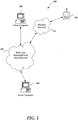
- FIGURE 1 shows components of an exemplary environment in which the invention may be practiced. Not all the components may be required to practice the invention, and variations in the arrangement and type of the components may be made without departing from the spirit or scope of the invention.
- LANs local area networks
- WAN wide area networks
- client computer 104 and server computer 108, employ network 102 to communicate with each other, and similar devices.
- Wireless network 110 is connected to network 102.
- Wireless network 110 may include various components, such as servers, messaging centers, and towers which are employed to provide wireless connectivity to mobile devices. Many of these components are interconnected by wires ; the wireless designation applies to the devices using the wireless network, and not to those representing its structure.
- the connection between wireless network 110 and network 102 may be realized by a variety of known methods, such as, for example, by the use of a gateway.
- Mobile device 106 can couple to wireless network 110 using a wireless communications medium.
- the mobile device can include a mobile telephone, smart phone, pager, walkie talkie, radio frequency (RF) device, infrared (IR) device, Wi-Fi device, and integrated devices combining one or more of the preceding devices, and the like.
- RF radio frequency
- IR infrared
- Wi-Fi device wireless local area network
- mobile device 106 can include an inbox for a messaging facility, such as email, instant messaging (IM), short messaging service (SMS), and the like.
- the LANs and WANs of network 102 are typically interconnected by routers and/or switches.
- communication links within the LANs and WANS can include twisted pair, fiber optics, or coaxial cable, while communication links between networks may utilize analog telephone lines, full or fractional dedicated digital lines including T1, T2, T3, and T4, Integrated Services Digital Networks (ISDNs), Digital Subscriber Lines (DSLs), wireless links, and the like.
- ISDNs Integrated Services Digital Networks
- DSLs Digital Subscriber Lines
- wireless links and the like.
- the number of WANs and LANs in FIGURE 1 may be increased or decreased arbitrarily without departing from the spirit or scope of this invention.
- Computer-readable media includes any media that can be accessed by a computing device.
- Computer-readable media may include computer storage media, communication media, or any combination thereof.
- communication media typically embodies computer-readable instructions, data structures, program modules, or other data in a modulated data signal such as a carrier wave or other transport mechanism and includes any information delivery media.
- modulated data signal and “carrier-wave signal” includes a signal that has one or more of its characteristics set or changed in such a manner as to encode information, instructions, data, and the like, in the signal.
- communication media includes wired media such as twisted pair, coaxial cable, fiber optics, wave guides, and other wired media and wireless media such as acoustic, RF, infrared, and other wireless media.
- Server computer 108 can include, among other components, a central processing unit (processor), a memory for storing instructions, and a network interface unit connected via a bus.
- the processor in combination with instructions stored in the memory enable the operation of one or more applications executing on server computer 108.
- These applications can include, but are not limited to, servers, clients, protocols, interfaces, compilers, translators, modules, agents, and the like.
- the network interface unit includes the necessary circuitry for connecting the server computer to network 102, and is constructed for use with various communication protocols including, but not limited to, TCP/IP, UDP/IP, SMS, IM, and WAP.
- the network interface unit may include or interface with circuitry and components for communicating information, such as graphical displays, advertiser data, and the like, over a wired and/or wireless communications medium.
- the network interface unit can sometimes be referred to as a transceiver.
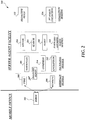
- FIGURE 2 illustrates overview 200 of an architecture for communication between a mobile device and a server agent facility.
- the mobile device (not shown) includes inbox 202 which is in communication with a messaging facility (not shown) operating on the mobile device, such as email, SMS, IM, and the like.
- the server agent facility operates on at least one server computer, client computer, or host computer, and the like (not shown).
- the server agent facility includes at least four categories of modules that are in communication with each other: an interface module, a packaging module, agent module, and a collection module.
- the interface module enables communication of collected and preprocessed information to inbox 202 when a wireless connection to the mobile device occurs and when a sufficient bandwidth is determined to be available to provide the collected and preprocessed information.
- the interface module may include push component 204 and retrieve component 206.
- Push component 204 is configured to provide collected and preprocessed information automatically to inbox 202 of the mobile device, if a wireless connection is available.
- retrieve component 206 is configured to provide substantially similar information to inbox 202 in response to a request from the mobile device, if a wireless connection is available.
- Delivery agent 207 is configured to monitor the mobile device to determine if it is available. If the mobile device is available, delivery agent 207 may provide responses from a temporary inbox residing on a server to an inbox on the mobile device through the interface module.
- the packaging module is configured to package collected and preprocessed information in a format suitable for inbox 202. Depending on the characteristics of inbox 202, the packaging module may employ normalize component 208 to arrange the collected and preprocessed information, compress component 210 to compress information, and/or encryption component 212 to encrypt information.
- the agent module includes various types of agents that may be employed to enable the collection and/or preprocessing of information. These agents can include editor agent 214 for editing collected information. For example, editor agent 214 may be used to determine a top ten result provided by a search.
- the agent module may also include search agent 216, which can be employed to collect information related to a query.
- Alert agent 218 may also be included within the agent module to collect information related to an event (alert), such as a change in a price of stock, a change in weather, a press release, and the like.
- agent module may also include forward looking agent 220, which can be employed to use a profile, such as for the mobile device, a user, and the like, and to use historical and/or behavior data to predict information that might be useful.
- a profile such as for the mobile device, a user, and the like
- historical and/or behavior data might include, for example, a search for an airplane ticket, directions in a particular city not associated with a current location of the mobile device, as well as similar behavior related information.
- forward looking agent 220 could predict that collecting weather information in that particular city would be useful. Forward looking agent 220 could then collect this predicted information so that it may be provided to inbox 202.
- forward looking agent 220 also may be employed to provide statistical, forecast, and similar information for use by the mobile device.
- FIGURE 2 Although only four types of agents are illustrated in FIGURE 2 , the invention is not so limited, and almost any other type of agent may be included whose operation is at least indirectly related to collection and/or preprocessing of information that may be useable by the mobile device.
- the collection module within the server agent facility is configured to enable information to be collected out of band of an operation with the mobile device.
- the collection module includes proactive fetch component 222 and third party collection component 224.
- Proactive fetch component 222 may be employed to collect information indicated by an agent within the agent module.
- Third party collection component 224 is useable to collect information indicated by an agents and/or program that may not be directly a part of the server agent facility.
- One such agent may include an external agent that is arranged to provide airline ticket information in response to a query. Typically, this type of information is collected in a batch approach; however, the invention is not so limited, and other approaches and external agents may also be employed.
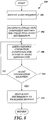
- FIGURE 3 illustrates a logical flow diagram generally showing one embodiment of process 300 for use in collecting information for an inbox associated with a mobile device.
- Process 300 may be implemented, for example, on server computer 108 of FIGURE 1 .
- Process 300 begins, after a start block, at block 302 where information is collected out of band of an operation with the mobile device.
- the collected information may then be preprocessed employing an agent in a server agent facility, such as shown in FIGURE 2 .
- the collection and preprocessing of the information by the agent may be automatically configured and at least partially selected based on any of a variety of criterion, including, but not limited to, time, a preference, profile, condition, event, historical data, behavior data, and the like.
- Process 300 flows next to block 304 where the information is packaged in a format suitable for delivery to an inbox of the mobile device.
- Process 300 continues next to block 305 where the packaged information is sent a temporary inbox that may reside on a server computer, such as server computer 108 of FIGURE 1 , or the like.
- Process 300 next continues to decision block 306, a determination is made whether the inbox of the mobile device is available. This determination is typically performed by a delivery agent and is based on if a network connection is present and a sufficient bandwidth is available to the mobile device. If the mobile device's inbox is unavailable or the bandwidth is insufficient, the process loops through decision block 306 to wait until the mobile device is available. However, if the determination at decision block 306 is true, the process advances to block 308 where the preprocessed/collected information is provided by the delivery agent to an interface module that is enabled to provide the information to the inbox of the mobile device. Upon completion of process 300, processing returns to a calling process to perform other actions.
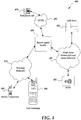
- FIGURE 4 shows functional block diagram 400 illustrating one embodiment of several interfaces employable to configure and/or send requests to server agent facility 406.
- the user may send a request for the information to server agent facility 406.
- the request may also include predefined instructions.
- a request for information may be made orally by telephone call 404.
- the request may also be made with the aid of a prompt (not shown), web-form 403, a menu, text message 401, email 402, instant message (IM), mobile telephone 400 call, and the like.
- a request for information is provided to server agent facility 406, which operates substantially similar the server agent facility shown in FIGURE 2 .
- server agent facility 406 which operates substantially similar the server agent facility shown in FIGURE 2 .
- the request may be sent to the server agent facility using mobile telephone 400 connected to wireless network 110.
- Mobile telephone 400 may be the same as or distinct from mobile device 106 of FIGURE 1 . While mobile telephone 400 is presently shown as coupled to wireless network 110, it is not necessary that mobile telephone 400 and mobile device 106 be coupled to the same network. Rather, mobile device 106 could be wirelessly coupled, instead, to WAN over network 102, or a similar arrangement.
- Server agent facility 406 is configured to provide a user utilizing mobile telephone 400 with an interface such as a voice menu, which enables the user to communicate a request in orally, phone button signals, and/or a combination of the above.
- the interface may include a voice recognition module to capture words or predetermined commands spoken by the user.
- the interface may include an intelligent language recognition module to accommodate a plain spoken language, and reduce the use of predefined commands.
- a user may communicate a request by use of telephone 404 coupled to a land line, such as Plain Old Telephone Service (POTS) 405.
- POTS Plain Old Telephone Service
- This type of request may be made and processed in a manner similar to a request made with mobile telephone 400.
- a user may communicate a request by means of text message 401.
- the text message may be, for example, a Short Message Service (SMS) message, or a similar protocol.
- SMS Short Message Service
- Text message 401 may be conveyed using a mobile device, a client computer, a land line telephone, mobile telephone 400, and the like.
- An interface included in or in communication with server agent facility 406 receives and processes a request in the text message.
- Web-form 403 also may be provided to a client.
- Web-form 403 can be provided by a web-server module included in or coupled to server agent facility 406.
- the user may fill in information including a request in web-form 403 and then perform an action, such as pressing a button that instructs the client to send information towards server agent facility 406.
- Other software and communication protocols may also be used to communicate a request over network 102 to server agent facility 406. These include, but are not limited to instant messaging, internet relay chat, file transfer protocol, and the like.
- FIGURE 5 illustrates a logical flow diagram generally showing one embodiment of process 500 for relaying requests to the server agent facility.
- process 500 is implemented in server computer 108 of FIGURE 1 .
- Process 500 begins, after a start block, at block 502 where a request for information is received from a mobile device. Processing flows next to block 504, where the received request is parsed. Parsing of the received request may include employing a speech recognition application, program, script, or the like. It may also include parsing the request for information for predefined commands, syntax, and so forth. The request may be parsed into a predefined format such that it may be more readily processed by another module in the server agent facility. Processing continues to block 506 where the parsed request is sent to the relevant module or modules in the server agent facility configured to further processing of the request. The relevant module or modules depends on a particular embodiment. For example, one of the agents within the agent module may be employed to further process the request. In any event, upon completion of block 506, processing returns to a calling process to perform other actions.
- FIGURE 6 illustrates a logical flow diagram generally showing one embodiment of a process of relaying requests to selected agents within the server agent facility.
- the request may be triggered in various forms, including one-off, event-based, and/or time-based requests.
- the request may be relayed to a search agent or an alert agent.
- the invention is not so constrained, and other agent types may be employed by the overall invention, although, they are not described in process 600.
- Process 600 of FIGURE 6 may be implemented in server computer 108 of FIGURE 1 .
- process 600 begins, after a start block, at block 602 where a request for information is received within the server agent facility. Processing flows next to decision block 604 where a determination is made whether the request encompasses actions that may be serviced by an alert agent, such as described above in conjunction with FIGURE 2 . If the request may be serviced by the alert agent, processing branches to block 608 ; otherwise, processing continues to decision block 606.
- the alert agent may operate to collect information associated with the received request employing a process such as is described below in conjunction with FIGURE 8 . Information that may be collected may, for example, include, information associated with a triggering event, such as a change in a stock price, and the like. Virtually any alert information may be collected by the alert agent. Process 600 then continues to decision block 606.
- the search agent may query a database, file, a network infrastructure, and the like, in search of information that may be responsive to a query within the request for information. In one embodiment, the search agent may employ a process such as described below in conjunction with FIGURE 7 .
- processing is configured to loop back to block 602 to monitor for the receipt of a next request for information.
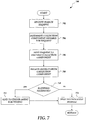
- FIGURE 7 illustrates a logical flow diagram generally showing one embodiment of process 700 of managing a search request.
- process 700 is called from block 610 of FIGURE 6 . Additionally, process 700 may be implemented within search agent 216 of FIGURE 2 .
- Process 700 begins, after a start block, at block 702, where the search request is received. Processing moves next to block 704 where a collection component that is suitable for processing the request is determined. Different collection components may be associated with different fields within the request, combination of fields, and/or search approaches. For example, one set of fields may be better satisfied by collecting information through a third party collection component. In any event, once the collection component is determined, processing flows to block 706, where the request is forwarded to the determined collection component. In one embodiment, the request is modified at block 704, prior to sending it to the determined collection component. Such modifications may include, but are not limited to reformatting the request and/or associated fields into a format suitable for use by the determined collection component.
- process 700 flows to block 714, where the results are sent to be packaged for delivery to the user.
- One embodiment of a process for packaging the results is described in more detail below in conjunction with FIGURE 11 .
- process 700 Upon completion of block 714, process 700 returns to a calling process to perform other actions.
- FIGURE 8 illustrates a logical flow diagram generally showing one embodiment of process 800 of managing an alert request.
- Process 800 may be implemented within alert agent 218 of FIGURE 2 .
- Process 800 begins, after a start block, at block 802 where the alert request is received.
- the alert request is received from block 608 of FIGURE 6 .
- an alert request may be associated with an event, condition, and the like, that when satisfied, enables information associated with the alert being sent to the user.
- Processing moves next to block 804, where a collection component is determined that is suitable for collecting the requested alert information.
- the determination of the collection component may be based on a variety of criteria, including the type of alert information requested. Moreover, one collection component may be better configured to handle a particular alert request than another collection component. In any event, once the appropriate collection component is determined, processing flows to block 806, where the determined collection component is queried about the status of the alert information.
- alert information is received when the determined collection component so determines that the alert request is satisfied. If it is determined that no alert information is received in response to the query, processing loops back to block 806 where another query is performed, until the alert request is satisfied, such as information associated with the alert request is received.
- the alert may also be configured to time out after a predetermined time. For example, should the user want to know a change in a stock price within a given time, and the stock does not change, the alert information may indicate that the stock did not change within the given time.
- the received alert information is sent to process 1100 described below in conjunction with FIGURE 11 .
- the received alert information is sent to a packaging module substantially similar to the packaging module described above in conjunction with FIGURE 2 .
- processing upon completion of block 810, processing returns to a calling process to perform other actions.
- FIGURE 9 illustrates a logical flow diagram generally showing one embodiment of a process for use by a forward looking agent.
- process 900 of FIGURE 9 is implemented in forward looking agent 220 of FIGURE 2 .
- Requests from the user typically are not specifically directed to a forward looking agent.
- process 900 begins, after a start block, at block 902, where requests to other agents are monitored.
- Process 900 moves next to decision block 904, where a determination is made whether a request sent to another agent is detected. If so, processing flows to block 906; otherwise, processing loops back to 902 to continue to monitor for alerts to other agents.
- a user record associated with the user sending the request is retrieved.
- the user record includes information associated with the user sending the request, such as, for example, statistical and behavioral information, configuration information applicable for the user, billing information, and so forth.
- the user record may include one or more data records, and portions of it may be saved at one or more locations in different formats.
- the user record is modified with statistical, historical, and/or behavior data, based, in part, on the detected request.
- the user record may be modified based on a variety of statistical and/or historical behavior data. For example, statistical data may have been collected that is associated with a number of requests sent by the user, by another user, and the like. Statistical, historical, and/or behavior data may also be associated with a type of request, time associated with a request, frequency of a type of request, and the like. Similarly, the statistical, historical, and/or behavior data may include information associated with keywords in a request, a context, or substance of a request, where the requests are sent, and the like.
- a user setting associated with the detected request may be employed to assist in determining what statistical, historical, and/or behavior data is to be collected and employed to modify the user record.
- the user may have indicated that a prior request is to be saved and returned to the user at some later time.
- any statistical, historical, and behavior data may be collected and employed to modify the user record.
- such statistical, historical, and behavior data may also be employed for other uses, including, but not limited to, billing, research, and the like.
- Process 900 next flows to block 910, where a determination is made whether additional information is to be provided to modify the user record.
- additional information may not be directly responsive to the detected request. However, providing such information may be desirable for a variety of other reasons, such as being indirectly helpful to the user. Thus, for example, if a user requests information about a novel, additional information about the author of the novel may be sent, although such information was not directly requested by the user.
- the determination of whether to provide additional information may depend on a variety of things, including user criteria, a user setting, a configuration of the server agent facility, the request itself, and so forth.
- additional information may be provided for a predefined type of request that may be defined by a keyword, a subject matter, a frequency, or the like.
- the determination to provide additional information may be based on a type of user, a predefined set of users, or the like. In any event, if no additional information is to be provided processing loops back to block 902; otherwise, processing continues to block 912.
- a request for additional information is formulated based on the request that was detected and/or the user record.
- the request for additional information may be based on keywords found in the detected request.
- the request for additional information may also be based on keywords found in the detected request in addition to a presence of certain historical, statistical, behavior, or other information in the user record.
- the request for additional information may refer to information about transportation options from geographical location A to geographical location B.
- the request for additional information is sent to a suitable collection component.
- the request for additional information is sent to collection component to perform actions substantially similar to those described below in conjunction with FIGURE 10 .
- the invention is not so limited, and another process may be employed.
- the suitable collection component includes one that is enabled to collect and store additional information associated with advertising information, and the like.
- a collection component specifically configured to access advertising information may instead be employed. That advertising collection component may then employ its own process to search for, collect, and provide, the additional advertising information.
- processing flows to block 918, where the additional information is obtained.
- Processing then continues to block 920 where the received additional information is sent to be packaged in a format suitable for delivery to the user.
- the additional information is sent to a packaging module, substantially similar to that described above in conjunction with FIGURE 2 .
- the additional information is sent for editing.
- the editing may be performed, for example, by employing editor agent 214 of FIGURE 2 .
- the invention is not so limited, and another editor or agent may be employed to perform actions on the additional information before it is sent for packaging. In any event, upon completion of process 900, processing returns to a calling process to perform other actions.
- FIGURE 10 illustrates a logical flow diagram generally showing one embodiment of process 1000 of collecting information employing a collection module, such as shown in FIGURE 2 .
- Process 1000 may be implemented, for example, in server computer 108 of FIGURE 1 .
- Process 1000 begins, after a start block, at block 1002, where a request for content is received.
- the request may be received from a variety of sources, including, but not limited to an agent within the server agent facility of FIGURE 2 , and the like.
- the request for content is received from process 900 of FIGURE 9 .
- decision block 1004 Upon receipt of the request for content, processing flows to decision block 1004, where a determination is made as to the type of collection component to be employed to service the request for content.
- the invention is not so limited, and additional collection components may be implemented for use in servicing the request for content.
- the process may employ a third party collection component.
- This type of information may include, for example, hotel reservation information, flight pricing information, and the like.
- an operator of the server agent facility may enter into an agreement with a third party (such as an airline), wherein the server agent facility will have access to certain otherwise proprietary information, or the like, belonging to the third party. Such access may be typically performed through the third party collection module.
- process 1000 flows to block 1006; otherwise, process 1000 flows to block 1010 for processing by the third party collection component.
- the request for content is forwarded to the proactive fetch component for processing.
- the proactive fetch component performs a search based on the request, obtains a result, and returns the result.
- the actions of block 1008 employ process 700 described above, in conjunction with FIGURE 7 .
- the results provided are sent towards the user's inbox.
- the results are sent back to the requesting agent for further processing, such as preparing the results or delivery to the user by employing a packaging module, or the like.
- process 1000 Upon completion of block 1018, process 1000 then returns to a calling process to perform other actions.
- FIGURE 11 illustrates a logical flow diagram generally showing one embodiment of a process of packaging information for delivery to a mobile device.
- process 1100 of FIGURE 11 is implemented within the server agent facility described above in conjunction with FIGURE 2 .
- Process 1100 of FIGURE 11 begins, after a start block, at block 1102, where information is received that is intended for delivery the inbox of the mobile device.
- information may include, for example, the results of a search received from a search agent, alert information received from an alert agent, predictive, historical, behavior information, or the like.
- processing flows to decision block 1104, where a determination is made whether the information is to be normalized. Normalization of the information may include modifying a format of the information. This determination can be made based on variety of factors, such as, but not limited to, the information itself, the type of the mobile device to which the information is to be directed, and the user settings. For example, a mobile device may not be able to display certain formats of information. In that instance, the information may be reformatted for viewing on that mobile device. Similarly, a user may have indicated that information is to be delivered in a predefined format.
- block 1106 may be implemented by normalize component 208 of FIGURE 2 . Normalization of the information may result in changes in a variety of characteristics of the information, including, but not limited to, resizing of an image, changing a format/encoding of an image, changing a font size, resizing text, regrouping text, and so forth. Similarly, information organized according to a presentation language or a markup language, such as HTML, may be reformatted, reorganized, and the like, by, for example, manipulating the content to change a presentation format.
- a presentation language or a markup language such as HTML
- Information may also be reformatted into a markup language, or if already in a markup language, may be placed in a different markup language.
- the information may be placed in a Synchronized Multimedia Integration Language (SMIL) compliant format for presentation by the mobile device. Processing then flows to decision block 1108.
- SMIL Synchronized Multimedia Integration Language
- the information is compressed.
- compression is achieved employing compress component 210 of FIGURE 2 .
- Compression may be performed according to one or more compression mechanisms, including, but not limited to, run length encoding, minimum redundancy coding, discrete fractal transform compression, fractal compression, and so forth. In fact, virtually any compression mechanism may be employed to compress the information.
- compression continues to flow to decision block 1112.
- any of a variety of encryption mechanisms may be employed to encrypt the information, including, but not limited to public key encryption, symmetric key encryption, hybrid encryption, and the like.
- processing flows to block 1116.
- the information is forwarded for delivery to the mobile device.
- the information is forwarded to an interface module, such as described above in conjunction with FIGURE 2 .
- a process, such as described in FIGURE 12 is employed at block 1116 to prepare the information for delivery to the mobile device.
- FIGURE 12 illustrates a logical flow diagram generally showing one embodiment of a process of managing an interface to a mobile device.
- Process 1200 of FIGURE 12 may be implemented, for example, within the interface module of FIGURE 2 .
- Process 1200 begins, after a start block, at block 1202, where information is received that is intended for delivery to the mobile device.
- the information is received from a packaging module, such as described in conjunction with FIGURE 11 , but it may also be received from other components of the server agent facility, such as, for example one of the agents, or the collection module.
- processing flows to decision block 1204, where a determination is made whether the received information is to be pushed to or retrieved by the mobile device. This determination may be made based on the a variety of criteria, including, but not limited to, a user setting, a type of the mobile device, a type of information, and the like.
- processing continues to block 1210, where a notification is forwarded to an inbox of the mobile device, indicating that the information is available.
- the notification may be in virtually any format, or form, including, for example, a text message, an SMS message, an Instant message, an email, and the like.
- Processing next flows to block 1212, where a request for the information is received from the mobile device. Processing then flows to decision block 1206.
- Many existing wireless networks support different types of connections with different bandwidth capabilities.
- the typical wireless telephone network may support a standard connection for sending short messages and voice communication, as well as a data connection (e. g., IX CDMA connection) for sending relatively large amounts of data.
- the determination of block 1206 is made in accordance with the amount of information being sent, and the bandwidth availability to send that information. If it is determined that there is insufficient bandwidth or the connection has dropped out, processing loops back through block 1206, until the connection is available and has sufficient bandwidth. However, when the connection is available with sufficient bandwidth, processing flows to decision block 1214.
- decision block 1214 it is determined whether the information to be sent is still fresh.
- Information may have become outdated while the interface module is waiting for a connection with sufficient bandwidth is available to the mobile device.
- the time it takes for a certain item of information to become outdated may depend on a variety of criteria, such as a type of information.
- Some types of information may also be considered to be never outdated, e. g. , have an infinite freshness time.
- decision block 1214 may be deleted, optionally executed based on other predefinable criteria, or the like.
- processing proceeds to block 1216, where the information is sent to the mobile device.
- processing Upon completion of block 1216, processing returns to a calling process to perform other actions.
- the information may be refreshed, for example, by performing another search for the information, re-requesting the collection of the information, and the like. Upon refreshing the information, processing loops back to decision block 1206.
- blocks of the flowchart illustration support combinations of operations for performing the specified actions, combinations of steps for performing the specified actions and program instruction means for performing the specified actions. It will also be understood that each block of the flowchart illustration, and combinations of blocks in the flowchart illustration, can be implemented by special purpose hardware-based systems which perform the specified actions or steps, or combinations of special purpose hardware and computer instructions.
Landscapes
- Engineering & Computer Science (AREA)
- Databases & Information Systems (AREA)
- Theoretical Computer Science (AREA)
- Physics & Mathematics (AREA)
- General Engineering & Computer Science (AREA)
- General Physics & Mathematics (AREA)
- Data Mining & Analysis (AREA)
- Computer Hardware Design (AREA)
- Software Systems (AREA)
- Information Transfer Between Computers (AREA)
- Telephonic Communication Services (AREA)
- Traffic Control Systems (AREA)
Abstract
Description
- The invention relates generally to information gathering, and more particularly, but not exclusively, to employing an agent to gather information out of band for use with a mobile device.
- Generally, an agent is an application that performs some type of information gathering and/or processing in the background of another application operating in the foreground. Typically, an agent program has a relatively small and well-defined task. For example, as the Internet has grown, agents have become more prominent for information gathering related to search requests. Information gathered by an agent can be pulled, or pushed to another application operating in the foreground. Therefore, it is with respect to these considerations and others that the present invention has been made.
- The invention in a first aspect provides a method for providing information to a mobile device as defined in appended claim 1.
- The invention in a second aspect provides a server for providing information to a mobile device over a network as defined in appended claim 13.
- The invention in a third aspect provides program instruction means comprising computer program instructions which, when executed on a processor, will cause the processor to perform the steps of the method of the first aspect of the invention, set forth above.
- Non-limiting and non-exhaustive embodiments of the present invention are described with reference to the following drawings. In the drawings, like reference numerals refer to like parts throughout the various figures unless otherwise specified.
- For a better understanding of the present invention, reference will be made to the following Detailed Description of the Invention, which is to be read in association with the accompanying drawings, wherein:
-
FIGURE 1 shows a functional block diagram illustrating one embodiment of an environment for practicing the invention; -
FIGURE 2 shows one embodiment of an overview of components employable by a mobile device and a server agent facility; -
FIGURE 3 illustrates a logical flow diagram generally showing one embodiment of a process for use in collecting information for an inbox associated with a mobile device; -
FIGURE 4 shows a functional block diagram illustrating one embodiment of several interfaces employable to configure and/or send requests to the server agent facility; -
FIGURE 5 illustrates a logical flow diagram generally showing one embodiment of a process for relaying requests to the server agent facility; -
FIGURE 6 illustrates a logical flow diagram generally showing one embodiment of a process of relaying requests to various agents within the server agent facility; -
FIGURE 7 illustrates a logical flow diagram generally showing one embodiment of a process of managing a search request; -
FIGURE 8 illustrates a logical flow diagram generally showing one embodiment of a process of managing an alert request; -
FIGURE 9 illustrates a logical flow diagram generally showing one embodiment of a process for use by a forwarding agent; -
FIGURE 10 illustrates a logical flow diagram generally showing one embodiment of a process of collecting information ; -
FIGURE 11 illustrates a logical flow diagram generally showing one embodiment of a process of packaging information for delivery to a mobile device; and -
FIGURE 12 illustrates a logical flow diagram generally showing one embodiment of a process of managing an interface to the mobile device, in accordance with the present invention. - In the following detailed description, reference is made to the accompanied drawings in which are shown specific exemplary embodiments of the invention. These embodiments are described in sufficient detail to enable those skilled in the art to practice the invention, and it is understood that other embodiments may be utilized, and other changes may be made, without departing from the spirit or scope of the invention. The following detailed description is, therefore, not to be taken in a limiting sense, and the scope of the invention is defined only by the appended claims.
- Briefly stated, the present invention enables a facility with one or more server agents to gather information from at least one resource on a network and automatically provide this information in a suitable format to an inbox of a mobile device. The server agent facility provides processes for preprocessing requests for information, collecting the information out of band, filtering the collected information, and packaging the information for delivery in a format suitable for the mobile device's inbox. A server agent can independently collect and process information based on at least one factor, including but not limited to, time, event (s), user profile, mobile device profile, request (s), alert (s), historical data, behavior data, and the like.
- Different type of server agents may be employed by the server agent facility to collect information, including but not limited to, an editor, a search agent, an alert agent, and a forward looking agent. Collection modules are employed by the server agent facility to collect information for preprocessing by the server agents including a module for collecting information provided by third party agents and a proactive fetch module that collects information for preprocessing by the server agents.
- A packaging module packages the collected information in at least one format suitable for use with a mobile device, including but not limited to, Wireless Application Protocol (WAP), and the like. Additionally, the packaging module can provide encryption and compression to package collected information in a format suitable for delivery to the inbox of a mobile device.
- An interface module enables the server agent facility to provide the preprocessed collected information in response to a retrieval request or automatically push the information to the inbox of a mobile device.
-
FIGURE 1 shows components of an exemplary environment in which the invention may be practiced. Not all the components may be required to practice the invention, and variations in the arrangement and type of the components may be made without departing from the spirit or scope of the invention. - In
FIGURE 1 , one or more local area networks ("LANs") and/or wide area networks ("WAN") are included in anetwork 102, such as the Internet, that enables communication between various users, devices, servers, agents, modules, clients, processes, and the like. As shown,client computer 104, andserver computer 108, employnetwork 102 to communicate with each other, and similar devices.Wireless network 110 is connected tonetwork 102.Wireless network 110 may include various components, such as servers, messaging centers, and towers which are employed to provide wireless connectivity to mobile devices. Many of these components are interconnected by wires ; the wireless designation applies to the devices using the wireless network, and not to those representing its structure. The connection betweenwireless network 110 andnetwork 102 may be realized by a variety of known methods, such as, for example, by the use of a gateway.Mobile device 106 can couple towireless network 110 using a wireless communications medium. Also, the mobile device can include a mobile telephone, smart phone, pager, walkie talkie, radio frequency (RF) device, infrared (IR) device, Wi-Fi device, and integrated devices combining one or more of the preceding devices, and the like. Although not shown,mobile device 106 can include an inbox for a messaging facility, such as email, instant messaging (IM), short messaging service (SMS), and the like. - Although not shown, the LANs and WANs of
network 102 are typically interconnected by routers and/or switches. Also, communication links within the LANs and WANS can include twisted pair, fiber optics, or coaxial cable, while communication links between networks may utilize analog telephone lines, full or fractional dedicated digital lines including T1, T2, T3, and T4, Integrated Services Digital Networks (ISDNs), Digital Subscriber Lines (DSLs), wireless links, and the like. Furthermore, the number of WANs and LANs inFIGURE 1 may be increased or decreased arbitrarily without departing from the spirit or scope of this invention. - The media used to transmit information in communication links as described above illustrates one type of computer-readable media, namely communication media. Generally, computer-readable media includes any media that can be accessed by a computing device. Computer-readable media may include computer storage media, communication media, or any combination thereof.
- Additionally, communication media typically embodies computer-readable instructions, data structures, program modules, or other data in a modulated data signal such as a carrier wave or other transport mechanism and includes any information delivery media. The terms "modulated data signal", and "carrier-wave signal" includes a signal that has one or more of its characteristics set or changed in such a manner as to encode information, instructions, data, and the like, in the signal. By way of example, communication media includes wired media such as twisted pair, coaxial cable, fiber optics, wave guides, and other wired media and wireless media such as acoustic, RF, infrared, and other wireless media.
-
Server computer 108 can include, among other components, a central processing unit (processor), a memory for storing instructions, and a network interface unit connected via a bus. The processor in combination with instructions stored in the memory enable the operation of one or more applications executing onserver computer 108. These applications can include, but are not limited to, servers, clients, protocols, interfaces, compilers, translators, modules, agents, and the like. - For
server computer 108, the network interface unit includes the necessary circuitry for connecting the server computer tonetwork 102, and is constructed for use with various communication protocols including, but not limited to, TCP/IP, UDP/IP, SMS, IM, and WAP. The network interface unit may include or interface with circuitry and components for communicating information, such as graphical displays, advertiser data, and the like, over a wired and/or wireless communications medium. The network interface unit can sometimes be referred to as a transceiver. -
FIGURE 2 illustratesoverview 200 of an architecture for communication between a mobile device and a server agent facility. The mobile device (not shown) includesinbox 202 which is in communication with a messaging facility (not shown) operating on the mobile device, such as email, SMS, IM, and the like. The server agent facility operates on at least one server computer, client computer, or host computer, and the like (not shown). - As shown, the server agent facility includes at least four categories of modules that are in communication with each other: an interface module, a packaging module, agent module, and a collection module. The interface module enables communication of collected and preprocessed information to
inbox 202 when a wireless connection to the mobile device occurs and when a sufficient bandwidth is determined to be available to provide the collected and preprocessed information. - The interface module may include
push component 204 and retrievecomponent 206.Push component 204 is configured to provide collected and preprocessed information automatically toinbox 202 of the mobile device, if a wireless connection is available. Retrievecomponent 206 is configured to provide substantially similar information toinbox 202 in response to a request from the mobile device, if a wireless connection is available. - Situated between the interface module and the packaging module is
delivery agent 207.Delivery agent 207 is configured to monitor the mobile device to determine if it is available. If the mobile device is available,delivery agent 207 may provide responses from a temporary inbox residing on a server to an inbox on the mobile device through the interface module. - The packaging module is configured to package collected and preprocessed information in a format suitable for
inbox 202. Depending on the characteristics ofinbox 202, the packaging module may employ normalizecomponent 208 to arrange the collected and preprocessed information,compress component 210 to compress information, and/orencryption component 212 to encrypt information. - The agent module includes various types of agents that may be employed to enable the collection and/or preprocessing of information. These agents can include
editor agent 214 for editing collected information. For example,editor agent 214 may be used to determine a top ten result provided by a search. The agent module may also includesearch agent 216, which can be employed to collect information related to a query.Alert agent 218 may also be included within the agent module to collect information related to an event (alert), such as a change in a price of stock, a change in weather, a press release, and the like. Moreover, as shown in the figure, agent module may also include forward lookingagent 220, which can be employed to use a profile, such as for the mobile device, a user, and the like, and to use historical and/or behavior data to predict information that might be useful. Such historical and/or behavior data might include, for example, a search for an airplane ticket, directions in a particular city not associated with a current location of the mobile device, as well as similar behavior related information. Based on the historical and/or behavior data, forward lookingagent 220 could predict that collecting weather information in that particular city would be useful. Forward lookingagent 220 could then collect this predicted information so that it may be provided toinbox 202. Additionally, forward lookingagent 220 also may be employed to provide statistical, forecast, and similar information for use by the mobile device. - Although only four types of agents are illustrated in
FIGURE 2 , the invention is not so limited, and almost any other type of agent may be included whose operation is at least indirectly related to collection and/or preprocessing of information that may be useable by the mobile device. - The collection module within the server agent facility is configured to enable information to be collected out of band of an operation with the mobile device. The collection module includes proactive fetch
component 222 and thirdparty collection component 224. Proactive fetchcomponent 222 may be employed to collect information indicated by an agent within the agent module. Thirdparty collection component 224 is useable to collect information indicated by an agents and/or program that may not be directly a part of the server agent facility. One such agent may include an external agent that is arranged to provide airline ticket information in response to a query. Typically, this type of information is collected in a batch approach; however, the invention is not so limited, and other approaches and external agents may also be employed. -
FIGURE 3 illustrates a logical flow diagram generally showing one embodiment ofprocess 300 for use in collecting information for an inbox associated with a mobile device.Process 300 may be implemented, for example, onserver computer 108 ofFIGURE 1 . -
Process 300 begins, after a start block, atblock 302 where information is collected out of band of an operation with the mobile device. The collected information may then be preprocessed employing an agent in a server agent facility, such as shown inFIGURE 2 . The collection and preprocessing of the information by the agent may be automatically configured and at least partially selected based on any of a variety of criterion, including, but not limited to, time, a preference, profile, condition, event, historical data, behavior data, and the like. -
Process 300 flows next to block 304 where the information is packaged in a format suitable for delivery to an inbox of the mobile device.Process 300 continues next to block 305 where the packaged information is sent a temporary inbox that may reside on a server computer, such asserver computer 108 ofFIGURE 1 , or the like. -
Process 300 next continues to decision block 306, a determination is made whether the inbox of the mobile device is available. This determination is typically performed by a delivery agent and is based on if a network connection is present and a sufficient bandwidth is available to the mobile device. If the mobile device's inbox is unavailable or the bandwidth is insufficient, the process loops throughdecision block 306 to wait until the mobile device is available. However, if the determination atdecision block 306 is true, the process advances to block 308 where the preprocessed/collected information is provided by the delivery agent to an interface module that is enabled to provide the information to the inbox of the mobile device. Upon completion ofprocess 300, processing returns to a calling process to perform other actions. -
FIGURE 4 shows functional block diagram 400 illustrating one embodiment of several interfaces employable to configure and/or send requests toserver agent facility 406. As shown in the figure, should a user desire to receive information at a mobile device, the user may send a request for the information toserver agent facility 406. In addition to the request for information, the request may also include predefined instructions. Also, shown in the figure, a request for information may be made orally bytelephone call 404. The request may also be made with the aid of a prompt (not shown), web-form 403, a menu,text message 401,email 402, instant message (IM),mobile telephone 400 call, and the like. - Generally, a request for information is provided to
server agent facility 406, which operates substantially similar the server agent facility shown inFIGURE 2 . There typically are several types of requests, including one-off requests, event-based requests, and time-based requests. The request may be sent to the server agent facility usingmobile telephone 400 connected towireless network 110.Mobile telephone 400 may be the same as or distinct frommobile device 106 ofFIGURE 1 . Whilemobile telephone 400 is presently shown as coupled towireless network 110, it is not necessary thatmobile telephone 400 andmobile device 106 be coupled to the same network. Rather,mobile device 106 could be wirelessly coupled, instead, to WAN overnetwork 102, or a similar arrangement. -
Server agent facility 406 is configured to provide a user utilizingmobile telephone 400 with an interface such as a voice menu, which enables the user to communicate a request in orally, phone button signals, and/or a combination of the above. The interface may include a voice recognition module to capture words or predetermined commands spoken by the user. Furthermore, the interface may include an intelligent language recognition module to accommodate a plain spoken language, and reduce the use of predefined commands. - In one embodiment, a user may communicate a request by use of
telephone 404 coupled to a land line, such as Plain Old Telephone Service (POTS) 405. This type of request may be made and processed in a manner similar to a request made withmobile telephone 400. - Alternatively, a user may communicate a request by means of
text message 401. The text message may be, for example, a Short Message Service (SMS) message, or a similar protocol.Text message 401 may be conveyed using a mobile device, a client computer, a land line telephone,mobile telephone 400, and the like. An interface included in or in communication withserver agent facility 406 receives and processes a request in the text message. - Web-
form 403 also may be provided to a client. Web-form 403 can be provided by a web-server module included in or coupled toserver agent facility 406. The user may fill in information including a request in web-form 403 and then perform an action, such as pressing a button that instructs the client to send information towardsserver agent facility 406. Other software and communication protocols may also be used to communicate a request overnetwork 102 toserver agent facility 406. These include, but are not limited to instant messaging, internet relay chat, file transfer protocol, and the like. -
FIGURE 5 illustrates a logical flow diagram generally showing one embodiment ofprocess 500 for relaying requests to the server agent facility. In one embodiment,process 500 is implemented inserver computer 108 ofFIGURE 1 . -
Process 500 begins, after a start block, atblock 502 where a request for information is received from a mobile device. Processing flows next to block 504, where the received request is parsed. Parsing of the received request may include employing a speech recognition application, program, script, or the like. It may also include parsing the request for information for predefined commands, syntax, and so forth. The request may be parsed into a predefined format such that it may be more readily processed by another module in the server agent facility. Processing continues to block 506 where the parsed request is sent to the relevant module or modules in the server agent facility configured to further processing of the request. The relevant module or modules depends on a particular embodiment. For example, one of the agents within the agent module may be employed to further process the request. In any event, upon completion ofblock 506, processing returns to a calling process to perform other actions. -
FIGURE 6 illustrates a logical flow diagram generally showing one embodiment of a process of relaying requests to selected agents within the server agent facility. The request may be triggered in various forms, including one-off, event-based, and/or time-based requests. In particular, as shown in the figure, the request may be relayed to a search agent or an alert agent. However, the invention is not so constrained, and other agent types may be employed by the overall invention, although, they are not described inprocess 600.Process 600 ofFIGURE 6 may be implemented inserver computer 108 ofFIGURE 1 . - As shown in
FIGURE 6 ,process 600 begins, after a start block, atblock 602 where a request for information is received within the server agent facility. Processing flows next to decision block 604 where a determination is made whether the request encompasses actions that may be serviced by an alert agent, such as described above in conjunction withFIGURE 2 . If the request may be serviced by the alert agent, processing branches to block 608 ; otherwise, processing continues todecision block 606. Atblock 608, the alert agent may operate to collect information associated with the received request employing a process such as is described below in conjunction withFIGURE 8 . Information that may be collected may, for example, include, information associated with a triggering event, such as a change in a stock price, and the like. Virtually any alert information may be collected by the alert agent.Process 600 then continues todecision block 606. - At
decision block 606, a determination is made whether the received request encompasses actions that may be serviced by a search agent. If a search agent is to be employed, processing branches to block 610, where the search agent is employed to service the request for information. The search agent may query a database, file, a network infrastructure, and the like, in search of information that may be responsive to a query within the request for information. In one embodiment, the search agent may employ a process such as described below in conjunction withFIGURE 7 . Upon completion ofblock 610, or if a search agent is not to be employed, processing is configured to loop back to block 602 to monitor for the receipt of a next request for information. -
FIGURE 7 illustrates a logical flow diagram generally showing one embodiment ofprocess 700 of managing a search request. In one embodiment,process 700 is called fromblock 610 ofFIGURE 6 . Additionally,process 700 may be implemented withinsearch agent 216 ofFIGURE 2 . -
Process 700 begins, after a start block, atblock 702, where the search request is received. Processing moves next to block 704 where a collection component that is suitable for processing the request is determined. Different collection components may be associated with different fields within the request, combination of fields, and/or search approaches. For example, one set of fields may be better satisfied by collecting information through a third party collection component. In any event, once the collection component is determined, processing flows to block 706, where the request is forwarded to the determined collection component. In one embodiment, the request is modified at block 704, prior to sending it to the determined collection component. Such modifications may include, but are not limited to reformatting the request and/or associated fields into a format suitable for use by the determined collection component. - Processing next proceeds to block 708, where results to the collection request are received from the determined collection component. Processing then continues to decision block 710, where a determination is made whether any editing of the results is to be performed. Editing may be performed, for example, to place the returned results in a format better useable by the user. Moreover, such editing may be based on any of a variety of criteria, including, but not limited to predefined criteria specified by the user, a characteristic of the user's computing device, a browser format, and the like. For example, a user may wish to receive only the top ten hits of a search, or a user may wish to receive only a specific metric about a certain stock. In any event, if editing is to be performed processing branches to block 712 where the results are sent to an editor agent. When editing is completed, or if editing is not to be performed,
process 700 flows to block 714, where the results are sent to be packaged for delivery to the user. One embodiment of a process for packaging the results is described in more detail below in conjunction withFIGURE 11 . Upon completion ofblock 714,process 700 returns to a calling process to perform other actions. -
FIGURE 8 illustrates a logical flow diagram generally showing one embodiment ofprocess 800 of managing an alert request.Process 800, for example, may be implemented withinalert agent 218 ofFIGURE 2 . -
Process 800 begins, after a start block, atblock 802 where the alert request is received. In one embodiment, the alert request is received fromblock 608 ofFIGURE 6 . As described briefly above, an alert request may be associated with an event, condition, and the like, that when satisfied, enables information associated with the alert being sent to the user. - Processing moves next to block 804, where a collection component is determined that is suitable for collecting the requested alert information. The determination of the collection component may be based on a variety of criteria, including the type of alert information requested. Moreover, one collection component may be better configured to handle a particular alert request than another collection component. In any event, once the appropriate collection component is determined, processing flows to block 806, where the determined collection component is queried about the status of the alert information.
- Processing continues to decision block 808, where it is determined whether alert information is received in response to the query. In one embodiment, alert information is received when the determined collection component so determines that the alert request is satisfied. If it is determined that no alert information is received in response to the query, processing loops back to block 806 where another query is performed, until the alert request is satisfied, such as information associated with the alert request is received. The alert may also be configured to time out after a predetermined time. For example, should the user want to know a change in a stock price within a given time, and the stock does not change, the alert information may indicate that the stock did not change within the given time.
- However, at
decision block 808, if alert information has been received, processing flows to block 810, where the received alert information is sent to be packaged for delivery to the user. In one embodiment, the received alert information is sent to process 1100 described below in conjunction withFIGURE 11 . In another embodiment, the received alert information is sent to a packaging module substantially similar to the packaging module described above in conjunction withFIGURE 2 . In any event, upon completion ofblock 810, processing returns to a calling process to perform other actions. -
FIGURE 9 illustrates a logical flow diagram generally showing one embodiment of a process for use by a forward looking agent. Thus, in one embodiment,process 900 ofFIGURE 9 is implemented in forward lookingagent 220 ofFIGURE 2 . - Requests from the user typically are not specifically directed to a forward looking agent.
- Instead, the forward looking agent may monitor requests directed to other agents, determine predictive information, and provide the predicative information to the user. As such,
process 900 begins, after a start block, atblock 902, where requests to other agents are monitored.Process 900 moves next to decision block 904, where a determination is made whether a request sent to another agent is detected. If so, processing flows to block 906; otherwise, processing loops back to 902 to continue to monitor for alerts to other agents. - At
block 906, a user record associated with the user sending the request is retrieved. The user record includes information associated with the user sending the request, such as, for example, statistical and behavioral information, configuration information applicable for the user, billing information, and so forth. The user record may include one or more data records, and portions of it may be saved at one or more locations in different formats. - Processing flows next to block 908, where the user record is modified with statistical, historical, and/or behavior data, based, in part, on the detected request. The user record may be modified based on a variety of statistical and/or historical behavior data. For example, statistical data may have been collected that is associated with a number of requests sent by the user, by another user, and the like. Statistical, historical, and/or behavior data may also be associated with a type of request, time associated with a request, frequency of a type of request, and the like. Similarly, the statistical, historical, and/or behavior data may include information associated with keywords in a request, a context, or substance of a request, where the requests are sent, and the like.
- In one embodiment, a user setting associated with the detected request may be employed to assist in determining what statistical, historical, and/or behavior data is to be collected and employed to modify the user record. For example, in another embodiment, the user may have indicated that a prior request is to be saved and returned to the user at some later time. Virtually, any statistical, historical, and behavior data may be collected and employed to modify the user record. Moreover, such statistical, historical, and behavior data may also be employed for other uses, including, but not limited to, billing, research, and the like.
-
Process 900 next flows to block 910, where a determination is made whether additional information is to be provided to modify the user record. Such additional information may not be directly responsive to the detected request. However, providing such information may be desirable for a variety of other reasons, such as being indirectly helpful to the user. Thus, for example, if a user requests information about a novel, additional information about the author of the novel may be sent, although such information was not directly requested by the user. The determination of whether to provide additional information may depend on a variety of things, including user criteria, a user setting, a configuration of the server agent facility, the request itself, and so forth. In one embodiment, additional information may be provided for a predefined type of request that may be defined by a keyword, a subject matter, a frequency, or the like. Furthermore, the determination to provide additional information may be based on a type of user, a predefined set of users, or the like. In any event, if no additional information is to be provided processing loops back to block 902; otherwise, processing continues to block 912. - At block 912, a request for additional information is formulated based on the request that was detected and/or the user record. For example, the request for additional information may be based on keywords found in the detected request. The request for additional information may also be based on keywords found in the detected request in addition to a presence of certain historical, statistical, behavior, or other information in the user record. Thus, if the user record indicates that the user has performed a predefined number of searches about geographical location A, but the monitored requests refers to geographical location B, then the request for additional information may refer to information about transportation options from geographical location A to geographical location B.
- In
block 914, the request for additional information is sent to a suitable collection component. In one embodiment, the request for additional information is sent to collection component to perform actions substantially similar to those described below in conjunction withFIGURE 10 . However, the invention is not so limited, and another process may be employed. For example, it may be determined that the suitable collection component includes one that is enabled to collect and store additional information associated with advertising information, and the like. In this example, a collection component specifically configured to access advertising information may instead be employed. That advertising collection component may then employ its own process to search for, collect, and provide, the additional advertising information. In any event, upon completion ofblock 916, processing flows to block 918, where the additional information is obtained. Processing then continues to block 920 where the received additional information is sent to be packaged in a format suitable for delivery to the user. In one embodiment, the additional information is sent to a packaging module, substantially similar to that described above in conjunction withFIGURE 2 . In another embodiment, prior to sending the additional information to be packaged, the additional information is sent for editing. In that embodiment, the editing may be performed, for example, by employingeditor agent 214 ofFIGURE 2 . However, the invention is not so limited, and another editor or agent may be employed to perform actions on the additional information before it is sent for packaging. In any event, upon completion ofprocess 900, processing returns to a calling process to perform other actions. -
FIGURE 10 illustrates a logical flow diagram generally showing one embodiment of process 1000 of collecting information employing a collection module, such as shown inFIGURE 2 . Process 1000 may be implemented, for example, inserver computer 108 ofFIGURE 1 . - Process 1000 begins, after a start block, at block 1002, where a request for content is received. The request may be received from a variety of sources, including, but not limited to an agent within the server agent facility of
FIGURE 2 , and the like. For example, in one embodiment, the request for content is received fromprocess 900 ofFIGURE 9 . Upon receipt of the request for content, processing flows to decision block 1004, where a determination is made as to the type of collection component to be employed to service the request for content. As shown inFIGURE 10 , andFIGURE 2 , two possible collection components are illustrated: a proactive fetch and a third party collection component. However, the invention is not so limited, and additional collection components may be implemented for use in servicing the request for content. - Typically, if the request for content refers to generally accessible information, such as information generally available through the Internet, through the server agent facility, and the like, the process flows to the proactive fetch direction. However, where the request for content refers to information that is not generally available through such sources, the process may employ a third party collection component. This type of information may include, for example, hotel reservation information, flight pricing information, and the like. In one configuration, an operator of the server agent facility may enter into an agreement with a third party (such as an airline), wherein the server agent facility will have access to certain otherwise proprietary information, or the like, belonging to the third party. Such access may be typically performed through the third party collection module. Thus, if it is determined that the request for content may be serviced by the proactive fetch component, process 1000 flows to block 1006; otherwise, process 1000 flows to block 1010 for processing by the third party collection component.
- At block 1006, the request for content is forwarded to the proactive fetch component for processing. Moving to block 1008, the proactive fetch component performs a search based on the request, obtains a result, and returns the result. In one embodiment, the actions of block 1008
employ process 700 described above, in conjunction withFIGURE 7 . Upon completion of block 1008 processing flows to block 1018. - At block 1010, however, several requests for content may be batched together. Although, the invention is not limited to batching of requests, it may be performed in one embodiment, to reduce costs, simplify common requests for content, and the like. In any event, if so desired, the request is batched with other requests. Upon completion of block 1010, processing continues to block 1012, where the batched requests (where so batched) are sent to the third party collection component for processing. Processing continues next to block 1014, where the results associated with different batched requests are received. Next, processing flows to block 1016, where the batched results are separated. Processing then continues to block 1018.
- At block 1018, the results provided are sent towards the user's inbox. In one embodiment, the results are sent back to the requesting agent for further processing, such as preparing the results or delivery to the user by employing a packaging module, or the like. Upon completion of block 1018, process 1000 then returns to a calling process to perform other actions.
-
FIGURE 11 illustrates a logical flow diagram generally showing one embodiment of a process of packaging information for delivery to a mobile device. In one embodiment, process 1100 ofFIGURE 11 is implemented within the server agent facility described above in conjunction withFIGURE 2 . - Process 1100 of
FIGURE 11 begins, after a start block, at block 1102, where information is received that is intended for delivery the inbox of the mobile device. Such information may include, for example, the results of a search received from a search agent, alert information received from an alert agent, predictive, historical, behavior information, or the like. Upon receipt of such information, processing flows to decision block 1104, where a determination is made whether the information is to be normalized. Normalization of the information may include modifying a format of the information. This determination can be made based on variety of factors, such as, but not limited to, the information itself, the type of the mobile device to which the information is to be directed, and the user settings. For example, a mobile device may not be able to display certain formats of information. In that instance, the information may be reformatted for viewing on that mobile device. Similarly, a user may have indicated that information is to be delivered in a predefined format. - In any event, if it is determined that the information should be normalized, flow proceeds to block 1106, where the format of the information is changed; otherwise, processing continues to decision block 1108. In one embodiment, block 1106 may be implemented by normalize
component 208 ofFIGURE 2 . Normalization of the information may result in changes in a variety of characteristics of the information, including, but not limited to, resizing of an image, changing a format/encoding of an image, changing a font size, resizing text, regrouping text, and so forth. Similarly, information organized according to a presentation language or a markup language, such as HTML, may be reformatted, reorganized, and the like, by, for example, manipulating the content to change a presentation format. Information may also be reformatted into a markup language, or if already in a markup language, may be placed in a different markup language. For example, the information may be placed in a Synchronized Multimedia Integration Language (SMIL) compliant format for presentation by the mobile device. Processing then flows to decision block 1108. - At decision block 1108, a determination is made whether the information should be compressed. This determination may be made based on a variety of factors, including a configuration of the server agent facility, a type of the mobile device, an available bandwidth, a user settings, and so forth. A type of compression may also be determined based, at least in part, on a characteristic of the network connection, and an capability of the mobile device to decompress the information. Compression use may also be based on, for example, consideration of possible data deterioration due to "lossy" compression or the like. In any event, if it is determined that compression is to be performed, processing flows to block 1110; otherwise, processing flows to decision block 1112.
- At block 1110, the information is compressed. In one embodiment, compression is achieved employing
compress component 210 ofFIGURE 2 . Compression may be performed according to one or more compression mechanisms, including, but not limited to, run length encoding, minimum redundancy coding, discrete fractal transform compression, fractal compression, and so forth. In fact, virtually any compression mechanism may be employed to compress the information. Upon completion, processing continues to flow to decision block 1112. - At decision block 1112, a determination is made whether encryption is be performed. Encryption is directed towards ensuring privacy, of the information. Encryption may also be used for copy protection. In any event, the determination whether to encrypt the information may be based on a variety of factors including, but not limited to, a configuration of the server agent facility, a type of the mobile device, a type of the information, a user settings, and so forth. If it is determined that encryption is to be performed, processing flows to block 1114; otherwise, processing flows to block 1116.
- At block 1114, any of a variety of encryption mechanisms may be employed to encrypt the information, including, but not limited to public key encryption, symmetric key encryption, hybrid encryption, and the like. Upon completion of the encryption of the information, processing flows to block 1116.
- At block 1116, the information is forwarded for delivery to the mobile device. In one embodiment, the information is forwarded to an interface module, such as described above in conjunction with
FIGURE 2 . In another embodiment, a process, such as described inFIGURE 12 is employed at block 1116 to prepare the information for delivery to the mobile device. -
FIGURE 12 illustrates a logical flow diagram generally showing one embodiment of a process of managing an interface to a mobile device. Process 1200 ofFIGURE 12 may be implemented, for example, within the interface module ofFIGURE 2 . - Process 1200 begins, after a start block, at block 1202, where information is received that is intended for delivery to the mobile device. Typically, the information is received from a packaging module, such as described in conjunction with
FIGURE 11 , but it may also be received from other components of the server agent facility, such as, for example one of the agents, or the collection module. - Upon receipt of the information, processing flows to decision block 1204, where a determination is made whether the received information is to be pushed to or retrieved by the mobile device. This determination may be made based on the a variety of criteria, including, but not limited to, a user setting, a type of the mobile device, a type of information, and the like.
- If it is determined that the information is to be retrieved by the mobile device, processing continues to block 1210, where a notification is forwarded to an inbox of the mobile device, indicating that the information is available. The notification may be in virtually any format, or form, including, for example, a text message, an SMS message, an Instant message, an email, and the like. Processing next flows to block 1212, where a request for the information is received from the mobile device. Processing then flows to decision block 1206.
- At decision block 1206 a determination is made whether a wireless connection is currently available that includes sufficient bandwidth for sending the information. Although a notification message may have been sent at block 1210, the bandwidth may not now be sufficient for sending the information. Many existing wireless networks support different types of connections with different bandwidth capabilities. For example, the typical wireless telephone network, may support a standard connection for sending short messages and voice communication, as well as a data connection (e. g., IX CDMA connection) for sending relatively large amounts of data. Thus, the determination of block 1206 is made in accordance with the amount of information being sent, and the bandwidth availability to send that information. If it is determined that there is insufficient bandwidth or the connection has dropped out, processing loops back through block 1206, until the connection is available and has sufficient bandwidth. However, when the connection is available with sufficient bandwidth, processing flows to decision block 1214.
- At decision block 1214, it is determined whether the information to be sent is still fresh. Information may have become outdated while the interface module is waiting for a connection with sufficient bandwidth is available to the mobile device. The time it takes for a certain item of information to become outdated may depend on a variety of criteria, such as a type of information. Thus, at decision block 1214 a predefined list of several information types, and associated values indicating the time (e. g. , a freshness time) that must elapse for the associated information type to become outdated at examined. Some types of information may also be considered to be never outdated, e. g. , have an infinite freshness time. In one embodiment, however, decision block 1214, may be deleted, optionally executed based on other predefinable criteria, or the like. However, if it is determined that the information is to be refreshed, processing branches to block 1218; otherwise, processing proceeds to block 1216, where the information is sent to the mobile device. Upon completion of block 1216, processing returns to a calling process to perform other actions.
- At block 1218, however, the information may be refreshed, for example, by performing another search for the information, re-requesting the collection of the information, and the like. Upon refreshing the information, processing loops back to decision block 1206.
- It will be understood that each block of the flowchart illustrations discussed above, and combinations of blocks in the flowchart illustrations above, can be implemented by computer program instructions. These program instructions may be provided to a processor to produce a machine, such that the instructions, which execute on the processor, create means for implementing the actions specified in the flowchart block or blocks. The computer program instructions may be executed by a processor to cause a series of operational steps to be performed by the processor to produce a computer-implemented process such that the instructions, which execute on the processor, provide steps for implementing the actions specified in the flowchart block or blocks.
- Accordingly, blocks of the flowchart illustration support combinations of operations for performing the specified actions, combinations of steps for performing the specified actions and program instruction means for performing the specified actions. It will also be understood that each block of the flowchart illustration, and combinations of blocks in the flowchart illustration, can be implemented by special purpose hardware-based systems which perform the specified actions or steps, or combinations of special purpose hardware and computer instructions.
- The above specification, examples, and data provide a complete description of the manufacture and use of the composition of the invention. Since many embodiments of the invention can be made without departing from the spirit and scope of the invention, the invention resides in the claims hereinafter appended.
- The following additional numbered examples are included as part of the present disclosure (comprising the disclosure of the claims of the parent application
04801005.2 - Example 1. A method for providing information to a mobile device over a network comprising:
- employing at least one module in a server agent facility to collect information;
- employing at least another module in the server agent facility to package the collected the information; and
- sending the information to the mobile device using at least a third module in the server agent facility.
- Example 2. The method of example 1, further comprising
sending the collected information to a temporary inbox associated with a server; and
if the mobile device is available, employing a delivery agent to monitor. - Example 3. The method of example 1, wherein packaging the collected information further comprises performing at least one of a normalization of the information, a compression, and an encryption of the information.
- Example 4. The method of example 3, wherein normalization of the information further comprises modifying a format of the information.
- Example 5. The method of example 1, wherein employing at least one module in the server agent facility to collect information further comprises employing at least one of a proactive fetch and a third party collection component.
- Example 6. The method of example 1, wherein sending the information to the mobile device further comprises determining if the information is to be retrieved by the mobile device, and if it is to be retrieved by the mobile device, providing a notification to the mobile device that the information is available.
- Example 7. The method of example 1, wherein sending the information further comprises determining if a wireless connection between a server and the mobile device includes a sufficient bandwidth for the information.
- Example 8. The method of example 1, wherein the at least one module, the at least one other module, and the third module in the server agent facility each are enabled to execute on a server remote from the mobile device.
- Example 9. A method for providing information to a mobile device, comprising:
- selecting an agent from one or more agents; processing a request from the mobile device by the selected agent;
- collecting information by a collection module; packaging the information into format suitable for the mobile device by a packaging module; and
- sending the information to the mobile device by an interface module, wherein the one or more agents, the collection module, the packaging module, and the interface module are associated with a server agent facility.
- Example 10. The method of example 9, wherein the one of more agents further includes at least one search agent.
- Example 11. The method of example 9, further comprising: editing the information by an editor agent, the editor agent being further included in the server agent facility.
- Example 12. The method of example 9, further comprising: monitoring the request by a forward looking agent, the forward looking agent being distinct from the agent processing the request;
retrieving a user profile associated the mobile device originating the request;
determining additional information based on the request; and
sending the additional information to the mobile device, wherein the additional information does not constitute a response to the request. - Example 13. The method of example 9, wherein packaging the information further comprises at least one of normalizing the information, compressing the information, and encrypting the information.
- Example 14. The method of example 9, wherein collecting the information further comprises employing at least one of a proactive fetch component for collecting information from directly accessible sources, and a third party collection component for collecting information from at least one proprietary source, the proactive fetch component and the third party collection component being included in the server agent facility.
- Example 15. A method for providing information to a mobile device comprising:
- processing a request by an alarm agent;
- determining if an alarm condition is present by querying a collection module, and if the alarm condition is present, packaging the information including a notification of the presence of the alarm condition in a format suitable for the mobile device using a packaging module; and
- sending the information to the mobile device using an interface module, wherein the alarm agent, the collection module, the packaging module, and the interface module are included in a server agent facility.
- Example 16. A server for providing information to a mobile device over a network, comprising:
a transceiver for receiving and sending information to the mobile device; and a server agent facility, coupled to the transceiver, that comprises:- an interface module configured to provide information to the mobile device in at least one of a push and a retrieve mode using the transceiver;
- a packaging module configured to prepare information for delivery to the interface module; an agent module configured to enable a determination of information for delivery to the packaging module; and
- a collection module configured to receive a request for information from the agent module and to collect information for delivery to the agent module.
- Example 17. The server of example 16, wherein the server agent facility further comprises a push component and a retrieve component.
- Example 18. The server of example 16, wherein the packaging module further comprises at least one of a normalize component, a compress component, and an encryption component.
- Example 19. The server of example 18, wherein the normalize component is configured to modify a format of the information.
- Example 20. The server of example 16, wherein the agent module further comprises at least one of an editor, a search component, an alert component, and a forward component.
- Example 21. The server of example 20, wherein the forward component is configured to monitor a request for information from the mobile device and to determine at least some additional information based, in part, on the request and at least one of a time, an event, a user profile, a mobile device profile, statistical data, historical data, and behavior data.
- Example 22. The server of example 16, wherein the collection module further comprises at least one of a proactive fetch module and a third party collection module.
- Example 23. The server of example 16, wherein the collection module is further configured to collect information employing at least one process out of band to a request for information.
- Example 24. A modulated data signal for communicating information over a network, the modulated data signal comprising:
- enabling an interface module in a server agent facility to provide information to a mobile device in at least one of a push and a retrieve mode using the transceiver;
- enabling a packaging module in the server agent facility to prepare information for delivery to the interface module;
- enabling an agent module in the server agent facility to determine information for delivery to the packaging module; and
- enabling a collection module in the server agent facility to receive a request for information from the agent module and to collect information for delivery to the agent module.
- Example 25. The modulated data signal of example 24, wherein the agent module is further enabled to perform at least one of an edit, a search, an alert, and a forward look for additional information, based, in part, on a request for information.
- Example 26. The modulated data signal of example 24, wherein the packaging module is further enabled to perform at least one of a normalization, a compression, and an encryption of the information.
- Example 27. An apparatus for communicating information over a network, comprising:
- a transceiver for receiving and sending information to a mobile device;
- an interfacing means for providing information to a mobile device in at least one of a push and a retrieve mode using the transceiver;
- a packaging means for preparing information for delivery to the interfacing means; an agent means for determining information for delivery to the packaging means; and
- a collection means for receiving a request for information from the agent means and for collecting information for delivery to the agent means.
- Example 28. The apparatus of example 27, wherein the interfacing means, the packaging means, the agent means, and the collection means are included in a server agent facility.
Claims (14)
- A method for providing information to a mobile device (106) over a network (102, 110), the method comprising:employing at least one module (214-224) in a server agent facility (202) to collect information;employing at least another module (208,210, 212) in the server agent facility to package the collected the information;determining (1206) if a wireless connection of sufficient bandwidth for the information is available between a server and the mobile device includes; andafter waiting until sufficient bandwidth is available, sending (1216) the information to the mobile device using at least a third module (204, 206) in the server agent facility,wherein the method further comprises:determining (1214) whether the information has become outdated while waiting for the connection of sufficient bandwidth; andif it is determined that the information has become outdated, refreshing (1218) the information prior to sending (1216) the information to the mobile device.
- The method of claim 1 wherein a time it takes for information to be determined as having become outdated depends on the type of information.
- The method of claim 1, further comprising
sending (305) the collected information to a temporary inbox associated with a server; and
employing a delivery agent (207) to monitor if the mobile device is available. - The method of claim 1, wherein packaging the collected information further comprises performing at least one of a normalization (208) of the information, a compression (210), and an encryption (212) of the information.
- The method of claim 4, wherein normalization of the information further comprises modifying a format of the information.
- The method of claim 1, wherein employing at least one module in the server agent facility to collect information further comprises employing at least one of a proactive fetch (222) and a third party collection component (224).
- The method of claim 1, wherein sending the information to the mobile device further comprises determining (1204) if the information is to be retrieved by the mobile device, and if it is to be retrieved by the mobile device, providing (1210) a notification to the mobile device that the information is available.
- The method of claim 1, wherein the at least one module, the at least one other module, and the third module in the server agent facility each are enabled to execute on a server (108) remote from the mobile device.
- The method of claim 1, comprising as a preliminary step:receiving (502) a request from the mobile device;selecting (504-506) an agent from one or more agents; andprocessing the request from the mobile device by the selected agent..
- The method of claim 9, wherein the one of more agents further includes at least one search agent.
- The method of claim 9, further comprising: editing the information by an editor agent, the editor agent being further included in the server agent facility.
- The method of claim 9, further comprising:monitoring the request by a forward looking agent, the forward looking agent being distinct from the agent processing the request;retrieving a user profile associated the mobile device originating the request;
determining additional information based on the request; andsending the additional information to the mobile device, wherein the additional information does not constitute a response to the request. - A server for providing information to a mobile device over a network, comprising:a transceiver for receiving and sending information to the mobile device; anda server agent facility, coupled to the transceiver, that comprises:an interface module (204, 206) configured to provide information to the mobile device in at least one of a push and a retrieve mode using the transceiver;a packaging module (208-212) configured to prepare information for delivery to the interface module;an agent module (214-220) configured to enable a determination of information for delivery to the packaging module; anda collection module (222, 224) configured to receive a request for information from the agent module and to collect information for delivery to the agent module,wherein said server is further configured:to determine (1206) if a wireless connection of sufficient bandwidth for the information is available between a server and the mobile device;to wait until sufficient bandwidth is available, sending (1216) the information to the mobile device;to determine (1214) whether the information has become outdated while waiting for the connection of sufficient bandwidth; andif it is determined that the information has become outdated, to refresh (1218) the information prior to sending (1216) the information to the mobile device.
- Program instruction means comprising computer program instructions which, when executed on a processor, will cause the processor to perform the steps of the method of any of claims 1 to 12.
Applications Claiming Priority (4)
| Application Number | Priority Date | Filing Date | Title |
|---|---|---|---|
| US51898903P | 2003-11-10 | 2003-11-10 | |
| US10/969,404 US7356572B2 (en) | 2003-11-10 | 2004-10-19 | Method, apparatus and system for providing a server agent for a mobile device |
| PCT/US2004/037717 WO2005048076A2 (en) | 2003-11-10 | 2004-11-10 | Method, apparatus and system for providing a server agent for a mobile device |
| EP04801005.2A EP1683034B1 (en) | 2003-11-10 | 2004-11-10 | Method, apparatus and system for providing a server agent for a mobile device |
Related Parent Applications (1)
| Application Number | Title | Priority Date | Filing Date |
|---|---|---|---|
| EP04801005.2A Division EP1683034B1 (en) | 2003-11-10 | 2004-11-10 | Method, apparatus and system for providing a server agent for a mobile device |
Publications (1)
| Publication Number | Publication Date |
|---|---|
| EP3418903A1 true EP3418903A1 (en) | 2018-12-26 |
Family
ID=34556493
Family Applications (2)
| Application Number | Title | Priority Date | Filing Date |
|---|---|---|---|
| EP18188998.1A Withdrawn EP3418903A1 (en) | 2003-11-10 | 2004-11-10 | Method, apparatus and system for providing a server agent for a mobile device |
| EP04801005.2A Expired - Lifetime EP1683034B1 (en) | 2003-11-10 | 2004-11-10 | Method, apparatus and system for providing a server agent for a mobile device |
Family Applications After (1)
| Application Number | Title | Priority Date | Filing Date |
|---|---|---|---|
| EP04801005.2A Expired - Lifetime EP1683034B1 (en) | 2003-11-10 | 2004-11-10 | Method, apparatus and system for providing a server agent for a mobile device |
Country Status (5)
| Country | Link |
|---|---|
| US (2) | US7356572B2 (en) |
| EP (2) | EP3418903A1 (en) |
| JP (1) | JP4309430B2 (en) |
| KR (1) | KR100820522B1 (en) |
| WO (1) | WO2005048076A2 (en) |
Families Citing this family (130)
| Publication number | Priority date | Publication date | Assignee | Title |
|---|---|---|---|---|
| EP3401794A1 (en) | 2002-01-08 | 2018-11-14 | Seven Networks, LLC | Connection architecture for a mobile network |
| US7917468B2 (en) | 2005-08-01 | 2011-03-29 | Seven Networks, Inc. | Linking of personal information management data |
| US7853563B2 (en) | 2005-08-01 | 2010-12-14 | Seven Networks, Inc. | Universal data aggregation |
| US8468126B2 (en) * | 2005-08-01 | 2013-06-18 | Seven Networks, Inc. | Publishing data in an information community |
| US9058388B2 (en) | 2004-06-22 | 2015-06-16 | Digimarc Corporation | Internet and database searching with handheld devices |
| JP2008504607A (en) * | 2004-06-22 | 2008-02-14 | ヴォイス シグナル テクノロジーズ インコーポレーティッド | Extensible voice commands |
| WO2006045102A2 (en) | 2004-10-20 | 2006-04-27 | Seven Networks, Inc. | Method and apparatus for intercepting events in a communication system |
| US8010082B2 (en) * | 2004-10-20 | 2011-08-30 | Seven Networks, Inc. | Flexible billing architecture |
| US7706781B2 (en) | 2004-11-22 | 2010-04-27 | Seven Networks International Oy | Data security in a mobile e-mail service |
| FI117152B (en) | 2004-12-03 | 2006-06-30 | Seven Networks Internat Oy | E-mail service provisioning method for mobile terminal, involves using domain part and further parameters to generate new parameter set in list of setting parameter sets, if provisioning of e-mail service is successful |
| US8819569B2 (en) | 2005-02-18 | 2014-08-26 | Zumobi, Inc | Single-handed approach for navigation of application tiles using panning and zooming |
| US7877703B1 (en) | 2005-03-14 | 2011-01-25 | Seven Networks, Inc. | Intelligent rendering of information in a limited display environment |
| US8438633B1 (en) | 2005-04-21 | 2013-05-07 | Seven Networks, Inc. | Flexible real-time inbox access |
| WO2006136660A1 (en) | 2005-06-21 | 2006-12-28 | Seven Networks International Oy | Maintaining an ip connection in a mobile network |
| US8103545B2 (en) | 2005-09-14 | 2012-01-24 | Jumptap, Inc. | Managing payment for sponsored content presented to mobile communication facilities |
| US8989718B2 (en) | 2005-09-14 | 2015-03-24 | Millennial Media, Inc. | Idle screen advertising |
| US7676394B2 (en) | 2005-09-14 | 2010-03-09 | Jumptap, Inc. | Dynamic bidding and expected value |
| US9076175B2 (en) | 2005-09-14 | 2015-07-07 | Millennial Media, Inc. | Mobile comparison shopping |
| US8195133B2 (en) | 2005-09-14 | 2012-06-05 | Jumptap, Inc. | Mobile dynamic advertisement creation and placement |
| US20110153428A1 (en) * | 2005-09-14 | 2011-06-23 | Jorey Ramer | Targeted advertising to specified mobile communication facilities |
| US20110145076A1 (en) * | 2005-09-14 | 2011-06-16 | Jorey Ramer | Mobile Campaign Creation |
| US10038756B2 (en) | 2005-09-14 | 2018-07-31 | Millenial Media LLC | Managing sponsored content based on device characteristics |
| US7702318B2 (en) | 2005-09-14 | 2010-04-20 | Jumptap, Inc. | Presentation of sponsored content based on mobile transaction event |
| US20110313853A1 (en) | 2005-09-14 | 2011-12-22 | Jorey Ramer | System for targeting advertising content to a plurality of mobile communication facilities |
| US7752209B2 (en) | 2005-09-14 | 2010-07-06 | Jumptap, Inc. | Presenting sponsored content on a mobile communication facility |
| US7660581B2 (en) | 2005-09-14 | 2010-02-09 | Jumptap, Inc. | Managing sponsored content based on usage history |
| US8832100B2 (en) | 2005-09-14 | 2014-09-09 | Millennial Media, Inc. | User transaction history influenced search results |
| US7912458B2 (en) | 2005-09-14 | 2011-03-22 | Jumptap, Inc. | Interaction analysis and prioritization of mobile content |
| US8209344B2 (en) * | 2005-09-14 | 2012-06-26 | Jumptap, Inc. | Embedding sponsored content in mobile applications |
| US8302030B2 (en) * | 2005-09-14 | 2012-10-30 | Jumptap, Inc. | Management of multiple advertising inventories using a monetization platform |
| US8615719B2 (en) | 2005-09-14 | 2013-12-24 | Jumptap, Inc. | Managing sponsored content for delivery to mobile communication facilities |
| US8660891B2 (en) | 2005-11-01 | 2014-02-25 | Millennial Media | Interactive mobile advertisement banners |
| US8688671B2 (en) | 2005-09-14 | 2014-04-01 | Millennial Media | Managing sponsored content based on geographic region |
| US9703892B2 (en) | 2005-09-14 | 2017-07-11 | Millennial Media Llc | Predictive text completion for a mobile communication facility |
| US9471925B2 (en) | 2005-09-14 | 2016-10-18 | Millennial Media Llc | Increasing mobile interactivity |
| US8238888B2 (en) | 2006-09-13 | 2012-08-07 | Jumptap, Inc. | Methods and systems for mobile coupon placement |
| US10592930B2 (en) | 2005-09-14 | 2020-03-17 | Millenial Media, LLC | Syndication of a behavioral profile using a monetization platform |
| US8812526B2 (en) | 2005-09-14 | 2014-08-19 | Millennial Media, Inc. | Mobile content cross-inventory yield optimization |
| US8229914B2 (en) | 2005-09-14 | 2012-07-24 | Jumptap, Inc. | Mobile content spidering and compatibility determination |
| US8364521B2 (en) | 2005-09-14 | 2013-01-29 | Jumptap, Inc. | Rendering targeted advertisement on mobile communication facilities |
| US8364540B2 (en) * | 2005-09-14 | 2013-01-29 | Jumptap, Inc. | Contextual targeting of content using a monetization platform |
| US8666376B2 (en) | 2005-09-14 | 2014-03-04 | Millennial Media | Location based mobile shopping affinity program |
| US7769764B2 (en) | 2005-09-14 | 2010-08-03 | Jumptap, Inc. | Mobile advertisement syndication |
| US20110106614A1 (en) * | 2005-11-01 | 2011-05-05 | Jumptap, Inc. | Mobile User Characteristics Influenced Search Results |
| US10911894B2 (en) | 2005-09-14 | 2021-02-02 | Verizon Media Inc. | Use of dynamic content generation parameters based on previous performance of those parameters |
| US8805339B2 (en) | 2005-09-14 | 2014-08-12 | Millennial Media, Inc. | Categorization of a mobile user profile based on browse and viewing behavior |
| US8503995B2 (en) | 2005-09-14 | 2013-08-06 | Jumptap, Inc. | Mobile dynamic advertisement creation and placement |
| US9058406B2 (en) | 2005-09-14 | 2015-06-16 | Millennial Media, Inc. | Management of multiple advertising inventories using a monetization platform |
| US20100076994A1 (en) * | 2005-11-05 | 2010-03-25 | Adam Soroca | Using Mobile Communication Facility Device Data Within a Monetization Platform |
| US8819659B2 (en) | 2005-09-14 | 2014-08-26 | Millennial Media, Inc. | Mobile search service instant activation |
| US8509750B2 (en) | 2005-11-05 | 2013-08-13 | Jumptap, Inc. | System for targeting advertising content to a plurality of mobile communication facilities |
| US8175585B2 (en) | 2005-11-05 | 2012-05-08 | Jumptap, Inc. | System for targeting advertising content to a plurality of mobile communication facilities |
| TW200729921A (en) * | 2006-01-27 | 2007-08-01 | Acer Inc | Mobile information service method and device and system thereof |
| US7769395B2 (en) | 2006-06-20 | 2010-08-03 | Seven Networks, Inc. | Location-based operations and messaging |
| US7761590B2 (en) * | 2006-06-12 | 2010-07-20 | Nokia Corporation | Method, apparatus, mobile terminal and computer program product for converting from a first forms markup language to a second forms markup language |
| KR101419287B1 (en) * | 2006-07-07 | 2014-07-14 | 삼성전자주식회사 | Apparatus and method for providing IPDC service and apparatus and method for processing IPDC service |
| US8041770B1 (en) * | 2006-07-13 | 2011-10-18 | Avaya Inc. | Method of providing instant messaging functionality within an email session |
| US8914786B2 (en) | 2007-03-23 | 2014-12-16 | Zumobi, Inc. | Systems and methods for controlling application updates across a wireless interface |
| US20120207098A1 (en) * | 2007-03-23 | 2012-08-16 | Zenzui, Inc. | Systems and methods for controlling application updates across a wireless interface |
| US8805425B2 (en) | 2007-06-01 | 2014-08-12 | Seven Networks, Inc. | Integrated messaging |
| US8693494B2 (en) | 2007-06-01 | 2014-04-08 | Seven Networks, Inc. | Polling |
| US8352549B2 (en) | 2007-09-28 | 2013-01-08 | Ebay Inc. | System and method for creating topic neighborhoods in a networked system |
| US8364181B2 (en) | 2007-12-10 | 2013-01-29 | Seven Networks, Inc. | Electronic-mail filtering for mobile devices |
| US8793305B2 (en) | 2007-12-13 | 2014-07-29 | Seven Networks, Inc. | Content delivery to a mobile device from a content service |
| US9002828B2 (en) | 2007-12-13 | 2015-04-07 | Seven Networks, Inc. | Predictive content delivery |
| US8107921B2 (en) | 2008-01-11 | 2012-01-31 | Seven Networks, Inc. | Mobile virtual network operator |
| US8862657B2 (en) | 2008-01-25 | 2014-10-14 | Seven Networks, Inc. | Policy based content service |
| US20090193338A1 (en) | 2008-01-28 | 2009-07-30 | Trevor Fiatal | Reducing network and battery consumption during content delivery and playback |
| US8856187B2 (en) * | 2008-02-07 | 2014-10-07 | International Business Machines Corporation | Data management for data aggregation |
| US20090292677A1 (en) * | 2008-02-15 | 2009-11-26 | Wordstream, Inc. | Integrated web analytics and actionable workbench tools for search engine optimization and marketing |
| US9710817B2 (en) | 2008-09-30 | 2017-07-18 | Microsoft Technology Licensing, Llc | Adaptive run-time advertisements |
| US20110022464A1 (en) * | 2009-07-21 | 2011-01-27 | Microsoft Corporation | Optimizing ads by customization for a target device |
| US8923890B1 (en) * | 2008-04-28 | 2014-12-30 | Open Invention Network, Llc | Providing information to a mobile device based on an event at a geographical location |
| US8787947B2 (en) | 2008-06-18 | 2014-07-22 | Seven Networks, Inc. | Application discovery on mobile devices |
| US8078158B2 (en) | 2008-06-26 | 2011-12-13 | Seven Networks, Inc. | Provisioning applications for a mobile device |
| US20100083255A1 (en) * | 2008-09-26 | 2010-04-01 | Microsoft Corporation | Notification batching based on user state |
| US8909759B2 (en) | 2008-10-10 | 2014-12-09 | Seven Networks, Inc. | Bandwidth measurement |
| US20100228773A1 (en) * | 2009-03-09 | 2010-09-09 | Sony Corporation And Sony Electronics Inc. | System and method for effectively utilizing a transport operator in an electronic network |
| US20110029670A1 (en) * | 2009-07-31 | 2011-02-03 | Microsoft Corporation | Adapting pushed content delivery based on predictiveness |
| US8838783B2 (en) | 2010-07-26 | 2014-09-16 | Seven Networks, Inc. | Distributed caching for resource and mobile network traffic management |
| WO2012018431A1 (en) * | 2010-07-26 | 2012-02-09 | Seven Networks, Inc. | Prediction of activity session for mobile network use optimization and user experience enhancement |
| JP5676762B2 (en) | 2010-07-26 | 2015-02-25 | セブン ネットワークス インコーポレイテッド | Mobile application traffic optimization |
| CA2806548C (en) | 2010-07-26 | 2015-03-31 | Seven Networks, Inc. | Distributed implementation of dynamic wireless traffic policy |
| GB2497012B (en) | 2010-07-26 | 2013-10-30 | Seven Networks Inc | Mobile network traffic coordination across multiple applications |
| EP2635973A4 (en) | 2010-11-01 | 2014-01-15 | Seven Networks Inc | Caching adapted for mobile application behavior and network conditions |
| US8484314B2 (en) | 2010-11-01 | 2013-07-09 | Seven Networks, Inc. | Distributed caching in a wireless network of content delivered for a mobile application over a long-held request |
| WO2012061437A1 (en) | 2010-11-01 | 2012-05-10 | Michael Luna | Cache defeat detection and caching of content addressed by identifiers intended to defeat cache |
| US9330196B2 (en) | 2010-11-01 | 2016-05-03 | Seven Networks, Llc | Wireless traffic management system cache optimization using http headers |
| US8843153B2 (en) | 2010-11-01 | 2014-09-23 | Seven Networks, Inc. | Mobile traffic categorization and policy for network use optimization while preserving user experience |
| WO2012060997A2 (en) | 2010-11-01 | 2012-05-10 | Michael Luna | Application and network-based long poll request detection and cacheability assessment therefor |
| WO2012060995A2 (en) | 2010-11-01 | 2012-05-10 | Michael Luna | Distributed caching in a wireless network of content delivered for a mobile application over a long-held request |
| WO2012061430A2 (en) | 2010-11-01 | 2012-05-10 | Michael Luna | Distributed management of keep-alive message signaling for mobile network resource conservation and optimization |
| US9060032B2 (en) | 2010-11-01 | 2015-06-16 | Seven Networks, Inc. | Selective data compression by a distributed traffic management system to reduce mobile data traffic and signaling traffic |
| EP2596658B1 (en) | 2010-11-22 | 2018-05-09 | Seven Networks, LLC | Aligning data transfer to optimize connections established for transmission over a wireless network |
| EP3422775A1 (en) | 2010-11-22 | 2019-01-02 | Seven Networks, LLC | Optimization of resource polling intervals to satisfy mobile device requests |
| GB2501416B (en) | 2011-01-07 | 2018-03-21 | Seven Networks Llc | System and method for reduction of mobile network traffic used for domain name system (DNS) queries |
| GB2505103B (en) | 2011-04-19 | 2014-10-22 | Seven Networks Inc | Social caching for device resource sharing and management cross-reference to related applications |
| GB2493473B (en) | 2011-04-27 | 2013-06-19 | Seven Networks Inc | System and method for making requests on behalf of a mobile device based on atomic processes for mobile network traffic relief |
| WO2012149434A2 (en) | 2011-04-27 | 2012-11-01 | Seven Networks, Inc. | Detecting and preserving state for satisfying application requests in a distributed proxy and cache system |
| EP2737741A4 (en) | 2011-07-27 | 2015-01-21 | Seven Networks Inc | Monitoring mobile application activities for malicious traffic on a mobile device |
| KR20130044571A (en) * | 2011-10-24 | 2013-05-03 | 삼성전자주식회사 | Method and apparatus for providing cloud service |
| US8934414B2 (en) | 2011-12-06 | 2015-01-13 | Seven Networks, Inc. | Cellular or WiFi mobile traffic optimization based on public or private network destination |
| EP2789138B1 (en) | 2011-12-06 | 2016-09-14 | Seven Networks, LLC | A mobile device and method to utilize the failover mechanisms for fault tolerance provided for mobile traffic management and network/device resource conservation |
| WO2013086447A1 (en) | 2011-12-07 | 2013-06-13 | Seven Networks, Inc. | Radio-awareness of mobile device for sending server-side control signals using a wireless network optimized transport protocol |
| WO2013086455A1 (en) | 2011-12-07 | 2013-06-13 | Seven Networks, Inc. | Flexible and dynamic integration schemas of a traffic management system with various network operators for network traffic alleviation |
| WO2013090821A1 (en) | 2011-12-14 | 2013-06-20 | Seven Networks, Inc. | Hierarchies and categories for management and deployment of policies for distributed wireless traffic optimization |
| WO2013090212A1 (en) | 2011-12-14 | 2013-06-20 | Seven Networks, Inc. | Mobile network reporting and usage analytics system and method using aggregation of data in a distributed traffic optimization system |
| WO2013090834A1 (en) | 2011-12-14 | 2013-06-20 | Seven Networks, Inc. | Operation modes for mobile traffic optimization and concurrent management of optimized and non-optimized traffic |
| WO2013103988A1 (en) | 2012-01-05 | 2013-07-11 | Seven Networks, Inc. | Detection and management of user interactions with foreground applications on a mobile device in distributed caching |
| US9317485B2 (en) | 2012-01-09 | 2016-04-19 | Blackberry Limited | Selective rendering of electronic messages by an electronic device |
| WO2013116856A1 (en) | 2012-02-02 | 2013-08-08 | Seven Networks, Inc. | Dynamic categorization of applications for network access in a mobile network |
| WO2013116852A1 (en) | 2012-02-03 | 2013-08-08 | Seven Networks, Inc. | User as an end point for profiling and optimizing the delivery of content and data in a wireless network |
| US8812695B2 (en) | 2012-04-09 | 2014-08-19 | Seven Networks, Inc. | Method and system for management of a virtual network connection without heartbeat messages |
| US20130268656A1 (en) | 2012-04-10 | 2013-10-10 | Seven Networks, Inc. | Intelligent customer service/call center services enhanced using real-time and historical mobile application and traffic-related statistics collected by a distributed caching system in a mobile network |
| US8775631B2 (en) | 2012-07-13 | 2014-07-08 | Seven Networks, Inc. | Dynamic bandwidth adjustment for browsing or streaming activity in a wireless network based on prediction of user behavior when interacting with mobile applications |
| US9161258B2 (en) | 2012-10-24 | 2015-10-13 | Seven Networks, Llc | Optimized and selective management of policy deployment to mobile clients in a congested network to prevent further aggravation of network congestion |
| US9307493B2 (en) | 2012-12-20 | 2016-04-05 | Seven Networks, Llc | Systems and methods for application management of mobile device radio state promotion and demotion |
| US9271238B2 (en) | 2013-01-23 | 2016-02-23 | Seven Networks, Llc | Application or context aware fast dormancy |
| US8874761B2 (en) | 2013-01-25 | 2014-10-28 | Seven Networks, Inc. | Signaling optimization in a wireless network for traffic utilizing proprietary and non-proprietary protocols |
| US9326185B2 (en) | 2013-03-11 | 2016-04-26 | Seven Networks, Llc | Mobile network congestion recognition for optimization of mobile traffic |
| US9065765B2 (en) | 2013-07-22 | 2015-06-23 | Seven Networks, Inc. | Proxy server associated with a mobile carrier for enhancing mobile traffic management in a mobile network |
| US10854180B2 (en) | 2015-09-29 | 2020-12-01 | Amper Music, Inc. | Method of and system for controlling the qualities of musical energy embodied in and expressed by digital music to be automatically composed and generated by an automated music composition and generation engine |
| US9721551B2 (en) | 2015-09-29 | 2017-08-01 | Amper Music, Inc. | Machines, systems, processes for automated music composition and generation employing linguistic and/or graphical icon based musical experience descriptions |
| US9584378B1 (en) | 2015-12-22 | 2017-02-28 | International Business Machines Corporation | Computer-implemented command control in information technology service environment |
| CA3052241A1 (en) | 2016-02-05 | 2017-08-10 | Fredrick T. Howard | Time limited image sharing |
| US11294898B2 (en) | 2017-07-31 | 2022-04-05 | Pearson Education, Inc. | System and method of automated assessment generation |
| US10467552B2 (en) | 2017-07-31 | 2019-11-05 | Pearson Education, Inc. | System and method for automatic content provisioning |
| US11037538B2 (en) | 2019-10-15 | 2021-06-15 | Shutterstock, Inc. | Method of and system for automated musical arrangement and musical instrument performance style transformation supported within an automated music performance system |
| US11024275B2 (en) | 2019-10-15 | 2021-06-01 | Shutterstock, Inc. | Method of digitally performing a music composition using virtual musical instruments having performance logic executing within a virtual musical instrument (VMI) library management system |
| US10964299B1 (en) | 2019-10-15 | 2021-03-30 | Shutterstock, Inc. | Method of and system for automatically generating digital performances of music compositions using notes selected from virtual musical instruments based on the music-theoretic states of the music compositions |
Citations (4)
| Publication number | Priority date | Publication date | Assignee | Title |
|---|---|---|---|---|
| WO2001020510A1 (en) * | 1999-09-16 | 2001-03-22 | Yodlee.Com, Inc. | Method and apparatus for restructuring of personalized data for transmission from a data network to connected and portable network appliances |
| WO2001078319A2 (en) * | 2000-04-10 | 2001-10-18 | Research In Motion Limited | System and method for bundling information |
| EP1215596A2 (en) * | 2000-12-18 | 2002-06-19 | Kizna Corporation | Information collection server with content conversion and synchronization for mobile clients |
| US20020083132A1 (en) * | 1998-12-22 | 2002-06-27 | Holland Ian Michael | Accessing page bundles on a portable client having intermittent network connectivity |
Family Cites Families (17)
| Publication number | Priority date | Publication date | Assignee | Title |
|---|---|---|---|---|
| JPH089053A (en) | 1994-06-15 | 1996-01-12 | Casio Comput Co Ltd | INFORMATION TRANSFER METHOD, INFORMATION TRANSFER SYSTEM, INFORMATION TRANSFER DEVICE AND INFORMATION RECEIVING TERMINAL USED FOR THE SAME |
| CA2220345C (en) * | 1995-05-08 | 2001-09-04 | Compuserve Incorporated | System for electronic messaging via wireless devices |
| US6021433A (en) * | 1996-01-26 | 2000-02-01 | Wireless Internet, Inc. | System and method for transmission of data |
| US5974447A (en) | 1996-07-17 | 1999-10-26 | Motorola, Inc. | Method and system for coupling a selective call receiver to widely distributed information sources |
| US6167426A (en) * | 1996-11-15 | 2000-12-26 | Wireless Internet, Inc. | Contact alerts for unconnected users |
| US6370508B2 (en) * | 1998-09-11 | 2002-04-09 | Genesys Telecommunications Laboratories, Inc. | Interface engine for managing business processes within a multimedia communication-center |
| US6219694B1 (en) | 1998-05-29 | 2001-04-17 | Research In Motion Limited | System and method for pushing information from a host system to a mobile data communication device having a shared electronic address |
| US6212548B1 (en) | 1998-07-30 | 2001-04-03 | At & T Corp | System and method for multiple asynchronous text chat conversations |
| US6442593B1 (en) * | 1999-02-01 | 2002-08-27 | Sony Corporation | Methods and apparatus for transmitting prioritized electronic mail messages |
| US6510144B1 (en) * | 1999-12-07 | 2003-01-21 | Cisco Technology, Inc. | Network layer support to enhance the transport layer performance in mobile and wireless environments |
| AU2001255742A1 (en) * | 2000-04-26 | 2001-11-07 | Portable Internet Inc. | Portable internet services |
| US7178099B2 (en) * | 2001-01-23 | 2007-02-13 | Inxight Software, Inc. | Meta-content analysis and annotation of email and other electronic documents |
| US20030093311A1 (en) * | 2001-11-05 | 2003-05-15 | Kenneth Knowlson | Targeted advertising |
| US7599852B2 (en) * | 2002-04-05 | 2009-10-06 | Sponster Llc | Method and apparatus for adding advertising tag lines to electronic messages |
| US6941310B2 (en) * | 2002-07-17 | 2005-09-06 | Oracle International Corp. | System and method for caching data for a mobile application |
| US20040205068A1 (en) * | 2002-11-05 | 2004-10-14 | Everypath, Inc. | Unified platform for building and operating connected and disconnected mobile applications |
| US20040128347A1 (en) * | 2002-12-31 | 2004-07-01 | Jeffrey Mason | System and method for providing content access at remote portal environments |
-
2004
- 2004-10-19 US US10/969,404 patent/US7356572B2/en not_active Expired - Lifetime
- 2004-11-10 KR KR1020067009071A patent/KR100820522B1/en not_active Expired - Lifetime
- 2004-11-10 EP EP18188998.1A patent/EP3418903A1/en not_active Withdrawn
- 2004-11-10 JP JP2006539875A patent/JP4309430B2/en not_active Expired - Lifetime
- 2004-11-10 WO PCT/US2004/037717 patent/WO2005048076A2/en not_active Ceased
- 2004-11-10 EP EP04801005.2A patent/EP1683034B1/en not_active Expired - Lifetime
-
2008
- 2008-02-12 US US12/030,129 patent/US7818397B2/en not_active Expired - Fee Related
Patent Citations (4)
| Publication number | Priority date | Publication date | Assignee | Title |
|---|---|---|---|---|
| US20020083132A1 (en) * | 1998-12-22 | 2002-06-27 | Holland Ian Michael | Accessing page bundles on a portable client having intermittent network connectivity |
| WO2001020510A1 (en) * | 1999-09-16 | 2001-03-22 | Yodlee.Com, Inc. | Method and apparatus for restructuring of personalized data for transmission from a data network to connected and portable network appliances |
| WO2001078319A2 (en) * | 2000-04-10 | 2001-10-18 | Research In Motion Limited | System and method for bundling information |
| EP1215596A2 (en) * | 2000-12-18 | 2002-06-19 | Kizna Corporation | Information collection server with content conversion and synchronization for mobile clients |
Also Published As
| Publication number | Publication date |
|---|---|
| KR20060085950A (en) | 2006-07-28 |
| US7356572B2 (en) | 2008-04-08 |
| US20050102351A1 (en) | 2005-05-12 |
| EP1683034A2 (en) | 2006-07-26 |
| WO2005048076A2 (en) | 2005-05-26 |
| JP2007514344A (en) | 2007-05-31 |
| KR100820522B1 (en) | 2008-04-07 |
| EP1683034B1 (en) | 2018-08-15 |
| JP4309430B2 (en) | 2009-08-05 |
| US20080139177A1 (en) | 2008-06-12 |
| EP1683034A4 (en) | 2010-08-04 |
| WO2005048076A3 (en) | 2006-04-27 |
| US7818397B2 (en) | 2010-10-19 |
Similar Documents
| Publication | Publication Date | Title |
|---|---|---|
| US7356572B2 (en) | Method, apparatus and system for providing a server agent for a mobile device | |
| US6321257B1 (en) | Method and apparatus for accessing internet service in a mobile communication network | |
| US9602604B2 (en) | Managing web services data and presence data | |
| CN1703031B (en) | Mobile gateway for securely extending enterprise services to mobile devices | |
| KR100612709B1 (en) | Short service gateway, information service providing system and method | |
| US8924383B2 (en) | Broadcast video monitoring and alerting system | |
| US20050266884A1 (en) | Methods and systems for conducting remote communications | |
| US6535586B1 (en) | System for the remote notification and retrieval of electronically stored messages | |
| US20010044275A1 (en) | Repeater, mobile radio communication system, fault notification method for said repeater or said mobile radio communication system, and recording medium having, recorded thereon, fault notification program for said repeater or said mobile radio communication system | |
| US20160373553A1 (en) | Mobile dialogue system and mobile content delivery solutions | |
| JP2001188743A (en) | Method and apparatus for providing Internet content to a wireless device based on SMS | |
| US20030014278A1 (en) | Method for managing personal information in a mobile communication system | |
| EP0981232A2 (en) | Mobile communication method | |
| CN101184261B (en) | Multi-network oriented multimedia information providing and receiving method and system | |
| JP2005524898A (en) | Communication system, compatible mobile device, and method for storing pages in mobile device | |
| US20250016225A1 (en) | Edge configuration server, multi-access system, method, and computer-readable medium | |
| US8019325B2 (en) | Podcasting on a mobile phone | |
| KR20000067044A (en) | Gateway apparatus and method for wireless data service, and wireless data service system and method using the apparatus and method | |
| KR100257563B1 (en) | SMS Supplementary Service Processing Method in PCS | |
| EP1650927A2 (en) | Broadcast video monitoring and alerting system | |
| CN1917510B (en) | Method for accessing address list, and system of address list | |
| US20030134628A1 (en) | On a mobile device | |
| CN100538689C (en) | Method, device and system for providing server proxy for mobile device | |
| KR100686865B1 (en) | Short service processor for integrated message service | |
| KR101454415B1 (en) | Method and apparatus for processing common business support in mobile communication system |
Legal Events
| Date | Code | Title | Description |
|---|---|---|---|
| PUAI | Public reference made under article 153(3) epc to a published international application that has entered the european phase |
Free format text: ORIGINAL CODE: 0009012 |
|
| STAA | Information on the status of an ep patent application or granted ep patent |
Free format text: STATUS: REQUEST FOR EXAMINATION WAS MADE |
|
| 17P | Request for examination filed |
Effective date: 20180814 |
|
| AC | Divisional application: reference to earlier application |
Ref document number: 1683034 Country of ref document: EP Kind code of ref document: P |
|
| AK | Designated contracting states |
Kind code of ref document: A1 Designated state(s): AT BE BG CH CY CZ DE DK EE ES FI FR GB GR HU IE IS IT LI LU MC NL PL PT RO SE SI SK TR |
|
| RAP3 | Party data changed (applicant data changed or rights of an application transferred) |
Owner name: SNAP INC. |
|
| STAA | Information on the status of an ep patent application or granted ep patent |
Free format text: STATUS: EXAMINATION IS IN PROGRESS |
|
| 17Q | First examination report despatched |
Effective date: 20210702 |
|
| STAA | Information on the status of an ep patent application or granted ep patent |
Free format text: STATUS: THE APPLICATION IS DEEMED TO BE WITHDRAWN |
|
| 18D | Application deemed to be withdrawn |
Effective date: 20220905 |