EP3418280A1 - Compounds as modulators of ror gamma - Google Patents
Compounds as modulators of ror gamma Download PDFInfo
- Publication number
- EP3418280A1 EP3418280A1 EP18177902.6A EP18177902A EP3418280A1 EP 3418280 A1 EP3418280 A1 EP 3418280A1 EP 18177902 A EP18177902 A EP 18177902A EP 3418280 A1 EP3418280 A1 EP 3418280A1
- Authority
- EP
- European Patent Office
- Prior art keywords
- cycloalkyl
- alkyl
- mmol
- optionally substituted
- groups selected
- Prior art date
- Legal status (The legal status is an assumption and is not a legal conclusion. Google has not performed a legal analysis and makes no representation as to the accuracy of the status listed.)
- Granted
Links
- 0 CC[C@@](C)C(C1=O)=CC2=NC(Cl)=*=CC=C2N=C1NCc(nc1)ccc1S(C)(=O)=O Chemical compound CC[C@@](C)C(C1=O)=CC2=NC(Cl)=*=CC=C2N=C1NCc(nc1)ccc1S(C)(=O)=O 0.000 description 5
- XPADLDDLXTYGOG-QGZVFWFLSA-N C[C@H](C1CCC1)N(c1nc(-c2c(C3CC3)ncnc2C)ncc1N=C1NCc(cc2)ccc2S(C)(=O)=O)C1=O Chemical compound C[C@H](C1CCC1)N(c1nc(-c2c(C3CC3)ncnc2C)ncc1N=C1NCc(cc2)ccc2S(C)(=O)=O)C1=O XPADLDDLXTYGOG-QGZVFWFLSA-N 0.000 description 2
- HFGPNLPQFASBDW-UHFFFAOYSA-N Brc1ccc2SCCc2c1 Chemical compound Brc1ccc2SCCc2c1 HFGPNLPQFASBDW-UHFFFAOYSA-N 0.000 description 1
- YJUFGFXVASPYFQ-UHFFFAOYSA-N C1c2ccccc2SC1 Chemical compound C1c2ccccc2SC1 YJUFGFXVASPYFQ-UHFFFAOYSA-N 0.000 description 1
- PEUHGWALKCYXDV-UHFFFAOYSA-N CC(C)(C)OC1OC1NCc(cc1CC2)ccc1S2(=O)=O Chemical compound CC(C)(C)OC1OC1NCc(cc1CC2)ccc1S2(=O)=O PEUHGWALKCYXDV-UHFFFAOYSA-N 0.000 description 1
- WDHHRSSIVHQLOB-UHFFFAOYSA-N CC(C)CN(c(nc(-c1c(C)ncnc1C1CC1)nc1)c1N=C1NCc(nc2)ccc2S(N)(=O)=O)C1=O Chemical compound CC(C)CN(c(nc(-c1c(C)ncnc1C1CC1)nc1)c1N=C1NCc(nc2)ccc2S(N)(=O)=O)C1=O WDHHRSSIVHQLOB-UHFFFAOYSA-N 0.000 description 1
- FWPZYGURRIJIRC-UHFFFAOYSA-N CC(C)N(c1nc(-c2c(C3CC3)ncnc2OC)ncc1N=C1NCc(cc2)ccc2S(C)(=N)=O)C1=O Chemical compound CC(C)N(c1nc(-c2c(C3CC3)ncnc2OC)ncc1N=C1NCc(cc2)ccc2S(C)(=N)=O)C1=O FWPZYGURRIJIRC-UHFFFAOYSA-N 0.000 description 1
- CBYWFGZNQAISAK-UHFFFAOYSA-N CC(C)N(c1nc(-c2c(C3CC3)ncnc2OC)ncc1N=C1NCc(cc2)ccc2S(C)(=O)=O)C1=O Chemical compound CC(C)N(c1nc(-c2c(C3CC3)ncnc2OC)ncc1N=C1NCc(cc2)ccc2S(C)(=O)=O)C1=O CBYWFGZNQAISAK-UHFFFAOYSA-N 0.000 description 1
- KDMPRLBJIYETPP-UHFFFAOYSA-N CC(C1CC1)N(c(nc(-c1c(C)ncnc1C1CC1)nc1)c1N=C1NCC(CC2)C=CN2S(C2CC2)(=O)=O)C1=O Chemical compound CC(C1CC1)N(c(nc(-c1c(C)ncnc1C1CC1)nc1)c1N=C1NCC(CC2)C=CN2S(C2CC2)(=O)=O)C1=O KDMPRLBJIYETPP-UHFFFAOYSA-N 0.000 description 1
- GLQRAXBWNYTUIC-UHFFFAOYSA-N CC(C1CC1)N(c(nc(-c1c(C2CC2)ncnc1C)nc1)c1N=C1NCc(cc2CC3)ccc2S3(=O)=O)C1=O Chemical compound CC(C1CC1)N(c(nc(-c1c(C2CC2)ncnc1C)nc1)c1N=C1NCc(cc2CC3)ccc2S3(=O)=O)C1=O GLQRAXBWNYTUIC-UHFFFAOYSA-N 0.000 description 1
- NKOPLHHNTROZOB-UHFFFAOYSA-N CC(C1CC1)N(c1nc(-c2c(C3CC3)ncnc2OC)ncc1N=C1NCc(nc2)ccc2S(C)(=O)=O)C1=O Chemical compound CC(C1CC1)N(c1nc(-c2c(C3CC3)ncnc2OC)ncc1N=C1NCc(nc2)ccc2S(C)(=O)=O)C1=O NKOPLHHNTROZOB-UHFFFAOYSA-N 0.000 description 1
- PEBJORXXFZTYGJ-PUQDSBSXSA-N CC/S(/c1ccc(CNC2=Nc3cnc(-c4c(C5CC5)ncnc4C)nc3N(C(CCC3)[C@H]3C#N)C2=O)nc1)=C/C Chemical compound CC/S(/c1ccc(CNC2=Nc3cnc(-c4c(C5CC5)ncnc4C)nc3N(C(CCC3)[C@H]3C#N)C2=O)nc1)=C/C PEBJORXXFZTYGJ-PUQDSBSXSA-N 0.000 description 1
- FNAPSVCPBGUYOY-LBPRGKRZSA-N CCC[C@H](C)N(c(nc(nc1)Cl)c1N=C1NCc(cc2)ncc2S(CC)(=O)=O)C1=O Chemical compound CCC[C@H](C)N(c(nc(nc1)Cl)c1N=C1NCc(cc2)ncc2S(CC)(=O)=O)C1=O FNAPSVCPBGUYOY-LBPRGKRZSA-N 0.000 description 1
- CGIDGMKQRBKRPX-GFCCVEGCSA-N CCS(c1ccc(CNC(C(N([C@H](C)C(C)C)c2n3)=O)=Nc2cnc3Cl)nc1)(=O)=O Chemical compound CCS(c1ccc(CNC(C(N([C@H](C)C(C)C)c2n3)=O)=Nc2cnc3Cl)nc1)(=O)=O CGIDGMKQRBKRPX-GFCCVEGCSA-N 0.000 description 1
- XPDSKVBIVBSVNZ-UHFFFAOYSA-N CCS(c1ccc(CNC(C(N2C(C)C)=O)=Nc(cn3)c2nc3Cl)nc1)(=O)=O Chemical compound CCS(c1ccc(CNC(C(N2C(C)C)=O)=Nc(cn3)c2nc3Cl)nc1)(=O)=O XPDSKVBIVBSVNZ-UHFFFAOYSA-N 0.000 description 1
- BPKBQKHQPGOZCN-UHFFFAOYSA-N CCS(c1ccc(CNC(C(N2CC3CC3)=O)=Nc3c2nc(-c2c(C4CC4)ncnc2OC)nc3)nc1)(=O)=O Chemical compound CCS(c1ccc(CNC(C(N2CC3CC3)=O)=Nc3c2nc(-c2c(C4CC4)ncnc2OC)nc3)nc1)(=O)=O BPKBQKHQPGOZCN-UHFFFAOYSA-N 0.000 description 1
- JOXWIOBMGSFOBJ-XPAHJXNJSA-N CCS(c1ccc(CNC(C(N2[C@@H]3COCC3)=O)=NC(C)=C2/N=C(\N=C)/Cl)cc1)(=O)=O Chemical compound CCS(c1ccc(CNC(C(N2[C@@H]3COCC3)=O)=NC(C)=C2/N=C(\N=C)/Cl)cc1)(=O)=O JOXWIOBMGSFOBJ-XPAHJXNJSA-N 0.000 description 1
- BUIZABQBHMRUKU-UHFFFAOYSA-N CCS(c1ccc(CNC2=Nc3cnc(-c(c(C4CC4)ncn4)c4OC)nc3N(C3CC3)C2=O)cc1)(=O)=O Chemical compound CCS(c1ccc(CNC2=Nc3cnc(-c(c(C4CC4)ncn4)c4OC)nc3N(C3CC3)C2=O)cc1)(=O)=O BUIZABQBHMRUKU-UHFFFAOYSA-N 0.000 description 1
- SASVNCSFVZUPDE-UHFFFAOYSA-N CCS(c1ccc(CNC2=Nc3cnc(-c4c(C)ncnc4C4CC4)nc3N(C3CCC3)C2=O)cc1)(=O)=O Chemical compound CCS(c1ccc(CNC2=Nc3cnc(-c4c(C)ncnc4C4CC4)nc3N(C3CCC3)C2=O)cc1)(=O)=O SASVNCSFVZUPDE-UHFFFAOYSA-N 0.000 description 1
- SUKJBMJWEBZAHZ-UHFFFAOYSA-N CCS(c1ccc(CNC2=Nc3cnc(-c4c(C5CC5)nccc4C4CC4)nc3N(C(C)C)C2=O)nc1)(=O)=O Chemical compound CCS(c1ccc(CNC2=Nc3cnc(-c4c(C5CC5)nccc4C4CC4)nc3N(C(C)C)C2=O)nc1)(=O)=O SUKJBMJWEBZAHZ-UHFFFAOYSA-N 0.000 description 1
- OTQUUVITRNJXST-UHFFFAOYSA-N CCS(c1ccc(CNC2=Nc3cnc(-c4c(C5CC5)ncnc4C)nc3N(CC3(C)CC3)C2=O)nc1)(=O)=O Chemical compound CCS(c1ccc(CNC2=Nc3cnc(-c4c(C5CC5)ncnc4C)nc3N(CC3(C)CC3)C2=O)nc1)(=O)=O OTQUUVITRNJXST-UHFFFAOYSA-N 0.000 description 1
- XRDKQHOCMSQIIF-UHFFFAOYSA-N CCS(c1ccc(CNC2=Nc3cnc(-c4c(C5CC5)ncnc4C)nc3N(CC3CCC3)C2=O)cc1)(=O)=O Chemical compound CCS(c1ccc(CNC2=Nc3cnc(-c4c(C5CC5)ncnc4C)nc3N(CC3CCC3)C2=O)cc1)(=O)=O XRDKQHOCMSQIIF-UHFFFAOYSA-N 0.000 description 1
- DFVMTOZVLADARW-UHFFFAOYSA-N CCS(c1ccc(CNC2=Nc3cnc(-c4c(C5CC5)ncnc4C4CC4)nc3N(C3CC3)C2=O)nc1)(=O)=O Chemical compound CCS(c1ccc(CNC2=Nc3cnc(-c4c(C5CC5)ncnc4C4CC4)nc3N(C3CC3)C2=O)nc1)(=O)=O DFVMTOZVLADARW-UHFFFAOYSA-N 0.000 description 1
- LFCSTSOTSVZMQZ-KRWDZBQOSA-N CCS(c1ccc(CNC2=Nc3cnc(-c4c(C5CC5)ncnc4C4CC4)nc3N([C@@H](C)C(C)C)C2=O)nc1)(=O)=O Chemical compound CCS(c1ccc(CNC2=Nc3cnc(-c4c(C5CC5)ncnc4C4CC4)nc3N([C@@H](C)C(C)C)C2=O)nc1)(=O)=O LFCSTSOTSVZMQZ-KRWDZBQOSA-N 0.000 description 1
- CQKMEBYUVKEAQH-INIZCTEOSA-N CCS(c1ccc(CNC2=Nc3cnc(-c4c(C5CC5)ncnc4C4CC4)nc3N([C@@H](C)COC)C2=O)nc1)(=O)=O Chemical compound CCS(c1ccc(CNC2=Nc3cnc(-c4c(C5CC5)ncnc4C4CC4)nc3N([C@@H](C)COC)C2=O)nc1)(=O)=O CQKMEBYUVKEAQH-INIZCTEOSA-N 0.000 description 1
- YAPRCOKUSUQITI-SFHVURJKSA-N CCS(c1ccc(CNC2=Nc3cnc(-c4c(C5CC5)ncnc4OC)nc3N([C@@H]3COCC3)C2=O)cc1)(=O)=O Chemical compound CCS(c1ccc(CNC2=Nc3cnc(-c4c(C5CC5)ncnc4OC)nc3N([C@@H]3COCC3)C2=O)cc1)(=O)=O YAPRCOKUSUQITI-SFHVURJKSA-N 0.000 description 1
- MXUOXKPSFMQGIS-UHFFFAOYSA-N CCS(c1cnc(CNC(C(N2C3CCC3)=O)=Nc(cn3)c2nc3Cl)nc1)(=O)=O Chemical compound CCS(c1cnc(CNC(C(N2C3CCC3)=O)=Nc(cn3)c2nc3Cl)nc1)(=O)=O MXUOXKPSFMQGIS-UHFFFAOYSA-N 0.000 description 1
- UGBURJDTBBSGIX-VXKWHMMOSA-N CCS(c1cnc(CNC2=Nc3cnc(-c4c(C5CC5)ncnc4C)nc3N([C@@H](CCC3)[C@H]3OC)C2=O)cc1)(=O)=O Chemical compound CCS(c1cnc(CNC2=Nc3cnc(-c4c(C5CC5)ncnc4C)nc3N([C@@H](CCC3)[C@H]3OC)C2=O)cc1)(=O)=O UGBURJDTBBSGIX-VXKWHMMOSA-N 0.000 description 1
- OGSNOZCOFQOUES-UHFFFAOYSA-N CCS(c1ncc(CNC(C(N2CC(C)C)=O)=Nc3c2nc(-c2c(C4CC4)ncnc2OC)nc3)cc1)(=O)=O Chemical compound CCS(c1ncc(CNC(C(N2CC(C)C)=O)=Nc3c2nc(-c2c(C4CC4)ncnc2OC)nc3)cc1)(=O)=O OGSNOZCOFQOUES-UHFFFAOYSA-N 0.000 description 1
- BATIFBUYBOGILG-GOSISDBHSA-N CC[C@@H](C)N(c(nc(-c1c(C2CC2)ncnc1OC)nc1)c1N=C1NCc(cc2)ccc2S(N2CCOCC2)(=O)=O)C1=O Chemical compound CC[C@@H](C)N(c(nc(-c1c(C2CC2)ncnc1OC)nc1)c1N=C1NCc(cc2)ccc2S(N2CCOCC2)(=O)=O)C1=O BATIFBUYBOGILG-GOSISDBHSA-N 0.000 description 1
- HMCOZBHWFKOJPB-CQSZACIVSA-N CC[C@@H](C)N(c1nc(-c2c(C)nc(N)nc2C2CC2)ncc1N=C1NCc(cc2)ccc2S(C)(=O)=O)C1=O Chemical compound CC[C@@H](C)N(c1nc(-c2c(C)nc(N)nc2C2CC2)ncc1N=C1NCc(cc2)ccc2S(C)(=O)=O)C1=O HMCOZBHWFKOJPB-CQSZACIVSA-N 0.000 description 1
- ZHCKNBQBVJSNBZ-OAHLLOKOSA-N CC[C@@H](C)N(c1nc(-c2c(C3CC3)ncnc2C)ncc1N=C1NCc(cc2)ccc2S(C)(=O)=O)C1=O Chemical compound CC[C@@H](C)N(c1nc(-c2c(C3CC3)ncnc2C)ncc1N=C1NCc(cc2)ccc2S(C)(=O)=O)C1=O ZHCKNBQBVJSNBZ-OAHLLOKOSA-N 0.000 description 1
- UNOOCGYEIFFMHD-CVEARBPZSA-N CC[C@@H](C)N(c1nc(-c2c(C3CC3)ncnc2OC)ncc1N=C1N[C@@H](C)c(cc2)ncc2S(CC)(=O)=O)C1=O Chemical compound CC[C@@H](C)N(c1nc(-c2c(C3CC3)ncnc2OC)ncc1N=C1N[C@@H](C)c(cc2)ncc2S(CC)(=O)=O)C1=O UNOOCGYEIFFMHD-CVEARBPZSA-N 0.000 description 1
- KAPWSEMVDMWTKZ-HNNXBMFYSA-N CC[C@H](C)N(c(nc(-c1c(C2CC2)ncnc1OC)nc1)c1N=C1NCc(cc2)cnc2S(CC)(=O)=O)C1=O Chemical compound CC[C@H](C)N(c(nc(-c1c(C2CC2)ncnc1OC)nc1)c1N=C1NCc(cc2)cnc2S(CC)(=O)=O)C1=O KAPWSEMVDMWTKZ-HNNXBMFYSA-N 0.000 description 1
- HUYSWZHVVHAQSV-MLCCFXAWSA-N CC[C@H](C)N(c1nc(C(C(C2CC2)=NC(C)N2)=C2OC)ncc1N=C1NCc(cc2)cnc2S(C)(=O)=O)C1=O Chemical compound CC[C@H](C)N(c1nc(C(C(C2CC2)=NC(C)N2)=C2OC)ncc1N=C1NCc(cc2)cnc2S(C)(=O)=O)C1=O HUYSWZHVVHAQSV-MLCCFXAWSA-N 0.000 description 1
- YVVBWFSNJYPNDW-UHFFFAOYSA-N CCc(ncnc1C2CC2)c1-c(nc1N(CC)C2=O)ncc1N=C2NCC(C=C1)=NCC1(C)S(CC)(=O)=O Chemical compound CCc(ncnc1C2CC2)c1-c(nc1N(CC)C2=O)ncc1N=C2NCC(C=C1)=NCC1(C)S(CC)(=O)=O YVVBWFSNJYPNDW-UHFFFAOYSA-N 0.000 description 1
- RTVFUPQILMUYHP-UHFFFAOYSA-N CNS(c1ccc(CNC(C(N2C3CCC3)=O)=Nc3c2nc(-c(c(C2CC2)ncn2)c2OC)nc3)nc1)(=O)=O Chemical compound CNS(c1ccc(CNC(C(N2C3CCC3)=O)=Nc3c2nc(-c(c(C2CC2)ncn2)c2OC)nc3)nc1)(=O)=O RTVFUPQILMUYHP-UHFFFAOYSA-N 0.000 description 1
- RDCMBUNOKHRGFW-LBPRGKRZSA-N C[C@@H](C(F)(F)F)N(c(nc(-c(c(C1CC1)ncn1)c1OC)nc1)c1N=C1NCc(nc2)ccc2S(C)(=O)=O)C1=O Chemical compound C[C@@H](C(F)(F)F)N(c(nc(-c(c(C1CC1)ncn1)c1OC)nc1)c1N=C1NCc(nc2)ccc2S(C)(=O)=O)C1=O RDCMBUNOKHRGFW-LBPRGKRZSA-N 0.000 description 1
- AHHPKSYQRYTNPZ-INIZCTEOSA-N C[C@@H](C1CC1)N(c(nc(-c1c(C)ncnc1C1CC1)nc1)c1N=C1NCc(ccc(C#N)c2)c2OC)C1=O Chemical compound C[C@@H](C1CC1)N(c(nc(-c1c(C)ncnc1C1CC1)nc1)c1N=C1NCc(ccc(C#N)c2)c2OC)C1=O AHHPKSYQRYTNPZ-INIZCTEOSA-N 0.000 description 1
- QQUAZFZHSYSTMD-NRTNLVKCSA-N C[C@@H](C1CC1)N(c1nc(-c2c(C)ncnc2C2CC2)ncc1N=C1NCc(cc2)ccc2S(C)(=N)=O)C1=O Chemical compound C[C@@H](C1CC1)N(c1nc(-c2c(C)ncnc2C2CC2)ncc1N=C1NCc(cc2)ccc2S(C)(=N)=O)C1=O QQUAZFZHSYSTMD-NRTNLVKCSA-N 0.000 description 1
- DAUWJIIXKUHDQV-HNNXBMFYSA-N C[C@@H](C1CC1)N(c1nc(-c2c(C3CC3)ncnc2C)ncc1N=C1NCc(cn2)ccc2S(C)(=O)=O)C1=O Chemical compound C[C@@H](C1CC1)N(c1nc(-c2c(C3CC3)ncnc2C)ncc1N=C1NCc(cn2)ccc2S(C)(=O)=O)C1=O DAUWJIIXKUHDQV-HNNXBMFYSA-N 0.000 description 1
- ZCWODTSKQNOERY-NSHDSACASA-N C[C@@H](C1CC1)N(c1nc(Cl)ncc1N=C1NCc(cc2)ccc2C(OC)=O)C1=O Chemical compound C[C@@H](C1CC1)N(c1nc(Cl)ncc1N=C1NCc(cc2)ccc2C(OC)=O)C1=O ZCWODTSKQNOERY-NSHDSACASA-N 0.000 description 1
- FBEUWDHZRQBGSH-MRXNPFEDSA-N C[C@H](C1CCC1)N(c(nc(-c1c(C2CC2)ncnc1C)nc1)c1N=C1NCc(cc2)ccc2S(N)(=O)=O)C1=O Chemical compound C[C@H](C1CCC1)N(c(nc(-c1c(C2CC2)ncnc1C)nc1)c1N=C1NCc(cc2)ccc2S(N)(=O)=O)C1=O FBEUWDHZRQBGSH-MRXNPFEDSA-N 0.000 description 1
- HHNWDZRWQUGIAJ-UHFFFAOYSA-N Cc(ncnc1C2CC2)c1-c(nc1N(C(C2CC2)=C)C2=O)ncc1N=C2NCc(cc1)ccc1S(NC)(=O)=O Chemical compound Cc(ncnc1C2CC2)c1-c(nc1N(C(C2CC2)=C)C2=O)ncc1N=C2NCc(cc1)ccc1S(NC)(=O)=O HHNWDZRWQUGIAJ-UHFFFAOYSA-N 0.000 description 1
- IRFIOUVSBKJORS-UHFFFAOYSA-N Cc1ncnc(C2CC2)c1 Chemical compound Cc1ncnc(C2CC2)c1 IRFIOUVSBKJORS-UHFFFAOYSA-N 0.000 description 1
- YZUYGSULFGKNJB-UHFFFAOYSA-N Cc1ncnc(C2CC2)c1Br Chemical compound Cc1ncnc(C2CC2)c1Br YZUYGSULFGKNJB-UHFFFAOYSA-N 0.000 description 1
- QQWGJFXERXLUHI-UHFFFAOYSA-N Clc1ncnc(C2CC2)c1 Chemical compound Clc1ncnc(C2CC2)c1 QQWGJFXERXLUHI-UHFFFAOYSA-N 0.000 description 1
- TYHMAVHQRWOBDN-UHFFFAOYSA-N N#Cc(cc1CC2)ccc1S2(=O)=O Chemical compound N#Cc(cc1CC2)ccc1S2(=O)=O TYHMAVHQRWOBDN-UHFFFAOYSA-N 0.000 description 1
- OSAIUDXHCRAOCQ-UHFFFAOYSA-N NCc(cc1CC2)ccc1S2(=O)=O Chemical compound NCc(cc1CC2)ccc1S2(=O)=O OSAIUDXHCRAOCQ-UHFFFAOYSA-N 0.000 description 1
- ADHAJDDBRUOZHJ-UHFFFAOYSA-N O=C1c2ccccc2SC1 Chemical compound O=C1c2ccccc2SC1 ADHAJDDBRUOZHJ-UHFFFAOYSA-N 0.000 description 1
- MNWPIGZDBXJGCE-UHFFFAOYSA-N O=S(CCc1c2)(c1ccc2Br)=O Chemical compound O=S(CCc1c2)(c1ccc2Br)=O MNWPIGZDBXJGCE-UHFFFAOYSA-N 0.000 description 1
Classifications
-
- A—HUMAN NECESSITIES
- A61—MEDICAL OR VETERINARY SCIENCE; HYGIENE
- A61K—PREPARATIONS FOR MEDICAL, DENTAL OR TOILETRY PURPOSES
- A61K31/00—Medicinal preparations containing organic active ingredients
- A61K31/33—Heterocyclic compounds
-
- C—CHEMISTRY; METALLURGY
- C07—ORGANIC CHEMISTRY
- C07D—HETEROCYCLIC COMPOUNDS
- C07D475/00—Heterocyclic compounds containing pteridine ring systems
-
- A—HUMAN NECESSITIES
- A61—MEDICAL OR VETERINARY SCIENCE; HYGIENE
- A61K—PREPARATIONS FOR MEDICAL, DENTAL OR TOILETRY PURPOSES
- A61K31/00—Medicinal preparations containing organic active ingredients
- A61K31/33—Heterocyclic compounds
- A61K31/395—Heterocyclic compounds having nitrogen as a ring hetero atom, e.g. guanethidine or rifamycins
- A61K31/495—Heterocyclic compounds having nitrogen as a ring hetero atom, e.g. guanethidine or rifamycins having six-membered rings with two or more nitrogen atoms as the only ring heteroatoms, e.g. piperazine or tetrazines
- A61K31/505—Pyrimidines; Hydrogenated pyrimidines, e.g. trimethoprim
- A61K31/519—Pyrimidines; Hydrogenated pyrimidines, e.g. trimethoprim ortho- or peri-condensed with heterocyclic rings
-
- A—HUMAN NECESSITIES
- A61—MEDICAL OR VETERINARY SCIENCE; HYGIENE
- A61P—SPECIFIC THERAPEUTIC ACTIVITY OF CHEMICAL COMPOUNDS OR MEDICINAL PREPARATIONS
- A61P1/00—Drugs for disorders of the alimentary tract or the digestive system
-
- A—HUMAN NECESSITIES
- A61—MEDICAL OR VETERINARY SCIENCE; HYGIENE
- A61P—SPECIFIC THERAPEUTIC ACTIVITY OF CHEMICAL COMPOUNDS OR MEDICINAL PREPARATIONS
- A61P1/00—Drugs for disorders of the alimentary tract or the digestive system
- A61P1/04—Drugs for disorders of the alimentary tract or the digestive system for ulcers, gastritis or reflux esophagitis, e.g. antacids, inhibitors of acid secretion, mucosal protectants
-
- A—HUMAN NECESSITIES
- A61—MEDICAL OR VETERINARY SCIENCE; HYGIENE
- A61P—SPECIFIC THERAPEUTIC ACTIVITY OF CHEMICAL COMPOUNDS OR MEDICINAL PREPARATIONS
- A61P11/00—Drugs for disorders of the respiratory system
- A61P11/02—Nasal agents, e.g. decongestants
-
- A—HUMAN NECESSITIES
- A61—MEDICAL OR VETERINARY SCIENCE; HYGIENE
- A61P—SPECIFIC THERAPEUTIC ACTIVITY OF CHEMICAL COMPOUNDS OR MEDICINAL PREPARATIONS
- A61P11/00—Drugs for disorders of the respiratory system
- A61P11/06—Antiasthmatics
-
- A—HUMAN NECESSITIES
- A61—MEDICAL OR VETERINARY SCIENCE; HYGIENE
- A61P—SPECIFIC THERAPEUTIC ACTIVITY OF CHEMICAL COMPOUNDS OR MEDICINAL PREPARATIONS
- A61P13/00—Drugs for disorders of the urinary system
- A61P13/12—Drugs for disorders of the urinary system of the kidneys
-
- A—HUMAN NECESSITIES
- A61—MEDICAL OR VETERINARY SCIENCE; HYGIENE
- A61P—SPECIFIC THERAPEUTIC ACTIVITY OF CHEMICAL COMPOUNDS OR MEDICINAL PREPARATIONS
- A61P17/00—Drugs for dermatological disorders
-
- A—HUMAN NECESSITIES
- A61—MEDICAL OR VETERINARY SCIENCE; HYGIENE
- A61P—SPECIFIC THERAPEUTIC ACTIVITY OF CHEMICAL COMPOUNDS OR MEDICINAL PREPARATIONS
- A61P17/00—Drugs for dermatological disorders
- A61P17/04—Antipruritics
-
- A—HUMAN NECESSITIES
- A61—MEDICAL OR VETERINARY SCIENCE; HYGIENE
- A61P—SPECIFIC THERAPEUTIC ACTIVITY OF CHEMICAL COMPOUNDS OR MEDICINAL PREPARATIONS
- A61P17/00—Drugs for dermatological disorders
- A61P17/06—Antipsoriatics
-
- A—HUMAN NECESSITIES
- A61—MEDICAL OR VETERINARY SCIENCE; HYGIENE
- A61P—SPECIFIC THERAPEUTIC ACTIVITY OF CHEMICAL COMPOUNDS OR MEDICINAL PREPARATIONS
- A61P19/00—Drugs for skeletal disorders
- A61P19/02—Drugs for skeletal disorders for joint disorders, e.g. arthritis, arthrosis
-
- A—HUMAN NECESSITIES
- A61—MEDICAL OR VETERINARY SCIENCE; HYGIENE
- A61P—SPECIFIC THERAPEUTIC ACTIVITY OF CHEMICAL COMPOUNDS OR MEDICINAL PREPARATIONS
- A61P19/00—Drugs for skeletal disorders
- A61P19/08—Drugs for skeletal disorders for bone diseases, e.g. rachitism, Paget's disease
-
- A—HUMAN NECESSITIES
- A61—MEDICAL OR VETERINARY SCIENCE; HYGIENE
- A61P—SPECIFIC THERAPEUTIC ACTIVITY OF CHEMICAL COMPOUNDS OR MEDICINAL PREPARATIONS
- A61P25/00—Drugs for disorders of the nervous system
-
- A—HUMAN NECESSITIES
- A61—MEDICAL OR VETERINARY SCIENCE; HYGIENE
- A61P—SPECIFIC THERAPEUTIC ACTIVITY OF CHEMICAL COMPOUNDS OR MEDICINAL PREPARATIONS
- A61P27/00—Drugs for disorders of the senses
- A61P27/02—Ophthalmic agents
-
- A—HUMAN NECESSITIES
- A61—MEDICAL OR VETERINARY SCIENCE; HYGIENE
- A61P—SPECIFIC THERAPEUTIC ACTIVITY OF CHEMICAL COMPOUNDS OR MEDICINAL PREPARATIONS
- A61P29/00—Non-central analgesic, antipyretic or antiinflammatory agents, e.g. antirheumatic agents; Non-steroidal antiinflammatory drugs [NSAID]
-
- A—HUMAN NECESSITIES
- A61—MEDICAL OR VETERINARY SCIENCE; HYGIENE
- A61P—SPECIFIC THERAPEUTIC ACTIVITY OF CHEMICAL COMPOUNDS OR MEDICINAL PREPARATIONS
- A61P3/00—Drugs for disorders of the metabolism
- A61P3/08—Drugs for disorders of the metabolism for glucose homeostasis
- A61P3/10—Drugs for disorders of the metabolism for glucose homeostasis for hyperglycaemia, e.g. antidiabetics
-
- A—HUMAN NECESSITIES
- A61—MEDICAL OR VETERINARY SCIENCE; HYGIENE
- A61P—SPECIFIC THERAPEUTIC ACTIVITY OF CHEMICAL COMPOUNDS OR MEDICINAL PREPARATIONS
- A61P37/00—Drugs for immunological or allergic disorders
-
- A—HUMAN NECESSITIES
- A61—MEDICAL OR VETERINARY SCIENCE; HYGIENE
- A61P—SPECIFIC THERAPEUTIC ACTIVITY OF CHEMICAL COMPOUNDS OR MEDICINAL PREPARATIONS
- A61P37/00—Drugs for immunological or allergic disorders
- A61P37/02—Immunomodulators
-
- A—HUMAN NECESSITIES
- A61—MEDICAL OR VETERINARY SCIENCE; HYGIENE
- A61P—SPECIFIC THERAPEUTIC ACTIVITY OF CHEMICAL COMPOUNDS OR MEDICINAL PREPARATIONS
- A61P37/00—Drugs for immunological or allergic disorders
- A61P37/02—Immunomodulators
- A61P37/06—Immunosuppressants, e.g. drugs for graft rejection
-
- A—HUMAN NECESSITIES
- A61—MEDICAL OR VETERINARY SCIENCE; HYGIENE
- A61P—SPECIFIC THERAPEUTIC ACTIVITY OF CHEMICAL COMPOUNDS OR MEDICINAL PREPARATIONS
- A61P37/00—Drugs for immunological or allergic disorders
- A61P37/08—Antiallergic agents
-
- A—HUMAN NECESSITIES
- A61—MEDICAL OR VETERINARY SCIENCE; HYGIENE
- A61P—SPECIFIC THERAPEUTIC ACTIVITY OF CHEMICAL COMPOUNDS OR MEDICINAL PREPARATIONS
- A61P9/00—Drugs for disorders of the cardiovascular system
- A61P9/10—Drugs for disorders of the cardiovascular system for treating ischaemic or atherosclerotic diseases, e.g. antianginal drugs, coronary vasodilators, drugs for myocardial infarction, retinopathy, cerebrovascula insufficiency, renal arteriosclerosis
-
- C—CHEMISTRY; METALLURGY
- C07—ORGANIC CHEMISTRY
- C07D—HETEROCYCLIC COMPOUNDS
- C07D401/00—Heterocyclic compounds containing two or more hetero rings, having nitrogen atoms as the only ring hetero atoms, at least one ring being a six-membered ring with only one nitrogen atom
- C07D401/14—Heterocyclic compounds containing two or more hetero rings, having nitrogen atoms as the only ring hetero atoms, at least one ring being a six-membered ring with only one nitrogen atom containing three or more hetero rings
-
- C—CHEMISTRY; METALLURGY
- C07—ORGANIC CHEMISTRY
- C07D—HETEROCYCLIC COMPOUNDS
- C07D475/00—Heterocyclic compounds containing pteridine ring systems
- C07D475/06—Heterocyclic compounds containing pteridine ring systems with a nitrogen atom directly attached in position 4
- C07D475/10—Heterocyclic compounds containing pteridine ring systems with a nitrogen atom directly attached in position 4 with an aromatic or hetero-aromatic ring directly attached in position 2
-
- C—CHEMISTRY; METALLURGY
- C07—ORGANIC CHEMISTRY
- C07D—HETEROCYCLIC COMPOUNDS
- C07D487/00—Heterocyclic compounds containing nitrogen atoms as the only ring hetero atoms in the condensed system, not provided for by groups C07D451/00 - C07D477/00
- C07D487/02—Heterocyclic compounds containing nitrogen atoms as the only ring hetero atoms in the condensed system, not provided for by groups C07D451/00 - C07D477/00 in which the condensed system contains two hetero rings
- C07D487/04—Ortho-condensed systems
Definitions
- the present invention relates to novel compounds which modulate the activity of ROR ⁇ and their use as medicaments.
- ROR ⁇ retinoic acid receptor related orphan receptor gamma
- ROR ⁇ t retinoic acid receptor related orphan receptor gamma
- IL-17 Interleukin 17
- Th 17 cells and the cytokine IL-17 contribute to the initiation and progression of the pathogenesis of several autoimmune diseases including psoriasis, ankylosing spondylitis, rheumatoid arthritis, multiple sclerosis and Crohn's disease (reviewed in Miossec, Nature Drug Discovery 2012, 11, 763-776 ; see also Khan et al., Bioorganic & Medicinal Chemistry Letters 23 (2013), 532-536 ).
- the invention comprises a novel class of heteroaromatic compounds and methods for making and using the same, said compounds having the general structure of formula (I), wherein the substituent groups are as herein defined:
- These compounds are useful for the treatment of autoimmune and allergic disorders in that they exhibit good modulatory effect upon ROR ⁇ .
- the last named subgroup is the radical attachment point
- the substituent "aryl-C 1-3 -alkyl” means an aryl group which is bound to a C 1-3 -alkyl-group, the latter of which is bound to the core or to the group to which the substituent is attached.
- the substituent "-S(O) n C 1-6 alkyl” means a C 1-6 -alkyl-group which is bound to an S(O) n group, the latter of which is bound to the core or to the group to which the substituent is attached.
- Alkyl denotes monovalent, saturated hydrocarbon chains, which may be present in both straight-chain (unbranched) and branched form. If an alkyl is substituted, the substitution may take place independently of one another, by mono- or polysubstitution in each case, on all the hydrogen-carrying carbon atoms.
- C 1-5 alkyl includes for example H 3 C-, H 3 C-CH 2 -, H 3 C-CH 2 -CH 2 -, H 3 C-CH(CH 3 )-, H 3 C-CH 2 -CH 2 -CH 2 -, H 3 C-CH 2 -CH(CH 3 )-, H 3 C-CH(CH 3 )-CH 2 -, H 3 C-C(CH 3 ) 2 -, H 3 C-CH 2 -CH 2 -CH 2 -CH 2 -, H 3 C-CH 2 -CH 2 -CH(CH 3 )-, H 3 C-CH 2 -CH(CH 3 )-CH 2 -, H 3 C-CH(CH 3 )-CH 2 -, H 3 C-CH(CH 3 )-CH 2 -, H 3 C-CH(CH 3 )-CH 2 -, H 3 C-CH 2 -C(CH 3 ) 2 -, H 3 C-C(CH 3 ) 2 -CH 2
- alkyl are methyl (Me; -CH 3 ), ethyl (Et; -CH 2 CH 3 ), 1-propyl ( n -propyl; n-Pr; -CH 2 CH 2 CH 3 ), 2-propyl ( i -Pr; iso -propyl; -CH(CH 3 ) 2 ), 1-butyl ( n -butyl; n-Bu; -CH 2 CH 2 CH 2 CH 3 ), 2-methyl-1-propyl ( iso -butyl; i -Bu; -CH 2 CH(CH 3 ) 2 ), 2-butyl ( sec- butyl; sec-Bu; -CH(CH 3 )CH 2 CH 3 ), 2-methyl-2-propyl ( tert -butyl; t -Bu; -C(CH 3 ) 3 ),1-pentyl n-pentyl; -CH 2 CH 2 CH 2 CH 3 ), 2-pent
- alkyl also applies if alkyl is a part of another (combined) group such as for example C x-y alkylamino or C x-y alkoxy.
- alkenyl when used alone or in combination, consists of at least two carbon atoms, wherein at least two adjacent carbon atoms are joined together by a C-C double bond and a carbon atom can only be part of one C-C double bond. If in an alkyl as hereinbefore defined having at least two carbon atoms, two hydrogen atoms on adjacent carbon atoms are formally removed and the free valencies are saturated to form a second bond, the corresponding alkenyl is formed.
- Alkenyl may optionally be present in the cis or trans or E or Z orientation with regard to the double bond(s).
- alkynyl when used alone or in combination, consists of at least two carbon atoms, wherein at least two adjacent carbon atoms are joined together by a C-C triple bond. If in an alkyl as hereinbefore defined having at least two carbon atoms, two hydrogen atoms in each case at adjacent carbon atoms are formally removed and the free valencies are saturated to form two further bonds, the corresponding alkynyl is formed.
- Haloalkyl when used alone or in combination, is derived from the previously defined alkyl (alkenyl, alkynyl) by replacing one or more hydrogen atoms of the hydrocarbon chain independently of one another by halogen atoms, which may be identical or different. If a haloalkyl (haloalkenyl, haloalkynyl) is to be further substituted, the substitutions may take place independently of one another, in the form of mono- or polysubstitutions in each case, on all the hydrogen-carrying carbon atoms.
- haloalkyl haloalkenyl, haloalkynyl
- haloalkyl haloalkenyl, haloalkynyl
- -CC1 CH 2
- -CBr CH 2 , -C ⁇ C-CF 3 , -CHFCH 2 CH 3 , -CHFCH 2 CF 3 etc.
- Halogen relates to fluorine, chlorine, bromine and/or iodine atoms.
- cycloalkyl when used alone or in combination, refers to a nonaromatic 3 to 12-membered (but preferably, 3 to 6-membered) monocyclic carbocyclic radical or a nonaromatic 6 to 10-membered fused bicyclic, bridged bicyclic, propellane or spirocyclic carbocyclic radical.
- the C 3-12 cycloalkyl may be either saturated or partially unsaturated, and the carbocycle may be attached by any atom of the cycle which results in the creation of a stable structure.
- Non-limiting examples of 3 to 10-membered monocyclic carbocycles include cyclopropyl, cyclobutyl, cyclopentyl, cyclopentenyl, cyclohexyl, cyclohexenyl, cycloheptanyl, cycloheptenyl, and cyclohexanone.
- Non-limiting examples of 6 to 10-membered fused bicyclic carbocyclic radicals include bicyclo[1.1.1]pentane, bicyclo[3.3.0]octane, bicyclo[4.3.0]nonane, and bicyclo[4.4.0]decanyl (decahydronaphthalenyl).
- Non-limiting examples of 6 to 10-membered bridged bicyclic carbocyclic radicals include bicyclo[2.2.2]heptanyl, bicyclo[2.2.2]octanyl, and bicyclo[3.2.1]octanyl.
- Non-limiting examples of 6 to 10-membered propellane carbocyclic radicals include but are not limited to [1.1.1.]propellane, [3.3.3]propellane and [3.3.1]propellane.
- Non-limiting examples of 6 to 10-membered spirocyclic carbocyclic radicals include but are not limited to spiro[3,3]heptanyl, spiro[3,4]octanyl and spiro [4,4] heptanyl.
- heterocyclyl when used alone or in combination, refers to a heterocyclic ring system that contains 2-10 carbon atoms and one to four heteroatom ring atoms chosen from NH, NR', oxygen and sulfur wherein R' is C 1-6 alkyl and includes stable nonaromatic 4-8 membered monocyclic heterocyclic radical or a stable nonaromatic 6 to 11-membered fused bicyclic, bridged bicyclic or spirocyclic heterocyclic radical.
- the heterocycle may be either completely saturated or partially unsaturated.
- the heterocycle is a C 3-6 heterocycle, i.e., containing 3 to 6 ring carbon atoms.
- Non-limiting examples of nonaromatic monocyclic heterocyclic radicals include tetrahydrofuranyl, azetidinyl, pyrrolidinyl, pyranyl, tetrahydropyranyl, dioxanyl, thiomorpholinyl, 1,1-dioxo-1.lamda 6 -thiomorpholinyl, morpholinyl, piperidinyl, piperazinyl, and azepinyl.
- Non-limiting examples of nonaromatic 6 to 11-membered fused bicyclic radicals include octahydroindolyl, octahydrobenzofuranyl, and octahydrobenzothiophenyl.
- Non-limiting examples of nonaromatic 6 to 11-membered bridged bicyclic radicals include 2-azabicyclo[2.2.1]heptanyl, 3-azabicyclo[3.1.0]hexanyl, and 3-azabicyclo[3.2.1]octanyl.
- Non-limiting examples of nonaromatic 6 to 11-membered spirocyclic heterocyclic radicals include 7-aza-spiro[3,3]heptanyl, 7-spiro[3,4]octanyl, and 7-aza-spiro[3,4]octanyl.
- Sulfur and nitrogen may optionally be present in all the possible oxidation stages (sulphur ⁇ sulphoxide -SO-, sulphone -SO 2 -; nitrogen ⁇ N-oxide).
- aryl when used alone or in combination, refers to an aromatic hydrocarbon ring containing from six to fourteen carbon ring atoms (e.g., a C 6-14 aryl, preferably C 6-10 aryl).
- C 6-14 aryl includes monocyclic rings, fused rings and bicyclic rings where at least one of the rings is aromatic.
- Non-limiting examples of C 6-14 aryls include phenyl, indanyl, indenyl, benzocyclobutanyl, dihydronaphthyl, tetrahydronaphthyl, naphthyl, benzocycloheptanyl and benzocycloheptenyl.
- heteroaryl when used alone or in combination, refers to a heteroaromatic ring system that contains 2-10 carbon atoms and 1-4 heteroatom ring atoms selected from N, NH, NR', O and S wherein R' is C 1-6 alkyl and includes aromatic 5 to 6-membered monocyclic heteroaryls and aromatic 7 to 11-membered heteroaryl bicyclic or fused rings where at least one of the rings is aromatic.
- Non-limiting examples of 5 to 6-membered monocyclic heteroaryl rings include furanyl, oxazolyl, isoxazolyl, oxadiazolyl, pyranyl, thiazolyl, pyrazolyl, pyrrolyl, imidazolyl, tetrazolyl, triazolyl, thienyl, thiadiazolyl, pyridinyl, pyrimidinyl, pyridazinyl, pyrazinyl, triazinyl, and purinyl.
- Non-limiting examples of 7 to 11-membered heteroaryl bicyclic or fused rings include benzimidazolyl, 1,3-dihydrobenzoimidazol-2-one, quinolinyl, dihydro-2H-quinolinyl, isoquinolinyl, quinazolinyl, indazolyl, thieno[2,3-d]pyrimidinyl, indolyl, isoindolyl, indazolyl, benzotriazolyl, benzofuranyl, benzopyranyl, benzodioxolyl, benzoxazolyl, benzothiazolyl, pyrrolo[2,3-b]pyridinyl, and imidazo[4,5-b]pyridinyl.
- Sulfur and nitrogen may optionally be present in all the possible oxidation stages (sulphur ⁇ sulphoxide -SO-, sulphone -SO 2 -; nitrogen ⁇ N-oxide).
- the compounds of the invention are only those which are contemplated to be chemically stable as will be appreciated by those skilled in the art.
- a compound which would have a "dangling valency", or a carbanion are not compounds contemplated by the inventive methods disclosed herein.
- a given chemical formula or name shall encompass tautomers and all stereo, optical and geometrical isomers (e . g . enantiomers, diastereomers, E/Z isomers, etc.) and racemates thereof as well as mixtures in different proportions of the separate enantiomers, mixtures of diastereomers, or mixtures of any of the foregoing forms where such isomers and enantiomers exist, as well as salts, including pharmaceutically acceptable salts thereof, and their corresponding unsolvated as well as solvated forms with pharmaceutically acceptable solvents such as water, ethanol and the like.
- Compounds of the invention also include their isotopically-labelled forms.
- An isotopically-labelled form of an active agent of a combination of the present invention is identical to said active agent but for the fact that one or more atoms of said active agent have been replaced by an atom or atoms having an atomic mass or mass number different from the atomic mass or mass number of said atom which is usually found in nature.
- isotopes which are readily available commercially and which can be incorporated into an active agent of a combination of the present invention in accordance with well established procedures, include isotopes of hydrogen, carbon, nitrogen, oxygen, phosphorous, fluorine and chlorine, e .
- An active agent of a combination of the present invention, a prodrug thereof, or a pharmaceutically acceptable salt of either which contains one or more of the above-mentioned isotopes and/or other isotopes of other atoms is contemplated to be within the scope of the present invention.
- phrases "pharmaceutically acceptable” is employed herein to refer to those compounds, materials, compositions, and/or dosage forms which are, within the scope of sound medical judgement, suitable for use in contact with the tissues of human beings and animals without excessive toxicity, irritation, allergic response, or other problem or complication, and commensurate with a reasonable benefit/risk ratio.
- Pharmaceutically acceptable salts include those derived from pharmaceutically acceptable inorganic and organic acids and bases.
- acids examples include hydrochloric, hydrobromic, sulfuric, nitric, perchloric, fumaric, maleic, phosphoric, glycolic, lactic, salicylic, succinic, toluene-p-sulfuric, tartaric, acetic, citric, methanesulfonic, formic, benzoic, malonic, naphthalene-2-sulfuric and benzenesulfonic acids.
- Other acids such as oxalic acid, while not themselves pharmaceutically acceptable, may be employed in the preparation of salts useful as intermediates in obtaining the compounds and their pharmaceutically acceptable acid addition salts.
- salts can be formed with cations from metals like aluminium, calcium, lithium, magnesium, potassium, sodium, zinc and the like (also see Pharmaceutical salts, Birge, S.M. et al., J. Pharm. Sci., (1977), 66, 1-19 ).
- the pharmaceutically acceptable salts of the present invention can be synthesised from the parent compound which contains a basic or acidic moiety by conventional chemical methods. Generally, such salts can be prepared by reacting the free acid or base form of these compounds with a sufficient amount of the appropriate base or acid in water or in an organic diluent like ether, ethyl acetate, ethanol, isopropanol, or acetonitrile, or a mixture thereof.
- a therapeutically effective amount for the purposes of this invention is meant a quantity of substance that is capable of obviating symptoms of illness or alleviating these symptoms, or which prolong the survival of a treated patient.
- a general embodiment of the invention is directed to a compound of formula (I) below: wherein:
- Additional embodiments include any possible combinations of the above sub-embodiments for R 1 , R 2 , R 3 , R 4 , R 5 , R 6 , and W.
- Table I also provides physicochemical data (i.e., HPLC retention time and mass spec data) for all the prepared compounds.
- HPLC methods are defined below in the Synthetic Examples section.
- the present invention further relates to a pharmaceutically acceptable salt of a compound of the formula (I) with inorganic or organic acids or bases.
- the invention relates to compounds of formula (I) - or the pharmaceutically acceptable salts thereof - as medicaments.
- the invention relates to compounds of formula (I) - or the pharmaceutically acceptable salts thereof - for use in a method for treatment of a patient.
- the invention relates to compounds of formula (I) - or the pharmaceutically acceptable salts thereof - for use in the treatment of autoimmune diseases and allergic disorders.
- the invention relates to the use of compounds of formula (I) - or the pharmaceutically acceptable salts thereof - for preparing a pharmaceutical composition for the treatment of autoimmune diseases and allergic disorders.
- the invention in another aspect, relates to a method for the treatment of autoimmune diseases and allergic disorders comprising administering a therapeutically effective amount of a compound of formula (I) - or one of the pharmaceutically acceptable salts thereof - to a patient.
- the invention relates to a pharmaceutical composition containing as active substance one or more compounds of formula (I)- or the pharmaceutically acceptable salts thereof - optionally in combination with conventional excipients and/or carriers.
- the compounds of formula (I) may be made using the general synthetic methods described below, which also constitute part of the invention.
- the compounds according to the invention may be prepared by the methods of synthesis, synthetic examples, methods known to those of ordinary skill in the art and methods reported in the chemical literature.
- the substituents R 1 , R 2 , R 3 , R 4 , R 5 , and W shall have the meanings defined hereinbefore in the detailed description of the compounds of formula I. These methods that are described here are intended as an illustration and for the enablement of the instant invention without restricting the scope of its subject matter, the claimed compounds, and the examples.
- the preparation of starting compounds is not described, they are commercially obtainable, may be prepared analogously to compounds or methods described herein, or are described in the chemical literature. Unless otherwise specified, solvents, temperatures, pressures, and other reaction conditions may be readily selected by one of ordinary skill in the art.
- Amine intermediates of formula R 1 -W-C(R 2 )(R 3 )-NH 2 are either commercially available, may be prepared according to the general procedures or references described in US 7,879,873 and WO 2011/049917 , or may be prepared by one skilled in the art using methods described in the chemical literature.
- a suitable pyrimidine of formula A' wherein G is NH 2 , X is a suitable group for palladium-mediated cross coupling reactions (e.g., I, Br, Cl, or OSO 2 CF 3 ), and Y is a suitable leaving group (e.g., CI), may be reacted with a suitable amine or amine salt (e.g., hydrochloride salt) of formula R 4 NH 2 such as isopropyl amine in the presence of a suitable base (e.g., i-Pr 2 EtN, or Et 3 N) in a suitable solvent (e.g., n- butanol) and under a suitable reaction conditions such as an appropriate temperature (e.g., about 120 °C) to provide a compound of formula B'.
- a suitable amine or amine salt e.g., hydrochloride salt
- R 4 NH 2 such as isopropyl amine
- a suitable base e.g., i-P
- the said pyrimidine of formula A' wherein G is a suitable synthetic precursor for NH 2 may be reacted with a suitable amine or amine salt (e.g., hydrochloride salt) of formula R 4 NH 2 such as 1-methyl cyclopropylamine in the presence of a suitable reagent and solvent (e.g., i-Pr 2 EtN and THF, respectively), and under a suitable reaction conditions such as an appropriate temperature (e.g., about -78°C to about 25 °C) to afford an intermediate, which may be converted to a compound of formula B' upon further reaction with suitable reagents (e.g., a NO 2 group that may be reduced with a suitable reagent such as SnCl 2 ).
- suitable reagents e.g., a NO 2 group that may be reduced with a suitable reagent such as SnCl 2 .
- a diaminopyrimidine of formula B' may be reacted with a suitable reagent such as chloro-oxo-acetic acid ethyl ester in a suitable solvent (e.g., acetone) and in the presence of a suitable base (e.g., K 2 CO 3 ) to furnish a compound of formula C'.
- a suitable reagent such as chloro-oxo-acetic acid ethyl ester in a suitable solvent (e.g., acetone) and in the presence of a suitable base (e.g., K 2 CO 3 ) to furnish a compound of formula C'.
- a dicarbonyl compound of formula C' may be reacted with a suitable dehydrochlorinating reagent such as oxalyl chloride in the presence of a suitable additive (e.g., a catalytic amount of DMF) in a suitable solvent (e.g., CH 2 Cl 2 ), and under a suitable reaction conditions such as an appropriate temperature (e.g., about ambient temperature) to provide a compound of formula D'.
- a suitable dehydrochlorinating reagent such as oxalyl chloride
- a suitable solvent e.g., CH 2 Cl 2
- a chloro-pteridinone of formula D' may be reacted with a suitable amine or amine salt of formula R 1 -W-C(R 2 )(R 3 )-NH 2 such as 4-ethanesulfonyl benzyl amine in the presence of a suitable base (e.g., Et 3 N) in a suitable solvent (e.g., THF) and under a suitable reaction conditions such as an appropriate temperature (e.g., about ambient temperature) to yields a compound of formula E'.
- a suitable amine or amine salt of formula R 1 -W-C(R 2 )(R 3 )-NH 2 such as 4-ethanesulfonyl benzyl amine
- a suitable base e.g., Et 3 N
- a suitable solvent e.g., THF
- an appropriate temperature e.g., about ambient temperature
- a pyrimidine of formula E' may be heated with a suitable cross-coupling partner (e.g., a boronic acid) and a suitable base (e.g., K 3 PO 4 ), in a suitable solvent (e.g., 1,4-dioxane), in the presence of a suitable cross-coupling catalyst (e.g., Pd(dppf)Cl 2 ), under suitable reaction conditions such as a suitable atmosphere (e.g., argon) and at a suitable temperature (e.g., about 100 °C) to provide a compound of formula (I).
- a suitable cross-coupling partner e.g., a boronic acid
- a suitable base e.g., K 3 PO 4
- a suitable solvent e.g., 1,4-dioxane
- Pd(dppf)Cl 2 e.g., Pd(dppf)Cl 2
- suitable reaction conditions such as a suitable atmosphere (e.g.,
- Non-limiting examples demonstrating the preparation of the compounds of the invention are provided below. Optimum reaction conditions and reaction times may vary depending on the particular reactants used. Unless otherwise specified, solvents, temperatures, pressures and other reaction conditions may be readily selected by one of ordinary skill in the art. Specific procedures are provided in the Synthetic Examples section. Intermediates and products may be purified by chromatography on silica gel, recrystallization and/or reverse phase HPLC (RHPLC). Discrete enantiomers may be obtained by resolution of racemic products using chiral HPLC. RHPLC purification methods used anywhere from 0-100% acetonitrile in water containing 0.1% formic acid or 0.1% TFA and used one of the following columns:
- A-1 (3.00 g, 18.18 mmol) in n-butanol (10 mL)
- A-2 (10.80 g, 18.18 mmol) followed by DIEA (6.46 mL, 36.58 mmol).
- the mixture is stirred for 17 h at 120 °C.
- the reaction is cooled to rt and quenched by the addition of saturated aqueous NH 4 Cl solution.
- the reaction is then diluted with EtOAc.
- the organic layer is separated and washed with water, followed by brine.
- the organic layer is dried (Na 2 SO 4 ) decanted and concentrated.
- the resultant residue is purified by SiO 2 flash chromatography to yield A-3.
- AD-1 100.0 g, 0.70 mol
- formamidine acetate 146 g, 1.4 mol
- NaOMe 266.0 g, 4.9 mol
- MeOH MeOH
- AD-2 (66.0 g, 0.48 mol) and TEA (145.1 g, 1.44 mol) in DCM (1.5 L) at 0 °C is added, dropwise, a solution of Tf 2 O (164.2 g, 0.58 mol) in DCM (500 mL) and stirred for 3 h.
- the reaction mixture is quenched by the addition of H 2 O (200 mL) and extracted with DCM (3 x 500 mL).
- the combined organic phase is washed with saturated aq NaHCO 3 , dried (Na 2 SO 4 ), decanted and concentrated.
- the resultant residue is purified by SiO 2 flash chromatography to yield AD-3.
- AD-3 (17.0 g, 0.06 mol), vinylboronic acid pinacolester (29.3 g, 0.09 mol), K 2 CO 3 (26.3 g, 0.19 mol), Ag 2 O (1.7 g, 10%wt) and Pd(dppf)Cl 2 (1.7 g, 10% wt) in anhydrous THF (400 mL) is stirred at reflux under N 2 atmosphere for 18 h. The mixture is cooled to rt and filtered. The filtrate is concentrated under reduced pressure and the resultant residue is purified by SiO 2 flash chromatography to yield AD-4.
- AD-4 (27.3 g, 0.28 mol) and RaNi (30.0 g, 10% wt) in EtOH (500 mL) is stirred under an H 2 atmosphere for 16 h.
- the vessel is purged with N 2 and the contents filtered.
- the filtrate is concentrated under reduced pressure and the resultant AD-5 (19.6 g) is used directly.
- AK-1 (2.00 g, 13.1 mmol) in THF (25 mL) is added Boc 2 O (3.45 mL, 15.0 mmol) and TEA (3.64 mL, 26.1 mmol). The reaction mixture is stirred at rt for 18 h and then diluted with H 2 O and extracted with EtOAc. The organic layers are concentrated to yield AK-2.
- AM-4 is synthesized in a fashion analogous to intermediate AL-3.
- AM-5 is synthesized in a fashion analogous to intermediate AL-4.
- AN-1 (6 g, 3.99 mmol) in EtOH (60 mL) is added N 2 H 4 hydrate (31.1 ml). The mixture is heated to reflux for 45 min. The mixture is cooled to rt and then concentrated. The residue is dissolved in diethylene glycol (20 mL) and KOH (6.72 g, 120 mmol) is added. The mixture is stirred at 120 °C for 18 h. The mixture is cooled to rt, diluted with EtOAc and the pH is adjusted with IN HCl to pH ⁇ 4. The organic layers are washed with brine, dried over Na 2 SO 4 and concentrated. The residue is purified by SiO 2 flash chromatography to yield AN-2.
- AN-2 (1.3 g, 9.54 mmol) in DCM (20 mL) is added dropwise Br 2 (1.53 g, 9.57 mmol) at 0 °C.
- the mixture is stirred at rt for 12 h.
- the mixture is quenched with aq NaHSO 3 and extracted with DCM twice.
- the organic layers are combined and washed with brine, dried over Na 2 SO 4 and concentrated.
- the residue is purified by SiO 2 flash chromatography to yield AN-3.
- AN-4 is synthesized in a fashion analogous to intermediate AH-4.
- AN-4 800 mg, 3.24 mmol
- NMP 10 mL
- CuI 920 mg, 4.83 mmol
- CuCN 397 mg, 4.43 mmol
- the microwave reaction is heated at 200 °C for 3 h.
- the mixture is poured into H 2 O, extracted with EtOAc.
- the organic layer is washed with brine, dried over Na 2 SO 4 and concentrated.
- the residue is purified by recrystallization to yield AN-5.
- AN-6 is synthesized in a fashion analogous to intermediate AH-3.
- AT-1 (10.0 g, 55 mmol)
- N,N-dimethyl-ethane-1,2-diamine (0.96 g, 11 mmol)
- Copper(II) trifluoromethanesulfonate (1.98, 5 mmol) in DMSO (100 mL)
- AT-2 8.27 g, 98 mmol
- the mixture is then heated to 120 °C for 30 min, quenched with H 2 O and extracted with EtOAc.
- the organic layer is dried, concentrated and purified by SiO 2 flash chromatography to yield AT-3.
- AV-1 (20.0 g, 168 mmol) is added to conc. HCl (200 mL) at 0 °C followed by dropwise addition of aq NaNO 2 (25.5 g in 25 mL H2O) maintaining an internal temperature of ⁇ 5 °C.
- the solution is allowed to stir at 0 °C for 15 min and then is slowly added to a mixture of SO 2 (108 g) and CuCl (84 mg) in AcOH (200 mL, > 5eq) at 5 °C.
- the solution is stirred 90 min at 5 °C.
- the reaction mixture is extracted with DCM (2 x 500 mL), dried (Na 2 SO 4 ), and the organic solution of AV-2 used directly in the next step.
- AX-2 is separated by SFC to give (S)-AX (67.9%ee) and (R)-AX (95.5%ee).
- Intermediate BG is synthesized in a fashion analogous to Intermediate BF.
- BI-2 (2.0 g, 7.4 mmol) in DCM (20 mL) at -21 °C is added Deoxo-Fluor (1.51 mL, 8.17 mmol). After the addition, the reaction mixture is stirred at -21 °C for 5 mins then quenched with sat. aq NaHCO 3 until pH ⁇ 8. The layers are separated and the aq layer is extracted with DCM. The combined organics are washed with sat. aq NaHCO 3 , dried over Na 2 SO 4 , filtered and concentrated to yield BI-3.
- intermediate A 500 mg, 1.18 mmol
- bis(pinacolato)diboron 600 mg, 2.36 mmol
- potassium acetate 348 mg, 2.36 mmol
- bis(di- tert -butyl(4-dimethylaminophenyl)phosphine)dichloropalladium(II) 84 mg, 0.118 mmol
- degassed 1,4 dioxane 3 mL.
- the reaction is heated to 90 °C for 20 min in a microwave reactor.
- the contents of the two vessels are combined and Na 2 CO 3(aq) (2M, 1 mL) is added.
- the reaction is heated to 120 °C for 30 min in a microwave reactor.
- the vessel is cooled to rt and the contents filtered and concentrated.
- the resultant residue is purified by SiO 2 flash chromatography to yield Example 11.
- intermediate A 500 mg, 1.18 mmol
- bis(pinacolato)diboron 600 mg, 2.36 mmol
- potassium acetate 348 mg, 3.54 mmol
- bis(di- tert -butyl(4-dimethylaminophenyl)phosphine)dichloropalladium(II) 84 mg, 0.12 mmol
- degassed 1,4 dioxane 3 mL.
- the reaction is heated to 90 °C for 20 min in a microwave reactor.
- 2M sodium bicarbonate (1 mL) is added.
- the reaction is heated to 120 °C for 30 min in a microwave reactor.
- the vessel is cooled to rt and the contents filtered and concentrated.
- the resultant residue is purified by SiO 2 flash chromatography to yield Example 15.
- intermediate B 100 mg, 0.23 mmol
- bis(pinacolato)diboron 175 mg, 0.69 mmol
- KOAc 67 mg, 0.69 mmol
- bis(di-tert- butyl(4-dimethylaminophenyl)phosphine)dichloropalladium(II) 16 mg, 0.045 mmol
- degassed 1,4 dioxane 3 mL.
- the reaction is heated to 90 °C for 20 min in a microwave reactor.
- 2M sodium bicarbonate (1 mL) is added.
- the reaction is heated to 120 °C for 30 min in a microwave reactor.
- the vessel is cooled to rt and the contents filtered and concentrated.
- the resultant residue is purified by SiO 2 flash chromatography to yield Example 63.
- intermediate X (247 mg, 0.547 mmol), bis(pinacolato)diboron (277 mg, 0.820 mmol), potassium acetate (161 mg, 1.64 mmol) and bis(di- tert -butyl(4-dimethylaminophenyl)phosphine)dichloropalladium(II) (43 mg, 0.055 mmol) are combined in degassed 1,4 dioxane (3 mL). The reaction is heated to 90 °C for 20 min in a microwave reactor. The contents of the two vessels are combined and Na 2 CO 3(aq) (2M, 1 mL) is added. The reaction is heated to 120 °C for 30 min in a microwave reactor. The vessel is cooled to rt and the contents filtered and concentrated. The resultant residue is purified by SiO 2 flash chromatography to yield Example 65. MS (ES+): m / z 550.0 [M+H] + .
- Example 135 and 145 are synthesized in a fashion analogous to Example 133.
- the compounds of the present invention have activity as modulators of RORy (retinoid acid receptor-related orphan receptor ⁇ ).
- a nuclear receptor transactivation assay is performed to quantitate the ability of test compounds to inhibit RORy transactivation of a luciferase reporter.
- a similar assay is described in: Khan et al., Bioorganic & Medicinal Chemistry Letters 23 (2013), 532-536 .
- the system uses transiently transfected HEK 293 cells cotransfected with two plasmids (pGL4.3, luc2P/GAL4UAS/Hygro, and pBIND, Gal4DBD hRORC LBD1-3).
- the positive control is co-transiently transfected with both plasmids, and the negative control contains the pGL4.3 promoter sequence.
- Assays are assembled in 384 well plates where transiently transfected cells and test compound at varying concentrations are incubated for 20-24 h. The next day, assays plates are taken out and equilibrated at RT for 20-30 minutes. Bright-GloTM Luciferase Assay System is used to detect Luciferase production. After addition of Bright GLO detection reagent, the plates are incubated at RT for 20 minutes. The plates are read on an Envision plate reader to measure luminescence signal. The RLU signal is converted to POC relative to control and blank wells.
- the compounds of formula (I) according to the invention are suitable for treating autoimmune and allergic disorders in that they exhibit good modulatory effect upon RORy .
- the present invention is therefore directed to compounds of general formula (I), and the pharmaceutically acceptable salts thereof, and all tautomers, racemates, enantiomers, diastereomers, mixtures thereof, which are useful in the treatment of a disease and/or condition wherein the activity of RORy modulators is of therapeutic benefit, including but not limited to the treatment of autoimmune or allergic disorders.
- Such disorders include for example: rheumatoid arthritis, psoriasis, systemic lupus erythromatosis, lupus nephritis, systemic sclerosis, vasculitis, scleroderma, asthma, allergic rhinitis, allergic eczema, multiple sclerosis, juvenile rheumatoid arthritis, juvenile idiopathic arthritis, type I diabetes, Crohn's disease, ulcerative colitis, graft versus host disease, psoriatic arthritis, reactive arthritis, ankylosing spondylitis, atherosclerosis, uveitis and non-radiographic spondyloarthropathy.
- a therapeutically effective dose will generally be in the range of approximately 0.01 mg to about 10 mg/kg of body weight per dosage of a compound of the invention; preferably, from about 0.1 mg to about 5 mg/kg of body weight per dosage.
- the dosage range would be approximately 0.7 mg to about 750 mg per dosage of a compound of the invention, preferably from about 7.0 mg to about 350 mg per dosage.
- Some degree of routine dose optimization may be required to determine an optimal dosing level and pattern.
- the active ingredient may be administered from 1 to 6 times a day.
- the compounds of the invention are typically administered in the form of a pharmaceutical composition.
- Such compositions can be prepared using procedures well known in the pharmaceutical art and generally comprise at least one compound of the invention and at least one pharmaceutically acceptable carrier.
- the compounds of the invention may also be administered alone or in combination with adjuvants that enhance stability of the compounds of the invention, facilitate administration of pharmaceutical compositions containing them in certain embodiments, provide increased dissolution or dispersion, increased antagonist activity, provide adjunct therapy, and the like.
- the compounds according to the invention may be used on their own or in conjunction with other active substances according to the invention, optionally also in conjunction with other pharmacologically active substances.
- the compounds of this invention are administered in a therapeutically or pharmaceutically effective amount, but may be administered in lower amounts for diagnostic or other purposes.
- Administration of the compounds of the invention, in pure form or in an appropriate pharmaceutical composition can be carried out using any of the accepted modes of administration of pharmaceutical compositions.
- administration can be, for example, orally, buccally (e.g., sublingually), nasally, parenterally, topically, transdermally, vaginally, or rectally, in the form of solid, semi-solid, lyophilized powder, or liquid dosage forms, such as, for example, tablets, suppositories, pills, soft elastic and hard gelatin capsules, powders, solutions, suspensions, or aerosols, or the like, preferably in unit dosage forms suitable for simple administration of precise dosages.
- the pharmaceutical compositions will generally include a conventional pharmaceutical carrier or excipient and a compound of the invention as the/an active agent, and, in addition, may include other medicinal agents, pharmaceutical agents, carriers, adjuvants, diluents, vehicles, or combinations thereof.
- Such pharmaceutically acceptable excipients, carriers, or additives as well as methods of making pharmaceutical compositions for various modes or administration are well-known to those of skill in the art. The state of the art is evidenced, e.g., by Remington: The Science and Practice of Pharmacy, 20th Edition, A.
- the forms of the compounds of the invention utilized in a particular pharmaceutical formulation will be selected (e.g., salts) that possess suitable physical characteristics (e.g., water solubility) that are required for the formulation to be efficacious.
Landscapes
- Health & Medical Sciences (AREA)
- Chemical & Material Sciences (AREA)
- Organic Chemistry (AREA)
- Medicinal Chemistry (AREA)
- Pharmacology & Pharmacy (AREA)
- Life Sciences & Earth Sciences (AREA)
- Animal Behavior & Ethology (AREA)
- General Health & Medical Sciences (AREA)
- Public Health (AREA)
- Veterinary Medicine (AREA)
- Engineering & Computer Science (AREA)
- Bioinformatics & Cheminformatics (AREA)
- Chemical Kinetics & Catalysis (AREA)
- General Chemical & Material Sciences (AREA)
- Nuclear Medicine, Radiotherapy & Molecular Imaging (AREA)
- Immunology (AREA)
- Epidemiology (AREA)
- Pulmonology (AREA)
- Diabetes (AREA)
- Dermatology (AREA)
- Rheumatology (AREA)
- Physical Education & Sports Medicine (AREA)
- Orthopedic Medicine & Surgery (AREA)
- Urology & Nephrology (AREA)
- Obesity (AREA)
- Biomedical Technology (AREA)
- Vascular Medicine (AREA)
- Otolaryngology (AREA)
- Heart & Thoracic Surgery (AREA)
- Pain & Pain Management (AREA)
- Emergency Medicine (AREA)
- Endocrinology (AREA)
- Ophthalmology & Optometry (AREA)
- Hematology (AREA)
- Cardiology (AREA)
- Neurology (AREA)
- Neurosurgery (AREA)
- Transplantation (AREA)
- Pharmaceuticals Containing Other Organic And Inorganic Compounds (AREA)
- Acyclic And Carbocyclic Compounds In Medicinal Compositions (AREA)
Abstract
Description
- The present invention relates to novel compounds which modulate the activity of RORγ and their use as medicaments.
- RORγ (retinoic acid receptor related orphan receptor gamma) (also referred to as "RORγt") is a transcription factor belonging to the steroid hormone receptor superfamily (reviewed in Jetten 2006. Adv. Dev Biol. 16 : 313-355.). RORγ has been identified as a transcriptional factor that is required for the differentiation of T cells and secretion of Interleukin 17 (IL-17) from a subset of T cells termed Th17 cells (Ivanov, Cell 2006, 126, 1121-1133). The rationale for the use of a RORγ targeted therapy for the treatment of chronic inflammatory diseases is based on the emerging evidence that Th17 cells and the cytokine IL-17 contribute to the initiation and progression of the pathogenesis of several autoimmune diseases including psoriasis, ankylosing spondylitis, rheumatoid arthritis, multiple sclerosis and Crohn's disease (reviewed in Miossec, Nature Drug Discovery 2012, 11, 763-776; see also Khan et al., Bioorganic & Medicinal Chemistry Letters 23 (2013), 532-536). The outcome of recent clinical trials with neutralizing antibodies to IL-17 and its receptor IL-17RA (Leonardi 2012, New England Journal of Medicine, 366, 1190-1199; Papp 2012, New England Journal of Medicine 366, 1181-1189) in psoriasis highlight the role of IL-17 in the pathogenesis of this disease. As such, attenuation of IL-17 secretion from activated Th17 T cells via inhibition of RORγ may offer similar therapeutic benefit.
- The invention comprises a novel class of heteroaromatic compounds and methods for making and using the same, said compounds having the general structure of formula (I), wherein the substituent groups are as herein defined:

- These compounds are useful for the treatment of autoimmune and allergic disorders in that they exhibit good modulatory effect upon RORγ.
- Terms that are not specifically defined here have the meanings that would be apparent to a person skilled in the art, in the light of the overall disclosure and the context as a whole.
- As used herein, the following definitions apply, unless stated otherwise:
The use of the prefix Cx-y, wherein x and y each represent a natural number, indicates that the chain or ring structure or combination of chain and ring structure as a whole, specified and mentioned in direct association, may consist of a maximum of y and a minimum of x number of carbon atoms. - In general, for groups comprising two or more subgroups, unless otherwise indicated the last named subgroup is the radical attachment point, for example, the substituent "aryl-C1-3-alkyl" means an aryl group which is bound to a C1-3-alkyl-group, the latter of which is bound to the core or to the group to which the substituent is attached. However, if a bond is depicted just prior to the first named subgroup, then that first named subgroup is the radical attachment point, for example, the substituent "-S(O)nC1-6alkyl" means a C1-6-alkyl-group which is bound to an S(O)n group, the latter of which is bound to the core or to the group to which the substituent is attached.
- Alkyl denotes monovalent, saturated hydrocarbon chains, which may be present in both straight-chain (unbranched) and branched form. If an alkyl is substituted, the substitution may take place independently of one another, by mono- or polysubstitution in each case, on all the hydrogen-carrying carbon atoms.
- For example, the term "C1-5alkyl" includes for example H3C-, H3C-CH2-, H3C-CH2-CH2-, H3C-CH(CH3)-, H3C-CH2-CH2-CH2-, H3C-CH2-CH(CH3)-, H3C-CH(CH3)-CH2-, H3C-C(CH3)2-, H3C-CH2-CH2-CH2-CH2-, H3C-CH2-CH2-CH(CH3)-, H3C-CH2-CH(CH3)-CH2-, H3C-CH(CH3)-CH2-CH2-, H3C-CH2-C(CH3)2-, H3C-C(CH3)2-CH2-, H3C-CH(CH3)-CH(CH3)- and H3C-CH2-CH(CH2CH3)-.
- Further examples of alkyl are methyl (Me; -CH3), ethyl (Et; -CH2CH3), 1-propyl (n-propyl; n-Pr; -CH2CH2CH3), 2-propyl (i-Pr; iso-propyl; -CH(CH3)2), 1-butyl (n-butyl; n-Bu; -CH2CH2CH2CH3), 2-methyl-1-propyl (iso-butyl; i-Bu; -CH2CH(CH3)2), 2-butyl (sec-butyl; sec-Bu; -CH(CH3)CH2CH3), 2-methyl-2-propyl (tert-butyl; t-Bu; -C(CH3)3),1-pentyl n-pentyl; -CH2CH2CH2CH2CH3), 2-pentyl (-CH(CH3)CH2CH2CH3), 3-pentyl (-CH(CH2CH3)2), 3-methyl-1-butyl (iso-pentyl; -CH2CH2CH(CH3)2), 2-methyl-2-butyl (-C(CH3)2CH2CH3), 3-methyl-2-butyl (-CH(CH3)CH(CH3)2), 2,2-dimethyl-1-propyl(neo-pentyl;-CH2C(CH3)3),2-methyl-1-butyl (-CH2CH(CH3)CH2CH3), 1-hexyl (n-hexyl; -CH2CH2CH2CH2CH2CH3), 2-hexyl (-CH(CH3)CH2CH2CH2CH3), 3-hexyl (-CH(CH2CH3)(CH2CH2CH3)), 2-methyl-2-pentyl (-C(CH3)2CH2CH2CH3), 3-methyl-2-pentyl (-CH(CH3)CH(CH3)CH2CH3), 4-methyl-2-pentyl (-CH(CH3)CH2CH(CH3)2), 3-methyl-3-pentyl (-C(CH3)(CH2CH3)2), 2-methyl-3-pentyl (-CH(CH2CH3)CH(CH3)2), 2,3-dimethyl-2-butyl (-C(CH3)2CH(CH3)2), 3,3-dimethyl-2-butyl (-CH(CH3)C(CH3)3), 2,3-dimethyl-1-butyl (-CH2CH(CH3)CH(CH3)CH3), 2,2-dimethyl-1-butyl (-CH2C(CH3)2CH2CH3), 3,3-dimethyl-1-butyl (-CH2CH2C(CH3)3), 2-methyl-1-pentyl (-CH2CH(CH3)CH2CH2CH3), 3-methyl-1-pentyl (-CH2CH2CH(CH3)CH2CH3), 1-heptyl (n-heptyl), 2-methyl-1-hexyl, 3-methyl-1-hexyl, 2,2-dimethyl-1-pentyl, 2,3-dimethyl-1-pentyl, 2,4-dimethyl-1-pentyl, 3,3-dimethyl-1-pentyl, 2,2,3-trimethyl-1-butyl, 3-ethyl-1-pentyl, 1-octyl (n-octyl), 1-nonyl (n-nonyl); 1-decyl (n-decyl) etc.
- By the terms propyl, butyl, pentyl, hexyl, heptyl, octyl, nonyl, decyl etc. without any further definition are meant saturated hydrocarbon groups with the corresponding number of carbon atoms, wherein all isomeric forms are included.
- The above definition for alkyl also applies if alkyl is a part of another (combined) group such as for example Cx-yalkylamino or Cx-yalkoxy.
- Unlike alkyl, alkenyl, when used alone or in combination, consists of at least two carbon atoms, wherein at least two adjacent carbon atoms are joined together by a C-C double bond and a carbon atom can only be part of one C-C double bond. If in an alkyl as hereinbefore defined having at least two carbon atoms, two hydrogen atoms on adjacent carbon atoms are formally removed and the free valencies are saturated to form a second bond, the corresponding alkenyl is formed.
- Alkenyl may optionally be present in the cis or trans or E or Z orientation with regard to the double bond(s).
- Unlike alkyl, alkynyl, when used alone or in combination, consists of at least two carbon atoms, wherein at least two adjacent carbon atoms are joined together by a C-C triple bond. If in an alkyl as hereinbefore defined having at least two carbon atoms, two hydrogen atoms in each case at adjacent carbon atoms are formally removed and the free valencies are saturated to form two further bonds, the corresponding alkynyl is formed.
- Haloalkyl (haloalkenyl, haloalkynyl), when used alone or in combination, is derived from the previously defined alkyl (alkenyl, alkynyl) by replacing one or more hydrogen atoms of the hydrocarbon chain independently of one another by halogen atoms, which may be identical or different. If a haloalkyl (haloalkenyl, haloalkynyl) is to be further substituted, the substitutions may take place independently of one another, in the form of mono- or polysubstitutions in each case, on all the hydrogen-carrying carbon atoms.
- Examples of haloalkyl (haloalkenyl, haloalkynyl) are -CF3, -CHF2, -CH2F,-CF2CF3, -CHFCF3, -CH2CF3, -CF2CH3, -CHFCH3, -CF2CF2CF3, -CF2CH2CH3, -CF=CF2,-CC1=CH2, -CBr=CH2, -C≡C-CF3, -CHFCH2CH3, -CHFCH2CF3 etc.
- Halogen relates to fluorine, chlorine, bromine and/or iodine atoms.
- The term "cycloalkyl", when used alone or in combination, refers to a nonaromatic 3 to 12-membered (but preferably, 3 to 6-membered) monocyclic carbocyclic radical or a nonaromatic 6 to 10-membered fused bicyclic, bridged bicyclic, propellane or spirocyclic carbocyclic radical. The C3-12 cycloalkyl may be either saturated or partially unsaturated, and the carbocycle may be attached by any atom of the cycle which results in the creation of a stable structure. Non-limiting examples of 3 to 10-membered monocyclic carbocycles include cyclopropyl, cyclobutyl, cyclopentyl, cyclopentenyl, cyclohexyl, cyclohexenyl, cycloheptanyl, cycloheptenyl, and cyclohexanone. Non-limiting examples of 6 to 10-membered fused bicyclic carbocyclic radicals include bicyclo[1.1.1]pentane, bicyclo[3.3.0]octane, bicyclo[4.3.0]nonane, and bicyclo[4.4.0]decanyl (decahydronaphthalenyl). Non-limiting examples of 6 to 10-membered bridged bicyclic carbocyclic radicals include bicyclo[2.2.2]heptanyl, bicyclo[2.2.2]octanyl, and bicyclo[3.2.1]octanyl. Non-limiting examples of 6 to 10-membered propellane carbocyclic radicals include but are not limited to [1.1.1.]propellane, [3.3.3]propellane and [3.3.1]propellane. Non-limiting examples of 6 to 10-membered spirocyclic carbocyclic radicals include but are not limited to spiro[3,3]heptanyl, spiro[3,4]octanyl and spiro [4,4] heptanyl.
- The term "heterocyclyl", when used alone or in combination, refers to a heterocyclic ring system that contains 2-10 carbon atoms and one to four heteroatom ring atoms chosen from NH, NR', oxygen and sulfur wherein R' is C1-6 alkyl and includes stable nonaromatic 4-8 membered monocyclic heterocyclic radical or a stable nonaromatic 6 to 11-membered fused bicyclic, bridged bicyclic or spirocyclic heterocyclic radical. The heterocycle may be either completely saturated or partially unsaturated. In one embodiment the heterocycle is a C3-6 heterocycle, i.e., containing 3 to 6 ring carbon atoms. Non-limiting examples of nonaromatic monocyclic heterocyclic radicals include tetrahydrofuranyl, azetidinyl, pyrrolidinyl, pyranyl, tetrahydropyranyl, dioxanyl, thiomorpholinyl, 1,1-dioxo-1.lamda6-thiomorpholinyl, morpholinyl, piperidinyl, piperazinyl, and azepinyl. Non-limiting examples of nonaromatic 6 to 11-membered fused bicyclic radicals include octahydroindolyl, octahydrobenzofuranyl, and octahydrobenzothiophenyl. Non-limiting examples of nonaromatic 6 to 11-membered bridged bicyclic radicals include 2-azabicyclo[2.2.1]heptanyl, 3-azabicyclo[3.1.0]hexanyl, and 3-azabicyclo[3.2.1]octanyl. Non-limiting examples of nonaromatic 6 to 11-membered spirocyclic heterocyclic radicals include 7-aza-spiro[3,3]heptanyl, 7-spiro[3,4]octanyl, and 7-aza-spiro[3,4]octanyl. Sulfur and nitrogen may optionally be present in all the possible oxidation stages (sulphur → sulphoxide -SO-, sulphone -SO2-; nitrogen → N-oxide).
- The term "aryl", when used alone or in combination, refers to an aromatic hydrocarbon ring containing from six to fourteen carbon ring atoms (e.g., a C6-14 aryl, preferably C6-10 aryl). The term C6-14 aryl includes monocyclic rings, fused rings and bicyclic rings where at least one of the rings is aromatic. Non-limiting examples of C6-14 aryls include phenyl, indanyl, indenyl, benzocyclobutanyl, dihydronaphthyl, tetrahydronaphthyl, naphthyl, benzocycloheptanyl and benzocycloheptenyl.
- As used herein, the term "heteroaryl", when used alone or in combination, refers to a heteroaromatic ring system that contains 2-10 carbon atoms and 1-4 heteroatom ring atoms selected from N, NH, NR', O and S wherein R' is C1-6 alkyl and includes aromatic 5 to 6-membered monocyclic heteroaryls and aromatic 7 to 11-membered heteroaryl bicyclic or fused rings where at least one of the rings is aromatic. Non-limiting examples of 5 to 6-membered monocyclic heteroaryl rings include furanyl, oxazolyl, isoxazolyl, oxadiazolyl, pyranyl, thiazolyl, pyrazolyl, pyrrolyl, imidazolyl, tetrazolyl, triazolyl, thienyl, thiadiazolyl, pyridinyl, pyrimidinyl, pyridazinyl, pyrazinyl, triazinyl, and purinyl. Non-limiting examples of 7 to 11-membered heteroaryl bicyclic or fused rings include benzimidazolyl, 1,3-dihydrobenzoimidazol-2-one, quinolinyl, dihydro-2H-quinolinyl, isoquinolinyl, quinazolinyl, indazolyl, thieno[2,3-d]pyrimidinyl, indolyl, isoindolyl, indazolyl, benzotriazolyl, benzofuranyl, benzopyranyl, benzodioxolyl, benzoxazolyl, benzothiazolyl, pyrrolo[2,3-b]pyridinyl, and imidazo[4,5-b]pyridinyl. Sulfur and nitrogen may optionally be present in all the possible oxidation stages (sulphur → sulphoxide -SO-, sulphone -SO2-; nitrogen → N-oxide).
- The compounds of the invention are only those which are contemplated to be chemically stable as will be appreciated by those skilled in the art. For example, a compound which would have a "dangling valency", or a carbanion are not compounds contemplated by the inventive methods disclosed herein.
- Unless specifically indicated, throughout the specification and appended claims, a given chemical formula or name shall encompass tautomers and all stereo, optical and geometrical isomers (e.g. enantiomers, diastereomers, E/Z isomers, etc.) and racemates thereof as well as mixtures in different proportions of the separate enantiomers, mixtures of diastereomers, or mixtures of any of the foregoing forms where such isomers and enantiomers exist, as well as salts, including pharmaceutically acceptable salts thereof, and their corresponding unsolvated as well as solvated forms with pharmaceutically acceptable solvents such as water, ethanol and the like.
- Compounds of the invention also include their isotopically-labelled forms. An isotopically-labelled form of an active agent of a combination of the present invention is identical to said active agent but for the fact that one or more atoms of said active agent have been replaced by an atom or atoms having an atomic mass or mass number different from the atomic mass or mass number of said atom which is usually found in nature. Examples of isotopes which are readily available commercially and which can be incorporated into an active agent of a combination of the present invention in accordance with well established procedures, include isotopes of hydrogen, carbon, nitrogen, oxygen, phosphorous, fluorine and chlorine, e.g., 2H, 3H, 13C, 14C, 15N, 18O, 17O, 31P, 32 P, 35S, 18F, and 36Cl, respectively. An active agent of a combination of the present invention, a prodrug thereof, or a pharmaceutically acceptable salt of either which contains one or more of the above-mentioned isotopes and/or other isotopes of other atoms is contemplated to be within the scope of the present invention.
- The phrase "pharmaceutically acceptable" is employed herein to refer to those compounds, materials, compositions, and/or dosage forms which are, within the scope of sound medical judgement, suitable for use in contact with the tissues of human beings and animals without excessive toxicity, irritation, allergic response, or other problem or complication, and commensurate with a reasonable benefit/risk ratio. Pharmaceutically acceptable salts include those derived from pharmaceutically acceptable inorganic and organic acids and bases. Examples of suitable acids include hydrochloric, hydrobromic, sulfuric, nitric, perchloric, fumaric, maleic, phosphoric, glycolic, lactic, salicylic, succinic, toluene-p-sulfuric, tartaric, acetic, citric, methanesulfonic, formic, benzoic, malonic, naphthalene-2-sulfuric and benzenesulfonic acids. Other acids, such as oxalic acid, while not themselves pharmaceutically acceptable, may be employed in the preparation of salts useful as intermediates in obtaining the compounds and their pharmaceutically acceptable acid addition salts. Further pharmaceutically acceptable salts can be formed with cations from metals like aluminium, calcium, lithium, magnesium, potassium, sodium, zinc and the like (also see Pharmaceutical salts, Birge, S.M. et al., J. Pharm. Sci., (1977), 66, 1-19).
- The pharmaceutically acceptable salts of the present invention can be synthesised from the parent compound which contains a basic or acidic moiety by conventional chemical methods. Generally, such salts can be prepared by reacting the free acid or base form of these compounds with a sufficient amount of the appropriate base or acid in water or in an organic diluent like ether, ethyl acetate, ethanol, isopropanol, or acetonitrile, or a mixture thereof.
- By a therapeutically effective amount for the purposes of this invention is meant a quantity of substance that is capable of obviating symptoms of illness or alleviating these symptoms, or which prolong the survival of a treated patient.
- A general embodiment of the invention is directed to a compound of formula (I) below:

- R1 is:
- -CN;
- -S(O)nR6;
- -S(O)nNR7R8;
- -S(O)(NR9)R6;
- -N(R9)C(O)R6;
- -N(R9)C(O)OR6 ;
- -N(R9)S(O)nR6;
- -C(O)OR9 ;
- -C(O)NR7R8; or
- -C(O)R9; or
R2 and R3 are each independently:- (A) -H;
- (B) C1-3 alkyl optionally substituted with one, two or three groups selected from:
- a) C3-6 cycloalkyl;
- b) -OR9;
- c) -CN;
- d) -CF3;
- e) -halo;
- f) -C(O)OR9;
- g) -C(O)N(R9)2;
- h) -S(O)nR9; and
- i) -S(O)nNR7R8; or
- (C) C3-6 cycloalkyl;
- (D) C3-6 heterocyclyl; or
- R2 and R3 are taken together with the carbon to which they are attached to form a C3-6 carbocyclic ring; or
- R2 and R3 are taken together with the carbon to which they are attached to form a C3-6 heterocyclic ring; or
- R2 or R3 may be cyclized onto W to form a ring;
- R4 is:
- (A) C1-6 alkyl optionally substituted with one, two or three groups selected from:
- a) C3-6 cycloalkyl;
- b) C3-6 heterocyclyl;
- c) -OR9;
- d) -CN;
- e) -S(O)nR9;
- f) -halo; and
- g) -CF3; or
- (B) C3-12 cycloalkyl optionally substituted with one, two or three groups selected from:
- a) C1-6 alkyl;
- b) -OR9;
- c) -CN;
- d) -S(O)nR9;
- e) -halo; and
- f) -CF3; or
- (C) aryl, heteroaryl or heterocyclyl each optionally substituted with one, two or three groups selected from:
- a) C1-6 alkyl;
- b) C3-6cycloalkyl;
- c) -OR9;
- d) -CN;
- e) -S(O)nR9;
- f) -halo; and
- g) -CF3;
- (A) C1-6 alkyl optionally substituted with one, two or three groups selected from:
- R5 is aryl, heteroaryl, heterocyclyl or C3-12 cycloalkyl each optionally substituted with one, two or three groups selected from:
- (A) C1-6 alkyl, C3-6 cycloalkyl or C3-6 heterocyclyl each optionally substituted with one, two or three groups selected from:
- a) C3-6 cycloalkyl;
- b) C3-6 heterocyclyl;
- c) -OR9;
- d) -CN;
- e) -S(O)nNR7R8
- f) -S(O)nR9;
- g) -halo; and
- h) -CF3; or
- (B) -OR9;
- (C) -CN;
- (D) -CF3;
- (E) -halo;
- (F) -S(O)nNR7R8;
- (G) -S(O)nR9; and
- (H) -NR7R8;
- (A) C1-6 alkyl, C3-6 cycloalkyl or C3-6 heterocyclyl each optionally substituted with one, two or three groups selected from:
- W is aryl, heteroaryl, heterocyclyl, C3-12 cycloalkyl, or alkynyl each optionally substituted with one or two groups selected from:
- a) C1-6 alkyl;
- b) C3-6 cycloalkyl;
- c) -OR9;
- d) -CN;
- e) -CF3;
- f) -halo;
- g) -NR7R8;
- h) -C(O)OR9; and
- i) -C(O)N(R9)2;
- R6 is selected from:
- (A) -OH;
- (B) C1-6 alkyl optionally substituted with one or two groups selected from:
- a) C3-6cycloalkyl;
- b) -OR9;
- c) -CN;
- d) -CF3; and
- e) -halo;
- (C) C3-6 cycloalkyl; and
- (D) -CF3;
- R7 and R8 are independently selected from:
- (A) -H;
- (B) C1-3 alkyl optionally substituted with one or two groups selected from:
- a) C3-6cycloalkyl;
- b) -OR9;
- c) -CN;
- d) -halo; and
- (C) C3-6cycloalkyl; or
- R7 and R8, together with the nitrogen to which they are bonded, form a saturated ring with 3-6 carbon atoms wherein one carbon atom in said saturated ring may be optionally replaced by -O-, -NR9- or -S(O)n-;
- R9 is selected from;
- (A) -H;
- (B) C1-3 alkyl optionally substituted with one or two groups selected from:
- a) C3-6cycloalkyl;
- b) -OR9;
- c) -CN;
- d) -CF3; and
- e) -halo; or
- (C) C3-6cycloalkyl; and
- n is 0, 1 or 2;
- Additional sub-embodiments within the various substituent definitions include the following:
-
- (1) R1 is:
- -CN,
- -S(O)nR6,
- -S(O)nNR7R8;
- -N(H)S(O)nR6; or
- -S(O)(NH)R6; and
- R6 is:
- (A) C1-3 alkyl optionally substituted with one or two groups selected from:
- a) C3-6cycloalkyl;
- b) -OR9; and
- c) -CN; or
- (B) C3-6cycloalkyl;
- (A) C1-3 alkyl optionally substituted with one or two groups selected from:
- R7 and R8 are each independently:
- (A) -H; or
- (B) C1-3 alkyl; and
- R9 is selected from;
- (A) -H;
- (B) C1-3 alkyl; or
- (C) C3-6cycloalkyl; and
- (2) R1 is:
- -S(O)nR6,
- -S(O)nNR7R8, or
- - S(O)(NH)R6; and
- R6 is:
- (A) C1-3 alkyl optionally substituted with one or two groups selected from:
- a) C3-6cycloalkyl;
- b) -OR9; and
- c) -CN; or
- (B) C3-6cycloalkyl;
- (A) C1-3 alkyl optionally substituted with one or two groups selected from:
- R7 and R8 are each independently:
- (A) -H; or
- (B) C1-3 alkyl; and
- R9 is selected from;
- (A) -H;
- (B) C1-3 alkyl; or
- (C) C3-6cycloalkyl; and
- n is 1 or 2.
- (3) R1 is -S(O)nR6, -S(O)nNR7R8 or -S(O)(NH)R6; and
R6 is C1-3 alkyl; and
R7 and R8 are each independently:- (A) -H; or
- (B) C1-3 alkyl; and
-
- (1) R2 and R3 are each independently selected from:
- (A) -H;
- (B) C1-3 alkyl optionally substituted with one, two or three groups selected from:
- a) C3-6 cycloalkyl;
- b) -OR9; or
- c) -halo; and
R2 and R3 are taken together with the carbon to which they are attached to form a C3-6 heterocyclic ring; and
R9 is selected from:- (A) -H; and
- (B) C1-3 alkyl.
- (2) R2 and R3 are each independently selected from:
- (A) -H; and
- (B) C1-3 alkyl;
- (3) R2 and R3 are H.
-
- (1) R4 is:
- (A) C1-6 alkyl optionally substituted with one, two or three groups selected from:
- a) C3-6 cycloalkyl;
- b) a 4, 5 or 6-memberedheterocyclyl;
- c) -OR9;
- d) -CN;
- e) -halo; and
- f) -CF3; or
- (B) C3-6 cycloalkyl optionally substituted with one, two or three groups selected from:
- a) C1-6 alkyl;
- b) -OR9;
- c) -CN;
- d) -halo; and
- e) -CF3; and
- (C) Phenyl; or
- (D) a 4, 5 or 6-membered heterocyclyl;
- (A) -H; and
- (B) C1-3 alkyl.
- (A) C1-6 alkyl optionally substituted with one, two or three groups selected from:
- (2) R4 is:
- (A) C1-6 alkyl optionally substituted with one or two groups selected from:
- a) C3-6cycloalkyl;
- b) a 4, 5, or 6-membered heterocyclyl;
- c) -OR9;
- d) -CN;
- e) -halo; and
- f) -CF3; or
- (B) C3-6 cycloalkyl optionally substituted with one, two or three groups selected from:
- a) C1-6 alkyl;
- b) -OR9;
- c) -CN;
- d) -halo; and
- e) -CF3; or
- (C) Phenyl; or
- (D) a 5 or 6-membered heterocyclyl; and
- (A) C1-6 alkyl optionally substituted with one or two groups selected from:
- (3) R4 is:
- (A) C1-6 alkyl optionally substituted with one or two groups selected from C3-6cycloalkyl, halo, -CF3, and C1-3 alkoxy; or
- (B) C3-6 cycloalkyl optionally substituted with one or two groups selected from C1-6 alkyl, -CF3, and halo; or
- (C) a 5-memberedheterocyclyl.
-
- (1) R5 is aryl, heteroaryl or heterocyclyl, each optionally substituted with one, two or three groups selected from:
- a) C1-6 alkyl;
- b) C3-6cycloalkyl;
- c) -OR9;
- d) -CN;
- e) -CF3;
- f) -halo; and
- g) -NR7R8; and
- (A) -H; and
- (B) C1-3 alkyl.
- (2) R5 is:
- (A) phenyl optionally substituted with one, two or three groups selected from:
- a) C1-6 alkyl;
- b) C3-6cycloalkyl;
- c) -OR9;
- d) -CN;
- e) -CF3; and
- f) -halo; or
- (B) a 5 or 6-membered heteroaryl optionally substituted with one, two or three groups selected from:
- a) C1-6 alkyl;
- b) C3-6 cycloalkyl;
- c) -OR9;
- d) -CN;
- e) -CF3;
- f) -halo; and
- g) -NR7R8; and
- (A) -H; and
- (B) C1-3 alkyl.
- (A) phenyl optionally substituted with one, two or three groups selected from:
- (3) R5 is pyridinyl or pyrimidinyl each optionally substituted with one, two or three groups selected from:
- a) C1-6 alkyl;
- b) C3-6cycloalkyl;
- c) -OR9;
- d) -CF3; and
- e) -NR7R8; and
- (A) -H;
- (B) C1-3 alkyl; and
- (4) R5 is pyrimidinyl optionally substituted with one or two groups selected from:
- a) C1-3 alkyl;
- b) C3-5 cycloalkyl;
- c) C1-3 alkoxy; and
- d) -CF3.
-
- (1) W is phenyl, pyridinyl, pyrimidinyl, piperidinyl, piperizinyl, pyrazinyl or C3-12 cycloalkyl, each optionally substituted with one or two groups selected from:
- a) C1-6 alkyl;
- b) C3-6cycloalkyl;
- c) -OR9;
- d) -CN;
- e) -CF3;
- f) -halo;
- g) -NR7R8
- h) -C(O)OR9; and
- i) -C(O)N(R9)2;
- (A) -H; and
- (B) C1-3 alkyl.
- (2) W is phenyl, pyridinyl, pyrimidinyl or piperidinyl.
- Additional embodiments include any possible combinations of the above sub-embodiments for R1, R2, R3, R4, R5, R6, and W.
- Additional subgeneric embodiments of the compounds of formula (I) above include:
- (1) A compound of formula (I) as described above, or a pharmaceutically acceptable salt thereof, wherein:
- R1 is:
- -S(O)nR6,
- -S(O)nNR7R8, or
- -S(O)(NH)R6,
- R2 and R3 are each independently selected from:
- (A) -H; and
- (B) C1-3 alkyl;
- R4 is:
- (A) C1-6 alkyl optionally substituted with one or two groups selected from:
- a) C3-6 cycloalkyl;
- b) a 4, 5, or 6-membered heterocyclyl;
- c) -OR9;
- d) -CN;
- e) -halo; and
- f) -CF3;
- (B) C3-6 cycloalkyl optionally substituted with one, two or three groups selected from:
- a) C1-6 alkyl;
- b) -OR9;
- c) -CN;
- d) -halo; and
- e) -CF3;
- (C) Phenyl; or
- (D) a 5 or 6-membered heterocyclyl;
- (A) C1-6 alkyl optionally substituted with one or two groups selected from:
- R5 is:
- (A) phenyl optionally substituted with one or two groups selected from:
- a) C1-6 alkyl;
- b) C3-6 cycloalkyl;
- c) -OR9;
- d) -CN;
- e) -CF3; and
- f) -halo; or
- (B) Pyridinyl or pyrimidinyl each optionally substituted with one, two or three groups selected from:
- a) C1-6 alkyl;
- b) C3-6cycloalkyl;
- c) -OR9;
- d) -CN;
- e) -CF3;
- f) -halo; and
- g) -NR7R8; and
- (A) phenyl optionally substituted with one or two groups selected from:
- W is phenyl, pyridinyl, pyrimidinyl, piperidinyl or C3-12 cycloalkyl, each optionally substituted with one or two groups selected from:
- a) C1-6 alkyl;
- b) C3-6 cycloalkyl;
- c) -OR9;
- d) -CN;
- e) -CF3;
- f) -halo;
- g) -NR7R8
- h) -C(O)OR9; and
- i) -C(O)N(R9)2;
- R6 is:
- (A) C1-3 alkyl optionally substituted with one or two groups selected from:
- a) C3-6 cycloalkyl;
- b) -OR9 and
- b) -CN; or
- (B) C3-6cycloalkyl;
- (A) C1-3 alkyl optionally substituted with one or two groups selected from:
- R7, R8 and R9 are each independently:
- (A) -H; or
- (B) C1-3 alkyl; and
- R1 is:
- (2) A compound of formula (I) as described above, or a pharmaceutically acceptable salt thereof, wherein:
- R1 is -S(O)nR6 or -S(O)nNR7R8; and
- R2 and R3 are H;
- R4 is:
- (A) C1-6 alkyl optionally substituted with one or two groups selected from C3-6 cycloalkyl, -CF3, and C1-3 alkoxy; or
- (B) C3-6 cycloalkyl optionally substituted with one or two groups selected from C1-6 alkyl, -CN, and halo; or
- (C) 5-memberedheterocyclyl;
- R5 is pyrimidinyl optionally substituted with one, two or three groups selected from:
- a) C1-6 alkyl;
- b) C3-6 cycloalkyl;
- c) -OR9;
- d) -CF3; and
- e) -NR7R8;
R6 is C1-3 alkyl;
R7, R8 R9 are each independently:- (A) -H; or
- (B) C1-3 alkyl; and
- (3) A compound of formula (I) as described immediately above in (2), or a pharmaceutically acceptable salt thereof, wherein:
- R5 is pyrimidinyl optionally substituted with one or two groups selected from:
- a) C1-3 alkyl;
- b) C3-5 cycloalkyl; and
- c) C1-3 alkoxy; and
- W is phenyl, pyridinyl, pyrimidinyl or piperidinyl.
- R5 is pyrimidinyl optionally substituted with one or two groups selected from:
- Specific compounds falling within the instant invention include the compounds in the following Table I, or their pharmaceutically acceptable salts:
Table 1 Example Structure RT (min) m/z [M+H]+ m/z [M-H]- HPLC Method 1 
1.09 563.7 A 2 
0.98 547.4 A 3 
1.05 561.4 A 4 
1.08 565.5 A 5 
1.08 563.4 A 6 
1.05 549.3 A 7 
1.14 575.4 A 8 
1.01 551.4 A 9 
1.03 537.2 A 10 
1.04 563.4 A 11 
0.91 521.4 A 12 
1.07 565.4 A 13 
1.11 573.4 A 14 
1.01 520.3 A 15 
1.02 547.4 A 16 
1.15 575.4 A 17 
1.01 551.4 A 18 
1.07 563.4 A 19 
1.12 561.3 A 20 
0.99 535.2 A 21 
0.97 535.4 A 22 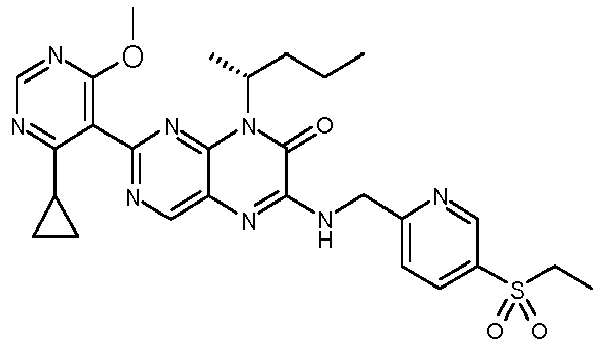
1.09 565.3 563.3 A 23 
1.14 547.4 A 24 
1.07 565.4 A 25 
1.14 575.4 A 26 
1.03 536.2 A 27 
1.03 549.2 547.1 A 28 
2.06 559.4 557.4 B 29 
0.97 577.4 A 30 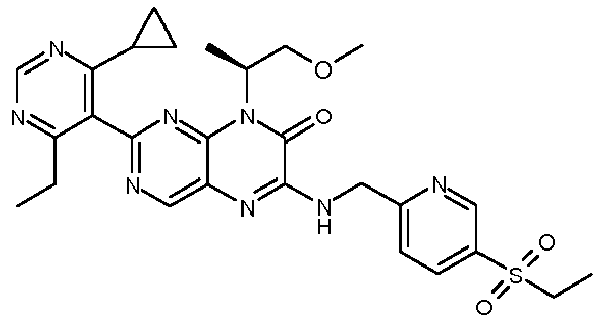
0.91 565.4 A 31 
1.03 549.2 547.0 A 32 
1.89 547.4 545.4 B 33 
1.09 565.3 563.3 A 34 
0.90 567.4 A 35 
1.05 537.2 A 36 
0.93 585.3 583.3 A 37 
1.85 549.4 547.4 B 38 
2.06 544.4 542.4 B 39 
0.91 565.4 A 40 
0.94 589.4 A 41 
0.90 567.4 A 42 
2.08 559.4 557.4 B 43 
1.81 534.4 532.4 B 44 
0.86 579.4 A 45 
1.67 518.4 516.4 B 46 
1.89 530.4 528.4 B 47 
0.85 545.1 543.2 A 48 
0.99 555.3 A 49 
0.94 521.1 A 50 
0.82 560.3 558.4 A 51 
0.85 544.7 543.1 A 52 
1.01 548.8 A 53 
1.01 549.9 A 54 
0.94 532.8 A 55 
0.97 577.4 A 56 
1.96 532.1 530.1 B 57 
2.17 546.1 544.1 B 58 
1.03 563.1 A 59 
1.01 591.1 589 A 60 
0.95 575.2 573 A 61 
1.02 591.2 589 A 62 
0.96 575.1 573 A 63 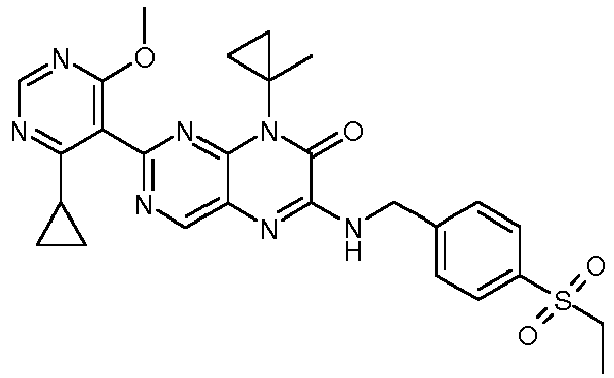
2.13 548.0 546.0 B 64 
1.97 546.8 545.1 B 65 
1.01 550.0 A 66 
1.02 548.9 A 67 
1.02 548.9 A 68 
1.04 563.0 A 69 
0.98 547.3 A 70 
0.98 548.0 A 71 
1.04 564.0 A 72 
1.05 560.8 A 73 
1.05 573.0 A 74 
1.05 563.0 A 75 
0.98 546.7 A 76 
1.11 568.8 A 77 
0.97 547.7 A 78 
1.04 563.8 A 79 
0.99 547.7 A 80 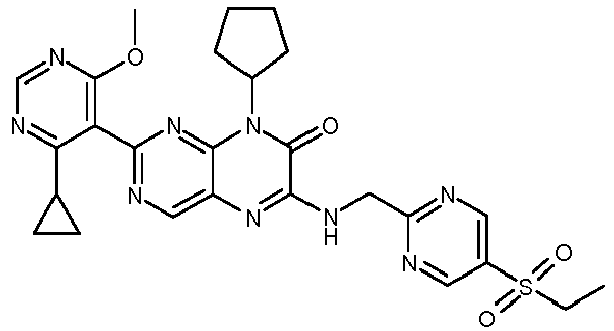
1.05 563.7 A 81 
0.94 533.8 A 82 
1.07 545.8 A 83 
1.07 545.9 A 84 
0.97 535.2 A 85 
1.04 549.2 A 86 
1.05 523.2 A 87 
1.11 561.2 A 88 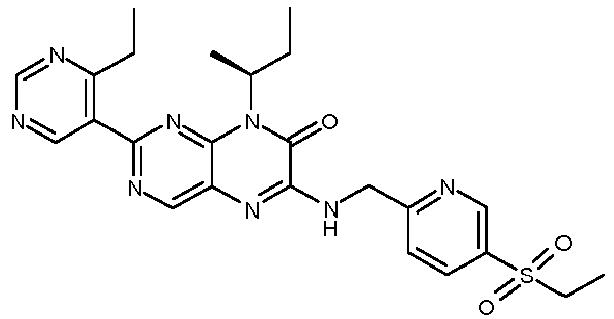
0.94 509.2 A 89 
1.04 523.2 A 90 
0.89 575.2 A 91 
0.89 575.2 A 92 
0.98 549.0 A 93 
1.03 584.0 A 94 
0.89 521.5 A 95 
0.95 537.3 A 96 
0.89 521.5 A 97 
0.95 537.5 A 98 
0.83 522.5 A 99 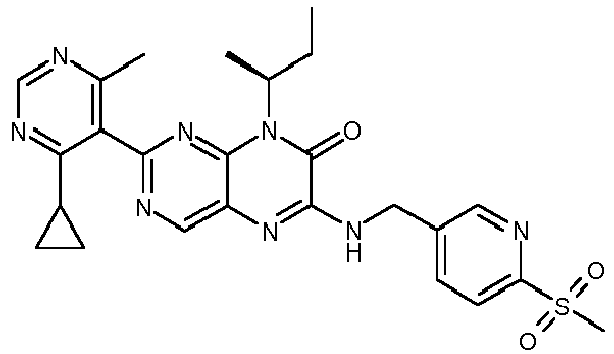
0.89 521.5 A 100 
0.93 535.5 A 101 
0.98 589.4 A 102 
0.95 537.5 A 103 
2.18 553.3 B 104 
1.67 507.0 B 105 
1.80 553.5 B 106 
1.99 569.5 B 107 
0.94 537.5 A 108 
0.87 588.1 A 109 
0.91 588.0 A 110 
0.88 603.1 A 111 
0.81 572.5 A 112 
0.81 572.5 A 113 
1.05 617.5 A 114 
2.28 567.5 B 115 
1.02 546.5 A 116 
0.92 550.5 A 117 
1.12 563.4 A 118 
0.98 549.5 A 119 
0.78 561.3 A 120 
0.83 577.3 A 121 
2.27 551.5 B 122 
0.89 538.4 A 123 
0.99 549.0 A 124 
1.03 563.2 A 125 
0.99 549.2 A 126 
0.93 550.2 A 127 
0.96 547.5 A 128 
0.91 533.4 A 129 
0.56 537.1 A 130 
0.96 526.8 A 131 
1.01 542.7 A 132 
0.90 532.9 A 133 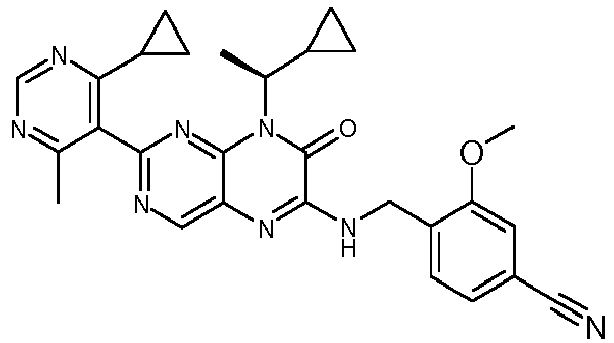
1.16 509.1 A 134 
0.94 547.9 A 135 
0.99 546.9 A 136 
0.92 533.0 A 137 
0.98 531.9 A 138 
1.04 552.9 A 139 
0.96 534.7 A 140 
1.77 524.0 B 141 
0.89 527.1 A 142 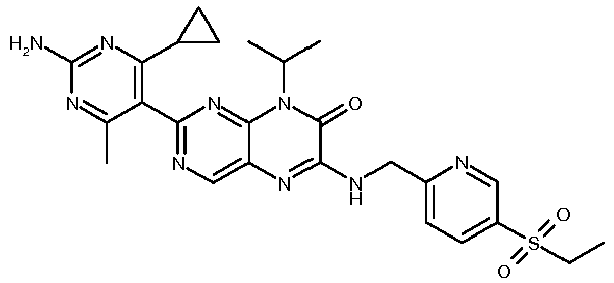
1.26 536.1 B 143 
1.01 535.9 A 144 
0.97 520.0 A 145 
1.04 557.1 A 146 
2.18 509.0 B 147 
1.02 546.9 A 148 
0.99 540.5 A 149 
0.90 522.9 A 150 
0.96 522.0 A 151 
0.90 522.9 A 152 
2.57 580.9 B 153 
1.07 564.9 A 154 
0.98 550.9 A 155 
0.90 537.9 A 156 
1.00 536.1 A 157 
0.95 546.9 A 158 
0.98 539.3 A 159 
1.05 564.8 A 160 
0.84 531.0 A 161 
0.96 575.3 A 162 
0.89 561.2 A 163 
1.01 550.7 A 164 
0.97 547.0 A 165 
1.03 563.8 A 166 
0.93 504.0 A 167 
0.93 574.0 A 168 
0.87 559.7 A 169 
1.09 599.8 A 170 
1.10 565.1 A 171 
0.97 531.1 A 172 
0.91 524 A 173 
1.90 520.9 B 174 
0.96 574 A 175 
0.87 561.9 A 176 
0.86 563.9 A 177 
1.00 573.0 A 178 
0.91 523.0 A 179 
0.96 535.1 A 180 
1.90 560.8 B 181 
2.16 577.1 B 182 
1.11 577.2 A 183 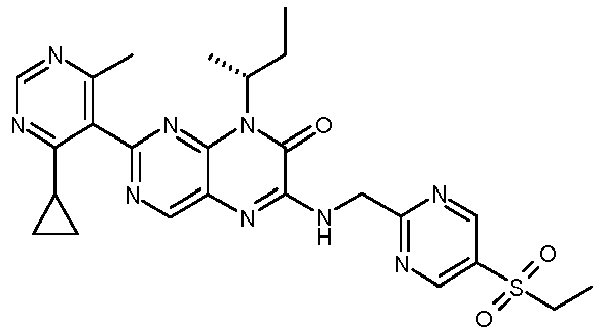
0.95 536.0 A 184 
1.01 552.2 A 185 
1.08 550.1 A 186 
1.08 561.9 A 187 
2.28 592.1 B 188 
2.08 576.0 B 189 
0.95 519.9 A 190 
1.02 536.0 A 191 
1.00 533.2 A 192 
1.09 545.2 A 193 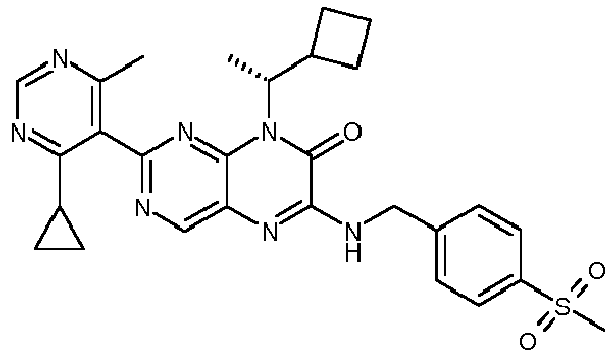
1.06 546.4 A 194 
0.99 547.4 A 195 
0.89 521.0 A 196 
0.95 537.0 A 197 
0.95 535.4 A 198 
1.00 551.4 A 199 
1.04 561.4 A 200 
1.09 498.3 A 201 
1.05 561.1 A 202 
1.01 539.3 A 203 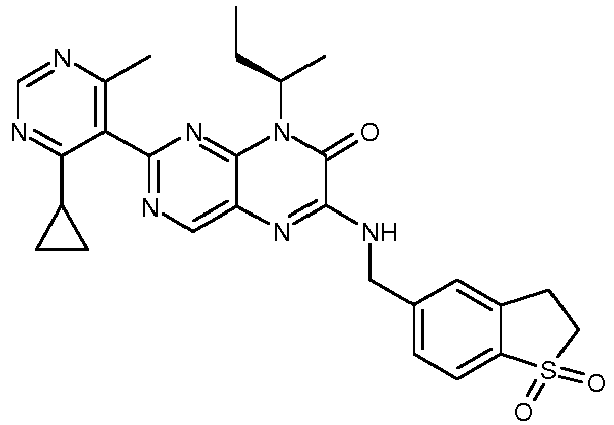
0.95 532.4 A 204 
0.89 497.4 A 205 
1.01 549.0 A 206 
1.01 565.3 A 207 
1.20 565.3 A 208 
1.07 564 A 209 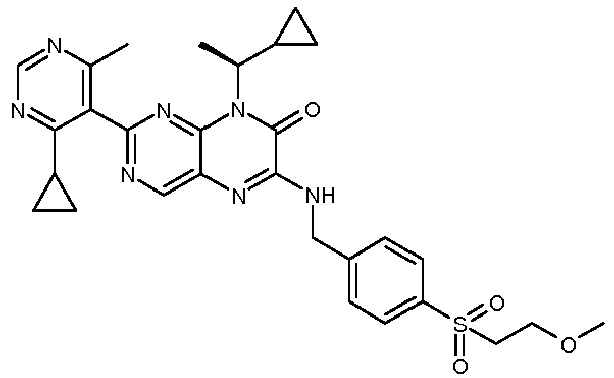
1.07 575.8 A 210 
0.91 545.0 A 211 
0.98 539.0 A 212 
1.05 543.8 A 213 
1.03 547.9 A 214 
0.91 533.9 A 215 
1.10 561.8 A 216 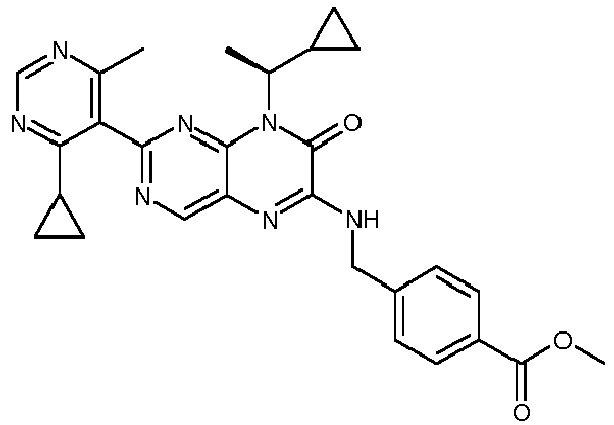
1.22 511.9 A 217 
1.49 562.4 B 218 
2.40 562.4 B 219 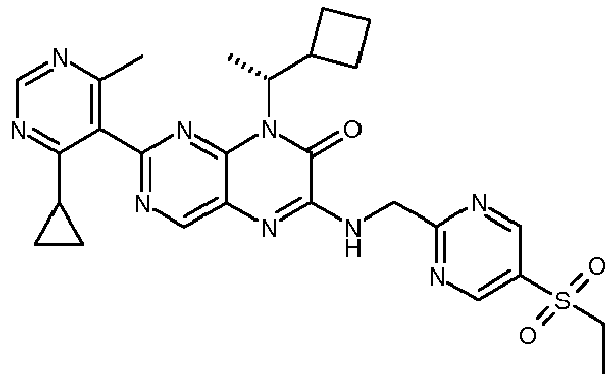
1.04 563.4 A 220 
1.97 573.5 B 221 
1.13 589.5 A 222 
0.88 591.4 A 223 
1.01 549.4 A 224 
1.08 561.4 A 225 
0.90 521.1 A 226 
0.96 537.2 A 227 
0.88 577.3 A 228 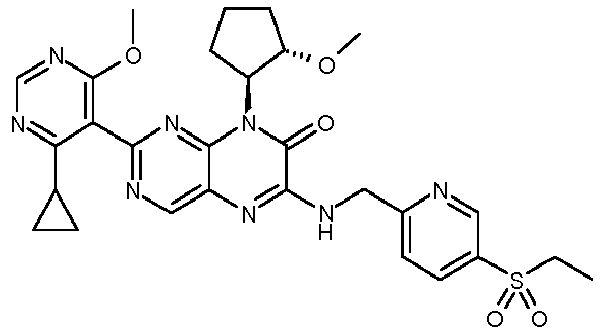
0.95 593.4 A 229 
0.91 562.2 A 230 
0.96 578.1 A 231 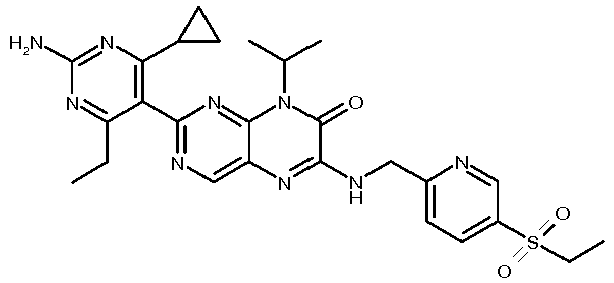
1.41 550.2 B 232 
2.14 545 B 233 
1.76 576 B 234 
0.85 536.4 A 235 
0.80 522.2 A 236 
0.88 538.3 A 237 
0.90 533.4 A 238 
0.88 536.4 A 239 
0.96 550.4 A 240 
0.98 550.5 A 241 
0.94 535.4 A 242 
0.88 519.4 A 243 
0.89 534.5 A 244 
0.70 535.3 A 245 
0.65 536.3 A 246 
0.91 535.5 A 247 
0.84 519.4 A 248 
2.44 575.5 B 249 
2.25 559.5 B 250 
0.99 532.5 A 251 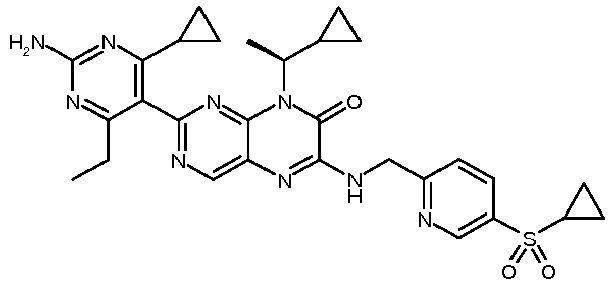
1.74 588.5 B 252 
0.93 535.5 A 253 
0.99 551.5 A 254 
0.90 522.3 A 255 
0.97 538.3 A 256 
2.13 553.4 B 257 
1.42 550.5 B 258 
1.92 521.5 B 259 
0.95 537.5 A 260 
0.69 550.3 A 261 
0.64 536.2 A 262 
0.86 579.3 A 263 
0.86 579.3 A 264 
0.89 607.3 A 265 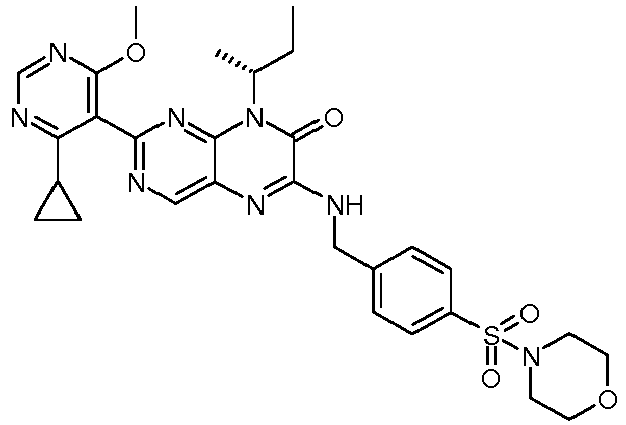
0.89 521.5 A - Table I also provides physicochemical data (i.e., HPLC retention time and mass spec data) for all the prepared compounds. The HPLC methods are defined below in the Synthetic Examples section.
- The present invention further relates to a pharmaceutically acceptable salt of a compound of the formula (I) with inorganic or organic acids or bases.
- In another aspect, the invention relates to compounds of formula (I) - or the pharmaceutically acceptable salts thereof - as medicaments.
- In another aspect, the invention relates to compounds of formula (I) - or the pharmaceutically acceptable salts thereof - for use in a method for treatment of a patient.
- In another aspect, the invention relates to compounds of formula (I) - or the pharmaceutically acceptable salts thereof - for use in the treatment of autoimmune diseases and allergic disorders.
- In another aspect, the invention relates to the use of compounds of formula (I) - or the pharmaceutically acceptable salts thereof - for preparing a pharmaceutical composition for the treatment of autoimmune diseases and allergic disorders.
- In another aspect, the invention relates to a method for the treatment of autoimmune diseases and allergic disorders comprising administering a therapeutically effective amount of a compound of formula (I) - or one of the pharmaceutically acceptable salts thereof - to a patient.
- In another aspect, the invention relates to a pharmaceutical composition containing as active substance one or more compounds of formula (I)- or the pharmaceutically acceptable salts thereof - optionally in combination with conventional excipients and/or carriers.
- The compounds of formula (I) may be made using the general synthetic methods described below, which also constitute part of the invention.
- The compounds according to the invention may be prepared by the methods of synthesis, synthetic examples, methods known to those of ordinary skill in the art and methods reported in the chemical literature. In the methods of synthesis and examples described hereinafter, the substituents R1, R2, R3, R4, R5, and W shall have the meanings defined hereinbefore in the detailed description of the compounds of formula I. These methods that are described here are intended as an illustration and for the enablement of the instant invention without restricting the scope of its subject matter, the claimed compounds, and the examples. Where the preparation of starting compounds is not described, they are commercially obtainable, may be prepared analogously to compounds or methods described herein, or are described in the chemical literature. Unless otherwise specified, solvents, temperatures, pressures, and other reaction conditions may be readily selected by one of ordinary skill in the art.
- Amine intermediates of formula R 1-W-C(R2)(R3)-NH2 are either commercially available, may be prepared according to the general procedures or references described in
US 7,879,873 andWO 2011/049917 , or may be prepared by one skilled in the art using methods described in the chemical literature. - Compounds of formula (I) may be prepared from intermediate A' according to Scheme I.

- As illustrated in Scheme I, a suitable pyrimidine of formula A', wherein G is NH2, X is a suitable group for palladium-mediated cross coupling reactions (e.g., I, Br, Cl, or OSO2CF3), and Y is a suitable leaving group (e.g., CI), may be reacted with a suitable amine or amine salt (e.g., hydrochloride salt) of formula R4NH2 such as isopropyl amine in the presence of a suitable base (e.g., i-Pr2EtN, or Et3N) in a suitable solvent (e.g., n-butanol) and under a suitable reaction conditions such as an appropriate temperature (e.g., about 120 °C) to provide a compound of formula B'. Alternatively, the said pyrimidine of formula A' wherein G is a suitable synthetic precursor for NH2 (e.g., a nitro group) may be reacted with a suitable amine or amine salt (e.g., hydrochloride salt) of formula R4NH2 such as 1-methyl cyclopropylamine in the presence of a suitable reagent and solvent (e.g., i-Pr2EtN and THF, respectively), and under a suitable reaction conditions such as an appropriate temperature (e.g., about -78°C to about 25 °C) to afford an intermediate, which may be converted to a compound of formula B' upon further reaction with suitable reagents (e.g., a NO2 group that may be reduced with a suitable reagent such as SnCl2). The selection of a suitable amine of formula R4NH2 and pyrimidine of formula A' for the aforementioned reaction by a person skilled in the art may be based on criteria such as steric and electronic nature of the amine and the pyrimidine. A diaminopyrimidine of formula B' may be reacted with a suitable reagent such as chloro-oxo-acetic acid ethyl ester in a suitable solvent (e.g., acetone) and in the presence of a suitable base (e.g., K2CO3) to furnish a compound of formula C'. A dicarbonyl compound of formula C' may be reacted with a suitable dehydrochlorinating reagent such as oxalyl chloride in the presence of a suitable additive (e.g., a catalytic amount of DMF) in a suitable solvent (e.g., CH2Cl2), and under a suitable reaction conditions such as an appropriate temperature (e.g., about ambient temperature) to provide a compound of formula D'. A chloro-pteridinone of formula D' may be reacted with a suitable amine or amine salt of formula R1-W-C(R2)(R3)-NH2 such as 4-ethanesulfonyl benzyl amine in the presence of a suitable base (e.g., Et3N) in a suitable solvent (e.g., THF) and under a suitable reaction conditions such as an appropriate temperature (e.g., about ambient temperature) to yields a compound of formula E'. A pyrimidine of formula E' may be heated with a suitable cross-coupling partner (e.g., a boronic acid) and a suitable base (e.g., K3PO4), in a suitable solvent (e.g., 1,4-dioxane), in the presence of a suitable cross-coupling catalyst (e.g., Pd(dppf)Cl2), under suitable reaction conditions such as a suitable atmosphere (e.g., argon) and at a suitable temperature (e.g., about 100 °C) to provide a compound of formula (I).
- Non-limiting examples demonstrating the preparation of the compounds of the invention are provided below. Optimum reaction conditions and reaction times may vary depending on the particular reactants used. Unless otherwise specified, solvents, temperatures, pressures and other reaction conditions may be readily selected by one of ordinary skill in the art. Specific procedures are provided in the Synthetic Examples section. Intermediates and products may be purified by chromatography on silica gel, recrystallization and/or reverse phase HPLC (RHPLC). Discrete enantiomers may be obtained by resolution of racemic products using chiral HPLC. RHPLC purification methods used anywhere from 0-100% acetonitrile in water containing 0.1% formic acid or 0.1% TFA and used one of the following columns:
- a) Waters Sunfire OBD C18 5 µM 30x150 mm column
- b) Waters XBridge OBD C18 5 µM 30x150 mm column
- c) Waters ODB C8 5 µM 19x150 mm column.
- d) Waters Atlantis ODB C18 5 µM 19x50 mm column.
- e) Waters Atlantis T3 OBD 5 µM 30x100 mm column
- f) Phenomenex Gemini Axia C18 5 µM 30x100 mm column
- Column: Waters BEH 2.1x50mm C18 1.7um column
Gradient:Time(min) 0.05% Formic Acid in Water 0.05% Formic Acid in ACN Flow(mL/min) 0 90 10 0.8 1.19 0 100 0.8 1.77 0 100 0.8 - Column: Waters BEH 2.1x50mm C18 1.7um column
Gradient:Time(min) 0.05% Formic Acid in Water 0.05% Formic Acid in ACN Flow(mL/min) 0 90 10 0.8 4.45 0 100 0.8 4.58 0 100 0.8 List of abbreviations used in synthetic examples: Ac Acetyl ACN Acetonitrile AcOH Acetic acid AIBN Azobisisobutyronitrile aq Aqueous Bu Butyl Boc2O Di-tert-butyl dicarbonate dba Dibenzylideneacetone DCM Dichloromethane DMA N,N-dimethylacetamide DIEA N,N-diisopropylethylamine DME 1,2-Dimethoxyethane DMAP 4-Dimethylaminopyridine DMF N,N-Dimethylformamide dppe (Diphenylphosphine)ethane dppf 1.1'-bis(diphenylphosphino)ferrocene ee Enantiomeric excess ES+ Electron spray positive ionization Et Ethyl EtOAc Ethyl acetate EtOH Ethanol Josiphos (S)-1-[(Rp)-2-(Dicyclohexylphosphino)ferroceyl]ethyl-di-t-butylphosphine h hour(s) HPLC High performance liquid chromatography i Iso LC Liquid chromatography Me Methyl MeOH Methanol min Minutes MPLC Medium Pressure Liquid Chromatography MS Mass spectrometry NBS N-Bromo-succinimide NCS N-Chloro-succinimide NMP N-Methylpyrrolidinone Oxone Potassium peroxymonosulfate Pd/C Palladium on carbon Ph Phenyl PPh3 Triphenylphosphine Pr Propyl RaNi Raney Nickel RT Retention time (HPLC) rt Ambient temperature SFC Supercritical Fluid Chromatography t Tertiary tert Tertiary Tf Triflate TBAF Tetrabutylammonium fluoride TEA Triethylamine TFA Trifluoroacetic acid THF Tetrahydrofuran Xanphos 4,5-Bis(diphenylphosphino)-9,9-dimethylxanthene -

- To a stirred suspension of A-1 (3.00 g, 18.18 mmol) in n-butanol (10 mL) is added A-2 (10.80 g, 18.18 mmol) followed by DIEA (6.46 mL, 36.58 mmol). The mixture is stirred for 17 h at 120 °C. The reaction is cooled to rt and quenched by the addition of saturated aqueous NH4Cl solution. The reaction is then diluted with EtOAc. The organic layer is separated and washed with water, followed by brine. The organic layer is dried (Na2SO4) decanted and concentrated. The resultant residue is purified by SiO2 flash chromatography to yield A-3.
- To a stirred suspension of A-3 (1.00 g, 5.00 mmol) in acetone (100 mL) is added ethyl chlorooxoacetate (0.88 g, 6.43 mmol) followed by K2CO3 (1.85g, 13.39 mmol). The mixture is stirred at rt for 18 h and the solid precipitate is isolated to yield A-4.
- To a stirred suspension of A-4 (1.14 g, 5.00 mmol) in CH2Cl2 (250 mL) is added oxalyl chloride (1 mL) followed by 5 drops of DMF. The mixture is stirred for 5 h at rt. The mixture is then concentrated at reduced pressure to yield A-5.
- To a stirred suspension of A-5 (0.1 g, 0.39 mmol) in THF (4 mL) is added TEA (0.16 mL, 1.16 mmol) (or DIEA), followed by AG (91 mg, 0.38 mmol). The reaction is allowed to stir for 18 h at rt. The reaction is quenched by the addition of saturated aqueous NH4Cl solution and the organics are extracted with EtOAc. The organic layer is washed with water and brine, dried (Na2SO4), decanted and concentrated under vacuum. The resultant residue is purified by SiO2 flash chromatography to yield intermediate A. MS (ES+): m/z 423.0 [M+H]+.
-

- To a stirred suspension of B-1 (1.80 g, 9.30 mmol) and B-2 (1.00 g, 9.30 mmol) in THF (10 mL) at -78 °C is added DIEA (3.29 mL, 18.59 mmol) and the reaction is allowed to slowly warm to 25 °C. The volatiles are removed under reduced pressure and the crude is redissolved in EtOAc and washed with H2O. The organic layer is separated and washed two more times with H2O. The organic layer is washed with brine, dried (Na2SO4), decanted and concentrated. The resultant residue is purified by SiO2 flash chromatography to yield B-3.
- To a solution of B-3 (1.78 g, 7.79 mmol) in EtOH (50 mL) is added SnCl2 (1.48 g, 7.79 mmol) and heated to reflux for 4 h. The reaction is allowed to cool to rt then poured over ice. The solution is treated with IN NaOH(aq) to bring the pH to ∼9 then filtered through a pad of diatomaceous earth. The organic phase is separated and washed with H2O followed by brine. The organic layer is dried (Na2SO4), decanted and concentrated. The crude product is purified by SiO2 flash chromatography to yield B-4.
- As an alternative procedure for the reduction of nitropyrimidine to the corresponding amino pyrimidine the following general procedure has been utilized for analogous intermediates: To a solution of the nitropyrimidine in EtOH is added catalytic RaNi. The reaction vessel is evacuated and purged with N2(g), then evacuated and filled with H2(g). The reaction is maintained under H2(g) atmosphere for 15 h. The vessel is evacuated and purged with N2(g). The reaction is filtered through a pad of diatomaceous earth to remove the Ni catalyst and the filtrate is concentrated. The resultant residue is purified by SiO2 flash chromatography to afford the corresponding aminopyrimidine.
- To a stirred solution of B-4 (0.40 g, 2.01 mmol) in acetone (10 mL) is K2CO3 (0.70 g, 5.06 mmol) followed by ethyl chlorooxoacetate (0.27 mL, 2.43 mmol). The reaction is stirred at rt for 24 h. The reaction is then filtered, redissolved in H2O and extracted with EtOAc. The aqueous phase is separated and extracted two more times with EtOAc. The organic layers are combined, dried (Na2SO4), decanted and concentrated to yield B-5.
- To a solution of B-5 (0.70 g, 2.77 mmol) in CH2Cl2 (50 mL) is added oxalyl chloride (0.47 mL, 5.54 mmol) followed by 5 drops of DMF. The reaction is allowed to stir at rt for 18 h. The volatiles are removed in vacuo. The crude is redissolved in DCM and poured into H2O. The organic layer is separated, washed with brine, dried (Na2SO4), decanted and concentrated. The resultant residue is purified by SiO2 flash chromatography to yield B-6.
- To a stirred solution of the B-6 (0.83 g, 3.06 mmol) in THF (10 mL) is added DIEA (1.07 mL, 6.12 mmol) followed by AF (0.72 g, 3.06 mmol). The reaction is stirred at rt for 18 h. The volatiles are removed in vacuo, the crude residue is re-suspended in DCM and poured into H2O. The aqueous phase is separated and extracted two more times with DCM. The organic layers are combined, washed with brine, dried (Na2SO4), decanted and concentrated. The resultant residue is purified by SiO2 flash to yield intermediate B. MS (ES+): m/z 434.1 [M+H]+.
- The following intermediates are prepared in analogous fashion:
(Note: As described in Method 34, the oxalamic acid ethyl ester intermediates generated from the reactions of A-3 (Method 1) and B-4 (Method 2) with ethyl chlorooxoacetate may be isolated and heated at a suitable temperature (e.g., 130 °C) with a suitable base, such as TEA, in a suitable solvent, such as EtOH, to afford the corresponding intermediates A-3 and B-5, respectively.)Intermediate Structure Synthetic Method m/z[M+H]+ C 
1 420.1 D 
1 451.2 E 
2 449.3 F 
1 437.2 G 
1 437.2 H 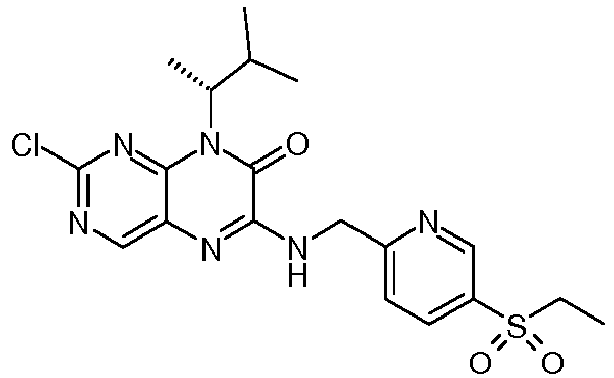
1 451.2 I 
1 451.2 J 
1 422.5 K 
2 451.1 L 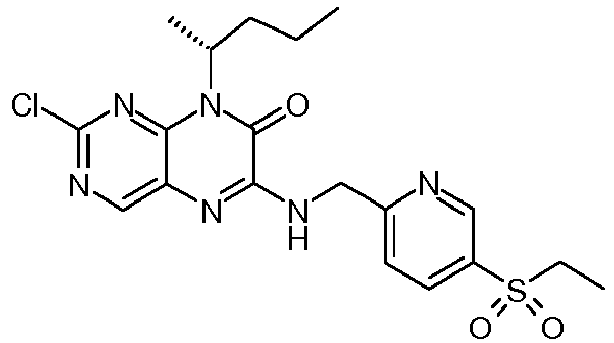
2 451.1 M 
1 453.2 N 
1 453.2 O 
1 465.2 P 
2 435.2 Q 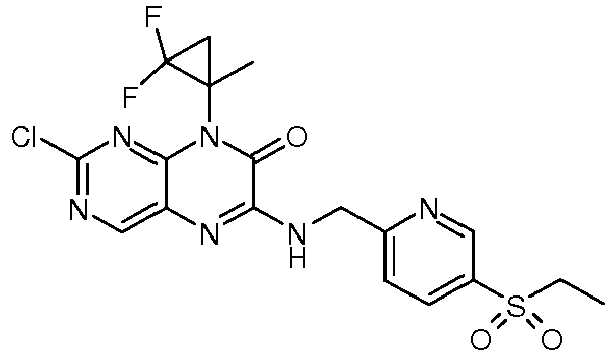
2 471.1 R 
2 466.2 S 
1 409.1 T 
1 434.9 U 
2 477.0 V 
2 476.9 W 
2 449.1 X 
1 451.9 Y 
1 449.9 Z 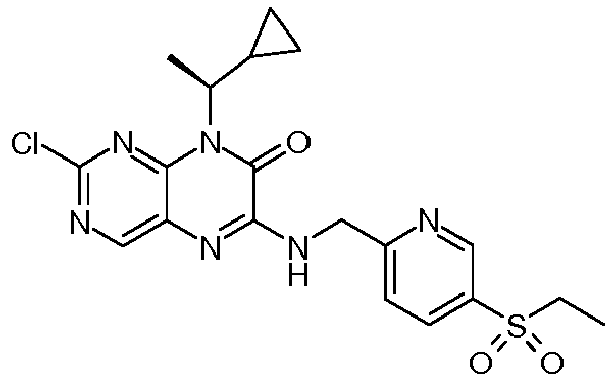
1 448.9 AA 
1 449.0 BB 
1 449.9 CC 
1 455.0 DD 
1 449.9 EE 
1 435.9 FF 
1 447.9 GG 
1 457.1 HH 
1 434.9 II 
1 406.0 JJ 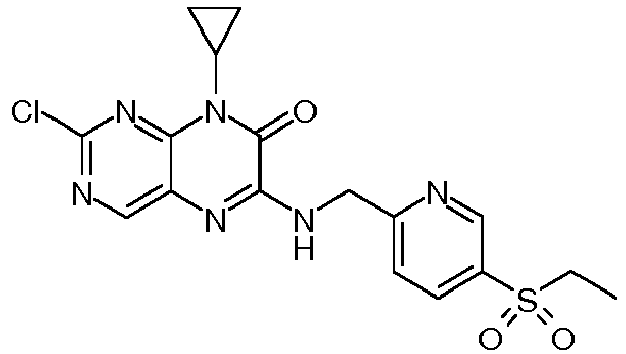
1 421.0 KK 
1 451.2 LL 
1 423.1 MM 
1 421.0 NN 
1 451.0 OO 
1 447.9 PP 
1 451.0 QQ 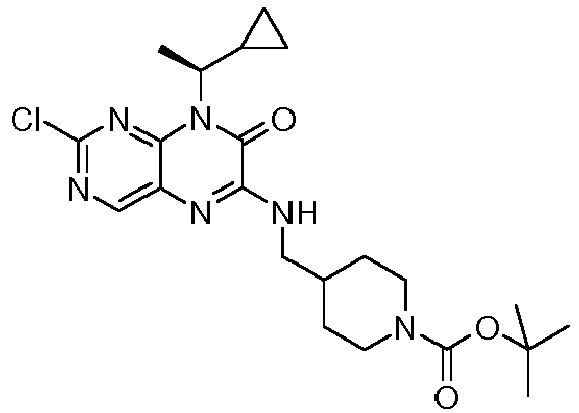
1 463.0 RR 
1 423.3 SS 
1 423.3 TT 
1 424.3 UU 
1 423.3 VV 
1 437.3 WW 
2 491.3 XX 
1 455.3 YY 
2 427.3 ZZ 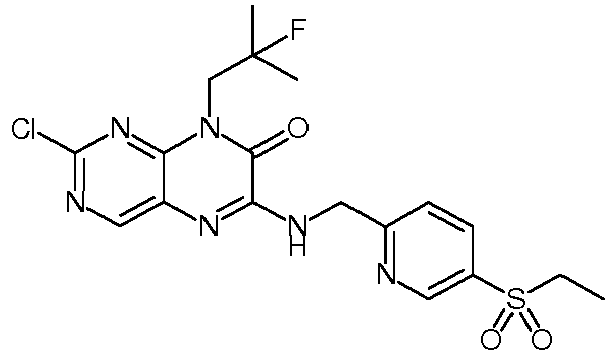
1 455.4 AAA 
1 423.3 BBB 
1 474.1 CCC 
1 474.1 DDD 
2 489.1 EEE 
2 503.3 FFF 
1 469.3 GGG 
1 448.1 HHH 
1 436.3 III 
1 449.3 JJJ 
1 435.3 KKK 
1 463.1 LLL 
1 435.2 MMM 
1 448.9 NNN 
1 435.2 OOO 
1 434.9 PPP 
1 449.2 QQQ 
1 448.2 RRR 
1 429.0 SSS 
1 450.0 TTT 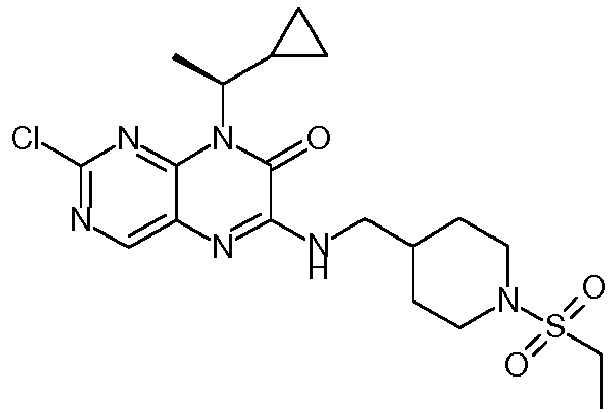
1 441.2 UUU 
1 436.9 VVV 
1 422.0 WWW 
1 432.9 XXX 
1 449.0 YYY 
1 407.8 ZZZ 
1 408.8 AAAA 
1 408.9 BBBB 
1 475.0 CCCC 
1 423.9 DDDD 
1 436.9 EEEE 
1 424.3 FFFF 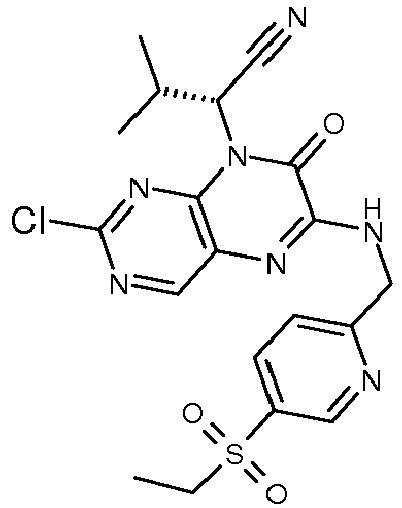
2 461.9 GGGG 
1 433.0 HHHH 
1 461.0 IIII 
1 448.9 JJJJ 
1 405.0 KKKK 
2 461.9 LLLL 
1 409.2 MMMM 
1 449.9 NNNN 
2 475.9 OOOO 
2 463.2 PPPP 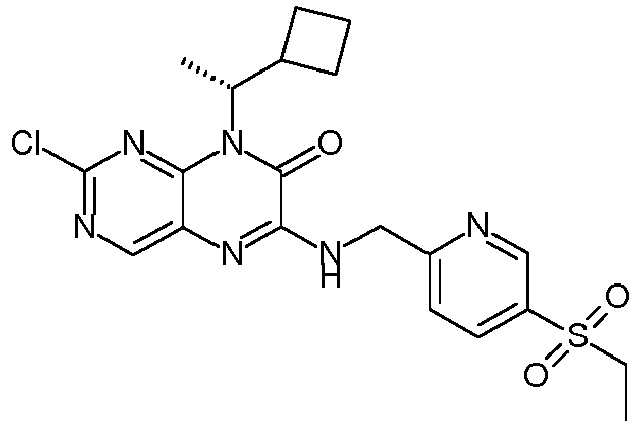
1 463.2 QQQQ 
1 438.1 RRRR 
2 477.9 SSSS 
1 422.1 TTTT 
1 448.2 UUUU 
1 449.2 VVVV 
1 423.1 WWWW 
1 463.2 XXXX 
1 414.0 YYYY 
1 463.2 ZZZZ 
1 449.3 AAAAA 
1 399.3 BBBBB 
1 433.9 CCCCC 
1 435.9 DDDDD 
1 451.0 EEEEE 
1 451.0 FFFFF 
1 477.9 GGGGG 
1 449.0 HHHHH 
1 446.0 IIIII 
1 450.0 JJJJJ 
1 435.9 KKKKK 
1 464.0 LLLLL 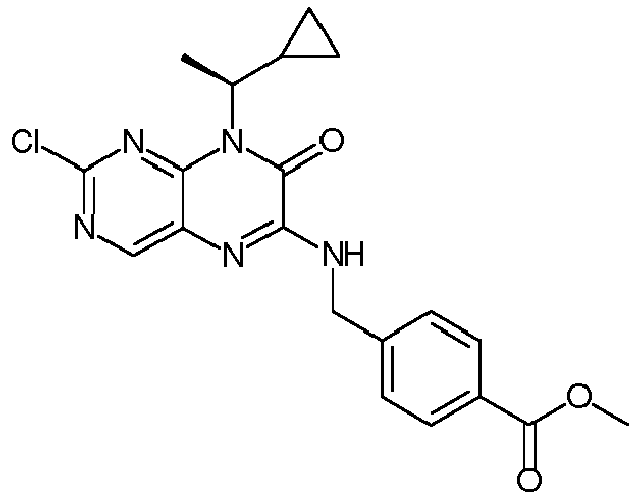
1 414.0 MMMMM 
1 464.3 NNNNN 
1 464.3 OOOOO 
1 475.2 PPPPP 
1 477.3 QQQQQ 
1 437.2 RRRRR 
1 423.2 SSSSS 
1 479.3 TTTTT 
1 464.1 UUUUU 
1 447.3 VVVVV 
1 422.2 WWWWWW 
1 424.1 XXXXX 
1 422.2 YYYYY 
1 436.3 ZZZZZ 
1 421.2 AAAAAA 
1 421.2 BBBBBB 
1 461.3 CCCCCC 
1 434.3 DDDDDD 
1 437.3 EEEEEE 
1 455.3 FFFFFF 
1 423.3 GGGGGG 
1 465.1 HHHHHH 
1 493.2 -

- To a solution of AB-1 (300 mg, 1.29 mmol) in anhydrous MeOH (15 mL) is added NaOMe (208 mg, 3.86 mmol). The mixture is stirred at rt for 1 h. The solution is filtered and concentrated. The residue is purified by SiO2 flash chromatography to yield intermediate AB. MS (ES+): m/z 230.8 [M+H]+.
-

- To a solution of AC-1 (320 mg, 2.07 mmol), 2,4,6-trimethyl-1,3,5,2,4,6-trioxatriborinane (520 mg, 4.14 mmol), and aq Na2CO3 (2M, 3.1 mL, 6.21 mmol) in dioxane (10 mL) is added dichloropalladium 4-ditert-butylphosphanyl-N,N-dimethyl-aniline (73 mg, 0.10 mmol). The mixture is heated to 130 °C for 40 min in a microwave reactor. The mixture is diluted with MeOH (5 mL), filtered and concentrated. The residue is purified by SiO2 flash chromatography to yield AC-2.
- To a solution of AC-2 (363 mg, 2.71 mmol) in EtOH (10 mL) at -10°C is added Br2 (432 mg, 2.71 mmol). The reaction mixture is stirred at rt for 18 h. The solution is concentrated and the residue is purified by SiO2 flash chromatography to yield intermediate AC. MS (ES+): m/z 214.3 [M+H]+.
-

- A mixture of AD-1 (100.0 g, 0.70 mol), formamidine acetate (146 g, 1.4 mol) and NaOMe (266.0 g, 4.9 mol) in MeOH (2 L) is stirred at 16 °C for 2 days. The reaction mixture is neutralized to pH 7 with acetic acid and filtered. The filtrate is concentrated under reduced pressure and the crude product is purified by SiO2 flash chromatography to yield AD-2.
- To a stirred solution of AD-2 (66.0 g, 0.48 mol) and TEA (145.1 g, 1.44 mol) in DCM (1.5 L) at 0 °C is added, dropwise, a solution of Tf2O (164.2 g, 0.58 mol) in DCM (500 mL) and stirred for 3 h. The reaction mixture is quenched by the addition of H2O (200 mL) and extracted with DCM (3 x 500 mL). The combined organic phase is washed with saturated aq NaHCO3, dried (Na2SO4), decanted and concentrated. The resultant residue is purified by SiO2 flash chromatography to yield AD-3.
- A mixture of AD-3 (17.0 g, 0.06 mol), vinylboronic acid pinacolester (29.3 g, 0.09 mol), K2CO3 (26.3 g, 0.19 mol), Ag2O (1.7 g, 10%wt) and Pd(dppf)Cl2 (1.7 g, 10% wt) in anhydrous THF (400 mL) is stirred at reflux under N2 atmosphere for 18 h. The mixture is cooled to rt and filtered. The filtrate is concentrated under reduced pressure and the resultant residue is purified by SiO2 flash chromatography to yield AD-4.
- A mixture of AD-4 (27.3 g, 0.28 mol) and RaNi (30.0 g, 10% wt) in EtOH (500 mL) is stirred under an H2 atmosphere for 16 h. The vessel is purged with N2 and the contents filtered. The filtrate is concentrated under reduced pressure and the resultant AD-5 (19.6 g) is used directly.
- To a stirred solution of AD-5 (19.6 g, 0.13 mol) in EtOH (300 mL) at -10 °C is added Br2 (52.9 g, 0.33 mol). Following the addition, the mixture is stirred at rt for 30 min. The reaction mixture is quenched by the addition of 10% Na2S2O3(aq) solution and basified by the addition of 10% Na2CO3(aq) solution to adjust to ∼pH 8. The mixture is extracted with EtOAc (3 x 200 mL). The organic layers are combined, dried (Na2SO4), decanted and concentrated. The resultant residue is purified by SiO2 flash chromatography to yield intermediate AD. MS (ES+): m/z 228.9 [M+H]+.
-

- To a solution of AC-1 (2.50 g, 16.17 mmol), cyclopropylboronic acid (4.17 g, 48.51 mmol) and Na2CO3 (aq) (2M, 24.26 mL, 48.51 mmol) in dioxane (30 mL) is added bis(ditert-butyl(4-dimethylaminophenyl)phosphine)dichloropalladium(II) (572.5 mg, 0.81 mmol). The vessel is sealed and heated to 130 °C for 2 h. The vessel is cooled to rt, diluted with MeOH and filtered. The filtrate is concentrated and purified by SiO2 flash chromatography to yield AE-1.
- To a solution of AE-1 (660 mg, 4.12 mmol) in EtOH (15 mL) at -10 °C is added Br2 (658 mg, 4.12 mmol). The reaction is stirred at rt for 3h. NH3 in MeOH solution (2N, 1 mL) is added to neutralize. The mixture is concentrated and purified by SiO2 flash chromatography to yield intermediate AE. MS (ES+): m/z 240.9 [M+H]+.
-

- A mixture of AF-1 (100 g, 561 mmol), EtI (131 g, 842 mmol) and TBAB (18 g, 56 mmol) in H2O (200 mL), acetone (150 mL) and toluene (150 mL) is stirred in a sealed vessel at 80 °C for 18 h. The mixture is partitioned between H2O and EtOAc. The organic layer is dried and concentrated. The residue is purified by SiO2 flash chromatography to yield AF-2.
- A mixture of AF-2 (200 g, 1.09 mol), NBS (425.02 g, 2.39 mol) and AIBN (17.82 g, 108.54 mmol) in CCl4 (1.40 L) is refluxed for 18 h. The mixture is partitioned between H2O and DCM. The organic layer is dried (Na2SO4), decanted and concentrated to yield AF-3.
- To a solution of AF-3 (333 g, 974 mmol) and DIEA (129 g, 1 mol) in ACN (500 mL) at 0 °C is added AF-4 (138 g, 1 mol) in ACN (150 mL) dropwise. The mixture is stirred for 5 h then concentrated. The resultant residue is crystallized from MeOH to yield AF-5.
- A solution of AF-5 (50 g, 190 mmol) in MeOH (200 mL) is added into a solution of NH3 in MeOH (2N, 800 mL) at -78°C. The reaction mixture is stirred at rt for 18 h then concentrated. The resultant residue is crystallized from EtOAc to afford AF-6.
- A solution of AF-6 (50 g, 250 mmol) in HCl in MeOH (1N, 250 mL) is stirred at rt for 12h then concentrated to yield intermediate AF as the HCl salt. MS (ES+): m/z 200.4 [M+H]+.
-

- A mixture of AG-1 (8.0 g, 43.96 mmol), K2CO3 (7.88 g, 57.1 mmol) and sodium ethanethiolate (4.06 g, 48.3 mmol) in NMP (60.0 mL) under N2 is stirred at rt for 18 h. The reaction mixture is poured into H2O and filtered. The solids are washed with H2O and dried under vacuum to yield AG-2.
- To a suspension of AG-2 (6.0 g, 36.6 mmol) in AcOH (2.63 g, 43.8 mmol) is added a solution of KMnO4 (5.78 g, 36.6 mmol) in H2O (20.0 mL) dropwise. The reaction mixture is stirred at rt for 15 h. The mixture is diluted with water and extracted with EtOAc. The organic layer is dried (Na2SO4), decanted and concentrated. The resultant residue is purified by SiO2 flash chromatography to yield AG-3.
- A solution of AG-3 (3.3 g, 16.8 mmol) and Pd/C (500 mg, 10% on carbon catalyst) in MeOH (30 mL) is stirred at rt under H2 (50 psi) for 8 h. The vessel is purged with N2, filtered and the filtrate concentrated to yield AG-4.
- To a stirred solution of AG-4 (2.5 g, 12.5 mmol) in EtOAc (30 mL) is added HCl in EtOAc (2N, 20.0 mL). The solution is stirred at rt for 5 h and then filtered to yield intermediate AG. MS (ES+): m/z 201.2 [M+H]+.
-
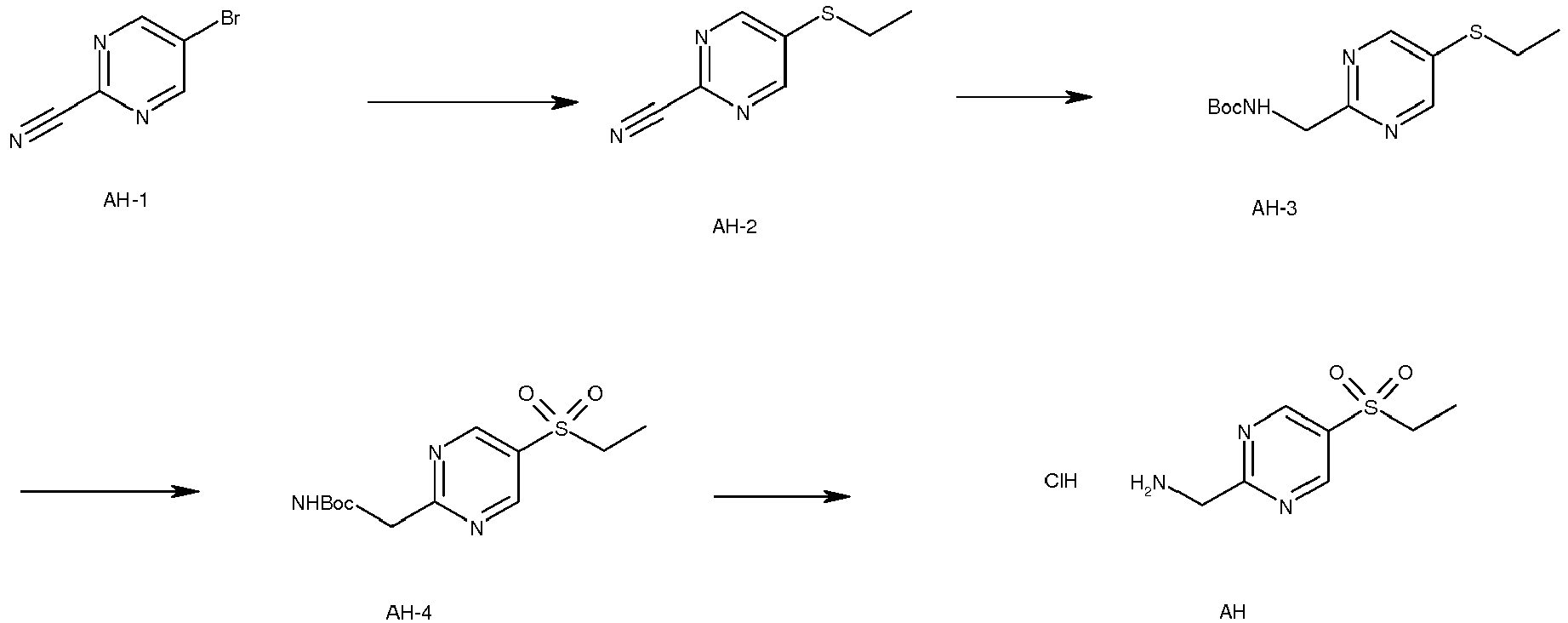
- A mixture of AH-1 (113 g, 0.62 mol), K2CO3 (171 g, 1.24 mol) and sodium ethanethiolate (67 g, 0.80 mol) in DMF (2 L) is stirred at rt under N2 for 18 h. The mixture is diluted with H2O and extracted with EtOAc. The organic layers are dried (Na2SO4), decanted and concentrated. The resultant residue is purified by SiO2 flash chromatography to yield AH-2.
- A solution of AH-2 (20.0 g, 0.12 mol), RaNi (40 g), Boc2O (31.7g, 0.14 mol) and TEA (24.5 g, 0.24 mol) in THF (600 mL) is stirred at rt under H2 (50 psi) for 12 h. The mixture is filtered and the filtrate concentrated under reduced pressure. The resultant residue is purified by SiO2 flash chromatography to yield AH-3.
- To a suspension of AH-3 (65 g, 0.24 mol) in AcOH (200 mL) at -10 °C is added dropwise a solution of KMnO4 (45.8 g, 0.29 mL) in water (500 mL). Following complete addition, the reaction mixture is stirred at rt for 30 min. The mixture is diluted with H2O and basified by addition of aqueous Na2CO3 to ∼pH 8 and extracted with EtOAc. The combined organic layers are dried (Na2SO4), decanted, and concentrated. The resultant residue is purified by crystallization to yield AH-4.
- To a stirred solution of compound AH-4 (46.5 g, 0.15 mol) in MeOH (300 mL) is added 4M HCl in MeOH (300 mL) at rt and stirred for 15 h. The mixture is concentrated under reduced pressure. The resultant residue is purified by crystallization to yield intermediate AH. MS (ES+): m/z 202.1 [M+H]+.
-

- A suspension of AC (2 g, 9.4 mmol), AI-1 (4.8 g, 18.8 mmol), KOAc (2.8 g, 28.2 mmol), and Pd(dppf)Cl2 (1.15 g, 0.15 mmol) in 1,4-dioxane (40 mL) is stirred at 100 °C for 18 h. After cooling to rt, the mixture is diluted with water (10 mL) and extracted with EtOAc (2x50 mL). The combined organic phase is dried (Na2SO4), decanted and concentrated. The resultant residue is purified by SiO2 flash chromatography to yield AI. MS (ES+): m/z 262.2 [M+H]+.
-

- To a solution of QQ (509 mg, 1.1 mmol) in MeOH (4 mL) is added HCl in dioxane (4N, 1.1 mL, 4.4 mmol). The reaction mixture is stirred at rt for 18 h. The mixture is concentrated under reduced pressure. The resultant residue is triturated with diethyl ether and filtered to yield intermediate AJ-1.
- To a solution of AJ-1 (200 mg, 0.55 mmol) in DCM (3 mL) is added TEA (0.77 mL, 5.51 mmol), followed by AJ-2 (175 mg, 1.10 mmol). The reaction mixture is stirred at rt for 1 h, then diluted with water (5 mL) and extracted with EtOAc (20 mL). The organic layer is dried (Na2SO4), decanted and concentrated. The resultant residue is purified by SiO2 flash chromatography to yield intermediate AJ. MS (ES+): m/z 485.0 [M+H]+.
-

- To a solution of AK-1 (2.00 g, 13.1 mmol) in THF (25 mL) is added Boc2O (3.45 mL, 15.0 mmol) and TEA (3.64 mL, 26.1 mmol). The reaction mixture is stirred at rt for 18 h and then diluted with H2O and extracted with EtOAc. The organic layers are concentrated to yield AK-2.
- To solution of AK-2 (3.3 g, 13.1 mmol) in AcOH (10 mL) is slowly added H2O2 (1.37 mL, 13.7 mmol). The reaction mixture is stirred at rt for 3 h and is then quenched with saturated Na2SO3(aq) and neutralized with IN NaOH(aq). The mixture is extracted with EtOAc and concentrated to yield AK-3.
- A mixture of AK-3 (1.0 g, 3.7 mmol), MgO (600 mg, 14.9 mmol), trifluoroacetamide (839 mg, 7.4 mmol), and Rh(II) acetate dimer (115 mg, 0.26 mmol) in DCM (10 mL) is added (diacetoxyiodo)benzene (1.79 g, 5.6 mmol). The mixture is stirred at rt for 18 h and then concentrated under reduced pressure. The resultant residue is dissolved in MeOH, filtered through a pad of diatomaceous earth and to it, K2CO3 (2.55 g, 18.6 mmol) is added. The mixture is stirred at rt for 18 h and is concentrated under reduced pressure. The resultant residue is purified by SiO2 flash chromatography to yield AK-4.
- To a stirred solution of compound AK-4 (585 mg, 2.1 mmol) in DCM (2 mL) is added HCl in dioxane (4N, 2 mL). The reaction mixture is stirred at rt for 15 h and then concentrated under reduced pressure to yield intermediate AK. MS (ES+): m/z 185.0 [M+H]+.
-

- To a solution of AL-1 (500 mg, 2.18 mmol) in ACN (12 mL) is added DIEA (0.46 mL, 2.61 mmol), Boc2O (1.02 g, 4.68 mmol), followed by DMAP (13.3 mg, 0.11 mmol). The reaction mixture is stirred at rt for 2.5 h. The reaction mixture is concentrated and the residue is diluted with EtOAc and washed with H2O then brine, dried over Na2SO4, filtered and concentrated. The residue is purified by SiO2 flash chromatography to yield AL-2.
- A mixture of AL-2 (250 mg, 0.85 mmol), Pd2(dba)3 (39 mg, 0.043 mmol) Xanphos (41 mg, 0.071 mmol), Josiphos (13 mg, 0.024 mmol) and TEA (0.83 mL, 0.97 mmol) in toluene (17 mL) is degassed and heated to 115 °C for 1 h. The reaction mixture is then cooled to rt and ethanethiol (0.076 mL, 1.02 mmol) is added. The reaction mixture is heated to 115 °C for 3 h. The reaction mixture is concentrated and the residue is purified by SiO2 flash chromatography to yield AL-3.
- To a solution of AL-3 (200 mg, 0.71 mmol) in acetone (14 mL) is added a solution of oxone (961 mg, 1.56 mmol) in water (7 mL). The reaction mixture is stirred at rt ofor 18 h. The mixture is concentrated then diluted with H2O and extracted with DCM twice. The organics are combined and washed with brine, dried over Na2SO4, filtered and concentrated to yield AL-4.
- To a solution of AL-4 (206 mg, 0.67 mmol) in DCM (4 mL) is added HCl in dioxane (4N, 1.68 mL, 6.73 mmol). The reaction mixture is stirred at rt for 2 h. The reaction mixture is concentrated to yield AL as the HCl salt. MS (ES+): m/z 207.1 [M+H]+.
-

- To a solution of AM-1 (1 g, 7.80 mmol) in THF (40 mL) at 0 °C is added DIEA (4.08 mL, 23.40 mmol) followed by dropwise addition of benzylchloroformate (1.52 mL, 10.14 mmol). The reaction mixture is warmed to rt and stirred overnight. The reaction mixture is then concentrated, diluted with water and then extracted with EtOAc. The organic layer is then washed with sat. aq NaHCO3 (2X), H2O (2X), and brine, dried over MgSO4, filtered and concentrated. The residue is purified by SiO2 flash chromatography to yield AM-2.
- To a solution of AM-2 (1 g, 3.81 mmol) in THF (20 mL) at 0 °C is added dropwise Br2 (0.30 mL, 5.91 mmol). The reaction mixture is warmed to rt and stirred overnight. The reaction mixture is diluted with water then extracted with EtOAc. The organic layer is then washed with sat. aq NaHCO3 (2X), water (2X) and brine, dried over MgSO4, filtered and concentrated. The residue is purified by SiO2 flash chromatography to yield AM-3.
- AM-4 is synthesized in a fashion analogous to intermediate AL-3.
- AM-5 is synthesized in a fashion analogous to intermediate AL-4.
- To a solution of AM-5 (146 mg, 0.41 mmol) in EtOH (10 mL) is added 10% Pd/C (150 mg) and the mixture is stirred at rt under an H2 atmosphere for 18 h. The reaction mixture is filtered through celite and washed with EtOAc. The filtrate is concentrated then HBr in acetic acid (1.5 mL, 33wt%) is added. The mixture is stirred at rt for 2.5 h then filtered to yield AM as the HCl salt. MS (ES+): m/z 221.1 [M+H]+.
-

- To a solution of AN-1 (6 g, 3.99 mmol) in EtOH (60 mL) is added N2H4 hydrate (31.1 ml). The mixture is heated to reflux for 45 min. The mixture is cooled to rt and then concentrated. The residue is dissolved in diethylene glycol (20 mL) and KOH (6.72 g, 120 mmol) is added. The mixture is stirred at 120 °C for 18 h. The mixture is cooled to rt, diluted with EtOAc and the pH is adjusted with IN HCl to pH < 4. The organic layers are washed with brine, dried over Na2SO4 and concentrated. The residue is purified by SiO2 flash chromatography to yield AN-2.
- To a solution of AN-2 (1.3 g, 9.54 mmol) in DCM (20 mL) is added dropwise Br2 (1.53 g, 9.57 mmol) at 0 °C. The mixture is stirred at rt for 12 h. The mixture is quenched with aq NaHSO3 and extracted with DCM twice. The organic layers are combined and washed with brine, dried over Na2SO4 and concentrated. The residue is purified by SiO2 flash chromatography to yield AN-3.
- AN-4 is synthesized in a fashion analogous to intermediate AH-4.
- To a solution of AN-4 (800 mg, 3.24 mmol) in NMP (10 mL) is added CuI (920 mg, 4.83 mmol) and CuCN (397 mg, 4.43 mmol). The microwave reaction is heated at 200 °C for 3 h. The mixture is poured into H2O, extracted with EtOAc. The organic layer is washed with brine, dried over Na2SO4 and concentrated. The residue is purified by recrystallization to yield AN-5.
- AN-6 is synthesized in a fashion analogous to intermediate AH-3.
-
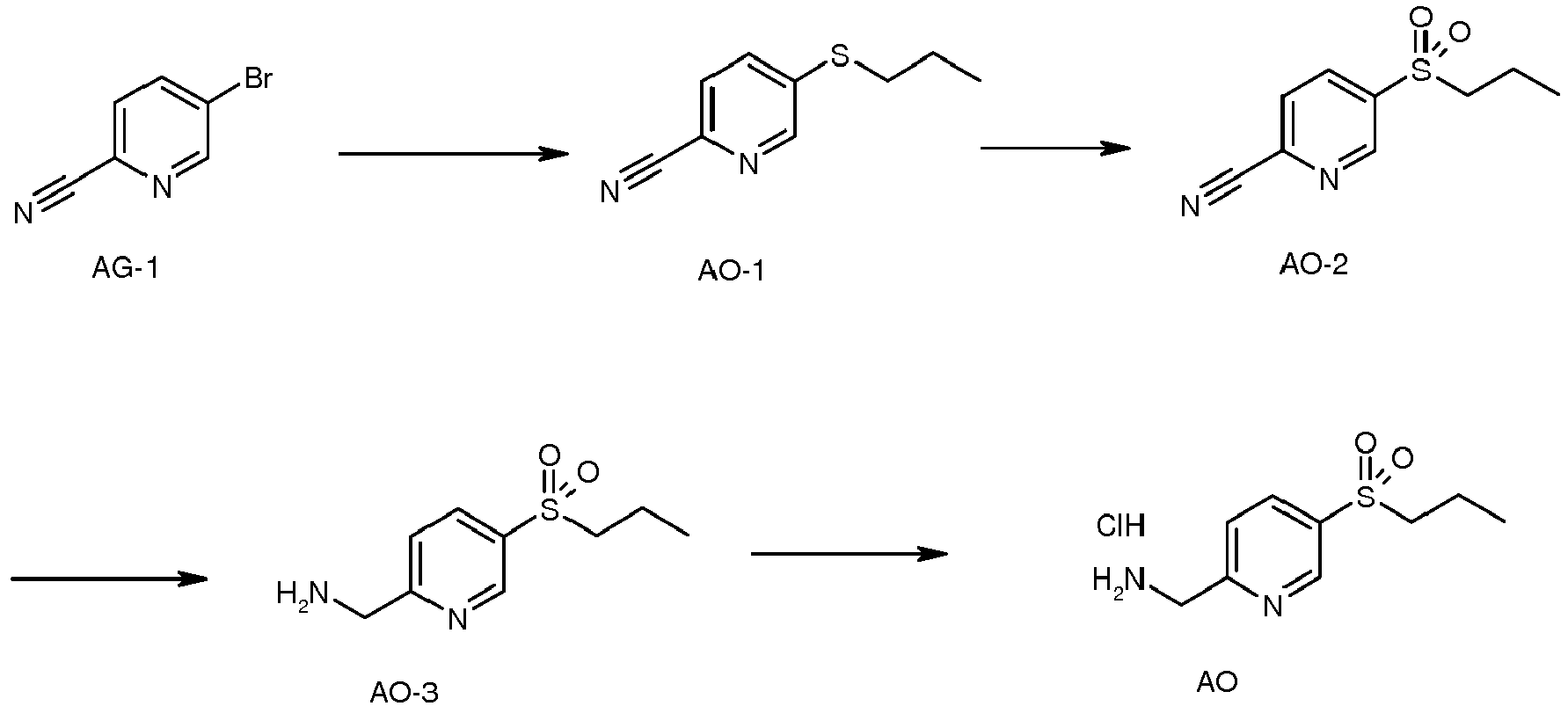
- To a solution of sodium 1-propanethiolate (12.8 g, 130 mmol) in ACN (150 mL) kept below 20 °C is added portion-wise AG-1 (19.8 g, 108 mmol). The mixture is then stirred at rt for 16 h, poured into water (300 mL) and extracted with EtOAc (300 mL). The combined organic phase is dried (Na2SO4), filtered and concentrated. The residue is purified by SiO2 flash chromatography to yield AO-1.
- To a stirred solution of AO-1 (16.5 g, 83.0 mmol) in AcOH (150 mL) kept below 10 °C is added a solution of KMnO4 (14.5 g, 92.0 mmol) in H2O (150 mL) dropwise. The reaction mixture is stirred for 30 min. The mixture is diluted with water, basified by addition of saturated aq Na2CO3 and extracted with EtOAc. The solution is concentrated and the residue is purified by SFC to yield AO-2.
- A mixture of AO-2 (7.80 g, 37.0 mmol) and Ra Ni (8.00 g) in MeOH (100 mL) is stirred at rt under H2 for 18 h. After filtration and concentration the residue is purified by MPLC to yield AO-3.
- To solid AO-3 (7.40 g, 35.0 mmol) is added acetic acid ethyl ester (2 mL) and HCl in EtOAc (100 mL). The solution is stirred at rt for 5h and the solids are filtered to yield intermediate AO.
-
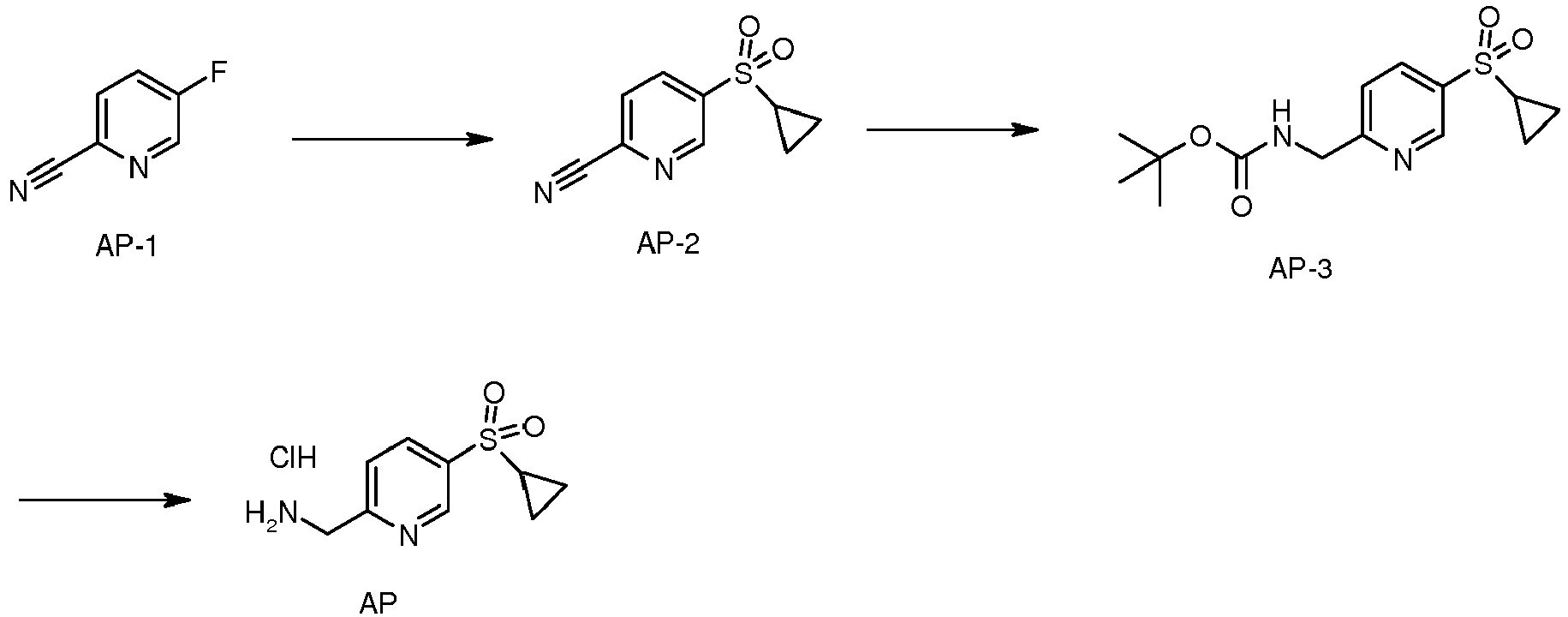
- A mixture of AP-1 (12.8 g, 130 mmol), sodium cyclopropanesulfonate (53.1 g, 369 mmol) and CuI (23.3 g, 123 mmol) in DMSO (150 mL) is stirred at 110 °C for 2 h. After cooling to rt, the solution is poured into water and extracted with EtOAc. The combined organic phase is dried over Na2SO4, filtered and concentrated. The resulting residue is purified by MPLC to yield AP-2.
- A mixture of AP-2 (10.3 g, 49 mmol), Ra Ni (25.0 g), Boc2O (16.2 g, 74 mmol) and TEA (10.0 g, 99 mmol) in MeOH (250 mL) is stirred under a H2 atmosphere at rt for 18 h. After filtration and concentration the residue is purified by MPLC to AP-3.
- To a solution of AP-3 (6.90 g, 22 mmol) in MeOH (60 mL) is added HCl in EtOH (60 mL). The solution is stirred at rt for 3 h and is concentrated and recrystallized to yield intermediate AP.
-

- To a solution of AG-1 (82.0 g, 448 mmol) in ACN (1.0 L) is added sodium t-butoxide (64.5 g). The mixture is cooled to 0 °C and sodium methanethiolate (172.5 g, 20% in H2O) is added dropwise. The reaction mixture is then allowed to stir at rt for 16 h. Water (800 mL) is added and the mixture is extracted with DCM. The combined organic phases are washed with brine, dried (Na2SO4) and concentrated. The residue is purified by SiO2 flash chromatography to yield AQ-1.
- To a suspension of AQ-1 (51.5 g, 343 mmol) in AcOH (500 mL) is added a solution of KMnO4 (59.7 g, 36.6 mmol) in H2O (500.0 mL) dropwise at 5 °C. The reaction mixture is then stirred at rt for 1 h. The mixture is extracted with EtOAc, washed with aq. NaHCO3, dried (Na2SO4) and concentrated. The resultant residue is purified by recrystallization to yield AQ-2.
- To a solution of AQ-2 (15.0 g, 82 mmol) in MeOH (200 mL) is added Ra Ni (10.0 g), TEA (34.4 mL) and Boc2O (17.8 g). The mixture is stirred at rt under H2 (50 psi) for 12 h. The vessel is purged with N2, filtered and the filtrate concentrated. The residue is purified by SiO2 flash chromatography to yield AQ-3.
- A solution of AQ-3 (30.0 g, 105 mmol) in HCl in MeOH (500 mL) is stirred at rt for 12 h. The mixture is concentrated and recrystallized to yield intermediate AQ. MS (ES+): m/z 187 [M+H]+.
- Intermediate AR and Intermediate AS (as the HCl salt. MS (ES+): m/z 202.1 [M+H]+) is synthesized in a fashion analogous to intermediate AQ.

-

- To a mixture of AT-1 (10.0 g, 55 mmol), N,N-dimethyl-ethane-1,2-diamine (0.96 g, 11 mmol) and Copper(II) trifluoromethanesulfonate (1.98, 5 mmol) in DMSO (100 mL) is added AT-2 (8.27 g, 98 mmol) at rt. The mixture is then heated to 120 °C for 30 min, quenched with H2O and extracted with EtOAc. The organic layer is dried, concentrated and purified by SiO2 flash chromatography to yield AT-3.
- A mixture of AT-3 (32.3 g, 165 mmol) and Pd (3.50 g, 33 mmol) in NH4OH (30 mL)/EtOH (200 mL) is stirred at rt under H2 (15 psi) for 15 h. The mixture is filtered, concentrated and purified by SiO2 flash chromatography to yield AT-4.
- To a stirred solution of AT-4 (17.5 g, 87 mmol) in EtOH (100 mL) is added HCl in EtOH (100 mL). The solution is stirred at rt for 3 h and then concentrated and recrystallized to yield intermediate AT. MS (ES+): m/z 201 [M+H]+.
-

- To a solution of AU-1 (7.15 g, 26.5 mmol) in THF (50 mL) is added Boc2O (6.70 mL, 29.2 mmol) and TEA (7.40 mL, 53.1 mmol). The reaction is allowed to stir at rt for 72 h. The solution is concentrated to yield AU-2.
- A mixture of AU-2 (5.25 g, 15.8 mmol), sodium t-butoxide (1.82 g, 18.9 mmol), Pd(OAc)2 (177 mg, 0.79 mmol), and 1,1'-Bis(diisopropylphosphino)ferrocene (396 mg, 0.95 mmol) are added to a sealed vessel which is purged with argon. Dioxane (35 mL) is added and the mixture is stirred at rt for 1h. Triisopropylsilanethiol (3.72 mL, 17.3 mmol) is added and the solution is heated to 100 °C for 1 h. The reaction is then poured into EtOAc and water. The organic layer is concentrated and the residue is purified by SiO2 flash chromatography to yield AU-3.
- A solution of AU-3 (2.50 g, 6.32 mmol) in THF (25 mL) is cooled to 0 °C and degassed with argon. Terabutylammoniumbromide (2.12 g, 7.58 mmol) is then added and the solution is stirred at 0 °C for 1 h. Bromoacetonitrile (660 uL, 9.48 mmol) is then added and the solution is stirred at 0 °C for 5 min. The solution is concentrated and partitioned between diethyl ether and water. The organic layer is concentrated to yield AU-4 which is carried forward without further manipulation.
- To a solution of AU-4 (1.80 g, 6.47 mmol) in ACN/H2O (10 mL) is added sodium periodate (4.18 g, 19.5 mmol) followed by ruthenium(III) chloride (7.87 mg, 0.038 mmol). The reaction mixture is stirred at rt for 30 min and is then concentrated. The residue is purified by SiO2 flash chromatography to yield AU-5.
- To a stirred solution of AU-5 (470 mg, 1.51 mmol) in DCM (3 mL) is added HCl in dioxane (2.00 mL, 8.00 mmol). The solution is stirred at rt for 1 h and concentrated to yield intermediate AU. MS (ES+): m/z 211.1 [M+H]+.
-

- AV-1 (20.0 g, 168 mmol) is added to conc. HCl (200 mL) at 0 °C followed by dropwise addition of aq NaNO2 (25.5 g in 25 mL H2O) maintaining an internal temperature of < 5 °C. The solution is allowed to stir at 0 °C for 15 min and then is slowly added to a mixture of SO2 (108 g) and CuCl (84 mg) in AcOH (200 mL, > 5eq) at 5 °C. The solution is stirred 90 min at 5 °C. The reaction mixture is extracted with DCM (2 x 500 mL), dried (Na2SO4), and the organic solution of AV-2 used directly in the next step.
- To a solution of AV-2 (20.0 g, 99 mmol) in DCM (200 mL) is added a solution of ammonia in MeOH (100 mL) at 0 C and stirred at rt for 30 min. The mixture is concentrated to dryness and the resultant residue is purified by SiO2 flash chromatography to yield AV-3.
- To a solution of AV-3 (15.0 g, 82 mmol) in MeOH (200 mL) is added Ra Ni (10.0 g), TEA (34.4 mL) and Boc2O (17.8 g). The mixture is stirred at rt under H2 (50 psi) for 12 h. The vessel is purged with N2, filtered and the filtrate concentrated. The residue is purified by SiO2 flash chromatography to yield AV-4.
- A solution of AV-4 (30.0 g, 105 mmol) in HCl in MeOH (500 mL) is stirred at rt for 12 h. The mixture is concentrated and recrystallized to yield intermediate AV. MS (ES+): m/z 188.1 [M+H]+.
- Intermediate AW is synthesized in a fashion analogous to Intermediate AV.

-

- To a solution of AG-3 (2.40g, 12 mmol) in THF (30 mL) is added dropwise MeMgBr (30 mL) at -30 °C. After the addition, the mixture is stirred at rt for 4 h.The reaction mixture is quenched by addition of sat. aq NH4Cl (100 mL) and extracted with EtOAc (3 x 100 mL). The organic phase is washed with brine, dried over Na2SO4 and concentrated under reduced pressure. The residue is purified by SiO2 flash chromatography to yield AX-1.
- To a solution of AX-1 (200 mg, 1.0 mmol) in MeOH (2 mL) is added NH4OAc (723 mg) and NaBH3CN (41 mg) at 0 °C. The mixture is stirred at rt for 16 h. The solvent is removed under reduced pressure, water (50 mL) is added and the mixture is adjusted to pH > 12 and then extracted with DCM (50 mL). The organic phase is dried over Na2SO4 and concentrated. The residue is purified by prep-TLC to yield AX-2.
- AX-2 is separated by SFC to give (S)-AX (67.9%ee) and (R)-AX (95.5%ee).
-

- To a solution of AY-1 (1.25g, 5.49 mmol) in anhydrous MeOH (15 mL) is added NaOMe (2.37g, 43.89 mmol). The mixture is stirred at rt for 1 h. The solution is filtered and concentrated. The residue is purified by SiO2 flash chromatography to yield intermediate AY. MS (ES+): m/z 218.9 [M+H]+.
-

- To a solution of sodium hydride (342 mg, (60%), 8.57 mmol) in DMF (10 mL) is added anhydrous isopropanol (360 uL, 4.71 mmol). The mixture is stirred at rt for 1 h. AB-1 (1.00 g, 4.28 mmol) is then added and the mixture is stirred for an additional 1 h before being poured onto ice. The mixture is then extracted with EtOAc and concentrated. The residue is purified by SiO2 flash chromatography to yield intermediate AZ. MS (ES+): m/z 258.8 [M+H]+.
-

- A solution of BA-1 (1.00 g, 7.78 mmol), and Ni(dppe)Cl2 (82 mg, 0.16 mmol) in anhydrous Et2O (5 mL) is cooled to -10 °C. Then, n-propyl magnesium bromide is added dropwise and the mixture is stirred for 2 h at -10 °C. The mixture is quenched with saturated NH4Cl, extracted with DCM and concentrated. The crude BA-2 is carried forward without further manipulation.
- To a solution of BA-2 (1.0 g, 7.34 mmol) in EtOH (10 mL) at 0 °C is added Br2 (379 uL, 7.34 mmol). The reaction mixture is stirred at rt for 2 h. The solution is concentrated and the residue is purified by SiO2 flash chromatography to yield intermediate BA. MS (ES+): m/z 217.4 [M+H]+.
-

- A solution of BA-1 (1.00 g, 7.78 mmol), and Ni(dppe)Cl2 (82 mg, 0.16 mmol) in anhydrous Et2O (5 mL) is cooled to -10 °C. A solution of isopropyl magnesium bromide (3.22 mL, 9.33 mmol) is added dropwise and the mixture is stirred for 1 h at -10 °C. The mixture is quenched with sat. NH4Cl, extracted with DCM and concentrated. The crude BC-1 is carried on as is.
- To a solution of BC-1 (1.0 g, 7.34 mmol) in EtOH (10 mL) at 0 °C is added Br2 (378 uL, 7.34 mmol). The reaction mixture is stirred at rt for 2 h. The solution is concentrated and the residue is purified by SiO2 flash chromatography to yield intermediate BC. MS (ES+): m/z 216.4 [M+H]+.
-

- A solution of BA-1 (1.00 g, 7.78 mmol), and Ni(dppe)Cl2 (82 mg, 0.16 mmol) in anhydrous Et2O (5 mL) is cooled to -10 °C. A solution of cyclopropyl magnesium bromide (1.36 g, 8.56 mmol) is added dropwise and the mixture is stirred for 2 h at -10 °C. The mixture is quenched with saturated aqueous NH4Cl, extracted with DCM and concentrated. The crude BD-1 is carried forward without further manipulation.
- To a solution of BD-1 (1.0 g, 6.74 mmol) in EtOH (10 mL) at 0 °C is added Br2 (347 uL, 6.74 mmol). The reaction mixture is stirred at rt for 18 h. The solution is concentrated and the residue is purified by SiO2 flash chromatography to yield intermediate BD. MS (ES+): m/z 229.2 [M+H]+.
-

- To a solution of BE-1 (40.0 g, 244 mmol) in THF (800 mL) is added PPh3 (98.0 g) and NCS (160.0 g). The reaction mixture is stirred at 80 °C for 10 h. The mixture is then quenched with water and extracted with EtOAc. The solution is concentrated and the residue is purified by SiO2 flash chromatography to yield BE-2.
- To a stirred solution of BE-2 (3.00 g, 14.79 mmol) in toluene and DMF is added Pd(PPh3)4 (600 mg), Pd(dppf)Cl2 (600 mg) and Na2CO3 (6.27 g, 59.17 mmol). The mixture is stirred at 90 °C for 5 h. The mixture is quenched with water, extracted with EtOAc. The solution is concentrated and the residue is purified by SiO2 flash chromatography to yield BE-3.
- To a solution of BE-3 (860 mg, 5.0 mmol) in EtOH (5 mL) at-10 °C is added Br2 (347 uL, 6.74 mmol). The reaction mixture is stirred at rt for 18 h. The solution is concentrated and the residue is purified by SiO2 flash chromatography to yield intermediate BE. MS (ES+): m/z 267 [M+H]+.
-

- To a solution of AB (6.00 g, 26.2 mmol) and BF-1 (7.86 mL, 34.1 mmol) in toluene (60 mL) and THF (18 mL) at -78 °C is added n-butyl lithium (12.6 mL, 31.4 mmol), dropwise, over 30 min. The solution is the stirred at -78 °C for 30 min and is then slowly warmed to - 20 °C. The solution is the quenched with 1 N HCl (40 mL). The layers are then separated and the aqueous layer is adjusted to pH ∼8 with 2M NaOH. A white solid begins to precipitate and the mixture is cooled in the refrigerator for 1 h. The solids are filtered to yield intermediate BF. The aqueous layer is extracted with MeTHF and concentrated to give additional intermediate BF. MS (ES+): m/z 195.1 [M+H]+.
- Intermediate BG is synthesized in a fashion analogous to Intermediate BF.
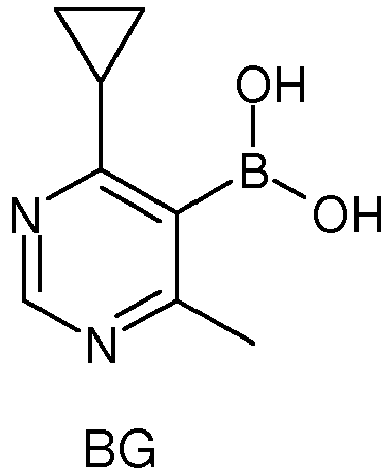
-

- To a mixture of 2-methyl-propionaldehyde (5 g, 69.34 mmol) and NH4Cl (7.42 g, 138.69 mmol) in water (50 mL) is added NaCN (4.08 g, 83.2 mmol). The mixture is stirred at rt for 18 h. The mixture is extracted with EtOAc (3x). The organics are combined, dried over Na2SO4, concentrated to give crude intermediate BH, which is carried forward without further manipulation.
-

- To a mixture of BI-1 (20 mL, 104 mmol) and 2,2-dimethyl oxirane (15 mL, 17 mmol) is added LiBr (1.86 g, 21.4 mmol) in one portion. The reaction mixture is stirred at rt for 16 h. Additional 2,2-dimethyl oxirane (2.0 mL, 23 mmol) is added and the mixture is heated at 60 °C for 2 h. The reaction mixture is quenched with water then extracted with EtOAc twice. The organics are combined and washed with brine, dried over Na2SO4, filtered and concentrated to yield BI-2.
- To a solution of BI-2 (2.0 g, 7.4 mmol) in DCM (20 mL) at -21 °C is added Deoxo-Fluor (1.51 mL, 8.17 mmol). After the addition, the reaction mixture is stirred at -21 °C for 5 mins then quenched with sat. aq NaHCO3 until pH ∼ 8. The layers are separated and the aq layer is extracted with DCM. The combined organics are washed with sat. aq NaHCO3, dried over Na2SO4, filtered and concentrated to yield BI-3.
- To a solution of BI-3 (1.5 g, 5.5 mmol) in toluene (30 mL) is added dropwise HCl in dioxane (4N, 1.45 mL, 5.80 mmol). The reaction mixture is stirred at rt for 2 h then filtered to yield BI-4.
- A mixture of BI-4 (500 mg, 1.62 mmol), 5% Pd/C (103 mg) and MeOH (3 mL) is hydrogenated on Endeavor (60 °C, 400 psi) for 5 h. The reaction mixture is filtered through celite and rinsed with MeOH. The filtrate is concentrated to yield intermediate BI as the HCl salt. MS (ES+): m/z 92.3 [M+H]+.
-

- To a solution of BJ-1 (7.40 mL, 99.0 mmol) in DCM (100 mL) is added (R)-2-methyl-2-propanesulfinamide (10.0 g, 82.5 mmol), MgSO4 (49.66 g, 412 mmol) and pyridinium p-toluenesulfonate (1.04 g, 4.13 mmol). The reaction mixture is allowed to stir at rt for 72 h. The reaction mixture is then filtered and the residue is purified by SiO2 flash chromatography to yield BJ-2.
- To a solution of BJ-2 (9.72 g, 56.1 mmol) in THF (200 mL) is added tetramethylammonium fluoride (6.27 g, 67.3 mmol). The solution is degassed with argon and is then cooled to -55 °C. A solution of trifluoromethyltrimethylsilane (12.4 mL, 84.1 mmol) in THF (250 mL) is added dropwise with an additional funnel and the reaction is allowed to stir at -55 °C for 2 h. The reaction mixture is then slowly allowed to warm to - 10 °C and is quenched with sat. aqueous NH4Cl. The aqueous layer is extracted with EtOAc and the combined organic layers are concentrated to yield BJ-3, which is carried forward without further manipulation.
- To a solution of BJ-3 (9.00 g, 37.0 mmol) in MeOH (30 mL) is added 4M HCl in dioxane (18.5 mL, 74.0 mmol). The solution is allowed to stir at rt for 1 h. The reaction mixture is then concentrated to half volume and diluted with diethyl ether until a white precipitate is formed. The solid is then filtered to yield intermediate BJ.
-

- To a solution of BK-1 (9.47 g, 113 mmol) in DCM (100 mL) is added (R)-2-methyl-2-propanesulfinamide (10.5 g, 86.6 mmol), MgSO4 (52.1 g, 433 mmol) and pyridinium p-toluenesulfonate (1.09 g, 4.33 mmol). The reaction mixture is allowed to stir at rt for 18 h. The reaction mixture is then filtered and the residue is purified by SiO2 flash chromatography to yield BK-2.
- To a solution of BK-2 (8.60 g, 45.9 mmol) in DCM (350 mL) at -50 °C, is added methylmagnesium bromide (36.0 mL, 108 mmol). The solution is stirred at -50 °C for 3h. The reaction is then allowed to warm to rt and stirred for 18 h. The solution is quenched with sat. aqueous NH4Cl and extracted with EtOAc (2X). The organic layer is concentrated to yield BK-3, which is carried forward without further manipulation.
- To a solution of BK-3 (5.00 g, 24.6 mmol) in MeOH (20 mL) is added 4M HCl in dioxane (12.3 mL, 49.2 mmol). The solution is allowed to stir at rt for 1 h. The reaction mixture is then concentrated and the residue is purified by SiO2 flash chromatography to yield intermediate BK.
- Intermediate BL is synthesized in a fashion analogous to Intermediate BK

- Intermediates BM, BN, BO, BP, BQ, BR, BS are synthesized in a fashion analogous to Intermediate AJ

-

- To a stirring suspension of 2,4-Dichloro-pyrimidin-5-ylamine (3.03 g, 18.1 mmol) in n-BuOH (40 mL) is added (1S,2S)-2-Amino-cyclopentanol hydrochloride (2.50 g, 17.2 mmol) and DIEA (9.20 ml, 51.8 mmol). The mixture is stirred at 130 °C for 4 h. The reaction mixture is then concentrated under reduced pressure and the crude product is triturated to a solid in EtOAc and heptane and filtered to yield BT-1.
- To a stirred solution of BT-1 (3.61 g, 15.5 mol) in acetone (200 mL) is added K2CO3 (5.34 g, 38.6 mmol) and chloro-oxo-acetic acid ethyl ester (1.94 mL, 17.0 mmol). The mixture is stirred at rt for 1h. The reaction mixture is filtered and the filtrate is concentrated under reduced pressure. The crude ketoester is dissolved in absolute EtOH (50 mL), placed in a pressure flask, and TEA (5.43 mL, 38.6 mmol) is added. This is heated to 130 °C for 1 h. The reaction mixture is concentrated under reduced pressure and dissolved in EtOAc (100 mL). The organic layer is washed with water (2 x 20 mL) then brine (20 mL) and dried (Na2SO4), decanted and concentrated. The resultant residue is triturated to a solid in EtOAc and heptane to yield BT-2.
- To a mixture of BT-2 (500 mg, 1.73 mmol) in DCM (100 mL) is added Dess-Martin periodinane (2.25 g, 5.20 mmol) and the mixture is stirred at rt for 96 h. The mixture is washed with sat. NaHCO3 (50 mL) and the organic layer dried (Na2SO4) and concentrated under reduced pressure. The solid residue is twice suspended in DCM (50 mL), sonicated, and filtered. The resulting solid is re-suspended in EtOAc (20 mL) and sonicated. The solid product is filtered to yield BT-3.
- To a mixture of BT-3 (124 mg, 0.442 mmol) in DCM (6 mL) at rt is added oxalyl chloride (0.076 mL, 0.88 mmol) followed dropwise by dry DMF (0.30 mL, 3.9 mmol) until dissolution of the solid. The mixture is stirred at rt for 30 min, whereupon LCMS indicates unreacted starting material. To the mixture is added more oxalyl chloride (0.048 mL, 0.55 mmol) and the mixture stirred an additional 10 min. The reaction is concentrated under a stream of nitrogen at 35 °C for 1h and the resultant residue BT-4 is used directly.
- To a stirred solution of BT-4 (132 mg, 0.442 mmol) and AG (105 mg, 0.442 mmol) in DMF (2 mL) at rt is added TEA (0.311 mL, 2.21 mmol) and the mixture is stirred at rt for 15 min. To the reaction mixture is added water (50 mL) and this is extracted with EtOAc (3 x 50 mL). The organic layers are combined, dried (Na2SO4), decanted and concentrated. The resultant residue is purified by SiO2 flash chromatography to yield intermediate BT. MS (ES+): m/z 463.1 [M+H]+.
-

- Intermediate AB (27 mg, 0.12 mmol), bis(pinacolato)diboron (30 mg, 0.12 mmol), potassium acetate (35 mg, 0.36 mmol) and [1,1'-bisdiphenylphosphinoferrocene]-palladium(II) dichloride (9 mg, 0.011 mmol) are combined in a solution of degassed toluene/DME/ethanol/water (3:2:2:1, 3 mL). The vessel is heated to 90 °C for 20 min in a microwave reactor. In a separate vessel, intermediate A (50 mg, 0.12 mmol), bis(pinacolato)diboron (30 mg, 0.12 mmol), KOAc (35 mg, 0.36 mmol) and bis(di-tert-butyl(4-dimethylaminophenyl)phosphine)dichloropalladium(II) (8 mg, 0.011 mmol) are combined in degassed 1,4 dioxane (3 mL). The reaction is heated to 90 °C for 20 min in a microwave reactor. The contents of the two vessels are combined and Na2CO3(aq) (2M, 1 mL) is added. The reaction is heated to 120 °C for 30 min in a microwave reactor. The vessel is cooled to rt and the contents filtered and concentrated. The resultant residue is purified by SiO2 flash chromatography to yield Example 9. MS (ES+): m/z 537.2 [M+H]+.
-
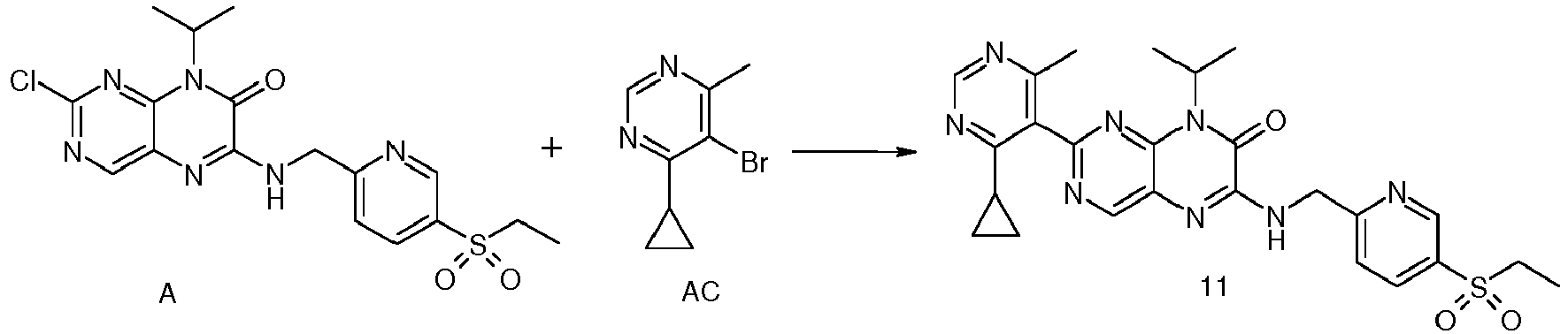
- Intermediate AC (252 mg, 1.18 mmol), bis(pinacolato)diboron (600 mg, 2.36 mmol), potassium acetate (348 mg, 2.36 mmol) and [1,1'-bisdiphenylphosphinoferrocene]-palladium(II) dichloride (95 mg, 0.118 mmol) are combined in a solution of degassed toluene/DME/ethanol/water (3:2:2:1, 3 mL). The vessel is heated to 90 °C for 20 min in a microwave reactor. In a separate vessel, intermediate A (500 mg, 1.18 mmol), bis(pinacolato)diboron (600 mg, 2.36 mmol), potassium acetate (348 mg, 2.36 mmol) and bis(di-tert-butyl(4-dimethylaminophenyl)phosphine)dichloropalladium(II) (84 mg, 0.118 mmol) are combined in degassed 1,4 dioxane (3 mL). The reaction is heated to 90 °C for 20 min in a microwave reactor. The contents of the two vessels are combined and Na2CO3(aq) (2M, 1 mL) is added. The reaction is heated to 120 °C for 30 min in a microwave reactor. The vessel is cooled to rt and the contents filtered and concentrated. The resultant residue is purified by SiO2 flash chromatography to yield Example 11. MS (ES+): m/z 521.4 [M+H]+.
-

- Intermediate AE (283 mg, 1.18 mmol), bis(pinacolato)diboron (600 mg, 2.36 mmol), potassium acetate (348mg, 3.54 mmol) and [1,1'-bisdiphenylphosphinoferrocene]-palladium(II) dichloride (95 mg, 0.12 mmol) are combined in a solution of degassed toluene/DME/ethanol/water (3:2:2:1, 3 mL). The vessel is heated to 90 °C for 20 min in a microwave reactor. In a separate vessel, intermediate A (500 mg, 1.18 mmol), bis(pinacolato)diboron (600 mg, 2.36 mmol), potassium acetate (348 mg, 3.54 mmol) and bis(di-tert-butyl(4-dimethylaminophenyl)phosphine)dichloropalladium(II) (84 mg, 0.12 mmol) are combined in degassed 1,4 dioxane (3 mL). The reaction is heated to 90 °C for 20 min in a microwave reactor. The contents of the two vessels are combined and 2M sodium bicarbonate (1 mL) is added. The reaction is heated to 120 °C for 30 min in a microwave reactor. The vessel is cooled to rt and the contents filtered and concentrated. The resultant residue is purified by SiO2 flash chromatography to yield Example 15. MS (ES+): m/z 547.4 [M+H]+.
-
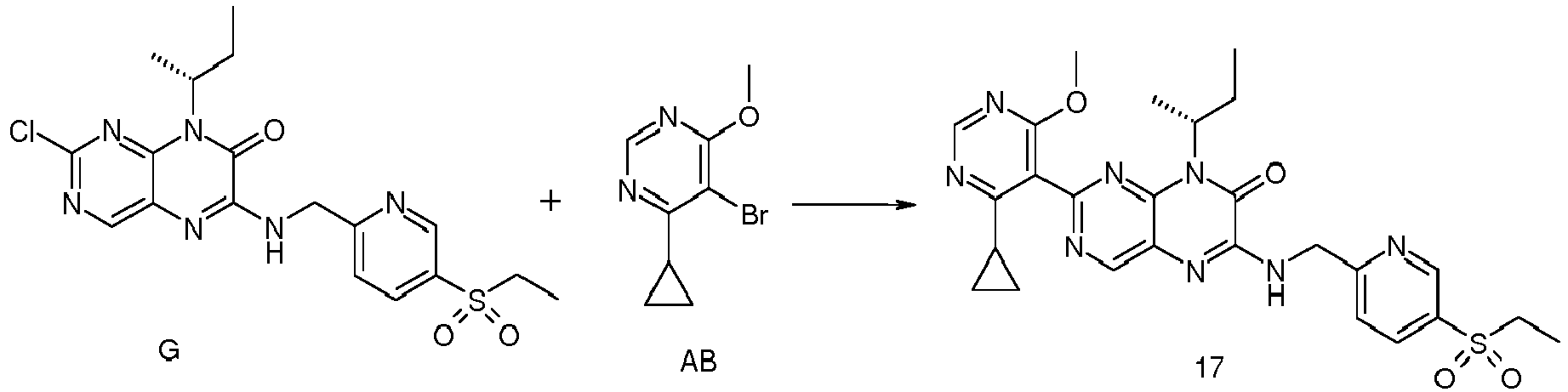
- Intermediate AB (52 mg, 0.23 mmol), bis(pinacolato)diboron (58 mg, 0.23 mmol), KOAc (67mg, 0.23 mmol) and [1,1'-bisdiphenylphosphinoferrocene]-palladium(II) dichloride (18 mg, 0.23 mmol) are combined in a solution of degassed toluene/DME/ethanol/water (3:2:2:1, 3 mL). The vessel is heated to 90 °C for 20 min in a microwave reactor. In a separate vessel, intermediate G (100 mg, 0.23 mmol), bis(pinacolato)diboron (58 mg, 0.23 mmol), KOAc (67 mg, 0.69 mmol) and bis(di-tert-butyl(4-dimethylaminophenyl)phosphine)dichloropalladium(II) (16 mg, 0.023 mmol) are combined in degassed 1,4 dioxane (3 mL). The reaction is heated to 90 °C for 20 min in a microwave reactor. The contents of the two vessels are combined and Na2CO3(aq) (2M, 1 mL) is added. The reaction is heated to 120 °C for 30 min in a microwave reactor. The vessel is cooled to rt and the contents filtered and concentrated. The resultant residue is purified by SiO2 flash chromatography to yield Example 17. MS (ES+): m/z 551.4 [M+H]+.
-

- Intermediate AB (105 mg, 0.46 mmol), bis(pinacolato)diboron (175 mg, 0.69 mmol), potassium acetate (67mg, 0.69 mmol) and [1,1'-bisdiphenylphosphinoferrocene]-palladium(II) dichloride (18 mg, 0.045 mmol) are combined in a solution of degassed toluene/DME/ethanol/water (3:2:2:1, 3 mL). The vessel is heated to 90 °C for 20 min in a microwave reactor. In a separate vessel, intermediate B (100 mg, 0.23 mmol), bis(pinacolato)diboron (175 mg, 0.69 mmol), KOAc (67 mg, 0.69 mmol) and bis(di-tert-butyl(4-dimethylaminophenyl)phosphine)dichloropalladium(II) (16 mg, 0.045 mmol) are combined in degassed 1,4 dioxane (3 mL). The reaction is heated to 90 °C for 20 min in a microwave reactor. The contents of the two vessels are combined and 2M sodium bicarbonate (1 mL) is added. The reaction is heated to 120 °C for 30 min in a microwave reactor. The vessel is cooled to rt and the contents filtered and concentrated. The resultant residue is purified by SiO2 flash chromatography to yield Example 63. MS (ES+): m/z 548.0 [M+H]+.
-

- Intermediate AC(174 mg, 0.820 mmol), bis(pinacolato)diboron (277 mg, 1.093 mmol), potassium acetate (161mg, 1.64 mmol) and [1,1'-bisdiphenylphosphinoferrocene]-palladium(II) dichloride (43 mg, 0.055 mmol) are combined in a solution of degassed toluene/DME/ethanol/water (3:2:2:1, 3 mL). The vessel is heated to 90 °C for 20 min in a microwave reactor. In a separate vessel, intermediate X (247 mg, 0.547 mmol), bis(pinacolato)diboron (277 mg, 0.820 mmol), potassium acetate (161 mg, 1.64 mmol) and bis(di-tert-butyl(4-dimethylaminophenyl)phosphine)dichloropalladium(II) (43 mg, 0.055 mmol) are combined in degassed 1,4 dioxane (3 mL). The reaction is heated to 90 °C for 20 min in a microwave reactor. The contents of the two vessels are combined and Na2CO3(aq) (2M, 1 mL) is added. The reaction is heated to 120 °C for 30 min in a microwave reactor. The vessel is cooled to rt and the contents filtered and concentrated. The resultant residue is purified by SiO2 flash chromatography to yield Example 65. MS (ES+): m/z 550.0 [M+H]+.
- The following compounds are prepared in an analogous manner:
Examples 1-8, 10, 12-14, 16, 18-62, 64, 66-92, 129. -

- A mixture of AJ (100 mg, 0.21 mmol), intermediate AI (83.7 mg, 0.32 mmol), K3PO4 (91 mg, 0.43 mmol), and Pd(dppf)Cl2 (26 mg, 0.03 mmol) in 1,4-dioxane (2 mL) is purged with argon, and then H2O (0.25 mL) is added. The mixture is stirred at 100 °C for 18h. After cooling to rt, the mixture is diluted with water (2 mL) and extracted with EtOAc (2x5 mL). The combined organic phase is dried (Na2SO4), decanted and concentrated. The resultant residue is purified by reversed HPLC to yield Example 93. MS (ES+): m/z 584.0 [M+H]+.
-

- A mixture of NNN (3500 mg, 8.05 mmol), intermediate BG (2149 mg, 12.07 mmol), K3PO4 (3417 mg, 16.09 mmol), and Pd(dppf)Cl2 (986 mg, 1.21 mmol) in 1,4-dioxane (60 mL) is purged with argon, and then H2O (6 mL) is added. The mixture is stirred at 100 °C for 18h. After cooling to rt, the mixture is diluted with water (2 mL) and extracted with EtOAc (2x5 mL). The combined organic phase is dried (Na2SO4), decanted and concentrated. The resultant residue is purified by reversed HPLC to yield Example 136. MS (ES+): m/z 533.0 [M+H]+.
-

- A mixture of MMM (3360 mg, 7.49 mmol), intermediate BG (2664 mg,14.97 mmol), K3PO4 (3177 mg, 14.97 mmol), and Pd(dppf)Cl2 (916 mg, 1.12 mmol) in 1,4-dioxane (60 mL) is purged with argon, and then H2O (6 mL) is added. The mixture is stirred at 100 °C for 18h. After cooling to rt, the mixture is diluted with water (2 mL) and extracted with EtOAc (2x5 mL). The combined organic phase is dried (Na2SO4), decanted and concentrated. The resultant residue is purified by reversed HPLC to yield Example 158. MS (ES+): m/z 539.3.0 [M+H]+.
- The following compounds are prepared in an analogous manner:
Examples 94-128, 130-132, 134, 137-144, 146-157, 159-199, 201-265. -

- A mixture of AC (5.39 g, 25.3 mmol), bis(pinacolato) diboron (10.4 g, 40.5 mmol), potassium acetate (3.98 g, 40.5 mmol), and Pd(dppf)Cl2 DCM complex (0.83 g, 1.01 mmol) in DME/Tol/EtOH/H2O (10:6:3:1) is purged with argon, sealed, and stirred at 80 °C for 30 min. This is added to an argon purged mixture of BU-1 (2.70 g, 10.1 mmol) and Pd(amphos)Cl2 (0.71 g, 1.01 mmol) and the sealed mixture is heated to 110°C for 2h. The mixture is then concentrated, diluted with EtOAc, filtered and then concentrated again. The crude is purified by SiO2 flash chromatography to yield BU-2.
- To a solution of the BU-2 (856 mg, 2.35 mmol) in DCM (15 ml) is added oxalyl chloride (596 mg, 4.70 mmol) followed by 5 drops of DMF. The reaction is allowed to stir for 18 h. The reaction is then concentrated and the residue yields BU-3 which is carried on as is.
- To a stirred solution of the BU-3 (150 mg, 0.36 mmol) in DMF is added DIEA (196 uL, 1.41 mmol) at rt. After 10 minutes BU-4 (84.1 mg, 0.42 mmol) is added and the reaction is stirred at rt for 10min. The mixture is then concentrated and purified by reversed HPLC (NH4CO3) to yield Example 133. MS (ES+): m/z 509.1 [M+H]+.
- Example 135 and 145 are synthesized in a fashion analogous to Example 133.

-

- To a solution of 216 (100 mg, 0.195 mmol) in dioxane (2 mL)/water (1 mL) is added LiOH (28.0 mg, 1.17 mmol). The reaction is stirred at rt for 16 h. The mixture is concentrated and dissolved in water, acidified with IN HCl to pH∼5, filtered, washed with water, and dried in vacuum oven to yield 200. MS (ES+): m/z 498.1 [M+H]+
- The compounds of the present invention have activity as modulators of RORy (retinoid acid receptor-related orphan receptor γ).
- A nuclear receptor transactivation assay is performed to quantitate the ability of test compounds to inhibit RORy transactivation of a luciferase reporter. A similar assay is described in: Khan et al., Bioorganic & Medicinal Chemistry Letters 23 (2013), 532-536. The system uses transiently transfected HEK 293 cells cotransfected with two plasmids (pGL4.3, luc2P/GAL4UAS/Hygro, and pBIND, Gal4DBD hRORC LBD1-3). The positive control is co-transiently transfected with both plasmids, and the negative control contains the pGL4.3 promoter sequence. Assays are assembled in 384 well plates where transiently transfected cells and test compound at varying concentrations are incubated for 20-24 h. The next day, assays plates are taken out and equilibrated at RT for 20-30 minutes. Bright-Glo™ Luciferase Assay System is used to detect Luciferase production. After addition of Bright GLO detection reagent, the plates are incubated at RT for 20 minutes. The plates are read on an Envision plate reader to measure luminescence signal. The RLU signal is converted to POC relative to control and blank wells.
- Cell Seeding Media:
RPMI 1640-Invitrogen #11875135), 2.5% FBS-Invitrogen # 26140, 1xPenicillin-Streptomycin-Gibco # 15140 - Compound dilution buffer:
- IX HBSS-Invitrogen #14025126
- Assay Plates: Greiner #781080-020
- Bright Glo Luciferase Assay System: Promega #E2620
Thaw lysis buffer provided in kit, add 100 mL lysis buffer to substrate powder. - The below table presents the results obtained when the compounds of the present invention were tested in the above assay, demonstrating their activity as modulators of RORγ:
Table II: Table of Biological Activity in Reporter Gene Assay Example RGA IC50 (nM) Example RGA IC50 (nM) Example RGA IC50 (nM) 1 210 101 115 201 75 2 230 102 250 202 455 3 230 103 82 203 800 4 250 104 3000 204 665 5 260 105 1600 205 80 6 260 106 1150 206 777 7 280 107 560 207 1400 8 290 108 300 208 125 9 300 109 790 209 75 10 300 110 1350 210 150 11 300 111 460 211 225 12 300 112 920 212 120 13 300 113 108 213 155 14 310 114 107 214 220 15 310 115 67 215 330 16 320 116 300 216 1385 17 330 117 155 217 160 18 330 118 225 218 170 19 330 119 720 219 280 20 330 120 420 220 390 21 360 121 130 221 350 22 360 122 150 222 1250 23 390 123 135 223 135 24 390 124 97 224 120 25 410 125 175 225 230 26 420 126 119 226 155 27 420 127 570 227 455 28 440 128 160 228 595 29 470 129 2500 229 530 30 550 130 285 230 270 31 560 131 205 231 195 32 640 132 243 232 180 33 670 133 1035 233 155 34 730 134 400 234 590 35 870 135 240 235 425 36 880 136 255 236 185 37 930 137 278 237 265 38 1100 138 160 238 400 39 1100 139 700 239 205 40 1400 140 730 240 600 41 1400 141 925 241 310 42 1500 142 333 242 395 43 2600 143 134 243 230 44 2800 144 162 244 475 45 2900 145 95 245 1700 46 3000 146 435 246 645 47 3200 147 250 247 385 48 3800 148 505 248 540 49 4300 149 305 249 530 50 4400 150 230 250 190 51 7600 151 255 251 158 52 420 152 470 252 325 53 680 153 375 253 340 54 420 154 295 254 455 55 1400 155 185 255 285 56 1400 156 275 256 1900 57 560 157 92 257 155 58 420 158 106 258 210 59 850 159 91 259 190 60 750 160 285 260 515 61 470 161 375 261 470 62 990 162 795 262 4000 63 930 163 160 263 4300 64 920 164 410 264 5900 65 590 165 157 265 4800 66 410 166 1600 67 370 167 270 68 330 168 435 69 320 169 145 70 630 170 235 71 480 171 200 72 250 172 440 73 290 173 690 74 410 174 275 75 590 175 380 76 1600 176 550 77 1600 177 73 78 2400 178 240 79 610 179 675 80 1100 180 235 81 1700 181 175 82 380 182 130 83 2200 183 325 84 400 184 295 85 290 185 175 86 550 186 150 87 310 187 255 88 3400 188 315 89 750 189 120 90 4100 190 130 91 1800 191 86 92 850 192 83 93 110 193 99 94 125 194 180 95 355 195 183 96 320 196 157 97 101 197 225 98 195 198 225 99 265 199 120 100 130 200 855 - On the basis of their biological properties the compounds of formula (I) according to the invention, or their tautomers, racemates, enantiomers, diastereomers, mixtures thereof and the salts of all the above-mentioned forms are suitable for treating autoimmune and allergic disorders in that they exhibit good modulatory effect upon RORy .
- The present invention is therefore directed to compounds of general formula (I), and the pharmaceutically acceptable salts thereof, and all tautomers, racemates, enantiomers, diastereomers, mixtures thereof, which are useful in the treatment of a disease and/or condition wherein the activity of RORy modulators is of therapeutic benefit, including but not limited to the treatment of autoimmune or allergic disorders.
- Such disorders that may be treated by the compounds of the invention include for example: rheumatoid arthritis, psoriasis, systemic lupus erythromatosis, lupus nephritis, systemic sclerosis, vasculitis, scleroderma, asthma, allergic rhinitis, allergic eczema, multiple sclerosis, juvenile rheumatoid arthritis, juvenile idiopathic arthritis, type I diabetes, Crohn's disease, ulcerative colitis, graft versus host disease, psoriatic arthritis, reactive arthritis, ankylosing spondylitis, atherosclerosis, uveitis and non-radiographic spondyloarthropathy.
- For treatment of the above-described diseases and conditions, a therapeutically effective dose will generally be in the range of approximately 0.01 mg to about 10 mg/kg of body weight per dosage of a compound of the invention; preferably, from about 0.1 mg to about 5 mg/kg of body weight per dosage. For example, for administration to a 70 kg person, the dosage range would be approximately 0.7 mg to about 750 mg per dosage of a compound of the invention, preferably from about 7.0 mg to about 350 mg per dosage. Some degree of routine dose optimization may be required to determine an optimal dosing level and pattern. The active ingredient may be administered from 1 to 6 times a day.
- When used as pharmaceuticals, the compounds of the invention are typically administered in the form of a pharmaceutical composition. Such compositions can be prepared using procedures well known in the pharmaceutical art and generally comprise at least one compound of the invention and at least one pharmaceutically acceptable carrier. The compounds of the invention may also be administered alone or in combination with adjuvants that enhance stability of the compounds of the invention, facilitate administration of pharmaceutical compositions containing them in certain embodiments, provide increased dissolution or dispersion, increased antagonist activity, provide adjunct therapy, and the like. The compounds according to the invention may be used on their own or in conjunction with other active substances according to the invention, optionally also in conjunction with other pharmacologically active substances. In general, the compounds of this invention are administered in a therapeutically or pharmaceutically effective amount, but may be administered in lower amounts for diagnostic or other purposes.
- Administration of the compounds of the invention, in pure form or in an appropriate pharmaceutical composition, can be carried out using any of the accepted modes of administration of pharmaceutical compositions. Thus, administration can be, for example, orally, buccally (e.g., sublingually), nasally, parenterally, topically, transdermally, vaginally, or rectally, in the form of solid, semi-solid, lyophilized powder, or liquid dosage forms, such as, for example, tablets, suppositories, pills, soft elastic and hard gelatin capsules, powders, solutions, suspensions, or aerosols, or the like, preferably in unit dosage forms suitable for simple administration of precise dosages. The pharmaceutical compositions will generally include a conventional pharmaceutical carrier or excipient and a compound of the invention as the/an active agent, and, in addition, may include other medicinal agents, pharmaceutical agents, carriers, adjuvants, diluents, vehicles, or combinations thereof. Such pharmaceutically acceptable excipients, carriers, or additives as well as methods of making pharmaceutical compositions for various modes or administration are well-known to those of skill in the art. The state of the art is evidenced, e.g., by Remington: The Science and Practice of Pharmacy, 20th Edition, A. Gennaro (ed.), Lippincott Williams & Wilkins, 2000; Handbook of Pharmaceutical Additives, Michael & Irene Ash (eds.), Gower, 1995; Handbook of Pharmaceutical Excipients, A. H. Kibbe (ed.), American Pharmaceutical Ass'n, 2000; H. C. Ansel and N. G. Popovish, Pharmaceutical Dosage Forms and Drug Delivery Systems, 5th ed., Lea and Febiger, 1990; each of which is incorporated herein by reference in their entireties to better describe the state of the art. As one of skill in the art would expect, the forms of the compounds of the invention utilized in a particular pharmaceutical formulation will be selected (e.g., salts) that possess suitable physical characteristics (e.g., water solubility) that are required for the formulation to be efficacious.
- All patent and non-patent documents or literature cited in this application are herein incorporated by reference in their entirety.
Claims (15)
- A compound of formula (I)
 R1 is:-CN;-S(O)nR6;-S(O)nNR7R8;-S(O)(NR9)R6;-N(R9)C(O)R6;-N(R9)C(O)OR6;-N(R9)S(O)nR6;-C(O)OR9;-C(O)NR7R8; or-C(O)R9; orR6, R7, R8 or R9 of R1 may be cyclized onto W to form a ring; and
R2 and R3 are each independently:(A) -H;(B) C1-3 alkyl optionally substituted with one, two or three groups selected from:a) C3-6 cycloalkyl;b) -OR9;c) -CN;d) -CF3;e) -halo;f) -C(O)OR9;g) -C(O)N(R9)2;h) -S(O)nR9; andi) -S(O)nNR7R8; or(C) C3-6 cycloalkyl;(D) C3-6 heterocyclyl; orR2 and R3 are taken together with the carbon to which they are attached to form a C3-6 carbocyclic ring; orR2 and R3 are taken together with the carbon to which they are attached to form a C3-6 heterocyclic ring; orR2 or R3 may be cyclized onto W to form a ring;R4 is:(A) C1-6 alkyl optionally substituted with one, two or three groups selected from:a) C3-6 cycloalkyl;b) C3-6 heterocyclyl;c) -OR9;d) -CN;e) -S(O)nR9;f) -halo; andg) -CF3; or(B) C3-12 cycloalkyl optionally substituted with one, two or three groups selected from:a) C1-6 alkyl;b) -OR9;c) -CN;d) -S(O)nR9;e) -halo; andf) -CF3; or(C) aryl, heteroaryl or heterocyclyl each optionally substituted with one, two or three groups selected from:a) C1-6 alkyl;b) C3-6cycloalkyl;c) -OR9;d) -CN;e) -S(O)nR9;f) -halo; andg) -CF3;R5 is aryl, heteroaryl, heterocyclyl or C3-12 cycloalkyl each optionally substituted with one, two or three groups selected from:(A) C1-6 alkyl, C3-6 cycloalkyl or C3-6 heterocyclyl each optionally substituted with one, two or three groups selected from:a) C3-6 cycloalkyl;b) C3-6 heterocyclyl;c) -OR9;d) -CN;e) -S(O)nNR7R8f) -S(O)nR9;g) -halo; andh) -CF3; or(B) -OR9;(C) -CN;(D) -CF3;(E) -halo;(F) -S(O)nNR7R8;(G) -S(O)nR9; and(H) -NR7R8;W is aryl, heteroaryl, heterocyclyl, C3-12 cycloalkyl, or alkynyl each optionally substituted with one or two groups selected from:a) C1-6 alkyl;b) C3-6 cycloalkyl;c) -OR9;d) -CN;e) -CF3;f) -halo;g) -NR7R8;h) -C(O)OR9; andi) -C(O)N(R9)2;R6 is selected from:(A) -OH;(B) C1-6 alkyl optionally substituted with one or two groups selected from:a) C3-6cycloalkyl;b) -OR9;c) -CN;d) -CF3; ande) -halo;(C) C3-6 cycloalkyl; and(D) -CF3;R7 and R8 are independently selected from:(A) -H;(B) C1-3 alkyl optionally substituted with one or two groups selected from:a) C3-6cycloalkyl;b) -OR9;c) -CN; andd) -halo; and(C) C3-6cycloalkyl; orR7 and R8, together with the nitrogen to which they are bonded, form a saturated ring with 3-6 carbon atoms wherein one carbon atom in said saturated ring may be optionally replaced by -O-, -NR9- or -S(O)n-;R9 is selected from;(A) -H;(B) C1-3 alkyl optionally substituted with one or two groups selected from:a) C3-6cycloalkyl;b) -OR9;c) -CN;d) -CF3e) -halo; or(C) C3-6cycloalkyl; andn is 0, 1 or 2;or a pharmaceutically acceptable salt thereof. - A compound of formula (I) according to claim 1, or a pharmaceutically acceptable salt thereof, wherein:
R1 is:-CN,-S(O)nR6,-S(O)nNR7R8;-N(H)S(O)nR6; or-S(O)(NH)R6; andwherein:R6 is:(A) C1-3 alkyl optionally substituted with one or two groups selected from:a) C3-6cycloalkyl;b) -OR9; andc) -CN; or(B) C3-6cycloalkyl;R7 and R8 are each independently:(A) -H; or(B) C1-3 alkyl; andR9 is selected from;(A) -H;(B) C1-3 alkyl; or(C) C3-6cycloalkyl; andn is 1 or 2. - A compound of formula (I) according to any of the preceding claims, or a pharmaceutically acceptable salt thereof, wherein:
R2 and R3 are each independently selected from:(A) -H;(B) C1-3 alkyl optionally substituted with one, two or three groups selected from:R2 and R3 are taken together with the carbon to which they are attached to form a C3-6 carbocyclic ring; ora) C3-6 cycloalkyl;b) -OR9; orc) -halo; and
R2 and R3 are taken together with the carbon to which they are attached to form a C3-6 heterocyclic ring; and
R9 is selected from:(A) -H; and(B) C1-3 alkyl. - A compound of formula (I) according to any of the preceding claims, or a pharmaceutically acceptable salt thereof, wherein:R4 is:(A) C1-6 alkyl optionally substituted with one, two or three groups selected from:a) C3-6 cycloalkyl;b) a 4, 5 or 6-memberedheterocyclyl;c) -OR9;d) -CN;e) -halo; andf) -CF3; or(B) C3-6 cycloalkyl optionally substituted with one, two or three groups selected from:a) C1-6 alkyl;b) -OR9;c) -CN;d) -halo; ande) -CF3; andwherein one carbon in said C3-6 cycloalkyl may be optionally replaced by -O-;(C) Phenyl; or(D) a 4, 5 or 6-membered heterocyclyl; andR9 is selected from:(A) -H; and(B) C1-3 alkyl.
- A compound of formula (I) according to any of the preceding claims, or a pharmaceutically acceptable salt thereof, wherein:R5 is aryl, heteroaryl or heterocyclyl, each optionally substituted with one, two or three groups selected from:a) C1-6 alkyl;b) C3-6cycloalkyl;c) -OR9;d) -CN;e) -CF3;f) -halo; andg) -NR7R8; andR7, R8 and R9 are each independently selected from:(A) -H; and(B) C1-3 alkyl.
- A compound of formula (I) according to any of the preceding claims, or a pharmaceutically acceptable salt thereof, wherein:W is phenyl, pyridinyl, pyrimidinyl, piperidinyl, piperizinyl, pyrazinyl or C3-12 cycloalkyl, each optionally substituted with one or two groups selected from:a) C1-6 alkyl;b) C3-6cycloalkyl;c) -OR9;d) -CN;e) -CF3;f) -halo;g) -NR7R8h) -C(O)OR9; andi) -C(O)N(R9)2;R7, R8 and R9 are each selected from:(A) -H; and(B) C1-3 alkyl.
- A compound of formula (I) according to claim 1, or a pharmaceutically acceptable salt thereof, wherein:R1 is:-S(O)nR6,-S(O)nNR7R8, or-S(O)(NH)R6;R2 and R3 are each independently selected from:(A) -H; and(B) C1-3 alkyl;R4 is:(A) C1-6 alkyl optionally substituted with one or two groups selected from:a) C3-6 cycloalkyl;b) a 4, 5, or 6-membered heterocyclyl;c) -OR9;d) -CN;e) -halo; andf) -CF3;(B) C3-6 cycloalkyl optionally substituted with one, two or three groups selected from:a) C1-6 alkyl;b) -OR9;c) -CN;d) -halo; ande) -CF3;(C) Phenyl; or(D) a 5 or 6-membered heterocyclyl;R5 is:(A) phenyl optionally substituted with one or two groups selected from:a) C1-6 alkyl;b) C3-6 cycloalkyl;c) -OR9;d) -CN;e) -CF3; andf) -halo; or(B) Pyridinyl or pyrimidinyl each optionally substituted with one, two or three groups selected from:a) C1-6 alkyl;b) C3-6cycloalkyl;c) -OR9;d) -CN;e) -CF3;f) -halo; andg) -NR7R8; andW is phenyl, pyridinyl, pyrimidinyl, piperidinyl or C3-12 cycloalkyl, each optionally substituted with one or two groups selected from:a) C1-6 alkyl;b) C3-6 cycloalkyl;c) -OR9;d) -CN;e) -CF3;f) -halo;g) -NR7R8h) -C(O)OR9; andi) -C(O)N(R9)2;R6 is:(A) C1-3 alkyl optionally substituted with one or two groups selected from:a) C3-6 cycloalkyl;b) -OR9 andb) -CN; or(B) C3-6cycloalkyl;R7, R8 and R9 are each independently:(A) -H; or(B) C1-3 alkyl; andn is 2.
- A compound of formula (I) according to claim 1, or a pharmaceutically acceptable salt thereof, wherein:R1 is -S(O)nR6 or -S(O)nNR7R8; andR2 and R3 are H;R4 is:(A) C1-6 alkyl optionally substituted with one or two groups selected from C3-6 cycloalkyl, -CF3, and C1-3 alkoxy; or(B) C3-6 cycloalkyl optionally substituted with one or two groups selected from C1-6 alkyl, -CN, and halo; or(C) 5-memberedheterocyclyl;R5 is pyrimidinyl optionally substituted with one, two or three groups selected from:a) C1-6 alkyl;b) C3-6 cycloalkyl;c) -OR9;d) -CF3; ande) -NR7R8;W is phenyl, pyridinyl, pyrimidinyl or piperidinyl;R6 is C1-3 alkyl;R7 R8 R9 are each independently:(A) -H; or(B) C1-3 alkyl; andn is 2.
- A compound selected from the compounds in the following table:
Example Structure Example Structure 1 
2 
3 
4 
5 
6 
7 
8 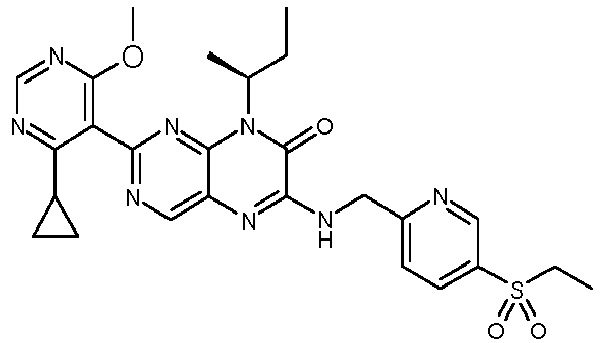
9 
10 
11 
12 
13 
14 
15 
16 
17 
18 
19 
20 
21 
22 
23 
24 
25 
26 
27 
28 
29 
30 
31 
32 
33 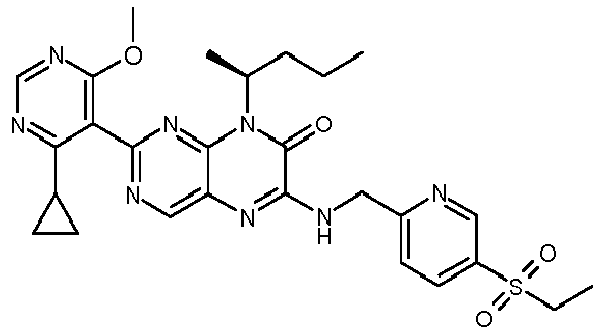
34 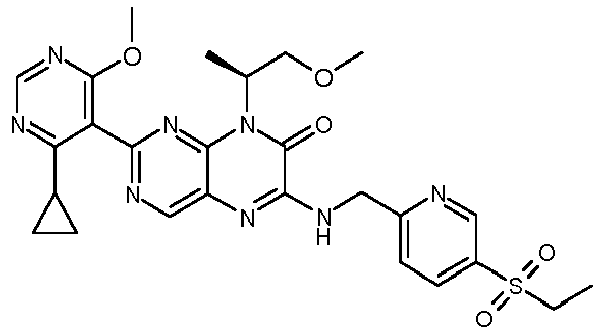
35 
36 
37 
38 
39 
40 
41 
42 
43 
44 
45 
46 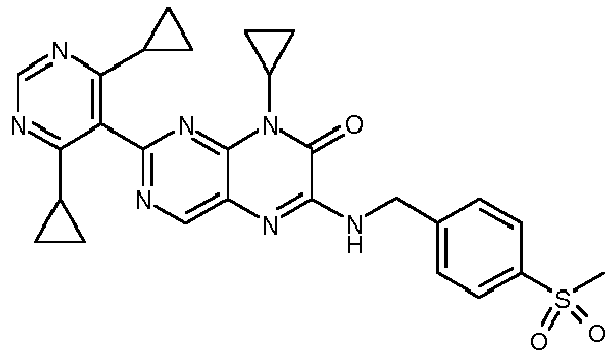
47 
48 
49 
50 
51 
52 
53 
54 
55 
56 
57 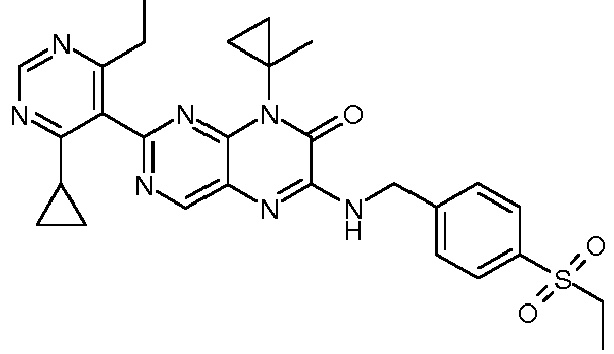
58 
59 
60 
61 
62 
63 
64 
65 
66 
67 
68 
69 
70 
71 
72 
73 
74 
75 
76 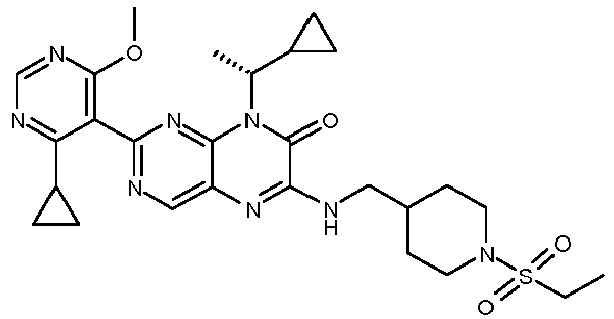
77 
78 
79 
80 
81 
82 
83 
84 
85 
86 
87 
88 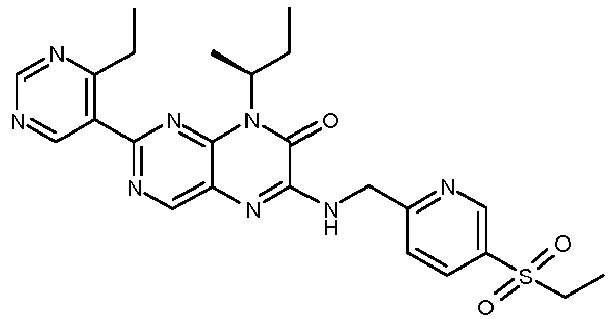
89 
90 
91 
92 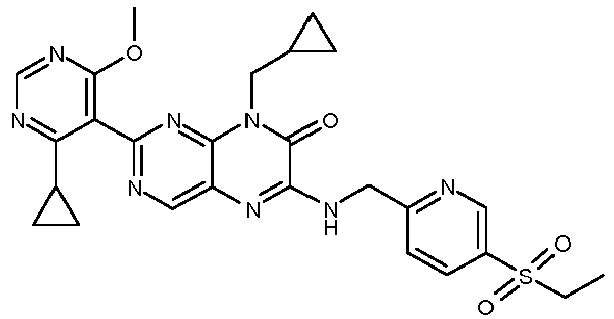
93 
94 
95 
96 
97 
98 
99 
100 
101 
102 
103 
104 
105 
106 
107 
108 
109 
110 
111 
112 
113 
114 
115 
116 
117 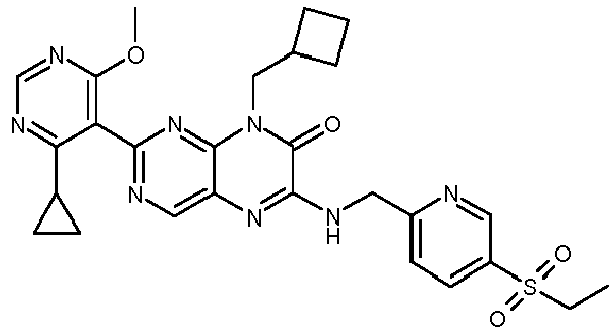
118 
119 
120 
121 
122 
123 
124 
125 
126 
127 
128 
129 
130 
131 
132 
133 
134 
135 
136 
137 
138 
139 
140 
141 
142 
143 
144 
145 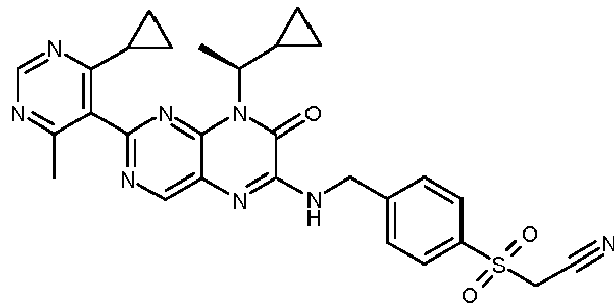
146 
147 
148 
149 
150 
151 
152 
153 
154 
155 
156 
157 
158 
159 
160 
161 
162 
163 
164 
165 
166 
167 
168 
169 
170 
171 
172 
173 
174 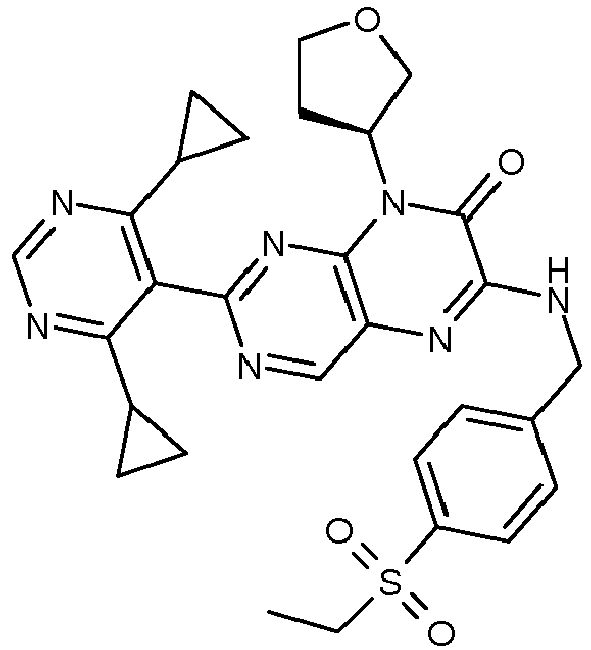
175 
176 
177 
178 
179 
180 
181 
182 
183 
184 
185 
186 
187 
188 
189 
190 
191 
192 
193 
194 
195 
196 
197 
198 
199 
200 
201 
202 
203 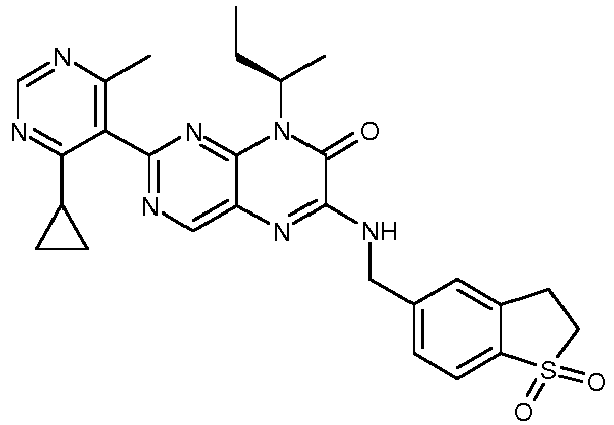
204 
205 
206 
207 
208 
209 
210 
211 
212 
213 
214 
215 
216 
217 
218 
219 
220 
221 
222 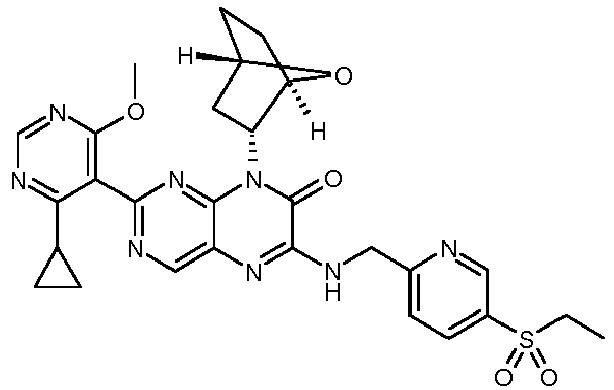
223 
224 
225 
226 
227 
228 
229 
230 
231 
232 
233 
234 
235 
236 
237 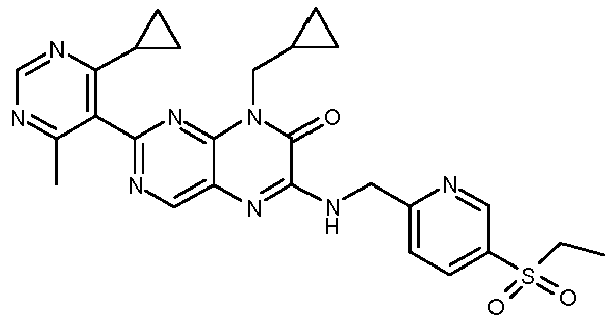
238 
239 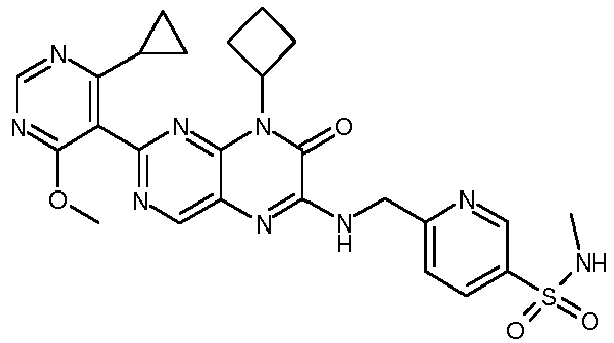
240 
241 
242 
243 
244 
245 
246 
247 
248 
249 
250 
251 
252 
253 
254 
255 
256 
257 
258 
259 
260 
261 
262 
263 
264 
265 
- A pharmaceutical composition comprising a compound of formula (I) according to any of the preceding claims, or a pharmaceutically acceptable salt thereof, and at least one pharmaceutically acceptable carrier.
- A compound of formula (I) according to any of claims 1 to 9, or a pharmaceutically acceptable salt thereof, for use as a medicament.
- Use of a compound of formula (I) according to any of claims 1 to 9, or a pharmaceutically acceptable salt thereof, for treating an autoimmune disease or allergic disorder in a patient.
- Use according to claim 12, wherein the autoimmune disease or allergic disorder is selected from rheumatoid arthritis, psoriasis, systemic lupus erythromatosis, lupus nephritis, scleroderma, asthma, allergic rhinitis, allergic eczema, multiple sclerosis, juvenile rheumatoid arthritis, juvenile idiopathic arthritis, type I diabetes, inflammatory bowel disease, graft versus host disease, psoriatic arthritis, reactive arthritis, ankylosing spondylitis, Crohn's disease, ulcerative colitis, uveitis and non-radiographic spondyloarthropathy.
- A method for treating an autoimmune disease or allergic disorder in a patient comprising administering to said patient a therapeutically effective amount of a compound of formula (I) according to any of claims 1 to 9, or a pharmaceutically acceptable salt thereof.
- A method according to claim 14, wherein the autoimmune disease or allergic disorder is selected from rheumatoid arthritis, psoriasis, systemic lupus erythromatosis, lupus nephritis, scleroderma, asthma, allergic rhinitis, allergic eczema, multiple sclerosis, juvenile rheumatoid arthritis, juvenile idiopathic arthritis, type I diabetes, inflammatory bowel disease, graft versus host disease, psoriatic arthritis, reactive arthritis, ankylosing spondylitis, Crohn's disease, ulcerative colitis, uveitis and non-radiographic spondyloarthropathy.
Applications Claiming Priority (3)
| Application Number | Priority Date | Filing Date | Title |
|---|---|---|---|
| US201461979231P | 2014-04-14 | 2014-04-14 | |
| PCT/US2015/025328 WO2015160654A1 (en) | 2014-04-14 | 2015-04-10 | Compounds as modulators of ror gamma |
| EP15718330.2A EP3131902B1 (en) | 2014-04-14 | 2015-04-10 | Compounds as modulators of ror gamma |
Related Parent Applications (2)
| Application Number | Title | Priority Date | Filing Date |
|---|---|---|---|
| EP15718330.2A Division EP3131902B1 (en) | 2014-04-14 | 2015-04-10 | Compounds as modulators of ror gamma |
| EP15718330.2A Division-Into EP3131902B1 (en) | 2014-04-14 | 2015-04-10 | Compounds as modulators of ror gamma |
Publications (2)
| Publication Number | Publication Date |
|---|---|
| EP3418280A1 true EP3418280A1 (en) | 2018-12-26 |
| EP3418280B1 EP3418280B1 (en) | 2023-07-12 |
Family
ID=52998264
Family Applications (2)
| Application Number | Title | Priority Date | Filing Date |
|---|---|---|---|
| EP15718330.2A Active EP3131902B1 (en) | 2014-04-14 | 2015-04-10 | Compounds as modulators of ror gamma |
| EP18177902.6A Active EP3418280B1 (en) | 2014-04-14 | 2015-04-10 | Compounds as modulators of ror gamma |
Family Applications Before (1)
| Application Number | Title | Priority Date | Filing Date |
|---|---|---|---|
| EP15718330.2A Active EP3131902B1 (en) | 2014-04-14 | 2015-04-10 | Compounds as modulators of ror gamma |
Country Status (35)
| Country | Link |
|---|---|
| US (5) | US9242989B2 (en) |
| EP (2) | EP3131902B1 (en) |
| JP (2) | JP6282759B2 (en) |
| KR (2) | KR102410069B1 (en) |
| CN (3) | CN107266450B (en) |
| AP (1) | AP2016009403A0 (en) |
| AR (2) | AR100058A1 (en) |
| AU (2) | AU2015247983B2 (en) |
| BR (2) | BR122020020657B1 (en) |
| CA (1) | CA2944787C (en) |
| CL (1) | CL2016002421A1 (en) |
| CY (1) | CY1122012T1 (en) |
| DK (1) | DK3131902T3 (en) |
| EA (2) | EA035063B1 (en) |
| ES (1) | ES2744299T3 (en) |
| HR (1) | HRP20191579T1 (en) |
| HU (1) | HUE045847T2 (en) |
| IL (2) | IL247419B (en) |
| LT (1) | LT3131902T (en) |
| MA (1) | MA46373A (en) |
| ME (1) | ME03513B (en) |
| MX (1) | MX370780B (en) |
| MY (1) | MY182834A (en) |
| NZ (1) | NZ723530A (en) |
| PE (2) | PE20211002A1 (en) |
| PH (2) | PH12016502019B1 (en) |
| PL (1) | PL3131902T3 (en) |
| PT (1) | PT3131902T (en) |
| RS (1) | RS59170B1 (en) |
| SG (1) | SG11201608537SA (en) |
| SI (1) | SI3131902T1 (en) |
| TW (2) | TWI652268B (en) |
| UA (2) | UA121255C2 (en) |
| UY (1) | UY36077A (en) |
| WO (1) | WO2015160654A1 (en) |
Families Citing this family (25)
| Publication number | Priority date | Publication date | Assignee | Title |
|---|---|---|---|---|
| BR122020020657B1 (en) * | 2014-04-14 | 2022-12-20 | Boehringer Ingelheim International Gmbh | COMPOUNDS, PHARMACEUTICAL COMPOSITION AND THEIR USES AS GAMMA ROR MODULATORS |
| FR3030518B1 (en) * | 2014-12-19 | 2018-03-23 | Galderma Research & Development | SULFONAMIDE DERIVATIVES AS REVERSE AGONISTS OF GAMMA RECTINTATIVE GAMMA ORPHELIN ASSOCIATED WITH RIN GAMMA RETINOIDS (T) |
| KR102702236B1 (en) | 2015-05-15 | 2024-09-04 | 오리진 온콜로지 리미티드 | Substituted tetrahydroquinolinone compounds as ROR gamma modulators |
| US10450314B2 (en) | 2015-10-01 | 2019-10-22 | Boehringer Ingelheim International Gmbh | Pteridine derivatives as modulators of ROR gamma |
| KR101947976B1 (en) | 2015-12-15 | 2019-02-13 | 아스트라제네카 아베 | Isoindole compound |
| EP3405470B1 (en) * | 2016-01-20 | 2020-07-15 | Boehringer Ingelheim International GmbH | Pyrazinedihydropyrimidinone or pyridazinedihydropyrimidinone compounds as modulators of ror gamma |
| AR110481A1 (en) | 2016-12-05 | 2019-04-03 | Lead Pharma Holding Bv | ROR MODULATORS g (RORg) |
| US20200031753A1 (en) | 2017-04-06 | 2020-01-30 | Boehringer Ingelheim International Gmbh | Cyclopropyl alkyl amines and process for their preparation |
| EP3638661A1 (en) | 2017-06-14 | 2020-04-22 | Astrazeneca AB | 2,3-dihydroisoindole-1-carboxamides useful as ror-gamma modulators |
| CN109206346A (en) * | 2017-07-01 | 2019-01-15 | 复旦大学 | Tertiary amine analog derivative or its salt and its preparation method and application |
| CN107903263B (en) * | 2017-12-28 | 2019-11-12 | 山东铂源药业有限公司 | A kind of synthetic method of Pabuk former times benefit cloth intermediate |
| SMT202300212T1 (en) | 2018-05-03 | 2023-09-06 | Shanghai hengrui pharmaceutical co ltd | Benzimidazole derivatives as modulators of retinoid-related orphan receptor gamma (rory) and pharmaceutical uses thereof |
| US20210395185A1 (en) | 2018-10-18 | 2021-12-23 | Boehringer Ingelheim International Gmbh | Scalable synthesis of optically active 1-cyclopropylalkyl-1-amines |
| WO2021061803A1 (en) | 2019-09-23 | 2021-04-01 | Nanjing Zhengxiang Pharmaceuticals Co., Ltd. | Phosphodiesterase inhibitors and use |
| US20230014730A1 (en) | 2019-09-23 | 2023-01-19 | Nanjing Zhengxiang Pharmaceuticals Co., Ltd. | Phosphodiesterase inhibitors and use |
| BR112022008293A2 (en) | 2019-10-31 | 2022-07-26 | Jiangsu Hengrui Medicine Co | ROR REGULATOR ACID ADDITION SALT, PHARMACEUTICAL COMPOSITIONS, USE THEREOF AND METHODS TO PREPARE CRYSTALLINE FORM AND PHARMACEUTICAL COMPOSITION |
| WO2022106548A1 (en) | 2020-11-19 | 2022-05-27 | Boehringer Ingelheim International Gmbh | Solid forms of a ror gamma inhibitor |
| WO2022106549A1 (en) | 2020-11-19 | 2022-05-27 | Boehringer Ingelheim International Gmbh | Crystalline salts of a ror gamma inhibitor |
| WO2022106547A1 (en) | 2020-11-19 | 2022-05-27 | Boehringer Ingelheim International Gmbh | Process for synthesising a ror gamma inhibitor |
| WO2022106550A1 (en) | 2020-11-19 | 2022-05-27 | Boehringer Ingelheim International Gmbh | Crystalline polymorphic form of a ror gamma inhibitor |
| WO2022106551A1 (en) | 2020-11-19 | 2022-05-27 | Boehringer Ingelheim International Gmbh | Co-crystals of a ror gamma inhibitor |
| CN117003757A (en) * | 2022-05-07 | 2023-11-07 | 苏州浦合医药科技有限公司 | Substituted bicyclic heteroaryls as USP1 inhibitors |
| WO2023232870A1 (en) | 2022-05-31 | 2023-12-07 | Immunic Ag | Rorg/rorgt modulators for the treatment of virus infections like covid-19 |
| CN116178279A (en) * | 2023-03-15 | 2023-05-30 | 上海药坦药物研究开发有限公司 | A kind of preparation method of 5-bromo-4-cyclopropyl-6-methoxypyrimidine and its intermediate |
| AU2024267864A1 (en) * | 2023-05-09 | 2025-11-06 | 11949098 Canada Inc. | Inverse agonists of rar related orphan receptors (rors) |
Citations (4)
| Publication number | Priority date | Publication date | Assignee | Title |
|---|---|---|---|---|
| WO2003024966A1 (en) * | 2001-08-14 | 2003-03-27 | Astrazeneca Ab | Pteridinone derivatives as modulators of chemokine receptor activity |
| WO2009022185A2 (en) * | 2007-08-16 | 2009-02-19 | Astrazeneca Ab | 6, 6-fused heterocycles, their pharmaceutical compositions and methos of use |
| US7879873B2 (en) | 2008-09-26 | 2011-02-01 | Boehringer Ingelheim International Gmbh | Azaindazole compounds as CCR1 receptor antagonists |
| WO2011049917A1 (en) | 2009-10-21 | 2011-04-28 | Boehringer Ingelheim International Gmbh | Indazole and pyrazolopyridine compounds as ccr1 receptor antagonists |
Family Cites Families (5)
| Publication number | Priority date | Publication date | Assignee | Title |
|---|---|---|---|---|
| BR112013030894A2 (en) * | 2011-06-01 | 2016-08-16 | Janus Biotherapeutics Inc | immune system modulators |
| CN106008511B (en) * | 2012-05-14 | 2018-08-14 | 华东理工大学 | Pteridine ketone derivatives and its application as EGFR, BLK, FLT3 inhibitor |
| BR122020020657B1 (en) * | 2014-04-14 | 2022-12-20 | Boehringer Ingelheim International Gmbh | COMPOUNDS, PHARMACEUTICAL COMPOSITION AND THEIR USES AS GAMMA ROR MODULATORS |
| US10450314B2 (en) * | 2015-10-01 | 2019-10-22 | Boehringer Ingelheim International Gmbh | Pteridine derivatives as modulators of ROR gamma |
| EP3405470B1 (en) * | 2016-01-20 | 2020-07-15 | Boehringer Ingelheim International GmbH | Pyrazinedihydropyrimidinone or pyridazinedihydropyrimidinone compounds as modulators of ror gamma |
-
2015
- 2015-04-10 BR BR122020020657-8A patent/BR122020020657B1/en active IP Right Grant
- 2015-04-10 SG SG11201608537SA patent/SG11201608537SA/en unknown
- 2015-04-10 MX MX2016013342A patent/MX370780B/en active IP Right Grant
- 2015-04-10 HR HRP20191579 patent/HRP20191579T1/en unknown
- 2015-04-10 RS RSP20191083 patent/RS59170B1/en unknown
- 2015-04-10 CN CN201710445827.7A patent/CN107266450B/en active Active
- 2015-04-10 MY MYPI2016001598A patent/MY182834A/en unknown
- 2015-04-10 DK DK15718330.2T patent/DK3131902T3/en active
- 2015-04-10 ES ES15718330T patent/ES2744299T3/en active Active
- 2015-04-10 HU HUE15718330A patent/HUE045847T2/en unknown
- 2015-04-10 EP EP15718330.2A patent/EP3131902B1/en active Active
- 2015-04-10 PT PT15718330T patent/PT3131902T/en unknown
- 2015-04-10 AP AP2016009403A patent/AP2016009403A0/en unknown
- 2015-04-10 ME MEP-2019-233A patent/ME03513B/en unknown
- 2015-04-10 EP EP18177902.6A patent/EP3418280B1/en active Active
- 2015-04-10 US US14/683,682 patent/US9242989B2/en active Active
- 2015-04-10 CA CA2944787A patent/CA2944787C/en active Active
- 2015-04-10 KR KR1020167031654A patent/KR102410069B1/en not_active Expired - Fee Related
- 2015-04-10 LT LTEP15718330.2T patent/LT3131902T/en unknown
- 2015-04-10 JP JP2016562565A patent/JP6282759B2/en active Active
- 2015-04-10 UA UAA201803569A patent/UA121255C2/en unknown
- 2015-04-10 PE PE2020001484A patent/PE20211002A1/en unknown
- 2015-04-10 EA EA201890329A patent/EA035063B1/en not_active IP Right Cessation
- 2015-04-10 BR BR112016021962A patent/BR112016021962A2/en not_active IP Right Cessation
- 2015-04-10 CN CN201580016630.0A patent/CN106132965B/en active Active
- 2015-04-10 KR KR1020207010364A patent/KR102410076B1/en not_active Expired - Fee Related
- 2015-04-10 SI SI201530865T patent/SI3131902T1/en unknown
- 2015-04-10 CN CN201710445005.9A patent/CN107266454B/en active Active
- 2015-04-10 PE PE2016001963A patent/PE20161572A1/en unknown
- 2015-04-10 WO PCT/US2015/025328 patent/WO2015160654A1/en not_active Ceased
- 2015-04-10 NZ NZ723530A patent/NZ723530A/en unknown
- 2015-04-10 AU AU2015247983A patent/AU2015247983B2/en not_active Ceased
- 2015-04-10 MA MA046373A patent/MA46373A/en unknown
- 2015-04-10 EA EA201691978A patent/EA031351B1/en not_active IP Right Cessation
- 2015-04-10 PL PL15718330T patent/PL3131902T3/en unknown
- 2015-04-10 UA UAA201610804A patent/UA120094C2/en unknown
- 2015-04-13 AR ARP150101103A patent/AR100058A1/en not_active Application Discontinuation
- 2015-04-13 TW TW107130729A patent/TWI652268B/en not_active IP Right Cessation
- 2015-04-13 UY UY0001036077A patent/UY36077A/en not_active Application Discontinuation
- 2015-04-13 TW TW104111832A patent/TWI655192B/en not_active IP Right Cessation
- 2015-11-20 US US14/946,873 patent/US20160075706A1/en not_active Abandoned
-
2016
- 2016-08-22 IL IL247419A patent/IL247419B/en active IP Right Grant
- 2016-09-20 US US15/270,029 patent/US9598415B2/en active Active
- 2016-09-27 CL CL2016002421A patent/CL2016002421A1/en unknown
- 2016-10-11 PH PH12016502019A patent/PH12016502019B1/en unknown
-
2017
- 2017-02-07 US US15/426,208 patent/US20180022749A1/en not_active Abandoned
-
2018
- 2018-01-24 JP JP2018009384A patent/JP6463855B2/en active Active
- 2018-09-06 US US16/123,139 patent/US20190002465A1/en not_active Abandoned
- 2018-12-20 IL IL26387818A patent/IL263878B/en active IP Right Grant
-
2019
- 2019-04-30 AU AU2019203027A patent/AU2019203027B2/en not_active Ceased
- 2019-09-09 CY CY20191100942T patent/CY1122012T1/en unknown
-
2020
- 2020-02-04 PH PH12020500252A patent/PH12020500252A1/en unknown
- 2020-07-21 AR ARP200102050A patent/AR119454A2/en unknown
Patent Citations (4)
| Publication number | Priority date | Publication date | Assignee | Title |
|---|---|---|---|---|
| WO2003024966A1 (en) * | 2001-08-14 | 2003-03-27 | Astrazeneca Ab | Pteridinone derivatives as modulators of chemokine receptor activity |
| WO2009022185A2 (en) * | 2007-08-16 | 2009-02-19 | Astrazeneca Ab | 6, 6-fused heterocycles, their pharmaceutical compositions and methos of use |
| US7879873B2 (en) | 2008-09-26 | 2011-02-01 | Boehringer Ingelheim International Gmbh | Azaindazole compounds as CCR1 receptor antagonists |
| WO2011049917A1 (en) | 2009-10-21 | 2011-04-28 | Boehringer Ingelheim International Gmbh | Indazole and pyrazolopyridine compounds as ccr1 receptor antagonists |
Non-Patent Citations (13)
| Title |
|---|
| "Handbook of Pharmaceutical Additives", 1995, GOWER |
| "Handbook of Pharmaceutical Excipients", 2000, AMERICAN PHARMACEUTICAL ASS'N |
| "Remington: The Science and Practice of Pharmacy", 2000, LIPPINCOTT WILLIAMS & WILKINS |
| BIRGE, S.M. ET AL.: "Pharmaceutical salts", J. PHARM. SCI., vol. 66, 1977, pages 1 - 19 |
| H. C. ANSEL; N. G. POPOVISH: "Pharmaceutical Dosage Forms and Drug Delivery Systems", 1990, LEA AND FEBIGER |
| IVANOV, CELL, vol. 126, 2006, pages 1121 - 1133 |
| JETTEN, ADV. DEV BIOL., vol. 16, 2006, pages 313 - 355 |
| KHAN ET AL., BIOORGANIC & MEDICINAL CHEMISTRY LETTERS, vol. 23, 2013, pages 532 - 536 |
| LEONARDI, NEW ENGLAND JOURNAL OF MEDICINE, vol. 366, 2012, pages 1190 - 1199 |
| MIOSSEC, NATURE DRUG DISCOVERY, vol. 11, 2012, pages 763 - 776 |
| PAPP, NEW ENGLAND JOURNAL OF MEDICINE, vol. 366, 2012, pages 1181 - 1189 |
| PASHA M. KHAN ET AL: "Small molecule amides as potent ROR-[gamma] selective modulators", BIOORGANIC & MEDICINAL CHEMISTRY LETTERS, vol. 23, no. 2, 1 January 2013 (2013-01-01), pages 532 - 536, XP055073469, ISSN: 0960-894X, DOI: 10.1016/j.bmcl.2012.11.025 * |
| R.O. HUGHES ET.AL.: "Investigation of aminopyridiopyrazinones as PDE5 inhibitors: evaluation of modifications to central ring system", BIOORGANIC & MEDICAL CHEMISTRY LETTERS, vol. 19, 2009, pages 4092 - 4096, XP002740794 * |
Also Published As
Similar Documents
| Publication | Publication Date | Title |
|---|---|---|
| EP3131902B1 (en) | Compounds as modulators of ror gamma | |
| EP3041821B1 (en) | Bicylic compounds as modulators of rorgamma | |
| EP3356366B1 (en) | Pteridine derivatives as modulators of ror gamma | |
| TW201838997A (en) | Compounds as modulators of ror gamma | |
| HK1227037B (en) | Compounds as modulators of ror gamma | |
| HK1227037A1 (en) | Compounds as modulators of ror gamma |
Legal Events
| Date | Code | Title | Description |
|---|---|---|---|
| PUAI | Public reference made under article 153(3) epc to a published international application that has entered the european phase |
Free format text: ORIGINAL CODE: 0009012 |
|
| STAA | Information on the status of an ep patent application or granted ep patent |
Free format text: STATUS: THE APPLICATION HAS BEEN PUBLISHED |
|
| AC | Divisional application: reference to earlier application |
Ref document number: 3131902 Country of ref document: EP Kind code of ref document: P |
|
| AK | Designated contracting states |
Kind code of ref document: A1 Designated state(s): AL AT BE BG CH CY CZ DE DK EE ES FI FR GB GR HR HU IE IS IT LI LT LU LV MC MK MT NL NO PL PT RO RS SE SI SK SM TR |
|
| AX | Request for extension of the european patent |
Extension state: BA ME |
|
| STAA | Information on the status of an ep patent application or granted ep patent |
Free format text: STATUS: REQUEST FOR EXAMINATION WAS MADE |
|
| 17P | Request for examination filed |
Effective date: 20190626 |
|
| RAV | Requested validation state of the european patent: fee paid |
Extension state: MA Effective date: 20190626 |
|
| RAX | Requested extension states of the european patent have changed |
Extension state: ME Payment date: 20190626 Extension state: BA Payment date: 20190626 |
|
| RBV | Designated contracting states (corrected) |
Designated state(s): AL AT BE BG CH CY CZ DE DK EE ES FI FR GB GR HR HU IE IS IT LI LT LU LV MC MK MT NL NO PL PT RO RS SE SI SK SM TR |
|
| STAA | Information on the status of an ep patent application or granted ep patent |
Free format text: STATUS: EXAMINATION IS IN PROGRESS |
|
| 17Q | First examination report despatched |
Effective date: 20200526 |
|
| REG | Reference to a national code |
Ref country code: DE Ref legal event code: R079 Ref document number: 602015084595 Country of ref document: DE Free format text: PREVIOUS MAIN CLASS: C07D0475100000 Ipc: A61P0001000000 Ref country code: DE Ref legal event code: R079 Free format text: PREVIOUS MAIN CLASS: C07D0475100000 Ipc: A61P0001000000 |
|
| GRAP | Despatch of communication of intention to grant a patent |
Free format text: ORIGINAL CODE: EPIDOSNIGR1 |
|
| STAA | Information on the status of an ep patent application or granted ep patent |
Free format text: STATUS: GRANT OF PATENT IS INTENDED |
|
| RIC1 | Information provided on ipc code assigned before grant |
Ipc: A61P 17/06 20060101ALI20230316BHEP Ipc: C07D 475/00 20060101ALI20230316BHEP Ipc: C07D 487/04 20060101ALI20230316BHEP Ipc: A61K 31/33 20060101ALI20230316BHEP Ipc: C07D 475/10 20060101ALI20230316BHEP Ipc: A61P 19/02 20060101ALI20230316BHEP Ipc: A61P 19/08 20060101ALI20230316BHEP Ipc: A61P 25/00 20060101ALI20230316BHEP Ipc: A61P 27/02 20060101ALI20230316BHEP Ipc: A61P 29/00 20060101ALI20230316BHEP Ipc: A61P 37/00 20060101ALI20230316BHEP Ipc: A61P 37/02 20060101ALI20230316BHEP Ipc: A61P 37/06 20060101ALI20230316BHEP Ipc: A61P 37/08 20060101ALI20230316BHEP Ipc: A61P 9/10 20060101ALI20230316BHEP Ipc: A61P 3/10 20060101ALI20230316BHEP Ipc: A61P 1/04 20060101ALI20230316BHEP Ipc: A61P 1/00 20060101AFI20230316BHEP |
|
| INTG | Intention to grant announced |
Effective date: 20230405 |
|
| GRAS | Grant fee paid |
Free format text: ORIGINAL CODE: EPIDOSNIGR3 |
|
| GRAA | (expected) grant |
Free format text: ORIGINAL CODE: 0009210 |
|
| STAA | Information on the status of an ep patent application or granted ep patent |
Free format text: STATUS: THE PATENT HAS BEEN GRANTED |
|
| AC | Divisional application: reference to earlier application |
Ref document number: 3131902 Country of ref document: EP Kind code of ref document: P |
|
| AK | Designated contracting states |
Kind code of ref document: B1 Designated state(s): AL AT BE BG CH CY CZ DE DK EE ES FI FR GB GR HR HU IE IS IT LI LT LU LV MC MK MT NL NO PL PT RO RS SE SI SK SM TR |
|
| REG | Reference to a national code |
Ref country code: CH Ref legal event code: EP |
|
| REG | Reference to a national code |
Ref country code: IE Ref legal event code: FG4D |
|
| REG | Reference to a national code |
Ref country code: DE Ref legal event code: R096 Ref document number: 602015084595 Country of ref document: DE |
|
| P01 | Opt-out of the competence of the unified patent court (upc) registered |
Effective date: 20230712 |
|
| REG | Reference to a national code |
Ref country code: LT Ref legal event code: MG9D |
|
| REG | Reference to a national code |
Ref country code: NL Ref legal event code: MP Effective date: 20230712 |
|
| REG | Reference to a national code |
Ref country code: AT Ref legal event code: MK05 Ref document number: 1586472 Country of ref document: AT Kind code of ref document: T Effective date: 20230712 |
|
| PG25 | Lapsed in a contracting state [announced via postgrant information from national office to epo] |
Ref country code: NL Free format text: LAPSE BECAUSE OF FAILURE TO SUBMIT A TRANSLATION OF THE DESCRIPTION OR TO PAY THE FEE WITHIN THE PRESCRIBED TIME-LIMIT Effective date: 20230712 |
|
| PG25 | Lapsed in a contracting state [announced via postgrant information from national office to epo] |
Ref country code: GR Free format text: LAPSE BECAUSE OF FAILURE TO SUBMIT A TRANSLATION OF THE DESCRIPTION OR TO PAY THE FEE WITHIN THE PRESCRIBED TIME-LIMIT Effective date: 20231013 |
|
| PG25 | Lapsed in a contracting state [announced via postgrant information from national office to epo] |
Ref country code: ES Free format text: LAPSE BECAUSE OF FAILURE TO SUBMIT A TRANSLATION OF THE DESCRIPTION OR TO PAY THE FEE WITHIN THE PRESCRIBED TIME-LIMIT Effective date: 20230712 |
|
| PG25 | Lapsed in a contracting state [announced via postgrant information from national office to epo] |
Ref country code: IS Free format text: LAPSE BECAUSE OF FAILURE TO SUBMIT A TRANSLATION OF THE DESCRIPTION OR TO PAY THE FEE WITHIN THE PRESCRIBED TIME-LIMIT Effective date: 20231112 |
|
| PG25 | Lapsed in a contracting state [announced via postgrant information from national office to epo] |
Ref country code: SE Free format text: LAPSE BECAUSE OF FAILURE TO SUBMIT A TRANSLATION OF THE DESCRIPTION OR TO PAY THE FEE WITHIN THE PRESCRIBED TIME-LIMIT Effective date: 20230712 Ref country code: RS Free format text: LAPSE BECAUSE OF FAILURE TO SUBMIT A TRANSLATION OF THE DESCRIPTION OR TO PAY THE FEE WITHIN THE PRESCRIBED TIME-LIMIT Effective date: 20230712 Ref country code: PT Free format text: LAPSE BECAUSE OF FAILURE TO SUBMIT A TRANSLATION OF THE DESCRIPTION OR TO PAY THE FEE WITHIN THE PRESCRIBED TIME-LIMIT Effective date: 20231113 Ref country code: NO Free format text: LAPSE BECAUSE OF FAILURE TO SUBMIT A TRANSLATION OF THE DESCRIPTION OR TO PAY THE FEE WITHIN THE PRESCRIBED TIME-LIMIT Effective date: 20231012 Ref country code: LV Free format text: LAPSE BECAUSE OF FAILURE TO SUBMIT A TRANSLATION OF THE DESCRIPTION OR TO PAY THE FEE WITHIN THE PRESCRIBED TIME-LIMIT Effective date: 20230712 Ref country code: LT Free format text: LAPSE BECAUSE OF FAILURE TO SUBMIT A TRANSLATION OF THE DESCRIPTION OR TO PAY THE FEE WITHIN THE PRESCRIBED TIME-LIMIT Effective date: 20230712 Ref country code: IS Free format text: LAPSE BECAUSE OF FAILURE TO SUBMIT A TRANSLATION OF THE DESCRIPTION OR TO PAY THE FEE WITHIN THE PRESCRIBED TIME-LIMIT Effective date: 20231112 Ref country code: HR Free format text: LAPSE BECAUSE OF FAILURE TO SUBMIT A TRANSLATION OF THE DESCRIPTION OR TO PAY THE FEE WITHIN THE PRESCRIBED TIME-LIMIT Effective date: 20230712 Ref country code: GR Free format text: LAPSE BECAUSE OF FAILURE TO SUBMIT A TRANSLATION OF THE DESCRIPTION OR TO PAY THE FEE WITHIN THE PRESCRIBED TIME-LIMIT Effective date: 20231013 Ref country code: FI Free format text: LAPSE BECAUSE OF FAILURE TO SUBMIT A TRANSLATION OF THE DESCRIPTION OR TO PAY THE FEE WITHIN THE PRESCRIBED TIME-LIMIT Effective date: 20230712 Ref country code: ES Free format text: LAPSE BECAUSE OF FAILURE TO SUBMIT A TRANSLATION OF THE DESCRIPTION OR TO PAY THE FEE WITHIN THE PRESCRIBED TIME-LIMIT Effective date: 20230712 Ref country code: AT Free format text: LAPSE BECAUSE OF FAILURE TO SUBMIT A TRANSLATION OF THE DESCRIPTION OR TO PAY THE FEE WITHIN THE PRESCRIBED TIME-LIMIT Effective date: 20230712 |
|
| PG25 | Lapsed in a contracting state [announced via postgrant information from national office to epo] |
Ref country code: PL Free format text: LAPSE BECAUSE OF FAILURE TO SUBMIT A TRANSLATION OF THE DESCRIPTION OR TO PAY THE FEE WITHIN THE PRESCRIBED TIME-LIMIT Effective date: 20230712 |
|
| REG | Reference to a national code |
Ref country code: DE Ref legal event code: R097 Ref document number: 602015084595 Country of ref document: DE |
|
| PG25 | Lapsed in a contracting state [announced via postgrant information from national office to epo] |
Ref country code: SM Free format text: LAPSE BECAUSE OF FAILURE TO SUBMIT A TRANSLATION OF THE DESCRIPTION OR TO PAY THE FEE WITHIN THE PRESCRIBED TIME-LIMIT Effective date: 20230712 Ref country code: RO Free format text: LAPSE BECAUSE OF FAILURE TO SUBMIT A TRANSLATION OF THE DESCRIPTION OR TO PAY THE FEE WITHIN THE PRESCRIBED TIME-LIMIT Effective date: 20230712 Ref country code: EE Free format text: LAPSE BECAUSE OF FAILURE TO SUBMIT A TRANSLATION OF THE DESCRIPTION OR TO PAY THE FEE WITHIN THE PRESCRIBED TIME-LIMIT Effective date: 20230712 Ref country code: DK Free format text: LAPSE BECAUSE OF FAILURE TO SUBMIT A TRANSLATION OF THE DESCRIPTION OR TO PAY THE FEE WITHIN THE PRESCRIBED TIME-LIMIT Effective date: 20230712 Ref country code: CZ Free format text: LAPSE BECAUSE OF FAILURE TO SUBMIT A TRANSLATION OF THE DESCRIPTION OR TO PAY THE FEE WITHIN THE PRESCRIBED TIME-LIMIT Effective date: 20230712 Ref country code: SK Free format text: LAPSE BECAUSE OF FAILURE TO SUBMIT A TRANSLATION OF THE DESCRIPTION OR TO PAY THE FEE WITHIN THE PRESCRIBED TIME-LIMIT Effective date: 20230712 |
|
| PLBE | No opposition filed within time limit |
Free format text: ORIGINAL CODE: 0009261 |
|
| STAA | Information on the status of an ep patent application or granted ep patent |
Free format text: STATUS: NO OPPOSITION FILED WITHIN TIME LIMIT |
|
| PG25 | Lapsed in a contracting state [announced via postgrant information from national office to epo] |
Ref country code: IT Free format text: LAPSE BECAUSE OF FAILURE TO SUBMIT A TRANSLATION OF THE DESCRIPTION OR TO PAY THE FEE WITHIN THE PRESCRIBED TIME-LIMIT Effective date: 20230712 |
|
| 26N | No opposition filed |
Effective date: 20240415 |
|
| PG25 | Lapsed in a contracting state [announced via postgrant information from national office to epo] |
Ref country code: SI Free format text: LAPSE BECAUSE OF FAILURE TO SUBMIT A TRANSLATION OF THE DESCRIPTION OR TO PAY THE FEE WITHIN THE PRESCRIBED TIME-LIMIT Effective date: 20230712 |
|
| PG25 | Lapsed in a contracting state [announced via postgrant information from national office to epo] |
Ref country code: BG Free format text: LAPSE BECAUSE OF FAILURE TO SUBMIT A TRANSLATION OF THE DESCRIPTION OR TO PAY THE FEE WITHIN THE PRESCRIBED TIME-LIMIT Effective date: 20230712 |
|
| PG25 | Lapsed in a contracting state [announced via postgrant information from national office to epo] |
Ref country code: MC Free format text: LAPSE BECAUSE OF FAILURE TO SUBMIT A TRANSLATION OF THE DESCRIPTION OR TO PAY THE FEE WITHIN THE PRESCRIBED TIME-LIMIT Effective date: 20230712 |
|
| PG25 | Lapsed in a contracting state [announced via postgrant information from national office to epo] |
Ref country code: MC Free format text: LAPSE BECAUSE OF FAILURE TO SUBMIT A TRANSLATION OF THE DESCRIPTION OR TO PAY THE FEE WITHIN THE PRESCRIBED TIME-LIMIT Effective date: 20230712 Ref country code: BG Free format text: LAPSE BECAUSE OF FAILURE TO SUBMIT A TRANSLATION OF THE DESCRIPTION OR TO PAY THE FEE WITHIN THE PRESCRIBED TIME-LIMIT Effective date: 20230712 |
|
| REG | Reference to a national code |
Ref country code: CH Ref legal event code: PL |
|
| PG25 | Lapsed in a contracting state [announced via postgrant information from national office to epo] |
Ref country code: LU Free format text: LAPSE BECAUSE OF NON-PAYMENT OF DUE FEES Effective date: 20240410 |
|
| REG | Reference to a national code |
Ref country code: BE Ref legal event code: MM Effective date: 20240430 |
|
| PG25 | Lapsed in a contracting state [announced via postgrant information from national office to epo] |
Ref country code: LU Free format text: LAPSE BECAUSE OF NON-PAYMENT OF DUE FEES Effective date: 20240410 |
|
| PG25 | Lapsed in a contracting state [announced via postgrant information from national office to epo] |
Ref country code: BE Free format text: LAPSE BECAUSE OF NON-PAYMENT OF DUE FEES Effective date: 20240430 |
|
| PG25 | Lapsed in a contracting state [announced via postgrant information from national office to epo] |
Ref country code: BE Free format text: LAPSE BECAUSE OF NON-PAYMENT OF DUE FEES Effective date: 20240430 Ref country code: CH Free format text: LAPSE BECAUSE OF NON-PAYMENT OF DUE FEES Effective date: 20240430 |
|
| PG25 | Lapsed in a contracting state [announced via postgrant information from national office to epo] |
Ref country code: IE Free format text: LAPSE BECAUSE OF NON-PAYMENT OF DUE FEES Effective date: 20240410 |
|
| PG25 | Lapsed in a contracting state [announced via postgrant information from national office to epo] |
Ref country code: CY Free format text: LAPSE BECAUSE OF FAILURE TO SUBMIT A TRANSLATION OF THE DESCRIPTION OR TO PAY THE FEE WITHIN THE PRESCRIBED TIME-LIMIT; INVALID AB INITIO Effective date: 20150410 |
|
| PG25 | Lapsed in a contracting state [announced via postgrant information from national office to epo] |
Ref country code: HU Free format text: LAPSE BECAUSE OF FAILURE TO SUBMIT A TRANSLATION OF THE DESCRIPTION OR TO PAY THE FEE WITHIN THE PRESCRIBED TIME-LIMIT; INVALID AB INITIO Effective date: 20150410 |
|
| VS25 | Lapsed in a validation state [announced via postgrant information from nat. office to epo] |
Ref country code: MA Free format text: FAILURE TO ELECT DOMICILE IN THE NATIONAL COUNTRY Effective date: 20231013 |
|
| PGFP | Annual fee paid to national office [announced via postgrant information from national office to epo] |
Ref country code: GB Payment date: 20260306 Year of fee payment: 12 |
|
| PG25 | Lapsed in a contracting state [announced via postgrant information from national office to epo] |
Ref country code: TR Free format text: LAPSE BECAUSE OF FAILURE TO SUBMIT A TRANSLATION OF THE DESCRIPTION OR TO PAY THE FEE WITHIN THE PRESCRIBED TIME-LIMIT Effective date: 20230712 |
|
| PGFP | Annual fee paid to national office [announced via postgrant information from national office to epo] |
Ref country code: DE Payment date: 20260422 Year of fee payment: 12 |
|
| PGFP | Annual fee paid to national office [announced via postgrant information from national office to epo] |
Ref country code: FR Payment date: 20260420 Year of fee payment: 12 |