EP3417840A1 - Absorbent article - Google Patents
Absorbent article Download PDFInfo
- Publication number
- EP3417840A1 EP3417840A1 EP17773577.6A EP17773577A EP3417840A1 EP 3417840 A1 EP3417840 A1 EP 3417840A1 EP 17773577 A EP17773577 A EP 17773577A EP 3417840 A1 EP3417840 A1 EP 3417840A1
- Authority
- EP
- European Patent Office
- Prior art keywords
- skin
- sheet
- horizontal
- protrusions
- side sheet
- Prior art date
- Legal status (The legal status is an assumption and is not a legal conclusion. Google has not performed a legal analysis and makes no representation as to the accuracy of the status listed.)
- Granted
Links
Images


Classifications
-
- A—HUMAN NECESSITIES
- A61—MEDICAL OR VETERINARY SCIENCE; HYGIENE
- A61F—FILTERS IMPLANTABLE INTO BLOOD VESSELS; PROSTHESES; DEVICES PROVIDING PATENCY TO, OR PREVENTING COLLAPSING OF, TUBULAR STRUCTURES OF THE BODY, e.g. STENTS; ORTHOPAEDIC, NURSING OR CONTRACEPTIVE DEVICES; FOMENTATION; TREATMENT OR PROTECTION OF EYES OR EARS; BANDAGES, DRESSINGS OR ABSORBENT PADS; FIRST-AID KITS
- A61F13/00—Bandages or dressings; Absorbent pads
- A61F13/15—Absorbent pads, e.g. sanitary towels, swabs or tampons for external or internal application to the body; Supporting or fastening means therefor; Tampon applicators
- A61F13/51—Absorbent pads, e.g. sanitary towels, swabs or tampons for external or internal application to the body; Supporting or fastening means therefor; Tampon applicators characterised by the outer layers of the pads
- A61F13/511—Topsheet, i.e. the permeable cover or layer facing the skin
- A61F13/51121—Topsheet, i.e. the permeable cover or layer facing the skin characterised by the material
-
- A—HUMAN NECESSITIES
- A61—MEDICAL OR VETERINARY SCIENCE; HYGIENE
- A61F—FILTERS IMPLANTABLE INTO BLOOD VESSELS; PROSTHESES; DEVICES PROVIDING PATENCY TO, OR PREVENTING COLLAPSING OF, TUBULAR STRUCTURES OF THE BODY, e.g. STENTS; ORTHOPAEDIC, NURSING OR CONTRACEPTIVE DEVICES; FOMENTATION; TREATMENT OR PROTECTION OF EYES OR EARS; BANDAGES, DRESSINGS OR ABSORBENT PADS; FIRST-AID KITS
- A61F13/00—Bandages or dressings; Absorbent pads
- A61F13/15—Absorbent pads, e.g. sanitary towels, swabs or tampons for external or internal application to the body; Supporting or fastening means therefor; Tampon applicators
- A61F13/53—Absorbent pads, e.g. sanitary towels, swabs or tampons for external or internal application to the body; Supporting or fastening means therefor; Tampon applicators characterised by the absorbing medium
- A61F13/534—Absorbent pads, e.g. sanitary towels, swabs or tampons for external or internal application to the body; Supporting or fastening means therefor; Tampon applicators characterised by the absorbing medium having an inhomogeneous composition through the thickness of the pad
- A61F13/535—Absorbent pads, e.g. sanitary towels, swabs or tampons for external or internal application to the body; Supporting or fastening means therefor; Tampon applicators characterised by the absorbing medium having an inhomogeneous composition through the thickness of the pad inhomogeneous in the plane of the pad, e.g. core absorbent layers being of different sizes
-
- A—HUMAN NECESSITIES
- A61—MEDICAL OR VETERINARY SCIENCE; HYGIENE
- A61F—FILTERS IMPLANTABLE INTO BLOOD VESSELS; PROSTHESES; DEVICES PROVIDING PATENCY TO, OR PREVENTING COLLAPSING OF, TUBULAR STRUCTURES OF THE BODY, e.g. STENTS; ORTHOPAEDIC, NURSING OR CONTRACEPTIVE DEVICES; FOMENTATION; TREATMENT OR PROTECTION OF EYES OR EARS; BANDAGES, DRESSINGS OR ABSORBENT PADS; FIRST-AID KITS
- A61F13/00—Bandages or dressings; Absorbent pads
- A61F13/15—Absorbent pads, e.g. sanitary towels, swabs or tampons for external or internal application to the body; Supporting or fastening means therefor; Tampon applicators
- A61F13/45—Absorbent pads, e.g. sanitary towels, swabs or tampons for external or internal application to the body; Supporting or fastening means therefor; Tampon applicators characterised by the shape
- A61F13/49—Absorbent pads, e.g. sanitary towels, swabs or tampons for external or internal application to the body; Supporting or fastening means therefor; Tampon applicators characterised by the shape specially adapted to be worn around the waist, e.g. diapers or nappies
- A61F13/49003—Reusable, washable fabric diapers
- A61F13/49006—Reusable, washable fabric diapers the reusable article being in the form of pants or briefs, e.g. slip or panty for light incontinence
-
- A—HUMAN NECESSITIES
- A61—MEDICAL OR VETERINARY SCIENCE; HYGIENE
- A61F—FILTERS IMPLANTABLE INTO BLOOD VESSELS; PROSTHESES; DEVICES PROVIDING PATENCY TO, OR PREVENTING COLLAPSING OF, TUBULAR STRUCTURES OF THE BODY, e.g. STENTS; ORTHOPAEDIC, NURSING OR CONTRACEPTIVE DEVICES; FOMENTATION; TREATMENT OR PROTECTION OF EYES OR EARS; BANDAGES, DRESSINGS OR ABSORBENT PADS; FIRST-AID KITS
- A61F13/00—Bandages or dressings; Absorbent pads
- A61F13/15—Absorbent pads, e.g. sanitary towels, swabs or tampons for external or internal application to the body; Supporting or fastening means therefor; Tampon applicators
- A61F13/51—Absorbent pads, e.g. sanitary towels, swabs or tampons for external or internal application to the body; Supporting or fastening means therefor; Tampon applicators characterised by the outer layers of the pads
- A61F13/511—Topsheet, i.e. the permeable cover or layer facing the skin
- A61F13/51104—Topsheet, i.e. the permeable cover or layer facing the skin the top sheet having a three-dimensional cross-section, e.g. corrugations, embossments, recesses or projections
- A61F13/51108—Topsheet, i.e. the permeable cover or layer facing the skin the top sheet having a three-dimensional cross-section, e.g. corrugations, embossments, recesses or projections the top sheet having corrugations or embossments having one axis relatively longer than the other axis, e.g. forming channels or grooves in a longitudinal direction
-
- A—HUMAN NECESSITIES
- A61—MEDICAL OR VETERINARY SCIENCE; HYGIENE
- A61F—FILTERS IMPLANTABLE INTO BLOOD VESSELS; PROSTHESES; DEVICES PROVIDING PATENCY TO, OR PREVENTING COLLAPSING OF, TUBULAR STRUCTURES OF THE BODY, e.g. STENTS; ORTHOPAEDIC, NURSING OR CONTRACEPTIVE DEVICES; FOMENTATION; TREATMENT OR PROTECTION OF EYES OR EARS; BANDAGES, DRESSINGS OR ABSORBENT PADS; FIRST-AID KITS
- A61F13/00—Bandages or dressings; Absorbent pads
- A61F13/15—Absorbent pads, e.g. sanitary towels, swabs or tampons for external or internal application to the body; Supporting or fastening means therefor; Tampon applicators
- A61F13/51—Absorbent pads, e.g. sanitary towels, swabs or tampons for external or internal application to the body; Supporting or fastening means therefor; Tampon applicators characterised by the outer layers of the pads
- A61F13/511—Topsheet, i.e. the permeable cover or layer facing the skin
- A61F13/5116—Topsheet, i.e. the permeable cover or layer facing the skin being formed of multiple layers
-
- A—HUMAN NECESSITIES
- A61—MEDICAL OR VETERINARY SCIENCE; HYGIENE
- A61F—FILTERS IMPLANTABLE INTO BLOOD VESSELS; PROSTHESES; DEVICES PROVIDING PATENCY TO, OR PREVENTING COLLAPSING OF, TUBULAR STRUCTURES OF THE BODY, e.g. STENTS; ORTHOPAEDIC, NURSING OR CONTRACEPTIVE DEVICES; FOMENTATION; TREATMENT OR PROTECTION OF EYES OR EARS; BANDAGES, DRESSINGS OR ABSORBENT PADS; FIRST-AID KITS
- A61F13/00—Bandages or dressings; Absorbent pads
- A61F13/15—Absorbent pads, e.g. sanitary towels, swabs or tampons for external or internal application to the body; Supporting or fastening means therefor; Tampon applicators
- A61F13/53—Absorbent pads, e.g. sanitary towels, swabs or tampons for external or internal application to the body; Supporting or fastening means therefor; Tampon applicators characterised by the absorbing medium
- A61F13/539—Absorbent pads, e.g. sanitary towels, swabs or tampons for external or internal application to the body; Supporting or fastening means therefor; Tampon applicators characterised by the absorbing medium characterised by the connection of the absorbent layers with each other or with the outer layers
-
- A—HUMAN NECESSITIES
- A61—MEDICAL OR VETERINARY SCIENCE; HYGIENE
- A61F—FILTERS IMPLANTABLE INTO BLOOD VESSELS; PROSTHESES; DEVICES PROVIDING PATENCY TO, OR PREVENTING COLLAPSING OF, TUBULAR STRUCTURES OF THE BODY, e.g. STENTS; ORTHOPAEDIC, NURSING OR CONTRACEPTIVE DEVICES; FOMENTATION; TREATMENT OR PROTECTION OF EYES OR EARS; BANDAGES, DRESSINGS OR ABSORBENT PADS; FIRST-AID KITS
- A61F13/00—Bandages or dressings; Absorbent pads
- A61F13/15—Absorbent pads, e.g. sanitary towels, swabs or tampons for external or internal application to the body; Supporting or fastening means therefor; Tampon applicators
- A61F13/45—Absorbent pads, e.g. sanitary towels, swabs or tampons for external or internal application to the body; Supporting or fastening means therefor; Tampon applicators characterised by the shape
- A61F13/49—Absorbent pads, e.g. sanitary towels, swabs or tampons for external or internal application to the body; Supporting or fastening means therefor; Tampon applicators characterised by the shape specially adapted to be worn around the waist, e.g. diapers or nappies
- A61F13/494—Absorbent pads, e.g. sanitary towels, swabs or tampons for external or internal application to the body; Supporting or fastening means therefor; Tampon applicators characterised by the shape specially adapted to be worn around the waist, e.g. diapers or nappies characterised by edge leakage prevention means
-
- A—HUMAN NECESSITIES
- A61—MEDICAL OR VETERINARY SCIENCE; HYGIENE
- A61F—FILTERS IMPLANTABLE INTO BLOOD VESSELS; PROSTHESES; DEVICES PROVIDING PATENCY TO, OR PREVENTING COLLAPSING OF, TUBULAR STRUCTURES OF THE BODY, e.g. STENTS; ORTHOPAEDIC, NURSING OR CONTRACEPTIVE DEVICES; FOMENTATION; TREATMENT OR PROTECTION OF EYES OR EARS; BANDAGES, DRESSINGS OR ABSORBENT PADS; FIRST-AID KITS
- A61F13/00—Bandages or dressings; Absorbent pads
- A61F13/15—Absorbent pads, e.g. sanitary towels, swabs or tampons for external or internal application to the body; Supporting or fastening means therefor; Tampon applicators
- A61F13/45—Absorbent pads, e.g. sanitary towels, swabs or tampons for external or internal application to the body; Supporting or fastening means therefor; Tampon applicators characterised by the shape
- A61F13/49—Absorbent pads, e.g. sanitary towels, swabs or tampons for external or internal application to the body; Supporting or fastening means therefor; Tampon applicators characterised by the shape specially adapted to be worn around the waist, e.g. diapers or nappies
- A61F13/496—Absorbent pads, e.g. sanitary towels, swabs or tampons for external or internal application to the body; Supporting or fastening means therefor; Tampon applicators characterised by the shape specially adapted to be worn around the waist, e.g. diapers or nappies in the form of pants or briefs
- A61F13/4963—Absorbent pads, e.g. sanitary towels, swabs or tampons for external or internal application to the body; Supporting or fastening means therefor; Tampon applicators characterised by the shape specially adapted to be worn around the waist, e.g. diapers or nappies in the form of pants or briefs characterized by the seam
-
- A—HUMAN NECESSITIES
- A61—MEDICAL OR VETERINARY SCIENCE; HYGIENE
- A61F—FILTERS IMPLANTABLE INTO BLOOD VESSELS; PROSTHESES; DEVICES PROVIDING PATENCY TO, OR PREVENTING COLLAPSING OF, TUBULAR STRUCTURES OF THE BODY, e.g. STENTS; ORTHOPAEDIC, NURSING OR CONTRACEPTIVE DEVICES; FOMENTATION; TREATMENT OR PROTECTION OF EYES OR EARS; BANDAGES, DRESSINGS OR ABSORBENT PADS; FIRST-AID KITS
- A61F13/00—Bandages or dressings; Absorbent pads
- A61F13/15—Absorbent pads, e.g. sanitary towels, swabs or tampons for external or internal application to the body; Supporting or fastening means therefor; Tampon applicators
- A61F13/51—Absorbent pads, e.g. sanitary towels, swabs or tampons for external or internal application to the body; Supporting or fastening means therefor; Tampon applicators characterised by the outer layers of the pads
- A61F13/511—Topsheet, i.e. the permeable cover or layer facing the skin
- A61F13/513—Topsheet, i.e. the permeable cover or layer facing the skin characterised by its function or properties, e.g. stretchability, breathability, rewet, visual effect; having areas of different permeability
Definitions
- the present invention relates to an absorbent article.
- Patent Document 1 discloses an absorbent article having a front exterior member, a back exterior member, and an absorbent main body crosslinking between the front exterior member and the back exterior member, wherein both horizontal edges of the front exterior member and both horizontal edges of the back exterior member are bonded to each other to form a waist opening and a pair of leg openings.
- a top sheet of the absorbent main body has a plurality of concave portions hollowed in a non-skin side and a plurality of convex portions protruding in a skin side.
- a plurality of concave portions and a plurality of convex portions alternate in a horizontal direction (short direction) of the top sheet.
- an absorbent article having a longitudinal direction, a horizontal direction, and a thickness direction, including: an absorbent core to absorb a liquid; a liquid permeable skin-side sheet provided on a skin side of the absorbent core in the thickness direction; and a liquid permeable second sheet arranged between the absorbent core and the skin-side sheet in the thickness direction and to be placed in a wearer's inseam, wherein the skin-side sheet has a plurality of protrusions formed along the longitudinal direction and spaced apart in the horizontal direction, the second sheet is smaller than the skin-side sheet in the horizontal direction, the skin-side sheet has an overlapping region overlapping with the second sheet in the thickness direction, and both end regions separated by a predetermined distance outward from the overlapping region in the horizontal direction and provided to overlap with the overlapping region in the longitudinal direction, and a horizontal pitch of the protrusions in the overlapping region of the skin-side sheet is larger than a horizontal pitch of the protrusions in the two end
- An absorbent article having a longitudinal direction, a horizontal direction, and a thickness direction includes: an absorbent core to absorb a liquid; a liquid permeable skin-side sheet provided on a skin side of the absorbent core in the thickness direction; and a liquid permeable second sheet arranged between the absorbent core and the skin-side sheet in the thickness direction and to be placed in a wearer's inseam, wherein the skin-side sheet has a plurality of protrusions formed along the longitudinal direction and spaced apart in the horizontal direction, the second sheet is smaller than the skin-side sheet in the horizontal direction, the skin-side sheet has an overlapping region overlapping with the second sheet in the thickness direction, and two end regions separated by a predetermined distance outward from the overlapping region in the horizontal direction and provided to overlap with the overlapping region in the longitudinal direction, wherein a horizontal pitch of the protrusions in the overlapping region of the skin-side sheet is larger than a horizontal pitch of the protrusions in the two end regions of the skin-side sheet.
- the number of gaps of the protrusions adjacent in the horizontal direction per unit length is larger than the number of gaps of the adjacent protrusions per unit length of the overlapping region.
- the gap between the protrusions adjacent in the horizontal direction is smaller than the thickness of the protrusion. Therefore, the skin-side sheet is easily deformable the thickness direction. Accordingly, in both end regions, the diaper is easily deformable the thickness direction and easily deforms to fit the shape of the wearer's inseam, compared to the overlapping region.
- the horizontal pitch of the protrusions gradually increases from the two end regions toward the overlapping region in the skin-side sheet.
- the horizontal pitch of the protrusions gradually increases from both end regions toward the overlapping region in the skin-side sheet. Therefore, even in both sides of the overlapping region of the horizontal direction, it is possible to easily maintain the shape of the protrusion in a portion close to the overlapping region and easily filter out solid components in urine, menstrual bleeding, and the like.
- the number of gaps of the protrusions adjacent in the horizontal direction per unit length increases more than the number of gaps of the protrusions adjacent in the horizontal direction per unit length of the overlapping region. Therefore, it is possible to facilitate collapse in the thickness direction compared to the overlapping region and improve the fit.
- the skin-side sheet is compressed in the horizontal direction, and horizontal compression per unit length of the skin-side sheet in the overlapping region is smaller than compression per unit length of the skin-side sheet in the two end regions.
- the horizontal pitch of the protrusions is adjusted depending on the compression per unit length of the skin-side sheet in the horizontal direction. Therefore, it is possible to change the horizontal pitch of the protrusions, for example, without the need to change a pitch setting for nozzles of a manufacturing device.
- the second sheet is smaller than the skin-side sheet in the longitudinal direction, and the horizontal pitch of the protrusions in the overlapping region is larger than the horizontal pitch of the protrusions in at least one of one end and the other end of the longitudinal direction of the skin-side sheet.
- the horizontal pitch of the protrusions is smaller than the horizontal pitch of the protrusions of the overlapping region. Therefore, the number of gaps of the protrusions adjacent in the horizontal direction per unit length is larger than the number of gaps of adjacent protrusions per unit length in the overlapping region. Since the gap between the protrusions adjacent in the horizontal direction is smaller than the thickness of the protrusion, the skin-side sheet is easily deformable the thickness direction.
- the diaper is easily deformable the thickness direction compared to the overlapping region and easily deforms to fit the shape of the wearer's front or back side (for example, in a cup shape).
- the shape of the wearer's front or back side for example, in a cup shape.
- the skin-side sheet has a horizontal pitch of the protrusions gradually increasing toward the overlapping region from at least one of the one end and the other end of the longitudinal direction.
- the horizontal pitch of the protrusions gradually increases toward the overlapping region from at least one of one end and the other end of the longitudinal direction of the skin-side sheet. Even in both sides of the longitudinal direction of the overlapping region, it is possible to easily maintain the shape of the protrusions in a portion close to the overlapping region and easily filter out solid components in urine, menstrual bleeding, and the like.
- the number of gaps of the protrusions adjacent in the horizontal direction per unit length increases more than the number of gaps of the protrusions adjacent in the horizontal direction per unit length in the overlapping region. Therefore, the diaper is easily deformable the thickness direction and easily deforms to fit the shape of the wearer's front side or rear side, compared to the overlapping region. As a result, it is possible to further improve fit in the vicinity of the waist opening.
- the skin-side sheet is compressed in the horizontal direction, and horizontal compression per unit length of the skin-side sheet in the overlapping region is smaller than longitudinal compression per unit length of the skin-side sheet in at least one of the one end and the other end.
- the horizontal pitch of the protrusions is adjusted depending on the horizontal compression per unit length of the skin-side sheet even in the longitudinal direction of the skin-side sheet. Therefore, it is possible to change the horizontal pitch of the protrusions without the need to change a pitch setting of nozzles of a manufacturing device and the like.
- the skin-side sheet and the absorbent core are bonded in the thickness direction by a plurality of skin-side bonding portions provided at intervals in the horizontal direction between the skin-side sheet and the absorbent core, and a position horizontally intermediate between each apex of any two protrusions adjacent in the horizontal direction among the plurality of protrusions does not overlap with a position of the skin-side bonding portion of the thickness direction in the two end regions of the skin-side sheet.
- the absorbent article described above further includes a liquid non-permeable non-skin-side sheet provided on a non-skin side of the absorbent core, wherein the non-skin-side sheet and the absorbent core are bonded in the thickness direction by a plurality of non-skin-side bonding portions provided at intervals in the horizontal direction, and a position horizontally intermediate between each apex of any two protrusions adjacent in the horizontal direction among the plurality of protrusions does not overlap with a position of the non-skin-side bonding portion in the thickness direction in the two end regions of the skin-side sheet.
- the position horizontally intermediate between each apex of the protrusions adjacent in the horizontal direction overlaps with a position of the gap of the skin-side bonding portions adjacent in the horizontal direction and a position of the gap of the non-skin-side bonding portions adjacent in the horizontal direction in the thickness direction. Therefore, the skin-side sheet is easily deformable the thickness direction in both the gap of the skin-side bonding portion and the gap of the non-skin-side bonding portion. As a result, it is possible to further improve fit when worn.
- the absorbent core is provided with grooves extending along the longitudinal direction in both horizontal sides of the second sheet, and a basis weight of the groove is smaller than a basis weight of a portion other than the groove of the absorbent core.
- a pair of grooves for example, slits
- the absorbent core having a thickness is easily deformable the thickness direction.
- grooves are provided on both sides of the overlapping region in the horizontal direction, it is possible to fit the diaper to a wearer's somatotype in the inseam side of the wearer's legs. Accordingly, it is possible to improve fit.
- a position horizontally intermediate between each apex of any two protrusions adjacent in the horizontal direction among the plurality of protrusions overlaps with a position of the groove in the thickness direction.
- the middle position (a portion of the skin-side sheet having a thickness smaller than the thickness of the protrusion) overlaps with a position of the groove in the thickness direction. Therefore, the skin-side sheet is easily deformable the thickness direction in the groove. As a result, it is possible to fit the diaper to a wearer's somatotype and further improve fit when worn.
- the skin-side sheet has a density difference in the horizontal direction, and an average density of the second sheet is higher than an average density of the skin-side sheet.
- the skin-side sheet is formed of air-through nonwoven fabric.
- the skin-side sheet is formed of short fibers of air-through nonwoven fabric having a high degree of freedom without bonding. Therefore, it is possible to easily form a gap between fibers. As a result, it is possible to more effectively suppress clogging of the skin-side sheet caused by solid components in urine, menstrual bleeding, and the like.
- a pull-on disposable diaper (hereinafter, simply referred to as "diaper 1") especially for elderly persons will be described.
- FIG. 1 is a schematic perspective view illustrating an exemplary configuration of the diaper 1 according to the first embodiment.
- FIG. 2 is a schematic plan view illustrating the diaper 1 in an unfolded and expanded state as seen from a skin side.
- FIG. 3 is a cross-sectional view along the line III-III of FIG. 2 .
- the diaper 1 has a "vertical direction” and a “horizontal direction” perpendicular to the vertical direction.
- the diaper 1 has a "thickness direction”.
- a waist side of the wearer will be referred to as an "upper side”
- an inseam side of the wearer will be referred to as a “lower side”.
- a side at the front of the wearer will be simply referred to as a "front side”
- a side at the back of the wearer will be simply referred to as a "back side”.
- the "thickness direction” refers to a direction in which each member of the diaper 1 is stacked.
- a side where a wearer makes contact with the wearer's skin will be referred to as a "skin side”
- the side opposite the skin side will be referred to as a "non-skin side”.
- the skin side of the thickness direction will be simply referred to as a “skin side”
- the non-skin side of the thickness direction will be simply referred to as the "non-skin side”.
- the diaper 1 when worn, the diaper 1 has a front waist section 2 placed at the front of the wearer, a back waist section 3 placed at the back of the wearer, and an inseam section 4.
- bonding regions 20 provided in both ends of the horizontal direction of the front waist section 2 and bonding regions 30 provided in both ends of the horizontal direction of the back waist section 3 are bonded to each other, so that a single waist opening 1HB and a pair of leg openings 1HL are formed as illustrated in FIG. 1 to provide a pull-on diaper.
- the diaper 1 is a so-called two-piece type including a band-shaped absorbent main body 11 that absorbs liquid such as urine and an exterior member 12 on the non-skin side of the absorbent main body 11.
- the exterior member 12 has the front waist section 2, the back waist section 3, and the inseam section 4.
- the front waist section 2 is provided on one end portion 11A of the longitudinal direction of the absorbent main body 11, and the back waist section 3 is provided on the other end portion 11B of the longitudinal direction of the absorbent main body 11. That is, the absorbent main body 11 is stretched between the front waist section 2 and the back waist section 3. Similar to the absorbent main body 11, the inseam section 4 is stretched between the front waist section 2 and the back waist section 3 in the non-skin side of the absorbent main body 11.
- the exterior member 12 has a front exterior top sheet 21, a front exterior back sheet 22, a back exterior top sheet 31, a back exterior back sheet 32, and an exterior center sheet 40.
- the sheets may be formed of, for example, air-through nonwoven fabric, spunbond nonwoven fabric, spunbond/meltblown/spunbond (SMS) nonwoven fabric, and the like.
- SMS spunbond/meltblown/spunbond
- the front exterior top sheet 21 and the back exterior top sheet 31 are formed of SMS nonwoven fabric
- the front exterior back sheet 22, the back exterior back sheet 32, and the exterior center sheet 40 are formed of spunbond nonwoven fabric.
- the front exterior top sheet 21 and the front exterior back sheet 22 are provided on the front side, and the front exterior top sheet 21 is placed between the absorbent main body 11 and the front exterior back sheet 22 in the thickness direction.
- a plurality of front elastic members 23 formed of, for example, elastic strings are arranged between the front exterior top sheet 21 and the front exterior back sheet 22 while being spaced apart vertically.
- a plurality of front elastic members 23 are arranged to overlap with the one end portion 11A of the longitudinal direction of the absorbent main body 11 in the thickness direction.
- the front exterior back sheet 22 has a front folding section 22A having an upper vertical end portion folded to the lower side (inseam side).
- a plurality of front upper-end elastic members 24 formed of, for example, elastic strings are provided in a gap of the thickness direction of the front folding section 22A while being spaced apart vertically.
- a plurality of front elastic members 23 and a plurality of front upper-end elastic members 24 are provided along the horizontal direction. As the plurality of front elastic members 23 and the plurality of front upper-end elastic members 24 are compressed in the horizontal direction, they tighten the front waist of the wearer and improve fit. Note that the plurality of front elastic members 23 and a plurality of front upper-end elastic members 24 are not necessarily provided in the front waist section 2.
- the front waist section 2 may be formed of elastic nonwoven fabric or the like expandable/shrinkable horizontally.
- an interval between the front upper-end elastic members 24 adjacent in the vertical direction in the front waist section 2 is narrower than an interval between the front elastic members 23 adjacent in the vertical direction. Therefore, a plurality of wrinkles formed by compressing a plurality of front upper-end elastic members 24 in the horizontal direction have a size smaller than the size of a plurality of wrinkles formed by squeezing together a plurality of front elastic members 23 in the horizontal direction. Therefore, when the diaper 1 is worn, clearance from the wearer's skin is reduced in the vicinity of the back side of the waist opening 1HB (refer to FIG. 1 ) for a snug fit. As a result, it is possible to improve fit and prevent the diaper 1 from slipping off.
- the back exterior top sheet 31 and the back exterior back sheet 32 are provided on the back side, and the back exterior top sheet 31 is placed between the absorbent main body 11 and the back exterior back sheet 32 in the thickness direction. As illustrated in FIG. 3 , the back exterior top sheet 31 and the back exterior back sheet 32 are arranged separately from the front exterior top sheet 21 and the front exterior back sheet 22.
- a plurality of back elastic members 33 are arranged between the back exterior top sheet 31 and the back exterior back sheet 32 and are spaced apart vertically. A plurality of back elastic members 33 are arranged to overlap with the other end portion 11B of the longitudinal direction of the absorbent main body 11 in the thickness direction.
- the back exterior back sheet 32 has a back folding portion 32A having a vertical upper-end portion folded toward the lower side (inseam side), and a plurality of back upper-end elastic members 34 are provided in a gap of the thickness direction of the back folding portion 32A while being spaced apart vertically.
- a plurality of back elastic members 33 and a plurality of back upper-end elastic members 34 are provided along the horizontal direction, and the plurality of back elastic members 33 and the plurality of back upper-end elastic members 34 are compressed in the horizontal direction to tighten a back waist of the wearer and improve fit.
- a plurality of back elastic members 33 and a plurality of back upper-end elastic members 34 are not necessarily provided in the back waist section 3.
- the back waist section 3 formed of elastic nonwoven fabric or the like that expandable/shrinkable horizontally may be provided.
- an interval between the back upper-end elastic members 34 adjacent in the vertical direction in the back waist section 3 is narrower than an interval of the back elastic members 33 adjacent in the vertical direction. Therefore, a plurality of wrinkles formed by compressing a plurality of back upper-end elastic members 34 in the horizontal direction have a size in the vertical direction smaller than the size of a plurality of wrinkles formed by compressing a plurality of back elastic members 33 in the horizontal direction. Therefore, when the diaper 1 is worn, clearance from the wearer's skin is reduced in the vicinity of the back side of the waist opening 1HB (refer to FIG. 1 ) for a snug fit. As a result, it is possible to improve fit and prevent the diaper 1 from slipping off.
- a plurality of front leg elastic members 25 are provided in the lower end portion of the front waist section 2 and in both sides of the absorbent main body 11 of the horizontal direction
- a plurality of back leg elastic members 35 are provided in the lower end portion of the back waist section 3 and in both sides of the absorbent main body 11 of the horizontal direction.
- a plurality of front leg elastic members 25 and a plurality of back leg elastic members 35 are arranged separately not to cross the absorbent main body 11 in the longitudinal direction.
- a plurality of front leg elastic members 25 and a plurality of back leg elastic members 35 are respectively provided to fit around the leg opening 1HL (refer to FIG. 1 ) to improve fit around the wearer's legs and prevent leakage of urine to the outside.
- a plurality of front elastic members 23, a plurality of front upper-end elastic members 24, a plurality of front leg elastic members 25, a plurality of back elastic members 33, a plurality of back upper-end elastic members 34, and a plurality of back leg elastic members 35 are indicated by one-dotted chain lines.
- the diaper 1 has an expanded state.
- the “expanded state” refers to a state in which the front waist section 2 and the back waist section 3 are expanded without wrinkles by stretching a plurality of front elastic members 23, a plurality of front upper-end elastic members 24, a plurality of front leg elastic members 25, a plurality of back elastic members 33, a plurality of back upper-end elastic members 34, and a plurality of back leg elastic members 35.
- a plurality of front elastic members 23, a plurality of front upper-end elastic members 24, a plurality of back elastic members 33, and a plurality of back upper-end elastic members 34 expand in the horizontal direction
- a plurality of front leg elastic members 25 and a plurality of back leg elastic members 35 expand in the horizontal direction and the vertical direction.
- the exterior center sheet 40 is arranged to link the front exterior top sheet 21 and the front exterior back sheet 22 and link the back exterior top sheet 31 and the back exterior back sheet 32 to prevent the absorbent main body 11 from being exposed to the outside.
- FIG. 4 is a schematic plan view illustrating the absorbent main body 11 as seen from the skin side.
- FIG. 5A is a cross-sectional view along the line VA-VA of FIG. 4
- FIG. 5B is a cross-sectional view along the line VA-VA of FIG. 4 to illustrate a deformed state of the absorbent main body 11.
- the absorbent main body 11 includes a top sheet 51, a second sheet 52, an absorbent core 53, a back sheet 54, a pair of side sheets 55, and a center elastic member cover sheet 56.
- Each member of the absorbent main body 11 is bonded to each other in the thickness direction using an adhesive such as a hot-melt adhesive.
- the absorbent core 53 is a member for absorbing and holding a liquid such as urine and is formed of, for example, liquid absorbent fibers such as pulp fibers mixed with super-absorbent polymer (SAP) .
- the absorbent core 53 includes a first core layer 531 formed in an hourglass shape, and a second core layer 532 having a size larger than the size of the first core layer 531 longitudinally and horizontally.
- the second core layer 532 is provided on the non-skin side of the first absorbent core 531.
- the center slit 532A along the longitudinal direction is provided in the center of the longitudinal direction and in the center of the horizontal direction, and a pair of side slits 532B along the longitudinal direction are provided in both sides of the horizontal direction of the center slit 532A while being spaced apart in the horizontal direction.
- the absorbent core 53 does not necessarily have a two-layered structure including the first core layer 531 and the second core layer 532.
- the top sheet 51 is provided on the skin side of the absorbent core 53 (first core layer 531) and serves as a liquid permeable skin-side sheet that can make contact with the wearer's skin when the diaper 1 is being worn.
- the top sheet 51 is formed, for example, of hydrophilic air-through nonwoven fabric, spunbond nonwoven fabric, or the like. According to the present embodiment, the top sheet 51 is formed of air-through nonwoven fabric. As illustrated in FIGS. 4 , 5A, and 5B , the top sheet 51 has a plurality of protrusions 511 formed along the longitudinal direction and spaced apart in the horizontal direction.
- a plurality of protrusions 511 protrude toward the skin side and are formed to continuously extend from one end 510A of the longitudinal direction of the top sheet 51 (of the absorbent main body 11) to the other end 510B.
- an air passage is formed. Therefore, the heat generated inside the diaper 1 can be easily discharged to the outside to improve air permeability.
- the protrusions 511 are not necessarily formed to continuously extend from the one end 510A of the longitudinal direction of the top sheet 51 to the other end 510B. In FIG. 4 , for simplicity, only a part of a plurality of protrusions 511 is illustrated.
- a plurality of front elastic members 23 are placed to overlap with the one end portion 11A of the longitudinal direction of the absorbent main body 11 in the thickness direction. Therefore, a plurality of front elastic members 23 are provided in the one end portion 11A of the longitudinal direction of the absorbent main body 11 to cross a plurality of protrusions 511.
- a plurality of back elastic members 33 are placed to overlap with the other end portion 11B of the longitudinal direction of the absorbent main body 11 in the thickness direction. Therefore, a plurality of back elastic members 33 is provided to cross a plurality of protrusions 511 in the other end portion 11B of the longitudinal direction of the absorbent main body 11.
- the top sheet 51 Since a plurality of protrusions 511 is provided, the top sheet 51 has a high density portion (high density region 511D of FIG. 7B ) and a low density portion. That is, the top sheet 51 has a density difference in the horizontal direction.
- the top sheet 51 having a plurality of protrusions 511 will be described in detail below.
- the second sheet 52 is a liquid permeable sheet arranged between the absorbent core 53 and the top sheet 51 in the thickness direction and placed in the wearer's inseam.
- the second sheet 52 is formed of hydrophilic air-through nonwoven fabric or the like. According to the embodiment, an average density of the entire second sheet 52 is higher than the average density of the horizontal direction of the top sheet 51.
- the "average density” is measured in the following way.
- the diaper 1 is laid on an observation table while an observation surface of the top sheet 51 (second sheet 52) faces upward, and a fiber surface is photographed using a predetermined measurement device (for example, a digital microscope, product number: VHX-100, produced by Keyence Corporation) to obtain a binary image of the fiber.
- a liquid such as urine tending to flow from a low density side to a high density side easily moves to the second sheet 52 as it passes through the top sheet 51.
- a liquid migration property inside the absorbent main body 11 is improved, and urine or the like is easily absorbed in the absorbent core 53. Therefore, it is possible to prevent accumulation of urine or the like on the top sheet 51 and more effectively suppress leakage of urine.
- the average density of the second sheet 52 is not necessarily higher than the average density of the top sheet 51.
- the second sheet 52 has a rectangular shape having a long side in the longitudinal direction and is formed to be smaller than the top sheet 51 horizontally and longitudinally. According to the embodiment, the second sheet 52 is formed to be smaller than the first core layer 531 of the absorbent core 53 longitudinally and horizontally. Note that the second sheet 52 may be smaller than the top sheet 51 at least horizontally.
- the back sheet 54 is a liquid non-permeable non-skin-side sheet provided on the non-skin side of the absorbent core 53 and is formed of, for example, a polyethylene film or the like.
- a pair of leak-proof side sheets 55 are provided on both sides of the horizontal direction in the non-skin side of the back sheet 54 and formed of, for example, hydrophobic SMS nonwoven fabric or the like.
- a pair of side sheets 55 are bonded to the skin-side surface of the top sheet 51 such that the horizontal outer end portion is folded to face the skin side to respectively surround the horizontal outer end portion of the top sheet 51 and the horizontal outer end portion of the back sheet 54.
- a plurality of longitudinally compressibly stretchable inseam-side leg elastic members 57 spaced apart in the horizontal direction are provided between the back sheet 54 and the side sheet 55.
- a plurality of inseam-side leg elastic members 57 are placed in both ends of the horizontal direction of the absorbent main body 11 to improve fit of the wearer's legs in cooperation with a plurality of front leg elastic members 25 and a plurality of back leg elastic members 35 (refer to FIG. 2 ) when the diaper 1 is worn.
- a plurality of longitudinally compressibly stretchable center elastic members 58 spaced apart in the horizontal direction are provided in the longitudinal center inward of a plurality of inseam-side leg elastic members 57 in the horizontal direction.
- a plurality of center elastic members 58 are placed to overlap with a position of the center slit 532A of the second core layer 532 in the thickness direction.
- a center elastic member cover sheet 56 for covering a plurality of center elastic members 58 from the non-skin side is arranged.
- the center elastic member cover sheet 56 is formed of, for example, hydrophobic spunbond nonwoven fabric or the like. As illustrated in FIG. 5A , the center elastic member cover sheet 56 is placed inward of a pair of side sheets 55 in the horizontal direction while being spaced apart in the horizontal direction from a pair of side sheets 55. As illustrated in FIGS. 2 and 4 , the center elastic member cover sheet 56 is formed in a band shape extending from the one end portion 11A to the other end portion 11B in the longitudinal direction of the absorbent main body 11.
- the absorbent main body 11 has a plurality of inseam-side leg elastic members 57 and a plurality of center elastic members 58 along the longitudinal direction. Therefore, a longitudinal compression difference between both ends and the center of the horizontal direction is reduced, and compression becomes uniform. As a result, it is possible to allow the absorbent main body 11 to make contact with a surface between the legs of the wearer and more effectively suppress leakage of the urine to the outside.
- center slit 532A and the pair of side slits 532B have a basis weight set to zero and do not have stiffness, so that they easily serve as the point of collapse in the thickness direction of the absorbent main body 11.
- the pair of side slits 532B are a type of grooves provided in both sides of the second sheet 52 in the horizontal direction of the absorbent core 53 to extend along the longitudinal direction.
- the groove is not necessarily a slit penetrating in the thickness direction and having a basis weight of zero as long as a basis weight of the groove is smaller than a basis weight of the portion other than the groove of the absorbent core 53. In this case, stiffness of the absorbent core 53 decreases in the groove, and the thickness is also reduced. Therefore, the groove easily serves as the point of collapse of the thickness direction of the absorbent main body 11. Note that the center slit 532A and the pair of side slits 532B are not necessarily provided in the absorbent core 53.
- FIG. 6 is a partially enlarged perspective view illustrating configurations of the protrusions 511 and thin portions 512 of the top sheet 51 of the absorbent main body 11.
- FIG. 7A is an explanatory diagram for describing an injection process in a manufacturing process of the top sheet 51
- FIG. 7B is an explanatory diagram for describing how the protrusions 511 and the thin portions 512 are formed in the injection process.
- FIG. 8A is an explanatory diagram illustrating a state in which the second sheet 52 is arranged on the top sheet 51 in the manufacturing process of the top sheet 51
- FIG. 8B is an explanatory diagram illustrating a state in which the top sheet 51 where the second sheet 52 is arranged is pulled in the longitudinal direction.
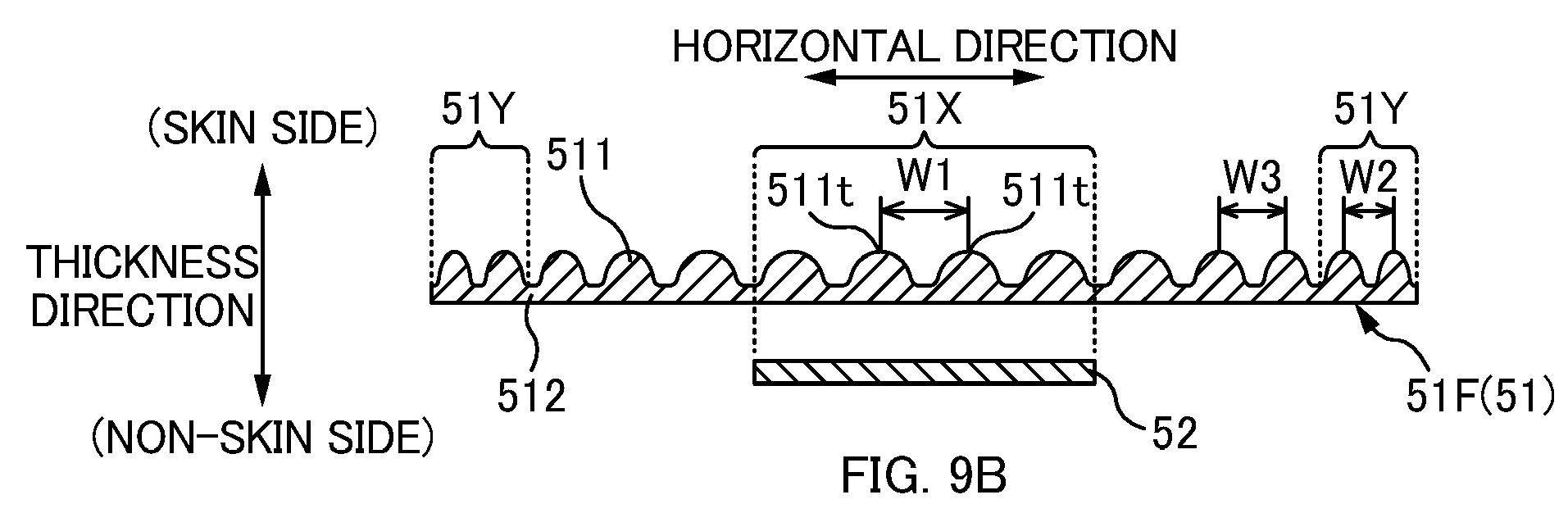
- FIG. 9A, 9B, 9C, and 9D are schematic cross-sectional views illustrating the top sheet 51 in the thickness direction, in which FIG. 9A illustrates a P1 portion of FIG. 8A , FIG. 9B illustrates a P2 portion of FIG. 8B , FIG. 9C illustrates a P3 portion of FIG. 8B , and FIG. 9D illustrates a P4 portion of FIG. 8B .
- FIG. 10A is a schematic diagram illustrating a cross section of the absorbent main body 11
- FIG. 10B is a schematic diagram illustrating a deformed state of the protrusion 511 when the diaper 1 is worn. Note that a plurality of inseam-side leg elastic members 57 and a plurality of center elastic members 58 are not illustrated in FIG. 10A for simplicity purposes.
- the top sheet 51 a plurality of protrusions 511 are spaced apart in the horizontal direction, and the thin portions 512 are provided along the longitudinal direction between the protrusions 511 adjacent in the horizontal direction. Therefore, the top sheet 51 is configured such that the protrusions 511 and the thin portions 512 of the longitudinal direction alternate in the horizontal direction.
- the top sheet 51 since the thickness D2 is smaller than the thickness D1 of the protrusion 511 (D2 ⁇ D1), a gap between the protrusions 511 adjacent in the horizontal direction has a hollowed shape. That is, the top sheet 51 is an uneven sheet having an uneven skin-side surface.
- the protrusion 511 has a substantially semicircular cross-sectional shape in the thickness direction and a curved skin-side surface.
- the shapes of the protrusions 511 and the thin portions 512 are not particularly limited.
- the protrusion 511 may have a triangular cross-sectional shape in the thickness direction.
- the skin surface of the thin portion 512 may be a curvilinear surface curved toward the non-skin.
- the plurality of protrusions 511 and the plurality of thin portions 512 are formed through an injection process as illustrated in FIG. 7A .
- a gas air
- a gas air
- FIG. 7B in a portion where the gas is injected, fibers of the top-sheet member 51F move to be squeezed outward perpendicularly (horizontal direction) to a direction of conveyance.
- the thickness is reduced in this portion to form the thin portion 512.
- the thickness increases due to the moving fibers to form the protrusions 511.
- the fibers moving by the injected gas are easily concentrated on the sides facing the adjacent protrusions 511, and a portion having the highest fiber density in the top sheet 51 (the high density region 511D) is formed inside the protrusion 511.
- the fiber density inside the top sheet 51 top-sheet member 51F
- urine easily moves from the low fiber density portion to the high fiber density portion, so that solid components in urine can be trapped between the fibers.
- it is possible to suppress clogging caused by the solid components, prevent leakage of urine, and suppress unpleasantness for the wearer.
- the top sheet 51 (top-sheet member 51F) is formed of air-through nonwoven fabric in which short fibers are not bonded to provide a relatively high degree of freedom. Therefore, a gap is easily formed between fibers, and clogging caused by solid components in urine is not easily generated.
- the non-skin-side surface of the top sheet 51 is a flat surface.
- the non-skin-side surface of the top sheet 51 is not necessarily a flat surface.
- by adjusting the number of injection nozzles, a size and pitch of the nozzle of the injection device S1, a temperature of the air injected from the injection nozzle, the amount of the injected air, a tension of the conveyed top sheet 51, and the like it is possible to set the number of the protrusions 511, the number of the thin portions 512, the interval, the fiber density, and the like to desired ranges.
- the fibers of the top-sheet member 51F are oriented in various directions.
- the top-sheet member 51F is conveyed while it is pulled in the longitudinal direction (direction of conveyance) as indicated by the arrow in FIG. 8A . Accordingly, each fiber of the top-sheet member 51F is also pulled in the longitudinal direction. For this reason, the fibers directed to cross the longitudinal direction move toward the longitudinal direction, and the entire top-sheet member 51F is compressed in the horizontal direction by the movement of the longitudinal direction (refer to FIG. 8B ).
- FIG. 8B the outer edge of the top-sheet member 51F before the top-sheet member 51F is compressed in the horizontal direction is indicated by two-dotted chain lines.
- each fiber of the top-sheet member 51F is not easily restrained in a predetermined direction, but exists in various directions. Therefore, if the top-sheet member 51F is pulled in the longitudinal direction, and each fiber is provided on the longitudinal direction, the top-sheet member 51F is easily compressed in the horizontal direction, compared to a top-sheet member formed of other types of nonwoven fabric.
- the "state in which the top-sheet member 51F is compressed in the horizontal direction” refers to a state in which the compressed horizontal size is maintained without expanding until the horizontal size is returned to its original size (the size with no load before being pulled in the longitudinal direction) even when a force applied longitudinally is released from the top-sheet member 51F pulled longitudinally.
- a horizontal pitch between a plurality of protrusions 511 formed in the top-sheet member 51F through the injection process is reduced, compared to a horizontal pitch W between the protrusions 511 formed when the top-sheet member 51F is not pulled in the longitudinal direction (refer to FIGS. 8A and 9A ).
- the "horizontal pitch between the protrusions 511” refers to a horizontal distance between each apex 511t of the protrusions 511 adjacent in the horizontal direction (for example, W of FIG. 9A , W1, W2, and W3 of FIG. 9B , W4 of FIG. 9C , and W5 of FIG. 9D ).
- the apex 511t refers to a portion of the protrusion 511 closest to the skin side in the thickness direction.
- the top sheet 51 has an overlapping region 51X overlapping with the second sheet 52 in the thickness direction, and both end regions 51Y separated by a predetermined distance outward from the overlapping region 51X in the horizontal direction and provided to overlap with the overlapping region 51X in the longitudinal direction.
- the second sheet 52 is indicated by the dotted line, and the overlapping region 51X and both end regions 51Y are hatched.
- the second sheet 52 overlaps in the overlapping region 51X in the thickness direction. Therefore, the top sheet 51 is not easily compressed in the horizontal direction due to stiffness of the second sheet 52, and horizontal compression of the top sheet 51 in the overlapping region 51X per unit length is smaller than horizontal compression per unit length in both end regions 51Y. For this reason, as illustrated in FIG. 9B , the horizontal pitch W1 of the protrusion 511 in the overlapping region 51X is larger than the horizontal pitch W2 of the protrusion 511 in both end regions 51Y (W1>W2).
- the protrusions 511 are not easily compressed in the horizontal direction even when the diaper 1 is worn. Therefore, it is possible to easily maintain the shape of the protrusion 511 and hold the density difference formed inside the protrusion 511. As a result, in the overlapping region 51X placed in the wearer's excretory opening, it is possible to easily maintain a function of suppressing clogging by filtering out solid components in urine and prevent leakage of urine.
- the horizontal pitch W2 of the protrusion 511 is smaller than the horizontal pitch W1 of the protrusion 511 in the overlapping region 51X (W2 ⁇ W1), the number of the thin portions 512 per unit length of the horizontal direction is larger than the number of the thin portions 512 per unit length of the horizontal direction in the overlapping region 51X. Since the thin portion 512 has a thickness thinner than the thickness of the protrusion 511 as described above, the diaper 1 is easily deformable the thickness direction. Therefore, in both end regions 51Y, compared to the overlapping region 51X, the top sheet 51 is easily deformable the thickness direction, and the diaper 1 easily deforms to fit the shape of the wearer's inseam. As a result, in both end regions 51Y close to the wearer's legs, it is possible to improve fit by fitting the wearer's somatotype.
- the horizontal pitch of the protrusions 511 of the top sheet 51 gradually increases from both end regions 51Y toward the overlapping region 51X.
- the horizontal pitch W2 of the protrusion 511 in both end regions 51Y is smaller than the horizontal pitch W3 of the protrusion 511 between both end regions 51Y and the overlapping region 51X in the horizontal direction (W2 ⁇ W3)
- the horizontal pitch W1 of the protrusion 511 in the overlapping region 51X is larger than the horizontal pitch W3 of the protrusion 511 between both end regions 51Y and the overlapping region 51X in the horizontal direction (W3 ⁇ W1).
- the horizontal pitch of the protrusions 511 gradually increases from both end regions 51Y toward the overlapping region 51X in the top sheet 51 (W2 ⁇ W3 ⁇ W1), the horizontal pitch of the protrusions 511 in both horizontal sides of the overlapping region 51X is not abruptly reduced, compared to the horizontal pitch W1 of the protrusion 511 in the overlapping region 51X. Therefore, it is possible to easily maintain the shape of the protrusion 511 in a part close to the overlapping region 51X even in both horizontal sides of the overlapping region 51X, and suppress clogging caused by solid components in urine.
- the number of the thin portions 512 per unit length of the horizontal direction increases more than the number of the thin portions 512 per unit length of the horizontal direction in the overlapping region 51X. Therefore, it is possible to easily gradually collapse the top sheet 51 in the thickness direction and smoothly fit the diaper 1 to the shape of the wearer's inseam.
- the horizontal pitch of the protrusions 511 has a relationship W2 ⁇ W3 ⁇ W1 from both end regions 51Y toward the overlapping region 51X for ease of manufacturing, such a relationship may be set differently.
- any relationship may be possible as long as the horizontal pitch W1 of the protrusion 511 in the overlapping region 51X is at least larger than the horizontal pitch W2 of the protrusion 511 in both end regions 51Y (W2 ⁇ W1).
- the horizontal pitch relationship of the protrusion 511 in the horizontal direction of the top sheet 51 may be established in the setting of the manufacturing device or the like instead of using the horizontal compression of the top sheet 51.
- one longitudinal end 510A and the other longitudinal end 510B of the top sheet 51 are not easily affected by the stiffness of the second sheet 52, but are easily compressed in the horizontal direction, compared to the overlapping region 51X. Therefore, as illustrated in FIG. 8B , in the overlapping region 51X, horizontal compression per unit length is smaller than horizontal compression per unit length in one end 510A and the other end 510B. For this reason, as illustrated in FIGS. 9B and 9D , the horizontal pitch W1 of the protrusion 511 in the overlapping region 51X is larger than the horizontal pitch W5 of the protrusion 511 in one end 510A and the other end 510B (W1>W5).
- the horizontal pitch W5 of the protrusion 511 is smaller than the horizontal pitch W1 of the protrusion 511 in the overlapping region 51X (W5 ⁇ W1). Therefore, the number of the thin portions 512 per unit length of the horizontal direction is larger than the number of the thin portions 512 per unit length of the horizontal direction in the overlapping region 51X, and collapse in the thickness direction is facilitated in one end 510A and the other end 510B compared to the overlapping region 51X. Therefore, it is possible to easily deform the diaper 1 to fit the wearer's front or back shape and the wearer's somatotype even for the front waist and the back waist of the wearer. Accordingly, it is possible to improve fit.
- the horizontal pitch of the protrusions 511 gradually increases from one end 510A and the other end 510B toward the overlapping region 51X. Specifically, in a region between the overlapping region 51X and one end 510A and in a region between the overlapping region 51X and the other end 510B (the P3 portion in FIG. 8B ), the horizontal pitch W4 of the protrusion 511 is larger than the horizontal pitch W5 of the protrusion 511 in one end 510A and the other end 510B (the P4 portion in FIG. 8B ) (W4>W5), and is smaller than the horizontal pitch W1 of the protrusion 511 in the overlapping region 51X (W4 ⁇ W1).
- the horizontal pitch of the protrusions 511 gradually increases from one end 510A and the other end 510B of the longitudinal direction toward the overlapping region 51X in the top sheet 51 (W5 ⁇ W4 ⁇ W1), the horizontal pitch of the protrusions 511 in both longitudinal sides of the overlapping region 51X is not abruptly reduced, compared to the horizontal pitch W1 of the protrusion 511 in the overlapping region 51X. Therefore, it is possible to easily maintain the shape of the protrusion 511 in a part close to the overlapping region 51X even in both longitudinal sides of the overlapping region 51X, and suppress clogging caused by solid components in urine.
- the number of the thin portions 512 per unit length of the horizontal direction increases more than the number of the thin portions 512 per unit length of the horizontal direction in the overlapping region 51X. Therefore, it is possible to easily gradually collapse the top sheet 51 in the thickness direction and smoothly fit the diaper 1 to the wearer's front or back shape.
- one end 510A and the other end 510B are indicated by one-dotted chain lines.
- the horizontal pitch of the protrusions 511 has a relationship W5 ⁇ W4 ⁇ W1 from one end 510A and the other end 510B toward the overlapping region 51X for ease of manufacturing, such a relationship may be set differently.
- the horizontal pitch W1 of the protrusion 511 in the overlapping region 51X may be larger than at least the horizontal pitch W5 of the protrusion 511 in any one of one end 510A and the other end 510B (W5 ⁇ W1).
- the horizontal pitch relationship of the protrusion 511 in the longitudinal direction of the top sheet 51 may be established in the setting of the manufacturing device or the like without using the horizontal compression of the top sheet 51.
- the horizontal pitch relationship of the protrusion 511 is adjusted on the basis of the relationship of the horizontal compression of the top sheet 51 per unit length caused by horizontal compression of the top-sheet member 51F in the manufacturing process of the top sheet 51. Therefore, it is possible to change the horizontal pitch of the protrusions 511 without modifying the manufacturing device, for example, changing the setting of the injection nozzle of the injection device S1 or the like.
- the horizontal pitch of each protrusion 511 is different in both the horizontal direction and the longitudinal direction.
- the horizontal pitch W1 of the protrusion 511 in the overlapping region 51X may be at least larger than the horizontal pitch W2 of the protrusion 511 in both end regions 51Y (W1>W2).
- the top sheet 51 and the absorbent core 53 are bonded in the thickness direction using a plurality of skin-side bonding portions 61 provided at intervals in the horizontal direction.
- An adhesive such as a hot-melt adhesive is applied to the skin-side bonding portion 61, and the skin-side bonding portion 61 has stiffness higher than the stiffness of the top sheet 51.
- any one of a plurality of middle positions 511c does not overlap with the skin-side bonding portion 61 in the thickness direction in both end regions 51Y, but overlaps with a position of the gap 61A between the skin-side bonding portions 61 adjacent in the horizontal direction (hereinafter, simply referred to as a "gap 61A of the skin-side bonding portion”) .
- the middle position 511c exists in the thin portion 512 having a thickness smaller than the thickness of the protrusion 511, the middle position 511c tends to serve as the point of collapse in the thickness direction of the top sheet 51.
- the middle position 511c overlaps with a position of the skin-side bonding portion 61 having stiffness higher than the stiffness of the top sheet 51 in the thickness direction, the top sheet 51 is not easily deformable the thickness direction with respect to the middle position 511c.
- the middle position 511c overlaps with the position of the gap 61A of the skin-side bonding portion in the thickness direction.
- the protrusions 511 placed in both sides of the horizontal direction of the middle position 511c approach each other when the diaper 1 is worn. Therefore, it is possible to easily induce the collapse of the absorbent main body 11 in the thickness direction.
- middle positions 511c overlaps with any one of the gaps 61A between the skin-side bonding portions in the thickness direction.
- a plurality of middle positions 511c may respectively overlap with positions of the gaps 61A between a plurality of skin-side bonding portions in the thickness direction.
- a plurality of middle positions 511c may be placed in a position of any one of the gaps 61A of the skin-side bonding portions in the thickness direction.
- the absorbent core 53 and the back sheet 54 are bonded in the thickness direction by a plurality of non-skin-side bonding portions 62 provided at intervals in the horizontal direction. Similar to the skin-side bonding portion 61, for example, an adhesive such as a hot-melt adhesive is applied to the non-skin-side bonding portion 62, and the non-skin-side bonding portion 62 has stiffness higher than the stiffness of the top sheet 51.
- an adhesive such as a hot-melt adhesive
- any one of a plurality of middle positions 511c does not overlap with the position of non-skin-side bonding portion 62 in the thickness direction, but overlaps with the position of the gap 62A between the non-skin-side bonding portions 62 adjacent in the horizontal direction (hereinafter, simply referred to as a "gap 62A of non-skin-side bonding portion) . That is, according to the embodiment, in both end regions 51Y, any one of a plurality of middle positions 511c overlaps with the gap 61A of the skin-side bonding portion in the thickness direction, and overlaps with a position of the gap 62A of the non-skin-side bonding portion.
- any one of a plurality of middle positions 511c does not overlap with the skin-side bonding portion 61 and the non-skin-side bonding portion 62 having high stiffness in the thickness direction. Therefore, the absorbent main body 11 is more easily deformable the thickness direction with respect to the middle position 511c.
- any one of a plurality of middle positions 511c overlaps with a position of the side slit 532B in the thickness direction.
- the top sheet 51 is easily deformable the thickness direction with respect to the middle position 511c. Therefore, the absorbent main body 11 is easily deformable the thickness direction in the vicinity of the wearer's legs to fit the wearer's somatotype.
- the middle position 511c does not necessarily overlap with the position of the gap 61A of the skin-side bonding portion, the position of the gap 62A of the non-skin-side bonding portion, or the position of the side slit 532B in the thickness direction.
- FIGS. 11 and 12 like reference numerals denote like elements as for the components of the diaper 1 of the first embodiment and description thereof is omitted.
- FIG. 11 is a schematic plan view illustrating an exemplary configuration of the diaper 1A according to the second embodiment in an unfolding and expanded state as seen from a skin side.
- FIG. 12 is a schematic cross-sectional view illustrating an absorbent main body 13 of the diaper 1A in the thickness direction.
- the diaper 1A is a so-called three-piece type pull-on diaper having a front waist section 2A, a back waist section 3A, and an absorbent main body 13.
- the front waist section 2A is provided on one end portion 13A of the longitudinal direction of the absorbent main body 13
- the back waist section 3A is provided on the other end portion 13B of the longitudinal direction of the absorbent main body 13. That is, the absorbent main body 13 is stretched between the front waist section 2A and the back waist section 3A, which are spaced apart from each other.
- the front waist section 2A is provided with a plurality of lower end side elastic member 25A along the horizontal direction arranged side by side and spaced apart vertically in the lower end portion under a plurality of front elastic members 23.
- the lower end side elastic member 25A is bent upward in a region overlapping with the absorbent main body 13 in the thickness direction.
- the absorbent main body 13 has a top sheet 51, a second sheet 52, an absorbent core 53A, a back sheet 54A, and a pair of side sheets 55.
- the absorbent core 53A does not have a two-layered structure, and the outer circumference is covered by a core-wrapping sheet 530.
- This core-wrapping sheet 530 is formed of, for example, tissues or the like and has a density higher than the fiber density of the second sheet 52.
- urine tends to flow from the skin side to the non-skin side in the thickness direction in order of the top sheet 51, the second sheet 52 having a fiber density higher than that of the top sheet 51, and the core-wrapping sheet 530 having a fiber density higher than that of the second sheet 52. Therefore, it is possible to improve a liquid migration property inside the absorbent main body 13.
- the back sheet 54A has a first back sheet 541 formed from a liquid non-permeable sheet member such as a film, and a second back sheet 542 formed from a soft sheet member such as nonwoven fabric.
- the second back sheet 542 is provided on the non-skin side of the first back sheet 541 to prevent the first back sheet 541 from being exposed to the outside.
- a pair of side sheets 55 the outer end portion of the horizontal direction is folded toward the skin side, and a leading end of the folded portion is further folded toward the non-skin side. While a plurality of elastic members 59 are provided on this portion, the folded portion is bonded to the skin-side surface of the top sheet 51. As a result, a so-called barrier cuff is formed.
- the diaper 1A according to the embodiment also has an uneven structure in the top sheet 51, it is possible to filter out solid components in urine and suppress clogging of the absorbent main body 13 caused by the solid component.
- the protrusions 511 are not easily compressed in the horizontal direction at least in the overlapping region 51X of the top sheet 51 due to stiffness of the second sheet 52 even when the diaper 1A is worn. Therefore, it is possible to easily maintain the shape of the protrusion 511 and hold a density difference formed inside the protrusion 511. As a result, in the overlapping region 51X placed in the excretory opening of the wearer, it is possible to easily maintain a function of suppressing clogging by filtering out solid components in urine and prevent leakage of urine.
- the horizontal pitch W2 of the protrusion 511 is smaller than the horizontal pitch W1 of the protrusion 511 in the overlapping region 51X (W2 ⁇ W1). Therefore, the number of the thin portions 512 per unit length of the horizontal direction is larger than the number of the thin portions 512 per unit length of the horizontal direction in the overlapping region 51X. Therefore, in both end regions 51Y, compared to the overlapping region 51X, it is possible to facilitate collapse in the thickness direction and deform the diaper 1 to fit the wearer's inseam shape. As a result, it is possible to improve fit by fitting the diaper 1 to the wearer's somatotype in both end regions 51Y close to the wearer's legs.
- the diaper is worn on an elderly person in the aforementioned embodiments, the diaper may be worn on newborns or infants without a limitation.
- the invention may be employed in other purposes such as a sanitary napkin without a limitation.
- a sanitary napkin it is difficult to think that the absorbent main body absorbs a menstrual bleeding amount enough to generate clogging, compared to the diaper.
- the effect that fit is improved by fitting the diaper to the shape of the inseam in the vicinity of the legs in a cup shape and suppressing clogging of the absorbent main body under an excretory opening is more advantageous when the invention is applied to a diaper in which a cup shape is formed using the wearer's inseam to allow the absorbent main body to absorb and hold urine, rather than a sanitary napkin that absorbs menstrual bleeding while allowing the top sheet to abut on a vaginal opening as an excretory opening.
Landscapes
- Health & Medical Sciences (AREA)
- Epidemiology (AREA)
- Engineering & Computer Science (AREA)
- Biomedical Technology (AREA)
- Heart & Thoracic Surgery (AREA)
- Vascular Medicine (AREA)
- Life Sciences & Earth Sciences (AREA)
- Animal Behavior & Ethology (AREA)
- General Health & Medical Sciences (AREA)
- Public Health (AREA)
- Veterinary Medicine (AREA)
- Absorbent Articles And Supports Therefor (AREA)
Abstract


Description
- The present invention relates to an absorbent article.
- Apull-on disposable diaper as an absorbent article is known. For example,
Patent Document 1 discloses an absorbent article having a front exterior member, a back exterior member, and an absorbent main body crosslinking between the front exterior member and the back exterior member, wherein both horizontal edges of the front exterior member and both horizontal edges of the back exterior member are bonded to each other to form a waist opening and a pair of leg openings. - In this diaper, a top sheet of the absorbent main body has a plurality of concave portions hollowed in a non-skin side and a plurality of convex portions protruding in a skin side. A plurality of concave portions and a plurality of convex portions alternate in a horizontal direction (short direction) of the top sheet. By employing such an uneven sheet provided with concave and convex portions in the top sheet, solid components (impurities) in urine are filtered out. Therefore, it is possible to suppress clogging of the absorbent main body caused by solid components and prevent leakage of urine.
- [Patent Document 1]
JP-A-2013-169388 - However, in the diaper discussed in
Patent Document 1, if a force is exerted on the top sheet to compress (squeeze) the convex portions in a horizontal direction, gaps between fibers of the convex portions are narrowed, and clogging is easily generated. Meanwhile, if a pitch between the convex portions adjacent in the horizontal direction is adjusted to prevent the clogging, a clearance is easily formed between the diaper and the wearer's skin. This may degrade the fit. - In view of the aforementioned problems, it is therefore an object of the present invention to provide an absorbent article capable of improving fit while suppressing leakage of urine, menstrual bleeding, and the like.
- According to an aspect of the invention, there is provided an absorbent article having a longitudinal direction, a horizontal direction, and a thickness direction, including: an absorbent core to absorb a liquid; a liquid permeable skin-side sheet provided on a skin side of the absorbent core in the thickness direction; and a liquid permeable second sheet arranged between the absorbent core and the skin-side sheet in the thickness direction and to be placed in a wearer's inseam, wherein the skin-side sheet has a plurality of protrusions formed along the longitudinal direction and spaced apart in the horizontal direction, the second sheet is smaller than the skin-side sheet in the horizontal direction, the skin-side sheet has an overlapping region overlapping with the second sheet in the thickness direction, and both end regions separated by a predetermined distance outward from the overlapping region in the horizontal direction and provided to overlap with the overlapping region in the longitudinal direction, and a horizontal pitch of the protrusions in the overlapping region of the skin-side sheet is larger than a horizontal pitch of the protrusions in the two end regions of the skin-side sheet. Other features and advantages of the invention will become apparent by reading the following specification with reference to the attached drawings.
- According to the present invention, it is possible to improve fit while suppressing leakage of urine, menstrual bleeding, and the like.
-
-
FIG. 1 is a schematic perspective view illustrating an exemplary configuration of a diaper according to a first embodiment of the invention; -
FIG. 2 is a schematic plan view illustrating a diaper in an unfolded state as seen from a skin side; -
FIG. 3 is a cross-sectional view along a line III-III ofFIG. 2 ; -
FIG. 4 is a schematic plan view illustrating an absorbent main body as seen from the skin side; -
FIG. 5A is a cross-sectional view along a line VA-VA ofFIG. 4 ; -
FIG. 5B is a cross-sectional view along the line VA-VA ofFIG. 4 when the absorbent main body is in a deformed state; -
FIG. 6 is a partially enlarged perspective view illustrating protrusions and thin portions of the top sheet; -
FIG. 7A is an explanatory diagram illustrating an injection process of a top sheet manufacturing process; -
FIG. 7B is an explanatory diagram illustrating protrusions and thin portions formed in the injection process; -
FIG. 8A is an explanatory diagram illustrating a state in which a second sheet is arranged on the top sheet in the top sheet manufacturing process; -
FIG. 8B is an explanatory diagram illustrating a state in which the top sheet where the second sheet is arranged is pulled in a longitudinal direction; -
FIGS. 9A, 9B, 9C, and 9D are schematic cross-sectional views illustrating the top sheet in a thickness direction, in whichFIG. 9A illustrates a P1 portion ofFIG. 8A ,FIG. 9B illustrates a P2 portion ofFIG. 8B ,FIG. 9C illustrates a P3 portion ofFIG. 8B , andFIG. 9D illustrates a P4 portion ofFIG. 8B . -
FIG. 10A is a schematic diagram illustrating a cross section of the absorbent main body; -
FIG. 10B is a schematic diagram illustrating a deformed state of the protrusion when the diaper is worn; -
FIG. 11 is a schematic plan view illustrating an exemplary configuration of a diaper according to a second embodiment of the invention in an unfolded and expanded state as seen from a skin side; and -
FIG. 12 is a schematic cross-sectional view illustrating an absorbent main body of the diaper according to the second embodiment in a thickness direction. - At least the following features will be clearly understood from the specification and the accompanying drawings.
- An absorbent article having a longitudinal direction, a horizontal direction, and a thickness direction, includes: an absorbent core to absorb a liquid; a liquid permeable skin-side sheet provided on a skin side of the absorbent core in the thickness direction; and a liquid permeable second sheet arranged between the absorbent core and the skin-side sheet in the thickness direction and to be placed in a wearer's inseam, wherein the skin-side sheet has a plurality of protrusions formed along the longitudinal direction and spaced apart in the horizontal direction, the second sheet is smaller than the skin-side sheet in the horizontal direction, the skin-side sheet has an overlapping region overlapping with the second sheet in the thickness direction, and two end regions separated by a predetermined distance outward from the overlapping region in the horizontal direction and provided to overlap with the overlapping region in the longitudinal direction, wherein a horizontal pitch of the protrusions in the overlapping region of the skin-side sheet is larger than a horizontal pitch of the protrusions in the two end regions of the skin-side sheet.
- In such an absorbent article, in the overlapping region of the skin-side sheet overlapping with the second sheet in the thickness direction, the protrusions are not easily compressed (squeezed) in the horizontal direction due to stiffness of the second sheet. Therefore, it is possible to easily maintain the shapes of the protrusions. As a result, in the overlapping region placed under a wearer's excretory opening, it is possible to suppress clogging of the skin-side sheet caused by solid components in urine, menstrual bleeding, and the like. In addition, in both end regions close to the wearer's leg, a horizontal pitch of the protrusions is smaller than a horizontal pitch of the protrusions in the overlapping region. Therefore, the number of gaps of the protrusions adjacent in the horizontal direction per unit length is larger than the number of gaps of the adjacent protrusions per unit length of the overlapping region. The gap between the protrusions adjacent in the horizontal direction is smaller than the thickness of the protrusion. Therefore, the skin-side sheet is easily deformable the thickness direction. Accordingly, in both end regions, the diaper is easily deformable the thickness direction and easily deforms to fit the shape of the wearer's inseam, compared to the overlapping region.
- Therefore, by maintaining the shapes of a plurality of protrusions in a region close to the excretory opening, it is possible to suppress clogging caused by solid components in urine, menstrual bleeding, and the like and prevent leakage of urine, menstrual bleeding, and the like. In addition, it is possible to improve fit by fitting the diaper to a wearer's somatotype in the vicinity of the legs.
- In the absorbent article described above, preferably, the horizontal pitch of the protrusions gradually increases from the two end regions toward the overlapping region in the skin-side sheet.
- In such an absorbent article, the horizontal pitch of the protrusions gradually increases from both end regions toward the overlapping region in the skin-side sheet. Therefore, even in both sides of the overlapping region of the horizontal direction, it is possible to easily maintain the shape of the protrusion in a portion close to the overlapping region and easily filter out solid components in urine, menstrual bleeding, and the like. In addition, toward both end regions, the number of gaps of the protrusions adjacent in the horizontal direction per unit length increases more than the number of gaps of the protrusions adjacent in the horizontal direction per unit length of the overlapping region. Therefore, it is possible to facilitate collapse in the thickness direction compared to the overlapping region and improve the fit.
- In the absorbent article described above, preferably, the skin-side sheet is compressed in the horizontal direction, and horizontal compression per unit length of the skin-side sheet in the overlapping region is smaller than compression per unit length of the skin-side sheet in the two end regions.
- In such an absorbent article, the horizontal pitch of the protrusions is adjusted depending on the compression per unit length of the skin-side sheet in the horizontal direction. Therefore, it is possible to change the horizontal pitch of the protrusions, for example, without the need to change a pitch setting for nozzles of a manufacturing device.
- In the absorbent article described above, preferably, the second sheet is smaller than the skin-side sheet in the longitudinal direction, and the horizontal pitch of the protrusions in the overlapping region is larger than the horizontal pitch of the protrusions in at least one of one end and the other end of the longitudinal direction of the skin-side sheet.
- In such an absorbent article, in at least one of one end and the other end of the longitudinal direction of the skin-side sheet, the horizontal pitch of the protrusions is smaller than the horizontal pitch of the protrusions of the overlapping region. Therefore, the number of gaps of the protrusions adjacent in the horizontal direction per unit length is larger than the number of gaps of adjacent protrusions per unit length in the overlapping region. Since the gap between the protrusions adjacent in the horizontal direction is smaller than the thickness of the protrusion, the skin-side sheet is easily deformable the thickness direction. Therefore, in at least one of one end and the other end of the longitudinal direction of the skin-side sheet, the diaper is easily deformable the thickness direction compared to the overlapping region and easily deforms to fit the shape of the wearer's front or back side (for example, in a cup shape). As a result, even in a front waist or a back waist, it is possible to fit the diaper to a wearer's somatotype. Therefore, it is possible to improve the fit when worn.
- In the absorbent article described above, preferably, the skin-side sheet has a horizontal pitch of the protrusions gradually increasing toward the overlapping region from at least one of the one end and the other end of the longitudinal direction.
- In such an absorbent article, the horizontal pitch of the protrusions gradually increases toward the overlapping region from at least one of one end and the other end of the longitudinal direction of the skin-side sheet. Even in both sides of the longitudinal direction of the overlapping region, it is possible to easily maintain the shape of the protrusions in a portion close to the overlapping region and easily filter out solid components in urine, menstrual bleeding, and the like. In addition, toward one end or the other end of the longitudinal direction of the skin-side sheet, the number of gaps of the protrusions adjacent in the horizontal direction per unit length increases more than the number of gaps of the protrusions adjacent in the horizontal direction per unit length in the overlapping region. Therefore, the diaper is easily deformable the thickness direction and easily deforms to fit the shape of the wearer's front side or rear side, compared to the overlapping region. As a result, it is possible to further improve fit in the vicinity of the waist opening.
- In the absorbent article described above, preferably, the skin-side sheet is compressed in the horizontal direction, and horizontal compression per unit length of the skin-side sheet in the overlapping region is smaller than longitudinal compression per unit length of the skin-side sheet in at least one of the one end and the other end.
- In such an absorbent article, the horizontal pitch of the protrusions is adjusted depending on the horizontal compression per unit length of the skin-side sheet even in the longitudinal direction of the skin-side sheet. Therefore, it is possible to change the horizontal pitch of the protrusions without the need to change a pitch setting of nozzles of a manufacturing device and the like.
- In the absorbent article described above, preferably, the skin-side sheet and the absorbent core are bonded in the thickness direction by a plurality of skin-side bonding portions provided at intervals in the horizontal direction between the skin-side sheet and the absorbent core, and a position horizontally intermediate between each apex of any two protrusions adjacent in the horizontal direction among the plurality of protrusions does not overlap with a position of the skin-side bonding portion of the thickness direction in the two end regions of the skin-side sheet.
- In such an absorbent article, since the position horizontally intermediate between each apex of the protrusions adjacent in the horizontal direction overlaps with a position of the gap of the skin-side bonding portions adjacent in the horizontal direction in the thickness direction in the two end regions, it is possible to more easily induce the collapse of the skin-side sheet in the thickness direction. As a result, it is possible to further improve fit when worn.
- Preferably, the absorbent article described above further includes a liquid non-permeable non-skin-side sheet provided on a non-skin side of the absorbent core, wherein the non-skin-side sheet and the absorbent core are bonded in the thickness direction by a plurality of non-skin-side bonding portions provided at intervals in the horizontal direction, and a position horizontally intermediate between each apex of any two protrusions adjacent in the horizontal direction among the plurality of protrusions does not overlap with a position of the non-skin-side bonding portion in the thickness direction in the two end regions of the skin-side sheet.
- In such an absorbent article, in both end regions, the position horizontally intermediate between each apex of the protrusions adjacent in the horizontal direction overlaps with a position of the gap of the skin-side bonding portions adjacent in the horizontal direction and a position of the gap of the non-skin-side bonding portions adjacent in the horizontal direction in the thickness direction. Therefore, the skin-side sheet is easily deformable the thickness direction in both the gap of the skin-side bonding portion and the gap of the non-skin-side bonding portion. As a result, it is possible to further improve fit when worn.
- In the absorbent article described above, preferably, the absorbent core is provided with grooves extending along the longitudinal direction in both horizontal sides of the second sheet, and a basis weight of the groove is smaller than a basis weight of a portion other than the groove of the absorbent core.
- In such an absorbent article, a pair of grooves (for example, slits) having a small basis weight are provided in the absorbent core. Therefore, the absorbent core having a thickness is easily deformable the thickness direction. In addition, since such grooves are provided on both sides of the overlapping region in the horizontal direction, it is possible to fit the diaper to a wearer's somatotype in the inseam side of the wearer's legs. Accordingly, it is possible to improve fit.
- In the absorbent article described above, a position horizontally intermediate between each apex of any two protrusions adjacent in the horizontal direction among the plurality of protrusions overlaps with a position of the groove in the thickness direction.
- In such an absorbent article, the middle position (a portion of the skin-side sheet having a thickness smaller than the thickness of the protrusion) overlaps with a position of the groove in the thickness direction. Therefore, the skin-side sheet is easily deformable the thickness direction in the groove. As a result, it is possible to fit the diaper to a wearer's somatotype and further improve fit when worn.
- In the absorbent article described above, preferably, the skin-side sheet has a density difference in the horizontal direction, and an average density of the second sheet is higher than an average density of the skin-side sheet.
- In such an absorbent article, since the average density of the second sheet is higher than the average density of the skin-side sheet, urine or menstrual bleeding passing through the skin-side sheet can easily move to the second sheet. As a result, a liquid migration property in the thickness direction is improved in the overlapping region. Therefore, urine, menstrual bleeding, and the like can be easily absorbed in the absorbent core. Accordingly, it is possible to prevent urine, menstrual bleeding, and the like from accumulating on the skin-side sheet and to more effectively suppress leakage.
- In the absorbent article described above, preferably, the skin-side sheet is formed of air-through nonwoven fabric.
- In such an absorbent article, the skin-side sheet is formed of short fibers of air-through nonwoven fabric having a high degree of freedom without bonding. Therefore, it is possible to easily form a gap between fibers. As a result, it is possible to more effectively suppress clogging of the skin-side sheet caused by solid components in urine, menstrual bleeding, and the like.
- As an example of the absorbent article according to a first embodiment of the invention, a pull-on disposable diaper (hereinafter, simply referred to as "
diaper 1") especially for elderly persons will be described. - First, the overall configuration of the
diaper 1 will be described with reference toFIGS. 1 to 3 . -
FIG. 1 is a schematic perspective view illustrating an exemplary configuration of thediaper 1 according to the first embodiment.FIG. 2 is a schematic plan view illustrating thediaper 1 in an unfolded and expanded state as seen from a skin side.FIG. 3 is a cross-sectional view along the line III-III ofFIG. 2 . - As illustrated in
FIG. 1 , thediaper 1 has a "vertical direction" and a "horizontal direction" perpendicular to the vertical direction. In addition, as illustrated inFIG. 3 , thediaper 1 has a "thickness direction". Along the vertical direction, a waist side of the wearer will be referred to as an "upper side", and an inseam side of the wearer will be referred to as a "lower side". In addition, assuming that the wearer wears thediaper 1, a side at the front of the wearer will be simply referred to as a "front side", and a side at the back of the wearer will be simply referred to as a "back side". The "thickness direction" refers to a direction in which each member of thediaper 1 is stacked. In addition, assuming that the wearer wears thediaper 1, a side where a wearer makes contact with the wearer's skin will be referred to as a "skin side", and the side opposite the skin side will be referred to as a "non-skin side". In the following description, the skin side of the thickness direction will be simply referred to as a "skin side", and the non-skin side of the thickness direction will be simply referred to as the "non-skin side". - As illustrated in
FIG. 1 , when worn, thediaper 1 has afront waist section 2 placed at the front of the wearer, aback waist section 3 placed at the back of the wearer, and aninseam section 4. As illustrated inFIG. 2 , in thediaper 1,bonding regions 20 provided in both ends of the horizontal direction of thefront waist section 2, andbonding regions 30 provided in both ends of the horizontal direction of theback waist section 3 are bonded to each other, so that a single waist opening 1HB and a pair of leg openings 1HL are formed as illustrated inFIG. 1 to provide a pull-on diaper. - According to the embodiment, as illustrated in
FIGS. 2 and3 , thediaper 1 is a so-called two-piece type including a band-shaped absorbentmain body 11 that absorbs liquid such as urine and anexterior member 12 on the non-skin side of the absorbentmain body 11. Theexterior member 12 has thefront waist section 2, theback waist section 3, and theinseam section 4. - As illustrated in
FIG. 2 , while thediaper 1 is unfolded, thefront waist section 2 is provided on oneend portion 11A of the longitudinal direction of the absorbentmain body 11, and theback waist section 3 is provided on theother end portion 11B of the longitudinal direction of the absorbentmain body 11. That is, the absorbentmain body 11 is stretched between thefront waist section 2 and theback waist section 3. Similar to the absorbentmain body 11, theinseam section 4 is stretched between thefront waist section 2 and theback waist section 3 in the non-skin side of the absorbentmain body 11. - Next, a configuration of the
exterior member 12 will be described in details with reference toFIGS. 2 and3 . - As illustrated in
FIG. 3 , theexterior member 12 has a front exteriortop sheet 21, a front exterior backsheet 22, a backexterior top sheet 31, a back exterior backsheet 32, and anexterior center sheet 40. The sheets may be formed of, for example, air-through nonwoven fabric, spunbond nonwoven fabric, spunbond/meltblown/spunbond (SMS) nonwoven fabric, and the like. According to the embodiment, the front exteriortop sheet 21 and the backexterior top sheet 31 are formed of SMS nonwoven fabric, and the front exterior backsheet 22, the back exterior backsheet 32, and theexterior center sheet 40 are formed of spunbond nonwoven fabric. - The front exterior
top sheet 21 and the front exterior backsheet 22 are provided on the front side, and the front exteriortop sheet 21 is placed between the absorbentmain body 11 and the front exterior backsheet 22 in the thickness direction. - As illustrated in
FIG. 3 , a plurality of frontelastic members 23 formed of, for example, elastic strings are arranged between the front exteriortop sheet 21 and the front exterior backsheet 22 while being spaced apart vertically. A plurality of frontelastic members 23 are arranged to overlap with the oneend portion 11A of the longitudinal direction of the absorbentmain body 11 in the thickness direction. - The front exterior back
sheet 22 has afront folding section 22A having an upper vertical end portion folded to the lower side (inseam side). A plurality of front upper-endelastic members 24 formed of, for example, elastic strings are provided in a gap of the thickness direction of thefront folding section 22A while being spaced apart vertically. - As illustrated in
FIG. 2 , a plurality of frontelastic members 23 and a plurality of front upper-endelastic members 24 are provided along the horizontal direction. As the plurality of frontelastic members 23 and the plurality of front upper-endelastic members 24 are compressed in the horizontal direction, they tighten the front waist of the wearer and improve fit. Note that the plurality of frontelastic members 23 and a plurality of front upper-endelastic members 24 are not necessarily provided in thefront waist section 2. For example, thefront waist section 2 may be formed of elastic nonwoven fabric or the like expandable/shrinkable horizontally. - According to the embodiment, an interval between the front upper-end
elastic members 24 adjacent in the vertical direction in thefront waist section 2 is narrower than an interval between the frontelastic members 23 adjacent in the vertical direction. Therefore, a plurality of wrinkles formed by compressing a plurality of front upper-endelastic members 24 in the horizontal direction have a size smaller than the size of a plurality of wrinkles formed by squeezing together a plurality of frontelastic members 23 in the horizontal direction. Therefore, when thediaper 1 is worn, clearance from the wearer's skin is reduced in the vicinity of the back side of the waist opening 1HB (refer toFIG. 1 ) for a snug fit. As a result, it is possible to improve fit and prevent thediaper 1 from slipping off. - The back
exterior top sheet 31 and the back exterior backsheet 32 are provided on the back side, and the backexterior top sheet 31 is placed between the absorbentmain body 11 and the back exterior backsheet 32 in the thickness direction. As illustrated inFIG. 3 , the backexterior top sheet 31 and the back exterior backsheet 32 are arranged separately from the front exteriortop sheet 21 and the front exterior backsheet 22. - A plurality of back
elastic members 33 are arranged between the backexterior top sheet 31 and the back exterior backsheet 32 and are spaced apart vertically. A plurality of backelastic members 33 are arranged to overlap with theother end portion 11B of the longitudinal direction of the absorbentmain body 11 in the thickness direction. - Similar to the front exterior back
sheet 22, the back exterior backsheet 32 has aback folding portion 32A having a vertical upper-end portion folded toward the lower side (inseam side), and a plurality of back upper-endelastic members 34 are provided in a gap of the thickness direction of theback folding portion 32A while being spaced apart vertically. - As illustrated in
FIG. 2 , a plurality of backelastic members 33 and a plurality of back upper-endelastic members 34 are provided along the horizontal direction, and the plurality of backelastic members 33 and the plurality of back upper-endelastic members 34 are compressed in the horizontal direction to tighten a back waist of the wearer and improve fit. Note that a plurality of backelastic members 33 and a plurality of back upper-endelastic members 34 are not necessarily provided in theback waist section 3. For example, theback waist section 3 formed of elastic nonwoven fabric or the like that expandable/shrinkable horizontally may be provided. - Similar to the
front waist section 2, an interval between the back upper-endelastic members 34 adjacent in the vertical direction in theback waist section 3 is narrower than an interval of the backelastic members 33 adjacent in the vertical direction. Therefore, a plurality of wrinkles formed by compressing a plurality of back upper-endelastic members 34 in the horizontal direction have a size in the vertical direction smaller than the size of a plurality of wrinkles formed by compressing a plurality of backelastic members 33 in the horizontal direction. Therefore, when thediaper 1 is worn, clearance from the wearer's skin is reduced in the vicinity of the back side of the waist opening 1HB (refer toFIG. 1 ) for a snug fit. As a result, it is possible to improve fit and prevent thediaper 1 from slipping off. - As illustrated in
FIG. 2 , a plurality of front legelastic members 25 are provided in the lower end portion of thefront waist section 2 and in both sides of the absorbentmain body 11 of the horizontal direction, and a plurality of back legelastic members 35 are provided in the lower end portion of theback waist section 3 and in both sides of the absorbentmain body 11 of the horizontal direction. A plurality of front legelastic members 25 and a plurality of back legelastic members 35 are arranged separately not to cross the absorbentmain body 11 in the longitudinal direction. A plurality of front legelastic members 25 and a plurality of back legelastic members 35 are respectively provided to fit around the leg opening 1HL (refer toFIG. 1 ) to improve fit around the wearer's legs and prevent leakage of urine to the outside. - In
FIG. 2 , a plurality of frontelastic members 23, a plurality of front upper-endelastic members 24, a plurality of front legelastic members 25, a plurality of backelastic members 33, a plurality of back upper-endelastic members 34, and a plurality of back legelastic members 35 are indicated by one-dotted chain lines. - Note that, in the unfolding state of
FIG. 2 , thediaper 1 has an expanded state. Here, the "expanded state" refers to a state in which thefront waist section 2 and theback waist section 3 are expanded without wrinkles by stretching a plurality of frontelastic members 23, a plurality of front upper-endelastic members 24, a plurality of front legelastic members 25, a plurality of backelastic members 33, a plurality of back upper-endelastic members 34, and a plurality of back legelastic members 35. A plurality of frontelastic members 23, a plurality of front upper-endelastic members 24, a plurality of backelastic members 33, and a plurality of back upper-endelastic members 34 expand in the horizontal direction, and a plurality of front legelastic members 25 and a plurality of back legelastic members 35 expand in the horizontal direction and the vertical direction. - As illustrated in
FIG. 3 , theexterior center sheet 40 is arranged to link the front exteriortop sheet 21 and the front exterior backsheet 22 and link the backexterior top sheet 31 and the back exterior backsheet 32 to prevent the absorbentmain body 11 from being exposed to the outside. - Next, a configuration of the absorbent
main body 11 will be described with reference toFIGS. 2 to 4 ,5A, and 5B . -
FIG. 4 is a schematic plan view illustrating the absorbentmain body 11 as seen from the skin side.FIG. 5A is a cross-sectional view along the line VA-VA ofFIG. 4 , andFIG. 5B is a cross-sectional view along the line VA-VA ofFIG. 4 to illustrate a deformed state of the absorbentmain body 11. - As illustrated in
FIGS. 3 ,5A, and 5B , the absorbentmain body 11 includes atop sheet 51, asecond sheet 52, anabsorbent core 53, aback sheet 54, a pair ofside sheets 55, and a center elasticmember cover sheet 56. Each member of the absorbentmain body 11 is bonded to each other in the thickness direction using an adhesive such as a hot-melt adhesive. - The
absorbent core 53 is a member for absorbing and holding a liquid such as urine and is formed of, for example, liquid absorbent fibers such as pulp fibers mixed with super-absorbent polymer (SAP) . According to the embodiment, theabsorbent core 53 includes afirst core layer 531 formed in an hourglass shape, and asecond core layer 532 having a size larger than the size of thefirst core layer 531 longitudinally and horizontally. Thesecond core layer 532 is provided on the non-skin side of the firstabsorbent core 531. - In the
second core layer 532, the center slit 532A along the longitudinal direction is provided in the center of the longitudinal direction and in the center of the horizontal direction, and a pair of side slits 532B along the longitudinal direction are provided in both sides of the horizontal direction of the center slit 532A while being spaced apart in the horizontal direction. Note that theabsorbent core 53 does not necessarily have a two-layered structure including thefirst core layer 531 and thesecond core layer 532. - The
top sheet 51 is provided on the skin side of the absorbent core 53 (first core layer 531) and serves as a liquid permeable skin-side sheet that can make contact with the wearer's skin when thediaper 1 is being worn. Thetop sheet 51 is formed, for example, of hydrophilic air-through nonwoven fabric, spunbond nonwoven fabric, or the like. According to the present embodiment, thetop sheet 51 is formed of air-through nonwoven fabric. As illustrated inFIGS. 4 ,5A, and 5B , thetop sheet 51 has a plurality ofprotrusions 511 formed along the longitudinal direction and spaced apart in the horizontal direction. - According to the embodiment, a plurality of
protrusions 511 protrude toward the skin side and are formed to continuously extend from oneend 510A of the longitudinal direction of the top sheet 51 (of the absorbent main body 11) to theother end 510B. As a result, an air passage is formed. Therefore, the heat generated inside thediaper 1 can be easily discharged to the outside to improve air permeability. Note that theprotrusions 511 are not necessarily formed to continuously extend from the oneend 510A of the longitudinal direction of thetop sheet 51 to theother end 510B. InFIG. 4 , for simplicity, only a part of a plurality ofprotrusions 511 is illustrated. - As described above, a plurality of front
elastic members 23 are placed to overlap with the oneend portion 11A of the longitudinal direction of the absorbentmain body 11 in the thickness direction. Therefore, a plurality of frontelastic members 23 are provided in the oneend portion 11A of the longitudinal direction of the absorbentmain body 11 to cross a plurality ofprotrusions 511. Similarly, a plurality of backelastic members 33 are placed to overlap with theother end portion 11B of the longitudinal direction of the absorbentmain body 11 in the thickness direction. Therefore, a plurality of backelastic members 33 is provided to cross a plurality ofprotrusions 511 in theother end portion 11B of the longitudinal direction of the absorbentmain body 11. - Since a plurality of
protrusions 511 is provided, thetop sheet 51 has a high density portion (high density region 511D ofFIG. 7B ) and a low density portion. That is, thetop sheet 51 has a density difference in the horizontal direction. Thetop sheet 51 having a plurality ofprotrusions 511 will be described in detail below. - The
second sheet 52 is a liquid permeable sheet arranged between theabsorbent core 53 and thetop sheet 51 in the thickness direction and placed in the wearer's inseam. For example, thesecond sheet 52 is formed of hydrophilic air-through nonwoven fabric or the like. According to the embodiment, an average density of the entiresecond sheet 52 is higher than the average density of the horizontal direction of thetop sheet 51. - Here, the "average density" is measured in the following way. The
diaper 1 is laid on an observation table while an observation surface of the top sheet 51 (second sheet 52) faces upward, and a fiber surface is photographed using a predetermined measurement device (for example, a digital microscope, product number: VHX-100, produced by Keyence Corporation) to obtain a binary image of the fiber. In addition, a value obtained by dividing a spatial area of the binary image (the area of the region where no fiber is present: µm2) by the number of spaces existing in the binary image is an average spatial area of the fiber (= spatial area/number of spaces), which corresponds to an average density of the top sheet 51 (second sheet 52). - A liquid such as urine tending to flow from a low density side to a high density side easily moves to the
second sheet 52 as it passes through thetop sheet 51. As a result, a liquid migration property inside the absorbentmain body 11 is improved, and urine or the like is easily absorbed in theabsorbent core 53. Therefore, it is possible to prevent accumulation of urine or the like on thetop sheet 51 and more effectively suppress leakage of urine. Note that the average density of thesecond sheet 52 is not necessarily higher than the average density of thetop sheet 51. - As illustrated in
FIGS. 2 and4 , thesecond sheet 52 has a rectangular shape having a long side in the longitudinal direction and is formed to be smaller than thetop sheet 51 horizontally and longitudinally. According to the embodiment, thesecond sheet 52 is formed to be smaller than thefirst core layer 531 of theabsorbent core 53 longitudinally and horizontally. Note that thesecond sheet 52 may be smaller than thetop sheet 51 at least horizontally. - As illustrated in
FIG. 5A , theback sheet 54 is a liquid non-permeable non-skin-side sheet provided on the non-skin side of theabsorbent core 53 and is formed of, for example, a polyethylene film or the like. A pair of leak-proof side sheets 55 are provided on both sides of the horizontal direction in the non-skin side of theback sheet 54 and formed of, for example, hydrophobic SMS nonwoven fabric or the like. A pair ofside sheets 55 are bonded to the skin-side surface of thetop sheet 51 such that the horizontal outer end portion is folded to face the skin side to respectively surround the horizontal outer end portion of thetop sheet 51 and the horizontal outer end portion of theback sheet 54. - A plurality of longitudinally compressibly stretchable inseam-side leg
elastic members 57 spaced apart in the horizontal direction are provided between theback sheet 54 and theside sheet 55. A plurality of inseam-side legelastic members 57 are placed in both ends of the horizontal direction of the absorbentmain body 11 to improve fit of the wearer's legs in cooperation with a plurality of front legelastic members 25 and a plurality of back leg elastic members 35 (refer toFIG. 2 ) when thediaper 1 is worn. - In the non-skin side of the
back sheet 54, a plurality of longitudinally compressibly stretchable centerelastic members 58 spaced apart in the horizontal direction are provided in the longitudinal center inward of a plurality of inseam-side legelastic members 57 in the horizontal direction. As illustrated inFIG. 5A , a plurality of centerelastic members 58 are placed to overlap with a position of the center slit 532A of thesecond core layer 532 in the thickness direction. - In the non-skin side of the
back sheet 54, a center elasticmember cover sheet 56 for covering a plurality of centerelastic members 58 from the non-skin side is arranged. The center elasticmember cover sheet 56 is formed of, for example, hydrophobic spunbond nonwoven fabric or the like. As illustrated inFIG. 5A , the center elasticmember cover sheet 56 is placed inward of a pair ofside sheets 55 in the horizontal direction while being spaced apart in the horizontal direction from a pair ofside sheets 55. As illustrated inFIGS. 2 and4 , the center elasticmember cover sheet 56 is formed in a band shape extending from the oneend portion 11A to theother end portion 11B in the longitudinal direction of the absorbentmain body 11. - The absorbent
main body 11 has a plurality of inseam-side legelastic members 57 and a plurality of centerelastic members 58 along the longitudinal direction. Therefore, a longitudinal compression difference between both ends and the center of the horizontal direction is reduced, and compression becomes uniform. As a result, it is possible to allow the absorbentmain body 11 to make contact with a surface between the legs of the wearer and more effectively suppress leakage of the urine to the outside. - As illustrated in
FIG. 5B , when thediaper 1 is being worn, a force is applied to the absorbentmain body 11 inward from the outside in the horizontal direction due to the wearer's legs or the like (as indicated by the arrow inFIG. 5B ). In this case, both sides of the horizontal direction of the center slit 532A of the absorbentmain body 11 collapse downward with respect to the center slit 532A, and the outer sides of the horizontal direction of the pair of side slits 532B collapse upward with respect to the pair of side slits 532B. That is, the absorbentmain body 11 is deformed such that its cross section has a W-shape. - This is because the center slit 532A and the pair of side slits 532B have a basis weight set to zero and do not have stiffness, so that they easily serve as the point of collapse in the thickness direction of the absorbent
main body 11. As a result, it is possible to reduce a distance between the absorbentmain body 11 and the excretory opening and fit the diaper to a wearer's somatotype in the inseam side. Therefore, it is possible to improve the fit of thediaper 1 when worn and prevent leakage of urine. - The pair of side slits 532B are a type of grooves provided in both sides of the
second sheet 52 in the horizontal direction of theabsorbent core 53 to extend along the longitudinal direction. The groove is not necessarily a slit penetrating in the thickness direction and having a basis weight of zero as long as a basis weight of the groove is smaller than a basis weight of the portion other than the groove of theabsorbent core 53. In this case, stiffness of theabsorbent core 53 decreases in the groove, and the thickness is also reduced. Therefore, the groove easily serves as the point of collapse of the thickness direction of the absorbentmain body 11. Note that the center slit 532A and the pair of side slits 532B are not necessarily provided in theabsorbent core 53. - Next, a configuration of the
top sheet 51 of the absorbentmain body 11 will be described in details with reference toFIGS. 6 to 10 . -
FIG. 6 is a partially enlarged perspective view illustrating configurations of theprotrusions 511 andthin portions 512 of thetop sheet 51 of the absorbentmain body 11.FIG. 7A is an explanatory diagram for describing an injection process in a manufacturing process of thetop sheet 51, andFIG. 7B is an explanatory diagram for describing how theprotrusions 511 and thethin portions 512 are formed in the injection process.FIG. 8A is an explanatory diagram illustrating a state in which thesecond sheet 52 is arranged on thetop sheet 51 in the manufacturing process of thetop sheet 51, andFIG. 8B is an explanatory diagram illustrating a state in which thetop sheet 51 where thesecond sheet 52 is arranged is pulled in the longitudinal direction.FIGS. 9A, 9B, 9C, and 9D are schematic cross-sectional views illustrating thetop sheet 51 in the thickness direction, in whichFIG. 9A illustrates a P1 portion ofFIG. 8A ,FIG. 9B illustrates a P2 portion ofFIG. 8B ,FIG. 9C illustrates a P3 portion ofFIG. 8B , andFIG. 9D illustrates a P4 portion ofFIG. 8B .FIG. 10A is a schematic diagram illustrating a cross section of the absorbentmain body 11, andFIG. 10B is a schematic diagram illustrating a deformed state of theprotrusion 511 when thediaper 1 is worn. Note that a plurality of inseam-side legelastic members 57 and a plurality of centerelastic members 58 are not illustrated inFIG. 10A for simplicity purposes. - As illustrated in
FIG. 6 , in thetop sheet 51, a plurality ofprotrusions 511 are spaced apart in the horizontal direction, and thethin portions 512 are provided along the longitudinal direction between theprotrusions 511 adjacent in the horizontal direction. Therefore, thetop sheet 51 is configured such that theprotrusions 511 and thethin portions 512 of the longitudinal direction alternate in the horizontal direction. In thethin portions 512, since the thickness D2 is smaller than the thickness D1 of the protrusion 511 (D2<D1), a gap between theprotrusions 511 adjacent in the horizontal direction has a hollowed shape. That is, thetop sheet 51 is an uneven sheet having an uneven skin-side surface. - According to the embodiment, the
protrusion 511 has a substantially semicircular cross-sectional shape in the thickness direction and a curved skin-side surface. However, the shapes of theprotrusions 511 and thethin portions 512 are not particularly limited. For example, theprotrusion 511 may have a triangular cross-sectional shape in the thickness direction. In addition, the skin surface of thethin portion 512 may be a curvilinear surface curved toward the non-skin. - The plurality of
protrusions 511 and the plurality ofthin portions 512 are formed through an injection process as illustrated inFIG. 7A . In the injection process, a gas (air) is injected from the upside to a skin surface of a conveyed top-sheet member 51F (a sheet member cut in the later into the top sheet 51) using an injection device S1. As illustrated inFIG. 7B , in a portion where the gas is injected, fibers of the top-sheet member 51F move to be squeezed outward perpendicularly (horizontal direction) to a direction of conveyance. As a result, the thickness is reduced in this portion to form thethin portion 512. In addition, in both sides of the horizontal direction of this portion, the thickness increases due to the moving fibers to form theprotrusions 511. - In this case, as illustrated in
FIG. 7B , the fibers moving by the injected gas are easily concentrated on the sides facing theadjacent protrusions 511, and a portion having the highest fiber density in the top sheet 51 (thehigh density region 511D) is formed inside theprotrusion 511. In this manner, by generating a difference of the fiber density inside the top sheet 51 (top-sheet member 51F), urine easily moves from the low fiber density portion to the high fiber density portion, so that solid components in urine can be trapped between the fibers. As a result, it is possible to suppress clogging caused by the solid components, prevent leakage of urine, and suppress unpleasantness for the wearer. - According to the embodiment, the top sheet 51 (top-
sheet member 51F) is formed of air-through nonwoven fabric in which short fibers are not bonded to provide a relatively high degree of freedom. Therefore, a gap is easily formed between fibers, and clogging caused by solid components in urine is not easily generated. - According to the embodiment, since a placement surface of the support S2 that supports the conveyed top-
sheet member 51F from the non-skin-side surface is flat, the non-skin-side surface of thetop sheet 51 is a flat surface. Alternatively, the non-skin-side surface of thetop sheet 51 is not necessarily a flat surface. In addition, by adjusting the number of injection nozzles, a size and pitch of the nozzle of the injection device S1, a temperature of the air injected from the injection nozzle, the amount of the injected air, a tension of the conveyedtop sheet 51, and the like, it is possible to set the number of theprotrusions 511, the number of thethin portions 512, the interval, the fiber density, and the like to desired ranges. - The fibers of the top-
sheet member 51F (top sheet 51) are oriented in various directions. In the manufacturing process of thetop sheet 51, the top-sheet member 51F is conveyed while it is pulled in the longitudinal direction (direction of conveyance) as indicated by the arrow inFIG. 8A . Accordingly, each fiber of the top-sheet member 51F is also pulled in the longitudinal direction. For this reason, the fibers directed to cross the longitudinal direction move toward the longitudinal direction, and the entire top-sheet member 51F is compressed in the horizontal direction by the movement of the longitudinal direction (refer toFIG. 8B ). InFIG. 8B , the outer edge of the top-sheet member 51F before the top-sheet member 51F is compressed in the horizontal direction is indicated by two-dotted chain lines. - Since the top-
sheet member 51F is formed of air-through nonwoven fabric as described above, each fiber of the top-sheet member 51F is not easily restrained in a predetermined direction, but exists in various directions. Therefore, if the top-sheet member 51F is pulled in the longitudinal direction, and each fiber is provided on the longitudinal direction, the top-sheet member 51F is easily compressed in the horizontal direction, compared to a top-sheet member formed of other types of nonwoven fabric. - The "state in which the top-
sheet member 51F is compressed in the horizontal direction" refers to a state in which the compressed horizontal size is maintained without expanding until the horizontal size is returned to its original size (the size with no load before being pulled in the longitudinal direction) even when a force applied longitudinally is released from the top-sheet member 51F pulled longitudinally. - As the top-
sheet member 51F is compressed in the horizontal direction, a horizontal pitch between a plurality ofprotrusions 511 formed in the top-sheet member 51F through the injection process is reduced, compared to a horizontal pitch W between theprotrusions 511 formed when the top-sheet member 51F is not pulled in the longitudinal direction (refer toFIGS. 8A and9A ). - Here, the "horizontal pitch between the
protrusions 511" refers to a horizontal distance between each apex 511t of theprotrusions 511 adjacent in the horizontal direction (for example, W ofFIG. 9A , W1, W2, and W3 ofFIG. 9B , W4 ofFIG. 9C , and W5 ofFIG. 9D ). Note that the apex 511t refers to a portion of theprotrusion 511 closest to the skin side in the thickness direction. - As illustrated in
FIGS. 8B and9B , thetop sheet 51 has anoverlapping region 51X overlapping with thesecond sheet 52 in the thickness direction, and bothend regions 51Y separated by a predetermined distance outward from the overlappingregion 51X in the horizontal direction and provided to overlap with the overlappingregion 51X in the longitudinal direction. InFIG. 8B , thesecond sheet 52 is indicated by the dotted line, and theoverlapping region 51X and bothend regions 51Y are hatched. - As illustrated in
FIG. 8B , thesecond sheet 52 overlaps in theoverlapping region 51X in the thickness direction. Therefore, thetop sheet 51 is not easily compressed in the horizontal direction due to stiffness of thesecond sheet 52, and horizontal compression of thetop sheet 51 in theoverlapping region 51X per unit length is smaller than horizontal compression per unit length in bothend regions 51Y. For this reason, as illustrated inFIG. 9B , the horizontal pitch W1 of theprotrusion 511 in theoverlapping region 51X is larger than the horizontal pitch W2 of theprotrusion 511 in bothend regions 51Y (W1>W2). - In the
overlapping region 51X, due to stiffness of thesecond sheet 52, theprotrusions 511 are not easily compressed in the horizontal direction even when thediaper 1 is worn. Therefore, it is possible to easily maintain the shape of theprotrusion 511 and hold the density difference formed inside theprotrusion 511. As a result, in theoverlapping region 51X placed in the wearer's excretory opening, it is possible to easily maintain a function of suppressing clogging by filtering out solid components in urine and prevent leakage of urine. - Meanwhile, in both
end regions 51Y, the horizontal pitch W2 of theprotrusion 511 is smaller than the horizontal pitch W1 of theprotrusion 511 in theoverlapping region 51X (W2<W1), the number of thethin portions 512 per unit length of the horizontal direction is larger than the number of thethin portions 512 per unit length of the horizontal direction in theoverlapping region 51X. Since thethin portion 512 has a thickness thinner than the thickness of theprotrusion 511 as described above, thediaper 1 is easily deformable the thickness direction. Therefore, in bothend regions 51Y, compared to theoverlapping region 51X, thetop sheet 51 is easily deformable the thickness direction, and thediaper 1 easily deforms to fit the shape of the wearer's inseam. As a result, in bothend regions 51Y close to the wearer's legs, it is possible to improve fit by fitting the wearer's somatotype. - According to the embodiment, as illustrated in
FIGS. 8B and9B , the horizontal pitch of theprotrusions 511 of thetop sheet 51 gradually increases from bothend regions 51Y toward the overlappingregion 51X. Specifically, the horizontal pitch W2 of theprotrusion 511 in bothend regions 51Y is smaller than the horizontal pitch W3 of theprotrusion 511 between bothend regions 51Y and theoverlapping region 51X in the horizontal direction (W2<W3), and the horizontal pitch W1 of theprotrusion 511 in theoverlapping region 51X is larger than the horizontal pitch W3 of theprotrusion 511 between bothend regions 51Y and theoverlapping region 51X in the horizontal direction (W3<W1). - This is because a part of the
top sheet 51 close to theoverlapping region 51X in the horizontal direction is easily affected by the stiffness of thesecond sheet 52, and influence of the stiffness of thesecond sheet 52 decreases from the overlappingregion 51X toward bothend regions 51Y, so that horizontal compression of thetop sheet 51 per unit length increases from the overlappingregion 51X toward bothend regions 51Y in the horizontal direction. - In this manner, as the horizontal pitch of the
protrusions 511 gradually increases from bothend regions 51Y toward the overlappingregion 51X in the top sheet 51 (W2<W3<W1), the horizontal pitch of theprotrusions 511 in both horizontal sides of theoverlapping region 51X is not abruptly reduced, compared to the horizontal pitch W1 of theprotrusion 511 in theoverlapping region 51X. Therefore, it is possible to easily maintain the shape of theprotrusion 511 in a part close to theoverlapping region 51X even in both horizontal sides of theoverlapping region 51X, and suppress clogging caused by solid components in urine. - Toward both
end regions 51Y, the number of thethin portions 512 per unit length of the horizontal direction increases more than the number of thethin portions 512 per unit length of the horizontal direction in theoverlapping region 51X. Therefore, it is possible to easily gradually collapse thetop sheet 51 in the thickness direction and smoothly fit thediaper 1 to the shape of the wearer's inseam. - Although, in the
top sheet 51 according to the embodiment, the horizontal pitch of theprotrusions 511 has a relationship W2<W3<W1 from bothend regions 51Y toward the overlappingregion 51X for ease of manufacturing, such a relationship may be set differently. Alternatively, any relationship may be possible as long as the horizontal pitch W1 of theprotrusion 511 in theoverlapping region 51X is at least larger than the horizontal pitch W2 of theprotrusion 511 in bothend regions 51Y (W2<W1). In addition, the horizontal pitch relationship of theprotrusion 511 in the horizontal direction of thetop sheet 51 may be established in the setting of the manufacturing device or the like instead of using the horizontal compression of thetop sheet 51. - Since the
second sheet 52 is smaller than thetop sheet 51 also in the longitudinal direction, onelongitudinal end 510A and the otherlongitudinal end 510B of the top sheet 51 (hereinafter, simply referred to as a "oneend 510A' and "theother end 510B") are not easily affected by the stiffness of thesecond sheet 52, but are easily compressed in the horizontal direction, compared to theoverlapping region 51X. Therefore, as illustrated inFIG. 8B , in theoverlapping region 51X, horizontal compression per unit length is smaller than horizontal compression per unit length in oneend 510A and theother end 510B. For this reason, as illustrated inFIGS. 9B and 9D , the horizontal pitch W1 of theprotrusion 511 in theoverlapping region 51X is larger than the horizontal pitch W5 of theprotrusion 511 in oneend 510A and theother end 510B (W1>W5). - In other words, in one
end 510A and theother end 510B, the horizontal pitch W5 of theprotrusion 511 is smaller than the horizontal pitch W1 of theprotrusion 511 in theoverlapping region 51X (W5<W1). Therefore, the number of thethin portions 512 per unit length of the horizontal direction is larger than the number of thethin portions 512 per unit length of the horizontal direction in theoverlapping region 51X, and collapse in the thickness direction is facilitated in oneend 510A and theother end 510B compared to theoverlapping region 51X. Therefore, it is possible to easily deform thediaper 1 to fit the wearer's front or back shape and the wearer's somatotype even for the front waist and the back waist of the wearer. Accordingly, it is possible to improve fit. - According to the embodiment, as illustrated in
FIGS. 8B and9B to 9D , the horizontal pitch of theprotrusions 511 gradually increases from oneend 510A and theother end 510B toward the overlappingregion 51X. Specifically, in a region between theoverlapping region 51X and oneend 510A and in a region between theoverlapping region 51X and theother end 510B (the P3 portion inFIG. 8B ), the horizontal pitch W4 of theprotrusion 511 is larger than the horizontal pitch W5 of theprotrusion 511 in oneend 510A and theother end 510B (the P4 portion inFIG. 8B ) (W4>W5), and is smaller than the horizontal pitch W1 of theprotrusion 511 in theoverlapping region 51X (W4<W1). - Similar to the horizontal direction of the
top sheet 51, this is because a region close to theoverlapping region 51X in the longitudinal direction of thetop sheet 51 is easily affected by the stiffness of thesecond sheet 52, and the influence of the stiffness of thesecond sheet 52 decreases from the overlappingregion 51X toward oneend 510A and theother end 510B, so that horizontal compression per unit length of thetop sheet 51 increases from the overlappingregion 51X toward oneend 510A and theother end 510B in the longitudinal direction. - In this manner, as the horizontal pitch of the
protrusions 511 gradually increases from oneend 510A and theother end 510B of the longitudinal direction toward the overlappingregion 51X in the top sheet 51 (W5<W4<W1), the horizontal pitch of theprotrusions 511 in both longitudinal sides of theoverlapping region 51X is not abruptly reduced, compared to the horizontal pitch W1 of theprotrusion 511 in theoverlapping region 51X. Therefore, it is possible to easily maintain the shape of theprotrusion 511 in a part close to theoverlapping region 51X even in both longitudinal sides of theoverlapping region 51X, and suppress clogging caused by solid components in urine. - Toward one
end 510A and theother end 510B, the number of thethin portions 512 per unit length of the horizontal direction increases more than the number of thethin portions 512 per unit length of the horizontal direction in theoverlapping region 51X. Therefore, it is possible to easily gradually collapse thetop sheet 51 in the thickness direction and smoothly fit thediaper 1 to the wearer's front or back shape. Note that, inFIG. 8B , oneend 510A and theother end 510B are indicated by one-dotted chain lines. - Although, in the
top sheet 51 of the embodiment, the horizontal pitch of theprotrusions 511 has a relationship W5<W4<W1 from oneend 510A and theother end 510B toward the overlappingregion 51X for ease of manufacturing, such a relationship may be set differently. Alternatively, the horizontal pitch W1 of theprotrusion 511 in theoverlapping region 51X may be larger than at least the horizontal pitch W5 of theprotrusion 511 in any one of oneend 510A and theother end 510B (W5<W1). In addition, similar to the horizontal pitch relationship of theprotrusion 511 in the horizontal direction, the horizontal pitch relationship of theprotrusion 511 in the longitudinal direction of thetop sheet 51 may be established in the setting of the manufacturing device or the like without using the horizontal compression of thetop sheet 51. - As described above, according to the embodiment, the horizontal pitch relationship of the
protrusion 511 is adjusted on the basis of the relationship of the horizontal compression of thetop sheet 51 per unit length caused by horizontal compression of the top-sheet member 51F in the manufacturing process of thetop sheet 51. Therefore, it is possible to change the horizontal pitch of theprotrusions 511 without modifying the manufacturing device, for example, changing the setting of the injection nozzle of the injection device S1 or the like. - According to the embodiment, since the
second sheet 52 is smaller than thetop sheet 51 in the horizontal direction and in the longitudinal direction, the horizontal pitch of eachprotrusion 511 is different in both the horizontal direction and the longitudinal direction. Alternatively, the horizontal pitch W1 of theprotrusion 511 in theoverlapping region 51X may be at least larger than the horizontal pitch W2 of theprotrusion 511 in bothend regions 51Y (W1>W2). - As illustrated in
FIG. 10A , thetop sheet 51 and theabsorbent core 53 are bonded in the thickness direction using a plurality of skin-side bonding portions 61 provided at intervals in the horizontal direction. An adhesive such as a hot-melt adhesive is applied to the skin-side bonding portion 61, and the skin-side bonding portion 61 has stiffness higher than the stiffness of thetop sheet 51. - Here, assuming that a position horizontally intermediate between each apex 511t of the
protrusions 511 adjacent in the horizontal direction is referred to as a "middle position 511c" (indicated by the dotted line inFIG. 10A ), any one of a plurality ofmiddle positions 511c does not overlap with the skin-side bonding portion 61 in the thickness direction in bothend regions 51Y, but overlaps with a position of the gap 61A between the skin-side bonding portions 61 adjacent in the horizontal direction (hereinafter, simply referred to as a "gap 61A of the skin-side bonding portion") . - Since the
middle position 511c exists in thethin portion 512 having a thickness smaller than the thickness of theprotrusion 511, themiddle position 511c tends to serve as the point of collapse in the thickness direction of thetop sheet 51. However, in bothend regions 51Y, if themiddle position 511c overlaps with a position of the skin-side bonding portion 61 having stiffness higher than the stiffness of thetop sheet 51 in the thickness direction, thetop sheet 51 is not easily deformable the thickness direction with respect to themiddle position 511c. - In this regard, in the two
end regions 51Y, themiddle position 511c overlaps with the position of the gap 61A of the skin-side bonding portion in the thickness direction. As result, it is possible to facilitate collapse of thetop sheet 51 in the thickness direction with respect to themiddle position 511c. Specifically, as indicated by the arrow inFIG. 10B , theprotrusions 511 placed in both sides of the horizontal direction of themiddle position 511c approach each other when thediaper 1 is worn. Therefore, it is possible to easily induce the collapse of the absorbentmain body 11 in the thickness direction. As a result, it is possible to easily fit the absorbentmain body 11 to the wearer's somatotype in the vicinity of the wearer's legs. Therefore, it is possible to improve fit of thediaper 1 when worn, prevent leakage of urine, and suppress unpleasant for the wearer. - In
FIG. 10A , in each of bothend regions 51Y, only one of themiddle positions 511c overlaps with any one of the gaps 61A between the skin-side bonding portions in the thickness direction. Alternatively, without limitation thereto, for example, a plurality ofmiddle positions 511c may respectively overlap with positions of the gaps 61A between a plurality of skin-side bonding portions in the thickness direction. Alternatively, a plurality ofmiddle positions 511c may be placed in a position of any one of the gaps 61A of the skin-side bonding portions in the thickness direction. - As illustrated in
FIG. 10A , theabsorbent core 53 and theback sheet 54 are bonded in the thickness direction by a plurality of non-skin-side bonding portions 62 provided at intervals in the horizontal direction. Similar to the skin-side bonding portion 61, for example, an adhesive such as a hot-melt adhesive is applied to the non-skin-side bonding portion 62, and the non-skin-side bonding portion 62 has stiffness higher than the stiffness of thetop sheet 51. - In both
end regions 51Y, any one of a plurality ofmiddle positions 511c does not overlap with the position of non-skin-side bonding portion 62 in the thickness direction, but overlaps with the position of thegap 62A between the non-skin-side bonding portions 62 adjacent in the horizontal direction (hereinafter, simply referred to as a "gap 62A of non-skin-side bonding portion) . That is, according to the embodiment, in bothend regions 51Y, any one of a plurality ofmiddle positions 511c overlaps with the gap 61A of the skin-side bonding portion in the thickness direction, and overlaps with a position of thegap 62A of the non-skin-side bonding portion. - In this manner, in both
end regions 51Y, any one of a plurality ofmiddle positions 511c does not overlap with the skin-side bonding portion 61 and the non-skin-side bonding portion 62 having high stiffness in the thickness direction. Therefore, the absorbentmain body 11 is more easily deformable the thickness direction with respect to themiddle position 511c. - In
FIG. 10A , in each of bothend regions 51Y, only one of themiddle positions 511c overlaps with a position of any one gap 61A of the skin-side bonding portion in the thickness direction and onegap 62A of the non-skin-side bonding portion corresponding to the position of the gap 61A of the skin-side bonding portion. However, the invention is not limited thereto. - According to the embodiment, any one of a plurality of
middle positions 511c overlaps with a position of the side slit 532B in the thickness direction. As a result, in addition to easiness of the collapse of theabsorbent core 53 in the thickness direction caused by the side slit 532B described above, thetop sheet 51 is easily deformable the thickness direction with respect to themiddle position 511c. Therefore, the absorbentmain body 11 is easily deformable the thickness direction in the vicinity of the wearer's legs to fit the wearer's somatotype. - In
FIG. 10A , in each of bothend regions 51Y, only one of themiddle positions 511c overlaps with the position of the side slit 532B in the thickness direction. However, without limitation thereto, a plurality ofmiddle positions 511c may be placed in the position of the side slit 532B in the thickness direction. - Note that the
middle position 511c does not necessarily overlap with the position of the gap 61A of the skin-side bonding portion, the position of thegap 62A of the non-skin-side bonding portion, or the position of the side slit 532B in the thickness direction. - Next, a configuration of the
diaper 1A according to the second embodiment of the invention will be described with reference toFIGS . 11 and12 . InFIGS. 11 and12 , like reference numerals denote like elements as for the components of thediaper 1 of the first embodiment and description thereof is omitted. -
FIG. 11 is a schematic plan view illustrating an exemplary configuration of thediaper 1A according to the second embodiment in an unfolding and expanded state as seen from a skin side.FIG. 12 is a schematic cross-sectional view illustrating an absorbentmain body 13 of thediaper 1A in the thickness direction. - The
diaper 1A according to the embodiment is a so-called three-piece type pull-on diaper having afront waist section 2A, aback waist section 3A, and an absorbentmain body 13. As illustrated inFIG. 11 , while thediaper 1A is unfolded, thefront waist section 2A is provided on oneend portion 13A of the longitudinal direction of the absorbentmain body 13, and theback waist section 3A is provided on theother end portion 13B of the longitudinal direction of the absorbentmain body 13. That is, the absorbentmain body 13 is stretched between thefront waist section 2A and theback waist section 3A, which are spaced apart from each other. - The
front waist section 2A is provided with a plurality of lower end sideelastic member 25A along the horizontal direction arranged side by side and spaced apart vertically in the lower end portion under a plurality of frontelastic members 23. The lower end sideelastic member 25A is bent upward in a region overlapping with the absorbentmain body 13 in the thickness direction. As a result, when thediaper 1A is worn, thefront waist section 2A can be deformed in a cup shape in a portion close to the inseam. Therefore, it is possible to easily rest the sexual organ in thediaper 1A. - As illustrated in
FIG. 12 , the absorbentmain body 13 has atop sheet 51, asecond sheet 52, anabsorbent core 53A, a back sheet 54A, and a pair ofside sheets 55. - Unlike the configuration of the
absorbent core 53 of the first embodiment, theabsorbent core 53A does not have a two-layered structure, and the outer circumference is covered by a core-wrappingsheet 530. This core-wrappingsheet 530 is formed of, for example, tissues or the like and has a density higher than the fiber density of thesecond sheet 52. As a result, urine tends to flow from the skin side to the non-skin side in the thickness direction in order of thetop sheet 51, thesecond sheet 52 having a fiber density higher than that of thetop sheet 51, and the core-wrappingsheet 530 having a fiber density higher than that of thesecond sheet 52. Therefore, it is possible to improve a liquid migration property inside the absorbentmain body 13. - The back sheet 54A has a first back sheet 541 formed from a liquid non-permeable sheet member such as a film, and a second back sheet 542 formed from a soft sheet member such as nonwoven fabric. The second back sheet 542 is provided on the non-skin side of the first back sheet 541 to prevent the first back sheet 541 from being exposed to the outside.
- In a pair of
side sheets 55, the outer end portion of the horizontal direction is folded toward the skin side, and a leading end of the folded portion is further folded toward the non-skin side. While a plurality ofelastic members 59 are provided on this portion, the folded portion is bonded to the skin-side surface of thetop sheet 51. As a result, a so-called barrier cuff is formed. - Since the
diaper 1A according to the embodiment also has an uneven structure in thetop sheet 51, it is possible to filter out solid components in urine and suppress clogging of the absorbentmain body 13 caused by the solid component. - Similar to the
diaper 1 of the first embodiment, theprotrusions 511 are not easily compressed in the horizontal direction at least in theoverlapping region 51X of thetop sheet 51 due to stiffness of thesecond sheet 52 even when thediaper 1A is worn. Therefore, it is possible to easily maintain the shape of theprotrusion 511 and hold a density difference formed inside theprotrusion 511. As a result, in theoverlapping region 51X placed in the excretory opening of the wearer, it is possible to easily maintain a function of suppressing clogging by filtering out solid components in urine and prevent leakage of urine. - Similar to the
diaper 1 of the first embodiment, at least in bothend regions 51Y, the horizontal pitch W2 of theprotrusion 511 is smaller than the horizontal pitch W1 of theprotrusion 511 in theoverlapping region 51X (W2<W1). Therefore, the number of thethin portions 512 per unit length of the horizontal direction is larger than the number of thethin portions 512 per unit length of the horizontal direction in theoverlapping region 51X. Therefore, in bothend regions 51Y, compared to theoverlapping region 51X, it is possible to facilitate collapse in the thickness direction and deform thediaper 1 to fit the wearer's inseam shape. As a result, it is possible to improve fit by fitting thediaper 1 to the wearer's somatotype in bothend regions 51Y close to the wearer's legs. - While the embodiments have been described for facilitating understanding of the invention, they are not construed in a limitative manner. Various modifications and changes may be possible without departing from the spirit and scope of the invention, naturally encompassing equivalents thereof.
- Although it is assumed that the diaper is worn on an elderly person in the aforementioned embodiments, the diaper may be worn on newborns or infants without a limitation.
- While a pull-on disposable diaper has been described as an example of the absorbent article in the aforementioned embodiments, the invention may be employed in other purposes such as a sanitary napkin without a limitation. However, in the case of the sanitary napkin, it is difficult to think that the absorbent main body absorbs a menstrual bleeding amount enough to generate clogging, compared to the diaper. In addition, the effect that fit is improved by fitting the diaper to the shape of the inseam in the vicinity of the legs in a cup shape and suppressing clogging of the absorbent main body under an excretory opening is more advantageous when the invention is applied to a diaper in which a cup shape is formed using the wearer's inseam to allow the absorbent main body to absorb and hold urine, rather than a sanitary napkin that absorbs menstrual bleeding while allowing the top sheet to abut on a vaginal opening as an excretory opening.
-
- 1, 1A diaper (absorbent article)
- 51 top sheet (skin-side sheet)
- 51X overlapping region
- 51Y both end regions
- 52 second sheet
- 53, 53A absorbent core
- 54, 54A back sheet (non-skin-side sheet)
- 61 skin-side bonding portion
- 62 non-skin-side bonding portion
- 510Aone end
- 510Bthe other end
- 511 protrusion
- 511cmiddle position (position horizontally intermediate between each apex)
- 532Bside slit (groove)
Claims (12)
- An absorbent article having a longitudinal direction, a horizontal direction, and a thickness direction, the absorbent article comprising:an absorbent core to absorb a liquid;a liquid permeable skin-side sheet provided on a skin side of the absorbent core in the thickness direction; anda liquid permeable second sheet arranged between the absorbent core and the skin-side sheet in the thickness direction and to be placed in a wearer's inseam,wherein the skin-side sheet has a plurality of protrusions formed along the longitudinal direction and spaced apart in the horizontal direction,the second sheet is smaller than the skin-side sheet in the horizontal direction,the skin-side sheet has an overlapping region overlapping with the second sheet in the thickness direction, and two end regions separated by a predetermined distance outward from the overlapping region in the horizontal direction and provided to overlap with the overlapping region in the longitudinal direction, anda horizontal pitch of the protrusions in the overlapping region of the skin-side sheet is larger than a horizontal pitch of the protrusions in the two end regions of the skin-side sheet.
- The absorbent article according to claim 1, wherein the horizontal pitch of the protrusions gradually increases from the two end regions toward the overlapping region in the skin-side sheet.
- The absorbent article according to claim 1 or 2, wherein the skin-side sheet is compressed in the horizontal direction, and
horizontal compression per unit length of the skin-side sheet in the overlapping region is smaller than compression per unit length of the skin-side sheet in the two end regions. - The absorbent article according to any one of claims 1 to 3, wherein the second sheet is smaller than the skin-side sheet in the longitudinal direction, and
the horizontal pitch of the protrusions in the overlapping region is larger than the horizontal pitch of the protrusions in at least one of one end and the other end of the longitudinal direction of the skin-side sheet. - The absorbent article according to claim 4, wherein the skin-side sheet has the horizontal pitch of the protrusions gradually increasing toward the overlapping region from at least one of the one end and the other end of the longitudinal direction.
- The absorbent article according to claim 4 or 5, wherein the skin-side sheet is compressed in the horizontal direction, and
horizontal compression per unit length of the skin-side sheet in the overlapping region is smaller than longitudinal compression per unit length of the skin-side sheet in at least one of the one end and the other end. - The absorbent article according to any one of claims 1 to 6, wherein the skin-side sheet and the absorbent core are bonded in the thickness direction by a plurality of skin-side bonding portions provided at intervals in the horizontal direction, and
a position horizontally intermediate between each apex of any two protrusions adjacent in the horizontal direction among the plurality of protrusions does not overlap with a position of the skin-side bonding portion of the thickness direction in the two end regions of the skin-side sheet. - The absorbent article according to claim 7, further comprising a liquid non-permeable non-skin-side sheet provided on a non-skin side of the absorbent core,
wherein the non-skin-side sheet and the absorbent core are bonded in the thickness direction by a plurality of non-skin-side bonding portions provided at intervals in the horizontal direction, and
a position horizontally intermediate between each apex of any two protrusions adjacent in the horizontal direction among the plurality of protrusions does not overlap with a position of the non-skin-side bonding portion in the thickness direction in the two end regions of the skin-side sheet. - The absorbent article according to any one of claims 1 to 8, wherein the absorbent core is provided with grooves extending along the longitudinal direction in both horizontal sides of the second sheet, and
a basis weight of the groove is smaller than a basis weight of a portion other than the groove of the absorbent core. - The absorbent article according to claim 9, wherein a position horizontally intermediate between each apex of any two protrusions adjacent in the horizontal direction among the plurality of protrusions overlaps with a position of the groove in the thickness direction.
- The absorbent article according to any one of claims 1 to 10, wherein the skin-side sheet has a density difference in the horizontal direction, and
an average density of the second sheet is higher than an average density of the skin-side sheet. - The absorbent article according to any one of claims 1 to 11, wherein the skin-side sheet is formed of air-through nonwoven fabric.
Applications Claiming Priority (2)
| Application Number | Priority Date | Filing Date | Title |
|---|---|---|---|
| JP2016065272A JP6427520B2 (en) | 2016-03-29 | 2016-03-29 | Absorbent articles |
| PCT/JP2017/002455 WO2017169027A1 (en) | 2016-03-29 | 2017-01-25 | Absorbent article |
Publications (3)
| Publication Number | Publication Date |
|---|---|
| EP3417840A1 true EP3417840A1 (en) | 2018-12-26 |
| EP3417840A4 EP3417840A4 (en) | 2019-04-17 |
| EP3417840B1 EP3417840B1 (en) | 2022-05-25 |
Family
ID=59963029
Family Applications (1)
| Application Number | Title | Priority Date | Filing Date |
|---|---|---|---|
| EP17773577.6A Active EP3417840B1 (en) | 2016-03-29 | 2017-01-25 | Absorbent article |
Country Status (5)
| Country | Link |
|---|---|
| US (1) | US11129758B2 (en) |
| EP (1) | EP3417840B1 (en) |
| JP (1) | JP6427520B2 (en) |
| CN (1) | CN108883015B (en) |
| WO (1) | WO2017169027A1 (en) |
Families Citing this family (9)
| Publication number | Priority date | Publication date | Assignee | Title |
|---|---|---|---|---|
| EP3824857A4 (en) * | 2018-08-21 | 2021-09-29 | Unicharm Corporation | Absorbent article and method for producing absorbent article |
| JP7084823B2 (en) * | 2018-08-21 | 2022-06-15 | ユニ・チャーム株式会社 | Manufacturing method of absorbent article and absorbent article |
| JP7016305B2 (en) * | 2018-08-21 | 2022-02-21 | ユニ・チャーム株式会社 | Absorbent article |
| JP6605167B1 (en) * | 2019-03-29 | 2019-11-13 | ユニ・チャーム株式会社 | Absorbent articles |
| PL4149403T3 (en) * | 2020-05-14 | 2025-02-10 | Essity Hygiene And Health Aktiebolag | ABSORBENT PRODUCT OF THE PANTIES TYPE |
| JP7532229B2 (en) * | 2020-11-30 | 2024-08-13 | ユニ・チャーム株式会社 | Absorbent articles |
| JP7805773B2 (en) * | 2021-12-23 | 2026-01-26 | ユニ・チャーム株式会社 | absorbent articles |
| JP2024014704A (en) * | 2022-07-21 | 2024-02-01 | 王子ホールディングス株式会社 | absorbent articles |
| JP2026115739A (en) * | 2024-12-27 | 2026-07-09 | ユニ・チャーム株式会社 | diapers |
Family Cites Families (20)
| Publication number | Priority date | Publication date | Assignee | Title |
|---|---|---|---|---|
| JP2000271170A (en) * | 1999-03-25 | 2000-10-03 | Uni Charm Corp | Absorbent article having surface structure |
| EP1338262B1 (en) * | 2002-02-25 | 2005-10-12 | Kao Corporation | Topsheet for absorbent article |
| JP3959339B2 (en) * | 2002-11-12 | 2007-08-15 | ユニ・チャーム株式会社 | Absorbent articles |
| JP2004166831A (en) * | 2002-11-18 | 2004-06-17 | Kao Corp | Absorbent articles |
| JP4744920B2 (en) * | 2005-04-22 | 2011-08-10 | 花王株式会社 | Fiber sheet processing method |
| JP5030510B2 (en) * | 2006-09-04 | 2012-09-19 | 花王株式会社 | Absorbent article and its packaging structure |
| JP5189901B2 (en) * | 2008-06-06 | 2013-04-24 | 花王株式会社 | Absorbent articles |
| JP3153853U (en) * | 2009-05-29 | 2009-09-24 | ユニ・チャーム株式会社 | Wearing article |
| JP5590834B2 (en) * | 2009-08-11 | 2014-09-17 | ユニ・チャーム株式会社 | Nonwoven fabric and method for producing the same |
| JP5773604B2 (en) * | 2010-09-30 | 2015-09-02 | ユニ・チャーム株式会社 | Absorbent articles and disposable diapers |
| JP5780731B2 (en) * | 2010-09-30 | 2015-09-16 | ユニ・チャーム株式会社 | Disposable diapers |
| JP5709685B2 (en) * | 2011-07-29 | 2015-04-30 | ユニ・チャーム株式会社 | Disposable diapers |
| JP5082007B1 (en) * | 2011-09-30 | 2012-11-28 | ユニ・チャーム株式会社 | Absorbent articles |
| JP2013128516A (en) * | 2011-12-20 | 2013-07-04 | Kao Corp | Pants-type absorbent article |
| JP5867152B2 (en) | 2012-02-22 | 2016-02-24 | 王子ホールディングス株式会社 | Method for manufacturing absorbent article |
| US9474660B2 (en) * | 2012-10-31 | 2016-10-25 | Kimberly-Clark Worldwide, Inc. | Absorbent article with a fluid-entangled body facing material including a plurality of hollow projections |
| JP2015027348A (en) * | 2013-07-30 | 2015-02-12 | 花王株式会社 | Absorbent article |
| JP6195770B2 (en) * | 2013-09-30 | 2017-09-13 | ユニ・チャーム株式会社 | Absorbent articles |
| CN103690313A (en) * | 2014-01-11 | 2014-04-02 | 福建恒安集团有限公司 | Disposable absorption article surface material |
| CN204744668U (en) * | 2015-06-08 | 2015-11-11 | 黄山富田精工制造有限公司 | Absorbent article |
-
2016
- 2016-03-29 JP JP2016065272A patent/JP6427520B2/en active Active
-
2017
- 2017-01-25 CN CN201780021558.XA patent/CN108883015B/en active Active
- 2017-01-25 US US16/086,606 patent/US11129758B2/en active Active
- 2017-01-25 WO PCT/JP2017/002455 patent/WO2017169027A1/en not_active Ceased
- 2017-01-25 EP EP17773577.6A patent/EP3417840B1/en active Active
Also Published As
| Publication number | Publication date |
|---|---|
| JP2017176316A (en) | 2017-10-05 |
| EP3417840B1 (en) | 2022-05-25 |
| JP6427520B2 (en) | 2018-11-21 |
| EP3417840A4 (en) | 2019-04-17 |
| CN108883015B (en) | 2021-04-16 |
| CN108883015A (en) | 2018-11-23 |
| US11129758B2 (en) | 2021-09-28 |
| US20190133844A1 (en) | 2019-05-09 |
| WO2017169027A1 (en) | 2017-10-05 |
Similar Documents
| Publication | Publication Date | Title |
|---|---|---|
| EP3417840B1 (en) | Absorbent article | |
| RU2730717C2 (en) | Absorbent article | |
| CN109310544B (en) | absorbent articles | |
| JP5144539B2 (en) | Absorbent articles | |
| WO2017213094A1 (en) | Absorbent article | |
| JP6175529B1 (en) | Pants-type disposable diaper | |
| KR101910783B1 (en) | Absorbent article | |
| WO2015015969A1 (en) | Absorbent article | |
| JP6878671B1 (en) | Absorbent article | |
| RU141262U1 (en) | OPEN TYPE DIAPER | |
| CN107847371B (en) | absorbent articles | |
| EP3406232A1 (en) | Disposable diaper | |
| JP2023171082A (en) | absorbent articles | |
| JP2016010516A (en) | Disposable clothing article | |
| CN116916865A (en) | Pants-type absorbent article | |
| JP6253836B1 (en) | Urine pad | |
| JP3211463U (en) | Disposable wearing items | |
| JP6520809B2 (en) | Absorbent articles | |
| JP6082435B2 (en) | Absorbent articles | |
| JP6380215B2 (en) | Absorption pad | |
| JP2006055462A (en) | Absorbent article and producing method of absorbent article | |
| JP2016059791A (en) | Shorts-type napkin |
Legal Events
| Date | Code | Title | Description |
|---|---|---|---|
| STAA | Information on the status of an ep patent application or granted ep patent |
Free format text: STATUS: THE INTERNATIONAL PUBLICATION HAS BEEN MADE |
|
| PUAI | Public reference made under article 153(3) epc to a published international application that has entered the european phase |
Free format text: ORIGINAL CODE: 0009012 |
|
| STAA | Information on the status of an ep patent application or granted ep patent |
Free format text: STATUS: REQUEST FOR EXAMINATION WAS MADE |
|
| 17P | Request for examination filed |
Effective date: 20180919 |
|
| AK | Designated contracting states |
Kind code of ref document: A1 Designated state(s): AL AT BE BG CH CY CZ DE DK EE ES FI FR GB GR HR HU IE IS IT LI LT LU LV MC MK MT NL NO PL PT RO RS SE SI SK SM TR |
|
| AX | Request for extension of the european patent |
Extension state: BA ME |
|
| A4 | Supplementary search report drawn up and despatched |
Effective date: 20190314 |
|
| RIC1 | Information provided on ipc code assigned before grant |
Ipc: A61F 13/539 20060101ALI20190308BHEP Ipc: A61F 13/535 20060101ALI20190308BHEP Ipc: A61F 13/511 20060101AFI20190308BHEP |
|
| DAV | Request for validation of the european patent (deleted) | ||
| DAX | Request for extension of the european patent (deleted) | ||
| GRAP | Despatch of communication of intention to grant a patent |
Free format text: ORIGINAL CODE: EPIDOSNIGR1 |
|
| STAA | Information on the status of an ep patent application or granted ep patent |
Free format text: STATUS: GRANT OF PATENT IS INTENDED |
|
| INTG | Intention to grant announced |
Effective date: 20220216 |
|
| GRAS | Grant fee paid |
Free format text: ORIGINAL CODE: EPIDOSNIGR3 |
|
| GRAA | (expected) grant |
Free format text: ORIGINAL CODE: 0009210 |
|
| STAA | Information on the status of an ep patent application or granted ep patent |
Free format text: STATUS: THE PATENT HAS BEEN GRANTED |
|
| AK | Designated contracting states |
Kind code of ref document: B1 Designated state(s): AL AT BE BG CH CY CZ DE DK EE ES FI FR GB GR HR HU IE IS IT LI LT LU LV MC MK MT NL NO PL PT RO RS SE SI SK SM TR |
|
| REG | Reference to a national code |
Ref country code: GB Ref legal event code: FG4D |
|
| REG | Reference to a national code |
Ref country code: CH Ref legal event code: EP |
|
| REG | Reference to a national code |
Ref country code: AT Ref legal event code: REF Ref document number: 1493973 Country of ref document: AT Kind code of ref document: T Effective date: 20220615 Ref country code: DE Ref legal event code: R096 Ref document number: 602017057840 Country of ref document: DE |
|
| REG | Reference to a national code |
Ref country code: IE Ref legal event code: FG4D |
|
| REG | Reference to a national code |
Ref country code: LT Ref legal event code: MG9D |
|
| REG | Reference to a national code |
Ref country code: NL Ref legal event code: MP Effective date: 20220525 |
|
| REG | Reference to a national code |
Ref country code: AT Ref legal event code: MK05 Ref document number: 1493973 Country of ref document: AT Kind code of ref document: T Effective date: 20220525 |
|
| PG25 | Lapsed in a contracting state [announced via postgrant information from national office to epo] |
Ref country code: SE Free format text: LAPSE BECAUSE OF FAILURE TO SUBMIT A TRANSLATION OF THE DESCRIPTION OR TO PAY THE FEE WITHIN THE PRESCRIBED TIME-LIMIT Effective date: 20220525 Ref country code: PT Free format text: LAPSE BECAUSE OF FAILURE TO SUBMIT A TRANSLATION OF THE DESCRIPTION OR TO PAY THE FEE WITHIN THE PRESCRIBED TIME-LIMIT Effective date: 20220926 Ref country code: NO Free format text: LAPSE BECAUSE OF FAILURE TO SUBMIT A TRANSLATION OF THE DESCRIPTION OR TO PAY THE FEE WITHIN THE PRESCRIBED TIME-LIMIT Effective date: 20220825 Ref country code: NL Free format text: LAPSE BECAUSE OF FAILURE TO SUBMIT A TRANSLATION OF THE DESCRIPTION OR TO PAY THE FEE WITHIN THE PRESCRIBED TIME-LIMIT Effective date: 20220525 Ref country code: LT Free format text: LAPSE BECAUSE OF FAILURE TO SUBMIT A TRANSLATION OF THE DESCRIPTION OR TO PAY THE FEE WITHIN THE PRESCRIBED TIME-LIMIT Effective date: 20220525 Ref country code: HR Free format text: LAPSE BECAUSE OF FAILURE TO SUBMIT A TRANSLATION OF THE DESCRIPTION OR TO PAY THE FEE WITHIN THE PRESCRIBED TIME-LIMIT Effective date: 20220525 Ref country code: GR Free format text: LAPSE BECAUSE OF FAILURE TO SUBMIT A TRANSLATION OF THE DESCRIPTION OR TO PAY THE FEE WITHIN THE PRESCRIBED TIME-LIMIT Effective date: 20220826 Ref country code: FI Free format text: LAPSE BECAUSE OF FAILURE TO SUBMIT A TRANSLATION OF THE DESCRIPTION OR TO PAY THE FEE WITHIN THE PRESCRIBED TIME-LIMIT Effective date: 20220525 Ref country code: ES Free format text: LAPSE BECAUSE OF FAILURE TO SUBMIT A TRANSLATION OF THE DESCRIPTION OR TO PAY THE FEE WITHIN THE PRESCRIBED TIME-LIMIT Effective date: 20220525 Ref country code: BG Free format text: LAPSE BECAUSE OF FAILURE TO SUBMIT A TRANSLATION OF THE DESCRIPTION OR TO PAY THE FEE WITHIN THE PRESCRIBED TIME-LIMIT Effective date: 20220825 Ref country code: AT Free format text: LAPSE BECAUSE OF FAILURE TO SUBMIT A TRANSLATION OF THE DESCRIPTION OR TO PAY THE FEE WITHIN THE PRESCRIBED TIME-LIMIT Effective date: 20220525 |
|
| PG25 | Lapsed in a contracting state [announced via postgrant information from national office to epo] |
Ref country code: RS Free format text: LAPSE BECAUSE OF FAILURE TO SUBMIT A TRANSLATION OF THE DESCRIPTION OR TO PAY THE FEE WITHIN THE PRESCRIBED TIME-LIMIT Effective date: 20220525 Ref country code: PL Free format text: LAPSE BECAUSE OF FAILURE TO SUBMIT A TRANSLATION OF THE DESCRIPTION OR TO PAY THE FEE WITHIN THE PRESCRIBED TIME-LIMIT Effective date: 20220525 Ref country code: LV Free format text: LAPSE BECAUSE OF FAILURE TO SUBMIT A TRANSLATION OF THE DESCRIPTION OR TO PAY THE FEE WITHIN THE PRESCRIBED TIME-LIMIT Effective date: 20220525 Ref country code: IS Free format text: LAPSE BECAUSE OF FAILURE TO SUBMIT A TRANSLATION OF THE DESCRIPTION OR TO PAY THE FEE WITHIN THE PRESCRIBED TIME-LIMIT Effective date: 20220925 |
|
| PG25 | Lapsed in a contracting state [announced via postgrant information from national office to epo] |
Ref country code: SM Free format text: LAPSE BECAUSE OF FAILURE TO SUBMIT A TRANSLATION OF THE DESCRIPTION OR TO PAY THE FEE WITHIN THE PRESCRIBED TIME-LIMIT Effective date: 20220525 Ref country code: SK Free format text: LAPSE BECAUSE OF FAILURE TO SUBMIT A TRANSLATION OF THE DESCRIPTION OR TO PAY THE FEE WITHIN THE PRESCRIBED TIME-LIMIT Effective date: 20220525 Ref country code: RO Free format text: LAPSE BECAUSE OF FAILURE TO SUBMIT A TRANSLATION OF THE DESCRIPTION OR TO PAY THE FEE WITHIN THE PRESCRIBED TIME-LIMIT Effective date: 20220525 Ref country code: EE Free format text: LAPSE BECAUSE OF FAILURE TO SUBMIT A TRANSLATION OF THE DESCRIPTION OR TO PAY THE FEE WITHIN THE PRESCRIBED TIME-LIMIT Effective date: 20220525 Ref country code: DK Free format text: LAPSE BECAUSE OF FAILURE TO SUBMIT A TRANSLATION OF THE DESCRIPTION OR TO PAY THE FEE WITHIN THE PRESCRIBED TIME-LIMIT Effective date: 20220525 Ref country code: CZ Free format text: LAPSE BECAUSE OF FAILURE TO SUBMIT A TRANSLATION OF THE DESCRIPTION OR TO PAY THE FEE WITHIN THE PRESCRIBED TIME-LIMIT Effective date: 20220525 |
|
| REG | Reference to a national code |
Ref country code: DE Ref legal event code: R097 Ref document number: 602017057840 Country of ref document: DE |
|
| PG25 | Lapsed in a contracting state [announced via postgrant information from national office to epo] |
Ref country code: AL Free format text: LAPSE BECAUSE OF FAILURE TO SUBMIT A TRANSLATION OF THE DESCRIPTION OR TO PAY THE FEE WITHIN THE PRESCRIBED TIME-LIMIT Effective date: 20220525 |
|
| PLBE | No opposition filed within time limit |
Free format text: ORIGINAL CODE: 0009261 |
|
| STAA | Information on the status of an ep patent application or granted ep patent |
Free format text: STATUS: NO OPPOSITION FILED WITHIN TIME LIMIT |
|
| 26N | No opposition filed |
Effective date: 20230228 |
|
| PG25 | Lapsed in a contracting state [announced via postgrant information from national office to epo] |
Ref country code: SI Free format text: LAPSE BECAUSE OF FAILURE TO SUBMIT A TRANSLATION OF THE DESCRIPTION OR TO PAY THE FEE WITHIN THE PRESCRIBED TIME-LIMIT Effective date: 20220525 |
|
| REG | Reference to a national code |
Ref country code: CH Ref legal event code: PL |
|
| GBPC | Gb: european patent ceased through non-payment of renewal fee |
Effective date: 20230125 |
|
| PG25 | Lapsed in a contracting state [announced via postgrant information from national office to epo] |
Ref country code: LU Free format text: LAPSE BECAUSE OF NON-PAYMENT OF DUE FEES Effective date: 20230125 |
|
| REG | Reference to a national code |
Ref country code: BE Ref legal event code: MM Effective date: 20230131 |
|
| PG25 | Lapsed in a contracting state [announced via postgrant information from national office to epo] |
Ref country code: LI Free format text: LAPSE BECAUSE OF NON-PAYMENT OF DUE FEES Effective date: 20230131 Ref country code: GB Free format text: LAPSE BECAUSE OF NON-PAYMENT OF DUE FEES Effective date: 20230125 Ref country code: CH Free format text: LAPSE BECAUSE OF NON-PAYMENT OF DUE FEES Effective date: 20230131 |
|
| PG25 | Lapsed in a contracting state [announced via postgrant information from national office to epo] |
Ref country code: FR Free format text: LAPSE BECAUSE OF NON-PAYMENT OF DUE FEES Effective date: 20230131 Ref country code: BE Free format text: LAPSE BECAUSE OF NON-PAYMENT OF DUE FEES Effective date: 20230131 |
|
| PG25 | Lapsed in a contracting state [announced via postgrant information from national office to epo] |
Ref country code: IT Free format text: LAPSE BECAUSE OF FAILURE TO SUBMIT A TRANSLATION OF THE DESCRIPTION OR TO PAY THE FEE WITHIN THE PRESCRIBED TIME-LIMIT Effective date: 20220525 Ref country code: IE Free format text: LAPSE BECAUSE OF NON-PAYMENT OF DUE FEES Effective date: 20230125 |
|
| PG25 | Lapsed in a contracting state [announced via postgrant information from national office to epo] |
Ref country code: MC Free format text: LAPSE BECAUSE OF FAILURE TO SUBMIT A TRANSLATION OF THE DESCRIPTION OR TO PAY THE FEE WITHIN THE PRESCRIBED TIME-LIMIT Effective date: 20220525 |
|
| PG25 | Lapsed in a contracting state [announced via postgrant information from national office to epo] |
Ref country code: MC Free format text: LAPSE BECAUSE OF FAILURE TO SUBMIT A TRANSLATION OF THE DESCRIPTION OR TO PAY THE FEE WITHIN THE PRESCRIBED TIME-LIMIT Effective date: 20220525 |
|
| PG25 | Lapsed in a contracting state [announced via postgrant information from national office to epo] |
Ref country code: BG Free format text: LAPSE BECAUSE OF FAILURE TO SUBMIT A TRANSLATION OF THE DESCRIPTION OR TO PAY THE FEE WITHIN THE PRESCRIBED TIME-LIMIT Effective date: 20220525 |
|
| PG25 | Lapsed in a contracting state [announced via postgrant information from national office to epo] |
Ref country code: BG Free format text: LAPSE BECAUSE OF FAILURE TO SUBMIT A TRANSLATION OF THE DESCRIPTION OR TO PAY THE FEE WITHIN THE PRESCRIBED TIME-LIMIT Effective date: 20220525 |
|
| PG25 | Lapsed in a contracting state [announced via postgrant information from national office to epo] |
Ref country code: CY Free format text: LAPSE BECAUSE OF FAILURE TO SUBMIT A TRANSLATION OF THE DESCRIPTION OR TO PAY THE FEE WITHIN THE PRESCRIBED TIME-LIMIT; INVALID AB INITIO Effective date: 20170125 |
|
| PG25 | Lapsed in a contracting state [announced via postgrant information from national office to epo] |
Ref country code: HU Free format text: LAPSE BECAUSE OF FAILURE TO SUBMIT A TRANSLATION OF THE DESCRIPTION OR TO PAY THE FEE WITHIN THE PRESCRIBED TIME-LIMIT; INVALID AB INITIO Effective date: 20170125 |
|
| PG25 | Lapsed in a contracting state [announced via postgrant information from national office to epo] |
Ref country code: TR Free format text: LAPSE BECAUSE OF FAILURE TO SUBMIT A TRANSLATION OF THE DESCRIPTION OR TO PAY THE FEE WITHIN THE PRESCRIBED TIME-LIMIT Effective date: 20220525 |
|
| PGFP | Annual fee paid to national office [announced via postgrant information from national office to epo] |
Ref country code: DE Payment date: 20251203 Year of fee payment: 10 |