EP3415725A2 - Flow modulating airfoil apparatus - Google Patents
Flow modulating airfoil apparatus Download PDFInfo
- Publication number
- EP3415725A2 EP3415725A2 EP18175569.5A EP18175569A EP3415725A2 EP 3415725 A2 EP3415725 A2 EP 3415725A2 EP 18175569 A EP18175569 A EP 18175569A EP 3415725 A2 EP3415725 A2 EP 3415725A2
- Authority
- EP
- European Patent Office
- Prior art keywords
- flap
- tab
- duct
- stem
- modulator
- Prior art date
- Legal status (The legal status is an assumption and is not a legal conclusion. Google has not performed a legal analysis and makes no representation as to the accuracy of the status listed.)
- Granted
Links
Images


Classifications
-
- F—MECHANICAL ENGINEERING; LIGHTING; HEATING; WEAPONS; BLASTING
- F02—COMBUSTION ENGINES; HOT-GAS OR COMBUSTION-PRODUCT ENGINE PLANTS
- F02C—GAS-TURBINE PLANTS; AIR INTAKES FOR JET-PROPULSION PLANTS; CONTROLLING FUEL SUPPLY IN AIR-BREATHING JET-PROPULSION PLANTS
- F02C7/00—Features, components parts, details or accessories, not provided for in, or of interest apart form groups F02C1/00 - F02C6/00; Air intakes for jet-propulsion plants
- F02C7/12—Cooling of plants
- F02C7/16—Cooling of plants characterised by cooling medium
- F02C7/18—Cooling of plants characterised by cooling medium the medium being gaseous, e.g. air
- F02C7/185—Cooling means for reducing the temperature of the cooling air or gas
-
- F—MECHANICAL ENGINEERING; LIGHTING; HEATING; WEAPONS; BLASTING
- F01—MACHINES OR ENGINES IN GENERAL; ENGINE PLANTS IN GENERAL; STEAM ENGINES
- F01D—NON-POSITIVE DISPLACEMENT MACHINES OR ENGINES, e.g. STEAM TURBINES
- F01D17/00—Regulating or controlling by varying flow
- F01D17/10—Final actuators
- F01D17/12—Final actuators arranged in stator parts
- F01D17/14—Final actuators arranged in stator parts varying effective cross-sectional area of nozzles or guide conduits
- F01D17/148—Final actuators arranged in stator parts varying effective cross-sectional area of nozzles or guide conduits by means of rotatable members, e.g. butterfly valves
-
- F—MECHANICAL ENGINEERING; LIGHTING; HEATING; WEAPONS; BLASTING
- F01—MACHINES OR ENGINES IN GENERAL; ENGINE PLANTS IN GENERAL; STEAM ENGINES
- F01D—NON-POSITIVE DISPLACEMENT MACHINES OR ENGINES, e.g. STEAM TURBINES
- F01D25/00—Component parts, details, or accessories, not provided for in, or of interest apart from, other groups
- F01D25/08—Cooling; Heating; Heat-insulation
- F01D25/12—Cooling
-
- F—MECHANICAL ENGINEERING; LIGHTING; HEATING; WEAPONS; BLASTING
- F02—COMBUSTION ENGINES; HOT-GAS OR COMBUSTION-PRODUCT ENGINE PLANTS
- F02C—GAS-TURBINE PLANTS; AIR INTAKES FOR JET-PROPULSION PLANTS; CONTROLLING FUEL SUPPLY IN AIR-BREATHING JET-PROPULSION PLANTS
- F02C6/00—Plural gas-turbine plants; Combinations of gas-turbine plants with other apparatus; Adaptations of gas-turbine plants for special use
- F02C6/04—Gas-turbine plants providing heated or pressurised working fluid for other apparatus, e.g. without mechanical power output
- F02C6/06—Gas-turbine plants providing heated or pressurised working fluid for other apparatus, e.g. without mechanical power output providing compressed gas
- F02C6/08—Gas-turbine plants providing heated or pressurised working fluid for other apparatus, e.g. without mechanical power output providing compressed gas the gas being bled from the gas-turbine compressor
-
- F—MECHANICAL ENGINEERING; LIGHTING; HEATING; WEAPONS; BLASTING
- F02—COMBUSTION ENGINES; HOT-GAS OR COMBUSTION-PRODUCT ENGINE PLANTS
- F02C—GAS-TURBINE PLANTS; AIR INTAKES FOR JET-PROPULSION PLANTS; CONTROLLING FUEL SUPPLY IN AIR-BREATHING JET-PROPULSION PLANTS
- F02C7/00—Features, components parts, details or accessories, not provided for in, or of interest apart form groups F02C1/00 - F02C6/00; Air intakes for jet-propulsion plants
- F02C7/12—Cooling of plants
- F02C7/14—Cooling of plants of fluids in the plant, e.g. lubricant or fuel
-
- F—MECHANICAL ENGINEERING; LIGHTING; HEATING; WEAPONS; BLASTING
- F02—COMBUSTION ENGINES; HOT-GAS OR COMBUSTION-PRODUCT ENGINE PLANTS
- F02K—JET-PROPULSION PLANTS
- F02K3/00—Plants including a gas turbine driving a compressor or a ducted fan
- F02K3/02—Plants including a gas turbine driving a compressor or a ducted fan in which part of the working fluid by-passes the turbine and combustion chamber
- F02K3/04—Plants including a gas turbine driving a compressor or a ducted fan in which part of the working fluid by-passes the turbine and combustion chamber the plant including ducted fans, i.e. fans with high volume, low pressure outputs, for augmenting the jet thrust, e.g. of double-flow type
- F02K3/06—Plants including a gas turbine driving a compressor or a ducted fan in which part of the working fluid by-passes the turbine and combustion chamber the plant including ducted fans, i.e. fans with high volume, low pressure outputs, for augmenting the jet thrust, e.g. of double-flow type with front fan
-
- F—MECHANICAL ENGINEERING; LIGHTING; HEATING; WEAPONS; BLASTING
- F02—COMBUSTION ENGINES; HOT-GAS OR COMBUSTION-PRODUCT ENGINE PLANTS
- F02K—JET-PROPULSION PLANTS
- F02K3/00—Plants including a gas turbine driving a compressor or a ducted fan
- F02K3/08—Plants including a gas turbine driving a compressor or a ducted fan with supplementary heating of the working fluid; Control thereof
- F02K3/105—Heating the by-pass flow
- F02K3/115—Heating the by-pass flow by means of indirect heat exchange
-
- F—MECHANICAL ENGINEERING; LIGHTING; HEATING; WEAPONS; BLASTING
- F16—ENGINEERING ELEMENTS AND UNITS; GENERAL MEASURES FOR PRODUCING AND MAINTAINING EFFECTIVE FUNCTIONING OF MACHINES OR INSTALLATIONS; THERMAL INSULATION IN GENERAL
- F16K—VALVES; TAPS; COCKS; ACTUATING-FLOATS; DEVICES FOR VENTING OR AERATING
- F16K1/00—Lift valves or globe valves, i.e. cut-off apparatus with closure members having at least a component of their opening and closing motion perpendicular to the closing faces
- F16K1/16—Lift valves or globe valves, i.e. cut-off apparatus with closure members having at least a component of their opening and closing motion perpendicular to the closing faces with pivoted closure-members
- F16K1/18—Lift valves or globe valves, i.e. cut-off apparatus with closure members having at least a component of their opening and closing motion perpendicular to the closing faces with pivoted closure-members with pivoted discs or flaps
- F16K1/20—Lift valves or globe valves, i.e. cut-off apparatus with closure members having at least a component of their opening and closing motion perpendicular to the closing faces with pivoted closure-members with pivoted discs or flaps with axis of rotation arranged externally of valve member
- F16K1/2007—Lift valves or globe valves, i.e. cut-off apparatus with closure members having at least a component of their opening and closing motion perpendicular to the closing faces with pivoted closure-members with pivoted discs or flaps with axis of rotation arranged externally of valve member specially adapted operating means therefor
-
- F—MECHANICAL ENGINEERING; LIGHTING; HEATING; WEAPONS; BLASTING
- F16—ENGINEERING ELEMENTS AND UNITS; GENERAL MEASURES FOR PRODUCING AND MAINTAINING EFFECTIVE FUNCTIONING OF MACHINES OR INSTALLATIONS; THERMAL INSULATION IN GENERAL
- F16K—VALVES; TAPS; COCKS; ACTUATING-FLOATS; DEVICES FOR VENTING OR AERATING
- F16K1/00—Lift valves or globe valves, i.e. cut-off apparatus with closure members having at least a component of their opening and closing motion perpendicular to the closing faces
- F16K1/16—Lift valves or globe valves, i.e. cut-off apparatus with closure members having at least a component of their opening and closing motion perpendicular to the closing faces with pivoted closure-members
- F16K1/18—Lift valves or globe valves, i.e. cut-off apparatus with closure members having at least a component of their opening and closing motion perpendicular to the closing faces with pivoted closure-members with pivoted discs or flaps
- F16K1/20—Lift valves or globe valves, i.e. cut-off apparatus with closure members having at least a component of their opening and closing motion perpendicular to the closing faces with pivoted closure-members with pivoted discs or flaps with axis of rotation arranged externally of valve member
- F16K1/2021—Lift valves or globe valves, i.e. cut-off apparatus with closure members having at least a component of their opening and closing motion perpendicular to the closing faces with pivoted closure-members with pivoted discs or flaps with axis of rotation arranged externally of valve member with a plurality of valve members
-
- F—MECHANICAL ENGINEERING; LIGHTING; HEATING; WEAPONS; BLASTING
- F24—HEATING; RANGES; VENTILATING
- F24F—AIR-CONDITIONING; AIR-HUMIDIFICATION; VENTILATION; USE OF AIR CURRENTS FOR SCREENING
- F24F13/00—Details common to, or for air-conditioning, air-humidification, ventilation or use of air currents for screening
- F24F13/08—Air-flow control members, e.g. louvres, grilles, flaps or guide plates
- F24F13/10—Air-flow control members, e.g. louvres, grilles, flaps or guide plates movable, e.g. dampers
-
- F—MECHANICAL ENGINEERING; LIGHTING; HEATING; WEAPONS; BLASTING
- F24—HEATING; RANGES; VENTILATING
- F24F—AIR-CONDITIONING; AIR-HUMIDIFICATION; VENTILATION; USE OF AIR CURRENTS FOR SCREENING
- F24F13/00—Details common to, or for air-conditioning, air-humidification, ventilation or use of air currents for screening
- F24F13/08—Air-flow control members, e.g. louvres, grilles, flaps or guide plates
- F24F13/10—Air-flow control members, e.g. louvres, grilles, flaps or guide plates movable, e.g. dampers
- F24F13/14—Air-flow control members, e.g. louvres, grilles, flaps or guide plates movable, e.g. dampers built up of tilting members, e.g. louvre
- F24F13/1486—Air-flow control members, e.g. louvres, grilles, flaps or guide plates movable, e.g. dampers built up of tilting members, e.g. louvre characterised by bearings, pivots or hinges
-
- F—MECHANICAL ENGINEERING; LIGHTING; HEATING; WEAPONS; BLASTING
- F05—INDEXING SCHEMES RELATING TO ENGINES OR PUMPS IN VARIOUS SUBCLASSES OF CLASSES F01-F04
- F05D—INDEXING SCHEME FOR ASPECTS RELATING TO NON-POSITIVE-DISPLACEMENT MACHINES OR ENGINES, GAS-TURBINES OR JET-PROPULSION PLANTS
- F05D2260/00—Function
- F05D2260/20—Heat transfer, e.g. cooling
- F05D2260/213—Heat transfer, e.g. cooling by the provision of a heat exchanger within the cooling circuit
-
- F—MECHANICAL ENGINEERING; LIGHTING; HEATING; WEAPONS; BLASTING
- F24—HEATING; RANGES; VENTILATING
- F24F—AIR-CONDITIONING; AIR-HUMIDIFICATION; VENTILATION; USE OF AIR CURRENTS FOR SCREENING
- F24F13/00—Details common to, or for air-conditioning, air-humidification, ventilation or use of air currents for screening
- F24F13/08—Air-flow control members, e.g. louvres, grilles, flaps or guide plates
- F24F13/10—Air-flow control members, e.g. louvres, grilles, flaps or guide plates movable, e.g. dampers
- F24F13/14—Air-flow control members, e.g. louvres, grilles, flaps or guide plates movable, e.g. dampers built up of tilting members, e.g. louvre
- F24F13/1426—Air-flow control members, e.g. louvres, grilles, flaps or guide plates movable, e.g. dampers built up of tilting members, e.g. louvre characterised by actuating means
- F24F2013/1433—Air-flow control members, e.g. louvres, grilles, flaps or guide plates movable, e.g. dampers built up of tilting members, e.g. louvre characterised by actuating means with electric motors
-
- Y—GENERAL TAGGING OF NEW TECHNOLOGICAL DEVELOPMENTS; GENERAL TAGGING OF CROSS-SECTIONAL TECHNOLOGIES SPANNING OVER SEVERAL SECTIONS OF THE IPC; TECHNICAL SUBJECTS COVERED BY FORMER USPC CROSS-REFERENCE ART COLLECTIONS [XRACs] AND DIGESTS
- Y02—TECHNOLOGIES OR APPLICATIONS FOR MITIGATION OR ADAPTATION AGAINST CLIMATE CHANGE
- Y02T—CLIMATE CHANGE MITIGATION TECHNOLOGIES RELATED TO TRANSPORTATION
- Y02T50/00—Aeronautics or air transport
- Y02T50/60—Efficient propulsion technologies, e.g. for aircraft
-
- Y—GENERAL TAGGING OF NEW TECHNOLOGICAL DEVELOPMENTS; GENERAL TAGGING OF CROSS-SECTIONAL TECHNOLOGIES SPANNING OVER SEVERAL SECTIONS OF THE IPC; TECHNICAL SUBJECTS COVERED BY FORMER USPC CROSS-REFERENCE ART COLLECTIONS [XRACs] AND DIGESTS
- Y10—TECHNICAL SUBJECTS COVERED BY FORMER USPC
- Y10T—TECHNICAL SUBJECTS COVERED BY FORMER US CLASSIFICATION
- Y10T137/00—Fluid handling
- Y10T137/8593—Systems
- Y10T137/87265—Dividing into parallel flow paths with recombining
- Y10T137/8741—With common operator
- Y10T137/87442—Rotary valve
- Y10T137/87467—Axes of rotation parallel
Definitions
- the present invention relates generally to fluid systems, and more particularly to a flow modulating airfoil apparatus for an aircraft engine cooling system.
- Such an engine typically includes a high pressure spool, a combustion system and a low pressure spool disposed within an engine case to form a generally axial, serial flow path about the engine centerline.
- the high pressure spool includes a high pressure turbine, a high pressure shaft extending axially forward from the high pressure turbine, and a high pressure compressor connected to a forward end of the high pressure shaft.
- the low pressure spool includes a low pressure turbine, which is disposed downstream of the high pressure turbine, a low pressure shaft, which typically extends coaxially through the high pressure shaft, and a low pressure compressor connected to a forward end of the low pressure shaft, forward of the high pressure compressor.
- a fan is also connected to the low pressure spool, forward of the low pressure compressor.
- the combustion system is disposed between the high pressure compressor and the high pressure turbine and receives compressed air from the compressors and fuel provided by a fuel injection system.
- a combustion process is carried out within the combustion system to produce high energy exhaust gases to produce thrust and turn the high and low pressure turbines, which drive their respective compressors and the fan to sustain the combustion process.
- bypass air i.e., air that is not used in the combustion process
- the temperature of the bypass airflow is relatively cool compared to the engine components, so it is used as an engine cooling source.
- a portion of the bypass airflow is bled at an upstream location into a cooling passage within the engine compartment and used to absorb heat from engine components.
- the cooling passage discharges the bleed flow at a downstream location back into the bypass airflow.
- a gas turbine engine includes a fan, a compressor, a combustor, a turbine, a bypass duct downstream of the fan and outward of the compressor, and a cooling system.
- the cooling system includes an inlet for receiving air from the bypass duct, an outlet for returning air to the bypass duct, a cooling duct, and a heat exchanger and a modulator positioned in the cooling duct.
- the modulator includes dividers that extend parallel to each other and are arranged across the duct, and each divider includes two flaps that are rotatable about an axis in opposite directions.
- a fluid modulator includes dividers that extend parallel to each other and are arranged across a duct.
- Each divider includes two flaps and a pin, with each flap including a knuckle and a leaf extending downstream.
- the pin extends through the knuckles and provides an axis of rotation for the flaps.
- FIG. 1 is a schematic side cross-sectional view of gas turbine engine 10 for an aircraft (not shown). Shown in FIG. 1 are gas turbine engine 10, fan 12, low pressure compressor (LPC) 14, high pressure compressor (HPC) 16, combustor section 18, high pressure turbine (HPT) 20, low pressure turbine (LPT) 22, bypass duct outer wall 24, LPC case 26, HPC case 28, combustor case 29, HPT case 30, LPT case 32, low pressure shaft 34, high pressure shaft 36, fan exit guide vanes 38, bypass duct inner wall 39, fuel injectors 40, HPT blades 42, LPT blades 44, support rotor 46, cooling system 48, duct 50, inlet 52, heat exchanger 54, modulator 56, outlet 58, component 60, inlet air A, bleed air AB, exhaust air AE, primary air AP, secondary air AS (also known as bypass air), and longitudinal engine centerline axis CL.
- LPC low pressure compressor
- HPPC high pressure compressor
- HPPT high pressure turbine
- LPT low pressure turbine
- gas turbine engine 10 comprises a dual-spool turbofan engine, although other engine configurations are possible in alternative embodiments.
- Gas turbine engine 10 of which the operational principles are well known in the art, comprises fan 12, LPC 14, HPC 16, combustor section 18, HPT 20, and LPT 22, which are each concentrically disposed around longitudinal engine centerline axis CL.
- Fan 12 is enclosed at its outer diameter within bypass duct outer wall 24.
- the other engine components are correspondingly enclosed at their outer diameters within various engine casings, including LPC case 26, HPC case 28, combustor case 29, HPT case 30, and LPT case 32.
- Fan 12 and LPC 14 are connected to LPT 22 through low pressure shaft 34, and together with fan 12, LPC 14, LPT 22, and low pressure shaft 34 comprise the low pressure spool.
- HPC 16 is connected to HPT 20 through high pressure shaft 36, and together HPC 16, HPT 20, and high pressure shaft 36 comprise the high pressure spool.
- inlet air A enters engine 10 where it is divided into streams of primary air AP and secondary air AS after passing through fan 12.
- Fan 12 is rotated by LPT 22 through low pressure shaft 34 (either directly as shown or through a gearbox, not shown) to accelerate secondary air AS (also known as bypass air) through fan exit guide vanes 38 and between bypass duct outer wall 24 and bypass duct inner wall 39, thereby producing a major portion of the thrust output of engine 10.
- Primary air AP also known as gas path air
- HPC 16 is rotated by HPT 20 through high pressure shaft 36 to provide primary air AP to combustor section 18.
- the compressed air is delivered to combustor section 18, along with fuel through fuel injectors 40, such that this fuel-air mixture is ignited by ignitors (not shown) thus resulting in a combustion process which can be carried out to produce the high energy gases necessary to turn HPT 20 and LPT 22.
- ignitors not shown
- These high energy gases continue through gas turbine engine 10 whereby they are typically passed through an exhaust nozzle (not shown) to further produce thrust.
- cooling system 48 is positioned between HPC case 28 and bypass duct inner wall 39.
- cooling system 48 includes duct 50 with inlet 52, heat exchanger 54, modulator 56, and outlet 58.
- bleed air AB can be up to 2% of secondary air AS, and the exact amount depends partly upon the state of modulator 56 which is a flow control valve that will be discussed in greater detail with respect to FIGS. 2A-3B .
- bleed air AB The temperature of bleed air AB is generally cooler than the temperature of components, systems, and lubricants within gas turbine engine 10, so bleed air AB is used as the fluid on the cold side of heat exchanger 54. After passing through heat exchanger 54 and modulator 56, bleed air AB exits cooling system 48 through outlet 58 and rejoins secondary air AS.
- heat exchanger 54 has a tube and fin configuration, although heat exchanger 54 can be another type of heat exchanger.
- the hot side of heat exchanger 54 has another heat transfer fluid (not shown) flowing through it, for example, oil, which circulates between heat exchanger 54 and component 60.
- Component 60 can be one of many components and/or systems of gas turbine engine 10, for example, a gearbox, an electric generator, or a whole-engine cooling system.
- the heat transfer fluid absorbs heat from component 60 which is then brought to heat exchanger 54.
- the heat is transferred to bleed air AB, cooling the heat transfer fluid which returns to component 60.
- Bleed air AB then removes the heat from cooling system 48 by flowing out of outlet 58 and eventually out of gas turbine engine 10 entirely. Thereby maintaining component 60 at the proper temperature and allowing gas turbine engine 10 to function properly.
- engine 10 can be a three spool engine.
- engine 10 has an intermediate pressure compressor (IPC) between LPC 14 and HPC 16 and an intermediate pressure turbine (IPT) between HPT 20 and LPT 22, wherein the intermediate compressor is connected to the intermediate turbine with an additional intermediate shaft such that low pressure shaft, intermediate shaft and high pressure shaft are each concentrically and coaxially disposed around longitudinal engine centerline axis CL.
- IPC intermediate pressure compressor
- IPT intermediate pressure turbine
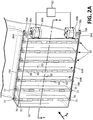
- FIG. 2A is a perspective, broken-out view of modulator 56 in a fully-open state.
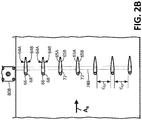
- FIG. 2B is a top cross-sectional view of modulator 56 in the fully-open state along line 2-2 in FIG. 2A.
- FIGS. 2A and 2B will now be discussed simultaneously.
- modulator 56 includes a plurality of dividers 62 extend across substantially the entirety of rectangular duct 50, parallel to and spaced apart from one another.
- Each divider 62 is comprised of two flaps 64A and 64B.
- each divider 62 has an airfoil-shape in that the thickness across the flow of bleed air AB is both tapered and substantially smaller than the length along the flow of bleed air AB.
- the gap GO between adjacent dividers 62 is maximized and modulator 56 has the maximum amount of effective flow area possible.
- modulator 56 allows the maximum amount of flow of bleed air AB that is possible under the given operating conditions.
- Each flap 64A has the same configuration as each flap 64B, although flaps 64B have an upside-down orientation compared to flaps 64A.
- Each of flaps 64A and 64B has a leaf 65A and 65B, respectively, and plurality of knuckles 66.
- Leaves 65A and 65B are responsible for the variable aerodynamic properties of each divider 62, and knuckles 66 form the leading edge of each divider 62 and also form a barrel into which a pin 68 is placed.
- Pin 68 links each pair of flaps 64A and 64B together and provides an axis around which both flaps 64A and 64B pivot.
- Each of flaps 64A and 64B includes a stem 70 which extends through duct 50, although the stems 70 for flaps 64B extend through the opposite side of the duct from the stems 70 for flaps 64A.
- a tab 72 that extends away from the axis of pin 68.
- each pin 68 includes a head that has a slightly enlarged head that is the same or larger diameter than the hole through tab 72.
- Each pin 68 is pressed into a tab 72 on flap 64A to secure pin 68, although alternative arrangements can be implemented, for example, a perpendicular cross-pin through pin 68 and stem 70.
- Each of the tabs 72 for flaps 64A are rotatably connected to a linkage 74A, and each of the tabs 72 for flaps 64B are rotatably connected to a linkage 74B.
- Linkage 74A is rotatably connected to tab 76A of motor shaft 78A
- linkage 74B is rotatably connected to tab 76B of motor shaft 78B.
- motor shaft 78A is connected to the rotor (not shown) of electric stepper motor 80A
- motor shaft 78B is connected to the rotor (not shown) of electric stepper motor 80B.
- Electric stepper motors 80A and 80B are powered and controlled by controller 82 which can be a full authority digital electronics control (FADEC).
- controller 82 which can be a full authority digital electronics control (FADEC).
- FIG. 3A is a perspective, broken-out view of modulator 56 in a partially-closed state.
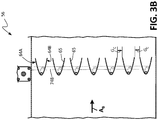
- FIG. 3B is a top cross-sectional view of modulator 56 in the partially-closed state along line 3-3 in FIG. 3A.
- FIGS. 3A and 3B will now be discussed simultaneously, and they can be used in conjunction with FIGS. 2A and 2B to demonstrate how modulator 56 operates.
- Controller 82 can cause electric stepper motors 80A and 80B to rotate a specific and equal amount in opposite directions, which turns motor shafts 78A and 78B and tabs 76A and 76B.
- This movement causes linkages 74A and 74B to move perpendicular to duct 50 in opposite directions, which rotates flaps 64A and 64B about pins 68, respectively, in opposite directions. Therefore, in each pair of flaps 64A and 64B, the trailing edge of leaf 65A moves from being in contact with the trailing edge of leaf 65B to being spaced apart therefrom.
- each divider 62 expands and becomes V-shaped, which shortens the gap GC between adjacent dividers 62 and lessens the effective flow area of duct 50 at modulator 56.
- electric stepper motors 80A and 80B include mechanical stops 84A and 84B, respectively, to limit the rotation of tabs 76A and 76B such that modulator 56 cannot be fully closed.
- modulator 56 allows modulator 56 to be controlled in a manner that prevents unnecessary flow of bleed air AB during conditions when less cooling is needed (e.g., cruising at high altitude) while still providing sufficient bleed air AB during conditions that require maximum cooling (e.g., take off in a high temperature environment). This occurs with minimal disturbance of bleed air AB through heat exchanger 54 (shown in FIG.
- modulator 56 is positioned downstream of heat exchanger 54, bleed air AB still flows generally axially and evenly through duct 50 when modulator 56 is in the partially-closed state, and flaps 64A and 64B move symmetrically together to prevent swirling (i.e., modulator 56 provides a substantially uniform blockage of duct 50 when in the partially-closed state).
- modulator 56 is in the fully-open state, the airfoil-shape of dividers 62 minimizes the flow loss through modulator in an effort to make it aerodynamically invisible.
- modulator 56 would be forced by bleed air AB into the fully-open state, ensuring that sufficient cooling is possible.
- FIGS. 2A-3B Depicted in FIGS. 2A-3B is one embodiment of the present invention, to which there are alternatives.
- the number and size of dividers 62 can depend on several factors such as, for example, the overall length of duct 50 (because more available length allows for longer leaves 65A and 65B, reducing the required number of dividers 62), the distance between heat exchanger 54 and modulator 56 (because the shorter this distance, the greater number of dividers 62 needed to provide uniform blockage), the difference between the maximum and minimum flow of bleed air AB (because a smaller difference requires a less restrictive gap GC, permitting larger distances between dividers 62), and the aspect ratio of dividers 62 when in the fully-open configuration (I.e., the thickness-to-chord ratio of the airfoil shape).
- Another example of an alternative embodiment includes tabs 72 that are oriented to extend forward from stems 70.
- there can be only one electric stepper motor 80 although in such an embodiment, additional gears and/or linkages would be needed to reverse the direction of the rotation while keeping the same magnitude in order to move flaps 64B with respect to flaps 64A.
- there are bushings (not shown) positioned between stems 70 and duct 50.
- a gas turbine engine includes: a fan; a compressor downstream of the fan; a combustor downstream of the fan; a turbine downstream of the fan; a bypass duct downstream of the fan and radially outward of the compressor; a cooling system comprising: an inlet for receiving air from the bypass duct; an outlet for returning air to the bypass duct; a cooling duct extending between the inlet and the outlet; a heat exchanger positioned in the cooling duct; and a modulator positioned in the cooling duct, wherein the modulator includes a plurality of dividers extending parallel to each other and arranged across the duct, wherein each divider comprises: a first flap that is rotatable in a first direction about an axis; a second flap is rotatable in a second direction about the axis that is opposite from the first direction.
- the gas turbine engine of the preceding paragraph can optionally include, additionally and/or alternatively, any one or more of the following features, configurations and/or additional components: Wherein the fluid modulator is moveable between fully-open position and a partially-closed position; wherein a trailing edge of the first flap is in contact with a trailing edge of the second flap in the fully-open position; and wherein the trailing edge of the first flap is spaced apart from the trailing edge of the second flap in the partially-closed position.
- first flap includes a first knuckle and first leaf extending downstream from the first knuckle;
- the second flap includes a second knuckle and a second leaf extending downstream from the second knuckle; and each divider further comprises a pin extending through the first and second knuckles, the pin providing an axis of rotation for the first and second flaps.
- first flap and the second flap form an airfoil shape when the fluid modulator is in the fully-open position.
- first flap includes a first stem that extends through the bypass duct.
- first stem is connected to a first tab that extends away from the first stem.
- first tab is rotatably connected to a first linkage.
- first linkage is rotatably connected to a second tab.
- the second tab is connected to a first shaft of a first motor such that the first motor controls the position of the first flap.
- the second flap includes a second stem that extends through the bypass duct on a side that is opposite of the first stem; the second stem is connected to a third tab that extends away from the second stem; the third tab is rotatably connected to a second linkage; the second linkage is rotatably connected to a fourth tab; and the fourth tab is connected to a second shaft of a second motor such that the second motor controls the position of the second flap.
- the inlet is located on an inner wall of the bypass duct.
- outlet is located on an inner wall of the bypass duct, downstream of the inlet.
- the air in the bypass duct travels generally axially when the fluid modulator is in the partially-closed position.
- a fluid modulator includes: a plurality of dividers extending parallel to each other and arranged across a duct, wherein each divider comprises: a first flap including a first knuckle and first leaf extending downstream from the first knuckle; a second flap including a second knuckle and a second leaf extending downstream from the second knuckle; and a pin extending through the first and second knuckles, the pin providing an axis of rotation for the first and second flaps;
- the fluid modulator of the preceding paragraph can optionally include, additionally and/or alternatively, any one or more of the following features, configurations and/or additional components: Wherein the fluid modulator is moveable between a fully-open position and a partially-closed position; wherein a trailing edge of the first leaf is in contact with a trailing edge of the second leaf in the fully-open position; and wherein the trailing edge of the first leaf is spaced apart from the trailing edge of the second leaf in the partially-closed positioned.
- first flap and the second flap form an airfoil shape when the fluid modulator is in the fully-open position
- first flap includes a first stem that extends through the duct
- second flap includes a second stem that extends through the duct on an opposite side from the first stem
- first stem is connected to a first tab that extends away from the axis of rotation
- second stem is connected to a second tab that extends away from the axis of rotation
- the pin is connected to one of the first tab and the second tab.
- first tab is rotatably connected to a first linkage
- second tab is rotatably connected to a second linkage
- first linkage is rotatably connected to a third tab
- second linkage is rotatably connected to a fourth tab
- the third tab is connected to a first shaft of a first motor such that the first motor controls the position of the first flap
- the fourth tab is connected to a second shaft of a second motor such that the second motor controls the position of the second flap.
Landscapes
- Engineering & Computer Science (AREA)
- General Engineering & Computer Science (AREA)
- Mechanical Engineering (AREA)
- Chemical & Material Sciences (AREA)
- Combustion & Propulsion (AREA)
- Structures Of Non-Positive Displacement Pumps (AREA)
- Turbine Rotor Nozzle Sealing (AREA)
- Physics & Mathematics (AREA)
- Fluid Mechanics (AREA)
Abstract
Description
- The present invention relates generally to fluid systems, and more particularly to a flow modulating airfoil apparatus for an aircraft engine cooling system.
- There are a variety of known gas turbine engine configurations, including two-spool, high-bypass engines. Such an engine typically includes a high pressure spool, a combustion system and a low pressure spool disposed within an engine case to form a generally axial, serial flow path about the engine centerline. The high pressure spool includes a high pressure turbine, a high pressure shaft extending axially forward from the high pressure turbine, and a high pressure compressor connected to a forward end of the high pressure shaft. The low pressure spool includes a low pressure turbine, which is disposed downstream of the high pressure turbine, a low pressure shaft, which typically extends coaxially through the high pressure shaft, and a low pressure compressor connected to a forward end of the low pressure shaft, forward of the high pressure compressor. A fan is also connected to the low pressure spool, forward of the low pressure compressor. The combustion system is disposed between the high pressure compressor and the high pressure turbine and receives compressed air from the compressors and fuel provided by a fuel injection system. A combustion process is carried out within the combustion system to produce high energy exhaust gases to produce thrust and turn the high and low pressure turbines, which drive their respective compressors and the fan to sustain the combustion process.
- The rotation of the fan produces bypass air (i.e., air that is not used in the combustion process) that provides a major portion of the thrust in a high-bypass engine. The temperature of the bypass airflow is relatively cool compared to the engine components, so it is used as an engine cooling source. For example, a portion of the bypass airflow is bled at an upstream location into a cooling passage within the engine compartment and used to absorb heat from engine components. The cooling passage discharges the bleed flow at a downstream location back into the bypass airflow.
- Two trends in new jet engine technology include geared turbofan systems and replacement of pneumatic systems with electrical systems. Such equipment can produce more heat than traditional gas turbine engine systems, so the cooling systems have increased in capacity accordingly. However, the amount of cooling required is dependent on the condition that the engine is operating in (e.g., ground idle, take-off, cruising, landing, etc.). Although effective for cooling, using the bleed flow for cooling reduces the thrust efficiency of the engine. Furthermore, in certain operating conditions, the bleed flow can cause excess cooling if left unchecked. Therefore, the amount of bleed flow being taken from the bypass airflow should be the smallest amount that provides adequate cooling during all of the engine operating conditions.
- According to one embodiment, a gas turbine engine includes a fan, a compressor, a combustor, a turbine, a bypass duct downstream of the fan and outward of the compressor, and a cooling system. The cooling system includes an inlet for receiving air from the bypass duct, an outlet for returning air to the bypass duct, a cooling duct, and a heat exchanger and a modulator positioned in the cooling duct. The modulator includes dividers that extend parallel to each other and are arranged across the duct, and each divider includes two flaps that are rotatable about an axis in opposite directions.
- According to another embodiment, a fluid modulator includes dividers that extend parallel to each other and are arranged across a duct. Each divider includes two flaps and a pin, with each flap including a knuckle and a leaf extending downstream. The pin extends through the knuckles and provides an axis of rotation for the flaps.
- Preferred embodiments of the invention will now be described, by way of example only, and with reference to the accompanying drawings in which:
-
FIG. 1 is a schematic cross-sectional view of a gas turbine engine including a cooling system. -
FIG. 2A is a perspective, broken-out view of a modulator of the cooling system ofFIG. 1 in a fully-open state. -
FIG. 2B is a top cross-sectional view of the modulator in the fully-open state along line 2-2 inFIG. 2A . -
FIG. 3A is a perspective, broken-out view of the modulator in a partially-closed state. -
FIG. 3B is a top cross-sectional view of the modulator in the partially-closed state along line 3-3 inFIG. 3A . -
FIG. 1 is a schematic side cross-sectional view ofgas turbine engine 10 for an aircraft (not shown). Shown inFIG. 1 aregas turbine engine 10,fan 12, low pressure compressor (LPC) 14, high pressure compressor (HPC) 16,combustor section 18, high pressure turbine (HPT) 20, low pressure turbine (LPT) 22, bypass ductouter wall 24,LPC case 26, HPCcase 28,combustor case 29, HPTcase 30,LPT case 32,low pressure shaft 34,high pressure shaft 36, fanexit guide vanes 38, bypass ductinner wall 39,fuel injectors 40, HPTblades 42,LPT blades 44,support rotor 46,cooling system 48,duct 50,inlet 52,heat exchanger 54,modulator 56,outlet 58,component 60, inlet air A, bleed air AB, exhaust air AE, primary air AP, secondary air AS (also known as bypass air), and longitudinal engine centerline axis CL. - In the illustrated embodiment,
gas turbine engine 10 comprises a dual-spool turbofan engine, although other engine configurations are possible in alternative embodiments.Gas turbine engine 10, of which the operational principles are well known in the art, comprisesfan 12,LPC 14, HPC 16,combustor section 18, HPT 20, andLPT 22, which are each concentrically disposed around longitudinal engine centerline axis CL.Fan 12 is enclosed at its outer diameter within bypass ductouter wall 24. Likewise, the other engine components are correspondingly enclosed at their outer diameters within various engine casings, includingLPC case 26, HPCcase 28,combustor case 29, HPTcase 30, andLPT case 32.Fan 12 andLPC 14 are connected toLPT 22 throughlow pressure shaft 34, and together withfan 12,LPC 14,LPT 22, andlow pressure shaft 34 comprise the low pressure spool. HPC 16 is connected to HPT 20 throughhigh pressure shaft 36, and together HPC 16, HPT 20, andhigh pressure shaft 36 comprise the high pressure spool. - During normal operation, inlet air A enters
engine 10 where it is divided into streams of primary air AP and secondary air AS after passing throughfan 12.Fan 12 is rotated byLPT 22 through low pressure shaft 34 (either directly as shown or through a gearbox, not shown) to accelerate secondary air AS (also known as bypass air) through fanexit guide vanes 38 and between bypass ductouter wall 24 and bypass ductinner wall 39, thereby producing a major portion of the thrust output ofengine 10. Primary air AP (also known as gas path air) is directed first intoLPC 14 and then intoHPC 16.LPC 14 and HPC 16 work together to incrementally increase the pressure of primary air AP. HPC 16 is rotated by HPT 20 throughhigh pressure shaft 36 to provide primary air AP tocombustor section 18. The compressed air is delivered tocombustor section 18, along with fuel throughfuel injectors 40, such that this fuel-air mixture is ignited by ignitors (not shown) thus resulting in a combustion process which can be carried out to produce the high energy gases necessary to turnHPT 20 andLPT 22. These high energy gases continue throughgas turbine engine 10 whereby they are typically passed through an exhaust nozzle (not shown) to further produce thrust. - After being compressed in
LPC 14 andHPC 16 and participating in a combustion process incombustor section 18 to increase pressure and energy, primary air AP is mixed with fuel in thecombustor section 18. This fuel-air mixture is ignited by ignitors (not shown) and burned in thecombustor section 18 producing exhaust air AE. Exhaust air AE flows through HPT 20 andLPT 22 such thatHPT blades 42 andLPT blades 44 extract energy from the flow of exhaust air AE. Exhaust air AE impinges onHPT blades 42 to cause rotation ofhigh pressure shaft 36, which turnsHPC 16. Exhaust air AE also impinges onLPT blades 44 to cause rotation ofsupport rotor 46 andlow pressure shaft 34, which turnsfan 12 andLPC 14. - In order to provide cooling for some of the components of
gas turbine engine 10,cooling system 48 is positioned betweenHPC case 28 and bypass ductinner wall 39. In the illustrated embodiment,cooling system 48 includesduct 50 withinlet 52,heat exchanger 54,modulator 56, andoutlet 58. During the operation offan 12, a portion of secondary air AS entersinlet 52 and becomes bleed air AB. For example, bleed air AB can be up to 2% of secondary air AS, and the exact amount depends partly upon the state ofmodulator 56 which is a flow control valve that will be discussed in greater detail with respect toFIGS. 2A-3B . The temperature of bleed air AB is generally cooler than the temperature of components, systems, and lubricants withingas turbine engine 10, so bleed air AB is used as the fluid on the cold side ofheat exchanger 54. After passing throughheat exchanger 54 andmodulator 56, bleed air AB exits coolingsystem 48 throughoutlet 58 and rejoins secondary air AS. - In one embodiment,
heat exchanger 54 has a tube and fin configuration, althoughheat exchanger 54 can be another type of heat exchanger. The hot side ofheat exchanger 54 has another heat transfer fluid (not shown) flowing through it, for example, oil, which circulates betweenheat exchanger 54 andcomponent 60.Component 60 can be one of many components and/or systems ofgas turbine engine 10, for example, a gearbox, an electric generator, or a whole-engine cooling system. During operation ofgas turbine engine 10, the heat transfer fluid absorbs heat fromcomponent 60 which is then brought toheat exchanger 54. There, the heat is transferred to bleed air AB, cooling the heat transfer fluid which returns tocomponent 60. Bleed air AB then removes the heat from coolingsystem 48 by flowing out ofoutlet 58 and eventually out ofgas turbine engine 10 entirely. Thereby maintainingcomponent 60 at the proper temperature and allowinggas turbine engine 10 to function properly. - Depicted in
FIG. 1 is one embodiment of the present invention, to which there are alternative embodiments. For example,engine 10 can be a three spool engine. In such an embodiment,engine 10 has an intermediate pressure compressor (IPC) betweenLPC 14 andHPC 16 and an intermediate pressure turbine (IPT) betweenHPT 20 andLPT 22, wherein the intermediate compressor is connected to the intermediate turbine with an additional intermediate shaft such that low pressure shaft, intermediate shaft and high pressure shaft are each concentrically and coaxially disposed around longitudinal engine centerline axis CL. -
FIG. 2A is a perspective, broken-out view ofmodulator 56 in a fully-open state.FIG. 2B is a top cross-sectional view ofmodulator 56 in the fully-open state along line 2-2 inFIG. 2A. FIGS. 2A and2B will now be discussed simultaneously. - In the illustrated embodiment,
modulator 56 includes a plurality ofdividers 62 extend across substantially the entirety ofrectangular duct 50, parallel to and spaced apart from one another. Eachdivider 62 is comprised of twoflaps divider 62 has an airfoil-shape in that the thickness across the flow of bleed air AB is both tapered and substantially smaller than the length along the flow of bleed air AB. In such a state, the gap GO betweenadjacent dividers 62 is maximized andmodulator 56 has the maximum amount of effective flow area possible. Thereby modulator 56 allows the maximum amount of flow of bleed air AB that is possible under the given operating conditions. - Each
flap 64A has the same configuration as eachflap 64B, althoughflaps 64B have an upside-down orientation compared toflaps 64A. Each offlaps leaf knuckles 66.Leaves divider 62, andknuckles 66 form the leading edge of eachdivider 62 and also form a barrel into which apin 68 is placed.Pin 68 links each pair offlaps flaps flaps stem 70 which extends throughduct 50, although the stems 70 forflaps 64B extend through the opposite side of the duct from the stems 70 forflaps 64A. At the end of each stem 70 is atab 72 that extends away from the axis ofpin 68. In the illustrated embodiment, eachpin 68 includes a head that has a slightly enlarged head that is the same or larger diameter than the hole throughtab 72. Eachpin 68 is pressed into atab 72 onflap 64A to securepin 68, although alternative arrangements can be implemented, for example, a perpendicular cross-pin throughpin 68 andstem 70. - Each of the
tabs 72 forflaps 64A are rotatably connected to alinkage 74A, and each of thetabs 72 forflaps 64B are rotatably connected to alinkage 74B.Linkage 74A is rotatably connected totab 76A ofmotor shaft 78A, andlinkage 74B is rotatably connected totab 76B ofmotor shaft 78B. In the illustrated embodiment,motor shaft 78A is connected to the rotor (not shown) ofelectric stepper motor 80A, andmotor shaft 78B is connected to the rotor (not shown) ofelectric stepper motor 80B.Electric stepper motors controller 82 which can be a full authority digital electronics control (FADEC). -
FIG. 3A is a perspective, broken-out view ofmodulator 56 in a partially-closed state.FIG. 3B is a top cross-sectional view ofmodulator 56 in the partially-closed state along line 3-3 inFIG. 3A. FIGS. 3A and3B will now be discussed simultaneously, and they can be used in conjunction withFIGS. 2A and2B to demonstrate howmodulator 56 operates. -
Controller 82 can causeelectric stepper motors motor shafts tabs linkages duct 50 in opposite directions, which rotatesflaps pins 68, respectively, in opposite directions. Therefore, in each pair offlaps leaf 65A moves from being in contact with the trailing edge ofleaf 65B to being spaced apart therefrom. - The result is that each
divider 62 expands and becomes V-shaped, which shortens the gap GC betweenadjacent dividers 62 and lessens the effective flow area ofduct 50 atmodulator 56. This inhibits the flow of bleed air AB, which reduces the amount of cooling performed by heat exchanger 54 (shown inFIG. 1 ). There can be a very large amount of degrees to whichmodulator 56 can be partially closed, and which position is selected in a given situation can be determined by the temperature of the hot fluid inheat exchanger 54 which is known bycontroller 82. Becauseheat exchanger 54 will require at least some amount of bleed air AB during operation of gas turbine engine 10 (shown inFIG. 1 ),electric stepper motors mechanical stops tabs modulator 56 cannot be fully closed. - The components and configuration of
modulator 56 as shown inFIGS. 2A-3B allowmodulator 56 to be controlled in a manner that prevents unnecessary flow of bleed air AB during conditions when less cooling is needed (e.g., cruising at high altitude) while still providing sufficient bleed air AB during conditions that require maximum cooling (e.g., take off in a high temperature environment). This occurs with minimal disturbance of bleed air AB through heat exchanger 54 (shown inFIG. 1 ) becausemodulator 56 is positioned downstream ofheat exchanger 54, bleed air AB still flows generally axially and evenly throughduct 50 whenmodulator 56 is in the partially-closed state, and flaps 64A and 64B move symmetrically together to prevent swirling (i.e.,modulator 56 provides a substantially uniform blockage ofduct 50 when in the partially-closed state). When modulator 56 is in the fully-open state, the airfoil-shape ofdividers 62 minimizes the flow loss through modulator in an effort to make it aerodynamically invisible. In addition, in case of power loss toelectric stepper motors modulator 56 would be forced by bleed air AB into the fully-open state, ensuring that sufficient cooling is possible. - Depicted in
FIGS. 2A-3B is one embodiment of the present invention, to which there are alternatives. For example, there can be greater orfewer dividers 62 than seven. The number and size ofdividers 62 can depend on several factors such as, for example, the overall length of duct 50 (because more available length allows for longer leaves 65A and 65B, reducing the required number of dividers 62), the distance betweenheat exchanger 54 and modulator 56 (because the shorter this distance, the greater number ofdividers 62 needed to provide uniform blockage), the difference between the maximum and minimum flow of bleed air AB (because a smaller difference requires a less restrictive gap GC, permitting larger distances between dividers 62), and the aspect ratio ofdividers 62 when in the fully-open configuration (I.e., the thickness-to-chord ratio of the airfoil shape). - Another example of an alternative embodiment includes
tabs 72 that are oriented to extend forward from stems 70. For yet another example, there can be only one electric stepper motor 80, although in such an embodiment, additional gears and/or linkages would be needed to reverse the direction of the rotation while keeping the same magnitude in order to moveflaps 64B with respect toflaps 64A. For a further example, there are bushings (not shown) positioned between stems 70 andduct 50. - The following are non-exclusive descriptions of possible embodiments of the present invention.
- A gas turbine engine according to an exemplary embodiment of this disclosure, among other possible things includes: a fan; a compressor downstream of the fan; a combustor downstream of the fan; a turbine downstream of the fan; a bypass duct downstream of the fan and radially outward of the compressor; a cooling system comprising: an inlet for receiving air from the bypass duct; an outlet for returning air to the bypass duct; a cooling duct extending between the inlet and the outlet; a heat exchanger positioned in the cooling duct; and a modulator positioned in the cooling duct, wherein the modulator includes a plurality of dividers extending parallel to each other and arranged across the duct, wherein each divider comprises: a first flap that is rotatable in a first direction about an axis; a second flap is rotatable in a second direction about the axis that is opposite from the first direction.
- The gas turbine engine of the preceding paragraph can optionally include, additionally and/or alternatively, any one or more of the following features, configurations and/or additional components:
Wherein the fluid modulator is moveable between fully-open position and a partially-closed position; wherein a trailing edge of the first flap is in contact with a trailing edge of the second flap in the fully-open position; and wherein the trailing edge of the first flap is spaced apart from the trailing edge of the second flap in the partially-closed position. - Wherein the first flap includes a first knuckle and first leaf extending downstream from the first knuckle; the second flap includes a second knuckle and a second leaf extending downstream from the second knuckle; and each divider further comprises a pin extending through the first and second knuckles, the pin providing an axis of rotation for the first and second flaps.
- Wherein the first flap and the second flap form an airfoil shape when the fluid modulator is in the fully-open position.
- Wherein the first flap includes a first stem that extends through the bypass duct.
- Wherein the first stem is connected to a first tab that extends away from the first stem.
- Wherein the first tab is rotatably connected to a first linkage.
- Wherein the first linkage is rotatably connected to a second tab.
- Wherein the second tab is connected to a first shaft of a first motor such that the first motor controls the position of the first flap.
- Wherein the second flap includes a second stem that extends through the bypass duct on a side that is opposite of the first stem; the second stem is connected to a third tab that extends away from the second stem; the third tab is rotatably connected to a second linkage; the second linkage is rotatably connected to a fourth tab; and the fourth tab is connected to a second shaft of a second motor such that the second motor controls the position of the second flap.
- Wherein the inlet is located on an inner wall of the bypass duct.
- Wherein the outlet is located on an inner wall of the bypass duct, downstream of the inlet.
- Wherein the air in the bypass duct travels generally axially when the fluid modulator is in the partially-closed position.
- A fluid modulator according to an exemplary embodiment of this disclosure, among other possible things includes: a plurality of dividers extending parallel to each other and arranged across a duct, wherein each divider comprises: a first flap including a first knuckle and first leaf extending downstream from the first knuckle; a second flap including a second knuckle and a second leaf extending downstream from the second knuckle; and a pin extending through the first and second knuckles, the pin providing an axis of rotation for the first and second flaps;
- The fluid modulator of the preceding paragraph can optionally include, additionally and/or alternatively, any one or more of the following features, configurations and/or additional components:
Wherein the fluid modulator is moveable between a fully-open position and a partially-closed position; wherein a trailing edge of the first leaf is in contact with a trailing edge of the second leaf in the fully-open position; and wherein the trailing edge of the first leaf is spaced apart from the trailing edge of the second leaf in the partially-closed positioned. - Wherein the first flap and the second flap form an airfoil shape when the fluid modulator is in the fully-open position
- Wherein the first flap includes a first stem that extends through the duct, and the second flap includes a second stem that extends through the duct on an opposite side from the first stem.
- Wherein the first stem is connected to a first tab that extends away from the axis of rotation, and the second stem is connected to a second tab that extends away from the axis of rotation.
- Wherein the pin is connected to one of the first tab and the second tab.
- Wherein the first tab is rotatably connected to a first linkage, and the second tab is rotatably connected to a second linkage.
- Wherein the first linkage is rotatably connected to a third tab, and the second linkage is rotatably connected to a fourth tab.
- Wherein the third tab is connected to a first shaft of a first motor such that the first motor controls the position of the first flap, and the fourth tab is connected to a second shaft of a second motor such that the second motor controls the position of the second flap.
- While the invention has been described with reference to an exemplary embodiment(s), it will be understood by those skilled in the art that various changes may be made and equivalents may be substituted for elements thereof without departing from the scope of the invention. In addition, many modifications may be made to adapt a particular situation or material to the teachings of the invention without departing from the essential scope thereof. Therefore, it is intended that the invention not be limited to the particular embodiment(s) disclosed, but that the invention will include all embodiments falling within the scope of the appended claims.
Claims (15)
- A gas turbine engine comprising:a fan;a compressor downstream of the fan;a combustor downstream of the fan;a turbine downstream of the fan;a bypass duct downstream of the fan and radially outward of the compressor;a cooling system comprising:an inlet for receiving air from the bypass duct;an outlet for returning air to the bypass duct;a cooling duct extending between the inlet and the outlet;a heat exchanger positioned in the cooling duct; anda fluid modulator positioned in the cooling duct, wherein the fluid modulator includes a plurality of dividers extending parallel to each other and arranged across the duct, wherein each divider comprises:a first flap that is rotatable in a first direction about an axis; anda second flap is rotatable in a second direction about the axis that is opposite from the first direction.
- The gas turbine engine of claim 1, wherein the fluid modulator is moveable between fully-open position and a partially-closed position:wherein a trailing edge of the first flap is in contact with a trailing edge of the second flap in the fully-open position; andwherein the trailing edge of the first flap is spaced apart from the trailing edge of the second flap in the partially-closed position.
- The gas turbine engine of claim 1 or 2, wherein the first flap and the second flap form an airfoil shape when the fluid modulator is in the fully-open position.
- The gas turbine engine of any preceding claim, wherein:the first flap includes a first knuckle and first leaf extending downstream from the first knuckle;the second flap includes a second knuckle and a second leaf extending downstream from the second knuckle; andeach divider further comprises a pin extending through the first and second knuckles, the pin providing an axis of rotation for the first and second flaps.
- The gas turbine engine of any preceding claim, wherein the first flap includes a first stem that extends through the bypass duct,
wherein, optionally, the first stem is connected to a first tab that extends away from the first stem,
wherein, optionally, the first tab is rotatably connected to a first linkage,
wherein, optionally, the first linkage is rotatably connected to a second tab,
wherein, optionally, the second tab is connected to a first shaft of a first motor such that the first motor controls the position of the first flap. - The gas turbine engine of claim 5, wherein:the second flap includes a second stem that extends through the bypass duct on a side that is opposite of the first stem;the second stem is connected to a third tab that extends away from the second stem;the third tab is rotatably connected to a second linkage;the second linkage is rotatably connected to a fourth tab; andthe fourth tab is connected to a second shaft of a second motor such that the second motor controls the position of the second flap.
- The gas turbine engine of any preceding claim, wherein the inlet is located on an inner wall of the bypass duct and the outlet is located on an inner wall of the bypass duct, downstream of the inlet.
- The gas turbine engine of any preceding claim, wherein the air in the bypass duct travels generally axially when the fluid modulator is in a partially-closed position.
- A fluid modulator comprising a plurality of dividers extending parallel to each other and arranged across a duct, wherein each divider comprises:a first flap including a first knuckle and first leaf extending downstream from the first knuckle;a second flap including a second knuckle and a second leaf extending downstream from the second knuckle; anda pin extending through the first and second knuckles, the pin providing an axis of rotation for the first and second flaps.
- The fluid modulator of claim 9, wherein the fluid modulator is moveable between fully-open position and a partially-closed position:wherein a trailing edge of the first flap is in contact with a trailing edge of the second flap in the fully-open position; andwherein the trailing edge of the first flap is spaced apart from the trailing edge of the second flap in the partially-closed position
- The fluid modulator of claim 10, wherein the first flap and the second flap form an airfoil shape when the fluid modulator is in the fully-open position
- The fluid modulator of claim 9, 10 or 11, wherein the first flap includes a first stem that extends through the duct, and the second flap includes a second stem that extends through the duct on an opposite side from the first stem.
- The fluid modulator of claim 12, wherein the first stem is connected to a first tab that extends away from the axis of rotation, and the second stem is connected to a second tab that extends away from the axis of rotation,
wherein, optionally, the pin is connected to one of the first tab and the second tab. - The fluid modulator of claim 12 or 13, wherein:the first tab is rotatably connected to a first linkage, and the second tab is rotatably connected to a second linkage; andthe first linkage is rotatably connected to a third tab, and the second linkage is rotatably connected to a fourth tab.
- The fluid modulator of claim 14, wherein the third tab is connected to a first shaft of a first motor such that the first motor controls the position of the first flap, and the fourth tab is connected to a second shaft of a second motor such that the second motor controls the position of the second flap.
Applications Claiming Priority (1)
| Application Number | Priority Date | Filing Date | Title |
|---|---|---|---|
| US15/620,284 US10557416B2 (en) | 2017-06-12 | 2017-06-12 | Flow modulating airfoil apparatus |
Publications (3)
| Publication Number | Publication Date |
|---|---|
| EP3415725A2 true EP3415725A2 (en) | 2018-12-19 |
| EP3415725A3 EP3415725A3 (en) | 2019-03-20 |
| EP3415725B1 EP3415725B1 (en) | 2024-08-28 |
Family
ID=62495712
Family Applications (1)
| Application Number | Title | Priority Date | Filing Date |
|---|---|---|---|
| EP18175569.5A Active EP3415725B1 (en) | 2017-06-12 | 2018-06-01 | Flow modulating airfoil apparatus |
Country Status (2)
| Country | Link |
|---|---|
| US (1) | US10557416B2 (en) |
| EP (1) | EP3415725B1 (en) |
Cited By (1)
| Publication number | Priority date | Publication date | Assignee | Title |
|---|---|---|---|---|
| EP4086445A1 (en) * | 2021-05-06 | 2022-11-09 | Safran Aero Boosters | Heat exchange device and aircraft turbine engine with the device |
Families Citing this family (5)
| Publication number | Priority date | Publication date | Assignee | Title |
|---|---|---|---|---|
| EP3851659B1 (en) * | 2020-01-15 | 2022-08-17 | Airbus Operations (S.A.S.) | Cold regulating valve for a heat exchanger system of an aircraft propulsion system |
| US11384649B1 (en) | 2021-02-11 | 2022-07-12 | General Electric Company | Heat exchanger and flow modulation system |
| GB202210040D0 (en) * | 2022-05-20 | 2022-08-24 | Rolls Royce Plc | Gas turbine engine |
| US12071913B1 (en) | 2023-07-31 | 2024-08-27 | Rolls-Royce North American Technologies Inc. | Inlets for gas turbine engine bypass duct heat exchangers |
| US12188408B1 (en) * | 2023-07-31 | 2025-01-07 | Rolls-Royce North American Technologies Inc. | Inlet turning vanes having trailing edge features for improved flow uniformity |
Family Cites Families (15)
| Publication number | Priority date | Publication date | Assignee | Title |
|---|---|---|---|---|
| US3125944A (en) * | 1964-03-24 | Or register | ||
| US1568410A (en) | 1925-02-17 | 1926-01-05 | Clarke C Minter | Charge-supply means for internal-combustion engines and means for maintaining uniform mixture conditions of the charge |
| FR1597532A (en) | 1967-09-15 | 1970-06-29 | ||
| US3593645A (en) * | 1969-03-03 | 1971-07-20 | Connor Eng Corp | Terminal outlet for air distribution system |
| US4147029A (en) * | 1976-01-02 | 1979-04-03 | General Electric Company | Long duct mixed flow gas turbine engine |
| GB9215316D0 (en) | 1992-07-18 | 1992-09-02 | Rolls Royce Plc | Ducted fan gas turbine engine |
| WO2008045054A1 (en) | 2006-10-12 | 2008-04-17 | United Technologies Corporation | Modulating flow through gas turbine engine cooling system |
| US7823389B2 (en) * | 2006-11-15 | 2010-11-02 | General Electric Company | Compound clearance control engine |
| US20090175718A1 (en) * | 2007-12-31 | 2009-07-09 | Carlos Diaz | System and method for passive cooling of gas turbine engine control components |
| US9108737B2 (en) | 2012-08-24 | 2015-08-18 | United Technologies Corporation | Nacelle scoop inlet |
| US9206912B2 (en) | 2013-01-23 | 2015-12-08 | The Boeing Company | Dual door fan air modulating valve |
| EP2971672B1 (en) | 2013-03-15 | 2018-09-26 | United Technologies Corporation | Gas turbine engine with air-oil cooler oil tank |
| US10145304B2 (en) | 2014-01-13 | 2018-12-04 | United Technologies Corporation | Dual function air diverter and variable area fan nozzle |
| US20160153363A1 (en) | 2014-12-01 | 2016-06-02 | United Technologies Corporation | Liquid separating air inlets |
| US10794288B2 (en) | 2015-07-07 | 2020-10-06 | Raytheon Technologies Corporation | Cooled cooling air system for a turbofan engine |
-
2017
- 2017-06-12 US US15/620,284 patent/US10557416B2/en active Active
-
2018
- 2018-06-01 EP EP18175569.5A patent/EP3415725B1/en active Active
Non-Patent Citations (1)
| Title |
|---|
| None |
Cited By (2)
| Publication number | Priority date | Publication date | Assignee | Title |
|---|---|---|---|---|
| EP4086445A1 (en) * | 2021-05-06 | 2022-11-09 | Safran Aero Boosters | Heat exchange device and aircraft turbine engine with the device |
| BE1029381B1 (en) * | 2021-05-06 | 2022-12-05 | Safran Aero Boosters | HEAT EXCHANGE DEVICE AND AIRCRAFT TURBOMACHINE WITH DEVICE |
Also Published As
| Publication number | Publication date |
|---|---|
| EP3415725A3 (en) | 2019-03-20 |
| US10557416B2 (en) | 2020-02-11 |
| US20180355739A1 (en) | 2018-12-13 |
| EP3415725B1 (en) | 2024-08-28 |
Similar Documents
| Publication | Publication Date | Title |
|---|---|---|
| US11378009B2 (en) | Multi-mode heat rejection system for a gas turbine engine | |
| EP3415725B1 (en) | Flow modulating airfoil apparatus | |
| EP2643557B1 (en) | Integrated variable geometry flow restrictor and heat exchanger | |
| EP3473818B1 (en) | Trapped vortex combustor for a gas turbine engine | |
| EP3133249A1 (en) | Gas turbine engine having an air bleed system | |
| EP3623586B1 (en) | Variable bypass ratio fan with variable pitch aft stage rotor blading | |
| WO2018009259A2 (en) | System for a surface cooler with ogv oriented fin angles | |
| US20250354518A1 (en) | Gas turbine engine having cooling systems | |
| EP3199779B1 (en) | Cooling air for variable geometry turbine | |
| US12031478B2 (en) | Air bottoming cycle driven propulsor | |
| US10787912B2 (en) | Spiral cavities for gas turbine engine components | |
| EP3351767B1 (en) | Intercooled cooling air system with bypass | |
| EP3569841A1 (en) | Intercooled cooling air with heat exchanger packaging | |
| US11512639B2 (en) | Heat transfer system | |
| US20260055774A1 (en) | Gas turbine engine bleed air flow control | |
| US12460574B2 (en) | Gas turbine engine having cooling systems | |
| US20250334055A1 (en) | Gas turbine engine having cooling systems | |
| US20250354519A1 (en) | Gas turbine engine having cooling systems | |
| US20250347252A1 (en) | Gas turbine engine having cooling systems | |
| US20250347251A1 (en) | Gas turbine engine having cooling systems | |
| US20250389225A1 (en) | Gas turbine engine having cooling systems | |
| US20250389226A1 (en) | Gas turbine engine having cooling systems | |
| US20250347258A1 (en) | Gas turbine engine having cooling systems |
Legal Events
| Date | Code | Title | Description |
|---|---|---|---|
| PUAI | Public reference made under article 153(3) epc to a published international application that has entered the european phase |
Free format text: ORIGINAL CODE: 0009012 |
|
| STAA | Information on the status of an ep patent application or granted ep patent |
Free format text: STATUS: THE APPLICATION HAS BEEN PUBLISHED |
|
| AK | Designated contracting states |
Kind code of ref document: A2 Designated state(s): AL AT BE BG CH CY CZ DE DK EE ES FI FR GB GR HR HU IE IS IT LI LT LU LV MC MK MT NL NO PL PT RO RS SE SI SK SM TR |
|
| AX | Request for extension of the european patent |
Extension state: BA ME |
|
| PUAL | Search report despatched |
Free format text: ORIGINAL CODE: 0009013 |
|
| AK | Designated contracting states |
Kind code of ref document: A3 Designated state(s): AL AT BE BG CH CY CZ DE DK EE ES FI FR GB GR HR HU IE IS IT LI LT LU LV MC MK MT NL NO PL PT RO RS SE SI SK SM TR |
|
| AX | Request for extension of the european patent |
Extension state: BA ME |
|
| RIC1 | Information provided on ipc code assigned before grant |
Ipc: F02K 3/06 20060101ALI20190214BHEP Ipc: F02K 3/115 20060101ALI20190214BHEP Ipc: F24F 13/10 20060101ALI20190214BHEP Ipc: F02C 7/18 20060101ALI20190214BHEP Ipc: F02C 6/08 20060101ALI20190214BHEP Ipc: F02C 7/14 20060101ALI20190214BHEP Ipc: F01D 17/14 20060101AFI20190214BHEP Ipc: F24F 13/14 20060101ALI20190214BHEP |
|
| STAA | Information on the status of an ep patent application or granted ep patent |
Free format text: STATUS: REQUEST FOR EXAMINATION WAS MADE |
|
| 17P | Request for examination filed |
Effective date: 20190918 |
|
| RBV | Designated contracting states (corrected) |
Designated state(s): AL AT BE BG CH CY CZ DE DK EE ES FI FR GB GR HR HU IE IS IT LI LT LU LV MC MK MT NL NO PL PT RO RS SE SI SK SM TR |
|
| RAP1 | Party data changed (applicant data changed or rights of an application transferred) |
Owner name: RAYTHEON TECHNOLOGIES CORPORATION |
|
| STAA | Information on the status of an ep patent application or granted ep patent |
Free format text: STATUS: EXAMINATION IS IN PROGRESS |
|
| 17Q | First examination report despatched |
Effective date: 20211111 |
|
| RAP3 | Party data changed (applicant data changed or rights of an application transferred) |
Owner name: RTX CORPORATION |
|
| GRAP | Despatch of communication of intention to grant a patent |
Free format text: ORIGINAL CODE: EPIDOSNIGR1 |
|
| STAA | Information on the status of an ep patent application or granted ep patent |
Free format text: STATUS: GRANT OF PATENT IS INTENDED |
|
| INTG | Intention to grant announced |
Effective date: 20231108 |
|
| GRAJ | Information related to disapproval of communication of intention to grant by the applicant or resumption of examination proceedings by the epo deleted |
Free format text: ORIGINAL CODE: EPIDOSDIGR1 |
|
| STAA | Information on the status of an ep patent application or granted ep patent |
Free format text: STATUS: EXAMINATION IS IN PROGRESS |
|
| GRAP | Despatch of communication of intention to grant a patent |
Free format text: ORIGINAL CODE: EPIDOSNIGR1 |
|
| STAA | Information on the status of an ep patent application or granted ep patent |
Free format text: STATUS: GRANT OF PATENT IS INTENDED |
|
| INTC | Intention to grant announced (deleted) | ||
| INTG | Intention to grant announced |
Effective date: 20240328 |
|
| GRAS | Grant fee paid |
Free format text: ORIGINAL CODE: EPIDOSNIGR3 |
|
| GRAA | (expected) grant |
Free format text: ORIGINAL CODE: 0009210 |
|
| STAA | Information on the status of an ep patent application or granted ep patent |
Free format text: STATUS: THE PATENT HAS BEEN GRANTED |
|
| AK | Designated contracting states |
Kind code of ref document: B1 Designated state(s): AL AT BE BG CH CY CZ DE DK EE ES FI FR GB GR HR HU IE IS IT LI LT LU LV MC MK MT NL NO PL PT RO RS SE SI SK SM TR |
|
| REG | Reference to a national code |
Ref country code: GB Ref legal event code: FG4D |
|
| REG | Reference to a national code |
Ref country code: CH Ref legal event code: EP |
|
| REG | Reference to a national code |
Ref country code: DE Ref legal event code: R096 Ref document number: 602018073555 Country of ref document: DE |
|
| REG | Reference to a national code |
Ref country code: IE Ref legal event code: FG4D |
|
| REG | Reference to a national code |
Ref country code: LT Ref legal event code: MG9D |
|
| PG25 | Lapsed in a contracting state [announced via postgrant information from national office to epo] |
Ref country code: NO Free format text: LAPSE BECAUSE OF FAILURE TO SUBMIT A TRANSLATION OF THE DESCRIPTION OR TO PAY THE FEE WITHIN THE PRESCRIBED TIME-LIMIT Effective date: 20241128 |
|
| REG | Reference to a national code |
Ref country code: AT Ref legal event code: MK05 Ref document number: 1718137 Country of ref document: AT Kind code of ref document: T Effective date: 20240828 |
|
| PG25 | Lapsed in a contracting state [announced via postgrant information from national office to epo] |
Ref country code: NL Free format text: LAPSE BECAUSE OF FAILURE TO SUBMIT A TRANSLATION OF THE DESCRIPTION OR TO PAY THE FEE WITHIN THE PRESCRIBED TIME-LIMIT Effective date: 20240828 Ref country code: PL Free format text: LAPSE BECAUSE OF FAILURE TO SUBMIT A TRANSLATION OF THE DESCRIPTION OR TO PAY THE FEE WITHIN THE PRESCRIBED TIME-LIMIT Effective date: 20240828 Ref country code: FI Free format text: LAPSE BECAUSE OF FAILURE TO SUBMIT A TRANSLATION OF THE DESCRIPTION OR TO PAY THE FEE WITHIN THE PRESCRIBED TIME-LIMIT Effective date: 20240828 Ref country code: PT Free format text: LAPSE BECAUSE OF FAILURE TO SUBMIT A TRANSLATION OF THE DESCRIPTION OR TO PAY THE FEE WITHIN THE PRESCRIBED TIME-LIMIT Effective date: 20241230 Ref country code: GR Free format text: LAPSE BECAUSE OF FAILURE TO SUBMIT A TRANSLATION OF THE DESCRIPTION OR TO PAY THE FEE WITHIN THE PRESCRIBED TIME-LIMIT Effective date: 20241129 |
|
| PG25 | Lapsed in a contracting state [announced via postgrant information from national office to epo] |
Ref country code: BG Free format text: LAPSE BECAUSE OF FAILURE TO SUBMIT A TRANSLATION OF THE DESCRIPTION OR TO PAY THE FEE WITHIN THE PRESCRIBED TIME-LIMIT Effective date: 20240828 |
|
| PG25 | Lapsed in a contracting state [announced via postgrant information from national office to epo] |
Ref country code: LV Free format text: LAPSE BECAUSE OF FAILURE TO SUBMIT A TRANSLATION OF THE DESCRIPTION OR TO PAY THE FEE WITHIN THE PRESCRIBED TIME-LIMIT Effective date: 20240828 |
|
| REG | Reference to a national code |
Ref country code: NL Ref legal event code: MP Effective date: 20240828 |
|
| PG25 | Lapsed in a contracting state [announced via postgrant information from national office to epo] |
Ref country code: AT Free format text: LAPSE BECAUSE OF FAILURE TO SUBMIT A TRANSLATION OF THE DESCRIPTION OR TO PAY THE FEE WITHIN THE PRESCRIBED TIME-LIMIT Effective date: 20240828 Ref country code: IS Free format text: LAPSE BECAUSE OF FAILURE TO SUBMIT A TRANSLATION OF THE DESCRIPTION OR TO PAY THE FEE WITHIN THE PRESCRIBED TIME-LIMIT Effective date: 20241228 |
|
| PG25 | Lapsed in a contracting state [announced via postgrant information from national office to epo] |
Ref country code: HR Free format text: LAPSE BECAUSE OF FAILURE TO SUBMIT A TRANSLATION OF THE DESCRIPTION OR TO PAY THE FEE WITHIN THE PRESCRIBED TIME-LIMIT Effective date: 20240828 |
|
| PG25 | Lapsed in a contracting state [announced via postgrant information from national office to epo] |
Ref country code: RS Free format text: LAPSE BECAUSE OF FAILURE TO SUBMIT A TRANSLATION OF THE DESCRIPTION OR TO PAY THE FEE WITHIN THE PRESCRIBED TIME-LIMIT Effective date: 20241128 Ref country code: ES Free format text: LAPSE BECAUSE OF FAILURE TO SUBMIT A TRANSLATION OF THE DESCRIPTION OR TO PAY THE FEE WITHIN THE PRESCRIBED TIME-LIMIT Effective date: 20240828 |
|
| PG25 | Lapsed in a contracting state [announced via postgrant information from national office to epo] |
Ref country code: RS Free format text: LAPSE BECAUSE OF FAILURE TO SUBMIT A TRANSLATION OF THE DESCRIPTION OR TO PAY THE FEE WITHIN THE PRESCRIBED TIME-LIMIT Effective date: 20241128 Ref country code: PT Free format text: LAPSE BECAUSE OF FAILURE TO SUBMIT A TRANSLATION OF THE DESCRIPTION OR TO PAY THE FEE WITHIN THE PRESCRIBED TIME-LIMIT Effective date: 20241230 Ref country code: PL Free format text: LAPSE BECAUSE OF FAILURE TO SUBMIT A TRANSLATION OF THE DESCRIPTION OR TO PAY THE FEE WITHIN THE PRESCRIBED TIME-LIMIT Effective date: 20240828 Ref country code: NO Free format text: LAPSE BECAUSE OF FAILURE TO SUBMIT A TRANSLATION OF THE DESCRIPTION OR TO PAY THE FEE WITHIN THE PRESCRIBED TIME-LIMIT Effective date: 20241128 Ref country code: NL Free format text: LAPSE BECAUSE OF FAILURE TO SUBMIT A TRANSLATION OF THE DESCRIPTION OR TO PAY THE FEE WITHIN THE PRESCRIBED TIME-LIMIT Effective date: 20240828 Ref country code: LV Free format text: LAPSE BECAUSE OF FAILURE TO SUBMIT A TRANSLATION OF THE DESCRIPTION OR TO PAY THE FEE WITHIN THE PRESCRIBED TIME-LIMIT Effective date: 20240828 Ref country code: IS Free format text: LAPSE BECAUSE OF FAILURE TO SUBMIT A TRANSLATION OF THE DESCRIPTION OR TO PAY THE FEE WITHIN THE PRESCRIBED TIME-LIMIT Effective date: 20241228 Ref country code: HR Free format text: LAPSE BECAUSE OF FAILURE TO SUBMIT A TRANSLATION OF THE DESCRIPTION OR TO PAY THE FEE WITHIN THE PRESCRIBED TIME-LIMIT Effective date: 20240828 Ref country code: GR Free format text: LAPSE BECAUSE OF FAILURE TO SUBMIT A TRANSLATION OF THE DESCRIPTION OR TO PAY THE FEE WITHIN THE PRESCRIBED TIME-LIMIT Effective date: 20241129 Ref country code: FI Free format text: LAPSE BECAUSE OF FAILURE TO SUBMIT A TRANSLATION OF THE DESCRIPTION OR TO PAY THE FEE WITHIN THE PRESCRIBED TIME-LIMIT Effective date: 20240828 Ref country code: ES Free format text: LAPSE BECAUSE OF FAILURE TO SUBMIT A TRANSLATION OF THE DESCRIPTION OR TO PAY THE FEE WITHIN THE PRESCRIBED TIME-LIMIT Effective date: 20240828 Ref country code: BG Free format text: LAPSE BECAUSE OF FAILURE TO SUBMIT A TRANSLATION OF THE DESCRIPTION OR TO PAY THE FEE WITHIN THE PRESCRIBED TIME-LIMIT Effective date: 20240828 Ref country code: AT Free format text: LAPSE BECAUSE OF FAILURE TO SUBMIT A TRANSLATION OF THE DESCRIPTION OR TO PAY THE FEE WITHIN THE PRESCRIBED TIME-LIMIT Effective date: 20240828 |
|
| PG25 | Lapsed in a contracting state [announced via postgrant information from national office to epo] |
Ref country code: SM Free format text: LAPSE BECAUSE OF FAILURE TO SUBMIT A TRANSLATION OF THE DESCRIPTION OR TO PAY THE FEE WITHIN THE PRESCRIBED TIME-LIMIT Effective date: 20240828 Ref country code: RO Free format text: LAPSE BECAUSE OF FAILURE TO SUBMIT A TRANSLATION OF THE DESCRIPTION OR TO PAY THE FEE WITHIN THE PRESCRIBED TIME-LIMIT Effective date: 20240828 Ref country code: DK Free format text: LAPSE BECAUSE OF FAILURE TO SUBMIT A TRANSLATION OF THE DESCRIPTION OR TO PAY THE FEE WITHIN THE PRESCRIBED TIME-LIMIT Effective date: 20240828 |
|
| PG25 | Lapsed in a contracting state [announced via postgrant information from national office to epo] |
Ref country code: EE Free format text: LAPSE BECAUSE OF FAILURE TO SUBMIT A TRANSLATION OF THE DESCRIPTION OR TO PAY THE FEE WITHIN THE PRESCRIBED TIME-LIMIT Effective date: 20240828 |
|
| PG25 | Lapsed in a contracting state [announced via postgrant information from national office to epo] |
Ref country code: CZ Free format text: LAPSE BECAUSE OF FAILURE TO SUBMIT A TRANSLATION OF THE DESCRIPTION OR TO PAY THE FEE WITHIN THE PRESCRIBED TIME-LIMIT Effective date: 20240828 |
|
| PG25 | Lapsed in a contracting state [announced via postgrant information from national office to epo] |
Ref country code: SK Free format text: LAPSE BECAUSE OF FAILURE TO SUBMIT A TRANSLATION OF THE DESCRIPTION OR TO PAY THE FEE WITHIN THE PRESCRIBED TIME-LIMIT Effective date: 20240828 Ref country code: IT Free format text: LAPSE BECAUSE OF FAILURE TO SUBMIT A TRANSLATION OF THE DESCRIPTION OR TO PAY THE FEE WITHIN THE PRESCRIBED TIME-LIMIT Effective date: 20240828 |
|
| REG | Reference to a national code |
Ref country code: DE Ref legal event code: R097 Ref document number: 602018073555 Country of ref document: DE |
|
| PLBE | No opposition filed within time limit |
Free format text: ORIGINAL CODE: 0009261 |
|
| STAA | Information on the status of an ep patent application or granted ep patent |
Free format text: STATUS: NO OPPOSITION FILED WITHIN TIME LIMIT |
|
| PGFP | Annual fee paid to national office [announced via postgrant information from national office to epo] |
Ref country code: DE Payment date: 20250520 Year of fee payment: 8 |
|
| PGFP | Annual fee paid to national office [announced via postgrant information from national office to epo] |
Ref country code: GB Payment date: 20250520 Year of fee payment: 8 |
|
| PGFP | Annual fee paid to national office [announced via postgrant information from national office to epo] |
Ref country code: FR Payment date: 20250520 Year of fee payment: 8 |
|
| 26N | No opposition filed |
Effective date: 20250530 |
|
| PG25 | Lapsed in a contracting state [announced via postgrant information from national office to epo] |
Ref country code: SE Free format text: LAPSE BECAUSE OF FAILURE TO SUBMIT A TRANSLATION OF THE DESCRIPTION OR TO PAY THE FEE WITHIN THE PRESCRIBED TIME-LIMIT Effective date: 20240828 |
|
| REG | Reference to a national code |
Ref country code: CH Ref legal event code: H13 Free format text: ST27 STATUS EVENT CODE: U-0-0-H10-H13 (AS PROVIDED BY THE NATIONAL OFFICE) Effective date: 20260127 |
|
| PG25 | Lapsed in a contracting state [announced via postgrant information from national office to epo] |
Ref country code: MC Free format text: LAPSE BECAUSE OF FAILURE TO SUBMIT A TRANSLATION OF THE DESCRIPTION OR TO PAY THE FEE WITHIN THE PRESCRIBED TIME-LIMIT Effective date: 20240828 |
|
| PG25 | Lapsed in a contracting state [announced via postgrant information from national office to epo] |
Ref country code: LU Free format text: LAPSE BECAUSE OF NON-PAYMENT OF DUE FEES Effective date: 20250601 |
|
| REG | Reference to a national code |
Ref country code: BE Ref legal event code: MM Effective date: 20250630 |
|
| PG25 | Lapsed in a contracting state [announced via postgrant information from national office to epo] |
Ref country code: IE Free format text: LAPSE BECAUSE OF NON-PAYMENT OF DUE FEES Effective date: 20250601 |
|
| PG25 | Lapsed in a contracting state [announced via postgrant information from national office to epo] |
Ref country code: BE Free format text: LAPSE BECAUSE OF NON-PAYMENT OF DUE FEES Effective date: 20250630 |
|
| PG25 | Lapsed in a contracting state [announced via postgrant information from national office to epo] |
Ref country code: CH Free format text: LAPSE BECAUSE OF NON-PAYMENT OF DUE FEES Effective date: 20250630 |