EP3415622A1 - Method for production of fine chemicals using a corynebacterium secreting modified alpha-1,6-glucosidases - Google Patents
Method for production of fine chemicals using a corynebacterium secreting modified alpha-1,6-glucosidases Download PDFInfo
- Publication number
- EP3415622A1 EP3415622A1 EP17175992.1A EP17175992A EP3415622A1 EP 3415622 A1 EP3415622 A1 EP 3415622A1 EP 17175992 A EP17175992 A EP 17175992A EP 3415622 A1 EP3415622 A1 EP 3415622A1
- Authority
- EP
- European Patent Office
- Prior art keywords
- seq
- amino acid
- corynebacterium
- positions
- sequence
- Prior art date
- Legal status (The legal status is an assumption and is not a legal conclusion. Google has not performed a legal analysis and makes no representation as to the accuracy of the status listed.)
- Withdrawn
Links
Classifications
-
- C—CHEMISTRY; METALLURGY
- C12—BIOCHEMISTRY; BEER; SPIRITS; WINE; VINEGAR; MICROBIOLOGY; ENZYMOLOGY; MUTATION OR GENETIC ENGINEERING
- C12P—FERMENTATION OR ENZYME-USING PROCESSES TO SYNTHESISE A DESIRED CHEMICAL COMPOUND OR COMPOSITION OR TO SEPARATE OPTICAL ISOMERS FROM A RACEMIC MIXTURE
- C12P13/00—Preparation of nitrogen-containing organic compounds
- C12P13/04—Alpha- or beta- amino acids
- C12P13/06—Alanine; Leucine; Isoleucine; Serine; Homoserine
-
- C—CHEMISTRY; METALLURGY
- C12—BIOCHEMISTRY; BEER; SPIRITS; WINE; VINEGAR; MICROBIOLOGY; ENZYMOLOGY; MUTATION OR GENETIC ENGINEERING
- C12N—MICROORGANISMS OR ENZYMES; COMPOSITIONS THEREOF; PROPAGATING, PRESERVING, OR MAINTAINING MICROORGANISMS; MUTATION OR GENETIC ENGINEERING; CULTURE MEDIA
- C12N1/00—Microorganisms; Compositions thereof; Processes of propagating, maintaining or preserving microorganisms or compositions thereof; Processes of preparing or isolating a composition containing a microorganism; Culture media therefor
- C12N1/20—Bacteria; Culture media therefor
-
- C—CHEMISTRY; METALLURGY
- C12—BIOCHEMISTRY; BEER; SPIRITS; WINE; VINEGAR; MICROBIOLOGY; ENZYMOLOGY; MUTATION OR GENETIC ENGINEERING
- C12N—MICROORGANISMS OR ENZYMES; COMPOSITIONS THEREOF; PROPAGATING, PRESERVING, OR MAINTAINING MICROORGANISMS; MUTATION OR GENETIC ENGINEERING; CULTURE MEDIA
- C12N15/00—Mutation or genetic engineering; DNA or RNA concerning genetic engineering, vectors, e.g. plasmids, or their isolation, preparation or purification; Use of hosts therefor
- C12N15/09—Recombinant DNA-technology
- C12N15/63—Introduction of foreign genetic material using vectors; Vectors; Use of hosts therefor; Regulation of expression
- C12N15/74—Vectors or expression systems specially adapted for prokaryotic hosts other than E. coli, e.g. Lactobacillus, Micromonospora
- C12N15/77—Vectors or expression systems specially adapted for prokaryotic hosts other than E. coli, e.g. Lactobacillus, Micromonospora for Corynebacterium; for Brevibacterium
-
- C—CHEMISTRY; METALLURGY
- C12—BIOCHEMISTRY; BEER; SPIRITS; WINE; VINEGAR; MICROBIOLOGY; ENZYMOLOGY; MUTATION OR GENETIC ENGINEERING
- C12N—MICROORGANISMS OR ENZYMES; COMPOSITIONS THEREOF; PROPAGATING, PRESERVING, OR MAINTAINING MICROORGANISMS; MUTATION OR GENETIC ENGINEERING; CULTURE MEDIA
- C12N9/00—Enzymes; Proenzymes; Compositions thereof; Processes for preparing, activating, inhibiting, separating or purifying enzymes
- C12N9/14—Hydrolases (3)
- C12N9/24—Hydrolases (3) acting on glycosyl compounds (3.2)
- C12N9/2402—Hydrolases (3) acting on glycosyl compounds (3.2) hydrolysing O- and S- glycosyl compounds (3.2.1)
- C12N9/2405—Glucanases
- C12N9/2451—Glucanases acting on alpha-1,6-glucosidic bonds
-
- C—CHEMISTRY; METALLURGY
- C12—BIOCHEMISTRY; BEER; SPIRITS; WINE; VINEGAR; MICROBIOLOGY; ENZYMOLOGY; MUTATION OR GENETIC ENGINEERING
- C12P—FERMENTATION OR ENZYME-USING PROCESSES TO SYNTHESISE A DESIRED CHEMICAL COMPOUND OR COMPOSITION OR TO SEPARATE OPTICAL ISOMERS FROM A RACEMIC MIXTURE
- C12P13/00—Preparation of nitrogen-containing organic compounds
- C12P13/04—Alpha- or beta- amino acids
-
- C—CHEMISTRY; METALLURGY
- C12—BIOCHEMISTRY; BEER; SPIRITS; WINE; VINEGAR; MICROBIOLOGY; ENZYMOLOGY; MUTATION OR GENETIC ENGINEERING
- C12P—FERMENTATION OR ENZYME-USING PROCESSES TO SYNTHESISE A DESIRED CHEMICAL COMPOUND OR COMPOSITION OR TO SEPARATE OPTICAL ISOMERS FROM A RACEMIC MIXTURE
- C12P13/00—Preparation of nitrogen-containing organic compounds
- C12P13/04—Alpha- or beta- amino acids
- C12P13/08—Lysine; Diaminopimelic acid; Threonine; Valine
-
- C—CHEMISTRY; METALLURGY
- C12—BIOCHEMISTRY; BEER; SPIRITS; WINE; VINEGAR; MICROBIOLOGY; ENZYMOLOGY; MUTATION OR GENETIC ENGINEERING
- C12P—FERMENTATION OR ENZYME-USING PROCESSES TO SYNTHESISE A DESIRED CHEMICAL COMPOUND OR COMPOSITION OR TO SEPARATE OPTICAL ISOMERS FROM A RACEMIC MIXTURE
- C12P19/00—Preparation of compounds containing saccharide radicals
- C12P19/02—Monosaccharides
-
- C—CHEMISTRY; METALLURGY
- C12—BIOCHEMISTRY; BEER; SPIRITS; WINE; VINEGAR; MICROBIOLOGY; ENZYMOLOGY; MUTATION OR GENETIC ENGINEERING
- C12P—FERMENTATION OR ENZYME-USING PROCESSES TO SYNTHESISE A DESIRED CHEMICAL COMPOUND OR COMPOSITION OR TO SEPARATE OPTICAL ISOMERS FROM A RACEMIC MIXTURE
- C12P19/00—Preparation of compounds containing saccharide radicals
- C12P19/14—Preparation of compounds containing saccharide radicals produced by the action of a carbohydrase (EC 3.2.x), e.g. by alpha-amylase, e.g. by cellulase, hemicellulase
-
- C—CHEMISTRY; METALLURGY
- C12—BIOCHEMISTRY; BEER; SPIRITS; WINE; VINEGAR; MICROBIOLOGY; ENZYMOLOGY; MUTATION OR GENETIC ENGINEERING
- C12P—FERMENTATION OR ENZYME-USING PROCESSES TO SYNTHESISE A DESIRED CHEMICAL COMPOUND OR COMPOSITION OR TO SEPARATE OPTICAL ISOMERS FROM A RACEMIC MIXTURE
- C12P19/00—Preparation of compounds containing saccharide radicals
- C12P19/26—Preparation of nitrogen-containing carbohydrates
- C12P19/28—N-glycosides
- C12P19/30—Nucleotides
-
- C—CHEMISTRY; METALLURGY
- C12—BIOCHEMISTRY; BEER; SPIRITS; WINE; VINEGAR; MICROBIOLOGY; ENZYMOLOGY; MUTATION OR GENETIC ENGINEERING
- C12P—FERMENTATION OR ENZYME-USING PROCESSES TO SYNTHESISE A DESIRED CHEMICAL COMPOUND OR COMPOSITION OR TO SEPARATE OPTICAL ISOMERS FROM A RACEMIC MIXTURE
- C12P19/00—Preparation of compounds containing saccharide radicals
- C12P19/26—Preparation of nitrogen-containing carbohydrates
- C12P19/28—N-glycosides
- C12P19/38—Nucleosides
-
- C—CHEMISTRY; METALLURGY
- C12—BIOCHEMISTRY; BEER; SPIRITS; WINE; VINEGAR; MICROBIOLOGY; ENZYMOLOGY; MUTATION OR GENETIC ENGINEERING
- C12P—FERMENTATION OR ENZYME-USING PROCESSES TO SYNTHESISE A DESIRED CHEMICAL COMPOUND OR COMPOSITION OR TO SEPARATE OPTICAL ISOMERS FROM A RACEMIC MIXTURE
- C12P25/00—Preparation of compounds containing alloxazine or isoalloxazine nucleus, e.g. riboflavin
-
- C—CHEMISTRY; METALLURGY
- C12—BIOCHEMISTRY; BEER; SPIRITS; WINE; VINEGAR; MICROBIOLOGY; ENZYMOLOGY; MUTATION OR GENETIC ENGINEERING
- C12Y—ENZYMES
- C12Y302/00—Hydrolases acting on glycosyl compounds, i.e. glycosylases (3.2)
- C12Y302/01—Glycosidases, i.e. enzymes hydrolysing O- and S-glycosyl compounds (3.2.1)
- C12Y302/0101—Oligo-1,6-glucosidase (3.2.1.10), i.e. sucrase
-
- C—CHEMISTRY; METALLURGY
- C07—ORGANIC CHEMISTRY
- C07K—PEPTIDES
- C07K2319/00—Fusion polypeptide
- C07K2319/01—Fusion polypeptide containing a localisation/targetting motif
- C07K2319/10—Fusion polypeptide containing a localisation/targetting motif containing a tag for extracellular membrane crossing, e.g. TAT or VP22
-
- C—CHEMISTRY; METALLURGY
- C12—BIOCHEMISTRY; BEER; SPIRITS; WINE; VINEGAR; MICROBIOLOGY; ENZYMOLOGY; MUTATION OR GENETIC ENGINEERING
- C12Y—ENZYMES
- C12Y302/00—Hydrolases acting on glycosyl compounds, i.e. glycosylases (3.2)
- C12Y302/01—Glycosidases, i.e. enzymes hydrolysing O- and S-glycosyl compounds (3.2.1)
- C12Y302/01033—Amylo-alpha-1,6-glucosidase (3.2.1.33)
Definitions
- the present invention relates to polynucleotides encoding novel fusion polypeptides essentially composed of a signal peptide for membrane translocation and a polypeptide providing ⁇ -1,6-glucosidase activity and to bacteria containing said polynucleotides.
- the invention further relates to methods for producing fine chemicals using media containing isomaltose and/or panose as carbon source.
- L-amino acids such as proteinogenic amino acids, e.g. L-lysine, L-threonine, L-valine or L-isoleucine
- other fine chemicals such as vitamins, nucleosides and nucleotides. Because of the great economic importance of these chemicals work is continually being done on improving the production methods. Improvements may relate to the genetic constitution of the microorganism, to the fermentation technology applied or to the working-up to the desired product form. The methods used for improving the genetic constitution are those of mutagenesis, selection and choice of mutants.
- Glucose used in the fermentation industry is typically produced from starch by enzymatic hydrolysis.
- Starch is a mixture of two different polysaccharides each consisting of chains of linked, repeated glucose units. The mixture mainly consists of two separate polysaccharides, amylose and amylopectin.
- Amylose is an almost linear polysaccharide with glucose units connected almost exclusively through ⁇ -1,4 glycosidic linkages.
- Glucose units in amylopectin are additionally linked through ⁇ -1,6 glycosidic linkages.
- amylose in starch in plant species like maize, wheat or rice is about 20 to 30 % and the amylopectin content about 80 to 70 %.
- Detailed information about starch may be found in J. Bemiller and R. Whistler (Starch: Chemistry and Technology, 3. ed., Elsevier, 2009 ).
- Enzymatic starch hydrolysis to glucose involves two main steps.
- starch is treated with ⁇ -amylase (4- ⁇ -D-glucan glucanohydrolase; EC 3.2.1.1).
- the products of this reaction are ⁇ -1,4 linked oligomers of glucose, also referred to as maltodextrin, comprising molecules like maltotriose (O- ⁇ -D-Glcp-(1 ⁇ 4)-O- ⁇ -D-Glcp-(1 ⁇ 4)-D-Glcp) and maltohexaose (the respective ⁇ -(1 ⁇ 4)-linked D-glucose hexamer), and oligomers of glucose containing an ⁇ -1,6 linkage also referred to as limit dextrin.
- maltodextrin comprising molecules like maltotriose (O- ⁇ -D-Glcp-(1 ⁇ 4)-O- ⁇ -D-Glcp-(1 ⁇ 4)-D-Glcp) and maltohe
- this mixture is treated with glucoamylase, also referred to as amyloglucosidase in the art (4- ⁇ -D-glucan glucohydrolase; EC 3.2.1.3).
- glucoamylase also referred to as amyloglucosidase in the art (4- ⁇ -D-glucan glucohydrolase; EC 3.2.1.3).
- This enzyme hydrolyzes the ⁇ -1,4 linkage rapidly. It also hydrolyzes the ⁇ -1,6 linkage but at a slower rate.
- pullulanase pullulan 6- ⁇ -glucanohydrolase
- the product of this second step is a glucose solution containing amongst others residual maltose (4-O-( ⁇ -D-Glucopyranosyl)-D-Glucopyranose), isomaltose (6-O-( ⁇ -D-Glucopyranosyl)-D-Glucopyranose) and panose (O- ⁇ -D-Glcp-(1 ⁇ 6)-O- ⁇ -D-Glcp-(1 ⁇ 4 )-D-Glcp) as side products.
- These side products are the result of reverse enzymatic reactions due to the high glucose concentration accumulating during the saccharification step.
- the reverse reaction of glucoamylase yields maltose and isomaltose.
- transglucosidase (1,4- ⁇ -glucan 6- ⁇ -glucosyltransferase; EC 2.4.1.24) the presence of this enzyme also contributes to the formation of isomaltose and panose. Many variations of this basic procedure exist due to the enzymes available, mixtures thereof and reaction conditions.
- Corynebacterium glutamicum is unable to use isomaltose or panose as a carbon source. Accordingly these compounds accumulate in the fermentation broth during a production process when said starch hydrolysate is used as feedstock. The presence of these sugars in turn is unfavourable because they are an additional load to the plants waste water. Further they may generate product losses during the processing steps for manufacturing the final product. For example it is known that the reducing end of a sugar molecule may react with the amino group of L-amino acids, e.g. L-lysine, to give Maillard reaction products ( M.W. Kearsley and S.Z. Dziedzic: Handbook of Starch Hydrolysis Products and their Derivatives, Chapmann & Hall, 1995 ).
- L-amino acids e.g. L-lysine
- EP2241632 A1 A different approach was followed by EP2241632 A1 . It is suggested to impart a microorganism with an isomaltase activity. As microorganisms Enterobacteriaceae including E.coli and coryneform bacteria, including specific examples of this group of bacteria are presented. EP2241632 A1 further teaches that an intracellular or an extracellular isomaltase can be used. In case an intracellular isomaltase is imparted and the cell does not possess an activity to take up isomaltose it is preferred to impart both the intracellular isomaltase activity and the activity to take up isomaltose into the cell.
- isomaltase gene examples include malL and glvA of Bacillus subtilis and homologues thereof are shown.
- isomaltose transporter genes the glvC gene of Bacillus subtilis and other genes fulfilling a similar function of various origin are shown.
- glvA and the glvC gene of Bacillus subtilis were expressed in an L-lysine excreting strain of C. glutamicum. The strain constructed showed favorable isomaltose consumption and L-lysine formation as compared to the reference.
- EP2241632 A1 is silent whether this system will enable a C. glutamicum cell to consume panose.
- EP2241632 A1 further generally proposes that an extracellular isomaltase gene may be obtained by ligating the coding region of the isomaltase gene with a sequence coding for a signal peptide for secreting the protein into a cell surface layer or out of the cell.
- signal peptide the protein A of Staphylococcus aureus is suggested.
- a technical example is given for E . coli by fusing said signal peptide of protein A to the MalL isomaltase of Bacillus subtilis.
- the document is silent whether this secreted isomaltase also attacks panose.
- the document is silent about suitable signal peptides for Corynebacterium glutamicum or how to elect an appropriate signal peptide fitting to the isomaltase.
- EP2241632 A1 also presents two lists of putative isomaltase genes from various microrganisms.
- Table 1 of EP2241632 A1 presents potential isomaltases as homologues of MalL having the function of amongst others oligosaccharide-producing multifunctional G-amylase, oligo-1,6-glucosidase, alpha amylase catalytic region or trehalose-6-phosphate hydrolase.
- Table 2 presents potential isomaltase genes as homologues having the function of maltose-6'-phosphate glucosidase or 6-phospho-alpha glucosidase.
- S. Jiang and L. Ma disclosed the nucleotide sequence of an oligo-1,6-glucosidase gene of Bacillus subtilis strain HB002 (available at the National Center for Biotechnology Information (NCBI) under GenBank accession number AY008307.1). The entry is silent about the activity of the encoded protein towards isomaltose and panose.
- the art teaches various intracellular ⁇ -1,6-glucosidases (EC 3.2.1.10) having the ability to attack the ⁇ -1,6 linkage of isomaltose and/or panose.
- the nucleotide sequence of the IMA1 gene of Saccharomyces cerevisiae strain S288c encoding an oligo-1,6-glucosidase is available at the NCBI under GenBank accession number NC_001139 having the locus_tag YGR287C.
- the entry discloses the encoded protein as an isomaltase. The entry is silent about its activity towards panose.
- the dexB gene of Streptococcus mutans encodes an intracellular glucan 1,6-alpha-glucosidase ( Whiting et al, Journal of General Microbiology 139, 2019-2026, 1993 ) having the ability to hydrolize the ⁇ -1,6 linkage in isomaltose and panose.
- WO2004018645 A2 relates to the sequencing of the genome of Bifidobacterium breve ATCC 15700 and in particular to the identification of genes encoding enzymes having the ability to hydrolyze the ⁇ -1,6 linkage in isomaltose and panose.
- Pokusaeva et al (Applied and Environmental Microbiology 75, 1135-1143, 2009 ) describe two genes agl1 and agl2 of Bifidobacterium breve UCC2003 encoding the enzymes Agl1 and Agl2, both having the activity of ⁇ -1,6-glucosidases. The enzymes were able to hydrolyze the ⁇ -1,6 linkage in panose and isomaltose. Pokusaeva et al. make no explicit statement about the intra- or extracellular location of the two enzymes. However in a review article by Pokusaeva et al. (Genes and Nutrition 6, 285-306, 2011 ) the two enzymes Agl1 and Agl2 are classified as "cytoplasmic enzymes" (see page 299-300).
- C. glutamicum two pathways for the secretion of proteins exist. One is referred to as Sec-pathway and mediates translocation of preproteins in an unfolded state through the membrane. The other is referred to as Tat-pathway and mediates transfer of preproteins in their folded state.
- the signal peptide of the preprotein is cleaved of from the preprotein by a peptidase during the secretion process and the mature protein is released into the culture medium.
- Salim et al. (Applied and Environmental Microbiology 63, 4392-4400, 1997 ) report on the expression and secretion of antigen 85 protein of Mycobacterium tuberculosis in C . glutamicum. This protein is naturally found in the culture filtrates of M. tuberculosis.
- EP1375664 A1 relates to the production and secretion of heterologous proteins such as the pro-transglutaminase of Streptoverticillium mobarense or the human epidermal growth factor (hEGF) in Corynebacterium glutamicum by fusing said proteins with signal peptide sequences of cell surface proteins of C . glutamicum or C . ammoniagenes.
- the pro-transglutaminase of Streptoverticillum mobarense is an enzyme which is secreted by its natural host ( Pasternack et al; European Journal of Biochemistry 257, 570-576, 1998 ).
- the human epidermal growth factor is a secreted peptide originally found in human urine by Cohen, S. and Carpenter, G. (Proceedings of National Academy of Sciences USA 72(4), 1317-1321, 1975 ).
- EP1748077 A1 relates to the production and secretion of heterologous proteins in coryneform bacteria making use of a Tat system-dependent signal peptide region.
- isomalto-dextranase of Arthrobacter globiformis (a 6- ⁇ -D-glucan isomaltohydrolase) was secreted by C. glutamicum using the signal sequence of the isomalto-dextranase or the signal sequence of the cell surface layer protein SlpA of C . ammoniagenes.
- Protein glutaminase of Chryseobacterium proteolyticum was secreted by C . glutamicum using the isomaltodextranase signal sequence of A.
- the isomalto-dextranase of Arthrobacter globiformis is an enzyme which is secreted by its natural host ( Iwai et al; Journal of Bacteriology 176, 7730-7734, 1994 ).
- the protein glutaminase of Chryseobacterium proteolyticum is also an enzyme which is secreted into the culture medium by its natural host ( Kikuchi et al; Applied Microbiology and Biotechnology 78, 67-74,2008 ).
- Watanabe et al. identified the N-terminus of the CgR0949 gene product and other gene products of C. glutamicum R as signal peptides addressing the Tat secretory pathway for proteins.
- the CgR0949 signal sequences comprises a sequence of 30 amino acid residues. After addition of this signal amino acid sequence to the ⁇ -amylase of Geobacillus stearothermophilus from which the natural signal peptide was removed the enzyme was secreted by the C. glutamicum host into the culture medium.
- the ⁇ -amylase of Geobacillus stearothermophilus is an enzyme which is secreted by its natural host ( Fincan and Enez, Starch 66, 182-189, 2014 ).
- Breitinger, K. J. (Dissertation/Ph.D. Thesis Ulm University 2013 ) disclosed the expression of a fusion polypeptide composed of the putative signal sequence of the protein encoded by gene cg0955 of C . glutamicum ATCC 13032 and the pullulanase PulA of Klebsiella pneumoniae UNF5023 in an L-lysine producing strain of C. glutamicum. Pullulanase activity was detected in the cell lysate and in the membrane fraction of said C. glutamicum cells but not in the culture supernatant of said strain.
- the pullulanase PulA of Klebsiella pneumoniae UNF5023 is an enzyme which is secreted by its natural host ( Kornacker and Pugsley, Molecular Microbiology 4, 73-85, 1990 ). Breitinger, K. J. further stated that the 5'-terminus of gene Cg0955 of C. glutamicum ATCC 13032 shows a 95 % homology to the signal sequence of gene cgR0949 of C. glutamicum R. The signal sequence of the protein encoded by gene cgR0949 was classified as a Tat-type signal sequence by Watanabe et al. (Microbiology 155, 741-750, 2009 ).
- Hyeon et al (Enzyme and Microbial Technology 48, 371-377, 2011 ) constructed vector pMT1s designed for secretion of gene products into the culture medium using the cg0955 nucleotide sequence encoding the Tat signal peptide. Thus they were able to achieve secretion of the CbpA scaffolding protein of Cellulomonas celluvorans and the endoglucanase CelE of Clostridium thermocellum in C. glutamicum to form minicellulosomes. These proteins are secreted and displayed on the cell surface in their natural hosts.
- Matano et al (BMC Microbiology 16, 177, 2016 ) studied the expression and secretion of N-acetylglucosaminidase from different microorganisms.
- a gene termed nagA2 was identified in the chromosome of C. glutamicum. After its expression enzyme activity was detected in the cytoplasmic fraction and culture supernatant. After replacement of the putative signal peptide of NagA2 with different Tat-type signal sequences including SP0955 (another term for the signal peptide encoded by cg0955) secretion efficiency was improved.
- Matano et al. further achieved secretion of the exochitinase ChiB of Serratia marcescens by fusing the sequence encoding the Tat secretion signal peptide from the C . glutamicum gene cg0955 to chiB. It is noted that the exochitinase ChiB of Serratia marcescens is an enzyme which is exported into the periplasm by its natural host ( Brurberg et al, Microbiology 142, 1581-1589 (1996 )). Matano et al. further investigated the secretion of the Bacillus subtilis N-acetylglucosaminidase encoded by nagZ in C. glutamicum. This enzyme is inefficiently secreted by its natural host.
- NagZ N-acetylglucosaminidase was also expressed with various C. glutamicum signal peptides to increase the amount of enzyme in the supernatant.
- fusion to these signal peptides including the signal peptide from Cg0955 had no effect on the amount of enzyme secreted into the culture supernatant.
- fusion to the signal peptide from Cg0955 drastically increased the amount of intracellular enzyme activity.
- WO2008049782 A1 relates to increasing gene expression in C. glutamicum by adjusting the codon usage of genes to that of abundant proteins in the host cell.
- the green fluorescent protein has attracted much interest in molecular biology as a model protein easy to monitor due to its fluorescence. It is found in jellyfish like Aequora victoria, where it is localized in specialized photocytes ( J. M. Kendall and M. N. Badminton, Tibtech, 216-224, 1998 ). Meissner et al. (Applied Microbiology and Biotechnology 76, 633-642, 2007 ) investigated protein secretion using the green fluorescent protein in three different Gram-positive bacteria Staphylococcus carnosus, Bacillus subtilis and Corynebacterium glutamicum.
- Isomaltose and/or panose are contained in starch hydrolysate in comparably small amounts. Accordingly, for a research program aiming at a C. glutamicum strain producing a fine chemical, e. g. L-lysine, at high yield and using the comparatively low amounts of these sugars as additional carbon source, it is not desirable to produce and secrete an enzyme, hydrolyzing the ⁇ -1,6 glycosidic linkage of these sugars, at high yield. Both compounds, the fine chemical and the enzyme, would compete for the same carbon source(s) and thus the yield of the compound of commercial interest, which is the fine chemical, would be negatively affected. The enzyme produced and secreted would then be a metabolic burden for the producer of the fine chemical.
- a fine chemical e. g. L-lysine
- a Corynebacterium in particular a Corynebacterium glutamicum
- a further object of the present invention is the provision of a Corynebacterium, preferably Corynebacterium glutamicum comprising said polynucleotide.
- a method for producing a fine chemical such as L-amino acids, vitamins, nucleosides and nucleotides, from a carbon source comprising oligosaccharides consisting of least two ⁇ -1-6-glycosidically linked glucose monomers, such as panose (O- ⁇ -D-Glcp-(1 ⁇ 6)-O- ⁇ -D-Glcp-(1 ⁇ 4)-D-Glcp) or isomaltose (O- ⁇ -D-Glcp-(1 ⁇ 6)-O- ⁇ -D-Glcp), by using said Corynebacterium.
- a fine chemical such as L-amino acids, vitamins, nucleosides and nucleotides
- the present invention makes available polynucleotides encoding novel fusion polypeptides essentially comprising the Tat-signal peptide of CgR0949 or Cg0955 and the polypeptides Agl2 or Agl1 of Bifidobacterium breve UCC2003 and variants thereof providing ⁇ -1,6-glucosidase activity.
- the present invention further makes available bacteria of the genus Corynebacterium and Escherichia carrying said polynucleotides and methods for the producing the fine chemicals from oligosaccharides consisting of least two ⁇ -1-6-glycosidically linked glucose monomers, such as panose and/or isomaltose using said bacteria.
- the objects underlying the present invention were solved by an isolated polynucleotide, preferably deoxyribo-polynucleotide, encoding a fusion polypeptide comprising amino acid sequences a), b) and c) with
- amino acid sequence c) consists of 3 amino acid residues it is preferred that these 3 amino acids have the sequence Met Thr Ser.
- the inventive polynucleotide combining the coding sequence for the specific Tat-signal peptide according to a1) or a2) with the specific ⁇ -1,6-glucosidase according to b1) or b2) enables the breakdown of panose and isomaltose when expressed in a fine chemical producing bacterium of the genus Corynebacterium or Escherichia.
- the expression of the polynucleotide according to the invention does not put a metabolic burden on the production of said fine chemical.
- Expression of the polynucleotide according to the invention further improves the yield of a fine chemical produced by the fine chemical producing bacterium by making available panose and isomaltose as carbon source.
- the inventive polynucleotide according to the invention thus solves the following problems:
- N-terminal Tat-signal peptide of a) consists of the amino acid sequence of a1) which is the amino acid sequence of positions 1 to 33 of SEQ ID NO:10 or positions 1 to 33 of SEQ ID NO:12.
- amino acid sequence of the C-terminal polypeptide of b1) is selected from positions 37 to 639 of SEQ ID NO:10 and from positions 37 to 639 of SEQ ID NO:10 plus an additional Met in front of position 37 as shown in SEQ ID NO:6, particularly preferred is the amino acid sequence from positions 37 to 639 of SEQ ID NO:10.
- an additional Met in front of position 37 as shown in SEQ ID NO:6 means that the amino acid Met is inserted in the amino acid sequence of SEQ ID NO:10 between positions 36 and 37.
- the C-terminal polypeptide of b2) is selected from positions 39 to 643 of SEQ ID NO:12, positions 38 to 643 of SEQ ID NO:12 and positions 37 to 643 of SEQ ID NO:12, particularly preferred is the amino acid sequence from positions 37 to 643 of SEQ ID NO:12.
- Polynucleotides consisting of deoxyribonucleotide monomers containing the nucleobases or bases resp. adenine (a), guanine (g), cytosine (c) and thymine (t) are referred to as deoxyribopolynucleotides or deoxyribonucleic acid (DNA).
- Polynucleotides consisting of ribonucleotide monomers containing the nucleobases or bases adenine (a), guanine (g), cytosine (c) and uracil (u) are referred to as ribo-polynucleotides or ribonucleic acid (RNA).
- the monomers in said polynucleotides are covalently linked to one another by a 3',5'-phosphodiester bond.
- single strand polynucleotides are written from 5'- to 3'-direction. Accordingly a polynucleotide has a 5'-end and 3'-end.
- deoxyribopolynucleotides are preferred.
- bacteria for example Corynebacterium or Escherichia
- the DNA is typically present in double stranded form. Accordingly the length of a DNA molecule is typically given in base pairs (bp).
- Polypeptides consist of L-amino acid monomers joined by peptide bonds.
- L-amino acids the one letter code and three letter code of IUPAC is used. Due to the nature of polypeptide biosynthesis polypeptides have an amino terminal end and a carboxyl terminal end also referred to as N-terminal end and C-terminal end. Polypeptides are also referred to as proteins.
- Fusion polypeptides also referred to as fusion proteins or chimeric proteins in the art are polypeptides created through the joining of two or more genes that originally coded for separate polypeptides. Translation of such fusion gene results in a polypeptide with functional properties from each of the original polypeptides.
- a portion comprising the 5'-end of the nucleotide sequence of various genes coding for the N-terminal portion of polypeptides having the ability to be translocated through the cytoplasmic membrane of a bacterium were fused to nucleotide sequences of genes or parts thereof coding for polypeptides having ⁇ -1,6-glucosidase enzyme activity, said polypeptides thus constituing the C-terminal portion or C-terminal polypeptide resp. within the fusion polypeptide.
- Watanabe et al (Microbiology 155, 741 - 750, 2009 ) identified the amino acid sequence from position 1 to 30 of SEQ ID NO:4 as a signal sequence or signal peptide, resp. adressing the Tat-pathway and the sequence Leu Gly Ala shown in positions 31 to 33 of SEQ ID NO:4 as a putative cleavage site.
- the nucleotide sequence of the coding region (cds) of cg0955 of Corynebacterium glutamicum strain ATCC13032 is shown in SEQ ID NO:1 and the amino acid sequence of the encoded Cg0955 polypeptide is shown in SEQ ID NO:2 of the sequence protocol.
- the nucleotide sequence of the coding region of cg0955 can also be found at the NCBI under locus tag NCgI0801 of the genome sequence accessible under NC_003450.
- the amino acid sequence of Cg0955 can be found under accession number NP_600064.1.
- signal peptide of CgR0949 or Tat-signal peptide of CgR0949 or signal peptide of Cg0955 or Tat-signal peptide of Cg0955 comprises the amino acid sequence of the signal sequence and the putative cleavage site Leu Gly Ala as defined by Watanabe et al (see figure 3 on page 745 of Watanabe et al).
- amino acid sequence from position 1 to 33 of SEQ ID NO:2 is identical with the amino acid sequence from position 1 to 33 of SEQ ID NO:4 with the exception of position 13.
- the amino acid at position 13 of of SEQ ID NO:2 is Thr and the amino acid at position 13 of SEQ ID NO:4 is Ala.
- amino acid sequence from positions 1 to 33 of SEQ ID NO:2 is fully identical with the amino acid sequence from positions 1 to 33 of SEQ ID NO:10 and fully identical with the amino acid sequence of SEQ ID NO:12.
- ⁇ -1,6-glucosidase designates an enzyme which has the activity of hydrolyzing the ⁇ -1,6 linkage in some oligo-saccharides produced from starch or glycogen.
- the enzyme has at least the ability to hydrolyze the ⁇ -1,6 linkage contained in isomaltose and/or panose.
- NC-IUBMB Nomenclature Committee of the International Union of Biochemistry and Molecular Biology
- the accepted name for the enzyme is "oligo-1,6-glucosidase” and the systematic name "oligosaccharide ⁇ -1,6-glucohydrolase”.
- the EC number of the enzyme is EC 3.2.1.10.
- the C-terminal polypeptide portion or C-terminal polypeptide resp. of the fusion polypeptide is the Agl2 ⁇ -1,6-glucosidase of Bifidobacterium breve strain UCC2003 (see Pokusaeva et al) and variants thereof.
- This group of C-terminal polypeptides is also referred to as Agl2-type C-terminal polypeptides hereafter.
- the amino acid sequence of the encoded Agl2 ⁇ -1,6-glucosidase polypeptide of Bifidobacterium breve strain UCC2003 is publicly available in the GenBank database of the NCBI (National Center for Biotechnology Information, U.S.
- accession number FJ386390 accession number 8600 Rockville Pike, Bethesda MD, 20894 USA
- SEQ ID NO:6 of the sequence protocol.
- the amino acid sequence from positions 2 to 604 of SEQ ID NO:6 is identical to the amino acid sequence from position 37 to 639 of SEQ ID NO: 10.
- the amino acid sequence from positions 37 to 639 of SEQ ID NO:10 represents the C-terminal polypeptide of the encoded fusion polypeptide shown in SEQ ID NO:10.
- variants of said C-terminal polypeptide may be used which have an amino acid sequence ⁇ 95 % identical, preferably ⁇ 99 %, particularly preferred 100 % identical to the amino acid sequence from positions 37 to 639 of SEQ ID NO:10.
- An example of a C-terminal polypeptide having an amino acid sequence ⁇ 99 % identical to that from positions 37 to 639 of SEQ ID NO:10 is shown in SEQ ID NO:6.
- These Agl2-type C-terminal polypeptides are preferably connected to the Tat-signal peptide of Cg0955 shown in the amino acid sequence of SEQ ID NO:2 from positions 1 to 33.
- the amino acid sequence from positions 1 to 33 of SEQ ID NO:2 is identical with the amino acid sequence from positions 1 to 33 of SEQ ID NO:10. They may be directly connected or by a sequence of maximally 10 amino acids, preferably 1 to 3, particularly preferred 3 amino acids. It is preferred that these 3 amino acids have the sequence Met Thr Ser.
- the invention provides an isolated polynucleotide encoding a fusion polypeptide comprising, preferably consisting of, the amino acid sequence of SEQ ID NO:10 and having ⁇ -1,6-glucosidase activity.
- the encoded fusion polypeptide shown in SEQ ID NO:10 was designated Tat-'Agl2.
- amino acid sequence of the C-terminal polypeptide of the fusion polypeptide shown in SEQ ID NO:10 which is the amino acid sequence from positions 37 to 639 of SEQ ID NO:10 may be encoded by the nucleotide sequence from positions 4 to 1812 of SEQ ID NO:5, which is the nucleotide sequence of the coding region of the agl2 gene contained in Bifidobacterium breve UCC2003 without the atg start codon.
- the nucleotide sequence from positions 4 to 1812 of SEQ ID NO:5 is also referred to as 'agl2.
- codon usage refers to the observation that a certain organism will typically not use every possible codon for a certain amino acid with the same frequency. Instead an organism will typically show certain preferences for specific codons meaning that these codons are found more frequently in the coding sequence of transcribed genes of an organism. If a certain gene foreign to its future host, i. e. from a different species, should be expressed in the future host organism the coding sequence of said gene should then be adjusted to the codon usage of said future host organism.
- said gene foreign to its future host is agl2 of Bifidobacterium breve UCC2003 or variants thereof and said future host is Corynebacterium, preferably Corynebacterium glutamicum.
- Teachings concerning codon usage optimization may be found in Fath et al (PLos ONE, 6(3), e17596, 2011 ) and WO2008049782 .
- amino acid sequence from positions 37 to 639 of SEQ ID NO:10 is encoded by an isolated polynucleotide having a nucleotide sequence optimized for the codon usage of Corynebacterium glutamicum said nucleotide sequence being ⁇ 99,0 %, particularly preferred ⁇ 99,5 %, more particularly preferred 100 % identical to the nucleotide sequence from position 109 to 1917 of SEQ ID NO:9.
- nucleotide sequence from position 109 to 1917 of SEQ ID NO:9 being codon usage optimized (cuo) for Corynebacterium glutamicum is also referred to as "'agl2_cuo" in this invention.
- the isolated polynucleotide encoding a fusion polypeptide comprising the amino acid sequence from positions 1 to 33 of SEQ ID NO:10, directly followed by a sequence of three amino acids, preferably the amino acid sequence from positions 34 to 36 of SEQ ID NO:10, directly followed by the amino acid sequence from positions 37 to 639 of SEQ ID NO:10 may be encoded by nucleotide sequence comprising nucleotides 1 to 1917 of SEQ ID NO:9, preferably comprising SEQ ID NO:9. More specifically said nucleotide sequence may consist of nucleotides 1 to 1917 of SEQ ID NO:9 or SEQ ID NO:9.
- the C-terminal polypeptide portion or C-terminal polypeptide resp. of the fusion polypeptide is the Agl1 ⁇ -1,6-glucosidase of Bifidobacterium breve strain UCC2003 (see Pokusaeva et al) and variants thereof.
- This group of C-terminal polypeptides is also referred to as Agl1-type C-terminal polypeptides hereafter.
- the amino acid sequence of the encoded Agl1 ⁇ -1,6-glucosidase polypeptide of Bifidobacterium breve strain UCC2003 is publicly available in the GenBank database of the NCBI (National Center for Biotechnology Information, U.S.
- the amino acid sequence from positions 1 to 607 of SEQ ID NO:8 is identical to the amino acid sequence from position 37 to 643 of SEQ ID NO: 12.
- the amino acid sequence from positions 37 to 643 of SEQ ID NO:12 represents the C-terminal polypeptide of the encoded fusion polypeptide shown in SEQ ID NO:12.
- variants of said C-terminal polypeptide may be used which have an amino acid sequence > 95 % identical, preferably ⁇ 99 %, particularly preferred 100 % identical to the amino acid sequence from positions 37 to 643 of SEQ ID NO:12.
- C-terminal polypeptides having an amino acid sequence ⁇ 99 % identical to that from positions 37 to 643 of SEQ ID NO:12 are C-terminal polypeptides having the amino acid sequence from 38 to 643 of SEQ ID NO:12 or from 39 to 643 of SEQ ID NO:12.
- These Agl1-type C-terminal polypeptides are preferably connected to the Tat-signal peptide of Cg0955 shown in the amino acid sequence of SEQ ID NO:2 from positions 1 to 33.
- the amino acid sequence from positions 1 to 33 of SEQ ID NO:2 is identical with the amino acid sequence from positions 1 to 33 of SEQ ID NO:12. They may be directly connected or by a sequence of maximally 10 amino acids, preferably 1 to 3, particularly preferred 3 amino acids. It is preferred that these 3 amino acids have the sequence Ile Leu Val.
- the invention provides an isolated polynucleotide encoding a fusion polypeptide comprising, preferably consisting of, the amino acid sequence of SEQ ID NO:12 and having ⁇ -1,6-glucosidase activity.
- the encoded fusion polypeptide shown in SEQ ID NO:12 was designated Tat-Agl1.
- amino acid sequence of the C-terminal polypeptide of the fusion polypeptide shown in SEQ ID NO:12 which is the amino acid sequence from positions 37 to 643 of SEQ ID NO:12 may be encoded by the nucleotide sequence from positions 1 to 1821 of SEQ ID NO:7, which is the nucleotide sequence of the coding region of the agl1 gene contained in Bifidobacterium breve UCC2003.
- the genetic code is degenerate which means that a certain amino acid may be encoded by a number of different triplets.
- codon usage refers to the observation that a certain organism will typically not use every possible codon for a certain amino acid with the same frequency. Instead an organism will typically show certain preferences for specific codons meaning that these codons are found more frequently in the coding sequence of transcribed genes of an organism. If a certain gene foreign to its future host, i. e. from a different species, should be expressed in the future host organism the coding sequence of said gene should then be adjusted to the codon usage of said future host organism.
- said gene foreign to its future host is agl1 of Bifidobacterium breve UCC2003 or variants thereof and said future host is Corynebacterium, preferably Corynebacterium glutamicum.
- said amino acid sequence from positions 37 to 643 of SEQ ID NO:12 is encoded by an isolated polynucleotide having a nucleotide sequence optimized for the codon usage of Corynebacterium glutamicum said nucleotide sequence being ⁇ 99,0 %, particularly preferred ⁇ 99,5 %, more particularly preferred 100 % identical to the nucleotide sequence from position 109 to 1929 of SEQ ID NO:11.
- nucleotide sequence from position 109 to 1929 of SEQ ID NO:11 being codon usage optimized (cuo) for Corynebacterium glutamicum is also referred to as "'agl1_cuo" in this invention.
- the isolated polynucleotide encoding a fusion polypeptide comprising the amino acid sequence from positions 1 to 33 of SEQ ID NO:12, directly followed by a sequence of three amino acids, preferably the amino acid sequence from positions 34 to 36 of SEQ ID NO:12, directly followed by the amino acid sequence from positions 37 to 643 of SEQ ID NO:12 is encoded by the nucleotide sequence comprising nucleotides 1 to 1929 of SEQ ID NO:11, preferably comprising SEQ ID NO:11. More specifically it is preferred that said nucleotide sequence consists of nucleotides 1 to 1929 of SEQ ID NO:11 or SEQ ID NO:11.
- the strand complementary to the strand shown in the sequence protocol e. g. SEQ ID NO:9 or SEQ ID NO:11 is likewise subject of the invention.
- said polynucleotides are functionally linked to a promotor.
- the invention provides an isolated polynucleotide encoding a fusion polypeptide of the invention functionally linked to a promotor.
- a promotor denotes a polynucleotide, preferably deoxyribo-polynucleotide, which is functionally linked to a polynucleotide to be transcribed and determines the point and frequency of initiation of transcription of the poly-nucleotide thus enabling expression of the polynucleotide.
- the term "functionally linked” denotes in this context the sequential arrangement of the promotor with a polynucleotide to be expressed resulting in transcription of said polynucleotide.
- the distance between the 3'-end of the promoter and the 5'-end of the coding sequence typically is ⁇ 300 base pairs, preferred ⁇ 200 base pairs, particularly preferred ⁇ 100 base pairs, more particularly preferred ⁇ 60 base pairs.
- said polynucleotide to be expressed encodes a fusion polypeptide according to the invention as for example shown in SEQ ID NO:10 or SEQ ID NO:12.
- transcription means the process by which a complementary RNA molecule is produced starting from a DNA template. This process involves specific proteins e.g. RNA polymerase.
- the synthesized RNA (messenger RNA)then serves as template in the process of translation which yields the polypeptide or protein resp..
- Transcription typically ends at a nucleotide sequence referred to as transcriptional terminator.
- An example of a transcriptional terminator is the transcriptional terminator of the gap gene of Corynebacterium glutamicum identified by Eikmanns, B. J. (Journal of Bacteriology 174(19), 6067 - 6068, 1992 ) and shown in SEQ ID NO:13 of the sequence listing.
- Corynebacterium preferably Corynebacterium glutamicum
- Promoters for Corynebacterium are well known in the art. See e.g. M. Patek (Regulation of gene expression, in: L. Eggeling and M. Bott (Handbook of Corynebacterium glutamicum, CRC Press, 2005 )) or Patek et al (Microbial Biotechnology 6, 103 - 117,2013 ).
- Suitable promoters include the promoters described in WO2002040679 , preferably the promoters shown in SEQ ID NO:4 to 22 thereof, the tac promoters described by De Boer et al (Proceedings of the National Academy of Sciences USA 80, 21 - 25, 1983 ; see also: Morinaga et al (Journal of Biotechnology 5, 305 - 312, 1987 )), preferably the promoters Ptacl or Ptacll, particularly preferred Ptacl as defined by the nucleotide sequence from positions 1 to 75 of SEQ ID NO:14 of the sequence listing, the promoter Pef-tu of the protein translation elongation factor TU described in WO2005059093 , preferably the promoter shown in SEQ ID NO:1 thereof, the promoter Pgro as described in WO2005059143 , preferably the promoter shown in SEQ ID NO:1 thereof, the promoter Psod described in WO2005059144 , preferably the promoter shown in
- Preferred promoters are the tac promotors, the PdapBN1 promoter, the Pgap3 promotor and the Pg3N3 promotor.
- the Ptacl promotor shown in SEQ ID NO:14 positions 1 to 75 and the PdapBN1 promoter shown in SEQ ID NO:15 of the sequence listing of the present invention are joined to the polynucleotide encoding the fusion polypeptide of the invention by constructing an expression unit, which is an isolated polynucleotide, comprising a promoter, preferably a promotor as elaborated above, particularly preferred the promotor PdapBN1, and functionally linked to said promoter the nucleotide sequence encoding the fusion polypeptide according to the present invention.
- said expression unit which is an isolated polynucleotide, comprises the promoter PdapBN1 as shown in SEQ ID NO:16 positions 32 to 91 of the sequence protocol and functionally linked to said promotor, preferably directly by the nucleotide sequence from positions 92 to 121 of SEQ ID NO:16, a nucleotide sequence encoding the fusion polypeptide of SEQ ID NO:17, preferably the nucleotide sequence from position 122 to 2038 of SEQ ID NO:16.
- said expression unit which is an isolated polynucleotide, comprises the nucleotide sequence from position 32 to 2038 of SEQ ID NO:16, more particularly preferred the nucleotide sequence from positions 32 to 2041 of SEQ ID NO:16.
- the expression unit which is an isolated polynucleotide, comprises the nucleotide sequence from 32 to 2088 of SEQ ID NO:16, preferably SEQ ID NO:16.
- the nucleotide sequence from positions 2053 to 2088 of SEQ ID NO:16 is identical to the nucleotide sequence from positions 3 to 38 of SEQ ID NO:13, SEQ ID NO:13 being the transcriptional terminator of the gap gene as described by B. J. Eickmanns (Journal of Bacteriology 174(19), 6076-6086, 1992 ).
- a transcriptional terminator named Tgap* having the nucleotide sequence of positions 3 to 38 of SEQ ID NO:13 was used.
- Said expression unit can be inserted into a suitable plasmid vector.
- said expression unit can be created by insertion of an isolated polynucleotide encoding a fusion polypeptide according to the invention downstream of a promotor provided by an expression vector available in the art as outlined below.
- Suitable plasmid vectors for Corynebacterium glutamicum are well known in the art.
- a summary of suitable plasmid vectors, including native plasmids, cloning vectors, expression vectors and plamid vectors enabling chromosomal integration is given by M. Patek and J. Nesvera: Promoters and Plasmid Vectors of Corynebacterium glutamicum (H. Yukawa and M. Inui: Corynebacterium glutamicum Biology and Biotechnolgy, Springer Verlag, 2013) and L. Eggeling and O. Reyes: Experiments (L. Eggeling and M. Bott: Handbook of Corynebacterium glutamicum, CRC Press 2005).
- Plasmid vector pVWEx1 has the ability to be autonomously replicated by Corynebacterium glutamicum and by Escherichia coli. It is therefore also called a shuttle vector. It provides the Ptacl promoter and suitable cloning sites, e.g. Pstl and BamHI restriction site, at the 3' end or downstream resp.
- plasmid vectors preferably plasmid vectors enabling chromosomal integration
- plasmid vectors preferably plasmid vectors enabling chromosomal integration
- pK*mob and pK*mobsacB particularly preferred pK18mobsacB, described by Schfer et al (Gene 145, 69 - 73, 1994 ).
- These plasmid vectors are capable of autonomous replication in Escherichia coli but not in Corynebacterium. However due to their mobilizable nature they can be transferred from Escherichia coli to Corynebacterium glutamicum by conjugation.
- plamid vector pK18mobsacB Due to the presence of the sacB gene selection system, conferring sucrose sensitivity to its host, plamid vector pK18mobsacB provides the means to select for double recombination events after homologous recombination. It thus enables the isolation of strains carrying the gene of interest integrated in a target site of their chromosomes. Similar plasmid vectors are described in e. g. WO2002070685 and WO2003014362 . In the context of the present invention the term gene of interest means the isolated polynucleotides of the present invention.
- a target site in this context is a nucleotide sequence which is dispensable for growth and formation of the fine chemical by the Corynebacterium strain.
- a list of suitable target sites being coding sequences dispensable for L-lysine formation, e.g. the aecD gene encoding a C-S lyase ( Rossol and Pühler, Journal of Bacteriology 174(9), 2968 - 2977, 1992 ) by Corynebacterium glutamicum is shown in table 3 of WO2003040373 .
- the target sites further include nucleotide sequences coding for phages or phage components, for example those shown in table 13 of WO2004069996 .
- the target sites furthermore include intergenic regions.
- An intergenic region is a nucleotide sequence located between two coding sequences and has no function. A list of suitable intergenic regions is for example shown in table 12 of WO2004069996 .
- a preferred target site is the intergenic region between the coding sequences identified by locus tag NCgl2176 and locus tag NCgl2177 of the chromosome of Corynebacterium glutamicum ATCC13032, preferably SEQ ID NO:18 from position 1036 to 1593 and the corresponding (homologous) target site in different strains of the species.
- the nucleotide sequence of the chromosome of Corynebacterium glutamicum ATCC13032 is available at the NCBI under accession number NC_003450.
- the corresponding (homologous) sequence to SEQ ID NO:18 in strain ATCC13869 is shown in SEQ ID NO:19.
- the corresponding intergenic region is located between the coding sequences identified by locus tag BBD29_10725 and locus tag BBD29_1730, preferably SEQ ID NO:19 from position 1036 to 1593.
- SEQ ID NO:19 from position 1036 to 1593 is > 98 % identical to SEQ ID NO:18 from position 1036 to 1593.
- the nucleotide sequence of the chromosome of Corynebacterium glutamicum ATCC13869 is available at the NCBI under accession number NZ_CP016335.1.
- SEQ ID NO:20 The corresponding (homologous) sequence to SEQ ID NO:18 in strain ATCC14067 is shown in SEQ ID NO:20.
- the intergenic region preferably is located from position 1036 to 1593 of SEQ ID NO:20.
- SEQ ID NO:20 from position 1036 to 1593 is > 97 % identical to SEQ ID NO:18 from position 1036 to 1593.
- a preferred target site is > 95 %, preferably > 97 %, particular preferred > 98 %, very particular preferred > 99 % identical, most particular preferred 100% identical to SEQ ID NO:18 from position 1036 to 1593.
- flanking sequences typically has a length of ⁇ 200 to ⁇ 2.000 base pairs.
- a plasmid vector for accomplishing integration of a desired polynucleotide into the chromosome of a desired Corynebacterium contains a polynucleotide comprising from 5'- to 3'-direction: a 5'-flanking sequence, the desired polynucleotide and a 3'-flanking sequence.
- a plasmid vector for accomplishing integration of a polynucleotide of the invention into the chromosome of a suitable Corynebacterium contains a polynucleotide comprising from 5'- to 3'-direction: a 5'-flanking sequence, a polynucleotide according to the invention and a 3'-flanking sequence.
- the polynucleotide of the invention is integrated in the Coryne-bacterium chromosome.
- An event of homologous recombination may also be referred to as crossing over.
- flanking sequences are chosen from nucleotide sequences contained in SEQ ID NO:18, which contains the intergenic region between locus tag NCgl2176 and locus tag NCgl2177 or from nucleotide sequences > 95 %, preferably > 97 %, particular preferred > 98 %, very particular preferred > 99 % identical to SEQ ID NO:18.
- flanking sequences may be chosen from nucleotide sequences contained in SEQ ID NO:19 or SEQ ID NO:20, which both have an identity of > 99 % to to SEQ ID NO:18. Accordingly the invention provides plasmid vectors containing the isolated polynucleotides of the present invention.
- Sequence analysis of polynucleotides and polypeptides can be made using public software such as the CLC Genomics Workbench (Qiagen, Hilden, Germany) or the program MUSCLE provided by the European Bioinformatics Institute (EMBL-EBI, Hinxton, UK).
- the isolated polynucleotides of the invention are transferred into strains of Corynebacterium, preferably Corynebacterium glutamicum, or Escherichia, preferably Escherichia coli, by means of transformation using physico-chemical methods or by conjugation using plasmid vectors containing said polynucleotides.
- transformation and conjugation may be summarized under the term transformation.
- Transfer of the polynucleotides of the invention can be confirmed by Southern hybridization using a probe complementary to the polynucleotide of the invention or a part thereof, by polymerase chain amplification (PCR) of the polynucleotide of the invention or a part thereof, preferably followed by nucleotide sequence analysis of the amplification product, or by measuring the ⁇ -1,6-glucosidase activity.
- PCR polymerase chain amplification
- the transformants obtained had the ability to secrete a polypeptide having ⁇ -1,6-glucosidase activity into a medium.
- Said polypeptide or polypeptides resp. secreted into the medium by said Corynebacterium hydrolyzes isomaltose to give glucose and hydrolyzes panose to give glucose and maltose.
- said Corynebacterium has the ability to use panose and/or isomaltose as carbon source.
- the present invention provides a bacterium selected from the genus Corynebacterium, preferably Corynebacterium glutamicum, or Escherichia, preferably Escherichia coli, comprising the isolated polynucleotide encoding a polypeptide according to the invention, preferably linked to a promoter, wherein said bacterium has the ability to secrete a polypeptide having ⁇ -1,6-glucosidase activity encoded by said isolated polynucleotide.
- the present invention further provides a Corynebacterium, preferably Corynebacterium glutamicum, having the ability to secrete a polypeptide having ⁇ -1,6-glucosidase activity and having the amino acid sequence of positions 31 to 639 of SEQ ID NO:10 or the amino acid sequence of positions 38 to 639 of SEQ ID NO:10.
- a Corynebacterium preferably Corynebacterium glutamicum, having the ability to secrete a polypeptide having ⁇ -1,6-glucosidase activity and having the amino acid sequence of positions 31 to 639 of SEQ ID NO:10 or the amino acid sequence of positions 38 to 639 of SEQ ID NO:10.
- the isolated polynucleotides of the invention may be contained in a plasmid vector autonomously replicating in the Corynebacterium or may be contained in the chromosome of the Corynebacterium. In case the isolated polynucleotide of the invention is contained in the chromosome it is replicated as part of the chromosome. It is preferred that said isolated polynucleotide is contained in the chromosome of the bacterium. It is particularly preferred that said isolated polynucleotide is contained in a sequence of the chromosome (target site) being > 95 % identical to SEQ ID NO:18 from position 1036 to 1593 as outlined above.
- the number of copies (copies per Corynebacterium cell) of an expression unit comprising the isolated polynucleotide of the invention linked to a promoter typically does not exceed 40. It is preferred that said number of copies is ⁇ 10, particularly preferred ⁇ 5, very particularly preferred ⁇ 2, most particularly preferred 1.
- Corynebacterium and the species comprised by this genus can be found in the article "Corynebacterium” by K. A. Bernard and G. Funke in Bergey's Manual of Systematics of Archaea and Bacteria (Bergey's Manual Trust, 2012 ).
- strains ATCC13032 are for example strains ATCC13032, ATCC14067 and ATCC13869, strains also referred to as wild type strains in the art, and fine chemical excreting strains obtained therefrom.
- Strain ATCC13032 (also available as DSM20300) is the taxonomic type strain of the species Corynebacterium glutamicum.
- Strain ATCC14067 (also available as DSM20411) is also known under the outdated designation Brevibacterium flavum.
- Strain ATCC13869 also available as DSM1412 is also known under the outdated designation Brevibacterium lactofermentum.
- Cos of Corynebacterium preferably Corynebacterium glutamicum, suitable for the measures of the present invention have a functional Tat- (twin-arginine translocation) pathway for protein secretion.
- the proteins of the Tat-pathway of Corynebacterium glutamicum are encoded by genes tatA, tatB, tatC and tatE and described by Kikuchi et al (Applied and Environmental Microbiology 72(11), 718 - 7192, 2006 ).
- fine chemical includes L-amino acids, vitamins, nucleosides and nucleotides with L-amino acids being preferred.
- vitamin includes riboflavin.
- L-amino acid includes the proteinogenic L-amino acids and also L-ornithine and L-homoserine. Proteinogenic L-amino acids are to be understood to mean the L-amino acids present in natural proteins, that is in proteins of microorganisms, plants, animals and humans.
- Proteinogenic L-amino acids comprise L-aspartic acid, L-asparagine, L-threonine, L-serine, L-glutamic acid, L-glutamine, L-glycine, L-alanine, L-cysteine, L-valine, L-methionine, L-isoleucine, L-leucine, L-tyrosine, L-phenylalanine, L-histidine, L-lysine, L-tryptophan, L-arginine, L-proline and in some cases L-selenocysteine and L-pyrrolysine.
- the fine chemical is preferably selected from the group consisting of proteinogenic L-amino acid, L-ornithine and L-homoserine. Particular preference is given to the proteinogenic L-amino acids selected from L-lysine, L-threonine, L-valine and L-isoleucine with L-lysine being very particularly preferred.
- L-amino acids where mentioned herein in the context of product formation, also comprises their salts, for example L-lysine monohydrochloride or L-lysine sulphate in the case of the L-amino acid L-lysine.
- L-lysine excreting strains of the species Corynebacterium glutamicum are widely known in the art and can be used for the purpose of the present invention.
- Strain DM2031 is a further developed derivative of DM1933 having enhanced L-lysine excretion ability.
- L-threonine excreting strains of the species Corynebacterium glutamicum are known in the art and can be used for the purpose of the present invention.
- EP0385940 describes strain DM368-2, which is deposited under DSM5399.
- L-valine excreting strains of the species Corynebacterium glutamicum are known in the art and can be used for the purpose of the present invention.
- US5188948 describes strain AJ12341, which is deposited under FERM BP-1763 and EP2811028 describes strain ATCC14067_PprpD2-ilvBN.
- L-isoleucine excreting strains of the species Corynebacterium glutamicum are known in the art and can be used for the purpose of the present invention.
- US4656135 describes strain AJ12152, which is deposited under Ferm BP-760.
- DSM denotes the depository Deutsche Sammlung für Mikroorganismen und Zellkulturen located in Braunschweig, Germany.
- KCCM denotes the depository Korean Culture Center of Microorganisms located in Seoul, Korea.
- NRRL denotes the depository Agricultural Research Service Culture Collection located in Peoria, Illinois, US.
- ATCC denotes the depository American Type Culture Collection located in Manasass, Virginia, US.
- FERM denotes the depository National Institute of Technology and Evaluation (NITE) located in Tokyo, Japan.
- a fine chemical excreting bacterium of the genus Corynebacterium preferably Corynebacterium glutamicum having the ability to secrete a polypeptide having ⁇ -1,6-glucosidase activity encoded by the isolated polynucleotide of the invention
- a fine chemical excreting bacterium of the genus Corynebacterium is transformed with an isolated polynucleotide of the invention, preferably an isolated polynucleotide linked to a promotor (expression unit).
- a fine chemical excreting bacterium of the genus Corynebacterium preferably Corynebacterium glutamicum having the ability to use panose and/or isomaltose as a carbon source for growth and fine chemical excretion is obtained.
- a fine chemical excreting bacterium by first transforming a wild type strain of the genus Corynebacterium, preferably Corynebacterium glutamicum, like e. g. ATCC13032, ATCC13869 or ATCC14067 with the polynucleotide of the invention and then to use the transformant obtained as starting point for a strain development program aiming at the desired fine chemical.
- Corynebacterium glutamicum like e. g. ATCC13032, ATCC13869 or ATCC14067
- the present invention provides a fine chemical excreting Corynebacterium, preferably Corynebacterium glutamicum, comprising an isolated polynucleotide of the invention thus having the ability to use panose and/ or isomaltose for growth and fine chemical excretion and production.
- the invention further provides a fermentative process for producing a fine chemical using the Corynebacterium according to the present invention.
- the fermentative process may be a continuous process or a discontinuous process like a batch process or a fed batch process.
- a summary concerning the general nature of fermentation processes is available in the textbook by H. Chmiel (Bioreatechnik, Spektrum Akademischer Verlag, 2011 ), in the textbook of C. Ratledge and B. Kristiansen (Basic Biotechnology, Cambridge University Press,2006 ) or in the textbook of V.C. Hass and R. Pörtner (Praxis der Bioreatechnik Spektrum Akademischer Verlag, 2011 ).
- a suitable medium used for the production of a fine chemical by a fermentative process contains a carbon source, a nitrogen source, a phosphorus source, inorganic ions and other organic compounds as required.
- the components employed in the fermentative process are also referred to as input materials in the art.
- a Corynebacterium preferably Corynebacterium glutamicum, comprising the isolated polynucleotide of the invention and having the ability to excrete a fine chemical is cultured in a suitable medium to produce and accumulate said fine chemical using a carbon source comprising at least one oligomer of ⁇ -D-glucose consisting of least two ⁇ -1-6-glycosidically linked glucose monomers , such as isomaltose and panose, preferably containing glucose and at least one oligomer of glucose selected from isomaltose and panose.
- a carbon source comprising at least one oligomer of ⁇ -D-glucose consisting of least two ⁇ -1-6-glycosidically linked glucose monomers , such as isomaltose and panose, preferably containing glucose and at least one oligomer of glucose selected from isomaltose and panose.
- said carbon source contains glucose and isomaltose or contains glucose and panose or contains glucose, isomaltose and panose.
- a carbon source may further contain other compounds, apart from glucose, isomaltose and panose, which are used by Corynebacterium, preferably Corynebacterium glutamicum, for growth and fine chemical excretion and production. These compounds include sugars like maltose, sucrose or fructose or organic acids like lactic acid.
- the isomaltose content in said carbon source is ⁇ 0.1 %, preferably ⁇ 0.2 % per dry matter.
- the isomaltose content in said carbon source does not exceed ( ⁇ ) 50 % per dry matter, does not exceed ( ⁇ ) 40 % per dry matter, does not exceed ( ⁇ ) 30 % per dry matter, does not exceed ( ⁇ ) 20 % per dry matter or does not exceed ( ⁇ ) 10 % per dry matter when mixtures of compounds serving as carbon source are fed.
- the panose content in said carbon source is ⁇ 0.1 %, preferably ⁇ 0.2 % per dry matter.
- the panose content in said carbon source does not exceed ( ⁇ ) 50 % per dry matter, does not exceed ( ⁇ ) 40 % per dry matter, does not exceed ( ⁇ ) 30 % per dry matter, does not exceed ( ⁇ ) 20 % per dry matter or does not exceed ( ⁇ ) 10 % per dry matter when mixtures of compounds serving as carbon source are fed.
- the glucose content in said carbon source is ⁇ 30 %, preferably ⁇ 40 % per dry matter, particularly preferred ⁇ 50 % per dry matter.
- the glucose content in said carbon source does not exceed ( ⁇ ) 99.9 % per dry matter, does not exceed ( ⁇ ) 99.8 % per dry matter, does not exceed ( ⁇ ) 99.6 % per dry matter or does not exceed ( ⁇ ) 99 % per dry matter when mixtures of compounds serving as carbon sources are fed.
- An example of a carbon source containing glucose and an oligomer of glucose selected from isomaltose and panose are starch hydrolysates.
- Starch hydrolysates are obtained by hydrolysis of starch typically manufactured from the grains of corn, wheat, barley or rice or from the tubers of potato or roots of cassava. Owing to the regimen of starch hydrolysis various products typically with a main component e. g. glucose or maltose and different side components e. g. maltose, isomaltose, panose or maltotriose are obtained.
- a main component e. g. glucose or maltose
- different side components e. g. maltose, isomaltose, panose or maltotriose are obtained.
- a starch hydrolysate is defined as product obtained by hydrolysis, preferably enzymatic hydrolysis, of starch manufactured from the grains of corn, wheat, barley or rice or from the tubers of potato or roots of cassava, preferably from the grains of corn, wheat or rice and having the following composition in dry matter (weight per weight): glucose ⁇ 80 %, preferably ⁇ 90 %, not exceeding ( ⁇ ) 99 % or not exceeding ( ⁇ ) 98 %; isomaltose ⁇ 0.1 %, preferably ⁇ 0.2 %, not exceeding ( ⁇ ) 4 %; panose ⁇ 0.1 %, preferably ⁇ 0.2 %, not exceeding ( ⁇ ) 3 %.
- the starch hydrolysate used for the purpose of the present invention typically further contains maltose at ⁇ 0.1 % or ⁇ 0.2 % not exceeding ( ⁇ ) 5 % per dry matter.
- the starch hydrolysate used for the purpose of the present invention may contain further oligomers of glucose as well as inorganic ions and proteins. It is obvious for a person of ordinary skill in the art that the sum of all components in the dry matter does not exceed 100 %.
- the dry matter of commercial liquid starch hydrolysates is usually in the range of 55 to 75 % (weight per weight). Teachings concerning the analysis of starch hydrolysates can be found in M.W. Kearsley and S.Z. Dziedzic (Handbook of Starch Hydrolysis Products and their Derivatives, Chapmann & Hall, 1995 ).
- organic nitrogen-containing compounds such as peptones, meat extract, soy bean hydrolysates or urea
- inorganic compounds such as ammonium sulfate, ammonium chloride, ammonium phosphate, ammonium carbonate, ammonium nitrate, ammonium gas or aqueous ammonia can be used.
- phosphorus source phosphoric acid, potassium dihydrogen phosphate or dipotassium hydrogen phosphate or the corresponding sodium-containing salts can be used.
- Inorganic ions like potassium, sodium, magnesium, calcium, iron and further trace elements etc. are supplied as salts of sulfuric acid, phosphoric acid or hydrochloric acid.
- organic compounds means essential growth factors like vitamins e. g. thiamine or biotin or L-amino acids e. g. L-homoserine.
- the media components may be added to the culture in form of a single batch or be fed in during the cultivation in a suitable manner.
- the pH of the culture can be controlled by employing basic compounds such as sodium hydroxide, potassium hydroxide, ammonia or aqueous ammonia, or acidic compounds such as phosphoric acid or sulfuric acid in a suitable manner.
- the pH is generally adjusted to a value of from 6.0 to 8.5, preferably 6.5 to 8.0.
- antifoam agents such as, for example, fatty acid polyglycol esters.
- suitable selective substances such as, for example, antibiotics.
- the fermentative process is preferably carried out under aerobic conditions. In order to maintain these conditions, oxygen or oxygen-containing gas mixtures such as, for example air are introduced into the culture.
- the fermentative process is carried out, where appropriate, at elevated pressure, for example at an elevated pressure of 0.03 to 0.2 MPa.
- the temperature of the culture is normally from 25 °C to 40 °C, preferably from 30 °C to 37 °C.
- the cultivation is continued until an amount of the desired fine chemical sufficient for being recovered has been formed.
- the cultivation is then completed. This aim is normally achieved within 10 hours to 160 hours. In continuous processes, longer cultivation times are possible.
- Corynebacterium of the invention Due to the ability of the Corynebacterium of the invention to excrete and produce the fine chemical into the medium during the fermentative process the concentration of the fine chemical increases and accumulates in the medium.
- the fermentative process results in a fermentation broth which contains the desired fine chemical, preferably L-amino acid.
- a product containing the fine chemical is then recovered in liquid or solid form.
- a “fermentation broth” means a medium in which a Corynebacterium of the invention has been cultivated for a certain time and under certain conditions.
- the resulting fermentation broth accordingly comprises:
- the organic by-products include compounds which may be formed by the Corynebacterium of the invention during the fermentative process in addition to production of the desired fine chemical.
- the fermentation broth is removed from the culture vessel or fermentation tank, collected where appropriate, and used for providing a product containing the fine chemical, preferably an L-amino acid-containing product, in liquid or solid form.
- a product containing the fine chemical preferably an L-amino acid-containing product, in liquid or solid form.
- the expression "recovering the fine chemical-containing product” is also used for this.
- the fine chemical-containing fermentation broth itself which has been removed from the fermentation tank, constitutes the recovered product.
- the fermentation broth can subsequently be subjected to one or more of the measures selected from the group consisting of:
- Removal of water can be achieved inter alia by evaporation, using e.g. a falling film evaporator, by reverse osmosis or nanofiltration.
- the concentrates thus obtained can be further worked up by spray drying or spray granulation. It is likewise possible to dry the fermentation broth directly using spray drying or spray granulation.
- Removal of the biomass (measure b)) can be achieved inter alia by centrifugation, filtration or decantation or a combination thereof.
- Removal of the organic by-products (measure c)) or removal of residual components of the medium (measure d) can be achieved inter alia by chromatography, e.g. ion exchange chromatography, treatment with activated carbon or crystallization.
- chromatography e.g. ion exchange chromatography, treatment with activated carbon or crystallization.
- the organic by-products or residual components of the medium are present in the fermentation broth as solids they can be removed by measure b).
- L-lysine Production of R. Kelle et al ( L. Eggeling and M. Bott (Handbook of Corynebacterium glutamicum, CRC Press, 2005 )).
- US5279744 teaches the manufacturing of a purified L-lysine product by ion exchange chromatography.
- US4956471 teaches the manufacturing of a purified L-valine product by ion exchange chromatography.
- US5431933 teaches the manufacturing of dry L-amino acid products, e. g. an L-lysine product or an L-valine product, containing most of the constituents of the fermentation broth.
- Analysis of L-amino acids to determine the concentration at one or more time(s) during the fermentation can take place by separating the L-amino acids by means of ion exchange chromatography, preferably cation exchange chromatography, with subsequent post-column derivatization using ninhydrin, as described in Spackman et al. (Analytical Chemistry 30: 1190-1206 (1958 )). It is also possible to employ ortho-phthalaldehyde rather than ninhydrin for post-column derivatization. An overview article on ion exchange chromatography can be found in Pickering (LC.GC ( Magazine of Chromatographic Science 7(6):484-487 (1989 )).
Landscapes
- Chemical & Material Sciences (AREA)
- Organic Chemistry (AREA)
- Life Sciences & Earth Sciences (AREA)
- Engineering & Computer Science (AREA)
- Zoology (AREA)
- Wood Science & Technology (AREA)
- Health & Medical Sciences (AREA)
- Genetics & Genomics (AREA)
- Bioinformatics & Cheminformatics (AREA)
- Biotechnology (AREA)
- General Engineering & Computer Science (AREA)
- General Health & Medical Sciences (AREA)
- Biochemistry (AREA)
- Microbiology (AREA)
- Chemical Kinetics & Catalysis (AREA)
- General Chemical & Material Sciences (AREA)
- Molecular Biology (AREA)
- Biomedical Technology (AREA)
- Medicinal Chemistry (AREA)
- Virology (AREA)
- Tropical Medicine & Parasitology (AREA)
- Plant Pathology (AREA)
- Biophysics (AREA)
- Physics & Mathematics (AREA)
- Preparation Of Compounds By Using Micro-Organisms (AREA)
- Micro-Organisms Or Cultivation Processes Thereof (AREA)
- Enzymes And Modification Thereof (AREA)
Abstract
The present invention relates to polynucleotides encoding novel fusion polypeptides essentially composed of a signal peptide for membrane translocation and a polypeptide providing ±-1,6-glucosidase activity and to bacteria containing said polynucleotides. The invention further relates to methods for producing fine chemicals using media containing isomaltose and/or panose as carbon source.
Description
- The present invention relates to polynucleotides encoding novel fusion polypeptides essentially composed of a signal peptide for membrane translocation and a polypeptide providing α-1,6-glucosidase activity and to bacteria containing said polynucleotides. The invention further relates to methods for producing fine chemicals using media containing isomaltose and/or panose as carbon source.
- Strains of the genus Corynebacterium, in particular the species Corynebacterium glutamicum, are known producers of L-amino acids, such as proteinogenic amino acids, e.g. L-lysine, L-threonine, L-valine or L-isoleucine, and of other fine chemicals, such as vitamins, nucleosides and nucleotides. Because of the great economic importance of these chemicals work is continually being done on improving the production methods. Improvements may relate to the genetic constitution of the microorganism, to the fermentation technology applied or to the working-up to the desired product form. The methods used for improving the genetic constitution are those of mutagenesis, selection and choice of mutants. Methods of recombinant DNA technology have likewise been used for a number of years for strain improvement of this group of bacteria. Background summaries concerning Corynebacterium, in particular Corynebacterium glutamicum, may be found in L. Eggeling and M. Bott (Handbook of Corynebacterium glutamicum, CRC Press, 2005), A. Burkovski (Corynebacteria Genomics and Molecular Biology, Caister Academic Press, 2008) or H. Yukawa and M. Inui (Corynebacterium glutamicum Biology and Biotechnology, Springer Verlag, 2013).
- One of the main carbon sources used for propagation of this group of bacteria and for formation of a desired chemical is glucose. Glucose used in the fermentation industry is typically produced from starch by enzymatic hydrolysis. Starch is a mixture of two different polysaccharides each consisting of chains of linked, repeated glucose units. The mixture mainly consists of two separate polysaccharides, amylose and amylopectin. Amylose is an almost linear polysaccharide with glucose units connected almost exclusively through α-1,4 glycosidic linkages. Glucose units in amylopectin are additionally linked through α-1,6 glycosidic linkages. The content of amylose in starch in plant species like maize, wheat or rice is about 20 to 30 % and the amylopectin content about 80 to 70 %. Detailed information about starch may be found in J. Bemiller and R. Whistler (Starch: Chemistry and Technology, 3. ed., Elsevier, 2009).
- Enzymatic starch hydrolysis to glucose involves two main steps. In the first step, also referred to as liquefaction, starch is treated with α-amylase (4-α-D-glucan glucanohydrolase; EC 3.2.1.1). The products of this reaction are α-1,4 linked oligomers of glucose, also referred to as maltodextrin, comprising molecules like maltotriose (O-α-D-Glcp-(1→4)-O-α-D-Glcp-(1→4)-D-Glcp) and maltohexaose (the respective α-(1→4)-linked D-glucose hexamer), and oligomers of glucose containing an α-1,6 linkage also referred to as limit dextrin. In the second step, also referred to as saccharification, this mixture is treated with glucoamylase, also referred to as amyloglucosidase in the art (4-α-D-glucan glucohydrolase; EC 3.2.1.3). This enzyme hydrolyzes the α-1,4 linkage rapidly. It also hydrolyzes the α-1,6 linkage but at a slower rate. The art also describes the use of pullulanase (pullulan 6-α-glucanohydrolase) in order to hydrolyze the α-1,6 linkage contained in the limit dextrins. The product of this second step is a glucose solution containing amongst others residual maltose (4-O-(α-D-Glucopyranosyl)-D-Glucopyranose), isomaltose (6-O-(α-D-Glucopyranosyl)-D-Glucopyranose) and panose (O-α-D-Glcp-(1→6)-O-α-D-Glcp-(1→4 )-D-Glcp) as side products. These side products are the result of reverse enzymatic reactions due to the high glucose concentration accumulating during the saccharification step. The reverse reaction of glucoamylase yields maltose and isomaltose. As commercial enzyme preparations may contain transglucosidase (1,4-α-glucan 6-α-glucosyltransferase; EC 2.4.1.24) the presence of this enzyme also contributes to the formation of isomaltose and panose. Many variations of this basic procedure exist due to the enzymes available, mixtures thereof and reaction conditions.
- Summaries concerning the enzymatic hydrolysis of starch to glucose and the side products formed may be found in P. H. Blanchard (Technology of Corn Wet Milling and Associated Processes, Elsevier, 1992), M.W. Kearsley and S.Z. Dziedzic: Handbook of Starch Hydrolysis Products and their Derivatives, Chapmann & Hall, 1995), B. H. Lee (Fundamentals of Food Biotechnology, VCH Publishers, 1996) or H. Uhlig (Industrial Enzymes and their Application, John Wiley & Sons 1998). Data concerning the composition of starch hydrolysates thus manufactured may be found in A. Converti (starch/stärke 46 (7), 260-265, 1994), M. Chaplin and C. Bucke (Enzyme Technolgy, Cambridge University Press, 1990), Amarakone, P. et al (Journal of the Japanese Society of Starch Science, 31(1), 1-7, 1984),
WO9927124 A1 WO2005100583 A2 . The glucose content of such starch hydrolysates is approximately 85 to 97 % (based on dry matter content). - For industrial fermentative production of commodity fine chemicals like L-amino acids, e.g. L-lysine, it is not economical to first purify glucose from starch hydrolysate and then use it in the fermentation process. Instead starch hydrolysate itself is used as a low cost, glucose containing feedstock.
- Corynebacterium glutamicum is unable to use isomaltose or panose as a carbon source. Accordingly these compounds accumulate in the fermentation broth during a production process when said starch hydrolysate is used as feedstock. The presence of these sugars in turn is unfavourable because they are an additional load to the plants waste water. Further they may generate product losses during the processing steps for manufacturing the final product. For example it is known that the reducing end of a sugar molecule may react with the amino group of L-amino acids, e.g. L-lysine, to give Maillard reaction products (M.W. Kearsley and S.Z. Dziedzic: Handbook of Starch Hydrolysis Products and their Derivatives, Chapmann & Hall, 1995).
- In order to avoid these disadvantages methods were developed to convert isomaltose and/or panose to glucose during a fermentation process.
WO2005100583 A2 ,WO2014093312 A1 andWO2015061289 A1 describe the addition of transglucosidase to the fermentation broth containing starch hydrolysate or sugar syrup as carbon source. This approach has the disadvantage that the enzyme must be produced separately thus adding to the production costs. - A different approach was followed by
EP2241632 A1 . It is suggested to impart a microorganism with an isomaltase activity. As microorganisms Enterobacteriaceae including E.coli and coryneform bacteria, including specific examples of this group of bacteria are presented.EP2241632 A1 further teaches that an intracellular or an extracellular isomaltase can be used. In case an intracellular isomaltase is imparted and the cell does not possess an activity to take up isomaltose it is preferred to impart both the intracellular isomaltase activity and the activity to take up isomaltose into the cell. As examples for an isomaltase gene the genes malL and glvA of Bacillus subtilis and homologues thereof are shown. As isomaltose transporter genes the glvC gene of Bacillus subtilis and other genes fulfilling a similar function of various origin are shown. During examination proceedings an experimental example was presented in which the glvA and the glvC gene of Bacillus subtilis were expressed in an L-lysine excreting strain of C. glutamicum. The strain constructed showed favorable isomaltose consumption and L-lysine formation as compared to the reference. However,EP2241632 A1 is silent whether this system will enable a C. glutamicum cell to consume panose. -
EP2241632 A1 further generally proposes that an extracellular isomaltase gene may be obtained by ligating the coding region of the isomaltase gene with a sequence coding for a signal peptide for secreting the protein into a cell surface layer or out of the cell. As signal peptide the protein A of Staphylococcus aureus is suggested. A technical example is given for E. coli by fusing said signal peptide of protein A to the MalL isomaltase of Bacillus subtilis. The document is silent whether this secreted isomaltase also attacks panose. Furthermore, the document is silent about suitable signal peptides for Corynebacterium glutamicum or how to elect an appropriate signal peptide fitting to the isomaltase. -
EP2241632 A1 also presents two lists of putative isomaltase genes from various microrganisms. Table 1 ofEP2241632 A1 presents potential isomaltases as homologues of MalL having the function of amongst others oligosaccharide-producing multifunctional G-amylase, oligo-1,6-glucosidase, alpha amylase catalytic region or trehalose-6-phosphate hydrolase. Table 2 presents potential isomaltase genes as homologues having the function of maltose-6'-phosphate glucosidase or 6-phospho-alpha glucosidase. - Similarly, S. Jiang and L. Ma disclosed the nucleotide sequence of an oligo-1,6-glucosidase gene of Bacillus subtilis strain HB002 (available at the National Center for Biotechnology Information (NCBI) under GenBank accession number AY008307.1). The entry is silent about the activity of the encoded protein towards isomaltose and panose.
- The art teaches various intracellular α-1,6-glucosidases (EC 3.2.1.10) having the ability to attack the α-1,6 linkage of isomaltose and/or panose.
- The nucleotide sequence of the IMA1 gene of Saccharomyces cerevisiae strain S288c encoding an oligo-1,6-glucosidase is available at the NCBI under GenBank accession number NC_001139 having the locus_tag YGR287C. The entry discloses the encoded protein as an isomaltase. The entry is silent about its activity towards panose.
- The dexB gene of Streptococcus mutans encodes an intracellular glucan 1,6-alpha-glucosidase (Whiting et al, Journal of General Microbiology 139, 2019-2026, 1993) having the ability to hydrolize the α-1,6 linkage in isomaltose and panose.
-
WO2004018645 A2 relates to the sequencing of the genome of Bifidobacterium breve ATCC 15700 and in particular to the identification of genes encoding enzymes having the ability to hydrolyze the α-1,6 linkage in isomaltose and panose. - Pokusaeva et al (Applied and Environmental Microbiology 75, 1135-1143, 2009) describe two genes agl1 and agl2 of Bifidobacterium breve UCC2003 encoding the enzymes Agl1 and Agl2, both having the activity of α-1,6-glucosidases. The enzymes were able to hydrolyze the α-1,6 linkage in panose and isomaltose. Pokusaeva et al. make no explicit statement about the intra- or extracellular location of the two enzymes. However in a review article by Pokusaeva et al. (Genes and Nutrition 6, 285-306, 2011) the two enzymes Agl1 and Agl2 are classified as "cytoplasmic enzymes" (see page 299-300).
- In C. glutamicum two pathways for the secretion of proteins exist. One is referred to as Sec-pathway and mediates translocation of preproteins in an unfolded state through the membrane. The other is referred to as Tat-pathway and mediates transfer of preproteins in their folded state. The signal peptide of the preprotein is cleaved of from the preprotein by a peptidase during the secretion process and the mature protein is released into the culture medium. Summaries concerning protein secretion in Corynebacterium glutamicum were presented by A. A. Vertes contained in H. Yukawa and M. Inui (Corynebacterium glutamicum Biology and Biotechnolgy, Springer Verlag, 2013) and Liu et al (Critical Reviews in Biotechnology 1-11, 2016).
- There are a number of reports for successful secretion of different proteins from different species or origin in C. glutamicum. However most of these proteins are secreted by their natural hosts indicating that these proteins have an intrinsic ability of being secretable.
- Liebl et al. (Journal of Bacteriology 174, 1854-1861, 1992) reported on the successful expression and secretion of a staphylococcal nuclease, an extracellular enzyme of Staphylococcus aureus in C. glutamicum using the signal peptide of the original host.
- Billman-Jacobe et al. (Applied and Environmental Microbiology 61, 1610-1613, 1995) report on expression and secretion of the basic protease of Dichelobacter nodosus and the subtilisin of Bacillus subtilis in C. glutamicum. While the secretion of subtilisin was directed by its own signal peptide the natural signal peptide of the basic protease did not facilitate secretion. After replacement of the natural signal sequence by the subtilisin signal sequence the basic protease was secreted by C. glutamicum.
- Salim et al. (Applied and Environmental Microbiology 63, 4392-4400, 1997) report on the expression and secretion of antigen 85 protein of Mycobacterium tuberculosis in C. glutamicum. This protein is naturally found in the culture filtrates of M. tuberculosis.
-
EP1375664 A1 relates to the production and secretion of heterologous proteins such as the pro-transglutaminase of Streptoverticillium mobarense or the human epidermal growth factor (hEGF) in Corynebacterium glutamicum by fusing said proteins with signal peptide sequences of cell surface proteins of C. glutamicum or C. ammoniagenes. The pro-transglutaminase of Streptoverticillum mobarense is an enzyme which is secreted by its natural host (Pasternack et al; European Journal of Biochemistry 257, 570-576, 1998). The human epidermal growth factor is a secreted peptide originally found in human urine by Cohen, S. and Carpenter, G. (Proceedings of National Academy of Sciences USA 72(4), 1317-1321, 1975). -
EP1748077 A1 relates to the production and secretion of heterologous proteins in coryneform bacteria making use of a Tat system-dependent signal peptide region. In particular isomalto-dextranase of Arthrobacter globiformis (a 6-α-D-glucan isomaltohydrolase) was secreted by C. glutamicum using the signal sequence of the isomalto-dextranase or the signal sequence of the cell surface layer protein SlpA of C. ammoniagenes. Protein glutaminase of Chryseobacterium proteolyticum was secreted by C. glutamicum using the isomaltodextranase signal sequence of A. globiformis, the SlpA signal sequence of C. ammoniagenes or the TorA signal sequence of Escherichia coli. The isomalto-dextranase of Arthrobacter globiformis is an enzyme which is secreted by its natural host (Iwai et al; Journal of Bacteriology 176, 7730-7734, 1994). The protein glutaminase of Chryseobacterium proteolyticum is also an enzyme which is secreted into the culture medium by its natural host (Kikuchi et al; Applied Microbiology and Biotechnology 78, 67-74,2008). - Watanabe et al. (Microbiology 155, 741-750, 2009) identified the N-terminus of the CgR0949 gene product and other gene products of C. glutamicum R as signal peptides addressing the Tat secretory pathway for proteins. The CgR0949 signal sequences comprises a sequence of 30 amino acid residues. After addition of this signal amino acid sequence to the α-amylase of Geobacillus stearothermophilus from which the natural signal peptide was removed the enzyme was secreted by the C. glutamicum host into the culture medium. The α-amylase of Geobacillus stearothermophilus is an enzyme which is secreted by its natural host (Fincan and Enez, Starch 66, 182-189, 2014).
- Breitinger, K. J. (Dissertation/Ph.D. Thesis Ulm University 2013) disclosed the expression of a fusion polypeptide composed of the putative signal sequence of the protein encoded by gene cg0955 of C. glutamicum ATCC 13032 and the pullulanase PulA of Klebsiella pneumoniae UNF5023 in an L-lysine producing strain of C. glutamicum. Pullulanase activity was detected in the cell lysate and in the membrane fraction of said C. glutamicum cells but not in the culture supernatant of said strain. The pullulanase PulA of Klebsiella pneumoniae UNF5023 is an enzyme which is secreted by its natural host (Kornacker and Pugsley, Molecular Microbiology 4, 73-85, 1990). Breitinger, K. J. further stated that the 5'-terminus of gene Cg0955 of C. glutamicum ATCC 13032 shows a 95 % homology to the signal sequence of gene cgR0949 of C. glutamicum R. The signal sequence of the protein encoded by gene cgR0949 was classified as a Tat-type signal sequence by Watanabe et al. (Microbiology 155, 741-750, 2009).
- Hyeon et al (Enzyme and Microbial Technology 48, 371-377, 2011) constructed vector pMT1s designed for secretion of gene products into the culture medium using the cg0955 nucleotide sequence encoding the Tat signal peptide. Thus they were able to achieve secretion of the CbpA scaffolding protein of Cellulomonas celluvorans and the endoglucanase CelE of Clostridium thermocellum in C. glutamicum to form minicellulosomes. These proteins are secreted and displayed on the cell surface in their natural hosts.
- Kim et al (Enzyme and Microbial Technology 66, 67-73, 2014) similarly expressed and secreted the endoglucanase CelE and the β-glucosidase BglA of C. thermocellum in C. glutamicum to display them on the cell surface. In their natural host these enzymes are constituents of cellulosomes located on the cell surface of its host.
- Matano et al (BMC Microbiology 16, 177, 2016) studied the expression and secretion of N-acetylglucosaminidase from different microorganisms. A gene termed nagA2 was identified in the chromosome of C. glutamicum. After its expression enzyme activity was detected in the cytoplasmic fraction and culture supernatant. After replacement of the putative signal peptide of NagA2 with different Tat-type signal sequences including SP0955 (another term for the signal peptide encoded by cg0955) secretion efficiency was improved.
- Matano et al. further achieved secretion of the exochitinase ChiB of Serratia marcescens by fusing the sequence encoding the Tat secretion signal peptide from the C. glutamicum gene cg0955 to chiB. It is noted that the exochitinase ChiB of Serratia marcescens is an enzyme which is exported into the periplasm by its natural host (Brurberg et al, Microbiology 142, 1581-1589 (1996)). Matano et al. further investigated the secretion of the Bacillus subtilis N-acetylglucosaminidase encoded by nagZ in C. glutamicum. This enzyme is inefficiently secreted by its natural host. NagZ N-acetylglucosaminidase was also expressed with various C. glutamicum signal peptides to increase the amount of enzyme in the supernatant. However, fusion to these signal peptides including the signal peptide from Cg0955 had no effect on the amount of enzyme secreted into the culture supernatant. In particular it is noted that fusion to the signal peptide from Cg0955 drastically increased the amount of intracellular enzyme activity.
- Yim et al. (Applied Microbiology and Biotechnology 98, 273-284, 2014) report on the secretion of a recombinant single-chain variable antibody fragment against anthrax toxin in C. glutamicum. The use of the TorA signal peptide addressing the Tat pathway resulted in negligible secretion whereas the use of the PorB signal peptide addressing the Sec pathway resulted in measurable secretion. The authors also stated that the use of a codon optimized gene sequence was one of the components for high production of the protein.
-
WO2008049782 A1 relates to increasing gene expression in C. glutamicum by adjusting the codon usage of genes to that of abundant proteins in the host cell. - The green fluorescent protein (GFP) has attracted much interest in molecular biology as a model protein easy to monitor due to its fluorescence. It is found in jellyfish like Aequora victoria, where it is localized in specialized photocytes (J. M. Kendall and M. N. Badminton, Tibtech, 216-224, 1998). Meissner et al. (Applied Microbiology and Biotechnology 76, 633-642, 2007) investigated protein secretion using the green fluorescent protein in three different Gram-positive bacteria Staphylococcus carnosus, Bacillus subtilis and Corynebacterium glutamicum. In all three microorganisms fusion of a Tat-signal peptide to GFP resulted in its translocation through the cytoplasmic membrane. However, in S. carnosus GFP was trapped entirely in the cell wall and not released into the supernatant. In Bacillus subtilis GFP was secreted into the supernatant in an inactive form. In C. glutamicum different Tat signal peptides were used. The TorA signal peptide from E. coli, the PhoD signal sequence of C. glutamicum and the PhoD signal sequence of Bacillus subtilis. Although GFP was secreted in all three cases the amount of secreted protein was significantly different. Strikingly the PhoD signal sequence from B. subtilis gave the best result.
- Teramoto et al. (Applied Microbiology and Biotechnoogy 91, 677-687, 2011) used the signal peptide of CgR0949 to achieve high yield secretion of GFP in C. glutamicum.
- It is noted that Hemmerich et al. (Microbial Cell Factory 15(1), 208, 2016) after a search for a suitable signal peptide for the secretion of the cutinase of Fusarium solani pisi in Corynebacterium glutamicum concluded that the best signal peptide for a specific target protein has to be evaluated each time from scratch.
- Isomaltose and/or panose are contained in starch hydrolysate in comparably small amounts. Accordingly, for a research program aiming at a C. glutamicum strain producing a fine chemical, e. g. L-lysine, at high yield and using the comparatively low amounts of these sugars as additional carbon source, it is not desirable to produce and secrete an enzyme, hydrolyzing the α-1,6 glycosidic linkage of these sugars, at high yield. Both compounds, the fine chemical and the enzyme, would compete for the same carbon source(s) and thus the yield of the compound of commercial interest, which is the fine chemical, would be negatively affected. The enzyme produced and secreted would then be a metabolic burden for the producer of the fine chemical.
- Hitherto, directing an intracellular enzyme of a microorganism having the ability to hydrolyse the α-1,6 glycosidic linkage of isomaltose and/or panose, to the extracellular matrix, i. e. the culture supernatant, has not been demonstrated for Corynebacterium glutamicum.
- However, it is desirable to provide a fermentative process for a fine chemical based on a low cost fermentation raw material containing panose and/or isomaltose such as starch hydrolysate using a Corynebacterium, in particular a Corynebacterium glutamicum, having the ability to hydrolyse the α-1,6 glycosidic linkage of panose and/or isomaltose thus making available these glucose oligomers for propagation and fine chemical formation.
- It is an object of the present invention to provide a polynucleotide encoding a polypeptide having α-1,6 glucosidase activity and which polypeptide can be secreted by a Corynebacterium, preferably by Corynebacterium glutamicum.
- A further object of the present invention is the provision of a Corynebacterium, preferably Corynebacterium glutamicum comprising said polynucleotide.
- Furthermore, it is an object of the present invention to provide a method for producing a fine chemical, such as L-amino acids, vitamins, nucleosides and nucleotides, from a carbon source comprising oligosaccharides consisting of least two α-1-6-glycosidically linked glucose monomers, such as panose (O-α-D-Glcp-(1→6)-O-α-D-Glcp-(1→4)-D-Glcp) or isomaltose (O-α-D-Glcp-(1→6)-O-α-D-Glcp), by using said Corynebacterium.
- To achieve the object outlined above the present invention makes available polynucleotides encoding novel fusion polypeptides essentially comprising the Tat-signal peptide of CgR0949 or Cg0955 and the polypeptides Agl2 or Agl1 of Bifidobacterium breve UCC2003 and variants thereof providing α-1,6-glucosidase activity.
- The present invention further makes available bacteria of the genus Corynebacterium and Escherichia carrying said polynucleotides and methods for the producing the fine chemicals from oligosaccharides consisting of least two α-1-6-glycosidically linked glucose monomers, such as panose and/or isomaltose using said bacteria.
- The objects underlying the present invention were solved by an isolated polynucleotide, preferably deoxyribo-polynucleotide, encoding a fusion polypeptide comprising amino acid sequences a), b) and c) with
- a) being an N-terminal Tat-signal peptide consisting of an amino acid sequence selected from
- a1) positions 1 to 33 of SEQ ID NO:10 or positions 1 to 33 of SEQ ID NO:12 and
- a2) positions 1 to 33 of SEQ ID NO:10 with Ala at position 13 or positions 1 to 33 of SEQ ID NO:12 with Ala at position 13;
- b) being a C-terminal polypeptide having α-1,6-glucosidase activity consisting of an amino acid sequence selected from
- b1) at least (≥) 95 % identical, preferably ≥ 99 % identical, to the sequence from positions 37 to 639 of SEQ ID NO:10 and
- b2) at least (≥) 95 % identical, preferably ≥ 99 % identical, to the sequence from positions 37 to 643 of SEQ ID NO:12, and
- c) being 0 to maximally 10 amino acid residues, preferably 1 to 3 amino acid residues, particularly preferred 3 amino acid residues, between a) and b).
- In case that the amino acid sequence c) consists of 3 amino acid residues it is preferred that these 3 amino acids have the sequence Met Thr Ser.
- It could be shown that the inventive polynucleotide combining the coding sequence for the specific Tat-signal peptide according to a1) or a2) with the specific α-1,6-glucosidase according to b1) or b2) enables the breakdown of panose and isomaltose when expressed in a fine chemical producing bacterium of the genus Corynebacterium or Escherichia. The expression of the polynucleotide according to the invention does not put a metabolic burden on the production of said fine chemical. Expression of the polynucleotide according to the invention further improves the yield of a fine chemical produced by the fine chemical producing bacterium by making available panose and isomaltose as carbon source.
- The inventive polynucleotide according to the invention thus solves the following problems:
- Providing an α-1,6-glucosidase with a specificity that allows depolymerization of isomaltose and panose under conditions of a fermentation.
- Expressing the α-1,6-glucosidase in a fine chemical producing bacterium without becoming a metabolic burden for the production of the fine chemical.
- Achieving secretion of the α-1,6-glucosidase into the surrounding medium of the fine chemical producing bacterium by combining the coding sequence of the α-1,6-glucosidase with a suitable signal peptide that is compatible with the specific α-1,6-glucosidase.
- Providing additional metabolizable carbon source for the production of the fine chemical and increasing the overall yield of the fine chemical produced by the bacterium by accomplishing that the expression of the secreted α-1,6-glucosidase is not competing with the production of the fine chemical for carbon source.
- In case the amino acid sequence of a) is directly adjoined or connected resp. to the amino acid sequence of b) the number of amino acid residues of c) is 0 (zero).
- In case the number of amino acid residues of c) is 3 (three) it is preferred that the sequence of said amino acid residues is Met Thr Ser or Ile Leu Val.
- It is preferred that the N-terminal Tat-signal peptide of a) consists of the amino acid sequence of a1) which is the amino acid sequence of positions 1 to 33 of SEQ ID NO:10 or positions 1 to 33 of SEQ ID NO:12.
- Further it is preferred that the amino acid sequence of the C-terminal polypeptide of b1) is selected from positions 37 to 639 of SEQ ID NO:10 and from positions 37 to 639 of SEQ ID NO:10 plus an additional Met in front of position 37 as shown in SEQ ID NO:6, particularly preferred is the amino acid sequence from positions 37 to 639 of SEQ ID NO:10.
- The term "an additional Met in front of position 37 as shown in SEQ ID NO:6" means that the amino acid Met is inserted in the amino acid sequence of SEQ ID NO:10 between positions 36 and 37.
- Further it is preferred that the C-terminal polypeptide of b2) is selected from positions 39 to 643 of SEQ ID NO:12, positions 38 to 643 of SEQ ID NO:12 and positions 37 to 643 of SEQ ID NO:12, particularly preferred is the amino acid sequence from positions 37 to 643 of SEQ ID NO:12.
- Details regarding the biochemistry and chemical structure of polynucleotides and polypeptides as present in living things such as bacteria like Corynebacterium or Escherichia, for example, can be found inter alia in the text book "Biochemie" by Berg et al (Spektrum Akademischer Verlag Heidelberg, Berlin, Germany, 2003; ISBN 3-8274-1303-6).
- Polynucleotides consisting of deoxyribonucleotide monomers containing the nucleobases or bases resp. adenine (a), guanine (g), cytosine (c) and thymine (t) are referred to as deoxyribopolynucleotides or deoxyribonucleic acid (DNA). Polynucleotides consisting of ribonucleotide monomers containing the nucleobases or bases adenine (a), guanine (g), cytosine (c) and uracil (u) are referred to as ribo-polynucleotides or ribonucleic acid (RNA). The monomers in said polynucleotides are covalently linked to one another by a 3',5'-phosphodiester bond. By convention single strand polynucleotides are written from 5'- to 3'-direction. Accordingly a polynucleotide has a 5'-end and 3'-end. For the purpose of this invention deoxyribopolynucleotides are preferred. In bacteria, for example Corynebacterium or Escherichia, the DNA is typically present in double stranded form. Accordingly the length of a DNA molecule is typically given in base pairs (bp).
- Polypeptides consist of L-amino acid monomers joined by peptide bonds. For abbreviation of L-amino acids the one letter code and three letter code of IUPAC is used. Due to the nature of polypeptide biosynthesis polypeptides have an amino terminal end and a carboxyl terminal end also referred to as N-terminal end and C-terminal end. Polypeptides are also referred to as proteins.
- Fusion polypeptides also referred to as fusion proteins or chimeric proteins in the art are polypeptides created through the joining of two or more genes that originally coded for separate polypeptides. Translation of such fusion gene results in a polypeptide with functional properties from each of the original polypeptides.
- During the work for the present invention a portion comprising the 5'-end of the nucleotide sequence of various genes coding for the N-terminal portion of polypeptides having the ability to be translocated through the cytoplasmic membrane of a bacterium were fused to nucleotide sequences of genes or parts thereof coding for polypeptides having α-1,6-glucosidase enzyme activity, said polypeptides thus constituing the C-terminal portion or C-terminal polypeptide resp. within the fusion polypeptide.
- In bacteria such as Corynebacterium and Escherichia two major pathways exist to secrete proteins or polypeptides resp. across the cytoplasmic membrane. One is called the general Secretion route or Sec-pathway and the other is called the Twin-arginine translocation pathway or Tat-pathway. A general review of these two translocation pathways was presented by Natale et al (Biochimica et Biophysica Acta 1778, 1735 -1756, 2008) and a review specific for Corynebacterium glutamicum was given by Liu et al (Critical Reviews in Biotechnology 2016) and Freudl (Journal of Biotechnology http://dx.doi.org/10.1016/j.jbiotec.2017.02.023).
- A functional analysis of the Twin-arginine translocation pathway in Corynebacterium glutamicum was presented by Kikuchi et al (Applied and Environmental Microbiology 72, 7183 - 7192, 2006). The nucleotide sequence of the coding region (cds) of cgR0949 of Corynebacterium glutamicum strain R is shown in SEQ ID NO:3 and the amino acid sequence of the encoded CgR0949 polypeptide is shown in SEQ ID NO:4 of the sequence protocol. The nucleotide sequence of the coding region of cgR0949 can also be found at the NCBI under locus tag CGR_RS04950 of the genome sequence accessible under NC_009342. The amino acid sequence of CgR0949, also designated CgR_0949 in the art, can be found under GenBank accession number BAF53923.1.
- Watanabe et al (Microbiology 155, 741 - 750, 2009) identified the amino acid sequence from position 1 to 30 of SEQ ID NO:4 as a signal sequence or signal peptide, resp. adressing the Tat-pathway and the sequence Leu Gly Ala shown in positions 31 to 33 of SEQ ID NO:4 as a putative cleavage site.
- The nucleotide sequence of the coding region (cds) of cg0955 of Corynebacterium glutamicum strain ATCC13032 is shown in SEQ ID NO:1 and the amino acid sequence of the encoded Cg0955 polypeptide is shown in SEQ ID NO:2 of the sequence protocol. The nucleotide sequence of the coding region of cg0955 can also be found at the NCBI under locus tag NCgI0801 of the genome sequence accessible under NC_003450. The amino acid sequence of Cg0955 can be found under accession number NP_600064.1.
- Within this invention the term signal peptide of CgR0949 or Tat-signal peptide of CgR0949 or signal peptide of Cg0955 or Tat-signal peptide of Cg0955 comprises the amino acid sequence of the signal sequence and the putative cleavage site Leu Gly Ala as defined by Watanabe et al (see figure 3 on page 745 of Watanabe et al).
- The amino acid sequence from position 1 to 33 of SEQ ID NO:2 is identical with the amino acid sequence from position 1 to 33 of SEQ ID NO:4 with the exception of position 13. The amino acid at position 13 of of SEQ ID NO:2 is Thr and the amino acid at position 13 of SEQ ID NO:4 is Ala.
- The amino acid sequence from positions 1 to 33 of SEQ ID NO:2 is fully identical with the amino acid sequence from positions 1 to 33 of SEQ ID NO:10 and fully identical with the amino acid sequence of SEQ ID NO:12.
- The term α-1,6-glucosidase designates an enzyme which has the activity of hydrolyzing the α-1,6 linkage in some oligo-saccharides produced from starch or glycogen. For the purpose of this invention the enzyme has at least the ability to hydrolyze the α-1,6 linkage contained in isomaltose and/or panose. According to the Nomenclature Committee of the International Union of Biochemistry and Molecular Biology (NC-IUBMB) the accepted name for the enzyme is "oligo-1,6-glucosidase" and the systematic name "oligosaccharide α-1,6-glucohydrolase". The EC number of the enzyme is EC 3.2.1.10. Instructions for measuring said enzyme activity may be found in Pokusaeva et al (Applied and Environmental Microbiology 75, 1135-1143, 2009). The activity of the enzyme may also be assessed by using a chromogenic substrate like para-nitrophenyl-a-glucoside as for example described by Deng et al (FEBS Open Bio 4, 200 - 212, 2014).
- In one set of preferred embodiments according to the invention the C-terminal polypeptide portion or C-terminal polypeptide resp. of the fusion polypeptide is the Agl2 α-1,6-glucosidase of Bifidobacterium breve strain UCC2003 (see Pokusaeva et al) and variants thereof. This group of C-terminal polypeptides is also referred to as Agl2-type C-terminal polypeptides hereafter. The amino acid sequence of the encoded Agl2 α-1,6-glucosidase polypeptide of Bifidobacterium breve strain UCC2003 is publicly available in the GenBank database of the NCBI (National Center for Biotechnology Information, U.S. National Library of Medicine 8600 Rockville Pike, Bethesda MD, 20894 USA) under accession number FJ386390. It is also shown in SEQ ID NO:6 of the sequence protocol. The amino acid sequence from positions 2 to 604 of SEQ ID NO:6 is identical to the amino acid sequence from position 37 to 639 of SEQ ID NO: 10. The amino acid sequence from positions 37 to 639 of SEQ ID NO:10 represents the C-terminal polypeptide of the encoded fusion polypeptide shown in SEQ ID NO:10.
- According to the invention variants of said C-terminal polypeptide may be used which have an amino acid sequence ≥ 95 % identical, preferably ≥ 99 %, particularly preferred 100 % identical to the amino acid sequence from positions 37 to 639 of SEQ ID NO:10. An example of a C-terminal polypeptide having an amino acid sequence ≥ 99 % identical to that from positions 37 to 639 of SEQ ID NO:10 is shown in SEQ ID NO:6.
- It was found that connecting the Tat-signal peptide of Cg0955 to said Agl2 α-1,6-glucosidases achieved the object of the invention in an efficient manner.
- These Agl2-type C-terminal polypeptides are preferably connected to the Tat-signal peptide of Cg0955 shown in the amino acid sequence of SEQ ID NO:2 from positions 1 to 33. The amino acid sequence from positions 1 to 33 of SEQ ID NO:2 is identical with the amino acid sequence from positions 1 to 33 of SEQ ID NO:10. They may be directly connected or by a sequence of maximally 10 amino acids, preferably 1 to 3, particularly preferred 3 amino acids. It is preferred that these 3 amino acids have the sequence Met Thr Ser.
- Accordingly, the invention provides an isolated polynucleotide encoding a fusion polypeptide comprising, preferably consisting of, the amino acid sequence of SEQ ID NO:10 and having α-1,6-glucosidase activity. The encoded fusion polypeptide shown in SEQ ID NO:10 was designated Tat-'Agl2.
- The amino acid sequence of the C-terminal polypeptide of the fusion polypeptide shown in SEQ ID NO:10, which is the amino acid sequence from positions 37 to 639 of SEQ ID NO:10 may be encoded by the nucleotide sequence from positions 4 to 1812 of SEQ ID NO:5, which is the nucleotide sequence of the coding region of the agl2 gene contained in Bifidobacterium breve UCC2003 without the atg start codon. The nucleotide sequence from positions 4 to 1812 of SEQ ID NO:5 is also referred to as 'agl2.
- It is known in the art that the genetic code is degenerated which means that a certain amino acid may be encoded by a number of different triplets. The term codon usage refers to the observation that a certain organism will typically not use every possible codon for a certain amino acid with the same frequency. Instead an organism will typically show certain preferences for specific codons meaning that these codons are found more frequently in the coding sequence of transcribed genes of an organism. If a certain gene foreign to its future host, i. e. from a different species, should be expressed in the future host organism the coding sequence of said gene should then be adjusted to the codon usage of said future host organism. In the present invention said gene foreign to its future host is agl2 of Bifidobacterium breve UCC2003 or variants thereof and said future host is Corynebacterium, preferably Corynebacterium glutamicum. Teachings concerning codon usage optimization may be found in Fath et al (PLos ONE, 6(3), e17596, 2011) and
WO2008049782 . - According to a further embodiment of the invention said amino acid sequence from positions 37 to 639 of SEQ ID NO:10 is encoded by an isolated polynucleotide having a nucleotide sequence optimized for the codon usage of Corynebacterium glutamicum said nucleotide sequence being ≥ 99,0 %, particularly preferred ≥ 99,5 %, more particularly preferred 100 % identical to the nucleotide sequence from position 109 to 1917 of SEQ ID NO:9.
- The nucleotide sequence from position 109 to 1917 of SEQ ID NO:9 being codon usage optimized (cuo) for Corynebacterium glutamicum is also referred to as "'agl2_cuo" in this invention.
- According to the invention the isolated polynucleotide encoding a fusion polypeptide comprising the amino acid sequence from positions 1 to 33 of SEQ ID NO:10, directly followed by a sequence of three amino acids, preferably the amino acid sequence from positions 34 to 36 of SEQ ID NO:10, directly followed by the amino acid sequence from positions 37 to 639 of SEQ ID NO:10 may be encoded by nucleotide sequence comprising nucleotides 1 to 1917 of SEQ ID NO:9, preferably comprising SEQ ID NO:9. More specifically said nucleotide sequence may consist of nucleotides 1 to 1917 of SEQ ID NO:9 or SEQ ID NO:9.
- In another set of embodiments according to the invention the C-terminal polypeptide portion or C-terminal polypeptide resp. of the fusion polypeptide is the Agl1 α-1,6-glucosidase of Bifidobacterium breve strain UCC2003 (see Pokusaeva et al) and variants thereof. This group of C-terminal polypeptides is also referred to as Agl1-type C-terminal polypeptides hereafter. The amino acid sequence of the encoded Agl1 α-1,6-glucosidase polypeptide of Bifidobacterium breve strain UCC2003 is publicly available in the GenBank database of the NCBI (National Center for Biotechnology Information, U.S. National Library of Medicine 8600 Rockville Pike, Bethesda MD, 20894 USA) under accession number FJ386389. It is also shown in SEQ ID NO:8 of the sequence protocol. The amino acid sequence from positions 1 to 607 of SEQ ID NO:8 is identical to the amino acid sequence from position 37 to 643 of SEQ ID NO: 12. The amino acid sequence from positions 37 to 643 of SEQ ID NO:12 represents the C-terminal polypeptide of the encoded fusion polypeptide shown in SEQ ID NO:12. According to the invention variants of said C-terminal polypeptide may be used which have an amino acid sequence > 95 % identical, preferably ≥ 99 %, particularly preferred 100 % identical to the amino acid sequence from positions 37 to 643 of SEQ ID NO:12. Examples of C-terminal polypeptides having an amino acid sequence ≥ 99 % identical to that from positions 37 to 643 of SEQ ID NO:12 are C-terminal polypeptides having the amino acid sequence from 38 to 643 of SEQ ID NO:12 or from 39 to 643 of SEQ ID NO:12.
- These Agl1-type C-terminal polypeptides are preferably connected to the Tat-signal peptide of Cg0955 shown in the amino acid sequence of SEQ ID NO:2 from positions 1 to 33. The amino acid sequence from positions 1 to 33 of SEQ ID NO:2 is identical with the amino acid sequence from positions 1 to 33 of SEQ ID NO:12. They may be directly connected or by a sequence of maximally 10 amino acids, preferably 1 to 3, particularly preferred 3 amino acids. It is preferred that these 3 amino acids have the sequence Ile Leu Val.
- Accordingly the invention provides an isolated polynucleotide encoding a fusion polypeptide comprising, preferably consisting of, the amino acid sequence of SEQ ID NO:12 and having α-1,6-glucosidase activity. The encoded fusion polypeptide shown in SEQ ID NO:12 was designated Tat-Agl1.
- The amino acid sequence of the C-terminal polypeptide of the fusion polypeptide shown in SEQ ID NO:12, which is the amino acid sequence from positions 37 to 643 of SEQ ID NO:12 may be encoded by the nucleotide sequence from positions 1 to 1821 of SEQ ID NO:7, which is the nucleotide sequence of the coding region of the agl1 gene contained in Bifidobacterium breve UCC2003.
- It is known in the art that the genetic code is degenerate which means that a certain amino acid may be encoded by a number of different triplets. The term codon usage refers to the observation that a certain organism will typically not use every possible codon for a certain amino acid with the same frequency. Instead an organism will typically show certain preferences for specific codons meaning that these codons are found more frequently in the coding sequence of transcribed genes of an organism. If a certain gene foreign to its future host, i. e. from a different species, should be expressed in the future host organism the coding sequence of said gene should then be adjusted to the codon usage of said future host organism. In the present invention said gene foreign to its future host is agl1 of Bifidobacterium breve UCC2003 or variants thereof and said future host is Corynebacterium, preferably Corynebacterium glutamicum.
- According to the invention it is preferred that said amino acid sequence from positions 37 to 643 of SEQ ID NO:12 is encoded by an isolated polynucleotide having a nucleotide sequence optimized for the codon usage of Corynebacterium glutamicum said nucleotide sequence being ≥ 99,0 %, particularly preferred ≥ 99,5 %, more particularly preferred 100 % identical to the nucleotide sequence from position 109 to 1929 of SEQ ID NO:11.
- The nucleotide sequence from position 109 to 1929 of SEQ ID NO:11 being codon usage optimized (cuo) for Corynebacterium glutamicum is also referred to as "'agl1_cuo" in this invention.
- According to the invention it is furthermore preferred that the isolated polynucleotide encoding a fusion polypeptide comprising the amino acid sequence from positions 1 to 33 of SEQ ID NO:12, directly followed by a sequence of three amino acids, preferably the amino acid sequence from positions 34 to 36 of SEQ ID NO:12, directly followed by the amino acid sequence from positions 37 to 643 of SEQ ID NO:12 is encoded by the nucleotide sequence comprising nucleotides 1 to 1929 of SEQ ID NO:11, preferably comprising SEQ ID NO:11. More specifically it is preferred that said nucleotide sequence consists of nucleotides 1 to 1929 of SEQ ID NO:11 or SEQ ID NO:11.
- Due to the double-stranded structure of DNA, the strand complementary to the strand shown in the sequence protocol e. g. SEQ ID NO:9 or SEQ ID NO:11 is likewise subject of the invention. In order to achieve expression of the polynucleotides of the present invention said polynucleotides are functionally linked to a promotor.
- Accordingly the invention provides an isolated polynucleotide encoding a fusion polypeptide of the invention functionally linked to a promotor.
- A promotor denotes a polynucleotide, preferably deoxyribo-polynucleotide, which is functionally linked to a polynucleotide to be transcribed and determines the point and frequency of initiation of transcription of the poly-nucleotide thus enabling expression of the polynucleotide.
The term "functionally linked" denotes in this context the sequential arrangement of the promotor with a polynucleotide to be expressed resulting in transcription of said polynucleotide. In these arrangements the distance between the 3'-end of the promoter and the 5'-end of the coding sequence typically is ≤ 300 base pairs, preferred ≤ 200 base pairs, particularly preferred ≤ 100 base pairs, more particularly preferred ≤ 60 base pairs. In the context of the present invention said polynucleotide to be expressed encodes a fusion polypeptide according to the invention as for example shown in SEQ ID NO:10 or SEQ ID NO:12. - The term "transcription" means the process by which a complementary RNA molecule is produced starting from a DNA template. This process involves specific proteins e.g. RNA polymerase. The synthesized RNA (messenger RNA)then serves as template in the process of translation which yields the polypeptide or protein resp.. Transcription typically ends at a nucleotide sequence referred to as transcriptional terminator. An example of a transcriptional terminator is the transcriptional terminator of the gap gene of Corynebacterium glutamicum identified by Eikmanns, B. J. (Journal of Bacteriology 174(19), 6067 - 6068, 1992) and shown in SEQ ID NO:13 of the sequence listing.
- Further details concerning gene expression, DNA biosynthesis, RNA biosynthesis can be found in textbooks of biochemistry and molecular genetics as known in the art.
- Promoters for Corynebacterium, preferably Corynebacterium glutamicum, are well known in the art. See e.g. M. Patek (Regulation of gene expression, in: L. Eggeling and M. Bott (Handbook of Corynebacterium glutamicum, CRC Press, 2005)) or Patek et al (Microbial Biotechnology 6, 103 - 117,2013).
- Suitable promoters include the promoters described in
WO2002040679 , preferably the promoters shown in SEQ ID NO:4 to 22 thereof, the tac promoters described by De Boer et al (Proceedings of the National Academy of Sciences USA 80, 21 - 25, 1983; see also: Morinaga et al (Journal of Biotechnology 5, 305 - 312, 1987)), preferably the promoters Ptacl or Ptacll, particularly preferred Ptacl as defined by the nucleotide sequence from positions 1 to 75 of SEQ ID NO:14 of the sequence listing, the promoter Pef-tu of the protein translation elongation factor TU described inWO2005059093 , preferably the promoter shown in SEQ ID NO:1 thereof, the promoter Pgro as described inWO2005059143 , preferably the promoter shown in SEQ ID NO:1 thereof,
the promoter Psod described inWO2005059144 , preferably the promoter shown in SEQ ID NO:1 thereof, the promoter variants of the gap gene as described inWO 2013000827 , preferably the promoters Pgap3 shown in SEQ ID NO:3 and Pg3N3 shown SEQ ID NO:34 thereof, and the promotor variants of the dapB gene as described inUS8637295 , preferably the promoter PdapBN1 shown in SEQ ID NO:13 thereof. - Preferred promoters are the tac promotors, the PdapBN1 promoter, the Pgap3 promotor and the Pg3N3 promotor.
- In particular preferred are the Ptacl promotor shown in SEQ ID NO:14 positions 1 to 75 and the PdapBN1 promoter shown in SEQ ID NO:15 of the sequence listing of the present invention.
Said promoters are joined to the polynucleotide encoding the fusion polypeptide of the invention by constructing an expression unit, which is an isolated polynucleotide, comprising a promoter, preferably a promotor as elaborated above, particularly preferred the promotor PdapBN1, and functionally linked to said promoter the nucleotide sequence encoding the fusion polypeptide according to the present invention. - It is preferred that said expression unit, which is an isolated polynucleotide, comprises the promoter PdapBN1 as shown in SEQ ID NO:16 positions 32 to 91 of the sequence protocol and functionally linked to said promotor, preferably directly by the nucleotide sequence from positions 92 to 121 of SEQ ID NO:16, a nucleotide sequence encoding the fusion polypeptide of SEQ ID NO:17, preferably the nucleotide sequence from position 122 to 2038 of SEQ ID NO:16.
- It is particularly preferred that said expression unit, which is an isolated polynucleotide, comprises the nucleotide sequence from position 32 to 2038 of SEQ ID NO:16, more particularly preferred the nucleotide sequence from positions 32 to 2041 of SEQ ID NO:16.
- In a further embodiment the expression unit, which is an isolated polynucleotide, comprises the nucleotide sequence from 32 to 2088 of SEQ ID NO:16, preferably SEQ ID NO:16. The nucleotide sequence from positions 2053 to 2088 of SEQ ID NO:16 is identical to the nucleotide sequence from positions 3 to 38 of SEQ ID NO:13, SEQ ID NO:13 being the transcriptional terminator of the gap gene as described by B. J. Eickmanns (Journal of Bacteriology 174(19), 6076-6086, 1992). For the work of the present invention a transcriptional terminator named Tgap* having the nucleotide sequence of positions 3 to 38 of SEQ ID NO:13 was used.
- Said expression unit can be inserted into a suitable plasmid vector. Likewise said expression unit can be created by insertion of an isolated polynucleotide encoding a fusion polypeptide according to the invention downstream of a promotor provided by an expression vector available in the art as outlined below.
- Suitable plasmid vectors for Corynebacterium glutamicum are well known in the art. A summary of suitable plasmid vectors, including native plasmids, cloning vectors, expression vectors and plamid vectors enabling chromosomal integration is given by M. Patek and J. Nesvera: Promoters and Plasmid Vectors of Corynebacterium glutamicum (H. Yukawa and M. Inui: Corynebacterium glutamicum Biology and Biotechnolgy, Springer Verlag, 2013) and L. Eggeling and O. Reyes: Experiments (L. Eggeling and M. Bott: Handbook of Corynebacterium glutamicum, CRC Press 2005).
- An example of a suitable plasmid vector, preferably expression vector, is pVWEx1 described by Peters-Wendisch et al (Journal of Molecular Microbiology and Biotechnology 3, 295 - 300, 2001). The nucleotide sequence of pVWEx1 is available at the GenBank database under accession number MF034723. Plasmid vector pVWEx1 has the ability to be autonomously replicated by Corynebacterium glutamicum and by Escherichia coli. It is therefore also called a shuttle vector. It provides the Ptacl promoter and suitable cloning sites, e.g. Pstl and BamHI restriction site, at the 3' end or downstream resp. of said Ptacl promoter. Further elements and details concerning this expression vector can be found in Peters-Wendisch et al. After insertion of a nucleotide sequence coding for the fusion polypeptide of the present invention, e.g. the polynucleotide shown in SEQ ID NO:22, into said cloning sites it is functionally linked to said Ptacl promoter and its expression is controlled by said Ptacl promoter accordingly. Thus the resulting plasmid vector contains an expression unit as described above.
- Another example of suitable plasmid vectors, preferably plasmid vectors enabling chromosomal integration, are pK*mob and pK*mobsacB, particularly preferred pK18mobsacB, described by Schäfer et al (Gene 145, 69 - 73, 1994). These plasmid vectors are capable of autonomous replication in Escherichia coli but not in Corynebacterium. However due to their mobilizable nature they can be transferred from Escherichia coli to Corynebacterium glutamicum by conjugation. Due to the presence of the sacB gene selection system, conferring sucrose sensitivity to its host, plamid vector pK18mobsacB provides the means to select for double recombination events after homologous recombination. It thus enables the isolation of strains carrying the gene of interest integrated in a target site of their chromosomes. Similar plasmid vectors are described in e. g.
WO2002070685 andWO2003014362 . In the context of the present invention the term gene of interest means the isolated polynucleotides of the present invention. - A target site in this context is a nucleotide sequence which is dispensable for growth and formation of the fine chemical by the Corynebacterium strain. A list of suitable target sites being coding sequences dispensable for L-lysine formation, e.g. the aecD gene encoding a C-S lyase (Rossol and Pühler, Journal of Bacteriology 174(9), 2968 - 2977, 1992) by Corynebacterium glutamicum is shown in table 3 of
WO2003040373 . The target sites further include nucleotide sequences coding for phages or phage components, for example those shown in table 13 ofWO2004069996 . The target sites furthermore include intergenic regions. An intergenic region is a nucleotide sequence located between two coding sequences and has no function. A list of suitable intergenic regions is for example shown in table 12 ofWO2004069996 . - During the work for the present invention a novel, suitable target site was identified.
- A preferred target site is the intergenic region between the coding sequences identified by locus tag NCgl2176 and locus tag NCgl2177 of the chromosome of Corynebacterium glutamicum ATCC13032, preferably SEQ ID NO:18 from position 1036 to 1593 and the corresponding (homologous) target site in different strains of the species. The nucleotide sequence of the chromosome of Corynebacterium glutamicum ATCC13032 is available at the NCBI under accession number NC_003450.
- It is known in the art that homologous nucleotide sequences, or alleles resp. in the chromosome of the species Corynebacterium glutamicum vary between different wild type strains and mutants obtained therefrom.
- The corresponding (homologous) sequence to SEQ ID NO:18 in strain ATCC13869 is shown in SEQ ID NO:19. The corresponding intergenic region is located between the coding sequences identified by locus tag BBD29_10725 and locus tag BBD29_1730, preferably SEQ ID NO:19 from position 1036 to 1593. SEQ ID NO:19 from position 1036 to 1593 is > 98 % identical to SEQ ID NO:18 from position 1036 to 1593. The nucleotide sequence of the chromosome of Corynebacterium glutamicum ATCC13869 is available at the NCBI under accession number NZ_CP016335.1.
- The corresponding (homologous) sequence to SEQ ID NO:18 in strain ATCC14067 is shown in SEQ ID NO:20. The intergenic region preferably is located from position 1036 to 1593 of SEQ ID NO:20. SEQ ID NO:20 from position 1036 to 1593 is > 97 % identical to SEQ ID NO:18 from position 1036 to 1593.
- Accordingly a preferred target site is > 95 %, preferably > 97 %, particular preferred > 98 %, very particular preferred > 99 % identical, most particular preferred 100% identical to SEQ ID NO:18 from position 1036 to 1593.
- To accomplish integration of the isolated polynucleotides of the invention, preferably those functionally linked to a promoter, into a target site by homologous recombination their 5'-end and their 3'-end are linked to polynucleotides comprising nucleotide sequences upstream and downstream of the target site. The art also refers to these sequences as flanking sequences, in particular as 5'-flanking sequence and 3'-flanking sequence. A flanking sequence typically has a length of ≥ 200 to ≤ 2.000 base pairs.
- A plasmid vector for accomplishing integration of a desired polynucleotide into the chromosome of a desired Corynebacterium contains a polynucleotide comprising from 5'- to 3'-direction: a 5'-flanking sequence, the desired polynucleotide and a 3'-flanking sequence.
- Accordingly a plasmid vector for accomplishing integration of a polynucleotide of the invention into the chromosome of a suitable Corynebacterium contains a polynucleotide comprising from 5'- to 3'-direction: a 5'-flanking sequence, a polynucleotide according to the invention and a 3'-flanking sequence.
- After two events of homologous recombination comprising a recombination event within the 5'-flanking sequence provided by the plasmid vector with the homologous sequence of the Corynebacterium chromosome and a recombination event within the 3'-flanking sequence provided by the plasmid vector with the homologous sequence of the Corynebacterium chromosome the polynucleotide of the invention is integrated in the Coryne-bacterium chromosome.
- An event of homologous recombination may also be referred to as crossing over.
- In a preferred embodiment said flanking sequences are chosen from nucleotide sequences contained in SEQ ID NO:18, which contains the intergenic region between locus tag NCgl2176 and locus tag NCgl2177 or from nucleotide sequences > 95 %, preferably > 97 %, particular preferred > 98 %, very particular preferred > 99 % identical to SEQ ID NO:18.
- Likewise said flanking sequences may be chosen from nucleotide sequences contained in SEQ ID NO:19 or SEQ ID NO:20, which both have an identity of > 99 % to to SEQ ID NO:18.
Accordingly the invention provides plasmid vectors containing the isolated polynucleotides of the present invention. - Teachings and information concerning the synthesis, analysis and handling of polynucleotides may be found inter alia in the book of P. Fu and S. Panke (Systems Biology and Synthetic Biology, Wiley, 2009), the book of S. Narang (Synthesis and Applications of DNA and RNA Academic Press, 1987), the handbook of J. Sambrook et al (Molecular Cloning, A Laboratory Manual, Cold Spring Harbor Laboratory Press, 1989), the textbook of C. R. Newton and A. Graham (PCR, Spektrum Akademischer Verlag, 1994) and the handbook of D. Rickwood and B. D. Hames (Gel electrophoresis of nucleic acids, a practical approach, IRL Press, 1982).
- Sequence analysis of polynucleotides and polypeptides, e.g. sequence alignments, can be made using public software such as the CLC Genomics Workbench (Qiagen, Hilden, Germany) or the program MUSCLE provided by the European Bioinformatics Institute (EMBL-EBI, Hinxton, UK).
- The isolated polynucleotides of the invention are transferred into strains of Corynebacterium, preferably Corynebacterium glutamicum, or Escherichia, preferably Escherichia coli, by means of transformation using physico-chemical methods or by conjugation using plasmid vectors containing said polynucleotides. For physico-chemical transformation of Corynebacterium the electroporation methods of Dunican and Shivnan (Bio/Technology 7, 1067 - 1070, 1989) or Ruan et al (Biotechnology letters, 2015, DOI 10.1007/s10529-015-1934-x) or the spheroplast or protoplast transformation method of Thierbach et al (Applied Microbiology and Biotechnology 29, 356 -362, 1988) can be used. For conjugational transfer or conjugation resp. from Escherichia coli to Corynebacterium the method of Schäfer et al (Journal of Bacteriology 172, 1663 - 1666, 1990) can be used. For selection of Corynebacterium strains carrying the polynucleotide of the invention in a target site of the chromosome after two events of homologous recombination the method of Schäfer et al can be used. Technical details for various target sites can be found for example in
WO2003040373 andWO2004069996 . Further details can also be found in the article "Experiments" by L. Eggeling and O. Reyes contained in L. Eggeling and M. Bott (Handbook of Corynebacterium glutamicum, CRC Press, 2005). - For the purpose of the present invention the terms transformation and conjugation may be summarized under the term transformation.
- Transfer of the polynucleotides of the invention can be confirmed by Southern hybridization using a probe complementary to the polynucleotide of the invention or a part thereof, by polymerase chain amplification (PCR) of the polynucleotide of the invention or a part thereof, preferably followed by nucleotide sequence analysis of the amplification product, or by measuring the α-1,6-glucosidase activity.
- During the work of the present invention it was found that after transformation of bacteria of the genus Corynebacterium, preferably bacteria of the species Corynebacterium glutamicum, with the isolated polynucleotide encoding a polypeptide according to the invention, preferably linked to a promoter, the transformants obtained had the ability to secrete a polypeptide having α-1,6-glucosidase activity into a medium.
- It was further found that the encoded polypeptide Tat-'Agl2 shown in SEQ ID NO:10 after being secreted into the medium by said Corynebacterium glutamicum, had the amino acid sequence of positions 31 to 639 of SEQ ID NO:10 or the amino acid sequence of positions 38 to 639 of SEQ ID NO:10.
- Said polypeptide or polypeptides resp. secreted into the medium by said Corynebacterium hydrolyzes isomaltose to give glucose and hydrolyzes panose to give glucose and maltose. Thus said Corynebacterium has the ability to use panose and/or isomaltose as carbon source.
- Accordingly the present invention provides a bacterium selected from the genus Corynebacterium, preferably Corynebacterium glutamicum, or Escherichia, preferably Escherichia coli, comprising the isolated polynucleotide encoding a polypeptide according to the invention, preferably linked to a promoter, wherein said bacterium has the ability to secrete a polypeptide having α-1,6-glucosidase activity encoded by said isolated polynucleotide.
- Accordingly the present invention further provides a Corynebacterium, preferably Corynebacterium glutamicum, having the ability to secrete a polypeptide having α-1,6-glucosidase activity and having the amino acid sequence of positions 31 to 639 of SEQ ID NO:10 or the amino acid sequence of positions 38 to 639 of SEQ ID NO:10.
- The isolated polynucleotides of the invention may be contained in a plasmid vector autonomously replicating in the Corynebacterium or may be contained in the chromosome of the Corynebacterium. In case the isolated polynucleotide of the invention is contained in the chromosome it is replicated as part of the chromosome. It is preferred that said isolated polynucleotide is contained in the chromosome of the bacterium. It is particularly preferred that said isolated polynucleotide is contained in a sequence of the chromosome (target site) being > 95 % identical to SEQ ID NO:18 from position 1036 to 1593 as outlined above.
- The number of copies (copies per Corynebacterium cell) of an expression unit comprising the isolated polynucleotide of the invention linked to a promoter typically does not exceed 40. It is preferred that said number of copies is ≤ 10, particularly preferred ≤ 5, very particularly preferred ≤ 2, most particularly preferred 1.
- A description of the genus Corynebacterium and the species comprised by this genus can be found in the article "Corynebacterium" by K. A. Bernard and G. Funke in Bergey's Manual of Systematics of Archaea and Bacteria (Bergey's Manual Trust, 2012).
- Within the genus Corynebacterium the species Corynebacterium glutamicum is preferred. Suitable strains are for example strains ATCC13032, ATCC14067 and ATCC13869, strains also referred to as wild type strains in the art, and fine chemical excreting strains obtained therefrom.
Strain ATCC13032 (also available as DSM20300) is the taxonomic type strain of the species Corynebacterium glutamicum. Strain ATCC14067 (also available as DSM20411) is also known under the outdated designation Brevibacterium flavum. Strain ATCC13869 (also available as DSM1412) is also known under the outdated designation Brevibacterium lactofermentum. A taxonomic study of this group of bacteria based on DNA-DNA hybridization was done by Liebl et al (International Journal of Systematic Bacteriology 41(2), 255-260, 1991). A comparative analysis of various strains of the species Corynebacterium glutamicum based on genome sequence analysis was provided by Yang and Yang (BMC Genomics 18(1):940). - A multitude of fine chemical excreting strains of the genus Corynebacterium were obtained in the art during the past decades starting from strains like ATCC13032, ATCC14067, ATCC13869 and the like. They were obtained as a result of strain development programs using inter alia methods like classical mutagenesis, selection for antimetabolite resistance as well as amplification and promotor modification of genes of the biosynthetic pathway of the fine chemical in question by genetic engineering methods. Summaries may be found in L. Eggeling and M. Bott (Handbook of Corynebacterium glutamicum, CRC Press, 2005) or H. Yukawa and M. Inui (Corynebacterium glutamicum Biology and Biotechnolgy, Springer Verlag, 2013).
- Strains of Corynebacterium, preferably Corynebacterium glutamicum, suitable for the measures of the present invention have a functional Tat- (twin-arginine translocation) pathway for protein secretion. The proteins of the Tat-pathway of Corynebacterium glutamicum are encoded by genes tatA, tatB, tatC and tatE and described by Kikuchi et al (Applied and Environmental Microbiology 72(11), 718 - 7192, 2006).
- The term fine chemical includes L-amino acids, vitamins, nucleosides and nucleotides with L-amino acids being preferred.
- The term "vitamin" includes riboflavin.
- The term "L-amino acid" includes the proteinogenic L-amino acids and also L-ornithine and L-homoserine. Proteinogenic L-amino acids are to be understood to mean the L-amino acids present in natural proteins, that is in proteins of microorganisms, plants, animals and humans. Proteinogenic L-amino acids comprise L-aspartic acid, L-asparagine, L-threonine, L-serine, L-glutamic acid, L-glutamine, L-glycine, L-alanine, L-cysteine, L-valine, L-methionine, L-isoleucine, L-leucine, L-tyrosine, L-phenylalanine, L-histidine, L-lysine, L-tryptophan, L-arginine, L-proline and in some cases L-selenocysteine and L-pyrrolysine.
- The fine chemical is preferably selected from the group consisting of proteinogenic L-amino acid, L-ornithine and L-homoserine. Particular preference is given to the proteinogenic L-amino acids selected from L-lysine, L-threonine, L-valine and L-isoleucine with L-lysine being very particularly preferred.
- The term L-amino acids, where mentioned herein in the context of product formation, also comprises their salts, for example L-lysine monohydrochloride or L-lysine sulphate in the case of the L-amino acid L-lysine.
- L-lysine excreting strains of the species Corynebacterium glutamicum are widely known in the art and can be used for the purpose of the present invention. For example Blombach et al (Applied and Environmental Microbiology 75(2), 419-427, 2009) describe strain DM1933, which is deposited under accession DSM25442;
WO2008033001 describes strain KFCC10881-C14, which is deposited under accession number KCCM10770P andEP0841395 refers to strain AJ11082, which is deposited under accession number NRRL B-1147. Furthermore L-lysine excreting Corynebacterium glutamicum strain DM2031, deposited according to the Budapest Treaty as DSM32514 may be used. Strain DM2031 is a further developed derivative of DM1933 having enhanced L-lysine excretion ability. - Summaries concerning the breeding of L-lysine excreting strains of Corynebacterium glutamicum may be found inter alia in L. Eggeling and M. Bott (Handbook of Corynebacterium glutamicum, CRC Press, 2005), V. F. Wendisch (Amino Acid Biosynthesis - Pathways, Regulation and Metabolic Engineering, Springer Verlag, 2007), H. Yukawa and M. Inui (Corynebacterium glutamicum Biology and Biotechnolgy, Springer Verlag, 2013), and Eggeling and Bott (Applied Microbiology and Biotechnology 99 (9), 3387-3394, 2015).
- L-threonine excreting strains of the species Corynebacterium glutamicum are known in the art and can be used for the purpose of the present invention. For example
EP0385940 describes strain DM368-2, which is deposited under DSM5399. -
- L-isoleucine excreting strains of the species Corynebacterium glutamicum are known in the art and can be used for the purpose of the present invention. For example
US4656135 describes strain AJ12152, which is deposited under Ferm BP-760. - Riboflavin excreting strains of the species Corynebacterium glutamicum are described in
EP2787082 . - The term DSM denotes the depository Deutsche Sammlung für Mikroorganismen und Zellkulturen located in Braunschweig, Germany. The term KCCM denotes the depository Korean Culture Center of Microorganisms located in Seoul, Korea. The term NRRL denotes the depository Agricultural Research Service Culture Collection located in Peoria, Illinois, US. The term ATCC denotes the depository American Type Culture Collection located in Manasass, Virginia, US. The term FERM denotes the depository National Institute of Technology and Evaluation (NITE) located in Tokyo, Japan.
- To obtain a fine chemical excreting bacterium of the genus Corynebacterium, preferably Corynebacterium glutamicum having the ability to secrete a polypeptide having α-1,6-glucosidase activity encoded by the isolated polynucleotide of the invention a fine chemical excreting bacterium of the genus Corynebacterium is transformed with an isolated polynucleotide of the invention, preferably an isolated polynucleotide linked to a promotor (expression unit).
- Thus a fine chemical excreting bacterium of the genus Corynebacterium, preferably Corynebacterium glutamicum having the ability to use panose and/or isomaltose as a carbon source for growth and fine chemical excretion is obtained.
- Likewise it is possible to obtain a fine chemical excreting bacterium according to the invention by first transforming a wild type strain of the genus Corynebacterium, preferably Corynebacterium glutamicum, like e. g. ATCC13032, ATCC13869 or ATCC14067 with the polynucleotide of the invention and then to use the transformant obtained as starting point for a strain development program aiming at the desired fine chemical.
- Accordingly the present invention provides a fine chemical excreting Corynebacterium, preferably Corynebacterium glutamicum, comprising an isolated polynucleotide of the invention thus having the ability to use panose and/ or isomaltose for growth and fine chemical excretion and production. The invention further provides a fermentative process for producing a fine chemical using the Corynebacterium according to the present invention.
- The fermentative process may be a continuous process or a discontinuous process like a batch process or a fed batch process. A summary concerning the general nature of fermentation processes is available in the textbook by H. Chmiel (Bioprozesstechnik, Spektrum Akademischer Verlag, 2011), in the textbook of C. Ratledge and B. Kristiansen (Basic Biotechnology, Cambridge University Press,2006) or in the textbook of V.C. Hass and R. Pörtner (Praxis der Bioprozesstechnik Spektrum Akademischer Verlag, 2011).
- Within the fermentative process the Corynebacterium of the invention is cultured in a suitable medium.
- A suitable medium used for the production of a fine chemical by a fermentative process contains a carbon source, a nitrogen source, a phosphorus source, inorganic ions and other organic compounds as required. The components employed in the fermentative process are also referred to as input materials in the art.
- In a fermentative process according to the invention a Corynebacterium, preferably Corynebacterium glutamicum, comprising the isolated polynucleotide of the invention and having the ability to excrete a fine chemical is cultured in a suitable medium to produce and accumulate said fine chemical using a carbon source comprising at least one oligomer of α-D-glucose consisting of least two α-1-6-glycosidically linked glucose monomers , such as isomaltose and panose, preferably containing glucose and at least one oligomer of glucose selected from isomaltose and panose.
- In further embodiments of the invention said carbon source contains glucose and isomaltose or contains glucose and panose or contains glucose, isomaltose and panose.
- According to the economic needs a carbon source may further contain other compounds, apart from glucose, isomaltose and panose, which are used by Corynebacterium, preferably Corynebacterium glutamicum, for growth and fine chemical excretion and production. These compounds include sugars like maltose, sucrose or fructose or organic acids like lactic acid. The isomaltose content in said carbon source is ≥ 0.1 %, preferably ≥ 0.2 % per dry matter. The isomaltose content in said carbon source does not exceed (≤) 50 % per dry matter, does not exceed (≤) 40 % per dry matter, does not exceed (≤) 30 % per dry matter, does not exceed (≤) 20 % per dry matter or does not exceed (≤) 10 % per dry matter when mixtures of compounds serving as carbon source are fed.
- The panose content in said carbon source is ≥ 0.1 %, preferably ≥ 0.2 % per dry matter. The panose content in said carbon source does not exceed (≤) 50 % per dry matter, does not exceed (≤) 40 % per dry matter, does not exceed (≤) 30 % per dry matter, does not exceed (≤) 20 % per dry matter or does not exceed (≤) 10 % per dry matter when mixtures of compounds serving as carbon source are fed.
- The glucose content in said carbon source is ≥ 30 %, preferably ≥ 40 % per dry matter, particularly preferred ≥ 50 % per dry matter. The glucose content in said carbon source does not exceed (≤) 99.9 % per dry matter, does not exceed (≤) 99.8 % per dry matter, does not exceed (≤) 99.6 % per dry matter or does not exceed (≤) 99 % per dry matter when mixtures of compounds serving as carbon sources are fed.
- It is obvious for a person of ordinary skill in the art that the sum of all components in the dry matter serving as carbon source does not exceed 100 %.
- An example of a carbon source containing glucose and an oligomer of glucose selected from isomaltose and panose are starch hydrolysates.
- Starch hydrolysates are obtained by hydrolysis of starch typically manufactured from the grains of corn, wheat, barley or rice or from the tubers of potato or roots of cassava. Owing to the regimen of starch hydrolysis various products typically with a main component e. g. glucose or maltose and different side components e. g. maltose, isomaltose, panose or maltotriose are obtained.
- For the purpose of this invention a starch hydrolysate is defined as product obtained by hydrolysis, preferably enzymatic hydrolysis, of starch manufactured from the grains of corn, wheat, barley or rice or from the tubers of potato or roots of cassava, preferably from the grains of corn, wheat or rice and having the following composition in dry matter (weight per weight): glucose ≥ 80 %, preferably ≥ 90 %, not exceeding (≤) 99 % or not exceeding (≤) 98 %; isomaltose ≥ 0.1 %, preferably ≥ 0.2 %, not exceeding (≤) 4 %; panose ≥ 0.1 %, preferably ≥ 0.2 %, not exceeding (≤) 3 %. The starch hydrolysate used for the purpose of the present invention typically further contains maltose at ≥ 0.1 % or ≥ 0.2 % not exceeding (≤) 5 % per dry matter. Furthermore the starch hydrolysate used for the purpose of the present invention may contain further oligomers of glucose as well as inorganic ions and proteins. It is obvious for a person of ordinary skill in the art that the sum of all components in the dry matter does not exceed 100 %. The dry matter of commercial liquid starch hydrolysates is usually in the range of 55 to 75 % (weight per weight). Teachings concerning the analysis of starch hydrolysates can be found in M.W. Kearsley and S.Z. Dziedzic (Handbook of Starch Hydrolysis Products and their Derivatives, Chapmann & Hall, 1995).
- As nitrogen source organic nitrogen-containing compounds such as peptones, meat extract, soy bean hydrolysates or urea, or inorganic compounds such as ammonium sulfate, ammonium chloride, ammonium phosphate, ammonium carbonate, ammonium nitrate, ammonium gas or aqueous ammonia can be used.
- As phosphorus source, phosphoric acid, potassium dihydrogen phosphate or dipotassium hydrogen phosphate or the corresponding sodium-containing salts can be used.
- Inorganic ions like potassium, sodium, magnesium, calcium, iron and further trace elements etc. are supplied as salts of sulfuric acid, phosphoric acid or hydrochloric acid.
- Other organic compounds means essential growth factors like vitamins e. g. thiamine or biotin or L-amino acids e. g. L-homoserine.
- The media components may be added to the culture in form of a single batch or be fed in during the cultivation in a suitable manner.
- During the fermentative process the pH of the culture can be controlled by employing basic compounds such as sodium hydroxide, potassium hydroxide, ammonia or aqueous ammonia, or acidic compounds such as phosphoric acid or sulfuric acid in a suitable manner. The pH is generally adjusted to a value of from 6.0 to 8.5, preferably 6.5 to 8.0. To control foaming, it is possible to employ antifoam agents such as, for example, fatty acid polyglycol esters. To maintain the stability of plasmids, it is possible to add to the medium suitable selective substances such as, for example, antibiotics. The fermentative process is preferably carried out under aerobic conditions. In order to maintain these conditions, oxygen or oxygen-containing gas mixtures such as, for example air are introduced into the culture. The fermentative process is carried out, where appropriate, at elevated pressure, for example at an elevated pressure of 0.03 to 0.2 MPa. The temperature of the culture is normally from 25 °C to 40 °C, preferably from 30 °C to 37 °C. In a discontinuous process, the cultivation is continued until an amount of the desired fine chemical sufficient for being recovered has been formed. The cultivation is then completed. This aim is normally achieved within 10 hours to 160 hours. In continuous processes, longer cultivation times are possible.
- Examples of suitable media and culture conditions can be found inter alia in L. Eggeling and M. Bott (Handbook of Corynebacterium glutamicum, CRC Press, 2005) and the patent documents
US5770409 ,US5990350 ,US 5275940 ,US5763230 andUS6025169 . - Due to the ability of the Corynebacterium of the invention to excrete and produce the fine chemical into the medium during the fermentative process the concentration of the fine chemical increases and accumulates in the medium.
- Thus the fermentative process results in a fermentation broth which contains the desired fine chemical, preferably L-amino acid. A product containing the fine chemical is then recovered in liquid or solid form.
- A "fermentation broth" means a medium in which a Corynebacterium of the invention has been cultivated for a certain time and under certain conditions.
- When the fermentative process is completed, the resulting fermentation broth accordingly comprises:
- a) the biomass (cell mass) of the Corynebacterium of the
invention, said biomass having been produced due to
propagation of the cells of said Corynebacterium, - b) the desired fine chemical accumulated during the
fermentative process, - c) the organic by-products accumulated during the
fermentative process, and - d) the components of the medium employed which have not been
consumed in the fermentative process. - The organic by-products include compounds which may be formed by the Corynebacterium of the invention during the fermentative process in addition to production of the desired fine chemical.
- The fermentation broth is removed from the culture vessel or fermentation tank, collected where appropriate, and used for providing a product containing the fine chemical, preferably an L-amino acid-containing product, in liquid or solid form. The expression "recovering the fine chemical-containing product" is also used for this. In the simplest case, the fine chemical-containing fermentation broth itself, which has been removed from the fermentation tank, constitutes the recovered product.
- The fermentation broth can subsequently be subjected to one or more of the measures selected from the group consisting of:
- a) partial (>0% to <80%) to complete (100%) or virtually
complete ( ≥ 80%, ≥ 90%, ≥ 95%, ≥ 96%, ≥ 97%, ≥ 98%, ≥ 99%)
removal of the water, - b) partial (>0% to <80%) to complete (100%) or virtually
complete (≥ 80%, ≥ 90%, ≥ 95%, ≥ 96%, ≥ 97%, ≥ 98%, ≥ 99%)
removal of the biomass, the latter being optionally
inactivated before removal, - c) partial (>0% to <80%) to complete (100%) or virtually
complete (≥ 80%, ≥ 90%, ≥ 95%, ≥ 96%, ≥ 97%, ≥ 98%, ≥ 99%,
≥ 99.3%, ≥ 99.7%) removal of the organic by-products formed
during the fermentative process, and - d) partial (>0%) to complete (100%) or virtually complete (
80%, ≥ 90%, ≥ 95%, ≥ 96%, ≥ 97%, ≥ 98%, ≥ 99%, ≥ 99.3%, ≥
99.7%) removal of the residual components of the medium
employed or of the residual input materials resp., which
have not been consumed in the fermentative process. - An abundance of technical instructions for measures a), b), c) and d) are available in the art.
- Removal of water (measure a)) can be achieved inter alia by evaporation, using e.g. a falling film evaporator, by reverse osmosis or nanofiltration. The concentrates thus obtained can be further worked up by spray drying or spray granulation. It is likewise possible to dry the fermentation broth directly using spray drying or spray granulation.
- Removal of the biomass (measure b)) can be achieved inter alia by centrifugation, filtration or decantation or a combination thereof.
- Removal of the organic by-products (measure c)) or removal of residual components of the medium (measure d) can be achieved inter alia by chromatography, e.g. ion exchange chromatography, treatment with activated carbon or crystallization. In case the organic by-products or residual components of the medium are present in the fermentation broth as solids they can be removed by measure b).
- General instructions on separation, purification and granulation methods can be found inter alia in the book of R. Ghosh "Principles of Bioseperation Engineering" (World Scientific Publishing, 2006), the book of F. J. Dechow "Seperation and Purification Techniques in Biotechnology" (Noyes Publications, 1989), the article "Bioseparation" of Shaeiwitz et al (Ullmann's Encyclopedia of Industrial Chemistry, Wiley-VCH, 2012) and the book of P. Serno et al "Granulieren" (Editio Cantor Verlag, 2007).
- A downstream processing scheme for L-lysine products can be found in the article "L-lysine Production" of R. Kelle et al (L. Eggeling and M. Bott (Handbook of Corynebacterium glutamicum, CRC Press, 2005)).
US5279744 teaches the manufacturing of a purified L-lysine product by ion exchange chromatography.US4956471 teaches the manufacturing of a purified L-valine product by ion exchange chromatography.US5431933 teaches the manufacturing of dry L-amino acid products, e. g. an L-lysine product or an L-valine product, containing most of the constituents of the fermentation broth. - Thus a concentration or purification of the desired fine chemical is achieved and a product having the desired content of said fine chemical is provided.
- Analysis of L-amino acids to determine the concentration at one or more time(s) during the fermentation can take place by separating the L-amino acids by means of ion exchange chromatography, preferably cation exchange chromatography, with subsequent post-column derivatization using ninhydrin, as described in Spackman et al. (Analytical Chemistry 30: 1190-1206 (1958)). It is also possible to employ ortho-phthalaldehyde rather than ninhydrin for post-column derivatization. An overview article on ion exchange chromatography can be found in Pickering (LC.GC (Magazine of Chromatographic Science 7(6):484-487 (1989)). It is likewise possible to carry out a pre-column derivatization, for example using ortho-phthalaldehyde or phenyl isothiocyanate, and to fractionate the resulting amino acid derivates by reversed-phase chromatography (RP), preferably in the form of high-performance liquid chromatography (HPLC). A method of this type is described, for example, in Lindroth et al. (Analytical Chemistry 51:1167-1174 (1979)). Detection is carried out photometrically (absorption, fluorescence). A review regarding amino acid analysis can be found inter alia in the textbook "Bioanalytik" by Lottspeich and Zorbas (Spektrum Akademischer Verlag, Heidelberg, Germany 1998).


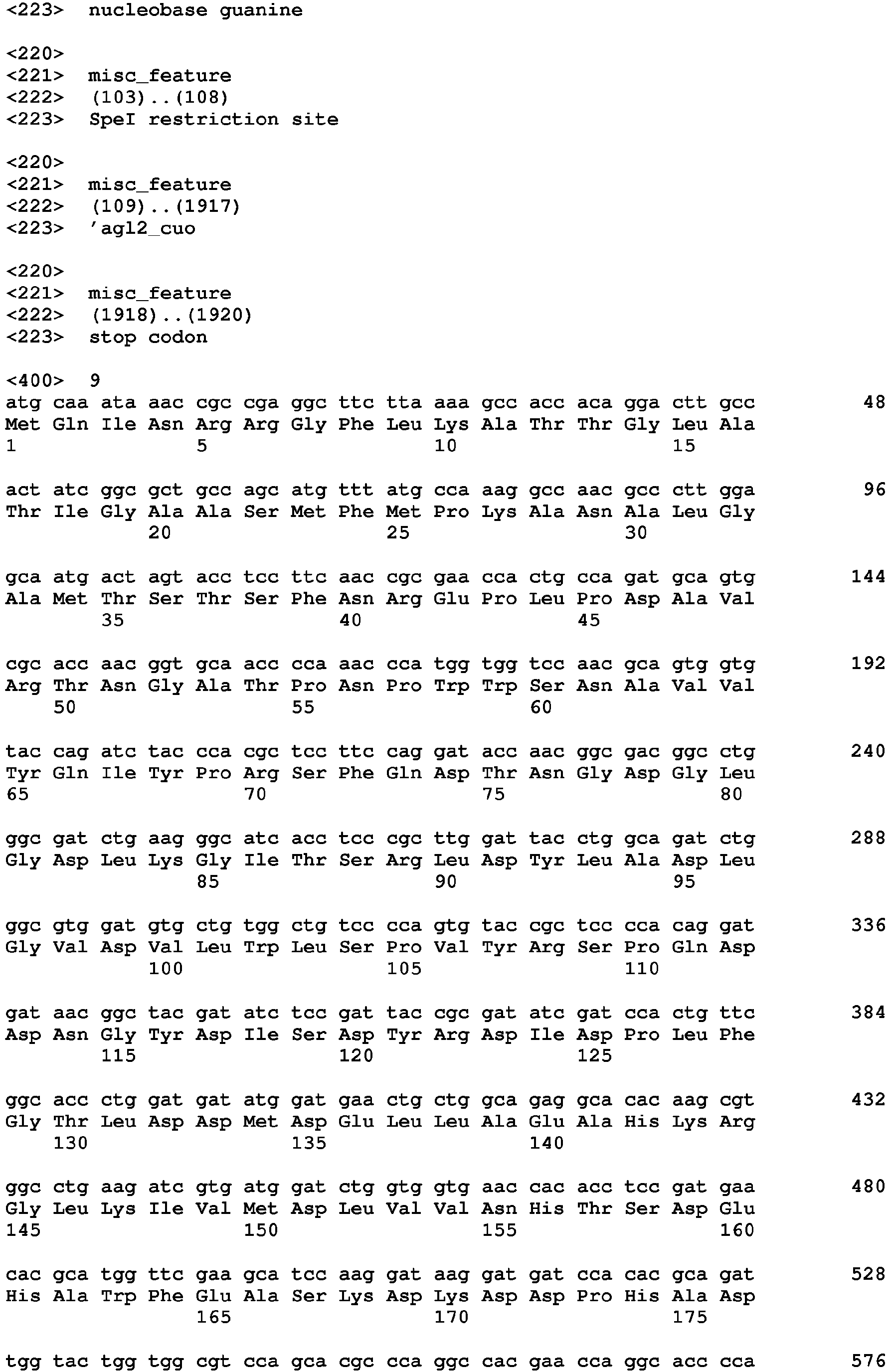
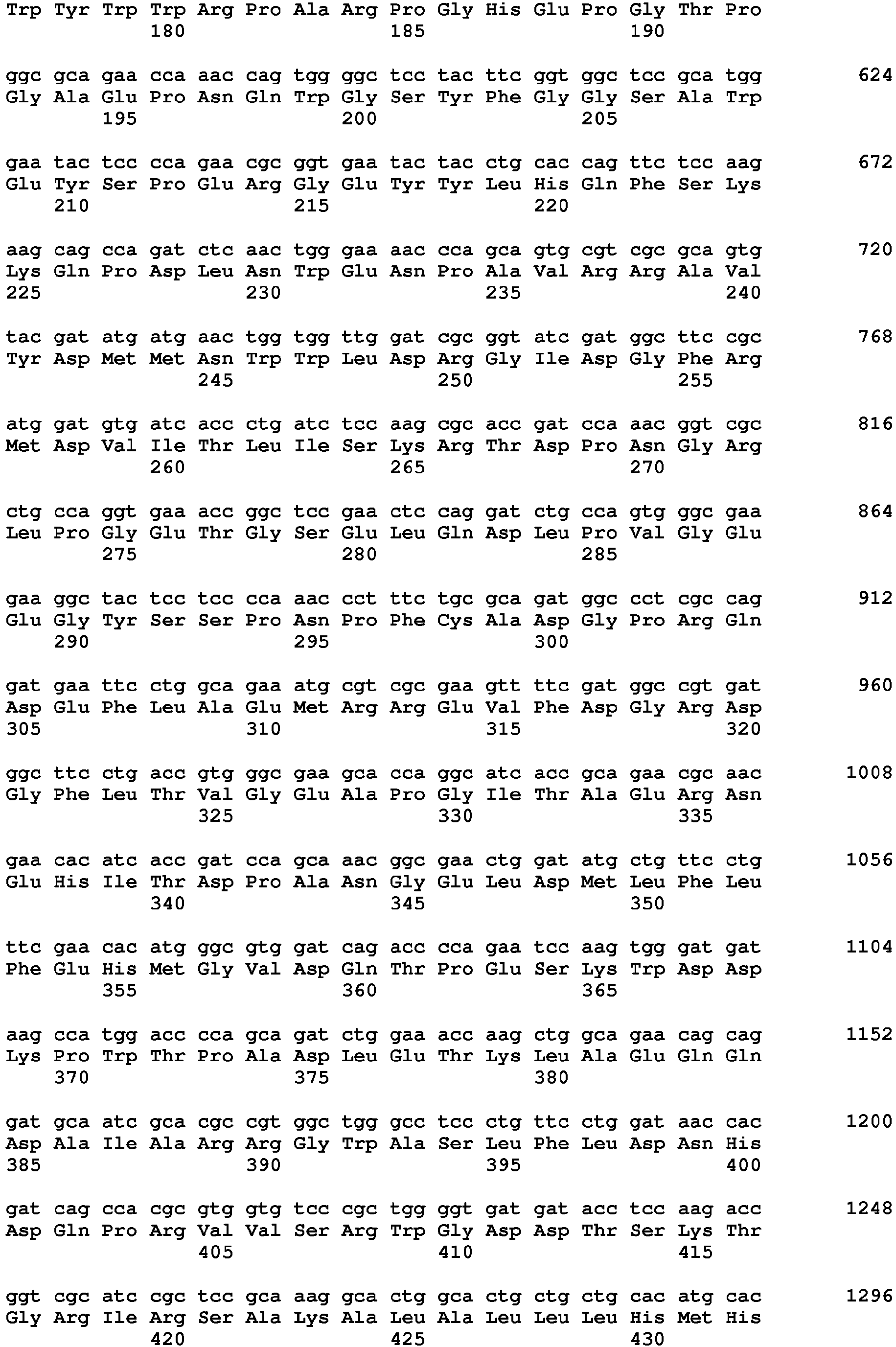


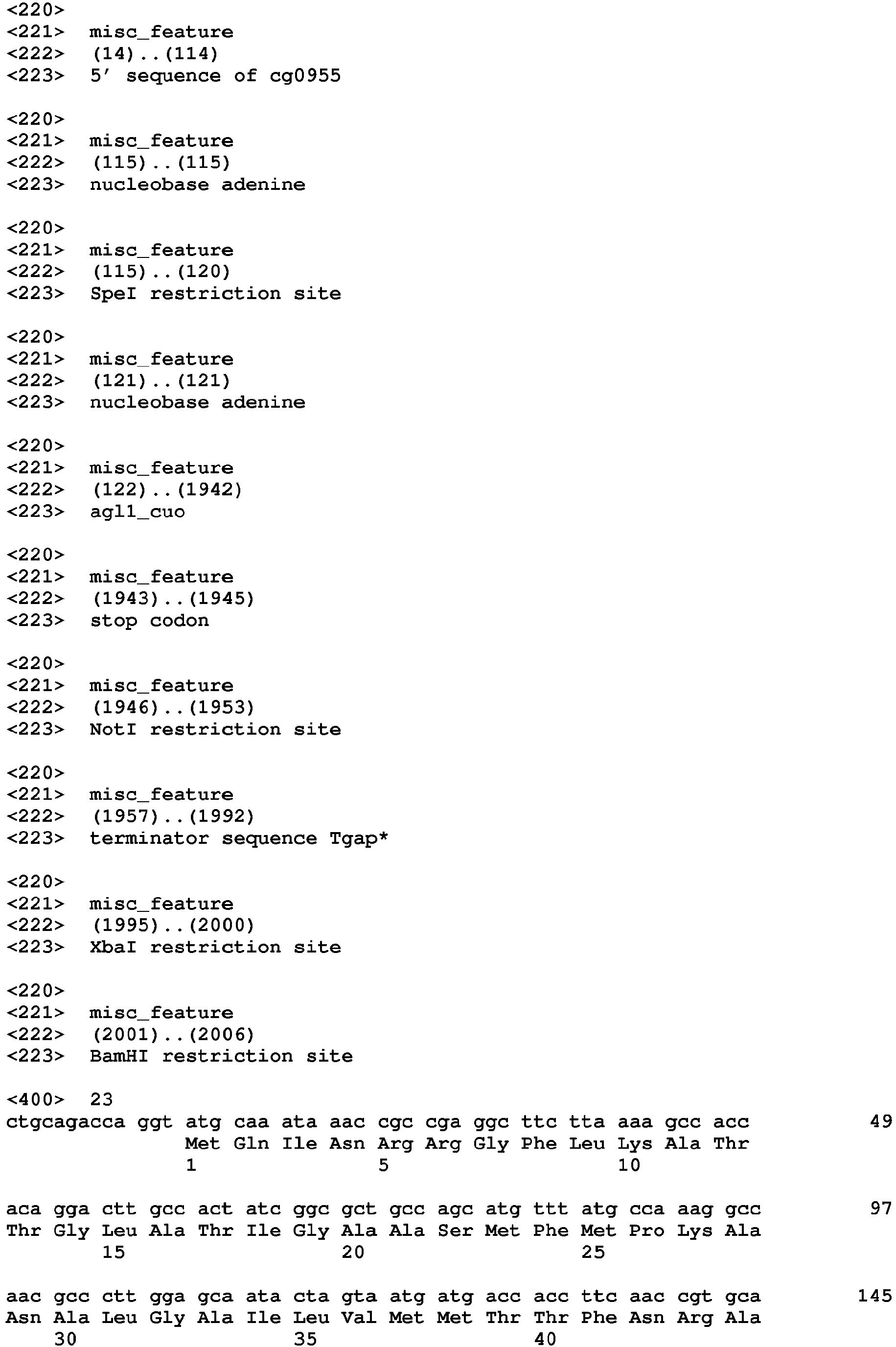


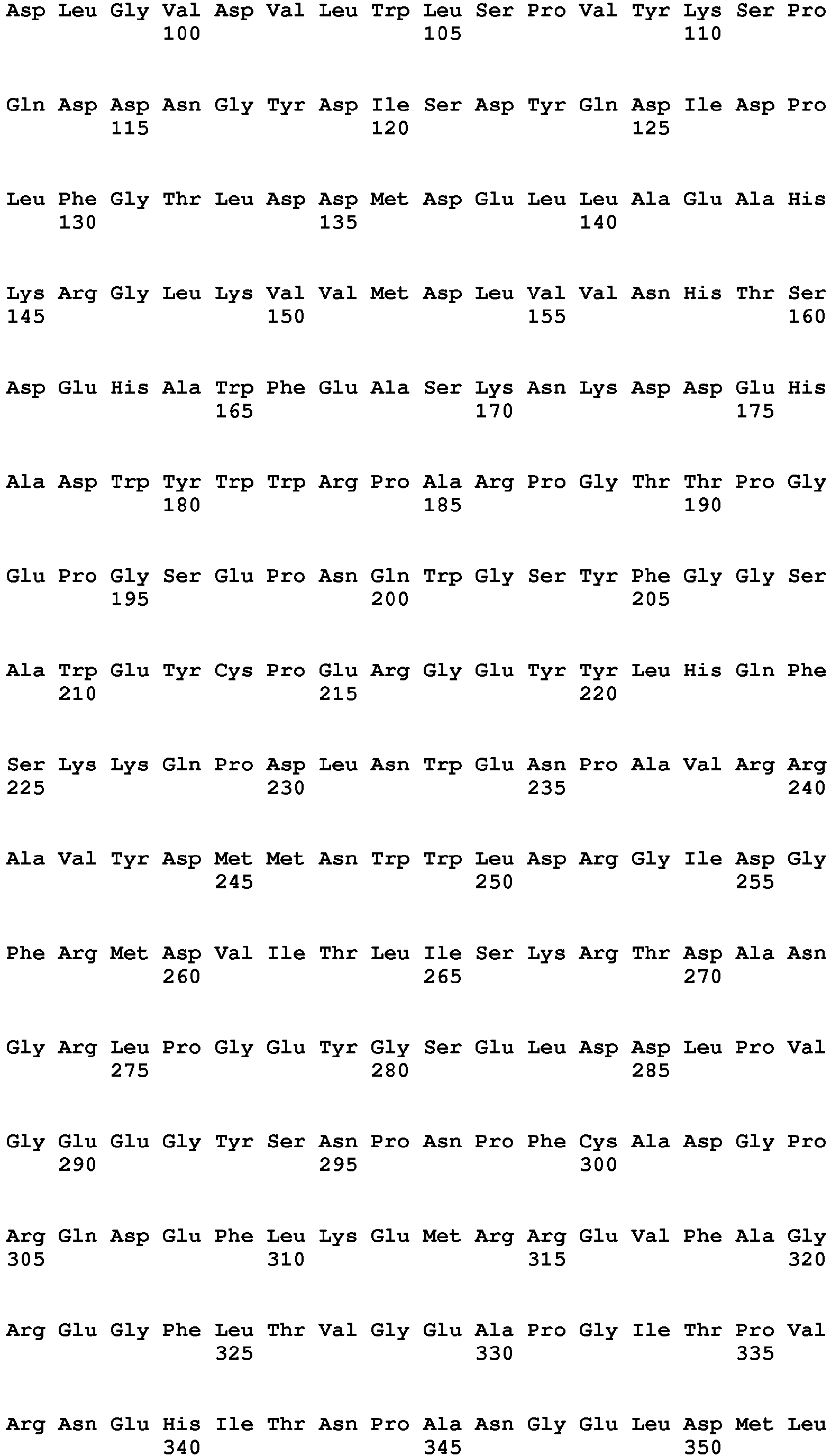


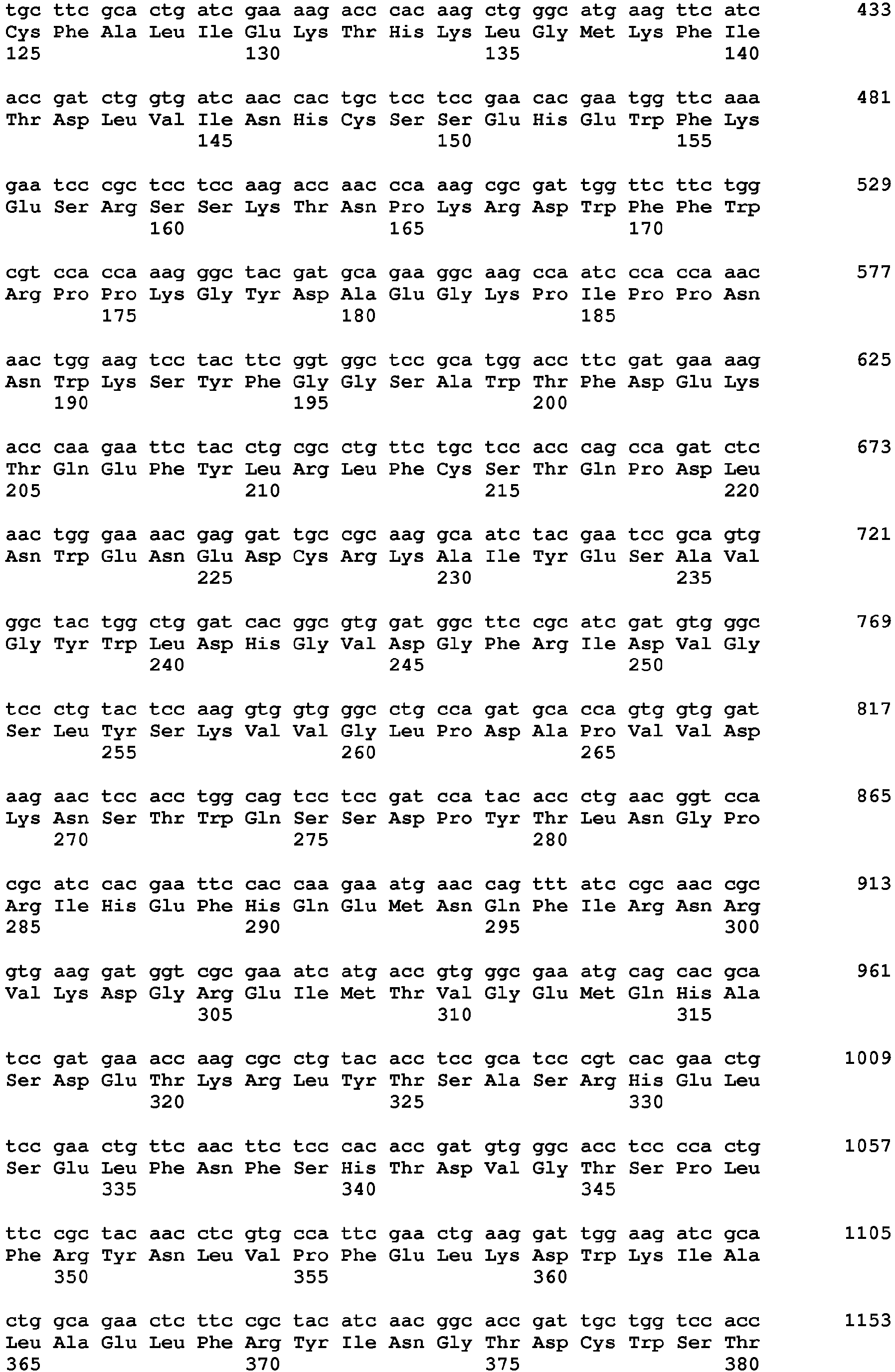


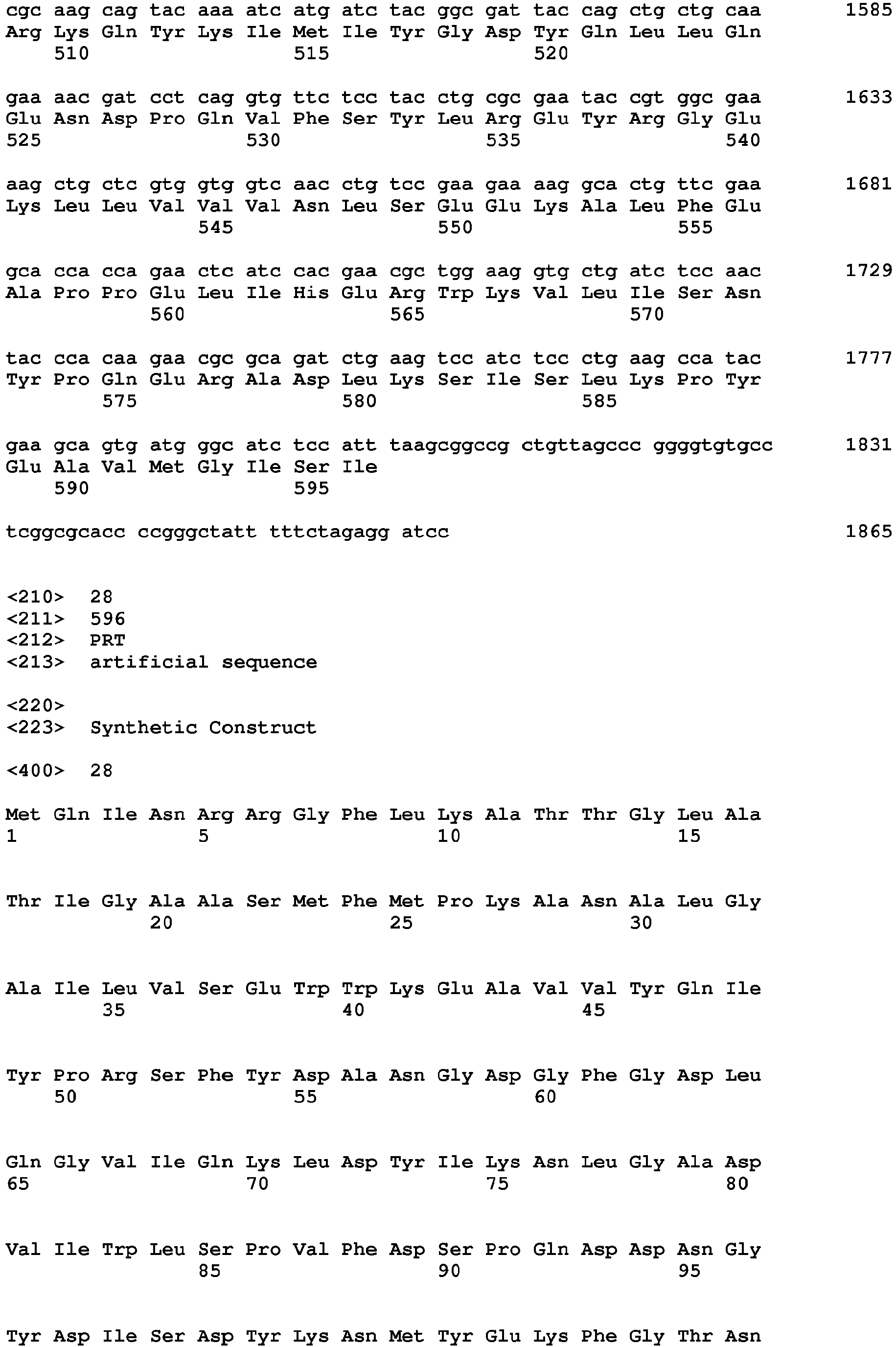


Claims (16)
- An isolated polynucleotide encoding a fusion polypeptide comprising the amino acid sequences a), b) and c) witha) being an N-terminal Tat-signal peptide consisting of the amino acid sequence of positions 1 to 33 of SEQ ID NO:10 or positions 1 to 33 of SEQ ID NO:12
or
consisting of the amino acid sequence of positions 1 to 33 of SEQ ID NO:10 with Ala at position 13 or positions 1 to 33 of SEQ ID NO:12 with Ala at position 13;b) being a C-terminal polypeptide having α-1,6-glucosidase activity consisting of an amino acid sequence selected fromb1) at least (≥) 95 % identical to the sequence from positions 37 to 639 of SEQ ID NO:10 andb2) at least (≥) 95 % identical to the sequence from positions 37 to 643 of SEQ ID NO:12, andc) being 0 to maximal 10 amino acid residues between a) and b). - The isolated polynucleotide as claimed claim 1, wherein said amino acid sequence ofb1) is selected from positions 37 to 639 of SEQ ID NO:10 and from positions 37 to 639 of SEQ ID NO:10 plus an additional Met at the N-terminus in front of position 37 as shown in SEQ ID NO:6 andb2) is selected from positions 39 to 643 of SEQ ID NO:12, positions 38 to 643 of SEQ ID NO:12 and positions 37 to 643 of SEQ ID NO:12.
- The isolated polynucleotide as claimed in any of of claims 1 or 2, wherein said number of amino acid residues of c) is 1 to 3.
- The isolated polynucleotide of claim 3, wherein said number of amino acid residues of c) is 3.
- The isolated polynucleotide of claim 4, wherein said amino acid residues between a) and b) consist of the amino acid sequence Met Thr Ser.
- The isolated polynucleotide of claim 4, wherein said amino acid residues of c) consist of the amino acid sequence Ile Leu Val.
- The isolated polynucleotide as claimed in any of claims 1 to 6, wherein said polynucleotide is functionally linked to a promotor.
- The isolated polynucleotide of claim 7, wherein said promotor is the Ptacl promotor according to the nucleotide sequence of SEQ ID NO:14 from positions 1 to 75 or the PdapBN1 promotor according to the nucleotide sequence of SEQ ID NO:15.
- The isolated polynucleotide of claim 8, wherein said promotor is the PdapBN1-promotor according to SEQ ID NO:15.
- A bacterium selected from the genus Corynebacterium comprising the isolated polynucleotide according to any of claims 1 to 9, wherein said bacterium has the ability to secrete a polypeptide having α-1,6-glucosidase activity encoded by said isolated polynucleotide.
- The bacterium of claim 10, wherein said isolated polynucleotide is contained in a plasmid vector autonomously replicating in said bacterium or in the chromosome of said bacterium.
- The bacterium of the genus Corynebacterium of claim 24 to 26, wherein said bacterium is a Corynebacterium glutamicum.
- The Corynebacterium as claimed in any of claims 10 to 12, wherein said Corynebacterium has the ability to excrete and produce a fine chemical selected from L-amino acids, vitamins, nucleosides and nucleotides.
- The Corynebacterium of claim 13, wherein said fine chemical is an L-amino acid.
- The Corynebacterium of claim 14, wherein said L-amino acid is selected from L-lysine, L-threonine, L-valine and L-isoleucine.
- A method for producing a fine chemical selected from the group consisting of L-amino acids, vitamins, nucleosides and nucleotides comprising culturing the fine chemical producing Corynebacterium according to any of claims 10 to 15 in a suitable medium, wherein for culturing said Corynebacterium a carbon source is used comprising oligomers of a-D-glucose consisting of least two α-1-6-glycosidically linked glucose monomers.
Priority Applications (6)
| Application Number | Priority Date | Filing Date | Title |
|---|---|---|---|
| EP17175992.1A EP3415622A1 (en) | 2017-06-14 | 2017-06-14 | Method for production of fine chemicals using a corynebacterium secreting modified alpha-1,6-glucosidases |
| EP18175546.3A EP3415623B1 (en) | 2017-06-14 | 2018-06-01 | Method for production of fine chemicals using a corynebacterium secreting modified alpha-1,6-glucosidases |
| BR102018011843-9A BR102018011843B1 (en) | 2017-06-14 | 2018-06-12 | METHOD FOR PRODUCING L-LYSINE USING A CORYNEBACTERIUM THAT SECRETES MODIFIED A-1,6-GLUCOSIDASES |
| US16/007,523 US10533200B2 (en) | 2017-06-14 | 2018-06-13 | Method for the production of fine chemicals using a Corynebacterium secreting modified α-1,6-glucosidases |
| RU2018121480A RU2763317C2 (en) | 2017-06-14 | 2018-06-13 | METHOD FOR PRODUCING CHEMICAL PRODUCTS OF SUBTLE SYNTHESIS USING CORYNEBACTERIUM SECRETING MODIFIED a-1,6-GLUCOSIDASES |
| CN201810613718.6A CN109721658A (en) | 2017-06-14 | 2018-06-14 | Use the method for the corynebacteria production fine chemicals of the α -1,6- glucosidase of secretion of modified |
Applications Claiming Priority (1)
| Application Number | Priority Date | Filing Date | Title |
|---|---|---|---|
| EP17175992.1A EP3415622A1 (en) | 2017-06-14 | 2017-06-14 | Method for production of fine chemicals using a corynebacterium secreting modified alpha-1,6-glucosidases |
Publications (1)
| Publication Number | Publication Date |
|---|---|
| EP3415622A1 true EP3415622A1 (en) | 2018-12-19 |
Family
ID=59070491
Family Applications (2)
| Application Number | Title | Priority Date | Filing Date |
|---|---|---|---|
| EP17175992.1A Withdrawn EP3415622A1 (en) | 2017-06-14 | 2017-06-14 | Method for production of fine chemicals using a corynebacterium secreting modified alpha-1,6-glucosidases |
| EP18175546.3A Active EP3415623B1 (en) | 2017-06-14 | 2018-06-01 | Method for production of fine chemicals using a corynebacterium secreting modified alpha-1,6-glucosidases |
Family Applications After (1)
| Application Number | Title | Priority Date | Filing Date |
|---|---|---|---|
| EP18175546.3A Active EP3415623B1 (en) | 2017-06-14 | 2018-06-01 | Method for production of fine chemicals using a corynebacterium secreting modified alpha-1,6-glucosidases |
Country Status (4)
| Country | Link |
|---|---|
| US (1) | US10533200B2 (en) |
| EP (2) | EP3415622A1 (en) |
| CN (1) | CN109721658A (en) |
| RU (1) | RU2763317C2 (en) |
Cited By (1)
| Publication number | Priority date | Publication date | Assignee | Title |
|---|---|---|---|---|
| EP3656863A4 (en) * | 2018-09-28 | 2021-04-14 | Cj Cheiljedang Corporation | L-amino acid-producing microorganism exhibiting increased -glucosidase activity, and l-amino acid production method using same |
Families Citing this family (9)
| Publication number | Priority date | Publication date | Assignee | Title |
|---|---|---|---|---|
| EP3456833A1 (en) | 2017-09-18 | 2019-03-20 | Evonik Degussa GmbH | Method for the fermentative production of l-amino acids |
| EP3498853A1 (en) * | 2017-12-14 | 2019-06-19 | Evonik Degussa GmbH | Method for the fermentative production of l-lysine |
| RU2019128538A (en) | 2018-09-26 | 2021-03-11 | Эвоник Оперейшенс ГмбХ | METHOD FOR ENZYMATIC PRODUCTION OF L-LYSINE |
| EP3835426B1 (en) * | 2019-12-13 | 2022-06-29 | Weissbiotech GmbH | Process for the preparation of a fermentable sugar composition and the fermentation thereof |
| BR112022017298A2 (en) * | 2020-06-08 | 2023-02-07 | Heilongjiang Eppen Biotech Co Ltd | L-LYSINE PRODUCING MICROORGANISM, POLYNUCLEOTIDE SEQUENCE, AMINO ACID SEQUENCE, RECOMBINANT VECTORS, RECOMBINANT STRAINS, PROMOTER NUCLEOTIDE SEQUENCE, EXPRESSION CASSETTE AND METHOD FOR PRODUCING L-LYSINE |
| CN111979165B (en) * | 2020-08-07 | 2021-05-07 | 黑龙江伊品生物科技有限公司 | A recombinant strain producing L-lysine and its construction method and application |
| KR20220156323A (en) * | 2021-05-18 | 2022-11-25 | 씨제이제일제당 (주) | Microorganism for producing amino acid with enhanced activity of Agl protein and method for producing amino acid using the same |
| CN116064456B (en) * | 2022-11-28 | 2023-08-08 | 江南大学 | A kind of oligosaccharide debranching enzyme mutant and its application in glucose mother liquor |
| CN120118963A (en) * | 2023-12-08 | 2025-06-10 | 宁夏伊品生物科技股份有限公司 | Application of aglA gene in the preparation of L-amino acids |
Citations (35)
| Publication number | Priority date | Publication date | Assignee | Title |
|---|---|---|---|---|
| US4656135A (en) | 1984-06-29 | 1987-04-07 | Ajinomoto Co., Inc. | Process for producing L-isoleucine by fermentation |
| EP0385940A1 (en) | 1989-03-02 | 1990-09-05 | Ciba-Geigy Ag | Device for the desludging of baths |
| US4956471A (en) | 1986-04-28 | 1990-09-11 | Ajinomoto Company, Inc. | Process for isolating and purifying amino acids |
| US5188948A (en) | 1987-04-16 | 1993-02-23 | Ajinomoto Co., Inc. | Process for producing L-valine by fermentation |
| US5275940A (en) | 1990-08-30 | 1994-01-04 | Kyowa Hakko Kogyo Co., Ltd. | Process for producing L-tryptophan by culturing a Corynebacterium glutamicum mutant |
| US5279744A (en) | 1990-09-25 | 1994-01-18 | Ajinomoto Co., Inc. | Method for purification of an amino acid using ion exchange resin |
| US5431933A (en) | 1991-09-17 | 1995-07-11 | Degussa Aktiengesellschaft | Animal feed supplement based on a fermentation broth amino acid, a process for its production and its use |
| EP0841395A1 (en) | 1995-06-07 | 1998-05-13 | Ajinomoto Co., Inc. | Process for producing l-lysine |
| US5763230A (en) | 1996-03-22 | 1998-06-09 | Triple-A B.V. P/A Produkschap Voor Veevoedor | Amino acid fermentation processes |
| US5770409A (en) | 1991-09-17 | 1998-06-23 | Degussa Aktiengsellschaft | Fermentative preparation of lysine with a strain of C. glutamicum |
| WO1999027124A1 (en) | 1997-11-26 | 1999-06-03 | Novo Nordisk A/S | Enzymatic starch saccharification including a membrane separation step |
| US5990350A (en) | 1997-12-16 | 1999-11-23 | Archer Midland Company | Process for making granular L-lysine |
| US6025169A (en) | 1990-11-30 | 2000-02-15 | Ajinomoto Co., Inc. | Process for production of lysine by fermentation |
| WO2002040679A2 (en) | 2000-11-15 | 2002-05-23 | Archer-Daniels-Midland Company | Corynebacterium glutamicum promoters |
| WO2002070685A2 (en) | 2001-03-01 | 2002-09-12 | Basf Aktiengesellschaft | Method of modifying the genome of gram-positive bacteria by means of a novel conditionally negative dominant marker gene |
| WO2003014362A2 (en) | 2001-08-06 | 2003-02-20 | Basf Aktiengesellschaft | Method for producing a marker-free mutated target organism and plasmid vectors suitable for the same |
| WO2003040373A2 (en) | 2001-08-06 | 2003-05-15 | Degussa Ag | Production of l-lysine by genetically modified corynebacterium glutamicum strains |
| EP1375664A1 (en) | 2001-03-30 | 2004-01-02 | Ajinomoto Co., Inc. | Method for the sectetion and production of protein |
| WO2004018645A2 (en) | 2002-08-23 | 2004-03-04 | E.I. Du Pont De Nemours And Company | Utilization of starch products for biological production by fermentation |
| WO2004069996A2 (en) | 2003-02-05 | 2004-08-19 | Degussa Ag | Bacteria and process for producing chemical compounds by said bacteria |
| WO2005059144A1 (en) | 2003-12-18 | 2005-06-30 | Basf Aktiengesellschaft | Psod expression units |
| WO2005059093A2 (en) | 2003-12-18 | 2005-06-30 | Basf Aktiengesellschaft | P ef-tu expression units |
| WO2005059143A1 (en) | 2003-12-18 | 2005-06-30 | Basf Aktiengesellschaft | Pgro expression units |
| WO2005100583A2 (en) | 2004-03-31 | 2005-10-27 | Natureworks Llc | Process for fermenting sugars containing oligomeric saccharides |
| EP1748077A1 (en) | 2004-04-20 | 2007-01-31 | Ajinomoto Co., Inc. | Method of producing protein |
| WO2008033001A1 (en) | 2006-09-15 | 2008-03-20 | Cj Cheiljedang Corporation | A corynebacteria having enhanced l-lysine productivity and a method of producing l-lysine using the same |
| WO2008049782A1 (en) | 2006-10-24 | 2008-05-02 | Basf Se | Method of increasing gene expression using modified codon usage |
| EP2241632A1 (en) | 2008-01-10 | 2010-10-20 | Ajinomoto Co., Inc. | Method for production of desired substance by fermentation process |
| WO2013000827A1 (en) | 2011-06-28 | 2013-01-03 | Evonik Degussa Gmbh | Variants of the promoter of the gap gene encoding glyceraldehyde-3-phosphate dehydrogenase |
| US8637295B1 (en) | 2009-02-20 | 2014-01-28 | Evonik Degussa Gmbh | Process for the production of L-lysine |
| WO2014093312A1 (en) | 2012-12-10 | 2014-06-19 | Cargill, Incorporated | Batch feed process for fermenting sugars |
| EP2787082A1 (en) | 2011-12-01 | 2014-10-08 | Cj Cheiljedang Corporation | Microorganism for simultaneously producing l-amino acid and riboflavin, and method for producing l-amino acid and riboflavin using same |
| EP2811028A1 (en) | 2013-06-03 | 2014-12-10 | Evonik Industries AG | Process for producing L-leucine, L-valine, L-isoleucine, alpha-ketoisovalerate, alpha-keto-beta-methylvalerate, or alpha-ketoisocaproate employing recombinant Corynebacteria comprising the propionate-inducible ilvBN operon |
| WO2015061289A1 (en) | 2013-10-24 | 2015-04-30 | Danisco Us Inc | Enhanced fermentation process using a transglycosidase |
| EP3130671A1 (en) * | 2014-03-07 | 2017-02-15 | Ajinomoto Co., Inc. | New protein deamidase |
Family Cites Families (6)
| Publication number | Priority date | Publication date | Assignee | Title |
|---|---|---|---|---|
| CA2456416A1 (en) | 2001-08-06 | 2003-02-20 | Degussa Ag | Coryneform bacteria which produce chemical compounds ii |
| JP4107856B2 (en) * | 2002-03-13 | 2008-06-25 | 東芝エレベータ株式会社 | Elevator control device |
| EP2080769A3 (en) * | 2004-07-02 | 2010-12-01 | Metanomics GmbH | Process for the production of fine chemicals |
| US20140199313A1 (en) * | 2005-03-02 | 2014-07-17 | Metanomics Gmbh | Process for the Production of Fine Chemicals |
| EP2762571A1 (en) * | 2013-01-30 | 2014-08-06 | Evonik Industries AG | Microorganism and method for the production of amino acids by fermentation |
| AU2015223025B2 (en) * | 2014-02-27 | 2018-09-20 | Nutrition & Biosciences USA 4, Inc. | Enzymatic hydrolysis of disaccharides and oligosaccharides using alpha-glucosidase enzymes |
-
2017
- 2017-06-14 EP EP17175992.1A patent/EP3415622A1/en not_active Withdrawn
-
2018
- 2018-06-01 EP EP18175546.3A patent/EP3415623B1/en active Active
- 2018-06-13 RU RU2018121480A patent/RU2763317C2/en active
- 2018-06-13 US US16/007,523 patent/US10533200B2/en active Active
- 2018-06-14 CN CN201810613718.6A patent/CN109721658A/en active Pending
Patent Citations (35)
| Publication number | Priority date | Publication date | Assignee | Title |
|---|---|---|---|---|
| US4656135A (en) | 1984-06-29 | 1987-04-07 | Ajinomoto Co., Inc. | Process for producing L-isoleucine by fermentation |
| US4956471A (en) | 1986-04-28 | 1990-09-11 | Ajinomoto Company, Inc. | Process for isolating and purifying amino acids |
| US5188948A (en) | 1987-04-16 | 1993-02-23 | Ajinomoto Co., Inc. | Process for producing L-valine by fermentation |
| EP0385940A1 (en) | 1989-03-02 | 1990-09-05 | Ciba-Geigy Ag | Device for the desludging of baths |
| US5275940A (en) | 1990-08-30 | 1994-01-04 | Kyowa Hakko Kogyo Co., Ltd. | Process for producing L-tryptophan by culturing a Corynebacterium glutamicum mutant |
| US5279744A (en) | 1990-09-25 | 1994-01-18 | Ajinomoto Co., Inc. | Method for purification of an amino acid using ion exchange resin |
| US6025169A (en) | 1990-11-30 | 2000-02-15 | Ajinomoto Co., Inc. | Process for production of lysine by fermentation |
| US5770409A (en) | 1991-09-17 | 1998-06-23 | Degussa Aktiengsellschaft | Fermentative preparation of lysine with a strain of C. glutamicum |
| US5431933A (en) | 1991-09-17 | 1995-07-11 | Degussa Aktiengesellschaft | Animal feed supplement based on a fermentation broth amino acid, a process for its production and its use |
| EP0841395A1 (en) | 1995-06-07 | 1998-05-13 | Ajinomoto Co., Inc. | Process for producing l-lysine |
| US5763230A (en) | 1996-03-22 | 1998-06-09 | Triple-A B.V. P/A Produkschap Voor Veevoedor | Amino acid fermentation processes |
| WO1999027124A1 (en) | 1997-11-26 | 1999-06-03 | Novo Nordisk A/S | Enzymatic starch saccharification including a membrane separation step |
| US5990350A (en) | 1997-12-16 | 1999-11-23 | Archer Midland Company | Process for making granular L-lysine |
| WO2002040679A2 (en) | 2000-11-15 | 2002-05-23 | Archer-Daniels-Midland Company | Corynebacterium glutamicum promoters |
| WO2002070685A2 (en) | 2001-03-01 | 2002-09-12 | Basf Aktiengesellschaft | Method of modifying the genome of gram-positive bacteria by means of a novel conditionally negative dominant marker gene |
| EP1375664A1 (en) | 2001-03-30 | 2004-01-02 | Ajinomoto Co., Inc. | Method for the sectetion and production of protein |
| WO2003040373A2 (en) | 2001-08-06 | 2003-05-15 | Degussa Ag | Production of l-lysine by genetically modified corynebacterium glutamicum strains |
| WO2003014362A2 (en) | 2001-08-06 | 2003-02-20 | Basf Aktiengesellschaft | Method for producing a marker-free mutated target organism and plasmid vectors suitable for the same |
| WO2004018645A2 (en) | 2002-08-23 | 2004-03-04 | E.I. Du Pont De Nemours And Company | Utilization of starch products for biological production by fermentation |
| WO2004069996A2 (en) | 2003-02-05 | 2004-08-19 | Degussa Ag | Bacteria and process for producing chemical compounds by said bacteria |
| WO2005059144A1 (en) | 2003-12-18 | 2005-06-30 | Basf Aktiengesellschaft | Psod expression units |
| WO2005059093A2 (en) | 2003-12-18 | 2005-06-30 | Basf Aktiengesellschaft | P ef-tu expression units |
| WO2005059143A1 (en) | 2003-12-18 | 2005-06-30 | Basf Aktiengesellschaft | Pgro expression units |
| WO2005100583A2 (en) | 2004-03-31 | 2005-10-27 | Natureworks Llc | Process for fermenting sugars containing oligomeric saccharides |
| EP1748077A1 (en) | 2004-04-20 | 2007-01-31 | Ajinomoto Co., Inc. | Method of producing protein |
| WO2008033001A1 (en) | 2006-09-15 | 2008-03-20 | Cj Cheiljedang Corporation | A corynebacteria having enhanced l-lysine productivity and a method of producing l-lysine using the same |
| WO2008049782A1 (en) | 2006-10-24 | 2008-05-02 | Basf Se | Method of increasing gene expression using modified codon usage |
| EP2241632A1 (en) | 2008-01-10 | 2010-10-20 | Ajinomoto Co., Inc. | Method for production of desired substance by fermentation process |
| US8637295B1 (en) | 2009-02-20 | 2014-01-28 | Evonik Degussa Gmbh | Process for the production of L-lysine |
| WO2013000827A1 (en) | 2011-06-28 | 2013-01-03 | Evonik Degussa Gmbh | Variants of the promoter of the gap gene encoding glyceraldehyde-3-phosphate dehydrogenase |
| EP2787082A1 (en) | 2011-12-01 | 2014-10-08 | Cj Cheiljedang Corporation | Microorganism for simultaneously producing l-amino acid and riboflavin, and method for producing l-amino acid and riboflavin using same |
| WO2014093312A1 (en) | 2012-12-10 | 2014-06-19 | Cargill, Incorporated | Batch feed process for fermenting sugars |
| EP2811028A1 (en) | 2013-06-03 | 2014-12-10 | Evonik Industries AG | Process for producing L-leucine, L-valine, L-isoleucine, alpha-ketoisovalerate, alpha-keto-beta-methylvalerate, or alpha-ketoisocaproate employing recombinant Corynebacteria comprising the propionate-inducible ilvBN operon |
| WO2015061289A1 (en) | 2013-10-24 | 2015-04-30 | Danisco Us Inc | Enhanced fermentation process using a transglycosidase |
| EP3130671A1 (en) * | 2014-03-07 | 2017-02-15 | Ajinomoto Co., Inc. | New protein deamidase |
Non-Patent Citations (84)
| Title |
|---|
| A. BURKOVSKI: "Corynebacteria Genomics and Molecular Biology", 2008, CAISTER ACADEMIC PRESS |
| A. CONVERTI, STARCH/STARKE, vol. 46, no. 7, 1994, pages 260 - 265 |
| AMARAKONE, P. ET AL., JOURNAL OF THE JAPANESE SOCIETY OF STARCH SCIENCE, vol. 31, no. 1, 1984, pages 1 - 7 |
| B. H. LEE: "Fundamentals of Food Biotechnology", 1996, VCH PUBLISHERS |
| B. J. EICKMANNS, JOURNAL OF BACTERIOLOGY, vol. 174, no. 19, 1992, pages 6076 - 6086 |
| BERG ET AL.: "Biochemie", 2003, SPEKTRUM AKADEMISCHER VERLAG |
| BILLMAN-JACOBE ET AL., APPLIED AND ENVIRONMENTAL MICROBIOLOGY, vol. 61, 1995, pages 1610 - 1613 |
| BIOTECHNOLOGY LETTERS, 2015 |
| BLOMBACH ET AL., APPLIED AND ENVIRONMENTAL MICROBIOLOGY, vol. 75, no. 2, 2009, pages 419 - 427 |
| BREITINGER, K. J., DISSERTATION/PH.D. THESIS ULM UNIVERSITY, 2013 |
| BRURBERG ET AL., MICROBIOLOGY, vol. 142, 1996, pages 1581 - 1589 |
| C. R. NEWTON; A. GRAHAM: "PCR", 1994, SPEKTRUM AKADEMISCHER VERLAG |
| C. RATLEDGE; B. KRISTIANSEN: "Basic Biotechnology", 2006, CAMBRIDGE UNIVERSITY PRESS |
| CHRISTIAN MATANO ET AL: "Corynebacterium glutamicum possesses [beta]-N-acetylglucosaminidase", BMC MICROBIOLOGY, vol. 16, no. 1, 5 August 2016 (2016-08-05), XP055392110, DOI: 10.1186/s12866-016-0795-3 * |
| COHEN, S.; CARPENTER, G., PROCEEDINGS OF NATIONAL ACADEMY OF SCIENCES USA, vol. 72, no. 4, 1975, pages 1317 - 1321 |
| D. RICKWOOD; B. D. HAMES: "Gel electrophoresis of nucleic acids, a practical approach", 1982, IRL PRESS |
| DE BOER ET AL., PROCEEDINGS OF THE NATIONAL ACADEMY OF SCIENCES USA, vol. 80, 1983, pages 21 - 25 |
| DENG ET AL., FEBS OPEN BIO, vol. 4, 2014, pages 200 - 212 |
| DUNICAN; SHIVNAN, BIO/TECHNOLOGY, vol. 7, 1989, pages 1067 - 1070 |
| EGGELING; BOTT, APPLIED MICROBIOLOGY AND BIOTECHNOLOGY, vol. 99, no. 9, 2015, pages 3387 - 3394 |
| EIKMANNS, B. J., JOURNAL OF BACTERIOLOGY, vol. 174, no. 19, 1992, pages 6067 - 6068 |
| F. J. DECHOW: "Seperation and Purification Techniques in Biotechnology", 1989, NOYES PUBLICATIONS |
| FATH ET AL., PLOS ONE, vol. 6, no. 3, 2011, pages e17596 |
| FINCAN; ENEZ, STARCH, vol. 66, 2014, pages 182 - 189 |
| FREUDL, JOURNAL OF BIOTECHNOLOGY, Retrieved from the Internet <URL:http://dx.doi.org/10.1016/j.jbiotec.2017.02.023> |
| H. CHMIEL: "Bioprozesstechnik", 2011, SPEKTRUM AKADEMISCHER VERLAG |
| H. UHLIG: "Industrial Enzymes and their Application", 1998, JOHN WILEY & SONS |
| H. YUKAWA; M. INUI: "Corynebacterium glutamicum Biology and Biotechnolgy", 2013, SPRINGER VERLAG |
| H. YUKAWA; M. INUI: "Corynebacterium glutamicum Biology and Biotechnology", 2013, SPRINGER VERLAG |
| HEMMERICH ET AL., MICROBIAL CELL FACTORY, vol. 15, no. 1, 2016, pages 208 |
| HYEON ET AL., ENZYME AND MICROBIAL TECHNOLOGY, vol. 48, 2011, pages 371 - 377 |
| IWAI ET AL., JOURNAL OF BACTERIOLOGY, vol. 176, 1994, pages 7730 - 7734 |
| J. BEMILLER; R. WHISTLER: "Starch: Chemistry and Technology", 2009, ELSEVIER |
| J. M. KENDALL; M. N. BADMINTON, TIBTECH, 1998, pages 216 - 224 |
| J. SAMBROOK ET AL.: "Molecular Cloning, A Laboratory Manual", 1989, COLD SPRING HARBOR LABORATORY PRESS |
| K. A. BERNARD; G. FUNKE: "Bergey's Manual of Systematics of Archaea and Bacteria", 2012, BERGEY'S MANUAL TRUST, article "Corynebacterium" |
| KIKUCHI ET AL., APPLIED AND ENVIRONMENTAL MICROBIOLOGY, vol. 72, 2006, pages 7183 - 7192 |
| KIKUCHI ET AL., APPLIED AND ENVIRONMENTAL MICROBIOLOGY, vol. 72, no. 11, 2006, pages 7183 - 7192 |
| KIKUCHI ET AL., APPLIED MICROBIOLOGY AND BIOTECHNOLOGY, vol. 78, 2008, pages 67 - 74 |
| KIM ET AL., ENZYME AND MICROBIAL TECHNOLOGY, vol. 66, 2014, pages 67 - 73 |
| KORNACKER; PUGSLEY, MOLECULAR MICROBIOLOGY, vol. 4, 1990, pages 73 - 85 |
| L. EGGELING; M. BOTT: "Handbook of Corynebacterium glutamicum", 2005, CRC PRESS |
| L. EGGELING; O. REYES: "Handbook of Corynebacterium glutamicum", 2005, CRC PRESS, article "Experiments" |
| LIEBL ET AL., INTERNATIONAL JOURNAL OF SYSTEMATIC BACTERIOLOGY, vol. 41, no. 2, 1991, pages 255 - 260 |
| LIEBL ET AL., JOURNAL OF BACTERIOLOGY, vol. 174, 1992, pages 1854 - 1861 |
| LINDROTH ET AL., ANALYTICAL CHEMISTRY, vol. 51, 1979, pages 1167 - 1174 |
| LIU ET AL., CRITICAL REVIEWS IN BIOTECHNOLOGY, 2016 |
| LIU ET AL., CRITICAL REVIEWS IN BIOTECHNOLOGY, 2016, pages 1 - 11 |
| LOTTSPEICH; ZORBAS: "Bioanalytik", 1998, SPEKTRUM AKADEMISCHER VERLAG |
| M. CHAPLIN; C. BUCKE: "Enzyme Technolgy", 1990, CAMBRIDGE UNIVERSITY PRESS |
| M. PATEK: "Handbook of Corynebacterium glutamicum", 2005, CRC PRESS, article "Regulation of gene expression" |
| M. PATEK; J. NESVERA: "Corynebacterium glutamicum Biology and Biotechnolgy", 2013, SPRINGER VERLAG, article "Promoters and Plasmid Vectors of Corynebacterium glutamicum" |
| M.W. KEARSLEY; S.Z. DZIEDZIC: "Handbook of Starch Hydrolysis Products and their Derivatives", 1995, CHAPMANN & HALL |
| MAGAZINE OF CHROMATOGRAPHIC SCIENCE, vol. 7, no. 6, 1989, pages 484 - 487 |
| MATANO ET AL., BMC MICROBIOLOGY, vol. 16, 2016, pages 177 |
| MEISSNER ET AL., APPLIED MICROBIOLOGY AND BIOTECHNOLOGY, vol. 76, 2007, pages 633 - 642 |
| MORINAGA ET AL., JOURNAL OF BIOTECHNOLOGY, vol. 5, 1987, pages 305 - 312 |
| NATALE ET AL., BIOCHIMICA ET BIOPHYSICA ACTA, vol. 1778, 2008, pages 1735 - 1756 |
| P. FU; S. PANKE: "Systems Biology and Synthetic Biology", 2009, WILEY |
| P. H. BLANCHARD: "Technology of Corn Wet Milling and Associated Processes", 1992, ELSEVIER |
| P. SERNO ET AL.: "Granulieren", 2007, EDITIO CANTOR VERLAG |
| PASTERNACK ET AL., EUROPEAN JOURNAL OF BIOCHEMISTRY, vol. 257, 1998, pages 570 - 576 |
| PATEK ET AL., MICROBIAL BIOTECHNOLOGY, vol. 6, 2013, pages 103 - 117 |
| PETERS-WENDISCH ET AL., JOURNAL OF MOLECULAR MICROBIOLOGY AND BIOTECHNOLOGY, vol. 3, 2001, pages 295 - 300 |
| POKUSAEVA ET AL., APPLIED AND ENVIRONMENTAL MICROBIOLOGY, vol. 75, 2009, pages 1135 - 1143 |
| POKUSAEVA ET AL., GENES AND NUTRITION, vol. 6, 2011, pages 285 - 306 |
| R. GHOSH: "Principles of Bioseperation Engineering", 2006, WORLD SCIENTIFIC PUBLISHING |
| R. KELLE ET AL.: "Handbook of Corynebacterium glutamicum", 2005, CRC PRESS, article "L-lysine Production" |
| ROSSOL; PUHLER, JOURNAL OF BACTERIOLOGY, vol. 174, no. 9, 1992, pages 2968 - 2977 |
| S. NARANG: "Synthesis and Applications of DNA and RNA", 1987, ACADEMIC PRESS |
| SALIM ET AL., APPLIED AND ENVIRONMENTAL MICROBIOLOGY, vol. 63, 1997, pages 4392 - 4400 |
| SANDRA SCHEELE ET AL: "Secretory production of an FAD cofactor-containing cytosolic enzyme (sorbitol-xylitol oxidase from Streptomyces coelicolor ) using the twin-arginine translocation (Tat) pathway of Corynebacterium glutamicum : Tat-dependent heterologous protein secretion", MICROBIAL BIOTECHNOLOGY, vol. 6, no. 2, 20 November 2012 (2012-11-20), GB, pages 202 - 206, XP055391962, ISSN: 1751-7915, DOI: 10.1111/1751-7915.12005 * |
| SCHAFER ET AL., GENE, vol. 145, 1994, pages 69 - 73 |
| SCHAFER ET AL., JOURNAL OF BACTERIOLOGY, vol. 172, 1990, pages 1663 - 1666 |
| SHAEIWITZ ET AL.: "Ullmann's Encyclopedia of Industrial Chemistry", 2012, WILEY-VCH, article "Bioseparation" |
| SPACKMAN ET AL., ANALYTICAL CHEMISTRY, vol. 30, 1958, pages 1190 - 1206 |
| TERAMOTO ET AL., APPLIED MICROBIOLOGY AND BIOTECHNOOGY, vol. 91, 2011, pages 677 - 687 |
| THIERBACH ET AL., APPLIED MICROBIOLOGY AND BIOTECHNOLOGY, vol. 29, 1988, pages 356 - 362 |
| V. F. WENDISCH: "Amino Acid Biosynthesis - Pathways, Regulation and Metabolic Engineering", 2007, SPRINGER VERLAG |
| V.C. HASS; R. PORTNER: "Praxis der Bioprozesstechnik", 2011, SPEKTRUM AKADEMISCHER VERLAG |
| WATANABE ET AL., MICROBIOLOGY, vol. 155, 2009, pages 741 - 750 |
| WHITING ET AL., JOURNAL OF GENERAL MICROBIOLOGY, vol. 139, 1993, pages 2019 - 2026 |
| YANG; YANG, BMC GENOMICS, vol. 18, no. 1, pages 940 |
| YIM ET AL., APPLIED MICROBIOLOGY AND BIOTECHNOLOGY, vol. 98, 2014, pages 273 - 284 |
Cited By (2)
| Publication number | Priority date | Publication date | Assignee | Title |
|---|---|---|---|---|
| EP3656863A4 (en) * | 2018-09-28 | 2021-04-14 | Cj Cheiljedang Corporation | L-amino acid-producing microorganism exhibiting increased -glucosidase activity, and l-amino acid production method using same |
| US11293014B2 (en) | 2018-09-28 | 2022-04-05 | Cj Cheiljedang Corporation | Microorganism for producing L-amino acid with enhanced activity of α-glucosidase and method for producing L-amino acid using the same |
Also Published As
| Publication number | Publication date |
|---|---|
| CN109721658A (en) | 2019-05-07 |
| BR102018011843A2 (en) | 2019-03-12 |
| EP3415623B1 (en) | 2020-08-05 |
| RU2018121480A (en) | 2019-12-13 |
| EP3415623A1 (en) | 2018-12-19 |
| US10533200B2 (en) | 2020-01-14 |
| RU2018121480A3 (en) | 2021-05-27 |
| BR102018011843A8 (en) | 2023-01-17 |
| RU2763317C2 (en) | 2021-12-28 |
| US20180363014A1 (en) | 2018-12-20 |
Similar Documents
| Publication | Publication Date | Title |
|---|---|---|
| EP3415622A1 (en) | Method for production of fine chemicals using a corynebacterium secreting modified alpha-1,6-glucosidases | |
| KR102375732B1 (en) | Compositions and methods for increasing protein production in Bacillus licheniformis | |
| AU2008238982B2 (en) | Recombinant microorganism | |
| EP2133416B1 (en) | Recombinant microorganism | |
| CN108779154B (en) | Enhanced protein production and methods thereof | |
| ES2703753T3 (en) | Expression procedure | |
| KR20230042368A (en) | Bacillus industrial fermentation method using temperature shift | |
| US8354248B2 (en) | Promoter-encoding DNA fragment, recombinant vector, recombiant transformant, and uses thereof | |
| DK2340306T3 (en) | EXPRESSION-AMPLIFIED NUCLEIC ACIDS | |
| CN116234922A (en) | Bacillus industrial fermentation process using feed rate variation | |
| AU2010308865B2 (en) | Modified promoter | |
| US20260028606A1 (en) | Use of foldases to improve heterologous expression of secreted molecules | |
| JP5498651B2 (en) | Method for producing dipicolinic acid or a salt thereof | |
| KR20230042353A (en) | Industrial Fermentation Process of Bacillus Using Partial Harvesting | |
| EP4225779A2 (en) | Bacillus cell with reduced lipase and/or esterase side activities | |
| JP7706628B2 (en) | Modified 5' untranslated region and method for producing target substance using same | |
| BR102018011843B1 (en) | METHOD FOR PRODUCING L-LYSINE USING A CORYNEBACTERIUM THAT SECRETES MODIFIED A-1,6-GLUCOSIDASES | |
| JP2004129576A (en) | Production method of hyperthermostable endoglucanase | |
| Horne et al. | A Brevibacillus choshinensis system that secretes cytoplasmic proteins | |
| Hollmann et al. | Bacillus megaterium as a host for recombinant protein production | |
| KR20090101130A (en) | Levanschkras derived from Bacillus amyloliquefaciens type 1 and preparation method thereof |
Legal Events
| Date | Code | Title | Description |
|---|---|---|---|
| PUAI | Public reference made under article 153(3) epc to a published international application that has entered the european phase |
Free format text: ORIGINAL CODE: 0009012 |
|
| AK | Designated contracting states |
Kind code of ref document: A1 Designated state(s): AL AT BE BG CH CY CZ DE DK EE ES FI FR GB GR HR HU IE IS IT LI LT LU LV MC MK MT NL NO PL PT RO RS SE SI SK SM TR |
|
| AX | Request for extension of the european patent |
Extension state: BA ME |
|
| STAA | Information on the status of an ep patent application or granted ep patent |
Free format text: STATUS: THE APPLICATION IS DEEMED TO BE WITHDRAWN |
|
| 18D | Application deemed to be withdrawn |
Effective date: 20190620 |