EP3415509A1 - Novel 2,5-substituted pyrimidines as pde inhibitors - Google Patents
Novel 2,5-substituted pyrimidines as pde inhibitors Download PDFInfo
- Publication number
- EP3415509A1 EP3415509A1 EP18182043.2A EP18182043A EP3415509A1 EP 3415509 A1 EP3415509 A1 EP 3415509A1 EP 18182043 A EP18182043 A EP 18182043A EP 3415509 A1 EP3415509 A1 EP 3415509A1
- Authority
- EP
- European Patent Office
- Prior art keywords
- alkyl
- pyrimidin
- indol
- methanone
- methylsulfinyl
- Prior art date
- Legal status (The legal status is an assumption and is not a legal conclusion. Google has not performed a legal analysis and makes no representation as to the accuracy of the status listed.)
- Withdrawn
Links
- 0 C*1(C)c(cc(cc2)C(**)=O)c2C(N*)=C1 Chemical compound C*1(C)c(cc(cc2)C(**)=O)c2C(N*)=C1 0.000 description 2
- LWJZQRJWSUPQFT-UHFFFAOYSA-N CC(C)N(C(C)C)C(c1ccc(c(S(C)=O)c[n]2-c(nc3)ncc3-c3ccccc3F)c2c1)=O Chemical compound CC(C)N(C(C)C)C(c1ccc(c(S(C)=O)c[n]2-c(nc3)ncc3-c3ccccc3F)c2c1)=O LWJZQRJWSUPQFT-UHFFFAOYSA-N 0.000 description 1
- IDSGJPDKLYAPGE-UHFFFAOYSA-N CC(c(c(c1c2)ccc2C(N(C)CC(N)=O)=O)c[n]1-c(nc1)ncc1-c1cc(C)ccn1)O Chemical compound CC(c(c(c1c2)ccc2C(N(C)CC(N)=O)=O)c[n]1-c(nc1)ncc1-c1cc(C)ccn1)O IDSGJPDKLYAPGE-UHFFFAOYSA-N 0.000 description 1
- PJNJOIQVQXXKLQ-UHFFFAOYSA-N CC(c(c(c1c2)ccc2C(N2CCOCC2)=O)c[n]1-c(nc1)ncc1-c1ccccc1F)O Chemical compound CC(c(c(c1c2)ccc2C(N2CCOCC2)=O)c[n]1-c(nc1)ncc1-c1ccccc1F)O PJNJOIQVQXXKLQ-UHFFFAOYSA-N 0.000 description 1
- BZTDRGRCLIOXJF-UHFFFAOYSA-N CCN(C)C(c1ccc(c(C)c[n]2-c(nc3)ncc3-c3ccccc3F)c2c1)=O Chemical compound CCN(C)C(c1ccc(c(C)c[n]2-c(nc3)ncc3-c3ccccc3F)c2c1)=O BZTDRGRCLIOXJF-UHFFFAOYSA-N 0.000 description 1
- YPQXFYXEISWBCH-RORZRARGSA-N CC[C@@H](C)N(C=C)[IH](CC)=[U]/C=C(\CC)/C1=CCCC=C1F Chemical compound CC[C@@H](C)N(C=C)[IH](CC)=[U]/C=C(\CC)/C1=CCCC=C1F YPQXFYXEISWBCH-RORZRARGSA-N 0.000 description 1
- UAFBKINKAAHIFX-ZETCQYMHSA-N CC[C@H](C)CCNC Chemical compound CC[C@H](C)CCNC UAFBKINKAAHIFX-ZETCQYMHSA-N 0.000 description 1
- ZPNGQZRPVSAHLP-UHFFFAOYSA-N CCc1cc(-c2cnc(-[n]3c4cc(C(N5CCOCC5)=O)ccc4c(S(C)=O)c3)nc2)ncc1 Chemical compound CCc1cc(-c2cnc(-[n]3c4cc(C(N5CCOCC5)=O)ccc4c(S(C)=O)c3)nc2)ncc1 ZPNGQZRPVSAHLP-UHFFFAOYSA-N 0.000 description 1
- AZUXNQLCGSLBIS-UHFFFAOYSA-N CN(CCC(O)=O)C(c1ccc(c(S(C)=O)c[n]2-c(nc3)ncc3-c(cccc3)c3F)c2c1)=O Chemical compound CN(CCC(O)=O)C(c1ccc(c(S(C)=O)c[n]2-c(nc3)ncc3-c(cccc3)c3F)c2c1)=O AZUXNQLCGSLBIS-UHFFFAOYSA-N 0.000 description 1
- QSPCLLCJQMCURN-UHFFFAOYSA-N CN(CCCO)C(c1ccc(c(S(C)=O)c[n]2-c(nc3)ncc3-c(cccc3)c3F)c2c1)=O Chemical compound CN(CCCO)C(c1ccc(c(S(C)=O)c[n]2-c(nc3)ncc3-c(cccc3)c3F)c2c1)=O QSPCLLCJQMCURN-UHFFFAOYSA-N 0.000 description 1
- IDVBXLMXFWRQSD-UHFFFAOYSA-N CN(CCO)C(c1ccc(c(S(C)=O)c[n]2-c(nc3)ncc3-c3ccccc3F)c2c1)=O Chemical compound CN(CCO)C(c1ccc(c(S(C)=O)c[n]2-c(nc3)ncc3-c3ccccc3F)c2c1)=O IDVBXLMXFWRQSD-UHFFFAOYSA-N 0.000 description 1
- XBIFSIHZNAEEKZ-WUTYVCDSSA-N COC[C@H](CCC1)N1C(c1ccc(c(S(C)=O)c[n]2-c(nc3)ncc3-c(cccc3)c3F)c2c1)=O Chemical compound COC[C@H](CCC1)N1C(c1ccc(c(S(C)=O)c[n]2-c(nc3)ncc3-c(cccc3)c3F)c2c1)=O XBIFSIHZNAEEKZ-WUTYVCDSSA-N 0.000 description 1
- SADSDDDQHZQRSD-UHFFFAOYSA-N COc1cc(-c2cnc(-[n]3c4cc(C(N5CCCC5)=O)ccc4c(S(C)=O)c3)nc2)ncc1 Chemical compound COc1cc(-c2cnc(-[n]3c4cc(C(N5CCCC5)=O)ccc4c(S(C)=O)c3)nc2)ncc1 SADSDDDQHZQRSD-UHFFFAOYSA-N 0.000 description 1
- NQVJKHLFFRBPSK-UHFFFAOYSA-N COc1cccc(-c2cnc(-[n]3c4cc(C(N5CCOCC5)=O)ccc4c(S(C)(=O)=O)c3)nc2)c1 Chemical compound COc1cccc(-c2cnc(-[n]3c4cc(C(N5CCOCC5)=O)ccc4c(S(C)(=O)=O)c3)nc2)c1 NQVJKHLFFRBPSK-UHFFFAOYSA-N 0.000 description 1
- PIIVHLIVYKJIJG-UHFFFAOYSA-N CS(c(c(c1c2)ccc2C(N2CCNCC2)=O)c[n]1-c(nc1)ncc1-c(ccc(C(N)=O)c1)c1F)=O Chemical compound CS(c(c(c1c2)ccc2C(N2CCNCC2)=O)c[n]1-c(nc1)ncc1-c(ccc(C(N)=O)c1)c1F)=O PIIVHLIVYKJIJG-UHFFFAOYSA-N 0.000 description 1
- TVGIBJHSEBEGKT-UHFFFAOYSA-N CS(c(c(c1c2)ccc2C(N2CCNCC2)=O)c[n]1-c(nc1)ncc1-c1cc(C#N)ccc1F)(=O)=O Chemical compound CS(c(c(c1c2)ccc2C(N2CCNCC2)=O)c[n]1-c(nc1)ncc1-c1cc(C#N)ccc1F)(=O)=O TVGIBJHSEBEGKT-UHFFFAOYSA-N 0.000 description 1
- IKYRGFLYUBHSIN-UHFFFAOYSA-N CS(c(c(c1c2)ccc2C(N2CCOCC2)=O)c[n]1-c(nc1)ncc1-c(cc(cc1)OC(F)(F)F)c1F)=O Chemical compound CS(c(c(c1c2)ccc2C(N2CCOCC2)=O)c[n]1-c(nc1)ncc1-c(cc(cc1)OC(F)(F)F)c1F)=O IKYRGFLYUBHSIN-UHFFFAOYSA-N 0.000 description 1
- SNBSSFXCAIRVBG-UHFFFAOYSA-N CS(c(c(c1c2)ccc2C(N2CCOCC2)=O)c[n]1-c(nc1)ncc1-c(nccc1)c1F)=O Chemical compound CS(c(c(c1c2)ccc2C(N2CCOCC2)=O)c[n]1-c(nc1)ncc1-c(nccc1)c1F)=O SNBSSFXCAIRVBG-UHFFFAOYSA-N 0.000 description 1
- QHQVMJSVZOJDSA-UHFFFAOYSA-N CS(c(c(c1c2)ccc2C(N2CCOCC2)=O)c[n]1-c(nc1)ncc1-c1cccc(Cl)c1)=O Chemical compound CS(c(c(c1c2)ccc2C(N2CCOCC2)=O)c[n]1-c(nc1)ncc1-c1cccc(Cl)c1)=O QHQVMJSVZOJDSA-UHFFFAOYSA-N 0.000 description 1
- YTHXSPIZCGMAAS-UHFFFAOYSA-N CS(c(c(c1c2)ccc2C(N2CCOCC2)=O)c[n]1-c(nc1)ncc1-c1nccc(NCC2CC2)c1)=O Chemical compound CS(c(c(c1c2)ccc2C(N2CCOCC2)=O)c[n]1-c(nc1)ncc1-c1nccc(NCC2CC2)c1)=O YTHXSPIZCGMAAS-UHFFFAOYSA-N 0.000 description 1
- NSTXWQNWAKMMGI-ZUALZJRYSA-N CS(c(c(c1c2)ccc2C(N2C[C@H](CO)OCC2)=O)c[n]1-c(nc1)ncc1-c(cccc1)c1F)=O Chemical compound CS(c(c(c1c2)ccc2C(N2C[C@H](CO)OCC2)=O)c[n]1-c(nc1)ncc1-c(cccc1)c1F)=O NSTXWQNWAKMMGI-ZUALZJRYSA-N 0.000 description 1
- MGQMGYMIYSGLFR-MJDSHPCQSA-N CS(c(c(c1c2)ccc2C(N2C[C@H]3NCC[C@H]3C2)=O)c[n]1-c(nc1)ncc1-c1ccccc1F)=O Chemical compound CS(c(c(c1c2)ccc2C(N2C[C@H]3NCC[C@H]3C2)=O)c[n]1-c(nc1)ncc1-c1ccccc1F)=O MGQMGYMIYSGLFR-MJDSHPCQSA-N 0.000 description 1
- IAEULEIKXBTPJN-ULQYOSEASA-N CS(c(c(c1c2)ccc2C(N2[C@@H](C3)CN[C@@H]3C2)=O)c[n]1-c(nc1)ncc1-c1ncccc1)=O Chemical compound CS(c(c(c1c2)ccc2C(N2[C@@H](C3)CN[C@@H]3C2)=O)c[n]1-c(nc1)ncc1-c1ncccc1)=O IAEULEIKXBTPJN-ULQYOSEASA-N 0.000 description 1
- WMYROGKNWREYPV-UHFFFAOYSA-N CS(c(c(c1c2)ccc2C(NCC2COC2)=O)c[n]1-c(nc1)ncc1-c1ccccc1F)=O Chemical compound CS(c(c(c1c2)ccc2C(NCC2COC2)=O)c[n]1-c(nc1)ncc1-c1ccccc1F)=O WMYROGKNWREYPV-UHFFFAOYSA-N 0.000 description 1
- MULNPACWWCJTPD-UHFFFAOYSA-N Cc(c(c1c2)ccc2C(NCCCOC)=O)c[n]1-c(nc1)ncc1-c1ccccc1F Chemical compound Cc(c(c1c2)ccc2C(NCCCOC)=O)c[n]1-c(nc1)ncc1-c1ccccc1F MULNPACWWCJTPD-UHFFFAOYSA-N 0.000 description 1
- IOUDDAIIFMRYHM-UHFFFAOYSA-N Cc(c(c1c2)ccc2C(NCCOC)=O)c[n]1-c(nc1)ncc1-c(cccc1)c1F Chemical compound Cc(c(c1c2)ccc2C(NCCOC)=O)c[n]1-c(nc1)ncc1-c(cccc1)c1F IOUDDAIIFMRYHM-UHFFFAOYSA-N 0.000 description 1
- BPYUBDOCEINGFT-UHFFFAOYSA-N Cc(cc1)cc(-c2cnc(-[n]3c4cc(C(N5CCOCC5)=O)ccc4c(S(C)(=O)=O)c3)nc2)c1F Chemical compound Cc(cc1)cc(-c2cnc(-[n]3c4cc(C(N5CCOCC5)=O)ccc4c(S(C)(=O)=O)c3)nc2)c1F BPYUBDOCEINGFT-UHFFFAOYSA-N 0.000 description 1
- MUAXWVWZSOWIHB-UHFFFAOYSA-N Cc1nccc(-c2cnc(-[n]3c(cc(cc4)C(N5CCOCC5)=O)c4c(S(C)=O)c3)nc2)c1 Chemical compound Cc1nccc(-c2cnc(-[n]3c(cc(cc4)C(N5CCOCC5)=O)c4c(S(C)=O)c3)nc2)c1 MUAXWVWZSOWIHB-UHFFFAOYSA-N 0.000 description 1
- GARKOSYGJVQKAL-UHFFFAOYSA-N OCc(c(c1c2)ccc2C(N2CCOCC2)=O)c[n]1-c(nc1)ncc1-c(cccc1)c1F Chemical compound OCc(c(c1c2)ccc2C(N2CCOCC2)=O)c[n]1-c(nc1)ncc1-c(cccc1)c1F GARKOSYGJVQKAL-UHFFFAOYSA-N 0.000 description 1
Classifications
-
- C—CHEMISTRY; METALLURGY
- C07—ORGANIC CHEMISTRY
- C07D—HETEROCYCLIC COMPOUNDS
- C07D403/00—Heterocyclic compounds containing two or more hetero rings, having nitrogen atoms as the only ring hetero atoms, not provided for by group C07D401/00
- C07D403/02—Heterocyclic compounds containing two or more hetero rings, having nitrogen atoms as the only ring hetero atoms, not provided for by group C07D401/00 containing two hetero rings
- C07D403/04—Heterocyclic compounds containing two or more hetero rings, having nitrogen atoms as the only ring hetero atoms, not provided for by group C07D401/00 containing two hetero rings directly linked by a ring-member-to-ring-member bond
-
- A—HUMAN NECESSITIES
- A61—MEDICAL OR VETERINARY SCIENCE; HYGIENE
- A61K—PREPARATIONS FOR MEDICAL, DENTAL OR TOILETRY PURPOSES
- A61K31/00—Medicinal preparations containing organic active ingredients
- A61K31/33—Heterocyclic compounds
- A61K31/395—Heterocyclic compounds having nitrogen as a ring hetero atom, e.g. guanethidine or rifamycins
- A61K31/40—Heterocyclic compounds having nitrogen as a ring hetero atom, e.g. guanethidine or rifamycins having five-membered rings with one nitrogen as the only ring hetero atom, e.g. sulpiride, succinimide, tolmetin, buflomedil
- A61K31/403—Heterocyclic compounds having nitrogen as a ring hetero atom, e.g. guanethidine or rifamycins having five-membered rings with one nitrogen as the only ring hetero atom, e.g. sulpiride, succinimide, tolmetin, buflomedil condensed with carbocyclic rings, e.g. carbazole
- A61K31/404—Indoles, e.g. pindolol
-
- A—HUMAN NECESSITIES
- A61—MEDICAL OR VETERINARY SCIENCE; HYGIENE
- A61K—PREPARATIONS FOR MEDICAL, DENTAL OR TOILETRY PURPOSES
- A61K31/00—Medicinal preparations containing organic active ingredients
- A61K31/33—Heterocyclic compounds
- A61K31/395—Heterocyclic compounds having nitrogen as a ring hetero atom, e.g. guanethidine or rifamycins
- A61K31/535—Heterocyclic compounds having nitrogen as a ring hetero atom, e.g. guanethidine or rifamycins having six-membered rings with at least one nitrogen and one oxygen as the ring hetero atoms, e.g. 1,2-oxazines
- A61K31/5375—1,4-Oxazines, e.g. morpholine
- A61K31/5377—1,4-Oxazines, e.g. morpholine not condensed and containing further heterocyclic rings, e.g. timolol
-
- A—HUMAN NECESSITIES
- A61—MEDICAL OR VETERINARY SCIENCE; HYGIENE
- A61P—SPECIFIC THERAPEUTIC ACTIVITY OF CHEMICAL COMPOUNDS OR MEDICINAL PREPARATIONS
- A61P1/00—Drugs for disorders of the alimentary tract or the digestive system
-
- A—HUMAN NECESSITIES
- A61—MEDICAL OR VETERINARY SCIENCE; HYGIENE
- A61P—SPECIFIC THERAPEUTIC ACTIVITY OF CHEMICAL COMPOUNDS OR MEDICINAL PREPARATIONS
- A61P1/00—Drugs for disorders of the alimentary tract or the digestive system
- A61P1/04—Drugs for disorders of the alimentary tract or the digestive system for ulcers, gastritis or reflux esophagitis, e.g. antacids, inhibitors of acid secretion, mucosal protectants
-
- A—HUMAN NECESSITIES
- A61—MEDICAL OR VETERINARY SCIENCE; HYGIENE
- A61P—SPECIFIC THERAPEUTIC ACTIVITY OF CHEMICAL COMPOUNDS OR MEDICINAL PREPARATIONS
- A61P1/00—Drugs for disorders of the alimentary tract or the digestive system
- A61P1/16—Drugs for disorders of the alimentary tract or the digestive system for liver or gallbladder disorders, e.g. hepatoprotective agents, cholagogues, litholytics
-
- A—HUMAN NECESSITIES
- A61—MEDICAL OR VETERINARY SCIENCE; HYGIENE
- A61P—SPECIFIC THERAPEUTIC ACTIVITY OF CHEMICAL COMPOUNDS OR MEDICINAL PREPARATIONS
- A61P11/00—Drugs for disorders of the respiratory system
-
- A—HUMAN NECESSITIES
- A61—MEDICAL OR VETERINARY SCIENCE; HYGIENE
- A61P—SPECIFIC THERAPEUTIC ACTIVITY OF CHEMICAL COMPOUNDS OR MEDICINAL PREPARATIONS
- A61P11/00—Drugs for disorders of the respiratory system
- A61P11/02—Nasal agents, e.g. decongestants
-
- A—HUMAN NECESSITIES
- A61—MEDICAL OR VETERINARY SCIENCE; HYGIENE
- A61P—SPECIFIC THERAPEUTIC ACTIVITY OF CHEMICAL COMPOUNDS OR MEDICINAL PREPARATIONS
- A61P11/00—Drugs for disorders of the respiratory system
- A61P11/06—Antiasthmatics
-
- A—HUMAN NECESSITIES
- A61—MEDICAL OR VETERINARY SCIENCE; HYGIENE
- A61P—SPECIFIC THERAPEUTIC ACTIVITY OF CHEMICAL COMPOUNDS OR MEDICINAL PREPARATIONS
- A61P11/00—Drugs for disorders of the respiratory system
- A61P11/08—Bronchodilators
-
- A—HUMAN NECESSITIES
- A61—MEDICAL OR VETERINARY SCIENCE; HYGIENE
- A61P—SPECIFIC THERAPEUTIC ACTIVITY OF CHEMICAL COMPOUNDS OR MEDICINAL PREPARATIONS
- A61P11/00—Drugs for disorders of the respiratory system
- A61P11/14—Antitussive agents
-
- A—HUMAN NECESSITIES
- A61—MEDICAL OR VETERINARY SCIENCE; HYGIENE
- A61P—SPECIFIC THERAPEUTIC ACTIVITY OF CHEMICAL COMPOUNDS OR MEDICINAL PREPARATIONS
- A61P13/00—Drugs for disorders of the urinary system
- A61P13/08—Drugs for disorders of the urinary system of the prostate
-
- A—HUMAN NECESSITIES
- A61—MEDICAL OR VETERINARY SCIENCE; HYGIENE
- A61P—SPECIFIC THERAPEUTIC ACTIVITY OF CHEMICAL COMPOUNDS OR MEDICINAL PREPARATIONS
- A61P13/00—Drugs for disorders of the urinary system
- A61P13/10—Drugs for disorders of the urinary system of the bladder
-
- A—HUMAN NECESSITIES
- A61—MEDICAL OR VETERINARY SCIENCE; HYGIENE
- A61P—SPECIFIC THERAPEUTIC ACTIVITY OF CHEMICAL COMPOUNDS OR MEDICINAL PREPARATIONS
- A61P13/00—Drugs for disorders of the urinary system
- A61P13/12—Drugs for disorders of the urinary system of the kidneys
-
- A—HUMAN NECESSITIES
- A61—MEDICAL OR VETERINARY SCIENCE; HYGIENE
- A61P—SPECIFIC THERAPEUTIC ACTIVITY OF CHEMICAL COMPOUNDS OR MEDICINAL PREPARATIONS
- A61P17/00—Drugs for dermatological disorders
-
- A—HUMAN NECESSITIES
- A61—MEDICAL OR VETERINARY SCIENCE; HYGIENE
- A61P—SPECIFIC THERAPEUTIC ACTIVITY OF CHEMICAL COMPOUNDS OR MEDICINAL PREPARATIONS
- A61P17/00—Drugs for dermatological disorders
- A61P17/06—Antipsoriatics
-
- A—HUMAN NECESSITIES
- A61—MEDICAL OR VETERINARY SCIENCE; HYGIENE
- A61P—SPECIFIC THERAPEUTIC ACTIVITY OF CHEMICAL COMPOUNDS OR MEDICINAL PREPARATIONS
- A61P19/00—Drugs for skeletal disorders
-
- A—HUMAN NECESSITIES
- A61—MEDICAL OR VETERINARY SCIENCE; HYGIENE
- A61P—SPECIFIC THERAPEUTIC ACTIVITY OF CHEMICAL COMPOUNDS OR MEDICINAL PREPARATIONS
- A61P19/00—Drugs for skeletal disorders
- A61P19/02—Drugs for skeletal disorders for joint disorders, e.g. arthritis, arthrosis
-
- A—HUMAN NECESSITIES
- A61—MEDICAL OR VETERINARY SCIENCE; HYGIENE
- A61P—SPECIFIC THERAPEUTIC ACTIVITY OF CHEMICAL COMPOUNDS OR MEDICINAL PREPARATIONS
- A61P19/00—Drugs for skeletal disorders
- A61P19/06—Antigout agents, e.g. antihyperuricemic or uricosuric agents
-
- A—HUMAN NECESSITIES
- A61—MEDICAL OR VETERINARY SCIENCE; HYGIENE
- A61P—SPECIFIC THERAPEUTIC ACTIVITY OF CHEMICAL COMPOUNDS OR MEDICINAL PREPARATIONS
- A61P19/00—Drugs for skeletal disorders
- A61P19/08—Drugs for skeletal disorders for bone diseases, e.g. rachitism, Paget's disease
-
- A—HUMAN NECESSITIES
- A61—MEDICAL OR VETERINARY SCIENCE; HYGIENE
- A61P—SPECIFIC THERAPEUTIC ACTIVITY OF CHEMICAL COMPOUNDS OR MEDICINAL PREPARATIONS
- A61P25/00—Drugs for disorders of the nervous system
-
- A—HUMAN NECESSITIES
- A61—MEDICAL OR VETERINARY SCIENCE; HYGIENE
- A61P—SPECIFIC THERAPEUTIC ACTIVITY OF CHEMICAL COMPOUNDS OR MEDICINAL PREPARATIONS
- A61P25/00—Drugs for disorders of the nervous system
- A61P25/02—Drugs for disorders of the nervous system for peripheral neuropathies
-
- A—HUMAN NECESSITIES
- A61—MEDICAL OR VETERINARY SCIENCE; HYGIENE
- A61P—SPECIFIC THERAPEUTIC ACTIVITY OF CHEMICAL COMPOUNDS OR MEDICINAL PREPARATIONS
- A61P25/00—Drugs for disorders of the nervous system
- A61P25/14—Drugs for disorders of the nervous system for treating abnormal movements, e.g. chorea, dyskinesia
- A61P25/16—Anti-Parkinson drugs
-
- A—HUMAN NECESSITIES
- A61—MEDICAL OR VETERINARY SCIENCE; HYGIENE
- A61P—SPECIFIC THERAPEUTIC ACTIVITY OF CHEMICAL COMPOUNDS OR MEDICINAL PREPARATIONS
- A61P25/00—Drugs for disorders of the nervous system
- A61P25/18—Antipsychotics, i.e. neuroleptics; Drugs for mania or schizophrenia
-
- A—HUMAN NECESSITIES
- A61—MEDICAL OR VETERINARY SCIENCE; HYGIENE
- A61P—SPECIFIC THERAPEUTIC ACTIVITY OF CHEMICAL COMPOUNDS OR MEDICINAL PREPARATIONS
- A61P25/00—Drugs for disorders of the nervous system
- A61P25/22—Anxiolytics
-
- A—HUMAN NECESSITIES
- A61—MEDICAL OR VETERINARY SCIENCE; HYGIENE
- A61P—SPECIFIC THERAPEUTIC ACTIVITY OF CHEMICAL COMPOUNDS OR MEDICINAL PREPARATIONS
- A61P25/00—Drugs for disorders of the nervous system
- A61P25/24—Antidepressants
-
- A—HUMAN NECESSITIES
- A61—MEDICAL OR VETERINARY SCIENCE; HYGIENE
- A61P—SPECIFIC THERAPEUTIC ACTIVITY OF CHEMICAL COMPOUNDS OR MEDICINAL PREPARATIONS
- A61P25/00—Drugs for disorders of the nervous system
- A61P25/28—Drugs for disorders of the nervous system for treating neurodegenerative disorders of the central nervous system, e.g. nootropic agents, cognition enhancers, drugs for treating Alzheimer's disease or other forms of dementia
-
- A—HUMAN NECESSITIES
- A61—MEDICAL OR VETERINARY SCIENCE; HYGIENE
- A61P—SPECIFIC THERAPEUTIC ACTIVITY OF CHEMICAL COMPOUNDS OR MEDICINAL PREPARATIONS
- A61P27/00—Drugs for disorders of the senses
- A61P27/02—Ophthalmic agents
-
- A—HUMAN NECESSITIES
- A61—MEDICAL OR VETERINARY SCIENCE; HYGIENE
- A61P—SPECIFIC THERAPEUTIC ACTIVITY OF CHEMICAL COMPOUNDS OR MEDICINAL PREPARATIONS
- A61P29/00—Non-central analgesic, antipyretic or antiinflammatory agents, e.g. antirheumatic agents; Non-steroidal antiinflammatory drugs [NSAID]
-
- A—HUMAN NECESSITIES
- A61—MEDICAL OR VETERINARY SCIENCE; HYGIENE
- A61P—SPECIFIC THERAPEUTIC ACTIVITY OF CHEMICAL COMPOUNDS OR MEDICINAL PREPARATIONS
- A61P3/00—Drugs for disorders of the metabolism
- A61P3/04—Anorexiants; Antiobesity agents
-
- A—HUMAN NECESSITIES
- A61—MEDICAL OR VETERINARY SCIENCE; HYGIENE
- A61P—SPECIFIC THERAPEUTIC ACTIVITY OF CHEMICAL COMPOUNDS OR MEDICINAL PREPARATIONS
- A61P3/00—Drugs for disorders of the metabolism
- A61P3/08—Drugs for disorders of the metabolism for glucose homeostasis
- A61P3/10—Drugs for disorders of the metabolism for glucose homeostasis for hyperglycaemia, e.g. antidiabetics
-
- A—HUMAN NECESSITIES
- A61—MEDICAL OR VETERINARY SCIENCE; HYGIENE
- A61P—SPECIFIC THERAPEUTIC ACTIVITY OF CHEMICAL COMPOUNDS OR MEDICINAL PREPARATIONS
- A61P35/00—Antineoplastic agents
-
- A—HUMAN NECESSITIES
- A61—MEDICAL OR VETERINARY SCIENCE; HYGIENE
- A61P—SPECIFIC THERAPEUTIC ACTIVITY OF CHEMICAL COMPOUNDS OR MEDICINAL PREPARATIONS
- A61P35/00—Antineoplastic agents
- A61P35/02—Antineoplastic agents specific for leukemia
-
- A—HUMAN NECESSITIES
- A61—MEDICAL OR VETERINARY SCIENCE; HYGIENE
- A61P—SPECIFIC THERAPEUTIC ACTIVITY OF CHEMICAL COMPOUNDS OR MEDICINAL PREPARATIONS
- A61P37/00—Drugs for immunological or allergic disorders
- A61P37/02—Immunomodulators
-
- A—HUMAN NECESSITIES
- A61—MEDICAL OR VETERINARY SCIENCE; HYGIENE
- A61P—SPECIFIC THERAPEUTIC ACTIVITY OF CHEMICAL COMPOUNDS OR MEDICINAL PREPARATIONS
- A61P37/00—Drugs for immunological or allergic disorders
- A61P37/08—Antiallergic agents
-
- A—HUMAN NECESSITIES
- A61—MEDICAL OR VETERINARY SCIENCE; HYGIENE
- A61P—SPECIFIC THERAPEUTIC ACTIVITY OF CHEMICAL COMPOUNDS OR MEDICINAL PREPARATIONS
- A61P43/00—Drugs for specific purposes, not provided for in groups A61P1/00-A61P41/00
-
- A—HUMAN NECESSITIES
- A61—MEDICAL OR VETERINARY SCIENCE; HYGIENE
- A61P—SPECIFIC THERAPEUTIC ACTIVITY OF CHEMICAL COMPOUNDS OR MEDICINAL PREPARATIONS
- A61P9/00—Drugs for disorders of the cardiovascular system
-
- A—HUMAN NECESSITIES
- A61—MEDICAL OR VETERINARY SCIENCE; HYGIENE
- A61P—SPECIFIC THERAPEUTIC ACTIVITY OF CHEMICAL COMPOUNDS OR MEDICINAL PREPARATIONS
- A61P9/00—Drugs for disorders of the cardiovascular system
- A61P9/10—Drugs for disorders of the cardiovascular system for treating ischaemic or atherosclerotic diseases, e.g. antianginal drugs, coronary vasodilators, drugs for myocardial infarction, retinopathy, cerebrovascula insufficiency, renal arteriosclerosis
-
- A—HUMAN NECESSITIES
- A61—MEDICAL OR VETERINARY SCIENCE; HYGIENE
- A61P—SPECIFIC THERAPEUTIC ACTIVITY OF CHEMICAL COMPOUNDS OR MEDICINAL PREPARATIONS
- A61P9/00—Drugs for disorders of the cardiovascular system
- A61P9/12—Antihypertensives
-
- C—CHEMISTRY; METALLURGY
- C07—ORGANIC CHEMISTRY
- C07D—HETEROCYCLIC COMPOUNDS
- C07D401/00—Heterocyclic compounds containing two or more hetero rings, having nitrogen atoms as the only ring hetero atoms, at least one ring being a six-membered ring with only one nitrogen atom
- C07D401/14—Heterocyclic compounds containing two or more hetero rings, having nitrogen atoms as the only ring hetero atoms, at least one ring being a six-membered ring with only one nitrogen atom containing three or more hetero rings
-
- C—CHEMISTRY; METALLURGY
- C07—ORGANIC CHEMISTRY
- C07D—HETEROCYCLIC COMPOUNDS
- C07D403/00—Heterocyclic compounds containing two or more hetero rings, having nitrogen atoms as the only ring hetero atoms, not provided for by group C07D401/00
- C07D403/14—Heterocyclic compounds containing two or more hetero rings, having nitrogen atoms as the only ring hetero atoms, not provided for by group C07D401/00 containing three or more hetero rings
-
- C—CHEMISTRY; METALLURGY
- C07—ORGANIC CHEMISTRY
- C07D—HETEROCYCLIC COMPOUNDS
- C07D405/00—Heterocyclic compounds containing both one or more hetero rings having oxygen atoms as the only ring hetero atoms, and one or more rings having nitrogen as the only ring hetero atom
- C07D405/14—Heterocyclic compounds containing both one or more hetero rings having oxygen atoms as the only ring hetero atoms, and one or more rings having nitrogen as the only ring hetero atom containing three or more hetero rings
-
- C—CHEMISTRY; METALLURGY
- C07—ORGANIC CHEMISTRY
- C07D—HETEROCYCLIC COMPOUNDS
- C07D413/00—Heterocyclic compounds containing two or more hetero rings, at least one ring having nitrogen and oxygen atoms as the only ring hetero atoms
- C07D413/14—Heterocyclic compounds containing two or more hetero rings, at least one ring having nitrogen and oxygen atoms as the only ring hetero atoms containing three or more hetero rings
-
- C—CHEMISTRY; METALLURGY
- C07—ORGANIC CHEMISTRY
- C07D—HETEROCYCLIC COMPOUNDS
- C07D417/00—Heterocyclic compounds containing two or more hetero rings, at least one ring having nitrogen and sulfur atoms as the only ring hetero atoms, not provided for by group C07D415/00
- C07D417/14—Heterocyclic compounds containing two or more hetero rings, at least one ring having nitrogen and sulfur atoms as the only ring hetero atoms, not provided for by group C07D415/00 containing three or more hetero rings
-
- C—CHEMISTRY; METALLURGY
- C07—ORGANIC CHEMISTRY
- C07D—HETEROCYCLIC COMPOUNDS
- C07D471/00—Heterocyclic compounds containing nitrogen atoms as the only ring hetero atoms in the condensed system, at least one ring being a six-membered ring with one nitrogen atom, not provided for by groups C07D451/00 - C07D463/00
- C07D471/02—Heterocyclic compounds containing nitrogen atoms as the only ring hetero atoms in the condensed system, at least one ring being a six-membered ring with one nitrogen atom, not provided for by groups C07D451/00 - C07D463/00 in which the condensed system contains two hetero rings
- C07D471/10—Spiro-condensed systems
-
- C—CHEMISTRY; METALLURGY
- C07—ORGANIC CHEMISTRY
- C07D—HETEROCYCLIC COMPOUNDS
- C07D487/00—Heterocyclic compounds containing nitrogen atoms as the only ring hetero atoms in the condensed system, not provided for by groups C07D451/00 - C07D477/00
- C07D487/02—Heterocyclic compounds containing nitrogen atoms as the only ring hetero atoms in the condensed system, not provided for by groups C07D451/00 - C07D477/00 in which the condensed system contains two hetero rings
- C07D487/04—Ortho-condensed systems
-
- C—CHEMISTRY; METALLURGY
- C07—ORGANIC CHEMISTRY
- C07D—HETEROCYCLIC COMPOUNDS
- C07D487/00—Heterocyclic compounds containing nitrogen atoms as the only ring hetero atoms in the condensed system, not provided for by groups C07D451/00 - C07D477/00
- C07D487/02—Heterocyclic compounds containing nitrogen atoms as the only ring hetero atoms in the condensed system, not provided for by groups C07D451/00 - C07D477/00 in which the condensed system contains two hetero rings
- C07D487/08—Bridged systems
-
- C—CHEMISTRY; METALLURGY
- C07—ORGANIC CHEMISTRY
- C07D—HETEROCYCLIC COMPOUNDS
- C07D491/00—Heterocyclic compounds containing in the condensed ring system both one or more rings having oxygen atoms as the only ring hetero atoms and one or more rings having nitrogen atoms as the only ring hetero atoms, not provided for by groups C07D451/00 - C07D459/00, C07D463/00, C07D477/00 or C07D489/00
- C07D491/02—Heterocyclic compounds containing in the condensed ring system both one or more rings having oxygen atoms as the only ring hetero atoms and one or more rings having nitrogen atoms as the only ring hetero atoms, not provided for by groups C07D451/00 - C07D459/00, C07D463/00, C07D477/00 or C07D489/00 in which the condensed system contains two hetero rings
- C07D491/10—Spiro-condensed systems
- C07D491/107—Spiro-condensed systems with only one oxygen atom as ring hetero atom in the oxygen-containing ring
-
- C—CHEMISTRY; METALLURGY
- C07—ORGANIC CHEMISTRY
- C07D—HETEROCYCLIC COMPOUNDS
- C07D493/00—Heterocyclic compounds containing oxygen atoms as the only ring hetero atoms in the condensed system
- C07D493/02—Heterocyclic compounds containing oxygen atoms as the only ring hetero atoms in the condensed system in which the condensed system contains two hetero rings
- C07D493/10—Spiro-condensed systems
-
- C—CHEMISTRY; METALLURGY
- C07—ORGANIC CHEMISTRY
- C07D—HETEROCYCLIC COMPOUNDS
- C07D498/00—Heterocyclic compounds containing in the condensed system at least one hetero ring having nitrogen and oxygen atoms as the only ring hetero atoms
- C07D498/02—Heterocyclic compounds containing in the condensed system at least one hetero ring having nitrogen and oxygen atoms as the only ring hetero atoms in which the condensed system contains two hetero rings
- C07D498/08—Bridged systems
-
- A—HUMAN NECESSITIES
- A61—MEDICAL OR VETERINARY SCIENCE; HYGIENE
- A61K—PREPARATIONS FOR MEDICAL, DENTAL OR TOILETRY PURPOSES
- A61K31/00—Medicinal preparations containing organic active ingredients
- A61K31/33—Heterocyclic compounds
- A61K31/395—Heterocyclic compounds having nitrogen as a ring hetero atom, e.g. guanethidine or rifamycins
- A61K31/495—Heterocyclic compounds having nitrogen as a ring hetero atom, e.g. guanethidine or rifamycins having six-membered rings with two or more nitrogen atoms as the only ring heteroatoms, e.g. piperazine or tetrazines
- A61K31/505—Pyrimidines; Hydrogenated pyrimidines, e.g. trimethoprim
- A61K31/506—Pyrimidines; Hydrogenated pyrimidines, e.g. trimethoprim not condensed and containing further heterocyclic rings
Definitions
- the present invention relates to novel 2,5-substituted pyrimidines and to their use as pharmaceuticals (medicaments).
- PDEs specific phosphodiesterases
- WO 95/01338 A1 describes, for example, that certain PDE inhibitors can be used for treating inflammatory respiratory diseases, dermatoses, and other proliferative, inflammatory and allergic skin diseases.
- Phosphodiesterases are a group of enzymes encompassing 11 gene families (PDE1-11), which differ inter alia through their affinity to cAMP and cGMP.
- PDE4 inhibitors having an anti-inflammatory effect is for example roflumilast (known under the trade name Daxas®), which is approved as a medicament for the treatment of COPD (chronic obstructive pulmonary disease). It is however known that roflumilast has quite a number of undesired (adverse) side-effects such as for example nausea, diarrhoea and headaches, which side-effects limit the dose in humans.
- Daxas® roflumilast
- COPD chronic obstructive pulmonary disease
- Phosphodiesterase 4 is cAMP-specific and encompasses 4 different subtypes (PDE4A, PDE4B, PDE4C and PDE4D). As described below, efforts are being made to find subtype-selective PDE4 inhibitors, above all PDE4B-selective inhibitors, that have less severe or no adverse side-effects, such that the therapeutic range of these compounds is increased significantly.
- the object of the present invention was to find compounds that are preferably PDE4B-selective (i.e. to find active compounds that with a particular amount of active ingredient inhibit PDE4B subtype but without or only weakly inhibiting the PDE4D subtype).
- PDE4B selectivity i.e. to find active compounds that with a particular amount of active ingredient inhibit PDE4B subtype but without or only weakly inhibiting the PDE4D subtype.
- the therapeutic range is often also referred to as the therapeutic window or therapeutic index. These names are used synonymously in the present application.
- 2,5- substituted pyrimidines that display the desired inhibiting and, additionally, a PDE4B-selective property. They are therefore particularly suitable for the treatment of diseases and conditions in which inhibition of the PDE4 enzyme, in particular the PDE4B enzyme, is advantageous.
- the invention relates to 2,5-substituted pyrimidines having the following general formula (I) in which
- V preferably stands for one of the following groups V1 to V40; more preferably for one of the groups V1, V2, V3, V4, V6, V7,V8, V11, V12, V14, V18, V19, V20, V21, V22, V24, V27, V28, V29, V30, V31, V34, V37, V40; most preferably for V1, V2, V7 or V12. wherein the site marked with an asterisk (*) indicates the binding site to L 1 ; and wherein R 6 and X V are as defined herein and n is 0, 1, 2, 3 or 4 (preferably n is 0,1 or 2).
- V is preferably selected form one of before mentioned groups V1, V2, V4, V5, V7, V9, V10, V12, V13, V15 to V17, V23, V25, V26, V31 to V36, V38, preferably, for V1, V2, V4, V7, V9, V12, V13, V34, V38; most preferably for V1, V2, V7 or V12.
- Compound of formula (I) are preferred which are defined as given herein and wherein A, B and C each stands for CH; or one of A, B or C stands for N while the other groupings stand for CH.
- compounds are preferred having the following formula (I-A), (I-A-1), (I-A-2), (I-B), (I-B-1), (I-B-2), (I-C), (I-C-1), (I-C-2), (I-D), (I-D-1), (I-D-2), (I-E), (I-E-1), (I-E-2)
- the invention relates to compounds having one of the formulae (I-A), (I-A-1), (I-A-2) wherein R 1 stands for methyl, hydroxymethyl, 1-hydroxyethyl, 2-hydroxypropan-2-yl, SOCH 3 , SO 2 CH 3 and wherein all other groups and indices are as defined in the context of the compound of general formula (I).
- the invention relates to compounds having one of the formulae (I-A), (I-A-1), (I-A-2) wherein G stands for G1, G2, G3, G4, G5, G12, G13, G16, and G17, preferably wherein G stands for G1, G2, G3, G4 or G5 which groups G are unsubstituted or substituted with one, two or three substituents Y which are independently of each other selected among F, Cl, CN, OH, NH 2 , N(CH 3 ) 2 , CONH 2 , CH 3 , CH 2 CH 3 , OCH 3 , OCH 2 CH 3 and cyclopropyl, preferably selected among F, Cl, CH 3 , CH 2 CH 3 , OCH 3 , OCH 2 CH 3 and cyclopropyl, and wherein all other groups and indices are as defined in the context of the compound of general formula (I).
- the invention relates to compounds according to [embodiment A] or [embodiment A-1] having the formula (I-A) or (I-A-1) with p being 1, wherein R 2 and R 3 independently of each other stand for H, CH 3 , CH 2 -cyclopropyl, 2-hydroxpropyl, hydroxyethyl, 2-methoxyethyl, 1-hydroxymethylcyclopropyl, 2-hydroxy-2-methylpropyl, CH 2 CO 2 H, CH 2 CONH 2 , CH 2 CO 2 CH 3 , V1, V2, V12, V7, and wherein all other groups and indices are as defined in the context of the compound of general formula (I).
- the invention relates to compounds having one of the formulae (I-B), (I-B-1), (I-B-2) with x being 1 or 2 wherein G stands for G1, G2, G3, G4, G5, G12, G13, G16, and G17, preferably wherein G stands for G1, G2, G3, G4 or G5 which groups G are unsubstituted or substituted with one, two or three substituents Y which are independently of each other selected among F, Cl, CN, OH, NH 2 , N(CH 3 ) 2 , CONH 2 , CH 3 , CH 2 CH 3 , OCH 3 , OCH 2 CH 3 and cyclopropyl, preferably selected among F, Cl, CH 3 , CH 2 CH 3 , OCH 3 , OCH 2 CH 3 and cyclopropyl and wherein all other groups and indices are as defined in the context of the compound of general formula (I).
- the invention relates to compounds according to [embodiment B] having the formula (I-B) or (I-B-1) with p being 1, wherein R 2 and R 3 independently of each other stand for H, CH 3 , CH 2 -cyclopropyl, 2-hydroxpropyl, hydroxyethyl, 2-methoxyethyl, 1-hydroxymethylcyclopropyl, 2-hydroxy-2-methylpropyl, CH 2 CO 2 H, CH 2 CONH 2 , CH 2 CO 2 CH 3 , V1, V2, V12, V7, and wherein all other groups and indices are as defined in the context of the compound of general formula (I).
- the invention relates to compounds having one of the formulae (I-C), (I-C-1), (I-C-2) wherein G stands for G1, G2, G3, G4, G5, G12, G13, G16, and G17, preferably wherein G stands for G1, G2, G3, G4 or G5 which groups G are unsubstituted or substituted with one, two or three substituents Y which are independently of each other selected among F, Cl, CN, OH, NH 2 , N(CH 3 ) 2 , CONH 2 , CH 3 , CH 2 CH 3 , OCH 3 , OCH 2 CH 3 and cyclopropyl, preferably selected among F, Cl, CH 3 , CH 2 CH 3 , OCH 3 , OCH 2 CH 3 and cyclopropyl, and wherein all other groups and indices are as defined in the context of the compound of general formula (I).
- the invention relates to compounds according to [embodiment C] having the formula (I-C) or (I-C-1) with p being 1, wherein R 2 and R 3 independently of each other stand for H, CH 3 , CH 2 -cyclopropyl, 2-hydroxpropyl, hydroxyethyl, 2-methoxyethyl, 1-hydroxymethylcyclopropyl, 2-hydroxy-2-methylpropyl, CH 2 CO 2 H, CH 2 CONH 2 , CH 2 CO 2 CH 3 , V1, V2, V12, V7, and wherein all other groups and indices are as defined in the context of the compound of general formula (I).
- the invention relates to compounds having one of the formulae (I-D), (I-D-1), (I-D-2) wherein G stands for G1, G2, G3, G4, G5, G12, G13, G16, and G17, preferably wherein G stands for G1, G2, G3, G4 or G5 which groups G are unsubstituted or substituted with one, two or three substituents Y which are independently of each other selected among F, Cl, CN, OH, NH 2 , N(CH 3 ) 2 , CONH 2 , CH 3 , CH 2 CH 3 , OCH 3 , OCH 2 CH 3 and cyclopropyl, preferably selected among F, Cl, CH 3 , CH 2 CH 3 , OCH 3 , OCH 2 CH 3 and cyclopropyl, and wherein all other groups and indices are as defined in the context of the compound of general formula (I).
- the invention relates to compounds according to [embodiment D] having the formula (I-D) or (I-D-1) with p being 1, wherein R 2 and R 3 independently of each other stand for H, CH 3 , CH 2 -cyclopropyl, 2-hydroxpropyl, hydroxyethyl, 2-methoxyethyl, 1-hydroxymethylcyclopropyl, 2-hydroxy-2-methylpropyl, CH 2 CO 2 H, CH 2 CONH 2 , CH 2 CO 2 CH 3 , V1, V2, V12, V7, and wherein all other groups and indices are as defined in the context of the compound of general formula (I).
- the invention relates to compounds having one of the formulae (I-E), (I-E-1), (I-E-2) wherein G stands for G1, G2, G3, G4, G5, G12, G13, G16, and G17, preferably wherein G stands for G1, G2, G3, G4 or G5 which groups G are unsubstituted or substituted with one, two or three substituents Y which are independently of each other selected among F, Cl, CN, OH, NH 2 , N(CH 3 ) 2 , CONH 2 , CH 3 , CH 2 CH 3 , OCH 3 , OCH 2 CH 3 and cyclopropyl, preferably selected among F, Cl, CH 3 , CH 2 CH 3 , OCH 3 , OCH 2 CH 3 and and wherein all other groups and indices are as defined in the context of the compound of general formula (I).
- the invention relates to compounds according to [embodiment E] having the formula (I-E) or (I-E-1) with p being 1, wherein R 2 and R 3 independently of each other stand for H, CH 3 , CH 2 -cyclopropyl, 2-hydroxpropyl, hydroxyethyl, 2-methoxyethyl, 1-hydroxymethylcyclopropyl, 2-hydroxy-2-methylpropyl, CH 2 CO 2 H, CH 2 CONH 2 , CH 2 CO 2 CH 3 , V1, V2, V12, V7, and wherein all other groups and indices are as defined in the context of the compound of general formula (I).
- physiologically acceptable salt in the sense of this invention preferably comprises a salt of at least one compound according to the present invention and at least one physiologically acceptable acid or base.
- a physiologically acceptable salt of at least one compound according to the present invention and at least one physiologically acceptable acid or one physiologically acceptable base preferably refers in the sense of this invention to a salt of at least one compound according to the present invention with at least one inorganic or organic acid or with at least one inorganic or organic base respectively which is physiologically acceptable - in particular when used in human beings and/or other mammals.
- physiologically acceptable solvate in the sense of this invention preferably comprises an adduct of one compound according to the present invention and/or a physiologically acceptable salt of at least one compound according to the present invention with distinct molecular equivalents of one solvent or more solvents.
- halogen preferably represents the radicals F, Cl, Br and I, in particular the radicals F and Cl.
- (C 1 -C 6 )-alkyl is understood to mean branched and unbranched alkyl groups consisting of 1 to 6 hydrocarbon atoms.
- Examples of (C 1 -C 6 )-alkyl radicals are methyl, ethyl, n-propyl, 1-methylethyl (isopropyl), n-butyl, 1-methylpropyl, 2-methylpropyl, 1,1-dimethylethyl (tert-butyl), n-pentyl, 1-methylbutyl, 2-methylbutyl, 3-methylbutyl, 1,1-dimethylpropyl, 1,2-dimethylpropyl, 2,2-dimethylpropyl, n-hexyl, 1-methylpentyl, 2-methylpentyl, 3-methylpentyl, 4-methylpentyl.
- (C 1 -C 4 )-alkyl radicals are preferred, (C 1 -C 3 )-alkyl radicals being particularly preferred, in particular methyl, ethyl n-propyl or iso-propyl. Unless otherwise stated, the definitions of propyl, butyl, pentyl and hexyl encompass all possible isomeric forms of the individual radicals.
- a haloalkyl radical is understood to be an alkyl radical in which at least one hydrogen is exchanged for a halogen atom, preferably fluorine, chlorine, bromine, particularly preferably fluorine.
- the haloalkyl radicals can be branched or unbranched and optionally mono- or polysubstituted.
- Preferred haloalkyl radicals are CHF 2 , CH 2 F, CF 3 , CH 2 -CH 2 F, CH 2 -CHF 2 , CH 2 CF 3 .
- (C 1 -C 6 ) haloalkyl radicals are preferred, with (C 1 -C 4 ) haloalkyl radicals being particularly preferred and (C 1 -C 3 ) haloalkyl radicals most particularly preferred, in particular CHF 2 , CH 2 F, CF 3 , CH 2 -CH 2 F, CH 2 -CHF 2 and CH 2 CF 3 .
- a haloalkoxy radical is understood to be an alkoxy radical in which at least one hydrogen is exchanged for a halogen atom, preferably fluorine, chlorine, bromine, particularly preferably fluorine.
- the haloalkoxy radicals can be branched or unbranched and optionally mono- or polysubstituted.
- Preferred haloalkoxy radicals are OCHF 2 , OCH 2 F, OCF 3 , OCH 2 -CFH 2 , OCH 2 -CF 2 H, OCH 2 CF 3 .
- (C 1 -C 6 ) haloalkoxy radicals are preferred, with (C 1 -C 4 ) haloalkoxy radicals being particularly preferred and (C 1 -C 3 ) haloalkoxy radicals most particularly preferred, in particular OCHF 2 , OCH 2 F, OCF 3 , OCH 2 -CFH 2 , OCH 2 -CF 2 H, OCH 2 CF 3 .
- a hydroxyalkyl radical is understood to be an alkyl radical in which at least one hydrogen is exchanged for a hydroxyl group.
- the hydroxyalkyl radicals can be branched or unbranched and optionally mono- or polysubstituted.
- (C 1 -C 6 )-hydroxyalkyl radicals are preferred, with (C 1 -C 4 )-hydroxyalkyl radicals being particularly preferred and (C 1 -C 3 )-hydroxyalkyl radicals most particularly preferred, in particular CH 2 -OH, CH 2 -CH 2 -OH and CH 2 -CH 2 -CH 2 -OH.
- a cyanoalkyl radical is understood to be an alkyl radical in which at least one hydrogen is exchanged for a cyano group.
- the cyanoalkyl radicals can be branched or unbranched and optionally mono- or polysubstituted.
- (C 1 -C 6 )-cyanoalkyl radicals are preferred, with (C 1 -C 4 )-cyanoalkyl radicals being particularly preferred and (C 1 -C 3 )-cyanoalkyl radicals most particularly preferred, in particular CH 2 -CN, CH 2 -CH 2 -CN and CH 2 -CH 2 -CH 2 -CN.
- (C 1 -C 6 )-alkylene group” or “(C 1 -C 4 )-alkylene group” includes acyclic saturated hydrocarbon radicals having 1, 2, 3, 4, 5 or 6 carbon atoms or 1, 2, 3 or 4 carbon atoms, respectively, which can be branched or unbranched and unsubstituted or substituted once or several times, for example 2, 3, 4 or 5 times, by identical or different substituents and which link a corresponding moiety to the main structure.
- Such alkylene groups can preferably be chosen from the group consisting of -CH 2 -, -CH 2 CH 2 -, -CH(CH 3 )-, -CH 2 CH 2 CH 2 -, -CH(CH 3 )CH 2 -,-CH(CH 2 CH 3 )-, -CH 2 (CH 2 ) 2 CH 2 -, -CH(CH 3 )CH 2 CH 2 -, -CH 2 CH(CH 3 )CH 2 -, -CH(CH 3 )CH(CH 3 )-,-CH(CH 2 CH 3 )CH 2 -, -C(CH 3 ) 2 CH 2 -, -CH(CH 2 CH 2 CH 3 )-, -C(CH 3 )(CH 2 CH 3 )-, -CH 2 (CH 2 ) 3 CH 2 -,-CH(CH 3 )CH 2 CH 2 CH 2 -, -CH 2 CH(CH 3 )CH 2 CH 2 -, -CH(CH 3 )CH
- (C 2 -C 6 )-alkenyl is understood to mean branched and unbranched unsaturated alkyl groups consisting of 2 to 6 hydrocarbon atoms and having at least one double bond.
- Examples of (C 2 -C 6 )-alkenyls are ethenyl (also referred to as vinyl), prop-1-enyl, prop-2-enyl (also referred to as allyl), but-1-enyl, but-2-enyl, but-3-enyl, pent-1-enyl and hex-1-enyl.
- the designation (C 2 -C 6 )-alkenyl includes all possible isomers, i.e.
- (C 2 -C 6 )-alkinyl is understood to mean branched and unbranched unsaturated alkyl groups consisting of 2 to 6 hydrocarbon atoms and having at least one triple bond. Examples of (C 2 -C 6 )-alkinyls are ethinyl.
- 3- to 12-membered cyclic aliphatic ring is understood to mean cyclic aliphatic hydrocarbons containing 3, 4, 5, 6, 7, 8, 9, 10, 11 or 12 carbon atoms, wherein the hydrocarbons in each case can be saturated or unsaturated (but not aromatic), unsubstituted or mono- or polysubstituted.
- the residues may be mono- or bicyclic.
- the cycloaliphatic residues can be bound to the respective superordinate general structure via any desired and possible ring member of the cycloaliphatic residue.
- the (C 3 -C 12 ) cycloaliphatic residue can furthermore be single or multiple bridged such as, for example, in the case of adamantyl, bicyclo[2.2.1]heptyl or bicyclo[2.2.2]octyl.
- Preferred (C 3 -C 12 ) cycloaliphatic residues are selected from the group consisting of cyclopropyl, cyclobutyl, cyclopentyl, cyclohexyl, cycloheptyl, cyclooctyl, cyclononyl, cyclodecyl, adamantyl, cyclopentenyl, cyclohexenyl, cycloheptenyl, cyclooctenyl,
- (C 3 -C 8 )-mono- or bicyclic aliphatic residues which are selected from the group consisting of cyclopropyl, cyclobutyl, cyclopentyl, cyclohexyl, cycloheptyl, and cyclooctyl.
- Particularly preferred are (C 3 -C 6 )-cycloaliphatic residues such as cyclopropyl, cyclobutyl, cyclopentyl, cyclohexyl, cyclopentenyl and cyclohexenyl, in particular cyclopropyl.
- the residues may be mono- or bicyclic.
- the term "5- or 6-membered heteroaryl” is understood to represent a 5- or 6-membered cyclic aromatic residue containing at least 1, if appropriate also 2, 3, 4 or 5 heteroatoms, wherein the heteroatoms are each preferably selected independently of one another from the group S, N and O, whereas the sulfur atom may exist in oxidized form as SO or SO 2 group, and the heteroaryl residue can be unsubstituted or mono- or polysubstituted; e.g. substituted by 2, 3, 4 or 5 substituents, whereby the substituents can be the same or different and be in any desired and possible position of the heteroaryl.
- the binding to the superordinate general structure can be carried out via any desired and possible ring member of the heteroaryl residue if not indicated otherwise.
- the heteroaryl may be condensed with a 4-, 5-, 6- or 7-membered ring, being carbocyclic or heterocyclic, wherein the heteroatoms of the heterocyclic ring are each preferably selected independently of one another from the group S, N and O, and wherein said condensed ring may be saturated, partially unsaturated or aromatic and may be unsubstituted or mono- or polysubstituted; e.g. substituted by 2, 3, 4 or 5 substituents, whereby the substituents can be the same or different and be in any desired and possible position.
- heteroaryl moieties are benzofuranyl, benzoimidazolyl, benzo-thienyl, benzo ⁇ thiadiazolyl, benzothiazolyl, benzotriazolyl, benzooxazolyl, benzooxadiazolyl, quinazolinyl, quinoxalinyl, carbazolyl, quinolinyl, dibenzofuranyl, dibenzothienyl, furyl (furanyl), imidazolyl, imidazo-thiazolyl, indazolyl, indolizinyl, indolyl, isoquinolinyl, isoxazoyl, isothiazolyl, indolyl, naphthyridinyl, oxazolyl, oxadiazolyl, phenazinyl, phenothiazinyl, phthalazinyl, pyrazolyl, pyridyl (2-pyridyl, 3-pyridyl,
- the substituents may be selected from the group consisting of F, Cl, Br, CF 3 , CHF 2 , CH 2 F, OCF 3 , OH, CN, (C 1 -C 4 )-alkyl, (C 1 -C 4 )-hydroxyalkyl, (C 1 -C 4 )-alkoxy, (C 3 -C 6 )-cycloalkyl, NH 2 , NH(C 1 -C 4 )-alkyl, N((C 1 -C 4 )-alkyl) 2 , NH-CO-(C 1 -C 4 )-alkyl, NH-CO-NH-(C 1 -C 6 )-alkyl, NH-CO-N((C 1 -C 6 )-alkyl) 2 , NH-S(O) 2 (C 1 -C 4 )-alkyl, CONH 2 , CO-NH(C 1 -C 6 )-alkyl,
- substituted is understood as meaning replacement of a hydrogen radical by a substituent selected from the group consisting of OH, halogen, CN, SH, nitro, (C 1 -C 6 )-alkyl, (C 2 -C 6 )-alkenyl, (C 2 -C 6 )-alkinyl, (C 1 -C 6 )-hydroxyalkyl, (C 1 -C 6 )-cyanoalkyl, (C 1 -C 6 )-alkoxy, (C 1 -C 6 )-thioalkyl, (C 1 -C 6 )-haloalkyl, (C 1 -C 6 )-thiohaloalkyl, (C 1 -C 6 )-haloalkoxy, (C 1 -C 6 )-alkylen-S-(C 1 -C 6 )
- substituents may be identical or different.
- the substituents may be selected from the group consisting of F, Cl, Br, CF 3 , CHF 2 , CH 2 F, OCF 3 , OH, CN, (C 1 -C 4 )-alkyl, (C 1 -C 4 )-hydroxyalkyl, (C 1 -C 4 )-alkoxy, (C 3 -C 6 )-cycloalkyl, NH 2 , NH(C 1 -C 4 )-alkyl, N((C 1 -C 4 )-alkyl) 2 , NH-CO-(C 1 -C 4 )-alkyl, NH-CO-NH-(C 1 -C 6 )-alkyl, NH-CO-N((C 1 -C 6 )-alkyl) 2 , NH-S
- the compounds according to the first aspect of the invention in particular according to the general structure of formulae (I), (I-A-1), (I-A-2), (I-B), (I-B-1), (I-B-2), (I-C), (I-C-1), (I-C-2), (I-D), (I-D-1), (I-D-2), (I-E), (I-E-1), (I-E-2) are suitable for the treatment of various diseases or conditions in which inhibition of the PDE4 enzyme is advantageous.
- One of the advantages of the compounds according to the first aspect of the invention is that they are selective PDE4B inhibitors.
- the advantage of this selectivity lies in the fact that the PDE4D enzyme for example is not inhibited or is only partly inhibited, and hence the use of such selective PDE4B inhibitors gives rise to no side-effects or to markedly reduced side-effects. Undesired side-effects are for example emesis and nausea, in particular indisposition, vomiting and sickness.
- the therapeutic range of the compounds according to the invention is therefore advantageous.
- the invention therefore also provides a pharmaceutical composition (medicament) containing at least one compound according to the first aspect of the invention, in particular according to formulae (I-A-1), (I-A-2), (I-B), (I-B-1), (I-B-2), (I-C), (I-C-1), (I-C-2), (I-D), (I-D-1), (I-D-2), (I-E), (I-E-1) and (I-E-2) in the presented form or in the form of its acids or bases or in the form of the pharmaceutically safe, in particular physiologically acceptable salts, or in the form of its solvates, optionally in the form of its racemates, its pure stereoisomers, in particular enantiomers or diastereomers, or in the form of mixtures of stereoisomers, in particular enantiomers or diastereomers, in any mixing ratio.
- the invention therefore also provides a compound according to the first aspect of the invention, in particular according to formulae (I), (I-A-1), (I-A-2), (I-B), (I-B-1), (I-B-2), (I-C), (I-C-1), (I-C-2), (I-D), (I-D-1), (I-D-2), (I-E), (I-E-1) and (I-E-2) in the presented form or in the form of its acids or bases or in the form of the pharmaceutically safe, in particular physiologically acceptable salts, or in the form of its solvates, optionally in the form of its racemates, its pure stereoisomers, in particular enantiomers or diastereomers, or in the form of mixtures of stereoisomers, in particular enantiomers or diastereomers, in any mixing ratio for use as a medicament, in particular for the treatment of conditions or diseases that can be treated by inhibition of the PDE4 enzyme, in particular the PDE4B
- the invention therefore also provides a compound according to the first aspect of the invention, in particular according to formulae (I), (I-A-1), (I-A-2), (I-B), (I-B-1), (I-B-2), (I-C), (I-C-1), (I-C-2), (I-D), (I-D-1), (I-D-2), (I-E), (I-E-1) and (I-E-2) in the presented form or in the form of its acids or bases or in the form of the pharmaceutically safe, in particular physiologically acceptable salts, or in the form of its solvates, optionally in the form of its racemates, its pure stereoisomers, in particular enantiomers or diastereomers, or in the form of mixtures of stereoisomers, in particular enantiomers or diastereomers, in any mixing ratio for the treatment of inflammatory diseases of the joints, in particular rheumatoid arthritis, psoriatic arthritis, ankylosing s
- the invention therefore provides a compound according to the first aspect of the invention, in particular of formulae (I), (I-A-1), (I-A-2), (I-B), (I-B-1), (I-B-2), (I-C), (I-C-1), (I-C-2), (I-D), (I-D-1), (I-D-2), (I-E), (I-E-1) and (I-E-2) in the presented form or in the form of its acids or bases or in the form of the pharmaceutically safe, in particular physiologically acceptable salts, or in the form of its solvates, in particular hydrates, optionally in the form of its racemates, its pure stereoisomers, in particular enantiomers or diastereomers, or in the form of mixtures of stereoisomers, in particular enantiomers or diastereomers, in any mixing ratio for the treatment of inflammatory diseases of the joints (in particular rheumatoid arthritis, psoriatic
- the invention also provides the use of a compound according to the first aspect of the invention, in particular according to the general structure of formulae (I), (I-A-1), (I-A-2), (I-B), (I-B-1), (I-B-2), (I-C), (I-C-1), (I-C-2), (I-D), (I-D-1), (I-D-2), (I-E), (I-E-1) and (I-E-2) in the presented form or in the form of its acids or bases or in the form of the pharmaceutically safe, in particular physiologically acceptable salts, or in the form of its solvates, in particular hydrates, optionally in the form of its racemates, its pure stereoisomers, in particular enantiomers or diastereomers, or in the form of mixtures of stereoisomers, in particular enantiomers or diastereomers, in any mixing ratio to produce a medicament for the treatment of diseases and conditions according to the fourth aspect of the invention.
- the invention also provides a method for the treatment of the diseases and conditions according to the fourth aspect of the invention in a human, which is characterised in that a therapeutically effective amount of at least one compound according to the first aspect of the invention, in particular according to the general structure of formulae (I), (I-A-1), (I-A-2), (I-B), (I-B-1), (I-B-2), (I-C), (I-C-1), (I-C-2), (I-D), (I-D-1), (I-D-2), (I-E), (I-E-1) and (I-E-2) in the presented form or in the form of its acids or bases or in the form of the pharmaceutically safe, in particular physiologically acceptable salts, or in the form of its solvates, optionally in the form of its racemates, its pure stereoisomers, in particular enantiomers or diastereomers, or in the form of mixtures of stereoisomers, in particular enantiomers or diastereomers,
- the amount of active ingredient to be administered to the person or patient varies and is dependent on the patient's weight, age and medical history and on the type of administration, the indication and the severity of the illness. Generally 0.01 to 500 mg/kg, in particular 0.05 to 50 mg/kg, preferably 0.1 to 25 mg/kg of body weight of at least one compound according to the first aspect of the invention, in particular according to the general structure of formula (I), (I-A-1), (I-A-2), (I-B), (I-B-1), (I-B-2), (I-C), (I-C-1), (I-C-2), (I-D), (I-D-1), (I-D-2), (I-E), (I-E-1) and (I-E-2) in the presented form or in the form of its acids or bases or in the form of the pharmaceutically safe, in particular physiologically acceptable salts, or in the form of its solvates, optionally in the form of its racemates, its pure stereoisomers, in particular enantiomers or diastereo
- the medicaments, drugs and pharmaceutical compositions according to the invention can take the form of and be administered as liquid, semi-solid or solid dosage forms and as for example injection solutions, drops, juices, syrups, sprays, suspensions, granules, tablets, pellets, transdermal therapeutic systems, capsules, plasters, suppositories, ointments, creams, lotions, gels, emulsions or aerosols and contain, in addition to at least one compound according to the first aspect of the invention, in particular according to the general structure of formula (I), (I-A-1), (I-A-2), (I-B), (I-B-1), (I-B-2), (I-C), (I-C-1), (I-C-2), (I-D), (I-D-1), (I-D-2), (I-E), (I-E-1) and (I-E-2) in the presented form or in the form of its acids or bases or in the form of the pharmaceutically safe, in particular physiologically acceptable salts, or in the form of
- auxiliary substances and the amounts thereof to use depends on whether the medicament/drug is to be administered by oral, subcutaneous, parenteral, intravenous, vaginal, pulmonary, intraperitoneal, transdermal, intramuscular, nasal, buccal or rectal means or locally, for example for infections of the skin, mucous membranes and eyes.
- Preparations in the form of inter alia tablets, pastilles, capsules, granules, drops, juices and syrups are suitable for oral administration; solutions, suspensions, easily reconstitutable powders for inhalation and sprays are suitable for parenteral, topical and inhalative administration.
- Compounds according to the first aspect of the invention in a depot formulation, in dissolved form or in a plaster, optionally with addition of agents promoting skin penetration, are suitable preparations for percutaneous administration.
- Preparation forms that are suitable for rectal, transmucosal, parenteral, oral or percutaneous administration can deliver the compounds according to the first aspect of the invention, on a delayed release basis.
- the compounds according to the first aspect of invention can be synthesized according to general knowledge in the field of organic chemistry or in a manner as described here (cf. reaction schemes below) or analogously.
- the reaction conditions in the synthesis routes described herein are known to the skilled person and are for some cases exemplified in the synthesis examples herein.
- R x is (C 1 -C 6 ) alkyl, preferably methyl and butyl.
- the coupling of the amine of general formula (II) and the compound of general formula (III) is performed by known methods from peptide chemistry (e.g. Tetrahedron 2004, 60, 2447-2467 ).
- Suitable coupling reagents are known to a person skilled in the art and include e.g. carbodiimides (such as 1-[3-(dimethylamino)propyl]-3-ethylcarbodiimide hydrochloride (EDC)) and are used in a suitable solvent (e.g. N,N-dimethylformamide).
- the 1H-indole-6-carboxamide of formula (IV) is converted into the corresponding 3-(alkylthio)-1H-indole of formula (VI) by methods known in the art (e.g. Heterocycles 1976, 4 (4), 729).
- a dialkylthioether of general formula (V) with N-chlorosuccinimide in a solvent like dichloromethane or chloroform leading to a succinimido-sulfonium salt which then reacts with the carboxamide of general formula (IV) at elevated temperatures to the compounds of general formula (VI).
- the 3-(alkylthio)-1H-indole of formula (VI) can also be obtained via alternative methods, for example, through halogenation at position three of the indol ring of the compounds (VI) followed by a nucleophilic substitution with nucleophiles like NaSMe (cf. Journal of Heterocyclic Chemistry 2007, 44, 967 ).
- Step (iii) of synthesis method (01) is the reaction of 5-bromo-2-chloropyrimidine (VII) with the alkylthio compound 3-(alkylthio)-1H-indole having general formula (VI) to form compounds of general formula (VIII).
- This reaction is performed with known methods for nucleophilic aromatic substitution in a solvent and in the presence of a base.
- suitable solvents are dioxane, N,N-dimethylformamide, N-methyl-2-pyrrolidone or dimethylsulfoxide.
- suitable bases are potassium tert-butylate, 1,8-diazabicyclo[5.4.0]undec-7-ene (DBU), aqueous sodium hydroxide and potassium carbonate.
- This reaction can take place at a temperature ranging from approximately 50°C to approximately 200°C.
- the reaction preferably takes place at a temperature in the range from 100°C to 150°C.
- alternative 2,5-di-substituted pyrimidines could be used wherein the two halogens are replaced by other suitable leaving groups.
- the compounds of general formula (VIII) can be obtained by reacting compounds of general formula (VI) in the presence of an acid, such as for example hydrochloric acid, in a solvent like N,N-dimethylformamide or under the conditions for palladium-catalyzed cross-coupling reactions, as described in step (i) of synthesis method (02).
- G in the compound "G-M” has the meaning described in connection with the compounds according to the invention and M is as defined as follows: If a Suzuki coupling is performed, then M denotes B(OH) 2 (boronic acid), B(OR a ) 2 (boronic acid ester) (R a stands for (C 1 -C 6 )-alkyl, preferably methyl) or an optionally (C 1 -C 6 ) alkyl-substituted 1,3,2-dioxaborolane (e.g.
- This step (iv) of synthesis method (01), namely the reaction under Stille or Suzuki coupling reaction conditions is performed according to methods well known in the art (cf. Tetrahedron 2005, 61, 2245-67 ).
- the Suzuki coupling can be performed for example in the presence of a catalyst such as tris(dibenzylideneacetone)dipalladium / tri-tert-butylphosphonium tetrafluoroborate, tetrakis(triphenylphosphine)palladium(0) or [1,1'-bis(diphenylphosphino)ferrocene]dichloropalladium(II) complex and a base (e.g. caesium or potassium carbonate) in a solvent or a mixture of solvents (solvent blend) (e.g. THF, dioxane or acetonitrile with or without water).
- solvent e.g. caesium or potassium carbonate
- synthesis method (01) further comprises a step (v):
- This step (v) of synthesis method (01) comprises reacting a compound of formula (IX) with an oxidizing agent under appropriate reaction conditions.
- a suitable oxidizing agent is for example m-chloroperoxybenzoic acid in a solvent like dichloromethane under cooling or at room temperature for a certain time period.
- This step (i) of synthesis method (02), namely the reaction of a 2-chloropyrimidine of general formula (XII) with an alkylthio compound (3-(alkylthio)-1H-indole) of general formula (VI) can be performed under the conditions for a nucleophilic aromatic substitution as described in step (iii) of synthesis method (01).
- the reaction can be performed under the conditions for a palladium-catalyzed cross-coupling reaction also known as Buchwald-Hartwig reaction (cf. Angewandte Chemie, International Edition 2008, 47(34), 6338-6361 ).
- a suitable catalyst for this reaction is for example palladium(II) acetate / 4,5-bis(diphenylphosphino)-9,9-dimethylxanthene (Xanphos) in a solvent like 1,4-dioxane preferably at temperatures between 50 and 150°C.
- This step (i) of synthesis method (03), namely the transformation of a compound of formula (VIII) to a compound of formula (XIII) wherein) can be performed under the conditions of a palladium-catalysed reaction that are known from the literature (cf. Journal of Organic Chemistry 1995, 60, 7508-7510 ; Journal of Organic Chemistry 2000, 65, 164-168 ).
- Suitable reaction conditions comprise for example the use of a catalyst like [1,1'-bis(diphenylphosphino)ferrocene]dichloropalladium(II) complex and potassium acetate in a solvent like dioxane or DMSO.
- a catalyst like [1,1'-bis(diphenylphosphino)ferrocene]dichloropalladium(II) complex and potassium acetate in a solvent like dioxane or DMSO.
- Compounds of formula (VIII) wherein the bromo substituent is replaced by a triflate, sulfonate or another halide like iodide could be also used as suitable substrates in this reaction.
- This step (ii) of synthesis method (03), namely the reaction of a compound of formula (XIII) with a compound G-Br are performed under the conditions for a Stille or Suzuki coupling reaction as described in step (iv) of synthesis method (01),
- the reaction can be also performed with compounds G-Br wherein the bromo substituent "-Br" is replaced by a triflate, sulfonate or another halide like iodide or chloride.
- G and M in the compound G-M are as defined herein, and wherein R c is a leaving group such as methyl, ethyl, tert-butyl or benzyl.
- step (i) of synthesis method (04), namely the transformation of an ester of formula (XIV) into an alkylthio compound of general formula (XV) can be performed applying the conditions respectively described in step (ii) of synthesis method (01).
- step (ii) of synthesis method (04), namely the reaction of 5-bromo-2-chloropyrimidine (VII) with an alkylthio compound (3-(alkylthio)-1H-indole) of general formula (XV) to form a compound of general formula (XVI) takes place as described in step (iii) of synthesis method (01).
- This step (iii) of synthesis method (04), namely the reaction of a compound of formula (XVI) with a compound G-M towards a compound of the general formula (XVII) can be performed under the conditions for a Stille or Suzuki coupling reaction as described in step (iv) of synthesis method (01).
- step (iv) of synthesis method (04), namely the treatment a compound of formula (XVII) with an oxidizing agent to form a sulfoxide of formula (XVIII) takes place for example under the conditions described in step (v) of synthesis method (01).
- This step (v) of synthesis method (04), namely the ester cleavage (ester hydrolysis) of a compound of formula (XVIII) to form a compound of general formula (XIX) takes place by known methods.
- Ester cleavages are described for example by P.G.M. Wuts, T.W. Greene in Greene's Protective Groups in Organic Synthesis, 4th Edition, 2007, pages 533-646, Wiley-Interscience . They can be performed hydrolytically, for example, in the presence of acids or bases (e.g. alkali hydroxides such as for example lithium or sodium hydroxide) in an organic solvent to which varying proportions of water can be added.
- acids or bases e.g. alkali hydroxides such as for example lithium or sodium hydroxide
- Step (vi) of synthesis method (04), namely the coupling of an amine of general formula (II) with a carboxylic acid of general formula (XIX) takes place under known conditions as described for example in step (i) of synthesis method (01).
- This step (i) of synthesis method (05), namely the reaction of a 2-chloropyrimidine of general formula (XII) with an alkylthio compound (3-(alkylthio)-1H-indole) of general formula (XV) can be carried out using the methods described in step (i) of synthesis method (02).
- R d stands for hydrogen and (C 1 -C 6 )-alkyl
- G and M in the compound G-M have the aforementioned meaning.
- This step (i) of synthesis method (06), namely the transformation of a compound of (IV) into a compound of general formula (XX) takes place under the conditions of a Vilsmeier-Haack reaction ( Synlett 2003, 1, 138-139 ). Therefore, reaction of N,N-dimethylformamide with phosphorus oxychloride leads to the formation of a chloroiminium salt that reacts with a compound of the general formula (IV) at temperatures between 0°C and 100°C, preferable at temperatures between 0°C and 30°C, under formation of a compound of formula (XX).
- This step (ii) of synthesis method (06), namely the transformation of a compound of formula (XX) into a compound of general formula (XXI) wherein R d is hydrogen takes place under standard conditions for the reduction of aldehydes towards primary alcohols.
- Suitable reducing reagents are alkyl borohydrides as for example sodium borohydride or lithium borohydride in a solvent like methanol at temperatures in the range between 0°C and 30°C.
- Compounds of the general formula (XXI) wherein R d is (C 1 -C 6 )-alkyl are obtained from the reaction of compounds of the general formula (XX) with alkyl magnesium halides under the conditions of a Grignard reaction. The reactions are typically performed in solvents like diethyl ether or THF at temperatures preferably in the range from - 70°C to 0°C.
- step (iii) of synthesis method (06), namely the reaction of 5-bromo-2-chloropyrimidine (VII) with a compound of general formula (XXI) to form the compounds of general formula (XXII) takes place respectively by the methods described in step (iii) of synthesis method (01).
- Table 1 Cmpd-No. Structure Name 1 (1-(5-(2-Fluorophenyl)pyrimidin-2-yl)-3-(methylsulfinyl)-1H-indol-6yl)(morpholino)-methanone 2 4-Fluoro-3-(2-(3-(methylsulfinyl)-6-(morpholine-4-carbonyl)-1H-indol-1yl)pyrimidin-5-yl)benzonitrile 3 (1-(5-(2-Chlorophenyl)pyrimidin-2-yl)-3-(methylsulfinyl)-1H-indol-6-yl)(morpholino)methanone 4 (3-(Methylsulfinyl)-1-(5-phenylpyrimidin-2-yl)-1H-indol-6-yl)(morpholino)methanone 4 (3-(Methylsulfinyl)-1-(5-phenylpyrimi
- APCI atmospheric pressure chemical ionization
- (AtaPhos)2PdCl2 bis(di-tert-butyl(4-dimethylaminophenyl)phosphine)dichloropalladium(II)
- BINAP 2,2'-bis(diphenylphosphino)-1,1'-binaphthyl
- DavePhos 2-dicyclohexylphosphino-2'-(N,N-dimethylamino)biphenyl;
- DMAP N,N-dimethylpyridin-4-amine;
- DME dimethoxyethane;
- HATU 1-[bis(dimethylamino)methylene]-1H-1,2,3-triazolo[4,5-b]pyridinium 3-oxid hexafluorophosphate
- HOBt 1-hydroxybenzotriazole monohydrate
- reaction mixture was stirred for 2 h at 30°C, then cooled to room temperature and diluted with ethyl acetate (10 mL).
- ethyl acetate 10 mL
- the mixture was filtered through a plug of celite, washed with water, and dried over sodium sulfate.
- the solvents were removed under vacuum and the residue was purified by column chromatography [silica gel 100-200 mesh, blend of ethyl acetate and petrolether].
- Tetrakis(triphenylphosphine)palladium(0) (2.06 g, 1.79 mmol, 0.1 eq) and caesium carbonate (17.4 g, 53.69 mmol, 2.0 eq) were added under an argon atmosphere to a stirred solution of 5-bromo-2-chloropyrimidine (2.5 g, 17.86 mmol, 1 eq) and (2-fluorophenyl)boronic acid (3.45 g, 17.86 mmol, 1.0 eq) in 1,4-dioxane/water (30 mL, 4:1) at room temperature.
- the mixture was heated to 90°C, stirred for 3 h and then cooled to room temperature.
- Methyl magnesium iodide (3M solution in diethyl ether, 0.17 mL, 0.522 mmol, 1.5 eq) was added at - 70°C to a stirred solution of 28a) (150 mg, 0.348 mmol, 1.0 eq) in dry THF (10 mL) and stirring was continued for 2 h at -50°C.
- the reaction mixture was quenched with ammonium chloride solution, diluted with water (20 mL), and extracted with ethyl acetate (2 x 20 mL). The organic layers were washed with brine, dried over sodium sulfate, and evaporated.
- Tetrakis(triphenylphosphine)palladium(0) (11 mg, 0.0092 mmol) and 2 M sodium carbonate solution (0.51 mL) were added under an argon atmosphere and at room temperature to a solution of 30a) (0.18 g, 0.40 mmol) in DME (6 mL).
- the target compound was synthesized from 1-(5-bromopyrimidin-2-yl)-3-(methylthio)-1H-indol-6-yl)(morpholino)methanone (0.22 g, 0.51 mmol) and 3-pyridylboronic acid (0.078 mg, 0.63 mmol) following the procedure for example 47.
- Tetrakis(triphenylphosphine)palladium(0) (0.15 g, 0.13 mmol), 2-fluorophenylboronic acid (0.93 g, 6.64 mmol) and ethanol (40 mL) were added under an argon atmosphere to a mixture of 51b) (2.0 g, 5.3 mmol) in DME (40 mL) and 2M sodium carbonate solution (5.3 mL).
- the resulting mixture was heated at 90°C for 3 h and then filtered through a pad of celite that was subsequently rinsed with dichloromethane (2 x 50 mL).
- Lithium hydroxide monohydrate (0.34 g, 8.05 mmol) in water (2 mL) was added to an ice-cooled suspension of methyl ester 51d) (2.2 g, 5.37 mmol) in THF/water (1:1; 40 mL) and the resulting mixture was stirred at room temperature for 16 h. The solvent was removed under vacuum and the remnant was dissolved in water (20 mL) and washed with ethyl acetate (2 x 20 mL). The aqueous phase was acidified with sodium hydrogen sulfate and extracted with dichloromethane (2 x 50 mL).
- HATU 158 mg, 0.41 mmol
- diisopropylethylamine (0.32 ml, 0.41 mmol)
- dimethylamine (2M in THF) (0.95 mL, 1.89 mmol) were added to an ice-cooled suspension of 51e) (150 mg, 0.38 mmol) in dichloromethane (10 mL) and the resulting mixture was stirred at room temperature for 4 h.
- the reaction mixture was diluted with dichloromethane (40 mL) and washed with saturated ammonium chloride solution (2 x 30 mL), saturated sodium hydrogen carbonate solution (2 x 30 mL), water (30 mL), and brine (30 mL).
- the organic phase was dried over sodium sulfate and evaporated.
- the compounds nos. 53 to 67 were synthesized in an analogous manner according to the synthesis examples 53 to 67.
- the target compound was obtained in three chemical steps from 68a).
- compound 68a) was oxidized to the corresponding methylsulfone with use of m-chloroperoxybenzoic acid.
- the methylsulfone was then reacted with sodium azide and afterwards hydrogenated in analogy to the procedures 68b) and 68c), respectively.
- Synthesis example 70 4-(3-(Methylsulfinyl)-1-(5-phenylpyrimidin-2-yl)-1H-indole-6-carbonyl)piperazin-2-one (Compound No. 70)
- the compounds nos. 72 to 85 were synthesized in an analogous manner according to the synthesis examples 72 to 85.
- Lithium hydroxide monohydrate (293 mg, 6.97 mmol) was added to a solution of ester xxa) (504 mg, 1.40 mmol) in methanol (10 mL), THF (10 mL) and water (5 mL) and the mixture was stirred at room temperature for 72 h. The organic solvents were removed under vacuum, water was added and the suspension was washed with diethyl ether and ethyl acetate. The aqueous phase was then acidified to pH ⁇ 3 by addition of 2N hydrochloride solution and the turbid solution was extracted with ethyl acetate. The combined organic layers were evaporated and the remnant co-distilled with toluene and dichloromethane.
- the reaction mixture was stirred for 16 h at 100°C, then cooled to room temperature and filtered through a pad of celite.
- the celite was rinsed with dichloromethane (20 mL) und the filtrate was evaporated.
- the crude product (500 mg) was so obtained as dark brown oil and used for the next step without further purification.
- 2-Bromo-4-methoxypyridine (215 mg, 1.145 mmol, 1.1 eq), potassium carbonate (431 mg, 3.124 mmol, 3.0 eq) and PdCl2(dppf) (85 mg, 0.104 mmol, 0.1 eq) were added at room temperature and under an inert atmosphere to a solution of the raw product from 141a) (500 mg, 1.041 mmol, 1.0 eq) in DMF (10 mL). The reaction mixture was stirred at 100°C for 3 h and then cooled to room temperature.
- the mixture was diluted with ethyl acetate (20 mL), washed with water (2 x 20 mL) and brine, and dried over anhydrous sodium sulfate. The solvents were removed under reduced pressure and the remnant was purified by column chromatography [100-200 mesh silica gel; 5% methanol in dichloromethane]. White solid.
- reaction mixture was stirred at the same temperature for 2 h and the cooled to ambient temperature and diluted with ethyl acetate (10 mL). The mixture was filtered through a pad of celite, washed with water, dried over sodium sulfate and evaporated. The residue was purified by column chromatography [100-200 mesh, 2% methanol in dichloromethane]. White solid.
- Example 150 (1-(5-(3-Fluoropyridin-4-yl)pyrimidin-2-yl)-3-(methylsulfinyl)-1H-indol-6-yl)(morpholino)methanone (synthesis example 150)
- the compounds nos. 151 to 153 were synthesized from 4-(1-(5-bromopyrimidin-2-yl)-3-(methylthio)-1H-indole-6-carbonyl)piperazin-2-one in two steps comprising a Suzuki reaction and an oxidation according to the instructions of procedure 148a) and general procedure 3, respectively.
- Example 154 and 155 (3-(Methylsulfinyl)-1-(5-(m-tolyl)pyrimidin-2-yl)-1H-indol-6-yl)(morpholino)methanone (faster and slower eluting enantiomer)
- Example 156 (3-(Methylsulfonyl)-1-(5-(m-tolyl)pyrimidin-2-yl)-1H-indol-6-yl)(morpholino) methanone
- Example 157 and 158 (1-(5-(3-Methoxyphenyl)pyrimidin-2-yl)-3-(methylsulfinyl)-1H-indol-6-yl)(morpholino)methanone (faster and slower eluting enantiomer)
- Tetrakis(triphenylphosphine)palladium(0) (0.23 g, 0.20 mmol) and a 2M solution of sodium carbonate (8 mL) were added at room temperature and under an argon atmosphere to methyl 1-(5-bromopyrimidin-2-yl)-3-(methylthio)-1H-indole-6-carboxylate (3.0 g, 7.96 mmol) in DME (50 mL).
- DME 50 mL
- 3-methoxy phenyl boronic acid (1.53 g, 9.94 mmol
- ethanol 50 mL
- HATU (2.23 g, 5.89 mmol), diisopropylethylamine (3.25 mL, 19.64 mmol) and morpholine (0.5 mL, 5.89 mmol) were added at 0°C to a solution the carboxylic acid obtained in the above mentioned reaction (2.0, 4.91 mmol) in dry dichloromethane (30 mL).
- the reaction mixture was stirred at room temperature for 16 h and then diluted with dichloromethane (50 mL). The mixture was successively washed with saturated ammonium chloride solution, saturated sodium hydrogen carbonate solution and brine.
- Example 160 and 161 (1-(5-(2-Fluoro-5-methoxyphenyl)pyrimidin-2-yl)-3-(methylsulfinyl)-1H-indol-6-yl)(morpholino)methanone (faster and slower eluting enantiomer)
- Example 163 and 164 (3-(Methylsulfinyl)-1-(5-phenylpyrimidin-2-yl)-1H-indol-6-yl)(morpholino)methanone (slower and faster eluting enantiomer)
- Tetrakis(triphenylphosphine)palladium(0) (66 mg, 0.057 mmol) was added under an argon atmosphere to a solution of the pyrimidyl bromide obtained in the preceding conversion a) (1.0 g, 2.29 mmol) in DME (20 mL) and 2M sodium carbonate solution (2.3 mL). Phenyl boronic acid (0.35 g, 2.88 mmol) and ethanol (20 mL) were added and the resulting mixture was heated at 90°C for 3 h. The reaction mixture was then filtered through a pad of celite bed and the filter was washed with dichloromethane (2 x 50 mL).
- Example 165 and 166 (1-(5-(2-Fluorophenyl)pyrimidin-2-yl)-3-(methylsulfinyl)-1H-indol-6-yl)(morpholino)methanone (faster and slower eluting enantiomer)
- Example 168 1-(5-(2-Fluorophenyl)pyrimidin-2-yl)-N-(2-hydroxypropyl)-N-methyl-3-(methylsulfinyl)-1H-indole-6-carboxamide
- Example 170 1-(5-(2-Fluorophenyl)pyrimidin-2-yl)-N-(1-(hydroxymethyl)cyclopropyl)-N-methyl-3-(methylsulfinyl)-1H-indole-6-carboxamide
- Example 171 1-(5-(2-Fluorophenyl)pyrimidin-2-yl)-N-(2-hydroxy-2-methylpropyl)-N-methyl-3-(methylsulfinyl)-1H-indole-6-carboxamide
- Example 172 (1-(5-(2-Fluorophenyl)pyrimidin-2-yl)-3-(methylsulfinyl)-1H-indol-6-yl)((S)-3- methoxypyrrolidin-1-yl)methanone
- Lithium hydroxide monohydrate (0.076 g, 1.82 mmol) was added to an ice-cooled suspension of synthesis example 177 (0.35 g, 0.73 mmol) in THF/water (1:1, 20 mL) and the resulting mixture was stirred at room temperature for 4 h. The solvent was evaporated and the residue was dissolved in water (20 mL) and washed with ethyl acetate (2 x 20 mL). The aqueous phase was then acidified with sodium hydrogen sulfate and extracted with dichloromethane (3 x 50 mL). The combined organic layers were dried over sodium sulfate and evaporated.
- EDCxHCl (0.123 g, 0.64 mmol), diisopropylethylamine (0.22 ml, 1.28 mmol) and HOBt ammonium salt (0.098 g, 0.64 mmol) were added to an ice cooled suspension of synthesis example 173 (0.2 g, 0.43 mmol) in DMF (2.5 mL). The resulting mixture was stirred at room temperature for 16 h, then poured onto cold water and filtered. The precipitate was dissolved in dichloromethane/methanol (95:5), dried over sodium sulfate and evaporated to dryness. The remnant was purified by column chromatography [100-200 mesh silica; dichloromethane with 4% methanol]. White solid.
- Example 176 8-(1-(5-(2-Fluorophenyl)pyrimidin-2-yl)-3-(methylsulfinyl)-1H-indole-6-carbonyl)-2,8-diazaspiro[4.5]decan-1-one
- Example 178 (1-(5-(2-Fluorophenyl)pyrimidin-2-yl)-3-(methylsulfinyl)-1H-indol-6-yl)((S)-3-methylmorpholino)methanone
- Dess-Martin periodinane reagent (437 mg, 1.008 mmol, 1.5 eq) was added at 0°C to a stirred solution of (1-(5-(2-fluorophenyl)pyrimidin-2-yl)-3-(1-hydroxyethyl)-1H-indol-6-yl)(morpholino)methanone (synthesis example 28, 300 mg, 0.672 mmol, 1.0 eq) in dichloromethane (10 mL). Stirring was continued for 2 h at room temperature and the reaction mixture was then filtered through a bed of celite.
- Methyl magnesium iodide (3M solution in diethyl ether, 0.14 mL, 0.439 mmol, 1.5eq) was added at - 50°C to a stirred solution of 184a) (130 mg, 0.292 mmol, 1.0 eq) in dry THF (10 mL). The reaction mixture was stirred for 2 h at -30°C, then quenched with ammonium chloride solution, diluted with water (20 mL) and extracted with ethyl acetate (2 x 20 mL). The combined organic layers were washed with brine, dried over sodium sulfate, and concentrated.
- Example 188 (1-(5-(3-(Hydroxymethyl)phenyl)pyrimidin-2-yl)-3-(methylsulfinyl)-1H-indol-6-yl)(morpholino)methanone
- Example 191 4-(2-(3-(Methylsulfinyl)-6-(morpholine-4-carbonyl)-1H-indol-1-yl)pyrimidin-5-yl)benzoic acid
- the target compound was prepared from methyl 4-(2-(3-(methylthio)-6-(morpholine-4-carbonyl)-1H-indol-1-yl)pyrimidin-5-yl)benzoate (precursor of synthesis example 190) via hydrolysis of the ester (trimethylsilanolate in THF / water) and subsequent oxidation of the thioether (hydrogen peroxide in acetic acid). White solid. Yield: 70 mg.
- Example 201 (1-(5-(3-Fluoropyridin-2-yl)pyrimidin-2-yl)-3-(methylsulfinyl)-1H-indol-6-yl)(morpholino)methanone
- Example 202 2-(2-(3-(Methylsulfinyl)-6-(morpholine-4-carbonyl)-1H-indol-1-yl)pyrimidin-5-yl)isonicotinamide
- Example 203 2-(2-(3-(Methylsulfinyl)-6-(morpholine-4-carbonyl)-1H-indol-1-yl)pyrimidin-5-yl)thiazole-4-carbonitrile
- the target compound was prepared from 2-(2-(3-(methylthio)-6-(morpholine-4-carbonyl)-1H-indol-1-yl)pyrimidin-5-yl)thiazole-4-carbonitrile (precursor of example 203) analogously to the synthesis protocol for example 196.
- Example 205 (3-(Methylsulfinyl)-1-(5-(4-methylthiazol-2-yl)pyrimidin-2-yl)-1H-indol-6-yl)(morpholino)methanone
- Example 206 (3-(Methylsulfinyl)-1-(5-(5-methylthiazol-2-yl)pyrimidin-2-yl)-1H-indol-6-yl)(morpholino)methanone
- Example 207 2-(2-(3-(Methylsulfinyl)-6-(morpholine-4-carbonyl)-1H-indol-1-yl)pyrimidin-5-yl)thiazole-5-carbonitrile
- Example 210 (1-(5-(4-(Dimethylamino)pyridin-2-yl)pyrimidin-2-yl)-3-(methylsulfinyl)-1H-indol-6-yl)(morpholino)methanone
- Example 212 (3-(Methylsulfinyl)-1-(5-(pyridazin-4-yl)pyrimidin-2-yl)-1H-indol-6-yl)(morpholino)methanone
- Examples 215 and 216 4-(3-(Methylsulfinyl)-1-(5-(m-tolyl)pyrimidin-2-yl)-1H-indole-6-carbonyl)piperazin-2-one (faster and slower eluting enantiomer)
- Example 220 (1-(5-(2-Fluorophenyl)pyrimidin-2-yl)-3-(methylsulfinyl)-1H-indol-6-yl)((S)-2-(hydroxymethyl)morpholino)methanone
- HATU (2.41g, 6.363 mmol), diisopropylethylamine (3.02 ml, 17.355 mmol) and (R)-pyrrolidin-3-yl-carbamic acid tert-butyl ester (1.18 g, 6.363 mmol) were added to an ice cooled suspension of 223a) (2.1g, 5.787mmol) in DMF (20 mL). The resulting mixture was stirred at room temperature for 16 h and then diluted with ice cold water (40 mL). The precipitate was filtered off, washed with water and hexane (3 times) and dissolved in dichloromethane.
- Potassium carbonate (1.16 g, 8.45 mmol) and bis(di-tert-butyl(4-dimethylaminophenyl)phosphine) dichloropalladium(II) (0.2 g, 0.28 mmol) were added under an argon atmosphere and at room temperature to a solution of 223b) (1.5 g, 2.8 mmol) and phenyl boronic acid (0.69 g, 5.63 mmol) in tert-butanol/water (10:1, 66 mL). The resulting mixture was heated at 90°C for 2 h, then cooled to room temperature and filtered through a pad of celite.
- the examples 232 to 234 were prepared from 3-(methylsulfinyl)-1-(5-phenylpyrimidin-2-yl)-1H-indole-6-carboxylic acid in 1-2 chemical steps comprising a HATU coupling and if necessary a removal of a BOC protecting group with TFA.
- the examples 235 to 237 were prepared from 3-(methylsulfonyl)-1-(5-phenylpyrimidin-2-yl)-1H-indole-6-carboxylic acid.
- Example 236 (1S,4S)-2,5-Diazabicyclo[2.2.1]heptan-2-yl(3-(methylsulfonyl)-1-(5-phenylpyrimidin-2-yl)-1H-indol-6-yl)methanone
- Synthesis examples 240 to 243 were prepared from 1-(5-(2-fluorophenyl)pyrimidin-2-yl)-3-(methylsulfinyl)-1H-indole-6-carboxylic acid via an amide coupling (HATU) followed by a BOC deprotection (TFA) in cases where a secondary amine was present.
- HATU amide coupling
- TFA BOC deprotection
- Example 240 (1S,4S)-2,5-Diazabicyclo[2.2.1]heptan-2-yl(1-(5-(2-fluorophenyl)pyrimidin-2-yl)-3-(methylsulflnyl)-1H-indol-6-yl)methanone
- Example 241 (1-(5-(2-Fluorophenyl)pyrimidin-2-yl)-3-(methylsulfinyl)-1H-indol-6-yl)((3aR,6aR)-hexahydropyrrolo[3,4-b]pyrrol-5(1H)-yl)methanone
- Example 242 (1-(5-(2-Fluorophenyl)pyrimidin-2-yl)-3-(methylsulfinyl)-1H-indol-6-yl)((3aS,6aS)-hexahydropyrrolo[3,4-b]pyrrol-5(1H)-yl)methanone
- PdC12(dppf) (0.323 g, 0.39 mmol, 0.05eq) was added at room temperature and under an argon atmosphere to a suspension of 1-(5-bromo-pyrimidin-2-yl)-3-methyl sulfanyl-1H-indole-6-carboxylic acid-methyl ester (3.0 g, 7.93 mmol, 1 eq), bis(pinacolato)diboron (4.01 g, 15.87 mmol, 2 eq) and potassium acetate (1.16 g, 11.90 mmol, 1.5 eq) in 1,4-dioxane (125 mL).
- the reaction mixture was stirred for 16 h at 100°C, then cooled to room temperature and filtered through a pad of celite. The filtrate was concentrated and 2-bromopyridine (1.38 g, 8.76 mmol, 1.5 eq) and a 2 M solution of potassium carbonate (5.8 mL, 11.66 mmol, 2 eq) in 1,4-dioxane (125 mL) were added. Tetrakis(triphenylphosphine)palladium(0) (0.336 g, 0.29 mmol, 0.05 eq) was introduced under an inert atmosphere and the mixture was stirred for 16 h at 100°C. After cooling to room temperature, the mixture was filtered.
- Example 248 (1S,4S)-2,5-Diazabicyclo[2.2.1]heptan-2-yl(1-(5-(4-(dimethylamino)pyridin-2-yl)pyrimidin-2-yl)-3-(methylsulfinyl)-1H-indol-6-yl)methanone
- Examples 250 and 251 were prepared from 1-(5-(2-fluorophenyl)pyrimidin-2-yl)-3-(methylsulfinyl)-1H-indole-6-carboxylic acid and the respective amines via an amide coupling utilizing HATU as reagent.
- Example 251 1-(5-(2-Fluorophenyl)pyrimidin-2-yl)-N-((S)-2-hydroxypropyl)-N-methyl-3-(methylsulfinyl)-1H-indole-6-carboxamide
- Racemic (3-(1-hydroxyethyl)-1-(5-phenylpyrimidin-2-yl)-1H-indol-6-yl)(morpholino)methanone was prepared in three chemical steps from (1-(5-bromopyrimidin-2-yl)-3-(hydroxymethyl)-1H-indol-6-yl)(morpholino)methanone analogously to the procedures for examples 252 /253.
- Synthesis examples 256 to 260 were prepared from (1-(5-bromopyrimidin-2-yl)-3-(methylsulfinyl)-1H-indol-6-yl)(morpholino)methanone and the respective 2-bromo-pyridines in an analogous manner as described for example 50.
- Example 256 (1-(5-(4-Isopropylpyridin-2-yl)pyrimidin-2-yl)-3-(methylsulfinyl)-1H-indol-6-yl)(morpholino)methanone
- Example 257 (3-(Methylsulfinyl)-1-(5-(4-(prop-1-yn-1-yl)pyridin-2-yl)pyrimidin-2-yl)-1H-indol-6-yl)(morpholino)methanone
- Example 258 (1-(5-(4-Cyclopropylpyridin-2-yl)pyrimidin-2-yl)-3-(methylsulfinyl)-1H-indol-6-yl)(morpholino)methanone
- Example 260 (1-(5-(4-Ethoxypyridin-2-yl)pyrimidin-2-yl)-3-(methylsulfinyl)-1H-indol-6-yl)(morpholino)methanone
- Potassium carbonate (0.185 g, 1.34 mmol) and (Ataphos)2PdCl2 (0.032 g, 0.044 mmol) were added under an argon atmosphere to a solution of (1-(5-bromopyrimidin-2-yl)-3-(methylsulfinyl)-1H-indol-6-yl)(morpholino)methanone (0.2 g, 0.445 mmol) and 2-fluoro-5-ethoxyphenylboronic acid (0.165 g, 0.89 mmol) in tert-amylalcohol (8.0 mL) and water (0.8 mL).
- the product was obtained through a Suzuki-Miyaura reaction of [1-(5-bromo-pyrimidin-2-yl)-3-methanesulfinyl-1H-indol-6-yl]-morpholin-4-yl-methanone (0.2 g, 0.445 mmol) and 2-fluoro-5-trifluoromethoxyphenylboronic acid (0.2 g, 0.89 mmol) analogously to the procedure for synthesis example 261.
- Example 264 4-Fluoro-3-(2-(3-(methylsulfinyl)-6-(morpholine-4-carbonyl)-1H-indol-1-yl)pyrimidin-5-yl)phenyl acetate
- Acetic anhydride (0.18 mL, 1.9 mmol) was added at 0°C to 264a) (0.45 g, 0.94 mmol) in pyridine (2.0 mL) and the resulting solution was stirred at room temperature for 3 h.
- the reaction mixture was diluted with cold water and extracted with dichloromethane/methanol (9:1; 3 x 30 mL). The organic layers were washed with saturated sodium hydrogen carbonate solution (2 x 20 mL) and brine (20 mL), dried over sodium sulfate and evaporated. The remnant was purified by flash column chromatography [silica; dichloromethane with 1.5% methanol].
- the synthesis example was prepared from methyl 1-(5-bromopyrimidin-2-yl)-3-(methylthio)-1H-indole-6-carboxylate in four chemical steps comprising a Suzuki reaction with (2-fluoro-5-methylphenyl)boronic acid, an oxidation with m-chloroperoxybenzoic acid, a hydrolysis of the methyl ester under use of lithium hydroxide and finally an amidation with HATU as coupling reagent and pyrrolidine as amine.
- White solid
- the synthesis example was obtained from 1-(5-bromopyrimidin-2-yl)-3-(methylthio)-1H-indole-6-carboxylic acid in three chemical steps comprising an amide coupling with HATU as reagent, an oxidation with m-chloroperoxybenzoic acid and a Suzuki reaction with (2-fluoro-5-methylphenyl)boronic acid.
- HATU hydroxy-3-(methylthio)-1H-indole-6-carboxylic acid
- PdC12(dppf) (0.325 g, 0.397 mmol) was added to a suspension of methyl 1-(5-bromopyrimidin-2-yl)-3-(methylthio)-1H-indole-6-carboxylate (3.0 g, 7.96 mmol), bis(pinacolato)diboron (2.26 g, 8.91 mmol) and potassium acetate (2.34 g, 23.87 mmol) in dioxane (80 mL) that was stirred under an argon atmosphere. The reaction mixture was stirred for 1 h at 110°C and then cooled to room temperature.
- HATU (0.36 g, 0.95 mmol
- diisopropylethylamine (0.41 mL, 2.39 mmol
- pyrrolidine 0.079 mL, 0.96 mmol
- the target compound was obtained from 1-(5-(4-methylpyridin-2-yl)pyrimidin-2-yl)-3-(methylthio)-1H-indole-6-carboxylic acid analogously to synthesis example 269.
- Examples 274 to 276 were prepared analogously to synthesis example 265.
- Example 275 (1-(5-(5-Ethyl-2-fluorophenyl)pyrimidin-2-yl)-3-(methylsulfinyl)-1H-indol-6-yl)(pyrrolidin-1-yl)methanone
- Example 280 N-(2-Amino-2-oxoethyl)-1-(5-(5-ethyl-2-fluorophenyl)pyrimidin-2-yl)-N-methyl-3-(methylsulfinyl)-1H-indole-6-carboxamide
- the synthesis example was obtained from 1-(5-(4-methylpyridin-2-yl)pyrimidin-2-yl)-3-(methylthio)-1H-indole-6-carboxylic acid in two steps comprising a TBTU mediated coupling of methyl 2-(methylamino)acetate hydrochloride and a subsequent oxidation under use of m-chloroperoxybenzoic acid.
- White solid
- PdC12(dppf) (0.094 g, 0.115 mmol) was added under an argon atmosphere to a suspension of N-(2-amino-2-oxoethyl)-1-(5-bromopyrimidin-2-yl)-N-methyl-3-(methylthio)-1H-indole-6-carboxamide (1.0 g, 2.3 mmol), bis(pinacolato)diboron (0.655 g, 2.58 mmol) and potassium acetate (0.68 g, 6.91 mmol) in dioxane (40 mL) and the mixture was stirred at 110°C for 1 h.
- Example 284 N-(2-Amino-2-oxoethyl)-1-(5-(4-(dimethylamino)pyridin-2-yl)pyrimidin-2-yl)-N-methyl-3-(methylsulfinyl)-1H-indole-6-carboxamide
- Methyl 1-(5-(4-aminopyridin-2-yl)pyrimidin-2-yl)-3-(methylthio)-1H-indole-6-carboxylate was treated with m-chloroperoxybenzoic acid, the methyl ester of the resulting sulfoxide was saponified next, and the liberated carboxylic acid was coupled with methyl 2-(methylamino)acetate hydrochloride providing thereby the target compound.
- Iodobenzene diacetate (0.96 g, 1.72 mmol) was added to a stirred suspension of (1-(5-(2-fluorophenyl)pyrimidin-2-yl)-3-(methylsulfinyl)-1H-indol-6-yl)(morpholino)methanone (0.7 g, 1.5 mmol; example 1), magnesium(II) oxide (0.27 g, 6.6 mmol), rhodium(II) acetate dimer (0.066 g, 0.15 mmol) and 2,2,2-trifluoro acetamide (0.37 g, 3.3 mmol) in dioxane (7 mL) at 40°C and the resulting mixture was stirred at this temperature for 30 min.
- Potassium carbonate (0.143 g, 1.04 mmol) was added at room temperature to a stirred suspension of 287a) (0.3 g, 0.52 mmol) in acetonitrile/methanol (1:1, 9.6 mL) and the mixture was stirred for 1 h. The solvents were evaporated and the residue was purified by column chromatography [alumina; dichloromethane with 1% methanol] and washed with ether. Pink solid.
- the examples 297 and 298 were synthesized from (1-(5-(4-chloropyridin-2-yl)pyrimidin-2-yl)-3-(methylthio)-1H-indol-6-yl)(morpholino)methanone analogously.
- Example 300 (1-(5-(4-(1-Hydroxyethyl)pyridin-2-yl)pyrimidin-2-yl)-3-(methylsulfinyl)-1H-indol-6-yl)(morpholino)methanone
Landscapes
- Chemical & Material Sciences (AREA)
- Organic Chemistry (AREA)
- Health & Medical Sciences (AREA)
- Animal Behavior & Ethology (AREA)
- Medicinal Chemistry (AREA)
- Veterinary Medicine (AREA)
- Public Health (AREA)
- General Health & Medical Sciences (AREA)
- Life Sciences & Earth Sciences (AREA)
- Pharmacology & Pharmacy (AREA)
- Bioinformatics & Cheminformatics (AREA)
- Engineering & Computer Science (AREA)
- Nuclear Medicine, Radiotherapy & Molecular Imaging (AREA)
- General Chemical & Material Sciences (AREA)
- Chemical Kinetics & Catalysis (AREA)
- Neurosurgery (AREA)
- Biomedical Technology (AREA)
- Neurology (AREA)
- Pulmonology (AREA)
- Physical Education & Sports Medicine (AREA)
- Immunology (AREA)
- Diabetes (AREA)
- Urology & Nephrology (AREA)
- Rheumatology (AREA)
- Epidemiology (AREA)
- Pain & Pain Management (AREA)
- Hematology (AREA)
- Psychiatry (AREA)
- Heart & Thoracic Surgery (AREA)
- Cardiology (AREA)
- Orthopedic Medicine & Surgery (AREA)
- Obesity (AREA)
- Dermatology (AREA)
- Oncology (AREA)
- Otolaryngology (AREA)
- Vascular Medicine (AREA)
- Hospice & Palliative Care (AREA)
- Endocrinology (AREA)
- Psychology (AREA)
- Child & Adolescent Psychology (AREA)
Abstract
Description
- The present invention relates to novel 2,5-substituted pyrimidines and to their use as pharmaceuticals (medicaments).
- It is known that certain pyrimidine compounds are suitable for inhibiting specific phosphodiesterases (abbreviated as PDEs).
WO 95/01338 A1 - The discovery that the second messenger cAMP plays an important role in many inflammatory processes and that PDE4 is strongly expressed in cells that control inflammation processes (see inter alia Schudt, C. et al. (1995). PDE isoenzymes as targets for anti-asthma drugs. European Respiratory Journal 8, 1179-1183), has led to the development of PDE4 inhibitors having an anti-inflammatory effect. One such PDE4 inhibitor having an anti-inflammatory effect is for example roflumilast (known under the trade name Daxas®), which is approved as a medicament for the treatment of COPD (chronic obstructive pulmonary disease). It is however known that roflumilast has quite a number of undesired (adverse) side-effects such as for example nausea, diarrhoea and headaches, which side-effects limit the dose in humans.
- Undesired side-effects in humans were not only observed with roflumilast but also with other PDE4 inhibitors, so that the therapeutic range (therapeutic window) of such medicaments is relatively narrow. The provision of PDE4 inhibitors having less severe or no adverse side-effects and a better therapeutic window would therefore be desirable.
- Phosphodiesterase 4 (PDE4) is cAMP-specific and encompasses 4 different subtypes (PDE4A, PDE4B, PDE4C and PDE4D). As described below, efforts are being made to find subtype-selective PDE4 inhibitors, above all PDE4B-selective inhibitors, that have less severe or no adverse side-effects, such that the therapeutic range of these compounds is increased significantly.
- It is known that the inhibition of PDE4D is associated with the occurrence of the undesired adverse side-effects like diarrhoea, vomiting and nausea (cf. Mori, F. et al. (2010). The human area postrema and other nuclei related to the emetic reflex express cAMP phosphodiesterases 4B and 4D. Journal of Chemical Neuroanatomy 40, 36-42; Press, N.J.; Banner K. H (2009). PDE4 inhibitors - A review of the current field. Progress in Medicinal Chemistry 47, 37-74; Robichaud, A. et al. (2002). Deletion of phosphodiesterase 4D in mice shortens α2-adrenoceptor-mediated anesthesia, a behavioral correlate of emesis. The Journal of Clinical Investigation 110, 1045-52; or Lee et al., (2007). Dynamic regulation of CFTR by competitive interactions of molecular adaptors. Journal of Biological Chemistry 282, 10414-10422); or Giembycz, M.A. (2002). 4D or not 4D - the emetogenic basis of PDE4 inhibitors uncovered? Trends in Pharmacological Sciences 23, 548).
- Based on this knowledge the object of the present invention was to find compounds that are preferably PDE4B-selective (i.e. to find active compounds that with a particular amount of active ingredient inhibit PDE4B subtype but without or only weakly inhibiting the PDE4D subtype). The advantage of such a PDE4B selectivity, as mentioned above, is that various side-effects do not occur or occur only to a small extent and that therefore a greater therapeutic range of the pharmaceutical active ingredient can be obtained. The therapeutic range of a pharmaceutical active ingredient and medicament, respectively, describes the gap between its therapeutic dose and a dose that would lead to a toxic or undesired effect. The greater the therapeutic range, the rarer or more unlikely the occurrence of such toxic or undesired effects and hence the safer and more acceptable the pharmaceutical active ingredient and medicament, respectively. The therapeutic range is often also referred to as the therapeutic window or therapeutic index. These names are used synonymously in the present application.
- The inventors now have found 2,5- substituted pyrimidines that display the desired inhibiting and, additionally, a PDE4B-selective property. They are therefore particularly suitable for the treatment of diseases and conditions in which inhibition of the PDE4 enzyme, in particular the PDE4B enzyme, is advantageous.
- Therefore, in a first aspect, the invention relates to 2,5-substituted pyrimidines having the following general formula (I)

- A, B, C each independently of each other stands for N or CH; preferably A, B, C each stands for CH;
- R1 stands for (C1-C6)-alkyl, (C1-C6)-hydroxyalkyl, (C3-C6)-cycloalkyl, SOx-(C1-C6)-alkyl; preferably R1 stands for methyl, ethyl, propyl, i-propyl, n-butyl, hydroxymethyl, hydroxyethyl, hydroxypropyl, cyclopropyl, SOCH3 or SO2CH3; more preferably R1 stands for methyl, hydroxymethyl, 1-hydroxyethyl, 2-hydroxypropan-2-yl, SOCH3, SO2CH3; even more preferably R1 stands for 1-hydroxyethyl, 2-hydroxypropan-2-yl, SOCH3, SO2CH3;
- x is 0, 1 or 2; preferably x is 1 or 2;
- G is an optionally with at least one substituent Y substituted phenyl or 5- or 6-membered heteroaryl which contains at least one oxygen, sulfur or nitrogen atom, whereas the nitrogen atoms present in the heteroaryl can be substituted with R4; preferably G stands for optionally with at least one substituent Y substituted phenyl, pyridyl, pyrimidyl, furyl, thiophenyl, oxazolyl, thiazolyl; more preferably G stands for one of the groups G1 to G45 as given herein;
- R4 is hydrogen, (C1-C6)-alkyl, (C1-C6)-haloalkyl, CO-(C1-C6)-alkyl, SO(C1-C6)-alkyl, SO2(C1-C6)-alkyl; preferably R4 stands for hydrogen or methyl;
- Y independently of one another is halogen, OH, CN, SH, (C1-C6)-alkyl, (C2-C6)-alkenyl, (C2-C6)-alkinyl, (C3-C6)-cycloalkyl, (C1-C6)-alkoxy, (C1-C6)-thioalkyl, (C1-C6)-haloalkyl, (C1-C6)-thiohaloalkyl, (C1-C6)-haloalkoxy, CO2H, CO2(C1-C6)-alkyl, CHO, CO(C1-C6)-alkyl, OCO(C1-C6)-alkyl, CONH2, CONH-(C1-C6)-alkyl, CON((C1-C6)-alkyl)2, OCO-NH(C1-C6)-alkyl, OCO-N((C1-C6)-alkyl)2, NH2, NH(C1-C6)-alkyl, N((C1-C6)-alkyl)2, N-pyrrolidinyl, N-piperidinyl, N-morpholinyl, NH-CO-(C1-C6)alkyl, NH-CO2(C1-C6)-alkyl, N(C1-C6)-alkyl-CO2(C1-C6)-alkyl, NH-CO-NH2, NH-CO-NH(C1-C6)-alkyl, NH-CO-N(C1-C6)-alkyl)2, N(C1-C6)-alkyl-CO-NH2, N(C1-C6)alkyl-CO-NH(C1-C6)-alkyl, N(C1-C6)-alkyl-CO-N((C1-C6)-alkyl)2, NH-SO2-(C1-C6)-alkyl, N(C1-C6)alkyl-SO2-(C1-C6)-alkyl, S-(C1-C6)-alkyl, SO(C1-C6)-alkyl, SO2-(C1-C6)-alkyl, SO2H, SO2OH, SO2NH2, SO2NH(C1-C6)-alkyl, SO2N((C1-C6)-alkyl)2, C(=N)-NH, NHC(=N)-NH2, -N=C=O, -S-CN, wherein the aforementioned alkyl chains may be substituted with at least one of the following substituents OH, CN, (C3-C6)-cycloalkyl, (C1-C6)-alkoxy, CO2H, CO2(C1-C6)-alkyl or -NH2; preferably Y independently of one another is halogen, CN, OH, NH2, N((C1-C4)-alkyl)2, CONH2, (C1-C4)-alkyl, (C1-C4)-alkoxy, (C3-C6)-cycloalkyl; more preferably Y independently of one another is F, Cl, CN, OH, NH2, N(CH3)2, CONH2, CH3, CH2CH3, OCH3, OCH2CH3, cyclopropyl;
- R2 and R3 independently of one another stand for hydrogen or optionally substituted (C1-C6)-alkyl, (C1-C6)-haloalkyl, (C1-C6)-hydroxyalkyl, (C1-C6)-alkoxy(C1-C6)-alkylen, (C1-C6)-alkylen-CO2H, (C1-C6)-alkylen-CO2(C1-C6)-alkyl, (C1-C6)-alkylen-CONH2, (C1-C6)-alkylen-CONH(C1-C6)-alkyl, (C1-C6)-alkylen-CON((C1-C6)-alkyl)2, (C1-C6)-alkylen-(C3-C6)-cycloalkyl, (C1-C6)-hydroxyalkyl-(C3-C6)-cycloalkylen, a group L1V, a group L2W, or
- R2 and R3 together with the nitrogen atom to which they are attached form an optionally with at least one substituent XQ substituted 3- to 12-membered mono- or bicyclic heteroaliphatic residue Q which may additionally contain at least one oxygen, sulfur or further nitrogen atom, whereas these one or more additional nitrogen atoms are substituted with R5;
- XQ independently of each other stand for =O (carbonyl), halogen, OH, CN, SH, (C1-C6)-alkyl, (C1-C6)-hydroxyalkyl, (C1-C6)-cyanoalkyl, (C2-C6)-alkenyl, (C2-C6)-alkinyl, (C3-C6)-cycloalkyl, (C1-C6)-alkoxy, (C1-C6)-alkoxy(C1-C6)-alkylen, (C1-C6)-thioalkyl, (C1-C6)-haloalkyl, (C1-C6)-thiohaloalkyl, (C1-C6)-haloalkoxy, -NH2, NH(C1-C6)-alkyl, N((C1-C6)-alkyl)2, (C1-C6)-alkylen-NH(C1-C6)-alkyl, (C1-C6)-alkylen-N((C1-C6)-alkyl)2 NH-CHO, NH-CO(C1-C6)-alkyl, N(C1-C6)-alkyl-CO(C1-C6)-alkyl, NH-CO-O(C1-C6)-alkyl, N(C1-C6)-alkyl-CO-O(C1-C6)-alkyl, NH-CO-NH2, NH-CO-NH(C1-C6)-alkyl, NH-CO-N((C1-C6)-alkyl)2, N(C1-C6)-alkyl-CO-NH2, N(C1-C6)-alkyl-CO-NH(C1-C6)-alkyl, N(C1-C6)-alkyl-CO-N((C1-C6)-alkyl)2, NH-SO2-(C1-C6)-alkyl, N(C1-C6)-alkyl-SO2-(C1-C6)-alkyl, CO2H, CO2(C1-C6)-alkyl, CHO, CO(C1-C6)-alkyl, O-CO(C1-C6)-alkyl, CO-NH2, CO-NH(C1-C6)-alkyl, CO-N((C1-C6)-alkyl)2, O-CO-NH(C1-C6)-alkyl, O-CO-N((C1-C6)-alkyl)2, S-(C1-C6)-alkyl, SO(C1-C6)-alkyl, SO2-(C1-C6)-alkyl, SOOH, SO2OH, SO2NH2, SO2NH(C1-C6)-alkyl, SO2N((C1-C6)-alkyl)2, C(=N)-NH, NHC(=N)-NH2, -N=C=O, -S-CN, wherein the aforementioned alkyl chains may be substituted with at least one of the following substituents OH, CN, (C3-C6)-cycloalkyl, (C1-C6)-alkoxy, CO2H, CO2(C1-C6)-alkyl or-NH2; preferably XQ independently of each other stands for carbonyl (=O), F, Cl, CN, NH2, OH, SH, CH3, CH2CH3, OCH3, OCH2CH3, SCH3, SCH2CH3, CH2OCH3, CH2OH, CH2CH2OH, CH2CN, CH2CH2CN, cyclopropyl, N(CH3)2, CH2NH(CH3), CF3, CHF2, CH2F, SCF3, SCF2H, SCFH2, OCF3, OCF2H, and OCFH2; more preferably for (=O), NH2, OH, CH3, CH2CH3, OCH3, OCH2CH3, CH2OCH3, CH2OH, CH2CH2OH,CH2CN, CH2CH2CN, N(CH3)2, CH2NH(CH3); most preferably XQ independently of each other stands for (=O), NH2, OH, CH3, OCH3, CH2OCH3, and CH2OH;
- R5 is hydrogen, (C1-C6)-alkyl, (C1-C6)-haloalkyl, CO-(C1-C6)-alkyl, SO-(C1-C6)-alkyl, SO2-(C1-C6)-alkyl; preferably R5 is for hydrogen, methyl or ethyl;
- preferably R2 and R3 independently of one another stand for hydrogen, (C1-C4)-alkyl, (C1-C4)-hydroxyalkyl, (C1-C4)-alkoxy(C1-C4)-alkylen, (C1-C4)-alkylen-CO2H, (C1-C4)-alkylen-CO2(C1-C4)-alkyl, (C1-C4)-alkylen-CONH2, (C1-C4)-alkylen-CONH(C1-C2)-alkyl, (C1-C4)-alkylen-CON((C1-C2)-alkyl)2, (C1-C4)-alkylen-(C3-C6)-cycloalkyl, (C1-C4)-hydroxyalkyl-(C3-C6)-cycloalkylen, a group L1V, a group L2W, or R2 and R3 together with the nitrogen atom to which they are attached form one of the groups Q1 to Q27 as given herein;
- more preferably R2 and R3 independently of each other stand for H, CH3, CH2-cyclopropyl, 2-hydroxpropyl, hydroxyethyl, 2-methoxyethyl, 1-hydroxymethylcyclopropyl, 2-hydroxy-2-methylpropyl, CH2CO2H, CH2CONH2, CH2CO2CH3, L1V1, L1V2, L1V7, L1V12, or R2 and R3 together with the nitrogen atom to which they are attached form one of the groups Q6, Q10, Q17, Q18, Q19, Q20, Q21, Q22, Q24 and Q25 as given herein;
- L1 is a bond or a branched or straight-chain optionally substituted (C1-C6)-alkylene group connected to the amide nitrogen; preferably L1 is a bond, or a branched or straight-chain optionally substituted (C1-C4)-alkylene; more preferably L1 is a bond or a methylene or ethylene group;
- V is an optionally with at least one substituent XV substituted 3- to 12-membered (preferably 3- to 8-membered) mono- or bicyclic aliphatic or heteroaliphatic residue, whereas if one or more nitrogen atoms are present in the mono- or bicyclic heteroaliphatic residue, then at least one of these nitrogen atoms is substituted with R6;
- XV independently of each other stand for =O (carbonyl), halogen, OH, CN, SH, (C1-C6)-alkyl, (C1-C6)-hydroxyalkyl, (C1-C6)-cyanoalkyl, (C2-C6)-alkenyl, (C2-C6)-alkinyl, (C3-C6)-cycloalkyl, (C1-C6)-alkoxy, (C1-C6)-alkoxy(C1-C6)-alkylen, (C1-C6)-thioalkyl, (C1-C6)-haloalkyl, (C1-C6)-thiohaloalkyl, (C1-C6)-haloalkoxy, -NH2, NH(C1-C6)-alkyl, N((C1-C6)-alkyl)2, (C1-C6)-alkylen-NH(C1-C6)-alkyl, (C1-C6)-alkylen-N((C1-C6)-alkyl)2 NH-CHO, NH-CO(C1-C6)-alkyl, N(C1-C6)-alkyl-CO(C1-C6)-alkyl, NH-CO-O(C1-C6)-alkyl, N(C1-C6)-alkyl-CO-O(C1-C6)-alkyl, NH-CO-NH2, NH-CO-NH(C1-C6)-alkyl, NH-CO-N((C1-C6)-alkyl)2, N(C1-C6)-alkyl-CO-NH2, N(C1-C6)-alkyl-CO-NH(C1-C6)-alkyl, N(C1-C6)-alkyl-CO-N((C1-C6)-alkyl)2, NH-SO2-(C1-C6)-alkyl, N(C1-C6)-alkyl-SO2-(C1-C6)-alkyl, CO2H, CO2(C1-C6)-alkyl, CHO, CO(C1-C6)-alkyl, O-CO(C1-C6)-alkyl, CO-NH2, CO-NH(C1-C6)-alkyl, CO-N((C1-C6)-alkyl)2, O-CO-NH(C1-C6)-alkyl, O-CO-N((C1-C6)-alkyl)2, S-(C1-C6)-alkyl, SO(C1-C6)-alkyl, SO2-(C1-C6)-alkyl, SOOH, SO2OH, SO2NH2, SO2NH(C1-C6)-alkyl, SO2N((C1-C6)-alkyl)2, C(=N)-NH, NHC(=N)-NH2, -N=C=O, -S-CN, wherein the aforementioned alkyl chains may be substituted with at least one of the following substituents OH, CN, (C3-C6)-cycloalkyl, (C1-C6)-alkoxy, CO2H, CO2(C1-C6)-alkyl or-NH2; preferably XV independently of each other stands for carbonyl (=O), F, Cl, CN, NH2, OH, SH, CH3, CH2CH3, OCH3, OCH2CH3, SCH3, SCH2CH3, CH2OCH3, CH2OH, CH2CH2OH, CH2CN, CH2CH2CN, cyclopropyl, N(CH3)2, CH2NH(CH3), CF3, CHF2, CH2F, SCF3, SCF2H, SCFH2, OCF3, OCF2H, and OCFH2; more preferably for (=O), NH2, OH, CH3, CH2CH3, OCH3, OCH2CH3, CH2OCH3, CH2OH, CH2CH2OH,CH2CN, CH2CH2CN, N(CH3)2, CH2NH(CH3); most preferably XV independently of each other stands for (=O), NH2, OH, CH3, OCH3, CH2OCH3, and CH2OH;
- R6 is hydrogen, (C1-C6)-alkyl, (C1-C6)-haloalkyl, CO-(C1-C6)-alkyl, SO(C1-C6)-alkyl, SO2(C1-C6)-alkyl; preferably R6 is hydrogen, methyl or ethyl;
- L2 is a bond or a branched or straight-chain optionally substituted (C1-C6)-alkylene group connected to the amide nitrogen; preferably L2 is a bond, or a branched or straight-chain optionally substituted (C1-C4)-alkylene; more preferably L2 is a bond or a methylene or ethylene group;
- W is an optionally with at least one substituent Z substituted phenyl or 5- or 6-membered heteroaryl which contains at least one oxygen, sulfur or nitrogen atom; W preferably stands for optionally with at least one substituent Z substituted phenyl, pyridyl, pyrimidyl, furyl; and
- Z independently of each other stand for halogen, OH, CN, SH, (C1-C6)-alkyl, (C2-C6)-alkenyl, (C2-C6)-alkinyl, (C3-C6)-cycloalkyl, (C1-C6)-alkoxy, (C1-C6)-thioalkyl, (C1-C6)-haloalkyl (C1-C6)-thiohaloalkyl, (C1-C6)-haloalkoxy, -NH2, NH(C1-C6)-alkyl, N((C1-C6)-alkyl)2, N-pyrrolidinyl, N-piperidinyl, N-morpholinyl, NH-CHO, NH-CO(C1-C6)-alkyl, N(C1-C6)-alkyl-CO(C1-C6)-alkyl, NH-CO2(C1-C6)-alkyl, N(C1-C6)-alkyl-CO2(C1-C6)-alkyl, NH-CO-NH2, NH-CO-NH(C1-C6)-alkyl, NH-CO-N((C1-C6)-alkyl)2, N(C1-C6)-alkyl-CO-NH2, N(C1-C6)-alkyl-CO-NH(C1-C6)-alkyl, N(C1-C6)-alkyl-CO-N((C1-C6)-alkyl)2, NH-SO2-(C1-C6)-alkyl, N(C1-C6)-alkyl-SO2-(C1-C6)-alkyl, CO2H, CO2(C1-C6)-alkyl, CHO, CO(C1-C6)-alkyl, O-CO(C1-C6)-alkyl, CO-NH2, CO-NH(C1-C6)-alkyl, CO-N((C1-C6)-alkyl)2, O-CO-NH(C1-C6)-alkyl, O-CO-N((C1-C6)-alkyl)2, S-(C1-C6)-alkyl, SO(C1-C6)-alkyl, SO2-(C1-C6)-alkyl, SO2H, SO2OH, SO2NH2, SO2NH(C1-C6)-alkyl, SO2N((C1-C6)-alkyl)2, C(=N)-NH, NHC(=N)-NH2, -N=C=O, -S-CN, wherein the aforementioned alkyl chains may be substituted with at least one of the following substituents OH, CN, (C3-C6)-cycloalkyl, (C1-C6)-alkoxy, CO2H, CO2(C1-C6)-alkyl or -NH2; preferably Z independently of each other stands halogen, for carbonyl (=O), F, Cl, CN, NH2, OH, SH, CH3, CH2CH3, OCH3, OCH2CH3, SCH3, SCH2CH3, CH2OCH3, CH2OH, CH2CH2OH,CH2CN, CH2CH2CN, cyclopropyl, N(CH3)2, CH2NH(CH3), CF3, CHF2, CH2F, SCF3, SCF2H, SCFH2, OCF3, OCF2H, OCFH2, more preferably for (=O), NH2, OH, CH3, CH2CH3, OCH3, OCH2CH3, CH2OCH3, CH2OH, CH2CH2OH, CH2CN, CH2CH2CN, N(CH3)2, CH2NH(CH3).
- Moreover, in the context of the invention the following groupings (groups or residues) and indices are preferred:
- G preferably stands for optionally with at least one substituent Y substituted phenyl, pyridyl, pyrimidyl, furyl, thiophenyl, oxazolyl, thiazolyl, or for one of the following groups G1 to G45
 wherein the site marked with an asterisk (*) indicates the binding site to the position 4 of the pyrimidine ring and wherein R4 and Y are as defined above and u is 0, 1, 2, 3 or 4 (preferably u is 0, or 1);
- G more preferably stands for one of the following groups G1, G2, G3, G4, G5, G12, G13, G16, or G17; G most preferably stands for G1, G2, G3, G4 or G5.
- R2 and R3 preferably and independently of one another stand for hydrogen, (C1-C4)-alkyl, (C1-C4)-hydroxyalkyl, (C1-C4)-alkoxy(C1-C4)-alkylen, (C1-C4)-alkylen-CO2H, (C1-C4)-alkylen-CO2(C1-C4)-alkyl, (C1-C4)-alkylen-CONH2, (C1-C4)-alkylen-CONH(C1-C2)-alkyl, (C1-C4)-alkylen-CON((C1-C2)-alkyl)2, (C1-C4)-alkylen-(C3-C6)-cycloalkyl, (C1-C4)-hydroxyalkyl-(C3-C6)-cycloalkylen, a group L1V, a group L2W, or
- if R2 and R3 together with the nitrogen atom to which they are attached form an optionally with at least one substituent XQ substituted 3- to 12-membered mono- or bicyclic heteroaliphatic residue Q which may additionally contain at least one oxygen, sulfur or further nitrogen atom, whereas these one or more additional nitrogen atoms are substituted with R5, then the following groups Q1 to Q27 are preferred; more preferably Q stands for one of the following groups Q6, Q10, Q17, Q18, Q19, Q20, Q21, Q22, Q24, and Q25; most preferably for the groups Q6, Q10, Q17, Q20, Q21, Q22, Q24 and Q25; particularly most preferably for Q17;
whereas the nitrogen atom marked with the asterisk (*) is bound to the carbonyl carbon atom; and wherein R5 and XQ are as defined herein and m is 0, 1, 2, 3 or 4 (preferably m is 0, 1, or 2).
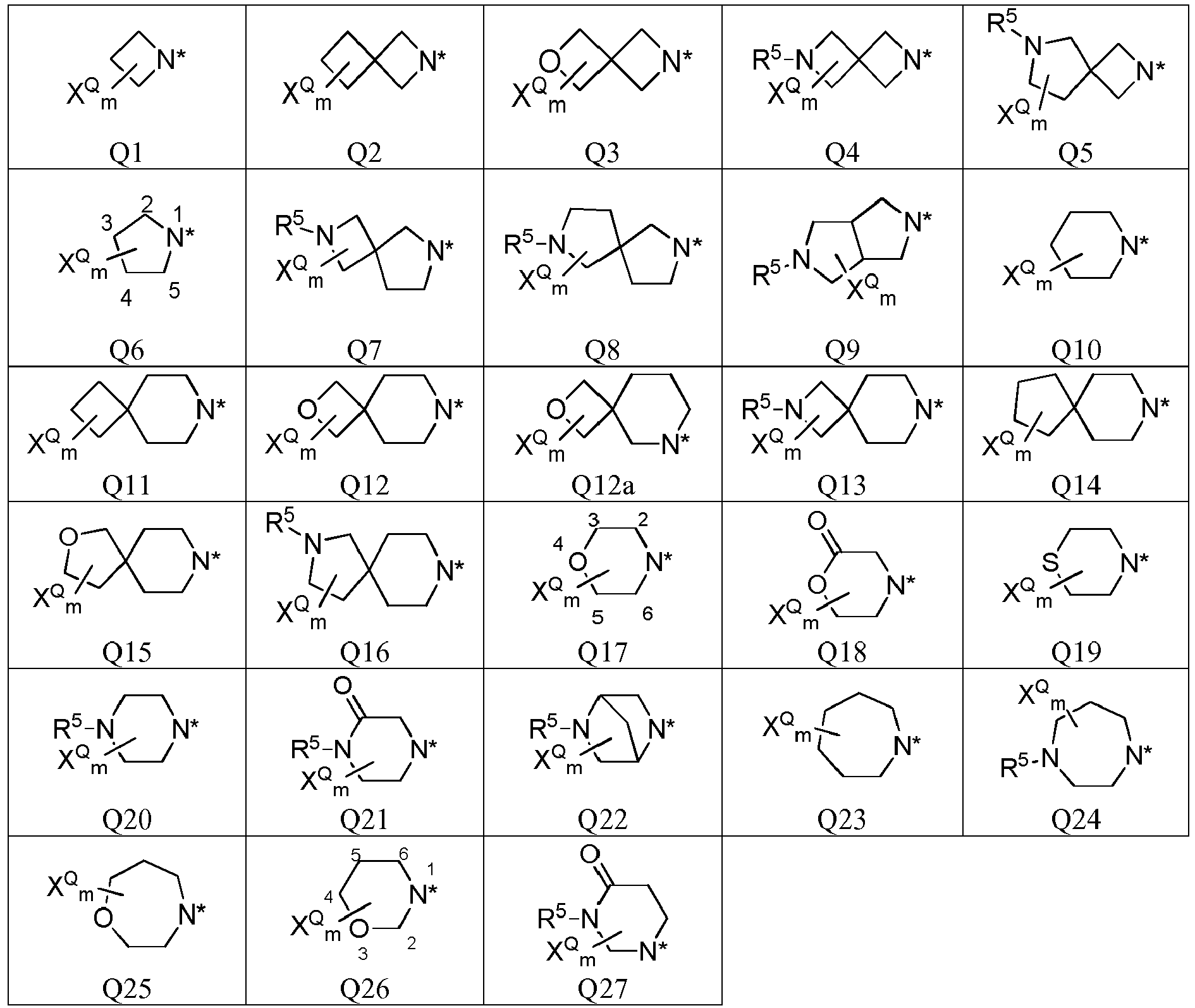
- If one or both of R2 and R3 stand for a group L1V with L1 being a branched or straight-chain optionally substituted (C1-C6)- or (C1-C4)-alkylene group, then V preferably stands for one of the following groups V1 to V40; more preferably for one of the groups V1, V2, V3, V4, V6, V7,V8, V11, V12, V14, V18, V19, V20, V21, V22, V24, V27, V28, V29, V30, V31, V34, V37, V40; most preferably for V1, V2, V7 or V12.


- If one or both of R2 and R3 stand for a group L1V with L1 being a bond, then V is preferably selected form one of before mentioned groups V1, V2, V4, V5, V7, V9, V10, V12, V13, V15 to V17, V23, V25, V26, V31 to V36, V38, preferably, for V1, V2, V4, V7, V9, V12, V13, V34, V38; most preferably for V1, V2, V7 or V12.
- Compound of formula (I) are preferred which are defined as given herein and wherein A, B and C each stands for CH; or one of A, B or C stands for N while the other groupings stand for CH.
- According to the invention, compounds are preferred having the following formula (I-A), (I-A-1), (I-A-2), (I-B), (I-B-1), (I-B-2), (I-C), (I-C-1), (I-C-2), (I-D), (I-D-1), (I-D-2), (I-E), (I-E-1), (I-E-2)


- In an [embodiment A] the invention relates to compounds having one of the formulae (I-A), (I-A-1), (I-A-2) wherein R1 stands for methyl, hydroxymethyl, 1-hydroxyethyl, 2-hydroxypropan-2-yl, SOCH3, SO2CH3 and wherein all other groups and indices are as defined in the context of the compound of general formula (I).
- In an [embodiment A-1] the invention relates to compounds having one of the formulae (I-A), (I-A-1), (I-A-2) wherein G stands for G1, G2, G3, G4, G5, G12, G13, G16, and G17, preferably wherein G stands for G1, G2, G3, G4 or G5 which groups G are unsubstituted or substituted with one, two or three substituents Y which are independently of each other selected among F, Cl, CN, OH, NH2, N(CH3)2, CONH2, CH3, CH2CH3, OCH3, OCH2CH3 and cyclopropyl, preferably selected among F, Cl, CH3, CH2CH3, OCH3, OCH2CH3 and cyclopropyl, and wherein all other groups and indices are as defined in the context of the compound of general formula (I).
- In an [embodiment A-2] the invention relates to compounds according to [embodiment A] or [embodiment A-1] having the formula (I-A-2), wherein Q is selected from Q6, Q10, Q17, Q18, Q19, Q20, Q21, Q22, Q24, and Q25; most preferably for the groups Q6, Q10, Q17, Q20, Q21, Q22, Q24 and Q25 and which groups Q are unsubstituted or substituted with one, two or three substituents XQ which are independently of each other selected among more preferably from (=O), NH2, OH, CH3, CH2CH3, OCH3, OCH2CH3, CH2OCH3, CH2OH, CH2CH2OH, CH2CN, CH2CH2CN, N(CH3)2, CH2NH(CH3), preferably selected among (=O), NH2, OH, CH3, OCH3, CH2OCH3 and CH2OH; R5 is H, methyl or ethyl, and wherein all other groups and indices are as defined in the context of the compound of general formula (I).
- In an [embodiment A-3] the invention relates to compounds according to [embodiment A] or [embodiment A-1] having the formula (I-A) or (I-A-1) with p being 1, wherein R2 and R3 independently of each other stand for H, CH3, CH2-cyclopropyl, 2-hydroxpropyl, hydroxyethyl, 2-methoxyethyl, 1-hydroxymethylcyclopropyl, 2-hydroxy-2-methylpropyl, CH2CO2H, CH2CONH2, CH2CO2CH3, V1, V2, V12, V7, and wherein all other groups and indices are as defined in the context of the compound of general formula (I).
- In an [embodiment B] the invention relates to compounds having one of the formulae (I-B), (I-B-1), (I-B-2) with x being 1 or 2 wherein G stands for G1, G2, G3, G4, G5, G12, G13, G16, and G17, preferably wherein G stands for G1, G2, G3, G4 or G5 which groups G are unsubstituted or substituted with one, two or three substituents Y which are independently of each other selected among F, Cl, CN, OH, NH2, N(CH3)2, CONH2, CH3, CH2CH3, OCH3, OCH2CH3 and cyclopropyl, preferably selected among F, Cl, CH3, CH2CH3, OCH3, OCH2CH3 and cyclopropyl and wherein all other groups and indices are as defined in the context of the compound of general formula (I).
- In an [embodiment B-1] the invention relates to compounds according to [embodiment B] having the formula (I-B-2), wherein Q is selected from Q6, Q10, Q17, Q18, Q19, Q20, Q21, Q22, Q24, and Q25; most preferably for the groups Q6, Q10, Q17, Q20, Q21, Q22, Q24 and Q25 and which groups Q are unsubstituted or substituted with one, two or three substituents XQ which are independently of each other selected among more preferably from (=O), NH2, OH, CH3, CH2CH3, OCH3, OCH2CH3, CH2OCH3, CH2OH, CH2CH2OH, CH2CN, CH2CH2CN, N(CH3)2, CH2NH(CH3), preferably selected among (=O), NH2, OH, CH3, OCH3, CH2OCH3 and CH2OH; R5 is H, methyl or ethyl, and wherein all other groups and indices are as defined in the context of the compound of general formula (I).
- In an [embodiment B-2] the invention relates to compounds according to [embodiment B] having the formula (I-B) or (I-B-1) with p being 1, wherein R2 and R3 independently of each other stand for H, CH3, CH2-cyclopropyl, 2-hydroxpropyl, hydroxyethyl, 2-methoxyethyl, 1-hydroxymethylcyclopropyl, 2-hydroxy-2-methylpropyl, CH2CO2H, CH2CONH2, CH2CO2CH3, V1, V2, V12, V7, and wherein all other groups and indices are as defined in the context of the compound of general formula (I).
- In an [embodiment C] the invention relates to compounds having one of the formulae (I-C), (I-C-1), (I-C-2) wherein G stands for G1, G2, G3, G4, G5, G12, G13, G16, and G17, preferably wherein G stands for G1, G2, G3, G4 or G5 which groups G are unsubstituted or substituted with one, two or three substituents Y which are independently of each other selected among F, Cl, CN, OH, NH2, N(CH3)2, CONH2, CH3, CH2CH3, OCH3, OCH2CH3 and cyclopropyl, preferably selected among F, Cl, CH3, CH2CH3, OCH3, OCH2CH3 and cyclopropyl, and wherein all other groups and indices are as defined in the context of the compound of general formula (I).
- In an [embodiment C-1] the invention relates to compounds according to [embodiment C] having the formula (I-C-2), wherein Q is selected from Q6, Q10, Q17, Q18, Q19, Q20, Q21, Q22, Q24, and Q25; most preferably for the groups Q6, Q10, Q17, Q20, Q21, Q22, Q24 and Q25 and which groups Q are unsubstituted or substituted with one, two or three substituents XQ which are independently of each other selected among more preferably from (=O), NH2, OH, CH3, CH2CH3, OCH3, OCH2CH3, CH2OCH3, CH2OH, CH2CH2OH, CH2CN, CH2CH2CN, N(CH3)2, CH2NH(CH3), preferably selected among (=O), NH2, OH, CH3, OCH3, CH2OCH3 and CH2OH; R5 is H, methyl or ethyl, and wherein all other groups and indices are as defined in the context of the compound of general formula (I).
- In an [embodiment C-2] the invention relates to compounds according to [embodiment C] having the formula (I-C) or (I-C-1) with p being 1, wherein R2 and R3 independently of each other stand for H, CH3, CH2-cyclopropyl, 2-hydroxpropyl, hydroxyethyl, 2-methoxyethyl, 1-hydroxymethylcyclopropyl, 2-hydroxy-2-methylpropyl, CH2CO2H, CH2CONH2, CH2CO2CH3, V1, V2, V12, V7, and wherein all other groups and indices are as defined in the context of the compound of general formula (I).
- In an [embodiment D] the invention relates to compounds having one of the formulae (I-D), (I-D-1), (I-D-2) wherein G stands for G1, G2, G3, G4, G5, G12, G13, G16, and G17, preferably wherein G stands for G1, G2, G3, G4 or G5 which groups G are unsubstituted or substituted with one, two or three substituents Y which are independently of each other selected among F, Cl, CN, OH, NH2, N(CH3)2, CONH2, CH3, CH2CH3, OCH3, OCH2CH3 and cyclopropyl, preferably selected among F, Cl, CH3, CH2CH3, OCH3, OCH2CH3 and cyclopropyl, and wherein all other groups and indices are as defined in the context of the compound of general formula (I).
- In an [embodiment D-1] the invention relates to compounds according to [embodiment D] having the formula (I-D-2), wherein Q is selected from Q6, Q10, Q17, Q18, Q19, Q20, Q21, Q22, Q24, and Q25; most preferably for the groups Q6, Q10, Q17, Q20, Q21, Q22, Q24 and Q25 and which groups Q are unsubstituted or substituted with one, two or three substituents XQ which are independently of each other selected among more preferably from (=O), NH2, OH, CH3, CH2CH3, OCH3, OCH2CH3, CH2OCH3, CH2OH, CH2CH2OH, CH2CN, CH2CH2CN, N(CH3)2, CH2NH(CH3), preferably selected among (=O), NH2, OH, CH3, OCH3, CH2OCH3 and CH2OH; R5 is H, methyl or ethyl, and wherein all other groups and indices are as defined in the context of the compound of general formula (I).
- In an [embodiment D-2] the invention relates to compounds according to [embodiment D] having the formula (I-D) or (I-D-1) with p being 1, wherein R2 and R3 independently of each other stand for H, CH3, CH2-cyclopropyl, 2-hydroxpropyl, hydroxyethyl, 2-methoxyethyl, 1-hydroxymethylcyclopropyl, 2-hydroxy-2-methylpropyl, CH2CO2H, CH2CONH2, CH2CO2CH3, V1, V2, V12, V7, and wherein all other groups and indices are as defined in the context of the compound of general formula (I).
- In an [embodiment E] the invention relates to compounds having one of the formulae (I-E), (I-E-1), (I-E-2) wherein G stands for G1, G2, G3, G4, G5, G12, G13, G16, and G17, preferably wherein G stands for G1, G2, G3, G4 or G5 which groups G are unsubstituted or substituted with one, two or three substituents Y which are independently of each other selected among F, Cl, CN, OH, NH2, N(CH3)2, CONH2, CH3, CH2CH3, OCH3, OCH2CH3 and cyclopropyl, preferably selected among F, Cl, CH3, CH2CH3, OCH3, OCH2CH3 and and wherein all other groups and indices are as defined in the context of the compound of general formula (I).
- In an [embodiment E-1] the invention relates to compounds according to [embodiment E] having the formula (I-E-2), wherein Q is selected from Q6, Q10, Q17, Q18, Q19, Q20, Q21, Q22, Q24, and Q25; most preferably for the groups Q6, Q10, Q17, Q20, Q21, Q22, Q24 and Q25 and which groups Q are unsubstituted or substituted with one, two or three substituents XQ which are independently of each other selected among more preferably from (=O), NH2, OH, CH3, CH2CH3, OCH3, OCH2CH3, CH2OCH3, CH2OH, CH2CH2OH, CH2CN, CH2CH2CN, N(CH3)2, CH2NH(CH3), preferably selected among (=O), NH2, OH, CH3, OCH3, CH2OCH3 and CH2OH; R5 is H, methyl or ethyl, and wherein all other groups and indices are as defined in the context of the compound of general formula (I).
- In an [embodiment E-2] the invention relates to compounds according to [embodiment E] having the formula (I-E) or (I-E-1) with p being 1, wherein R2 and R3 independently of each other stand for H, CH3, CH2-cyclopropyl, 2-hydroxpropyl, hydroxyethyl, 2-methoxyethyl, 1-hydroxymethylcyclopropyl, 2-hydroxy-2-methylpropyl, CH2CO2H, CH2CONH2, CH2CO2CH3, V1, V2, V12, V7, and wherein all other groups and indices are as defined in the context of the compound of general formula (I).
- The term "physiologically acceptable salt" in the sense of this invention preferably comprises a salt of at least one compound according to the present invention and at least one physiologically acceptable acid or base.
- A physiologically acceptable salt of at least one compound according to the present invention and at least one physiologically acceptable acid or one physiologically acceptable base preferably refers in the sense of this invention to a salt of at least one compound according to the present invention with at least one inorganic or organic acid or with at least one inorganic or organic base respectively which is physiologically acceptable - in particular when used in human beings and/or other mammals.
- The term "physiologically acceptable solvate" in the sense of this invention preferably comprises an adduct of one compound according to the present invention and/or a physiologically acceptable salt of at least one compound according to the present invention with distinct molecular equivalents of one solvent or more solvents.
- In the context of the present invention, and unless otherwise specified herein, the term "halogen" preferably represents the radicals F, Cl, Br and I, in particular the radicals F and Cl.
- Unless otherwise specified, the term "(C1-C6)-alkyl" is understood to mean branched and unbranched alkyl groups consisting of 1 to 6 hydrocarbon atoms. Examples of (C1-C6)-alkyl radicals are methyl, ethyl, n-propyl, 1-methylethyl (isopropyl), n-butyl, 1-methylpropyl, 2-methylpropyl, 1,1-dimethylethyl (tert-butyl), n-pentyl, 1-methylbutyl, 2-methylbutyl, 3-methylbutyl, 1,1-dimethylpropyl, 1,2-dimethylpropyl, 2,2-dimethylpropyl, n-hexyl, 1-methylpentyl, 2-methylpentyl, 3-methylpentyl, 4-methylpentyl. (C1-C4)-alkyl radicals are preferred, (C1-C3)-alkyl radicals being particularly preferred, in particular methyl, ethyl n-propyl or iso-propyl. Unless otherwise stated, the definitions of propyl, butyl, pentyl and hexyl encompass all possible isomeric forms of the individual radicals.
- Unless otherwise specified, a haloalkyl radical is understood to be an alkyl radical in which at least one hydrogen is exchanged for a halogen atom, preferably fluorine, chlorine, bromine, particularly preferably fluorine. The haloalkyl radicals can be branched or unbranched and optionally mono- or polysubstituted. Preferred haloalkyl radicals are CHF2, CH2F, CF3, CH2-CH2F, CH2-CHF2, CH2CF3. (C1-C6) haloalkyl radicals are preferred, with (C1-C4) haloalkyl radicals being particularly preferred and (C1-C3) haloalkyl radicals most particularly preferred, in particular CHF2, CH2F, CF3, CH2-CH2F, CH2-CHF2 and CH2CF3.
- Unless otherwise specified, a haloalkoxy radical is understood to be an alkoxy radical in which at least one hydrogen is exchanged for a halogen atom, preferably fluorine, chlorine, bromine, particularly preferably fluorine. The haloalkoxy radicals can be branched or unbranched and optionally mono- or polysubstituted. Preferred haloalkoxy radicals are OCHF2, OCH2F, OCF3, OCH2-CFH2, OCH2-CF2H, OCH2CF3. (C1-C6) haloalkoxy radicals are preferred, with (C1-C4) haloalkoxy radicals being particularly preferred and (C1-C3) haloalkoxy radicals most particularly preferred, in particular OCHF2, OCH2F, OCF3, OCH2-CFH2, OCH2-CF2H, OCH2CF3.
- Unless otherwise specified, a hydroxyalkyl radical is understood to be an alkyl radical in which at least one hydrogen is exchanged for a hydroxyl group. The hydroxyalkyl radicals can be branched or unbranched and optionally mono- or polysubstituted. (C1-C6)-hydroxyalkyl radicals are preferred, with (C1-C4)-hydroxyalkyl radicals being particularly preferred and (C1-C3)-hydroxyalkyl radicals most particularly preferred, in particular CH2-OH, CH2-CH2-OH and CH2-CH2-CH2-OH.
- Unless otherwise specified, a cyanoalkyl radical is understood to be an alkyl radical in which at least one hydrogen is exchanged for a cyano group. The cyanoalkyl radicals can be branched or unbranched and optionally mono- or polysubstituted. (C1-C6)-cyanoalkyl radicals are preferred, with (C1-C4)-cyanoalkyl radicals being particularly preferred and (C1-C3)-cyanoalkyl radicals most particularly preferred, in particular CH2-CN, CH2-CH2-CN and CH2-CH2-CH2-CN.
- In the context of the present invention, the expression "(C1-C6)-alkylene group" or "(C1-C4)-alkylene group" includes acyclic saturated hydrocarbon radicals having 1, 2, 3, 4, 5 or 6 carbon atoms or 1, 2, 3 or 4 carbon atoms, respectively, which can be branched or unbranched and unsubstituted or substituted once or several times, for example 2, 3, 4 or 5 times, by identical or different substituents and which link a corresponding moiety to the main structure. Such alkylene groups can preferably be chosen from the group consisting of -CH2-, -CH2CH2-, -CH(CH3)-, -CH2CH2CH2-, -CH(CH3)CH2-,-CH(CH2CH3)-, -CH2(CH2)2CH2-, -CH(CH3)CH2CH2-, -CH2CH(CH3)CH2-, -CH(CH3)CH(CH3)-,-CH(CH2CH3)CH2-, -C(CH3)2CH2-, -CH(CH2CH2CH3)-, -C(CH3)(CH2CH3)-, -CH2(CH2)3CH2-,-CH(CH3)CH2CH2CH2-, -CH2CH(CH3)CH2CH2-, -CH(CH3)CH2CH(CH3)-, -CH(CH3)CH(CH3)CH2-,-C(CH3)2CH2CH2-, -CH2C(CH3)2CH2-, -CH(CH2CH3)CH2CH2-, -CH2CH(CH2CH3)CH2-,-C(CH3)2CH(CH3)-, -CH(CH2CH3)CH(CH3)-, -C(CH3)(CH2CH3)CH2-, -CH(CH2CH2CH3)CH2-,-C(CH2CH2CH3)CH2-, -CH(CH2CH2CH2CH3)-, -C(CH3)(CH2CH2CH3)-, -C(CH2CH3)2- and -CH2(CH2 )4CH2-. The alkylene groups can particularly preferably be chosen from the group consisting of -CH2-, -CH2CH2- and -CH2CH2CH2-.
- Unless otherwise specified, the term "(C2-C6)-alkenyl" is understood to mean branched and unbranched unsaturated alkyl groups consisting of 2 to 6 hydrocarbon atoms and having at least one double bond. Examples of (C2-C6)-alkenyls are ethenyl (also referred to as vinyl), prop-1-enyl, prop-2-enyl (also referred to as allyl), but-1-enyl, but-2-enyl, but-3-enyl, pent-1-enyl and hex-1-enyl. The designation (C2-C6)-alkenyl includes all possible isomers, i.e. structural isomers (constitutional isomers) and stereoisomers ((Z) and (E) isomers). Unless otherwise specified, the term "(C2-C6)-alkinyl" is understood to mean branched and unbranched unsaturated alkyl groups consisting of 2 to 6 hydrocarbon atoms and having at least one triple bond. Examples of (C2-C6)-alkinyls are ethinyl.
- Unless otherwise specified, the term "3- to 12-membered cyclic aliphatic ring" is understood to mean cyclic aliphatic hydrocarbons containing 3, 4, 5, 6, 7, 8, 9, 10, 11 or 12 carbon atoms, wherein the hydrocarbons in each case can be saturated or unsaturated (but not aromatic), unsubstituted or mono- or polysubstituted. The residues may be mono- or bicyclic.
- The cycloaliphatic residues can be bound to the respective superordinate general structure via any desired and possible ring member of the cycloaliphatic residue. The (C3-C12) cycloaliphatic residue can furthermore be single or multiple bridged such as, for example, in the case of adamantyl, bicyclo[2.2.1]heptyl or bicyclo[2.2.2]octyl. Preferred (C3-C12) cycloaliphatic residues are selected from the group consisting of cyclopropyl, cyclobutyl, cyclopentyl, cyclohexyl, cycloheptyl, cyclooctyl, cyclononyl, cyclodecyl, adamantyl, cyclopentenyl, cyclohexenyl, cycloheptenyl, cyclooctenyl,

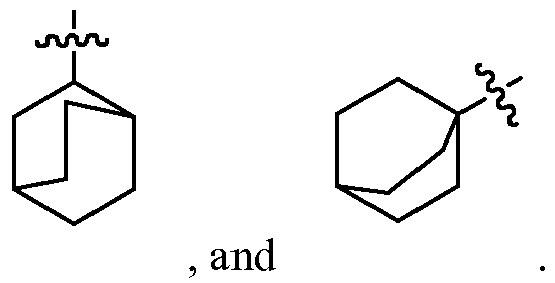
- Preferred are (C3-C8)-mono- or bicyclic aliphatic residues which are selected from the group consisting of cyclopropyl, cyclobutyl, cyclopentyl, cyclohexyl, cycloheptyl, and cyclooctyl. Particularly preferred are (C3-C6)-cycloaliphatic residues such as cyclopropyl, cyclobutyl, cyclopentyl, cyclohexyl, cyclopentenyl and cyclohexenyl, in particular cyclopropyl.
- Unless otherwise specified, the term "3- to 12-membered heteroaliphatic residue" is understood to mean heterocycloaliphatic saturated or unsaturated (but not aromatic) residues having 3 to 12, i.e. 3, 4, 5, 6, 7, 8, 9, 10, 11 or 12 ring members, in which in each case at least one, if appropriate also two or three carbon atoms are replaced by a heteroatom or a heteroatom group each selected independently of one another from the group consisting of O, S, S(=O), S(=O)2, N, NH and N(C1-C6)-alkyl such as N(CH3), wherein the ring members can be unsubstituted or mono- or polysubstituted. The residues may be mono- or bicyclic.
- Unless otherwise specified, the term "5- or 6-membered heteroaryl" is understood to represent a 5- or 6-membered cyclic aromatic residue containing at least 1, if appropriate also 2, 3, 4 or 5 heteroatoms, wherein the heteroatoms are each preferably selected independently of one another from the group S, N and O, whereas the sulfur atom may exist in oxidized form as SO or SO2 group, and the heteroaryl residue can be unsubstituted or mono- or polysubstituted; e.g. substituted by 2, 3, 4 or 5 substituents, whereby the substituents can be the same or different and be in any desired and possible position of the heteroaryl. The binding to the superordinate general structure can be carried out via any desired and possible ring member of the heteroaryl residue if not indicated otherwise. The heteroaryl may be condensed with a 4-, 5-, 6- or 7-membered ring, being carbocyclic or heterocyclic, wherein the heteroatoms of the heterocyclic ring are each preferably selected independently of one another from the group S, N and O, and wherein said condensed ring may be saturated, partially unsaturated or aromatic and may be unsubstituted or mono- or polysubstituted; e.g. substituted by 2, 3, 4 or 5 substituents, whereby the substituents can be the same or different and be in any desired and possible position. Examples of such heteroaryl moieties are benzofuranyl, benzoimidazolyl, benzo-thienyl, benzo¬thiadiazolyl, benzothiazolyl, benzotriazolyl, benzooxazolyl, benzooxadiazolyl, quinazolinyl, quinoxalinyl, carbazolyl, quinolinyl, dibenzofuranyl, dibenzothienyl, furyl (furanyl), imidazolyl, imidazo-thiazolyl, indazolyl, indolizinyl, indolyl, isoquinolinyl, isoxazoyl, isothiazolyl, indolyl, naphthyridinyl, oxazolyl, oxadiazolyl, phenazinyl, phenothiazinyl, phthalazinyl, pyrazolyl, pyridyl (2-pyridyl, 3-pyridyl, 4-pyridyl), pyrrolyl, pyridazinyl, pyrimidinyl, pyrazinyl, purinyl, phenazinyl, thienyl (thiophenyl), triazolyl, tetrazolyl, thiazolyl, thiadiazolyl and triazinyl.
- In connection with non-aromatic moieties such as "alkyl", "alkenyl", "alkinyl", "alkylene", "cycloaliphatic", "heterocycloaliphatic", "carbocyclic ring", "heterocyclic", "cycloalkyl" and "heterocyclyl", in the context of this invention the term "substituted" is understood as meaning replacement of a hydrogen radical by a substituent selected from the group consisting of =O, OH, CN, halogen, SH, nitro, (C1-C6)-alkyl, (C2-C6)-alkenyl, (C2-C6)-alkinyl, (C1-C6)-hydroxyalkyl, (C1-C6)-cyanoalkyl, (C1-C6)-alkoxy, (C1-C6)-thioalkyl, (C1-C6)-haloalkyl, (C1-C6)-thiohaloalkyl, (C1-C6)-haloalkoxy, (C1-C6)-alkylen-S-(C1-C6)-alkyl, (C3-C8)-cycloalkyl, (C3-C6)-cycloalkyl-(C1-C3)-alkylenyl, (C3-C8)-heterocycloalkyl, NH2, NH(C1-C6)-alkyl, N((C1-C6)-alkyl)2, NH-CO-(C1-C6)-alkyl, NH-CO-O-(C1-C6)-alkyl, NH-C(O)NH2, NH-CO-NH-(C1-C6)-alkyl, NH-CO-N((C-C6)-alkyl)2, NH((C1-C6)-alkylen)-CO-(C1-C6)-alkyl, NH((C1-C6)-alkylen)-CO-O-(C1-C6)-alkyl, NH((C1-C6)-alkylen)-CONH2, NH((C1-C6)-alkylen)-CO-NH-(C1-C6)-alkyl, NH((C1-C6)-alkylen)-CO-N((C1-C6)-alkyl)2, NH-S(O)2OH, NH-S(O)2(C1-C6)-alkyl, NH-S(O)2O(C1-C6)-alkyl, NH-S(O)2NH2, NH-S(O)2NH(C1-C6)-alkyl, NH-S(O)2N((C1-C6)-alkyl)2, NH((C1-C6)-alkylen)-S(O)2OH, NH((C1-C6)-alkylen)-S(O)2(C1-C6)-alkyl, NH((C1-C6)-alkylen)-S(O)2O(C1-C6)-alkyl, NH((C1-C6)-alkylen)-S(O)2NH2, NH((C1-C6)-alkylen)-S(O)2NH(C1-C6)-alkyl, CO2H, CO(C1-C6)-alkyl, CO-O(C1-C6)-alkyl, O-CO(C1-C6)-alkyl, O-CO-O(C1-C6)-alkyl, CONH2, CO-NH(C1-C6)-alkyl, CO-N((C1-C6)-alkyl)2, O-CO-NH(C1-C6)-alkyl, O-CO-N((C1-C6)-alkyl)2, O-S(O)2-(C1-C6)-alkyl, O-S(O)2OH, O-S(O)2-(C1-C6)-alkoxy, O-S(O)2NH2, O-S(O)2-NH(C1-C6)-alkyl, O-S(O)2-N((C1-C6)-alkyl)2, S(O)(C1-C6)-alkyl, S(O)2(C1-C6)-alkyl, S(O)2OH, S(O)2O(C1-C6)-alkyl, S(O)2NH2, S(O)2NH(C1-C6)-alkyl, and S(O)2N((C1-C6)-alkyl)2. If a moiety is substituted with more than 1 substituent, e.g. by 2, 3, 4, or 5 substituents, these substituents may be present either on different or on the same atoms, e.g. as in the case of CF3 or CH2CF3, or at different places, as in the case of CH(Cl)-CH=CH-CHCl2. Substitution with more than 1 substituent may include identical or different substituents, such as, for example, in the case of CH(OH)-CH=CH-CHCl2. Preferably, the substituents may be selected from the group consisting of F, Cl, Br, CF3, CHF2, CH2F, OCF3, OH, CN, (C1-C4)-alkyl, (C1-C4)-hydroxyalkyl, (C1-C4)-alkoxy, (C3-C6)-cycloalkyl, NH2, NH(C1-C4)-alkyl, N((C1-C4)-alkyl)2, NH-CO-(C1-C4)-alkyl, NH-CO-NH-(C1-C6)-alkyl, NH-CO-N((C1-C6)-alkyl)2, NH-S(O)2(C1-C4)-alkyl, CONH2, CO-NH(C1-C6)-alkyl, CO-N((C1-C6)-alkyl)2, S(O)(C1-C4)-alkyl and S(O)2(C1-C4)-alkyl.
- In connection with aromatic moieties such as "phenyl" and "heteroaryl", in the context of this invention the term "substituted" is understood as meaning replacement of a hydrogen radical by a substituent selected from the group consisting of OH, halogen, CN, SH, nitro, (C1-C6)-alkyl, (C2-C6)-alkenyl, (C2-C6)-alkinyl, (C1-C6)-hydroxyalkyl, (C1-C6)-cyanoalkyl, (C1-C6)-alkoxy, (C1-C6)-thioalkyl, (C1-C6)-haloalkyl, (C1-C6)-thiohaloalkyl, (C1-C6)-haloalkoxy, (C1-C6)-alkylen-S-(C1-C6)-alkyl, (C3-C8)-cycloalkyl, (C3-C6)-cycloalkyl-(C1-C3)-alkylenyl, (C3-C8)-heterocycloalkyl, NH2, NH(C1-C6)-alkyl, N((C1-C6)-alkyl)2, NH-CO-(C1-C6)-alkyl, NH-CO-O-(C1-C6)-alkyl, NH-C(O)NH2, NH-CO-NH-(C1-C6)-alkyl, NH-CO-N((C1-C6)-alkyl)2, NH((C1-C6)-alkylen)-CO-(C1-C6)-alkyl, NH((C1-C6)-alkylen)-CO-O-(C1-C6)-alkyl, NH((C1-C6)-alkylen)-CONH2, NH((C1-C6)-alkylen)-CO-NH-(C1-C6)-alkyl, NH((C1-C6)-alkylen)-CO-N((C1-C6)-alkyl)2, NH-S(O)2OH, NH-S(O)2(C1-C6)-alkyl, NH-S(O)2O(C1-C6)-alkyl, NH-S(O)2NH2, NH-S(O)2NH(C1-C6)-alkyl, NH-S(O)2N((C1-C6)-alkyl)2, NH((C1-C6)-alkylen)-S(O)2OH, NH((C1-C6)-alkylen)-S(O)2(C1-C6)-alkyl, NH((C1-C6)-alkylen)-S(O)2O(C1-C6)-alkyl, NH((C1-C6)-alkylen)-S(O)2NH2, NH((C1-C6)-alkylen)-S(O)2NH(C1-C6)-alkyl, CO2H, CO(C1-C6)-alkyl, CO-O(C1-C6)-alkyl, O-CO(C1-C6)-alkyl, O-CO-O(C1-C6)-alkyl, CONH2, CO-NH(C1-C6)-alkyl, CO-N((C1-C6)-alkyl)2, O-CO-NH(C1-C6)-alkyl, O-CO-N((C1-C6)-alkyl)2, O-S(O)2-(C1-C6)-alkyl, O-S(O)2OH, O-S(O)2-(C1-C6)-alkoxy, O-S(O)2NH2, O-S(O)2-NH(C1-C6)-alkyl, O-S(O)2-N((C1-C6)-alkyl)2, S(O)(C1-C6)-alkyl, S(O)2(C1-C6)-alkyl, S(O)2OH, S(O)2O(C1-C6)-alkyl, S(O)2NH2, S(O)2NH(C1-C6)-alkyl, and S(O)2N((C1-C6)-alkyl)2. If a moiety is substituted with more than 1 substituent, e.g. by 2, 3, 4, or 5 substituents, these substituents may be identical or different. Preferably, the substituents may be selected from the group consisting of F, Cl, Br, CF3, CHF2, CH2F, OCF3, OH, CN, (C1-C4)-alkyl, (C1-C4)-hydroxyalkyl, (C1-C4)-alkoxy, (C3-C6)-cycloalkyl, NH2, NH(C1-C4)-alkyl, N((C1-C4)-alkyl)2, NH-CO-(C1-C4)-alkyl, NH-CO-NH-(C1-C6)-alkyl, NH-CO-N((C1-C6)-alkyl)2, NH-S(O)2(C1-C4)-alkyl, CONH2, CO-NH(C1-C6)-alkyl, CO-N((C1-C6)-alkyl)2, S(O)(C1-C4)-alkyl and S(O)2(C1-C4)-alkyl.
- Owing to their excellent pharmacological activity, the compounds according to the first aspect of the invention, in particular according to the general structure of formulae (I), (I-A-1), (I-A-2), (I-B), (I-B-1), (I-B-2), (I-C), (I-C-1), (I-C-2), (I-D), (I-D-1), (I-D-2), (I-E), (I-E-1), (I-E-2) are suitable for the treatment of various diseases or conditions in which inhibition of the PDE4 enzyme is advantageous.
- Such conditions and diseases are inter alia
- inflammatory diseases of the joints, in particular rheumatoid arthritis, psoriatic arthritis, ankylosing spondylitis (Bechterew's disease), gout, osteoarthritis;
- inflammatory diseases of the skin, in particular psoriasis, atopic dermatitis, lichen planus;
- inflammatory diseases of the eyes, in particular uveitis;
- gastrointestinal diseases and complaints, in particular inflammatory diseases of the digestive organs, above all Crohn's disease, ulcerative colitis, and acute and chronic inflammations of the gall bladder and bile ducts, of pseudopolyps and juvenile polyps;
- inflammatory diseases of the internal organs, in particular SLE (systemic lupus erythematosus) including lupus nephritis, chronic prostatitis, interstitial cystitis;
- hyperplastic diseases, in particular benign prostatic hyperplasia;
- respiratory or lung diseases associated with elevated mucus production, inflammation and/or obstruction of the respiratory tract, in particular COPD (chronic obstructive pulmonary disease), chronic bronchitis, asthma, pulmonary fibrosis, allergic and non-allergic rhinitis, obstructive sleep apnoea, cystic fibrosis, chronic sinusitis, emphysema, cough, alveolitis, ARDS (acute respiratory distress syndrome), pulmonary oedema, bronchiectasis, pneumonia;
- diseases of the fibrotic spectrum, in particular hepatic fibrosis, systemic sclerosis, scleroderma;
- cancers, in particular haematopoietic cancers, inter alia B-cell lymphoma, T-cell lymphoma, in particular CLL and CML (chronic lymphatic and chronic myeloid leukaemia), ALL and AML (acute lymphatic and acute myeloid leukaemia), and gliomas;
- metabolic diseases, in particular type 2 diabetes, metabolic syndrome, obesity/adiposity, fatty liver disease (not alcohol-induced), and cardiovascular diseases, in particular arteriosclerosis, PAH (pulmonary arterial hypertension);
- psychological disorders, in particular schizophrenia, depression, in particular bipolar or manic depression, dementia, memory loss, generalised anxiety disorder (GAD); and
- diseases of the peripheral or central nervous system, in particular Parkinson's disease, multiple sclerosis, Alzheimer's disease, stroke, ALS (amyotrophic lateral sclerosis).
- One of the advantages of the compounds according to the first aspect of the invention is that they are selective PDE4B inhibitors. The advantage of this selectivity lies in the fact that the PDE4D enzyme for example is not inhibited or is only partly inhibited, and hence the use of such selective PDE4B inhibitors gives rise to no side-effects or to markedly reduced side-effects. Undesired side-effects are for example emesis and nausea, in particular indisposition, vomiting and sickness. The therapeutic range of the compounds according to the invention is therefore advantageous.
- In a second aspect of the invention, the invention therefore also provides a pharmaceutical composition (medicament) containing at least one compound according to the first aspect of the invention, in particular according to formulae (I-A-1), (I-A-2), (I-B), (I-B-1), (I-B-2), (I-C), (I-C-1), (I-C-2), (I-D), (I-D-1), (I-D-2), (I-E), (I-E-1) and (I-E-2) in the presented form or in the form of its acids or bases or in the form of the pharmaceutically safe, in particular physiologically acceptable salts, or in the form of its solvates, optionally in the form of its racemates, its pure stereoisomers, in particular enantiomers or diastereomers, or in the form of mixtures of stereoisomers, in particular enantiomers or diastereomers, in any mixing ratio.
- In a third aspect of the invention, the invention therefore also provides a compound according to the first aspect of the invention, in particular according to formulae (I), (I-A-1), (I-A-2), (I-B), (I-B-1), (I-B-2), (I-C), (I-C-1), (I-C-2), (I-D), (I-D-1), (I-D-2), (I-E), (I-E-1) and (I-E-2) in the presented form or in the form of its acids or bases or in the form of the pharmaceutically safe, in particular physiologically acceptable salts, or in the form of its solvates, optionally in the form of its racemates, its pure stereoisomers, in particular enantiomers or diastereomers, or in the form of mixtures of stereoisomers, in particular enantiomers or diastereomers, in any mixing ratio for use as a medicament, in particular for the treatment of conditions or diseases that can be treated by inhibition of the PDE4 enzyme, in particular the PDE4B enzyme.
- In a fourth aspect of the invention, the invention therefore also provides a compound according to the first aspect of the invention, in particular according to formulae (I), (I-A-1), (I-A-2), (I-B), (I-B-1), (I-B-2), (I-C), (I-C-1), (I-C-2), (I-D), (I-D-1), (I-D-2), (I-E), (I-E-1) and (I-E-2) in the presented form or in the form of its acids or bases or in the form of the pharmaceutically safe, in particular physiologically acceptable salts, or in the form of its solvates, optionally in the form of its racemates, its pure stereoisomers, in particular enantiomers or diastereomers, or in the form of mixtures of stereoisomers, in particular enantiomers or diastereomers, in any mixing ratio for the treatment of inflammatory diseases of the joints, in particular rheumatoid arthritis, psoriatic arthritis, ankylosing spondylitis (Bechterew's disease), gout, osteoarthritis; and/or inflammatory diseases of the skin, in particular psoriasis, atopic dermatitis, lichen planus; and/or inflammatory diseases of the eyes, in particular uveitis; gastrointestinal diseases and complaints, in particular inflammatory diseases of the digestive organs, above all Crohn's disease, ulcerative colitis, and acute and chronic inflammations of the gall bladder and bile ducts, of pseudopolyps and juvenile polyps; inflammatory diseases of the internal organs, in particular SLE (systemic lupus erythematosus) including lupus nephritis, chronic prostatitis, interstitial cystitis; and/or hyperplastic diseases, in particular benign prostatic hyperplasia; respiratory or lung diseases associated with elevated mucus production, inflammation and/or obstruction of the respiratory tract, in particular COPD (chronic obstructive pulmonary disease), chronic bronchitis, asthma, pulmonary fibrosis, allergic and non-allergic rhinitis, obstructive sleep apnoea, cystic fibrosis, chronic sinusitis, emphysema, cough, alveolitis, ARDS (acute respiratory distress syndrome), pulmonary oedema, bronchiectasis, pneumonia; diseases of the fibrotic spectrum, in particular hepatic fibrosis, systemic sclerosis, scleroderma; cancers, in particular haematopoietic cancers, inter alia B-cell lymphomas, T-cell lymphomas, in particular CLL and CML (chronic lymphatic and chronic myeloid leukaemia), ALL and AML (acute lymphatic and acute myeloid leukaemia), and gliomas; metabolic diseases, in particular type 2 diabetes, metabolic syndrome, obesity/adiposity, fatty liver disease (not alcohol-induced), and cardiovascular diseases, in particular arteriosclerosis, PAH (pulmonary arterial hypertension); psychological disorders, in particular schizophrenia, depression, in particular bipolar or manic depression, dementia, memory loss, generalised anxiety disorder (GAD); and/or diseases of the peripheral or central nervous system, in particular Parkinson's disease, multiple sclerosis, Alzheimer's disease, stroke, ALS (amyotrophic lateral sclerosis).
- In a preferred embodiment of the fourth aspect of the invention, the invention therefore provides a compound according to the first aspect of the invention, in particular of formulae (I), (I-A-1), (I-A-2), (I-B), (I-B-1), (I-B-2), (I-C), (I-C-1), (I-C-2), (I-D), (I-D-1), (I-D-2), (I-E), (I-E-1) and (I-E-2) in the presented form or in the form of its acids or bases or in the form of the pharmaceutically safe, in particular physiologically acceptable salts, or in the form of its solvates, in particular hydrates, optionally in the form of its racemates, its pure stereoisomers, in particular enantiomers or diastereomers, or in the form of mixtures of stereoisomers, in particular enantiomers or diastereomers, in any mixing ratio for the treatment of inflammatory diseases of the joints (in particular rheumatoid arthritis, psoriatic arthritis, ankylosing spondylitis (Bechterew's disease), gout, osteoarthritis), the skin (in particular psoriasis, atopic dermatitis, lichen planus) or the eyes (in particular uveitis), of respiratory or lung diseases associated with elevated mucus production, inflammation and/or obstruction of the respiratory tract, in particular COPD (chronic obstructive pulmonary disease), chronic bronchitis, asthma, pulmonary fibrosis, allergic and non-allergic rhinitis, obstructive sleep apnoea, cystic fibrosis, chronic sinusitis, emphysema, cough, alveolitis, ARDS (acute respiratory distress syndrome), pulmonary oedema, bronchiectasis, pneumonia; of metabolic diseases, in particular type 2 diabetes, metabolic syndrome, obesity/adiposity, fatty liver disease (not alcohol-induced), and/or cardiovascular diseases, in particular arteriosclerosis, PAH (pulmonary arterial hypertension).
- In another aspect of the invention, the invention also provides the use of a compound according to the first aspect of the invention, in particular according to the general structure of formulae (I), (I-A-1), (I-A-2), (I-B), (I-B-1), (I-B-2), (I-C), (I-C-1), (I-C-2), (I-D), (I-D-1), (I-D-2), (I-E), (I-E-1) and (I-E-2) in the presented form or in the form of its acids or bases or in the form of the pharmaceutically safe, in particular physiologically acceptable salts, or in the form of its solvates, in particular hydrates, optionally in the form of its racemates, its pure stereoisomers, in particular enantiomers or diastereomers, or in the form of mixtures of stereoisomers, in particular enantiomers or diastereomers, in any mixing ratio to produce a medicament for the treatment of diseases and conditions according to the fourth aspect of the invention.
- In yet another aspect of the invention, the invention also provides a method for the treatment of the diseases and conditions according to the fourth aspect of the invention in a human, which is characterised in that a therapeutically effective amount of at least one compound according to the first aspect of the invention, in particular according to the general structure of formulae (I), (I-A-1), (I-A-2), (I-B), (I-B-1), (I-B-2), (I-C), (I-C-1), (I-C-2), (I-D), (I-D-1), (I-D-2), (I-E), (I-E-1) and (I-E-2) in the presented form or in the form of its acids or bases or in the form of the pharmaceutically safe, in particular physiologically acceptable salts, or in the form of its solvates, optionally in the form of its racemates, its pure stereoisomers, in particular enantiomers or diastereomers, or in the form of mixtures of stereoisomers, in particular enantiomers or diastereomers, in any mixing ratio, is administered.
- The amount of active ingredient to be administered to the person or patient varies and is dependent on the patient's weight, age and medical history and on the type of administration, the indication and the severity of the illness. Generally 0.01 to 500 mg/kg, in particular 0.05 to 50 mg/kg, preferably 0.1 to 25 mg/kg of body weight of at least one compound according to the first aspect of the invention, in particular according to the general structure of formula (I), (I-A-1), (I-A-2), (I-B), (I-B-1), (I-B-2), (I-C), (I-C-1), (I-C-2), (I-D), (I-D-1), (I-D-2), (I-E), (I-E-1) and (I-E-2) in the presented form or in the form of its acids or bases or in the form of the pharmaceutically safe, in particular physiologically acceptable salts, or in the form of its solvates, optionally in the form of its racemates, its pure stereoisomers, in particular enantiomers or diastereomers, or in the form of mixtures of stereoisomers, in particular enantiomers or diastereomers, in any mixing ratio, are administered.
- All embodiments, in particular the preferred embodiments, of the first aspect of the invention apply mutatis mutandis to all other aspects of the invention.
- The medicaments, drugs and pharmaceutical compositions according to the invention can take the form of and be administered as liquid, semi-solid or solid dosage forms and as for example injection solutions, drops, juices, syrups, sprays, suspensions, granules, tablets, pellets, transdermal therapeutic systems, capsules, plasters, suppositories, ointments, creams, lotions, gels, emulsions or aerosols and contain, in addition to at least one compound according to the first aspect of the invention, in particular according to the general structure of formula (I), (I-A-1), (I-A-2), (I-B), (I-B-1), (I-B-2), (I-C), (I-C-1), (I-C-2), (I-D), (I-D-1), (I-D-2), (I-E), (I-E-1) and (I-E-2) in the presented form or in the form of its acids or bases or in the form of the pharmaceutically safe, in particular physiologically acceptable salts, or in the form of its solvates, optionally in the form of its racemates, its pure stereoisomers, in particular enantiomers or diastereomers, or in the form of mixtures of stereoisomers, in particular enantiomers or diastereomers, in any mixing ratio, according to the pharmaceutical form and depending on the administration route, pharmaceutical auxiliary substances such as for example carrier materials, fillers, solvents, diluting agents, surface-active substances, dyes, preservatives, disintegrants, slip additives, lubricants, flavourings and/or binders.
- The choice of auxiliary substances and the amounts thereof to use depends on whether the medicament/drug is to be administered by oral, subcutaneous, parenteral, intravenous, vaginal, pulmonary, intraperitoneal, transdermal, intramuscular, nasal, buccal or rectal means or locally, for example for infections of the skin, mucous membranes and eyes. Preparations in the form of inter alia tablets, pastilles, capsules, granules, drops, juices and syrups are suitable for oral administration; solutions, suspensions, easily reconstitutable powders for inhalation and sprays are suitable for parenteral, topical and inhalative administration. Compounds according to the first aspect of the invention in a depot formulation, in dissolved form or in a plaster, optionally with addition of agents promoting skin penetration, are suitable preparations for percutaneous administration. Preparation forms that are suitable for rectal, transmucosal, parenteral, oral or percutaneous administration can deliver the compounds according to the first aspect of the invention, on a delayed release basis.
- Preparation of the medicaments and pharmaceutical compositions according to the invention takes place using agents, equipment, methods and procedures that are well-known from the prior art of pharmaceutical formulation, such as are described for example in "Remington's Pharmaceutical Sciences", Ed. A.R. Gennaro, 17th edition, Mack Publishing Company, Easton PD (1985), in particular in part 8, chapters 76 to 93.The compounds according to the invention can be produced in the manner described here or in an analogous manner.
- Unless indicated otherwise, the compounds according to the first aspect of invention can be synthesized according to general knowledge in the field of organic chemistry or in a manner as described here (cf. reaction schemes below) or analogously. The reaction conditions in the synthesis routes described herein are known to the skilled person and are for some cases exemplified in the synthesis examples herein.
- If not stated otherwise, in below reaction scheme all substituents, chemical moieties, variables and indices in the compounds shown in the following reaction schemes are defined herein the context of the first aspect of the invention, and Rx is (C1-C6) alkyl, preferably methyl and butyl.
-

- In the step (i), the coupling of the amine of general formula (II) and the compound of general formula (III) is performed by known methods from peptide chemistry (e.g. Tetrahedron 2004, 60, 2447-2467). Suitable coupling reagents are known to a person skilled in the art and include e.g. carbodiimides (such as 1-[3-(dimethylamino)propyl]-3-ethylcarbodiimide hydrochloride (EDC)) and are used in a suitable solvent (e.g. N,N-dimethylformamide).
- In the step (ii), the 1H-indole-6-carboxamide of formula (IV) is converted into the corresponding 3-(alkylthio)-1H-indole of formula (VI) by methods known in the art (e.g. Heterocycles 1976, 4 (4), 729). For example, by treatment of a dialkylthioether of general formula (V) with N-chlorosuccinimide in a solvent like dichloromethane or chloroform leading to a succinimido-sulfonium salt which then reacts with the carboxamide of general formula (IV) at elevated temperatures to the compounds of general formula (VI). The 3-(alkylthio)-1H-indole of formula (VI) can also be obtained via alternative methods, for example, through halogenation at position three of the indol ring of the compounds (VI) followed by a nucleophilic substitution with nucleophiles like NaSMe (cf. Journal of Heterocyclic Chemistry 2007, 44, 967).
- Step (iii) of synthesis method (01) is the reaction of 5-bromo-2-chloropyrimidine (VII) with the alkylthio compound 3-(alkylthio)-1H-indole having general formula (VI) to form compounds of general formula (VIII). This reaction is performed with known methods for nucleophilic aromatic substitution in a solvent and in the presence of a base. Examples of suitable solvents are dioxane, N,N-dimethylformamide, N-methyl-2-pyrrolidone or dimethylsulfoxide. Examples of suitable bases are potassium tert-butylate, 1,8-diazabicyclo[5.4.0]undec-7-ene (DBU), aqueous sodium hydroxide and potassium carbonate. This reaction can take place at a temperature ranging from approximately 50°C to approximately 200°C. The reaction preferably takes place at a temperature in the range from 100°C to 150°C. Instead of 5-bromo-2-chloropyrimidine, alternative 2,5-di-substituted pyrimidines could be used wherein the two halogens are replaced by other suitable leaving groups. Alternatively, the compounds of general formula (VIII) can be obtained by reacting compounds of general formula (VI) in the presence of an acid, such as for example hydrochloric acid, in a solvent like N,N-dimethylformamide or under the conditions for palladium-catalyzed cross-coupling reactions, as described in step (i) of synthesis method (02).
- G in the compound "G-M" has the meaning described in connection with the compounds according to the invention and M is as defined as follows:
If a Suzuki coupling is performed, then M denotes B(OH)2 (boronic acid), B(ORa)2 (boronic acid ester) (Ra stands for (C1-C6)-alkyl, preferably methyl) or an optionally (C1-C6) alkyl-substituted 1,3,2-dioxaborolane (e.g. 4,4,5,5-tetramethyl-1,3,2-dioxaborolane; pinacol boronic acid ester) and if a Stille coupling is performed, then M denotes SnRb 3 (Rb stands for (C1-C6)-alkyl, preferably methyl and butyl; e.g. M = Sn(CH3)3 (= trimethylstannyl) or SnBn3 (= tributylstannyl)). - This step (iv) of synthesis method (01), namely the reaction under Stille or Suzuki coupling reaction conditions is performed according to methods well known in the art (cf. Tetrahedron 2005, 61, 2245-67). The Suzuki coupling can be performed for example in the presence of a catalyst such as tris(dibenzylideneacetone)dipalladium / tri-tert-butylphosphonium tetrafluoroborate, tetrakis(triphenylphosphine)palladium(0) or [1,1'-bis(diphenylphosphino)ferrocene]dichloropalladium(II) complex and a base (e.g. caesium or potassium carbonate) in a solvent or a mixture of solvents (solvent blend) (e.g. THF, dioxane or acetonitrile with or without water).
- Optionally, synthesis method (01) further comprises a step (v):
-

- This step (v) of synthesis method (01), comprises reacting a compound of formula (IX) with an oxidizing agent under appropriate reaction conditions. A suitable oxidizing agent is for example m-chloroperoxybenzoic acid in a solvent like dichloromethane under cooling or at room temperature for a certain time period. By choosing the appropriate amount or equivalents of the oxidizing agent based on the amount of starting material of formula (IX), the oxidation reaction can be controlled so that either the sulfoxides of formula (X) or the sulfones of formula (XI) are obtained.
-


- This step (i) of synthesis method (02), namely the reaction of a 2-chloropyrimidine of general formula (XII) with an alkylthio compound (3-(alkylthio)-1H-indole) of general formula (VI) can be performed under the conditions for a nucleophilic aromatic substitution as described in step (iii) of synthesis method (01). Alternatively, the reaction can be performed under the conditions for a palladium-catalyzed cross-coupling reaction also known as Buchwald-Hartwig reaction (cf. Angewandte Chemie, International Edition 2008, 47(34), 6338-6361). A suitable catalyst for this reaction is for example palladium(II) acetate / 4,5-bis(diphenylphosphino)-9,9-dimethylxanthene (Xanphos) in a solvent like 1,4-dioxane preferably at temperatures between 50 and 150°C.
-

- This step (i) of synthesis method (03), namely the transformation of a compound of formula (VIII) to a compound of formula (XIII) wherein) can be performed under the conditions of a palladium-catalysed reaction that are known from the literature (cf. Journal of Organic Chemistry 1995, 60, 7508-7510; Journal of Organic Chemistry 2000, 65, 164-168).
- Suitable reaction conditions comprise for example the use of a catalyst like [1,1'-bis(diphenylphosphino)ferrocene]dichloropalladium(II) complex and potassium acetate in a solvent like dioxane or DMSO. Compounds of formula (VIII) wherein the bromo substituent is replaced by a triflate, sulfonate or another halide like iodide could be also used as suitable substrates in this reaction.
- Alternatively, the compounds of formula (VIII) can be transformed into compounds of formula (XIII) wherein M denotes SnRy 3 with Ry is (C1-C6) alkyl, preferably methyl and butyl. (e.g. M = Sn(CH3)3, SnBn3, trimethylstannyl or tributylstannyl compounds).
- This step (ii) of synthesis method (03), namely the reaction of a compound of formula (XIII) with a compound G-Br are performed under the conditions for a Stille or Suzuki coupling reaction as described in step (iv) of synthesis method (01), The reaction can be also performed with compounds G-Br wherein the bromo substituent "-Br" is replaced by a triflate, sulfonate or another halide like iodide or chloride.
-


- G and M in the compound G-M are as defined herein, and wherein Rc is a leaving group such as methyl, ethyl, tert-butyl or benzyl.
- This step (i) of synthesis method (04), namely the transformation of an ester of formula (XIV) into an alkylthio compound of general formula (XV) can be performed applying the conditions respectively described in step (ii) of synthesis method (01).
- This step (ii) of synthesis method (04), namely the reaction of 5-bromo-2-chloropyrimidine (VII) with an alkylthio compound (3-(alkylthio)-1H-indole) of general formula (XV) to form a compound of general formula (XVI) takes place as described in step (iii) of synthesis method (01).
- This step (iii) of synthesis method (04), namely the reaction of a compound of formula (XVI) with a compound G-M towards a compound of the general formula (XVII) can be performed under the conditions for a Stille or Suzuki coupling reaction as described in step (iv) of synthesis method (01).
- This step (iv) of synthesis method (04), namely the treatment a compound of formula (XVII) with an oxidizing agent to form a sulfoxide of formula (XVIII) takes place for example under the conditions described in step (v) of synthesis method (01).
- This step (v) of synthesis method (04), namely the ester cleavage (ester hydrolysis) of a compound of formula (XVIII) to form a compound of general formula (XIX) takes place by known methods. Ester cleavages are described for example by P.G.M. Wuts, T.W. Greene in Greene's Protective Groups in Organic Synthesis, 4th Edition, 2007, pages 533-646, Wiley-Interscience. They can be performed hydrolytically, for example, in the presence of acids or bases (e.g. alkali hydroxides such as for example lithium or sodium hydroxide) in an organic solvent to which varying proportions of water can be added. Other frequently used methods of ester cleavage involve the acid-catalyzed cleavage of a tert-butyl ester (Rc = tert-butyl) by generally known methods, for example using trifluoroacetic acid in dichloromethane, or the hydrogenolysis of benzyl esters (if Rc = benzyl).
- Step (vi) of synthesis method (04), namely the coupling of an amine of general formula (II) with a carboxylic acid of general formula (XIX) takes place under known conditions as described for example in step (i) of synthesis method (01).
-

- This step (i) of synthesis method (05), namely the reaction of a 2-chloropyrimidine of general formula (XII) with an alkylthio compound (3-(alkylthio)-1H-indole) of general formula (XV) can be carried out using the methods described in step (i) of synthesis method (02).
-


- In this reaction scheme 06, Rd stands for hydrogen and (C1-C6)-alkyl, and G and M in the compound G-M have the aforementioned meaning.
- This step (i) of synthesis method (06), namely the transformation of a compound of (IV) into a compound of general formula (XX) takes place under the conditions of a Vilsmeier-Haack reaction (Synlett 2003, 1, 138-139). Therefore, reaction of N,N-dimethylformamide with phosphorus oxychloride leads to the formation of a chloroiminium salt that reacts with a compound of the general formula (IV) at temperatures between 0°C and 100°C, preferable at temperatures between 0°C and 30°C, under formation of a compound of formula (XX).
- This step (ii) of synthesis method (06), namely the transformation of a compound of formula (XX) into a compound of general formula (XXI) wherein Rd is hydrogen takes place under standard conditions for the reduction of aldehydes towards primary alcohols. Suitable reducing reagents are alkyl borohydrides as for example sodium borohydride or lithium borohydride in a solvent like methanol at temperatures in the range between 0°C and 30°C. Compounds of the general formula (XXI) wherein Rd is (C1-C6)-alkyl are obtained from the reaction of compounds of the general formula (XX) with alkyl magnesium halides under the conditions of a Grignard reaction. The reactions are typically performed in solvents like diethyl ether or THF at temperatures preferably in the range from - 70°C to 0°C.
- This step (iii) of synthesis method (06), namely the reaction of 5-bromo-2-chloropyrimidine (VII) with a compound of general formula (XXI) to form the compounds of general formula (XXII) takes place respectively by the methods described in step (iii) of synthesis method (01).
- Step (iv) of synthesis method (06), namely the reaction of a compound G-M with a compound of general formula (XXII) takes place under the conditions for a Stille or a Suzuki coupling reaction as described in step (iv) of synthesis method (01).
- The compounds according to the first aspect of the invention are specified in the table 1 below, without limiting the invention thereto.
Table 1: Cmpd-No. Structure Name 1 
(1-(5-(2-Fluorophenyl)pyrimidin-2-yl)-3-(methylsulfinyl)-1H-indol-6yl)(morpholino)-methanone 2 
4-Fluoro-3-(2-(3-(methylsulfinyl)-6-(morpholine-4-carbonyl)-1H-indol-1yl)pyrimidin-5-yl)benzonitrile 3 
(1-(5-(2-Chlorophenyl)pyrimidin-2-yl)-3-(methylsulfinyl)-1H-indol-6-yl)(morpholino)methanone 4 
(3-(Methylsulfinyl)-1-(5-phenylpyrimidin-2-yl)-1H-indol-6-yl)(morpholino)methanone 5 
4-Fluoro-3-(2-(3-(methylsulfonyl)-6-(morpholine-4-carbonyl)-1H-indol-1-yl) pyrimidin-5-yl)benzonitrile 6 
(1-(5-(2,4-Difluorophenyl)pyrimidin-2-yl)-3-(methylsulfonyl)-1H-indol-6-yl)(morpholino)methanone 7 
3-Fluoro-4-(2-(3-(methylsulfonyl)-6-(morpholine-4-carbonyl)-1H-indol-1-yl)pyrimidin-5-yl)benzamide 8 
2-(2-(3-(Methylsulfonyl)-6-(morpholine-4-carbonyl)-1H-indol-1-yl)pyrimidin-5-yl) benzonitrile 9 
(1-(5-(2-Chlorophenyl)pyrimidin-2-yl)-3-(methylsulfonyl)-1H-indol-6-yl) (morpholino)methanone 10 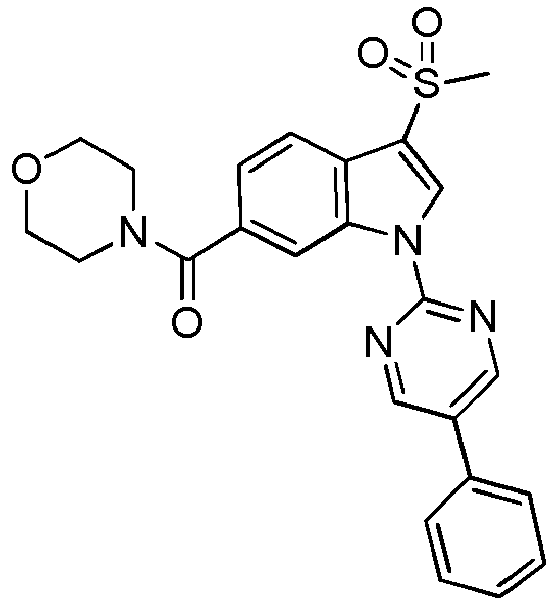
(3-(Methylsulfonyl)-1-(5-phenylpyrimidin-2-yl)-1H-indol-6-yl)(morpholino) methanone 11 
(1-(5-(2-fluorophenyl)pyrimidin-2-yl)-3-(methylsulfonyl)-1H-indol-6-yl)(morpholino)methanone 12 
(3-(Methylsulfinyl)-1-(5-phenylpyrimidin-2-yl)-1H-indol-6-yl)(piperazin-1-yl)methanone 13 
(1-(5-(2-fluorophenyl)pyrimidin-2-yl)-3-(methylsulfinyl)-1H-indol-6-yl)(piperazin-1-yl)methanone 14 
(1-(5-(2,4-difluorophenyl)pyrimidin-2-yl)-3-(methylsulfinyl)-1H-indol-6-yl)(piperazin-1-yl)methanone 15 
3-fluoro-4-(2-(3-(methylsulfinyl)-6-(piperazine-1-carbonyl)-1H-indol-1-yl)pyrimidin-5-yl)benzamide 16 
2-(2-(3-(methylsulfinyl)-6-(piperazine-1-carbonyl)-1 H-indol-1-yl)pyrimidin-5-yl)benzonitrile 17 
4-fluoro-3-(2-(3-(methylsulfinyl)-6-(piperazine-1-carbonyl)-1H-indol-1-yl)pyrimidin-5-yl)benzonitrile 18 
(1-(5-(2,4-Difluorophenyl)pyrimidin-2-yl)-3-(methylsulfinyl)-1H-indol-6-yl)(morpholino)methanone 19 
3-Fluoro-4-(2-(3-(methylsulfinyl)-6-(morpholine-4-carbonyl)-1H-indol-1-yl)pyrimidin-5-yl)benzamide 20 
2-(2-(3-(Methylsulfinyl)-6-(morpholine-4-carbonyl)-1H-indol-1-yl)pyrimidin-5-yl)benzonitrile 21 
(3-(methylsulfonyl)-1-(5-phenylpyrimidin-2-yl)-1H-indol-6-yl)(piperazin-1-yl)methanone 22 
3-fluoro-4-(2-(3-(methylsulfonyl)-6-(piperazine-1-carbonyl)-1H-indol-1-yl)pyrimidin-5-yl)benzamide 23 
(1-(5-(2,4-difluorophenyl)pyrimidin-2-yl)-3-(methylsulfonyl)-1H-indol-6-yl)(piperazin-1-yl)methanone 24 
(1-(5-(2-fluorophenyl)pyrimidin-2-yl)-3-(methylsulfonyl)-1H-indol-6-yl)(piperazin-1-yl)methanone 25 
2-(2-(3-(methylsulfonyl)-6-(piperazine-1-carbonyl)-1 H-indol-1-yl)pyrimidin-5-yl)benzonitrile 26 
4-fluoro-3-(2-(3-(methylsulfonyl)-6-(piperazine-1-carbonyl)-1H-indol-1-yl)pyrimidin-5-yl)benzonitrile 27 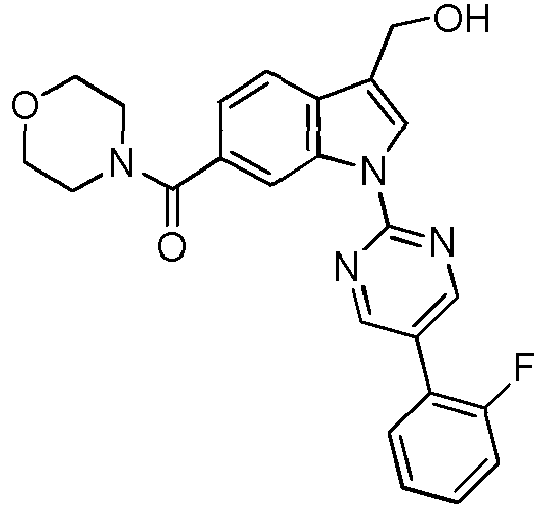
(1-(5-(2-fluorophenyl)pyrimidin-2-yl)-3-(hydroxymethyl)-1H-indol-6-yl)(morpholino)methanone 28 
(1-(5-(2-Fluorophenyl)pyrimidin-2-yl)-3-(1-hydroxyethyl)-1H-indol-6-yl)(morpholino)methanone 29 
(3-(ethylsulfinyl)-1-(5-(2-fluorophenyl)pyrimidin-2-yl)-1H-indol-6-yl)(morpholino)methanone 30 
(1-(5-(2,3-Difluorophenyl)pyrimidin-2-yl)-3-(methylsulfinyl)-1H-indol-6-yl)(morpholino)methanone 31 
4-(2-(3-(Methylsulfinyl)-6-(morpholine-4-carbonyl)-1H-indol-1-yl)pyrimidin-5-yl)benzonitrile 32 
(1-(5-(4-Fluorophenyl)pyrimidin-2-yl)-3-(methylsulfinyl)-1H-indol-6-yl)(morpholino)methanone 33 
(1-(5-(4-Methoxyphenyl)pyrimidin-2-yl)-3-(methylsulfinyl)-1H-indol-6-yl)(morpholino)methanone 34 
(1-(5-(3-Fluorophenyl)pyrimidin-2-yl)-3-(methylsulfinyl)-1H-indol-6-yl)(morpholino)methanone 35 
3-(2-(3-(methylsulfinyl)-6-(morpholine-4-carbonyl)-1H-indol-1-yl)pyrimidin-5-yl)benzamide 36 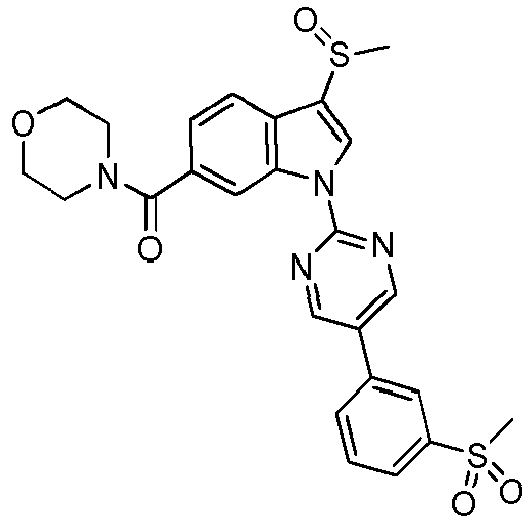
(3-(Methylsulfinyl)-1-(5-(3-(methylsulfonyl)phenyl)pyrimidin-2-yl)-1H-indol-6-yl)(morpholino)methanone 37 
(3-(Methylsulfinyl)-1-(5-(m-tolyl)pyrimidin-2-yl)-1H-indol-6-yl)(morpholino)methanone 38 
(1-(5-(2-Fluoro-5-methoxyphenyl)pyrimidin-2-yl)-3-(methylsulfinyl)-1H-indol-6-yl)(morpholino)methanone 39 
(1-(5-(2-Fluoro-4-methoxyphenyl)pyrimidin-2-yl)-3-(methylsulfinyl)-1H-indol-6-yl)(morpholino)methanone 40 
3-(2-(3-(Methylsulfinyl)-6-(morpholine-4-carbonyl)-1H-indol-1-yl)pyrimidin-5-yl)benzonitrile 41 
(1-(5-(2-Fluoro-5-hydroxyphenyl)pyrimidin-2-yl)-3-(methylsulfinyl)-1H-indol-6-yl)(morpholino)methanone 42 
4-(2-(3-(methylsulfinyl)-6-(morpholine-4-carbonyl)-1 H-indol-1-yl)pyrimidin-5-yl)benzamide 43 
4-Fluoro-3-(2-(3-(methylsulfinyl)-6-(morpholine-4-carbonyl)-1H-indol-1-yl)pyrimidin-5-yl)benzamide 44 
(1-(5-(2,6-difluorophenyl)pyrimidin-2-yl)-3-(methylsulfinyl)-1H-indol-6-yl)(morpholino)methanone 45 
(1-(5-(3-methoxyphenyl)pyrimidin-2-yl)-3-(methylsulfinyl)-1H-indol-6-yl)(morpholino)methanone 46 
(3-(Methylsulfinyl)-1-(5-(p-tolyl)pyrimidin-2-yl)-1H-indol-6-yl)(morpholino)methanone 47 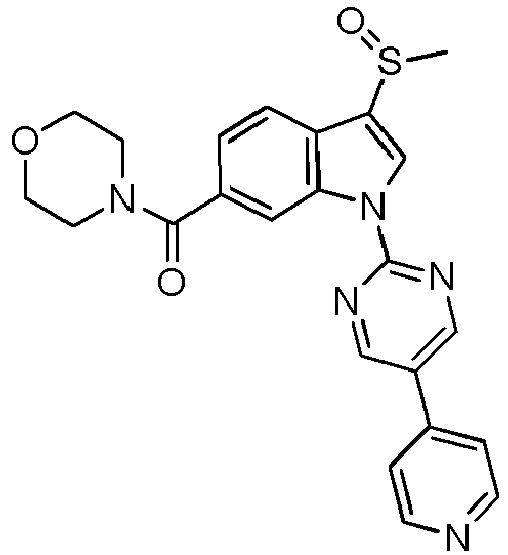
(3-(Methylsulfinyl)-1-(5-(pyridin-4-yl)pyrimidin-2-yl)-1H-indol-6-yl)(morpholino)methanone 48 
(1-(5-(2-Fluoropyridin-3-yl)pyrimidin-2-yl)-3-(methylsulfinyl)-1H-indol-6-yl)(morpholino)methanone 49 
(3-(Methylsulfinyl)-1-(5-(pyridin-3-yl)pyrimidin-2-yl)-1H-indol-6-yl)(morpholino)methanone 50 
(3-(methylsulfinyl)-1-(5-(pyridin-2-yl)pyrimidin-2-yl)-1H-indol-6-yl)(morpholino)methanone 51 
(1-(5-(2-Fluorophenyl)pyrimidin-2-yl)-3-(methylsulfinyl)-1H-indol-6-yl)(pyrrolidin-1-yl)methanone 52 
1-(5-(2-Fluorophenyl)pyrimidin-2-yl)-N,N-dimethyl-3-(methylsulfinyl)-1H-indole-6-carboxamide 53 
1-(5-(2-fluorophenyl)pyrimidin-2-yl)-3-(methylsulfinyl)-N-(tetrahydrofuran-3-yl)-1H-indole-6-carboxamide 54 
1-(5-(2-fluorophenyl)pyrimidin-2-yl)-N-methyl-3-(methylsulfinyl)-N-(tetrahydrofuran-3-yl)-1H-indole-6-carboxamide 55 
(1,4-diazepan-1-yl)(1-(5-(2-fluorophenyl)pyrimidin-2-yl)-3-(methylsulfinyl)-1H-indol-6-yl)methanone 56 
4-(1-(5-(2-fluorophenyl)pyrimidin-2-yl)-3-(methylsulfinyl)-1H-indole-6-carbonyl)piperazin-2-one 57 
1-(5-(2-fluorophenyl)pyrimidin-2-yl)-3-(methylsulfinyl)-N-(5-oxopyrrolidin-3-yl)-1H-indole-6-carboxamide 58 
1-(5-(2-fluorophenyl)pyrimidin-2-yl)-N-methyl-3-(methylsulfinyl)-N-(pyrrolidin-3-yl)-1H-indole-6-carboxamide 59 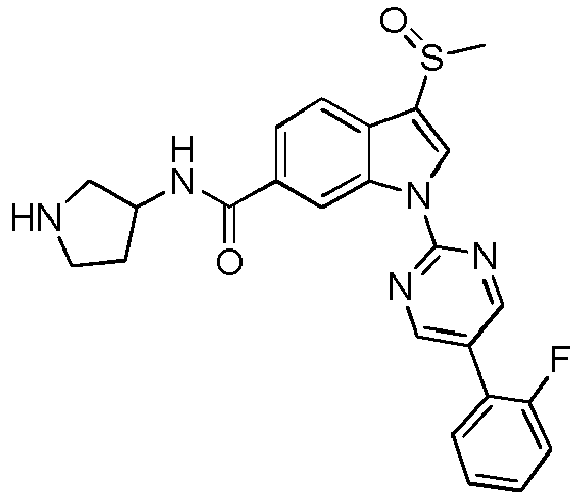
1-(5-(2-fluorophenyl)pyrimidin-2-yl)-3-(methylsulfinyl)-N-(pyrrolidin-3-yl)-1H-indole-6-carboxamide 60 
(1-(5-(2-fluorophenyl)pyrimidin-2-yl)-3-(methylsulfinyl)-1H-indol-6-yl)(1,4-oxazepan-4-yl)methanone 61 
1-(5-(2-fluorophenyl)pyrimidin-2-yl)-N-methyl-3-(methylsulfinyl)-1H-indole-6-carboxamide 62 
N-(cyclopropylmethyl)-1-(5-(2-fluorophenyl)pyrimidin-2-yl)-3-(methylsulfinyl)-1H-indole-6-carboxamide 63 
1-(5-(2-fluorophenyl)pyrimidin-2-yl)-N-(2-hydroxyethyl)-3-(methylsulfinyl)-1H-indole-6-carboxamide 64 
1-(5-(2-fluorophenyl)pyrimidin-2-yl)-N-(2-hydroxyethyl)-N-methyl-3-(methylsulfinyl)-1H-indole-6-carboxamide 65 
1-(5-(2-fluorophenyl)pyrimidin-2-yl)-N-(2-methoxyethyl)-N-methyl-3-(methylsulfinyl)-1H-indole-6-carboxamide 66 
(1-(5-(2-fluorophenyl)pyrimidin-2-yl)-3-(methylsulfinyl)-1H-indol-6-yl)((R)-3-hydroxypyrrolidin-1-yl)methanone 67 
(1-(5-(2-fluorophenyl)pyrimidin-2-yl)-3-(methylsulfinyl)-1H-indol-6-yl)((S)-3-hydroxypyrrolidin-1-yl)methanone 68 
(R)-3-Aminopyrrolidin-1-yl)(1-(5-(2-fluorophenyl)pyrimidin-2-yl)-3-(methylsulfinyl)-1H-indol-6-yl)methanone 69 
(R)-(3-Aminopyrrolidin-1-yl)(1-(5-(2-fluorophenyl)pyrimidin-2-yl)-3-(methylsulfonyl)-1H-indol-6-yl)methanone 70 
4-(3-(Methylsulfinyl)-1-(5-phenylpyrimidin-2-yl)-1H-indole-6-carbonyl)piperazin-2-one 71 
(1-(5-(2-fluorophenyl)pyrimidin-2-yl)-3-(methylsulfinyl)-1H-indol-6-yl)((S)-2-(methoxymethyl)pyrrolidin-1-yl)methanone 72 
(1-(5-(2-fluorophenyl)pyrimidin-2-yl)-3-(methylsulfinyl)-1H-indol-6-yl)(4-methoxypiperidin-1-yl)methanone 73 
(1-(5-(2-fluorophenyl)pyrimidin-2-yl)-3-(methylsulfinyl)-1H-indol-6-yl)(4-hydroxypiperidin-1-yl)methanone 74 
(2,2-dimethylmorpholino)(1-(5-(2-fluorophenyl)pyrimidin-2-yl)-3-(methylsulfinyl)-1H-indol-6-yl)methanone 75 
1-(5-(2-fluorophenyl)pyrimidin-2-yl)-3-(methylsulfinyl)-N-(oxetan-3-yl)-1H-indole-6-carboxamide 76 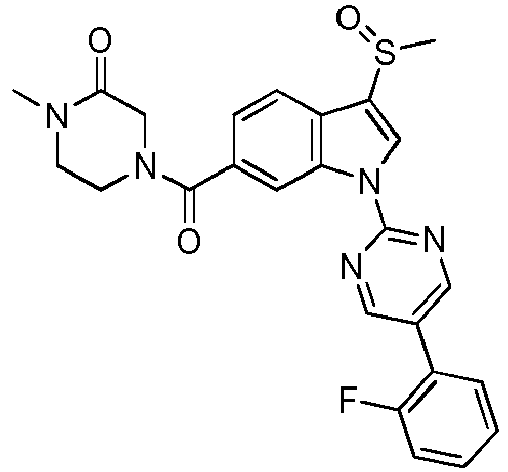
4-(1-(5-(2-fluorophenyl)pyrimidin-2-yl)-3-(methylsulfinyl)-1H-indole-6-carbonyl)-1-methylpiperazin-2-one 77 
(1-(5-(2-fluorophenyl)pyrimidin-2-yl)-3-(methylsulfinyl)-1H-indol-6-yl)((R)-2-(methoxymethyl)pyrrolidin-1-yl)methanone 78 
(1-(5-(2-fluorophenyl)pyrimidin-2-yl)-3-(methylsulfinyl)-1H-indol-6-yl)((R)-2-(hydroxymethyl)pyrrolidin-1-yl)methanone 79 
(1-(5-(2-fluorophenyl)pyrimidin-2-yl)-3-(methylsulfinyl)-1H-indol-6-yl)((S)-2-(hydroxymethyl)pyrrolidin-1-yl)methanone 80 
(1-(5-(2-fluorophenyl)pyrimidin-2-yl)-3-(methylsulfinyl)-1H-indol-6-yl)((R)-3-hydroxypiperidin-1-yl)methanone 81 
(1-(5-(2-fluorophenyl)pyrimidin-2-yl)-3-(methylsulfinyl)-1H-indol-6-yl)((S)-3-hydroxypiperidin-1-yl)methanone 82 
(1-(5-(2-fluorophenyl)pyrimidin-2-yl)-3-(methylsulfinyl)-1H-indol-6-yl)((R)-3-methoxypyrrolidin-1-yl)methanone 83 
1-(5-(2-fluorophenyl)pyrimidin-2-yl)-3-(methylsulfinyl)-N-(oxetan-3-ylmethyl)-1H-indole-6-carboxamide 84 
(1-(5-(2-fluorophenyl)pyrimidin-2-yl)-3-(methylsulfinyl)-1H-indol-6-yl)((R)-2-methylmorpholino)methanone 85 
(1-(5-(2-fluorophenyl)pyrimidin-2-yl)-3-(methylsulfinyl)-1H-indol-6-yl)((S)-2-methylmorpholino)methanone 86 
(1-(5-(4-hydroxyphenyl)pyrimidin-2-yl)-3-(methylsulfinyl)-1H-indol-6-yl)(morpholino)methanone 87 
(1-(5-(2-fluorophenyl)pyrimidin-2-yl)-3-methyl-1H-indol-6-yl)(morpholino)methanone 88 
(3-Ethyl-1-(5-(2-fluorophenyl)pyrimidin-2-yl)-1H-indol-6-yl)(morpholino)methanone 89 
(1-(5-(2-fluorophenyl)pyrimidin-2-yl)-3-methyl-1H-indol-6-yl)(1,3-oxazinan-3-yl)methanone 90 
1-(5-(2-fluorophenyl)pyrimidin-2-yl)-N-(3-hydroxypropyl)-3-methyl-1H-indole-6-carboxamide 91 
(5,5-dimethyl-1,3-oxazinan-3-yl)(1-(5-(2-fluorophenyl)pyrimidin-2-yl)-3-methyl-1H-indol-6-yl)methanone 92 
1-(5-(2-fluorophenyl)pyrimidin-2-yl)-N-(3-hydroxy-2,2-dimethylpropyl)-3-methyl-1H-indole-6-carboxamide 93 
4-(1-(5-(2-fluorophenyl)pyrimidin-2-yl)-3-methyl-1H-indole-6-carbonyl)piperazin-2-one 94 
1-(1-(5-(2-fluorophenyl)pyrimidin-2-yl)-3-methyl-1H-indole-6-carbonyl)tetrahydropyrimidin-4( 1H)-one 95 
N-(cyclohexylmethyl)-1-(5-(2-fluorophenyl)pyrimidin-2-yl)-3-methyl-1H-indole-6-carboxamide 96 
1-(5-(2-fluorophenyl)pyrimidin-2-yl)-N-((1-hydroxycyclohexyl)methyl)-3-methyl-1H-indole-6-carboxamide 97 
N-cyclohexyl-1-(5-(2-fluorophenyl)pyrimidin-2-yl)-3-methyl-1H-indole-6-carboxamide 98 
1-(5-(2-fluorophenyl)pyrimidin-2-yl)-N-((1-hydroxycyclopentyl)methyl)-3-methyl-1H-indole-6-carboxamide 99 
azetidin-1-yl(1-(5-(2-fluorophenyl)pyrimidin-2-yl)-3-methyl-1H-indol-6-yl)methanone 100 
N-ethyl-1-(5-(2-fluorophenyl)pyrimidin-2-yl)-N,3-dimethyl-1H-indole-6-carboxamide 101 
(1-(5-(2-fluorophenyl)pyrimidin-2-yl)-3-methyl-1H-indol-6-yl)(pyrrolidin-1-yl)methanone 102 
N,N-diethyl-1-(5-(2-fluorophenyl)pyrimidin-2-yl)-3-methyl-1H-indole-6-carboxamide 103 
1-(5-(2-fluorophenyl)pyrimidin-2-yl)-N-(2-hydroxyethyl)-N,3-dimethyl-1H-indole-6-carboxamide 104 
1-(5-(2-fluorophenyl)pyrimidin-2-yl)-N-(2-methoxyethyl)-3-methyl-1H-indole-6-carboxamide 105 
(1-(5-(2-fluorophenyl)pyrimidin-2-yl)-3-methyl-1H-indol-6-yl)(piperidin-1-yl)methanone 106 
(1-(5-(2-fluorophenyl)pyrimidin-2-yl)-3-methyl-1H-indol-6-yl)(morpholino)methanone 107 
1-(5-(2-fluorophenyl)pyrimidin-2-yl)-N-(3-methoxypropyl)-3-methyl-1H-indole-6-carboxamide 108 
1-(5-(2-fluorophenyl)pyrimidin-2-yl)-N-(furan-2-ylmethyl)-3-methyl-1H-indole-6-carboxamide 109 
(1-(5-(2-fluorophenyl)pyrimidin-2-yl)-3-methyl-1H-indol-6-yl)(4-methylpiperazin-1-yl)methanone 110 
(1-(5-(2-fluorophenyl)pyrimidin-2-yl)-3-methyl-1H-indol-6-yl)(3-hydroxypiperidin-1-yl)methanone 111 
(1-(5-(2-fluorophenyl)pyrimidin-2-yl)-3-methyl-1H-indol-6-yl)(3-methylmorpholino)methanone 112 
1-(5-(2-fluorophenyl)pyrimidin-2-yl)-3-methyl-N-((tetrahydrofuran-2-yl)methyl)-1H-indole-6-carboxamide 113 
1-(5-(2-fluorophenyl)pyrimidin-2-yl)-3-methyl-N-(tetrahydro-2H-pyran-4-yl)-1H-indole-6-carboxamide 114 
1-(5-(2-fluorophenyl)pyrimidin-2-yl)-N-((1-hydroxycyclobutyl)methyl)-3-methyl-1H-indole-6-carboxamide 115 
N-(2-(dimethylamino)-2-oxoethyl)-1-(5-(2-fluorophenyl)pyrimidin-2-yl)-3-methyl-1H-indole-6-carboxamide 116 
N-(2-(dimethylamino)ethyl)-1-(5-(2-fluorophenyl)pyrimidin-2-yl)-N,3-dimethyl-1H-indole-6-carboxamide 117 
(1-(5-(2-fluorophenyl)pyrimidin-2-yl)-3-methyl-1H-indol-6-yl)(thiomorpholino)methanone 118 
1-(5-(2-fluorophenyl)pyrimidin-2-yl)-N,3-dimethyl-N-(pyridin-4-yl)-1H-indole-6-carboxamide 119 
1-(5-(2-fluorophenyl)pyrimidin-2-yl)-3-methyl-N-(pyridin-4-ylmethyl)-1H-indole-6-carboxamide 120 
1-(5-(2-fluorophenyl)pyrimidin-2-yl)-N-(furan-2-ylmethyl)-N,3-dimethyl-1H-indole-6-carboxamide 121 
(R)-(3-(dimethylamino)pyrrolidin-1-yl)(1-(5-(2-fluorophenyl)pyrimidin-2-yl)-3-methyl-1H-indol-6-yl)methanone 122 
(4-ethylpiperazin-1-yl)(1-(5-(2-fluorophenyl)pyrimidin-2-yl)-3-methyl-1H-indol-6-yl)methanone 123 
(1-(5-(2-fluorophenyl)pyrimidin-2-yl)-3-methyl-1H-indol-6-yl)(4-methyl-1,4-diazepan-1-yl)methanone 124 
1-(5-(2-fluorophenyl)pyrimidin-2-yl)-3-methyl-N-(1-methylpiperidin-4-yl)-1H-indole-6-carboxamide 125 
(2,6-dimethylmorpholino)(1-(5-(2-fluorophenyl)pyrimidin-2-yl)-3-methyl-1H-indol-6-yl)methanone (isomer 1) 126 
(2,6-dimethylmorpholino)(1-(5-(2-fluorophenyl)pyrimidin-2-yl)-3-methyl-1H-indol-6-yl)methanone (isomer 2) 127 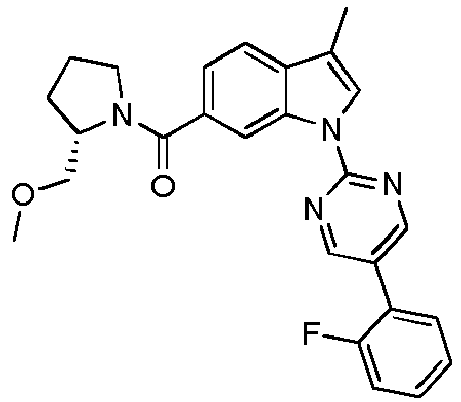
(S)-(1-(5-(2-fluorophenyl)pyrimidin-2-yl)-3-methyl-1H-indol-6-yl)(2-(methoxymethyl)pyrrolidin-1-yl)methanone 128 
(1-(5-(2-fluorophenyl)pyrimidin-2-yl)-3-methyl-1H-indol-6-yl)(2-(hydroxymethyl)piperidin-1-yl)methanone 129 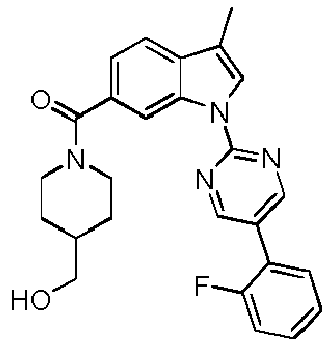
(1-(5-(2-fluorophenyl)pyrimidin-2-yl)-3-methyl-1H-indol-6-yl)(4-(hydroxymethyl)piperidin-1-yl)methanone 130 
(1-(5-(2-fluorophenyl)pyrimidin-2-yl)-3-methyl-1H-indol-6-yl)(4-methoxypiperidin-1-yl)methanone 131 
1-(5-(2-fluorophenyl)pyrimidin-2-yl)-N,3-dimethyl-N-(tetrahydro-2H-pyran-4-yl)-1H-indole-6-carboxamide 132 
1-(5-(2-fluorophenyl)pyrimidin-2-yl)-3-methyl-N-((tetrahydro-2H-pyran-4-yl)methyl)-1 H-indole-6-carboxamide 133 
(1-(5-(2-fluorophenyl)pyrimidin-2-yl)-3-methyl-1H-indol-6-yl)(2-oxa-7-azaspiro[3.5]nonan-7-yl)methanone 134 
3-(4-(1-(5-(2-fluorophenyl)pyrimidin-2-yl)-3-methyl-1H-indole-6-carbonyl)piperazin-1-yl)propanenitrile 135 
1-(4-(1-(5-(2-fluorophenyl)pyrimidin-2-yl)-3-methyl-1H-indole-6-carbonyl)piperazin-1-yl)ethanone 136 
1-(5-(2-fluorophenyl)pyrimidin-2-yl)-3-methyl-N-(2-(2-oxopyrrolidin-1-yl)ethyl)-1H-indole-6-carboxamide 137 
(1-(5-(2-fluorophenyl)pyrimidin-2-yl)-3-methyl-1H-indol-6-yl)(4-(2-hydroxyethyl)piperazin-1-yl)methanone 138 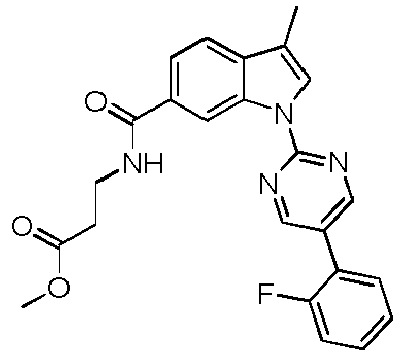
methyl 3-(1-(5-(2-fluorophenyl)pyrimidin-2-yl)-3-methyl-1H-indole-6-carboxamido)propanoate 139 
N-(3-(dimethylamino)-3-oxopropyl)-1-(5-(2-fluorophenyl)pyrimidin-2-yl)-3-methyl-1H-indole-6-carboxamide 140 
(1-(5-(2-fluorophenyl)pyrimidin-2-yl)-3-methyl-1H-indol-6-yl)(2-oxa-6-azaspiro[3.5]nonan-6-yl)methanone 141 
(1-(5-(4-Methoxypyridin-2-yl)pyrimidin-2-yl)-3-(methylsulfinyl)-1H-indol-6-yl)(morpholino)methanone 142 
(1-(5-(4-Methylpyridin-2-yl)pyrimidin-2-yl)-3-(methylsulfinyl)-1H-indol-6-yl)(morpholino)methanone 143 
(1-(5-(2-Hydroxypyridin-4-yl)pyrimidin-2-yl)-3-(methylsulfinyl)-1H-indol-6-yl)(morpholino)methanone 144 
(3-(Methylsulfinyl)-1-(5-(pyridazin-3-yl)pyrimidin-2-yl)-1H-indol-6-yl)(morpholino)methanone 145 
(3-(Methylsulfinyl)-1-(5-(thiazol-4-yl)pyrimidin-2-yl)-1H-indol-6-yl)(morpholino)methanone 146 
(1-(5-(5-Amino-2-fluorophenyl)pyrimidin-2-yl)-3-(methylsulfinyl)-1H-indol-6-yl)(morpholino)methanone 147 
(1-(5-(4-Hydroxypyridin-2-yl)pyrimidin-2-yl)-3-(methylsulfinyl)-1H-indol-6-yl)(morpholino)methanone 148 
(1-(5-(1-Methyl-1H-pyrazol-4-yl)pyrimidin-2-yl)-3-(methylsulfinyl)-1H-indol-6-yl)(morpholino)methanone 149 
(1-(5-(3-Hydroxyphenyl)pyrimidin-2-yl)-3-(methylsulfinyl)-1H-indol-6-yl)(morpholino)methanone 150 
(1-(5-(3-Fluoropyridin-4-yl)pyrimidin-2-yl)-3-(methylsulfinyl)-1H-indol-6-yl)(morpholino)methanone 151 
4-(3-(Methylsulfonyl)-1-(5-(m-tolyl)pyrimidin-2-yl)-1H-indole-6-carbonyl)piperazin-2-one 152 
4-(1-(5-(2-Fluoro-5-methoxyphenyl)pyrimidin-2-yl)-3-(methylsulfonyl)-1H-indole-6-carbonyl)piperazin-2-one 153 
4-(1-(5-(3-Methoxyphenyl)pyrimidin-2-yl)-3-(methylsulfonyl)-1H-indole-6-carbonyl)piperazin-2-one 154 
(3-(Methylsulfinyl)-1-(5-(m-tolyl)pyrimidin-2-yl)-1H-indol-6-yl)(morpholino)methanone (Enantiomer 1) 155 
(3-(Methylsulfinyl)-1-(5-(m-tolyl)pyrimidin-2-yl)-1H-indol-6-yl)(morpholino)methanone (Enantiomer 2) 156 
(3-(Methylsulfonyl)-1-(5-(m-tolyl)pyrimidin-2-yl)-1H-indol-6-yl)(morpholino)methanone 157 
(1-(5-(3-Methoxyphenyl)pyrimidin-2-yl)-3-(methylsulfinyl)-1H-indol-6-yl)(morpholino)methanone (Enantiomer 1) 158 
(1-(5-(3-Methoxyphenyl)pyrimidin-2-yl)-3-(methylsulfinyl)-1H-indol-6-yl)(morpholino)methanone (Enantiomer 2) 159 
(1-(5-(3 -Methoxyphenyl)pyrimidin-2-yl)-3-(methylsulfonyl)-1H-indol-6-yl)(morpholino)methanone 160 
(1-(5-(2-Fluoro-5-methoxyphenyl)pyrimidin-2-yl)-3-(methylsulfinyl)-1H-indol-6-yl)(morpholino)methanone (Enantiomer 1) 161 
(1-(5-(2-Fluoro-5-methoxyphenyl)pyrimidin-2-yl)-3-(methylsulfinyl)-1H-indol-6-yl)(morpholino)methanone (Enantiomer 2) 162 
(1-(5-(2-Fluoro-5-methoxyphenyl)pyrimidin-2-yl)-3-(methylsulfonyl)-1H-indol-6-yl)(morpholino)methanone 163 
(3-(Methylsulfinyl)-1-(5-phenylpyrimidin-2-yl)-1H-indol-6-yl)(morpholino)methanone (Enantiomer 1) 164 
(3-(Methylsulfinyl)-1-(5-phenylpyrimidin-2-yl)-1H-indol-6-yl)(morpholino)methanone (Enantiomer 2) 165 
(1-(5-(2-Fluorophenyl)pyrimidin-2-yl)-3-(methylsulfinyl)-1H-indol-6-yl)(morpholino)methanone (Enantiomer 1) 166 
(1-(5-(2-Fluorophenyl)pyrimidin-2-yl)-3-(methylsulfinyl)-1H-indol-6-yl)(morpholino)methanone (Enantiomer 2) 167 
(R)-(3-Aminopyrrolidin-1-yl)(3-(methylsulfonyl)-1-(5-(m-tolyl)pyrimidin-2-yl)-1H-indol-6-yl)methanone 168 
1-(5-(2-Fluorophenyl)pyrimidin-2-yl)-N-(2-hydroxypropyl)-N-methyl-3-(methylsulfinyl)-1H-indole-6-carboxamide 169 
(1-(5-(2-Fluorophenyl)pyrimidin-2-yl)-3-(methylsulfinyl)-1H-indol-6-yl)(3-((methylamino)methyl)azetidin-1-yl)methanone 170 
1-(5-(2-Fluorophenyl)pyrimidin-2-yl)-N-(1-(hydroxymethyl)cyclopropyl)-N-methyl- 3-(methylsulfinyl)-1H-indole-6-carboxamide 171 
1-(5-(2-Fluorophenyl)pyrimidin-2-yl)-N-(2-hydroxy-2-methylpropyl)-N-methyl-3-(methylsulfinyl)-1H-indole-6-carboxamide 172 
(1-(5-(2-Fluorophenyl)pyrimidin-2-yl)-3-(methylsulfinyl)-1H-indol-6-yl)((S)-3-methoxypyrrolidin-1-yl)methanone 173 
2-(1-(5-(2-Fluorophenyl)pyrimidin-2-yl)-N-methyl-3-(methylsulfinyl)-1H-indole-6-carboxamido)acetic acid 174 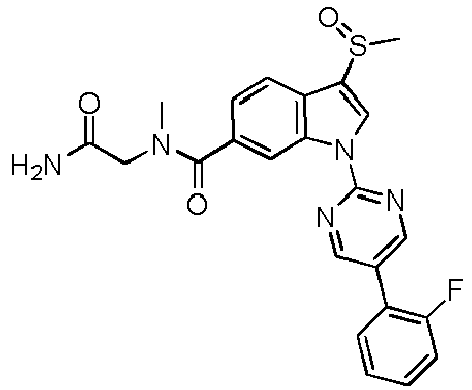
N-(2-Amino-2-oxoethyl)-1-(5-(2-fluorophenyl)pyrimidin-2-yl)-N-methyl-3-(methylsulfinyl)-1H-indole-6-carboxamide 175 
2,5-Diazabicyclo[2.2.1]heptan-2-yl(1-(5-(2-fluorophenyl)pyrimidin-2-yl)-3-(methylsulfinyl)-1H-indol-6-yl)methanone 176 
8-(1-(5-(2-Fluorophenyl)pyrimidin-2-yl)-3-(methylsulfinyl)-1H-indole-6-carbonyl)-2,8-diazaspiro[4.5]decan-1-one 177 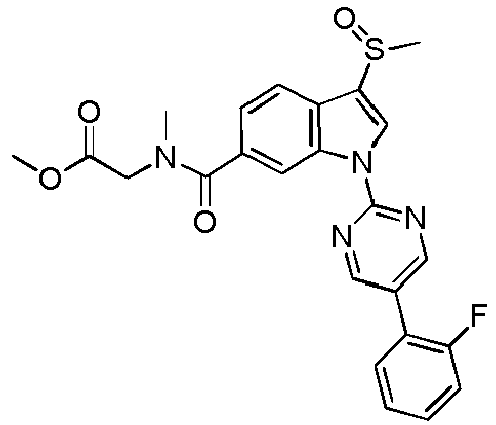
Methyl 2-(1-(5-(2-fluorophenyl)pyrimidin-2-yl)-N-methyl-3-(methylsulfinyl)-1H-indole-6-carboxamido)acetate 178 
(1-(5-(2-Fluorophenyl)pyrimidin-2-yl)-3-(methylsulfinyl)-1H-indol-6-yl)((S)-3-methylmorpholino)methanone 179 
(1-(5-(2-Fluorophenyl)pyrimidin-2-yl)-3-(methylsulfinyl)-1H-indol-6-yl)((R)-3-methylmorpholino)methanone 180 
(1-(5-(6-Methylpyridin-2-yl)pyrimidin-2-yl)-3-(methylsulfinyl)-1H-indol-6-yl)(morpholino)methanone 181 
2-(2-(3-(Methylsulfinyl)-6-(morpholine-4-carbonyl)-1H-indol-1-yl)pyrimidin-5-yl)isonicotinonitrile 182 
(1-(5-(4-Fluoropyridin-2-yl)pyrimidin-2-yl)-3-(methylsulfinyl)-1H-indol-6-yl)(morpholino)methanone 183 
6-(2-(3-(Methylsulfinyl)-6-(morpholine-4-carbonyl)-1H-indol-1-yl)pyrimidin-5-yl)picolinonitrile 184 
(1-(5-(2-Fluorophenyl)pyrimidin-2-yl)-3-(2-hydroxypropan-2-yl)-1H-indol-6-yl)(morpholino)methanone 185 
(1-(5-(6-Fluoropyridin-2-yl)pyrimidin-2-yl)-3-(methylsulfinyl)-1H-indol-6-yl)(morpholino)methanone 186 
(1-(5-(2-Methylpyridin-4-yl)pyrimidin-2-yl)-3-(methylsulfinyl)-1H-indol-6-yl)(morpholino)methanone 187 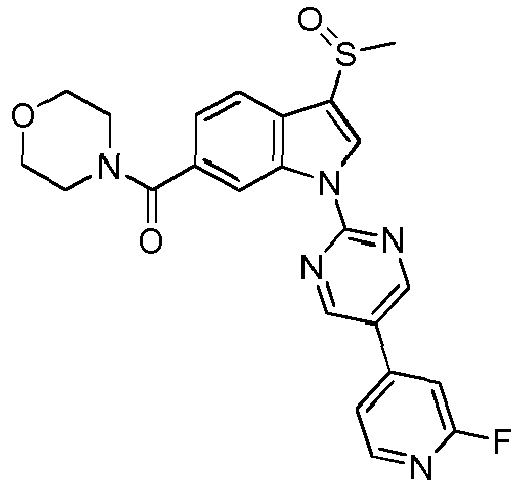
(1-(5-(2-Fluoropyridin-4-yl)pyrimidin-2-yl)-3-(methylsulfinyl)-1H-indol-6-yl)(morpholino)methanone 188 
(1-(5-(3-(Hydroxymethyl)phenyl)pyrimidin-2-yl)-3-(methylsulfinyl)-1H-indol-6-yl)(morpholino)methanone 189 
(1-(5-(3-Ethylphenyl)pyrimidin-2-yl)-3-(methylsulfinyl)-1H-indol-6-yl)(morpholino)methanone 190 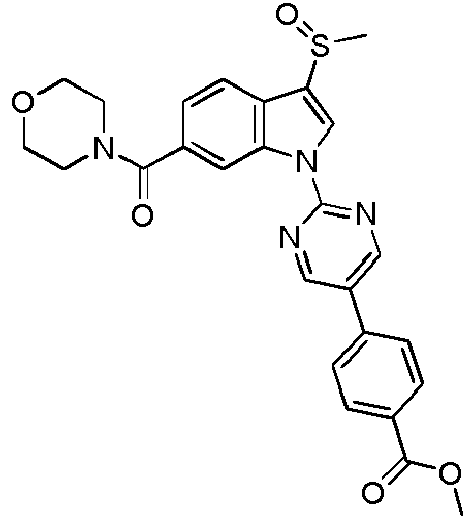
Methyl 4-(2-(3-(methylsulfinyl)-6-(morpholine-4-carbonyl)-1H-indol-1-yl)pyrimidin-5-yl)benzoate 191 
4-(2-(3-(Methylsulfinyl)-6-(morpholine-4-carbonyl)-1H-indol-1-yl)pyrimidin-5-yl)benzoic acid 192 
Methyl 3-(2-(3-(methylsulfinyl)-6-(morpholine-4-carbonyl)-1H-indol-1-yl)pyrimidin-5-yl)benzoate 193 
3-(2-(3-(Methylsulfinyl)-6-(morpholine-4-carbonyl)-1H-indol-1-yl)pyrimidin-5-yl)benzoic acid 194 
(1-(5-(3-Chlorophenyl)pyrimidin-2-yl)-3-(methylsulfinyl)-1H-indol-6-yl)(morpholino)methanone 195 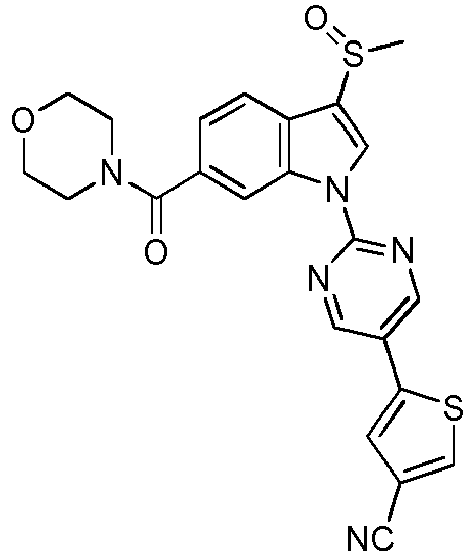
5-(2-(3-(Methylsulfinyl)-6-(morpholine-4-carbonyl)-1H-indol-1-yl)pyrimidin-5-yl)thiophene-3-carbonitrile 196 
5-(2-(3-(Methylsulfinyl)-6-(morpholine-4-carbonyl)-1H-indol-1-yl)pyrimidin-5-yl)thiophene-3-carboxamide 197 
5-(2-(3-(Methylsulfinyl)-1-(5-(4-methylthiophen-2-yl)pyrimidin-2-yl)-1H-indol-6-yl)(morpholino)methanone 198 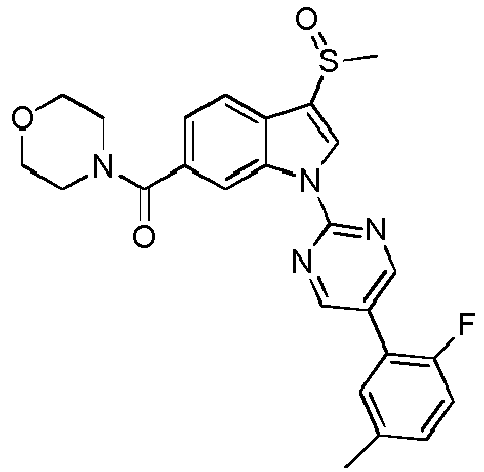
(1-(5-(2-Fluoro-5-methylphenyl)pyrimidin-2-yl)-3-(methylsulfinyl)-1H-indol-6-yl)(morpholino)methanone 199 
6-(2-(3-(Methylsulfinyl)-6-(morpholine-4-carbonyl)-1H-indol-1-yl)pyrimidin-5-yl)nicotinamide 200 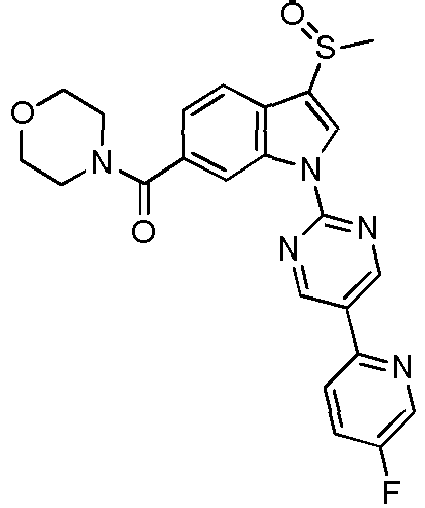
(1-(5-(5-Fluoropyridin-2-yl)pyrimidin-2-yl)-3-(methylsulfinyl)-1H-indol-6-yl)(morpholino)methanone 201 
(1-(5-(3-Fluoropyridin-2-yl)pyrimidin-2-yl)-3-(methylsulfinyl)-1H-indol-6-yl)(morpholino)methanone 202 
2-(2-(3-(Methylsulfinyl)-6-(morpholine-4-carbonyl)-1H-indol-1-yl)pyrimidin-5-yl)isonicotinamide 203 
2-(2-(3-(Methylsulfinyl)-6-(morpholine-4-carbonyl)-1H-indol-1-yl)pyrimidin-5-yl)thiazole-4-carbonitrile 204 
2-(2-(3-(Methylsulfinyl)-6-(morpholine-4-carbonyl)-1H-indol-1-yl)pyrimidin-5-yl)thiazole-4-carboxamide 205 
(3-(Methylsulfinyl)-1-(5-(4-methylthiazol-2-yl)pyrimidin-2-yl)-1H-indol-6-yl)(morpholino)methanone 206 
(3-(Methylsulfinyl)-1-(5-(5-methylthiazol-2-yl)pyrimidin-2-yl)-1H-indol-6-yl)(morpholino)methanone 207 
2-(2-(3-(Methylsulfinyl)-6-(morpholine-4-carbonyl)-1H-indol-1-yl)pyrimidin-5-yl)thiazole-5-carbonitrile 208 
2-(2-(3-(Methylsulfinyl)-6-(morpholine-4-carbonyl)-1H-indol-1-yl)pyrimidin-5-yl)thiazole-5-carboxamide 209 
2-(1-(5-(4-Aminopyridin-2-yl)pyrimidin-2-yl)-3-(methylsulfinyl)-1H-indol-6-yl)(morpholino)methanone 210 
(1-(5-(4-(Dimethylamino)pyridin-2-yl)pyrimidin-2-yl)-3-(methylsulfinyl)-1H-indol-6-yl)(morpholino)methanone 211 
(3-(Methylsulfinyl)-1-(5-(thiazol-2-yl)pyrimidin-2-yl)-1H-indol-6-yl)(morpholino)methanone 212 
(3-(Methylsulfinyl)-1-(5-(pyridazin-4-yl)pyrimidin-2-yl)-1H-indol-6-yl)(morpholino)methanone 213 and 214 
4-(1-(5-(2-Fluoro-5-methoxyphenyl)pyrimidin-2-yl)-3-(methylsulfinyl)-1H-indole-6-carbonyl)piperazin-2-one (enantiomer 1 and 2) 215 and 216 
4-(3-(Methylsulfinyl)-1-(5-(m-tolyl)pyrimidin-2-yl)-1H-indole-6-carbonyl)piperazin-2-one (enantiomer 1 and 2) 217 and 218 
4-(1-(5-(3-Methoxyphenyl)pyrimidin-2-yl)-3-(methylsulfinyl)-1H-indole-6-carbonyl)piperazin-2-one (enantiomer 1 and 2) 219 
(1-(5-(2-Fluorophenyl)pyrimidin-2-yl)-3-(methylsulfinyl)-1H-indol-6-yl)((R)-2-(hydroxymethyl)morpholino)methanone 220 
(1-(5-(2-Fluorophenyl)pyrimidin-2-yl)-3-(methylsulfinyl)-1H-indol-6-yl)((S)-2-(hydroxymethyl)morpholino)methanone 221 
N-(2-Aminoethyl)-1-(5-(2-fluorophenyl)pyrimidin-2-yl)-N-methyl-3-(methylsulfinyl)-1H-indole-6-carboxamide 222 
(1-(5-(2-Fluorophenyl)pyrimidin-2-yl)-3-(methylsulfinyl)-1H-indol-6-yl)(hexahydropyrrolo[3,4-c]pyrrol-2(1H)-yl)methanone 223 
((R)-3-Aminopyrrolidin-1-yl)(3-(methylsulfinyl)-1-(5-phenylpyrimidin-2-yl)-1H-indol-6-yl)methanone 224 
((R)-3-Aminopyrrolidin-1-yl)(3-(methylsulfinyl)-1-(5-(m-tolyl)pyrimidin-2-yl)-1H-indol-6-yl)methanone 225 
3-(2-(6-((R)-3-Aminopyrrolidine-1-carbonyl)-3-(methylsulfinyl)-1H-indol-1-yl)pyrimidin-5-yl)-4-fluorobenzonitrile 226 
((R)-3-Aminopyrrolidin-1-yl)(1-(5-(2-fluoro-5-methoxyphenyl)pyrimidin-2-yl)-3-(methylsulfinyl)-1H-indol-6-yl)methanone 227 
((R)-3-Aminopyrrolidin-1-yl)(1-(5-(2-fluoro-5-methylphenyl)pyrimidin-2-yl)-3-(methylsulfinyl)-1H-indol-6-yl)methanone 228 
(R)-(3-Aminopyrrolidin-1-yl)(3-(methylsulfonyl)-1-(5-phenylpyrimidin-2-yl)-1H-indol-6-yl)methanone 229 
(R)-3-(2-(6-(3-Aminopyrrolidine-1-carbonyl)-3-(methylsulfonyl)-1H-indol-1-yl)pyrimidin-5-yl)-4-fluorobenzonitrile 230 
(R)-(3-Aminopyrrolidin-1-yl)(1-(5-(2-fluoro-5-methoxyphenyl)pyrimidin-2-yl)-3-(methylsulfonyl)-1H-indol-6-yl)methanone 231 
(R)-(3-Aminopyrrolidin-1-yl)(1-(5-(2-fluoro-5-methylphenyl)pyrimidin-2-yl)-3-(methylsulfonyl)-1H-indol-6-yl)methanone 232 
(1R,4R)-2,5-Diazabicyclo[2.2.1]heptan-2-yl(3-(methylsulfinyl)-1-(5-phenylpyrimidin-2-yl)-1H-indol-6-yl)methanone 233 
(1S,4S)-2,5-Diazabicyclo[2.2.1]heptan-2-yl(3-(methylsulfinyl)-1-(5-phenylpyrimidin-2-yl)-1H-indol-6-yl)methanone 234 
(1R,4R)-2-Oxa-5-azabicyclo[2.2.1]heptan-5-yl(3-(methylsulfinyl)-1-(5-phenylpyrimidin-2-yl)-1H-indol-6-yl)methanone 235 
(1R,4R)-2,5-Diazabicyclo[2.2.1]heptan-2-yl(3-(methylsulfonyl)-1-(5-phenylpyrimidin-2-yl)-1H-indol-6-yl)methanone 236 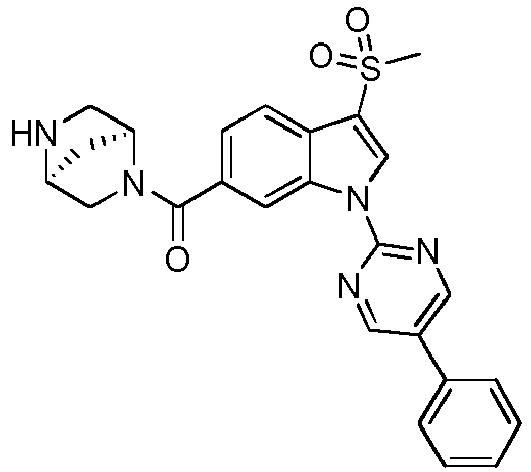
(1S,4S)-2,5-Diazabicyclo[2.2.1]heptan-2-yl(3-(methylsulfonyl)-1-(5-phenylpyrimidin-2-yl)-1H-indol-6-yl)methanone 237 
(1R,4R)-2-Oxa-5-azabicyclo[2.2.1]heptan-5-yl(3-(methylsulfonyl)-1-(5-phenylpyrimidin-2-yl)-1H-indol-6-yl)methanone 238 
(1 R,4R)-2-Oxa-5-azabicyclo[2.2.1 ]heptan-5-yl(1-(5-(2-fluorophenyl)pyrimidin-2-yl)-3-(methylsulfonyl)-1H-indol-6-yl)methanone 239 
(1S,4S)-2,5-Diazabicyclo[2.2.1]heptan-2-yl(1-(5-(2-fluorophenyl)pyrimidin-2-yl)-3-(methylsulfonyl)-1H-indol-6-yl)methanone 240 
(1S,4S)-2,5-Diazabicyclo[2.2.1]heptan-2-yl(1-(5-(2-fluorophenyl)pyrimidin-2-yl)-3-(methylsulfinyl)-1H-indol-6-yl)methanone 241 
(1-(5-(2-Fluorophenyl)pyrimidin-2-yl)-3-(methylsulfinyl)-1H-indol-6-yl)((3 aR,6aR)-hexahydropyrrolo[3,4-b]pyrrol-5(1H)-yl)methanone 242 
(1-(5-(2-Fluorophenyl)pyrimidin-2-yl)-3-(methylsulfinyl)-1H-indol-6-yl)((3aS,6aS)-hexahydropyrrolo[3,4-b]pyrrol-5(1H)-yl)methanone 243 
(1 R,4R)-2-Oxa-5-azabicyclo[2.2.1 ]heptan-5-yl(1-(5-(2-fluorophenyl)pyrimidin-2-yl)-3-(methylsulfinyl)-1H-indol-6-yl)methanone 244 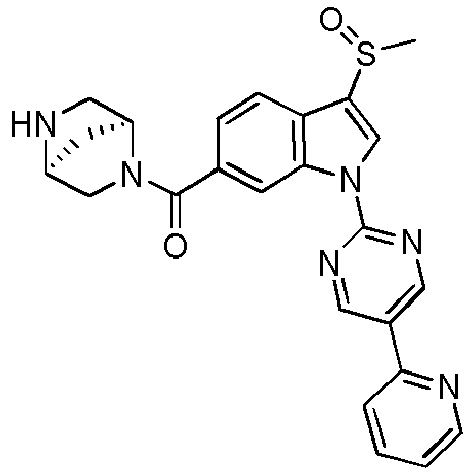
(1S,4S)-2,5-Diazabicyclo[2.2.1]heptan-2-yl(3-(methylsulfinyl)-1-(5-(pyridin-2-yl)pyrimidin-2-yl)-1H-indol-6-yl)methanone 245 
(1S,4S)-2,5-Diazabicyclo[2.2.1]heptan-2-yl(1-(5-(4-methylpyridin-2-yl)pyrimidin-2-yl)-3-(methylsulfinyl)-1H-indol-6-yl)methanone 246 
(1S,4S)-2,5-Diazabicyclo[2.2.1]heptan-2-yl(1-(5-(4-ethylpyridin-2-yl)pyrimidin-2-yl)-3-(methylsulfinyl)-1H-indol-6-yl)methanone 247 
(1S,4S)-2,5-Diazabicyclo[2.2.1]heptan-2-yl(1-(5-(6-methylpyridin-2-yl)pyrimidin-2-yl)-3-(methylsulfinyl)-1H-indol-6-yl)methanone 248 
(1S,4S)-2,5-Diazabicyclo[2.2.1]heptan-2-yl(1-(5-(4-(dimethylamino)pyridin-2-yl)pyrimidin-2-yl)-3-(methylsulfinyl)-1H-indol-6-yl)methanone 249 
(1S,4S)-2,5-Diazabicyclo[2.2.1]heptan-2-yl(1-(5-(2-fluoro-5-methylphenyl) pyrimidin-2-yl)-3-(methylsulfinyl)-1H-indol-6-yl)methanone 250 
1-(5-(2-Fluorophenyl)pyrimidin-2-yl)-N-((1-hydroxycyclopropyl)methyl)-N-methyl-3-(methylsulfinyl)-1H-indole-6-carboxamide 251 
1-(5-(2-Fluorophenyl)pyrimidin-2-yl)-N-((S)-2-hydroxypropyl)-N-methyl-3-(methylsulfinyl)-1H-indole-6-carboxamide 252 and 253 
(1-(5-(2-Fluorophenyl)pyrimidin-2-yl)-3-(1-hydroxyethyl)-1H-indol-6-yl)(morpholino)methanone (enantiomer 1 and 2) 254 and 255 
(3-(1-Hydroxyethyl)-1-(5-phenylpyrimidin-2-yl)-1H-indol-6-yl)(morpholino)methanone (enantiomer 1 and 2) 256 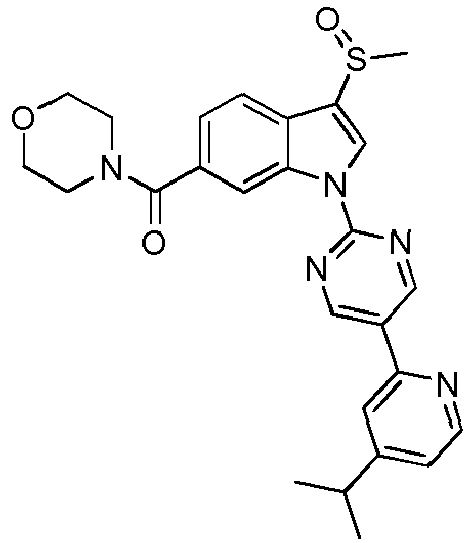
(1-(5-(4-Isopropylpyridin-2-yl)pyrimidin-2-yl)-3-(methylsulfinyl)-1H-indol-6-yl)(morpholino)methanone 257 
(3-(Methylsulfinyl)-1-(5-(4-(prop-1-yn-1-yl)pyridin-2-yl)pyrimidin-2-yl)-1H-indol-6-yl)(morpholino)methanone 258 
(1-(5-(4-Cyclopropylpyridin-2-yl)pyrimidin-2-yl)-3-(methylsulfinyl)-1H-indol-6-yl)(morpholino)methanone 259 
(1-(5-(4-Ethylpyridin-2-yl)pyrimidin-2-yl)-3-(methylsulfinyl)-1H-indol-6-yl)(morpholino)methanone 260 
(1-(5-(4-Ethoxypyridin-2-yl)pyrimidin-2-yl)-3-(methylsulfinyl)-1H-indol-6-yl)(morpholino)methanone 261 
(1-(5-(5-Ethoxy-2-fluorophenyl)pyrimidin-2-yl)-3-(methylsulfinyl)-1H-indol-6-yl)(morpholino)methanone 262 
(1-(5-(Benzo[d][1,3]dioxol-5-yl)pyrimidin-2-yl)-3-(methylsulfinyl)-1H-indol-6-yl)(morpholino)methanone 263 
(1-(5-(2-Fluoro-5-(trifluoromethoxy)phenyl)pyrimidin-2-yl)-3-(methylsulfinyl)-1H-indol-6-yl)(morpholino)methanone 264 
4-Fluoro-3-(2-(3-(methylsulfinyl)-6-(morpholine-4-carbonyl)-1H-indol-1-yl)pyrimidin-5-yl)phenyl acetate 265 
(1 -(5-(2-Fluoro-5-methylphenyl)pyrimidin-2-yl)-3-(methylsulfinyl)-1H-indol-6-yl)(pyrrolidin-1-yl)methanone 266 
N-Ethyl-1-(5-(2-fluoro-5-methylphenyl)pyrimidin-2-yl)-N-methyl-3-(methylsulfinyl)-1H-indole-6-carboxamide 267 
1 -(5-(2-Fluoro-5-methylphenyl)pyrimidin-2-yl)-N,N-dimethyl-3-(methylsulfinyl)-1H-indole-6-carboxamide 268 
1-(5-(2-Fluoro-5-methoxyphenyl)pyrimidin-2-yl)-N,N-dimethyl-3-(methylsulfinyl)-1H-indole-6-carboxamide 269 
(1-(5-(4-Methylpyridin-2-yl)pyrimidin-2-yl)-3-(methylsulfinyl)-1H-indol-6-yl)(pyrrolidin-1-yl)methanone 270 
N,N-Dimethyl-1-(5-(4-methylpyridin-2-yl)pyrimidin-2-yl)-3-(methylsulfinyl)-1H-indole-6-carboxamide 271 
N-Ethyl-N-methyl-1-(5-(4-methylpyridin-2-yl)pyrimidin-2-yl)-3-(methylsulfinyl)-1H-indole-6-carboxamide 272 
1-(5-(4-(Dimethylamino)pyridin-2-yl)pyrimidin-2-yl)-N,N-dimethyl-3-(methylsulfinyl)-1H-indole-6-carboxamide 273 
1-(5-(4-Aminopyridin-2-yl)pyrimidin-2-yl)-N,N-dimethyl-3-(methylsulfinyl)-1H-indole-6-carboxamide 274 
1-(5-(5-Ethyl-2-fluorophenyl)pyrimidin-2-yl)-N,N-dimethyl-3-(methylsulfinyl)-1H-indole-6-carboxamide 275 
(1-(5-(5-Ethyl-2-fluorophenyl)pyrimidin-2-yl)-3-(methylsulfinyl)-1H-indol-6-yl)(pyrrolidin-1-yl)methanone 276 
(1-(5-(5-Ethyl-2-fluorophenyl)pyrimidin-2-yl)-3-(methylsulfinyl)-1H-indol-6-yl)(morpholino)methanone 277 
(1-(5-(4-Ethylpyridin-2-yl)pyrimidin-2-yl)-3-(methylsulfinyl)-1H-indol-6-yl)(pyrrolidin-1-yl)methanone 278 
1-(5-(4-Ethylpyridin-2-yl)pyrimidin-2-yl)-N,N-dimethyl-3-(methylsulfinyl)-1H-indole-6-carboxamide 279 
N-(2-Amino-2-oxoethyl)-1-(5-(2-fluoro-5-methoxyphenyl)pyrimidin-2-yl)-N-methyl-3-(methylsulfinyl)-1H-indole-6-carboxamide 280 
N-(2-Amino-2-oxoethyl)-1-(5-(5-ethyl-2-fluorophenyl)pyrimidin-2-yl)-N-methyl-3-(methylsulfinyl)-1H-indole-6-carboxamide 281 
N-(2-Amino-2-oxoethyl)-1-(5-(2-fluoro-5-methylphenyl)pyrimidin-2-yl)-N-methyl- 3-(methylsulfinyl)-1H-indole-6-carboxamide 282 
N-(2-Amino-2-oxoethyl)-N-methyl-1-(5-(4-methylpyridin-2-yl)pyrimidin-2-yl)-3-(methylsulfinyl)-1H-indole-6-carboxamide 283 
N-(2-Amino-2-oxoethyl)-1-(5-(4-methoxypyridin-2-yl)pyrimidin-2-yl)-N-methyl-3-(methylsulfinyl)-1H-indole-6-carboxamide 284 
N-(2-Amino-2-oxoethyl)-1-(5-(4-(dimethylamino)pyridin-2-yl)pyrimidin-2-yl)-N-methyl-3-(methylsulfinyl)-1H-indole-6-carboxamide 285 
N-(2-Amino-2-oxoethyl)-1-(5-(4-ethylpyridin-2-yl)pyrimidin-2-yl)-N-methyl-3-(methylsulfinyl)-1H-indole-6-carboxamide 286 
N-(2-Amino-2-oxoethyl)-1-(5-(4-aminopyridin-2-yl)pyrimidin-2-yl)-N-methyl-3-(methylsulfinyl)-1H-indole-6-carboxamide 287 
(1-(5-(2-Fluorophenyl)pyrimidin-2-yl)-3-(S-methylsulfonimidoyl)-1H-indol-6-yl)(morpholino)methanone 288 
(1-(5-(4-Methylpyridin-2-yl)pyrimidin-2-yl)-3-(S-methylsulfonimidoyl)-1H-indol-6-yl)(morpholino)methanone 289 
(1-(5-(4-(2-Hydroxypropan-2-yl)pyridin-2-yl)pyrimidin-2-yl)-3-(methylsulfinyl)-1H-indol-6-yl)(morpholino)methanone 290 
(1-(5-(5-((Cyclopropylmethyl)amino)-2-fluorophenyl)pyrimidin-2-yl)-3-(methylsulfinyl)-1H-indol-6-yl)(morpholino)methanone 291 
(1-(5-(4-(1-Hydroxyethyl)pyridin-2-yl)pyrimidin-2-yl)-3-(methylsulfinyl)-1H-indol-6-yl)(morpholino)methanone 292 
(1-(5-(5-(Ethylamino)-2-fluorophenyl)pyrimidin-2-yl)-3-(methylsulfinyl)-1H-indol-6-yl)(morpholino)methanone 293 
(1-(5-(2-Fluoro-5-(2-hydroxypropan-2-yl)phenyl)pyrimidin-2-yl)-3-(methylsulfinyl)-1H-indol-6-yl)(morpholino)methanone 294 
(1-(5-(2-Fluoro-5-(1-hydroxycyclopropyl)phenyl)pyrimidin-2-yl)-3-(methylsulfinyl)-1H-indol-6-yl)(morpholino)methanone 295 
(1-(5-(4-(1-Hydroxycyclopropyl)pyridin-2-yl)pyrimidin-2-yl)-3-(methylsulfinyl)-1H-indol-6-yl)(morpholino)methanone 296 
(1-(5-(4-((Cyclopropylmethyl)amino)pyridin-2-yl)pyrimidin-2-yl)-3-(methylsulfinyl)-1H-indol-6-yl)(morpholino)methanone 297 
(3-(Methylsulfinyl)-1-(5-(4-(pyrrolidin-1-yl)pyridin-2-yl)pyrimidin-2-yl)-1H-indol-6-yl)(morpholino)methanone 298 
(1-(5-(4-(Ethylamino)pyridin-2-yl)pyrimidin-2-yl)-3-(methylsulfinyl)-1H-indol-6-yl)(morpholino)methanone 299 
(1-(5-(4-Chloropyridin-2-yl)pyrimidin-2-yl)-3-(methylsulfinyl)-1H-indol-6-yl)(morpholino)methanone 300 
(1-(5-(4-(1-Hydroxyethyl)pyridin-2-yl)pyrimidin-2-yl)-3-(methylsulfinyl)-1H-indol-6-yl)(morpholino)methanone 301 
(3-(Methylsulfinyl)-1-(5-(4-(pyrrolidin-1-yl)pyridin-2-yl)pyrimidin-2-yl)-1H-indol-6-yl)(morpholino)methanone 302 
(1-(5-(2-Fluorophenyl)pyrimidin-2-yl)-3-(methylsulfinyl)-1H-indol-6-yl)((R)-3-(hydroxymethyl)pyrrolidin-1-yl)methanone 303 
(1-(5-(2-Fluorophenyl)pyrimidin-2-yl)-3-(methylsulfinyl)-1H-indol-6-yl)((S)-3-(hydroxymethyl)pyrrolidin-1-yl)methanone 304 
1-(5-(2-Fluoro-5-methylphenyl)pyrimidin-2-yl)-N-methyl-N-(2-(methylamino)-2-oxoethyl)-3-(methylsulfinyl)-1H-indole-6-carboxamide 305 
1-(5-(2-Fluoro-5-methylphenyl)pyrimidin-2-yl)-N-methyl-N-(2-(methylamino)-2-oxoethyl)-3-(methylsulfonyl)-1H-indole-6-carboxamide 306 
(5,6-Dihydropyridin-1(2H)-yl)(1-(5-(2-fluorophenyl)pyrimidin-2-yl)-3-(methylsulfinyl)-1H-indol-6-yl)methanone 307 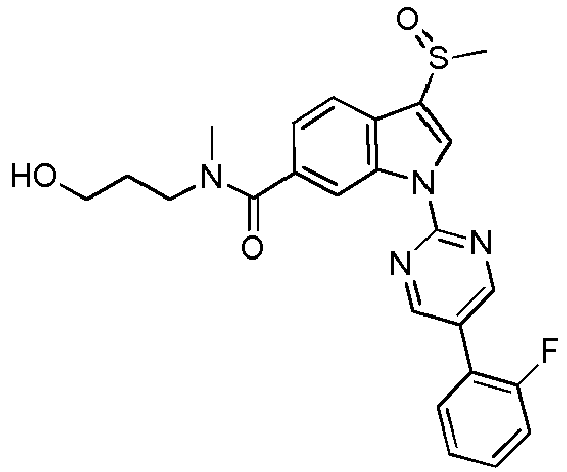
1-(5-(2-Fluorophenyl)pyrimidin-2-yl)-N-(3-hydroxypropyl)-N-methyl-3-(methylsulfinyl)-1H-indole-6-carboxamide 308 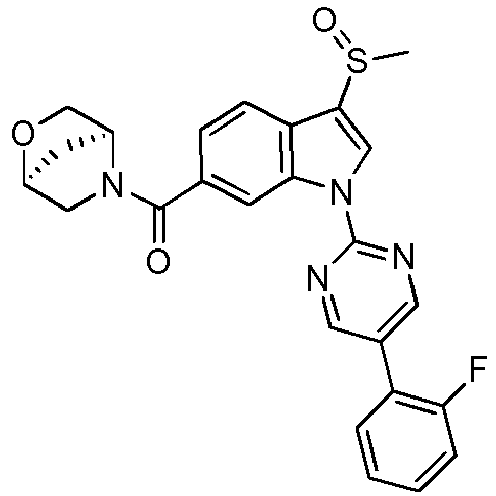
(1S,4S)-2-Oxa-5-azabicyclo[2.2.1]heptan-5-yl(1-(5-(2-fluorophenyl)pyrimidin-2-yl)-3-(methylsulfinyl)-1H-indol-6-yl)methanone 309 
(1S,4S)-2-Oxa-5-azabicyclo[2.2.1]heptan-5-yl(1-(5-(2-fluorophenyl)pyrimidin-2-yl)-3-(methylsulfonyl)-1H-indol-6-yl)methanone 310 
N-(2-Amino-2-oxoethyl)-1-(5-(2-fluoro-5-methoxyphenyl)pyrimidin-2-yl)-N-methyl-3-(methylsulfonyl)-1H-indole-6-carboxamide 311 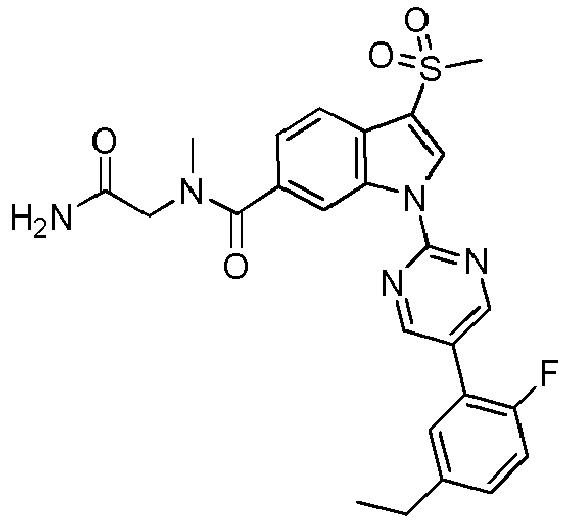
N-(2-Amino-2-oxoethyl)-1-(5-(5-ethyl-2-fluorophenyl)pyrimidin-2-yl)-N-methyl-3-(methylsulfonyl)-1H-indole-6-carboxamide 312 
(1-(5-(4-Chloropyridin-2-yl)pyrimidin-2-yl)-3-(methylsulfonyl)-1H-indol-6-yl)(morpholino)methanone 313 
N,N-Dimethyl-3-(methylsulfinyl)-1-(5-(pyridin-2-yl)pyrimidin-2-yl)-1H-indole-6-carboxamide 314 
N,N-Dimethyl-1-(5-(6-methylpyridin-2-yl)pyrimidin-2-yl)-3-(methylsulfinyl)-1H-indole-6-carboxamide 315 
1-(5-(2-Fluoro-5-methylphenyl)pyrimidin-2-yl)-N-(2-hydroxyethyl)-N-methyl-3 -(methylsulfinyl)- 1H-indole-6-carboxamide 316 
1-(5-(5-Ethoxy-2-fluorophenyl)pyrimidin-2-yl)-N-(2-hydroxyethyl)-N-methyl-3-(methylsulfinyl)-1H-indole-6-carboxamide 317 
N-(2-Hydroxyethyl)-N-methyl-1-(5-(4-methylpyridin-2-yl)pyrimidin-2-yl)-3-(methylsulfinyl)-1H-indole-6-carboxamide 318 
(3-(1-Hydroxyethyl)-1-(5-(4-methylpyridin-2-yl)pyrimidin-2-yl)-1H-indol-6-yl)(morpholino)methanone 319 
(1-(5-(5-Ethoxy-2-fluorophenyl)pyrimidin-2-yl)-3-(1-hydroxyethyl)-1H-indol-6-yl)(morpholino)methanone 320 
(1-(5-(2-Fluoro-5-methylphenyl)pyrimidin-2-yl)-3-(1-hydroxyethyl)-1H-indol-6-yl)(morpholino)methanone 321 
((R)-3-Aminopyrrolidin-1-yl)(1-(5-(2-fluoro-5-methylphenyl)pyrimidin-2-yl)-3-(1-hydroxyethyl)-1H-indol-6-yl)methanone 322 
1-(5-(2-Fluoro-5-methylphenyl)pyrimidin-2-yl)-3-(1-hydroxyethyl)-N,N-dimethyl-1H-indole-6-carboxamide 323 
N-(2-Amino-2-oxoethyl)-1-(5-(2-fluoro-5-methylphenyl)pyrimidin-2-yl)-3-(1-hydroxyethyl)-N-methyl-1H-indole-6-carboxamide 324 
(1-(5-(4-Isopropylpyridin-2-yl)pyrimidin-2-yl)-3-(methylsulfonyl)-1H-indol-6-yl)(morpholino)methanone 325 
(1-(5-(4-Ethylpyridin-2-yl)pyrimidin-2-yl)-3-(methylsulfonyl)-1H-indol-6-yl)(morpholino)methanone 326 
(1-(5-(5-Ethoxy-2-fluorophenyl)pyrimidin-2-yl)-3-(methylsulfonyl)-1H-indol-6-yl)(morpholino)methanone 327 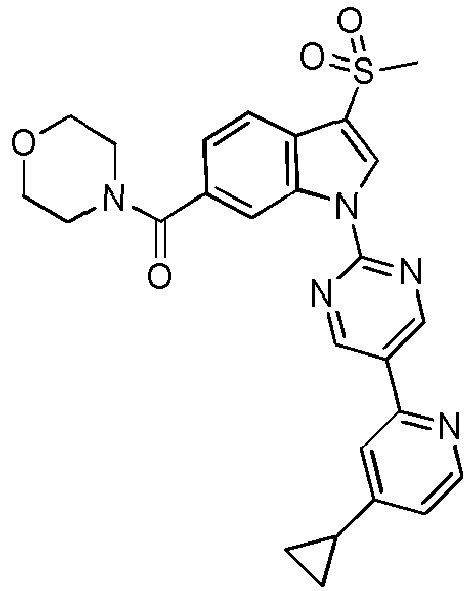
(1-(5-(4-Cyclopropylpyridin-2-yl)pyrimidin-2-yl)-3-(methylsulfonyl)-1 H-indol-6-yl)(morpholino)methanone 328 
N-(2-Amino-2-oxoethyl)-1-(5-(2-fluoro-5-methylphenyl)pyrimidin-2-yl)-N-methyl-3-(methylsulfonyl)-1H-indole-6-carboxamide 329 
(1-(5-(4-(2-Hydroxypropan-2-yl)pyridin-2-yl)pyrimidin-2-yl)-3-(methylsulfonyl)-1H-indol-6-yl)(morpholino)methanone 330 
(1-(5-(4-(1-Hydroxyethyl)pyridin-2-yl)pyrimidin-2-yl)-3-(methylsulfonyl)-1H-indol-6-yl)(morpholino)methanone 331 
N-(2-Amino-2-oxoethyl)-1-(5-(5-ethyl-2-fluorophenyl)pyrimidin-2-yl)-3-(1-hydroxyethyl)-N-methyl-1H-indole-6-carboxamide 332 
N-(2-Amino-2-oxoethyl)-3-(1-hydroxyethyl)-N-methyl-1-(5-(4-methylpyridin-2-yl)pyrimidin-2-yl)-1H-indole-6-carboxamide 333 
N-(2-Amino-2-oxoethyl)-1-(5-(4-cyclopropylpyridin-2-yl)pyrimidin-2-yl)-N-methyl-3-(methylsulfinyl)-1H-indole-6-carboxamide 334 
N-(2-Amino-2-oxoethyl)-1-(5-(2-fluoro-5-(2-hydroxypropan-2-yl)phenyl)pyrimidin-2-yl)-N-methyl-3-(methylsulfinyl)-1H-indole-6-carboxamide 335 
N-(2-Amino-2-oxoethyl)-1-(5-(5-cyclopropyl-2-fluorophenyl)pyrimidin-2-yl)-N-methyl-3-(methylsulfinyl)-1H-indole-6-carboxamide 336 
((R)-3-Aminopyrrolidin-1-yl)(1-(5-(4-methylpyridin-2-yl)pyrimidin-2-yl)-3-(methylsulfinyl)-1H-indol-6-yl)methanone 337 
((R)-3-Aminopyrrolidin-1-yl)(1-(5-(4-ethylpyridin-2-yl)pyrimidin-2-yl)-3-(methylsulfinyl)-1H-indol-6-yl)methanone 338 
((R)-3-Aminopyrrolidin-1-yl)(1-(5-(4-isopropylpyridin-2-yl)pyrimidin-2-yl)-3-(methylsulfinyl)-1H-indol-6-yl)methanone 339 
((R)-3-Aminopyrrolidin-1-yl)(1-(5-(4-cyclopropylpyridin-2-yl)pyrimidin-2-yl)-3-(methylsulfinyl)-1H-indol-6-yl)methanone 340 
(R)-(3-Aminopyrrolidin-1-yl)(1-(5-(4-methylpyridin-2-yl)pyrimidin-2-yl)-3-(methylsulfonyl)-1H-indol-6-yl)methanone 341 
(1-(5-(4-Cyclopropylpyridin-2-yl)pyrimidin-2-yl)-3-(methylsulfinyl)-1H-indol-6-yl)(pyrrolidin-1-yl)methanone 342 
(1-(5-(4-Methoxypyridin-2-yl)pyrimidin-2-yl)-3-(methylsulfinyl)-1H-indol-6-yl)(pyrrolidin-1-yl)methanone 343 
(1-(5-(4-Ethoxypyridin-2-yl)pyrimidin-2-yl)-3-(methylsulfinyl)-1H-indol-6-yl)(pyrrolidin-1-yl)methanone 344 and 345 
(1-(5-(2-Fluoro-5-(1-hydroxyethyl)phenyl)pyrimidin-2-yl)-3-(methylsulfonyl)-1H-indol-6-yl)(morpholino)methanone (enantiomer 1 and 2) 346 
1-(5-(2-Fluorophenyl)pyrimidin-2-yl)-N-methyl-N-(2-(methylamino)ethyl)-3-(methylsulfinyl)-1H-indole-6-carboxamide 347 
2,5-Diazabicyclo[2.2.2]octan-2-yl(1-(5-(2-fluorophenyl)pyrimidin-2-yl)-3-(methylsulfinyl)-1H-indol-6-yl)methanone 348 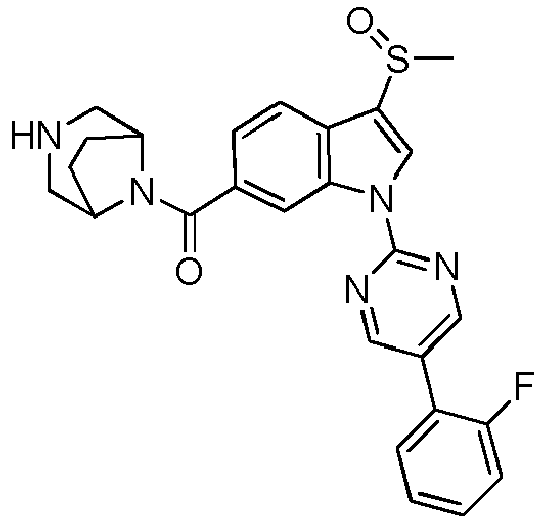
3,8-Diazabicyclo[3.2.1]octan-8-yl(1-(5-(2-fluorophenyl)pyrimidin-2-yl)-3-(methylsulfinyl)-1H-indol-6-yl)methanone 349 
(1 R,4R)-2-Oxa-5-azabicyclo[2.2.1]heptan-5-yl(1-(5-(2-fluorophenyl)pyrimidin-2-yl)-3-(methylsulfonyl)-1H-indol-6-yl)methanone 350 
(1-(5-(2-Fluoro-5-methylphenyl)pyrimidin-2-yl)-3-(methylsulfonyl)-1H-indol-6-yl)(morpholino)methanone 351 and 352 
(1-(5-(4-Methylpyridin-2-yl)pyrimidin-2-yl)-3-(methylsulfinyl)-1H-indol-6-yl)(morpholino)methanone (enantiomer 1 and 2) 353 
(1-(5-(4-Methylpyridin-2-yl)pyrimidin-2-yl)-3-(methylsulfonyl)-1H-indol-6-yl)(morpholino)methanone 354 
(3-Cyclopropyl-1-(5-(2-fluorophenyl)pyrimidin-2-yl)-1H-indol-6-yl)(morpholino) methanone 355 
Azetidin-1-yl(1-(5-(2-fluorophenyl)pyrimidin-2-yl)-3-(methylsulfinyl)-1H-indol-6-yl)methanone 356 
N-Ethyl-1-(5-(2-fluorophenyl)pyrimidin-2-yl)-N-methyl-3-(methylsulfinyl)-1H-indole-6-carboxamide 357 
N,N-Diethyl-1-(5-(2-fluorophenyl)pyrimidin-2-yl)-3-(methylsulfinyl)-1H-indole-6-carboxamide 358 
(1-(5-(2-Fluorophenyl)pyrimidin-2-yl)-3-(methylsulfinyl)-1H-indol-6-yl)(piperidin-1-yl)methanone 359 
(1-(5-(2-Fluorophenyl)pyrimidin-2-yl)-3-(methylsulfinyl)-1H-indol-6-yl)(2-methylpyrrolidin-1-yl)methanone 360 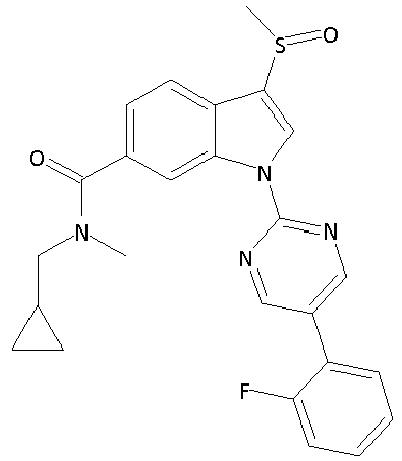
N-(Cyclopropylmethyl)-1-(5-(2-fluorophenyl)pyrimidin-2-yl)-N-methyl-3-(methylsulfinyl)-1H-indole-6-carboxamide 361 
(1-(5-(2-Fluorophenyl)pyrimidin-2-yl)-3-(methylsulfinyl)-1H-indol-6-yl)(2-methylpiperidin-1-yl)methanone 362 
(1-(5-(2-Fluorophenyl)pyrimidin-2-yl)-3-(methylsulfinyl)-1H-indol-6-yl)(3-methylpiperidin-1-yl)methanone 363 
(1-(5-(2-Fluorophenyl)pyrimidin-2-yl)-3-(methylsulfinyl)-1H-indol-6-yl)(4-methylpiperidin-1-yl)methanone 364 
Azepan-1-yl(1-(5-(2-fluorophenyl)pyrimidin-2-yl)-3-(methylsulfinyl)-1H-indol-6-yl)methanone 365 
(1-(5-(2-Fluorophenyl)pyrimidin-2-yl)-3-(methylsulfinyl)-1H-indol-6-yl)(4-methylpiperazin-1-yl)methanone 366 
1-(5-(2-Fluorophenyl)pyrimidin-2-yl)-N,N-diisopropyl-3-(methylsulfinyl)-1H-indole-6-carboxamide 367 
N-(2-(Dimethylamino)ethyl)-1-(5-(2-fluorophenyl)pyrimidin-2-yl)-N-methyl-3-(methylsulfinyl)-1H-indole-6-carboxamide 368 
(1-(5-(2-Fluorophenyl)pyrimidin-2-yl)-3-(methylsulfinyl)-1H-indol-6-yl)(thiomorpholino)methanone 369 
3-(1-(5-(2-Fluorophenyl)pyrimidin-2-yl)-N-methyl-3-(methylsulfinyl)-1H-indole-6-carboxamido)propanoic acid 370 
(1-(5-(2-Fluorophenyl)pyrimidin-2-yl)-3-(methylsulfinyl)-1H-indol-6-yl)(2-oxa-6-azaspiro[3.4]octan-6-yl)methanone 371 
(2-Ethylpiperidin-1-yl)(1-(5-(2-fluorophenyl)pyrimidin-2-yl)-3-(methylsulfinyl)-1H-indol-6-yl)methanone 372 
(3,5-Dimethylpiperidin-1-yl)(1-(5-(2-fluorophenyl)pyrimidin-2-yl)-3-(methylsulfinyl)-1H-indol-6-yl)methanone (diastereomer 1) 373 
(3,5-Dimethylpiperidin-1-yl)(1-(5-(2-fluorophenyl)pyrimidin-2-yl)-3-(methylsulfinyl)-1H-indol-6-yl)methanone (diastereomer 2) 374 
((R)-3-(Dimethylamino)pyrrolidin-1-yl)(1-(5-(2-fluorophenyl)pyrimidin-2-yl)-3-(methylsulfinyl)-1H-indol-6-yl)methanone 375 
(4-Ethylpiperazin-1-yl)(1-(5-(2-fluorophenyl)pyrimidin-2-yl)-3 -(methylsulfinyl)-1H-indol-6-yl)methanone 376 
(1-(5-(2-Fluorophenyl)pyrimidin-2-yl)-3-(methylsulfinyl)-1H-indol-6-yl)(4-methyl-1,4-diazepan-1-yl)methanone 377 
(2,6-Dimethylmorpholino)(1-(5-(2-fluorophenyl)pyrimidin-2-yl)-3-(methylsulfinyl)-1H-indol-6-yl)methanone (diastereomer 1) 378 
(2,6-Dimethylmorpholino)(1-(5-(2-fluorophenyl)pyrimidin-2-yl)-3 -(methylsulfinyl)-1H-mdol-6-yl)methanone (diastereomer 2) 379 
(1-(5-(2-Fluorophenyl)pyrimidin-2-yl)-3-(methylsulfinyl)-1H-indol-6-yl)(2-(hydroxymethyl)piperidin-1-yl)methanone 380 
(1-(5-(2-Fluorophenyl)pyrimidin-2-yl)-3-(methylsulfinyl)-1H-indol-6-yl)(4-(hydroxymethyl)piperidin-1-yl)methanone 381 
(1-(5-(2-Fluorophenyl)pyrimidin-2-yl)-3-(methylsulfinyl)-1H-indol-6-yl)(4-methoxypiperidin-1-yl)methanone 382 
1-(5-(2-Fluorophenyl)pyrimidin-2-yl)-N-methyl-3-(methylsulfinyl)-N-(tetrahydro-2H-pyran-4-yl)-1H-indole-6-carboxamide 383 
(2,2-Dimethylmorpholino)(1-(5-(2-fluorophenyl)pyrimidin-2-yl)-3 -(methylsulfinyl)-1H-indol-6-yl)methanone 384 
(1-(5-(2-Fluorophenyl)pyrimidin-2-yl)-3-(methylsulfinyl)-1H-indol-6-yl)(2-oxa-7-azaspiro[3.5]nonan-7-yl)methanone 385 
1-(4-(1-(5-(2-Fluorophenyl)pyrimidin-2-yl)-3-(methylsulfinyl)-1H-indole-6-carbonyl)piperazin-1-yl)ethanone 386 
(1-(5-(2-Fluorophenyl)pyrimidin-2-yl)-3-(methylsulfinyl)-1H-indol-6-yl)(4-isopropylpiperazin-1-yl)methanone 387 
(4-(Dimethylamino)piperidin-1-yl)(1-(5-(2-fluorophenyl)pyrimidin-2-yl)-3-(methylsulfinyl)-1H-indol-6-yl)methanone 388 
Methyl 1-(1-(5-(2-fluorophenyl)pyrimidin-2-yl)-3-(methylsulfinyl)-1H-indole-6-carbonyl)pyrrolidine-3-carboxylate 389 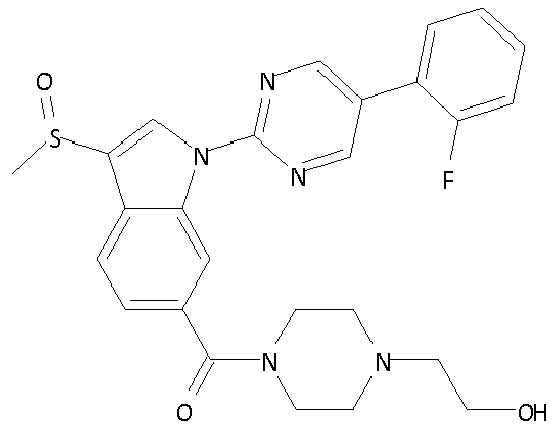
(1-(5-(2-Fluorophenyl)pyrimidin-2-yl)-3-(methylsulfinyl)-1H-indol-6-yl)(4-(2-hydroxyethyl)piperazin-1-yl)methanone 390 
(1,1-Dioxidothiomorpholino)(1-(5-(2-fluorophenyl)pyrimidin-2-yl)-3-(methylsulfinyl)-1H-indol-6-yl)methanone 391 
3-(4-(1-(5-(2-Fluorophenyl)pyrimidin-2-yl)-3-(methylsulfinyl)-1H-indole-6-carbonyl)piperazin-1-yl)propanenitrile 392 
(1-(5-(2-Fluorophenyl)pyrimidin-2-yl)-3-(methylsulfinyl)-1H-indol-6-yl)(4-(2-methoxyethyl)piperazin-1-yl)methanone 393 
Ethyl 1-(1-(5-(2-fluorophenyl)pyrimidin-2-yl)-3-(methylsulfinyl)-1H-indole-6-carbonyl)piperidine-4-carboxylate 394 
Ethyl 4-(1-(5-(2-fluorophenyl)pyrimidin-2-yl)-3-(methylsulfinyl)-1H-indole-6-carbonyl)piperazine-1-carboxylat 395 
2-(4-(1-(5-(2-Fluorophenyl)pyrimidin-2-yl)-3-(methylsulfinyl)-1H-indole-6-carbonyl)piperazin-1-yl)-N,N-dimethylacetamide - The following abbreviations are used in the descriptions of the experiments:
APCI = atmospheric pressure chemical ionization; (AtaPhos)2PdCl2 = bis(di-tert-butyl(4-dimethylaminophenyl)phosphine)dichloropalladium(II); BINAP = 2,2'-bis(diphenylphosphino)-1,1'-binaphthyl; BOP = (benzotriazol-1-yloxy)tris(dimethylamino)phosphonium hexafluorophosphate; calc.= calculated; CDI = carbonyldiimidazole; d = day; dba = dibenzylidene-acetone; DavePhos = 2-dicyclohexylphosphino-2'-(N,N-dimethylamino)biphenyl; DMAP = N,N-dimethylpyridin-4-amine; DME = dimethoxyethane; DMF = N,N-dimethylformamide; DMSO = dimethylsulfoxide; EDCxHCl = 1-[3-(dimethylamino)propyl]-3-ethylcarbodiimide hydrochloride; ES-MS = electrospray mass spectrometry (ES-MS); eq. = equivalent; h = hour; HATU = 1-[bis(dimethylamino)methylene]-1H-1,2,3-triazolo[4,5-b]pyridinium 3-oxid hexafluorophosphate; HOBt = 1-hydroxybenzotriazole monohydrate; min. = minute; MTBE = methyl-tert-butylether; NMP = N-methyl-2-pyrrolidone; PdCl2(dppf) = [1,1'-bis(diphenylphosphino)ferrocene] dichloropalladium(II) dichloromethane complex; Rt = retention time; SFC = supercritical fluid chromatography; T3P = 1-propylphoshonic acid cyclic anhydride, tBuXPhos = 2-di-tert-butylphosphino-2,4,6-triisopropyl-1,1-biphenyl; tert = tertiary; TFA = 2,2,2-trifluoroacetic acid; THF = tetrahydrofuran; TLC = thin layer chromatography; TOFMS = time-of-flight mass spectrometer; Xantphos = 4,5-Bis(diphenylphosphino)-9,9-dimethylxanthene. - The following analytical HPLC methods were used:
-
- Column: XBridge C18 (150 mm x 4.6 mm, 5.0 µm); Column temperature: 35°C
- Flow rate: 1.0 mL/min
- Injection volume: 3 µl
- Detection: 215 and 254 nm
- Mobile phase A: acetonitrile; mobile phase B: 10 mM ammonium acetate in water
-
- Column: Sunfire C18 (150 mm x 4.6 mm, 3.5 µm); Column temperature: ambient
- Flow rate: 1.0 mL/min
- Injection volume: 3 µl
- Detection: 215 and 254 nm
- Mobile phase A: 0.1% formic acid in acetonitrile; mobile phase B: 0.1% formic acid in water
-
- Column: Acquity UPLC BEH C18 (100 mm x 2.1 mm, 1.7 µm); Column temperature: 35°C
- Flow rate: 0.3 mL/min
- Injection volume: 0.5 µl
- Detection: 215 and 254 nm
- Mobile phase A: 5 mM ammonium acetate in water; mobile phase B: acetonitrile
-
- Column: XBridge C18 (4.6 x 50 mm, 5.0 µm); Instrument: Shimadzu Prominence
- Flow rate: 1.2 mL/min
- Detection: 220 and 260 nm
- Mobile phase A: 10 mM ammonium acetate in water; mobile phase B: acetonitrile
-
- Instrument: API 2000 LC/MS/MS from Applied Biosystem; Ionization technique: ESI using API source; Declustering Potential: 10-70 V depending on the ionization of compound;
- Mass range: 100-800 amu
- Scan type: Q1
- Polarity: + Ve
- Ion Source: Turbo spray
- Ion spray voltage: +5500 for +Ve mode
- Mass Source temperature: 200°C
-
- Column: Zorbax Extend C18 (4.6 x 50 mm, 5 µm); Instrument: Shimadzu Prominence
- Flow rate: 1.2 mL/min
- Detection: 220 and 260 nm
- Mobile phase A: 10 mM ammonium acetate in water; mobile phase B: acetonitrile
- Mass spectroscopy conditions
- Instrument: API 2000 LC/MS/MS from Applied Biosystem
- Ionization technique: ESI using API source
- Declustering Potential: 10-70 V depending on the ionization of compound
- Mass range: 100-800 amu
- Scan type: Q1
- Polarity: + Ve
- Ion Source: Turbo spray
- Ion spray voltage: +5500 for +Ve mode
- Mass Source temperature: 200°C
-
- Column: XBridge C18 (150 mm x 4.6 mm, 3.5 µm); Column temperature: 25°C
- Flow rate: 1.0 mL/min
- Injection volume: 2 µl
- Detection: 215 and 254 nm
- Mobile phase A: acetonitrile; mobile phase B: 10 mM ammonium acetate in water
-
- Column: Zorbax Extend C18 (4.6 x 50 mm, 5 µm)
- Instrument: Shimadzu Prominence
- Column temperature: 25°C
- Injection volume: 2 µl
- Flow rate: 1.0 mL/min
- Detection: 220 and 260 nm
- Mobile phase A: 10 mM ammonium acetate in water
- Mobile phase B: acetonitrile
- Mass spectroscopy conditions
- Instrument: API 2000 LC/MS/MS from Applied Biosystem
- Ionization technique: ESI using API source
- Declustering Potential: 10-70 V depending on the ionization of compound
- Mass range: 100-800 amu
- Scan type: Q1
- Polarity: + Ve
- Ion Source: Turbo spray
- Ion spray voltage: +5500 for +Ve mode
- Mass Source temperature: 200°C
-
- Column: XBridge C18 (150 mm x 4.6 mm, 5.0 µm); Column temperature: 25°C
- Flow rate: 1.2 mL/min
- Injection volume: 2 µl
- Detection: 215 and 254 nm
- Mobile phase A: 10 mM ammonium acetate in water B: acetonitrile; mobile phase
-
- Column: Acquity UPLC BEH C18 (100 mm x 2.1 mm, 1.7 µm)
- Column temperature: 35°C
- Flow rate: 0.3 mL/min
- Injection volume: 1 µl
- Detection: 215 and 254 nm
- Mobile phase A: 0.025% TFA in water
- Mobile phase B: 0.025% TFA in acetonitrile
-
- Column: XBridge C18 (150 mm x 4.6 mm, 5.0 µm); Column temperature: 25°C
- Flow rate: 1.0 mL/min
- Injection volume: 2 µl
- Detection: 215 and 254 nm
- Mobile phase A: 10 mM ammonium acetate in water B: acetonitrile; mobile phase
-
- Column: XBridge C18 (150 mm x 4.6 mm, 5.0 µm); Column temperature: 25°C
- Flow rate: 1.0 mL/min
- Injection volume: 2 µl
- Detection: 215 and 254 nm
- Mobile phase A: 10 mM ammonium acetate in water B: acetonitrile; mobile phase
-
- Column: XBridge C18 (150 mm x 4.6 mm, 5.0 µm); Column temperature: 25°C
- Flow rate: 1.2 mL/min
- Injection volume: 2 µl
- Detection: 215 and 254 nm
- Mobile phase A: 10 mM ammonium acetate in water B: acetonitrile; mobile phase
- Potassium carbonate (6.9 mmol, 3.0 eq), Pd2(dba)3 (0.21 mmol, 0.1eq) and tri-tert-butyl phosphonium tetrafluoroborate (0.12 mmol, 0.05 eq) were added at room temperature under an argon atmosphere to a stirred solution of (1-(5-bromopyrimidin-2-yl)-3-(methylthio)-1H-indol-6-yl)(morpholino)-methanone (2.3 mmol, 1.0 eq) and a phenyl boronic acid (2.8 mmol, 1.2 eq) in degassed THF/water (25 mL, 4:1). The reaction mixture was stirred for 2 h at 30°C, then cooled to room temperature and diluted with ethyl acetate (10 mL). For the work up, the mixture was filtered through a plug of celite, washed with water, and dried over sodium sulfate. The solvents were removed under vacuum and the residue was purified by column chromatography [silica gel 100-200 mesh, blend of ethyl acetate and petrolether].
- m-Chloroperoxybenzoic acid (0.22 mmol, 1.0 eq) was added at 0°C to a stirred solution of a 3-(alkylthio)-1-(pyrimidin-2-yl)-1H-indole-6-carboxamide (0.22 mmol, 1.0 eq) in dichloromethane (10 mL) and stirring was continued for 2 h at room temperature. The mixture was diluted with dichloromethane (10 mL), washed with saturated sodium hydrogen carbonate solution and brine and dried over anhydrous sodium sulphate. The solvent was removed under vacuum and the residue was purified by preparative TLC using for example ethyl acetate as eluent (an alternative solvent system would be a blend methanol and dichloromethane).
- m-Chloroperoxybenzoic acid (1.2 mmol, 3.0 eq) was added at room temperature to a solution of 3-(alkylthio)-1-(pyrimidin-2-yl)-1H-indole-6-carboxamide (0.4 mmol, 1.0 eq) in dichloromethane (10 mL) and the reaction mixture was stirred for 2 h. Dichloromethane (10 mL) was added and the mixture was washed with saturated sodium hydrogen carbonate solution and brine, and dried over anhydrous sodium sulphate. The solvent was evaporated and the residue was purified by preparative TLC using a blend of methanol and dichloromethane (an alternative solvent system would be a blend ethyl acetate / petrolether) as eluent.
- A stirred solution of a 1-(5-bromopyrimidin-2-yl)-3-(methylthio)-1H-indole-6-carboxamide (1.88 mmol, 1.0 eq) and a phenyl boronic acid (2.25 mmol, 1.2 eq) in THF/water (25mL, 4:1) was degassed with argon for 15 min at room temperature. Potassium carbonate (0.78 g, 5.63 mmol, 3.0 eq), Pd2(dba)3 (0.171 g, 0.187 mmol, 0.1 eq), and tri-tert-butyl phosphonium tetrafluoroborate (0.027 g, 0.094 mmol, 0.05 eq) were added and stirring was continued at 30°C for 3 h. The mixture was diluted with ethyl acetate (10 mL), filtered through a pad of celite, washed with water, dried over sodium sulphate and evaporated under vacuum. The crude was purified by column chromatography [silica gel 100-200 mesh, e.g. ethyl acetate / petrolether 1:2].
- 1-Hydroxy-7-azabenzotriazole (0.844 g, 6.21 mmol, 0.05 eq), EDCxHCl (26.09 g, 136.64 mmol, 1.1 eq) and morpholine (12.9 g, 149.06 mmol, 1.2 eq) were added to a stirred solution of 1H-indole-6-carboxylic acid (20.0 g, 124.22 mmol, 1.0 eq) in DMF (150 mL). Stirring was continued for 16 h at room temperature and water (200 mL) was then poured into the reaction mixture. The mixture was extracted with dichloromethane (2 x 150 mL) and the combined organic layers were washed with brine (100 mL), dried over anhydrous sodium sulphate and evaporated. White solid. Yield: 16.0 g (56% of theory).
1H NMR (400 MHz, DMSO-d6, δ ppm): 11.28 (s, 1H), 7.58 (d, J = 8.1 Hz, 1H), 7.49-7.43 (m, 2H), 7.04 (dd, J = 8.0, 1.5 Hz, 1H), 6.49 (s, 1H), 3.65-3.48 (m, 8H). - Dimethylsulfane (8.17 mL, 109.32 mmol, 1.1 eq) was added dropwise to a stirred suspension of N-chlorosuccinimide (14.53 g, 109.32 mmol, 1.1 eq) in dichloromethane (50 mL) at 0°C. The reaction mixture was cooled to -20°C and (1H-indol-6-yl)(morpholino)methanone (16.0 g, 99.37 mmol, 1.0 eq) in dichloromethane (120 mL) was added dropwise. After stirring for 1 h at room temperature, the solvent was evaporated and replaced by xylene (100 mL). The mixture was refluxed for 1 h, cooled to ambient temperature and then passed through a silica gel column [100-200 mesh, methanol / dichloromethane = 1:19]. The product (16.0 g) obtained was used without further purification.
1H NMR (400 MHz, DMSO-d6, δ ppm): 11.51 (s, 1H), 7.69-7.55 (m, 2H), 7.46 (d, J = 3.5 Hz, 1H), 7.13 (dd, J = 8.1, 1.4 Hz, 1H), 3.60-3.52 (m, 8H), 2.56 (s, 3H). - Potassium tert-butoxide (9.75 g, 86.95 mmol, 1.5 eq) and 5-bromo-2-chloropyrimidine (11.21 g, 57.97 mmol, 1.0 eq) were added to (3-(methylthio)-1H-indol-6-yl)(morpholino)methanone (16.0 g, 57.97 mmol, 1.0 eq) in DMF (100 mL). The mixture was stirred at 120°C for 16 h, then cooled to room temperature, diluted with ethyl acetate (100 mL), and filtered through a pad of celite. The filtrate was washed with water (2 x 100 mL) and brine (50 mL), and dried over sodium sulphate. The solvents were distilled off and the residue was purified by silica gel column chromatography [100-200 mesh; ethyl acetate/petrolether = 1:1]. Yield: 8.0 g (32% over two steps).
1H NMR (300 MHz, DMSO-d6, δ ppm): 9.06 (s, 2H), 8.74 (s, 1H), 8.22 (s, 1H), 7.68 (d, J = 8.1 Hz, 1H), 7.36 (dd, J = 8.0, 1.4 Hz, 1H), 3.78-3.34 (m, 8H), 2.52 (s, 3H). - Potassium carbonate (5.73 g, 41.57 mmol, 3.0 eq), Pd2(dba)3 (1.26 g, 1.39 mmol, 0.1 eq) and tri-tert-butyl phosphonium tetrafluoroborate (0.2 g, 0.69 mmol, 0.05 eq) were added at room temperature under an argon atmosphere to a stirred solution of (1-(5-bromopyrimidin-2-yl)-3-(methylthio)-1H-indol-6-yl)(morpholino)-methanone (6.0 g, 13.85 mmol, 1.0 eq) and (2-fluorophenyl)boronic acid (2.31 g, 16.62 mmol, 1.2 eq) in THF/water (100 mL, 4:1). The mixture was stirred for 2 h at 30°C, diluted with ethyl acetate (50 mL), and filtered through a pad of celite. The filtrate was washed with water, dried over sodium sulphate and evaporated. The residue was purified by column chromatography [100-200 mesh; ethyl acetate/petrolether = 2:3]. Yield: 4.0 g (64% of theory).
1H NMR (300 MHz, DMSO-d6, δ ppm): 9.13 (d, J = 1.5 Hz, 2H), 8.90 (s, 1H), 8.35 (s, 1H), 7.80-7.68 (m, 2H), 7.56-7.51 (m, 1H), 7.46-7.36 (m, 3H), 3.78-3.34 (s, 8H), 2.54 (s, 3H). - Prepared from (1-(5-(2-fluorophenyl)pyrimidin-2-yl)-3-(methylthio)-1H-indol-6-yl)(morpholino)-methanone (100 mg, 0.223 mmol) according to general procedure 2. White solid. Yield: 70 mg (67% of theory). Melting range: 214-217°C. HPLC (method 1): Rt = 9.14 min. Mass spectroscopy: m/z: [M+H]+ = 464.8
1H NMR (400 MHz, DMSO-d6, δ ppm): 9.20 (s, 2H), 8.94 (s, 1H), 8.79 (s, 1H), 8.05 (d, J = 8.2 Hz, 1H), 7.78-7.76 (m, 1H), 7.57-7.55 (m, 1H), 7.47-7.40 (m, 3H), 3.64 (brs, 8H), 3.08 (s, 3H). - Synthesized according to general procedure 1 from (1-(5-bromopyrimidin-2-yl)-3-(methylthio)-1H-indol-6-yl)(morpholino)methanone (1.0 g, 2.309 mmol, 1.0 eq) and (5-cyano-2-fluorophenyl)boronic acid (0.451 g, 2.77 mmol, 1.2 eq). Yield: 0.4 g (36% of theory)
1H NMR: (300 MHz, DMSO-d6, δ ppm): 9.18 (d, J = 1.4 Hz, 1H), 8.88 (s, 1H), 8.38-8.35 (m, 2H), 8.09-8.05 (m, 1H), 7.75-7.63 (m, 3H), 7.39 (dd, J = 8.1, 1.4 Hz, 1H), 3.8-3.36 (m, 8H), 2.55 (s, 3H). - The product obtained under 2a) (200 mg, 0.422 mmol, 1.0 eq) was reacted according to the instructions of the general procedure 2. The crude product was purified by preparative TLC using 5% methanol in dichloromethane as eluent. White solid. Yield: 120 mg (58% of theory). Melting range: 262-266°C. HPLC (method 3): Rt = 4.54 min. Mass spectroscopy: m/z: [M+H]+ = 489.8
1H NMR (400 MHz, DMSO-d6, δ ppm): 9.24 (s, 2H), 8.94 (s, 1H), 8.79 (s, 1H), 8.40 (dd, J = 7.3, 2.2 Hz, 1H), 8.10-8.04 (m, 2H), 7.72-7.68 (m, 1H), 7.44 (dd, J = 8.1, 1.5 Hz, 1H), 3.81-3.39 (m, 8H), 3.08 (s, 3H). - Synthesized according to general procedure 1 from (1-(5-bromopyrimidin-2-yl)-3-(methylthio)-1H-indol-6-yl)(morpholino)methanone (1.0 g, 2.30 mmol, 1.0 eq) and (2-chlorophenyl)boronic acid (0.429 g, 2.77 mmol, 1.2 eq). Yield: 0.7 g (65% of theory).
1H NMR (400 MHz, DMSO-d6, δ ppm): 9.04 (s, 2H), 8.86 (s, 1H), 8.35 (s, 1H), 7.70-7.63 (m, 3H), 7.56-7.52 (m, 2H), 7.37 (dd, J = 8.1, 1.4 Hz, 1H), 3.71-3.41 (m, 8H), 2.55 (s, 3H). - The product obtained under 3a) (150 mg, 0.323 mmol) was converted according to the general procedure 2. White solid. Yield: 80 mg (51% of theory). Melting range: 226-230°C. HPLC (method 1): Rt = 9.55 min. Mass spectroscopy: m/z: [M+H]+ = 481.1.
1H NMR (400 MHz, DMSO-d6, δ ppm): 9.11 (s, 2H), 8.94 (s, 1H), 8.79 (s, 1H), 8.05 (d, J = 8.1 Hz, 1H), 7.70-7.65 (m, 2H), 7.56-7.53 (m, 2H), 7.43 (dd, J = 8.0, 1.5 Hz, 1H), 3.71-3.41 (m, 8H), 3.08 (s, 3H). - Obtained according to general procedure 1 from (1-(5-bromopyrimidin-2-yl)-3-(methylthio)-1H-indol-6-yl)(morpholino)methanone (0.7 g, 1.616 mmol) and phenyl boronic acid (0.232 g, 1.939 mmol). Yield: 0.5 g (72% of theory)
1H NMR (300 MHz, DMSO-d6, δ ppm): 9.25 (s, 2H), 8.90 (s, 1H), 8.35 (s, 1H), 7.87-7.85 (m, 2H), 7.70 (d, J = 8.1 Hz, 1H), 7.61-7.52 (m, 2H), 7.52-7.44 (m, 1H), 7.37 (dd, J = 8.1, 1.5 Hz, 1H), 3.78-3.34 (m, 8H), 2.54 (s, 3H). - The product from the previous step (200 mg, 0.464 mmol) was reacted according to the instructions from general procedure 2. White solid. Yield: 125 mg (60% of theory). Melting range: 239-242°C. HPLC (method 2): Rt = 9.68 min. Mass spectroscopy: m/z: [M+H]+ = 447.3
1H NMR (400 MHz, DMSO-d6, δ ppm): 9.31 (s, 2H), 8.96 (s, 1H), 8.78 (s, 1H), 8.05 (d, J = 8.4 Hz, 1H), 7.90-7.88 (m, 2H), 7.59-7.55 (m, 2H), 7.51-7.48 (m, 1H), 7.43 (dd, J = 8.3, 1.5 Hz, 1H), 3.78-3.34 (m, 8H), 3.08 (s, 3H). - Obtained from 4-fluoro-3-(2-(3-(methylthio)-6-(morpholine-4-carbonyl)-1H-indol-1-yl)pyrimidin-5-yl)benzonitrile (200 mg, 0.422 mmol) according to the general procedure 3. White solid. Yield: 110 mg (51% of theory). Melting range: 316-319°C. HPLC (method 3): Rt = 5.0 min. Mass spectroscopy: m/z: [M+H]+ = 505.9
1H NMR: (300 MHz, DMSO-d6, δ ppm): 9.29 (s, 2H), 8.93 (d, J = 4.7 Hz, 2H), 8.41 (dd, J = 7.2, 2.2 Hz, 1H), 8.12-8.07 (m, 1H), 8.01 (d, J = 8.3 Hz, 1H), 7.74-7.68 (m, 1H), 7.52 (dd, J = 8.2, 1.4 Hz, 1H), 3.81-3.35 (m, 8H), 3.40 (s, 3H). - The following compounds were prepared according to general procedure 3:
- White solid. Yield: 140 mg (67% of theory). Melting range: 247-252°C. HPLC (method 3): Rt = 5.25 min. Mass spectroscopy: m/z: [M+H]+ = 498.9.
1H NMR (300 MHz, DMSO-d6, δ ppm): 9.21 (s, 2H), 8.93 (s, 1H), 8.90 (s, 1H), 8.01 (d, J = 8.2 Hz, 1H), 7.91-7.80 (m, 1H), 7.57-7.49 (m, 2H), 7.37-7.31 (m, 1H), 3.81-3.34 (s, 8H), 3.39 (s, 3H). - White solid. Yield: 80 mg (32% of theory). Melting range: 263-266°C. HPLC (method 3): Rt = 4.19 min. Mass spectroscopy: m/z: [M+H]+ = 523.9
1H NMR (300 MHz, DMSO-d6, δ ppm): 9.28 (s, 2H), 8.95 (s, 1H), 8.92 (s, 1H), 8.19 (s, 1H), 8.01 (d, J = 8.2 Hz, 1H), 7.94-7.86 (m, 3H), 7.65 (s, 1H), 7.52 (dd, J = 8.2, 1.4 Hz, 1H), 3.64 (s, 8H), 3.39 (s, 3H). - White solid. Yield: 180 mg (84% of theory). Melting range: 265-269°C. HPLC (method 3): Rt = 4.84 min. Mass spectroscopy: m/z: [M+H]+ = 487.9
1H NMR (300 MHz, DMSO-d6, δ ppm): 9.29 (s, 2H), 8.95-8.94 (m, 2H), 8.10 (dd, J = 7.7, 1.3 Hz, 1H), 8.01 (d, J = 8.2 Hz, 1H), 7.97-7.85 (m, 2H), 7.75-7.70 (m, 1H), 7.52 (dd, J = 8.1, 1.5 Hz, 1H), 3.71-3.42 (m, 8H), 3.40 (s, 3H). - White solid. Yield: 165 mg (77% of theory). Melting range: 235-239°C. HPLC (method 2): Rt = 10.92 min. Mass spectroscopy: m/z: [M+H]+ = 497.3.
1H NMR (400 MHz, DMSO-d6, δ ppm): 9.16 (s, 2H), 8.95-8.90 (m, 2H), 8.01 (d, J = 8.2 Hz, 1H), 7.74-7.64 (m, 2H), 7.59-7.48 (m, 3H), 3.68-3.48 (m, 8H), 3.39 (s, 3H). - White solid. Yield: 90 mg (42% of theory). Melting range: 270-274°C. HPLC (method 2): Rt = 10.61 min. Mass spectroscopy: m/z: [M+H]+ = 463.3.
1H NMR: (400 MHz, DMSO-d6, δ ppm): 9.36 (s, 2H), 8.95 (s, 1H), 8.91 (s, 1H), 8.01 (d, J = 8.2 Hz, 1H), 7.93-7.87 (m, 2H), 7.60-7.56 (m, 2H), 7.52-7.49 (m, 2H), 3.68-3.54 (m, 8H), 3.39 (s, 3H). - White solid. Yield: 75 mg (70% of theory). Melting range: 267-270°C. HPLC (method 1): Rt = 9.91 min. Mass spectroscopy: m/z: [M+H]+ = 480.8
1H NMR (400 MHz, DMSO-d6, δ ppm): 9.24 (d, J = 1.3 Hz, 2H), 8.96-8.90 (m, 2H), 8.01 (d, J = 8.2 Hz, 1H), 7.81-7.78 (m, 1H), 7.58-7.52 (m, 1H), 7.53-7.40 (m, 3H), 3.64 (brs, 8H), 3.31 (s, 3H) - Prepared from 1H-indole-6-carboxylic acid (4.0 g, 24.84 mmol, 1.0 eq) and tert-butyl piperazine-1-carboxylate (4.6 g, 24.84 mmol, 1.0 eq) in an analogous manner as described under procedure 1a). White solid. Yield: 5.0 g (61% of theory)
1H NMR (400 MHz, DMSO-d6, δ ppm): 11.29 (s, 1H), 7.58 (d, J = 8.1 Hz, 1H), 7.49-7.43 (m, 2H), 7.04 (dd, J = 8.1, 1.5 Hz, 1H), 6.48-6.47 (m, 1H), 3.62-3.42 (m, 4H), 3.32-3.42 (m, 4H), 1.41 (s, 9H). - Synthesized in analogy to the procedure 1b) from tert-butyl 4-(1H-indole-6-carbonyl)piperazine-1-carboxylate (2.0 g, 6.079 mmol). The product (2.0 g) obtained was used without further purification in the next step.
- Prepared from the product of 12b) (1.2 g, 3.2 mmol, 1.0 eq) and 2-chloro-5-phenylpyrimidine (0.604 g, 3.2 mmol, 1.0 eq) following the instructions of 1c). Yield: 700 mg.
1H NMR (300 MHz, DMSO-d6, δ ppm): 9.24 (s, 2H), 8.90 (s, 1H), 8.35 (s, 1H), 7.87-7.85 (d, J = 6.9 Hz, 2H), 7.71-7.68 (d, J = 8.1 Hz, 1H), 7.58-7.47 (m, 3H), 7.38 (d, J = 8.1 Hz, 1H), 3.70-3.38 (m, 8H), 2.54 (s, 3H), 1.41 (s, 9H). - Obtained from 12c) (300 mg, 0.56 mmol) according to the general procedure 2. The preparative TLC was performed with 3% methanol in dichloromethane as eluent. White solid. Yield: 170 mg (54% yield).
1H NMR (400 MHz, DMSO-d6, δ ppm): 9.31 (s, 2H), 8.96 (s, 1H), 8.79 (s, 1H), 8.05 (d, J = 8.1 Hz, 1H), 7.89 (d, J = 7.6 Hz, 2H), 7.61-7.54 (m, 2H), 7.52-7.47 (m, 1H), 7.43 (dd, J = 8.1, 1.5 Hz, 1H), 3.70-3.35 (m, 8H), 3.09 (s, 3H), 1.41 (s, 9H). - TFA (0.5 mL) was added to compound 12d) (170 mg, 0.311 mmol) in dichloromethane (5 mL) at room temperature and the solution was stirred for 2 h. The reaction mixture was then diluted with water, adjusted to pH 8 via addition of saturated sodium hydrogen carbonate solution and extracted with dichloromethane. The combined organic layers were dried over sodium sulfate and evaporated. The remnant was purified by preparative TLC using a blend of 5% methanol in dichloromethane as eluent. White solid. Yield: 75 mg (51% of theory). Melting range: 193-197°C. HPLC (method 3): Rt = 4.02 min. Mass spectroscopy: m/z: [M+H]+ = 446.1.
1H NMR (300 MHz, DMSO-d6, δ ppm): 9.31 (s, 2H), 8.92 (s, 1H), 8.77 (s, 1H), 8.03 (d, J = 8.2 Hz, 1H), 7.91-7.87 (m, 2H), 7.63-7.45 (m, 3H), 7.38 (dd, J = 8.2, 1.4 Hz, 1H), 3.7-3.4 (m, 4H), 3.08 (s, 3H), 2.9-2.6 (s, 4H). - Tetrakis(triphenylphosphine)palladium(0) (2.06 g, 1.79 mmol, 0.1 eq) and caesium carbonate (17.4 g, 53.69 mmol, 2.0 eq) were added under an argon atmosphere to a stirred solution of 5-bromo-2-chloropyrimidine (2.5 g, 17.86 mmol, 1 eq) and (2-fluorophenyl)boronic acid (3.45 g, 17.86 mmol, 1.0 eq) in 1,4-dioxane/water (30 mL, 4:1) at room temperature. The mixture was heated to 90°C, stirred for 3 h and then cooled to room temperature. The mixture was diluted with ethyl acetate (10 mL), washed with water, and dried over sodium sulfate. The solvents were removed in vacuo and the residue was purified by column chromatography [silica gel 100-200 mesh, ethyl acetate/petrolether 1:19]. Yield: 2.0 g (53% of theory)
1H NMR (300 MHz, CDCl3, δ ppm): 8.83 (s, 2H), 7.48-7.42 (m, 2H), 7.35-7.25 (m, 2H). - Obtained from the product of 12b) (1.2 g, 3.2 mmol, 1.0 eq) and 2-chloro-5-(2-fluorophenyl)-pyrimidine (0.665 g, 3.2 mmol, 1.0 eq) according to procedure 1c). Yield: 800 mg (46% of theory)
1H NMR (300 MHz, DMSO-d6, δ ppm): 9.13 (s, 2H), 8.89 (s, 1H), 8.35 (s, 1H), 7.81-7.66 (m, 2H), 7.56-7.51 (m, 1H), 7.47-7.31 (m, 3H), 3.81-3.34 (m, 8H), 2.55 (s, 3H), 1.41 (s, 9H). - The target compound was synthesized from 13b) (250 mg, 0.46 mmol, 1.0 eq) following the instructions of general procedure 2. White solid. Yield: 170 mg (66% of theory)
1H NMR (300 MHz, DMSO-d6, δ ppm): 9.19 (s, 2H), 8.95 (s, 1H), 8.79 (s, 1H), 8.05 (d, J = 8.1 Hz, 1H), 7.81-7.76 (m, 1H), 7.63-7.36 (m, 4H), 3.42 (m, 8H), 3.09 (s, 3H), 1.41 (s, 9H). - Prepared from 13c) (170 mg, 0.30 mmol, 1.0 eq) in analogy to the procedure of 12e). White solid. Yield: 130mg (71% of theory). Melting range: 199-203°C. HPLC (method 3): Rt = 4.04 min. Mass spectroscopy: m/z: [M+H]+ = 464.1.
1H NMR (300 MHz, DMSO-d6, δ ppm): 9.19 (d, J = 1.4 Hz, 2H), 8.90 (s, 1H), 8.78 (s, 1H), 8.03 (d, J = 8.1 Hz, 1H), 7.82-7.76 (m, 1H), 7.58-7.52 (m, 1H), 7.48-7.37 (m, 3H), 3.70-3.37 (m, 4H), 3.08 (s, 3H), 2.73 (bs, 5H). - Prepared according to general procedure 1 from tert-butyl 4-(1-(5-bromopyrimidin-2-yl)-3-(methylthio)-1H-indole-6-carbonyl)piperazine-1-carboxylate (1.0 g, 1.876 mmol, 1.0 eq) and (3,4-difluorophenyl)boronic acid (0.353 g, 2.251 mmol, 1.2 eq). Yield: 0.6 g (56% of theory)
1H NMR: (300 MHz, DMSO-d6, δ ppm): 9.10 (s, 2H), 8.88 (s, 1H), 8.35 (s, 1H), 7.88-7.79 (m, 1H), 7.70 (d, J = 8.1 Hz, 1H), 7.56-7.46 (m, 1H), 7.41-7.28 (m, 2H), 3.82-3.35 (m, 8H), 2.55 (s, 3H), 1.41 (s, 9H). - Synthesized from 14a) (260 mg, 0.46 mmol) following the instructions of general procedure 2. Yield: 180 mg (67% of theory)
- Preparation from 14b) (180 mg, 0.31 mmol) in an analogous manner as described under 12e). White solid. Yield: 135 mg (83% of theory). Melting range: 198-201°C. HPLC (method 3): Rt = 4.20 min. Mass spectroscopy: m/z: [M+H]+ = 482.2.
1H NMR: (300 MHz, DMSO-d6, δ ppm): 9.17 (s, 2H), 8.90 (s, 1H), 8.77 (s, 1H), 8.03 (d, J = 8.2 Hz, 1H), 7.91-7.79 (m, 1H), 7.61-7.42 (m, 1H), 7.44-7.20 (m, 2H), 3.72-3.37 (m, 4H), 3.08 (s, 3H), 2.58-2.78 (m, 4H). - The compounds nos. 15 to 17 were synthesized in three steps from tert-butyl 4-(1-(5-bromopyrimidin-2-yl)-3-(methylthio)-1H-indole-6-carbonyl)piperazine-1-carboxylate in an analogous manner:
- White solid. Yield: 170 mg. HPLC (method 1): Rt = 6.60 min. Mass spectroscopy: m/z: [M+H]+ = 506.7
1H NMR (300 MHz, DMSO- d6, δ ppm): 9.23 (S, 2H), 8.91 (S, 1H), 8.78 (s, 1H), 8.18 (s, 1H), 8.04 (d, J = 8.1 Hz, 1H), 7.90-7.85 (m, 3H), 7.63 (s, 1H), 7.40 (d, J = 8.3, 1H), 3.71-3.46 (m, 8H), 3.08 (s, 3H), 2.75 (s, 1H). - White solid. Yield: 80 mg (75% of theory). Melting range: 230-235°C. HPLC (method 1): Rt = 7.23 min. Mass spectroscopy: m/z: [M+H]+ = 471.1
1H NMR (400 MHz, DMSO-d6, δ ppm): 9.24 (s, 2H), 8.92 (s, 1H), 8.82 (s, 1H), 8.10-8.03 (m, 2H), 7.94-7.85 (m, 2H), 7.75-7.70 (m, 1H), 7.40 (dd, J = 8.1, 1.6 Hz, 1H), 3.74-3.53 (m, 2H), 3.49-3.3 (m, 2H), 3.09 (s, 3H), 2.91-2.60 (m, 4H). - White solid. Yield: 95 mg (76% of theory). Melting range: 159-163°C. HPLC (method 1): Rt = 7.67 min. Mass spectroscopy: m/z: [M+H]+ = 489.1
1H NMR (300 MHz, DMSO-d6, δ ppm): 9.24 (s, 2H), 8.90 (s, 1H), 8.80 (s, 1H), 8.40 (dd, J = 7.2, 2.2 Hz, 1H), 8.10-8.03 (m, 2H), 7.73-7.67 (m, 1H), 7.40 (dd, J = 8.1, 1.5 Hz, 1H), 3.7-3.4 (m, 4H), 3.08 (s, 3H), 2.81-2.60 (m, 4H). - The compound nos. 18 to 20 were prepared in an analogous manner as described in synthesis example 1:
- White solid. Yield: 120 mg (58% of theory). Melting range: 230-233°C. HPLC (method 1): Rt = 9.34 min. Mass spectroscopy: m/z: [M+H]+ = 482.8
1H NMR (300 MHz, DMSOd6, δ ppm): 9.17 (s, 2H), 8.93 (s, 1H), 8.78 (s, 1H), 8.05-8.03 (m, 1H), 7.89-7.18 (m, 1H), 7.56-7.49 (m, 1H), 7.44-7.37 (m, 1H), 7.36-7.30 (m, 1H), 3.78-3.41 (m, 8H), 3.08 (s, 3H). - White solid. Yield: 72 mg (35% of theory). Melting range: 202-206°C.. HPLC (method 3): Rt = 3.65 min. Mass spectroscopy: m/z: [M+H]+ = 508.0.
1H NMR (300 MHz, DMSO-d6, δ ppm): 9.23 (s, 2H), 8.94 (s, 1H), 8.79 (s, 1H), 8.19 (s, 1H), 8.05 (d, J = 8.1 Hz, 1H), 7.89-7.87 (m, 3H), 7.64 (s, 1H), 7.44 (dd, J = 8.1, 1.5 Hz, 1H), 3.64-3.52 (m, 8H), 3.06 (s, 3H). - White solid. Yield: 185 mg (68% of theory). Melting range: 277-281°C. HPLC (method 3): Rt = 4.36 min. Mass spectroscopy: m/z: [M+H]+ = 471.9
1H NMR (300 MHz, DMSO, δ ppm): 9.25 (s, 2H), 8.95(s, 1H), 8.82 (s, 1H), 8.14-8.02 (m, 2H), 7.96-7.82 (m, 2H), 7.72 (td, J = 7.5, 1.7 Hz, 1H), 7.44 (dd, J = 8.1, 1.5 Hz, 1H), 3.64-3.41 (m, 8H), 3.09 (s, 3H). - Preparation according to the general procedure 3 from 12d) (300 mg, 0.567 mmol). Different from the instructions of the general procedure, the crude product was not purified by preparative TLC, instead it was triturated in methanol. White solid. Yield: 180 mg (56% of theory)
1H NMR (400 MHz, DMSO-d6, δ ppm): 9.35 (s, 2H), 8.95 (s, 1H), 8.91 (s, 1H), 8.01 (d, J = 8.2 Hz, 1H), 7.91 (d, J = 6.8 Hz, 2H), 7.63-7.47 (m, 4H), 3.7-3.3 (m, 11H), 1.41 (s, 9H). - The target compound was obtained from 21a) (170 mg, 0.303 mmol) in an analogous manner to the procedure of 12e). White solid. Yield: 130 mg (93% of theory)
1H NMR: (300 MHz, DMSO-d6, δ ppm). 9.33 (s, 2H), 8.92 (d, J = 7.0 Hz, 2H), 8.01 (d, J = 8.1, Hz 1H), 7.91 (d, J = 7.2 Hz, 2H), 7.61-7.42 (m, 4H), 3.7-3.4 (m, 4H), 3.39 (s, 3H), 2.7-2.9 (m, 4H). - The compound nos. 22 to 26 were obtained in an analogous manner as described for compound no. 21.
- Prepared from tert-butyl 4-(1-(5-(4-carbamoyl-2-fluorophenyl)pyrimidin-2-yl)-3-(methylthio)-1H-indole-6-carbonyl)piperazine-1-carboxylate. Pale brown solid. Yield: 130 mg HPLC (method 3): Rt = 3.61 min. Mass spectroscopy: m/z: [M+H]+ = 523.1.
1H NMR (400 MHz, DMSO-d6, δ ppm): 9.27 (s, 2H), 8.91 (s, 2H), 8.20 (s, 1H), 8.00 (d, J = 8.2 Hz, 1H), 7.95-7.86 (m, 3H), 7.64 (s, 1H), 7.48 (d, J = 8.2 Hz, 1H), 3.7-3.56 (m, 4H), 3.39 (s, 3H), 3.34-3.21 (s, 2H), 2.92-2.61 (m, 3H). - Obtained from tert-butyl 4-(1-(5-(2,4-difluorophenyl)pyrimidin-2-yl)-3-(methylthio)-1H-indole-6-carbonyl)piperazine-1-carboxylate. White solid. Yield: 120 mg. Melting range: 229-233°C. HPLC (method 1): Rt = 8.83 min. Mass spectroscopy: m/z: [M+H]+ = 498.1
1H NMR (300 MHz, DMSO-d6, δ ppm): 9.20 (s, 2H), 8.93 (d, J = 6.9 Hz, 2H), 8.01 (d, J = 8.2 Hz, 1H), 7.90-7.82 (m, 1H), 7.58-7.50 (m, 2H), 7.39-7.33 (m, 1H), 3.9-3.42 (m, 4H), 3.40 (s, 3H), 3.17-2.92 (m, 4H). - Synthesized from tert-butyl 4-(1-(5-(2-fluorophenyl)pyrimidin-2-yl)-3-(methylthio)-1H-indole-6-carbonyl)piperazine-1-carboxylate. White solid. Yield: 110 mg. Melting range: 206-210°C. HPLC (method 1): Rt = 8.10 min. Mass spectroscopy: m/z: [M+H]+ = 480.1.
1H NMR (300 MHz, DMSO-d6, δ ppm): 9.23 (s, 2H), 8.96 (d, J = 12.6 Hz, 2H), 8.79 (s, 2H), 8.03 (d, J = 8.2 Hz, 1H), 7.82-7.76 (m, 1H), 7.59-7.413 (m, 4H), 3.74 (s, 4H), 3.40 (s, 3H), 3.16 (s, 4H). - Preparation from tert-butyl 4-(1-(5-(2-cyanophenyl)pyrimidin-2-yl)-3-(methylthio)-1H-indole-6-carbonyl)piperazine-1-carboxylate. White solid. Yield: 100 mg. Melting range: 193-197°C. HPLC (method 3): Rt = 4.10 min. Mass spectroscopy: m/z: [M+H]+ = 487.1
1H NMR (300 MHz, DMSO-d6, δ ppm): 9.23 (s, 2H), 8.96 (d, J = 12.6 Hz, 2H), 8.1 (d, J = 7.5 Hz, 1H), 8.03 (d, J = 8.2 Hz, 1H), 7.96-7.86 (m, 2H), 7.78-7.70 (m, 1H), 7.5-7.46 (m, 1H), 3.74-3.50 (m, 4H), 3.39 (s, 3H), 2.81-2.6 (m, 4H). - Synthesized from tert-butyl 4-(1-(5-(5-cyano-2-fluorophenyl)pyrimidin-2-yl)-3-(methylsulfonyl)-1H-indole-6-carbonyl)piperazine-1-carboxylate. White solid. Yield: 110 mg. Melting range: 279-283°C. HPLC (method 3): Rt = 4.31 min. Mass spectroscopy: m/z: [M+H]+ = 505.1
1H NMR (400 MHz, DMSO-d6, δ ppm): 9.26 (s, 2H), 8.90 (d, J = 8.8 Hz, 2H), 8.37 (dd, J = 7.2, 2.2 Hz, 1H), 8.11-8.05 (m, 1H), 8.00 (d, J = 8.2 Hz, 1H), 7.73-7.68 (m, 1H), 7.47 (dd, J = 8.2, 1.4 Hz, 1H), 3.71-3.59 (m, 2H), 3.39-3.23 (m, 5H), 2.82-2.6 (m, 4H). - A solution of (1H-indol-6-yl)(morpholino)methanone (200 mg, 0.869 mmol, 1.0 eq) in DMF (3.0 ml) was added dropwise at 0°C to phosphorus oxychloride (0.34 mL, 2.60 mmol, 3.0 eq) in DMF (5.0 mL) under stirring. The mixture was stirred at room temperature for 3 h, then neutralized with saturated sodium hydrogen carbonate solution, diluted with water (20 mL), and extracted with ethyl acetate (2 x 10 mL). The organic layers were combined, washed with brine (20 mL), dried over sodium sulfate and evaporated. The residue was purified by silica gel column chromatography [100-200 mesh; methanol/dichloromethane = 1:9]. White solid. Yield: 100 mg (45% of theory).
1H NMR (300 MHz, DMSO-d6, δ ppm): 12.23 (s, 1H), 9.95 (s, 1H), 8.39 (s, 1H), 8.12 (d, J = 8.7Hz, 1H), 7.56 (s, 1H), 7.26 (d, J = 8.1 Hz, 1H), 3.75-3.41 (m, 8H). - Sodium borohydride (220 mg, 5.81 mmol, 3.0 eq) was added to a stirred solution of product 27a) (500 mg, 1.94 mmol, 1.0 eq) in methanol (10 mL) at room temperature and stirring was continued for 2 h. The methanol was removed under vacuum, water (50 mL) was added, and the mixture was extracted with ethyl acetate (2 x 30 mL). The combined organic layers were washed with brine (50 mL), dried over sodium sulfate, and evaporated. White solid. Yield: 400 mg (80% of theory).
1H NMR (300 MHz, DMSO-d6, δ ppm): 11.07 (s, 1H), 7.63 (d, J = 8.1 Hz, 1H), 7.41 (s, 1H), 7.35 (d, J = 2.4 Hz, 1H), 7.04 (dd, J = 8.2, 1.4 Hz, 1H), 4.77 (t, J = 5.3 Hz, 1H), 4.64 (d, J = 5.4 Hz, 2H), 3.65-3.45 (m, 8H). - Prepared from 27b) (700 mg, 2.69 mmol, 1.0 eq) and 5-bromo-2-chloropyrimidine (520 mg, 2.69 mmol, 1.0 eq) in an analogous manner to the procedure of 1c). The raw product was purified by column chromatography [100-200 mesh; ethyl acetate/petrolether = 7:3]. White solid. Yield: 400 mg (35% of theory).
1H NMR (300 MHz, DMSO-d6, δ ppm): 9.04 (s, 2H), 8.71 (s, 1H), 8.21 (s, 1H), 7.75 (d, J = 8.1 Hz, 1H), 7.30 (dd, J = 8.0, 1.5 Hz, 1H), 5.15 (t, J = 5.5 Hz, 1H), 4.72 (d, J = 5.7 Hz, 2H), 3.72-3.41 (m, 8H). - Prepared from 27c) (400 mg, 0.959 mmol, 1.0 eq) and (2-fluorophenyl)boronic acid (133 mg, 0.959 mmol, 1.0 eq) according to general procedure 1. White solid. Yield: 230 mg (55% of theory). Melting range: 190-194°C. HPLC (method 1): Rt = 9.69 min. Mass spectroscopy: m/z: [M+H]+ = 433.0
1H NMR (300 MHz, DMSO-d6, δ ppm): 9.11 (d, J = 1.4 Hz, 2H), 8.86 (s, 1H), 8.33 (s, 1H), 7.83-7.69 (m, 2H), 7.55-7.50 (m, 1H), 7.47-7.36 (m, 2H), 7.31 (dd, J = 8.1, 1.5 Hz, 1H), 5.17 (t, J = 5.5 Hz, 1H), 4.75 (d, J = 5.1 Hz, 2H), 3.72-3.38 (m, 8H). - Dess Martin periodinane (235 mg, 0.556 mmol, 1.5 eq) was added to the product of 27d) (160 mg, 0.370 mmol, 1.0 eq) in dichloromethane (10 mL) at 0°C. The mixture was stirred for 2 h at room temperature, and then filtered through a pad of celite. The filter was rinsed with dichloromethane and the filtrate was dried over sodium sulfate, and evaporated. White solid. Yield: 140 mg. Mass spectroscopy: m/z: [M+H]+ = 430.9
- Methyl magnesium iodide (3M solution in diethyl ether, 0.17 mL, 0.522 mmol, 1.5 eq) was added at - 70°C to a stirred solution of 28a) (150 mg, 0.348 mmol, 1.0 eq) in dry THF (10 mL) and stirring was continued for 2 h at -50°C. The reaction mixture was quenched with ammonium chloride solution, diluted with water (20 mL), and extracted with ethyl acetate (2 x 20 mL). The organic layers were washed with brine, dried over sodium sulfate, and evaporated. The residue was purified by preparative TLC using 70% ethyl acetate in petrolether as eluent. White solid. Yield: 70 mg (45% of theory). Melting range: 209-213°C. HPLC (method 1): Rt = 10.09 min. Mass spectroscopy: m/z: [M+H]+ = 447.0.
1H NMR (300 MHz, DMSO-d6, δ ppm): 9.11 (s, 2H), 8.86 (s, 1H), 8.27 (s, 1H), 7.84-7.74 (m, 2H), 7.56-7.51 (m, 1H), 7.47-7.38 (m, 2H), 7.30 (dd, J = 8.1, 1.5 Hz, 1H), 5.26 (d, J = 4.9 Hz, 1H), 5.12-5.02 (m, 1H), 3.65-3.41 (m, 8H), 1.55 (d, J = 6.4 Hz, 3H). - Synthesized from (1H-indol-6-yl)(morpholino)methanone (1.5 g, 6.52 mmol, 1.0 eq) in an analogous manner as described for 1b). Yield: 1.3 g. Mass spectroscopy: m/z: [M+H]+ = 291.4.
- The product 29a) (1.5 g, 5.17 mmol, 1.0 eq) and 5-bromo-2-chloropyrimidine (1.0 g, 5.17 mmol, 1.0 eq) were reacted as described in procedure 1c). Yield: 700 mg. Mass spectroscopy: m/z: [M+H]+ = 446.6 / 448.7
- Obtained from 29b) (700 mg, 1.56 mmol, 1.0 eq) and (2-fluorophenyl)boronic acid (206 mg, 1.72 mmol, 1.1 eq) according to general procedure 1. Yield: 400 mg. Mass spectroscopy: m/z: [M+H]+ = 463.4
- The target compound was prepared from 29c) (400 mg, 0.87 mmol, 1.0 eq) according to general procedure 2. White solid. Yield: 110 mg (7% over the last four steps). Melting range: 122-126°C. HPLC (method 3): Rt = 4.972 min. Mass spectroscopy: m/z: [M+H]+ = 479.5
1H NMR (400 MHz, DMSO-d6, δ ppm): 9.19 (s, 2H), 8.94 (s, 1H), 8.75 (s, 1H), 8.01 (d, J = 8.4 Hz, 1H), 7.80-7.76 (m, 1H), 7.57-7.53 (m, 1H), 7.47-7.39 (m, 3H), 3.65-3.38 (m, 8H), 3.31-3.18 (m, 2H), 1.16 (t, J = 7.4 Hz, 3H). - A solution of m-chloroperoxybenzoic acid (77%, 2.10 g, 9.42 mmol) in dichloromethane (20 mL) was added at 0°C to (1-(5-bromopyrimidin-2-yl)-3-(methylthio)-1H-indol-6-yl)(morpholino)methanone (0.18 g, 0.25 mmol) in dry dichloromethane (300 mL). The mixture was stirred at room temperature for 4 h and then poured onto saturated sodium sulfite solution (20 mL). The organic layer was separated after stirring for 15 min and washed with saturated sodium hydrogen carbonate solution and brine. The organic phase was then dried over sodium sulphate and concentrated. The residue was purified by flash column chromatography [methanol/dichloromethane = 1:40]. White solid. Yield: 3.2 g.
- Potassium fluoride (0.048 g, 0.83 mmol), 2,3-difluoro phenyl boronic acid (0.10 g, 0.67 mmol), and bis(tri-tert-butylphosphine)palladium(0) (0.026 g, 0.05 mmol) were added at room temperature under an argon atmosphere to a solution of [1-(5-bromo-pyrimidin-2-yl)-3-methanesulfinyl-1H-indol-6-yl]-morpholin-4-yl-methanone (0.15 g, 0.33 mmol) in dry THF (12 mL). The reaction mixture was heated at 70°C for 16 h, then filtered through a plug of celite and concentrated. The residue was purified by flash column chromatography [methanol/dichloromethane = 1:40]. White solid. Yield: 100 mg (63% of theory).
1H NMR (400 MHz, DMSO-d6, 100°C, δ ppm): 9.17 (s, 2H), 8.94 (s, 1H), 8.75 (s, 1H), 8.04 (d, 1H, J = 8.0 Hz), 7.59-7.49 (m, 2H), 7.43-7.39 (m, 2H), 3.67-3.58 (m, 8H), 3.07 (s, 3H). - The compound nos. 31 to 46 were synthesized in an analogous manner:
- The raw product was purified by flash column chromatography [methanol/dichloromethane = 1:50] followed by trituration with dichloromethane/hexane (1:2). White solid. Yield: 0.35 g (83% of theory)
1H NMR (400 MHz, DMSO-d6, 80°C, δ ppm): 9.35 (s, 2H), 8.94 (s, 1H), 8.75 (s, 1H), 8.09 (d, 2H, J = 8.0 Hz), 8.04-7.99 (m, 3H), 7.43 (d, 1H, J = 8.0 Hz), 3.66-3.58 (m, 8H), 3.07 (s, 3H). - Notwithstanding from procedure 30b), the target product was purified by HPLC and not by flash chromatography. White solid. Yield: 0.07 g (34% of theory)
1H NMR (400 MHz, DMSO-d6, 80°C, δ ppm): 9.25 (s, 2H), 8.94 (s, 1H), 8.74 (s, 1H), 8.03 (d, 1H, J = 8.0 Hz), 7.92 (t, 2H, J = 8.4 Hz), 7.43-7.36 (m, 3H), 3.66-3.58 (m, 8H), 3.07 (s, 3H). - Purification by preparative HPLC. Light yellow solid. Yield: 0.09 g (42% of theory)
1H NMR (400 MHz, DMSO-d6, 80°C, δ ppm): 9.21 (s, 2H), 8.93 (s, 1H), 8.73 (s, 1H), 8.03 (d, 1H, J = 8.0 Hz), 7.82-7.8 (m, 2H, J = 8.0 Hz), 7.42 (d, 1H, J = 8 Hz), 7.13 (d, 2H, J = 8 Hz), 3.86 (s, 3H), 3.66-3.58 (m, 8H), 3.07 (s, 3H). - The raw product was purified by preparative HPLC. White solid. Yield: 75 mg (49% of theory)
1H NMR (400 MHz, DMSO-d6, 80°C, δ ppm): 9.28 (s, 2H), 8.94 (s, 1H), 8.74 (s, 1H), 8.03 (d, 1H, J = 8 Hz), 7.74-7.7 (m, 2H), 7.62-7.58 (m, 1H), 7.42 (d, 1H, J = 8 Hz), 7.29 (t, 1H, J = 8 Hz), 3.67 (bs, 4H), 3.59 (bs, 4H), 3.07 (3 H). - Purification by HPLC. White solid. Yield: 0.10 g (62% of theory)
1H NMR (400 MHz, DMSO-d6, δ ppm): 9.37 (s, 2H), 8.96 (s, 1H), 8.79 (s, 1H), 8.35 (s,1H), 8.13 (s, 1H), 8.05 (d, 2H, J = 8 Hz), 7.97 (d, 1H, J = 8 Hz), 7.67 (t, 1H, J = 8.0 Hz), 7.55 (s, 1H), 7.43 (d, 1H, J = 8 Hz), 3.67 (bs, 4H), 3.64 (bs, 8H), 3.08 (s, 3H). - Purification of the raw product by preparative HPLC. White solid. Yield: 0.08 g (46% of theory)
1H NMR (400 MHz, DMSO-d6, 100°C, δ ppm): 9.34 (s, 2H), 8.95 (s, 1H), 8.75 (s, 1H), 8.37 (s, 1H), 8.2 (d, 1H, J = 8 Hz), 8.03 (d, 2H, J = 4 Hz), 7.84 (t, 1H, J = 8 Hz), 7.42 (d, 1H, J = 4 Hz), 3.67 (bs, 4H), 3.59 (bs, 4H), 3.29 (s, 3H), 3.08 (s, 3H). - Purification by preparative HPLC. White solid. Yield: 0.05 g (40% of theory)
1H NMR (400 MHz, DMSO-d6, 100°C, δ ppm): 9.23 (bs, 2H), 8.93 (bs, 1H), 8.74 (bs, 1H), 8.03 (bs, 1H), 7.67-7.63 (m, 2H), 7.45-7.41 (m, 2H), 7.32 (bs, 1H), 3.67 (bs, 4H), 3.59 (bs, 4H), 3.07 (s, 3H), 2.44 (s, 3H). - The raw product was purified by flash chromatography followed by preparative HPLC. White solid. Yield: 0.04 g (37% of theory)
1H NMR (400 MHz, DMSO-d6, 100°C, δ ppm): 9.15 (s, 2H), 8.93 (s, 1H), 8.74 (s, 1H), 8.03 (d, 1H, J = 8 Hz), 7.42 (d, 1H, J = Hz), 7.34-7.29 (m, 2H), 7.09 (bs, 1H), 3.87 (s, 3H), 3.66 (bs, 4H), 3.58 (bs, 4H), 3.07 (s, 3H). - White solid. Yield: 0.09 g (41% of theory)
1H NMR (400 MHz, DMSO-d6, 80°C, δ ppm): 9.1 (s, 2H), 8.92 (s, 1H), 8.74 (s, 1H), 8.03 (d, 1H, J = 8 Hz), 7.69 (t, 1H, J = 8 Hz), 7.41 (d, 1H, J = 8 Hz), 7.04-6.98 (m, 2H), 3.88 (s, 3H), 3.66-3.57 (m, 8H), 3.07 (s, 3H). - White solid. Yield: 0.35 g (83% of theory)
1H NMR (400 MHz, DMSO-d6, 80°C, δ ppm): 9.34 (s, 2H), 8.94 (s, 1H), 8.75 (s, 1H), 8.36 (s, 1H), 8.2 (d, 1H, J = 8 Hz), 8.03 (d, 1H, J = 8 Hz), 7.92 (d, 1H, J = 8 Hz), 7.79-7.75 (m, 1H), 7.2 (d, 1H, J = 8 Hz), 3.67 (bs, 4H), 3.59 (bs, 4H), 3.07 (s, 3H). - White solid. Yield: 0.14 g (67% of theory)
1H NMR (400 MHz, DMSO-d6, 80°C, δ ppm): 9.44 (s, 1H), 9.1 (s, 2H), 8.92 (s, 1H), 8.75 (s, 1H), 8.03 (d, 1H, J = 8 Hz), 7.41 (d, 1H, J = 8 Hz), 7.2 (t, 1H, J = 10 Hz), 7.05 (bs, 1H), 6.91 (bs, 1H), 3.66 (bs, 4H), 3.58 (bs, 4H), 3.07 (s, 3H). - Purification of the raw product by preparative HPLC. White solid. Yield: 0.11 g (68% of theory)
1H NMR (400 MHz, DMSO-d6, δ ppm): 9.37 (s, 2H), 8.95 (s, 1H), 8.78 (s, 1H), 8.01-7.98 (m, 6H) 7.48 (s, 1H), 7.43 (d, 1H, J = 8.28 Hz), 3.64 (bs, 8H), 3.08 (s, 3H). - Purified by preparative HPLC. White solid. Yield: 0.11 g (66% of theory)
1H NMR (400 MHz, DMSO-d6, δ ppm): 9.25 (s, 2H), 8.94 (s, 1H), 8.79 (s, 1H), 8.28 (d, 1H, J = 5.96 Hz), 8.11 (s, 1H), 8.05-8.03 (m, 2H), 7.54 (m, 2H), 7.43 (d, 1H, J = 8.2 Hz), 3.63 (bs, 8H), 3.08 (s, 3H). - Purified by flash column chromatography and preparative TLC [ethyl acetate/hexane = 4:5]. White solid. Yield: 0.10 g (47% of theory)
1H NMR (400 MHz, DMSO-d6, δ ppm): 9.14 (s, 2H), 8.93 (s, 1H), 8.79 (s, 1H), 8.04 (d, 1H, J = 8.0 Hz), 7.64-7.6 (m, 1H), 7.43 (d, 1H, J = 8 Hz), 7.36 (t, 2H, J = 8.0 Hz), 3.66 (bs, 8H), 3.08 (s, 3H). - The raw product was purified first by flash column chromatography and then by preparative HPLC. White solid. Yield: 0.08 mg (49% of theory)
1H NMR (400 MHz, DMSO-d6, 80°C, δ ppm): 9.25 (s, 2H), 8.94 (s, 1H), 8.74 (s, 1H), 8.02 (d, 1H, J = 8.0 Hz), 7.46 (t, 1H, J = 8 Hz), 7.42-7.41 (m, 3H), 7.06 (d, 1H, J = 8 Hz), 3.9 (s, 3H), 3.67-3.59 (m, 8 H), 3.07 (s, 3H). - For purification, the raw product was first subjected to flash chromatography and then to preparative HPLC. White solid. Yield: 0.06 g (29% of theory)
1H NMR (400 MHz, DMSO-d6, 80°C, δ ppm): 9.23 (s, 2H), 8.93 (s, 1H), 8.74 (s, 1H), 8.02 (d, 1H, J = 8.0 Hz), 7.76 (d, 2H, J = 8 Hz), 7.42-7.37 (m, 3H), 3.66-3.58 (m, 8 H), 3.07 (s, 3H), 2.33 (s, 3H). - Tetrakis(triphenylphosphine)palladium(0) (11 mg, 0.0092 mmol) and 2 M sodium carbonate solution (0.51 mL) were added under an argon atmosphere and at room temperature to a solution of 30a) (0.18 g, 0.40 mmol) in DME (6 mL). 4-Pyridylboronic acid (0.06 g, 0.52 mmol) in ethanol (6 mL) were added and the resulting mixture was stirred for 5 h at 90°C, then cooled to room temperature and filtered. The filtrate was concentrated and the residue purified by flash column chromatography [methanol/dichloromethane = 1:50] followed by trituration with acetone/hexane (1:3). White solid. Yield: 0.10 g (56% of theory)
1H NMR (400 MHz, DMSO-d6, 100°C, δ ppm): 9.37 (s, 2H), 8.94 (s, 1H), 8.75-8.74 (m, 3H), 8.03 (d, 1H, J = 8.0 Hz), 7.88 (d, 2H, J = 8.12 Hz), 7.43 (d, 1H, J = 8 Hz), 3.67 (t, 4H, J = 4 Hz), 3.59 (t, 4H, J = 4 Hz), 3.08 (s, 3H). - [1-(5-Bromo-pyrimidin-2-yl)-3-methanesulfinyl-1H-indol-6-yl]-morpholin-4-yl-methanone (0.20 g, 0.44 mmol) and 2-fluoro-3-pyridylboronic acid (0.078 g, 0.56 mmol) were reacted in an analogous manner as described for example 47. The residue that was obtained from the filtrate after removal of the solvents was purified by flash column chromatography. White solid. Yield: 0.12 g (58% of theory)
1H NMR (400 MHz, DMSO-d6, 80°C, δ ppm): 9.21 (s, 2H), 8.93 (s, 1H), 8.75 (s, 1H), 8.36-8.32 (m, 2H), 8.03 (d, 1H, J = 8 Hz), 7.56 (dd, 1H, J = 4 and 8 Hz), 7.43 (d, 1H, J = 8 Hz), 3.67 (t, 4H, J = 4 Hz), 3.58 (t, 4H, J = 4 Hz), 3.07 (s, 3H). - The target compound was synthesized from 1-(5-bromopyrimidin-2-yl)-3-(methylthio)-1H-indol-6-yl)(morpholino)methanone (0.22 g, 0.51 mmol) and 3-pyridylboronic acid (0.078 mg, 0.63 mmol) following the procedure for example 47. White solid. Yield: 0.17 g (77% of theory)
- m-Chloroperoxybenzoic acid (48 mg, 0.21 mmol) was added at 0°C to a solution of 49a) (0.18 g, 0.25 mmol) in dichloromethane (20 mL) and the resulting mixture was stirred at room temperature for 4 h. The reaction was quenched with saturated sodium sulfite solution (20 mL) and stirred for further 5 min. The organic layer was separated, washed with saturated sodium hydrogen carbonate solution (2 x 20 mL) and brine (1 x 20 mL), dried over sodium sulphate and concentrated. The residue was purified by flash column chromatography [methanol/dichloromethane = 1:25]. White solid. Yield: 0.06 g (53% of theory)
1H NMR (400 MHz, DMSO-d6, 80°C, δ ppm): 9.31 (s, 2H), 9.07 (s, 1H), 8.94 (s, 1H), 8.75 (s, 1H), 8.68 (d, 1H, J = 4 Hz), 8.26 (d, 1H, J = 8 Hz), 8.03 (d, 1H, J = 8 Hz), 7.57 (t, 1H, J = 4 Hz), 7.41 (d, 1H, J = 8 Hz), 3.67-3.59 (m, 8H), 3.07 (s, 3H). - [1,1'-bis(diphenylphosphino)ferrocene]dichloropalladium(II) dichloromethane complex (0.014 g, 0.016 mmol) was added under an argon atmosphere at room temperature to a solution of [(1-(5-bromopyrimidin-2-yl)-3-(methylsulfinyl)-1H-indol-6-yl)(morpholino)methanone (0.15 g, 0.33 mmol), bis(pinacolato)diboron (0.093 g, 0.37 mmol) and potassium acetate (0.099 g, 0.99 mmol) in dioxane (6 mL). The reaction mixture was heated at 115°C for 40 min and then cooled to ambient temperature. For the Suzuki coupling, which was also carried out under an inert atmosphere, 2-bromopyridine (0.078 g, 0.49 mmol), tetrakis(triphenylphosphine)palladium(0) (0.019 g, 0.016 mmol) and 2M potassium carbonate solution (0.5 mL) were added. The mixture was stirred at 100°C for 2.5 h and then filtered through a plug of celite. The filtrate was concentrated and the resulting residue purified by flash column chromatography [methanol/dichloromethane = 1:50] and a subsequent trituration with dichloromethane/hexane (1:2). White solid. Yield: 45 mg (30% of theory)
1H NMR (400 MHz, DMSO-d6, 100°C, δ ppm): 9.55 (s, 2H), 8.95 (s, 1H), 8.76 (s, 2H), 8.14 (d, 1H, J = 8.0 Hz), 8.04-7.96 (m, 2H), 7.48-7.42 (m, 2H), 3.66 (bs, 4H), 3.59 (bs, 4H), 3.07 (s, 3H). - Dimethyl sulfide (0.54 mL, 7.42 mmol) was added dropwise at 0°C to a suspension of N-chlorosuccinamide (0.99 g, 7.42 mmol) in dichloromethane (10 mL). The reaction mixture was cooled to -20°C and a solution of 1H-indole-6-carboxylic acid methyl ester (1.0 g, 5.71 mmol) in dichloromethane (10 mL) was added. The reaction mixture was warmed to room temperature and stirred for 1 h. The solvent was evaporated and the residue and xylene (50 mL) were refluxed at 140-150°C for 1 h. The xylene was removed under vacuum and the remnant purified by column chromatography [100-200 mesh silica; dichloromethane / hexane = 1:1]. Light brown solid. Yield: 0.9 g (71% of theory). HPLC-MS (method 5): Rt = 3.26 min; m/z [M+H]+ = 222
- Potassium tert-butylate (4.41 g, 39.36 mmol) and 5-bromo-2-chloro-pyrimidine (5.0 g, 26.2 mmol) were added to a solution of methyl 3-(methylthio)-1H-indole-6-carboxylate (5.8 g, 26.2 mmol) in DMF (60 mL). The resulting mixture was heated at 120°C for 16 h, then cooled and poured onto ice-cold water (100 mL). The mixture was extracted with MTBE (3 x 50 mL) and the combined organic layers were dried over sodium sulfate and evaporated. The crude material was purified by column chromatography [100-200 mesh silica; ethyl acetate/hexane = 1:9]. White solid. Yield: 6.0 g (61% of theory). HPLC-MS (method 5): Rt = 4.15 min; m/z [M+H]+ = 379
- Tetrakis(triphenylphosphine)palladium(0) (0.15 g, 0.13 mmol), 2-fluorophenylboronic acid (0.93 g, 6.64 mmol) and ethanol (40 mL) were added under an argon atmosphere to a mixture of 51b) (2.0 g, 5.3 mmol) in DME (40 mL) and 2M sodium carbonate solution (5.3 mL). The resulting mixture was heated at 90°C for 3 h and then filtered through a pad of celite that was subsequently rinsed with dichloromethane (2 x 50 mL). The filtrate was concentrated and the remnant purified by column chromatography [100-200 mesh silica; dichloromethane / hexane = 1:1]. White solid. Yield: 2.0 g (96% of theory). HPLC-MS (method 5): Rt = 4.41 min; m/z [M+H]+ = 394
- m-Chloroperoxybenzoic acid (77 %, 0.98 g, 4.38 mmol) in dichloromethane (5 mL) was added dropwise to an ice-cooled solution of 51c) (2.3 g, 5.85 mmol) in dichloromethane (25 mL). The resulting mixture was stirred at room temperature for 2 h, then diluted with dichloromethane (50 mL), and successively washed with saturated sodium hydrogen carbonate solution (2 x 50 mL) and brine (1 x 50 mL). The organic phase was dried over sodium sulfate and evaporated to obtain the crude product that was purified by column chromatography [100-200 mesh silica; 2% methanol in dichloromethane]. White solid. Yield: 2.2 g (92% of theory). HPLC-MS (method 5): Rt = 3.38 min; m/z [M+H]+ = 410
- Lithium hydroxide monohydrate (0.34 g, 8.05 mmol) in water (2 mL) was added to an ice-cooled suspension of methyl ester 51d) (2.2 g, 5.37 mmol) in THF/water (1:1; 40 mL) and the resulting mixture was stirred at room temperature for 16 h. The solvent was removed under vacuum and the remnant was dissolved in water (20 mL) and washed with ethyl acetate (2 x 20 mL). The aqueous phase was acidified with sodium hydrogen sulfate and extracted with dichloromethane (2 x 50 mL).
- The organic layers were dried over sodium sulfate and evaporated. White solid. Yield: 1.8 g (85% of theory). HPLC-MS (method 5): Rt = 2.6 min; m/z [M+H]+ = 396
- EDCxHCl (115 mg, 0.60 mmol), hydroxybenzotriazol (82 mg, 0.60 mmol), diisopropylethylamine (0.35 ml, 2.02 mmol) and pyrrolidine (0.05 mL, 0.60 mmol) were added to an ice-cooled suspension of 51e) (200 mg, 0.50 mmol) in dichloromethane (10 mL). The reaction mixture was stirred at room temperature for 16 h and then diluted with dichloromethane (40 mL). The organic phase was successively washed with saturated ammonium chloride solution (2 x 50 mL), saturated sodium hydrogen carbonate solution (2 x 30 mL), water (30 mL), and brine (30 mL), dried over anhydrous sodium sulfate and evaporated. The residue was purified by column chromatography [100-200 mesh silica; 2% methanol in dichloromethane]. White solid. Yield: 65 mg (28% of theory). HPLC-MS (method 5): Rt = 3.13 min; m/z [M+H]+ = 449.1
1H NMR (400 MHz, DMSO-d6, δ ppm): 9.19 (s, 2H), 9.03 (s, 1H), 8.78 (s, 1H), 8.02 (d, 1H, J = 8.2 Hz), 7.8-7.76 (m, 1H), 7.57-7.52 (m, 2H), 7.46-7.4 (m, 2H), 3.55-3.45 (m, 4H), 3.08 (s, 3H), 1.92-1.81 (m, 4H). - HATU (158 mg, 0.41 mmol), diisopropylethylamine (0.32 ml, 0.41 mmol) and dimethylamine (2M in THF) (0.95 mL, 1.89 mmol) were added to an ice-cooled suspension of 51e) (150 mg, 0.38 mmol) in dichloromethane (10 mL) and the resulting mixture was stirred at room temperature for 4 h. The reaction mixture was diluted with dichloromethane (40 mL) and washed with saturated ammonium chloride solution (2 x 30 mL), saturated sodium hydrogen carbonate solution (2 x 30 mL), water (30 mL), and brine (30 mL). The organic phase was dried over sodium sulfate and evaporated. The remnant was purified by column chromatography [100-200 mesh silica; 2% methanol in dichloromethane]. White solid. Yield: 62 mg (38% of theory). LC-MS (method 5): Rt = 2.99 min; m/z [M+H]+ = 423.2
1H NMR (400 MHz, DMSO-d6, 100°C, δ ppm): 9.14 (s, 2H), 8.9 (s, 1H), 8.74 (s, 1H), 8.01 (d, 1H, J = 8.0 Hz), 7.76 (t, 1H, J = 8.0 Hz), 7.57-7.54 (m, 1H), 7.42-7.37 (m, 3H), 3.07 (s, 3H), 3.04 (s, 6H). - The compounds nos. 53 to 67 were synthesized in an analogous manner according to the synthesis examples 53 to 67.
- White solid. Yield: 110 mg (47% of theory for the last step). LC-MS (method 5): Rt = 2.93 min; m/z [M+H]+ = 465.4
1H NMR (400 MHz, DMSO-d6, δ ppm): 9.32 (s, 1H), 9.2 (s, 2H), 8.8 (s, 1H), 8.68 (d, 1H, J = 6 Hz), 8.04-8.03 (d, 1H, J = 8.2 Hz), 7.88 (d, 1H, J = 8.1 Hz), 7.8 (t, 1H, J = 7.2 Hz), 7.57-7.54 (m, 1H), 7.47-7.4 (m, 2H), 4.5 (bs, 1H), 3.92-3.85 (m, 2H), 3.76-3.71 (m, 1H), 3.65-3.62 (m, 1H), 3.08 (s, 3H), 2.23-2.14 (m, 1H), 2.01-1.96 (m, 1H). - White solid. Yield: 55 mg (23% of theory for the last step). HPLC-MS (method 5): Rt = 3.0 min; m/z [M+H]+ = 479
1H NMR (400 MHz, DMSO-d6, 100°C, δ ppm): 9.14 (s, 2H), 8.89 (s, 1H), 8.74 (s, 1H), 8.02 (d, 1H, J = 12.0Hz), 7.76 (t, 1H, J = 8.0 Hz), 7.57-7.54 (m, 1H), 7.42-7.38 (m, 3H), 4.81 (bs, 1H), 3.97-3.94 (m, 1H), 3.84-3.82 (m, 1H), 3.75-3.71 (m, 1H), 3.63-3.57 (m, 1H), 3.08 (s, 3H), 2.21-2.19 (m, 1H), 2.95 (s, 3H, obscured under H2O peak), 2.08-2.04 (m, 1H). - White solid. Yield: 70 mg (29% of theory for the last step). HPLC-MS (method 4): Rt = 2.5 min; m/z [M+H]+ = 478.2
1H NMR (400 MHz, DMSO-d6, 100°C, δ ppm): 9.14 (s, 2H), 8.89 (s, 1H), 8.73 (bs, 1H), 8.0 (bs, 1H), 7.76 (bs, 1H), 7.54 (s, 1H), 7.4 (bs, 3H), 3.59 (bs, 4H), 3.07 (s, 3H), 2.89 (bs, 4H), 1.76 (bs, 2H). - White solid. Yield: 131 mg (72% of theory for the last step). HPLC-MS (method 4): Rt = 2.6 min; m/z [M+H]+ = 478
1H NMR (400 MHz, DMSO-d6, 100°C, δ ppm): 9.14 (s, 2H), 8.96 (s, 1H), 8.76 (s, 1H), 8.05 (d, 1H, J = 8.0 Hz), 7.76-7.74 (m, 2H), 7.55 (bs, 1H), 7.46-7.4 (m, 3H), 4.11 (s, 2H), 3.72 (bs, 2H), 3.32 (bs, 2H), 3.12 (s, 3H). - White solid. Yield: 280 mg (77% of theory for the last step). HPLC-MS (method 4): Rt = 2.58 min; m/z [M+H]+ = 478.2
1H NMR (400 MHz, DMSO-d6, δ ppm): 9.34 (s, 1H), 9.2 (s, 2H), 8.89 (d, 1H, J = 6.2 Hz), 8.8 (s, 1H), 8.04 (d, 1H, J = 8.1 Hz), 7.89 (d, 1H, J = 8.1 Hz), 7.8 (t, 1H, J = 7.7 Hz), 7.67 (s, 1H), 7.59-7.54 (m, 1H), 7.47-7.4 (m, 2H), 4.67-4.64 (m, 1H), 3.62 (t, 1H, J = 8.0 Hz), 3.23-3.2 (m, 1H), 3.08 (s, 3H), 2.58-2.54 (m, 1H), 2.35-2.3 (m, 1H). - Synthesized via amide coupling of 51e) with tert-butyl 3-(methylamino)pyrrolidine-1-carboxylate in analogy to the instructions for 52) followed by deprotection with trifluoroacetic acid in dichloromethane. White solid. Yield: 100 mg (44% of theory for the last step). LC-MS (method 4): Rt = 2.58 min; m/z [M+H]+ = 477.9
1H NMR (400 MHz, DMSO-d6, 100°C, δ ppm): 9.14 (s, 2H), 8.88 (s, 1H), 8.74 (s, 1H), 8.02 (d, 1H, J = 8.0 Hz), 7.76 (t, 1H, J = 8.0 Hz), 7.57-7.53 (m, 1H), 7.42-7.37 (m, 3H), 4.59-4.54 (m, 1H), 3.13 (s, 3H), 3.07-2.87 (m, 3H, obscured under water peak), 2.95 (3H, obscured under water peak), 2.8-2.74 (m, 1H), 2.04-1.83 (m, 2H). - Obtained from 51e) and tert-butyl 3-aminopyrrolidine-1-carboxylate via amide coupling and a subsequent deprotection step with trifluoroacetic acid in dichloromethane. White solid. Yield: 65 mg (26% of theory for the last step). HPLC-MS (method 4): Rt = 2.58 min; m/z [M+H]+ = 464.3
1H NMR (400 MHz, DMSO-d6, δ ppm): 9.31 (s, 1H), 9.2 (s, 2H), 8.8 (s, 1H), 8.46 (d, 1H, J = 6.8 Hz), 8.03-8.01 (m, 1H), 7.86-7.78 (m, 2H), 7.58-7.54 (m, 1H), 7.47-7.4 (m, 2H), 4.37-4.33 (m, 1H), 3.08 (s, 3H), 3.01-2.9 (m, 2H), 2.79-2.66 (m, 2H), 2.03-1.98 (m, 1H), 1.74-1.68 (m, 1H). - White solid. Yield: 50 mg (27% of theory for the last step). HPLC-MS (method 5): Rt = 3.06 min; m/z [M+H]+ = 479
1H NMR (400 MHz, DMSO-d6, 80°C, δ ppm): 9.15 (s, 2H), 8.9 (s, 1H), 8.75 (s, 1H), 8.03 (d, 1H, J = 8.0 Hz), 7.79-7.75 (m, 1H), 7.58-7.53 (m, 1H), 7.43-7.39 (m, 3H), 3.78-3.66 (m, 8H), 3.08 (s, 3H), 1.87 (bs, 2H). - White solid. Yield: 68 mg (33% of theory for the last step). HPLC-MS (method 5): Rt = 2.93 min; m/z [M+H]+ = 409.2
1H NMR (400 MHz, DMSO-d6, δ ppm): 9.33 (s, 1H), 9.2 (s, 2H), 8.8 (s, 1H), 8.58-8.53 (m, 1H), 8.03 (d, 1H, J = 8.3 Hz), 7.84-7.72 (m, 2H), 7.59-7.54 (m, 1H), 7.47-7.4 (m, 2H), 3.08 (s, 3H), 2.83 (d, 3H, J = 4.4 Hz). - White solid. Yield: 80 mg (36% of theory for the last step). HPLC-MS (method 5): Rt = 3.16 min; m/z [M+H]+ = 449.4
1H NMR (400 MHz, DMSO-d6, δ ppm): 9.34 (s, 1H), 9.2 (s, 2H), 8.8 (s, 1H), 8.69 (t, 1H, J = 5.4 Hz), 8.03 (d, 1H, J = 8.3 Hz), 7.86 (d, 1H, J = 8.4 Hz), 7.8 (t, 1H, J = 7.8 Hz), 7.59-7.53 (m, 1H), 7.47-7.4 (m, 2H), 3.2 (t, 2H, J = 6.1 Hz), 3.08 (s, 3H), 1.1-1.07 (m, 1H), 0.47-0.43 (m, 2H), 0.28-0.24 (m, 2H). - White solid. Yield: 95 mg (43% of theory for the last step). HPLC-MS (method 4): Rt = 2.66 min; m/z [M+H]+ = 439.2
1H NMR (400 MHz, DMSO-d6, δ ppm): 9.34 (s, 1H), 9.19 (s, 2H), 8.8 (s, 1H), 8.56 (t, 1H, J = 5.5 Hz), 8.03 (d, 1H, J = 8.3 Hz), 7.86 (d, 1H, J = 8.4 Hz), 7.8 (t, 1H, J = 7.7 Hz), 7.58-7.54 (m, 1H), 7.47-7.4 (m, 2H), 4.75 (t, 1H, J = 5.6 Hz), 3.58-3.54 (m, 2H), 3.41-3.37 (m, 2H), 3.08 (s, 3H). - White solid. Yield: 160 mg (70% of theory for the last step). HPLC-MS (method 4): Rt = 2.69 min; m/z [M+H]+ = 453.2
1H NMR (400 MHz, DMSO-d6, 100°C, δ ppm): 9.14 (s, 2H), 8.91 (s, 1H), 8.73 (s, 1H), 7.99 (d, 1H, J = 8.0 Hz), 7.76 (t, 1H, J = 8.0 Hz), 7.56-7.54 (m, 1H), 7.42-7.37 (m, 3H), 4.43 (bs, 1H), 3.64 (bs, 2H), 3.49 (bs, 2H), 3.06 (s, 3H), 3.07 (s, 3H). - White solid. Yield: 110 mg (47% of theory for the last step). HPLC-MS (method 5): Rt = 3.12 min; m/z [M+H]+ = 466.9
1H NMR (400 MHz, DMSO-d6, 100°C, δ ppm): 9.14 (s, 2H), 8.89 (s, 1H), 8.74 (s, 1H), 8.0 (d, 1H, J = 8.0 Hz), 7.76 (t, 1H, J = 8.0 Hz), 7.56-7.53 (m, 1H), 7.42-7.37 (m, 3H), 3.58 (s, 3H), 3.29 (s, 3H), 3.07 (s, 3H), 3.05 (s, 3H), 2.92 (obscured under water peak, 1H). - White solid. Yield: 0.17 g (73% of theory for the last step). HPLC-MS (method 4): Rt = 2.69 min; m/z [M+H]+ = 465.4
1H NMR (400 MHz, DMSO-d6, 100°C, δ ppm): 9.14 (s, 2H), 9.01 (s, 1H), 8.74 (s, 1H), 8.01 (d, 1H, J = 8.0 Hz), 7.76 (t, 1H, J = 8.0 Hz), 7.55-7.52 (m, 2H), 7.42-7.37 (m, 2H), 4.66 (bs, 1H), 4.34 (bs, 1H), 3.67-3.56 (m, 3H), 3.41-3.38 (m, 1H), 3.07 (s, 3H), 2.01-2.0 (m, 1H), 1.88-1.86 (m, 1H). - White solid. Yield: 0.1 g (43% of theory for the last step). HPLC-MS (method 4): Rt = 2.67 min; m/z [M+H]+ = 465
1H NMR (400 MHz DMSO-d6, 100°C, δ ppm): 9.14 (s, 2H), 9.01 (s, 1H), 8.74 (s, 1H), 8 (d, 1H, J = 8.0 Hz), 7.76 (t, 1H, J = 8.0 Hz), 7.56-7.5 (m, 2H), 7.42-7.4 (m, 2H), 4.67 (bs, 1H), 4.33 (bs, 1H), 3.71-3.64 (m, 2H), 3.55 (bs, 1H), 3.42-3.38 (m, 1H), 3.07 (s, 3H), 2.01-1.83 (m, 2H). - Methanesulfonylchloride (0.32 mL, 4.12 mmol) and triethylamine (1.56 mL, 10.29 mmol) were added dropwise at 5°C to a solution of example 67 (1.6 g, 3.43 mmol) in dichloromethane (15 mL). The resulting mixture was stirred at room temperature for 2 h, then poured onto water and extracted with dichloromethane (2 x 40 mL). The organic layer was dried over sodium sulfate and evaporated. The residue was purified by flash column chromatography [silica; 3% methanol in dichloromethane]. White solid. Yield: 1.5 g (80% of theory). HPLC-MS (method 4): Rt = 2.93 min; m/z [M+H]+ = 542.9
- Sodium azide (0.31 g, 4.79 mmol) was added to a solution of 68a) (0.75 g, 1.37 mmol) in DMF (8.65 mL) and the resulting mixture was stirred at 60°C for 2 h. After cooling to ambient temperature, the reaction mixture was poured onto water and extracted with dichloromethane (3 x 30 mL). The organic phase was dried over sodium sulfate and concentrated. The remnant was purified by flash column chromatography [silica; 2.5% methanol in dichloromethane]. White solid. Yield: 0.4 g (59% of theory). HPLC-MS (method 4): Rt = 3.04 min; m/z [M+H]+ = 490.2
- Palladium hydroxide (0.16 g; 20% wt.) was added under an argon atmosphere to 68b) (0.42 g, 0.85 mmol) in methanol (10 ml). The resulting mixture was hydrogenated for 2 h using a balloon as hydrogen source and then filtered through a celite pad. The filtrate was concentrated under vacuum and the residue purified by preparative HPLC. White solid. Yield: 45 mg (11% of theory). HPLC-MS (method 4): Rt = 2.47 min; m/z [M+H]+ = 464.3
1H NMR (400 MHz, DMSO-d6, 100°C, δ ppm): 9.14 (s, 2H), 9.01 (s, 1H), 8.74 (s, 1H), 7.99 (d, 1H, J = 8.0 Hz), 7.76-7.73 (m, 1H), 7.54-7.49 (m, 2H), 7.42-7.38 (m, 2H), 4.11 (bs, 2H), 3.67 (bs, 2H), 3.21 (bs, 1H), 3.07 (s, 3H), 2.09-1.28 (m, 4H). - The target compound was obtained in three chemical steps from 68a). In the first step, compound 68a) was oxidized to the corresponding methylsulfone with use of m-chloroperoxybenzoic acid. The methylsulfone was then reacted with sodium azide and afterwards hydrogenated in analogy to the procedures 68b) and 68c), respectively. White solid. Yield: 75 mg. HPLC-MS (method 4): Rt = 2.72 min; m/z [M+H]+ = 479.9
1H NMR (400 MHz, DMSO-d6, 100°C, δ ppm): 9.19 (s, 2H), 9.01 (s, 1H), 8.91 (s, 1H), 7.99 (d, 1H, J = 8.0 Hz), 7.79-7.76 (m, 1H), 7.6-7.54 (m, 2H), 7.43-7.38 (m, 2H), 3.67-3.63 (m, 2H), 3.53 (bs, 2H), 3.35 (s, 3H), 3.21-3.18 (m, 1H), 2.04-2.01 (m, 1H), 1.7-1.64 (m, 1H), 1.28 (bs, 2H). - Synthesized from 3-(methylsulfinyl)-1-(5-phenylpyrimidin-2-yl)-1H-indole-6-carboxylic acid (200 mg, 0.53 mmol) and piperazin-2-one (64 mg, 0.63 mmol) in an analogous manner as described for example 52. White solid. Yield: 148 mg (61% of theory). HPLC-MS (method 4): Rt = 2.6 min; m/z [M+H]+ = 460.3
1H NMR (400 MHz, DMSO-d6, 100°C, δ ppm): 9.24 (s, 2H), 8.97 (s, 1H), 8.75 (s, 1H), 8.04 (d, 1H, J = 8.0 Hz), 7.86-7.84 (m, 2H), 7.74 (bs, 1H), 7.59-7.55 (m, 2H), 7.51-7.44 (m, 2H), 4.12 (s, 2H), 3.73-3.71 (m, 2H), 3.32 (bs. 2H), 3.08 (s, 3H). - HATU (144 mg, 0.379 mmol, 1.5 eq) and diisoproylethylamine (0.13 mL, 0.759 mmol, 3.0 eq) were added at room temperature to a stirred solution of compound 51e) (100 mg, 0.253 mmol, 1.0 eq) and (S)-2-(methoxymethyl)pyrrolidine (0.02 mL, 0.303 mmol, 1.2 eq) in dry DMF (10 mL). The reaction mixture was stirred for 30 min and then diluted with ice water (20 mL). The precipitating solid was filtered off and dried. White solid. Yield: 110 mg (88% of theory). Melting range: 143-146°C. HPLC (method 1): Rt = 10.03 min
1H NMR (400 MHz, DMSO-d6, δ ppm): 9.36 (s, 2H), 9.24 (s, 1H), 9.21 (s, 1H), 8.07 (d, J = 8.3 Hz, 1H), 7.80-7.70 (m, 1H), 7.58-7.39 (m, 4H), 4.35-4.30 (m, 1H), 3.65-3.29 (m, 7H) 3.09 (s, 4H), 2.05-2.00 (m, 1H), 1.88-1.84 (m, 1H), 1.72-1.1.66 (m, 1H). - The compounds nos. 72 to 85 were synthesized in an analogous manner according to the synthesis examples 72 to 85.
- White solid. Yield: 76 mg (40% of theory). Melting range: 153-156°C. HPLC (method 1): Rt = 9.60 min.
1H NMR (400 MHz, DMSO-d6, δ ppm): 9.18 (s, 2H), 8.91 (s, 1H), 8.78 (s, 1H), 8.03 (d, J = 8.4 Hz, 1H), 7.80-7.76 (m, 1H), 7.56-7.55 (m, 1H), 7.46-7.39 (m, 3H), 4.15-3.90 (m, 2H), 3.64-2.52 (m, 1H), 3.50-3.42 (m, 1H), 3.26 (s, 3H), 3.08 (s, 4H), 1.90-1.80 (m, 2H), 1.51-1.42 (m, 2H). - White solid. Yield: 100 mg (82% of theory). Melting range: 196-200°C. HPLC (method 1): Rt = 8.51min.
1H NMR (400 MHz, DMSO-d6, δ ppm): δ 9.18 (s, 2H), 8.91 (s, 1H), 8.78 (s, 1H), 8.03 (d, J = 8.1 Hz, 1H), 7.80-7.76 (m, 1H), 7.62-7.51 (m, 1H), 7.49-7.37 (m, 3H), 4.77 (d, J = 4.1 Hz, 1H), 4.30-3.90 (m, 1H), 3.80-3.70 (m, 1H), 3.71-3.50 (m, 1H), 3.30-3.20 (m, 2H), 3.08 (s, 3H), 1.90-1.60 (m, 2H), 1.50-1.30 (m, 2H). - White solid. Yield: 90 mg (81% of theory). Melting range: 206-209°C. HPLC (method 1): Rt = 9.77 min
1H NMR (400 MHz, CDC13, δ ppm): 9.07 (s, 1H), 8.95 (s, 2H), 8.82 (s, 1H), 8.02 (d, J = 8.0 Hz, 1H), 7.54-7.43 (m, 2H), 7.42-7.32 (m, 3H), 3.81-3.60 (m, 6H), 3.08 (s, 3H), 1.26 (s, 6H). - White solid. Yield: 100 mg (88% of theory). Melting range: 236-240°C. HPLC (method 1): Rt = 8.90 min.
1H NMR (400 MHz, DMSO-d6, δ ppm): 9.36 (s, 1H), 9.24-9.20 (m, 3H), 8.82 (s, 1H), 8.07 (d, J = 8.3 Hz, 1H), 7.91 (dd, J = 8.4, 1.6 Hz, 1H), 7.82-7.78 (m, 1H), 7.62-7.51 (m, 1H), 7.48-7.34 (m, 2H), 5.08-5.033 (m, 1H), 4.81 (t, J = 6.9 Hz, 2H), 4.66 (t, J = 6.4 Hz, 2H), 3.09 (s, 3H). - White solid. Yield: 155 mg (83% of theory). Melting range: 244-248°C. HPLC (method 1): Rt = 8.67 min
1H NMR (400 MHz, DMSO-d6, δ ppm): 9.19 (s, 2H), 8.98 (s, 1H), 8.81 (s, 1H), 8.07 (d, J = 7.6 Hz, 1H), 7.80-7.76 (m, 1H), 7.55-7.48 (m, 1H), 7.48-7.37 (m, 3H), 4.20-4.15 (m, 2H), 3.71-3.68 (m, 2H), 3.41-3.44 (m, 2H), 3.09 (s, 3H), 2.89 (s, 3H). - White solid. Yield: 85 mg (56% of theory). Melting range: 93-96°C. HPLC (method 1): Rt = 9.98 min
1H NMR (300 MHz, DMSO-d6, δ ppm): 9.19 (s, 2H), 8.99 (s, 1H), 8.79 (s, 1H), 8.03 (d, J = 8.2 Hz, 1H), 7.82-7.76 (m, 1H), 7.62-7.33 (m, 4H), 4.41-4.31 (m, 1H), 3.75-3.59 (m, 1H), 3.48-3.34 (m, 5H), 3.21-2.91 (m, 4H), 2.12-1.61 (m, 4H). - White solid. Yield: 150 mg (41% of theory). Melting range: 163-166°C. HPLC (method 1): Rt = 9.10 min
1H NMR (400 MHz, DMSO-d6, δ ppm): 9.19 (s, 2H), 8.99 (s, 1H), 8.81 (s, 1H), 8.02 (d, J = 8.0, 1H), 7.81-7.75 (m, 1H), 7.59-7.52 (m, 2H), 7.46-7.39 (m, 2H), 4.91-4.78 (m, 1H), 4.39-4.15 (m, 1H), 3.71-3.62 (m, 1H), 3.56-3.48 (m, 2H), 3.43-3.31 (m, 1H), 3.09 (s, 3H), 2.10-1.65 (m, 4H). - White solid. Yield: 120 mg (66% of theory). Melting range: 133-137°C. HPLC (method 1): Rt = 9.03 min
1H NMR (400 MHz, DMSO-d6, δ ppm): 9.19 (s, 2H), 8.99 (s, 1H), 8.78 (s, 1H), 8.02 (d, J = 7.7 Hz, 1H), 7.79 (t, J = 7.5 Hz, 1H), 7.58-7.40 (m, 4H), 4.84 (s, 1H), 4.23-4.20 (m, 1H), 3.65-3.36 (m, 4H), 3.09 (s, 3H), 1.98-1.90 (m, 3H), 1.72-1.67 (m, 1H). - White solid. Yield: 130 mg (71% of theory). Melting range: 213-216°C. HPLC (method 1): Rt = 8.86 min
1H NMR (400 MHz, DMSO-d6, δ ppm): 9.19 (s, 2H), 8.92 (s, 1H), 8.78 (s, 1H), 8.03 (d, J = 8.1 Hz, 1H), 7.81-7.76 (m, 1H), 7.59-7.53 (m, 1H), 7.48-7.33 (m, 3H), 5.12-4.75 (m, 1H), 4.33-3.75 (m, 1H), 3.62-3.41 (m, 2H), 3.08-3.06 (m, 5H), 1.95-1.72 (m, 2H), 1.51-1.39 (m, 2H). - White solid. Yield: 95 mg (52% of theory). Melting range: 220-224°C. HPLC (method 1): Rt = 8.93 min.
1H NMR (400 MHz, DMSO-d6, δ ppm): 9.16 (s, 2H), 8.92 (s, 1H), 8.78 (s, 1H), 8.03 (d, J = 8.1 Hz, 1H), 7.80-7.76 (m, 1H), 7.58-7.53 (m, 1H), 7.48-7.32 (m, 3H), 4.98-4.79 (m, 1H), 4.22-3.87 (m, 1H), 3.55 (s, 2H), 3.08 (s, 3H), 2.98-2.49 (m, 2H), 1.88-169 (m, 2H), 1.44-133 (m, 2H). - White solid. Yield: 91 mg (38% of theory). Melting range: 101-104°C. HPLC (method 1): Rt = 9.34 min.
1H NMR (400 MHz, DMSO-d6, δ ppm): 9.19 (s, 2H), 9.02 (s, 1H), 8.79 (s, 1H), 8.03 (d, J = 8.1 Hz, 1H), 7.80-7.70 (m, 1H), 7.58-7.52 (m, 2H), 7.49-7.37 (m, 2H), 4.04-3.93 (m, 1H), 3.68-3.35 (m, 4H), 3.26 (s, 1H), 3.16 (s, 2H), 3.09 (s, 3H), 2.02-1.97 (m, 2H). - White solid. Yield: 100 mg (85% of theory). Melting range: 209-212°C. HPLC (method 1): Rt = 8.82 min.
1H NMR (400 MHz, DMSO-d6, δ ppm): 9.33 (s, 1H), 9.20 (s, 2H), 8.80 (s, 1H), 8.75-8.73(m, 1H), 8.04 (d, J = 8.3 Hz, 1H), 7.90-7.74 (m, 2H), 7.61-7.54 (m, 1H), 7.49-7.35 (m, 2H), 4.67-4.64 (m, 2H), 4.39 (t, J= 6.0 Hz, 2H), 3.66-3.53 (m, 2H), 3.31-3.14 (m, 1H), 3.08 (s, 3H). - White solid. Yield: 80 mg (67% of theory). Melting range: 208-211°C. HPLC (method 1): Rt = 9.57 min
1H NMR (400 MHz, DMSO-d6, δ ppm): 9.19 (s, 2H), 8.94 (s, 1H), 8.79 (s, 1H), 8.05 (d, J = 8.1 Hz, 1H), 7.82-7.65 (m, 1H), 7.57-7.3 (m, 1H), 7.49-7.38 (m, 3H), 4.49-4.21 (m, 1H), 3.98-3.41 (m, 4H), 3.27-3.12 (m, 1H), 3.08 (s, 3H), 3.05-2.71 (m, 1H), 1.19-0.9 (m, 3 H). - White solid. Yield: 80 mg (67% of theory). Melting range: 205-208°C. HPLC (method 1): Rt = 9.64 min
1H NMR (400 MHz, DMSO-d6, δ ppm): 9.16 (s, 2H), 8.90 (s, 1H), 8.76 (s, 1H), 8.01 (d, J = 8.1 Hz, 1H), 7.77-7.73 (m, 1H), 7.51-7.43 (m, 1H), 7.461-7.36 (m, 3H), 4.45-4.19 (m, 1H), 3.95-3.61 (m, 2H), 3.58-3.41 (m, 2H), 3.05 (s, 5H), 1.2-0.9 (m, 3H). - Synthesized from (1-(5-bromopyrimidin-2-yl)-3-(methylthio)-1H-indol-6-yl)(morpholino)methanone (400 mg, 0.923 mmol) and 4-hydroxyphenyl boronic acid (153 mg, 1.108 mmol) in analogy to procedure 1d). Pale brown solid. Yield: 280 mg (68% of theory)
1H NMR (400 MHz, DMSO-d6, δ ppm): 9.76 (s, 1H), 9.15 (s, 2H), 8.88 (s, 1H), 8.34 (s, 1H), 7.71-7.67 (m, 3H), 7.36 (dd, J = 8.0, 1.4 Hz, 1H), 6.93 (d, J = 8.5 Hz, 2H), 3.70-3.60 (m, 8H), 2.52 (s, 3H). - m-Chloroperoxybenzoic acid (134 mg, 0.5022 mmol, 0.8 eq) was added at 0°C to a stirred solution of 86a) (280 mg, 0.6278 mmol, 1.0 eq) in dichloromethane/DMF (10:1; 22 mL) and the solution was stirred for 1 h at this temperature. The reaction mixture was then diluted with dichloromethane (20 mL), washed with saturated sodium hydrogen carbonate solution and brine, and dried over anhydrous sodium sulfate. The solvents were removed under vacuum and the residue was purified by preparative TLC using ethyl acetate as eluent. White solid. Yield: 65 mg (21% of theory)
1H NMR (400 MHz, DMSO-d6, δ ppm): 9.80 (s, 1H), 9.21 (s, 2H), 8.93 (s, 1H), 8.76 (s, 1H), 8.04 (d, J = 8.1 Hz, 1H), 7.71 (d, J = 8.4 Hz, 2H), 7.41 (dd, J = 8.2, 1.5 Hz, 1H), 6.93 (d, J = 8.8 Hz, 2H), 3.80-3.49 (m, 8H), 3.07 (s, 3H). - Palladium(II) acetate (8 mg, 0.036 mmol) and Xantphos (42 mg, 0.072 mmol) were added under an argon atmosphere to a solution of 2-chloro-5-(2-fluorophenyl)pyrimidine (150 mg, 0.72 mmol), (3-methyl-1H-indol-6-yl)(morpholino)methanone (176 mg, 0.72 mmol; synthesized from morpholine and 3-methyl-1H-indole-6-carboxylic acid) and cesium carbonate (422 mg, 1.29 mmol) in dry THF (5 mL). The reaction mixture was heated in a microwave at 120°C for 1 h. After cooling to room temperature, water was added and the mixture was extracted with ethyl acetate (2 x 15 mL). Purification by flash chromatography [silica, heptane with 25% to 75% ethyl acetate] afforded the target compound as white solid. Yield: 185 mg (62% of theory). HPLC-MS: m/z [M+H]+ = 417.1
- 1-(6-(Morpholine-4-carbonyl)-1H-indol-3-yl)ethanone (717 mg, 3.11 mmol) was added to a solution of aluminium trichloride (913 mg, 6.85 mmol) and acetyl chloride (0.24 ml, 3.43 mmol) in dichloromethane (15 ml). After stirring at room temperature for 18 h, water (50 ml) was added and the mixture was extracted with ethyl acetate (2 x 50 mL). The organic layer was dried over sodium sulfate and concentrated. Light yellow solid. Yield: 730 mg (86% of theory). HPLC-MS: m/z [M+H]+ = 273
- 1-(6-(Morpholine-4-carbonyl)-1H-indol-3-yl)ethanone (730 mg, 2.68 mmol) in acetic acid (1.53 ml, 26.8 mmol) and ethanol (50 ml) was hydrogenated in the presence of 10% Pd/C (285 mg, 0.27 mmol) for 72 h at room temperature, and then for 3 h at 50°C. After cooling to room temperature, the suspension was filtered over Celite and washed with ethanol. The solvent was evaporated and the residue repeatedly co-distilled with toluene and dichloromethane. White solid. Yield: 228 mg (33% of theory). HPLC-MS: m/z [M+H]+ = 259
- Obtained from 88b) (100 mg, 0.39 mmol) and 2-chloro-5-(2-fluorophenyl)pyrimidine (81 mg, 0.39 mmol) analogously to the procedure for example 87. White solid. Yield: 115 mg (69% of theory). HPLC-MS: m/z [M+H]+ = 431.2
- Potassium carbonate (1.61 g, 11.6 mmol) and DMAP (0.18 g, 1.45 mmol) were added to a solution of methyl 3-methyl-1H-indole-6-carboxylate (1.1 g, 5.81 mmol) and 2-chloro-5-(2-fluorophenyl)-pyrimidine (1.21 g, 5.81 mmol) in dry DMSO (10 mL). The solution was stirred at 100°C for 1 h, then cooled to room temperature and slowly poured into vigorously stirred water (100 mL). The precipitating solid was filtered off, washed with water and dried in vacuum. Light-brown solid. Yield: 1.89 g (80% chemical purity). HPLC-MS: m/z [M+H]+ = 362.
- Lithium hydroxide monohydrate (293 mg, 6.97 mmol) was added to a solution of ester xxa) (504 mg, 1.40 mmol) in methanol (10 mL), THF (10 mL) and water (5 mL) and the mixture was stirred at room temperature for 72 h. The organic solvents were removed under vacuum, water was added and the suspension was washed with diethyl ether and ethyl acetate. The aqueous phase was then acidified to pH∼3 by addition of 2N hydrochloride solution and the turbid solution was extracted with ethyl acetate. The combined organic layers were evaporated and the remnant co-distilled with toluene and dichloromethane. The remaining solid was triturated with diisopropyl ether, filtered, and washed with diisopropyl ether. Light-yellow solid. Yield: 388 mg (86% chemical purity). HPLC-MS: m/z [M+H]+ = 348.
- EDCxHCl (109 mg, 0.57 mmol) and 1-hydroxy-7-azabenzotriazole (17 mg, 0.12 mmol) were added to a solution of acid 89b) (200 mg, 0.50 mmol), 1,3-oxazinane (43.1 mg, 0.50 mmol) and diisopropylethylamine (0.13 mL, 0.74 mmol) in dichloromethane (2 mL) and the reaction mixture was stirred at room temperature for 18 h. The solvent was evaporated and the residue purified by column chromatography [silica, heptane with 5 to 100% ethyl acetate]. White solid. Yield: 51 mg. HPLC-MS: m/z [M+H]+ = 417.2
- Obtained as a side product in the reaction 89c). White solid. Yield: 67 mg (33% of theory). HPLC-MS: m/z [M+H]+ = 405.2
- Synthesized from the carboxylic acid 89b) (350 mg, 1.01 mmol) and 2,2-dimethyl-1,3-oxazinane (230 mg, 2.00 mmol) in an analogous manner as described under 89c). White solid. Yield: 250 mg (56% of theory). HPLC-MS: m/z [M+H]+ = 445.2
- The target compound was obtained as side product in the final step towards compound no. 91. White solid. Yield: 100 mg (23% of theory). HPLC-MS: m/z [M+H]+ = 433.2
- Synthesized analogously to the instructions of procedure 89c). White solid. Yield: 55 mg
HPLC-MS: m/z [M+H]+ = 430.2 - The compounds nos. 94 to 98 as given in below table 2 were synthesized in an analogous manner:
Table 2: Cpd. No. Name Mass peak [M+H]+ 94 1-(1-(5-(2-Fluorophenyl)pyrimidin-2-yl)-3-methyl-1H-indole-6-carbonyl)tetrahydropyrimidin-4(1H)-one 430.2 95 N-(Cyclohexylmethyl)-1-(5-(2-fluorophenyl)pyrimidin-2-yl)-3-methyl-1H-indole-6-carboxamide 443.2 96 1-(5-(2-Fluorophenyl)pyrimidin-2-yl)-N-((1-hydroxycyclohexyl)methyl)-3-methyl-1H-indole-6-carboxamide 459.2 97 N-Cyclohexyl-1-(5-(2-fluorophenyl)pyrimidin-2-yl)-3-methyl-1H-indole-6-carboxamide 429.2 98 1-(5-(2-Fluorophenyl)pyrimidin-2-yl)-N-((1-hydroxycyclopentyl)methyl)-3-methyl-1H-indole-6-carboxamide 445.2 - The compounds nos. 99 to 140 as given in below table 3 were synthesized according to the following general procedure:
EDCxHCl (150 µmol) and N,N-diisopropylethylamine (380 µmol) were added to a solution of 1-(5-(2-fluorophenyl)pyrimidin-2-yl)-3-methyl-1H-indole-6-carboxylic acid (100 µmol) and hydroxybenzotriazol (30 µmol) in dichloromethane (4 mL) and the mixture was stirred for 15 min at room temperature. The appropriate amine (125 µmol) was added and the reaction mixture was stirred for 16 h at room temperature. The reaction was stopped by addition of saturated sodium hydrogen carbonate solution (2.5 mL) and the mixture was extracted with dichloromethane (3 x 3 mL). The solvent was removed under reduced pressure and the residue purified by preparative HPLC to furnish the desired compound.Table 3: Cpd No. Name Mass peak [M+H]+ 99 azetidin-1-yl(1-(5-(2-fluorophenyl)pyrimidin-2-yl)-3-methyl-1H-indol-6-yl)methanone 387.2 100 N-ethyl-1-(5-(2-fluorophenyl)pyrimidin-2-yl)-N,3-dimethyl-1H-indole-6-carboxamide 389.2 101 (1-(5-(2-fluorophenyl)pyrimidin-2-yl)-3-methyl-1H-indol-6-yl)(pyrrolidin-1-yl)methanone 401.2 102 N,N-diethyl-1-(5-(2-fluorophenyl)pyrimidin-2-yl)-3-methyl-1H-indole-6-carboxamide 403.2 103 1-(5-(2-fluorophenyl)pyrimidin-2-yl)-N-(2-hydroxyethyl)-N,3-dimethyl-1H-indole-6-carboxamide 405.2 104 1-(5-(2-fluorophenyl)pyrimidin-2-yl)-N-(2-methoxyethyl)-3-methyl-1H-indole-6-carboxamide 405.2 105 (1-(5-(2-fluorophenyl)pyrimidin-2-yl)-3-methyl-1H-indol-6-yl)(piperidin-1-yl)methanone 415.2 106 (1-(5-(2-fluorophenyl)pyrimidin-2-yl)-3-methyl-1H-indol-6-yl)(morpholino)methanone 417.2 107 1-(5-(2-fluorophenyl)pyrimidin-2-yl)-N-(3-methoxypropyl)-3-methyl-1H-indole-6-carboxamide 419.2 108 1-(5-(2-fluorophenyl)pyrimidin-2-yl)-N-(furan-2-ylmethyl)-3-methyl-1H-indole-6-carboxamide 427.2 109 (1-(5-(2-fluorophenyl)pyrimidin-2-yl)-3-methyl-1H-indol-6-yl)(4-methylpiperazin-1-yl)methanone 430.2 110 (1-(5-(2-auorophenyl)pyrimidin-2-yl)-3-methyl-1H-indol-6-yl)(3-hydroxypiperidin-1-yl)methanone 431.2 111 (1-(5-(2-fluorophenyl)pyrimidin-2-yl)-3-methyl-1H-indol-6-yl)(3-methylmorpholino)methanone 431.2 112 1-(5-(2-fluorophenyl)pyrimidin-2-yl)-3-methyl-N-((tetrahydrofuran-2-yl)methyl)-1H-indole-6-carboxamide 431.2 113 1-(5-(2-fluorophenyl)pyrimidin-2-yl)-3-methyl-N-(tetrahydro-2H-pyran-4-yl)-1H-indole-6-carboxamide 431.2 114 1-(5-(2-fluorophenyl)pyrimidin-2-yl)-N-((1-hydroxycyclobutyl)methyl)-3-methyl-1H-indole-6-carboxamide 431.2 115 N-(2-(dimethylamino)-2-oxoethyl)-1-(5-(2-fluorophenyl)pyrimidin-2-yl)-3-methyl-1H-indole-6-carboxamide 432.2 116 N-(2-(dimethylamino)ethyl)-1-(5-(2-fluorophenyl)pyrimidin-2-yl)-N,3-dimethyl-1H-indole-6-carboxamide 432.2 117 (1-(5-(2-fluorophenyl)pyrimidin-2-yl)-3-methyl-1H-indol-6-yl)(thiomorpholino)methanone 433.1 118 1-(5-(2-fluorophenyl)pyrimidin-2-yl)-N,3-dimethyl-N-(pyridin-4-yl)-1H-indole-6-carboxamide 438.2 119 1-(5-(2-fluorophenyl)pyrimidin-2-yl)-3-methyl-N-(pyridin-4-ylmethyl)-1H-indole-6-carboxamide 438.2 120 1-(5-(2-fluorophenyl)pyrimidin-2-yl)-N-(furan-2-ylmethyl)-N,3-dimethyl-1H-indole-6-carboxamide 441.2 121 (R)-(3-(dimethylamino)pyrrolidin-1-yl)(1-(5-(2-fluorophenyl)pyrimidin-2-yl)-3-methyl-1H-indol-6-yl)methanone 444.2 122 (4-ethylpiperazin-1-yl)(1-(5-(2-fluorophenyl)pyrimidin-2-yl)-3-methyl-1H-indol-6-yl)methanone 444.2 123 (1-(5-(2-fluorophenyl)pyrimidin-2-yl)-3-methyl-1H-indol-6-yl)(4-methyl-1,4-diazepan-1-yl)methanone 444.2 124 1-(5-(2-fluorophenyl)pyrimidin-2-yl)-3-methyl-N-(1-methylpiperidin-4-yl)-1 H-indole-6-carboxamide 444.2 125 (2,6-dimethylmorpholino)(1-(5-(2-fluorophenyl)pyrimidin-2-yl)-3-methyl-1H-indol-6-yl)methanone (Isomer 1) 445.2 126 (2,6-dimethylmorpholino)(1-(5-(2-fluorophenyl)pyrimidin-2-yl)-3-methyl-1H-indol-6-yl)methanone (Isomer 2) 445.2 127 (S)-(1-(5-(2-fluorophenyl)pyrimidin-2-yl)-3-methyl-1H-indol-6-yl)(2-(methoxymethyl)pyrrolidin-1-yl)methanone 445.2 128 (1-(5-(2-fluorophenyl)pyrimidin-2-yl)-3-methyl-1H-indol-6-yl)(2-(hydroxymethyl)piperidin-1-yl)methanone 445.2 129 (1-(5-(2-fluorophenyl)pyrimidin-2-yl)-3-methyl-1H-indol-6-yl)(4-(hydroxymethyl)piperidin-1-yl)methanone 445.2 130 (1-(5-(2-fluorophenyl)pyrimidin-2-yl)-3-methyl-1H-indol-6-yl)(4-methoxypiperidin-1-yl)methanone 445.2 131 1-(5-(2-fluorophenyl)pyrimidin-2-yl)-N,3-dimethyl-N-(tetrahydro-2H-pyran-4-yl)-1H-indole-6-carboxamide 445.2 132 1-(5-(2-fluorophenyl)pyrimidin-2-yl)-3-methyl-N-((tetrahydro-2H-pyran-4-yl)methyl)-1H-indole-6-carboxamide 445.2 133 (1-(5-(2-fluorophenyl)pyrimidin-2-yl)-3-methyl-1H-indol-6-yl)(2-oxa-7-azaspiro[3.5]nonan-7-yl)methanone 457.2 134 3-(4-(1-(5-(2-fluorophenyl)pyrimidin-2-yl)-3-methyl-1 H-indole-6-carbonyl)piperazin-1-yl)propanenitrile 469.2 135 1-(4-(1-(5-(2-auorophenyl)pyrimidin-2-yl)-3-methyl-1H-indole-6-carbonyl)piperazin-1-yl)ethanone 458.2 136 1-(5-(2-auorophenyl)pyrimidin-2-yl)-3-methyl-N-(2-(2-oxopyrrolidin-1-yl)ethyl)-1H-indole-6-carboxamide 458.2 137 (1-(5-(2-auorophenyl)pyrimidin-2-yl)-3-methyl-1H-indol-6-yl)(4-(2-hydroxyethyl)piperazin-1-yl)methanone 460.2 138 methyl 3-(1-(5-(2-fluorophenyl)pyrimidin-2-yl)-3-methyl-1H-indole-6-carboxamido)propanoate 433.2 139 N-(3-(dimethylamino)-3-oxopropyl)-1-(5-(2-fluorophenyl)pyrimidin-2-yl)-3-methyl-1H-indole-6-carboxamide 446.2 140 (1-(5-(2-fluorophenyl)pyrimidin-2-yl)-3-methyl-1H-indol-6-yl)(2-oxa-6-azaspiro[3.5]nonan-6-yl)methanone 457.2 - Bis(pinacolato)diboron (322 mg, 1.27 mmol, 1.1 eq), potassium acetate (339 mg, 3.464 mmol, 3.0 eq), and PdCl2(dppf) (94.2 mg, 0.115 mmol, 0.1 eq) were added at room temperature to a solution of (1-(5-bromopyrimidin-2-yl)-3-(methylthio)-1H-indol-6-yl)(morpholino)methanone (500 mg, 1.154 mmol, 1.0 eq) in 1,4-dioxane (10 mL) stirred under an argon atmosphere. The reaction mixture was stirred for 16 h at 100°C, then cooled to room temperature and filtered through a pad of celite. The celite was rinsed with dichloromethane (20 mL) und the filtrate was evaporated. The crude product (500 mg) was so obtained as dark brown oil and used for the next step without further purification.
- 2-Bromo-4-methoxypyridine (215 mg, 1.145 mmol, 1.1 eq), potassium carbonate (431 mg, 3.124 mmol, 3.0 eq) and PdCl2(dppf) (85 mg, 0.104 mmol, 0.1 eq) were added at room temperature and under an inert atmosphere to a solution of the raw product from 141a) (500 mg, 1.041 mmol, 1.0 eq) in DMF (10 mL). The reaction mixture was stirred at 100°C for 3 h and then cooled to room temperature. For the work up, the mixture was diluted with ethyl acetate (20 mL), washed with water (2 x 20 mL) and brine, and dried over anhydrous sodium sulfate. The solvents were removed under reduced pressure and the remnant was purified by column chromatography [100-200 mesh silica gel; 5% methanol in dichloromethane]. White solid. Yield: 200 mg (41% of theory over two steps)
1H NMR (400 MHz, DMSO-d6, δ ppm): 9.53 (s, 2H), 8.90 (s, 1H), 8.55 (d, J = 5.5 Hz, 1H), 8.35 (s, 1H), 7.78-7.63 (m, 2H), 7.38 (d, J = 8.2 Hz, 1H), 7.06-7.04 (m, 1H), 3.95 (s, 3H), 3.72-3.4 (m, 8H), 2.55 (s, 3H). - m-Chloroperoxybenzoic acid (65%; 91.6 mg, 0.345 mmol, 0.8 eq,) was added at 0°C to a stirred solution of the product 141b) (200 mg, 0.432 mmol, 1.0 eq) in dichloromethane (10 mL). Stirring was continued at this temperature for 30 min and the reaction mixture was then diluted with dichloromethane (10 mL), washed with saturated natrium hydrogen carbonate solution and brine, and dried over sodium sulfate. The solvent was removed under reduced pressure and the residue was purified by column chromatography [100-200 mesh silica gel; methanol / ethyl acetate = 1:9]. White solid. Yield 70 mg (34% of theory). Melting range: 216-220°C. HPLC (method 6): Rt = 7.24 min. Mass spectroscopy: m/z: [M+H]+ = 478.2.
1H NMR (400 MHz, DMSO-d6, δ ppm): 9.57 (s, 2H), 8.93 (s, 1H), 8.77 (s, 1H), 8.55 (d, J = 5.7 Hz, 1H), 8.02 (d, J = 8.1 Hz, 1H), 7.75 (s, 1H), 7.42-7.39 (m, 1H), 7.06-7.03 (m, 1H), 3.93 (s, 3H), 3.71-3.43 (m, 8H), 3.05 (s, 3H). - The compounds nos. 142 to 147 were synthesized analoguously to synthesis example 141a)
- White solid. Yield: 90 mg (57% of theory for the last step). Melting range: 167-171°C. HPLC (method 6): Rt = 8.61 min. Mass spectroscopy: m/z: [M+H]+ = 462.2
1H NMR (400 MHz, DMSO-d6, δ ppm): 9.34 (s, 2H), 9.09 (s, 1H), 8.84 (s, 1H), 8.61 (d, J = 5.2 Hz, 1H), 8.01 (d, J = 8.1, 1H), 7.59 (s, 1H), 7.43-7.40 (m, 1H), 7.19-7.17 (m, 1H), 3.91-3.62 (m, 8H), 3.07 (s, 3H), 2.48 (s, 3H). - Pale brown solid. Yield: 50 mg (9% over the last three steps). Melting range: 262-265°C. HPLC (method 6): Rt = 6.75 min. Mass spectroscopy: m/z: [M+H]+ = 464.1.
1H NMR (400 MHz, DMSO-d6, δ ppm): 11.75 (s, 1H), 9.33 (s, 2H), 8.93 (s, 1H), 8.76 (s, 1H), 8.04 (d, J = 8.4 Hz, 1H), 7.56 (d, J = 6.8 Hz, 1H), 7.43 (d, J = 7.6 Hz, 1H), 6.86 (s, 1H), 6.74-6.72 (d, J = 6.4 Hz, 1H), 3.72-3.48 (m, 8H), 3.0 (s, 3H). - White solid. Yield: 70 mg (33% of theory for the last step). Melting range: 261-265°C. HPLC (method 6): Rt = 7.24 min. Mass spectroscopy: m/z: [M+H]+ = 449.2.
1H NMR (400 MHz, DMSO-d6, δ ppm): 9.65 (s, 2H), 9.31 (d, J = 5.2, 1H), 8.95 (s, 1H), 8.80 (s, 1H), 8.43 (d, J = 8.7, 1H), 8.03 (d, J = 8.1 Hz, 1H), 7.92-7.88 (m, 1H), 7.42 (d, J = 8.1, 1H), 3.71-3.43 (m, 8H), 3.06 (s, 3H). - White solid. Yield: 100 mg (48% of theory for the last step). Melting range: 254-257°C. HPLC (method 6): Rt = 7.96 min. Mass spectroscopy: m/z: [M+H]+ = 454.1
1H NMR (400 MHz, DMSO-d6, δ ppm): 9.50 (s, 2H), 9.35 (d, J = 1.6 Hz, 1H), 8.93 (s, 1H), 8.77 (s, 1H), 8.50 (d, J = 1.6 Hz, 1H), 8.04 (d, J = 8.0 Hz, 1H), 7.43-7.41 (m, 1H), 3.73-3.48 (m, 8H), 3.07 (s, 3H). - White solid. Yield: 100 mg (48% of theory for the last step). Melting range: 188-192°C. HPLC (method 6): Rt = 8.27 min. Mass spectroscopy: m/z: [M+H]+ = 480.3
1H NMR (400 MHz, DMSO-d6, δ ppm): 9.08 (s, 2H), 8.92 (s, 1H), 8.77 (s, 1H), 8.04 (d, J = 8.4 Hz, 1H), 7.42 (dd, J = 8.4, 1.4 Hz, 1H), 7.10-7.05 (m, 1H), 6.82-6.79 (m, 1H), 6.69-6.67 (m, 1H), 5.18 (s, 2H), 3.81-3.48 (m, 8H), 3.07 (s, 3H). - White solid. Yield: 67 mg. Melting range: 272-276°C. HPLC (method 6): Rt = 6.645 min. Mass spectroscopy: m/z: [M-H]+ = 462.1
1H NMR (400 MHz, DMSO-d6, δ ppm): 10.99 (bs, 1H), 9.49 (s, 2H), 8.95 (s, 1H), 8.79 (s, 1H), 8.41 (s, 1H), 8.04 (d, J = 8.4 Hz, 1H), 7.59-7.34 (m, 2H), 6.84 (s, 1H), 3.72-3.41 (m, 8H), 3.08 (s, 3H). - Potassium carbonate (254 mg, 1.846 mmol, 2.0 eq), Pd2(dba)3 (84 mg, 0.0923 mmol, 0.1eq) and tri-tert-butylphosphonium tetrafluoroborate (13 mg, 0.046 mmol, 0.05 eq) were added to a solution of (1-(5-bromopyrimidin-2-yl)-3-(methylthio)-1H-indol-6-yl)(morpholino)methanone (400 mg, 0.923 mmol, 1.0 eq) and (1-methyl-1H-pyrazol-4-yl)boronic acid (140 mg, 1.108 mmol, 1.2 eq) in THF/water (20 mL, 4:1) stirred under an argon atmosphere at 30°C. The reaction mixture was stirred at the same temperature for 2 h and the cooled to ambient temperature and diluted with ethyl acetate (10 mL). The mixture was filtered through a pad of celite, washed with water, dried over sodium sulfate and evaporated. The residue was purified by column chromatography [100-200 mesh, 2% methanol in dichloromethane]. White solid. Yield: 380 mg (95% of theory)
1H NMR (400 MHz, DMSO-d6, δ ppm): 9.13 (s, 2H), 8.84 (s, 1H), 8.33 (d, J = 7.8 Hz, 2H), 8.07 (s, 1H), 7.69 (d, J = 8.1 Hz, 1H), 7.36-7.34 (m, 1H), 3.92 (s, 3H), 3.80-3.60 (m, 8H), 2.53 (s, 3H). - The compound obtained in 148a) (380 mg, 0.921 mmol, 1.0 eq) was oxidized with m-chloroperoxybenzoic acid in analogy to the instructions from 141c). White solid. Yield: 150 mg (36% of theory). Melting range: 208-212°C. HPLC (method 6): Rt = 7.51 min. Mass spectroscopy: m/z: [M+H]+ = 451.2.
1H NMR (400 MHz, DMSO-d6, δ ppm): 9.19 (s, 2H), 8.89 (s, 1H), 8.74 (s, 1H), 8.38 (s, 1H), 8.11 (s, 1H), 8.02 (d, J = 8.1 Hz, 1H), 7.41 (dd, J = 8.1, 1.5 Hz, 1H), 3.92 (s, 3H), 3.80-3.60 (m, 8H), 3.07 (s, 3H). - The compound nos. 149 and 150 were obtained analogously to synthesis example 148:
- Pale brown solid. Yield: 100 mg (48% of theory for the last step). Melting range: 249-253°C. HPLC (method 6): Rt = 8.16 min. Mass spectroscopy: m/z: [M-H]+ = 461.1
1H NMR (400 MHz, DMSO-d6, δ ppm): 9.72 (s, 1H), 9.22 (s, 2H), 8.94 (s, 1H), 8.77 (s, 1H), 8.03 (d, J = 8.4, 1H), 7.45-7.32 (m, 2H), 7.29-7.26 (m, 1H), 7.22-7.20 (m, 1H), 6.91-6.88 (m, 1H), 3.71-3.40 (m, 8H), 3.08 (s, 3H). - Different to the instructions from procedure 141c), the oxidation step with m-chloroperoxybenzoic acid as oxidizing reagent was carried out at -30°C (30 min). White solid. Yield: 140 mg (31% of theory for the last step). Melting range: 241-244°C. HPLC (method 6): Rt = 7.77 min. Mass spectroscopy: m/z: [M+H]+ = 465.9
1H NMR (400 MHz, DMSO-d6, δ ppm): 9.31 (s, 2H), 8.94 (s, 1H), 8.79 (s, 2H), 8.63 (d, J = 4.8 Hz, 1H), 8.05 (d, J = 8.1 Hz, 1H), 7.93-7.82 (m, 1H), 7.45-7.42 (m, 1H), 3.81-3.41 (m, 8H), 3.08 (s, 3H). - The compounds nos. 151 to 153 were synthesized from 4-(1-(5-bromopyrimidin-2-yl)-3-(methylthio)-1H-indole-6-carbonyl)piperazin-2-one in two steps comprising a Suzuki reaction and an oxidation according to the instructions of procedure 148a) and general procedure 3, respectively.
- White solid. Yield: 65 mg (24% of theory over 2 steps). Melting range: 283-287°C. HPLC (method 6): Rt = 9.55 min. Mass spectroscopy: m/z: [M+H]+ = 490.1
1H NMR (400 MHz, DMSO-d6, δ ppm): 9.32 (s, 2H), 8.97 (s, 1H), 8.91 (s, 1H), 8.12 (s,1H), 8.02 (d, J = 8.4 Hz, 1H), 7.74-7.72 (m, 1H), 7.68 (d, J = 7.6 Hz, 1H), 7.55 (d, J = 8.0, 1H), 7.86-7.44 (m, 1H), 7.32 (d, J = 7.6 Hz, 1H), 4.31-3.95 (m, 2H), 3.65-3.45 (m, 2H), 3.39 (s, 3H), 3.25 (s, 2H), 2.42 (s, 3H). - White solid. Yield: 65 mg. Melting range: 293-295°C. HPLC (method 6): Rt = 9.28 min. Mass spectroscopy: m/z: [M+H]+ = 524.3 1H NMR (400 MHz, DMSO-d6, δ ppm): 9.24 (s, 2H), 8.97 (s, 1H), 8.92 (s, 1H), 8.14 (s, 1H), 8.02 (d, J = 8.2 Hz, 1H), 7.55 (d, J = 8.3 Hz, 1H), 7.42-7.25 (m, 2H), 7.10-7.08 (m, 1H), 4.16-4.02 (m, 2H), 3.84 (s, 3H), 3.60-3.54 (m, 2H), 3.40 (s, 3H), 3.31-3.27 (m, 2H).
- White solid. Yield: 90 mg (28% of theory over 2 steps). Melting range: 270-273°C. HPLC (method 6): Rt = 9.21 min. Mass spectroscopy: m/z: [M+H]+ = 506.1
1H NMR (400 MHz, DMSO-d6, δ ppm): 9.35 (s, 2H), 8.98 (s, 1H), 8.91 (s, 1H), 8.09-8.14 (m, 1H), 8.02 (d, J = 8.4 Hz, 1H), 7.54 (d, J = 8.0 Hz, 1H), 7.51-7.40 (m, 3H), 7.06-7.09 (m, 1H), 4.20-4.02 (m, 2H), 3.87 (s, 3H), 3.90-3.52 (m, 2H), 3.39 (s, 3H), 3.29 (s, 2H). - Racemic (3-(methylsulfinyl)-1-(5-(m-tolyl)pyrimidin-2-yl)-1H-indol-6-yl)(morpholino)methanone was prepared from methyl 1-(5-bromopyrimidin-2-yl)-3-(methylthio)-1H-indole-6-carboxylate (2.0 g, 5.30 mmol) in analogy to the experimental procedures detailed for synthesis examples 157/158. Yield: 1.2 g (racemate)
HPLC-MS (method 5): Rt = 2.99 min; m/z [M+H]+ = 461 - The racemate (0.7 g) was separated into its single enantiomers via chiral preparative HPLC (column: YMC-ActusChiral Amylose-C IC 250 x 20 mm, 5 µm; mobile phase: ethanol/ diethylamine = 100/0.1).
- Faster eluting enantiomer (example 154):
Yield: 0.30 g
1H NMR (400 MHz, DMSO-d6, δ ppm): 9.21 (s, 2 H), 8.95 (s, 1 H), 8.78 (s, 1 H), 8.05 (d, 1H, J = 8.2 Hz), 7.71 (s, 1 H), 7.68 (d, 1 H, J = 7.6 Hz), 7.47-7.41(m, 2 H), 7.32 (d, 1H, J = 7.1 Hz), 3.64 (s, 8 H), 3.08 (s, 3 H), 2.42 (s, 3H). - Slower eluting enantiomer (example 155):
Yield: 0.18 g
1H NMR (400 MHz, DMSO-d6, δ ppm): 9.29 (s, 2 H), 8.95 (s, 1 H), 8.78 (s, 1 H), 8.05 (d, 1H, J = 8.1 Hz), 7.71-7.66 (m, 2 H), 7.47-7.41 (m, 2 H), 7.32-7.30 (d, 1 H, J = 7.6 Hz), 3.64 (s, 8 H), 3.08 (s, 3 H), 2.42 (s, 3 H). - Prepared from 3-methanesulfinyl-1-(5-m-tolyl-pyrimidin-2-yl)-1H-indol-6-yl]-morpholin-4-yl-methanone (0.25 g, 0.54 mmol) through oxidation with m-chloroperoxybenzoic acid. White solid. Yield: 0.16 g (62% of theory)
HPLC-MS (method 5): Rt = 3.28 min; m/z [M+H]+ = 477.1
1H NMR (400 MHz, DMSO-d6, 100°C, δ ppm): 9.26 (s, 2H), 8.94 (s, 1H), 8.9 (s, 1H), 8.03 (d, 1H, J = 8.0 Hz), 7.69-7.64 (m, 2H), 7.51-7.44 (m, 2 H), 7.33 (d, 1H, J = 8.0 Hz), 3.67-3.6 (m, 8H), 3.35 (s, 3H), 2.42 (s, 3 H). - Tetrakis(triphenylphosphine)palladium(0) (0.23 g, 0.20 mmol) and a 2M solution of sodium carbonate (8 mL) were added at room temperature and under an argon atmosphere to methyl 1-(5-bromopyrimidin-2-yl)-3-(methylthio)-1H-indole-6-carboxylate (3.0 g, 7.96 mmol) in DME (50 mL). The addition of 3-methoxy phenyl boronic acid (1.53 g, 9.94 mmol) and ethanol (50 mL) followed 10 min later, and the resulting mixture was heated at 90°C for 5 h. The reaction mixture was then cooled to room temperature and filtered through a pad of celite. The filtrate was concentrated and the residue was purified by flash column chromatography [silica; ethyl acetate/hexane = 3:7]. Yellow solid. Yield: 2.6 g (80% of theory)
HPLC-MS (method 5): Rt = 2.57 min; m/z [M+H]+ = 406 - m-Chloroperoxybenzoic acid (77%, 1.29 g, 5.77 mmol) in dichloromethane (10 mL) was added at 0°C to a solution of the product from the aforementioned reaction (2.6 g, 6.41 mmol) in dichloromethane (170 mL) and the reaction mixture was stirred at room temperature for 2 h. Saturated sodium hydrogen carbonate solution was added at 0°C, and the aqueous phase was separated and extracted with dichloromethane (2 x 50 mL). The combined organic layers were washed with brine, dried over sodium sulfate and concentrated. The remnant was purified by flash column chromatography [silica; dichloromethane with 2.5% methanol]. Yellow solid. Yield: 2.0 g (74% of theory)
HPLC-MS (method 5): Rt = 3.25 min; m/z [M+H]+ = 422 - Lithium hydroxide monohydrate (0.59 g, 14.25 mmol) was added at room temperature to a solution of the sulfoxide b) (2.0 g, 4.75 mmol) in THF/water (1:1, 40 mL) and the reaction mixture was stirred at this temperature for 18 h. The mixture was concentrated, then diluted with water (20 mL) and washed with ethyl acetate (2 x 30 mL). The aqueous phase was acidified with sodium hydrogen sulfate to a pH value of 2 and extracted with THF (3 x 30 mL). The combined organic layers were dried over sodium sulfate and the solvent was removed under vacuum. Yellow solid. Yield: 1.7 g (88% of theory)
HPLC-MS (method 5): Rt = 2.46 min; m/z [M+H]+ = 408 - HATU (2.23 g, 5.89 mmol), diisopropylethylamine (3.25 mL, 19.64 mmol) and morpholine (0.5 mL, 5.89 mmol) were added at 0°C to a solution the carboxylic acid obtained in the above mentioned reaction (2.0, 4.91 mmol) in dry dichloromethane (30 mL). The reaction mixture was stirred at room temperature for 16 h and then diluted with dichloromethane (50 mL). The mixture was successively washed with saturated ammonium chloride solution, saturated sodium hydrogen carbonate solution and brine. The combined organic layers were dried over sodium sulfate, the solvent was distilled off, and the residue was purified by flash column chromatography [silica, dichloromethane with 2% methanol], followed by trituration with ether/hexane (1:2). Yield: 1.4 g (60% of theory, racemate)
HPLC-MS (method 5): Rt = 2.88 min; m/z [M+H]+ = 477 - The single enantiomers were derived from the racemate (0.7 g) through chiral preparative HPLC (column: Chiralpak IC, 250 x 20 mm, 5 µm; mobile phase: dichloromethane/isopropyl alcohol /diethylamine = 90/10/0.1)
- Slower eluting enantiomer (example 157):
Yield: 0.24 g
1H NMR (400 MHz, DMSO-d6, δ ppm): 9.31 (s, 2H), 8.95 (s, 1H), 8.77 (s, 1H), 8.05 (d, 1H, J = 8.0 Hz), 7.48-7.41 (m, 4H), 7.07 (d, 1H, J = 7.2 Hz), 3.87 (s, 3H), 3.64 (s, 8H), 3.08(s, 3H). - Faster eluting enantiomer (example 158):
Yield: 0.25 g
1H NMR (400 MHz, DMSO-d6, δ ppm): 9.31 (s, 2H), 8.94 (s, 1H), 8.77 (s, 1H), 8.05 (d, 1H, J = 8.0 Hz), 7.48-7.41 (m, 4H), 7.07 (d, 1H, J = 7.6 Hz), 3.87 (s, 3H), 3.64 (s, 8H), 3.08 (s, 3H). - Prepared from methyl 1-(5-(3-methoxyphenyl)pyrimidin-2-yl)-3-(methylthio)-1H-indole-6-carboxylate in three chemical steps comprising an oxidation with m-chloroperoxybenzoic acid, a saponification of the methyl ester with lithium hydroxide and an amide coupling with HATU as reagent. White solid. Yield: 0.10 g (58% of theory)
HPLC-MS (method 4): Rt = 3.12 min; m/z [M+H]+ = 493.0
1H NMR (400 MHz, DMSO-d6, 100°C, δ ppm): 9.29 (s, 2H), 8.94 (s, 1H), 8.9 (s, 1H), 8.03 (d, 1H, J = 8.0 Hz), 7.51-7.43 (m, 4H), 7.09 (d, 1H, J = 8.0 Hz), 3.90 (s, 3H), 3.67-3.58 (m, 8H), 3.35 (s, 3H). - Racemic (1-(5-(2-fluoro-5-methoxyphenyl)pyrimidin-2-yl)-3-(methylsulfinyl)-1H-indol-6-yl)(morpholino)methanone was prepared in four chemical steps from methyl 1-(5-bromopyrimidin-2-yl)-3-(methylthio)-1H-indole-6-carboxylate (3.0 g, 7.98 mmol) in analogy to the procedures of synthesis examples 157/158. White solid. Yield: 1.0 g (racemate)
HPLC-MS (method 5): Rt = 2.99 min; m/z [M+H]+ = 495.2 - The single enantiomers were obtained from the racemate (0.6 g) via chiral preparative HPLC (column: Chiralpak IC, 250 x 20 mm, µm; mobile phase: dichloromethane/isopropyl alcohol /diethylamine = 90/10/0.1).
- Slower eluting enantiomer (example 160):
Yield: 0.22 g
1H NMR (400 MHz, DMSO-d6, δ ppm): 9.20 (s, 2 H), 8.94 (s, 1 H), 8.78 (s, 1 H), 8.06 (d, 1H, J = 8.0 Hz), 7.44-7.41 (d, 1 H, J = 8.0 Hz), 7.36 (s,1 H), 7.34-7.32 (m, 1 H), 7.09 (m, 1H), 3.84 (s, 3 H), 3.63 (s, 8 H), 3.08 (s, 3 H) - Faster eluting enantiomer (example 161):
Yield: 0.18 g
1H NMR (400 MHz, DMSO-d6, δ ppm): 9.20 (s, 2 H), 8.94 (s, 1 H), 8.78 (s, 1 H), 8.06 (d, 1H, J = 8.0 Hz), 7.44-7.32 (m, 3 H), 7.09-7.07 (m, 1 H), 3.84 (s, 3 H), 3.63 (s, 8 H), 3.08 (s, 3 H). - Prepared from methyl 1-(5-(2-fluoro-5-methoxyphenyl)pyrimidin-2-yl)-3-(methylthio)-1H-indole-6-carboxylate in an analogous manner as synthesis example 159. Yield: 0.11 g
HPLC-MS (method 5): Rt = 3.18 min; m/z [M+H]+ = 511.2
1H NMR (400 MHz, DMSO-d6, 100°C, δ ppm): 9.19 (s, 2 H), 8.93 (d, 2 H, J = 8.0 Hz), 8.78 (s, 1 H), 8.03 (d, 1H, J = 8.0 Hz), 7.51 (d, 1 H, J = 8.0 Hz), 7.32 (d, 2 H, J = 12.0 Hz), 7.10 (d, 1H, J = 8.0 Hz), 3.87 (s, 3 H), 3.67-3.58 (m, 8 H), 3.35 (s, 3 H). - m-Chloroperoxybenzoic acid (77%, 2.10 g, 9.42 mmol) in dichloromethane (20 mL) was added at 0°C to a solution of (1-(5-bromopyrimidin-2-yl)-3-(methylthio)-1H-indol-6-yl)(morpholino) methanone (4.8 g, 11.08 mmol) in dry dichloromethane (300 mL). The mixture was stirred at room temperature for 3 h and then poured onto saturated sodium sulfite solution. The organic layer was separated after stirring for 15 min and washed with saturated sodium hydrogen carbonate solution and brine. The organic phase was dried over sodium sulfate and concentrated and the remnant was purified by flash column chromatography [dichloromethane with 2.5% methanol]. White solid. Yield: 3.2 g
HPLC-MS (method 4): Rt = 2.71 min; m/z [M+H]+ = 448.8 / 450.8 - Tetrakis(triphenylphosphine)palladium(0) (66 mg, 0.057 mmol) was added under an argon atmosphere to a solution of the pyrimidyl bromide obtained in the preceding conversion a) (1.0 g, 2.29 mmol) in DME (20 mL) and 2M sodium carbonate solution (2.3 mL). Phenyl boronic acid (0.35 g, 2.88 mmol) and ethanol (20 mL) were added and the resulting mixture was heated at 90°C for 3 h. The reaction mixture was then filtered through a pad of celite bed and the filter was washed with dichloromethane (2 x 50 mL). The filtrate was concentrated and the residue was purified by flash column chromatography [silica; dichloromethane with 2% methanol]. White solid. Yield: 0.8 g (78% of theory, racemate)
HPLC-MS (method 5): Rt = 2.98 min; m/z [M+H]+ = 447.2 - The racemic compound (0.8 g) was submitted to chiral preparative HPLC (column: Chiralpak IA, 250 x 20 mm, 5 µm; mobile phase: hexane/ethyl acetate/ethanol/diethylamine = 50/25/25/0.1) in order to obtain its single enantiomers.
- Slower eluting enantiomer (example 163):
Yield: 0.22 g
1H NMR (400 MHz, DMSO-d6, δ ppm): 9.31 (s, 2H), 8.95 (s, 1H), 8.78 (s, 1H), 8.05 (d, 1H, J = 8.0 Hz), 7.9-7.88 (m, 2H), 7.59-7.41 (m, 4H), 3.64 (bs, 8H), 3.08 (s, 3H). - Faster eluting enantiomer (example 164):
Yield: 0.28 g
1H NMR (400 MHz, DMSO-d6, δ ppm): 9.31 (s, 2H), 8.95 (s, 1H), 8.78 (s, 1H), 8.05 (bs, 1H), 7.88 (bs, 2H), 7.57-7.41 (m, 4H), 3.64 (bs, 8H), 3.08 (s, 3H). - 800 mg of the racemate were separated into the single enantiomers via SFC using a chiral HPLC column. For the determination of the enantiomeric purity the following analytical method was used: column: Chiracel OJ-H 4.6 x 250 mm, 5µm; injection volume = 6 µL; column temperature: 25°C; co-solvent: methanol with 0.5% diethylamine; amount of co-solvent: 20%; flow rate: 3 g/min; pressure: 100 bar.
- Faster eluting enantiomer (example 165):
- White solid. Yield: 304 mg. Melting range: 219-222°C
- Mass spectroscopy: m/z: [M+H]+ = 464.9
- Enantiomeric excess determined by analytical SFC: 99.9% (Rt = 6.68 min; detection at 314 nm)
1H NMR (400 MHz, DMSO-d6, δ ppm): 9.20 (s, 2H), 8.95 (s, 1H), 8.79 (s, 1H), 8.05 (d, J = 8.0 Hz, 1H), 7.83-7.70 (m, 1H), 7.59-7.54 (m, 1H), 7.50-7.35 (m, 2H), 3.85-3.43 (m, 8H), 3.08 (s, 3H). - Slower eluting enantiomer (example 166):
- White solid. Yield: 337 mg. Melting range: 217-220°C
- Mass spectroscopy: m/z: [M+H]+ = 465.0
- Enantiomeric excess determined by analytical SFC: 99.7% (Rt = 7.67 min; detection at 314 nm)
1H NMR (400 MHz, DMSO-d6, δ ppm): 9.20 (s, 2H), 8.95 (s, 1H), 8.79 (s, 1H), 8.05 (d, J = 8.0 Hz, 1H), 7.83-7.70 (m, 1H), 7.57-7.54 (m, 1H), 7.49-7.36 (m, 3H), 3.81-3.41 (m, 8H), 3.08 (s, 3H). - The compound was obtained in analogy to examples 222 and 227. White solid. Yield: 72 mg
HPLC-MS (method 5): Rt = 2.90 min; m/z [M+H]+ = 476.3
1H NMR (400 MHz, DMSO-d6, 100 °C, δ ppm): 9.28 (s, 2H), 9.02 (s, 1H), 8.90 (s, 1H), 8.00 (d, J = 8.0 Hz, 1H), 7.77-7.65 (m, 2H), 7.59 (d, J = 8.0 Hz, 1H), 7.47-7.44 (m, 1H), 7.33 (d, J = 4.0 Hz, 1H), 3.67 (bs, 2H), 3.53 (bs, 2H), 3.36 (s, 3H), 3.20 (bs, 1H), 2.44 (s, 3H), 2.02 (bs, 1H), 1.71-1.66 (m, 3H). - HATU coupling of 1-(5-(2-fluorophenyl)pyrimidin-2-yl)-3-(methylsulfinyl)-1H-indole-6-carboxylic acid with 1-(methylamino)propan-2-ol. White solid. Yield: 0.16 g
HPLC-MS (method 5): Rt = 2.77 min; m/z [M+H]+ = 467.2
1H NMR (400 MHz, DMSO-d6, 100°C, δ ppm): 9.13 (s, 2H), 8.9 (s, 1H), 8.73 (s, 1H), 7.99 (d, 1H, J = 8.0 Hz), 7.76 (t, 1H, J = 8.0 Hz), 7.58-7.54 (m, 1H), 7.42-7.37 (m, 3H), 4.44 (bs, 1H), 4.0 (bs, 1H), 3.39-3.38 (m, 2H), 3.07 (s, 6H), 1.07 (d, 3H, J = 4.0 Hz). - Coupling of 1-(5-(2-fluorophenyl)pyrimidin-2-yl)-3-(methylsulfinyl)-1H-indole-6-carboxylic acid with tert-butyl 3-((methylamino)methyl)azetidine-1-carboxylate under use of T3P as reagent followed by a TFA-catalyzed removal of the protection group.
HPLC-MS: m/z [M+H]+ = 478.1 - Prepared from 1-(5-(2-fluorophenyl)pyrimidin-2-yl)-3-(methylsulfinyl)-1H-indole-6-carboxylic acid and (1-(methylamino)cyclopropyl)methanol hydrochloride under use of HATU as reagent. White solid. Yield: 42 mg
HPLC-MS (method 5): Rt = 2.83 min; m/z [M+H]+ = 479.2
1H NMR (400 MHz, DMSO-d6, 100°C, δ ppm): 9.14 (s, 2H), 8.95 (s, 1H), 8.73 (s, 1H), 7.97 (d, 1H, J = 8.0 Hz), 7.76 (t, 1H, J = 7.6 Hz), 7.57-7.52 (m, 1H), 7.46-7.38 (m, 3H), 4.6 (t, 1H, J = 4.0 Hz), 3.67 (d, 2H, J = 5.6 Hz), 3.07 (s, 6H), 0.76 (bs, 4H). - HATU coupling of 1-(5-(2-fluorophenyl)pyrimidin-2-yl)-3-(methylsulfinyl)-1H-indole-6-carboxylic acid with 2-methyl-1-(methylamino)propan-2-ol. White solid. Yield: 110 mg HPLC-MS (method 5): Rt = 2.81 min; m/z [M+H]+ = 481.3
1H NMR (400 MHz, DMSO-d6, 100°C, δ ppm): 9.14 (s, 2H), 8.89 (s, 1H), 8.73 (s, 1H), 8 (d, 1H, J = 8.0 Hz), 7.76 (t, 1H, J = 8.0 Hz), 7.58-7.52 (m, 1H), 7.42-7.38 (m, 3H), 4.27 (s, 1H), 3.51 (s, 2H), 3.12 (s, 3H), 3.07 (s, 3H), 1.18 (s, 6H). - Amide coupling of 1-(5-(2-fluorophenyl)pyrimidin-2-yl)-3-(methylsulfinyl)-1H-indole-6-carboxylic acid with (S)-3-methoxypyrrolidine utilizing HATU as coupling reagent. White solid. Yield: 100 mg (85% of theory)
Melting range: 164-166°C
HPLC-MS (method 6): Rt = 9.34 min; m/z [M+H]+ = 479.2
1H NMR (400 MHz, DMSO-d6, δ ppm): 9.19 (s, 2H), 9.02 (s, 1H), 8.79 (s, 1H), 8.03 (d, J = 8.1 Hz, 1H), 7.84-7.74 (m, 1H), 7.58-7.50 (m, 2H), 7.49-7.37 (m, 2H), 4.05-3.94 (m, 1H), 3.71-3.35 (m, 4H), 3.29 (s, 1H), 3.16 (s, 2H), 3.09 (s, 3H), 2.08-1.95 (m, 2H). - Lithium hydroxide monohydrate (0.076 g, 1.82 mmol) was added to an ice-cooled suspension of synthesis example 177 (0.35 g, 0.73 mmol) in THF/water (1:1, 20 mL) and the resulting mixture was stirred at room temperature for 4 h. The solvent was evaporated and the residue was dissolved in water (20 mL) and washed with ethyl acetate (2 x 20 mL). The aqueous phase was then acidified with sodium hydrogen sulfate and extracted with dichloromethane (3 x 50 mL). The combined organic layers were dried over sodium sulfate and evaporated. The raw product was finally washed with dichloromethane/hexane (3 x 30 mL). White solid. Yield: 0.30 g (88% of theory)
HPLC-MS (method 5): Rt = 2.3 min; m/z [M+H]+ = 467.2
1H NMR (400 MHz, DMSO-d6, 100 °C, δ ppm): 12.3 (bs, 1H), 9.14 (s, 2H), 8.93 (s, 1H), 8.74 (s, 1H), 8.01 (d, 1H, J = 8.0 Hz), 7.76 (t, 1H, J = 8.0 Hz), 7.56-7.53 (m, 1H), 7.42-7.37 (m, 3H), 4.14 (s, 2H), 3.06 (s, 6H). - EDCxHCl (0.123 g, 0.64 mmol), diisopropylethylamine (0.22 ml, 1.28 mmol) and HOBt ammonium salt (0.098 g, 0.64 mmol) were added to an ice cooled suspension of synthesis example 173 (0.2 g, 0.43 mmol) in DMF (2.5 mL). The resulting mixture was stirred at room temperature for 16 h, then poured onto cold water and filtered. The precipitate was dissolved in dichloromethane/methanol (95:5), dried over sodium sulfate and evaporated to dryness. The remnant was purified by column chromatography [100-200 mesh silica; dichloromethane with 4% methanol]. White solid. Yield: 0.10 g (51 % of theory)
HPLC-MS (method 5): Rt = 2.61 min; m/z [M+H]+ = 466.4
1H NMR (400 MHz, DMSO-d6, 100°C, δ ppm): 9.14 (s, 2H), 8.95 (s, 1H), 8.74 (s, 1H), 7.99 (d, 1H, J = 8.0 Hz), 7.79-7.74 (m, 1H), 7.58-7.53 (m, 1H), 7.45-7.37 (m, 3H), 7.6 (bs, 2H), 4.01 (s, 2H), 3.07 (s, 3H), 3.04 (s, 3H). - Prepared from 1-(5-(2-fluorophenyl)pyrimidin-2-yl)-3-(methylsulfinyl)-1H-indole-6-carboxylic acid and tert-butyl 2,5-diazabicyclo[2.2.1]heptane-2-carboxylate in two steps comprising a T3P coupling and a TFA-catalyzed removal of the Boc protecting group. Light yellow solid.
HPLC-MS: m/z [M+H]+ = 476.1 - The target compound was prepared in an analogous manner as example 178. Light yellow solid.
HPLC-MS: m/z [M+H]+ = 532.1 - Prepared from 1-(5-(2-fluorophenyl)pyrimidin-2-yl)-3-(methylsulfinyl)-1H-indole-6-carboxylic acid in analogy to the procedure for example 52). White solid. Yield: 0.475 g
HPLC-MS (method 5): Rt = 3.03 min; m/z [M+H]+ = 481.0
1H NMR (400 MHz, DMSO-d6, 100°C, δ ppm): 9.14 (s, 2H), 8.91 (s, 1H), 8.75 (s, 1H), 8.02 (d, 1H, J = 8.0 Hz), 7.76 (t, 1H, J = 8.0 Hz), 7.56-7.53 (m, 1H), 7.4-7.39 (m, 3H), 4.24 (s, 2H), 3.72 (s, 3H), 3.07 (s, 6H). - T3P (50 wt% solution in ethyl acetate, 179 µL, 0.304 mmol) was added to a solution of (S)-3-methylmorpholine (46 mg, 0.456 mmol) and 1-(5-(2-fluorophenyl)pyrimidin-2-yl)-3-(methylsulfinyl)-1H-indole-6-carboxylic acid (60 mg, 0.152 mmol) in dichloromethane (3 mL) at room temperature and the mixture was stirred overnight. 1 M sodium carbonate solution (20 mL) was poured into the reaction mixture and stirring was continued for 1 h. The mixture was extracted with dichloromethane (3 x) and the combined organic layers were dried over magnesium sulfate and concentrated. The residue was purified by flash chromatography [dichloromethane with 0-5% ethanol]. White foam. Yield: 68 mg (93% of theory).
HPLC-MS: m/z [M+H]+ = 479.1 - Synthesized in an analogous manner as example 178. White foam. Yield: 61 mg (84% of theory).
HPLC-MS: m/z [M+H]+ = 479.1 - Synthesis in analogy to example 50. White solid. Yield: 48 mg
HPLC-MS (method 5): Rt = 2.78 min; m/z [M+H]+ = 462.2
1H NMR (400 MHz, DMSO-d6, 100°C, δ ppm): 9.52 (bs, 2H), 8.95 (s, 1H), 8.75 (s, 1H), 8.02 (d, 1H, J = 8.0 Hz), 7.93 (d, 1H, J = 8.0 Hz), 7.87 (t, 1H, J = 8.0 Hz), 7.43 (d, 1H, J = 8.0 Hz), 7.34 (d, 1H, J = 8.0 Hz) 3.67(bs, 4H), 3.59 (bs, 4H), 3.07(s, 3H), 2.67 (s, 3H). - Synthesis in analogy to example 50. Grey solid. Yield: 50 mg
HPLC-MS (method 5): Rt = 2.7 min; m/z [M+H]+ = 473.2
1H NMR (400 MHz, DMSO-d6, 100°C, δ ppm): 9.60 (bs, 2H), 8.99 (d, 1H, J = 4.0 Hz), 8.95 (s, 1H), 8.76 (s, 1H), 8.60 (s, 1H), 8.04 (d, 1H, J = 8.0 Hz), 7.87 (s, 1H), 7.44 (d, 1H, J = 8.0 Hz), 3.67 (bs, 4H), 3.59 (bs, 4H), 3.08 (s, 3H). - Synthesis in analogy to example 50. Light yellow solid. Yield: 40 mg
HPLC-MS (method 7): Rt = 6.29 min; m/z [M+H]+ = 466
1H NMR (400 MHz, DMSO-d6, 100°C, δ ppm): 9.57 (bs, 2H), 8.95 (s, 1H), 8.81 (t, 2H, J = 8.0 Hz), 8.08 (d, 1H, J = 8.0 Hz), 8.02 (d, 1H, J = 8.0 Hz), 7.44 (d, 1H, J = 8.0 Hz), 7.38-7.35 (m, 1H), 3.68 (s, 4H), 3.60 (s, 4H), 3.07 (s, 3H). - White solid. Yield: 60 mg
HPLC-MS (method 5): Rt = 2.69 min; m/z [M+H]+ = 473.1
1H NMR (400 MHz, DMSO-d6, 100°C, δ ppm): 9.56 (bs, 2H), 8.95 (s, 1H), 8.76 (s, 1H), 8.46 (d, 1H, J = 8.0 Hz), 8.23 (t, 1H, J = 8.0 Hz), 8.05-8.03 (m, 2H), 7.44 (d, 1H, J = 8.0 Hz), 3.68 (bs, 4H), 3.60 (bs, 4H), 3.08 (s, 3H). - Dess-Martin periodinane reagent (437 mg, 1.008 mmol, 1.5 eq) was added at 0°C to a stirred solution of (1-(5-(2-fluorophenyl)pyrimidin-2-yl)-3-(1-hydroxyethyl)-1H-indol-6-yl)(morpholino)methanone (synthesis example 28, 300 mg, 0.672 mmol, 1.0 eq) in dichloromethane (10 mL). Stirring was continued for 2 h at room temperature and the reaction mixture was then filtered through a bed of celite. The celite was washed with dichloromethane (10 mL) and the filtrate was dried over anhydrous sodium sulfate and evaporated in vacuo. White solid. Yield: 250 mg (72% of theory).
1H NMR (400 MHz, DMSO-d6, δ ppm): 9.28-9.16 (m, 3H), 8.89 (s, 1H), 8.36 (d, J = 8.4 Hz, 1H), 7.86-7.71 (m, 1H), 7.64-7.50 (m, 1H), 7.49-7.31 (m, 3H), 3.81-3.41 (m, 8H), 2.64 (s, 3H). - Methyl magnesium iodide (3M solution in diethyl ether, 0.14 mL, 0.439 mmol, 1.5eq) was added at - 50°C to a stirred solution of 184a) (130 mg, 0.292 mmol, 1.0 eq) in dry THF (10 mL). The reaction mixture was stirred for 2 h at -30°C, then quenched with ammonium chloride solution, diluted with water (20 mL) and extracted with ethyl acetate (2 x 20 mL). The combined organic layers were washed with brine, dried over sodium sulfate, and concentrated. The remnant was purified by preparative TLC using ethyl acetate / pet ether (7:3) as eluent. White solid. Yield: 50 mg (37% of theory).
Melting range: 116-119°C
HPLC (method 6): Rt = 10.44 min
Mass spectroscopy: m/z: [M+H]+ = 461.2
1H NMR (400 MHz, DMSO-d6, δ ppm): 9.11 (s, 2H), 8.88 (s, 1H), 8.22 (s, 1H), 7.97 (d, J = 8.1 Hz, 1H), 7.76-7.74 (m, 1H), 7.60-7.46 (m, 1H), 7.47 - 7.35 (m, 2H), 7.29 (dd, J = 8.1, 1.5 Hz, 1H), 5.19 (s, 1H), 3.75-3.41 (m, 8H), 1.63 (s, 6H). - Synthesis in analogy to example 50. White solid. Yield: 45 mg
HPLC-MS (method 5): Rt = 2.76 min; m/z [M+H]+ = 466.1
1H NMR (400 MHz, DMSO-d6, 100°C, δ ppm): 9.51 (bs, 2H), 8.94 (s, 1H), 8.75 (s, 1H), 8.18 (t, 1H, J = 8.0 Hz), 8.10 (d, 1H, J = 8.0 Hz), 8.04 (d, 1H, J = 8.0 Hz), 7.44 (d, 1H, J = 8.0 Hz), 7.23 (d, 1H, J = 4.0 Hz) 3.68 (bs, 4H), 3.60 (bs, 4H), 3.07(s, 3H). - Hydrogen peroxide (30%, 0.4 mL, 3.595 mmol, 4.0 eq) was added to a stirred solution of (1-(5-(2-methylpyridin-4-yl)pyrimidin-2-yl)-3-(methylthio)-1H-indol-6-yl)(morpholino)methanone (400 mg, 0.898 mmol, 1.0 eq, synthesized analogously to procedure 1d) in acetic acid (10 mL). The reaction mixture was stirred for 1h at room temperature and then diluted with dichloromethane (20 mL). The mixture was washed with saturated sodium hydrogen carbonate solution and brine, dried over anhydrous sodium sulfate, and evaporated under vacuum. The remnant was purified by preparative silica gel TLC [dichloromethane with 3% methanol]. White solid. Yield: 250 mg
Melting range: 230-232°C
HPLC (method 6): Rt = 7.92 min
Mass spectroscopy: m/z: [M+H]+ = 462.2
1H NMR (400 MHz, DMSO-d6, δ ppm): 9.37 (s, 2H), 8.91 (s, 1H), 8.74 (s, 1H), 8.56 (d, J = 5.2 Hz, 1H), 8.05 (d, J = 8.4 Hz, 1H), 7.82 (s, 1H), 7.73 (d, J = 5.1Hz, 1H), 7.40 (d, J = 8.0 Hz, 1H), 3.60 - 3.50 (m, 8H), 3.08 (s, 3H), 2.58 (s, 3H). - The following examples 187, 188, 189, 190, 192, 194, 195, 197 and 198 were synthesized analogously:
- White solid. Yield: 290 mg. Melting range: 285-288°C
HPLC (method 6): Rt = 8.39 min
Mass spectroscopy: m/z: [M+H]+ = 466.1
1H NMR (400 MHz, DMSO-d6, δ ppm): δ 9.49 (s, 2H), 8.95 (s, 1H), 8.79 (s, 1H), 8.43 (d, J = 5.3 Hz, 1H), 8.05 (d, J = 8.2 Hz, 1H), 7.94 (d, J = 5.3 Hz, 1H), 7.82 (s, 1H), 7.43 (d, J = 8.0 Hz, 1H), 3.60-3.50 (m, 8H), 3.08 (s, 3H). - White solid. Yield: 159 mg. Melting range: 193-196°C
HPLC (method 6): Rt = 8.12 min
Mass spectroscopy: m/z: [M+H]+ = 477.1
1H NMR (400 MHz, DMSO-d6, δ ppm): 9.28 (s, 2H), 8.95 (s, 1H), 8.78 (s, 1H), 8.04 (d, J = 8.4Hz, 1H), 7.80-7.78 (m, 1H), 7.75 (d, J = 7.6 Hz, 1H), 7.53-7.51 (m, 1H), 7.47-7.41 (m, 2H), 5.29 (t, J = 5.7 Hz, 1H), 4.62 (d, J = 5.6 Hz, 2H), 3.82-3.54 (m, 8H), 3.07 (s, 3H). - White solid. Yield: 130 mg. Melting range: 162-165°C
HPLC (method 6): Rt = 10.38 min
Mass spectroscopy: m/z: [M+H]+ = 475.2
1H NMR (400 MHz, DMSO-d6, δ ppm): 9.30 (s, 2H), 8.95 (s, 1H), 8.77 (s, 1H), 8.04 (d, J = 8.0 Hz, 1H), 7.80-7.64 (m, 2H), 7.52-7.41 (m, 2H), 7.34 (d, J = 7.6 Hz, 1H), 3.84-3.45 (m, 8H), 3.08 (s, 3H), 2.72 (q, J = 7.5 Hz, 2H), 1.27 (t, J = 7.6 Hz, 3H). - White solid. Yield: 400 mg. Melting range: 256-258°C
HPLC (method 6): Rt = 9.23 min
Mass spectroscopy: m/z: [M+H]+ = 505.2
1H NMR (400 MHz, DMSO-d6, δ ppm): 9.39 (s, 2H), 8.95 (s, 1H), 8.78 (s, 1H), 8.13-8.11 (m, 2H), 8.05-8.03 (m, 3H), 7.42 (d, J = 8.0, 1H), 3.90 (s, 3H), 3.71-3.56 (m, 8H), 3.08 (s, 3H). - The target compound was prepared from methyl 4-(2-(3-(methylthio)-6-(morpholine-4-carbonyl)-1H-indol-1-yl)pyrimidin-5-yl)benzoate (precursor of synthesis example 190) via hydrolysis of the ester (trimethylsilanolate in THF / water) and subsequent oxidation of the thioether (hydrogen peroxide in acetic acid). White solid. Yield: 70 mg. Melting range: 219-223°C
HPLC (method 6): Rt = 6.78 min
Mass spectroscopy: m/z: [M-H]- = 489.2
1H NMR (400 MHz, DMSO-d6, δ ppm): 9.35 (s, 2H), 8.95 (s, 1H), 8.78 (s, 1H), 8.08-8.03 (m, 3H), 7.96 (d, J = 8.0, 2H), 7.43 (dd, J = 8.0, 1.2 Hz, 1H), 3.80-3.44 (m, 8H), 3.08 (s, 3H). - White solid. Yield: 50 mg. Melting range: 217-220°C
HPLC (method 6): Rt = 9.27 min
Mass spectroscopy: m/z: [M+H]+ = 505.2
1H NMR (400 MHz, DMSO-d6, δ ppm): 9.35 (s, 2H), 8.99-8.95 (m, 1H), 8.78 (s, 1H), 8.40 (d, J = 1.9 Hz, 1H), 8.16 (d, J = 7.9, 1.4 Hz, 1H), 8.08-8.03 (m, 2H), 7.75-7.71 (m, 1H), 7.43 (dd, J = 8.3, 1.5 Hz, 1H), 3.92 (s, 3H), 3.82-3.41 (m, 8H), 3.08 (s, 3H). - Prepared from methyl 3-(2-(3-(methylthio)-6-(morpholine-4-carbonyl)-1H-indol-1-yl)pyrimidin-5-yl)benzoate (precursor of example 192) in two reaction steps comprising an ester hydrolysis with potassium trimethylsilanolate in THF and water and an oxidation of the thioether with hydrogen peroxide in acetic acid. White solid. Yield: 90 mg. Melting range: 230-235°C
HPLC (method 6): Rt = 6.94 min
Mass spectroscopy: m/z: [M-H]-= 489.2
1H NMR (400 MHz, DMSO-d6, δ ppm): 9.29 (s, 2H), 8.94 (s, 1H), 8.77 (s, 1H), 8.33 (s, 1H), 8.05-7.99 (m, 2H), 7.91 (d, J = 7.6 Hz, 1H), 7.58-7.53 (m, 1H), 7.42 (dd, J = 8.2, 1.5 Hz, 1H), 3.70-3.60 (m, 8H), 3.07 (s, 3H). - White solid. Yield: 148 mg. Melting range: 211-213°C
HPLC (method 6): Rt = 9.961 min
Mass spectroscopy: m/z: [M+H]+ = 481.1
1H NMR (400 MHz, DMSO-d6, δ ppm): 9.34 (s, 2H), 8.94 (s, 1H), 8.77 (s, 1H), 8.04 (d, J = 8.0 Hz, 1H), 8.02-8.01 (m, 1H), 7.88-7.85 (m, 1H), 7.61-7.54 (m, 2H), 7.43 (dd, J = 8.3, 1.5 Hz, 1H), 3.89-3.38 (m, 8H), 3.08 (s, 3H). - White solid. Yield: 80 mg. Melting range: 253-256°C
HPLC (method 6): Rt = 8.83 min
Mass spectroscopy: m/z: [M+H]+ = 478.0
1H NMR (400 MHz, DMSO-d6, δ ppm): 9.32 (s, 2H), 8.91 (s, 1H), 8.75-8.72 (m, 2H), 8.18 (s, 1H), 8.05 (d, J = 8.4 Hz, 1H), 7.43 (dd, J = 8.0, 1.2 Hz, 1H), 3.85-3.45 (m, 8H), 3.07 (s, 3H). - Potassium carbonate (90 mg, 0.650 mmol, 1.5 eq) and hydrogen peroxide (30%, 2.0 mL) were added at room temperature to a stirred solution of 5-(2-(3-(methylthio)-6-(morpholine-4-carbonyl)-1H-indol-1-yl)pyrimidin-5-yl)thiophene-3-carbonitrile (precursor of synthesis example 195, 200 mg, 0.433 mmol, 1.0 eq) in DMSO (2 mL). The reaction mixture was stirred at this temperature for 48 h and then diluted with water (10 mL). The precipitating solid was filtered off, washed with water, and dried under vacuum. The remnant was purified by column chromatography [silica gel 100-200 mesh, dichloromethane with 2% methanol].
White solid. Yield: 40 mg. Melting range: 302-305°C
HPLC (method 6): Rt = 7.56 min
Mass spectroscopy: m/z: [M+H]+ = 496.1
1H NMR (400 MHz, DMSO-d6, δ ppm): 9.26 (s, 2H), 8.90 (s, 1H), 8.74 (s, 1H), 8.27 (s, 1H), 8.09 (s, 1H), 8.04 (d, J = 8.0 Hz, 1H), 7.85 (s, 1H), 7.43 (d, J = 8.4 Hz, 1H), 7.34 (s, 1H), 3.71-3.59 (m, 8H), 3.08 (s, 3H). - White solid. Yield: 195 mg. Melting range: 232-235°C
HPLC (method 6): Rt = 9.78 min
Mass spectroscopy: m/z: [M+H]+ = 467.1
1H NMR (400 MHz, DMSO-d6, δ ppm): 9.20 (s, 2H), 8.90 (s, 1H), 8.73 (s, 1H), 8.03 (d, J = 8.4 Hz, 1H), 7.61 (s, 1H), 7.42 (d, J = 8.4 Hz, 1H), 7.32 (s, 1H), 3.71-3.51 (m, 8H), 3.07 (s, 3H), 2.29 (s, 3H). - White solid. Yield: 45 mg. Melting range: 120-123°C
HPLC (method 6): Rt = 9.96 min
Mass spectroscopy: m/z: [M+H]+ = 479.2
1H NMR (400 MHz, DMSO-d6, δ ppm): 9.17 (s, 2H), 8.94 (s, 1H), 8.78 (s, 1H), 8.04 (d, J = 8.0 Hz, 1H), 7.58 (d, J = 6.8 Hz, 1H), 7.43 (d, J = 8.0 Hz, 1H), 7.38-7.25 (m, 2H), 3.81-3.51 (m, 8H), 3.08 (s, 3H), 2.39 (s, 3H). - (1-(5-Bromopyrimidin-2-yl)-3-(methylthio)-1H-indol-6-yl)(morpholino)methanone was reacted first with bis(pinacolato)diboron and then with 6-bromonicotinamide as described in the protocols 141a) and 141b). A subsequent oxidation with hydrogen peroxide in acetic acid provided the target compound. White solid. Yield: 67 mg. Melting range: 288-290°C
HPLC (method 6): Rt = 7.24 min
Mass spectroscopy: m/z: [M+H]+ = 491.2
1H NMR (400 MHz, DMSO-d6, δ ppm): 9.64 (s, 2H), 9.19 (s, 1H), 8.97 (s, 1H), 8.80 (s, 1H), 8.40 (dd, J = 8.3, 2.3 Hz, 1H), 8.30 (d, J = 8.4 Hz, 1H), 8.24 (s, 1H), 8.05 (d, J = 8.0 Hz, 1H), 7.67 (s, 1H), 7.44 (dd, J = 8.1, 1.5 Hz, 1H), 3.71-3.51 (m, 8H), 3.08 (s, 3H). - The following synthesis examples 200 to 212 were prepared in an analogous manner:
- White solid. Yield: 145 mg. Melting range: 244-248°C
HPLC (method 6): Rt = 8.78 min
Mass spectroscopy: m/z: [M+H]+ = 466.1
1H NMR (400 MHz, DMSO-d6, δ ppm): 9.56 (s, 2H), 8.95 (s, 1H), 8.79-8.77 (m, 2H), 8.30-8.27 (m, 1H), 8.05 (d, J = 8.4 Hz, 1H), 8.00-7.95 (m, 1H), 7.43 (d, J = 8.4Hz, 1H), 3.82-3.41 (m, 8H), 3.07 (s, 3H). - White solid. Yield: 110 mg. Melting range: 222-225°C
HPLC (method 6): Rt = 8.52 min
Mass spectroscopy: m/z: [M+H]+ = 466.1
1H NMR (400 MHz, DMSO-d6, δ ppm): 9.44 (s, 2H), 8.95 (s, 1H), 8.80 (s, 1H), 8.66-8.65 (m, 1H), 8.05 (d, J = 8.0 Hz, 1H), 8.00-7.95 (m, 1H), 7.64-7.60 (m, 1H), 7.43 (dd, J = 8.0, 1.5 Hz, 1H), 3.82-3.41 (m, 8H), 3.08 (s, 3H). - White solid. Yield: 260 mg. Melting range: 303-306°C
HPLC (method 6): Rt = 7.34 min
Mass spectroscopy: m/z: [M+H]+ = 491.2
1H NMR (400 MHz, DMSO-d6, δ ppm): 9.62 (s, 2H), 8.96 (s, 1H), 8.90 (d, J = 4.8 Hz, 1H), 8.81 (s, 1H), 8.53 (s, 1H), 8.32 (s, 1H), 8.05 (d, J = 8.0 Hz, 1H), 7.85-7.83 (m, 2H), 7.44 (dd, J = 8.4, 1H), 3.80-3.42 (m, 8H), 3.08 (s, 3H). - Pale yellow solid. Yield: 120 mg. Melting range: 273-276°C
HPLC (method 9): Rt = 4.13 min
Mass spectroscopy: m/z: [M+H]+ = 479.0
1H NMR (400 MHz, DMSO-d6, δ ppm): 9.52 (s, 2H), 9.05 (s, 1H), 8.93 (s, 1H), 8.77 (s, 1H), 8.05 (d, J = 8.0 Hz, 1H), 7.45 (d, J = 8.0 Hz, 1H), 3.75-3.51 (m, 8H), 3.08 (s, 3H). - The target compound was prepared from 2-(2-(3-(methylthio)-6-(morpholine-4-carbonyl)-1H-indol-1-yl)pyrimidin-5-yl)thiazole-4-carbonitrile (precursor of example 203) analogously to the synthesis protocol for example 196. White solid. Pale yellow solid. Yield: 75 mg. Melting range: 286-288°C
HPLC (method 6): Rt = 7.44 min
Mass spectroscopy: m/z: [M+H]+ = 497.4
1H NMR (400 MHz, DMSO-d6, δ ppm): 9.57 (s, 2H), 8.94 (s, 1H), 8.78 (s, 1H), 8.42 (s, 1H), 8.08-7.97 (m, 2H), 7.73 (s, 1H), 7.44 (dd, J = 8.1, 1.5 Hz, 1H), 3.75-3.48 (m, 8H), 3.08 (s, 3H). - White solid. Yield: 170 mg. Melting range: 247-249°C
HPLC (method 8): Rt = 4.58 min
Mass spectroscopy: m/z: [M+H]+ = 468.4
1H NMR (400 MHz, DMSO-d6, δ ppm): δ 9.41 (s, 2H), 8.2 (s, 1H), 8.76 (s, 1H), 8.04 (d, J = 8.4 Hz, 1H), 7.51 (s, 1H), 7.43 (dd, J = 8.5, 1.4 Hz, 1H), 3.75-3.48 (m, 8H), 3.07 (s, 3H), 2.49 (s, 3H). - White solid. Yield: 120 mg. Melting range: 257-260°C
HPLC (method 8): Rt = 4.61 min
Mass spectroscopy: m/z: [M+H]+ = 468.4
1H NMR (400 MHz, DMSO-d6, δ ppm): 9.38 (s, 2H), 8.92 (s, 1H), 8.75 (s, 1H), 8.04 (d, J = 8.4 Hz, 1H), 7.76 (s, 1H), 7.43 (d, J = 8.0 Hz, 1H), 3.86-3.55 (m, 8H), 3.07 (s, 3H), 2.56 (s, 3H). - Pale yellow solid. Yield: 50 mg. Melting range: 280-283°C
HPLC (method 8): Rt = 4.02 min
Mass spectroscopy: m/z: [M+H]+ = 479.5
1H NMR (400 MHz, DMSO-d6, δ ppm): 9.53 (s, 2H), 8.93 (s, 1H), 8.89 (s, 1H), 8.66 (s, 1H), 8.05 (d, J = 8.0 Hz, 1H), 7.45 (d, J = 9.2 Hz, 1H), 3.75-3.54 (m, 8H), 3.08 (s, 3H). - Yield: 110 mg. Melting range: 286-289°C
HPLC (method 9): Rt = 3.42 min
Mass spectroscopy: m/z: [M+H]+ = 497.5
1H NMR (400 MHz, DMSO-d6, δ ppm): 9.48 (s, 2H), 8.93 (s, 1H), 8.76 (s, 1H), 8.56 (s, 1H), 8.28 (s, 1H), 8.05 (d, J = 8.0 Hz, 1H), 7.74 (s, 1H), 7.44 (d, J = 7.6 Hz, 1H), 3.72-3.57 (m, 8H), 3.08 (s, 3H). - White solid. Yield: 75 mg. Melting range: 293-297°C
HPLC (method 6): Rt = 7.47 min
Mass spectroscopy: m/z: [M+H]+ = 463.2
1H NMR (400 MHz, DMSO-d6, δ ppm): 9.39 (s, 2H), 8.94 (s, 1H), 8.78 (s, 1H), 8.16 (d, J = 5.6 Hz, 1H), 8.04 (d, J = 8.4 Hz, 1H), 7.43 (dd, J = 8.0, 1.2 Hz, 1H), 7.14 (d, J = 1.6 Hz, 1H), 6.57 (dd, J = 5.6, 2.0 Hz, 1H), 6.24 (s,2H), 3.71-3.51 (m, 8H), 3.07 (s, 3H). - White solid. Yield: 82 mg. Melting range: 213-217°C
HPLC (method 10): Rt = 8.43 min
Mass spectroscopy: m/z: [M+H]+ = 491.3
1H NMR (400 MHz, DMSO-d6, δ ppm): 9.57 (s, 2H), 8.96 (s, 1H), 8.79 (s, 1H), 8.28 (d, J = 5.9 Hz, 1H), 8.05 (d, J = 8.1 Hz, 1H), 7.43 (dd, J = 8.1, 1.5 Hz, 1H), 7.32 (d, J = 2.5 Hz, 1H), 6.68 (dd, J = 6.0, 2.5 Hz, 1H), 3.81-3.42 (m, 8H), 3.07 (s, 9H). - The final oxidation was performed with use of m-chloroperoxybenzoic acid analogously to synthesis protocol 141c). White solid. Yield: 122 mg. Melting range: 235-237°C
HPLC (method 6): Rt = 8.24 min
Mass spectroscopy: m/z: [M+H]+ = 454.1
1H NMR (400 MHz, DMSO-d6, δ ppm): 9.46 (s, 2H), 8.93 (s, 1H), 8.76 (s, 1H), 8.08-8.03 (m, 2H), 7.98 (d, J = 3.6 Hz, 1H), 7.44 (dd, J = 8.1, 1.5 Hz, 1H), 3.84-3.34 (m, 8H), 3.07 (s, 3H). - White solid. Yield: 85 mg. Melting range: 278-282°C
HPLC (method 11): Rt = 7.12 min
Mass spectroscopy: m/z: [M+H]+ = 449.3
1H NMR (400 MHz, DMSO-d6, δ ppm): 9.85 (s, 1H), 9.54 (s, 2H), 9.40 (d, J = 5.2 Hz, 1H), 8.95 (s, 1H), 8.79 (s, 1H), 8.25 (dd, J = 5.6, 2.4 Hz, 1H), 8.05 (d, J = 8.0 Hz, 1H), 7.45 (dd, J = 8.0, 1.2 Hz, 1H), 3.64-3.39 (m, 8H), 3.08 (s, 3H). - Hydrogen peroxide (30%, 5 ml) was added at room temperature to a stirred solution of 4-(1-(5-(2-fluoro-5-methoxyphenyl)pyrimidin-2-yl)-3-(methylthio)-1H-indole-6-carbonyl)piperazin-2-one (1.8 gm, 3.665 mmol, 1.0 eq, precursor of example 152) in acetic acid (20 ml). Stirring was continued for 1 h at this temperature and the solution was then diluted with water (30 mL) and extracted with dichloromethane. The combined organic layers were washed with saturated sodium hydrogen carbonate solution and brine, dried over anhydrous sodium sulfate, and evaporated under vacuum. The residue was purified by column chromatography [silica gel 100-200 mesh, dichloromethane with 4% methanol]. Pale yellow solid. Yield: 1.6 g.
- The single enantiomers were obtained from the racemate via SFC utilizing a chiral HPLC column and the enantiomeric excess of the isolated enantiomers was measured with the following analytical method: column: Chiracel OJ-H 4.6 x 250 mm, 5µm; injection volume = 10 µL; column temperature: 25°C; co-solvent: methanol; amount of co-solvent: 45%; flow rate: 3 g/min; pressure: 100 bar.
- Faster eluting enantiomer (example 213):
- White solid. Yield: 404 mg
- HPLC (method 6): Rt = 8.68 min
- Mass spectroscopy: m/z: [M+H]+ = 508.1
- Enantiomeric excess determined by analytical SFC: 99.6% (Rt = 2.86 min)
1H NMR (400 MHz, DMSO-d6, δ ppm): 9.19 (s, 2H), 8.97 (s, 1H), 8.79 (s, 1H), 8.11 (s, 1H), 8.06 (d, J = 8.4 Hz, 1H), 7.46 (dd, J = 8.1, 1.5 Hz, 1H), 7.39-7.29 (m, 2H), 7.10-7.07 (m, 1H), 4.22-4.08 (m, 2H), 3.84 (s, 3H), 3.70-3.48 (m, 2H), 3.27 (s, 2H), 3.09 (s, 3H). - Slower eluting enantiomer (example 214):
- Pale yellow solid. Yield: 326 mg
- HPLC (method 6): Rt = 8.67 min
- Mass spectroscopy: m/z: [M+H]+ = 508.2
- Enantiomeric excess determined by analytical SFC: 99.8% (Rt = 4.99 min)
1H NMR (400 MHz, DMSO-d6, δ ppm): 9.19 (d, J = 1.2 Hz, 2H), 8.97 (s, 1H), 8.79 (s, 1H), 8.11 (s, 1H), 8.06 (d, J = 8.4 Hz, 1H), 7.46 (dd, J = 8.1, 1.5 Hz, 1H), 7.39-7.29 (m, 2H), 7.15-7.03 (m, 1H), 4.22-4.08 (m, 2H), 3.84 (s, 3H), 3.70-3.48 (m, 2H), 3.27 (s, 2H), 3.09 (s, 3H). - 4-(3-(Methylthio)-1-(5-(m-tolyl)pyrimidin-2-yl)-1H-indole-6-carbonyl)piperazin-2-one (precursor of example 151) was oxidized to the corresponding sulfoxide through treatment with hydrogen peroxide in acetic acid. Pale yellow solid. Yield: 1.2 g
- The single enantiomers were obtained from the racemate via SFC utilizing a chiral HPLC column and the enantiomeric purity was measured with the following analytical method: column: Chiracel OJ-H 4.6 x 250 mm, 5µm; injection volume = 10 µL; column temperature: 25°C; co-solvent: methanol; amount of co-solvent: 45%; flow rate: 3 g/min; pressure: 100 bar.
- Faster eluting enantiomer (example 215):
- White solid. Yield: 405 mg. Melting range: 168-171°C
- HPLC (method 6): Rt = 8.91 min
- Mass spectroscopy: m/z: [M+H]+ = 474.2
- Enantiomeric excess determined by analytical SFC: 99.2% (Rt = 3.45 min)
1H NMR (400 MHz, DMSO-d6, δ ppm): 9.28 (s, 2H), 8.97 (s, 1H), 8.79 (s, 1H), 8.12 (s, 1H), 8.06 (d, J = 8.0 Hz, 1H), 7.70 (s, 1H), 7.66 (d, J = 8.0 Hz, 1H), 7.49-7.38 (m, 2H), 7.31 (d, J = 7.6 Hz, 1H), 4.41-4.01 (m, 2H), 3.81-3.51 (m, 2H), 3.29 (s, 2H), 3.08 (s, 3H), 2.42 (s, 3H). - Slower eluting enantiomer (example 216):
- White solid. Yield: 281 mg. Melting range: 168-172°C
- HPLC (method 6): Rt = 8.91 min
- Mass spectroscopy: m/z: [M+H]+ = 474.3
- Enantiomeric excess determined by analytical SFC: 99.0% (Rt = 4.03 min)
1H NMR (400 MHz, DMSO-d6, δ ppm): 9.28 (s, 2H), 8.97 (s, 1H), 8.79 (s, 1H), 8.12 (s, 1H), 8.06 (d, J = 8.0 Hz, 1H), 7.70 (s, 1H), 7.66 (d, J = 8.0 Hz, 1H), 7.49-7.38 (m, 2H), 7.31 (d, J = 7.6 Hz, 1H), 4.41-4.01 (m, 2H), 3.81-3.51 (m, 2H), 3.29 (s, 2H), 3.08 (s, 3H), 2.42 (s, 3H). - Prepared from 4-(1-(5-(3-methoxyphenyl)pyrimidin-2-yl)-3-(methylthio)-1H-indole-6-carbonyl)piperazin-2-one (precursor of example 153) using hydrogen peroxide in acetic acid as oxidation method. Pale yellow solid. Yield: 1.7 g.
- The single enantiomers were obtained from the racemate via SFC utilizing a chiral HPLC column and the enantiomeric purity was measured with the following analytical method: column: Chiracel OJ-H 4.6 x 250 mm, 5µm; injection volume = 10 µL; column temperature: 25°C; co-solvent: methanol; amount of co-solvent: 45%; flow rate: 3 g/min; pressure: 100 bar.
- Faster eluting enantiomer (example 217):
- White solid. Yield: 500 mg. Melting range: 164-168°C
- HPLC (method 11): Rt = 8.59 min
- Mass spectroscopy: m/z: [M+H]+ = 490.3
- Enantiomeric excess determined by analytical SFC: 99.9% (Rt = 4.78 min)
1H NMR (400 MHz, DMSO-d6, δ ppm): 9.31 (s, 2H), 8.98 (s, 1H), 8.78 (s, 1H), 8.12 (s, 1H), 8.06 (d, J = 8.0 Hz, 1H), 7.54-7.38 (m, 4H), 7.10-7.02 (m, 1H), 4.19-4.03 (m, 2H), 3.87 (s, 3H), 3.75-3.55 (m, 2H), 3.29 (s, 2H), 3.09 (s, 3H). - Slower eluting enantiomer (example 218):
- White solid. Yield: 312 mg. Melting range: 162-166°C
- HPLC (method 11): Rt = 8.58 min
- Mass spectroscopy: m/z: [M+H]+ = 490.2
- Enantiomeric excess determined by analytical SFC: 99.3% (Rt = 6.22 min)
1H NMR (400 MHz, DMSO-d6, δ ppm): 9.31 (s, 2H), 8.98 (s, 1H), 8.78 (s, 1H), 8.12 (s, 1H), 8.06 (d, J = 8.0 Hz, 1H), 7.54-7.38 (m, 4H), 7.10-7.02 (m, 1H), 4.19-4.03 (m, 2H), 3.87 (s, 3H), 3.75-3.55 (m, 2H), 3.29 (s, 2H), 3.09 (s, 3H). - The following synthesis examples 219 to 222 were prepared from 1-(5-(2-fluorophenyl)pyrimidin-2-yl)-3-(methylsulfinyl)-1H-indole-6-carboxylic acid in one or two steps comprising a HATU coupling and if necessary a BOC deprotection with trifluoroacetic acid.
- White solid. Yield: 125 mg. Melting range: 206-210°C
HPLC (method 12): Rt = 5.10 min
Mass spectroscopy: m/z: [M+H]+ = 495.2
1H NMR (400 MHz, DMSO-d6, δ ppm): 9.19 (s, 2H), 8.95 (s, 1H), 8.79 (s, 1H), 8.05 (d, J = 8.0 Hz, 1H), 7.81-7.76 (m, 1H), 7.59-7.53 (m, 1H), 7.48-7.37 (m, 3H), 4.88-3.38 (m, 8H), 3.23-2.78 (m, 5H). - White solid. Yield: 75 mg. Melting range: 194-198°C
HPLC (method 12): Rt = 5.10 min
Mass spectroscopy: m/z: [M+H]+ = 495.2
H NMR (400 MHz, DMSO-d6, δ ppm): 9.19 (s, 2H), 8.95 (s, 1H), 8.79 (s, 1H), 8.05 (d, J = 8.0 Hz, 1H), 7.81-7.76 (m, 1H), 7.57-7.55 (m, 1H), 7.47-7.40 (m, 3H), 4.88-4.12 (m, 3H), 4.11-3.65 (m, 2H), 3.60-3.39 (m, 3H) 3.08-2.78 (m, 5H). - Pale yellow solid. Yield: 70 mg. Melting range: 88-92°C
HPLC (method 12): Rt = 4.85 min
Mass spectroscopy: m/z: [M+H]+ = 490.2
1H NMR (400 MHz, DMSO-d6, δ ppm): 9.19 (s, 2H), 8.91 (s, 1H), 8.77 (s, 1H), 8.03 (d, J = 8.0 Hz, 1H), 7.80-7.76 (m, 1H), 7.57-7.53 (m, 1H), 7.46-7.39 (m, 3H), 3.65-3.41 (m, 2H), 3.08 (s, 3H), 3.05-2.95 (s, 3H), 2.85-2.69 (m, 2H). - White solid. Yield: 85 mg. Melting range: 219-222°C
HPLC (method 12): Rt = 4.85 min
Mass spectroscopy: m/z: [M+H]+ = 452.2
1H NMR (400 MHz, DMSO-d6, δ ppm): 9.18 (s, 2H), 9.00 (d, J = 1.5 Hz, 1H), 8.79 (s, 1H), 8.03 (d, J = 8.2 Hz, 1H), 7.81-7.76 (m, 1H), 7.59-7.33 (m, 4H), 3.88-3.40 (m, 5H), 3.08 (s, 3H), 3.05-2.60 (d, J = 70.2 Hz, 6H). - Lithium hydroxide monohydrate (1.63 g, 39.78 mmol) was added to an ice-cooled suspension of 51b) (5 g, 13.26 mmol) in THF/water (1:1, 50 mL) and the resulting mixture was stirred at room temperature for 16 h. The solvents were removed under reduced pressure and the residue was dissolved in water (20 mL). The aqueous solution was washed with ethyl acetate (2 x 20 mL), acidified with sodium hydrogen sulfate and extracted with dichloromethane (3 x 50 mL). The combined organic layers were dried over sodium sulfate and evaporated. White solid. Yield: 4 g (83% of theory)
HPLC-MS (method 5): Rt = 2.88 min; m/z [M+H]+ = 365.8 - HATU (2.41g, 6.363 mmol), diisopropylethylamine (3.02 ml, 17.355 mmol) and (R)-pyrrolidin-3-yl-carbamic acid tert-butyl ester (1.18 g, 6.363 mmol) were added to an ice cooled suspension of 223a) (2.1g, 5.787mmol) in DMF (20 mL). The resulting mixture was stirred at room temperature for 16 h and then diluted with ice cold water (40 mL). The precipitate was filtered off, washed with water and hexane (3 times) and dissolved in dichloromethane. The solution was successively washed with saturated ammonium chloride solution (2 x 30 mL), saturated sodium hydrogen solution (2 x 30 mL), and brine (30 mL). The organic layer was dried over sodium sulfate and concentrated. The residue was triturated with ether. White solid. Yield: 3 g (97% of theory)
HPLC-MS (method 5): Rt = 3.79 min; m/z [M+H]+ = 534.1 - Potassium carbonate (1.16 g, 8.45 mmol) and bis(di-tert-butyl(4-dimethylaminophenyl)phosphine) dichloropalladium(II) (0.2 g, 0.28 mmol) were added under an argon atmosphere and at room temperature to a solution of 223b) (1.5 g, 2.8 mmol) and phenyl boronic acid (0.69 g, 5.63 mmol) in tert-butanol/water (10:1, 66 mL). The resulting mixture was heated at 90°C for 2 h, then cooled to room temperature and filtered through a pad of celite. The filtrate was concentrated and the remnant purified by flash column chromatography [silica gel, dichloromethane with 2% methanol] and then triturated with ether. White solid. Yield: 1 g (67% of theory)
HPLC-MS (method 5): Rt = 3.92 min; m/z [M+H]+ = 530.3 - m-Chloroperoxybenzoic acid (77%, 0.20 g, 0.92 mmol) in THF (5 mL) was added to an ice-cooled solution of 223c) (0.54 g, 1.02 mmol) in THF (100 mL) and the resulting mixture was stirred at room temperature for 4 h. The reaction mixture was then diluted with ethyl acetate (50 mL) and successively washed with saturated sodium hydrogen carbonate solution (2 x 50 mL) and brine (1 x 50 mL). The organic phase was dried over sodium sulfate and evaporated. The residue was purified by flash column chromatography [silica gel; dichloromethane with 2% methanol]. White solid. Yield: 0.28 g (51% of theory)
HPLC-MS (method 5): Rt = 3.14 min; m/z [M+H]+ = 546.3 - A 4M solution of TFA in dichloromethane (5.22 mL, 20.91 mmol) was added to 223d) (0.28 g, 0.52 mmol) in dichloromethane (16 mL) and the resulting mixture was stirred at room temperature for 3 h. The solution was concentrated, diluted with dichloromethane (40 mL), then washed with saturated potassium carbonate solution (2 x 20 mL) and dried over sodium sulfate. After evaporation of the solvent, the remnant was triturated with ether, pentane and acetone. Light yellow solid. Yield: 0.11 g (46% of theory)
HPLC-MS (method 5): Rt = 2.44 min; m/z [M+H]+ = 446.3
1H NMR (400 MHz, DMSO-d6, 100°C, δ ppm): 9.24 (s, 2H), 9.01 (s, 1H), 8.73 (s, 1H), 8.00 (d, J = 8.0 Hz, 1H), 7.85 (d, J = 8.0 Hz, 2H), 7.58-7.55 (m, 2H), 7.51-7.47 (m, 2H), 3.63-3.67 (m, 2H), 3.53 (bs, 2H), 3.22-3.19 (m, 1H), 3.07 (s, 3H), 2.04-2.00 (m, 1H), 1.67-1.64 (m, 2H). - Prepared in analogy to synthesis example 223. Light yellow solid. Yield: 90 mg.
HPLC-MS (method 5): Rt = 2.54 min; m/z [M+H]+ = 460.3
1H NMR (400 MHz, DMSO-d6, 100 °C, δ ppm): 9.22 (s, 2H), 9.01 (s, 1H), 8.73 (s, 1H), 7.99 (d, J = 8.0 Hz, 1H), 7.66-7.62 (m, 2H), 7.50 (d, J = 8.0 Hz, 1H), 7.46-7.32 (m, 1H), 7.30 (d, J = 8.0 Hz, 1H), 3.67-3.63 (m, 2H), 3.52 (bs, 2H), 3.19 (d, J = 8.0 Hz, 1H), 3.06 (s, 3H), 2.43 (s, 3H), 2.03-2.00 (m, 1H), 1.68-1.62 (m, 1H), 1.53 (bs, 2H). - Prepared in analogy to example 223. White solid. Yield: 75 mg
HPLC-MS (method 5): Rt = 2.47 min; m/z [M+H]+ = 489.0
1H NMR (400 MHz, DMSO-d6, 100°C, δ ppm): 9.19 (s, 2H), 9.00 (s, 1H), 8.74 (s, 1H), 8.31-8.29 (m, 1H), 8.01-7.99 (m, 2H), 7.65-7.60 (m, 1H), 7.51 (d, J = 8.0 Hz, 1H), 3.71-3.63 (m, 2H), 3.53 (bs, 2H), 3.21-3.18 (m, 1H), 3.07 (s, 3H), 2.05-2.00 (m, 1H), 1.70-1.62 (m, 3H). - Prepared in analogy to example 223. White solid. Yield: 135 mg
HPLC-MS (method 5): Rt = 2.49 min; m/z [M+H]+ = 493.9
1H NMR (400 MHz, DMSO-d6, 100°C, δ ppm): 9.15 (s, 2H), 9.00 (s, 1H), 8.73 (s, 1H), 8.00 (d, J = 8.0 Hz, 1H), 7.50 (d, J = 8.0 Hz, 1H), 7.33-7.28 (m, 2H), 7.08-7.06 (m, 1H), 3.86 (s, 3H), 3.66-3.62 (m, 2H), 3.52 (bs, 2H), 3.19 (d, J = 8.0 Hz, 1H), 3.07 (s, 3H), 2.03-2.00 (m, 1H), 1.68-1.58 (m, 3H). - Synthesized in analogy to example 223. White solid. Yield: 80 mg
HPLC-MS (method 5): Rt = 2.60 min; m/z [M+H]+ = 478.2
1H NMR (400 MHz, DMSO-d6, 100°C, δ ppm): 9.12 (s, 2H), 9.00 (s, 2H), 8.73 (s, 1H), 8.00 (d, J = 8.0 Hz, 1H), 7.56-7.49 (m, 2H), 7.34-7.23 (m, 2H), 3.67-3.63 (m, 2H), 3.53 (bs, 2H), 3.21-3.18 (m, 1H), 3.06 (s, 3H), 2.40 (s, 3H), 2.05-1.99 (m, 1H), 1.68-1.62 (m, 3H). - Synthesized in analogy to example 223 with the difference that the oxidation towards the sulfone was performed with 2.2 equivalents of m-chloroperoxybenzoic acid. White solid. Yield: 65 mg HPLC-MS (method 5): Rt = 2.65 min; m/z [M+H]+ = 462.0
1H NMR (400 MHz, DMSO-d6, 100 °C, δ ppm): 9.28 (s, 2H), 9.02 (s, 1H), 8.90 (s, 1H), 8.00 (d, J = 8.0 Hz, 1H), 7.87 (d, J = 8.0 Hz, 2H), 7.59-7.49 (m, 4H), 3.67-3.63 (m, 2H), 3.54 (bs, 2H), 3.35 (s, 3H), 3.21-3.19 (m, 1H), 2.07-1.99 (m, 1H), 1.69-1.65 (m, 3H). - White solid. Yield: 0.22 g
HPLC-MS (method 4): Rt = 2.70 min; m/z [M+H]+ = 505.0
1H NMR (400 MHz, DMSO-d6, 100°C, δ ppm): 9.24 (s, 2H), 9.00 (s, 1H), 8.91 (s, 1H), 8.32 (d, J = 8.0 Hz, 1H), 8.04-8.00 (m, 2H), 7.66-7.59 (m, 2H), 3.67-3.63 (m, 2H), 3.54 (bs, 2H), 3.36 (s, 3H), 3.21-3.19 (m, 1H), 2.07-2.01 (m, 1H), 1.76-1.63 (m, 3H). - White solid. Yield: 180 mg
HPLC-MS (method 5): Rt = 2.83 min; m/z [M+H]+ = 510.0
1H NMR (400 MHz, DMSO-d6, 100°C, δ ppm): 9.19 (s, 2H), 9.01 (s, 1H), 8.90 (s, 1H), 8.00 (d, J = 8.0 Hz, 1H), 7.59 (d, J = 8.0 Hz, 1H), 7.35-7.30 (m, 2H), 7.11-7.07 (m, 1H), 3.87 (s, 3H), 3.67-3.62 (m, 2H), 3.53 (bs, 2H), 3.35 (s, 3H), 3.19 (d, J = 8.0 Hz, 1H), 2.05-2.01 (m, 1H), 1.70-1.63 (m, 3H). - White solid. Yield: 0.11 g
HPLC-MS (method 5): Rt = 2.79 min; m/z [M+H]+ = 494.2
1H NMR (400 MHz, DMSO-d6, 100°C, δ ppm): 9.17 (s, 2H), 9.00 (s, 1H), 8.90 (s, 1H), 8.00 (d, J = 8.0 Hz, 1H), 7.60-7.56 (m, 2H), 7.34-7.25 (m, 2H), 3.67-3.65 (m, 2H), 3.53 (bs, 2H), 3.35 (s, 3H), 3.20 (d, J = 4.0 Hz, 2H), 2.41 (s, 3H), 2.05-2.01 (m, 1H), 1.69-1.62 (m, 1H), 1.57 (bs, 2H). - The examples 232 to 234 were prepared from 3-(methylsulfinyl)-1-(5-phenylpyrimidin-2-yl)-1H-indole-6-carboxylic acid in 1-2 chemical steps comprising a HATU coupling and if necessary a removal of a BOC protecting group with TFA.
- White solid. Yield: 55 mg
HPLC-MS (method 5): Rt = 2.54 min; m/z [M+H]+ = 458.2
1H NMR (400 MHz, DMSO-d6, 100°C, δ ppm): 9.22 (s, 2H), 9.04 (s, 1H), 8.74 (s, 1H), 8.00 (d, J = 8.0 Hz, 1H), 7.84-7.82 (m, 2H), 7.55-7.48 (m, 4H), 4.6 (bs, 1H), 3.98 (bs, 1H), 3.6 (bs, 1H), 3.51-3.49 (m, 2H), 3.24 (bs, 1H), 3.07 (s, 3H), 1.91-1.77 (m, 2H). - White solid. Yield: 55 mg
HPLC-MS (method 5): Rt = 2.53 min; m/z [M+H]+ = 458.3
1H NMR (400 MHz, DMSO-d6, 100 °C, δ ppm): 9.23 (s, 2H), 9.04 (s, 1H), 8.74 (s, 1H), 8.00 (d, J = 8.0 Hz, 1H), 7.84-7.83 (m, 2H), 7.56-7.48 (m, 4H), 4.61 (bs, 1H), 3.98 (bs, 1H), 3.62 (bs, 1H), 3.5-3.47 (m, 2H), 3.24 (bs, 1H), 3.07 (s, 3H), 1.91-1.76 (m, 2H). - White solid. Yield: 0.135 g
HPLC-MS (method 5): Rt = 2.78 min; m/z [M+H]+ = 459.2
1H NMR (400 MHz, DMSO-d6, 100°C, δ ppm): 9.24 (s, 2H), 9.04 (s, 1H), 8.75 (s, 1H), 8.03 (d, 1H, J = 8.1 Hz), 7.86 (d, J = 7.8 Hz, 2H), 7.58-7.47 (m, 4H), 4.82-4.64 (m, 2H), 3.97 (d, 1H, J = 7.3 Hz), 3.81 (d, 1H, J = 7.3 Hz), 3.62 (d, 1H, J = 10.9 Hz), 3.41 (d, 1H, J = 10.9 Hz), 3.07 (s, 3H), 1.95-1.82 (m, 2H). - The examples 235 to 237 were prepared from 3-(methylsulfonyl)-1-(5-phenylpyrimidin-2-yl)-1H-indole-6-carboxylic acid.
- White solid. Yield: 0.11 g
HPLC-MS (method 5): Rt = 2.68 min; m/z [M+H]+ = 474.3
1H NMR (400 MHz, DMSO-d6, 100°C, δ ppm): 9.27 (s, 2H), 9.03 (s, 1H), 8.90 (s, 1H), 8.00 (d, J = 8.3 Hz, 1H), 7.87-7.86 (m, 2H), 7.59-7.56 (m, 3H), 7.52-7.5 (m, 1H), 3.98 (bs, 1H), 3.67 (bs, 1H), 3.59-3.56 (m, 1H), 3.34 (s, 3H), 3.31-3.29 (m, 1H), 3.09-3.07 (m, 1H), 2.94 (1H, obscured from water peak), 1.79-1.77 (m, 1H), 1.64-1.62 (m, 1H). - White solid. Yield: 0.15 g
HPLC-MS (method 5): Rt = 2.63 min; m/z [M+H]+ = 444.1
1H NMR (400 MHz, DMSO-d6, 100°C, δ ppm): 9.27 (s, 2H), 9.03 (s, 1H), 8.90 (s, 1H), 8.01-7.99 (m, 1H), 7.87-7.85 (m, 2H), 7.59-7.48 (m, 4H), 4.67 (bs, 1H), 3.68 (bs, 1H), 3.59-3.56 (m, 1H), 3.34-3.29 (m, 4H), 3.1-3.07 (m, 1H), 2.94 (1H, obscured from water peak), 1.79-1.77 (m, 1H), 1.65-1.53 (m, 1H). - White solid. Yield: 0.115 g
HPLC-MS (method 5): Rt = 3.03 min; m/z [M+H]+ = 475.3
1H NMR (400 MHz, DMSO-d6, 100°C, δ ppm): 9.28 (s, 2H), 9.04 (s, 1H), 8.91 (s, 1H), 8.01 (d, 1H, J = 8.0 Hz), 7.86 (d, 2H, J= 7.6 Hz), 7.62-7.48 (m, 4H), 4.85-4.65 (m, 2H), 3.95 (d, 1H, J=7.6 Hz), 3.79 (d, 1H, J = 7.2 Hz), 3.59 (d, 1H, J = 11.2 Hz), 3.38 (d, 1H, J = 10.8 Hz), 3.35 (s, 3H), 1.95-1.82 (m, 2H). - Prepared from 1-(5-bromopyrimidin-2-yl)-3-(methylthio)-1H-indole-6-carboxylic acid in three steps comprising an amide coupling with (1R,4R)-2-oxa-5-azabicyclo[2.2.1]heptane hydrochloride, a Suzuki reaction and an oxidation with m-chloroperoxybenzoic acid. White solid. Yield: 0.16 g HPLC-MS (method 5): Rt = 3.06 min; m/z [M+H]+ = 493.2
1H NMR (400 MHz, DMSO-d6, 100°C, δ ppm): 9.18 (s, 2H), 9.03 (s, 1H), 8.92 (s, 1H), 8.03-8.01 (m, 1H), 7.77 (t, 1H, J = 6.9 Hz), 7.62-7.53 (m, 2H), 7.43-7.38 (m, 2H), 4.83-4.64 (m, 2H), 3.95 (d, 1H, J = 7.1 Hz), 3.78 (d, 1H, J = 7.1 Hz), 3.58 (d, 1H, J = 10.8 Hz), 3.41-3.35 (m, 4H), 1.95-1.93 (m, 1H), 1.84-1.82 (m, 1H). - Synthesized from 1-(5-bromopyrimidin-2-yl)-3-(methylthio)-1H-indole-6-carboxylic acid and (1S,4S)-tert-butyl 2,5-diazabicyclo[2.2.1]heptane-2-carboxylate in four steps (amide coupling, Suzuki reaction, oxidation, deprotection). White solid. Yield: 0.21 g
HPLC-MS (method 5): Rt = 2.77 min; m/z [M+H]+ = 492.4
1H NMR (400 MHz, DMSO-d6, 100°C, δ ppm): 9.18 (s, 2H), 9.02 (s, 1H), 8.91 (s, 1H), 8.0 (d, 1H, J = 8.0 Hz), 7.77 (t, 1H, J = 7.8 Hz), 7.59-7.53 (m, 2H), 7.43-7.38 (m, 2H), 4.5 (bs, 1H), 3.66 (bs, 1H), 3.58 (d, 1H, J = 10.1 Hz), 3.34-2.88 (m, 4H), 3.09-3.07 (m, 1H), 2.94 (1H, obscured from water peak), 2.2 (bs, 1H), 1.79-1.76 (m, 1H), 1.64-1.62 (m, 1H). - Synthesis examples 240 to 243 were prepared from 1-(5-(2-fluorophenyl)pyrimidin-2-yl)-3-(methylsulfinyl)-1H-indole-6-carboxylic acid via an amide coupling (HATU) followed by a BOC deprotection (TFA) in cases where a secondary amine was present.
- White solid. Yield: 85 mg
HPLC-MS (method 5): Rt = 2.55 min; m/z [M+H]+ = 476.2
1H NMR (400 MHz, DMSO-d6, 100°C, δ ppm): 9.14 (s, 2H), 9.02 (s, 1H), 8.74 (s, 1H), 8.0 (d, 1H, J = 8.0 Hz), 7.77-7.74 (m, 1H), 7.54-7.5 (m, 2H), 7.42-7.39 (m, 2H), 4.52 (bs, 1H), 3.82 (bs, 1H), 3.73-3.71 (m, 1H), 3.58-3.48 (m, 1H), 3.13-3.07 (m, 4H), 2.98 (1H, obscured from water peak), 1.87-1.8 (m, 1H), 1.67-1.64 (m, 1H). - White solid. Yield: 0.07 g
HPLC-MS (method 5): Rt = 2.48 min; m/z [M+H]+ = 490.1
1H NMR (400 MHz, DMSO-d6, 100°C, δ ppm): 9.13 (s, 2H), 8.98 (s, 1H), 8.74 (s, 1H), 8.00 (d, J = 8.0 Hz, 1H), 7.77-7.73 (m, 1H), 7.55 (d, J = 4.0 Hz, 1H), 7.48 (d, J = 8.0 Hz, 1H), 7.42-7.37 (m, 2H), 3.80-3.65 (m, 3H), 3.58-3.42 (m, 2H), 3.07 (s, 3H), 2.89 (s, 2H), 2.66 (bs, 1H), 1.91-1.86 (m, 1H), 1.60 (bs, 1H). - White solid. Yield: 0.098 g
HPLC-MS (method 5): Rt = 2.49 min; m/z [M+H]+ = 490.1
1H NMR (400 MHz, DMSO-d6, 100°C, δ ppm): 9.13 (s, 2H), 8.98 (s, 1H), 7.99 (d, J = 8.0 Hz, 1H), 7.77-7.73 (m, 1H), 7.55 (d, J = 4.0 Hz, 1H), 7.47 (d, J = 8.0 Hz, 1H), 7.42-7.37 (m, 2H), 3.78-3.65 (m, 3H), 3.49-3.42 (m, 2H), 3.07 (s, 3H), 2.75 (bs, 2H), 2.66 (s, 1H), 1.91-1.85 (m, 1H), 1.59 (bs, 1H). - White solid. Yield: 70 mg
HPLC-MS (method 5): Rt = 2.87 min; m/z [M+H]+ = 477.2
1H NMR (400 MHz, DMSO-d6, 100°C, δ ppm): 9.14 (s, 2H), 9.03 (s, 1H), 8.75 (s, 1H), 8.01 (d, 1H, J = 8.2 Hz), 7.76 (t, 1H, J = 7.5 Hz), 7.54-7.52 (m, 2H), 7.42-7.37 (m, 2H), 4.78-4.64 (m, 2H), 3.95 (d, 1H, J = 7.1 Hz), 3.79 (d, 1H, J = 7.3 Hz), 3.58 (d, 1H, J = 10.8 Hz), 3.38 (d, 1H, J = 10.5 Hz), 3.07 (s, 3H), 1.95-1.92 (m, 1H), 1.84-1.82 (m, 1H). - PdC12(dppf) (0.323 g, 0.39 mmol, 0.05eq) was added at room temperature and under an argon atmosphere to a suspension of 1-(5-bromo-pyrimidin-2-yl)-3-methyl sulfanyl-1H-indole-6-carboxylic acid-methyl ester (3.0 g, 7.93 mmol, 1 eq), bis(pinacolato)diboron (4.01 g, 15.87 mmol, 2 eq) and potassium acetate (1.16 g, 11.90 mmol, 1.5 eq) in 1,4-dioxane (125 mL). The reaction mixture was stirred for 16 h at 100°C, then cooled to room temperature and filtered through a pad of celite. The filtrate was concentrated and 2-bromopyridine (1.38 g, 8.76 mmol, 1.5 eq) and a 2 M solution of potassium carbonate (5.8 mL, 11.66 mmol, 2 eq) in 1,4-dioxane (125 mL) were added. Tetrakis(triphenylphosphine)palladium(0) (0.336 g, 0.29 mmol, 0.05 eq) was introduced under an inert atmosphere and the mixture was stirred for 16 h at 100°C. After cooling to room temperature, the mixture was filtered. The filtrate was evaporated and the remnant was dissolved in ethyl acetate (150 mL) and successively washed by water (2 x 50 mL) and brine (50 mL). The organic layer was dried over sodium sulfate, the solvent was removed under reduced pressure, and the residue was purified by column chromatography [230-400 mesh silica gel; ethyl acetate/hexane = 2:3]. White solid. Yield: 2.5 g (84% of theory)
HPLC-MS (method 5): Rt = 4.22 min; m/z [M+H]+ = 377.3 - Lithium hydroxide monohydrate (0.837 g, 19.94 mmol, 3 eq) was added to a solution of 244a) (2.5 g, 6.64 mmol, 1 eq) in water/THF (1:1, 40 mL) and the reaction mixture was stirred for 16 h at room temperature. The solvents were removed under reduced pressure and the residue was dissolved in water (100 mL), washed with ether (50 mL) and acidified with 2N hydrogen chloride solution. The aqueous phase was then extracted with ethyl acetate (2 x 100 mL) and the combined organic layers were washed with water and brine (50 mL), dried over sodium sulfate, and evaporated. White solid.
Yield: 1.5 g (63% of theory)
HPLC-MS (method 5): Rt = 2.76 min; m/z [M+H]+ = 363 - TBTU (0.532 g, 1.65 mmol, 1.2 eq), 4-methyl-morpholine (0.30 mL, 2.75 mmol, 1.2 eq) and finally (1S,4S)-tert-butyl 2,5-diazabicyclo[2.2.1]heptane-2-carboxylate (0.328 g, 1.65 mmol, 1.2eq) were added to a stirred solution 244b) (0.5 g, 1.3 mmol, 1eq) in DMF (10 mL). The reaction mixture stirred for 16 h at room temperature and then quenched with ice cold water (20 mL). The precipitating solid was filtered off, dried and purified by washing with pentane and ether. Yield: 0.400 g (54% of theory)
HPLC-MS (method 5): Rt = 3.91 min; m/z [M+H+NH3]+ = 543.4 - m-Chloroperoxybenzoic acid (0.114 g, 0.66 mmol, 0.9 eq) was added at 0°C to a stirred solution of 244c) (0.400 g, 0.61 mmol, 1 eq) in dichloromethane (30 mL). The reaction mixture was stirred for 3 h at room temperature, then diluted with dichloromethane (50 mL) and successively washed with saturated sodium hydrogen carbonate solution (2 x 30 mL) and brine (30 mL). The organic layer was dried over sodium sulfate and concentrated under reduced pressure. The residue was purified by column chromatography [230-400 mesh silica gel, dichloromethane/methanol = 95:5]. White solid. Yield: 0.290 g (71% of theory)
HPLC-MS (method 5): Rt = 3.02 min; m/z [M+H]+ = 559.4 - 4 M solution of trifluoroacetic acid in dichloromethane (5.1 mL, 20.78 mmol, 40 eq) was added at 0°C to 244d) (0.29 g, 0.51 mmol, 1 eq) in dichloromethane (10 mL). The reaction mixture was then stirred for 3 h at room temperature. The solvent was removed under vacuum and the residue was co-distilled twice with dichloromethane, diluted with dichloromethane (50 mL) and washed with saturated potassium carbonate solution (2 x 20 mL) and brine (20 mL). The organic layer was dried over sodium sulfate, concentrated and finally chromatographed by preparative HPLC. White solid. Yield: 0.200 g (84% by theory)
HPLC-MS (method 5): Rt = 2.00 min; m/z [M+H]+ = 459.3
1H-NMR (400 MHz, DMSO-d6, 100°C, δ ppm): 9.53 (s, 2H), 9.04 (s, 1H), 8.75 (s, 2H), 8.14 (d, 1H, J = 8 Hz), 7.95-8.02 (m, 2H), 7.44-7.52 (m, 2H), 4.50 (bs, 1H), 3.67 (s, 1H), 3.58 (d, 1H, J = 12 Hz), 3.31 (d, 1H, J = 12 Hz), 3.21 (s, 1H), 3.07 (s, 3H), 1.78 (d, 1H, J = 8 Hz), 1.63 (d, 1H, J = 8 Hz). - Synthesis examples 245 to 248 were prepared analogously to example 244.
- White solid. Yield: 0.065 g
HPLC-MS (method 5): Rt = 2.23 min; m/z [M+H]+ = 473.1
1H-NMR (400 MHz, DMSO-d6, 100°C, δ ppm): 9.52 (s, 2H), 9.05 (s, 1H), 8.76 (s, 1H), 8.61 (d, 1H, J = 4.8 Hz), 8.02-7.99 (m, 2H), 7.52 (d, 1H, J = 8 Hz), 7.30 (d, 1H, J = 4.8 Hz), 4.48 (bs, 1H), 3.68 (s, 1H), 3.59 (d, 1H, J = 10. 4 Hz), 3.31 (d, 1H, J = 10 Hz), 3.11 (s, 1H), 3.09 (s, 3H), 2.96 (s, 1H), 2.46 (s, 3H), 1.78 (d, 1H, J = 8.8 Hz), 1.64 (d, 1H, J = 9.2 Hz). - White solid. Yield: 0.115 g
HPLC-MS (method 5): Rt = 2.58 min; m/z [M+H]+ = 487.1
1H-NMR (400 MHz, DMSO-d6, 100°C, δ ppm): 9.54 (s, 2H), 9.05 (s, 1H), 8.76 (s, 1H), 8.63 (d, 1H, J = 4.8 Hz), 8.01 (d, 2H, J = 8.4 Hz), 7.51 (d, 1H, J = 8.1 Hz), 7.32 (d, 1H, J = 4.6 Hz), 4.5 (bs, 1H), 3.68 (s, 1H), 3.59 (d, 1H, J = 10.2 Hz), 3.31 (d, 1H, J = 10.1 Hz), 3.12 (s, 1H), 3.07 (s, 3H), 2.80-2.74 (q, 2H), 1.79 (d, 1H, J = 9.6 Hz), 1.64 (d, 1H, J = 9.1 Hz), 1.31 (t, 3H, J = 7.5 Hz) - White solid. Yield: 0.22 g
HPLC-MS (method 5): Rt = 2.44 min; m/z [M+H]+ = 473
1H-NMR (400 MHz, DMSO-d6, 100°C, δ ppm): 9.51 (s, 2H), 9.04 (s, 1H), 8.75 (s, 1H), 8.01 (d, 1H, J = 8.2 Hz), 7.92 (d, 1H, J = 7.7 Hz), 7.85 (t, 1H, J = 7.6 Hz), 7.51 (d, 1H, J = 8.2 Hz), 7.33 (d, 1H, J = 7.52 Hz), 4.5 (bs, 1H), 3.67 (s, 1H), 3.59 (d, 1H, J = 10.2 Hz), 3.31 (d, 1H, J = 10.0 Hz), 3.11 (s, 1H), 3.07 (s, 3H), 2.61 (s, 3H), 1.79 (d, 1H, J = 9.1 Hz), 1.64 (d, 1H, J = 9.2 Hz). - White solid. Yield: 0.066 g
HPLC-MS (method 5): Rt = 2.42 min; m/z [M+H]+ = 502.2
1H-NMR (400 MHz, DMSO-d6, 100°C, δ ppm): 9.52 (s, 2H), 9.05 (s, 1H), 8.75 (s, 1H), 8.29 (d, 1H, J = 5.9 Hz), 8.01 (d, 1H, J = 8.0 Hz), 7.50 (d, 1H, J = 8.1 Hz), 7.29 (d, 1H, J = 2.1 Hz), 6.68-6.66 (m, 1H), 4.45 (bs, 1H), 3.67 (s, 1H), 3.58 (d, 1H, J = 10.2 Hz), 3.30 (d, 1H, J = 10.5 Hz), 3.07 (s, 9H), 1.78 (d, 1H, J = 9.3 Hz), 1.64 (d, 1H, J = 9.1 Hz). - Synthesized in analogy to example 244 with the difference that 1-(5-bromo-pyrimidin-2-yl)-3-methyl sulfanyl-1H-indole-6-carboxylic acid-methyl ester was not transferred into a pincol boronic acid ester but instead directly reacted with 2-(2-fluoro-5-methylphenyl)-4,4,5,5-tetramethyl-1,3,2-dioxaborolane. White solid. Yield: 0.11 g
HPLC-MS (method 5): Rt = 2.65 min; m/z [M+H]+ = 490.2
1H-NMR (400 MHz, DMSO-d6, 100°C, δ ppm): 9.12 (s, 2H), 9.02 (s, 1H), 8.75 (s, 1H), 8.02 (d, 1H, J = 8.4 Hz), 7.56-7.51 (m, 2H), 7.33 (bs, 1H), 7.26 (t, 1H, J = 10 Hz), 4.54 (bs, 1H), 3.78 (s, 1H), 3.60 (d, 1H, J = 10.4 Hz), 3.36 (d, 1H, J = 10.8 Hz), 3.15 (d, 1H, J = 9.6 Hz), 3.07 (s, 3H), 3.02 (s, 1H), 2.41 (s, 3H), 1.83 (d, 1H, J = 8.4 Hz), 1.68 (d, 1H, J = 8.4 Hz). - Examples 250 and 251 were prepared from 1-(5-(2-fluorophenyl)pyrimidin-2-yl)-3-(methylsulfinyl)-1H-indole-6-carboxylic acid and the respective amines via an amide coupling utilizing HATU as reagent.
- White solid. Yield: 0.079 g
HPLC-MS (method 4): Rt = 2.96 min; m/z [M+H]+ = 479.0
1H NMR (400 MHz, DMSO-d6, 100°C, δ ppm): 9.13 (s, 2H), 8.91 (s, 1H), 8.72 (s, 1H), 7.98 (d, 1H, J = 8.4 Hz), 7.75 (t, 1H, J = 7.2 Hz), 7.57-7.52 (m, 1H), 7.44-7.37 (m, 3H), 5.06 (s, 1H), 3.56 (bs, 2H), 3.13 (s, 3H), 3.07 (s, 3H), 0.66 (bs, 2H), 0.52 (bs, 2H). - White solid. Yield: 75 mg
HPLC-MS (method 5): Rt = 2.82 min; m/z [M+H]+ = 467.3
1H NMR (400 MHz, DMSO-d6, 100°C, δ ppm): 9.13 (s, 2H), 8.9 (s, 1H), 8.73 (s, 1H), 7.99 (d, 1H, J = 8.0 Hz), 7.76 (t, 1H, J = 8.0 Hz), 7.58-7.52 (m, 1H), 7.42-7.37 (m, 3H), 4.45 (bs, 1H), 4.02-3.97 (m, 1H), 3.39 (d, 2H, J = 8.0 Hz), 3.07 (s, 6H), 1.07 (d, 3H, J = 4.0 Hz). - (1H-Indol-6-yl)(morpholino)methanone (36.0 g, 156.5 mmol) in DMF (540 mL) was added drop wise at 0°C to a solution of phosphoryl chloride (43.9 mL, 469 mmol) in DMF (884 mL) and the mixture was stirred at room temperature for 4 h. The reaction mixture was then neutralized with saturated sodium hydrogen carbonate solution and extracted with ethyl acetate (3 x). The combined organic layers were dried over sodium sulfate and evaporated. The residue was finally purified by column chromatography [100-200 mesh silica; dichloromethane with 10% methanol]. White solid. Yield: 36 g (89% of theory)
HPLC-MS (method 5): Rt = 1.86 min; m/z [M+H]+ = 259.1 - Sodium borohydride (2.2 g, 58.34 mmol) was added at 0°C portion wise to a suspension of 6-(morpholine-4-carbonyl)-1H-indole-3-carbaldehyde (5 g, 19.44 mmol) in methanol (106 mL) and the mixture was stirred at room temperature for 3 h. The methanol was removed under vacuum whereby the temperature was kept below <35°C. The residue was diluted with water (100 mL) and extracted with ethyl acetate (3 x 100 mL). The combined organic layers were washed with brine, dried over sodium sulfate and evaporated. Washing of the remnant with ether provided the product as white solid.
Yield: 4 g (79% of theory)
HPLC-MS (method 5): Rt = 1.72 min; m/z [M+H]+ = 261.2 - Potassium tert-butylate (1.72 g, 15.38 mmol) and 5-bromo-2-chloro-pyrimidine (2.97 g, 15.38 mmol) were added to a solution of the indol obtained under b) (4 g, 15.38 mmol) in DMF (57 mL). The resulting mixture was heated at 120°C for 16 h, then filtered through a pad of celite and washed with ethyl acetate (3 x 50 mL). The filtrate was washed with water (2 x 50 mL) and brine (1 x 50 mL), and evaporated. The residue was purified through flash column chromatography [silica; dichloromethane with 0-4% methanol]. The raw product was triturated with ether/dichloromethane = 95/5. White solid.
Yield: 3.1 g (48% of theory)
HPLC-MS (method 5): Rt = 2.84 min; m/z [M+H]+ = 419.1 - Potassium carbonate (4.35 g, 31.58 mmol) was added to the product of c) (4.39 g, 10.52 mmol) in THF/water (4.5:1, 165 mL). The reaction apparatus was flushed with argon and Pd2(dba)3 (0.96g, 1.052 mmol), tert-butylphosphonium tetrafluoroborate (0.15 g, 0.52 mmol) and 2-fluorophenylboronic acid (1.49 g, 10.52 mmol) were added. The resulting mixture was stirred at 30°C for 2 h and then filtered through a pad of celite. The celite was washed with dichloromethane (2 x 75 mL) and the filtrate was concentrated. The remnant was purified by flash column chromatography [silica; dichloromethane with 1.5% methanol]. Yellow solid. Yield: 4 g (88% of theory)
HPLC-MS (method 4): Rt = 3.0 min; m/z [M+H]+ = 433.0 - Dess-Martin periodinane (5.89 g, 13.8 mmol) was added at 0°C to a solution of the product from the preceding procedure d) (4.0 g, 9.25 mmol) in dichloromethane (250 mL) and the resulting mixture was stirred at room temperature for 30 min. The reaction mixture was then filtered through a pad of celite and the filter was washed with dichloromethane (2 x 60 mL). The filtrate was concentrated and the residue purified by flash column chromatography [silica; dichloromethane with 0-1.5% methanol]. White solid. Yield: 3 g (75% of theory)
HPLC-MS (method 5): Rt = 3.27 min; m/z [M+H]+ = 431.1. - Methyl magnesium iodide (3 M in ether, 5.57 mL, 16.72 mmol) was added at -70°C to a solution of d) (2.4 g, 5.57 mmol) in THF (163 mL) and the resulting mixture was stirred at -50°C for 4 h. The reaction mixture was quenched with ammonium chloride solution (50 mL) and extracted with ethyl acetate (2 x 100 mL). The combined organic layers were washed with brine, dried over sodium sulfate and concentrated. The residue was purified by flash column chromatography [silica; dichloromethane with 0-2 % methanol]. Light yellow solid. Yield: 1.9 g (76% of theory; racemate).
HPLC-MS (method 5): Rt = 3.13 min; m/z [M+H]+ = 447.3. - The single enantiomers were obtained from the racemate (0.5 g) via chiral SFC (column: Chiracel OJ-H 250 x 21 mm, 5 µm; column temperature: 35°C; co-solvent: isopropylamine in acetonitrile = 60/40; amount of co-solvent: 0.5%; flow rate: 30 g/min; pressure: 80 bar).
- Faster eluting enantiomer (example 252):
Yield: 0.180 g
1H NMR (400 MHz, DMSO-d6, δ ppm): 9.1 (s, 2H), 8.86 (s, 1H), 8.27 (s, 1H), 7.81 (d, 1H, J = 8.0 Hz), 7.78-7.74 (m, 1H), 7.5-7.51 (m, 1H), 7.45-7.38 (m, 2H), 7.3 (dd, 1H, J = 8.1, 1.1 Hz), 5.27 (d, 1H, J = 5.1 Hz), 5.12-5.07 (m, 1H), 3.63 (bs, 8H), 1.54 (d, 3H, J = 6.4 Hz). - Slower eluting enantiomer (example 253):
Yield: 0.125 g
1H NMR (400 MHz, DMSO-d6, δ ppm): 9.1 (s, 2H), 8.86 (s, 1H), 8.27 (s, 1H), 7.81 (d, 1H, J = 8.0 Hz), 7.78-7.74 (m, 1H), 7.5-7.51 (m, 1H), 7.45-7.38 (m, 2H), 7.3 (dd, 1H, J = 8.1, 1.1 Hz), 5.27 (d, 1H, J = 5.1 Hz), 5.12-5.07 (m, 1H), 3.63 (bs, 8H), 1.54 (d, 3H, J = 6.4 Hz). - Racemic (3-(1-hydroxyethyl)-1-(5-phenylpyrimidin-2-yl)-1H-indol-6-yl)(morpholino)methanone was prepared in three chemical steps from (1-(5-bromopyrimidin-2-yl)-3-(hydroxymethyl)-1H-indol-6-yl)(morpholino)methanone analogously to the procedures for examples 252 /253. White solid. Yield: 1.6 g
HPLC-MS (method 5): Rt = 3.04 min; m/z [M+H]+ = 429.2 - The racemate (0.4 g) was submitted to chiral SFC to obtain the single enantiomers (column: Chiracel OJ-H 250 x 21 mm, 5 µm; column temperature: 35°C; co-solvent: isopropylamine in acetonitrile = 65/35; amount of co-solvent: 0.5%; flow rate: 25 g/min; pressure: 80 bar).
- Faster eluting enantiomer (example 254):
Yield: 0.13 g
1H NMR (400 MHz, DMSO-d6, δ ppm): 9.2 (s, 2H), 8.76 (s, 1H), 8.27 (s, 1H), 7.87-7.81 (m, 3H), 7.57-7.45 (m, 3H), 7.3 (d, 1H, J = 8.0 Hz), 5.25 (d, 1H, J = 4.8 Hz), 5.12-5.06 (m, 1H), 3.63 (bs, 8H), 1.54 (d, 3H, J = 6.4 Hz). - Slower eluting enantiomer (example 255):
Yield: 0.10 g
1H NMR (400 MHz, DMSO-d6, δ ppm): 9.2 (s, 2H), 8.76 (s, 1H), 8.27 (s, 1H), 7.87-7.81 (m, 3H), 7.57-7.45 (m, 3H), 7.3 (d, 1H, J = 8.0 Hz), 5.25 (d, 1H, J = 4.8 Hz), 5.12-5.06 (m, 1H), 3.63 (bs, 8H), 1.54 (d, 3H, J = 6.4 Hz). - Synthesis examples 256 to 260 were prepared from (1-(5-bromopyrimidin-2-yl)-3-(methylsulfinyl)-1H-indol-6-yl)(morpholino)methanone and the respective 2-bromo-pyridines in an analogous manner as described for example 50.
- White solid. Yield: 0.15 g
HPLC-MS (method 5): Rt = 3.04 min; m/z [M+H]+ = 490.2
1H NMR (400 MHz, DMSO-d6, 100 °C, δ ppm): 9.56 (s, 2H), 8.95 (s, 1H), 8.75 (s, 1H), 8.63 (d, 1H, J = 8.0 Hz), 8.03-8.01 (m, 2H), 7.41 (d, 1H, J = 8.0 Hz), 7.34 (d, 1H, J = 4.8 Hz), 3.67-3.66 (m, 4H), 3.6-3.59 (m, 4H), 3.07-3.01 (m, 4H), 1.32 (d, 6H, J = 6.9 Hz). - White solid. Yield: 0.13 g
HPLC-MS (method 5): Rt = 2.89 min; m/z [M+H]+ = 486.1
1H NMR (400 MHz, DMSO-d6, 100°C, δ ppm): 9.54 (s, 2H), 8.94 (s, 1H), 8.75 (s, 1H), 8.7(d, 1H, J = 4.8 Hz), 8.11 (s, 1H), 8.03 (d, 1H, J = 8.0 Hz), 7.43-7.39 (m, 2H), 3.68-3.66 (m, 4H), 3.6-3.59 (m, 4H), 3.07 (s, 3H), 2.15 (s, 3H). - White solid. Yield: 0.125 g
HPLC-MS (method 5): Rt = 2.83 min; m/z [M+H]+ = 488.3
1H NMR (400 MHz, DMSO-d6, 100°C, δ ppm): 9.54 (s, 2H), 8.94 (s, 1H), 8.75 (s, 1H), 8.54 (d, 1H, J = 5.0 Hz), 8.03 (d, 1H, J = 8.0 Hz), 7.81 (s, 1H), 7.4 (d, 1H, J = 8.1 Hz), 7.16 (d, 1H, J = 4.9 Hz), 3.67-3.66 (m, 4H), 3.59-3.58 (m, 4H), 3.06 (s, 3H), 2.08-2.04 (m, 1H), 1.16-1.13 (m, 2H), 0.98-0.96 (m, 2H). - White solid. Yield: 0.1 g
HPLC-MS (method 5): Rt = 2.86 min; m/z [M+H]+ = 476.3
1H NMR (400 MHz, DMSO-d6, 100°C, δ ppm): 9.54 (s, 2H), 8.96 (s, 1H), 8.75 (s, 1H), 8.63 (bs, 1H), 8.03-7.99 (m, 2H), 7.43-7.41 (m, 1H), 7.32 (bs, 1H), 3.67 (bs, 4H), 3.59 (bs, 4H), 3.07 (s, 3H), 2.81-2.74 (m, 2H), 1.31 (t, 3H, J = 7.5 Hz). - White solid. Yield: 0.085 g
HPLC-MS (method 5): Rt = 2.77 min; m/z [M+H]+ = 492.2
1H NMR (400 MHz, DMSO-d6, 100°C, δ ppm): 9.54 (s, 2H), 8.94 (s, 1H), 8.75 (s, 1H), 8.54 (d, 1H, J = 5.7 Hz), 8.03 (d, 1H, J = 8.2 Hz), 7.67 (s, 1H), 7.43-7.41 (m, 1H), 7.02-7.0 (m, 1H), 4.3 (q, 2H, J = 7 Hz), 3.68-3.66 (m, 4H), 3.6-3.58 (m, 4H), 3.07 (s, 3H), 1.42 (t, 3H, J = 6.9 Hz). - Potassium carbonate (0.185 g, 1.34 mmol) and (Ataphos)2PdCl2 (0.032 g, 0.044 mmol) were added under an argon atmosphere to a solution of (1-(5-bromopyrimidin-2-yl)-3-(methylsulfinyl)-1H-indol-6-yl)(morpholino)methanone (0.2 g, 0.445 mmol) and 2-fluoro-5-ethoxyphenylboronic acid (0.165 g, 0.89 mmol) in tert-amylalcohol (8.0 mL) and water (0.8 mL). The reaction mixture was stirred at 90°C for 4 h, then cooled to ambient temperatures and filtered over celite. The filtrate was concentrated and the residue purified by flash column chromatography [silica; dichloromethane with 2% methanol]. White solid. Yield: 0.14 g (62% of theory)
HPLC-MS (method 5): Rt = 3.15 min; m/z [M+H]+ = 509.3
1H NMR (400 MHz, DMSO-d6, 100°C, δ ppm): 9.15 (s, 2H), 8.92 (s, 1H), 8.74 (s, 1H), 8.03 (d, 1H, J = 8.0 Hz), 7.4 (dd, 1H, J = 8.0, 1.2 Hz), 7.32-7.27 (m, 2H), 7.07-7.04 (m, 1H), 4.14 (q, 2H, J = 6.9 Hz), 3.67-3.65 (m, 4H), 3.59-3.57 (m, 4H), 3.07 (s, 3H), 1.37 (t, 3H, J = 7.0 Hz). - Prepared from (1-(5-bromopyrimidin-2-yl)-3-(methylsulfinyl)-1H-indol-6-yl)(morpholino)-methanone (0.3 g, 0.67 mmol) and benzo[1,3]dioxole-5-boronic acid (0.22 g, 1.33 mmol) analogously to synthesis example 261. White solid. Yield: 0.145 g (44% of theory)
HPLC-MS (method 5): Rt = 2.94 min; m/z [M+H]+ = 491.3
1H NMR (400 MHz, DMSO-d6, 100°C, δ ppm): 9.18 (s, 2H), 8.9 (s, 1H), 8.72 (s, 1H), 8.01 (d, 1H, J = 8.0 Hz), 7.44-7.33 (m, 3H), 7.05 (d, 1H, J = 8.0 Hz), 6.09 (s, 2H), 3.67-3.66 (m, 4H), 3.59-3.58 (m, 4H), 3.06 (s, 3H). - The product was obtained through a Suzuki-Miyaura reaction of [1-(5-bromo-pyrimidin-2-yl)-3-methanesulfinyl-1H-indol-6-yl]-morpholin-4-yl-methanone (0.2 g, 0.445 mmol) and 2-fluoro-5-trifluoromethoxyphenylboronic acid (0.2 g, 0.89 mmol) analogously to the procedure for synthesis example 261. White solid. Yield: 0.14 g (57% of theory)
HPLC-MS (method 5): Rt = 3.21 min; m/z [M+H]+ = 549.1
1H NMR (400 MHz, DMSO-d6, 80°C, δ ppm): 9.19 (s, 2H), 8.92 (s, 1H), 8.75 (s, 1H), 8.02 (d, 1H, J = 8.0 Hz), 7.82 (d, 1H, J = 4.0 Hz), 7.58-7.54 (m, 2H), 7.41 (d, 1H, J = 8.0 Hz), 3.67-3.65 (m, 4H), 3.58-3.57 (m, 4H), 3.07 (s, 3H). - Bis(tri-tert-butylphosphine) palladium(0)(0.51 g, 1.0 mmol) was added under an argon atmosphere to a suspension of [1-(5-bromo-pyrimidin-2-yl)-3-methanesulfinyl-1H-indol-6-yl]-morpholin-4-yl-methanone (1.0 g, 2.0 mmol), 2-fluoro-5-hydroxyphenylboronic acid (0.625 g, 4.0 mmol) and potassium fluoride (0.29 g, 5.0 mmol) in dioxane (50 ml). The reaction mixture was stirred at 90°C for 4 h and then filtered through a pad of celite. The filter was washed with dichloromethane (2 x 20 mL) and concentrated. The residue was purified by flash column chromatography [silica; dichloromethane with 2% methanol]. Light yellow solid. Yield: 0.44 g (46% of theory)
HPLC-MS (method 5): Rt = 2.72 min; m/z [M+H]+ = 481.4 - Acetic anhydride (0.18 mL, 1.9 mmol) was added at 0°C to 264a) (0.45 g, 0.94 mmol) in pyridine (2.0 mL) and the resulting solution was stirred at room temperature for 3 h. The reaction mixture was diluted with cold water and extracted with dichloromethane/methanol (9:1; 3 x 30 mL). The organic layers were washed with saturated sodium hydrogen carbonate solution (2 x 20 mL) and brine (20 mL), dried over sodium sulfate and evaporated. The remnant was purified by flash column chromatography [silica; dichloromethane with 1.5% methanol]. Yield: 0.09 g (38% of theory)
HPLC-MS (method 5): Rt = 2.91 min; m/z [M+H]+ = 523.2
1H NMR (400 MHz, DMSO-d6, 100°C, δ ppm): 9.15 (s, 2H), 8.92 (s, 1H), 8.74 (s, 1H), 8.03 (d, 1H, J = 8.0 Hz), 7.57 (dd, 1H, J = 6.8, 2.8 Hz), 7.46-7.41 (m, 2H), 7.32-7.29 (m, 1H), 3.68-3.65 (m, 4H), 3.59-3.57 (m, 4H), 3.07 (s, 3H), 2.31 (s, 3H). - The synthesis example was prepared from methyl 1-(5-bromopyrimidin-2-yl)-3-(methylthio)-1H-indole-6-carboxylate in four chemical steps comprising a Suzuki reaction with (2-fluoro-5-methylphenyl)boronic acid, an oxidation with m-chloroperoxybenzoic acid, a hydrolysis of the methyl ester under use of lithium hydroxide and finally an amidation with HATU as coupling reagent and pyrrolidine as amine. White solid. Yield: 0.08 g
HPLC-MS (method 5): Rt = 3.2 min; m/z [M+H]+ = 463.3
1H NMR (400 MHz, DMSO-d6, δ ppm): 9.16 (s, 2H), 9.02 (s, 1H), 8.78 (s, 1H), 8.01 (d, 1H, J = 8.16 Hz), 7.6-7.52 (m, 2H), 7.33-7.31 (m, 2H), 3.53-3.46 (m, 4H), 3.08 (s, 3H), 2.38 (s, 3H), 1.91-1.83 (m, 4H). - Prepared in an analogous manner as synthesis example 265. White solid. Yield: 0.13 g
HPLC-MS (method 5): Rt = 3.27 min; m/z [M+H]+ = 451.0
1H NMR (400 MHz, DMSO-d6, 100°C, δ ppm): 9.12 (s, 2H), 8.88 (s, 1H), 8.73 (s, 1H), 8.02 (d, 1H, J = 8.0 Hz), 7.54 (d, 1H, J = 7.7 Hz), 7.39-7.23 (m, 3H), 3.46-3.41 (m, 2H), 3.07 (s, 3H), 3.0 (s, 3H), 2.4 (s, 3H), 1.18 (t, 3H, J = 7.0 Hz). - The synthesis example was obtained from 1-(5-bromopyrimidin-2-yl)-3-(methylthio)-1H-indole-6-carboxylic acid in three chemical steps comprising an amide coupling with HATU as reagent, an oxidation with m-chloroperoxybenzoic acid and a Suzuki reaction with (2-fluoro-5-methylphenyl)boronic acid. White solid. Yield: 0.11 g
HPLC-MS (method 7): Rt = 7.81 min; m/z [M+H]+ = 437.2
1H NMR (400 MHz, DMSO-d6, δ ppm): 9.16 (s, 2H), 8.91 (s, 1H), 8.77 (s, 1H), 8.01 (d, 1H, J = 8.1 Hz), 7.57 (d, 1H, J = 7.6 Hz), 7.42-7.29 (m, 3H), 3.08-2.98 (m, 9H), 2.38 (s, 3H). - Suzuki reaction of 1-(5-bromopyrimidin-2-yl)-N,N-dimethyl-3-(methylsulfinyl)-1H-indole-6-carboxamide (0.15 g, 0.37 mmol; intermediate in the preparation of synthesis example 267) with 2-fluoro-5-methoxyphenylboronic acid (0.13 g, 0.74 mmol) in analogy to the procedure detailed for example 261). White solid. Yield: 0.06 g (36% of theory)
HPLC-MS (method 7): Rt = 7.26 min; m/z [M+H]+ = 453.1
1H NMR (400 MHz, DMSO-d6, δ ppm): 9.19 (s, 2H), 8.91 (s, 1H), 8.77 (s, 1H), 8.02 (d, 1H, J = 8.1 Hz), 7.42-7.31 (m, 3H), 7.1-7.06 (m, 1H), 3.84 (s, 3H), 3.08 (s, 3H), 3.04-2.98 (m, 6H). - PdC12(dppf) (0.325 g, 0.397 mmol) was added to a suspension of methyl 1-(5-bromopyrimidin-2-yl)-3-(methylthio)-1H-indole-6-carboxylate (3.0 g, 7.96 mmol), bis(pinacolato)diboron (2.26 g, 8.91 mmol) and potassium acetate (2.34 g, 23.87 mmol) in dioxane (80 mL) that was stirred under an argon atmosphere. The reaction mixture was stirred for 1 h at 110°C and then cooled to room temperature. 2-Bromo-4-methyl-pyridine (2.05 g, 11.93 mmol), 2M potassium carbonate solution (8.0 mL) and tetrakis(triphenylphosphine)palladium(0) (0.46 g, 0.398 mmol) were added at this temperature and the resulting mixture was stirred for 16 h at 100°C. The reaction mixture was filtered through a pad of celite, the filter was washed with dichloromethane/methanol (9:1) and the filtrate was concentrated under reduced pressure. The remnant was purified by column chromatography [100-200 mesh silica; dichloromethane ethyl acetate/hexane = 5/20/75]. Yellow solid. Yield: 2.0 g (64% of theory)
HPLC-MS (method 5): Rt = 4.50 min; m/z [M+H]+ = 391.3 - Lithium hydroxide monohydrate (0.27 g, 6.4 mmol) was added to an ice-cooled suspension of the methyl ester 269a) (1.0 g, 2.56 mmol) in THF/water (1:1, 50 mL) and the resulting mixture was stirred at room temperature for 16 h. The solvent was removed under vacuum, and the residue was dissolved in water (20 mL) and washed with dichloromethane (2 x 20 mL). The aqueous phase was acidified with sodium hydrogen sulfate and extracted with dichloromethane (3 x 50 mL). The combined organic layers were dried over sodium sulfate and evaporated to dryness. White solid. Yield: 0.9 g (93% of theory)
HPLC-MS (method 5): Rt = 3.05 min; m/z [M+H]+ = 377.2 - HATU (0.36 g, 0.95 mmol), diisopropylethylamine (0.41 mL, 2.39 mmol) and pyrrolidine (0.079 mL, 0.96 mmol) were added at 0°C to a solution of the carboxylic acid 269b) (0.3 g, 0.79 mmol) in DMF (2 mL) and the resulting mixture was stirred at room temperature for 16 h. The reaction mixture was then poured onto water and extracted with dichloromethane (3 x 20 mL). The combined organic layers were washed with saturated sodium hydrogen carbonate solution and brine, dried over sodium sulfate and evaporated. The remnant was purified by flash column chromatography [silica; dichloromethane with 1% methanol]. White solid. Yield: 0.33 g (97% of theory)
HPLC-MS (method 5): Rt = 3.93 min; m/z [M+H]+ = 430.0 - m-Chloroperoxybenzoic acid (77%, 0.14 g, 0.62 mmol) in dichloromethane (10 mL) was added at 0°C to a solution of 269c) (0.33 g, 0.77 mmol) in dichloromethane (40 mL) and the reaction mixture was stirred at room temperature for 3 h. The mixture was then washed successively with saturated sodium hydrogen carbonate solution (2 x 20 mL) and brine (1 x 30 mL), dried over sodium sulfate and evaporated. The residue was purified by flash column chromatography [silica gel; dichloromethane with 2% methanol]. White solid. Yield: 0.215 g (63% of theory)
HPLC-MS (method 5): Rt = 2.84 min; m/z [M+H]+ = 446.2
1H NMR (400 MHz, DMSO-d6, 100°C, δ ppm): 9.56 (s, 2H), 9.05 (s, 1H), 8.79 (s, 1H), 8.6 (d, 1H, J = 4.8 Hz), 8.05-8 (m, 2H), 7.53 (d, 1H, J = 8.1 Hz), 7.31 (d, 1H, J = 4.6 Hz), 3.55-3.49 (m, 4H), 3.08 (s, 3H), 2.43 (s, 3H), 1.93-1.84 (m, 4H). - Synthesized from 1-(5-(4-methylpyridin-2-yl)pyrimidin-2-yl)-3-(methylthio)-1H-indole-6-carboxylic acid as described for example 269. White solid. Yield: 0.158 g
HPLC-MS (method 5): Rt = 2.70 min; m/z [M+H]+ = 420.2
1H NMR (400 MHz, DMSO-d6, δ ppm): 9.55 (s, 2H), 8.92 (s, 1H), 8.78 (s, 1H), 8.6 (d, 1H, J = 4.9 Hz), 8.04-8.01 (m, 2H), 7.4 (d, 1H, J = 8.2 Hz), 7.31 (s, 1H, J = 4.7 Hz), 3.05-2.99 (m, 9H), 2.43 (s, 3H). - The target compound was obtained from 1-(5-(4-methylpyridin-2-yl)pyrimidin-2-yl)-3-(methylthio)-1H-indole-6-carboxylic acid analogously to synthesis example 269. White solid. Yield: 0.175 g
HPLC-MS (method 5): Rt = 2.79 min; m/z [M+H]+ = 434.2
1H NMR (400 MHz, DMSO-d6, δ ppm): 9.55 (s, 2H), 8.91 (s, 1H), 8.78 (s, 1H), 8.59 (d, 1H, J = 4.8 Hz), 8.04-8.01 (m, 2H), 7.4 (d, 1H, J = 7.9 Hz), 7.31 (d, 1H, J = 4.5 Hz), 3.51 (bs, 1H), 3.25 (bs, 1H), 3.08 (s, 3H), 3.0 (bs, 3H), 2.43 (s, 3H), 1.08 (bs, 3H). - Prepared using the same synthetic route as detailed for synthesis example 269. White solid. Yield: 0.14 g
HPLC-MS (method 5): Rt = 2.70 min; m/z [M+H]+ = 449.0
1H NMR (400 MHz, DMSO-d6, δ ppm): 9.56 (s, 2H), 8.94 (s, 1H), 8.78 (s, 1H), 8.26 (d, 1H, J = 5.9 Hz), 8.01 (d, 1H, J = 8.1 Hz), 7.39 (d, 1H, J = 8.0 Hz), 7.32 (d, 1H, J = 2 Hz), 6.68-6.66 (m, 1H), 3.08-2.99 (m, 15H). - 1 -(5-Bromopyrimidin-2-yl)-N,N-dimethyl-3 -(methylthio)-1H-indole-6-carboxamide was converted into a boronic ester that was reacted in a Suzuki reaction with 2-bromopyridin-4-amine and the resulting product was then oxidized towards the sulfoxide (analogously to the protocols 269a) and 269d), respectively). White solid. Yield: 0.095 g
HPLC-MS (method 5): Rt = 2.28 min; m/z [M+H]+ = 421.3
1H NMR (400 MHz, DMSO-d6, δ ppm): 9.38 (s, 2H), 8.91 (s, 1H), 8.78 (s, 1H), 8.15 (d, 1H, J = 5.2 Hz), 8.01 (d, 1H, J = 7.9 Hz), 7.41 (d, 1H, J = 7.9 Hz), 6.55 (bs, 1H), 6.26 (bs, 2H), 3.07-2.99 (m, 9H). - Examples 274 to 276 were prepared analogously to synthesis example 265.
- Light yellow solid. Yield: 95 mg
HPLC-MS (method 7): Rt = 8.40 min; m/z [M+H]+ = 451
1H NMR (400 MHz, DMSO-d6, δ ppm): 9.18 (s, 2 H,), 8.91 (s, 1 H), 8.77 (s, 1 H), 8.04 (d, 1H, J = 8.12 Hz), 7.61-7.59 (m, 1 H), 7.42-7.31 (m, 3 H), 3.08 (s, 3 H), 3.04-2.98 (m, 6 H), 2.72-2.66 (m, 2 H), 1.26-1.22 (m, 3 H). - White solid. Yield: 75 mg
HPLC-MS (method 7): Rt = 8.64 min; m/z [M+H]+ = 477
1H NMR (400 MHz, DMSO-d6, 100°C, δ ppm): 9.13 (s, 2H), 9.01 (s, 1H), 8.73 (s, 1H), 7.99 (d, 1H, J = 8.0 Hz), 7.56 (d, 1H, J = 7.6 Hz), 7.5 (d, 1H, J = 8.0 Hz), 7.36-7.26 (m, 2H), 3.53 (bs, 4H), 3.07 (s, 3H), 2.71 (q, 2H, J = 7.6 Hz), 1.9 (bs, 4H), 1.27 (t, 3H, J = 7.6 Hz). - Light yellow solid. Yield: 65 mg
HPLC-MS (method 5): Rt = 3.27 min; m/z [M+H]+ = 493.2
1H NMR (400 MHz, DMSO-d6, δ ppm): 9.18 (s, 2H), 8.94 (s, 1H), 8.78 (s, 1H), 8.03 (d, 1H, J = 8.1 Hz), 7.6 (d, 1H, J = 7.6 Hz), 7.42 (d, 1H, J = 8 Hz), 7.37-7.31 (m, 2H), 3.63-3.5 (m, 8H), 3.08 (s, 3H), 2.68 (q, 2H, J = 7.6 Hz), 1.24 (t, 3H, J = 7.5 Hz). - Prepared from methyl 1-(5-bromopyrimidin-2-yl)-3-(methylthio)-1H-indole-6-carboxylate analogously to the procedures of synthesis example 269. White solid. Yield: 0.13 g
HPLC-MS (method 5): Rt = 3.08 min; m/z [M+H]+ = 460.2
1H NMR (400 MHz, DMSO-d6, 100°C, δ ppm): 9.54 (s, 2H), 9.04 (s, 1H), 8.75 (s, 1H), 8.63 (d, 1H, J = 4.6 Hz), 8.01 (d, 2H, J = 7.7 Hz), 7.53 (d, 1H, J = 8.0 Hz), 7.32 (d, 1H, J = 4.4 Hz), 3.54 (s, 4 H), 3.07 (s, 3 H), 2.79-2.74 (m, 2H), 1.91 (s, 4H), 1.33 (m, 3H). - Prepared from 1-(5-(4-ethylpyridin-2-yl)pyrimidin-2-yl)-3-(methylthio)-1H-indole-6-carboxylic acid (intermediate of synthesis example 277) in two steps analogously to example 269. White solid. Yield: 0.18 g
HPLC-MS (method 5): Rt = 2.87 min; m/z [M+H]+ = 434
1H NMR (400 MHz, DMSO-d6, δ ppm): 9.58 (s, 2H), 8.94 (s, 1H), 8.79 (s, 1H), 8.64 (d, 1H, J = 4.8 Hz), 8.07 (m, 2H), 7.43 (d, 1H, J = 8.1 Hz), 7.36 (d, 1H, J = 4.5 Hz), 3.08 (s, 3H), 3.05-2.99 (m, 6H), 2.76-2.71 (m, 2H), 1.30-1.26 (m, 3 H). - Diisopropylethylamine (0.34 mL, 1.99 mmol), EDCxHCl (0.19 g, 0.992 mmol) and HOBt ammonium salt (0.15 g, 0.997 mmol) were added to 2-(1-(5-bromopyrimidin-2-yl)-N-methyl-3-(methylsulfinyl)-1H-indole-6-carboxamido)acetic acid (0.3 g, 0.66 mmol, synthesized from 1-(5-bromopyrimidin-2-yl)-3-(methylthio)-1H-indole-6-carboxylic acid in three steps comprising a TBTU mediated amide coupling of methyl 2-(methylamino)acetate hydrochloride, the oxidation of the thioether and the hydrolysis of the methyl ester) in DMF (3.0 mL). The reaction mixture was stirred at room temperature for 16 h, diluted with ice water and extracted with methanol/dichloromethane (5:95; 3 x 40 mL). The combined organic layers were successively washed with saturated sodium hydrogen carbonate, saturated ammonium chloride solution, and brine, dried over sodium sulfate and concentrated to yield the raw product which was purified by column chromatography [silica; methanol/dichloromethane = 5:95]. White solid. Yield: 0.13 g (43% of theory)
HPLC-MS (method 7): Rt = 4.84 min; m/z [M+H]+ = 450.0 - Potassium carbonate (110 mg, 0.79 mmol) and (Ataphos)2PdCl2 (19 mg, 0.026 mmol) were added under an inert atmosphere to a solution of 279a) (120 mg, 0.26 mmol) and 2-fluoro-5-methoxyphenylboronic acid (91m g, 0.53 mmol) in tert-amylalcohol (4.0 mL) and water (0.4 mL). The reaction mixture was stirred for 4 h at 95°C, then cooled to ambient temperature and filtered over celite. The filtrate was evaporated to dryness and the residue was purified by flash column chromatography [silica; methanol/dichloromethane = 4:96]. White solid. Yield: 35 mg (27% of theory)
HPLC-MS (method 5): Rt = 2.64 min; m/z [M+H]+ = 496.2
1H NMR (400 MHz, DMSO-d6, 100°C, δ ppm): 9.14 (s, 2H), 8.94 (s, 1H), 8.73 (s, 1H), 7.99 (d, 1H, J = 8.1 Hz), 7.42 (d, 1H, J = 8.1 Hz), 7.33-7.28 (m, 2H), 7.09-7.06 (m, 1H), 6.92 (bs, 2H), 4.0 (s, 2H), 3.86 (s, 3H), 3.07 (s, 3H), 3.03 (s, 3H). - Prepared from N-(2-amino-2-oxoethyl)-1-(5-bromopyrimidin-2-yl)-N-methyl-3-(methylsulfinyl)-1H-indole-6-carboxamide analogously to synthesis example 279). White solid. Yield: 85 mg,
HPLC-MS (method 5): Rt = 2.93 min; m/z [M+H]+ = 494.1
1H NMR (400 MHz, DMSO-d6, 100°C, δ ppm): 9.13 (s, 2H), 8.94 (s, 1H), 8.73 (s, 1H), 7.99 (d, 1H, J = 8.1 Hz), 7.58-7.56 (m, 1H), 7.44-7.26 (m, 3H), 6.92 (bs, 2H), 4.0 (s, 2H), 3.07 (s, 3H), 3.03 (s, 3H), 2.72 (q, 2H, J = 7.4 Hz), 1.28 (t, 3H, J = 7.5 Hz). - Methyl 1-(5-bromopyrimidin-2-yl)-3-(methylthio)-1H-indole-6-carboxylate and 2-fluoro-5-methylyphenylboronic acid were submitted to a Suzuki reaction as described under 279b). The resulting coupling product was oxidized (m-CPBA) to the corresponding sulfoxide, transformed into its carboxylic acid (LiOH/THF/water) and then reacted with methyl 2-(methylamino)acetate hydrochloride (TBTU). Ester hydrolysis of the product methyl 2-(1-(5-(2-fluoro-5-methylphenyl)pyrimidin-2-yl)-N-methyl-3-(methylsulfinyl)-1H-indole-6-carboxamido)acetate, and subsequent reaction with HOBt ammonium salt provided the target compound as white solid. Yield: 0.13 g
HPLC-MS (method 5): Rt = 2.76 min; m/z [M+H]+ = 480.3
1H NMR (400 MHz, DMSO-d6, 100°C, δ ppm): 9.11 (s, 2H), 8.94 (s, 1H), 8.73 (s, 1H), 7.98 (d, 1H, J = 8.2 Hz), 7.55 (d, 1H, J = 7.2 Hz), 7.42 (d, 1H, J = 8.1 Hz), 7.33-7.24 (m, 2H), 6.93 (bs, 2H), 4.0 (s, 2H), 3.07 (s, 3H), 3.03 (s, 3H), 2.4 (s, 3H). - The synthesis example was obtained from 1-(5-(4-methylpyridin-2-yl)pyrimidin-2-yl)-3-(methylthio)-1H-indole-6-carboxylic acid in two steps comprising a TBTU mediated coupling of methyl 2-(methylamino)acetate hydrochloride and a subsequent oxidation under use of m-chloroperoxybenzoic acid. White solid. Yield: 0.08 g
HPLC-MS (method 5): Rt = 2.39 min; m/z [M+H]+ = 462.3
1H NMR (400 MHz, DMSO-d6, 100°C, δ ppm): 9.52 (s, 2H), 8.96 (s, 1H), 8.74 (s, 1H), 8.6 (d, 1H, J = 4.5 Hz), 8.0-7.98 (m, 2H), 7.42 (d, 1H, J = 8.1 Hz), 7.29 (d, 1H, J = 3.6 Hz), 6.93 (bs, 2H), 4.09 (s, 2H), 3.07 (s, 3H), 3.04 (s, 3H), 2.32 (s, 3H). - PdC12(dppf) (0.094 g, 0.115 mmol) was added under an argon atmosphere to a suspension of N-(2-amino-2-oxoethyl)-1-(5-bromopyrimidin-2-yl)-N-methyl-3-(methylthio)-1H-indole-6-carboxamide (1.0 g, 2.3 mmol), bis(pinacolato)diboron (0.655 g, 2.58 mmol) and potassium acetate (0.68 g, 6.91 mmol) in dioxane (40 mL) and the mixture was stirred at 110°C for 1 h. After cooling to room temperature, 2-bromo-4-ethoxy-pyridine (0.65 g, 3.45 mmol), a 2M potassium carbonate solution (8.0 mL) and tetrakis(triphenylphosphine)palladium(0) (0.133 g, 0.115 mmol) were added. The reaction mixture was stirred at 100°C for 16 h, and then filtered through celite. The filter was washed with methanol/dichloromethane (1:9), the filtrate was concentrated and the residue purified by flash column chromatography [silica; methanol/dichloromethane = 3.5:96.5]. White solid. Yield: 0.185 g
HPLC-MS (method 7): Rt = 7.48 min; m/z [M+H]+ = 463.2 - Oxidation of 283a) with m-chloroperoxybenzoic acid (0.18 g, 0.39 mmol). White solid. Yield: 0.065 g (35% of theory)
HPLC-MS (method 7): Rt = 5.15 min; m/z [M+H]+ = 479.0
1H NMR (400 MHz, DMSO-d6, 100°C, δ ppm): 9.54 (s, 2H), 8.96 (s, 1H), 8.74 (s, 1H), 8.55 (d, 1H, J = 5.6 Hz), 7.98 (d, 1H, J = 8.1 Hz), 7.69 (d, 1H, J = 1.6 Hz), 7.42 (d, 1H, J = 8 Hz), 7.03 (d, 1H, J = 1.8 Hz), 6.93 (bs, 2H), 4.0 (s, 2H), 3.97 (s, 3H), 3.07 (s, 3H), 3.04 (s, 3H). - Examples 284 and 285 were prepared analogously to example 283:
- White solid. Yield: 86 mg
HPLC-MS (method 7): Rt = 5.17 min; m/z [M+H]+ = 492.4
1H NMR (400 MHz, DMSO-d6, δ ppm): 9.57 (s, 2H), 8.96 (s, 1H), 8.77 (s, 1H), 8.27 (d, 1H, J = 5.7 Hz), 8.05-7.99 (m, 1H), 7.47-7.32 (m, 3H), 7.13 (bs, 1H), 6.67 (d, 1H, J = 4.3 Hz), 4.08 (s, 1H), 3.87 (s, 1H), 3.07-3.0 (m, 12 H). - White solid. Yield: 0.066 g
HPLC-MS (method 7): Rt = 6.03 min; m/z [M+H]+ = 477.1
1H NMR (400 MHz, THF-d8 + 1drop D2O, δ ppm): 9.54 (s, 2H), 9.15 (s, 1H), 8.88 (s, 1H), 8.59 (d, 1H, J = 4.9 Hz), 8.02 (bs, 2H), 7.53 (bs, 1H), 7.28 (d, 1H, J = 4.7 Hz), 4.24-4.0 (m, 2H), 3.11 (s, 3H), 3.08 (s, 3H), 2.78 (q, 2H, J = 7.3 Hz), 1.3 (t, 3H, J = 7.5 Hz). - Methyl 1-(5-(4-aminopyridin-2-yl)pyrimidin-2-yl)-3-(methylthio)-1H-indole-6-carboxylate was treated with m-chloroperoxybenzoic acid, the methyl ester of the resulting sulfoxide was saponified next, and the liberated carboxylic acid was coupled with methyl 2-(methylamino)acetate hydrochloride providing thereby the target compound. White solid. Yield: 60 mg
HPLC-MS (method 5): Rt = 1.82 min; m/z [M+H]+ = 464.4
1H NMR (400 MHz, DMSO-d6, δ ppm): 9.39-9.37 (m, 2H), 8.95 (s, 1H), 8.77 (s, 1H), 8.17 (d, 1H, J = 5.5 Hz), 8.04-7.99 (m, 1H), 7.5-7.37 (m, 2H), 7.18-7.12 (m, 2H), 6.54 (d, 1H, J = 4.3 Hz), 6.26 (bs, 2H), 4.08 (s, 1H), 3.87 (s, 1H), 3.07 (s, 3H), 3.01 (s, 3H). - Iodobenzene diacetate (0.96 g, 1.72 mmol) was added to a stirred suspension of (1-(5-(2-fluorophenyl)pyrimidin-2-yl)-3-(methylsulfinyl)-1H-indol-6-yl)(morpholino)methanone (0.7 g, 1.5 mmol; example 1), magnesium(II) oxide (0.27 g, 6.6 mmol), rhodium(II) acetate dimer (0.066 g, 0.15 mmol) and 2,2,2-trifluoro acetamide (0.37 g, 3.3 mmol) in dioxane (7 mL) at 40°C and the resulting mixture was stirred at this temperature for 30 min. The reaction mixture was cooled to room temperature, the solvent was evaporated and the remnant was purified by flash chromatography [silica; dichloromethane with 1% methanol]. White solid. Yield: 0.3 g (35% of theory)
HPLC-MS (method 5): Rt = 3.43 min; m/z [M+H]+ = 576.1 - Potassium carbonate (0.143 g, 1.04 mmol) was added at room temperature to a stirred suspension of 287a) (0.3 g, 0.52 mmol) in acetonitrile/methanol (1:1, 9.6 mL) and the mixture was stirred for 1 h. The solvents were evaporated and the residue was purified by column chromatography [alumina; dichloromethane with 1% methanol] and washed with ether. Pink solid. Yield: 0.12 g (48% of theory)
HPLC-MS (method 5): Rt = 2.81 min; m/z [M+H]+ = 480.1
1H NMR (400 MHz, DMSO-d6, δ ppm): 9.22 (s, 2H), 8.92 (s, 1H), 8.8 (s, 1H), 8.04 (d, 1H, J = 8.1 Hz), 7.79 (t, 1H, J = 7.2 Hz), 7.6-7.54 (m, 1H), 7.49-7.4 (m, 3H), 4.64 (s, 1H), 3.63-3.47 (m, 8H), 3.24 (s, 3H). - Prepared from (1-(5-(4-methylpyridin-2-yl)pyrimidin-2-yl)-3-(methylsulfinyl)-1H-indol-6-yl)(morpholino)methanone (0.4 g, 0.87 mmol, example 142) in two steps analogously to synthesis example 287.
White solid. Yield: 0.09 g
HPLC-MS (method 5): Rt = 2.66 min; m/z [M+H]+ = 476.9
1H NMR (400 MHz, DMSO-d6, δ ppm): 9.59 (s, 2H), 8.94 (s, 1H), 8.81 (s, 1H), 8.61 (d, 1H, J = 4.9 Hz), 8.06-8.04 (m, 2H), 7.49-7.47 (m, 1H), 7.32 (d, 1H, J = 4.7 Hz), 4.65 (s, 1H), 3.65 (bs, 8H), 3.24 (s, 3H), 2.32 (s, 3H). - Bis(pinacolato)diboron (0.52 g, 2.08 mmol) and potassium acetate (0.34 g, 3.46 mmol) were added at room temperature to a solution of (1-(5-bromopyrimidin-2-yl)-3-(methylthio)-1H-indol-6-yl)(morpholino)methanone (0.5 g, 1.15 mmol) in dry dioxane (20 mL). The reaction apparatus was set under an inert atmosphere, PdCl2(dppf) (47 mg, 0.057 mmol) was added and the reaction mixture was stirred at 110°C for 40 min. After cooling to ambient temperature, 2-(2-bromo-pyridin-4-yl)-propan-2-ol (0.37 g, 1.73 mmol), 2M aqueous potassium carbonate solution (2 mL) and tetrakis(triphenylphosphine)palladium(0) (67 mg, 0.057 mmol) were added. The reaction mixture was stirred at 100°C for 2 h, then cooled to room temperature and filtered through a sintered funnel. The filtrate was concentrated and the remnant was purified by flash column chromatography [silica; dichloromethane with 3% methanol]. Light yellow solid. Yield: 0.18 g (33% of theory)
Mass spectroscopy: m/z [M+H]+ = 490.3 - Treatment of 289a) (0.18 g, 0.38 mmol) with m-chloroperoxybenzoic acid in dichloromethane provided the target compound. Light yellow solid. Yield: 65 mg (34% of theory)
HPLC-MS (method 5): Rt = 2.44 min; m/z [M+H]+ = 506.1
1H NMR (400 MHz, DMSO-d6, δ ppm): 9.59 (s, 2H), 8.96 (s, 1H), 8.80 (s, 1H), 8.69 (d, 1H, J = 5 Hz), 8.18 (s, 1H), 8.05 (d, 1H, J = 8.1Hz), 7.58 (d, 1H, J= 4.9 Hz), 7.44 (d, 1H, J = 8.1 Hz), 5.37 (s, 1H), 3.64 (bs, 8H), 3.08 (s, 3H), 1.51 (s, 6H). - Prepared from (1-(5-bromopyrimidin-2-yl)-3-(methylthio)-1H-indol-6-yl)(morpholino)methanone and 3-bromo-N-(cyclopropylmethyl)-4-fluoroaniline analogously to synthesis example 289. White solid. Yield: 45 mg
HPLC-MS (method 5): Rt = 3.17 min; m/z [M+H]+ = 534.1
1H NMR (400 MHz, DMSO-d6, δ ppm): 9.12 (s, 2H), 8.93 (s, 1H), 8.77 (s, 1H), 8.05 (d, 1H, J = 8.1 Hz), 7.43 (d, 1 H, J = 8.1 Hz), 7.15 (t, 1 H, J = 9.6 Hz), 6.8-6.79 (m, 1H), 6.73-6.7 (m, 1H), 5.8-5.77 (m, 1 H), 3.63 (bs, 8H), 3.07 (s, 3H), 2.96 (t, 2 H, J = 6.0 Hz), 1.07 (bs, 1H), 0.49-0.46 (m, 2H), 0.24-0.2 (m, 2H). - Synthesized from (1-(5-bromopyrimidin-2-yl)-3-(methylthio)-1H-indol-6-yl)(morpholino) methanone and 1-(2-bromopyridin-4-yl)ethanol analogously to example 289. White solid. Yield: 0.15 g
HPLC-MS (method 5): Rt = 2.36 min; m/z [M+H]+ = 492.2
1H NMR (400 MHz, DMSO-d6, δ ppm): 9.57 (s, 2H), 8.95 (s, 1H), 8.79 (s, 1H), 8.69 (d, 1H, J = 4.9 Hz), 8.11 (s, 1H), 8.05 (d, 1 H, J = 8.1 Hz), 7.47-7.41 (m, 2H), 5.53 (d, 1H, J = 4.3Hz), 4.86 (t, 1 H, J = 5.6 Hz), 3.65 (bs, 8H), 3.07 (s, 3H), 1.43 (d, 3H, J = 6.5Hz). - Prepared from (1-(5-bromopyrimidin-2-yl)-3-(methylthio)-1H-indol-6-yl)(morpholino)methanone and 3-bromo-N-ethyl-4-fluoroaniline analogously to synthesis example 289. White solid. Yield: 130 mg
HPLC-MS (method 5): Rt = 3.09 min; m/z [M+H]+ = 508.8
1H NMR (400 MHz, DMSO-d6, δ ppm): 9.12 (s, 2H), 8.93 (s, 1H), 8.77 (s, 1H), 8.05 (d, 1H, J = 8.1 Hz), 7.43 (d, 1H, J = 8.1 Hz), 7.16 (t, 1H, J = 9.6 Hz), 6.77-6.75 (m, 1H), 6.68-6.66 (m, 1H), 5.68 (t, 1H, J = 5.2 Hz), 3.63 (bs, 8H), 3.12-3.05 (m, 5H), 1.20 (t, 3H, J = 7.0 Hz). - Prepared from (1-(5-bromopyrimidin-2-yl)-3-(methylthio)-1H-indol-6-yl)(morpholino)methanone and 2-(3-bromo-4-fluorophenyl)propan-2-ol analogously to synthesis example 289. Light yellow solid. Yield: 65 mg
HPLC-MS (method 5): Rt = 2.80 min; m/z [M+H]+ = 523.6
1H NMR (400 MHz, DMSO-d6, δ ppm): 9.18 (s, 2H), 8.94 (s, 1H), 8.78 (s, 1H), 8.05 (d, 1H, J = 8 Hz), 7.78 (d, 1H, J = 5.6 Hz), 7.63 (bs, 1H), 7.43 (d, 1H, J = 7.9 Hz), 7.37 (t, 1H, J = 10.1 Hz), 5.19 (s, 1H), 3.64 (bs, 8H), 3.08 (s, 3H), 1.49 (s, 6H). - Prepared from (1-(5-bromopyrimidin-2-yl)-3-(methylthio)-1H-indol-6-yl)(morpholino)methanone and 1-(3-bromo-4-fluorophenyl)cyclopropanol analogously to synthesis example 289. White solid. Yield: 50 mg
HPLC-MS (method 7): Rt = 6.67 min; m/z [M+H]+ = 521
1H NMR (400 MHz, DMSO-d6, δ ppm): 9.17 (s, 2H), 8.94 (s 1H), 8.78 (s, 1H), 8.05 (d, 1H, J = 8.0 Hz), 7.47-7.41(m, 3H), 7.37-7.33 (m, 1H), 6.07 (s, 1H), 3.63 (bs, 8H), 3.08 (s, 3H), 1.15-1.12 (m, 2H), 1.09-1.06 (m, 2H). - Prepared from (1-(5-bromopyrimidin-2-yl)-3-(methylthio)-1H-indol-6-yl)(morpholino)methanone and 1-(2-chloropyridin-4-yl)cyclopropanol analogously to synthesis example 289. White solid. Yield: 78 mg
HPLC-MS (method 5): Rt = 2.64 min; m/z [M+H]+ = 504
1H NMR (400 MHz, DMSO-d6, δ ppm): 9.57 (s, 2H), 8.96 (s, 1H), 8.79 (s, 1H), 8.63 (d, 1H, J = 5 Hz), 8.05 (d, 1H, J = 8.1 Hz), 7.77 (s, 1H), 7.43-7.41 (m, 2H), 6.27 (bs, 1H), 3.64 (bs, 8H), 3.07 (s, 3 H), 1.28-1.26 (m, 4H). - Coupling of (1-(5-bromopyrimidin-2-yl)-3-(methylthio)-1H-indol-6-yl)(morpholino) methanone and 2-bromo-4-chloropyridineanalogously in an analogous manner as described for 289a). White solid. Yield: 1.7 g (79% of theory)
HPLC-MS (method 5): Rt = 3.77 min; m/z [M+H]+ = 466.3 - Cesium carbonate (0.62 g, 1.89 mmol), BINAP (64 mg, 0.10 mmol) and palladium(II) acetate (19.3 mg, 0.086 mmol) were added at room temperature und under an argon atmosphere to a solution of cyclopropyl methyl amine (0.07 mL, 0.86 mmol) and of 296a) (0.40 g, 0.86 mmol) in dry dioxane (16 mL). The reaction mixture was stirred at 90°C for 16 h, then cooled to room temperature and filtered through a sintered funnel. The filtrate was evaporated and the remnant was purified by flash column chromatography [silica; dichloromethane with 3% methanol]. White solid. Yield: 0.25 g (58% of theory)
HPLC-MS (method 5): Rt = 3.61 min; m/z [M+H]+ = 501.2 - Oxidation of 296b) (0.25 g, 0.49 mmol) with m-chloroperoxybenzoic acid in dichloromethane. White solid. Yield: 80 mg (31% of theory)
HPLC-MS (method 5): Rt = 2.81 min; m/z [M+H]+ = 517.4
1H NMR (400 MHz, DMSO-d6, 100°C, δ ppm): 9.43 (s, 2H), 8.94 (s, 1H), 8.74 (s, 1H), 8.2 (d, 1H, J = 5.7 Hz), 8.03 (d, 1H, J = 8.1 Hz), 7.42 (d, 1H, J = 8.0 Hz), 7.20 (s, 1H), 6.63-6.61 (m, 1H), 6.50 (s, 1H), 3.67 (bs, 4H), 3.59 (bs, 4H), 3.14 (t, 2H, J = 5.8 Hz), 3.06 (s, 3H), 1.13-1.06 (m, 1H), 0.55 (d, 2H, J = 7.9 Hz), 0.30 (d, 2H, J = 4.5 Hz). - The examples 297 and 298 were synthesized from (1-(5-(4-chloropyridin-2-yl)pyrimidin-2-yl)-3-(methylthio)-1H-indol-6-yl)(morpholino)methanone analogously.
- White solid. Yield: 70 mg
HPLC-MS (method 5): Rt = 2.84 min; m/z [M+H]+ = 517.4
1H NMR (400 MHz, DMSO-d6, 100°C, δ ppm): 9.50 (s, 2H), 8.94 (s, 1H), 8.74 (s, 1H), 8.27 (d, 1H, J = 5.8 Hz), 8.03 (d, 1H, J = 8.1 Hz), 7.42 (d, 1H, J = 8.1 Hz), 7.14 (s, 1H), 6.54-6.52 (m, 1H), 3.68-3.66 (m, 4H), 3.60-3.57 (m, 4H), 3.43-3.40 (m, 4H), 3.06 (s, 3H), 2.05-2.02 (m, 4H). - White solid. Yield: 97 mg
HPLC-MS (method 5): Rt = 2.61 min; m/z [M+H]+ = 491
1H NMR (400 MHz, DMSO-d6, 100°C, δ ppm): 9.43 (s, 2H), 8.94 (s, 1H), 8.74 (s, 1H), 8.20 (d, 1H, J = 4.9 Hz), 8.03 (d, 1H, J = 8.1 Hz), 7.42 (d, 1H, J = 7.6 Hz), 7.15 (s, 1H), 6.57 (bs, 1H), 6.39 (bs, 1H), 3.67 (bs, 4H), 3.58 (bs, 4H), 3.27-3.24 (m, 2H), 3.07 (s, 3H), 1.25-1.21 (m, 3H). - Prepared from (1-(5-bromopyrimidin-2-yl)-3-(methylsulfinyl)-1H-indol-6-yl)(morpholino)-methanone (0.5 g, 1.11 mmol) and 2-bromo-4-chloropyridine (0.23 g, 1.22 mmol) analogously to the experimental procedure for 289a). White solid. Yield: 61 mg (11% of theory)
HPLC-MS (method 5): Rt = 2.89 min; m/z [M+H]+ = 482
1H NMR (400 MHz, DMSO-d6, δ ppm): 9.61 (s, 2H), 8.95 (s, 1H), 8.79 (s, 1H), 8.75 (d, 1H, J = 5.3 Hz), 8.40 (d, 1H, J = 1.4 Hz), 8.06 (d, 1H, J = 8.16 Hz), 7.65-7.63 (m, 1H), 7.45 (d, 1H, J = 8.5 Hz), 3.65 (bs, 8H), 3.08 (s, 3H). - Syntheized from methyl 1-(5-bromopyrimidin-2-yl)-3-(methylthio)-1H-indole-6-carboxylate (1.0 g, 2.65 mmol) and 1-(3-bromo-4-fluorophenyl)ethanol (0.87 g, 3.98 mmol) analogously to the experimental procedure 289a). Yellow solid. Yield: 1.0 g (89% of theory)
HPLC-MS (method 5): Rt = 3.98 min; m/z [M+H]+ = 438.1 - Lithium hydroxide monohydrate (0.30 g, 7.07 mmol) was added at room temperature to a solution of 300a) (1.0 g, 2.36 mmol) in THF/water (1:1, 40 mL). The reaction mixture was stirred at this temperature for 16 h and then concentrated. The residue was diluted with water (20 mL) and washed with ethyl acetate (2 x 30 mL). The aqueous phase was adjusted with sodium hydrogen sulfate to a pH value of 2. The precipitating solid was filtered off through a sintered funnel and residual water was removed by azeotropic distillation with toluene. Light brown solid. Yield: 0.75 g (75% of theory)
HPLC-MS (method 5): Rt = 2.95 min; m/z [M+H]+ = 424.3 - HATU (0.38 g, 0.99 mmol), diisopropylethylamine (0.41 mL, 2.48 mmol) and morpholine (0.08 mL, 0.99 mmol) were added at 0°C to a solution of 300b) (0.35, 0.83 mmol) in dry DMF (2 mL). The reaction mixture was stirred at room temperature for 6 h and then quenched with ice-cold water. The mixture was extracted with dichloromethane (2 x 50 mL), the combined organic layers were dried over sodium sulfate and the solvent was removed in vacuo. The remnant was purified by flash column chromatography [silica, dichloromethane with 1.5% methanol]. White solid. Yield: 0.32 g (80% of theory)
LC-MS (Method A): m/z [M+H]+ = 493.3 (MW calc. 492.57); Rt = 3.48 min.
HPLC-MS (method 5): Rt = 3.48 min; m/z [M+H]+ = 493.3 - m-Chloroperoxybenzoic acid (77%, 0.12 g, 0.53 mmol) was added at 0°C to a solution of 300c) (0.32 g, 0.66 mmol) in dichloromethane (20 mL) and the reaction mixture was stirred at room temperature for 2 h. The mixture was diluted with saturated sodium hydrogen carbonate solution and the aqueous phase was separated and extracted with dichloromethane (2 x 20 mL). The combined organic layers were dried, the solvent was removed in vacuo and the residue was purified by flash column chromatography [silica; dichloromethane with 2% methanol] .White solid. Yield: 0.20 g (60% of theory)
HPLC-MS (method 5): Rt = 2.66 min; m/z [M+H]+ = 509.2
1H NMR (400 MHz, DMSO-d6, δ ppm): 9.19 (s, 2H), 8.94 (s, 1H), 8.78 (s, 1H), 8.05 (d, 1H, J = 8.1 Hz), 7.70 (d, 1H, J = 7.5 Hz), 7.53-7.50 (m, 1H), 7.44-7.35 (m, 2H), 5.32 (d, 1H, J = 4.3 Hz), 4.84-4.81 (m, 1H), 3.64 (m, 8H), 3.08 (s, 3H), 1.40 (d, 3H, J = 6.4 Hz). - Prepared from (1-(5-bromopyrimidin-2-yl)-3-(methylthio)-1H-indol-6-yl)(morpholino)methanone (2.5 g, 5.77 mmol) and 1-bromo-4-chloro-2-fluorobenzene (1.82 g, 8.66 mmol) applying the reaction conditions described under 289a). White solid. Yield: 1.0 g (37% of theory)
HPLC-MS (method 5): Rt = 4.01 min; m/z [M+H]+ = 483 - Sodium tert-butylate (0.08 g, 0.81 mmol), DavePhos (0.01 mg, 0.031 mmol) and Pd2(dba)3 (0.03 mg, 0.031 mmol) were added at room temperature to a solution of 301a) (0.3 g, 0.62 mmol) and pyrrolidine (0.26 mL, 3.1 mmol) in dry dioxane (15 mL) that was kept under an inert atmosphere. The reaction mixture was stirred at 90°C for 16 h, then cooled to ambient temperature and filtered through a sintered funnel. The filtrate was evaporated and the residue was purified by flash column chromatography [dichloromethane with 3% methanol]. White solid. Yield: 0.20 g (62% of theory)
HPLC-MS (method 5): Rt = 4.90 min; m/z [M+H]+ = 518.2 - Oxidation of 301b) (0.20 g, 0.39 mmol) with m-chloroperoxybenzoic acid in dichloromethane under conditions described in the preceding experimental section. Light yellow solid. Yield: 31 mg (14% of theory)
Mass spectroscopy: m/z [M+H]+ = 534.2
1H NMR (400 MHz, DMSO-d6, δ ppm): 9.17 (s, 2H), 8.94 (s, 1H), 8.78 (s, 1H), 8.05 (d, 1H, J = 8.1 Hz), 7.43 (d, 1H, J = 8.2 Hz), 7.2 (t, J = 9.9 Hz, 1H), 6.78-6.76 (m, 1H), 6.64-6.62 (m,1H), 3.63 (bs, 8H), 3.29-3.28 (m, 4H), 3.08 (s, 3H), 1.97 (bs, 4H). - Prepared from 1-(5-(2-fluorophenyl)pyrimidin-2-yl)-3-(methylthio)-1H-indole-6-carboxylic acid in two reaction steps comprising a TBTU mediated amide coupling with (R)-pyrrolidin-3-ylmethanol (see also procedure 244c) and an oxidation utilizing m-chloroperoxybenzoic acid as oxidizing agent. Yellow solid. Yield: 0.12 g
HPLC-MS (method 5): Rt = 2.64 min; m/z [M+H]+ = 478.8
1H NMR (400 MHz, DMSO-d6, δ ppm): 9.19 (s, 2H), 9.02 (s, 1H), 8.79 (s, 1H), 8.03 (d, 1H, J = 7.3 Hz), 7.78 (t, 1H, J = 7.7 Hz), 7.56-7.52 (m, 2H), 7.47-7.39 (m, 2H), 4.74-4.62 (m, 1H), 3.66-3.61 (m, 1H), 3.53-3.29 (m, 5H, obscured by water signal), 3.08 (s, 3H), 2.38-2.29 (m ,1H), 1.97-1.89 (m, 1H), 1.96-1.89 (m, 1H), 1.71-1.66 (m, 1H). - White solid. Yield: 70 mg
HPLC-MS (method 5): Rt = 2.79 min; m/z [M+H]+ = 478.9
1H NMR (400 MHz, DMSO-d6, δ ppm): 9.19 (s, 2H), 9.02 (s, 1H), 8.78 (s, 1H), 8.03-8.01 (m, 1 H), 7.80-7.77 (m, 1H), 7.58-7.52 (m, 2H), 7.47-7.39 (m, 2H), 4.74-4.62 (m, 1H), 3.66-3.61 (m, 1 H), 3.55-3.46 (m, 3H), 3.39-3.26 (m, 2H), 3.08 (s, 3H), 2.39-2.28 (m, 1H), 1.98-1.87 (m, 1H), 1.7-1.64 (m, 1H). - Amide coupling of 1-(5-bromopyrimidin-2-yl)-3-(methylthio)-1H-indole-6-carboxylic acid (2.0 g, 5.49 mmol) with methyl 2-(methylamino)acetate hydrochloride (1.53 g, 10.9 mmol) analogously to the protocol 244c). White solid. Yield: 0.6 g (24% of theory)
HPLC-MS (method 5): Rt = 3.61 min; m/z [M+H]+ = 451.0 - Suzuki coupling of 304a) (0.5 g, 1.11 mmol) and (2-fluoro-5-methylphenyl)boronic acid (0.34 g, 2.22 mmol) under use of (Ataphos)2PdC12 (79 mg, 0.11 mmol) as catalyst analogously to the protocoll for example 261. White solid. Yield: 0.51g (96% of theory)
HPLC-MS (method 5): Rt = 4.02 min; m/z [M+H]+ = 479.2 - Ester hydrolysis of 304b) (0.5 g, 1.05 mmol) with lithium hydroxide monohydrate in THF/water. White solid. Yield: 0.48 g (98% of theory)
HPLC-MS (method 5): Rt = 2.82 min; m/z [M+H]+ = 365.3 - Methylamine (2M in THF, 1.54 ml, 3.09 mmol) was coupled with TBTU to 304c) (0.48 g, 1.03 mmol). Light yellow solid. Yield: 0.22 g (45% of theory)
HPLC-MS (method 5): Rt = 3.65 min; m/z [M+H]+ = 478.2 - Oxidation of 304d) (0.1 g, 0.209 mmol) with m-chloroperoxybenzoic acid (77%, 0.038 g, 0.167 mmol) in dichloromethane (10 mL). White solid. Yield: 0.065 g (63% of theory)
HPLC-MS (method 5): Rt = 2.81 min; m/z [M+H]+ = 494.2
1H NMR (400 MHz, DMSO-d6, 100°C, δ ppm): 9.11 (s, 2H), 8.92 (s, 1H), 8.72 (s, 1H), 8.01 (d, J = 7.9 Hz, 1H), 7.56-7.54 (m, 2H), 7.43 (d, 1H, J = 7.96 Hz), 7.33-7.23 (m, 2H), 4.00 (bs, 2H), 3.06-3.03 (m, 6H), 2.65 (d, 3H, J = 3.92 Hz), 2.32 (s, 3H). - Prepared from 304d) (0.1 g, 0.209 mmol) via oxidation with m-chloroperoxybenzoic acid (77%, 0.091 g, 0.524 mmol) in dichloromethane (10 mL). White solid. Yield: 0.06 g (56% of theory)
HPLC-MS (method 5): Rt = 3.12 min; m/z [M+H]+ = 510.3
1H NMR (400 MHz, DMSO-d6, 100°C, δ ppm): 9.16 (s, 2H), 8.89-8.93 (m, 2H), 8.01 (d, 1H, J = 8.0 Hz), 7.57-7.50 (m, 3H), 7.34-7.25 (m, 2H), 4.00 (bs, 2H), 3.35 (s, 3H), 3.03 (s, 3H), 2.64 (d, 3H, J = 4.0 Hz), 2.32 (bs, 3H). - Synthesis examples 306 to 312 were prepared analogously to aforementioned methods.
- White solid. Yield: 0.2 g
HPLC-MS (method 5): Rt = 3.13 min; m/z [M+H]+ = 460.9
1H NMR (400 MHz, DMSO-d6, 100°C, δ ppm): 9.14 (s, 2H), 8.91 (s, 1H), 8.74 (s, 1H), 8.02 (d, J = 8 Hz, 1H), 7.77-7.73 (m, 1H), 7.55-7.54 (m, 1H), 7.41-7.39 (m, 3H), 5.89 (bs, 1H), 5.75 (bs, 1H), 4.07 (bs, 2H), 3.62 (bs, 2H), 3.07 (s, 3H), 2.22 (bs, 2H). - White solid. Yield: 0.07 g
HPLC-MS (method 5): Rt = 2.73 min; m/z [M+H]+ = 467.0
1H NMR (400 MHz, DMSO-d6, 100°C, δ ppm): 9.14 (s, 2H), 8.88 (s, 1H), 8.73 (s, 1H), 8.0 (d, J = 8.0 Hz, 1H), 7.77-7.73 (m, 1H), 7.57-7.52 (m, 1H), 7.41-7.37 (m, 3H), 4.09 (bs, 1H), 3.49-3.46 (m, 4H), 3.07 (s, 3H), 3.00 (s, 3H), 1.83-1.78 (m, 2H). - White solid. Yield: 0.1 g
HPLC-MS: m/z [M+H]+ = 477.0
[α]589 25 = +35.57° (c. 0.5, chloroform)
1H NMR (400 MHz, DMSO-d6, 100°C, δ ppm): 9.15 (s, 2H), 9.03 (s, 1H), 8.75 (s, 1H), 8.04-8.01 (m, 1H), 7.78-7.74 (m, 1H), 7.57-7.52 (m, 2H), 7.42-7.37 (m, 2H), 4.64 (bs, 2H), 3.96 (d, J = 8.0 Hz, 1H), 3.80 (d, J = 4.0 Hz, 1H), 3.60 (d, J = 8.0 Hz, 1H), 3.41-3.38 (m, 1H), 3.07 (s, 3H), 1.93-1.82 (m, 2H). - White solid. Yield: 60 mg
HPLC-MS (method 5): Rt = 3.16 min; m/z [M+H]+ = 493.2
[α]589 25 = +40.5° (c. 0.49, chloroform)
1H NMR (400 MHz, DMSO-d6, 100°C, δ ppm): 9.19 (s, 2H), 9.03 (s, 1H), 8.92 (s, 1H), 8.02 (d, J = 8.0 Hz, 1H), 7.79-7.75 (m, 1H), 7.62-7.54 (m, 2H), 7.43-7.38 (m, 2H), 4.64 (bs, 2H), 3.96 (d, J = 8.0 Hz, 1H), 3.79 (d, J = 8.0 Hz, 1H), 3.60 (d, J = 8.0 Hz, 1H), 3.41-3.35 (m, 4H), 1.95-1.82 (m, 2H). - White solid. Yield: 0.15 g
HPLC-MS (method 5): Rt = 2.91 min; m/z [M+H]+ = 512.1
1H NMR (400 MHz, DMSO-d6, 100°C, δ ppm): 9.18 (s, 2H), 8.94 (s, 1H), 8.89 (s, 1H), 7.98 (d, 1H, J = 8.2 Hz), 7.5 (d, 1H, J = 8.1 Hz), 7.34-7.29 (m, 2H), 7.1-7.07 (m, 1H), 6.92 (bs, 2H), 4.0 (s, 2H), 3.87 (s, 3H), 3.35 (s, 3H), 3.03 (s, 3H). - White solid. Yield: 0.155 g
HPLC-MS (method 5): Rt = 3.11 min; m/z [M+H]+ = 510.0
1H NMR (400 MHz, DMSO-d6, 100°C, δ ppm): 9.17 (s, 2H), 8.95 (s, 1H), 8.89 (s, 1H), 7.99 (d, 1H, J = 8.2 Hz), 7.6-7.57 (m, 2H), 7.39-7.27 (m, 2H), 6.92 (bs, 2H), 4.0 (s, 2H), 3.35 (s, 3H), 3.04 (s, 3H), 2.72 (q, 2H, J = 7.5 Hz), 1.28 (t, 3H, J = 7.6 Hz). - White solid. Yield: 0.145 g
HPLC-MS (method 5): Rt = 3.18 min; m/z [M+H]+ = 497.9
1H NMR (400 MHz, DMSO-d6, 100°C, δ ppm): 9.65 (s, 2H), 8.94 (s, 1H), 8.92 (s, 1H), 8.74 (d, 1H, J = 5.2 Hz), 8.42 (s, 1H), 7.99 (d, 1H, J = 8.1 Hz), 7.65 (d, 1H, J = 5.2 Hz), 7.51 (d, 1H, J = 8.1 Hz), 3.65 (bs, 8H), 3.39 (s, 3H). - Example 313 and 314 were prepared analogously to synthesis example 269.
- White solid. Yield: 160 mg
HPLC-MS: m/z [M+H]+ = 406.2
1H NMR (400 MHz, DMSO-d6, 20°C, δ ppm): 9.58 (s, 2H), 8.93 (s, 1H), 8.79 (s, 1H), 8.77 (d, J = 4.4 Hz, 1H), 8.18 (d, J = 7.84 Hz, 1H), 8.04-7.99 (m, 2H), 7.50-7.47 (m, 1H), 7.41 (d, J = 8.12 Hz, 1H), 3.08 (s, 3H), 3.05 (s, 3H), 2.99 (s, 3H). - White solid. Yield: 0.17 g
HPLC-MS: m/z [M+H]+ = 419.9
1H NMR (400 MHz, DMSO-d6, 20°C, δ ppm): δ 9.56 (s, 2H), 8.95 (s, 1H), 8.78 (s, 1H), 8.03 (d, J = 8.1 Hz, 1H), 7.98 (d, J = 7.7 Hz, 1H), 7.88 (t, 7.4 Hz, 1H), 7.41 (d, J = 8 Hz, 1H), 7.35 (d, J = 7.6 Hz, 1H), 3.08 (s, 3H), 3.05 (s, 3H), 3.00 (s, 3H), 2.59 (s, 3H). - White solid. Yield: 109 mg
HPLC-MS (method 7): Rt = 6.99 min; m/z [M+H]+ = 467.0
1H NMR (400 MHz, DMSO-d6, 100°C, δ ppm): 9.12 (s, 2H), 8.9 (s, 1H), 8.72 (s, 1H), 7.98 (d, 1H, J = 8.0 Hz), 7.54 (d, 1H, J = 6.6 Hz), 7.41-7.39 (m, 1H), 7.33-7.23 (m, 2H), 4.41 (t, 1H, J = 5.1 Hz), 3.66-3.62 (m, 2H), 3.5-3.47 (m, 2H), 3.07 (s, 3H), 3.06 (s, 3H), 2.4 (s, 3H). - White solid. Yield: 0.09 g
HPLC-MS (method 7): Rt = 7.18 min; m/z [M+H]+ = 497.4
1H NMR (400 MHz, DMSO-d6, 100°C, δ ppm): 9.18 (s, 2H), 8.91 (s, 1H), 8.76 (s, 1H), 8.02 (d, 1H, J = 6.1 Hz), 7.4 (d, 1H, J = 8.1 Hz), 7.37-7.3 (m, 2H), 7.08-7.04 (m, 1H), 4.82-4.76 (m, 1H), 4.1 (q, 2H, J = 6.9 Hz), 3.67 (bs, 1H), 3.56-3.51 (m, 2H), 3.32 (1H, obscured under water peak), 3.08 (s, 3H), 3.03 (bs, 3H), 1.35 (t, 3H, J = 6.9 Hz). - White solid. Yield: 60 mg,
HPLC-MS (method 5): Rt = 2.59 min; m/z [M+H]+ = 450.0
1H NMR (400 MHz, DMSO-d6, δ ppm): 9.56 (s, 2H), 8.93 (s, 1H), 8.78 (s, 1H), 8.61 (d, 1H, J = 4.7 Hz), 8.05-8.0 (m, 2H), 7.41 (d, 1H, J = 8.0 Hz), 7.32 (d, 1H, J = 4.5 Hz), 4.84-4.78 (m, 1H), 3.68-3.54 (m, 3H), 3.32 (1H, obscured under water peak), 3.08-3.04 (m, 6H), 2.43 (s, 3H). - (1-(5-Bromopyrimidin-2-yl)-3-(hydroxymethyl)-1H-indol-6-yl)(morpholino)methanone (intermediate 27c) was converted into a boronic ester that was subsequently reacted with 2-bromo-4-methylpyridine under Suzuki conditions. The resulting product was oxidized to the corresponding aldehyde and then submitted to a Grignard reaction analogously to the protocols 28a) and 28b), respectively. Light yellow solid. Yield: 70 mg
HPLC-MS (method 5): Rt = 2.92 min; m/z [M+H]+ = 444.2
1H NMR (400 MHz, DMSO-d6, δ ppm): 9.49 (s, 2H), 8.87 (s, 1H), 8.58 (d, 1H, J = 4.9 Hz), 8.28 (s, 1H), 8.01 (s, 1H), 7.81 (d, 1H, J = 8.0 Hz), 7.31-7.29 (m, 2H), 5.26 (d, 1H, J = 4.9 Hz), 5.1-5.07 (m, 1H), 3.64-3.56 (m, 8H), 2.43 (s, 3H), 1.54 (d, 3H, J = 6.4 Hz). - The target compound was prepared from intermediate 27c in three reaction steps comprising a Suzuki reaction with (5-ethoxy-2-fluorophenyl)boronic acid, an oxidation with Dess-Martin periodinane and a Grignard reaction with methylmagnesium bromide. White solid. Yield: 110 mg
HPLC-MS: m/z [M+H]+ = 491.4
1H NMR (400 MHz, DMSO-d6, δ ppm): 9.1 (s, 2H), 8.86 (s, 1H), 8.26 (s, 1H), 7.81 (d, 1H, J = 8.0 Hz), 7.35-7.28 (m, 3H), 7.05-7.03 (m, 1H), 5.25 (d, 1H, J = 4.7 Hz), 5.1-5.07 (m, 1H), 4.1 (q, 2H, J = 6.9 Hz), 3.63 (bs, 8H), 1.53 (d, 3H, J = 6.3 Hz), 1.35 (t, 3H, J = 6.9 Hz). - Prepared in an analogous manner as synthesis example 28. White solid. Yield: 0.1 g
HPLC-MS (method 5): Rt = 3.47 min; m/z [M+H]+ = 461.1
1H NMR (400 MHz, DMSO-d6, δ ppm): 9.08 (s, 2H), 8.85 (s, 1H), 8.26 (s, 1H), 7.81 (d, 1H, J = 8.0 Hz), 7.55 (d, 1H, J = 7.2 Hz), 7.31-7.28 (m, 3H), 5.26 (d, 1H, J = 4.9 Hz), 5.1-5.07 (m, 1H), 3.63 (bs, 8H), 2.38 (s, 3H), 1.55 (d, 3H, J = 6.4 Hz). - Prepared from (R)-tert-butyl (1-(1H-indole-6-carbonyl)pyrrolidin-3-yl)carbamate following the synthetic route applied for the preparation of example 28. White solid. Yield: 70 mg
HPLC-MS (method 7): Rt = 6.71 min; m/z [M+H]+ = 460.4
1H NMR (400 MHz, DMSO-d6, 100°C, δ ppm): 9.04 (s, 2H), 8.92 (s, 1H), 8.26 (s, 1H), 7.79 (d, 1H, J = 8.1 Hz), 7.52 (d, 1H, J = 7.1 Hz), 7.39-7.18 (m, 3H), 5.12 (bs, 1H), 4.88 (bs, 1H), 3.65 (bs, 2H), 3.51 (bs, 2H), 3.21-3.18 (m, 1H), 3.01 (1H, obscured under water peak), 2.39 (s, 3H), 2.02 (bs, 1H), 1.67-1.58 (m, 4H). - Prepared from N,N-dimethyl-1H-indole-6-carboxamide analogously to the synthesis route of example 28. Light yellow solid. Yield: 0.08 g
HPLC-MS: m/z [M+H]+ = 419.0
1H NMR (400 MHz, DMSO-d6, δ ppm): 9.08 (s, 2H), 8.82 (s, 1H), 8.25 (s, 1H), 7.81 (d, 1H, J = 8 Hz), 7.55 (d, 1H, J = 7.2 Hz), 7.31-7.27 (m, 3H), 5.26 (bs, 1H), 5.09 (d, 1H, J = 6.1 Hz), 3.0 (bs, 6H), 2.37 (s, 3H), 1.54 (d, 3H, J = 6.2 Hz). - Obtained from methyl 1-(5-(2-fluoro-5-methylphenyl)pyrimidin-2-yl)-3-(1-hydroxyethyl)-1H-indole-6-carboxylate in two steps namely an ester hydrolysis and an amidation with TBTU as coupling reagent. White solid. Yield: 43 mg
HPLC-MS (method 5): Rt = 2.97 min; m/z [M+H]+ = 461.9
1H NMR (400 MHz, DMSO-d6, δ ppm): 9.03 (s, 2H), 8.86 (s, 1H), 8.26 (s, 1H), 7.79 (d, 1H, J = 8 Hz), 7.52 (d, 1H, J = 6.6 Hz), 7.32-7.22 (m, 3H), 6.91 (bs, 2H), 5.14-5.11 (m, 1H), 4.87 (bs, 1H), 4.0 (s, 2H), 3.03 (s, 3H), 2.4 (s, 3H), 1.58 (d, 3H, J = 6.1 Hz). - Magnesium monoperoxyphthalate (1.04 g, 2.11 mmol) was added to an ice-cooled solution of (1-(5-(4-isopropylpyridin-2-yl)pyrimidin-2-yl)-3-(methylthio)-1H-indol-6-yl)(morpholino)methanone (0.250 g, 0.52 mmol) in THF (36 mL). The resulting mixture was stirred at room temperature for 3.5 h and then diluted with ethyl acetate (25 mL). The organic phase was washed successively with saturated sodium hydrogen carbonate solution (2 x 20 mL) and brine (1 x 10 mL), dried over sodium sulfate and evaporated. The remnant was purified by flash column chromatography [silica gel; dichloromethane with 2.5% methanol] followed by preparative TLC [dichloromethane with 2% methanol]. Light yellow solid. Yield: 80 mg (30% of theory)
HPLC-MS (method 5): Rt = 3.26 min; m/z [M+H]+ = 506.2
1H NMR (400 MHz, DMSO-d6, δ ppm): 9.64 (s, 2H), 8.96 (s, 1H), 8.92 (s, 1H), 8.65 (d, J = 5 Hz, 1H), 8.11 (s, 1H), 8.01 (d, J = 8.2 Hz, 1H), 7.5 (d, J = 8.2 Hz, 1H), 7.38 (d, J = 4.8 Hz, 1H), 3.65 (bs, 8H), 3.39 (s, 3H), 3.05-2.98 (m, 1H), 1.29 (d, J = 6.9 Hz, 6H). - Prepared from (1-(5-(4-ethylpyridin-2-yl)pyrimidin-2-yl)-3-(methylthio)-1H-indol-6-yl)(morpholino)methanone (0.19 g, 0.41 mmol) analogously to synthesis example 324. White solid. Yield: 80 mg (40% of theory)
HPLC-MS (method 5): Rt = 3.12 min; m/z [M+H]+ = 492.2
1H NMR (400 MHz, DMSO-d6, δ ppm): 9.62 (s, 2H), 8.95 (s, 1H), 8.92 (s, 1H), 8.63 (d, J = 4.9 Hz, 1H), 8.09 (s, 1H), 7.99 (d, J = 8.1 Hz, 1H), 7.52 (d, J = 8.9 Hz, 1H), 7.35 (d, J = 4.5 Hz, 1H), 3.64 (bs, 8H), 3.44 (s, 3H), 2.73 (q, J = 7.5 Hz, 2H), 1.28 (t, J = 7.5 Hz, 3H). - (1-(5-(5-Ethoxy-2-fluorophenyl)pyrimidin-2-yl)-3-(methylthio)-1H-indol-6-yl)(morpholino)methanone (0.2 g, 0.406 mmol) was oxidized with m-chloroperoxybenzoic acid. White solid. Yield: 0.12 g (56% of theory)
HPLC-MS (method 5): Rt = 3.35 min; m/z [M+H]+ = 525.0
1H NMR (400 MHz, DMSO-d6, δ ppm): 9.23 (s, 2H), 8.93 (s, 1H), 8.9 (s, 1H), 7.99 (d, 1H, J = 8.1 Hz), 7.5 (d, 1H, J = 8.2 Hz), 7.38-7.31 (m, 2H), 7.09-7.06 (m, 1H), 4.12 (q, 2H, J = 6.9 Hz), 3.64 (bs, 8H), 3.39 (s, 3H), 1.36 (t, 3H, J = 6.9 Hz). - Obtained from (1-(5-(4-cyclopropylpyridin-2-yl)pyrimidin-2-yl)-3-(methylthio)-1H-indol-6-yl)(morpholino)methanone (0.250 g, 0.53 mmol) via oxidation with magnesium monoperoxyphthalate analogously to synthesis example 324. White solid. Yield: 0.17 g (64% of theory)
HPLC-MS (method 5): Rt = 3.10 min; m/z [M+H]+ = 504.0
1H NMR (400 MHz, DMSO-d6, δ ppm): 9.61 (s, 2H), 8.95 (s, 1H), 8.91 (s, 1H), 8.54 (d, J = 4.8 Hz, 1H), 7.99 (d, J = 8.1 Hz, 1H), 7.86 (s, 1H), 7.5 (d, J = 8.1 Hz, 1H), 7.2 (d, J = 4.6 Hz, 1H), 3.65 (bs, 8H), 3.47 (s, 3H), 2.0 (bs, 1H), 1.14 (bs, 2H), 0.98 (bs, 2H). - N-(2-amino-2-oxoethyl)-1-(5-(2-fluoro-5-methylphenyl)pyrimidin-2-yl)-N-methyl-3-(methylthio)-1H-indole-6-carboxamide was oxidized (0.17 g, 0.367 mmol) with m-chloroperoxybenzoic acid. White solid. Yield: 0.08 g (44% of theory)
HPLC-MS (method 7): Rt = 7.52 min; m/z [M+H]+ = 496.2
1H NMR (400 MHz, DMSO-d6, 100°C, δ ppm): 9.16 (s, 2H), 8.94 (s, 1H), 8.89 (s, 1H), 8 (d, J = 8.1 Hz, 1H), 7.58-7.5 (m, 2H), 7.34-7.24 (m, 2H), 6.92 (bs, 2H), 4.0 (s, 2H), 3.34 (s, 3H), 3.0 (s, 3H), 2.41 (s, 3H). - Prepared from (1-(5-(4-(2-hydroxypropan-2-yl)pyridin-2-yl)pyrimidin-2-yl)-3-(methylthio)-1H-indol-6-yl)(morpholino)methanone via oxidation with m-chloroperoxybenzoic acid. Light yellow solid. Yield: 0.13 g (53% of theory)
HPLC-MS (method 7): Rt = 7.86 min; m/z [M+H]+ = 522.2
1H NMR (400 MHz, DMSO-d6, 100°C, δ ppm): 9.58 (s, 2H), 8.95 (s, 1H), 8.92 (s, 1H), 8.68 (d, J = 4.9 Hz, 1H), 8.16 (s, 1H), 8.01 (d, 1H, J = 8.1 Hz), 7.57-7.49 (m, 2H), 5.03 (bs, 1H), 3.67 (bs, 4H), 3.59 (bs, 4H), 3.35 (s, 3H), 1.55 (s, 6H). - Obtained from (1-(5-(4-(1-hydroxyethyl)pyridin-2-yl)pyrimidin-2-yl)-3-(methylthio)-1H-indol-6-yl)(morpholino)methanone (0.2 g, 0.42 mmol) via oxidation with magnesium monoperoxyphthalate. White solid. Yield: 80 mg (38% of theory)
HPLC-MS (method 5): Rt = 2.65min; m/z [M+H]+ = 508.3
1H NMR (400 MHz, DMSO-d6, δ ppm): 9.62 (s, 2H), 8.95 (s, 1H), 8.92 (s, 1H), 8.69 (d, J = 4.9 Hz, 1H), 8.13 (s, 1H), 7.99 (d, 1H, J = 8.1 Hz), 7.52-7.47 (m, 2H), 5.54 (bs, 1H), 4.85-4.84 (m, 1H), 3.65 (bs, 8H), 3.39 (s, 3H), 1.43 (d, 3H, J = 6.5 Hz). - Prepared in three chemical steps from methyl 1H-indole-6-carboxylate in analogy to the protocols 27a) to c). White solid. Yield: 4.5 g
HPLC-MS (method 5): Rt = 3.30 min; m/z [M+H]+ = 362.0 - Potassium carbonate (0.915 g, 6.62 mmol) and 2-fluoro-5-ethylphenylboronic acid (0.742 g, 4.14 mmol) were added at room temperature to a solution 331a) (0.8 g, 2.2 mmol) in 2-methyl-2-butanol l/water (44 mL, 10:1). The reaction apparatus was set under an argon atmosphere and (Ataphos)2PdC12 (0.156 g, 0.22 mmol) was introduced. The reaction mixture was stirred at 100°C for 4 h, cooled to room temperature and filtered through a pad of celite. The filtrate was concentrated and the remnant purified by flash column chromatography [silica; dichloromethane with 1-2% methanol]. White solid. Yield: 0.5 g (56% of theory)
HPLC-MS (method 5): Rt = 3.83 min; m/z [M+H]+ = 406.3 - Dess-Martin periodinane (0.541 g, 1.27 mmol) was added at 0°C to a solution of 331b) (0.345 g, 0.85 mmol) in dichloromethane (25 mL). The resulting mixture was stirred at this temperature for 3 h and then filtered through celite. The filter was rinsed with dichloromethane (2 x 30 mL) and the filtrate was washed with saturated sodium hydrogen carbonate solution (3 x 20 mL) and brine (20 mL), dried over sodium sulfate and concentrated. Light yellow solid. Yield: 0.32 g (93% of theory)
HPLC-MS (method 5): Rt = 4.23 min; m/z [M+H]+ = 404.2 - Methylmagnesium bromide (3 M in ether, 0.45 mL, 1.33 mmol) was added at 0°C to a solution of 331c) (0.36 g, 0.89 mmol) in THF (70 mL) and the resulting mixture was stirred at this temperature for 6 h. The mixture was quenched with ammonium chloride solution (20 mL) and extracted with ethyl acetate (2 x 50 mL). The organic phase was washed with brine, dried over sodium sulfate and evaporated. The residue was purified by flash column chromatography [silica; dichloromethane with 0-1.5% methanol]. Light yellow solid. Yield: 0.22 g (59% of theory)
HPLC-MS (method 5): Rt = 3.93 min; m/z [M+H]+ = 420.2 - Lithium hydroxide monohydrate (33 mg, 0.786 mmol) was added to an ice-cooled suspension of 331d) (0.22 g, 0.524 mmol) in THF/water (1:1, 10 mL) and the resulting mixture was stirred at room temperature for 48 h. The THF was distilled off and the residue was diluted with water (5 mL) and acidified with saturated sodium hydrogen sulfate solution. A precipitating solid was filtered off and washed with water. Remaining humidity was removed by repeated azeotropic distillation of toluene. White solid. Yield: 0.17 g (80% of theory)
HPLC-MS (method 5): Rt = 2.93 min; m/z [M+H]+ = 406.3 - N-methylmorpholine (0.107 mL, 0.986 mmol), TBTU (0.191 g, 0.592 mmol) and 2-(methylamino)acetamide hydrochloride (0.123 g, 0.986 mmol) were added to an ice-cooled suspension of 331e) (0.2 g, 0.493 mmol) in DMF (4 mL). The reaction mixture was stirred at room temperature for 16 h and then diluted with ice-cold water. A precipitate was filtered off and dissolved in dichloromethane. The organic phase was washed with sodium hydrogen carbonate solution (20 mL) and brine (20 mL), dried over sodium sulfate and evaporated. The remnant was purified by flash column chromatography [silica gel; dichloromethane with 4% methanol] followed by preparative HPLC. White solid. Yield: 65 mg (28% of theory)
HPLC-MS (method 5): Rt = 3.13 min; m/z [M+H]+ = 476.2
1H NMR (400 MHz, DMSO-d6, 100°C, δ ppm): 9.05 (s, 2H), 8.86 (s, 1H), 8.26 (s, 1H), 7.81 (d, 1H, J = 8.0 Hz), 7.56 (d, 1H, J = 7.6 Hz), 7.32-7.24 (m, 3H), 6.92 (bs, 2H), 5.13-5.1 (m, 1H), 4.88 (bs, 1H), 4.0 (s, 2H), 3.03 (s, 3H), 2.74-2.69 (m, 2H), 1.58 (d, 3H, J = 6.0 Hz), 1.27 (t, 3H, J = 7.2 Hz). - The target compound was synthesized from methyl 3-(hydroxymethyl)-1-(5-(4-methylpyridin-2-yl)pyrimidin-2-yl)-1H-indole-6-carboxylate in analogy to example 331. The substrate, methyl 3-(hydroxymethyl)-1-(5-(4-methylpyridin-2-yl)pyrimidin-2-yl)-1H-indole-6-carboxylate, was obtained from methyl 1-(5-bromopyrimidin-2-yl)-3-(hydroxymethyl)-1H-indole-6-carboxylate applying the chemistry described under 141a) and b). White solid. Yield: 0.12 g
HPLC-MS (method 7): Rt = 2.64 min; m/z [M+H]+ = 443.4
1H NMR (400 MHz, DMSO-d6, 100°C, δ ppm): 9.44 (s, 2 H), 8.86 (s, 1H), 8.59 (d, 1H, J = 5.2 Hz), 8.27 (s, 1H), 7.93 (s, 1H), 7.79 (d, 1H, J = 8 Hz), 7.3 (d, 1H, J = 8.0 Hz), 7.26 (d, 1H, J = 4.8 Hz), 6.9 (bs, 2H), 5.15-5.09 (m, 1H), 4.86 (d, 1H, J = 4.8 Hz), 4.01 (s, 2H), 3.04 (s, 3H), 2.44 (s, 3H), 1.58 (d, 3H, J = 6.4 Hz). - Synthesized from methyl 1-(5-bromopyrimidin-2-yl)-3-(methylthio)-1H-indole-6-carboxylate (1.7 g, 4.49 mmol) and 2-chloro-4-cyclopropylpyridine (1.03 g, 6.73 mmol) in analogy to the procedures 141a) and b). White solid. Yield: 1.2 g (64% of theory)
HPLC-MS (method 7): Rt = 11.53 min; m/z [M+H]+ = 417.3 - N1,N2-bis(2-((R)-4-isopropyl-4,5-dihydrooxazol-2-yl)phenyl)benzene-1,2-diamine (6.95 mg, 0.014 mmol) and Mn(OTf)2 (5.09 mg, 0.014 mmol; for synthesis and application of this ligand see: Dai. W. et al. Org. Lett. 2013, 15, 5658; Dai. W. et al. Org. Lett. 2013, 15, 4138) in dichloromethane (10 mL) were stirred at room temperature for 3 h. 333a) (0.3 g, 0.721 mmol), acetic acid (0.263 mL, 4.61 mmol) and 30% aqueous hydrogen peroxide solution (0.147 mL, 1.47 mmol) were added at room temperature and the resulting mixture was immediately cooled with an ice bath to 5-8°C. The reaction mixture was stirred at this temperature for 30 min, quenched with saturated sodium sulfite solution (10 mL) and further stirred for 15 min. The mixture was then diluted with dichloromethane (30 mL) and washed with brine (20 mL). The combined organic layers were dried over sodium sulfate and evaporated. The residue was purified by flash column chromatography [silica; dichloromethane with 1.5% methanol]. White solid. Yield: 0.14 g (45% of theory). Enantiomeric excess: >99% (chiral HPLC)
HPLC-MS (method 7): Rt = 8.48 min; m/z [M+H]+ = 433.4 - The target compound was derived from 333b) in two steps comprising an ester hydrolysis and an amidation reaction in analogy to the procedures 331e) and f). White solid. Yield: 0.08 g
- HPLC-MS (method 7): Rt = 6.11 min; m/z [M+H]+ = 489.3
Specific optical rotation: [α]589 25 = -25.22° (c. 0.23, DMSO)
1H NMR (400 MHz, DMSO-d6, 100°C, δ ppm): 9.53 (s, 2H), 8.96 (s, 1H), 8.72 (s, 1H), 8.55 (d, 1H, J = 4.8 Hz), 7.98 (d, 1H, J = 7.6 Hz), 7.81 (s, 1H), 7.42 (d, 1H, J = 7.7 Hz), 7.17 (s, 1H), 6.92 (bs, 2H), 4.01 (s, 2H), 3.07 (s, 3H), 3.04 (s, 3H), 2.05-2.01 (m, 1H), 1.14-1.12 (m, 2H), 0.97 (bs, 2H). - Prepared analogously to synthesis example 333. White solid. Yield: 70 mg
UPLC-MS: m/z [M+H]+ = 524.1
Specific optical rotation: [α]589 25 = -48.19° (c. 0.38, chloroform).
1H NMR (400 MHz, DMSO-d6, δ ppm): 9.18-9.15 (m, 2H), 8.95 (s, 1H), 8.78-8.76 (m, 1H), 8.05-7.99 (m, 1H), 7.78-7.77 (m, 1H), 7.64-7.61 (m, 1H), 7.48-7.32 (m, 3H), 7.15-7.12 (m, 1H), 5.18 (s, 1H), 4.08 (s, 1H), 3.87 (s, 1H), 3.08 (s, 3H), 3 (s, 3H), 1.49 (s, 6H). - Methyl 1-(5-bromopyrimidin-2-yl)-3-(methylthio)-1H-indole-6-carboxylate (1 g, 2.64 mmol) and (5-cyclopropyl-2-fluorophenyl)boronic acid (1.09 g, 7.92 mmol) were coupled according to procedure 331b). The remaining steps were performed in analogy to synthesis example 333. White solid. White solid. Yield: 0.2 g
HPLC-MS (method 5): Rt = 2.89 min; m/z [M+H]+ = 506.3
Specific optical rotation: [α]589 25 = -51.6° (c. 0.5, chloroform).
1H NMR (400 MHz, DMSO-d6, 100°C, δ ppm): 9.12 (s, 2H), 8.94 (s, 1H), 8.72 (s, 1H), 7.98 (d, 1H, J = 8.1 Hz), 7.44 (d, 2H, J = 6.7 Hz), 7.24 (d, 2H, J = 8.1 Hz), 6.92 (bs, 2H), 4.0 (s, 2H), 3.06 (s, 3H), 3.03 (s, 3H), 2.05-2.03 (m, 1H), 1.0-0.98 (m, 2 H), 0.78-0.77 (m, 2H). - EDCxHCl (17.7g, 93.00 mmol, 1.5 eq), 1-hydroxy-7-azabenzotriazole (4.2 g, 31.01 mmol, 0.5 eq) followed by triethylamine (28.7 mL, 204 mmol, 3.3 eq) were added at room temperature to a stirred solution of 1H-indole-6-carboxylic acid (10 g, 62.03 mmol, 1.0 eq) in dry DMF (50 mL). (R)-tert-butyl pyrrolidin-3-ylcarbamate (13.86 g, 74.44 mmol, 1.2eq) was added after 10 min and stirring was continued for 16h at room temperature. The reaction mixture was diluted with icy water (100 mL), and the precipitating solid was filtered off, washed with water (50 mL) and pet ether (50 mL), and dried under vacuum. White solid. Yield: 11.0 g (55% of theory)
Mass spectroscopy: m/z: [M+H]+ = 330.2
1H NMR (400 MHz, CDC13, δ ppm): 8.44 (s, 1H), 7.64 (d, J = 7.6 Hz, 2H), 7.31 (t, J = 2.8 Hz, 1H), 6.57 (t, J = 2.2 Hz, 1H), 4.66-4.59 (m, 1H), 4.30-4.11 (m, 1H), 3.92-3.38 (m, 3H), 2.23-2.04 (m, 1H), 1.92-1.85 (m, 1H), 1.61-1.46 (m, 2H), 1.39-1.27 (m, 9H). - Dimethylsulfane (2.0 mL, 26.74 mmol, 1.1 eq) was added drop wise at 0°C to a stirred suspension of N-chlorosuccinamide (3.55 g, 26.74 mmol, 1.1 eq) in dichloromethane (20 mL). The mixture was cooled to -20°C, compound 336a) (8.0 g, 24.31 mmol, 1.0 eq) in dichloromethane (50 mL) was added drop wise at this temperature and the mixture was then stirred for 1 h at room temperature. The volatiles were evaporated and the residue was dissolved in xylene (30 mL) and stirred at 120°C for 16h. The solvent was removed in vacuo, ethyl acetate was added (50 mL), and the organic phase was washed with water (100 mL), dried over sodium sulfate and evaporated. The residue was purified by column chromatography [100-200 mesh silica, ethyl acetate/pet ether = 1:4]. Yield: 5.5 g (60% of theory)
Mass spectroscopy: m/z: [M+H]+ = 376.2
1H NMR (400 MHz, CDC13, δ ppm): 7.74 (d, J = 8.4 Hz, 1H), 7.57 (s, 1H), 7.37 (d, J = 2.8 Hz, 1H), 7.32-7.30 (m, 1H), 4.84-4.67 (m, 1H), 4.31-4.16 (m, 1H), 4.01-3.35 (m, 5H), 2.36 (s, 3H), 2.23-2.10 (m, 1H), 1.92-1.85 (m, 1H), 1.39-1.27 (m, 9H). - Compound 336b) (500 mg, 1.33 mmol, 1.0 eq), 2-chloro-5-(4-methylpyridin-2-yl)pyrimidine (300 mg, 1.46 mmol, 1.1 eq) and potassium tert-butylate (225 mg, 1.99 mmol, 1.5 eq) in DMF (10 mL) were stirred at 120°C for 4 h. The reaction mixture was diluted with ethyl acetate (50 mL), washed with cold water (2 x 20 mL) and brine (20 mL), dried over anhydrous sodium sulfate, and evaporated. The remnant was purified by silica gel column chromatography [100-200 mesh, ethyl acetate/pet ether = 1:1]. Yield: 320 mg (44% of theory).
- Mass spectroscopy: m/z: [M+H]+ = 545.3
1H NMR (400 MHz, CDC13, δ ppm): 9.29 (s, 2H), 9.10 (s, 1H), 8.60 (d, J = 5.2 Hz, 1H), 8.39 (s, 1H), 7.73 (d, J = 8.0 Hz, 1H), 7.57 (s, 1H), 7.52-7.47 (m, 1H), 7.17 (d, J = 4.8 Hz, 1H), 5.30 (s, 1H), 4.85-4.73 (m, 1H), 4.41-4.25 (m, 1H), 3.91-3.75 (m, 2H), 3.71-3.48 (m, 1H), 2.51 (s, 3H), 2.47 (s, 3H), 2.36-2.21 (m, 1H), 2.19-2.12 (m, 1H), 1.49-1.37 (m, 9H). - The target compound was obtained from 336c) in two steps comprising an oxidation with m-chloroperoxybenzoic acid (1.0 eq., in dichloromethane) followed by a removal of the protecting group (TFA in dichloromethane). White solid. Yield: 75 mg
Melting range: 154-158°C
HPLC-MS (method 12): Rt = 4.66 min; m/z [M+H]+ = 475.2
1H NMR (400 MHz, DMSO-d6, 90°C, δ ppm): 9.51 (s, 2H), 9.02 (s, 1H), 8.74 (s, 1H), 8.59 (d, J = 4.8 Hz, 1H), 8.00-7.96 (m, 2H), 7.51 (dd, J = 8.4 Hz, J = 1.0 Hz, 1H), 7.28 (d, J = 4.8 Hz, 1H), 3.73-3.50 (m, 6H), 3.30-3.28 (m, 1H), 3.03 (s, 3H), 2.43 (s, 3H), 2.09-2.04 (m, 1H), 1.76-1.71 (m, 1H). - Examples 337 to 340 were prepared analogously to synthesis example 336.
- White solid. Yield: 75 mg
Melting range: 160-163°C
HPLC-MS (method 12): Rt = 4.82 min; m/z [M+H]+ = 475.2
1H NMR (400 MHz, DMSO-d6, 90°C, δ ppm): 9.52 (s, 2H), 9.01 (s, 1H), 8.73 (s, 1H), 8.61 (d, J = 4.8 Hz, 1H), 7.99-7.97 (m, 2H), 7.50 (d, J = 8.0 Hz, 1H), 7.30 (d, J = 5.2 Hz, 1H), 3.66-3.61 (m, 2H), 3.57-3.46 (m, 2H), 3.20-3.10 (m, 1H), 3.05 (s, 3H), 2.80-2.71 (m, 2H), 2.02-1.62 (m, 4H), 1.31-1.24 (m, 3H). - White solid. Yield: 65 mg
Melting range: 264-268°C
HPLC-MS (method 12): Rt = 4.97 min; m/z [M+H]+ = 489.3
1H NMR (300 MHz, DMSO-d6, 90°C, δ ppm): 9.54 (s, 2H), 9.02 (s, 1H), 8.74 (s, 1H), 8.63 (d, J = 5.1 Hz, 1H), 8.00-7.97 (m, 2H), 7.51 (dd, J = 8.1 Hz, J = 1.5 Hz, 1H), 7.34 (dd, J = 5.1 Hz, J = 1.5 Hz, 1H), 3.65-3.61 (m, 3H), 3.55-3.53 (m, 2H), 3.22-3.18 (m, 1H), 3.05 (s, 3H), 2.02-1.96 (m, 3H), 1.67-1.65 (m, 1H), 1.32 (d, J = 7.2 Hz, 6H). - Pale yellow solid. Yield: 65 mg
Melting range: 278-281°C
HPLC-MS (method 12): Rt = 4.84 min; m/z [M+H]+ = 487.2
1H NMR (400 MHz, DMSO-d6, 1H NMR (400 MHz, DMSO-d6, δ ppm): δ ppm): 9.58 (s, 2H), 9.05 (s, 1H), 8.79 (s, 1H), 8.55 (d, J = 4.8 Hz, 1H), 8.03 (d, J = 8.4 Hz, 1H), 7.85 (s, 1H), 7.55-7.51 (m, 1H), 7.21-7.19 (m, 1H), 3.67-3.58 (m, 6H), 3.25-3.18 (m, 1H), 3.08 (s, 3H), 2.06-1.91 (m, 2H), 1.71-1.64 (m, 1H), 1.16-1.12 (m, 2H), 1.11-0.97 (m, 2H). - Prepared in analogy to synthesis example 336 with the difference that the oxidation was performed at 0°C with 1.5 equivalents of m-chloroperoxybenzoic acid. White solid: Yield: 65 mg
Melting range: 157-160°C
HPLC-MS (method 12): Rt = 4.90 min; m/z [M+H]+ = 477.2
1H NMR (400 MHz, DMSO-d6, 90°C, δ ppm): 9.55 (s, 2H), 9.01 (s, 1H), 8.90 (s, 1H), 8.60 (d, J = 4.8 Hz, 1H), 7.99-7.97 (m, 2H), 7.58 (d, J = 8.0 Hz, 1H), 7.30 (d, J = 4.8 Hz, 1H), 3.71-3.62 (m, 2H), 3.56-3.43 (m, 2H), 3.33 (s, 3H), 3.15-3.27 (m, 1H), 2.44 (s, 3H), 1.94-2.13 (m, 1H), 1.76-1.86 (m, 2H), 1.61-1.74 (m, 1H). - HATU (3.1 g, 8.24 mmol), diisopropylethylamine (3.6 ml, 20.6 mmol) and pyrrolidine (0.6 g, 8.24 mmol) were added to an ice cooled suspension of 1-(5-bromopyrimidin-2-yl)-3-(methylthio)-1H-indole-6-carboxylic acid (2.5 g, 6.86 mmol) in DMF (20 mL). The resulting mixture was stirred at room temperature for 16 h and then quenched with crushed ice. The precipitating solid was filtered off, washed with water and dissolved in dichloromethane. The organic phase was dried over sodium sulfate and evaporated. White solid. Yield: 2.1 g (73% of theory)
HPLC-MS (method 5): Rt = 3.80 min; m/z [M+H]+ = 419.2 - Bis(pinacolato)diboron (0.584 g, 2.3 mmol) and potassium acetate (0.421 g, 4.29 mmol) were added at room temperature to a solution of 341a) (0.6 g, 1.43 mmol) in dry dioxane (35 mL). The reaction apparatus was flushed with argon, PdCl2(dppf) (58 mg, 0.071 mmol) was added and the resulting mixture was stirred for 1 h at 110°C (complete consumption of starting material). 2-bromo-4-cyclopropyl-pyridine (0.328 g, 2.14 mmol), potassium carbonate (2M, 2.5 mL) and tetrakis(triphenylphosphine)palladium(0) (83 mg, 0.071 mmol) were added successively and the reaction mixture was stirred for 16 h at 100°C. The mixture was then cooled to ambient temperature and filtered through a sintered funnel. The filtrate was concentrated and the remnant was purified by flash column chromatography [silica; dichloromethane with 2% methanol]. White solid. Yield: 0.28 g (43% of theory)
HPLC-MS (method 5): Rt = 4.06 min; m/z [M+H]+ = 456.0 - m-Chloroperoxybenzoic acid (77%, 79 mg, 0.35 mmol) was added to an ice cooled solution of 341b) (0.2 g, 0.43 mmol) in dichloromethane (30 mL). The mixture was stirred at room temperature for 1 h and then diluted with dichloromethane (25 mL). The organic phase was washed successively with saturated sodium hydrogen solution (2 x 15 mL) and brine (1 x 15 mL), dried over sodium sulfate and evaporated. The residue was purified by flash column chromatography [silica; dichloromethane with 0-2% methanol]. White solid. Yield: 0.08 g (39% of theory)
HPLC-MS (method 5): Rt = 3.06 min; m/z [M+H]+ = 472.0
1H NMR (400 MHz, DMSO-d6, δ ppm): 9.57 (s, 2H), 9.06 (s, 1H), 8.79 (s, 1H), 8.53 (d, 1H, J = 4.8 Hz), 8.01 (d, 1H, J = 8.4 Hz), 7.85 (s, 1H), 7.53 (d, 1H, J = 8.0 Hz), 7.19 (d, 1H, J = 4.0 Hz), 3.54-3.48 (m, 4H), 3.08 (s, 3H), 2.03 (bs, 1H), 1.91-1.83 (m, 4H), 1.22 (bs, 2H), 0.98 (bs, 2H). - Synthesized analogously to example 341. White solid. Yield: 0.11 g
HPLC-MS: m/z [M+H]+ = 462.2
1H NMR (400 MHz, DMSO-d6, δ ppm): 9.59 (s, 2H), 9.05 (s, 1H), 8.79 (s, 1H), 8.55 (d, 1H, J = 5.6 Hz), 8.01 (d, 1H, J = 8.1 Hz), 7.77 (s, 1H), 7.53 (d, 1H, J = 8.0 Hz), 7.07 (bs, 1H), 3.95 (s, 3H), 3.53-3.48 (m, 4H), 3.08 (s, 3H), 1.91-1.83 (m, 4H). - Synthesized analogously to example 341. White solid. Yield: 0.11 g
HPLC-MS (method 5): Rt = 2.99 min; m/z [M+H]+= 476.0
1H NMR (400 MHz, DMSO-d6, δ ppm): 9.58 (s, 2H), 9.05 (s, 1H), 8.79 (s, 1H), 8.54 (d, 1H, J = 5.3 Hz), 8.01 (d, 1H, J = 8.2 Hz), 7.75 (s, 1H), 7.53 (d, 1H, J = 8.5 Hz), 7.04 (bs, 1H), 4.26-4.24 (m, 2H), 3.54-3.48 (m, 4H), 3.08 (s, 3H), 1.91-1.83 (m, 4H), 1.39 (t, 3H, J = 6.8 Hz). - (1-(5-(2-Fluoro-5-(1-hydroxyethyl)phenyl)pyrimidin-2-yl)-3-(methylsulfonyl)-1H-indol-6-yl)(morpholino)methanone (racemate, 0.30 g) was prepared from methyl 1-(5-bromopyrimidin-2-yl)-3-(methylthio)-1H-indole-6-carboxylate and 1-(3-bromo-4-fluorophenyl)ethanol adopting the synthesis strategy described for example 300. The single enantiomers were obtained from this racemate via preparative chiral HPLC column and the enantiomeric excess of the isolated enantiomers was measured with the following analytical method: column: Chiralpak IA 4.6 x 250 mm, 5µm; injection volume: 2 µL; mobile phase: hexane/ethyl acetate/ethanol/diethylamine = 50/25/25/0.1; flow rate: 1.0 mL/min.
- Faster eluting enantiomer (example 344):
- White solid. Yield: 80 mg
- HPLC-MS (method 5): Rt = 2.94 min; m/z [M+H]+= 524.8
- 1H NMR (400 MHz, DMSO-d6, δ ppm): 9.22 (s, 2H), 8.94 (d, 2H, J = 12.1 Hz), 8.02 (d, 1H, J = 8.2 Hz), 7.71 (d, 1H, J = 7.5 Hz), 7.54-7.50 (m, 2H), 7.41-7.36 (m, 1H), 5.33 (d, 1H, J = 4.3 Hz), 4.84-4.81 (m, 1H), 3.64 (m, 8H), 3.39 (s, 3H), 1.40 (d, 1H, J = 6.4 Hz).
- Specific optical rotation: [α]589 25 = +11.3° (c. 0.4, chloroform)
- Enantiomeric excess determined by analytical chiral HPLC method: 100% (Rt = 13.56 min)
- Slower eluting enantiomer (example 345):
- White solid. Yield: 80 mg
- HPLC-MS (method 5): Rt = 2.95 min; m/z [M+H]+= 525.0
- Enantiomeric excess determined by analytical chiral HPLC method: 95.3% (Rt = 15.54 min)
1H NMR (400 MHz, DMSO-d6, δ ppm): 9.22 (s, 2H), 8.94 (d, 2H, J = 12.5 Hz), 8.02 (d, 1H, J = 8.1 Hz), 7.71 (d, 1H, J = 7.2 Hz), 7.52 (d, 2H, J = 8.1 Hz), 7.41 (t, 1H, J = 9.5 Hz), 5.34 (d, 1H, J = 4.2 Hz), 4.84-4.81 (m, 1H), 3.66 (m, 8H), 3.39 (s, 3H), 1.40 (d, 1H, J = 6.3 Hz). - Specific optical rotation: [α]589 25 = -11.9° (c. 0.46, chloroform).
- Synthesis examples 346 to 348 were prepared from 1-(5-(2-fluorophenyl)pyrimidin-2-yl)-3-(methylsulfinyl)-1H-indole-6-carboxylic acid (51e) and the appropriate partially BOC-protected amines in analogy to the procedure of synthesis example 52.
- White solid: Yield: 95 mg,
HPLC-MS (method 12): Rt = 4.90 min; m/z [M+H]+= 466.3
Melting range: 122-126°C
1H NMR (400 MHz, DMSO-d6, δ ppm): 9.18 (d, J = 1.6 Hz, 2H), 8.90 (s, 1H), 8.77 (s, 1H), 8.02 (d, J = 8.0 Hz, 1H), 7.80-7.76 (m, 1H), 7.57-7.55 (m, 1H), 7.46-7.39 (m, 3H), 3.68-3.40 (m, 2H), 3.08 (s, 3H), 3.00-2.66 (m, 6H), 2.45-2.32 (m, 1H), 2.25-2.12 (m, 2H). - Pale brown solid. Yield: 95 mg
HPLC-MS (method 12): Rt = 4.90 min; m/z [M+H]+= 490.2
Melting range: 141-144°C
1H NMR (400 MHz, DMSO-d6, 90°C, δ ppm): 9.14 (s, 2H), 8.94 (s, 1H), 8.74 (s, 1H), 8.03 (d, J = 8.0 Hz, 1H), 7.78-7.74 (m, 1H), 7.56-7.52 (m, 1H), 7.42-7.38 (m, 3H), 3.80-3.31 (m, 4H), 3.32-3.12 (m, 3H), 3.07 (s, 3H), 2.10-1.79 (m, 4H). - White solid. Yield: 69 mg
HPLC-MS (method 12): Rt = 5.05 min; m/z [M+H]+= 490.2
Melting range: 237-240°C
1H NMR (400 MHz, DMSO-d6, δ ppm): 9.19 (s, 2H), 9.02 (s, 1H), 8.79 (s, 1H), 8.03 (d, J = 8.4 Hz, 1H), 7.81-7.76 (m, 1H), 7.58-7.39 (m, 4H), 4.62-4.50 (m, 1H), 4.05-3.95 (m, 1H), 3.08 (s, 3H), 2.98-2.80 (m, 2H), 2.75-2.55 (m, 2H), 1.95-1.75 (m, 4H). - White solid. Yield: 65 mg
HPLC-MS (method 5): Rt = 3.15 min; m/z [M+H]+ = 493.0
[α]58925 = - 35.9° (c. 0.51, chloroform) - Prepared from (1-(5-bromopyrimidin-2-yl)-3-(methylthio)-1H-indol-6-yl)(morpholino)methanone in two steps namely a Suzuki reaction with (AtaPhos)2PdC12 as catalyst and an oxidation with m-chloroperoxybenzoic acid. Light yellow solid. Yield: 0.15 g
HPLC-MS (method 5): Rt = 3.35 min; m/z [M+H]+ = 495.2 (MW calc. 494.54)
1H NMR (400 MHz, DMSO-d6, δ ppm): 9.21 (s, 2H), 8.93 (s, 1H), 8.9 (s, 1H), 7.99 (d, 1H, J = 8.1 Hz), 7.59 (d, 1H, J = 7.3 Hz), 7.5 (d, 1H, J = 8.3 Hz), 7.34-7.29 (m, 2H), 3.63 (bs, 8H), 3.38 (s, 3H), 2.39 (s, 3H). - The single enantiomers were obtained from the racemic synthesis example 142 via preparative chiral HPLC and the enantiomeric excess of the isolated enantiomers was measured with the following analytical method: column: Chiralpak IC 4.6 x 250 mm, 5µm; injection volume: 2 µL; mobile phase: dichloromethane/isopropyl alcohol/diethylamine = 90/10/0.1; flow rate: 1.0 mL/min.
- Faster eluting enantiomer (example 351):
- White solid. Yield: 0.45 g
- HPLC-MS (method 5): Rt = 2.60 min; m/z [M+H]+= 462.1 (MW calc. 461.54)
- 1H NMR (400 MHz, DMSO-d6, δ ppm): 9.57 (s, 2H), 8.95 (s, 1H), 8.79 (s, 1H), 8.6 (d, 1H, J = 4.9 Hz), 8.05-8.03 (m, 2H), 7.42 (d, 1H, J = 8.7 Hz), 7.31 (d, 1H, J = 4.8 Hz), 3.65 (bs, 8H), 3.08 (s, 3H), 2.44 (s, 3H).
- Specific optical rotation: [α]589 25 = +63.6° (c. 0.502, chloroform)
- Enantiomeric excess determined by analytical chiral HPLC method: 100% (Rt = 21.95 min)
- Slower eluting enantiomer (example 352):
- White solid. Yield: 0.43 g
- HPLC-MS (method 5): Rt = 2.59 min; m/z [M+H]+= 462.3 (MW calc. 461.54)
- Specific optical rotation: [α]589 25 = -61.4° (c. 0.51, chloroform)
- Enantiomeric excess determined by analytical chiral HPLC method: 100% (Rt = 39.47 min)
- (1-(5-Bromopyrimidin-2-yl)-3-(methylthio)-1H-indol-6-yl)(morpholino)methanone was oxidized with m-chloroperoxybenzoic acid to the corresponding sulfone which was then submitted to a Suzuki reaction in analogy to procedure 244a). White solid. Yield: 0.12 g
HPLC-MS (method 5): Rt = 2.99 min; m/z [M+H]+= 478.3 (MW calc. 477.54)
1H NMR (400 MHz, DMSO-d6, 100°C, δ ppm): 9.57 (s, 2H), 8.94 (s, 1H), 8.92 (s, 1H), 8.61 (d, 1H, J = 4.8 Hz), 8.03-8.01 (m, 2H), 7.49 (d, 1H, J = 8.0 Hz), 7.31 (d, 1H, J = 4.8 Hz), 3.68-3.66 (m, 4H), 3.59-3.58 (m, 4H), 3.35 (s, 3H), 2.46 (s, 3H) - Potassium hydroxide (422 mg, 7.543 mmol, 3.47 eq), iodine (1.103 g, 4.347 mmol, 2.0 eq) and (1H-indol-6-yl)(morpholino)methanone (500 mg, 2.173 mmol, 1.0 eq) in DMF (10 mL) were stirred at room temperature for 5 h. The reaction mixture was diluted with water (20 mL) and extracted with ethyl acetate (2 x 15 mL). The combined organic phase was washed with brine (20 mL), dried over anhydrous sodium sulfate and evaporated in vacuo. White solid. Yield: 600 mg (77% of theory)
1H NMR (400 MHz, DMSO-d6, δ ppm): 11.73 (d, J = 3.0 Hz, 1H), 7.67 (d, J = 2.5 Hz, 1H), 7.46 (s, 1H), 7.32 (d, J = 8.1 Hz, 1H), 7.15 (dd, J = 8.3, 1.4 Hz, 1H), 3.71-3.41 (m, 8H). - Potassium tert-butoxide (236 mg, 2.106 mmol, 1.5 eq), compound 354a) (500 mg, 1.404 mmol, 1.0 eq) and 2-chloro-5-(2-fluorophenyl)pyrimidine (292 mg, 1.404 mmol, 1.0 eq) in DMF (10 mL) were stirred at 120°C for 5 h. The reaction mixture was cooled to room temperature, diluted with water (15 mL), and extracted with ethyl acetate (2 x 20 mL). The combined organic layers were washed with brine (30 mL), dried over sodium sulfate and concentrated. The residue was purified by silica gel column chromatography [100-200 mesh silica; ethyl acetate/pet ether = 7:3]. Yield: 400 mg (53% of theory).
1H NMR (400 MHz, DMSO-d6, δ ppm): 9.14 (s, 2H), 8.86 (s, 1H), 8.58 (s, 1H), 7.81-7.72 (m, 1H), 7.59-7.51 (m, 1H), 7.49-7.45 (m, 1H), 7.44-7.37 (m, 3H), 3.74-3.52 (m, 8H). - Lithium chloride (79.5 mg, 1.893 mmol, 3.0 eq) and tetrakis(triphenylphosphine)palladium(0) (109.3 g, 0.094 mmol, 0.1 eq) were added to a solution of 354b) (500 mg, 0.946 mmol, 1.0 eq) and tributyl(cyclopropyl)stannane (376 mg, 1.136 mmol, 1.2 eq) in DMF (10 mL) that was kept under an argon atmosphere at room temperature. The mixture was then stirred at 160°C under microwave irradiation for 1 h, cooled to room temperature and diluted with ethyl acetate (10 mL). The organic phase was separated, washed with water (10 mL), and dried (sodium sulfate). The solvents were distilled off under reduced pressure and the residue was purified by preparative HPLC. White solid. Yield: 70 mg (16% of theory)
Melting range: 177-181°C
HPLC-MS (method 6): Rt = 12.29 min; m/z [M+H]+ = 443.2
1H NMR (400 MHz, DMSO-d6, δ ppm): 9.09 (s, 2H), 8.84 (s, 1H), 8.07 (s, 1H), 7.80-7.73 (m, 2H), 7.55-7.51 (m, 1H), 7.46-7.34 (m, 2H), 7.33-7.31 (m, 1H), 3.71-3.41 (m, 8H), 2.08-2.02 (m, 1H), 1.05-0.92 (m, 2H), 0.81-0.71 (m, 2H). - The examples in table 4 were synthesized according to the following general procedure:
1-Hydroxybenzotriazole monohydrate (60 µmol) and N,N-diisopropylethylamine (400 µmol) in dichloromethane (2 mL) were added to 1-(5-(2-fluorophenyl)pyrimidin-2-yl)-3-(methylsulfinyl)-1H-indole-6-carboxylic acid (100 µmol) and N,N-diisopropylethylamine (180 µmol) in dichloromethane (1 mL). EDCxHCl (150 µmol) in dichloromethane (1 mL) was added and the mixture was agitated for 15 min in a shaking device. The appropriate amine (125 µmol) in dichloromethane (1 mL) was then added and the reaction mixture was agitated for 16 h at room temperature. The reaction was quenched by addition of saturated sodium hydrogen carbonate solution (2.5 mL) and shaking was continued for further 30 min. The aqueous layer was separated and extracted with dichloromethane (2 x 3 mL). The organic layers were combined, the solvent was removed under reduced pressure, and the raw product was purified by preparative HPLC.Table 4 Example no. Name Mass peak [M+H]+ 355 Azetidin-1-yl(1-(5-(2-fluorophenyl)pyrimidin-2-yl)-3-(methylsulfinyl)-1H-indol-6-yl)methanone 435,1 356 N-Ethyl-1-(5-(2-fluorophenyl)pyrimidin-2-yl)-N-methyl-3-(methylsulfinyl)-1H-indole-6-carboxamide 437,1 357 N,N-Diethyl-1-(5-(2-fluorophenyl)pyrimidin-2-yl)-3-(methylsulfinyl)-1H-indole-6-carboxamide 451,2 358 (1-(5-(2-Fluorophenyl)pyrimidin-2-yl)-3-(methylsulfinyl)-1H-indol-6-yl)(piperidin-1-yl)methanone 463,2 359 (1-(5-(2-Fluorophenyl)pyrimidin-2-yl)-3-(methylsulfinyl)-1H-indol-6-yl)(2-methylpyrrolidin-1-yl)methanone 463,2 360 N-(Cyclopropylmethyl)-1-(5-(2-fluorophenyl)pyrimidin-2-yl)-N-methyl-3-(methylsulfinyl)-1H-indole-6-carboxamide 463,2 361 (1-(5-(2-Fluorophenyl)pyrimidin-2-yl)-3-(methylsulfinyl)-1H-indol-6-yl)(2-methylpiperidin-1-yl)methanone 477,2 362 (1-(5-(2-Fluorophenyl)pyrimidin-2-yl)-3-(methylsulfinyl)-1H-indol-6-yl)(3-methylpiperidin-1-yl)methanone 477,2 363 (1-(5-(2-Fluorophenyl)pyrimidin-2-yl)-3-(methylsulfinyl)-1H-indol-6-yl)(4-methylpiperidin-1-yl)methanone 477,2 364 Azepan-1-yl(1-(5-(2-fluorophenyl)pyrimidin-2-yl)-3-(methylsulfinyl)-1 H-indol-6-yl)methanone 477,2 365 (1-(5-(2-Fluorophenyl)pyrimidin-2-yl)-3-(methylsulfinyl)-1H-indol-6-yl)(4-methylpiperazin-1-yl)methanone 478,2 366 1-(5-(2-Fluorophenyl)pyrimidin-2-yl)-N,N-diisopropyl-3-(methylsulfinyl)-1H-indole-6-carboxamide 479,2 367 N-(2-(Dimethylamino)ethyl)-1-(5-(2-fluorophenyl)pyrimidin-2-yl)-N-methyl-3-(methylsulfinyl)-1H-indole-6-carboxamide 480,2 368 (1-(5-(2-Fluorophenyl)pyrimidin-2-yl)-3-(methylsulfinyl)-1H-indol-6-yl)(thiomorpholino)methanone 481,1 369 3-(1-(5-(2-F luorophenyl)pyrimidin-2-yl)-N-methyl-3-(methylsulfinyl)-1H-indole-6-carboxamido)propanoic acid 481,1 370 (1-(5-(2-Fluorophenyl)pyrimidin-2-yl)-3-(methylsulfinyl)-1H-indol-6-yl)(2-oxa-6-azaspiro[3.4]octan-6-yl)methanone 491,2 371 (2-Ehylpiperidin-1-yl)(1-(5-(2-fluorophenyl)pyrimidin-2-yl)-3-(methylsulfinyl)-1H-indol-6-yl)methanone 491,2 372 (3,5-Dimethylpiperidin-1-yl)(1-(5-(2-fluorophenyl)pyrimidin-2-yl)-3-(methylsulfinyl)-1H-indol-6-yl)methanone (diastereomer 1) 491,2 373 (3,5-Dimethylpiperidin-1-yl)(1-(5-(2-fluorophenyl)pyrimidin-2-yl)-3-(methylsulfinyl)-1H-indol-6-yl)methanone (diastereomer 2) 491,2 374 ((R)-3-(Dimethylamino)pyrrolidin-1-yl)(1-(5-(2-fluorophenyl)-pyrimidin-2-yl)-3-(methylsulfinyl)-1H-indol-6-yl)methanone 492,2 375 (4-Ethylpiperazin-1-yl)(1-(5-(2-fluorophenyl)pyrimidin-2-yl)-3-(methylsulfinyl)-1H-indol-6-yl)methanone 492,2 376 (1-(5-(2-Fluorophenyl)pyrimidin-2-yl)-3-(methylsulfinyl)-1H-indol-6-yl)(4-methyl-1,4-diazepan-1-yl)methanone 492,2 377 (2,6-Dimethylmorpholino)(1-(5-(2-fluorophenyl)pyrimidin-2-yl)-3-(methylsulfinyl)-1H-indol-6-yl)methanone (diastereomer 1) 493,2 378 (2,6-Dimethylmorpholino)(1-(5-(2-fluorophenyl)pyrimidin-2-yl)-3-(methylsulfinyl)-1H-indol-6-yl)methanone (diastereomer 2) 493,2 379 (1-(5-(2-Fluorophenyl)pyrimidin-2-yl)-3-(methylsulfinyl)-1H-indol-6-yl)(2-(hydroxymethyl)piperidin-1-yl)methanone 493,2 380 (1-(5-(2-Fluorophenyl)pyrimidin-2-yl)-3-(methylsulfinyl)-1H-indol-6-yl)(4-(hydroxymethyl)piperidin-1-yl)methanone 493,2 381 (1-(5-(2-Fluorophenyl)pyrimidin-2-yl)-3-(methylsulfinyl)-1H-indol-6-yl)(4-methoxypiperidin-1-yl)methanone 493,2 382 1-(5-(2-Fluorophenyl)pyrimidin-2-yl)-N-methyl-3-(methylsulfinyl)-N-(tetrahydro-2H-pyran-4-yl)-1H-indole-6-carboxamide 493,2 383 (2,2-Dimethylmorpholino)(1-(5-(2-fluorophenyl)pyrimidin-2-yl)-3-(methylsulfinyl)-1H-indol-6-yl)methanone 493,2 384 (1-(5-(2-Fluorophenyl)pyrimidin-2-yl)-3-(methylsulfinyl)-1H-indol-6-yl)(2-oxa-7-azaspiro[3.5]nonan-7-yl)methanone 505,2 385 1-(4-(1-(5-(2-Fluorophenyl)pyrimidin-2-yl)-3-(methylsulfinyl)-1 H-indole-6-carbonyl)piperazin-1-yl)ethanone 506,2 386 (1-(5-(2-Fluorophenyl)pyrimidin-2-yl)-3-(methylsulfinyl)-1H-indol-6-yl)(4-isopropylpiperazin-1-yl)methanone 506,2 387 (4-(Dimethylamino)piperidin-1-yl)(1-(5-(2-fluorophenyl)pyrimidin-2-yl)-3-(methylsulfinyl)-1H-indol-6-yl)methanone 506,2 388 Methyl 1-(1-(5-(2-fluorophenyl)pyrimidin-2-yl)-3-(methylsulfinyl)-1H-indole-6-carbonyl)pyrrolidine-3-carboxylate 507,1 389 (1-(5-(2-Fluorophenyl)pyrimidin-2-yl)-3-(methylsulfinyl)-1H-indol-6-yl)(4-(2-hydroxyethyl)piperazin-1-yl)methanone 508,2 390 (1,1-Dioxidothiomorpholino)(1-(5-(2-fluorophenyl)pyrimidin-2-yl)-3-(methylsulfinyl)-1H-indol-6-yl)methanone 513,1 391 3-(4-(1-(5-(2-Fluorophenyl)pyrimidin-2-yl)-3-(methylsulfinyl)-1H-indole-6-carbonyl)piperazin-1-yl)propanenitrile 517,2 392 (1-(5-(2-Fluorophenyl)pyrimidin-2-yl)-3-(methylsulfinyl)-1H-indol-6-yl)(4-(2-methoxyethyl)piperazin-1-yl)methanone 522,2 393 Ethyl 1-(1-(5-(2-fluorophenyl)pyrimidin-2-yl)-3-(methylsulfinyl)-1H-indole-6-carbonyl)piperidine-4-carboxylate 535,2 394 Ethyl 4-(1-(5-(2-fluorophenyl)pyrimidin-2-yl)-3-(methylsulfinyl)-1H-indole-6-carbonyl)piperazine-1-carboxylat 536,2 395 2-(4-(1-(5-(2-Fluorophenyl)pyrimidin-2-yl)-3-(methylsulfinyl)-1H-indole-6-carbonyl)piperazin-1-yl)-N,N-dimethylacetamide 549,2 - The inhibiting effect of the compounds on the enzyme activity of human PDE4B1 was measured by the quantification of 5'-adenosine monophosphate (5'-AMP), which is formed from 3',5'-cyclic adenosine monophosphate (cAMP). Human recombinant enzyme, expressed in Sf9 cells, and the HTRF (homogeneous time-resolved fluorescence) detection method were used in the assay.
- The test compound or water (control) was mixed with the human recombinant PDE4B1 enzyme (4.8 U) in a buffer consisting of 44.4 mM tris-HCl, 5.28 mM MgCl2, 2.64 mM DTT and 0.044% Tween 20 (pH 7.8). After adding the cAMP enzyme substrate (final concentration 40 nM), the mixture was incubated for 30 minutes at room temperature. Then a fluorescence acceptor (Dye2 marked with cAMP), a fluorescence donor (anti-cAMP antibody marked with a europium cryptate) and the nonspecific phosphodiesterase inhibitor IBMX (3-isobutyl-1-methylxanthine; final concentration 1 mM) were added. After 60 minutes the fluorescence transfer, which correlates with the amount of remaining cAMP, was measured with a microplate reader (Rubystar, BMG) at λex = 337 nm, λem = 620 nm and λem = 665 nm. The enzyme activity was calculated from the quotient formed from the measured signal at 665 nm and that at 620 nm. The result was expressed as the percentage inhibition of enzyme activity of the control (without PDE4 inhibitor). The enzyme was omitted for measurement of the basal control. IC50 values (IC50 = concentration causing a half-maximal inhibition of control specific activity) were derived from dose response measurements with eight different concentrations (n = 2; N = 1-3).
- Literature: N. Saldou et al., Comparison of recombinant human PDE4 isoforms: interaction with substrate and inhibitors, Cell. Signal. Vol. 10, No. 6, 427-440, 1998
- The compounds according to the invention were tested with above mentioned assay and the results are given below
- The effects of the compounds on the activity of the human PDE4B1 was quantified by measuring the production of 5'AMP from cAMP using a human recombinant enzyme expressed in Sf9 cells and the LANCE® Ultra cAMP kit, a TR-FRET detection method from PerkinElmer. The human PDE4B1 enzyme was purchased from SignalChem Lifesciences (Catalog# P92-31BG, Lot# H296-2).
- The test compound, reference compound or water (control) was mixed with the enzyme (0.96 U) in a reaction buffer containing 50 mM Tris-HCl, 50 mM MgCl2 and 5 mM DTT (pH 8.5). Thereafter, the reaction was initiated by addition of 500 nM cAMP (substrate) and the mixture was incubated for 30 minutes at room temperature. For control basal measurements, the enzyme was omitted from the reaction mixture. After 30 minutes, the reaction was stopped and diluted by a factor of 100 with the reaction buffer supplemented with 500 µM IBMX. The fluorescence donor (europium chelate-labeled cAMP) and the fluorescence acceptor (anti-cAMP antibody labeled with the ULight™ dye) were then added together with 500 µM IBMX to a 10 µl aliquot. After 60 minutes, the fluorescence transfer corresponding to the amount of residual cAMP was measured at λex = 337 nm, λem = 620 nm and λem = 665 nm using a microplate reader (PHERAstar, BMG). The enzyme activity was determined by dividing the signal measured at 665 nm by that measured at 620 nm (ratio) multiplied by 10000. The results were expressed as percent inhibition of the control enzyme activity. IC50 values (IC50 = concentration causing a half-maximal inhibition of control specific activity) were derived from dose response measurements with ten different concentrations (n = 3; N = 1-3).
- Table 5 shows the inhibition of PDE4B at a test substrate concentration of 1 µM in [%] as determined by the cAMP HTRF® assay:


- Table 6 shows the inhibition of PDE4B at a test substrate concentration of 1 µM (10 µM) in [%] as determined by the TR-FRET assay using the LANCE® Ultra cAMP kit:


| Time in min | % A | % B | Flow rate in ml/min |
| 0 | 5 | 95 | 1.0 |
| 1.5 | 5 | 95 | 1.0 |
| 3 | 15 | 85 | 1.0 |
| 7 | 55 | 45 | 1.0 |
| 10 | 95 | 5 | 1.0 |
| 14 | 95 | 5 | 1.0 |
| 17 | 5 | 95 | 1.0 |
| 20 | 5 | 95 | 1.0 |
| Time in min | % A | % B | Flow rate in ml/min |
| 0 | 5 | 95 | 1.0 |
| 1.5 | 5 | 95 | 1.0 |
| 3 | 15 | 85 | 1.0 |
| 7 | 55 | 45 | 1.0 |
| 10 | 95 | 5 | 1.0 |
| 14 | 95 | 5 | 1.0 |
| 17 | 5 | 95 | 1.0 |
| 20 | 5 | 95 | 1.0 |
| Time in min | % A | % B | Flow rate in ml/min |
| 0 | 5 | 95 | 0.3 |
| 0.6 | 5 | 95 | 0.3 |
| 1.5 | 15 | 85 | 0.3 |
| 4 | 55 | 45 | 0.3 |
| 5.5 | 95 | 5 | 0.3 |
| 7.8 | 95 | 5 | 0.3 |
| 9 | 5 | 95 | 0.3 |
| 10 | 5 | 95 | 0.3 |
| Time in min | % A | % B | Flow rate in ml/min |
| 0 | 90 | 10 | 1.2 |
| 1.5 | 70 | 30 | 1.2 |
| 3.0 | 10 | 90 | 1.2 |
| 4.0 | 10 | 90 | 1.2 |
| 5.0 | 90 | 10 | 1.2 |
| Time in min | % A | % B | Flow rate in ml/min |
| 0 | 90 | 10 | 1.2 |
| 1.5 | 70 | 30 | 1.2 |
| 3.0 | 10 | 90 | 1.2 |
| 4.0 | 10 | 90 | 1.2 |
| 5.0 | 90 | 10 | 1.2 |
| Time in min | % A | % B | Flow rate in ml/min |
| 0 | 5 | 95 | 1.0 |
| 1.5 | 5 | 95 | 1.0 |
| 3 | 15 | 85 | 1.0 |
| 7 | 55 | 45 | 1.0 |
| 10 | 95 | 5 | 1.0 |
| 14 | 95 | 5 | 1.0 |
| 16 | 100 | 0 | 1.0 |
| 18 | 5 | 95 | 1.0 |
| 20 | 5 | 95 | 1.0 |
| Time in min | % A | % B | Flow rate in ml/min |
| 0 | 95 | 5 | 1.0 |
| 1 | 95 | 5 | 1.0 |
| 7.0 | 50 | 50 | 1.0 |
| 10.0 | 10 | 90 | 1.0 |
| 11.0 | 10 | 90 | 1.0 |
| 12.0 | 95 | 5 | 1.0 |
| Time in min | % A | % B | Flow rate in ml/min |
| 0 | 5 | 95 | 1.2 |
| 2 | 55 | 45 | 1.2 |
| 5 | 70 | 30 | 1.2 |
| 7 | 95 | 5 | 1.2 |
| 10 | 95 | 5 | 1.2 |
| 12 | 100 | 0 | 1.2 |
| 14 | 5 | 95 | 1.2 |
| 16 | 5 | 95 | 1.2 |
| Time in min | % A | % B | Flow rate in ml/min |
| 0 | 5 | 95 | 0.3 |
| 0.6 | 5 | 95 | 0.3 |
| 1.5 | 15 | 85 | 0.3 |
| 4 | 55 | 45 | 0.3 |
| 5.5 | 95 | 5 | 0.3 |
| 7.8 | 95 | 5 | 0.3 |
| 9 | 5 | 95 | 0.3 |
| 10 | 5 | 95 | 0.3 |
| Time in min | % A | % B | Flow rate in ml/min |
| 0 | 5 | 95 | 1.0 |
| 1.5 | 5 | 95 | 1.0 |
| 3 | 15 | 85 | 1.0 |
| 5 | 55 | 45 | 1.0 |
| 8 | 95 | 5 | 1.0 |
| 14 | 95 | 5 | 1.0 |
| 15 | 95 | 5 | 1.0 |
| Time in min | % A | % B | Flow rate in ml/min |
| 0 | 30 | 95 | 1.0 |
| 7 | 55 | 95 | 1.0 |
| 10 | 95 | 85 | 1.0 |
| 15 | 95 | 45 | 1.0 |
| 16 | 100 | 5 | 1.0 |
| 18 | 30 | 5 | 1.0 |
| 20 | 30 | 5 | 1.0 |
| Time in min | % A | % B | Flow rate in ml/min |
| 0 | 5 | 95 | 1.2 |
| 1.2 | 5 | 95 | 1.2 |
| 3 | 55 | 45 | 1.2 |
| 5 | 70 | 30 | 1.2 |
| 7 | 95 | 5 | 1.2 |
| 10 | 95 | 5 | 1.2 |
| 12 | 100 | 0 | 1.2 |
| 14 | 5 | 95 | 1.2 |
| 16 | 5 | 95 | 1.2 |
Claims (14)
- 2,5-substituted pyrimidines having the following general formula (I)
 A, B, C each independently of each other stands for N or CH;R1 stands for (C1-C6)-alkyl, (C1-C6)-hydroxyalkyl, (C3-C6)-cycloalkyl, SOx-(C1-C6)-alkyl;x is 0, 1 or 2;G is an optionally with at least one substituent Y substituted phenyl or 5- or 6-membered heteroaryl which contains at least one oxygen, sulfur or nitrogen atom, whereas the nitrogen atoms present in the heteroaryl can be substituted with R4;R4 is hydrogen, (C1-C6)-alkyl, (C1-C6)-haloalkyl, CO-(C1-C6)-alkyl, SO(C1-C6)-alkyl, SO2(C1-C6)-alkyl;Y OH, CN, SH, (C1-C6)-alkyl, (C2-C6)-alkenyl, (C2-C6)-alkinyl, (C3-C6)-cycloalkyl, (C1-C6)-alkoxy, (C1-C6)-thioalkyl, (C1-C6)-haloalkyl, (C1-C6)-thiohaloalkyl, (C1-C6)-haloalkoxy, CO2H, CO2(C1-C6)-alkyl, CHO, CO(C1-C6)-alkyl, OCO(C1-C6)-alkyl, CONH2, CONH-(C1-C6)-alkyl, CON((C1-C6)-alkyl)2, OCO-NH(C1-C6)-alkyl, OCO-N((C1-C6)-alkyl)2, NH2, NH(C1-C6)-alkyl, N((C1-C6)-alkyl)2, N-pyrrolidinyl, N-piperidinyl, N-morpholinyl, NH-CO-(C1-C6)alkyl, NH-CO2(C1-C6)-alkyl, N(C1-C6)-alkyl-CO2(C1-C6)-alkyl, NH-CO-NH2, NH-CO-NH(C1-C6)-alkyl, NH-CO-N(C1-C6)-alkyl)2, N(C1-C6)-alkyl-CO-NH2, N(C1-C6)alkyl-CO-NH(C1-C6)-alkyl, N(C1-C6)-alkyl-CO-N((C1-C6)-alkyl)2, NH-SO2-(C1-C6)-alkyl, N(C1-C6)alkyl-SO2-(C1-C6)-alkyl, S-(C1-C6)-alkyl, SO(C1-C6)-alkyl, SO2-(C1-C6)-alkyl, SO2H, SO2OH, SO2NH2, SO2NH(C1-C6)-alkyl, SO2N((C1-C6)-alkyl)2, C(=N)-NH, NHC(=N)-NH2, -N=C=O, -S-CN, wherein the aforementioned alkyl chains may be substituted with at least one of the following substituents OH, CN, (C3-C6)-cycloalkyl, (C1-C6)-alkoxy, CO2H, CO2(C1-C6)-alkyl or -NH2;R2 and R3 independently of one another stand for hydrogen or optionally substituted (C1-C6)-alkyl, (C1-C6)-haloalkyl, (C1-C6)-hydroxyalkyl, (C1-C6)-alkoxy(C1-C6)-alkylen, (C1-C6)-alkylen-CO2H, (C1-C6)-alkylen-CO2(C1-C6)-alkyl, (C1-C6)-alkylen-CONH2, (C1-C6)-alkylen-CONH(C1-C6)-alkyl, (C1-C6)-alkylen-CON((C1-C6)-alkyl)2, (C1-C6)-alkylen-(C3-C6)-cycloalkyl, (C1-C6)-hydroxyalkyl-(C3-C6)-cycloalkylen, a group L1V, a group L2W, orR2 and R3 together with the nitrogen atom to which they are attached form an optionally with at least one substituent XQ substituted 3- to 12-membered mono- or bicyclic heteroaliphatic residue Q which may additionally contain at least one oxygen, sulfur or further nitrogen atom, whereas these one or more additional nitrogen atoms are substituted with R5;XQ independently of each other stand for =O (carbonyl), halogen, OH, CN, SH, (C1-C6)-alkyl, (C1-C6)-hydroxyalkyl, (C1-C6)-cyanoalkyl, (C2-C6)-alkenyl, (C2-C6)-alkinyl, (C3-C6)-cycloalkyl, (C1-C6)-alkoxy, (C1-C6)-alkoxy(C1-C6)-alkylen, (C1-C6)-thioalkyl, (C1-C6)-haloalkyl, (C1-C6)-thiohaloalkyl, (C1-C6)-haloalkoxy, -NH2, NH(C1-C6)-alkyl, N((C1-C6)-alkyl)2, (C1-C6)-alkylen-NH(C1-C6)-alkyl, (C1-C6)-alkylen-N((C1-C6)-alkyl)2 NH-CHO, NH-CO(C1-C6)-alkyl, N(C1-C6)-alkyl-CO(C1-C6)-alkyl, NH-CO-O(C1-C6)-alkyl, N(C1-C6)-alkyl-CO-O(C1-C6)-alkyl, NH-CO-NH2, NH-CO-NH(C1-C6)-alkyl, NH-CO-N((C1-C6)-alkyl)2, N(C1-C6)-alkyl-CO-NH2, N(C1-C6)-alkyl-CO-NH(C1-C6)-alkyl, N(C1-C6)-alkyl-CO-N((C1-C6)-alkyl)2, NH-SO2-(C1-C6)-alkyl, N(C1-C6)-alkyl-SO2-(C1-C6)-alkyl, CO2H, CO2(C1-C6)-alkyl, CHO, CO(C1-C6)-alkyl, O-CO(C1-C6)-alkyl, CO-NH2, CO-NH(C1-C6)-alkyl, CO-N((C1-C6)-alkyl)2, O-CO-NH(C1-C6)-alkyl, O-CO-N((C1-C6)-alkyl)2, S-(C1-C6)-alkyl, SO(C1-C6)-alkyl, SO2-(C1-C6)-alkyl, SOOH, SO2OH, SO2NH2, SO2NH(C1-C6)-alkyl, SO2N((C1-C6)-alkyl)2, C(=N)-NH, NHC(=N)-NH2, -N=C=O, -S-CN, wherein the aforementioned alkyl chains may be substituted with at least one of the following substituents OH, CN, (C3-C6)-cycloalkyl, (C1-C6)-alkoxy, CO2H, CO2(C1-C6)-alkyl or -NH2;R5 is hydrogen, (C1-C6)-alkyl, (C1-C6)-haloalkyl, CO-(C1-C6)-alkyl, SO-(C1-C6)-alkyl, SO2-(C1-C6)-alkyl;L1 is a bond or a branched or straight-chain optionally substituted (C1-C6)-alkylene group connected to the amide nitrogen;V is an optionally with at least one substituent Xv substituted 3- to 12-membered mono- or bicyclic aliphatic or heteroaliphatic residue, whereas if one or more nitrogen atoms are present in the mono- or bicyclic heteroaliphatic residue, then at least one of these nitrogen atoms is substituted with R6;Xv independently of each other stand for =O (carbonyl), halogen, OH, CN, SH, (C1-C6)-alkyl, (C1-C6)-hydroxyalkyl, (C1-C6)-cyanoalkyl, (C2-C6)-alkenyl, (C2-C6)-alkinyl, (C3-C6)-cycloalkyl, (C1-C6)-alkoxy, (C1-C6)-alkoxy(C1-C6)-alkylen, (C1-C6)-thioalkyl, (C1-C6)-haloalkyl, (C1-C6)-thiohaloalkyl, (C1-C6)-haloalkoxy, -NH2, NH(C1-C6)-alkyl, N((C1-C6)-alkyl)2, (C1-C6)-alkylen-NH(C1-C6)-alkyl, (C1-C6)-alkylen-N((C1-C6)-alkyl)2 NH-CHO, NH-CO(C1-C6)-alkyl, N(C1-C6)-alkyl-CO(C1-C6)-alkyl, NH-CO-O(C1-C6)-alkyl, N(C1-C6)-alkyl-CO-O(C1-C6)-alkyl, NH-CO-NH2, NH-CO-NH(C1-C6)-alkyl, NH-CO-N((C1-C6)-alkyl)2, N(C1-C6)-alkyl-CO-NH2, N(C1-C6)-alkyl-CO-NH(C1-C6)-alkyl, N(C1-C6)-alkyl-CO-N((C1-C6)-alkyl)2, NH-SO2-(C1-C6)-alkyl, N(C1-C6)-alkyl-SO2-(C1-C6)-alkyl, CO2H, CO2(C1-C6)-alkyl, CHO, CO(C1-C6)-alkyl, O-CO(C1-C6)-alkyl, CO-NH2, CO-NH(C1-C6)-alkyl, CO-N((C1-C6)-alkyl)2, O-CO-NH(C1-C6)-alkyl, O-CO-N((C1-C6)-alkyl)2, S-(C1-C6)-alkyl, SO(C1-C6)-alkyl, SO2-(C1-C6)-alkyl, SOOH, SO2OH, SO2NH2, SO2NH(C1-C6)-alkyl, SO2N((C1-C6)-alkyl)2, C(=N)-NH, NHC(=N)-NH2, -N=C=O, -S-CN, wherein the aforementioned alkyl chains may be substituted with at least one of the following substituents OH, CN, (C3-C6)-cycloalkyl, (C1-C6)-alkoxy, CO2H, CO2(C1-C6)-alkyl or -NH2;R6 is hydrogen, (C1-C6)-alkyl, (C1-C6)-haloalkyl, CO-(C1-C6)-alkyl, SO(C1-C6)-alkyl, SO2(C1-C6)-alkyl;L2 is a bond or a branched or straight-chain optionally substituted (C1-C6)-alkylene group connected to the amide nitrogen;W is an optionally with at least one substituent Z substituted phenyl or 5- or 6-membered heteroaryl which contains at least one oxygen, sulfur or nitrogen atom; andZ independently of each other stand for halogen, OH, CN, SH, (C1-C6)-alkyl, (C2-C6)-alkenyl, (C2-C6)-alkinyl, (C3-C6)-cycloalkyl, (C1-C6)-alkoxy, (C1-C6)-thioalkyl, (C1-C6)-haloalkyl (C1-C6)-thiohaloalkyl, (C1-C6)-haloalkoxy, -NH2, NH(C1-C6)-alkyl, N((C1-C6)-alkyl)2, N-pyrrolidinyl, N-piperidinyl, N-morpholinyl, NH-CHO, NH-CO(C1-C6)-alkyl, N(C1-C6)-alkyl-CO(C1-C6)-alkyl, NH-CO2(C1-C6)-alkyl, N(C1-C6)-alkyl-CO2(C1-C6)-alkyl, NH-CO-NH2, NH-CO-NH(C1-C6)-alkyl, NH-CO-N((C1-C6)-alkyl)2, N(C1-C6)-alkyl-CO-NH2, N(C1-C6)-alkyl-CO-NH(C1-C6)-alkyl, N(C1-C6)-alkyl-CO-N((C1-C6)-alkyl)2, NH-SO2-(C1-C6)-alkyl, N(C1-C6)-alkyl-SO2-(C1-C6)-alkyl, CO2H, CO2(C1-C6)-alkyl, CHO, CO(C1-C6)-alkyl, O-CO(C1-C6)-alkyl, CO-NH2, CO-NH(C1-C6)-alkyl, CO-N((C1-C6)-alkyl)2, O-CO-NH(C1-C6)-alkyl, O-CO-N((C1-C6)-alkyl)2, S-(C1-C6)-alkyl, SO(C1-C6)-alkyl, SO2-(C1-C6)-alkyl, SO2H, SO2OH, SO2NH2, SO2NH(C1-C6)-alkyl, SO2N((C1-C6)-alkyl)2, C(=N)-NH, NHC(=N)-NH2, -N=C=O, -S-CN, wherein the aforementioned alkyl chains may be substituted with at least one of the following substituents OH, CN, (C3-C6)-cycloalkyl, (C1-C6)-alkoxy, CO2H, CO2(C1-C6)-alkyl or-NH2.
 - The 2,5-substituted pyrimidines according to claim 1, whereinG stands for optionally with at least one substituent Y substituted phenyl, pyridyl, pyrimidyl, furyl, thiophenyl, oxazolyl, thiazolyl or for one of the following groups G1 to G45wherein the site marked with an asterisk (*) indicates the binding site to the position 4 of the pyrimidine ring; and
 u is 0, 1, 2, 3 or 4.
 - The 2,5-substituted pyrimidines according to claim 1 or claim 2, whereinR2 and R3 independently of one another stand for hydrogen, (C1-C4)-alkyl, (C1-C4)-hydroxyalkyl, (C1-C4)-alkoxy(C1-C4)-alkylen, (C1-C4)-alkylen-CO2H, (C1-C4)-alkylen-CO2(C1-C4)-alkyl, (C1-C4)-alkylen-CONH2, (C1-C4)-alkylen-CONH(C1-C2)-alkyl), (C1-C4)-alkylen-CON((C1-C2)-alkyl)2, (C1-C4)-alkylen-(C3-C6)-cycloalkyl, (C1-C4)-hydroxyalkyl-(C3-C6)-cycloalkylen, a group L1V, a group L2W, whereinL1 is a bond, or a branched or a straight-chain optionally substituted (C1-C4)-alkylene group;V is one of the following groups V1 to V40

 L2 is a bond, or a branched or straight-chain optionally substituted (C1-C4)-alkylene;W stands for optionally with at least one substituent Z substituted phenyl, pyridyl, pyrimidyl, furyl.
 - The 2,5-substituted pyrimidines according to claim 1 or claim 2, whereinR2 and R3 independently of one another stand for hydrogen, (C1-C4)-alkyl, (C1-C4)-hydroxyalkyl, (C1-C4)-alkoxy(C1-C4)-alkylen, (C1-C4)-alkylen-CO2H, (C1-C4)-alkylen-CO2(C1-C4)-alkyl, (C1-C4)-alkylen-CONH2, (C1-C4)-alkylen-CONH(C1-C2)-alkyl), (C1-C4)-alkylen-CON((C1-C2)-alkyl)2, (C1-C4)-alkylen-(C3-C6)-cycloalkyl, (C1-C4)-hydroxyalkyl-(C3-C6)-cycloalkylen, a group L1V, whereinL1 is bond or methylene or ethylene;V is one of the following groups V1, V2, V4, V5, V7, V9, V10, V12, V13, V15 to V17, V23, V25, V26, V31 to V36, V38,


- The 2,5-substituted pyrimidines according to claim 1 or claim 2, wherein
R2 and R3 together with the nitrogen atom to which they are attached form an optionally with at least one substituent XQ substituted 3- to 12-membered mono- or bicyclic heteroaliphatic residue Q selected from the groups Q1 to Q27

- The 2,5-substituted pyrimidines according to any one of claims 1 to 5 wherein
R1 stands for methyl, ethyl, propyl, i-propyl, n-butyl, hydroxymethyl, hydroxyethyl, hydroxypropyl, cyclopropyl, SOCH3 or SO2CH3. - The 2,5-substituted pyrimidines according to any one of claims 1 to 5 wherein
R1 stands for methyl. - The 2,5-substituted pyrimidines according to any one of claims 1 to 5 wherein
R1 stands for SOCH3 or SO2CH3. - The 2,5-substituted pyrimidines according to any one of claims 1 to 5 wherein
R1 stands for 1-hydroxyethyl, 2-hydroxypropan-2-yl. - The 2,5-substituted pyrimidines according to any one of claims 1 to 9 wherein A, B, and C each stand for CH.
- The 2,5-substituted pyrimidines according to any one of claims 2 to 10 whereinG stands for optionally with at least one substituent Y substituted group G1, G2, G3, G4, G5, G12, G13, G16, or G17; G most preferably stands for G1, G2, G3, G4 or G5 as defined in claim 2; andY independently of one another is halogen, CN, OH, NH2, N((C1-C4)-alkyl)2, CONH2, (C1-C4)-alkyl, (C1-C4)-alkoxy, (C3-C6)-cycloalkyl.
- Medicament containing at least one compound as defined in one of claims 1 to 11.
- The 2,5-substituted pyrimidines as defined in one of claims 1 to 11 in the presented form or in the form of their acids or bases or in the form of the physiologically tolerable salts, or in the form of their solvates, optionally in the form of their racemates, their pure stereoisomers, in particular enantiomers or diastereomers, or in the form of mixtures of stereoisomers, in particular enantiomers or diastereomers, in any mixing ratio for use as a medicament for the treatment of conditions or diseases selected from the following rheumatoid arthritis, psoriatic arthritis, ankylosing spondylitis, gout, osteoarthritis, psoriasis, atopic dermatitis, lichen planus, uveitis, Crohn's disease, ulcerative colitis, and acute and chronic inflammations of the gall bladder and bile ducts, of pseudopolyps and juvenile polyps, systemic lupus erythematosus, lupus nephritis, chronic prostatitis, interstitial cystitis, benign prostatic hyperplasia, COPD, chronic bronchitis, asthma, pulmonary fibrosis, allergic and non-allergic rhinitis, obstructive sleep apnoea, cystic fibrosis, chronic sinusitis, emphysema, cough, alveolitis, acute respiratory distress syndrome, pulmonary oedema, bronchiectasis, pneumonia, hepatic fibrosis, systemic sclerosis, scleroderma, cancers, haematopoietic cancers, B-cell lymphoma, T-cell lymphoma, chronic lymphatic and chronic myeloid leukaemia, acute lymphatic and acute myeloid leukaemia, and gliomas, type 2 diabetes, metabolic syndrome, obesity/adiposity, fatty liver disease (not alcohol-induced), and cardiovascular diseases, in particular arteriosclerosis, pulmonary arterial hypertension, schizophrenia, depression, bipolar or manic depression, dementia, memory loss, generalised anxiety disorder, Parkinson's disease, multiple sclerosis, Alzheimer's disease, stroke, amyotrophic lateral sclerosis.
- The compounds for use as a medicament according to claim 14, wherein the conditions or diseases that can be treated by inhibition of the PDE4 enzyme are selected from the following group: inflammatory diseases of the joints, skin and eyes, gastrointestinal diseases and complaints, inflammatory diseases of the internal organs; hyperplastic diseases, respiratory or lung diseases associated with elevated mucus production, inflammation and/or obstruction of the respiratory tract, diseases of the fibrotic spectrum, cancers, metabolic diseases, psychological disorders, and diseases of the peripheral or central nervous system.
Applications Claiming Priority (3)
| Application Number | Priority Date | Filing Date | Title |
|---|---|---|---|
| EP14002451 | 2014-07-16 | ||
| PCT/EP2015/001475 WO2016008592A1 (en) | 2014-07-16 | 2015-07-16 | Novel 2,5-substituted pyrimidines as pde inhibitors |
| EP15739176.4A EP3169680A1 (en) | 2014-07-16 | 2015-07-16 | Novel 2,5-substituted pyrimidines as pde inhibitors |
Related Parent Applications (1)
| Application Number | Title | Priority Date | Filing Date |
|---|---|---|---|
| EP15739176.4A Division EP3169680A1 (en) | 2014-07-16 | 2015-07-16 | Novel 2,5-substituted pyrimidines as pde inhibitors |
Publications (1)
| Publication Number | Publication Date |
|---|---|
| EP3415509A1 true EP3415509A1 (en) | 2018-12-19 |
Family
ID=51210960
Family Applications (2)
| Application Number | Title | Priority Date | Filing Date |
|---|---|---|---|
| EP15739176.4A Withdrawn EP3169680A1 (en) | 2014-07-16 | 2015-07-16 | Novel 2,5-substituted pyrimidines as pde inhibitors |
| EP18182043.2A Withdrawn EP3415509A1 (en) | 2014-07-16 | 2015-07-16 | Novel 2,5-substituted pyrimidines as pde inhibitors |
Family Applications Before (1)
| Application Number | Title | Priority Date | Filing Date |
|---|---|---|---|
| EP15739176.4A Withdrawn EP3169680A1 (en) | 2014-07-16 | 2015-07-16 | Novel 2,5-substituted pyrimidines as pde inhibitors |
Country Status (19)
| Country | Link |
|---|---|
| US (1) | US9315490B2 (en) |
| EP (2) | EP3169680A1 (en) |
| JP (1) | JP6726655B2 (en) |
| KR (1) | KR20170032420A (en) |
| CN (1) | CN106488916A (en) |
| AR (1) | AR101197A1 (en) |
| AU (1) | AU2015291477B2 (en) |
| BR (1) | BR112017000826A2 (en) |
| CA (1) | CA2955062A1 (en) |
| CL (1) | CL2017000105A1 (en) |
| CO (1) | CO2017001523A2 (en) |
| EA (1) | EA201790209A1 (en) |
| EC (1) | ECSP17010482A (en) |
| IL (1) | IL250025A0 (en) |
| MX (1) | MX366840B (en) |
| PE (1) | PE20170119A1 (en) |
| TW (1) | TW201609708A (en) |
| WO (1) | WO2016008592A1 (en) |
| ZA (1) | ZA201701132B (en) |
Families Citing this family (8)
| Publication number | Priority date | Publication date | Assignee | Title |
|---|---|---|---|---|
| AR101196A1 (en) * | 2014-07-16 | 2016-11-30 | Gruenenthal Gmbh | SUBSTITUTED PYRIMIDINE COMPOUNDS |
| AR101198A1 (en) | 2014-07-16 | 2016-11-30 | Gruenenthal Gmbh | PYRIMIDINES 2,5-REPLACED AS PDE4B INHIBITORS |
| US11612599B2 (en) * | 2016-02-25 | 2023-03-28 | Asceneuron Sa | Glycosidase inhibitors |
| CN108570052A (en) * | 2017-03-13 | 2018-09-25 | 中国科学院上海药物研究所 | Five-ring heterocycles and pyrazine compound, preparation method, intermediate, combination and application |
| WO2018234354A1 (en) | 2017-06-20 | 2018-12-27 | Grünenthal GmbH | NOVEL SUBSTITUTED 3-INDOLE AND 3-INDAZOLE COMPOUNDS AS PHOSPHODIESTERASE INHIBITORS |
| WO2018234353A1 (en) | 2017-06-20 | 2018-12-27 | Grünenthal GmbH | NOVEL SUBSTITUTED INDOLE AND INDAZOLE COMPOUNDS AS INHIBITORS OF PHOSPHODIESTERASE |
| WO2026005535A1 (en) * | 2024-06-28 | 2026-01-02 | 주식회사 대웅제약 | Novel compound, and pharmaceutical composition for preventing or treating cancer or autoimmune disease, comprising same |
| CN119954804B (en) * | 2025-04-10 | 2025-08-12 | 广州呼吸药物工程技术有限公司 | Pyrimido [6,1-a ] isoquinolin-4-one derivatives and uses thereof |
Citations (3)
| Publication number | Priority date | Publication date | Assignee | Title |
|---|---|---|---|---|
| WO1995001338A1 (en) | 1993-07-02 | 1995-01-12 | Byk Gulden Lomberg Chemische Fabrik Gmbh | Fluoroalkoxy-substituted benzamides and their use as cyclic nucleotide phosphodiesterase inhibitors |
| WO2001064639A2 (en) * | 2000-03-02 | 2001-09-07 | Merck Frosst Canada & Co. | Pde iv inhibiting amides, compositions and pharmaceutical use |
| WO2003055882A1 (en) * | 2001-12-24 | 2003-07-10 | Merck Patent Gmbh | Pyrrolopyrimidines as phosphodiesterase vii inhibitors |
Family Cites Families (5)
| Publication number | Priority date | Publication date | Assignee | Title |
|---|---|---|---|---|
| JP2001233875A (en) * | 1999-10-12 | 2001-08-28 | Takeda Chem Ind Ltd | Pyrimidine-5-carboxamide compound, method for producing the same and use thereof |
| ATE314362T1 (en) * | 1999-10-12 | 2006-01-15 | Takeda Pharmaceutical | PYRIMIDINE-5-CARBOXIMIDE COMPOUNDS, METHOD FOR PRODUCING SAME AND USE THEREOF |
| JP2009513571A (en) * | 2005-09-30 | 2009-04-02 | バーテックス ファーマシューティカルズ インコーポレイテッド | Deazapurine useful as a Janus kinase inhibitor |
| TW201512189A (en) | 2013-04-16 | 2015-04-01 | Gruenenthal Chemie | Novel substituted condensed pyrimidine compounds |
| AR101196A1 (en) * | 2014-07-16 | 2016-11-30 | Gruenenthal Gmbh | SUBSTITUTED PYRIMIDINE COMPOUNDS |
-
2015
- 2015-07-14 AR ARP150102232A patent/AR101197A1/en unknown
- 2015-07-15 US US14/800,180 patent/US9315490B2/en not_active Expired - Fee Related
- 2015-07-16 WO PCT/EP2015/001475 patent/WO2016008592A1/en not_active Ceased
- 2015-07-16 KR KR1020177004411A patent/KR20170032420A/en not_active Withdrawn
- 2015-07-16 MX MX2017000522A patent/MX366840B/en active IP Right Grant
- 2015-07-16 EP EP15739176.4A patent/EP3169680A1/en not_active Withdrawn
- 2015-07-16 CN CN201580038254.5A patent/CN106488916A/en active Pending
- 2015-07-16 TW TW104123022A patent/TW201609708A/en unknown
- 2015-07-16 BR BR112017000826A patent/BR112017000826A2/en not_active Application Discontinuation
- 2015-07-16 EA EA201790209A patent/EA201790209A1/en unknown
- 2015-07-16 AU AU2015291477A patent/AU2015291477B2/en not_active Ceased
- 2015-07-16 JP JP2017502129A patent/JP6726655B2/en not_active Expired - Fee Related
- 2015-07-16 EP EP18182043.2A patent/EP3415509A1/en not_active Withdrawn
- 2015-07-16 CA CA2955062A patent/CA2955062A1/en not_active Abandoned
- 2015-07-16 PE PE2017000067A patent/PE20170119A1/en not_active Application Discontinuation
-
2017
- 2017-01-10 IL IL250025A patent/IL250025A0/en unknown
- 2017-01-13 CL CL2017000105A patent/CL2017000105A1/en unknown
- 2017-02-15 CO CONC2017/0001523A patent/CO2017001523A2/en unknown
- 2017-02-15 ZA ZA2017/01132A patent/ZA201701132B/en unknown
- 2017-02-16 EC ECIEPI201710482A patent/ECSP17010482A/en unknown
Patent Citations (3)
| Publication number | Priority date | Publication date | Assignee | Title |
|---|---|---|---|---|
| WO1995001338A1 (en) | 1993-07-02 | 1995-01-12 | Byk Gulden Lomberg Chemische Fabrik Gmbh | Fluoroalkoxy-substituted benzamides and their use as cyclic nucleotide phosphodiesterase inhibitors |
| WO2001064639A2 (en) * | 2000-03-02 | 2001-09-07 | Merck Frosst Canada & Co. | Pde iv inhibiting amides, compositions and pharmaceutical use |
| WO2003055882A1 (en) * | 2001-12-24 | 2003-07-10 | Merck Patent Gmbh | Pyrrolopyrimidines as phosphodiesterase vii inhibitors |
Non-Patent Citations (18)
| Title |
|---|
| "Remington's Pharmaceutical Sciences", 1985, MACK PUBLISHING COMPANY |
| ANGEWANDTE CHEMIE, INTERNATIONAL EDITION, vol. 47, no. 34, 2008, pages 6338 - 6361 |
| DAI. W. ET AL., ORG. LETT., vol. 15, 2013, pages 4138 |
| DAI. W. ET AL., ORG. LETT., vol. 15, 2013, pages 5658 |
| GIEMBYCZ, M.A.: "4D or not 4D - the emetogenic basis of PDE4 inhibitors uncovered?", TRENDS IN PHARMACOLOGICAL SCIENCES, vol. 23, 2002, pages 548, XP004394693, DOI: doi:10.1016/S0165-6147(02)02089-8 |
| JOURNAL OF HETEROCYCLIC CHEMISTRY, vol. 44, 2007, pages 967 |
| JOURNAL OF ORGANIC CHEMISTRY, vol. 60, 1995, pages 7508 - 7510 |
| JOURNAL OF ORGANIC CHEMISTRY, vol. 65, 2000, pages 164 - 168 |
| LEE ET AL.: "Dynamic regulation of CFTR by competitive interactions of molecular adaptors", JOURNAL OF BIOLOGICAL CHEMISTRY, vol. 282, 2007, pages 10414 - 10422 |
| MORI, F. ET AL.: "The human area postrema and other nuclei related to the emetic reflex express cAMP phosphodiesterases 4B and 4D", JOURNAL OF CHEMICAL NEUROANATOMY, vol. 40, 2010, pages 36 - 42, XP027038040 |
| N. SALDOU ET AL.: "Comparison of recombinant human PDE4 isoforms: interaction with substrate and inhibitors", CELL. SIGNAL, vol. 10, no. 6, 1998, pages 427 - 440, XP002483511, DOI: doi:10.1016/S0898-6568(97)00169-1 |
| P.G.M. WUTS; T.W. GREENE: "Greene's Protective Groups in Organic Synthesis", 2007, WILEY-INTERSCIENCE, pages: 533 - 646 |
| PRESS, N.J.; BANNER K. H: "PDE4 inhibitors - A review of the current field", PROGRESS IN MEDICINAL CHEMISTRY, vol. 47, 2009, pages 37 - 74, XP009142806 |
| ROBICHAUD, A. ET AL.: "Deletion of phosphodiesterase 4D in mice shortens a2-adrenoceptor-mediated anesthesia, a behavioral correlate of emesis", THE JOURNAL OF CLINICAL INVESTIGATION, vol. 110, 2002, pages 1045 - 52 |
| SCHUDT, C. ET AL.: "PDE isoenzymes as targets for anti-asthma drugs", EUROPEAN RESPIRATORY JOURNAL, vol. 8, 1995, pages 1179 - 1183, XP001064258, DOI: doi:10.1183/09031936.95.08071179 |
| SYNLETT, vol. 1, 2003, pages 138 - 139 |
| TETRAHEDRON, vol. 60, 2004, pages 2447 - 2467 |
| TETRAHEDRON, vol. 61, 2005, pages 2245 - 67 |
Also Published As
| Publication number | Publication date |
|---|---|
| JP2017520600A (en) | 2017-07-27 |
| ZA201701132B (en) | 2019-07-31 |
| KR20170032420A (en) | 2017-03-22 |
| AR101197A1 (en) | 2016-11-30 |
| MX366840B (en) | 2019-07-26 |
| BR112017000826A2 (en) | 2017-12-05 |
| CO2017001523A2 (en) | 2017-05-10 |
| CA2955062A1 (en) | 2016-01-21 |
| MX2017000522A (en) | 2017-05-01 |
| AU2015291477B2 (en) | 2019-02-21 |
| AU2015291477A1 (en) | 2017-03-09 |
| TW201609708A (en) | 2016-03-16 |
| CL2017000105A1 (en) | 2017-07-21 |
| JP6726655B2 (en) | 2020-07-22 |
| CN106488916A (en) | 2017-03-08 |
| ECSP17010482A (en) | 2017-05-31 |
| EA201790209A1 (en) | 2017-07-31 |
| US9315490B2 (en) | 2016-04-19 |
| EP3169680A1 (en) | 2017-05-24 |
| IL250025A0 (en) | 2017-03-30 |
| PE20170119A1 (en) | 2017-03-30 |
| US20160024053A1 (en) | 2016-01-28 |
| WO2016008592A1 (en) | 2016-01-21 |
Similar Documents
| Publication | Publication Date | Title |
|---|---|---|
| US9315490B2 (en) | 2,5-substituted pyrimidines | |
| EP3746435B1 (en) | Substituted quinazoline and pyridopyrimidine derivatives useful as anticancer agents | |
| EP3402790B1 (en) | Spiroheptane salicylamides and related compounds as inhibitors of rock | |
| EP3587417B1 (en) | 1,3-thiazol-2-yl substituted benzamides | |
| JP5227032B2 (en) | Pyrrolopyrimidines useful as inhibitors of protein kinases | |
| EP2686321B1 (en) | Pyrrolopyridazine jak3 inhibitors and their use for the treatment of inflammatory and autoimmune diseases | |
| JP6882289B2 (en) | Bicyclic BET Bromodomain Inhibitors and Their Use | |
| EP4182308B1 (en) | Pyridazinyl amino derivatives as alk5 inhibitors | |
| EP4257591A2 (en) | Inhibitors of lysine specific demethylase-1 | |
| EP3336084A1 (en) | 6-(5-hydroxy-1h-pyrazol-1-yl)nicotinamide derivatives and their use as phd inhibitors | |
| EP3415510A1 (en) | Novel 2,5-substituted pyrimidines as pde4 inhibitors | |
| TW201605827A (en) | New bis-amido pyridines | |
| TW201734020A (en) | Bruton's tyrosine kinase inhibitor and method of use thereof | |
| EP3884939A1 (en) | 3-phosphoglycerate dehydrogenase inhibitors and uses thereof | |
| WO2018229543A2 (en) | Therapeutic inhibitory compounds | |
| EP4169575B1 (en) | Condensed ring compounds that inhibit h-pgds | |
| CN108137608A (en) | Selective inhibitors of JANUS kinase 1 and their pharmaceutical use | |
| KR20210029231A (en) | Amino-pyrimidonyl derivative, preparation method thereof, and pharmaceutical composition containing same | |
| HK40001962A (en) | Novel 2,5-substituted pyrimidines as pde inhibitors | |
| HK40087512B (en) | Condensed ring compounds that inhibit h-pgds | |
| HK40087512A (en) | Condensed ring compounds that inhibit h-pgds | |
| HK40078733A (en) | Bicyclic bet bromodomain inhibitors and uses thereof | |
| HK40078733B (en) | Bicyclic bet bromodomain inhibitors and uses thereof | |
| HK40117528A (en) | Aminopyridine derivatives and their use as selective alk-2 inhibitors | |
| HK40001963A (en) | Novel 2,5-substituted pyrimidines as pde4 inhibitors |
Legal Events
| Date | Code | Title | Description |
|---|---|---|---|
| PUAI | Public reference made under article 153(3) epc to a published international application that has entered the european phase |
Free format text: ORIGINAL CODE: 0009012 |
|
| STAA | Information on the status of an ep patent application or granted ep patent |
Free format text: STATUS: THE APPLICATION HAS BEEN PUBLISHED |
|
| AC | Divisional application: reference to earlier application |
Ref document number: 3169680 Country of ref document: EP Kind code of ref document: P |
|
| AK | Designated contracting states |
Kind code of ref document: A1 Designated state(s): AL AT BE BG CH CY CZ DE DK EE ES FI FR GB GR HR HU IE IS IT LI LT LU LV MC MK MT NL NO PL PT RO RS SE SI SK SM TR |
|
| STAA | Information on the status of an ep patent application or granted ep patent |
Free format text: STATUS: REQUEST FOR EXAMINATION WAS MADE |
|
| 17P | Request for examination filed |
Effective date: 20190109 |
|
| RBV | Designated contracting states (corrected) |
Designated state(s): AL AT BE BG CH CY CZ DE DK EE ES FI FR GB GR HR HU IE IS IT LI LT LU LV MC MK MT NL NO PL PT RO RS SE SI SK SM TR |
|
| GRAP | Despatch of communication of intention to grant a patent |
Free format text: ORIGINAL CODE: EPIDOSNIGR1 |
|
| STAA | Information on the status of an ep patent application or granted ep patent |
Free format text: STATUS: GRANT OF PATENT IS INTENDED |
|
| RIC1 | Information provided on ipc code assigned before grant |
Ipc: C07D 487/08 20060101ALI20191031BHEP Ipc: C07D 493/10 20060101ALI20191031BHEP Ipc: C07D 471/10 20060101ALI20191031BHEP Ipc: C07D 405/14 20060101ALI20191031BHEP Ipc: C07D 413/14 20060101ALI20191031BHEP Ipc: A61K 31/506 20060101ALI20191031BHEP Ipc: C07D 403/04 20060101ALI20191031BHEP Ipc: C07D 417/14 20060101ALI20191031BHEP Ipc: A61P 29/00 20060101ALI20191031BHEP Ipc: C07D 401/14 20060101AFI20191031BHEP Ipc: C07D 403/14 20060101ALI20191031BHEP |
|
| INTG | Intention to grant announced |
Effective date: 20191119 |
|
| REG | Reference to a national code |
Ref country code: HK Ref legal event code: DE Ref document number: 40001962 Country of ref document: HK |
|
| GRAJ | Information related to disapproval of communication of intention to grant by the applicant or resumption of examination proceedings by the epo deleted |
Free format text: ORIGINAL CODE: EPIDOSDIGR1 |
|
| STAA | Information on the status of an ep patent application or granted ep patent |
Free format text: STATUS: REQUEST FOR EXAMINATION WAS MADE |
|
| INTC | Intention to grant announced (deleted) | ||
| GRAP | Despatch of communication of intention to grant a patent |
Free format text: ORIGINAL CODE: EPIDOSNIGR1 |
|
| STAA | Information on the status of an ep patent application or granted ep patent |
Free format text: STATUS: GRANT OF PATENT IS INTENDED |
|
| INTG | Intention to grant announced |
Effective date: 20200506 |
|
| STAA | Information on the status of an ep patent application or granted ep patent |
Free format text: STATUS: THE APPLICATION IS DEEMED TO BE WITHDRAWN |
|
| 18D | Application deemed to be withdrawn |
Effective date: 20200917 |
|
| REG | Reference to a national code |
Ref country code: HK Ref legal event code: WD Ref document number: 40001962 Country of ref document: HK |