EP3415507A1 - Process for the manufacture of aryl-thiadiazole-acetamide compounds - Google Patents
Process for the manufacture of aryl-thiadiazole-acetamide compounds Download PDFInfo
- Publication number
- EP3415507A1 EP3415507A1 EP17175754.5A EP17175754A EP3415507A1 EP 3415507 A1 EP3415507 A1 EP 3415507A1 EP 17175754 A EP17175754 A EP 17175754A EP 3415507 A1 EP3415507 A1 EP 3415507A1
- Authority
- EP
- European Patent Office
- Prior art keywords
- formula
- compound
- optionally substituted
- group
- residue
- Prior art date
- Legal status (The legal status is an assumption and is not a legal conclusion. Google has not performed a legal analysis and makes no representation as to the accuracy of the status listed.)
- Withdrawn
Links
- 238000000034 method Methods 0.000 title claims abstract description 46
- 238000004519 manufacturing process Methods 0.000 title claims abstract description 34
- 150000001875 compounds Chemical class 0.000 claims abstract description 84
- 239000002243 precursor Substances 0.000 claims abstract description 8
- ZMANZCXQSJIPKH-UHFFFAOYSA-N Triethylamine Chemical group CCN(CC)CC ZMANZCXQSJIPKH-UHFFFAOYSA-N 0.000 claims description 24
- 125000004400 (C1-C12) alkyl group Chemical group 0.000 claims description 19
- OAKJQQAXSVQMHS-UHFFFAOYSA-N Hydrazine Chemical compound NN OAKJQQAXSVQMHS-UHFFFAOYSA-N 0.000 claims description 16
- 125000001072 heteroaryl group Chemical group 0.000 claims description 14
- QTBSBXVTEAMEQO-UHFFFAOYSA-N Acetic acid Chemical compound CC(O)=O QTBSBXVTEAMEQO-UHFFFAOYSA-N 0.000 claims description 12
- 125000006552 (C3-C8) cycloalkyl group Chemical group 0.000 claims description 11
- 150000001244 carboxylic acid anhydrides Chemical class 0.000 claims description 11
- 125000000217 alkyl group Chemical group 0.000 claims description 10
- 125000000592 heterocycloalkyl group Chemical group 0.000 claims description 9
- 238000007363 ring formation reaction Methods 0.000 claims description 8
- 125000003107 substituted aryl group Chemical group 0.000 claims description 8
- 125000003118 aryl group Chemical group 0.000 claims description 7
- 229910052739 hydrogen Inorganic materials 0.000 claims description 7
- 125000001495 ethyl group Chemical group [H]C([H])([H])C([H])([H])* 0.000 claims description 6
- IANUJLZYFUDJIH-UHFFFAOYSA-N flufenacet Chemical compound C=1C=C(F)C=CC=1N(C(C)C)C(=O)COC1=NN=C(C(F)(F)F)S1 IANUJLZYFUDJIH-UHFFFAOYSA-N 0.000 claims description 6
- 125000002496 methyl group Chemical group [H]C([H])([H])* 0.000 claims description 6
- 150000003839 salts Chemical class 0.000 claims description 6
- 239000000203 mixture Substances 0.000 claims description 5
- 125000001449 isopropyl group Chemical group [H]C([H])([H])C([H])(*)C([H])([H])[H] 0.000 claims description 4
- 239000003795 chemical substances by application Substances 0.000 claims description 3
- 229910021645 metal ion Inorganic materials 0.000 claims description 3
- 229910052760 oxygen Inorganic materials 0.000 claims description 3
- 150000007944 thiolates Chemical group 0.000 claims description 3
- XLYOFNOQVPJJNP-UHFFFAOYSA-N water Substances O XLYOFNOQVPJJNP-UHFFFAOYSA-N 0.000 claims description 3
- 125000001255 4-fluorophenyl group Chemical group [H]C1=C([H])C(*)=C([H])C([H])=C1F 0.000 claims description 2
- 229910052717 sulfur Inorganic materials 0.000 claims description 2
- DTQVDTLACAAQTR-UHFFFAOYSA-N Trifluoroacetic acid Chemical group OC(=O)C(F)(F)F DTQVDTLACAAQTR-UHFFFAOYSA-N 0.000 claims 2
- -1 2-hydroxyacetamide compound Chemical class 0.000 description 37
- HEMHJVSKTPXQMS-UHFFFAOYSA-M Sodium hydroxide Chemical compound [OH-].[Na+] HEMHJVSKTPXQMS-UHFFFAOYSA-M 0.000 description 15
- KWYUFKZDYYNOTN-UHFFFAOYSA-M Potassium hydroxide Chemical compound [OH-].[K+] KWYUFKZDYYNOTN-UHFFFAOYSA-M 0.000 description 12
- WMFOQBRAJBCJND-UHFFFAOYSA-M Lithium hydroxide Chemical compound [Li+].[OH-] WMFOQBRAJBCJND-UHFFFAOYSA-M 0.000 description 10
- JUJWROOIHBZHMG-UHFFFAOYSA-N Pyridine Chemical compound C1=CC=NC=C1 JUJWROOIHBZHMG-UHFFFAOYSA-N 0.000 description 10
- 125000004432 carbon atom Chemical group C* 0.000 description 6
- 150000007529 inorganic bases Chemical class 0.000 description 5
- 150000007530 organic bases Chemical class 0.000 description 5
- LPNYRYFBWFDTMA-UHFFFAOYSA-N potassium tert-butoxide Chemical compound [K+].CC(C)(C)[O-] LPNYRYFBWFDTMA-UHFFFAOYSA-N 0.000 description 5
- UMJSCPRVCHMLSP-UHFFFAOYSA-N pyridine Natural products COC1=CC=CN=C1 UMJSCPRVCHMLSP-UHFFFAOYSA-N 0.000 description 5
- 0 Cc1nnc(OCC(N(*)*)=O)[s]1 Chemical compound Cc1nnc(OCC(N(*)*)=O)[s]1 0.000 description 3
- YMWUJEATGCHHMB-UHFFFAOYSA-N Dichloromethane Chemical compound ClCCl YMWUJEATGCHHMB-UHFFFAOYSA-N 0.000 description 3
- NINIDFKCEFEMDL-UHFFFAOYSA-N Sulfur Chemical group [S] NINIDFKCEFEMDL-UHFFFAOYSA-N 0.000 description 3
- 238000006243 chemical reaction Methods 0.000 description 3
- 125000002950 monocyclic group Chemical group 0.000 description 3
- 125000001997 phenyl group Chemical group [H]C1=C([H])C([H])=C(*)C([H])=C1[H] 0.000 description 3
- 239000000047 product Substances 0.000 description 3
- 239000002904 solvent Substances 0.000 description 3
- 239000007858 starting material Substances 0.000 description 3
- 125000004178 (C1-C4) alkyl group Chemical group 0.000 description 2
- WFDIJRYMOXRFFG-UHFFFAOYSA-N Acetic anhydride Chemical compound CC(=O)OC(C)=O WFDIJRYMOXRFFG-UHFFFAOYSA-N 0.000 description 2
- CSCPPACGZOOCGX-UHFFFAOYSA-N Acetone Chemical compound CC(C)=O CSCPPACGZOOCGX-UHFFFAOYSA-N 0.000 description 2
- IJGRMHOSHXDMSA-UHFFFAOYSA-N Atomic nitrogen Chemical compound N#N IJGRMHOSHXDMSA-UHFFFAOYSA-N 0.000 description 2
- KAJVNOUHWXYZDQ-UHFFFAOYSA-N C(C)OC(=O)SC(C(F)(F)F)=O Chemical compound C(C)OC(=O)SC(C(F)(F)F)=O KAJVNOUHWXYZDQ-UHFFFAOYSA-N 0.000 description 2
- 239000005531 Flufenacet Substances 0.000 description 2
- HUMNYLRZRPPJDN-UHFFFAOYSA-N benzaldehyde Chemical compound O=CC1=CC=CC=C1 HUMNYLRZRPPJDN-UHFFFAOYSA-N 0.000 description 2
- 230000008878 coupling Effects 0.000 description 2
- 238000010168 coupling process Methods 0.000 description 2
- 238000005859 coupling reaction Methods 0.000 description 2
- 239000012043 crude product Substances 0.000 description 2
- 125000004122 cyclic group Chemical group 0.000 description 2
- 125000000959 isobutyl group Chemical group [H]C([H])([H])C([H])(C([H])([H])[H])C([H])([H])* 0.000 description 2
- 125000004108 n-butyl group Chemical group [H]C([H])([H])C([H])([H])C([H])([H])C([H])([H])* 0.000 description 2
- 125000004123 n-propyl group Chemical group [H]C([H])([H])C([H])([H])C([H])([H])* 0.000 description 2
- 125000005575 polycyclic aromatic hydrocarbon group Chemical group 0.000 description 2
- 125000002914 sec-butyl group Chemical group [H]C([H])([H])C([H])([H])C([H])(*)C([H])([H])[H] 0.000 description 2
- 125000000999 tert-butyl group Chemical group [H]C([H])([H])C(*)(C([H])([H])[H])C([H])([H])[H] 0.000 description 2
- DLYUQMMRRRQYAE-UHFFFAOYSA-N tetraphosphorus decaoxide Chemical compound O1P(O2)(=O)OP3(=O)OP1(=O)OP2(=O)O3 DLYUQMMRRRQYAE-UHFFFAOYSA-N 0.000 description 2
- VLLMWSRANPNYQX-UHFFFAOYSA-N thiadiazole Chemical compound C1=CSN=N1.C1=CSN=N1 VLLMWSRANPNYQX-UHFFFAOYSA-N 0.000 description 2
- QAEDZJGFFMLHHQ-UHFFFAOYSA-N trifluoroacetic anhydride Chemical compound FC(F)(F)C(=O)OC(=O)C(F)(F)F QAEDZJGFFMLHHQ-UHFFFAOYSA-N 0.000 description 2
- 125000001607 1,2,3-triazol-1-yl group Chemical group [*]N1N=NC([H])=C1[H] 0.000 description 1
- 125000001766 1,2,4-oxadiazol-3-yl group Chemical group [H]C1=NC(*)=NO1 0.000 description 1
- 125000004505 1,2,4-oxadiazol-5-yl group Chemical group O1N=CN=C1* 0.000 description 1
- 125000004515 1,2,4-thiadiazol-3-yl group Chemical group S1N=C(N=C1)* 0.000 description 1
- 125000004516 1,2,4-thiadiazol-5-yl group Chemical group S1N=CN=C1* 0.000 description 1
- 125000003626 1,2,4-triazol-1-yl group Chemical group [*]N1N=C([H])N=C1[H] 0.000 description 1
- 125000001305 1,2,4-triazol-3-yl group Chemical group [H]N1N=C([*])N=C1[H] 0.000 description 1
- 125000004509 1,3,4-oxadiazol-2-yl group Chemical group O1C(=NN=C1)* 0.000 description 1
- 125000004521 1,3,4-thiadiazol-2-yl group Chemical group S1C(=NN=C1)* 0.000 description 1
- 125000004317 1,3,5-triazin-2-yl group Chemical group [H]C1=NC(*)=NC([H])=N1 0.000 description 1
- 125000001462 1-pyrrolyl group Chemical group [*]N1C([H])=C([H])C([H])=C1[H] 0.000 description 1
- LBLYYCQCTBFVLH-UHFFFAOYSA-N 2-Methylbenzenesulfonic acid Chemical compound CC1=CC=CC=C1S(O)(=O)=O LBLYYCQCTBFVLH-UHFFFAOYSA-N 0.000 description 1
- 125000002941 2-furyl group Chemical group O1C([*])=C([H])C([H])=C1[H] 0.000 description 1
- 125000000389 2-pyrrolyl group Chemical group [H]N1C([*])=C([H])C([H])=C1[H] 0.000 description 1
- 125000000175 2-thienyl group Chemical group S1C([*])=C([H])C([H])=C1[H] 0.000 description 1
- 125000003682 3-furyl group Chemical group O1C([H])=C([*])C([H])=C1[H] 0.000 description 1
- 125000001397 3-pyrrolyl group Chemical group [H]N1C([H])=C([*])C([H])=C1[H] 0.000 description 1
- 125000001541 3-thienyl group Chemical group S1C([H])=C([*])C([H])=C1[H] 0.000 description 1
- KDDQRKBRJSGMQE-UHFFFAOYSA-N 4-thiazolyl Chemical group [C]1=CSC=N1 KDDQRKBRJSGMQE-UHFFFAOYSA-N 0.000 description 1
- CWDWFSXUQODZGW-UHFFFAOYSA-N 5-thiazolyl Chemical group [C]1=CN=CS1 CWDWFSXUQODZGW-UHFFFAOYSA-N 0.000 description 1
- XVMSFILGAMDHEY-UHFFFAOYSA-N 6-(4-aminophenyl)sulfonylpyridin-3-amine Chemical compound C1=CC(N)=CC=C1S(=O)(=O)C1=CC=C(N)C=N1 XVMSFILGAMDHEY-UHFFFAOYSA-N 0.000 description 1
- USFZMSVCRYTOJT-UHFFFAOYSA-N Ammonium acetate Chemical compound N.CC(O)=O USFZMSVCRYTOJT-UHFFFAOYSA-N 0.000 description 1
- UFHFLCQGNIYNRP-UHFFFAOYSA-N Hydrogen Chemical compound [H][H] UFHFLCQGNIYNRP-UHFFFAOYSA-N 0.000 description 1
- 239000007832 Na2SO4 Substances 0.000 description 1
- YZCKVEUIGOORGS-IGMARMGPSA-N Protium Chemical compound [1H] YZCKVEUIGOORGS-IGMARMGPSA-N 0.000 description 1
- VYPSYNLAJGMNEJ-UHFFFAOYSA-N Silicium dioxide Chemical compound O=[Si]=O VYPSYNLAJGMNEJ-UHFFFAOYSA-N 0.000 description 1
- PMZURENOXWZQFD-UHFFFAOYSA-L Sodium Sulfate Chemical compound [Na+].[Na+].[O-]S([O-])(=O)=O PMZURENOXWZQFD-UHFFFAOYSA-L 0.000 description 1
- VMHLLURERBWHNL-UHFFFAOYSA-M Sodium acetate Chemical group [Na+].CC([O-])=O VMHLLURERBWHNL-UHFFFAOYSA-M 0.000 description 1
- QAOWNCQODCNURD-UHFFFAOYSA-N Sulfuric acid Chemical compound OS(O)(=O)=O QAOWNCQODCNURD-UHFFFAOYSA-N 0.000 description 1
- 239000005864 Sulphur Substances 0.000 description 1
- 230000002378 acidificating effect Effects 0.000 description 1
- 125000005073 adamantyl group Chemical group C12(CC3CC(CC(C1)C3)C2)* 0.000 description 1
- 150000001299 aldehydes Chemical class 0.000 description 1
- BIVUUOPIAYRCAP-UHFFFAOYSA-N aminoazanium;chloride Chemical compound Cl.NN BIVUUOPIAYRCAP-UHFFFAOYSA-N 0.000 description 1
- 125000002178 anthracenyl group Chemical group C1(=CC=CC2=CC3=CC=CC=C3C=C12)* 0.000 description 1
- QVGXLLKOCUKJST-UHFFFAOYSA-N atomic oxygen Chemical compound [O] QVGXLLKOCUKJST-UHFFFAOYSA-N 0.000 description 1
- 150000007514 bases Chemical class 0.000 description 1
- 125000002619 bicyclic group Chemical group 0.000 description 1
- 230000015572 biosynthetic process Effects 0.000 description 1
- 150000001735 carboxylic acids Chemical class 0.000 description 1
- 239000003054 catalyst Substances 0.000 description 1
- 125000001995 cyclobutyl group Chemical group [H]C1([H])C([H])([H])C([H])(*)C1([H])[H] 0.000 description 1
- 125000002188 cycloheptatrienyl group Chemical group C1(=CC=CC=CC1)* 0.000 description 1
- 125000000582 cycloheptyl group Chemical group [H]C1([H])C([H])([H])C([H])([H])C([H])([H])C([H])(*)C([H])([H])C1([H])[H] 0.000 description 1
- 125000000113 cyclohexyl group Chemical group [H]C1([H])C([H])([H])C([H])([H])C([H])(*)C([H])([H])C1([H])[H] 0.000 description 1
- 125000000640 cyclooctyl group Chemical group [H]C1([H])C([H])([H])C([H])([H])C([H])([H])C([H])(*)C([H])([H])C([H])([H])C1([H])[H] 0.000 description 1
- 125000000058 cyclopentadienyl group Chemical group C1(=CC=CC1)* 0.000 description 1
- 125000001511 cyclopentyl group Chemical group [H]C1([H])C([H])([H])C([H])([H])C([H])(*)C1([H])[H] 0.000 description 1
- 125000001559 cyclopropyl group Chemical group [H]C1([H])C([H])([H])C1([H])* 0.000 description 1
- ZSWFCLXCOIISFI-UHFFFAOYSA-N endo-cyclopentadiene Natural products C1C=CC=C1 ZSWFCLXCOIISFI-UHFFFAOYSA-N 0.000 description 1
- 125000005678 ethenylene group Chemical group [H]C([*:1])=C([H])[*:2] 0.000 description 1
- MYXNWWDJRWCURH-UHFFFAOYSA-N ethoxymethanethioic s-acid Chemical compound CCOC(S)=O MYXNWWDJRWCURH-UHFFFAOYSA-N 0.000 description 1
- 230000002363 herbicidal effect Effects 0.000 description 1
- 239000004009 herbicide Substances 0.000 description 1
- 125000005842 heteroatom Chemical group 0.000 description 1
- 150000007857 hydrazones Chemical class 0.000 description 1
- 125000001183 hydrocarbyl group Chemical group 0.000 description 1
- 239000001257 hydrogen Substances 0.000 description 1
- 239000012433 hydrogen halide Substances 0.000 description 1
- 229910000039 hydrogen halide Inorganic materials 0.000 description 1
- 239000000543 intermediate Substances 0.000 description 1
- 150000002576 ketones Chemical class 0.000 description 1
- 229910052751 metal Inorganic materials 0.000 description 1
- 239000002184 metal Substances 0.000 description 1
- 125000001434 methanylylidene group Chemical group [H]C#[*] 0.000 description 1
- 239000002808 molecular sieve Substances 0.000 description 1
- RISGISSUGUGJMO-UHFFFAOYSA-N n-(4-fluorophenyl)-2-hydroxy-n-propan-2-ylacetamide Chemical compound OCC(=O)N(C(C)C)C1=CC=C(F)C=C1 RISGISSUGUGJMO-UHFFFAOYSA-N 0.000 description 1
- 125000003136 n-heptyl group Chemical group [H]C([H])([H])C([H])([H])C([H])([H])C([H])([H])C([H])([H])C([H])([H])C([H])([H])* 0.000 description 1
- 125000001280 n-hexyl group Chemical group C(CCCCC)* 0.000 description 1
- 125000000740 n-pentyl group Chemical group [H]C([H])([H])C([H])([H])C([H])([H])C([H])([H])C([H])([H])* 0.000 description 1
- 125000001624 naphthyl group Chemical group 0.000 description 1
- 229910052757 nitrogen Inorganic materials 0.000 description 1
- 238000005457 optimization Methods 0.000 description 1
- 239000001301 oxygen Substances 0.000 description 1
- QNGNSVIICDLXHT-UHFFFAOYSA-N para-ethylbenzaldehyde Natural products CCC1=CC=C(C=O)C=C1 QNGNSVIICDLXHT-UHFFFAOYSA-N 0.000 description 1
- 125000004307 pyrazin-2-yl group Chemical group [H]C1=C([H])N=C(*)C([H])=N1 0.000 description 1
- 125000002206 pyridazin-3-yl group Chemical group [H]C1=C([H])C([H])=C(*)N=N1 0.000 description 1
- 125000004940 pyridazin-4-yl group Chemical group N1=NC=C(C=C1)* 0.000 description 1
- 125000000246 pyrimidin-2-yl group Chemical group [H]C1=NC(*)=NC([H])=C1[H] 0.000 description 1
- 125000004527 pyrimidin-4-yl group Chemical group N1=CN=C(C=C1)* 0.000 description 1
- 125000004528 pyrimidin-5-yl group Chemical group N1=CN=CC(=C1)* 0.000 description 1
- 238000001953 recrystallisation Methods 0.000 description 1
- 239000000741 silica gel Substances 0.000 description 1
- 229910002027 silica gel Inorganic materials 0.000 description 1
- 239000001632 sodium acetate Substances 0.000 description 1
- 235000017281 sodium acetate Nutrition 0.000 description 1
- URGAHOPLAPQHLN-UHFFFAOYSA-N sodium aluminosilicate Chemical compound [Na+].[Al+3].[O-][Si]([O-])=O.[O-][Si]([O-])=O URGAHOPLAPQHLN-UHFFFAOYSA-N 0.000 description 1
- 229910052938 sodium sulfate Inorganic materials 0.000 description 1
- 125000001424 substituent group Chemical group 0.000 description 1
- 239000001117 sulphuric acid Substances 0.000 description 1
- 235000011149 sulphuric acid Nutrition 0.000 description 1
- 125000006168 tricyclic group Chemical group 0.000 description 1
- GKASDNZWUGIAMG-UHFFFAOYSA-N triethyl orthoformate Chemical compound CCOC(OCC)OCC GKASDNZWUGIAMG-UHFFFAOYSA-N 0.000 description 1
- PNQBEPDZQUOCNY-UHFFFAOYSA-N trifluoroacetyl chloride Chemical compound FC(F)(F)C(Cl)=O PNQBEPDZQUOCNY-UHFFFAOYSA-N 0.000 description 1
- 239000002699 waste material Substances 0.000 description 1
- 238000010626 work up procedure Methods 0.000 description 1
- 239000010457 zeolite Substances 0.000 description 1
Classifications
-
- C—CHEMISTRY; METALLURGY
- C07—ORGANIC CHEMISTRY
- C07D—HETEROCYCLIC COMPOUNDS
- C07D285/00—Heterocyclic compounds containing rings having nitrogen and sulfur atoms as the only ring hetero atoms, not provided for by groups C07D275/00 - C07D283/00
- C07D285/01—Five-membered rings
- C07D285/02—Thiadiazoles; Hydrogenated thiadiazoles
- C07D285/04—Thiadiazoles; Hydrogenated thiadiazoles not condensed with other rings
- C07D285/12—1,3,4-Thiadiazoles; Hydrogenated 1,3,4-thiadiazoles
- C07D285/125—1,3,4-Thiadiazoles; Hydrogenated 1,3,4-thiadiazoles with oxygen, sulfur or nitrogen atoms, directly attached to ring carbon atoms, the nitrogen atoms not forming part of a nitro radical
- C07D285/13—Oxygen atoms
-
- C—CHEMISTRY; METALLURGY
- C07—ORGANIC CHEMISTRY
- C07C—ACYCLIC OR CARBOCYCLIC COMPOUNDS
- C07C329/00—Thiocarbonic acids; Halides, esters or anhydrides thereof
- C07C329/02—Monothiocarbonic acids; Derivatives thereof
-
- C—CHEMISTRY; METALLURGY
- C07—ORGANIC CHEMISTRY
- C07C—ACYCLIC OR CARBOCYCLIC COMPOUNDS
- C07C329/00—Thiocarbonic acids; Halides, esters or anhydrides thereof
- C07C329/02—Monothiocarbonic acids; Derivatives thereof
- C07C329/04—Esters of monothiocarbonic acids
- C07C329/06—Esters of monothiocarbonic acids having sulfur atoms of thiocarbonic groups bound to acyclic carbon atoms
Definitions
- the present invention concerns processes for the manufacture of aryl-thiadiazole-acetamide compounds or precursors thereof and processes for the manufacture of agriculturally or pharmaceutically active compounds comprising the processes for the manufacture of aryl-thiadiazole-acetamide compounds or precursors thereof.
- Aryl-thiadiazole-acetamide compounds or precursors thereof have been recognized to be useful structural moieties in numerous agriculturally or pharmaceutically active compounds, such as, for example Flufenacet, a herbicide.
- the routes towards compounds aryl-thiadiazole-acetamide usually proceed via coupling of an 2-hydroxyacetamide compound with thiadiazole intermediates. Such a coupling is disclosed, for example, in US5792872 . It has been found that it can be advantageous when the formation of the thiadiazole directly on the aryl moiety in the newly developed process can have advantages, such as employing short routes, good to handle starting materials, commercially available starting materials and overall good yields and waste optimization.
- the invention this concerns a process for the manufacture of a compound of formula (I)
- the invention also concerns a process for the manufacture of a compound of formula (II) wherein Y is O and R 2 is a residue of formula (IV), wherein a compound of formula (VI) is reacted with a compound of formula (VII) and (VIII)
- Another object of the present invention is a process for the manufacture of a compound of formula (VI), wherein a compound of formula (IX) is reacted with a compound of formula (X) wherein R 8 is selected from the group consisting of -OR 7 , wherein R is an optionally substituted C 1-12 alkyl or aryl group, preferably R 7 is ethyl or methyl, or R 8 is X, wherein X is selected from the group consisting of Cl, Br and F.
- Yet another object of the present invention is a process for the manufacture of a compound of formula (II) wherein Y is S and R 2 is a residue of formula (III), wherein a compound of formula (II) wherein Y is S and R 2 is a residue of formula (V) is reacted with a compound of formula (VIII) wherein R 1 , R 3 , and X are defined as below.
- the invention further concerns a process for the manufacturing of an agriculturally or pharmaceutically active compound or a composition comprising an agriculturally or pharmaceutically active compound, which comprises at least one of the processes according to the present invention , in particular wherein the agriculturally active compound is N-(4-Fluorophenyl)-N-isopropyl-2- ⁇ [5-(trifluoromethyl)-1,3,4-thiadiazol-2-yl]oxy ⁇ acetamide or a precursor thereof.
- the agriculturally active compound is N-(4-Fluorophenyl)-N-isopropyl-2- ⁇ [5-(trifluoromethyl)-1,3,4-thiadiazol-2-yl]oxy ⁇ acetamide or a precursor thereof.
- designations in singular are in intended to include the plural; for example, "a solvent” is intended to denote also "more than one solvent” or "a plurality of solvents”. All aspects and embodiments of the present invention are combinable.
- basic compounds such as the compound of formula H 2 NNH 2 or (XIII), can also be used in their form as a salt, for example in the form of a hydrogen halide salt.
- C 1 -C 12 -alkyl is intended to denote straight or branched alkyl groups having one to twelve carbon atoms.
- the group comprises, for example, methyl, ethyl, n-propyl, isopropyl, n-, iso-, sec- and t-butyl, n-pentyl and its isomers, n-hexyl and its isomers, 1,3-dimethylbutyl, 3,3-dimethylbutyl, n-heptyl and its isomers, n-octyl and its isomers, n-nonyl and its isomers, n-decyl and its isomers, n-undecyl and its isomers and n-dodecyl and its isomers.
- C 1 to C 4 alkyl groups are the most preferred groups of the C 1 -C 12 alkyl group.
- the term "C 1 -C 4 -alkyl” is intended to denote straight or branched alkyl groups having one to four carbon atoms. This group comprises methyl, ethyl, n-propyl, isopropyl, n-, iso-, sec- and t-butyl.
- C 3 -C 8 cycloalkyl group intends to denote mono-, bi- or tricyclic hydrocarbon groups comprising 3 to 10 carbon atoms, especially 3 to 6 carbon atoms.
- monocyclic groups include cyclopropyl, cyclobutyl, cyclopentyl, cyclohexyl, cycloheptyl or cyclooctyl.
- bicyclic groups include bicyclo[2.2.1]heptyl, bicyclo[3.1.1]heptyl, bicyclo[2.2.2]octyl and bicyclo[3.2.1]octyl.
- tricyclic groups are adamantyl and homoadamantyl.
- aryl group intends to denote C 5 -C 18 monocyclic and polycyclic aromatic hydrocarbons with 5 to 18 carbon atoms in the cyclic system. Specifically, this definition comprises, for example, the meanings cyclopentadienyl, phenyl, cycloheptatrienyl, cyclooctatetraenyl, naphthyl and anthracenyl.
- this definition comprises, for example, the meanings 2-furyl, 3-furyl, 2-thienyl, 3-thienyl, 2-pyrrolyl, 3-pyrrolyl, 3-isoxazolyl, 4-isoxazolyl, 5-isoxazolyl, 3-isothiazolyl, 4-isothiazolyl, 5-isothiazolyl, 3-pyrazolyl, 4-pyrazolyl, 5-pyrazolyl, 2-oxazolyl, 4-oxazolyl, 5-oxazolyl, 2-thiazolyl, 4-thiazolyl, 5-thiazolyl, 2-imidazolyl, 4-imidazolyl, 1,2,4-oxadiazol-3-yl, 1,2,4-oxadiazol-5-yl, 1,2,4-thiadiazol-3-yl, 1,2,4-thiadiazol-5-yl, 1,2,4-triazol-3-yl, 1,3,4-oxadiazol-2-yl, 1,3,4-thiadiazol-2-yl and 1,3,3,4
- a C 1 -C 4 alkyl group, C 1 -C 12 alkyl group, C 3 -C 8 cycloalkyl group, aryl or heteroaryl group each can be optionally substituted by one or more substituents of the following group consisting of R', -X", -OR', -SR', -NR' 2 , -SiR' 3 , -COOR', - (C-O)R', -CN and -CONR' 2 , wherein R' is selected independently, from the group consisting of hydrogen or C 1 -C 12 -alkyl group and X" is selected from the group consisting of F, Cl, Br, or I.
- step a) the compound of formula (II), wherein Y is S and R 2 is a residue of formula (III), is cyclized in the presence of a carboxylic acid anhydride, a water removing agent or a base to form the compound of formula (II)
- the base that can be present in the cyclization of formula (II), wherein Y is S and R 2 is a residue of formula (III), can be an organic base, such as for example triethylamine or pyridine, or an inorganic base, such as for example KOH, NaOH, a metal alcoholate such as tBuOK, and LiOH.
- the preferred base is triethylamine.
- the carboxylic acid anhydride that can be present in the cyclization of formula II), wherein Y is S and R 2 is a residue of formula (III) can be an unsubstituted carboxylic acid anhydride, for example acetic acid anhydride, or a substituted carboxylic anhydride, for example trifluoroacetic acid anhydride.
- Carboxylic acid anhydrides derived from optionally substituted C 1-4 carboxylic acids are preferred.
- the water removing agent that can be present in the cyclization of formula (II), wherein Y is S and R 2 is a residue of formula (III), can be selected, for example, from the group consisting of sulphuric acid, oleum, toluenesulfonic acid, orthoformates such as triethylorthoformate, zeolites, silica gel, NH 4 OAc, molecular sieves and P 2 O 5 .
- step b) the compound of formula (II), wherein Y is O and R 2 is a residue of formula (IV) is reacted with hydrazine
- a base in this context, denotes a base other than H 2 NNH 2 , which chemically also could be considered to be a base.
- a base » can be, for example, an organic base, such as for example triethylamine or pyridine, or an inorganic base, such as for example KOH, tBuOK, NaOH or LiOH.
- hydrazine into a hydrazone by reaction with an aldehyde or ketone, such as benzaldehyde or acetone, prior to the reaction with (II), in order to enhance selectivity in the addition to the desired C(O) function in (II).
- an acidic catalyst is present when the hydrazone-(II) product is cyclized, for example HCI or Na 2 SO 4 .
- step c) the compound of formula (II), wherein Y is S and R 2 is a residue of formula (V) is cyclized in the presence of a carboxylic acid anhydride of formula R 3 C(O)-O-C(O)R 3
- a base can be present in the cyclization reaction of (II) wherein Y is S and R 2 is a residue of formula (V) in the presence of a carboxylic acid anhydride of formula R 3 C(O)-O-C(O)R 3 .
- a suitable base can be, for example, an organic base, such as for example triethylamine or pyridine, or an inorganic base, such as for example KOH, tBuOK, NaOH or LiOH.
- the preferred carboxylic acid anhydride of formula R 3 C(O)-O-C(O)R 3 is trifluoroacetic acid anhydride.
- Another object of the present invention is a process for the manufacture of a compound of formula (II) wherein Y is O and R 2 is a residue of formula (IV), wherein a compound of formula (VI) is reacted with a compound of formula (VII) and (VIII)
- a base can be present in the process for the manufacture of a compound of formula (II) wherein Y is O and R 2 is a residue of formula (IV), wherein a compound of formula (VI) is reacted with a compound of formula (VII) and (VIII), optionally a base can be present.
- a suitable base can be, for example, an organic base, such as for example triethylamine or pyridine, or an inorganic base, such as for example KOH, tBuOK, NaOH or LiOH.
- Another object of the present invention is a process for the manufacture of a compound of formula (II) wherein Y is O and R 2 is a residue of formula (IV), wherein a compound of formula (VI) is reacted with a compound of formula (VII) and (VIII) of a compound of formula (VI), which further comprises a step for the manufacture of a compound of formula (VI), wherein a compound of formula (IX) is reacted with a compound of formula (X) wherein R 8 is selected from the group consisting of -OR 7 , wherein R is an optionally substituted C 1-12 alkyl or aryl group, preferably R 7 is ethyl or methyl, or R 8 is X, wherein X is selected from the group consisting of Cl, Br and F.
- the invention also concerns a process for the manufacture of a compound of formula (II) wherein Y is S and R 2 is a residue of formula (III), wherein a compound of formula (II) wherein Y is S and R 2 is a residue of formula (V) is reacted with a compound of formula (VIII) wherein R 1 and R 3 are defined as above, and X is selected from the group consisting of Cl, F and Br.
- a base can be present in the process for the manufacture of a compound of formula (II) wherein Y is S and R 2 is a residue of formula (III), wherein a compound of formula (II) wherein Y is S and R 2 is a residue of formula (V) is reacted with a compound of formula (VIII), optionally a base can be present.
- a suitable base can be, for example, an organic base, such as for example triethylamine or pyridine, or an inorganic base, such as for example KOH, tBuOK, NaOH or LiOH.
- Another object of the present invention is a process for the manufacture of a compound of formula (II) wherein R 2 is a residue of formula (V), wherein a compound of formula (VI) is treated successively with CS 2 , a base, a salt of acetic acid, and hydrazine .
- the base preferably is KOH.
- the salt of acetic acid preferably is sodium acetate.
- R 3 often is selected from a C 1 to C 4 alkyl group, which is preferably halogenated, and more preferably R 3 is selected from CF 2 H and CF 3 .
- R 1 is often selected from a C 1 to C 4 alkyl group, wherein preferably, R 1 is an isopropyl group.
- Ar preferably is a substituted aryl group, more preferably an optionally substituted phenyl group, even more preferably a halogenated phenyl group, and most preferably a 4-fluorophenyl group.
- the invention also concerns a process for the manufacture of a compound of formula (I), wherein a compound of formula (II) is submitted to at least one cyclization step according to step a), b) or c), and which further comprises at least one of the processes for
- Another object according to the present invention is a process for the manufacturing of an agriculturally or pharmaceutically active compound or a composition comprising an agriculturally or pharmaceutically active compound, which comprises at least one of the processes according to the present invention , in particular wherein the agriculturally active compound is N-(4-Fluorophenyl)-N-isopropyl-2- ⁇ [5-(trifluoromethyl)-1,3,4-thiadiazol-2-yl]oxy ⁇ acetamide or a precursor thereof.
- the starting materials for the processes and steps according to the present invention can be obtained from commercial sources or can be manufactured according to procedures known from the public domain.
- the manufacture of compounds of formula (VI) is described, for example, in EP0060426 .
- trifluoroacetic acid chloride 0.1 mol
- the product, trifluoroacetyl ethoxycarbonyl sulphide can be used in the following step as a crude product, or can be distilled to obtain a purer intermediary product.
- 10 g (0.1 mol) of the intermediary trifluoroacetyl ethoxycarbonyl sulphide is subsequently treated with N-(4-fluorophenyl)-2-hydroxy-N-isopropylacetamide in the presence of triethylamine.
- the 2,2,2-trifluoroacetic (2-((4-fluorophenyl)(isopropyl)amino)-2-oxoethyl carbonic) thioanhydride can be used in the next step as a crude product.
Landscapes
- Chemical & Material Sciences (AREA)
- Organic Chemistry (AREA)
- Nitrogen- Or Sulfur-Containing Heterocyclic Ring Compounds With Rings Of Six Or More Members (AREA)
- Plural Heterocyclic Compounds (AREA)
Abstract
The present invention concerns processes for the manufacture of aryl-thiadiazole-acetamide compounds or precursors thereof and processes for the manufacture of agriculturally or pharmaceutically active compounds comprising the processes for the manufacture of aryl-thiadiazole-acetamide compounds or precursors thereof.
Description
- The present invention concerns processes for the manufacture of aryl-thiadiazole-acetamide compounds or precursors thereof and processes for the manufacture of agriculturally or pharmaceutically active compounds comprising the processes for the manufacture of aryl-thiadiazole-acetamide compounds or precursors thereof.
- Aryl-thiadiazole-acetamide compounds or precursors thereof have been recognized to be useful structural moieties in numerous agriculturally or pharmaceutically active compounds, such as, for example Flufenacet, a herbicide. The routes towards compounds aryl-thiadiazole-acetamide usually proceed via coupling of an 2-hydroxyacetamide compound with thiadiazole intermediates. Such a coupling is disclosed, for example, in
US5792872 . It has been found that it can be advantageous when the formation of the thiadiazole directly on the aryl moiety in the newly developed process can have advantages, such as employing short routes, good to handle starting materials, commercially available starting materials and overall good yields and waste optimization. - In one aspect, the invention this concerns a process for the manufacture of a compound of formula (I)
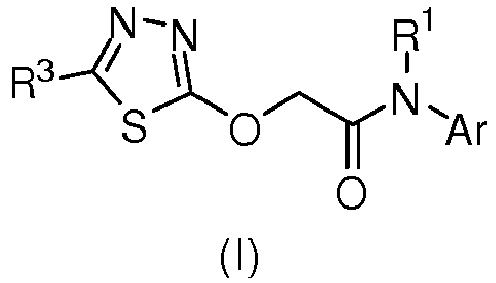
- wherein R1 is selected from the group consisting of H, optionally substituted branched or straight C1-C12-alkyl, optionally substituted C3-8 cycloalkyl, optionally substituted aryl, optionally substituted heterocycloalkyl, and optionally substituted heteroaryl, and wherein Ar is an optionally substituted aryl or heteroaryl group,
- wherein R3 is selected from the group consisting of optionally substituted C1-C12-alkyl, optionally substituted C3-8 cycloalkyl, optionally substituted heterocycloalkyl, and optionally substituted heteroaryl, -CN and -COOR4, wherein R4 selected from H and a C1 to C4 alkyl group
- wherein a compound of formula (II), wherein R1 and Ar are defined as above,
- The invention also concerns a process for the manufacture of a compound of formula (II) wherein Y is O and R2 is a residue of formula (IV), wherein a compound of formula (VI) is reacted with a compound of formula (VII) and (VIII)

- wherein R1, Ar and R3 are defined as below, X is selected from Cl, Br and F, Y is S or O,
- R5 is selected from the group consisting of H, optionally substituted branched or straight C1-C12-alkyl, optionally substituted C3-8 cycloalkyl, optionally C6 - aryl optionally substituted heterocycloalkyl, and optionally substituted heteroaryl
- R6 is selected from H and optionally substituted branched or straight C1-C12-alkyl, or R6 is a metal ion to form a thiolate group with the sulphur atom.
- Another object of the present invention is a process for the manufacture of a compound of formula (VI), wherein a compound of formula (IX) is reacted with a compound of formula (X)

- Yet another object of the present invention is a process for the manufacture of a compound of formula (II) wherein Y is S and R2 is a residue of formula (III), wherein a compound of formula (II) wherein Y is S and R2 is a residue of formula (V) is reacted with a compound of formula (VIII)

- The invention further concerns a process for the manufacturing of an agriculturally or pharmaceutically active compound or a composition comprising an agriculturally or pharmaceutically active compound, which comprises at least one of the processes according to the present invention , in particular wherein the agriculturally active compound is N-(4-Fluorophenyl)-N-isopropyl-2-{[5-(trifluoromethyl)-1,3,4-thiadiazol-2-yl]oxy}acetamide or a precursor thereof. In the present invention, designations in singular are in intended to include the plural; for example, "a solvent" is intended to denote also "more than one solvent" or "a plurality of solvents".
All aspects and embodiments of the present invention are combinable. - In the context of the present invention, the term "comprising" is intended to include the meaning of "consisting of'.
- When a double bond is depicted in a particular E/Z geometry, this is intended to also denote the other geometric form as well as mixtures thereof.
- Generally, in the present invention, basic compounds, such as the compound of formula H2NNH2 or (XIII), can also be used in their form as a salt, for example in the form of a hydrogen halide salt.
- In the context of the present invention, the term "C1-C12-alkyl" is intended to denote straight or branched alkyl groups having one to twelve carbon atoms. The group comprises, for example, methyl, ethyl, n-propyl, isopropyl, n-, iso-, sec- and t-butyl, n-pentyl and its isomers, n-hexyl and its isomers, 1,3-dimethylbutyl, 3,3-dimethylbutyl, n-heptyl and its isomers, n-octyl and its isomers, n-nonyl and its isomers, n-decyl and its isomers, n-undecyl and its isomers and n-dodecyl and its isomers. Often, the C1 to C4 alkyl groups are the most preferred groups of the C1-C12 alkyl group. The term "C1-C4-alkyl" is intended to denote straight or branched alkyl groups having one to four carbon atoms. This group comprises methyl, ethyl, n-propyl, isopropyl, n-, iso-, sec- and t-butyl.
- The term "C3-C8 cycloalkyl group" intends to denote mono-, bi- or tricyclic hydrocarbon groups comprising 3 to 10 carbon atoms, especially 3 to 6 carbon atoms. Examples of monocyclic groups include cyclopropyl, cyclobutyl, cyclopentyl, cyclohexyl, cycloheptyl or cyclooctyl. Examples of bicyclic groups include bicyclo[2.2.1]heptyl, bicyclo[3.1.1]heptyl, bicyclo[2.2.2]octyl and bicyclo[3.2.1]octyl. Examples of tricyclic groups are adamantyl and homoadamantyl.
- The term "aryl group" intends to denote C5-C18 monocyclic and polycyclic aromatic hydrocarbons with 5 to 18 carbon atoms in the cyclic system. Specifically, this definition comprises, for example, the meanings cyclopentadienyl, phenyl, cycloheptatrienyl, cyclooctatetraenyl, naphthyl and anthracenyl.
- In the context of the present invention, the term "heteroaryl" intends to denote C5-C18 monocyclic and polycyclic aromatic hydrocarbons with 5 to 18 carbon atoms in the cyclic system, wherein one or more methine (-C=) and/or vinylene (-CH=CH-) groups are replaced by trivalent or divalent heteroatoms, in particular nitrogen, oxygen and/or sulphur, respectively, in such a way as to maintain the continuous π-electron system characteristic of aromatic systems. Specifically, this definition comprises, for example, the meanings 2-furyl, 3-furyl, 2-thienyl, 3-thienyl, 2-pyrrolyl, 3-pyrrolyl, 3-isoxazolyl, 4-isoxazolyl, 5-isoxazolyl, 3-isothiazolyl, 4-isothiazolyl, 5-isothiazolyl, 3-pyrazolyl, 4-pyrazolyl, 5-pyrazolyl, 2-oxazolyl, 4-oxazolyl, 5-oxazolyl, 2-thiazolyl, 4-thiazolyl, 5-thiazolyl, 2-imidazolyl, 4-imidazolyl, 1,2,4-oxadiazol-3-yl, 1,2,4-oxadiazol-5-yl, 1,2,4-thiadiazol-3-yl, 1,2,4-thiadiazol-5-yl, 1,2,4-triazol-3-yl, 1,3,4-oxadiazol-2-yl, 1,3,4-thiadiazol-2-yl and 1,3,4-triazol-2-yl; 1-pyrrolyl, 1-pyrazolyl, 1,2,4-triazol-1-yl, 1-imidazolyl, 1,2,3-triazol-1-yl, 1,3,4-triazol-1-yl; 3-pyridazinyl, 4-pyridazinyl, 2-pyrimidinyl, 4-pyrimidinyl, 5-pyrimidinyl, 2-pyrazinyl, 1,3,5-triazin-2-yl and 1,2,4-triazin-3-yl.
- A C1-C4 alkyl group, C1-C12 alkyl group, C3-C8 cycloalkyl group, aryl or heteroaryl group each can be optionally substituted by one or more substituents of the following group consisting of R', -X", -OR', -SR', -NR'2, -SiR'3, -COOR', - (C-O)R', -CN and -CONR'2, wherein R' is selected independently, from the group consisting of hydrogen or C1-C12-alkyl group and X" is selected from the group consisting of F, Cl, Br, or I.
- In its broadest aspect, the invention this concerns a process for the manufacture of a compound of formula (I)

- wherein R1 is selected from the group consisting of H, optionally substituted branched or straight C1-C12-alkyl, optionally substituted C3-8 cycloalkyl, optionally substituted aryl, optionally substituted heterocycloalkyl, and optionally substituted heteroaryl, and wherein Ar is an optionally substituted aryl or heteroaryl group,
- wherein R3 is selected from the group consisting of optionally substituted C1-C12-alkyl, optionally substituted C3-8 cycloalkyl, optionally substituted heterocycloalkyl, and optionally substituted heteroaryl, -CN and -COOR4, wherein R4 selected from H and a C1 to C4 alkyl group wherein a compound of formula (II) wherein R1 and Ar are defined as above
- In step a), the compound of formula (II), wherein Y is S and R2 is a residue of formula (III), is cyclized in the presence of a carboxylic acid anhydride, a water removing agent or a base to form the compound of formula (II)

- The base that can be present in the cyclization of formula (II), wherein Y is S and R2 is a residue of formula (III), can be an organic base, such as for example triethylamine or pyridine, or an inorganic base, such as for example KOH, NaOH, a metal alcoholate such as tBuOK, and LiOH. The preferred base is triethylamine. The carboxylic acid anhydride that can be present in the cyclization of formula II), wherein Y is S and R2 is a residue of formula (III) can be an unsubstituted carboxylic acid anhydride, for example acetic acid anhydride, or a substituted carboxylic anhydride, for example trifluoroacetic acid anhydride. Carboxylic acid anhydrides derived from optionally substituted C1-4 carboxylic acids are preferred. The water removing agent that can be present in the cyclization of formula (II), wherein Y is S and R2 is a residue of formula (III), can be selected, for example, from the group consisting of sulphuric acid, oleum, toluenesulfonic acid, orthoformates such as triethylorthoformate, zeolites, silica gel, NH4OAc, molecular sieves and P2O5.
- In step b), the compound of formula (II), wherein Y is O and R2 is a residue of formula (IV) is reacted with hydrazine

- In the reaction of (II) wherein Y is O and R2 is a residue of formula (IV) with hydrazine, optionally, a base can be present. "A base", in this context, denotes a base other than H2NNH2, which chemically also could be considered to be a base. « A base » can be, for example, an organic base, such as for example triethylamine or pyridine, or an inorganic base, such as for example KOH, tBuOK, NaOH or LiOH. It can be advantageous to convert hydrazine into a hydrazone by reaction with an aldehyde or ketone, such as benzaldehyde or acetone, prior to the reaction with (II), in order to enhance selectivity in the addition to the desired C(O) function in (II). In this aspect, it is advantageous if an acidic catalyst is present when the hydrazone-(II) product is cyclized, for example HCI or Na2SO4.
- In step c), the compound of formula (II), wherein Y is S and R2 is a residue of formula (V) is cyclized in the presence of a carboxylic acid anhydride of formula R3C(O)-O-C(O)R3

- In the cyclization reaction of (II) wherein Y is S and R2 is a residue of formula (V) in the presence of a carboxylic acid anhydride of formula R3C(O)-O-C(O)R3, optionally, a base can be present. A suitable base can be, for example, an organic base, such as for example triethylamine or pyridine, or an inorganic base, such as for example KOH, tBuOK, NaOH or LiOH. The preferred carboxylic acid anhydride of formula R3C(O)-O-C(O)R3 is trifluoroacetic acid anhydride.
- Another object of the present invention is a process for the manufacture of a compound of formula (II) wherein Y is O and R2 is a residue of formula (IV), wherein a compound of formula (VI) is reacted with a compound of formula (VII) and (VIII)

- wherein R1, Ar and R3 are defined as above, X is selected from Cl, Br and F, Y is O,
- R5 is selected from the group consisting of H, optionally substituted branched or straight C1-C12-alkyl, optionally substituted C3-8 cycloalkyl, optionally C6 - aryl optionally substituted heterocycloalkyl, and optionally substituted heteroaryl, wherein methyl and ethyl are preferred
- R6 is selected from H and optionally substituted branched or straight C1-C12-alkyl, or R6 is a metal ion to form a thiolate group with the sulphur atom of (VII), wherein R6 preferably is H.
- In the process for the manufacture of a compound of formula (II) wherein Y is O and R2 is a residue of formula (IV), wherein a compound of formula (VI) is reacted with a compound of formula (VII) and (VIII), optionally a base can be present. A suitable base can be, for example, an organic base, such as for example triethylamine or pyridine, or an inorganic base, such as for example KOH, tBuOK, NaOH or LiOH.
- Another object of the present invention is a process for the manufacture of a compound of formula (II) wherein Y is O and R2 is a residue of formula (IV), wherein a compound of formula (VI) is reacted with a compound of formula (VII) and (VIII) of a compound of formula (VI), which further comprises a step for the manufacture of a compound of formula (VI), wherein a compound of formula (IX) is reacted with a compound of formula (X)

- The invention also concerns a process for the manufacture of a compound of formula (II) wherein Y is S and R2 is a residue of formula (III), wherein a compound of formula (II) wherein Y is S and R2 is a residue of formula (V) is reacted with a compound of formula (VIII)

- Another object of the present invention is a process for the manufacture of a compound of formula (II) wherein R2 is a residue of formula (V), wherein a compound of formula (VI) is treated successively with CS2, a base, a salt of acetic acid, and hydrazine . The base preferably is KOH. The salt of acetic acid preferably is sodium acetate.

- In all aspects and processes according to the present invention, R3 often is selected from a C1 to C4 alkyl group, which is preferably halogenated, and more preferably R3 is selected from CF2H and CF3. Likewise, in all aspects and processes according to the present invention, R1 is often selected from a C1 to C4 alkyl group, wherein preferably, R1 is an isopropyl group. Ar preferably is a substituted aryl group, more preferably an optionally substituted phenyl group, even more preferably a halogenated phenyl group, and most preferably a 4-fluorophenyl group.
- The invention also concerns a process for the manufacture of a compound of formula (I), wherein a compound of formula (II) is submitted to at least one cyclization step according to step a), b) or c), and which further comprises at least one of the processes for
- the manufacture of a compound of formula (II) wherein Y is O and R2 is a residue of formula (IV), wherein a compound of formula (VI) is reacted with a compound of formula (VII) and (VIII), which optionally further comprises a step for the manufacture of a compound of formula (VI), wherein a compound of formula (IX) is reacted with a compound of formula (X)
- the manufacture of a compound of formula (II) wherein Y is S and R2 is a residue of formula (III), wherein a compound of formula (II) wherein Y is S and R2 is a residue of formula (V) is reacted with a compound of formula (VIII)
- the manufacture of a compound of formula (II) wherein R2 is a residue of formula (V), wherein a compound of formula (VI) is treated successively with CS2, a base, a salt of acetic acid, and hydrazine
- Another object according to the present invention is a process for the manufacturing of an agriculturally or pharmaceutically active compound or a composition comprising an agriculturally or pharmaceutically active compound, which comprises at least one of the processes according to the present invention , in particular wherein the agriculturally active compound is N-(4-Fluorophenyl)-N-isopropyl-2-{[5-(trifluoromethyl)-1,3,4-thiadiazol-2-yl]oxy}acetamide or a precursor thereof.
- Should the disclosure of any patents, patent applications, and publications which are incorporated herein by reference conflict with the description of the present application to the extent that it may render a term unclear, the present description shall take precedence.
The following examples are intended to further explain the invention without limiting it. - The starting materials for the processes and steps according to the present invention can be obtained from commercial sources or can be manufactured according to procedures known from the public domain. The manufacture of compounds of formula (VI) is described, for example, in
EP0060426 . -

- 13.25 g trifluoroacetic acid chloride (0.1 mol) are added to a mixture of 15,9 g (0.15 mol) O-ethyl S-hydrogen carbonothioate and 1 g pyridine in 50 mL. The product, trifluoroacetyl ethoxycarbonyl sulphide, can be used in the following step as a crude product, or can be distilled to obtain a purer intermediary product. 10 g (0.1 mol) of the intermediary trifluoroacetyl ethoxycarbonyl sulphide is subsequently treated with N-(4-fluorophenyl)-2-hydroxy-N-isopropylacetamide in the presence of triethylamine. The 2,2,2-trifluoroacetic (2-((4-fluorophenyl)(isopropyl)amino)-2-oxoethyl carbonic) thioanhydride can be used in the next step as a crude product.
-

- 3.7 g (0.01 mol) 2,2,2-trifluoroacetic (2-((4-fluorophenyl)(isopropyl)-amino)-2-oxoethyl carbonic) thioanhydride is treated with 0.01 mol hydrazine hydrochloride in dichloromethane. Flufenacet is obtained after workup, such as recrystallization, in good yields and purity.


Claims (15)
- Process for the manufacture of a compound of formula (I)
 wherein R1 is selected from the group consisting of H, optionally substituted branched or straight C1-C12-alkyl, optionally substituted C3-8 cycloalkyl, optionally substituted aryl, optionally substituted heterocycloalkyl, and optionally substituted heteroaryl, and wherein Ar is an optionally substituted aryl or heteroaryl group,wherein R3 is selected from the group consisting of optionally substituted C1-C12-alkyl, optionally substituted C3-8 cycloalkyl, optionally substituted heterocycloalkyl, and optionally substituted heteroaryl, -CN and -COOR4, wherein R4 selected from H and a C1 to C4 alkyl groupwherein a compound of formula (II) wherein R1 and Ar are defined as above

step a), the compound of formula (II), wherein Y is S and R2 is a residue of formula (III) is cyclized in the presence of a carboxylic acid anhydride, a water removing agent or a base to form the compound of formula (II)
step b), the compound of formula (II), wherein Y is O and R2 is a residue of formula (IV) is reacted with hydrazine
step c), the compound of formula (II), wherein Y is S and R2 is a residue of formula (V) is cyclized in the presence of a carboxylic acid anhydride of formula R3C(O)-O-C(O)R3
- Process according to claim 1, wherein R3 is selected from a C1 to C4 alkyl group, which is preferably halogenated.
- Process according to claim 2, wherein R3 is selected from CF2H and CF3.
- Process according to anyone of claims 1 to 3, wherein R1 is selected from a C1 to C4 alkyl group.
- Process according to claim 4, wherein R1 is an isopropyl group.
- Process according to anyone of claims 1 to 5, wherein in step c), the carboxylic acid anhydride is trifluoroacetic acid anhyride.
- Process according to anyone of claims 1 to 5, wherein in step a), the base is triethylamine.
- Process according to anyone of claims 1 to 7, wherein Ar is a substituted aryl group, more preferably a 4-fluoro-phenylgroup.
- Process for the manufacture of a compound of formula (II) wherein Y is O and R2 is a residue of formula (IV), wherein a compound of formula (VI) is reacted with a compound of formula (VII) and (VIII)
 wherein R1, Ar and R3 are defined as in any one of the preceding claims, X is selected from Cl, Br and F, Y is S or O,R5 is selected from the group consisting of H, optionally substituted branched or straight C1-C12-alkyl, optionally substituted C3-8 cycloalkyl, optionally C6 - aryl optionally substituted heterocycloalkyl, and optionally substituted heteroarylR6 is selected from H and optionally substituted branched or straight C1-C12-alkyl, or R6 is a metal ion to form a thiolate group.
 - Process according to claim 9, which further comprises a step for the manufacture of a compound of formula (VI), wherein a compound of formula (IX) is reacted with a compound of formula (X)

- Process for the manufacture of a compound of formula (II) wherein Y is S and R2 is a residue of formula (III), wherein a compound of formula (II) wherein Y is S and R2 is a residue of formula (V) is reacted with a compound of formula (VIII)

- Process for the manufacture of a compound of formula (II) wherein R2 is a residue of formula (V), wherein a compound of formula (VI) is treated successively with CS2, a base, a salt of acetic acid, and hydrazine.
- Process for the manufacture of a compound of formula (I), which comprises at least one of the processes of claim 9 to 12.
- Process for the manufacturing of an agriculturally or pharmaceutically active compound or a composition comprising an agriculturally or pharmaceutically active compound, which comprises at least one of the processes according to anyone of claims 1 to 13.
- Process according to claim 14, wherein the agriculturally active compound is N-(4-Fluorophenyl)-N-isopropyl-2-{[5-(trifluoromethyl)-1,3,4-thiadiazol-2-yl]oxy}acetamide or a precursor thereof.
Priority Applications (1)
| Application Number | Priority Date | Filing Date | Title |
|---|---|---|---|
| EP17175754.5A EP3415507A1 (en) | 2017-06-13 | 2017-06-13 | Process for the manufacture of aryl-thiadiazole-acetamide compounds |
Applications Claiming Priority (1)
| Application Number | Priority Date | Filing Date | Title |
|---|---|---|---|
| EP17175754.5A EP3415507A1 (en) | 2017-06-13 | 2017-06-13 | Process for the manufacture of aryl-thiadiazole-acetamide compounds |
Publications (1)
| Publication Number | Publication Date |
|---|---|
| EP3415507A1 true EP3415507A1 (en) | 2018-12-19 |
Family
ID=59055104
Family Applications (1)
| Application Number | Title | Priority Date | Filing Date |
|---|---|---|---|
| EP17175754.5A Withdrawn EP3415507A1 (en) | 2017-06-13 | 2017-06-13 | Process for the manufacture of aryl-thiadiazole-acetamide compounds |
Country Status (1)
| Country | Link |
|---|---|
| EP (1) | EP3415507A1 (en) |
Cited By (2)
| Publication number | Priority date | Publication date | Assignee | Title |
|---|---|---|---|---|
| GB2589919A (en) * | 2019-12-13 | 2021-06-16 | Rotam Agrochem Int Co Ltd | Novel crystalline forms of flufenacet, methods for their preparation and use of the same |
| GB2592888A (en) * | 2019-12-13 | 2021-09-15 | Rotam Agrochem Int Co Ltd | Novel crystalline forms of Flufenacet, methods for their preparation and use of the same |
Citations (6)
| Publication number | Priority date | Publication date | Assignee | Title |
|---|---|---|---|---|
| EP0060426A2 (en) | 1981-03-13 | 1982-09-22 | Bayer Ag | N-(2,2,2-trifluoroethyl)-N-alkyl-azolyloxyacetic-acid amides, their preparation and use as herbicides and intermediates for their preparation |
| US4581175A (en) * | 1984-01-04 | 1986-04-08 | Bayer Aktiengesellschaft | N'-acylhydrazine-N-thiocarboxylic acid O-carbamoylmethyl esters |
| US4658025A (en) * | 1984-01-04 | 1987-04-14 | Bayer Aktiengesellschaft | Hydrazine-thiocarboxylic acid O-carbamoylmethyl esters |
| US4708731A (en) * | 1984-01-04 | 1987-11-24 | Bayer Aktiengesellschaft | Novel 5-halogenoalkyl-1,3,4-thiadiazol-2-yloxyacetamide herbicides and fungicides |
| US5792872A (en) | 1997-12-12 | 1998-08-11 | Bayer Corporation | Process for producing N-(4-fluorophenyl)-N-(1-methylethyl)-2- (5-trifluoromethyl-1,3,4-thiadiazol-2-yl)oxy!acetamide |
| EP2947075A1 (en) * | 2013-02-05 | 2015-11-25 | Zhejiang Zhuji United Chemicals Co., Ltd | Synthesis method of thiadiazolylamide derivative |
-
2017
- 2017-06-13 EP EP17175754.5A patent/EP3415507A1/en not_active Withdrawn
Patent Citations (6)
| Publication number | Priority date | Publication date | Assignee | Title |
|---|---|---|---|---|
| EP0060426A2 (en) | 1981-03-13 | 1982-09-22 | Bayer Ag | N-(2,2,2-trifluoroethyl)-N-alkyl-azolyloxyacetic-acid amides, their preparation and use as herbicides and intermediates for their preparation |
| US4581175A (en) * | 1984-01-04 | 1986-04-08 | Bayer Aktiengesellschaft | N'-acylhydrazine-N-thiocarboxylic acid O-carbamoylmethyl esters |
| US4658025A (en) * | 1984-01-04 | 1987-04-14 | Bayer Aktiengesellschaft | Hydrazine-thiocarboxylic acid O-carbamoylmethyl esters |
| US4708731A (en) * | 1984-01-04 | 1987-11-24 | Bayer Aktiengesellschaft | Novel 5-halogenoalkyl-1,3,4-thiadiazol-2-yloxyacetamide herbicides and fungicides |
| US5792872A (en) | 1997-12-12 | 1998-08-11 | Bayer Corporation | Process for producing N-(4-fluorophenyl)-N-(1-methylethyl)-2- (5-trifluoromethyl-1,3,4-thiadiazol-2-yl)oxy!acetamide |
| EP2947075A1 (en) * | 2013-02-05 | 2015-11-25 | Zhejiang Zhuji United Chemicals Co., Ltd | Synthesis method of thiadiazolylamide derivative |
Non-Patent Citations (1)
| Title |
|---|
| ARYANASAB F ET AL: "Dithiocarbamate as an efficient intermediate for the synthesis of 2-amino-1,3,4-thiadiazoles in water", TETRAHEDRON LETTERS, ELSEVIER, AMSTERDAM, NL, vol. 51, no. 5, 3 February 2010 (2010-02-03), pages 790 - 792, XP026824861, ISSN: 0040-4039, [retrieved on 20091127] * |
Cited By (3)
| Publication number | Priority date | Publication date | Assignee | Title |
|---|---|---|---|---|
| GB2589919A (en) * | 2019-12-13 | 2021-06-16 | Rotam Agrochem Int Co Ltd | Novel crystalline forms of flufenacet, methods for their preparation and use of the same |
| WO2021115493A3 (en) * | 2019-12-13 | 2021-07-15 | Jiangsu Rotam Chemistry Co., Ltd | Novel crystalline forms of flufenacet, methods for their preparation and use of the same |
| GB2592888A (en) * | 2019-12-13 | 2021-09-15 | Rotam Agrochem Int Co Ltd | Novel crystalline forms of Flufenacet, methods for their preparation and use of the same |
Similar Documents
| Publication | Publication Date | Title |
|---|---|---|
| JP6676038B2 (en) | Process for the preparation of 5-fluoro-1H-pyrazoles starting from hexafluoropropene | |
| US20210040043A1 (en) | Halogen substituted diketones, pyrazole compounds and processes for the manufacture of pyrazole compounds | |
| KR102140620B1 (en) | Procedure for the decarboxylation of 3,5-bis(haloalkyl)-pyrazole-4-carboxylic acid derivatives | |
| US20210371386A1 (en) | Manufacture of hydrazinyl compounds useful in the manufacture of pyrazole carboxylic acid and derivatives, hydrazinyl compounds and their use | |
| EP3415506A1 (en) | Process for the manufacture of haloalkyl substituted thiadiazole compounds | |
| TWI651306B (en) | Method for preparing 3,5-bis(haloalkyl)pyrazole derivatives from α,α-dihaloamines and ketimines | |
| BR112016010413B1 (en) | process for preparing 3,5-bis (haloalkyl) pyrazole derivatives from a, a-dihaloamines | |
| US20210179563A1 (en) | Process for the manufacture of iminium compounds and their application in the manufacture of pyrazole derivatives | |
| WO2022259210A1 (en) | Novel process for preparation of 1-methyl-3-(trifluoromethyl)-1h-pyrazol-5-ol | |
| US20200407304A1 (en) | Process and intermediate for the manufacture of difluoroacetyl chloride | |
| TWI669292B (en) | Process for preparing 3,5-bis(haloalkyl)pyrazoles via acylation of ketimines | |
| JP2002371067A (en) | Method for producing 1-methyl-5-hydroxypyrazole | |
| EP3412659A1 (en) | Processes for the manufacture of sulfur-substituted pyrazole derivatives | |
| CN101410386B (en) | 2-alkenyl-3-aminothiophene derivative and its preparation method | |
| WO2021175959A1 (en) | Process for the preparation of 5-chloro-3-alkylsulfanyl-pyridine-2-carboxylic acid amides and carboxylates | |
| US20090088584A1 (en) | Process for preparing 3, 4-disubstituted phenylacetic acids and novel intermediates | |
| CN111587242A (en) | Process for producing pyrazole compound | |
| TWI692470B (en) | Method for preparing 3,5-bis(haloalkyl)pyrazole derivative by hydrazone acetylation | |
| CN110003111A (en) | A kind of preparation method of 2- aryl -3- ether -3- pyrazoles acrylonitrile compound | |
| US10710972B2 (en) | Method for preparing substituted 2,3-dihydro-1-benzofuran derivatives | |
| CN101108837A (en) | The method for preparing halogenated allyl furfuryl alcohol | |
| HK1129656A (en) | Process for preparing 3, 4-disubstituted phenylacetic acids and novel intermediates | |
| HU196958B (en) | Process for producing derivatives of hydrazine-thiocarboxylic acid-o-carbamoyl-methyl-esters |
Legal Events
| Date | Code | Title | Description |
|---|---|---|---|
| PUAI | Public reference made under article 153(3) epc to a published international application that has entered the european phase |
Free format text: ORIGINAL CODE: 0009012 |
|
| AK | Designated contracting states |
Kind code of ref document: A1 Designated state(s): AL AT BE BG CH CY CZ DE DK EE ES FI FR GB GR HR HU IE IS IT LI LT LU LV MC MK MT NL NO PL PT RO RS SE SI SK SM TR |
|
| AX | Request for extension of the european patent |
Extension state: BA ME |
|
| STAA | Information on the status of an ep patent application or granted ep patent |
Free format text: STATUS: THE APPLICATION IS DEEMED TO BE WITHDRAWN |
|
| 18D | Application deemed to be withdrawn |
Effective date: 20190620 |