EP3415496B1 - Process for preparing 1,2-benzenedimethanol compound - Google Patents
Process for preparing 1,2-benzenedimethanol compound Download PDFInfo
- Publication number
- EP3415496B1 EP3415496B1 EP16889770.0A EP16889770A EP3415496B1 EP 3415496 B1 EP3415496 B1 EP 3415496B1 EP 16889770 A EP16889770 A EP 16889770A EP 3415496 B1 EP3415496 B1 EP 3415496B1
- Authority
- EP
- European Patent Office
- Prior art keywords
- formula
- compound represented
- compound
- water
- added
- Prior art date
- Legal status (The legal status is an assumption and is not a legal conclusion. Google has not performed a legal analysis and makes no representation as to the accuracy of the status listed.)
- Active
Links
- 0 CC*c1c(CC)c(CC)c(*)c(*)c1* Chemical compound CC*c1c(CC)c(CC)c(*)c(*)c1* 0.000 description 5
Classifications
-
- C—CHEMISTRY; METALLURGY
- C07—ORGANIC CHEMISTRY
- C07C—ACYCLIC OR CARBOCYCLIC COMPOUNDS
- C07C303/00—Preparation of esters or amides of sulfuric acids; Preparation of sulfonic acids or of their esters, halides, anhydrides or amides
- C07C303/26—Preparation of esters or amides of sulfuric acids; Preparation of sulfonic acids or of their esters, halides, anhydrides or amides of esters of sulfonic acids
- C07C303/30—Preparation of esters or amides of sulfuric acids; Preparation of sulfonic acids or of their esters, halides, anhydrides or amides of esters of sulfonic acids by reactions not involving the formation of esterified sulfo groups
-
- C—CHEMISTRY; METALLURGY
- C07—ORGANIC CHEMISTRY
- C07C—ACYCLIC OR CARBOCYCLIC COMPOUNDS
- C07C303/00—Preparation of esters or amides of sulfuric acids; Preparation of sulfonic acids or of their esters, halides, anhydrides or amides
- C07C303/24—Preparation of esters or amides of sulfuric acids; Preparation of sulfonic acids or of their esters, halides, anhydrides or amides of esters of sulfuric acids
-
- C—CHEMISTRY; METALLURGY
- C07—ORGANIC CHEMISTRY
- C07C—ACYCLIC OR CARBOCYCLIC COMPOUNDS
- C07C309/00—Sulfonic acids; Halides, esters, or anhydrides thereof
- C07C309/63—Esters of sulfonic acids
- C07C309/64—Esters of sulfonic acids having sulfur atoms of esterified sulfo groups bound to acyclic carbon atoms
- C07C309/65—Esters of sulfonic acids having sulfur atoms of esterified sulfo groups bound to acyclic carbon atoms of a saturated carbon skeleton
-
- C—CHEMISTRY; METALLURGY
- C07—ORGANIC CHEMISTRY
- C07C—ACYCLIC OR CARBOCYCLIC COMPOUNDS
- C07C309/00—Sulfonic acids; Halides, esters, or anhydrides thereof
- C07C309/63—Esters of sulfonic acids
- C07C309/64—Esters of sulfonic acids having sulfur atoms of esterified sulfo groups bound to acyclic carbon atoms
- C07C309/65—Esters of sulfonic acids having sulfur atoms of esterified sulfo groups bound to acyclic carbon atoms of a saturated carbon skeleton
- C07C309/66—Methanesulfonates
-
- C—CHEMISTRY; METALLURGY
- C07—ORGANIC CHEMISTRY
- C07D—HETEROCYCLIC COMPOUNDS
- C07D417/00—Heterocyclic compounds containing two or more hetero rings, at least one ring having nitrogen and sulfur atoms as the only ring hetero atoms, not provided for by group C07D415/00
- C07D417/14—Heterocyclic compounds containing two or more hetero rings, at least one ring having nitrogen and sulfur atoms as the only ring hetero atoms, not provided for by group C07D415/00 containing three or more hetero rings
Definitions
- the present invention relates to a process for preparing 1,2-benzenedimethanol compound.
- Processes for preparing 1,2-benzenedimethanol compound that have been reported to date include: a method of reacting phthalic acid, phthalic anhydride or phthalide with strong reductants, such as lithium aluminum hydride, borane, or sodium borohydride; and a method of treating 1,2-bishalomethylbenzene in a basic aqueous solution (NPL1 to NPL3).
- NPL1 to NPL3 a basic aqueous solution
- an industrial production of the compound by the former method is disadvantageous in that it requires treatment of secondary aluminum compound products as well as performing production under a water-prohibiting condition
- an industrial production of the compound by the latter method is disadvantageous in that it frequently leads to undesired decomposition of functional groups and generation of an untargeted secondary product, phthalan.
- US 2009/298894 A1 discloses the reaction of 1,2-bis(acetoxymethyl)-5-hydroxy-3-methylbenzene with N-phenylbis(trifluoromethanesulfonimide), to form 1,2-bis(acetoxymethyl)-3-methyl-5-trifluoromethanesulfonyloxybenzene.
- US 2001/051620 A1 Bayer Dan M et al.
- the object of the present invention is to provide a process for efficiently preparing a 1,2-benzenedimethanol compound constituting a synthetic intermediate of a piperidine derivative, which is effective as a fungicidal crop protectant.
- the present inventors carried out extensive studies to solve the above problem and found a process for efficiently preparing a 1,2-benzenedimethanol compound represented by Formula [1], and completed the present invention based on the finding.
- the present invention encompasses the following preparation processes of compounds.
- Formula [1] provides a general definition of a 1,2-benzenedimethanol compound that may be prepared by the present invention.
- a preferable definition of the groups associated with the formulae shown above and below are provided hereafter. The definition is applied to the final product represented by Formula [1], and also to all intermediates.
- X 1 is -OS(O) 2 R 1
- X 2 , X 3 and X 4 are each independently a hydrogen atom, nitro, a halogen atom, difluoromethoxy or -OS(O) 2 Me
- X 1 is particularly preferably -OS(O) 2 Me,-OS(O) 2 Et, -OS(O) 2 n-Pr, -OS(O) 2 i-Pr, -OS(O) 2 c-Pr, -OS(O) 2 n-Bu, -OS(O) 2 n-C 8 H 17 ,-OS(O) 2 CH 2 CH 2 CF 3
- X 2 and X 3 are particularly preferably hydrogen atoms
- X 4 is preferably a hydrogen atom, nitro, a halogen atom, difluoromethoxy or -OS(O) 2 Me, most preferably, X 1 is -OS(O) 2 Me, and most preferably, X 4 is is
- R 1 is C 1 -C 8 alkyl, C 1 -C 8 haloalkyl or C 3 -C 6 cycloalkyl, and preferably methyl.
- L 1 and L 2 are each independently, a halogen atom, preferably, a chlorine atom or a bromine atom, and in particular, preferably a bromine atom.
- each range may be combined with the preferable range. This rule is applied to both the final product and the corresponding precursor and intermediate.
- One preferable aspect is a compound represented by Formula [1] (wherein, at least one of X 1 , X 2 , X 3 and X 4 is -OS(O) 2 Me).
- Another preferable aspect is a compound represented by Formula [1] (wherein, X 1 is -OS(O) 2 Me, and X 2 , X 3 and X 4 are hydrogen atoms).
- Another preferable aspect is a compound represented by Formula [1] (wherein, X 1 is -OS(O) 2 Et, and X 2 , X 3 and X 4 are hydrogen atoms).
- Another preferable aspect is a compound represented by Formula [1] (wherein, X 1 is -OS(O) 2 n-Pr, and X 2 , X 3 and X 4 are hydrogen atoms).
- Another preferable aspect is a compound represented by Formula [1] (wherein, X 1 is -OS(O) 2 i-Pr, and X 2 , X 3 and X 4 are hydrogen atoms).
- Another preferable aspect is a compound represented by Formula [1] (wherein, X 1 is -OS(O) 2 c-Pr, and X 2 , X 3 and X 4 are hydrogen atoms).
- Another preferable aspect is a compound represented by Formula [1] (wherein, X 1 is -OS(O) 2 n-Bu, and X 2 , X 3 and X 4 are hydrogen atoms).
- Another preferable aspect is a compound represented by Formula [1] (wherein, X 1 is -OS(O) 2 n-C 8 H 17 , and X 2 , X 3 and X 4 are hydrogen atoms).
- Another preferable aspect is a compound represented by Formula [1] (wherein, X 1 is -OS(O) 2 CH 2 CH 2 CF 3 , and X 2 , X 3 and X 4 are hydrogen atoms).
- Another preferable aspect is a compound represented by Formula [1] (wherein, X 1 is -OS(O) 2 Me, X 2 and X 3 are hydrogen atoms, and X 4 is nitro).
- Another preferable aspect is a compound represented by Formula [1] (wherein, X 1 is -OS(O) 2 Me, X 2 and X 3 are hydrogen atoms, and X 4 is a fluorine atom).
- Another preferable aspect is a compound represented by Formula [1] (wherein, X 1 is -OS(O) 2 Me, X 2 and X 3 are hydrogen atoms, and X 4 is a chlorine atom).
- Another preferable aspect is a compound represented by Formula [1] (wherein, X 1 is -OS(O) 2 Me, X 2 and X 3 are hydrogen atoms, and X 4 is a bromine atom).
- Another preferable aspect is a compound represented by Formula [1] (wherein, X 1 is -OS(O) 2 Me, X 2 and X 3 are hydrogen atoms, and X 4 is an iodine atom).
- Another preferable aspect is a compound represented by Formula [1] (wherein, X 1 is -OS(O) 2 Me, X 2 and X 3 are hydrogen atoms, and X 4 is difluoromethoxy).
- Another preferable aspect is a compound represented by Formula [1] (wherein, X 1 and X 4 are -OS(O) 2 Me, and X 2 and X 3 are hydrogen atoms).
- Halogen atom encompasses a fluorine atom, a chlorine atom, a bromine atom or an iodine atom.
- the notation consisting of a chemical symbol and a subscript figure as exemplified by C 1 -C 6 indicates that the number of the subject element in the group following said notation is in the range shown by the subscript figure. For example, the number of carbons in the given case is 1 to 6, and the number of carbons in C 2 -C 6 is 2 to 6.
- a name of a composite substituent follows the notation consisting of a chemical symbol and a subscript figure, such as C 1 -C 6 , the notation shows that the number of the subject element in the entire composite substituent is in the range shown by the subscript figure.
- the number of carbons in the entire alkylcarbonyl is 2 to 6, including a propyl carbonyl group.
- Alkyl means a straight chain or a branched chain alkyl with a number of carbons of 1 to 8, preferably 1 to 6, unless otherwise specified. Examples include groups such as methyl, ethyl, n-propyl, isobutyl, n-butyl, sec-butyl, isobutyl, tert-butyl, n-pentyl, 1-methylbutyl, 2-methylbutyl, 3-methylbutyl, 1-ethylpropyl, 1,1-dimethylpropyl, 1,2-dimethylpropyl, neopentyl, n-hexyl, 1-methylpentyl, 2-methylpentyl, 3-methylpentyl, 4-methylpentyl, 1-ethylbutyl, 2-ethylbutyl, 1,1-dimethylbutyl, 1,2-dimethylbutyl, 1,3-dimethylbutyl, 2,2-dimethylbutyl, 2,3-diimethyl
- alkyl that constitutes a part of a composite substituent such as haloalkyl, alkylthio, alkylcarbonyl.
- a composite substituent such as alkylcycloalkyl, which includes alkyl at the end
- specific section of the cycloalkyl may be independently mono-substituted or poly-substituted with the same or different alkyl.
- Cycloalkyl means a cycloalkyl having a branched chain with a number of carbons of 3 to 8, preferably 3 to 6, unless otherwise specified. Examples include groups such as cyclopropyl, 1-methylcyclopropyl, 2-methylcyclopropyl, cyclobutyl, cyclopentyl, cyclohexyl, 4,4-dimethylcyclohexyl. This definition is applied to cycloalkyl that constitutes a part of a composite substituent, such as halocycloalkyl.
- halo in "halo" (e.g. "haloalkyl”) encompasses fluorine, chlorine, bromine and iodine.
- the halo substitution indicated by the prefix "halo" encompasses a mono-substitution or a poly-substitution, preferably a mono-substitution, a di-substitution and a tri-substitution.
- Haloalkyl is a straight chain or branched chain alkyl with a carbon number of 1 to 6, having a part or all of hydrogen atoms on the group substituted by a halogen atom, unless otherwise specified.
- Examples include groups such as fluoromethyl, chloromethyl, bromomethyl, iodomethyl, difluoromethyl, dichloromethyl, dibromomethyl, diiodomethyl, trifluoromethyl, trichloromethyl, tribromomethyl, triiodomethyl, 1-chloroethyl, 1-bromoethyl, 2-trifluoroethyl, 3-chloropropyl, 3-bromopropyl, 4-chlorobutyl, 4-bromobutyl, 4-trifluorobutyl, 5-chloropentyl, 6-chlorohexyl. This definition is applied to haloalkyl that constitutes a part of a composite substituent, such as haloalkylcarbon
- Alkenyl means a straight chain or a branched chain alkenyl with a carbon number of 2 to 6, unless otherwise specified. Examples include groups such as vinyl, 1-propenyl, 2-propenyl, isopropenyl, 3-butenyl, 1,3-butadienyl, 4-pentenyl, 5-hexenyl. This definition is applied to alkenyl that constitutes a part of a composite substituent, such as haloalkenyl, unless defined otherwise.
- Alkynyl means a straight chain or a branched chain alkynyl with a carbon number of 2 to 6, unless otherwise specified. Examples include groups such as ethynyl, 1-propynyl, 2-propynyl, 3-butynyl, 1-methyl-3-propynyl, 4-pentynyl, 5-hexynyl. This definition is applied to alkynyl that constitutes a part of a composite substituent, such as haloalkynyl, unless defined otherwise.
- Alkoxy means a straight chain or a branched chain alkoxy with a carbon number of 1 to 6, unless otherwise specified. Examples include groups such as methoxy, ethoxy, propoxy, isopropoxy, butoxy, isobutoxy, sec-butoxy, tert-butoxy, pentyloxy, hexyloxy. This definition is applied to alkoxy that constitutes a part of a composite substituent, such as haloalkoxy, alkoxycarbonyl, unless defined otherwise.
- Haloalkoxy means a straight chain or a branched chain alkoxy with a carbon number of 1 to 6, substituted by one or more, preferably one to ten halogen atoms, unless otherwise specified. Examples include groups such as fluoromethoxy, chloromethoxy, bromomethoxy, iodomethoxy, difluoromethoxy, dichloromethoxy, dibromomethoxy, diiodomethoxy, trifluoromethoxy, trichloromethoxy, tribromomethoxy, triiodomethoxy, 1-chloroethoxy, 1-bromoethoxy, 2-trifluoroethoxy, 3-chloropropoxy, 3-bromopropoxy, 4-chlorobutoxy, 4-bromobutoxy, 4-trifluorobutoxy, 5-chloropentoxy, 6-chlorohexyloxy. This definition is applied to haloalkoxy that constitutes a part of a composite substituent, such as haloalkoxy
- Alkylthio means an (alkyl)-S-group with a carbon number of 1 to 6, in which the alkyl section is as indicated above, unless otherwise specified. Examples include groups such as methylthio, ethylthio, n-propylthio, isopropylthio. This definition is applied to alkylthio that constitutes a part of a composite substituent, such as haloalkylthio, unless defined otherwise.
- Alkylsulfinyl means an (alkyl)-SO-group with a carbon number of 1 to 6, in which the alkyl section is as indicated above, unless otherwise specified. Examples include groups such as methylsulfinyl, ethylsulfinyl, n-propylsulfinyl, isopropylsulfinyl. This definition is applied to alkylsulfinyl that constitutes a part of a composite substituent, such as haloalkylsulfinyl, unless defined otherwise.
- Alkylsulfonyl means an (alkyl)-SO 2 -group with a carbon number of 1 to 6, in which the alkyl section is as indicated above, unless otherwise specified. Examples include groups such as methylsulfonyl, ethylsulfonyl, n-propylsulfonyl, isopropylsulfonyl. This definition is applied to alkylsulfonyl that constitutes a part of a composite substituent, such as haloalkylsulfonyl, unless defined otherwise.
- Hydroalkyl means a straight chain or a branched chain alkyl group with a carbon number of 1 to 6, substituted by 1 to 5 hydroxy groups, unless otherwise specified. Examples include groups such hydroxymethyl, hydroxyethyl, hydroxypropyl or hydroxyisopropyl.
- the acid used in the reaction associated with the present invention is a Bronsted acid, which releases proton in the reaction system, unless otherwise specified.
- examples include inorganic acids such as hydrochloric acid, hydrobromic acid, sulfuric acid; and organic acids such as acetic acid, trifluoroacetic acid, p-toluenesulfonic acid, trifluoromethanesulfonic acid.
- "Lewis acid" used in a reaction of the present invention means a compound, other than the hydrogen ion, that acts as an electron pair receptor in a reaction system. Examples include zinc chloride, aluminum chloride, tin chloride, boron trichloride, boron trifluoride, trimethylsilyl trifluoromethanesulfonate.
- the base used in the present invention is a compound which receives proton in the reaction system, or a compound which acts as an electron pair donor in the reaction system, unless otherwise specified.
- examples include organic amines such as triethylamine, pyridine, 4-dimethylaminopyridine, N,N-dimethylaniline, 1,8-diazabicyclo[5,4,0]-7-undecen; metal carbonate salts such as sodium carbonate, potassium carbonate, magnesium carbonate, calcium carbonate; metal hydrogen carbonate salts such as sodium hydrogen carbonate, potassium hydrogen carbonate; and metal carboxylic acid salts represented by metal acetic acid salt such as sodium acetate, potassium acetate, calcium acetate, and magnesium acetate; metal alkoxides such as sodium methoxide, sodium ethoxide, sodium tert-butoxide, potassium methoxide, potassium tert-butoxide; metal hydroxides such as sodium hydroxide, potassium hydroxide, calcium hydroxide, magnesium hydroxide
- Ionic liquids as referred to herein include imidazolium salts such as 1-butyl-3-methylimidazolium tetrafluoroborate, 1-butyl-2,3-dimethylimidazolium tetrafluoroborate, 1-ethyl-3-methylimidazolium tetrafluoroborate, 1-hexyl-3-methylimidazolium tetrafluoroborate, 1-ethyl-3-methylimidazolium methanesulfonate, 1-butyl-3-methylimidazolium trifluoromethanesulfonate, 1-butyl-2,3-dimethylimidazolium trifluoromethanesulfonate, 1-ethyl-3-methylimidazolium trifluoromethanesulfonate, 1-hexyl-3-methylimidazolium trifluoromethanesulfonate; ammonium salts such as tetrabutylammonium fluoride
- Me indicates a methyl group
- Et indicates an ethyl group
- n-Pr indicates a n-propyl group
- i-Pr indicates an isopropyl group
- c-Pr indicates a cyclopropyl group
- n-Bu indicates a n-butyl group.
- the compound represented by Formula [1] may be prepared by a process consisting of a reaction formula exemplified below. (wherein, X 1 , X 2 , X 3 , X 4 , L 1 and L 2 are each as defined in (1) and (3).)
- the compound of Formula [3] may be prepared by reacting the compound of Formula [4] in a solvent under the presence of a halogenating reagent.
- the halogenating reagent that is applicable in this step includes chlorinating reagents such as chlorine, sulfuryl chloride, N-chlorosuccinimide; brominating reagents such as bromine and N-bromosuccinimide.
- radical initiator such as azoisobutyronitrile, and benzoyl peroxide
- the amount of halogenating reagent used in this step may be selected appropriately from a range of from 2.0 to 10 mol, preferably from 2.0 to 3.0 mol, against 1 mol of the compound of Formula [4].
- the solvent to be used in this step may be any solvent that does not inhibit the progress of the reaction.
- examples include nitriles such as acetonitrile; ethers such as diethyl ether, diisopropyl ether, tetrahydrofuran, dioxane, Monoglyme, Diglyme; halogenated hydrocarbons such as dichloromethane, dichloroethane, chloroform, carbon tetrachloride, tetrachloroethane; aromatic hydrocarbons such as benzene, chlorobenzene, nitrobenzene, toluene; amides such as N,N-dimethylformamide, N,N-dimethylacetoamide; imidazolidinones such as 1,3-dimethyl-2-imidazolinone; sulfur compounds such as dimethylsulfoxide.
- a mixture of these solvents may also be used.
- the amount of the solvent to be used may be selected appropriately from a range of from 0.01 to 100 L, preferably from 0.1 to 10 L, against 1 mol of the compound of Formula [4].
- the reaction temperature may be selected from a range of from -20°C to the boiling point range of the applied inert solvent, preferably from 0°C to 100°C.
- the reaction time is normally 10 min. to 48 h. although it differs by the reaction temperature, the reaction substrate, the reaction amount, etc.
- the compound of Formula [3], which is the reaction target, may be collected from the reaction system by a common method after the reaction completes, and purified by operations such as the column chromatography or recrystallization, etc. as necessary.
- the compound of Formula [3] obtained by this step may be used in the reaction of Step 2 without being isolated or purified.
- the compound of Formula [2] may be prepared by reacting the compound represented by Formula [3] in a solvent under the presence of a metal acetate salt.
- metal acetate salts used in this step include lithium acetate, sodium acetate and potassium acetate.
- the amount of metal acetate salts to be used in this step may be selected from a range of from 2.0 to 10 mol, preferably from 2.0 to 3.0 mol against 1 mol of the compound of Formula [3].
- the solvent to be used in this step includes a solvent as described in Step 1 of Preparation Process 1.
- the amount of solvent to be used may be selected from a range of from 0.01 to 100 L, preferably 0.1 to 10 L against 1 mol of the compound of Formula [3].
- the reaction temperature may be selected from a range of from -20°C to the boiling point range of the applied inert solvent, preferably 0°C to 100°C.
- the reaction time is normally 10 min. to 48 h. although it differs by the reaction temperature, the reaction substrate, the reaction amount, etc.
- the compound of Formula [2] obtained by this step may be collected from the reaction system by a common method, and purified by operations such as the column chromatography or recrystallization, etc. as necessary.
- the compound of Formula [2] obtained by this step may be used in the reaction of Step 3 without being isolated or purified.
- the compound of Formula [1] may be prepared by reacting the compound represented by Formula [2] in water and a solvent under the presence of acid, acid chloride or base.
- the acid that may be used in this step includes inorganic acids such as hydrochloric acid, hydrobromic acid, sulfuric acid; and organic acids such as acetic acid, trifluoroacetic acid, p-toluenesulfonic acid, trifluoromethanesulfonic acid.
- inorganic acids such as hydrochloric acid, hydrobromic acid, sulfuric acid
- organic acids such as acetic acid, trifluoroacetic acid, p-toluenesulfonic acid, trifluoromethanesulfonic acid.
- the amount of acid used may be selected appropriately from a range of from 0.1 to 10 mol, preferably from 0.1 to 5.0 mol, against 1 mol of the compound of Formula [2].
- the acid chloride used in this step includes acetyl chloride, and benzoyl chloride.
- the amount of acid chloride used may be selected appropriately from a range of from 0.1 to 10 mol, preferably from 0.1 to 5.0 mol, against 1 mol of the compound of Formula [2].
- the base that may be used in this step includes organic amines such as triethylamine, pyridine, 4-dimethylaminopyridine, N,N-dimethylaniline, 1,8- diazabicyclo [5,4,0]-7-undecen; metal carbonate salts such as sodium carbonate, potassium carbonate, magnesium carbonate, calcium carbonate; metal hydrogen carbonate salts such as sodium hydrogen carbonate, potassium hydrogen carbonate; and metal carboxylic acid salts represented by metal acetic acid salt such as sodium acetate, potassium acetate, calcium acetate, and magnesium acetate; metal alkoxides such as sodium methoxide, sodium ethoxide, sodium tert-butoxide, potassium methoxide, potassium tert-butoxide; metal hydroxides such as sodium hydroxide, potassium hydroxide, calcium hydroxide, magnesium hydroxide; and metal hydrides such as lithium hydride, sodium hydride, and calcium hydride.
- metal carbonate salts such as sodium carbonate,
- the amount of base used may be selected appropriately from a range of from 0.2 to 10 mol, preferably 0.2 to 5.0 mol against 1 mol of the compound of Formula [2].
- the solvent to be used in this step includes water and a solvent as described in Step 1 of Preparation Process 1.
- the amount of solvent used may be selected appropriately from a range of from 0.01 to 100 L, preferably 0.1 to 10 L against 1 mol of the compound of Formula [2].
- the amount of water used may be selected appropriately from a range of from 0.01 to 100 L, preferably 0.1 to 10 L against 1 mol of the compound of Formula [2].
- the reaction temperature may be selected from a range of from -20°C to the boiling point range of the applied inert solvent, preferably 0°C to 100°C.
- the reaction time is normally 10 min. to 48 h. although it differs by the reaction temperature, the reaction substrate, the reaction amount, etc.
- the compound of Formula [1], which is the reaction target, may be collected from the reaction system by a common method after the reaction completes, and purified by operations such as the column chromatography or recrystallization, etc. as necessary.
- the compound represented by Formula [1] may also be prepared by a process consisting of a reaction formula exemplified below. (wherein, X 1 , X 2 , X 3 , X 4 , L 1 and L 2 are each as defined in (1) and (3).)
- the compound of Formula [1] may be prepared by reacting the compound represented by Formula [3] in a solvent under the presence of a metal acetate salt (Step 1), and then adding alcohol, water and base to the reaction solution of Step 1 to react them (Step 2).
- the metal acetate salts that may be used in this step includes those as described in Step 2 of Preparation Process 1.
- the amount of metal acetate salt used in this step may be appropriately selected from a range of 2.0 to 10 mol, preferably 2.0 to 3.0 mol, against 1 mol of the compound of Formula [3].
- the solvent to be used in this step includes a solvent as described in Step 1 of Preparation Process 1.
- the amount of solvent to be used may be appropriately selected from a range of from 0.01 to 100 L, preferably 0.1 to 10 L against 1 mol of the compound of Formula [3].
- the reaction temperature may be selected from a range of from -20°C to the boiling point range of the applied inert solvent, preferably 0°C to 100°C.
- the reaction time is normally 10 min. to 48 h. although it differs by the reaction temperature, the reaction substrate, the reaction amount, etc.
- the compound of Formula [1] may be prepared by adding alcohol, water and base to the reaction solution of Step 1 of Preparation Process 2 to react them.
- the alcohol to be used in this step includes, for example, methanol or ethanol.
- the amount of alcohol to be used may be appropriately selected from a range of 0.01 to 100 L, preferably 0.1 to 10 L against 1 mol of the compound of Formula [3].
- the amount of water to be used may be appropriately selected from a range of 0.01 to 100 L, preferably 0.1 to 10 L against 1 mol of the compound of Formula [3].
- the base to be used in this step includes a base as described in Step 3 of Preparation Process 1.
- the amount of base to be used may be appropriately selected from a range of 0.2 to 10 mol, preferably 0.2 to 5.0 mol against 1 mol of the compound of Formula [3].
- the reaction temperature may be selected from a range of from -20°C to the boiling point range of the applied inert solvent, preferably 0°C to 100°C.
- the reaction time is normally 10 min. to 48 h. although it differs by the reaction temperature, the reaction substrate, the reaction amount, etc.
- the compound of Formula [1], which is the reaction target, may be collected from the reaction system by a common method after the reaction completes, and purified by operations such as the column chromatography or recrystallization, etc. as necessary.
- the compound represented by Formula [1] may also be prepared by a process consisting of a reaction formula exemplified below. (wherein, X 1 , X 2 , X 3 , X 4 , L 1 and L 2 are each as defined in (1) and (3).)
- the compound of Formula [1] may be prepared by reacting the compound of Formula [3] in water or a mixed solvent of water and an organic solvent under the absence of base, ionic liquid and metal sulfate salt, or preferably reacting the compound of Formula [3] in water or a mixed solvent of water and an organic solvent under the presence of base or metal sulfate salt, and more preferably reacting the compound of Formula [3] in water or a mixed solvent of water and an organic solvent.
- a base as referred to in this step includes organic amines such as triethylamine, pyridine, 4-dimethylaminopyridine, N,N-dimethylaniline, 1,8- diazabicyclo [5,4,0]-7-undecen; metal carbonate salts such as sodium carbonate, potassium carbonate, magnesium carbonate, calcium carbonate; metal hydrogen carbonate salts such as sodium hydrogen carbonate, potassium hydrogen carbonate; and metal carboxylic acid salts represented by metal acetic acid salt such as sodium acetate, potassium acetate, calcium acetate, and magnesium acetate; metal alkoxides such as sodium methoxide, sodium ethoxide, sodium tert-butoxide, potassium methoxide, potassium tert-butoxide; metal hydroxides such as sodium hydroxide, potassium hydroxide, calcium hydroxide, magnesium hydroxide; and metal hydrides such as lithium hydride, sodium hydride, and calcium hydride.
- metal carbonate salts such as sodium carbonate,
- a ionic liquid as referred to in this step includes imidazolium salts such as 1-butyl-3-methylimidazoliumtetrafluoroborate, 1-butyl-2,3-dimethylimidazoliumtetrafluoroborate, 1-ethyl-3-methylimidazoliumtetrafluoroborate, 1-hexyl-3-methylimidazoliumtetrafluoroborate, 1-ethyl-3-methylimidazoliummethane sulfonate, 1-butyl-3-methylimidazoliumtrifluoromethanesulfonate, 1-butyl-2,3-dimethylimidazoliumtrifluoromethanesulfonate, 1-ethyl-3-methylimidazoliumtrifluoromethanesulfonate, 1-hexyl-3-methylimidazoliumtrifluoromethanesulfonate; ammonium salts such as tetrabutylammonium fluoride,
- the metal sulfate salts to be used in this step includes copper (II) sulfate or iron (III) sulfate.
- the amount of metal sulfate salts to be used in this reaction may be appropriately selected from a range of 0 to 100 mol, preferably 0 to 1.0 mol against 1 mol of the compound of Formula [3].
- the solvent to be used in this step includes water and a solvent as described in Step 1 of Preparation Process 1.
- the amount of solvent to be used may be appropriately selected from a range of 0.01 to 100 L, preferably 0.1 to 10 L against 1 mol of the compound of Formula [3].
- the reaction temperature may be selected from a range of from -20°C to the boiling point range of the applied inert solvent, preferably 0°C to 100°C.
- the reaction time is normally 10 min. to 48 h. although it differs by the reaction temperature, the reaction substrate, the reaction amount, etc.
- the compound of Formula [1], which is the reaction target, may be collected from the reaction system by a common method after the reaction completes, and purified by operations such as the column chromatography or recrystallization, etc. as necessary..
- the subject compound may be prepared by Step 3A and Step 3B shown below.
- Step 3A Preparation of 1-methylsulfonyloxy-2,3-bis(chloromethyl)benzene
- Step 3B Alternative preparation of 1-methylsulfonyloxy-2,3-bis(acetyloxymethyl)benzene
- the subject compound may be prepared by Step 4A shown below.
- Step 4A Alternative preparation of 3-methylsulfonyloxy-1,2-benzenedimethanol
- water 5.6 mL
- the reaction solution was cooled to room temperature, then, extraction was performed using ethyl acetate.
- the organic layer was washed with a saturated saline solution, and dried with anhydrous sodium sulfate. After the inorganic matter was filtered out, the solvent was removed by distillation under reduced pressure to obtain the subject compound (325 mg, yield 100%).
- the subject compound may be prepared by Step 1A shown below as well.
- Step 1A Alternative preparation of 1-amino-2,3-dimethyl-4-methylsulfonyloxybenzene
- Step 2 Preparation of 2,3-dimethyl-4-methylsulfonyloxybenzenediazonium tetrafluorob orate
- the subject compound may also be prepared by Step 3A or Step 3B as shown below.
- Step 3A Alternative preparation of 1-fluoro-2,3-dimethyl-4-methylsulfonyloxybenzene
- Step 3B Alternative preparation of 1-fluoro-2,3-dimethyl-4-methylsulfonyloxybenzene
- 2,3-Dimethyl-4-fluorophenol 200 mg was dissolved in ethyl acetate (5 mL), to which triethylamine (174 mg) was added. Then, methanesulfonyl chloride (180 mg) was added at room temperature, and the mixture was stirred for 30 min. Water was added to the reaction solution, and extraction was performed using ethyl acetate. The organic layer was washed with water and a saturated saline solution, and dried with anhydrous sodium sulfate. After the inorganic matter was filtered out, the solvent was removed by distillation under reduced pressure to obtain the subject compound (290 mg, yield 93%).
- the subject compound may also be prepared by Step 5A and Step 5B shown below.
- Step 5A Preparation of 1-fluoro-2,3-bis(chloromethyl)-4-methylsulfonyloxybenzene
- Step 5B Alternative preparation of 1-fluoro-2,3-bis(acetyloxymethyl)-4-methylsulfonyloxy benzene
- the subject compound may also be prepared by Step 6A, 6B, 6C, 6D or 6E shown below.
- Step 6A Alternative preparation of 3-fluoro-6-methylsulfonyloxy-1,2-benzenedimethanol
- Step 6B Alternative preparation of 3-fluoro-6-methylsulfonyloxy-1,2-benzenedimethanol
- Step 6C Alternative preparation of 3-fluoro-6-methylsulfonyloxy-1,2-benzenedimethanol
- Step 6D Alternative preparation of 3-fluoro-6-methylsulfonyloxy-1,2-benzenedimethanol
- Step 6E Alternative preparation of 3-fluoro-6-methylsulfonyloxy-1,2-benzenedimethanol
- Step 3 Preparation of 1-chloro-2,3-bis(acetyloxymethyl)-4-methylsulfonyloxy benzene
- the subject compound may also be prepared by Step 4A shown below.
- Step 4A Alternative preparation of 3-chloro-6-methylsulfonyloxy-1,2-benzenedimethanol
- the subject compound may also be prepared by Step 4A shown below.
- Step 4A Alternative preparation of 3-bromo-6-methylsulfonyloxy-1,2-benzenedimethanol
- Step 1 Preparation of 1-iodo-2,3-dimethyl-4-methylsulfonyloxy benzene
- the subject compound may also be prepared by Step 4A shown below.
- Step 4A Alternative preparation of 3,6-bis(methylsulfonyloxy)-1,2-benzenedimethanol
- Example 10 Shown in Example 10 is a Production Example of the production starting material used in Examples 1 to 9.
- 2,3-Dimethyl-4-nitrosophenol 500 mg was suspended in methanol (10 mL), to which sodium tungstate dehydrate (54 mg) was added, and the reaction solution was heated to 60°C. To this solution was gradually added 30% hydrogen peroxide aqueous solution (563 mg), and the mixture was stirred at 60°C for 8 h. The reaction solution was cooled to room temperature, to which sodium sulfite and water were added, and the mixture was subjected to extraction using ethyl acetate. After the organic layer was dried with anhydrous sodium sulfate and the inorganic matter was filtered out, the solvent was removed by distillation under reduced pressure to obtain the subject compound (500 mg, yield 90%).
Landscapes
- Chemical & Material Sciences (AREA)
- Organic Chemistry (AREA)
- Chemical Kinetics & Catalysis (AREA)
- Plural Heterocyclic Compounds (AREA)
- Organic Low-Molecular-Weight Compounds And Preparation Thereof (AREA)
Description
- The present invention relates to a process for preparing 1,2-benzenedimethanol compound.
- Processes for preparing 1,2-benzenedimethanol compound that have been reported to date include: a method of reacting phthalic acid, phthalic anhydride or phthalide with strong reductants, such as lithium aluminum hydride, borane, or sodium borohydride; and a method of treating 1,2-bishalomethylbenzene in a basic aqueous solution (NPL1 to NPL3). However, an industrial production of the compound by the former method is disadvantageous in that it requires treatment of secondary aluminum compound products as well as performing production under a water-prohibiting condition, and an industrial production of the compound by the latter method is disadvantageous in that it frequently leads to undesired decomposition of functional groups and generation of an untargeted secondary product, phthalan. A more efficient improvement was thus awaited from the perspective of operability, economics, safety and acceptability of functional groups.
US 2009/298894 A1 (Ohmori Yutaka et al. ) discloses the reaction of 1,2-bis(acetoxymethyl)-5-hydroxy-3-methylbenzene with N-phenylbis(trifluoromethanesulfonimide), to form 1,2-bis(acetoxymethyl)-3-methyl-5-trifluoromethanesulfonyloxybenzene.US 2001/051620 A1 (Berger Dan M et al. ) discloses the preparation of 2-[(acetyloxy)methyl]-4-(2-chloroethoxy)-5-methoxybenzyl acetate, starting from the corresponding 1,2-bis(chloromethyl)benzene; and the transformation of the 2-[(acetyloxy)methyl]-4-(2-chloroethoxy)-5-methoxybenzyl acetate to the corresponding 1,2-phenylenedimethanol. -
- NPL1: J. Am. Chem. Soc. 1947, 69, 1197.
- NPL2: J. Am. Chem. Soc. 1949, 71, 122.
- NPL3: J. Org. Chem. 1990, 55, 2325.
- The object of the present invention is to provide a process for efficiently preparing a 1,2-benzenedimethanol compound constituting a synthetic intermediate of a piperidine derivative, which is effective as a fungicidal crop protectant.
- The present inventors carried out extensive studies to solve the above problem and found a process for efficiently preparing a 1,2-benzenedimethanol compound represented by Formula [1], and completed the present invention based on the finding.
- The present invention encompasses the following preparation processes of compounds.
- (1) A process for preparing a compound represented by Formula [1]:

- wherein, X1 is -OS(O)2R1, and X2, X3 and X4 are each independently a hydrogen atom, nitro, a halogen atom, difluoromethoxy, or -OS(O)2Me; and
- R1 is C1-C8 alkyl, C1-C8 haloalkyl or C3-C6 cycloalkyl the process comprising:
- a step of hydrolyzing a compound represented by Formula [2] under an acidic or basic condition:

- wherein, X1, X2, X3 and X4 are as defined for Formula [1].
- a step of hydrolyzing a compound represented by Formula [2] under an acidic or basic condition:
- (2) The process according to (1), wherein the basic condition is provided by a metal carbonate salt.
- (3) The process according to either (1) or (2), further comprising a step of reacting a compound represented by Formula [3] with a metal acetate salt:

- wherein, X1, X2, X3 and X4 are as defined in (1); and
- L1 and L2 are each independently a halogen atom to prepare the compound represented by Formula [2].
- (4) The process for preparing a compound represented by Formula [2]:

a step of reacting a compound represented by Formula [3] with a metal acetate salt:
- wherein, X1, X2, X3 and X4 are as defined in (1); and
- L1 and L2 are each independently a halogen atom.
- (5) The process according to (3) or (4), further comprising a step of halogenating a compound represented by Formula [4]:

- (6) A process for preparing a compound represented by Formula [3]:

- wherein, X1, X2, X3 and X4 are as defined in (1); and
- L1 and L2 are each independently a halogen atom
the process comprising:- a step of halogenating a compound represented by Formula [4]:

- wherein, X1, X2, X3 and X4 are as defined in (1), and
- wherein a halogenation reagent for the halogenation reaction is chlorine, sulfuryl chloride, or bromine.
- a step of halogenating a compound represented by Formula [4]:
- (7) The process according to (5), wherein a halogenation reagent for the halogenation reaction is a chlorination reagent such as chlorine, sulfuryl chloride, or N-chlorosuccinimide, or a bromination reagent such as bromine, or N-bromosuccinimide.
- (8) The process according to (3) comprising a step of reacting the compound represented by Formula [3] with a metal acetate salt to obtain the compound represented by Formula [2], and hydrolyzing the compound represented by Formula [2] without isolating the compound represented by Formula [2] under a basic condition to obtain the compound represented by Formula [1].
- (9) A process for preparing a compound represented by Formula [1]:

the process comprising:- a step of reacting a compound represented by Formula [3] under absence of a base, an ionic liquid and a metal sulfate salt, in water or a mixed solvent of water and an organic solvent; or under presence of a metal sulfate salt, in water or a mixed solvent of water and an organic solvent:
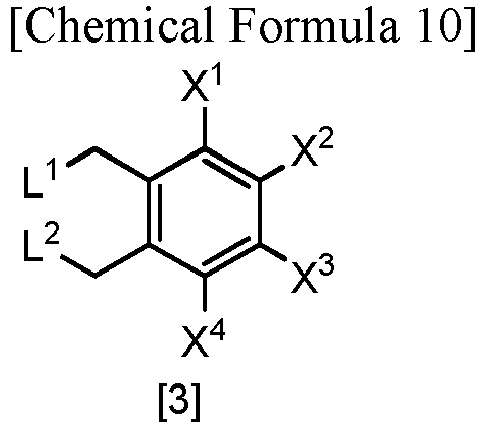
- wherein X1, X2, X3 and X4 are as defined in (1); and
- L1 and L2 are as defined in (3).
- a step of reacting a compound represented by Formula [3] under absence of a base, an ionic liquid and a metal sulfate salt, in water or a mixed solvent of water and an organic solvent; or under presence of a metal sulfate salt, in water or a mixed solvent of water and an organic solvent:
- (10) The process according to (9) wherein the reaction condition is provided by a step of performing a reaction in water or a mixed solvent of water and organic solvent under a presence of a metal sulfate salt.
- (13) The process according to any one of (1) to (10),
wherein X1 is -OS(O)2Me, -OS(O)2Et, -OS(O)2n-Pr, -OS(O)2i-Pr, -OS(O)2c-Pr, - OS(O)2n-Bu, -OS(O)2n-C8H17, -OS(O)2CH2CH2CF3;
X2 and X3 are hydrogen atoms; and
X4 is a hydrogen atom, nitro, a halogen atom, difluoromethoxy, or -OS(O)2Me. - (14) The process according to (13),
wherein X1 is -OS(O)2Me; and
X4 is a hydrogen atom or a fluorine atom. - (15) The process according to any one of (3) to (10),
wherein X1 is -OS(O)2R1;
X2, X3 and X4 are each independently a hydrogen atom, nitro, a halogen atom, difluoromethoxy or -OS(O)2Me; and
L1 and L2 are each independently a chlorine atom or a bromine atom. - (16) The process according to (15),
wherein X1 is -OS(O)2Me, -OS(O)2Et, -OS(O)2n-Pr, -OS(O)2i-Pr, -OS(O)2c-Pr, - OS(O)2n-Bu, -OS(O)2n-C8H17, -OS(O)2CH2CH2CF3;
X2 and X3 are hydrogen atoms;
X4 is a hydrogen atom, nitro, a halogen atom, difluoromethoxy or -OS(O)2Me; and
L1 and L2 are bromine atoms. - (17) The process according to (16),
wherein X1 is -OS(O)2Me; and
X4 is a hydrogen atom or a fluorine atom. - (22) A compound represented by Formula [2] or a salt thereof:

- wherein, X1 is-OS(O)2R1, and X2, X3 and X4 are each independently a hydrogen atom, nitro, a halogen atom, difluoromethoxy, or -OS(O)2Me; and
- R1 is C1-C8 alkyl, C1-C8 haloalkyl or C3-C6 cycloalkyl.
- (23) The compound or a salt thereof according to (22),
wherein X1 is -OS(O)2Me, -OS(O)2Et, -OS(O)2n-Pr, -OS(O)2i-Pr, -OS(O)2c-Pr,-OS(O)2n-Bu, -OS(O)2n-C8H17, -OS(O)2CH2CH2CF3;
X2 and X3 are hydrogen atoms;
X4 is a hydrogen atom, nitro, a halogen atom, a difluoromethoxy or -OS(O)2Me. - (24) Also described herein is a compound represented by Formula [3] or a salt thereof:

- wherein, X1 is-OS(O)2R1, and X2, X3 and X4 are each independently a hydrogen atom, nitro, a halogen atom, difluoromethoxy, or -OS(O)2Me; R1 is C1-C8 alkyl, C1-C8 haloalkyl or C3-C6 cycloalkyl; and
- L1 and L2 are each independently a halogen atom.
- (25) Also described herein is the compound or a salt thereof according to (24),
wherein X1 is -OS(O)2Me, -OS(O)2Et, -OS(O)2n-Pr, -OS(O)2i-Pr, -OS(O)2c-Pr,-OS(O)2n-Bu, -OS(O)2n-C8H17, -OS(O)2CH2CH2CF3;
X2 and X3 are hydrogen atoms;
X4 is a hydrogen atom, nitro, a halogen atom, difluoromethoxy or -OS(O)2Me; and
L1 and L2 are bromine atoms. - The present invention is described in detail below.
- Formula [1] provides a general definition of a 1,2-benzenedimethanol compound that may be prepared by the present invention. A preferable definition of the groups associated with the formulae shown above and below are provided hereafter. The definition is applied to the final product represented by Formula [1], and also to all intermediates.
- X1 is -OS(O)2R1, and X2, X3 and X4 are each independently a hydrogen atom, nitro, a halogen atom, difluoromethoxy or -OS(O)2Me; X1 is particularly preferably -OS(O)2Me,-OS(O)2Et, -OS(O)2n-Pr, -OS(O)2i-Pr, -OS(O)2c-Pr, -OS(O)2n-Bu, -OS(O)2n-C8H17,-OS(O)2CH2CH2CF3, X2 and X3 are particularly preferably hydrogen atoms, in particular, X4 is preferably a hydrogen atom, nitro, a halogen atom, difluoromethoxy or -OS(O)2Me, most preferably, X1 is -OS(O)2Me, and most preferably, X4 is a hydrogen atom, or a fluorine atom.
- R1 is C1-C8 alkyl, C1-C8 haloalkyl or C3-C6 cycloalkyl, and preferably methyl.
- L1 and L2 are each independently, a halogen atom, preferably, a chlorine atom or a bromine atom, and in particular, preferably a bromine atom.
- The aforementioned definition and explanation concerning the groups may be combined with each other in the general range or the preferable range as necessary. That is, each range may be combined with the preferable range. This rule is applied to both the final product and the corresponding precursor and intermediate.
- One preferable aspect is a compound represented by Formula [1] (wherein, at least one of X1, X2, X3 and X4 is -OS(O)2Me).
- Another preferable aspect is a compound represented by Formula [1] (wherein, X1 is -OS(O)2Me, and X2, X3 and X4 are hydrogen atoms).
- Another preferable aspect is a compound represented by Formula [1] (wherein, X1 is -OS(O)2Et, and X2, X3 and X4 are hydrogen atoms).
- Another preferable aspect is a compound represented by Formula [1] (wherein, X1 is -OS(O)2n-Pr, and X2, X3 and X4 are hydrogen atoms).
- Another preferable aspect is a compound represented by Formula [1] (wherein, X1 is -OS(O)2i-Pr, and X2, X3 and X4 are hydrogen atoms).
- Another preferable aspect is a compound represented by Formula [1] (wherein, X1 is -OS(O)2c-Pr, and X2, X3 and X4 are hydrogen atoms).
- Another preferable aspect is a compound represented by Formula [1] (wherein, X1 is -OS(O)2n-Bu, and X2, X3 and X4 are hydrogen atoms).
- Another preferable aspect is a compound represented by Formula [1] (wherein, X1 is -OS(O)2n-C8H17, and X2, X3 and X4 are hydrogen atoms).
- Another preferable aspect is a compound represented by Formula [1] (wherein, X1 is -OS(O)2CH2CH2CF3, and X2, X3 and X4 are hydrogen atoms).
- Another preferable aspect is a compound represented by Formula [1] (wherein, X1 is -OS(O)2Me, X2 and X3 are hydrogen atoms, and X4 is nitro).
- Another preferable aspect is a compound represented by Formula [1] (wherein, X1 is -OS(O)2Me, X2 and X3 are hydrogen atoms, and X4 is a fluorine atom).
- Another preferable aspect is a compound represented by Formula [1] (wherein, X1 is -OS(O)2Me, X2 and X3 are hydrogen atoms, and X4 is a chlorine atom).
- Another preferable aspect is a compound represented by Formula [1] (wherein, X1 is -OS(O)2Me, X2 and X3 are hydrogen atoms, and X4 is a bromine atom).
- Another preferable aspect is a compound represented by Formula [1] (wherein, X1 is -OS(O)2Me, X2 and X3 are hydrogen atoms, and X4 is an iodine atom).
- Another preferable aspect is a compound represented by Formula [1] (wherein, X1 is -OS(O)2Me, X2 and X3 are hydrogen atoms, and X4 is difluoromethoxy).
- Another preferable aspect is a compound represented by Formula [1] (wherein, X1 and X4 are -OS(O)2Me, and X2 and X3 are hydrogen atoms).
- The terms used in the present specification is explained below.
- "Halogen atom" encompasses a fluorine atom, a chlorine atom, a bromine atom or an iodine atom.
- The notation consisting of a chemical symbol and a subscript figure as exemplified by C1-C6 indicates that the number of the subject element in the group following said notation is in the range shown by the subscript figure. For example, the number of carbons in the given case is 1 to 6, and the number of carbons in C2-C6 is 2 to 6.
- If a name of a composite substituent follows the notation consisting of a chemical symbol and a subscript figure, such as C1-C6, the notation shows that the number of the subject element in the entire composite substituent is in the range shown by the subscript figure. For example, in C2-C6 alkylcarbonyl, the number of carbons in the entire alkylcarbonyl is 2 to 6, including a propyl carbonyl group.
- "Alkyl" means a straight chain or a branched chain alkyl with a number of carbons of 1 to 8, preferably 1 to 6, unless otherwise specified. Examples include groups such as methyl, ethyl, n-propyl, isobutyl, n-butyl, sec-butyl, isobutyl, tert-butyl, n-pentyl, 1-methylbutyl, 2-methylbutyl, 3-methylbutyl, 1-ethylpropyl, 1,1-dimethylpropyl, 1,2-dimethylpropyl, neopentyl, n-hexyl, 1-methylpentyl, 2-methylpentyl, 3-methylpentyl, 4-methylpentyl, 1-ethylbutyl, 2-ethylbutyl, 1,1-dimethylbutyl, 1,2-dimethylbutyl, 1,3-dimethylbutyl, 2,2-dimethylbutyl, 2,3-dimethylbutyl, 3,3-dimethylbutyl, 1,1,2-trimethylpropyl, 1,2,2-trimethylpropyl, 1-ethyl-1-methylpropyl, 1-ethyl-2-methylpropyl. This definition is applied to alkyl that constitutes a part of a composite substituent, such as haloalkyl, alkylthio, alkylcarbonyl. For example, in a composite substituent such as alkylcycloalkyl, which includes alkyl at the end, such specific section of the cycloalkyl may be independently mono-substituted or poly-substituted with the same or different alkyl. The same applies to a composite substituent with other groups at the end, examples of other groups including alkenyl, alkoxy, hydroxy, halogen.
- "Cycloalkyl" means a cycloalkyl having a branched chain with a number of carbons of 3 to 8, preferably 3 to 6, unless otherwise specified. Examples include groups such as cyclopropyl, 1-methylcyclopropyl, 2-methylcyclopropyl, cyclobutyl, cyclopentyl, cyclohexyl, 4,4-dimethylcyclohexyl. This definition is applied to cycloalkyl that constitutes a part of a composite substituent, such as halocycloalkyl.
- The term "halo" in "halo..." (e.g. "haloalkyl") encompasses fluorine, chlorine, bromine and iodine. The halo substitution indicated by the prefix "halo" encompasses a mono-substitution or a poly-substitution, preferably a mono-substitution, a di-substitution and a tri-substitution.
- "Haloalkyl" is a straight chain or branched chain alkyl with a carbon number of 1 to 6, having a part or all of hydrogen atoms on the group substituted by a halogen atom, unless otherwise specified. Examples include groups such as fluoromethyl, chloromethyl, bromomethyl, iodomethyl, difluoromethyl, dichloromethyl, dibromomethyl, diiodomethyl, trifluoromethyl, trichloromethyl, tribromomethyl, triiodomethyl, 1-chloroethyl, 1-bromoethyl, 2-trifluoroethyl, 3-chloropropyl, 3-bromopropyl, 4-chlorobutyl, 4-bromobutyl, 4-trifluorobutyl, 5-chloropentyl, 6-chlorohexyl. This definition is applied to haloalkyl that constitutes a part of a composite substituent, such as haloalkylcarbonyl, unless defined otherwise.
- "Alkenyl" means a straight chain or a branched chain alkenyl with a carbon number of 2 to 6, unless otherwise specified. Examples include groups such as vinyl, 1-propenyl, 2-propenyl, isopropenyl, 3-butenyl, 1,3-butadienyl, 4-pentenyl, 5-hexenyl. This definition is applied to alkenyl that constitutes a part of a composite substituent, such as haloalkenyl, unless defined otherwise.
- "Alkynyl" means a straight chain or a branched chain alkynyl with a carbon number of 2 to 6, unless otherwise specified. Examples include groups such as ethynyl, 1-propynyl, 2-propynyl, 3-butynyl, 1-methyl-3-propynyl, 4-pentynyl, 5-hexynyl. This definition is applied to alkynyl that constitutes a part of a composite substituent, such as haloalkynyl, unless defined otherwise.
- "Alkoxy" means a straight chain or a branched chain alkoxy with a carbon number of 1 to 6, unless otherwise specified. Examples include groups such as methoxy, ethoxy, propoxy, isopropoxy, butoxy, isobutoxy, sec-butoxy, tert-butoxy, pentyloxy, hexyloxy. This definition is applied to alkoxy that constitutes a part of a composite substituent, such as haloalkoxy, alkoxycarbonyl, unless defined otherwise.
- "Haloalkoxy" means a straight chain or a branched chain alkoxy with a carbon number of 1 to 6, substituted by one or more, preferably one to ten halogen atoms, unless otherwise specified. Examples include groups such as fluoromethoxy, chloromethoxy, bromomethoxy, iodomethoxy, difluoromethoxy, dichloromethoxy, dibromomethoxy, diiodomethoxy, trifluoromethoxy, trichloromethoxy, tribromomethoxy, triiodomethoxy, 1-chloroethoxy, 1-bromoethoxy, 2-trifluoroethoxy, 3-chloropropoxy, 3-bromopropoxy, 4-chlorobutoxy, 4-bromobutoxy, 4-trifluorobutoxy, 5-chloropentoxy, 6-chlorohexyloxy. This definition is applied to haloalkoxy that constitutes a part of a composite substituent, such as haloalkoxycarbonyl, unless defined otherwise.
- "Alkylthio" means an (alkyl)-S-group with a carbon number of 1 to 6, in which the alkyl section is as indicated above, unless otherwise specified. Examples include groups such as methylthio, ethylthio, n-propylthio, isopropylthio. This definition is applied to alkylthio that constitutes a part of a composite substituent, such as haloalkylthio, unless defined otherwise.
- "Alkylsulfinyl" means an (alkyl)-SO-group with a carbon number of 1 to 6, in which the alkyl section is as indicated above, unless otherwise specified. Examples include groups such as methylsulfinyl, ethylsulfinyl, n-propylsulfinyl, isopropylsulfinyl. This definition is applied to alkylsulfinyl that constitutes a part of a composite substituent, such as haloalkylsulfinyl, unless defined otherwise.
- "Alkylsulfonyl" means an (alkyl)-SO2-group with a carbon number of 1 to 6, in which the alkyl section is as indicated above, unless otherwise specified. Examples include groups such as methylsulfonyl, ethylsulfonyl, n-propylsulfonyl, isopropylsulfonyl. This definition is applied to alkylsulfonyl that constitutes a part of a composite substituent, such as haloalkylsulfonyl, unless defined otherwise.
- "Hydroxyalkyl" means a straight chain or a branched chain alkyl group with a carbon number of 1 to 6, substituted by 1 to 5 hydroxy groups, unless otherwise specified. Examples include groups such hydroxymethyl, hydroxyethyl, hydroxypropyl or hydroxyisopropyl.
- "Alkylcarbonyl" means an (alkyl) -C(=O)-group, in which the alkyl section is as indicated above, unless otherwise specified. Examples include groups such as formyl, acetyl, propionyl, butyryl, and pivaloyl. This definition is applied to alkylcarbonyl that constitutes a part of a composite substituent, such as haloalkylcarbonyl, unless defined otherwise.
- "Alkylcarbonyloxy" means an (alkyl)-C(=O)O-group, in which the alkyl section is as indicated above, unless otherwise specified. Examples include groups such as methylcarbonyloxy, ethylcarbonyloxy, propylcarbonyloxy. This definition is applied to alkylcarbonyloxy that constitutes a part of a composite substituent, such as haloalkylcarbonyloxy, unless defined otherwise.
- The acid used in the reaction associated with the present invention is a Bronsted acid, which releases proton in the reaction system, unless otherwise specified. Examples include inorganic acids such as hydrochloric acid, hydrobromic acid, sulfuric acid; and organic acids such as acetic acid, trifluoroacetic acid, p-toluenesulfonic acid, trifluoromethanesulfonic acid. "Lewis acid" used in a reaction of the present invention means a compound, other than the hydrogen ion, that acts as an electron pair receptor in a reaction system. Examples include zinc chloride, aluminum chloride, tin chloride, boron trichloride, boron trifluoride, trimethylsilyl trifluoromethanesulfonate.
- The base used in the present invention is a compound which receives proton in the reaction system, or a compound which acts as an electron pair donor in the reaction system, unless otherwise specified. Examples include organic amines such as triethylamine, pyridine, 4-dimethylaminopyridine, N,N-dimethylaniline, 1,8-diazabicyclo[5,4,0]-7-undecen; metal carbonate salts such as sodium carbonate, potassium carbonate, magnesium carbonate, calcium carbonate; metal hydrogen carbonate salts such as sodium hydrogen carbonate, potassium hydrogen carbonate; and metal carboxylic acid salts represented by metal acetic acid salt such as sodium acetate, potassium acetate, calcium acetate, and magnesium acetate; metal alkoxides such as sodium methoxide, sodium ethoxide, sodium tert-butoxide, potassium methoxide, potassium tert-butoxide; metal hydroxides such as sodium hydroxide, potassium hydroxide, calcium hydroxide, magnesium hydroxide; and metal hydrides such as lithium hydride, sodium hydride, and calcium hydride.
- Ionic liquids as referred to herein include imidazolium salts such as 1-butyl-3-methylimidazolium tetrafluoroborate, 1-butyl-2,3-dimethylimidazolium tetrafluoroborate, 1-ethyl-3-methylimidazolium tetrafluoroborate, 1-hexyl-3-methylimidazolium tetrafluoroborate, 1-ethyl-3-methylimidazolium methanesulfonate, 1-butyl-3-methylimidazolium trifluoromethanesulfonate, 1-butyl-2,3-dimethylimidazolium trifluoromethanesulfonate, 1-ethyl-3-methylimidazolium trifluoromethanesulfonate, 1-hexyl-3-methylimidazolium trifluoromethanesulfonate; ammonium salts such as tetrabutylammonium fluoride, tetrabutylammonium chloride, tetrabutylammonium bromide, tetrabutylammonium iodide.
- The following notations in the table in this specification shows corresponding groups shown below.
- For example,
Me indicates a methyl group,
Et indicates an ethyl group,
n-Pr indicates a n-propyl group,
i-Pr indicates an isopropyl group,
c-Pr indicates a cyclopropyl group,
n-Bu indicates a n-butyl group. - Typical preparation processes of the compound represented by Formula [1] is shown below, without being limited thereby.
- The compound represented by Formula [1] may be prepared by a process consisting of a reaction formula exemplified below.

- The compound of Formula [3] may be prepared by reacting the compound of Formula [4] in a solvent under the presence of a halogenating reagent.
- The halogenating reagent that is applicable in this step includes chlorinating reagents such as chlorine, sulfuryl chloride, N-chlorosuccinimide; brominating reagents such as bromine and N-bromosuccinimide.
- It is possible to irradiate light, or add a radical initiator such as azoisobutyronitrile, and benzoyl peroxide to initiate a radical reaction.
- The amount of halogenating reagent used in this step may be selected appropriately from a range of from 2.0 to 10 mol, preferably from 2.0 to 3.0 mol, against 1 mol of the compound of Formula [4].
- The solvent to be used in this step may be any solvent that does not inhibit the progress of the reaction. Examples include nitriles such as acetonitrile; ethers such as diethyl ether, diisopropyl ether, tetrahydrofuran, dioxane, Monoglyme, Diglyme; halogenated hydrocarbons such as dichloromethane, dichloroethane, chloroform, carbon tetrachloride, tetrachloroethane; aromatic hydrocarbons such as benzene, chlorobenzene, nitrobenzene, toluene; amides such as N,N-dimethylformamide, N,N-dimethylacetoamide; imidazolidinones such as 1,3-dimethyl-2-imidazolinone; sulfur compounds such as dimethylsulfoxide. A mixture of these solvents may also be used.
- The amount of the solvent to be used may be selected appropriately from a range of from 0.01 to 100 L, preferably from 0.1 to 10 L, against 1 mol of the compound of Formula [4].
- The reaction temperature may be selected from a range of from -20°C to the boiling point range of the applied inert solvent, preferably from 0°C to 100°C.
- The reaction time is normally 10 min. to 48 h. although it differs by the reaction temperature, the reaction substrate, the reaction amount, etc.
- The compound of Formula [3], which is the reaction target, may be collected from the reaction system by a common method after the reaction completes, and purified by operations such as the column chromatography or recrystallization, etc. as necessary.
- Further, after the reaction completes, the compound of Formula [3] obtained by this step may be used in the reaction of Step 2 without being isolated or purified.
- The compound of Formula [2] may be prepared by reacting the compound represented by Formula [3] in a solvent under the presence of a metal acetate salt.
- Examples of metal acetate salts used in this step include lithium acetate, sodium acetate and potassium acetate.
- The amount of metal acetate salts to be used in this step may be selected from a range of from 2.0 to 10 mol, preferably from 2.0 to 3.0 mol against 1 mol of the compound of Formula [3].
- The solvent to be used in this step includes a solvent as described in Step 1 of Preparation Process 1.
- The amount of solvent to be used may be selected from a range of from 0.01 to 100 L, preferably 0.1 to 10 L against 1 mol of the compound of Formula [3].
- The reaction temperature may be selected from a range of from -20°C to the boiling point range of the applied inert solvent, preferably 0°C to 100°C.
- The reaction time is normally 10 min. to 48 h. although it differs by the reaction temperature, the reaction substrate, the reaction amount, etc.
- The compound of Formula [2] obtained by this step may be collected from the reaction system by a common method, and purified by operations such as the column chromatography or recrystallization, etc. as necessary.
- Further, after the reaction completes, the compound of Formula [2] obtained by this step may be used in the reaction of Step 3 without being isolated or purified.
- The compound of Formula [1] may be prepared by reacting the compound represented by Formula [2] in water and a solvent under the presence of acid, acid chloride or base.
- The acid that may be used in this step includes inorganic acids such as hydrochloric acid, hydrobromic acid, sulfuric acid; and organic acids such as acetic acid, trifluoroacetic acid, p-toluenesulfonic acid, trifluoromethanesulfonic acid.
- The amount of acid used may be selected appropriately from a range of from 0.1 to 10 mol, preferably from 0.1 to 5.0 mol, against 1 mol of the compound of Formula [2].
- The acid chloride used in this step includes acetyl chloride, and benzoyl chloride.
- The amount of acid chloride used may be selected appropriately from a range of from 0.1 to 10 mol, preferably from 0.1 to 5.0 mol, against 1 mol of the compound of Formula [2].
- The base that may be used in this step includes organic amines such as triethylamine, pyridine, 4-dimethylaminopyridine, N,N-dimethylaniline, 1,8- diazabicyclo [5,4,0]-7-undecen; metal carbonate salts such as sodium carbonate, potassium carbonate, magnesium carbonate, calcium carbonate; metal hydrogen carbonate salts such as sodium hydrogen carbonate, potassium hydrogen carbonate; and metal carboxylic acid salts represented by metal acetic acid salt such as sodium acetate, potassium acetate, calcium acetate, and magnesium acetate; metal alkoxides such as sodium methoxide, sodium ethoxide, sodium tert-butoxide, potassium methoxide, potassium tert-butoxide; metal hydroxides such as sodium hydroxide, potassium hydroxide, calcium hydroxide, magnesium hydroxide; and metal hydrides such as lithium hydride, sodium hydride, and calcium hydride. Preferable among those are metal carbonate salts such as sodium carbonate, potassium carbonate, magnesium carbonate and calcium carbonate.
- The amount of base used may be selected appropriately from a range of from 0.2 to 10 mol, preferably 0.2 to 5.0 mol against 1 mol of the compound of Formula [2].
- The solvent to be used in this step includes water and a solvent as described in Step 1 of Preparation Process 1.
- The amount of solvent used may be selected appropriately from a range of from 0.01 to 100 L, preferably 0.1 to 10 L against 1 mol of the compound of Formula [2].
- The amount of water used may be selected appropriately from a range of from 0.01 to 100 L, preferably 0.1 to 10 L against 1 mol of the compound of Formula [2].
- The reaction temperature may be selected from a range of from -20°C to the boiling point range of the applied inert solvent, preferably 0°C to 100°C.
- The reaction time is normally 10 min. to 48 h. although it differs by the reaction temperature, the reaction substrate, the reaction amount, etc.
- The compound of Formula [1], which is the reaction target, may be collected from the reaction system by a common method after the reaction completes, and purified by operations such as the column chromatography or recrystallization, etc. as necessary.
- The compound represented by Formula [1] may also be prepared by a process consisting of a reaction formula exemplified below.

- The compound of Formula [1] may be prepared by reacting the compound represented by Formula [3] in a solvent under the presence of a metal acetate salt (Step 1), and then adding alcohol, water and base to the reaction solution of Step 1 to react them (Step 2).
- The metal acetate salts that may be used in this step includes those as described in Step 2 of Preparation Process 1.
- The amount of metal acetate salt used in this step may be appropriately selected from a range of 2.0 to 10 mol, preferably 2.0 to 3.0 mol, against 1 mol of the compound of Formula [3].
- The solvent to be used in this step includes a solvent as described in Step 1 of Preparation Process 1.
- The amount of solvent to be used may be appropriately selected from a range of from 0.01 to 100 L, preferably 0.1 to 10 L against 1 mol of the compound of Formula [3].
- The reaction temperature may be selected from a range of from -20°C to the boiling point range of the applied inert solvent, preferably 0°C to 100°C.
- The reaction time is normally 10 min. to 48 h. although it differs by the reaction temperature, the reaction substrate, the reaction amount, etc.
- The compound of Formula [1] may be prepared by adding alcohol, water and base to the reaction solution of Step 1 of Preparation Process 2 to react them.
- The alcohol to be used in this step includes, for example, methanol or ethanol.
- The amount of alcohol to be used may be appropriately selected from a range of 0.01 to 100 L, preferably 0.1 to 10 L against 1 mol of the compound of Formula [3].
- The amount of water to be used may be appropriately selected from a range of 0.01 to 100 L, preferably 0.1 to 10 L against 1 mol of the compound of Formula [3].
- The base to be used in this step includes a base as described in Step 3 of Preparation Process 1.
- The amount of base to be used may be appropriately selected from a range of 0.2 to 10 mol, preferably 0.2 to 5.0 mol against 1 mol of the compound of Formula [3].
- The reaction temperature may be selected from a range of from -20°C to the boiling point range of the applied inert solvent, preferably 0°C to 100°C.
- The reaction time is normally 10 min. to 48 h. although it differs by the reaction temperature, the reaction substrate, the reaction amount, etc.
- The compound of Formula [1], which is the reaction target, may be collected from the reaction system by a common method after the reaction completes, and purified by operations such as the column chromatography or recrystallization, etc. as necessary.
- The compound represented by Formula [1] may also be prepared by a process consisting of a reaction formula exemplified below.

- The compound of Formula [1] may be prepared by reacting the compound of Formula [3] in water or a mixed solvent of water and an organic solvent under the absence of base, ionic liquid and metal sulfate salt, or preferably reacting the compound of Formula [3] in water or a mixed solvent of water and an organic solvent under the presence of base or metal sulfate salt, and more preferably reacting the compound of Formula [3] in water or a mixed solvent of water and an organic solvent.
- A base as referred to in this step includes organic amines such as triethylamine, pyridine, 4-dimethylaminopyridine, N,N-dimethylaniline, 1,8- diazabicyclo [5,4,0]-7-undecen; metal carbonate salts such as sodium carbonate, potassium carbonate, magnesium carbonate, calcium carbonate; metal hydrogen carbonate salts such as sodium hydrogen carbonate, potassium hydrogen carbonate; and metal carboxylic acid salts represented by metal acetic acid salt such as sodium acetate, potassium acetate, calcium acetate, and magnesium acetate; metal alkoxides such as sodium methoxide, sodium ethoxide, sodium tert-butoxide, potassium methoxide, potassium tert-butoxide; metal hydroxides such as sodium hydroxide, potassium hydroxide, calcium hydroxide, magnesium hydroxide; and metal hydrides such as lithium hydride, sodium hydride, and calcium hydride. Preferable among those are metal carbonate salts such as sodium carbonate, potassium carbonate, magnesium carbonate and calcium carbonate; metal hydrogen carbonate salts such as sodium hydrogen carbonate, potassium hydrogen carbonate.
- A ionic liquid as referred to in this step includes imidazolium salts such as 1-butyl-3-methylimidazoliumtetrafluoroborate, 1-butyl-2,3-dimethylimidazoliumtetrafluoroborate, 1-ethyl-3-methylimidazoliumtetrafluoroborate, 1-hexyl-3-methylimidazoliumtetrafluoroborate, 1-ethyl-3-methylimidazoliummethane sulfonate, 1-butyl-3-methylimidazoliumtrifluoromethanesulfonate, 1-butyl-2,3-dimethylimidazoliumtrifluoromethanesulfonate, 1-ethyl-3-methylimidazoliumtrifluoromethanesulfonate, 1-hexyl-3-methylimidazoliumtrifluoromethanesulfonate; ammonium salts such as tetrabutylammonium fluoride, tetrabutylammonium chloride, tetrabutylammonium bromide, tetrabutylammonium iodide.
- The metal sulfate salts to be used in this step includes copper (II) sulfate or iron (III) sulfate.
- The amount of metal sulfate salts to be used in this reaction may be appropriately selected from a range of 0 to 100 mol, preferably 0 to 1.0 mol against 1 mol of the compound of Formula [3].
- The solvent to be used in this step includes water and a solvent as described in Step 1 of Preparation Process 1.
- The amount of solvent to be used may be appropriately selected from a range of 0.01 to 100 L, preferably 0.1 to 10 L against 1 mol of the compound of Formula [3].
- The reaction temperature may be selected from a range of from -20°C to the boiling point range of the applied inert solvent, preferably 0°C to 100°C.
- The reaction time is normally 10 min. to 48 h. although it differs by the reaction temperature, the reaction substrate, the reaction amount, etc.
- The compound of Formula [1], which is the reaction target, may be collected from the reaction system by a common method after the reaction completes, and purified by operations such as the column chromatography or recrystallization, etc. as necessary..
- Cases in which the reagent and the reaction condition of the compounds of Formula [1], Formula [2], Formula [3], or Formula [4] do not match the specific functional groups existing in the intermediate are anticipated. In these examples, it is possible to obtain the desired product by adopting in the synthesis, the means of protection/deprotection or the mutual conversion of functional groups. A use of and options of the protection groups should be obvious to a person skilled in the art of chemical synthesis (e.g. T.W. Greene and P.G. Wuts, Protective Groups in Organic Synthesis, 4th ed.; Wiley: New York, 2007). A person skilled in the art would recognize that additional synthesis steps from a common method, not explained herein, may need to be conducted to complete the synthesis of the compound of Formula [1], Formula [2], Formula [3], or Formula [4] after a specific reagent is introduced, in certain cases, as explained regarding the individual schemes. A person skilled in the art would also recognize that the combination of steps exemplified in the aforementioned schemes may need to be conducted in an order other than the specific order proposed for preparing the compound of Formula [1], Formula [2], Formula [3], or Formula [4].
- The present invention is described in detail below by providing Examples, but it is assumed that a person skilled in the art is capable of making full use of the present invention without more detailed explanation. Hence, the following Examples are understood merely as exemplary cases that do not limit the present disclosure in any way. The steps in the following examples explain the procedure of each step in the entirety of the synthesis process, and the starting material of each step does not necessarily have to be prepared by performing the procedures of the specific formulation described in other examples or steps.
- Note that the symbol "%" shows weight percentage and "part" shows weight parts in the following explanation.
- 2,3-Dimethyl phenol (10 g) was dissolved in tetrahydrofuran (125 mL), and triethyl amine (9.1 g) was added to that solution. Then, methanesulfonyl chloride (10.26 g) was added under ice-cold condition, and the mixture was stirred overnight at room temperature. Water was added to the reaction solution, and extraction was performed using ethyl acetate. The organic layer was washed with water and a saturated saline solution, and dried with anhydrous sodium sulfate. After the inorganic matter was filtered out, the solvent was removed by distillation under reduced pressure to obtain the subject compound (16.39 g, yield 100%).
1H-NMR (CDCl3/TMS δ(ppm) value): 2.26(s,3H), 2.31(s,3H), 3.17(s,3H), 7.11-7.15(m,3H). - The product obtained in Step 1 of Example 1 above (16.39 g) was dissolved in carbon tetrachloride (300 mL), to which N-bromosuccinimide (32.05 g) and 2,2'-azobisisobutylonitrile (671 mg) were added, and the mixture was subjected to 4 h. of reflux under heating. The reaction solution was cooled to room temperature, run through a filter using Celite, and subjected to distillation under reduced pressure to remove the solvent and obtain the subject compound (29.3g, yield 100%).
1H-NMR (CDCl3/TMS δ(ppm) value): 3.20(s,3H), 4.87(s,2H), 5.00(s,2H), 7.04(d,1H), 7.16-7.23(m,2H). - The product obtained in Step 2 of Example 1 above (506 mg) was dissolved in N,N-dimethylformamide (2.8 mL), to which sodium acetate (241 mg) was added, and the mixture was stirred at room temperature overnight. Water was added to the reaction solution, and extraction was performed using ethyl acetate. The organic layer was washed with water and a saturated saline solution, and dried with anhydrous sodium sulfate. After the inorganic matter was filtered out, the solvent was removed by distillation under reduced pressure to obtain the subject compound (380 mg, yield 85%).
1H-NMR (CDCl3/TMS δ(ppm) value): 2.07(s,3H), 2.11(s,3H), 3.28(s,3H), 5.25(s,2H), 5.30(s,2H), 7.40-7.43(m,3H). - Also, the subject compound may be prepared by Step 3A and Step 3B shown below.
- The product obtained in Step 1 of Example 1 above (1 g) was dissolved in chlorobenzene (25 mL), to which 2,2'-azobisisobutylonitrile (0.05 g) was added. The reaction solution was heated to 90°C, and bubbled with chlorine gas (3.15 equivalent against the starting material). The reaction solution was cooled to room temperature, and subsequently subjected to distillation under reduced pressure to remove the solvent and to obtain a crude product including the subject compound. The crude product was used in the next step without being purified.
1H-NMR (CDCl3/TMS δ(ppm) value): 3.29(s,3H), 4.75(s,2H), 4.84(s,2H), 7.38-7.51(m,3H). - The crude product obtained in Step 3A of Example 1 above (630 mg) was dissolved in toluene (23 mL), to which sodium acetate (480 mg) and tetrabutylammonium bromide (75 mg) were added, and the mixture was stirred at 80°C for 7 h. After the reaction solution was cooled to room temperature, water was added, and extraction was performed using ethyl acetate. The organic layer was washed with a saturated saline solution, and dried with anhydrous sodium sulfate. After the inorganic matter was filtered out, the solvent was removed by distillation under reduced pressure. The residue was subjected to purification by silica gel flash chromatography (elution by ethyl acetate-hexane: 40%) using flash automatic purification device (Biotage AB/Isolera™) to obtain the subject compound (310 mg).
- The product obtained in Step 3 of Example 1 above (17 g) was dissolved in methanol (160 mL) and tetrahydrofuran (160 mL), to which water (40 mL) and potassium carbonate (15.23 g) were added under ice-cold condition, and the mixture was stirred for 3 h. Distillation was performed under reduced pressure to remove the solvent, and water was added, and extraction was performed using ethyl acetate. The organic layer was dried with anhydrous sodium sulfate, and the inorganic matter was filtered out, and then the solvent was removed by distillation under reduced pressure to obtain the subject compound (12.18 g, yield 98%).
1H-NMR (DMSO-d6/TMS δ(ppm) value): 3.42(s,3H), 4.57(d,2H), 4.70(d,2H), 4.98(t,1H), 5.27(t,1H), 7.25(d,1H), 7.36(t,1H), 7.46(d,1H). - Additionally, the subject compound may be prepared by Step 4A shown below.
- Step 4A: Alternative preparation of 3-methylsulfonyloxy-1,2-benzenedimethanol To the product obtained in Step 2 of Example 1 above (502 mg) was added water (5.6 mL), and the mixture was subjected to 6 h. of reflux under heating. The reaction solution was cooled to room temperature, then, extraction was performed using ethyl acetate. The organic layer was washed with a saturated saline solution, and dried with anhydrous sodium sulfate. After the inorganic matter was filtered out, the solvent was removed by distillation under reduced pressure to obtain the subject compound (325 mg, yield 100%).
- 2,3-Dimethyl-4-nitrophenol (25 g) was dissolved in tetrahydrofuran (500 mL), to which triethylamine (16.7 g) was added. Then, methanesulfonyl chloride (18.93 g) was added under ice-cold condition, and the mixture was reacted in the same manner as the preparation process of Step 1 of Example 1, and aftertreatment was performed to obtain the subject compound (34.98 g, yield 95%).
1H-NMR (CDCl3/TMS δ(ppm) value): 2.36(s,3H), 2.44(s,3H), 3.26(s,3H), 7.30(d,1H), 7.67(d,1H). - The product obtained in Step 1 of Example 2 above (2.92 g) was dissolved in 1,2-dichloroethane (140 mL), to which N-bromosuccinimide (8.43 g) and 2,2'-azobisisobutylonitrile (195 mg) were added, and the mixture was subjected to 8 h. of reflux under heating. The reaction solution was cooled to room temperature and kept stationary overnight. After the precipitated solid was filtered out, the solvent was removed by distillation under reduced pressure to obtain the subject compound (4.8 g, yield 100%).
1H-NMR (CDCl3/TMS δ(ppm) value): 3.42(s,3H), 4.73(s,2H), 4.84(s,2H), 7.62(d,1H), 7.98(d,1H). - The product obtained in Step 2 of Example 2 above (4.8 g) was dissolved in N,N-dimethylformamide (50 mL), to which sodium acetate (1.75 g) was added, and the mixture was stirred at room temperature overnight. Water was added to the reaction solution, and extraction was performed using ethyl acetate. The organic layer was washed with water and a saturated saline solution, and dried with anhydrous sodium sulfate. After the inorganic matter was filtered out, the solvent was removed by distillation under reduced pressure. The residue was subjected to purification by silica gel flash chromatography (elution by ethyl acetate-hexane: 40%) using flash automatic purification device (Biotage AB/Isolera™) to obtain the subject compound (2.8g, yield 65%).
1H-NMR (CDCl3/TMS δ(ppm) value): 2.04(s,3H), 2.08(s,3H), 3.36(s,3H), 5.37(s,2H), 5.47(s,2H), 7.60(d,1H), 7.89(d,1H). - The product obtained in Step 3 of Example 2 above (2.8 g) was dissolved in methanol (80 mL) and tetrahydrofuran (80 mL), to which water (20 mL) and potassium carbonate (1.9 g) were added under ice-cold condition, and the mixture was stirred for 2 h. 1 Normal hydrochloric acid was added to the reaction solution and distillation was performed under reduced pressure to remove the solvent, then, water was added and extraction was performed using ethyl acetate. After the organic layer was dried with anhydrous sodium sulfate and the inorganic matter was filtered out, the solvent was removed by distillation under reduced pressure. The residue was subjected to purification by silica gel flash chromatography (elution by ethyl acetate-hexane: 50%) using flash automatic purification device (Biotage AB/Isolera™) to obtain the subject compound (1.59 g, yield 74%).
1H-NMR (CDCl3/TMS δ(ppm) value): 3.05-3.12(m,2H), 3.36(s,3H), 4.91(dd,4H), 7.48(d,1H), 7.89(d,1H). - The product obtained in Step 1 of Example 2 above (10 g) was dissolved in methanol (200 mL), to which palladium/carbon (2 g, palladium content 10%, about 55% water wet product) were added, and the mixture was stirred at room temperature for 24 h. under a hydrogen atmosphere. The reaction solution was run through a filter using Celite, and subjected to distillation under reduced pressure to remove the solvent and obtain the subject compound (8.43 g, yield 96%).
1H-NMR (CDCl3/TMS δ(ppm) value): 2.09(s,3H), 2.26(s,3H), 3.12(s,3H), 3.64(brs,2H), 6.54(d,1H), 6.98(d,1H). - The subject compound may be prepared by Step 1A shown below as well.
- 2,3-Dimethyl-4-nitrophenol (25.3 g) was dissolved in ethyl acetate (300 mL), to which triethylamine (16.8 g) was added. Then, methanesulfonyl chloride (18.2 g) was added under ice-cold condition, and the mixture was stirred at room temperature for 30 min. Palladium/carbon (8 g, palladium content 10%, about 55% water wet product) were added to the reaction solution, and the mixture was stirred at room temperature for 24 h. under a hydrogen atmosphere. The reaction solution was run through a filter using Celite, and subjected to distillation under reduced pressure to remove the solvent and obtain the subject compound (33 g, yield 100%).
- The product obtained in Step 1 of Example 3 above (15.6 g) was dissolved in 48% tetrafluoroboric acid aqueous solution (84 mL) and water (120 mL), to which an aqueous solution consisting of sodium nitrite (5.1 g) dissolved in water (12 mL) was added over 10 min. under ice-cold condition, and the mixture was stirred for 1.5 h under ice-cold condition. The reaction solution was run through a filter, and the obtained solid was washed with diethyl ether and subsequently dried to obtain the subject compound (19.5 g, yield 86%).
- To a product obtained in Step 2 of Example 3 above (0.5 g) was added 1-butyl-3-methylimidazolium tetrafluoroborate (1.8 g), and the mixture was stirred at 80°C for 2 h. The reaction solution was cooled to room temperature and subjected to extraction using toluene. The organic layer was washed with water and a saturated saline solution, and dried with anhydrous sodium sulfate. After the inorganic matter was filtered out, the solvent was removed by distillation under reduced pressure to obtain the subject compound (0.29 g, yield 83%).
1H-NMR (CDCl3/TMS δ(ppm)value): 2.21(d,3H), 2.28(s,3H), 3.18(s,3H), 6.90(t,1H), 7.11(dd,1H). - The subject compound may also be prepared by Step 3A or Step 3B as shown below.
- To a product obtained in Step 1 of Example 3 above (1 g) was added hydrogen fluoride pyridine (8 mL) under ice-cold condition, then sodium nitrite (355 mg) was added little by little and the mixture was stirred for 30 min. The mixture was subsequently stirred at 55°C for 1.5 h. The reaction solution was cooled to room temperature and subjected to extraction using diethyl ether. The organic layer was washed with a saturated sodium hydrogencarbonate solution and a saturated saline solution, and dried with anhydrous sodium sulfate. After the inorganic matter was filtered out, the solvent was removed by distillation under reduced pressure to obtain the subject compound (0.75 g, yield 74%).
- 2,3-Dimethyl-4-fluorophenol (200 mg) was dissolved in ethyl acetate (5 mL), to which triethylamine (174 mg) was added. Then, methanesulfonyl chloride (180 mg) was added at room temperature, and the mixture was stirred for 30 min. Water was added to the reaction solution, and extraction was performed using ethyl acetate. The organic layer was washed with water and a saturated saline solution, and dried with anhydrous sodium sulfate. After the inorganic matter was filtered out, the solvent was removed by distillation under reduced pressure to obtain the subject compound (290 mg, yield 93%).
- The product obtained in Step 3 of Example 3 above (1.48 g) was dissolved in chlorobenzene (15 mL), to which water (8 mL), and 2,2'-azobisisobutyronitrile (0.11 g) were added, and the reaction solution was heated to 80°C, to which a solution consisting of bromine (1 mL) dissolved in chlorobenzene (15 mL) was added over 30 min, and the mixture was stirred at 80°C for 1.5 h. The reaction solution was cooled to room temperature and subjected to extraction using ethyl acetate. The organic layer was washed with water, sodium thiosulfate aqueous solution, and a saturated saline solution, and dried with anhydrous sodium sulfate. After the inorganic matter was filtered out, the solvent was removed by distillation under reduced pressure to obtain the subject compound (2.45 g, yield 96%).
1H-NMR (CDCl3/TMS δ(ppm) value): 3.33(s,3H), 4.65(d,2H), 4.68(s,2H), 7.12(t,1H), 7.42(dd,1H). - The product obtained in Step 4 of Example 3 above (16.71 g) was dissolved in N,N-dimethylformamide (50 mL), to which sodium acetate (7.65 g) was added, and the mixture was reacted in the same manner as the preparation process in Step 3 of Example 2 and then purified to obtain the subject compound (11.81 g, yield 80%).
1H-NMR (CDCl3/TMS δ(ppm) value): 2.06(s,3H), 2.07(s,3H), 3.29(s,3H), 5.29(d,2H), 5.31(s,2H), 7.17(t,1H), 7.44(dd,1H). - The subject compound may also be prepared by Step 5A and Step 5B shown below.
- The product obtained in Step 3 of Example 3 above (1 g) was dissolved in chlorobenzene (25 mL), to which 2,2'-azobisisobutylonitrile (0.08 g) was added. The reaction solution was heated to 88°C, and bubbled with chlorine gas (4.1 equivalent against the starting material). The reaction solution was cooled to room temperature, and subsequently subjected to distillation under reduced pressure to remove the solvent and to obtain a crude product including the subject compound. The crude product was used in the next step without being purified.
1H-NMR (CDCl3/TMS δ(ppm) value): 3.33(s,3H), 4.79(s,2H), 4.82(s,2H), 7.14-7.19(m,1H), 7.44-7.47(m,1H). - The crude product obtained in Step 5A of Example 3 above (2 g) was dissolved in toluene (20 mL), to which sodium acetate (1.32 g) and tetrabutyl ammonium bromide (225 mg) were added, and the mixture was stirred at 80°C for 5 h. The reaction solution was cooled to room temperature, and a saturated saline solution was added and extraction was performed using toluene. The organic layer was dried with anhydrous sodium sulfate, the inorganic matter was filtered out, and then the solvent was removed by distillation under reduced pressure. The residue was subjected to purification by silica gel flash chromatography (elution by ethyl acetate-hexane: 35%) using flash automatic purification device (Biotage AB/Isolera™) to obtain the subject compound (1.47 g).
- The product obtained in Step 5 of Example 3 above (7.19 g) was dissolved in methanol (20 mL), to which water (4 mL) and potassium carbonate (6.53 g) were added under ice-cold condition, and the mixture was stirred for 15 min. The solvent was removed by distillation under reduced pressure, and extraction was performed using ethyl acetate. The organic layer was washed with a saturated saline solution and dried with anhydrous sodium sulfate. After the inorganic matter was filtered out, the solvent was removed by distillation under reduced pressure to obtain the subject compound (5.38 g, yield 100%).
1H-NMR (CDCl3/TMS δ(ppm) value): 3.27(s,3H), 3.53(brs,1H), 3.65(brs,1H), 4.80(s,2H), 4.84(s,2H), 7.11(dd,1H), 7.26-7.29(m,1H). - The subject compound may also be prepared by Step 6A, 6B, 6C, 6D or 6E shown below.
- The product obtained in Step 4 of Example 3 above (10 g) was dissolved in N,N-dimethylformamide (27 mL), to which sodium acetate (4.58 g) was added, and the mixture was stirred at 50°C for 4 h. After the reaction solution was cooled to room temperature, methanol (20 mL), water (5 mL), potassium carbonate (7.73 g) were added, and the mixture was stirred for 2 h. After water was added to the reaction solution, extraction was performed using ethyl acetate. The organic layer was washed with a saturated saline solution, and dried with anhydrous sodium sulfate. After the inorganic matter was filtered out, the solvent was removed by distillation under reduced pressure to obtain the subject compound (6.43 g, yield 97%).
- To the product obtained in Step 4 of Example 3 above (0.38 g) was added water (10 mL), and the mixture was subjected to 6 h. of reflux under heating. After the reaction solution was cooled to room temperature, extraction was performed using ethyl acetate. The organic layer was washed with a saturated saline solution, and dried with anhydrous sodium sulfate. After the inorganic matter was filtered out, the solvent was removed by distillation under reduced pressure to obtain the subject compound (0.23 g, yield 92%).
- The product obtained in Step 4 of Example 3 above (10 g) was dissolved in N,N-dimethylformamide (27 mL), to which water (240 mL) was added, and the mixture was stirred at 100°C for 3 h. After the reaction solution was cooled to room temperature, extraction was performed using ethyl acetate. The organic layer was washed with a saturated saline solution, and dried with anhydrous sodium sulfate. After the inorganic matter was filtered out, the solvent was removed by distillation under reduced pressure to obtain the subject compound (6.66 g, yield 100%).
- The product obtained in Step 4 of Example 3 above (5 g) was dissolved in N,N-dimethylformamide (11 mL), to which copper (II) sulfate pentahydrate (234 mg) and water (30 mL) were added, and the mixture was subjected to 7 h. of reflux under heating at 110°C. After the reaction solution was cooled to room temperature, water was added and extraction was performed using ethyl acetate. The organic layer was washed with a saturated saline solution, and dried with anhydrous sodium sulfate. After the inorganic matter was filtered out, the solvent was removed by distillation under reduced pressure to obtain the subject compound (3.1g, yield 93%).
- The product obtained in Step 5 of Example 3 above (4.46 g) was dissolved in methanol (20 mL), to which acetyl chloride (208 mg) was added, and the mixture was stirred at room temperature overnight. Water was added to the reaction solution, and extraction was performed using ethyl acetate. The organic layer was washed with a saturated saline solution, and dried with anhydrous sodium sulfate. After the inorganic matter was filtered out, the solvent was removed by distillation under reduced pressure to obtain the subject compound (2.8g, yield 84%).
- 2,3-Dimethyl-4-chlorophenol (1.81 g) was dissolved in tetrahydrofuran (20 mL), to which triethylamine (1.41 g) was added. Then, methanesulfonyl chloride (1.45 g) was added under ice-cold condition, and the mixture was reacted in the same manner as the preparation process of Step 1 of Example 1, and aftertreatment was performed to obtain the subject compound (1.86 g, yield 68%).
1H-NMR (CDCl3/TMS δ(ppm) value): 2.31(s,3H), 2.37(s,3H), 3.19(s,3H), 7.10(dd,1H), 7.25(dd,1H). - The product obtained in Step 1 of Example 4 above (1.86 g) was dissolved in 1,2-dichloroethane (50 mL), to which N-bromosuccinimide (4.23 g) and 2,2'-azobisisobutylonitrile (130 mg) were added, and the mixture was subjected to 3 h. of reflux under heating. After the reaction solution was cooled to room temperature, water was added, and extraction was performed using chloroform. The organic layer was washed with a saturated saline solution, and dried with anhydrous sodium sulfate. After the inorganic matter was filtered out, the solvent was removed by distillation under reduced pressure to obtain the subject compound (3.11 g, yield 100%).
1H-NMR (CDCl3/TMS δ(ppm) value): 3.34(s,3H), 4.69(s,2H), 4.76(s,2H), 7.39-7.45(m,2H). - The product obtained in Step 2 of Example 4 above (3.11 g) was dissolved in N,N-dimethylformamide (40 mL), to which sodium acetate (1.56 g) was added, and the mixture was stirred at room temperature overnight. Water was added to the reaction solution, and extraction was performed using ethyl acetate. The organic layer was washed with water and a saturated saline solution, and dried with anhydrous sodium sulfate. After the inorganic matter was filtered out, the solvent was removed by distillation under reduced pressure to obtain a crude product including the subject compound. The crude product was used in the next step without being purified.
1H-NMR (CDCl3/TMS δ(ppm) value): 2.06(s,3H), 2.09(s,3H), 3.30(s,3H), 5.31(s,2H), 5.36(s,2H), 7.42(d,1H), 7.49(d,1H). - The crude product obtained in Step 3 of Example 4 above was dissolved in methanol (20 mL), and tetrahydrofuran (20 mL), to which water (5 mL) and potassium carbonate (2.2 g) were added under ice-cold condition, and the mixture was stirred for 3 h. Water was added to the reaction solution, and extraction was performed using ethyl acetate. The organic layer was washed with a saturated saline solution, and dried with anhydrous sodium sulfate. After the inorganic matter was filtered out, the solvent was removed by distillation under reduced pressure. The residue was subjected to purification by silica gel flash chromatography (elution by ethyl acetate-hexane: 80%) using flash automatic purification device (Biotage AB/Isolera™) to obtain the subject compound (1.41 g).
1H-NMR (CDCl3/TMS δ(ppm) value): 2.57(brs,2H), 2.85(s,3H), 4.88(s,2H), 4.94(s,2H), 6.84(d,1H), 7.35(d,1H). - The subject compound may also be prepared by Step 4A shown below.
- To the product obtained in Step 2 of Example 4 above (1.64 g) was added water (42 mL), and the mixture was subjected to 7 h. of reflux under heating. After the reaction solution was cooled to room temperature, extraction was performed using ethyl acetate. The organic layer was washed with a saturated saline solution, and dried with anhydrous sodium sulfate. After the inorganic matter was filtered out, the solvent was removed by distillation under reduced pressure to obtain the subject compound (1.11 g, yield 100%).
- 2,3-Dimethyl-4-bromophenol (6.57 g) was dissolved in tetrahydrofuran (100 mL), to which triethylamine (3.64 g) was added. Then, methanesulfonyl chloride (4.12 g) was added under ice-cold condition, and the mixture was reacted in the same manner as the preparation process of Step 1 of Example 1, and aftertreatment was performed to obtain a crude product including the subject compound. The crude product was used in the next step without being purified.
1H-NMR (CDCl3/TMS δ(ppm) value): 2.33(s,3H), 2.41(s,3H), 3.19(s,3H), 7.04(d,1H), 7.44(d,1H). - The crude product obtained in Step 1 of Example 5 above (1.87 g) was dissolved in 1,2-dichloroethane (13 mL), to which N-bromosuccinimide (2.5 g) and 2,2'-azobisisobutyronitrile (110 mg) were added, and the mixture was subjected to reflux for 3 h. under heating. After the reaction solution was cooled to room temperature, it was washed with water and a saturated saline solution, and dried with anhydrous sodium sulfate. After the inorganic matter was filtered out, the solvent was removed by distillation under reduced pressure. The residue was subjected to purification by silica gel flash chromatography (elution by ethyl acetate-hexane: 30%) using flash automatic purification device (Biotage AB/Isolera™) to obtain the subject compound (2.66 g).
1H-NMR (CDCl3/TMS δ(ppm) value): 3.34(s,3H), 4.71(s,2H), 4.79(s,2H), 7.33(d,1H), 7.62(d,1H). - The product obtained in Step 2 of Example 5 above (15.28 g) was dissolved in N,N-dimethylformamide (100 mL), to which sodium acetate (6.31 g) was added, and the mixture was stirred at 90°C for 3 h. After cooling the reaction solution to room temperature, water was added and extraction was performed using ethyl acetate. The organic layer was washed with water and a saturated saline solution, and dried with anhydrous sodium sulfate. After the inorganic matter was filtered out, the solvent was removed by distillation under reduced pressure to obtain a crude product including the subject compound. This crude product was used in the next step without being purified.
1H-NMR (CDCl3/TMS δ(ppm) value): 2.06(s,3H), 2.09(s,3H), 3.30(s,3H), 5.32(s,2H), 5.37(s,2H), 7.35(d,1H), 7.68(d,1H). - The crude product obtained in Step 3 of Example 5 above (75 mL) was dissolved in methanol (75 mL) and tetrahydrofuran (25 mL), to which water (25 mL) and potassium carbonate (9.04 g) were added under ice-cold condition, and the mixture was stirred for 3 h. Water was added to the reaction solution, and extraction was performed using ethyl acetate. The organic layer was washed with a saturated saline solution, and dried with anhydrous sodium sulfate. After the inorganic matter was filtered out, the solvent was removed by distillation under reduced pressure. The residue was subjected to purification by silica gel flash chromatography (elution by ethyl acetate-hexane: 50%) using flash automatic purification device (Biotage AB/Isolera™) to obtain the subject compound (7.53 g).
1H-NMR (CDCl3/TMS δ(ppm) value): 2.10(s,2H), 3.29(s,3H), 4.86(s,2H), 5.01(s,2H), 7.17(d,1H), 7.64(d,1H). - The subject compound may also be prepared by Step 4A shown below.
- To the product obtained in Step 2 of Example 5 above (1.95 g) was added water (45 mL), and the mixture was subjected to 8 h. of reflux under heating. After the reaction solution was cooled to room temperature, extraction was performed using ethyl acetate. The organic layer was washed with a saturated saline solution, and dried with anhydrous sodium sulfate. After the inorganic matter was filtered out, the solvent was removed by distillation under reduced pressure to obtain the subject compound (1.35 g, yield 97%).
- The product obtained in Step 1 of Example 3 above (3.44 g) was dissolved in dimethylsulfoxide (100 mL), to which potassium iodide (13.3 g), and sodium nitrite (4.41 g) were added, and 48% hydrobromic acid (20 mL) was added little by little under ice-cold condition, and the mixture was stirred for 3 h. A sodium thiosulfate aqueous solution was added to the reaction solution, and extraction was performed using ethyl acetate. The organic layer was washed with water and a saturated saline solution, and dried with anhydrous sodium sulfate. After the inorganic matter was filtered out, the solvent was removed by distillation under reduced pressure. The residue was subjected to purification by silica gel flash chromatography (elution by ethyl acetate-hexane: 50%) using flash automatic purification device (Biotage AB/Isolera™) to obtain the subject compound (2.97 g, yield 57%).
1H-NMR (CDCl3/TMS δ(ppm) value): 2.35(s,3H), 2.47(s,3H), 3.18(s,3H), 6.89(d,1H), 7.72(d,1H). - The product obtained in Step 1 of Example 6 above (2.97 g) was dissolved in 1,2-dichloroethane (50 mL), to which N-bromosuccinimide (3.89 g) and 2,2'-azobisisobutylonitrile (150 mg) were added, and the mixture was subjected to 3 h. of reflux under heating. After the reaction solution was cooled to room temperature, water was added, and extraction was performed using chloroform. The organic layer was washed with water, and a saturated saline solution, and dried with anhydrous sodium sulfate. After the inorganic matter was filtered out, the solvent was removed by distillation under reduced pressure to obtain a crude product including the subject compound. This crude product was used in the next step without being purified.
1H-NMR (CDCl3/TMS δ(ppm) value): 3.34(s,3H), 4.74(s,2H), 4.80(s,2H), 7.18(d,1H), 7.89(d,1H). - The crude product obtained in Step 2 of Example 6 above was dissolved in N,N-dimethylformamide (50 mL), to which sodium acetate (1.79 g) was added, and the mixture was stirred at room temperature overnight. Water was added to the reaction solution, and extraction was performed using ethyl acetate. The organic layer was washed with water and a saturated saline solution, and dried with anhydrous sodium sulfate. After the inorganic matter was filtered out, the solvent was removed by distillation under reduced pressure to obtain a crude product including the subject compound. This crude product was used in the next step without being purified.
1H-NMR (CDCl3/TMS δ(ppm) value): 2.06(s,3H), 2.09(s,3H), 3.30(s,3H), 5.31(s,2H), 5.37(s,2H), 7.42(d,1H), 7.49(d,1H). - The crude product obtained in Step 3 of Example 6 above was dissolved in methanol (20 mL), tetrahydrofuran (20 mL), to which water (5 mL), and potassium carbonate (2.52 g) were added, and the mixture was reacted in the same manner as the preparation process in Step 4 of Example 5 and then purified to obtain the subject compound (652 mg).
1H-NMR (CDCl3/TMS δ(ppm) value): 3.11-3.16 (m,2H), 3.29(s,3H), 4.86(d,2H), 5.00(d,2H), 7.01(d,1H), 7.92(d,1H). - 2,3-Dimethyl-4-[[(1,1-dimethylethyl)dimethylsilyl]oxy]phenol (820 mg)(compound described in European Journal of Organic Chemistry, (11), 2218-2225; 2010) was dissolved in acetonitrile (13 mL), to which water (13 mL), and potassium hydroxide (3.65 g) were added. After the reaction solution was cooled to -20°C, (bromodifluoromethyl) phosphonic acid diethyl ester (1.74 g) was added, and the mixture was further stirred at -20°C for 1 h. Then, after the mixture was stirred at room temperature for 2.5 h., water was added to the reaction solution, and extraction was performed using ethyl acetate. The organic layer was washed with a saturated saline solution, and dried with anhydrous sodium sulfate. After the inorganic matter was filtered out, the solvent was removed by distillation under reduced pressure. The residue was subjected to purification by silica gel flash chromatography (elution by ethyl acetate-hexane: 50%) using flash automatic purification device (Biotage AB/Isolera™) to obtain the subject compound (200 mg, yield 33%).
1H-NMR (CDCl3/TMS δ(ppm) value): 2.18(s,3H), 2.21(s,3H), 5.01(s,1H), 6.37(t,1H), 6.60(d,1H), 6.84(d,1H). - The product obtained in Step 1 of Example 7 above (200 mg) was dissolved in tetrahydrofuran (20 mL), to which triethylamine (178 mg) was added. Then, methanesulfonyl chloride (134 mg) was added under ice-cold condition, and the mixture was stirred at room temperature for 3 h. The reaction solution was run through a filter and subjected to distillation under reduced pressure to remove the solvent. The residue was subjected to purification by silica gel flash chromatography (elution by ethyl acetate-hexane: 50%) using flash automatic purification device (Biotage AB/Isolera™) to obtain the subject compound (220 mg, yield 78%).
1H-NMR (CDCl3/TMS δ(ppm) value): 2.24(s,3H), 2.29(s,3H), 3.19(s,3H), 6.47(t,1H), 6.99(d,1H), 7.15(d,1H). - The product obtained in Step 2 of Example 7 above (220 mg) was dissolved in carbon tetrachloride (10 mL), to which N-bromosuccinimide (353 mg) and 2,2'-azobisisobutylonitrile (13.6 mg) were added, and the mixture was subjected to 4 h. of reflux under heating. The reaction solution was cooled to room temperature, and then the solvent was removed by distillation under reduced pressure. The residue was subjected to purification by silica gel flash chromatography (elution by ethyl acetate-hexane: 50%) using flash automatic purification device (Biotage AB/Isolera™) to obtain the subject compound (340 mg, yield 97%).
1H-NMR (CDCl3/TMS δ(ppm) value): 3.34(s,3H), 4.68(s,2H), 4.69(s,2H), 6.58(t,1H), 7.20(d,1H), 7.45(d,1H). - The product obtained in Step 3 of Example 7 above (340 mg) was dissolved in N,N-dimethylformamide (10 mL), to which sodium acetate (158 mg) was added, and the mixture was stirred at room temperature overnight. Water was added to the reaction solution, and extraction was performed using ethyl acetate. The organic layer was washed with water and a saturated saline solution, and dried with anhydrous sodium sulfate. After the inorganic matter was filtered out, the solvent was removed by distillation under reduced pressure to obtain the subject compound (306 mg, yield 100%).
1H-NMR (CDCl3/TMS δ(ppm) value): 2.06(s,6H), 3.30(s,3H), 5.30(s,2H), 5.31(s,2H), 6.53(t,1H), 7.27(d,1H), 7.48(d,1H). - The product obtained in Step 4 of Example 7 above (306 mg) was dissolved in methanol (8 mL), and tetrahydrofuran (8 mL), to which water (2 mL), and potassium carbonate (222 mg) were added under ice-cold condition, and the mixture was stirred for 1 h. Water was added to the reaction solution, and extraction was performed using ethyl acetate. The organic layer was washed with a saturated saline solution, and dried with anhydrous sodium sulfate. After the inorganic matter was filtered out, the solvent was removed by distillation under reduced pressure. The residue was subjected to purification by silica gel flash chromatography (elution by ethyl acetate-methanol: 15% of methanol) using flash automatic purification device (Biotage AB/Isolera™) to obtain the subject compound (130 mg, yield 55%)
1H-NMR (CDCl3/TMS δ(ppm) value): 3.27-3.30(m,5H), 4.82(s,2H), 4.86(s,2H), 6.57(t,1H), 7.22(d,1H), 7.31(d,1H). - 2,3-Dimethylhydroquinone (1g) was dissolved in tetrahydrofuran (12 mL), to which triethylamine (1.75 g) is added. Then, methanesulfonyl chloride (1.83 g) was added under ice-cold condition, the mixture was reacted in the same manner as the preparation process of Step 1 of Example 1, and aftertreatment was performed to obtain the subject compound (2.13 g, yield 100%).
1H-NMR (CDCl3/TMS δ(ppm) value): 2.30(s,6H), 3.21(s,6H), 7.20(s,2H). - The product obtained in Step 1 of Example 8 above (2 g) was dissolved in 1,2-dichloroethane (13 mL), to which N-bromosuccinimide (2.53 g) and 2,2'-azobisisobutylonitrile (112 mg) were added, and the mixture was subjected to 3 h. of reflux under heating. The reaction solution was cooled to room temperature, and then washed with water and a saturated saline solution, and dried with anhydrous sodium sulfate. After the inorganic matter was filtered out, the solvent was removed by distillation under reduced pressure to obtain the subject compound (2.81 g, yield 92%).
1H-NMR (CDCl3/TMS δ(ppm) value): 3.36(s,6H), 4.69(s,4H), 7.50(s,2H). - The product obtained in Step 2 of Example 8 above (2.68 g) was dissolved in N,N-dimethylformamide (40 mL), to which sodium acetate (1.07 g) was added, and the mixture was reacted in the same manner as the preparation process in Step 3 of Example 2 and then purified to obtain the subject compound (1.78 g, yield 60%).
1H-NMR (CDCl3/TMS δ(ppm) value): 2.07(s,6H), 3.31(s,6H), 5.34(s,4H), 7.51(s,2H). - The product obtained in Step 3 of Example 8 above (1.78 g) was dissolved in methanol (40 mL), and tetrahydrofuran (40 mL), to which water (10 mL), and potassium carbonate (1.1 g) were added under ice-cold condition, and the mixture was reacted in the same manner as the preparation process in Step 4 of Example 2, and then purified to obtain the subject compound (916 mg, yield 64%).
1H-NMR (CDCl3/TMS δ(ppm) value): 3.30-3.38(m,8H), 4.86(d,4H), 7.39(s,2H). - The subject compound may also be prepared by Step 4A shown below.
- To the product obtained in Step 2 of Example 8 above (1g) was added water (22 mL), and the mixture was subjected to 7 h. of reflux under heating. The reaction solution was cooled to room temperature, and then extraction was performed using ethyl acetate. The organic layer was washed with a saturated saline solution, and dried with anhydrous sodium sulfate. After the inorganic matter was filtered out, the solvent was removed by distillation under reduced pressure to obtain the subject compound (790 mg, yield 100%).
- 3,4-Dimethylphenol (2 g) was dissolved in tetrahydrofuran (25 mL), to which triethylamine (1.99 g) was added. Then, methanesulfonyl chloride (2.06 g) was added and the mixture was reacted in the same manner as the preparation process of Step 1 of Example 1, and aftertreatment was performed to obtain a crude product containing the subject compound. This crude product was used in the next step without being purified.
1H-NMR (CDCl3/TMS δ(ppm) value): 2.26(s,3H), 2.28(s,3H), 3.11(s,3H), 7.01(dd,1H), 7.06(d,1H), 7.15(d,1H). - The crude product obtained in Step 1 of Example 9 above was dissolved in carbon tetrachloride (60 mL), to which N-bromosuccinimide (6.4g) and 2,2'-azobisisobutylonitrile (134 mg) were added and the mixture was reacted in the same manner as the preparation process of Step 2 of Example 1, and aftertreatment was performed to obtain a crude product containing the subject compound. This crude product was used in the next step without being purified.
1H-NMR (CDCl3/TMS δ(ppm) value): 3.18(s,3H), 4.61(s,2H), 4.63(s,2H), 7.22-7.25(m,1H), 7.32(d,1H), 7.42(d,1H). - The crude product obtained in Step 2 of Example 9 above was dissolved in N,N-dimethylformamide (50 mL), to which sodium acetate (3.36 g) was added, and the mixture was reacted in the same manner as the preparation process in Step 3 of Example 2 and then purified to obtain the subject compound (3.26 g).
1H-NMR (CDCl3/TMS δ(ppm) value): 2.10(s,3H), 2.12(s,3H), 3.17(s,3H), 5.18(s,2H), 5.19(s,2H), 7.28(d,1H), 7.35(d,1H), 7.46(d,1H). - The product obtained in Step 3 of Example 9 above (3.26 g) was dissolved in methanol (40 mL) and tetrahydrofuran (40 mL), to which water (20 mL) and potassium carbonate (2.6 g) were added under ice-cold condition, and the mixture was reacted in the same manner as the preparation process in Step 4 of Example 2 and then purified to obtain the subject compound (1.64 g, yield 69%).
1H-NMR (CDCl3/TMS δ(ppm) value): 2.63(brs,2H), 3.16(s,3H), 4.76(s,4H), 7.21-7.53(m,2H), 7.32(s,1H), 7.42(d,1H). - Shown in Example 10 is a Production Example of the production starting material used in Examples 1 to 9.
- 2,3-Dimethyl-4-nitrosophenol (500 mg) was suspended in methanol (10 mL), to which sodium tungstate dehydrate (54 mg) was added, and the reaction solution was heated to 60°C. To this solution was gradually added 30% hydrogen peroxide aqueous solution (563 mg), and the mixture was stirred at 60°C for 8 h. The reaction solution was cooled to room temperature, to which sodium sulfite and water were added, and the mixture was subjected to extraction using ethyl acetate. After the organic layer was dried with anhydrous sodium sulfate and the inorganic matter was filtered out, the solvent was removed by distillation under reduced pressure to obtain the subject compound (500 mg, yield 90%).
- Same production methods were used to synthesize Compounds 1-2, 1-5 to 1-13, 1-15, and 1-16 shown in [Table 1], wherein Compounds Nos. 1-4, 1-6, 1-10, 1-12, and 1-16 are not according to the invention.
[Table 1] 
No. X1 X2 X3 X4 1 - 1 OSO2Me H H H 1 - 2 OSO2Et H H H 1 - 3 OSO2Me H H F 1 - 4 H OSO2Me H H 1 - 5 OSO2c-Pr H H H 1 - 6 OSO2Me H H Me 1 - 7 OSO2n-Bu H H H 1 - 8 OSO2n-Pr H H H 1 - 9 OSO2n-C8H17 H H H 1 - 10 OSO2Me H H OMe 1 - 11 OSO2i-Pr H H H 1 - 12 H OSO2Et H H 1 - 13 OSO2CH2CH2CF3 H H H 1 - 14 OSO2Me H H NO2 1 - 15 OSO2Me F H H 1 - 16 OSO2Me H Me Me 1 - 17 OSO2Me H H Cl 1 - 18 OSO2Me H H Br 1 - 19 OSO2Me H H I 1 - 20 OSO2Me H H OSO2Me 1 - 21 OSO2Me H H OCHF2 - The 1H-NMR data (CDCl3/TMS δ(ppm) value) of the compounds obtained by the aforementioned examples and the compounds produced by same processes shown in [Table 1] is shown in [Table 2] wherein Compounds Nos. 1-4, 1-6, 1-10, 1-12, and 1-16 are not according to the invention.
[Table 2] No. CDCl3/TMS δ (ppm) 1-1 3.11-3.33 (m, 5H), 4.81 (s, 4H), 7.25-7.28 (m, 1H), 7.37-7.40 (m, 2H) 1-2 1.40 (s, 3H), 3.59 (q, 2H), 4.56 (d, 2H), 4.69 (d, 2H), 4.96 (t, 1H), 5.26 (t, 1H), 7.22 (d, 1H), 7.37 (t, 1H), 7.45 (d, 1H) 1-3 3.27 (s, 3H), 3.53 (brs, 1H), 3.65 (brs, 1H), 4.80 (s, 2H), 4.84 (s, 2H), 7.11 (dd, 1H), 7.26-7.29 (m, 1H) 1-4 2.63 (brs, 2H), 3.16 (s, 3H), 4.76 (s, 4H), 7.21-7.53 (m, 2H), 7.32 (s, 1H), 7.42 (d, 1H) 1-5 1.21-1.26 (m, 2H), 1.34-1.37 (m, 2H), 2.72-2.77 (m, 1H), 3.27 (brs, 1H), 3.51 (brs, 1H), 4.78 (s, 2H), 4.95 (s, 2H), 7.29 (d, 1H), 7.35-7.40 (m, 2H) 1-6 2.46 (s, 3H), 3.40 (s, 3H), 4.62 (dd, 4H), 4.92 (t, 1H), 5.00 (t, 1H), 7.20-7.23 (m, 2H) 1-7 1.00 (t, 3H), 1.03-1.61 (m, 2H), 1.98-2.06 (m, 2H), 3.12 (t, 1H), 3.37-3.41 (m, 3H), 4.79 (dd, 4H), 7.22 (d, 1H), 7.35-7.40 (m, 2H) 1-8 1.17 (t, 3H), 2.04-2.11 (m, 2H), 3.22 (t, 1H), 3.35-3.40 (m, 4H), 4.79 (d, 4H), 7.24 (d, 1H), 7.37-7.45 (m, 2H) 1-9 0.89 (t, 3H), 1.25-1.40 (m, 6H), 1.48-1.56 (m, 2H), 1.59-1.63 (m, 2H), 2.00-2.07 (m, 2H), 3.19 (brs, 1H), 3.31-3.40 (m, 3H), 4.80 (s, 4H), 7.24 (d, 1H), 7.34-7.39 (m, 2H) 1-10 3.39 (s, 3H), 3.81 (s, 3H), 4.63 (dd, 4H), 4.84 (t, 1H), 5.05 (t, 1H), 7.03 (d, 1H), 7.28 (d, 1H) 1-11 1.62 (s, 3H), 1.64 (s, 3H), 3.18 (t, 1H), 3.34 (t, 1H), 3.59-3.66 (m, 1H), 4.79 (d, 4H), 7.23 (d, 1H), 7.35-7.40 (m, 2H) 1-12 1.53 (t, 3H), 3.28 (q, 2H), 3.39 (brs, 1H), 3.52 (brs, 1H), 4.65 (s, 4H), 7.18 (d, 1H), 7.27 (s, 1H), 7.36 (d, 1H) 1-13 2.53 (brs, 2H), 2.83-2.89 (m, 2H), 3.16-3.66 (m, 2H), 4.79 (d, 4H), 7.24-7.27 (m, 1H), 7.39-7.41 (m, 2H) 1-14 3.05-3.12 (m, 2H), 3.36 (s, 3H), 4.91 (dd, 4H), 7.48 (d, 1H), 7.89 (d, 1H) 1-15 3.14 (brs, 1H), 3.33 (m, 4H), 4.75 (s, 2H), 4.83 (s, 2H), 7.18 (dd, 1H), 7.35-7.39 (m, 1H) 1-16 2.33 (s, 3H), 2.36 (s, 3H), 3.06 (brs, 1H), 3.17 (brs, 1H), 3.30 (s, 3H), 4.80-4.83 (m, 4H), 7.05 (d, 1H) 1-17 2.57 (brs, 2H), 2.85 (s, 3H), 4.88 (s, 2H), 4.94 (s, 2H), 6.84 (d, 1H), 7.35 (d, 1H) 1-18 2.10 (s, 2H), 3.29 (s, 3H), 4.86 (s, 2H), 5.01 (s, 2H), 7.17 (d, 1H), 7.64 (d, 1H) 1-19 3.11-3.16 (m, 2H), 3.29 (s, 3H), 4.86 (d, 2H), 5.00 (d, 2H), 7.01 (d, 1H), 7.92 (d, 1H) 1-20 3.30-3.38 (m, 8H), 4.86 (d, 4H), 7.39 (s, 2H) 1-21 3.27-3.30 (m, 5H), 4.82 (s, 2H), 4.86 (s, 2H), 6.57 (t, 1H), 7.22 (d, 1H), 7.31 (d, 1H)
Claims (15)
- A process for preparing a compound represented by Formula [1]:
 wherein, X1 is -OS(O)2R1, and X2, X3 and X4 are each independently a hydrogen atom, nitro, a halogen atom, difluoromethoxy, or -OS(O)2Me; andR1 is C1-C8 alkyl, C1-C8 haloalkyl or C3-C6 cycloalkylthe process comprising:
a step of hydrolyzing a compound represented by Formula [2] under an acidic or basic condition:
- The process according to claim 1, wherein the basic condition is provided by a metal carbonate salt.
- The process according to either claim 1 or 2, further comprising a step of reacting a compound represented by Formula [3] with a metal acetate salt:
 wherein, X1, X2, X3 and X4 are as defined in claim 1, and L1 and L2 are each independently a halogen atomto prepare the compound represented by Formula [2].
 - A process for preparing a compound represented by Formula [2]:

the process comprising:
a step of reacting a compound represented by Formula [3] with a metal acetate salt:
- The process according to claim 3 or 4, further comprising a step of halogenating a compound represented by Formula [4]:

- A process for preparing a compound represented by Formula [3]:
 wherein, X1, X2, X3 and X4 are as defined in claim 1, and L1 and L2 are each independently a halogen atomthe process comprising:
a step of halogenating a compound represented by Formula [4]: wherein, X1, X2, X3 and X4 are as defined in claim 1, andwherein a halogenation reagent for the halogenation reaction is chlorine, sulfuryl chloride, or bromine.
 - The process according to claim 5, wherein a halogenation reagent for the halogenation reaction is a chlorination reagent such as chlorine, sulfuryl chloride or N-chlorosuccinimide, or a bromination reagent such as bromine or N-bromosuccinimide.
- The process according to claim 3, which is a process for preparing the compound represented by Formula [1] comprising a step of reacting the compound represented by Formula [3] with a metal acetate salt to obtain the compound represented by Formula [2], and hydrolyzing the compound represented by Formula [2] without isolating the compound represented by Formula [2] under a basic condition to obtain the compound represented by Formula [1].
- A process for preparing a compound represented by Formula [1]:

the process comprising:
a step of reacting a compound represented by Formula [3] under absence of a base, an ionic liquid and a metal sulfate salt, in water or a mixed solvent of water and an organic solvent; or under presence of a metal sulfate salt, in water or a mixed solvent of water and an organic solvent:
- The process according to claim 9, wherein the compound represented by Formula [3] is reacted under absence of a base, an ionic liquid and a metal sulfate salt, in water or a mixed solvent of water and an organic solvent.
- The process according to any one of claims 1 to 10, wherein X1 is -OS(O)2Me, -OS(O)2Et, -OS(O)2n-Pr, -OS(O)2i-Pr, -OS(O)2c-Pr, -OS(O)2n-Bu, -OS(O)2n-C8H17, -OS(O)2CH2CH2CF3; X2 and X3 are hydrogen atoms; and X4 is a hydrogen atom, nitro, a halogen atom, difluoromethoxy, or -OS(O)2Me.
- The process according to any one of claims 3 to 9, wherein L1 and L2 are each independently a chlorine atom or a bromine atom.
- The process according to claim 12, wherein X1 is -OS(O)2Me, -OS(O)2Et, -OS(O)2n-Pr, -OS(O)2i-Pr, -OS(O)2c-Pr, -OS(O)2n-Bu, -OS(O)2n-C8H17, -OS(O)2CH2CH2CF3; X2 and X3 are hydrogen atoms; X4 is a hydrogen atom, nitro, a halogen atom, difluoromethoxy or -OS(O)2Me; and L1 and L2 are bromine atoms.
- A compound represented by Formula [2] or a salt thereof:
 wherein, X1 is -OS(O)2R1, and X2, X3 and X4 are each independently a hydrogen atom, nitro, a halogen atom, difluoromethoxy, or -OS(O)2Me; andR1 is a C1-C8 alkyl, a C1-C8 haloalkyl or a C3-C6 cycloalkyl.
 - The compound or a salt thereof according to claim 14,
wherein X1 is -OS(O)2Me, -OS(O)2Et, -OS(O)2n-Pr, -OS(O)2i-Pr, -OS(O)2c-Pr, -OS(O)2n-Bu, -OS(O)2n-C8H17, -OS(O)2CH2CH2CF3;
X2 and X3 are hydrogen atoms; and
X4 is a hydrogen atom, nitro, a halogen atom, a difluoromethoxy or -OS(O)2Me.
Priority Applications (1)
| Application Number | Priority Date | Filing Date | Title |
|---|---|---|---|
| PL16889770T PL3415496T3 (en) | 2016-02-08 | 2016-02-08 | Process for preparing 1,2-benzenedimethanol compound |
Applications Claiming Priority (1)
| Application Number | Priority Date | Filing Date | Title |
|---|---|---|---|
| PCT/JP2016/053650 WO2017138068A1 (en) | 2016-02-08 | 2016-02-08 | Method for producing 1, 2-benzene dimethanol compound |
Publications (3)
| Publication Number | Publication Date |
|---|---|
| EP3415496A1 EP3415496A1 (en) | 2018-12-19 |
| EP3415496A4 EP3415496A4 (en) | 2019-08-07 |
| EP3415496B1 true EP3415496B1 (en) | 2021-07-21 |
Family
ID=59562964
Family Applications (1)
| Application Number | Title | Priority Date | Filing Date |
|---|---|---|---|
| EP16889770.0A Active EP3415496B1 (en) | 2016-02-08 | 2016-02-08 | Process for preparing 1,2-benzenedimethanol compound |
Country Status (9)
| Country | Link |
|---|---|
| US (1) | US11274076B2 (en) |
| EP (1) | EP3415496B1 (en) |
| JP (1) | JP6407457B2 (en) |
| CN (2) | CN108602765B (en) |
| ES (1) | ES2895047T3 (en) |
| PL (1) | PL3415496T3 (en) |
| PT (1) | PT3415496T (en) |
| TW (1) | TWI731930B (en) |
| WO (1) | WO2017138068A1 (en) |
Families Citing this family (6)
| Publication number | Priority date | Publication date | Assignee | Title |
|---|---|---|---|---|
| WO2016024350A1 (en) | 2014-08-13 | 2016-02-18 | 株式会社エス・ディー・エス バイオテック | Condensed 11-membered ring compounds and agricultural and horticultural fungicide containing same |
| AU2016392652B2 (en) | 2016-02-08 | 2021-01-21 | Gowan Company, L.L.C. | Fungicidal Composition |
| ES2895047T3 (en) * | 2016-02-08 | 2022-02-17 | Gowan Crop Prot Limited | Process for the preparation of the compound 1,2-benzenedimethanol |
| CN108069831B (en) * | 2018-01-25 | 2020-11-24 | 上海恩氟佳科技有限公司 | Method for synthesizing 2, 3-dimethyl-4-fluorophenol |
| CN110776441B (en) * | 2019-11-27 | 2022-03-22 | 西安淳甄新材料有限公司 | Synthesis method of 4-fluoro-2, 3-dimethylphenylmethylsulfonate |
| CN115448835A (en) * | 2022-09-08 | 2022-12-09 | 苏州莱克施德药业有限公司 | Synthetic method of 2-fluoro-3- (trifluoromethyl) benzoic acid |
Family Cites Families (76)
| Publication number | Priority date | Publication date | Assignee | Title |
|---|---|---|---|---|
| US4218464A (en) | 1979-03-02 | 1980-08-19 | Smithkline Corporation | 4- and 5-Substituted 2,3-dihydro-1H-isoindoles, pharmaceutical compositions and method of inhibiting phenylethanolamine N-methyltransferase |
| GB8529546D0 (en) | 1985-11-30 | 1986-01-08 | Beecham Group Plc | Compounds |
| AU601877B2 (en) | 1987-10-19 | 1990-09-20 | Beecham Group Plc | Substituted imidazoles |
| GB9123857D0 (en) * | 1991-11-09 | 1992-01-02 | Smithkline Beecham Plc | Novel compounds |
| TWI242011B (en) | 1997-03-31 | 2005-10-21 | Eisai Co Ltd | 1,4-substituted cyclic amine derivatives |
| US6638929B2 (en) | 1999-12-29 | 2003-10-28 | Wyeth | Tricyclic protein kinase inhibitors |
| DK1242382T3 (en) | 1999-12-29 | 2007-05-07 | Wyeth Corp | Tricyclic protein kinase inhibitors |
| JP2001302658A (en) * | 2000-04-18 | 2001-10-31 | Showa Denko Kk | Method for manufacturing of 3-isochromanones |
| AU2002316734A1 (en) | 2001-07-20 | 2003-03-03 | University Of Rochester | Light-emitting organic oligomer compositions |
| JP3630326B2 (en) | 2002-08-22 | 2005-03-16 | 三共株式会社 | Water-soluble triazole pharmaceutical composition |
| UA91536C2 (en) | 2005-02-07 | 2010-08-10 | Ф. Хоффманн-Ля Рош Аг | Heterocyclic substituted phenyl methanones as inhibitors of the glycine transporter 1 |
| TW200738701A (en) | 2005-07-26 | 2007-10-16 | Du Pont | Fungicidal carboxamides |
| WO2008013622A2 (en) | 2006-07-27 | 2008-01-31 | E. I. Du Pont De Nemours And Company | Fungicidal azocyclic amides |
| WO2008091594A2 (en) | 2007-01-24 | 2008-07-31 | E. I. Du Pont De Nemours And Company | Fungicidal mixtures |
| BRPI0806214A2 (en) | 2007-01-25 | 2011-08-30 | Du Pont | compound, method for the control of plant diseases caused by oomycete fungal plant pathogens and fungicidal compositions |
| WO2009014637A2 (en) | 2007-07-19 | 2009-01-29 | Schering Corporation | Heterocyclic amide compounds as protein kinase inhibitors |
| TWI428091B (en) | 2007-10-23 | 2014-03-01 | Du Pont | Fungicide mixture |
| JP5529044B2 (en) | 2008-01-25 | 2014-06-25 | イー・アイ・デュポン・ドウ・ヌムール・アンド・カンパニー | Bactericidal heterocyclic compounds |
| WO2009094407A2 (en) | 2008-01-25 | 2009-07-30 | E. I. Du Pont De Nemours And Company | Fungicidal amides |
| US20090298894A1 (en) * | 2008-04-21 | 2009-12-03 | Asahi Kasei Pharma Corporation | Amino acid compounds |
| PT2280965E (en) | 2008-04-30 | 2012-11-13 | Bayer Cropscience Ag | Thiazol-4-carboxylic acid esters and thioesters as plant protection agents |
| KR20110067052A (en) | 2008-10-01 | 2011-06-20 | 바이엘 크롭사이언스 아게 | Heterocyclyl Substituted Thiazoles As Plant Protecting Agent |
| PL2358709T3 (en) | 2008-12-02 | 2014-06-30 | Du Pont | Fungicidal heterocyclic compounds |
| CN102292334A (en) | 2008-12-11 | 2011-12-21 | 拜尔农作物科学股份公司 | Thiazolyl oxime ether and hydrazones asl plant protection agent |
| US20110306626A1 (en) | 2008-12-17 | 2011-12-15 | Selnick Harold G | Imidazolinone derivatives as cgrp receptor antagonists |
| JP2011021013A (en) * | 2009-06-19 | 2011-02-03 | Ube Industries Ltd | Method for producing aromatic methyl alcohol compound having oxyl group |
| EP2272846A1 (en) | 2009-06-23 | 2011-01-12 | Bayer CropScience AG | Thiazolylpiperidine derivatives as fungicide |
| UA107938C2 (en) | 2009-08-12 | 2015-03-10 | Syngenta Participations Ag | Heterocycles with microbicidal properties |
| GEP20146079B (en) | 2009-08-12 | 2014-04-25 | Syngenta Participations Ag | Microbiocidal heterocycles |
| WO2011051243A1 (en) | 2009-10-29 | 2011-05-05 | Bayer Cropscience Ag | Active compound combinations |
| WO2011051244A1 (en) | 2009-10-30 | 2011-05-05 | Bayer Cropscience Ag | Heteroarylpiperidine and -piperazine derivatives |
| KR101808074B1 (en) | 2009-12-21 | 2017-12-12 | 바이엘 크롭사이언스 악티엔게젤샤프트 | Bis(difluoromethyl)-pyrazoles used as fungicides |
| US8629286B2 (en) | 2009-12-22 | 2014-01-14 | Syngenta Crop Protection, Llc | Pyrazole derivatives |
| ES2534516T3 (en) | 2010-01-07 | 2015-04-23 | E.I. Du Pont De Nemours And Company | Fungicidal heterocyclic compounds |
| MX2012012460A (en) | 2010-04-28 | 2012-11-21 | Bayer Cropscience Ag | Ketoheteroarylpiperidine and ketoheteroarylpiperazine derivates as fungicides. |
| US8815775B2 (en) | 2010-05-18 | 2014-08-26 | Bayer Cropscience Ag | Bis(difluoromethyl)pyrazoles as fungicides |
| EP2571866A1 (en) | 2010-05-20 | 2013-03-27 | E.I. Du Pont De Nemours And Company | Fungicidal oximes and hydrazones |
| BR112012030184A2 (en) | 2010-05-27 | 2015-12-29 | Bayer Cropscience Ag | pyridinyl carboxylic acid derivatives as fungicides |
| US20120122928A1 (en) | 2010-08-11 | 2012-05-17 | Bayer Cropscience Ag | Heteroarylpiperidine and -Piperazine Derivatives as Fungicides |
| US8759527B2 (en) | 2010-08-25 | 2014-06-24 | Bayer Cropscience Ag | Heteroarylpiperidine and -piperazine derivatives as fungicides |
| EP2423210A1 (en) | 2010-08-25 | 2012-02-29 | Bayer CropScience AG | Heteroarylpiperidine and heteroarylpiperazine derivatives as fungicides |
| GB2483736B (en) | 2010-09-16 | 2012-08-29 | Aragon Pharmaceuticals Inc | Estrogen receptor modulators and uses thereof |
| BR112013008446B1 (en) | 2010-10-07 | 2018-06-12 | Bayer Cropscience Ag | '' COMPOSITION AND METHOD FOR CONTROLING PHYTOPATHOGENIC FUNGALS OR DAMAGING INSECTS OF PLANTS, CROPS OR SEEDS '' |
| UA112534C2 (en) | 2010-10-27 | 2016-09-26 | Байєр Інтеллектуал Проперті Гмбх | HETEROARYLPIPERIDINE DERIVATIVES, INTERMEDIATE COMPOUNDS, COMPOSITION FOR THE FIGHTING OF HAZARDOUS PHYTOPATHOGENIC MUSHROOMS AND A METHOD OF PRODUCTION |
| CN103228645A (en) | 2010-11-25 | 2013-07-31 | 先正达参股股份有限公司 | Microbicidal heterocycles |
| MX2013006936A (en) | 2010-12-17 | 2013-07-22 | Du Pont | Fungicidal azocyclic amides. |
| KR101848116B1 (en) | 2011-02-01 | 2018-04-11 | 바이엘 인텔렉쳐 프로퍼티 게엠베하 | Heteroaryl piperidine and heteroaryl piperazine derivatives as fungicides |
| CN103347879A (en) | 2011-02-10 | 2013-10-09 | 先正达参股股份有限公司 | Microbiocidal pyrazole derivatives |
| WO2012107475A1 (en) | 2011-02-10 | 2012-08-16 | Syngenta Participations Ag | Microbiocidal pyrazole derivatives |
| EP2532233A1 (en) | 2011-06-07 | 2012-12-12 | Bayer CropScience AG | Active compound combinations |
| CN114133382A (en) | 2011-06-30 | 2022-03-04 | 先正达参股股份有限公司 | Microbicidal heterocycles |
| WO2013000941A1 (en) | 2011-06-30 | 2013-01-03 | Syngenta Participations Ag | Microbiocidal heterocycles |
| JP5959646B2 (en) | 2011-09-15 | 2016-08-02 | バイエル・インテレクチュアル・プロパティ・ゲゼルシャフト・ミット・ベシュレンクテル・ハフツングBayer Intellectual Property GmbH | Piperidine pyrazoles as fungicides |
| US20140228372A1 (en) | 2011-10-18 | 2014-08-14 | Syngenta Participations Ag | Microbiocidal pyrazole derivatives |
| US20140243371A1 (en) | 2011-10-18 | 2014-08-28 | Syngenta Participations Ag | Microbiocidal pyrazole derivatives |
| DK2921495T3 (en) | 2011-12-27 | 2018-07-16 | Bayer Ip Gmbh | HETEROARYLPIPERIDINE AND PIPERAZINE DERIVATIVES AS FUNGICIDES |
| TWI568721B (en) | 2012-02-01 | 2017-02-01 | 杜邦股份有限公司 | Fungicide pyrazole mixture |
| CA2865300C (en) | 2012-02-27 | 2021-02-16 | Bayer Intellectual Property Gmbh | Active compound combinations containing a thiazoylisoxazoline and a fungicide |
| IN2012DE00621A (en) | 2012-03-02 | 2015-07-17 | Syngenta Participations Ag | |
| EP2820011A1 (en) | 2012-03-02 | 2015-01-07 | Syngenta Participations AG | Microbiocidal pyrazole derivatives |
| US20160007606A1 (en) | 2012-03-02 | 2016-01-14 | Syngenta Participations Ag | Microbiocidal pyrazole derivatives |
| WO2013191866A1 (en) | 2012-06-22 | 2013-12-27 | E. I. Du Pont De Nemours And Company | Fungicidal heterocyclic compounds |
| WO2014060176A1 (en) | 2012-10-16 | 2014-04-24 | Syngenta Participations Ag | Microbiocidal pyrazole derivatives |
| WO2014075873A1 (en) | 2012-11-13 | 2014-05-22 | Syngenta Participations Ag | Microbiocidal pyrazole derivatives |
| WO2014075874A1 (en) | 2012-11-13 | 2014-05-22 | Syngenta Participations Ag | Microbiocidal pyrazole derivatives |
| WO2014118142A1 (en) | 2013-02-01 | 2014-08-07 | Syngenta Participations Ag | Microbiocidal pyrazole derivatives |
| WO2014118143A1 (en) | 2013-02-04 | 2014-08-07 | Syngenta Participations Ag | Microbiocidal pyrazole derivatives |
| WO2014154530A1 (en) | 2013-03-25 | 2014-10-02 | Syngenta Participations Ag | Microbiocidal pyrazole derivatives |
| WO2014179144A1 (en) | 2013-04-29 | 2014-11-06 | E. I. Du Pont De Nemours And Company | Fungicidal heterocyclic compounds |
| JP6430494B2 (en) | 2013-06-24 | 2018-11-28 | バイエル・クロップサイエンス・アクチェンゲゼルシャフト | Piperidinecarboxylic acid derivatives as fungicides |
| WO2015036379A1 (en) | 2013-09-13 | 2015-03-19 | Bayer Cropscience Ag | Fungicidal compositions containing thiazolylisoxazoline fungicide and biological fungicide |
| RU2691948C2 (en) | 2013-10-17 | 2019-06-19 | Байер Кропсайенс Акциенгезельшафт | New crystalline form of 2-{3-[2-(1-{[3,5-bis(difluoromethyl)-1h-pyrazol-1-yl]acetyl}piperidin-4-yl)-1,3-thiazol-4-yl]-4,5-dihydro-1,2-oxazol-5-yl}-3-chlorophenylmethane sulphonate |
| TWI647215B (en) | 2013-11-11 | 2019-01-11 | 德商拜耳作物科學股份有限公司 | Method for preparing 3,5-dihaloalkylpyrazole derivatives from α,α-dihalamine |
| WO2016024350A1 (en) | 2014-08-13 | 2016-02-18 | 株式会社エス・ディー・エス バイオテック | Condensed 11-membered ring compounds and agricultural and horticultural fungicide containing same |
| AU2016392652B2 (en) | 2016-02-08 | 2021-01-21 | Gowan Company, L.L.C. | Fungicidal Composition |
| ES2895047T3 (en) * | 2016-02-08 | 2022-02-17 | Gowan Crop Prot Limited | Process for the preparation of the compound 1,2-benzenedimethanol |
-
2016
- 2016-02-08 ES ES16889770T patent/ES2895047T3/en active Active
- 2016-02-08 PL PL16889770T patent/PL3415496T3/en unknown
- 2016-02-08 PT PT16889770T patent/PT3415496T/en unknown
- 2016-02-08 CN CN201680081183.1A patent/CN108602765B/en not_active Expired - Fee Related
- 2016-02-08 CN CN202210385927.6A patent/CN114702411A/en active Pending
- 2016-02-08 US US16/076,153 patent/US11274076B2/en not_active Expired - Fee Related
- 2016-02-08 EP EP16889770.0A patent/EP3415496B1/en active Active
- 2016-02-08 WO PCT/JP2016/053650 patent/WO2017138068A1/en not_active Ceased
- 2016-02-08 JP JP2017566254A patent/JP6407457B2/en not_active Expired - Fee Related
-
2017
- 2017-02-03 TW TW106103717A patent/TWI731930B/en not_active IP Right Cessation
Non-Patent Citations (1)
| Title |
|---|
| None * |
Also Published As
| Publication number | Publication date |
|---|---|
| JP6407457B2 (en) | 2018-10-17 |
| EP3415496A1 (en) | 2018-12-19 |
| JPWO2017138068A1 (en) | 2018-03-29 |
| US11274076B2 (en) | 2022-03-15 |
| TW201800388A (en) | 2018-01-01 |
| WO2017138068A1 (en) | 2017-08-17 |
| TWI731930B (en) | 2021-07-01 |
| CN108602765A (en) | 2018-09-28 |
| ES2895047T3 (en) | 2022-02-17 |
| CN108602765B (en) | 2022-05-03 |
| PT3415496T (en) | 2021-10-25 |
| CN114702411A (en) | 2022-07-05 |
| EP3415496A4 (en) | 2019-08-07 |
| PL3415496T3 (en) | 2022-02-07 |
| US20200399263A1 (en) | 2020-12-24 |
Similar Documents
| Publication | Publication Date | Title |
|---|---|---|
| ES2895047T3 (en) | Process for the preparation of the compound 1,2-benzenedimethanol | |
| KR101547044B1 (en) | Process for the preparation of 4-amino-5-fluoro-3-halo-6-(substituted)picolinates | |
| KR101537880B1 (en) | Process for the preparation of 4-amino-5-fluoro-3-halo-6-(substituted)picolinates | |
| CN107709284A (en) | The method for preparing the phenyl ketone of substitution | |
| US20180370946A1 (en) | 4-((6-(2-(2,4-difluorophenyl)-1,1-difluoro-2-hydroxy-3-(1h-1,2,4-triazol-1-yl)propyl)pyridin-3-yl)oxy)benzonitrile and processes of preparation | |
| HUE031809T2 (en) | Process for the production of estetrol intermediates | |
| CN102001979A (en) | Preparation method of 2-(2', 2'-difluoroethoxyl)-6-trifluoromethyl phenyl propyl sulfide | |
| CN114746406B (en) | Method for synthesizing 2- (5-isoxazolyl) -phenol | |
| Adonin et al. | Nucleophilic aryloxydefluorination of pentafluorobenzene without noble metal catalysis | |
| US20170297999A1 (en) | Method for producing triphenylbutene derivative | |
| EP3743416B1 (en) | Halogenation of pyridine derivatives | |
| CN101279972A (en) | Benzoxazole herbicide and preparation method thereof | |
| CN108349884B (en) | The production method of 2-amino-4-substituted phenol | |
| US11332447B2 (en) | Method for producing halogenated N-arylpyrazoles | |
| EP4069679A1 (en) | Process for synthesis of a 2-thioalkyl pyrimidine | |
| JP2025035859A (en) | Method for producing 4-ketobenzamide derivatives and 4-ketobenzoic acid derivatives | |
| WO2026098417A1 (en) | Preparation method for uracil-containing iminoaryl compound | |
| HK1188684B (en) | Process for the preparation of 4-amino-5-fluoro-3-halo-6-(substituted)picolinates | |
| JP2016079104A (en) | Diphenyl disulfide derivative and method for producing the same |
Legal Events
| Date | Code | Title | Description |
|---|---|---|---|
| STAA | Information on the status of an ep patent application or granted ep patent |
Free format text: STATUS: THE INTERNATIONAL PUBLICATION HAS BEEN MADE |
|
| PUAI | Public reference made under article 153(3) epc to a published international application that has entered the european phase |
Free format text: ORIGINAL CODE: 0009012 |
|
| STAA | Information on the status of an ep patent application or granted ep patent |
Free format text: STATUS: REQUEST FOR EXAMINATION WAS MADE |
|
| 17P | Request for examination filed |
Effective date: 20180807 |
|
| AK | Designated contracting states |
Kind code of ref document: A1 Designated state(s): AL AT BE BG CH CY CZ DE DK EE ES FI FR GB GR HR HU IE IS IT LI LT LU LV MC MK MT NL NO PL PT RO RS SE SI SK SM TR |
|
| AX | Request for extension of the european patent |
Extension state: BA ME |
|
| DAV | Request for validation of the european patent (deleted) | ||
| DAX | Request for extension of the european patent (deleted) | ||
| REG | Reference to a national code |
Ref country code: DE Ref legal event code: R079 Ref document number: 602016061117 Country of ref document: DE Free format text: PREVIOUS MAIN CLASS: C07C0303220000 Ipc: C07C0303300000 |
|
| A4 | Supplementary search report drawn up and despatched |
Effective date: 20190709 |
|
| RIC1 | Information provided on ipc code assigned before grant |
Ipc: C07C 309/66 20060101ALI20190703BHEP Ipc: C07C 309/65 20060101ALI20190703BHEP Ipc: C07C 303/30 20060101AFI20190703BHEP |
|
| STAA | Information on the status of an ep patent application or granted ep patent |
Free format text: STATUS: EXAMINATION IS IN PROGRESS |
|
| 17Q | First examination report despatched |
Effective date: 20200515 |
|
| RAP1 | Party data changed (applicant data changed or rights of an application transferred) |
Owner name: GOWAN COMPANY, L.L.C. |
|
| GRAP | Despatch of communication of intention to grant a patent |
Free format text: ORIGINAL CODE: EPIDOSNIGR1 |
|
| STAA | Information on the status of an ep patent application or granted ep patent |
Free format text: STATUS: GRANT OF PATENT IS INTENDED |
|
| INTG | Intention to grant announced |
Effective date: 20210204 |
|
| GRAS | Grant fee paid |
Free format text: ORIGINAL CODE: EPIDOSNIGR3 |
|
| GRAA | (expected) grant |
Free format text: ORIGINAL CODE: 0009210 |
|
| STAA | Information on the status of an ep patent application or granted ep patent |
Free format text: STATUS: THE PATENT HAS BEEN GRANTED |
|
| AK | Designated contracting states |
Kind code of ref document: B1 Designated state(s): AL AT BE BG CH CY CZ DE DK EE ES FI FR GB GR HR HU IE IS IT LI LT LU LV MC MK MT NL NO PL PT RO RS SE SI SK SM TR |
|
| REG | Reference to a national code |
Ref country code: GB Ref legal event code: FG4D |
|
| REG | Reference to a national code |
Ref country code: CH Ref legal event code: EP |
|
| REG | Reference to a national code |
Ref country code: DE Ref legal event code: R096 Ref document number: 602016061117 Country of ref document: DE |
|
| REG | Reference to a national code |
Ref country code: AT Ref legal event code: REF Ref document number: 1412484 Country of ref document: AT Kind code of ref document: T Effective date: 20210815 |
|
| REG | Reference to a national code |
Ref country code: IE Ref legal event code: FG4D |
|
| REG | Reference to a national code |
Ref country code: DE Ref legal event code: R081 Ref document number: 602016061117 Country of ref document: DE Owner name: GOWAN CROP PROTECTION LIMITED, HARPENDEN, GB Free format text: FORMER OWNER: GOWAN COMPANY L.L.C., YUMA, ARIZ., US Ref country code: DE Ref legal event code: R081 Ref document number: 602016061117 Country of ref document: DE Owner name: GOWAN CROP PROTECTION LIMITED, READING, GB Free format text: FORMER OWNER: GOWAN COMPANY L.L.C., YUMA, ARIZ., US |
|
| REG | Reference to a national code |
Ref country code: PT Ref legal event code: SC4A Ref document number: 3415496 Country of ref document: PT Date of ref document: 20211025 Kind code of ref document: T Free format text: AVAILABILITY OF NATIONAL TRANSLATION Effective date: 20211019 |
|
| RAP2 | Party data changed (patent owner data changed or rights of a patent transferred) |
Owner name: GOWAN CROP PROTECTION LIMITED |
|
| REG | Reference to a national code |
Ref country code: LT Ref legal event code: MG9D |
|
| REG | Reference to a national code |
Ref country code: NL Ref legal event code: PD Owner name: GOWAN CROP PROTECTION LIMITED; GB Free format text: DETAILS ASSIGNMENT: CHANGE OF OWNER(S), ASSIGNMENT; FORMER OWNER NAME: GOWAN COMPANY, L.L.C. Effective date: 20211020 Ref country code: NL Ref legal event code: FP |
|
| REG | Reference to a national code |
Ref country code: AT Ref legal event code: MK05 Ref document number: 1412484 Country of ref document: AT Kind code of ref document: T Effective date: 20210721 |
|
| REG | Reference to a national code |
Ref country code: BE Ref legal event code: PD Owner name: GOWAN CROP PROTECTION LIMITED; GB Free format text: DETAILS ASSIGNMENT: CHANGE OF OWNER(S), ASSIGNMENT; FORMER OWNER NAME: GOWAN COMPANY, L.L.C. Effective date: 20211123 |
|
| REG | Reference to a national code |
Ref country code: DE Ref legal event code: R082 Ref document number: 602016061117 Country of ref document: DE Representative=s name: WEICKMANN & WEICKMANN PATENT- UND RECHTSANWAEL, DE |
|
| PG25 | Lapsed in a contracting state [announced via postgrant information from national office to epo] |
Ref country code: RS Free format text: LAPSE BECAUSE OF FAILURE TO SUBMIT A TRANSLATION OF THE DESCRIPTION OR TO PAY THE FEE WITHIN THE PRESCRIBED TIME-LIMIT Effective date: 20210721 Ref country code: SE Free format text: LAPSE BECAUSE OF FAILURE TO SUBMIT A TRANSLATION OF THE DESCRIPTION OR TO PAY THE FEE WITHIN THE PRESCRIBED TIME-LIMIT Effective date: 20210721 Ref country code: NO Free format text: LAPSE BECAUSE OF FAILURE TO SUBMIT A TRANSLATION OF THE DESCRIPTION OR TO PAY THE FEE WITHIN THE PRESCRIBED TIME-LIMIT Effective date: 20211021 Ref country code: HR Free format text: LAPSE BECAUSE OF FAILURE TO SUBMIT A TRANSLATION OF THE DESCRIPTION OR TO PAY THE FEE WITHIN THE PRESCRIBED TIME-LIMIT Effective date: 20210721 Ref country code: FI Free format text: LAPSE BECAUSE OF FAILURE TO SUBMIT A TRANSLATION OF THE DESCRIPTION OR TO PAY THE FEE WITHIN THE PRESCRIBED TIME-LIMIT Effective date: 20210721 Ref country code: LT Free format text: LAPSE BECAUSE OF FAILURE TO SUBMIT A TRANSLATION OF THE DESCRIPTION OR TO PAY THE FEE WITHIN THE PRESCRIBED TIME-LIMIT Effective date: 20210721 Ref country code: BG Free format text: LAPSE BECAUSE OF FAILURE TO SUBMIT A TRANSLATION OF THE DESCRIPTION OR TO PAY THE FEE WITHIN THE PRESCRIBED TIME-LIMIT Effective date: 20211021 Ref country code: AT Free format text: LAPSE BECAUSE OF FAILURE TO SUBMIT A TRANSLATION OF THE DESCRIPTION OR TO PAY THE FEE WITHIN THE PRESCRIBED TIME-LIMIT Effective date: 20210721 |
|
| REG | Reference to a national code |
Ref country code: ES Ref legal event code: FG2A Ref document number: 2895047 Country of ref document: ES Kind code of ref document: T3 Effective date: 20220217 |
|
| PG25 | Lapsed in a contracting state [announced via postgrant information from national office to epo] |
Ref country code: LV Free format text: LAPSE BECAUSE OF FAILURE TO SUBMIT A TRANSLATION OF THE DESCRIPTION OR TO PAY THE FEE WITHIN THE PRESCRIBED TIME-LIMIT Effective date: 20210721 Ref country code: GR Free format text: LAPSE BECAUSE OF FAILURE TO SUBMIT A TRANSLATION OF THE DESCRIPTION OR TO PAY THE FEE WITHIN THE PRESCRIBED TIME-LIMIT Effective date: 20211022 |
|
| REG | Reference to a national code |
Ref country code: DE Ref legal event code: R097 Ref document number: 602016061117 Country of ref document: DE |
|
| PG25 | Lapsed in a contracting state [announced via postgrant information from national office to epo] |
Ref country code: DK Free format text: LAPSE BECAUSE OF FAILURE TO SUBMIT A TRANSLATION OF THE DESCRIPTION OR TO PAY THE FEE WITHIN THE PRESCRIBED TIME-LIMIT Effective date: 20210721 |
|
| PLBE | No opposition filed within time limit |
Free format text: ORIGINAL CODE: 0009261 |
|
| STAA | Information on the status of an ep patent application or granted ep patent |
Free format text: STATUS: NO OPPOSITION FILED WITHIN TIME LIMIT |
|
| PG25 | Lapsed in a contracting state [announced via postgrant information from national office to epo] |
Ref country code: SM Free format text: LAPSE BECAUSE OF FAILURE TO SUBMIT A TRANSLATION OF THE DESCRIPTION OR TO PAY THE FEE WITHIN THE PRESCRIBED TIME-LIMIT Effective date: 20210721 Ref country code: SK Free format text: LAPSE BECAUSE OF FAILURE TO SUBMIT A TRANSLATION OF THE DESCRIPTION OR TO PAY THE FEE WITHIN THE PRESCRIBED TIME-LIMIT Effective date: 20210721 Ref country code: RO Free format text: LAPSE BECAUSE OF FAILURE TO SUBMIT A TRANSLATION OF THE DESCRIPTION OR TO PAY THE FEE WITHIN THE PRESCRIBED TIME-LIMIT Effective date: 20210721 Ref country code: EE Free format text: LAPSE BECAUSE OF FAILURE TO SUBMIT A TRANSLATION OF THE DESCRIPTION OR TO PAY THE FEE WITHIN THE PRESCRIBED TIME-LIMIT Effective date: 20210721 Ref country code: CZ Free format text: LAPSE BECAUSE OF FAILURE TO SUBMIT A TRANSLATION OF THE DESCRIPTION OR TO PAY THE FEE WITHIN THE PRESCRIBED TIME-LIMIT Effective date: 20210721 Ref country code: AL Free format text: LAPSE BECAUSE OF FAILURE TO SUBMIT A TRANSLATION OF THE DESCRIPTION OR TO PAY THE FEE WITHIN THE PRESCRIBED TIME-LIMIT Effective date: 20210721 |
|
| 26N | No opposition filed |
Effective date: 20220422 |
|
| PG25 | Lapsed in a contracting state [announced via postgrant information from national office to epo] |
Ref country code: MC Free format text: LAPSE BECAUSE OF FAILURE TO SUBMIT A TRANSLATION OF THE DESCRIPTION OR TO PAY THE FEE WITHIN THE PRESCRIBED TIME-LIMIT Effective date: 20210721 |
|
| PG25 | Lapsed in a contracting state [announced via postgrant information from national office to epo] |
Ref country code: LU Free format text: LAPSE BECAUSE OF NON-PAYMENT OF DUE FEES Effective date: 20220208 |
|
| PG25 | Lapsed in a contracting state [announced via postgrant information from national office to epo] |
Ref country code: IE Free format text: LAPSE BECAUSE OF NON-PAYMENT OF DUE FEES Effective date: 20220208 |
|
| REG | Reference to a national code |
Ref country code: DE Ref legal event code: R081 Ref document number: 602016061117 Country of ref document: DE Owner name: GOWAN CROP PROTECTION LIMITED, HARPENDEN, GB Free format text: FORMER OWNER: GOWAN CROP PROTECTION LIMITED, READING, BERKSHIRE, GB |
|
| PG25 | Lapsed in a contracting state [announced via postgrant information from national office to epo] |
Ref country code: HU Free format text: LAPSE BECAUSE OF FAILURE TO SUBMIT A TRANSLATION OF THE DESCRIPTION OR TO PAY THE FEE WITHIN THE PRESCRIBED TIME-LIMIT; INVALID AB INITIO Effective date: 20160208 |
|
| PGFP | Annual fee paid to national office [announced via postgrant information from national office to epo] |
Ref country code: NL Payment date: 20240219 Year of fee payment: 9 Ref country code: ES Payment date: 20240304 Year of fee payment: 9 |
|
| PG25 | Lapsed in a contracting state [announced via postgrant information from national office to epo] |
Ref country code: MK Free format text: LAPSE BECAUSE OF FAILURE TO SUBMIT A TRANSLATION OF THE DESCRIPTION OR TO PAY THE FEE WITHIN THE PRESCRIBED TIME-LIMIT Effective date: 20210721 Ref country code: CY Free format text: LAPSE BECAUSE OF FAILURE TO SUBMIT A TRANSLATION OF THE DESCRIPTION OR TO PAY THE FEE WITHIN THE PRESCRIBED TIME-LIMIT Effective date: 20210721 |
|
| PGFP | Annual fee paid to national office [announced via postgrant information from national office to epo] |
Ref country code: DE Payment date: 20240219 Year of fee payment: 9 Ref country code: GB Payment date: 20240131 Year of fee payment: 9 Ref country code: CH Payment date: 20240301 Year of fee payment: 9 Ref country code: PT Payment date: 20240201 Year of fee payment: 9 |
|
| PGFP | Annual fee paid to national office [announced via postgrant information from national office to epo] |
Ref country code: PL Payment date: 20240202 Year of fee payment: 9 Ref country code: IT Payment date: 20240220 Year of fee payment: 9 Ref country code: FR Payment date: 20240221 Year of fee payment: 9 Ref country code: BE Payment date: 20240219 Year of fee payment: 9 |
|
| PG25 | Lapsed in a contracting state [announced via postgrant information from national office to epo] |
Ref country code: TR Free format text: LAPSE BECAUSE OF FAILURE TO SUBMIT A TRANSLATION OF THE DESCRIPTION OR TO PAY THE FEE WITHIN THE PRESCRIBED TIME-LIMIT Effective date: 20210721 |
|
| PG25 | Lapsed in a contracting state [announced via postgrant information from national office to epo] |
Ref country code: MT Free format text: LAPSE BECAUSE OF FAILURE TO SUBMIT A TRANSLATION OF THE DESCRIPTION OR TO PAY THE FEE WITHIN THE PRESCRIBED TIME-LIMIT Effective date: 20210721 |
|
| REG | Reference to a national code |
Ref country code: GB Ref legal event code: 732E Free format text: REGISTERED BETWEEN 20240905 AND 20240911 |
|
| REG | Reference to a national code |
Ref country code: DE Ref legal event code: R119 Ref document number: 602016061117 Country of ref document: DE |
|
| REG | Reference to a national code |
Ref country code: CH Ref legal event code: PL |
|
| REG | Reference to a national code |
Ref country code: NL Ref legal event code: MM Effective date: 20250301 |
|
| PG25 | Lapsed in a contracting state [announced via postgrant information from national office to epo] |
Ref country code: PT Free format text: LAPSE BECAUSE OF NON-PAYMENT OF DUE FEES Effective date: 20250808 |
|
| PG25 | Lapsed in a contracting state [announced via postgrant information from national office to epo] |
Ref country code: CH Free format text: LAPSE BECAUSE OF NON-PAYMENT OF DUE FEES Effective date: 20250228 |
|
| GBPC | Gb: european patent ceased through non-payment of renewal fee |
Effective date: 20250208 |
|
| PG25 | Lapsed in a contracting state [announced via postgrant information from national office to epo] |
Ref country code: NL Free format text: LAPSE BECAUSE OF NON-PAYMENT OF DUE FEES Effective date: 20250301 |
|
| REG | Reference to a national code |
Ref country code: BE Ref legal event code: MM Effective date: 20250228 |
|
| PG25 | Lapsed in a contracting state [announced via postgrant information from national office to epo] |
Ref country code: DE Free format text: LAPSE BECAUSE OF NON-PAYMENT OF DUE FEES Effective date: 20250902 |
|
| PG25 | Lapsed in a contracting state [announced via postgrant information from national office to epo] |
Ref country code: GB Free format text: LAPSE BECAUSE OF NON-PAYMENT OF DUE FEES Effective date: 20250208 |
|
| PG25 | Lapsed in a contracting state [announced via postgrant information from national office to epo] |
Ref country code: IT Free format text: LAPSE BECAUSE OF NON-PAYMENT OF DUE FEES Effective date: 20250208 Ref country code: FR Free format text: LAPSE BECAUSE OF NON-PAYMENT OF DUE FEES Effective date: 20250228 |
|
| PG25 | Lapsed in a contracting state [announced via postgrant information from national office to epo] |
Ref country code: BE Free format text: LAPSE BECAUSE OF NON-PAYMENT OF DUE FEES Effective date: 20250228 |
|
| REG | Reference to a national code |
Ref country code: ES Ref legal event code: FD2A Effective date: 20260327 |
|
| PG25 | Lapsed in a contracting state [announced via postgrant information from national office to epo] |
Ref country code: ES Free format text: LAPSE BECAUSE OF NON-PAYMENT OF DUE FEES Effective date: 20250209 |
|
| PG25 | Lapsed in a contracting state [announced via postgrant information from national office to epo] |
Ref country code: PL Free format text: LAPSE BECAUSE OF NON-PAYMENT OF DUE FEES Effective date: 20250208 |