EP3415491A1 - Method for producing phenoxyethanol derivative - Google Patents
Method for producing phenoxyethanol derivative Download PDFInfo
- Publication number
- EP3415491A1 EP3415491A1 EP17766668.2A EP17766668A EP3415491A1 EP 3415491 A1 EP3415491 A1 EP 3415491A1 EP 17766668 A EP17766668 A EP 17766668A EP 3415491 A1 EP3415491 A1 EP 3415491A1
- Authority
- EP
- European Patent Office
- Prior art keywords
- formula
- production method
- compound
- compound represented
- iii
- Prior art date
- Legal status (The legal status is an assumption and is not a legal conclusion. Google has not performed a legal analysis and makes no representation as to the accuracy of the status listed.)
- Granted
Links
Classifications
-
- C—CHEMISTRY; METALLURGY
- C07—ORGANIC CHEMISTRY
- C07C—ACYCLIC OR CARBOCYCLIC COMPOUNDS
- C07C41/00—Preparation of ethers; Preparation of compounds having groups, groups or groups
- C07C41/01—Preparation of ethers
- C07C41/18—Preparation of ethers by reactions not forming ether-oxygen bonds
- C07C41/26—Preparation of ethers by reactions not forming ether-oxygen bonds by introduction of hydroxy or O-metal groups
-
- A—HUMAN NECESSITIES
- A61—MEDICAL OR VETERINARY SCIENCE; HYGIENE
- A61K—PREPARATIONS FOR MEDICAL, DENTAL OR TOILETRY PURPOSES
- A61K31/00—Medicinal preparations containing organic active ingredients
- A61K31/075—Ethers or acetals
- A61K31/085—Ethers or acetals having an ether linkage to aromatic ring nuclear carbon
-
- A—HUMAN NECESSITIES
- A61—MEDICAL OR VETERINARY SCIENCE; HYGIENE
- A61P—SPECIFIC THERAPEUTIC ACTIVITY OF CHEMICAL COMPOUNDS OR MEDICINAL PREPARATIONS
- A61P43/00—Drugs for specific purposes, not provided for in groups A61P1/00-A61P41/00
-
- C—CHEMISTRY; METALLURGY
- C07—ORGANIC CHEMISTRY
- C07C—ACYCLIC OR CARBOCYCLIC COMPOUNDS
- C07C41/00—Preparation of ethers; Preparation of compounds having groups, groups or groups
- C07C41/01—Preparation of ethers
- C07C41/34—Separation; Purification; Stabilisation; Use of additives
- C07C41/46—Use of additives, e.g. for stabilisation
-
- C—CHEMISTRY; METALLURGY
- C07—ORGANIC CHEMISTRY
- C07C—ACYCLIC OR CARBOCYCLIC COMPOUNDS
- C07C43/00—Ethers; Compounds having groups, groups or groups
- C07C43/02—Ethers
- C07C43/20—Ethers having an ether-oxygen atom bound to a carbon atom of a six-membered aromatic ring
- C07C43/23—Ethers having an ether-oxygen atom bound to a carbon atom of a six-membered aromatic ring containing hydroxy or O-metal groups
-
- Y—GENERAL TAGGING OF NEW TECHNOLOGICAL DEVELOPMENTS; GENERAL TAGGING OF CROSS-SECTIONAL TECHNOLOGIES SPANNING OVER SEVERAL SECTIONS OF THE IPC; TECHNICAL SUBJECTS COVERED BY FORMER USPC CROSS-REFERENCE ART COLLECTIONS [XRACs] AND DIGESTS
- Y02—TECHNOLOGIES OR APPLICATIONS FOR MITIGATION OR ADAPTATION AGAINST CLIMATE CHANGE
- Y02P—CLIMATE CHANGE MITIGATION TECHNOLOGIES IN THE PRODUCTION OR PROCESSING OF GOODS
- Y02P20/00—Technologies relating to chemical industry
- Y02P20/50—Improvements relating to the production of bulk chemicals
- Y02P20/55—Design of synthesis routes, e.g. reducing the use of auxiliary or protecting groups
Definitions
- the present invention relates to a production method for phenoxyethanol derivatives. More specifically, the invention relates to a production method for the selective estrogen receptor modulator ospemifene. Furthermore, in a separate aspect, the present invention relates to a production method for alcohols characterized in that ester is reacted with lithium borohydride.
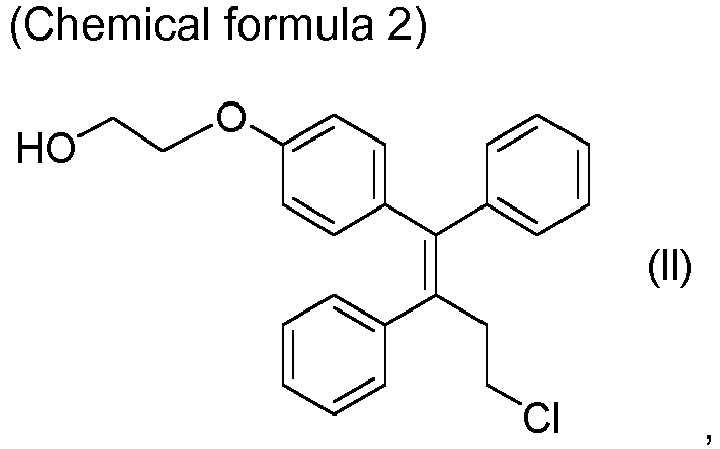
- Patent literatures 1 through 5 describe a production method for the selective estrogen receptor modulator ospemifene represented by the formula (II):
- Patent literature 1 describes a production method for obtaining ospemifene, wherein 4-hydroxybenzophenone and 3-chloropropiophenone are subjected to McMurry reaction to obtain the formula: the obtained compound is alkylated with an alkylation agent represented by the formula: X-(CH 2 ) 2 -O-Pr (wherein X is CI, Br, I, methyloxy or tosyloxy, and Pr is a protective group) to obtain the formula: which is then deprotected; and a production method for obtaining ospemifene wherein alkylation is performed with an alkylation agent represented by the formula: X-CH 2 -COOR (wherein X is Cl, Br, I, methyloxy or tosyloxy, and R is alkyl) to obtain the compound represented by the formula: and then reducing this ester.
- an alkylation agent represented by the formula: X-(CH 2 ) 2 -O-Pr
- X is CI
- Patent literature 2 describes a production method for obtaining ospemifene through a McMurry reaction from a compound represented by the formula: (wherein R 1 represents H or a C1-6 alkyl optionally substituted with one or multiple -OH groups, and R 3a , R 3b , R 3c , R 3d and R 3e each independently represent H or -OH) and a compound represented by the formula: (wherein X represents halogen or -OH, and R 2a , R 2b , R 2c , R 2d and R 2e each independently represent H or -OH).
- Patent literature 3 describes a production method for obtaining ospemifene wherein the formula: (wherein R a is C(O)-R b , where R b is optionally substituted phenyl) and 3-chloropropiophenone are subjected to McMurry reaction to obtain the formula: (wherein the symbols have the same meaning as above), which is then deprotected.
- Patent literature 4 describes a production method for obtaining ospemifene, wherein a compound represented by the formula: and phenyl magnesium halide are reacted to obtain a compound represented by the formula: which is treated with hydrochloric acid to obtain the formula: which is then deprotected.
- Patent literature 5 describes a production method for obtaining ospemifene characterized in that a perfluorophenyl group is introduced.
- patent literatures 1 through 5 do not describe or suggest a production method for ospemifene using reduction reaction by means of lithium borohydride. Furthermore, in the case of methods of producing alcohols by reacting ester and lithium borohydride, reacting in the presence of borane or reacting in the presence of trimethylsilyl chloride is not known.
- the production method described in embodiment example 7 of patent literature 1 is a method of producing ospemifene by reducing (4-(4-chloro-1,2-diphenyl-but-1-enyl)-phenoxy-acetic acid ethyl ester with lithium aluminum hydride.
- This production method has a poor yield of 43% and uses lithium aluminum hydride, which is an explosive reagent.
- the production method described in embodiment examples 1A and 1B of patent literature 2 is a method of producing ospemifene by means of a McMurry reaction of 4-(2-hydroxyethoxy)benzophenone and 3-chloropropiophenone.
- the production method described in embodiment example 11 of patent literature 3 is a method of producing ospemifene by reducing (Z)-2-(4-(4-chloro-1,2-diphenyl-but-1-enyl)phenoxy)ethyl pivalate with lithium aluminum hydride.
- this production method has a poor yield of 61% and uses lithium aluminum hydride, which is an explosive reagent.
- the method of embodiment example 2 of International Application No. PCT/JP2015/076165 is a method of producing ospemifene by reducing (Z)-2-(4-(4-chloro-1,2-diphenyl-but-1-enyl)phenoxy)methyl benzoate with sodium borohydride in the presence of methanol.
- sodium borohydride reacts with methanol to produce hydrogen, so large scale production involves the risk of explosion.
- ospemifene can be efficiently produced by reducing a compound represented by the formula (I): (wherein R 1 is a substituted or unsubstituted alkyl) using lithium borohydride as a reducing agent.
- lithium hydroxide is produced through the reaction of lithium borohydride with moisture in the solvent or air, and this lithium hydroxide causes the esters to be hydrolyzed, leading to the production of carboxylic acid.
- the produced carboxylic acid cannot be readily reduced to alcohol with lithium borohydride and becomes a byproduct.
- alcohols can be efficiently produced by reducing the formed carboxylic acid to the corresponding alcohol by performing the ester reduction reaction in the presence of borane or in the presence of trimethylsilyl chloride.
- This production method unlike the known production methods described above, does not employ explosive reagents and has good yield and thus favorable cost of goods sold (COGS), and so is very well suited for industrial use.
- COGS cost of goods sold
- the present invention relates to the following.
- Halogen includes fluorine, chlorine, bromine and iodine. Fluorine and chlorine are especially preferable.
- Alkyl signifies straight chain or branched alkyl with 1 to 6 carbons. Alkyls with 1 to 4 carbons, alkyls with 1 to 3 carbons and the like are included. As examples, methyl, ethyl, n-propyl, isopropyl, n-butyl, isobutyl, sec-butyl, tert-butyl, n-pentyl, isopentyl, neopentyl, hexyl, isohexyl and the like may be mentioned.
- Methyl is preferable as the alkyl in R 1 .
- substituents of the "substituted alkyl" in R 1 include hydroxy, alkyloxy (hydroxyalkyloxy, phenylalkyloxy, etc.), non-aromatic carbocyclic oxy (tetrahydropyranyloxy, etc.), alkyl carbonyloxy (methyl carbonyloxy, ethyl carbonyloxy, etc.), aromatic carbocyclic carbonyloxy (phenyl carbonyloxy, etc.), acyl (acetyl, trichloroacetyl, benzoyl, etc.), alkyloxy carbonyl (t-butoxycarbonyl, etc.), alkyl sulfonyl (methanesulfonyl, etc.), alkyloxyalkyl (methoxymethyl, etc.), trialkyl silyl (t-butyl dimethyl silyl, etc.), and the like. Hydroxy, alkyloxy, hydroxyalkyloxy, phenylalkyloxy, etc
- reacting a compound with another compound in the present specification includes reacting salts thereof or solvates thereof.
- the production method of the present invention can be implemented, for example, as follows.
- R 1 is a substituted or unsubstituted alkyl.
- This process involves reducing the compound represented by formula (I) in the presence of lithium borohydride to obtain the compound represented by formula (II).
- Lithium borohydride is suitably reacted at a 0.3 mol equivalent to 5 mol equivalent quantity relative to the compound represented by formula (I).
- lithium borohydride in the presence of lithium borohydride includes the case of adding lithium borohydride as well as the case of forming lithium borohydride in the reaction system.
- Lithium borohydride can be formed in the reaction system by reacting potassium borohydride or sodium borohydride with lithium chloride or lithium bromide.
- the solvent is not particularly limited, so long as it allows the aforementioned process to proceed efficiently.
- One or more solvents selected from among toluene, cyclopentyl methyl ether, tetrahydrofuran, 2-methyl tetrahydrofuran, dimethyl sulfoxide and the like can be used.
- the reaction temperature is not particularly limited, but normally, the reaction can be performed at approximately 0 to 100°C, or preferably at 0°C to room temperature.
- the reaction time is not particularly limited, but is usually 0.5 hours to 24 hours, or preferably, 1 to 10 hours.
- carboxylic acid formed in the system can be reduced to alcohol by reacting in the presence of borane.
- borane in the presence of borane includes the case of adding borane and the case of forming borane in the reaction system.
- Borane can be formed by reacting lithium borohydride with a Lewis acid.
- the borane is suitably reacted at 0.05 mol equivalents to 1 mol equivalent relative to the compound represented by formula (I).
- 0.05 mol equivalents to 0.3 mol equivalents is preferable, and 0.05 mol equivalents to 0.15 mol equivalents is even more preferable.
- Examples of the Lewis acid include chlorotrimethyl silane.
- the Lewis acid is suitably reacted at 0.05 mol equivalents to 1 mol equivalents in relation to the compound represented by formula (I).
- 0.05 mol equivalents to 0.3 mol equivalents is preferable, and 0.05 mol equivalents to 0.15 mol equivalents is even more preferable.
- the ratio between the compound represented by the formula (II): and the total of the byproduct compounds represented by the formula (III): can be calculated through HPLC analysis on the basis of the area percentages (UV detection wavelength: 235 nm) of the compound represented by formula (II) and the compounds represented by formula (III).
- Surface area percentage represents the surface area of each compound within the total surface area of peaks of all the compounds in the reaction system.
- the ratio between the compound represented by formula (II) and the total of the compound represented by said formula (II) and the compounds represented by formula (III) is used to evaluate purity. It will be noted that the aforesaid ratio is expressed as (II)/((II) + (III)).
- the gradient is not particularly limited, but method B presented below can be mentioned by way of example.
- reaction byproducts include the reaction solution and reaction slurry during reaction and after completion of reaction, the organic layer and aqueous layer after liquid separation and extraction, the products after purification, etc.
- a formulation low in impurities can be produced by preparing the formulation using a compound represented by formula (II) obtained by means of the present invention.
- the present invention makes it possible to obtain a pharmaceutical composition containing a compound represented by formula (II) as an active ingredient and furthermore containing compounds represented by formula (III), wherein the quantity of compounds represented by formula (III) is 0.2 weight percent or less of the quantity of compound represented by said formula (II). Even more preferably, the quantity of compounds represented by said formula (III) is 0.15 weight percent or less of the quantity of compound represented by said formula (II).
- salts include sodium salt, lithium salt, potassium salt, calcium salt and other inorganic base salts.
- solvates include hydrates, alcoholates, etc. of the compounds or of salts thereof.
- monohydrates, dihydrates, monoalcoholates, dialcoholates, etc. of the compounds or salts thereof may be mentioned as examples.
- Tetrahydrofuran (2.5 mL) was added to lithium chloride (104.2 mg, 2.458 mmol) and potassium borohydride (132.6 mg, 2.458 mmol), agitating for 2.5 hours to form a slurry.
- Chlorotrimethyl silane (31 ⁇ L, 0.245 mmol) was added to the slurry and compound 6 (1.00 g, 2.458 mmol) dissolved in tetrahydrofuran (4.5 mL) was added dropwise at room temperature, agitating for 3.5 hours.
- reaction liquid was analyzed by HPLC (measurement method B).
- Compound (II) was obtained using lithium chloride (1.0 eq) and potassium borohydride (1.0 eq) instead of the lithium chloride (1.0 eq), potassium borohydride (1.0 eq) and chlorotrimethyl silane (0.1 eq) in the above process 3-1.
- Compound (II) was obtained using lithium borohydride (1.0 eq) and calcium chloride (0.25 eq) instead of the lithium chloride (1.0 eq), potassium borohydride (1.0 eq) and chlorotrimethyl silane (0.1 eq) in the above process 3-1.
- Compound (II) was obtained using lithium borohydride (1.0 eq) and borane-THF complex (0.1 eq) instead of the lithium chloride (1.0 eq), potassium borohydride (1.0 eq) and chlorotrimethyl silane (0.1 eq) in the above process 3-1.
- the method is otherwise the same as process 3-1 above.
- Compound (II) was obtained using lithium borohydride (1.0 eq) and chlorotrimethyl silane (0.1 eq) instead of the lithium chloride (1.0 eq), potassium borohydride (1.0 eq) and chlorotrimethyl silane (0.1 eq) in the above process 3-1.
- the method is otherwise the same as process 3-1 above.
- the method is otherwise the same as process 3-1 above.
- HPLC measurements were performed under the following conditions.
- Ospemifene can be efficiently produced using the present invention.
Landscapes
- Chemical & Material Sciences (AREA)
- Organic Chemistry (AREA)
- Health & Medical Sciences (AREA)
- Chemical Kinetics & Catalysis (AREA)
- Public Health (AREA)
- Animal Behavior & Ethology (AREA)
- Medicinal Chemistry (AREA)
- General Health & Medical Sciences (AREA)
- Life Sciences & Earth Sciences (AREA)
- Pharmacology & Pharmacy (AREA)
- Veterinary Medicine (AREA)
- Epidemiology (AREA)
- General Chemical & Material Sciences (AREA)
- Bioinformatics & Cheminformatics (AREA)
- Engineering & Computer Science (AREA)
- Nuclear Medicine, Radiotherapy & Molecular Imaging (AREA)
- Organic Low-Molecular-Weight Compounds And Preparation Thereof (AREA)
- Low-Molecular Organic Synthesis Reactions Using Catalysts (AREA)
- Acyclic And Carbocyclic Compounds In Medicinal Compositions (AREA)
Abstract
Description
- The present invention relates to a production method for phenoxyethanol derivatives. More specifically, the invention relates to a production method for the selective estrogen receptor modulator ospemifene. Furthermore, in a separate aspect, the present invention relates to a production method for alcohols characterized in that ester is reacted with lithium borohydride.
- Patent literatures 1 through 5 describe a production method for the selective estrogen receptor modulator ospemifene represented by the formula (II):

- Patent literature 1 describes a production method for obtaining ospemifene, wherein 4-hydroxybenzophenone and 3-chloropropiophenone are subjected to McMurry reaction to obtain the formula:


- Patent literature 2 describes a production method for obtaining ospemifene through a McMurry reaction from a compound represented by the formula:


- Patent literature 3 describes a production method for obtaining ospemifene wherein the formula:


- Patent literature 4 describes a production method for obtaining ospemifene, wherein a compound represented by the formula:


- Patent literature 5 describes a production method for obtaining ospemifene characterized in that a perfluorophenyl group is introduced.
- Furthermore, the method of producing alcohols by reacting ester and lithium borohydride is widely known.
- However, patent literatures 1 through 5 do not describe or suggest a production method for ospemifene using reduction reaction by means of lithium borohydride. Furthermore, in the case of methods of producing alcohols by reacting ester and lithium borohydride, reacting in the presence of borane or reacting in the presence of trimethylsilyl chloride is not known.
-
- Patent literature 1: International Publication No.
2008/099059 pamphlet - Patent literature 2: International Publication No.
2011/089385 pamphlet - Patent literature 3: International Publication No.
2014/060640 pamphlet - Patent literature 4: International Publication No.
2014/060639 pamphlet - Patent literature 5: Chinese Application Publication No.
103242142 pamphlet - It is an object of the present invention to provide a novel useful production method for phenoxyethanol derivatives represented by formula (II). Furthermore, it is an object of the present invention to provide a method of producing alcohols by reacting ester and lithium borohydride, wherein the production of byproducts is suppressed.
- The production method described in embodiment example 7 of patent literature 1 is a method of producing ospemifene by reducing (4-(4-chloro-1,2-diphenyl-but-1-enyl)-phenoxy-acetic acid ethyl ester with lithium aluminum hydride. This production method has a poor yield of 43% and uses lithium aluminum hydride, which is an explosive reagent.
- The production method described in embodiment examples 1A and 1B of patent literature 2 is a method of producing ospemifene by means of a McMurry reaction of 4-(2-hydroxyethoxy)benzophenone and 3-chloropropiophenone.
- The production method described in embodiment example 11 of patent literature 3 is a method of producing ospemifene by reducing (Z)-2-(4-(4-chloro-1,2-diphenyl-but-1-enyl)phenoxy)ethyl pivalate with lithium aluminum hydride. However, this production method has a poor yield of 61% and uses lithium aluminum hydride, which is an explosive reagent.
- The method of embodiment example 2 of International Application No.
PCT/JP2015/076165 - Furthermore, in the case of common reduction reaction using sodium borohydride or the like, it is difficult to control the production of hydrogen in the reduction reaction and the heat of reaction, so this reduction method is not suitable for industrialization or other types of mass production.
- The present inventors discovered that ospemifene can be efficiently produced by reducing a compound represented by the formula (I):

using lithium borohydride as a reducing agent. - Furthermore, the present inventors discovered that in the method of producing alcohols by reacting ester with lithium borohydride, lithium hydroxide is produced through the reaction of lithium borohydride with moisture in the solvent or air, and this lithium hydroxide causes the esters to be hydrolyzed, leading to the production of carboxylic acid. The produced carboxylic acid cannot be readily reduced to alcohol with lithium borohydride and becomes a byproduct.
- To solve this problem, it was discovered that alcohols can be efficiently produced by reducing the formed carboxylic acid to the corresponding alcohol by performing the ester reduction reaction in the presence of borane or in the presence of trimethylsilyl chloride.
- This production method, unlike the known production methods described above, does not employ explosive reagents and has good yield and thus favorable cost of goods sold (COGS), and so is very well suited for industrial use.
- Namely, the present invention relates to the following.
- (1) A production methods for a compound represented by the formula (II):


- (2) A production method as set forth under (1) above, characterized in that the lithium borohydride is formed in the reaction system.
- (3) A production method as set forth under (2) above, characterized in that the lithium borohydride is formed in the reaction system by reacting potassium borohydride with lithium chloride.
- (4) A production method as set forth under any one of (1) through (3) above, characterized in that the reaction is performed in the presence of borane.
- (5) A production method as set forth under any one of (1) through (3) above, characterized in that the reaction is performed in the presence of trimethylsilyl chloride.
- (6) A production method as set forth under any one of (1) through (5) above, wherein R1 is methyl.
- (7) A production method as set forth under any one of Claims 1 through 6, wherein the ratio between the compound represented by the formula (II):


- (8) A production method for alcohols characterized in that ester and lithium borohydride are reacted in the presence of borane.
- (9) A production method for alcohols characterized in that ester and lithium borohydride are reacted in the presence of trimethylsilyl chloride.
It should be noted that the alcohols of (8) and (9) signify alcohols that correspond to the ester. - (10) A production method as set forth under (8) or (9) above, characterized in that the lithium borohydride is formed in the reaction system.
- (11) A production method as set forth under (10) above, characterized in that the lithium borohydride is formed in the reaction system by reacting potassium borohydride with lithium chloride.
- (12) A reaction product wherein the ratio between the compound represented by the formula (II):


- (13) A pharmaceutical composition containing a compound represented by the formula (II):

- Using the present invention makes it possible to efficiently produce phenoxyethanol derivatives represented by formula (II).
- The terms used in the present specification are explained below.
- "Halogen" includes fluorine, chlorine, bromine and iodine. Fluorine and chlorine are especially preferable.
- "Alkyl" signifies straight chain or branched alkyl with 1 to 6 carbons. Alkyls with 1 to 4 carbons, alkyls with 1 to 3 carbons and the like are included. As examples, methyl, ethyl, n-propyl, isopropyl, n-butyl, isobutyl, sec-butyl, tert-butyl, n-pentyl, isopentyl, neopentyl, hexyl, isohexyl and the like may be mentioned.
- Methyl is preferable as the alkyl in R1.
- Substituents of "substituted alkyl" include halogen, hydroxy, mercapto, nitro, nitroso, cyano, azido, formyl, amino, carboxy, alkyl, haloalkyl, alkenyl, alkynyl, non-aromatic carbocyclic groups, aromatic carbocyclic groups, aromatic heterocyclic groups, non-aromatic heterocyclic groups, substituted carbamoyl, substituted sulfamoyl, substituted amidino, groups represented by the formula:-O-Rx, groups represented by the formula: -O-C(=O)-Rx, groups represented by the formula: -C(=O)-Rx, groups represented by the formula:-C(=O)-O-Rx, groups represented by the formula: -S-Rx and groups represented by the formula: -SO2-Rx (here, Rx is alkyl, haloalkyl, alkenyl, alkynyl, a non-aromatic carbocyclic group, aromatic carbocyclic group, aromatic heterocyclic group, non-aromatic heterocyclic group, carbamoyl, sulfamoyl or amidino). Any one or multiple substitutable positions may be substituted with these substituents. Examples of substituents of the "substituted alkyl" in R1 include hydroxy, alkyloxy (hydroxyalkyloxy, phenylalkyloxy, etc.), non-aromatic carbocyclic oxy (tetrahydropyranyloxy, etc.), alkyl carbonyloxy (methyl carbonyloxy, ethyl carbonyloxy, etc.), aromatic carbocyclic carbonyloxy (phenyl carbonyloxy, etc.), acyl (acetyl, trichloroacetyl, benzoyl, etc.), alkyloxy carbonyl (t-butoxycarbonyl, etc.), alkyl sulfonyl (methanesulfonyl, etc.), alkyloxyalkyl (methoxymethyl, etc.), trialkyl silyl (t-butyl dimethyl silyl, etc.), and the like. Hydroxy, alkyloxy, non-aromatic carbocyclic oxy, alkyl carbonyloxy, aromatic carbocyclic carbonyloxy and the like are preferable.
- It should be noted that reacting a compound with another compound in the present specification includes reacting salts thereof or solvates thereof.
- The production method of the present invention can be implemented, for example, as follows.
-

- This process involves reducing the compound represented by formula (I) in the presence of lithium borohydride to obtain the compound represented by formula (II).
- Lithium borohydride is suitably reacted at a 0.3 mol equivalent to 5 mol equivalent quantity relative to the compound represented by formula (I).
- It should be noted that "in the presence of lithium borohydride" includes the case of adding lithium borohydride as well as the case of forming lithium borohydride in the reaction system.
- Lithium borohydride can be formed in the reaction system by reacting potassium borohydride or sodium borohydride with lithium chloride or lithium bromide.
- This process makes it possible to produce the compound represented by formula (II) at a higher yield than with the methods described in patent literatures 1 and 3, which use other reducing agents.
- The solvent is not particularly limited, so long as it allows the aforementioned process to proceed efficiently. One or more solvents selected from among toluene, cyclopentyl methyl ether, tetrahydrofuran, 2-methyl tetrahydrofuran, dimethyl sulfoxide and the like can be used.
- The reaction temperature is not particularly limited, but normally, the reaction can be performed at approximately 0 to 100°C, or preferably at 0°C to room temperature.
- The reaction time is not particularly limited, but is usually 0.5 hours to 24 hours, or preferably, 1 to 10 hours.
- It will be noted that the present inventors discovered that a compound represented by the formula (III):

- In the above process, carboxylic acid formed in the system can be reduced to alcohol by reacting in the presence of borane.
- It should be noted that "in the presence of borane" includes the case of adding borane and the case of forming borane in the reaction system.
- Borane can be formed by reacting lithium borohydride with a Lewis acid.
- The borane is suitably reacted at 0.05 mol equivalents to 1 mol equivalent relative to the compound represented by formula (I). Here, 0.05 mol equivalents to 0.3 mol equivalents is preferable, and 0.05 mol equivalents to 0.15 mol equivalents is even more preferable.
- Examples of the Lewis acid include chlorotrimethyl silane. The Lewis acid is suitably reacted at 0.05 mol equivalents to 1 mol equivalents in relation to the compound represented by formula (I). Here, 0.05 mol equivalents to 0.3 mol equivalents is preferable, and 0.05 mol equivalents to 0.15 mol equivalents is even more preferable.
- The ratio between the compound represented by the formula (II):


- Surface area percentage represents the surface area of each compound within the total surface area of peaks of all the compounds in the reaction system.
- In the present specification, the ratio between the compound represented by formula (II) and the total of the compound represented by said formula (II) and the compounds represented by formula (III) is used to evaluate purity. It will be noted that the aforesaid ratio is expressed as (II)/((II) + (III)).
- When the present process is used, 0.95 ≤ (II) / ((II) + (III)) < 1. A higher purify of 0.99 ≤ (II)/((II) + (III)) < 1 is preferable.
- So long as the peaks of compound (II) and compound (III) can be separated, the gradient is not particularly limited, but method B presented below can be mentioned by way of example.
- "Reaction byproducts" include the reaction solution and reaction slurry during reaction and after completion of reaction, the organic layer and aqueous layer after liquid separation and extraction, the products after purification, etc.
- A formulation low in impurities can be produced by preparing the formulation using a compound represented by formula (II) obtained by means of the present invention.
- Namely, the present invention makes it possible to obtain a pharmaceutical composition containing a compound represented by formula (II) as an active ingredient and furthermore containing compounds represented by formula (III), wherein the quantity of compounds represented by formula (III) is 0.2 weight percent or less of the quantity of compound represented by said formula (II). Even more preferably, the quantity of compounds represented by said formula (III) is 0.15 weight percent or less of the quantity of compound represented by said formula (II).
- It should be noted that compounds represented by formula (II) and compounds represented by formula (III) as used in such a pharmaceutical composition include salts and solvates.
- Examples of "salts" include sodium salt, lithium salt, potassium salt, calcium salt and other inorganic base salts.
- Examples of "solvates" include hydrates, alcoholates, etc. of the compounds or of salts thereof. For instance, monohydrates, dihydrates, monoalcoholates, dialcoholates, etc. of the compounds or salts thereof may be mentioned as examples.
- Production method for ospemifene

- Under a nitrogen atmosphere, compound 3 (2.97 g, 15 mmol), compound 4 (2.53 g, 15 mmol), zinc (3.73 g, 57 mmol) and potassium chloride (4.25 g, 57 mmol) were suspended in 2-methyl tetrahydrofuran (15 mL). After reducing pressure, nitrogen substitution was repeated 5 times. Titanium tetrachloride (3.14 ml, 28.5 mmol) was added over the course of 30 minutes at 0 degrees, after which agitation was performed for 20 minutes at room temperature and for 2 hours at 50 degrees. After leaving to cool, concentrated hydrochloric acid (6.1 g) water (16 mL) was added, insolubles were filtered out, and extraction was performed with ethyl acetate. The organic layer was washed with water and saturated table salt water, and was then dried with anhydrous sodium sulfate. The solvent was distilled off under reduced pressure and a portion (331 mg) of the obtained residue (7.18 g) was sampled. This was purified by column chromatography to obtain compound 5 (160 mg, Z:E = 5.7:1). Methanol-water was added to the remainder to precipitate out solids, after which a crude product (4.98 g) of compound 5 was obtained by filtering off. (Quantitated value: 69.2%, Z:E = 5.7:1)
- Under a nitrogen atmosphere, compound 3 (14.87 g, 75.0 mmol), compound 4 (12.65 g, 75.0 mmol) and zinc (18.64 g, 285 mmol) were suspended in 2-methyl tetrahydrofuran (149 mL). After reducing pressure, nitrogen substitution was repeated 5 times. Titanium tetrachloride (26.48 mg, 140 mmol) was added over the course of approximately 2 hours at 0 degrees, after which agitation was performed for 3 hours at 50 degrees. After leaving to cool, concentrated hydrochloric acid (30.34 g) water (80.01 g) was added, insolubles were filtered out, and extraction was performed with ethyl acetate. The organic layer was washed 3 times with water to obtain an organic layer (359.9 g). This organic layer was divided into portions, and the solvent from one portion (119.69 g) was distilled off. Methanol was added to the residue, and the operation of distilling solvent off under reduced pressure was repeated 2 times. Methanol (33 mL)/water (13.5 mL) was then added, the solids were precipitated out, and filtration was then performed to obtain a crude product (4.599 g) of compound 5. (Quantitative value: 46.6%, Z:E = 19:1)
- Crude product (4.98 g) of compound 5 was dissolved in N,N-dimethyl formamide (25 mL), methyl 2-bromoacetate (1.69 mL, 17.9 mmol) and potassium carbonate (3.08 g, 22.31 mmol) were added, and agitation was performed for 1 hour at room temperature. Water was added to the reaction liquid and extraction was performed with ethyl acetate. The organic layer was washed with water and saturated table salt water and then dried with anhydrous sodium sulfate. The solvent was distilled off under reduced pressure to obtain a crude product (6.05 g) of compound 6.
1H-NMR (CDCl3) δ : 2. 92 (t, J = 7. 4 Hz, 2H), 3. 41 (t, J = 7. 4 Hz, 2H), 3.75 (s, 3H), 4.50̸ (s, 2H), 6. 55 (d, J = 8.6 Hz, 2H), 6.80̸ (d, J = 8 . 6 Hz, 2H), 7.08-7.43 (m, 10̸H). - Compound 5 (200 mg, 0.597 mmol, Z:E = 20:1) was dissolved in N,N-dimethyl formamide (1 mL), adding methyl 2-bromoacetate (67.8 µL, 0.717 mmol) and potassium carbonate (99 mg, 0.717 mmol) thereto and agitating for 2 hours at room temperature. Water was added to the reaction liquid and extraction was performed with ethyl acetate. The organic layer was washed with water and saturated table salt water and then dried with anhydrous sodium sulfate. The solvent was distilled off under reduced pressure and the residue was purified by column chromatography to obtain compound 6 (243 mg, quant, Z:E = 20:1).
1H-NMR (CDCl3) δ : 2.92 (t, J = 7. 4 Hz, 2H), 3. 41 (t, J = 7.4 Hz, 2H), 3.75 (s, 3H), 4.50 (s, 2H), 6. 55 (d, J = 8. 6 Hz, 2H), 6. 80̸ (d, J = 8 .6 Hz, 2H), 7.08-7.43 (m, 10H). - Tetrahydrofuran (2.5 mL) was added to lithium chloride (104.2 mg, 2.458 mmol) and potassium borohydride (132.6 mg, 2.458 mmol), agitating for 2.5 hours to form a slurry. Chlorotrimethyl silane (31 µL, 0.245 mmol) was added to the slurry and compound 6 (1.00 g, 2.458 mmol) dissolved in tetrahydrofuran (4.5 mL) was added dropwise at room temperature, agitating for 3.5 hours.
- The reaction liquid was analyzed by HPLC (measurement method B). Compound (II) HPLC area percentage: 98.13%, retention time: 29.4 minutes
- Compound (III) HPLC area percentage: 0.03%, retention time: 38.2 minutes

- Acetone (724 µL, 9.832 mmol) and 1 mol/L hydrochloric acid were added to the reaction liquid and extraction was performed with ethyl acetate. The organic layer was washed with water and 5% table salt water and was then concentrated. Methanol was added to the concentrated residue and water was added dropwise to induce crystallization. The crystals were filtered off and washed with 70% methanol-water to obtain compound (II) (0.82 g, yield: 88%).
- Compound (II) was obtained using lithium chloride (1.0 eq) and potassium borohydride (1.0 eq) instead of the lithium chloride (1.0 eq), potassium borohydride (1.0 eq) and chlorotrimethyl silane (0.1 eq) in the above process 3-1.
- Compound (II) HPLC area percentage: 96.35%, retention time: 20.6 minutes The method is otherwise the same as process 3-1 above. (Yield: 89.8%)
- Compound (II) was obtained using lithium borohydride (0.6 eq) instead of the lithium chloride (1.0 eq), potassium borohydride (1.0 eq) and chlorotrimethyl silane (0.1 eq) in the above process 3-1.
- Compound (II) HPLC area percentage: 98.27%, retention time: 17.66 minutes The method is otherwise the same as process 3-1 above. (Yield: 92.4%)
- Compound (II) was obtained using lithium borohydride (1.0 eq) and calcium chloride (0.25 eq) instead of the lithium chloride (1.0 eq), potassium borohydride (1.0 eq) and chlorotrimethyl silane (0.1 eq) in the above process 3-1.
- Compound (II) HPLC area percentage: 96.03%, retention time: 20.48 minutes The method is otherwise the same as process 3-1 above.
- Compound (II) was obtained using lithium borohydride (1.0 eq) and borane-THF complex (0.1 eq) instead of the lithium chloride (1.0 eq), potassium borohydride (1.0 eq) and chlorotrimethyl silane (0.1 eq) in the above process 3-1.
- Compound (II) HPLC area percentage: 98.62%, retention time: 29.36 minutes
- Compound (III) Below detection limit.
- The method is otherwise the same as process 3-1 above.
- Compound (II) was obtained using lithium borohydride (1.0 eq) and chlorotrimethyl silane (0.1 eq) instead of the lithium chloride (1.0 eq), potassium borohydride (1.0 eq) and chlorotrimethyl silane (0.1 eq) in the above process 3-1.
- Compound (II) HPLC area percentage: 98.77%, retention time: 29.25 minutes
- Compound (III) Below detection limit.
- The method is otherwise the same as process 3-1 above.
- Compound (II) was obtained using lithium borohydride (1.0 eq) instead of the lithium chloride (1.0 eq), potassium borohydride (1.0 eq) and chlorotrimethyl silane (0.1 eq) in the above process 3-1.
- Compound (II) HPLC area percentage: 97.63%, retention time: 29.29 minutes
- Compound (III) HPLC area percentage: 0.79%, retention time: 38.03 minutes

- The method is otherwise the same as process 3-1 above.
- HPLC measurements were performed under the following conditions.
- Column: Symmetry C18, 5 µm (3.9 × 150 mm)
Flow rate: 1.0 mL/minute
UV detection wavelength: 235 nm
Column temperature: 40°C
Mobile phase: (A) = aqueous solution containing 0.03% acetic acid / acetonitrile = 80/20; (B) = acetonitrile
Gradient: 40% solvent (B) was maintained for 31 minutes, a linear gradient of 40% to 70% solvent (B) was performed for 2 minutes, 70% solvent (B) was maintained for 16 minutes, a linear gradient of 70% to 95% solvent (B) was performed for 3 minutes, and 95% solvent (B) was maintained for 10 minutes. - Column: Symmetry C8, 3.5 µm (4.6 × 150 mm)
Flow rate: 1.0 mL/minute
UV detection wavelength: 235 nm
Column temperature: 25°C
Mobile phase: (A) = aqueous solution containing 0.03% acetic acid / acetonitrile = 80/20; (B) = acetonitrile
Gradient: 37.5% solvent (B) was maintained for 10 minutes and a linear gradient of 37.5% to 87.5% solvent (B) was performed for 80 minutes. - Ospemifene can be efficiently produced using the present invention.

Claims (13)
- A production method for a compound represented by the formula (II):

- A production method as set forth in Claim 1, characterized in that the lithium borohydride is formed in the reaction system.
- A production method as set forth in Claim 2, characterized in that the lithium borohydride is formed in the reaction system by reacting potassium borohydride with lithium chloride.
- A production method as set forth in any one of Claims 1 through 3, characterized in that the reaction is performed in the presence of borane.
- A production method as set forth in any one of Claims 1 through 3, characterized in that the reaction is performed in the presence of trimethylsilyl chloride.
- A production method as set forth in any one of Claims 1 through 5, wherein R1 is methyl.
- A production method as set forth in any one of Claims 1 through 6, wherein the ratio between the compound represented by the formula (II):


- A production method for alcohols characterized in that ester and lithium borohydride are reacted in the presence of borane.
- A production method for alcohols characterized in that ester and lithium borohydride are reacted in the presence of trimethylsilyl chloride.
- A production method as set forth in Claim 8 or 9, characterized in that the lithium borohydride is formed in the reaction system.
- A production method as set forth in Claim 10, characterized in that the lithium borohydride is formed in the reaction system by reacting potassium borohydride with lithium chloride.
- A reaction product wherein the ratio between the compound represented by the formula (II):


- A pharmaceutical composition containing a compound represented by the formula (II):


Priority Applications (1)
| Application Number | Priority Date | Filing Date | Title |
|---|---|---|---|
| EP20208147.7A EP3835285A1 (en) | 2016-03-15 | 2017-03-14 | Method for producing phenoxyethanol derivative |
Applications Claiming Priority (2)
| Application Number | Priority Date | Filing Date | Title |
|---|---|---|---|
| JP2016050604 | 2016-03-15 | ||
| PCT/JP2017/010159 WO2017159669A1 (en) | 2016-03-15 | 2017-03-14 | Method for producing phenoxyethanol derivative |
Related Child Applications (1)
| Application Number | Title | Priority Date | Filing Date |
|---|---|---|---|
| EP20208147.7A Division EP3835285A1 (en) | 2016-03-15 | 2017-03-14 | Method for producing phenoxyethanol derivative |
Publications (3)
| Publication Number | Publication Date |
|---|---|
| EP3415491A1 true EP3415491A1 (en) | 2018-12-19 |
| EP3415491A4 EP3415491A4 (en) | 2019-02-27 |
| EP3415491B1 EP3415491B1 (en) | 2020-11-18 |
Family
ID=59851930
Family Applications (2)
| Application Number | Title | Priority Date | Filing Date |
|---|---|---|---|
| EP20208147.7A Withdrawn EP3835285A1 (en) | 2016-03-15 | 2017-03-14 | Method for producing phenoxyethanol derivative |
| EP17766668.2A Active EP3415491B1 (en) | 2016-03-15 | 2017-03-14 | Method for producing phenoxyethanol derivative |
Family Applications Before (1)
| Application Number | Title | Priority Date | Filing Date |
|---|---|---|---|
| EP20208147.7A Withdrawn EP3835285A1 (en) | 2016-03-15 | 2017-03-14 | Method for producing phenoxyethanol derivative |
Country Status (12)
| Country | Link |
|---|---|
| US (1) | US10472312B2 (en) |
| EP (2) | EP3835285A1 (en) |
| JP (1) | JPWO2017159669A1 (en) |
| KR (1) | KR102377433B1 (en) |
| CN (1) | CN108137457B (en) |
| AU (1) | AU2017232476B2 (en) |
| BR (1) | BR112018017117B1 (en) |
| CL (1) | CL2018002641A1 (en) |
| CO (1) | CO2018009436A2 (en) |
| EA (1) | EA039048B1 (en) |
| MX (1) | MX2018010466A (en) |
| WO (1) | WO2017159669A1 (en) |
Family Cites Families (28)
| Publication number | Priority date | Publication date | Assignee | Title |
|---|---|---|---|---|
| JPS4839639B1 (en) * | 1963-04-15 | 1973-11-26 | ||
| BE788612A (en) * | 1971-09-09 | 1973-03-08 | Rhone Poulenc Sa | NEW HERBICIDES |
| FR2162692A5 (en) * | 1971-09-09 | 1973-07-20 | Rhone Poulenc Sa | |
| DE3512179A1 (en) | 1985-04-03 | 1986-12-04 | Merck Patent Gmbh, 6100 Darmstadt | PHOTO INITIATORS FOR PHOTOPOLYMERIZATION IN AQUEOUS SYSTEMS |
| US4982016A (en) * | 1989-06-06 | 1991-01-01 | Carter-Wallace, Inc. | Conversion of diethyl phenylmalonate to 2-phenyl-1,3-propanediol |
| US5532416A (en) | 1994-07-20 | 1996-07-02 | Monsanto Company | Benzoyl derivatives and synthesis thereof |
| JPH05271129A (en) | 1992-01-30 | 1993-10-19 | Idemitsu Petrochem Co Ltd | @(3754/24)perfluorodecalin)alcoholic derivative |
| DE4212628A1 (en) | 1992-04-15 | 1993-10-21 | Manfred Dr Metzler | New bis-phenyl-hexenes |
| FR2706898B1 (en) * | 1993-06-25 | 1995-09-08 | Union Pharma Scient Appl | |
| JPH07316131A (en) * | 1994-05-27 | 1995-12-05 | Mitsubishi Chem Corp | Process for producing pyrrole derivative |
| US5808107A (en) * | 1997-10-31 | 1998-09-15 | Board Of Trustees Operating Michigan State University | Process for the preparation of hydroxy substituted gamma butyrolactones |
| JP4079505B2 (en) | 1998-04-28 | 2008-04-23 | 田辺三菱製薬株式会社 | Novel process for the preparation of 2-amino-2- [2- (4-octylphenyl) ethyl] propane-1,3-diol |
| TW593256B (en) | 1999-11-16 | 2004-06-21 | Hormos Medical Oy Ltd | Triphenylalkene derivatives and their use as selective estrogen receptor modulators |
| SI21655A (en) | 2003-12-29 | 2005-06-30 | LEK farmacevtska dru�ba d.d. | Synthesis of optically pure (r)-5-(2-aminopropyl)-methoxybenzene sulphonamide |
| CN101528749B (en) | 2006-09-07 | 2013-07-31 | 工业研究有限公司 | Acyclic amine inhibitors of nucleoside phosphorylases and hydrolases |
| EP2121553B1 (en) * | 2007-02-14 | 2012-06-27 | Hormos Medical Ltd. | Method for the preparation of therapeutically valuable triphenylbutene derivatives |
| CA2707447C (en) | 2007-12-26 | 2016-03-08 | Banyu Pharmaceutical Co., Ltd. | Sulfonyl-substituted 6-membered ring derivative |
| RS53353B (en) * | 2010-01-19 | 2014-10-31 | Cambrex Karlskoga Ab | NEW PROCEDURES FOR THE PRODUCTION OF BENZOPHENONE DERIVATIVES |
| US8277699B2 (en) | 2010-04-30 | 2012-10-02 | Transistions Optical, Inc. | Photochromic materials that include 6-amino substituted indeno-fused naphthopyrans |
| JP2013224263A (en) * | 2010-08-19 | 2013-10-31 | Taisho Pharmaceutical Co Ltd | 4-isopropylphenyl glucitol compound |
| WO2012089606A1 (en) | 2010-12-28 | 2012-07-05 | Glaxo Group Limited | Azabicyclo [4.1.0] hept - 4 - yl derivatives as human orexin receptor antagonists |
| WO2012089607A1 (en) | 2010-12-28 | 2012-07-05 | Glaxo Group Limited | Novel compounds with a 3a-azabicyclo [4.1.0] heptane core acting on orexin receptors |
| CN103242142A (en) | 2012-02-13 | 2013-08-14 | 天津药物研究院 | Method for preparing ospemifene and intermediate thereof |
| US9321712B2 (en) * | 2012-10-19 | 2016-04-26 | Fermion Oy | Process for the preparation of ospemifene |
| US20150321983A1 (en) * | 2012-10-19 | 2015-11-12 | Fermion Oy | A process for the preparation of ospemifene |
| CN104030896A (en) * | 2013-03-07 | 2014-09-10 | 天津药物研究院 | Method for simply removing specific impurities from ospemifene |
| MX2017003290A (en) * | 2014-09-16 | 2017-06-21 | Shionogi & Co | Method for producing triphenylbutene derivative. |
| WO2016110805A1 (en) * | 2015-01-09 | 2016-07-14 | Glenmark Pharmaceuticals Limited | Process for preparation of ospemifene |
-
2017
- 2017-03-14 EA EA201891918A patent/EA039048B1/en unknown
- 2017-03-14 CN CN201780003403.3A patent/CN108137457B/en active Active
- 2017-03-14 US US16/085,110 patent/US10472312B2/en active Active
- 2017-03-14 KR KR1020187024120A patent/KR102377433B1/en active Active
- 2017-03-14 EP EP20208147.7A patent/EP3835285A1/en not_active Withdrawn
- 2017-03-14 MX MX2018010466A patent/MX2018010466A/en unknown
- 2017-03-14 JP JP2018505944A patent/JPWO2017159669A1/en active Pending
- 2017-03-14 WO PCT/JP2017/010159 patent/WO2017159669A1/en not_active Ceased
- 2017-03-14 EP EP17766668.2A patent/EP3415491B1/en active Active
- 2017-03-14 BR BR112018017117-4A patent/BR112018017117B1/en active IP Right Grant
- 2017-03-14 AU AU2017232476A patent/AU2017232476B2/en active Active
-
2018
- 2018-09-10 CO CONC2018/0009436A patent/CO2018009436A2/en unknown
- 2018-09-14 CL CL2018002641A patent/CL2018002641A1/en unknown
Also Published As
| Publication number | Publication date |
|---|---|
| WO2017159669A1 (en) | 2017-09-21 |
| CO2018009436A2 (en) | 2018-10-10 |
| KR102377433B1 (en) | 2022-03-23 |
| EA201891918A1 (en) | 2019-02-28 |
| BR112018017117B1 (en) | 2021-11-16 |
| EP3835285A1 (en) | 2021-06-16 |
| CA3016545A1 (en) | 2017-09-21 |
| MX2018010466A (en) | 2019-01-14 |
| AU2017232476B2 (en) | 2019-10-03 |
| US20190084910A1 (en) | 2019-03-21 |
| BR112018017117A2 (en) | 2018-12-26 |
| CN108137457B (en) | 2022-09-06 |
| US10472312B2 (en) | 2019-11-12 |
| CL2018002641A1 (en) | 2019-01-18 |
| EA039048B1 (en) | 2021-11-26 |
| JPWO2017159669A1 (en) | 2019-01-24 |
| HK1256626A1 (en) | 2019-09-27 |
| KR20180122330A (en) | 2018-11-12 |
| EP3415491A4 (en) | 2019-02-27 |
| EP3415491B1 (en) | 2020-11-18 |
| CN108137457A (en) | 2018-06-08 |
| AU2017232476A1 (en) | 2018-10-04 |
Similar Documents
| Publication | Publication Date | Title |
|---|---|---|
| CN101302207B (en) | Preparation of 3-o-alkyl-5,6-o-(1-methyl ethylidine)-l-ascorbic acid and preparation of 5,6-o-(1- methyl ethylidine)-l- ascorbic acid | |
| EP2812311B1 (en) | Processes for isolating fluorinated products | |
| EP3181545B1 (en) | Process for the preparation of ospemifene | |
| EP2674420B1 (en) | Method for producing aminophenyl pyrimidinyl alcohol derivative, and synthesis intermediate thereof | |
| EP3415491B1 (en) | Method for producing phenoxyethanol derivative | |
| JP5186910B2 (en) | Method for producing tris (perfluoroalkanesulfonyl) methidoate | |
| CA3016545C (en) | Method for producing phenoxyethanol derivative | |
| EP4130020A1 (en) | Novel method for preparing inotodiol | |
| EP2141151A1 (en) | Method for producing 2-haloimidazole compound | |
| HK1256626B (en) | Method for producing phenoxyethanol derivative | |
| JP2896244B2 (en) | Method for producing 3-N-alkoxyalkyl-N-alkylaminophenol derivative | |
| WO2006109570A1 (en) | Method for producing 2-isopropenyl-5-methyl-4-hexen-1-yl 3-methyl-2-butenoate | |
| JP2003206274A (en) | Method for producing thiocarboxylic acid or salt thereof, method for measuring optical purity thereof, and tetrahydrofuranthiocarboxylic acid or derivative thereof | |
| FI90068C (en) | FRUIT PROCESSING FOR A VITAMIN A ELLER DESS CARBOXYLSYRAESTRAR | |
| JP4402951B2 (en) | Method for producing erythromycin compound | |
| WO2007086559A1 (en) | Method for producing tetrahydropyran compound | |
| HK1242296A1 (en) | Method for producing triphenylbutene derivative | |
| JP2000136177A (en) | Production of n-alkyl-alpha-dialkylaminoaceto- hydroxamic acid compound | |
| EP2039680A1 (en) | Process for producing ester or alcohol | |
| JPS58164536A (en) | Manufacture of 1-desiloxy-4-((7-oxa-4-octynyl) oxy)benzene | |
| JP2015040175A (en) | Method for producing N-acyl-α-aminolactone compound | |
| JP2006206533A (en) | Method for producing naphthylethanol | |
| JP2001322951A (en) | Method for producing alkenes |
Legal Events
| Date | Code | Title | Description |
|---|---|---|---|
| STAA | Information on the status of an ep patent application or granted ep patent |
Free format text: STATUS: THE INTERNATIONAL PUBLICATION HAS BEEN MADE |
|
| PUAI | Public reference made under article 153(3) epc to a published international application that has entered the european phase |
Free format text: ORIGINAL CODE: 0009012 |
|
| STAA | Information on the status of an ep patent application or granted ep patent |
Free format text: STATUS: REQUEST FOR EXAMINATION WAS MADE |
|
| 17P | Request for examination filed |
Effective date: 20180914 |
|
| AK | Designated contracting states |
Kind code of ref document: A1 Designated state(s): AL AT BE BG CH CY CZ DE DK EE ES FI FR GB GR HR HU IE IS IT LI LT LU LV MC MK MT NL NO PL PT RO RS SE SI SK SM TR |
|
| AX | Request for extension of the european patent |
Extension state: BA ME |
|
| RIC1 | Information provided on ipc code assigned before grant |
Ipc: C07C 43/23 20060101ALI20190117BHEP Ipc: C07C 41/26 20060101AFI20190117BHEP Ipc: A61K 31/085 20060101ALI20190117BHEP |
|
| A4 | Supplementary search report drawn up and despatched |
Effective date: 20190130 |
|
| DAV | Request for validation of the european patent (deleted) | ||
| DAX | Request for extension of the european patent (deleted) | ||
| STAA | Information on the status of an ep patent application or granted ep patent |
Free format text: STATUS: EXAMINATION IS IN PROGRESS |
|
| 17Q | First examination report despatched |
Effective date: 20191128 |
|
| GRAP | Despatch of communication of intention to grant a patent |
Free format text: ORIGINAL CODE: EPIDOSNIGR1 |
|
| STAA | Information on the status of an ep patent application or granted ep patent |
Free format text: STATUS: GRANT OF PATENT IS INTENDED |
|
| RIC1 | Information provided on ipc code assigned before grant |
Ipc: A61K 31/085 20060101ALI20200525BHEP Ipc: C07C 41/26 20060101AFI20200525BHEP Ipc: C07C 43/23 20060101ALI20200525BHEP |
|
| INTG | Intention to grant announced |
Effective date: 20200612 |
|
| GRAS | Grant fee paid |
Free format text: ORIGINAL CODE: EPIDOSNIGR3 |
|
| GRAA | (expected) grant |
Free format text: ORIGINAL CODE: 0009210 |
|
| STAA | Information on the status of an ep patent application or granted ep patent |
Free format text: STATUS: THE PATENT HAS BEEN GRANTED |
|
| AK | Designated contracting states |
Kind code of ref document: B1 Designated state(s): AL AT BE BG CH CY CZ DE DK EE ES FI FR GB GR HR HU IE IS IT LI LT LU LV MC MK MT NL NO PL PT RO RS SE SI SK SM TR |
|
| REG | Reference to a national code |
Ref country code: GB Ref legal event code: FG4D |
|
| REG | Reference to a national code |
Ref country code: CH Ref legal event code: EP |
|
| REG | Reference to a national code |
Ref country code: IE Ref legal event code: FG4D |
|
| REG | Reference to a national code |
Ref country code: DE Ref legal event code: R096 Ref document number: 602017027857 Country of ref document: DE |
|
| REG | Reference to a national code |
Ref country code: AT Ref legal event code: REF Ref document number: 1335593 Country of ref document: AT Kind code of ref document: T Effective date: 20201215 |
|
| REG | Reference to a national code |
Ref country code: SE Ref legal event code: TRGR |
|
| REG | Reference to a national code |
Ref country code: FI Ref legal event code: FGE |
|
| REG | Reference to a national code |
Ref country code: AT Ref legal event code: MK05 Ref document number: 1335593 Country of ref document: AT Kind code of ref document: T Effective date: 20201118 |
|
| REG | Reference to a national code |
Ref country code: NL Ref legal event code: MP Effective date: 20201118 |
|
| PG25 | Lapsed in a contracting state [announced via postgrant information from national office to epo] |
Ref country code: NO Free format text: LAPSE BECAUSE OF FAILURE TO SUBMIT A TRANSLATION OF THE DESCRIPTION OR TO PAY THE FEE WITHIN THE PRESCRIBED TIME-LIMIT Effective date: 20210218 Ref country code: PT Free format text: LAPSE BECAUSE OF FAILURE TO SUBMIT A TRANSLATION OF THE DESCRIPTION OR TO PAY THE FEE WITHIN THE PRESCRIBED TIME-LIMIT Effective date: 20210318 Ref country code: RS Free format text: LAPSE BECAUSE OF FAILURE TO SUBMIT A TRANSLATION OF THE DESCRIPTION OR TO PAY THE FEE WITHIN THE PRESCRIBED TIME-LIMIT Effective date: 20201118 Ref country code: GR Free format text: LAPSE BECAUSE OF FAILURE TO SUBMIT A TRANSLATION OF THE DESCRIPTION OR TO PAY THE FEE WITHIN THE PRESCRIBED TIME-LIMIT Effective date: 20210219 |
|
| PG25 | Lapsed in a contracting state [announced via postgrant information from national office to epo] |
Ref country code: AT Free format text: LAPSE BECAUSE OF FAILURE TO SUBMIT A TRANSLATION OF THE DESCRIPTION OR TO PAY THE FEE WITHIN THE PRESCRIBED TIME-LIMIT Effective date: 20201118 Ref country code: IS Free format text: LAPSE BECAUSE OF FAILURE TO SUBMIT A TRANSLATION OF THE DESCRIPTION OR TO PAY THE FEE WITHIN THE PRESCRIBED TIME-LIMIT Effective date: 20210318 Ref country code: PL Free format text: LAPSE BECAUSE OF FAILURE TO SUBMIT A TRANSLATION OF THE DESCRIPTION OR TO PAY THE FEE WITHIN THE PRESCRIBED TIME-LIMIT Effective date: 20201118 Ref country code: LV Free format text: LAPSE BECAUSE OF FAILURE TO SUBMIT A TRANSLATION OF THE DESCRIPTION OR TO PAY THE FEE WITHIN THE PRESCRIBED TIME-LIMIT Effective date: 20201118 Ref country code: BG Free format text: LAPSE BECAUSE OF FAILURE TO SUBMIT A TRANSLATION OF THE DESCRIPTION OR TO PAY THE FEE WITHIN THE PRESCRIBED TIME-LIMIT Effective date: 20210218 |
|
| REG | Reference to a national code |
Ref country code: LT Ref legal event code: MG9D |
|
| PG25 | Lapsed in a contracting state [announced via postgrant information from national office to epo] |
Ref country code: HR Free format text: LAPSE BECAUSE OF FAILURE TO SUBMIT A TRANSLATION OF THE DESCRIPTION OR TO PAY THE FEE WITHIN THE PRESCRIBED TIME-LIMIT Effective date: 20201118 |
|
| PG25 | Lapsed in a contracting state [announced via postgrant information from national office to epo] |
Ref country code: SK Free format text: LAPSE BECAUSE OF FAILURE TO SUBMIT A TRANSLATION OF THE DESCRIPTION OR TO PAY THE FEE WITHIN THE PRESCRIBED TIME-LIMIT Effective date: 20201118 Ref country code: RO Free format text: LAPSE BECAUSE OF FAILURE TO SUBMIT A TRANSLATION OF THE DESCRIPTION OR TO PAY THE FEE WITHIN THE PRESCRIBED TIME-LIMIT Effective date: 20201118 Ref country code: CZ Free format text: LAPSE BECAUSE OF FAILURE TO SUBMIT A TRANSLATION OF THE DESCRIPTION OR TO PAY THE FEE WITHIN THE PRESCRIBED TIME-LIMIT Effective date: 20201118 Ref country code: EE Free format text: LAPSE BECAUSE OF FAILURE TO SUBMIT A TRANSLATION OF THE DESCRIPTION OR TO PAY THE FEE WITHIN THE PRESCRIBED TIME-LIMIT Effective date: 20201118 Ref country code: LT Free format text: LAPSE BECAUSE OF FAILURE TO SUBMIT A TRANSLATION OF THE DESCRIPTION OR TO PAY THE FEE WITHIN THE PRESCRIBED TIME-LIMIT Effective date: 20201118 Ref country code: SM Free format text: LAPSE BECAUSE OF FAILURE TO SUBMIT A TRANSLATION OF THE DESCRIPTION OR TO PAY THE FEE WITHIN THE PRESCRIBED TIME-LIMIT Effective date: 20201118 |
|
| REG | Reference to a national code |
Ref country code: DE Ref legal event code: R097 Ref document number: 602017027857 Country of ref document: DE |
|
| PG25 | Lapsed in a contracting state [announced via postgrant information from national office to epo] |
Ref country code: DK Free format text: LAPSE BECAUSE OF FAILURE TO SUBMIT A TRANSLATION OF THE DESCRIPTION OR TO PAY THE FEE WITHIN THE PRESCRIBED TIME-LIMIT Effective date: 20201118 |
|
| PLBE | No opposition filed within time limit |
Free format text: ORIGINAL CODE: 0009261 |
|
| STAA | Information on the status of an ep patent application or granted ep patent |
Free format text: STATUS: NO OPPOSITION FILED WITHIN TIME LIMIT |
|
| 26N | No opposition filed |
Effective date: 20210819 |
|
| PG25 | Lapsed in a contracting state [announced via postgrant information from national office to epo] |
Ref country code: MC Free format text: LAPSE BECAUSE OF FAILURE TO SUBMIT A TRANSLATION OF THE DESCRIPTION OR TO PAY THE FEE WITHIN THE PRESCRIBED TIME-LIMIT Effective date: 20201118 Ref country code: NL Free format text: LAPSE BECAUSE OF FAILURE TO SUBMIT A TRANSLATION OF THE DESCRIPTION OR TO PAY THE FEE WITHIN THE PRESCRIBED TIME-LIMIT Effective date: 20201118 Ref country code: AL Free format text: LAPSE BECAUSE OF FAILURE TO SUBMIT A TRANSLATION OF THE DESCRIPTION OR TO PAY THE FEE WITHIN THE PRESCRIBED TIME-LIMIT Effective date: 20201118 |
|
| REG | Reference to a national code |
Ref country code: CH Ref legal event code: PL |
|
| PG25 | Lapsed in a contracting state [announced via postgrant information from national office to epo] |
Ref country code: SI Free format text: LAPSE BECAUSE OF FAILURE TO SUBMIT A TRANSLATION OF THE DESCRIPTION OR TO PAY THE FEE WITHIN THE PRESCRIBED TIME-LIMIT Effective date: 20201118 |
|
| REG | Reference to a national code |
Ref country code: BE Ref legal event code: MM Effective date: 20210331 |
|
| PG25 | Lapsed in a contracting state [announced via postgrant information from national office to epo] |
Ref country code: ES Free format text: LAPSE BECAUSE OF FAILURE TO SUBMIT A TRANSLATION OF THE DESCRIPTION OR TO PAY THE FEE WITHIN THE PRESCRIBED TIME-LIMIT Effective date: 20201118 Ref country code: CH Free format text: LAPSE BECAUSE OF NON-PAYMENT OF DUE FEES Effective date: 20210331 Ref country code: LI Free format text: LAPSE BECAUSE OF NON-PAYMENT OF DUE FEES Effective date: 20210331 Ref country code: LU Free format text: LAPSE BECAUSE OF NON-PAYMENT OF DUE FEES Effective date: 20210314 Ref country code: IE Free format text: LAPSE BECAUSE OF NON-PAYMENT OF DUE FEES Effective date: 20210314 |
|
| PG25 | Lapsed in a contracting state [announced via postgrant information from national office to epo] |
Ref country code: IS Free format text: LAPSE BECAUSE OF FAILURE TO SUBMIT A TRANSLATION OF THE DESCRIPTION OR TO PAY THE FEE WITHIN THE PRESCRIBED TIME-LIMIT Effective date: 20210318 |
|
| PG25 | Lapsed in a contracting state [announced via postgrant information from national office to epo] |
Ref country code: BE Free format text: LAPSE BECAUSE OF NON-PAYMENT OF DUE FEES Effective date: 20210331 |
|
| P01 | Opt-out of the competence of the unified patent court (upc) registered |
Effective date: 20230517 |
|
| PG25 | Lapsed in a contracting state [announced via postgrant information from national office to epo] |
Ref country code: CY Free format text: LAPSE BECAUSE OF FAILURE TO SUBMIT A TRANSLATION OF THE DESCRIPTION OR TO PAY THE FEE WITHIN THE PRESCRIBED TIME-LIMIT Effective date: 20201118 |
|
| PG25 | Lapsed in a contracting state [announced via postgrant information from national office to epo] |
Ref country code: HU Free format text: LAPSE BECAUSE OF FAILURE TO SUBMIT A TRANSLATION OF THE DESCRIPTION OR TO PAY THE FEE WITHIN THE PRESCRIBED TIME-LIMIT; INVALID AB INITIO Effective date: 20170314 |
|
| PG25 | Lapsed in a contracting state [announced via postgrant information from national office to epo] |
Ref country code: MK Free format text: LAPSE BECAUSE OF FAILURE TO SUBMIT A TRANSLATION OF THE DESCRIPTION OR TO PAY THE FEE WITHIN THE PRESCRIBED TIME-LIMIT Effective date: 20201118 |
|
| PG25 | Lapsed in a contracting state [announced via postgrant information from national office to epo] |
Ref country code: MT Free format text: LAPSE BECAUSE OF FAILURE TO SUBMIT A TRANSLATION OF THE DESCRIPTION OR TO PAY THE FEE WITHIN THE PRESCRIBED TIME-LIMIT Effective date: 20201118 |
|
| PG25 | Lapsed in a contracting state [announced via postgrant information from national office to epo] |
Ref country code: TR Free format text: LAPSE BECAUSE OF FAILURE TO SUBMIT A TRANSLATION OF THE DESCRIPTION OR TO PAY THE FEE WITHIN THE PRESCRIBED TIME-LIMIT Effective date: 20201118 |
|
| PGFP | Annual fee paid to national office [announced via postgrant information from national office to epo] |
Ref country code: SE Payment date: 20260327 Year of fee payment: 10 |
|
| PGFP | Annual fee paid to national office [announced via postgrant information from national office to epo] |
Ref country code: GB Payment date: 20260327 Year of fee payment: 10 |
|
| PGFP | Annual fee paid to national office [announced via postgrant information from national office to epo] |
Ref country code: DE Payment date: 20260327 Year of fee payment: 10 |
|
| PGFP | Annual fee paid to national office [announced via postgrant information from national office to epo] |
Ref country code: FI Payment date: 20260325 Year of fee payment: 10 Ref country code: IT Payment date: 20260319 Year of fee payment: 10 |
|
| PGFP | Annual fee paid to national office [announced via postgrant information from national office to epo] |
Ref country code: FR Payment date: 20260325 Year of fee payment: 10 |