EP3413244A1 - Efficient toffoli state generation from low-fidelity single qubit magic states - Google Patents
Efficient toffoli state generation from low-fidelity single qubit magic states Download PDFInfo
- Publication number
- EP3413244A1 EP3413244A1 EP18179254.0A EP18179254A EP3413244A1 EP 3413244 A1 EP3413244 A1 EP 3413244A1 EP 18179254 A EP18179254 A EP 18179254A EP 3413244 A1 EP3413244 A1 EP 3413244A1
- Authority
- EP
- European Patent Office
- Prior art keywords
- qubit
- qubits
- rotation
- state
- fidelity
- Prior art date
- Legal status (The legal status is an assumption and is not a legal conclusion. Google has not performed a legal analysis and makes no representation as to the accuracy of the status listed.)
- Granted
Links
Images

Classifications
-
- B—PERFORMING OPERATIONS; TRANSPORTING
- B82—NANOTECHNOLOGY
- B82Y—SPECIFIC USES OR APPLICATIONS OF NANOSTRUCTURES; MEASUREMENT OR ANALYSIS OF NANOSTRUCTURES; MANUFACTURE OR TREATMENT OF NANOSTRUCTURES
- B82Y10/00—Nanotechnology for information processing, storage or transmission, e.g. quantum computing or single electron logic
-
- G—PHYSICS
- G06—COMPUTING OR CALCULATING; COUNTING
- G06N—COMPUTING ARRANGEMENTS BASED ON SPECIFIC COMPUTATIONAL MODELS
- G06N10/00—Quantum computing, i.e. information processing based on quantum-mechanical phenomena
- G06N10/20—Models of quantum computing, e.g. quantum circuits or universal quantum computers
-
- G—PHYSICS
- G06—COMPUTING OR CALCULATING; COUNTING
- G06N—COMPUTING ARRANGEMENTS BASED ON SPECIFIC COMPUTATIONAL MODELS
- G06N10/00—Quantum computing, i.e. information processing based on quantum-mechanical phenomena
- G06N10/40—Physical realisations or architectures of quantum processors or components for manipulating qubits, e.g. qubit coupling or qubit control
-
- G—PHYSICS
- G06—COMPUTING OR CALCULATING; COUNTING
- G06N—COMPUTING ARRANGEMENTS BASED ON SPECIFIC COMPUTATIONAL MODELS
- G06N10/00—Quantum computing, i.e. information processing based on quantum-mechanical phenomena
- G06N10/70—Quantum error correction, detection or prevention, e.g. surface codes or magic state distillation
Definitions
- This invention relates to quantum computing, and more particularly, to the efficient generation of Toffoli states from low-fidelity single qubit states.
- a classical computer operates by processing bits (binary digits) of information that change state according to the laws of classical physics. These information bits can be modified by using simple logic gates such as AND and OR gates. The bits are physically represented by a high or a low voltage occurring at the output of the logic gate, corresponding either to a logical one (e.g., high voltage) or a logical zero (e.g., low voltage).
- a classical algorithm such as one that multiplies two integers, can be decomposed into a long string of these simple logic gates.
- a quantum computer also has bits and gates.
- a quantum bit can store any quantum mechanical superposition of the two, in some sense allowing a qubit to be in both classical states simultaneously. This ability enables a quantum computer to solve certain problems with exponentially greater efficiency than that of a classical computer.
- a system for providing three qubits in a Toffoli has a first fidelity, from a plurality of single qubit magic states having a second fidelity such that using the single qubit magic states to construct a Toffoli state directly would result in a Toffoli state with fidelity less than the first fidelity and comprises a first set of qubits, each storing a plus state; a second set of qubits, each storing one of the plurality of single qubit magic states; a third set of qubits, each storing one of the plurality of single qubit magic states; a plurality of controlled NOT (CNOT) gates each having one of the first set of qubits as a control qubit and one of the second set of qubits as a target of the CNOT gate; a plurality of rotation gates that each rotate a qubit of the second set of qubits around an axis of the Bloch sphere, each rotation gate comprising at least one Clifford gate and
- CNOT controlled NOT
- each rotation gate may perform one of a rotation of ⁇ /4 radians around the Y-axis and a rotation of negative ⁇ /4 radians around the Y-axis.
- each rotation gate may perform a controlled Y operation targeting the qubit of the second set of qubits that is controlled by a selected qubit of the third set of qubits, measures the qubit of the second set of qubits in the Y basis to provide one of a first value and a second value, performs a rotation of the qubit of the second set of qubits t by ⁇ /2 radians around the Y-axis if the first value is measured, and performs no rotation of the qubit of the second set of qubits if the second value is measured.
- the plurality of CNOT gates may include a first CNOT gate controlled by a first qubit of the first set of qubits and targeting a first qubit of the second set of qubits and a second CNOT gate controlled by the first qubit of the first set of qubits and targeting a second qubit of the second set of qubits.
- a method for generating a Toffoli state comprising preparing each of a first set of qubits in a plus state; preparing each of a second set of qubits in one of the plurality of single qubit magic states; preparing each of a third set of qubits in one of the plurality of single qubit magic states; performing, for each qubit of the first set of qubits, a controlled NOT (CNOT) operation targeting a qubit of the second set of qubits; performing a rotation of each qubit of the second set of qubits around an axis of the Bloch sphere using at least one Clifford gate and at least one single qubit magic state stored in the third set of qubits; and measuring at
- the CNOT operation may be a first CNOT operation and the method further comprising performing, for each qubit of the first set of qubits, a second CNOT operation targeting a different qubit of the second set of qubits.
- the rotation may be a first rotation and further comprising performing a second rotation of each qubit of the second set of qubits around the axis of the Bloch sphere using at least one Clifford gate and at least one other single qubit magic state stored in the third set of qubits, the second rotation being equal and opposite to the first rotation.
- performing the rotation of each qubit of the second set of qubits around the axis of the Bloch sphere may comprise performing one of a rotation of ⁇ /4 radians around the Y-axis and a rotation of negative ⁇ /4 radians around the Y-axis.
- performing the rotation of a given qubit of the second set of qubits may comprise performing a controlled Y operation targeting the given qubit that is controlled by a selected qubit of the third set of qubits, the qubit storing one of the at least one single qubit magic states; measuring the selected qubit in the Y basis to provide one of a first value and a second value; performing a rotation of the given qubit by ⁇ /2 radians around the Y-axis if the first value is measured; and performing no rotation of the given qubit if the second value is measured.
- the method for generating a Toffoli state may have a first fidelity, from a plurality of single qubit magic states having a second fidelity such that using the single qubit magic states to construct a Toffoli state directly would result in a Toffoli state with fidelity less than the first fidelity.
- Each of first and second qubits are prepared in a high-fidelity state that can be generated with a set of Clifford gates.
- N target qubits are prepared in the single qubit magic state, where N is an integer greater than one.
- a series of gates are performed on the first qubit, the second qubits, and the N target qubits, such that a system comprising the first qubit, the second qubits, and the N target qubits is in a state 1 ⁇ 2
- a parity check is performed on the N target qubits to verify that a first target qubit is in a same state as the other target qubits. The parity check provides at least a first measurement value.
- the first qubit, the second qubit, and the first target qubit are accepted as the Toffoli ancilla state if the measurement values assume a desired value.
- first and second qubits each may store a high-fidelity state that can be generated by Clifford gates.
- N target qubits each store an instance of the magic state.
- a Toffoli state preparation component is configured to perform a series of gates on the first qubit, second qubit, and the N target qubits to place the system in a state 1 ⁇ 2
- a parity check component is configured to check the parity of the N target qubits. The parity check includes measurements on N-1 target qubits to provide an unmeasured target qubit.
- the method for generating a Toffoli state, having a first fidelity, from a plurality of single qubit magic states having a second fidelity such that using the single qubit magic states to construct a Toffoli state directly would result in a Toffoli state with fidelity less than the first fidelity.
- Each of a first set of qubits are prepared in a plus state.
- Each of a second set of qubits are prepared in one of the plurality of single qubit magic states.
- Each of a third set of qubits are prepared in one of the plurality of single qubit magic states.
- a controlled NOT (CNOT) operation is performed targeting a corresponding qubit of the second set of qubits, such that the CNOT operation targeting a given one of the second set of qubits is controlled by the corresponding qubit from the first set of qubits.
- At least one rotation of each qubit of the second set of qubits around an axis of the Bloch sphere is performed using at least one Clifford gate and at least one single qubit magic state stored in the third set of qubits.
- At least one of the second set of qubits are measured in a measurement basis perpendicular to the axis of the Bloch sphere around which each qubit of the second set of qubits was rotated.
- a family of routines is provided to provide high-fidelity Toffoli gates from a plurality of input single qubit magic states.
- the systems and methods described herein directly generate high quality Toffoli ancilla states without the need for separate distillation of the input single qubits, resulting in a significant increase in efficiency over separate distillation and generation.
- a standard basis for qubit states includes a zero state, denoted herein as
- a sign basis includes a plus state,
- a Toffoli state is defined in the standard basis as 1 ⁇ 2
- a set of universal quantum gates is any set of quantum gates to which any operation possible on a quantum computer can be reduced, that is, any other unitary operation can be approximated as a finite sequence of gates from the set.
- a non-universal set of gates refers to set of quantum gates that lacks this property.
- One example of a non-universal set of gates is the set of Clifford gates.
- a "magic state”, as used herein, is a quantum state which can be used with Clifford gates to provide arbitrary quantum operations and can be improved in fidelity by a circuit constructed from Clifford gates. Effectively, the use of a given magic state, or rather, a finite number of instances of the magic state, with the set of Clifford gates allows for universal quantum computation. It will be appreciated that the circuits herein describe transformations that can be reexpressed using different gate sets and in different bases without fundamentally changing their nature.
- distillation refers to the process of probabilistically converting a set of qubits in a given state to produce a smaller set of qubits that assume the given state (or more generally, another state) with higher fidelity.
- fidelity is a measure of the "closeness" of two quantum states. As used herein, fidelity refers to the closeness of a given instance of a state to a desired ideal state.
- a “low-fidelity state” refers to a state that is below the level of fidelity desirable for use in a quantum computation but above a minimum fidelity needed for a distillation process.
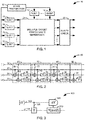
- FIG. 1 illustrates a system 10 for direct distillation of Toffoli states from single qubit magic states in accordance with an aspect of the present invention. It will be appreciated that, while the various components of the system are displayed as discrete components, it is possible that the actual hardware used to implement the system could overlap across the various physical components as they are reused.
- the system 10 includes a state preparation component 12 that initializes a plurality of qubits 13-18 to respective desired initial states. It will be appreciated that the plurality of qubits 13-18 can each be stored in one or more physical components.
- the system After the initial state preparation, the system includes a first set of qubits 13 and 14, each storing an initial state that can be generated with high-fidelity using Clifford gates, and a second set of qubits 15 and 16, referred to as target qubits, each storing a relatively low-fidelity instance of the magic states.
- the single qubit magic state is one of a class of states equivalent to a +1 eigenstate of the Hadamard operator.
- Equivalent it is meant that each state can be derived from the others via one-qubit Clifford unitary operators.
- the system 10 will consume a number of low-fidelity magic states, stored in a third set of qubits 17 and 18.
- Each of the qubits 13-18 are provided to an multiple-target Toffoli state preparation component 20.
- the multiple-target Toffoli state preparation component 20 performs a series of gates on the first and second sets of qubits to place a system comprising the first set of qubits and the second set of qubits in a state: 1 ⁇ 2
- first two qubits in each entangled state represents the first set of qubits and the indexed qubits, 1 through N, represent the second set of qubits.
- the multiple-target Toffoli state preparation component 20 includes a plurality of quantum circuit components arranged in series, with each quantum circuit component including a plurality of controlled NOT (CNOT) gates configured such that each of the second set of qubits states 15 and 16 are a target of one of the CNOT gates and each CNOT gate is controlled by one of the first set of qubits 13 and 14.
- Each quantum circuit component further comprises at least one rotation gate configured to provide a rotation around an axis of the Bloch sphere using at least one Clifford gate and at least one single qubit magic state stored in the third set of qubits.
- each rotation gate provides one of a rotation of ⁇ /4 radians around the Y-axis and a rotation of negative ⁇ /4 radians around the Y-axis to at least one of the second set of qubits 15 and 16.
- the first and second sets of qubits 13-16 are then provided to parity check assembly 22.
- the parity check assembly 22 is configured to check the parity of the second set of qubits 15 and 16 to determine if any errors have occurred in the generation of the entangled state.
- the parity check can include one or more gate operations on the second set of qubits 15 and 16 as well as measurement of all but one of the second set of qubits, leaving an unmeasured target qubit (e.g., 15).
- the first qubit 13, the second qubit 14, and the unmeasured target qubit 15 represent a high-fidelity Toffoli state. This state can be used with the set of Clifford gates to provide a Toffoli gate, which is sufficient for universal quantum computing.
- the parity assembly 22 includes at least one CNOT gate whose target and control bits are both members of the second set of quits 15 and 16.
- one of the at least one CNOT gates is controlled by a first qubit 15 of the second set of qubits and targets another qubit 16 of the second set of qubits.
- Each qubit in the second set of qubits that was targeted by a CNOT gate is then measured at a measurement assembly in a measurement basis perpendicular to the axis of the Bloch sphere around which each qubit 16 of the second set of qubits was rotated.
- the qubits 16 are measured in the standard (Z) basis.
- the system utilizes six magic states comprising the third set of qubits and four initial qubits, with first and second qubits initialized in the plus state and third and fourth qubits, initialized in the magic state, forming the second set of qubits.
- a first CNOT gate of the first quantum circuit targets the third qubit and is controlled by the second qubit
- a second CNOT gate of the first quantum circuit targets the fourth qubit and is controlled by the first qubit.
- the rotation gate is configured to provide a rotation of ⁇ /4 radians around the Y-axis to each of the third and fourth qubits.
- a first CNOT gate of the second quantum circuit targets the third qubit and is controlled by the first qubit
- the second CNOT gate of the second quantum circuit targets the fourth qubit and is controlled by the second qubit.
- the rotation gate is configured to provide a rotation of negative ⁇ /4 radians around the Y-axis to each of the third and fourth qubits.
- a first CNOT gate of the third quantum circuit targets the third qubit and is controlled by the second qubit
- a second CNOT gate of the third quantum circuit targets the fourth qubit and is controlled by the first qubit.
- the rotation gate is configured to provide a rotation of negative ⁇ /4 radians around the Y-axis to each of the third and fourth qubits.
- the parity check assembly 22 in this example comprises a single CNOT gate and a standard basis measurement assembly.
- the CNOT gate is controlled by the third qubit and targets the fourth qubit.
- the fourth qubit is then measured in the standard basis. Assuming no errors, the fourth qubit should be found to be in the ground state, and the first, second, and third qubit form a high-fidelity Toffoli ancilla state.
- FIG. 2 illustrates one example of a quantum circuit 50 for generating high-fidelity Toffoli states in accordance with an aspect of the present invention.
- the magic state is an "H" state, that is, one of a family of states equivalent to the +1 eigenstate of the Hadamard operator.
- the specific magic state in this example can be represented in the standard basis as
- H ⁇ cos( ⁇ /8)
- the quantum circuit includes four qubits 52-55, with first and second qubits 52 and 53 beginning in high-fidelity plus states, and third and fourth qubits 54 and 55 beginning in the H state. It will be appreciated that each of the high-fidelity states can be generated via initialization of a qubit to the ground (zero) state in the standard basis and a Hadamard gate operation on the initialized qubit to provide the plus state.
- the system also uses eight relatively low-fidelity H states, which includes the two H states initially stored in the third and fourth qubits 54 and 55, as well as six additional states that are utilized to produce Y-rotations within the quantum circuit 50.
- FIG. 3 An exemplary Y-rotation gate 100 for providing a ⁇ /4 rotation to a target qubit is illustrated as FIG. 3 for reference. It will be appreciated that each Y-rotation consumes one of the prepared H states, stored in a qubit 102, to provide a rotation to a target qubit 104.
- the gate 100 includes a controlled Y gate 106, controlled by the ancilla qubit 102.
- the ancilla qubit 102 is then measured in the Y basis at a measurement assembly 108 to provide one of the eigenstates of the Y operator.
- a classically controlled rotation element 110 applies a ⁇ /2 rotation to the target qubit if a first eigenstate, specifically the -1 eigenstate, of the Y operator is measured at the measurement assembly 108, and applies no rotation to the target qubit if a second eigenstate, specifically the +1 eigenstate, of the Y operator is measured. It will be appreciated that, for a - ⁇ /4 rotation, the controls on the classically controlled rotation element 110 are modified, such that a - ⁇ /2 rotation is applied to the target qubit if the second eigenstate is measured at the measurement assembly 108, and no rotation is applied if the first eigenstate is measured.
- a first circuit component 60 contains two controlled NOT (CNOT) gates 62 and 64.
- a first CNOT gate 62 targets the third qubit and is controlled by the second qubit.
- a second CNOT gate 64 targets the fourth qubit and is controlled by the first qubit.
- the third and fourth qubits are then provided to first and second Y-rotation gates 66 and 68, respectively. Each Y-rotation gate 66 and 68 then rotates its respective qubit by ⁇ /4 radians, consuming one of the low-fidelity H states in the process
- a second circuit component 70 contains third and fourth CNOT gates 72 and 74.
- the third CNOT gate 72 targets the third qubit and is controlled by the first qubit.
- the fourth CNOT gate 74 targets the fourth qubit and is controlled by the second qubit.
- the third and fourth qubits are then provided to respective third and fourth Y-rotation gates 76 and 78.
- Each Y-rotation gate 76 and 78 rotates its respective qubit by negative ⁇ /4 radians, such that the rotation is equal and opposite that provided by the first and second rotation gates 66 and 68.
- a third circuit component 80 contains fifth and sixth CNOT gates 82 and 84.
- the fifth CNOT gate 82 targets the third qubit and is controlled by the second qubit.
- the sixth CNOT gate 84 targets the fourth qubit and is controlled by the first qubit.
- the third and fourth qubits are then provided to fifth and sixth Y-rotation gates 66 and 68, respectively. Each Y-rotation gate 66 and 68 rotates its respective qubit by negative ⁇ /4 radians.
- the system 50 formed by the qubits 52-55 can be represented as:
- ⁇ ⁇ 1 ⁇ 2
- a fourth circuit component 90 performs a parity check to provide a final output of the system. It will be noted that, in the absence of errors, measuring the third and forth 54 and 55 qubits in the Z-basis would yield the same result and thus a parity measurement will be zero. To this end, a seventh CNOT gate 92 targets the fourth qubit and is controlled by the third qubit. After the seventh CNOT gate, the state of the system can be represented as: 1 ⁇ 2
- the fourth qubit 55 is then measured in the standard basis at a measurement assembly 94 to provide the parity measurement. Assuming that no error has occurred, the ground state (0) will be measured, and the first three qubits 52, 53, and 54 will be left in a high-fidelity Toffoli state. If the fourth qubit 55 is measured in the excited state (1), the output of the circuit 50 is discarded.
- the probability of an undetected X (or Y) error on the output target qubit can be made arbitrarily small by generating more target qubits and checking their parities; the X (or Y) -error probability can be reduced to order p° by generating o target qubits and checking them against each other. This does not reduce the probability of a Z error on the output control qubits below order p 2 ; in fact, the constant in front of p 2 worsens as o becomes larger.
- Toffoli ancilla that suffer only X errors on the target qubit and Z errors on the control qubits can be used to implement Toffoli gates that suffer only X errors on the target and Z errors on the (matching) controls. Consequently, a second order reduction in the probability of an error on the target qubit of such an ancilla can be achieved.
- Toffoli ancillae that suffer only X errors on the target qubit and Z errors on the control qubits
- higher orders of error suppression can be achieved either by using multiple rounds of Toffoli distillation or/and by adding additional target qubits to be verified against one another. In this way, given H-type magic states with sufficiently small error probably, the probability of an error anywhere on the output Toffoli ancilla can be reduced dramatically compared to direct implementation of this ancilla using the H-type magic states.
- the direct-to-Toffoli distillation circuit of FIG. 2 provides a significant advance in efficiency over existing methods, which generate the Toffoli states and distill the magic states in a separate process.
- This routine cannot be directly compared to magic-state distillation routines for H-type magic states since the output is not an H-type magic state.
- Many quantum algorithms require magic-states primarily for use in the implementation of Toffoli gates, however, and for this purpose, the most sensible comparison is of the resources required to implement an improved Toffoli gate using a more traditional routine.
- the state cost for implementing a Toffoli gate that is, the number of copies of magic states required per improved Toffoli gate, is easily calculated.
- H-type magic states which suffer Y errors with probability p are required to implement a single Toffoli gate which suffers errors with probability order p 2 .
- the state cost required for distilling an H-type magic state with quadratically reduced error has been shown to be no more than three.
- the traditional decomposition of the Toffoli gate in terms of Clifford gates and ⁇ /4 rotations requires seven ⁇ /4 rotations, although a Margolus-Toffoli gate frequently can be used as an adequate stand-in, and can be implemented using Clifford gates and only four ⁇ /4 rotations.
- the state cost is thus reduced to eight from twenty or twelve, using the inventor's other work, a savings of sixty percent and thirty-three percent, respectively.
- Another quantity of interest is the location cost for implementing a Toffoli gate, that is, the number of locations required to implement an improved Toffoli gate using a given routine. Counting only one-qubit Clifford state preparations and two-qubit Clifford gates as taking non-zero time, the number of locations in the direct-to-Toffoli distillation routine of FIG. 2 where Y ( ⁇ /4) gates are implemented as illustrated in FIG. 3 is thirty-six. The number of additional locations required to implement a Toffoli gate using the resultant Toffoli ancilla is fifteen. The total resource cost is thus fifty-one locations and eight H states. If each H state is injected from a lower level of computation using a process that requires five locations, then the location cost becomes ninety-one locations per Toffoli gate.
- the location cost for distilling H states with quadratically suppressed errors assuming the input states are injected from a lower level of computation is sixtyfive.
- Other work done by the inventor can improve this number to fifty.
- the most efficient method of implementing the Toffoli gate appears to be preparing a Toffoli state and then using this state to implement a Toffoli gate.
- the Margolus-Toffoli gate can be implemented more compactly and such a Toffoli-like gate is often sufficient, it can be used as a basis of comparison.
- the resource overhead is twenty-five locations and four H states.
- FIGS. 4 and 5 example methodologies will be better appreciated with reference to FIGS. 4 and 5 . While, for purposes of simplicity of explanation, the methodologies of FIGS. 4 and 5 are shown and described as executing serially, it is to be understood and appreciated that the present invention is not limited by the illustrated order, as some actions could in other examples occur in different orders and/or concurrently from that shown and described herein.
- FIG. 4 illustrates an example of a method 150 for generating a Toffoli state, having a first fidelity, from a plurality of single qubit magic states having a second fidelity such that using the single qubit magic states to construct a Toffoli state directly would result in a Toffoli state with fidelity less than the first fidelity.
- first and second qubits are prepared in a quantum state that can be achieved with high-fidelity with the set of Clifford gates.
- achievable high-fidelity states can include at least either eigenstate of the Z operator (i.e., the zero and one states of the standard basis) and either eigenstate of the X operator ( i.e., the plus and minus states).
- the first set of qubits includes two qubits prepared in the plus state.
- N target qubits are prepared in the single qubit magic state.
- the single qubit magic states can be magic states of the Clifford set and include one of a class of states equivalent to the +1 eigenstate of the Hadamard operator. It will be appreciated that additional copies of the magic state may also be prepared and utilized as part of the method.
- the series of gates can include one or more quantum circuit components that each perform, for each of the first and second qubits, at least one controlled NOT operation targeting each of the target qubits and a rotation of each target qubit around an axis of the Bloch sphere.
- the rotation for each target qubit includes performing a controlled Y operation on the target qubit that is controlled by a qubit storing the H-type magic state, measuring the control qubit in the Y basis to provide one of a first value and a second value, and performing a Y-rotation on the target qubit of either nothing or positive or negative ⁇ /2 radians according to the measured value.
- a parity check is performed on the N target qubits to provide at least one measurement value.
- a selected target qubit is the control qubit for a CNOT gate targeting one or more other target qubits, and each target qubit other than the selected target qubit is measured in the standard basis. If any of the at least one measurement values does not assume a desired value, an error is indicated and the state of the first qubit, the second qubit, and the selected target qubit is discarded. If all of the measurement values assume the respective desired values, the system formed by the first qubit, the second qubit, and the selected target qubit are accepted as a high-fidelity Toffoli state at 160.
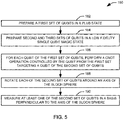
- FIG. 5 illustrates another example of method 180 for generating a Toffoli state, having a first fidelity, from a plurality of single qubit magic states having a second fidelity such that using the single qubit magic states to construct a Toffoli state directly would result in a Toffoli state with fidelity less than the first fidelity in accordance with an aspect of the present invention.
- a first set of qubits are prepared in the plus state.
- each of a second set of qubits and a third set of qubits are prepared in the single qubit magic state.
- the single qubit magic states cannot be directly generated with high-fidelity efficiently, and thus, in accordance with an aspect of the present invention, each of the single qubit magic states are provided with relatively low-fidelity.
- the single qubit magic states include one of a class of states equivalent to the +1 eigenstate of the Hadamard operator.
- a controlled NOT operation is performed targeting a qubit of the second set of qubits.
- a rotation of each qubit of the second set of qubits around an axis of the Bloch sphere is performed.
- the rotation can be performed using at least one Clifford gate and at least one single qubit magic state stored in the third set of qubits.
- the rotation of each qubit can be either a positive or a negative ⁇ /4 rotation around the Y-axis. It will be appreciated that 186 and 188 can be repeated multiple times in some implementations.
- At 190 at least one of the second set of qubits is measured in a measurement basis perpendicular to the axis of the Bloch sphere around which each qubit of the second set of qubits was rotated.
- the qubits are measured in the standard basis. Assuming that at least one measurement does not indicate an error, a Toffoli state is formed by the first and second qubits of the first set of qubits and a given qubit of the second set of qubits.
Landscapes
- Engineering & Computer Science (AREA)
- Physics & Mathematics (AREA)
- Theoretical Computer Science (AREA)
- General Physics & Mathematics (AREA)
- Mathematical Physics (AREA)
- General Engineering & Computer Science (AREA)
- Computing Systems (AREA)
- Evolutionary Computation (AREA)
- Mathematical Analysis (AREA)
- Mathematical Optimization (AREA)
- Pure & Applied Mathematics (AREA)
- Data Mining & Analysis (AREA)
- Condensed Matter Physics & Semiconductors (AREA)
- Computational Mathematics (AREA)
- Software Systems (AREA)
- Artificial Intelligence (AREA)
- Chemical & Material Sciences (AREA)
- Nanotechnology (AREA)
- Crystallography & Structural Chemistry (AREA)
- Error Detection And Correction (AREA)
- Detection And Correction Of Errors (AREA)
- Superconductor Devices And Manufacturing Methods Thereof (AREA)
- Computer Hardware Design (AREA)
- Logic Circuits (AREA)
Abstract
Description
- This application claims priority from
U.S. Patent Application Serial No. 61/719073, filed 26 October 2012 - This invention relates to quantum computing, and more particularly, to the efficient generation of Toffoli states from low-fidelity single qubit states.
- A classical computer operates by processing bits (binary digits) of information that change state according to the laws of classical physics. These information bits can be modified by using simple logic gates such as AND and OR gates. The bits are physically represented by a high or a low voltage occurring at the output of the logic gate, corresponding either to a logical one (e.g., high voltage) or a logical zero (e.g., low voltage). A classical algorithm, such as one that multiplies two integers, can be decomposed into a long string of these simple logic gates. Like a classical computer, a quantum computer also has bits and gates. Instead of storing exclusively logical ones and zeroes, a quantum bit ("qubit") can store any quantum mechanical superposition of the two, in some sense allowing a qubit to be in both classical states simultaneously. This ability enables a quantum computer to solve certain problems with exponentially greater efficiency than that of a classical computer.
- In accordance with an aspect of the present invention, a system for providing three qubits in a Toffoli is provided. The system has a first fidelity, from a plurality of single qubit magic states having a second fidelity such that using the single qubit magic states to construct a Toffoli state directly would result in a Toffoli state with fidelity less than the first fidelity and comprises a first set of qubits, each storing a plus state; a second set of qubits, each storing one of the plurality of single qubit magic states; a third set of qubits, each storing one of the plurality of single qubit magic states; a plurality of controlled NOT (CNOT) gates each having one of the first set of qubits as a control qubit and one of the second set of qubits as a target of the CNOT gate; a plurality of rotation gates that each rotate a qubit of the second set of qubits around an axis of the Bloch sphere, each rotation gate comprising at least one Clifford gate and consuming at least one single qubit magic state stored in the third set of qubits; and a measurement assembly that measures at least one of the second set of qubits in a measurement basis perpendicular to the axis of the Bloch sphere around which each qubit of the second set of qubits was rotated.
- In the system, each rotation gate may perform one of a rotation of π/4 radians around the Y-axis and a rotation of negative π/4 radians around the Y-axis.
- In the system, each rotation gate may perform a controlled Y operation targeting the qubit of the second set of qubits that is controlled by a selected qubit of the third set of qubits, measures the qubit of the second set of qubits in the Y basis to provide one of a first value and a second value, performs a rotation of the qubit of the second set of qubits t by π/2 radians around the Y-axis if the first value is measured, and performs no rotation of the qubit of the second set of qubits if the second value is measured.
- In the system, the plurality of CNOT gates may include a first CNOT gate controlled by a first qubit of the first set of qubits and targeting a first qubit of the second set of qubits and a second CNOT gate controlled by the first qubit of the first set of qubits and targeting a second qubit of the second set of qubits.
- In accordance with another aspect of the invention, a method for generating a Toffoli state is provided, the Toffoli state having a first fidelity, from a plurality of single qubit magic states having a second fidelity such that using the single qubit magic states to construct a Toffoli state directly would result in a Toffoli state with fidelity less than the first fidelity comprising preparing each of a first set of qubits in a plus state; preparing each of a second set of qubits in one of the plurality of single qubit magic states; preparing each of a third set of qubits in one of the plurality of single qubit magic states; performing, for each qubit of the first set of qubits, a controlled NOT (CNOT) operation targeting a qubit of the second set of qubits; performing a rotation of each qubit of the second set of qubits around an axis of the Bloch sphere using at least one Clifford gate and at least one single qubit magic state stored in the third set of qubits; and measuring at least one of the second set of qubits in a measurement basis perpendicular to the axis of the Bloch sphere around which each qubit of the second set of qubits was rotated.
- In the method, the CNOT operation may be a first CNOT operation and the method further comprising performing, for each qubit of the first set of qubits, a second CNOT operation targeting a different qubit of the second set of qubits.
- In the method, the rotation may be a first rotation and further comprising performing a second rotation of each qubit of the second set of qubits around the axis of the Bloch sphere using at least one Clifford gate and at least one other single qubit magic state stored in the third set of qubits, the second rotation being equal and opposite to the first rotation.
- In the method, performing the rotation of each qubit of the second set of qubits around the axis of the Bloch sphere may comprise performing one of a rotation of π/4 radians around the Y-axis and a rotation of negative π/4 radians around the Y-axis.
- In the method, performing the rotation of a given qubit of the second set of qubits may comprise performing a controlled Y operation targeting the given qubit that is controlled by a selected qubit of the third set of qubits, the qubit storing one of the at least one single qubit magic states; measuring the selected qubit in the Y basis to provide one of a first value and a second value; performing a rotation of the given qubit by π/2 radians around the Y-axis if the first value is measured; and performing no rotation of the given qubit if the second value is measured.
- The method for generating a Toffoli state, may have a first fidelity, from a plurality of single qubit magic states having a second fidelity such that using the single qubit magic states to construct a Toffoli state directly would result in a Toffoli state with fidelity less than the first fidelity. Each of first and second qubits are prepared in a high-fidelity state that can be generated with a set of Clifford gates. N target qubits are prepared in the single qubit magic state, where N is an integer greater than one. A series of gates are performed on the first qubit, the second qubits, and the N target qubits, such that a system comprising the first qubit, the second qubits, and the N target qubits is in a state ½|0001...0 N 〉 + ½|0101...0 N 〉 + ½|1001...0 N 〉+ ½|1111...1 N 〉, wherein the indexed
values 1 through N represent the N target qubits. A parity check is performed on the N target qubits to verify that a first target qubit is in a same state as the other target qubits. The parity check provides at least a first measurement value. The first qubit, the second qubit, and the first target qubit are accepted as the Toffoli ancilla state if the measurement values assume a desired value. - In the system for generating three qubits in a high-fidelity Toffoli state from a plurality of instances of a magic state, first and second qubits each may store a high-fidelity state that can be generated by Clifford gates. N target qubits each store an instance of the magic state. A Toffoli state preparation component is configured to perform a series of gates on the first qubit, second qubit, and the N target qubits to place the system in a state ½|0001...0 N 〉 + ½|0101...0 N 〉 + ½|1001...0 N 〉+ ½|1111...1 N 〉, wherein the indexed
values 1 through N represent the N target qubits. A parity check component is configured to check the parity of the N target qubits. The parity check includes measurements on N-1 target qubits to provide an unmeasured target qubit. - The method for generating a Toffoli state, having a first fidelity, from a plurality of single qubit magic states having a second fidelity such that using the single qubit magic states to construct a Toffoli state directly would result in a Toffoli state with fidelity less than the first fidelity. Each of a first set of qubits are prepared in a plus state. Each of a second set of qubits are prepared in one of the plurality of single qubit magic states. Each of a third set of qubits are prepared in one of the plurality of single qubit magic states. For each qubit of the first set of qubits, a controlled NOT (CNOT) operation is performed targeting a corresponding qubit of the second set of qubits, such that the CNOT operation targeting a given one of the second set of qubits is controlled by the corresponding qubit from the first set of qubits. At least one rotation of each qubit of the second set of qubits around an axis of the Bloch sphere is performed using at least one Clifford gate and at least one single qubit magic state stored in the third set of qubits. At least one of the second set of qubits are measured in a measurement basis perpendicular to the axis of the Bloch sphere around which each qubit of the second set of qubits was rotated.
-
-
FIG. 1 illustrates a system for direct distillation of Toffoli states from single qubit magic states in accordance with an aspect of the present invention; -
FIG. 2 illustrates one example of a quantum circuit for generating high-fidelity Toffoli states in accordance with an aspect of the present invention; -
FIG. 3 illustrates an exemplary quantum circuit used for a Y-rotation via a magic state; -
FIG. 4 illustrates one example of a method for generating a Toffoli state, having a first fidelity, from a plurality of single qubit magic states having a second fidelity such that using the single qubit magic states to construct a Toffoli state directly would result in a Toffoli state with fidelity less than the first fidelity; and -
FIG. 5 illustrates another example of a method for generating a Toffoli state, having a first fidelity, from a plurality of single qubit states having a second fidelity such that using the single qubit magic states to construct a Toffoli state directly would result in a Toffoli state with fidelity less than the first fidelity. - In accordance with an aspect of the present invention, a family of routines is provided to provide high-fidelity Toffoli gates from a plurality of input single qubit magic states. Specifically, the systems and methods described herein directly generate high quality Toffoli ancilla states without the need for separate distillation of the input single qubits, resulting in a significant increase in efficiency over separate distillation and generation.
- A standard basis for qubit states includes a zero state, denoted herein as |0> and a one state, orthogonal to the zero state and denoted herein as |1 >. A sign basis includes a plus state, |+>, defined in the standard basis as


- A set of universal quantum gates, as the phrase used herein, is any set of quantum gates to which any operation possible on a quantum computer can be reduced, that is, any other unitary operation can be approximated as a finite sequence of gates from the set. Conversely, a non-universal set of gates refers to set of quantum gates that lacks this property. One example of a non-universal set of gates is the set of Clifford gates.
- A "magic state", as used herein, is a quantum state which can be used with Clifford gates to provide arbitrary quantum operations and can be improved in fidelity by a circuit constructed from Clifford gates. Effectively, the use of a given magic state, or rather, a finite number of instances of the magic state, with the set of Clifford gates allows for universal quantum computation. It will be appreciated that the circuits herein describe transformations that can be reexpressed using different gate sets and in different bases without fundamentally changing their nature.
- "Distillation", as used herein, refers to the process of probabilistically converting a set of qubits in a given state to produce a smaller set of qubits that assume the given state (or more generally, another state) with higher fidelity. In quantum information theory, fidelity is a measure of the "closeness" of two quantum states. As used herein, fidelity refers to the closeness of a given instance of a state to a desired ideal state. A "low-fidelity state" refers to a state that is below the level of fidelity desirable for use in a quantum computation but above a minimum fidelity needed for a distillation process.
-
FIG. 1 illustrates asystem 10 for direct distillation of Toffoli states from single qubit magic states in accordance with an aspect of the present invention. It will be appreciated that, while the various components of the system are displayed as discrete components, it is possible that the actual hardware used to implement the system could overlap across the various physical components as they are reused. Thesystem 10 includes astate preparation component 12 that initializes a plurality of qubits 13-18 to respective desired initial states. It will be appreciated that the plurality of qubits 13-18 can each be stored in one or more physical components. After the initial state preparation, the system includes a first set ofqubits qubits target qubits system 10 will consume a number of low-fidelity magic states, stored in a third set ofqubits - Each of the qubits 13-18 are provided to an multiple-target Toffoli
state preparation component 20. In accordance with an aspect of the present invention, the multiple-target Toffolistate preparation component 20 performs a series of gates on the first and second sets of qubits to place a system comprising the first set of qubits and the second set of qubits in a state:
- where the first two qubits in each entangled state represents the first set of qubits and the indexed qubits, 1 through N, represent the second set of qubits.
- In one implementation, the multiple-target Toffoli
state preparation component 20 includes a plurality of quantum circuit components arranged in series, with each quantum circuit component including a plurality of controlled NOT (CNOT) gates configured such that each of the second set of qubits states 15 and 16 are a target of one of the CNOT gates and each CNOT gate is controlled by one of the first set ofqubits qubits - The first and second sets of qubits 13-16 are then provided to parity check
assembly 22. Theparity check assembly 22 is configured to check the parity of the second set ofqubits qubits first qubit 13, thesecond qubit 14, and theunmeasured target qubit 15 represent a high-fidelity Toffoli state. This state can be used with the set of Clifford gates to provide a Toffoli gate, which is sufficient for universal quantum computing. - In one implementation, the
parity assembly 22 includes at least one CNOT gate whose target and control bits are both members of the second set of quits 15 and 16. In other words, one of the at least one CNOT gates is controlled by afirst qubit 15 of the second set of qubits and targets anotherqubit 16 of the second set of qubits. Each qubit in the second set of qubits that was targeted by a CNOT gate is then measured at a measurement assembly in a measurement basis perpendicular to the axis of the Bloch sphere around which eachqubit 16 of the second set of qubits was rotated. In one implementation, thequbits 16 are measured in the standard (Z) basis. - In one implementation, described in further detail in
FIG. 2 , the system utilizes six magic states comprising the third set of qubits and four initial qubits, with first and second qubits initialized in the plus state and third and fourth qubits, initialized in the magic state, forming the second set of qubits. In a first quantum circuit component, a first CNOT gate of the first quantum circuit targets the third qubit and is controlled by the second qubit, and a second CNOT gate of the first quantum circuit targets the fourth qubit and is controlled by the first qubit. The rotation gate is configured to provide a rotation of π/4 radians around the Y-axis to each of the third and fourth qubits. - In a second quantum circuit component, a first CNOT gate of the second quantum circuit targets the third qubit and is controlled by the first qubit, and the second CNOT gate of the second quantum circuit targets the fourth qubit and is controlled by the second qubit. The rotation gate is configured to provide a rotation of negative π/4 radians around the Y-axis to each of the third and fourth qubits. In a third quantum circuit component, a first CNOT gate of the third quantum circuit targets the third qubit and is controlled by the second qubit, and a second CNOT gate of the third quantum circuit targets the fourth qubit and is controlled by the first qubit. The rotation gate is configured to provide a rotation of negative π/4 radians around the Y-axis to each of the third and fourth qubits.
- The
parity check assembly 22 in this example comprises a single CNOT gate and a standard basis measurement assembly. The CNOT gate is controlled by the third qubit and targets the fourth qubit. The fourth qubit is then measured in the standard basis. Assuming no errors, the fourth qubit should be found to be in the ground state, and the first, second, and third qubit form a high-fidelity Toffoli ancilla state. -
FIG. 2 illustrates one example of aquantum circuit 50 for generating high-fidelity Toffoli states in accordance with an aspect of the present invention. In the illustrated implementation, the magic state is an "H" state, that is, one of a family of states equivalent to the +1 eigenstate of the Hadamard operator. The specific magic state in this example can be represented in the standard basis as|H〉 = cos(π/8)|0〉 + sin(π/8)|1〉. - The quantum circuit includes four qubits 52-55, with first and
second qubits fourth qubits fourth qubits quantum circuit 50. - An exemplary Y-
rotation gate 100 for providing a ±π/4 rotation to a target qubit is illustrated asFIG. 3 for reference. It will be appreciated that each Y-rotation consumes one of the prepared H states, stored in a qubit 102, to provide a rotation to atarget qubit 104. Thegate 100 includes a controlledY gate 106, controlled by the ancilla qubit 102. The ancilla qubit 102 is then measured in the Y basis at ameasurement assembly 108 to provide one of the eigenstates of the Y operator. A classically controlledrotation element 110 applies a π/2 rotation to the target qubit if a first eigenstate, specifically the -1 eigenstate, of the Y operator is measured at themeasurement assembly 108, and applies no rotation to the target qubit if a second eigenstate, specifically the +1 eigenstate, of the Y operator is measured. It will be appreciated that, for a -π/4 rotation, the controls on the classically controlledrotation element 110 are modified, such that a -π/2 rotation is applied to the target qubit if the second eigenstate is measured at themeasurement assembly 108, and no rotation is applied if the first eigenstate is measured. - Returning to
FIG. 2 , for the purpose of clarity of description, the quantum circuit is divided into fourcircuit components first circuit component 60 contains two controlled NOT (CNOT)gates 62 and 64. A first CNOT gate 62 targets the third qubit and is controlled by the second qubit. Asecond CNOT gate 64 targets the fourth qubit and is controlled by the first qubit. The third and fourth qubits are then provided to first and second Y-rotation gates rotation gate - A
second circuit component 70 contains third andfourth CNOT gates third CNOT gate 72 targets the third qubit and is controlled by the first qubit. Thefourth CNOT gate 74 targets the fourth qubit and is controlled by the second qubit. The third and fourth qubits are then provided to respective third and fourth Y-rotation gates rotation gate second rotation gates - A
third circuit component 80 contains fifth andsixth CNOT gates fifth CNOT gate 82 targets the third qubit and is controlled by the second qubit. Thesixth CNOT gate 84 targets the fourth qubit and is controlled by the first qubit. The third and fourth qubits are then provided to fifth and sixth Y-rotation gates rotation gate third circuit component 80, assuming no error has been introduced, thesystem 50 formed by the qubits 52-55 can be represented as:
- A
fourth circuit component 90 performs a parity check to provide a final output of the system. It will be noted that, in the absence of errors, measuring the third and forth 54 and 55 qubits in the Z-basis would yield the same result and thus a parity measurement will be zero. To this end, aseventh CNOT gate 92 targets the fourth qubit and is controlled by the third qubit. After the seventh CNOT gate, the state of the system can be represented as:
- The
fourth qubit 55 is then measured in the standard basis at ameasurement assembly 94 to provide the parity measurement. Assuming that no error has occurred, the ground state (0) will be measured, and the first threequbits fourth qubit 55 is measured in the excited state (1), the output of thecircuit 50 is discarded. - The inventor has shown that an error on an H state used to implement the quantum circuit 50 (either an initial state or consumed in a rotation) can be propagated to a Y error on the target qubit together with, possibly, Z errors on the control qubits. A single such error will thus be detected by the parity measurement while any two errors will go undetected. To lowest non-trivial order, the output error probability is thus

- The probability of an undetected X (or Y) error on the output target qubit can be made arbitrarily small by generating more target qubits and checking their parities; the X (or Y) -error probability can be reduced to order p° by generating o target qubits and checking them against each other. This does not reduce the probability of a Z error on the output control qubits below order p 2; in fact, the constant in front of p 2 worsens as o becomes larger. Nonetheless, having reduced the probability of an X (or Y) error on the target qubit to the desired order, reduction of the Z-error probability on a control qubit can be achieved if one swaps the target qubit with the control qubit of the Toffoli ancilla using a pair of Hadamard gates.
- This transformation takes Z errors on the former control qubit to X errors on the new target qubit. Toffoli ancilla that suffer only X errors on the target qubit and Z errors on the control qubits can be used to implement Toffoli gates that suffer only X errors on the target and Z errors on the (matching) controls. Consequently, a second order reduction in the probability of an error on the target qubit of such an ancilla can be achieved. Given Toffoli ancillae that suffer only X errors on the target qubit and Z errors on the control qubits, higher orders of error suppression can be achieved either by using multiple rounds of Toffoli distillation or/and by adding additional target qubits to be verified against one another. In this way, given H-type magic states with sufficiently small error probably, the probability of an error anywhere on the output Toffoli ancilla can be reduced dramatically compared to direct implementation of this ancilla using the H-type magic states.
- The direct-to-Toffoli distillation circuit of
FIG. 2 provides a significant advance in efficiency over existing methods, which generate the Toffoli states and distill the magic states in a separate process. This routine cannot be directly compared to magic-state distillation routines for H-type magic states since the output is not an H-type magic state. Many quantum algorithms require magic-states primarily for use in the implementation of Toffoli gates, however, and for this purpose, the most sensible comparison is of the resources required to implement an improved Toffoli gate using a more traditional routine. The state cost for implementing a Toffoli gate, that is, the number of copies of magic states required per improved Toffoli gate, is easily calculated. - Using the quantum circuit of
FIG. 2 , eight H-type magic states which suffer Y errors with probability p are required to implement a single Toffoli gate which suffers errors with probability order p 2. The state cost required for distilling an H-type magic state with quadratically reduced error has been shown to be no more than three. The traditional decomposition of the Toffoli gate in terms of Clifford gates and π/4 rotations requires seven π/4 rotations, although a Margolus-Toffoli gate frequently can be used as an adequate stand-in, and can be implemented using Clifford gates and only four π/4 rotations. The state cost is thus reduced to eight from twenty or twelve, using the inventor's other work, a savings of sixty percent and thirty-three percent, respectively. - Another quantity of interest is the location cost for implementing a Toffoli gate, that is, the number of locations required to implement an improved Toffoli gate using a given routine. Counting only one-qubit Clifford state preparations and two-qubit Clifford gates as taking non-zero time, the number of locations in the direct-to-Toffoli distillation routine of
FIG. 2 where Y(±π/4) gates are implemented as illustrated inFIG. 3 is thirty-six. The number of additional locations required to implement a Toffoli gate using the resultant Toffoli ancilla is fifteen. The total resource cost is thus fifty-one locations and eight H states. If each H state is injected from a lower level of computation using a process that requires five locations, then the location cost becomes ninety-one locations per Toffoli gate. - By comparison, using the published routine with the best location cost, the location cost for distilling H states with quadratically suppressed errors assuming the input states are injected from a lower level of computation is sixtyfive. Other work done by the inventor can improve this number to fifty. For magic-state distillation routines with cost of this size, the most efficient method of implementing the Toffoli gate appears to be preparing a Toffoli state and then using this state to implement a Toffoli gate. However, since the Margolus-Toffoli gate can be implemented more compactly and such a Toffoli-like gate is often sufficient, it can be used as a basis of comparison. For one example of a Margolus-Toffoli gate, the resource overhead is twenty-five locations and four H states. Using the best generally available distillation routine, this works out to a total location cost of two hundred eighty-five. The comparable number using the inventor's other work is two hundred forty-one. The savings in the location cost compared to generally available routines is thus sixty-eight percent while the savings compared to a routine implemented with the inventor's other work is sixty-two percent.
- In view of the foregoing structural and functional features described above in
FIGS. 1-3 , example methodologies will be better appreciated with reference toFIGS. 4 and5 . While, for purposes of simplicity of explanation, the methodologies ofFIGS. 4 and5 are shown and described as executing serially, it is to be understood and appreciated that the present invention is not limited by the illustrated order, as some actions could in other examples occur in different orders and/or concurrently from that shown and described herein. -
FIG. 4 illustrates an example of amethod 150 for generating a Toffoli state, having a first fidelity, from a plurality of single qubit magic states having a second fidelity such that using the single qubit magic states to construct a Toffoli state directly would result in a Toffoli state with fidelity less than the first fidelity. At 152, first and second qubits are prepared in a quantum state that can be achieved with high-fidelity with the set of Clifford gates. It will be appreciated that, for the Clifford set, achievable high-fidelity states, assuming a high-fidelity initialization to the ground state in the standard basis, can include at least either eigenstate of the Z operator (i.e., the zero and one states of the standard basis) and either eigenstate of the X operator (i.e., the plus and minus states). In one implementation, the first set of qubits includes two qubits prepared in the plus state. At 154, N target qubits are prepared in the single qubit magic state. In one example, the single qubit magic states can be magic states of the Clifford set and include one of a class of states equivalent to the +1 eigenstate of the Hadamard operator. It will be appreciated that additional copies of the magic state may also be prepared and utilized as part of the method. - At 156, a series of gates is performed on the first qubit, the second qubit, and the N of target qubits as to place the system, assuming no error has been introduced by the relatively low-fidelity ancilla states, in a state:

- For example, the series of gates can include one or more quantum circuit components that each perform, for each of the first and second qubits, at least one controlled NOT operation targeting each of the target qubits and a rotation of each target qubit around an axis of the Bloch sphere. In an exemplary implementation, the rotation for each target qubit includes performing a controlled Y operation on the target qubit that is controlled by a qubit storing the H-type magic state, measuring the control qubit in the Y basis to provide one of a first value and a second value, and performing a Y-rotation on the target qubit of either nothing or positive or negative π/2 radians according to the measured value.
- At 158, a parity check is performed on the N target qubits to provide at least one measurement value. In one implementation, a selected target qubit is the control qubit for a CNOT gate targeting one or more other target qubits, and each target qubit other than the selected target qubit is measured in the standard basis. If any of the at least one measurement values does not assume a desired value, an error is indicated and the state of the first qubit, the second qubit, and the selected target qubit is discarded. If all of the measurement values assume the respective desired values, the system formed by the first qubit, the second qubit, and the selected target qubit are accepted as a high-fidelity Toffoli state at 160.
-
FIG. 5 illustrates another example ofmethod 180 for generating a Toffoli state, having a first fidelity, from a plurality of single qubit magic states having a second fidelity such that using the single qubit magic states to construct a Toffoli state directly would result in a Toffoli state with fidelity less than the first fidelity in accordance with an aspect of the present invention. At 182, a first set of qubits are prepared in the plus state. At 184, each of a second set of qubits and a third set of qubits are prepared in the single qubit magic state. It will be appreciated that the single qubit magic states cannot be directly generated with high-fidelity efficiently, and thus, in accordance with an aspect of the present invention, each of the single qubit magic states are provided with relatively low-fidelity. In one example, the single qubit magic states include one of a class of states equivalent to the +1 eigenstate of the Hadamard operator. - At 186, for each qubit of the first set of qubits, a controlled NOT operation is performed targeting a qubit of the second set of qubits. At 188, a rotation of each qubit of the second set of qubits around an axis of the Bloch sphere is performed. The rotation can be performed using at least one Clifford gate and at least one single qubit magic state stored in the third set of qubits. In one implementation, the rotation of each qubit can be either a positive or a negative π/4 rotation around the Y-axis. It will be appreciated that 186 and 188 can be repeated multiple times in some implementations.
- At 190, at least one of the second set of qubits is measured in a measurement basis perpendicular to the axis of the Bloch sphere around which each qubit of the second set of qubits was rotated. In one example, the qubits are measured in the standard basis. Assuming that at least one measurement does not indicate an error, a Toffoli state is formed by the first and second qubits of the first set of qubits and a given qubit of the second set of qubits.
- What have been described above are examples of the present invention. It is, of course, not possible to describe every conceivable combination of components or methodologies for purposes of describing the present invention, but one of ordinary skill in the art will recognize that many further combinations and permutations of the present invention are possible. Accordingly, the present invention is intended to embrace all such alterations, modifications, and variations that fall within the scope of the appended claims.
Claims (9)
- A system for providing three qubits in a Toffoli having a first fidelity, from a plurality of single qubit magic states having a second fidelity such that using the single qubit magic states to construct a Toffoli state directly would result in a Toffoli state with fidelity less than the first fidelity comprising:a first set of qubits, each storing a plus state;a second set of qubits, each storing one of the plurality of single qubit magic states;a third set of qubits, each storing one of the plurality of single qubit magic states;a plurality of controlled NOT (CNOT) gates each having one of the first set of qubits as a control qubit and one of the second set of qubits as a target of the CNOT gate;a plurality of rotation gates that each rotate a qubit of the second set of qubits around an axis of the Bloch sphere, each rotation gate comprising at least one Clifford gate and consuming at least one single qubit magic state stored in the third set of qubits; anda measurement assembly that measures at least one of the second set of qubits in a measurement basis perpendicular to the axis of the Bloch sphere around which each qubit of the second set of qubits was rotated.
- The system of claim 1, each rotation gate performing one of a rotation of p/4 radians around the Y-axis and a rotation of negative p/4 radians around the Y-axis.
- The system of claim 2, wherein each rotation gate performs a controlled Y operation targeting the qubit of the second set of qubits that is controlled by a selected qubit of the third set of qubits, measures the qubit of the second set of qubits in the Y basis to provide one of a first value and a second value, performs a rotation of the qubit of the second set of qubits t by p/2 radians around the Y-axis if the first value is measured, and performs no rotation of the qubit of the second set of qubits if the second value is measured.
- The system of claim 1, wherein the plurality of CNOT gates includes a first CNOT gate controlled by a first qubit of the first set of qubits and targeting a first qubit of the second set of qubits and a second CNOT gate controlled by the first qubit of the first set of qubits and targeting a second qubit of the second set of qubits.
- A method for generating a Toffoli state, having a first fidelity, from a plurality of single qubit magic states having a second fidelity such that using the single qubit magic states to construct a Toffoli state directly would result in a Toffoli state with fidelity less than the first fidelity comprising:preparing each of a first set of qubits in a plus state;preparing each of a second set of qubits in one of the plurality of single qubit magic states;preparing each of a third set of qubits in one of the plurality of single qubit magic states;performing, for each qubit of the first set of qubits, a controlled NOT (CNOT) operation targeting a qubit of the second set of qubits;performing a rotation of each qubit of the second set of qubits around an axis of the Bloch sphere using at least one Clifford gate and at least one single qubit magic state stored in the third set of qubits; andmeasuring at least one of the second set of qubits in a measurement basis perpendicular to the axis of the Bloch sphere around which each qubit of the second set of qubits was rotated.
- The method of claim 5, wherein the CNOT operation is a first CNOT operation and the method further comprising performing, for each qubit of the first set of qubits, a second CNOT operation targeting a different qubit of the second set of qubits..
- The method of claim 6, wherein the rotation is a first rotation and further comprising performing a second rotation of each qubit of the second set of qubits around the axis of the Bloch sphere using at least one Clifford gate and at least one other single qubit magic state stored in the third set of qubits, the second rotation being equal and opposite to the first rotation.
- The method of claim 5, wherein performing the rotation of each qubit of the second set of qubits around the axis of the Bloch sphere comprises performing one of a rotation of p/4 radians around the Y-axis and a rotation of negative p/4 radians around the Y-axis.
- The method of claim 8, wherein performing the rotation of a given qubit of the second set of qubits comprises:performing a controlled Y operation targeting the given qubit that is controlled by a selected qubit of the third set of qubits, the qubit storing one of the at least one single qubit magic states;measuring the selected qubit in the Y basis to provide one of a first value and a second value;performing a rotation of the given qubit by p/2 radians around the Y-axis if the first value is measured; andperforming no rotation of the given qubit if the second value is measured.
Applications Claiming Priority (3)
| Application Number | Priority Date | Filing Date | Title |
|---|---|---|---|
| US201261719073P | 2012-10-26 | 2012-10-26 | |
| EP13780493.6A EP2912608B1 (en) | 2012-10-26 | 2013-10-10 | Efficient toffoli state generation from low-fidelity single qubit magic states |
| PCT/US2013/064343 WO2014066056A1 (en) | 2012-10-26 | 2013-10-10 | Efficient toffoli state generation from low-fidelity single qubit magic states |
Related Parent Applications (2)
| Application Number | Title | Priority Date | Filing Date |
|---|---|---|---|
| EP13780493.6A Division EP2912608B1 (en) | 2012-10-26 | 2013-10-10 | Efficient toffoli state generation from low-fidelity single qubit magic states |
| EP13780493.6A Division-Into EP2912608B1 (en) | 2012-10-26 | 2013-10-10 | Efficient toffoli state generation from low-fidelity single qubit magic states |
Publications (2)
| Publication Number | Publication Date |
|---|---|
| EP3413244A1 true EP3413244A1 (en) | 2018-12-12 |
| EP3413244B1 EP3413244B1 (en) | 2024-05-01 |
Family
ID=49484479
Family Applications (2)
| Application Number | Title | Priority Date | Filing Date |
|---|---|---|---|
| EP18179254.0A Active EP3413244B1 (en) | 2012-10-26 | 2013-10-10 | Efficient toffoli state generation from low-fidelity single qubit magic states |
| EP13780493.6A Active EP2912608B1 (en) | 2012-10-26 | 2013-10-10 | Efficient toffoli state generation from low-fidelity single qubit magic states |
Family Applications After (1)
| Application Number | Title | Priority Date | Filing Date |
|---|---|---|---|
| EP13780493.6A Active EP2912608B1 (en) | 2012-10-26 | 2013-10-10 | Efficient toffoli state generation from low-fidelity single qubit magic states |
Country Status (7)
| Country | Link |
|---|---|
| US (1) | US8957699B2 (en) |
| EP (2) | EP3413244B1 (en) |
| JP (1) | JP5965078B2 (en) |
| KR (1) | KR101656637B1 (en) |
| AU (1) | AU2013335083B2 (en) |
| CA (1) | CA2889438C (en) |
| WO (1) | WO2014066056A1 (en) |
Families Citing this family (26)
| Publication number | Priority date | Publication date | Assignee | Title |
|---|---|---|---|---|
| US9018971B2 (en) | 2012-10-26 | 2015-04-28 | Northrop Grumman Systems Corporation | Efficient resource state distillation |
| US9633313B2 (en) * | 2013-03-14 | 2017-04-25 | Microsoft Technology Licensing, Llc | Method and system that implement a V-gate quantum circuit |
| JP2015154416A (en) * | 2014-02-18 | 2015-08-24 | 株式会社東芝 | Magic state generation device, magic state generation method and quantum gate operation method |
| US10650319B2 (en) | 2015-02-06 | 2020-05-12 | Northrop Grumman Systems Corporation | Flux control of qubit under resonant excitation |
| US10404287B2 (en) * | 2017-03-20 | 2019-09-03 | Microsoft Technology Licensing, Llc | Magic state distillation with low space overhead and asymptotic input count |
| US9940586B1 (en) * | 2017-07-25 | 2018-04-10 | Northrop Grumman Systems Corporation | Encoding two-qubit interactions |
| AU2017430470B2 (en) * | 2017-09-08 | 2020-11-19 | Google Llc | Quantum circuits with reduced T gate count |
| US10756712B2 (en) | 2017-11-13 | 2020-08-25 | Northrop Grumman Systems Corporation | RQL phase-mode flip-flop |
| WO2019204282A1 (en) * | 2018-04-17 | 2019-10-24 | Google Llc | Methods and apparatus for performing phase operations |
| US10540603B2 (en) | 2018-06-19 | 2020-01-21 | Northrop Grumman Systems Corporation | Reconfigurable quantum routing |
| WO2020013665A1 (en) * | 2018-07-12 | 2020-01-16 | (주)더포스컨설팅 | Quantum computer |
| US10554207B1 (en) | 2018-07-31 | 2020-02-04 | Northrop Grumman Systems Corporation | Superconducting non-destructive readout circuits |
| CN111580782B (en) * | 2019-07-09 | 2022-07-15 | 沈阳工业大学 | Quantum n-bit full adder |
| CN110598867B (en) * | 2019-09-17 | 2023-08-08 | 本源量子计算科技(合肥)股份有限公司 | Quantum state information conversion method |
| US11734598B2 (en) | 2019-11-01 | 2023-08-22 | International Business Machines Corporation | Quantum state preparation of a probability distribution facilitating quantum amplitude estimation |
| US11960969B2 (en) | 2020-03-27 | 2024-04-16 | International Business Machines Corporation | Quantum amplitude estimation state preparation for stochastic processes |
| US11201608B2 (en) | 2020-04-24 | 2021-12-14 | Northrop Grumman Systems Corporation | Superconducting latch system |
| CN113743610B (en) * | 2020-05-29 | 2024-11-26 | 华为技术有限公司 | Method and device for displaying quantum state evolution process |
| US12045743B2 (en) * | 2020-09-24 | 2024-07-23 | Microsoft Technology Licensing, Llc | Mixing techniques for probabilistic quantum circuits with fallback |
| US11625639B2 (en) * | 2020-09-28 | 2023-04-11 | Beit Inc. | Controllable quantum logic gates with measurement and methods for use therewith |
| US11741279B2 (en) * | 2020-11-13 | 2023-08-29 | Amazon Technologies, Inc. | Toffoli gate distillation from Toffoli magic states |
| US12093785B2 (en) | 2020-11-13 | 2024-09-17 | Amazon Technologies, Inc. | High-fidelity measurement of bosonic modes |
| US11468219B2 (en) | 2020-11-13 | 2022-10-11 | Amazon Technologies, Inc. | Toffoli gate preparation for a quantum hardware system comprising hybrid acoustic-electrical qubits |
| KR102652870B1 (en) * | 2020-11-26 | 2024-04-01 | 경희대학교 산학협력단 | Counterfactually implemeting universal logic gate and calculate method using the same |
| CN112529200B (en) * | 2020-12-23 | 2021-08-24 | 北京百度网讯科技有限公司 | Entangled quantum state purification method, device, equipment, storage medium and product |
| KR20250018655A (en) * | 2023-07-31 | 2025-02-07 | 한국과학기술원 | Method and device for quantum error filtering using quantum error filtering code |
Citations (1)
| Publication number | Priority date | Publication date | Assignee | Title |
|---|---|---|---|---|
| US20120159272A1 (en) * | 2010-12-16 | 2012-06-21 | Pesetski Aaron A | Methods of increasing fidelity of quantum operations |
Family Cites Families (4)
| Publication number | Priority date | Publication date | Assignee | Title |
|---|---|---|---|---|
| GB0120744D0 (en) * | 2001-08-28 | 2001-10-17 | Hewlett Packard Co | Quantum computation with coherent optical pulses |
| GB0415742D0 (en) | 2004-07-14 | 2004-08-18 | Hewlett Packard Development Co | Quantum information processing with static qubits using optical preparation, addressing and detection |
| JP4700413B2 (en) | 2005-05-31 | 2011-06-15 | 日本電信電話株式会社 | Quantum operation apparatus and quantum operation method using quantum circuit |
| JP4366348B2 (en) | 2005-09-26 | 2009-11-18 | 日本電信電話株式会社 | Quantum calculation method and quantum calculation device |
-
2013
- 2013-02-12 US US13/765,377 patent/US8957699B2/en active Active
- 2013-10-10 CA CA2889438A patent/CA2889438C/en active Active
- 2013-10-10 KR KR1020157013546A patent/KR101656637B1/en active Active
- 2013-10-10 WO PCT/US2013/064343 patent/WO2014066056A1/en not_active Ceased
- 2013-10-10 JP JP2015539638A patent/JP5965078B2/en active Active
- 2013-10-10 EP EP18179254.0A patent/EP3413244B1/en active Active
- 2013-10-10 AU AU2013335083A patent/AU2013335083B2/en active Active
- 2013-10-10 EP EP13780493.6A patent/EP2912608B1/en active Active
Patent Citations (1)
| Publication number | Priority date | Publication date | Assignee | Title |
|---|---|---|---|---|
| US20120159272A1 (en) * | 2010-12-16 | 2012-06-21 | Pesetski Aaron A | Methods of increasing fidelity of quantum operations |
Non-Patent Citations (3)
| Title |
|---|
| AI MIN CHEN ET AL: "Implementation of a three-qubit Toffoli gate in a single step", PHYSICAL REVIEW A (ATOMIC, MOLECULAR, AND OPTICAL PHYSICS) AMERICAN PHYSICAL SOCIETY USA, vol. 85, no. 3, March 2012 (2012-03-01), XP002720568, ISSN: 1050-2947 * |
| EASTIN B: "Distilling one-qubit magic states into Toffoli states", PHYSICAL REVIEW A (ATOMIC, MOLECULAR, AND OPTICAL PHYSICS) AMERICAN PHYSICAL SOCIETY USA, vol. 87, no. 3, March 2013 (2013-03-01), XP002720569, ISSN: 1050-2947 * |
| MEIER ADAM M.: "Magic-state distillation with the four-qubit code", 18 April 2012 (2012-04-18), XP002720567, Retrieved from the Internet <URL:http://arxiv.org/pdf/1204.4221.pdf> [retrieved on 20140219] * |
Also Published As
| Publication number | Publication date |
|---|---|
| AU2013335083A1 (en) | 2015-05-14 |
| JP2016500886A (en) | 2016-01-14 |
| EP2912608A1 (en) | 2015-09-02 |
| US20140118024A1 (en) | 2014-05-01 |
| CA2889438A1 (en) | 2014-05-01 |
| KR20150087247A (en) | 2015-07-29 |
| CA2889438C (en) | 2018-01-02 |
| US8957699B2 (en) | 2015-02-17 |
| EP3413244B1 (en) | 2024-05-01 |
| EP2912608B1 (en) | 2018-08-01 |
| KR101656637B1 (en) | 2016-09-09 |
| JP5965078B2 (en) | 2016-08-03 |
| AU2013335083B2 (en) | 2016-12-22 |
| WO2014066056A1 (en) | 2014-05-01 |
Similar Documents
| Publication | Publication Date | Title |
|---|---|---|
| EP3413244B1 (en) | Efficient toffoli state generation from low-fidelity single qubit magic states | |
| Chao et al. | Finding angles for quantum signal processing with machine precision | |
| Fujii | Quantum Computation with Topological Codes: from qubit to topological fault-tolerance | |
| US9160341B2 (en) | Efficient resource state distillation | |
| Helwig | Absolutely maximally entangled qudit graph states | |
| Bravyi et al. | Improved classical simulation of quantum circuits dominated by Clifford gates | |
| CN116636145B (en) | Method and system for fully randomized benchmarking of quantum circuits | |
| EP3586278B1 (en) | Methods and apparatus for performing phase operations | |
| US10824373B2 (en) | Effective quantum RAM architecture for quantum database | |
| US20240160986A1 (en) | Method and system for encoding a dataset in a quantum circuit for quantum machine learning | |
| Groenland et al. | Signal processing techniques for efficient compilation of controlled rotations in trapped ions | |
| Üstün et al. | Single-step parity check gate set for quantum error correction | |
| Eppstein | Counting polygon triangulations is hard | |
| Jiang et al. | Improving Grover’s Algorithm with Dicke States | |
| Doliskani et al. | Public-key quantum money and fast real transforms | |
| Griffiths | Graph states and graph codes | |
| Patel | Optimisation of quantum evolution algorithms | |
| Boykin et al. | Fault Tolerant Computation on Ensemble Quantum Computers. | |
| QLMN et al. | Lecture 1-Introduction and overview: Qubits, quantum gates and errors | |
| Castro et al. | CLASSIC SIMULATION OF QUANTUM ALGORITHM SIMULACIÓN CLÁSICA DE UN ALGORITMO CUÁNTICO | |
| Epelbaum | On Quantum Sieve Approaches to the Lattice Shortest Vector Problem | |
| Jacobs et al. | Introduction to Coalgebra | |
| Janmark | Quantum search on strongly regular graphs | |
| Wei et al. | The spin-2 AKLT state on the square lattice is universal for measurement-based quantum computation | |
| Douce et al. | Quantum search with non--orthogonal entangled states |
Legal Events
| Date | Code | Title | Description |
|---|---|---|---|
| PUAI | Public reference made under article 153(3) epc to a published international application that has entered the european phase |
Free format text: ORIGINAL CODE: 0009012 |
|
| STAA | Information on the status of an ep patent application or granted ep patent |
Free format text: STATUS: THE APPLICATION HAS BEEN PUBLISHED |
|
| AC | Divisional application: reference to earlier application |
Ref document number: 2912608 Country of ref document: EP Kind code of ref document: P |
|
| AK | Designated contracting states |
Kind code of ref document: A1 Designated state(s): AL AT BE BG CH CY CZ DE DK EE ES FI FR GB GR HR HU IE IS IT LI LT LU LV MC MK MT NL NO PL PT RO RS SE SI SK SM TR |
|
| STAA | Information on the status of an ep patent application or granted ep patent |
Free format text: STATUS: REQUEST FOR EXAMINATION WAS MADE |
|
| STAA | Information on the status of an ep patent application or granted ep patent |
Free format text: STATUS: EXAMINATION IS IN PROGRESS |
|
| 17P | Request for examination filed |
Effective date: 20190612 |
|
| RBV | Designated contracting states (corrected) |
Designated state(s): AL AT BE BG CH CY CZ DE DK EE ES FI FR GB GR HR HU IE IS IT LI LT LU LV MC MK MT NL NO PL PT RO RS SE SI SK SM TR |
|
| 17Q | First examination report despatched |
Effective date: 20190717 |
|
| REG | Reference to a national code |
Ref country code: DE Ref legal event code: R079 Free format text: PREVIOUS MAIN CLASS: G06N0099000000 Ipc: G06N0010000000 Ref country code: DE Ref legal event code: R079 Ref document number: 602013085673 Country of ref document: DE Free format text: PREVIOUS MAIN CLASS: G06N0099000000 Ipc: G06N0010000000 |
|
| RIC1 | Information provided on ipc code assigned before grant |
Ipc: G06N 10/00 20190101AFI20210525BHEP |
|
| P01 | Opt-out of the competence of the unified patent court (upc) registered |
Effective date: 20230607 |
|
| REG | Reference to a national code |
Ref country code: DE Ref legal event code: R079 Free format text: PREVIOUS MAIN CLASS: G06N0010000000 Ipc: G06N0010200000 Ref country code: DE Ref legal event code: R079 Ref document number: 602013085673 Country of ref document: DE Free format text: PREVIOUS MAIN CLASS: G06N0010000000 Ipc: G06N0010200000 |
|
| GRAP | Despatch of communication of intention to grant a patent |
Free format text: ORIGINAL CODE: EPIDOSNIGR1 |
|
| STAA | Information on the status of an ep patent application or granted ep patent |
Free format text: STATUS: GRANT OF PATENT IS INTENDED |
|
| RIC1 | Information provided on ipc code assigned before grant |
Ipc: B82Y 10/00 20110101ALN20240111BHEP Ipc: G06N 10/20 20220101AFI20240111BHEP |
|
| INTG | Intention to grant announced |
Effective date: 20240125 |
|
| RIC1 | Information provided on ipc code assigned before grant |
Ipc: B82Y 10/00 20110101ALN20240112BHEP Ipc: G06N 10/20 20220101AFI20240112BHEP |
|
| GRAS | Grant fee paid |
Free format text: ORIGINAL CODE: EPIDOSNIGR3 |
|
| GRAA | (expected) grant |
Free format text: ORIGINAL CODE: 0009210 |
|
| STAA | Information on the status of an ep patent application or granted ep patent |
Free format text: STATUS: THE PATENT HAS BEEN GRANTED |
|
| AC | Divisional application: reference to earlier application |
Ref document number: 2912608 Country of ref document: EP Kind code of ref document: P |
|
| AK | Designated contracting states |
Kind code of ref document: B1 Designated state(s): AL AT BE BG CH CY CZ DE DK EE ES FI FR GB GR HR HU IE IS IT LI LT LU LV MC MK MT NL NO PL PT RO RS SE SI SK SM TR |
|
| REG | Reference to a national code |
Ref country code: GB Ref legal event code: FG4D |
|
| REG | Reference to a national code |
Ref country code: CH Ref legal event code: EP |
|
| REG | Reference to a national code |
Ref country code: DE Ref legal event code: R096 Ref document number: 602013085673 Country of ref document: DE |
|
| REG | Reference to a national code |
Ref country code: IE Ref legal event code: FG4D |
|
| REG | Reference to a national code |
Ref country code: LT Ref legal event code: MG9D |
|
| REG | Reference to a national code |
Ref country code: NL Ref legal event code: MP Effective date: 20240501 |
|
| PG25 | Lapsed in a contracting state [announced via postgrant information from national office to epo] |
Ref country code: IS Free format text: LAPSE BECAUSE OF FAILURE TO SUBMIT A TRANSLATION OF THE DESCRIPTION OR TO PAY THE FEE WITHIN THE PRESCRIBED TIME-LIMIT Effective date: 20240901 |
|
| PG25 | Lapsed in a contracting state [announced via postgrant information from national office to epo] |
Ref country code: BG Free format text: LAPSE BECAUSE OF FAILURE TO SUBMIT A TRANSLATION OF THE DESCRIPTION OR TO PAY THE FEE WITHIN THE PRESCRIBED TIME-LIMIT Effective date: 20240501 |
|
| PG25 | Lapsed in a contracting state [announced via postgrant information from national office to epo] |
Ref country code: FI Free format text: LAPSE BECAUSE OF FAILURE TO SUBMIT A TRANSLATION OF THE DESCRIPTION OR TO PAY THE FEE WITHIN THE PRESCRIBED TIME-LIMIT Effective date: 20240501 Ref country code: HR Free format text: LAPSE BECAUSE OF FAILURE TO SUBMIT A TRANSLATION OF THE DESCRIPTION OR TO PAY THE FEE WITHIN THE PRESCRIBED TIME-LIMIT Effective date: 20240501 |
|
| PG25 | Lapsed in a contracting state [announced via postgrant information from national office to epo] |
Ref country code: GR Free format text: LAPSE BECAUSE OF FAILURE TO SUBMIT A TRANSLATION OF THE DESCRIPTION OR TO PAY THE FEE WITHIN THE PRESCRIBED TIME-LIMIT Effective date: 20240802 |
|
| PG25 | Lapsed in a contracting state [announced via postgrant information from national office to epo] |
Ref country code: PT Free format text: LAPSE BECAUSE OF FAILURE TO SUBMIT A TRANSLATION OF THE DESCRIPTION OR TO PAY THE FEE WITHIN THE PRESCRIBED TIME-LIMIT Effective date: 20240902 |
|
| REG | Reference to a national code |
Ref country code: AT Ref legal event code: MK05 Ref document number: 1683415 Country of ref document: AT Kind code of ref document: T Effective date: 20240501 |
|
| PG25 | Lapsed in a contracting state [announced via postgrant information from national office to epo] |
Ref country code: NL Free format text: LAPSE BECAUSE OF FAILURE TO SUBMIT A TRANSLATION OF THE DESCRIPTION OR TO PAY THE FEE WITHIN THE PRESCRIBED TIME-LIMIT Effective date: 20240501 |
|
| PG25 | Lapsed in a contracting state [announced via postgrant information from national office to epo] |
Ref country code: ES Free format text: LAPSE BECAUSE OF FAILURE TO SUBMIT A TRANSLATION OF THE DESCRIPTION OR TO PAY THE FEE WITHIN THE PRESCRIBED TIME-LIMIT Effective date: 20240501 |
|
| PG25 | Lapsed in a contracting state [announced via postgrant information from national office to epo] |
Ref country code: AT Free format text: LAPSE BECAUSE OF FAILURE TO SUBMIT A TRANSLATION OF THE DESCRIPTION OR TO PAY THE FEE WITHIN THE PRESCRIBED TIME-LIMIT Effective date: 20240501 |
|
| PG25 | Lapsed in a contracting state [announced via postgrant information from national office to epo] |
Ref country code: PL Free format text: LAPSE BECAUSE OF FAILURE TO SUBMIT A TRANSLATION OF THE DESCRIPTION OR TO PAY THE FEE WITHIN THE PRESCRIBED TIME-LIMIT Effective date: 20240501 |
|
| PG25 | Lapsed in a contracting state [announced via postgrant information from national office to epo] |
Ref country code: LV Free format text: LAPSE BECAUSE OF FAILURE TO SUBMIT A TRANSLATION OF THE DESCRIPTION OR TO PAY THE FEE WITHIN THE PRESCRIBED TIME-LIMIT Effective date: 20240501 |
|
| PG25 | Lapsed in a contracting state [announced via postgrant information from national office to epo] |
Ref country code: PT Free format text: LAPSE BECAUSE OF FAILURE TO SUBMIT A TRANSLATION OF THE DESCRIPTION OR TO PAY THE FEE WITHIN THE PRESCRIBED TIME-LIMIT Effective date: 20240902 Ref country code: PL Free format text: LAPSE BECAUSE OF FAILURE TO SUBMIT A TRANSLATION OF THE DESCRIPTION OR TO PAY THE FEE WITHIN THE PRESCRIBED TIME-LIMIT Effective date: 20240501 Ref country code: NO Free format text: LAPSE BECAUSE OF FAILURE TO SUBMIT A TRANSLATION OF THE DESCRIPTION OR TO PAY THE FEE WITHIN THE PRESCRIBED TIME-LIMIT Effective date: 20240801 Ref country code: NL Free format text: LAPSE BECAUSE OF FAILURE TO SUBMIT A TRANSLATION OF THE DESCRIPTION OR TO PAY THE FEE WITHIN THE PRESCRIBED TIME-LIMIT Effective date: 20240501 Ref country code: LV Free format text: LAPSE BECAUSE OF FAILURE TO SUBMIT A TRANSLATION OF THE DESCRIPTION OR TO PAY THE FEE WITHIN THE PRESCRIBED TIME-LIMIT Effective date: 20240501 Ref country code: IS Free format text: LAPSE BECAUSE OF FAILURE TO SUBMIT A TRANSLATION OF THE DESCRIPTION OR TO PAY THE FEE WITHIN THE PRESCRIBED TIME-LIMIT Effective date: 20240901 Ref country code: HR Free format text: LAPSE BECAUSE OF FAILURE TO SUBMIT A TRANSLATION OF THE DESCRIPTION OR TO PAY THE FEE WITHIN THE PRESCRIBED TIME-LIMIT Effective date: 20240501 Ref country code: GR Free format text: LAPSE BECAUSE OF FAILURE TO SUBMIT A TRANSLATION OF THE DESCRIPTION OR TO PAY THE FEE WITHIN THE PRESCRIBED TIME-LIMIT Effective date: 20240802 Ref country code: FI Free format text: LAPSE BECAUSE OF FAILURE TO SUBMIT A TRANSLATION OF THE DESCRIPTION OR TO PAY THE FEE WITHIN THE PRESCRIBED TIME-LIMIT Effective date: 20240501 Ref country code: ES Free format text: LAPSE BECAUSE OF FAILURE TO SUBMIT A TRANSLATION OF THE DESCRIPTION OR TO PAY THE FEE WITHIN THE PRESCRIBED TIME-LIMIT Effective date: 20240501 Ref country code: BG Free format text: LAPSE BECAUSE OF FAILURE TO SUBMIT A TRANSLATION OF THE DESCRIPTION OR TO PAY THE FEE WITHIN THE PRESCRIBED TIME-LIMIT Effective date: 20240501 Ref country code: AT Free format text: LAPSE BECAUSE OF FAILURE TO SUBMIT A TRANSLATION OF THE DESCRIPTION OR TO PAY THE FEE WITHIN THE PRESCRIBED TIME-LIMIT Effective date: 20240501 Ref country code: RS Free format text: LAPSE BECAUSE OF FAILURE TO SUBMIT A TRANSLATION OF THE DESCRIPTION OR TO PAY THE FEE WITHIN THE PRESCRIBED TIME-LIMIT Effective date: 20240801 |
|
| PG25 | Lapsed in a contracting state [announced via postgrant information from national office to epo] |
Ref country code: DK Free format text: LAPSE BECAUSE OF FAILURE TO SUBMIT A TRANSLATION OF THE DESCRIPTION OR TO PAY THE FEE WITHIN THE PRESCRIBED TIME-LIMIT Effective date: 20240501 |
|
| PG25 | Lapsed in a contracting state [announced via postgrant information from national office to epo] |
Ref country code: EE Free format text: LAPSE BECAUSE OF FAILURE TO SUBMIT A TRANSLATION OF THE DESCRIPTION OR TO PAY THE FEE WITHIN THE PRESCRIBED TIME-LIMIT Effective date: 20240501 |
|
| PG25 | Lapsed in a contracting state [announced via postgrant information from national office to epo] |
Ref country code: CZ Free format text: LAPSE BECAUSE OF FAILURE TO SUBMIT A TRANSLATION OF THE DESCRIPTION OR TO PAY THE FEE WITHIN THE PRESCRIBED TIME-LIMIT Effective date: 20240501 |
|
| PG25 | Lapsed in a contracting state [announced via postgrant information from national office to epo] |
Ref country code: RO Free format text: LAPSE BECAUSE OF FAILURE TO SUBMIT A TRANSLATION OF THE DESCRIPTION OR TO PAY THE FEE WITHIN THE PRESCRIBED TIME-LIMIT Effective date: 20240501 Ref country code: SK Free format text: LAPSE BECAUSE OF FAILURE TO SUBMIT A TRANSLATION OF THE DESCRIPTION OR TO PAY THE FEE WITHIN THE PRESCRIBED TIME-LIMIT Effective date: 20240501 |
|
| PG25 | Lapsed in a contracting state [announced via postgrant information from national office to epo] |
Ref country code: SM Free format text: LAPSE BECAUSE OF FAILURE TO SUBMIT A TRANSLATION OF THE DESCRIPTION OR TO PAY THE FEE WITHIN THE PRESCRIBED TIME-LIMIT Effective date: 20240501 |
|
| PG25 | Lapsed in a contracting state [announced via postgrant information from national office to epo] |
Ref country code: SM Free format text: LAPSE BECAUSE OF FAILURE TO SUBMIT A TRANSLATION OF THE DESCRIPTION OR TO PAY THE FEE WITHIN THE PRESCRIBED TIME-LIMIT Effective date: 20240501 Ref country code: SK Free format text: LAPSE BECAUSE OF FAILURE TO SUBMIT A TRANSLATION OF THE DESCRIPTION OR TO PAY THE FEE WITHIN THE PRESCRIBED TIME-LIMIT Effective date: 20240501 Ref country code: RO Free format text: LAPSE BECAUSE OF FAILURE TO SUBMIT A TRANSLATION OF THE DESCRIPTION OR TO PAY THE FEE WITHIN THE PRESCRIBED TIME-LIMIT Effective date: 20240501 Ref country code: EE Free format text: LAPSE BECAUSE OF FAILURE TO SUBMIT A TRANSLATION OF THE DESCRIPTION OR TO PAY THE FEE WITHIN THE PRESCRIBED TIME-LIMIT Effective date: 20240501 Ref country code: DK Free format text: LAPSE BECAUSE OF FAILURE TO SUBMIT A TRANSLATION OF THE DESCRIPTION OR TO PAY THE FEE WITHIN THE PRESCRIBED TIME-LIMIT Effective date: 20240501 Ref country code: CZ Free format text: LAPSE BECAUSE OF FAILURE TO SUBMIT A TRANSLATION OF THE DESCRIPTION OR TO PAY THE FEE WITHIN THE PRESCRIBED TIME-LIMIT Effective date: 20240501 |
|
| REG | Reference to a national code |
Ref country code: DE Ref legal event code: R097 Ref document number: 602013085673 Country of ref document: DE |
|
| PG25 | Lapsed in a contracting state [announced via postgrant information from national office to epo] |
Ref country code: IT Free format text: LAPSE BECAUSE OF FAILURE TO SUBMIT A TRANSLATION OF THE DESCRIPTION OR TO PAY THE FEE WITHIN THE PRESCRIBED TIME-LIMIT Effective date: 20240501 |
|
| PLBE | No opposition filed within time limit |
Free format text: ORIGINAL CODE: 0009261 |
|
| STAA | Information on the status of an ep patent application or granted ep patent |
Free format text: STATUS: NO OPPOSITION FILED WITHIN TIME LIMIT |
|
| 26N | No opposition filed |
Effective date: 20250204 |
|
| PG25 | Lapsed in a contracting state [announced via postgrant information from national office to epo] |
Ref country code: SI Free format text: LAPSE BECAUSE OF FAILURE TO SUBMIT A TRANSLATION OF THE DESCRIPTION OR TO PAY THE FEE WITHIN THE PRESCRIBED TIME-LIMIT Effective date: 20240501 |
|
| PG25 | Lapsed in a contracting state [announced via postgrant information from national office to epo] |
Ref country code: MC Free format text: LAPSE BECAUSE OF FAILURE TO SUBMIT A TRANSLATION OF THE DESCRIPTION OR TO PAY THE FEE WITHIN THE PRESCRIBED TIME-LIMIT Effective date: 20240501 |
|
| PG25 | Lapsed in a contracting state [announced via postgrant information from national office to epo] |
Ref country code: LU Free format text: LAPSE BECAUSE OF NON-PAYMENT OF DUE FEES Effective date: 20241010 Ref country code: BE Free format text: LAPSE BECAUSE OF NON-PAYMENT OF DUE FEES Effective date: 20241031 |
|
| REG | Reference to a national code |
Ref country code: BE Ref legal event code: MM Effective date: 20241031 |
|
| PG25 | Lapsed in a contracting state [announced via postgrant information from national office to epo] |
Ref country code: SE Free format text: LAPSE BECAUSE OF FAILURE TO SUBMIT A TRANSLATION OF THE DESCRIPTION OR TO PAY THE FEE WITHIN THE PRESCRIBED TIME-LIMIT Effective date: 20240501 |
|
| PG25 | Lapsed in a contracting state [announced via postgrant information from national office to epo] |
Ref country code: IE Free format text: LAPSE BECAUSE OF NON-PAYMENT OF DUE FEES Effective date: 20241010 |
|
| REG | Reference to a national code |
Ref country code: CH Ref legal event code: U11 Free format text: ST27 STATUS EVENT CODE: U-0-0-U10-U11 (AS PROVIDED BY THE NATIONAL OFFICE) Effective date: 20251101 |
|
| PGFP | Annual fee paid to national office [announced via postgrant information from national office to epo] |
Ref country code: DE Payment date: 20251021 Year of fee payment: 13 |
|
| PGFP | Annual fee paid to national office [announced via postgrant information from national office to epo] |
Ref country code: GB Payment date: 20251022 Year of fee payment: 13 |
|
| PGFP | Annual fee paid to national office [announced via postgrant information from national office to epo] |
Ref country code: FR Payment date: 20251030 Year of fee payment: 13 |
|
| PGFP | Annual fee paid to national office [announced via postgrant information from national office to epo] |
Ref country code: CH Payment date: 20251101 Year of fee payment: 13 |
|
| PG25 | Lapsed in a contracting state [announced via postgrant information from national office to epo] |
Ref country code: CY Free format text: LAPSE BECAUSE OF FAILURE TO SUBMIT A TRANSLATION OF THE DESCRIPTION OR TO PAY THE FEE WITHIN THE PRESCRIBED TIME-LIMIT; INVALID AB INITIO Effective date: 20131010 |
|
| PG25 | Lapsed in a contracting state [announced via postgrant information from national office to epo] |
Ref country code: HU Free format text: LAPSE BECAUSE OF FAILURE TO SUBMIT A TRANSLATION OF THE DESCRIPTION OR TO PAY THE FEE WITHIN THE PRESCRIBED TIME-LIMIT; INVALID AB INITIO Effective date: 20131010 |