EP3413221A1 - Risk assessment method and system - Google Patents
Risk assessment method and system Download PDFInfo
- Publication number
- EP3413221A1 EP3413221A1 EP17746812.1A EP17746812A EP3413221A1 EP 3413221 A1 EP3413221 A1 EP 3413221A1 EP 17746812 A EP17746812 A EP 17746812A EP 3413221 A1 EP3413221 A1 EP 3413221A1
- Authority
- EP
- European Patent Office
- Prior art keywords
- variable
- variable group
- group
- risk assessment
- type variable
- Prior art date
- Legal status (The legal status is an assumption and is not a legal conclusion. Google has not performed a legal analysis and makes no representation as to the accuracy of the status listed.)
- Withdrawn
Links
Images


Classifications
-
- G—PHYSICS
- G06—COMPUTING OR CALCULATING; COUNTING
- G06F—ELECTRIC DIGITAL DATA PROCESSING
- G06F17/00—Digital computing or data processing equipment or methods, specially adapted for specific functions
- G06F17/10—Complex mathematical operations
- G06F17/18—Complex mathematical operations for evaluating statistical data, e.g. average values, frequency distributions, probability functions, regression analysis
-
- G—PHYSICS
- G06—COMPUTING OR CALCULATING; COUNTING
- G06Q—INFORMATION AND COMMUNICATION TECHNOLOGY [ICT] SPECIALLY ADAPTED FOR ADMINISTRATIVE, COMMERCIAL, FINANCIAL, MANAGERIAL OR SUPERVISORY PURPOSES; SYSTEMS OR METHODS SPECIALLY ADAPTED FOR ADMINISTRATIVE, COMMERCIAL, FINANCIAL, MANAGERIAL OR SUPERVISORY PURPOSES, NOT OTHERWISE PROVIDED FOR
- G06Q40/00—Finance; Insurance; Tax strategies; Processing of corporate or income taxes
- G06Q40/03—Credit; Loans; Processing thereof
-
- G—PHYSICS
- G06—COMPUTING OR CALCULATING; COUNTING
- G06N—COMPUTING ARRANGEMENTS BASED ON SPECIFIC COMPUTATIONAL MODELS
- G06N20/00—Machine learning
-
- G—PHYSICS
- G06—COMPUTING OR CALCULATING; COUNTING
- G06Q—INFORMATION AND COMMUNICATION TECHNOLOGY [ICT] SPECIALLY ADAPTED FOR ADMINISTRATIVE, COMMERCIAL, FINANCIAL, MANAGERIAL OR SUPERVISORY PURPOSES; SYSTEMS OR METHODS SPECIALLY ADAPTED FOR ADMINISTRATIVE, COMMERCIAL, FINANCIAL, MANAGERIAL OR SUPERVISORY PURPOSES, NOT OTHERWISE PROVIDED FOR
- G06Q10/00—Administration; Management
- G06Q10/06—Resources, workflows, human or project management; Enterprise or organisation planning; Enterprise or organisation modelling
- G06Q10/063—Operations research, analysis or management
- G06Q10/0635—Risk analysis of enterprise or organisation activities
-
- G—PHYSICS
- G16—INFORMATION AND COMMUNICATION TECHNOLOGY [ICT] SPECIALLY ADAPTED FOR SPECIFIC APPLICATION FIELDS
- G16Z—INFORMATION AND COMMUNICATION TECHNOLOGY [ICT] SPECIALLY ADAPTED FOR SPECIFIC APPLICATION FIELDS, NOT OTHERWISE PROVIDED FOR
- G16Z99/00—Subject matter not provided for in other main groups of this subclass
Definitions
- the present disclosure relates to the field of risk assessment technologies based on computer technologies, and specifically, to a risk assessment method and system.
- Risk assessment is assessment on the possibility of risks brought by, for example, threats faced by, weaknesses of, and impact caused by the information.
- risk assessment methods There are two common risk assessment methods: a model method and an expert method.
- the model method is a method for constructing a risk assessment model using a machine learning method such as logistic regression, a decision tree, and a random forest, and performing risk assessment based on a model result.
- a machine learning method such as logistic regression, a decision tree, and a random forest.
- the practice shows that some weak variables may be quite significant in services.
- the weak variables cannot be selected for a model. Consequently, in the model method, functions of some variables cannot be reflected, and it is difficult to reflect the future trend of service development.
- the expert method is a method for performing risk assessment by determining considerations of the assessment according to opinions of an expert.
- the expert method can resolve the problem that the weak variables cannot be selected for the model.
- the expert method is a relatively subjective method, in which the value of data is not fully dug and used.
- Embodiments of the present invention provide a risk assessment method. Valuable weak variables are dug and added to a risk assessment model, making considerations of risk assessment more comprehensive and the interpretability and stability stronger, helping improve the accuracy of risk assessment, and ensuring the objectiveness of risk assessment.
- a first aspect of the present disclosure provides a risk assessment method, including: performing variable grouping according to data sources, to obtain at least one first-type variable group and at least one second-type variable group; constructing a risk assessment model for the at least one second-type variable group, to obtain a model result of the risk assessment model for the at least one second-type variable group; using the model result of the at least one second-type variable group as a variable, and combining the variable with a variable in the at least one first-type variable group, to form a third-type variable group; and constructing a comprehensive risk assessment model for the third-type variable group.
- a second aspect of the present disclosure provides a risk assessment system, including: a preprocessing module, configured to perform variable grouping according to data sources, to obtain at least one first-type variable group and at least one second-type variable group; a first construction module, configured to construct a risk assessment model for the at least one second-type variable group, to obtain a model result of the risk assessment model for the at least one second-type variable group; a variable combination module, configured to: use the model result of the at least one second-type variable group as a variable, and combine the variable with a variable in the at least one first-type variable group, to form a third-type variable group; and a second construction module, configured to construct a comprehensive risk assessment model for the third-type variable group.
- a technical solution is used in which variables are grouped to obtain two types of variable groups, a risk assessment model is constructed for a second-type variable group, a model result is used as a variable to be combined with a variable in a first-type variable group, to form a third-type variable group, and finally, a comprehensive risk assessment model is constructed for the third-type variable group.
- the method fully digs and uses the data value of the second-type variable group, so that the second-type variable group is reflected in a finally constructed comprehensive model. Therefore, considerations of risk assessment are more comprehensive, the interpretability and the model stability are stronger, and the model result is as objective and accurate as possible and is more robust in application, thereby helping improve the effect of risk assessment and helping reflect the future trend of service development.
- the technical solutions in the embodiments of the present invention relate to a risk assessment method based on a computer system.
- risk scorecard refers to a risk assessment model, for example, a risk assessment model used for assessing credit risks of users, and usually includes two types: supervised learning and semi-supervised learning (if reject inference exists).
- a supervised target that is, a target variable
- a target variable is that whether a user defaults in a period of time, for example, if the user does not pay back loans in time, whether the loans are more than 90 days overdue within six months after the loans are issued.
- a model method there are two methods for constructing a risk scorecard.
- weak variable refers to a variable that is statistically insignificant, that is, a probability (P-Value, Pr) in a significance hypothesis test is greater than or equal to a set standard, for example, 0.05, and that cannot be selected for a risk assessment model according to such a statistics standard.
- strong variable refers to a variable that is statistically significant, that is, a P-value in a significance hypothesis test is less than a set standard, for example, 0.05, and that can meet a significance statistics standard.
- the set standard may alternatively be a value different from 0.05, for example, 0.01. This is not limited in this specification.
- the hypothesis test is an important element in inferential statistics.
- the P-value is a basis for test decision.
- the P-value is a probability, and reflects a possibility that an event happens.
- a P-value obtained by using a significance test method may indicate a significant variable when P ⁇ 0.05, which means that a probability of a difference between samples caused by a sampling error is less than 0.05.
- variable group refers to a group of variables from a same data source.
- strong variable group refers to a variable group having a relatively high correlation with a target variable and/or having a relatively high correlation with user information.
- weak variable group refers to a variable group having a relatively low correlation with a target variable and/or having a relatively low correlation with user information.
- the correlation may be represented by using a correlation coefficient such as a P-value. An average value of P-values of all variables in a variable group may be calculated. When the average value is greater than a threshold, it is considered that the variable group has a relatively high correlation with the target variable; when the average value is not greater than the threshold, it is considered that the variable group has a relatively low correlation with the target variable.
- expert scorecard refers to a risk scorecard designed based on the industry expert experience.
- An expert scoring method is a risk assessment method performed based on the expert scorecard.
- logistic regression refers to a method that is maturely and widely applied at present and that is used for developing a risk scorecard, and is a generalized linear regression method.
- the term "decision tree” refers to a method for approximating a value of a discrete function.
- the decision tree is a typical classification method, and may also be used for constructing a prediction model.
- Typical algorithms of the decision tree include ID3, C4.5, a classification and regression tree (CART), and the like.
- analytic hierarchy process refers to a decision method of determining an element that is always related to a decision as a target, criterion, solution, or the like in a hierarchy, and performing qualitative and quantitative analysis based on the hierarchy.
- variable normalization refers to an operation of standardizing a variable, an objective of which is to make a variable having different dimensions comparable. There are different normalization methods. In this specification, a minimum-maximum normalization method may be used, and a value range of each processed variable is [0,1].
- model robustness refers to stability of a model from a development process to an implementation process. A model having higher robustness has a more ideal implementation effect.
- KS Kolmogorov Smirnov
- KS is a common metric for measuring an effect of a score model.
- Kolmogorov and Smirnov are names of two Soviet mathematicians.
- KS is in a range of 0 to 100, and a larger value indicates a better model effect.
- KS being equal to approximately 25 is a risk assessment criterion acceptable by financial institutions.
- the model method is a most common risk assessment method.
- a risk assessment model (a logic model) constructed by using the model method may be referred to as a risk scorecard.
- There are many conventional methods for constructing a risk scorecard for example, a logistic regression method, a decision tree, and a random forest.
- the logistic/stepwise regression method is one of most widely and maturely applied methods at present. The following uses the logistic regression method as an example to describe a basic modeling process of the risk scorecard. The process includes the following steps:
- Table 1 a normalized modeling wide table, for example, Table 1, is prepared. Usually, there are more than hundreds of variables x in Table 1. It is assumed that there are totally 10000 user samples and 300 attributes (that is, variables) in Table 1. Table 1 includes a total of three types of variables from different data sources: payment variables, instant messaging variables, and socialization variables. Assuming that the three types of variables each include 100 variables, there are a total of 300 variables. Y in the second column in Table 1 is a supervised target or a target variable, which may specifically refer to that if a user does not pay back loans in time, whether the loans are more than 90 days overdue within one year after the loans are issued. A value of each variable in the table is a normalized value. Therefore, each value is in a range of [0,1].
- each variable in the embodiments of the present invention is from a legal data source, for example, including user data or data that may be queried for by the public.
- the user data is data that is authenticated by users for use.
- Table 1 Modeling wide table User number Target variable Variable 1 ... Variable 15 Variable 16 ... Variable 30 ... Variable 300 obs target(y) x1 ... x15 x16 ... x30 ... x300 1 1 0 ... 0 1 ... 0.8 ... 0.50 2 0 1 ... 0.12 0 ... 0.2 ... 0.45 3 0 1 ... 0.27 1 ... 0.1 ... 0.31 4 0 0 ... 0.87 0 ... 0.3 ... 0.12 ... ... ... ... ... ... ... 10000 1 1 ... 0.35 0 ... 0.9 ... 0.53
- payment variables are directly correlated and have a relatively high correlation with finance, and may be considered as a strong variable group; instant messaging variables and socialization variables each have a relatively low correlation with finance and may be considered as a weak variable group.
- Logodds being an output result of the logistic regression model (model result for short), Pr obability being a probability parameter, and Pr obability representing a probability that the model result Logodds is impaired.
- An expert scorecard is a logistic score model designed and formed based on the industry expert experience.
- the expert scorecard is very useful at an initial stage of the service development, and is also frequently used in some public services relating to a relatively small number of users.
- opinions of experts are collected in advance, considerations, that is, ranges of used variables, for scoring are determined, and then a weight of each variable is determined, so as to finally obtain an expert scorecard required for a service. Data and variable assumption are the same as those in Table 1 in the model method.
- the expert scorecard is shown in Table 2.
- the expert scorecard resolves a problem that most variables in the weak variable group cannot be selected for the model in the model method, and is relatively easy to understand and implement.
- the expert scorecard has a fatal defect: The value of data is not fully dug and used, having relatively strong subjectivity. For example, the method does not consider correlations and synergies among the variables, and a variable value may vary relatively greatly, causing a model to be not very stable.
- the existing risk scorecard construction methods mainly include the expert method and the model method. Both of the two methods are relatively mature in industry application, but their defects are also very obvious.
- the main defect of the model method is that a weak variable cannot be selected, and a service development trend cannot be reflected.
- the main defect of the expert method is that the method has relatively strong subjectivity and cannot dig and use the value of data to the greatest extent.
- the embodiments of the present invention provide a risk assessment method and system.
- the following provides descriptions separately.
- the first embodiment of the present invention provides a risk assessment method.
- the method may include the following steps: S110: Perform variable grouping according to data sources, to obtain at least one first-type variable group and at least one second-type variable group.
- variables are grouped according to the data sources, and variables that are from a same source are considered as one variable group.
- variables are classified, and all of the variable groups are classified into a strong variable group and a weak variable group.
- these variables may be referred to as the strong variable group.
- Some variables such as instant messaging, socialization, and gaming are not directly correlated with finance, only reflect some social and behavior habits of users, and therefore have relatively weak correlations with credit risks.
- these variables may be referred to as the weak variable group.
- Factors of classifying the variable groups may include, but are not limited to, the following:
- a Pearson correlation coefficient may be used in correlation analysis, and a calculation method thereof is not described herein.
- a correlation criterion may be: a value above 0.6 indicates a strong correlation, 0.4 to 0.6 indicates a medium correlation, 0.2 to 0.4 indicates a weak correlation, and a value below 0.2 indicates an extremely weak correlation or no correlation.
- a criterion for actual application in the financial circle is far from that, and the correlation criterion is much lower, because a variable whose correlation coefficient is above 0.4 is extremely rare. That is, the correlation criterion may be defined according to a requirement. For example, for a payment variable, it may be defined that a value above 0.1 indicates a strong correlation, and a value below 0.1 indicates a weak correlation.
- Correlations are also quite related to variable types. Usually, correlations of variables such as loans, financing, and payment that are relatively close to information such as user funds is relatively strong; correlations of variables such as instant messaging or socialization that is relatively far from the user funds is relatively weak. During application, an importance value may be used for representing the correlations between the data sources and the user information, for example, strong, medium, and weak.
- variable groups may be classified into the strong variable group and the weak variable group according to the foregoing two criteria, that is, the correlations between the data sources and the target variable and/or the correlations between the data sources and the user information.
- the strong variable group is the first-type variable group
- the weak variable group is the second-type variable group.
- a specific method for classifying the variable groups may include the following steps:
- the strong variable group is a variable group having a relatively high correlation with the target variable and/or having a relatively high correlation with the user information
- the weak variable group is a variable group having a relatively low correlation with the target variable and/or having a relatively low correlation with the user information.
- FIG. 3 is a schematic diagram of variable group classification in an example of an application scenario.
- Correlation criteria for various types of variables are also different.
- Correlation criterion thresholds set in combination with practical experience may be: 0.1 for a payment variable, 0.05 for an instant messaging variable, and 0.06 for a socialization variable.
- a variable whose correlation is greater than the threshold is considered as a strong variable, and a variable whose correlation is less than the threshold is considered as a weak variable.
- relatively strong variables include credit card payment reflecting a payment capability of a user, a fund size reflecting a payment capability of a user, and the like
- relatively weak variables include a user transaction frequency, a phone card recharge of a user, and the like.
- relatively strong variables include the number of commonly-used login cities reflecting user stability and the like, and relatively weak variables include the number of pieces of sent and received information and the like.
- relatively strong variables include the number of and the quality of relatively close friends, and relatively weak variables include the number of friends, the amount of sent and received information, and the like.
- variable names of the three types of variables are corresponding to those in Table 1. Specifically, refer to the third row and the fourth row in Table 3.
- the numbers of strong variables and weak variables in each type of variables are respectively: 15 and 85 for payment variables, 8 and 92 for instant messaging variables, and 7 and 93 for socialization variables.
- variable groups A, B, and C An average correlation coefficient and an importance value of the variable group A are the largest. Therefore, the variable group A is a strong variable group, and the variable group B and C are weak variable groups.
- the weak variable groups are different from weak variables.
- a weak variable group may also include a strong variable, but a correlation with a target variable is merely not very strong.
- a strong variable group may also include a weak variable.
- a weak variable is more easily included in a weak variable group, and a strong variable is more easily included in a strong variable group.
- many variables in a weak variable group are significant in statistics, when they are placed together with a strong variable group for modeling, usually, only a small part of them can enter the model. The effect of the weak variable group is greatly diluted, and the weak variable group cannot play a due role.
- S120 Construct a risk assessment model for the at least one second-type variable group, to obtain a model result of the risk assessment model for the second-type variable group.
- a risk assessment model is established for each of the at least one second-type variable group, or the weak variable group, obtained in the foregoing step, to obtain a model result of the risk assessment model for each weak variable group. It is assumed that each weak variable group is modeled by using a logistic regression method. Considering the weak variable group, a variable selection criterion may be properly relaxed.
- a modeling result of the weak variable group B corresponding to instant messaging is as follows:
- logodds B is a model result
- f (x B ) represents modeling of the variable group B
- x Bi represents the i th variable in the variable group B
- i is a positive integer
- ⁇ 0 is an intercept term/a constant term
- ⁇ i represents a weight of the variable x Bi .
- logodds B is a model result
- f (x B ) represents modeling of the variable group B
- ⁇ 0 is an intercept term/a constant term
- ⁇ i represents a weight of a variable x i
- i is a positive integer.
- logodds C is a model result
- f ( x C ) represents modeling of the variable group C
- x Ci represents the i th variable in the variable group C
- i is a positive integer
- a 0 is an intercept term/a constant term
- a i represents a weight of the variable x Ci .
- logodds C is a model result
- f ( x C ) represents modeling of the variable group C
- a 0 is an intercept term/a constant term
- a i represents a weight of a variable x i
- i is a positive integer.
- risk assessment models represented by the foregoing formulas are merely examples, and are not intended to limit the present disclosure.
- a risk assessment model may be established for only one of the second-type variable groups, or a risk assessment model may be established for several or each of the second-type variable groups. Both of them can have a corresponding technical effect, and the present disclosure imposes no limit thereon.
- S130 Use the model result of the second-type variable group as a variable, and combine the variable with a variable in the at least one first-type variable group, to form a third-type variable group; and construct a comprehensive risk assessment model for the third-type variable group.
- a model result of each weak variable group is used as a variable, and all variables in all strong variable groups are combined with all model result variables, to form a third-type variable group.
- the third-type variable group is also referred to as a combination variable group.
- a model result of a risk assessment model for any weak variable group X j in the at least one weak variable group is denoted as Logodds j
- logodds j is used as a variable
- any variable in the at least one strong variable group is denoted as x i .
- All variables Logodds j and x i may be combined to form a combination variable group, both i and j being positive integers.
- a comprehensive risk assessment model is constructed for the combination variable group:
- Logodd s j a 0 being an intercept term/a constant term, a i representing a weight of the variable x i , and a j being a weight of the variable Logodds j .
- a relatively large number of variables in the weak variable groups may enter the model, ensuring contributions of the weak variable groups.
- the model has stronger interpretability in services, and has stronger robustness in practical application.
- risk assessment models may be established for some second-type variable groups (for example, when there are three second-type variable groups, risk assessment models are established for only two of them), and variables in the some second-type variable groups are combined with some variables in the first-type variable group.
- risk assessment models may be established for some second-type variable groups (for example, when there are three second-type variable groups, risk assessment models are established for only two of them), and variables in the some second-type variable groups are combined with some variables in the first-type variable group.
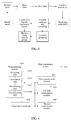
- FIG. 2 shows a process of constructing a model by using a conventional model method such as a logistic regression method.
- FIG. 3 shows a process of constructing a model by using the risk assessment method in this embodiment of the present invention.
- KS is one of the most frequently used metrics for measuring a model.
- the effect of a model during implementation is a final criterion for assessing the model.
- Table 4 shows that both the model training effect and the implementation effect of the method in this embodiment of the present invention are slightly better than those of the logistic regression method, and much better than those of the expert scorecard.
- the risk assessment method is provided.
- the solution is used in which the variables are grouped and classified, to obtain the strong variable group and the weak variable group; the risk assessment model is constructed for each obtained weak variable group; the model result of each weak variable group is used as a variable to be combined with the obtained strong variable group, to form the combination variable group; and finally, the comprehensive risk assessment model is constructed for the combination variable group.
- the method fully digs and uses the data value of a weak variable group, and each variable in each weak variable group may be reflected in a finally constructed comprehensive model by using a corresponding model result variable, so that a model result of the comprehensive model can reflect a function of each variable in each weak variable group. Therefore, considerations of risk assessment are more comprehensive, the interpretability and the model stability are stronger, and the model result is as objective as possible and is more robust in application, thereby helping improve the effect of risk assessment and helping reflect the future trend of service development.
- the following further provides a related apparatus used for cooperatively implementing the foregoing solution.
- the risk assessment system 400 may include:
- variable grouping according to data sources is performed according to correlations between the data sources and a target variable and/or correlations between the data sources and user information.
- the preprocessing module 410 includes:
- variable combination module 430 is specifically configured to: denote a model result of a risk assessment model for any variable group X j in the at least one second-type variable group as Logodds j , use Logodds j as a variable, denote any variable in the at least one first-type variable group as x i , and combine all Logodds j and x i to form the third-type variable group, both i and j being positive integers.
- the second construction module 440 is specifically configured to construct the following comprehensive risk assessment model for the third-type variable group:
- Logodd s j n being the number of variables x i
- m being the number of variables Logodds j
- a 0 being an intercept term/a constant term
- a i representing a weight of the variable x i
- a j representing a weight of the variable Logodds j .
- Probability representing a probability that the model result is impaired.
- the risk assessment system is provided.
- the solution is used in which the variables are grouped and classified, to obtain the strong variable group and the weak variable group; the risk assessment model is constructed for each obtained weak variable group; the model result of each weak variable group is used as a variable to be combined with the obtained strong variable group, to form the combination variable group; and finally, the comprehensive risk assessment model is constructed for the combination variable group.
- the method fully digs and uses the data value of a weak variable group, and each variable in each weak variable group may be reflected in a finally constructed comprehensive model by using a corresponding model result variable, so that a model result of the comprehensive model can reflect a function of each variable in each weak variable group. Therefore, considerations of risk assessment are more comprehensive, the interpretability and the model stability are stronger, and the model result is as objective as possible and is more robust in application, thereby helping improve the effect of risk assessment and helping reflect the future trend of service development.
- This embodiment of the present invention further provides a computer storage medium.
- the computer storage medium may store a program.
- the program When being executed by a computer device including a processor, the program enables the computer device to perform some or all steps in the risk assessment method in the foregoing method embodiment.
- this embodiment of the present invention further provides a computer device 500.
- the computer device 500 includes a processor 501, a memory 502, a bus 503, and a communications interface 504.
- the memory 502 is configured to store a program 505.
- the program 505 includes a computer executable instruction.
- the processor 501 and the memory 502 are connected by using the bus 503. When the computer device 500 runs, the processor 501 executes the program 505 stored in the memory 502, so that the computer device 500 performs the risk assessment method in the foregoing method embodiment.
- the communications interface 504 may receive data.
- the received data includes all variables.
- the memory 502 may store the received variables.
- the processor 501 may perform the following steps by executing the program 505: performing variable grouping according to data sources, to obtain at least one first-type variable group and at least one second-type variable group; constructing a risk assessment model for the at least one second-type variable group, to obtain a model result of the risk assessment model for the at least one second-type variable group; using the model result of the at least one second-type variable group as a variable, and combining the variable with a variable (for example, all variables) in the at least one first-type variable group, to form a third-type variable group; and constructing a comprehensive risk assessment model for the third-type variable group.
- a variable for example, all variables
- the bus 503 may be an Industry Standard Architecture (ISA) bus, a peripheral component interconnect (PCI) bus, an Extended Industry Standard Architecture (EISA) bus, or the like.
- ISA Industry Standard Architecture
- PCI peripheral component interconnect
- EISA Extended Industry Standard Architecture
- the bus may be classified into one or more of an address bus, a data bus, and a control bus. For convenience of representation, only one bold line is used for representation in FIG. 5 , but it does not represent that there is only one bus or one type of bus.
- the memory 502 may include a high-speed ramdom access memory (RAM) memory.
- the memory 502 may further include a non-volatile memory.
- the memory 502 may include a magnetic disk memory.
- the processor 501 may be a central processing unit (CPU), or the processor 501 may be an application-specific integrated circuit (ASIC), or the processor 501 may be configured as one or more integrated circuits for implementing this embodiment of the present invention.
- CPU central processing unit
- ASIC application-specific integrated circuit
Landscapes
- Engineering & Computer Science (AREA)
- Business, Economics & Management (AREA)
- Physics & Mathematics (AREA)
- General Physics & Mathematics (AREA)
- Theoretical Computer Science (AREA)
- Accounting & Taxation (AREA)
- Finance (AREA)
- Economics (AREA)
- Strategic Management (AREA)
- Development Economics (AREA)
- General Business, Economics & Management (AREA)
- Marketing (AREA)
- Human Resources & Organizations (AREA)
- Data Mining & Analysis (AREA)
- Technology Law (AREA)
- Mathematical Physics (AREA)
- Software Systems (AREA)
- Mathematical Optimization (AREA)
- Mathematical Analysis (AREA)
- Computational Mathematics (AREA)
- Operations Research (AREA)
- Entrepreneurship & Innovation (AREA)
- Pure & Applied Mathematics (AREA)
- General Engineering & Computer Science (AREA)
- Educational Administration (AREA)
- Quality & Reliability (AREA)
- Databases & Information Systems (AREA)
- Bioinformatics & Cheminformatics (AREA)
- Algebra (AREA)
- Life Sciences & Earth Sciences (AREA)
- Evolutionary Biology (AREA)
- Probability & Statistics with Applications (AREA)
- Game Theory and Decision Science (AREA)
- Bioinformatics & Computational Biology (AREA)
- Tourism & Hospitality (AREA)
- Artificial Intelligence (AREA)
- Computer Vision & Pattern Recognition (AREA)
- Evolutionary Computation (AREA)
- Medical Informatics (AREA)
- Computing Systems (AREA)
Abstract
Description
- This application claims the priority to Chinese Patent Application No.
201610070616.5 - The present disclosure relates to the field of risk assessment technologies based on computer technologies, and specifically, to a risk assessment method and system.
- Risk assessment is assessment on the possibility of risks brought by, for example, threats faced by, weaknesses of, and impact caused by the information. There are two common risk assessment methods: a model method and an expert method.
- The model method is a method for constructing a risk assessment model using a machine learning method such as logistic regression, a decision tree, and a random forest, and performing risk assessment based on a model result. The practice shows that some weak variables may be quite significant in services. However, in the model method, the weak variables cannot be selected for a model. Consequently, in the model method, functions of some variables cannot be reflected, and it is difficult to reflect the future trend of service development.
- The expert method is a method for performing risk assessment by determining considerations of the assessment according to opinions of an expert. The expert method can resolve the problem that the weak variables cannot be selected for the model. However, the expert method is a relatively subjective method, in which the value of data is not fully dug and used.
- Embodiments of the present invention provide a risk assessment method. Valuable weak variables are dug and added to a risk assessment model, making considerations of risk assessment more comprehensive and the interpretability and stability stronger, helping improve the accuracy of risk assessment, and ensuring the objectiveness of risk assessment.
- A first aspect of the present disclosure provides a risk assessment method, including: performing variable grouping according to data sources, to obtain at least one first-type variable group and at least one second-type variable group; constructing a risk assessment model for the at least one second-type variable group, to obtain a model result of the risk assessment model for the at least one second-type variable group; using the model result of the at least one second-type variable group as a variable, and combining the variable with a variable in the at least one first-type variable group, to form a third-type variable group; and constructing a comprehensive risk assessment model for the third-type variable group.
- A second aspect of the present disclosure provides a risk assessment system, including: a preprocessing module, configured to perform variable grouping according to data sources, to obtain at least one first-type variable group and at least one second-type variable group; a first construction module, configured to construct a risk assessment model for the at least one second-type variable group, to obtain a model result of the risk assessment model for the at least one second-type variable group; a variable combination module, configured to: use the model result of the at least one second-type variable group as a variable, and combine the variable with a variable in the at least one first-type variable group, to form a third-type variable group; and a second construction module, configured to construct a comprehensive risk assessment model for the third-type variable group.
- It can be learned from the above that in some feasible implementations of the present disclosure, a technical solution is used in which variables are grouped to obtain two types of variable groups, a risk assessment model is constructed for a second-type variable group, a model result is used as a variable to be combined with a variable in a first-type variable group, to form a third-type variable group, and finally, a comprehensive risk assessment model is constructed for the third-type variable group.
- The method fully digs and uses the data value of the second-type variable group, so that the second-type variable group is reflected in a finally constructed comprehensive model. Therefore, considerations of risk assessment are more comprehensive, the interpretability and the model stability are stronger, and the model result is as objective and accurate as possible and is more robust in application, thereby helping improve the effect of risk assessment and helping reflect the future trend of service development.
- To describe the technical solutions of the embodiments of the present invention more clearly, the following briefly introduces the accompanying drawings required for describing the embodiments. Apparently, the accompanying drawings in the following descriptions show only some embodiments of the present invention, and a person of ordinary skill in the art may still derive other drawings from these accompanying drawings without creative efforts.
-
FIG. 1 is a schematic flowchart of a risk assessment method according to an embodiment of the present invention; -
FIG. 2 is a schematic diagram of a process of constructing a model by using a conventional model method; -
FIG. 3 is a schematic diagram of a process of constructing a model by using the risk assessment method in the embodiment of the present invention; -
FIG. 4 is a schematic structural diagram of a risk assessment system according to an embodiment of the present invention; and -
FIG. 5 is a schematic structural diagram of a computer device according to an embodiment of the present invention. - To make the solutions of the present disclosure more comprehensible for a person skilled in the art, the following clearly and completely describes the technical solutions in the embodiments of the present invention with reference to the accompanying drawings in the embodiments of the present invention. Apparently, the described embodiments are merely some rather than all of the embodiments of the present invention. All other embodiments obtained by a person of ordinary skill in the art based on the embodiments of the present invention without creative effects shall fall within the protection scope of the present disclosure.
- The technical solutions in the embodiments of the present invention relate to a risk assessment method based on a computer system. The following first briefly describes some terms used in the risk assessment method.
- Throughout this specification, the term "risk scorecard" refers to a risk assessment model, for example, a risk assessment model used for assessing credit risks of users, and usually includes two types: supervised learning and semi-supervised learning (if reject inference exists). Usually, a supervised target (that is, a target variable) is that whether a user defaults in a period of time, for example, if the user does not pay back loans in time, whether the loans are more than 90 days overdue within six months after the loans are issued. Usually, there are two methods for constructing a risk scorecard: a model method and an expert method.
- The term "weak variable" refers to a variable that is statistically insignificant, that is, a probability (P-Value, Pr) in a significance hypothesis test is greater than or equal to a set standard, for example, 0.05, and that cannot be selected for a risk assessment model according to such a statistics standard. Comparatively, the term "strong variable" refers to a variable that is statistically significant, that is, a P-value in a significance hypothesis test is less than a set standard, for example, 0.05, and that can meet a significance statistics standard. It should be noted that the set standard may alternatively be a value different from 0.05, for example, 0.01. This is not limited in this specification. It should be noted that the hypothesis test is an important element in inferential statistics. When the hypothesis test is performed by using professional statistics software, the P-value is a basis for test decision. The P-value is a probability, and reflects a possibility that an event happens. In statistics, usually, a P-value obtained by using a significance test method may indicate a significant variable when P<0.05, which means that a probability of a difference between samples caused by a sampling error is less than 0.05.
- The term "variable group" refers to a group of variables from a same data source. The term "strong variable group" refers to a variable group having a relatively high correlation with a target variable and/or having a relatively high correlation with user information. The term "weak variable group" refers to a variable group having a relatively low correlation with a target variable and/or having a relatively low correlation with user information. The correlation may be represented by using a correlation coefficient such as a P-value. An average value of P-values of all variables in a variable group may be calculated. When the average value is greater than a threshold, it is considered that the variable group has a relatively high correlation with the target variable; when the average value is not greater than the threshold, it is considered that the variable group has a relatively low correlation with the target variable.
- The term "expert scorecard" refers to a risk scorecard designed based on the industry expert experience. An expert scoring method is a risk assessment method performed based on the expert scorecard.
- The term "logistic regression (LR)" refers to a method that is maturely and widely applied at present and that is used for developing a risk scorecard, and is a generalized linear regression method.
- The term "decision tree" refers to a method for approximating a value of a discrete function. The decision tree is a typical classification method, and may also be used for constructing a prediction model. First, data is processed, and a readable rule and decision tree are generated by using an inductive algorithm. Then, the decision tree is used for analyzing new data. Substantially, the decision tree is a process of classifying data according to a series of rules. Typical algorithms of the decision tree include ID3, C4.5, a classification and regression tree (CART), and the like.
- The term "analytic hierarchy process" refers to a decision method of determining an element that is always related to a decision as a target, criterion, solution, or the like in a hierarchy, and performing qualitative and quantitative analysis based on the hierarchy.
- The term "variable normalization" refers to an operation of standardizing a variable, an objective of which is to make a variable having different dimensions comparable. There are different normalization methods. In this specification, a minimum-maximum normalization method may be used, and a value range of each processed variable is [0,1].
- The term "model robustness" refers to stability of a model from a development process to an implementation process. A model having higher robustness has a more ideal implementation effect.
- The term "Kolmogorov Smirnov (KS)" refers to a common metric for measuring an effect of a score model. Kolmogorov and Smirnov are names of two Soviet mathematicians. KS is in a range of 0 to 100, and a larger value indicates a better model effect. Usually, KS being equal to approximately 25 is a risk assessment criterion acceptable by financial institutions.
- The following briefly describes the model method.
- The model method is a most common risk assessment method. A risk assessment model (a logic model) constructed by using the model method may be referred to as a risk scorecard. There are many conventional methods for constructing a risk scorecard, for example, a logistic regression method, a decision tree, and a random forest. The logistic/stepwise regression method is one of most widely and maturely applied methods at present. The following uses the logistic regression method as an example to describe a basic modeling process of the risk scorecard. The process includes the following steps:
- First, a normalized modeling wide table, for example, Table 1, is prepared. Usually, there are more than hundreds of variables x in Table 1. It is assumed that there are totally 10000 user samples and 300 attributes (that is, variables) in Table 1. Table 1 includes a total of three types of variables from different data sources: payment variables, instant messaging variables, and socialization variables. Assuming that the three types of variables each include 100 variables, there are a total of 300 variables. Y in the second column in Table 1 is a supervised target or a target variable, which may specifically refer to that if a user does not pay back loans in time, whether the loans are more than 90 days overdue within one year after the loans are issued. A value of each variable in the table is a normalized value. Therefore, each value is in a range of [0,1].
- It should be noted that each variable in the embodiments of the present invention is from a legal data source, for example, including user data or data that may be queried for by the public. The user data is data that is authenticated by users for use.
Table 1 Modeling wide table User number Target variable Variable 1 ... Variable 15 Variable 16 ... Variable 30 ... Variable 300 obs target(y) x1 ... x15 x16 ... x30 ... x300 1 1 0 ... 0 1 ... 0.8 ... 0.50 2 0 1 ... 0.12 0 ... 0.2 ... 0.45 3 0 1 ... 0.27 1 ... 0.1 ... 0.31 4 0 0 ... 0.87 0 ... 0.3 ... 0.12 ... ... ... ... ... ... ... ... ... 10000 1 1 ... 0.35 0 ... 0.9 ... 0.53 - It is easily understood that among the three types of variables, payment variables are directly correlated and have a relatively high correlation with finance, and may be considered as a strong variable group; instant messaging variables and socialization variables each have a relatively low correlation with finance and may be considered as a weak variable group.
- It is assumed that in Table 1, the first to the fifteenth variables are strong variables in the strong variable group, and the sixteenth to the thirtieth variables are strong variables in the weak variable group. After a series of variable analysis and variable screening, a normal result may be that the first 15 strong variables in the strong variable group and the sixteenth to the eighteenth strong variables in the weak variable group enter a final logistic regression model. A result of the obtained logistic regression model is shown in formulas (1) and (2):


- Logodds being an output result of the logistic regression model (model result for short), Probability being a probability parameter, and Probability representing a probability that the model result Logodds is impaired.
- It can be learned that in the weak variable group, only 3 variables including x16, x17, and x18 are selected for the model, and the remaining variables do not enter the model. Although other strong variables (for example, x19 to x30) in the weak variable group can be placed into the model by lowering a select in/out screening criterion or by using a force in method, contributions of the weak variable group to the model cannot be effectively reflected, or a weight of the weak variable group in the risk scorecard is excessively low. Such an approach further has a significant disadvantage: variables in the weak variable group that are newly selected by lowering the criterion may be very unstable.
- The following briefly describes the expert method.
- An expert scorecard is a logistic score model designed and formed based on the industry expert experience. The expert scorecard is very useful at an initial stage of the service development, and is also frequently used in some public services relating to a relatively small number of users. For a conventional expert scorecard, opinions of experts are collected in advance, considerations, that is, ranges of used variables, for scoring are determined, and then a weight of each variable is determined, so as to finally obtain an expert scorecard required for a service. Data and variable assumption are the same as those in Table 1 in the model method. The expert scorecard is shown in Table 2.

- The expert scorecard resolves a problem that most variables in the weak variable group cannot be selected for the model in the model method, and is relatively easy to understand and implement. However, the expert scorecard has a fatal defect: The value of data is not fully dug and used, having relatively strong subjectivity. For example, the method does not consider correlations and synergies among the variables, and a variable value may vary relatively greatly, causing a model to be not very stable.
- As described above, the existing risk scorecard construction methods mainly include the expert method and the model method. Both of the two methods are relatively mature in industry application, but their defects are also very obvious. The main defect of the model method is that a weak variable cannot be selected, and a service development trend cannot be reflected. The main defect of the expert method is that the method has relatively strong subjectivity and cannot dig and use the value of data to the greatest extent.
- Therefore, the embodiments of the present invention provide a risk assessment method and system. The following provides descriptions separately.
- Referring to
FIG. 1 , the first embodiment of the present invention provides a risk assessment method. The method may include the following steps:
S110: Perform variable grouping according to data sources, to obtain at least one first-type variable group and at least one second-type variable group. - With the rapid development of the Internet, there are increasingly more information and data, and data sources used in the risk assessment method are increasingly more widely distributed. Some data sources are relatively strongly correlated with a credit risk, and some data sources are relatively weakly correlated with the credit risk. In this specification, first, variables are grouped according to the data sources, and variables that are from a same source are considered as one variable group. For example, three types of variables respectively from payment, instant messaging, and socialization may be considered as three variable groups. In this specification, variable groups are classified, and all of the variable groups are classified into a strong variable group and a weak variable group. Some variables such as financial management, saving, consumption, and payment of users are directly correlated with user information such as funds, and have relatively strong correlations with credit risks of the users. For example, these variables may be referred to as the strong variable group. Some variables such as instant messaging, socialization, and gaming are not directly correlated with finance, only reflect some social and behavior habits of users, and therefore have relatively weak correlations with credit risks. For example, these variables may be referred to as the weak variable group.
- Factors of classifying the variable groups may include, but are not limited to, the following:
- Usually, a Pearson correlation coefficient may be used in correlation analysis, and a calculation method thereof is not described herein. Usually, a correlation criterion may be: a value above 0.6 indicates a strong correlation, 0.4 to 0.6 indicates a medium correlation, 0.2 to 0.4 indicates a weak correlation, and a value below 0.2 indicates an extremely weak correlation or no correlation. However, a criterion for actual application in the financial circle is far from that, and the correlation criterion is much lower, because a variable whose correlation coefficient is above 0.4 is extremely rare. That is, the correlation criterion may be defined according to a requirement. For example, for a payment variable, it may be defined that a value above 0.1 indicates a strong correlation, and a value below 0.1 indicates a weak correlation.
- Correlations are also quite related to variable types. Usually, correlations of variables such as loans, financing, and payment that are relatively close to information such as user funds is relatively strong; correlations of variables such as instant messaging or socialization that is relatively far from the user funds is relatively weak. During application, an importance value may be used for representing the correlations between the data sources and the user information, for example, strong, medium, and weak.
- In this specification, the variable groups may be classified into the strong variable group and the weak variable group according to the foregoing two criteria, that is, the correlations between the data sources and the target variable and/or the correlations between the data sources and the user information. The strong variable group is the first-type variable group, and the weak variable group is the second-type variable group.
- In some embodiments, a specific method for classifying the variable groups may include the following steps:
- a0: Group all variables into a plurality of variable groups according to different data sources.
- a1: Calculate a correlation coefficient of any variable and a target variable according to correlations between the data sources and the target variable, and calculate an average correlation coefficient of each variable group in the plurality of variable groups. The correlation coefficient is the P-value described above.
- a2: Determine an importance value of each variable group in the plurality of variable groups according to correlations between the data sources and user information.
- a3: Perform variable group classification according to the average correlation coefficients and/or the importance values of the plurality of variable groups, classify a variable group whose average correlation coefficient is greater than a threshold and/or whose importance value is the highest as a first-type variable group, that is, a strong variable group, and classify other variable groups as second-type variable groups, that is, weak variable groups.
- It can be learned that the strong variable group is a variable group having a relatively high correlation with the target variable and/or having a relatively high correlation with the user information, and the weak variable group is a variable group having a relatively low correlation with the target variable and/or having a relatively low correlation with the user information.
- As shown in
FIG. 3, FIG. 3 is a schematic diagram of variable group classification in an example of an application scenario. Correlation criteria for various types of variables are also different. Correlation criterion thresholds set in combination with practical experience may be: 0.1 for a payment variable, 0.05 for an instant messaging variable, and 0.06 for a socialization variable. A variable whose correlation is greater than the threshold is considered as a strong variable, and a variable whose correlation is less than the threshold is considered as a weak variable. Among payment variables, relatively strong variables include credit card payment reflecting a payment capability of a user, a fund size reflecting a payment capability of a user, and the like, and relatively weak variables include a user transaction frequency, a phone card recharge of a user, and the like. Among instant messaging variables, relatively strong variables include the number of commonly-used login cities reflecting user stability and the like, and relatively weak variables include the number of pieces of sent and received information and the like. Among socialization variables, relatively strong variables include the number of and the quality of relatively close friends, and relatively weak variables include the number of friends, the amount of sent and received information, and the like. - For convenience of description, variable names of the three types of variables are corresponding to those in Table 1. Specifically, refer to the third row and the fourth row in Table 3. According to the correlation criterion thresholds of the variables described above, the numbers of strong variables and weak variables in each type of variables are respectively: 15 and 85 for payment variables, 8 and 92 for instant messaging variables, and 7 and 93 for socialization variables.
Table 3 Variable grouping Variable type Payment (A) Instant messaging (B) Socialization (C) Correlation Relatively strong Relatively weak Relatively strong Relatively weak Relatively strong Relatively weak Variable xA1-xA15 xA16-xA100 xB1-xB10 xB11-xB100 xC1-xC10 xC11-xC100 Variable name x1-x15 x31-x115 x16-x23 x116-x207 x24-x30 x208-x300 Number of variables 15 85 8 92 7 93 Correlation coefficient ≥0.1 <0.1 ≥0.05 <0.05 ≥0.06 <0.06 Average correlation coefficient 0.12 0.03 0.02 Importance value Strong Weak Weak Variable grouping Weak variable group Weak variable group Weak variable group - It can be learned from Table 3 that three types of variables from payment, instant messaging, and socialization may be classified into three groups according to different data sources, that is, variable groups A, B, and C. An average correlation coefficient and an importance value of the variable group A are the largest. Therefore, the variable group A is a strong variable group, and the variable group B and C are weak variable groups.
- It should be noted that the weak variable groups are different from weak variables. A weak variable group may also include a strong variable, but a correlation with a target variable is merely not very strong. Similarly, a strong variable group may also include a weak variable. Certainly, a weak variable is more easily included in a weak variable group, and a strong variable is more easily included in a strong variable group. Although many variables in a weak variable group are significant in statistics, when they are placed together with a strong variable group for modeling, usually, only a small part of them can enter the model. The effect of the weak variable group is greatly diluted, and the weak variable group cannot play a due role.
- S120: Construct a risk assessment model for the at least one second-type variable group, to obtain a model result of the risk assessment model for the second-type variable group.
- In this step, a risk assessment model is established for each of the at least one second-type variable group, or the weak variable group, obtained in the foregoing step, to obtain a model result of the risk assessment model for each weak variable group. It is assumed that each weak variable group is modeled by using a logistic regression method. Considering the weak variable group, a variable selection criterion may be properly relaxed.
- For example, a modeling result of the weak variable group B corresponding to instant messaging is as follows:

- In the formula (3), LogoddsB is a model result, f(x B ) represents modeling of the variable group B, xBi represents the ith variable in the variable group B, i is a positive integer, α 0 is an intercept term/a constant term, and αi represents a weight of the variable xBi.
- Considering a correspondence between variable names in Table 3, the formula (3) may be written as:

- In the formula (4), LogoddsB is a model result, f(x B ) represents modeling of the variable group B, α 0 is an intercept term/a constant term, αi represents a weight of a variable xi , and i is a positive integer.
- Similarly, a modeling result of the weak variable group C corresponding to socialization may be obtained:

- In the formula (5), LogoddsC is a model result, f(xC ) represents modeling of the variable group C, xCi represents the ith variable in the variable group C, i is a positive integer, a 0 is an intercept term/a constant term, and ai represents a weight of the variable xCi.
- Considering the correspondence between the variable names in Table 3, the formula (5) may be written as:

- In the formula (6), LogoddsC is a model result, f(xC ) represents modeling of the variable group C, a 0 is an intercept term/a constant term, ai represents a weight of a variable xi, and i is a positive integer.
- It should be noted that risk assessment models represented by the foregoing formulas are merely examples, and are not intended to limit the present disclosure. In addition, when there are a plurality of second-type variable groups, a risk assessment model may be established for only one of the second-type variable groups, or a risk assessment model may be established for several or each of the second-type variable groups. Both of them can have a corresponding technical effect, and the present disclosure imposes no limit thereon.
- S130: Use the model result of the second-type variable group as a variable, and combine the variable with a variable in the at least one first-type variable group, to form a third-type variable group; and construct a comprehensive risk assessment model for the third-type variable group.
- For example, in this step, a model result of each weak variable group is used as a variable, and all variables in all strong variable groups are combined with all model result variables, to form a third-type variable group. In this specification, the third-type variable group is also referred to as a combination variable group. It is assumed that a model result of a risk assessment model for any weak variable group Xj in the at least one weak variable group is denoted as Logoddsj , Logoddsj is used as a variable, and any variable in the at least one strong variable group is denoted as xi. All variables Logoddsj and xi may be combined to form a combination variable group, both i and j being positive integers. The combination variable group may be represented by [x 1, x 2......xi ......xn ......Logoddsj ......Logoddsm ], n being the number of variables xi , m being the number of variables Logoddsj , and both n and m being positive integers.
- In this step, a comprehensive risk assessment model is constructed for the combination variable group:

- Assuming that there are two variables Logoddsj , that is, LogoddsB and LogoddsC obtained in the foregoing step, the comprehensive model represented by the formula (7) may be written as:

- Further, a probability parameter Probability may be calculated based on a model result Logodds of the foregoing comprehensive model, and a formula is as follows:

- It can be learned from the foregoing that according to the technical solution in this embodiment of the present invention, a problem in the existing technology is resolved methodologically:
- (1) First, the variables are grouped and classified according to the data sources, the correlations between the data sources and the target variable (for example, the financial risk), and the correlations between the data sources and the user information (for example, the funds information), to obtain the strong variable group and the weak variable group, for example, one strong variable group and two weak variable groups.
- (2) The weak variable groups are modeled separately, for example, two models are constructed for the two weak variable groups.
- (3) Modeling results of the two weak variable groups are used as two variables, which are placed together with a variable in the strong variable group, to construct a final comprehensive risk assessment model.
- According to this method, a relatively large number of variables in the weak variable groups may enter the model, ensuring contributions of the weak variable groups. In addition, the model has stronger interpretability in services, and has stronger robustness in practical application.
- It should be noted that in this embodiment of the present invention, it is not necessarily that a risk assessment model is established for each second-type variable group and that each model structure is used as a variable to be combined with a variable in the first-type variable group. Alternatively, risk assessment models may be established for some second-type variable groups (for example, when there are three second-type variable groups, risk assessment models are established for only two of them), and variables in the some second-type variable groups are combined with some variables in the first-type variable group. A person skilled in the art shall make no restrictive interpretation thereon.
- For better understanding of the technical solution of this embodiment of the present invention, the following describes an entire modeling process of a risk scorecard with reference to the accompanying drawings. As shown in
FIG. 2, FIG. 2 shows a process of constructing a model by using a conventional model method such as a logistic regression method. As shown inFIG. 3, FIG. 3 shows a process of constructing a model by using the risk assessment method in this embodiment of the present invention. It can be learned fromFIG. 2 andFIG. 3 that, two processes of "variable grouping" and "modeling a weak variable group" are added to the modeling process in this embodiment of the present invention. - In practice, the inventor of the present disclosure tests and compares results of three methods which are a logistic regression method, an expert scorecard method, and the method in the present disclosure. Comparison results are shown in Table 4.
Table 4 Comparison between test results Method Logistic regression method Expert scorecard Method for modeling a weak variable group Selected variable 18 30 30 Model development effect (KS) Development sample 32 25 33 Test sample 30 24 31 Inter-temporal test 31 24 32 Model implementation effect (KS) 26 22 27 - KS is one of the most frequently used metrics for measuring a model. The effect of a model during implementation is a final criterion for assessing the model. Table 4 shows that both the model training effect and the implementation effect of the method in this embodiment of the present invention are slightly better than those of the logistic regression method, and much better than those of the expert scorecard.
- It can be understood that the foregoing solution in this embodiment of the present invention may be specifically implemented in, for example, a computer device.
- It can be learned from the foregoing that in some feasible implementations of the present disclosure, the risk assessment method is provided. The solution is used in which the variables are grouped and classified, to obtain the strong variable group and the weak variable group; the risk assessment model is constructed for each obtained weak variable group; the model result of each weak variable group is used as a variable to be combined with the obtained strong variable group, to form the combination variable group; and finally, the comprehensive risk assessment model is constructed for the combination variable group. The following technical effects are obtained:
- The method fully digs and uses the data value of a weak variable group, and each variable in each weak variable group may be reflected in a finally constructed comprehensive model by using a corresponding model result variable, so that a model result of the comprehensive model can reflect a function of each variable in each weak variable group. Therefore, considerations of risk assessment are more comprehensive, the interpretability and the model stability are stronger, and the model result is as objective as possible and is more robust in application, thereby helping improve the effect of risk assessment and helping reflect the future trend of service development.
- To better implement the foregoing solution in the embodiment of the present invention, the following further provides a related apparatus used for cooperatively implementing the foregoing solution.
- Referring to
FIG. 4 , this embodiment of the present invention provides arisk assessment system 400. Therisk assessment system 400 may include: - a
preprocessing module 410, configured to perform variable grouping according to data sources, to obtain at least one first-type variable group and at least one second-type variable group; - a
first construction module 420, configured to construct a risk assessment model for the at least one second-type variable group, to obtain a model result of the risk assessment model for the at least one second-type variable group; - a
variable combination module 430, configured to: use the model result of the at least one second-type variable group as a variable, and combine the variable with a variable in the at least one first-type variable group, to form a third-type variable group; and - a
second construction module 440, configured to construct a comprehensive risk assessment model for the third-type variable group. - Optionally, the variable grouping according to data sources is performed according to correlations between the data sources and a target variable and/or correlations between the data sources and user information.
- In some embodiments, the
preprocessing module 410 includes: - a
grouping unit 4101, configured to group all variables into a plurality of variable groups according to different data sources; - a
calculation unit 4102, configured to: calculate a correlation coefficient of any variable and a target variable according to correlations between the data sources and the target variable, and calculate average correlation coefficients of the plurality of variable groups; - a determining
unit 4103, configured to determine importance values of the plurality of variable groups according to correlations between the data sources and user information; and - a
classification unit 4104, configured to: perform variable classification according to the average correlation coefficients and/or the importance values of the plurality of variable groups, classify a variable group whose average correlation coefficient is greater than a threshold and/or whose importance value is the highest as a strong variable group, that is, the first-type variable group, and classify other variable groups as weak variable groups, that is, second-type variable groups. - In some embodiments, the
variable combination module 430 is specifically configured to: denote a model result of a risk assessment model for any variable group Xj in the at least one second-type variable group as Logoddsj , use Logoddsj as a variable, denote any variable in the at least one first-type variable group as xi, and combine all Logoddsj and xi to form the third-type variable group, both i and j being positive integers. - In some embodiments, the
second construction module 440 is specifically configured to construct the following comprehensive risk assessment model for the third-type variable group:
- In some embodiments, the
system 400 further includes acalculation module 450, configured to calculate a probability parameter Probability according to a model result Logodds of the second logic model:
- Probability representing a probability that the model result is impaired.
- It can be understood that functions of various functional modules of the system in this embodiment of the present invention may be specifically implemented according to the method in the foregoing method embodiment, and for a specific implementation process thereof, refer to the related descriptions in the foregoing method embodiment. Details are not described herein again.
- It can be learned from the foregoing that in some feasible implementations of the present disclosure, the risk assessment system is provided. The solution is used in which the variables are grouped and classified, to obtain the strong variable group and the weak variable group; the risk assessment model is constructed for each obtained weak variable group; the model result of each weak variable group is used as a variable to be combined with the obtained strong variable group, to form the combination variable group; and finally, the comprehensive risk assessment model is constructed for the combination variable group. The following technical effects are obtained:
- The method fully digs and uses the data value of a weak variable group, and each variable in each weak variable group may be reflected in a finally constructed comprehensive model by using a corresponding model result variable, so that a model result of the comprehensive model can reflect a function of each variable in each weak variable group. Therefore, considerations of risk assessment are more comprehensive, the interpretability and the model stability are stronger, and the model result is as objective as possible and is more robust in application, thereby helping improve the effect of risk assessment and helping reflect the future trend of service development.
- This embodiment of the present invention further provides a computer storage medium. The computer storage medium may store a program. When being executed by a computer device including a processor, the program enables the computer device to perform some or all steps in the risk assessment method in the foregoing method embodiment.
- Referring to
FIG. 5 , this embodiment of the present invention further provides acomputer device 500. - The
computer device 500 includes aprocessor 501, amemory 502, abus 503, and acommunications interface 504. Thememory 502 is configured to store aprogram 505. Theprogram 505 includes a computer executable instruction. Theprocessor 501 and thememory 502 are connected by using thebus 503. When thecomputer device 500 runs, theprocessor 501 executes theprogram 505 stored in thememory 502, so that thecomputer device 500 performs the risk assessment method in the foregoing method embodiment. - Specifically, the
communications interface 504 may receive data. The received data includes all variables. Thememory 502 may store the received variables. Theprocessor 501 may perform the following steps by executing the program 505: performing variable grouping according to data sources, to obtain at least one first-type variable group and at least one second-type variable group; constructing a risk assessment model for the at least one second-type variable group, to obtain a model result of the risk assessment model for the at least one second-type variable group; using the model result of the at least one second-type variable group as a variable, and combining the variable with a variable (for example, all variables) in the at least one first-type variable group, to form a third-type variable group; and constructing a comprehensive risk assessment model for the third-type variable group. - The
bus 503 may be an Industry Standard Architecture (ISA) bus, a peripheral component interconnect (PCI) bus, an Extended Industry Standard Architecture (EISA) bus, or the like. The bus may be classified into one or more of an address bus, a data bus, and a control bus. For convenience of representation, only one bold line is used for representation inFIG. 5 , but it does not represent that there is only one bus or one type of bus. - The
memory 502 may include a high-speed ramdom access memory (RAM) memory. Optionally, thememory 502 may further include a non-volatile memory. For example, thememory 502 may include a magnetic disk memory. - The
processor 501 may be a central processing unit (CPU), or theprocessor 501 may be an application-specific integrated circuit (ASIC), or theprocessor 501 may be configured as one or more integrated circuits for implementing this embodiment of the present invention. - In the foregoing embodiments, descriptions of the embodiments have different emphases, and for parts that are not described in detail in one embodiment, refer to the related descriptions in the other embodiments.
- The risk assessment method and system provided in the embodiments of the present invention are described above in detail. Although the principles and implementations of the present disclosure are described by using specific examples in this specification, the descriptions of the foregoing embodiments are merely intended to help understand the method and the core idea of the method of the present disclosure. Meanwhile, a person of ordinary skill in the art may make modifications to the specific implementations and application range according to the idea of the present disclosure. In conclusion, the content of this specification should not be construed as a limit on the present disclosure.
Claims (13)
- A risk assessment method, comprising:performing variable grouping according to data sources, to obtain at least one first-type variable group and at least one second-type variable group;constructing a risk assessment model for the at least one second-type variable group, to obtain a model result of the risk assessment model for the at least one second-type variable group;using the model result of the at least one second-type variable group as a variable, and combining the variable with a variable in the at least one first-type variable group, to form a third-type variable group; andconstructing a comprehensive risk assessment model for the third-type variable group.
- The risk assessment method according to claim 1, wherein the variable grouping according to data sources is performed according to correlations between the data sources and a target variable and/or correlations between the data sources and user information.
- The risk assessment method according to claim 2, wherein a correlation between the at least one first-type variable group and the target variable is greater than a correlation between the at least one second-type variable group and the target variable and/or a correlation between the at least one first-type variable group and the user information is greater than a correlation between the at least one second-type variable group and the user information.
- The risk assessment method according to claim 1, wherein the at least one second-type variable group comprises a plurality of second-type variable groups; and
before the constructing a comprehensive risk assessment model for the third-type variable group, the method comprises:
constructing a risk assessment model for each of the second-type variable groups, to obtain a model result of the risk assessment model for each second-type variable group; and using the model result of each second-type variable group as a variable, and combining the variable with all variables in the at least one first-type variable group, to form the third-type variable group. - The method according to claim 1, wherein the performing variable grouping according to data sources, to obtain at least one first-type variable group and at least one second-type variable group comprises:grouping all variables into a plurality of variable groups according to different data sources;calculating a correlation coefficient of any variable and a target variable according to correlations between the data sources and the target variable, and calculating an average correlation coefficient of each variable group in the plurality of variable groups;determining an importance value of each variable group in the plurality of variable groups according to correlations between the data sources and user information; andperforming variable group classification according to the average correlation coefficients and/or the importance values of the plurality of variable groups, classifying a variable group whose average correlation coefficient is greater than a threshold and/or whose importance value is the highest as a first-type variable group, and classifying other variable groups as second-type variable groups.
- The method according to any one of claims 1 to 3 and 5, wherein the using the model result of the at least one second-type variable group as a variable, and combining the variable with a variable in the at least one first-type variable group, to form a third-type variable group comprises:
denoting a model result of a risk assessment model for any variable group Xj in the at least one second-type variable group as Logoddsj , using Logoddsj as a variable, denoting any variable in the at least one first-type variable group as xi, and combining all Logoddsj and xi to form the third-type variable group, both i and j being positive integers. - The method according to claim 6, wherein the constructing a comprehensive risk assessment model for the third-type variable group comprises:constructing the following comprehensive risk assessment model for the third-type variable group:
 n being the number of variables xi, m being the number of variables Logoddsj, a 0 being an intercept term/a constant term, ai representing a weight of the variable xi, and aj representing a weight of the variable Logoddsj.
 - The method according to claim 7, further comprising:calculating a probability parameter Probability according to a model result Logodds of the comprehensive risk assessment model:
 Probability representing a probability that the model result of the comprehensive risk assessment model is impaired.
 - A risk assessment system, comprising:a preprocessing module, configured to perform variable grouping according to data sources, to obtain at least one first-type variable group and at least one second-type variable group;a first construction module, configured to construct a risk assessment model for the at least one second-type variable group, to obtain a model result of the risk assessment model for the at least one second-type variable group;a variable combination module, configured to: use the model result of the at least one second-type variable group as a variable, and combine the variable with a variable in the at least one first-type variable group, to form a third-type variable group; anda second construction module, configured to construct a comprehensive risk assessment model for the third-type variable group.
- The system according to claim 9, wherein the preprocessing module comprises:a grouping unit, configured to group all variables into a plurality of variable groups according to different data sources;a calculation unit, configured to: calculate a correlation coefficient of any variable and a target variable according to correlations between the data sources and the target variable, and calculate average correlation coefficients of the plurality of variable groups;a determining unit, configured to determine importance values of the plurality of variable groups according to correlations between the data sources and user information; anda classification unit, configured to: perform variable classification according to the average correlation coefficients and/or the importance values of the plurality of variable groups, classify a variable group whose average correlation coefficient is greater than a threshold and/or whose importance value is the highest as a first-type variable group, and classify other variable groups as second-type variable groups.
- The system according to claim 9 or 10, wherein
the variable combination module is configured to: denote a model result of a risk assessment model for any variable group Xj in the at least one second-type variable group as Logoddsj , use Logoddsj as a variable, denote any variable in the at least one first-type variable group as xi , and combine all Logoddsj and xj to form the third-type variable group, both i and j being positive integers. - The system according to claim 11, wherein
the second construction module is configured to construct the following comprehensive risk assessment model for the third-type variable group:
- The system according to claim 12, further comprising:a calculation module, configured to calculate a probability parameter Probability according to a model result Logodds of the second logic model:
 Probability representing a probability that the model result is impaired.
Applications Claiming Priority (2)
| Application Number | Priority Date | Filing Date | Title |
|---|---|---|---|
| CN201610070616.5A CN107025596B (en) | 2016-02-01 | 2016-02-01 | Risk assessment method and system |
| PCT/CN2017/071920 WO2017133492A1 (en) | 2016-02-01 | 2017-01-20 | Risk assessment method and system |
Publications (2)
| Publication Number | Publication Date |
|---|---|
| EP3413221A1 true EP3413221A1 (en) | 2018-12-12 |
| EP3413221A4 EP3413221A4 (en) | 2019-08-07 |
Family
ID=59499353
Family Applications (1)
| Application Number | Title | Priority Date | Filing Date |
|---|---|---|---|
| EP17746812.1A Withdrawn EP3413221A4 (en) | 2016-02-01 | 2017-01-20 | METHOD AND SYSTEM FOR RISK ASSESSMENT |
Country Status (6)
| Country | Link |
|---|---|
| US (1) | US20180308160A1 (en) |
| EP (1) | EP3413221A4 (en) |
| JP (1) | JP6771751B2 (en) |
| KR (1) | KR102061987B1 (en) |
| CN (1) | CN107025596B (en) |
| WO (1) | WO2017133492A1 (en) |
Families Citing this family (47)
| Publication number | Priority date | Publication date | Assignee | Title |
|---|---|---|---|---|
| US10924479B2 (en) * | 2016-07-20 | 2021-02-16 | Aetna Inc. | System and methods to establish user profile using multiple channels |
| US10404735B2 (en) * | 2017-02-02 | 2019-09-03 | Aetna Inc. | Individualized cybersecurity risk detection using multiple attributes |
| JP2020509484A (en) * | 2017-02-17 | 2020-03-26 | アキュウェザー, インク.Accuweather, Inc. | System and method for forecasting economic trends using statistical analysis of weather data |
| US11144940B2 (en) * | 2017-08-16 | 2021-10-12 | Benjamin Jack Flora | Methods and apparatus to generate highly-interactive predictive models based on ensemble models |
| CN107730096A (en) * | 2017-09-29 | 2018-02-23 | 北京神州绿盟信息安全科技股份有限公司 | A kind of method for evaluating quality and device in information data source |
| CN107957982B (en) * | 2017-12-05 | 2020-11-20 | 中国科学院遥感与数字地球研究所 | Method and system for rapid assessment of susceptibility to post-earthquake secondary geological hazards |
| CN108596415B (en) | 2017-12-15 | 2023-11-24 | 创新先进技术有限公司 | A model integration method and device |
| CN108416669A (en) * | 2018-03-13 | 2018-08-17 | 腾讯科技(深圳)有限公司 | User behavior data processing method, device, electronic equipment and computer-readable medium |
| CN110400208B (en) * | 2018-04-25 | 2021-03-12 | 上海方付通商务服务有限公司 | Small and micro risk control model construction method and application method |
| CN108805692B (en) * | 2018-04-27 | 2021-05-28 | 重庆小雨点小额贷款有限公司 | Variable selection method and device and server |
| US10769006B2 (en) | 2018-07-31 | 2020-09-08 | Cisco Technology, Inc. | Ensemble risk assessment method for networked devices |
| KR102203705B1 (en) * | 2018-08-21 | 2021-01-15 | 아주대학교산학협력단 | Method for stratified grouping of continuous variables and Method and Apparatus for analyzing correlation using as the same |
| KR102203711B1 (en) * | 2018-08-28 | 2021-01-15 | 아주대학교산학협력단 | Method for adjusting of continuous variables and Method and Apparatus for analyzing correlation using as the same |
| US12367430B2 (en) * | 2018-08-31 | 2025-07-22 | Capital One Services, Llc | Sequential machine learning for data modification |
| CN109346168B (en) * | 2018-08-31 | 2025-01-24 | 东软集团股份有限公司 | A method and device for determining data correlation |
| CN109377083A (en) * | 2018-11-14 | 2019-02-22 | 中国电子产品可靠性与环境试验研究所((工业和信息化部电子第五研究所)(中国赛宝实验室)) | Risk assessment method, apparatus, equipment and storage medium |
| CN109727120A (en) * | 2018-12-14 | 2019-05-07 | 深圳壹账通智能科技有限公司 | Test method and device, storage medium, the computer equipment of risk evaluation model |
| CN109961362A (en) * | 2019-02-19 | 2019-07-02 | 合肥工业大学 | P2P platform credit risk dynamic evaluation method and system |
| CN110310129B (en) * | 2019-06-04 | 2023-08-04 | 创新先进技术有限公司 | Risk Identification Method and System |
| CN112116180B (en) * | 2019-06-20 | 2024-05-31 | 中科聚信信息技术(北京)有限公司 | Integrated score model generation method and device and electronic equipment |
| CN110503566B (en) * | 2019-07-08 | 2024-02-09 | 中国平安人寿保险股份有限公司 | Wind control model building method and device, computer equipment and storage medium |
| CN110490749A (en) * | 2019-07-23 | 2019-11-22 | 平安科技(深圳)有限公司 | A kind of price fixing method and device |
| CN110413901B (en) * | 2019-08-02 | 2023-05-26 | 深圳索信达数据技术有限公司 | A credit risk assessment method based on social network analysis |
| CN110688400A (en) * | 2019-09-02 | 2020-01-14 | 深圳壹账通智能科技有限公司 | Data processing method, data processing device, computer equipment and storage medium |
| CN110751400B (en) * | 2019-10-22 | 2022-08-02 | 宜人恒业科技发展(北京)有限公司 | Risk assessment method and device |
| CN111079941B (en) * | 2019-12-03 | 2024-02-20 | 武汉纺织大学 | Credit information processing method, system, terminal and storage medium |
| CN111178756B (en) * | 2019-12-29 | 2024-02-27 | 杭州拓深科技有限公司 | Multiple linear regression fire risk assessment method based on environmental big data |
| CN111430030A (en) * | 2020-04-17 | 2020-07-17 | 武汉大学 | Methods and systems for the application of biomarkers in the evaluation of ovarian cancer |
| CN111415247B (en) * | 2020-04-25 | 2023-07-28 | 中信银行股份有限公司 | Post-credit risk evaluation method and device, storage medium and electronic equipment |
| JP7396213B2 (en) * | 2020-06-22 | 2023-12-12 | Tdk株式会社 | Data analysis system, data analysis method, and data analysis program |
| KR102329428B1 (en) * | 2020-07-22 | 2021-11-24 | 주식회사 업데이터 | Apparatus for predicting the risk of fire in units of buildings using deep learning and method using thereof |
| CN112365165A (en) * | 2020-11-13 | 2021-02-12 | 广东卓志跨境电商供应链服务有限公司 | Cross-border e-commerce wind control management method and system |
| CN112581000B (en) * | 2020-12-24 | 2024-09-06 | 广东省电信规划设计院有限公司 | Enterprise risk index calculation method and device |
| CN114880369B (en) * | 2021-02-05 | 2024-10-22 | 京东科技控股股份有限公司 | Risk credit granting method and system based on weak data technology |
| CN113129126B (en) * | 2021-04-15 | 2023-04-25 | 算话智能科技有限公司 | Service data processing method and device |
| CN114021898A (en) * | 2021-10-13 | 2022-02-08 | 成都寻道数财科技有限公司 | System for identifying risk level of overseas cooperative enterprise |
| US12124585B1 (en) * | 2021-10-25 | 2024-10-22 | Netformx | Risk assessment management |
| CN114240097B (en) * | 2021-12-02 | 2024-07-12 | 支付宝(杭州)信息技术有限公司 | A method and device for risk assessment |
| CN114119211B (en) * | 2021-12-09 | 2025-08-29 | 武汉众邦银行股份有限公司 | A method for high-dimensional variable screening of credit variable data |
| KR102774305B1 (en) * | 2021-12-09 | 2025-03-04 | 주식회사 카카오뱅크 | Method for operating credit scoring model using two-stage logistic regression |
| CN115396161B (en) * | 2022-08-10 | 2024-07-12 | 中国第一汽车股份有限公司 | Vehicle network security assessment method and device and cloud server |
| CN115880053B (en) * | 2022-12-05 | 2024-05-31 | 中电金信软件有限公司 | A scoring card model training method and device |
| CN118674280B (en) * | 2024-08-23 | 2024-11-22 | 中国电建集团华东勘测设计研究院有限公司 | Pipeline network safety risk level assessment method, device, electronic equipment and storage medium |
| CN119624181A (en) * | 2024-11-27 | 2025-03-14 | 中国电建集团北京勘测设计研究院有限公司 | A suitability assessment method for lining schemes of high-pressure pipelines in inclined shafts |
| CN119397923A (en) * | 2024-12-31 | 2025-02-07 | 北京交通大学 | A dynamic assessment method and system for large-diameter shield tunneling risk in volcanic ash strata |
| CN119621808B (en) * | 2025-02-14 | 2025-05-13 | 国能信控技术股份有限公司 | An intelligence mining and analysis method in industrial scenarios |
| CN121056057A (en) * | 2025-07-14 | 2025-12-02 | 文山电视调频骨干转播台 | Methods, devices, and equipment for determining the health status and mission reachability of broadcast transmitters. |
Family Cites Families (24)
| Publication number | Priority date | Publication date | Assignee | Title |
|---|---|---|---|---|
| AU7110500A (en) | 1999-09-02 | 2001-03-26 | Children's Medical Center Corporation | A system and method for mining data from a database using relevance networks |
| EP1259898A2 (en) | 2000-02-22 | 2002-11-27 | Eqe International, Inc. | Comprehensive risk assessment system and autonomous methods of insurance underwriting utilizing same |
| US20040249678A1 (en) * | 2003-06-03 | 2004-12-09 | Henderson E. Devere | Systems and methods for qualifying expected risk due to contingent destructive human activities |
| WO2007005975A2 (en) * | 2005-07-01 | 2007-01-11 | Valen Technologies, Inc. | Risk modeling system |
| US7889318B2 (en) * | 2007-09-19 | 2011-02-15 | Asml Netherlands B.V. | Methods of characterizing similarity between measurements on entities, computer programs product and data carrier |
| CN101131763A (en) * | 2007-09-27 | 2008-02-27 | 中国工商银行股份有限公司 | Bank credit risk checking method and system based on WEB |
| US8190612B2 (en) * | 2008-12-17 | 2012-05-29 | Sas Institute Inc. | Computer-implemented systems and methods for variable clustering in large data sets |
| US8095498B2 (en) * | 2008-12-17 | 2012-01-10 | International Business Machines Corporation | Data mining model interpretation, optimization, and customization using statistical techniques |
| WO2011057217A2 (en) * | 2009-11-06 | 2011-05-12 | University Of Utah Research Foundation | Method for gathering, processing, and analyzing data to determine crash risk associated with driving behavior |
| US8489499B2 (en) * | 2010-01-13 | 2013-07-16 | Corelogic Solutions, Llc | System and method of detecting and assessing multiple types of risks related to mortgage lending |
| JP5603827B2 (en) * | 2010-05-18 | 2014-10-08 | トヨタテクニカルディベロップメント株式会社 | Generation of regression equation for control factor identification |
| US20120078681A1 (en) | 2010-09-24 | 2012-03-29 | Fair Isaac Corporation | Multi-hierarchical customer and product profiling for enhanced retail offerings |
| CN102117469A (en) * | 2011-01-18 | 2011-07-06 | 中国工商银行股份有限公司 | System and method for estimating credit risks |
| TWI451336B (en) * | 2011-12-20 | 2014-09-01 | Univ Nat Cheng Kung | Method for screening samples for building prediction model and computer program product thereof |
| JP5794160B2 (en) * | 2012-01-26 | 2015-10-14 | 富士通株式会社 | Information processing apparatus, information processing method, and program for determining explanatory variables |
| CN102663643A (en) * | 2012-03-16 | 2012-09-12 | 暨南大学 | Method of farmers' multi-layer one-way network piecewise linear credit rating |
| CN103854063B (en) * | 2012-11-29 | 2017-04-05 | 中国科学院计算机网络信息中心 | A kind of prediction of event occurrence risk method for early warning based on internet opening imformation |
| US20140365350A1 (en) * | 2013-06-10 | 2014-12-11 | Rawllin International Inc. | Financial platform that facilitates management of financial services |
| US20150262289A1 (en) * | 2014-03-14 | 2015-09-17 | Dean S. Hettesheimer | Method of Producing a Lifestyle Evaluation Report from User Attribute and Behavior Data by Executing Computer-Executable Instructions Stored On a Non-Transitory Computer-Readable Medium |
| EP3125057B1 (en) * | 2014-03-27 | 2019-07-03 | Nec Corporation | System-analyzing device, analysis-model generation method, system analysis method, and system-analyzing program |
| US20150324922A1 (en) * | 2014-05-07 | 2015-11-12 | Guy Carpenter & Company, Llc | System and method for simulating the operational claims response to a catastrophic event |
| CN104463673A (en) * | 2014-12-22 | 2015-03-25 | 中国科学技术大学苏州研究院 | P2P network credit risk assessment model based on support vector machine |
| CN104679939B (en) * | 2015-01-26 | 2018-11-09 | 北京航空航天大学 | A kind of criteria decision-making method of airplane design Affordability evaluation process |
| CN105243474A (en) * | 2015-09-24 | 2016-01-13 | 浙江省安全生产科学研究院 | Spatio-temporal information based tailing pond safety risk evaluation method |
-
2016
- 2016-02-01 CN CN201610070616.5A patent/CN107025596B/en active Active
-
2017
- 2017-01-20 KR KR1020187007365A patent/KR102061987B1/en active Active
- 2017-01-20 WO PCT/CN2017/071920 patent/WO2017133492A1/en not_active Ceased
- 2017-01-20 EP EP17746812.1A patent/EP3413221A4/en not_active Withdrawn
- 2017-01-20 JP JP2018513514A patent/JP6771751B2/en active Active
-
2018
- 2018-06-29 US US16/024,159 patent/US20180308160A1/en not_active Abandoned
Also Published As
| Publication number | Publication date |
|---|---|
| CN107025596A (en) | 2017-08-08 |
| JP6771751B2 (en) | 2020-10-21 |
| EP3413221A4 (en) | 2019-08-07 |
| US20180308160A1 (en) | 2018-10-25 |
| CN107025596B (en) | 2021-07-16 |
| JP2018538587A (en) | 2018-12-27 |
| KR20180041174A (en) | 2018-04-23 |
| KR102061987B1 (en) | 2020-01-02 |
| WO2017133492A1 (en) | 2017-08-10 |
Similar Documents
| Publication | Publication Date | Title |
|---|---|---|
| EP3413221A1 (en) | Risk assessment method and system | |
| US10943186B2 (en) | Machine learning model training method and device, and electronic device | |
| CN112801498B (en) | Risk identification model training method, risk identification method, device and equipment | |
| CN107169523B (en) | Method for automatically determining industry category of mechanism, storage device and terminal | |
| US11250368B1 (en) | Business prediction method and apparatus | |
| CN111061948B (en) | User tag recommendation method and device, computer equipment and storage medium | |
| CN111179051B (en) | Resource target customer determination method, device and electronic equipment | |
| CN118196567B (en) | Data evaluation method, device, equipment and storage medium based on large language model | |
| US20200250560A1 (en) | Determining pattern similarities using a multi-level machine learning system | |
| CN116739759A (en) | Asset and fund matching method, device and equipment based on order risk identification | |
| CN115759750A (en) | Financial risk assessment method, system, computer and readable storage medium | |
| CN114549186A (en) | Loan user and sponsor matching method, loan user and sponsor matching device and computer equipment | |
| CN111784492B (en) | Public opinion analysis and financial early warning method and device, electronic equipment and storage medium | |
| CN119227767A (en) | Large model pruning method, large model-based response method, device and equipment | |
| CN110929123A (en) | E-commerce product competition analysis method and system | |
| CN117474669A (en) | A method, device, equipment and storage medium for loan overdue prediction | |
| CN117611250A (en) | Questionnaire data processing method, device, computer equipment and storage medium | |
| JP5118707B2 (en) | Search log misuse prevention method and apparatus | |
| CN115034893A (en) | Deep learning model training method, risk assessment method and device | |
| Park et al. | An Automated Scenario Generation Model for Anti-phishing using Generative AI | |
| CN114239543A (en) | Data processing method and device | |
| CN114677210A (en) | Financial risk assessment method and device | |
| CN120030133B (en) | Fine-grained debiasing method and system for large language models based on bias strength | |
| CN116308370A (en) | Abnormal transaction identification model training method, abnormal transaction identification method and device | |
| CN110827144A (en) | User's application risk assessment method, application risk assessment device and electronic equipment |
Legal Events
| Date | Code | Title | Description |
|---|---|---|---|
| STAA | Information on the status of an ep patent application or granted ep patent |
Free format text: STATUS: THE INTERNATIONAL PUBLICATION HAS BEEN MADE |
|
| PUAI | Public reference made under article 153(3) epc to a published international application that has entered the european phase |
Free format text: ORIGINAL CODE: 0009012 |
|
| STAA | Information on the status of an ep patent application or granted ep patent |
Free format text: STATUS: REQUEST FOR EXAMINATION WAS MADE |
|
| 17P | Request for examination filed |
Effective date: 20180903 |
|
| AK | Designated contracting states |
Kind code of ref document: A1 Designated state(s): AL AT BE BG CH CY CZ DE DK EE ES FI FR GB GR HR HU IE IS IT LI LT LU LV MC MK MT NL NO PL PT RO RS SE SI SK SM TR |
|
| AX | Request for extension of the european patent |
Extension state: BA ME |
|
| DAV | Request for validation of the european patent (deleted) | ||
| DAX | Request for extension of the european patent (deleted) | ||
| A4 | Supplementary search report drawn up and despatched |
Effective date: 20190704 |
|
| RIC1 | Information provided on ipc code assigned before grant |
Ipc: G06Q 40/02 20120101AFI20190628BHEP |
|
| STAA | Information on the status of an ep patent application or granted ep patent |
Free format text: STATUS: EXAMINATION IS IN PROGRESS |
|
| 17Q | First examination report despatched |
Effective date: 20210201 |
|
| STAA | Information on the status of an ep patent application or granted ep patent |
Free format text: STATUS: THE APPLICATION HAS BEEN WITHDRAWN |
|
| 18W | Application withdrawn |
Effective date: 20210526 |