EP3412763A1 - Blood-sugar-level measurement reagent, blood-sugar-level measurement chip, and blood-sugar-level measurement device set - Google Patents
Blood-sugar-level measurement reagent, blood-sugar-level measurement chip, and blood-sugar-level measurement device set Download PDFInfo
- Publication number
- EP3412763A1 EP3412763A1 EP16889361.8A EP16889361A EP3412763A1 EP 3412763 A1 EP3412763 A1 EP 3412763A1 EP 16889361 A EP16889361 A EP 16889361A EP 3412763 A1 EP3412763 A1 EP 3412763A1
- Authority
- EP
- European Patent Office
- Prior art keywords
- blood
- blood glucose
- reagent
- sensor chip
- aromatic hydrocarbon
- Prior art date
- Legal status (The legal status is an assumption and is not a legal conclusion. Google has not performed a legal analysis and makes no representation as to the accuracy of the status listed.)
- Granted
Links
Images



Classifications
-
- C—CHEMISTRY; METALLURGY
- C12—BIOCHEMISTRY; BEER; SPIRITS; WINE; VINEGAR; MICROBIOLOGY; ENZYMOLOGY; MUTATION OR GENETIC ENGINEERING
- C12Q—MEASURING OR TESTING PROCESSES INVOLVING ENZYMES, NUCLEIC ACIDS OR MICROORGANISMS; COMPOSITIONS OR TEST PAPERS THEREFOR; PROCESSES OF PREPARING SUCH COMPOSITIONS; CONDITION-RESPONSIVE CONTROL IN MICROBIOLOGICAL OR ENZYMOLOGICAL PROCESSES
- C12Q1/00—Measuring or testing processes involving enzymes, nucleic acids or microorganisms; Compositions therefor; Processes of preparing such compositions
- C12Q1/54—Measuring or testing processes involving enzymes, nucleic acids or microorganisms; Compositions therefor; Processes of preparing such compositions involving glucose or galactose
-
- G—PHYSICS
- G01—MEASURING; TESTING
- G01N—INVESTIGATING OR ANALYSING MATERIALS BY DETERMINING THEIR CHEMICAL OR PHYSICAL PROPERTIES
- G01N21/00—Investigating or analysing materials by the use of optical means, i.e. using sub-millimetre waves, infrared, visible or ultraviolet light
- G01N21/17—Systems in which incident light is modified in accordance with the properties of the material investigated
- G01N21/25—Colour; Spectral properties, i.e. comparison of effect of material on the light at two or more different wavelengths or wavelength bands
- G01N21/27—Colour; Spectral properties, i.e. comparison of effect of material on the light at two or more different wavelengths or wavelength bands using photo-electric detection ; circuits for computing concentration
- G01N21/272—Colour; Spectral properties, i.e. comparison of effect of material on the light at two or more different wavelengths or wavelength bands using photo-electric detection ; circuits for computing concentration for following a reaction, e.g. for determining photometrically a reaction rate (photometric cinetic analysis)
-
- G—PHYSICS
- G01—MEASURING; TESTING
- G01N—INVESTIGATING OR ANALYSING MATERIALS BY DETERMINING THEIR CHEMICAL OR PHYSICAL PROPERTIES
- G01N21/00—Investigating or analysing materials by the use of optical means, i.e. using sub-millimetre waves, infrared, visible or ultraviolet light
- G01N21/75—Systems in which material is subjected to a chemical reaction, the progress or the result of the reaction being investigated
- G01N21/77—Systems in which material is subjected to a chemical reaction, the progress or the result of the reaction being investigated by observing the effect on a chemical indicator
- G01N21/78—Systems in which material is subjected to a chemical reaction, the progress or the result of the reaction being investigated by observing the effect on a chemical indicator producing a change of colour
-
- G—PHYSICS
- G01—MEASURING; TESTING
- G01N—INVESTIGATING OR ANALYSING MATERIALS BY DETERMINING THEIR CHEMICAL OR PHYSICAL PROPERTIES
- G01N31/00—Investigating or analysing non-biological materials by the use of the chemical methods specified in the subgroup; Apparatus specially adapted for such methods
- G01N31/22—Investigating or analysing non-biological materials by the use of the chemical methods specified in the subgroup; Apparatus specially adapted for such methods using chemical indicators
-
- C—CHEMISTRY; METALLURGY
- C12—BIOCHEMISTRY; BEER; SPIRITS; WINE; VINEGAR; MICROBIOLOGY; ENZYMOLOGY; MUTATION OR GENETIC ENGINEERING
- C12Q—MEASURING OR TESTING PROCESSES INVOLVING ENZYMES, NUCLEIC ACIDS OR MICROORGANISMS; COMPOSITIONS OR TEST PAPERS THEREFOR; PROCESSES OF PREPARING SUCH COMPOSITIONS; CONDITION-RESPONSIVE CONTROL IN MICROBIOLOGICAL OR ENZYMOLOGICAL PROCESSES
- C12Q1/00—Measuring or testing processes involving enzymes, nucleic acids or microorganisms; Compositions therefor; Processes of preparing such compositions
- C12Q1/26—Measuring or testing processes involving enzymes, nucleic acids or microorganisms; Compositions therefor; Processes of preparing such compositions involving oxidoreductase
- C12Q1/32—Measuring or testing processes involving enzymes, nucleic acids or microorganisms; Compositions therefor; Processes of preparing such compositions involving oxidoreductase involving dehydrogenase
-
- G—PHYSICS
- G01—MEASURING; TESTING
- G01N—INVESTIGATING OR ANALYSING MATERIALS BY DETERMINING THEIR CHEMICAL OR PHYSICAL PROPERTIES
- G01N21/00—Investigating or analysing materials by the use of optical means, i.e. using sub-millimetre waves, infrared, visible or ultraviolet light
- G01N21/01—Arrangements or apparatus for facilitating the optical investigation
Definitions
- the present disclosure relates to a blood glucose measurement reagent, a sensor chip, and a blood glucose meter set, and particularly relates to a blood glucose measurement reagent, a sensor chip, and a blood glucose meter set that can prevent or reduce the risk of color development before blood application and also can increase the color development speed after blood application even when the blood as a sample is whole blood.
- Patent Literature 1 Conventionally, a blood glucose meter for measuring glucose components in blood has been widely used (see, Patent Literature 1, for example).
- blood whole blood
- a sensor chip which has an enzyme and a reagent containing a chromogenic indicator (dye-forming substance) (see, Patent Literature 2, for example) and coloration level at the time of a reaction between the reagent and blood (whole blood) is photometrically (optically) measured so that the glucose components in blood can be measured (see, Patent Literature 3, for example).
- the chromogenic indicator (dye-forming substance) used for the measurement of blood glucose level in whole blood has a problem that, due to the presence of a buffer agent included in the reagent, color development is shown even before blood application.
- An object of certain embodiments of the present disclosure is to provide a blood glucose measurement reagent, a sensor chip, and a blood glucose meter set that can prevent or reduce the risk of color development before blood application and also can increase the color development speed after blood application.
- a blood glucose measurement reagent includes: an enzyme having glucose as a substrate; a mediator; and a chromogenic indicator, wherein the blood glucose measurement reagent additionally includes an aromatic hydrocarbon having at least one sulfonic acid group.
- an "aromatic hydrocarbon” is defined as a kind of carbocyclic compounds (i.e., among cyclic compounds, compound containing only carbon atoms in the ring) that are different from heterocyclic compounds, and that do not have any amine.
- the aromatic hydrocarbon has two or more sulfonic acid groups.
- each of the hydrophilic moiety and hydrophobic moiety is not localized in the aromatic hydrocarbon molecule so that the reagent can easily become wetted by (be sufficiently mixed with) blood.
- the aromatic hydrocarbon is disodium 1,3-benzene disulfonate or trisodium naphthalene-1,3,6-trisulfonate.
- disodium 1,3-benzene disulfonate and trisodium naphthalene-1,3,6-trisulfonate have no buffering capacity. Blood itself have buffering capacity in neutral range for reaction.
- the content of the aromatic hydrocarbon is 30% by mol or more.
- a tetrazolium salt is additionally contained as the chromogenic indicator.
- a sensor chip includes a supply port through which blood is supplied, a flow path having the supply port formed at one end, and a reagent which is provided in the flow path.
- the sensor chip is mountable on a blood glucose meter for measuring the blood glucose level in the blood, in which the reagent is the blood glucose measurement reagent described with respect to the first embodiment above.
- a blood glucose meter set includes the sensor chip described above with respect to the second embodiment, and a blood glucose meter for measuring the blood glucose level in blood, in which the blood glucose meter includes a light illuminating part for illuminating a reactant of the blood and the reagent with light, a light receiving part for receiving measured light which has been transmitted through the reactant or reflected from the reactant, and a processing part for processing a signal resulting from the measured light.
- a blood glucose measurement reagent, a sensor chip, and a blood glucose meter set that can prevent or reduce the risk of color development before blood application and also can increase the color development speed after blood application can be provided.
- the blood glucose measurement reagent includes at least an enzyme, a mediator, a chromogenic indicator (dye-forming substance), and an aromatic hydrocarbon (arene). Furthermore, the blood glucose measurement reagent according to certain embodiment is achieved by additionally including, if necessary, other components like transition metal salt.
- D-glucose in blood and the mediator react with an enzyme (for example, GDH which will be described later), and according to the reaction, the chromogenic indicator (for example, WST-4 which will be described later) yields color development.
- the mediator for example, m-PMS which will be described later
- an enzyme for example, GDH which will be described later
- the chromogenic indicator for example, WST-4 which will be described later
- the aromatic hydrocarbon is not particularly limited as long as it is an aromatic hydrocarbon having at least one sulfonic acid group, and it can be suitably selected depending on the purpose .
- Examples thereof include sodium benzene sulfonate (see, the following Structural Formula (1)), disodium 1,3-benzene disulfonate (see, the following Structural Formula (2)), trisodium 1,3,5-benzene trisulfonate (see, the following Structural Formula (3)), trisodium naphthalene-1,3,6-trisulfonate (see, the following Structural Formula (4)), and trisodium anthracene-1,3,6-trisulfonate (see, the following Structural Formula (5)). They may be used either singly or in combination of two or more types thereof.
- the aromatic hydrocarbon having two or more sulfonic acid groups (for example, disodium 1,3-benzene disulfonate and trisodium naphthalene-1,3,6-trisulfonate) is preferable from the viewpoint that the color development speed after blood application can be further increased.
- those having the larger number of sulfonic acid groups (ions) can have a reduced activity of a surfactant while having enhanced hydrophilicity of the aromatic hydrocarbon, and thus the color development speed can be further increased even when whole blood is used as a sample . This effect can be obtained even at low content. Furthermore, there is no adverse effect on the stability even when the number of the sulfonic acid groups contained in the aromatic hydrocarbon is high.
- the content of the aromatic hydrocarbon is not particularly limited, and it can be suitably selected depending on the purpose . However, it is preferably 30% by mol or more, more preferably 50% by mol or more, and particularly preferably 70% by mol to 80% by mol.
- the concentration of the aromatic hydrocarbon at the time of a blood analyte reaction is not particularly limited, and it can be suitably selected depending on the purpose. However, it is preferably 50 mM or more, more preferably 100 mM or more, and particularly preferably 250 mM to 400 mM.
- the content of the aromatic hydrocarbon or the concentration thereof at the time of a blood analyte reaction is within the preferred range, more preferred range, or particularly preferred range, the risk of having color development before blood application can be surely prevented or reduced and also the color development speed after blood application can be surely increased.
- the enzyme plays a role of reacting with glucose in blood, withdrawing electrons from the glucose, or the like, for example.
- the enzyme is not particularly limited as long as it has glucose as a substrate, and it can be suitably selected depending on the purpose. Examples thereof include glucose dehydrogenase (GDH) and glucose oxidase (GOD) . They may be used either singly or in combination of two or more types thereof.
- GDH glucose dehydrogenase
- GOD glucose oxidase
- glucose dehydrogenase is preferable from the viewpoint that it can be easily combined with a tetrazolium salt.
- optimum pH region is near neutral region (i.e., pH of about 6.5 to 7.0)
- optimum pH varies depending on the enzyme.
- buffer agent i.e., buffer
- glucose dehydrogenase (GDH) which has the optimum pH region near neutral region (i.e., pH of about 6.5 to 7.0).
- the enzyme concentration at the time of a blood sample reaction is not particularly limited, and it can be suitably selected depending on the purpose. However, it is preferably 1 U/ ⁇ L or more, more preferably 4 U/ ⁇ L or more, and particularly preferably 8 U/ ⁇ L to 20 U/ ⁇ L.
- the concentration at the time of a blood sample reaction is within the preferred range, more preferred range, or particularly preferred range, the reaction can be completed within a short time.
- the mediator plays a role of (i) promoting a reaction between an enzyme and glucose in blood, (ii) receiving the electrons that are withdrawn from glucose by the enzyme and then delivering them to a chromogenic indicator (dye-forming substance), or the like.
- the mediator is not particularly limited, and it can be suitably selected depending on the purpose.
- the mediator 5-methylphenazinium methyl sulfate (PMS), 1-methoxy-5-methylphenazinium methyl sulfate (mPMS), NAD, FAD, PQQ, potassium ferricyanide, or the like can be selected. They may be used either singly or in combination of two or more types thereof.
- mPMS 1-methoxy-5-methylphenazinium methyl sulfate
- the content of the mediator is not particularly limited, and it can be suitably selected depending on the purpose.
- the content of the mediator is preferably 0.01% by mol or more, more preferably 0.1% by mol or more, and particularly preferably 0.3% by mol to 3% by mol.
- the concentration of the mediator at the time of a blood sample reaction is not particularly limited, and it can be suitably selected depending on the purpose.
- the concentration of the mediator at the time of a blood sample reaction is preferably 0.1 mM or more, more preferably 0.5 mM or more, and particularly preferably 1 mM to 10 mM.
- the reaction can be completed within a short time.
- the chromogenic indicator (dye-forming substance) (i.e., reduction type indicator) can play a role of showing color development by receiving electrons or hydrogen peroxides (i.e., indicator being reduced) that are generated according to a reaction between the enzyme and glucose, for example.
- the chromogenic indicator is not particularly limited, and it can be suitably selected depending on the purpose.
- examples thereof include a tetrazolium salt (for example, WST-4, WST-1, WST-5, MTS, MTT, and tetrazolium salt (A)), sodium phosphomolybdate, indigo carmine, dichloroindophenol, and resazurin. They may be used either singly or in combination of two or more types thereof.
- a tetrazolium salt having a benzothiazoyl group is preferable, and the tetrazolium salt (A) and 2-(2-benzothiazolyl)-3-(4-carboxy-2-methoxyphenyl)-5-[4-[(2-sodiosulfoethyl)carbamoyl]phenyl]-2H-tetrazol-3-ium (WST-4) are particularly preferable in that they have a favorable color development spectrum and high solubility.
- the content of the chromogenic indicator is not particularly limited, and it can be suitably selected depending on the purpose . However, it is preferably 5% by mol or more, more preferably 15% by mol or more, and particularly preferably 30% by mol to 50% by mol.
- the concentration of the chromogenic indicator at the time of a blood sample reaction is not particularly limited, and it can be suitably selected depending on the purpose. However, it is preferably 10 mM or more, more preferably 50 mM or more, and particularly preferably 100 mM to 200 mM.
- the content of the chromogenic indicator or the concentration thereof at the time of a blood sample reaction is within the preferred range, more preferred range, or particularly preferred range, even a blood glucose level of high concentration can be dealt with.
- the chromogenic indicator is a tetrazolium salt
- a transition metal salt transition metal ion
- a tetrazolium salt is subjected to a chelate reaction, and a chelate complex is formed for having color development.
- the transition metal salt can be suitably selected depending on the purpose as long as it can generate ions in aqueous liquid (for example, water, buffer solution, blood, and body fluid). However, it is preferably chloride, bromide, nitrate, sulfate, or organic acid salt of nickel or cobalt.
- the sensor chip according to certain embodiments is described in detail below.
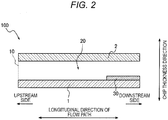
- Fig. 1 is a planar view illustrating the sensor chip according to one embodiment. Furthermore, Fig. 2 is a cross-sectional view along line I-I of Fig. 1 .
- the sensor chip 100 in the present embodiment is provided with a support port 10, a flow path 20, and a reagent layer 30, and it can be mounted on a blood glucose meter that will be described later.
- the sensor chip 100 is provided with a first base 1 for forming a bottom surface part, a second base 2 for forming a top surface part, and adhesion parts 3 and 4 that are provided between the first base 1 and the second base 2 and also at both ends in the width direction which is perpendicular to the chip thickness direction.
- the first base 1 and the second base 2 are attached to each other so that a void with a predetermined size is formed between the first base 1 and the second base 2.
- This void with the predetermined size serves as the flow path 20 having the support port 10 formed at one end thereof, and thus blood is allowed to flow into the sensor chip 100.
- the reagent layer 30 is provided inside the flow path 20.
- the reagent layer 30 is formed on the first base 1 in Fig. 1 and Fig. 2 , it is not limited thereto, and it is acceptable that the reagent layer 30 is provided inside the flow path 20 without blocking the flow path 20.
- the material of the first base 1 can be suitably selected depending on the purpose (i.e., illuminating light and receiving light), and examples thereof include a transparent organic resin material such as polyethylene terephthalate (PET), polymethyl methacrylate, polystyrene, cyclic polyolefin, cyclic olefin copolymer, or polycarbonate; and a transparent inorganic material such as glass and quartz.
- a transparent organic resin material such as polyethylene terephthalate (PET), polymethyl methacrylate, polystyrene, cyclic polyolefin, cyclic olefin copolymer, or polycarbonate
- a transparent inorganic material such as glass and quartz.
- the material of the second base 2 can be suitably selected depending on the purpose (i.e., illuminating light and receiving light), and examples thereof include a transparent organic resin material like a polyester film subjected to a hydrophilicizing treatment (e.g., 3M hydrophilicized film).
- a transparent organic resin material like a polyester film subjected to a hydrophilicizing treatment (e.g., 3M hydrophilicized film).
- the thicknesses of adhesion parts 3 and 4 are suitably adjusted so as to have a desired value of the length of the flow path 20 in the chip thickness direction.
- a spacer with any thickness is disposed between a first base and a second base followed by adhesion or melt-adhesion, or a double-sided tape also functioning as a spacer is used as an adhesive member for attaching a first base and a second base.
- the reagent layer 30 consists of the blood glucose measurement reagent.
- the method for producing the above reagent layer structure includes at least a coating step and a drying step, and if necessary, a step other than those steps.
- the coating step is a step for coating a coating liquid containing the blood glucose measurement reagent.
- the coating method is not particularly limited, and it can be suitably selected depending on the purpose. Examples thereof include spray coating, ink jet method, screen printing, and gravure printing. They may be used either singly or in combination of two or more types thereof.
- the drying step is a step for drying the coated coating liquid.
- the drying temperature and drying time of the drying step can be suitably selected depending on the purpose.
- the blood glucose meter set includes the aforementioned sensor chip, and a blood glucose meter on which the sensor chip is mounted, for measuring glucose components in blood.
- a blood glucose meter set that is provided with a transmission photometry blood glucose meter for measuring the light transmitted through a reactant of blood and a chromogenic indicator as a blood glucose measurement reagent, but the present invention is not limited thereto.
- it can be also a blood glucose meter set provided with a reflection photometry blood glucose meter for measuring the light reflected from the reactant described above.
- Fig. 3 illustrates a blood glucose meter set 500 according to one embodiment.
- the blood glucose meter set 500 is provided with a blood glucose meter 110 and a sensor chip 100.
- the sensor chip 100 is to be mounted on the tip part of the blood glucose meter 110.
- the blood glucose meter 110 is provided with a display 111 for displaying measurement results, contents of the operation, or the like, a power button 112 for instructing on and off of the blood glucose meter 110, an operation button 113, and a release lever 114 for releasing the sensor chip 100.
- the display 111 consists of a liquid crystal, an LED, or the like.
- Fig. 4 is a longitudinal cross-sectional view illustrating each of the tip part of the blood glucose meter 110 and the sensor chip 100 of the blood glucose meter set 500.
- a mounting part 22 having an opening part 21 formed at the tip part of the blood glucose meter 110 is provided, and a mounting hole 23 for mounting the sensor chip 100 inside the blood glucose meter 110 is constructed.
- an optical measurement part 24 for measuring glucose components (i.e., blood glucose level) of the blood collected on the sensor chip 100 is provided.
- the blood glucose meter 110 is provided with a processing part 25 for calculating the blood glucose level by processing the signal resulting from measured light, and an eject pin 26 for releasing the sensor chip 100 in conjunction with the release lever 114 (see, Fig. 3 ).
- the sensor chip 100 is mounted in the mounting hole 23.
- the mounting operation is carried out manually by a user.
- the optical measurement part 24 is provided with a light illuminating part 31 for illuminating a reactant of blood and a chromogenic indicator (dye-forming substance) as a blood glucose measurement reagent with light, and light receiving part 32 for receiving the light transmitted through the reactant as measured light.
- a light emitting diode LED
- PD photodiode
- the light receiving part 32 can be any one that can convert the received light to a certain signal, and it can be also CCD, CMOS, or the like.
- the light illuminating part 31 has a first light emitting element 51 for emitting light with a first wavelength and a second light emitting element 52 for emitting light with a second wavelength that is different from the first wavelength.
- the first wavelength indicates a wavelength for detecting the degree of color development according to blood glucose amount, and it is within a wavelength region of 600 to 900 nm, for example.
- the second wavelength indicates a wavelength for detecting the red blood cell concentration in blood, and it is within a wavelength region of 510 to 590 nm, for example.
- the light illuminating part 31 is disposed in the first space 41 and the light receiving part 32 is disposed in the second space 42, respectively.
- the first space 41 and the second space 42 face each other while having the mounting hole 23 therebetween (see, Fig. 4 ).
- the first space 41 and the second space 42 face each other while having therebetween an area in which the reagent layer 30 on the sensor chip 100 is hold.
- the light illuminating part 31 is preferably disposed at an area in which the bottom surface of the sensor chip 100 can be perpendicularly illuminated with the illumination light 33.
- a halogen lamp is used for the light illuminating part 31 to have white light illumination
- a method in which a spectral filter is disposed to extract only specific wavelength as the illumination light 33 it is also possible to have a method of having a condenser lens to provide effective performance with low energy illumination.
- an aqueous reagent solution pH 6.5 containing 4 U/ ⁇ L glucose dehydrogenase (GDH, manufactured by TOYOBO CO., LTD.) as an enzyme, 1 mM 1-methoxy-5-methylphenazinium methyl sulfate (mPMS, manufactured by DOJINDO LABORATORIES) as a mediator, 100 mM 2-benzo-thiazolyl-3-(4-carboxy-2-methoxyphenyl)-5-[4-(2-sulf oethylcarbamoyl)phenyl]-2H-tetrazolium (WST-4, manufactured by DOJINDO LABORATORIES) as a chromogenic indicator, and 250 mM trisodium naphthalene-1,3,6-trisulfonate (TSN, manufactured by Tokyo Chemical Industry Co., Ltd.) as an aromatic hydrocarbon was prepared.
- GDH glucose dehydrogenase
- mPMS 1-methoxy-5-methylphen
- the prepared aqueous reagent solution was applied on a polyethylene terephthalate (PET) film (manufacturer's name: Toray Industries, Inc., trade name: Lumirror T60, thickness of 188 ⁇ m) and then dried for 10 minutes at 25°C.
- PET polyethylene terephthalate
- a cover film of which the material is a hydrophilicized polyester film (manufacturer's name: 3M Company, trade name: hydrophilicized polyester film 9901P, thickness of 100 ⁇ m) was mounted while a spacer and a double-side tape as an adhesion part (manufacturer's name: 3M Company, trade name: polyester film base, double-side adhesive tape 9965, thickness of 80 ⁇ m) were inserted therebetween, and thus the sensor chip illustrated in Figs. 1 and 2 was produced.
- a hydrophilicized polyester film manufactured by the PET film having a reagent layer formed thereon.
- Glucose solution having high concentration 40 g/dL was added to blood (whole blood, hematocrit (Ht) 40) to prepare a blood sample having glucose concentration of 100 mg/dL.
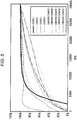
- the blood sample which has been prepared above (3 mm3) was applied onto the sensor chip prepared above, and by using a UV and visible spectrophotometer, absorbance was measured (wavelength for measurement: 650 nm). The results are shown in Table 1 and Fig. 5 .
- Fig. 5 is a graph illustrating the color development speed (in time course), in which the vertical axis indicates the absorbance index (i.e., color development amount after 30 seconds is set at 100%) and the horizontal axis indicates the time after application (ms: milliseconds) . The time until completion of color development was evaluated in terms of the time from 0 second to time at which the color development amount is 100%.
- Fig. 6 is a graph illustrating the storage stability of a sensor chip before applying blood, in which the vertical axis indicates absorbance (abs).
- Preparation of an aqueous reagent solution, production of a sensor chip, preparation of a sample, absorbance measurement after sample application, and absorbance measurement after thermal acceleration test were carried out in the same manner as Embodiment 1 except that, instead of carrying out the preparation of an aqueous reagent solution by using trisodium naphthalene-1,3,6-trisulfonate (TSN, manufactured by Tokyo Chemical Industry Co., Ltd.) in Embodiment 1, the preparation of an aqueous reagent solution was carried out by using disodium 1,3-benzene disulfonate (DSB, manufactured by Alfa Aear). The evaluation results are illustrated in Figs. 5 and 6 .
- TSN trisodium naphthalene-1,3,6-trisulfonate
- DSB disodium 1,3-benzene disulfonate
- Preparation of an aqueous reagent solution, production of a sensor chip, preparation of a sample, absorbance measurement after sample application, and absorbance measurement after thermal acceleration test were carried out in the same manner as Embodiment 1 except that, instead of carrying out the preparation of an aqueous reagent solution by using trisodium naphthalene-1,3,6-trisulfonate (TSN, manufactured by Tokyo Chemical Industry Co., Ltd.) in Embodiment 1, the preparation of an aqueous reagent solution was carried out by using sodium benzene sulfonate (BS, manufactured by Tokyo Chemical Industry Co., Ltd.). The evaluation results are shown in Table 1, and Figs. 5 and 6 .
- an aqueous reagent solution pH of 6.5 and containing 4 U/ ⁇ L glucose dehydrogenase (GDH, manufactured by TOYOBOCO., LTD.) as an enzyme, 1mM1-methoxy-5-methylphenazinium methyl sulfate (mPMS, manufactured by DOJINDO LABORATORIES) as a mediator, 100 mM tetrazolium salt A (manufactured by Terumo Corporation) as a chromogenic indicator (dye-forming substance), 200 mM of nickel ions as a transition metal ion, and 250 mM disodium 1,3-benzene disulfonate (DSB, manufactured by Alfa Aear) as an aromatic hydrocarbon was prepared.
- GDH glucose dehydrogenase
- mPMS 1mM1-methoxy-5-methylphenazinium methyl sulfate
- mPMS 1mM1-methoxy-5-methylphenazinium methyl sulfate
- Preparation of an aqueous reagent solution, production of a sensor chip, preparation of a sample, absorbance measurement after sample application, and absorbance measurement after thermal acceleration test were carried out in the same manner as Embodiment 1 except that, instead of carrying out the preparation of an aqueous reagent solution by adding trisodium naphthalene-1,3,6-trisulfonate (TSN, manufactured by Tokyo Chemical Industry Co., Ltd.) in Embodiment 1, the preparation of an aqueous reagent solution was carried out without adding trisodium naphthalene-1,3,6-trisulfonate (TSN, manufactured by Tokyo Chemical Industry Co., Ltd.). The evaluation results are shown in Table 1, and Figs. 5 and 6 .
- Preparation of an aqueous reagent solution, production of a sensor chip, preparation of a sample, absorbance measurement after sample application, and absorbance measurement after thermal acceleration test were carried out in the same manner as Embodiment 1 except that, instead of carrying out the preparation of an aqueous reagent solution (pH 6.5) by using trisodium naphthalene-1,3,6-trisulfonate (TSN, manufactured by Tokyo Chemical Industry Co., Ltd.) in Embodiment 1, the preparation of an aqueous reagent solution (pH 7.0) was carried out by using 3-morpholinopropanesulfonic acid (MOPS, manufactured by DOJINDO LABORATORIES). The evaluation results are shown in Table 1, and Figs. 5 and 6 .
- Preparation of an aqueous reagent solution, production of a sensor chip, preparation of an sample, absorbance measurement after sample application, and absorbance measurement after thermal acceleration test were carried out in the same manner as Embodiment 1 except that, instead of carrying out the preparation of an aqueous reagent solution (pH 6.5) by using trisodium naphthalene-1,3,6-trisulfonate (TSN, manufactured by Tokyo Chemical Industry Co., Ltd.) in Embodiment 1, the preparation of an aqueous reagent solution was carried out by using sodium isethionate (manufactured by Tokyo Chemical Industry Co., Ltd.). The evaluation results are shown in Table 1, and Figs. 5 and 6 .
- Preparation of an aqueous reagent solution, production of a sensor chip, preparation of an sample, absorbance measurement after sample application, and absorbance measurement after thermal acceleration test were carried out in the same manner as Embodiment 1 except that, instead of carrying out the preparation of an aqueous reagent solution (pH 6.5) by using trisodium naphthalene-1,3,6-trisulfonate (TSN, manufactured by Tokyo Chemical Industry Co., Ltd.) in Embodiment 1, the preparation of an aqueous reagent solution (pH 7.0) was carried out by using phosphate buffer solution (manufactured by Wako Pure Chemical Industries Ltd.). The evaluation results are shown in Table 1, and Figs. 5 and 6 .
- aqueous reagent solution Preparation of an aqueous reagent solution was carried out in the same manner as Embodiment 4 except that, instead of carrying out the preparation of an aqueous reagent solution (pH 6.5) by using 250 mMdisodium 1,3-benzene disulfonate (DSB, manufactured by Alfa Aear) in Embodiment 4, the preparation of an aqueous reagent solution was carried out by using 70 mM trisodium 8-methoxy pyrene-1,3,6-trisulfonate (MPTS, manufactured by Sigma Aldrich Company).
- MPTS trisodium 8-methoxy pyrene-1,3,6-trisulfonate
- Blank increase after storage at 60°C for 3 days is less than 0.1 ⁇ : Blank increase after storage at 60°C for 3 days is 0.1 or more
- Embodiments 1 to 4 in which a blood glucose measurement reagent containing an aromatic hydrocarbon having at least one sulfonic acid group is used, with Comparative Embodiments 1 to 6 in which a blood glucose measurement reagent containing an aromatic hydrocarbon having at least one sulfonic acid group is not used, it was found that, by using a blood glucose measurement reagent containing an aromatic hydrocarbon having at least one sulfonic acid group, the risk of having color development before blood application can be prevented or reduced.
- Embodiments 1, 2 and 4 in which a blood glucose measurement reagent containing an aromatic hydrocarbon having at least two sulfonic acid groups is used, with Comparative Embodiment 3 in which a blood glucose measurement reagent containing an aromatic hydrocarbon having one sulfonic acid group is used, by using a blood glucose measurement reagent containing an aromatic hydrocarbon having at least two sulfonic acid groups, not only the risk of having color development before blood application can be prevented or reduced but also the color development speed after blood application can be further increased.
- the blood glucose measurement reagent substantially not added with any buffer and containing an aromatic hydrocarbon having at least two sulfonic acid groups shows not only the prevented or reduced risk of having color development before blood application but also further increased color development speed after blood application.
- the present disclosure relates to a blood glucose measurement reagent, a sensor chip, and a blood glucose meter set, and in particular, a blood glucose measurement reagent, a sensor chip, and a blood glucose meter set that can prevent or reduce the risk of color development before blood application and also can increase the color development speed after blood application even when the blood as a sample is whole blood.
Landscapes
- Chemical & Material Sciences (AREA)
- Life Sciences & Earth Sciences (AREA)
- Health & Medical Sciences (AREA)
- Physics & Mathematics (AREA)
- Engineering & Computer Science (AREA)
- Immunology (AREA)
- Analytical Chemistry (AREA)
- Biochemistry (AREA)
- General Health & Medical Sciences (AREA)
- Organic Chemistry (AREA)
- General Physics & Mathematics (AREA)
- Pathology (AREA)
- Zoology (AREA)
- Proteomics, Peptides & Aminoacids (AREA)
- Wood Science & Technology (AREA)
- Chemical Kinetics & Catalysis (AREA)
- Biophysics (AREA)
- Molecular Biology (AREA)
- Emergency Medicine (AREA)
- Bioinformatics & Cheminformatics (AREA)
- Biotechnology (AREA)
- Microbiology (AREA)
- Genetics & Genomics (AREA)
- Plasma & Fusion (AREA)
- General Engineering & Computer Science (AREA)
- Mathematical Physics (AREA)
- Theoretical Computer Science (AREA)
- Spectroscopy & Molecular Physics (AREA)
- Investigating Or Analysing Biological Materials (AREA)
- Investigating Or Analysing Materials By The Use Of Chemical Reactions (AREA)
- Measuring Or Testing Involving Enzymes Or Micro-Organisms (AREA)
- Apparatus Associated With Microorganisms And Enzymes (AREA)
- Investigating Or Analysing Materials By Optical Means (AREA)
Abstract
Description
- The present disclosure relates to a blood glucose measurement reagent, a sensor chip, and a blood glucose meter set, and particularly relates to a blood glucose measurement reagent, a sensor chip, and a blood glucose meter set that can prevent or reduce the risk of color development before blood application and also can increase the color development speed after blood application even when the blood as a sample is whole blood.
- Conventionally, a blood glucose meter for measuring glucose components in blood has been widely used (see,
Patent Literature 1, for example). - According to the blood glucose meter, blood (whole blood) is injected to a sensor chip which has an enzyme and a reagent containing a chromogenic indicator (dye-forming substance) (see,
Patent Literature 2, for example) and coloration level at the time of a reaction between the reagent and blood (whole blood) is photometrically (optically) measured so that the glucose components in blood can be measured (see,Patent Literature 3, for example). -
- Patent Literature 1:
JP 2006-215034 A - Patent Literature 2:
JP 4381463 B2 - Patent Literature 3:
WO 2014/049704 A - However, the chromogenic indicator (dye-forming substance) used for the measurement of blood glucose level in whole blood (for example, tetrazolium salt like WST-4) has a problem that, due to the presence of a buffer agent included in the reagent, color development is shown even before blood application.
- To solve the above issue, determination has been made for not adding a buffer agent. However, when the buffer agent is not added, there is a problem that the change speed of color development (i.e., absorbance) after blood application is slowed down, and, even after a predetermined time following the blood application, a change in color development (i.e., absorbance) is continuously shown.
- An object of certain embodiments of the present disclosure is to provide a blood glucose measurement reagent, a sensor chip, and a blood glucose meter set that can prevent or reduce the risk of color development before blood application and also can increase the color development speed after blood application.
- According toafirst embodiment, a blood glucose measurement reagent includes: an enzyme having glucose as a substrate; a mediator; and a chromogenic indicator, wherein the blood glucose measurement reagent additionally includes an aromatic hydrocarbon having at least one sulfonic acid group.
- Accordingly, not only the risk of color development before blood application can be prevented or reduced but also the color development speed after blood apply can be increased.
- Furthermore, in the present specification, an "aromatic hydrocarbon" is defined as a kind of carbocyclic compounds (i.e., among cyclic compounds, compound containing only carbon atoms in the ring) that are different from heterocyclic compounds, and that do not have any amine.
- In one aspect, the aromatic hydrocarbon has two or more sulfonic acid groups.
- By placing the sulfonic acid groups over the entire periphery of an aromatic ring of the aromatic hydrocarbon, each of the hydrophilic moiety and hydrophobic moiety is not localized in the aromatic hydrocarbon molecule so that the reagent can easily become wetted by (be sufficiently mixed with) blood.
- In one aspect, the aromatic hydrocarbon is
disodium 1,3-benzene disulfonate or trisodium naphthalene-1,3,6-trisulfonate. - Furthermore, although
disodium 1,3-benzene disulfonate and trisodium naphthalene-1,3,6-trisulfonate have no buffering capacity. Blood itself have buffering capacity in neutral range for reaction. - In one aspect, the content of the aromatic hydrocarbon is 30% by mol or more.
- In one aspect, a tetrazolium salt is additionally contained as the chromogenic indicator.
- According to a second embodiment, a sensor chip includes a supply port through which blood is supplied, a flow path having the supply port formed at one end, and a reagent which is provided in the flow path. The sensor chip is mountable on a blood glucose meter for measuring the blood glucose level in the blood, in which the reagent is the blood glucose measurement reagent described with respect to the first embodiment above.
- According to a third embodiment, a blood glucose meter set includes the sensor chip described above with respect to the second embodiment, and a blood glucose meter for measuring the blood glucose level in blood, in which the blood glucose meter includes a light illuminating part for illuminating a reactant of the blood and the reagent with light, a light receiving part for receiving measured light which has been transmitted through the reactant or reflected from the reactant, and a processing part for processing a signal resulting from the measured light.
- According to certain embodiments, a blood glucose measurement reagent, a sensor chip, and a blood glucose meter set that can prevent or reduce the risk of color development before blood application and also can increase the color development speed after blood application can be provided.
-
-
Fig. 1 is a planar view illustrating the sensor chip according to one embodiment. -
Fig. 2 is a cross-sectional view along line I-I ofFig. 1 . -
Fig. 3 is a planar view illustrating the blood glucose meter set according to one embodiment. -
Fig. 4 is a longitudinal cross-sectional view illustrating the blood glucose meter and sensor chip of the blood glucose meter set illustrated inFig. 3 . -
Fig. 5 is a graph illustrating the color development speed of each reagent (Embodiments 1 to 4 andComparative Embodiments 1 to 5), in which the vertical axis indicates the absorbance index (i.e., index when the color development amount after 30 seconds is set at 100%) and the horizontal axis indicates the time after application (ms: milliseconds). -
Fig. 6 is a graph illustrating the storage stability of each reagent (Embodiments 1 to 4 andComparative Embodiments 1 to 5) before blood application, in which the vertical axis indicates absorbance (abs). - The blood glucose measurement reagent according to certain embodiment includes at least an enzyme, a mediator, a chromogenic indicator (dye-forming substance), and an aromatic hydrocarbon (arene). Furthermore, the blood glucose measurement reagent according to certain embodiment is achieved by additionally including, if necessary, other components like transition metal salt.
- Furthermore, D-glucose in blood and the mediator (for example, m-PMS which will be described later) react with an enzyme (for example, GDH which will be described later), and according to the reaction, the chromogenic indicator (for example, WST-4 which will be described later) yields color development.
- The aromatic hydrocarbon is not particularly limited as long as it is an aromatic hydrocarbon having at least one sulfonic acid group, and it can be suitably selected depending on the purpose . Examples thereof include sodium benzene sulfonate (see, the following Structural Formula (1)),
disodium 1,3-benzene disulfonate (see, the following Structural Formula (2)),trisodium - Among them, the aromatic hydrocarbon having two or more sulfonic acid groups (for example,
disodium 1,3-benzene disulfonate and trisodium naphthalene-1,3,6-trisulfonate) is preferable from the viewpoint that the color development speed after blood application can be further increased. Herein, those having the larger number of sulfonic acid groups (ions) can have a reduced activity of a surfactant while having enhanced hydrophilicity of the aromatic hydrocarbon, and thus the color development speed can be further increased even when whole blood is used as a sample . This effect can be obtained even at low content. Furthermore, there is no adverse effect on the stability even when the number of the sulfonic acid groups contained in the aromatic hydrocarbon is high.


- The content of the aromatic hydrocarbon is not particularly limited, and it can be suitably selected depending on the purpose . However, it is preferably 30% by mol or more, more preferably 50% by mol or more, and particularly preferably 70% by mol to 80% by mol.
- The concentration of the aromatic hydrocarbon at the time of a blood analyte reaction is not particularly limited, and it can be suitably selected depending on the purpose. However, it is preferably 50 mM or more, more preferably 100 mM or more, and particularly preferably 250 mM to 400 mM.
- As the content of the aromatic hydrocarbon or the concentration thereof at the time of a blood analyte reaction is within the preferred range, more preferred range, or particularly preferred range, the risk of having color development before blood application can be surely prevented or reduced and also the color development speed after blood application can be surely increased.
- The enzyme plays a role of reacting with glucose in blood, withdrawing electrons from the glucose, or the like, for example.
- The enzyme is not particularly limited as long as it has glucose as a substrate, and it can be suitably selected depending on the purpose. Examples thereof include glucose dehydrogenase (GDH) and glucose oxidase (GOD) . They may be used either singly or in combination of two or more types thereof.
- Among them, glucose dehydrogenase (GDH) is preferable from the viewpoint that it can be easily combined with a tetrazolium salt.
- Furthermore, although the pH region in which the reaction of glucose dehydrogenase (GDH) progresses smoothly (i.e., optimum pH region) is near neutral region (i.e., pH of about 6.5 to 7.0), the optimum pH varies depending on the enzyme. For example, because "glycine-hydrochloric acid" and "sodium acetate" that are used as a buffer agent (i.e., buffer) used in embodiments of
JP 4381463 B2 - The enzyme concentration at the time of a blood sample reaction is not particularly limited, and it can be suitably selected depending on the purpose. However, it is preferably 1 U/µL or more, more preferably 4 U/µL or more, and particularly preferably 8 U/µL to 20 U/µL.
- As the concentration at the time of a blood sample reaction is within the preferred range, more preferred range, or particularly preferred range, the reaction can be completed within a short time.
- The mediator plays a role of (i) promoting a reaction between an enzyme and glucose in blood, (ii) receiving the electrons that are withdrawn from glucose by the enzyme and then delivering them to a chromogenic indicator (dye-forming substance), or the like.
- The mediator is not particularly limited, and it can be suitably selected depending on the purpose. As for the mediator, 5-methylphenazinium methyl sulfate (PMS), 1-methoxy-5-methylphenazinium methyl sulfate (mPMS), NAD, FAD, PQQ, potassium ferricyanide, or the like can be selected. They may be used either singly or in combination of two or more types thereof.
- Among them, 1-methoxy-5-methylphenazinium methyl sulfate (mPMS) is preferable from the viewpoint that it is excellent in term of both the reactivity and stability.
- The content of the mediator is not particularly limited, and it can be suitably selected depending on the purpose. The content of the mediator is preferably 0.01% by mol or more, more preferably 0.1% by mol or more, and particularly preferably 0.3% by mol to 3% by mol.
- The concentration of the mediator at the time of a blood sample reaction is not particularly limited, and it can be suitably selected depending on the purpose. The concentration of the mediator at the time of a blood sample reaction is preferably 0.1 mM or more, more preferably 0.5 mM or more, and particularly preferably 1 mM to 10 mM.
- As the content of the mediator or the concentration thereof at the time of a blood sample reaction is within the preferred range, more preferred range, or particularly preferred range, the reaction can be completed within a short time.
- The chromogenic indicator (dye-forming substance) (i.e., reduction type indicator) can play a role of showing color development by receiving electrons or hydrogen peroxides (i.e., indicator being reduced) that are generated according to a reaction between the enzyme and glucose, for example.
- The chromogenic indicator is not particularly limited, and it can be suitably selected depending on the purpose. Examples thereof include a tetrazolium salt (for example, WST-4, WST-1, WST-5, MTS, MTT, and tetrazolium salt (A)), sodium phosphomolybdate, indigo carmine, dichloroindophenol, and resazurin. They may be used either singly or in combination of two or more types thereof.
- Among them, a tetrazolium salt having a benzothiazoyl group is preferable, and the tetrazolium salt (A) and 2-(2-benzothiazolyl)-3-(4-carboxy-2-methoxyphenyl)-5-[4-[(2-sodiosulfoethyl)carbamoyl]phenyl]-2H-tetrazol-3-ium (WST-4) are particularly preferable in that they have a favorable color development spectrum and high solubility.
- Chemical structure of the tetrazolium salt (A) is shown below.


- In the formula, X = Na.
- The content of the chromogenic indicator is not particularly limited, and it can be suitably selected depending on the purpose . However, it is preferably 5% by mol or more, more preferably 15% by mol or more, and particularly preferably 30% by mol to 50% by mol.
- The concentration of the chromogenic indicator at the time of a blood sample reaction is not particularly limited, and it can be suitably selected depending on the purpose. However, it is preferably 10 mM or more, more preferably 50 mM or more, and particularly preferably 100 mM to 200 mM.
- As the content of the chromogenic indicator or the concentration thereof at the time of a blood sample reaction is within the preferred range, more preferred range, or particularly preferred range, even a blood glucose level of high concentration can be dealt with.
- In a case in which the chromogenic indicator is a tetrazolium salt, it is also possible that a transition metal salt (transition metal ion) and a tetrazolium salt are subjected to a chelate reaction, and a chelate complex is formed for having color development. The transition metal salt can be suitably selected depending on the purpose as long as it can generate ions in aqueous liquid (for example, water, buffer solution, blood, and body fluid). However, it is preferably chloride, bromide, nitrate, sulfate, or organic acid salt of nickel or cobalt.
- The sensor chip according to certain embodiments is described in detail below.
-
Fig. 1 is a planar view illustrating the sensor chip according to one embodiment. Furthermore,Fig. 2 is a cross-sectional view along line I-I ofFig. 1 . - As illustrated in
Fig. 1 andFig. 2 , thesensor chip 100 in the present embodiment is provided with asupport port 10, aflow path 20, and areagent layer 30, and it can be mounted on a blood glucose meter that will be described later. - Details of each member of the
sensor chip 100 of the present embodiment and characteristic parts consisting of each member are described below. - As illustrated in
Fig. 1 andFig. 2 , thesensor chip 100 is provided with afirst base 1 for forming a bottom surface part, asecond base 2 for forming a top surface part, andadhesion parts first base 1 and thesecond base 2 and also at both ends in the width direction which is perpendicular to the chip thickness direction. - As such, with regard to the
adhesion parts first base 1 and thesecond base 2, thefirst base 1 and thesecond base 2 are attached to each other so that a void with a predetermined size is formed between thefirst base 1 and thesecond base 2. This void with the predetermined size serves as theflow path 20 having thesupport port 10 formed at one end thereof, and thus blood is allowed to flow into thesensor chip 100. Furthermore, inside theflow path 20, thereagent layer 30 is provided. Although thereagent layer 30 is formed on thefirst base 1 inFig. 1 andFig. 2 , it is not limited thereto, and it is acceptable that thereagent layer 30 is provided inside theflow path 20 without blocking theflow path 20. - The material of the
first base 1 can be suitably selected depending on the purpose (i.e., illuminating light and receiving light), and examples thereof include a transparent organic resin material such as polyethylene terephthalate (PET), polymethyl methacrylate, polystyrene, cyclic polyolefin, cyclic olefin copolymer, or polycarbonate; and a transparent inorganic material such as glass and quartz. - The material of the
second base 2 can be suitably selected depending on the purpose (i.e., illuminating light and receiving light), and examples thereof include a transparent organic resin material like a polyester film subjected to a hydrophilicizing treatment (e.g., 3M hydrophilicized film). - The thicknesses of
adhesion parts flow path 20 in the chip thickness direction. For example, it is possible that a spacer with any thickness is disposed between a first base and a second base followed by adhesion or melt-adhesion, or a double-sided tape also functioning as a spacer is used as an adhesive member for attaching a first base and a second base. - The
reagent layer 30 consists of the blood glucose measurement reagent. - The method for producing the above reagent layer structure includes at least a coating step and a drying step, and if necessary, a step other than those steps.
- The coating step is a step for coating a coating liquid containing the blood glucose measurement reagent.
- The coating method is not particularly limited, and it can be suitably selected depending on the purpose. Examples thereof include spray coating, ink jet method, screen printing, and gravure printing. They may be used either singly or in combination of two or more types thereof.
- The drying step is a step for drying the coated coating liquid.
- The drying temperature and drying time of the drying step can be suitably selected depending on the purpose.
- Next, descriptions are given for the blood glucose meter set as according to certain embodiments.
- The blood glucose meter set according to one embodiment includes the aforementioned sensor chip, and a blood glucose meter on which the sensor chip is mounted, for measuring glucose components in blood.
- Below, descriptions are given for a blood glucose meter set that is provided with a transmission photometry blood glucose meter for measuring the light transmitted through a reactant of blood and a chromogenic indicator as a blood glucose measurement reagent, but the present invention is not limited thereto. For example, it can be also a blood glucose meter set provided with a reflection photometry blood glucose meter for measuring the light reflected from the reactant described above.
-
Fig. 3 illustrates a blood glucose meter set 500 according to one embodiment. The blood glucose meter set 500 is provided with ablood glucose meter 110 and asensor chip 100. - The
sensor chip 100 is to be mounted on the tip part of theblood glucose meter 110. Theblood glucose meter 110 is provided with adisplay 111 for displaying measurement results, contents of the operation, or the like, apower button 112 for instructing on and off of theblood glucose meter 110, anoperation button 113, and arelease lever 114 for releasing thesensor chip 100. Thedisplay 111 consists of a liquid crystal, an LED, or the like. -
Fig. 4 is a longitudinal cross-sectional view illustrating each of the tip part of theblood glucose meter 110 and thesensor chip 100 of the blood glucose meter set 500. For mounting thesensor chip 100 on theblood glucose meter 110, a mountingpart 22 having an openingpart 21 formed at the tip part of theblood glucose meter 110 is provided, and a mountinghole 23 for mounting thesensor chip 100 inside theblood glucose meter 110 is constructed. Furthermore, inside theblood glucose meter 110, anoptical measurement part 24 for measuring glucose components (i.e., blood glucose level) of the blood collected on thesensor chip 100 is provided. Furthermore, theblood glucose meter 110 is provided with aprocessing part 25 for calculating the blood glucose level by processing the signal resulting from measured light, and aneject pin 26 for releasing thesensor chip 100 in conjunction with the release lever 114 (see,Fig. 3 ). - At the time of the measurement, the
sensor chip 100 is mounted in the mountinghole 23. The mounting operation is carried out manually by a user. Although it is not illustrated, in order to minimize any irregularity of a mounting position that is caused by manual operation, it is preferable to provide a lock device or the like for fixing thesensor chip 100 at a predetermined position inside the mountinghole 23. - The
optical measurement part 24 is provided with a light illuminating part 31 for illuminating a reactant of blood and a chromogenic indicator (dye-forming substance) as a blood glucose measurement reagent with light, andlight receiving part 32 for receiving the light transmitted through the reactant as measured light. In the present embodiment, a light emitting diode (LED) is used for the light illuminating part 31, but it can be also a halogen lamp, laser, or the like. For thelight receiving part 32, a photodiode (PD) is used, for example. Thelight receiving part 32 can be any one that can convert the received light to a certain signal, and it can be also CCD, CMOS, or the like. - According to the present embodiment, the light illuminating part 31 has a first light emitting element 51 for emitting light with a first wavelength and a second light emitting element 52 for emitting light with a second wavelength that is different from the first wavelength. Herein, the first wavelength indicates a wavelength for detecting the degree of color development according to blood glucose amount, and it is within a wavelength region of 600 to 900 nm, for example. The second wavelength indicates a wavelength for detecting the red blood cell concentration in blood, and it is within a wavelength region of 510 to 590 nm, for example.
- Descriptions are given for the arrangement and positional relationship of the light illuminating part 31 and the
light receiving part 32. Inside theblood glucose meter 110, afirst space 41 and asecond space 42 are created. The light illuminating part 31 is disposed in thefirst space 41 and thelight receiving part 32 is disposed in thesecond space 42, respectively. In a state in which thesensor chip 100 is not mounted on theblood glucose meter 110, thefirst space 41 and thesecond space 42 face each other while having the mountinghole 23 therebetween (see,Fig. 4 ). In a state in which thesensor chip 100 is mounted on theblood glucose meter 110, thefirst space 41 and thesecond space 42 face each other while having therebetween an area in which thereagent layer 30 on thesensor chip 100 is hold. Furthermore, to minimize the energy loss of theillumination light 33, the light illuminating part 31 is preferably disposed at an area in which the bottom surface of thesensor chip 100 can be perpendicularly illuminated with theillumination light 33. - Although not illustrated, in a case in which a halogen lamp is used for the light illuminating part 31 to have white light illumination, it is also possible to have a method in which a spectral filter is disposed to extract only specific wavelength as the
illumination light 33. It is also suitable to have a method of having a condenser lens to provide effective performance with low energy illumination. - Embodiments of the present disclosure are described in further detail-below, but the present invention is not limited to the embodiments below.
- First, an aqueous reagent solution (pH 6.5) containing 4 U/µL glucose dehydrogenase (GDH, manufactured by TOYOBO CO., LTD.) as an enzyme, 1 mM 1-methoxy-5-methylphenazinium methyl sulfate (mPMS, manufactured by DOJINDO LABORATORIES) as a mediator, 100 mM 2-benzo-thiazolyl-3-(4-carboxy-2-methoxyphenyl)-5-[4-(2-sulf oethylcarbamoyl)phenyl]-2H-tetrazolium (WST-4, manufactured by DOJINDO LABORATORIES) as a chromogenic indicator, and 250 mM trisodium naphthalene-1,3,6-trisulfonate (TSN, manufactured by Tokyo Chemical Industry Co., Ltd.) as an aromatic hydrocarbon was prepared.
- The prepared aqueous reagent solution was applied on a polyethylene terephthalate (PET) film (manufacturer's name: Toray Industries, Inc., trade name: Lumirror T60, thickness of 188 µm) and then dried for 10 minutes at 25°C. After drying, to the PET film having a reagent layer formed thereon, a cover film of which the material is a hydrophilicized polyester film (manufacturer's name: 3M Company, trade name: hydrophilicized polyester film 9901P, thickness of 100 µm) was mounted while a spacer and a double-side tape as an adhesion part (manufacturer's name: 3M Company, trade name: polyester film base, double-side adhesive tape 9965, thickness of 80 µm) were inserted therebetween, and thus the sensor chip illustrated in
Figs. 1 and2 was produced. - Glucose solution having high concentration (40 g/dL) was added to blood (whole blood, hematocrit (Ht) 40) to prepare a blood sample having glucose concentration of 100 mg/dL.
- The blood sample which has been prepared above (3 mm3) was applied onto the sensor chip prepared above, and by using a UV and visible spectrophotometer, absorbance was measured (wavelength for measurement: 650 nm). The results are shown in Table 1 and
Fig. 5 . - Furthermore,
Fig. 5 is a graph illustrating the color development speed (in time course), in which the vertical axis indicates the absorbance index (i.e., color development amount after 30 seconds is set at 100%) and the horizontal axis indicates the time after application (ms: milliseconds) . The time until completion of color development was evaluated in terms of the time from 0 second to time at which the color development amount is 100%. - By using a UV and visible spectrophotometer, absorbance after application of distilled water (3 mm3) was measured for each sensor chip immediately after the production (i.e., initial), after storage at room temperature (for 3 days), and after a thermal acceleration test (60°C, for 3 days) (wavelength for measurement: 650 nm to 750 nm). With regard to those absorbances of the sensor chip, the result obtained as a difference of the absorbance with respect to a sensor chip immediately after the production (i.e., initial) is shown in Table 1 and
Fig. 6 . - Furthermore,
Fig. 6 is a graph illustrating the storage stability of a sensor chip before applying blood, in which the vertical axis indicates absorbance (abs). - Preparation of an aqueous reagent solution, production of a sensor chip, preparation of a sample, absorbance measurement after sample application, and absorbance measurement after thermal acceleration test were carried out in the same manner as
Embodiment 1 except that, instead of carrying out the preparation of an aqueous reagent solution by using trisodium naphthalene-1,3,6-trisulfonate (TSN, manufactured by Tokyo Chemical Industry Co., Ltd.) inEmbodiment 1, the preparation of an aqueous reagent solution was carried out by usingdisodium 1,3-benzene disulfonate (DSB, manufactured by Alfa Aear). The evaluation results are illustrated inFigs. 5 and6 . - Preparation of an aqueous reagent solution, production of a sensor chip, preparation of a sample, absorbance measurement after sample application, and absorbance measurement after thermal acceleration test were carried out in the same manner as
Embodiment 1 except that, instead of carrying out the preparation of an aqueous reagent solution by using trisodium naphthalene-1,3,6-trisulfonate (TSN, manufactured by Tokyo Chemical Industry Co., Ltd.) inEmbodiment 1, the preparation of an aqueous reagent solution was carried out by using sodium benzene sulfonate (BS, manufactured by Tokyo Chemical Industry Co., Ltd.). The evaluation results are shown in Table 1, andFigs. 5 and6 . - Production of a sensor chip, preparation of a sample, absorbance measurement after sample application, and absorbance measurement after thermal acceleration test were carried out in the same manner as
Embodiment 1 except that "Preparation of aqueous reagent solution" ofEmbodiment 1 was carried out as described below, and the absorbance measurement in "Absorbance measurement after sample application" was carried out at 630 nm to 900 nm. The evaluation results are shown in Table 1, andFigs. 5 and6 . - When the tetrazolium salt A is used as a chromogenic indicator, rapid progress of the reaction was shown simultaneously with the start of the measurement, and the color development was completed at 5 seconds, approximately. The color development speed and sensitivity were both favorable in
Embodiment 4. - First, an aqueous reagent solution (pH of 6.5) and containing 4 U/µL glucose dehydrogenase (GDH, manufactured by TOYOBOCO., LTD.) as an enzyme, 1mM1-methoxy-5-methylphenazinium methyl sulfate (mPMS, manufactured by DOJINDO LABORATORIES) as a mediator, 100 mM tetrazolium salt A (manufactured by Terumo Corporation) as a chromogenic indicator (dye-forming substance), 200 mM of nickel ions as a transition metal ion, and 250
mM disodium 1,3-benzene disulfonate (DSB, manufactured by Alfa Aear) as an aromatic hydrocarbon was prepared. - Preparation of an aqueous reagent solution, production of a sensor chip, preparation of a sample, absorbance measurement after sample application, and absorbance measurement after thermal acceleration test were carried out in the same manner as
Embodiment 1 except that, instead of carrying out the preparation of an aqueous reagent solution by adding trisodium naphthalene-1,3,6-trisulfonate (TSN, manufactured by Tokyo Chemical Industry Co., Ltd.) inEmbodiment 1, the preparation of an aqueous reagent solution was carried out without adding trisodium naphthalene-1,3,6-trisulfonate (TSN, manufactured by Tokyo Chemical Industry Co., Ltd.). The evaluation results are shown in Table 1, andFigs. 5 and6 . - Preparation of an aqueous reagent solution, production of a sensor chip, preparation of a sample, absorbance measurement after sample application, and absorbance measurement after thermal acceleration test were carried out in the same manner as
Embodiment 1 except that, instead of carrying out the preparation of an aqueous reagent solution (pH 6.5) by using trisodium naphthalene-1,3,6-trisulfonate (TSN, manufactured by Tokyo Chemical Industry Co., Ltd.) inEmbodiment 1, the preparation of an aqueous reagent solution (pH 7.0) was carried out by using 3-morpholinopropanesulfonic acid (MOPS, manufactured by DOJINDO LABORATORIES). The evaluation results are shown in Table 1, andFigs. 5 and6 . - As
Comparative Embodiment 2, when a good buffer (i.e., buffer having buffer capacity near neutral region and having free amine) like MOPS is used, there was a tendency that the color development gradually starts during the preparation of an aqueous reagent solution, and significantly increased absorbance is obtained in a state in which blood is yet to be applied (i.e., blank). - Preparation of an aqueous reagent solution, production of a sensor chip, preparation of an sample, absorbance measurement after sample application, and absorbance measurement after thermal acceleration test were carried out in the same manner as
Embodiment 1 except that, instead of carrying out the preparation of an aqueous reagent solution (pH 6.5) by using trisodium naphthalene-1,3,6-trisulfonate (TSN, manufactured by Tokyo Chemical Industry Co., Ltd.) inEmbodiment 1, the preparation of an aqueous reagent solution was carried out by using sodium isethionate (manufactured by Tokyo Chemical Industry Co., Ltd.). The evaluation results are shown in Table 1, andFigs. 5 and6 . - Preparation of an aqueous reagent solution, production of a sensor chip, preparation of an sample, absorbance measurement after sample application, and absorbance measurement after thermal acceleration test were carried out in the same manner as
Embodiment 1 except that, instead of carrying out the preparation of an aqueous reagent solution (pH 6.5) by using trisodium naphthalene-1,3,6-trisulfonate (TSN, manufactured by Tokyo Chemical Industry Co., Ltd.) inEmbodiment 1, the preparation of an aqueous reagent solution (pH 7.0) was carried out by using phosphate buffer solution (manufactured by Wako Pure Chemical Industries Ltd.). The evaluation results are shown in Table 1, andFigs. 5 and6 . - As
Comparative Embodiment 4, when a phosphate buffer (i.e., buffer having no free amine), which is not a good buffer, is used, there was a tendency that slower color development speed is yielded even though the storage stability before blood application is favorable. - Preparation of an aqueous reagent solution, production of a sensor chip, preparation of a sample, absorbance measurement after sample application, and absorbance measurement after thermal acceleration test were carried out in the same manner as
Embodiment 1 except that, instead of carrying out the preparation of an aqueous reagent solution (pH 6.5) by using trisodium naphthalene-1,3,6-trisulfonate (TSN, manufactured by Tokyo Chemical Industry Co., Ltd.) inEmbodiment 1, the preparation of an aqueous reagent solution was carried out by using trehalose (manufactured by HAYASHIBARA CO., LTD.). The evaluation results are shown in Table 1, andFigs. 5 and6 . AsComparative Embodiment 5, when trehalose easily soluble in water but having no buffer capacity is used, there was a tendency that slower color development speed is yielded even though the storage stability before blood application is favorable. - Preparation of an aqueous reagent solution was carried out in the same manner as
Embodiment 4 except that, instead of carrying out the preparation of an aqueous reagent solution (pH 6.5) by using 250mMdisodium 1,3-benzene disulfonate (DSB, manufactured by Alfa Aear) inEmbodiment 4, the preparation of an aqueous reagent solution was carried out by using 70 mM trisodium 8-methoxy pyrene-1,3,6-trisulfonate (MPTS, manufactured by Sigma Aldrich Company). Herein, as precipitates generated in the aqueous reagent solution (coating solution), it was not possible to produce a sensor chip. The evaluations results are shown in Table 1. - Furthermore, the chemical formula of trisodium 8-methoxy pyrene-1,3,6-trisulfonate (MPTS) is shown below.

[Table 1] Ionic organic matters (aromatic hydrocarbon) Chromogenic indicator Time course Thermal acceleration test Embodiment 1 TSN WST-4 ⊙ ○ Embodiment 2DSB WST-4 ⊙ ○ Embodiment 3BS WST-4 ○ ○ Embodiment 4DSB Tetrazolium salt A ⊙ ○ Comparative Embodiment 1None WST-4 × × Comparative Embodiment 2MOPS WST-4 ○ × Comparative Embodiment 3Sodium isethionate WST-4 ○ × Comparative Embodiment 4Phosphate buffer solution WST-4 ○ × Comparative Embodiment 5Trehalose WST-4 × ○ Comparative Embodiment 6 MPTS Tetrazolium salt A Precipitate was generated in aqueous reagent solution (coating solution) - Furthermore, the evaluation criteria for the results of "Absorbance (amount of color development) measurement (time course) after sample application" and "Absorbance measurement after thermal acceleration test" in Table 1 are as described below.
- ⊙: Within 10 seconds, 90% or more of the reaction end point underwent the reaction
○: Within 10 seconds, 60% or more but less than 90% of the reaction end point underwent the reaction
×: Within 10 seconds, less than 60% of the reaction end point underwent the reaction - ○: Blank increase after storage at 60°C for 3 days is less than 0.1
× : Blank increase after storage at 60°C for 3 days is 0.1 or more - According to comparison of
Embodiments 1 to 4, in which a blood glucose measurement reagent containing an aromatic hydrocarbon having at least one sulfonic acid group is used, withComparative Embodiments 1 to 6 in which a blood glucose measurement reagent containing an aromatic hydrocarbon having at least one sulfonic acid group is not used, it was found that, by using a blood glucose measurement reagent containing an aromatic hydrocarbon having at least one sulfonic acid group, the risk of having color development before blood application can be prevented or reduced. - According to comparison of
Embodiments Comparative Embodiment 3 in which a blood glucose measurement reagent containing an aromatic hydrocarbon having one sulfonic acid group is used, by using a blood glucose measurement reagent containing an aromatic hydrocarbon having at least two sulfonic acid groups, not only the risk of having color development before blood application can be prevented or reduced but also the color development speed after blood application can be further increased. Furthermore, according to comparison ofEmbodiments Comparative Embodiment 2, it was found that the blood glucose measurement reagent substantially not added with any buffer and containing an aromatic hydrocarbon having at least two sulfonic acid groups shows not only the prevented or reduced risk of having color development before blood application but also further increased color development speed after blood application. - The present disclosure relates to a blood glucose measurement reagent, a sensor chip, and a blood glucose meter set, and in particular, a blood glucose measurement reagent, a sensor chip, and a blood glucose meter set that can prevent or reduce the risk of color development before blood application and also can increase the color development speed after blood application even when the blood as a sample is whole blood.
-
- 1:
- First base
- 2:
- Second base
- 3:
- Adhesion part
- 4:
- Adhesion part
- 10:
- Supply port
- 20:
- Flow part
- 21:
- Opening part
- 22:
- Mounting part
- 23:
- Mounting hole
- 24:
- Optical measurement part
- 25:
- Processing part
- 26:
- Eject pin
- 30:
- Reagent layer (Reagent)
- 31:
- Light illuminating part
- 32:
- Light receiving part
- 33:
- Illumination light
- 41:
- First space
- 42:
- Second space
- 51:
- First light illuminating element
- 52:
- Second light illuminating element
- 100:
- Sensor chip
- 110:
- Blood glucose meter
- 111:
- Display
- 112:
- Power button
- 113:
- Operation button
- 114:
- Release lever
- 500:
- Blood glucose meter set
Claims (7)
- A blood glucose measurement reagent comprising:an enzyme having glucose as a substrate;a mediator; anda chromogenic indicator,wherein the blood glucose measurement reagent additionally comprises an aromatic hydrocarbon having at least one sulfonic acid group.
- The blood glucose measurement reagent according to claim 1, wherein the aromatic hydrocarbon has two or more sulfonic acid groups.
- The blood glucose measurement reagent according to claim 2, wherein the aromatic hydrocarbon is disodium 1,3-benzene disulfonate or trisodium naphthalene-1,3,6-trisulfonate.
- The blood glucose measurement reagent according to any one of claims 1 to 3, wherein the content of the aromatic hydrocarbon is 30% by mol or more.
- The blood glucose measurement reagent according to any one of claims 1 to 4, further comprising a tetrazolium salt as the chromogenic indicator.
- A sensor chip which is provided with a supply port through which blood is supplied, a flow path having the supply port formed at one end, and a reagent which is provided in the flow path, and can be mounted on a blood glucose meter for measuring the blood glucose in the blood,
wherein the reagent is the blood glucose measurement reagent described in any one of claims 1 to 5. - A blood glucose meter set which is provided with the sensor chip described in claim 6 and a blood glucose meter for measuring the blood glucose level in blood,
wherein the blood glucose meter is provided with
a light illuminating part for illuminating a reactant of the blood and the reagent with light,
a light receiving part for receiving measured light which has been transmitted through the reactant or reflected from the reactant, and
a processing part for processing a signal resulting from the measured light.
Applications Claiming Priority (2)
| Application Number | Priority Date | Filing Date | Title |
|---|---|---|---|
| JP2016019689 | 2016-02-04 | ||
| PCT/JP2016/081944 WO2017134878A1 (en) | 2016-02-04 | 2016-10-27 | Blood-sugar-level measurement reagent, blood-sugar-level measurement chip, and blood-sugar-level measurement device set |
Publications (3)
| Publication Number | Publication Date |
|---|---|
| EP3412763A1 true EP3412763A1 (en) | 2018-12-12 |
| EP3412763A4 EP3412763A4 (en) | 2019-10-23 |
| EP3412763B1 EP3412763B1 (en) | 2020-12-23 |
Family
ID=59500369
Family Applications (1)
| Application Number | Title | Priority Date | Filing Date |
|---|---|---|---|
| EP16889361.8A Active EP3412763B1 (en) | 2016-02-04 | 2016-10-27 | Blood-sugar-level measurement reagent, blood-sugar-level measurement chip, and blood-sugar-level measurement device set |
Country Status (6)
| Country | Link |
|---|---|
| US (3) | US10648015B2 (en) |
| EP (1) | EP3412763B1 (en) |
| JP (2) | JP6815335B2 (en) |
| CN (1) | CN108368472B (en) |
| ES (1) | ES2845209T3 (en) |
| WO (1) | WO2017134878A1 (en) |
Families Citing this family (15)
| Publication number | Priority date | Publication date | Assignee | Title |
|---|---|---|---|---|
| JP6815335B2 (en) * | 2016-02-04 | 2021-01-20 | テルモ株式会社 | Blood glucose level measuring reagent, blood glucose level measuring chip, and blood glucose level measuring device set |
| JP6904966B2 (en) * | 2016-09-28 | 2021-07-21 | テルモ株式会社 | Methods, compositions and tips for detecting objects of analysis in blood samples |
| EP3578634B1 (en) | 2017-07-14 | 2021-12-15 | Terumo Kabushiki Kaisha | Blood sugar level measurement chip and blood sugar level measurement device set |
| EP3736571A4 (en) * | 2018-03-07 | 2021-03-24 | Terumo Kabushiki Kaisha | Method, reagent, and chip, for measuring analyte concentration in biological sample |
| US11636870B2 (en) | 2020-08-20 | 2023-04-25 | Denso International America, Inc. | Smoking cessation systems and methods |
| US12017506B2 (en) | 2020-08-20 | 2024-06-25 | Denso International America, Inc. | Passenger cabin air control systems and methods |
| US12269315B2 (en) | 2020-08-20 | 2025-04-08 | Denso International America, Inc. | Systems and methods for measuring and managing odor brought into rental vehicles |
| US12251991B2 (en) | 2020-08-20 | 2025-03-18 | Denso International America, Inc. | Humidity control for olfaction sensors |
| US12377711B2 (en) | 2020-08-20 | 2025-08-05 | Denso International America, Inc. | Vehicle feature control systems and methods based on smoking |
| US11760169B2 (en) | 2020-08-20 | 2023-09-19 | Denso International America, Inc. | Particulate control systems and methods for olfaction sensors |
| US11881093B2 (en) | 2020-08-20 | 2024-01-23 | Denso International America, Inc. | Systems and methods for identifying smoking in vehicles |
| US11760170B2 (en) | 2020-08-20 | 2023-09-19 | Denso International America, Inc. | Olfaction sensor preservation systems and methods |
| US11813926B2 (en) | 2020-08-20 | 2023-11-14 | Denso International America, Inc. | Binding agent and olfaction sensor |
| US11828210B2 (en) | 2020-08-20 | 2023-11-28 | Denso International America, Inc. | Diagnostic systems and methods of vehicles using olfaction |
| US11932080B2 (en) | 2020-08-20 | 2024-03-19 | Denso International America, Inc. | Diagnostic and recirculation control systems and methods |
Family Cites Families (18)
| Publication number | Priority date | Publication date | Assignee | Title |
|---|---|---|---|---|
| US4208346A (en) * | 1978-12-26 | 1980-06-17 | American Cyanamid Company | s-Phenenyltris(sulfonylimino)tri-benzene mono-and di-sulfonic acids and salts |
| GB2204951B (en) * | 1987-04-04 | 1991-04-24 | Tokuyama Soda Kk | Method for quantitative determination of polyamines |
| US4892817A (en) * | 1987-09-21 | 1990-01-09 | Biogenex Laboratories | Stable phosphatase substrate composition |
| US6777243B2 (en) * | 1995-10-30 | 2004-08-17 | Arkray Inc. | Method for measuring substance and testing piece |
| EP0860695B1 (en) * | 1995-10-30 | 2006-01-04 | Arkray, Inc. | Method for measuring an analyte and corresponding device |
| US5902731A (en) * | 1998-09-28 | 1999-05-11 | Lifescan, Inc. | Diagnostics based on tetrazolium compounds |
| JP4474010B2 (en) * | 2000-03-15 | 2010-06-02 | アークレイ株式会社 | Specimen with solid component separation ability |
| EP1352951A1 (en) * | 2002-04-11 | 2003-10-15 | The Procter & Gamble Company | Detergent granule comprising a nonionic surfactant and a hydrotrope |
| MX2007002224A (en) * | 2004-08-24 | 2007-05-04 | Bayer Healthcare Llc | Method for determining the concentration of analytes in samples by direct mediation of enzymes. |
| CN101115750A (en) * | 2005-01-14 | 2008-01-30 | 拜尔保健有限公司 | Water soluble tetrazolium salts |
| KR100698961B1 (en) | 2005-02-04 | 2007-03-26 | 주식회사 아이센스 | Electrochemical Biosensor |
| JP5017614B2 (en) * | 2007-02-13 | 2012-09-05 | 株式会社シノテスト | Method and reagent for measuring substance to be measured in sample, method for suppressing nonspecific color development, and nonspecific color development inhibitor |
| JP5247261B2 (en) * | 2007-07-02 | 2013-07-24 | 富士フイルム株式会社 | Planographic printing plate precursor and printing method using the same |
| JP4381463B2 (en) | 2008-11-05 | 2009-12-09 | 東洋紡績株式会社 | Method for improving the thermal stability of a composition comprising soluble coenzyme linked glucose dehydrogenase (GDH) |
| WO2014049704A1 (en) * | 2012-09-26 | 2014-04-03 | テルモ株式会社 | Measuring tip |
| US9023826B2 (en) * | 2012-10-12 | 2015-05-05 | L'oreal S.A. | Compositions containing adenosine and the hydrotropes caffeine and nicotinamide for cosmetic use |
| US9107853B2 (en) * | 2012-10-12 | 2015-08-18 | L'oreal S.A. | Compositions containing phenolic compounds and hydrotropes for cosmetic use |
| JP6815335B2 (en) * | 2016-02-04 | 2021-01-20 | テルモ株式会社 | Blood glucose level measuring reagent, blood glucose level measuring chip, and blood glucose level measuring device set |
-
2016
- 2016-10-27 JP JP2017565399A patent/JP6815335B2/en active Active
- 2016-10-27 CN CN201680070375.2A patent/CN108368472B/en active Active
- 2016-10-27 ES ES16889361T patent/ES2845209T3/en active Active
- 2016-10-27 EP EP16889361.8A patent/EP3412763B1/en active Active
- 2016-10-27 WO PCT/JP2016/081944 patent/WO2017134878A1/en not_active Ceased
-
2018
- 2018-06-29 US US16/022,967 patent/US10648015B2/en active Active
-
2020
- 2020-01-30 US US16/777,175 patent/US11130982B2/en active Active
- 2020-10-12 JP JP2020172179A patent/JP2021052754A/en active Pending
-
2021
- 2021-08-26 US US17/412,995 patent/US12146184B2/en active Active
Also Published As
| Publication number | Publication date |
|---|---|
| US20200165660A1 (en) | 2020-05-28 |
| CN108368472B (en) | 2021-09-21 |
| US11130982B2 (en) | 2021-09-28 |
| WO2017134878A1 (en) | 2017-08-10 |
| EP3412763B1 (en) | 2020-12-23 |
| US12146184B2 (en) | 2024-11-19 |
| JP2021052754A (en) | 2021-04-08 |
| ES2845209T3 (en) | 2021-07-26 |
| US20180305734A1 (en) | 2018-10-25 |
| JP6815335B2 (en) | 2021-01-20 |
| US20210388412A1 (en) | 2021-12-16 |
| CN108368472A (en) | 2018-08-03 |
| US10648015B2 (en) | 2020-05-12 |
| HK1257848A1 (en) | 2019-11-01 |
| EP3412763A4 (en) | 2019-10-23 |
| JPWO2017134878A1 (en) | 2018-11-29 |
Similar Documents
| Publication | Publication Date | Title |
|---|---|---|
| EP3412763B1 (en) | Blood-sugar-level measurement reagent, blood-sugar-level measurement chip, and blood-sugar-level measurement device set | |
| RU2015513C1 (en) | Agent for colorimetric determination of analyte | |
| EP0102504A1 (en) | Ascorbate-resistant broad range glucose test composition, test device and method | |
| US11656182B2 (en) | Method, composition, and chip for detecting analyte in blood sample | |
| JPS6361147A (en) | Analytical method | |
| US20080213808A1 (en) | Mediators for photometric tests and means and methods relating to use thereof | |
| CN100350251C (en) | Test strip for creatinine determination | |
| JP2022186748A (en) | Blood sugar level measurement chip and blood sugar level measurement device set | |
| US9528977B2 (en) | Simplified storage of at least one test element including a dry reagent layer having an enzyme and a stabilized coenzyme | |
| EP3514156A1 (en) | 2-substituted benzothiazolyl-3-substituted phenyl-5-substituted sulfonated phenyl-2h-tetrazolium salt, biological component concentration measurement reagent containing said salt, and biological component concentration measurement method using said salt | |
| US5366868A (en) | Multilayer analytical element for assaying fructosamine | |
| EP0586397B1 (en) | Improved method and reagent for determination of an analyte | |
| EP1717582B1 (en) | Multilayer analysis element | |
| JP2017142199A (en) | Blood sugar measurement reagent, blood sugar measurement chip, and blood sugar measurement device set | |
| HK40012315A (en) | Blood sugar level measurement chip and blood sugar level measurement device set | |
| HK40012315B (en) | Blood sugar level measurement chip and blood sugar level measurement device set | |
| JPH06104077B2 (en) | Analytical element | |
| JPS63255659A (en) | Color reagent and multilayer analytical element containing the same |
Legal Events
| Date | Code | Title | Description |
|---|---|---|---|
| STAA | Information on the status of an ep patent application or granted ep patent |
Free format text: STATUS: THE INTERNATIONAL PUBLICATION HAS BEEN MADE |
|
| PUAI | Public reference made under article 153(3) epc to a published international application that has entered the european phase |
Free format text: ORIGINAL CODE: 0009012 |
|
| STAA | Information on the status of an ep patent application or granted ep patent |
Free format text: STATUS: REQUEST FOR EXAMINATION WAS MADE |
|
| 17P | Request for examination filed |
Effective date: 20180613 |
|
| AK | Designated contracting states |
Kind code of ref document: A1 Designated state(s): AL AT BE BG CH CY CZ DE DK EE ES FI FR GB GR HR HU IE IS IT LI LT LU LV MC MK MT NL NO PL PT RO RS SE SI SK SM TR |
|
| AX | Request for extension of the european patent |
Extension state: BA ME |
|
| DAV | Request for validation of the european patent (deleted) | ||
| DAX | Request for extension of the european patent (deleted) | ||
| A4 | Supplementary search report drawn up and despatched |
Effective date: 20190925 |
|
| RIC1 | Information provided on ipc code assigned before grant |
Ipc: C12Q 1/32 20060101ALI20190919BHEP Ipc: G01N 33/66 20060101ALI20190919BHEP Ipc: C12M 1/34 20060101AFI20190919BHEP |
|
| STAA | Information on the status of an ep patent application or granted ep patent |
Free format text: STATUS: EXAMINATION IS IN PROGRESS |
|
| 17Q | First examination report despatched |
Effective date: 20200512 |
|
| GRAP | Despatch of communication of intention to grant a patent |
Free format text: ORIGINAL CODE: EPIDOSNIGR1 |
|
| STAA | Information on the status of an ep patent application or granted ep patent |
Free format text: STATUS: GRANT OF PATENT IS INTENDED |
|
| INTG | Intention to grant announced |
Effective date: 20200907 |
|
| GRAS | Grant fee paid |
Free format text: ORIGINAL CODE: EPIDOSNIGR3 |
|
| GRAA | (expected) grant |
Free format text: ORIGINAL CODE: 0009210 |
|
| STAA | Information on the status of an ep patent application or granted ep patent |
Free format text: STATUS: THE PATENT HAS BEEN GRANTED |
|
| AK | Designated contracting states |
Kind code of ref document: B1 Designated state(s): AL AT BE BG CH CY CZ DE DK EE ES FI FR GB GR HR HU IE IS IT LI LT LU LV MC MK MT NL NO PL PT RO RS SE SI SK SM TR |
|
| REG | Reference to a national code |
Ref country code: GB Ref legal event code: FG4D |
|
| REG | Reference to a national code |
Ref country code: DE Ref legal event code: R096 Ref document number: 602016050419 Country of ref document: DE |
|
| REG | Reference to a national code |
Ref country code: AT Ref legal event code: REF Ref document number: 1347746 Country of ref document: AT Kind code of ref document: T Effective date: 20210115 |
|
| REG | Reference to a national code |
Ref country code: IE Ref legal event code: FG4D |
|
| PG25 | Lapsed in a contracting state [announced via postgrant information from national office to epo] |
Ref country code: RS Free format text: LAPSE BECAUSE OF FAILURE TO SUBMIT A TRANSLATION OF THE DESCRIPTION OR TO PAY THE FEE WITHIN THE PRESCRIBED TIME-LIMIT Effective date: 20201223 Ref country code: NO Free format text: LAPSE BECAUSE OF FAILURE TO SUBMIT A TRANSLATION OF THE DESCRIPTION OR TO PAY THE FEE WITHIN THE PRESCRIBED TIME-LIMIT Effective date: 20210323 Ref country code: GR Free format text: LAPSE BECAUSE OF FAILURE TO SUBMIT A TRANSLATION OF THE DESCRIPTION OR TO PAY THE FEE WITHIN THE PRESCRIBED TIME-LIMIT Effective date: 20210324 Ref country code: FI Free format text: LAPSE BECAUSE OF FAILURE TO SUBMIT A TRANSLATION OF THE DESCRIPTION OR TO PAY THE FEE WITHIN THE PRESCRIBED TIME-LIMIT Effective date: 20201223 |
|
| REG | Reference to a national code |
Ref country code: AT Ref legal event code: MK05 Ref document number: 1347746 Country of ref document: AT Kind code of ref document: T Effective date: 20201223 |
|
| REG | Reference to a national code |
Ref country code: NL Ref legal event code: MP Effective date: 20201223 |
|
| PG25 | Lapsed in a contracting state [announced via postgrant information from national office to epo] |
Ref country code: SE Free format text: LAPSE BECAUSE OF FAILURE TO SUBMIT A TRANSLATION OF THE DESCRIPTION OR TO PAY THE FEE WITHIN THE PRESCRIBED TIME-LIMIT Effective date: 20201223 Ref country code: BG Free format text: LAPSE BECAUSE OF FAILURE TO SUBMIT A TRANSLATION OF THE DESCRIPTION OR TO PAY THE FEE WITHIN THE PRESCRIBED TIME-LIMIT Effective date: 20210323 Ref country code: LV Free format text: LAPSE BECAUSE OF FAILURE TO SUBMIT A TRANSLATION OF THE DESCRIPTION OR TO PAY THE FEE WITHIN THE PRESCRIBED TIME-LIMIT Effective date: 20201223 |
|
| PG25 | Lapsed in a contracting state [announced via postgrant information from national office to epo] |
Ref country code: HR Free format text: LAPSE BECAUSE OF FAILURE TO SUBMIT A TRANSLATION OF THE DESCRIPTION OR TO PAY THE FEE WITHIN THE PRESCRIBED TIME-LIMIT Effective date: 20201223 Ref country code: NL Free format text: LAPSE BECAUSE OF FAILURE TO SUBMIT A TRANSLATION OF THE DESCRIPTION OR TO PAY THE FEE WITHIN THE PRESCRIBED TIME-LIMIT Effective date: 20201223 |
|
| REG | Reference to a national code |
Ref country code: LT Ref legal event code: MG9D |
|
| REG | Reference to a national code |
Ref country code: ES Ref legal event code: FG2A Ref document number: 2845209 Country of ref document: ES Kind code of ref document: T3 Effective date: 20210726 |
|
| PG25 | Lapsed in a contracting state [announced via postgrant information from national office to epo] |
Ref country code: RO Free format text: LAPSE BECAUSE OF FAILURE TO SUBMIT A TRANSLATION OF THE DESCRIPTION OR TO PAY THE FEE WITHIN THE PRESCRIBED TIME-LIMIT Effective date: 20201223 Ref country code: SK Free format text: LAPSE BECAUSE OF FAILURE TO SUBMIT A TRANSLATION OF THE DESCRIPTION OR TO PAY THE FEE WITHIN THE PRESCRIBED TIME-LIMIT Effective date: 20201223 Ref country code: PT Free format text: LAPSE BECAUSE OF FAILURE TO SUBMIT A TRANSLATION OF THE DESCRIPTION OR TO PAY THE FEE WITHIN THE PRESCRIBED TIME-LIMIT Effective date: 20210423 Ref country code: CZ Free format text: LAPSE BECAUSE OF FAILURE TO SUBMIT A TRANSLATION OF THE DESCRIPTION OR TO PAY THE FEE WITHIN THE PRESCRIBED TIME-LIMIT Effective date: 20201223 Ref country code: EE Free format text: LAPSE BECAUSE OF FAILURE TO SUBMIT A TRANSLATION OF THE DESCRIPTION OR TO PAY THE FEE WITHIN THE PRESCRIBED TIME-LIMIT Effective date: 20201223 Ref country code: SM Free format text: LAPSE BECAUSE OF FAILURE TO SUBMIT A TRANSLATION OF THE DESCRIPTION OR TO PAY THE FEE WITHIN THE PRESCRIBED TIME-LIMIT Effective date: 20201223 Ref country code: LT Free format text: LAPSE BECAUSE OF FAILURE TO SUBMIT A TRANSLATION OF THE DESCRIPTION OR TO PAY THE FEE WITHIN THE PRESCRIBED TIME-LIMIT Effective date: 20201223 |
|
| PG25 | Lapsed in a contracting state [announced via postgrant information from national office to epo] |
Ref country code: AT Free format text: LAPSE BECAUSE OF FAILURE TO SUBMIT A TRANSLATION OF THE DESCRIPTION OR TO PAY THE FEE WITHIN THE PRESCRIBED TIME-LIMIT Effective date: 20201223 Ref country code: PL Free format text: LAPSE BECAUSE OF FAILURE TO SUBMIT A TRANSLATION OF THE DESCRIPTION OR TO PAY THE FEE WITHIN THE PRESCRIBED TIME-LIMIT Effective date: 20201223 |
|
| REG | Reference to a national code |
Ref country code: DE Ref legal event code: R097 Ref document number: 602016050419 Country of ref document: DE |
|
| PG25 | Lapsed in a contracting state [announced via postgrant information from national office to epo] |
Ref country code: IS Free format text: LAPSE BECAUSE OF FAILURE TO SUBMIT A TRANSLATION OF THE DESCRIPTION OR TO PAY THE FEE WITHIN THE PRESCRIBED TIME-LIMIT Effective date: 20210423 |
|
| PG25 | Lapsed in a contracting state [announced via postgrant information from national office to epo] |
Ref country code: AL Free format text: LAPSE BECAUSE OF FAILURE TO SUBMIT A TRANSLATION OF THE DESCRIPTION OR TO PAY THE FEE WITHIN THE PRESCRIBED TIME-LIMIT Effective date: 20201223 |
|
| PLBE | No opposition filed within time limit |
Free format text: ORIGINAL CODE: 0009261 |
|
| STAA | Information on the status of an ep patent application or granted ep patent |
Free format text: STATUS: NO OPPOSITION FILED WITHIN TIME LIMIT |
|
| PG25 | Lapsed in a contracting state [announced via postgrant information from national office to epo] |
Ref country code: DK Free format text: LAPSE BECAUSE OF FAILURE TO SUBMIT A TRANSLATION OF THE DESCRIPTION OR TO PAY THE FEE WITHIN THE PRESCRIBED TIME-LIMIT Effective date: 20201223 |
|
| 26N | No opposition filed |
Effective date: 20210924 |
|
| PG25 | Lapsed in a contracting state [announced via postgrant information from national office to epo] |
Ref country code: SI Free format text: LAPSE BECAUSE OF FAILURE TO SUBMIT A TRANSLATION OF THE DESCRIPTION OR TO PAY THE FEE WITHIN THE PRESCRIBED TIME-LIMIT Effective date: 20201223 |
|
| REG | Reference to a national code |
Ref country code: CH Ref legal event code: PL |
|
| PG25 | Lapsed in a contracting state [announced via postgrant information from national office to epo] |
Ref country code: IS Free format text: LAPSE BECAUSE OF FAILURE TO SUBMIT A TRANSLATION OF THE DESCRIPTION OR TO PAY THE FEE WITHIN THE PRESCRIBED TIME-LIMIT Effective date: 20210423 |
|
| REG | Reference to a national code |
Ref country code: BE Ref legal event code: MM Effective date: 20211031 |
|
| PG25 | Lapsed in a contracting state [announced via postgrant information from national office to epo] |
Ref country code: MC Free format text: LAPSE BECAUSE OF FAILURE TO SUBMIT A TRANSLATION OF THE DESCRIPTION OR TO PAY THE FEE WITHIN THE PRESCRIBED TIME-LIMIT Effective date: 20201223 |
|
| PG25 | Lapsed in a contracting state [announced via postgrant information from national office to epo] |
Ref country code: LU Free format text: LAPSE BECAUSE OF NON-PAYMENT OF DUE FEES Effective date: 20211027 Ref country code: BE Free format text: LAPSE BECAUSE OF NON-PAYMENT OF DUE FEES Effective date: 20211031 |
|
| PG25 | Lapsed in a contracting state [announced via postgrant information from national office to epo] |
Ref country code: LI Free format text: LAPSE BECAUSE OF NON-PAYMENT OF DUE FEES Effective date: 20211031 Ref country code: CH Free format text: LAPSE BECAUSE OF NON-PAYMENT OF DUE FEES Effective date: 20211031 |
|
| PG25 | Lapsed in a contracting state [announced via postgrant information from national office to epo] |
Ref country code: IE Free format text: LAPSE BECAUSE OF NON-PAYMENT OF DUE FEES Effective date: 20211027 |
|
| PG25 | Lapsed in a contracting state [announced via postgrant information from national office to epo] |
Ref country code: CY Free format text: LAPSE BECAUSE OF FAILURE TO SUBMIT A TRANSLATION OF THE DESCRIPTION OR TO PAY THE FEE WITHIN THE PRESCRIBED TIME-LIMIT Effective date: 20201223 |
|
| PG25 | Lapsed in a contracting state [announced via postgrant information from national office to epo] |
Ref country code: HU Free format text: LAPSE BECAUSE OF FAILURE TO SUBMIT A TRANSLATION OF THE DESCRIPTION OR TO PAY THE FEE WITHIN THE PRESCRIBED TIME-LIMIT; INVALID AB INITIO Effective date: 20161027 |
|
| PG25 | Lapsed in a contracting state [announced via postgrant information from national office to epo] |
Ref country code: MK Free format text: LAPSE BECAUSE OF FAILURE TO SUBMIT A TRANSLATION OF THE DESCRIPTION OR TO PAY THE FEE WITHIN THE PRESCRIBED TIME-LIMIT Effective date: 20201223 |
|
| PG25 | Lapsed in a contracting state [announced via postgrant information from national office to epo] |
Ref country code: MT Free format text: LAPSE BECAUSE OF FAILURE TO SUBMIT A TRANSLATION OF THE DESCRIPTION OR TO PAY THE FEE WITHIN THE PRESCRIBED TIME-LIMIT Effective date: 20201223 |
|
| PGFP | Annual fee paid to national office [announced via postgrant information from national office to epo] |
Ref country code: IT Payment date: 20250922 Year of fee payment: 10 |
|
| PGFP | Annual fee paid to national office [announced via postgrant information from national office to epo] |
Ref country code: GB Payment date: 20250904 Year of fee payment: 10 |
|
| PGFP | Annual fee paid to national office [announced via postgrant information from national office to epo] |
Ref country code: FR Payment date: 20250908 Year of fee payment: 10 |
|
| PG25 | Lapsed in a contracting state [announced via postgrant information from national office to epo] |
Ref country code: TR Free format text: LAPSE BECAUSE OF FAILURE TO SUBMIT A TRANSLATION OF THE DESCRIPTION OR TO PAY THE FEE WITHIN THE PRESCRIBED TIME-LIMIT Effective date: 20201223 |
|
| PGFP | Annual fee paid to national office [announced via postgrant information from national office to epo] |
Ref country code: DE Payment date: 20250902 Year of fee payment: 10 |
|
| PGFP | Annual fee paid to national office [announced via postgrant information from national office to epo] |
Ref country code: ES Payment date: 20251103 Year of fee payment: 10 |