EP3412673A1 - Method for preparing pyrrolo[3,2-d]pyrimidine compound, and intermediates thereof - Google Patents
Method for preparing pyrrolo[3,2-d]pyrimidine compound, and intermediates thereof Download PDFInfo
- Publication number
- EP3412673A1 EP3412673A1 EP17747006.9A EP17747006A EP3412673A1 EP 3412673 A1 EP3412673 A1 EP 3412673A1 EP 17747006 A EP17747006 A EP 17747006A EP 3412673 A1 EP3412673 A1 EP 3412673A1
- Authority
- EP
- European Patent Office
- Prior art keywords
- compound
- formula
- alkyl
- pyrrolo
- group
- Prior art date
- Legal status (The legal status is an assumption and is not a legal conclusion. Google has not performed a legal analysis and makes no representation as to the accuracy of the status listed.)
- Granted
Links
- 0 CCCCOc1nc(N)c2[n]cc(C(c3ccc(CN(*)*)cc3)O)c2n1 Chemical compound CCCCOc1nc(N)c2[n]cc(C(c3ccc(CN(*)*)cc3)O)c2n1 0.000 description 2
- KDSBGVNLPOGLEJ-UHFFFAOYSA-N CCCCOc1nc(N)c2[nH]cc(C(c3ccc(CN(CC4)CC4(F)F)cc3)O)c2n1 Chemical compound CCCCOc1nc(N)c2[nH]cc(C(c3ccc(CN(CC4)CC4(F)F)cc3)O)c2n1 KDSBGVNLPOGLEJ-UHFFFAOYSA-N 0.000 description 1
- JPCFBMBQEHHXJA-UHFFFAOYSA-N CCCCOc1nc(N)c2[nH]cc(C(c3ccc(CN(CC4)CC4F)cc3)O)c2n1 Chemical compound CCCCOc1nc(N)c2[nH]cc(C(c3ccc(CN(CC4)CC4F)cc3)O)c2n1 JPCFBMBQEHHXJA-UHFFFAOYSA-N 0.000 description 1
- CGOLDCLDXXORJW-UHFFFAOYSA-N CCCCOc1nc(N)c2[nH]cc(C(c3ccc(CN(CC4)CC4O)cc3)O)c2n1 Chemical compound CCCCOc1nc(N)c2[nH]cc(C(c3ccc(CN(CC4)CC4O)cc3)O)c2n1 CGOLDCLDXXORJW-UHFFFAOYSA-N 0.000 description 1
- UJZDELOVOPPFQM-UHFFFAOYSA-N CCCCOc1nc(N)c2[nH]cc(C(c3ccc(CN4CCCC4)cc3)O)c2n1 Chemical compound CCCCOc1nc(N)c2[nH]cc(C(c3ccc(CN4CCCC4)cc3)O)c2n1 UJZDELOVOPPFQM-UHFFFAOYSA-N 0.000 description 1
Classifications
-
- C—CHEMISTRY; METALLURGY
- C07—ORGANIC CHEMISTRY
- C07D—HETEROCYCLIC COMPOUNDS
- C07D487/00—Heterocyclic compounds containing nitrogen atoms as the only ring hetero atoms in the condensed system, not provided for by groups C07D451/00 - C07D477/00
-
- C—CHEMISTRY; METALLURGY
- C07—ORGANIC CHEMISTRY
- C07D—HETEROCYCLIC COMPOUNDS
- C07D487/00—Heterocyclic compounds containing nitrogen atoms as the only ring hetero atoms in the condensed system, not provided for by groups C07D451/00 - C07D477/00
- C07D487/02—Heterocyclic compounds containing nitrogen atoms as the only ring hetero atoms in the condensed system, not provided for by groups C07D451/00 - C07D477/00 in which the condensed system contains two hetero rings
- C07D487/04—Ortho-condensed systems
Definitions
- the present invention relates to the field of medicinal chemistry and specifically relates to a process for preparing pyrrolo[3,2-d]pyrimidine compound and the intermediate thereof.
- Toll-like receptor is expressed by various immune cells and recognizes high reserved structural motifs: Pathogen Associated Molecular Pattern (PAMP) expressed by microorganism pathogens or Damage Associated Molecular Patterns (DAMP) released by dead cells.
- PAMP or DAMP stimulates Toll-like receptor to trigger signal cascade which induces the activations of transcriptional factors like AP-1, NF- ⁇ B and interferon regulators (pulse response function). It results in various cell responses, including productions of interferons, proinflammatory cytokines and effector cytokines, whereby immune response is produced.
- PAMP Pathogen Associated Molecular Pattern
- DAMP Damage Associated Molecular Patterns
- Toll-like receptors 1, 2, 4, 5 and 6 are mainly expressed on the cell surface while Toll-like receptors 3, 7, 8 and 9 are expressed in the endosome.
- Different Toll-like receptors recognize ligands derived from different pathogens.
- Toll-like receptor 7 (TLR7) is mainly expressed by plasmaeytoid dendritic cells (pDC), and recognized via ligand to induce the secretion of interferon ⁇ (IFN- ⁇ ).
- Toll-like receptor 7 (TLR7) and Toll-like receptor 8 (TLR8) are highly homologous and therefore the ligand of TLR7 in most cases is also that of TLR8.
- TLR8 stimulation mainly induces the productions of cytokines like tumor necrosis factor ⁇ (TNF- ⁇ ) and chemoattractant.
- Interferon ⁇ is one of the medicines for treating chronic hepatitis B or hepatitis C while TNF- ⁇ is a proinflammatory cytokine, of which the over secretion will result severe side effects.
- TLR7 agonists like imiquimod ( British Journal of Dermatology 2003; 149 (Suppl. 66): 5-8 ), resiquimod ( Antiviral Research 64 (2004) 79-83 ), GS-9620( Gastroenterology (2013), 144(7), 1508-1517 ). Nevertheless, it is desirable to have novel TLR7 agonists with better selectivity, activity and safety.
- a process for preparing the compound of formula I comprises dehydroxylating the compound of formula VI to obtain the compound of formula I: wherein
- proportion is calculated based on weight herein.
- the term “approximate” or “about” usually refers to the value of the variable and all the values of the variable within the experimental error (for example, within an average 95% confidence interval) or within ⁇ 10% of the specified value, or a wider range.
- C m-n used herein means that it has m-n carbon atoms.
- C 1-4 alkyl means said alkyl has 1-4 carbon atoms.
- C 1-4 means said group may have 1 carbon atom, 2 carbon atoms, 3 carbon atoms or 4 carbon atoms.
- C 1-4 alkyl encompasses “C 2-3 alkyl", “C 1-3 alkyl”,”C 2-4 alkyl", as well as C 1 alkyl, C 2 alkyl, C 3 alkyl, C 4 alkyl or the like.
- substituted means that one or more hydrogen atoms on a given atom are replaced by a substituent, provided that the valence of the particular atom is normal and the compound after substitution is stable.
- hetero means heteroatom or hetero-radical (i.e. a radical containing heteroatom), i.e. the atoms beyond carbon and hydrogen atoms or the radical containing such atoms.
- the heteroatom is independently selected from the group consisting O, N, S etc.
- the two or more heteroatoms may be the same or part or all of the two or more heteroatoms may be different.
- alkyl refers to a linear or branched saturated aliphatic hydrocarbyl group consisting of carbon and hydrogen atoms, which is linked to rest of the molecule via a single bond.
- C 1-4 alkyl comprise but not limited to methyl, ethyl, propyl, isopropyl, n-butyl, isobutyl, sec-butyl, tert-butyl or the like.
- C 1-4 alkoxy refers to "C 1-4 alkyl” which is connected to the rest of the molecule via "-O-", wherein the "C 1-4 alkyl” is defined as above.
- halo or halogen refers to F, Cl, Br or I.
- hydroxyl refers to -OH group.
- N atom in the expression "R 1 and R 2 together with the N atom attached thereto" refers to the N atom in the moiety in the formula.
- heterocycloalkyl refers to a saturated monocyclic or polycyclic system group, wherein part of the ring atoms are heteroatoms selected from the group consisting of N, O, S, and rest of the ring atoms are C. Accordingly, the term “4 ⁇ 8 membered heterocycloalkyl” refers to the heterocycloalkyl containing 4-8 ring atoms in the system, wherein one or more ring atoms are heteroatoms selected from the group consisting of N, O, S.
- heterocycloalkyl encompasses "4 ⁇ 7 membered”, “4 ⁇ 6 membered”, “5 ⁇ 7 membered” heterocycloalkyl, for example but not limited to 4, 5, 6, 7, 8 membered heterocycloalkyl.
- the examples of 4 membered heterocycloalkyl comprise but not limited to azetidinyl; the examples of 5 membered heterocycloalkyl comprise but not limited to pyrrolidinyl, isoxazolidinyl, oxazolidinyl, isothiazolidinyl, thiazolidinyl, imidazolidinyl; the examples of 6 membered heterocycloalkyl comprise but not limited to piperidinyl, morpholinyl, piperazinyl; and the examples of 7 membered heterocycloalkyl comprise but not limited to azacycloheptanyl, oxaazabicyclo[2.2.1]heptyl, or the like.
- one or more refers to one, two, three, four, five, six, seven, eight or more.
- SEM 2-(trimethylsilyl)ethoxymethyl
- SEM-Cl 2-(trimethylsilyl)ethoxymethyl chloride
- DIPEA diisopropylethylamine
- TFA trifluoroacetic acid
- DMF N,N-dimethylformamide
- n -BuOH n -butanol.
- a process for preparing the compound of formula I comprises dehydroxylating the compound of formula VI to obtain the compound of formula I: wherein
- the process for preparing the compound of formula I according to the invention comprises the following steps:
- the base is selected from the group consisting of sodium carbonate, sodium bicarbonate, potassium carbonate, potassium phosphate, potassium bicarbonate, cesium carbonate, lithium hydroxide, sodium hydroxide, potassium hydroxide, calcium hydroxide, magnesium hydroxide, barium hydroxide, sodium methoxide, sodium ethoxide, sodium t-butoxide, potassium t-butoxide, triethylamine, diisopropylethylamine, pyridine, N,N-dimethylaminopyridine, piperidine, N-methylpiperidine, morpholine, N-methylmorpholine and any combination thereof, preferably sodium carbonate, potassium carbonate, sodium hydroxide, potassium hydroxide and any combination thereof, most preferably potassium carbonate.
- step (a) is performed in a solvent.
- the solvent is isopropanol or a mixture of isopropanol with water.
- the molar ratio of the compound of formula II to the base is 1.0:1.0 ⁇ 3.0, preferably 1.0:1.0 ⁇ 1.5, more preferably 1.0:1.2.
- the molar ratio of the compound of formula II to the compound of formula III is 1.0:1.0 ⁇ 3.0, preferably 1.0:1.0 ⁇ 1.5, more preferably 1.0: 1.2 ⁇ 1.5.
- the step (b) is performed in the presence of acid.
- the acid is selected from the group consisting of hydrochloric acid, hydrobromic acid, phosphoric acid, sulfuric acid, formic acid, acetic acid, propionic acid, citric acid, fumaric acid, malic acid, succinic acid, salicylic acid, maleic acid, trifluoroacetic acid and any combination thereof, preferably acetic acid.
- step (b) the molar ratio of the compound of formula IV to the acid is 1.0:1.0 ⁇ 3.0, preferably 1.0:1.2 ⁇ 2.0, more preferably 1.0:1.5.
- the step (b) is conducted in a solvent.
- the solvent is isopropanol or a mixture of isopropanol with water.
- the reductant is selected from the group consisting of BH 3 , NaBH 4 , NaBH 3 CN, NaBH(AcO) 3 and any combination thereof, preferably NaBH(AcO) 3 .
- the molar ratio of the compound of formula IV to the reductant is 1.0:1.0 ⁇ 3.0, preferably 1.0:1.2 ⁇ 2.0, more preferably 1.0:1.5.
- the dehydroxylation is performed in the presence of triethylsilane and trifluoroacetic acid.
- the molar ratio of the compound of formula VI to triethylsilane is 1:1 ⁇ 10, preferably 1:2-8, more preferably 1:5.
- the molar ratio of the compound of formula VI to trifluoroacetic acid is 1:2 ⁇ 20, preferably 1:5 ⁇ 15, more preferably 1:10 ⁇ 12.
- the step (c) is performed in a solvent.
- the solvent is dichloromethane.
- the process for preparing the compound of formula I according to the invention comprises the following steps:
- the base is selected from the group consisting of sodium carbonate, sodium bicarbonate, potassium carbonate, potassium phosphate, potassium bicarbonate, cesium carbonate, lithium hydroxide, sodium hydroxide, potassium hydroxide, calcium hydroxide, magnesium hydroxide, barium hydroxide, sodium methoxide, sodium ethoxide, sodium t-butoxide, potassium t-butoxide, triethylamine, diisopropylethylamine, pyridine, N,N-dimethylaminopyridine, piperidine, N-methylpiperidine, morpholine, N-methylmorpholine and any combination thereof, preferably sodium carbonate, potassium carbonate, sodium hydroxide, potassium hydroxide and any combination thereof, most preferably potassium carbonate.
- the step (a') is performed in a solvent.
- the solvent is methanol or a mixture of methanol with water.
- the molar ratio of the compound of formula II to the base is 1.0:1.0 ⁇ 3.0, preferably 1.0:1.0 ⁇ 1.5, more preferably 1.0:1.2.
- the molar ratio of the compound of formula II to the compound of formula III' is 1.0:1.0 ⁇ 3.0, preferably 1.0:1.0 ⁇ 1.5, more preferably 1.0:1.2 ⁇ 1.5.
- the dehydroxylation is performed in the presence of triethylsilane and trifluoroacetic acid.
- the molar ratio of the compound of formula VI to triethylsilane is 1:1 ⁇ 10, preferably 1:2 ⁇ 8, more preferably 1:5.
- the molar ratio of the compound of formula VI to trifluoroacetic acid is 1:2 ⁇ 20, preferably 1:5 ⁇ 15, more preferably 1:10 ⁇ 12.
- the step (b') is performed in a solvent.
- the solvent is dichloromethane.
- the compound of formula V is selected from preferably
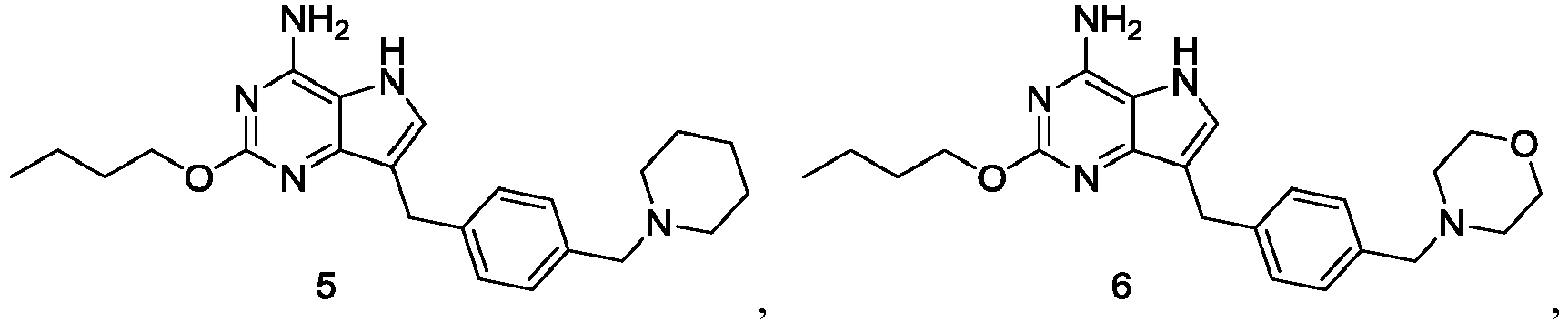
- the compound of formula I is selected from the compounds numbered as follows:
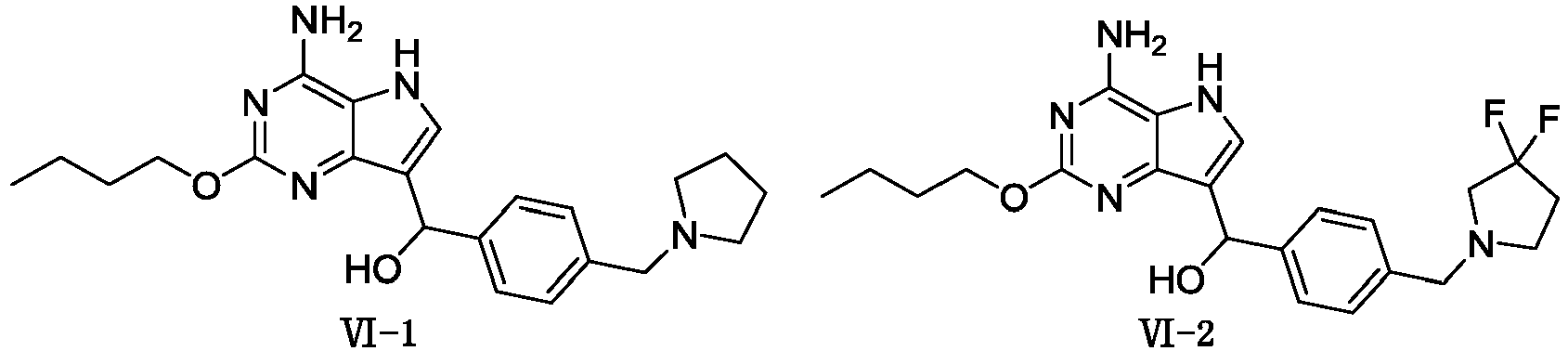
- the compound of formula VI is selected from
- the compound of formula II according to the invention may be prepared through the following process, wherein,
- the preparing process according to the invention has mild reaction conditions, for example the reaction may be conducted under atmospheric pressure (e.g. about 1 atm), and the requirement for reaction temperature is normal.
- the preparing process according to the invention can also avoid the use of reagents with high cost and risks and is particularly suitable for industrial production.
- sodium triacetoxyborohydride (NaBH(AcO) 3 ) (420.0 g, 1.98 mol) was added in portions. The reaction was carried out at 10-20°C for 3 h until the raw materials were depleted with the monitor by liquid chromatography. After the completion of reaction, 5 L of purified water was added and the temperature of the solution was lowered to about -10°C. 12L of 15% aqueous ammonia was added during which the temperature of the solution was kept below 0°C. Solid was precipitated out under stirring. Filtration was performed and the solid was slurried with 2L of water and 2L ⁇ 2 ethyl acetate successively.
- NaBH(AcO) 3 sodium triacetoxyborohydride
- the compound of formula VI-1 can also be prepared according to the following process:
- reaction was carried out at 0°C for 2 h until the raw material point disappeared with the monitor by liquid chromatography. After the completion of reaction, the reaction liquid was concentrated to dryness, 2.2 L of ethyl acetate was added and the system was cooled to below 0°C with stirring. Saturated sodium carbonate solution was added to adjust pH to 9-10, during which the temperature was kept below 10°C. Filtration was performed and the obtained filter cake was slurried with 2.2 L of water.
- reaction liquid was allowed to cool to 25°C, poured into 30 L of saturated aqueous ammonium chloride solution slowly, and extracted with ethyl acetate (15 L ⁇ 3).
- the combined organic phase was washed with saturated brine (20 L ⁇ 2) and dried with anhydrous Na 2 SO 4 . After filtration, solvent was removed by distillation under reduced pressure and the residue was slurried in n-heptane (4 L). Filtration was performed to give solid. The solid was then slurried with ethyl acetate (5 L) to give the title compound as yellow-white solid (1.53 kg, 4.55 mol, 69.7%).
- GS-9620 and R848 used are as follows, wherein the preparation of GS-9620 could be referred to the process disclosed in US20100143301 ; R848 was commercially available from ABGENT (IMG-2208, specification: 0.5 mg).
- the compound according to the invention showed higher in vitro receptor binding activity to Toll-like receptor 7 than the control (Toll-like receptor 7 agonist GS-9620) and lower in vitro receptor binding activity to Toll-like receptor 8 than the control (Toll-like receptor 7 agonist GS-9620).
- the compound of the present invention has distinct selectivity differences with respect to different receptors, and the effect is superior over the prior art.
Landscapes
- Chemical & Material Sciences (AREA)
- Organic Chemistry (AREA)
- Nitrogen Condensed Heterocyclic Rings (AREA)
- Pharmaceuticals Containing Other Organic And Inorganic Compounds (AREA)
- Plural Heterocyclic Compounds (AREA)
- Pyrrole Compounds (AREA)
- Low-Molecular Organic Synthesis Reactions Using Catalysts (AREA)
Abstract
Description
- The present invention relates to the field of medicinal chemistry and specifically relates to a process for preparing pyrrolo[3,2-d]pyrimidine compound and the intermediate thereof.
- Toll-like receptor is expressed by various immune cells and recognizes high reserved structural motifs: Pathogen Associated Molecular Pattern (PAMP) expressed by microorganism pathogens or Damage Associated Molecular Patterns (DAMP) released by dead cells. PAMP or DAMP stimulates Toll-like receptor to trigger signal cascade which induces the activations of transcriptional factors like AP-1, NF-κB and interferon regulators (pulse response function). It results in various cell responses, including productions of interferons, proinflammatory cytokines and effector cytokines, whereby immune response is produced. By far, 13 types of Toll-like receptors have been discovered in mammal. Toll-like receptors 1, 2, 4, 5 and 6 are mainly expressed on the cell surface while Toll-like receptors 3, 7, 8 and 9 are expressed in the endosome. Different Toll-like receptors recognize ligands derived from different pathogens. Toll-like receptor 7 (TLR7) is mainly expressed by plasmaeytoid dendritic cells (pDC), and recognized via ligand to induce the secretion of interferon α (IFN-α). Toll-like receptor 7 (TLR7) and Toll-like receptor 8 (TLR8) are highly homologous and therefore the ligand of TLR7 in most cases is also that of TLR8. TLR8 stimulation mainly induces the productions of cytokines like tumor necrosis factor α (TNF-α) and chemoattractant. Interferon α is one of the medicines for treating chronic hepatitis B or hepatitis C while TNF-α is a proinflammatory cytokine, of which the over secretion will result severe side effects. There have been reported several TLR7 agonists, like imiquimod (British Journal of Dermatology 2003; 149 (Suppl. 66): 5-8), resiquimod (Antiviral Research 64 (2004) 79-83), GS-9620(Gastroenterology (2013), 144(7), 1508-1517). Nevertheless, it is desirable to have novel TLR7 agonists with better selectivity, activity and safety.
- Chinese Patent Application No.
201410405136.0 - In an aspect, provided is a process for preparing the compound of formula I:


- R1 and R2 are independently selected from the group consisting of C1-4 alkyl, or
- R1 and R2 together with the N atom attached thereto form 4∼8 membered heterocycloalkyl, wherein the heterocycloalkyl is optionally substituted with one or more substituents independently selected from the group consisting of hydroxyl, halogen, C1-4 alkyl and C1-4 alkoxy.
- Unless stated otherwise, the terms and phrases used herein have the following meaning. A specific term or phrase shall not be considered as unclear or indefinite when it is not specifically defined. It should be understood according to the general meaning. The trade name used herein refers to the corresponding product or the active ingredient.
- Unless specifically defined otherwise, proportion (including percentage) or part is calculated based on weight herein.
- When used with a numerical variable, the term "approximate" or "about" usually refers to the value of the variable and all the values of the variable within the experimental error (for example, within an average 95% confidence interval) or within ± 10% of the specified value, or a wider range.
- The expression "comprise" or its synonyms "contain", "include", "have" or the like is open-ended, which does not exclude other unlisted elements, steps or ingredients. The expression "consist of' excludes any unlisted elements, steps or ingredients. The expression "substantially consist of' refers to specified elements, steps or ingredients within a given range, together with optional elements, steps or components which do not substantively affect the basic and novel feature of the claimed subject matter. It should be understood that the expression "comprise" encompasses the expressions "substantially consist of' and "consist of'.
- The term "optional" or "optionally" means the event described subsequent thereto may or may not happen. This term encompasses the cases that the event may or may not happen.
- The expression Cm-n used herein means that it has m-n carbon atoms. For example, "C1-4alkyl" means said alkyl has 1-4 carbon atoms.
- The numerical range herein refers to each of the integers therein and the subranges formed by the integers. For example, "C1-4" means said group may have 1 carbon atom, 2 carbon atoms, 3 carbon atoms or 4 carbon atoms. Accordingly, "C1-4 alkyl" encompasses "C2-3 alkyl", "C1-3 alkyl","C2-4 alkyl", as well as C1 alkyl, C2 alkyl, C3 alkyl, C4alkyl or the like.
- The term "substituted" means that one or more hydrogen atoms on a given atom are replaced by a substituent, provided that the valence of the particular atom is normal and the compound after substitution is stable.
- Unless stated otherwise, the term "hetero" means heteroatom or hetero-radical (i.e. a radical containing heteroatom), i.e. the atoms beyond carbon and hydrogen atoms or the radical containing such atoms. Preferably, the heteroatom is independently selected from the group consisting O, N, S etc. In an embodiment wherein two or more heteroatoms are involved, the two or more heteroatoms may be the same or part or all of the two or more heteroatoms may be different.
- The term "alkyl" refers to a linear or branched saturated aliphatic hydrocarbyl group consisting of carbon and hydrogen atoms, which is linked to rest of the molecule via a single bond. Non-limiting examples of C1-4alkyl comprise but not limited to methyl, ethyl, propyl, isopropyl, n-butyl, isobutyl, sec-butyl, tert-butyl or the like.
- The term "C1-4 alkoxy" refers to "C1-4 alkyl" which is connected to the rest of the molecule via "-O-", wherein the "C1-4 alkyl" is defined as above.
- The term "halo" or "halogen" refers to F, Cl, Br or I.
- The term "hydroxyl" refers to -OH group.
- The N atom in the expression "R1 and R2 together with the N atom attached thereto" refers to the N atom in the moiety

- The term "heterocycloalkyl" refers to a saturated monocyclic or polycyclic system group, wherein part of the ring atoms are heteroatoms selected from the group consisting of N, O, S, and rest of the ring atoms are C. Accordingly, the term "4∼8 membered heterocycloalkyl" refers to the heterocycloalkyl containing 4-8 ring atoms in the system, wherein one or more ring atoms are heteroatoms selected from the group consisting of N, O, S. "4-8 membered heterocycloalkyl" encompasses "4∼7 membered", "4∼6 membered", "5∼7 membered" heterocycloalkyl, for example but not limited to 4, 5, 6, 7, 8 membered heterocycloalkyl. The examples of 4 membered heterocycloalkyl comprise but not limited to azetidinyl; the examples of 5 membered heterocycloalkyl comprise but not limited to pyrrolidinyl, isoxazolidinyl, oxazolidinyl, isothiazolidinyl, thiazolidinyl, imidazolidinyl; the examples of 6 membered heterocycloalkyl comprise but not limited to piperidinyl, morpholinyl, piperazinyl; and the examples of 7 membered heterocycloalkyl comprise but not limited to azacycloheptanyl, oxaazabicyclo[2.2.1]heptyl, or the like.
- The term "one or more" refers to one, two, three, four, five, six, seven, eight or more.
- The following abbreviations are used herein: SEM: 2-(trimethylsilyl)ethoxymethyl; SEM-Cl: 2-(trimethylsilyl)ethoxymethyl chloride; DIPEA: diisopropylethylamine; TFA: trifluoroacetic acid; DMF: N,N-dimethylformamide; n-BuOH: n-butanol.
- In an aspect, provided is a process for preparing the compound of formula I, the process comprises dehydroxylating the compound of formula VI to obtain the compound of formula I:

- R1 and R2 are independently selected from the group consisting of C1-4 alkyl, or
- R1 and R2 together with the N atom attached thereto form 4∼8 membered heterocycloalkyl, wherein the heterocycloalkyl is optionally substituted with one or more substituents independently selected from the group consisting of hydroxyl, halogen, C1-4 alkyl and C1-4 alkoxy.
- In an embodiment, the process for preparing the compound of formula I according to the invention comprises the following steps:
- (a) reacting the compound of formula II with the compound of formula III in the presence of base to obtain the compound of formula IV

- (b) reacting the compound of formula IV with the compound of formula V in the presence of reductant to obtain the compound of formula VI

- (c) dehydroxylating the compound of formula VI to obtain the compound of formula I

- R1 and R2 are independently selected from the group consisting of C1-4 alkyl, or
- R1 and R2 together with the N atom attached thereto form 4∼8 membered heterocycloalkyl, wherein the heterocycloalkyl is optionally substituted with one or more substituents independently selected from the group consisting of hydroxyl, halogen, C1-4 alkyl and C1-4 alkoxy.
- In an embodiment, the base is selected from the group consisting of sodium carbonate, sodium bicarbonate, potassium carbonate, potassium phosphate, potassium bicarbonate, cesium carbonate, lithium hydroxide, sodium hydroxide, potassium hydroxide, calcium hydroxide, magnesium hydroxide, barium hydroxide, sodium methoxide, sodium ethoxide, sodium t-butoxide, potassium t-butoxide, triethylamine, diisopropylethylamine, pyridine, N,N-dimethylaminopyridine, piperidine, N-methylpiperidine, morpholine, N-methylmorpholine and any combination thereof, preferably sodium carbonate, potassium carbonate, sodium hydroxide, potassium hydroxide and any combination thereof, most preferably potassium carbonate.
- In an embodiment, step (a) is performed in a solvent. In a preferred embodiment, the solvent is isopropanol or a mixture of isopropanol with water.
- In an embodiment, the molar ratio of the compound of formula II to the base is 1.0:1.0∼3.0, preferably 1.0:1.0∼1.5, more preferably 1.0:1.2.
- In an embodiment, the molar ratio of the compound of formula II to the compound of formula III is 1.0:1.0∼3.0, preferably 1.0:1.0∼1.5, more preferably 1.0: 1.2∼1.5.
- In an embodiment, the step (b) is performed in the presence of acid. In another embodiment, the acid is selected from the group consisting of hydrochloric acid, hydrobromic acid, phosphoric acid, sulfuric acid, formic acid, acetic acid, propionic acid, citric acid, fumaric acid, malic acid, succinic acid, salicylic acid, maleic acid, trifluoroacetic acid and any combination thereof, preferably acetic acid.
- In an embodiment, in step (b), the molar ratio of the compound of formula IV to the acid is 1.0:1.0∼3.0, preferably 1.0:1.2∼2.0, more preferably 1.0:1.5.
- In an embodiment, the step (b) is conducted in a solvent. In a preferred embodiment, the solvent is isopropanol or a mixture of isopropanol with water.
- In an embodiment, the reductant is selected from the group consisting of BH3, NaBH4, NaBH3CN, NaBH(AcO)3 and any combination thereof, preferably NaBH(AcO)3.
- In an embodiment, the molar ratio of the compound of formula IV to the reductant is 1.0:1.0∼3.0, preferably 1.0:1.2∼2.0, more preferably 1.0:1.5.
- In a preferred embodiment, the dehydroxylation is performed in the presence of triethylsilane and trifluoroacetic acid.
- In another preferred embodiment, the molar ratio of the compound of formula VI to triethylsilane is 1:1∼10, preferably 1:2-8, more preferably 1:5.
- In another preferred embodiment, the molar ratio of the compound of formula VI to trifluoroacetic acid is 1:2∼20, preferably 1:5∼15, more preferably 1:10∼12.
- In an embodiment, the step (c) is performed in a solvent. In a preferred embodiment, the solvent is dichloromethane.
- In another embodiment, the process for preparing the compound of formula I according to the invention comprises the following steps:
- (a') reacting the compound of formula II with the compound of formula III' in the presence of base to obtain the compound of formula VI

- (b') dehydroxylating the compound of formula VI to obtain the compound of formula I

- R1 and R2 are independently selected from the group consisting of C1-4 alkyl, or
- R1 and R2 together with the N atom attached thereto form 4∼8 membered heterocycloalkyl, wherein the heterocycloalkyl is optionally substituted with one or more substituents independently selected from the group consisting of hydroxyl, halogen, C1-4 alkyl and C1-4 alkoxy.
- In an embodiment, the base is selected from the group consisting of sodium carbonate, sodium bicarbonate, potassium carbonate, potassium phosphate, potassium bicarbonate, cesium carbonate, lithium hydroxide, sodium hydroxide, potassium hydroxide, calcium hydroxide, magnesium hydroxide, barium hydroxide, sodium methoxide, sodium ethoxide, sodium t-butoxide, potassium t-butoxide, triethylamine, diisopropylethylamine, pyridine, N,N-dimethylaminopyridine, piperidine, N-methylpiperidine, morpholine, N-methylmorpholine and any combination thereof, preferably sodium carbonate, potassium carbonate, sodium hydroxide, potassium hydroxide and any combination thereof, most preferably potassium carbonate.
- In an embodiment, the step (a') is performed in a solvent. In a preferred embodiment, the solvent is methanol or a mixture of methanol with water.
- In an embodiment, the molar ratio of the compound of formula II to the base is 1.0:1.0∼3.0, preferably 1.0:1.0∼1.5, more preferably 1.0:1.2.
- In an embodiment, the molar ratio of the compound of formula II to the compound of formula III' is 1.0:1.0∼3.0, preferably 1.0:1.0∼1.5, more preferably 1.0:1.2∼1.5.
- In a preferred embodiment, the dehydroxylation is performed in the presence of triethylsilane and trifluoroacetic acid.
- In another preferred embodiment, the molar ratio of the compound of formula VI to triethylsilane is 1:1∼10, preferably 1:2∼8, more preferably 1:5.
- In another preferred embodiment, the molar ratio of the compound of formula VI to trifluoroacetic acid is 1:2∼20, preferably 1:5∼15, more preferably 1:10∼12.
- In an embodiment, the step (b') is performed in a solvent. In a preferred embodiment, the solvent is dichloromethane.
- In an embodiment, the compound of formula V is selected from


- In a preferable embodiment, the compound of formula I is selected from the compounds numbered as follows:




- Provided are the compound of formula II and the compound of formula VI as intermediate:


- R1 and R2 are independently selected from the group consisting of C1-4 alkyl, or
- R1 and R2 together with the N atom attached thereto form 4∼8 membered heterocycloalkyl, wherein the heterocycloalkyl is optionally substituted with one or more substituents independently selected from the group consisting of hydroxyl, halogen, C1-4 alkyl and C1-4alkoxy.
- In an embodiment, the compound of formula VI is selected from


- The compound of formula II according to the invention may be prepared through the following process,
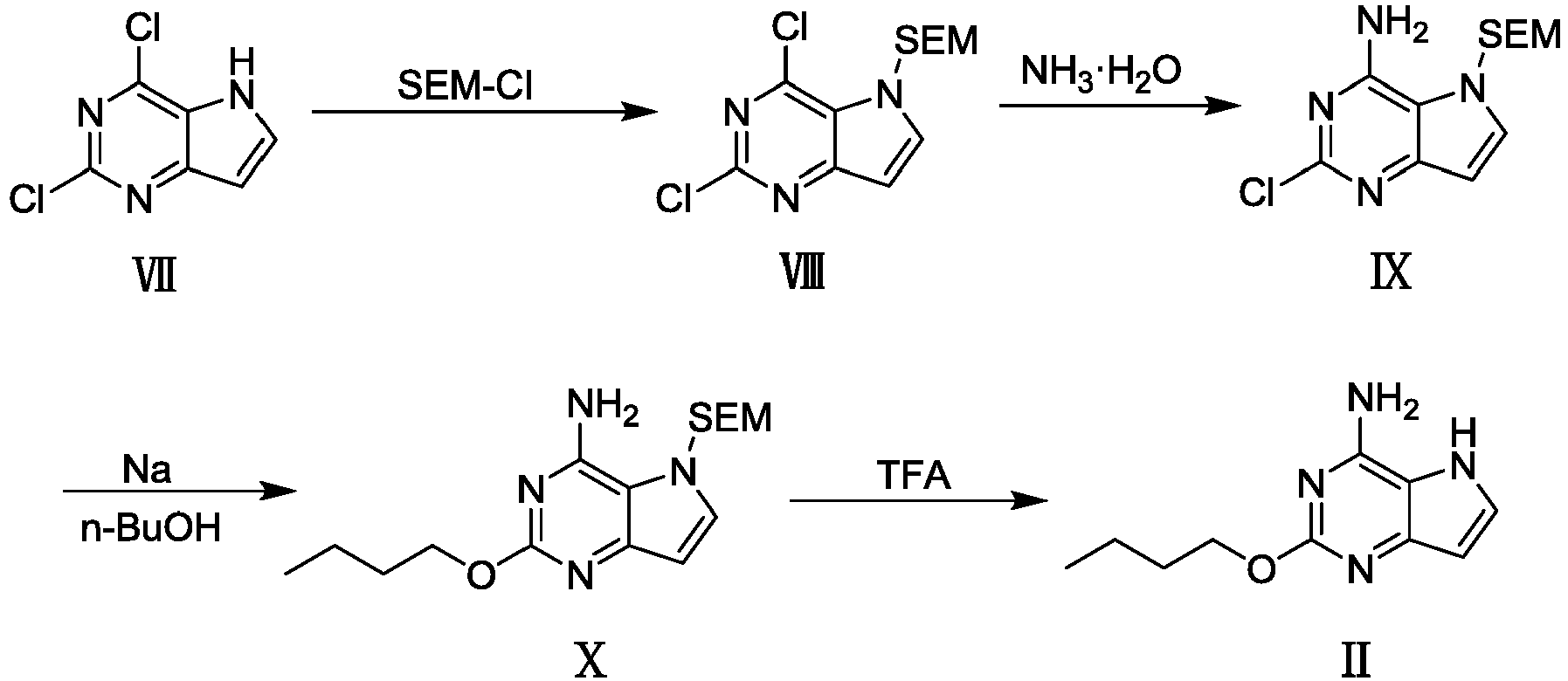
- reacting the compound of formula VII with SEM-C1 to obtain the compound of formula VIII (preferably in DMF);
- reacting the compound of formula VIII with aqueous ammonia to obtain the compound of formula IX (preferably in isopropanol);
- subjecting the compound of formula IX to substitution reaction with sodium n-butoxide to form the compound of formula X (preferably in n-BuOH); and
- removing SEM from the compound of formula X under the action of TFA to obtain the compound of formula II (preferably in TFA).
- The preparing process according to the invention has mild reaction conditions, for example the reaction may be conducted under atmospheric pressure (e.g. about 1 atm), and the requirement for reaction temperature is normal. The preparing process according to the invention can also avoid the use of reagents with high cost and risks and is particularly suitable for industrial production.
- To better understand the invention, further illustration will be given below with reference to the following examples. The specific examples, however, are not intended to limit the scope of the present invention.
-

- To a three-necked flask were added terephthalic aldehyde (790.64 mg, 5.82 mmol) and isopropanol (10 mL), followed by addition of 2-butoxy-5H-pyrrolo[3,2-d]pyrimidin-4-amine (1.00 g, 4.85 mmol) with stirring. Stirring was performed for 10 min after the system was cooled to 0°C. Purified water (10 mL) and potassium carbonate (804.17 mg, 5.82 mmol) were added, and the reaction was performed at 25°C for 16 h until the raw materials were depleted with the monitor by LCMS. After completion of the reaction, solid was precipitated out. Filtration was performed and the solid was slurried with 20 ml of purified water and 30 ml (ethyl acetate/n-heptane=1/20) successively. Filtration was performed and drying was conducted to give the title compound as yellow solid (1.50 g, 4.41 mmol, yield: 90.9%).
1H NMR (400 MHz, methanol -d4 ) δ 9.94 (s, 1 H), 7.86 (d, J = 8.16 Hz, 2 H), 7.72 (d, J = 8.16 Hz, 2 H), 7.12 - 7.17 (m, 1 H), 6.19 (s, 1 H), 4.28 (t, J=6.53 Hz, 2 H), 1.68 - 1.77 (m, 2 H), 1.44 - 1.54 (m, 2 H), 0.97 (t, J=7.34 Hz, 3 H). -

- To 30L clave were added the above obtained compound of formula IV 4-((4-amino -2-butoxy-5H-pyrrolo[3,2-d]pyrimidin-7-yl)-hydroxylmethyl)benzaldehyde (450.0 g, 1.32 mol) and isopropanol (4.5 L). After stirring for 5 min, glacial acetic acid (119.0 g, 1.98 mol) was added. The system was stirred until it was cooled to 0-10°C. Pyrrolidine (112.4 g, 1.58 mol) was added dropwise during which the temperature of the system was kept below 10°C. After addition, sodium triacetoxyborohydride (NaBH(AcO)3) (420.0 g, 1.98 mol) was added in portions. The reaction was carried out at 10-20°C for 3 h until the raw materials were depleted with the monitor by liquid chromatography. After the completion of reaction, 5 L of purified water was added and the temperature of the solution was lowered to about -10°C. 12L of 15% aqueous ammonia was added during which the temperature of the solution was kept below 0°C. Solid was precipitated out under stirring. Filtration was performed and the solid was slurried with 2L of water and 2L×2 ethyl acetate successively. Filtration was performed and drying was conducted at 40°C under reduced pressure for 12h to give the title compound as yellow solid (465.0 g, 1.18mol, yield 89.4%, moisture 0.9%).
1H NMR (400 MHz, methanol-d4 ) δ 7.46 (d, J=7.91 Hz, 1 H), 7.29 (d, J = 8.03 Hz, 1 H), 7.09 (s, 1 H), 6.12 (s, 1 H), 4.29 (t, J = 6.53 Hz, 2 H), 3.60 (s, 2 H), 2.52 (br. s., 4 H), 1.66 - 1.83 (m, 6 H), 1.49 (d, J = 7.53 Hz, 2 H), 0.98 (t, J = 7.40 Hz, 3 H). -

- To the mixture of 2-butoxy-5H-pyrrolo[3,2-d]pyrimidin-4-amine (3.00 g, 14.55 mmol), 4-(pyrrolidin-1-ylmethyl)benzaldehyde (4.13 g, 21.82 mmol), methanol (30 mL) and water(30 mL) was added potassium carbonate (2.41 g, 17.46 mmol) with stirring. Then stirring was performed at 25°C for 12 h and raw materials were depleted with the monitor by thin-layer chromatography. Solid was precipitated out after completion of the reaction. 30 mL of water was added, and the solid was filtered and dried to give the title compound as white solid (3.50 g, 8.85 mmol, yield: 60.82%).
1H NMR (400 MHz, methanol-d4 ) δ 7.46 (d, J=7.91 Hz, 1 H), 7.29 (d, J = 8.03 Hz, 1 H), 7.09 (s, 1 H), 6.12 (s, 1 H), 4.29 (t, J = 6.53 Hz, 2 H), 3.60 (s, 2 H), 2.52 (br. s., 4 H), 1.66 - 1.83 (m, 6 H), 1.49 (d, J = 7.53 Hz, 2 H), 0.98 (t, J = 7.40 Hz, 3 H). -

- To 20L clave were added the above obtained compound of formula VI-1 (4-amino -2-butoxy-5H-pyrrolo[3,2-d]pyrimidin-7-yl)(4-(pyrrolidin-1-ylmethyl)phenyl)methanol (440.0 g, 1.11 mol) and dichloromethane (7.0 L). The system was stirred until it was cooled to below -15°C. Triethylsilane (880mL, 5.55 mol) was added dropwise followed by trifluoroacetic acid (880 mL, 11.84 mol) dropwise during which the temperature of the system was kept below -10°C. After addition, the reaction was carried out at 0°C for 2 h until the raw material point disappeared with the monitor by liquid chromatography. After the completion of reaction, the reaction liquid was concentrated to dryness, 2.2 L of ethyl acetate was added and the system was cooled to below 0°C with stirring. Saturated sodium carbonate solution was added to adjust pH to 9-10, during which the temperature was kept below 10°C. Filtration was performed and the obtained filter cake was slurried with 2.2 L of water. Drying was conducted under reduced pressure to give 550 g of 2-butoxy-7-(4-(pyrrolidin-1-ylmethyl)benzyl)-5H-pyrrolo[3,2-d]pyrimidin-4-amine (trifluoroacetate of the title compound) as white solid. The obtained white solid was desalinated under alkaline condition to give the title compound, which may be carried out, for example, by conventional process.
1H NMR (400 MHz, methanol-d4 ) δ 7.27 (d, J = 8.0 Hz, 2H), 7.22 (d, J = 8.0 Hz, 2H), 7.04 (s, 1H), 4.32 (t, J = 6.6 Hz, 2H), 3.99 (s, 2H), 3.60 (s, 2H), 2.55 - 2.52 (m, 4H), 1.85 - 1.71 (m, 6H), 1.55-1.48 (m, 2H), 1.00 (t, J = 7.4 Hz, 3H). -

- In DMF (20.00 L) was dissolved 2,4-dichloro-5H-pyrrolo[3,2-d]pyrimidine (4.00 kg, 21.28 mol), DIPEA (2.58 kg,20.00 mol) was added in portions at room temperature (25°C), and stirring was performed subsequently for 30 min. The reaction liquid was cooled to 0°C with ice bath. Then SEM-Cl (4.00 kg, 24.00 mol) was added dropwise slowly at the speed of 1-2 drop/s over 5 h. After addition, the reaction was carried out at 0°C for 4 h with stirring, and the reaction was monitored by HPLC until the reaction was completed. The reaction liquid was quenched and diluted with 70 L of water, and extracted with ethyl acetate (15 L×3). The combined organic phase was washed with 1 M hydrochloric acid aqueous solution (5 L × 2) and saturated brine (7 L × 2) successively. The solvent was removed by distillation under reduced pressure to give the title compound (6.40 kg, 20.11 mol, yield 94.50%).
1H NMR (400 MHz, DMSO-d 6) δ 8.24 - 8.35 (m, 1 H),6.70 - 6.85 (m, 1 H),5.77 (s, 2 H),3.45 - 3.57 (m, 2 H),0.74 - 0.86 (m, 2 H),0.00 (s, 9 H). -
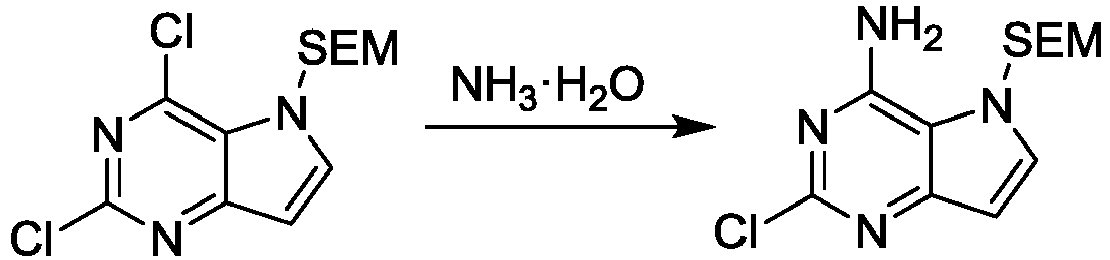
- In isopropanol (1.60 L) was dissolved 2,4-dichloro-5-((2-(trimethylsilyl)ethoxy)methyl)-5H-pyrrolo[3,2-d]pyrimidine (1.60 kg, 5.03 mol) in 10 L autoclave. Aqueous ammonia (4 L) was added in one portion at room temperature (25°C). The reaction mixture was stirred at 95°C for 7 h and monitored by HPLC until the reaction was completed. The reaction liquid was allowed to cool to room temperature, and filtered through a Buchner funnel to give dark brown solid. The solid was slurried with ethyl acetate/n-heptane (1/1, 5 L x 2) and ethyl acetate (4 L) successively to give the title compound as brown solid (1.25kg, 4.18mol, yield 83.1%).
1H NMR (400 MHz, DMSO-d 6) δ 7.61 - 7.77 (m, 1 H), 6.97 - 7.19 (m, 2 H),6.28 - 6.38 (m, 1 H),5.54 - 5.67 (m, 2 H),3.43 - 3.53 (m, 2 H),0.76 - 0.91 (m, 2 H),0.07 (s, 9 H). -

- To n-BuOH (17.0 L) was slowly added sodium metal (525.05 g, 22.84 mol) in portions under nitrogen atmosphere. After addition, the system was heated to 60°C and kept stirring at the temperature until sodium metal was dissolved completely. The system was cooled to 25°C, and 2-chloro-5-((2-(trimethylsilyl)ethoxy)methyl)-5H-pyrrolo [3,2-d]pyrimidin-4-amine (1.95 kg,6.53 mol) was added in portions. After homogeneous mixing with stirring, the reactants were stirred at 90°C for 8 h, and monitored by HPLC until the reaction was completed. The reaction liquid was allowed to cool to 25°C, poured into 30 L of saturated aqueous ammonium chloride solution slowly, and extracted with ethyl acetate (15 L×3). The combined organic phase was washed with saturated brine (20 L × 2) and dried with anhydrous Na2SO4. After filtration, solvent was removed by distillation under reduced pressure and the residue was slurried in n-heptane (4 L). Filtration was performed to give solid. The solid was then slurried with ethyl acetate (5 L) to give the title compound as yellow-white solid (1.53 kg, 4.55 mol, 69.7%).
1H NMR (400 MHz, DMSO-d 6) δ 7.49 - 7.54 (m, 1 H),6.54 - 6.62 (m, 2 H),6.15 - 6.20 (m, 1 H),5.54 (s, 2 H),4.10 - 4.22 (m, 2 H),3.42 - 3.55 (m, 2 H),1.58 - 1.73 (m, 2 H),1.35 - 1.47 (m, 2 H),0.90 - 0.96 (m, 3 H),0.83 - 0.89 (m, 2 H),0.05 (s, 9 H). -

- In TFA (5.50 L) was dissolved 2-butoxy-5-((2-(trimethylsilyl)ethoxy)methyl)-5H-pyrrolo[3,2-d]pyrimidin-4-amine (1.10 kg, 3.27 mol). The reaction liquid was stirred at 25°C for 16 h, and monitored by HPLC until the reaction was completed. TFA was removed by distillation under reduced pressure. The residue was dissolved in methanol (1.2 L) and ice water (1.2 L), concentrated aqueous ammonia was used under uniform stirring to adjust pH to 12, and then stirring was performed for 2 h. Precipitate was precipitated out from solution continuously. The filter cake was white solid after filtration, which was slurried with 15% aqueous ammonia (1.2 L×3) and ethyl acetate (4 L) successively to give the title compound as white solid (550.00 g, 2.67 mol, 81.7%).
1H NMR (400 MHz, methanol-d 4) δ 7.37 (d, J=2.89 Hz, 1 H),6.29 (d, J=3.01 Hz, 1 H),4.27 (t, J=6.53 Hz, 2 H),1.75 (d, J=7.91 Hz, 2 H),1.44 - 1.61 (m, 2 H),1.00 (t, J=7.40 Hz, 3 H). -
- HEK-blue hTLR7 cell and HEK-blue hTLR8 cell (available from InvivoGen)
- DMEM medium
- heat inactivated fetal bovine serum
- Anti Mycoplasma reagent Normocin™
- bleomycin
- blasticidin
- The structures of GS-9620 and R848 used are as follows, wherein the preparation of GS-9620 could be referred to the process disclosed in
US20100143301 ; R848 was commercially available from ABGENT (IMG-2208, specification: 0.5 mg).
- 1. Preparation of 96-well compound plate:
The compounds were gradient diluted with DMSO in 3-fold using liquid work station POD starting at a concentration of 10 mmol/L and 10 points were diluted (2nd column to 11th column, and each point was duplicated). At 12th column, 1 µL of 5 mg/mL positive compound R848 was added as positive control; and at 1st column, 1 µL of DMSO was added as negative control. Each well contained 1 µL of DMSO. - 2. The cells in culture flask were collected and the cell density was diluted to 250,000 cells/mL.
- 3. 200 µL (50,000 cells/well) of cell suspension was added into prepared compound plate and the final concentration of DMSO in each well was 0.5%.
- 4. The culture plates containing cells and the compounds were incubated in CO2 incubator for 24 h at 37°C, 5%CO2.
- 5. After 24 h incubation, 20 µL of supernatant was removed from each well to a 96-well transparent assay plate. To each well of the assay plate was added 180 µL of Quanti-Blue reagent and the plate was incubated in an incubator at 37°C, 5%CO2 for 1 h.
- 6. After 1 h, the content of alkaline phosphatase in 20 µL of supernatant was determined using Microplate Reader OD650.
- 7. EC50 of each compound was obtained with Prism software.
- Results were shown in Table 1.
Table 1 Compound TLR7 EC50 Compound TLR7 EC50 Compound 1 B Compound 9 B Compound 2 C Compound 10 B Compound 3 B Compound 11 B Compound 4 B Compound 12 B Compound 5 B Compound 13 B Compound 6 C Compound 14 B Compound 7 C Compound 15 B Compound 8 B Compound 16 B Note:1 nM≤A≤100 nM; 100 nM<B≤1000 nM; 1000 nM<C≤50 µM. - Results of compound 1 and control sample Toll-like receptor 7 agonist GS-9620 were shown in Table 2.
Table 2 Samples (Title compound) TLR7 EC50 (nM) TLR8 EC50 (nM) GS-9620 517 7867 Compound 1 160 11632 - The compound according to the invention showed higher in vitro receptor binding activity to Toll-like receptor 7 than the control (Toll-like receptor 7 agonist GS-9620) and lower in vitro receptor binding activity to Toll-like receptor 8 than the control (Toll-like receptor 7 agonist GS-9620). The compound of the present invention has distinct selectivity differences with respect to different receptors, and the effect is superior over the prior art.
Claims (10)
- A process for preparing the compound of formula I, comprising dehydroxylating the compound of formula VI to obtain the compound of formula I
 R1 and R2 are independently selected from the group consisting of C1-4 alkyl, orR1 and R2 together with the N atom attached thereto form 4∼8 membered heterocycloalkyl, wherein the heterocycloalkyl is optionally substituted with one or more substituents independently selected from the group consisting of hydroxyl, halogen, C1-4 alkyl and C1-4 alkoxy.
 - The process according to claim 1, comprising the following steps:(a) reacting the compound of formula II with the compound of formula III in the presence of base to obtain the compound of formula IV
 (b) reacting the compound of formula IV with the compound of formula V in the presence of reductant to obtain the compound of formula VI
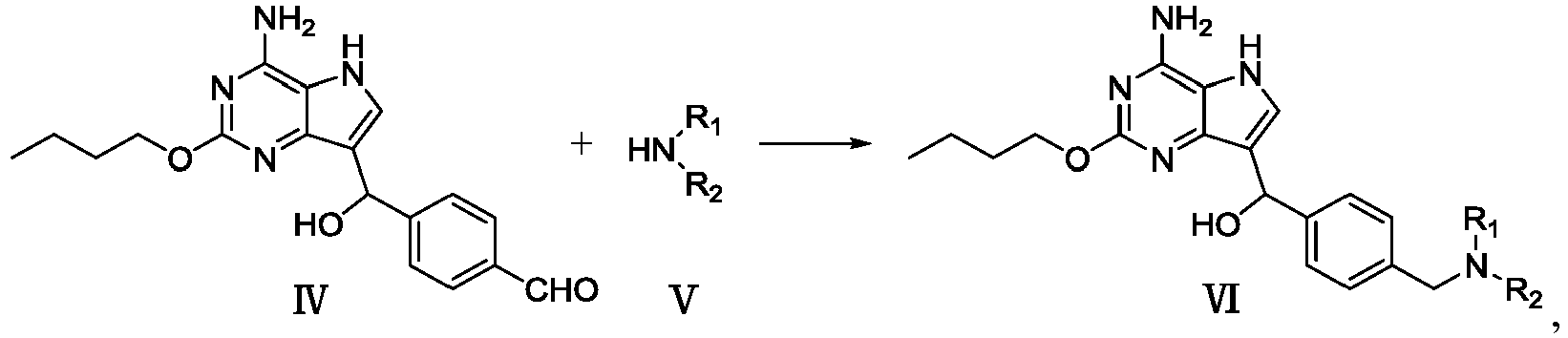 (c) dehydroxylating the compound of formula VI to obtain the compound of formula I
- The process according to claim 2, wherein the compound of formula V is selected from:


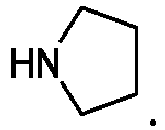
- The process according to claim 1, wherein the process comprises the following steps:(a') reacting the compound of formula II with the compound of formula III' in the presence of base to obtain the compound of formula VI
 (b') dehydroxylating the compound of formula VI to obtain the compound of formula I
- The process according to any one of claims 1-4, wherein the dehydroxylation is performed in the presence of triethylsilane and trifluoroacetic acid.
- The process according to claim 5, wherein
the molar ratio of the compound of formula VI to the triethylsilane is 1:1 ∼10, preferably 1:2 ∼8, more preferably 1:5;
the molar ratio of the compound of formula VI to the trifluoroacetic acid is 1:2 ∼ 20, preferably 1:5 ∼15, more preferably 1:10 ∼ 12. - The process according to any one of claims 1-6, wherein the compound of formula I is selected from:


- A compound of formula VI:
 R1 and R2 are independently selected from the group consisting of C1-4 alkyl, orR1 and R2 together with the N atom attached thereto form 4∼8 membered heterocycloalkyl, wherein the heterocycloalkyl is optionally substituted with one or more substituents independently selected from hydroxyl, halogen, C1-4 alkyl and C1-4 alkoxy.
 - The compound of formula VI according to claim 8 selected from:


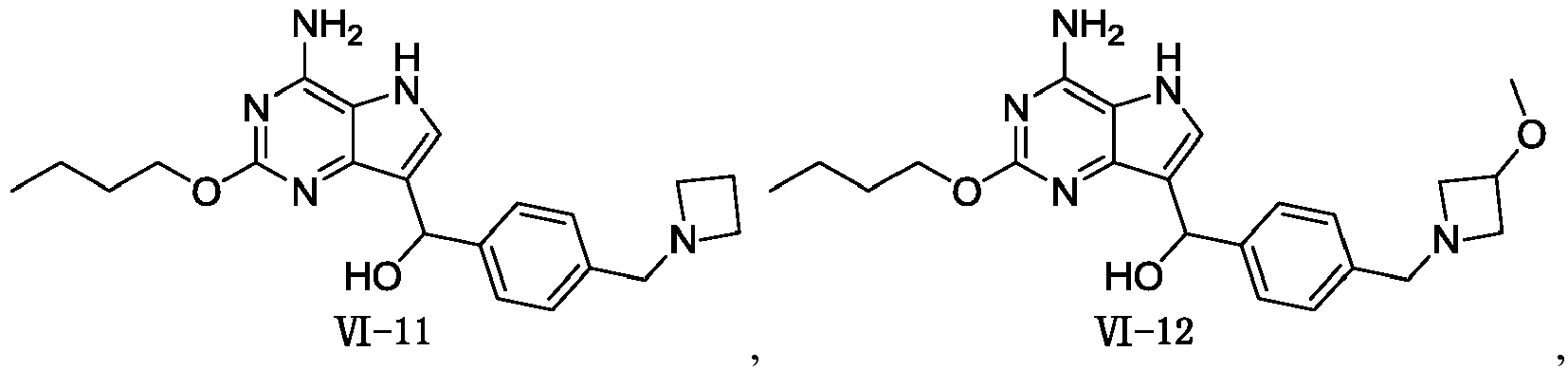


- A compound of formula II:

Priority Applications (3)
| Application Number | Priority Date | Filing Date | Title |
|---|---|---|---|
| SI201730605T SI3412673T1 (en) | 2016-02-05 | 2017-02-04 | Method for preparing pyrrolo(3,2-d)pyrimidine compound, and intermediates thereof |
| PL17747006T PL3412673T3 (en) | 2016-02-05 | 2017-02-04 | Method for preparing pyrrolo[3,2-d]pyrimidine compound, and intermediates thereof |
| HRP20210103TT HRP20210103T1 (en) | 2016-02-05 | 2017-02-04 | Method for preparing pyrrolo[3,2-d]pyrimidine compound, and intermediates thereof |
Applications Claiming Priority (2)
| Application Number | Priority Date | Filing Date | Title |
|---|---|---|---|
| CN201610082028.3A CN107043378A (en) | 2016-02-05 | 2016-02-05 | A kind of Preparation Method And Their Intermediate of pyrrolo- [3,2-d] pyrimidines |
| PCT/CN2017/072893 WO2017133686A1 (en) | 2016-02-05 | 2017-02-04 | Method for preparing pyrrolo[3,2-d]pyrimidine compound, and intermediates thereof |
Publications (3)
| Publication Number | Publication Date |
|---|---|
| EP3412673A1 true EP3412673A1 (en) | 2018-12-12 |
| EP3412673A4 EP3412673A4 (en) | 2019-07-03 |
| EP3412673B1 EP3412673B1 (en) | 2020-11-25 |
Family
ID=59500148
Family Applications (1)
| Application Number | Title | Priority Date | Filing Date |
|---|---|---|---|
| EP17747006.9A Active EP3412673B1 (en) | 2016-02-05 | 2017-02-04 | Method for preparing pyrrolo[3,2-d]pyrimidine compound, and intermediates thereof |
Country Status (28)
| Country | Link |
|---|---|
| US (2) | US10654856B2 (en) |
| EP (1) | EP3412673B1 (en) |
| JP (1) | JP6877449B2 (en) |
| KR (1) | KR102371500B1 (en) |
| CN (2) | CN107043378A (en) |
| AR (1) | AR107549A1 (en) |
| AU (1) | AU2017214134B2 (en) |
| BR (1) | BR112018015879B1 (en) |
| CA (1) | CA3013520C (en) |
| CL (1) | CL2018002094A1 (en) |
| DK (1) | DK3412673T3 (en) |
| EA (1) | EA034581B1 (en) |
| ES (1) | ES2852323T3 (en) |
| HR (1) | HRP20210103T1 (en) |
| HU (1) | HUE053455T2 (en) |
| IL (1) | IL260999B (en) |
| LT (1) | LT3412673T (en) |
| MX (1) | MX374298B (en) |
| MY (1) | MY190551A (en) |
| NZ (1) | NZ744885A (en) |
| PH (1) | PH12018501642B1 (en) |
| PL (1) | PL3412673T3 (en) |
| PT (1) | PT3412673T (en) |
| SG (1) | SG11201806685VA (en) |
| SI (1) | SI3412673T1 (en) |
| TW (1) | TW201728590A (en) |
| UA (1) | UA124100C2 (en) |
| WO (1) | WO2017133686A1 (en) |
Cited By (1)
| Publication number | Priority date | Publication date | Assignee | Title |
|---|---|---|---|---|
| EP3412671A4 (en) * | 2016-02-05 | 2019-07-24 | Chia Tai Tianqing Pharmaceutical Group Co.,Ltd | TLR7 AGONIST MALLEATE SALT, CRYSTALLINE FORMS C, D AND E THEREOF, PROCESSES FOR PREPARING AND USES OF MALATEATE SALT AND ITS CRYSTALLINE FORMS |
Families Citing this family (7)
| Publication number | Priority date | Publication date | Assignee | Title |
|---|---|---|---|---|
| SG10201913587WA (en) | 2016-02-05 | 2020-02-27 | Denali Therapeutics Inc | Inhibitors of receptor-interacting protein kinase 1 |
| BR112021015577A8 (en) | 2019-02-08 | 2021-10-05 | Research & Business Found Sungkyunkwan Univ | Toll-like receptor 7/8 agonist cholesterol-complex, nanoparticle composition, adjuvant composition, vaccine composition, composition for regulating immune function, pharmaceutical composition and use of the complex |
| EP4115901A4 (en) | 2020-03-02 | 2024-04-10 | Progeneer Inc. | LIVE PATHOGEN MIMETIC NANOPARTICLES BASED ON A PATHOGEN CELL WALL SKELETON AND PRODUCTION PROCESS THEREOF |
| WO2022031021A1 (en) | 2020-08-04 | 2022-02-10 | 성균관대학교산학협력단 | Mrna vaccine comprising adjuvant capable of kinetic control |
| EP4194008A4 (en) | 2020-08-04 | 2025-01-08 | Progeneer Inc. | KINETIC ACTION ADJUVANT SET |
| EP4194010A4 (en) | 2020-08-04 | 2025-03-26 | Progeneer Inc. | CONJUGATE OF A FUNCTIONAL DRUG AND A TOLL-LIKE RECEPTOR 7 OR 8 AGONIST, THE ACTIVE SITE OF WHICH IS TEMPORARILY INACTIVATED, AND ASSOCIATED USE |
| WO2023137035A1 (en) | 2022-01-12 | 2023-07-20 | Denali Therapeutics Inc. | Crystalline forms of (s)-5-benzyl-n-(5-methyl-4-oxo-2, 3,4,5- tetrahydropyrido [3,2-b] [l,4]oxazepin-3-yl)-4h-l,2,4-triazole-3-carboxamide |
Family Cites Families (12)
| Publication number | Priority date | Publication date | Assignee | Title |
|---|---|---|---|---|
| WO2009082247A1 (en) * | 2007-12-21 | 2009-07-02 | Industrial Research Limited | Process for preparing immucillins having a methylene link |
| AU2009333559B2 (en) | 2008-12-09 | 2015-03-12 | Gilead Sciences, Inc. | Modulators of toll-like receptors |
| EA035327B1 (en) * | 2012-10-10 | 2020-05-28 | Янссен Сайенсиз Айрлэнд Юси | PYRROLO[3,2-d]PYRIMIDINE DERIVATIVES FOR THE TREATMENT OF VIRAL INFECTIONS AND OTHER DISEASES |
| PL2922549T3 (en) | 2012-11-20 | 2017-11-30 | Glaxosmithkline Llc | Novel compounds |
| CA2890201A1 (en) * | 2012-11-20 | 2014-05-30 | Glaxosmithkline Llc | Novel compounds |
| KR102139847B1 (en) * | 2014-05-01 | 2020-07-31 | 노파르티스 아게 | Compounds and compositions as toll-like receptor 7 agonists |
| CN105367576A (en) | 2014-08-15 | 2016-03-02 | 正大天晴药业集团股份有限公司 | Pyrrolopyrimidine compounds as TLR7 agonists |
| MX386981B (en) | 2014-08-15 | 2025-03-19 | Chia Tai Tianqing Pharmaceutical Group Co Ltd | PYRROLOPYRIMIDINE COMPOUNDS USED AS TOLL-LIKE RECEPTOR 7 (TLR7) AGONISTS. |
| CN108349982B (en) | 2015-11-05 | 2020-05-05 | 正大天晴药业集团股份有限公司 | 7- (thiazol-5-yl) pyrrolopyrimidine compounds as TLR7 agonists |
| CN107043380A (en) * | 2016-02-05 | 2017-08-15 | 正大天晴药业集团股份有限公司 | A kind of maleate of TLR7 activators, its crystal formation C, crystal formation D, crystal formation E, preparation method and purposes |
| CN107043379A (en) * | 2016-02-05 | 2017-08-15 | 正大天晴药业集团股份有限公司 | A kind of crystal formation A, its preparation method and the medical usage of TLR7 activators |
| CN107043377A (en) * | 2016-02-05 | 2017-08-15 | 正大天晴药业集团股份有限公司 | A kind of trifluoroacetate of TLR7 activators, crystal formation B and preparation method thereof, pharmaceutical composition and purposes |
-
2016
- 2016-02-05 CN CN201610082028.3A patent/CN107043378A/en active Pending
-
2017
- 2017-02-03 TW TW106103696A patent/TW201728590A/en unknown
- 2017-02-04 DK DK17747006.9T patent/DK3412673T3/en active
- 2017-02-04 SI SI201730605T patent/SI3412673T1/en unknown
- 2017-02-04 EP EP17747006.9A patent/EP3412673B1/en active Active
- 2017-02-04 PL PL17747006T patent/PL3412673T3/en unknown
- 2017-02-04 BR BR112018015879-8A patent/BR112018015879B1/en active IP Right Grant
- 2017-02-04 CN CN201780009748.XA patent/CN108602832B/en active Active
- 2017-02-04 UA UAA201809087A patent/UA124100C2/en unknown
- 2017-02-04 EA EA201891769A patent/EA034581B1/en not_active IP Right Cessation
- 2017-02-04 NZ NZ744885A patent/NZ744885A/en unknown
- 2017-02-04 HR HRP20210103TT patent/HRP20210103T1/en unknown
- 2017-02-04 HU HUE17747006A patent/HUE053455T2/en unknown
- 2017-02-04 WO PCT/CN2017/072893 patent/WO2017133686A1/en not_active Ceased
- 2017-02-04 JP JP2018540720A patent/JP6877449B2/en active Active
- 2017-02-04 ES ES17747006T patent/ES2852323T3/en active Active
- 2017-02-04 MY MYPI2018702701A patent/MY190551A/en unknown
- 2017-02-04 AU AU2017214134A patent/AU2017214134B2/en active Active
- 2017-02-04 KR KR1020187024628A patent/KR102371500B1/en active Active
- 2017-02-04 MX MX2018009502A patent/MX374298B/en active IP Right Grant
- 2017-02-04 SG SG11201806685VA patent/SG11201806685VA/en unknown
- 2017-02-04 LT LTEP17747006.9T patent/LT3412673T/en unknown
- 2017-02-04 US US16/075,300 patent/US10654856B2/en active Active
- 2017-02-04 PT PT177470069T patent/PT3412673T/en unknown
- 2017-02-04 CA CA3013520A patent/CA3013520C/en active Active
- 2017-02-06 AR ARP170100298A patent/AR107549A1/en active IP Right Grant
-
2018
- 2018-08-02 PH PH12018501642A patent/PH12018501642B1/en unknown
- 2018-08-03 CL CL2018002094A patent/CL2018002094A1/en unknown
- 2018-08-05 IL IL260999A patent/IL260999B/en active IP Right Grant
-
2020
- 2020-04-13 US US16/847,394 patent/US20200239484A1/en not_active Abandoned
Cited By (1)
| Publication number | Priority date | Publication date | Assignee | Title |
|---|---|---|---|---|
| EP3412671A4 (en) * | 2016-02-05 | 2019-07-24 | Chia Tai Tianqing Pharmaceutical Group Co.,Ltd | TLR7 AGONIST MALLEATE SALT, CRYSTALLINE FORMS C, D AND E THEREOF, PROCESSES FOR PREPARING AND USES OF MALATEATE SALT AND ITS CRYSTALLINE FORMS |
Also Published As
Similar Documents
| Publication | Publication Date | Title |
|---|---|---|
| EP3412673B1 (en) | Method for preparing pyrrolo[3,2-d]pyrimidine compound, and intermediates thereof | |
| CN108349982B (en) | 7- (thiazol-5-yl) pyrrolopyrimidine compounds as TLR7 agonists | |
| EP3412672B1 (en) | Crystal form a of 2-butoxy-7-(4-(pyrrolidin-1-ylmethyl) benzyl)-5h-pyrrolo[3,2-d]pyrimidin-4-amine as tlr7 agonist, preparation method and use thereof | |
| AU2017214135B2 (en) | TLR7 agonist trifluoroacetate salt and crystalline form B thereof, preparation methods and uses | |
| AU2017215800B2 (en) | TLR7 agonist maleate salt, crystalline forms C, D and E thereof, preparation methods and uses of maleate salt and crystalline forms | |
| HK1259183B (en) | Method for preparing pyrrolo[3,2-d]pyrimidine compound, and intermediates thereof | |
| HK1259182B (en) | Tlr7 agonist trifluoroacetate salt and crystalline form b thereof, preparation methods and uses |
Legal Events
| Date | Code | Title | Description |
|---|---|---|---|
| STAA | Information on the status of an ep patent application or granted ep patent |
Free format text: STATUS: THE INTERNATIONAL PUBLICATION HAS BEEN MADE |
|
| PUAI | Public reference made under article 153(3) epc to a published international application that has entered the european phase |
Free format text: ORIGINAL CODE: 0009012 |
|
| STAA | Information on the status of an ep patent application or granted ep patent |
Free format text: STATUS: REQUEST FOR EXAMINATION WAS MADE |
|
| 17P | Request for examination filed |
Effective date: 20180831 |
|
| AK | Designated contracting states |
Kind code of ref document: A1 Designated state(s): AL AT BE BG CH CY CZ DE DK EE ES FI FR GB GR HR HU IE IS IT LI LT LU LV MC MK MT NL NO PL PT RO RS SE SI SK SM TR |
|
| AX | Request for extension of the european patent |
Extension state: BA ME |
|
| A4 | Supplementary search report drawn up and despatched |
Effective date: 20190603 |
|
| RIC1 | Information provided on ipc code assigned before grant |
Ipc: C07D 487/04 20060101AFI20190527BHEP |
|
| GRAP | Despatch of communication of intention to grant a patent |
Free format text: ORIGINAL CODE: EPIDOSNIGR1 |
|
| STAA | Information on the status of an ep patent application or granted ep patent |
Free format text: STATUS: GRANT OF PATENT IS INTENDED |
|
| INTG | Intention to grant announced |
Effective date: 20200408 |
|
| GRAJ | Information related to disapproval of communication of intention to grant by the applicant or resumption of examination proceedings by the epo deleted |
Free format text: ORIGINAL CODE: EPIDOSDIGR1 |
|
| STAA | Information on the status of an ep patent application or granted ep patent |
Free format text: STATUS: REQUEST FOR EXAMINATION WAS MADE |
|
| GRAP | Despatch of communication of intention to grant a patent |
Free format text: ORIGINAL CODE: EPIDOSNIGR1 |
|
| STAA | Information on the status of an ep patent application or granted ep patent |
Free format text: STATUS: GRANT OF PATENT IS INTENDED |
|
| INTC | Intention to grant announced (deleted) | ||
| INTG | Intention to grant announced |
Effective date: 20200708 |
|
| GRAS | Grant fee paid |
Free format text: ORIGINAL CODE: EPIDOSNIGR3 |
|
| GRAA | (expected) grant |
Free format text: ORIGINAL CODE: 0009210 |
|
| STAA | Information on the status of an ep patent application or granted ep patent |
Free format text: STATUS: THE PATENT HAS BEEN GRANTED |
|
| AK | Designated contracting states |
Kind code of ref document: B1 Designated state(s): AL AT BE BG CH CY CZ DE DK EE ES FI FR GB GR HR HU IE IS IT LI LT LU LV MC MK MT NL NO PL PT RO RS SE SI SK SM TR |
|
| AX | Request for extension of the european patent |
Extension state: BA ME |
|
| REG | Reference to a national code |
Ref country code: GB Ref legal event code: FG4D |
|
| REG | Reference to a national code |
Ref country code: CH Ref legal event code: EP |
|
| REG | Reference to a national code |
Ref country code: DE Ref legal event code: R096 Ref document number: 602017028301 Country of ref document: DE |
|
| REG | Reference to a national code |
Ref country code: AT Ref legal event code: REF Ref document number: 1338163 Country of ref document: AT Kind code of ref document: T Effective date: 20201215 |
|
| REG | Reference to a national code |
Ref country code: IE Ref legal event code: FG4D |
|
| REG | Reference to a national code |
Ref country code: DK Ref legal event code: T3 Effective date: 20210114 |
|
| REG | Reference to a national code |
Ref country code: HR Ref legal event code: TUEP Ref document number: P20210103 Country of ref document: HR |
|
| REG | Reference to a national code |
Ref country code: RO Ref legal event code: EPE |
|
| REG | Reference to a national code |
Ref country code: FI Ref legal event code: FGE |
|
| REG | Reference to a national code |
Ref country code: PT Ref legal event code: SC4A Ref document number: 3412673 Country of ref document: PT Date of ref document: 20210215 Kind code of ref document: T Free format text: AVAILABILITY OF NATIONAL TRANSLATION Effective date: 20210209 |
|
| REG | Reference to a national code |
Ref country code: HR Ref legal event code: ODRP Ref document number: P20210103 Country of ref document: HR Payment date: 20210211 Year of fee payment: 5 |
|
| REG | Reference to a national code |
Ref country code: SE Ref legal event code: TRGR |
|
| REG | Reference to a national code |
Ref country code: HR Ref legal event code: T1PR Ref document number: P20210103 Country of ref document: HR |
|
| REG | Reference to a national code |
Ref country code: SK Ref legal event code: T3 Ref document number: E 36362 Country of ref document: SK Ref country code: NL Ref legal event code: FP |
|
| REG | Reference to a national code |
Ref country code: NO Ref legal event code: T2 Effective date: 20201125 |
|
| REG | Reference to a national code |
Ref country code: GR Ref legal event code: EP Ref document number: 20210400354 Country of ref document: GR Effective date: 20210416 |
|
| PG25 | Lapsed in a contracting state [announced via postgrant information from national office to epo] |
Ref country code: RS Free format text: LAPSE BECAUSE OF FAILURE TO SUBMIT A TRANSLATION OF THE DESCRIPTION OR TO PAY THE FEE WITHIN THE PRESCRIBED TIME-LIMIT Effective date: 20201125 |
|
| PG25 | Lapsed in a contracting state [announced via postgrant information from national office to epo] |
Ref country code: IS Free format text: LAPSE BECAUSE OF FAILURE TO SUBMIT A TRANSLATION OF THE DESCRIPTION OR TO PAY THE FEE WITHIN THE PRESCRIBED TIME-LIMIT Effective date: 20210325 |
|
| REG | Reference to a national code |
Ref country code: HU Ref legal event code: AG4A Ref document number: E053455 Country of ref document: HU |
|
| PG25 | Lapsed in a contracting state [announced via postgrant information from national office to epo] |
Ref country code: EE Free format text: LAPSE BECAUSE OF FAILURE TO SUBMIT A TRANSLATION OF THE DESCRIPTION OR TO PAY THE FEE WITHIN THE PRESCRIBED TIME-LIMIT Effective date: 20201125 Ref country code: SM Free format text: LAPSE BECAUSE OF FAILURE TO SUBMIT A TRANSLATION OF THE DESCRIPTION OR TO PAY THE FEE WITHIN THE PRESCRIBED TIME-LIMIT Effective date: 20201125 |
|
| REG | Reference to a national code |
Ref country code: DE Ref legal event code: R097 Ref document number: 602017028301 Country of ref document: DE |
|
| VS25 | Lapsed in a validation state [announced via postgrant information from nat. office to epo] |
Ref country code: MD Free format text: LAPSE BECAUSE OF FAILURE TO SUBMIT A TRANSLATION OF THE DESCRIPTION OR TO PAY THE FEE WITHIN THE PRESCRIBED TIME-LIMIT Effective date: 20201125 |
|
| REG | Reference to a national code |
Ref country code: ES Ref legal event code: FG2A Ref document number: 2852323 Country of ref document: ES Kind code of ref document: T3 Effective date: 20210913 |
|
| REG | Reference to a national code |
Ref country code: AT Ref legal event code: UEP Ref document number: 1338163 Country of ref document: AT Kind code of ref document: T Effective date: 20201125 |
|
| PG25 | Lapsed in a contracting state [announced via postgrant information from national office to epo] |
Ref country code: MC Free format text: LAPSE BECAUSE OF FAILURE TO SUBMIT A TRANSLATION OF THE DESCRIPTION OR TO PAY THE FEE WITHIN THE PRESCRIBED TIME-LIMIT Effective date: 20201125 |
|
| PLBE | No opposition filed within time limit |
Free format text: ORIGINAL CODE: 0009261 |
|
| STAA | Information on the status of an ep patent application or granted ep patent |
Free format text: STATUS: NO OPPOSITION FILED WITHIN TIME LIMIT |
|
| PG25 | Lapsed in a contracting state [announced via postgrant information from national office to epo] |
Ref country code: AL Free format text: LAPSE BECAUSE OF FAILURE TO SUBMIT A TRANSLATION OF THE DESCRIPTION OR TO PAY THE FEE WITHIN THE PRESCRIBED TIME-LIMIT Effective date: 20201125 |
|
| 26N | No opposition filed |
Effective date: 20210826 |
|
| REG | Reference to a national code |
Ref country code: HR Ref legal event code: ODRP Ref document number: P20210103 Country of ref document: HR Payment date: 20220202 Year of fee payment: 6 |
|
| REG | Reference to a national code |
Ref country code: HR Ref legal event code: ODRP Ref document number: P20210103 Country of ref document: HR Payment date: 20230117 Year of fee payment: 7 |
|
| PG25 | Lapsed in a contracting state [announced via postgrant information from national office to epo] |
Ref country code: CY Free format text: LAPSE BECAUSE OF FAILURE TO SUBMIT A TRANSLATION OF THE DESCRIPTION OR TO PAY THE FEE WITHIN THE PRESCRIBED TIME-LIMIT Effective date: 20201125 |
|
| P01 | Opt-out of the competence of the unified patent court (upc) registered |
Effective date: 20230601 |
|
| REG | Reference to a national code |
Ref country code: HR Ref legal event code: ODRP Ref document number: P20210103 Country of ref document: HR Payment date: 20231228 Year of fee payment: 8 |
|
| PG25 | Lapsed in a contracting state [announced via postgrant information from national office to epo] |
Ref country code: MK Free format text: LAPSE BECAUSE OF FAILURE TO SUBMIT A TRANSLATION OF THE DESCRIPTION OR TO PAY THE FEE WITHIN THE PRESCRIBED TIME-LIMIT Effective date: 20201125 |
|
| VS25 | Lapsed in a validation state [announced via postgrant information from nat. office to epo] |
Ref country code: MA Free format text: LAPSE BECAUSE OF FAILURE TO SUBMIT A TRANSLATION OF THE DESCRIPTION OR TO PAY THE FEE WITHIN THE PRESCRIBED TIME-LIMIT Effective date: 20201125 |
|
| PG25 | Lapsed in a contracting state [announced via postgrant information from national office to epo] |
Ref country code: MT Free format text: LAPSE BECAUSE OF FAILURE TO SUBMIT A TRANSLATION OF THE DESCRIPTION OR TO PAY THE FEE WITHIN THE PRESCRIBED TIME-LIMIT Effective date: 20201125 |
|
| REG | Reference to a national code |
Ref country code: HR Ref legal event code: ODRP Ref document number: P20210103 Country of ref document: HR Payment date: 20241224 Year of fee payment: 9 |
|
| PGFP | Annual fee paid to national office [announced via postgrant information from national office to epo] |
Ref country code: LT Payment date: 20251222 Year of fee payment: 10 Ref country code: GB Payment date: 20251211 Year of fee payment: 10 |
|
| PGFP | Annual fee paid to national office [announced via postgrant information from national office to epo] |
Ref country code: FI Payment date: 20251230 Year of fee payment: 10 |
|
| PGFP | Annual fee paid to national office [announced via postgrant information from national office to epo] |
Ref country code: FR Payment date: 20251208 Year of fee payment: 10 Ref country code: NL Payment date: 20251215 Year of fee payment: 10 |
|
| PGFP | Annual fee paid to national office [announced via postgrant information from national office to epo] |
Ref country code: SE Payment date: 20251210 Year of fee payment: 10 |
|
| PGFP | Annual fee paid to national office [announced via postgrant information from national office to epo] |
Ref country code: IE Payment date: 20251209 Year of fee payment: 10 |
|
| PGFP | Annual fee paid to national office [announced via postgrant information from national office to epo] |
Ref country code: LV Payment date: 20251219 Year of fee payment: 10 |
|
| PGFP | Annual fee paid to national office [announced via postgrant information from national office to epo] |
Ref country code: PL Payment date: 20251212 Year of fee payment: 10 |
|
| PGFP | Annual fee paid to national office [announced via postgrant information from national office to epo] |
Ref country code: BG Payment date: 20251215 Year of fee payment: 10 |
|
| PGFP | Annual fee paid to national office [announced via postgrant information from national office to epo] |
Ref country code: SK Payment date: 20251223 Year of fee payment: 10 |
|
| PGFP | Annual fee paid to national office [announced via postgrant information from national office to epo] |
Ref country code: SI Payment date: 20251226 Year of fee payment: 10 |
|
| REG | Reference to a national code |
Ref country code: HR Ref legal event code: ODRP Ref document number: P20210103 Country of ref document: HR Payment date: 20251223 Year of fee payment: 10 |
|
| PGFP | Annual fee paid to national office [announced via postgrant information from national office to epo] |
Ref country code: LU Payment date: 20260129 Year of fee payment: 10 |
|
| REG | Reference to a national code |
Ref country code: CH Ref legal event code: U11 Free format text: ST27 STATUS EVENT CODE: U-0-0-U10-U11 (AS PROVIDED BY THE NATIONAL OFFICE) Effective date: 20260301 |
|
| PGFP | Annual fee paid to national office [announced via postgrant information from national office to epo] |
Ref country code: HU Payment date: 20260122 Year of fee payment: 10 |
|
| PGFP | Annual fee paid to national office [announced via postgrant information from national office to epo] |
Ref country code: ES Payment date: 20260311 Year of fee payment: 10 |
|
| PGFP | Annual fee paid to national office [announced via postgrant information from national office to epo] |
Ref country code: NO Payment date: 20260211 Year of fee payment: 10 Ref country code: DE Payment date: 20251210 Year of fee payment: 10 Ref country code: DK Payment date: 20260213 Year of fee payment: 10 |
|
| PGFP | Annual fee paid to national office [announced via postgrant information from national office to epo] |
Ref country code: AT Payment date: 20260127 Year of fee payment: 10 Ref country code: HR Payment date: 20260204 Year of fee payment: 10 |
|
| PGFP | Annual fee paid to national office [announced via postgrant information from national office to epo] |
Ref country code: RO Payment date: 20260112 Year of fee payment: 10 Ref country code: BE Payment date: 20260105 Year of fee payment: 10 Ref country code: IT Payment date: 20260122 Year of fee payment: 10 |
|
| PGFP | Annual fee paid to national office [announced via postgrant information from national office to epo] |
Ref country code: TR Payment date: 20260203 Year of fee payment: 10 |
|
| PGFP | Annual fee paid to national office [announced via postgrant information from national office to epo] |
Ref country code: PT Payment date: 20260202 Year of fee payment: 10 Ref country code: CZ Payment date: 20260119 Year of fee payment: 10 Ref country code: CH Payment date: 20260301 Year of fee payment: 10 |
|
| PGFP | Annual fee paid to national office [announced via postgrant information from national office to epo] |
Ref country code: GR Payment date: 20260114 Year of fee payment: 10 |