EP3412151A1 - Pest control composition and pest control method - Google Patents
Pest control composition and pest control method Download PDFInfo
- Publication number
- EP3412151A1 EP3412151A1 EP17747295.8A EP17747295A EP3412151A1 EP 3412151 A1 EP3412151 A1 EP 3412151A1 EP 17747295 A EP17747295 A EP 17747295A EP 3412151 A1 EP3412151 A1 EP 3412151A1
- Authority
- EP
- European Patent Office
- Prior art keywords
- compound
- carboxamide compound
- group
- compound represented
- composition
- Prior art date
- Legal status (The legal status is an assumption and is not a legal conclusion. Google has not performed a legal analysis and makes no representation as to the accuracy of the status listed.)
- Granted
Links
- IHNSIFFSNUQGQN-UHFFFAOYSA-N c1c[s]c(-c2nc(-c3ccccc3)n[o]2)c1 Chemical compound c1c[s]c(-c2nc(-c3ccccc3)n[o]2)c1 IHNSIFFSNUQGQN-UHFFFAOYSA-N 0.000 description 1
Classifications
-
- A—HUMAN NECESSITIES
- A01—AGRICULTURE; FORESTRY; ANIMAL HUSBANDRY; HUNTING; TRAPPING; FISHING
- A01P—BIOCIDAL, PEST REPELLANT, PEST ATTRACTANT OR PLANT GROWTH REGULATORY ACTIVITY OF CHEMICAL COMPOUNDS OR PREPARATIONS
- A01P3/00—Fungicides
-
- A—HUMAN NECESSITIES
- A01—AGRICULTURE; FORESTRY; ANIMAL HUSBANDRY; HUNTING; TRAPPING; FISHING
- A01N—PRESERVATION OF BODIES OF HUMANS OR ANIMALS OR PLANTS OR PARTS THEREOF; BIOCIDES, e.g. AS DISINFECTANTS, AS PESTICIDES OR AS HERBICIDES; PEST REPELLANTS OR ATTRACTANTS; PLANT GROWTH REGULATORS
- A01N43/00—Biocides, pest repellants or attractants, or plant growth regulators containing heterocyclic compounds
- A01N43/48—Biocides, pest repellants or attractants, or plant growth regulators containing heterocyclic compounds having rings with two nitrogen atoms as the only ring hetero atoms
- A01N43/56—1,2-Diazoles; Hydrogenated 1,2-diazoles
-
- A—HUMAN NECESSITIES
- A01—AGRICULTURE; FORESTRY; ANIMAL HUSBANDRY; HUNTING; TRAPPING; FISHING
- A01G—HORTICULTURE; CULTIVATION OF VEGETABLES, FLOWERS, RICE, FRUIT, VINES, HOPS OR SEAWEED; FORESTRY; WATERING
- A01G7/00—Botany in general
- A01G7/06—Treatment of growing trees or plants, e.g. for preventing decay of wood, for tingeing flowers or wood, for prolonging the life of plants
-
- A—HUMAN NECESSITIES
- A01—AGRICULTURE; FORESTRY; ANIMAL HUSBANDRY; HUNTING; TRAPPING; FISHING
- A01N—PRESERVATION OF BODIES OF HUMANS OR ANIMALS OR PLANTS OR PARTS THEREOF; BIOCIDES, e.g. AS DISINFECTANTS, AS PESTICIDES OR AS HERBICIDES; PEST REPELLANTS OR ATTRACTANTS; PLANT GROWTH REGULATORS
- A01N43/00—Biocides, pest repellants or attractants, or plant growth regulators containing heterocyclic compounds
- A01N43/72—Biocides, pest repellants or attractants, or plant growth regulators containing heterocyclic compounds having rings with nitrogen atoms and oxygen or sulfur atoms as ring hetero atoms
- A01N43/82—Biocides, pest repellants or attractants, or plant growth regulators containing heterocyclic compounds having rings with nitrogen atoms and oxygen or sulfur atoms as ring hetero atoms five-membered rings with three ring hetero atoms
-
- A—HUMAN NECESSITIES
- A01—AGRICULTURE; FORESTRY; ANIMAL HUSBANDRY; HUNTING; TRAPPING; FISHING
- A01N—PRESERVATION OF BODIES OF HUMANS OR ANIMALS OR PLANTS OR PARTS THEREOF; BIOCIDES, e.g. AS DISINFECTANTS, AS PESTICIDES OR AS HERBICIDES; PEST REPELLANTS OR ATTRACTANTS; PLANT GROWTH REGULATORS
- A01N43/00—Biocides, pest repellants or attractants, or plant growth regulators containing heterocyclic compounds
- A01N43/90—Biocides, pest repellants or attractants, or plant growth regulators containing heterocyclic compounds having two or more relevant hetero rings, condensed among themselves or with a common carbocyclic ring system
-
- A—HUMAN NECESSITIES
- A01—AGRICULTURE; FORESTRY; ANIMAL HUSBANDRY; HUNTING; TRAPPING; FISHING
- A01P—BIOCIDAL, PEST REPELLANT, PEST ATTRACTANT OR PLANT GROWTH REGULATORY ACTIVITY OF CHEMICAL COMPOUNDS OR PREPARATIONS
- A01P7/00—Arthropodicides
- A01P7/04—Insecticides
Definitions
- the present invention relates to a composition for controlling pests and a method for controlling pests.
- Patent Documents 1 and 2 In the related art, many compounds have been developed for controlling pests, and put into practical use (for example, refer to Patent Documents 1 and 2).
- An object of the present invention is to provide a composition having excellent controlling efficacy against pests.
- the present inventor has studied to find a composition having an excellent controlling efficacy against pests, and as a result, has found that a composition for controlling pests comprising a carboxamide compound represented by the following formula (I) and one or more compounds selected from the following group (A) has an excellent controlling efficacy against pests.
- a composition for controlling pests comprising a carboxamide compound represented by the following formula (I) and one or more compounds selected from the following group (A) has an excellent controlling efficacy against pests.
- the present invention is as follows.
- composition for controlling pests of the present invention comprises the carboxamide compound represented by the above formula (I) (hereinafter, referred to as the carboxamide compound) and one or more compounds selected from the group (A) (hereinafter, referred to as the compound A).
- the carboxamide compound is a compound described in WO 86/02641 , WO 92/12970 , WO 2011/162397 , and WO 2012/084812 , and can be produced by the methods described in these documents.
- the carboxamide compound is a carboxamide compound represented by the following formula (Ia): (hereinafter, referred to as the carboxamide compound (Ia)) or a carboxamide compound represented by the following formula (Ib): (hereinafter, referred to as the carboxamide compound (Ib)).
- carboxamide compound (Ia) an enantiomer of the R form represented by the following formula (Ia-R): (hereinafter, referred to as the carboxamide compound (Ia-R)) and an enantiomer of the S form represented by the following formula (Ia-S): (hereinafter, referred to as the carboxamide compound (Ia-S)) are present.
- the carboxamide compound (Ia) is a mixture including these enantiomers in an arbitrary ratio, the carboxamide compound (Ia-R), or the carboxamide compound (Ia-S).
- the enantiomer ratio of the carboxamide compound (Ia) is preferably 50/50 or greater, and more preferably 80/20 to 99.999/0.001 (carboxamide compound (Ia-R)/carboxamide compound (Ia-S)).
- the compound represented by the formula (II) (hereinafter, referred to as the compound (II)) is described in WO 2010/129500 , and is known as the generic name of fluazaindolizine.
- the compound (II) can be produced by a known method.
- the compound represented by the formula (III) (hereinafter, referred to as the compound (III)) is described in WO 2006/114400 , and is known as the generic name of tioxazafen.
- the compound (III) can be produced by a known method.
- the weight ratio of the carboxamide compound to the compound A in the composition of the present invention is usually 0.01/1 to 500/1, and preferably 0.01/1 to 100/1 or 0.05/1 to 100/1 of carboxamide compound / compound A.
- the composition of the present invention may be a mixture itself of the carboxamide compound and the compound A, and in general, the composition of the present invention is formulated into oil, an emulsifiable concentrate, a flowable agent, a wettable powder, a granulated wettable powder, a powder agent, and granule by mixing the carboxamide compound, the compound A, and an inert carrier, and adding a surfactant or other adjuvants for formulation as necessary.
- the formulation can be used as a formulation for controlling pests, alone or by adding other inert ingredients.
- the carboxamide compound and the compound A are usually contained by 0.1% to 99% by weight, preferably 0.2% to 90% by weight, and more preferably 1% to 80% by weight in total.
- a solid carrier and a liquid carrier can be exemplified, and examples of the solid carrier include fine powdery or granular materials formed of minerals such as kaolin clay, attapulgite clay, bentonite, montmorillonite, acid clay, pyrophyllite, talc, diatomaceous earth, and calcite, natural organic substances such as corncob powder and walnut powder, synthetic organic substances such as urea, salts such as calcium carbonate and ammonium sulfate, or synthetic inorganic substances such as synthetic hydrated silicon oxide, and examples of the liquid carrier include aromatic hydrocarbons such as xylene, alkylbenzene, and methylnaphthalene, alcohols such as 2-propanol, ethylene glycol, propylene glycol, and ethylene glycol monoethyl ether, ketones such as acetone, cyclohexanone, and isophorone, plant oil such as soybean oil and cotton seed oil, petroleum-based alipha
- surfactants examples include anionic surfactants such as an alkyl sulfuric acid ester salt, an alkyl aryl sulfonic acid salt, a dialkyl sulfosuccinic acid salt, a polyoxyethylene alkyl aryl ether phosphoric acid ester salt, a lignin sulfonic acid salt, and a naphthalene sulfonate formaldehyde polycondensate, nonionic surfactants such as a polyoxyethylene alkyl aryl ether, a polyoxyethylene alkyl polyoxypropylene block copolymer, and a sorbitan fatty acid ester, and cationic surfactants such as an alkyl trimethyl ammonium salt.
- anionic surfactants such as an alkyl sulfuric acid ester salt, an alkyl aryl sulfonic acid salt, a dialkyl sulfosuccinic acid salt, a polyoxyethylene alkyl aryl
- adjuvants for formulation examples include water-soluble polymers such as polyvinyl alcohol and polyvinyl pyrrolidone, gum Arabic, alginic acid and a salt thereof, polysaccharides such as CMC (carboxymethylcellulose) and xanthan gum, inorganic substances such as aluminum magnesium silicate and alumina sol, preservatives, colorants, and stabilizing agents such as PAP (isopropyl acid phosphate) and BHT.
- water-soluble polymers such as polyvinyl alcohol and polyvinyl pyrrolidone
- gum Arabic alginic acid and a salt thereof
- polysaccharides such as CMC (carboxymethylcellulose) and xanthan gum
- inorganic substances such as aluminum magnesium silicate and alumina sol
- preservatives colorants
- stabilizing agents such as PAP (isopropyl acid phosphate) and BHT.
- composition of the present invention can be prepared by mixing each formulation obtained by formulating each of the carboxamide compound and the compound A by the above-described method or can also be prepared by mixing each mixed solution obtained by mixing each of these formulations with water.
- composition of the present invention may be used to protect plants from harm caused by pests.
- pests harmful insects and plant diseases which cause harm such as eating, sucking, etc. to plants are collectively called pests.
- Examples of the harmful insects on which the composition of the present invention has controlling efficacy include the following.
- Hemiptera pests planthoppers such as small brown planthoppers ( Laodelphax striatellus ), brown planthoppers ( Nilaparvata lugens ), and white-backed planthoppers ( Sogatella furcifera ); leafhoppers such as green rice leafhoppers ( Nephotettix cincticeps ) and Taiwan green rice leafhoppers ( Nephotettix virescens ); aphids such as cotton aphids ( Aphis gossypii ), green peach aphids ( Myzus persicae ), cabbage aphids ( Brevicoryne brassicae ), potato aphids ( Macrosiphum euphorbiae ), greenhouse potato aphids ( Aulacorthum solani ), bird-cherry oat aphids ( Rhopalosiphum padi ), and black citrus aphids ( Toxoptera citricidus );
- ermine moths such as diamondback moths ( Plutella xylostella ); pink bollworms ( Pectinophora gossypiella ) and potato tuber moths ( Phthorimaea operculella ); tiger moths such as fall webworms ( Hyphantria cunea ); and tineids such as clothes moths ( Tinea translucens ) and common clothes moths ( Tineola bisselliella ); Thysanoptera pests: trips such as western flower thrips ( Frankliniella occidentalis ), southern yellow thrips ( Thrips peri ), yellow tea thrips ( Scirtothrips dorsalis ), onion thrips ( Thrips tabaci ), flower thrips ( Frankliniella intonsa ), and tobacco thrips ( Frankliniella fusca ); Diptera pests: houseflies ( Musca domestic
- Examples of the plant diseases on which the composition of the present invention has controlling efficacy include the following.
- Rice diseases blast ( Magnaporthe grisea ), brown spot ( Cochliobolus miyabeanus ), sheath blight (Rhizoctonia solani), and bakanae ( Gibberella fujikuroi ).
- Wheat diseases powdery mildew ( Erysiphe graminis ), fusarium head blight ( Fusarium graminearum, F. avenacerum, F. culmorum, Microdochium nivale ), rust (Puccinia striiformis, P. graminis, P.
- Rhizoctonia solani avenacerum, F. culmorum, Microdochium nivale ), rust ( Puccinia striiformis, P. graminis, P. hordei ), loose smut ( Ustilago nuda ), leaf blotch ( Rhynchosporium secalis ), net blotch ( Pyrenophora teres ), leaf spot ( Cochliobolus sativus ), leaf stripe ( Pyrenophora graminea ), and Rhizoctonia damping-off ( Rhizoctonia solani ).
- Corn diseases smut ( Ustilago maydis ), brown leaf spot ( Cochliobolus heterostrophus ), copper spot ( Gloeocercospora sorghi ), southern rust ( Puccinia polysora ), gray leaf spot ( Cercospora zeae-maydis ), and Rhizoctonia damping-off (Rhizoctonia solani).
- Citrus diseases melanose ( Diaporthe citri ), scab ( Elsinoe fawcetti ), green mold ( Penicillium digitatum, P . italicum ), and brown rot ( Phytophthora parasitica, Phytophthora citrophthora ) .
- Apple diseases blossom blight ( Monilinia mali ), canker ( Valsa ceratosperma ), powdery mildew ( Podosphaera leucotricha ), Alternaria leaf spot ( Alternaria alternata apple pathotype ), scab ( Venturia inaequalis ), bitter rot ( Colletotrichum acutatum), and crawn rot ( Phytophtora cactorum ).
- Pear diseases scab ( Venturia nashicola, V.
- Grapes diseases anthracnose ( Elsinoe ampelina ), ripe rot ( Glomerella cingulata ), powdery mildew ( Uncinula necator ), rust ( Phakopsora ampelopsidis ), black rot ( Guignardia bidwellii ), and downy mildew ( Plasmopara viticola ).
- Japanese persimmon diseases anthracnose ( Gloeosporium kaki ) and leaf spot ( Cercospora kaki, Mycosphaerella nawae ) .
- Gourd family diseases anthracnose ( Colletotrichum lagenarium ), powdery mildew ( Sphaerotheca fuliginea ), gummy stem blight ( Mycosphaerella melonis ), Fusarium wilt ( Fusarium oxysporum ), downy mildew ( Pseudoperonospora cubensis ), Phytophthora rot ( Phytophthora sp.), and damping-off ( Pythium sp.); Tomato diseases: early blight ( Alternaria solani ), leaf mold ( Cladosporium fulvum ), and late blight ( Phytophthora infestans ).
- Egg plant diseases brown spot ( Phomopsis vexans ) and powdery mildew ( Erysiphe cichoracearum ).
- Cruciferous vegetable diseases Alternaria leaf spot ( Alternaria japonica ), white spot ( Cercosporella brassicae ), clubroot ( Plasmodiophora brassicae ), and downy mildew ( Peronospora parasitica ).
- Welsh onion diseases rust ( Puccinia allii ) and downy mildew ( Peronospora destructor ) .
- Soybean diseases purple seed stain ( Cercospora kikuchii ), sphaceloma scad ( Elsinoe glycines ), pod and stem blight ( Diaporthe phaseolorum var. sojae ), septoria brown spot ( Septoria glycines ), frogeye leaf spot ( Cercospora sojina ), rust ( Phakopsora pachyrhizi ), brown stem rot ( Phytophthora sojae ), Rhizoctonia damping-off ( Rhizoctonia solani ), brown ring spot ( Corynespora casiicola ), and sclerotinia rot ( Sclerotinia sclerotiorum ) .
- Kidney bean disease anthracnose ( Colletotrichum lindemthianum ) .
- Peanut diseases leaf spot ( Cercospora personata ), brown leaf spot ( Cercospora arachidicola ), and southern blight ( Sclerotium rolfsii ).
- Garden pea diseases powdery mildew ( Erysiphe pisi ) .
- Potato diseases early blight ( Alternaria solani ), late blight ( Phytophthora infestans ), pink rot ( Phytophthora erythroseptica ), and powdery scab ( Spongospora subterranean f. sp. subterranea ).
- Strawberry diseases powdery mildew ( Sphaerotheca humuli ) and anthracnose ( Glomerella cingulata ).
- Tea diseases net blister blight ( Exobasidium reticulatum), white scab ( Elsinoe leucospila ), gray blight ( Pestalotiopsis sp.), and anthracnose ( Colletotrichum theae-sinensis ).
- Tobacco diseases brown spot ( Alternaria longipes ), powdery mildew ( Erysiphe cichoracearum ), anthracnose ( Colletotrichum tabacum ), downy mildew ( Peronospora tabacina ), and black shank ( Phytophthora nicotianae ).
- Rapeseed diseases sclerotinia rot ( Sclerotinia sclerotiorum ) and Rhizoctonia damping-off ( Rhizoctonia solani ) .
- Cotton diseases Rhizoctonia damping-off ( Rhizoctonia solani ).
- Sugar beet diseases Cercospora leaf spot ( Cercospora beticola ), leaf rot ( Thanatephorus cucumeris ), root rot ( Thanatephorus cucumeris ), and Aphanomyces root rot ( Aphanomyces cochlioides ) .
- Rose diseases black spot ( Diplocarpon rosae ) , powdery mildew ( Sphaerotheca pannosa ), and downy mildew ( Peronospora sparsa ).
- Turfgrass diseases dollar spot ( Sclerotinia homeocarpa ), and brown patch and large patch ( Rhizoctonia solani ) .
- Banana disease sigatoka ( Mycosphaerella fijiensis, Mycosphaerella musicola ).
- Sunflower disease downy mildew ( Plasmopara halstedii ) .
- composition of the present invention can be used for the following plants.
- Crops corn, rice, wheat, barley, rye, oat, sorghum, cotton, soybean, peanut, buckwheat, sugar beet, rapeseed, sunflower, sugar cane, tobacco, etc.
- Vegetables solanaceous vegetables (eggplant, tomato, bell pepper, pepper, potato, etc.), cucurbitaceous vegetables (cucumber, pumpkin, zucchini, watermelon, melon, squash, etc.), cruciferous vegetables (Japanese radish, turnip, horseradish, kohlrabi, Chinese cabbage, cabbage, leaf mustard, broccoli, cauliflower, etc.), asteraceous vegetables (burdock, crown daisy, artichoke, lettuce, etc.) liliaceous vegetables (green onion, onion, garlic, and asparagus), Umbelliferous vegetables (carrot, parsley, celery, parsnip, etc.), chenopodiaceous vegetables (spinach, Swiss chard, etc.),
- the plants described above may be plants to which resistance is applied by gene recombination techniques.
- Rhizoctonia damping-off Rhizoctonia solani
- purple seed stain Cercospora kikuchii
- septoria brown spot Septoria glycines
- brown ring spot Corynespora casiicola
- rust Phakopsora pachyrizi
- sclerotinia rot Sclerotinia sclerotiorum
- frogeye leaf spot Cercospora sojina
- compositions of the present invention include the following.
- a composition comprising the carboxamide compound (Ia-R) and the compound (II) in which the weight ratio of carboxamide compound (Ia-R) to compound (II) is 0.01/1 to 100/1;
- a composition comprising the carboxamide compound (Ia-R) and the compound (III) in which the weight ratio of carboxamide compound (Ia-R) to compound (III) is 0.01/1 to 100/1;
- a composition comprising the carboxamide compound (Ib) and the compound (II) in which the weight ratio of carboxamide compound (Ib) to compound (II) is 0.05/1 to 100/1; and
- a composition comprising the carboxamide compound (Ib) and the compound (III) in which the weight ratio of carboxamide compound (Ib) to compound (III) is 0.05/1 to 100/1;
- the method for controlling pests of the present invention includes a step of applying an effective amount of the carboxamide compound and the compound A to a plant or soil for cultivating a plant.
- foliage of a plant, seeds of a plant, and bulbs of a plant are included.
- the bulbs mean discoid stems, corms, rhizomes, tubers, tuberous roots, and rhizophores.
- the carboxamide compound and the compound A can be separately applied to a plant or soil for cultivating a plant in the same period, but the composition of the present invention is usually applied in an effective amount from the viewpoint of simplicity of application.
- examples of the method of applying the carboxamide compound and the compound A include a foliar treatment, a soil treatment, a root treatment, and a seed treatment.
- Examples of the foliar treatment include a method of applying the carboxamide compound and the compound A to the surface of a plant which is being cultivated, by spraying to foliage or a trunk.
- Examples of the root treatment include a method of immersing a whole plant or a root part of a plant into a solution comprising the carboxamide compound and the compound A and a method of attaching a solid formulation comprising the carboxamide compound, the compound A, and a solid carrier to roots of a plant.
- Examples of the soil treatment include spraying onto the soil, admixing with the soil, and irrigating a solution into the soil.
- Examples of the seed treatment include a treatment of seeds or bulbs of a plant to be protected from harm caused by pests with the composition of the present invention, and specifically, examples thereof include a spraying treatment in which a suspension of the composition of the present invention is sprayed onto a seed surface or a bulb surface in the form of mist, a smearing treatment in which the composition of the present invention in the form of wettable powder, emulsifiable concentrate, or a flowable agent, and as necessary, added with water is applied to seeds or bulbs, an immersing treatment in which seeds are immersed in a mixed solution of the composition of the present invention and water for a certain period of time, a film coating treatment, a pellet coating treatment, etc.
- a spraying treatment in which a suspension of the composition of the present invention is sprayed onto a seed surface or a bulb surface in the form of mist
- a smearing treatment in which the composition of the present invention in the form of wettable powder, emulsifiable concentrate
- the total amount of the carboxamide compound and the compound A applied can be changed depending on the kind of plant to be applied, the kind and the frequency of occurrence of pests to be controlled, a formulation form, an application period, an application method, an application place, a climatic condition, etc., and in a case where the carboxamide compound and the compound A are applied to foliage of a plant or soil for cultivating a plant, the total amount applied is usually 1 to 500 g, preferably 2 to 200 g, and more preferably 10 to 100 g per 1000 m 2 .
- the total amount of the carboxamide compound and the compound A applied is usually 0.001 to 10 g, and preferably 0.01 to 1 g per 1 kg of seeds.
- the seed treatment is performed on unseeded seeds.
- the unseeded seeds mean seeds at an arbitrary point in time until seeded.
- the formulation form is emulsion, wettable powder, or a flowable agent
- the formulation is typically applied by spraying a liquid chemical obtained by mixing the formulation with water.
- concentration of the carboxamide compound and the compound A in the liquid chemical is usually 0.0005% to 2% by weight, and preferably 0.005% to 1% by weight in terms of the total concentration of these compounds.
- the formulation form is a powder agent or granule
- the formulation is usually applied as it is without being diluted.
- a cyclohexanone solution of the compound was prepared such that the treatment amount of the compound when seeds were treated therewith became the value described in Tables 1 and 2. 10 g of seeds of soybean (Hatayutaka) and 100 ⁇ l of the cyclohexanone solution were put into a plastic container, then, the plastic container was covered with a lid and shaken, and the seeds taken out from the container were left overnight, whereby treated seeds were obtained.
- soybean seeds on which the seed treatment had not been performed were cultivated in the same manner as in the treated area (this was used as a non-treated area). Then, the incidence of disease was calculated in the same manner as in the treated area.
- a cyclohexanone solution of the compound was prepared such that the treatment amount of the compound when seeds were treated therewith became the value described in Tables 3 and 4. 10 g of seeds of soybean (Hatayutaka) and 100 ⁇ l of the cyclohexanone solution were put into a plastic container, then, the plastic container was covered with a lid and shaken, and the seeds taken out from the container were left overnight, whereby treated seeds were obtained.
- soybean seeds on which the seed treatment had not been performed were cultivated in the same manner as in the treated area (this was used as a non-treated area). Then, the incidence of disease was calculated in the same manner as in the treated area.
Landscapes
- Life Sciences & Earth Sciences (AREA)
- Engineering & Computer Science (AREA)
- Wood Science & Technology (AREA)
- Environmental Sciences (AREA)
- Pest Control & Pesticides (AREA)
- Plant Pathology (AREA)
- Zoology (AREA)
- Agronomy & Crop Science (AREA)
- Health & Medical Sciences (AREA)
- Dentistry (AREA)
- General Health & Medical Sciences (AREA)
- Ecology (AREA)
- Biodiversity & Conservation Biology (AREA)
- Forests & Forestry (AREA)
- Chemical & Material Sciences (AREA)
- Chemical Kinetics & Catalysis (AREA)
- General Chemical & Material Sciences (AREA)
- Botany (AREA)
- Insects & Arthropods (AREA)
- Microbiology (AREA)
- Mycology (AREA)
- Agricultural Chemicals And Associated Chemicals (AREA)
- Pretreatment Of Seeds And Plants (AREA)
- Cultivation Of Plants (AREA)
Abstract
Description
- The present invention relates to a composition for controlling pests and a method for controlling pests.
- In the related art, many compounds have been developed for controlling pests, and put into practical use (for example, refer to Patent Documents 1 and 2).
-
- [Patent Document 1]
WO 86/02641 - [Patent Document 2]
WO 92/12970 - An object of the present invention is to provide a composition having excellent controlling efficacy against pests.
- The present inventor has studied to find a composition having an excellent controlling efficacy against pests, and as a result, has found that a composition for controlling pests comprising a carboxamide compound represented by the following formula (I) and one or more compounds selected from the following group (A) has an excellent controlling efficacy against pests.
- That is, the present invention is as follows.
- [1] A composition for controlling pests comprising a carboxamide compound represented by the following formula (I) :

Group (A): a group consisting of a compound represented by the following formula (II):

- [2] The composition for controlling pests according to [1], wherein the weight ratio of the carboxamide compound represented by the formula (I) to one or more compounds selected from the group (A) is 0.01/1 to 100/1 of carboxamide compound / one or more compounds selected from the group (A).
- [3] The composition for controlling pests according to [1] or [2], wherein one or more compounds selected from the group (A) is the compound represented by the formula (II).
- [4] The composition for controlling pests according to [1] or [2], wherein one or more compounds selected from the group (A) is the compound represented by the formula (III).
- [5] A method for controlling pests comprising a step of applying an effective amount of a carboxamide compound represented by the following formula (I):


- [6] The method for controlling pests according to [5], wherein the weight ratio of the carboxamide compound represented by Formula (I) to one or more compounds selected from the group (A) is 0.01/1 to 100/1 of carboxamide compound / one or more compounds selected from the group (A).
- [7] The method for controlling pests according to [5] or [6], wherein one or more compounds selected from the group (A) is the compound represented by the formula (II).
- [8] The method for controlling pests according to [5] or [6], wherein one or more compounds selected from the group (A) is the compound represented by the formula (III).
- [9] The method for controlling pests according to any one of [5] to [8], wherein a plant or soil for cultivating a plant is soybean or soil for cultivating soybean.
- According to the invention, it is possible to control pests.
- The composition for controlling pests of the present invention (hereinafter, referred to as the composition of the present invention) comprises the carboxamide compound represented by the above formula (I) (hereinafter, referred to as the carboxamide compound) and one or more compounds selected from the group (A) (hereinafter, referred to as the compound A).
- The carboxamide compound is a compound described in
WO 86/02641 WO 92/12970 WO 2011/162397 , andWO 2012/084812 , and can be produced by the methods described in these documents. - The carboxamide compound is a carboxamide compound represented by the following formula (Ia):


- In the carboxamide compound (Ia), an enantiomer of the R form represented by the following formula (Ia-R):

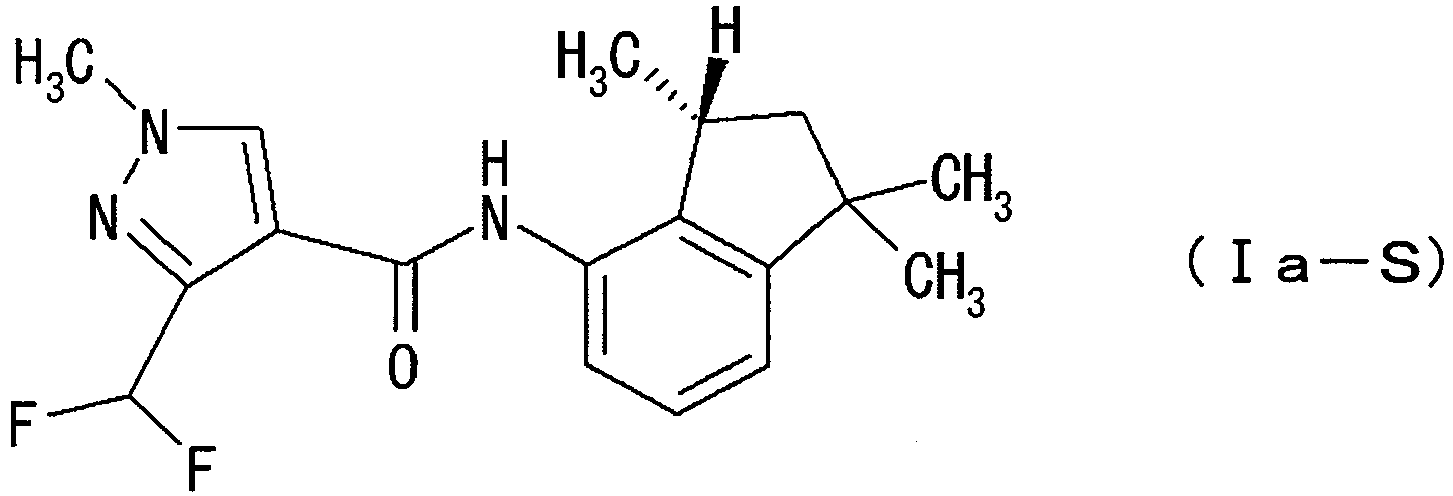
- The carboxamide compound (Ia) is a mixture including these enantiomers in an arbitrary ratio, the carboxamide compound (Ia-R), or the carboxamide compound (Ia-S). In a case where the carboxamide compound (Ia) is a mixture of the carboxamide compound (Ia-R) and the carboxamide compound (Ia-S), the enantiomer ratio of the carboxamide compound (Ia) is preferably 50/50 or greater, and more preferably 80/20 to 99.999/0.001 (carboxamide compound (Ia-R)/carboxamide compound (Ia-S)).
- The compound represented by the formula (II) (hereinafter, referred to as the compound (II)) is described in
WO 2010/129500 , and is known as the generic name of fluazaindolizine. The compound (II) can be produced by a known method. - The compound represented by the formula (III) (hereinafter, referred to as the compound (III)) is described in
WO 2006/114400 , and is known as the generic name of tioxazafen. The compound (III) can be produced by a known method. - The weight ratio of the carboxamide compound to the compound A in the composition of the present invention is usually 0.01/1 to 500/1, and preferably 0.01/1 to 100/1 or 0.05/1 to 100/1 of carboxamide compound / compound A.
- The composition of the present invention may be a mixture itself of the carboxamide compound and the compound A, and in general, the composition of the present invention is formulated into oil, an emulsifiable concentrate, a flowable agent, a wettable powder, a granulated wettable powder, a powder agent, and granule by mixing the carboxamide compound, the compound A, and an inert carrier, and adding a surfactant or other adjuvants for formulation as necessary. The formulation can be used as a formulation for controlling pests, alone or by adding other inert ingredients.
- In the composition of the present invention, the carboxamide compound and the compound A are usually contained by 0.1% to 99% by weight, preferably 0.2% to 90% by weight, and more preferably 1% to 80% by weight in total.
- As the inert carrier used for formulation, a solid carrier and a liquid carrier can be exemplified, and examples of the solid carrier include fine powdery or granular materials formed of minerals such as kaolin clay, attapulgite clay, bentonite, montmorillonite, acid clay, pyrophyllite, talc, diatomaceous earth, and calcite, natural organic substances such as corncob powder and walnut powder, synthetic organic substances such as urea, salts such as calcium carbonate and ammonium sulfate, or synthetic inorganic substances such as synthetic hydrated silicon oxide, and examples of the liquid carrier include aromatic hydrocarbons such as xylene, alkylbenzene, and methylnaphthalene, alcohols such as 2-propanol, ethylene glycol, propylene glycol, and ethylene glycol monoethyl ether, ketones such as acetone, cyclohexanone, and isophorone, plant oil such as soybean oil and cotton seed oil, petroleum-based aliphatic hydrocarbons, esters, dimethylsulfoxide, acetonitrile, and water.
- Examples of the surfactants include anionic surfactants such as an alkyl sulfuric acid ester salt, an alkyl aryl sulfonic acid salt, a dialkyl sulfosuccinic acid salt, a polyoxyethylene alkyl aryl ether phosphoric acid ester salt, a lignin sulfonic acid salt, and a naphthalene sulfonate formaldehyde polycondensate, nonionic surfactants such as a polyoxyethylene alkyl aryl ether, a polyoxyethylene alkyl polyoxypropylene block copolymer, and a sorbitan fatty acid ester, and cationic surfactants such as an alkyl trimethyl ammonium salt.
- Examples of other adjuvants for formulation include water-soluble polymers such as polyvinyl alcohol and polyvinyl pyrrolidone, gum Arabic, alginic acid and a salt thereof, polysaccharides such as CMC (carboxymethylcellulose) and xanthan gum, inorganic substances such as aluminum magnesium silicate and alumina sol, preservatives, colorants, and stabilizing agents such as PAP (isopropyl acid phosphate) and BHT.
- The composition of the present invention can be prepared by mixing each formulation obtained by formulating each of the carboxamide compound and the compound A by the above-described method or can also be prepared by mixing each mixed solution obtained by mixing each of these formulations with water.
- The composition of the present invention may be used to protect plants from harm caused by pests. In the present specification, harmful insects and plant diseases which cause harm such as eating, sucking, etc. to plants are collectively called pests.
- Examples of the harmful insects on which the composition of the present invention has controlling efficacy include the following.
- Hemiptera pests: planthoppers such as small brown planthoppers (Laodelphax striatellus), brown planthoppers (Nilaparvata lugens), and white-backed planthoppers (Sogatella furcifera); leafhoppers such as green rice leafhoppers (Nephotettix cincticeps) and Taiwan green rice leafhoppers (Nephotettix virescens); aphids such as cotton aphids (Aphis gossypii), green peach aphids (Myzus persicae), cabbage aphids (Brevicoryne brassicae), potato aphids (Macrosiphum euphorbiae), greenhouse potato aphids (Aulacorthum solani), bird-cherry oat aphids (Rhopalosiphum padi), and black citrus aphids (Toxoptera citricidus); stink bugs such as eastern green stink bugs (Nezara antennata), bean bugs (Riptortus clavetus), male rice bugs (Leptocorisa chinensis), white-spotted spined bugs (Eysarcoris parvus), brown marmorated stink bugs (Halyomorpha mista), and turnished plant bugs (Lygus lineolaris); whiteflies such as greenhouse whiteflies (Trialeurodes vaporariorum) and silverleaf whiteflies (Bemisia argentifolii); scale insects such as red scales (Aonidiella aurantii), San Jose scales (Comstockaspis perniciosa), citrus snow scales (Unaspis citri), red wax scales (Ceroplastes rubens), and cottony cushion scales (Icerya purchasi); lace bugs; and psyllids;
Lepidoptera pests: pyralids such as asiatic rice borers (Chilo suppressalis), yellow stem borers (Tryporyza incertulas), rice leafrollers (Cnaphalocrocis medinalis), cotton leaf rollers (Notarcha derogata), Indian meal moths (Plodia interpunctella), Asian corn borers (Ostrinia furnacalis), cabbage webworms (Hellula undalis), and bluegrass webworms (Pediasia teterrellus) ; noctuids such as oriental leafworm moths (Spodoptera litura), beet armyworms (Spodoptera exigua), oriental armyworms (Pseudaletia separata), cabbage moths (Mamestra brassicae), black cutworms (Agrotis ipsilon), asiatic common loopers (Plusia nigrisigna), Trichoplusia spp., Heliothis spp., and Helicoverpa spp.; pieridae such as small white butterflies (Pieris rapae); leaf roller moths such as Adoxophyes spp., oriental fruit moths (Grapholita molesta), soybean pod borers (Leguminivora glycinivorella), adzuki bean podworms (Matsumuraeses azukivora), summer fruit tortrix moths (Adoxophyes orana fasciata), smaller tea tortrixes (Adoxophyes sp.), oriental tea tortrix moths (Homona magnanima), apple tortrixes (Archips fuscocupreanus), and codling moths (Cydia pomonella); meaf miners such as tea leaf rollers (Caloptilia theivora), and apple leaf miner (Phyllonorycter ringoneella) ; codling moths such as peach fruit moths (Carposina niponensis); leafminer moths such as Rionetia spp.; tussock moths such as Lymantria spp. and Euproctis spp.; ermine moths such as diamondback moths (Plutella xylostella); pink bollworms (Pectinophora gossypiella) and potato tuber moths (Phthorimaea operculella); tiger moths such as fall webworms (Hyphantria cunea); and tineids such as clothes moths (Tinea translucens) and common clothes moths (Tineola bisselliella);
Thysanoptera pests: trips such as western flower thrips (Frankliniella occidentalis), southern yellow thrips (Thrips parmi), yellow tea thrips (Scirtothrips dorsalis), onion thrips (Thrips tabaci), flower thrips (Frankliniella intonsa), and tobacco thrips (Frankliniella fusca);
Diptera pests: houseflies (Musca domestica), house mosquito (Culex pipiens pallens), gadflies (Tabanus trigonus), onion flies (Hylemya antiqua), bean seed flies (Hylemya platura), hyrcanus group mosquitoes (Anopheles sinensis), Japanese rice leafminers (Agromyza oryzae), rice leafminers (Hydrellia griseola), rice stem maggots (Chlorops oryzae), melon flies (Dacus cucurbitae), Mediterranean fruit flies (Ceratitis capitata), and American serpentine leafminers (Liriomyza trifolii);
Coleoptera pests: 28-spotted ladybirds (Epilachna vigintioctopunctata), cucurbit leaf beetles (Aulacophora femoralis), striped flea beetles (Phyllotreta striolata), rice leaf beetles (Oulema oryzae), rice plant weevils (Echinocnemus squameus), rice water weevils (Lissorhoptrus oryzophilus), boll weevils (Anthonomus grandis), adzuki bean weevils (Callosobruchus chinensis), hunting billbugs (Sphenophorus venatus), Japanese beetles (Popillia japonica), scarab beetles (Anomala cuprea), a group of western corn rootworms (Diabrotica spp.), Colorado potato beetles (Leptinotarsa decemlineata), a group of click beetles (Agriotes spp.), cigarette beetles (Lasioderma serricorne), varied carpet beetles (Anthrenus verbasci), red flour beetles (Tribolium castaneum), powderpost beetles (Lyctus brunneus), sitrus long-horned beetles (Anoplophora malasiaca), and common pine shoot beetles (Tomicus piniperda);
Orthopteran pests: migratory locusts (Locusta migratoria), mole crickets (Gryllotalpa africana), rice grasshoppers (Oxya yezoensis), and rice grasshoppers (Oxya japonica);
Hymenoptera pests: turnip sawflies (Athalia rosae), leafcutter ants (Acromyrmex spp.), and fire ants (Solenopsis spp.); and
Blattodea Pests: German cockroaches (Blattella germanica), smoky brown cockroaches (Periplaneta fuliginosa), American cockroaches (Periplaneta americana), brown cockroaches (Periplaneta brunnea), and oriental cockroaches (Blatta orientalis). - Examples of the plant diseases on which the composition of the present invention has controlling efficacy include the following.
Rice diseases: blast (Magnaporthe grisea), brown spot (Cochliobolus miyabeanus), sheath blight (Rhizoctonia solani), and bakanae (Gibberella fujikuroi).
Wheat diseases: powdery mildew (Erysiphe graminis), fusarium head blight (Fusarium graminearum, F. avenacerum, F. culmorum, Microdochium nivale), rust (Puccinia striiformis, P. graminis, P. recondita), pink snow rot (Micronectriella nivale), Typhula snow blight (Typhula sp.), loose smut (Ustilago tritici), smut (Tilletia caries), Eyespot (Pseudocercosporella herpotrichoides), leaf blight (Mycosphaerella graminicola), septoria leaf spot (Stagonospora nodorum), and tan spot (Pyrenophora tritici-repentis).
Barley diseases: powdery mildew (Erysiphe graminis), Fusarium head blight (Fusarium graminearum, F. avenacerum, F. culmorum, Microdochium nivale), rust (Puccinia striiformis, P. graminis, P. hordei), loose smut (Ustilago nuda), leaf blotch (Rhynchosporium secalis), net blotch (Pyrenophora teres), leaf spot (Cochliobolus sativus), leaf stripe (Pyrenophora graminea), and Rhizoctonia damping-off (Rhizoctonia solani).
Corn diseases: smut (Ustilago maydis), brown leaf spot (Cochliobolus heterostrophus), copper spot (Gloeocercospora sorghi), southern rust (Puccinia polysora), gray leaf spot (Cercospora zeae-maydis), and Rhizoctonia damping-off (Rhizoctonia solani).
Citrus diseases: melanose (Diaporthe citri), scab (Elsinoe fawcetti), green mold (Penicillium digitatum, P. italicum), and brown rot (Phytophthora parasitica, Phytophthora citrophthora).
Apple diseases: blossom blight (Monilinia mali), canker (Valsa ceratosperma), powdery mildew (Podosphaera leucotricha), Alternaria leaf spot (Alternaria alternata apple pathotype), scab (Venturia inaequalis), bitter rot (Colletotrichum acutatum), and crawn rot (Phytophtora cactorum).
Pear diseases: scab (Venturia nashicola, V. pirina), black spot (Alternaria alternata Japanese pear pathotype), rust (Gymnosporangium haraeanum), and phytophthora fruit rot (Phytophtora cactorum);
Peach diseases: brown rot (Monilinia fructicola), scab (Cladosporium carpophilum), and Phomopsis rot (Phomopsis sp.).
Grapes diseases: anthracnose (Elsinoe ampelina), ripe rot (Glomerella cingulata), powdery mildew (Uncinula necator), rust (Phakopsora ampelopsidis), black rot (Guignardia bidwellii), and downy mildew (Plasmopara viticola).
Japanese persimmon diseases: anthracnose (Gloeosporium kaki) and leaf spot (Cercospora kaki, Mycosphaerella nawae).
Gourd family diseases: anthracnose (Colletotrichum lagenarium), powdery mildew (Sphaerotheca fuliginea), gummy stem blight (Mycosphaerella melonis), Fusarium wilt (Fusarium oxysporum), downy mildew (Pseudoperonospora cubensis), Phytophthora rot (Phytophthora sp.), and damping-off (Pythium sp.);
Tomato diseases: early blight (Alternaria solani), leaf mold (Cladosporium fulvum), and late blight (Phytophthora infestans).
Egg plant diseases: brown spot (Phomopsis vexans) and powdery mildew (Erysiphe cichoracearum).
Cruciferous vegetable diseases: Alternaria leaf spot (Alternaria japonica), white spot (Cercosporella brassicae), clubroot (Plasmodiophora brassicae), and downy mildew (Peronospora parasitica).
Welsh onion diseases: rust (Puccinia allii) and downy mildew (Peronospora destructor).
Soybean diseases: purple seed stain (Cercospora kikuchii), sphaceloma scad (Elsinoe glycines), pod and stem blight (Diaporthe phaseolorum var. sojae), septoria brown spot (Septoria glycines), frogeye leaf spot (Cercospora sojina), rust (Phakopsora pachyrhizi), brown stem rot (Phytophthora sojae), Rhizoctonia damping-off (Rhizoctonia solani), brown ring spot (Corynespora casiicola), and sclerotinia rot (Sclerotinia sclerotiorum).
Kidney bean disease: anthracnose (Colletotrichum lindemthianum).
Peanut diseases: leaf spot (Cercospora personata), brown leaf spot (Cercospora arachidicola), and southern blight (Sclerotium rolfsii).
Garden pea diseases: powdery mildew (Erysiphe pisi).
Potato diseases: early blight (Alternaria solani), late blight (Phytophthora infestans), pink rot (Phytophthora erythroseptica), and powdery scab (Spongospora subterranean f. sp. subterranea).
Strawberry diseases: powdery mildew (Sphaerotheca humuli) and anthracnose (Glomerella cingulata).
Tea diseases: net blister blight (Exobasidium reticulatum), white scab (Elsinoe leucospila), gray blight (Pestalotiopsis sp.), and anthracnose (Colletotrichum theae-sinensis).
Tobacco diseases: brown spot (Alternaria longipes), powdery mildew (Erysiphe cichoracearum), anthracnose (Colletotrichum tabacum), downy mildew (Peronospora tabacina), and black shank (Phytophthora nicotianae).
Rapeseed diseases: sclerotinia rot (Sclerotinia sclerotiorum) and Rhizoctonia damping-off (Rhizoctonia solani).
Cotton diseases: Rhizoctonia damping-off (Rhizoctonia solani).
Sugar beet diseases: Cercospora leaf spot (Cercospora beticola), leaf rot (Thanatephorus cucumeris), root rot (Thanatephorus cucumeris), and Aphanomyces root rot (Aphanomyces cochlioides ) .
Rose diseases: black spot (Diplocarpon rosae), powdery mildew (Sphaerotheca pannosa), and downy mildew (Peronospora sparsa).
Diseases of chrysanthemum and asteraceous vegetables: downy mildew (Bremia lactucae), leaf blight (Septoria chrysanthemi-indici), and white rust (Puccinia horiana).
Diseases of various groups: diseases caused by Pythium spp. (Pythium aphanidermatum, Pythium debarianum, Pythium graminicola, Pythium irregulare, Pythium ultimum), gray mold (Botrytis cinerea), and Sclerotinia rot (Sclerotinia sclerotiorum).
Radish disease: Alternaria leaf spot (Alternaria brassicicola) .
Turfgrass diseases: dollar spot (Sclerotinia homeocarpa), and brown patch and large patch (Rhizoctonia solani) .
Banana disease: sigatoka (Mycosphaerella fijiensis, Mycosphaerella musicola).
Sunflower disease: downy mildew (Plasmopara halstedii). - Seed diseases or diseases in the early stages of the growth of various plants caused by Aspergillus spp., Penicillium spp., Fusarium spp., Gibberella spp., Tricoderma spp., Thielaviopsis spp., Rhizopus spp., gMucor spp., Corticium spp., Phoma spp., Rhizoctonia spp., and Diplodia spp.
- Viral diseases of various plants mediated by Polymixa spp. or Olpidium spp.
- The composition of the present invention can be used for the following plants.
Crops: corn, rice, wheat, barley, rye, oat, sorghum, cotton, soybean, peanut, buckwheat, sugar beet, rapeseed, sunflower, sugar cane, tobacco, etc.,
Vegetables: solanaceous vegetables (eggplant, tomato, bell pepper, pepper, potato, etc.), cucurbitaceous vegetables (cucumber, pumpkin, zucchini, watermelon, melon, squash, etc.), cruciferous vegetables (Japanese radish, turnip, horseradish, kohlrabi, Chinese cabbage, cabbage, leaf mustard, broccoli, cauliflower, etc.), asteraceous vegetables (burdock, crown daisy, artichoke, lettuce, etc.) liliaceous vegetables (green onion, onion, garlic, and asparagus), Umbelliferous vegetables (carrot, parsley, celery, parsnip, etc.), chenopodiaceous vegetables (spinach, Swiss chard, etc.), lamiaceous vegetables (Perilla frutescens, mint, basil, etc.), strawberry, sweet potato, Dioscorea japonica, colocasia, etc.,
Flowers,
Foliage plants,
Turf grasses,
Fruits: pome fruits (apple, pear, Japanese pear, Chinese quince, quince, etc.), stone fruits (peach, plum, nectarine, Japanese apricot (Prunus mume), cherry fruit, apricot, prune, etc.), citrus fruits (Citrus unshiu, orange, lemon, rime, grapefruit, etc.), nuts (chestnuts, walnuts, hazelnuts, almond, pistachio, cashew nuts, macadamia nuts, etc.), berries (blueberry, cranberry, blackberry, raspberry, etc.), grape, kaki fruit, olive, Japanese plum, banana, coffee, date palm, coconuts, etc., and
Trees other than fruit trees; tea, mulberry, flowering plant, roadside trees (ash, birch, dogwood, Eucalyptus, ginkgo (Ginkgo biloba), lilac, maple, oak (Quercus), poplar, Cercis chinensis, Formosan gum (Liquidambar formosana), plane tree, zelkova, Japanese arborvitae, fir wood, hemlock, juniper, Pinus, Picea, and yew (Taxus cuspidate), etc. - The plants described above may be plants to which resistance is applied by gene recombination techniques.
- Among the above, in particular, high controlling effect on plant diseases occurring in soybeans is expected.
- In addition, as plant diseases occurring in soybeans, against which particularly high efficacy is expected, Rhizoctonia damping-off (Rhizoctonia solani), purple seed stain (Cercospora kikuchii), septoria brown spot (Septoria glycines), brown ring spot (Corynespora casiicola), rust (Phakopsora pachyrizi), sclerotinia rot (Sclerotinia sclerotiorum), and frogeye leaf spot (Cercospora sojina) are exemplified.
- Examples of an aspect of the composition of the present invention include the following.
A composition comprising the carboxamide compound (Ia-R) and the compound (II);
A composition comprising the carboxamide compound (Ia-R) and the compound (III);
A composition comprising the carboxamide compound (Ib) and the compound (II);
A composition comprising the carboxamide compound (Ib) and the compound (III); - A composition comprising the carboxamide compound (Ia-R) and the compound (II) in which the weight ratio of carboxamide compound (Ia-R) to compound (II) is 0.01/1 to 100/1;
A composition comprising the carboxamide compound (Ia-R) and the compound (III) in which the weight ratio of carboxamide compound (Ia-R) to compound (III) is 0.01/1 to 100/1;
A composition comprising the carboxamide compound (Ib) and the compound (II) in which the weight ratio of carboxamide compound (Ib) to compound (II) is 0.05/1 to 100/1; and
A composition comprising the carboxamide compound (Ib) and the compound (III) in which the weight ratio of carboxamide compound (Ib) to compound (III) is 0.05/1 to 100/1. - The method for controlling pests of the present invention (hereinafter, described as the control method of the present invention) includes a step of applying an effective amount of the carboxamide compound and the compound A to a plant or soil for cultivating a plant. In plants to be applied, foliage of a plant, seeds of a plant, and bulbs of a plant are included. Here, the bulbs mean discoid stems, corms, rhizomes, tubers, tuberous roots, and rhizophores.
- In the control method of the present invention, the carboxamide compound and the compound A can be separately applied to a plant or soil for cultivating a plant in the same period, but the composition of the present invention is usually applied in an effective amount from the viewpoint of simplicity of application.
- In the control method of the present invention, examples of the method of applying the carboxamide compound and the compound A include a foliar treatment, a soil treatment, a root treatment, and a seed treatment.
- Examples of the foliar treatment include a method of applying the carboxamide compound and the compound A to the surface of a plant which is being cultivated, by spraying to foliage or a trunk.
- Examples of the root treatment include a method of immersing a whole plant or a root part of a plant into a solution comprising the carboxamide compound and the compound A and a method of attaching a solid formulation comprising the carboxamide compound, the compound A, and a solid carrier to roots of a plant.
- Examples of the soil treatment include spraying onto the soil, admixing with the soil, and irrigating a solution into the soil.
- Examples of the seed treatment include a treatment of seeds or bulbs of a plant to be protected from harm caused by pests with the composition of the present invention, and specifically, examples thereof include a spraying treatment in which a suspension of the composition of the present invention is sprayed onto a seed surface or a bulb surface in the form of mist, a smearing treatment in which the composition of the present invention in the form of wettable powder, emulsifiable concentrate, or a flowable agent, and as necessary, added with water is applied to seeds or bulbs, an immersing treatment in which seeds are immersed in a mixed solution of the composition of the present invention and water for a certain period of time, a film coating treatment, a pellet coating treatment, etc.
- In the control method of the present invention, the total amount of the carboxamide compound and the compound A applied can be changed depending on the kind of plant to be applied, the kind and the frequency of occurrence of pests to be controlled, a formulation form, an application period, an application method, an application place, a climatic condition, etc., and in a case where the carboxamide compound and the compound A are applied to foliage of a plant or soil for cultivating a plant, the total amount applied is usually 1 to 500 g, preferably 2 to 200 g, and more preferably 10 to 100 g per 1000 m2. In the case of a seed treatment, the total amount of the carboxamide compound and the compound A applied is usually 0.001 to 10 g, and preferably 0.01 to 1 g per 1 kg of seeds. The seed treatment is performed on unseeded seeds. The unseeded seeds mean seeds at an arbitrary point in time until seeded.
- In a case where the formulation form is emulsion, wettable powder, or a flowable agent, the formulation is typically applied by spraying a liquid chemical obtained by mixing the formulation with water. The concentration of the carboxamide compound and the compound A in the liquid chemical is usually 0.0005% to 2% by weight, and preferably 0.005% to 1% by weight in terms of the total concentration of these compounds. In a case where the formulation form is a powder agent or granule, the formulation is usually applied as it is without being diluted.
- Hereinafter, formulation examples and test examples of the present invention will be described in more detail, and the present invention is not limited to the following examples. In the following examples, "part(s)" represents "part(s) by weight" unless otherwise specified.
- 2 parts of any one of the carboxamide compound (Ia) and the carboxamide compound (Ib), 8 parts of the compound (II), 35 parts of a mixture (weight ratio of 1:1) of white carbon and a polyoxyethylene alkyl ether sulfate ammonium salt, and 55 parts of water were mixed, and the mixture was milled by a wet milling method, whereby each flowable formulation was obtained.
- 5 parts of any one of the carboxamide compound (Ia) and the carboxamide compound (Ib), 10 parts of the compound (II), 1.5 parts of sorbitan trioleate, and 28.5 parts of a polyvinyl alcohol aqueous solution obtained by mixing 2 parts of polyvinyl alcohol and 26.5 parts of water were mixed, and the mixture was milled by a wet milling method, whereby suspension was obtained. 45 parts of a mixed solution obtained by mixing 0.05 parts of xanthan gum, 0.1 parts of aluminum magnesium silicate, and 44.85 parts of water was added to the suspension, then, 10 parts of propylene glycol was further added thereto, and the resulting product was mixed by stirring, whereby each flowable formulation was obtained.
- 1 part of any one of the carboxamide compound (Ia) and the carboxamide compound (Ib), 4 parts of the compound (II), 1 part of synthetic hydrated silicon oxide, 2 parts of calcium lignin sulfonate, 30 parts of bentonite, and 62 parts of kaolin clay were fully milled and mixed, water was added thereto, the resulting product was fully kneaded, and granulation drying was performed, whereby each granule was obtained.
- 12.5 parts of any one of the carboxamide compound (Ia) and the carboxamide compound (Ib), 37.5 parts of the compound (II), 3 parts of calcium lignin sulfonate, 2 parts of sodium lauryl sulfate, and 45 parts of synthetic hydrated silicon oxide were fully ground and mixed, whereby each wettable powder was obtained.
- 3 parts of any one of the carboxamide compound (Ia) and the carboxamide compound (Ib), 2 parts of the compound (II), 85 parts of kaolin clay, and 10 parts of talc were fully ground and mixed, whereby each powder agent was obtained.
- The same operation as in Formulation Example 1 was performed except that the compound (III) was used instead of the compound (II), whereby each flowable formulation was obtained.
- The same operation as in Formulation Example 2 was performed except that the compound (III) was used instead of the compound (II), whereby each flowable formulation was obtained.
- The same operation as in Formulation Example 3 was performed except that the compound (III) was used instead of the compound (II), whereby each granule was obtained.
- The same operation as in Formulation Example 4 was performed except that the compound (III) was used instead of the compound (II), whereby each wettable powder was obtained.
- The same operation as in Formulation Example 5 was performed except that the compound (III) was used instead of the compound (II), whereby each powder agent was obtained.
- Hereinafter, test examples are shown.
- A cyclohexanone solution of the compound was prepared such that the treatment amount of the compound when seeds were treated therewith became the value described in Tables 1 and 2. 10 g of seeds of soybean (Hatayutaka) and 100 µl of the cyclohexanone solution were put into a plastic container, then, the plastic container was covered with a lid and shaken, and the seeds taken out from the container were left overnight, whereby treated seeds were obtained.
- One day after the above-described treatment, soil contaminated with Rhizoctonia solani was packed in a plastic pot, and the treated seeds were seeded and cultivated for 12 days in a glass greenhouse (this was used as a treated area). Thereafter, the presence or absence of incidence of Rhizoctonia damping-off (Rhizoctonia solani) in seedlings budded from seeds was observed, and the incidence of disease was calculated by the following equation (1).
- On the other hand, soybean seeds on which the seed treatment had not been performed were cultivated in the same manner as in the treated area (this was used as a non-treated area). Then, the incidence of disease was calculated in the same manner as in the treated area.
- From each of the incidences of disease of the treated area and the non-treated area, the efficacy of the treated area was calculated by the following equation (2). The results thereof are shown in Tables 1 and 2. The enantiomer ratio of the carboxamide compound (Ia) in Tables 1 and 2 is 97/3 of carboxamide compound (Ia-R) / carboxamide compound (Ia-S).


[Table 1] Carboxamide compound (Ia) (g/100 kg seed) Compound (II) (g/100 kg seed) Efficacy Weight ratio (carboxamide compound (Ia) /compound (II)) 0.2 20 76 0.01/1 0.2 0.2 71 1/1 0.2 0.002 63 100/1 [Table 2] Carboxamide compound (Ia) (g/100 kg seed) Compound (III) (g/100 kg seed) Efficacy Weight ratio (carboxamide compound (Ia) /compound (III)) 0.2 20 74 0.01/1 0.2 0.2 66 1/1 0.2 0.002 68 100/1 - A cyclohexanone solution of the compound was prepared such that the treatment amount of the compound when seeds were treated therewith became the value described in Tables 3 and 4. 10 g of seeds of soybean (Hatayutaka) and 100 µl of the cyclohexanone solution were put into a plastic container, then, the plastic container was covered with a lid and shaken, and the seeds taken out from the container were left overnight, whereby treated seeds were obtained.
- One day after the above-described treatment, soil contaminated with Rhizoctonia solani was packed in a plastic pot, and the treated seeds were seeded and cultivated for 8 days in a glass greenhouse (this was used as a treated area). Thereafter, the presence or absence of incidence of Rhizoctonia damping-off (Rhizoctonia solani) in seedlings budded from seeds was observed, and the incidence of disease was calculated by the above-described equation (1).
- On the other hand, soybean seeds on which the seed treatment had not been performed were cultivated in the same manner as in the treated area (this was used as a non-treated area). Then, the incidence of disease was calculated in the same manner as in the treated area.
- From each of the incidences of disease of the treated area and the non-treated area, the efficacy of the treated area was calculated by the above-described equation (2). The results thereof are shown in Tables 3 and 4.
[Table 3] Carboxamide compound (Ib) (g/100 kg seed) Compound (II) (g/100 kg seed) Efficacy Weight ratio (carboxamide compound (Ib) /compound (II)) 1.0 20 63 0.05/1 1.0 1 61 1/1 1.0 0.01 61 100/1 [Table 4] Carboxamide compound (Ib) (g/100 kg seed) Compound (III) (g/100 kg seed) Efficacy Weight ratio (carboxamide compound (Ib) /compound (III)) 1.0 20 61 0.05/1 1.0 1 58 1/1 1.0 0.01 61 100/1
Claims (9)
- A composition for controlling pests comprising a carboxamide compound represented by the following formula (I):

Group (A): a group consisting of a compound represented by the following formula (II):

- The composition for controlling pests according to Claim 1, wherein the weight ratio of the carboxamide compound represented by the formula (I) to one or more compounds selected from the group (A) is 0.01/1 to 100/1 of carboxamide compound / one or more compounds selected from the group (A).
- The composition for controlling pests according to Claim 1 or 2, wherein one or more compounds selected from the group (A) is the compound represented by the formula (II).
- The composition for controlling pests according to Claim 1 or 2, wherein one or more compounds selected from the group (A) is the compound represented by the formula (III) .
- A method for controlling pests, comprising a step of applying an effective amount of a carboxamide compound represented by the following formula (I):

Group (A): a group consisting of a compound represented by the following formula (II):

- The method for controlling pests according to Claim 5, wherein the weight ratio of the carboxamide compound represented by the formula (I) to one or more compounds selected from the group (A) is 0.01/1 to 100/1 of carboxamide compound / one or more compounds selected from the group (A).
- The method for controlling pests according to Claim 5 or 6, wherein one or more compounds selected from the group (A) is the compound represented by the formula (II).
- The method for controlling pests according to Claim 5 or 6, wherein one or more compounds selected from the group (A) is the compound represented by the formula (III).
- The method for controlling pests according to any one of Claims 5 to 8, wherein a plant or soil for cultivating a plant is soybean or soil for cultivating soybean.
Applications Claiming Priority (2)
| Application Number | Priority Date | Filing Date | Title |
|---|---|---|---|
| JP2016016909 | 2016-02-01 | ||
| PCT/JP2017/002672 WO2017135137A1 (en) | 2016-02-01 | 2017-01-26 | Pest control composition and pest control method |
Publications (3)
| Publication Number | Publication Date |
|---|---|
| EP3412151A1 true EP3412151A1 (en) | 2018-12-12 |
| EP3412151A4 EP3412151A4 (en) | 2019-10-09 |
| EP3412151B1 EP3412151B1 (en) | 2024-01-17 |
Family
ID=59500680
Family Applications (1)
| Application Number | Title | Priority Date | Filing Date |
|---|---|---|---|
| EP17747295.8A Active EP3412151B1 (en) | 2016-02-01 | 2017-01-26 | Pest control composition and pest control method |
Country Status (20)
| Country | Link |
|---|---|
| US (1) | US11324221B2 (en) |
| EP (1) | EP3412151B1 (en) |
| JP (1) | JP6810062B2 (en) |
| KR (1) | KR102651310B1 (en) |
| CN (1) | CN108495556B (en) |
| AR (1) | AR107482A1 (en) |
| AU (1) | AU2017213900B2 (en) |
| BR (1) | BR112018015079B1 (en) |
| CA (1) | CA3012593C (en) |
| CL (1) | CL2018001985A1 (en) |
| CO (1) | CO2018007668A2 (en) |
| ES (1) | ES2971120T3 (en) |
| MX (1) | MX2018009034A (en) |
| NZ (1) | NZ744630A (en) |
| PH (1) | PH12018501620A1 (en) |
| PL (1) | PL3412151T3 (en) |
| RU (1) | RU2725816C2 (en) |
| UA (1) | UA124384C2 (en) |
| WO (1) | WO2017135137A1 (en) |
| ZA (1) | ZA201805113B (en) |
Cited By (1)
| Publication number | Priority date | Publication date | Assignee | Title |
|---|---|---|---|---|
| EP3818829A3 (en) * | 2019-10-16 | 2021-07-21 | Monsanto Technology LLC | Granular nematicide compositions |
Families Citing this family (2)
| Publication number | Priority date | Publication date | Assignee | Title |
|---|---|---|---|---|
| CN114213403B (en) * | 2021-12-17 | 2022-10-25 | 贵州大学 | 1,2,4-oxadiazole-5-carboxamide derivatives and preparation method and application thereof |
| CN116171786B (en) * | 2023-02-03 | 2024-05-07 | 云南省热带作物科学研究所 | A method for preventing and treating macadamia longan skin phenomenon |
Family Cites Families (16)
| Publication number | Priority date | Publication date | Assignee | Title |
|---|---|---|---|---|
| BR8506974A (en) | 1984-10-29 | 1986-12-23 | Sumitomo Chemical Co | PIRAZOLCARBOXAMIDE DERIVATIVE, PROCESS FOR ITS PREPARATION AND FUNGICIDE CONTAINING THE SAME AS AN ACTIVE SUBSTANCE |
| US5093347A (en) | 1991-01-28 | 1992-03-03 | Monsanto Company | 3-difluoromethylpyrazolecarboxamide fungicides, compositions and use |
| CA2606087A1 (en) | 2005-04-26 | 2006-11-02 | Neurosearch A/S | Novel oxadiazole derivatives and their medical use |
| ES2655466T3 (en) | 2007-08-13 | 2018-02-20 | Monsanto Technology Llc | Compositions and procedures of nematode control |
| TWI482771B (en) | 2009-05-04 | 2015-05-01 | Du Pont | Nematocidal sulfonamides |
| WO2011135831A1 (en) | 2010-04-28 | 2011-11-03 | Sumitomo Chemical Company, Limited | Pesticidal composition and its use |
| JP2012025735A (en) * | 2010-06-24 | 2012-02-09 | Sumitomo Chemical Co Ltd | Plant disease control composition and method of controlling plant disease |
| IT1403275B1 (en) | 2010-12-20 | 2013-10-17 | Isagro Ricerca Srl | HIGH-ACTIVITY INDANYLANILIDES FUNGICIDE AND THEIR PHYTOSANITARY COMPOSITIONS |
| ITMI20121045A1 (en) | 2012-06-15 | 2013-12-16 | Isagro Ricerca Srl | SYNERGIC COMPOSITIONS FOR THE PROTECTION OF AGRICULTURAL CROPS AND ITS USE |
| UA117819C2 (en) | 2012-11-30 | 2018-10-10 | Байєр Кропсайєнс Акцієнгезелльшафт | Binary pesticidal and fungicidal mixtures |
| JP2016511220A (en) | 2013-02-13 | 2016-04-14 | 住友化学株式会社 | Pest control composition and use thereof |
| CN109430279B (en) | 2013-10-03 | 2021-08-06 | 先正达参股股份有限公司 | fungicidal composition |
| JP2017515794A (en) | 2014-03-26 | 2017-06-15 | ビーエーエスエフ ソシエタス・ヨーロピアBasf Se | Substituted [1,2,4] triazole and imidazole compounds as fungicides |
| WO2015157005A1 (en) | 2014-04-10 | 2015-10-15 | E I Du Pont De Nemours And Company | Substituted tolyl fungicide mixtures |
| JP2014208695A (en) | 2014-07-04 | 2014-11-06 | 住友化学株式会社 | Pest control composition and use thereof |
| JP2015166386A (en) * | 2015-06-05 | 2015-09-24 | 住友化学株式会社 | Pest control method in soybean |
-
2017
- 2017-01-26 WO PCT/JP2017/002672 patent/WO2017135137A1/en not_active Ceased
- 2017-01-26 EP EP17747295.8A patent/EP3412151B1/en active Active
- 2017-01-26 AU AU2017213900A patent/AU2017213900B2/en active Active
- 2017-01-26 CN CN201780008006.5A patent/CN108495556B/en active Active
- 2017-01-26 MX MX2018009034A patent/MX2018009034A/en unknown
- 2017-01-26 US US16/074,094 patent/US11324221B2/en active Active
- 2017-01-26 PL PL17747295.8T patent/PL3412151T3/en unknown
- 2017-01-26 CA CA3012593A patent/CA3012593C/en active Active
- 2017-01-26 BR BR112018015079-7A patent/BR112018015079B1/en active IP Right Grant
- 2017-01-26 KR KR1020187024688A patent/KR102651310B1/en active Active
- 2017-01-26 NZ NZ744630A patent/NZ744630A/en unknown
- 2017-01-26 RU RU2018131256A patent/RU2725816C2/en active
- 2017-01-26 JP JP2017565508A patent/JP6810062B2/en not_active Expired - Fee Related
- 2017-01-26 UA UAA201809004A patent/UA124384C2/en unknown
- 2017-01-26 ES ES17747295T patent/ES2971120T3/en active Active
- 2017-01-30 AR ARP170100233A patent/AR107482A1/en active IP Right Grant
-
2018
- 2018-07-23 CL CL2018001985A patent/CL2018001985A1/en unknown
- 2018-07-24 CO CONC2018/0007668A patent/CO2018007668A2/en unknown
- 2018-07-30 ZA ZA201805113A patent/ZA201805113B/en unknown
- 2018-07-31 PH PH12018501620A patent/PH12018501620A1/en unknown
Cited By (1)
| Publication number | Priority date | Publication date | Assignee | Title |
|---|---|---|---|---|
| EP3818829A3 (en) * | 2019-10-16 | 2021-07-21 | Monsanto Technology LLC | Granular nematicide compositions |
Also Published As
| Publication number | Publication date |
|---|---|
| RU2725816C2 (en) | 2020-07-06 |
| BR112018015079A2 (en) | 2018-12-11 |
| KR102651310B1 (en) | 2024-03-27 |
| JP6810062B2 (en) | 2021-01-06 |
| MX2018009034A (en) | 2018-11-09 |
| US11324221B2 (en) | 2022-05-10 |
| KR20180103164A (en) | 2018-09-18 |
| UA124384C2 (en) | 2021-09-08 |
| EP3412151B1 (en) | 2024-01-17 |
| PL3412151T3 (en) | 2024-05-13 |
| CA3012593A1 (en) | 2017-08-10 |
| WO2017135137A1 (en) | 2017-08-10 |
| JPWO2017135137A1 (en) | 2018-11-29 |
| ZA201805113B (en) | 2019-10-30 |
| PH12018501620A1 (en) | 2019-06-03 |
| EP3412151A4 (en) | 2019-10-09 |
| ES2971120T3 (en) | 2024-06-03 |
| CN108495556B (en) | 2021-05-04 |
| BR112018015079B1 (en) | 2022-06-21 |
| AR107482A1 (en) | 2018-05-02 |
| US20210007357A1 (en) | 2021-01-14 |
| CN108495556A (en) | 2018-09-04 |
| CO2018007668A2 (en) | 2018-07-31 |
| RU2018131256A (en) | 2020-03-04 |
| CA3012593C (en) | 2023-12-19 |
| NZ744630A (en) | 2025-02-28 |
| AU2017213900B2 (en) | 2021-07-22 |
| RU2018131256A3 (en) | 2020-05-21 |
| CL2018001985A1 (en) | 2018-08-24 |
| AU2017213900A1 (en) | 2018-08-16 |
Similar Documents
| Publication | Publication Date | Title |
|---|---|---|
| KR101812362B1 (en) | Pesticidal composition and its use | |
| KR101811897B1 (en) | Pesticidal composition and its use | |
| KR101840487B1 (en) | Pesticidal composition and its use | |
| KR101812361B1 (en) | Pesticidal composition and its use | |
| KR101811898B1 (en) | Pesticidal composition and its use | |
| KR101811896B1 (en) | Pesticidal composition and its use | |
| KR101849792B1 (en) | Pesticidal composition and its use | |
| EP3412151B1 (en) | Pest control composition and pest control method |
Legal Events
| Date | Code | Title | Description |
|---|---|---|---|
| STAA | Information on the status of an ep patent application or granted ep patent |
Free format text: STATUS: THE INTERNATIONAL PUBLICATION HAS BEEN MADE |
|
| PUAI | Public reference made under article 153(3) epc to a published international application that has entered the european phase |
Free format text: ORIGINAL CODE: 0009012 |
|
| STAA | Information on the status of an ep patent application or granted ep patent |
Free format text: STATUS: REQUEST FOR EXAMINATION WAS MADE |
|
| 17P | Request for examination filed |
Effective date: 20180802 |
|
| AK | Designated contracting states |
Kind code of ref document: A1 Designated state(s): AL AT BE BG CH CY CZ DE DK EE ES FI FR GB GR HR HU IE IS IT LI LT LU LV MC MK MT NL NO PL PT RO RS SE SI SK SM TR |
|
| AX | Request for extension of the european patent |
Extension state: BA ME |
|
| DAV | Request for validation of the european patent (deleted) | ||
| DAX | Request for extension of the european patent (deleted) | ||
| RIC1 | Information provided on ipc code assigned before grant |
Ipc: A01P 3/00 20060101ALI20190527BHEP Ipc: A01N 43/836 20060101ALI20190527BHEP Ipc: A01N 43/56 20060101AFI20190527BHEP Ipc: A01N 43/90 20060101ALI20190527BHEP |
|
| A4 | Supplementary search report drawn up and despatched |
Effective date: 20190909 |
|
| RIC1 | Information provided on ipc code assigned before grant |
Ipc: A01P 3/00 20060101ALI20190903BHEP Ipc: A01N 43/56 20060101AFI20190903BHEP Ipc: A01N 43/90 20060101ALI20190903BHEP Ipc: A01N 43/836 20060101ALI20190903BHEP |
|
| STAA | Information on the status of an ep patent application or granted ep patent |
Free format text: STATUS: EXAMINATION IS IN PROGRESS |
|
| 17Q | First examination report despatched |
Effective date: 20200805 |
|
| GRAP | Despatch of communication of intention to grant a patent |
Free format text: ORIGINAL CODE: EPIDOSNIGR1 |
|
| STAA | Information on the status of an ep patent application or granted ep patent |
Free format text: STATUS: GRANT OF PATENT IS INTENDED |
|
| RIC1 | Information provided on ipc code assigned before grant |
Ipc: A01P 7/04 20060101ALI20230717BHEP Ipc: A01P 3/00 20060101ALI20230717BHEP Ipc: A01N 25/30 20060101ALI20230717BHEP Ipc: A01N 25/04 20060101ALI20230717BHEP Ipc: A01N 43/90 20060101ALI20230717BHEP Ipc: A01N 43/82 20060101ALI20230717BHEP Ipc: A01N 43/56 20060101AFI20230717BHEP |
|
| INTG | Intention to grant announced |
Effective date: 20230802 |
|
| GRAS | Grant fee paid |
Free format text: ORIGINAL CODE: EPIDOSNIGR3 |
|
| GRAA | (expected) grant |
Free format text: ORIGINAL CODE: 0009210 |
|
| STAA | Information on the status of an ep patent application or granted ep patent |
Free format text: STATUS: THE PATENT HAS BEEN GRANTED |
|
| P01 | Opt-out of the competence of the unified patent court (upc) registered |
Effective date: 20231204 |
|
| RAP3 | Party data changed (applicant data changed or rights of an application transferred) |
Owner name: SUMITOMO CHEMICAL COMPANY, LIMITED |
|
| AK | Designated contracting states |
Kind code of ref document: B1 Designated state(s): AL AT BE BG CH CY CZ DE DK EE ES FI FR GB GR HR HU IE IS IT LI LT LU LV MC MK MT NL NO PL PT RO RS SE SI SK SM TR |
|
| REG | Reference to a national code |
Ref country code: GB Ref legal event code: FG4D |
|
| REG | Reference to a national code |
Ref country code: DE Ref legal event code: R096 Ref document number: 602017078514 Country of ref document: DE |
|
| REG | Reference to a national code |
Ref country code: CH Ref legal event code: EP |
|
| REG | Reference to a national code |
Ref country code: IE Ref legal event code: FG4D |
|
| REG | Reference to a national code |
Ref country code: NL Ref legal event code: FP |
|
| REG | Reference to a national code |
Ref country code: LT Ref legal event code: MG9D |
|
| REG | Reference to a national code |
Ref country code: ES Ref legal event code: FG2A Ref document number: 2971120 Country of ref document: ES Kind code of ref document: T3 Effective date: 20240603 |
|
| REG | Reference to a national code |
Ref country code: AT Ref legal event code: MK05 Ref document number: 1649924 Country of ref document: AT Kind code of ref document: T Effective date: 20240117 |
|
| PG25 | Lapsed in a contracting state [announced via postgrant information from national office to epo] |
Ref country code: IS Free format text: LAPSE BECAUSE OF FAILURE TO SUBMIT A TRANSLATION OF THE DESCRIPTION OR TO PAY THE FEE WITHIN THE PRESCRIBED TIME-LIMIT Effective date: 20240517 |
|
| PG25 | Lapsed in a contracting state [announced via postgrant information from national office to epo] |
Ref country code: LT Free format text: LAPSE BECAUSE OF FAILURE TO SUBMIT A TRANSLATION OF THE DESCRIPTION OR TO PAY THE FEE WITHIN THE PRESCRIBED TIME-LIMIT Effective date: 20240117 |
|
| PG25 | Lapsed in a contracting state [announced via postgrant information from national office to epo] |
Ref country code: GR Free format text: LAPSE BECAUSE OF FAILURE TO SUBMIT A TRANSLATION OF THE DESCRIPTION OR TO PAY THE FEE WITHIN THE PRESCRIBED TIME-LIMIT Effective date: 20240418 |
|
| PG25 | Lapsed in a contracting state [announced via postgrant information from national office to epo] |
Ref country code: RS Free format text: LAPSE BECAUSE OF FAILURE TO SUBMIT A TRANSLATION OF THE DESCRIPTION OR TO PAY THE FEE WITHIN THE PRESCRIBED TIME-LIMIT Effective date: 20240417 Ref country code: HR Free format text: LAPSE BECAUSE OF FAILURE TO SUBMIT A TRANSLATION OF THE DESCRIPTION OR TO PAY THE FEE WITHIN THE PRESCRIBED TIME-LIMIT Effective date: 20240117 |
|
| PG25 | Lapsed in a contracting state [announced via postgrant information from national office to epo] |
Ref country code: AT Free format text: LAPSE BECAUSE OF FAILURE TO SUBMIT A TRANSLATION OF THE DESCRIPTION OR TO PAY THE FEE WITHIN THE PRESCRIBED TIME-LIMIT Effective date: 20240117 |
|
| PG25 | Lapsed in a contracting state [announced via postgrant information from national office to epo] |
Ref country code: RS Free format text: LAPSE BECAUSE OF FAILURE TO SUBMIT A TRANSLATION OF THE DESCRIPTION OR TO PAY THE FEE WITHIN THE PRESCRIBED TIME-LIMIT Effective date: 20240417 Ref country code: NO Free format text: LAPSE BECAUSE OF FAILURE TO SUBMIT A TRANSLATION OF THE DESCRIPTION OR TO PAY THE FEE WITHIN THE PRESCRIBED TIME-LIMIT Effective date: 20240417 Ref country code: LT Free format text: LAPSE BECAUSE OF FAILURE TO SUBMIT A TRANSLATION OF THE DESCRIPTION OR TO PAY THE FEE WITHIN THE PRESCRIBED TIME-LIMIT Effective date: 20240117 Ref country code: IS Free format text: LAPSE BECAUSE OF FAILURE TO SUBMIT A TRANSLATION OF THE DESCRIPTION OR TO PAY THE FEE WITHIN THE PRESCRIBED TIME-LIMIT Effective date: 20240517 Ref country code: HR Free format text: LAPSE BECAUSE OF FAILURE TO SUBMIT A TRANSLATION OF THE DESCRIPTION OR TO PAY THE FEE WITHIN THE PRESCRIBED TIME-LIMIT Effective date: 20240117 Ref country code: GR Free format text: LAPSE BECAUSE OF FAILURE TO SUBMIT A TRANSLATION OF THE DESCRIPTION OR TO PAY THE FEE WITHIN THE PRESCRIBED TIME-LIMIT Effective date: 20240418 Ref country code: FI Free format text: LAPSE BECAUSE OF FAILURE TO SUBMIT A TRANSLATION OF THE DESCRIPTION OR TO PAY THE FEE WITHIN THE PRESCRIBED TIME-LIMIT Effective date: 20240117 Ref country code: BG Free format text: LAPSE BECAUSE OF FAILURE TO SUBMIT A TRANSLATION OF THE DESCRIPTION OR TO PAY THE FEE WITHIN THE PRESCRIBED TIME-LIMIT Effective date: 20240117 Ref country code: AT Free format text: LAPSE BECAUSE OF FAILURE TO SUBMIT A TRANSLATION OF THE DESCRIPTION OR TO PAY THE FEE WITHIN THE PRESCRIBED TIME-LIMIT Effective date: 20240117 |
|
| PG25 | Lapsed in a contracting state [announced via postgrant information from national office to epo] |
Ref country code: PT Free format text: LAPSE BECAUSE OF FAILURE TO SUBMIT A TRANSLATION OF THE DESCRIPTION OR TO PAY THE FEE WITHIN THE PRESCRIBED TIME-LIMIT Effective date: 20240517 |
|
| PG25 | Lapsed in a contracting state [announced via postgrant information from national office to epo] |
Ref country code: SE Free format text: LAPSE BECAUSE OF FAILURE TO SUBMIT A TRANSLATION OF THE DESCRIPTION OR TO PAY THE FEE WITHIN THE PRESCRIBED TIME-LIMIT Effective date: 20240117 Ref country code: PT Free format text: LAPSE BECAUSE OF FAILURE TO SUBMIT A TRANSLATION OF THE DESCRIPTION OR TO PAY THE FEE WITHIN THE PRESCRIBED TIME-LIMIT Effective date: 20240517 Ref country code: LV Free format text: LAPSE BECAUSE OF FAILURE TO SUBMIT A TRANSLATION OF THE DESCRIPTION OR TO PAY THE FEE WITHIN THE PRESCRIBED TIME-LIMIT Effective date: 20240117 |
|
| REG | Reference to a national code |
Ref country code: CH Ref legal event code: PL |
|
| PG25 | Lapsed in a contracting state [announced via postgrant information from national office to epo] |
Ref country code: LU Free format text: LAPSE BECAUSE OF NON-PAYMENT OF DUE FEES Effective date: 20240126 |
|
| PG25 | Lapsed in a contracting state [announced via postgrant information from national office to epo] |
Ref country code: LU Free format text: LAPSE BECAUSE OF NON-PAYMENT OF DUE FEES Effective date: 20240126 |
|
| PG25 | Lapsed in a contracting state [announced via postgrant information from national office to epo] |
Ref country code: DK Free format text: LAPSE BECAUSE OF FAILURE TO SUBMIT A TRANSLATION OF THE DESCRIPTION OR TO PAY THE FEE WITHIN THE PRESCRIBED TIME-LIMIT Effective date: 20240117 |
|
| PG25 | Lapsed in a contracting state [announced via postgrant information from national office to epo] |
Ref country code: SM Free format text: LAPSE BECAUSE OF FAILURE TO SUBMIT A TRANSLATION OF THE DESCRIPTION OR TO PAY THE FEE WITHIN THE PRESCRIBED TIME-LIMIT Effective date: 20240117 |
|
| PG25 | Lapsed in a contracting state [announced via postgrant information from national office to epo] |
Ref country code: BE Free format text: LAPSE BECAUSE OF NON-PAYMENT OF DUE FEES Effective date: 20240131 |
|
| REG | Reference to a national code |
Ref country code: DE Ref legal event code: R097 Ref document number: 602017078514 Country of ref document: DE |
|
| PG25 | Lapsed in a contracting state [announced via postgrant information from national office to epo] |
Ref country code: CH Free format text: LAPSE BECAUSE OF NON-PAYMENT OF DUE FEES Effective date: 20240131 |
|
| PG25 | Lapsed in a contracting state [announced via postgrant information from national office to epo] |
Ref country code: EE Free format text: LAPSE BECAUSE OF FAILURE TO SUBMIT A TRANSLATION OF THE DESCRIPTION OR TO PAY THE FEE WITHIN THE PRESCRIBED TIME-LIMIT Effective date: 20240117 Ref country code: CZ Free format text: LAPSE BECAUSE OF FAILURE TO SUBMIT A TRANSLATION OF THE DESCRIPTION OR TO PAY THE FEE WITHIN THE PRESCRIBED TIME-LIMIT Effective date: 20240117 |
|
| PG25 | Lapsed in a contracting state [announced via postgrant information from national office to epo] |
Ref country code: SK Free format text: LAPSE BECAUSE OF FAILURE TO SUBMIT A TRANSLATION OF THE DESCRIPTION OR TO PAY THE FEE WITHIN THE PRESCRIBED TIME-LIMIT Effective date: 20240117 |
|
| PG25 | Lapsed in a contracting state [announced via postgrant information from national office to epo] |
Ref country code: SM Free format text: LAPSE BECAUSE OF FAILURE TO SUBMIT A TRANSLATION OF THE DESCRIPTION OR TO PAY THE FEE WITHIN THE PRESCRIBED TIME-LIMIT Effective date: 20240117 Ref country code: SK Free format text: LAPSE BECAUSE OF FAILURE TO SUBMIT A TRANSLATION OF THE DESCRIPTION OR TO PAY THE FEE WITHIN THE PRESCRIBED TIME-LIMIT Effective date: 20240117 Ref country code: RO Free format text: LAPSE BECAUSE OF FAILURE TO SUBMIT A TRANSLATION OF THE DESCRIPTION OR TO PAY THE FEE WITHIN THE PRESCRIBED TIME-LIMIT Effective date: 20240117 Ref country code: EE Free format text: LAPSE BECAUSE OF FAILURE TO SUBMIT A TRANSLATION OF THE DESCRIPTION OR TO PAY THE FEE WITHIN THE PRESCRIBED TIME-LIMIT Effective date: 20240117 Ref country code: DK Free format text: LAPSE BECAUSE OF FAILURE TO SUBMIT A TRANSLATION OF THE DESCRIPTION OR TO PAY THE FEE WITHIN THE PRESCRIBED TIME-LIMIT Effective date: 20240117 Ref country code: CZ Free format text: LAPSE BECAUSE OF FAILURE TO SUBMIT A TRANSLATION OF THE DESCRIPTION OR TO PAY THE FEE WITHIN THE PRESCRIBED TIME-LIMIT Effective date: 20240117 Ref country code: CH Free format text: LAPSE BECAUSE OF NON-PAYMENT OF DUE FEES Effective date: 20240131 Ref country code: BE Free format text: LAPSE BECAUSE OF NON-PAYMENT OF DUE FEES Effective date: 20240131 |
|
| REG | Reference to a national code |
Ref country code: BE Ref legal event code: MM Effective date: 20240131 |
|
| PG25 | Lapsed in a contracting state [announced via postgrant information from national office to epo] |
Ref country code: MC Free format text: LAPSE BECAUSE OF FAILURE TO SUBMIT A TRANSLATION OF THE DESCRIPTION OR TO PAY THE FEE WITHIN THE PRESCRIBED TIME-LIMIT Effective date: 20240117 |
|
| PLBE | No opposition filed within time limit |
Free format text: ORIGINAL CODE: 0009261 |
|
| STAA | Information on the status of an ep patent application or granted ep patent |
Free format text: STATUS: NO OPPOSITION FILED WITHIN TIME LIMIT |
|
| PG25 | Lapsed in a contracting state [announced via postgrant information from national office to epo] |
Ref country code: MC Free format text: LAPSE BECAUSE OF FAILURE TO SUBMIT A TRANSLATION OF THE DESCRIPTION OR TO PAY THE FEE WITHIN THE PRESCRIBED TIME-LIMIT Effective date: 20240117 |
|
| 26N | No opposition filed |
Effective date: 20241018 |
|
| PG25 | Lapsed in a contracting state [announced via postgrant information from national office to epo] |
Ref country code: IE Free format text: LAPSE BECAUSE OF NON-PAYMENT OF DUE FEES Effective date: 20240126 |
|
| PG25 | Lapsed in a contracting state [announced via postgrant information from national office to epo] |
Ref country code: IE Free format text: LAPSE BECAUSE OF NON-PAYMENT OF DUE FEES Effective date: 20240126 |
|
| PG25 | Lapsed in a contracting state [announced via postgrant information from national office to epo] |
Ref country code: SI Free format text: LAPSE BECAUSE OF FAILURE TO SUBMIT A TRANSLATION OF THE DESCRIPTION OR TO PAY THE FEE WITHIN THE PRESCRIBED TIME-LIMIT Effective date: 20240117 |
|
| PG25 | Lapsed in a contracting state [announced via postgrant information from national office to epo] |
Ref country code: CY Free format text: LAPSE BECAUSE OF FAILURE TO SUBMIT A TRANSLATION OF THE DESCRIPTION OR TO PAY THE FEE WITHIN THE PRESCRIBED TIME-LIMIT; INVALID AB INITIO Effective date: 20170126 |
|
| PG25 | Lapsed in a contracting state [announced via postgrant information from national office to epo] |
Ref country code: HU Free format text: LAPSE BECAUSE OF FAILURE TO SUBMIT A TRANSLATION OF THE DESCRIPTION OR TO PAY THE FEE WITHIN THE PRESCRIBED TIME-LIMIT; INVALID AB INITIO Effective date: 20170126 |
|
| PG25 | Lapsed in a contracting state [announced via postgrant information from national office to epo] |
Ref country code: TR Free format text: LAPSE BECAUSE OF FAILURE TO SUBMIT A TRANSLATION OF THE DESCRIPTION OR TO PAY THE FEE WITHIN THE PRESCRIBED TIME-LIMIT Effective date: 20240117 |
|
| PGFP | Annual fee paid to national office [announced via postgrant information from national office to epo] |
Ref country code: GB Payment date: 20251220 Year of fee payment: 10 |
|
| PGFP | Annual fee paid to national office [announced via postgrant information from national office to epo] |
Ref country code: FR Payment date: 20251217 Year of fee payment: 10 Ref country code: NL Payment date: 20251217 Year of fee payment: 10 |
|
| PGFP | Annual fee paid to national office [announced via postgrant information from national office to epo] |
Ref country code: PL Payment date: 20251223 Year of fee payment: 10 |
|
| PGFP | Annual fee paid to national office [announced via postgrant information from national office to epo] |
Ref country code: ES Payment date: 20260202 Year of fee payment: 10 |
|
| PGFP | Annual fee paid to national office [announced via postgrant information from national office to epo] |
Ref country code: DE Payment date: 20251217 Year of fee payment: 10 |
|
| PGFP | Annual fee paid to national office [announced via postgrant information from national office to epo] |
Ref country code: IT Payment date: 20260107 Year of fee payment: 10 |