EP3411157B1 - Fog resistant coatings - Google Patents
Fog resistant coatings Download PDFInfo
- Publication number
- EP3411157B1 EP3411157B1 EP17748228.8A EP17748228A EP3411157B1 EP 3411157 B1 EP3411157 B1 EP 3411157B1 EP 17748228 A EP17748228 A EP 17748228A EP 3411157 B1 EP3411157 B1 EP 3411157B1
- Authority
- EP
- European Patent Office
- Prior art keywords
- reactive
- coating
- hydrophilic
- fog
- acrylates
- Prior art date
- Legal status (The legal status is an assumption and is not a legal conclusion. Google has not performed a legal analysis and makes no representation as to the accuracy of the status listed.)
- Active
Links
Images

Classifications
-
- C—CHEMISTRY; METALLURGY
- C09—DYES; PAINTS; POLISHES; NATURAL RESINS; ADHESIVES; COMPOSITIONS NOT OTHERWISE PROVIDED FOR; APPLICATIONS OF MATERIALS NOT OTHERWISE PROVIDED FOR
- C09D—COATING COMPOSITIONS, e.g. PAINTS, VARNISHES OR LACQUERS; FILLING PASTES; CHEMICAL PAINT OR INK REMOVERS; INKS; CORRECTING FLUIDS; WOODSTAINS; PASTES OR SOLIDS FOR COLOURING OR PRINTING; USE OF MATERIALS THEREFOR
- C09D133/00—Coating compositions based on homopolymers or copolymers of compounds having one or more unsaturated aliphatic radicals, each having only one carbon-to-carbon double bond, and at least one being terminated by only one carboxyl radical, or of salts, anhydrides, esters, amides, imides, or nitriles thereof; Coating compositions based on derivatives of such polymers
- C09D133/04—Homopolymers or copolymers of esters
- C09D133/14—Homopolymers or copolymers of esters of esters containing halogen, nitrogen, sulfur or oxygen atoms in addition to the carboxy oxygen
-
- C—CHEMISTRY; METALLURGY
- C09—DYES; PAINTS; POLISHES; NATURAL RESINS; ADHESIVES; COMPOSITIONS NOT OTHERWISE PROVIDED FOR; APPLICATIONS OF MATERIALS NOT OTHERWISE PROVIDED FOR
- C09D—COATING COMPOSITIONS, e.g. PAINTS, VARNISHES OR LACQUERS; FILLING PASTES; CHEMICAL PAINT OR INK REMOVERS; INKS; CORRECTING FLUIDS; WOODSTAINS; PASTES OR SOLIDS FOR COLOURING OR PRINTING; USE OF MATERIALS THEREFOR
- C09D133/00—Coating compositions based on homopolymers or copolymers of compounds having one or more unsaturated aliphatic radicals, each having only one carbon-to-carbon double bond, and at least one being terminated by only one carboxyl radical, or of salts, anhydrides, esters, amides, imides, or nitriles thereof; Coating compositions based on derivatives of such polymers
- C09D133/04—Homopolymers or copolymers of esters
- C09D133/06—Homopolymers or copolymers of esters of esters containing only carbon, hydrogen and oxygen, the oxygen atom being present only as part of the carboxyl radical
-
- C—CHEMISTRY; METALLURGY
- C09—DYES; PAINTS; POLISHES; NATURAL RESINS; ADHESIVES; COMPOSITIONS NOT OTHERWISE PROVIDED FOR; APPLICATIONS OF MATERIALS NOT OTHERWISE PROVIDED FOR
- C09D—COATING COMPOSITIONS, e.g. PAINTS, VARNISHES OR LACQUERS; FILLING PASTES; CHEMICAL PAINT OR INK REMOVERS; INKS; CORRECTING FLUIDS; WOODSTAINS; PASTES OR SOLIDS FOR COLOURING OR PRINTING; USE OF MATERIALS THEREFOR
- C09D4/00—Coating compositions, e.g. paints, varnishes or lacquers, based on organic non-macromolecular compounds having at least one polymerisable carbon-to-carbon unsaturated bond ; Coating compositions, based on monomers of macromolecular compounds of groups C09D183/00 - C09D183/16
-
- C—CHEMISTRY; METALLURGY
- C09—DYES; PAINTS; POLISHES; NATURAL RESINS; ADHESIVES; COMPOSITIONS NOT OTHERWISE PROVIDED FOR; APPLICATIONS OF MATERIALS NOT OTHERWISE PROVIDED FOR
- C09D—COATING COMPOSITIONS, e.g. PAINTS, VARNISHES OR LACQUERS; FILLING PASTES; CHEMICAL PAINT OR INK REMOVERS; INKS; CORRECTING FLUIDS; WOODSTAINS; PASTES OR SOLIDS FOR COLOURING OR PRINTING; USE OF MATERIALS THEREFOR
- C09D5/00—Coating compositions, e.g. paints, varnishes or lacquers, characterised by their physical nature or the effects produced; Filling pastes
-
- C—CHEMISTRY; METALLURGY
- C09—DYES; PAINTS; POLISHES; NATURAL RESINS; ADHESIVES; COMPOSITIONS NOT OTHERWISE PROVIDED FOR; APPLICATIONS OF MATERIALS NOT OTHERWISE PROVIDED FOR
- C09D—COATING COMPOSITIONS, e.g. PAINTS, VARNISHES OR LACQUERS; FILLING PASTES; CHEMICAL PAINT OR INK REMOVERS; INKS; CORRECTING FLUIDS; WOODSTAINS; PASTES OR SOLIDS FOR COLOURING OR PRINTING; USE OF MATERIALS THEREFOR
- C09D7/00—Features of coating compositions, not provided for in group C09D5/00; Processes for incorporating ingredients in coating compositions
- C09D7/40—Additives
- C09D7/60—Additives non-macromolecular
- C09D7/61—Additives non-macromolecular inorganic
-
- C—CHEMISTRY; METALLURGY
- C08—ORGANIC MACROMOLECULAR COMPOUNDS; THEIR PREPARATION OR CHEMICAL WORKING-UP; COMPOSITIONS BASED THEREON
- C08K—Use of inorganic or non-macromolecular organic substances as compounding ingredients
- C08K2201/00—Specific properties of additives
- C08K2201/011—Nanostructured additives
-
- C—CHEMISTRY; METALLURGY
- C08—ORGANIC MACROMOLECULAR COMPOUNDS; THEIR PREPARATION OR CHEMICAL WORKING-UP; COMPOSITIONS BASED THEREON
- C08K—Use of inorganic or non-macromolecular organic substances as compounding ingredients
- C08K3/00—Use of inorganic substances as compounding ingredients
- C08K3/18—Oxygen-containing compounds, e.g. metal carbonyls
- C08K3/20—Oxides; Hydroxides
- C08K3/22—Oxides; Hydroxides of metals
-
- C—CHEMISTRY; METALLURGY
- C08—ORGANIC MACROMOLECULAR COMPOUNDS; THEIR PREPARATION OR CHEMICAL WORKING-UP; COMPOSITIONS BASED THEREON
- C08L—COMPOSITIONS OF MACROMOLECULAR COMPOUNDS
- C08L2312/00—Crosslinking
- C08L2312/06—Crosslinking by radiation
Definitions
- the present disclosure relates to coatings with washable, anti-fog properties and, optionally, abrasion resistant properties.
- the present disclosure in particular according to the appended claims relates to a coating composition, to a UV curable coating composition, to a cured coating and finally to an article therefrom.
- Permanent anti-fog properties are desired in several applications such as ophthalmic and sun lenses; safety, military and sports eyewear and accessories; glazing for automotive, transportation, building and construction, greenhouses; industrial, point-of-sale and electronics displays; commercial refrigerators and freezer doors; mirrors; solar panels, and others.
- JP2007277537A discloses an ultraviolet light-curable coating composition obtained by formulating 100 pts.wt.
- (A) photopolymerizable composition containing (a-1) 4-35 wt.% ethoxylated bisphenol A di(meth)acrylate, (a-2) 3-45 wt.% 2-15 functional acrylate oligomer, (a-3) 20-65 wt.% hydrophilic monofunctional acrylate having a content larger than that of the component (a-1) and (a-4) 10-40 wt.% di(meth)acrylate other than the above component (a-1) with (B) 1-10 pts.wt. photopolymerization initiator.
- US2012177928A1 discloses a hydrophilic UV nano-epoxy/acrylate cationic hybrid coating composition
- a hydrophilic UV nano-epoxy/acrylate cationic hybrid coating composition comprising a cationically polymerizable compound, a radically polymerizable compound, a surfactant with both hydrophilic and hydrophobic segments, and a nano-particular filler.
- the cationically polymerizable compound comprises at least one epoxy group.
- the radically polymerizable compound comprises at least one (meth)acrylate group and the nano-sized particulate filler comprises TiO 2 , and SiO 2 and/or Al 2 O 3 .
- CN102702812A provides a UV (Ultraviolet) curable coating comprising 35-60 parts (by weight) of monomer, 35-65 parts (by weight) of tripropylene glycol diacrylate propylate, 7-12 parts (by weight) of photo-initiator, 0.6-1.2 parts (by weight) of auxiliary agent 10-20 parts (by weight) of filler and 50-60 parts (by weight) of solvent.
- WO2017113269A1 discloses coating compositions comprising silica nanoparticles functionalized with an alkenyl silane, a dispersing agent, and a compound including a polyethylene oxide segment containing at least one hydroxyl group, at least one silane, and optionally a hydrophobic group, and further at least two multifunctional (meth) acrylate monomers.
- EP0399441A2 provides curable coating compositions having more than 40% by weight of a hydrophilic monomer such as polyethylene glycol di(meth)acrylate together with 0.1 to 1.5% of a surfactant.
- US2015166827A1 provides organosiloxane coating compositions comprising a blocked isocyanate silane and at least one polyol that provide abrasion resistant coatings for transparent polymer substrates.
- US2004167280A1 provides a coating composition comprising (1) an anionic surfactant comprising a sulfonic acid salt, (2) a sol of fine inorganic oxide particles, (3) a silicon compound having one acryl or methacryl group and a hydrolyzable group or a product of hydrolysis of the compound, (4) a compound having at least two photopolymerizable unsaturated groups, and (5) a photopolymerization initiator.
- Surfactants are used in the coating formulation to increase the surface energy of the cured coatings enabling the droplet to sheet instead of forming spherical droplets on the substrate. The resulting water sheeting effect minimizes the scattering of light thereby improving visibility.
- anti-fog coatings are typically formulated with large amounts of surfactants that can considerably lower the hardness of the coatings.
- the anti-fog coatings lose the anti-fog functionalities rather quickly, and need to be rejuvenated with additional surfactants.
- the long-lasting anti-fog coatings available on the market today are principally thermally cured and thus require long cure times at elevated temperatures that can impact manufacturing cost and productivity of anti-fog article manufacturers. Additionally, many of these coatings do not have abrasion resistant properties. Accordingly, there is a need for new fast-curing anti-fog coatings with long-lasting anti-fog properties without the need for rejuvenation, and, optional, better abrasion resistant properties.
- the present disclosure provides fast-curing coating formulations with long-lasting anti-fog properties and optional abrasion resistant properties.
- a coating composition comprising one or more radiation-curable acrylates having hydrophilic regions comprising one or more hydrophilic alkoxylate groups, the one or more hydrophilic alkoxylate groups having the formula -((CH2)nO-)m-, where n can be equal or greater than 1 and equal or less than 3 (1 ⁇ n ⁇ 3) and m can be equal or greater than 1 and equal or less than 10 (1 ⁇ m ⁇ 10); a reactive surfactant comprising a reactive moiety; and a photoinitiator, wherein the one or more radiation-curable acrylates are capable of being cured to form a hydrophilic network upon the exposure of the photoinitiator to light energy with the reactive surfactant by being bound to the network by binding of the reactive moiety of the surfactant to one or more acrylate groups in the hydrophilic regions of the one or more radiation-curable acrylates, wherein the reactive surfactant comprises one or more reactive groups comprising an alkenyl group,
- a Ultra Violet (UV) curable coating composition comprises: one or more radiation-curable, multifunctional acrylates having hydrophilic regions comprising one or more hydrophilic alkoxylate groups, the one or more hydrophilic alkoxylate groups having the formula -((CH2)nO-)m-, where n can be equal or greater than 1 and equal or less than 3 (1 ⁇ n ⁇ 3) and m can be equal or greater than 1 and equal or less than 10 (1 ⁇ m ⁇ 10); one or more reactive surfactants, wherein the reactive surfactants have one or more reactive groups comprising an alkenyl group, acrylate group, thiol group or a combination thereof; and a photoinitiator, wherein, upon the exposure of the photoinitiator to UV light energy, the one or more radiation-curable acrylates are capable of being cured to form a hydrophilic network with the one or more reactive groups of the reactive surfactants bound to the network by binding of the reactive moiety of the surfact
- the coating compositions of the instant disclosure further comprise metal oxide nanoparticles dispersed throughout the network to provide abrasion-resistant properties to the coating. In some embodiments, the coating compositions of the instant disclosure further comprise comprises a non-reactive surfactant.
- the present disclosure provides a cured coating that comprises a hydrophilic network comprising one or more acrylates having hydrophilic regions comprising one or more hydrophilic alkoxylate groups, the one or more hydrophilic alkoxylate groups having the formula -((CH2)nO-)m-, where n can be equal or greater than 1 and equal or less than 3 (1 ⁇ n ⁇ 3) and m can be equal or greater than 1 and equal or less than 10 (1 ⁇ m ⁇ 10); and a reactive surfactant comprising a reactive moiety, wherein the reactive surfactant is bound to the hydrophilic network by binding of the reactive moiety of the reactive surfactant to one or more acrylate groups in the hydrophilic regions of the one or more radiation-curable acrylates, wherein the reactive surfactant comprises one or more reactive groups comprising an alkenyl group, acrylate group, thiol group or a combination thereof.
- Such coating may further include metal oxide nanoparticles dispersed throughout the network, and may be an optically
- the present disclosure provides an article comprising a substrate and a transparent, water-washable anti-fog coating applied onto the substrate, wherein the coating comprises: a hydrophilic network comprising one or more acrylates having hydrophilic regions comprising one or more hydrophilic alkoxylate groups, the one or more hydrophilic alkoxylate groups having the formula -((CH2)nO-)m-, where n can be equal or greater than 1 and equal or less than 3 (1 ⁇ n ⁇ 3) and m can be equal or greater than 1 and equal or less than 10 (1 ⁇ m ⁇ 10); and a reactive surfactant comprising a reactive moiety, wherein the reactive surfactant is bound to the hydrophilic network by binding of the reactive moiety of the reactive surfactant to one or more acrylate groups in the hydrophilic regions of the one or more radiation-curable acrylates.
- the coating may further comprise metal oxide nanoparticles dispersed throughout the network.
- FIG. 1 provides non-limiting examples of curable resins and reactive surfactants suitable for use in some embodiments of the present disclosure.
- the present disclosure provides coating compositions according to the appended claims and comprising (a) radiation-curable resins having a hydrophilic domain and a reactive group in the hydrophilic domain, and (b) reactive surfactants comprising one or more reactive groups that can react with the reactive groups in the hydrophilic domain of the polymers.
- the compositions may be liquid and are cured upon exposure to radiation. Upon cure, a hydrophilic network is formed with the reactive surfactant bound to the network due to the binding between the reactive groups of the resins and reactive surfactants.
- such coating compositions provide an optically transparent, washable anti-fog coating when applied to a substrate and cured.
- the coatings may be washable with water, soap, commercial cleaners and similar fluids, and still retain their fog resistant properties.
- the composition may further include metal oxide nanoparticles that can impart abrasion-resistant properties to the coating, upon cure, while still retaining optical transparency and/or fog resistant properties.
- the instant coatings are applied to an optically transparent substrate (for example, Gentex PC lenses)
- the present coatings preferably do not add haze to the lens.
- the ⁇ Haze the difference in haze as measured using ASTM D1003 standard between coated and uncoated optically transparent substrate, may be ⁇ 0.01%, thus indicating that the coating has no impact on haze.
- Radiation curable coating compositions of the present disclosure include hydrophilic alkoxylated acrylates as a curable or crosslinkable resin, which upon cure, form a hydrophilic network to which the reactive moiety of the reactive surfactant can bind.
- the resins may be curable upon exposure to UV light to decrease curing time of the compositions.
- the bonding of the reactive surfactant to the acrylate network may provide long lasting anti-fog properties to the present composition. Long lasting, washable anti-fog property may also be achieved by using minimal loading of the surfactant.
- the instant compositions result in washable anti-fog coatings, that is, coatings that retain their anti-fog properties after being subjected to multiple washes, for example, at least 20 washes, according to various wash and wipe tests described below.
- the present disclosure further describes processes for making the coating compositions and methods of use of such compositions.
- some aspects of the present disclosure also provide articles coated with the coating compositions or cured coatings resulting from such compositions, and processes for coating substrates with the anti-fog coating compositions.
- the instant coatings may be optically transparent due to the selection of ingredients and may be applied on an optically transparent substrate, such as lenses for eyeglasses.
- the instant coatings may be utilized to manufacture an anti-fog freezer film to be applied to surfaces of a freezer or refrigerator, or may be directly coated on the surfaces of a freezer or refrigerator.
- the curable resins of the present disclosure include various hydrophilic acrylates such as alkoxylated acrylates, glycidyl acrylates and the like. Such acrylates have one more hydrophilic regions or domains due to the presence of one or more groups of the following formula: -((CH 2 ) n O-) m , wherein n is equal or greater than 1 and equal or less than 3 (1 ⁇ n ⁇ 3), and m is equal or greater than 1 and equal or less than 10 (1 ⁇ m ⁇ 10), or both. For instance, n may be equal to 2. Further, m may be equal to 5. In this manner, suitable hydrophilic environment necessary for the anti-fog property may be provided.
- the acrylates suitable for use with the instant compositions also include a reactive group that can react with a reactive group of the reactive surfactant, as described below.
- the reactive groups comprise an acrylate group.
- the reactive group is located in the hydrophilic region of the acrylates and of network formed upon cure of the acrylates.
- FIG. 1 presents a non-limiting example of suitable acrylates 10, 20 having hydrophilic regions 12, 22 (due to the presence of the alkoxylate group) and reactive groups 14, 24 in the hydrophilic regions 12, 22.
- the acrylates 10, 20 can form a network with hydrophilic regions, and a reactive surfactant 30 can bind or become tethered to the network in the hydrophilic regions of the network due to binding of a reactive group 34 to the reactive groups 14, 24 of the acrylates 10, 20.
- the surfactant 30 can also have a hydrophilic region 32 to enable the reactive surfactant to reside in the hydrophilic network domain so that the untethered side of the reactive surfactant can move freely to the surface of the network for anti-fog activity.
- One or more ethoxylated acrylates may be employed to form the network.
- the acrylates may include one or more acrylates with mono, di, tri, or tetrafunctional groups.
- the acrylates may include more than one type of acrylate monomer.
- the network can be generated by use of multifunctional ethoxylated acrylate monomers. For instance, ethoxylated diacrylates and ethoxylated triacrylates may be employed to form the network.
- hydrophilic diacrylate monomers include, but are not limited to, ethylene glycol diacrylate; ethylene glycol dimethacrylate; diethylene glycol diacrylate; triethylene glycol diacrylate; triethylene glycol dimethacrylate; tetraethylene glycol diacrylate; tetraethylene glycol dimethacrylate; polyethylene glycol diacrylate; tripropylene glycol diacrylate; triisopropylene glycol diacrylate; polypropylene glycol dimethacrylate; polyether diacrylates derived from Pluronic TM or Polaxamer TM , and polyether diacrylates derived from reverse Pluroinc TM .
- hydrophilic triacrylate monomers include, but are not limited to, ethoxylated trimethylolpropane triacrylate, propoxylated glyceryl triacrylate, propoxylated trimethylolpropane triacrylate, and tris(2-hydroxyethyl) isocyanurate triacrylate.
- hydrophilic tetraacrylate monomers examples include, but are not limited to, ethoxylated pentaerythritol tetraacrylate.
- the reactive surfactants of the present compositions may comprise hydrophilic regions and also include reactive moieties or groups capable of reacting with the reactive groups of the crosslinkable resins.
- the reactive moieties are selected from one or more of an alkenyl group, an acrylate group, a thiol group or combination thereof.
- the surfactant may be allowed to react with one or more reactive moieties either prior to adding the product of the reaction to the acrylate mix or the surfactant and the reactive moiety can be added to the acrylate mix at the same time.
- the reactive moieties may be located in a hydrophilic region or domain of the reactive surfactant.
- R can be selected from ether sulfonates, phosphoric acid esters, polyethers and copolymers thereof, nonionic polyethers, alkyl ethers, alkenyl ethers, and olefinic ethers, as shown in Table 1.
- Illustrative examples of reactive surfactants having hydrophilic segments with reactive double bond include, but are not limited to, Reasoap SR10, Reasoap SR20, Reasoap ER10, Reasoap PP70, Emulsogen APS100.
- R can be selected from ether sulfonates, phosphoric acid esters, polyethers and copolymers thereof, as shown in Table 2.
- Illustrative examples of surfactants having hydrophilic segments with reactive acrylate moiety include, but are not limited to, metal salts of sulfopropylacrylic acid, and alkylacryloxyethyl trialkylammonium salts. Additional non-limiting examples of reactive surfactant with an acrylate reactive group are presented in Table 2 below.
- a representative reactive surfactant with a thiol reactive group may have a general chemical formula of: (SH)-R, where R can be selected from ether sulfonates, phosphoric acid esters, polyethers and copolymers thereof, as shown in Table 3.
- R can be selected from ether sulfonates, phosphoric acid esters, polyethers and copolymers thereof, as shown in Table 3.
- a surfactant having hydrophilic segments with reactive thiol moiety can be obtained by reacting Trimethylolpropane tris (3-mercaptoproprionate) (TMPTMP) with Reasoap SR10 via thiol-ene reaction. (see Premix 3).
- Another surfactant having hydrophilic segments with reactive thiol moiety can be obtained by reacting Pentaerythritol tetrakis(3-mercaptoproprionate) with Reasoap SR10 via thiol-ene reaction. Additional non-limiting examples of reactive surfactant with a thiol reactive are presented in Table 3 below.
- the reactive segments of the reactive surfactant may react with hydrophilic domains of the acrylates during the curing process. In this manner, upon curing, the reactive surfactant may be able to bind to the cured acrylate network and thus remain in place (not washed off or otherwise removed) to provide the coating with long-lasting anti-fog properties.
- the present compositions may include metal oxide particles dispersed throughout the network of hydrophilic crosslinkable resins, for example, acrylates.
- the metal particles may provide hardness and abrasion resistant properties to the coatings.
- Suitable examples of metal oxide nanoparticle include, but are not limited to, silica particles, titania, alumina, zinc oxides, antimony oxide, tin oxide, zirconium oxides, and combinations thereof.
- the size and concentration of the metal nanoparticles can be selected such that the resulting coatings are optically transparent, while still retaining their fog resistant properties and anti-abrasion properties.
- the metal oxide particles are nanoparticles with sizes ranging from about 5 to about 50 nm.
- the metal oxide particles may be nanoparticles with sizes ranging from about 10 to about 20 nm.
- the nanoparticles may be present in the concentration between 0 and 80% by weight.
- non-reactive surfactants may be added to the coating composition to further enhance anti-fog property.
- Suitable non-reactive surfactants include, but are not limited to, sulfonic acid salts, ammonium salts, phosphate salts, polyethylene glycol ether oligomers, hydrophilic polyacrylates, octophenoxypolyethoxyethanols, and nonionic polyether block copolymers.
- the concentration of non-reactive surfactant in the composition may range between 0 and 10% by weight, or may range between 0.5 and 2% by liquid weight.
- the inventive compositions include one or more photoinitiators to initiate curing of the compositions upon exposure to radiation or light.
- the one or more photoinitiators present in the coating composition initiates and advances the crosslinking of the curable resins, i.e, curing of the coating composition when the coating composition is exposed to radiation.
- the photoinitiators may be selected to react when exposed to UV light or visible light.
- the photoinitiators are blue light photoinitiators.
- cumulative UV-A exposure can be between 1.0 and 2.5 J/cm 2 when using an H bulb for an exposure bulb for one minute.
- UV radiation sensitive photoinitiators or blends of initiators used in coating compositions disclosed herein include, but are not limited to, benzoin; substituted benzoins such as butyl isomers of benzoin ethers; benzophenone; substituted benzophenones such as hydroxy benzophenone; 2-hydroxyethyl-N-maleimide; 2-[2-hydroxyethyl(methyl)amino]ethanol anthraquinone; thioxanthone; ⁇ , ⁇ -diethoxyacetophenone; 2,2-dimethoxy-1,2-diphenylethan-1-one; 2-hydroxy-2-methyl-1-phenyl-propan-1-one; diphenyl(2,4,6-trimethylbenzoyl)phosphine oxide, phenyl glyoxylic acid methyl ester; 1-hydroxylcyclohexyl phenyl ketone; 2-benzyl-2-dimethylamino-1-(4-morpholinophenyl)-butanone
- Cationic photoacid generators may include but are not limited to diphenyl[3-(phenylsulfanyl)phenyl]sulfonium hexafluorophosphate; diphenyl[2-phenylsulfanyl)phenyl]sulfonium hexafluoroantimonate; mixtures of triarylsulfonium with hexafluoroantimonate of hexafluorophosphate salts in propylene carbonate; and diaryl iodonium salts with pentafluoroborate, hexafluoroantimonate or hexafluorophosphate.
- photoinitiator synergists are employed as coinitiators in conjunction with acyl ketone photoinitiators such as, for example, benzophenone.
- Suitable photoinitiator synergists include, for example, N-methyl-diethanol amine, triethanolamine 2-(butoxy)ethyl-4-dimethyaminobenzoate and reactive amine acrylates commercially available as EBECRYL P104, EBECRYL P105, and EBECRYL 7100 from UCB Radcure Chemicals Corporation, Smyrna, Ga. or CN 371, CN 373, CN 384, or CN 386 available commercially from Sartomer Company, Inc., Exton, Pa.
- Sartomer describes CN 373 as a reactive amine acrylate coinitiator that can be used in combination with a hydrogen abstracting photoinitiator, such as benzophenone or isopropyl thioxanthone (ITX), to promote free radical polymerization.
- CN 373 accelerates surface cure speed and helps overcome oxygen inhibition in UV curable coatings and inks.
- Sartomer describes CN 371, CN 384, CN 386, CN 550 , and CN551 as di- and tri-functional amine acrylate coinitiators which, when used in conjunction with a photosensitizer, such as benzophenone, promote rapid curing under UV light.
- the composition may include a visible light photoinitiator to initiate curing of the composition upon exposure to blue light (400-500 nm).
- photoinitiators may include, but are not limited to, camphorquinone, phenylpropanedione (PPD), bisacrylphosphine oxide (Ir819), include 2,4,6-trimethylbenzoyldiphenylphosphine oxide (TPO), 2,4,6-trimethylbenzoylethoxy-phenylphosphine oxide (TPO-L), and bis(2,4,6-trimethylbenzoyl)phenylphosphine oxide (BAPO).
- TPO 2,4,6-trimethylbenzoyldiphenylphosphine oxide
- TPO-L 2,4,6-trimethylbenzoylethoxy-phenylphosphine oxide
- BAPO bis(2,4,6-trimethylbenzoyl)phenylphosphine oxide
- the photoinitiators can be selected from a family of alpha hydroxyl ketone photoinitiators.
- the photoinitiators comprises one or more of Irgacure 500 (50% Benzophenone + 50% 1-hydroxy-cyclohexyl-phenyl ketone) and Darocure 1173 (2-hydroxy-2-methyl-propiophenone).
- the coating formulation may be alternatively cured using electron beam (EB) radiation with minimal to no use of photoinitiators.
- EB electron beam
- the coating compositions disclosed herein can include a leveling agent.
- the leveling agent which may also be known as a flow-control agent, may be incorporated into the coating compositions described herein to spread the composition more evenly or level on the surface of the substrate and to provide substantially uniform contact with the substrate.
- the amount of the leveling agent can vary widely but preferably is used in an amount ranging from about 0.001% to about 10% leveling agent by weight solids of the coating composition. Any conventional, commercially available leveling agent which is compatible with the coating composition and the substrate, which is capable of leveling the coating composition on a substrate, and which enhances wetting between the coating composition and the substrate is employed.
- Non-limiting examples of such leveling agents include polyethers, silicones, fluorosurfactants, polyacrylates, silicone polyacrylates such as silicone hexaacrylate, and fluoro-modified polyacrylates.
- leveling agents include polyethers, silicones, fluorosurfactants, polyacrylates, silicone polyacrylates such as silicone hexaacrylate, and fluoro-modified polyacrylates.
- examples include TRITON X-100, X-405, and N-57 from Rohm and Haas, silicones such as Paint Additive 3, Paint Additive 29, and Paint Additive 57 from Dow Corning, SILWET L-77 and SILWET L-7600 from Momentive (Columbus, OH), and fluorosurfactants such as FLUORAD FC-4430 from 3M Corporation (St. Paul, MN).
- antioxidants include octadecyl-3- (3,5-di-tertbutyl-4-hydroxyphenyl) propionate, and pentaerythrityltetrakis[3-(3,5-di-tert-butyl-4-hydroxyphenyl)propionate].
- heat stabilizers examples include triphenyl phosphite, tris-(2,6 dimethylphenyl)phosphite, tris-(2,4-di-t-butyl-phenyl)phosphite, tris-(mixed mono-and dinonylphenyl)phosphite, dimethylbenzene phosphonate and trimethyl phosphate.
- the antistatic agent examples include glycerolmonostearate, sodium stearyl sulfonate, and sodium dodecylbenzenesulfonate.
- PC Polycarbonates
- UV light This process is known as weathering.
- a weatherable material can maintain its physical properties for a prolonged time under the UV exposure.
- a UV absorber may be used in the coating for polycarbonate and similar aromatic plastic substrates.
- UV absorbers include, but are not limited to, three groups of chemicals: 1) 2-hydroxy-benzophenones(BP) derivatives, commercial examples include, but are not limited to, Chimassorb ® 81 and Chimassorb ® 90 (both from BASF, Germany); 2) 2-(2-hydroxyphenyl)-benzotriazole (HPBT) derivatives, commercial examples include, but are not limited to, Tinuvin ® 1130, Tinuvin ® 384-2, Tinuvin ® 928 and Tinuvin ® 900 (all from BASF, Germany); 3) 2-hydroxyphenyl-s-triazines (HPT) derivatives, commercial examples include, but are not limited to, Tinuvin ® 400, Tinuvin ® 405 (both from BASF, Germany).
- BP 2-hydroxy-benzophenones
- HPBT 2-(2-hydroxyphenyl)-benzotriazole
- HPT 2-hydroxyphenyl-s-triazines
- Hindered amine light stabilizers are also used for effective stabilization against the detrimental effects of light and weathering.
- the most widely used hindered amine light stabilizers (HALS) are mainly derivatives of 2,2,6,6-tetramethyl piperidine.
- Commercial examples include, but are not limited to, Tinuvin ® 152, Tinuvin ® 292 (both from BASF, Germany).
- the concentration of the acrylates in the present composition may range between about 4% and 95% by weight. In some embodiments, the concentration of the acrylates in the present composition may range between 7% and 55% by weight of liquid coating. In some embodiments, the concentration of the reactive surfactant may range between 0.5% and 30% by weight of the liquid coating composition.
- the weight ratio between the acrylates and the reactive surfactants can be between 3:1 and 95:1. In some embodiments, the concentration of non-reactive surfactant in the composition may range between 0.5 and 2% by liquid weight of the coating composition.
- the composition may include silica particles.
- the acrylates comprise a mixture of one or more ethoxylated diacrylates and one or more ethoxylated triacrylates.
- the diacrylates may comprise triethylene glycol diacrylate.
- the triacrylates may comprise ethoxylated trimethylolpropane triacylate.
- the ratio between the diacrylates and triacrylates may range between 1:3 to 1:7.
- the network may be essentially or completely free of non-hydrophilic acrylates.
- the network may lack non-hydrophilic acrylates or acrylates with hydrophobic regions.
- the composition further includes a reactive surfactant with an alkenyl reactive group, but surfactants with an acrylate group, a thiol group or combination of these 3 groups may be used.
- the reactive surfactant may be an anionic surfactant.
- the instant compositions may further include metal oxide particles, such as silica, to impart hardness and abrasion resistance properties to the instant coatings.
- the instant compositions may include one or more of the following: non-reactive surfactant, solvent, photo initiators, and flow modifiers.
- compositions having the following ratios (by dry weight) of one or more of silica, diacrylate and triacrylate:
- compositions may include between about 15 and about 50% weight of diacrylate, and, optionally between about 5 and about 60% weight of diacrylate, and between about 50 and about 85% weight of triacrylate, and, optionally between about 40 and about 100% weight of triacrylate.
- compositions may include between about 50 and about 70% of metal oxide particles, and, optionally between about 15 and about 80% weight of metal oxide particles, and between about 30 and about 50% weight of triacrylate, and, optionally between about 20 and about 85% weight of triacrylate.
- compositions may include between about 50 and about 71% weight of metal oxide particles, and, optionally between about 30 and about 80% weight of metal oxide particles; between about 4 and about 25% weight of diacrylate, and, optionally between about 4 and about 30% weight of diacrylate, and between about 20 and about 50% weight of triacrylate, and, optionally between about 16 and about 70% weight of triacrylate.
- the compositions may include between about 4 and about 35% weight of diacrylate in the overall coating, and, optionally between about 2 and about 45% weight of diacrylate; between about 15 and about 60% weight of triacrylate in the overall coating, and, optionally between about 10 and about 75% weight of triacrylate; and between about 0.5 and about 2% weight of reactive surfactant, and, optionally between about 0.5 and about 30% weight of reactive surfactant.
- compositions may also include one or more of the following: between about 0.5 and about 2% weight of non-reactive surfactant, and, optionally between about 0.5 and about 10% weight of non-reactive surfactant; between about 40 and about 65% weight of solvent, and, optionally between about 40 and about 70% weight of solvent; and between about 1 and about 4% weight of photo initiator and flow modifier, and, optionally between 0.5 and about 5% weight of photo initiator and flow modifier.
- compositions may include between about 15 and about 50% weight of metal oxide particles in the overall coating, and, optionally between about 5 and about 60% weight of metal oxide particles; between about 9 and about 35% weight of triacrylate in the overall coating, and, optionally between about 5 and about 60% weight of triacrylate; and between about 0.5 and about 2% weight of reactive surfactant, and, optionally between about 0.5 and about 30% weight of reactive surfactant.
- compositions may also include one or more of the following: between about 0.5 and about 2% weight of non-reactive surfactant, and in some embodiments, optionally between about 0.5 and about 10% weight of non-reactive surfactant; between about 40 and about 65% weight of solvent, and, optionally between about 30 and about 70% weight of solvent; and between about 1 and about 4% weight of photo initiator and flow modifier, and optionally between 1 and about 5% weight of photo initiator and flow modifier.
- compositions may include between about 15 and about 50% weight of metal oxide particles in the overall coating, and, optionally between about 5 and about 70% weight of metal oxide particles; between about 1 and about 20% weight of diacrylate in the overall coating, and, optionally between about 1 and about 30% weight of diacrylate; between about 6 and about 35% weight of triacrylate in the overall coating, and, optionally between about 4 and about 50% weight of triacrylate; and between about 0.5 and about 2% weight of reactive surfactant, and, optionally between about 0.5 and about 30% weight of reactive surfactant.
- compositions may also include one or more of the following: between about 40 and about 65% weight of solvent, and, optionally between about 10 and about 70% weight of solvent; and between about 1 and about 4% weight of photo initiator and flow modifier, and optionally between 1 and about 5% weight of photo initiator and flow modifier.
- compositions may include between about 15 and about 50% weight of metal oxide particles in the overall coating, and, optionally between about 5 and about 70% weight of metal oxide particles; between about 1 and about 20% weight of diacrylate in the overall coating, and in some embodiments, optionally between about 1 and about 30% weight of diacrylate; between about 6 and about 35% weight of triacrylate in the overall coating, and, optionally between about 4 and about 50% weight of triacrylate; between about 0.5 and about 2% weight of reactive surfactant, and, optionally between about 0.5 and about 30% weight of reactive surfactant.
- compositions may also include one or more of the following: between about 0.5 and about 2% weight of non-reactive surfactant, and, optionally between about 0.5 and about 10% weight of non-reactive surfactant; between about 40 and about 65% weight of solvent, and, optionally between about 10 and about 70% weight of solvent; and between about 1 and about 4% weight of photo initiator and flow modifier, and optionally between 1 and about 5% weight of photo initiator and flow modifier.
- Suitable substrate materials include, but are not limited to, transparent plastics such as polycarbonate (PC), polarized polycarbonate, polyamide, polyacrylic, polymethylmethacrylate (PMMA), polyvinylchloride, polybisallyl carbonate, allyl diglycol carbonate (ADC) polymer, polyethylene terephthalate (PET), polyethylene naphthenate, cellulose triacetate (CTA) polymer, cellulose acetate butyrate (CAB) polymer, polyurethane, polyepisulfide, and polythiourethane.
- transparent plastics such as polycarbonate (PC), polarized polycarbonate, polyamide, polyacrylic, polymethylmethacrylate (PMMA), polyvinylchloride, polybisallyl carbonate, allyl diglycol carbonate (ADC) polymer, polyethylene terephthalate (PET), polyethylene naphthenate, cellulose triacetate (CTA) polymer, cellulose acetate butyrate (CAB)
- substrates including various polyolefins, fluorinated polymers, metals and glass, such as soda-lime glass, borosilicate glass, acrylic glass among other types of glass, can be used with appropriate pretreatments, if necessary.
- articles that may be coated with coatings of the present disclosure include, but are not limited to, safety eyewear, optical lenses, goggles, face shields, face plates for helmets, glazing used as windows in buildings, and glazing used as windshields or windows in automotives, buses, trains, airplanes, and other transportation vehicles, multifunctional LED, LCD displays, bathroom mirrors, shower mirrors and fixtures. Coating may also be applied to commercial freezer doors, ice cream freezer doors and deli cases.
- the substrates may be subjected to surface treatments and/or coated with primers. Acrylate-based primers may be used, particularly with PMMA substrates.
- coated articles prepared by coating the disclosed compositions on thin flexible substrates like PC or PET film can further be mounted/applied to the articles that require anti-fog functionality for example safety eyewear, optical lenses, goggles, face shields, face plates for helmets, glazing used as windows in buildings, and glazing used as windshields or windows in automotives, buses, trains, airplanes, and other transportation vehicles, multifunctional LED, LCD displays , bathroom and shower mirrors.
- the anti-fog flexible films can also be applied via a repositionable optically transparent adhesive, such as a pressure sensitive adhesive, to commercial freezer doors, ice cream freezer doors and displays, deli cases to prevent frost formation and fogging.
- compositions described herein can be applied in any suitable manner to a substrate.
- the compositions of the present disclosure can be applied to solid substrates by conventional methods, such as flow coating, spray coating, curtain coating, dip coating, spin coating, slot-die coating, roll coating, and the like to form a continuous surface film on the substrate.
- the coating compositions are then cured by exposing the coated substrate to UV radiation provided by UV lamps, visible light radiation provided by visible light lamps or, in some embodiments, EB radiation provided by EB accelerators, or a combination of these, all of these techniques being known to those skilled in the art.
- the coated articles prepared by coating the disclosed compositions on thin flexible substrates like PC or PET film can be installed or retrofitted via dry or wet lamination on rigid substrates.
- a method of providing an article with washable anti-fog properties may comprise treating a surface of an article and applying to the surface a washable anti-fog coating of the present disclosure, where the coating can further be optically transparent, abrasion resistant, or both.
- Film Thickness Film thickness of cured coating was measured with a Filmetrics F20-CP Spectrophotometer at wavelength of 632.8 nm based on spectral reflectance methodology.
- Haze Light transmission and light-scattering properties of the cured coating was evaluated by measuring haze according to ASTM D1003 standard with a Haze-gard Plus Hazemeter (BYK-Gardner, Columbia, Md.).
- Yellow Index was measured on a Shimadzu UV-1601 UV-Vis spectrophotometer (Shimadzu Scientific Instruments of Kyoto, Japan) in accordance to ASTM E-313.
- Adhesion is the ability of a coating to adhere to a substrate.
- the initial adhesion was tested using a roll of pressure sensitive tape 3M Brand SCOTCH TM 600 tape. The test was carried out as follows: 1) a cross-hatch of a 5 X 5 grid, approximately 2 mm apart was made with a retractable razor blade into the cured coating; 2) the tape was pressed down firmly (using a tongue depressor) over the cross-hatched area; 3) After 90 ⁇ 30 s, tape was pulled at an angle of 180° or as close to substrate as possible; 4) a check for the removal of the coating was made by examination of the coated substrate using appropriate visual control; 5) the subject area was also inspected under a microscope; 6) the actual count of unaffected areas was reported as percent adhesion (when adhesion was affected along a line only, the estimate is converted into percentages).
- Boiling Water Adhesion The adhesion was also tested in the same manner as above for certain samples after the coated specimen was soaked in boiling water for 1 hour.
- Steel Wool Abrasion Steel wool abrasion measured by YT-520 Steel Wool Tester gives qualitative determination of abrasion / scratch resistance of coated materials upon rubbing with standardized grades of steel wool.
- Japanese steel wool grade 0000 (Extra fine) was used for the test.
- the coated surface was rubbed by the machine in about 2" x 2" area for 10 strokes.
- the test is initiated with a weight of 50g. If the coating does not develop scratches, the weight is increased to 100g. Thus the weight is incrementally increased until scratches are observed on the coating. For example a cured coating with steel wool resistance rating of 200g, shows scratches at a minimum load of 200g.
- Bayer Abrasion Test is a quantitative measure of the abrasion resistance of a coated specimen relative to that of an uncoated CR39 standard. The test was carried out in a Colts Laboratory BTE Abrasion Tester using 500g of Norton ZF#12 Alundum abrasion media. Uncoated Silor Optical CR-39 Plano lenses were used as standard. After 600 strokes, the change in haze of coated specimen and CR39 standard were noted. Bayer ratio was reported as percentage difference in haze of uncoated CR39 standard divided by the percentage difference in haze of coated specimen.
- the Taber Abrasion test was performed with a Teledyne Model 5155 Taber Abrader (Taber Industries, North Tonawanda, N.Y.) with a 500 g auxiliary load weight and with CS-10F wheels (Taber Industries, North Tonawanda, N.Y.). Prior to the measurement, the wheels were refaced with the ST-11 refacing stone (Taber Industries, North Tonawanda, N.Y.). The refacing was performed by 25 revolutions of the CS-10F wheels on the refacing stone.
- the initial haze of the sample was recorded 4 times with a Haze-gard Plus (BYK-Gardner, Columbia, Md.) equipped with a Taber Abrasion holder (BYK-Gardner, Columbia, Md.). After 100 cycles of the CS-10F wheels on the sample, the haze was recorded again 4 times with a Haze-gard Plus (BYK-Gardner, Columbia, Md.) equipped with a Taber Abrasion holder (BYK-Gardner, Columbia, Md.). The average haze was then determined for the initial haze reading and the haze reading after 100 cycles using the CS-10F wheels. The difference between the averaged haze readings at 100 cycles and the initial haze reading is then reported.
- Breath test was carried out by holding the coated substrate about 2.5 to 7.5 cm from the tester. The tester blew on the sample so as to intentionally create fog. If no fog appeared on the coated substrate during the test, the coating composition passed the breath test. If fog appeared on the surface, then the coating composition failed this test.
- Initial Anti-fog test was carried out by positioning a coated substrate at a standard height (1") above a beaker containing a source of 60 °C water. The coated substrate was exposed to water vapor from the 60 °C water for 1 minute. If fog appeared on the coated substrate during this test, the time taken for the appearance of the fog was recorded. If no fog appeared during 1 minute of exposure, then the coating was considered to "pass" the initial anti-fog test.
- Water Soak Anti-fog Test A coated substrate was soaked in water at room temperature for 1 hour. The coated specimen was then removed from the water, suspended on a rack at 25 °C, 50% RH for 12 hours and tested for anti-fog property by placing the coated substrate above beaker containing water at 50 °C for 1 minute. If fog appeared on the coated substrate during this test, the time taken for the appearance of the fog was recorded. If no fog appeared during 1 minute of exposure, then the coating was considered to "pass" the 1 h water soak anti-fog test.
- the anti-fog property of 12 h conditioned water- soaked coated specimens was tested using a YT-810 Resistance to Fogging Tester (manufactured by Yin-Tsung Co., Ltd ) according to the EN166/EN168 protocol.
- the test involves placing the coated substrate onto the tester. When the test is started, the coated substrate is exposed to 50 °C steam, and a laser is passed through the lens. The amount of fogging was determined by reduction in the transmission of the laser light over 8 seconds (s) of exposure. The coating fails the fog test if the laser transmission falls below 80% of the initial reading during the 8 s period, if not, it is rated as a pass.
- Dry cloth wipe test The coated substrate was wiped with a dry microfiber cloth twenty times. After the 20 wipes, the anti-fog properties were evaluated by both the breath test and the 60° C beaker test for one minute. If both tests pass, the coated substrate is considered to pass the dry cloth wipe anti-fog test.
- IPA wipe test A microfiber cloth was soaked with isopropyl alcohol and then wiped across the coated surface once. After the wipe, the anti-fog properties were evaluated by both the breath test and the 60 °C beaker test. This constitutes one IPA wipe cycle. If the coated substrate passes both tests, it is allowed to dry for thirty minutes and retested. The number of cycles completed without fogging is reported.
- wet cloth wipe test A microfiber cloth was soaked in water. The coated substrate was wiped with wet cloth ten times. After 10 wipes the coated specimen was allowed to dry for one minute and tested for anti-fog property by the breath test and the 60 °C beaker test. This constitutes one wet cloth wipe cycle. If the coated substrate passes both tests, it is conditioned for 24 h at 25 °C and 50% RH and retested. The number of cycles completed without fogging is reported.
- Running water Wash test The coated substrate is placed under running tap water and wiped with a wet microfiber cloth across the surface twenty times. After 20 wipes, the coated part was allowed to dry for 30 minutes at ambient conditions. It was then tested by the breath test and 60 °C beaker test. This constitutes one water wash cycle. If the coated substrate passes both tests, it is equilibrated at 25 °C, 50% RH for 24h and retested. The number of cycles completed without fogging is reported.
- Soap and running water Wash test The coated part was wiped once with a 1 wt% solution of 'Simple Green' cleaner in water, then placed under running tap water and wiped twenty times with a wet microfiber cloth. After 20 wipes, the coated sample was allowed to dry for 1 hour at ambient conditions. The sample was then tested for anti-fog property by breath test and 60 °C beaker test. This constitutes one soap water wash cycle. If the coated substrate passes both tests, it is conditioned for 24h at 25 °C, 50% RH and then retested. The number of cycles completed without fogging is reported.
- Table 4 Test name Initial Test Duration between Cycles Method Time before testing Anti-fog Wipe tests Dry cloth wipe test 10 wipes with a dry cloth Immediate - IPA wipe test 1 wipe with an IPA soaked cloth Immediate 30 minutes Wet cloth wipe test 10 wipes with a water soaked cloth 1 minute 24 hours Wash tests Running water test 20 wipes with a cloth under running tap 30 minutes 24 hours Soap/running water test 1 wipe with a soapy cloth, followed by 20 wipes under running tap 1 hour 24 hours
- washability tester (AB5005 Automatic Washability Test, TQC Thermimport Quality Control, Capelle aan den Ussel, the Netherlands), consists of an mechanical device onto which a sponge is mounted on a holding arm, with a weight applied, to equal 300g of force applied to the tested material. Tested material was coated primed PET films. During testing, the sponge was repeatedly moved across the surface of the tested material for a specified number of cycles, in the disclosed testing 1000 and 5000 cycles. While the sponge moved across the surface, a liquid is applied to the surface at a rate of 0.3ml/min. Liquids tested included deionized water, ammonia free Windex, and formula 409 cleaner.
- the tested material was dried by wiping with paper towels, and then tested for anti-fog performance. If the material passes anti-fog testing after washing, then the coating is determined to retain anti-fog performance after the specified number of wipes. If immediate anti-fog testing fails, the time required for anti-fog recovery is noted. If anti-fog performance does not return, the coating would be determined to have failed permanent anti-fog.
- Freezer Test Only samples coated on 125 um thick polycarbonate film were tested. The coated film was affixed to a glass insulated passive freezer door with double-sided tape. The freezer was set to specified temperature and the system was allowed to equilibrate for at least 1 hour. The door was opened at least 60°. A coating passes the test if it remains fog-free for at least 6 seconds. The external ambient temperature and relative humidity were recorded.
- MEK-AC-2140Z Colloidal silica dispersion in methyl ethyl ketone (Nissan Chemical America Corporation); PGM-AC-2140Y: Colloidal silica dispersion in 1-methoxy-2-propanol (Nissan Chemical America Corporation); TMPTMP: Trimethylolpropane tris(3-mercaptoproprionate) (Aldrich); SR272: Triethylene glycol diacrylate (Sartomer Americas); SR454: Ethoxylated (3) trimethylolpropane triacrylate (Sartomer Americas); SR499: Ethoxylated (6) timethylolpropane triacrylate (Sartomer Americas); SR9035 : Ethoxylated (15) trimethylolpropane triacylate (Sartomer Americas); SR415: Ethyoxylated (20) trimethylolpropane triacylate (Sartomer Americas); SR415: Ethyoxyl
- PC Lens Polycarbonate Ophthalmic Lens
- CR-39 CR-39TM Polybisallyl Carbonate Ophthalmic Lens
- MR-7 MR-7TM Polythiourethane Ophthalmic Lens
- Trivex TrivexTM Urethane Ophthalmic Lens
- PET Film Biaxially-Oriented Polyethylene Terephthalate Film
- PC Plaque Bayer MakrolonTM Polycarbonate Sheet
- PC Film 125 um thick PC substrate
- Primed PET Film Proprietary treatment on Biaxially-Oriented Polyethylene Terephthalate Film
- PMMA Poly (methylmethacrylate).
- Premix 1 135.01 grams of SR9035 was added to a round bottom flask containing 24.65 g 3-EGA equipped with a magnetic stir bar. The contents were stirred continuously at room temperature for 30 minutes. After stirring for 30 minutes, 850.65 grams of MEK-AC-2140Z was added slowly at room temperature with constant stirring and the mixture was stirred overnight. The mixture was then vacuum distilled using a Buschi Rotovap at 40 °C and 730 mTorr. The concentrated resin was then diluted with 192 g of PM glycol ether. The mixture was then transferred to a capped brown container suitable for packaging UV curable coatings and allowed to cool to room temperature.
- Premix 2 70 grams of OT75 (75% solids in water) was added to a vessel containing 30 grams of Schercoquat IAS-PG and stirred continuously for 4 hours using a magnetic stir rod.
- Premix 3 75 grams of REASOAP SR10 was added to a round bottom flask containing 25 grams of TMPTMP and stirred using a mechanical mixer at 70 C for 8 hours. The mixture was then transferred to a capped brown container suitable for packaging UV curable coatings and cooled to room temperature.
- Premix 4 15 grams of Witcobond 240 was mixed with 85 grams of PM in a vessel for 30 minutes using a magnetic stir bar.
- Premix 5 In a 250 mL vessel, 35.8 g of Eastek 1400 was added to 128.5 g of de-ionized water and stirred for 10 minutes with a magnetic sir bar. 35.9 g of PM was added to the mixture and stirred for 30 minutes using a magnetic stir bar. Premix 6: 70 grams of PM Acetate and 30 grams of Paraloid A-11 are mixed for 3 hours at 60 °C. Premix 7: 90 grams of PM with 10 grams of BYK-333 were mixed for 30 minutes at ambient conditions.
- coating mixture was further adjusted for solids by dilution with PM.
- the coating was applied variously via dip coating, draw down bar, flow coating and spin coating. Coated parts were cured at 2.0 J/cm2 with H bulb in Fusion UV Cure Unit. Cured samples pass water soak anti-fog testing, adhesion tests, and have a steel wool abrasion resistance up to 200 grams. When applied to PC lens, this formulation has a Bayer abrasion resistance of 2.79. When flow coated onto Bayer Makrolon polycarbonate sheet, this sample passes water soak anti-fog tests and has a steel wool abrasion resistance of 250 g. Coated lenses were tested for wipe tests as previously described. These coatings pass the IPA test up to 10 cycles, wet wipe tests up to 14 cycles, and running water wash tests up to 21 cycles.
- Example 1 has been applied to CR-39. MR-7, Trivex, and PC lenses over a primer layer namely Premix 4. When applied to the primer layer, cured coatings pass water soak anti-fog testing, and boiling water adhesion testing.
- Table 5 shows the properties of the cured coating of Example 1 after a flow coating on Bayer Makrolon Polycarbonate sheet followed by a cure at 2.0 J/cm 2 .
- Table 6 below shows the anti-fog properties after the Wipe and Wash Tests of Example 1's cured coating. Table 6 Test name # Cycles tested # Cycles passed Wipe tests Dry cloth wipe test 1 1 IPA wipe test 10 10 Wet cloth wipe test Until Failure 14 Wash tests Running water test Until Failure 21 Soap/running water test Until Failure 21
- Table 7 shows the properties of the cured coating of Example 1 coated on different ophthalmic lens substrates (spin coating, cured at 2.0 J/cm 2 ). All substrates used in the study were surfaced by surfacing equipment and polished by conventional polishing methods prior to coating; The surfaced lens substrates were spin coated on the surfaced side with Premix 4 , air dried for 90 min and then spin-coated with the coating of Example 1.
- Table 8 below shows the properties of the cured coating of Example 1 on 100um thick pre-treated PET film. The coating was applied via a flow coating technique and cured at 2.0 J/cm 2 .
- Table 8 Properties PET film Pre-treatment Corona (30 s) Pre-coated with Premix -5* Thickness (um) 3.9-5.0 6.0-8.0 Haze (%) 1.5-2.0 1.46
- Initial Anti-fog Pass Pass Water Soak Anti-fog Machine Test Pass Pass Water Soak Anti-fog Test Pass Pass *PET film was pretreated by flow coating with Premix 5 and dried under ambient conditions for 30 min.
- Table 9 below shows properties of cured coatings Examples 1-3. Coatings were applied via dip coat on finished plano polycarbonate lenses and cured at 2.0 J/cm 2 . Table 9 Properties Example 1 Example 2 Example 3 Thickness (um) 6.5 6.5 6.5 Haze (%) 0.28 0.30 0.35 Initial Anti-fog Test Pass Pass Pass Water Soak Anti-fog Machine Test Pass Pass Pass Water Soak Anti-fog Test Pass Pass Pass Adhesion Pass Pass Pass Pass Steel Wool (g) 200 150 200
- Table 10 below shows properties of cured coatings of Examples 1-6. All the coatings were applied via spin coating on finished plano polycarbonate lenses. Coated lenses were cured at 2.0 J/cm 2 . Table 10 Properties Example 1 Example 2 Example 3 Example 4 Example 5 Thickness (um) 4.1 4.0 4.4 4.0 4.5 Haze (%) 0.25 0.31 0.29 0.30 0.22 Initial Anti-fog Test Pass Pass Pass Pass Pass Water Soak Anti-fog Machine Test Pass Pass Pass Pass Pass Water Soak Anti-fog Test Pass Pass Pass Pass Pass Pass Pass Pass Steel Wool (g) 200 150 150 ⁇ 50 100 Bayer 2.79 2.82 3.3 0.4 2.4
- Example 6 was also applied via drawdown bar onto PC film. Coated parts were cured at 2.0 J/cm 2 with H bulb in Fusion UV Cure Unit. These samples pass water soak anti-fog, initial adhesion, and exhibit steel wool abrasion resistance up to 200 grams.
- Table 11 shows the properties of the cured samples of Example 6 applied to primed PET and PC films. The coating was applied via drawdown bar and cured using UV. Table 11 Properties Primed PET Film* PC Film Thickness (um) 4.5 3.0-8.0 Haze (%) 0.20-0.40 0.20-0.35 Initial Anti-Fog Test Pass Pass Water Soak Anti-fog Test Pass Pass Steel Wool 400 g 200 g Adhesion 100% 100% YI 1.58 1.19-1.30 *coated and cured at Solar Gard, San Diego, CA
- Table 12 below demonstrates Example 6 coated to 4 micron thick on 125 um thick polycarbonate film. Freezer testing of the coated samples was performed on a passive freezer door. Table 12 Handle Hinge LTF300 Temperature (°F) Temperature (°C) Room Temperature (°C) Room Relative Humidity (%) 6 sec Test 6 sec Test 6 sec Test 10 -12.2 22.7 47.8 Pass Pass Pass 5 -15 21.7 52.4 Pass Pass Pass 0 -17.8 20.5 60.7 Pass Pass Pass -5 -20.6 20.9 60.5 Pass Pass Pass Pass Pass
- Table 13 below demonstrates Example 6 coated to 4 microns thick on a 125 um thick polycarbonate film. Freezer testing of the coated samples was performed on a passive freezer set to -12.2 C. The door was opened every 10 minutes for a 6 second duration for up to 1 hour. The length of time for fog the clear was measure and percent (%) fog of individual coated articles were measured. The ambient room temperature was 20.9 C, relative humidity 53.4%. Table 13 Time (min) Clear Time (Sec) Avg Fog (%) 0 0 0 10 0 0 20 0 0 30 0 0 40 0 0 50 0 0 60 0 0
- Table 14 below demonstrates the anti-fog properties of the coated PET films after machine wash testing at 1000 and 5000 cycles.
- Table 14 Cleaning Liquid Number of Cycles Test Method Conditioning time before testing Anti-fog Example 6 Windex (Ammonia Free) 1000 Antifog (60°C, beaker, 1 min) 0 min Pass 5000 0 min Pass Formula 409 Cleaner 1000 0 min Pass 5000 0 min Pass Deionized Water 1000 0 min Fail 15 min Fail 30 min Pass 5000 0 min Fail 15 min Fail 30 min Fail 1 hour Fail 2 hour Fail 18 hour Pass
- Example 7 was also applied to backside conventionally surfaced PC, CR-39, MR-7, MR-8, MR-10, and Trivex lenses.
- Premix 4 was first applied to a selected substrate followed by Example 7. All coatings were applied and cured using a CrystalSpin SV spin coating and curing unit from LTI Coating Technologies, LLC. All coated substrates pass water soak anti-fog test, adhesion, and exhibit a steel wool resistance of 200 grams. These coatings also pass a 15-minute boiling water adhesion test.
- Table 15 below shows the properties of the cured coating of Example 7 coated on different ophthalmic lens substrates (Spin coating, cured at 2.0 J/cm 2 using a Fusion UV unit). All substrates used in the study were surfaced by surfacing equipment and polished by conventional polishing methods prior to coating; The surfaced lens substrates were spin coated on the surfaced side with Premix 4 and dried for 45 seconds while spinning, and then spin-coated with the coating of Example 7.
- Table 16 below shows the properties of the cured coating of Example 7 coated on different ophthalmic lens substrates (Spin coating, cured at 2.0 J/cm 2 using a Crystal Spin SV Unit). All substrates used in the study were surfaced by surfacing equipment and polished by conventional polishing methods prior to coating; The surfaced lens substrates were spin coated on the surfaced side with Premix 4 inside the Crystal Spin SV Unit and dried for 45 seconds while spinning , and then spin-coated with the coating of Example 7.
- Table 17 below shows the properties of cured samples containing no reactive surfactant combination compared with Sample 9.
- the coating was spin coated on PC lenses and cured using a Fusion UV cure unit at 2.0 J/cm2.
- Table 17 Properties Example 7 Example 7a
- Example 7b Thickness (um) 4.2 4.0 4.0 Haze (%) 0.22 0.19 0.11
- Table 18 below shows the properties of cured samples of different reactive surfactant combinations.
- the coating was spin coated on Gentex PC lenses and cured using a Fusion UV cure unit at 2.0 J/cm2. Table 18 Properties Example 7
- Example 8 Example 9 Thickness (um) 4.2 4.0 4.1 Haze (%) 0.22 0.27 0.27 Initial Anti-fog Test Pass Pass Pass Water Soak Anti-Fog Test Pass Pass Pass Adhesion Pass Fail Fail
- Table 19 below shows the properties of the cured samples of different non-reactive surfactants using Igepal.
- the coating was spin coated on Gentex PC lenses and cured using a Fusion UV cure unit at 2.0 J/cm2.
- Table 19 Properties Example 10
- Example 11 Example 12 Thickness (um) 4.4 4.0 4.3 Haze (%) 0.23 0.21 0.28
- Table 20 below shows the property comparison of using different photoinitiators.
- the coating was spin coated on the backside surface PC and cures using a Fusion UV cure unit at 2.0 J/cm2.
- Table 20 Properties Example 7
- Example 13 Thickness (um) 4.2 4.1 Haze (%) 0.25 0.24
- Premix 6 was mixed with 93.15 grams of PM and 0.1 grams of Premix 7 for 1 hour. The liquid was allowed to rest and was later flow coated onto PMMA plaques and dried for 30 minutes at ambient conditions. 69.04 grams of Premix 1, 1.06 grams of Premix 2, 1.08 grams of Premix 3, 1.69 grams of Darocur 1173, 1.57 grams of Capstone FS-35, and 25.56 grams of PM were then mixed using a magnetic stir bar at room temperature for 30 minutes. After mixing, the formulation was allowed to rest for 1 hour. This liquid was then applied to the primer-coated PMMA via drawdown bar. Coated parts were cured at 2.0 J/cm2 with H bulb in Fusion UV Cure Unit. This coating passed initial adhesion and water soak anti-fog.
- Table 21 below shows the properties of Example 14 applied to PMMA plaque with Primer.
- Table 21 Primer Coating Thickness (um) Haze (%) Adhesion Initial Anti-Fog Test Water Soak Anti-Fog Test Steel Wool Abrasion (g)
- Example 14 10.9 0.48 Pass Pass Pass 200
- Table 22 below shows the properties of the cured samples of Example 6 and Example 15 applied to a 50um thick Primed PET film via a drawdown bar and cured using a Fusion UV cure unit at 2.0 J/cm 2 .
- Table 22 Properties Example 6 Example 15 Thickness (um) 4.5 4.0-6.9 Haze (%) 0.20-0.40 0.34 Adhesion (%) Pass Fail Initial Anti-Fog Pass Pass Water Soak Anti-Fog Test Pass Pass Pass
- Table 23 below shows the properties of the cured coating of Example 16 applied via a draw down bar, and cured at 1.0 J/cm 2 .
- Table 23 Properties Example 16 Example 16 Substrate PET PC Plaque Thickness (um) 3.5 3.5 Haze (%) 1.1 0.39 Initial Anti-fog Test Pass Pass Water Soak Anti-fog Fail Fail Machine Test Water Soak Anti-fog Test Fail Fail Adhesion Fail Fail Steel Wool (g) 500 500
Landscapes
- Chemical & Material Sciences (AREA)
- Organic Chemistry (AREA)
- Life Sciences & Earth Sciences (AREA)
- Engineering & Computer Science (AREA)
- Materials Engineering (AREA)
- Wood Science & Technology (AREA)
- Chemical Kinetics & Catalysis (AREA)
- Health & Medical Sciences (AREA)
- Medicinal Chemistry (AREA)
- Polymers & Plastics (AREA)
- Inorganic Chemistry (AREA)
- Paints Or Removers (AREA)
- Laminated Bodies (AREA)
- Application Of Or Painting With Fluid Materials (AREA)
- Surface Treatment Of Optical Elements (AREA)
- Polymerisation Methods In General (AREA)
- Emulsifying, Dispersing, Foam-Producing Or Wetting Agents (AREA)
- Surface Treatment Of Glass (AREA)
- Macromonomer-Based Addition Polymer (AREA)
Description
- This Application claims the benefit of and priority to
U.S. Provisional Application Serial No. 62/291,882, filed February 5, 2016 U.S. Utility Patent Application No. 15/423,764 filed February 3, 2017 - The present disclosure relates to coatings with washable, anti-fog properties and, optionally, abrasion resistant properties. The present disclosure in particular according to the appended claims relates to a coating composition, to a UV curable coating composition, to a cured coating and finally to an article therefrom.
- Permanent anti-fog properties are desired in several applications such as ophthalmic and sun lenses; safety, military and sports eyewear and accessories; glazing for automotive, transportation, building and construction, greenhouses; industrial, point-of-sale and electronics displays; commercial refrigerators and freezer doors; mirrors; solar panels, and others.
- Fogging occurs when the water vapor from surrounding air condenses on an article forming small water droplets. This happens when the article is at a lower temperature than that of the environment. Current anti-fog coatings usually form smooth surfaces that are hydrophilic in nature. For instance,
JP2007277537A US2012177928A1 discloses a hydrophilic UV nano-epoxy/acrylate cationic hybrid coating composition comprising a cationically polymerizable compound, a radically polymerizable compound, a surfactant with both hydrophilic and hydrophobic segments, and a nano-particular filler. The cationically polymerizable compound comprises at least one epoxy group. The radically polymerizable compound comprises at least one (meth)acrylate group and the nano-sized particulate filler comprises TiO2, and SiO2 and/or Al2O3.CN102702812A provides a UV (Ultraviolet) curable coating comprising 35-60 parts (by weight) of monomer, 35-65 parts (by weight) of tripropylene glycol diacrylate propylate, 7-12 parts (by weight) of photo-initiator, 0.6-1.2 parts (by weight) of auxiliary agent 10-20 parts (by weight) of filler and 50-60 parts (by weight) of solvent.WO2017113269A1 discloses coating compositions comprising silica nanoparticles functionalized with an alkenyl silane, a dispersing agent, and a compound including a polyethylene oxide segment containing at least one hydroxyl group, at least one silane, and optionally a hydrophobic group, and further at least two multifunctional (meth) acrylate monomers.EP0399441A2 provides curable coating compositions having more than 40% by weight of a hydrophilic monomer such as polyethylene glycol di(meth)acrylate together with 0.1 to 1.5% of a surfactant.US2015166827A1 provides organosiloxane coating compositions comprising a blocked isocyanate silane and at least one polyol that provide abrasion resistant coatings for transparent polymer substrates.US2004167280A1 provides a coating composition comprising (1) an anionic surfactant comprising a sulfonic acid salt, (2) a sol of fine inorganic oxide particles, (3) a silicon compound having one acryl or methacryl group and a hydrolyzable group or a product of hydrolysis of the compound, (4) a compound having at least two photopolymerizable unsaturated groups, and (5) a photopolymerization initiator. Surfactants are used in the coating formulation to increase the surface energy of the cured coatings enabling the droplet to sheet instead of forming spherical droplets on the substrate. The resulting water sheeting effect minimizes the scattering of light thereby improving visibility. - In order to have long-lasting, or permanent, anti-fog performance, anti-fog coatings are typically formulated with large amounts of surfactants that can considerably lower the hardness of the coatings. However, oftentimes, the anti-fog coatings lose the anti-fog functionalities rather quickly, and need to be rejuvenated with additional surfactants. Moreover, the long-lasting anti-fog coatings available on the market today are principally thermally cured and thus require long cure times at elevated temperatures that can impact manufacturing cost and productivity of anti-fog article manufacturers. Additionally, many of these coatings do not have abrasion resistant properties. Accordingly, there is a need for new fast-curing anti-fog coatings with long-lasting anti-fog properties without the need for rejuvenation, and, optional, better abrasion resistant properties.
- The present disclosure provides fast-curing coating formulations with long-lasting anti-fog properties and optional abrasion resistant properties.
- In some aspects, a coating composition is provided, the composition comprises one or more radiation-curable acrylates having hydrophilic regions comprising one or more hydrophilic alkoxylate groups, the one or more hydrophilic alkoxylate groups having the formula -((CH2)nO-)m-, where n can be equal or greater than 1 and equal or less than 3 (1≤ n ≤ 3) and m can be equal or greater than 1 and equal or less than 10 (1≤ m≤ 10); a reactive surfactant comprising a reactive moiety; and a photoinitiator, wherein the one or more radiation-curable acrylates are capable of being cured to form a hydrophilic network upon the exposure of the photoinitiator to light energy with the reactive surfactant by being bound to the network by binding of the reactive moiety of the surfactant to one or more acrylate groups in the hydrophilic regions of the one or more radiation-curable acrylates, wherein the reactive surfactant comprises one or more reactive groups comprising an alkenyl group, acrylate group, thiol group or a combination thereof.
- In some aspects, a Ultra Violet (UV) curable coating composition is provided, the composition comprises: one or more radiation-curable, multifunctional acrylates having hydrophilic regions comprising one or more hydrophilic alkoxylate groups, the one or more hydrophilic alkoxylate groups having the formula -((CH2)nO-)m-, where n can be equal or greater than 1 and equal or less than 3 (1≤ n ≤ 3) and m can be equal or greater than 1 and equal or less than 10 (1≤ m≤ 10); one or more reactive surfactants, wherein the reactive surfactants have one or more reactive groups comprising an alkenyl group, acrylate group, thiol group or a combination thereof; and a photoinitiator, wherein, upon the exposure of the photoinitiator to UV light energy, the one or more radiation-curable acrylates are capable of being cured to form a hydrophilic network with the one or more reactive groups of the reactive surfactants bound to the network by binding of the reactive moiety of the surfactant to one or more acrylate groups in the hydrophilic regions of the one or more radiation-curable acrylates. The coating compositions of the instant disclosure provide a transparent, washable anti-fog coating when applied to a substrate and cured. The acrylates may be mono, di, tri, or tetrafunctional or a combination thereof.
- In some embodiments, the coating compositions of the instant disclosure further comprise metal oxide nanoparticles dispersed throughout the network to provide abrasion-resistant properties to the coating. In some embodiments, the coating compositions of the instant disclosure further comprise comprises a non-reactive surfactant.
- In some aspects, the present disclosure provides a cured coating that comprises a hydrophilic network comprising one or more acrylates having hydrophilic regions comprising one or more hydrophilic alkoxylate groups, the one or more hydrophilic alkoxylate groups having the formula -((CH2)nO-)m-, where n can be equal or greater than 1 and equal or less than 3 (1≤ n ≤ 3) and m can be equal or greater than 1 and equal or less than 10 (1≤ m≤ 10); and a reactive surfactant comprising a reactive moiety, wherein the reactive surfactant is bound to the hydrophilic network by binding of the reactive moiety of the reactive surfactant to one or more acrylate groups in the hydrophilic regions of the one or more radiation-curable acrylates, wherein the reactive surfactant comprises one or more reactive groups comprising an alkenyl group, acrylate group, thiol group or a combination thereof. Such coating may further include metal oxide nanoparticles dispersed throughout the network, and may be an optically-transparent, abrasion-resistant, with washable anti-fog properties when applied to a substrate.
- In some aspects, the present disclosure provides an article comprising a substrate and a transparent, water-washable anti-fog coating applied onto the substrate, wherein the coating comprises: a hydrophilic network comprising one or more acrylates having hydrophilic regions comprising one or more hydrophilic alkoxylate groups, the one or more hydrophilic alkoxylate groups having the formula -((CH2)nO-)m-, where n can be equal or greater than 1 and equal or less than 3 (1≤ n ≤ 3) and m can be equal or greater than 1 and equal or less than 10 (1≤ m≤ 10); and a reactive surfactant comprising a reactive moiety, wherein the reactive surfactant is bound to the hydrophilic network by binding of the reactive moiety of the reactive surfactant to one or more acrylate groups in the hydrophilic regions of the one or more radiation-curable acrylates. The coating may further comprise metal oxide nanoparticles dispersed throughout the network.
- The present disclosure is further described in the detailed description which follows, in reference to the noted plurality of drawings by way of non-limiting examples of exemplary embodiments, in which like reference numerals represent similar parts throughout the several views of the drawings, and wherein:
FIG. 1 provides non-limiting examples of curable resins and reactive surfactants suitable for use in some embodiments of the present disclosure. - While the above-identified drawings set forth presently disclosed embodiments, other embodiments are also contemplated, as noted in the discussion. This disclosure presents illustrative embodiments by way of representation and not limitation.
- In some embodiments, the present disclosure provides coating compositions according to the appended claims and comprising (a) radiation-curable resins having a hydrophilic domain and a reactive group in the hydrophilic domain, and (b) reactive surfactants comprising one or more reactive groups that can react with the reactive groups in the hydrophilic domain of the polymers. The compositions may be liquid and are cured upon exposure to radiation. Upon cure, a hydrophilic network is formed with the reactive surfactant bound to the network due to the binding between the reactive groups of the resins and reactive surfactants. In some embodiments, such coating compositions provide an optically transparent, washable anti-fog coating when applied to a substrate and cured. The coatings may be washable with water, soap, commercial cleaners and similar fluids, and still retain their fog resistant properties. In some embodiments, the composition may further include metal oxide nanoparticles that can impart abrasion-resistant properties to the coating, upon cure, while still retaining optical transparency and/or fog resistant properties. When the instant coatings are applied to an optically transparent substrate (for example, Gentex PC lenses), the present coatings preferably do not add haze to the lens. For example, the ΔHaze, the difference in haze as measured using ASTM D1003 standard between coated and uncoated optically transparent substrate, may be ~0.01%, thus indicating that the coating has no impact on haze.
- Radiation curable coating compositions of the present disclosure include hydrophilic alkoxylated acrylates as a curable or crosslinkable resin, which upon cure, form a hydrophilic network to which the reactive moiety of the reactive surfactant can bind. The resins may be curable upon exposure to UV light to decrease curing time of the compositions. The bonding of the reactive surfactant to the acrylate network may provide long lasting anti-fog properties to the present composition. Long lasting, washable anti-fog property may also be achieved by using minimal loading of the surfactant. In some embodiments, the instant compositions result in washable anti-fog coatings, that is, coatings that retain their anti-fog properties after being subjected to multiple washes, for example, at least 20 washes, according to various wash and wipe tests described below. The present disclosure further describes processes for making the coating compositions and methods of use of such compositions.
- For example, some aspects of the present disclosure also provide articles coated with the coating compositions or cured coatings resulting from such compositions, and processes for coating substrates with the anti-fog coating compositions. The instant coatings may be optically transparent due to the selection of ingredients and may be applied on an optically transparent substrate, such as lenses for eyeglasses. For instance, the instant coatings may be utilized to manufacture an anti-fog freezer film to be applied to surfaces of a freezer or refrigerator, or may be directly coated on the surfaces of a freezer or refrigerator.
- The curable resins of the present disclosure include various hydrophilic acrylates such as alkoxylated acrylates, glycidyl acrylates and the like. Such acrylates have one more hydrophilic regions or domains due to the presence of one or more groups of the following formula: -((CH2)nO-)m, wherein n is equal or greater than 1 and equal or less than 3 (1≤ n ≤ 3), and m is equal or greater than 1 and equal or less than 10 (1≤ m≤ 10), or both. For instance, n may be equal to 2. Further, m may be equal to 5. In this manner, suitable hydrophilic environment necessary for the anti-fog property may be provided.
- The acrylates suitable for use with the instant compositions also include a reactive group that can react with a reactive group of the reactive surfactant, as described below. The reactive groups comprise an acrylate group. The reactive group is located in the hydrophilic region of the acrylates and of network formed upon cure of the acrylates. For example,
FIG. 1 presents a non-limiting example ofsuitable acrylates hydrophilic regions 12, 22 (due to the presence of the alkoxylate group) andreactive groups hydrophilic regions acrylates reactive surfactant 30 can bind or become tethered to the network in the hydrophilic regions of the network due to binding of areactive group 34 to thereactive groups acrylates surfactant 30 can also have ahydrophilic region 32 to enable the reactive surfactant to reside in the hydrophilic network domain so that the untethered side of the reactive surfactant can move freely to the surface of the network for anti-fog activity. - One or more ethoxylated acrylates may be employed to form the network. The acrylates may include one or more acrylates with mono, di, tri, or tetrafunctional groups. The acrylates may include more than one type of acrylate monomer. In some embodiments, the network can be generated by use of multifunctional ethoxylated acrylate monomers. For instance, ethoxylated diacrylates and ethoxylated triacrylates may be employed to form the network.
- Examples of suitable hydrophilic diacrylate monomers include, but are not limited to, ethylene glycol diacrylate; ethylene glycol dimethacrylate; diethylene glycol diacrylate; triethylene glycol diacrylate; triethylene glycol dimethacrylate; tetraethylene glycol diacrylate; tetraethylene glycol dimethacrylate; polyethylene glycol diacrylate; tripropylene glycol diacrylate; triisopropylene glycol diacrylate; polypropylene glycol dimethacrylate; polyether diacrylates derived from Pluronic™ or Polaxamer™, and polyether diacrylates derived from reverse Pluroinc™.
- Examples of suitable hydrophilic triacrylate monomers include, but are not limited to, ethoxylated trimethylolpropane triacrylate, propoxylated glyceryl triacrylate, propoxylated trimethylolpropane triacrylate, and tris(2-hydroxyethyl) isocyanurate triacrylate.
- Examples of suitable hydrophilic tetraacrylate monomers include, but are not limited to, ethoxylated pentaerythritol tetraacrylate.
- As described above, the reactive surfactants of the present compositions may comprise hydrophilic regions and also include reactive moieties or groups capable of reacting with the reactive groups of the crosslinkable resins. The reactive moieties are selected from one or more of an alkenyl group, an acrylate group, a thiol group or combination thereof. It should be noted that the surfactant may be allowed to react with one or more reactive moieties either prior to adding the product of the reaction to the acrylate mix or the surfactant and the reactive moiety can be added to the acrylate mix at the same time. The reactive moieties may be located in a hydrophilic region or domain of the reactive surfactant.
- A representative reactive surfactant with an alkenyl reactive group may have a general chemical formula of: (CH2=CH)- R, where R can be selected from ether sulfonates, phosphoric acid esters, polyethers and copolymers thereof, nonionic polyethers, alkyl ethers, alkenyl ethers, and olefinic ethers, as shown in Table 1. Illustrative examples of reactive surfactants having hydrophilic segments with reactive double bond include, but are not limited to, Reasoap SR10, Reasoap SR20, Reasoap ER10, Reasoap PP70, Emulsogen APS100. Additional non-limiting examples of reactive surfactant with an alkenyl reactive group are presented in Table 1 below.
Table 1 Compound Description 
Ether sulfonates (R' can be alkyl, aryl or other) n= 10, 11,... M+ = metal or ammonium counterion 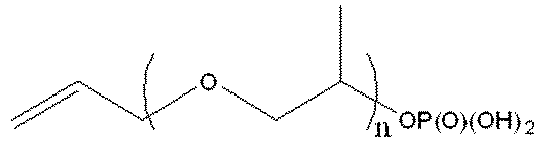
Phosphoric acid ester n= 10, 11,... 
Nonionic polyether surfactant (R' can be alkyl, aryl or other) n =10, 11,... 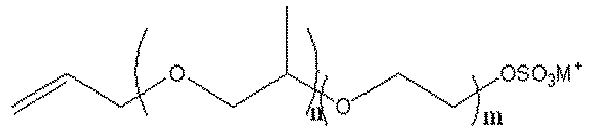
Polyether sulfates n = 4, 5,... m = 10, 11,... M+ = metal or ammonium counterion 
Polyether copolymer 1= 1,2,... n= 1,2,... m = 1, 2,... p = 1,2,... - A representative reactive surfactant with an acrylate reactive group may have a general chemical formula of: (CH2=CHCOO)- R, where R can be selected from ether sulfonates, phosphoric acid esters, polyethers and copolymers thereof, as shown in Table 2. Illustrative examples of surfactants having hydrophilic segments with reactive acrylate moiety include, but are not limited to, metal salts of sulfopropylacrylic acid, and alkylacryloxyethyl trialkylammonium salts. Additional non-limiting examples of reactive surfactant with an acrylate reactive group are presented in Table 2 below.
Table 2 Compound Description 
Ether Sulfonate n = 10, 11,... M+ = metal or ammonium counterion 
Phosphoric acid ester n = 1, 2,... 
Polyethers n = 10, 11,... 
Non-ionic Polyether Copolymers n= 1, 2,... m = 1, 2,... - A representative reactive surfactant with a thiol reactive group may have a general chemical formula of: (SH)-R, where R can be selected from ether sulfonates, phosphoric acid esters, polyethers and copolymers thereof, as shown in Table 3. A surfactant having hydrophilic segments with reactive thiol moiety can be obtained by reacting Trimethylolpropane tris (3-mercaptoproprionate) (TMPTMP) with Reasoap SR10 via thiol-ene reaction. (see Premix 3). Another surfactant having hydrophilic segments with reactive thiol moiety can be obtained by reacting Pentaerythritol tetrakis(3-mercaptoproprionate) with Reasoap SR10 via thiol-ene reaction. Additional non-limiting examples of reactive surfactant with a thiol reactive are presented in Table 3 below.
Table 3 Compound Description 
Ether sulfonates (R' can be alkyl, aryl or other) n = 10, 11,... M+ = metal or ammonium counterion 
Phosphoric acid ester n = 1, 2,... 
Non-ionic Polyether Copolymers n = 1, 2,... m = 1, 2,... - The reactive segments of the reactive surfactant may react with hydrophilic domains of the acrylates during the curing process. In this manner, upon curing, the reactive surfactant may be able to bind to the cured acrylate network and thus remain in place (not washed off or otherwise removed) to provide the coating with long-lasting anti-fog properties.
- In some embodiments, the present compositions may include metal oxide particles dispersed throughout the network of hydrophilic crosslinkable resins, for example, acrylates. The metal particles may provide hardness and abrasion resistant properties to the coatings. Suitable examples of metal oxide nanoparticle include, but are not limited to, silica particles, titania, alumina, zinc oxides, antimony oxide, tin oxide, zirconium oxides, and combinations thereof. The size and concentration of the metal nanoparticles can be selected such that the resulting coatings are optically transparent, while still retaining their fog resistant properties and anti-abrasion properties. In some embodiments, the metal oxide particles are nanoparticles with sizes ranging from about 5 to about 50 nm. The metal oxide particles may be nanoparticles with sizes ranging from about 10 to about 20 nm. The nanoparticles may be present in the concentration between 0 and 80% by weight.
- In some embodiments, non-reactive surfactants may be added to the coating composition to further enhance anti-fog property. Suitable non-reactive surfactants include, but are not limited to, sulfonic acid salts, ammonium salts, phosphate salts, polyethylene glycol ether oligomers, hydrophilic polyacrylates, octophenoxypolyethoxyethanols, and nonionic polyether block copolymers. The concentration of non-reactive surfactant in the composition may range between 0 and 10% by weight, or may range between 0.5 and 2% by liquid weight.
- The inventive compositions include one or more photoinitiators to initiate curing of the compositions upon exposure to radiation or light. The one or more photoinitiators present in the coating composition initiates and advances the crosslinking of the curable resins, i.e, curing of the coating composition when the coating composition is exposed to radiation. In some embodiments, the photoinitiators may be selected to react when exposed to UV light or visible light. In some instances, the photoinitiators are blue light photoinitiators. To cure the composition, cumulative UV-A exposure can be between 1.0 and 2.5 J/cm2 when using an H bulb for an exposure bulb for one minute.
- Examples of suitable UV radiation sensitive photoinitiators or blends of initiators used in coating compositions disclosed herein include, but are not limited to, benzoin; substituted benzoins such as butyl isomers of benzoin ethers; benzophenone; substituted benzophenones such as hydroxy benzophenone; 2-hydroxyethyl-N-maleimide; 2-[2-hydroxyethyl(methyl)amino]ethanol anthraquinone; thioxanthone; α,α-diethoxyacetophenone; 2,2-dimethoxy-1,2-diphenylethan-1-one; 2-hydroxy-2-methyl-1-phenyl-propan-1-one; diphenyl(2,4,6-trimethylbenzoyl)phosphine oxide, phenyl glyoxylic acid methyl ester; 1-hydroxylcyclohexyl phenyl ketone; 2-benzyl-2-dimethylamino-1-(4-morpholinophenyl)-butanone-1; 2-dimethylamino-2-(4-methyl-benzyl)-1-(4-morpholin-4-yl-phenyl)-butan-1-one; 2-methyl-1-[4-(methylthio)phenyl]-2-morpholinopropan-1-one; and 1-[4-(2-hydroxyethoxy)-phenyl]-2-hydroxy-2-methyl-1-propane-1-one. Cationic photoacid generators may include but are not limited to diphenyl[3-(phenylsulfanyl)phenyl]sulfonium hexafluorophosphate; diphenyl[2-phenylsulfanyl)phenyl]sulfonium hexafluoroantimonate; mixtures of triarylsulfonium with hexafluoroantimonate of hexafluorophosphate salts in propylene carbonate; and diaryl iodonium salts with pentafluoroborate, hexafluoroantimonate or hexafluorophosphate.
- Optionally, photoinitiator synergists are employed as coinitiators in conjunction with acyl ketone photoinitiators such as, for example, benzophenone. Suitable photoinitiator synergists include, for example, N-methyl-diethanol amine, triethanolamine 2-(butoxy)ethyl-4-dimethyaminobenzoate and reactive amine acrylates commercially available as EBECRYL P104, EBECRYL P105, and EBECRYL 7100 from UCB Radcure Chemicals Corporation, Smyrna, Ga. or CN 371, CN 373, CN 384, or CN 386 available commercially from Sartomer Company, Inc., Exton, Pa. Sartomer describes CN 373 as a reactive amine acrylate coinitiator that can be used in combination with a hydrogen abstracting photoinitiator, such as benzophenone or isopropyl thioxanthone (ITX), to promote free radical polymerization. CN 373 accelerates surface cure speed and helps overcome oxygen inhibition in UV curable coatings and inks. Sartomer describes CN 371, CN 384, CN 386, CN 550 , and CN551 as di- and tri-functional amine acrylate coinitiators which, when used in conjunction with a photosensitizer, such as benzophenone, promote rapid curing under UV light.
- In some instances, the composition may include a visible light photoinitiator to initiate curing of the composition upon exposure to blue light (400-500 nm). Such photoinitiators may include, but are not limited to, camphorquinone, phenylpropanedione (PPD), bisacrylphosphine oxide (Ir819), include 2,4,6-trimethylbenzoyldiphenylphosphine oxide (TPO), 2,4,6-trimethylbenzoylethoxy-phenylphosphine oxide (TPO-L), and bis(2,4,6-trimethylbenzoyl)phenylphosphine oxide (BAPO).
- In some instances, the photoinitiators can be selected from a family of alpha hydroxyl ketone photoinitiators. In some embodiments, the photoinitiators comprises one or more of Irgacure 500 (50% Benzophenone + 50% 1-hydroxy-cyclohexyl-phenyl ketone) and Darocure 1173 (2-hydroxy-2-methyl-propiophenone).
- The coating formulation may be alternatively cured using electron beam (EB) radiation with minimal to no use of photoinitiators.
- The coating compositions disclosed herein can include a leveling agent. The leveling agent, which may also be known as a flow-control agent, may be incorporated into the coating compositions described herein to spread the composition more evenly or level on the surface of the substrate and to provide substantially uniform contact with the substrate. The amount of the leveling agent can vary widely but preferably is used in an amount ranging from about 0.001% to about 10% leveling agent by weight solids of the coating composition. Any conventional, commercially available leveling agent which is compatible with the coating composition and the substrate, which is capable of leveling the coating composition on a substrate, and which enhances wetting between the coating composition and the substrate is employed. Non-limiting examples of such leveling agents include polyethers, silicones, fluorosurfactants, polyacrylates, silicone polyacrylates such as silicone hexaacrylate, and fluoro-modified polyacrylates. Examples include TRITON X-100, X-405, and N-57 from Rohm and Haas, silicones such as Paint Additive 3, Paint Additive 29, and Paint Additive 57 from Dow Corning, SILWET L-77 and SILWET L-7600 from Momentive (Columbus, OH), and fluorosurfactants such as FLUORAD FC-4430 from 3M Corporation (St. Paul, MN).
- Other ingredients such as an antioxidant, antistatic agent, weather resistive agent, tint additive, UV stabilizer, dispersing agent, defoamer, heat stabilizer, may also be added to the coating formulation. Examples of antioxidants include octadecyl-3- (3,5-di-tertbutyl-4-hydroxyphenyl) propionate, and pentaerythrityltetrakis[3-(3,5-di-tert-butyl-4-hydroxyphenyl)propionate].
- Examples of heat stabilizers include triphenyl phosphite, tris-(2,6 dimethylphenyl)phosphite, tris-(2,4-di-t-butyl-phenyl)phosphite, tris-(mixed mono-and dinonylphenyl)phosphite, dimethylbenzene phosphonate and trimethyl phosphate. Examples of the antistatic agent include glycerolmonostearate, sodium stearyl sulfonate, and sodium dodecylbenzenesulfonate.
- Polycarbonates (PC) are known to degrade under the exposure of ultraviolet (UV) light. This process is known as weathering. A weatherable material can maintain its physical properties for a prolonged time under the UV exposure. In order to improve service life under UV exposure, a UV absorber may be used in the coating for polycarbonate and similar aromatic plastic substrates. UV absorbers include, but are not limited to, three groups of chemicals: 1) 2-hydroxy-benzophenones(BP) derivatives, commercial examples include, but are not limited to, Chimassorb® 81 and Chimassorb® 90 (both from BASF, Germany); 2) 2-(2-hydroxyphenyl)-benzotriazole (HPBT) derivatives, commercial examples include, but are not limited to, Tinuvin® 1130, Tinuvin® 384-2, Tinuvin® 928 and Tinuvin® 900 (all from BASF, Germany); 3) 2-hydroxyphenyl-s-triazines (HPT) derivatives, commercial examples include, but are not limited to, Tinuvin® 400, Tinuvin® 405 (both from BASF, Germany).
- Hindered amine light stabilizers (HALS) are also used for effective stabilization against the detrimental effects of light and weathering. The most widely used hindered amine light stabilizers (HALS) are mainly derivatives of 2,2,6,6-tetramethyl piperidine. Commercial examples include, but are not limited to, Tinuvin® 152, Tinuvin® 292 (both from BASF, Germany).
- The concentration of the acrylates in the present composition may range between about 4% and 95% by weight. In some embodiments, the concentration of the acrylates in the present composition may range between 7% and 55% by weight of liquid coating. In some embodiments, the concentration of the reactive surfactant may range between 0.5% and 30% by weight of the liquid coating composition. The weight ratio between the acrylates and the reactive surfactants can be between 3:1 and 95:1. In some embodiments, the concentration of non-reactive surfactant in the composition may range between 0.5 and 2% by liquid weight of the coating composition. The composition may include silica particles.
- The acrylates comprise a mixture of one or more ethoxylated diacrylates and one or more ethoxylated triacrylates. The diacrylates may comprise triethylene glycol diacrylate. The triacrylates may comprise ethoxylated trimethylolpropane triacylate. The ratio between the diacrylates and triacrylates may range between 1:3 to 1:7. In order to enhance hydrophilic properties of the network, the network may be essentially or completely free of non-hydrophilic acrylates. The network may lack non-hydrophilic acrylates or acrylates with hydrophobic regions. The composition further includes a reactive surfactant with an alkenyl reactive group, but surfactants with an acrylate group, a thiol group or combination of these 3 groups may be used. The reactive surfactant may be an anionic surfactant. The instant compositions may further include metal oxide particles, such as silica, to impart hardness and abrasion resistance properties to the instant coatings. In addition, the instant compositions may include one or more of the following: non-reactive surfactant, solvent, photo initiators, and flow modifiers.
- By way of non-limiting examples, the present disclosure provides compositions having the following ratios (by dry weight) of one or more of silica, diacrylate and triacrylate:
- The compositions may include between about 15 and about 50% weight of diacrylate, and, optionally between about 5 and about 60% weight of diacrylate, and between about 50 and about 85% weight of triacrylate, and, optionally between about 40 and about 100% weight of triacrylate.
- The compositions may include between about 50 and about 70% of metal oxide particles, and, optionally between about 15 and about 80% weight of metal oxide particles, and between about 30 and about 50% weight of triacrylate, and, optionally between about 20 and about 85% weight of triacrylate.
- The compositions may include between about 50 and about 71% weight of metal oxide particles, and, optionally between about 30 and about 80% weight of metal oxide particles; between about 4 and about 25% weight of diacrylate, and, optionally between about 4 and about 30% weight of diacrylate, and between about 20 and about 50% weight of triacrylate, and, optionally between about 16 and about 70% weight of triacrylate.
- By way of non-limiting examples, the present disclosure provides the following compositions:
The compositions may include between about 4 and about 35% weight of diacrylate in the overall coating, and, optionally between about 2 and about 45% weight of diacrylate; between about 15 and about 60% weight of triacrylate in the overall coating, and, optionally between about 10 and about 75% weight of triacrylate; and between about 0.5 and about 2% weight of reactive surfactant, and, optionally between about 0.5 and about 30% weight of reactive surfactant. The compositions may also include one or more of the following: between about 0.5 and about 2% weight of non-reactive surfactant, and, optionally between about 0.5 and about 10% weight of non-reactive surfactant; between about 40 and about 65% weight of solvent, and, optionally between about 40 and about 70% weight of solvent; and between about 1 and about 4% weight of photo initiator and flow modifier, and, optionally between 0.5 and about 5% weight of photo initiator and flow modifier. - The compositions may include between about 15 and about 50% weight of metal oxide particles in the overall coating, and, optionally between about 5 and about 60% weight of metal oxide particles; between about 9 and about 35% weight of triacrylate in the overall coating, and, optionally between about 5 and about 60% weight of triacrylate; and between about 0.5 and about 2% weight of reactive surfactant, and, optionally between about 0.5 and about 30% weight of reactive surfactant. The compositions may also include one or more of the following: between about 0.5 and about 2% weight of non-reactive surfactant, and in some embodiments, optionally between about 0.5 and about 10% weight of non-reactive surfactant; between about 40 and about 65% weight of solvent, and, optionally between about 30 and about 70% weight of solvent; and between about 1 and about 4% weight of photo initiator and flow modifier, and optionally between 1 and about 5% weight of photo initiator and flow modifier.
- The compositions may include between about 15 and about 50% weight of metal oxide particles in the overall coating, and, optionally between about 5 and about 70% weight of metal oxide particles; between about 1 and about 20% weight of diacrylate in the overall coating, and, optionally between about 1 and about 30% weight of diacrylate; between about 6 and about 35% weight of triacrylate in the overall coating, and, optionally between about 4 and about 50% weight of triacrylate; and between about 0.5 and about 2% weight of reactive surfactant, and, optionally between about 0.5 and about 30% weight of reactive surfactant. The compositions may also include one or more of the following: between about 40 and about 65% weight of solvent, and, optionally between about 10 and about 70% weight of solvent; and between about 1 and about 4% weight of photo initiator and flow modifier, and optionally between 1 and about 5% weight of photo initiator and flow modifier.
- The compositions may include between about 15 and about 50% weight of metal oxide particles in the overall coating, and, optionally between about 5 and about 70% weight of metal oxide particles; between about 1 and about 20% weight of diacrylate in the overall coating, and in some embodiments, optionally between about 1 and about 30% weight of diacrylate; between about 6 and about 35% weight of triacrylate in the overall coating, and, optionally between about 4 and about 50% weight of triacrylate; between about 0.5 and about 2% weight of reactive surfactant, and, optionally between about 0.5 and about 30% weight of reactive surfactant. The compositions may also include one or more of the following: between about 0.5 and about 2% weight of non-reactive surfactant, and, optionally between about 0.5 and about 10% weight of non-reactive surfactant; between about 40 and about 65% weight of solvent, and, optionally between about 10 and about 70% weight of solvent; and between about 1 and about 4% weight of photo initiator and flow modifier, and optionally between 1 and about 5% weight of photo initiator and flow modifier.
- The coating compositions disclosed herein can be applied as a coating to rigid or flexible substrates. Suitable substrate materials include, but are not limited to, transparent plastics such as polycarbonate (PC), polarized polycarbonate, polyamide, polyacrylic, polymethylmethacrylate (PMMA), polyvinylchloride, polybisallyl carbonate, allyl diglycol carbonate (ADC) polymer, polyethylene terephthalate (PET), polyethylene naphthenate, cellulose triacetate (CTA) polymer, cellulose acetate butyrate (CAB) polymer, polyurethane, polyepisulfide, and polythiourethane. Other substrates including various polyolefins, fluorinated polymers, metals and glass, such as soda-lime glass, borosilicate glass, acrylic glass among other types of glass, can be used with appropriate pretreatments, if necessary. Examples of articles that may be coated with coatings of the present disclosure include, but are not limited to, safety eyewear, optical lenses, goggles, face shields, face plates for helmets, glazing used as windows in buildings, and glazing used as windshields or windows in automotives, buses, trains, airplanes, and other transportation vehicles, multifunctional LED, LCD displays, bathroom mirrors, shower mirrors and fixtures. Coating may also be applied to commercial freezer doors, ice cream freezer doors and deli cases. To increase adhesion of the present composition to the substrates, the substrates may be subjected to surface treatments and/or coated with primers. Acrylate-based primers may be used, particularly with PMMA substrates.
- Additionally, the coated articles prepared by coating the disclosed compositions on thin flexible substrates like PC or PET film can further be mounted/applied to the articles that require anti-fog functionality for example safety eyewear, optical lenses, goggles, face shields, face plates for helmets, glazing used as windows in buildings, and glazing used as windshields or windows in automotives, buses, trains, airplanes, and other transportation vehicles, multifunctional LED, LCD displays , bathroom and shower mirrors. The anti-fog flexible films can also be applied via a repositionable optically transparent adhesive, such as a pressure sensitive adhesive, to commercial freezer doors, ice cream freezer doors and displays, deli cases to prevent frost formation and fogging.
- The coating compositions described herein can be applied in any suitable manner to a substrate. For example, the compositions of the present disclosure can be applied to solid substrates by conventional methods, such as flow coating, spray coating, curtain coating, dip coating, spin coating, slot-die coating, roll coating, and the like to form a continuous surface film on the substrate. The coating compositions are then cured by exposing the coated substrate to UV radiation provided by UV lamps, visible light radiation provided by visible light lamps or, in some embodiments, EB radiation provided by EB accelerators, or a combination of these, all of these techniques being known to those skilled in the art. Additionally, the coated articles prepared by coating the disclosed compositions on thin flexible substrates like PC or PET film can be installed or retrofitted via dry or wet lamination on rigid substrates.
- A method of providing an article with washable anti-fog properties may comprise treating a surface of an article and applying to the surface a washable anti-fog coating of the present disclosure, where the coating can further be optically transparent, abrasion resistant, or both.
- The following examples are merely representative and used mostly to demonstrate the principles of the coatings disclosed herein.
- Film Thickness: Film thickness of cured coating was measured with a Filmetrics F20-CP Spectrophotometer at wavelength of 632.8 nm based on spectral reflectance methodology.
- Haze: Light transmission and light-scattering properties of the cured coating was evaluated by measuring haze according to ASTM D1003 standard with a Haze-gard Plus Hazemeter (BYK-Gardner, Columbia, Md.).
- Yellow Index: Yellow index was measured on a Shimadzu UV-1601 UV-Vis spectrophotometer (Shimadzu Scientific Instruments of Kyoto, Japan) in accordance to ASTM E-313.
- Adhesion: Adhesion is the ability of a coating to adhere to a substrate. The initial adhesion was tested using a roll of pressure sensitive tape 3M Brand SCOTCH™ 600 tape. The test was carried out as follows: 1) a cross-hatch of a 5 X 5 grid, approximately 2 mm apart was made with a retractable razor blade into the cured coating; 2) the tape was pressed down firmly (using a tongue depressor) over the cross-hatched area; 3) After 90 ± 30 s, tape was pulled at an angle of 180° or as close to substrate as possible; 4) a check for the removal of the coating was made by examination of the coated substrate using appropriate visual control; 5) the subject area was also inspected under a microscope; 6) the actual count of unaffected areas was reported as percent adhesion (when adhesion was affected along a line only, the estimate is converted into percentages).
- Boiling Water Adhesion: The adhesion was also tested in the same manner as above for certain samples after the coated specimen was soaked in boiling water for 1 hour.
- Steel Wool Abrasion: Steel wool abrasion measured by YT-520 Steel Wool Tester gives qualitative determination of abrasion / scratch resistance of coated materials upon rubbing with standardized grades of steel wool. Japanese steel wool grade 0000 (Extra fine) was used for the test. The coated surface was rubbed by the machine in about 2" x 2" area for 10 strokes. The test is initiated with a weight of 50g. If the coating does not develop scratches, the weight is increased to 100g. Thus the weight is incrementally increased until scratches are observed on the coating. For example a cured coating with steel wool resistance rating of 200g, shows scratches at a minimum load of 200g.
- Bayer Abrasion Test: Bayer abrasion test is a quantitative measure of the abrasion resistance of a coated specimen relative to that of an uncoated CR39 standard. The test was carried out in a Colts Laboratory BTE Abrasion Tester using 500g of
Norton ZF# 12 Alundum abrasion media. Uncoated Silor Optical CR-39 Plano lenses were used as standard. After 600 strokes, the change in haze of coated specimen and CR39 standard were noted. Bayer ratio was reported as percentage difference in haze of uncoated CR39 standard divided by the percentage difference in haze of coated specimen. - Taber Test: The Taber Abrasion test was performed with a Teledyne Model 5155 Taber Abrader (Taber Industries, North Tonawanda, N.Y.) with a 500 g auxiliary load weight and with CS-10F wheels (Taber Industries, North Tonawanda, N.Y.). Prior to the measurement, the wheels were refaced with the ST-11 refacing stone (Taber Industries, North Tonawanda, N.Y.). The refacing was performed by 25 revolutions of the CS-10F wheels on the refacing stone. The initial haze of the sample was recorded 4 times with a Haze-gard Plus (BYK-Gardner, Columbia, Md.) equipped with a Taber Abrasion holder (BYK-Gardner, Columbia, Md.). After 100 cycles of the CS-10F wheels on the sample, the haze was recorded again 4 times with a Haze-gard Plus (BYK-Gardner, Columbia, Md.) equipped with a Taber Abrasion holder (BYK-Gardner, Columbia, Md.). The average haze was then determined for the initial haze reading and the haze reading after 100 cycles using the CS-10F wheels. The difference between the averaged haze readings at 100 cycles and the initial haze reading is then reported.
- Breath Test: Breath test was carried out by holding the coated substrate about 2.5 to 7.5 cm from the tester. The tester blew on the sample so as to intentionally create fog. If no fog appeared on the coated substrate during the test, the coating composition passed the breath test. If fog appeared on the surface, then the coating composition failed this test.
- Initial Anti-fog Test: Initial anti-fog test was carried out by positioning a coated substrate at a standard height (1") above a beaker containing a source of 60 °C water. The coated substrate was exposed to water vapor from the 60 °C water for 1 minute. If fog appeared on the coated substrate during this test, the time taken for the appearance of the fog was recorded. If no fog appeared during 1 minute of exposure, then the coating was considered to "pass" the initial anti-fog test.
- Water Soak Anti-fog Test: A coated substrate was soaked in water at room temperature for 1 hour. The coated specimen was then removed from the water, suspended on a rack at 25 °C, 50% RH for 12 hours and tested for anti-fog property by placing the coated substrate above beaker containing water at 50 °C for 1 minute. If fog appeared on the coated substrate during this test, the time taken for the appearance of the fog was recorded. If no fog appeared during 1 minute of exposure, then the coating was considered to "pass" the 1 h water soak anti-fog test.
- In addition the anti-fog property of 12 h conditioned water- soaked coated specimens was tested using a YT-810 Resistance to Fogging Tester (manufactured by Yin-Tsung Co., Ltd ) according to the EN166/EN168 protocol. The test involves placing the coated substrate onto the tester. When the test is started, the coated substrate is exposed to 50 °C steam, and a laser is passed through the lens. The amount of fogging was determined by reduction in the transmission of the laser light over 8 seconds (s) of exposure. The coating fails the fog test if the laser transmission falls below 80% of the initial reading during the 8 s period, if not, it is rated as a pass.
- Dry cloth wipe test - The coated substrate was wiped with a dry microfiber cloth twenty times. After the 20 wipes, the anti-fog properties were evaluated by both the breath test and the 60° C beaker test for one minute. If both tests pass, the coated substrate is considered to pass the dry cloth wipe anti-fog test.
- IPA wipe test - A microfiber cloth was soaked with isopropyl alcohol and then wiped across the coated surface once. After the wipe, the anti-fog properties were evaluated by both the breath test and the 60 °C beaker test. This constitutes one IPA wipe cycle. If the coated substrate passes both tests, it is allowed to dry for thirty minutes and retested. The number of cycles completed without fogging is reported.
- Wet cloth wipe test - A microfiber cloth was soaked in water. The coated substrate was wiped with wet cloth ten times. After 10 wipes the coated specimen was allowed to dry for one minute and tested for anti-fog property by the breath test and the 60 °C beaker test. This constitutes one wet cloth wipe cycle. If the coated substrate passes both tests, it is conditioned for 24 h at 25 °C and 50% RH and retested. The number of cycles completed without fogging is reported.
- Running water Wash test - The coated substrate is placed under running tap water and wiped with a wet microfiber cloth across the surface twenty times. After 20 wipes, the coated part was allowed to dry for 30 minutes at ambient conditions. It was then tested by the breath test and 60 °C beaker test. This constitutes one water wash cycle. If the coated substrate passes both tests, it is equilibrated at 25 °C, 50% RH for 24h and retested. The number of cycles completed without fogging is reported.
- Soap and running water Wash test - The coated part was wiped once with a 1 wt% solution of 'Simple Green' cleaner in water, then placed under running tap water and wiped twenty times with a wet microfiber cloth. After 20 wipes, the coated sample was allowed to dry for 1 hour at ambient conditions. The sample was then tested for anti-fog property by breath test and 60 °C beaker test. This constitutes one soap water wash cycle. If the coated substrate passes both tests, it is conditioned for 24h at 25 °C, 50% RH and then retested. The number of cycles completed without fogging is reported.
- The wipe and wash cycles are summarized in Table 4 below.
Table 4 Test name Initial Test Duration between Cycles Method Time before testing Anti-fog Wipe tests Dry cloth wipe test 10 wipes with a dry cloth Immediate - IPA wipe test 1 wipe with an IPA soaked cloth Immediate 30 minutes Wet cloth wipe test 10 wipes with a water soaked cloth 1 minute 24 hours Wash tests Running water test 20 wipes with a cloth under running tap 30 minutes 24 hours Soap/running water test 1 wipe with a soapy cloth, followed by 20 wipes under running tap 1 hour 24 hours - Wash and Wipe Test (Machine): The washability tester (AB5005 Automatic Washability Test, TQC Thermimport Quality Control, Capelle aan den Ussel, the Netherlands), consists of an mechanical device onto which a sponge is mounted on a holding arm, with a weight applied, to equal 300g of force applied to the tested material. Tested material was coated primed PET films. During testing, the sponge was repeatedly moved across the surface of the tested material for a specified number of cycles, in the disclosed testing 1000 and 5000 cycles. While the sponge moved across the surface, a liquid is applied to the surface at a rate of 0.3ml/min. Liquids tested included deionized water, ammonia free Windex, and formula 409 cleaner. After the specified cycles were completed, the tested material was dried by wiping with paper towels, and then tested for anti-fog performance. If the material passes anti-fog testing after washing, then the coating is determined to retain anti-fog performance after the specified number of wipes. If immediate anti-fog testing fails, the time required for anti-fog recovery is noted. If anti-fog performance does not return, the coating would be determined to have failed permanent anti-fog.
- Freezer Test: Only samples coated on 125 um thick polycarbonate film were tested. The coated film was affixed to a glass insulated passive freezer door with double-sided tape. The freezer was set to specified temperature and the system was allowed to equilibrate for at least 1 hour. The door was opened at least 60°. A coating passes the test if it remains fog-free for at least 6 seconds. The external ambient temperature and relative humidity were recorded.
- An "average freezer use" simulation was performed on a passive freezer that was set to -12.2 °C. The door was opened every 10 minutes for a 6-second duration up to 1 hour. The length of time for fog to clear was measured and the percent (%) fog of individual coated articles were measured. Ambient room temperature was 20.9 °C, relative humidity 53.4%.
- The following is a description of the abbreviations of chemicals and other materials referred to in the application: MEK-AC-2140Z: Colloidal silica dispersion in methyl ethyl ketone (Nissan Chemical America Corporation); PGM-AC-2140Y: Colloidal silica dispersion in 1-methoxy-2-propanol (Nissan Chemical America Corporation); TMPTMP: Trimethylolpropane tris(3-mercaptoproprionate) (Aldrich); SR272: Triethylene glycol diacrylate (Sartomer Americas); SR454: Ethoxylated (3) trimethylolpropane triacrylate (Sartomer Americas); SR499: Ethoxylated (6) timethylolpropane triacrylate (Sartomer Americas); SR9035 : Ethoxylated (15) trimethylolpropane triacylate (Sartomer Americas); SR415: Ethyoxylated (20) trimethylolpropane triacrylate (Sartomer Americas); 3-EGA: Triethylene glycol diacrylate (Kyoeisha); REASOAP SR-10: Reactive anionic ether sulfate surfactant (Adeka); REASOAP SR-20: Reactive anionic ether sulfate surfactant (Adeka); REASOAP ER-10: Reactive non-ionic ether surfactant (Adeka); Emulsogen APS-100: Non-ionic APEO-free ammonium salt of allyl polyakylene glycol ether sulfate (Clariant); Igepal CA-720: Polyoxyethylene (12) isooctylphenyl ether (Sigma Aldrich); Brij 30: Polyoxyethylene(4)lauryl ether (ACROS Organics); Brij 58: Polyxoyethylene glycol hexadecyl ether (ACROS Organics); OT-75: Sodium dioctyl sulfosuccinate (75% in water and alcohol), (Cytec Industries, Inc.); Schercoquat IAS-PG: Isosteramidopropyl ethyl dimonium ethosulfate and propylene glycol (Lubrizol); PM: 1-Methoxy-2-Propanol; TMPTA: Trimethylolpropane triacrylate; NPC-ST-30: Organo SiO2 (Nissan Chemical America Corporation); Pelex OT-P: Bis(2-ethylhexyl)sulfsuccinate docusate sodium (Kao Corp.); Witcobond 240: Aqueous Polyurethane Dispersion (Chemtura); FZ-2105: Dow Corning Toray; Paraloid A-11: Thermoplastic acrylic resin (Dow); Dymax XR-9416: Water dilutable urethane acrylate (Dymax); BYK-333: Polyether modified polydimethylsiloxane (Byk); Coatosil 7602: Silicone copolymer with ethylene oxide pendent side chains (Momentive); and NeoRez R9679: Aliphatic waterborne urethane (DSM Coating Resins, LLC).
- The following is a description of the substrates referred to in the application: PC Lens: Polycarbonate Ophthalmic Lens; CR-39: CR-39TM Polybisallyl Carbonate Ophthalmic Lens; MR-7: MR-7TM Polythiourethane Ophthalmic Lens; Trivex: TrivexTM Urethane Ophthalmic Lens; PET Film: Biaxially-Oriented Polyethylene Terephthalate Film; PC Plaque: Bayer MakrolonTM Polycarbonate Sheet; PC Film: 125 um thick PC substrate; Primed PET Film: Proprietary treatment on Biaxially-Oriented Polyethylene Terephthalate Film; and PMMA: Poly (methylmethacrylate).
- The following Premixes were used for the examples. Premix 1: 135.01 grams of SR9035 was added to a round bottom flask containing 24.65 g 3-EGA equipped with a magnetic stir bar. The contents were stirred continuously at room temperature for 30 minutes. After stirring for 30 minutes, 850.65 grams of MEK-AC-2140Z was added slowly at room temperature with constant stirring and the mixture was stirred overnight. The mixture was then vacuum distilled using a Buschi Rotovap at 40 °C and 730 mTorr. The concentrated resin was then diluted with 192 g of PM glycol ether. The mixture was then transferred to a capped brown container suitable for packaging UV curable coatings and allowed to cool to room temperature. Premix 2: 70 grams of OT75 (75% solids in water) was added to a vessel containing 30 grams of Schercoquat IAS-PG and stirred continuously for 4 hours using a magnetic stir rod. Premix 3: 75 grams of REASOAP SR10 was added to a round bottom flask containing 25 grams of TMPTMP and stirred using a mechanical mixer at 70 C for 8 hours. The mixture was then transferred to a capped brown container suitable for packaging UV curable coatings and cooled to room temperature. Premix 4: 15 grams of Witcobond 240 was mixed with 85 grams of PM in a vessel for 30 minutes using a magnetic stir bar. Premix 5: In a 250 mL vessel, 35.8 g of Eastek 1400 was added to 128.5 g of de-ionized water and stirred for 10 minutes with a magnetic sir bar. 35.9 g of PM was added to the mixture and stirred for 30 minutes using a magnetic stir bar. Premix 6: 70 grams of PM Acetate and 30 grams of Paraloid A-11 are mixed for 3 hours at 60 °C. Premix 7: 90 grams of PM with 10 grams of BYK-333 were mixed for 30 minutes at ambient conditions.
- 94.7 grams of Premix 1, 1.47 grams of Premix 2, 1.50 grams of Premix 3, and 2.29 grams of Darocur 1173 were added to a vessel and stirred using a magnetic stir bar at room temperature for 30 minutes. The coating mixture was then allowed to rest for 1 hour.
- Depending on mode of application coating mixture was further adjusted for solids by dilution with PM. The coating was applied variously via dip coating, draw down bar, flow coating and spin coating. Coated parts were cured at 2.0 J/cm2 with H bulb in Fusion UV Cure Unit. Cured samples pass water soak anti-fog testing, adhesion tests, and have a steel wool abrasion resistance up to 200 grams. When applied to PC lens, this formulation has a Bayer abrasion resistance of 2.79. When flow coated onto Bayer Makrolon polycarbonate sheet, this sample passes water soak anti-fog tests and has a steel wool abrasion resistance of 250 g. Coated lenses were tested for wipe tests as previously described. These coatings pass the IPA test up to 10 cycles, wet wipe tests up to 14 cycles, and running water wash tests up to 21 cycles.
- Example 1 has been applied to CR-39. MR-7, Trivex, and PC lenses over a primer layer namely Premix 4. When applied to the primer layer, cured coatings pass water soak anti-fog testing, and boiling water adhesion testing.
- Table 5 below shows the properties of the cured coating of Example 1 after a flow coating on Bayer Makrolon Polycarbonate sheet followed by a cure at 2.0 J/cm2.
Table 5 Properties Example 1 Thickness (um) 4-6 Haze (%) 0.26 Initial Antifog Test Pass Water Soak Anti-fog Test Pass Adhesion Pass Steel Wool (g) 250 g Taber (100 rev) 5.71 - Table 6 below shows the anti-fog properties after the Wipe and Wash Tests of Example 1's cured coating.
Table 6 Test name # Cycles tested # Cycles passed Wipe tests Dry cloth wipe test 1 1 IPA wipe test 10 10 Wet cloth wipe test Until Failure 14 Wash tests Running water test Until Failure 21 Soap/running water test Until Failure 21 - Table 7 below shows the properties of the cured coating of Example 1 coated on different ophthalmic lens substrates (spin coating, cured at 2.0 J/cm2). All substrates used in the study were surfaced by surfacing equipment and polished by conventional polishing methods prior to coating; The surfaced lens substrates were spin coated on the surfaced side with Premix 4 , air dried for 90 min and then spin-coated with the coating of Example 1.
Table 7 Properties Substrate CR-39 MR-7 Trivex PC Lens Thickness (µm) 4.9 4.8 4.7 5.2 Haze (%) 0.21 0.30 0.26 0.53 Initial Anti-fog Test Pass Pass Pass Pass Water Soak Anti-fog Test Pass Pass Pass Pass Adhesion Pass Pass Pass Pass Boiling Water Adhesion Pass Pass Pass Pass - Table 8 below shows the properties of the cured coating of Example 1 on 100um thick pre-treated PET film. The coating was applied via a flow coating technique and cured at 2.0 J/cm2.
Table 8 Properties PET film Pre-treatment Corona (30 s) Pre-coated with Premix -5* Thickness (um) 3.9-5.0 6.0-8.0 Haze (%) 1.5-2.0 1.46 Initial Anti-fog Pass Pass Water Soak Anti-fog Machine Test Pass Pass Water Soak Anti-fog Test Pass Pass Adhesion Pass Pass *PET film was pretreated by flow coating with Premix 5 and dried under ambient conditions for 30 min. - 69.88 grams of Premix 1, 1.09 grams of Premix 2, 1.11 grams of REASOAP SR-10, 1.69 grams of Darocure 1173, 0.37 grams of Tergitol 15-s-7, and 25.86 grams of PM were mixed using a magnetic stir bar at room temperature for 30 minutes. After mixing, the formulation was allowed to rest for 1 hour before application to the substrate. The coating was applied variously via dip coating and spin coating. Coated parts were cured at 2.0 J/cm2 with H bulb in Fusion UV Cure Unit. Cured samples pass water soak anti-fog testing, adhesion tests, and have a steel wool abrasion resistance up to 150 grams. When applied to PC lens, this formulation has a Bayer abrasion resistance of 2.82.
- 69.88 grams of Premix 1, 1.09 grams of Premix 2, 0.83 grams of REASOAP SR-10, 0.28 grams of TMPTMP, 1.69 grams of Darocure 1173, 0.37 grams of Tergitol 15-s-7, and 25.86 grams of PM were mixed using a magnetic stir bar at room temperature for 30 minutes. After mixing, the formulation was allowed to rest for 1 hour. The coating was applied variously via dip coating and spin coating. Coated parts were cured at 2.0 J/cm2 with H bulb in Fusion UV Cure Unit. Cured samples pass water soak anti-fog testing, adhesion tests, and have a steel wool abrasion resistance up to 150 grams. When applied to PC lens, this formulation has a Bayer abrasion resistance of 3.30.
- Table 9 below shows properties of cured coatings Examples 1-3. Coatings were applied via dip coat on finished plano polycarbonate lenses and cured at 2.0 J/cm2.
Table 9 Properties Example 1 Example 2 Example 3 Thickness (um) 6.5 6.5 6.5 Haze (%) 0.28 0.30 0.35 Initial Anti-fog Test Pass Pass Pass Water Soak Anti-fog Machine Test Pass Pass Pass Water Soak Anti-fog Test Pass Pass Pass Adhesion Pass Pass Pass Steel Wool (g) 200 150 200 - 41.26 grams of SR9035, 7.64 grams of 3-EGA, 1.09 grams of Premix 2, 1.11 grams of Premix 3, 1.69 grams of Darocur 1173, and 46.84 grams of PM were mixed using a magnetic stir bar for 30 minutes at room temperature. The coating was applied by spin coating. Coated parts were cured at 2.0 J/cm2 with H bulb in Fusion UV Cure Unit. Cured samples pass water soak anti-fog testing, adhesion tests, and have a steel wool abrasion resistance up to <50 grams. When applied to PC lens, this formulation has a Bayer abrasion resistance of 0.40.
- 69.88 grams of Premix 1, 4.44 grams of REASOAP SR-10, 1.69 grams of Darocure 1173, 0.37 grams of Tergitol 15-s-7, and 25.86 grams of PM were mixed using a magnetic stir bar at room temperature for 30 minutes. After mixing, the mixture was allowed to rest for 1 hour before application to the substrate. The coating was applied variously via dip coating and spin coating. Coated parts were cured at 2.0 J/cm2 with H bulb in Fusion UV Cure Unit. Cured samples pass water soak anti-fog testing, adhesion tests, and have a steel wool abrasion resistance up to 100 grams. When applied to PC lens, this formulation has a Bayer abrasion resistance of 2.40.
- Table 10 below shows properties of cured coatings of Examples 1-6. All the coatings were applied via spin coating on finished plano polycarbonate lenses. Coated lenses were cured at 2.0 J/cm2.
Table 10 Properties Example 1 Example 2 Example 3 Example 4 Example 5 Thickness (um) 4.1 4.0 4.4 4.0 4.5 Haze (%) 0.25 0.31 0.29 0.30 0.22 Initial Anti-fog Test Pass Pass Pass Pass Pass Water Soak Anti-fog Machine Test Pass Pass Pass Pass Pass Water Soak Anti-fog Test Pass Pass Pass Pass Pass Adhesion Pass Pass Pass Pass Pass Steel Wool (g) 200 150 150 <50 100 Bayer 2.79 2.82 3.3 0.4 2.4 - 69.88 grams of Premix 1, 1.09 grams of Premix 2, 1.11 grams of REASOAP SR-10, 1.69 grams of Darocur 1173, 0.37 grams of Tergitol 15-s-7, and 65 grams of PM were mixed using a magnetic stir bar at room temperature for 30 minutes. After mixing, the formulation was allowed to rest for 1 hour. PET film was coated and cured at SolarGard of San Diego, CA. These samples pass water soak anti-fog test and exhibit steel wool abrasion resistance up to 400 grams.
- In another set of experiments, Example 6 was also applied via drawdown bar onto PC film. Coated parts were cured at 2.0 J/cm2 with H bulb in Fusion UV Cure Unit. These samples pass water soak anti-fog, initial adhesion, and exhibit steel wool abrasion resistance up to 200 grams.
- Table 11 below shows the properties of the cured samples of Example 6 applied to primed PET and PC films. The coating was applied via drawdown bar and cured using UV.
Table 11 Properties Primed PET Film* PC Film Thickness (um) 4.5 3.0-8.0 Haze (%) 0.20-0.40 0.20-0.35 Initial Anti-Fog Test Pass Pass Water Soak Anti-fog Test Pass Pass Steel Wool 400 g 200 g Adhesion 100% 100% YI 1.58 1.19-1.30 *coated and cured at Solar Gard, San Diego, CA - Table 12 below demonstrates Example 6 coated to 4 micron thick on 125 um thick polycarbonate film. Freezer testing of the coated samples was performed on a passive freezer door.
Table 12 Handle Hinge LTF300 Temperature (°F) Temperature (°C) Room Temperature (°C) Room Relative Humidity (%) 6 sec Test 6 sec Test 6 sec Test 10 -12.2 22.7 47.8 Pass Pass Pass 5 -15 21.7 52.4 Pass Pass Pass 0 -17.8 20.5 60.7 Pass Pass Pass -5 -20.6 20.9 60.5 Pass Pass Pass - Table 13 below demonstrates Example 6 coated to 4 microns thick on a 125 um thick polycarbonate film. Freezer testing of the coated samples was performed on a passive freezer set to -12.2 C. The door was opened every 10 minutes for a 6 second duration for up to 1 hour. The length of time for fog the clear was measure and percent (%) fog of individual coated articles were measured. The ambient room temperature was 20.9 C, relative humidity 53.4%.
Table 13 Time (min) Clear Time (Sec) Avg Fog (%) 0 0 0 10 0 0 20 0 0 30 0 0 40 0 0 50 0 0 60 0 0 - Table 14 below demonstrates the anti-fog properties of the coated PET films after machine wash testing at 1000 and 5000 cycles.
Table 14 Cleaning Liquid Number of Cycles Test Method Conditioning time before testing Anti-fog Example 6 Windex (Ammonia Free) 1000 Antifog (60°C, beaker, 1 min) 0 min Pass 5000 0 min Pass Formula 409 Cleaner 1000 0 min Pass 5000 0 min Pass Deionized Water 1000 0 min Fail 15 min Fail 30 min Pass 5000 0 min Fail 15 min Fail 30 min Fail 1 hour Fail 2 hour Fail 18 hour Pass - 69.04 grams of Premix 1, 1.06 grams of Premix 2, 1.08 grams of REASOAP SR-10, 1.69 grams of Darocur 1173, 1.57 grams of Capstone FS-35, and 25.56 grams of PM were mixed using a magnetic stir bar at room temperature for 30 minutes. After mixing, the formulation was allowed to rest for 1 hour. The coating was applied via spin coating on PC, CR-39, MR-7 and Trivex lenses. Coated parts were cured at 2.0 J/cm2 with H bulb in Fusion UV Cure Unit. These samples pass water soak anti-fog and initial adhesion. The Bayer for coated PC sample is 2.68 and steel wool abrasion resistance 200 grams. When applied to other substrates including CR-39, MR-7, and Trivex, these samples maintained anti-fog properties, adhesion, exhibited steel wool abrasion resistance of 200 grams, and a Bayer abrasion of 2.5.
- Example 7 was also applied to backside conventionally surfaced PC, CR-39, MR-7, MR-8, MR-10, and Trivex lenses. Premix 4 was first applied to a selected substrate followed by Example 7. All coatings were applied and cured using a CrystalSpin SV spin coating and curing unit from LTI Coating Technologies, LLC. All coated substrates pass water soak anti-fog test, adhesion, and exhibit a steel wool resistance of 200 grams. These coatings also pass a 15-minute boiling water adhesion test.
- Table 15 below shows the properties of the cured coating of Example 7 coated on different ophthalmic lens substrates (Spin coating, cured at 2.0 J/cm2 using a Fusion UV unit). All substrates used in the study were surfaced by surfacing equipment and polished by conventional polishing methods prior to coating; The surfaced lens substrates were spin coated on the surfaced side with Premix 4 and dried for 45 seconds while spinning, and then spin-coated with the coating of Example 7.
Table 15 Coating Example 7 Example 7 Example 7 Example 7 Example 7 Primer Premix 4 Premix 4 None Premix 4 Premix 4 Substrate CR39 Poly carbonate Poly carbonate MR7 Trivex Appearance Smooth/ Excellent Smooth/ Excellent Smooth/ Excellent Smooth/ Excellent Smooth/ Excellent Thickness (mm) 4.8 4.9 4.4 4.9 4.4 Haze (%) 0.35 0.26 0.22 0.30 0.19 Initial Anti-Fog Test Pass Pass Pass Pass Pass Water Soak Anti-Fog Machine Test Pass Pass Pass Pass Pass Adhesion Pass Pass Pass Pass Pass Boiling Water Adhesion 100°C for 1h Pass Pass Fail Pass Pass Steel Wool (g) 200 200 200 200 200 Bayer Ratio 2.5 2.5 2.68 2.5 2.5 - Table 16 below shows the properties of the cured coating of Example 7 coated on different ophthalmic lens substrates (Spin coating, cured at 2.0 J/cm2 using a Crystal Spin SV Unit). All substrates used in the study were surfaced by surfacing equipment and polished by conventional polishing methods prior to coating; The surfaced lens substrates were spin coated on the surfaced side with Premix 4 inside the Crystal Spin SV Unit and dried for 45 seconds while spinning , and then spin-coated with the coating of Example 7.
Table 16 Substrate Thickness (mm) Haze (%) YI Steel Wool (g) Adhesion Initial Anti-fog Test Water Soak Anti-Fog Test Poly 5.8 0.22 0.98 200 100% Pass Pass MR-7 5.7 0.21 1.88 200 100% Pass Pass MR-8 5.8 0.25 1.92 200 100% Pass Pass MR-10 5.8 0.22 1.69 200 100% Pass Pass CR-39 5.1 0.21 0.90 200 100% Pass Pass Trivex™ 5.1 0.19 0.96 200 98% Pass Pass - 69.04 grams of Premix 1, 1.06 grams of Premix 2, 1.69 grams of Darocur 1173, 1.57 grams of Capstone FS-35, and 25.56 grams of PM are mixed using a magnetic stir bar at room temperature for 30 minutes. After mixing, the formulation was allowed to rest for 1 hour. The coating was applied via spin coat on PC lens. Coated parts were cured at 2.0 J/cm2 with H bulb in Fusion UV Cure Unit. These samples fail water soak anti-fog and pass initial adhesion.
- 69.04 grams of Premix 1, 1.06 grams of OT-75, 1.69 grams of Darocur 1173, 1.57 grams of Capstone FS-35, and 25.56 grams of PM are mixed using a magnetic stir bar at room temperature for 30 minutes. After mixing, the formulation was allowed to rest for 1 hour. The coating was applied via spin coat on PC lens. Coated parts were cured at 2.0 J/cm2 with H bulb in Fusion UV Cure Unit. These samples fail water soak anti-fog and pass initial adhesion.
- Table 17 below shows the properties of cured samples containing no reactive surfactant combination compared with Sample 9. The coating was spin coated on PC lenses and cured using a Fusion UV cure unit at 2.0 J/cm2.
Table 17 Properties Example 7 Example 7a Example 7b Thickness (um) 4.2 4.0 4.0 Haze (%) 0.22 0.19 0.11 Initial Anti-fog Test Pass Pass Pass Water Soak Anti-Fog Test Pass Fail Fail Adhesion Pass Pass Pass - 69.04 grams of Premix 1, 1.06 grams of Premix 2, 1.08 grams of Emulsogen APS-100, 1.69 grams of Darocur 1173, 1.57 grams of Capstone FS-35, and 25.56 grams of PM were mixed using a magnetic stir bar at room temperature for 30 minutes. After mixing, the formulation was allowed to rest for 1 hour. The coating was applied via spin coating on PC lenses. Coated parts were cured at 2.0 J/cm2 with H bulb in Fusion UV Cure Unit. Cured samples pass water soak anti-fog, fail initial adhesion, and exhibit a steel wool abrasion resistance of 200 g.
- 69.04 grams of Premix 1, 1.06 grams of Premix 2, 1.08 grams of REASOAP SR-20, 1.69 grams of Darocur 1173, 1.57 grams of Capstone FS-35, and 25.56 grams of PM were mixed using a magnetic stir bar at room temperature for 30 minutes. After mixing, the formulation was allowed to rest for 1 hour. The coating was applied via spin coating on PC lenses. Coated parts were cured at 2.0 J/cm2 with H bulb in Fusion UV Cure Unit. Cured samples pass water soak anti-fog, fail initial adhesion, and exhibit a steel wool abrasion resistance of 150 g.
- Table 18 below shows the properties of cured samples of different reactive surfactant combinations. The coating was spin coated on Gentex PC lenses and cured using a Fusion UV cure unit at 2.0 J/cm2.
Table 18 Properties Example 7 Example 8 Example 9 Thickness (um) 4.2 4.0 4.1 Haze (%) 0.22 0.27 0.27 Initial Anti-fog Test Pass Pass Pass Water Soak Anti-Fog Test Pass Pass Pass Adhesion Pass Fail Fail - 69.04 grams of Premix 1, 1.06 grams of Igepal CA-720, 1.08 grams of Premix 3, 1.69 grams of Darocur 1173, 1.57 grams of Capstone FS-35, and 25.56 grams of PM were mixed using a magnetic stir bar at room temperature for 30 minutes. After mixing, the formulation was allowed to rest for 1 hour. The coating was applied via spin coat on PC lenses. Coated parts were cured at 2.0 J/cm2 with H bulb in Fusion UV Cure Unit. These samples pass water soak anti-fog and initial adhesion.
- 69.04 grams of Premix 1, 1.06 grams of Igepal CA-720, 1.08 grams of REASOAP SR-10, 1.69 grams of Darocur 1173, 1.57 grams of Capstone FS-35, and 25.56 grams of PM were mixed using a magnetic stir bar at room temperature for 30 minutes. After mixing, the formulation was allowed to rest for 1 hour. The coating was applied via spin coat on PC lenses. Coated parts were cured at 2.0 J/cm2 with H bulb in Fusion UV Cure Unit. These samples pass water soak anti-fog and initial adhesion.
- 69.04 grams of Premix 1, 1.06 grams of Igepal CA-720, 1.08 grams of REASOAP ER-10, 1.69 grams of Darocur 1173, 1.57 grams of Capstone FS-35, and 25.56 grams of PM were mixed using a magnetic stir bar at room temperature for 30 minutes. After mixing, the formulation was allowed to rest for 1 hour. The coating was applied via spin coat on PC lenses. Coated parts were cured at 2.0 J/cm2 with H bulb in Fusion UV Cure Unit. These samples pass water soak anti-fog and initial adhesion.
- Table 19 below shows the properties of the cured samples of different non-reactive surfactants using Igepal. The coating was spin coated on Gentex PC lenses and cured using a Fusion UV cure unit at 2.0 J/cm2.
Table 19 Properties Example 10 Example 11 Example 12 Thickness (um) 4.4 4.0 4.3 Haze (%) 0.23 0.21 0.28 Initial Anti-fog Test Pass Pass Pass Water Soak Anti-Fog Test Pass Pass Pass Adhesion Pass Pass Pass - 69.04 grams of Premix 1, 1.06 grams of Premix 2, 1.08 grams of REASOAP SR-10, 1.00 grams of Irgacure 500, 1.57 grams of Capstone FS-35, and 25.56 grams of PM were mixed using a magnetic stir bar at room temperature for 30 minutes. After mixing, the formulation was allowed to rest for 1 hour. The coating was applied via spin coat on PC. Coated parts were cured at 2.0 J/cm2 with H bulb in Fusion UV Cure Unit. These samples failed water soak anti-fog and passed initial adhesion. This coating exhibited a Bayer abrasion of 1.72.
- Table 20 below shows the property comparison of using different photoinitiators. The coating was spin coated on the backside surface PC and cures using a Fusion UV cure unit at 2.0 J/cm2.
Table 20 Properties Example 7 Example 13 Thickness (um) 4.2 4.1 Haze (%) 0.25 0.24 Initial Anti-fog Test Pass Pass Water Soak Anti-fog test Pass Fail Adhesion Pass Pass Bayer 2.68 1.72 YI 1.31 1.16 - 6.75 grams of Premix 6 was mixed with 93.15 grams of PM and 0.1 grams of Premix 7 for 1 hour. The liquid was allowed to rest and was later flow coated onto PMMA plaques and dried for 30 minutes at ambient conditions. 69.04 grams of Premix 1, 1.06 grams of Premix 2, 1.08 grams of Premix 3, 1.69 grams of Darocur 1173, 1.57 grams of Capstone FS-35, and 25.56 grams of PM were then mixed using a magnetic stir bar at room temperature for 30 minutes. After mixing, the formulation was allowed to rest for 1 hour. This liquid was then applied to the primer-coated PMMA via drawdown bar. Coated parts were cured at 2.0 J/cm2 with H bulb in Fusion UV Cure Unit. This coating passed initial adhesion and water soak anti-fog.
- Table 21 below shows the properties of Example 14 applied to PMMA plaque with Primer.
Table 21 Primer Coating Thickness (um) Haze (%) Adhesion Initial Anti-Fog Test Water Soak Anti-Fog Test Steel Wool Abrasion (g) Example 14 10.9 0.48 Pass Pass Pass 200 - 332 grams of PGM-AC-2140Y, 9.9 grams of SR-272, 52.9 grams of SR-9035, 4.44 grams of REASOAP SR-10, 4.5 grams of Premix 2, 6.8 grams of Darocur 1173, 1.5 grams of Tergitol 15-s-7, and 168 grams of PM were mixed using a magnetic stir bar at room temperature for 30 minutes. After mixing, the formulation was allowed to rest for 1 hour. The coating was applied via drawdown bar to a primed PET substrate. Coated parts were cured at 2.0 J/cm2 with an H bulb in a Fusion UV Cure Unit. This coating failed initial adhesion and passed water soak anti-fog.
- Table 22 below shows the properties of the cured samples of Example 6 and Example 15 applied to a 50um thick Primed PET film via a drawdown bar and cured using a Fusion UV cure unit at 2.0 J/cm2.
Table 22 Properties Example 6 Example 15 Thickness (um) 4.5 4.0-6.9 Haze (%) 0.20-0.40 0.34 Adhesion (%) Pass Fail Initial Anti-Fog Pass Pass Water Soak Anti-Fog Test Pass Pass - In accordance with teachings of US 6, 946, 498 B2, 3.38 g of de-ionized water was added to 73.88 g NPC-ST-30 and stirred at room temperature. 5.16 g of A-174 was slowly dripped into the stirring mixture and mixed for 2 hours. 11.12 g of TMPTA was then added to the stirring mixture followed by 3.28 g of OT-75 and allowed to mix for 12 hours. 1.59 g of Darocur 1173 was then added to the mixture and mixed for an additional 30 minutes at room temperature. The coating was applied to PET film or PC Plaque via draw down bar. Coated parts were cured at 1.0 J/cm2 with H bulb in Fusion UV Cure Unit. Samples failed water soak anti-fog testing.
- Table 23 below shows the properties of the cured coating of Example 16 applied via a draw down bar, and cured at 1.0 J/cm2.
Table 23 Properties Example 16 Example 16 Substrate PET PC Plaque Thickness (um) 3.5 3.5 Haze (%) 1.1 0.39 Initial Anti-fog Test Pass Pass Water Soak Anti-fog Fail Fail Machine Test Water Soak Anti-fog Test Fail Fail Adhesion Fail Fail Steel Wool (g) 500 500
Claims (15)
- A coating composition comprising:one or more radiation-curable acrylates having hydrophilic regions comprising one or more hydrophilic alkoxylate groups, the one or more hydrophilic alkoxylate groups having the formula -((CH2)nO-)m-, where n can be equal or greater than 1 and equal or less than 3 (1≤ n ≤ 3) and m can be equal or greater than 1 and equal or less than 10 (1≤ m≤ 10);a reactive surfactant comprising a reactive moiety; anda photoinitiator,wherein the one or more radiation-curable acrylates are capable of being cured to form a hydrophilic network with the reactive surfactant being bound to the network upon exposure of the photoinitiator to light energy by binding the reactive moiety of the surfactant to one or more acrylate groups in the hydrophilic regions of the one or more radiation-curable acrylates, andwherein the reactive surfactant comprises one or more reactive groups comprising an alkenyl group, acrylate group, thiol group or a combination thereof.
- The coating composition of claim 1, wherein the coating composition further comprises metal oxide nanoparticles dispersed throughout the network.
- A ultraviolet (UV) curable coating composition comprising:one or more radiation-curable, multifunctional acrylates having hydrophilic regions comprising one or more hydrophilic alkoxylate groups, the one or more hydrophilic alkoxylate groups having the formula -((CH2)nO-)m-, where n can be equal or greater than 1 and equal or less than 3 (1≤ n ≤ 3) and m can be equal or greater than 1 and equal or less than 10 (1≤ m≤ 10);one or more reactive surfactants, wherein the reactive surfactants have one or more reactive groups comprising an alkenyl group, acrylate group, thiol group or a combination thereof; anda photoinitiator,wherein the one or more radiation-curable acrylates are capable of being cured to form a hydrophilic network with the one or more reactive surfactants bound to the network upon exposure of the photoinitiator to UV light energy by binding the one or more reactive groups of the one or more reactive surfactants to one or more acrylate groups in the hydrophilic regions of the one or more radiation-curable acrylates, and wherein the coating composition provides a transparent, washable anti-fog coating when applied to a substrate and cured.
- The coating composition of claim 3 further comprising metal oxide nanoparticles dispersed throughout the network to provide abrasion-resistant properties to the coating.
- The coating composition of any one of the preceding claims, wherein the one or more radiation-curable acrylates comprise ethoxylated acrylates.
- The coating composition of claim 5, wherein the concentration of the ethoxylated acrylates is between 7% and 55% by weight of the liquid coating.
- The coating composition of any one of the preceding claims,wherein the reactive surfactant comprises one or more reactive surfactants with an alkenyl reactive group, the one or more reactive surfactants having a formula of: (CH2=CH)- R, where R is selected from ether sulfonates, phosphoric acid esters, polyethers and copolymers thereof, nonionic polyethers, alkyl ethers, alkenyl ethers, and olefinic ethers; orwherein the reactive surfactant comprises one or more reactive surfactants with an acrylate reactive group, the one or more reactive surfactants having a formula of: (CH2=CHCOO)- R, where R is selected from ether sulfonates, phosphoric acid esters, and polyethers and copolymers thereof; orwherein the reactive surfactant comprises one or more reactive surfactants with a thiol reactive group, the one or more reactive surfactants having a formula of: (SH)-R, where R is selected from ether sulfonates, phosphoric acid esters, and polyethers and copolymers thereof.
- The coating composition of any one of the preceding claims, wherein the concentration of the reactive surfactant is between 0.5% and 30% by weight of the liquid coating , preferably between 0.5% to 2% by weight of the liquid coating; and/or wherein the coating composition optionally further comprises a non-reactive surfactant.
- A cured coating comprising:a hydrophilic network comprising one or more radiation cured acrylates having hydrophilic regions comprising one or more hydrophilic alkoxylate groups, the one or more hydrophilic alkoxylate groups having the formula -((CH2)nO-)m-, where n can be equal or greater than 1 and equal or less than 3 (1≤ n ≤ 3) and m can be equal or greater than 1 and equal or less than 10 (1≤ m≤ 10); anda reactive surfactant comprising a reactive moiety,wherein the reactive surfactant is bound to the hydrophilic network by binding of the reactive moiety of the reactive surfactant to one or more acrylate groups in the hydrophilic regions of the one or more radiation cured acrylates; andwherein the reactive surfactant comprises one or more reactive groups comprising an alkenyl group, acrylate group, thiol group or a combination thereof.
- The coating of claim 9 further comprising metal oxide nanoparticles dispersed throughout the network.
- The coating of any one of claims 9 or 10, wherein the one or more radiation-curable acrylates comprise ethoxylated acrylates, or wherein the hydrophilic network comprises ethoxylated diacrylates and ethoxylated triacrylates.
- The coating of any one of the preceding claims,wherein the reactive surfactant comprises one or more reactive surfactants with an alkenyl reactive group, the one or more reactive surfactants having a formula of: (CH2=CH)- R, where R is selected from ether sulfonates, phosphoric acid esters, polyethers and copolymers thereof, nonionic polyethers, alkyl ethers, alkenyl ethers, and olefinic ethers; orwherein the reactive surfactant comprises one or more reactive surfactants with an acrylate reactive group, the one or more reactive surfactants having a formula of: (CH2=CHCOO)- R, where R is selected from ether sulfonates, phosphoric acid esters, and polyethers and copolymers thereof; orwherein the reactive surfactant comprises one or more reactive surfactants with a thiol reactive group, the one or more reactive surfactants having a formula of: (SH)-R, where R is selected from ether sulfonates, phosphoric acid esters, and polyethers and copolymers thereof.
- An article comprising: a substrate and a transparent, washable anti-fog coating applied onto the substrate, wherein the coating comprises:a hydrophilic network comprising one or more radiation cured acrylates having hydrophilic regions comprising one or more hydrophilic alkoxylate groups, the one or more hydrophilic alkoxylate groups having the formula -((CH2)nO-)m-, where n can be equal or greater than 1 and equal or less than 3 (1≤ n ≤ 3) and m can be equal or greater than 1 and equal or less than 10 (1≤ m≤ 10); anda reactive surfactant comprising a reactive moiety, wherein the reactive surfactant is bound to the hydrophilic network by binding of the reactive moiety of the reactive surfactant to one or more acrylate groups in the hydrophilic regions of the one or more radiation cured acrylates.
- The article of claim 13 wherein the coating further comprises metal oxide nanoparticles dispersed throughout the network.
- The cured coating or article of any one of claims 9 to 14, wherein the concentration of the reactive surfactant is between 0.5% and 30% by weight of the coating composition, preferably between 0.5% to 2% by weight of the coating composition.
Applications Claiming Priority (2)
| Application Number | Priority Date | Filing Date | Title |
|---|---|---|---|
| US201662291882P | 2016-02-05 | 2016-02-05 | |
| PCT/US2017/016405 WO2017136658A1 (en) | 2016-02-05 | 2017-02-03 | Fog resistant coatings |
Publications (4)
| Publication Number | Publication Date |
|---|---|
| EP3411157A1 EP3411157A1 (en) | 2018-12-12 |
| EP3411157A4 EP3411157A4 (en) | 2019-09-25 |
| EP3411157C0 EP3411157C0 (en) | 2024-06-05 |
| EP3411157B1 true EP3411157B1 (en) | 2024-06-05 |
Family
ID=59496833
Family Applications (1)
| Application Number | Title | Priority Date | Filing Date |
|---|---|---|---|
| EP17748228.8A Active EP3411157B1 (en) | 2016-02-05 | 2017-02-03 | Fog resistant coatings |
Country Status (9)
| Country | Link |
|---|---|
| US (3) | US10221331B2 (en) |
| EP (1) | EP3411157B1 (en) |
| JP (2) | JP6937311B2 (en) |
| KR (1) | KR102237509B1 (en) |
| CN (1) | CN109070134B (en) |
| AU (1) | AU2017213885B2 (en) |
| MY (1) | MY201319A (en) |
| TW (1) | TWI702282B (en) |
| WO (1) | WO2017136658A1 (en) |
Families Citing this family (15)
| Publication number | Priority date | Publication date | Assignee | Title |
|---|---|---|---|---|
| US10221331B2 (en) * | 2016-02-05 | 2019-03-05 | Sdc Technologies, Inc. | Fog resistant coatings |
| US10731008B2 (en) * | 2016-03-07 | 2020-08-04 | Dow Toray Co., Ltd. | Photocurable silicone composition and cured product thereof |
| JP7027034B2 (en) * | 2016-10-14 | 2022-03-01 | 株式会社Adeka | Anti-fog paint compositions and articles |
| US11510561B2 (en) * | 2018-08-21 | 2022-11-29 | Verily Life Sciences Llc | Endoscope defogging |
| US20200362193A1 (en) * | 2019-03-20 | 2020-11-19 | Akita Innovations Llc | Anti-fog coatings |
| WO2020251765A1 (en) * | 2019-06-14 | 2020-12-17 | Dow Global Technologies Llc | A polymer for cleaning boosting |
| EP3983515B1 (en) * | 2019-06-14 | 2023-07-12 | Dow Global Technologies LLC | Liquid laundry detergent with cleaning booster |
| US20210165134A1 (en) * | 2019-12-02 | 2021-06-03 | Ripclear Llc | Anti-fog lens covering systems |
| CN111560210B (en) * | 2020-04-16 | 2021-11-16 | 江苏斯迪克新材料科技股份有限公司 | Antifog medical isolation face guard of wear-type high definition |
| CN112194775A (en) * | 2020-09-29 | 2021-01-08 | 深圳市科汇泰科技有限公司 | Water-based ultraviolet-curing polyurethane oligomer, preparation method thereof and ultraviolet-curing long-acting antifogging coating |
| TWI861438B (en) | 2020-10-05 | 2024-11-11 | 美商Sdc科技有限公司 | Radical curable anti-fog coatings |
| JP7676165B2 (en) * | 2021-03-01 | 2025-05-14 | 中国塗料株式会社 | Photocurable resin composition, substrate with cured film and method for producing same |
| WO2022232018A1 (en) | 2021-04-26 | 2022-11-03 | Milwaukee Electric Tool Corporation | Safety eyewear with heated lenses |
| EP4585656A4 (en) * | 2022-09-06 | 2025-12-31 | Dainippon Ink & Chemicals | Active energy radiation hardening anti-fog coating composition, hardened material and laminate |
| CN117025012B (en) * | 2023-09-11 | 2024-10-22 | 重庆清工新业材料科技有限公司 | Thermo-optical dual-curing amphiphilic anti-fog coating composition and anti-fog film |
Family Cites Families (19)
| Publication number | Priority date | Publication date | Assignee | Title |
|---|---|---|---|---|
| DE3814374A1 (en) * | 1988-04-28 | 1989-11-09 | Joerg Schwarzbich | BALL PEG |
| CA2016740A1 (en) | 1989-05-26 | 1990-11-26 | Shih-Chung Chen | Anti-fog coating |
| JPH08231887A (en) * | 1995-02-22 | 1996-09-10 | Nisshin Chem Ind Co Ltd | Anti-fog composition |
| JP3543588B2 (en) * | 1997-11-05 | 2004-07-14 | 東亞合成株式会社 | Visible light or active energy ray curable antifogging composition |
| JP2000319543A (en) * | 1999-03-09 | 2000-11-21 | Toto Ltd | Hydrophilic member |
| JP2001194502A (en) * | 2000-01-06 | 2001-07-19 | Seiko Epson Corp | Method for imparting antifogging performance to optical article and antifogging optical article |
| JP4222480B2 (en) | 2001-06-13 | 2009-02-12 | Sdcテクノロジーズ・アジア株式会社 | Coating composition and article coated with the composition |
| US7008979B2 (en) | 2002-04-30 | 2006-03-07 | Hydromer, Inc. | Coating composition for multiple hydrophilic applications |
| JP2007277537A (en) | 2006-03-13 | 2007-10-25 | Mitsubishi Gas Chem Co Inc | Anti-fogging coating composition |
| US8758894B2 (en) * | 2010-04-09 | 2014-06-24 | Nanofilm, Ltd. | Fog and abrasion resistant hardcoat for plastics having hydrophilic surfactant rich surface portion with surfactant concentration gradient |
| US20120177928A1 (en) * | 2010-08-16 | 2012-07-12 | Honeywell International Inc. | Hydrophilic and self cleaning uv nano-epoxy/acrylate cationic hybrid coating compositions for transparent polymeric materials, methods for forming coated transparent polymeric materials using such coating compositions, and coated transparent polymeric materials |
| JP5731817B2 (en) | 2010-12-22 | 2015-06-10 | ダイセル・オルネクス株式会社 | Water-absorbent resin composition and laminate using the same |
| CN102702812A (en) | 2012-06-13 | 2012-10-03 | 天长市银狐漆业有限公司 | UV (Ultraviolet) curing coating for compact disc |
| WO2013191861A1 (en) * | 2012-06-19 | 2013-12-27 | 3M Innovative Properties Company | Additive comprising low surface energy group and hydroxyl groups and coating compositions |
| US20140166827A1 (en) | 2012-12-18 | 2014-06-19 | Carolyn Berry | Novelty wine bottle holder |
| CN105764948B (en) | 2013-12-13 | 2018-07-06 | Sdc 科技有限公司 | Include the coating composition of blocked isocyanate silane |
| CN108473811B (en) | 2015-12-31 | 2021-05-07 | 3M创新有限公司 | Anti-fog coating compositions comprising functionalized silica nanoparticles and multifunctional (meth) acrylate monomers |
| US10221331B2 (en) * | 2016-02-05 | 2019-03-05 | Sdc Technologies, Inc. | Fog resistant coatings |
| JP2020104631A (en) * | 2018-12-27 | 2020-07-09 | 小島プレス工業株式会社 | Automobile undercover |
-
2017
- 2017-02-03 US US15/423,764 patent/US10221331B2/en active Active
- 2017-02-03 JP JP2018540801A patent/JP6937311B2/en active Active
- 2017-02-03 AU AU2017213885A patent/AU2017213885B2/en active Active
- 2017-02-03 WO PCT/US2017/016405 patent/WO2017136658A1/en not_active Ceased
- 2017-02-03 TW TW106103706A patent/TWI702282B/en active
- 2017-02-03 MY MYPI2018001399A patent/MY201319A/en unknown
- 2017-02-03 CN CN201780019726.1A patent/CN109070134B/en active Active
- 2017-02-03 EP EP17748228.8A patent/EP3411157B1/en active Active
- 2017-02-03 KR KR1020187025598A patent/KR102237509B1/en active Active
- 2017-12-13 US US15/840,736 patent/US20180100082A1/en not_active Abandoned
-
2019
- 2019-02-27 US US16/287,445 patent/US10745581B2/en active Active
-
2020
- 2020-06-17 JP JP2020104631A patent/JP2020170178A/en active Pending
Also Published As
| Publication number | Publication date |
|---|---|
| EP3411157A1 (en) | 2018-12-12 |
| WO2017136658A1 (en) | 2017-08-10 |
| JP2019507378A (en) | 2019-03-14 |
| AU2017213885B2 (en) | 2020-06-11 |
| EP3411157A4 (en) | 2019-09-25 |
| CN109070134B (en) | 2021-11-02 |
| US20190194487A1 (en) | 2019-06-27 |
| AU2017213885A1 (en) | 2018-09-06 |
| EP3411157C0 (en) | 2024-06-05 |
| TWI702282B (en) | 2020-08-21 |
| CN109070134A (en) | 2018-12-21 |
| US20180100082A1 (en) | 2018-04-12 |
| MY201319A (en) | 2024-02-16 |
| KR102237509B1 (en) | 2021-04-06 |
| US10745581B2 (en) | 2020-08-18 |
| US20170226371A1 (en) | 2017-08-10 |
| JP2020170178A (en) | 2020-10-15 |
| JP6937311B2 (en) | 2021-09-22 |
| KR20180107230A (en) | 2018-10-01 |
| TW201739894A (en) | 2017-11-16 |
| US10221331B2 (en) | 2019-03-05 |
Similar Documents
| Publication | Publication Date | Title |
|---|---|---|
| US10745581B2 (en) | Fog resistant coatings | |
| EP2435523B1 (en) | Process for preparing articles having an anti-fog layer by layer coating and coated articles having enhanced anti-fog and durability properties | |
| EP2730955B1 (en) | Haze-proof optical article and method for producing same | |
| CN105764948B (en) | Include the coating composition of blocked isocyanate silane | |
| CN110431213B (en) | Photochromic articles | |
| US20100238397A1 (en) | Coating composition and optical mar-resistant tintable coating | |
| KR101592611B1 (en) | Uv cross-linkable hardcoat coatings containing silica with urethane acrylates | |
| US20180113239A1 (en) | Uv curable coating compositions for organic ophthalmic lenses | |
| TWI861438B (en) | Radical curable anti-fog coatings | |
| CN102317380B (en) | Abrasion-resistant tintable coating | |
| KR102057381B1 (en) | Eyeglass lens and eyeglasses | |
| US20220348495A1 (en) | Article with a Hydrophilic Surface Coated with a Temporary Super-Hydrophobic Film and Process for Obtaining Same | |
| CN115380227B (en) | Water-based anti-wear coating | |
| JP2000284235A (en) | Plastic lens | |
| US20240093056A1 (en) | Fog and frost resistant coatings with low coefficient of friction |
Legal Events
| Date | Code | Title | Description |
|---|---|---|---|
| STAA | Information on the status of an ep patent application or granted ep patent |
Free format text: STATUS: THE INTERNATIONAL PUBLICATION HAS BEEN MADE |
|
| PUAI | Public reference made under article 153(3) epc to a published international application that has entered the european phase |
Free format text: ORIGINAL CODE: 0009012 |
|
| STAA | Information on the status of an ep patent application or granted ep patent |
Free format text: STATUS: REQUEST FOR EXAMINATION WAS MADE |
|
| 17P | Request for examination filed |
Effective date: 20180801 |
|
| AK | Designated contracting states |
Kind code of ref document: A1 Designated state(s): AL AT BE BG CH CY CZ DE DK EE ES FI FR GB GR HR HU IE IS IT LI LT LU LV MC MK MT NL NO PL PT RO RS SE SI SK SM TR |
|
| AX | Request for extension of the european patent |
Extension state: BA ME |
|
| DAV | Request for validation of the european patent (deleted) | ||
| DAX | Request for extension of the european patent (deleted) | ||
| A4 | Supplementary search report drawn up and despatched |
Effective date: 20190827 |
|
| RIC1 | Information provided on ipc code assigned before grant |
Ipc: B05D 3/02 20060101AFI20190821BHEP Ipc: C08G 18/48 20060101ALI20190821BHEP Ipc: C03C 17/32 20060101ALI20190821BHEP Ipc: C09D 4/00 20060101ALI20190821BHEP |
|
| STAA | Information on the status of an ep patent application or granted ep patent |
Free format text: STATUS: EXAMINATION IS IN PROGRESS |
|
| 17Q | First examination report despatched |
Effective date: 20210406 |
|
| GRAP | Despatch of communication of intention to grant a patent |
Free format text: ORIGINAL CODE: EPIDOSNIGR1 |
|
| STAA | Information on the status of an ep patent application or granted ep patent |
Free format text: STATUS: GRANT OF PATENT IS INTENDED |
|
| INTG | Intention to grant announced |
Effective date: 20240227 |
|
| GRAS | Grant fee paid |
Free format text: ORIGINAL CODE: EPIDOSNIGR3 |
|
| GRAA | (expected) grant |
Free format text: ORIGINAL CODE: 0009210 |
|
| STAA | Information on the status of an ep patent application or granted ep patent |
Free format text: STATUS: THE PATENT HAS BEEN GRANTED |
|
| AK | Designated contracting states |
Kind code of ref document: B1 Designated state(s): AL AT BE BG CH CY CZ DE DK EE ES FI FR GB GR HR HU IE IS IT LI LT LU LV MC MK MT NL NO PL PT RO RS SE SI SK SM TR |
|
| REG | Reference to a national code |
Ref country code: GB Ref legal event code: FG4D |
|
| REG | Reference to a national code |
Ref country code: CH Ref legal event code: EP |
|
| REG | Reference to a national code |
Ref country code: DE Ref legal event code: R096 Ref document number: 602017082408 Country of ref document: DE |
|
| REG | Reference to a national code |
Ref country code: IE Ref legal event code: FG4D |
|
| U01 | Request for unitary effect filed |
Effective date: 20240620 |
|
| U07 | Unitary effect registered |
Designated state(s): AT BE BG DE DK EE FI FR IT LT LU LV MT NL PT SE SI Effective date: 20240702 |
|
| PG25 | Lapsed in a contracting state [announced via postgrant information from national office to epo] |
Ref country code: HR Free format text: LAPSE BECAUSE OF FAILURE TO SUBMIT A TRANSLATION OF THE DESCRIPTION OR TO PAY THE FEE WITHIN THE PRESCRIBED TIME-LIMIT Effective date: 20240605 |
|
| PG25 | Lapsed in a contracting state [announced via postgrant information from national office to epo] |
Ref country code: GR Free format text: LAPSE BECAUSE OF FAILURE TO SUBMIT A TRANSLATION OF THE DESCRIPTION OR TO PAY THE FEE WITHIN THE PRESCRIBED TIME-LIMIT Effective date: 20240906 |
|
| PG25 | Lapsed in a contracting state [announced via postgrant information from national office to epo] |
Ref country code: ES Free format text: LAPSE BECAUSE OF FAILURE TO SUBMIT A TRANSLATION OF THE DESCRIPTION OR TO PAY THE FEE WITHIN THE PRESCRIBED TIME-LIMIT Effective date: 20240605 |
|
| PG25 | Lapsed in a contracting state [announced via postgrant information from national office to epo] |
Ref country code: NO Free format text: LAPSE BECAUSE OF FAILURE TO SUBMIT A TRANSLATION OF THE DESCRIPTION OR TO PAY THE FEE WITHIN THE PRESCRIBED TIME-LIMIT Effective date: 20240905 Ref country code: HR Free format text: LAPSE BECAUSE OF FAILURE TO SUBMIT A TRANSLATION OF THE DESCRIPTION OR TO PAY THE FEE WITHIN THE PRESCRIBED TIME-LIMIT Effective date: 20240605 Ref country code: GR Free format text: LAPSE BECAUSE OF FAILURE TO SUBMIT A TRANSLATION OF THE DESCRIPTION OR TO PAY THE FEE WITHIN THE PRESCRIBED TIME-LIMIT Effective date: 20240906 Ref country code: ES Free format text: LAPSE BECAUSE OF FAILURE TO SUBMIT A TRANSLATION OF THE DESCRIPTION OR TO PAY THE FEE WITHIN THE PRESCRIBED TIME-LIMIT Effective date: 20240605 Ref country code: RS Free format text: LAPSE BECAUSE OF FAILURE TO SUBMIT A TRANSLATION OF THE DESCRIPTION OR TO PAY THE FEE WITHIN THE PRESCRIBED TIME-LIMIT Effective date: 20240905 |
|
| PG25 | Lapsed in a contracting state [announced via postgrant information from national office to epo] |
Ref country code: PL Free format text: LAPSE BECAUSE OF FAILURE TO SUBMIT A TRANSLATION OF THE DESCRIPTION OR TO PAY THE FEE WITHIN THE PRESCRIBED TIME-LIMIT Effective date: 20240605 |
|
| PG25 | Lapsed in a contracting state [announced via postgrant information from national office to epo] |
Ref country code: IS Free format text: LAPSE BECAUSE OF FAILURE TO SUBMIT A TRANSLATION OF THE DESCRIPTION OR TO PAY THE FEE WITHIN THE PRESCRIBED TIME-LIMIT Effective date: 20241005 |
|
| PG25 | Lapsed in a contracting state [announced via postgrant information from national office to epo] |
Ref country code: CZ Free format text: LAPSE BECAUSE OF FAILURE TO SUBMIT A TRANSLATION OF THE DESCRIPTION OR TO PAY THE FEE WITHIN THE PRESCRIBED TIME-LIMIT Effective date: 20240605 |
|
| PG25 | Lapsed in a contracting state [announced via postgrant information from national office to epo] |
Ref country code: RO Free format text: LAPSE BECAUSE OF FAILURE TO SUBMIT A TRANSLATION OF THE DESCRIPTION OR TO PAY THE FEE WITHIN THE PRESCRIBED TIME-LIMIT Effective date: 20240605 Ref country code: SK Free format text: LAPSE BECAUSE OF FAILURE TO SUBMIT A TRANSLATION OF THE DESCRIPTION OR TO PAY THE FEE WITHIN THE PRESCRIBED TIME-LIMIT Effective date: 20240605 |
|
| PG25 | Lapsed in a contracting state [announced via postgrant information from national office to epo] |
Ref country code: SM Free format text: LAPSE BECAUSE OF FAILURE TO SUBMIT A TRANSLATION OF THE DESCRIPTION OR TO PAY THE FEE WITHIN THE PRESCRIBED TIME-LIMIT Effective date: 20240605 |
|
| PG25 | Lapsed in a contracting state [announced via postgrant information from national office to epo] |
Ref country code: SM Free format text: LAPSE BECAUSE OF FAILURE TO SUBMIT A TRANSLATION OF THE DESCRIPTION OR TO PAY THE FEE WITHIN THE PRESCRIBED TIME-LIMIT Effective date: 20240605 Ref country code: SK Free format text: LAPSE BECAUSE OF FAILURE TO SUBMIT A TRANSLATION OF THE DESCRIPTION OR TO PAY THE FEE WITHIN THE PRESCRIBED TIME-LIMIT Effective date: 20240605 Ref country code: RO Free format text: LAPSE BECAUSE OF FAILURE TO SUBMIT A TRANSLATION OF THE DESCRIPTION OR TO PAY THE FEE WITHIN THE PRESCRIBED TIME-LIMIT Effective date: 20240605 Ref country code: PL Free format text: LAPSE BECAUSE OF FAILURE TO SUBMIT A TRANSLATION OF THE DESCRIPTION OR TO PAY THE FEE WITHIN THE PRESCRIBED TIME-LIMIT Effective date: 20240605 Ref country code: IS Free format text: LAPSE BECAUSE OF FAILURE TO SUBMIT A TRANSLATION OF THE DESCRIPTION OR TO PAY THE FEE WITHIN THE PRESCRIBED TIME-LIMIT Effective date: 20241005 Ref country code: CZ Free format text: LAPSE BECAUSE OF FAILURE TO SUBMIT A TRANSLATION OF THE DESCRIPTION OR TO PAY THE FEE WITHIN THE PRESCRIBED TIME-LIMIT Effective date: 20240605 |
|
| U20 | Renewal fee for the european patent with unitary effect paid |
Year of fee payment: 9 Effective date: 20250227 |
|
| PLBE | No opposition filed within time limit |
Free format text: ORIGINAL CODE: 0009261 |
|
| STAA | Information on the status of an ep patent application or granted ep patent |
Free format text: STATUS: NO OPPOSITION FILED WITHIN TIME LIMIT |
|
| 26N | No opposition filed |
Effective date: 20250306 |
|
| PG25 | Lapsed in a contracting state [announced via postgrant information from national office to epo] |
Ref country code: MC Free format text: LAPSE BECAUSE OF FAILURE TO SUBMIT A TRANSLATION OF THE DESCRIPTION OR TO PAY THE FEE WITHIN THE PRESCRIBED TIME-LIMIT Effective date: 20240605 |
|
| REG | Reference to a national code |
Ref country code: CH Ref legal event code: PL |
|
| PG25 | Lapsed in a contracting state [announced via postgrant information from national office to epo] |
Ref country code: CH Free format text: LAPSE BECAUSE OF NON-PAYMENT OF DUE FEES Effective date: 20250228 |
|
| GBPC | Gb: european patent ceased through non-payment of renewal fee |
Effective date: 20250203 |
|
| PG25 | Lapsed in a contracting state [announced via postgrant information from national office to epo] |
Ref country code: GB Free format text: LAPSE BECAUSE OF NON-PAYMENT OF DUE FEES Effective date: 20250203 |
|
| PG25 | Lapsed in a contracting state [announced via postgrant information from national office to epo] |
Ref country code: IE Free format text: LAPSE BECAUSE OF NON-PAYMENT OF DUE FEES Effective date: 20250203 |
|
| U20 | Renewal fee for the european patent with unitary effect paid |
Year of fee payment: 10 Effective date: 20260227 |