EP3410766A1 - Assigning a subset of access points in a wireless network to a high priority - Google Patents
Assigning a subset of access points in a wireless network to a high priority Download PDFInfo
- Publication number
- EP3410766A1 EP3410766A1 EP17198669.8A EP17198669A EP3410766A1 EP 3410766 A1 EP3410766 A1 EP 3410766A1 EP 17198669 A EP17198669 A EP 17198669A EP 3410766 A1 EP3410766 A1 EP 3410766A1
- Authority
- EP
- European Patent Office
- Prior art keywords
- client devices
- cluster
- client
- centroid location
- subset
- Prior art date
- Legal status (The legal status is an assumption and is not a legal conclusion. Google has not performed a legal analysis and makes no representation as to the accuracy of the status listed.)
- Granted
Links
Images


Classifications
-
- H—ELECTRICITY
- H04—ELECTRIC COMMUNICATION TECHNIQUE
- H04W—WIRELESS COMMUNICATION NETWORKS
- H04W28/00—Network traffic management; Network resource management
- H04W28/16—Central resource management; Negotiation of resources or communication parameters, e.g. negotiating bandwidth or QoS [Quality of Service]
- H04W28/24—Negotiating SLA [Service Level Agreement]; Negotiating QoS [Quality of Service]
-
- H—ELECTRICITY
- H04—ELECTRIC COMMUNICATION TECHNIQUE
- H04W—WIRELESS COMMUNICATION NETWORKS
- H04W64/00—Locating users or terminals or network equipment for network management purposes, e.g. mobility management
- H04W64/003—Locating users or terminals or network equipment for network management purposes, e.g. mobility management locating network equipment
-
- H—ELECTRICITY
- H04—ELECTRIC COMMUNICATION TECHNIQUE
- H04W—WIRELESS COMMUNICATION NETWORKS
- H04W16/00—Network planning, e.g. coverage or traffic planning tools; Network deployment, e.g. resource partitioning or cells structures
- H04W16/18—Network planning tools
-
- H—ELECTRICITY
- H04—ELECTRIC COMMUNICATION TECHNIQUE
- H04W—WIRELESS COMMUNICATION NETWORKS
- H04W24/00—Supervisory, monitoring or testing arrangements
- H04W24/04—Arrangements for maintaining operational condition
-
- H—ELECTRICITY
- H04—ELECTRIC COMMUNICATION TECHNIQUE
- H04W—WIRELESS COMMUNICATION NETWORKS
- H04W84/00—Network topologies
- H04W84/02—Hierarchically pre-organised networks, e.g. paging networks, cellular networks, WLAN [Wireless Local Area Network] or WLL [Wireless Local Loop]
- H04W84/04—Large scale networks; Deep hierarchical networks
- H04W84/08—Trunked mobile radio systems
-
- H—ELECTRICITY
- H04—ELECTRIC COMMUNICATION TECHNIQUE
- H04W—WIRELESS COMMUNICATION NETWORKS
- H04W52/00—Power management, e.g. Transmission Power Control [TPC] or power classes
- H04W52/02—Power saving arrangements
- H04W52/0209—Power saving arrangements in terminal devices
- H04W52/0261—Power saving arrangements in terminal devices managing power supply demand, e.g. depending on battery level
- H04W52/0274—Power saving arrangements in terminal devices managing power supply demand, e.g. depending on battery level by switching on or off the equipment or parts thereof
-
- H—ELECTRICITY
- H04—ELECTRIC COMMUNICATION TECHNIQUE
- H04W—WIRELESS COMMUNICATION NETWORKS
- H04W88/00—Devices specially adapted for wireless communication networks, e.g. terminals, base stations or access point devices
- H04W88/08—Access point devices
Definitions
- the access points When a customer wireless network is deployed, the access points (APs) are normally deployed to cover the entire coverage area. While such deployment provides service to all enterprise clients, day-to-day wireless client behaviors are quite different and have to be handled on the fly. Thus, some APs are associated with a higher priority than other APs due to their client serviceability. The list of these high priority APs keeps changing depending on the time and circumstances. Currently, no method is developed to prioritize APs into different priority layers in order to apply certain properties.
- Examples described herein include a method and system for assigning a subset of access points in a wireless network to a high priority.
- an example network device can determine a plurality of client devices' locations within a wireless network. Then, the network device can assign the plurality of client devices into a number of clusters. Furthermore, the network device can calculate an original cluster centroid location for each cluster of client devices. Then, the network device can also calculate an average distance between each client device in a particular cluster and the original cluster centroid location for the particular cluster.
- the network device can iteratively adjust the number of clusters and assignment of the plurality of client devices to determine the number of clusters associated with a low number of cluster and a low average distance from each client device in a respective cluster to a respective cluster centroid location.
- the network device can assign a subset of access points in the wireless network to a high priority, such that each AP in the subset has the closest distance to the respective cluster centroid location corresponding to the determined number of clusters.
- Examples in the present disclosure generally disclose a method to prioritize APs into different layers in order to apply certain properties.
- This method can be broadly subdivided into two approaches. First, an example system can determine which APs should be selected into the high priority layer. Second, the example system can determine how many APs should be selected into the high priority layer. These determinations are made based on specific context of the network, and can be changing depending on the current state of the network and the wireless client devices.
- the network may turn off the radios on the APs belong to the lower priority group in order to reduce the electric usage.
- a selected subset of high priority APs may be sufficient to provide quality network service. Therefore, turning off the radios on the remaining low priority APs can save power.
- the radios of the low priority APs may be turned off to preserve the client roaming while achieving coverage balance. If there are very few active APs, then the wireless network may not provide sufficient network coverage for the client devices. On the other hand, if there are too many active APs, the network might suffer from roaming issues. Therefore, the example system can select the right number of APs to be given a high priority, such that the network will not suffer from extensive client roaming and also provides sufficient coverage.
- the example system can create certain traffic and QoS profiles for APs in the high priority layer.
- the higher priority layer can be a proxy for the APs residing in places with higher client density.
- the client density may be similar for day-to-day events. However, the client density might change during special events, e.g., a company-wide town hall meeting, where a large number of client devices are closely located within a single area.
- certain APs in the higher priority layer can have high priority in selecting channels from a group of feasible channels.
- a smart phone device may not support certain wireless channels, which happen to be the operating channel of a nearby AP.
- the smart phone device would be connected to a faraway AP, which reduces the throughput for other client device connected to the faraway AP.
- the nearby AP would be given a high priority. Therefore, the nearby AP can select a wireless channel that associated client devices (e.g., the smart phone device) support.
- the example method disclosed herein generally uses client devices as inputs to K-means clustering computation.
- the k-means clustering computation can produce a center-of-mass location of the client devices' locations. These client devices' locations represent a zone of maximum influence. Generally, the APs in that zone are the ones to be assigned with a high priority.
- the K-means clustering computation is used here for illustration purposes only. Other appropriate clustering method can also be used.
- the example method also has the advantage of having centralized information regarding to a client device's location, an AP's location and signal strengths corresponding to the connections between the AP and the client device.
- the example method can be used in a periodic fashion. In other examples, the example method may be invoked during specific events (e.g., a town hall meeting) when the client devices are concentrated in certain areas which is not seen in day-to-day client behaviors.
- specific events e.g., a town hall meeting
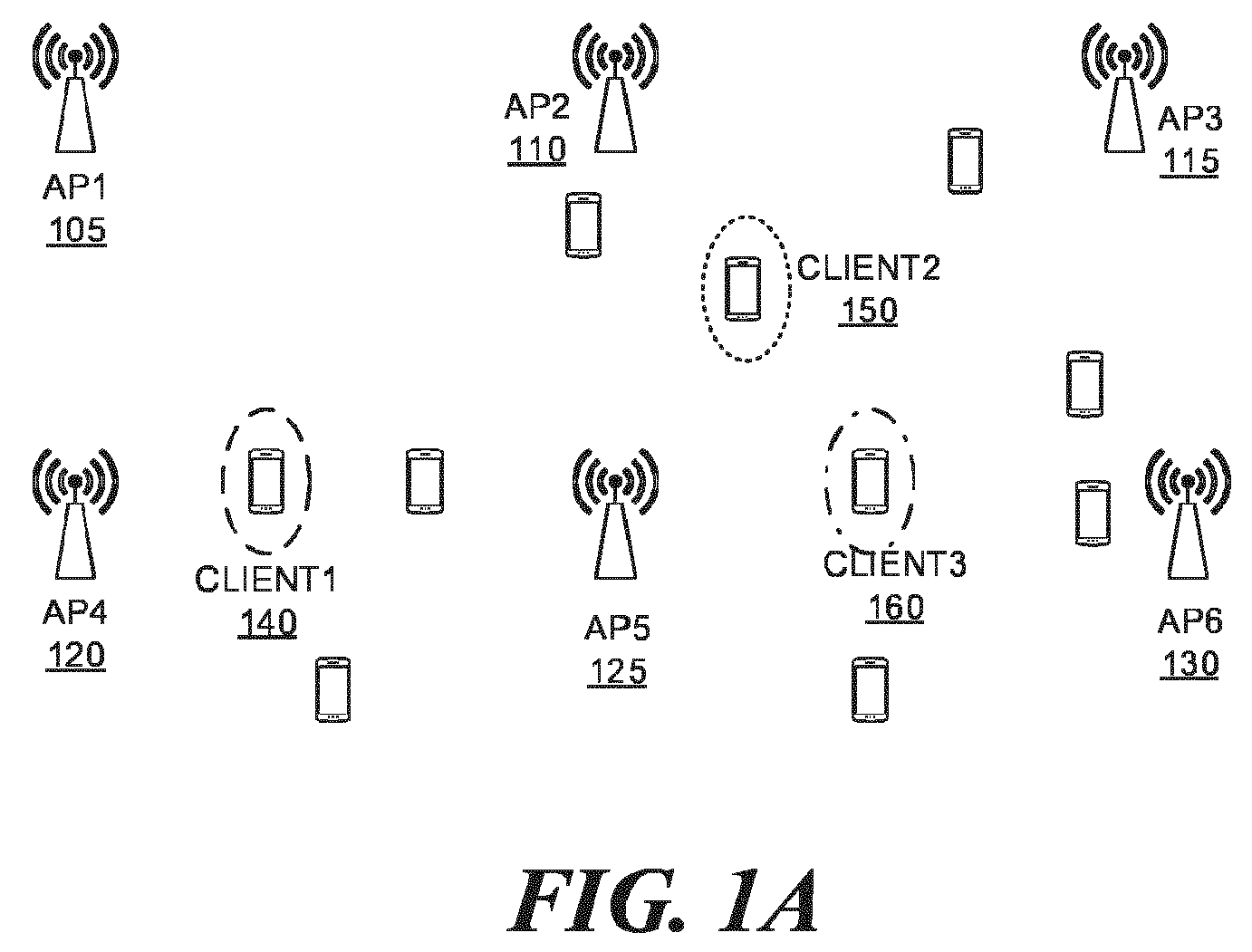
- FIGs. 1A-1E are block diagrams of example mechanisms for assigning a subset of access points in a wireless network to a high priority. According to examples of the present disclosure, the following information is considered as given.
- each AP's location is known by a co-ordinate system, for example, as shown by X and Y co-ordinates.
- a plurality of such APs are shown, including AP1 105, AP2 110, AP3 115, AP4 120, AP5 125, and AP6 130.
- each client device's location is known by a co-ordinate system as well. For illustration purposes, ten client devices are depicted in FIGs. 1A-1E .
- Table 1 shows a theoretical method assigning a subset of access points in a wireless network to a high priority.
- the system can determine a number of APs by which maximum client devices are affected. Note that the computation above runs over a single radio frequency domain. As such, it can be scalable, because radio frequency domains in a wireless network deployment are generally within tens to hundreds of APs.
- FIGs. 1A-1E shows the computation in Table 1 through a detailed example.
- the APs and client devices are shown for illustrated purposes only. Any number of APs and client devices can be deployed to utilize the method described herein to determine a subset of high priority APs in the similar fashion.
- AP1 105 to AP6 130 are deployed in a wireless network, serving ten client devices as depicted.
- the system determines a number K.
- K indicates the number of cluster centroids or the number of APs to assign to a single layer of priority.
- a K value of 3 is used for illustration purposes.
- a network administrator can determine the K value dynamically or statically depending on the network's conditions and configurations.
- K 3
- the system then can select three random client devices as the original cluster centroids. For example, Client1 140, Client2 150 and Client3 160 are selected as the original cluster centroids. All ten client devices in the network will be clustered into one of the three clusters.
- each client device is assigned to a cluster based on the closest centroid.
- Client 4 142 and Client5 144 are assigned to be in the same cluster with Client 1 140, because Client1 140 is the closest cluster centroid (as compared to Client 2 150 and Client3 160) to Client4 142 and Client5 144.
- Client6 152 and Client7 154 are assigned to be in the same cluster with Client2 150.
- Client8 162, Client9 164, and Client10 166 are assigned to be in the same cluster with Client3 160.
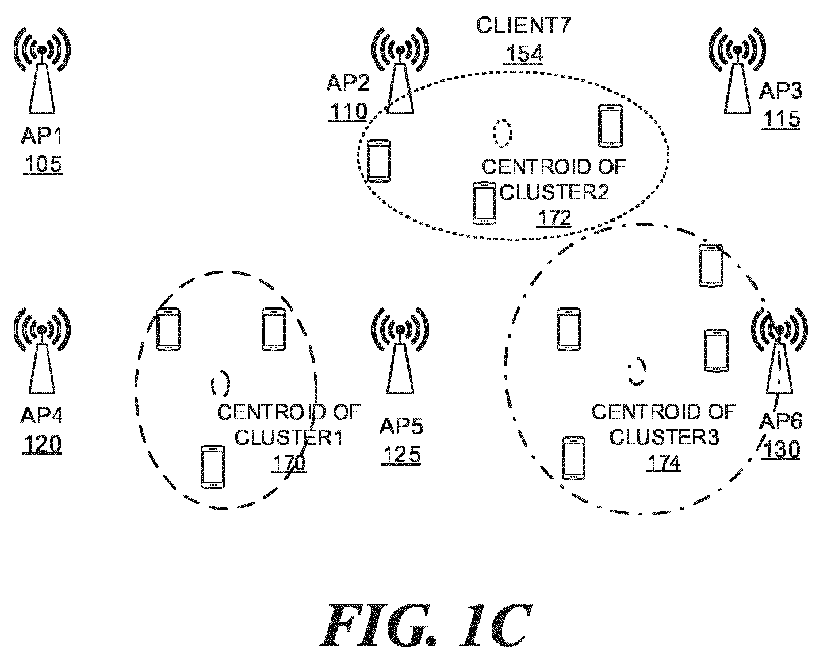
- the system can proceed to compute a centroid for each cluster of client devices.
- the cluster of Client1 140, Client4 142 and Client5 144 has centroid of cluster1 170;
- the cluster of Client2 150, Client7 152 and Client8 154 has a centroid of cluster2 172;
- the cluster of Client3 160, Client8 162, Client9 164, and Client10 166 has a centroid of cluster3 174.
- centroid location for each cluster may be different from the original cluster centroid. This is because the original cluster centroid locations are randomly selected to be co-located with K number of random client devices.
- the computed cluster centroid location corresponds to the middle of each cluster of client devices.
- a cluster centroid generally refers to a vector containing one number for each variable, where each number is the mean of a variable for the observations (e.g., client device location coordinates) in that cluster.
- the centroid can be used as a measure of the cluster location. For a particular cluster, the average distance from the centroid is the average of the distances between each client device and the centroid. The maximum distance from the centroid is the maximum of the distances between each client device and the centroid.
- centroid membership of each client device is computed again based on the distance from each client device's location to a centroid location.
- This loop of membership computation followed by new centroid location computation is carried on until the previous and the current computation's distance differs by less than or equal to a threshold percentage (p%).
- the computed centroids are shown in FIG. 1D as centroid of cluster1 170, centroid of cluster2 172, and centroid of cluster3 174.
- the locations of the virtual centroids e.g., centroid of cluster1 170, centroid of cluster2 172, and centroid of cluster3 174) are truncated to a real AP, such that the closest AP to each centroid is marked as associated with the centroid.
- centroid of cluster1 170, centroid of cluster2 172, and centroid of cluster3 174 are truncated to a real AP, such that the closest AP to each centroid is marked as associated with the centroid.
- AP5 125 is the closest AP to centroid of cluster1 170, and thus is marked as associated with centroid of cluster2 172.
- AP2 110 is the closest AP to centroid of cluster2 172, and thus is marked as associated with centroid of cluster2 172.
- AP6 130 is the closest AP to centroid of cluster3 174, and thus is marked as associated with centroid of cluster3 174.
- FIG. 1E the metric of average distance per client device to the corresponding centroid is computed as shown FIG. 1E .
- For AP5 125 the average of distance between the three closest client devices in the cluster and AP5 125 is computed.
- AP2 110 the average of distance between the three closest client devices in the cluster and AP2 110 is computed.
- AP6 130 the average of distance between the four closest client devices in the cluster and AP6 130 is computed.
- the system has computed a set of the followings:
- the system can randomly select K number of client devices for a predetermined number of times (e.g., 100 times). Then, the system can run the above processes. At the end of 100 times of computation, the system can compare the metric for all iterations (e.g., the 100 iterations) and determine the best metric solution as characterized by the lowest distance metric. Further, the system can store such information (e.g., best distance metric and K value as well as corresponding AP assignments) in a database.
- the system can change the value of K according to the outermost "for" loop in the method shown in Table 1 above and repeat the above process again. After looping through different K values, the system can identify the best AP selections and assignments for each of the K values.
- One objective of the disclosed solution is to see which APs provide the maximum impact for the client devices in a wireless network. Therefore, two controversial factors are to be balanced.
- One of the controversial factors is to reduce the number of high priority APs.
- the other of the controversial factors is to minimize the average distance between each client device in a cluster and the assigned AP for that cluster of client devices. As such, the information stored in the database is normalized and sorted after all the loops are completed.
- the system can get a gradation of solutions, where the best K versus minimum normalized distance solution may be sorted at the top.
- the best solution signifies the K APs, which affect the client devices the most.
- these K APs can be assigned with high priority (or classified into a high priority layer of APs), and considered for certain enhancements. For example, traffic and/or QoS profiles may be created for APs in the high priority layer; APs in the high priority layer may have priority in selecting its operating channels from a group of feasible channels; etc.
- power save enhancement other traffic related weights for client devices, or client health parameters can be added in addition to or in lieu of the average distance as the metric in the example method disclosed above.
- FIG. 2 is a flowchart of an example method (e.g., process) of assigning a subset of access points in a wireless network to a high priority.
- a network device e.g., a server or network controller
- can determine a plurality of client devices' locations within a wireless network operation 210.
- the network device can assign the plurality of client devices into a number of clusters (operation 220).
- the network device can calculate an original cluster centroid location for each cluster of client devices (operation 230).
- the network device can calculate an average distance between each client device in a particular cluster and the original cluster centroid location for the particular cluster (operation 240).
- the network device can iteratively adjust the number of clusters and assignment of the plurality of client devices to determine the number of clusters associated with a low number of cluster and a low average distance from each client device in a respective cluster to a respective cluster centroid location (operation 250). Moreover, the network device can assign a subset of access points in the wireless network to a high priority, whereas each AP in the subset has the closest distance to the respective cluster centroid location corresponding to the determined number of clusters (operation 260).
- the network device can further assign each client device in the plurality of client devices to a cluster whose cluster centroid location is closest to the location of the each client device.
- the network device iteratively adjusts the number of clusters and the assignment of the plurality of client devices using K-means clustering.
- the K-means clustering may aim to partition N observations into K clusters, in which each observation belongs to the cluster with the nearest mean, serving as a prototype of the cluster.
- the network device can randomly select a subset of client devices from the plurality of client devices, wherein a total number of selected client devices equals to the number of clusters; associate each of remaining client devices to one client device in the subset that is closest in distance to each respective remaining client device; and for each client device in the selected subset, identify associated remaining client devices as belonging to the same cluster of client devices.
- the network device can further give each client device in the plurality of client devices a weight value based on a client parameter. If a respective client device has a high weight value, the network device can select the respective client device frequently into the subset of client devices.
- the network device can determine a closest cluster centroid location for each of the plurality of client devices; associate each respective client device to a new cluster whose centroid location has closest distance to the each respective client device; and calculate a new cluster centroid location based on client devices associated to the new cluster.
- the network device further can determine whether a distance between a respective new cluster centroid location and original cluster centroid location is less than a predetermined threshold. If a distance between a respective new cluster centroid location and original cluster centroid location is less than a predetermined threshold, the network device can assign the high priority to the subset of access points having closest distance to each new cluster centroid location.
- the subset of access points may be (1) associated with a high priority traffic profile, (2) associated with a high priority Quality-of-Service (QoS) profile, and (3) given priority for selecting their operating channels.
- QoS Quality-of-Service
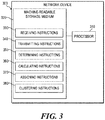
- a network device may be implemented, at least in part, by a combination of hardware and programming.
- the hardware may comprise at least one processor (e.g., processor 310) and the programming may comprise instructions, executable by the processor(s), stored on at least one machine-readable storage medium (e.g., 320).
- a network device may also include embedded memory and a software that can be executed in a host system and serve as a driver of the embedded memory.
- a "processor” may be at least one of a central processing unit (CPU), a semiconductor-based microprocessor, a graphics processing unit (GPU), a field-programmable gate array (FPGA) configured to retrieve and execute instructions, other electronic circuitry suitable for the retrieval and execution instructions stored on a machine-readable storage medium, or a combination thereof.
- CPU central processing unit
- GPU graphics processing unit
- FPGA field-programmable gate array
- the at least one processor 310 may fetch, decode, and execute instructions stored on storage medium 320 to perform the functionalities described below in relation to instructions 330-380.
- the functionalities of any of the instructions of storage medium 320 may be implemented in the form of electronic circuitry, in the form of executable instructions encoded on a machine-readable storage medium, or a combination thereof.
- the storage medium may be located either in the computing device executing the machine-readable instructions, or remote from but accessible to the computing device (e.g., via a computer network) for execution.
- storage medium 320 may be implemented by one machine-readable storage medium, or multiple machine-readable storage media.
- network device 300 includes at least one processor 310 and machine-readable storage medium 320, it may also include other suitable components, such as additional processing component(s) (e.g., processor(s), ASIC(s), etc.), storage (e.g., storage drive(s), etc.), or a combination thereof.
- additional processing component(s) e.g., processor(s), ASIC(s), etc.
- storage e.g., storage drive(s), etc.
- a "machine-readable storage medium” may be any electronic, magnetic, optical, or other physical storage apparatus to contain or store information such as executable instructions, data, and the like.
- any machine-readable storage medium described herein may be any of Random Access Memory (RAM), volatile memory, non-volatile memory, flash memory, a storage drive (e.g., a hard drive), a solid state drive, any type of storage disc (e.g., a compact disc, a DVD, etc.), and the like, or a combination thereof.
- RAM Random Access Memory
- volatile memory volatile memory
- non-volatile memory flash memory
- a storage drive e.g., a hard drive
- solid state drive any type of storage disc (e.g., a compact disc, a DVD, etc.)
- any machine-readable storage medium described herein may be non-transitory.
- a machine-readable storage medium or media may be part of an article (or article of manufacture). An article or article of manufacture may refer to any manufactured single component or multiple components.
- instructions 330-380 may be executed by processor 310 to: determine locations of a plurality of client devices within a wireless network; assign the plurality of client devices into a number of clusters; calculate an original cluster centroid location for each cluster of client devices; calculate an average distance between each client device in a particular cluster and the original cluster centroid location for the particular cluster; iteratively adjust the number of clusters and assignment of the plurality of client devices to determine the number of clusters associated with a low number of clusters and a low average distance from each client device in a respective cluster to a respective cluster centroid location; assign a subset of access points in the wireless network to a high priority, each AP in the subset having the closest distance to the respective cluster centroid location corresponding to the determined number of clusters; assign each client device in the plurality of client devices to a cluster whose cluster centroid location is closest to the location of the each client device; iteratively adjust the number of clusters and the assignment of the plurality of client devices using K-means clustering; etc.
- instructions 330-380 can be executed by processor 310 further to: randomly select a subset of client devices from the plurality of client devices, wherein a total number of selected client devices equals to the number of clusters; associate each of remaining client devices to one client device in the subset that is closest in distance to each respective remaining client device; for each client device in the selected subset, identify associated remaining client devices as belonging to the same cluster of client devices; give each client device in the plurality of client devices a weight value based on a client parameter; select the respective client device frequently into the subset of client devices in response to a respective client device having a high weight value; determine a closest cluster centroid location for each of the plurality of client devices; associate each respective client device to a new cluster whose centroid location has closest distance to the each respective client device; calculate a new cluster centroid location based on client devices associated to the new cluster; determine whether a distance between a respective new cluster centroid location and original cluster centroid location is less than a predetermined threshold; assign the high priority to the subset
Landscapes
- Engineering & Computer Science (AREA)
- Computer Networks & Wireless Communication (AREA)
- Signal Processing (AREA)
- Quality & Reliability (AREA)
- Mobile Radio Communication Systems (AREA)
Abstract


Description
- When a customer wireless network is deployed, the access points (APs) are normally deployed to cover the entire coverage area. While such deployment provides service to all enterprise clients, day-to-day wireless client behaviors are quite different and have to be handled on the fly. Thus, some APs are associated with a higher priority than other APs due to their client serviceability. The list of these high priority APs keeps changing depending on the time and circumstances. Currently, no method is developed to prioritize APs into different priority layers in order to apply certain properties.
- The following detailed description references the drawings, wherein:
-
FIGs. 1A-1E are block diagrams of example mechanisms for assigning a subset of access points in a wireless network to a high priority; -
FIG. 2 is a flowchart of an example process of assigning a subset of access points in a wireless network to a high priority; and -
FIG. 3 is a block diagram of an example network device to assign a subset of access points in a wireless network to a high priority. - Examples described herein include a method and system for assigning a subset of access points in a wireless network to a high priority. In particular, an example network device can determine a plurality of client devices' locations within a wireless network. Then, the network device can assign the plurality of client devices into a number of clusters. Furthermore, the network device can calculate an original cluster centroid location for each cluster of client devices. Then, the network device can also calculate an average distance between each client device in a particular cluster and the original cluster centroid location for the particular cluster. Next, the network device can iteratively adjust the number of clusters and assignment of the plurality of client devices to determine the number of clusters associated with a low number of cluster and a low average distance from each client device in a respective cluster to a respective cluster centroid location. Finally, the network device can assign a subset of access points in the wireless network to a high priority, such that each AP in the subset has the closest distance to the respective cluster centroid location corresponding to the determined number of clusters.
- Examples in the present disclosure generally disclose a method to prioritize APs into different layers in order to apply certain properties. This method can be broadly subdivided into two approaches. First, an example system can determine which APs should be selected into the high priority layer. Second, the example system can determine how many APs should be selected into the high priority layer. These determinations are made based on specific context of the network, and can be changing depending on the current state of the network and the wireless client devices.
- Note that, when a group of high priority APs is created, the remaining group of APs would form a low priority group. That low priority group of APs can also be used in certain key areas. A few examples of the uses of the high priority APs and low priority APs are given below as an illustration. Many more example scenarios can similarly benefit from the priority layering approach disclosed herein.
- In some examples, the network may turn off the radios on the APs belong to the lower priority group in order to reduce the electric usage. During off peak operation hours, a selected subset of high priority APs may be sufficient to provide quality network service. Therefore, turning off the radios on the remaining low priority APs can save power.
- In some examples, the radios of the low priority APs may be turned off to preserve the client roaming while achieving coverage balance. If there are very few active APs, then the wireless network may not provide sufficient network coverage for the client devices. On the other hand, if there are too many active APs, the network might suffer from roaming issues. Therefore, the example system can select the right number of APs to be given a high priority, such that the network will not suffer from extensive client roaming and also provides sufficient coverage.
- In some examples, the example system can create certain traffic and QoS profiles for APs in the high priority layer. For example, the higher priority layer can be a proxy for the APs residing in places with higher client density. The client density may be similar for day-to-day events. However, the client density might change during special events, e.g., a company-wide town hall meeting, where a large number of client devices are closely located within a single area.
- In some examples, certain APs in the higher priority layer can have high priority in selecting channels from a group of feasible channels. Sometimes, a smart phone device may not support certain wireless channels, which happen to be the operating channel of a nearby AP. As a result, the smart phone device would be connected to a faraway AP, which reduces the throughput for other client device connected to the faraway AP. With the solution described herein, the nearby AP would be given a high priority. Therefore, the nearby AP can select a wireless channel that associated client devices (e.g., the smart phone device) support.
- Currently, the information that can be used to determine an AP's priority is local to each AP. At most, current systems can try to determine a set of neighboring APs and using additional information obtained from the neighboring APs. However, even with the additional information from the neighboring APs, current systems do not take into consideration locations of client devices.
- The example method disclosed herein generally uses client devices as inputs to K-means clustering computation. The k-means clustering computation can produce a center-of-mass location of the client devices' locations. These client devices' locations represent a zone of maximum influence. Generally, the APs in that zone are the ones to be assigned with a high priority. The K-means clustering computation is used here for illustration purposes only. Other appropriate clustering method can also be used. The example method also has the advantage of having centralized information regarding to a client device's location, an AP's location and signal strengths corresponding to the connections between the AP and the client device.
- In some examples, the example method can be used in a periodic fashion. In other examples, the example method may be invoked during specific events (e.g., a town hall meeting) when the client devices are concentrated in certain areas which is not seen in day-to-day client behaviors.
-
FIGs. 1A-1E are block diagrams of example mechanisms for assigning a subset of access points in a wireless network to a high priority. According to examples of the present disclosure, the following information is considered as given. First, each AP's location is known by a co-ordinate system, for example, as shown by X and Y co-ordinates. InFIGs. 1A-1E , a plurality of such APs are shown, includingAP1 105,AP2 110,AP3 115,AP4 120, AP5 125, andAP6 130. Second. each client device's location is known by a co-ordinate system as well. For illustration purposes, ten client devices are depicted inFIGs. 1A-1E . - Table 1 below shows a theoretical method assigning a subset of access points in a wireless network to a high priority.
Table 1
 Begin Method:
 m = number of client devices
 K = number of cluster centroids or number of APs to assign
 to a single layer of priority.
 L = list of APs.
 p% = error applicable in the centroid location (e.g., 5%).
 max_STA = maximum number of client devices serviced per AP
  (e.g., 20).
 for loop for number of K from num(L)/max_STA to num(L):
        random initialization for j = 1 to 100 //used for
        removing local optima issues
               Randomly initialize K cluster centroids mu(1),
               mu(2), ..., mu(K) such that each represents an
               STA.
               Repeat until distance between previous and
               current centroid is less than p%:
                      for i = 1 to m:
                            c (i) := index (from 1 to K) of cluster
                            centroid closest to x(i)
                             //Each client device is assigned to a
                            cluster with the closest centroid.
                      for n = 1 to K:
                            mu(n):= centroid of points assigned to
                            cluster n //The previous assumption of
                            the centroid location is corrected by
                            the client devices already assigned to
                            the clusters, i.e., a centroid for a
                            cluster is computed.
               mu(n) = {1 | 1 belongs to L and 1 is closest to
               mu(n)} // Fit or truncate the centroid to the
               closest AP.
               Compute avg_distance = sum(dist of each STA with
               its centroid AP) / number of client devices.
        Choose the lowest avg_distance amongst all "j" random
        iterations and store in db (mu, avg_distance, K)
 Normalize avg_distance for entries in db
 for all entries in db:
        Create a new value per entry called score =
        normalized_avg_distance * K
 Sort using score and get the solution with the lowest score
 // lowest score gives the best solution with regard to
 client distances and the number of APs powered up.
End Method: - (1) distance metric from each client device in a cluster to the closest AP;
- (2) K value indicating the number of cluster centroid; and
- (3) AP assignment to each client device cluster.
- 1. A non-transitory machine-readable storage medium encoded with instructions executable by at least one processor of a network device, the machine-readable storage medium comprising instructions to:
- determine locations of a plurality of client devices within a wireless network;
- assign the plurality of client devices into a number of clusters;
- calculate an original cluster centroid location for each cluster of client devices;
- calculate an average distance between each client device in a particular cluster and the original cluster centroid location for the particular cluster;
- iteratively adjust the number of clusters and assignment of the plurality of client devices to determine the number of clusters associated with a low number of clusters and a low average distance from each client device in a respective cluster to a respective cluster centroid location; and
- assign a subset of access points in the wireless network to a high priority, each AP in the subset having the closest distance to the respective cluster centroid location corresponding to the determined number of clusters.
- 2. The non-transitory machine-readable storage medium of
clause 1, wherein the machine-readable storage medium further comprises instructions to:- assign each client device in the plurality of client devices to a cluster whose cluster centroid location is closest to the location of the each client device.
- 3. The non-transitory machine-readable storage medium of
clause 1, wherein the machine-readable storage medium further comprises instructions to:- iteratively adjust the number of clusters and the assignment of the plurality of client devices using K-means clustering.
- 4. The non-transitory machine-readable storage medium of
clause 1, wherein the machine-readable storage medium further comprises instructions to:- randomly select a subset of client devices from the plurality of client devices, wherein a total number of selected client devices equals to the number of clusters; associate each of remaining client devices to one client device in the subset that is closest in distance to each respective remaining client device; and
for each client device in the selected subset, identify associated remaining client devices as belonging to the same cluster of client devices.
- randomly select a subset of client devices from the plurality of client devices, wherein a total number of selected client devices equals to the number of clusters; associate each of remaining client devices to one client device in the subset that is closest in distance to each respective remaining client device; and
- 5. The non-transitory machine-readable storage medium of
clause 1, wherein the machine-readable storage medium further comprises instructions to:- determine a closest cluster centroid location for each of the plurality of client devices;
associate each respective client device to a new cluster whose centroid location has closest distance to the each respective client device;
calculate a new cluster centroid location based on client devices associated to the new cluster;
determine whether a distance between a respective new cluster centroid location and original cluster centroid location is less than a predetermined threshold; and
in response to a distance between a respective new cluster centroid location and original cluster centroid location being less than a predetermined threshold, assign the high priority to the subset of access points having closest distance to each new cluster centroid location.
- determine a closest cluster centroid location for each of the plurality of client devices;
Claims (15)
- A method comprising:determining, by a network device, a plurality of client devices' locations within a wireless network;assigning, by the network device, the plurality of client devices into a number of clusters;calculating, by the network device, an original cluster centroid location for each cluster of client devices;calculating, by the network device, an average distance between each client device in a particular cluster and the original cluster centroid location for the particular cluster;iteratively adjusting, by the network device, the number of clusters and assignment of the plurality of client devices to determine the number of clusters associated with a low number of cluster and a low average distance from each client device in a respective cluster to a respective cluster centroid location; andassigning, by the network device, a subset of access points in the wireless network to a high priority, each AP in the subset having the closest distance to the respective cluster centroid location corresponding to the determined number of clusters.
- The method of claim 1, further comprising:assigning, by the network device, each client device in the plurality of client devices to a cluster whose cluster centroid location is closest to the location of the each client device.
- The method of either of claims 1 and 2, further comprising:iteratively adjusting, by the network device, the number of clusters and the assignment of the plurality of client devices using K-means clustering.
- The method of any of claims 1 to 3, wherein assigning the plurality of client devices into the number of clusters further comprising:randomly selecting a subset of client devices from the plurality of client devices, wherein a total number of selected client devices equals to the number of clusters;associating each of remaining client devices to one client device in the subset that is closest in distance to each respective remaining client device; andfor each client device in the selected subset, identifying associated remaining client devices as belonging to the same cluster of client devices.
- The method of claim 4, further comprising:giving each client device in the plurality of client devices a weight value based on a client parameter; andin response to a respective client device having a high weight value, selecting the respective client device frequently into the subset of client devices.
- The method of any of claims 1 to 5, further comprising:determining a closest cluster centroid location for each of the plurality of client devices;associating each respective client device to a new cluster whose centroid location has closest distance to the each respective client device; andcalculating a new cluster centroid location based on client devices associated to the new cluster.
- The method of claim 6, further comprising:determining whether a distance between a respective new cluster centroid location and original cluster centroid location is less than a predetermined threshold; andin response to a distance between a respective new cluster centroid location and original cluster centroid location being less than a predetermined threshold, assigning the high priority to the subset of access points having closest distance to each new cluster centroid location.
- The method of any of claims 1 to 7, wherein the subset of access points are (1) associated with a high priority traffic profile, (2) associated with a high priority Quality-of-Service (QoS) profile, and (3) given priority for selecting their operating channels.
- A network device, comprising at least:a memory;a processor executing instructions from the memory to:determine locations of a plurality of client devices within a wireless network;assign the plurality of client devices into a number of clusters;calculate an original cluster centroid location for each cluster of client devices;calculate an average distance between each client device in a particular cluster and the original cluster centroid location for the particular cluster;iteratively adjust the number of clusters and assignment of the plurality of client devices to determine the number of clusters associated with a low number of clusters and a low average distance from each client device in a respective cluster to a respective cluster centroid location; andassign a subset of access points in the wireless network to a high priority, each AP in the subset having the closest distance to the respective cluster centroid location corresponding to the determined number of clusters.
- The network device of claim 9, wherein the processor further executes instructions from the memory to:assign each client device in the plurality of client devices to a cluster whose cluster centroid location is closest to the location of the each client device.
- The network device of either of claims 9 to 10, wherein the processor further executes instructions from the memory to:iteratively adjust the number of clusters and the assignment of the plurality of client devices using K-means clustering.
- The network device of any of claims 9 to 11, wherein the processor further executes instructions from the memory to:randomly select a subset of client devices from the plurality of client devices, wherein a total number of selected client devices equals to the number of clusters;associate each of remaining client devices to one client device in the subset that is closest in distance to each respective remaining client device; andfor each client device in the selected subset, identify associated remaining client devices as belonging to the same cluster of client devices.
- The network device of claim 12, wherein the processor further executes instructions from the memory to:give each client device in the plurality of client devices a weight value based on a client parameter; andselect the respective client device frequently into the subset of client devices in response to a respective client device having a high weight value.
- The network device of any of claims 9 to 13, wherein the processor further executes instructions from the memory to:determine a closest cluster centroid location for each of the plurality of client devices;associate each respective client device to a new cluster whose centroid location has closest distance to the each respective client device; andcalculate a new cluster centroid location based on client devices associated to the new cluster.
- The network device of claim 14, wherein the processor further executes instructions from the memory to:determine whether a distance between a respective new cluster centroid location and original cluster centroid location is less than a predetermined threshold;in response to a distance between a respective new cluster centroid location and original cluster centroid location being less than a predetermined threshold, assign the high priority to the subset of access points having closest distance to each new cluster centroid location.
Applications Claiming Priority (1)
| Application Number | Priority Date | Filing Date | Title |
|---|---|---|---|
| US15/610,319 US9974043B1 (en) | 2017-05-31 | 2017-05-31 | Assigning a subset of access points in a wireless network to a high priority |
Publications (2)
| Publication Number | Publication Date |
|---|---|
| EP3410766A1 true EP3410766A1 (en) | 2018-12-05 |
| EP3410766B1 EP3410766B1 (en) | 2020-05-27 |
Family
ID=60201841
Family Applications (1)
| Application Number | Title | Priority Date | Filing Date |
|---|---|---|---|
| EP17198669.8A Active EP3410766B1 (en) | 2017-05-31 | 2017-10-26 | Assigning a subset of access points in a wireless network to a high priority |
Country Status (3)
| Country | Link |
|---|---|
| US (3) | US9974043B1 (en) |
| EP (1) | EP3410766B1 (en) |
| CN (1) | CN108990114B (en) |
Families Citing this family (6)
| Publication number | Priority date | Publication date | Assignee | Title |
|---|---|---|---|---|
| CN109548161B (en) * | 2018-12-17 | 2023-02-17 | 深圳信息职业技术学院 | A method, device and terminal equipment for wireless resource scheduling |
| CN109699043B (en) * | 2018-12-25 | 2022-10-21 | 北京云中融信网络科技有限公司 | Link establishment method and device |
| US10904851B1 (en) * | 2020-01-21 | 2021-01-26 | Cisco Technology, Inc. | Systems and methods for determining locations of access points |
| US10887860B1 (en) * | 2020-06-25 | 2021-01-05 | Link Labs, Inc. | Apparatus and method for optimizing wireless end node location determination via targeted proximity ranging to clusters of other wireless nodes |
| US12490113B2 (en) | 2022-04-27 | 2025-12-02 | Cisco Technology, Inc. | Grouping access points for automatic frequency coordination |
| CN115297114B (en) * | 2022-08-02 | 2024-07-02 | 中国电信股份有限公司 | Node allocation method and device, storage medium and electronic equipment |
Citations (3)
| Publication number | Priority date | Publication date | Assignee | Title |
|---|---|---|---|---|
| US20130024579A1 (en) * | 2011-07-19 | 2013-01-24 | Telefonaktiebolaget L M Ericsson (Publ) | Controller Placement for Split Architecture Networks |
| US20140359626A1 (en) * | 2013-05-30 | 2014-12-04 | Qualcomm Incorporated | Parallel method for agglomerative clustering of non-stationary data |
| US8983470B1 (en) * | 2012-01-23 | 2015-03-17 | Eden Rock Communications, Llc | Automatic identification of clustered near neighbor cells in wireless networks |
Family Cites Families (15)
| Publication number | Priority date | Publication date | Assignee | Title |
|---|---|---|---|---|
| US6236365B1 (en) * | 1996-09-09 | 2001-05-22 | Tracbeam, Llc | Location of a mobile station using a plurality of commercial wireless infrastructures |
| US7580399B2 (en) | 2005-09-14 | 2009-08-25 | Cisco Technology, Inc. | Automatic partitioning of wireless access points into overlay and underlay networks |
| CN101047909A (en) * | 2006-06-15 | 2007-10-03 | 华为技术有限公司 | Channel resource allocation method in trunking service and trunking communication system |
| WO2008097694A1 (en) * | 2007-02-05 | 2008-08-14 | Andrew Corporation | System and method for optimizing location estimate of mobile unit |
| WO2010037128A1 (en) | 2008-09-29 | 2010-04-01 | Kabushiki Kaisha Toshiba | Pre-evaluation of multiple network access points |
| US8433334B2 (en) * | 2010-01-15 | 2013-04-30 | Apple Inc. | Managing a location database for network-based positioning system |
| US20120170471A1 (en) * | 2010-12-31 | 2012-07-05 | Openpeak Inc. | Automated access point selection to provide communication network presence to a communication device |
| US9451418B2 (en) * | 2012-10-19 | 2016-09-20 | Qualcomm Incorporated | Group association based on network determined location |
| US9578487B2 (en) * | 2013-03-14 | 2017-02-21 | Aruba Networks, Inc. | Method and system for dynamic determination of potential access points for propagating client information |
| US9998969B2 (en) * | 2013-03-15 | 2018-06-12 | Facebook, Inc. | Portable platform for networked computing |
| US9225602B2 (en) | 2013-07-30 | 2015-12-29 | Aruba Networks, Inc. | Dynamic grouping and configuration of access points |
| US9326294B2 (en) * | 2014-07-29 | 2016-04-26 | Aruba Networks, Inc. | System and method for grouping and assigning channels in a network system |
| US9642040B2 (en) * | 2014-09-19 | 2017-05-02 | Qualcomm Incorporated | Load balancing in a wireless network with multiple access points |
| US20160227369A1 (en) | 2015-01-30 | 2016-08-04 | Qualcomm Incorporated | Multi-layer assistance data caching |
| CN104883397B (en) * | 2015-05-11 | 2018-11-16 | 广州微信通讯技术有限公司 | A kind of CoMP transmission method based on cloud computing |
-
2017
- 2017-05-31 US US15/610,319 patent/US9974043B1/en active Active
- 2017-10-26 EP EP17198669.8A patent/EP3410766B1/en active Active
- 2017-10-27 CN CN201711023094.4A patent/CN108990114B/en active Active
-
2018
- 2018-04-16 US US15/954,024 patent/US10154471B1/en active Active
- 2018-12-01 US US16/207,109 patent/US10764859B2/en active Active
Patent Citations (3)
| Publication number | Priority date | Publication date | Assignee | Title |
|---|---|---|---|---|
| US20130024579A1 (en) * | 2011-07-19 | 2013-01-24 | Telefonaktiebolaget L M Ericsson (Publ) | Controller Placement for Split Architecture Networks |
| US8983470B1 (en) * | 2012-01-23 | 2015-03-17 | Eden Rock Communications, Llc | Automatic identification of clustered near neighbor cells in wireless networks |
| US20140359626A1 (en) * | 2013-05-30 | 2014-12-04 | Qualcomm Incorporated | Parallel method for agglomerative clustering of non-stationary data |
Also Published As
| Publication number | Publication date |
|---|---|
| CN108990114B (en) | 2021-10-29 |
| US10764859B2 (en) | 2020-09-01 |
| US9974043B1 (en) | 2018-05-15 |
| US10154471B1 (en) | 2018-12-11 |
| US20190104495A1 (en) | 2019-04-04 |
| CN108990114A (en) | 2018-12-11 |
| EP3410766B1 (en) | 2020-05-27 |
| US20180352532A1 (en) | 2018-12-06 |
Similar Documents
| Publication | Publication Date | Title |
|---|---|---|
| US10764859B2 (en) | Assigning a subset of access points in a wireless network to a high priority | |
| Piltyay et al. | Wireless sensor network connectivity in heterogeneous 5G mobile systems | |
| US10129790B2 (en) | Facilitation of idle mode traffic load balancing | |
| US9148839B2 (en) | Evolutionary algorithms for geographic load balancing using a distributed antenna system | |
| US9867083B2 (en) | Wireless network controller load balancing | |
| CN111385805B (en) | Method and device for generating radio frequency fingerprint information base and positioning grids | |
| CN111082840B (en) | Method and device for optimizing antenna broadcast beam | |
| CN109640340A (en) | Base station data processing method, device, equipment and computer readable storage medium | |
| EP3997823A1 (en) | Method and apparatus for carrier aggregation optimization | |
| WO2014003770A1 (en) | Generation of access point configuration change based on a generated coverage monitor | |
| CN105592551B (en) | A kind of method for channel allocation and device | |
| CN113590211A (en) | Calculation unloading method based on PSO-DE algorithm | |
| KR101134196B1 (en) | Optimal designing method and device of location area planning using artifical bee colony in wireless communication network | |
| KR102192239B1 (en) | Method for Cluster-based Load Balancing in Cellular Networks | |
| CN115190493B (en) | A network base station deployment optimization method, system, device and storage medium based on hard core distance and dynamic payment mechanism | |
| CN116755786A (en) | A MEC computing offloading method for balanced allocation of multi-user resources | |
| CN113825198B (en) | Cell reselection method, network management equipment, base station and storage medium | |
| CN119182702A (en) | Network segmentation method, device, electronic equipment and storage medium | |
| CN108260165B (en) | Method and device for load balancing among sectors | |
| JP2015177274A (en) | Device and method for calculation of base station parameter, and control program | |
| CN109121140B (en) | Parameter configuration method and equipment for wireless network cell | |
| US20230047986A1 (en) | System and method for communication load balancing in unseen traffic scenarios | |
| CN110650483A (en) | Equipment model selection method and device | |
| US12634759B2 (en) | System and method for communication load balancing in unseen traffic scenarios | |
| CN110753353B (en) | A kind of equipment selection method and device |
Legal Events
| Date | Code | Title | Description |
|---|---|---|---|
| PUAI | Public reference made under article 153(3) epc to a published international application that has entered the european phase |
Free format text: ORIGINAL CODE: 0009012 |
|
| STAA | Information on the status of an ep patent application or granted ep patent |
Free format text: STATUS: REQUEST FOR EXAMINATION WAS MADE |
|
| 17P | Request for examination filed |
Effective date: 20171026 |
|
| AK | Designated contracting states |
Kind code of ref document: A1 Designated state(s): AL AT BE BG CH CY CZ DE DK EE ES FI FR GB GR HR HU IE IS IT LI LT LU LV MC MK MT NL NO PL PT RO RS SE SI SK SM TR |
|
| AX | Request for extension of the european patent |
Extension state: BA ME |
|
| RAP1 | Party data changed (applicant data changed or rights of an application transferred) |
Owner name: HEWLETT PACKARD ENTERPRISE DEVELOPMENT LP |
|
| GRAP | Despatch of communication of intention to grant a patent |
Free format text: ORIGINAL CODE: EPIDOSNIGR1 |
|
| STAA | Information on the status of an ep patent application or granted ep patent |
Free format text: STATUS: GRANT OF PATENT IS INTENDED |
|
| RIC1 | Information provided on ipc code assigned before grant |
Ipc: H04W 52/02 20090101ALN20200123BHEP Ipc: H04W 24/04 20090101AFI20200123BHEP |
|
| RIC1 | Information provided on ipc code assigned before grant |
Ipc: H04W 52/02 20090101ALN20200128BHEP Ipc: H04W 24/04 20090101AFI20200128BHEP |
|
| INTG | Intention to grant announced |
Effective date: 20200220 |
|
| GRAS | Grant fee paid |
Free format text: ORIGINAL CODE: EPIDOSNIGR3 |
|
| GRAA | (expected) grant |
Free format text: ORIGINAL CODE: 0009210 |
|
| STAA | Information on the status of an ep patent application or granted ep patent |
Free format text: STATUS: THE PATENT HAS BEEN GRANTED |
|
| AK | Designated contracting states |
Kind code of ref document: B1 Designated state(s): AL AT BE BG CH CY CZ DE DK EE ES FI FR GB GR HR HU IE IS IT LI LT LU LV MC MK MT NL NO PL PT RO RS SE SI SK SM TR |
|
| REG | Reference to a national code |
Ref country code: GB Ref legal event code: FG4D |
|
| REG | Reference to a national code |
Ref country code: CH Ref legal event code: EP |
|
| REG | Reference to a national code |
Ref country code: AT Ref legal event code: REF Ref document number: 1275871 Country of ref document: AT Kind code of ref document: T Effective date: 20200615 |
|
| REG | Reference to a national code |
Ref country code: DE Ref legal event code: R096 Ref document number: 602017017222 Country of ref document: DE |
|
| REG | Reference to a national code |
Ref country code: LT Ref legal event code: MG4D |
|
| PG25 | Lapsed in a contracting state [announced via postgrant information from national office to epo] |
Ref country code: LT Free format text: LAPSE BECAUSE OF FAILURE TO SUBMIT A TRANSLATION OF THE DESCRIPTION OR TO PAY THE FEE WITHIN THE PRESCRIBED TIME-LIMIT Effective date: 20200527 Ref country code: IS Free format text: LAPSE BECAUSE OF FAILURE TO SUBMIT A TRANSLATION OF THE DESCRIPTION OR TO PAY THE FEE WITHIN THE PRESCRIBED TIME-LIMIT Effective date: 20200927 Ref country code: PT Free format text: LAPSE BECAUSE OF FAILURE TO SUBMIT A TRANSLATION OF THE DESCRIPTION OR TO PAY THE FEE WITHIN THE PRESCRIBED TIME-LIMIT Effective date: 20200928 Ref country code: GR Free format text: LAPSE BECAUSE OF FAILURE TO SUBMIT A TRANSLATION OF THE DESCRIPTION OR TO PAY THE FEE WITHIN THE PRESCRIBED TIME-LIMIT Effective date: 20200828 Ref country code: NO Free format text: LAPSE BECAUSE OF FAILURE TO SUBMIT A TRANSLATION OF THE DESCRIPTION OR TO PAY THE FEE WITHIN THE PRESCRIBED TIME-LIMIT Effective date: 20200827 Ref country code: FI Free format text: LAPSE BECAUSE OF FAILURE TO SUBMIT A TRANSLATION OF THE DESCRIPTION OR TO PAY THE FEE WITHIN THE PRESCRIBED TIME-LIMIT Effective date: 20200527 Ref country code: SE Free format text: LAPSE BECAUSE OF FAILURE TO SUBMIT A TRANSLATION OF THE DESCRIPTION OR TO PAY THE FEE WITHIN THE PRESCRIBED TIME-LIMIT Effective date: 20200527 |
|
| REG | Reference to a national code |
Ref country code: NL Ref legal event code: MP Effective date: 20200527 |
|
| PG25 | Lapsed in a contracting state [announced via postgrant information from national office to epo] |
Ref country code: LV Free format text: LAPSE BECAUSE OF FAILURE TO SUBMIT A TRANSLATION OF THE DESCRIPTION OR TO PAY THE FEE WITHIN THE PRESCRIBED TIME-LIMIT Effective date: 20200527 Ref country code: HR Free format text: LAPSE BECAUSE OF FAILURE TO SUBMIT A TRANSLATION OF THE DESCRIPTION OR TO PAY THE FEE WITHIN THE PRESCRIBED TIME-LIMIT Effective date: 20200527 Ref country code: BG Free format text: LAPSE BECAUSE OF FAILURE TO SUBMIT A TRANSLATION OF THE DESCRIPTION OR TO PAY THE FEE WITHIN THE PRESCRIBED TIME-LIMIT Effective date: 20200827 Ref country code: RS Free format text: LAPSE BECAUSE OF FAILURE TO SUBMIT A TRANSLATION OF THE DESCRIPTION OR TO PAY THE FEE WITHIN THE PRESCRIBED TIME-LIMIT Effective date: 20200527 |
|
| REG | Reference to a national code |
Ref country code: AT Ref legal event code: MK05 Ref document number: 1275871 Country of ref document: AT Kind code of ref document: T Effective date: 20200527 |
|
| PG25 | Lapsed in a contracting state [announced via postgrant information from national office to epo] |
Ref country code: AL Free format text: LAPSE BECAUSE OF FAILURE TO SUBMIT A TRANSLATION OF THE DESCRIPTION OR TO PAY THE FEE WITHIN THE PRESCRIBED TIME-LIMIT Effective date: 20200527 Ref country code: NL Free format text: LAPSE BECAUSE OF FAILURE TO SUBMIT A TRANSLATION OF THE DESCRIPTION OR TO PAY THE FEE WITHIN THE PRESCRIBED TIME-LIMIT Effective date: 20200527 |
|
| PG25 | Lapsed in a contracting state [announced via postgrant information from national office to epo] |
Ref country code: CZ Free format text: LAPSE BECAUSE OF FAILURE TO SUBMIT A TRANSLATION OF THE DESCRIPTION OR TO PAY THE FEE WITHIN THE PRESCRIBED TIME-LIMIT Effective date: 20200527 Ref country code: IT Free format text: LAPSE BECAUSE OF FAILURE TO SUBMIT A TRANSLATION OF THE DESCRIPTION OR TO PAY THE FEE WITHIN THE PRESCRIBED TIME-LIMIT Effective date: 20200527 Ref country code: RO Free format text: LAPSE BECAUSE OF FAILURE TO SUBMIT A TRANSLATION OF THE DESCRIPTION OR TO PAY THE FEE WITHIN THE PRESCRIBED TIME-LIMIT Effective date: 20200527 Ref country code: ES Free format text: LAPSE BECAUSE OF FAILURE TO SUBMIT A TRANSLATION OF THE DESCRIPTION OR TO PAY THE FEE WITHIN THE PRESCRIBED TIME-LIMIT Effective date: 20200527 Ref country code: DK Free format text: LAPSE BECAUSE OF FAILURE TO SUBMIT A TRANSLATION OF THE DESCRIPTION OR TO PAY THE FEE WITHIN THE PRESCRIBED TIME-LIMIT Effective date: 20200527 Ref country code: EE Free format text: LAPSE BECAUSE OF FAILURE TO SUBMIT A TRANSLATION OF THE DESCRIPTION OR TO PAY THE FEE WITHIN THE PRESCRIBED TIME-LIMIT Effective date: 20200527 Ref country code: SM Free format text: LAPSE BECAUSE OF FAILURE TO SUBMIT A TRANSLATION OF THE DESCRIPTION OR TO PAY THE FEE WITHIN THE PRESCRIBED TIME-LIMIT Effective date: 20200527 Ref country code: AT Free format text: LAPSE BECAUSE OF FAILURE TO SUBMIT A TRANSLATION OF THE DESCRIPTION OR TO PAY THE FEE WITHIN THE PRESCRIBED TIME-LIMIT Effective date: 20200527 |
|
| PG25 | Lapsed in a contracting state [announced via postgrant information from national office to epo] |
Ref country code: SK Free format text: LAPSE BECAUSE OF FAILURE TO SUBMIT A TRANSLATION OF THE DESCRIPTION OR TO PAY THE FEE WITHIN THE PRESCRIBED TIME-LIMIT Effective date: 20200527 Ref country code: PL Free format text: LAPSE BECAUSE OF FAILURE TO SUBMIT A TRANSLATION OF THE DESCRIPTION OR TO PAY THE FEE WITHIN THE PRESCRIBED TIME-LIMIT Effective date: 20200527 |
|
| REG | Reference to a national code |
Ref country code: DE Ref legal event code: R097 Ref document number: 602017017222 Country of ref document: DE |
|
| PLBE | No opposition filed within time limit |
Free format text: ORIGINAL CODE: 0009261 |
|
| STAA | Information on the status of an ep patent application or granted ep patent |
Free format text: STATUS: NO OPPOSITION FILED WITHIN TIME LIMIT |
|
| 26N | No opposition filed |
Effective date: 20210302 |
|
| PG25 | Lapsed in a contracting state [announced via postgrant information from national office to epo] |
Ref country code: SI Free format text: LAPSE BECAUSE OF FAILURE TO SUBMIT A TRANSLATION OF THE DESCRIPTION OR TO PAY THE FEE WITHIN THE PRESCRIBED TIME-LIMIT Effective date: 20200527 |
|
| REG | Reference to a national code |
Ref country code: CH Ref legal event code: PL |
|
| PG25 | Lapsed in a contracting state [announced via postgrant information from national office to epo] |
Ref country code: LU Free format text: LAPSE BECAUSE OF NON-PAYMENT OF DUE FEES Effective date: 20201026 Ref country code: MC Free format text: LAPSE BECAUSE OF FAILURE TO SUBMIT A TRANSLATION OF THE DESCRIPTION OR TO PAY THE FEE WITHIN THE PRESCRIBED TIME-LIMIT Effective date: 20200527 |
|
| REG | Reference to a national code |
Ref country code: BE Ref legal event code: MM Effective date: 20201031 |
|
| PG25 | Lapsed in a contracting state [announced via postgrant information from national office to epo] |
Ref country code: FR Free format text: LAPSE BECAUSE OF NON-PAYMENT OF DUE FEES Effective date: 20201031 |
|
| PG25 | Lapsed in a contracting state [announced via postgrant information from national office to epo] |
Ref country code: BE Free format text: LAPSE BECAUSE OF NON-PAYMENT OF DUE FEES Effective date: 20201031 Ref country code: CH Free format text: LAPSE BECAUSE OF NON-PAYMENT OF DUE FEES Effective date: 20201031 Ref country code: LI Free format text: LAPSE BECAUSE OF NON-PAYMENT OF DUE FEES Effective date: 20201031 |
|
| PG25 | Lapsed in a contracting state [announced via postgrant information from national office to epo] |
Ref country code: IE Free format text: LAPSE BECAUSE OF NON-PAYMENT OF DUE FEES Effective date: 20201026 |
|
| PG25 | Lapsed in a contracting state [announced via postgrant information from national office to epo] |
Ref country code: TR Free format text: LAPSE BECAUSE OF FAILURE TO SUBMIT A TRANSLATION OF THE DESCRIPTION OR TO PAY THE FEE WITHIN THE PRESCRIBED TIME-LIMIT Effective date: 20200527 Ref country code: MT Free format text: LAPSE BECAUSE OF FAILURE TO SUBMIT A TRANSLATION OF THE DESCRIPTION OR TO PAY THE FEE WITHIN THE PRESCRIBED TIME-LIMIT Effective date: 20200527 Ref country code: CY Free format text: LAPSE BECAUSE OF FAILURE TO SUBMIT A TRANSLATION OF THE DESCRIPTION OR TO PAY THE FEE WITHIN THE PRESCRIBED TIME-LIMIT Effective date: 20200527 |
|
| PG25 | Lapsed in a contracting state [announced via postgrant information from national office to epo] |
Ref country code: MK Free format text: LAPSE BECAUSE OF FAILURE TO SUBMIT A TRANSLATION OF THE DESCRIPTION OR TO PAY THE FEE WITHIN THE PRESCRIBED TIME-LIMIT Effective date: 20200527 |
|
| REG | Reference to a national code |
Ref country code: DE Ref legal event code: R082 Ref document number: 602017017222 Country of ref document: DE Representative=s name: PROCK, THOMAS, DR., GB |
|
| REG | Reference to a national code |
Ref country code: DE Ref legal event code: R081 Ref document number: 602017017222 Country of ref document: DE Owner name: HEWLETT PACKARD ENTERPRISE DEVELOPMENT LP, SPR, US Free format text: FORMER OWNER: HEWLETT PACKARD ENTERPRISE DEVELOPMENT LP, HOUSTON, TEX., US |
|
| PGFP | Annual fee paid to national office [announced via postgrant information from national office to epo] |
Ref country code: DE Payment date: 20251028 Year of fee payment: 9 |
|
| PGFP | Annual fee paid to national office [announced via postgrant information from national office to epo] |
Ref country code: GB Payment date: 20251023 Year of fee payment: 9 |