EP3409553A1 - System and method for automated execution of a maneuver or behavior of a system - Google Patents
System and method for automated execution of a maneuver or behavior of a system Download PDFInfo
- Publication number
- EP3409553A1 EP3409553A1 EP17174041.8A EP17174041A EP3409553A1 EP 3409553 A1 EP3409553 A1 EP 3409553A1 EP 17174041 A EP17174041 A EP 17174041A EP 3409553 A1 EP3409553 A1 EP 3409553A1
- Authority
- EP
- European Patent Office
- Prior art keywords
- maneuver
- behavior
- options
- operator
- situation
- Prior art date
- Legal status (The legal status is an assumption and is not a legal conclusion. Google has not performed a legal analysis and makes no representation as to the accuracy of the status listed.)
- Granted
Links
Images

Classifications
-
- B—PERFORMING OPERATIONS; TRANSPORTING
- B60—VEHICLES IN GENERAL
- B60W—CONJOINT CONTROL OF VEHICLE SUB-UNITS OF DIFFERENT TYPE OR DIFFERENT FUNCTION; CONTROL SYSTEMS SPECIALLY ADAPTED FOR HYBRID VEHICLES; ROAD VEHICLE DRIVE CONTROL SYSTEMS FOR PURPOSES NOT RELATED TO THE CONTROL OF A PARTICULAR SUB-UNIT
- B60W50/00—Details of control systems for road vehicle drive control not related to the control of a particular sub-unit, e.g. process diagnostic or vehicle driver interfaces
- B60W50/08—Interaction between the driver and the control system
- B60W50/14—Means for informing the driver, warning the driver or prompting a driver intervention
- B60W50/16—Tactile feedback to the driver, e.g. vibration or force feedback to the driver on the steering wheel or the accelerator pedal
-
- B—PERFORMING OPERATIONS; TRANSPORTING
- B60—VEHICLES IN GENERAL
- B60K—ARRANGEMENT OR MOUNTING OF PROPULSION UNITS OR OF TRANSMISSIONS IN VEHICLES; ARRANGEMENT OR MOUNTING OF PLURAL DIVERSE PRIME-MOVERS IN VEHICLES; AUXILIARY DRIVES FOR VEHICLES; INSTRUMENTATION OR DASHBOARDS FOR VEHICLES; ARRANGEMENTS IN CONNECTION WITH COOLING, AIR INTAKE, GAS EXHAUST OR FUEL SUPPLY OF PROPULSION UNITS IN VEHICLES
- B60K35/00—Instruments specially adapted for vehicles; Arrangement of instruments in or on vehicles
- B60K35/10—Input arrangements, i.e. from user to vehicle, associated with vehicle functions or specially adapted therefor
-
- B—PERFORMING OPERATIONS; TRANSPORTING
- B60—VEHICLES IN GENERAL
- B60K—ARRANGEMENT OR MOUNTING OF PROPULSION UNITS OR OF TRANSMISSIONS IN VEHICLES; ARRANGEMENT OR MOUNTING OF PLURAL DIVERSE PRIME-MOVERS IN VEHICLES; AUXILIARY DRIVES FOR VEHICLES; INSTRUMENTATION OR DASHBOARDS FOR VEHICLES; ARRANGEMENTS IN CONNECTION WITH COOLING, AIR INTAKE, GAS EXHAUST OR FUEL SUPPLY OF PROPULSION UNITS IN VEHICLES
- B60K35/00—Instruments specially adapted for vehicles; Arrangement of instruments in or on vehicles
- B60K35/20—Output arrangements, i.e. from vehicle to user, associated with vehicle functions or specially adapted therefor
- B60K35/21—Output arrangements, i.e. from vehicle to user, associated with vehicle functions or specially adapted therefor using visual output, e.g. blinking lights or matrix displays
- B60K35/22—Display screens
-
- B—PERFORMING OPERATIONS; TRANSPORTING
- B60—VEHICLES IN GENERAL
- B60K—ARRANGEMENT OR MOUNTING OF PROPULSION UNITS OR OF TRANSMISSIONS IN VEHICLES; ARRANGEMENT OR MOUNTING OF PLURAL DIVERSE PRIME-MOVERS IN VEHICLES; AUXILIARY DRIVES FOR VEHICLES; INSTRUMENTATION OR DASHBOARDS FOR VEHICLES; ARRANGEMENTS IN CONNECTION WITH COOLING, AIR INTAKE, GAS EXHAUST OR FUEL SUPPLY OF PROPULSION UNITS IN VEHICLES
- B60K35/00—Instruments specially adapted for vehicles; Arrangement of instruments in or on vehicles
- B60K35/20—Output arrangements, i.e. from vehicle to user, associated with vehicle functions or specially adapted therefor
- B60K35/25—Output arrangements, i.e. from vehicle to user, associated with vehicle functions or specially adapted therefor using haptic output
-
- B—PERFORMING OPERATIONS; TRANSPORTING
- B60—VEHICLES IN GENERAL
- B60W—CONJOINT CONTROL OF VEHICLE SUB-UNITS OF DIFFERENT TYPE OR DIFFERENT FUNCTION; CONTROL SYSTEMS SPECIALLY ADAPTED FOR HYBRID VEHICLES; ROAD VEHICLE DRIVE CONTROL SYSTEMS FOR PURPOSES NOT RELATED TO THE CONTROL OF A PARTICULAR SUB-UNIT
- B60W30/00—Purposes of road vehicle drive control systems not related to the control of a particular sub-unit, e.g. of systems using conjoint control of vehicle sub-units
- B60W30/18—Propelling the vehicle
- B60W30/18181—Propulsion control with common controlling member for different functions
-
- B—PERFORMING OPERATIONS; TRANSPORTING
- B60—VEHICLES IN GENERAL
- B60W—CONJOINT CONTROL OF VEHICLE SUB-UNITS OF DIFFERENT TYPE OR DIFFERENT FUNCTION; CONTROL SYSTEMS SPECIALLY ADAPTED FOR HYBRID VEHICLES; ROAD VEHICLE DRIVE CONTROL SYSTEMS FOR PURPOSES NOT RELATED TO THE CONTROL OF A PARTICULAR SUB-UNIT
- B60W50/00—Details of control systems for road vehicle drive control not related to the control of a particular sub-unit, e.g. process diagnostic or vehicle driver interfaces
- B60W50/08—Interaction between the driver and the control system
- B60W50/14—Means for informing the driver, warning the driver or prompting a driver intervention
-
- G—PHYSICS
- G06—COMPUTING OR CALCULATING; COUNTING
- G06F—ELECTRIC DIGITAL DATA PROCESSING
- G06F3/00—Input arrangements for transferring data to be processed into a form capable of being handled by the computer; Output arrangements for transferring data from processing unit to output unit, e.g. interface arrangements
- G06F3/01—Input arrangements or combined input and output arrangements for interaction between user and computer
- G06F3/016—Input arrangements with force or tactile feedback as computer generated output to the user
-
- G—PHYSICS
- G06—COMPUTING OR CALCULATING; COUNTING
- G06F—ELECTRIC DIGITAL DATA PROCESSING
- G06F3/00—Input arrangements for transferring data to be processed into a form capable of being handled by the computer; Output arrangements for transferring data from processing unit to output unit, e.g. interface arrangements
- G06F3/01—Input arrangements or combined input and output arrangements for interaction between user and computer
- G06F3/017—Gesture based interaction, e.g. based on a set of recognized hand gestures
-
- G—PHYSICS
- G06—COMPUTING OR CALCULATING; COUNTING
- G06F—ELECTRIC DIGITAL DATA PROCESSING
- G06F3/00—Input arrangements for transferring data to be processed into a form capable of being handled by the computer; Output arrangements for transferring data from processing unit to output unit, e.g. interface arrangements
- G06F3/01—Input arrangements or combined input and output arrangements for interaction between user and computer
- G06F3/03—Arrangements for converting the position or the displacement of a member into a coded form
- G06F3/041—Digitisers, e.g. for touch screens or touch pads, characterised by the transducing means
- G06F3/043—Digitisers, e.g. for touch screens or touch pads, characterised by the transducing means using propagating acoustic waves
-
- B—PERFORMING OPERATIONS; TRANSPORTING
- B60—VEHICLES IN GENERAL
- B60K—ARRANGEMENT OR MOUNTING OF PROPULSION UNITS OR OF TRANSMISSIONS IN VEHICLES; ARRANGEMENT OR MOUNTING OF PLURAL DIVERSE PRIME-MOVERS IN VEHICLES; AUXILIARY DRIVES FOR VEHICLES; INSTRUMENTATION OR DASHBOARDS FOR VEHICLES; ARRANGEMENTS IN CONNECTION WITH COOLING, AIR INTAKE, GAS EXHAUST OR FUEL SUPPLY OF PROPULSION UNITS IN VEHICLES
- B60K2360/00—Indexing scheme associated with groups B60K35/00 or B60K37/00 relating to details of instruments or dashboards
- B60K2360/141—Activation of instrument input devices by approaching fingers or pens
-
- B—PERFORMING OPERATIONS; TRANSPORTING
- B60—VEHICLES IN GENERAL
- B60K—ARRANGEMENT OR MOUNTING OF PROPULSION UNITS OR OF TRANSMISSIONS IN VEHICLES; ARRANGEMENT OR MOUNTING OF PLURAL DIVERSE PRIME-MOVERS IN VEHICLES; AUXILIARY DRIVES FOR VEHICLES; INSTRUMENTATION OR DASHBOARDS FOR VEHICLES; ARRANGEMENTS IN CONNECTION WITH COOLING, AIR INTAKE, GAS EXHAUST OR FUEL SUPPLY OF PROPULSION UNITS IN VEHICLES
- B60K2360/00—Indexing scheme associated with groups B60K35/00 or B60K37/00 relating to details of instruments or dashboards
- B60K2360/146—Instrument input by gesture
-
- B—PERFORMING OPERATIONS; TRANSPORTING
- B60—VEHICLES IN GENERAL
- B60K—ARRANGEMENT OR MOUNTING OF PROPULSION UNITS OR OF TRANSMISSIONS IN VEHICLES; ARRANGEMENT OR MOUNTING OF PLURAL DIVERSE PRIME-MOVERS IN VEHICLES; AUXILIARY DRIVES FOR VEHICLES; INSTRUMENTATION OR DASHBOARDS FOR VEHICLES; ARRANGEMENTS IN CONNECTION WITH COOLING, AIR INTAKE, GAS EXHAUST OR FUEL SUPPLY OF PROPULSION UNITS IN VEHICLES
- B60K2360/00—Indexing scheme associated with groups B60K35/00 or B60K37/00 relating to details of instruments or dashboards
- B60K2360/146—Instrument input by gesture
- B60K2360/1464—3D-gesture
-
- B—PERFORMING OPERATIONS; TRANSPORTING
- B60—VEHICLES IN GENERAL
- B60W—CONJOINT CONTROL OF VEHICLE SUB-UNITS OF DIFFERENT TYPE OR DIFFERENT FUNCTION; CONTROL SYSTEMS SPECIALLY ADAPTED FOR HYBRID VEHICLES; ROAD VEHICLE DRIVE CONTROL SYSTEMS FOR PURPOSES NOT RELATED TO THE CONTROL OF A PARTICULAR SUB-UNIT
- B60W50/00—Details of control systems for road vehicle drive control not related to the control of a particular sub-unit, e.g. process diagnostic or vehicle driver interfaces
- B60W2050/0062—Adapting control system settings
- B60W2050/0063—Manual parameter input, manual setting means, manual initialising or calibrating means
- B60W2050/0066—Manual parameter input, manual setting means, manual initialising or calibrating means using buttons or a keyboard connected to the on-board processor
- B60W2050/0067—Confirmation by the driver
-
- B—PERFORMING OPERATIONS; TRANSPORTING
- B60—VEHICLES IN GENERAL
- B60W—CONJOINT CONTROL OF VEHICLE SUB-UNITS OF DIFFERENT TYPE OR DIFFERENT FUNCTION; CONTROL SYSTEMS SPECIALLY ADAPTED FOR HYBRID VEHICLES; ROAD VEHICLE DRIVE CONTROL SYSTEMS FOR PURPOSES NOT RELATED TO THE CONTROL OF A PARTICULAR SUB-UNIT
- B60W50/00—Details of control systems for road vehicle drive control not related to the control of a particular sub-unit, e.g. process diagnostic or vehicle driver interfaces
- B60W50/08—Interaction between the driver and the control system
- B60W50/14—Means for informing the driver, warning the driver or prompting a driver intervention
- B60W2050/146—Display means
-
- B—PERFORMING OPERATIONS; TRANSPORTING
- B60—VEHICLES IN GENERAL
- B60W—CONJOINT CONTROL OF VEHICLE SUB-UNITS OF DIFFERENT TYPE OR DIFFERENT FUNCTION; CONTROL SYSTEMS SPECIALLY ADAPTED FOR HYBRID VEHICLES; ROAD VEHICLE DRIVE CONTROL SYSTEMS FOR PURPOSES NOT RELATED TO THE CONTROL OF A PARTICULAR SUB-UNIT
- B60W2540/00—Input parameters relating to occupants
- B60W2540/215—Selection or confirmation of options
-
- B—PERFORMING OPERATIONS; TRANSPORTING
- B60—VEHICLES IN GENERAL
- B60W—CONJOINT CONTROL OF VEHICLE SUB-UNITS OF DIFFERENT TYPE OR DIFFERENT FUNCTION; CONTROL SYSTEMS SPECIALLY ADAPTED FOR HYBRID VEHICLES; ROAD VEHICLE DRIVE CONTROL SYSTEMS FOR PURPOSES NOT RELATED TO THE CONTROL OF A PARTICULAR SUB-UNIT
- B60W50/00—Details of control systems for road vehicle drive control not related to the control of a particular sub-unit, e.g. process diagnostic or vehicle driver interfaces
- B60W50/08—Interaction between the driver and the control system
- B60W50/10—Interpretation of driver requests or demands
Definitions
- the invention relates to a system, in particular a vehicle, that is capable of executing a maneuver or behavior autonomously when such maneuver or behavior is selected to be executed by an operator of the system.
- a mobility device such as a vehicle (car, motorcycle, boat or ship, air plane, ...) in many cases is capable of reaching a destination in a plurality of different ways. In former times it was necessary that an operator is capable of controlling (accelerating, braking, steering,%) the vehicle and this is the predominant way to drive a car for example even today.
- the driver has to operate steering, the accelerator and brake pedal by manual operation. Additional components and operational elements of the vehicle may be used as well like a clutch, a gear shifter, blinker, driving light and so on. Due to automation in any kind of daily life, the drivers expect that also their vehicles will at least in parts be capable of automated execution of specific tasks.
- a first step toward such increased comfort was introduction of an automatic transmission, making the operation of a clutch and gear shifter unnecessary for the driver.
- One approach to present the driver the options for different maneuvers that may be executed in a determined traffic situation is described in EP 2 669 109 A1 .
- the options that are available for the driver are determined based on a traffic situation and furthermore presented to the driver so that the driver is informed about the maneuver itself and the correct direction of the potential maneuver.
- the options are displayed on a pair of display units namely one display on an instrument panel and the other one being a head up display in order to reduce distraction of the driver.
- the driver may then choose one of the presented potential maneuvers (options) in a current traffic situations.
- the system which may particularly be a vehicle is capable of an automated execution of a maneuver or behavior that is selected by an operator of the system.
- the system which may particularly be a vehicle, is capable of an automated execution of a maneuver or behavior that is selected by an operator (driver) of the system. Such selection can be performed either by choosing one of a plurality of options or by selecting/dismissing the only available option.
- the system comprises a situation analyzing unit for determining a situation. For the example of a traffic situation such systems are well-known in the art. They observe the environment of the vehicle by means of sensors and determine a current traffic situation the vehicle is in. Then, according to the invention, a maneuver and/or behavior determining unit determines the available options for executing a maneuver and/or a behavior that might be executed in the determined situation.
- the system further comprises a haptic display unit for outputting information on at least one of the determined maneuver and/or behavior options.
- a haptic display unit for outputting information on at least one of the determined maneuver and/or behavior options.
- Such haptic display which is used for outputting information on the available options according to the present invention has the big advantage that it does not need the visual channel for conveying information on the options from the system to its operator or driver. Contrary, senses of the driver are used, which are usually not exploited at all.
- Such haptic display units for example, use an array of ultrasonic elements in order to give a person an impression of a virtual object.
- haptic display unit it is possible to convey information to the driver without a necessity for the driver to move his eye direction from an observation point in the environment of the vehicle to a display inside the vehicle. Even if it is thought of a head up display, at least some distraction of the driver's attention can be observed. If the driver, based on the information received via the haptic display unit, selects one of the presented maneuver and/or behavior options, he makes an input for selecting one of these options.
- the system comprises a selection input unit for accepting a selection of one of the maneuvers and based thereon, actuators of the system are used in order to execute the selected option.
- the haptic display is configured such that it is capable of stimulating the operator without any physical contact between the operator and the haptic display.
- one example for realizing such contactless stimulation of the driver can be made by using the array of ultrasonic emitters.
- the information which is output by means of the haptic display, encodes at least one maneuver and/or behavior spatially and/or temporarily and/or with respect to intensity of the haptic stimulation.
- the information which is output by means of the haptic display, encodes at least one maneuver and/or behavior spatially and/or temporarily and/or with respect to intensity of the haptic stimulation.
- the selection input unit is configured to determine a selection made by the operator based by a gesture made by the driver. Using such gesture in order to select one of the presented options has the advantage that a selection can be realized very intuitively without for example pushing a dedicated button or operating any other hardware control.
- a vehicle 1 representative of any kind of system that is capable to autonomously or semi-automated execution of any delegated task.
- Such tasks may be a driving maneuver or any kind or behavior.
- Such maneuver is can be a lane change or a turning movement to the left or right, and an example for a behavior might be following a preceding vehicle or keeping the lane.
- the vehicle 1 comprises one or a plurality of sensors 2 that are dedicated to physically sense the environment of the vehicle 1. Based on the sensor signals, which may be for example camera signals, radar signals, lidar signals or any other signals generated by sensors that are capable of perceiving the environment of the vehicle, are supplied to a processor 3.
- the processor 3 comprises a situation modeling unit 3.1, which is realized as a software module that is executed by processor 3.
- the situation modeling unit 3.1 is supplied with the sensor signals and analyzes this description of a scene in order to determine a traffic situation.
- the situation modeling unit 3.1 furthermore makes a prediction of the traffic situation on the basis of the current traffic situation in order to provide a basis for determining the maneuver options and/or behavior options that are applicable in the present situation.
- Information of the current situation and situation development is then supplied to an option determining unit 3.2.
- the option determining unit 3.2 filters from all available options (maneuvers and behaviors that in principle can be performed by the vehicle) that might be carried out by the vehicle 1, those maneuvers and behaviors that reasonably can be executed in the determined and predicted traffic situation.
- information to be output is encoded by an information encoding unit 3.3.
- the information encoding unit 3.3 all the options that are determined in the option determining unit 3.2 are encoded in a signal that is suitable for controlling a haptic display 4.
- the reason is that by using the haptic display 4 it is possible to simultaneously stimulate the driver at for example a plurality of different locations of his hand or the like. Thus, the driver will be well able to distinguish between the different pieces of information each corresponding to one option.
- the options that are determined in the option determining unit 3.2 are encoded by using at least one of space, time and intensity characteristics of the final stimulation of the driver.
- the driver of the vehicle 1 will make a gesture in order to select one of the presented options.
- the gesture will be sensed by a gesture sensor 5.
- the signal from the gesture sensor 5 is provided to a gesture recognition unit 3.4.
- the gesture recognition unit 3.4 identifies the gesture that was made by the driver and associates it with one of the options.
- the information of the thus selected option is then fed to a control signal generation unit 3.5.
- the control signal generation unit 3.5 the drive signals in order to drive actuators 6 of the vehicle 1 are generated.
- actuators 6 like for example throttle motor, brake system and the like, the selected maneuver or behavior is executed by the vehicle 1.
- the control signal generation unit 3.5 further receives signals from the sensors 2 in order to perform the maneuver or behavior execution. Carrying out and executing such a maneuver or behavior per se is known from the prior art.
- the control signal generation unit 3.5 further is in communication with the situation modelling unit 3.1 and the option determining unit 3.2. In particular communication with the option determining unit 3.2 enables the option determining unit 3.2 not to present information about the currently executed maneuver or behavior redundantly to the driver.
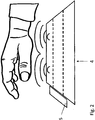
- Fig. 2 shows a haptic display 4 which is divided into three areas.
- the arrangement of the haptic display 4 is such that the driver being in a comfortable driving position is able to hold his hand with a distance from the haptic display unit 4. If in the option determining unit 3.2 it is determined that currently taking a right turn is a poor option within the current situation, then for example the option determining unit 3.2 determines that only going straight or turning left is left as reasonable options for a future driving maneuver. Consequently it could be indicated to the driver that he has two options, namely going straight or turning left.
- the opposite indication is used in order to inform the driver about the situations.
- the driver holds his hand above the haptic display 4. Then the display 4 can stimulate haptic sensations at the palm and the lower side of the hand without the driver touching the display directly.
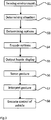
- Fig. 3 is a flowchart illustrating the main steps of the present invention.
- the environment is sensed in step 1.
- a traffic situation is determined in step 2.
- those options of maneuvers and behaviors are determined in step S3 that are applicable in the determined traffic situation.
- These options are encoded in an information (S4) that is finally presented to the driver of the vehicle.
- the encoded information is output by a haptic display in step 5 such that the driver (or more general the operator of any system) is capable of perceiving the plurality of different options without touching the display and without changing his eye direction.
- the driver selects one of the presented options (or one of the options that was not indicated as being not available) and makes a respective gesture for selecting this option.
- the gesture is sensed by a gesture sensor 5 in step S6 and is interpreted by the gesture recognition unit 3.5 in step S7.
- control of the vehicle 1 is executed based on the selected option in step 8.
Landscapes
- Engineering & Computer Science (AREA)
- Transportation (AREA)
- Mechanical Engineering (AREA)
- Automation & Control Theory (AREA)
- General Engineering & Computer Science (AREA)
- Human Computer Interaction (AREA)
- Chemical & Material Sciences (AREA)
- Combustion & Propulsion (AREA)
- Theoretical Computer Science (AREA)
- Physics & Mathematics (AREA)
- General Physics & Mathematics (AREA)
- Acoustics & Sound (AREA)
- User Interface Of Digital Computer (AREA)
- Control Of Driving Devices And Active Controlling Of Vehicle (AREA)
Abstract
Description
- The invention relates to a system, in particular a vehicle, that is capable of executing a maneuver or behavior autonomously when such maneuver or behavior is selected to be executed by an operator of the system.
- First, it is to be noted, that the following explanations are given with respect to vehicles as one example for a system. Nevertheless other applications of the present invention are possible as long as the system has the capability to execute a maneuver or behavior which is defined or selected by the operator of the system in an automated fashion. Such system can be any kind of machine. Of course, the present invention, and also the technological background will become apparent from the example using a vehicle.
- A mobility device such as a vehicle (car, motorcycle, boat or ship, air plane, ...) in many cases is capable of reaching a destination in a plurality of different ways. In former times it was necessary that an operator is capable of controlling (accelerating, braking, steering,...) the vehicle and this is the predominant way to drive a car for example even today. The driver has to operate steering, the accelerator and brake pedal by manual operation. Additional components and operational elements of the vehicle may be used as well like a clutch, a gear shifter, blinker, driving light and so on. Due to automation in any kind of daily life, the drivers expect that also their vehicles will at least in parts be capable of automated execution of specific tasks. A first step toward such increased comfort was introduction of an automatic transmission, making the operation of a clutch and gear shifter unnecessary for the driver. Following this need of the consumers, the industry is currently moving to more automated ways with a final goal of fully automated driving. Of course, at the moment this seems to be a goal that lies pretty far in the future, but first successful the steps have been taken. However, the steps in between full manual and fully automated driving are less clear and conceptionalized.
- To illustrate that these steps in between are pretty unclear can be understood from the following model in an easy way. On the lowest lever the pure driving of a vehicle is addressed which means vehicle stabilization and dynamics control. One level above this basic control of the vehicle is the trajectory control, controlling temporarily coherent patterns like lane keeping, left turn or the like. Whereas on the lowest level the driving itself is done, the second level describes how this is done. On the next higher level it is decided what has to be done by determining patterns to be executed. On this level decisions are taken which maneuvers and in which sequence have to be performed and then these maneuvers are monitored and changed eventually, if necessary. These decisions on the other side are taken in light of the overall task to reach, a desired destination. This is the highest level of the driving hierarchy in the herewith introduced model.
- Having the different levels of the driving hierarchy in mind it is clear that full automated driving only needs an "operator" of the vehicle to define a destination or a driving mission on the topmost level. Anything below this top level is fully automated. In an extreme realization of this full automated driving it might be even thought of omitting any possibility for the driver to intervene in the execution. Contrary, state of the art driver assistant systems only have the capability to assist the driver by delegating tasks like performing a specific maneuver, lane keeping, lane or vehicle following. The current driver assistant systems may perform such maneuvers or other behaviors on the second lowest level of the above-mentioned model. This means that currently the operator of a system or the driver of a vehicle still needs to decide what needs to be done. But then, there is a need to inform the driver about current options that are available for delegating a task to the vehicle or system. The driver needs to know what can be done before the driver can define the task to be delegated for automated execution. Of course, it could be thought of the driver having all the options in mind. But as the driver is confronted with such a large amount of information and not all options can reasonably be executed in an arbitrary traffic situation, it would be desirable if only the options that are currently available in a specific traffic situation can be selected by the driver. This reduces the chance that the driver makes a wrong decision.
- One approach to present the driver the options for different maneuvers that may be executed in a determined traffic situation is described in
EP 2 669 109 A1 - One major drawback of such system and method is that the options are presented visually. Thus, the gaze of the operator is diverted from the environment for a long time and further the visual channel of humans driving vehicles is already highly loaded by many different indicators, light signals and the driving scene itself. Thus, it is questionable if the presentation of a plurality of options from which the driver has to select by using the visual channel is in fact helpful in the end. Of course, the solution as described could mitigate the latter aspect itself, because some of the signals from the driver assistant system might not be necessary anymore. The load to analyze the driving scene will remain nevertheless.
- Thus, it is an object of the present invention to improve a system and method for semi-automated execution of a maneuver or behavior.
- This object is achieved by the system and method according to the independent claims. The dependent claims define advantageous further aspects of the present invention.
- According to the present invention the system which may particularly be a vehicle is capable of an automated execution of a maneuver or behavior that is selected by an operator of the system.
- According to the present invention, the system, which may particularly be a vehicle, is capable of an automated execution of a maneuver or behavior that is selected by an operator (driver) of the system. Such selection can be performed either by choosing one of a plurality of options or by selecting/dismissing the only available option. The system comprises a situation analyzing unit for determining a situation. For the example of a traffic situation such systems are well-known in the art. They observe the environment of the vehicle by means of sensors and determine a current traffic situation the vehicle is in. Then, according to the invention, a maneuver and/or behavior determining unit determines the available options for executing a maneuver and/or a behavior that might be executed in the determined situation. This determination ensures that only such maneuver options and/or behavior options are determined that practically can be realized by the entire system and are reasonable in the determined situation. Other options might be available in other traffic situations. The system further comprises a haptic display unit for outputting information on at least one of the determined maneuver and/or behavior options. Such haptic display, which is used for outputting information on the available options according to the present invention has the big advantage that it does not need the visual channel for conveying information on the options from the system to its operator or driver. Contrary, senses of the driver are used, which are usually not exploited at all. Such haptic display units, for example, use an array of ultrasonic elements in order to give a person an impression of a virtual object. Thus, by using such haptic display unit, it is possible to convey information to the driver without a necessity for the driver to move his eye direction from an observation point in the environment of the vehicle to a display inside the vehicle. Even if it is thought of a head up display, at least some distraction of the driver's attention can be observed. If the driver, based on the information received via the haptic display unit, selects one of the presented maneuver and/or behavior options, he makes an input for selecting one of these options. The system comprises a selection input unit for accepting a selection of one of the maneuvers and based thereon, actuators of the system are used in order to execute the selected option.
- It is in particular preferred that the haptic display is configured such that it is capable of stimulating the operator without any physical contact between the operator and the haptic display. As mentioned above, one example for realizing such contactless stimulation of the driver can be made by using the array of ultrasonic emitters.
- Furthermore, it is advantageous if the information, which is output by means of the haptic display, encodes at least one maneuver and/or behavior spatially and/or temporarily and/or with respect to intensity of the haptic stimulation. Using space, time and intensity for encoding the entire information gives the opportunity to convey information on a plurality of options in parallel. This is in particular an advantage over prior art approaches, which use audio signals or artificial voices for providing information.
- According to another advantageous aspect, the selection input unit is configured to determine a selection made by the operator based by a gesture made by the driver. Using such gesture in order to select one of the presented options has the advantage that a selection can be realized very intuitively without for example pushing a dedicated button or operating any other hardware control.
- Details of the inventive system and method will now be explained with reference to the annexed drawings in which
- Figure 1
- shows a block diagram of the inventive system taking as an example a vehicle;
- Figure 2
- illustrates the operation of a haptic display to convey information to an operator; and
- Figure 3
- shows a flowchart illustrating the main steps of the present invention.
- In
figure 1 , the invention will be described in detail with respect to avehicle 1 representative of any kind of system that is capable to autonomously or semi-automated execution of any delegated task. Such tasks may be a driving maneuver or any kind or behavior. Such maneuver is can be a lane change or a turning movement to the left or right, and an example for a behavior might be following a preceding vehicle or keeping the lane. - The
vehicle 1 comprises one or a plurality ofsensors 2 that are dedicated to physically sense the environment of thevehicle 1. Based on the sensor signals, which may be for example camera signals, radar signals, lidar signals or any other signals generated by sensors that are capable of perceiving the environment of the vehicle, are supplied to aprocessor 3. Theprocessor 3 comprises a situation modeling unit 3.1, which is realized as a software module that is executed byprocessor 3. The situation modeling unit 3.1 is supplied with the sensor signals and analyzes this description of a scene in order to determine a traffic situation. The situation modeling unit 3.1 furthermore makes a prediction of the traffic situation on the basis of the current traffic situation in order to provide a basis for determining the maneuver options and/or behavior options that are applicable in the present situation. Information of the current situation and situation development is then supplied to an option determining unit 3.2. The option determining unit 3.2, as mentioned above, filters from all available options (maneuvers and behaviors that in principle can be performed by the vehicle) that might be carried out by thevehicle 1, those maneuvers and behaviors that reasonably can be executed in the determined and predicted traffic situation. Based on the output from the option determining unit 3.2, information to be output is encoded by an information encoding unit 3.3. In the information encoding unit 3.3, all the options that are determined in the option determining unit 3.2 are encoded in a signal that is suitable for controlling ahaptic display 4. By encoding the options that are determined in the option determining unit 3.2, it is possible to convey information about the plurality of available options to the driver of thevehicle 1. The reason is that by using thehaptic display 4 it is possible to simultaneously stimulate the driver at for example a plurality of different locations of his hand or the like. Thus, the driver will be well able to distinguish between the different pieces of information each corresponding to one option. The options that are determined in the option determining unit 3.2 are encoded by using at least one of space, time and intensity characteristics of the final stimulation of the driver. - Based on the presented information the driver of the
vehicle 1 will make a gesture in order to select one of the presented options. The gesture will be sensed by agesture sensor 5. The signal from thegesture sensor 5 is provided to a gesture recognition unit 3.4. The gesture recognition unit 3.4 identifies the gesture that was made by the driver and associates it with one of the options. The information of the thus selected option is then fed to a control signal generation unit 3.5. In the control signal generation unit 3.5 the drive signals in order to driveactuators 6 of thevehicle 1 are generated. By using one or a plurality ofactuators 6, like for example throttle motor, brake system and the like, the selected maneuver or behavior is executed by thevehicle 1. - The control signal generation unit 3.5 further receives signals from the
sensors 2 in order to perform the maneuver or behavior execution. Carrying out and executing such a maneuver or behavior per se is known from the prior art. The control signal generation unit 3.5 further is in communication with the situation modelling unit 3.1 and the option determining unit 3.2. In particular communication with the option determining unit 3.2 enables the option determining unit 3.2 not to present information about the currently executed maneuver or behavior redundantly to the driver. - Using the illustration of
fig. 2 a very simple way of presenting information on available options to a driver according to the present invention shall be explained.Fig. 2 shows ahaptic display 4 which is divided into three areas. The arrangement of thehaptic display 4 is such that the driver being in a comfortable driving position is able to hold his hand with a distance from thehaptic display unit 4. If in the option determining unit 3.2 it is determined that currently taking a right turn is a poor option within the current situation, then for example the option determining unit 3.2 determines that only going straight or turning left is left as reasonable options for a future driving maneuver. Consequently it could be indicated to the driver that he has two options, namely going straight or turning left. In the present case the opposite indication is used in order to inform the driver about the situations. Obviously in general there are three possibilities, namely going straight, turning left or turning right. If as indicated above the option "go right" is not reasonable, then for example the driver can be warned by activating the rightmost area of the haptic display 4 (the one in the background infig. 2 ) in order to stimulate the rightmost area of the palm of the driver's hand for example. Such stimulation resembles a virtual obstacle for this option. Similar procedures are applied for driving left or straight or any other driving decision that could be taken. It is evident that the available options may vary and change during driving because of a change in the driving context. - As illustrated in
fig. 2 it is in particular preferred that the driver holds his hand above thehaptic display 4. Then thedisplay 4 can stimulate haptic sensations at the palm and the lower side of the hand without the driver touching the display directly. -
Fig. 3 is a flowchart illustrating the main steps of the present invention. At first the environment is sensed instep 1. On the basis of the environment perception a traffic situation is determined instep 2. Then by filtering from among all available options that might be executed by the vehicle, those options of maneuvers and behaviors are determined in step S3 that are applicable in the determined traffic situation. These options are encoded in an information (S4) that is finally presented to the driver of the vehicle. The encoded information is output by a haptic display instep 5 such that the driver (or more general the operator of any system) is capable of perceiving the plurality of different options without touching the display and without changing his eye direction. - The driver then selects one of the presented options (or one of the options that was not indicated as being not available) and makes a respective gesture for selecting this option. The gesture is sensed by a
gesture sensor 5 in step S6 and is interpreted by the gesture recognition unit 3.5 in step S7. Finally control of thevehicle 1 is executed based on the selected option instep 8.
Claims (11)
- System for automated execution of a maneuver or behavior selected by an operator of the system, the system comprising
a situation analyzing unit (3.1) for determining a currently experienced situation maneuver and/or behavior determining unit (3.2) for determining maneuver options and/or behavior option that potentially can be realized by the system in the determined situation
a haptic display unit (4) for outputting information on at least one of the determined maneuvers and/or behavior,
a selection input unit (5, 3.4) for accepting a system operator's selection of one of the output maneuver options and/or behavior options, and
actuators (6) configured to execute the selected option. - System according to claim 1,
characterized in that
the haptic display unit (4) is configured to generate a stimulation of the operator without physical contact between the operator and the haptic display (4). - System according to claim 1,
characterized in that
the output information encodes the at least one maneuver and/or behavior spatially, and/or temporally and/or with respect to intensity of a haptic stimulation. - System according to any one of claims 1 to 3,
characterized in that
the haptic display unit (4) is configured to output information on a plurality of options simultaneously. - System according to any one of claims 1 to 4,
characterized in that
the selection input unit (5, 3.4) is configured to determine a selection made by the operator based on a gesture made by the operator. - System according to any one of claims 1 to 4,
characterized in that
the system is a vehicle (1). - Method for automated execution of a maneuver or behavior, the method comprising the steps of:- determining a situation in which the system executing the method currently is based on environment sensing (S1),- determining maneuver options and/or behavior options based on the determined situation, wherein each such option is a maneuver or behavior for which potentially can be executed by the system in the determined situation (S2),- outputting information on at last one of the determined maneuver option and/or behavior option via a haptic display (S5),- receiving an input for selecting one of the options (S6, S7), and- executing the selected maneuver or behavior by correspondingly driving actuators of the system (S8).
- Method according to claim 7,
characterized in that
information is provided to an operator of the system by making use of tactile perceptual capabilities of the operator such that no physical contact between the operator and the haptic display unit (4) is necessary. - Method according to claim 7 or 8,
characterized in that
the output information encodes the at least one maneuver and/ or behavior spatially, and/or temporally and/or with respect to intensity of a haptic stimulation (S4). - Method according to any one of claims 7 to 9
characterized in that
a plurality of options is output simultaneously. - Method according to any one of claims to 10
characterized in that
the selection of one option is performed based on gesture recognition of a gesture made by the operator (S6).
Priority Applications (3)
| Application Number | Priority Date | Filing Date | Title |
|---|---|---|---|
| EP17174041.8A EP3409553B1 (en) | 2017-06-01 | 2017-06-01 | System and method for automated execution of a maneuver or behavior of a system |
| JP2018097858A JP6650486B2 (en) | 2017-06-01 | 2018-05-22 | System and method for automatically performing steering or behavior of a system |
| US15/990,921 US11021173B2 (en) | 2017-06-01 | 2018-05-29 | System and method for automated execution of a maneuver or behavior of a system |
Applications Claiming Priority (1)
| Application Number | Priority Date | Filing Date | Title |
|---|---|---|---|
| EP17174041.8A EP3409553B1 (en) | 2017-06-01 | 2017-06-01 | System and method for automated execution of a maneuver or behavior of a system |
Publications (2)
| Publication Number | Publication Date |
|---|---|
| EP3409553A1 true EP3409553A1 (en) | 2018-12-05 |
| EP3409553B1 EP3409553B1 (en) | 2021-08-04 |
Family
ID=59030787
Family Applications (1)
| Application Number | Title | Priority Date | Filing Date |
|---|---|---|---|
| EP17174041.8A Active EP3409553B1 (en) | 2017-06-01 | 2017-06-01 | System and method for automated execution of a maneuver or behavior of a system |
Country Status (3)
| Country | Link |
|---|---|
| US (1) | US11021173B2 (en) |
| EP (1) | EP3409553B1 (en) |
| JP (1) | JP6650486B2 (en) |
Cited By (2)
| Publication number | Priority date | Publication date | Assignee | Title |
|---|---|---|---|---|
| DE102020200247A1 (en) | 2020-01-10 | 2021-07-15 | Robert Bosch Gesellschaft mit beschränkter Haftung | Method and driver assistance system for supporting a driver of a vehicle in the execution of driving maneuvers |
| US12559194B2 (en) | 2022-07-14 | 2026-02-24 | Porsche Ebike Performance Gmbh | Bicycle comprising a steering unit |
Families Citing this family (10)
| Publication number | Priority date | Publication date | Assignee | Title |
|---|---|---|---|---|
| US10832031B2 (en) | 2016-08-15 | 2020-11-10 | Apple Inc. | Command processing using multimodal signal analysis |
| US10913463B2 (en) * | 2016-09-21 | 2021-02-09 | Apple Inc. | Gesture based control of autonomous vehicles |
| US10372132B2 (en) | 2016-12-12 | 2019-08-06 | Apple Inc. | Guidance of autonomous vehicles in destination vicinities using intent signals |
| US11208188B2 (en) | 2019-06-10 | 2021-12-28 | Polaris Industries Inc. | Thruster arrangement for a boat |
| EP4034957A4 (en) | 2019-09-27 | 2023-12-27 | Polaris Industries Inc. | SYSTEM AND METHOD FOR POSITIONING AN AQUATIC VESSEL |
| US12179889B2 (en) | 2020-07-06 | 2024-12-31 | Polaris Industries Inc. | Boat maneuverability and stability control systems and methods |
| GB2597492B (en) * | 2020-07-23 | 2022-08-03 | Nissan Motor Mfg Uk Ltd | Gesture recognition system |
| US12623766B2 (en) | 2021-08-10 | 2026-05-12 | Polaris Industries Inc. | Thruster control for a boat |
| JP7326505B2 (en) * | 2022-01-06 | 2023-08-15 | 本田技研工業株式会社 | vehicle warning device |
| JP7884834B2 (en) * | 2022-11-02 | 2026-07-06 | 株式会社ユニオン | Door opening and closing system |
Citations (3)
| Publication number | Priority date | Publication date | Assignee | Title |
|---|---|---|---|---|
| EP2216197A1 (en) * | 2009-02-09 | 2010-08-11 | Technische Universität Darmstadt | Method for controlling a driver assist system and driver assist system |
| DE102012101686A1 (en) * | 2012-03-01 | 2013-09-05 | Continental Teves Ag & Co. Ohg | Method for a driver assistance system for the autonomous longitudinal and / or transverse control of a vehicle |
| EP2669109A1 (en) | 2012-05-30 | 2013-12-04 | Technische Universität Darmstadt | Manoeuvre assistance system |
Family Cites Families (15)
| Publication number | Priority date | Publication date | Assignee | Title |
|---|---|---|---|---|
| US6873911B2 (en) * | 2002-02-01 | 2005-03-29 | Nissan Motor Co., Ltd. | Method and system for vehicle operator assistance improvement |
| DE102004029369B4 (en) * | 2004-06-17 | 2016-09-15 | Robert Bosch Gmbh | Lane change assistant for motor vehicles |
| BRPI0606576A2 (en) * | 2005-01-19 | 2009-07-07 | Takata Petri Ag | Steering wheel set for motor vehicle and method for setting a speed limit value of a motor vehicle |
| CN102112945B (en) * | 2008-06-18 | 2016-08-10 | 奥布隆工业有限公司 | Attitude-Based Control System for Vehicle Interface |
| EP2654028B1 (en) * | 2012-04-20 | 2018-09-26 | Honda Research Institute Europe GmbH | Orientation sensitive traffic collision warning system |
| JP2016509767A (en) * | 2012-12-21 | 2016-03-31 | ハーマン ベッカー オートモーティブ システムズ ゲーエムベーハー | Vehicle system and communication method |
| JP2014225245A (en) * | 2013-04-25 | 2014-12-04 | パナソニックIpマネジメント株式会社 | Traffic information presentation system, traffic information presentation method and electronic device |
| JP6056729B2 (en) * | 2013-10-15 | 2017-01-11 | 株式会社デンソー | Tactile presentation device |
| US20150185858A1 (en) * | 2013-12-26 | 2015-07-02 | Wes A. Nagara | System and method of plane field activation for a gesture-based control system |
| US9612658B2 (en) * | 2014-01-07 | 2017-04-04 | Ultrahaptics Ip Ltd | Method and apparatus for providing tactile sensations |
| JP6282188B2 (en) * | 2014-07-04 | 2018-02-21 | クラリオン株式会社 | Information processing device |
| JP6685008B2 (en) * | 2015-04-21 | 2020-04-22 | パナソニックIpマネジメント株式会社 | Driving support method and driving support device, driving control device, vehicle, driving support program using the same |
| JP2017027401A (en) * | 2015-07-23 | 2017-02-02 | 株式会社デンソー | Display operation device |
| US9809231B2 (en) * | 2015-10-28 | 2017-11-07 | Honda Motor Co., Ltd. | System and method for executing gesture based control of a vehicle system |
| KR102395288B1 (en) * | 2017-05-18 | 2022-05-09 | 현대자동차주식회사 | Apparatus and method for controlling display of hologram, vehicle system |
-
2017
- 2017-06-01 EP EP17174041.8A patent/EP3409553B1/en active Active
-
2018
- 2018-05-22 JP JP2018097858A patent/JP6650486B2/en active Active
- 2018-05-29 US US15/990,921 patent/US11021173B2/en active Active
Patent Citations (3)
| Publication number | Priority date | Publication date | Assignee | Title |
|---|---|---|---|---|
| EP2216197A1 (en) * | 2009-02-09 | 2010-08-11 | Technische Universität Darmstadt | Method for controlling a driver assist system and driver assist system |
| DE102012101686A1 (en) * | 2012-03-01 | 2013-09-05 | Continental Teves Ag & Co. Ohg | Method for a driver assistance system for the autonomous longitudinal and / or transverse control of a vehicle |
| EP2669109A1 (en) | 2012-05-30 | 2013-12-04 | Technische Universität Darmstadt | Manoeuvre assistance system |
Non-Patent Citations (2)
| Title |
|---|
| ANONYMOUS: "BMW wins the future with HoloActive Touch controls - Roadshow", 6 January 2017 (2017-01-06), XP055403934, Retrieved from the Internet <URL:https://www.cnet.com/roadshow/news/bmw-wins-the-future-with-holoactive-touch-controls-ces-2017/> [retrieved on 20170905] * |
| DARRELL ETHERINGTON: "BMW's HoloActive Touch in-car interface offers tactile feedback on a floating display | TechCrunch", 15 December 2016 (2016-12-15), XP055403928, Retrieved from the Internet <URL:https://techcrunch.com/2016/12/15/bmws-holoactive-touch-in-car-interface-offers-tactile-feedback-on-a-floating-display/> [retrieved on 20170905] * |
Cited By (2)
| Publication number | Priority date | Publication date | Assignee | Title |
|---|---|---|---|---|
| DE102020200247A1 (en) | 2020-01-10 | 2021-07-15 | Robert Bosch Gesellschaft mit beschränkter Haftung | Method and driver assistance system for supporting a driver of a vehicle in the execution of driving maneuvers |
| US12559194B2 (en) | 2022-07-14 | 2026-02-24 | Porsche Ebike Performance Gmbh | Bicycle comprising a steering unit |
Also Published As
| Publication number | Publication date |
|---|---|
| US20180345994A1 (en) | 2018-12-06 |
| US11021173B2 (en) | 2021-06-01 |
| JP6650486B2 (en) | 2020-02-19 |
| EP3409553B1 (en) | 2021-08-04 |
| JP2019023062A (en) | 2019-02-14 |
Similar Documents
| Publication | Publication Date | Title |
|---|---|---|
| US11021173B2 (en) | System and method for automated execution of a maneuver or behavior of a system | |
| US10635103B2 (en) | Device and method for controlling a vehicle | |
| JP6351867B2 (en) | Vehicle information display control device and automatic driving information display method | |
| US9851715B2 (en) | Method for the automatic operation of a vehicle | |
| US8390440B2 (en) | Method for displaying a visual warning signal | |
| JP6381826B2 (en) | Vehicle information display control device | |
| EP2746126A1 (en) | Driver assistance system | |
| CN110869262B (en) | Method, mobile user device, computing unit for generating visual information for at least one occupant of a vehicle | |
| EP2930081A1 (en) | Method for transition between driving modes | |
| DE102016220313B3 (en) | Method for operating a motor vehicle with a plurality of driver assistance systems and motor vehicle | |
| JP4891286B2 (en) | Remote control device | |
| CN105882747A (en) | System and method for parallel parking a vehicle | |
| Baltzer et al. | Mediating the interaction between human and automation during the arbitration processes in cooperative guidance and control of highly automated vehicles | |
| JP6316523B2 (en) | Vehicle information display control device and automatic driving information display method | |
| US11958496B2 (en) | Driving intention recognition | |
| JP7075189B2 (en) | How to provide information about a vehicle with a driver's seat and at least one occupant's seat, and the driving situation currently experienced by the alternate driver and / or at least one passenger. | |
| EP3654311B1 (en) | Method for assisting a driver of an ego-vehicle in making use of a gap between vehicles, corresponding driver assistance system and vehicle equipped with such driver assistance system | |
| US9266432B2 (en) | Operating system for driver assistance systems of a motor vehicle and motor vehicle with an operating system of this kind | |
| JP2015515406A (en) | Method for a driver-assistant system for performing autonomous longitudinal feedback control and / or lateral feedback control of a vehicle | |
| US20230219593A1 (en) | Method for assisting a user, including an indicator | |
| US20200239073A1 (en) | Display controller | |
| CN110979329A (en) | Apparatus and method for providing kinesthetic cues in a vehicle equipped with driving automation | |
| CN113825666A (en) | Method for personalized use of communication device | |
| CN110015292B (en) | Vehicle control device and vehicle control method | |
| WO2021099321A1 (en) | A control system for a vehicle |
Legal Events
| Date | Code | Title | Description |
|---|---|---|---|
| PUAI | Public reference made under article 153(3) epc to a published international application that has entered the european phase |
Free format text: ORIGINAL CODE: 0009012 |
|
| STAA | Information on the status of an ep patent application or granted ep patent |
Free format text: STATUS: THE APPLICATION HAS BEEN PUBLISHED |
|
| AK | Designated contracting states |
Kind code of ref document: A1 Designated state(s): AL AT BE BG CH CY CZ DE DK EE ES FI FR GB GR HR HU IE IS IT LI LT LU LV MC MK MT NL NO PL PT RO RS SE SI SK SM TR |
|
| AX | Request for extension of the european patent |
Extension state: BA ME |
|
| STAA | Information on the status of an ep patent application or granted ep patent |
Free format text: STATUS: REQUEST FOR EXAMINATION WAS MADE |
|
| 17P | Request for examination filed |
Effective date: 20190527 |
|
| RBV | Designated contracting states (corrected) |
Designated state(s): AL AT BE BG CH CY CZ DE DK EE ES FI FR GB GR HR HU IE IS IT LI LT LU LV MC MK MT NL NO PL PT RO RS SE SI SK SM TR |
|
| STAA | Information on the status of an ep patent application or granted ep patent |
Free format text: STATUS: EXAMINATION IS IN PROGRESS |
|
| 17Q | First examination report despatched |
Effective date: 20200310 |
|
| GRAP | Despatch of communication of intention to grant a patent |
Free format text: ORIGINAL CODE: EPIDOSNIGR1 |
|
| STAA | Information on the status of an ep patent application or granted ep patent |
Free format text: STATUS: GRANT OF PATENT IS INTENDED |
|
| RIC1 | Information provided on ipc code assigned before grant |
Ipc: G06F 3/01 20060101ALN20210301BHEP Ipc: B60W 50/14 20200101AFI20210301BHEP Ipc: B60W 30/18 20120101ALN20210301BHEP Ipc: B60W 50/10 20120101ALN20210301BHEP Ipc: B60W 50/16 20200101ALN20210301BHEP |
|
| RIC1 | Information provided on ipc code assigned before grant |
Ipc: B60W 50/14 20200101AFI20210308BHEP Ipc: B60W 50/16 20200101ALN20210308BHEP Ipc: B60W 50/10 20120101ALN20210308BHEP Ipc: G06F 3/01 20060101ALN20210308BHEP Ipc: B60W 30/18 20120101ALN20210308BHEP |
|
| INTG | Intention to grant announced |
Effective date: 20210326 |
|
| GRAS | Grant fee paid |
Free format text: ORIGINAL CODE: EPIDOSNIGR3 |
|
| GRAA | (expected) grant |
Free format text: ORIGINAL CODE: 0009210 |
|
| STAA | Information on the status of an ep patent application or granted ep patent |
Free format text: STATUS: THE PATENT HAS BEEN GRANTED |
|
| AK | Designated contracting states |
Kind code of ref document: B1 Designated state(s): AL AT BE BG CH CY CZ DE DK EE ES FI FR GB GR HR HU IE IS IT LI LT LU LV MC MK MT NL NO PL PT RO RS SE SI SK SM TR |
|
| REG | Reference to a national code |
Ref country code: GB Ref legal event code: FG4D |
|
| REG | Reference to a national code |
Ref country code: DE Ref legal event code: R084 Ref document number: 602017043215 Country of ref document: DE |
|
| REG | Reference to a national code |
Ref country code: AT Ref legal event code: REF Ref document number: 1416696 Country of ref document: AT Kind code of ref document: T Effective date: 20210815 |
|
| REG | Reference to a national code |
Ref country code: CH Ref legal event code: EP |
|
| REG | Reference to a national code |
Ref country code: DE Ref legal event code: R096 Ref document number: 602017043215 Country of ref document: DE |
|
| REG | Reference to a national code |
Ref country code: IE Ref legal event code: FG4D |
|
| REG | Reference to a national code |
Ref country code: LT Ref legal event code: MG9D |
|
| REG | Reference to a national code |
Ref country code: NL Ref legal event code: MP Effective date: 20210804 |
|
| REG | Reference to a national code |
Ref country code: AT Ref legal event code: MK05 Ref document number: 1416696 Country of ref document: AT Kind code of ref document: T Effective date: 20210804 |
|
| PG25 | Lapsed in a contracting state [announced via postgrant information from national office to epo] |
Ref country code: SE Free format text: LAPSE BECAUSE OF FAILURE TO SUBMIT A TRANSLATION OF THE DESCRIPTION OR TO PAY THE FEE WITHIN THE PRESCRIBED TIME-LIMIT Effective date: 20210804 Ref country code: RS Free format text: LAPSE BECAUSE OF FAILURE TO SUBMIT A TRANSLATION OF THE DESCRIPTION OR TO PAY THE FEE WITHIN THE PRESCRIBED TIME-LIMIT Effective date: 20210804 Ref country code: LT Free format text: LAPSE BECAUSE OF FAILURE TO SUBMIT A TRANSLATION OF THE DESCRIPTION OR TO PAY THE FEE WITHIN THE PRESCRIBED TIME-LIMIT Effective date: 20210804 Ref country code: BG Free format text: LAPSE BECAUSE OF FAILURE TO SUBMIT A TRANSLATION OF THE DESCRIPTION OR TO PAY THE FEE WITHIN THE PRESCRIBED TIME-LIMIT Effective date: 20211104 Ref country code: AT Free format text: LAPSE BECAUSE OF FAILURE TO SUBMIT A TRANSLATION OF THE DESCRIPTION OR TO PAY THE FEE WITHIN THE PRESCRIBED TIME-LIMIT Effective date: 20210804 Ref country code: HR Free format text: LAPSE BECAUSE OF FAILURE TO SUBMIT A TRANSLATION OF THE DESCRIPTION OR TO PAY THE FEE WITHIN THE PRESCRIBED TIME-LIMIT Effective date: 20210804 Ref country code: ES Free format text: LAPSE BECAUSE OF FAILURE TO SUBMIT A TRANSLATION OF THE DESCRIPTION OR TO PAY THE FEE WITHIN THE PRESCRIBED TIME-LIMIT Effective date: 20210804 Ref country code: FI Free format text: LAPSE BECAUSE OF FAILURE TO SUBMIT A TRANSLATION OF THE DESCRIPTION OR TO PAY THE FEE WITHIN THE PRESCRIBED TIME-LIMIT Effective date: 20210804 Ref country code: PT Free format text: LAPSE BECAUSE OF FAILURE TO SUBMIT A TRANSLATION OF THE DESCRIPTION OR TO PAY THE FEE WITHIN THE PRESCRIBED TIME-LIMIT Effective date: 20211206 Ref country code: NO Free format text: LAPSE BECAUSE OF FAILURE TO SUBMIT A TRANSLATION OF THE DESCRIPTION OR TO PAY THE FEE WITHIN THE PRESCRIBED TIME-LIMIT Effective date: 20211104 |
|
| PG25 | Lapsed in a contracting state [announced via postgrant information from national office to epo] |
Ref country code: PL Free format text: LAPSE BECAUSE OF FAILURE TO SUBMIT A TRANSLATION OF THE DESCRIPTION OR TO PAY THE FEE WITHIN THE PRESCRIBED TIME-LIMIT Effective date: 20210804 Ref country code: LV Free format text: LAPSE BECAUSE OF FAILURE TO SUBMIT A TRANSLATION OF THE DESCRIPTION OR TO PAY THE FEE WITHIN THE PRESCRIBED TIME-LIMIT Effective date: 20210804 Ref country code: GR Free format text: LAPSE BECAUSE OF FAILURE TO SUBMIT A TRANSLATION OF THE DESCRIPTION OR TO PAY THE FEE WITHIN THE PRESCRIBED TIME-LIMIT Effective date: 20211105 |
|
| REG | Reference to a national code |
Ref country code: GB Ref legal event code: 746 Effective date: 20220307 |
|
| PG25 | Lapsed in a contracting state [announced via postgrant information from national office to epo] |
Ref country code: NL Free format text: LAPSE BECAUSE OF FAILURE TO SUBMIT A TRANSLATION OF THE DESCRIPTION OR TO PAY THE FEE WITHIN THE PRESCRIBED TIME-LIMIT Effective date: 20210804 |
|
| PG25 | Lapsed in a contracting state [announced via postgrant information from national office to epo] |
Ref country code: DK Free format text: LAPSE BECAUSE OF FAILURE TO SUBMIT A TRANSLATION OF THE DESCRIPTION OR TO PAY THE FEE WITHIN THE PRESCRIBED TIME-LIMIT Effective date: 20210804 |
|
| REG | Reference to a national code |
Ref country code: DE Ref legal event code: R097 Ref document number: 602017043215 Country of ref document: DE |
|
| PG25 | Lapsed in a contracting state [announced via postgrant information from national office to epo] |
Ref country code: SM Free format text: LAPSE BECAUSE OF FAILURE TO SUBMIT A TRANSLATION OF THE DESCRIPTION OR TO PAY THE FEE WITHIN THE PRESCRIBED TIME-LIMIT Effective date: 20210804 Ref country code: SK Free format text: LAPSE BECAUSE OF FAILURE TO SUBMIT A TRANSLATION OF THE DESCRIPTION OR TO PAY THE FEE WITHIN THE PRESCRIBED TIME-LIMIT Effective date: 20210804 Ref country code: RO Free format text: LAPSE BECAUSE OF FAILURE TO SUBMIT A TRANSLATION OF THE DESCRIPTION OR TO PAY THE FEE WITHIN THE PRESCRIBED TIME-LIMIT Effective date: 20210804 Ref country code: EE Free format text: LAPSE BECAUSE OF FAILURE TO SUBMIT A TRANSLATION OF THE DESCRIPTION OR TO PAY THE FEE WITHIN THE PRESCRIBED TIME-LIMIT Effective date: 20210804 Ref country code: CZ Free format text: LAPSE BECAUSE OF FAILURE TO SUBMIT A TRANSLATION OF THE DESCRIPTION OR TO PAY THE FEE WITHIN THE PRESCRIBED TIME-LIMIT Effective date: 20210804 Ref country code: AL Free format text: LAPSE BECAUSE OF FAILURE TO SUBMIT A TRANSLATION OF THE DESCRIPTION OR TO PAY THE FEE WITHIN THE PRESCRIBED TIME-LIMIT Effective date: 20210804 |
|
| PLBE | No opposition filed within time limit |
Free format text: ORIGINAL CODE: 0009261 |
|
| STAA | Information on the status of an ep patent application or granted ep patent |
Free format text: STATUS: NO OPPOSITION FILED WITHIN TIME LIMIT |
|
| 26N | No opposition filed |
Effective date: 20220506 |
|
| PG25 | Lapsed in a contracting state [announced via postgrant information from national office to epo] |
Ref country code: IT Free format text: LAPSE BECAUSE OF FAILURE TO SUBMIT A TRANSLATION OF THE DESCRIPTION OR TO PAY THE FEE WITHIN THE PRESCRIBED TIME-LIMIT Effective date: 20210804 |
|
| PG25 | Lapsed in a contracting state [announced via postgrant information from national office to epo] |
Ref country code: SI Free format text: LAPSE BECAUSE OF FAILURE TO SUBMIT A TRANSLATION OF THE DESCRIPTION OR TO PAY THE FEE WITHIN THE PRESCRIBED TIME-LIMIT Effective date: 20210804 |
|
| PG25 | Lapsed in a contracting state [announced via postgrant information from national office to epo] |
Ref country code: MC Free format text: LAPSE BECAUSE OF FAILURE TO SUBMIT A TRANSLATION OF THE DESCRIPTION OR TO PAY THE FEE WITHIN THE PRESCRIBED TIME-LIMIT Effective date: 20210804 |
|
| REG | Reference to a national code |
Ref country code: CH Ref legal event code: PL |
|
| REG | Reference to a national code |
Ref country code: BE Ref legal event code: MM Effective date: 20220630 |
|
| PG25 | Lapsed in a contracting state [announced via postgrant information from national office to epo] |
Ref country code: LU Free format text: LAPSE BECAUSE OF NON-PAYMENT OF DUE FEES Effective date: 20220601 Ref country code: LI Free format text: LAPSE BECAUSE OF NON-PAYMENT OF DUE FEES Effective date: 20220630 Ref country code: IE Free format text: LAPSE BECAUSE OF NON-PAYMENT OF DUE FEES Effective date: 20220601 Ref country code: CH Free format text: LAPSE BECAUSE OF NON-PAYMENT OF DUE FEES Effective date: 20220630 |
|
| PG25 | Lapsed in a contracting state [announced via postgrant information from national office to epo] |
Ref country code: BE Free format text: LAPSE BECAUSE OF NON-PAYMENT OF DUE FEES Effective date: 20220630 |
|
| PGFP | Annual fee paid to national office [announced via postgrant information from national office to epo] |
Ref country code: FR Payment date: 20230620 Year of fee payment: 7 Ref country code: DE Payment date: 20230621 Year of fee payment: 7 |
|
| PGFP | Annual fee paid to national office [announced via postgrant information from national office to epo] |
Ref country code: GB Payment date: 20230622 Year of fee payment: 7 |
|
| PG25 | Lapsed in a contracting state [announced via postgrant information from national office to epo] |
Ref country code: HU Free format text: LAPSE BECAUSE OF FAILURE TO SUBMIT A TRANSLATION OF THE DESCRIPTION OR TO PAY THE FEE WITHIN THE PRESCRIBED TIME-LIMIT; INVALID AB INITIO Effective date: 20170601 |
|
| PG25 | Lapsed in a contracting state [announced via postgrant information from national office to epo] |
Ref country code: MK Free format text: LAPSE BECAUSE OF FAILURE TO SUBMIT A TRANSLATION OF THE DESCRIPTION OR TO PAY THE FEE WITHIN THE PRESCRIBED TIME-LIMIT Effective date: 20210804 Ref country code: CY Free format text: LAPSE BECAUSE OF FAILURE TO SUBMIT A TRANSLATION OF THE DESCRIPTION OR TO PAY THE FEE WITHIN THE PRESCRIBED TIME-LIMIT Effective date: 20210804 |
|
| PG25 | Lapsed in a contracting state [announced via postgrant information from national office to epo] |
Ref country code: TR Free format text: LAPSE BECAUSE OF FAILURE TO SUBMIT A TRANSLATION OF THE DESCRIPTION OR TO PAY THE FEE WITHIN THE PRESCRIBED TIME-LIMIT Effective date: 20210804 |
|
| PG25 | Lapsed in a contracting state [announced via postgrant information from national office to epo] |
Ref country code: MT Free format text: LAPSE BECAUSE OF FAILURE TO SUBMIT A TRANSLATION OF THE DESCRIPTION OR TO PAY THE FEE WITHIN THE PRESCRIBED TIME-LIMIT Effective date: 20210804 |
|
| REG | Reference to a national code |
Ref country code: DE Ref legal event code: R119 Ref document number: 602017043215 Country of ref document: DE |
|
| GBPC | Gb: european patent ceased through non-payment of renewal fee |
Effective date: 20240601 |
|
| PG25 | Lapsed in a contracting state [announced via postgrant information from national office to epo] |
Ref country code: DE Free format text: LAPSE BECAUSE OF NON-PAYMENT OF DUE FEES Effective date: 20250101 |
|
| PG25 | Lapsed in a contracting state [announced via postgrant information from national office to epo] |
Ref country code: FR Free format text: LAPSE BECAUSE OF NON-PAYMENT OF DUE FEES Effective date: 20240630 |
|
| PG25 | Lapsed in a contracting state [announced via postgrant information from national office to epo] |
Ref country code: GB Free format text: LAPSE BECAUSE OF NON-PAYMENT OF DUE FEES Effective date: 20240601 |