EP3407607A1 - Method and device for encoding and reconstructing a point cloud - Google Patents
Method and device for encoding and reconstructing a point cloud Download PDFInfo
- Publication number
- EP3407607A1 EP3407607A1 EP17305610.2A EP17305610A EP3407607A1 EP 3407607 A1 EP3407607 A1 EP 3407607A1 EP 17305610 A EP17305610 A EP 17305610A EP 3407607 A1 EP3407607 A1 EP 3407607A1
- Authority
- EP
- European Patent Office
- Prior art keywords
- gft
- point
- cluster
- attributes
- points
- Prior art date
- Legal status (The legal status is an assumption and is not a legal conclusion. Google has not performed a legal analysis and makes no representation as to the accuracy of the status listed.)
- Withdrawn
Links
Images


Classifications
-
- H—ELECTRICITY
- H04—ELECTRIC COMMUNICATION TECHNIQUE
- H04N—PICTORIAL COMMUNICATION, e.g. TELEVISION
- H04N19/00—Methods or arrangements for coding, decoding, compressing or decompressing digital video signals
- H04N19/60—Methods or arrangements for coding, decoding, compressing or decompressing digital video signals using transform coding
-
- H—ELECTRICITY
- H04—ELECTRIC COMMUNICATION TECHNIQUE
- H04N—PICTORIAL COMMUNICATION, e.g. TELEVISION
- H04N19/00—Methods or arrangements for coding, decoding, compressing or decompressing digital video signals
- H04N19/60—Methods or arrangements for coding, decoding, compressing or decompressing digital video signals using transform coding
- H04N19/62—Methods or arrangements for coding, decoding, compressing or decompressing digital video signals using transform coding by frequency transforming in three dimensions [3D]
-
- H—ELECTRICITY
- H04—ELECTRIC COMMUNICATION TECHNIQUE
- H04N—PICTORIAL COMMUNICATION, e.g. TELEVISION
- H04N19/00—Methods or arrangements for coding, decoding, compressing or decompressing digital video signals
- H04N19/10—Methods or arrangements for coding, decoding, compressing or decompressing digital video signals using adaptive coding
- H04N19/169—Methods or arrangements for coding, decoding, compressing or decompressing digital video signals using adaptive coding characterised by the coding unit, i.e. the structural portion or semantic portion of the video signal being the object or the subject of the adaptive coding
- H04N19/18—Methods or arrangements for coding, decoding, compressing or decompressing digital video signals using adaptive coding characterised by the coding unit, i.e. the structural portion or semantic portion of the video signal being the object or the subject of the adaptive coding the unit being a set of transform coefficients
-
- H—ELECTRICITY
- H04—ELECTRIC COMMUNICATION TECHNIQUE
- H04N—PICTORIAL COMMUNICATION, e.g. TELEVISION
- H04N19/00—Methods or arrangements for coding, decoding, compressing or decompressing digital video signals
- H04N19/50—Methods or arrangements for coding, decoding, compressing or decompressing digital video signals using predictive coding
- H04N19/597—Methods or arrangements for coding, decoding, compressing or decompressing digital video signals using predictive coding specially adapted for multi-view video sequence encoding
Definitions
- the present disclosure generally relates to the field of point cloud data sources.
- PCC point cloud compression
- the disclosure concerns a method for encoding a point cloud and a corresponding encoder. It also concerns a method for reconstructing a point cloud and a corresponding decoder. It further concerns computer programs implementing the encoding and reconstructing methods of the invention.
- a point cloud consists in a set of points. Each point is defined by its spatial location (x, y, z), i.e. geometry information, and different attributes, which typically include the color information in (R, G, B) or (Y, U, V) or any other color coordinate system. Geometry can be regarded as one of the attribute data. In the rest of this disclosure, both geometry and other attribute data are considered as attributes of points.
- Point cloud data sources are found in many applications. Important applications relying on huge point cloud data sources can be found in geographic information systems, robotics, medical tomography and scientific visualization.
- Scanned 3D point clouds often have thousands of points and occupy large amounts of storage space. Additionally, they can be generated at a high rate when captured live from 3D scanners, increasing the data rate even further. Therefore, point cloud compression is critical for efficient networked distribution and storage.
- the first coding approach is based on the octree based point-cloud representation. It is described, for instance, in J. Peng and C.-C. Jay Kuo, "Geometry-guided progressive lossless 3D mesh coding with octree (OT) decomposition," ACM Trans. Graph, vol. 21, no. 2, pp. 609-616, July 2005 and in Yan Huang, Jingliang Peng, C.-C. Jay Kuo and M. Gopi, "A Generic Scheme for Progressive Point Cloud Coding," IEEE Transactions on Visualization and Computer Graphics, vol. 14, no. 2, pp. 440-453, 2008 .
- An octree is a tree data structure where every branch node represents a certain cube or cuboid bounding volume in space. Starting at the root, every branch has up to eight children, one for each sub-octant of the node's bounding box.
- a single bit is used to mark whether every child of a branch node is empty and then this branch node configuration can be efficiently represented in a single byte, assuming some consistent ordering of the eight octants.
- the point distribution in space can be efficiently encoded.
- the number of bits set in the first byte tells the decoder the number of consecutive bytes that are direct children.
- the bit positions specify the voxel/child in the octree they occupy.
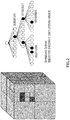
- the right half side of Figure 2 illustrates this byte stream representation for the octree represented in the left half side.
- octree representation Due to its hierarchical nature, the octree representation is very efficient in exploiting the sparsity of point clouds. Thus, octree decomposition based strategy is very efficient for compressing sparse point clouds. However, octree-based representation is inefficient for representing and compressing watertight dense point clouds. Moreover, most of the existing octree-based point cloud representations independently represent geometry and other attributes of points.
- the second coding approach is based on the segmentation based point cloud representation. It is described, for instance, in T. Ochotta and D. Saupe, "Compression of point-based 3d models by shape-adaptive wavelet coding of multi-heightfields," in Proc. Eurographics Symp. on Point-Based Graphics, 2004 , and in J. Digne, R. Chaine, S. Valette, et al, "Self-similarity for accurate compression of point sampled surfaces," Computer Graphics Forum, vol. 33, p. 155-164, 2014 .
- the segmentation based point cloud representation comprises three steps: plane-like decomposition, plane projection and coding.
- the point cloud data is segmented into plane-like patches.
- the resultant patches are projected onto one or several planes.
- the projected image(s) are compressed. Efficient image/video compression techniques can be used for compressing the projected image(s).
- Plane-like segmentation based PCC has been proved to be very efficient at coding dense point clouds which represent approximate piecewise linear surfaces.
- segmentation-based PCC requires resampling onto a regular grid, which introduces approximation errors.
- it is necessary to generate a large number of patches for complex shapes, which implies a high computation complexity for complicated textures.
- this method processes independently geometry and other properties.
- the point cloud attributes are compressed using graph transforms in Zhang et al.: "Point cloud attribute compression with graph transform", IEEE International Conference on Image Processing, Paris, 2014 .
- the attributes are treated as signals over the graph and the graph transform is employed to approximately de-correlate the signal.
- the point cloud representation is still based on the octree representation by constructing graphs upon the octree structure. Also, only the compression of attributes except the geometry is considered in this article.
- the present disclosure proposes a solution for improving the situation.
- the present disclosure provides a method for encoding a point cloud comprising a plurality of points, in which each point is defined by attributes, the attributes including the spatial position of the point in a 3D space and at least one feature of the point, wherein the method comprises:
- the coding method of the invention jointly compresses the attributes, which include the geometry i.e. the spatial position of the points in the 3D space and at least one other attribute i.e. a feature such as the color or the texture, and exploits the redundancy among them based on the GFT.
- the graph transform operation is performed within each cluster and thus it is more efficient in the sense of processing time.
- the method comprises, for each cluster, transmitting to a decoder the encoded GFT coefficients and identifiers of the cluster and of the computed GFT.
- These identifiers may consist on cluster indices and GFT indices in order to indicate to the decoder which GFT is used for which cluster so that the decoder can perform the correct inverse transform for the final reconstruction of the point cloud.
- the encoding of the GFT coefficients is an entropy encoding.
- the segmentation of the point cloud into clusters uses a normalized cuts technique.
- vertices of the constructed similarity graph consist of the points of the corresponding cluster and the method comprises assigning a weight w i,j between any vertices Pi and Pj of the graph.
- the weight w i,j between vertices Pi and Pj is set to 0 if said weight is less than a threshold.
- the small weights are not encoded so as to reduce the overall coding bits while not degrading the coding quality as a small weight means that the corresponding connected vertices are dissimilar to some extent.
- constructing the similarity graph comprises adding an edge e i,j between vertices Pi and Pj if the weight w i,j is equal to or greater than the threshold.
- the present disclosure also provides an encoder for encoding a point cloud comprising a plurality of points, in which each point is defined by attributes, the attributes including the spatial position of the point in a 3D space and at least one feature of the point, wherein the encoder comprises :
- the encoder comprises a transmitter configured to transmit to a decoder the encoded GFT coefficients and identifiers of the clusters and of the computed GFTs.
- the present disclosure also provides a method for reconstructing a point cloud comprising a plurality of points, in which each point is defined by attributes, the attributes including the spatial position of the point in a 3D space and at least one feature of the point, wherein the method comprises:
- the decoding includes an entropy decoding.
- the present disclosure also provides a decoder for reconstructing a point cloud comprising a plurality of points, in which each point is defined by attributes, the attributes including the spatial position of the point in a 3D space and at least one feature of the point, wherein the decoder comprises:
- the methods according to the disclosure may be implemented in software on a programmable apparatus. They may be implemented solely in hardware or in software, or in a combination thereof.
- a carrier medium may comprise a storage medium such as a floppy disk, a CD-ROM, a hard disk drive, a magnetic tape device or a solid state memory device and the like.
- the disclosure thus provides a computer-readable program comprising computer-executable instructions to enable a computer to perform the encoding method of the invention.
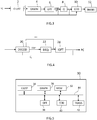
- the diagram of figure 3 illustrates an example of the general algorithm for such computer program.
- the disclosure also provides a computer-readable program comprising computer-executable instructions to enable a computer to perform the reconstructing method of the invention.
- the diagram of figure 4 illustrates an example of the general algorithm for such computer program.
- the points of the point cloud PC are characterized by their attributes which include the geometry, i.e. the spatial position of each point and at least another attribute of the point, such as for example the color.
- attributes include the geometry, i.e. the spatial position of each point and at least another attribute of the point, such as for example the color.
- each point of the point cloud has two attributes : the geometry g in the 3D space and the color c in the RGB space.
- the point cloud data is classified into several clusters at step 2. As a result of this clustering, the point cloud data in each cluster can be approximated by a linear function as it has generally been observed that most point cloud data has a piecewise linear behavior.
- This clustering may be performed by any prior art clustering method.
- the clustering is performed using the normalized cuts technique modified, according to the present embodiment, in order to consider similarities between all the attributes of the points of the point cloud.
- the point cloud PC is clustered into a plurality of clusters identified by corresponding indices C i , wherein 1 ⁇ i ⁇ N, where N is the obtained number of clusters.
- the cluster indices are assigned randomly, while ensuring that a unique index is assigned for each cluster.
- a similarity graph is constructed for each cluster.
- This similarity graph represents the similarity among neighboring vertices, i.e. points, of the cluster and permits to acquire a compact representation of the cluster.
- N, a set of edges E connecting vertices, and a weighted adjacency matrix W .
- ⁇ g i - g j ⁇ 2 describes the similarity in the geometry and ⁇ c i - c j ⁇ 2 describes the similarity in the color.
- ⁇ is a parameter used to control the weight value and is often set empirically.
- the graph is constructed as follows.
- step 6 the GFT is calculated for each cluster based on the constructed similarity graph.
- the weighted adjacency matrix is obtained from the weights of the graph.
- This Laplacian matrix is employed in one embodiment for two reasons.
- GFT defaults to the well-known DCT when defined for a line graph (corresponding to the 1D DCT) or a 4-connectivity graph (2D DCT) with all edge weights equal to 1. That means that the GFT is at least as good as the DCT in sparse signal representation if the weights are chosen in this way. Due to the above two desirable properties, the unnormalized Laplacian matrix is used for the definition of the GFT as described in the following paragraph.
- x ⁇ ( l ) is the l -th GFT coefficient.
- the obtained GFT is identified by a GFT index.
- step 6 results in the GFT coefficients and the GFT indices.
- step 8 the GFT coefficients are quantized.
- the quantized GFT coefficients are entropy coded, for example by using the CABAC method described in Marpe : "Context-Based Adaptive Binary Arithmetic Coding in the H.264/AVC Video Compression Standard", IEEE Trans. Cir. and Sys. For Video Technol., vol.13, no.7, pages 620-636, 2003 .
- the overhead constituted by the cluster indices and the GFT indices, is entropy coded at step 10 to indicate which GFT is used for which cluster.
- the encoded GFT coefficients, cluster indices and GFT indices are then transmitted, at step 12, to a decoder.
- Figure 4 shows the steps of reconstructing a point cloud, i.e. the decoding steps implemented by the decoder after receiving the encoded GFT coefficients, cluster indices and GFT indices, according to an embodiment of the present disclosure.
- the received GFT coefficients, cluster indices and GFT indices are entropy decoded.
- the decoded GFT coefficients are dequantized.
- an inverse GFT is performed using the dequantized GFT coefficient and the decoded GFT indices which indicate the applied GFT.
- x is the recovered signal representing the point cloud data of each cluster.
- Figure 5 is a block diagram of an exemplary embodiment of an encoder 30 implementing the encoding method of the present disclosure.
- the encoder 30 includes one or more processors and a memory 32.
- the encoder 30 comprises:
- the encoder 30 also comprises a transmitter 42 configured to transmit to a decoder the encoded GFT coefficients and identifiers of the clusters and of the computed GFTs.
- a bus 44 provides a communication path between various elements of the encoder 30.
- Other point-to-point interconnection options e.g. non-bus architecture are also feasible.
- Figure 6 is a block diagram of an exemplary embodiment of a decoder 50 implementing the reconstructing method of the present disclosure.
- the decoder 50 includes one or more processors and a memory 52.
- the decoder 50 comprises :
- a bus 60 provides a communication path between various elements of the decoder 50.
- Other point-to-point interconnection options e.g. non-bus architecture are also feasible.
Landscapes
- Engineering & Computer Science (AREA)
- Multimedia (AREA)
- Signal Processing (AREA)
- Compression Or Coding Systems Of Tv Signals (AREA)
- Compression, Expansion, Code Conversion, And Decoders (AREA)
- Image Processing (AREA)
Abstract
Method for encoding a point cloud (PC) comprising a plurality of points, in which each point is defined by attributes, said attributes including the spatial position of the point in a 3D space and at least one feature of the point, wherein the method comprises:
- Segmenting (2) the point cloud (PC) into clusters (Ci) of points on the basis of the attributes of the points;
and for each cluster (Ci):
- constructing (4) a similarity graph representing the similarity among neighboring points of the cluster (Ci) in terms of the attributes;
- computing (6) a Graph Fourier Transform, GFT, based on the constructed similarity graph, said GFT being characterized by its coefficients; and
- quantizing (8) and encoding (10) the GFT coefficients.
- Segmenting (2) the point cloud (PC) into clusters (Ci) of points on the basis of the attributes of the points;
and for each cluster (Ci):
- constructing (4) a similarity graph representing the similarity among neighboring points of the cluster (Ci) in terms of the attributes;
- computing (6) a Graph Fourier Transform, GFT, based on the constructed similarity graph, said GFT being characterized by its coefficients; and
- quantizing (8) and encoding (10) the GFT coefficients.
Description
- The present disclosure generally relates to the field of point cloud data sources.
- More particularly, it deals with point cloud compression (PCC).
- Thus, the disclosure concerns a method for encoding a point cloud and a corresponding encoder. It also concerns a method for reconstructing a point cloud and a corresponding decoder. It further concerns computer programs implementing the encoding and reconstructing methods of the invention.
- The approaches described in this section could be pursued, but are not necessarily approaches that have been previously conceived or pursued. Therefore, unless otherwise indicated herein, the approaches described in this section are not prior art to the claims in this application and are not admitted to be prior art by inclusion in this section.
- A point cloud consists in a set of points. Each point is defined by its spatial location (x, y, z), i.e. geometry information, and different attributes, which typically include the color information in (R, G, B) or (Y, U, V) or any other color coordinate system. Geometry can be regarded as one of the attribute data. In the rest of this disclosure, both geometry and other attribute data are considered as attributes of points.
- Point cloud data sources are found in many applications. Important applications relying on huge point cloud data sources can be found in geographic information systems, robotics, medical tomography and scientific visualization.
- Beyond these applications that are more industrial and scientifically oriented, the rise in popularity of inexpensive 3D scanners based on time of flight or other depth sensing technologies, 3D capturing on mobile devices and the rise of cloud based 3D printing are creating a huge demand for large scale interoperable compressed 3D point cloud storage and transmission data formats in the consumer market.
- Scanned 3D point clouds often have thousands of points and occupy large amounts of storage space. Additionally, they can be generated at a high rate when captured live from 3D scanners, increasing the data rate even further. Therefore, point cloud compression is critical for efficient networked distribution and storage.
- While there has been quite some work on point cloud compression in the 3D graphics and robotics domains, they generally do not address some of the requirements for building efficient interoperable and complete end-to-end 3D multimedia systems.
- For example, the coding of color and other attribute values, which are important for high quality rendering, are often ignored or dealt with inefficiently, for example by performing a simple one way predictive coding of colors. Also, compression of time-varying point clouds, i.e. sequences of clouds captured at a fast rate over time, is limited. Furthermore, methods with low complexity and lossy encoding are of interest for systems where hardware/bandwidth limitations apply or where a low delay is critical. Research in point cloud compression still needs to happen to address these challenges.
- Different coding methods of the point clouds have been proposed in the prior art.
- The first coding approach is based on the octree based point-cloud representation. It is described, for instance, in J. Peng and C.-C. Jay Kuo, "Geometry-guided progressive lossless 3D mesh coding with octree (OT) decomposition," ACM Trans. Graph, vol. 21, no. 2, pp. 609-616, July 2005 and in Yan Huang, Jingliang Peng, C.-C. Jay Kuo and M. Gopi, "A Generic Scheme for Progressive Point Cloud Coding," IEEE Transactions on Visualization and Computer Graphics, vol. 14, no. 2, pp. 440-453, 2008.
- An octree is a tree data structure where every branch node represents a certain cube or cuboid bounding volume in space. Starting at the root, every branch has up to eight children, one for each sub-octant of the node's bounding box.
- An example is shown in Erreur ! Source du renvoi introuvable. and the left half of Erreur ! Source du renvoi introuvable.
- For compression, a single bit is used to mark whether every child of a branch node is empty and then this branch node configuration can be efficiently represented in a single byte, assuming some consistent ordering of the eight octants. By traversing the tree in breadth-first order and outputting every child node configuration byte encountered, the point distribution in space can be efficiently encoded. Upon reading the encoded byte stream, the number of bits set in the first byte tells the decoder the number of consecutive bytes that are direct children. The bit positions specify the voxel/child in the octree they occupy. The right half side of
Figure 2 illustrates this byte stream representation for the octree represented in the left half side. - Due to its hierarchical nature, the octree representation is very efficient in exploiting the sparsity of point clouds. Thus, octree decomposition based strategy is very efficient for compressing sparse point clouds. However, octree-based representation is inefficient for representing and compressing watertight dense point clouds. Moreover, most of the existing octree-based point cloud representations independently represent geometry and other attributes of points.
- The second coding approach is based on the segmentation based point cloud representation. It is described, for instance, in T. Ochotta and D. Saupe, "Compression of point-based 3d models by shape-adaptive wavelet coding of multi-heightfields," in Proc. Eurographics Symp. on Point-Based Graphics, 2004, and in J. Digne, R. Chaine, S. Valette, et al, "Self-similarity for accurate compression of point sampled surfaces," Computer Graphics Forum, vol. 33, p. 155-164, 2014.
- The segmentation based point cloud representation comprises three steps: plane-like decomposition, plane projection and coding. In the first step, the point cloud data is segmented into plane-like patches. Then, the resultant patches are projected onto one or several planes. In the last step, the projected image(s) are compressed. Efficient image/video compression techniques can be used for compressing the projected image(s).
- Plane-like segmentation based PCC has been proved to be very efficient at coding dense point clouds which represent approximate piecewise linear surfaces. However, there are several disadvantages of segmentation-based PCC. Indeed, this method requires resampling onto a regular grid, which introduces approximation errors. Also, it is necessary to generate a large number of patches for complex shapes, which implies a high computation complexity for complicated textures. Moreover, this method processes independently geometry and other properties.
- There are works trying to combine the advantages of the above two representations of point clouds such as J. K. N. Blodow, R. Rusu, S. Gedikli and E. S. M Beetz, "Real-time compression of point cloud streams," in Robotics and Automation (ICRA), 2012 IEEE International Conference on , pp.778,785, 14-18 May, 2012.
- These works first decompose the input point clouds in the manner of octree decomposition. After each cuboid division operation, it is checked whether the points falling into the same newly generated leaf cuboid can be approximated by a plane. If the answer is yes, the division of the corresponding cuboid is stopped and the related points are encoded by projecting on the corresponding plane. Then, the positions of the plane-like patches can be efficiently represented and compressed by the octree method.
- However, all these known methods do not provide an efficient representation and encoding of the attribute data of point clouds.
- In the article of Collet et al. "High-quality streamable free-viewpoint video", ACM Transactions on Graphics, vol.34, no.4, 2015, point clouds are converted into 3D meshes and then a state-of-the-art 3D mesh compression technique is used to encode the point clouds. However, this method, which requires the conversion of the point cloud into a mesh, is usually computationally expensive and extra bits are required to encode the connectivity of 3D meshes.
- Recently graph-based methods have been proposed to encode point clouds. The point cloud attributes are compressed using graph transforms in Zhang et al.: "Point cloud attribute compression with graph transform", IEEE International Conference on Image Processing, Paris, 2014. The attributes are treated as signals over the graph and the graph transform is employed to approximately de-correlate the signal. However, the point cloud representation is still based on the octree representation by constructing graphs upon the octree structure. Also, only the compression of attributes except the geometry is considered in this article.
- The problem of compression of 3D point cloud sequences is addressed in Thanou et al. : "Graph-based compression of dynamic 3D point cloud sequences", IEEE Transactions on Image Processing, vol25, n°4, pages 1765-1778, 2016, with focus on intra coding with graph-based methods. Nevertheless, this approach still adopts the octree representation. In Queiroz et al. "Compression of 3D point clouds using a region-adaptive hierarchical transform", IEEE Transactions on Image Processing, Volume: 25, Issue: 8, Aug. 2016, a method is designed to compress the colors in point clouds based on a hierarchical transform. Meanwhile, the geometry of the point cloud is again encoded using the octree representation.
- The aforementioned works are all based on the octree representation and consider the geometry and other attributes separately. This is disadvantageous as the exploration of the piecewise-linearity of the point cloud for coding efficiency is limited by the octree representation. Also, the redundancy between the geometry and the attributes is not taken into account, which eliminates further improvement of the coding performance.
- The present disclosure proposes a solution for improving the situation.
- Accordingly, the present disclosure provides a method for encoding a point cloud comprising a plurality of points, in which each point is defined by attributes, the attributes including the spatial position of the point in a 3D space and at least one feature of the point, wherein the method comprises:
- segmenting the point cloud into clusters of points on the basis of the attributes of the points;
- constructing a similarity graph representing the similarity among neighboring points of the cluster in terms of the attributes;
- computing a Graph Fourier Transform, GFT, based on the constructed similarity graph, the GFT being characterized by its coefficients; and
- quantizing and encoding the GFT coefficients.
- Thus, the coding method of the invention jointly compresses the attributes, which include the geometry i.e. the spatial position of the points in the 3D space and at least one other attribute i.e. a feature such as the color or the texture, and exploits the redundancy among them based on the GFT.
- By segmenting the point cloud into clusters, the graph transform operation is performed within each cluster and thus it is more efficient in the sense of processing time.
- Advantageously, the method comprises, for each cluster, transmitting to a decoder the encoded GFT coefficients and identifiers of the cluster and of the computed GFT.
- These identifiers may consist on cluster indices and GFT indices in order to indicate to the decoder which GFT is used for which cluster so that the decoder can perform the correct inverse transform for the final reconstruction of the point cloud.
- According to a preferred embodiment, the encoding of the GFT coefficients is an entropy encoding.
- Advantageously, the segmentation of the point cloud into clusters uses a normalized cuts technique.
- This technique is described, for instance, in the article of Malik et al.: "Normalized cuts and image segmentation" in IEEE Trans. Pattern Anal. Mach. Intell., Vol.22, No.8, pages 888-905, 2000.
- Preferably, vertices of the constructed similarity graph consist of the points of the corresponding cluster and the method comprises assigning a weight wi,j between any vertices Pi and Pj of the graph.
- Advantageously, the weight wi,j between vertices Pi and Pj is set to 0 if said weight is less than a threshold.
- In this way, the small weights are not encoded so as to reduce the overall coding bits while not degrading the coding quality as a small weight means that the corresponding connected vertices are dissimilar to some extent.
- Advantageously, constructing the similarity graph comprises adding an edge ei,j between vertices Pi and Pj if the weight wi,j is equal to or greater than the threshold.
- The present disclosure also provides an encoder for encoding a point cloud comprising a plurality of points, in which each point is defined by attributes, the attributes including the spatial position of the point in a 3D space and at least one feature of the point, wherein the encoder comprises :
- a segmentation module configured to segment the point cloud into clusters of points on the basis of the attributes of the points;
- a construction module configured to construct, for each cluster, a similarity graph representing the similarity among neighboring points of the cluster in terms of the attributes;
- a computation module configured to compute, for each cluster; a Graph Fourier Transform, GFT, based on the constructed similarity graph, the GFT being characterized by its coefficients; and
- a coding module configured to encode the GFT coefficients.
- Advantageously, the encoder comprises a transmitter configured to transmit to a decoder the encoded GFT coefficients and identifiers of the clusters and of the computed GFTs.
- The present disclosure also provides a method for reconstructing a point cloud comprising a plurality of points, in which each point is defined by attributes, the attributes including the spatial position of the point in a 3D space and at least one feature of the point, wherein the method comprises:
- receiving data including GFT coefficients associated with cluster indices and GFT indices;
- decoding the received data; and
- reconstructing clusters by performing for each cluster identified by a received cluster index an inverse GFT.
- Advantageously, the decoding includes an entropy decoding.
- The present disclosure also provides a decoder for reconstructing a point cloud comprising a plurality of points, in which each point is defined by attributes, the attributes including the spatial position of the point in a 3D space and at least one feature of the point, wherein the decoder comprises:
- a receiver configured to receive encoded data including GFT coefficients associated with cluster indices and GFT indices;
- a decoding module configured to decode the received data; and
- a reconstruction module configured to reconstruct clusters by performing for each cluster identified by a received cluster index an inverse GFT.
- The methods according to the disclosure may be implemented in software on a programmable apparatus. They may be implemented solely in hardware or in software, or in a combination thereof.
- Since these methods can be implemented in software, they can be embodied as computer readable code for provision to a programmable apparatus on any suitable carrier medium. A carrier medium may comprise a storage medium such as a floppy disk, a CD-ROM, a hard disk drive, a magnetic tape device or a solid state memory device and the like.
- The disclosure thus provides a computer-readable program comprising computer-executable instructions to enable a computer to perform the encoding method of the invention.
- The diagram of
figure 3 illustrates an example of the general algorithm for such computer program. - The disclosure also provides a computer-readable program comprising computer-executable instructions to enable a computer to perform the reconstructing method of the invention.
- The diagram of
figure 4 illustrates an example of the general algorithm for such computer program. - The present invention is illustrated by way of examples, and not by way of limitation, in the figures of the accompanying drawings, in which like reference numerals refer to similar elements and in which:
-
Figure 1 , already described, is a schematic view illustrating an octree-based point cloud representation according to the prior art; -
Figure 2 already described, is a schematic view illustrating an overview of an octree data structure; -
Figure 3 is a flowchart showing the steps of encoding a point cloud, according to an embodiment of the present invention; -
Figure 4 is a flowchart showing the steps of reconstructing a point cloud, according to an embodiment of the present invention; -
Figure 5 is a schematic view illustrating an encoder, according to an embodiment of the invention; and -
Figure 6 is a schematic view illustrating a decoder, according to an embodiment of the invention. - The method of encoding a point cloud according to an embodiment of the present invention is illustrated in the flowchart of
Figure 3 . - The points of the point cloud PC are characterized by their attributes which include the geometry, i.e. the spatial position of each point and at least another attribute of the point, such as for example the color. We will assume in the following description that each point of the point cloud has two attributes : the geometry g in the 3D space and the color c in the RGB space.
- The point cloud data is classified into several clusters at
step 2. As a result of this clustering, the point cloud data in each cluster can be approximated by a linear function as it has generally been observed that most point cloud data has a piecewise linear behavior. - This clustering may be performed by any prior art clustering method.
- Advantageously, the clustering is performed using the normalized cuts technique modified, according to the present embodiment, in order to consider similarities between all the attributes of the points of the point cloud.
- Thus, when performing clustering, multi-lateral relations are considered. That is, both similarities in the geometry and in the other attributes, such as the color, are taken into account to segment the point cluster in order to achieve a clustering result that exploits the piecewise linear property in an optimal way.
- At the end of
step 2, the point cloud PC is clustered into a plurality of clusters identified by corresponding indices Ci, wherein 1 ≤ i ≤ N, where N is the obtained number of clusters. - The cluster indices are assigned randomly, while ensuring that a unique index is assigned for each cluster.
- Then, at
step 4, a similarity graph is constructed for each cluster. This similarity graph represents the similarity among neighboring vertices, i.e. points, of the cluster and permits to acquire a compact representation of the cluster. - A graph G = {V, E, W} consists of a finite set of vertices V with cardinality |V| = N, a set of edges E connecting vertices, and a weighted adjacency matrix W . W is a real N×N matrix, where Wi,j is the weight assigned to the edge (i, j) connecting vertices Pi and Pj. Only undirected graphs are considered here, which correspond to symmetric weighted adjacency matrices, i.e., Wi,j = Wj,i. Weights are assumed non-negative, i.e., Wi,j ≥ 0.
- In the similarity graph constructed at
step 4, the weight Wi,j between vertex Pi and vertex Pj is assigned as
- Where gi and gj are the coordinate vectors respectively, i.e., gi = (xi, yi, zi ) T and gj = (xj, yj, zj ) T ; ci and cj are the color vectors respectively, i.e., Ci = (ri, gi, bi ) T and cj = (rj, gj, bj ) T. In this formula, ∥gi - gj ∥2 describes the similarity in the geometry and ∥ci - cj ∥2 describes the similarity in the color.
- σ is a parameter used to control the weight value and is often set empirically.
- In this way, both the geometry and color information are taken into consideration in the constructed graph, which is different from the usual definition of edge weights, which only considers the similarity in one attribute.
- According to a preferred embodiment and in order to reduce the number of connected vertices for sparse representation, a threshold t is used to set small weights to 0 as follows:

- In this way, small weights won't be encoded so as to save coding bits. Also, as these weights are small, which means the connected vertices are dissimilar to some extent, setting these weights to 0 almost does not degrade the coding quality.
- Thus, the graph is constructed as follows.
- For each point Pi of the cluster, the possible edge weight between it and any other point Pj in the cluster is calculating according to equation (1). If Wi,j >= t, an edge e i,j between Pi and Pj is added and the calculated weight Wi,j is attached to the edge, otherwise, Pi and Pj are disconnected as a small weight means that there's a large discrepancy between them.
- Then, at
step 6, the GFT is calculated for each cluster based on the constructed similarity graph. - At this step, the weighted adjacency matrix is obtained from the weights of the graph.
- Then, the graph Laplacian matrix is computed.
- There exist different variants of Laplacian matrices.
- In one embodiment, the unnormalized combinatorial graph Laplacian is deployed, which is defined as L := D - W, where D is the degree matrix defined as a diagonal matrix whose i-th diagonal element is the sum of all elements in the i-th row of W, i.e.,

- This Laplacian matrix is employed in one embodiment for two reasons.
- First, as the elements in each row of L sum to zero by construction, 0 is guaranteed to be an eigenvalue with [1...1]T as the corresponding eigenvector. This allows a frequency interpretation of the GFT, where the eigenvalues λl's are the graph frequencies and always have a DC component, which is beneficial for the compression of point cloud data consisting of many smooth regions. By connecting similar points and disconnecting dissimilar ones, high-frequency coefficient are reduced, which leads to a compact representation of the point cloud in the GFT domain.
- Second, GFT defaults to the well-known DCT when defined for a line graph (corresponding to the 1D DCT) or a 4-connectivity graph (2D DCT) with all edge weights equal to 1. That means that the GFT is at least as good as the DCT in sparse signal representation if the weights are chosen in this way. Due to the above two desirable properties, the unnormalized Laplacian matrix is used for the definition of the GFT as described in the following paragraph.
- The eigenvectors {Ψl}l=0,1,... ,N-1 of the Laplacian matrix are used to define the GFT. Formally, for any signal


- For each cluster, the obtained GFT is identified by a GFT index.
- Thus,
step 6 results in the GFT coefficients and the GFT indices. - Then, at
step 8, the GFT coefficients are quantized. - At
step 10, the quantized GFT coefficients are entropy coded, for example by using the CABAC method described in Marpe : "Context-Based Adaptive Binary Arithmetic Coding in the H.264/AVC Video Compression Standard", IEEE Trans. Cir. and Sys. For Video Technol., vol.13, no.7, pages 620-636, 2003. - Also, the overhead, constituted by the cluster indices and the GFT indices, is entropy coded at
step 10 to indicate which GFT is used for which cluster. The encoded GFT coefficients, cluster indices and GFT indices are then transmitted, atstep 12, to a decoder. -
Figure 4 shows the steps of reconstructing a point cloud, i.e. the decoding steps implemented by the decoder after receiving the encoded GFT coefficients, cluster indices and GFT indices, according to an embodiment of the present disclosure. - At
step 20, the received GFT coefficients, cluster indices and GFT indices are entropy decoded. - Then, at
step 22, the decoded GFT coefficients are dequantized. - At
step 24, an inverse GFT is performed using the dequantized GFT coefficient and the decoded GFT indices which indicate the applied GFT. - The inverse GFT is given by:

-
Figure 5 is a block diagram of an exemplary embodiment of anencoder 30 implementing the encoding method of the present disclosure. - Advantageously, the
encoder 30 includes one or more processors and amemory 32. - The
encoder 30 comprises: - a
segmentation module 34 configured to segment the point cloud into clusters of points on the basis of the attributes of the points; - a
construction module 36 configured to construct, for each cluster, a similarity graph representing the similarity among neighboring points of the cluster in terms of the attributes; - a
computation module 38 configured to compute, for each cluster; a Graph Fourier Transform, GFT, based on the constructed similarity graph, the GFT being characterized by its coefficients; and - a
coding module 40 configured to encode the GFT coefficients. - The
encoder 30 also comprises atransmitter 42 configured to transmit to a decoder the encoded GFT coefficients and identifiers of the clusters and of the computed GFTs. - According to the represented embodiment, a
bus 44 provides a communication path between various elements of theencoder 30. Other point-to-point interconnection options (e.g. non-bus architecture) are also feasible. -
Figure 6 is a block diagram of an exemplary embodiment of adecoder 50 implementing the reconstructing method of the present disclosure. - Advantageously, the
decoder 50 includes one or more processors and amemory 52. - The
decoder 50 comprises : - a
receiver 54 configured to receive encoded data including GFT coefficients associated with cluster indices and GFT indices; - a decoding module 66 configured to decode the received data; and
- a
reconstruction module 58 configured to reconstruct the clusters by performing for each cluster an inverse GFT. - According to the represented embodiment, a
bus 60 provides a communication path between various elements of thedecoder 50. Other point-to-point interconnection options (e.g. non-bus architecture) are also feasible. - While there has been illustrated and described what are presently considered to be the preferred embodiments of the present invention, it will be understood by those skilled in the art that various other modifications may be made, and equivalents may be substituted, without departing from the true scope of the present invention. Additionally, many modifications may be made to adapt a particular situation to the teachings of the present invention without departing from the central inventive concept described herein. Furthermore, an embodiment of the present invention may not include all of the features described above. Therefore, it is intended that the present invention is not limited to the particular embodiments disclosed, but that the invention includes all embodiments falling within the scope of the appended claims.
- Expressions such as "comprise", "include", "incorporate", "contain", "is" and "have" are to be construed in a non-exclusive manner when interpreting the description and its associated claims, namely construed to allow for other items or components which are not explicitly defined also to be present. Reference to the singular is also to be construed to be a reference to the plural and vice versa.
- A person skilled in the art will readily appreciate that various parameters disclosed in the description may be modified and that various embodiments disclosed and/or claimed may be combined without departing from the scope of the invention.
Claims (13)
- Method for encoding a point cloud (PC) comprising a plurality of points, in which each point is defined by attributes, said attributes including the spatial position of the point in a 3D space and at least one feature of the point, wherein the method comprises:- Segmenting (2) the point cloud (PC) into clusters (Ci) of points on the basis of the attributes of the points;and for each cluster (Ci):- constructing (4) a similarity graph representing the similarity among neighboring points of the cluster (Ci) in terms of the attributes;- computing (6) a Graph Fourier Transform, GFT, based on the constructed similarity graph, said GFT being characterized by its coefficients; and- quantizing (8) and encoding (10) the GFT coefficients.
- Method of claim 1, comprising, for each cluster (Ci), transmitting (12) to a decoder (50) the encoded GFT coefficients and identifiers of the cluster (Ci) and of the computed GFT.
- Method of claim 1 or 2, wherein the encoding of the GFT coefficients is an entropy encoding.
- Method of any one of claims 1 to 3, wherein vertices of the constructed similarity graph consist of the points of the corresponding cluster (Ci) and the method comprises assigning a weight wi,j between any vertices Pi and Pj of the graph.
- Method of claim 4, wherein the weight wi,j between vertices Pi and Pj is set to 0 if said weight is less than a threshold.
- Method of claim 5, wherein constructing (4) the similarity graph comprises adding an edge ei,j between vertices Pi and Pj if the weight wi,j is equal to or greater than the threshold.
- Encoder (30) for encoding a point cloud (PC) comprising a plurality of points, in which each point is defined by attributes, said attributes including the spatial position of the point in a 3D space and at least one feature of the point, wherein the encoder (30) comprises:- a segmentation module (34) configured to segment the point cloud into clusters of points on the basis of the attributes of the points;- a construction module (36) configured to construct, for each cluster, a similarity graph representing the similarity among neighboring points of the cluster in terms of the attributes;- a computation module (38) configured to compute, for each cluster; a Graph Fourier Transform, GFT, based on the constructed similarity graph, said GFT being characterized by its coefficients; and- a coding module (40) configured to encode the GFT coefficients.
- Encoder of claim 7, comprising a transmitter (42) configured to transmit to a decoder (50) the encoded GFT coefficients and identifiers of the clusters and of the computed GFTs.
- Method for reconstructing a point cloud (PC) comprising a plurality of points, in which each point is defined by attributes, said attributes including the spatial position of the point in a 3D space and at least one feature of the point, wherein the method comprises:- receiving data including GFT coefficients associated with cluster indices and GFT indices;- decoding (20) the received data; and- reconstructing clusters (Ci) by performing (24) for each cluster identified by a received cluster index an inverse GFT.
- Method of claim 9, wherein the decoding (20) includes an entropy decoding.
- Decoder (50) for reconstructing a point cloud comprising a plurality of points, in which each point is defined by attributes, said attributes including the spatial position of the point in a 3D space and at least one feature of the point, wherein the decoder (50) comprises:- a receiver (54) configured to receive encoded data including GFT coefficients associated with cluster indices and GFT indices;- a decoding module (56) configured to decode the received data; and- a reconstruction module (58) configured to reconstruct clusters by performing for each cluster identified by a received cluster index an inverse GFT.
- A computer-readable program comprising computer-executable instructions to enable a computer to perform the encoding method of any one of claims 1 to 6.
- A computer-readable program comprising computer-executable instructions to enable a computer to perform the reconstructing method of claim 9 or 10.
Priority Applications (7)
| Application Number | Priority Date | Filing Date | Title |
|---|---|---|---|
| EP17305610.2A EP3407607A1 (en) | 2017-05-24 | 2017-05-24 | Method and device for encoding and reconstructing a point cloud |
| US16/616,491 US11627339B2 (en) | 2017-05-24 | 2018-04-12 | Methods and devices for encoding and reconstructing a point cloud |
| MX2019014040A MX2019014040A (en) | 2017-05-24 | 2018-04-12 | Methods and devices for encoding and reconstructing a point cloud. |
| EP18719779.3A EP3632112A1 (en) | 2017-05-24 | 2018-04-12 | Methods and devices for encoding and reconstructing a point cloud |
| JP2019561153A JP7309616B2 (en) | 2017-05-24 | 2018-04-12 | Method and apparatus for encoding and reconstructing point clouds |
| PCT/EP2018/059420 WO2018215134A1 (en) | 2017-05-24 | 2018-04-12 | Methods and devices for encoding and reconstructing a point cloud |
| CN201880034063.5A CN110663255B (en) | 2017-05-24 | 2018-04-12 | Method and apparatus for encoding and reconstructing point clouds |
Applications Claiming Priority (1)
| Application Number | Priority Date | Filing Date | Title |
|---|---|---|---|
| EP17305610.2A EP3407607A1 (en) | 2017-05-24 | 2017-05-24 | Method and device for encoding and reconstructing a point cloud |
Publications (1)
| Publication Number | Publication Date |
|---|---|
| EP3407607A1 true EP3407607A1 (en) | 2018-11-28 |
Family
ID=59061945
Family Applications (2)
| Application Number | Title | Priority Date | Filing Date |
|---|---|---|---|
| EP17305610.2A Withdrawn EP3407607A1 (en) | 2017-05-24 | 2017-05-24 | Method and device for encoding and reconstructing a point cloud |
| EP18719779.3A Pending EP3632112A1 (en) | 2017-05-24 | 2018-04-12 | Methods and devices for encoding and reconstructing a point cloud |
Family Applications After (1)
| Application Number | Title | Priority Date | Filing Date |
|---|---|---|---|
| EP18719779.3A Pending EP3632112A1 (en) | 2017-05-24 | 2018-04-12 | Methods and devices for encoding and reconstructing a point cloud |
Country Status (6)
| Country | Link |
|---|---|
| US (1) | US11627339B2 (en) |
| EP (2) | EP3407607A1 (en) |
| JP (1) | JP7309616B2 (en) |
| CN (1) | CN110663255B (en) |
| MX (1) | MX2019014040A (en) |
| WO (1) | WO2018215134A1 (en) |
Cited By (5)
| Publication number | Priority date | Publication date | Assignee | Title |
|---|---|---|---|---|
| CN111247798A (en) * | 2019-01-10 | 2020-06-05 | 深圳市大疆创新科技有限公司 | Method and device for encoding or decoding a three-dimensional data point set |
| WO2020206671A1 (en) * | 2019-04-09 | 2020-10-15 | 北京大学深圳研究生院 | Attribute-based point cloud strip division method |
| CN113315970A (en) * | 2020-02-26 | 2021-08-27 | 武汉Tcl集团工业研究院有限公司 | Image compression method, image decoding method, intelligent terminal and storage medium |
| CN113615204A (en) * | 2019-03-20 | 2021-11-05 | Lg电子株式会社 | Point cloud data transmitting device, point cloud data transmitting method, point cloud data receiving device, and point cloud data receiving method |
| CN113963184A (en) * | 2021-10-09 | 2022-01-21 | 杭州大数云智科技有限公司 | Method for evaluating similarity of laser point cloud scene |
Families Citing this family (19)
| Publication number | Priority date | Publication date | Assignee | Title |
|---|---|---|---|---|
| US11693924B2 (en) * | 2019-06-06 | 2023-07-04 | Hitachi, Ltd. | System and method for maintenance recommendation in industrial networks |
| JP2022172413A (en) * | 2019-09-26 | 2022-11-16 | シャープ株式会社 | Three-dimensional expression conversion device and three-dimensional expression inverse conversion device |
| CN114303376A (en) * | 2019-10-03 | 2022-04-08 | 松下电器(美国)知识产权公司 | Three-dimensional data encoding method, three-dimensional data decoding method, three-dimensional data encoding device, and three-dimensional data decoding device |
| US11417029B2 (en) * | 2019-12-02 | 2022-08-16 | Tencent America LLC | Method and apparatus for point cloud coding |
| US11741637B2 (en) * | 2020-02-10 | 2023-08-29 | Tencent America LLC | Node-based geometry and attribute coding for a point cloud |
| GB202001839D0 (en) * | 2020-02-11 | 2020-03-25 | V Nova Int Ltd | Use of tiered hierarchical coding for point cloud compression |
| US11373323B2 (en) * | 2020-02-27 | 2022-06-28 | Apple Inc. | Spatial relationships of point cloud clusters |
| WO2021187565A1 (en) * | 2020-03-19 | 2021-09-23 | パナソニック インテレクチュアル プロパティ コーポレーション オブ アメリカ | Three-dimensional data encoding method, three-dimensional data decoding method, three-dimensional data encoding device, and three-dimensional data decoding device |
| US12322144B2 (en) * | 2020-04-24 | 2025-06-03 | Lg Electronics Inc. | Point cloud data transmission device, point cloud data transmission method, point cloud data reception device and point cloud data reception method |
| WO2022252337A1 (en) * | 2021-06-04 | 2022-12-08 | 华为技术有限公司 | Encoding method and apparatus for 3d map, and decoding method and apparatus for 3d map |
| CN113395506A (en) * | 2021-06-16 | 2021-09-14 | 北京大学深圳研究生院 | Point cloud neighbor searching method, encoding method, decoding method and equipment based on segmentation |
| CN118613833A (en) * | 2021-11-24 | 2024-09-06 | 抖音视界有限公司 | Method, device and medium for point cloud encoding and decoding |
| CN114860725B (en) * | 2022-04-24 | 2025-03-18 | 京东城市(北京)数字科技有限公司 | A method and device for processing spatial data |
| WO2024085936A1 (en) * | 2022-10-21 | 2024-04-25 | Innopeak Technology, Inc. | System and method for geometry point cloud coding |
| US11748945B1 (en) | 2023-02-14 | 2023-09-05 | Illuscio, Inc. | Systems and methods for signal-based point cloud representation |
| JP2024155592A (en) * | 2023-04-21 | 2024-10-31 | キヤノン株式会社 | Playback device, generation device, control method, program, and recording medium |
| TWI819989B (en) * | 2023-05-17 | 2023-10-21 | 台達電子工業股份有限公司 | Modeling device and modeling method for 3d object |
| US12602837B2 (en) * | 2023-05-24 | 2026-04-14 | Tencent America LLC | On sub-division of mesh sequences |
| US20260032272A1 (en) * | 2024-07-24 | 2026-01-29 | Apple Inc. | Configuration record and record lists/video codecs |
Citations (1)
| Publication number | Priority date | Publication date | Assignee | Title |
|---|---|---|---|---|
| WO2016129872A1 (en) * | 2015-02-12 | 2016-08-18 | 엘지전자(주) | Method and apparatus for processing video signal using graph-based transform |
Family Cites Families (19)
| Publication number | Priority date | Publication date | Assignee | Title |
|---|---|---|---|---|
| JP3009651B1 (en) * | 1998-10-06 | 2000-02-14 | 彰 川中 | Method for compressing and restoring three-dimensional data |
| US7940279B2 (en) * | 2007-03-27 | 2011-05-10 | Utah State University | System and method for rendering of texel imagery |
| WO2008138378A1 (en) * | 2007-05-14 | 2008-11-20 | Max-Planck-Gesellschaft Zur Förderung Des Wissenschaften E.V. | Method and device for reconstructing an object surface |
| JP2010250634A (en) * | 2009-04-17 | 2010-11-04 | Seiko Epson Corp | Image server, image retrieval system, image retrieval method, and index creation method |
| BR112012017138A2 (en) | 2010-01-25 | 2018-06-19 | Thomson Licensing | method for encoding normal vectors from a 3d model, method for decoding normal vectors from a 3d mesh model, encoder and decoder. |
| EP2749023A4 (en) | 2011-08-25 | 2016-04-06 | Thomson Licensing | HIERARCHICAL ENCODING AND DECODING BY ENTROPY |
| WO2013067674A1 (en) | 2011-11-07 | 2013-05-16 | Thomson Licensing | Predictive position encoding |
| US9153061B2 (en) * | 2012-05-04 | 2015-10-06 | Qualcomm Incorporated | Segmentation of 3D point clouds for dense 3D modeling |
| US20140192050A1 (en) * | 2012-10-05 | 2014-07-10 | University Of Southern California | Three-dimensional point processing and model generation |
| US9098773B2 (en) * | 2013-06-27 | 2015-08-04 | Chevron U.S.A. Inc. | System and method of detecting objects in scene point cloud |
| US9508186B2 (en) * | 2013-11-07 | 2016-11-29 | Autodesk, Inc. | Pre-segment point cloud data to run real-time shape extraction faster |
| FR3038196A1 (en) * | 2015-06-29 | 2016-12-30 | B<>Com | METHOD FOR ENCODING A DIGITAL IMAGE, DECODING METHOD, DEVICES AND COMPUTER PROGRAMS |
| KR102733195B1 (en) * | 2015-12-14 | 2024-11-25 | 파나소닉 인텔렉츄얼 프로퍼티 코포레이션 오브 아메리카 | Three-dimensional data coding method, three-dimensional data decoding method, three-dimensional data coding device, and three-dimensional data decoding device |
| CN105630905A (en) * | 2015-12-14 | 2016-06-01 | 西安科技大学 | Scattered-point cloud data based hierarchical compression method and apparatus |
| JP6826368B2 (en) * | 2016-01-14 | 2021-02-03 | キヤノン株式会社 | Encoding device and its control method |
| JP6088094B1 (en) * | 2016-06-20 | 2017-03-01 | 株式会社Cygames | System for creating a mixed reality environment |
| CN106407408B (en) | 2016-09-22 | 2019-08-16 | 北京数字绿土科技有限公司 | A kind of the spatial index construction method and device of mass cloud data |
| US10623635B2 (en) * | 2016-09-23 | 2020-04-14 | Mediatek Inc. | System and method for specifying, signaling and using coding-independent code points in processing media contents from multiple media sources |
| CN106651900B (en) * | 2016-12-27 | 2019-07-23 | 中国农业大学 | A kind of overhead strawberry three-dimensional modeling method in situ based on contours segmentation |
-
2017
- 2017-05-24 EP EP17305610.2A patent/EP3407607A1/en not_active Withdrawn
-
2018
- 2018-04-12 MX MX2019014040A patent/MX2019014040A/en unknown
- 2018-04-12 EP EP18719779.3A patent/EP3632112A1/en active Pending
- 2018-04-12 JP JP2019561153A patent/JP7309616B2/en active Active
- 2018-04-12 US US16/616,491 patent/US11627339B2/en active Active
- 2018-04-12 CN CN201880034063.5A patent/CN110663255B/en active Active
- 2018-04-12 WO PCT/EP2018/059420 patent/WO2018215134A1/en not_active Ceased
Patent Citations (1)
| Publication number | Priority date | Publication date | Assignee | Title |
|---|---|---|---|---|
| WO2016129872A1 (en) * | 2015-02-12 | 2016-08-18 | 엘지전자(주) | Method and apparatus for processing video signal using graph-based transform |
Non-Patent Citations (14)
| Title |
|---|
| COLLET ET AL.: "High-quality streamable free-viewpoint video", ACM TRANSACTIONS ON GRAPHICS, vol. 34, no. 4, 2015 |
| DONG TIAN ET AL: "CDVA CE2: Graph transform for keypoint trajectory coding", 115. MPEG MEETING; 30-5-2016 - 3-6-2016; GENEVA; (MOTION PICTURE EXPERT GROUP OR ISO/IEC JTC1/SC29/WG11),, no. m38671, 25 May 2016 (2016-05-25), XP030067023 * |
| J. DIGNE; R. CHAINE; S. VALETTE ET AL.: "Self-similarity for accurate compression of point sampled surfaces", COMPUTER GRAPHICS FORUM, vol. 33, 2014, pages 155 - 164 |
| J. K. N. BLODOW; R. RUSU; S. GEDIKLI; E. S. M BEETZ: "Real-time compression of point cloud streams", ROBOTICS AND AUTOMATION (ICRA), 2012 IEEE INTERNATIONAL CONFERENCE, 14 May 2012 (2012-05-14), pages 778,785 |
| J. PENG; C.-C. JAY KUO: "Geometry-guided progressive lossless 3D mesh coding with octree (OT) decomposition", ACM TRANS. GRAPH, vol. 21, no. 2, July 2005 (2005-07-01), pages 609 - 616 |
| MALIK ET AL.: "Normalized cuts and image segmentation", IEEE TRANS. PATTERN ANAL. MACH. INTELL., vol. 22, no. 8, 2000, pages 888 - 905 |
| MARPE: "Context-Based Adaptive Binary Arithmetic Coding in the H.264/AVC Video Compression Standard", IEEE TRANS. CIR. AND SYS. FOR VIDEO TECHNOL., vol. 13, no. 7, 2003, pages 620 - 636 |
| QUEIROZ ET AL.: "Compression of 3D point clouds using a region-adaptive hierarchical transform", IEEE TRANSACTIONS ON IMAGE PROCESSING, vol. 25, no. 8, August 2016 (2016-08-01) |
| T. OCHOTTA; D. SAUPE: "Compression of point-based 3d models by shape-adaptive wavelet coding of multi-heightfields", PROC. EUROGRAPHICS SYMP. ON POINT-BASED GRAPHICS, 2004 |
| THANOU DORINA ET AL: "Graph-Based Compression of Dynamic 3D Point Cloud Sequences", IEEE TRANSACTIONS ON IMAGE PROCESSING, IEEE SERVICE CENTER, PISCATAWAY, NJ, US, vol. 25, no. 4, 1 April 2016 (2016-04-01), pages 1765 - 1778, XP011602605, ISSN: 1057-7149, [retrieved on 20160307], DOI: 10.1109/TIP.2016.2529506 * |
| THANOU DORINA ET AL: "Graph-based motion estimation and compensation for dynamic 3D point cloud compression", 2015 IEEE INTERNATIONAL CONFERENCE ON IMAGE PROCESSING (ICIP), IEEE, 27 September 2015 (2015-09-27), pages 3235 - 3239, XP032827070, DOI: 10.1109/ICIP.2015.7351401 * |
| THANOU ET AL.: "Graph-based compression of dynamic 3D point cloud sequences", IEEE TRANSACTIONS ON IMAGE PROCESSING, vol. 25, no. 4, 2016, pages 1765 - 1778 |
| YAN HUANG; JINGLIANG PENG; C.-C. JAY KUO; M. GOPI: "A Generic Scheme for Progressive Point Cloud Coding", IEEE TRANSACTIONS ON VISUALIZATION AND COMPUTER GRAPHICS, vol. 14, no. 2, 2008, pages 440 - 453 |
| ZHANG ET AL.: "Point cloud attribute compression with graph transform", IEEE INTERNATIONAL CONFERENCE ON IMAGE PROCESSING, PARIS, 2014 |
Cited By (11)
| Publication number | Priority date | Publication date | Assignee | Title |
|---|---|---|---|---|
| CN111247798A (en) * | 2019-01-10 | 2020-06-05 | 深圳市大疆创新科技有限公司 | Method and device for encoding or decoding a three-dimensional data point set |
| CN111247798B (en) * | 2019-01-10 | 2022-03-15 | 深圳市大疆创新科技有限公司 | Method and device for encoding or decoding a three-dimensional data point set |
| CN113615204A (en) * | 2019-03-20 | 2021-11-05 | Lg电子株式会社 | Point cloud data transmitting device, point cloud data transmitting method, point cloud data receiving device, and point cloud data receiving method |
| KR20210134049A (en) * | 2019-03-20 | 2021-11-08 | 엘지전자 주식회사 | Point cloud data transmitting apparatus, point cloud data transmitting method, point cloud data receiving apparatus and point cloud data receiving method |
| CN113615204B (en) * | 2019-03-20 | 2024-02-20 | Lg电子株式会社 | Point cloud data sending device, point cloud data sending method, point cloud data receiving device and point cloud data receiving method |
| US12069316B2 (en) | 2019-03-20 | 2024-08-20 | Lg Electronics Inc. | Point cloud data transmission device, point cloud data transmission method, point cloud data reception device, and point cloud data reception method |
| WO2020206671A1 (en) * | 2019-04-09 | 2020-10-15 | 北京大学深圳研究生院 | Attribute-based point cloud strip division method |
| US12039762B2 (en) | 2019-04-09 | 2024-07-16 | Peking University Shenzhen Graduate School | Attribute-based point cloud strip division method |
| CN113315970A (en) * | 2020-02-26 | 2021-08-27 | 武汉Tcl集团工业研究院有限公司 | Image compression method, image decoding method, intelligent terminal and storage medium |
| CN113315970B (en) * | 2020-02-26 | 2023-08-01 | 武汉Tcl集团工业研究院有限公司 | Image compression method, image decoding method, intelligent terminal and storage medium |
| CN113963184A (en) * | 2021-10-09 | 2022-01-21 | 杭州大数云智科技有限公司 | Method for evaluating similarity of laser point cloud scene |
Also Published As
| Publication number | Publication date |
|---|---|
| US20200092584A1 (en) | 2020-03-19 |
| US11627339B2 (en) | 2023-04-11 |
| MX2019014040A (en) | 2020-07-28 |
| WO2018215134A1 (en) | 2018-11-29 |
| CN110663255A (en) | 2020-01-07 |
| EP3632112A1 (en) | 2020-04-08 |
| JP7309616B2 (en) | 2023-07-18 |
| CN110663255B (en) | 2023-04-04 |
| JP2020521359A (en) | 2020-07-16 |
Similar Documents
| Publication | Publication Date | Title |
|---|---|---|
| US11627339B2 (en) | Methods and devices for encoding and reconstructing a point cloud | |
| CN112184840B (en) | 3D point cloud compression system based on multi-scale structured dictionary learning | |
| Krivokuća et al. | A volumetric approach to point cloud compression–part ii: Geometry compression | |
| De Queiroz et al. | Transform coding for point clouds using a Gaussian process model | |
| Chou et al. | A volumetric approach to point cloud compression—Part I: Attribute compression | |
| US11348260B2 (en) | Methods and devices for encoding and reconstructing a point cloud | |
| WO2020187710A1 (en) | Methods and devices for predictive point cloud attribute coding | |
| JP7394980B2 (en) | Method, device and program for decoding neural network with block division | |
| US20240087176A1 (en) | Point cloud decoding method and apparatus, point cloud encoding method and apparatus, computer device, computer-readable storage medium | |
| WO2024074122A9 (en) | Method, apparatus, and medium for point cloud coding | |
| US20260039873A1 (en) | Method, apparatus, and medium for video processing | |
| Krivokuća et al. | A volumetric approach to point cloud compression | |
| WO2024083194A1 (en) | Method, apparatus, and medium for point cloud coding | |
| WO2023116897A1 (en) | Method, apparatus, and medium for point cloud coding | |
| Gu et al. | Compression of 3D point clouds using 1D discrete cosine transform | |
| WO2024074121A9 (en) | Method, apparatus, and medium for point cloud coding | |
| US20260095586A1 (en) | Motion coding for dynamic meshes using intra- and inter-frame graph fourier transforms | |
| EP4244813B1 (en) | Devices and methods for scalable coding for point cloud compression | |
| WO2025011598A1 (en) | Method, apparatus, and medium for point cloud coding | |
| US20260017831A1 (en) | System and method for geometry point cloud coding | |
| CN120303923A (en) | Geometric point cloud coding method, encoder and decoder | |
| WO2024064043A1 (en) | Point cloud decoding method, point cloud encoding method, decoder and encoder | |
| CN121444131A (en) | Methods, apparatus and media for video processing | |
| Lincoln et al. | Plane-Tree Low-Bitrate Mesh Compression | |
| Kalaivani et al. | Multi resolution transform and artificial neural network based digital image coder |
Legal Events
| Date | Code | Title | Description |
|---|---|---|---|
| PUAI | Public reference made under article 153(3) epc to a published international application that has entered the european phase |
Free format text: ORIGINAL CODE: 0009012 |
|
| AK | Designated contracting states |
Kind code of ref document: A1 Designated state(s): AL AT BE BG CH CY CZ DE DK EE ES FI FR GB GR HR HU IE IS IT LI LT LU LV MC MK MT NL NO PL PT RO RS SE SI SK SM TR |
|
| AX | Request for extension of the european patent |
Extension state: BA ME |
|
| STAA | Information on the status of an ep patent application or granted ep patent |
Free format text: STATUS: THE APPLICATION IS DEEMED TO BE WITHDRAWN |
|
| 18D | Application deemed to be withdrawn |
Effective date: 20190529 |