EP3407600A1 - Three-dimensional measurement device with annotation features - Google Patents
Three-dimensional measurement device with annotation features Download PDFInfo
- Publication number
- EP3407600A1 EP3407600A1 EP18173131.6A EP18173131A EP3407600A1 EP 3407600 A1 EP3407600 A1 EP 3407600A1 EP 18173131 A EP18173131 A EP 18173131A EP 3407600 A1 EP3407600 A1 EP 3407600A1
- Authority
- EP
- European Patent Office
- Prior art keywords
- annotation
- data
- measurement device
- user
- recording
- Prior art date
- Legal status (The legal status is an assumption and is not a legal conclusion. Google has not performed a legal analysis and makes no representation as to the accuracy of the status listed.)
- Withdrawn
Links
Images


Classifications
-
- G—PHYSICS
- G06—COMPUTING OR CALCULATING; COUNTING
- G06T—IMAGE DATA PROCESSING OR GENERATION, IN GENERAL
- G06T7/00—Image analysis
- G06T7/50—Depth or shape recovery
- G06T7/521—Depth or shape recovery from laser ranging, e.g. using interferometry; from the projection of structured light
-
- B—PERFORMING OPERATIONS; TRANSPORTING
- B25—HAND TOOLS; PORTABLE POWER-DRIVEN TOOLS; MANIPULATORS
- B25J—MANIPULATORS; CHAMBERS PROVIDED WITH MANIPULATION DEVICES
- B25J15/00—Gripping heads and other end effectors
- B25J15/04—Gripping heads and other end effectors with provision for the remote detachment or exchange of the head or parts thereof
- B25J15/0408—Connections means
-
- B—PERFORMING OPERATIONS; TRANSPORTING
- B25—HAND TOOLS; PORTABLE POWER-DRIVEN TOOLS; MANIPULATORS
- B25J—MANIPULATORS; CHAMBERS PROVIDED WITH MANIPULATION DEVICES
- B25J9/00—Program-controlled manipulators
- B25J9/16—Program controls
- B25J9/1602—Program controls characterised by the control system, structure, architecture
- B25J9/161—Hardware, e.g. neural networks, fuzzy logic, interfaces, processor
-
- G—PHYSICS
- G01—MEASURING; TESTING
- G01B—MEASURING LENGTH, THICKNESS OR SIMILAR LINEAR DIMENSIONS; MEASURING ANGLES; MEASURING AREAS; MEASURING IRREGULARITIES OF SURFACES OR CONTOURS
- G01B11/00—Measuring arrangements characterised by the use of optical techniques
- G01B11/002—Measuring arrangements characterised by the use of optical techniques for measuring two or more coordinates
-
- G—PHYSICS
- G01—MEASURING; TESTING
- G01B—MEASURING LENGTH, THICKNESS OR SIMILAR LINEAR DIMENSIONS; MEASURING ANGLES; MEASURING AREAS; MEASURING IRREGULARITIES OF SURFACES OR CONTOURS
- G01B11/00—Measuring arrangements characterised by the use of optical techniques
- G01B11/14—Measuring arrangements characterised by the use of optical techniques for measuring distance or clearance between spaced objects or spaced apertures
-
- G—PHYSICS
- G01—MEASURING; TESTING
- G01B—MEASURING LENGTH, THICKNESS OR SIMILAR LINEAR DIMENSIONS; MEASURING ANGLES; MEASURING AREAS; MEASURING IRREGULARITIES OF SURFACES OR CONTOURS
- G01B11/00—Measuring arrangements characterised by the use of optical techniques
- G01B11/24—Measuring arrangements characterised by the use of optical techniques for measuring contours or curvatures
-
- G—PHYSICS
- G01—MEASURING; TESTING
- G01B—MEASURING LENGTH, THICKNESS OR SIMILAR LINEAR DIMENSIONS; MEASURING ANGLES; MEASURING AREAS; MEASURING IRREGULARITIES OF SURFACES OR CONTOURS
- G01B21/00—Measuring arrangements or details thereof, where the measuring technique is not covered by the other groups of this subclass, unspecified or not relevant
- G01B21/02—Measuring arrangements or details thereof, where the measuring technique is not covered by the other groups of this subclass, unspecified or not relevant for measuring length, width, or thickness
- G01B21/04—Measuring arrangements or details thereof, where the measuring technique is not covered by the other groups of this subclass, unspecified or not relevant for measuring length, width, or thickness by measuring coordinates of points
- G01B21/042—Calibration or calibration artifacts
-
- G—PHYSICS
- G01—MEASURING; TESTING
- G01C—MEASURING DISTANCES, LEVELS OR BEARINGS; SURVEYING; NAVIGATION; GYROSCOPIC INSTRUMENTS; PHOTOGRAMMETRY OR VIDEOGRAMMETRY
- G01C11/00—Photogrammetry or videogrammetry, e.g. stereogrammetry; Photographic surveying
- G01C11/04—Interpretation of pictures
- G01C11/06—Interpretation of pictures by comparison of two or more pictures of the same area
-
- G—PHYSICS
- G01—MEASURING; TESTING
- G01S—RADIO DIRECTION-FINDING; RADIO NAVIGATION; DETERMINING DISTANCE OR VELOCITY BY USE OF RADIO WAVES; LOCATING OR PRESENCE-DETECTING BY USE OF THE REFLECTION OR RERADIATION OF RADIO WAVES; ANALOGOUS ARRANGEMENTS USING OTHER WAVES
- G01S17/00—Systems using the reflection or reradiation of electromagnetic waves other than radio waves, e.g. lidar systems
- G01S17/02—Systems using the reflection of electromagnetic waves other than radio waves
- G01S17/06—Systems determining position data of a target
- G01S17/08—Systems determining position data of a target for measuring distance only
-
- G—PHYSICS
- G01—MEASURING; TESTING
- G01S—RADIO DIRECTION-FINDING; RADIO NAVIGATION; DETERMINING DISTANCE OR VELOCITY BY USE OF RADIO WAVES; LOCATING OR PRESENCE-DETECTING BY USE OF THE REFLECTION OR RERADIATION OF RADIO WAVES; ANALOGOUS ARRANGEMENTS USING OTHER WAVES
- G01S17/00—Systems using the reflection or reradiation of electromagnetic waves other than radio waves, e.g. lidar systems
- G01S17/66—Tracking systems using electromagnetic waves other than radio waves
-
- G—PHYSICS
- G01—MEASURING; TESTING
- G01S—RADIO DIRECTION-FINDING; RADIO NAVIGATION; DETERMINING DISTANCE OR VELOCITY BY USE OF RADIO WAVES; LOCATING OR PRESENCE-DETECTING BY USE OF THE REFLECTION OR RERADIATION OF RADIO WAVES; ANALOGOUS ARRANGEMENTS USING OTHER WAVES
- G01S17/00—Systems using the reflection or reradiation of electromagnetic waves other than radio waves, e.g. lidar systems
- G01S17/88—Lidar systems specially adapted for specific applications
- G01S17/89—Lidar systems specially adapted for specific applications for mapping or imaging
-
- G—PHYSICS
- G01—MEASURING; TESTING
- G01S—RADIO DIRECTION-FINDING; RADIO NAVIGATION; DETERMINING DISTANCE OR VELOCITY BY USE OF RADIO WAVES; LOCATING OR PRESENCE-DETECTING BY USE OF THE REFLECTION OR RERADIATION OF RADIO WAVES; ANALOGOUS ARRANGEMENTS USING OTHER WAVES
- G01S3/00—Direction-finders for determining the direction from which infrasonic, sonic, ultrasonic or electromagnetic waves, or particle emission, not having a directional significance, are being received
- G01S3/80—Direction-finders for determining the direction from which infrasonic, sonic, ultrasonic or electromagnetic waves, or particle emission, not having a directional significance, are being received using ultrasonic, sonic or infrasonic waves
- G01S3/802—Systems for determining direction or deviation from predetermined direction
- G01S3/803—Systems for determining direction or deviation from predetermined direction using amplitude comparison of signals derived from receiving transducers or transducer systems having differently-oriented directivity characteristics
- G01S3/8034—Systems for determining direction or deviation from predetermined direction using amplitude comparison of signals derived from receiving transducers or transducer systems having differently-oriented directivity characteristics wherein the signals are derived simultaneously
-
- G—PHYSICS
- G01—MEASURING; TESTING
- G01S—RADIO DIRECTION-FINDING; RADIO NAVIGATION; DETERMINING DISTANCE OR VELOCITY BY USE OF RADIO WAVES; LOCATING OR PRESENCE-DETECTING BY USE OF THE REFLECTION OR RERADIATION OF RADIO WAVES; ANALOGOUS ARRANGEMENTS USING OTHER WAVES
- G01S7/00—Details of systems according to groups G01S13/00, G01S15/00, G01S17/00
- G01S7/48—Details of systems according to groups G01S13/00, G01S15/00, G01S17/00 of systems according to group G01S17/00
- G01S7/481—Constructional features, e.g. arrangements of optical elements
-
- G—PHYSICS
- G06—COMPUTING OR CALCULATING; COUNTING
- G06K—GRAPHICAL DATA READING; PRESENTATION OF DATA; RECORD CARRIERS; HANDLING RECORD CARRIERS
- G06K7/00—Methods or arrangements for sensing record carriers, e.g. for reading patterns
- G06K7/10—Methods or arrangements for sensing record carriers, e.g. for reading patterns by electromagnetic radiation, e.g. optical sensing; by corpuscular radiation
- G06K7/10009—Methods or arrangements for sensing record carriers, e.g. for reading patterns by electromagnetic radiation, e.g. optical sensing; by corpuscular radiation sensing by radiation using wavelengths larger than 0.1 mm, e.g. radio-waves or microwaves
- G06K7/10297—Methods or arrangements for sensing record carriers, e.g. for reading patterns by electromagnetic radiation, e.g. optical sensing; by corpuscular radiation sensing by radiation using wavelengths larger than 0.1 mm, e.g. radio-waves or microwaves arrangements for handling protocols designed for non-contact record carriers such as RFIDs NFCs, e.g. ISO/IEC 14443 and 18092
-
- G—PHYSICS
- G06—COMPUTING OR CALCULATING; COUNTING
- G06T—IMAGE DATA PROCESSING OR GENERATION, IN GENERAL
- G06T7/00—Image analysis
- G06T7/50—Depth or shape recovery
- G06T7/55—Depth or shape recovery from multiple images
- G06T7/593—Depth or shape recovery from multiple images from stereo images
-
- H—ELECTRICITY
- H04—ELECTRIC COMMUNICATION TECHNIQUE
- H04N—PICTORIAL COMMUNICATION, e.g. TELEVISION
- H04N13/00—Stereoscopic video systems; Multi-view video systems; Details thereof
- H04N13/10—Processing, recording or transmission of stereoscopic or multi-view image signals
- H04N13/106—Processing image signals
- H04N13/172—Processing image signals image signals comprising non-image signal components, e.g. headers or format information
- H04N13/183—On-screen display [OSD] information, e.g. subtitles or menus
-
- H—ELECTRICITY
- H04—ELECTRIC COMMUNICATION TECHNIQUE
- H04N—PICTORIAL COMMUNICATION, e.g. TELEVISION
- H04N13/00—Stereoscopic video systems; Multi-view video systems; Details thereof
- H04N13/20—Image signal generators
- H04N13/204—Image signal generators using stereoscopic image cameras
- H04N13/243—Image signal generators using stereoscopic image cameras using three or more two-dimensional [2D] image sensors
-
- H—ELECTRICITY
- H04—ELECTRIC COMMUNICATION TECHNIQUE
- H04N—PICTORIAL COMMUNICATION, e.g. TELEVISION
- H04N13/00—Stereoscopic video systems; Multi-view video systems; Details thereof
- H04N13/20—Image signal generators
- H04N13/204—Image signal generators using stereoscopic image cameras
- H04N13/254—Image signal generators using stereoscopic image cameras in combination with electromagnetic radiation sources for illuminating objects
-
- H—ELECTRICITY
- H04—ELECTRIC COMMUNICATION TECHNIQUE
- H04N—PICTORIAL COMMUNICATION, e.g. TELEVISION
- H04N23/00—Cameras or camera modules comprising electronic image sensors; Control thereof
- H04N23/60—Control of cameras or camera modules
Definitions
- the subject matter disclosed herein relates to a three-dimensional (3D) measurement device, and in particular to a 3D measurement device operable to receive and store date to annotate the 3D measurements.
- a 3D imager is a portable device includes a projector that projects light patterns on the surface of an object to be scanned. Typically the projector emits a coded or uncoded pattern.
- One (or more) cameras having a predetermined positions and alignment relative to the projector, which record images of the light pattern on the surface of an object.
- the three-dimensional coordinates of elements in the light pattern can be determined by trigonometric methods, such as by using epipolar geometry.
- Other types of noncontact devices may also be used to measure 3D coordinates, such as those that use time of flight techniques (e.g. laser trackers, laser scanners or time of flight cameras) for measuring the amount of time it takes for light to travel to the surface and return to the device.
- time of flight techniques e.g. laser trackers, laser scanners or time of flight cameras
- the operator may want to make additional notes about observations or include other data. These observations, such as noises that are heard for example, may be recorded with handwritten notes. These handwritten notes may be later incorporated into a report. However, the association about where the operator was at the time the notes were made will be lost or only have a tenuous relationship with the 3D data if the operator remembers to precisely describe where they are when the notes are written.
- Other types of annotations may include measurements between user identified points in the environment being scanned. Similarly, an operator may make manual measurements (e.g. with a tape measure) and make a handwritten note of the distance. However, as with the observation notes, these measurements are ancillary to and separate from the 3D coordinate data.
- a three-dimensional (3D) measurement system includes a noncontact measurement device, an annotation member and a processor.
- the noncontact measurement device being operable to measure a distance from the noncontact measurement device to a surface.
- the annotation member is coupled to the noncontact measurement device.
- the processor is operably coupled to the noncontact measurement device and the annotation member, the processor operable to execute computer instructions when executed on the processor for determining 3D coordinates of at least one point in a field of view based at least in part on the distance, recording an annotation in response to an input from a user, and associating the annotation with the at least one point.
- a method for acquiring 3D coordinates with additional data includes acquiring point data about a plurality of points on a surface with a noncontact measurement device. 3D coordinates of the plurality of points are determined based at least in part on the point data.
- annotation data is recorded with an annotation member in response to an input from a user, the annotation member being coupled to the noncontact measurement device.
- the annotation data is associated with at least a portion of the 3D coordinates of points, wherein the portion of the 3D coordinates of points were determined from the point data acquired contemporaneously with the annotation data.
- Embodiments of the invention provide for a three-dimensional (3D) measurement device that acquires annotation data that is registered with the coordinate data.
- Embodiments of the invention provide for the recording of sounds, such as the operators voice or background noise.
- Still further embodiments provide for the emitting of a visible light beam that can be used for marking locations in the environment that are being scanned, or for measuring distances between two marked points.
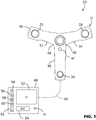
- a measurement device such as 3D imager system 20, is shown for determining 3D coordinates of surfaces in an environment.
- the system 20 includes an image scanner 22 having a projector 24, a first camera 26 and a second camera 28.
- the projector 24, and cameras 26, 28 are each disposed in a separate arms 30, 32, 34 of a housing 36 respectively.
- a color camera 40 may be centrally disposed on the housing 36 between the arms 30, 32, 34.
- the color camera 40 has a field of view that acquires images, including color information, of the environment being scanned.
- the color camera 40 may be used to provide color (texture) information for incorporation into the 3D image.
- the camera 40 acquires a video image may be used to register multiple 3D images through the use of videogrammetry.
- the color camera 40 is sometimes referred to as an RGB camera.
- the image scanner 22 may further have an annotation device 47, such as a microphone or a laser light source that emits a visible beam of light.
- the laser light source may include an assembly, such as a digital micromirror device (DMD) or galvomirrors for example, that allows the visible beam of light to be moved relative to the image scanner 22.
- DMD digital micromirror device
- galvomirrors for example
- the projector 24 projects a pattern of light onto a surfaces in the environment.
- the term "projector” is defined to generally refer to a device for producing a pattern.
- the generation of the pattern can take place by means of deflecting methods, such as generation by means of diffractive optical elements or micro-lenses (or single lasers), or by shading methods, for example the production by means of shutters, transparencies (as they would be used in a transparency projector) and other masks.
- the deflecting methods have the advantage of less light getting lost and consequently a higher intensity being available.
- the cameras 26, 28 acquire images of the pattern and in some instances able to determine the 3D coordinates of points on the surface using trigonometric principles, e.g. epipolar geometry.
- a controller 48 is coupled for communication to the projector 24, cameras 26, 28, 40 and in an embodiment the annotation device 47.
- the connection may be a wired-connection/data-transmission-media 50 or a wireless connection.
- the controller 48 is a suitable electronic device capable of accepting data and instructions, executing the instructions to process the data, and presenting the results. Controller 48 may accept instructions through user interface 52, or through other means such as but not limited to electronic data card, voice activation means, manually-operable selection and control means, radiated wavelength and electronic or electrical transfer.
- Controller 48 uses signals act as input to various processes for controlling the system 20.
- the digital signals represent one or more system 20 data including but not limited to images acquired by cameras 26, 28, 40, temperature, ambient light levels, operator inputs via user interface 52 and the like.
- Controller 48 is operably coupled with one or more components of system 20 by data transmission media 50.
- Data transmission media 50 includes, but is not limited to, twisted pair wiring, coaxial cable, and fiber optic cable.
- Data transmission media 50 also includes, but is not limited to, wireless, radio and infrared signal transmission systems.
- Controller 48 is configured to provide operating signals to these components and to receive data from these components via data transmission media 50.
- controller 48 accepts data from cameras 26, 28, 40, projector 24 and light source 47, and is given certain instructions for the purpose of determining the 3D coordinates of points on surfaces being scanned.
- the controller 48 may compare the operational parameters to predetermined variances and if the predetermined variance is exceeded, generates a signal that may be used to indicate an alarm to an operator or to a remote computer via a network. Additionally, the signal may initiate other control methods that adapt the operation of the system 20 such as changing the operational state of cameras 26, 28, 40, projector 24 or light source 42 to compensate for the out of variance operating parameter.
- the data received from cameras 26, 28, 40 may be displayed on a user interface 52.
- the user interface 52 may be an LED (light-emitting diode) display, an LCD (liquid-crystal diode) display, a CRT (cathode ray tube) display, a touch-screen display or the like.
- a keypad may also be coupled to the user interface for providing data input to controller 48.
- the controller 48 displays in the user interface 52 a point cloud to visually represent the acquired 3D coordinates.
- controller 48 may also be coupled to external computer networks such as a local area network (LAN) and the Internet.
- a LAN interconnects one or more remote computers, which are configured to communicate with controller 48 using a well-known computer communications protocol such as TCP/IP (Transmission Control Protocol/Internet( ⁇ ) Protocol), RS-232, ModBus, and the like.
- Additional systems 20 may also be connected to LAN with the controllers 48 in each of these systems 20 being configured to send and receive data to and from remote computers and other systems 20.
- the LAN is connected to the Internet. This connection allows controller 48 to communicate with one or more remote computers connected to the Internet.
- Controller 48 includes a processor 54 coupled to a random access memory (RAM) device 56 , a non-volatile memory (NVM) device 58 , a read-only memory (ROM) device 60 , one or more input/output (I/O) controllers, and a LAN interface device 62 via a data communications bus.
- RAM random access memory
- NVM non-volatile memory
- ROM read-only memory
- I/O input/output
- LAN interface device 62 provides for communication between controller 48 and a network in a data communications protocol supported by the network.
- ROM device 60 stores an application code, e.g., main functionality firmware, including initializing parameters, and boot code, for processor 54.
- Application code also includes program instructions as shown in FIG. 8 for causing processor 54 to execute any system 20 operation control methods, including starting and stopping operation, changing operational states of projector 24 and annotation device 47, monitoring predetermined operating parameters, and generation of alarms.
- the application code creates an onboard telemetry system may be used to transmit operating information between the system 20 and one or more remote computers or receiving locations.
- the information to be exchanged remote computers and the controller 48 include but are not limited to 3D coordinate data and images.
- NVM device 58 is any form of non-volatile memory such as an EPROM (Erasable Programmable Read Only Memory) chip, a disk drive, or the like.
- EPROM Erasable Programmable Read Only Memory
- Stored in NVM device 58 are various operational parameters for the application code. The various operational parameters can be input to NVM device 58 either locally, using a user interface 52 or remote computer, or remotely via the Internet using a remote computer. It will be recognized that application code can be stored in NVM device 58 rather than ROM device 60.
- Controller 48 includes operation control methods embodied in application code such as that shown in FIG. 8 . These methods are embodied in computer instructions written to be executed by processor 54, typically in the form of software.
- the software can be encoded in any language, including, but not limited to, assembly language, VHDL (Verilog Hardware Description Language), VHSIC HDL (Very High Speed IC Hardware Description Language), Fortran (formula translation), C, C++, Visual C++, C#, Objective-C, Java, Javascript ALGOL (algorithmic language), BASIC (beginners all-purpose symbolic instruction code), visual BASIC, ActiveX, HTML (HyperText Markup Language), Python, Ruby and any combination or derivative of at least one of the foregoing. Additionally, an operator can use an existing software application such as a spreadsheet or database and correlate various cells with the variables enumerated in the algorithms. Furthermore, the software can be independent of other software or dependent upon other software, such as in the form of integrated software.
- the controller 48 may be configured to receive audio annotation data and associate/integrate the annotation data with the three-dimensional coordinate data.
- the audio annotation data is a spoken voice.
- the controller 48 includes computer instructions written to be executed by processor 54 to translate the audio annotation data from a first spoken language to a second spoken language.
- the controller 48 further includes an energy source, such as battery 64.
- the battery 64 may be an electrochemical device that provides electrical power for the controller 48.
- the battery 64 may also provide electrical power to the cameras 26, 28, 40, the projector 24 and the annotation device 47.
- the battery 64 may be separate from the controller (e.g. a battery pack).
- a second battery (not shown) may be disposed in the housing 36 to provide electrical power to the cameras 26, 28, 40 and projector 24.
- the light source 42 may have a separate energy source (e.g. a battery pack).
- the controller 48 may include a microphone 65.
- the microphone 65 may be used to annotate the point cloud data acquired during the scanning process.
- the microphone 65 may be used by itself, or in combination with an annotation device 47.
- controller 48 is illustrated as being separate from the housing 36, this is for exemplary purposes and the claims should not be so limited. In other embodiments, the controller 48 is integrated into the housing 36. Further, while embodiments herein illustrate the controller 48 as being coupled with a single image scanner 22, this is for exemplary purposes and the claims should not be so limited. In other embodiments, the controller 48 may be coupled to and combine three-dimensional coordinate data and annotation data from multiple image scanners 22.
- the projector 24 and cameras 26, 28 are arranged spaced apart in a triangular arrangement where the relative distances and positions between the components is known.
- the triangular arrangement is advantageous in providing information beyond that available for two cameras and a projector arranged in a straight line or from a system with a projector and a single camera.
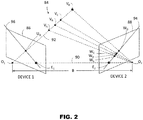
- the additional information may be understood in reference to FIG. 2 , which explain the concept of epipolar constraints, and FIG. 3 that explains how epipolar constraints are advantageously applied to the triangular arrangement of the system 20.
- a 3D triangulation instrument 84 includes a device 1 and a device 2 on the left and right sides as view from the viewpoint of FIG. 2 , respectively.
- Device 1 and device 2 may be two cameras or device 1 and device 2 may be one camera and one projector. Each of the two devices, whether a camera or a projector, has a perspective center, O 1 and O 2 , and a representative plane, 86 or 88.
- the perspective centers are separated by a baseline distance B, which is the length of the line 90.
- the perspective centers O 1 , O 2 are points through which rays of light may be considered to travel, either to or from a point on a surface in the area of the environment being scanned. These rays of light either emerge from an illuminated projector pattern or impinge on a photosensitive array.
- the placement of the reference planes 86, 88 is applied in FIG. 2 , which shows the reference planes 86, 88 between the object point and the perspective centers O 1 , O 2 .
- a point U D on the plane 86 If device 1 is a camera, it is known that an object point that produces the point U D on the image lies on the line 92.
- the object point might be, for example, one of the points V A , V B , V C , or V D .
- These four object points correspond to the points W A , W B , W C , W D , respectively, on the reference plane 88 of device 2.
- any epipolar line on the reference plane 88 passes through the epipole E 2 .
- FIG. 3 illustrates the epipolar relationships for a 3D imager 100 corresponding to triangulation instrument 84 of FIG. 2 in which two cameras and one projector are arranged in a triangular pattern.
- the device 1, device 2, and device 3 may be any combination of cameras and projectors as long as at least one of the devices is a camera.
- Each of the three devices 102, 104, 106 has a perspective center O 1 , O 2 , O 3 , respectively, and a reference plane 108, 110, and 112, respectively.
- Each pair of devices has a pair of epipoles.
- Device 1 and device 2 have epipoles E 12 , E 21 on the planes 108, 110, respectively.
- Device 1 and device 3 have epipoles E 13 , E 31 , respectively on the planes 108, 112, respectively.
- Device 2 and device 3 have epipoles E 23 , E 32 on the planes 110, 112, respectively.
- each reference plane includes two epipoles.
- the reference plane for device 1 includes epipoles E 12 and E 13 .
- the reference plane for device 2 includes epipoles E 21 and E 23 .
- the reference plane for device 3 includes epipoles E 31 and E 32 .
- device 3 is a projector
- device 1 is a first camera
- device 2 is a second camera.
- a projection point P 3 , a first image point P 1 , and a second image point P 2 are obtained in a measurement.
- the redundancy of information provided by using a 3D imager 100 having a triangular arrangement of projector and cameras may be used to reduce measurement time, to identify errors, and to automatically update compensation/calibration parameters. It should be appreciated that based on the epipolar geometry relationships described herein, the distance from the image scanner 22 to points on the surface being scanned may be determined. By moving the image scanner 22, the determination of the pose/orientation of the image scanner, and a registration process the three dimensional coordinates of locations (point data) on a surface may be determined.
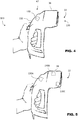
- an embodiment of the image scanner 22 is shown having an annotation device 47, such as a microphone 130 coupled to the housing 36.
- the microphone 130 is coupled to the controller 48 to transmit a signal in response to an external sound.
- the microphone 130 transmits a signal to the controller 48 in response to a user input, such as by depressing an actuator for example.
- the microphone 130 is positioned on or adjacent a handle 132 on a rear side 133 of the image scanner 22 to record sounds, such as the user's voice.
- the rear side 133 is opposite the front side 135, the front side being the side from which the projector 24 emits a light pattern.
- the microphone 130 allows the user to annotate the scanned data with additional information, such as notes on what the user is observing during the scan for example.
- the annotation device 47 includes a plurality of microphones 130A, 130B, 130C.
- the microphones 130A, 130B, 130C are each arranged to record sound from a different direction. This provides advantages in allowing background noise to be recorded during the scan. Further, since multiple microphones 130A, 130B, 130C are recording a sound the direction of the source of the sound may be identified. When this is combined with the location of the image scanner 22 (as determined from the 3D coordinates acquired during the scan) and the orientation/pose of the image scanner 22, the direction (and potential locations) of the source of the sound may be annotated or merged with the 3D coordinate data.
- the microphones 130 may be used to control the image scanner 22 with audio commands.
- the microphone 130 in response to an operator input, receives spoken/audible words from the operator.
- the controller 48 matches the received words with a list of predetermined commands and initiate control sequences or procedures in response.
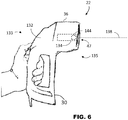
- an embodiment is shown of an image scanner 22 having an annotation device 47 that includes a laser light source 134.
- the laser light source 134 is arranged to emit a visible beam of light 138 from the front 135 of the image scanner 22, such as from an area adjacent the color camera 40 for example.
- the laser light source 134 emits a light beam having a predetermined wavelength in the visible spectrum.
- the predetermined wavelength is between 400 - 700 nanometers, in another embodiment, the predetermined wavelength is about 650 nanometers.
- the annotation device 47 includes both the laser light source 134 and the microphones 130, which allows an operator to mark a spot of light 142 on an environment and also contemporaneously record audio notes or comments.
- the operator may use the spot of light 142 to indicate cardinal points that will be used by the controller for registration of the images acquired by the image scanner 22 during the scanning process.
- the controller 48 receives a computer-aided-design (CAD) model of an object being scanned and the spot of light 142 marked by the operator defines a reference point for the CAD model.
- CAD computer-aided-design
- the laser light source 134 includes a steering mechanism 144.
- the steering mechanism 144 may be a galvomirror or a digital micromirror device for example.
- the steering mechanism 144 allows the direction that the light beam 138 to be changed relative to the front side 135.
- the direction of the light beam 138 may be dynamically changed as the image scanner 22 is moved or its pose changed.
- the direction of the light beam 138 may be changed by the operator, such as through the controller 48 for example.
- the operator may direct the light beam 138 to create a spot of light 142 in a desired position.
- the operator such as via controller 48 for example, may lock the light beam 138 on that spot.
- the steering mechanism 144 automatically changes the direction of the light beam 138 to maintain the spot of light 142 in the locked on location. It should be appreciated that the spot of light 142 will then appear in multiple images acquired by color camera 140.
- the operator may direct the light beam 138 to mark a spot of light 146 at a first location, such as at the corner of a wall 148 and a floor 150 for example.
- the operator then redirects the light beam 138 to generate a spot of light 142 at a second location, such as on an object 152 for example.
- the image scanner 22 is able to determine the three-dimensional coordinates of each location of the spots of light 146, 142, the system 20 is able to directly measure the distance between the two user-defined locations.
- the operator may move or change the pose of the image scanner 22 between marking the first location with the spot of light 146 and the second location with a spot of light 142.
- the laser light source 134 includes the steering mechanism 144 and the operator may use the steering mechanism to change the direction of the light beam 138. It should be appreciated that the locations of spots of light 146, 142 do not need to be within the same field of view of the cameras 26, 28, 40 for the distance between the locations of the spots of light 146, 142 to be measured.
- the image scanner 22 may determine the three-dimensional coordinates of the locations of the spots of light 146, 142 directly using the laser light source 134 and the color camera 40. It should be appreciated that the laser light source and color camera 40 may be device 1 and device 2 of FIG. 2 , therefore, as described herein the distance from the image scanner 22 to the locations of the spotes of light 146, 142 may be determined without scanning using the projector 24 and cameras 26, 28.
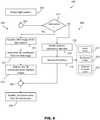
- an exemplary method 200 is shown of operating the system 20 to annotate 3D coordinate data with annotation data.
- the method 200 starts in block 202 where the light pattern is projected by the projector 24 onto a surface of an object being scanned to obtain its 3D coordinates.
- the method 200 then proceeds to node 204.
- the system 20 is configured to perform multiple processes simultaneously, such as the scanning of the object and the recording of annotation data.
- the method 200 bifurcates into a first process 206 that measures the three-dimensional coordinates of the object being scanned and a second process 208 that acquires annotation data.
- the first process 206 includes the acquiring of an images (or multiple images) of the light pattern projected by projector 24 with cameras 26, 28 in block 210.
- the system 20 then proceeds to block 212 where the three-dimensional coordinates of the scanned area are determined.
- the acquisition of three-dimensional coordinates of an object may involve scanning the object from multiple locations where the image scanner 22 is moved relative to the object (or the object is moved relative to the image scanner).
- the first process proceeds to block 213 where the three-dimensional coordinate data from the multiple scanning positions is registered. It should be appreciated that the registration of the three-dimensional coordinate data may be performed during the scanning process (simultaneously with or contemporaneously with the determination of the three-dimensional coordinates) or may be performed after the object is scanned.
- the second process 208 initiates at query block 214 where it is determined whether the operator desires to record any annotations.
- the image scanner 22 may have an actuator or switch (not shown) on the handle 132 that the operator actuates to initiate the annotations.
- the query block 214 returns a positive
- the second process 208 proceeds to block 216 where at least one of a position, orientation/pose or time is recorded. It should be appreciated that this may be used to register the annotation data to the three-dimensional coordinate data.
- the second process 208 then proceeds to block 218 where the annotation data 220 is recorded.
- the annotation data may include, but is not limited to, audio notes 222, background audio 224, and measurements between user defined locations 226 for example.
- the second process 208 then proceeds to node 228 and merges with the first process 206.
- the method 200 then proceeds to block 230 where the annotation data 220 is registered with the three-dimensional coordinate data.
- first process 206 and the second process 208 may be performed multiple times during the scanning process and the single instance illustrated in FIG. 8 is intended to be exemplary and the claims should not be so limited. Further, the registration of the annotation data with the three-dimensional data may be performed simultaneously with or contemporaneously with the determination of the three-dimensional coordinates.
- annotation data may include data received via LAN/internet interface device 62, such as but not limited to measurement data, documentation data, hyperlinks, and web addresses for example.
Landscapes
- Engineering & Computer Science (AREA)
- Physics & Mathematics (AREA)
- General Physics & Mathematics (AREA)
- Electromagnetism (AREA)
- Radar, Positioning & Navigation (AREA)
- Remote Sensing (AREA)
- Computer Networks & Wireless Communication (AREA)
- Multimedia (AREA)
- Computer Vision & Pattern Recognition (AREA)
- Theoretical Computer Science (AREA)
- Signal Processing (AREA)
- Robotics (AREA)
- Mechanical Engineering (AREA)
- Artificial Intelligence (AREA)
- Automation & Control Theory (AREA)
- Toxicology (AREA)
- Health & Medical Sciences (AREA)
- Optics & Photonics (AREA)
- Mathematical Physics (AREA)
- Software Systems (AREA)
- Computer Security & Cryptography (AREA)
- Fuzzy Systems (AREA)
- Evolutionary Computation (AREA)
- General Health & Medical Sciences (AREA)
- Human Computer Interaction (AREA)
- Length Measuring Devices By Optical Means (AREA)
Abstract
Description
- This application claims the benefit of
U.S. Provisional Application Serial No. 62/508,439, filed May 19, 2017 - The subject matter disclosed herein relates to a three-dimensional (3D) measurement device, and in particular to a 3D measurement device operable to receive and store date to annotate the 3D measurements.
- A 3D imager is a portable device includes a projector that projects light patterns on the surface of an object to be scanned. Typically the projector emits a coded or uncoded pattern. One (or more) cameras, having a predetermined positions and alignment relative to the projector, which record images of the light pattern on the surface of an object. The three-dimensional coordinates of elements in the light pattern can be determined by trigonometric methods, such as by using epipolar geometry. Other types of noncontact devices may also be used to measure 3D coordinates, such as those that use time of flight techniques (e.g. laser trackers, laser scanners or time of flight cameras) for measuring the amount of time it takes for light to travel to the surface and return to the device.
- Often, the operator may want to make additional notes about observations or include other data. These observations, such as noises that are heard for example, may be recorded with handwritten notes. These handwritten notes may be later incorporated into a report. However, the association about where the operator was at the time the notes were made will be lost or only have a tenuous relationship with the 3D data if the operator remembers to precisely describe where they are when the notes are written.
- Other types of annotations may include measurements between user identified points in the environment being scanned. Similarly, an operator may make manual measurements (e.g. with a tape measure) and make a handwritten note of the distance. However, as with the observation notes, these measurements are ancillary to and separate from the 3D coordinate data.
- Accordingly, while existing 3D imagers are suitable for their intended purpose the need for improvement remains, particularly in providing a system for associating annotation data with the measured 3D coordinates.
- According to one aspect of the disclosure, a three-dimensional (3D) measurement system is provided. The system includes a noncontact measurement device, an annotation member and a processor. The noncontact measurement device being operable to measure a distance from the noncontact measurement device to a surface. The annotation member is coupled to the noncontact measurement device. The processor is operably coupled to the noncontact measurement device and the annotation member, the processor operable to execute computer instructions when executed on the processor for determining 3D coordinates of at least one point in a field of view based at least in part on the distance, recording an annotation in response to an input from a user, and associating the annotation with the at least one point.
- According to another aspect of the disclosure, a method for acquiring 3D coordinates with additional data is provided. The method includes acquiring point data about a plurality of points on a surface with a noncontact measurement device. 3D coordinates of the plurality of points are determined based at least in part on the point data. In a first instance, annotation data is recorded with an annotation member in response to an input from a user, the annotation member being coupled to the noncontact measurement device. The annotation data is associated with at least a portion of the 3D coordinates of points, wherein the portion of the 3D coordinates of points were determined from the point data acquired contemporaneously with the annotation data.
- These and other advantages and features will become more apparent from the following description taken in conjunction with the drawings.
- The subject matter, which is regarded as the disclosure, is particularly pointed out and distinctly claimed in the claims at the conclusion of the specification. The foregoing and other features, and advantages of the disclosure are apparent from the following detailed description taken in conjunction with the accompanying drawings in which:
-
FIG. 1 is a view of a 3D imager system in accordance with an embodiment of the invention; -
FIG. 2 andFIG. 3 are schematic illustrations of the principle of operation of the 3D imager ofFIG. 1 ; -
FIG. 4 is a side view of a 3D imager system in accordance with an embodiment of the invention; -
FIG. 5 is a side view of a 3D imager system in accordance with another embodiment of the invention; -
FIG. 6 is a side view of a 3D imager system in accordance with another embodiment of the invention; -
FIG. 7 is an illustration of a 3D imager measuring a distance between user defined points in an environment in accordance with an embodiment; and -
FIG. 8 is a flow diagram of a method of operating a 3D imager, in accordance with an embodiment. - The detailed description explains embodiments of the disclosure, together with advantages and features, by way of example with reference to the drawings.
- Embodiments of the invention provide for a three-dimensional (3D) measurement device that acquires annotation data that is registered with the coordinate data. Embodiments of the invention provide for the recording of sounds, such as the operators voice or background noise. Still further embodiments provide for the emitting of a visible light beam that can be used for marking locations in the environment that are being scanned, or for measuring distances between two marked points.
- Referring now to
FIG. 1 , a measurement device, such as3D imager system 20, is shown for determining 3D coordinates of surfaces in an environment. Thesystem 20 includes animage scanner 22 having aprojector 24, afirst camera 26 and asecond camera 28. In the exemplary embodiment, theprojector 24, andcameras separate arms housing 36 respectively. Acolor camera 40 may be centrally disposed on thehousing 36 between thearms color camera 40 has a field of view that acquires images, including color information, of the environment being scanned. In an embodiment, thecolor camera 40 may be used to provide color (texture) information for incorporation into the 3D image. In some embodiments, thecamera 40 acquires a video image may be used to register multiple 3D images through the use of videogrammetry. Thecolor camera 40 is sometimes referred to as an RGB camera. In an embodiment discussed below, theimage scanner 22 may further have anannotation device 47, such as a microphone or a laser light source that emits a visible beam of light. In an embodiment, the laser light source may include an assembly, such as a digital micromirror device (DMD) or galvomirrors for example, that allows the visible beam of light to be moved relative to theimage scanner 22. - As discussed in more detail herein, in an embodiment the
projector 24 projects a pattern of light onto a surfaces in the environment. As used herein, the term "projector" is defined to generally refer to a device for producing a pattern. The generation of the pattern can take place by means of deflecting methods, such as generation by means of diffractive optical elements or micro-lenses (or single lasers), or by shading methods, for example the production by means of shutters, transparencies (as they would be used in a transparency projector) and other masks. The deflecting methods have the advantage of less light getting lost and consequently a higher intensity being available. - The
cameras - It should be appreciated that while the illustrated embodiments show and describe the device that determines 3D coordinates as being an image scanner, this is for exemplary purposes and the claimed invention should not be so limited. In other embodiments, devices that use other noncontact means for measuring 3D coordinates may also be used, such as a laser scanner device that uses time-of-flight to determine the distance to the surface.
- A
controller 48 is coupled for communication to theprojector 24,cameras annotation device 47. The connection may be a wired-connection/data-transmission-media 50 or a wireless connection. Thecontroller 48 is a suitable electronic device capable of accepting data and instructions, executing the instructions to process the data, and presenting the results.Controller 48 may accept instructions throughuser interface 52, or through other means such as but not limited to electronic data card, voice activation means, manually-operable selection and control means, radiated wavelength and electronic or electrical transfer. -
Controller 48 uses signals act as input to various processes for controlling thesystem 20. The digital signals represent one ormore system 20 data including but not limited to images acquired bycameras user interface 52 and the like. -
Controller 48 is operably coupled with one or more components ofsystem 20 bydata transmission media 50.Data transmission media 50 includes, but is not limited to, twisted pair wiring, coaxial cable, and fiber optic cable.Data transmission media 50 also includes, but is not limited to, wireless, radio and infrared signal transmission systems.Controller 48 is configured to provide operating signals to these components and to receive data from these components viadata transmission media 50. - In general,
controller 48 accepts data fromcameras projector 24 andlight source 47, and is given certain instructions for the purpose of determining the 3D coordinates of points on surfaces being scanned. Thecontroller 48 may compare the operational parameters to predetermined variances and if the predetermined variance is exceeded, generates a signal that may be used to indicate an alarm to an operator or to a remote computer via a network. Additionally, the signal may initiate other control methods that adapt the operation of thesystem 20 such as changing the operational state ofcameras projector 24 or light source 42 to compensate for the out of variance operating parameter. - The data received from
cameras user interface 52. Theuser interface 52 may be an LED (light-emitting diode) display, an LCD (liquid-crystal diode) display, a CRT (cathode ray tube) display, a touch-screen display or the like. A keypad may also be coupled to the user interface for providing data input tocontroller 48. In an embodiment, thecontroller 48 displays in the user interface 52 a point cloud to visually represent the acquired 3D coordinates. - In addition to being coupled to one or more components within
system 20,controller 48 may also be coupled to external computer networks such as a local area network (LAN) and the Internet. A LAN interconnects one or more remote computers, which are configured to communicate withcontroller 48 using a well-known computer communications protocol such as TCP/IP (Transmission Control Protocol/Internet(^) Protocol), RS-232, ModBus, and the like.Additional systems 20 may also be connected to LAN with thecontrollers 48 in each of thesesystems 20 being configured to send and receive data to and from remote computers andother systems 20. The LAN is connected to the Internet. This connection allowscontroller 48 to communicate with one or more remote computers connected to the Internet. -
Controller 48 includes aprocessor 54 coupled to a random access memory (RAM)device 56 , a non-volatile memory (NVM)device 58 , a read-only memory (ROM)device 60 , one or more input/output (I/O) controllers, and aLAN interface device 62 via a data communications bus. -
LAN interface device 62 provides for communication betweencontroller 48 and a network in a data communications protocol supported by the network.ROM device 60 stores an application code, e.g., main functionality firmware, including initializing parameters, and boot code, forprocessor 54. Application code also includes program instructions as shown inFIG. 8 for causingprocessor 54 to execute anysystem 20 operation control methods, including starting and stopping operation, changing operational states ofprojector 24 andannotation device 47, monitoring predetermined operating parameters, and generation of alarms. In an embodiment, the application code creates an onboard telemetry system may be used to transmit operating information between thesystem 20 and one or more remote computers or receiving locations. The information to be exchanged remote computers and thecontroller 48 include but are not limited to 3D coordinate data and images. -
NVM device 58 is any form of non-volatile memory such as an EPROM (Erasable Programmable Read Only Memory) chip, a disk drive, or the like. Stored inNVM device 58 are various operational parameters for the application code. The various operational parameters can be input toNVM device 58 either locally, using auser interface 52 or remote computer, or remotely via the Internet using a remote computer. It will be recognized that application code can be stored inNVM device 58 rather thanROM device 60. -
Controller 48 includes operation control methods embodied in application code such as that shown inFIG. 8 . These methods are embodied in computer instructions written to be executed byprocessor 54, typically in the form of software. The software can be encoded in any language, including, but not limited to, assembly language, VHDL (Verilog Hardware Description Language), VHSIC HDL (Very High Speed IC Hardware Description Language), Fortran (formula translation), C, C++, Visual C++, C#, Objective-C, Java, Javascript ALGOL (algorithmic language), BASIC (beginners all-purpose symbolic instruction code), visual BASIC, ActiveX, HTML (HyperText Markup Language), Python, Ruby and any combination or derivative of at least one of the foregoing. Additionally, an operator can use an existing software application such as a spreadsheet or database and correlate various cells with the variables enumerated in the algorithms. Furthermore, the software can be independent of other software or dependent upon other software, such as in the form of integrated software. - As will be discussed in more detail herein, the
controller 48 may be configured to receive audio annotation data and associate/integrate the annotation data with the three-dimensional coordinate data. In an embodiment, the audio annotation data is a spoken voice. In one embodiment, thecontroller 48 includes computer instructions written to be executed byprocessor 54 to translate the audio annotation data from a first spoken language to a second spoken language. - In an embodiment, the
controller 48 further includes an energy source, such asbattery 64. Thebattery 64 may be an electrochemical device that provides electrical power for thecontroller 48. In an embodiment, thebattery 64 may also provide electrical power to thecameras projector 24 and theannotation device 47. In some embodiments, thebattery 64 may be separate from the controller (e.g. a battery pack). In an embodiment, a second battery (not shown) may be disposed in thehousing 36 to provide electrical power to thecameras projector 24. In still further embodiments, the light source 42 may have a separate energy source (e.g. a battery pack). - In one embodiment, the
controller 48 may include amicrophone 65. As discussed further herein, themicrophone 65 may be used to annotate the point cloud data acquired during the scanning process. In an embodiment, themicrophone 65 may be used by itself, or in combination with anannotation device 47. - It should be appreciated that while the
controller 48 is illustrated as being separate from thehousing 36, this is for exemplary purposes and the claims should not be so limited. In other embodiments, thecontroller 48 is integrated into thehousing 36. Further, while embodiments herein illustrate thecontroller 48 as being coupled with asingle image scanner 22, this is for exemplary purposes and the claims should not be so limited. In other embodiments, thecontroller 48 may be coupled to and combine three-dimensional coordinate data and annotation data frommultiple image scanners 22. - In the illustrated embodiment, the
projector 24 andcameras FIG. 2 , which explain the concept of epipolar constraints, andFIG. 3 that explains how epipolar constraints are advantageously applied to the triangular arrangement of thesystem 20. InFIG. 2 , a3D triangulation instrument 84 includes adevice 1 and adevice 2 on the left and right sides as view from the viewpoint ofFIG. 2 , respectively.Device 1 anddevice 2 may be two cameras ordevice 1 anddevice 2 may be one camera and one projector. Each of the two devices, whether a camera or a projector, has a perspective center, O1 and O2, and a representative plane, 86 or 88. The perspective centers are separated by a baseline distance B, which is the length of theline 90. The perspective centers O1, O2 are points through which rays of light may be considered to travel, either to or from a point on a surface in the area of the environment being scanned. These rays of light either emerge from an illuminated projector pattern or impinge on a photosensitive array. The placement of the reference planes 86, 88 is applied inFIG. 2 , which shows the reference planes 86, 88 between the object point and the perspective centers O1, O2. - In
FIG. 2 , for thereference plane 86 angled toward the perspective center O2 and thereference plane 88 angled toward the perspective center O1, aline 90 drawn between the perspective centers O1 and O2 crosses theplanes plane 86. Ifdevice 1 is a camera, it is known that an object point that produces the point UD on the image lies on theline 92. The object point might be, for example, one of the points VA, VB, VC, or VD. These four object points correspond to the points WA, WB, WC, WD, respectively, on thereference plane 88 ofdevice 2. This is true whetherdevice 2 is a camera or a projector. It is also true that the four points lie on astraight line 94 in theplane 88. This line, which is the line of intersection of thereference plane 88 with the plane of O1-O2-UD, is referred to as theepipolar line 94. It follows that any epipolar line on thereference plane 88 passes through the epipole E2. Just as there is an epipolar line on the reference plane ofdevice 2 for any point on the reference plane ofdevice 1, there is also anepipolar line 96 on the reference plane ofdevice 1 for any point on the reference plane ofdevice 2. -
FIG. 3 illustrates the epipolar relationships for a3D imager 100 corresponding totriangulation instrument 84 ofFIG. 2 in which two cameras and one projector are arranged in a triangular pattern. In general, thedevice 1,device 2, anddevice 3 may be any combination of cameras and projectors as long as at least one of the devices is a camera. Each of the threedevices reference plane Device 1 anddevice 2 have epipoles E12, E21 on theplanes Device 1 anddevice 3 have epipoles E13, E31, respectively on theplanes Device 2 anddevice 3 have epipoles E23, E32 on theplanes device 1 includes epipoles E12 and E13. The reference plane fordevice 2 includes epipoles E21 and E23. The reference plane fordevice 3 includes epipoles E31 and E32. - Consider the embodiment of
FIG. 3 in whichdevice 3 is a projector,device 1 is a first camera, anddevice 2 is a second camera. Suppose that a projection point P3, a first image point P1, and a second image point P2 are obtained in a measurement. These results can be checked for consistency in the following way. - To check the consistency of the image point P1, intersect the plane P3-E31-E13 with the
reference plane 108 to obtain theepipolar line 114. Intersect the plane P2-E21-E12 to obtain theepipolar line 116. If the image point P1 has been determined consistently, the observed image point P1 will lie on the intersection of thedetermined epipolar line 114 andline 116. - To check the consistency of the image point P2, intersect the plane P3-E32-E23 with the
reference plane 110 to obtain theepipolar line 105. Intersect the plane P1-E12-E21 to obtain theepipolar line 107. If the image point P2 has been determined consistently, the observed image point P2 will lie on the intersection of the determinedepipolar lines - To check the consistency of the projection point P3, intersect the plane P2-E23-E32 with the
reference plane 110 to obtain theepipolar line 118. Intersect the plane P1-E13-E31 to obtain theepipolar line 120. If the projection point P3 has been determined consistently, the projection point P3 will lie on the intersection of thedetermined epipolar line 118 andline 120. - The redundancy of information provided by using a
3D imager 100 having a triangular arrangement of projector and cameras may be used to reduce measurement time, to identify errors, and to automatically update compensation/calibration parameters. It should be appreciated that based on the epipolar geometry relationships described herein, the distance from theimage scanner 22 to points on the surface being scanned may be determined. By moving theimage scanner 22, the determination of the pose/orientation of the image scanner, and a registration process the three dimensional coordinates of locations (point data) on a surface may be determined. - Referring now to
FIG. 4 , an embodiment of theimage scanner 22 is shown having anannotation device 47, such as amicrophone 130 coupled to thehousing 36. Themicrophone 130 is coupled to thecontroller 48 to transmit a signal in response to an external sound. In an embodiment, themicrophone 130 transmits a signal to thecontroller 48 in response to a user input, such as by depressing an actuator for example. In the embodiment ofFIG. 4 , themicrophone 130 is positioned on or adjacent ahandle 132 on arear side 133 of theimage scanner 22 to record sounds, such as the user's voice. As used herein, therear side 133 is opposite thefront side 135, the front side being the side from which theprojector 24 emits a light pattern. As will be discussed in more detail herein, themicrophone 130 allows the user to annotate the scanned data with additional information, such as notes on what the user is observing during the scan for example. - In the embodiment of
FIG. 5 , theannotation device 47 includes a plurality ofmicrophones microphones multiple microphones image scanner 22, the direction (and potential locations) of the source of the sound may be annotated or merged with the 3D coordinate data. - It should be appreciated that the ability to record sound, such as verbal notes spoken by the user provides advantages in that it allows the user to integrate the annotations with the 3D coordinate data, whereas previously these notes would have been kept separately. Further, the separate, and usually handwritten, notes would not have the positional association within the 3D coordinate data that embodiments described herein provide.
- In still further embodiments, the
microphones 130 may be used to control theimage scanner 22 with audio commands. In this embodiment, in response to an operator input, themicrophone 130 receives spoken/audible words from the operator. Thecontroller 48 matches the received words with a list of predetermined commands and initiate control sequences or procedures in response. - Referring now to
FIG. 6 , an embodiment is shown of animage scanner 22 having anannotation device 47 that includes alaser light source 134. In an embodiment, thelaser light source 134 is arranged to emit a visible beam of light 138 from thefront 135 of theimage scanner 22, such as from an area adjacent thecolor camera 40 for example. In an embodiment, thelaser light source 134 emits a light beam having a predetermined wavelength in the visible spectrum. In an embodiment, the predetermined wavelength is between 400 - 700 nanometers, in another embodiment, the predetermined wavelength is about 650 nanometers. - It should be appreciated when the visible beam of
light 138 intersects or strikes a surface, such assurface 140 shown inFIG. 7 for example, a visible mark or spot oflight 142 will appear on the surface. Since the spot oflight 142 is within the field of view of thecolor camera 40, the spot oflight 142 will appear on images acquired by thecolor camera 40 and as a result may be incorporated into the 3D point cloud generated by theimage scanner 22. This enables the operator to mark a point or location in the environment and later have this location incorporated into the 3D data. Further, in an embodiment, theannotation device 47 includes both thelaser light source 134 and themicrophones 130, which allows an operator to mark a spot of light 142 on an environment and also contemporaneously record audio notes or comments. - In one embodiment, the operator may use the spot of light 142 to indicate cardinal points that will be used by the controller for registration of the images acquired by the
image scanner 22 during the scanning process. In still another embodiment, thecontroller 48 receives a computer-aided-design (CAD) model of an object being scanned and the spot of light 142 marked by the operator defines a reference point for the CAD model. - In an embodiment, the
laser light source 134 includes asteering mechanism 144. Thesteering mechanism 144 may be a galvomirror or a digital micromirror device for example. Thesteering mechanism 144 allows the direction that thelight beam 138 to be changed relative to thefront side 135. In an embodiment, the direction of thelight beam 138 may be dynamically changed as theimage scanner 22 is moved or its pose changed. In another embodiment, the direction of thelight beam 138 may be changed by the operator, such as through thecontroller 48 for example. - In one embodiment, the operator may direct the
light beam 138 to create a spot of light 142 in a desired position. The operator, such as viacontroller 48 for example, may lock thelight beam 138 on that spot. Then as the position or pose of theimage scanner 22 changes, thesteering mechanism 144 automatically changes the direction of thelight beam 138 to maintain the spot of light 142 in the locked on location. It should be appreciated that the spot oflight 142 will then appear in multiple images acquired bycolor camera 140. - Referring now to
FIG. 7 , another embodiment is shown of theimage scanner 22 having thelaser light source 134. In this embodiment, the operator may direct thelight beam 138 to mark a spot of light 146 at a first location, such as at the corner of awall 148 and afloor 150 for example. The operator then redirects thelight beam 138 to generate a spot of light 142 at a second location, such as on anobject 152 for example. As described herein, theimage scanner 22 is able to determine the three-dimensional coordinates of each location of the spots oflight system 20 is able to directly measure the distance between the two user-defined locations. - In one embodiment, the operator may move or change the pose of the
image scanner 22 between marking the first location with the spot oflight 146 and the second location with a spot oflight 142. In another embodiment, thelaser light source 134 includes thesteering mechanism 144 and the operator may use the steering mechanism to change the direction of thelight beam 138. It should be appreciated that the locations of spots oflight cameras light - In still another embodiment, the
image scanner 22 may determine the three-dimensional coordinates of the locations of the spots oflight laser light source 134 and thecolor camera 40. It should be appreciated that the laser light source andcolor camera 40 may bedevice 1 anddevice 2 ofFIG. 2 , therefore, as described herein the distance from theimage scanner 22 to the locations of the spotes oflight projector 24 andcameras - Referring now to
FIG. 8 , anexemplary method 200 is shown of operating thesystem 20 to annotate 3D coordinate data with annotation data. Themethod 200 starts inblock 202 where the light pattern is projected by theprojector 24 onto a surface of an object being scanned to obtain its 3D coordinates. Themethod 200 then proceeds tonode 204. In an embodiment, thesystem 20 is configured to perform multiple processes simultaneously, such as the scanning of the object and the recording of annotation data. In an embodiment, atnode 204, themethod 200 bifurcates into afirst process 206 that measures the three-dimensional coordinates of the object being scanned and asecond process 208 that acquires annotation data. - The
first process 206 includes the acquiring of an images (or multiple images) of the light pattern projected byprojector 24 withcameras block 210. Thesystem 20 then proceeds to block 212 where the three-dimensional coordinates of the scanned area are determined. In some embodiments, the acquisition of three-dimensional coordinates of an object may involve scanning the object from multiple locations where theimage scanner 22 is moved relative to the object (or the object is moved relative to the image scanner). In these embodiments, the first process proceeds to block 213 where the three-dimensional coordinate data from the multiple scanning positions is registered. It should be appreciated that the registration of the three-dimensional coordinate data may be performed during the scanning process (simultaneously with or contemporaneously with the determination of the three-dimensional coordinates) or may be performed after the object is scanned. - The
second process 208 initiates atquery block 214 where it is determined whether the operator desires to record any annotations. In an embodiment, theimage scanner 22 may have an actuator or switch (not shown) on thehandle 132 that the operator actuates to initiate the annotations. When thequery block 214 returns a positive, thesecond process 208 proceeds to block 216 where at least one of a position, orientation/pose or time is recorded. It should be appreciated that this may be used to register the annotation data to the three-dimensional coordinate data. - The
second process 208 then proceeds to block 218 where theannotation data 220 is recorded. The annotation data may include, but is not limited to, audio notes 222,background audio 224, and measurements between user definedlocations 226 for example. Thesecond process 208 then proceeds tonode 228 and merges with thefirst process 206. Themethod 200 then proceeds to block 230 where theannotation data 220 is registered with the three-dimensional coordinate data. - It should be appreciated that the
first process 206 and thesecond process 208 may be performed multiple times during the scanning process and the single instance illustrated inFIG. 8 is intended to be exemplary and the claims should not be so limited. Further, the registration of the annotation data with the three-dimensional data may be performed simultaneously with or contemporaneously with the determination of the three-dimensional coordinates. - Further, it should be appreciated that while embodiments herein describe the annotation data with respect to recording sound or marking locations with light, this is for exemplary purposes and the claims should not be so limited. In other embodiments, other types or sources of data may be integrated with the three-dimensional coordinate data to annotate the point cloud. Other annotation data may include data received via LAN/
internet interface device 62, such as but not limited to measurement data, documentation data, hyperlinks, and web addresses for example. - The term "about" is intended to include the degree of error associated with measurement of the particular quantity based upon the equipment available at the time of filing the application. For example, "about" can include a range of ± 8% or 5%, or 2% of a given value.
- The terminology used herein is for the purpose of describing particular embodiments only and is not intended to be limiting of the disclosure. As used herein, the singular forms "a", "an" and "the" are intended to include the plural forms as well, unless the context clearly indicates otherwise. It will be further understood that the terms "comprises" and/or "comprising," when used in this specification, specify the presence of stated features, integers, steps, operations, elements, and/or components, but do not preclude the presence or addition of one or more other features, integers, steps, operations, element components, and/or groups thereof.
- While the disclosure is provided in detail in connection with only a limited number of embodiments, it should be readily understood that the disclosure is not limited to such disclosed embodiments. Rather, the disclosure can be modified to incorporate any number of variations, alterations, substitutions or equivalent arrangements not heretofore described, but which are commensurate with the spirit and scope of the disclosure. Additionally, while various embodiments of the disclosure have been described, it is to be understood that the exemplary embodiment(s) may include only some of the described exemplary aspects. Accordingly, the disclosure is not to be seen as limited by the foregoing description, but is only limited by the scope of the appended claims.
Claims (15)
- A three-dimensional (3D) measurement system comprising:a noncontact measurement device operable to measure a distance from the noncontact measurement device to a surface;an annotation member coupled to the noncontact measurement device; anda processor operably coupled to the noncontact measurement device and the annotation member, the processor operable to execute computer instructions when executed on the processor for determining 3D coordinates of at least one point in a field of view based at least in part on the distance, recording an annotation in response to an input from a user, and associating the annotation with the at least one point.
- The system of claim 1, wherein the annotation member is a microphone arranged to receive sounds from the user.
- The system of claim 2, wherein the microphone includes a plurality of microphones, each of the plurality of microphones being coupled to the noncontact measurement device and arranged to receive sound from a different direction.
- The system of claim 2, wherein the processor is further operable to execute a process on the noncontact measurement device in response to a sound received by the microphone from the user.
- The system of claim 1, wherein the annotation member is a laser light source arranged to emit a visible light beam from the noncontact measurement device.
- The system of claim 5, wherein the processor is further operable to perform a method comprising:in a first instance emitting the visible light beam onto a first position in response to a first input from the user;in a second instance emitting the visible light beam onto a second position in response to a second input from the user; andcomparing measurement data around the first position and the second position based at least in part on the 3D coordinates of the first position and the second position.
- The system of claim 5, wherein the annotation member further includes a microphone, and wherein the processor is further operable to perform a method comprising:emitting the visible light beam onto a surface in response to an input from the user;acquiring an image of the surface with a spot of light from the visible light beam;recording a sound from the user; andassociating the recording of the sound with the image.
- The system of claim 5, wherein the noncontact measurement device includes a camera with the field of view, and wherein the processor is further operable to perform a method comprising:defining a reference point in a computer-aided-design model; andemitting the visible light beam onto a feature of an object in response to an input from the user, the feature being based at least in part on the reference point.
- A method comprising:acquiring point data about a plurality of points on a surface with a noncontact measurement device;determining 3D coordinates of the plurality of points based at least in part on the point data;in a first instance, recording annotation data with an annotation member in response to an input from a user, the annotation member being coupled to the noncontact measurement device; andassociating the annotation data with at least a portion of the 3D coordinates of points, wherein the portion of the 3D coordinates of points were determined from the point data acquired contemporaneously with the annotation data.
- The method of claim 9, wherein the annotation member includes a microphone and the recording of annotation data includes recording sound data.
- The method of claim 10, wherein the annotation member includes a plurality of microphones, each of the microphones arranged to receive sound from a different direction.
- The method of claim 10, further comprising executing a process on the noncontact measurement device based at least in part on the sound data.
- The method of claim 9, wherein the annotation member includes a laser light source that emits a visible light beam and the step of recording annotation data further comprising:emitting the visible light beam onto a surface in an environment;acquiring an image of a spot of light on the surface generated by the visible light beam.
- The method of claim 13, wherein the recording annotation data further comprises:in a first instance emitting the visible light beam onto a first position in response to a first input from the user;in a second instance emitting the visible light beam onto a second position in response to a second input from the user; andcomparing measurement data around the first position and the second position based at least in part on the 3D coordinates of the first position and the second position.
- The method of claim 13, wherein the recording annotation data further comprises:recording a sound from the user; andassociating the recording of the sound with the image.
Applications Claiming Priority (2)
| Application Number | Priority Date | Filing Date | Title |
|---|---|---|---|
| US201762508439P | 2017-05-19 | 2017-05-19 | |
| US15/959,640 US10719947B2 (en) | 2017-05-19 | 2018-04-23 | Three-dimensional measurement device with annotation features |
Publications (1)
| Publication Number | Publication Date |
|---|---|
| EP3407600A1 true EP3407600A1 (en) | 2018-11-28 |
Family
ID=62200378
Family Applications (1)
| Application Number | Title | Priority Date | Filing Date |
|---|---|---|---|
| EP18173131.6A Withdrawn EP3407600A1 (en) | 2017-05-19 | 2018-05-18 | Three-dimensional measurement device with annotation features |
Country Status (3)
| Country | Link |
|---|---|
| US (1) | US10719947B2 (en) |
| EP (1) | EP3407600A1 (en) |
| JP (1) | JP2018194549A (en) |
Families Citing this family (5)
| Publication number | Priority date | Publication date | Assignee | Title |
|---|---|---|---|---|
| WO2019094901A1 (en) | 2017-11-13 | 2019-05-16 | Hexagon Metrology, Inc. | Thermal management of an optical scanning device |
| US20200014909A1 (en) | 2018-07-03 | 2020-01-09 | Faro Technologies, Inc. | Handheld three dimensional scanner with autofocus or autoaperture |
| USD875573S1 (en) | 2018-09-26 | 2020-02-18 | Hexagon Metrology, Inc. | Scanning device |
| CN112212803B (en) * | 2020-09-30 | 2025-03-04 | 武汉中观自动化科技有限公司 | A three-camera handheld 3D laser scanner for flash hole measurement |
| CN117621032A (en) * | 2022-08-11 | 2024-03-01 | 华为云计算技术有限公司 | An object picking method and related equipment |
Citations (4)
| Publication number | Priority date | Publication date | Assignee | Title |
|---|---|---|---|---|
| US20120223885A1 (en) * | 2011-03-02 | 2012-09-06 | Microsoft Corporation | Immersive display experience |
| US9196067B1 (en) * | 2013-03-05 | 2015-11-24 | Amazon Technologies, Inc. | Application specific tracking of projection surfaces |
| US20160073091A1 (en) * | 2014-09-10 | 2016-03-10 | Faro Technologies, Inc. | Method for optically measuring three-dimensional coordinates and calibration of a three-dimensional measuring device |
| US20160129594A1 (en) * | 2014-11-10 | 2016-05-12 | Faro Technologies, Inc. | Human-centric robot with noncontact measurement device |
Family Cites Families (7)
| Publication number | Priority date | Publication date | Assignee | Title |
|---|---|---|---|---|
| US9163922B2 (en) * | 2010-01-20 | 2015-10-20 | Faro Technologies, Inc. | Coordinate measurement machine with distance meter and camera to determine dimensions within camera images |
| US9671221B2 (en) | 2014-09-10 | 2017-06-06 | Faro Technologies, Inc. | Portable device for optically measuring three-dimensional coordinates |
| DE102014013677B4 (en) | 2014-09-10 | 2017-06-22 | Faro Technologies, Inc. | Method for optically scanning and measuring an environment with a handheld scanner and subdivided display |
| US9602811B2 (en) | 2014-09-10 | 2017-03-21 | Faro Technologies, Inc. | Method for optically measuring three-dimensional coordinates and controlling a three-dimensional measuring device |
| DE102014013678B3 (en) | 2014-09-10 | 2015-12-03 | Faro Technologies, Inc. | Method for optically sensing and measuring an environment with a handheld scanner and gesture control |
| DE102015122842B4 (en) | 2015-12-27 | 2019-02-07 | Faro Technologies, Inc. | Method for calibrating a 3D measuring device by means of a calibration plate |
| US10834377B2 (en) | 2016-08-29 | 2020-11-10 | Faro Technologies, Inc. | Forensic three-dimensional measurement device |
-
2018
- 2018-04-23 US US15/959,640 patent/US10719947B2/en active Active
- 2018-05-09 JP JP2018090673A patent/JP2018194549A/en active Pending
- 2018-05-18 EP EP18173131.6A patent/EP3407600A1/en not_active Withdrawn
Patent Citations (4)
| Publication number | Priority date | Publication date | Assignee | Title |
|---|---|---|---|---|
| US20120223885A1 (en) * | 2011-03-02 | 2012-09-06 | Microsoft Corporation | Immersive display experience |
| US9196067B1 (en) * | 2013-03-05 | 2015-11-24 | Amazon Technologies, Inc. | Application specific tracking of projection surfaces |
| US20160073091A1 (en) * | 2014-09-10 | 2016-03-10 | Faro Technologies, Inc. | Method for optically measuring three-dimensional coordinates and calibration of a three-dimensional measuring device |
| US20160129594A1 (en) * | 2014-11-10 | 2016-05-12 | Faro Technologies, Inc. | Human-centric robot with noncontact measurement device |
Also Published As
| Publication number | Publication date |
|---|---|
| US20180336690A1 (en) | 2018-11-22 |
| US10719947B2 (en) | 2020-07-21 |
| JP2018194549A (en) | 2018-12-06 |
Similar Documents
| Publication | Publication Date | Title |
|---|---|---|
| EP3435023B1 (en) | System and method for inspecting an object | |
| US10719947B2 (en) | Three-dimensional measurement device with annotation features | |
| EP3477256A1 (en) | Three-dimensional measurement device with color camera | |
| US10414048B2 (en) | Noncontact safety sensor and method of operation | |
| US10378889B2 (en) | Measurement system having a cooperative robot and three-dimensional imager | |
| US10935374B2 (en) | Systems and methods for generating models of scanned environments | |
| JP4607095B2 (en) | Method and apparatus for image processing in surveying instrument | |
| US11692812B2 (en) | System and method for measuring three-dimensional coordinates | |
| US9761016B1 (en) | Automated generation of a three-dimensional scanner video | |
| US10834377B2 (en) | Forensic three-dimensional measurement device | |
| US20170242110A1 (en) | Optical Safety System | |
| US20190285404A1 (en) | Noncontact three-dimensional measurement system | |
| EP3754547B1 (en) | Shape dependent model identification in point clouds | |
| US12429844B2 (en) | Computer numerical control machine, machining method thereof, and system | |
| US10447991B1 (en) | System and method of mapping elements inside walls | |
| US20230228557A1 (en) | User interface for three-dimensional measurement device | |
| WO2023225754A1 (en) | System, apparatus and method for providing 3d surface measurements with precision indication capabilities and use thereof | |
| CN113822930A (en) | System and method for high precision positioning of objects in a parking lot | |
| Wiese et al. | Estimation of the spatial calibration quality of multicamera systems for tracking surgical instruments in large measuring volumes | |
| CN111300426B (en) | Control system of sensing head of highly intelligent humanoid robot | |
| US11315282B2 (en) | System and method of imaging evidence at a scene | |
| JP2013257289A (en) | Image processing apparatus and image processing method | |
| JP2002031511A (en) | Three-dimensional digitizer | |
| EP3822846A1 (en) | System and method for monitoring and servicing an object within a location | |
| CN121918778A (en) | Image projection method, system and equipment |
Legal Events
| Date | Code | Title | Description |
|---|---|---|---|
| PUAI | Public reference made under article 153(3) epc to a published international application that has entered the european phase |
Free format text: ORIGINAL CODE: 0009012 |
|
| STAA | Information on the status of an ep patent application or granted ep patent |
Free format text: STATUS: THE APPLICATION HAS BEEN PUBLISHED |
|
| AK | Designated contracting states |
Kind code of ref document: A1 Designated state(s): AL AT BE BG CH CY CZ DE DK EE ES FI FR GB GR HR HU IE IS IT LI LT LU LV MC MK MT NL NO PL PT RO RS SE SI SK SM TR |
|
| AX | Request for extension of the european patent |
Extension state: BA ME |
|
| STAA | Information on the status of an ep patent application or granted ep patent |
Free format text: STATUS: REQUEST FOR EXAMINATION WAS MADE |
|
| 17P | Request for examination filed |
Effective date: 20190305 |
|
| RBV | Designated contracting states (corrected) |
Designated state(s): AL AT BE BG CH CY CZ DE DK EE ES FI FR GB GR HR HU IE IS IT LI LT LU LV MC MK MT NL NO PL PT RO RS SE SI SK SM TR |
|
| STAA | Information on the status of an ep patent application or granted ep patent |
Free format text: STATUS: THE APPLICATION IS DEEMED TO BE WITHDRAWN |
|
| 18D | Application deemed to be withdrawn |
Effective date: 20201201 |