EP3407291A1 - Border control system and method - Google Patents
Border control system and method Download PDFInfo
- Publication number
- EP3407291A1 EP3407291A1 EP17172894.2A EP17172894A EP3407291A1 EP 3407291 A1 EP3407291 A1 EP 3407291A1 EP 17172894 A EP17172894 A EP 17172894A EP 3407291 A1 EP3407291 A1 EP 3407291A1
- Authority
- EP
- European Patent Office
- Prior art keywords
- user
- biometric
- computing device
- capturing
- border control
- Prior art date
- Legal status (The legal status is an assumption and is not a legal conclusion. Google has not performed a legal analysis and makes no representation as to the accuracy of the status listed.)
- Withdrawn
Links
Images







Classifications
-
- G—PHYSICS
- G07—CHECKING-DEVICES
- G07C—TIME OR ATTENDANCE REGISTERS; REGISTERING OR INDICATING THE WORKING OF MACHINES; GENERATING RANDOM NUMBERS; VOTING OR LOTTERY APPARATUS; ARRANGEMENTS, SYSTEMS OR APPARATUS FOR CHECKING NOT PROVIDED FOR ELSEWHERE
- G07C9/00—Individual registration on entry or exit
- G07C9/20—Individual registration on entry or exit involving the use of a pass
- G07C9/22—Individual registration on entry or exit involving the use of a pass in combination with an identity check of the pass holder
- G07C9/25—Individual registration on entry or exit involving the use of a pass in combination with an identity check of the pass holder using biometric data, e.g. fingerprints, iris scans or voice recognition
- G07C9/257—Individual registration on entry or exit involving the use of a pass in combination with an identity check of the pass holder using biometric data, e.g. fingerprints, iris scans or voice recognition electronically
-
- B—PERFORMING OPERATIONS; TRANSPORTING
- B42—BOOKBINDING; ALBUMS; FILES; SPECIAL PRINTED MATTER
- B42D—BOOKS; BOOK COVERS; LOOSE LEAVES; PRINTED MATTER CHARACTERISED BY IDENTIFICATION OR SECURITY FEATURES; PRINTED MATTER OF SPECIAL FORMAT OR STYLE NOT OTHERWISE PROVIDED FOR; DEVICES FOR USE THEREWITH AND NOT OTHERWISE PROVIDED FOR; MOVABLE-STRIP WRITING OR READING APPARATUS
- B42D25/00—Information-bearing cards or sheet-like structures characterised by identification or security features; Manufacture thereof
- B42D25/20—Information-bearing cards or sheet-like structures characterised by identification or security features; Manufacture thereof characterised by a particular use or purpose
- B42D25/24—Passports
-
- G—PHYSICS
- G06—COMPUTING OR CALCULATING; COUNTING
- G06F—ELECTRIC DIGITAL DATA PROCESSING
- G06F21/00—Security arrangements for protecting computers, components thereof, programs or data against unauthorised activity
- G06F21/30—Authentication, i.e. establishing the identity or authorisation of security principals
- G06F21/31—User authentication
- G06F21/32—User authentication using biometric data, e.g. fingerprints, iris scans or voiceprints
-
- G—PHYSICS
- G06—COMPUTING OR CALCULATING; COUNTING
- G06F—ELECTRIC DIGITAL DATA PROCESSING
- G06F21/00—Security arrangements for protecting computers, components thereof, programs or data against unauthorised activity
- G06F21/30—Authentication, i.e. establishing the identity or authorisation of security principals
- G06F21/31—User authentication
- G06F21/34—User authentication involving the use of external additional devices, e.g. dongles or smart cards
-
- G—PHYSICS
- G06—COMPUTING OR CALCULATING; COUNTING
- G06Q—INFORMATION AND COMMUNICATION TECHNOLOGY [ICT] SPECIALLY ADAPTED FOR ADMINISTRATIVE, COMMERCIAL, FINANCIAL, MANAGERIAL OR SUPERVISORY PURPOSES; SYSTEMS OR METHODS SPECIALLY ADAPTED FOR ADMINISTRATIVE, COMMERCIAL, FINANCIAL, MANAGERIAL OR SUPERVISORY PURPOSES, NOT OTHERWISE PROVIDED FOR
- G06Q50/00—Information and communication technology [ICT] specially adapted for implementation of business processes of specific business sectors, e.g. utilities or tourism
- G06Q50/10—Services
- G06Q50/26—Government or public services
- G06Q50/265—Personal security, identity or safety
-
- G—PHYSICS
- G06—COMPUTING OR CALCULATING; COUNTING
- G06V—IMAGE OR VIDEO RECOGNITION OR UNDERSTANDING
- G06V40/00—Recognition of biometric, human-related or animal-related patterns in image or video data
- G06V40/10—Human or animal bodies, e.g. vehicle occupants or pedestrians; Body parts, e.g. hands
- G06V40/16—Human faces, e.g. facial parts, sketches or expressions
- G06V40/172—Classification, e.g. identification
-
- G—PHYSICS
- G06—COMPUTING OR CALCULATING; COUNTING
- G06V—IMAGE OR VIDEO RECOGNITION OR UNDERSTANDING
- G06V40/00—Recognition of biometric, human-related or animal-related patterns in image or video data
- G06V40/50—Maintenance of biometric data or enrolment thereof
-
- G—PHYSICS
- G07—CHECKING-DEVICES
- G07C—TIME OR ATTENDANCE REGISTERS; REGISTERING OR INDICATING THE WORKING OF MACHINES; GENERATING RANDOM NUMBERS; VOTING OR LOTTERY APPARATUS; ARRANGEMENTS, SYSTEMS OR APPARATUS FOR CHECKING NOT PROVIDED FOR ELSEWHERE
- G07C9/00—Individual registration on entry or exit
- G07C9/20—Individual registration on entry or exit involving the use of a pass
- G07C9/22—Individual registration on entry or exit involving the use of a pass in combination with an identity check of the pass holder
- G07C9/25—Individual registration on entry or exit involving the use of a pass in combination with an identity check of the pass holder using biometric data, e.g. fingerprints, iris scans or voice recognition
- G07C9/253—Individual registration on entry or exit involving the use of a pass in combination with an identity check of the pass holder using biometric data, e.g. fingerprints, iris scans or voice recognition visually
-
- H—ELECTRICITY
- H04—ELECTRIC COMMUNICATION TECHNIQUE
- H04L—TRANSMISSION OF DIGITAL INFORMATION, e.g. TELEGRAPHIC COMMUNICATION
- H04L9/00—Cryptographic mechanisms or cryptographic arrangements for secret or secure communications; Network security protocols
- H04L9/32—Cryptographic mechanisms or cryptographic arrangements for secret or secure communications; Network security protocols including means for verifying the identity or authority of a user of the system or for message authentication, e.g. authorization, entity authentication, data integrity or data verification, non-repudiation, key authentication or verification of credentials
- H04L9/3226—Cryptographic mechanisms or cryptographic arrangements for secret or secure communications; Network security protocols including means for verifying the identity or authority of a user of the system or for message authentication, e.g. authorization, entity authentication, data integrity or data verification, non-repudiation, key authentication or verification of credentials using a predetermined code, e.g. password, passphrase or PIN
- H04L9/3228—One-time or temporary data, i.e. information which is sent for every authentication or authorization, e.g. one-time-password, one-time-token or one-time-key
-
- G—PHYSICS
- G07—CHECKING-DEVICES
- G07C—TIME OR ATTENDANCE REGISTERS; REGISTERING OR INDICATING THE WORKING OF MACHINES; GENERATING RANDOM NUMBERS; VOTING OR LOTTERY APPARATUS; ARRANGEMENTS, SYSTEMS OR APPARATUS FOR CHECKING NOT PROVIDED FOR ELSEWHERE
- G07C9/00—Individual registration on entry or exit
- G07C9/20—Individual registration on entry or exit involving the use of a pass
- G07C9/22—Individual registration on entry or exit involving the use of a pass in combination with an identity check of the pass holder
- G07C9/25—Individual registration on entry or exit involving the use of a pass in combination with an identity check of the pass holder using biometric data, e.g. fingerprints, iris scans or voice recognition
- G07C9/26—Individual registration on entry or exit involving the use of a pass in combination with an identity check of the pass holder using biometric data, e.g. fingerprints, iris scans or voice recognition using a biometric sensor integrated in the pass
Definitions
- the present disclosure relates to a border control system and method. More particularly, the disclosure relates to a border control system and method allowing automation and digitisation of existing processes without loss of security.
- Border control processes relating to the passage of individuals across national borders require high levels of accuracy and security. They are typically labour intensive, involving a manual check of credentials, and involve multiple computer systems. For air travel, there will typically be checks both by the airline at bag drop and at the gate, checks by national authorities between groundside and airside, with personal information being provided before boarding cards are issued to provide further traveller credentials.
- a traveller's boarding pass will typically comprise a 2-D barcode that provides user and travel details and which is scanned at bag drop, entry into security and at the gate.
- the boarding pass may be provided on a user's phone, rather than as a paper document.
- manual checks are carried out for document irregularities and to confirm that there is a match between the traveller and his or her travel documents.
- the disclosure provides a computer-implemented method for border control involving interaction between a user computing device and a management server, the method comprising at the user computing device: performing a registration process involving capturing user information and a stored biometric of the user from a user travel document, while also capturing a first fresh user biometric at the user computing device for verification to register the user at the management server; and performing at least one check step during passage through a border control area, the check step comprising capturing a second fresh user biometric for verification and generation of a time limited code for completing the check step.
- This different technical approach allows border control processes to be automated in such a way as to reduce demand on relevant systems, such as user queueing, while retaining or even enhancing security.
- Capturing user information may comprise reading machine readable data from the user travel document.
- This user travel document may be a biometric passport.
- the biometric of the user may be a visual image of the face of the user, in which case capturing a fresh biometric comprises the user capturing a visual image of his or her face with a camera associated with the user computing device.
- This is a particularly suitable approach for use with a mobile phone. The user can effectively verify himself or herself by capturing a "selfie”.
- the border control area may be an airport, or an airport terminal.
- suitable check steps may be at bag drop or at the boarding gate.
- There may also be provision for making a transaction associated with a travel process associated with the border control (for example, buying a seat upgrade), wherein making the transaction comprises verification of the user by obtaining a fresh user biometric. This may be implemented by providing both border control and purchases through a user portal to the airline.
- the invention provides a user computing device comprising a processor, a memory, and a biometric capture device, wherein the user computing device is programmed to perform the method as described above.
- the biometric capture device may be a camera adapted for capturing a visual image of a user of the user computing device.
- the user computing device may be a mobile telephone handset.
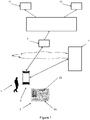
- FIG. 1 shows elements of a system adapted to implement an embodiment of the disclosure.
- a traveller 1 has a travel document such as a passport 2 and a mobile telephone 3 (or other appropriate computing device, such as a tablet computer).
- the passport 2 has a machine readable zone (MRZ) 2a and a biometric chip 2b.
- the machine readable zone 2a will typically conform with the standards set by ICAO Document 9303 and contains characters readily readable by optical character recognition.
- the biometric chip 2b contains biometric information of the passport owner - most typically a digital image of the passport owner's face - and again will generally conform with standards set by ICAO Document 9303 unless a separate national standard has been defined.
- the biometric chip 2b can be read by an appropriate contactless reader, similarly to a contactless transaction card, using protocols in accordance with the ISO/IEC 14443 international standard.
- the mobile telephone 3 runs a border control application, the functionality of which will be described in detail below.
- the mobile telephone 3 comprises a camera 5 - it may also comprise another biometric reader such as a fingerprint sensor 6.
- the mobile telephone 3 may also comprise a digital wallet that allows it to make card payments - in one aspect of the disclosure discussed in more detail below, interaction between the digital wallet and the border control application is shown to allow seat upgrades to be obtained at bag drop.
- the mobile telephone 3 is configured to communicate with an airline management server 4, which may itself be connected to a border control server 5.
- the border control application may interact with a digital wallet server 7 - this may server to initiate a transaction between the mobile telephone 3 and its user, supported by their issuing bank 11, for one part and the airline management server 4 or other airline server supported by their acquiring bank 12 for the other part.
- This transaction is mediated by a transaction scheme provider 13.
- embodiments shown here use the applicant's Masterpass technology (described for example in the applicant's earlier patent publication) EP 3091492
- Conventional digital wallet technologies may be used in connection with embodiments of the disclosure, and so will not be described further here as the skilled person will obtain details as necessary from data sources specific to the digital wallet solution used.
- FIG. 2A shows the user mobile telephone 3 with camera 5, fingerprint sensor 6 and cellular telecommunications mechanism 8 and local wireless communications mechanism 9.
- the telephone has at least one processor 11 and memory 12 defining between them a computing environment 13.
- the computing environment runs the border control application 21 and a digital wallet application 22. These connect as necessary with the camera 5 and the fingerprint sensor 6, mediated as appropriate by a biometric application 23 to determine biometric authentication.
- the biometric application 23 may be from an existing off-the-shelf system, such as the Daon Personal Identity Verification (PIV) product suite (see for example https://www.daon.com/solutions/employee-credentialing) , or from a bespoke solution.
- An MRZ reader application 24 such as ReadID is used to read machine readable data from the passport.
- FIG. 2B shows the management server 4, which also has at least one processor 11 and memory 12 defining between them a computing environment 13.
- This computing environment 13 runs the border management server application 25 which accesses a verification system 26, for example another part of the Daon Personal Identity Verification (PIV) product suite (alternatively, this may be hosted in another server with a secure connection to the management server 4).
- the management server 4 may provide information to a border agency server 28.
- the management server 4 may also interact with a merchant server 29, particularly if other paid services are to be provided (such as a seat upgrade).
- a process according to a general embodiment of the disclosure is illustrated schematically in Figure 3 .
- the embodiment provides a computer-implemented process for border control involving interaction between a user computing device such as a mobile phone and a management server.
- a user computing device such as a mobile phone and a management server.
- the user performs a pre-travel registration process 310 involving capturing a machine readable part of a travel document and a stored biometric of the user, while also capturing a fresh user biometric at the user computing device.
- the user then performs one or more check steps 320, 330 before being allowed to complete the border control process.
- At least one of the check steps 320, 330 - in this case both bag drop 320 and boarding gate 330 - involve capture of a fresh user biometric and generation of a time limited code for completion of that check step.
- the user begins with a mobile telephone 1 with a built in camera 5 and optionally another biometric sensor such as a fingerprint detector 6, though the embodiment described uses facial image data as the only biometric so other sensors are not required.
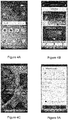
- the border control application 21 is installed on the mobile telephone 1 and made available for selection by the user, as shown in Figure 4A . As is apparent from Figure 4A , the embodiment shown uses the Android operating system, but embodiments may equally well be developed for other operating systems.
- the border control application 21 is embodied within an airline portal application with additional functionality (see Figure 4B ), from which the border control application 21 may be selected ( Figure 4C ).
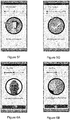
- the border control application requests basic passport details ( Figure 5A ) - while this could be achieved by manual entry, a preferred option is direct capture of the information in the MRZ of the passport, as indicated in Figure 5B.
- Figures 5C informs the user of how to capture this information, and Figure 5D shows successful capture.
- the passport holder's biometric information is held in the passport chip.
- Figure 5E shows the user how to hold the passport and phone together so that the chip information can be read over a short range wireless connection, with Figure 5F shown during the reading process and Figure 5G showing that the information has been checked. When this information has been captured and checked, a live image also needs to be taken.
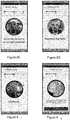
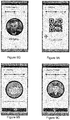
- Figures 6A shows that a passport holder selfie is required, and Figure 6B , 6C and 6D provide instructions for taking the picture, with further instructions ( Figure 6E ) or warnings ( Figure 6F ) provided as necessary, with image capture allowed ( Figure 6G ) only when it will be acceptable. Registration with the airline management server then takes place ( Figure 6H ) using the information held on the passport and the "fresh" user image used for verification ( Figure 6I ).
- the user is registered, typically for a specific flight (to ensure freshness, registration may for example be limited to a specified period before the flight takes place).
- the user may obtain his or her boarding pass at this time.
- the result of success at the bag drop verification is the generation of a 2D barcode ( Figure 9A ) that will allow the user to complete the bag drop process.
- the barcode is time limited to ensure that the system is not abused, and that the bearer of the passport is also the bearer of the bag - the user is here required to complete the remaining part of the bag drop process ( Figure 9B ) within five minutes in order to achieve success ( Figure 9C ).
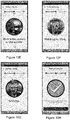
- FIG. 10A shows selection of a seat upgrade application, with Figure 10B showing an offer for the customer (which may be personalised to that customer).
- the customer in this case accepts, makes a seat selection ( Figure 10C ) and is invited to pay using their digital wallet (in this case, Masterpass) as shown in Figure 10D .
- selfie capture may also be used as a user verification technology, so in this case the same image capture steps take place as before ( Figure 10E to Figure 10G ), with a payment verification screen ( Figure 10H ) indicating tha the upgrade has been successful.
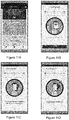
- FIG 11A shows the activation of the border control application at the boarding gate ( Figure 11B ) - the user is now interacting with the airline management system to obtain permission to pass through the boarding gate.
- the stored biometric data is collected as at registration ( Figures 11C to 11 E ), and the user takes a verification selfie as before ( Figures 12B ) for user verification ( Figure 12C ).
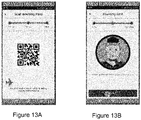
- Figure 13A There is again a time limited code generated ( Figure 13A ) for the user to scan at the gate.
- the combination of data available from user registration, presence of the passport and presence of the legitimate bearer together provide a sufficient guarantee that the correct customer is on the plane.
Landscapes
- Engineering & Computer Science (AREA)
- Computer Security & Cryptography (AREA)
- General Physics & Mathematics (AREA)
- Physics & Mathematics (AREA)
- Theoretical Computer Science (AREA)
- Business, Economics & Management (AREA)
- Human Computer Interaction (AREA)
- Tourism & Hospitality (AREA)
- Health & Medical Sciences (AREA)
- General Health & Medical Sciences (AREA)
- General Engineering & Computer Science (AREA)
- Software Systems (AREA)
- Computer Hardware Design (AREA)
- Development Economics (AREA)
- Educational Administration (AREA)
- Strategic Management (AREA)
- General Business, Economics & Management (AREA)
- Marketing (AREA)
- Human Resources & Organizations (AREA)
- Economics (AREA)
- Primary Health Care (AREA)
- Multimedia (AREA)
- Computer Networks & Wireless Communication (AREA)
- Signal Processing (AREA)
- Oral & Maxillofacial Surgery (AREA)
- Financial Or Insurance-Related Operations Such As Payment And Settlement (AREA)
- Collating Specific Patterns (AREA)
Abstract
Description
- The present disclosure relates to a border control system and method. More particularly, the disclosure relates to a border control system and method allowing automation and digitisation of existing processes without loss of security.
- Border control processes relating to the passage of individuals across national borders require high levels of accuracy and security. They are typically labour intensive, involving a manual check of credentials, and involve multiple computer systems. For air travel, there will typically be checks both by the airline at bag drop and at the gate, checks by national authorities between groundside and airside, with personal information being provided before boarding cards are issued to provide further traveller credentials.
- These processes are currently automated to some degree. A traveller's boarding pass will typically comprise a 2-D barcode that provides user and travel details and which is scanned at bag drop, entry into security and at the gate. The boarding pass may be provided on a user's phone, rather than as a paper document. In addition to scanning of the barcode, manual checks are carried out for document irregularities and to confirm that there is a match between the traveller and his or her travel documents.
- Despite this partial automation, travel checks are timeconsuming and reliant on manual checks to prevent errors and deliberate attempts to subvert the systems. This is particularly true of pre-flight processes such as bag drop and boarding gate entry, which require routine checks which can lead to significant queues and delays. It would be desirable to improve these processes for the benefit of the traveller, the airline and the border management service.
- In a first aspect, the disclosure provides a computer-implemented method for border control involving interaction between a user computing device and a management server, the method comprising at the user computing device: performing a registration process involving capturing user information and a stored biometric of the user from a user travel document, while also capturing a first fresh user biometric at the user computing device for verification to register the user at the management server; and performing at least one check step during passage through a border control area, the check step comprising capturing a second fresh user biometric for verification and generation of a time limited code for completing the check step.
- This different technical approach allows border control processes to be automated in such a way as to reduce demand on relevant systems, such as user queueing, while retaining or even enhancing security.
- Capturing user information may comprise reading machine readable data from the user travel document. This user travel document may be a biometric passport.
- The biometric of the user may be a visual image of the face of the user, in which case capturing a fresh biometric comprises the user capturing a visual image of his or her face with a camera associated with the user computing device. This is a particularly suitable approach for use with a mobile phone. The user can effectively verify himself or herself by capturing a "selfie".
- The border control area may be an airport, or an airport terminal. In this case, suitable check steps may be at bag drop or at the boarding gate. There may also be provision for making a transaction associated with a travel process associated with the border control (for example, buying a seat upgrade), wherein making the transaction comprises verification of the user by obtaining a fresh user biometric. This may be implemented by providing both border control and purchases through a user portal to the airline.
- In a second aspect, the invention provides a user computing device comprising a processor, a memory, and a biometric capture device, wherein the user computing device is programmed to perform the method as described above.
- The biometric capture device may be a camera adapted for capturing a visual image of a user of the user computing device. The user computing device may be a mobile telephone handset.
- Embodiments of the disclosure will now be described, by way of example, with reference to the accompanying Figures, of which:
-
Figure 1 shows the elements of a system adapted to implement embodiments of the disclosure; -
Figures 2A and 2B illustrate a computing device and a management server suitable for use in implementing embodiments of the disclosure; -
Figure 3 is a flow diagram indicating a method according to an embodiment of the disclosure; and -
Figures 4A to 4C are screenshots illustrating a startup process for an application operating according to an embodiment of the disclosure in a pre-travel registration step; -
Figures 5A to 5G are screenshots illustrating a process of passport scanning for an application operating according to an embodiment of the disclosure in a pre-travel registration step; -
Figures 6A to 6I are screenshots illustrating a process of (selfie) image capture for verification for an application operating according to an embodiment of the disclosure in a pre-travel registration step; -
Figures 7A to 7C are screenshots illustrating a startup process for an application operating according to an embodiment of the disclosure in a bag drop step; -
Figures 8A to 8G are screenshots illustrating a process of (selfie) image capture for verification for an application operating according to an embodiment of the disclosure in a bag drop step; -
Figures 9A to 9C are screenshots illustrating a process of timed bag drop for an application operating according to an embodiment of the disclosure; -
Figures 10A to 10H are screenshots illustrating a process of seat upgrade purchase for an application operating according to an embodiment of the disclosure; -
Figures 11A to 11E are screenshots illustrating an initial boarding gate process for an application operating according to an embodiment of the disclosure; -
Figures 12A to 12C are screenshots illustrating a process of (selfie) image capture for verification for an application operating according to an embodiment of the disclosure in a boarding gate step; and -
Figures 13A to 13C are screenshots illustrating a final boarding gate process for an application operating according to an embodiment of the disclosure. - Specific embodiments of the invention will be described below with reference to the Figures.
Figure 1 shows elements of a system adapted to implement an embodiment of the disclosure. A traveller 1 has a travel document such as apassport 2 and a mobile telephone 3 (or other appropriate computing device, such as a tablet computer). Thepassport 2 has a machine readable zone (MRZ) 2a and abiometric chip 2b. The machinereadable zone 2a will typically conform with the standards set by ICAO Document 9303 and contains characters readily readable by optical character recognition. Thebiometric chip 2b contains biometric information of the passport owner - most typically a digital image of the passport owner's face - and again will generally conform with standards set by ICAO Document 9303 unless a separate national standard has been defined. Thebiometric chip 2b can be read by an appropriate contactless reader, similarly to a contactless transaction card, using protocols in accordance with the ISO/IEC 14443 international standard. - The
mobile telephone 3 runs a border control application, the functionality of which will be described in detail below. Themobile telephone 3 comprises a camera 5 - it may also comprise another biometric reader such as afingerprint sensor 6. Themobile telephone 3 may also comprise a digital wallet that allows it to make card payments - in one aspect of the disclosure discussed in more detail below, interaction between the digital wallet and the border control application is shown to allow seat upgrades to be obtained at bag drop. - The
mobile telephone 3 is configured to communicate with anairline management server 4, which may itself be connected to a border control server 5. As discussed, in embodiments of the disclosure, the border control application may interact with a digital wallet server 7 - this may server to initiate a transaction between themobile telephone 3 and its user, supported by their issuingbank 11, for one part and theairline management server 4 or other airline server supported by their acquiringbank 12 for the other part. This transaction is mediated by atransaction scheme provider 13. While embodiments shown here use the applicant's Masterpass technology (described for example in the applicant's earlier patent publication)EP 3091492 , other digital wallet technologies may be used. Conventional digital wallet technologies may be used in connection with embodiments of the disclosure, and so will not be described further here as the skilled person will obtain details as necessary from data sources specific to the digital wallet solution used. -
Figure 2A shows the usermobile telephone 3 with camera 5,fingerprint sensor 6 andcellular telecommunications mechanism 8 and localwireless communications mechanism 9. The telephone has at least oneprocessor 11 andmemory 12 defining between them acomputing environment 13. The computing environment runs theborder control application 21 and a digital wallet application 22. These connect as necessary with the camera 5 and thefingerprint sensor 6, mediated as appropriate by a biometric application 23 to determine biometric authentication. The biometric application 23 may be from an existing off-the-shelf system, such as the Daon Personal Identity Verification (PIV) product suite (see for example https://www.daon.com/solutions/employee-credentialing), or from a bespoke solution. An MRZ reader application 24 such as ReadID is used to read machine readable data from the passport. -
Figure 2B shows themanagement server 4, which also has at least oneprocessor 11 andmemory 12 defining between them acomputing environment 13. Thiscomputing environment 13 runs the border management server application 25 which accesses averification system 26, for example another part of the Daon Personal Identity Verification (PIV) product suite (alternatively, this may be hosted in another server with a secure connection to the management server 4). Themanagement server 4 may provide information to aborder agency server 28. Themanagement server 4 may also interact with a merchant server 29, particularly if other paid services are to be provided (such as a seat upgrade). - A process according to a general embodiment of the disclosure is illustrated schematically in
Figure 3 . The embodiment provides a computer-implemented process for border control involving interaction between a user computing device such as a mobile phone and a management server. Firstly the user performs apre-travel registration process 310 involving capturing a machine readable part of a travel document and a stored biometric of the user, while also capturing a fresh user biometric at the user computing device. The user then performs one or more check steps 320, 330 before being allowed to complete the border control process. At least one of the check steps 320, 330 - in this case bothbag drop 320 and boarding gate 330 - involve capture of a fresh user biometric and generation of a time limited code for completion of that check step. - Specific embodiments of the disclosure are illustrated in more detail in
Figures 4 to 13 with reference to screenshots of the mobile telephone user interface taken at different stages of theborder control application 21. - The user begins with a mobile telephone 1 with a built in camera 5 and optionally another biometric sensor such as a
fingerprint detector 6, though the embodiment described uses facial image data as the only biometric so other sensors are not required. Theborder control application 21 is installed on the mobile telephone 1 and made available for selection by the user, as shown inFigure 4A . As is apparent fromFigure 4A , the embodiment shown uses the Android operating system, but embodiments may equally well be developed for other operating systems. When the application is opened, theborder control application 21 is embodied within an airline portal application with additional functionality (seeFigure 4B ), from which theborder control application 21 may be selected (Figure 4C ). - On selection, the border control application requests basic passport details (
Figure 5A ) - while this could be achieved by manual entry, a preferred option is direct capture of the information in the MRZ of the passport, as indicated inFigure 5B. Figures 5C informs the user of how to capture this information, andFigure 5D shows successful capture. The passport holder's biometric information is held in the passport chip.Figure 5E shows the user how to hold the passport and phone together so that the chip information can be read over a short range wireless connection, withFigure 5F shown during the reading process andFigure 5G showing that the information has been checked. When this information has been captured and checked, a live image also needs to be taken. -
Figures 6A shows that a passport holder selfie is required, andFigure 6B ,6C and 6D provide instructions for taking the picture, with further instructions (Figure 6E ) or warnings (Figure 6F ) provided as necessary, with image capture allowed (Figure 6G ) only when it will be acceptable. Registration with the airline management server then takes place (Figure 6H ) using the information held on the passport and the "fresh" user image used for verification (Figure 6I ). - At this point the user is registered, typically for a specific flight (to ensure freshness, registration may for example be limited to a specified period before the flight takes place). The user may obtain his or her boarding pass at this time.
- The user proceeds to the airport, and at this point, the border control application may be activated again for bag drop (
Figures 7A and7B ). The user is now interacting with the airline management server to enable access to an airline system - the bag drop apparatus. The user is again requested to take a "live" picture (Figure 7A ). The process of user verification is essentially the same as before (Figures 8A to 8F ) except that in the case shown the verification fails (Figure 8G ), possibly in this case for poor facial orientation leading to a recognition fault (considering the image ofFigure 8F ). The user is invited to verify again (Figure 8G ), which in this case is successful. - The result of success at the bag drop verification is the generation of a 2D barcode (
Figure 9A ) that will allow the user to complete the bag drop process. The barcode is time limited to ensure that the system is not abused, and that the bearer of the passport is also the bearer of the bag - the user is here required to complete the remaining part of the bag drop process (Figure 9B ) within five minutes in order to achieve success (Figure 9C ). - There may be an intervening check by the official border agency (unless it is agreed that this should be replaced by this process), but the application is enabled for further use at the boarding gate. However, as indicated above, the
border control application 21 may be combined into a portal application, and similar methodology can be used to make relevant purchases, such as a seat upgrade.Figure 10A shows selection of a seat upgrade application, withFigure 10B showing an offer for the customer (which may be personalised to that customer). The customer in this case accepts, makes a seat selection (Figure 10C ) and is invited to pay using their digital wallet (in this case, Masterpass) as shown inFigure 10D . On selection of Masterpass for payment, selfie capture may also be used as a user verification technology, so in this case the same image capture steps take place as before (Figure 10E to Figure 10G ), with a payment verification screen (Figure 10H ) indicating tha the upgrade has been successful. -
Figure 11A shows the activation of the border control application at the boarding gate (Figure 11B ) - the user is now interacting with the airline management system to obtain permission to pass through the boarding gate. The stored biometric data is collected as at registration (Figures 11C to 11 E ), and the user takes a verification selfie as before (Figures 12B ) for user verification (Figure 12C ). There is again a time limited code generated (Figure 13A ) for the user to scan at the gate. The combination of data available from user registration, presence of the passport and presence of the legitimate bearer together provide a sufficient guarantee that the correct customer is on the plane. - While this specific approach may be used to provide border control in a secure and reliable way, the skilled person will appreciate that the embodiments described here are exemplary, and that modifications may be made and alternative embodiments provided that fall within the scope of the disclosure. For example, this approach is not necessarily limited to airline transit but could be modified for other transport types, such as trains and sea crossings. This approach can be used for other types of interaction between a user and a government agency (or other authority) - examples may include identification of citizens for online tax filings, or remote enrolment of new banking customers to meet KYC requirements. Aspects of the described process are not limited to the embodiment specifically described. Other proprietary or bespoke solutions may be used for verification using biometric information, or for reading machine readable data from a passport or other travel or identification document. Other biometrics could be used, such as a fingerprint. Additional checks may be made, including checks of other types. Freshness criteria could be modified or determined according to the perceived risk involved with individual steps of the process.
Claims (11)
- A computer-implemented method for border control involving interaction between a user computing device and a management server, the method comprising at the user computing device:performing a registration process (310) involving capturing user information and a stored biometric of the user from a user travel document, while also capturing a first fresh user biometric at the user computing device for verification to register the user at the management server;performing at least one check step (320, 330) during passage through a border control area, the check step comprising capturing a second fresh user biometric for verification and generation of a time limited code for completing the check step.
- The method of claim 1, wherein capturing user information comprises reading machine readable data from the user travel document.
- The method of claim 1 or claim 2, wherein the user travel document is a biometric passport.
- The method of any preceding claim, wherein the biometric of the user is a visual image of the face of the user, and wherein capturing a fresh biometric comprises the user capturing a visual image of his or her face with a camera associated with the user computing device.
- The method of any preceding claim, wherein the border control area is an airport.
- The method of claim 5, wherein one of the at least one check steps takes place at bag drop.
- The method of claim 5 or claim 6, wherein one of the at least one check steps takes place at a boarding gate.
- The method of any preceding claim, further comprising making a transaction associated with a travel process associated with the border control, wherein making the transaction comprises verification of the user by obtaining a fresh user biometric.
- A user computing device comprising a processor, a memory, and a biometric capture device, wherein the user computing device is programmed to perform the method of any of claims 1 to 8.
- The user computing device of claim 9, wherein the biometric capture device is a camera adapted for capturing a visual image of a user of the user computing device.
- The user computing device of claim 9 or claim 10, wherein the user computing device is a mobile telephone handset.
Priority Applications (3)
| Application Number | Priority Date | Filing Date | Title |
|---|---|---|---|
| EP17172894.2A EP3407291A1 (en) | 2017-05-24 | 2017-05-24 | Border control system and method |
| PCT/US2018/029548 WO2018217395A1 (en) | 2017-05-24 | 2018-04-26 | Border control system and method |
| US15/988,896 US10685520B2 (en) | 2017-05-24 | 2018-05-24 | Border control system and method |
Applications Claiming Priority (1)
| Application Number | Priority Date | Filing Date | Title |
|---|---|---|---|
| EP17172894.2A EP3407291A1 (en) | 2017-05-24 | 2017-05-24 | Border control system and method |
Publications (1)
| Publication Number | Publication Date |
|---|---|
| EP3407291A1 true EP3407291A1 (en) | 2018-11-28 |
Family
ID=58992661
Family Applications (1)
| Application Number | Title | Priority Date | Filing Date |
|---|---|---|---|
| EP17172894.2A Withdrawn EP3407291A1 (en) | 2017-05-24 | 2017-05-24 | Border control system and method |
Country Status (3)
| Country | Link |
|---|---|
| US (1) | US10685520B2 (en) |
| EP (1) | EP3407291A1 (en) |
| WO (1) | WO2018217395A1 (en) |
Cited By (1)
| Publication number | Priority date | Publication date | Assignee | Title |
|---|---|---|---|---|
| EP3905147A4 (en) * | 2018-12-27 | 2022-02-23 | NEC Corporation | INFORMATION PROCESSING DEVICE, INFORMATION PROCESSING METHOD AND RECORDING MEDIA |
Families Citing this family (4)
| Publication number | Priority date | Publication date | Assignee | Title |
|---|---|---|---|---|
| CN109858219B (en) * | 2018-12-22 | 2022-05-20 | 深圳市珍爱捷云信息技术有限公司 | User registration method and device, electronic equipment and computer readable storage medium |
| GB201905180D0 (en) * | 2019-04-11 | 2019-05-29 | Sita Advanced Travel Solutions Ltd | Identity management system and method |
| JP7327515B2 (en) * | 2020-01-07 | 2023-08-16 | 日本電気株式会社 | Gate device, server device, immigration control system, gate device control method, and server device control method |
| WO2021231742A1 (en) * | 2020-05-13 | 2021-11-18 | 214 Technologies Inc. | Passive multi-factor access control with biometric and wireless capability |
Citations (7)
| Publication number | Priority date | Publication date | Assignee | Title |
|---|---|---|---|---|
| GB2418511A (en) * | 2004-09-24 | 2006-03-29 | Bournemouth Internat Airport L | Automated passenger handling system |
| KR20060099310A (en) * | 2005-03-11 | 2006-09-19 | 한국조폐공사 | Immigration Control System and Method of Control Using Bio-Passport |
| US20130238503A1 (en) * | 2012-02-29 | 2013-09-12 | Upen Patel | System and method to manage information for conducting secure transactions |
| GB2515142A (en) * | 2013-06-14 | 2014-12-17 | Sita Information Networking Computing Ireland Ltd | Portable user control system and method therefor |
| US20150281232A1 (en) * | 2012-04-10 | 2015-10-01 | Sita Information Networking Computing Ireland Limited | Airport security check system and method therefor |
| EP3091492A1 (en) | 2015-05-05 | 2016-11-09 | Mastercard International Incorporated | Systems, methods, devices, and computer readable media for enabling electronic payment transfers |
| RU2617335C1 (en) * | 2016-03-02 | 2017-04-24 | Павел Анатольевич Зайцев | Mobile terminal for collection of personal identification data |
Family Cites Families (13)
| Publication number | Priority date | Publication date | Assignee | Title |
|---|---|---|---|---|
| CA2492004C (en) * | 2002-07-09 | 2009-02-03 | Bnc Ip Switzerland Gmbh | System and method for providing secure identification solutions |
| US7597250B2 (en) * | 2003-11-17 | 2009-10-06 | Dpd Patent Trust Ltd. | RFID reader with multiple interfaces |
| US10354004B2 (en) * | 2012-06-07 | 2019-07-16 | Apple Inc. | Intelligent presentation of documents |
| US9721086B2 (en) * | 2013-03-15 | 2017-08-01 | Advanced Elemental Technologies, Inc. | Methods and systems for secure and reliable identity-based computing |
| JP6229352B2 (en) * | 2013-07-26 | 2017-11-15 | 富士通株式会社 | Image processing apparatus, image processing method, and program |
| US10885598B2 (en) * | 2013-09-20 | 2021-01-05 | Dallas/Fort Worth International Airport | Apparatus, system, and method supporting compliance with customs/border requirements |
| US20150088778A1 (en) * | 2013-09-24 | 2015-03-26 | Adam Y. Tsao | System and method for verifying a travelers authorization to enter into a jurisdiction using a software application installed on a personal electronic device |
| US10652735B2 (en) * | 2013-10-04 | 2020-05-12 | Sol Mingso Li | Systems and methods for programming, controlling and monitoring wireless networks |
| US9685012B2 (en) * | 2014-08-20 | 2017-06-20 | Gate Labs Inc. | Access management and resource sharing platform based on biometric identity |
| KR101634980B1 (en) * | 2015-12-01 | 2016-07-08 | 주식회사 한국엔에프씨 | System and method for performing user authentication using a fingerprint, and the financial card information stored in the mobile communication terminal |
| CN107306183B (en) * | 2016-04-22 | 2021-12-21 | 索尼公司 | Client, server, method and identity verification system |
| US20190035042A1 (en) * | 2016-06-22 | 2019-01-31 | Michael J. Attar | Method and System for Implementing User Biometrics as a Boarding Pass for Public Transportation |
| US20180343120A1 (en) * | 2016-10-26 | 2018-11-29 | Black Gold Coin, Inc. | Systems and methods for providing a universal decentralized solution for verification of users with cross-verification features |
-
2017
- 2017-05-24 EP EP17172894.2A patent/EP3407291A1/en not_active Withdrawn
-
2018
- 2018-04-26 WO PCT/US2018/029548 patent/WO2018217395A1/en not_active Ceased
- 2018-05-24 US US15/988,896 patent/US10685520B2/en active Active
Patent Citations (7)
| Publication number | Priority date | Publication date | Assignee | Title |
|---|---|---|---|---|
| GB2418511A (en) * | 2004-09-24 | 2006-03-29 | Bournemouth Internat Airport L | Automated passenger handling system |
| KR20060099310A (en) * | 2005-03-11 | 2006-09-19 | 한국조폐공사 | Immigration Control System and Method of Control Using Bio-Passport |
| US20130238503A1 (en) * | 2012-02-29 | 2013-09-12 | Upen Patel | System and method to manage information for conducting secure transactions |
| US20150281232A1 (en) * | 2012-04-10 | 2015-10-01 | Sita Information Networking Computing Ireland Limited | Airport security check system and method therefor |
| GB2515142A (en) * | 2013-06-14 | 2014-12-17 | Sita Information Networking Computing Ireland Ltd | Portable user control system and method therefor |
| EP3091492A1 (en) | 2015-05-05 | 2016-11-09 | Mastercard International Incorporated | Systems, methods, devices, and computer readable media for enabling electronic payment transfers |
| RU2617335C1 (en) * | 2016-03-02 | 2017-04-24 | Павел Анатольевич Зайцев | Mobile terminal for collection of personal identification data |
Cited By (2)
| Publication number | Priority date | Publication date | Assignee | Title |
|---|---|---|---|---|
| EP3905147A4 (en) * | 2018-12-27 | 2022-02-23 | NEC Corporation | INFORMATION PROCESSING DEVICE, INFORMATION PROCESSING METHOD AND RECORDING MEDIA |
| US12170934B2 (en) | 2018-12-27 | 2024-12-17 | Nec Corporation | Information processing apparatus, information processing method, and storage medium |
Also Published As
| Publication number | Publication date |
|---|---|
| US10685520B2 (en) | 2020-06-16 |
| WO2018217395A1 (en) | 2018-11-29 |
| US20180342120A1 (en) | 2018-11-29 |
Similar Documents
| Publication | Publication Date | Title |
|---|---|---|
| US9667627B2 (en) | Airport security check system and method therefor | |
| US10685520B2 (en) | Border control system and method | |
| US11210650B2 (en) | Credit payment method and apparatus based on mobile terminal embedded secure element | |
| JP6897953B2 (en) | Admission terminal, admission method, admission program, and admission system | |
| US20210042759A1 (en) | Incremental enrolment algorithm | |
| US10997586B2 (en) | Multifunction card including biometric data, card payment terminal, and card payment system | |
| CN109426963B (en) | Biometric system for authenticating biometric requests | |
| JP7740414B2 (en) | Server device, server device control method and program | |
| Selvakumar et al. | Face biometric authentication system for ATM using deep learning | |
| US12423397B2 (en) | Method for checking individuals with simplified authentication | |
| KR101813950B1 (en) | An automated teller machine and a method for operating it | |
| US20260127695A1 (en) | Terminal, system, control method of terminal, and storage medium | |
| KR101813534B1 (en) | An automated teller machine and a method for operating it | |
| US20220092600A1 (en) | System for Credit Card, Debit Card, and Voting Fraud Prevention |
Legal Events
| Date | Code | Title | Description |
|---|---|---|---|
| PUAI | Public reference made under article 153(3) epc to a published international application that has entered the european phase |
Free format text: ORIGINAL CODE: 0009012 |
|
| AK | Designated contracting states |
Kind code of ref document: A1 Designated state(s): AL AT BE BG CH CY CZ DE DK EE ES FI FR GB GR HR HU IE IS IT LI LT LU LV MC MK MT NL NO PL PT RO RS SE SI SK SM TR |
|
| AX | Request for extension of the european patent |
Extension state: BA ME |
|
| 17P | Request for examination filed |
Effective date: 20190528 |
|
| RBV | Designated contracting states (corrected) |
Designated state(s): AL AT BE BG CH CY CZ DE DK EE ES FI FR GB GR HR HU IE IS IT LI LT LU LV MC MK MT NL NO PL PT RO RS SE SI SK SM TR |
|
| 17Q | First examination report despatched |
Effective date: 20200225 |
|
| STAA | Information on the status of an ep patent application or granted ep patent |
Free format text: STATUS: THE APPLICATION HAS BEEN WITHDRAWN |
|
| 18W | Application withdrawn |
Effective date: 20200406 |