EP3407206A1 - Reconciled data storage system - Google Patents
Reconciled data storage system Download PDFInfo
- Publication number
- EP3407206A1 EP3407206A1 EP17172285.3A EP17172285A EP3407206A1 EP 3407206 A1 EP3407206 A1 EP 3407206A1 EP 17172285 A EP17172285 A EP 17172285A EP 3407206 A1 EP3407206 A1 EP 3407206A1
- Authority
- EP
- European Patent Office
- Prior art keywords
- property
- entity
- value
- value pairs
- registered
- Prior art date
- Legal status (The legal status is an assumption and is not a legal conclusion. Google has not performed a legal analysis and makes no representation as to the accuracy of the status listed.)
- Granted
Links
Images





Classifications
-
- G—PHYSICS
- G06—COMPUTING OR CALCULATING; COUNTING
- G06F—ELECTRIC DIGITAL DATA PROCESSING
- G06F16/00—Information retrieval; Database structures therefor; File system structures therefor
- G06F16/20—Information retrieval; Database structures therefor; File system structures therefor of structured data, e.g. relational data
- G06F16/23—Updating
- G06F16/2308—Concurrency control
- G06F16/2315—Optimistic concurrency control
- G06F16/2329—Optimistic concurrency control using versioning
-
- G—PHYSICS
- G06—COMPUTING OR CALCULATING; COUNTING
- G06F—ELECTRIC DIGITAL DATA PROCESSING
- G06F16/00—Information retrieval; Database structures therefor; File system structures therefor
- G06F16/20—Information retrieval; Database structures therefor; File system structures therefor of structured data, e.g. relational data
- G06F16/21—Design, administration or maintenance of databases
- G06F16/211—Schema design and management
-
- G—PHYSICS
- G06—COMPUTING OR CALCULATING; COUNTING
- G06F—ELECTRIC DIGITAL DATA PROCESSING
- G06F16/00—Information retrieval; Database structures therefor; File system structures therefor
- G06F16/20—Information retrieval; Database structures therefor; File system structures therefor of structured data, e.g. relational data
- G06F16/21—Design, administration or maintenance of databases
- G06F16/217—Database tuning
-
- G—PHYSICS
- G06—COMPUTING OR CALCULATING; COUNTING
- G06F—ELECTRIC DIGITAL DATA PROCESSING
- G06F16/00—Information retrieval; Database structures therefor; File system structures therefor
- G06F16/20—Information retrieval; Database structures therefor; File system structures therefor of structured data, e.g. relational data
- G06F16/21—Design, administration or maintenance of databases
- G06F16/219—Managing data history or versioning
-
- G—PHYSICS
- G06—COMPUTING OR CALCULATING; COUNTING
- G06F—ELECTRIC DIGITAL DATA PROCESSING
- G06F16/00—Information retrieval; Database structures therefor; File system structures therefor
- G06F16/20—Information retrieval; Database structures therefor; File system structures therefor of structured data, e.g. relational data
- G06F16/23—Updating
-
- G—PHYSICS
- G06—COMPUTING OR CALCULATING; COUNTING
- G06F—ELECTRIC DIGITAL DATA PROCESSING
- G06F16/00—Information retrieval; Database structures therefor; File system structures therefor
- G06F16/20—Information retrieval; Database structures therefor; File system structures therefor of structured data, e.g. relational data
- G06F16/25—Integrating or interfacing systems involving database management systems
-
- G—PHYSICS
- G06—COMPUTING OR CALCULATING; COUNTING
- G06F—ELECTRIC DIGITAL DATA PROCESSING
- G06F16/00—Information retrieval; Database structures therefor; File system structures therefor
- G06F16/20—Information retrieval; Database structures therefor; File system structures therefor of structured data, e.g. relational data
- G06F16/25—Integrating or interfacing systems involving database management systems
- G06F16/254—Extract, transform and load [ETL] procedures, e.g. ETL data flows in data warehouses
-
- G—PHYSICS
- G06—COMPUTING OR CALCULATING; COUNTING
- G06F—ELECTRIC DIGITAL DATA PROCESSING
- G06F16/00—Information retrieval; Database structures therefor; File system structures therefor
- G06F16/90—Details of database functions independent of the retrieved data types
- G06F16/903—Querying
Definitions
- the present invention lies in the field of data storage and in particular relates to the recognition of input datasets.
- a challenge in the data science domain is the integration of input datasets from heterogeneous data sources with different structures, formats, and nature. Resolution of overlapping data and identification of data representing the same entity from different datasets require a high level of manual interaction. In most cases, knowing how to interpret an input dataset, or which information the data is related to, is a key element for a correct data interpretation and hence integration. In many cases, to integrate the input dataset properly it is necessary to have a background in the field of knowledge represented by the input dataset.
- Information represented in input datasets takes an increasingly important role in the decision making of technological enterprises. Enabling machines to accurately describe datasets at varying levels of abstraction is desirable if the knowledge contained in input datasets is to be harvested.
- the interoperability of machines is enhanced by storing datasets with accurate descriptors. Furthermore, the accessibility and efficiency of storage is enhanced with meaningfully annotated data.
- Processing overheads are imposed in data centres by cross-device traversals and access operations.
- Embodiments include: a data storage system comprising a processor coupled to a memory, the memory including a reconciled data store and a registry, the processor being configured to execute a process comprising:
- the process further comprises, for each of the one or more acquired dataset entities:
- the automated consolidation of data representing the same entity from different and heterogeneous data sources reduces considerably the manual intervention required in extract, transform, and load (ETL) tasks in the data science domain.
- ETL extract, transform, and load
- Embodiments provide an intelligent system for automated acquisition and reconciliation of data providing the following benefits, among others:
- An identifier property uniquely identifies an entity. Uniqueness is among a population of entities to which the entity belongs, bound by the scope of data already acquired and stored in the system and to be acquired. For example, it may be unique among legal entities, or unique among entities listed at a particular list or registry.
- Embodiments of another aspect include a data storage method, for stored including a reconciled data store and a registry, the method comprising: in the reconciled data store, storing, with respect to each of a plurality of registered entities: an array of registered entity property-value pairs representing the registered entity, from each dataset from among a plurality of datasets, wherein each of the registered entity data property-value pairs comprises a property label representing a property of a registered entity and a value representing a value range of the property for the respective registered entity.
- the method also includes: in the registry, storing, with respect to each of the plurality of registered entities: a registry entry comprising at least one identifier property-value pair with respect to each of the plurality of datasets, wherein each of the identifier property-value pairs comprises an identifier property label representing an identifier property of a registered entity, uniquely identifying the registered entity, and an identifier value representing a value of the identifier property for the respective registered entity.
- the method also includes: acquiring a dataset for reconciliation with the reconciled data store, the acquired dataset including a plurality of acquired dataset property-value pairs for each of a first set of one or more acquired dataset entities, wherein each of the acquired dataset data property-value pairs comprises a property label representing a property of an acquired dataset entity and a value representing a value range of the property for the respective acquired dataset entity.
- the method further comprises: for each of the one or more acquired dataset entities: identifying an identifier property-value pair stored in the registry matching an acquired dataset property-value pair for the acquired dataset entity; and consolidating the acquired dataset property-value pairs for the acquired dataset entity into the array of registered entity property-value pairs stored with respect to the registered entity identified by the identifier value of the identified identifier property-value pair.
- Embodiments of another aspect include a computer program which, when executed by a computing apparatus, causes the computing apparatus to perform a method of an embodiment.
- a computer program may be stored on a computer-readable medium such as a non-transitory computer-readable medium.
- the data storage system 100 is a computing system and comprises memory hardware for storing data and processor hardware 101 for executing processing instructions.
- the processor hardware 101 is configured to perform the process illustrated in Figure 1 by executing processing instructions stored on a memory 102 coupled to the processor hardware.
- the processor hardware 101 is referred to as a processor or the processor, and may be one or more CPU devices.
- the memory hardware is referred to as a memory or the memory, and comprises a storage device 102 accessible to the processor for storing processing instructions and for storing data for input to and output from the processor during execution of processing instructions.
- the memory hardware may also comprise a storage area for storing the registry 104, and a storage area for storing the reconciled data store 103. Each of said storage areas may comprise part or all of one or more interconnected storage devices.
- the reconciled data store 103 stores, for example, an array of registered entity property-value pairs representing the registered entity, from each dataset from among a plurality of heterogeneous datasets already input to the data storage system, wherein each of the registered entity data property-value pairs comprises a property label representing a property of a registered entity and a value representing a value range of the property for the respective registered entity.
- the dataset may be read from its native storage as relational data, in which the entity is represented by a row of entries, the property label is a column header, and the value is the data from the entry of the row in the respective column.
- the dataset may be read from its native storage as graph data, in which, for example, property labels are labels of subject nodes linked to object nodes by a has Value predicate, or equivalent, and the value is the value specified by the linked object node.
- the datasets may retain their respective native forms in the reconciled data store 103, albeit with modifications, such as removal or addition of property-value pairs, addition of reference ID, timestamps, and other metadata, and alignment of property labels with a set of defined property labels stored in the data storage system 100.
- the reconciled data store 103 stores the sum of information about each registered entity from plural external (to the data storage system) physical data storage locations in one physical data storage area accessible via a single access point and in a consolidated form to avoid duplication of information.
- the registry 104 stores with respect to each of the plurality of registered entities: a registry entry comprising at least one identifier property-value pair with respect to each of the plurality of datasets, wherein each of the identifier property-value pairs comprises an identifier property label representing an identifier property of a registered entity, uniquely identifying the registered entity within the respective dataset, and an identifier value representing a value of the identifier property for the respective registered entity.
- Registered entity is taken to mean an entity appearing in the registry, that is, an entity for which an identifier property-value pair is identified among the input datasets and stored in a registry entry.
- Plural datasets store data relating to the same entity, and hence each entity has more than one corresponding identifier property-value pair. It is also possible that, for a single dataset, more than one identifier property-value pair is recorded in the registry entry for a single entity.
- Identifier properties may be denoted as such by a system user (where system user is taken to be a manual input to the data storage system via, for example, a user interface) or by semantic analysis of the respective property label, or by a combination of the two.
- automated semantic analysis of a property label may identify candidates for identifier properties, which candidates are presented to a system user for confirmation or rejection.
- a new dataset is acquired for reconciliation with the data already stored in the reconciled data store 103.
- the new dataset is acquired by reading data from its physical storage location (for example, addressed via a URL) and parsing the data into the data storage system.
- the acquired dataset includes a plurality of acquired dataset property-value pairs for each of a first set of one or more acquired dataset entities, wherein each of the acquired dataset data property-value pairs comprises a property label representing a property of an acquired dataset entity and a value representing a value range of the property for the respective acquired dataset entity.
- data acquisition may be performed by the processor 101 executing processing instructions stored on the memory 102 in order to read data via network interface hardware, the combination of processor 101, memory 102, and network interface hardware realising an acquisition module.
- systems may also be provided with a data property recognition module.
- Data property recognition may be performed by the processor 101 executing processing instructions stored on the memory 102, and making read accesses to a knowledge base or other data store via network interface hardware, the combination of processor 101, memory 102, and network interface hardware realising a data property recognition module.
- input datasets that is, datasets for reconciliation with the reconciled data store
- values of recognised i.e. labelled with property labels from a set stored by the data storage system 100
- mapping of values to recognised properties is known.
- values in the input datasets are attributable to a property represented by a property label in a stored set or list of property labels.
- the stored set or list of property labels may be stored as property-level nodes of a graph-based ontology model.
- input datasets that is, datasets read into the system by the acquisition module from their native storage
- a property label from the stored set of property labels for each property represented in the dataset.
- the dataset contains a set of values each defining a value or range of values of the property.
- a set of values is, for example, a column of values in a tabular data set or a collection of values instantiating the same property-level concept in a data graph.
- the acquisition module collects, extracts and integrates heterogeneous and distributed data into the system in the form of input datasets.
- the input datasets may be in different formats and contain different grades of information complexity.
- the data property reconciliation module 220 normalises the data with the purpose of providing the standardised data properties to the data storage system for identification of the entities represented in the data by the process of Figure 1 .
- the data property reconciliation module supports the process in order to provide datasets having values which are mapped to one of the property labels in the stored list.
- the data property reconciliation module assigns a property label from the stored list to a property represented by values within an input dataset.
- the data property reconciliation module receives raw data with their descriptors (i.e.
- the operation of the data property reconciliation module is to determine a data property descriptor from a list of standardised data property descriptors, or a new data property descriptor, to assign to a set of data values, and therefore, the functionality may be considered to be a recognition function, and the data property reconciliation module may be referred to as a data property recognition module.
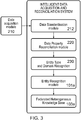
- FIG. 3 The principle of operation of the property recognition module 220 in the context of a wider data acquisition and reconciliation system is illustrated in Figure 3 .
- raw data comprising a value of each of three properties for each of three entities is acquired as raw data by the property recognition module 220, as shown in Figure 5 .
- the properties are labelled with a descriptor.
- An exemplary data property recognition module 220 comprises a semantics engine which compares the semantics of descriptors labelling the properties in the raw data with the semantics of property labels from the stored list.
- the data property recognition module 220 comprises a data value fingerprint engine which compares statistical characteristics of the values of the properties in the raw data with the statistical characteristics of sets of values representing the property labels from the stored list. Based on the comparisons each set of values (i.e. each column) is assigned a property label from the stored list.
- the acquisition module 210 and the data property reconciliation module 220 are included in the system or are external modules providing data to the system, said modules may be provided by a data property recognition apparatus, data property recognition method, or data property recognition program such as that disclosed in German patent applications DE102016220781.4 & DE1012016220771.7 , the contents of which are incorporated herein by reference.
- the process proceeds to S104, at which the acquired dataset property-value pairs in respect of an entity are used to identify the respective entity from among the registered entities.
- the acquired dataset property-value pairs in respect of an entity do contain a property-value pair matching an identifier property-value pair stored in the registry. It may be that all of the acquired dataset property value pairs are compared against identifier property-value pairs to seek a matching property-value pair. Alternatively, it may be that a subset of the acquired dataset property-value pairs are selected for comparison, for example, based on a semantic comparison of the property label with property labels assumed to contain identifying values.
- a match may be, for example, property label of the two pairs being equal and value of the two pairs being equal, or property label of the two pairs being equal and value of the two pairs being equal within a predefined tolerance, or property label of the two pairs being equal to a predefined tolerance and value of the two pairs being equal, or property label of the two pairs being equal to a predefined tolerance and value of the two pairs being equal to a predefined tolerance.
- step S105 the acquired dataset property-value pairs are consolidated into the reconciled data storage.
- step S105 may comprise consolidating the acquired dataset property-value pairs for the acquired dataset entity into the array of registered entity property-value pairs stored with respect to the registered entity identified by the identifier value of the matching identifier property-value pair.
- the consolidating may comprise, for each acquired-dataset property-value pair: if the property label matches a property label in the stored array of registered entity property-value pairs, if the value of the acquired dataset property-value pair matches the value of the registered entity property-value pair with the matching label, make no modification to the stored array, and if the value of the acquired dataset property-value pair does not match the value of the registered entity property-value pair, add the acquired dataset property-value pair to the stored array as a registered entity property-value pair; and if the property label does not match a property label in the stored array of registered entity property-value pairs, add the acquired dataset property-value pair to the stored array as a registered entity property-value pair.
- the registry entry for the entry is extended with metadata representing the newly-added property-value pairs, including information identifying a storage location within the reconciled data store 103, one or more identifier property-value pairs, and a dataset ID uniquely identifying the acquired dataset among the plurality of datasets input to the system 100 and from which property-value pairs are stored in the reconciled data store 103.
- Figure 3 illustrates components of the data storage system 100 in the wider context of an intelligent data acquisition and reconciliation system.
- Figure 4 illustrates the operation of the system of Figure 3 with reference to a sample acquired dataset entity.
- the data storage system 100 of Figure 2 may form part of the intelligent data acquisition and reconciliation system, a system which automates data ingestion tasks and recognises and labels data properties, recognises entity type and domains of entities represented in input datasets, and identifies entities within said datasets.
- the intelligent data acquisition and reconciliation system converts heterogeneous datasets into reconciled and identified data within a single federated heterogeneous knowledge base 103a.
- the process of Figure 1 which may be attributed to the entity recognition module 101 a within the context of the Figure 3 diagram, provides a key role within the understanding of input datasets by a machine, facilitated by the system of Figure 3 .
- the data acquisition module 210 collects extracts and integrates heterogeneous and distributed data from respective native data sources into the system, and is described above in relation to step S103 of Figure 1 . These data sources could be in different formats and complexity of grades of information.
- the data standardisation module 212 obtains the data acquired by the data acquisition module 210 and processes the data to provide the correct format, that is, the standard format for the system.
- the data standardisation module 212 modifies units of values and data formats upon parsing into the system for compliance with defined standards for the system.
- the data standardisation module 212 normalises the data with the purpose of providing a standardised format readable by the system.
- the data standardisation module 212 supports the process in order to provide the right format to be recognised by the recognition and reconciliation modules. As illustrated in Figure 4 , the acquired data is parsed into acquired dataset property-value pairs.
- the data property reconciliation module 220 module is configured to recognise the set of properties obtained through the data acquisition module 210 and data standardisation module 212, and also, it is configured to store the set of standardised data properties to which input datasets are aligned, as well as recognising which property-value pairs could be identifier property-value pairs.
- the data property reconciliation module 220 performs a reconciliation or recognition function, the reconciliation being alignment with a defined list or set of data properties.
- the native property labels of the input dataset are modified to match property labels from a stored list of property labels. Semantics of the native property labels and the stored list of property labels are compared, along with statistical properties of the values, in order to match the property of the acquired dataset with a property from the stored list.
- the data property reconciliation module 220 recognises which of the acquired dataset property-value pairs may be an identifier. For example, particular property labels among the stored list may be assumed by the system to represent identifiers.
- the module may execute semantic analysis of the respective property label. For example, automated semantic analysis of a property label may identify candidates for identifier properties, which candidates are presented to a system user for confirmation or rejection.
- the output of the data property reconciliation module is a clean and annotated version of the acquired dataset which contains the extracted data property-value pairs.
- the entity type and domain recognition 230 is a procedure for categorising the entities represented in an input dataset by two hierarchical levels of categorisation, entity type, and domain.
- the system is able to infer added information from the set of data properties received and the potential identifiers based on knowledge.
- the entity type and domain recognition 230 may be automated, or partially automated & partially manual, using a knowledge base of user preferences and semantic and statistical properties of data to annotate or categorise the entities represented in an input dataset with an entity type label and a domain label. In the same way as the property labels being from a defined list, the entity type and domain may also be from a defined list.
- the lists may be partially predefined but may be augmented when new property labels, entity types, or domains are encountered.
- the acquired dataset property-value pairs are annotated with new descriptors: an entity type descriptor and a domain descriptor.
- the entity recognition module 101a is a representation of the process of Figure 1 , which results in acquired dataset property-value pairs being written into a reconciled data store, said reconciled data store being exemplified in Figure 3 by the federated heterogeneous knowledge base 103a.
- the entity recognition module is configured to recognise the specific entity which acquired dataset property-value pairs refer to.
- the entity recognition module 101 a obtains a set of standardised data properties, a set of potential identifiers, the potential type and domain of the entity from the entity type and domain recognition module 230, and, based on some or all of these inputs and knowledge stored in the registry 104 and reconciled data store 103, this module provides a recommendation about which specific entity property-value pairs in an input dataset refer to.
- an entity known to the system and being represented by an entry in the registry 104 is determined to be the entity represented by the acquired dataset property-value pairs.
- the federated heterogeneous knowledge base 103a is an intelligent data repository that offers a unified view of the knowledge about an entity from plural heterogeneous datasets.
- the federated heterogeneous knowledge base 103a provides a unified interface for all the data and knowledge stored into the system.
- the federated heterogeneous knowledge base 103a component is able to decide and provide the best data repository depending on data nature.
- the federated heterogeneous knowledge base 103a offers a unified view of all of the data about a specific entity stored in the reconciled data store.
- Figure 5 exemplifies a sample input to and output from the data property reconciliation module 220.
- the output illustrates that, in addition to the property-value pair, metadata relating to the property label stored in association with the stored list of property labels is used to annotate the acquired dataset property-value pairs.
- Figure 6 exemplifies a sample input to and output from the entity type and domain recognition 230.
- the entity type and domain recognition module 230 is configured to provide an entity type and domain annotation to each acquired dataset entity based on knowledge stored in a knowledge base and user experience for the data properties received. This component extracts knowledge from ontologies and the preferences from the user feedbacks, and utilises the knowledge to: recognise the entity type according to the data properties, and recognise the corresponding domain according to the entity type and the data properties.
- the entity type recognition module 231 recognises entity type
- the domain recognition module 232 recognises domain.
- the data acquisition module 210, data standardisation module 212, data property reconciliation module 220, and entity type and domain recognition module 230 may be considered to perform pre-processing tasks for the process of Figure 1 executed by the system of Figure 2 .
- a description of said modules is provided to explain the context for the process of Figure 1 and system of Figure 2 .
- the process of Figure 1 is executed on a hardware architecture such as that of Figure 2 .
- the process of Figure 1 is represented by the entity recognition module 101 a.
- the entity recognition module 101 a identifies unique entities from the acquired dataset and matches or maps the unique entities to entities registered in the registry 104.
- the registry 104 is exemplified by the entity index registry of Figure 7 .
- the entity index registry 104 stores entity metadata in a registry entry per entity.
- Exemplary entity metadata includes a system identifier (i.e. an ID for the entity and all data relating thereto within the data storage system 100), an identifier of the dataset registry (a connected registry storing pointers to the physical location at which property-value pairs representing the entity are stored in the reconciled data store 103), and identifier property-value pairs of entity identifiers found in all the datasets processed by the system.
- a REST API provides different methods to obtain the information of this registry, e.g. to look for an entity with a given identifier property-value pair.
- Figure 7 illustrates in more detail the functionality provided by the entity recognition module 101 a.
- the entity recognition module 101 a is configured to recognise the concrete entity to which acquired dataset property value pairs refer, from among registered entities.
- the entity recognition module 101 a manages the entity index registry 104 and coordinates the use of said registry, and updates to said registry, given a received set of acquired dataset property-value pairs, and optionally the potential identifier property-value pair(s), and optionally also the entity type and domain annotations.
- the entity recognition module 101 a of Figure 7 is divided into two functional submodules: the reconciliation engine 1011 and the entity index manager 1012, as is further described in the followings paragraphs.
- a diagram of an exemplary process executed by the entity recognition module 101 a is depicted in Figure 8 .
- the processor 101 of Figure 2 executes processing instructions stored on the coupled memory 102 in order to function as the entity recognition module 101 a.
- Figure 8 illustrates an exemplary entity reconciliation process performed by the entity recognition module 101 a.
- steps S801 to S815 are performed on a per entity basis, so all of the steps relate a single entity represented in an acquired dataset.
- step S801 a number of identifier property value pairs among the acquired dataset property-value pairs for the entity is determined. The determination may be based on rules stored by the system 100 regarding property labels attributed to identifier property-value pairs (i.e. properties for which the value uniquely identifies the entity). If there are no identifier property-value pairs in the acquired dataset property-value pairs representing the entity, the flow proceeds to S802. If there is a single identifier property-value pair, the flow proceeds to S805.
- the identifier property-values representing the acquired dataset entity are identified in advance.
- all acquired dataset property-value pairs may be treated as having the potential to be identifiers, and thus compared with the identifier property-value pairs stored in the registry. If the comparisons determine there to be zero matches, then the flow proceeds to S807. If the comparisons determine there to be one match, then the flow proceeds to S806. If the comparisons determine there to be more than one match, but the matching identifier property-value pairs from the registry relate to the same entity, then the flow also proceeds to S806. If the comparisons determine there to be more than one match, and the matching identifier property-value pairs from the registry relate to different entities, then the flow proceeds to S812.
- a dialog is established with the user via a user interface to recognise based on user insights one or more registered entities which the acquired dataset property-value pairs represent.
- a system user is requested to either nominate one of the acquired dataset property-value pairs for the entity as an identifier property-value pair, or the user may nominate all of the property-value pairs as identifier property-value pairs.
- a comparison is performed between the identifier property-value pairs of the acquired dataset entity and the identifier property-value pairs of the registry. If the comparisons determine there to be zero matches, then the flow proceeds to S807. If the comparisons determine there to be one match, then the flow proceeds to S806. If the comparisons determine there to be more than one match, but the matching identifier property-value pairs from the registry relate to the same entity, then the flow also proceeds to S806. If the comparisons determine there to be more than one match, and the matching identifier property-value pairs from the registry relate to different entities, then the flow proceeds to S803, which is the same as S812.
- an entity disambiguation process is executed. This process is to resolve ambiguity with respect to the entity identified by the identifier property-value pairs in the acquired dataset property-value pairs.
- the entity disambiguation process is a process to resolve ambiguity caused by the acquired dataset property-value pairs matching identifier property-value pairs of more than one different entity registry entry.
- An exemplary entity disambiguation process may comprise, for each different registered entity identified by the identifier property-value pairs of the matching combinations: identifying, from among the array of registered entity property-value pairs stored in the reconciled data store with respect to the registered entity, a set of property labels matching property labels among the acquired dataset property-value pairs; and for each of the set of matching property labels, (string similarity distance or numeric distance) compare the respective values, and combine the results of the comparisons to obtain a distance measure between the acquired dataset entity and the registered entity; and selecting the registered entity for which the obtained distance measure to acquired dataset entity is the shortest as the reconciliation target for the acquired dataset entity.
- the user may be presented with the option of the system 100 performing a similarity search process. If selected, the flow proceeds to S807.
- a similarity search process is performed.
- the similarity search process is to determine the most similar registered entity based on the data received from one or more among: data property and values, identifiers, entity type descriptor and domain descriptor.
- the similarity search process calculates a distance measure between the acquired dataset entity and each of the registered entities.
- the system 100 analyses the nature of the data and classifies the data based on the type of data, this is in order to determine a form of distance comparison for property-value pairs. Once the data is classified, the system determines the intersection between the property labels of the acquired dataset property-value pairs and those of the registered entity property-value pairs.
- the different functions for calculate the distance between properties are based on string similarity and numeric distances calculated with state of the art techniques.
- the similarity search process is not restricted to identifier property-value pairs of the registry, but compares the acquired dataset property-value pairs with the array of property-value pairs about registered entities stored in the reconciled data store 103. This may be considered a deep search based on all knowledge about an entity.
- An exemplary similarity search process comprises, for each of the registry entries in the register: identifying, from among the array of registered entity property-value pairs stored in the reconciled data store with respect to the registered entity identified by the registry entry, a set of property labels matching property labels among the acquired dataset property-value pairs; for each of the set of matching property labels, (string similarity distance or numeric distance) comparing the respective values, and combine the results of the comparisons to obtain a distance measure (such as an Euclidean distance as exemplified above) between the acquired dataset entity and the registered entity identified by the registry entry; and selecting the registered entity for which the obtained distance measure to the acquired dataset entity is the shortest as the most similar registered entity to the member of the second set.
- a distance measure such as an Euclidean distance as exemplified above
- step S808 it is determined whether the obtained distance measure between the acquired dataset entity and the registered entity selected as the most similar registered entity to the member of the second set is above or below a defined threshold.
- the defined threshold is a global variable in the system, which may be be predefined and adaptable by a system administrator. If it is determined that the obtained distance measure is below the threshold, then the flow proceeds to S809: consolidating the acquired dataset property-value pairs for the entity into the array of registered entity property-value pairs stored with respect to the most similar registered entity.
- the flow proceeds to S810: including S815S815, adding the acquired dataset property-value pairs to the reconciled data store as registered entity property-value pairs with respect to the entity, and S814S814, creating a new entry in the register for the entity.
- the acquired dataset property-value pairs are consolidated into the reconciled data store 103 for a reconciliation target entity.
- These steps determine how to reconcile the acquired dataset property-value pairs representing the target entity with the already stored property-value pairs representing the target entity (that is, registered entity property-value pairs).
- the system 100 determines the overlap between the already stored property-value pairs and the acquired dataset property-value pairs.
- the acquired dataset property-value pairs are written to the reconciled data store 103 as registered entity property-value pairs for the target entity.
- an exemplary procedure is to determined a confidence score for the acquired dataset and a confidence score for the dataset from which the overlapping registered entity property-value pair was obtained, and to select the property-value pair with the higher confidence score to be stored in the reconciled data store 103.
- the confidence score may be based on the confidence of the system user in the dataset, and/or the number of times which a new data property-value pair refers to each entity. These confidence scores may be stored into the knowledge base as annotations.
- An example of the consolidation is as follows: for each acquired-dataset property-value pair: if the property label matches a property label in the stored array of registered entity property-value pairs, if the value of the acquired dataset property-value pair matches the value of the registered entity property-value pair with the matching label, make no modification to the stored array, and if the value of the acquired dataset property-value pair does not match the value of the registered entity property-value pair, add the acquired dataset property-value pair to the stored array as a registered entity property-value pair S814; and if the property label does not match a property label in the stored array of registered entity property-value pairs, add the acquired dataset property-value pair to the stored array as a registered entity property-value pair S814. At S813 any identifier property-value pairs from the acquired dataset property-value pairs are added to the respective registry entry.
- the entity index manager 1012 is configured to manage the all the CRUD (Create, Read, Update and Delete operations) requests in the entity index registry 104.
- Figure 9 illustrates an exemplary logic followed by the entity index manager 1012.
- the reconciliation engine 1011 issues a put request to the entity index manager 1012 specifying the entity from among the acquired dataset entities.
- the entity is parsed by the entity index manager 1012 as a JSON entity.
- the entity that is, the property-value pairs from the acquired dataset contained within the JSON entity
- the reconciled data store 103 it is determined whether the entity, that is, the property-value pairs from the acquired dataset contained within the JSON entity, are being added to the reconciled data store 103 as a new entity (eg as part of or following step S810 of Figure 8 ) or being consolidated with the array of property-value pairs already stored in the reconciled data store 103 for a registered entity (eg as part of steps S804, S806, S809, and S813 of Figure 8 ).
- the flow proceeds to S903
- the flow proceeds to S904.
- a POST operation is performed and a registry entry for the entity is created in the entity index registry 104.
- the entry comprises a system ID or reference number uniquely identifying the entity among the registered entities in the system, along with identifier property value pairs from among the acquire dataset property-value pairs representing the entity.
- metadata for the dataset such as a dataset ID or URL, may be included in the registry entry.
- the acquired-dataset property-value pairs representing the entity are added to the reconciled data store 103 as registered entity property-value pairs.
- a dataset object is added to the registry entry, including the identifier property-value pairs from the acquired dataset for the entity.
- the remaining acquired dataset property-value pairs for the entity are added to the array of registered entity property-value pairs for the entity in the reconciled data store 103. This adding may be all property-value pairs, or may omit acquired dataset property-value pairs which match an existing registered entity property-value pair for the same entity.
- the acquired dataset property-value pair is added to the array of registered dataset property-value pairs for the entity.
- the acquired dataset property-value pair is added to the array of registered dataset property-value pairs for the entity.
- the acquired dataset property value pair is discarded with no modification to the entity index registry or the array of registered entity property-value pairs.
- step S904 may omit steps S904 and S905, so that a positive determination at step S902 leads directly to step S906.
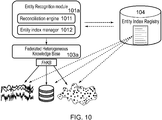
- the entity index registry 104 is illustrated in Figure 10 .
- the entity index registry 104 is a data storage device or a memory area within a data storage device, and stores information including a reference index with metadata of all the entities stored by the system. This registry enables the possibility of storing distributed entities in several different data stores.
- the registry 104 stores an index with the following parameters related to each entity in an entry for the entity: unique system id, pairs of identifier property-value, data store reference or dataset reference, and other parameters as illustrated in Figure 11 , such as address at which the dataset may be accessed in the reconciled data store 103.
- Figure 11 illustrates an exemplary registry entry, which registry entry is illustrated within the entity index registry 104 in Figure 10 .
- the entity index registry 104 provides a centralised index with all the entities stored in the system 100. Furthermore, the inclusion of at least one identifier property-value pair and a dataset ID for each dataset comprising property-value pairs for the entity enables the entities in each data store in which the entity has a portion of the information to be identified, as well as, the identifiers which this distributed information may be located. Finally, the entity index registry 104 stores other additional information that may provide some extra information, such as, timestamp of the last update or other metadata, as is illustrated in Figure 11 .
- the Federated Heterogeneous Knowledge base 103a is exemplary of the reconciled data store and is an intelligent data repository that offers a unified view of the knowledge present in the system 100.
- the array of registered entity property-value pairs for each entity is stored in the federated heterogeneous knowledge base 103a.
- the knowledge base 103a may store datasets in their native format and thus may use a variety of data repositories internally, as for example document stores (e.g. MongoDB), graph databases (e.g. Neo4j), or in-memory data (Spark RDDs). Each one of these data repositories may be located in a different computer or in several of them (a cluster) when possible.
- the heterogeneous knowledge base is able to store and update the data in the internal data repositories, choosing the most appropriate place or places (with possible replication) for each data fragment.
- the Federated Heterogeneous Knowledge base 103a is also configured to provide an interface to handle data query operations on the knowledge base and to respond to queries on the stored data, by:
- FIGURE 12 is a block diagram of a computing device, such as a data storage server forming all or part of a data storage system 100 which embodies the present invention, and which may be used to implement a method of an embodiment of Figure 1 .
- the computing device comprises a processor 993, and memory, 994.
- the computing device also includes a network interface 997 for communication with other computing devices, for example with other computing devices of invention embodiments.
- an embodiment may be composed of a network of such computing devices.
- the computing device also includes one or more input mechanisms such as keyboard and mouse 996, and a display unit such as one or more monitors 995.
- the components are connectable to one another via a bus 992.
- the memory 994 may include a computer readable medium, which term may refer to a single medium or multiple media (e.g., a centralized or distributed database and/or associated caches and servers) configured to carry computer-executable instructions or have data structures stored thereon.
- Computer-executable instructions may include, for example, instructions and data accessible by and causing a general purpose computer, special purpose computer, or special purpose processing device (e.g., one or more processors) to perform one or more functions or operations.
- the term "computer-readable storage medium” may also include any medium that is capable of storing, encoding or carrying a set of instructions for execution by the machine and that cause the machine to perform any one or more of the methods of the present disclosure.
- computer-readable storage medium may accordingly be taken to include, but not be limited to, solid-state memories, optical media and magnetic media.
- computer-readable media may include non-transitory computer-readable storage media, including Random Access Memory (RAM), Read-Only Memory (ROM), Electrically Erasable Programmable Read-Only Memory (EEPROM), Compact Disc Read-Only Memory (CD-ROM) or other optical disk storage, magnetic disk storage or other magnetic storage devices, flash memory devices (e.g., solid state memory devices).
- RAM Random Access Memory
- ROM Read-Only Memory
- EEPROM Electrically Erasable Programmable Read-Only Memory
- CD-ROM Compact Disc Read-Only Memory
- flash memory devices e.g., solid state memory devices
- the processor 993 is configured to control the computing device and execute processing operations, for example executing code stored in the memory to implement the various different functions of the entity recognition module 101 a, the entity index registry 104, the entity type and domain recognition module 230, the data acquisition module 210, the data standardisation module 212, and the data property reconciliation module 220, described here and in the claims.
- the memory 994 stores data being read and written by the processor 993.
- a processor may include one or more general-purpose processing devices such as a microprocessor, central processing unit, or the like.
- the processor may include a complex instruction set computing (CISC) microprocessor, reduced instruction set computing (RISC) microprocessor, very long instruction word (VLIW) microprocessor, or a processor implementing other instruction sets or processors implementing a combination of instruction sets.
- the processor may also include one or more special-purpose processing devices such as an application specific integrated circuit (ASIC), a field programmable gate array (FPGA), a digital signal processor (DSP), network processor, or the like.
- ASIC application specific integrated circuit
- FPGA field programmable gate array
- DSP digital signal processor
- network processor or the like.
- a processor is configured to execute instructions for performing the operations and steps discussed herein.
- the display unit 997 may display a representation of data stored by the computing device and may also display a cursor and dialog boxes and screens enabling interaction between a user and the programs and data stored on the computing device.
- the input mechanisms 996 may enable a user to input data and instructions to the computing device.
- the network interface (network I/F) 997 may be connected to a network, such as the Internet, and is connectable to other such computing devices via the network.
- the network I/F 997 may control data input/output from/to other apparatus via the network.
- Other peripheral devices such as microphone, speakers, printer, power supply unit, fan, case, scanner, trackerball etc may be included in the computing device.
- the data storage system 100 of Figures 2 , 3 , 4 , 7 , and 10 may be a processor 993 (or plurality thereof) executing processing instructions (a program) stored on a memory 994 and acquiring data via a network I/F 997.
- the processor 993 executes processing instructions to receive, via the network I/F, acquired dataset property-value pairs from native data stores and reconcile the data into the reconciled data store, as in the method of Figure 1 .
- the processor 993 may execute processing instructions to store reconciled data on a connected storage unit and/or to transmit, via the network I/F 997, reconciled data to a federated heterogeneous knowledge base 103a for storage.
- the entity recognition module 101 a of Figures 2 , 3 , 4 , 7 , and 10 may be a processor 993 (or plurality thereof) executing processing instructions (a program) stored on a memory 994 and acquiring data via a network I/F 997 and/or via a data acquisition module 210.
- the processor 993 executes processing instructions to receive, via the network I/F, acquired dataset property-value pairs from native data stores and reconcile the data into the reconciled data store, as in the method of Figure 1 .
- the processor 993 may execute processing instructions to store reconciled data on a connected storage unit and/or to transmit, via the network I/F 997, reconciled data to a federated heterogeneous knowledge base 103a for storage.
- the entity index registry 104 of Figures 2 , 7 , and 10 may be a processor 993 (or plurality thereof) executing processing instructions (a program) stored on a memory 994 and exchanging data via a network I/F 997 or via an internal data exchange mechanism.
- the processor 993 executes processing instructions to receive, via the network I/F or internal data exchange mechanism, acquired dataset property-value pairs representing an entity from the entity recognition module 101 a and to consolidate the received data into the reconciled data store 103, as in step S104 of Figure 1 , or as in the method of Figure 9 .
- the processor 993 may execute processing instructions to store acquired dataset property-value pairs on a connected storage unit such as the entity index registry 104 or the reconciled data store 103.
- the entity type recognition module 230 of Figures 3 , 4 , 6 , & 7 may be a processor 993 (or plurality thereof) executing processing instructions (a program) stored on a memory 994 and exchanging data via a network I/F 997.
- the processor 993 executes processing instructions to receive a set of data properties characterising an acquired dataset from either a data property recognition module 220 or some other input mechanism, and process the set of data properties to generate a selection of an entity type for the input dataset as illustrated in Figure 6 .
- the processor 993 may execute processing instructions to store the selected entity type with the acquired dataset on a connected storage unit and/or to transmit, via the network I/F 997, the entity type selection to the domain recognition module 230 for use in selecting a domain for the input dataset.
- the domain recognition module 230 of Figures 3 , 4 , 6 , & 7 may be a processor 993 (or plurality thereof) executing processing instructions (a program) stored on a memory 994 and exchanging data via a network I/F 997.
- the processor 993 executes processing instructions to receive a set of data properties characterising an acquired dataset from either a data property recognition module 220 or some other input mechanism, and a selection of entity type for the input dataset from the entity type recognition module 230 and process the set of data properties and the selection of entity type to generate a selection of a domain for the input dataset.
- the processor 993 may execute processing instructions to store the selected domain with the acquired dataset on a connected storage unit and/or to transmit, via the network I/F 997, the entity type selection, the domain selection, and the set of data properties to the entity recognition module 101 a.
- the data acquisition module of Figures 3 & 4 may be a processor 993 (or plurality thereof) executing processing instructions (a program) stored on a memory 994 and exchanging data via a network I/F 997.
- the processor 993 executes processing instructions to receive, via the network I/F, acquired dataset property value pairs from their respective native data sources and to parse the acquired data into the system 100.
- the processor 993 may execute processing instructions to store the acquired dataset on a connected storage unit and/or to transmit, via the network I/F 997, the acquired dataset to the data property reconciliation module 220 (also referred to as the data property recognition module 220) for processing, and optionally via the data standardisation module.
- the data property reconciliation module 220 also referred to as the data property recognition module 220
- the data standardisation module 212 of Figures 3 & 4 may be a processor 993 (or plurality thereof) executing processing instructions (a program) stored on a memory 994 and exchanging data via a network I/F 997.
- the processor 993 executes processing instructions to receive, via the network I/F, an acquired dataset from the data acquisition module 210 and standardise the data into the data format and units defined as standard for the system 100.
- the processor 993 may execute processing instructions to store the standardised acquired dataset on a connected storage unit and/or to transmit, via the network I/F 997, the standardised acquired dataset to the data property reconciliation module for processing.
- the data property reconciliation module of Figures 3 & 4 may be a processor 993 (or plurality thereof) executing processing instructions (a program) stored on a memory 994 and exchanging data via a network I/F 997.
- the processor 993 executes processing instructions to receive, via the network I/F, an acquired dataset from the dataset acquisition module 210 and reconcile the property labels with those in a stored list.
- the processor 993 may execute processing instructions to store the acquired dataset with property labels modified to match those of the stored list on a connected storage unit and/or to transmit, via the network I/F 997, said acquired dataset to the entity recognition module 101 a for processing, optionally via the entity type and domain recognition module 230.
- Methods embodying the present invention may be carried out on a computing device such as that illustrated in Figure 12 .
- a computing device need not have every component illustrated in Figure 12 , and may be composed of a subset of those components.
- a method embodying the present invention may be carried out by a single computing device in communication with one or more data storage servers via a network.
- the computing device may be a data storage itself storing the reconciled data store 103 and the registry 104.
- a method embodying the present invention may be carried out by a plurality of computing devices operating in cooperation with one another.
- One or more of the plurality of computing devices may be a data storage server storing at least a portion of the reconciled data store 103 and the registry 104.
Landscapes
- Engineering & Computer Science (AREA)
- Theoretical Computer Science (AREA)
- Databases & Information Systems (AREA)
- Data Mining & Analysis (AREA)
- Physics & Mathematics (AREA)
- General Engineering & Computer Science (AREA)
- General Physics & Mathematics (AREA)
- Computational Linguistics (AREA)
- Information Retrieval, Db Structures And Fs Structures Therefor (AREA)
Abstract
Description
- The present invention lies in the field of data storage and in particular relates to the recognition of input datasets.
- A challenge in the data science domain is the integration of input datasets from heterogeneous data sources with different structures, formats, and nature. Resolution of overlapping data and identification of data representing the same entity from different datasets require a high level of manual interaction. In most cases, knowing how to interpret an input dataset, or which information the data is related to, is a key element for a correct data interpretation and hence integration. In many cases, to integrate the input dataset properly it is necessary to have a background in the field of knowledge represented by the input dataset.
- Information represented in input datasets takes an increasingly important role in the decision making of technological enterprises. Enabling machines to accurately describe datasets at varying levels of abstraction is desirable if the knowledge contained in input datasets is to be harvested.
- The interoperability of machines is enhanced by storing datasets with accurate descriptors. Furthermore, the accessibility and efficiency of storage is enhanced with meaningfully annotated data.
- Processing overheads are imposed in data centres by cross-device traversals and access operations.
- It is desirable to enhance the ability of machines to recognise context and knowledge domains for input datasets. It is desirable to enhance the ability of machines to correctly and accurately reconcile data representing the same real-world entity from different heterogeneous data sources.
- Embodiments include: a data storage system comprising a processor coupled to a memory, the memory including a reconciled data store and a registry, the processor being configured to execute a process comprising:
- in the reconciled data store, storing, with respect to each of a plurality of registered entities: an array of registered entity property-value pairs representing the registered entity, from each dataset from among a plurality of (heterogeneous) datasets, wherein each of the registered entity data property-value pairs comprises a property label representing a property of a registered entity and a value representing a value range of the property for the respective registered entity;
- in a registry, storing, with respect to each of the plurality of registered entities: a registry entry comprising at least one identifier property-value pair with respect to each of the plurality of datasets, wherein each of the identifier property-value pairs comprises an identifier property label representing an identifier property of a registered entity, uniquely identifying the registered entity (within the respective dataset), and an identifier value representing a value of the identifier property for the respective registered entity;
- acquiring a dataset for reconciliation with the reconciled data store, the acquired dataset including a plurality of acquired dataset property-value pairs for each of a first set of one or more acquired dataset entities, wherein each of the acquired dataset data property-value pairs comprises a property label representing a property of an acquired dataset entity and a value representing a value range of the property for the respective acquired dataset entity..
- The process further comprises, for each of the one or more acquired dataset entities:
- identifying an identifier property-value pair stored in the registry matching an acquired dataset property-value pair for the acquired dataset entity; and
- consolidating the acquired dataset property-value pairs for the acquired dataset entity into the array of registered entity property-value pairs stored with respect to the registered entity identified by the identifier value of the identified identifier property-value pair.
- Advantageously, the automated consolidation of data representing the same entity from different and heterogeneous data sources reduces considerably the manual intervention required in extract, transform, and load (ETL) tasks in the data science domain.
- Embodiments provide an intelligent system for automated acquisition and reconciliation of data providing the following benefits, among others:
- Reducing considerably the effort in ETL tasks which are low value-added tasks.
- The generation of machine readable metadata in semi-automatic and intelligent manner, especially with non-standard formats.
- Facilitate the automation of data acquisition and reconciliation for assistants and intelligent platforms.
- An identifier property uniquely identifies an entity. Uniqueness is among a population of entities to which the entity belongs, bound by the scope of data already acquired and stored in the system and to be acquired. For example, it may be unique among legal entities, or unique among entities listed at a particular list or registry.
- Embodiments of another aspect include a data storage method, for stored including a reconciled data store and a registry, the method comprising: in the reconciled data store, storing, with respect to each of a plurality of registered entities: an array of registered entity property-value pairs representing the registered entity, from each dataset from among a plurality of datasets, wherein each of the registered entity data property-value pairs comprises a property label representing a property of a registered entity and a value representing a value range of the property for the respective registered entity. The method also includes: in the registry, storing, with respect to each of the plurality of registered entities: a registry entry comprising at least one identifier property-value pair with respect to each of the plurality of datasets, wherein each of the identifier property-value pairs comprises an identifier property label representing an identifier property of a registered entity, uniquely identifying the registered entity, and an identifier value representing a value of the identifier property for the respective registered entity. The method also includes: acquiring a dataset for reconciliation with the reconciled data store, the acquired dataset including a plurality of acquired dataset property-value pairs for each of a first set of one or more acquired dataset entities, wherein each of the acquired dataset data property-value pairs comprises a property label representing a property of an acquired dataset entity and a value representing a value range of the property for the respective acquired dataset entity. The method further comprises: for each of the one or more acquired dataset entities: identifying an identifier property-value pair stored in the registry matching an acquired dataset property-value pair for the acquired dataset entity; and consolidating the acquired dataset property-value pairs for the acquired dataset entity into the array of registered entity property-value pairs stored with respect to the registered entity identified by the identifier value of the identified identifier property-value pair.
- Embodiments of another aspect include a computer program which, when executed by a computing apparatus, causes the computing apparatus to perform a method of an embodiment. Such a computer program may be stored on a computer-readable medium such as a non-transitory computer-readable medium.
- Preferred features of the present invention will now be described, purely by way of example, with reference to the accompanying drawings, in which:-
-
Figure 1 illustrates an exemplary process executed by a data storage system; -
Figure 2 illustrates an exemplary hardware architecture; -
Figure 3 illustrates an intelligent data acquisition and reconciliation system; -
Figure 4 illustrates the operation of the system ofFigure 3 with reference to a sample acquired dataset entity; -
Figure 5 illustrates a data property reconciliation process; -
Figure 6 illustrates an entity type and domain recognition process; -
Figure 7 illustrates an entity recognition process performed by the system ofclaim 1; -
Figure 8 illustrates an exemplary entity recognition process; -
Figure 9 illustrates an entity index registry management process; -
Figure 10 illustrates an entity index registry; -
Figure 11 illustrates a registry entry; and -
Figure 12 illustrates a hardware structure of a computing device in the data storage system ofFigure 1 . - The
data storage system 100 is a computing system and comprises memory hardware for storing data andprocessor hardware 101 for executing processing instructions. Theprocessor hardware 101 is configured to perform the process illustrated inFigure 1 by executing processing instructions stored on amemory 102 coupled to the processor hardware. Theprocessor hardware 101 is referred to as a processor or the processor, and may be one or more CPU devices. The memory hardware is referred to as a memory or the memory, and comprises astorage device 102 accessible to the processor for storing processing instructions and for storing data for input to and output from the processor during execution of processing instructions. The memory hardware may also comprise a storage area for storing theregistry 104, and a storage area for storing the reconcileddata store 103. Each of said storage areas may comprise part or all of one or more interconnected storage devices. - At S101 of the process of
Figure 1 , the reconcileddata store 103 stores, for example, an array of registered entity property-value pairs representing the registered entity, from each dataset from among a plurality of heterogeneous datasets already input to the data storage system, wherein each of the registered entity data property-value pairs comprises a property label representing a property of a registered entity and a value representing a value range of the property for the respective registered entity. For example, the dataset may be read from its native storage as relational data, in which the entity is represented by a row of entries, the property label is a column header, and the value is the data from the entry of the row in the respective column. Alternatively, the dataset may be read from its native storage as graph data, in which, for example, property labels are labels of subject nodes linked to object nodes by a has Value predicate, or equivalent, and the value is the value specified by the linked object node. The datasets may retain their respective native forms in the reconcileddata store 103, albeit with modifications, such as removal or addition of property-value pairs, addition of reference ID, timestamps, and other metadata, and alignment of property labels with a set of defined property labels stored in thedata storage system 100. - The reconciled
data store 103 stores the sum of information about each registered entity from plural external (to the data storage system) physical data storage locations in one physical data storage area accessible via a single access point and in a consolidated form to avoid duplication of information. - At S102 of the process the
registry 104 stores with respect to each of the plurality of registered entities: a registry entry comprising at least one identifier property-value pair with respect to each of the plurality of datasets, wherein each of the identifier property-value pairs comprises an identifier property label representing an identifier property of a registered entity, uniquely identifying the registered entity within the respective dataset, and an identifier value representing a value of the identifier property for the respective registered entity. Registered entity is taken to mean an entity appearing in the registry, that is, an entity for which an identifier property-value pair is identified among the input datasets and stored in a registry entry. Plural datasets store data relating to the same entity, and hence each entity has more than one corresponding identifier property-value pair. It is also possible that, for a single dataset, more than one identifier property-value pair is recorded in the registry entry for a single entity. - Identifier properties may be denoted as such by a system user (where system user is taken to be a manual input to the data storage system via, for example, a user interface) or by semantic analysis of the respective property label, or by a combination of the two. For example, automated semantic analysis of a property label may identify candidates for identifier properties, which candidates are presented to a system user for confirmation or rejection.
- At step S103 a new dataset is acquired for reconciliation with the data already stored in the reconciled
data store 103. The new dataset is acquired by reading data from its physical storage location (for example, addressed via a URL) and parsing the data into the data storage system. The acquired dataset includes a plurality of acquired dataset property-value pairs for each of a first set of one or more acquired dataset entities, wherein each of the acquired dataset data property-value pairs comprises a property label representing a property of an acquired dataset entity and a value representing a value range of the property for the respective acquired dataset entity. - For example, data acquisition may be performed by the
processor 101 executing processing instructions stored on thememory 102 in order to read data via network interface hardware, the combination ofprocessor 101,memory 102, and network interface hardware realising an acquisition module. In addition to the acquisition module, systems may also be provided with a data property recognition module. Data property recognition may be performed by theprocessor 101 executing processing instructions stored on thememory 102, and making read accesses to a knowledge base or other data store via network interface hardware, the combination ofprocessor 101,memory 102, and network interface hardware realising a data property recognition module. - In systems provided without the acquisition module and the data property recognition module, it is assumed that input datasets, that is, datasets for reconciliation with the reconciled data store, are composed of values of recognised (i.e. labelled with property labels from a set stored by the data storage system 100) properties upon initiation of step S103, and the mapping of values to recognised properties is known. Thus, values in the input datasets are attributable to a property represented by a property label in a stored set or list of property labels. For example, the stored set or list of property labels may be stored as property-level nodes of a graph-based ontology model.
- In systems provided with the acquisition module and the data property recognition module, input datasets, that is, datasets read into the system by the acquisition module from their native storage, are assigned a property label from the stored set of property labels for each property represented in the dataset. For each property the dataset contains a set of values each defining a value or range of values of the property. Wherein a set of values is, for example, a column of values in a tabular data set or a collection of values instantiating the same property-level concept in a data graph.
- The acquisition module collects, extracts and integrates heterogeneous and distributed data into the system in the form of input datasets. The input datasets may be in different formats and contain different grades of information complexity.
- The data
property reconciliation module 220 normalises the data with the purpose of providing the standardised data properties to the data storage system for identification of the entities represented in the data by the process ofFigure 1 . The data property reconciliation module supports the process in order to provide datasets having values which are mapped to one of the property labels in the stored list. The data property reconciliation module assigns a property label from the stored list to a property represented by values within an input dataset. The data property reconciliation module receives raw data with their descriptors (i.e. native property labels) and, based on semantics of the descriptor and values of the property and knowledge, reconciles the descriptors with property labels from the stored list, a process which is described in more detail in German patent applicationsDE102016220781.4 &DE1012016220771.7 - The principle of operation of the
property recognition module 220 in the context of a wider data acquisition and reconciliation system is illustrated inFigure 3 . For example, raw data comprising a value of each of three properties for each of three entities is acquired as raw data by theproperty recognition module 220, as shown inFigure 5 . The properties are labelled with a descriptor. An exemplary dataproperty recognition module 220 comprises a semantics engine which compares the semantics of descriptors labelling the properties in the raw data with the semantics of property labels from the stored list. The dataproperty recognition module 220 comprises a data value fingerprint engine which compares statistical characteristics of the values of the properties in the raw data with the statistical characteristics of sets of values representing the property labels from the stored list. Based on the comparisons each set of values (i.e. each column) is assigned a property label from the stored list. - Whether the
acquisition module 210 and the dataproperty reconciliation module 220 are included in the system or are external modules providing data to the system, said modules may be provided by a data property recognition apparatus, data property recognition method, or data property recognition program such as that disclosed in German patent applicationsDE102016220781.4 &DE1012016220771.7 - The process proceeds to S104, at which the acquired dataset property-value pairs in respect of an entity are used to identify the respective entity from among the registered entities. In particular, a case where the acquired dataset property-value pairs in respect of an entity do contain a property-value pair matching an identifier property-value pair stored in the registry. It may be that all of the acquired dataset property value pairs are compared against identifier property-value pairs to seek a matching property-value pair. Alternatively, it may be that a subset of the acquired dataset property-value pairs are selected for comparison, for example, based on a semantic comparison of the property label with property labels assumed to contain identifying values. Alternatively, it may be that both approaches are combined, with the subset compared with the identifier property-value pairs of the registry first, moving on to the remaining property-value pairs if no match is found. A match may be, for example, property label of the two pairs being equal and value of the two pairs being equal, or property label of the two pairs being equal and value of the two pairs being equal within a predefined tolerance, or property label of the two pairs being equal to a predefined tolerance and value of the two pairs being equal, or property label of the two pairs being equal to a predefined tolerance and value of the two pairs being equal to a predefined tolerance.
- At step S105, the acquired dataset property-value pairs are consolidated into the reconciled data storage. For example, step S105 may comprise consolidating the acquired dataset property-value pairs for the acquired dataset entity into the array of registered entity property-value pairs stored with respect to the registered entity identified by the identifier value of the matching identifier property-value pair.
- In particular, the consolidating may comprise, for each acquired-dataset property-value pair: if the property label matches a property label in the stored array of registered entity property-value pairs, if the value of the acquired dataset property-value pair matches the value of the registered entity property-value pair with the matching label, make no modification to the stored array, and if the value of the acquired dataset property-value pair does not match the value of the registered entity property-value pair, add the acquired dataset property-value pair to the stored array as a registered entity property-value pair; and if the property label does not match a property label in the stored array of registered entity property-value pairs, add the acquired dataset property-value pair to the stored array as a registered entity property-value pair.
- The registry entry for the entry is extended with metadata representing the newly-added property-value pairs, including information identifying a storage location within the reconciled
data store 103, one or more identifier property-value pairs, and a dataset ID uniquely identifying the acquired dataset among the plurality of datasets input to thesystem 100 and from which property-value pairs are stored in the reconcileddata store 103. -
Figure 3 illustrates components of thedata storage system 100 in the wider context of an intelligent data acquisition and reconciliation system.Figure 4 illustrates the operation of the system ofFigure 3 with reference to a sample acquired dataset entity. - The
data storage system 100 ofFigure 2 may form part of the intelligent data acquisition and reconciliation system, a system which automates data ingestion tasks and recognises and labels data properties, recognises entity type and domains of entities represented in input datasets, and identifies entities within said datasets. In the same way as a speech recognition apparatus converts audio into a codified representation of speech, i.e. text, the intelligent data acquisition and reconciliation system converts heterogeneous datasets into reconciled and identified data within a single federatedheterogeneous knowledge base 103a. The process ofFigure 1 , which may be attributed to theentity recognition module 101 a within the context of theFigure 3 diagram, provides a key role within the understanding of input datasets by a machine, facilitated by the system ofFigure 3 . - The
data acquisition module 210 collects extracts and integrates heterogeneous and distributed data from respective native data sources into the system, and is described above in relation to step S103 ofFigure 1 . These data sources could be in different formats and complexity of grades of information. - The data standardisation module212 obtains the data acquired by the
data acquisition module 210 and processes the data to provide the correct format, that is, the standard format for the system. Thedata standardisation module 212 modifies units of values and data formats upon parsing into the system for compliance with defined standards for the system. Thedata standardisation module 212 normalises the data with the purpose of providing a standardised format readable by the system. Thedata standardisation module 212 supports the process in order to provide the right format to be recognised by the recognition and reconciliation modules. As illustrated inFigure 4 , the acquired data is parsed into acquired dataset property-value pairs. - The data
property reconciliation module 220 module is configured to recognise the set of properties obtained through thedata acquisition module 210 anddata standardisation module 212, and also, it is configured to store the set of standardised data properties to which input datasets are aligned, as well as recognising which property-value pairs could be identifier property-value pairs. The dataproperty reconciliation module 220 performs a reconciliation or recognition function, the reconciliation being alignment with a defined list or set of data properties. As illustrated inFigure 4 , the native property labels of the input dataset are modified to match property labels from a stored list of property labels. Semantics of the native property labels and the stored list of property labels are compared, along with statistical properties of the values, in order to match the property of the acquired dataset with a property from the stored list. In addition, the dataproperty reconciliation module 220 recognises which of the acquired dataset property-value pairs may be an identifier. For example, particular property labels among the stored list may be assumed by the system to represent identifiers. The module may execute semantic analysis of the respective property label. For example, automated semantic analysis of a property label may identify candidates for identifier properties, which candidates are presented to a system user for confirmation or rejection. The output of the data property reconciliation module is a clean and annotated version of the acquired dataset which contains the extracted data property-value pairs. - The entity type and
domain recognition 230 is a procedure for categorising the entities represented in an input dataset by two hierarchical levels of categorisation, entity type, and domain. The system is able to infer added information from the set of data properties received and the potential identifiers based on knowledge. The entity type anddomain recognition 230 may be automated, or partially automated & partially manual, using a knowledge base of user preferences and semantic and statistical properties of data to annotate or categorise the entities represented in an input dataset with an entity type label and a domain label. In the same way as the property labels being from a defined list, the entity type and domain may also be from a defined list. It is noted in all cases that the lists may be partially predefined but may be augmented when new property labels, entity types, or domains are encountered. As illustrated byFigure 4 , the acquired dataset property-value pairs are annotated with new descriptors: an entity type descriptor and a domain descriptor. - The
entity recognition module 101a is a representation of the process ofFigure 1 , which results in acquired dataset property-value pairs being written into a reconciled data store, said reconciled data store being exemplified inFigure 3 by the federatedheterogeneous knowledge base 103a. The entity recognition module is configured to recognise the specific entity which acquired dataset property-value pairs refer to. Theentity recognition module 101 a obtains a set of standardised data properties, a set of potential identifiers, the potential type and domain of the entity from the entity type anddomain recognition module 230, and, based on some or all of these inputs and knowledge stored in theregistry 104 and reconcileddata store 103, this module provides a recommendation about which specific entity property-value pairs in an input dataset refer to. As illustrated byFigure 4 , an entity known to the system and being represented by an entry in theregistry 104 is determined to be the entity represented by the acquired dataset property-value pairs. - The federated
heterogeneous knowledge base 103a is an intelligent data repository that offers a unified view of the knowledge about an entity from plural heterogeneous datasets. The federatedheterogeneous knowledge base 103a provides a unified interface for all the data and knowledge stored into the system. Optionally, the federatedheterogeneous knowledge base 103a component is able to decide and provide the best data repository depending on data nature. The federatedheterogeneous knowledge base 103a offers a unified view of all of the data about a specific entity stored in the reconciled data store. -
Figure 5 exemplifies a sample input to and output from the dataproperty reconciliation module 220. The output illustrates that, in addition to the property-value pair, metadata relating to the property label stored in association with the stored list of property labels is used to annotate the acquired dataset property-value pairs. -
Figure 6 exemplifies a sample input to and output from the entity type anddomain recognition 230. The entity type anddomain recognition module 230 is configured to provide an entity type and domain annotation to each acquired dataset entity based on knowledge stored in a knowledge base and user experience for the data properties received. This component extracts knowledge from ontologies and the preferences from the user feedbacks, and utilises the knowledge to: recognise the entity type according to the data properties, and recognise the corresponding domain according to the entity type and the data properties. As illustrated inFigure 6 , the entitytype recognition module 231 recognises entity type, and thedomain recognition module 232 recognises domain. - The
data acquisition module 210,data standardisation module 212, dataproperty reconciliation module 220, and entity type anddomain recognition module 230 may be considered to perform pre-processing tasks for the process ofFigure 1 executed by the system ofFigure 2 . A description of said modules is provided to explain the context for the process ofFigure 1 and system ofFigure 2 . The process ofFigure 1 is executed on a hardware architecture such as that ofFigure 2 . In the overview diagram ofFigure 3 , the process ofFigure 1 is represented by theentity recognition module 101 a. - The
entity recognition module 101 a identifies unique entities from the acquired dataset and matches or maps the unique entities to entities registered in theregistry 104. Theregistry 104 is exemplified by the entity index registry ofFigure 7 . Theentity index registry 104 stores entity metadata in a registry entry per entity. Exemplary entity metadata includes a system identifier (i.e. an ID for the entity and all data relating thereto within the data storage system 100), an identifier of the dataset registry (a connected registry storing pointers to the physical location at which property-value pairs representing the entity are stored in the reconciled data store 103), and identifier property-value pairs of entity identifiers found in all the datasets processed by the system. To query the Entity Index Registry, a REST API provides different methods to obtain the information of this registry, e.g. to look for an entity with a given identifier property-value pair. -
Figure 7 illustrates in more detail the functionality provided by theentity recognition module 101 a. - The
entity recognition module 101 a is configured to recognise the concrete entity to which acquired dataset property value pairs refer, from among registered entities. Theentity recognition module 101 a manages theentity index registry 104 and coordinates the use of said registry, and updates to said registry, given a received set of acquired dataset property-value pairs, and optionally the potential identifier property-value pair(s), and optionally also the entity type and domain annotations. To illustrate the functionality in more detail, theentity recognition module 101 a ofFigure 7 is divided into two functional submodules: thereconciliation engine 1011 and theentity index manager 1012, as is further described in the followings paragraphs. Furthermore, for a better understanding of this module, a diagram of an exemplary process executed by theentity recognition module 101 a is depicted inFigure 8 . - The
processor 101 ofFigure 2 executes processing instructions stored on the coupledmemory 102 in order to function as theentity recognition module 101 a.Figure 8 illustrates an exemplary entity reconciliation process performed by theentity recognition module 101 a. - The process of steps S801 to S815 is performed on a per entity basis, so all of the steps relate a single entity represented in an acquired dataset. At step S801, a number of identifier property value pairs among the acquired dataset property-value pairs for the entity is determined. The determination may be based on rules stored by the
system 100 regarding property labels attributed to identifier property-value pairs (i.e. properties for which the value uniquely identifies the entity). If there are no identifier property-value pairs in the acquired dataset property-value pairs representing the entity, the flow proceeds to S802. If there is a single identifier property-value pair, the flow proceeds to S805. At S805, it is determined whether or not the identifier property-value pair from the acquired dataset matches an identifier property-value pair stored in theregistry 104. If it does, then the flow proceeds to S806. If it does not, then the flow proceeds to S807. If there is more than one identifier property-value pair among the acquired dataset property-value pairs representing the entity, the flow proceeds to S811. At S811 it is determined whether or not, from among the more than one identifier property-value pairs for the acquired dataset entity, there is at least one that matches an identifier property value pair stored in theregistry 104. If there is, then the flow proceeds to S812, if there is not, then the flow proceeds to S807. - In the example of steps S801, S805, S807, and S811, the identifier property-values representing the acquired dataset entity are identified in advance. However, alternatively, all acquired dataset property-value pairs may be treated as having the potential to be identifiers, and thus compared with the identifier property-value pairs stored in the registry. If the comparisons determine there to be zero matches, then the flow proceeds to S807. If the comparisons determine there to be one match, then the flow proceeds to S806. If the comparisons determine there to be more than one match, but the matching identifier property-value pairs from the registry relate to the same entity, then the flow also proceeds to S806. If the comparisons determine there to be more than one match, and the matching identifier property-value pairs from the registry relate to different entities, then the flow proceeds to S812.
- At S802, if the system cannot identify the presence of a property label presumed to be an identifier property label (based on stored logic such as a list of property labels presumed to be instantiated by identifying values) at S801, a dialog is established with the user via a user interface to recognise based on user insights one or more registered entities which the acquired dataset property-value pairs represent.
- At S802, via a user interface, a system user is requested to either nominate one of the acquired dataset property-value pairs for the entity as an identifier property-value pair, or the user may nominate all of the property-value pairs as identifier property-value pairs. In either case, a comparison is performed between the identifier property-value pairs of the acquired dataset entity and the identifier property-value pairs of the registry. If the comparisons determine there to be zero matches, then the flow proceeds to S807. If the comparisons determine there to be one match, then the flow proceeds to S806. If the comparisons determine there to be more than one match, but the matching identifier property-value pairs from the registry relate to the same entity, then the flow also proceeds to S806. If the comparisons determine there to be more than one match, and the matching identifier property-value pairs from the registry relate to different entities, then the flow proceeds to S803, which is the same as S812.
- At steps S803 and S812, an entity disambiguation process is executed. This process is to resolve ambiguity with respect to the entity identified by the identifier property-value pairs in the acquired dataset property-value pairs. The entity disambiguation process has as key inputs a set of identifier property-value pairs (in the case of having identifiers) and all the related information with the original data (set of data properties, values for the data properties, and optionally also one or more entity descriptors including entity type and domain). With that information the entity disambiguation component searches into the knowledge stored in the reconciled
data store 103 to obtain the probability Pe with an associated weight We for each identifier related to a registered entity. Finally, the top ranked entity is returned as result of the following formula:
- The entity disambiguation process is a process to resolve ambiguity caused by the acquired dataset property-value pairs matching identifier property-value pairs of more than one different entity registry entry.
- An exemplary entity disambiguation process may comprise, for each different registered entity identified by the identifier property-value pairs of the matching combinations: identifying, from among the array of registered entity property-value pairs stored in the reconciled data store with respect to the registered entity, a set of property labels matching property labels among the acquired dataset property-value pairs; and for each of the set of matching property labels, (string similarity distance or numeric distance) compare the respective values, and combine the results of the comparisons to obtain a distance measure between the acquired dataset entity and the registered entity; and selecting the registered entity for which the obtained distance measure to acquired dataset entity is the shortest as the reconciliation target for the acquired dataset entity.
- Alternatively, at S802, the user may be presented with the option of the
system 100 performing a similarity search process. If selected, the flow proceeds to S807. - At step S807 a similarity search process is performed. The similarity search process is to determine the most similar registered entity based on the data received from one or more among: data property and values, identifiers, entity type descriptor and domain descriptor. The similarity search process calculates a distance measure between the acquired dataset entity and each of the registered entities. In a first step of an exemplary similarity search process, the
system 100 analyses the nature of the data and classifies the data based on the type of data, this is in order to determine a form of distance comparison for property-value pairs. Once the data is classified, the system determines the intersection between the property labels of the acquired dataset property-value pairs and those of the registered entity property-value pairs. Finally, thesystem 100 executes a distance calculation based on the values attributed to the intersecting property labels to calculate the similarity between the acquired dataset entity and the registered entity, obtaining as result an Euclidean distance among the properties which establish the intersection between the different entities.
- The different functions for calculate the distance between properties are based on string similarity and numeric distances calculated with state of the art techniques.
- The similarity search process is not restricted to identifier property-value pairs of the registry, but compares the acquired dataset property-value pairs with the array of property-value pairs about registered entities stored in the reconciled
data store 103. This may be considered a deep search based on all knowledge about an entity. An exemplary similarity search process comprises, for each of the registry entries in the register: identifying, from among the array of registered entity property-value pairs stored in the reconciled data store with respect to the registered entity identified by the registry entry, a set of property labels matching property labels among the acquired dataset property-value pairs; for each of the set of matching property labels, (string similarity distance or numeric distance) comparing the respective values, and combine the results of the comparisons to obtain a distance measure (such as an Euclidean distance as exemplified above) between the acquired dataset entity and the registered entity identified by the registry entry; and selecting the registered entity for which the obtained distance measure to the acquired dataset entity is the shortest as the most similar registered entity to the member of the second set. - At step S808, it is determined whether the obtained distance measure between the acquired dataset entity and the registered entity selected as the most similar registered entity to the member of the second set is above or below a defined threshold. The defined threshold is a global variable in the system, which may be be predefined and adaptable by a system administrator. If it is determined that the obtained distance measure is below the threshold, then the flow proceeds to S809: consolidating the acquired dataset property-value pairs for the entity into the array of registered entity property-value pairs stored with respect to the most similar registered entity. If it is determined that the obtained distance measure is above the threshold, the flow proceeds to S810: including S815S815, adding the acquired dataset property-value pairs to the reconciled data store as registered entity property-value pairs with respect to the entity, and S814S814, creating a new entry in the register for the entity.
- At steps S804, S806, S809, and S813, the acquired dataset property-value pairs are consolidated into the reconciled
data store 103 for a reconciliation target entity. These steps determine how to reconcile the acquired dataset property-value pairs representing the target entity with the already stored property-value pairs representing the target entity (that is, registered entity property-value pairs). For this purpose, thesystem 100 determines the overlap between the already stored property-value pairs and the acquired dataset property-value pairs. For the case of non-overlapping data, the acquired dataset property-value pairs are written to the reconcileddata store 103 as registered entity property-value pairs for the target entity. For the overlapping data, an exemplary procedure is to determined a confidence score for the acquired dataset and a confidence score for the dataset from which the overlapping registered entity property-value pair was obtained, and to select the property-value pair with the higher confidence score to be stored in the reconcileddata store 103. For example, the confidence score may be based on the confidence of the system user in the dataset, and/or the number of times which a new data property-value pair refers to each entity. These confidence scores may be stored into the knowledge base as annotations. - An example of the consolidation is as follows: for each acquired-dataset property-value pair: if the property label matches a property label in the stored array of registered entity property-value pairs, if the value of the acquired dataset property-value pair matches the value of the registered entity property-value pair with the matching label, make no modification to the stored array, and if the value of the acquired dataset property-value pair does not match the value of the registered entity property-value pair, add the acquired dataset property-value pair to the stored array as a registered entity property-value pair S814; and if the property label does not match a property label in the stored array of registered entity property-value pairs, add the acquired dataset property-value pair to the stored array as a registered entity property-value pair S814. At S813 any identifier property-value pairs from the acquired dataset property-value pairs are added to the respective registry entry.
- The
entity index manager 1012 is configured to manage the all the CRUD (Create, Read, Update and Delete operations) requests in theentity index registry 104.Figure 9 illustrates an exemplary logic followed by theentity index manager 1012. - At S901 the
reconciliation engine 1011 issues a put request to theentity index manager 1012 specifying the entity from among the acquired dataset entities. The entity is parsed by theentity index manager 1012 as a JSON entity. - At S902, it is determined whether the entity, that is, the property-value pairs from the acquired dataset contained within the JSON entity, are being added to the reconciled
data store 103 as a new entity (eg as part of or following step S810 ofFigure 8 ) or being consolidated with the array of property-value pairs already stored in the reconcileddata store 103 for a registered entity (eg as part of steps S804, S806, S809, and S813 ofFigure 8 ). In the case of the former, the flow proceeds to S903, in the case of the latter, the flow proceeds to S904. - At S903 a POST operation is performed and a registry entry for the entity is created in the
entity index registry 104. The entry comprises a system ID or reference number uniquely identifying the entity among the registered entities in the system, along with identifier property value pairs from among the acquire dataset property-value pairs representing the entity. In addition, metadata for the dataset, such as a dataset ID or URL, may be included in the registry entry. The acquired-dataset property-value pairs representing the entity are added to the reconcileddata store 103 as registered entity property-value pairs. - At S904 it is determined whether identifier property-value pairs from the dataset have already been added to the registry entry, based on a dataset identifier. If it is determined that identifier property-value pairs from the dataset have already been added to the registry entry, the flow proceeds to S906. If not, the flow proceeds to S905.
- At S905, a dataset object is added to the registry entry, including the identifier property-value pairs from the acquired dataset for the entity. The remaining acquired dataset property-value pairs for the entity are added to the array of registered entity property-value pairs for the entity in the reconciled
data store 103. This adding may be all property-value pairs, or may omit acquired dataset property-value pairs which match an existing registered entity property-value pair for the same entity. - At S906 it is determined, for each acquired dataset property-value pair, whether or not the property label already exists among the array of registered entity property-value pairs for the entity. If it is determined that the property label does not already exist among said array, the flow proceeds to S907. If it is determined that the property label does already exist among said array, the flow proceeds to S908.
- At S907, the acquired dataset property-value pair is added to the array of registered dataset property-value pairs for the entity.
- At S908, it is determined whether the value matches the or any of the values already present in the array of registered entity property-value pairs for the matching property label. If the value does match, then the flow proceeds to S910. If the value does not match, then the flow proceeds to S909.
- At S909, the acquired dataset property-value pair is added to the array of registered dataset property-value pairs for the entity.
- At S910, the acquired dataset property value pair is discarded with no modification to the entity index registry or the array of registered entity property-value pairs.
- It is noted that the procedure may omit steps S904 and S905, so that a positive determination at step S902 leads directly to step S906.
- The
entity index registry 104 is illustrated inFigure 10 . Theentity index registry 104 is a data storage device or a memory area within a data storage device, and stores information including a reference index with metadata of all the entities stored by the system. This registry enables the possibility of storing distributed entities in several different data stores. For example, theregistry 104 stores an index with the following parameters related to each entity in an entry for the entity: unique system id, pairs of identifier property-value, data store reference or dataset reference, and other parameters as illustrated inFigure 11 , such as address at which the dataset may be accessed in the reconcileddata store 103. -
Figure 11 illustrates an exemplary registry entry, which registry entry is illustrated within theentity index registry 104 inFigure 10 . - The
entity index registry 104 provides a centralised index with all the entities stored in thesystem 100. Furthermore, the inclusion of at least one identifier property-value pair and a dataset ID for each dataset comprising property-value pairs for the entity enables the entities in each data store in which the entity has a portion of the information to be identified, as well as, the identifiers which this distributed information may be located. Finally, theentity index registry 104 stores other additional information that may provide some extra information, such as, timestamp of the last update or other metadata, as is illustrated inFigure 11 . - The Federated
Heterogeneous Knowledge base 103a is exemplary of the reconciled data store and is an intelligent data repository that offers a unified view of the knowledge present in thesystem 100. The array of registered entity property-value pairs for each entity is stored in the federatedheterogeneous knowledge base 103a. Theknowledge base 103a may store datasets in their native format and thus may use a variety of data repositories internally, as for example document stores (e.g. MongoDB), graph databases (e.g. Neo4j), or in-memory data (Spark RDDs). Each one of these data repositories may be located in a different computer or in several of them (a cluster) when possible. The heterogeneous knowledge base is able to store and update the data in the internal data repositories, choosing the most appropriate place or places (with possible replication) for each data fragment. The FederatedHeterogeneous Knowledge base 103a is also configured to provide an interface to handle data query operations on the knowledge base and to respond to queries on the stored data, by: - Expanding the query using the knowledge available in the system to identify all the data that is relevant to answer the query.
- Locating the relevant pieces of data in their corresponding data stores that are relevant for the corresponding query.
- Leveraging the different data stores for query optimisation depending on the requirements of the queries and the capabilities of the data stores.
- Integrating the partial answers obtained from each of these data stores into a unified answer as would have been obtained from a single data store.
-
FIGURE 12 is a block diagram of a computing device, such as a data storage server forming all or part of adata storage system 100 which embodies the present invention, and which may be used to implement a method of an embodiment ofFigure 1 . The computing device comprises aprocessor 993, and memory, 994. Optionally, the computing device also includes anetwork interface 997 for communication with other computing devices, for example with other computing devices of invention embodiments. - For example, an embodiment may be composed of a network of such computing devices. Optionally, the computing device also includes one or more input mechanisms such as keyboard and
mouse 996, and a display unit such as one or more monitors 995. The components are connectable to one another via abus 992. - The
memory 994 may include a computer readable medium, which term may refer to a single medium or multiple media (e.g., a centralized or distributed database and/or associated caches and servers) configured to carry computer-executable instructions or have data structures stored thereon. Computer-executable instructions may include, for example, instructions and data accessible by and causing a general purpose computer, special purpose computer, or special purpose processing device (e.g., one or more processors) to perform one or more functions or operations. Thus, the term "computer-readable storage medium" may also include any medium that is capable of storing, encoding or carrying a set of instructions for execution by the machine and that cause the machine to perform any one or more of the methods of the present disclosure. The term "computer-readable storage medium" may accordingly be taken to include, but not be limited to, solid-state memories, optical media and magnetic media. By way of example, and not limitation, such computer-readable media may include non-transitory computer-readable storage media, including Random Access Memory (RAM), Read-Only Memory (ROM), Electrically Erasable Programmable Read-Only Memory (EEPROM), Compact Disc Read-Only Memory (CD-ROM) or other optical disk storage, magnetic disk storage or other magnetic storage devices, flash memory devices (e.g., solid state memory devices). - The
processor 993 is configured to control the computing device and execute processing operations, for example executing code stored in the memory to implement the various different functions of theentity recognition module 101 a, theentity index registry 104, the entity type anddomain recognition module 230, thedata acquisition module 210, thedata standardisation module 212, and the dataproperty reconciliation module 220, described here and in the claims. Thememory 994 stores data being read and written by theprocessor 993. As referred to herein, a processor may include one or more general-purpose processing devices such as a microprocessor, central processing unit, or the like. The processor may include a complex instruction set computing (CISC) microprocessor, reduced instruction set computing (RISC) microprocessor, very long instruction word (VLIW) microprocessor, or a processor implementing other instruction sets or processors implementing a combination of instruction sets. The processor may also include one or more special-purpose processing devices such as an application specific integrated circuit (ASIC), a field programmable gate array (FPGA), a digital signal processor (DSP), network processor, or the like. In one or more embodiments, a processor is configured to execute instructions for performing the operations and steps discussed herein. - The
display unit 997 may display a representation of data stored by the computing device and may also display a cursor and dialog boxes and screens enabling interaction between a user and the programs and data stored on the computing device. Theinput mechanisms 996 may enable a user to input data and instructions to the computing device. - The network interface (network I/F) 997 may be connected to a network, such as the Internet, and is connectable to other such computing devices via the network. The network I/
F 997 may control data input/output from/to other apparatus via the network. Other peripheral devices such as microphone, speakers, printer, power supply unit, fan, case, scanner, trackerball etc may be included in the computing device. - The
data storage system 100 ofFigures 2 ,3 ,4 ,7 , and10 , may be a processor 993 (or plurality thereof) executing processing instructions (a program) stored on amemory 994 and acquiring data via a network I/F 997. In particular, theprocessor 993 executes processing instructions to receive, via the network I/F, acquired dataset property-value pairs from native data stores and reconcile the data into the reconciled data store, as in the method ofFigure 1 . Furthermore, theprocessor 993 may execute processing instructions to store reconciled data on a connected storage unit and/or to transmit, via the network I/F 997, reconciled data to a federatedheterogeneous knowledge base 103a for storage. - The
entity recognition module 101 a ofFigures 2 ,3 ,4 ,7 , and10 , may be a processor 993 (or plurality thereof) executing processing instructions (a program) stored on amemory 994 and acquiring data via a network I/F 997 and/or via adata acquisition module 210. In particular, theprocessor 993 executes processing instructions to receive, via the network I/F, acquired dataset property-value pairs from native data stores and reconcile the data into the reconciled data store, as in the method ofFigure 1 . Furthermore, theprocessor 993 may execute processing instructions to store reconciled data on a connected storage unit and/or to transmit, via the network I/F 997, reconciled data to a federatedheterogeneous knowledge base 103a for storage. - The
entity index registry 104 ofFigures 2 ,7 , and10 , and the manager thereof, may be a processor 993 (or plurality thereof) executing processing instructions (a program) stored on amemory 994 and exchanging data via a network I/F 997 or via an internal data exchange mechanism. In particular, theprocessor 993 executes processing instructions to receive, via the network I/F or internal data exchange mechanism, acquired dataset property-value pairs representing an entity from theentity recognition module 101 a and to consolidate the received data into the reconcileddata store 103, as in step S104 ofFigure 1 , or as in the method ofFigure 9 . Furthermore, theprocessor 993 may execute processing instructions to store acquired dataset property-value pairs on a connected storage unit such as theentity index registry 104 or the reconcileddata store 103. - The entity
type recognition module 230 ofFigures 3 ,4 ,6 , &7 , may be a processor 993 (or plurality thereof) executing processing instructions (a program) stored on amemory 994 and exchanging data via a network I/F 997. In particular, theprocessor 993 executes processing instructions to receive a set of data properties characterising an acquired dataset from either a dataproperty recognition module 220 or some other input mechanism, and process the set of data properties to generate a selection of an entity type for the input dataset as illustrated inFigure 6 . Furthermore, theprocessor 993 may execute processing instructions to store the selected entity type with the acquired dataset on a connected storage unit and/or to transmit, via the network I/F 997, the entity type selection to thedomain recognition module 230 for use in selecting a domain for the input dataset. - The
domain recognition module 230 ofFigures 3 ,4 ,6 , &7 , may be a processor 993 (or plurality thereof) executing processing instructions (a program) stored on amemory 994 and exchanging data via a network I/F 997. In particular, theprocessor 993 executes processing instructions to receive a set of data properties characterising an acquired dataset from either a dataproperty recognition module 220 or some other input mechanism, and a selection of entity type for the input dataset from the entitytype recognition module 230 and process the set of data properties and the selection of entity type to generate a selection of a domain for the input dataset. Furthermore, theprocessor 993 may execute processing instructions to store the selected domain with the acquired dataset on a connected storage unit and/or to transmit, via the network I/F 997, the entity type selection, the domain selection, and the set of data properties to theentity recognition module 101 a. - The data acquisition module of
Figures 3 &4 may be a processor 993 (or plurality thereof) executing processing instructions (a program) stored on amemory 994 and exchanging data via a network I/F 997. In particular, theprocessor 993 executes processing instructions to receive, via the network I/F, acquired dataset property value pairs from their respective native data sources and to parse the acquired data into thesystem 100. Furthermore, theprocessor 993 may execute processing instructions to store the acquired dataset on a connected storage unit and/or to transmit, via the network I/F 997, the acquired dataset to the data property reconciliation module 220 (also referred to as the data property recognition module 220) for processing, and optionally via the data standardisation module. - The
data standardisation module 212 ofFigures 3 &4 may be a processor 993 (or plurality thereof) executing processing instructions (a program) stored on amemory 994 and exchanging data via a network I/F 997. In particular, theprocessor 993 executes processing instructions to receive, via the network I/F, an acquired dataset from thedata acquisition module 210 and standardise the data into the data format and units defined as standard for thesystem 100. Furthermore, theprocessor 993 may execute processing instructions to store the standardised acquired dataset on a connected storage unit and/or to transmit, via the network I/F 997, the standardised acquired dataset to the data property reconciliation module for processing. - The data property reconciliation module of
Figures 3 &4 may be a processor 993 (or plurality thereof) executing processing instructions (a program) stored on amemory 994 and exchanging data via a network I/F 997. In particular, theprocessor 993 executes processing instructions to receive, via the network I/F, an acquired dataset from thedataset acquisition module 210 and reconcile the property labels with those in a stored list. Furthermore, theprocessor 993 may execute processing instructions to store the acquired dataset with property labels modified to match those of the stored list on a connected storage unit and/or to transmit, via the network I/F 997, said acquired dataset to theentity recognition module 101 a for processing, optionally via the entity type anddomain recognition module 230. - Methods embodying the present invention may be carried out on a computing device such as that illustrated in
Figure 12 . Such a computing device need not have every component illustrated inFigure 12 , and may be composed of a subset of those components. A method embodying the present invention may be carried out by a single computing device in communication with one or more data storage servers via a network. The computing device may be a data storage itself storing the reconcileddata store 103 and theregistry 104. - A method embodying the present invention may be carried out by a plurality of computing devices operating in cooperation with one another. One or more of the plurality of computing devices may be a data storage server storing at least a portion of the reconciled
data store 103 and theregistry 104.
Claims (11)
- A data storage system comprising a processor coupled to a memory, the memory including a reconciled data store and a registry, the processor being configured to execute a process comprising:in the reconciled data store, storing, with respect to each of a plurality of registered entities:an array of registered entity property-value pairs representing the registered entity, from each dataset from among a plurality of datasets, wherein each of the registered entity data property-value pairs comprises a property label representing a property of a registered entity and a value representing a value range of the property for the respective registered entity;in a registry, storing, with respect to each of the plurality of registered entities:a registry entry comprising at least one identifier property-value pair with respect to each of the plurality of datasets, wherein each of the identifier property-value pairs comprises an identifier property label representing an identifier property of a registered entity, uniquely identifying the registered entity, and an identifier value representing a value of the identifier property for the respective registered entity;acquiring a dataset for reconciliation with the reconciled data store, the acquired dataset including a plurality of acquired dataset property-value pairs for each of a first set of one or more acquired dataset entities, wherein each of the acquired dataset data property-value pairs comprises a property label representing a property of an acquired dataset entity and a value representing a value range of the property for the respective acquired dataset entity;the process further comprising:for each of the one or more acquired dataset entities:identifying an identifier property-value pair stored in the registry matching an acquired dataset property-value pair for the acquired dataset entity; andconsolidating the acquired dataset property-value pairs for the acquired dataset entity into the array of registered entity property-value pairs stored with respect to the registered entity identified by the identifier value of the identified identifier property-value pair.
- The system according to claim 1, wherein the acquired dataset further includes a plurality of acquired dataset property-value pairs for each member of a second set of one or more acquired dataset entities, from among which plurality of acquired dataset property-value pairs for each member of the second set there is no matching identifier property-value pair stored in the registry;
the process further comprising, for each member of said second set, performing a similarity search process comprising:for each of the registry entries in the register:identify, from among the array of registered entity property-value pairs stored in the reconciled data store with respect to the registered entity identified by the registry entry, a set of property labels matching property labels among the acquired dataset property-value pairs;for each of the set of matching property labels, (string similarity distance or numeric distance) compare the respective values, and combine the results of the comparisons to obtain a distance measure between the member of the second set and the registered entity identified by the registry entry;selecting the registered entity for which the obtained distance measure to the member of the second set is the shortest as the most similar registered entity to the member of the second set. - The system according to claim 2, wherein the process further comprises:determining whether the obtained distance measure between the member of the second set and the registered entity selected as the most similar registered entity to the member of the second set is above or below a threshold; andif it is determined that the obtained distance measure is below the threshold, consolidating the acquired dataset property-value pairs for the member of the second set into the array of registered entity property-value pairs stored with respect to the most similar registered entity; andif it is determined that the obtained distance measure is above the threshold, adding the acquired dataset property-value pairs to the reconciled data store as registered entity property-value pairs with respect to the member of the second set, and creating a new entry in the register for the member of the second set.
- The system according to claim 3, further comprising:presenting one or more acquired dataset property-value pairs for the member of the second set to a system user via a user interface, and presenting one or more registered entity property-value pairs for the most similar registered entity to the system user via the user interface;receiving, from the system user, an indication of whether or not the presented acquired dataset property-value pairs represent the same entity as the presented registered entity property-value pairs; andin the case of the received indication being positive, consolidating the acquired dataset property-value pairs for the member of the second set into the array of registered entity property-value pairs stored with respect to the most similar registered entity; andin the case of the received indication being negative, adding the acquired dataset property-value pairs to the reconciled data store as registered entity property-value pairs with respect to the member of the second set, and creating a new entry in the register for the member of the second set.
- The system according to claim 1, wherein the registry entry further comprises a system entity ID uniquely identifying the registered entity within the system, and the array of registered entity property-value pairs are stored in association with the system entity ID.
- The system according to any of the preceding claims, wherein
the property labels of the registered entity property-value pairs, and the property labels of the acquired dataset property-value pairs, are from a set of (standardised) property labels stored by the system. - The system according to any of the preceding claims, wherein consolidating the acquired dataset property-value pairs for the acquired dataset entity into the array of registered entity property-value pairs stored with respect to the registered entity identified by the identifier value of the identified identifier property-value pair includes:for each acquired-dataset property-value pair:if the property label matches a property label in the stored array of registered entity property-value pairs, if the value of the acquired dataset property-value pair matches the value of the registered entity property-value pair with the matching label, make no modification to the stored array, and if the value of the acquired dataset property-value pair does not match the value of the registered entity property-value pair, add the acquired dataset property-value pair to the stored array as a registered entity property-value pair; andif the property label does not match a property label in the stored array of registered entity property-value pairs, add the acquired dataset property-value pair to the stored array as a registered entity property-value pair.
- The system according to any of the preceding claims, the process including:for each of the one or more acquired dataset entities:for every combination of acquired dataset property-value pair for the acquired dataset entity and identifier property-value pair in the registry, determining whether or not the respective properties are matching and the respective values are matching;if the number of determined matching combinations is zero, executing the similarity search process of claim 2;if the number of determined matching combinations is one, or if the number of determined matching combinations is greater than one and the number of different registered entities identified by the identifier property-value pairs of the matching combinations collectively is one, consolidating the acquired dataset property-value pairs for the acquired dataset entity into the array of registered entity property-value pairs stored with respect to the registered entity identified by the identifier value of the identifier property-value pair from the matching combination; andif the number of determined matching combinations is greater than one, and the number of different registered entities identified by the identifier property-value pairs of the matching combinations collectively is greater than one, executing an entity disambiguation process comprising:for each different registered entity identified by the identifier property-value pairs of the matching combinations:identify, from among the array of registered entity property-value pairs stored in the reconciled data store with respect to the registered entity, a set of property labels matching property labels among the acquired dataset property-value pairs;for each of the set of matching property labels, (string similarity distance or numeric distance) compare the respective values, and combine the results of the comparisons to obtain a distance measure between the acquired dataset entity and the registered entity;selecting the registered entity for which the obtained distance measure to acquired dataset entity is the shortest as the reconciliation target for the acquired dataset entity; andconsolidating the acquired dataset property-value pairs for the acquired dataset entity into the array of registered entity property-value pairs stored with respect to the reconciliation target.
- A data storage method, for stored including a reconciled data store and a registry, the method comprising:in the reconciled data store, storing, with respect to each of a plurality of registered entities:an array of registered entity property-value pairs representing the registered entity, from each dataset from among a plurality of datasets, wherein each of the registered entity data property-value pairs comprises a property label representing a property of a registered entity and a value representing a value range of the property for the respective registered entity;in the registry, storing, with respect to each of the plurality of registered entities:a registry entry comprising at least one identifier property-value pair with respect to each of the plurality of datasets, wherein each of the identifier property-value pairs comprises an identifier property label representing an identifier property of a registered entity, uniquely identifying the registered entity, and an identifier value representing a value of the identifier property for the respective registered entity;acquiring a dataset for reconciliation with the reconciled data store, the acquired dataset including a plurality of acquired dataset property-value pairs for each of a first set of one or more acquired dataset entities, wherein each of the acquired dataset data property-value pairs comprises a property label representing a property of an acquired dataset entity and a value representing a value range of the property for the respective acquired dataset entity;the method further comprising:for each of the one or more acquired dataset entities:identifying an identifier property-value pair stored in the registry matching an acquired dataset property-value pair for the acquired dataset entity; andconsolidating the acquired dataset property-value pairs for the acquired dataset entity into the array of registered entity property-value pairs stored with respect to the registered entity identified by the identifier value of the identified identifier property-value pair.
- A computer program which, when executed by a computing apparatus, causes the computing apparatus to perform a method according to claim 9.
- A non-transitory computer-readable medium storing the computer program of claim 10.
Priority Applications (3)
| Application Number | Priority Date | Filing Date | Title |
|---|---|---|---|
| EP17172285.3A EP3407206B1 (en) | 2017-05-22 | 2017-05-22 | Reconciled data storage system |
| JP2018054414A JP2018198047A (en) | 2017-05-22 | 2018-03-22 | Integrated data storage system |
| US15/933,933 US10866944B2 (en) | 2017-05-22 | 2018-03-23 | Reconciled data storage system |
Applications Claiming Priority (1)
| Application Number | Priority Date | Filing Date | Title |
|---|---|---|---|
| EP17172285.3A EP3407206B1 (en) | 2017-05-22 | 2017-05-22 | Reconciled data storage system |
Publications (2)
| Publication Number | Publication Date |
|---|---|
| EP3407206A1 true EP3407206A1 (en) | 2018-11-28 |
| EP3407206B1 EP3407206B1 (en) | 2021-08-04 |
Family
ID=58765740
Family Applications (1)
| Application Number | Title | Priority Date | Filing Date |
|---|---|---|---|
| EP17172285.3A Active EP3407206B1 (en) | 2017-05-22 | 2017-05-22 | Reconciled data storage system |
Country Status (3)
| Country | Link |
|---|---|
| US (1) | US10866944B2 (en) |
| EP (1) | EP3407206B1 (en) |
| JP (1) | JP2018198047A (en) |
Families Citing this family (4)
| Publication number | Priority date | Publication date | Assignee | Title |
|---|---|---|---|---|
| JP7276355B2 (en) * | 2019-01-23 | 2023-05-18 | 日本電気株式会社 | Information provision system, method and program |
| US11561766B2 (en) * | 2019-02-28 | 2023-01-24 | Bmc Software, Inc. | Creative and additive reconciliation of data records |
| US11397715B2 (en) * | 2019-07-31 | 2022-07-26 | International Business Machines Corporation | Defining indexing fields for matching data entities |
| US12265531B2 (en) | 2021-05-04 | 2025-04-01 | Target Brands, Inc. | Lightweight graph database and searchable datastore |
Citations (2)
| Publication number | Priority date | Publication date | Assignee | Title |
|---|---|---|---|---|
| US20060247944A1 (en) * | 2005-01-14 | 2006-11-02 | Calusinski Edward P Jr | Enabling value enhancement of reference data by employing scalable cleansing and evolutionarily tracked source data tags |
| US20140337331A1 (en) * | 2013-05-07 | 2014-11-13 | International Business Machines Corporation | Methods and Systems for Discovery of Linkage Points Between Data Sources |
Family Cites Families (17)
| Publication number | Priority date | Publication date | Assignee | Title |
|---|---|---|---|---|
| TW200614017A (en) | 2004-10-26 | 2006-05-01 | Via Tech Inc | Instantaneous integrated system and method of heterogeneous databases |
| US20070106771A1 (en) | 2005-11-10 | 2007-05-10 | International Business Machines Corporation | Reconciliation of independently updated distributed data |
| US9514167B2 (en) * | 2011-08-01 | 2016-12-06 | Qatar Foundation | Behavior based record linkage |
| GB201210234D0 (en) | 2012-06-12 | 2012-07-25 | Fujitsu Ltd | Reconciliation of large graph-based data storage |
| WO2015005833A1 (en) | 2013-07-08 | 2015-01-15 | Telefonaktiebolaget L M Ericsson (Publ) | Control of a distributed data grid layer in a federated database system |
| US9824116B2 (en) | 2013-11-22 | 2017-11-21 | Bank Of America Corporation | Centralized method to reconcile data |
| EP3023886A1 (en) | 2014-11-18 | 2016-05-25 | Fujitsu Limited | Method, controller, program, and data storage system for performing reconciliation processing |
| CN104462568B (en) | 2014-12-26 | 2018-07-31 | 山东中创软件商用中间件股份有限公司 | A kind of data account checking method, device and system |
| CN104504128B (en) | 2014-12-31 | 2017-09-12 | 天津南大通用数据技术股份有限公司 | A kind of construction method of the asymmetric deployment of Database Systems based on federal cluster |
| WO2016114736A1 (en) | 2015-01-14 | 2016-07-21 | Türkiye Petrol Rafinerisi | A real-time data verification and data reconciliation system for petroleum refineries |
| US10585887B2 (en) | 2015-03-30 | 2020-03-10 | Oracle International Corporation | Multi-system query execution plan |
| GB2536898A (en) | 2015-03-30 | 2016-10-05 | Fujitsu Ltd | Reconciliation processing system, method, and program |
| CN105243528A (en) | 2015-09-15 | 2016-01-13 | 普元信息技术股份有限公司 | Financial IT system graphical centralized reconciliation system and method under big data environment |
| CN105354236B (en) | 2015-10-09 | 2021-11-30 | 上海瀚之友信息技术服务有限公司 | A method and system for generating reconciliation information |
| US20170154057A1 (en) * | 2015-11-30 | 2017-06-01 | Linkedin Corporation | Efficient consolidation of high-volume metrics |
| JP6787087B2 (en) | 2016-10-21 | 2020-11-18 | 富士通株式会社 | Devices, methods and programs for data property recognition |
| JP7100422B2 (en) | 2016-10-21 | 2022-07-13 | 富士通株式会社 | Devices, programs, and methods for recognizing data properties |
-
2017
- 2017-05-22 EP EP17172285.3A patent/EP3407206B1/en active Active
-
2018
- 2018-03-22 JP JP2018054414A patent/JP2018198047A/en active Pending
- 2018-03-23 US US15/933,933 patent/US10866944B2/en not_active Expired - Fee Related
Patent Citations (2)
| Publication number | Priority date | Publication date | Assignee | Title |
|---|---|---|---|---|
| US20060247944A1 (en) * | 2005-01-14 | 2006-11-02 | Calusinski Edward P Jr | Enabling value enhancement of reference data by employing scalable cleansing and evolutionarily tracked source data tags |
| US20140337331A1 (en) * | 2013-05-07 | 2014-11-13 | International Business Machines Corporation | Methods and Systems for Discovery of Linkage Points Between Data Sources |
Non-Patent Citations (1)
| Title |
|---|
| ENRÍQUEZ J G ET AL: "Entity reconciliation in big data sources: A systematic mapping study", EXPERT SYSTEMS WITH APPLICATIONS, OXFORD, GB, vol. 80, 10 March 2017 (2017-03-10), pages 14 - 27, XP029974853, ISSN: 0957-4174, DOI: 10.1016/J.ESWA.2017.03.010 * |
Also Published As
| Publication number | Publication date |
|---|---|
| US20180336235A1 (en) | 2018-11-22 |
| EP3407206B1 (en) | 2021-08-04 |
| US10866944B2 (en) | 2020-12-15 |
| JP2018198047A (en) | 2018-12-13 |
Similar Documents
| Publication | Publication Date | Title |
|---|---|---|
| US11521713B2 (en) | System and method for generating clinical trial protocol design document with selection of patient and investigator | |
| US10725836B2 (en) | Intent-based organisation of APIs | |
| CN111291161A (en) | Legal case knowledge graph query method, device, equipment and storage medium | |
| US10430440B2 (en) | Apparatus program and method for data property recognition | |
| CN107590123B (en) | Method and device for resolving location context reference in vehicle | |
| KR20160124742A (en) | Method for disambiguating features in unstructured text | |
| CN112286916A (en) | A data processing method, device, equipment and storage medium | |
| EP3407206B1 (en) | Reconciled data storage system | |
| CN117744784B (en) | Medical scientific research knowledge graph construction and intelligent retrieval method and system | |
| CN119025552A (en) | A natural language intelligent number asking method, device and storage medium | |
| CN116822491A (en) | Log analysis method and device, equipment and storage medium | |
| GB2536898A (en) | Reconciliation processing system, method, and program | |
| JP2024528500A (en) | A method for graph modeling electronic documents with authorship verification. | |
| CN120687574A (en) | A government document information extraction and question-answering method, device and medium | |
| CN119166740A (en) | Knowledge base construction method, data processing method, device, storage medium and program product | |
| CN112416754B (en) | Model evaluation method, terminal, system and storage medium | |
| Zhao et al. | Integrating ontologies using ontology learning approach | |
| CN116257607A (en) | A question-and-answer recommendation method and device, electronic equipment, and storage medium | |
| CN119988600B (en) | A Knowledge Graph-Based Method and System for Enhancing the Retrieval and Generation of Large-Scale Models in the Coal Industry | |
| CN120705259A (en) | Evaluation data set construction method, device, computer equipment and readable storage medium | |
| CN119576976A (en) | A method for querying medical structured data and related devices and storage media | |
| Sazontev et al. | An extensible approach for materialized big data integration in distributed computation environments | |
| CN120832889B (en) | Enhanced application methods, devices, equipment, and storage media for semantic parsing models | |
| CN120911625B (en) | Equipment semantic reasoning system and method based on large model and ontology mapping | |
| CN121328707B (en) | Knowledge reasoning method and system |
Legal Events
| Date | Code | Title | Description |
|---|---|---|---|
| PUAI | Public reference made under article 153(3) epc to a published international application that has entered the european phase |
Free format text: ORIGINAL CODE: 0009012 |
|
| STAA | Information on the status of an ep patent application or granted ep patent |
Free format text: STATUS: REQUEST FOR EXAMINATION WAS MADE |
|
| 17P | Request for examination filed |
Effective date: 20180828 |
|
| AK | Designated contracting states |
Kind code of ref document: A1 Designated state(s): AL AT BE BG CH CY CZ DE DK EE ES FI FR GB GR HR HU IE IS IT LI LT LU LV MC MK MT NL NO PL PT RO RS SE SI SK SM TR |
|
| AX | Request for extension of the european patent |
Extension state: BA ME |
|
| REG | Reference to a national code |
Ref country code: DE Ref legal event code: R079 Ref document number: 602017043209 Country of ref document: DE Free format text: PREVIOUS MAIN CLASS: G06F0017300000 Ipc: G06F0016210000 |
|
| GRAP | Despatch of communication of intention to grant a patent |
Free format text: ORIGINAL CODE: EPIDOSNIGR1 |
|
| STAA | Information on the status of an ep patent application or granted ep patent |
Free format text: STATUS: GRANT OF PATENT IS INTENDED |
|
| RIC1 | Information provided on ipc code assigned before grant |
Ipc: G06F 16/25 20190101ALI20210210BHEP Ipc: G06F 16/21 20190101AFI20210210BHEP |
|
| INTG | Intention to grant announced |
Effective date: 20210225 |
|
| GRAS | Grant fee paid |
Free format text: ORIGINAL CODE: EPIDOSNIGR3 |
|
| GRAA | (expected) grant |
Free format text: ORIGINAL CODE: 0009210 |
|
| STAA | Information on the status of an ep patent application or granted ep patent |
Free format text: STATUS: THE PATENT HAS BEEN GRANTED |
|
| AK | Designated contracting states |
Kind code of ref document: B1 Designated state(s): AL AT BE BG CH CY CZ DE DK EE ES FI FR GB GR HR HU IE IS IT LI LT LU LV MC MK MT NL NO PL PT RO RS SE SI SK SM TR |
|
| REG | Reference to a national code |
Ref country code: GB Ref legal event code: FG4D |
|
| REG | Reference to a national code |
Ref country code: AT Ref legal event code: REF Ref document number: 1417691 Country of ref document: AT Kind code of ref document: T Effective date: 20210815 |
|
| REG | Reference to a national code |
Ref country code: CH Ref legal event code: EP |
|
| REG | Reference to a national code |
Ref country code: DE Ref legal event code: R096 Ref document number: 602017043209 Country of ref document: DE |
|
| REG | Reference to a national code |
Ref country code: IE Ref legal event code: FG4D |
|
| REG | Reference to a national code |
Ref country code: LT Ref legal event code: MG9D |
|
| REG | Reference to a national code |
Ref country code: NL Ref legal event code: MP Effective date: 20210804 |
|
| REG | Reference to a national code |
Ref country code: AT Ref legal event code: MK05 Ref document number: 1417691 Country of ref document: AT Kind code of ref document: T Effective date: 20210804 |
|
| PG25 | Lapsed in a contracting state [announced via postgrant information from national office to epo] |
Ref country code: RS Free format text: LAPSE BECAUSE OF FAILURE TO SUBMIT A TRANSLATION OF THE DESCRIPTION OR TO PAY THE FEE WITHIN THE PRESCRIBED TIME-LIMIT Effective date: 20210804 Ref country code: SE Free format text: LAPSE BECAUSE OF FAILURE TO SUBMIT A TRANSLATION OF THE DESCRIPTION OR TO PAY THE FEE WITHIN THE PRESCRIBED TIME-LIMIT Effective date: 20210804 Ref country code: NO Free format text: LAPSE BECAUSE OF FAILURE TO SUBMIT A TRANSLATION OF THE DESCRIPTION OR TO PAY THE FEE WITHIN THE PRESCRIBED TIME-LIMIT Effective date: 20211104 Ref country code: PT Free format text: LAPSE BECAUSE OF FAILURE TO SUBMIT A TRANSLATION OF THE DESCRIPTION OR TO PAY THE FEE WITHIN THE PRESCRIBED TIME-LIMIT Effective date: 20211206 Ref country code: HR Free format text: LAPSE BECAUSE OF FAILURE TO SUBMIT A TRANSLATION OF THE DESCRIPTION OR TO PAY THE FEE WITHIN THE PRESCRIBED TIME-LIMIT Effective date: 20210804 Ref country code: ES Free format text: LAPSE BECAUSE OF FAILURE TO SUBMIT A TRANSLATION OF THE DESCRIPTION OR TO PAY THE FEE WITHIN THE PRESCRIBED TIME-LIMIT Effective date: 20210804 Ref country code: FI Free format text: LAPSE BECAUSE OF FAILURE TO SUBMIT A TRANSLATION OF THE DESCRIPTION OR TO PAY THE FEE WITHIN THE PRESCRIBED TIME-LIMIT Effective date: 20210804 Ref country code: AT Free format text: LAPSE BECAUSE OF FAILURE TO SUBMIT A TRANSLATION OF THE DESCRIPTION OR TO PAY THE FEE WITHIN THE PRESCRIBED TIME-LIMIT Effective date: 20210804 Ref country code: BG Free format text: LAPSE BECAUSE OF FAILURE TO SUBMIT A TRANSLATION OF THE DESCRIPTION OR TO PAY THE FEE WITHIN THE PRESCRIBED TIME-LIMIT Effective date: 20211104 Ref country code: LT Free format text: LAPSE BECAUSE OF FAILURE TO SUBMIT A TRANSLATION OF THE DESCRIPTION OR TO PAY THE FEE WITHIN THE PRESCRIBED TIME-LIMIT Effective date: 20210804 |
|
| PG25 | Lapsed in a contracting state [announced via postgrant information from national office to epo] |
Ref country code: PL Free format text: LAPSE BECAUSE OF FAILURE TO SUBMIT A TRANSLATION OF THE DESCRIPTION OR TO PAY THE FEE WITHIN THE PRESCRIBED TIME-LIMIT Effective date: 20210804 Ref country code: LV Free format text: LAPSE BECAUSE OF FAILURE TO SUBMIT A TRANSLATION OF THE DESCRIPTION OR TO PAY THE FEE WITHIN THE PRESCRIBED TIME-LIMIT Effective date: 20210804 |
|
| PG25 | Lapsed in a contracting state [announced via postgrant information from national office to epo] |
Ref country code: NL Free format text: LAPSE BECAUSE OF FAILURE TO SUBMIT A TRANSLATION OF THE DESCRIPTION OR TO PAY THE FEE WITHIN THE PRESCRIBED TIME-LIMIT Effective date: 20210804 |
|
| PG25 | Lapsed in a contracting state [announced via postgrant information from national office to epo] |
Ref country code: DK Free format text: LAPSE BECAUSE OF FAILURE TO SUBMIT A TRANSLATION OF THE DESCRIPTION OR TO PAY THE FEE WITHIN THE PRESCRIBED TIME-LIMIT Effective date: 20210804 |
|
| REG | Reference to a national code |
Ref country code: DE Ref legal event code: R097 Ref document number: 602017043209 Country of ref document: DE |
|
| PG25 | Lapsed in a contracting state [announced via postgrant information from national office to epo] |
Ref country code: SM Free format text: LAPSE BECAUSE OF FAILURE TO SUBMIT A TRANSLATION OF THE DESCRIPTION OR TO PAY THE FEE WITHIN THE PRESCRIBED TIME-LIMIT Effective date: 20210804 Ref country code: SK Free format text: LAPSE BECAUSE OF FAILURE TO SUBMIT A TRANSLATION OF THE DESCRIPTION OR TO PAY THE FEE WITHIN THE PRESCRIBED TIME-LIMIT Effective date: 20210804 Ref country code: RO Free format text: LAPSE BECAUSE OF FAILURE TO SUBMIT A TRANSLATION OF THE DESCRIPTION OR TO PAY THE FEE WITHIN THE PRESCRIBED TIME-LIMIT Effective date: 20210804 Ref country code: EE Free format text: LAPSE BECAUSE OF FAILURE TO SUBMIT A TRANSLATION OF THE DESCRIPTION OR TO PAY THE FEE WITHIN THE PRESCRIBED TIME-LIMIT Effective date: 20210804 Ref country code: CZ Free format text: LAPSE BECAUSE OF FAILURE TO SUBMIT A TRANSLATION OF THE DESCRIPTION OR TO PAY THE FEE WITHIN THE PRESCRIBED TIME-LIMIT Effective date: 20210804 Ref country code: AL Free format text: LAPSE BECAUSE OF FAILURE TO SUBMIT A TRANSLATION OF THE DESCRIPTION OR TO PAY THE FEE WITHIN THE PRESCRIBED TIME-LIMIT Effective date: 20210804 |
|
| PLBE | No opposition filed within time limit |
Free format text: ORIGINAL CODE: 0009261 |
|
| STAA | Information on the status of an ep patent application or granted ep patent |
Free format text: STATUS: NO OPPOSITION FILED WITHIN TIME LIMIT |
|
| 26N | No opposition filed |
Effective date: 20220506 |
|
| PG25 | Lapsed in a contracting state [announced via postgrant information from national office to epo] |
Ref country code: IT Free format text: LAPSE BECAUSE OF FAILURE TO SUBMIT A TRANSLATION OF THE DESCRIPTION OR TO PAY THE FEE WITHIN THE PRESCRIBED TIME-LIMIT Effective date: 20210804 |
|
| PG25 | Lapsed in a contracting state [announced via postgrant information from national office to epo] |
Ref country code: SI Free format text: LAPSE BECAUSE OF FAILURE TO SUBMIT A TRANSLATION OF THE DESCRIPTION OR TO PAY THE FEE WITHIN THE PRESCRIBED TIME-LIMIT Effective date: 20210804 |
|
| REG | Reference to a national code |
Ref country code: CH Ref legal event code: PL |
|
| REG | Reference to a national code |
Ref country code: BE Ref legal event code: MM Effective date: 20220531 |
|
| PG25 | Lapsed in a contracting state [announced via postgrant information from national office to epo] |
Ref country code: MC Free format text: LAPSE BECAUSE OF FAILURE TO SUBMIT A TRANSLATION OF THE DESCRIPTION OR TO PAY THE FEE WITHIN THE PRESCRIBED TIME-LIMIT Effective date: 20210804 Ref country code: LU Free format text: LAPSE BECAUSE OF NON-PAYMENT OF DUE FEES Effective date: 20220522 Ref country code: LI Free format text: LAPSE BECAUSE OF NON-PAYMENT OF DUE FEES Effective date: 20220531 Ref country code: CH Free format text: LAPSE BECAUSE OF NON-PAYMENT OF DUE FEES Effective date: 20220531 |
|
| PG25 | Lapsed in a contracting state [announced via postgrant information from national office to epo] |
Ref country code: IE Free format text: LAPSE BECAUSE OF NON-PAYMENT OF DUE FEES Effective date: 20220522 Ref country code: FR Free format text: LAPSE BECAUSE OF NON-PAYMENT OF DUE FEES Effective date: 20220531 |
|
| PG25 | Lapsed in a contracting state [announced via postgrant information from national office to epo] |
Ref country code: BE Free format text: LAPSE BECAUSE OF NON-PAYMENT OF DUE FEES Effective date: 20220531 |
|
| PGFP | Annual fee paid to national office [announced via postgrant information from national office to epo] |
Ref country code: GB Payment date: 20230330 Year of fee payment: 7 |
|
| PGFP | Annual fee paid to national office [announced via postgrant information from national office to epo] |
Ref country code: DE Payment date: 20230331 Year of fee payment: 7 |
|
| PG25 | Lapsed in a contracting state [announced via postgrant information from national office to epo] |
Ref country code: HU Free format text: LAPSE BECAUSE OF FAILURE TO SUBMIT A TRANSLATION OF THE DESCRIPTION OR TO PAY THE FEE WITHIN THE PRESCRIBED TIME-LIMIT; INVALID AB INITIO Effective date: 20170522 |
|
| PG25 | Lapsed in a contracting state [announced via postgrant information from national office to epo] |
Ref country code: MK Free format text: LAPSE BECAUSE OF FAILURE TO SUBMIT A TRANSLATION OF THE DESCRIPTION OR TO PAY THE FEE WITHIN THE PRESCRIBED TIME-LIMIT Effective date: 20210804 Ref country code: CY Free format text: LAPSE BECAUSE OF FAILURE TO SUBMIT A TRANSLATION OF THE DESCRIPTION OR TO PAY THE FEE WITHIN THE PRESCRIBED TIME-LIMIT Effective date: 20210804 |
|
| PG25 | Lapsed in a contracting state [announced via postgrant information from national office to epo] |
Ref country code: TR Free format text: LAPSE BECAUSE OF FAILURE TO SUBMIT A TRANSLATION OF THE DESCRIPTION OR TO PAY THE FEE WITHIN THE PRESCRIBED TIME-LIMIT Effective date: 20210804 |
|
| PG25 | Lapsed in a contracting state [announced via postgrant information from national office to epo] |
Ref country code: MT Free format text: LAPSE BECAUSE OF FAILURE TO SUBMIT A TRANSLATION OF THE DESCRIPTION OR TO PAY THE FEE WITHIN THE PRESCRIBED TIME-LIMIT Effective date: 20210804 |
|
| REG | Reference to a national code |
Ref country code: DE Ref legal event code: R119 Ref document number: 602017043209 Country of ref document: DE |
|
| PG25 | Lapsed in a contracting state [announced via postgrant information from national office to epo] |
Ref country code: GR Free format text: LAPSE BECAUSE OF NON-PAYMENT OF DUE FEES Effective date: 20210804 |
|
| PG25 | Lapsed in a contracting state [announced via postgrant information from national office to epo] |
Ref country code: GR Free format text: LAPSE BECAUSE OF NON-PAYMENT OF DUE FEES Effective date: 20210804 |
|
| GBPC | Gb: european patent ceased through non-payment of renewal fee |
Effective date: 20240522 |
|
| PG25 | Lapsed in a contracting state [announced via postgrant information from national office to epo] |
Ref country code: DE Free format text: LAPSE BECAUSE OF NON-PAYMENT OF DUE FEES Effective date: 20241203 |
|
| PG25 | Lapsed in a contracting state [announced via postgrant information from national office to epo] |
Ref country code: GB Free format text: LAPSE BECAUSE OF NON-PAYMENT OF DUE FEES Effective date: 20240522 |