EP3406601A1 - Multi-directional ligand for organometallic complex - Google Patents
Multi-directional ligand for organometallic complex Download PDFInfo
- Publication number
- EP3406601A1 EP3406601A1 EP17834825.6A EP17834825A EP3406601A1 EP 3406601 A1 EP3406601 A1 EP 3406601A1 EP 17834825 A EP17834825 A EP 17834825A EP 3406601 A1 EP3406601 A1 EP 3406601A1
- Authority
- EP
- European Patent Office
- Prior art keywords
- chemical formula
- compound represented
- pentyl
- following chemical
- metal
- Prior art date
- Legal status (The legal status is an assumption and is not a legal conclusion. Google has not performed a legal analysis and makes no representation as to the accuracy of the status listed.)
- Granted
Links
- 0 C*(CCON=Cc(cc(cc1C=NO)-c(cc2C=NO)cc(C=NO)c2O)c1O)I Chemical compound C*(CCON=Cc(cc(cc1C=NO)-c(cc2C=NO)cc(C=NO)c2O)c1O)I 0.000 description 1
- KIXLIHNEOJSFID-OWWPEWGMSA-N Oc(c(/C=N/NC(c1ncccc1)=O)c1)c(/C=N/NC(c2ccccn2)=O)cc1-c(cc1/C=N/NC(c2ccccn2)=O)cc(/C=N/NC(c2ccccn2)=O)c1O Chemical compound Oc(c(/C=N/NC(c1ncccc1)=O)c1)c(/C=N/NC(c2ccccn2)=O)cc1-c(cc1/C=N/NC(c2ccccn2)=O)cc(/C=N/NC(c2ccccn2)=O)c1O KIXLIHNEOJSFID-OWWPEWGMSA-N 0.000 description 1
Images















Classifications
-
- C—CHEMISTRY; METALLURGY
- C07—ORGANIC CHEMISTRY
- C07C—ACYCLIC OR CARBOCYCLIC COMPOUNDS
- C07C249/00—Preparation of compounds containing nitrogen atoms doubly-bound to a carbon skeleton
- C07C249/02—Preparation of compounds containing nitrogen atoms doubly-bound to a carbon skeleton of compounds containing imino groups
-
- B—PERFORMING OPERATIONS; TRANSPORTING
- B01—PHYSICAL OR CHEMICAL PROCESSES OR APPARATUS IN GENERAL
- B01J—CHEMICAL OR PHYSICAL PROCESSES, e.g. CATALYSIS OR COLLOID CHEMISTRY; THEIR RELEVANT APPARATUS
- B01J31/00—Catalysts comprising hydrides, coordination complexes or organic compounds
- B01J31/16—Catalysts comprising hydrides, coordination complexes or organic compounds containing coordination complexes
- B01J31/22—Organic complexes
- B01J31/2204—Organic complexes the ligands containing oxygen or sulfur as complexing atoms
- B01J31/2208—Oxygen, e.g. acetylacetonates
- B01J31/2226—Anionic ligands, i.e. the overall ligand carries at least one formal negative charge
- B01J31/2243—At least one oxygen and one nitrogen atom present as complexing atoms in an at least bidentate or bridging ligand
-
- C—CHEMISTRY; METALLURGY
- C07—ORGANIC CHEMISTRY
- C07C—ACYCLIC OR CARBOCYCLIC COMPOUNDS
- C07C249/00—Preparation of compounds containing nitrogen atoms doubly-bound to a carbon skeleton
- C07C249/16—Preparation of compounds containing nitrogen atoms doubly-bound to a carbon skeleton of hydrazones
-
- C—CHEMISTRY; METALLURGY
- C07—ORGANIC CHEMISTRY
- C07C—ACYCLIC OR CARBOCYCLIC COMPOUNDS
- C07C251/00—Compounds containing nitrogen atoms doubly-bound to a carbon skeleton
- C07C251/32—Oximes
- C07C251/34—Oximes with oxygen atoms of oxyimino groups bound to hydrogen atoms or to carbon atoms of unsubstituted hydrocarbon radicals
- C07C251/48—Oximes with oxygen atoms of oxyimino groups bound to hydrogen atoms or to carbon atoms of unsubstituted hydrocarbon radicals with the carbon atom of at least one of the oxyimino groups bound to a carbon atom of a six-membered aromatic ring
-
- C—CHEMISTRY; METALLURGY
- C07—ORGANIC CHEMISTRY
- C07C—ACYCLIC OR CARBOCYCLIC COMPOUNDS
- C07C251/00—Compounds containing nitrogen atoms doubly-bound to a carbon skeleton
- C07C251/72—Hydrazones
- C07C251/86—Hydrazones having doubly-bound carbon atoms of hydrazone groups bound to carbon atoms of six-membered aromatic rings
-
- C—CHEMISTRY; METALLURGY
- C07—ORGANIC CHEMISTRY
- C07D—HETEROCYCLIC COMPOUNDS
- C07D213/00—Heterocyclic compounds containing six-membered rings, not condensed with other rings, with one nitrogen atom as the only ring hetero atom and three or more double bonds between ring members or between ring members and non-ring members
- C07D213/02—Heterocyclic compounds containing six-membered rings, not condensed with other rings, with one nitrogen atom as the only ring hetero atom and three or more double bonds between ring members or between ring members and non-ring members having three double bonds between ring members or between ring members and non-ring members
- C07D213/04—Heterocyclic compounds containing six-membered rings, not condensed with other rings, with one nitrogen atom as the only ring hetero atom and three or more double bonds between ring members or between ring members and non-ring members having three double bonds between ring members or between ring members and non-ring members having no bond between the ring nitrogen atom and a non-ring member or having only hydrogen or carbon atoms directly attached to the ring nitrogen atom
- C07D213/60—Heterocyclic compounds containing six-membered rings, not condensed with other rings, with one nitrogen atom as the only ring hetero atom and three or more double bonds between ring members or between ring members and non-ring members having three double bonds between ring members or between ring members and non-ring members having no bond between the ring nitrogen atom and a non-ring member or having only hydrogen or carbon atoms directly attached to the ring nitrogen atom with hetero atoms or with carbon atoms having three bonds to hetero atoms with at the most one bond to halogen, e.g. ester or nitrile radicals, directly attached to ring carbon atoms
- C07D213/78—Carbon atoms having three bonds to hetero atoms, with at the most one bond to halogen, e.g. ester or nitrile radicals
- C07D213/86—Hydrazides; Thio or imino analogues thereof
-
- C—CHEMISTRY; METALLURGY
- C07—ORGANIC CHEMISTRY
- C07D—HETEROCYCLIC COMPOUNDS
- C07D251/00—Heterocyclic compounds containing 1,3,5-triazine rings
- C07D251/02—Heterocyclic compounds containing 1,3,5-triazine rings not condensed with other rings
- C07D251/12—Heterocyclic compounds containing 1,3,5-triazine rings not condensed with other rings having three double bonds between ring members or between ring members and non-ring members
- C07D251/14—Heterocyclic compounds containing 1,3,5-triazine rings not condensed with other rings having three double bonds between ring members or between ring members and non-ring members with hydrogen or carbon atoms directly attached to at least one ring carbon atom
- C07D251/24—Heterocyclic compounds containing 1,3,5-triazine rings not condensed with other rings having three double bonds between ring members or between ring members and non-ring members with hydrogen or carbon atoms directly attached to at least one ring carbon atom to three ring carbon atoms
-
- C—CHEMISTRY; METALLURGY
- C07—ORGANIC CHEMISTRY
- C07D—HETEROCYCLIC COMPOUNDS
- C07D251/00—Heterocyclic compounds containing 1,3,5-triazine rings
- C07D251/02—Heterocyclic compounds containing 1,3,5-triazine rings not condensed with other rings
- C07D251/12—Heterocyclic compounds containing 1,3,5-triazine rings not condensed with other rings having three double bonds between ring members or between ring members and non-ring members
- C07D251/26—Heterocyclic compounds containing 1,3,5-triazine rings not condensed with other rings having three double bonds between ring members or between ring members and non-ring members with only hetero atoms directly attached to ring carbon atoms
- C07D251/40—Nitrogen atoms
- C07D251/48—Two nitrogen atoms
-
- C—CHEMISTRY; METALLURGY
- C07—ORGANIC CHEMISTRY
- C07D—HETEROCYCLIC COMPOUNDS
- C07D401/00—Heterocyclic compounds containing two or more hetero rings, having nitrogen atoms as the only ring hetero atoms, at least one ring being a six-membered ring with only one nitrogen atom
- C07D401/14—Heterocyclic compounds containing two or more hetero rings, having nitrogen atoms as the only ring hetero atoms, at least one ring being a six-membered ring with only one nitrogen atom containing three or more hetero rings
-
- B—PERFORMING OPERATIONS; TRANSPORTING
- B01—PHYSICAL OR CHEMICAL PROCESSES OR APPARATUS IN GENERAL
- B01J—CHEMICAL OR PHYSICAL PROCESSES, e.g. CATALYSIS OR COLLOID CHEMISTRY; THEIR RELEVANT APPARATUS
- B01J2531/00—Additional information regarding catalytic systems classified in B01J31/00
- B01J2531/001—General concepts, e.g. reviews, relating to catalyst systems and methods of making them, the concept being defined by a common material or method/theory
- B01J2531/002—Materials
- B01J2531/004—Ligands
-
- B—PERFORMING OPERATIONS; TRANSPORTING
- B01—PHYSICAL OR CHEMICAL PROCESSES OR APPARATUS IN GENERAL
- B01J—CHEMICAL OR PHYSICAL PROCESSES, e.g. CATALYSIS OR COLLOID CHEMISTRY; THEIR RELEVANT APPARATUS
- B01J2531/00—Additional information regarding catalytic systems classified in B01J31/00
- B01J2531/20—Complexes comprising metals of Group II (IIA or IIB) as the central metal
- B01J2531/26—Zinc
-
- B—PERFORMING OPERATIONS; TRANSPORTING
- B01—PHYSICAL OR CHEMICAL PROCESSES OR APPARATUS IN GENERAL
- B01J—CHEMICAL OR PHYSICAL PROCESSES, e.g. CATALYSIS OR COLLOID CHEMISTRY; THEIR RELEVANT APPARATUS
- B01J2531/00—Additional information regarding catalytic systems classified in B01J31/00
- B01J2531/30—Complexes comprising metals of Group III (IIIA or IIIB) as the central metal
- B01J2531/38—Lanthanides other than lanthanum
-
- B—PERFORMING OPERATIONS; TRANSPORTING
- B01—PHYSICAL OR CHEMICAL PROCESSES OR APPARATUS IN GENERAL
- B01J—CHEMICAL OR PHYSICAL PROCESSES, e.g. CATALYSIS OR COLLOID CHEMISTRY; THEIR RELEVANT APPARATUS
- B01J2531/00—Additional information regarding catalytic systems classified in B01J31/00
- B01J2531/40—Complexes comprising metals of Group IV (IVA or IVB) as the central metal
- B01J2531/46—Titanium
-
- B—PERFORMING OPERATIONS; TRANSPORTING
- B01—PHYSICAL OR CHEMICAL PROCESSES OR APPARATUS IN GENERAL
- B01J—CHEMICAL OR PHYSICAL PROCESSES, e.g. CATALYSIS OR COLLOID CHEMISTRY; THEIR RELEVANT APPARATUS
- B01J2531/00—Additional information regarding catalytic systems classified in B01J31/00
- B01J2531/40—Complexes comprising metals of Group IV (IVA or IVB) as the central metal
- B01J2531/48—Zirconium
-
- B—PERFORMING OPERATIONS; TRANSPORTING
- B01—PHYSICAL OR CHEMICAL PROCESSES OR APPARATUS IN GENERAL
- B01J—CHEMICAL OR PHYSICAL PROCESSES, e.g. CATALYSIS OR COLLOID CHEMISTRY; THEIR RELEVANT APPARATUS
- B01J2531/00—Additional information regarding catalytic systems classified in B01J31/00
- B01J2531/50—Complexes comprising metals of Group V (VA or VB) as the central metal
- B01J2531/56—Vanadium
-
- B—PERFORMING OPERATIONS; TRANSPORTING
- B01—PHYSICAL OR CHEMICAL PROCESSES OR APPARATUS IN GENERAL
- B01J—CHEMICAL OR PHYSICAL PROCESSES, e.g. CATALYSIS OR COLLOID CHEMISTRY; THEIR RELEVANT APPARATUS
- B01J2531/00—Additional information regarding catalytic systems classified in B01J31/00
- B01J2531/60—Complexes comprising metals of Group VI (VIA or VIB) as the central metal
- B01J2531/64—Molybdenum
-
- B—PERFORMING OPERATIONS; TRANSPORTING
- B01—PHYSICAL OR CHEMICAL PROCESSES OR APPARATUS IN GENERAL
- B01J—CHEMICAL OR PHYSICAL PROCESSES, e.g. CATALYSIS OR COLLOID CHEMISTRY; THEIR RELEVANT APPARATUS
- B01J2531/00—Additional information regarding catalytic systems classified in B01J31/00
- B01J2531/70—Complexes comprising metals of Group VII (VIIB) as the central metal
- B01J2531/72—Manganese
-
- B—PERFORMING OPERATIONS; TRANSPORTING
- B01—PHYSICAL OR CHEMICAL PROCESSES OR APPARATUS IN GENERAL
- B01J—CHEMICAL OR PHYSICAL PROCESSES, e.g. CATALYSIS OR COLLOID CHEMISTRY; THEIR RELEVANT APPARATUS
- B01J2531/00—Additional information regarding catalytic systems classified in B01J31/00
- B01J2531/80—Complexes comprising metals of Group VIII as the central metal
- B01J2531/82—Metals of the platinum group
-
- B—PERFORMING OPERATIONS; TRANSPORTING
- B01—PHYSICAL OR CHEMICAL PROCESSES OR APPARATUS IN GENERAL
- B01J—CHEMICAL OR PHYSICAL PROCESSES, e.g. CATALYSIS OR COLLOID CHEMISTRY; THEIR RELEVANT APPARATUS
- B01J2531/00—Additional information regarding catalytic systems classified in B01J31/00
- B01J2531/80—Complexes comprising metals of Group VIII as the central metal
- B01J2531/84—Metals of the iron group
- B01J2531/842—Iron
-
- B—PERFORMING OPERATIONS; TRANSPORTING
- B01—PHYSICAL OR CHEMICAL PROCESSES OR APPARATUS IN GENERAL
- B01J—CHEMICAL OR PHYSICAL PROCESSES, e.g. CATALYSIS OR COLLOID CHEMISTRY; THEIR RELEVANT APPARATUS
- B01J2531/00—Additional information regarding catalytic systems classified in B01J31/00
- B01J2531/80—Complexes comprising metals of Group VIII as the central metal
- B01J2531/84—Metals of the iron group
- B01J2531/845—Cobalt
-
- B—PERFORMING OPERATIONS; TRANSPORTING
- B01—PHYSICAL OR CHEMICAL PROCESSES OR APPARATUS IN GENERAL
- B01J—CHEMICAL OR PHYSICAL PROCESSES, e.g. CATALYSIS OR COLLOID CHEMISTRY; THEIR RELEVANT APPARATUS
- B01J2531/00—Additional information regarding catalytic systems classified in B01J31/00
- B01J2531/80—Complexes comprising metals of Group VIII as the central metal
- B01J2531/84—Metals of the iron group
- B01J2531/847—Nickel
-
- C—CHEMISTRY; METALLURGY
- C07—ORGANIC CHEMISTRY
- C07C—ACYCLIC OR CARBOCYCLIC COMPOUNDS
- C07C251/00—Compounds containing nitrogen atoms doubly-bound to a carbon skeleton
- C07C251/02—Compounds containing nitrogen atoms doubly-bound to a carbon skeleton containing imino groups
- C07C251/24—Compounds containing nitrogen atoms doubly-bound to a carbon skeleton containing imino groups having carbon atoms of imino groups bound to carbon atoms of six-membered aromatic rings
Definitions
- the present invention relates to multi-directional polydentate ligands for metal-organic hybrid structures and a metal-organic hybrid structures including the same.
- a Schiff base is formed through the condensation of an amine and an aldehyde.
- the Schiff base is commonly found in the living system.
- the amine functional group of a lysine residue of an enzyme intermediate reversibly reacts with a cofactor or substrate.
- the enzyme cofactor PLP forms a Schiff base with a lysine residue, and is involved in the transaldimidation reaction of a substrate.
- a retinal cofactor forms a Schiff base with a lysine residue of rhodopsin.
- the Schiff base is one of the representative ligands in coordination chemistry.
- the nitrogen donor atom has both nucleophilicity and Lewis basicity, and could simultaneously exhibit a ⁇ -acceptor property as well.
- Representative multidentate ligands based on the Schiff base motif include salen-type ligands.
- chiral Schiff bases have been used extensively as ligands for asymmetric catalysis.
- a Schiff base involved in ⁇ -conjugation also exhibits various photoelectronic properties. Based on this property, many composite materials having Schiff base functional groups are being used as key electronic components of organic solar cells or perovskite solar cells. Further, covalent organic frameworks (COFs) of Schiff bases are emerging as next-generation molecule-based materials that exploit the reversibility of amine-aldehyde condensation reaction.
- COFs covalent organic frameworks
- the present inventors designed Schiff base-derived multidirectional ligands to maximize the number of metal-ligand bonds, confirmed that metal-organic hybrid structures with network topology are formed through supramolecular interaction with multinuclear repeating units growing bidirectionally, and completed the present invention.
- the present invention provides a compound represented by the following Chemical Formula 1, or a salt thereof: in the Chemical Formula 1,
- the compound represented by Chemical Formula 1 is a compound for preparing a metal-organic hybrid structure that exhibits porosity, electrical conductivity, and electrochromism.
- R 1 's are each independently -OH, phenyl, naphthyl, methyl, ethyl, propyl, isopropyl, butyl, isobutyl, tert- butyl , pentyl, tert -pentyl, neopentyl, isopentyl, sec -pentyl, 3-pentyl, or an amino acid residue selected from the group consisting of alanine, cysteine, aspartic acid, glutamic acid, phenylalanine, histidine, isoleucine, lysine, leucine, methionine, asparagine, pyrrolysine, glutamine, arginine, serine, threonine, selenocysteine, valine, tryptophan, and tyrosine.
- the amino acid residue means a structure excluding the amine group in the structure of an amino acid.
- the amine group condenses with aldehyde to form imine.
- the amino acid residue is propionic acid, which is the structure excluding an amine group in the structure of alanine.
- R 2 is methyl, ethyl, propyl, isopropyl, butyl, isobutyl, tert -butyl , pentyl, tert -pentyl, neopentyl, isopentyl, sec -pentyl, 3-pentyl, hexyl, octyl, phenyl, naphthyl, or pyridinyl.
- compound represented by Chemical Formula 1 when compound represented by Chemical Formula 1 includes a carboxy group, it may exist in the form of a salt, wherein the counter ion may be Na + , K + , etc.
- Representative examples of the compound represented by Chemical Formula 1 include compounds represented by the following Chemical Formulas 1-1 to 1-5:
- the compound represented by Chemical Formula 1 has a biphenyl scaffold, and it is capable of charge transfer through ⁇ -conjugation. Further, the compound represented by Chemical Formula 1 has hydroxy groups on each benzene ring, has two imine groups at the ortho-positions to the hydroxy group. It can coordinate to metal ions through such hydroxy groups and imine groups.
- the present invention provides a metal-organic hybrid structure formed by the coordinate bonding of the compound represented by Chemical Formula 1 with metal ions.
- the compound represented by Chemical Formula 1 is characterized in that, in addition to the hydroxy groups and imine groups, the substituent R on the imine group may have a R 1 substituent, an imide bond (-NH-CO-R 2 ), or an amine group (-NH-R 2 ) that can additionally coordinate with metal ions.
- the substituent R on the imine group may have a R 1 substituent, an imide bond (-NH-CO-R 2 ), or an amine group (-NH-R 2 ) that can additionally coordinate with metal ions.
- the compound represented by Chemical Formula 1 and metal ions form two-dimensional or three-dimensional network structures.
- a representative example of the network structure of the metal-organic hybrid structure is shown in FIG. 1 .
- the organic ligand of the compound represented by Chemical Formula 1 and metal ions are bonded to form network structures.
- MOFs metal-organic frameworks
- gel those having entrapped solvents without crystallinity are referred to as gel. It is expected that, in such network structure, charge transport is facilitated through the ⁇ -conjugation of the biphenol skeleton of the compound represented by Chemical Formula 1 and the coordinated metal ions.
- the charge transport in the network may be bidirectional or multidirectional rather than unidirectional.
- charge transfer is facilitated, electrical conductivity is remarkably improved, and long distance charge transfer may be expected.
- new electrical properties that are difficult to realize with purely organic-based conductive polymers may be expected through the interactions between redox-active transition metal centers that are capable of multi-electron transfer, and redox-active ⁇ -conjugated ligands.
- the metals of the metal ions are not specifically limited, and for example, may include lanthanide metals such as Tb, Eu, Yb, etc., as well as Period 1 transition metals such as Ti, V, Mn, Fe, Co, Ni, Cu, Zn, etc., Period 2 transition metals such as Zr, Mo, Ru, Rh, Pd, Ag, etc., and Period 3 transition metal such as Ir, Pt, Au, etc.
- Period 1 transition metals such as Ti, V, Mn, Fe, Co, Ni, Cu, Zn, etc.
- Period 2 transition metals such as Zr, Mo, Ru, Rh, Pd, Ag, etc.
- Period 3 transition metal such as Ir, Pt, Au, etc.
- the metal-organic hybrid structure may be prepared by mixing the above-explained compound represented by Chemical Formula 1 and the precursor of the metal.
- a base so that the compound represented by Chemical Formula 1 may be ionized, and for example, an amine (triethylamine), etc. may be used.
- the metal-organic hybrid structure in a gel form is characterized by the characteristic optical transitions with strong absorptivity in the visible wavelength region, which arise from charge-transfer (CT) electronic transitions. Particularly, it can maintain the gel form even at a high temperature (about 140°C), which results from the stability of metal-organic network due to the two-dimensional or three-dimensional network structure through the coordinate bond of the compound represented by Chemical Formula 1 and metal ions.
- CT charge-transfer
- this metal-organic hybrid structure since this metal-organic hybrid structure includes metal ions, it can be used as a catalyst where such metal ions are used. Particularly, since the metal ions are arranged at a regular interval in the metal-organic hybrid structure, catalytic activity may be further improved. Further, since the optical properties are changed according to the state of the metal ions, it can be applied for various sensors using the same. Moreover, since the metal-organic hybrid structure according to the present invention is porous, it can be applied for gas separation or gas adsorption.
- the present invention provides a method for preparing the above-explained compound represented by Chemical Formula 1, as shown in the following Reaction Formula 1.
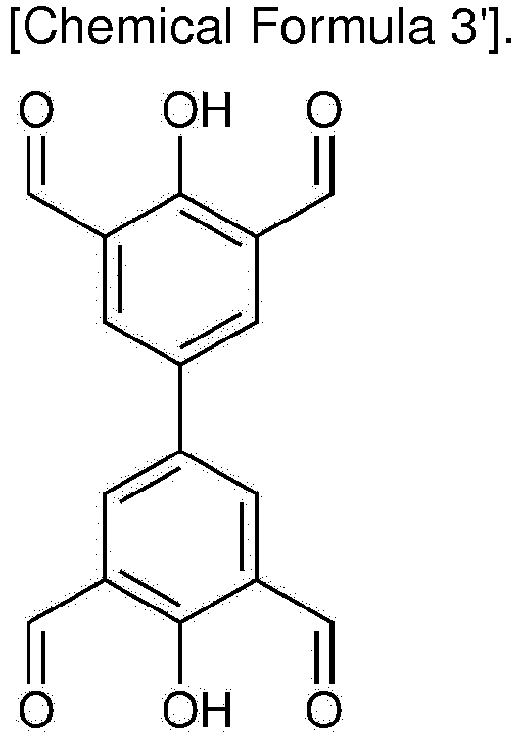
- the preparation method includes the steps of: reacting a compound represented by Chemical Formula 1', a compound represented by Chemical Formula 2', and trifluoroacetic acid to prepare a compound represented by Chemical Formula 3' (Step 1); and reacting the compound represented by Chemical Formula 3' with a compound represented by Chemical Formula 4' (Step 2).
- Step 1 is a Duff reaction, wherein aldehyde groups are substituted at the ortho -positions to the hydroxy groups of the compound represented by Chemical Formula 1'.
- the mole ratio of the compound represented by Chemical Formula 1' and the compound represented by the Chemical Formula 2' is 1:20.
- the trifluoroacetic acid also functions as a solvent, and it is preferably used such that it may dissolve both the compound represented by Chemical Formula 1' and the compound represented by Chemical Formula 2'.
- the reaction temperature of Step 1 is 100°C to 150°C. Further, preferably, the reaction time of Step 1 is 1 day to 10 days.
- a step of obtaining the product may be conducted.
- the reaction mixture may be added to an excess amount (1 mole to 5 moles) of hydrochloric acid, and stirred for 1 day to 3 days to obtain a precipitate.
- the precipitate may be recrystallized with dimethylsulfoxide to obtain a compound represented by Chemical Formula 3'.
- Step 2 is the reaction of aldehyde and hydroxyamine to form aldoxime, wherein the aldoxime is formed at the aldehyde group of the compound represented by Chemical Formula 3'.
- R is as defined as in Chemical Formula 1.
- water, a C 1-4 alcohol, or a mixed solvent thereof may be preferably used, and a water/ethanol mixed solvent or a water/methanol mixed solvent is more preferable.
- a step of obtaining the product may be conducted. For example, an excess amount of water may be added to filter the produced precipitate, followed by sequentially washing with water and acetone, thus obtaining a compound represented by Chemical Formula 1.
- the compound represented by Chemical Formula 1 when obtained in the form of a gel, it may be treated with supercritical carbon dioxide to remove the solvent, as necessary.
- the compound represented by Chemical Formula 1 according to the present invention can coordinate with metal ions to form a bidirectional or multidirectional metal-organic hybrid structure.
- the present invention can provide a precursor capable of synthesizing various ligands using amine-aldehyde condensation, and use the precursor for the synthesis of metal-organic materials.
- HMTA hexamethylenetetramine, 7.530 g, 53.70 mmol
- TFA trifluoroacetic acid, 50 mL
- biphenyl-4,4'-diol 1.000 g, 5.370 mmol
- the mixture was heated at 120°C for 7 days.
- the product was dark red, and it was poured into 4 N HCl (100 mL) to isolate the yellow precipitate.
- the precipitate was recrystallized with hot DMSO to obtain 2.460 g of yellow microcrystals (yield: 65.1 %).
- Tetraformylbiphenol (0.500 g, 1.678 mmol) prepared in Step 1 of Example 1 and nicotinic hydrazide (0.920 g, 6.710 mmol) were added into a reactor, and 13 mL of ethanol was added thereto.
- the reactor was sealed and heated at 100 °C for 8 hours.
- the reaction mixture was cooled to room temperature, and then poured into 100 mL of water.
- the precipitate was isolated by filtration, and washed with acetone to obtain the product in the form of a yellow powder (0.8971 g, 69.1 %).
- MALDI-TOF calculated for C 40 H 30 N 12 O 6 [M] + 774.24, found 775.5
- Example 1 The compound prepared in Example 1 (50.0 mg, 0.140 mmol) was added into a vial, and DMF (1.0 mL) was added to dissolve it. After adding triethylamine (0.12 mL, 0.840 mmol) dropwise and confirming that the solution turned to an orange color, the material of the following Table 1 was rapidly added. After stirring the mixture for 5 seconds, it was heated to 100 °C to form a gel, during which time the gel was gradually formed. [Table 1] Experimental Example 1-1 Mn(OAc) 2 ⁇ 4H 2 O (90.0 mg, 0.240 mmol) dissolved in DMF (3.0 mL)
- Example 2 The compound prepared in Example 1 (50.0 mg, 0.140 mmol) was added into a vial, and DMF (1.0 mL) was added to dissolve it. After it was completely dissolved, the material of the following Table 2 was added. Thereafter, triethylamine (0.12 mL, 0.840 mmol) was rapidly added dropwise, and immediately after the addition, a black gel was formed. After stirring the mixture for 5 seconds, it was heated to 100 °C for homogenization of a gel and an increase in the strength thereof. After about 1 hour, the gelation process was completed. [Table 2] Experimental Example 1-2 FeCl 2 (90.0 mg, 0.240 mmol) dissolved in DMF (3.0 mL)
- Example 2 The compound prepared in Example 1 (50.0 mg, 0.140 mmol) was added into a vial, and DMF (1.0 mL) was put therein to dissolve it. After adding triethylamine (0.12 mL, 0.840 mmol) dropwise and confirming that the solution turned to an orange color, the materials of the following Table 3 were rapidly added. Immediately after the addition, a gel began to form. After stirring the mixture for 5 seconds, it was heated to 100 °C for the homogenization of the gel and an increase in the strength thereof. After about 1 hour, the gelation process was completed.
- each gel prepared in Experimental Examples 1-1, 1-3, 1-4, and 1-6 are shown in FIG. 2 .
- each metal-organic hybrid structure was prepared in the form of a gel.
- Example 2 The compound prepared in Example 1 (50.0 mg, 0.140 mmol) was added into a vial, and DMF (1.0 mL) was added to dissolve it. After adding a solution of sodium methoxide (22.5 mL, 0.420 mmol) in 1.0 mL of ethanol dropwise and confirming that the solution turned to an orange color, the materials of the following Table 4 were rapidly added. Immediately after the addition, a gel began to form. After stirring the mixture for 5 seconds, it was heated to 100 °C for the homogenization of the gel and an increase in the strength thereof. After about 1 hour, the gelation process was completed.
- the gel prepared in Experimental Example 1-9 was applied on a slide glass, and then dried in a vacuum oven at 80 °C for 2 hours.
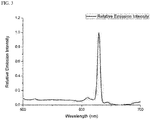
- the fluorescence spectrum of the dried gel was measured, an excitation wavelength was 450 nm, and a maximum emission wavelength was 629 nm as shown in FIG. 3 .
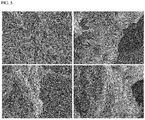
- a cobalt gel prepared in Experimental Example 1-3 was dried under vacuum for 12 hours, and a SEM image was obtained using the product. Specifically, the dried gel was dispersed in a stub, to which a carbon double-sided tape was attached, and coated with platinum, and it was observed under a 15 kV voltage condition. The result is shown in FIG. 4 .
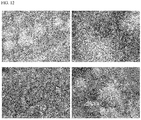
- a nickel gel prepared in Experimental Example 1-4 was dried under vacuum for 12 hours, and a SEM image was obtained using the product. Specifically, the dried gel was dispersed in a stub, to which a carbon double-sided tape was attached, and coated with platinum, and it was observed under a 5-15 kV voltage condition. The result is shown in FIG. 5 .
- the gels prepared in Experimental Examples 1-2 to 1-10 were treated with supercritical carbon dioxide to remove the solvent, thus preparing xerogels. Specifically, the above prepared gel was loaded into a cylinder made of stainless steel, and then it was installed inside a supercritical carbon dioxide apparatus. At 40 °C, 200 atm of supercritical carbon dioxide was flowed at a rate of 0.1 mL/minute to remove the solvent, thus obtaining a product in the form of a powder. The results of observing a part of them with the unaided eyes are shown in FIG. 6 .
- FIG.16a FIG.16b Xerogel (Co xerogel) of Experimental Example 1-3 FIG.8 FIG.17a FIG.17b Xerogel (Ni xerogel) of Experimental Example 1-4 FIG.9 - - Xerogel (Cu xerogel) of Experimental Example 1-5 FIG.10 FIG.18a FIG.18b Xerogel (Zn xerogel) of Experimental Example 1-6 FIG.11 FIG.19a FIG.19b Xerogel (Pd xerogel) of Experimental Example 1-7 FIG.12 FIG.20a FIG.20b Xerogel (Ru xerogel) of Experimental Example 1-8 FIG.13 FIG.21a FIG.21b Xerogel (Tb xerogel) of Experimental Example 1-9 FIG.14 FIG.22a FIG.22b Xerogel (Eu xerogel) of Experimental Example 1-10 FIG.15 FIG.23a FIG.23b
Landscapes
- Chemical & Material Sciences (AREA)
- Organic Chemistry (AREA)
- Inorganic Chemistry (AREA)
- Engineering & Computer Science (AREA)
- Materials Engineering (AREA)
- Chemical Kinetics & Catalysis (AREA)
- Organic Low-Molecular-Weight Compounds And Preparation Thereof (AREA)
Description
- This application claims the benefit of Korean Patent Application No.
10-2016-0096904 filed on July 29, 2016 - The present invention relates to multi-directional polydentate ligands for metal-organic hybrid structures and a metal-organic hybrid structures including the same.
- A Schiff base is formed through the condensation of an amine and an aldehyde. The Schiff base is commonly found in the living system. For example, the amine functional group of a lysine residue of an enzyme intermediate reversibly reacts with a cofactor or substrate. Here, the enzyme cofactor PLP forms a Schiff base with a lysine residue, and is involved in the transaldimidation reaction of a substrate. Through a similar mechanism, a retinal cofactor forms a Schiff base with a lysine residue of rhodopsin.
- Further, the Schiff base is one of the representative ligands in coordination chemistry. The nitrogen donor atom has both nucleophilicity and Lewis basicity, and could simultaneously exhibit a π-acceptor property as well. Representative multidentate ligands based on the Schiff base motif include salen-type ligands. In particular, chiral Schiff bases have been used extensively as ligands for asymmetric catalysis. When the Schiff base is used as the backbone of multidentate ligands to support metal centers of planar coordination geometry, porous network materials can constructed, which have unobstructed channels to facilitate the access of substrates to the metal sites.
- A Schiff base involved in π-conjugation also exhibits various photoelectronic properties. Based on this property, many composite materials having Schiff base functional groups are being used as key electronic components of organic solar cells or perovskite solar cells. Further, covalent organic frameworks (COFs) of Schiff bases are emerging as next-generation molecule-based materials that exploit the reversibility of amine-aldehyde condensation reaction.
- To take full advantage of the unique structural, chemical, and photoelectronic properties of the Schiff base, studies for preparing a new framework connected as a two-dimensional or three-dimensional network structure are actively in progress. For example, according to a recently reported document (R. Banerjee et al. J. Am. Chem. Soc. 2016, 138, 2823-2828), the aldehyde groups of 1,3,5-triformylphloroglucinol, which is a molecule of D 3h symmetry, are condensed with guanidinium having amine groups positioned in three directions to form an ionic covalent organic framework having Schiff base linkages. According to another document (P. Sun et al. Cryst. Growth. Des. 2015, 15, 5360-5367), a ligand prepared using Schiff base condensation is reacted with gold to form a metallogel.
- The present inventors designed Schiff base-derived multidirectional ligands to maximize the number of metal-ligand bonds, confirmed that metal-organic hybrid structures with network topology are formed through supramolecular interaction with multinuclear repeating units growing bidirectionally, and completed the present invention.
- It is an object of the present invention to provide a multi-directional polydentate ligand having wide expandability in terms of its structure and functions, for the preparation of a metal-organic hybrid structure.
- It is another object of the present invention to provide a metal-organic hybrid structure based on the multi-directional polydentate ligand.
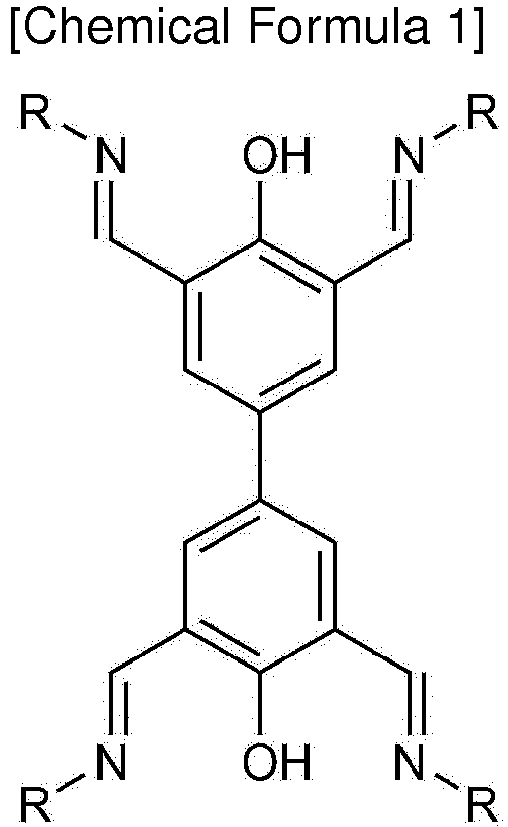
- The present invention provides a compound represented by the following Chemical Formula 1, or a salt thereof:

- R's are each independently, -R1, -NH-CO-R2, or -NH-R2,
- R1's are each independently, -OH, a C6-60 aryl, a C1-10 alkyl, or an amino acid residue, and
- R2's are a C1-10 alkyl, a C6-60 aryl, or a C4-60 heteroaryl containing one of N, O, and S.
- The compound represented by Chemical Formula 1 is a compound for preparing a metal-organic hybrid structure that exhibits porosity, electrical conductivity, and electrochromism.
- Preferably, R1's are each independently -OH, phenyl, naphthyl, methyl, ethyl, propyl, isopropyl, butyl, isobutyl, tert-butyl, pentyl, tert-pentyl, neopentyl, isopentyl, sec-pentyl, 3-pentyl, or an amino acid residue selected from the group consisting of alanine, cysteine, aspartic acid, glutamic acid, phenylalanine, histidine, isoleucine, lysine, leucine, methionine, asparagine, pyrrolysine, glutamine, arginine, serine, threonine, selenocysteine, valine, tryptophan, and tyrosine.
- The amino acid residue means a structure excluding the amine group in the structure of an amino acid. The amine group condenses with aldehyde to form imine. For example, in the case of alanine, the amino acid residue is propionic acid, which is the structure excluding an amine group in the structure of alanine.
- Further, preferably, R2 is methyl, ethyl, propyl, isopropyl, butyl, isobutyl, tert-butyl, pentyl, tert-pentyl, neopentyl, isopentyl, sec-pentyl, 3-pentyl, hexyl, octyl, phenyl, naphthyl, or pyridinyl.
- Further, when compound represented by Chemical Formula 1 includes a carboxy group, it may exist in the form of a salt, wherein the counter ion may be Na+, K+, etc.
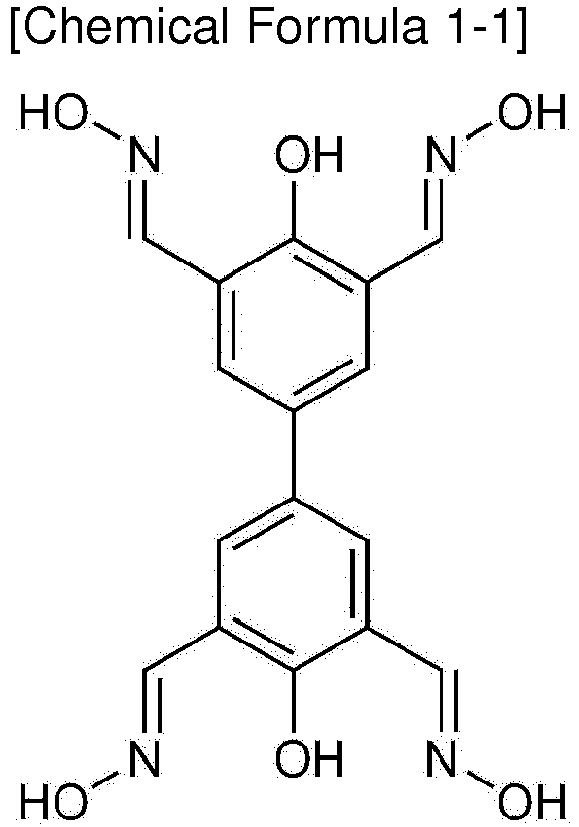
- Representative examples of the compound represented by Chemical Formula 1 include compounds represented by the following Chemical Formulas 1-1 to 1-5:


- The compound represented by Chemical Formula 1 has a biphenyl scaffold, and it is capable of charge transfer through π-conjugation. Further, the compound represented by Chemical Formula 1 has hydroxy groups on each benzene ring, has two imine groups at the ortho-positions to the hydroxy group. It can coordinate to metal ions through such hydroxy groups and imine groups.
- Further, the present invention provides a metal-organic hybrid structure formed by the coordinate bonding of the compound represented by Chemical Formula 1 with metal ions.
- Particularly, the compound represented by Chemical Formula 1 is characterized in that, in addition to the hydroxy groups and imine groups, the substituent R on the imine group may have a R1 substituent, an imide bond (-NH-CO-R2), or an amine group (-NH-R2) that can additionally coordinate with metal ions. Thus, in addition to the coordinate bonds with metal ions through the hydroxy groups and imine groups, additional coordinate bonding with metal ions is possible, and thus, the compound represented by Chemical Formula 1 and metal ions form two-dimensional or three-dimensional network structures. A representative example of the network structure of the metal-organic hybrid structure is shown in
FIG. 1 . - In the metal-organic hybrid structure of the present invention, the organic ligand of the compound represented by Chemical Formula 1 and metal ions are bonded to form network structures. Among such materials, those having crystallinity are referred to as MOFs (metal-organic frameworks), while those having entrapped solvents without crystallinity are referred to as gel. It is expected that, in such network structure, charge transport is facilitated through the π-conjugation of the biphenol skeleton of the compound represented by Chemical Formula 1 and the coordinated metal ions.
- Further, as explained above, the charge transport in the network may be bidirectional or multidirectional rather than unidirectional. Thus, compared to polymers capable of charge transport only through π-conjugation, or polymers capable of unidirectional charge transport, in the metal-organic hybrid structure of the present invention, charge transfer is facilitated, electrical conductivity is remarkably improved, and long distance charge transfer may be expected. In addition, new electrical properties that are difficult to realize with purely organic-based conductive polymers may be expected through the interactions between redox-active transition metal centers that are capable of multi-electron transfer, and redox-active π-conjugated ligands.
- The metals of the metal ions are not specifically limited, and for example, may include lanthanide metals such as Tb, Eu, Yb, etc., as well as Period 1 transition metals such as Ti, V, Mn, Fe, Co, Ni, Cu, Zn, etc.,
Period 2 transition metals such as Zr, Mo, Ru, Rh, Pd, Ag, etc., and Period 3 transition metal such as Ir, Pt, Au, etc. - Further, the metal-organic hybrid structure may be prepared by mixing the above-explained compound represented by Chemical Formula 1 and the precursor of the metal. Here, it is preferable to use a base so that the compound represented by Chemical Formula 1 may be ionized, and for example, an amine (triethylamine), etc. may be used.
- The metal-organic hybrid structure in a gel form, according to the present invention, is characterized by the characteristic optical transitions with strong absorptivity in the visible wavelength region, which arise from charge-transfer (CT) electronic transitions. Particularly, it can maintain the gel form even at a high temperature (about 140°C), which results from the stability of metal-organic network due to the two-dimensional or three-dimensional network structure through the coordinate bond of the compound represented by Chemical Formula 1 and metal ions.
- In addition, since this metal-organic hybrid structure includes metal ions, it can be used as a catalyst where such metal ions are used. Particularly, since the metal ions are arranged at a regular interval in the metal-organic hybrid structure, catalytic activity may be further improved. Further, since the optical properties are changed according to the state of the metal ions, it can be applied for various sensors using the same. Moreover, since the metal-organic hybrid structure according to the present invention is porous, it can be applied for gas separation or gas adsorption.
- The present invention provides a method for preparing the above-explained compound represented by Chemical Formula 1, as shown in the following Reaction Formula 1.

- Specifically, the preparation method includes the steps of: reacting a compound represented by Chemical Formula 1', a compound represented by Chemical Formula 2', and trifluoroacetic acid to prepare a compound represented by Chemical Formula 3' (Step 1); and reacting the compound represented by Chemical Formula 3' with a compound represented by Chemical Formula 4' (Step 2).
- Step 1 is a Duff reaction, wherein aldehyde groups are substituted at the ortho-positions to the hydroxy groups of the compound represented by Chemical Formula 1'.
- Preferably, the mole ratio of the compound represented by Chemical Formula 1' and the compound represented by the Chemical Formula 2' is 1:20. Further, the trifluoroacetic acid also functions as a solvent, and it is preferably used such that it may dissolve both the compound represented by Chemical Formula 1' and the compound represented by Chemical Formula 2'.
- Preferably, the reaction temperature of Step 1 is 100°C to 150°C. Further, preferably, the reaction time of Step 1 is 1 day to 10 days.
- After the reaction of Step 1, a step of obtaining the product may be conducted. For example, the reaction mixture may be added to an excess amount (1 mole to 5 moles) of hydrochloric acid, and stirred for 1 day to 3 days to obtain a precipitate. For the purification thereof, the precipitate may be recrystallized with dimethylsulfoxide to obtain a compound represented by Chemical Formula 3'.
-
Step 2 is the reaction of aldehyde and hydroxyamine to form aldoxime, wherein the aldoxime is formed at the aldehyde group of the compound represented by Chemical Formula 3'. In the compound represented by Chemical Formula 4', R is as defined as in Chemical Formula 1. - As the solvent of the reaction of
Step 2, water, a C1-4 alcohol, or a mixed solvent thereof may be preferably used, and a water/ethanol mixed solvent or a water/methanol mixed solvent is more preferable. - After the reaction of
Step 2, a step of obtaining the product may be conducted. For example, an excess amount of water may be added to filter the produced precipitate, followed by sequentially washing with water and acetone, thus obtaining a compound represented by Chemical Formula 1. - Further, when the compound represented by Chemical Formula 1 is obtained in the form of a gel, it may be treated with supercritical carbon dioxide to remove the solvent, as necessary.
- As explained above, the compound represented by Chemical Formula 1 according to the present invention can coordinate with metal ions to form a bidirectional or multidirectional metal-organic hybrid structure. Thus, the present invention can provide a precursor capable of synthesizing various ligands using amine-aldehyde condensation, and use the precursor for the synthesis of metal-organic materials.
-
-
FIG. 1 shows the network structure formed by the coordination bond of the compound according to one embodiment of the present invention with metal ions. -
FIG. 2 shows that the metal-organic hybrid structure of the present invention is prepared in the form of gel. -
FIG. 3 shows the result of measuring fluorescence of the metal-organic hybrid structure of the present invention (terbium(III) metallogel) (solid fluorescence, absorption wavelength = 450 nm, maximum emission wavelength = 629 nm, baseline corrected). -
FIG. 4 shows the result of observing the surface of the metal-organic hybrid structure of the present invention (cobalt(II) metallogel) with SEM. -
FIG. 5 shows the result of observing the surface of the metal-organic hybrid structure of the present invention (nickel(II) metallogel) with SEM. -
FIG. 6 shows the result of preparing the metal-organic hybrid structure of the present invention as a xerogel. -
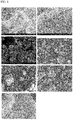
FIGS. 7 to 14 show the results of preparing the metal-organic hybrid structure of the present invention as a xerogel, and observing the surfaces with SEM. -
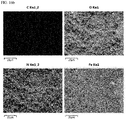
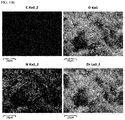
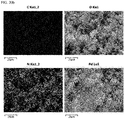
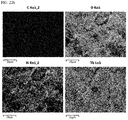
FIGS. 15 to 23 show the results of preparing the metal-organic hybrid structure of the present invention as a xerogel, and observing the content of each element and the distribution in the sample with EDS (energy dispersive X-ray spectrometry). - Hereinafter, preferable examples are presented for better understanding of the present invention. However, these examples are presented only as illustrations of the present invention, and the scope of the present invention is not limited thereby.
-

- HMTA (hexamethylenetetramine, 7.530 g, 53.70 mmol) was added into a dried round-bottom flask. The flask was purged with argon, and TFA (trifluoroacetic acid, 50 mL) was added. After completely dissolving HMTA, biphenyl-4,4'-diol (1.000 g, 5.370 mmol) was rapidly added. After confirming that the mixture turned to an orange color, the mixture was heated at 120°C for 7 days. The product was dark red, and it was poured into 4 N HCl (100 mL) to isolate the yellow precipitate. The precipitate was recrystallized with hot DMSO to obtain 2.460 g of yellow microcrystals (yield: 65.1 %).
- The compound (0.296 g, 1.000 mmol) prepared in Step 1 and NH2OH-HCl (0.420 g, 6.0 mmol) were added into a reactor. After adding water (7 mL), the mixture was heated to 80°C. Methanol was added dropwise until the mixture became transparent. After tightly sealing the reactor, the mixture was heated to 100°C for 1 hour. After cooling to room temperature, water was added to induce precipitation. The solid material was isolated by filtration, and washed with water to obtain a light yellow product (powder, 0.360 g).
1H NMR (300 MHz, DMSO-d) δ 11.60 (s, 4H), 10.88 (s, 2H), 8.45 (s, 4H), 7.83 (s, 4H) -

- Potassium hydroxide (6.80 mmol, 0.38 g) and 10 mL of ethanol were added into a reactor and stirred. Glycine (6.80 mmol, 0.510 g) was added to the mixture with stirring, and the mixture was stirred until solid materials were completely dissolved. A mixture in which tetraformylbiphenol (1.70 mmol, 0.500 g) prepared in Step 1 of Example 1 was dispersed in 10 mL of ethanol was separately prepared, and then it was slowly added to the reactor with stirring. During the addition, the mixture turned red. After the addition was finished, the mixture was poured into 20 mL of water, and then non-dissolved solid materials were removed by filtration. After removing water under reduced pressure, the remaining material was dispersed in a solvent of dimethylformamide and filtered to obtain a product in the form of an orange powder (0.4654 g, 74.6 %).
1H NMR (300 MHz, D20) δ 3.31 (s, 8H), 7.91 (s, 4H) -

- 13 mL of ethanol was added into a reactor containing tetraformylbiphenol (0.500 g, 1.678 mmol) prepared in Step 1 of Example 1. While stirring the mixture, phenyl hydrazine (0.726 g, 6.710 mmol) was added with a syringe. The reactor was sealed and heated at 100 °C for 8 hours. The reaction mixture was cooled to room temperature, and then poured into 100 mL of water. The resulting precipitate was isolated by filtration, and washed with acetone to obtain a product in the form of a yellow powder (0.7797 g, 70.6 %).
LC-MS: calculated for C40H34N8O2 [M]+ 658.28, found 659.4 -

- Tetraformylbiphenol (0.500 g, 1.678 mmol) prepared in Step 1 of Example 1 and nicotinic hydrazide (0.920 g, 6.710 mmol) were added into a reactor, and 13 mL of ethanol was added thereto. The reactor was sealed and heated at 100 °C for 8 hours. The reaction mixture was cooled to room temperature, and then poured into 100 mL of water. The precipitate was isolated by filtration, and washed with acetone to obtain the product in the form of a yellow powder (0.8971 g, 69.1 %).
MALDI-TOF: calculated for C40H30N12O6 [M]+ 774.24, found 775.5 -

- Tetraformylbiphenol (0.500 g, 1.678 mmol) prepared in Step 1 of Example 1 and n-octanohydrazide (1.062 g, 6.710 mmol) were added into a reactor, and 13 mL of ethanol was added thereto. The reactor was sealed and heated at 100 °C for 8 hours. The reaction mixture was cooled to room temperature, and then poured into 100 mL of water. The precipitate was isolated by filtration, and washed with acetone to obtain a product in the form of a yellow powder (0.8072 g, 56.0 %).
LC-MS : calculated for C48H74N8O6 [M]+ 858.57, found 859.7 - The compound prepared in Example 1 (50.0 mg, 0.140 mmol) was added into a vial, and DMF (1.0 mL) was added to dissolve it. After adding triethylamine (0.12 mL, 0.840 mmol) dropwise and confirming that the solution turned to an orange color, the material of the following Table 1 was rapidly added. After stirring the mixture for 5 seconds, it was heated to 100 °C to form a gel, during which time the gel was gradually formed.
[Table 1] Experimental Example 1-1 Mn(OAc)2·4H2O (90.0 mg, 0.240 mmol) dissolved in DMF (3.0 mL) - The compound prepared in Example 1 (50.0 mg, 0.140 mmol) was added into a vial, and DMF (1.0 mL) was added to dissolve it. After it was completely dissolved, the material of the following Table 2 was added. Thereafter, triethylamine (0.12 mL, 0.840 mmol) was rapidly added dropwise, and immediately after the addition, a black gel was formed. After stirring the mixture for 5 seconds, it was heated to 100 °C for homogenization of a gel and an increase in the strength thereof. After about 1 hour, the gelation process was completed.
[Table 2] Experimental Example 1-2 FeCl2 (90.0 mg, 0.240 mmol) dissolved in DMF (3.0 mL) - The compound prepared in Example 1 (50.0 mg, 0.140 mmol) was added into a vial, and DMF (1.0 mL) was put therein to dissolve it. After adding triethylamine (0.12 mL, 0.840 mmol) dropwise and confirming that the solution turned to an orange color, the materials of the following Table 3 were rapidly added. Immediately after the addition, a gel began to form. After stirring the mixture for 5 seconds, it was heated to 100 °C for the homogenization of the gel and an increase in the strength thereof. After about 1 hour, the gelation process was completed.
[Table 3] Experimental Example 1-3 Co(OAC)2·4H2O (90.0 mg, 0.280 mmol) dissolved in DMF (3.0 mL) Experimental Example 1-4 Ni(OAc)2·4H2O (140.0 mg, 0.420 mmol) dissolved in DMF (3.0 mL) Experimental Example 1-5 Cu(OAc)2·H2O (140.0 mg, 0.420 mmol) dissolved in DMF (3.0 mL) Experimental Example 1-6 Zn(OAc)2·2H2O (140.0 mg, 0.420 mmol) dissolved in DMF (3.0 mL) - Each gel prepared in Experimental Examples 1-1, 1-3, 1-4, and 1-6 are shown in
FIG. 2 . As shown inFIG. 2 , each metal-organic hybrid structure was prepared in the form of a gel. - The compound prepared in Example 1 (50.0 mg, 0.140 mmol) was added into a vial, and DMF (1.0 mL) was added to dissolve it. After adding a solution of sodium methoxide (22.5 mL, 0.420 mmol) in 1.0 mL of ethanol dropwise and confirming that the solution turned to an orange color, the materials of the following Table 4 were rapidly added. Immediately after the addition, a gel began to form. After stirring the mixture for 5 seconds, it was heated to 100 °C for the homogenization of the gel and an increase in the strength thereof. After about 1 hour, the gelation process was completed.
[Table 4] Experimental Example 1-7 Pd(OAc)2 (95.0 mg, 0.420 mmol) dissolved in DMF (3.0 mL) Experimental Example 1-8 Ru(acac)3 (113.0 mg, 0.280 mmol) dissolved in DMF (3.0 mL) Experimental Example 1-9 Tb(NO3)3·5H2O (122.0 mg, 0.280 mmol) dissolved in DMF (3.0 mL) Experimental Example 1-10 Eu(NO3)3·5H2O (119.0 mg, 0.280 mmol) dissolved in DMF (3.0 mL) - The gel prepared in Experimental Example 1-9 was applied on a slide glass, and then dried in a vacuum oven at 80 °C for 2 hours. The fluorescence spectrum of the dried gel was measured, an excitation wavelength was 450 nm, and a maximum emission wavelength was 629 nm as shown in
FIG. 3 . - A cobalt gel prepared in Experimental Example 1-3 was dried under vacuum for 12 hours, and a SEM image was obtained using the product. Specifically, the dried gel was dispersed in a stub, to which a carbon double-sided tape was attached, and coated with platinum, and it was observed under a 15 kV voltage condition. The result is shown in
FIG. 4 . - A nickel gel prepared in Experimental Example 1-4 was dried under vacuum for 12 hours, and a SEM image was obtained using the product. Specifically, the dried gel was dispersed in a stub, to which a carbon double-sided tape was attached, and coated with platinum, and it was observed under a 5-15 kV voltage condition. The result is shown in
FIG. 5 . - The gels prepared in Experimental Examples 1-2 to 1-10 were treated with supercritical carbon dioxide to remove the solvent, thus preparing xerogels. Specifically, the above prepared gel was loaded into a cylinder made of stainless steel, and then it was installed inside a supercritical carbon dioxide apparatus. At 40 °C, 200 atm of supercritical carbon dioxide was flowed at a rate of 0.1 mL/minute to remove the solvent, thus obtaining a product in the form of a powder. The results of observing a part of them with the unaided eyes are shown in
FIG. 6 . - Using the xerogel prepared in Experimental Example 4, a SEM image was obtained. Specifically, the xerogel was dispersed in a stub, to which a carbon double-sided tape was attached, coated with platinum, and it was observed under a 5-15 kV voltage condition, and the results are shown in
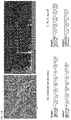
FIGS. 7-15 . Simultaneously, the element distribution of the xerogel surface was measured by EDS (energy dispersive X-ray spectroscopy), and the results are shown inFIGS. 16-23 . The contents of each drawing are as described in the following Table. 5.[Table 5] SEM image Element distribution SEM EDS component mapping Xerogel (Fe xerogel) of Experimental Example 1-2 FIG. 7 FIG.16a FIG.16b Xerogel (Co xerogel) of Experimental Example 1-3 FIG.8 FIG.17a FIG.17b Xerogel (Ni xerogel) of Experimental Example 1-4 FIG.9 - - Xerogel (Cu xerogel) of Experimental Example 1-5 FIG.10 FIG.18a FIG.18b Xerogel (Zn xerogel) of Experimental Example 1-6 FIG.11 FIG.19a FIG.19b Xerogel (Pd xerogel) of Experimental Example 1-7 FIG.12 FIG.20a FIG.20b Xerogel (Ru xerogel) of Experimental Example 1-8 FIG.13 FIG.21a FIG.21b Xerogel (Tb xerogel) of Experimental Example 1-9 FIG.14 FIG.22a FIG.22b Xerogel (Eu xerogel) of Experimental Example 1-10 FIG.15 FIG.23a FIG.23b
Claims (5)
- A compound represented by the following Chemical Formula 1, or a salt thereof:
 R's are each independently -R1, -NH-CO-R2, or -NH-R2,R1's are each independently -OH, a C6-60 aryl, a C1-10 alkyl, or an amino acid residue, andR2's are a C1-10 alkyl, a C6-60 aryl, or a C4-60 heteroaryl containing one of N, O, and S.
 - The compound according to claim 1, wherein R1's are each independently -OH, phenyl, naphthyl, methyl, ethyl, propyl, isopropyl, butyl, isobutyl, tert-butyl, pentyl, tert-pentyl, neopentyl, isopentyl, sec-pentyl, 3-pentyl, or an amino acid residue selected from the group consisting of alanine, cysteine, aspartic acid, glutamic acid, phenylalanine, histidine, isoleucine, lysine, leucine, methionine, asparagine, pyrrolysine, glutamine, arginine, serine, threonine, selenocysteine, valine, tryptophan, and tyrosine.
- The compound according to claim 1, wherein R2 is methyl, ethyl, propyl, isopropyl, butyl, isobutyl, tert-butyl, pentyl, tert-pentyl, neopentyl, isopentyl, sec-pentyl, 3-pentyl, hexyl, octyl, phenyl, naphthyl, or pyridinyl.
- The compound according to claim 1, wherein the compound represented by Chemical Formula 1 is a compound represented by one of the following Chemical Formulas 1-1 to 1-5:


- A method for preparing a compound represented by the following Chemical Formula 1 comprising the steps of:1) reacting a compound represented by the following Chemical Formula 1', a compound represented by the following Chemical Formula 2' and trifluoroacetic acid to prepare a compound represented by the following Chemical Formula 3'; and2) reacting the compound represented by the following Chemical Formula 3' with a compound represented by the following Chemical Formula 4':


[Chemical Formula 4'] H2N-R
in the Chemical Formulas 1 and 4',
R is as defined in any one of claims 1 to 4.
Applications Claiming Priority (2)
| Application Number | Priority Date | Filing Date | Title |
|---|---|---|---|
| KR20160096904 | 2016-07-29 | ||
| PCT/KR2017/008184 WO2018021884A1 (en) | 2016-07-29 | 2017-07-28 | Multi-directional ligand for organometallic complex |
Publications (3)
| Publication Number | Publication Date |
|---|---|
| EP3406601A1 true EP3406601A1 (en) | 2018-11-28 |
| EP3406601A4 EP3406601A4 (en) | 2019-05-08 |
| EP3406601B1 EP3406601B1 (en) | 2022-04-20 |
Family
ID=61017576
Family Applications (1)
| Application Number | Title | Priority Date | Filing Date |
|---|---|---|---|
| EP17834825.6A Active EP3406601B1 (en) | 2016-07-29 | 2017-07-28 | Multi-directional ligand for organometallic complex |
Country Status (6)
| Country | Link |
|---|---|
| US (1) | US10562845B2 (en) |
| EP (1) | EP3406601B1 (en) |
| JP (1) | JP6675771B2 (en) |
| KR (1) | KR101841667B1 (en) |
| CN (1) | CN109071466B (en) |
| WO (1) | WO2018021884A1 (en) |
Cited By (1)
| Publication number | Priority date | Publication date | Assignee | Title |
|---|---|---|---|---|
| EP3591393A4 (en) * | 2018-01-26 | 2020-06-24 | Lg Chem, Ltd. | COMPOSITION FOR DETECTION OF AN ACID COMPOUND |
Families Citing this family (5)
| Publication number | Priority date | Publication date | Assignee | Title |
|---|---|---|---|---|
| JP6625768B2 (en) * | 2016-07-29 | 2019-12-25 | エルジー・ケム・リミテッド | Organometallic complexes based on multidirectional ligands |
| CN110229347B (en) * | 2019-06-25 | 2021-10-01 | 哈尔滨理工大学 | A metal-chelated biporous covalent organic framework material and its preparation and application |
| CN110157008A (en) * | 2019-06-25 | 2019-08-23 | 哈尔滨理工大学 | A dual-porous covalent organic framework material linked by imine bonds and its preparation and application |
| CN113304261B (en) * | 2021-05-28 | 2022-07-22 | 江南大学 | Construction and application of charge reversal type intelligent light diagnosis and treatment platform |
| CN114917957B (en) * | 2022-06-13 | 2023-10-27 | 南开大学 | Preparation method and application of heterogeneous bimetallic L-ZIF-67-Ag-X catalyst |
Family Cites Families (22)
| Publication number | Priority date | Publication date | Assignee | Title |
|---|---|---|---|---|
| JPS5645932B2 (en) | 1972-12-23 | 1981-10-29 | ||
| JPS5496676A (en) | 1978-01-13 | 1979-07-31 | Saiichi Okamoto | Vibration control |
| US4322563A (en) | 1980-04-14 | 1982-03-30 | Merck & Co., Inc. | Substituted biphenyl-2-carboxaldehydes |
| GB9108221D0 (en) * | 1991-04-18 | 1991-06-05 | Ici Plc | Compound preparation and use |
| FR2816946B1 (en) | 2000-11-17 | 2004-04-02 | Ppg Sipsy | DISSYMMETRIC CHIRAL DIPHOSPHINES, THEIR USES FOR THE PREPARATION OF DIPHOSPHINO-METALLIC COMPLEXES, AND THE DIPHOSPHINO-METALLIC COMPLEXES THUS OBTAINED |
| US20070185343A1 (en) | 2004-02-26 | 2007-08-09 | Universiteit Gent | Metal complexes for use in olefin metathesis and atom group transfer reactions |
| PL1577282T3 (en) | 2004-02-26 | 2011-11-30 | Rimtec Corp | Metal complexes for use in olefin metathesis and atom or group transfer reactions |
| US20060040139A1 (en) * | 2004-08-18 | 2006-02-23 | Norman Herron | Electronic devices made with metal Schiff base complexes |
| US8362463B2 (en) | 2004-12-30 | 2013-01-29 | E. I. Du Pont De Nemours And Company | Organometallic complexes |
| KR20060082676A (en) | 2005-01-13 | 2006-07-19 | 현대자동차주식회사 | Metal-organic Hybrid-based Crystalline Nanoporous Body and Its Manufacturing Method and Application to Hydrogen Storage |
| JP2007063470A (en) * | 2005-09-01 | 2007-03-15 | Kuraray Co Ltd | Metal compound, catalyst composition for polymerizing vinyl monomer containing metal compound, and use thereof for polymerization of vinyl monomer |
| DE102005056564B4 (en) | 2005-11-25 | 2009-11-12 | Gkss-Forschungszentrum Geesthacht Gmbh | Polymer electrolyte membrane with coordination polymer, process for its preparation and use in a fuel cell |
| WO2008153338A2 (en) | 2007-06-12 | 2008-12-18 | Lg Chem, Ltd. | Organic metal complexes derivative and organic light emitting devices using the same |
| WO2010021345A1 (en) | 2008-08-19 | 2010-02-25 | 株式会社クラレ | Metal complex and manufacturing method therefor |
| CN101392006A (en) | 2008-11-06 | 2009-03-25 | 上海交通大学 | Axial chiral bis-Schiff base-containing bisphosphine ligands |
| CN101391970A (en) | 2008-11-06 | 2009-03-25 | 上海交通大学 | Axial chiral bis-Schiff base-containing ligands |
| CN102503966B (en) * | 2011-10-25 | 2015-04-01 | 中国科学院上海有机化学研究所 | Schiff-base ligand-based rare-earth metal complex, preparation method and applications |
| CN103102480B (en) | 2013-01-24 | 2016-03-02 | 大连理工大学 | For the synthesis of the bimetallic catalyst of taxis polycarbonate |
| CN103396457B (en) | 2013-08-12 | 2016-03-23 | 中国科学院长春应用化学研究所 | The preparation method of a kind of Schiff's base cobalt compound, its preparation method and polycarbonate |
| JP6336870B2 (en) | 2013-09-30 | 2018-06-06 | 日本ポリプロ株式会社 | Biphenol compound, olefin polymerization catalyst using the same, and process for producing olefin polymer |
| CN104557988B (en) | 2015-01-28 | 2016-04-13 | 山东理工大学 | Nitrogen heterocyclic schiff bases silver complex and its preparation method and application |
| JP6625768B2 (en) * | 2016-07-29 | 2019-12-25 | エルジー・ケム・リミテッド | Organometallic complexes based on multidirectional ligands |
-
2017
- 2017-07-28 KR KR1020170096358A patent/KR101841667B1/en active Active
- 2017-07-28 EP EP17834825.6A patent/EP3406601B1/en active Active
- 2017-07-28 CN CN201780021266.6A patent/CN109071466B/en active Active
- 2017-07-28 WO PCT/KR2017/008184 patent/WO2018021884A1/en not_active Ceased
- 2017-07-28 US US16/085,525 patent/US10562845B2/en active Active
- 2017-07-28 JP JP2018545604A patent/JP6675771B2/en active Active
Cited By (2)
| Publication number | Priority date | Publication date | Assignee | Title |
|---|---|---|---|---|
| EP3591393A4 (en) * | 2018-01-26 | 2020-06-24 | Lg Chem, Ltd. | COMPOSITION FOR DETECTION OF AN ACID COMPOUND |
| US11465962B2 (en) | 2018-01-26 | 2022-10-11 | Lg Chem, Ltd. | Composition for detecting acidic compound |
Also Published As
| Publication number | Publication date |
|---|---|
| JP6675771B2 (en) | 2020-04-01 |
| KR101841667B1 (en) | 2018-03-23 |
| EP3406601A4 (en) | 2019-05-08 |
| CN109071466A (en) | 2018-12-21 |
| WO2018021884A1 (en) | 2018-02-01 |
| JP2019507161A (en) | 2019-03-14 |
| US10562845B2 (en) | 2020-02-18 |
| KR20180013806A (en) | 2018-02-07 |
| CN109071466B (en) | 2021-12-17 |
| US20190100490A1 (en) | 2019-04-04 |
| EP3406601B1 (en) | 2022-04-20 |
Similar Documents
| Publication | Publication Date | Title |
|---|---|---|
| EP3406615B1 (en) | Multi-directional ligand-based organometallic complex | |
| EP3406601B1 (en) | Multi-directional ligand for organometallic complex | |
| Hillhouse et al. | Monosubstituted triazenido complexes as intermediates in the formation of amido complexes from hafnium hydrides and aryl azides | |
| Van Kralingen et al. | Synthesis and characterization of antitumor-active platinum 2, 2-dimethyl-1, 3-diaminopropane compounds. Crystal and molecular structure of (malonato)(2, 2-dimethyl-1, 3-diaminopropane) platinum (II) | |
| EP3591393B1 (en) | Use of a composition for detecting acidic compound | |
| Shimazaki et al. | Effects of a side chain aromatic ring on the reactivity of copper (I) complexes with dioxygen | |
| Abe et al. | Microwave-assisted synthesis of metal complexes | |
| Bochkarev et al. | Reduction of vanadium (II) to vanadium (O) by naphthaleneytterbium: synthesis and X-ray crystal structure of the two-dimensional multidecker complex [(η5-C5H5) V (μ-η6: η2-C10H8) Yb (THF)-(η5-C5H5)] n | |
| KR102418587B1 (en) | Catalyst composition for carbon dioxide fixation | |
| Choi et al. | In situ crystalline transformation of bis (halo) mercury (ii) coordination polymers to ionic chloro-bridged-bis (halo) mercury (ii) species via UV irradiation in chloroform media | |
| Shit et al. | Synthesis, structure and fluorescence properties of a trinuclear Zn (II) complex with N, N, O-donor schiff base ligands and bridging acetates | |
| Cindrić et al. | Synthesis of Molybdovanadates Coordinated by Oxalato Ligands. The Crystal Structure of K6 [Mo6V2O24 (C2O4) 2]· 6H2O | |
| CN100439381C (en) | The Synthetic Method of Bis(acetylacetonate)palladium(Ⅱ) | |
| Song et al. | Hetero-binuclear complexes containing a Ru 0→ M n+ bond bridged by P, N-phosphine ligands: convenient synthesis of tridentate organometallic trans-Ru (CO) 3 (L) 2 (L= phosphine bearing an N-donor substituent) ligands | |
| Wester et al. | Synthesis, characterization, and x-ray structure determination of chromium (I) nitrosyl complexes with macrocyclic ligands | |
| JP2021130062A (en) | Polyazine-supported carbon catalyst and catalyst electrode using it | |
| Guan et al. | Reactions of a geminal Sc/P Lewis pair with pyridotetrazole and beyond | |
| Nakahanada et al. | Syntheses and x-ray structures of novel phenoxo-bridged binuclear complexes: bis (. mu.-phenoxo) bis [bis (acetylacetonato) chromium (III)] complex and its para-substituted phenoxo analogs | |
| CN116144034B (en) | Metal triangle supermolecule with near infrared fluorescence, preparation method and application thereof | |
| CN107043401A (en) | Supermolecule different metal complex with two-dimensional network structure and preparation method thereof | |
| CN101665495A (en) | Method for directly synthesizing nickel phthalocyanine crystal by using solvent thermal method | |
| GB2457454A (en) | Polymorphic form II of the adamantylamino-platinum (IV) complex LA-12 | |
| CN105541919A (en) | Half sandwich type ruthenium complex and preparation method thereof | |
| MX2012003673A (en) | Solar synthesis process at laboratory scale of functional macrocyclic compounds using radiation from a fresnel-type half concentration prototype. |
Legal Events
| Date | Code | Title | Description |
|---|---|---|---|
| STAA | Information on the status of an ep patent application or granted ep patent |
Free format text: STATUS: THE INTERNATIONAL PUBLICATION HAS BEEN MADE |
|
| PUAI | Public reference made under article 153(3) epc to a published international application that has entered the european phase |
Free format text: ORIGINAL CODE: 0009012 |
|
| STAA | Information on the status of an ep patent application or granted ep patent |
Free format text: STATUS: REQUEST FOR EXAMINATION WAS MADE |
|
| 17P | Request for examination filed |
Effective date: 20180823 |
|
| AK | Designated contracting states |
Kind code of ref document: A1 Designated state(s): AL AT BE BG CH CY CZ DE DK EE ES FI FR GB GR HR HU IE IS IT LI LT LU LV MC MK MT NL NO PL PT RO RS SE SI SK SM TR |
|
| AX | Request for extension of the european patent |
Extension state: BA ME |
|
| A4 | Supplementary search report drawn up and despatched |
Effective date: 20190409 |
|
| RIC1 | Information provided on ipc code assigned before grant |
Ipc: C07C 249/02 20060101ALI20190403BHEP Ipc: C07D 401/14 20060101ALI20190403BHEP Ipc: C07D 251/24 20060101AFI20190403BHEP Ipc: C07C 251/48 20060101ALI20190403BHEP Ipc: C07D 251/48 20060101ALI20190403BHEP Ipc: C07C 251/86 20060101ALI20190403BHEP Ipc: C07C 249/16 20060101ALI20190403BHEP Ipc: C07C 251/24 20060101ALI20190403BHEP |
|
| DAV | Request for validation of the european patent (deleted) | ||
| DAX | Request for extension of the european patent (deleted) | ||
| STAA | Information on the status of an ep patent application or granted ep patent |
Free format text: STATUS: EXAMINATION IS IN PROGRESS |
|
| 17Q | First examination report despatched |
Effective date: 20200818 |
|
| GRAP | Despatch of communication of intention to grant a patent |
Free format text: ORIGINAL CODE: EPIDOSNIGR1 |
|
| STAA | Information on the status of an ep patent application or granted ep patent |
Free format text: STATUS: GRANT OF PATENT IS INTENDED |
|
| RIC1 | Information provided on ipc code assigned before grant |
Ipc: C07D 213/86 20060101ALI20220111BHEP Ipc: C07C 251/48 20060101ALI20220111BHEP Ipc: C07C 251/24 20060101ALI20220111BHEP Ipc: C07D 401/14 20060101ALI20220111BHEP Ipc: C07C 249/16 20060101ALI20220111BHEP Ipc: C07C 249/02 20060101ALI20220111BHEP Ipc: C07C 251/86 20060101ALI20220111BHEP Ipc: C07D 251/48 20060101ALI20220111BHEP Ipc: C07D 251/24 20060101AFI20220111BHEP |
|
| INTG | Intention to grant announced |
Effective date: 20220201 |
|
| GRAS | Grant fee paid |
Free format text: ORIGINAL CODE: EPIDOSNIGR3 |
|
| GRAA | (expected) grant |
Free format text: ORIGINAL CODE: 0009210 |
|
| STAA | Information on the status of an ep patent application or granted ep patent |
Free format text: STATUS: THE PATENT HAS BEEN GRANTED |
|
| REG | Reference to a national code |
Ref country code: DE Ref legal event code: R081 Ref document number: 602017056342 Country of ref document: DE Owner name: SEOUL NATIONAL UNIVERSITY R&DB FOUNDATION, KR Free format text: FORMER OWNER: LG CHEM, LTD., SEOUL, KR Ref country code: DE Ref legal event code: R081 Ref document number: 602017056342 Country of ref document: DE Owner name: LG CHEM, LTD., KR Free format text: FORMER OWNER: LG CHEM, LTD., SEOUL, KR |
|
| AK | Designated contracting states |
Kind code of ref document: B1 Designated state(s): AL AT BE BG CH CY CZ DE DK EE ES FI FR GB GR HR HU IE IS IT LI LT LU LV MC MK MT NL NO PL PT RO RS SE SI SK SM TR |
|
| REG | Reference to a national code |
Ref country code: GB Ref legal event code: FG4D |
|
| REG | Reference to a national code |
Ref country code: CH Ref legal event code: EP |
|
| REG | Reference to a national code |
Ref country code: DE Ref legal event code: R096 Ref document number: 602017056342 Country of ref document: DE |
|
| REG | Reference to a national code |
Ref country code: IE Ref legal event code: FG4D |
|
| REG | Reference to a national code |
Ref country code: AT Ref legal event code: REF Ref document number: 1485084 Country of ref document: AT Kind code of ref document: T Effective date: 20220515 |
|
| REG | Reference to a national code |
Ref country code: LT Ref legal event code: MG9D |
|
| REG | Reference to a national code |
Ref country code: NL Ref legal event code: MP Effective date: 20220420 |
|
| REG | Reference to a national code |
Ref country code: AT Ref legal event code: MK05 Ref document number: 1485084 Country of ref document: AT Kind code of ref document: T Effective date: 20220420 |
|
| PG25 | Lapsed in a contracting state [announced via postgrant information from national office to epo] |
Ref country code: NL Free format text: LAPSE BECAUSE OF FAILURE TO SUBMIT A TRANSLATION OF THE DESCRIPTION OR TO PAY THE FEE WITHIN THE PRESCRIBED TIME-LIMIT Effective date: 20220420 |
|
| PG25 | Lapsed in a contracting state [announced via postgrant information from national office to epo] |
Ref country code: SE Free format text: LAPSE BECAUSE OF FAILURE TO SUBMIT A TRANSLATION OF THE DESCRIPTION OR TO PAY THE FEE WITHIN THE PRESCRIBED TIME-LIMIT Effective date: 20220420 Ref country code: PT Free format text: LAPSE BECAUSE OF FAILURE TO SUBMIT A TRANSLATION OF THE DESCRIPTION OR TO PAY THE FEE WITHIN THE PRESCRIBED TIME-LIMIT Effective date: 20220822 Ref country code: NO Free format text: LAPSE BECAUSE OF FAILURE TO SUBMIT A TRANSLATION OF THE DESCRIPTION OR TO PAY THE FEE WITHIN THE PRESCRIBED TIME-LIMIT Effective date: 20220720 Ref country code: LT Free format text: LAPSE BECAUSE OF FAILURE TO SUBMIT A TRANSLATION OF THE DESCRIPTION OR TO PAY THE FEE WITHIN THE PRESCRIBED TIME-LIMIT Effective date: 20220420 Ref country code: HR Free format text: LAPSE BECAUSE OF FAILURE TO SUBMIT A TRANSLATION OF THE DESCRIPTION OR TO PAY THE FEE WITHIN THE PRESCRIBED TIME-LIMIT Effective date: 20220420 Ref country code: GR Free format text: LAPSE BECAUSE OF FAILURE TO SUBMIT A TRANSLATION OF THE DESCRIPTION OR TO PAY THE FEE WITHIN THE PRESCRIBED TIME-LIMIT Effective date: 20220721 Ref country code: FI Free format text: LAPSE BECAUSE OF FAILURE TO SUBMIT A TRANSLATION OF THE DESCRIPTION OR TO PAY THE FEE WITHIN THE PRESCRIBED TIME-LIMIT Effective date: 20220420 Ref country code: ES Free format text: LAPSE BECAUSE OF FAILURE TO SUBMIT A TRANSLATION OF THE DESCRIPTION OR TO PAY THE FEE WITHIN THE PRESCRIBED TIME-LIMIT Effective date: 20220420 Ref country code: BG Free format text: LAPSE BECAUSE OF FAILURE TO SUBMIT A TRANSLATION OF THE DESCRIPTION OR TO PAY THE FEE WITHIN THE PRESCRIBED TIME-LIMIT Effective date: 20220720 Ref country code: AT Free format text: LAPSE BECAUSE OF FAILURE TO SUBMIT A TRANSLATION OF THE DESCRIPTION OR TO PAY THE FEE WITHIN THE PRESCRIBED TIME-LIMIT Effective date: 20220420 |
|
| PG25 | Lapsed in a contracting state [announced via postgrant information from national office to epo] |
Ref country code: RS Free format text: LAPSE BECAUSE OF FAILURE TO SUBMIT A TRANSLATION OF THE DESCRIPTION OR TO PAY THE FEE WITHIN THE PRESCRIBED TIME-LIMIT Effective date: 20220420 Ref country code: PL Free format text: LAPSE BECAUSE OF FAILURE TO SUBMIT A TRANSLATION OF THE DESCRIPTION OR TO PAY THE FEE WITHIN THE PRESCRIBED TIME-LIMIT Effective date: 20220420 Ref country code: LV Free format text: LAPSE BECAUSE OF FAILURE TO SUBMIT A TRANSLATION OF THE DESCRIPTION OR TO PAY THE FEE WITHIN THE PRESCRIBED TIME-LIMIT Effective date: 20220420 Ref country code: IS Free format text: LAPSE BECAUSE OF FAILURE TO SUBMIT A TRANSLATION OF THE DESCRIPTION OR TO PAY THE FEE WITHIN THE PRESCRIBED TIME-LIMIT Effective date: 20220820 |
|
| REG | Reference to a national code |
Ref country code: DE Ref legal event code: R097 Ref document number: 602017056342 Country of ref document: DE |
|
| PG25 | Lapsed in a contracting state [announced via postgrant information from national office to epo] |
Ref country code: SM Free format text: LAPSE BECAUSE OF FAILURE TO SUBMIT A TRANSLATION OF THE DESCRIPTION OR TO PAY THE FEE WITHIN THE PRESCRIBED TIME-LIMIT Effective date: 20220420 Ref country code: SK Free format text: LAPSE BECAUSE OF FAILURE TO SUBMIT A TRANSLATION OF THE DESCRIPTION OR TO PAY THE FEE WITHIN THE PRESCRIBED TIME-LIMIT Effective date: 20220420 Ref country code: RO Free format text: LAPSE BECAUSE OF FAILURE TO SUBMIT A TRANSLATION OF THE DESCRIPTION OR TO PAY THE FEE WITHIN THE PRESCRIBED TIME-LIMIT Effective date: 20220420 Ref country code: EE Free format text: LAPSE BECAUSE OF FAILURE TO SUBMIT A TRANSLATION OF THE DESCRIPTION OR TO PAY THE FEE WITHIN THE PRESCRIBED TIME-LIMIT Effective date: 20220420 Ref country code: DK Free format text: LAPSE BECAUSE OF FAILURE TO SUBMIT A TRANSLATION OF THE DESCRIPTION OR TO PAY THE FEE WITHIN THE PRESCRIBED TIME-LIMIT Effective date: 20220420 Ref country code: CZ Free format text: LAPSE BECAUSE OF FAILURE TO SUBMIT A TRANSLATION OF THE DESCRIPTION OR TO PAY THE FEE WITHIN THE PRESCRIBED TIME-LIMIT Effective date: 20220420 |
|
| PLBE | No opposition filed within time limit |
Free format text: ORIGINAL CODE: 0009261 |
|
| STAA | Information on the status of an ep patent application or granted ep patent |
Free format text: STATUS: NO OPPOSITION FILED WITHIN TIME LIMIT |
|
| PG25 | Lapsed in a contracting state [announced via postgrant information from national office to epo] |
Ref country code: MC Free format text: LAPSE BECAUSE OF FAILURE TO SUBMIT A TRANSLATION OF THE DESCRIPTION OR TO PAY THE FEE WITHIN THE PRESCRIBED TIME-LIMIT Effective date: 20220420 |
|
| REG | Reference to a national code |
Ref country code: CH Ref legal event code: PL |
|
| 26N | No opposition filed |
Effective date: 20230123 |
|
| REG | Reference to a national code |
Ref country code: BE Ref legal event code: MM Effective date: 20220731 |
|
| PG25 | Lapsed in a contracting state [announced via postgrant information from national office to epo] |
Ref country code: AL Free format text: LAPSE BECAUSE OF FAILURE TO SUBMIT A TRANSLATION OF THE DESCRIPTION OR TO PAY THE FEE WITHIN THE PRESCRIBED TIME-LIMIT Effective date: 20220420 |
|
| PG25 | Lapsed in a contracting state [announced via postgrant information from national office to epo] |
Ref country code: LU Free format text: LAPSE BECAUSE OF NON-PAYMENT OF DUE FEES Effective date: 20220728 Ref country code: LI Free format text: LAPSE BECAUSE OF NON-PAYMENT OF DUE FEES Effective date: 20220731 Ref country code: CH Free format text: LAPSE BECAUSE OF NON-PAYMENT OF DUE FEES Effective date: 20220731 |
|
| PG25 | Lapsed in a contracting state [announced via postgrant information from national office to epo] |
Ref country code: SI Free format text: LAPSE BECAUSE OF FAILURE TO SUBMIT A TRANSLATION OF THE DESCRIPTION OR TO PAY THE FEE WITHIN THE PRESCRIBED TIME-LIMIT Effective date: 20220420 Ref country code: BE Free format text: LAPSE BECAUSE OF NON-PAYMENT OF DUE FEES Effective date: 20220731 |
|
| PG25 | Lapsed in a contracting state [announced via postgrant information from national office to epo] |
Ref country code: IE Free format text: LAPSE BECAUSE OF NON-PAYMENT OF DUE FEES Effective date: 20220728 |
|
| PG25 | Lapsed in a contracting state [announced via postgrant information from national office to epo] |
Ref country code: IT Free format text: LAPSE BECAUSE OF FAILURE TO SUBMIT A TRANSLATION OF THE DESCRIPTION OR TO PAY THE FEE WITHIN THE PRESCRIBED TIME-LIMIT Effective date: 20220420 |
|
| PG25 | Lapsed in a contracting state [announced via postgrant information from national office to epo] |
Ref country code: HU Free format text: LAPSE BECAUSE OF FAILURE TO SUBMIT A TRANSLATION OF THE DESCRIPTION OR TO PAY THE FEE WITHIN THE PRESCRIBED TIME-LIMIT; INVALID AB INITIO Effective date: 20170728 |
|
| PG25 | Lapsed in a contracting state [announced via postgrant information from national office to epo] |
Ref country code: MK Free format text: LAPSE BECAUSE OF FAILURE TO SUBMIT A TRANSLATION OF THE DESCRIPTION OR TO PAY THE FEE WITHIN THE PRESCRIBED TIME-LIMIT Effective date: 20220420 Ref country code: CY Free format text: LAPSE BECAUSE OF FAILURE TO SUBMIT A TRANSLATION OF THE DESCRIPTION OR TO PAY THE FEE WITHIN THE PRESCRIBED TIME-LIMIT Effective date: 20220420 |
|
| PG25 | Lapsed in a contracting state [announced via postgrant information from national office to epo] |
Ref country code: TR Free format text: LAPSE BECAUSE OF FAILURE TO SUBMIT A TRANSLATION OF THE DESCRIPTION OR TO PAY THE FEE WITHIN THE PRESCRIBED TIME-LIMIT Effective date: 20220420 |
|
| PG25 | Lapsed in a contracting state [announced via postgrant information from national office to epo] |
Ref country code: MT Free format text: LAPSE BECAUSE OF FAILURE TO SUBMIT A TRANSLATION OF THE DESCRIPTION OR TO PAY THE FEE WITHIN THE PRESCRIBED TIME-LIMIT Effective date: 20220420 |
|
| PG25 | Lapsed in a contracting state [announced via postgrant information from national office to epo] |
Ref country code: BG Free format text: LAPSE BECAUSE OF FAILURE TO SUBMIT A TRANSLATION OF THE DESCRIPTION OR TO PAY THE FEE WITHIN THE PRESCRIBED TIME-LIMIT Effective date: 20220420 |
|
| PG25 | Lapsed in a contracting state [announced via postgrant information from national office to epo] |
Ref country code: BG Free format text: LAPSE BECAUSE OF FAILURE TO SUBMIT A TRANSLATION OF THE DESCRIPTION OR TO PAY THE FEE WITHIN THE PRESCRIBED TIME-LIMIT Effective date: 20220420 |
|
| PGFP | Annual fee paid to national office [announced via postgrant information from national office to epo] |
Ref country code: GB Payment date: 20250624 Year of fee payment: 9 |
|
| PGFP | Annual fee paid to national office [announced via postgrant information from national office to epo] |
Ref country code: FR Payment date: 20250624 Year of fee payment: 9 |
|
| PGFP | Annual fee paid to national office [announced via postgrant information from national office to epo] |
Ref country code: DE Payment date: 20250624 Year of fee payment: 9 |