EP3404743A1 - Preparation method of modified positive electrode active material - Google Patents
Preparation method of modified positive electrode active material Download PDFInfo
- Publication number
- EP3404743A1 EP3404743A1 EP18172241.4A EP18172241A EP3404743A1 EP 3404743 A1 EP3404743 A1 EP 3404743A1 EP 18172241 A EP18172241 A EP 18172241A EP 3404743 A1 EP3404743 A1 EP 3404743A1
- Authority
- EP
- European Patent Office
- Prior art keywords
- positive electrode
- active material
- electrode active
- alcohol
- preparation
- Prior art date
- Legal status (The legal status is an assumption and is not a legal conclusion. Google has not performed a legal analysis and makes no representation as to the accuracy of the status listed.)
- Granted
Links
Images


Classifications
-
- H—ELECTRICITY
- H01—ELECTRIC ELEMENTS
- H01M—PROCESSES OR MEANS, e.g. BATTERIES, FOR THE DIRECT CONVERSION OF CHEMICAL ENERGY INTO ELECTRICAL ENERGY
- H01M4/00—Electrodes
- H01M4/02—Electrodes composed of, or comprising, active material
- H01M4/36—Selection of substances as active materials, active masses, active liquids
- H01M4/362—Composites
- H01M4/366—Composites as layered products
-
- C—CHEMISTRY; METALLURGY
- C01—INORGANIC CHEMISTRY
- C01B—NON-METALLIC ELEMENTS; COMPOUNDS THEREOF; METALLOIDS OR COMPOUNDS THEREOF NOT COVERED BY SUBCLASS C01C
- C01B25/00—Phosphorus; Compounds thereof
- C01B25/16—Oxyacids of phosphorus; Salts thereof
- C01B25/26—Phosphates
- C01B25/36—Aluminium phosphates
-
- C—CHEMISTRY; METALLURGY
- C01—INORGANIC CHEMISTRY
- C01G—COMPOUNDS CONTAINING METALS NOT COVERED BY SUBCLASSES C01D OR C01F
- C01G53/00—Compounds of nickel
- C01G53/40—Complex oxides containing nickel and at least one other metal element
- C01G53/42—Complex oxides containing nickel and at least one other metal element containing alkali metals, e.g. LiNiO2
-
- C—CHEMISTRY; METALLURGY
- C01—INORGANIC CHEMISTRY
- C01G—COMPOUNDS CONTAINING METALS NOT COVERED BY SUBCLASSES C01D OR C01F
- C01G53/00—Compounds of nickel
- C01G53/40—Complex oxides containing nickel and at least one other metal element
- C01G53/42—Complex oxides containing nickel and at least one other metal element containing alkali metals, e.g. LiNiO2
- C01G53/44—Complex oxides containing nickel and at least one other metal element containing alkali metals, e.g. LiNiO2 containing manganese
- C01G53/50—Complex oxides containing nickel and at least one other metal element containing alkali metals, e.g. LiNiO2 containing manganese of the type (MnO2)n-, e.g. Li(NixMn1-x)O2 or Li(MyNixMn1-x-y)O2
- C01G53/502—Complex oxides containing nickel and at least one other metal element containing alkali metals, e.g. LiNiO2 containing manganese of the type (MnO2)n-, e.g. Li(NixMn1-x)O2 or Li(MyNixMn1-x-y)O2 containing lithium and cobalt
- C01G53/504—Complex oxides containing nickel and at least one other metal element containing alkali metals, e.g. LiNiO2 containing manganese of the type (MnO2)n-, e.g. Li(NixMn1-x)O2 or Li(MyNixMn1-x-y)O2 containing lithium and cobalt with the molar ratio of nickel with respect to all the metals other than alkali metals higher than or equal to 0.5, e.g. Li(MzNixCoyMn1-x-y-z)O2 with x ≥ 0.5
-
- C—CHEMISTRY; METALLURGY
- C01—INORGANIC CHEMISTRY
- C01G—COMPOUNDS CONTAINING METALS NOT COVERED BY SUBCLASSES C01D OR C01F
- C01G53/00—Compounds of nickel
- C01G53/40—Complex oxides containing nickel and at least one other metal element
- C01G53/42—Complex oxides containing nickel and at least one other metal element containing alkali metals, e.g. LiNiO2
- C01G53/44—Complex oxides containing nickel and at least one other metal element containing alkali metals, e.g. LiNiO2 containing manganese
- C01G53/50—Complex oxides containing nickel and at least one other metal element containing alkali metals, e.g. LiNiO2 containing manganese of the type (MnO2)n-, e.g. Li(NixMn1-x)O2 or Li(MyNixMn1-x-y)O2
- C01G53/502—Complex oxides containing nickel and at least one other metal element containing alkali metals, e.g. LiNiO2 containing manganese of the type (MnO2)n-, e.g. Li(NixMn1-x)O2 or Li(MyNixMn1-x-y)O2 containing lithium and cobalt
- C01G53/504—Complex oxides containing nickel and at least one other metal element containing alkali metals, e.g. LiNiO2 containing manganese of the type (MnO2)n-, e.g. Li(NixMn1-x)O2 or Li(MyNixMn1-x-y)O2 containing lithium and cobalt with the molar ratio of nickel with respect to all the metals other than alkali metals higher than or equal to 0.5, e.g. Li(MzNixCoyMn1-x-y-z)O2 with x ≥ 0.5
- C01G53/506—Complex oxides containing nickel and at least one other metal element containing alkali metals, e.g. LiNiO2 containing manganese of the type (MnO2)n-, e.g. Li(NixMn1-x)O2 or Li(MyNixMn1-x-y)O2 containing lithium and cobalt with the molar ratio of nickel with respect to all the metals other than alkali metals higher than or equal to 0.5, e.g. Li(MzNixCoyMn1-x-y-z)O2 with x ≥ 0.5 with the molar ratio of nickel with respect to all the metals other than alkali metals higher than or equal to 0.8, e.g. Li(MzNixCoyMn1-x-y-z)O2 with x ≥ 0.8
-
- H—ELECTRICITY
- H01—ELECTRIC ELEMENTS
- H01M—PROCESSES OR MEANS, e.g. BATTERIES, FOR THE DIRECT CONVERSION OF CHEMICAL ENERGY INTO ELECTRICAL ENERGY
- H01M10/00—Secondary cells; Manufacture thereof
- H01M10/05—Accumulators with non-aqueous electrolyte
- H01M10/052—Li-accumulators
-
- H—ELECTRICITY
- H01—ELECTRIC ELEMENTS
- H01M—PROCESSES OR MEANS, e.g. BATTERIES, FOR THE DIRECT CONVERSION OF CHEMICAL ENERGY INTO ELECTRICAL ENERGY
- H01M10/00—Secondary cells; Manufacture thereof
- H01M10/05—Accumulators with non-aqueous electrolyte
- H01M10/052—Li-accumulators
- H01M10/0525—Rocking-chair batteries, i.e. batteries with lithium insertion or intercalation in both electrodes; Lithium-ion batteries
-
- H—ELECTRICITY
- H01—ELECTRIC ELEMENTS
- H01M—PROCESSES OR MEANS, e.g. BATTERIES, FOR THE DIRECT CONVERSION OF CHEMICAL ENERGY INTO ELECTRICAL ENERGY
- H01M4/00—Electrodes
- H01M4/02—Electrodes composed of, or comprising, active material
- H01M4/04—Processes of manufacture in general
- H01M4/0471—Processes of manufacture in general involving thermal treatment, e.g. firing, sintering, backing particulate active material, thermal decomposition, pyrolysis
-
- H—ELECTRICITY
- H01—ELECTRIC ELEMENTS
- H01M—PROCESSES OR MEANS, e.g. BATTERIES, FOR THE DIRECT CONVERSION OF CHEMICAL ENERGY INTO ELECTRICAL ENERGY
- H01M4/00—Electrodes
- H01M4/02—Electrodes composed of, or comprising, active material
- H01M4/13—Electrodes for accumulators with non-aqueous electrolyte, e.g. for lithium-accumulators; Processes of manufacture thereof
- H01M4/131—Electrodes based on mixed oxides or hydroxides, or on mixtures of oxides or hydroxides, e.g. LiCoOx
-
- H—ELECTRICITY
- H01—ELECTRIC ELEMENTS
- H01M—PROCESSES OR MEANS, e.g. BATTERIES, FOR THE DIRECT CONVERSION OF CHEMICAL ENERGY INTO ELECTRICAL ENERGY
- H01M4/00—Electrodes
- H01M4/02—Electrodes composed of, or comprising, active material
- H01M4/13—Electrodes for accumulators with non-aqueous electrolyte, e.g. for lithium-accumulators; Processes of manufacture thereof
- H01M4/139—Processes of manufacture
- H01M4/1391—Processes of manufacture of electrodes based on mixed oxides or hydroxides, or on mixtures of oxides or hydroxides, e.g. LiCoOx
-
- H—ELECTRICITY
- H01—ELECTRIC ELEMENTS
- H01M—PROCESSES OR MEANS, e.g. BATTERIES, FOR THE DIRECT CONVERSION OF CHEMICAL ENERGY INTO ELECTRICAL ENERGY
- H01M4/00—Electrodes
- H01M4/02—Electrodes composed of, or comprising, active material
- H01M4/36—Selection of substances as active materials, active masses, active liquids
- H01M4/48—Selection of substances as active materials, active masses, active liquids of inorganic oxides or hydroxides
- H01M4/50—Selection of substances as active materials, active masses, active liquids of inorganic oxides or hydroxides of manganese
- H01M4/505—Selection of substances as active materials, active masses, active liquids of inorganic oxides or hydroxides of manganese of mixed oxides or hydroxides containing manganese for inserting or intercalating light metals, e.g. LiMn2O4 or LiMn2OxFy
-
- H—ELECTRICITY
- H01—ELECTRIC ELEMENTS
- H01M—PROCESSES OR MEANS, e.g. BATTERIES, FOR THE DIRECT CONVERSION OF CHEMICAL ENERGY INTO ELECTRICAL ENERGY
- H01M4/00—Electrodes
- H01M4/02—Electrodes composed of, or comprising, active material
- H01M4/36—Selection of substances as active materials, active masses, active liquids
- H01M4/48—Selection of substances as active materials, active masses, active liquids of inorganic oxides or hydroxides
- H01M4/52—Selection of substances as active materials, active masses, active liquids of inorganic oxides or hydroxides of nickel, cobalt or iron
- H01M4/525—Selection of substances as active materials, active masses, active liquids of inorganic oxides or hydroxides of nickel, cobalt or iron of mixed oxides or hydroxides containing iron, cobalt or nickel for inserting or intercalating light metals, e.g. LiNiO2, LiCoO2 or LiCoOxFy
-
- H—ELECTRICITY
- H01—ELECTRIC ELEMENTS
- H01M—PROCESSES OR MEANS, e.g. BATTERIES, FOR THE DIRECT CONVERSION OF CHEMICAL ENERGY INTO ELECTRICAL ENERGY
- H01M4/00—Electrodes
- H01M4/02—Electrodes composed of, or comprising, active material
- H01M4/36—Selection of substances as active materials, active masses, active liquids
- H01M4/58—Selection of substances as active materials, active masses, active liquids of inorganic compounds other than oxides or hydroxides, e.g. sulfides, selenides, tellurides, halogenides or LiCoFy; of polyanionic structures, e.g. phosphates, silicates or borates
- H01M4/5825—Oxygenated metallic salts or polyanionic structures, e.g. borates, phosphates, silicates, olivines
-
- H—ELECTRICITY
- H01—ELECTRIC ELEMENTS
- H01M—PROCESSES OR MEANS, e.g. BATTERIES, FOR THE DIRECT CONVERSION OF CHEMICAL ENERGY INTO ELECTRICAL ENERGY
- H01M4/00—Electrodes
- H01M4/02—Electrodes composed of, or comprising, active material
- H01M4/62—Selection of inactive substances as ingredients for active masses, e.g. binders, fillers
-
- H—ELECTRICITY
- H01—ELECTRIC ELEMENTS
- H01M—PROCESSES OR MEANS, e.g. BATTERIES, FOR THE DIRECT CONVERSION OF CHEMICAL ENERGY INTO ELECTRICAL ENERGY
- H01M4/00—Electrodes
- H01M4/02—Electrodes composed of, or comprising, active material
- H01M4/62—Selection of inactive substances as ingredients for active masses, e.g. binders, fillers
- H01M4/628—Inhibitors, e.g. gassing inhibitors, corrosion inhibitors
-
- C—CHEMISTRY; METALLURGY
- C01—INORGANIC CHEMISTRY
- C01P—INDEXING SCHEME RELATING TO STRUCTURAL AND PHYSICAL ASPECTS OF SOLID INORGANIC COMPOUNDS
- C01P2004/00—Particle morphology
- C01P2004/01—Particle morphology depicted by an image
- C01P2004/03—Particle morphology depicted by an image obtained by SEM
-
- C—CHEMISTRY; METALLURGY
- C01—INORGANIC CHEMISTRY
- C01P—INDEXING SCHEME RELATING TO STRUCTURAL AND PHYSICAL ASPECTS OF SOLID INORGANIC COMPOUNDS
- C01P2004/00—Particle morphology
- C01P2004/80—Particles consisting of a mixture of two or more inorganic phases
-
- C—CHEMISTRY; METALLURGY
- C01—INORGANIC CHEMISTRY
- C01P—INDEXING SCHEME RELATING TO STRUCTURAL AND PHYSICAL ASPECTS OF SOLID INORGANIC COMPOUNDS
- C01P2006/00—Physical properties of inorganic compounds
- C01P2006/40—Electric properties
-
- H—ELECTRICITY
- H01—ELECTRIC ELEMENTS
- H01M—PROCESSES OR MEANS, e.g. BATTERIES, FOR THE DIRECT CONVERSION OF CHEMICAL ENERGY INTO ELECTRICAL ENERGY
- H01M4/00—Electrodes
- H01M4/02—Electrodes composed of, or comprising, active material
- H01M2004/026—Electrodes composed of, or comprising, active material characterised by the polarity
- H01M2004/028—Positive electrodes
-
- H—ELECTRICITY
- H01—ELECTRIC ELEMENTS
- H01M—PROCESSES OR MEANS, e.g. BATTERIES, FOR THE DIRECT CONVERSION OF CHEMICAL ENERGY INTO ELECTRICAL ENERGY
- H01M2220/00—Batteries for particular applications
- H01M2220/20—Batteries in motive systems, e.g. vehicle, ship, plane
-
- Y—GENERAL TAGGING OF NEW TECHNOLOGICAL DEVELOPMENTS; GENERAL TAGGING OF CROSS-SECTIONAL TECHNOLOGIES SPANNING OVER SEVERAL SECTIONS OF THE IPC; TECHNICAL SUBJECTS COVERED BY FORMER USPC CROSS-REFERENCE ART COLLECTIONS [XRACs] AND DIGESTS
- Y02—TECHNOLOGIES OR APPLICATIONS FOR MITIGATION OR ADAPTATION AGAINST CLIMATE CHANGE
- Y02E—REDUCTION OF GREENHOUSE GAS [GHG] EMISSIONS, RELATED TO ENERGY GENERATION, TRANSMISSION OR DISTRIBUTION
- Y02E60/00—Enabling technologies; Technologies with a potential or indirect contribution to GHG emissions mitigation
- Y02E60/10—Energy storage using batteries
Definitions
- the present invention relates to the field of energy storage device, and more specifically relates to a preparation method of a modified positive electrode active material.
- the safety performance of the lithium-ion battery remains in doubt.
- the number of stable Ni 2+ to be transformed into unstable Ni 3+ will be increased in order to maintain electric charge balance due to the increasing of a content of nickel, plenty of side reactions will occur between the nickel-rich positive electrode active material and the electrolyte, which will produce gas and lead the volume of the lithium-ion battery expand. This will not only damage the lithium-ion battery and affect the service life of the lithium-ion battery, but also damage the equipment using the lithium-ion battery.
- manufacturers of the positive electrode active material usually mix the positive electrode active material with nanocompound (such as aluminum oxide, zirconium oxide, magnesium oxide, titanium dioxide and aluminum phosphate) in solid state, and then a coating layer is formed after a second sintering process to stabilize the surface of the positive electrode active material.
- nanocompound such as aluminum oxide, zirconium oxide, magnesium oxide, titanium dioxide and aluminum phosphate
- it can reduce the direct contact between the surface of the positive electrode active material and the electrolyte, and decrease the occurrence of side reactions on the surface to a certain extent, so as to reduce gas production of the lithium-ion battery and improve cycle performance.
- the coating layer will be not uniformly coated on the surface of the positive electrode active material by this method, and can only protect the positive electrode active material in a certain extent, therefore how to achieve uniform coating has always been the common direction of the industry efforts.
- one object of the present invention is to provide a preparation method of a modified positive electrode active material, which can uniformly, continuously and densely coat an aluminum phosphate layer on a surface of a positive electrode active material matrix so as to effectively isolate direct contact between the positive electrode active material matrix and an electrolyte, and reduce side reactions between the positive electrode active material matrix and the electrolyte, and reduce gas production of an electrochemical energy storage device and improve high temperature storage performance of the electrochemical energy storage device.
- Another object of the present invention is to provide a preparation method of a modified positive electrode active material, the modified positive electrode active material obtained by which has excellent structure stability and can effectively improve cycle stability of the electrochemical energy storage device.
- the present invention provides a preparation method of a modified positive electrode active material, which comprises steps of: dispersing a positive electrode active material matrix into an alcohol solvent to form a positive electrode active material matrix suspension; dissolving an alcohol-soluble aluminum salt in an alcohol solvent to form an alcohol-soluble aluminum salt solution; dissolving an alcohol-soluble phosphorous compound in an alcohol solvent to form an alcohol-soluble phosphorous compound solution; mixing the alcohol-soluble aluminum salt solution and the alcohol-soluble phosphorous compound solution and heating to react, obtaining a liquid-phase coating solution which contains aluminum phosphate after the reaction is finished; mixing and stirring the positive electrode active material matrix suspension and the liquid-phase coating solution which contains aluminum phosphate, extraction filtrating and obtaining a filter cake after the stirring is finished, then drying and baking the filter cake, finally obtaining a modified positive electrode active material in which an aluminum phosphate layer is uniformly coated on a surface of the positive electrode active material matrix.
- the present invention has the following beneficial effects: the preparation method of the modified positive electrode active material can uniformly, continuously and densely coat the aluminum phosphate layer on the surface of the positive electrode active material matrix so as to effectively isolate direct contact between the positive electrode active material matrix and an electrolyte, and reduce side reactions between the positive electrode active material matrix and the electrolyte, and reduce gas production of an electrochemical energy storage device and improve high temperature storage performance of the electrochemical energy storage device. Meanwhile the modified positive electrode active material obtained by which has excellent structure stability and can effectively improve cycle stability of the electrochemical energy storage device.
- the preparation method of the modified positive electrode active material according to the first aspect of the present invention comprises steps of: dispersing a positive electrode active material matrix into an alcohol solvent to form a positive electrode active material matrix suspension; dissolving an alcohol-soluble aluminum salt in an alcohol solvent to form an alcohol-soluble aluminum salt solution; dissolving an alcohol-soluble phosphorous compound in an alcohol solvent to form an alcohol-soluble phosphorous compound solution; mixing the alcohol-soluble aluminum salt solution and the alcohol-soluble phosphorous compound solution, heating to react, obtaining a liquid-phase coating solution which contains aluminum phosphate after the reaction is finished; mixing and stirring the positive electrode active material matrix suspension and the liquid-phase coating solution which contains aluminum phosphate, extraction filtrating and obtaining a filter cake after the stirring is finished, then drying and baking the filter cake, finally obtaining a modified positive electrode active material in which an aluminum phosphate layer is uniformly coated on a surface of the positive electrode active material matrix.
- esterification reaction will occur between the alcohol-soluble phosphorous compound and the alcohol solvent after the alcohol-soluble phosphorous compound is dissolved in the alcohol solvent to obtain a chain phosphate ester; after the alcohol-soluble aluminum salt is added into the alcohol-soluble phosphorous compound solution, reaction will occur between the alcohol-soluble aluminum salt and the chain phosphate ester to form the liquid-phase coating solution which contains aluminum phosphate, the obtained liquid-phase coating solution which contains aluminum phosphate is uniform and stable, when the positive electrode active material matrix is added, the aluminum phosphate in the liquid-phase coating solution is adequately coated on a surface of a secondary particle of the positive electrode active material matrix under stirring, then after extraction filtrating, drying and baking, the modified positive electrode active material with the aluminum phosphate layer uniformly, continuously and densely coated on the surface is obtained.
- the modified positive electrode active material obtained by the preparation method of the modified positive electrode active material of the present invention can form an uniform aluminum phosphate layer coated on the surface of the secondary particle of the positive electrode active material matrix, such an uniform, continuous and dense aluminum phosphate layer can effectively isolate the direct contact between the positive electrode active material matrix and an electrolyte, and reduce the side reaction between the positive electrode active material matrix and the electrolyte, and decrease gas production of an electrochemical energy storage device, and effectively improve high temperature storage performance of the electrochemical energy storage device. Meanwhile the modified positive electrode active material obtained by this method has excellent structure stability, which can inhibit the phase change of the positive electrode active material matrix, thereby improving cycle performance of the electrochemical energy storage device, and reducing capacity loss of the electrochemical energy storage device.
- reaction will occur between free metal ions (such as free lithium ions, etc.) of the positive electrode active material matrix and materials of the aluminum phosphate coating layer during the baking process of preparation of the modified positive electrode active material, thereby reducing a content of the free metal ions, reducing gas production of the electrochemical energy storage device, improving processing performance of the positive electrode active material matrix in slurrying process; proper amount of the aluminum phosphate coating layer can also reduce polarization of the positive electrode active material matrix, thereby reducing internal resistance of the electrochemical energy storage device, reducing energy loss of the electrochemical energy storage device during using process, thereby further improving cycle performance of the electrochemical energy storage device.
- free metal ions such as free lithium ions, etc.
- a mass ratio of the alcohol solvent may be 30% ⁇ 70% of a mass of the positive electrode active material matrix. If the mass ratio of the alcohol solvent is less than 30%, the positive electrode active material matrix will not be dispersed uniformly, which will affect uniformity, continuity and density of the subsequent aluminum phosphate coating layer. If the mass ratio of the alcohol solvent is more than 70%, the concentration of the positive electrode active material matrix is too low in the positive electrode active material matrix suspension, the aluminum phosphate will not easily adhere the surface of the positive electrode active material matrix to form the aluminum phosphate layer.
- a mass ratio of the aluminum phosphate layer may be 0.03% ⁇ 0.3% of the mass of the positive electrode active material matrix. If the mass of the aluminum phosphate layer is less than 0.03% of the mass of the positive electrode active material matrix, the aluminum phosphate layer will not completely coat the surface of the positive electrode active material matrix due to less content of the aluminum phosphate layer.
- the mass ratio of the aluminum phosphate layer is more than 0.3% of the mass of the positive electrode active material matrix, the aluminum phosphate layer formed on the surface of the positive electrode active material matrix will be too thick, deintercalateion and intercalation of the metal ions (such as lithium ions) from the surface of the positive electrode active material matrix will become difficult, thereby resulting in an increase of internal polarization of the electrochemical energy storage device, increasing internal resistance of the electrochemical energy storage device, and deteriorating electrochemical performance of the electrochemical energy storage device.
- a thickness of the aluminum phosphate layer ranges from 5nm to 70nm.
- a type of the alcohol solvent is not specifically limited and may be selected as desired, preferably, the alcohol solvent may be one or more selected from a group consisting of methanol, etanol, 1-propanol, isopropanol and 1-butanol, further preferably, the alcohol solvent may be selected from etanol.
- an acidity regulator may be added so as to adjust pH of reaction system.
- the acidity regulator may be weak acid ammonium.
- the acidity regulator is one or more selected from a group consisting of ammonium acetate, ammonium bicarbonate and ammonium carbonate.
- a mass ratio of the acidity regulator may be 3% ⁇ 60% of a mass of the alcohol-soluble aluminum salt.
- a type of the alcohol-soluble aluminum salt is not limited and may be selected as desired.
- the alcohol-soluble aluminum salt is one or more selected from a group consisting of aluminum chloride, aluminum isopropoxide, aluminum acetylacetonate, trimethylaluminum and aluminum nitrate.
- a type of the alcohol-soluble phosphorous compound is not limited and may be selected as desired.
- the alcohol-soluble phosphorous compound is one or more selected from a group consisting of triethyl phosphate, phosphorous acid and phosphorus pentoxide.
- an atomic ratio of Al in the alcohol-soluble aluminum salt solution and P in the alcohol-soluble phosphorous compound solution is 1:1.
- a water-bath heating can be adopted after mixing the alcohol-soluble aluminum salt solution and the alcohol-soluble phosphorous compound solution to make them react, but the present invention is not limited to this, other heating methods are also used.
- a water-bath heating temperature ranges from 60 ⁇ 80°C
- a water-bath heating time is not specifically limited and may be selected based on actual demands and environmental factor, taking the amount of the alcohol solvent in the preparation process into account, preferably, the water-bath heating time ranges from 1h to 3h.
- a content of the aluminum phosphate is not specifically limited.
- a mass ratio of the aluminum phosphate is set as 10% of the total mass of the liquid-phase coating solution, but the present invention is not limited to this.
- a type of the positive electrode active material matrix is not limited, the preparation method of the modified positive electrode active material of the present invention is suitable for uniformly, continuously and densely coating the aluminum phosphate layer on the surface of various kinds of positive electrode active material matrix.
- a general formula of the positive electrode active material matrix is Li a Ni x M 1-x O 2 , where, 0.9 ⁇ a ⁇ 1.2, 0.5 ⁇ x ⁇ 1, M is one or more selected from a group consisting of Co, Mn, Al, Mg, Fe, Cr, V, Ti, Cu, B, Ca, Zn, Zr, Nb, Mo, Sr, Sb, W and Bi.
- the positive electrode active material matrix is one or more selected from a group consisting of LiNi 0.6 Co 0.2 Mn 0 . 2 O 2 , LiNi 0.8 Co 0.1 Mn 0.1 O 2 and LiNi 0.8 Co 0.15 Al 0.05 O 2 .
- a mixing and stirring time of the positive electrode active material matrix suspension and the liquid-phase coating solution which contains aluminum phosphate ranges from 30min to 60min.
- the baking process may be performed in a muffle roaster, a baking temperature ranges from 300°C to 700°C, a baking time ranges from 1h to 10h.
- the baking process may be performed under air atmosphere or oxygen atmosphere.
- the electrochemical energy storage device comprises the modified positive electrode active material obtained by the preparation method of the modified positive electrode active material according to the first aspect of the present invention.
- the electrochemical energy storage device comprises a positive electrode plate, a negative electrode plate, a separator and an electrolyte.
- the positive electrode plate comprises a positive electrode current collector and a positive electrode film provided on the positive electrode current collector, the positive electrode film comprises the modified positive electrode active material obtained by the preparation method of the modified positive electrode active material according to the first aspect of the present invention.
- the electrochemical energy storage device may be a supercapacitor, a lithium-ion secondary battery or a sodium-ion secondary battery.
- the positive electrode active material matrix is selected from different kinds according to the kind of the electrochemical energy storage device.
- the electrochemical energy storage device in examples of the present invention is only shown as a lithium-ion secondary battery, but the present invention is not limited to this.
- the positive electrode current collector is an aluminum foil.
- Positive electrode conductive agent is one or more selected from a group consisting of acetylene black, conductive carbon black, carbon fibre (VGCF), carbon nanotube (CNT) and ketjen black.
- the negative electrode plate comprises a negative electrode current collector and a negative electrode film provided on the negative electrode current collector.
- the negative electrode current collector is a copper foil.
- Negative electrode active material is one or more selected from a group consisting of artificial graphite and natural graphite.
- Negative electrode conductive agent is one or more selected from a group consisting of acetylene black, conductive carbon black (Super P, Super S, 350G), carbon fibre (VGCF), carbon nanotube (CNT) and ketjen black.
- the electrolyte can be a liquid electrolyte, the electrolyte may comprise lithium salt and organic solvent.
- the lithium salt is one or more selected from a group consisting of LiPF 6 , LiBF 4 , LiN(SO 2 F) 2 (abbreviated as LiFSI), LiN(CF 3 SO 2 ) 2 (abbreviated as LiTFSI), LiClO 4 , LiAsF 6 , LiB(C 2 O 4 ) 2 (abbreviated as LiBOB) and LiBF 2 C 2 O 4 (abbreviated as LiDFOB).
- LiPF 6 LiBF 4
- LiN(SO 2 F) 2 abbreviated as LiFSI
- LiTFSI LiN(CF 3 SO 2 ) 2
- LiClO 4 LiAsF 6
- LiB(C 2 O 4 ) 2 abbreviated as LiBOB
- LiDFOB LiBF 2 C 2 O 4
- a specific type of the organic solvent is not specifically limited and may be selected as desire.
- a non-aqueous organic solvent is used.
- the non-aqueous organic solvent may comprise any kind of carbonate ester and carboxylic ester.
- the carbonate ester comprises cyclic carbonate ester or chain carbonate ester.
- the non-aqueous organic solvent further comprises halogenated carbonate ester.
- the organic solvent selected from a group consisting of ethylene carbonate (EC), propylene carbonate, butylene carbonate, pentylene carbonate, fluoroethylene carbonate, dimethyl carbonate (DMC), diethyl carbonate, dipropyl carbonate, ethyl methyl carbonate (EMC), ⁇ -butyrolactone, methyl formate, ethyl formate, ethyl propionate, propyl propionate and tetrahydrofuran.
- EC ethylene carbonate
- DMC dimethyl carbonate
- EMC ethyl methyl carbonate
- ⁇ -butyrolactone methyl formate, ethyl formate, ethyl propionate, propyl propionate and tetrahydrofuran.
- a type of the separator is not specifically limited and may be selected as desired.
- the described electrochemical energy storage device is a lithium-ion secondary battery, but the present invention is not limited to this.
- the preparation process was the same as example 1 except that in the preparation of the modified positive electrode active material (step(1)), 96.6g of aluminum nitrate hydrate (Al(NO 3 ) 3 ⁇ 9H 2 O, it should be noted that the aluminum nitrate hydrate was an existence form of the aluminum nitrate in natural conditions) was dissolved in 160g etanol to prepare an alcohol-soluble aluminum salt solution; then, 21.1g of phosphorous acid was dissolved in160g etanol to prepare an alcohol-soluble phosphorous compound solution, the alcohol-soluble aluminum salt solution and the alcohol-soluble phosphorous compound solution were mixed in a beaker and placed in water bath at 80°C for 1h, then 3.50g of ammonium acetate (acidity regulator) was gradually added; finally, etanol was added after the reaction was finished to obtain a total mass of 314g of a mixed solution, that was, a liquid-phase coating solution which contained AlPO 4 was obtained, where, a content of AlPO 4 of
- the preparation process was the same as example 1 except that in the preparation of the modified positive electrode active material (step (1)), 96.6g of aluminum nitrate hydrate (Al(NO 3 ) 3 ⁇ 9H 2 O, it should be noted that the aluminum nitrate hydrate was an existence form of the aluminum nitrate in natural conditions) was dissolved in 160g of etanol to prepare an alcohol-soluble aluminum salt solution; then, 46.9g of triethyl phosphate was dissolved in 160g of etanol to prepare an alcohol-soluble phosphorous compound solution, the alcohol-soluble aluminum salt solution and the alcohol-soluble phosphorous compound solution were mixed in a beaker and placed in water bath at 80°C for 1h, then 38.7g of ammonium acetate (acidity regulator) was added gradually; finally, etanol was added after the reaction was finished to obtain a total mass of 314g of a mixed solution, that was, a liquid-phase coating solution which contained AlPO 4 was obtained, where,
- the preparation process was the same as example 1 except that in the preparation of the modified positive electrode active material (step (1)), 18.6g of trimethylaluminum was dissolved in 160g etanol to prepare an alcohol-soluble aluminum salt solution; then, 18.3g of phosphorus pentoxide was dissolved in 160g of etanol to prepare an alcohol-soluble phosphorous compound solution, the alcohol-soluble aluminum salt solution and the alcohol-soluble phosphorous compound solution were mixed in a beaker and placed in water bath at 80°C for 1h, then 3.97g of acidity regulator ammonium carbonate was gradually added; finally, etanol was added after the reaction was finished to obtain a total mass of 314g of a mixed solution, that was, a liquid-phase coating solution which contained AlPO 4 was obtained, where, a content of AlPO 4 of the liquid-phase coating solution was 10% of a total mass of the liquid-phase coating solution.
- the preparation process was the same as example 1 except that in the preparation of the modified positive electrode active material (step (1)), 84.3g of aluminum acetylacetonate was dissolved in 160g of etanol to prepare an alcohol-soluble aluminum salt solution; then, 21.1g of phosphorous acid was dissolved in 160g of etanol to prepare an alcohol-soluble phosphorous compound solution, the alcohol-soluble aluminum salt solution and the alcohol-soluble phosphorous compound solution were mixed in a beaker and placed in water bath at 80°C for 1h, then 5.65g of ammonium acetate (acidity regulator) was gradually added; finally, etanol was added after the reaction was finished to obtain a total mass of 314g of a mixed solution, that was, a liquid-phase coating solution which contained AlPO 4 was obtained, where, a content of AlPO 4 of the liquid-phase coating solution was 10% of a total mass of the liquid-phase coating solution.
- step (1) 84.3g of aluminum acetylacetonate was
- the preparation process was the same as example 1 except that in the preparation of the modified positive electrode active material (step (1)), 34.3g of aluminum chloride was dissolved in 160g etanol to prepare an alcohol-soluble aluminum salt solution; then, 46.9g of triethyl phosphate was dissolved in 160g of etanol to prepare of an alcohol-soluble phosphorous compound solution, the alcohol-soluble aluminum salt solution and the alcohol-soluble phosphorous compound solution were mixed in a beaker and placed in water bath at 80°C for 1h, then 2.68g of ammonium carbonate (acidity regulator) was gradually added; finally, etanol was added after the reaction was finished to obtain a total mass of 314g of a mixed solution, that was, a liquid-phase coating solution which contained AlPO 4 was obtained, where, a content of AlPO 4 of the liquid-phase coating solution was 10% of a total mass of the liquid-phase coating solution.
- the preparation process was the same as example 1 except that in the preparation of the modified positive electrode active material (step (1)), commercial LiNi 0.6 Co 0.2 Mn 0.2 O 2 powders were directly used as the positive electrode active material and there was no coating modification.
- the preparation process was the same as example 1 except that in the preparation of the modified positive electrode active material (step (1)), commercial LiNi 0.8 Co 0.1 Mn 0.1 O 2 powders were directly used as the positive electrode active material and there was no coating modification.
- the preparation process was the same as example 1 except that in the preparation of the modified positive electrode active material (step (1)), commercial LiNi 0.8 Co 0.15 Al 0.05 O 2 powders were directly used as the positive electrode active material and there was no coating modification.
- the preparation process was the same as example 1 except that in the preparation of the modified positive electrode active material (step (1)), 12.0g of nano-aluminum phosphate and 4.00Kg of uncoated LiNi 0.6 Co 0.2 Mn 0.2 O 2 were placed in a blender mixer to solid phase mix for 5h, then powders after solid phase mixing were taken out to place in a saggar and then placed in a muffle roaster, and air was introduced into the muffle roaster, after baking for 5h under 600°C, natural cooling was performed to obtained the LiNi 0.6 Co 0.2 Mn 0.2 O 2 coated with the aluminum phosphate.
- the preparation process was the same as example 1 except that in the preparation of the preparation of the modified positive electrode active material (step (1)), 12.0g of nano-aluminum phosphate and 4.00Kg of uncoated LiNi 0.8 Co 0.1 Mn 0.1 O 2 were placed in a blender mixer to solid phase mix for 5h, then powders after solid phase mixing were taken out to place in a saggar and then placed in a muffle roaster, and air was introduced into the muffle roaster, after baking for 5h under 600°C, natural cooling was performed to obtained the LiNi 0.8 Co 0.1 Mn 0.1 O 2 coated with the aluminum phosphate.
- the preparation process was the same as example 1 except that in the preparation of the preparation of the modified positive electrode active material (step (1)), 12.0g of nano-aluminum phosphate and 4.00Kg of uncoated LiNi 0.8 Co 0.15 Al 0.05 O 2 were placed in a blender mixer to solid phase mix for 5h, then powders after solid phase mixing were taken out to place in a saggar and then placed in a muffle roaster, and air was introduced into the muffle roaster, after baking for 5h under 600°C, natural cooling was performed to obtained the LiNi 0.8 Co 0.15 Al 0.05 O 2 with the aluminum phosphate coated.
- Table 1 Parameters of addition amount of raw material of examples 1-6 Liquid-phase coating solution Positive electrode active material matrix Alcohol-soluble aluminum salt Alcohol-soluble phosphorous compound Acidity regulator Type Mass /g Type Mass /g Type Mass ratio relative to alcohol-soluble alumin um salt Type Mass/ Kg
- Example 1 Aluminum isopropoxid e 52.6 Phosphorus pentoxide 18.3 Ammonium bicarbonate 58.4% LiNi 0.6 Co 0.2 Mn 0.2 O 2 4.00
- Example 2 Aluminum nitrate 96.6 Phosphorous acid 21.1 Ammonium acetate 3.60% LiNi 0.6 Co 0.2 Mn 0.2 O 2 4.00
- Example 3 Aluminum nitrate 96.6 Tiethyl phosphate 46.9 Ammonium acetate 40.1% LiNi 0.6 Co 0.2 Mn 0.2 O 2 4.00
- Example 4 Trimethylal uminum 18.6 Phosphorus pentoxide 18.3 Ammonium carbonate 21.4% LiNi 0.6 Co 0.2 Mn 0.2 O 2
- the lithium-ion secondary battery was charged to an upper limit voltage of 4.3V at a constant current of 1C (that was the current that the theoretical capacity was completely discharged in 1h), then the lithium-ion secondary battery was charged to a current of 0.05C at a constant voltage of 4.3V, then the lithium-ion secondary battery was discharged to a final voltage of 2.8V at a constant current of 1C, discharged capacity of first cycle of the lithium-ion secondary battery was recorded, then the charged-discharge cycle was repeated for 500 times, the discharge capacity of 500 th of the lithium-ion secondary battery was recorded.
- Capacity retention rate after 500 cycles under 25 °C of the lithium ⁇ ion secondary battery % discharge capacity of 500 th cycle / discharge capacity of first cycle ⁇ 100 % .
- the lithium-ion secondary battery was charged to 4.3V at a constant current of 0.33C, then the lithium-ion secondary battery was further charged to a current less than 0.05C at a constant voltage of 4.3V to make the lithium-ion secondary battery fully charged at 4.3V, the volume of the lithium-ion secondary battery was measured by using the drainage method and remarked as V0, then the lithium-ion secondary battery was stored under 85°C in a baking oven, the volume change was measured every 24h for 4 days, then the lithium-ion secondary battery was taken out and cooled to room temperature, the volume after stored for 4 days was measured again by the drainage method and remarked as VI.
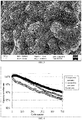
- FIG. 1, FIG. 2 and FIG. 3 respectively were a SEM picture of the positive electrode active material without coating modification (comparative example1), a SEM picture the modified positive electrode active material by solid phase mixed coating (comparative example 4) and a SEM picture of modified positive electrode active material obtained by the liquid-phase coating method of the present invention (example 1).
- discontinuous point or block coating layer was formed on the surface of the modified positive electrode active material obtained by solid phase mixed coating in FIG.
- the coating layer showed non-uniform and discontinuous, especially there was basically no coating layer on the surface of primary particle of the positive electrode active material matrix inside the positive electrode active material matrix, however the modified positive electrode active material obtained by the liquid-phase coating method of the present invention, which was referred to FIG. 3 , coating layer was uniformly, continuously and densely coated on the surface of the positive electrode active material matrix, especially there was uniform coating layer on the surface of the primary particle inside the positive electrode active material matrix.
- FIG.4 and FIG. 5 respectively illustrated cycle performance curve and volume expansion rate curve of example 1, comparative example 1 and comparative example 4.
- comparative example 1 since there was no protection of the aluminum phosphate layer, the direct contact between the positive electrode active material and the electrolyte would lead increment of the side reactions therebetween, the volume expansion rate after high temperature storage of the lithium-ion secondary battery was too large.
- the preparation method of the modified positive electrode active material could uniformly, continuously and densely coat the aluminum phosphate layer on the surface of the positive electrode active material matrix so as to effectively isolate direct contact between the positive electrode active material matrix and an electrolyte, and reduce side reactions between the positive electrode active material matrix and the electrolyte, and reduce gas production of an electrochemical energy storage device and improve high temperature storage performance of the electrochemical energy storage device.
- the modified positive electrode active material obtained by which had excellent structure stability, and could effectively improve cycle stability of the electrochemical energy storage device.
Landscapes
- Chemical & Material Sciences (AREA)
- Chemical Kinetics & Catalysis (AREA)
- Electrochemistry (AREA)
- General Chemical & Material Sciences (AREA)
- Organic Chemistry (AREA)
- Inorganic Chemistry (AREA)
- Engineering & Computer Science (AREA)
- Manufacturing & Machinery (AREA)
- Composite Materials (AREA)
- Materials Engineering (AREA)
- Crystallography & Structural Chemistry (AREA)
- Battery Electrode And Active Subsutance (AREA)
Abstract
Description
- The present application claims priority to Chinese patent application No.
CN201710357028.4, filed on May 19, 2017 - The present invention relates to the field of energy storage device, and more specifically relates to a preparation method of a modified positive electrode active material.
- With the popularization and development of electric vehicles, people's requirements of a battery become more and more strict, such as the requirement that the battery must have high energy density, long cycle performance, high safety and stability performance. The advantage of high energy density of a lithium-ion battery makes it take up the dominant position in the market compared with other kinds of batteries. With the change of the government policy of the electric vehicles, the requirement of the lithium-ion battery with higher energy density becomes more urgent, which makes nickel-rich positive electrode active material become the best choice for the development and application of the lithium-ion battery at present and in the future.
- When voltage of the lithium-ion battery is increased or the nickel-rich positive electrode active material is used in order to meet the requirements of product for high energy density of the lithium-ion battery, the safety performance of the lithium-ion battery remains in doubt. For example, when using the nickel-rich positive electrode active material, the number of stable Ni2+ to be transformed into unstable Ni3+ will be increased in order to maintain electric charge balance due to the increasing of a content of nickel, plenty of side reactions will occur between the nickel-rich positive electrode active material and the electrolyte, which will produce gas and lead the volume of the lithium-ion battery expand. This will not only damage the lithium-ion battery and affect the service life of the lithium-ion battery, but also damage the equipment using the lithium-ion battery. In serious cases, there are risks of a fire or other safety accidents due to occurrence of short circuit in the lithium-ion battery owing to its volume expansion and deformation, or due to occurrence of combustible electrolyte leakage owing to the burst of the outer case of the lithium-ion battery. For the same reason as above (the number of stable Ni2+ to be transformed into unstable Ni3+ will be increased), the structure stability of the nickel-rich positive electrode active material will become worse, layered structure material will be transformed to rock-salt structure NiO, which will influence capacity and cycle performance of the lithium-ion battery. Therefore, effective technology is needed to improve surface stability of the positive electrode active material and reduce gas production of the lithium-ion battery.
- At present, manufacturers of the positive electrode active material usually mix the positive electrode active material with nanocompound (such as aluminum oxide, zirconium oxide, magnesium oxide, titanium dioxide and aluminum phosphate) in solid state, and then a coating layer is formed after a second sintering process to stabilize the surface of the positive electrode active material. As a result, it can reduce the direct contact between the surface of the positive electrode active material and the electrolyte, and decrease the occurrence of side reactions on the surface to a certain extent, so as to reduce gas production of the lithium-ion battery and improve cycle performance. However the coating layer will be not uniformly coated on the surface of the positive electrode active material by this method, and can only protect the positive electrode active material in a certain extent, therefore how to achieve uniform coating has always been the common direction of the industry efforts.
- In view of the problems existing in the background, one object of the present invention is to provide a preparation method of a modified positive electrode active material, which can uniformly, continuously and densely coat an aluminum phosphate layer on a surface of a positive electrode active material matrix so as to effectively isolate direct contact between the positive electrode active material matrix and an electrolyte, and reduce side reactions between the positive electrode active material matrix and the electrolyte, and reduce gas production of an electrochemical energy storage device and improve high temperature storage performance of the electrochemical energy storage device.
- Another object of the present invention is to provide a preparation method of a modified positive electrode active material, the modified positive electrode active material obtained by which has excellent structure stability and can effectively improve cycle stability of the electrochemical energy storage device.
- In order to achieve the above objects, the present invention provides a preparation method of a modified positive electrode active material, which comprises steps of: dispersing a positive electrode active material matrix into an alcohol solvent to form a positive electrode active material matrix suspension; dissolving an alcohol-soluble aluminum salt in an alcohol solvent to form an alcohol-soluble aluminum salt solution; dissolving an alcohol-soluble phosphorous compound in an alcohol solvent to form an alcohol-soluble phosphorous compound solution; mixing the alcohol-soluble aluminum salt solution and the alcohol-soluble phosphorous compound solution and heating to react, obtaining a liquid-phase coating solution which contains aluminum phosphate after the reaction is finished; mixing and stirring the positive electrode active material matrix suspension and the liquid-phase coating solution which contains aluminum phosphate, extraction filtrating and obtaining a filter cake after the stirring is finished, then drying and baking the filter cake, finally obtaining a modified positive electrode active material in which an aluminum phosphate layer is uniformly coated on a surface of the positive electrode active material matrix.
- Compared to the prior art, the present invention has the following beneficial effects: the preparation method of the modified positive electrode active material can uniformly, continuously and densely coat the aluminum phosphate layer on the surface of the positive electrode active material matrix so as to effectively isolate direct contact between the positive electrode active material matrix and an electrolyte, and reduce side reactions between the positive electrode active material matrix and the electrolyte, and reduce gas production of an electrochemical energy storage device and improve high temperature storage performance of the electrochemical energy storage device. Meanwhile the modified positive electrode active material obtained by which has excellent structure stability and can effectively improve cycle stability of the electrochemical energy storage device.
-
-
FIG. 1 illustrated a SEM picture of a positive electrode active material without coating modification in comparative example 1. -
FIG. 2 illustrated a SEM picture of a modified positive electrode active material obtained by solid phase mixed coating in comparative example 4. -
FIG. 3 illustrated a SEM picture of a modified positive electrode active material obtained by liquid-phase coating method in example 1. -
FIG. 4 illustrated cycle performance curves of example 1, comparative example 1 and comparative example 4. -
FIG. 5 illustrated volume expansion rate curves of example 1, comparative example 1 and comparative example 4. - Hereinafter a preparation method of a modified positive electrode active material according to the present invention is described in detail.
- Firstly, a preparation method of a modified positive electrode active material according to a first aspect of the present invention is described.
- The preparation method of the modified positive electrode active material according to the first aspect of the present invention comprises steps of: dispersing a positive electrode active material matrix into an alcohol solvent to form a positive electrode active material matrix suspension; dissolving an alcohol-soluble aluminum salt in an alcohol solvent to form an alcohol-soluble aluminum salt solution; dissolving an alcohol-soluble phosphorous compound in an alcohol solvent to form an alcohol-soluble phosphorous compound solution; mixing the alcohol-soluble aluminum salt solution and the alcohol-soluble phosphorous compound solution, heating to react, obtaining a liquid-phase coating solution which contains aluminum phosphate after the reaction is finished; mixing and stirring the positive electrode active material matrix suspension and the liquid-phase coating solution which contains aluminum phosphate, extraction filtrating and obtaining a filter cake after the stirring is finished, then drying and baking the filter cake, finally obtaining a modified positive electrode active material in which an aluminum phosphate layer is uniformly coated on a surface of the positive electrode active material matrix.
- In the preparation method of the modified positive electrode active material according to the first aspect of the present invention, in the alcohol-soluble phosphorous compound solution, esterification reaction will occur between the alcohol-soluble phosphorous compound and the alcohol solvent after the alcohol-soluble phosphorous compound is dissolved in the alcohol solvent to obtain a chain phosphate ester; after the alcohol-soluble aluminum salt is added into the alcohol-soluble phosphorous compound solution, reaction will occur between the alcohol-soluble aluminum salt and the chain phosphate ester to form the liquid-phase coating solution which contains aluminum phosphate, the obtained liquid-phase coating solution which contains aluminum phosphate is uniform and stable, when the positive electrode active material matrix is added, the aluminum phosphate in the liquid-phase coating solution is adequately coated on a surface of a secondary particle of the positive electrode active material matrix under stirring, then after extraction filtrating, drying and baking, the modified positive electrode active material with the aluminum phosphate layer uniformly, continuously and densely coated on the surface is obtained. The modified positive electrode active material obtained by the preparation method of the modified positive electrode active material of the present invention can form an uniform aluminum phosphate layer coated on the surface of the secondary particle of the positive electrode active material matrix, such an uniform, continuous and dense aluminum phosphate layer can effectively isolate the direct contact between the positive electrode active material matrix and an electrolyte, and reduce the side reaction between the positive electrode active material matrix and the electrolyte, and decrease gas production of an electrochemical energy storage device, and effectively improve high temperature storage performance of the electrochemical energy storage device. Meanwhile the modified positive electrode active material obtained by this method has excellent structure stability, which can inhibit the phase change of the positive electrode active material matrix, thereby improving cycle performance of the electrochemical energy storage device, and reducing capacity loss of the electrochemical energy storage device. Moreover, reaction will occur between free metal ions (such as free lithium ions, etc.) of the positive electrode active material matrix and materials of the aluminum phosphate coating layer during the baking process of preparation of the modified positive electrode active material, thereby reducing a content of the free metal ions, reducing gas production of the electrochemical energy storage device, improving processing performance of the positive electrode active material matrix in slurrying process; proper amount of the aluminum phosphate coating layer can also reduce polarization of the positive electrode active material matrix, thereby reducing internal resistance of the electrochemical energy storage device, reducing energy loss of the electrochemical energy storage device during using process, thereby further improving cycle performance of the electrochemical energy storage device.
- In the preparation method of the modified positive electrode active material according to the first aspect of the present invention, in the positive electrode active material matrix suspension, a mass ratio of the alcohol solvent may be 30%∼70% of a mass of the positive electrode active material matrix. If the mass ratio of the alcohol solvent is less than 30%, the positive electrode active material matrix will not be dispersed uniformly, which will affect uniformity, continuity and density of the subsequent aluminum phosphate coating layer. If the mass ratio of the alcohol solvent is more than 70%, the concentration of the positive electrode active material matrix is too low in the positive electrode active material matrix suspension, the aluminum phosphate will not easily adhere the surface of the positive electrode active material matrix to form the aluminum phosphate layer.
- In the preparation method of the modified positive electrode active material according to the first aspect of the present invention, in the obtained modified positive electrode active material, a mass ratio of the aluminum phosphate layer may be 0.03%∼0.3% of the mass of the positive electrode active material matrix. If the mass of the aluminum phosphate layer is less than 0.03% of the mass of the positive electrode active material matrix, the aluminum phosphate layer will not completely coat the surface of the positive electrode active material matrix due to less content of the aluminum phosphate layer. If the mass ratio of the aluminum phosphate layer is more than 0.3% of the mass of the positive electrode active material matrix, the aluminum phosphate layer formed on the surface of the positive electrode active material matrix will be too thick, deintercalateion and intercalation of the metal ions (such as lithium ions) from the surface of the positive electrode active material matrix will become difficult, thereby resulting in an increase of internal polarization of the electrochemical energy storage device, increasing internal resistance of the electrochemical energy storage device, and deteriorating electrochemical performance of the electrochemical energy storage device.
- In the preparation method of the modified positive electrode active material according to the first aspect of the present invention, in the prepared modified positive electrode active material, a thickness of the aluminum phosphate layer ranges from 5nm to 70nm.
- In the preparation method of the modified positive electrode active material according to the first aspect of the present invention, a type of the alcohol solvent is not specifically limited and may be selected as desired, preferably, the alcohol solvent may be one or more selected from a group consisting of methanol, etanol, 1-propanol, isopropanol and 1-butanol, further preferably, the alcohol solvent may be selected from etanol.
- In the preparation method of the modified positive electrode active material according to the first aspect of the present invention, in the step of obtaining a liquid-phase coating solution which contains aluminum phosphate, an acidity regulator may be added so as to adjust pH of reaction system. Preferably, the acidity regulator may be weak acid ammonium. Further preferably, the acidity regulator is one or more selected from a group consisting of ammonium acetate, ammonium bicarbonate and ammonium carbonate.
- In the preparation method of the modified positive electrode active material according to the first aspect of the present invention, a mass ratio of the acidity regulator may be 3%∼60% of a mass of the alcohol-soluble aluminum salt.
- In the preparation method of the modified positive electrode active material according to the first aspect of the present invention, a type of the alcohol-soluble aluminum salt is not limited and may be selected as desired. Preferably, the alcohol-soluble aluminum salt is one or more selected from a group consisting of aluminum chloride, aluminum isopropoxide, aluminum acetylacetonate, trimethylaluminum and aluminum nitrate.
- In the preparation method of the modified positive electrode active material according to the first aspect of the present invention, a type of the alcohol-soluble phosphorous compound is not limited and may be selected as desired. Preferably, the alcohol-soluble phosphorous compound is one or more selected from a group consisting of triethyl phosphate, phosphorous acid and phosphorus pentoxide.
- In the preparation method of the modified positive electrode active material according to the first aspect of the present invention, an atomic ratio of Al in the alcohol-soluble aluminum salt solution and P in the alcohol-soluble phosphorous compound solution is 1:1.
- In the preparation method of the modified positive electrode active material according to the first aspect of the present invention, a water-bath heating can be adopted after mixing the alcohol-soluble aluminum salt solution and the alcohol-soluble phosphorous compound solution to make them react, but the present invention is not limited to this, other heating methods are also used. A water-bath heating temperature ranges from 60∼80°C, a water-bath heating time is not specifically limited and may be selected based on actual demands and environmental factor, taking the amount of the alcohol solvent in the preparation process into account, preferably, the water-bath heating time ranges from 1h to 3h.
- In the preparation method of the modified positive electrode active material according to the first aspect of the present invention, in the liquid-phase coating solution which contains aluminum phosphate, a content of the aluminum phosphate is not specifically limited. In order to facilitate calculation of the amounts of the alcohol-soluble aluminum salt and the alcohol-soluble phosphorous compound in examples of the present invention, a mass ratio of the aluminum phosphate is set as 10% of the total mass of the liquid-phase coating solution, but the present invention is not limited to this.
- In the preparation method of the modified positive electrode active material according to the first aspect of the present invention, a type of the positive electrode active material matrix is not limited, the preparation method of the modified positive electrode active material of the present invention is suitable for uniformly, continuously and densely coating the aluminum phosphate layer on the surface of various kinds of positive electrode active material matrix. Taking a lithium-ion secondary battery as an example, a general formula of the positive electrode active material matrix is LiaNixM1-xO2, where, 0.9≤a≤1.2, 0.5≤x<1, M is one or more selected from a group consisting of Co, Mn, Al, Mg, Fe, Cr, V, Ti, Cu, B, Ca, Zn, Zr, Nb, Mo, Sr, Sb, W and Bi. Preferably, the positive electrode active material matrix is one or more selected from a group consisting of LiNi0.6Co0.2Mn0.2O2, LiNi0.8Co0.1Mn0.1O2 and LiNi0.8Co0.15Al0.05O2.
- In the preparation method of the modified positive electrode active material according to the first aspect of the present invention, a mixing and stirring time of the positive electrode active material matrix suspension and the liquid-phase coating solution which contains aluminum phosphate ranges from 30min to 60min.
- In the preparation method of the modified positive electrode active material according to the first aspect of the present invention, the baking process may be performed in a muffle roaster, a baking temperature ranges from 300°C to 700°C, a baking time ranges from 1h to 10h.
- In the preparation method of the modified positive electrode active material according to the first aspect of the present invention, the baking process may be performed under air atmosphere or oxygen atmosphere.
- Secondly, an electrochemical energy storage device according to a second aspect of the present invention is described.
- The electrochemical energy storage device according to the second aspect of the present invention comprises the modified positive electrode active material obtained by the preparation method of the modified positive electrode active material according to the first aspect of the present invention.
- In the electrochemical energy storage device according to the second aspect of the present invention, the electrochemical energy storage device comprises a positive electrode plate, a negative electrode plate, a separator and an electrolyte. The positive electrode plate comprises a positive electrode current collector and a positive electrode film provided on the positive electrode current collector, the positive electrode film comprises the modified positive electrode active material obtained by the preparation method of the modified positive electrode active material according to the first aspect of the present invention.
- In the electrochemical energy storage device according to the second aspect of the present invention, the electrochemical energy storage device may be a supercapacitor, a lithium-ion secondary battery or a sodium-ion secondary battery. The positive electrode active material matrix is selected from different kinds according to the kind of the electrochemical energy storage device. The electrochemical energy storage device in examples of the present invention is only shown as a lithium-ion secondary battery, but the present invention is not limited to this.
- In the lithium-ion secondary battery, the positive electrode current collector is an aluminum foil. Positive electrode conductive agent is one or more selected from a group consisting of acetylene black, conductive carbon black, carbon fibre (VGCF), carbon nanotube (CNT) and ketjen black.
- In the lithium-ion secondary battery, the negative electrode plate comprises a negative electrode current collector and a negative electrode film provided on the negative electrode current collector. The negative electrode current collector is a copper foil. Negative electrode active material is one or more selected from a group consisting of artificial graphite and natural graphite. Negative electrode conductive agent is one or more selected from a group consisting of acetylene black, conductive carbon black (Super P, Super S, 350G), carbon fibre (VGCF), carbon nanotube (CNT) and ketjen black.
- In the lithium-ion secondary battery, the electrolyte can be a liquid electrolyte, the electrolyte may comprise lithium salt and organic solvent.
- In the lithium-ion secondary battery, a specific type of the lithium salt is not limited. Specifically, the lithium salt is one or more selected from a group consisting of LiPF6, LiBF4, LiN(SO2F)2 (abbreviated as LiFSI), LiN(CF3SO2)2 (abbreviated as LiTFSI), LiClO4, LiAsF6, LiB(C2O4)2 (abbreviated as LiBOB) and LiBF2C2O4 (abbreviated as LiDFOB).
- In the lithium-ion secondary battery, a specific type of the organic solvent is not specifically limited and may be selected as desire. Preferably, a non-aqueous organic solvent is used. The non-aqueous organic solvent may comprise any kind of carbonate ester and carboxylic ester. The carbonate ester comprises cyclic carbonate ester or chain carbonate ester. The non-aqueous organic solvent further comprises halogenated carbonate ester. Specifically, the organic solvent selected from a group consisting of ethylene carbonate (EC), propylene carbonate, butylene carbonate, pentylene carbonate, fluoroethylene carbonate, dimethyl carbonate (DMC), diethyl carbonate, dipropyl carbonate, ethyl methyl carbonate (EMC), γ-butyrolactone, methyl formate, ethyl formate, ethyl propionate, propyl propionate and tetrahydrofuran.
- In the lithium-ion secondary battery, a type of the separator is not specifically limited and may be selected as desired.
- Hereafter the present invention will be described in detail in combination with examples. It should be noted that, the examples described in the present invention are only used for explaining the present invention, and are not intended to limit the scope of the present invention. In the examples, the described electrochemical energy storage device is a lithium-ion secondary battery, but the present invention is not limited to this.
- In the following examples, reagents, materials and instruments used are commercially available unless otherwise specified.
-
- (1) Preparation of a modified positive electrode active material: 52.6g of aluminum isopropoxide was dissolved in160g of etanol to prepare an alcohol-soluble aluminum salt solution; then, 18.3g of P2O5 was dissolved in160g of etanol to prepare an alcohol-soluble phosphorous compound solution, the alcohol-soluble aluminum salt solution and the alcohol-soluble phosphorous compound solution were mixed in a beaker and placed in water bath at 80°C for 1h, then 30.7g of NH4HCO3 (acidity regulator) was gradually added; finally, etanol was added after the reaction was finished to obtain a total mass of 314g of a mixed solution, that was, a liquid-phase coating solution which contained AlPO4 was obtained, where, a content of AlPO4 of the liquid-phase coating solution was 10% of a total mass of the liquid-phase coating solution. 4.00Kg of uncoated positive electrode active material matrix LiNi0.6Co0.2Mn0.2O2 was dispersed in 1.20Kg of etanol under stirring, the positive electrode active material matrix suspension with the positive electrode active material matrix uniformly dispersed was obtained; then, 120g of the liquid-phase coating solution was added into the positive electrode active material matrix suspension and stirred for 30min, which was followed by extraction filtrating to remove etanol and obtain filter cake, the filter cake then was performed for drying for 10h under 80°C in a vacuum oven to obtain dry powder, after that, the dry powder was placed in a saggar and then placed in a muffle roaster, and air was introduced into the muffle roaster, after baking for 5h under 300°C, natural cooling was performed to obtain the modified positive electrode active material, that was, LiNi0.6Co0.2Mn0.2O2 with AlPO4 layer coated on the surface uniformly, where an average thickness of the AlPO4 layer was 50nm.
- (2) Preparation of an positive electrode plate: the modified positive electrode active material, acetylene black (positive electrode conductive agent) and polyvinylidene fluoride (PVDF, binder) according to a mass ratio of 95:3:2 were uniformly mixed with N-methyl-2-pyrrolidone (NMP, solvent) to form a positive electrode slurry, where a solid content of the positive electrode slurry was 40%, then the positive electrode slurry was uniformly coated on an aluminum foil (positive electrode current collector) with a thickness of 12µm, baking was then performed for 5h under 85°C, which was followed by cold-pressing under 8MPa, after edge-trimming, slitting, slicing, baking at 85°C for 4h under vacuum and welding an electrode tab, the preparation of the positive electrode plate was finished.
- (3) Preparation of a negative electrode plate: graphite (negative electrode active material), acetylene black (negative electrode conductive agent), SBR (binder) and CMC (thickening agent) according to a mass ratio of 95:2:1:1 were uniformly mixed with deionized water (solvent) to form a negative electrode slurry, where a solid content of the negative electrode slurry was 45%, then the negative electrode slurry was uniformly coated on a copper foil (negative electrode current collector), baking was then performed for 5h under 85°C, which was followed by cold-pressing under 8MPa, after edge-trimming, slitting, slicing, baking at 110°C for 4h under vacuum and welding an electrode tab, the preparation of the negative electrode plate was finished.
- (4) Preparation of an electrolyte: in an argon atmosphere glove box in which the water content was less than 10ppm, ethylene carbonate (EC), ethyl methyl carbonate (EMC) and dimethyl carbonate (DMC) according to a volume ratio of EC:EMC:DMC=1:1:1 were mixed to obtain a mixed organic solvent, then a fully dried lithium salt LiPF6 was dissolved in the mixed organic solvent, the electrolyte was obtained after uniformly mixing, where a concentration of the LiPF6 was 1M.
- (5) Preparation of a separator: a poly(ethylene) (PE) film was used as the separator.
- (6) Preparation of a lithium-ion secondary battery: the positive electrode plate, the separator, the negative electrode plate were laminated in order to make the separator separate the positive electrode plate from the negative electrode plate, then were wound to form an electrode assembly and placed in a package film, then the prepared electrolyte was injected, after sealing, standing-by, forming, shaping, capacity testing, the preparation of the lithium-ion secondary battery was finished.
- The preparation process was the same as example 1 except that in the preparation of the modified positive electrode active material (step(1)), 96.6g of aluminum nitrate hydrate (Al(NO3)3·9H2O, it should be noted that the aluminum nitrate hydrate was an existence form of the aluminum nitrate in natural conditions) was dissolved in 160g etanol to prepare an alcohol-soluble aluminum salt solution; then, 21.1g of phosphorous acid was dissolved in160g etanol to prepare an alcohol-soluble phosphorous compound solution, the alcohol-soluble aluminum salt solution and the alcohol-soluble phosphorous compound solution were mixed in a beaker and placed in water bath at 80°C for 1h, then 3.50g of ammonium acetate (acidity regulator) was gradually added; finally, etanol was added after the reaction was finished to obtain a total mass of 314g of a mixed solution, that was, a liquid-phase coating solution which contained AlPO4 was obtained, where, a content of AlPO4 of the liquid-phase coating solution was 10% of a total mass of the liquid-phase coating solution. 4.00Kg of uncoated positive electrode active material matrix LiNi0.6Co0.2Mn0.2O2 was dispersed in 1.60Kg of etanol under stirring, the positive electrode active material matrix suspension with the positive electrode active material matrix uniformly dispersed was obtained; then, 60.0g of the liquid-phase coating solution was added into the positive electrode active material matrix suspension and stirred for 30min, which was followed by extraction filtrating to remove etanol, filter cake then was performed for drying for 10h under 80°C in a vacuum oven to obtain dry powder, after that, the dry powder was placed in a saggar and then placed in a muffle roaster, and air was introduced into the muffle roaster, after baking for 8h under 600°C, natural cooling was performed to obtained the modified positive electrode active material, that was, LiNi0.6Co0.2Mn0.2O2 with AlPO4 layer coated on the surface uniformly, where an average thickness of the AlPO4 layer was 26nm.
- The preparation process was the same as example 1 except that in the preparation of the modified positive electrode active material (step (1)), 96.6g of aluminum nitrate hydrate (Al(NO3)3·9H2O, it should be noted that the aluminum nitrate hydrate was an existence form of the aluminum nitrate in natural conditions) was dissolved in 160g of etanol to prepare an alcohol-soluble aluminum salt solution; then, 46.9g of triethyl phosphate was dissolved in 160g of etanol to prepare an alcohol-soluble phosphorous compound solution, the alcohol-soluble aluminum salt solution and the alcohol-soluble phosphorous compound solution were mixed in a beaker and placed in water bath at 80°C for 1h, then 38.7g of ammonium acetate (acidity regulator) was added gradually; finally, etanol was added after the reaction was finished to obtain a total mass of 314g of a mixed solution, that was, a liquid-phase coating solution which contained AlPO4 was obtained, where, a content of AlPO4 of the liquid-phase coating solution was 10% of a total mass of the liquid-phase coating solution. 4.00Kg of uncoated positive electrode active material matrix LiNi0.6Co0.2Mn0.2O2 was dispersed in 2.00Kg of etanol under stirring, the positive electrode active material matrix suspension with the positive electrode active material matrix uniformly dispersed was obtained; then, 32.0g of the liquid-phase coating solution was added into the positive electrode active material matrix suspension and stirred for 45min, which was followed by extraction filtrating to remove etanol and obtain filter cake, the filter cake then was performed for drying for 10h under 80°C in a vacuum oven to obtain dry powder, after that, the dry powder was placed in a saggar and then placed in a muffle roaster, and air was introduced into the muffle roaster, after baking for 1h under 500°C, natural cooling was performed to obtained the modified positive electrode active material, that was, LiNi0.6Co0.2Mn0.2O2 with AlPO4 layer coated on the surface uniformly, where an average thickness of the AlPO4 layer was 15nm.
- The preparation process was the same as example 1 except that in the preparation of the modified positive electrode active material (step (1)), 18.6g of trimethylaluminum was dissolved in 160g etanol to prepare an alcohol-soluble aluminum salt solution; then, 18.3g of phosphorus pentoxide was dissolved in 160g of etanol to prepare an alcohol-soluble phosphorous compound solution, the alcohol-soluble aluminum salt solution and the alcohol-soluble phosphorous compound solution were mixed in a beaker and placed in water bath at 80°C for 1h, then 3.97g of acidity regulator ammonium carbonate was gradually added; finally, etanol was added after the reaction was finished to obtain a total mass of 314g of a mixed solution, that was, a liquid-phase coating solution which contained AlPO4 was obtained, where, a content of AlPO4 of the liquid-phase coating solution was 10% of a total mass of the liquid-phase coating solution. 4.00Kg of uncoated positive electrode active material matrix LiNi0.5Co0.2Mn0.3O2 was dispersed in 2.40Kg of etanol under stirring, the positive electrode active material matrix suspension with the positive electrode active material matrix uniformly dispersed was obtained; then, 20.0g of the liquid-phase coating solution was added into the positive electrode active material matrix suspension and stirred for 30min, which was followed by extraction filtrating to remove etanol and obtain filter cake, filter cake then was performed for drying for 10h under 80°C in a vacuum oven to obtain dry powder, after that, the dry powder was placed in a saggar and then placed in a muffle roaster, and air was introduced into the muffle roaster, after baking for 3h under 700°C, natural cooling was performed to obtained the modified positive electrode active material, that was, LiNi0.5Co0.2Mn0.3O2 with AlPO4 layer coated on the surface uniformly, where an average thickness of the AlPO4 layer was 10nm.
- The preparation process was the same as example 1 except that in the preparation of the modified positive electrode active material (step (1)), 84.3g of aluminum acetylacetonate was dissolved in 160g of etanol to prepare an alcohol-soluble aluminum salt solution; then, 21.1g of phosphorous acid was dissolved in 160g of etanol to prepare an alcohol-soluble phosphorous compound solution, the alcohol-soluble aluminum salt solution and the alcohol-soluble phosphorous compound solution were mixed in a beaker and placed in water bath at 80°C for 1h, then 5.65g of ammonium acetate (acidity regulator) was gradually added; finally, etanol was added after the reaction was finished to obtain a total mass of 314g of a mixed solution, that was, a liquid-phase coating solution which contained AlPO4 was obtained, where, a content of AlPO4 of the liquid-phase coating solution was 10% of a total mass of the liquid-phase coating solution. 4.00Kg of uncoated positive electrode active material matrix LiNi0.8Co0.1Mn0.1O2 was dispersed in 2.40Kg of etanol under stirring, the positive electrode active material matrix suspension with the positive electrode active material matrix uniformly dispersed was obtained; then, 12.0g of the liquid-phase coating solution was added into the positive electrode active material matrix suspension and stirred for 60min, which was followed by extraction filtrating to remove etanol and obtain filter cake, the filter cake then was performed for drying for 10h under 80°C in a vacuum oven to obtain dry powder, after that, the dry powder was placed in a saggar and then placed in a muffle roaster, and oxygen was introduced into the muffle roaster, after baking for 7h under 400°C, natural cooling was performed to obtained the modified positive electrode active material, that was, that is LiNi0.8Co0.1Mn0.1O2 with AlPO4 layer coated on the surface uniformly, where an average thickness of the AlPO4 layer was 5nm.
- The preparation process was the same as example 1 except that in the preparation of the modified positive electrode active material (step (1)), 34.3g of aluminum chloride was dissolved in 160g etanol to prepare an alcohol-soluble aluminum salt solution; then, 46.9g of triethyl phosphate was dissolved in 160g of etanol to prepare of an alcohol-soluble phosphorous compound solution, the alcohol-soluble aluminum salt solution and the alcohol-soluble phosphorous compound solution were mixed in a beaker and placed in water bath at 80°C for 1h, then 2.68g of ammonium carbonate (acidity regulator) was gradually added; finally, etanol was added after the reaction was finished to obtain a total mass of 314g of a mixed solution, that was, a liquid-phase coating solution which contained AlPO4 was obtained, where, a content of AlPO4 of the liquid-phase coating solution was 10% of a total mass of the liquid-phase coating solution. 4.00Kg of uncoated positive electrode active material matrix LiNi0.8Co0.15Al0.05O2 was dispersed in 2.80Kg of etanol under stirring, the positive electrode active material matrix suspension with the positive electrode active material matrix uniformly dispersed was obtained; then, 80.0g of the liquid-phase coating solution was added into the positive electrode active material matrix suspension and stirred for 30min, which was followed by extraction filtrating to remove etanol and obtain filter cake, the filter cake then was performed for drying for 10h under 80°C in a vacuum oven to obtain dry powder, after that, the dry powder was placed in a saggar and then placed in a muffle roaster, and oxygen was introduced into the muffle roaster, after baking for 10h under 300°C, natural cooling was performed to obtained the modified positive electrode active material, that was, LiNi0.8Co0.15Al0.05O2 with AlPO4 layer coated on the surface uniformly, where an average thickness of the AlPO4 layer was 35nm.
- The preparation process was the same as example 1 except that in the preparation of the modified positive electrode active material (step (1)), commercial LiNi0.6Co0.2Mn0.2O2 powders were directly used as the positive electrode active material and there was no coating modification.
- The preparation process was the same as example 1 except that in the preparation of the modified positive electrode active material (step (1)), commercial LiNi0.8Co0.1Mn0.1O2 powders were directly used as the positive electrode active material and there was no coating modification.
- The preparation process was the same as example 1 except that in the preparation of the modified positive electrode active material (step (1)), commercial LiNi0.8Co0.15Al0.05O2 powders were directly used as the positive electrode active material and there was no coating modification.
- The preparation process was the same as example 1 except that in the preparation of the modified positive electrode active material (step (1)), 12.0g of nano-aluminum phosphate and 4.00Kg of uncoated LiNi0.6Co0.2Mn0.2O2 were placed in a blender mixer to solid phase mix for 5h, then powders after solid phase mixing were taken out to place in a saggar and then placed in a muffle roaster, and air was introduced into the muffle roaster, after baking for 5h under 600°C, natural cooling was performed to obtained the LiNi0.6Co0.2Mn0.2O2 coated with the aluminum phosphate.
- The preparation process was the same as example 1 except that in the preparation of the preparation of the modified positive electrode active material (step (1)), 12.0g of nano-aluminum phosphate and 4.00Kg of uncoated LiNi0.8Co0.1Mn0.1O2 were placed in a blender mixer to solid phase mix for 5h, then powders after solid phase mixing were taken out to place in a saggar and then placed in a muffle roaster, and air was introduced into the muffle roaster, after baking for 5h under 600°C, natural cooling was performed to obtained the LiNi0.8Co0.1Mn0.1O2 coated with the aluminum phosphate.
- The preparation process was the same as example 1 except that in the preparation of the preparation of the modified positive electrode active material (step (1)), 12.0g of nano-aluminum phosphate and 4.00Kg of uncoated LiNi0.8Co0.15Al0.05O2 were placed in a blender mixer to solid phase mix for 5h, then powders after solid phase mixing were taken out to place in a saggar and then placed in a muffle roaster, and air was introduced into the muffle roaster, after baking for 5h under 600°C, natural cooling was performed to obtained the LiNi0.8Co0.15Al0.05O2 with the aluminum phosphate coated.
Table 1 Parameters of addition amount of raw material of examples 1-6 Liquid-phase coating solution Positive electrode active material matrix Alcohol-soluble aluminum salt Alcohol-soluble phosphorous compound Acidity regulator Type Mass /g Type Mass /g Type Mass ratio relative to alcohol-soluble alumin um salt Type Mass/ Kg Example 1 Aluminum isopropoxid e 52.6 Phosphorus pentoxide 18.3 Ammonium bicarbonate 58.4% LiNi0.6Co0.2 Mn0.2O2 4.00 Example 2 Aluminum nitrate 96.6 Phosphorous acid 21.1 Ammonium acetate 3.60% LiNi0.6Co0.2 Mn0.2O2 4.00 Example 3 Aluminum nitrate 96.6 Tiethyl phosphate 46.9 Ammonium acetate 40.1% LiNi0.6Co0.2 Mn0.2O2 4.00 Example 4 Trimethylal uminum 18.6 Phosphorus pentoxide 18.3 Ammonium carbonate 21.4% LiNi0.6Co0.2 Mn0.2O2 4.00 Example 5 Aluminum acetylaceton 84.3 Phosphorous acid 21.1 Ammonium acetate 6.70% LiNi0.8Co0.1 Mn0.2O2 4.00 Example 6 Aluminum chloride 34.3 Triethyl phosphate 46.9 Ammonium carbonate 7.80% LiNi0.8Co0.1 5Al0.05O2 4.00 Table 2 Parameters of preparation method of examples 1-6 and comparative examples 1-6 Stirring time/min Baking atmosphere Baking temperature Baking time/h Average thickness of coating layer /nm Example 1 30 Air 300 5 50 Example 2 30 Air 600 8 26 Example 3 45 Air 500 1 15 Example 4 30 Air 700 3 10 Example 5 60 Oxygen 400 7 5 Example 6 30 Oxygen 300 10 35 Comparative example1 / / / / / Comparative example2 / / / / / Comparative example3 / / / / / Comparative example4 / Air 600 5 Non-uniform, discontinuous coating layer Comparative example5 / Air 600 5 Non-uniform, discontinuous coating layer Comparative example6 / Air 600 5 Non-uniform, discontinuous coating layer - Finally, test processes and test results of the lithium-ion secondary batteries were described.
- At 25°C, the lithium-ion secondary battery was charged to an upper limit voltage of 4.3V at a constant current of 1C (that was the current that the theoretical capacity was completely discharged in 1h), then the lithium-ion secondary battery was charged to a current of 0.05C at a constant voltage of 4.3V, then the lithium-ion secondary battery was discharged to a final voltage of 2.8V at a constant current of 1C, discharged capacity of first cycle of the lithium-ion secondary battery was recorded, then the charged-discharge cycle was repeated for 500 times, the discharge capacity of 500th of the lithium-ion secondary battery was recorded.

- At 25°C, the lithium-ion secondary battery was charged to 4.3V at a constant current of 0.33C, then the lithium-ion secondary battery was further charged to a current less than 0.05C at a constant voltage of 4.3V to make the lithium-ion secondary battery fully charged at 4.3V, the volume of the lithium-ion secondary battery was measured by using the drainage method and remarked as V0, then the lithium-ion secondary battery was stored under 85°C in a baking oven, the volume change was measured every 24h for 4 days, then the lithium-ion secondary battery was taken out and cooled to room temperature, the volume after stored for 4 days was measured again by the drainage method and remarked as VI.

Table 3 Results of examples 1-6 and comparative examples 1-6 Volume expansion rate after stored for 4 days under 85°C(%) Capacity retention rate after 500 cycles under 25°C/% Example 1 38.0% 90.1% Example 2 39.0% 89.6% Example 3 39.2% 88.8% Example 4 39.8% 88.1% Example 5 47.2% 82.9% Example 6 45.8% 84.0% Comparative example 1 65.6% 85.8% Comparative example 2 71.0% 78.6% Comparative example 3 68.9% 80.9% Comparative example 4 44.0% 87.5% Comparative example 5 51.3% 80.2% Comparative example 6 49.7% 81.4% - It could be seen from relevant data of table 1, table 2 and table 3, the modified positive electrode active material obtained by the preparation method of the present invention could make the lithium-ion secondary battery have better cycle performance and high temperature storage performance.
FIG. 1, FIG. 2 andFIG. 3 respectively were a SEM picture of the positive electrode active material without coating modification (comparative example1), a SEM picture the modified positive electrode active material by solid phase mixed coating (comparative example 4) and a SEM picture of modified positive electrode active material obtained by the liquid-phase coating method of the present invention (example 1). Compared withFIG. 1 , discontinuous point or block coating layer was formed on the surface of the modified positive electrode active material obtained by solid phase mixed coating inFIG. 2 , where, there was no coating layer on partial area, the coating layer showed non-uniform and discontinuous, especially there was basically no coating layer on the surface of primary particle of the positive electrode active material matrix inside the positive electrode active material matrix, however the modified positive electrode active material obtained by the liquid-phase coating method of the present invention, which was referred toFIG. 3 , coating layer was uniformly, continuously and densely coated on the surface of the positive electrode active material matrix, especially there was uniform coating layer on the surface of the primary particle inside the positive electrode active material matrix. -
FIG.4 andFIG. 5 respectively illustrated cycle performance curve and volume expansion rate curve of example 1, comparative example 1 and comparative example 4. In comparative example 1, since there was no protection of the aluminum phosphate layer, the direct contact between the positive electrode active material and the electrolyte would lead increment of the side reactions therebetween, the volume expansion rate after high temperature storage of the lithium-ion secondary battery was too large. However since the aluminum phosphate layer uniformly, continuously and densely coated on the surface of the positive electrode active material matrix in example 1 obtained by the preparation method of the present invention, the direct contact between the electrolyte and the positive electrode active material matrix was isolated to a great extent, and the side reactions between the positive electrode active material matrix and the electrolyte were reduced, thereby the volume expansion rate after high temperature storage of the lithium-ion secondary battery was reduced obviously, meanwhile cycle performance was improved obviously. In comparative example 4, there was no uniform and continuous coating layer formed on the surface of the positive electrode active material matrix of the modified positive electrode active material obtained by solid phase mixed coating, therefore the direct contact between the positive electrode active material matrix and the electrolyte could not be effectively reduced, there was still plenty of side reactions between the positive electrode active material matrix and the electrolyte, thereby the improvement of the cycle performance and the high temperature storage performance of the lithium-ion secondary battery was not obvious. - Therefore, the preparation method of the modified positive electrode active material could uniformly, continuously and densely coat the aluminum phosphate layer on the surface of the positive electrode active material matrix so as to effectively isolate direct contact between the positive electrode active material matrix and an electrolyte, and reduce side reactions between the positive electrode active material matrix and the electrolyte, and reduce gas production of an electrochemical energy storage device and improve high temperature storage performance of the electrochemical energy storage device. Meanwhile the modified positive electrode active material obtained by which had excellent structure stability, and could effectively improve cycle stability of the electrochemical energy storage device.
Claims (13)
- A preparation method of a modified positive electrode active material, which comprising steps of:dispersing a positive electrode active material matrix into an alcohol solvent to form a positive electrode active material matrix suspension;dissolving an alcohol-soluble aluminum salt in an alcohol solvent to form an alcohol-soluble aluminum salt solution;dissolving an alcohol-soluble phosphorous compound in an alcohol solvent to form an alcohol-soluble phosphorous compound solution;mixing the alcohol-soluble aluminum salt solution and the alcohol-soluble phosphorous compound solution and heating to react, obtaining a liquid-phase coating solution which contains aluminum phosphate after the reaction is finished;mixing and stirring the positive electrode active material matrix suspension and the liquid-phase coating solution which contains aluminum phosphate, extraction filtrating and obtaining a filter cake after the stirring is finished, then drying and baking the filter cake, finally obtaining a modified positive electrode active material in which an aluminum phosphate layer is uniformly coated on a surface of the positive electrode active material matrix.
- The preparation method of the modified positive electrode active material according to Claim 1, wherein in the positive electrode active material matrix suspension, a mass ratio of the alcohol solvent is 30%∼70% of a mass of the positive electrode active material matrix.
- The preparation method of the modified positive electrode active material according to Claim 1, wherein in the obtained modified positive electrode active material, a mass ratio of the aluminum phosphate layer is 0.03%∼0.3% of a mass of the positive electrode active material matrix.
- The preparation method of the modified positive electrode active material according to Claim 1, wherein in the obtained modified positive electrode active material, a thickness of the aluminum phosphate layer ranges from 5nm to 70nm.
- The preparation method of the modified positive electrode active material according to Claim 1, wherein the alcohol solvent is one or more selected from a group consisting of methanol, etanol, 1-propanol, isopropanol and 1-butanol.
- The preparation method of the modified positive electrode active material according to Claim 5, wherein the alcohol solvent is selected from etanol.
- The preparation method of the modified positive electrode active material according to Claim 1, wherein an acidity regulator is added to adjust pH of reaction system in the step of obtaining a liquid-phase coating solution which contains aluminum phosphate.
- The preparation method of the modified positive electrode active material according to Claim 7, wherein the acidity regulator is weak acid ammonium.
- The preparation method of the modified positive electrode active material according to Claim 7, wherein the acidity regulator is one or more selected from a group consisting of ammonium acetate, ammonium bicarbonate and ammonium carbonate.
- The preparation method of the modified positive electrode active material according to Claim 1, wherein the alcohol-soluble aluminum salt is one or more selected from a group consisting of aluminum chloride, aluminum isopropoxide, aluminum acetylacetonate, trimethylaluminum and aluminum nitrate.
- The preparation method of the modified positive electrode active material according to Claim 1, wherein the alcohol-soluble phosphorous compound is one or more selected from a group consisting of triethyl phosphate, phosphorous acid and phosphorus pentoxide.
- The preparation method of the modified positive electrode active material according to Claim 1, wherein a general formula of the positive electrode active material matrix is LiaNixM1-xO2, where, 0.9≤a≤1.2, 0.5≤x<1, M is one or more selected from a group consisting of Co, Mn, Al, Mg, Fe, Cr, V, Ti, Cu, B, Ca, Zn, Zr, Nb, Mo, Sr, Sb, W and Bi.
- The preparation method of the modified positive electrode active material according to Claim 1, wherein a baking temperature ranges from 300°C to 700°C, a baking time ranges from 1h to 10h.
Applications Claiming Priority (1)
| Application Number | Priority Date | Filing Date | Title |
|---|---|---|---|
| CN201710357028.4A CN108963197A (en) | 2017-05-19 | 2017-05-19 | Preparation method of modified positive electrode active material |
Publications (2)
| Publication Number | Publication Date |
|---|---|
| EP3404743A1 true EP3404743A1 (en) | 2018-11-21 |
| EP3404743B1 EP3404743B1 (en) | 2021-10-27 |
Family
ID=62167179
Family Applications (1)
| Application Number | Title | Priority Date | Filing Date |
|---|---|---|---|
| EP18172241.4A Active EP3404743B1 (en) | 2017-05-19 | 2018-05-15 | Preparation method of modified positive electrode active material |
Country Status (3)
| Country | Link |
|---|---|
| US (1) | US10784508B2 (en) |
| EP (1) | EP3404743B1 (en) |
| CN (1) | CN108963197A (en) |
Cited By (1)
| Publication number | Priority date | Publication date | Assignee | Title |
|---|---|---|---|---|
| CN111092213A (en) * | 2019-12-31 | 2020-05-01 | 河南电池研究院有限公司 | Composite positive electrode material of lithium ion battery and preparation method thereof |
Families Citing this family (14)
| Publication number | Priority date | Publication date | Assignee | Title |
|---|---|---|---|---|
| US11437646B2 (en) * | 2014-09-26 | 2022-09-06 | Lg Energy Solution, Ltd. | Non-aqueous liquid electrolyte and lithium secondary battery comprising the same |
| CN106898734B (en) * | 2015-12-17 | 2019-06-14 | 江苏华东锂电技术研究院有限公司 | Cathode active material coating solution and preparation method thereof, and coating method of cathode active material |
| CN106898735B (en) * | 2015-12-17 | 2019-06-14 | 江苏华东锂电技术研究院有限公司 | Cathode active material coating solution and preparation method thereof, and coating method of cathode active material |
| CN107275579B (en) * | 2016-04-08 | 2019-12-13 | 江苏华东锂电技术研究院有限公司 | Preparation method of positive electrode active material coating liquid and coating method of positive electrode active material |
| US11424449B2 (en) | 2019-01-25 | 2022-08-23 | Camx Power Llc | Stable cathode materials |
| US10501335B1 (en) | 2019-01-17 | 2019-12-10 | Camx Power Llc | Polycrystalline metal oxides with enriched grain boundaries |
| US10950857B2 (en) | 2019-01-17 | 2021-03-16 | Camx Power Llc | Polycrystalline metal oxides with enriched grain boundaries |
| CN110265658A (en) * | 2019-06-03 | 2019-09-20 | 湖北锂诺新能源科技有限公司 | A kind of aluminum phosphate coats the preparation method of rich lithium ruthenium Base Metal oxyfluoride positive electrode |
| CN112271282B (en) * | 2020-10-24 | 2021-10-01 | 江西普瑞美新材料科技有限公司 | Method for coating Al on high-nickel ternary positive electrode material by washing |
| CN113078309B (en) * | 2021-03-25 | 2023-07-28 | 宁德新能源科技有限公司 | Positive electrode active material, and electrochemical device and electronic device using same |
| CN113488633B (en) * | 2021-07-27 | 2022-05-31 | 广西师范大学 | Titanium magnesium phosphate coated high-nickel ternary or lithium-rich manganese-based positive electrode material and preparation method thereof |
| CN114927670B (en) * | 2022-06-16 | 2024-04-09 | 蜂巢能源科技股份有限公司 | A modified ternary positive electrode material and its preparation method and application |
| CN115732678B (en) * | 2022-12-15 | 2025-11-18 | 合肥国轩高科动力能源有限公司 | Lithium nickel cobalt manganese oxide cathode material and its preparation method, cathode and lithium-ion battery |
| US12278363B1 (en) | 2024-04-29 | 2025-04-15 | Camx Power, Llc | Multiple morphology composite cathode materials providing high energy and long cycle life and cells employing the same |
Citations (2)
| Publication number | Priority date | Publication date | Assignee | Title |
|---|---|---|---|---|
| CN102332563A (en) * | 2010-12-17 | 2012-01-25 | 东莞新能源科技有限公司 | A kind of preparation method of positive electrode material of lithium ion battery |
| CN105720257A (en) * | 2016-04-13 | 2016-06-29 | 杨仲英 | Preparation method for lithium cobalt oxide positive electrode material |
Family Cites Families (14)
| Publication number | Priority date | Publication date | Assignee | Title |
|---|---|---|---|---|
| US7678465B2 (en) * | 2002-07-24 | 2010-03-16 | Applied Thin Films, Inc. | Aluminum phosphate compounds, compositions, materials and related metal coatings |
| JP5623100B2 (en) * | 2010-03-12 | 2014-11-12 | 三洋電機株式会社 | Non-aqueous electrolyte secondary battery and manufacturing method thereof |
| CN102347471B (en) | 2010-08-02 | 2014-03-26 | 清华大学 | Lithium-nickel-cobalt-manganese oxide composite material particle and preparation method thereof as well as battery |
| CN102347473B (en) * | 2010-08-02 | 2014-03-26 | 清华大学 | Anode composite material particle of lithium ion battery and preparation method thereof |
| US8568620B2 (en) * | 2010-08-02 | 2013-10-29 | Tsinghua University | Electrode composite material, method for making the same, and lithium ion battery using the same |
| CN102544446B (en) * | 2010-12-29 | 2014-04-30 | 清华大学 | Cathode composite material and preparation method thereof and lithium ion battery |
| CN102856530B (en) * | 2011-06-30 | 2015-01-21 | 清华大学 | Lithium ion battery |
| CN103000899A (en) * | 2011-09-14 | 2013-03-27 | 比亚迪股份有限公司 | Surface coating method of anode material |
| KR101416399B1 (en) * | 2012-12-11 | 2014-07-09 | 현대자동차 주식회사 | Apparatus for diagnosing fault of fuel cell stack |
| KR102307907B1 (en) * | 2014-11-04 | 2021-10-01 | 삼성에스디아이 주식회사 | Positive active material, positive electrode and lithium battery including the same and method of manufacture thereof |
| US11127937B2 (en) * | 2015-11-25 | 2021-09-21 | Research & Business Foundation Sungkyunkwan University | Method of manufacturing carbon-coated electrode active material and electrode active material manufactured by the method |
| CN106898734B (en) * | 2015-12-17 | 2019-06-14 | 江苏华东锂电技术研究院有限公司 | Cathode active material coating solution and preparation method thereof, and coating method of cathode active material |
| CN106898735B (en) * | 2015-12-17 | 2019-06-14 | 江苏华东锂电技术研究院有限公司 | Cathode active material coating solution and preparation method thereof, and coating method of cathode active material |
| US10930927B2 (en) * | 2017-11-08 | 2021-02-23 | Samsung Electronics Co., Ltd. | Positive electrode active material, methods for the manufacture thereof, and electrochemical cell comprising the positive electrode active material |
-
2017
- 2017-05-19 CN CN201710357028.4A patent/CN108963197A/en active Pending
-
2018
- 2018-05-10 US US15/976,713 patent/US10784508B2/en active Active
- 2018-05-15 EP EP18172241.4A patent/EP3404743B1/en active Active
Patent Citations (2)
| Publication number | Priority date | Publication date | Assignee | Title |
|---|---|---|---|---|
| CN102332563A (en) * | 2010-12-17 | 2012-01-25 | 东莞新能源科技有限公司 | A kind of preparation method of positive electrode material of lithium ion battery |
| CN105720257A (en) * | 2016-04-13 | 2016-06-29 | 杨仲英 | Preparation method for lithium cobalt oxide positive electrode material |
Non-Patent Citations (1)
| Title |
|---|
| TAN K S ET AL: "Effect of AlPO4-coating on cathodic behaviour of Li(Ni0.8Co0.2)O2", JOURNAL OF POWER SOURCES, ELSEVIER SA, CH, vol. 141, no. 1, 16 February 2005 (2005-02-16), pages 129 - 142, XP027756010, ISSN: 0378-7753, [retrieved on 20050216] * |
Cited By (2)
| Publication number | Priority date | Publication date | Assignee | Title |
|---|---|---|---|---|
| CN111092213A (en) * | 2019-12-31 | 2020-05-01 | 河南电池研究院有限公司 | Composite positive electrode material of lithium ion battery and preparation method thereof |
| CN111092213B (en) * | 2019-12-31 | 2023-01-31 | 河南电池研究院有限公司 | A kind of lithium-ion battery composite cathode material and preparation method thereof |
Also Published As
| Publication number | Publication date |
|---|---|
| EP3404743B1 (en) | 2021-10-27 |
| US20180337401A1 (en) | 2018-11-22 |
| US10784508B2 (en) | 2020-09-22 |
| CN108963197A (en) | 2018-12-07 |
Similar Documents
| Publication | Publication Date | Title |
|---|---|---|
| EP3404743B1 (en) | Preparation method of modified positive electrode active material | |
| US11108043B2 (en) | Method for producing positive electrode active material for nonaqueous electrolyte secondary battery | |
| JP7209780B2 (en) | Positive electrode active material for secondary battery, method for producing the same, and lithium secondary battery including the same | |
| EP3595060B1 (en) | Positive electrode active material for lithium secondary battery and manufacturing method therefor | |
| US10629891B2 (en) | Cathode active material for non-aqueous electrolyte secondary battery, manufacturing method thereof, and non-aqueous electrolyte secondary battery | |
| EP2763218B1 (en) | Cathode active material for a lithium secondary battery, method for manufacturing same, and lithium secondary battery including same | |
| EP1117145B1 (en) | Nonaqueous electrolyte secondary cell | |
| US10177379B2 (en) | Positive electrode material for secondary battery and method for manufacturing the same | |
| EP3663265A2 (en) | Positive electrode active material for lithium secondary battery and lithium secondary battery including the same | |
| EP3533764A1 (en) | Nickel-manganese composite hydroxide, method for producing the same, positive electrode active material for nonaqueous electrolyte secondary battery, method for producing the same, and nonaqueous electrolyte secondary battery | |
| JP7286800B2 (en) | Method for manufacturing positive electrode active material for lithium secondary battery, positive electrode for lithium secondary battery containing positive electrode active material manufactured by said manufacturing method, and lithium secondary battery | |
| EP2763220A2 (en) | Precursor of cathode active material for a lithium secondary battery, method for manufacturing the precursor, cathode active material, and lithium secondary battery including the cathode active material | |
| EP3267517A1 (en) | Positive electrode active substance for non-aqueous electrolyte secondary battery, and method for producing same | |
| KR20170063420A (en) | Positive electrode active material for lithium secondary battery, method for preparing the same, and lithium secondary battery comprising the same | |
| KR101808373B1 (en) | Positive electrode active material for lithium secondary battery and lithium secondary battery comprising same | |
| WO2011031544A2 (en) | Metal oxide coated positive electrode materials for lithium-based batteries | |
| KR20170063415A (en) | Positive electrode active material for lithium secondary battery, method for preparing the same, and lithium secondary battery comprising the same | |
| EP3442069B1 (en) | Lithium-ion secondary battery | |
| KR20180077018A (en) | Positive electrode active material for secondary battery, method for preparing the same and lithium secondary battery comprising the same | |
| EP4369439A1 (en) | Lithium-containing nickel-manganese composite oxide, preparation method therefor, positive electrode sheet containing same, secondary battery, and electrical apparatus | |
| EP2624343A2 (en) | Positive electrode active material for a lithium secondary battery, method for preparing same, and lithium secondary battery comprising same | |
| KR20160052427A (en) | Transition metal oxide precursor, lithium composite transition metal hydroxide, secondary battery and cathode comprising the same | |
| EP4033566B1 (en) | Positive electrode active material for lithium ion secondary batteries, and lithium ion secondary battery | |
| EP3978439A1 (en) | Positive electrode active material precursor for lithium-ion secondary battery, positive electrode active material for lithium-ion secondary battery, method for producing positive electrode active material precursor for lithium-ion secondary battery, method for producing positive electrode active material for lithium-ion secondary battery, lithium-ion secondary battery | |
| US20220293937A1 (en) | Positive electrode and non-aqueous electrolyte secondary battery including the positive electrode |
Legal Events
| Date | Code | Title | Description |
|---|---|---|---|
| PUAI | Public reference made under article 153(3) epc to a published international application that has entered the european phase |
Free format text: ORIGINAL CODE: 0009012 |
|
| STAA | Information on the status of an ep patent application or granted ep patent |
Free format text: STATUS: REQUEST FOR EXAMINATION WAS MADE |
|
| 17P | Request for examination filed |
Effective date: 20180515 |
|
| AK | Designated contracting states |
Kind code of ref document: A1 Designated state(s): AL AT BE BG CH CY CZ DE DK EE ES FI FR GB GR HR HU IE IS IT LI LT LU LV MC MK MT NL NO PL PT RO RS SE SI SK SM TR |
|
| AX | Request for extension of the european patent |
Extension state: BA ME |
|
| STAA | Information on the status of an ep patent application or granted ep patent |
Free format text: STATUS: EXAMINATION IS IN PROGRESS |
|
| 17Q | First examination report despatched |
Effective date: 20191007 |
|
| GRAP | Despatch of communication of intention to grant a patent |
Free format text: ORIGINAL CODE: EPIDOSNIGR1 |
|
| STAA | Information on the status of an ep patent application or granted ep patent |
Free format text: STATUS: GRANT OF PATENT IS INTENDED |
|
| RIC1 | Information provided on ipc code assigned before grant |
Ipc: C01B 25/36 20060101ALN20210503BHEP Ipc: H01M 4/02 20060101ALN20210503BHEP Ipc: H01M 10/052 20100101ALI20210503BHEP Ipc: H01M 4/525 20100101ALI20210503BHEP Ipc: H01M 4/505 20100101ALI20210503BHEP Ipc: H01M 4/36 20060101ALI20210503BHEP Ipc: H01M 4/1391 20100101ALI20210503BHEP Ipc: H01M 4/131 20100101ALI20210503BHEP Ipc: H01M 4/04 20060101AFI20210503BHEP |
|
| INTG | Intention to grant announced |
Effective date: 20210601 |
|
| GRAS | Grant fee paid |
Free format text: ORIGINAL CODE: EPIDOSNIGR3 |
|
| GRAA | (expected) grant |
Free format text: ORIGINAL CODE: 0009210 |
|
| STAA | Information on the status of an ep patent application or granted ep patent |
Free format text: STATUS: THE PATENT HAS BEEN GRANTED |
|
| AK | Designated contracting states |
Kind code of ref document: B1 Designated state(s): AL AT BE BG CH CY CZ DE DK EE ES FI FR GB GR HR HU IE IS IT LI LT LU LV MC MK MT NL NO PL PT RO RS SE SI SK SM TR |
|
| REG | Reference to a national code |
Ref country code: GB Ref legal event code: FG4D |
|
| REG | Reference to a national code |
Ref country code: CH Ref legal event code: EP |
|
| REG | Reference to a national code |
Ref country code: AT Ref legal event code: REF Ref document number: 1442634 Country of ref document: AT Kind code of ref document: T Effective date: 20211115 |
|
| REG | Reference to a national code |
Ref country code: DE Ref legal event code: R096 Ref document number: 602018025544 Country of ref document: DE |
|
| REG | Reference to a national code |
Ref country code: IE Ref legal event code: FG4D |
|
| REG | Reference to a national code |
Ref country code: LT Ref legal event code: MG9D |
|
| REG | Reference to a national code |
Ref country code: NL Ref legal event code: MP Effective date: 20211027 |
|
| REG | Reference to a national code |
Ref country code: AT Ref legal event code: MK05 Ref document number: 1442634 Country of ref document: AT Kind code of ref document: T Effective date: 20211027 |
|
| PG25 | Lapsed in a contracting state [announced via postgrant information from national office to epo] |
Ref country code: RS Free format text: LAPSE BECAUSE OF FAILURE TO SUBMIT A TRANSLATION OF THE DESCRIPTION OR TO PAY THE FEE WITHIN THE PRESCRIBED TIME-LIMIT Effective date: 20211027 Ref country code: LT Free format text: LAPSE BECAUSE OF FAILURE TO SUBMIT A TRANSLATION OF THE DESCRIPTION OR TO PAY THE FEE WITHIN THE PRESCRIBED TIME-LIMIT Effective date: 20211027 Ref country code: FI Free format text: LAPSE BECAUSE OF FAILURE TO SUBMIT A TRANSLATION OF THE DESCRIPTION OR TO PAY THE FEE WITHIN THE PRESCRIBED TIME-LIMIT Effective date: 20211027 Ref country code: BG Free format text: LAPSE BECAUSE OF FAILURE TO SUBMIT A TRANSLATION OF THE DESCRIPTION OR TO PAY THE FEE WITHIN THE PRESCRIBED TIME-LIMIT Effective date: 20220127 Ref country code: AT Free format text: LAPSE BECAUSE OF FAILURE TO SUBMIT A TRANSLATION OF THE DESCRIPTION OR TO PAY THE FEE WITHIN THE PRESCRIBED TIME-LIMIT Effective date: 20211027 |
|
| PG25 | Lapsed in a contracting state [announced via postgrant information from national office to epo] |
Ref country code: IS Free format text: LAPSE BECAUSE OF FAILURE TO SUBMIT A TRANSLATION OF THE DESCRIPTION OR TO PAY THE FEE WITHIN THE PRESCRIBED TIME-LIMIT Effective date: 20220227 Ref country code: SE Free format text: LAPSE BECAUSE OF FAILURE TO SUBMIT A TRANSLATION OF THE DESCRIPTION OR TO PAY THE FEE WITHIN THE PRESCRIBED TIME-LIMIT Effective date: 20211027 Ref country code: PT Free format text: LAPSE BECAUSE OF FAILURE TO SUBMIT A TRANSLATION OF THE DESCRIPTION OR TO PAY THE FEE WITHIN THE PRESCRIBED TIME-LIMIT Effective date: 20220228 Ref country code: PL Free format text: LAPSE BECAUSE OF FAILURE TO SUBMIT A TRANSLATION OF THE DESCRIPTION OR TO PAY THE FEE WITHIN THE PRESCRIBED TIME-LIMIT Effective date: 20211027 Ref country code: NO Free format text: LAPSE BECAUSE OF FAILURE TO SUBMIT A TRANSLATION OF THE DESCRIPTION OR TO PAY THE FEE WITHIN THE PRESCRIBED TIME-LIMIT Effective date: 20220127 Ref country code: NL Free format text: LAPSE BECAUSE OF FAILURE TO SUBMIT A TRANSLATION OF THE DESCRIPTION OR TO PAY THE FEE WITHIN THE PRESCRIBED TIME-LIMIT Effective date: 20211027 Ref country code: LV Free format text: LAPSE BECAUSE OF FAILURE TO SUBMIT A TRANSLATION OF THE DESCRIPTION OR TO PAY THE FEE WITHIN THE PRESCRIBED TIME-LIMIT Effective date: 20211027 Ref country code: HR Free format text: LAPSE BECAUSE OF FAILURE TO SUBMIT A TRANSLATION OF THE DESCRIPTION OR TO PAY THE FEE WITHIN THE PRESCRIBED TIME-LIMIT Effective date: 20211027 Ref country code: GR Free format text: LAPSE BECAUSE OF FAILURE TO SUBMIT A TRANSLATION OF THE DESCRIPTION OR TO PAY THE FEE WITHIN THE PRESCRIBED TIME-LIMIT Effective date: 20220128 Ref country code: ES Free format text: LAPSE BECAUSE OF FAILURE TO SUBMIT A TRANSLATION OF THE DESCRIPTION OR TO PAY THE FEE WITHIN THE PRESCRIBED TIME-LIMIT Effective date: 20211027 |
|
| REG | Reference to a national code |
Ref country code: DE Ref legal event code: R097 Ref document number: 602018025544 Country of ref document: DE |
|
| PG25 | Lapsed in a contracting state [announced via postgrant information from national office to epo] |
Ref country code: SM Free format text: LAPSE BECAUSE OF FAILURE TO SUBMIT A TRANSLATION OF THE DESCRIPTION OR TO PAY THE FEE WITHIN THE PRESCRIBED TIME-LIMIT Effective date: 20211027 Ref country code: SK Free format text: LAPSE BECAUSE OF FAILURE TO SUBMIT A TRANSLATION OF THE DESCRIPTION OR TO PAY THE FEE WITHIN THE PRESCRIBED TIME-LIMIT Effective date: 20211027 Ref country code: RO Free format text: LAPSE BECAUSE OF FAILURE TO SUBMIT A TRANSLATION OF THE DESCRIPTION OR TO PAY THE FEE WITHIN THE PRESCRIBED TIME-LIMIT Effective date: 20211027 Ref country code: EE Free format text: LAPSE BECAUSE OF FAILURE TO SUBMIT A TRANSLATION OF THE DESCRIPTION OR TO PAY THE FEE WITHIN THE PRESCRIBED TIME-LIMIT Effective date: 20211027 Ref country code: DK Free format text: LAPSE BECAUSE OF FAILURE TO SUBMIT A TRANSLATION OF THE DESCRIPTION OR TO PAY THE FEE WITHIN THE PRESCRIBED TIME-LIMIT Effective date: 20211027 Ref country code: CZ Free format text: LAPSE BECAUSE OF FAILURE TO SUBMIT A TRANSLATION OF THE DESCRIPTION OR TO PAY THE FEE WITHIN THE PRESCRIBED TIME-LIMIT Effective date: 20211027 |
|
| PLBE | No opposition filed within time limit |
Free format text: ORIGINAL CODE: 0009261 |
|
| STAA | Information on the status of an ep patent application or granted ep patent |
Free format text: STATUS: NO OPPOSITION FILED WITHIN TIME LIMIT |
|
| 26N | No opposition filed |
Effective date: 20220728 |
|
| PG25 | Lapsed in a contracting state [announced via postgrant information from national office to epo] |
Ref country code: AL Free format text: LAPSE BECAUSE OF FAILURE TO SUBMIT A TRANSLATION OF THE DESCRIPTION OR TO PAY THE FEE WITHIN THE PRESCRIBED TIME-LIMIT Effective date: 20211027 |
|
| PG25 | Lapsed in a contracting state [announced via postgrant information from national office to epo] |
Ref country code: SI Free format text: LAPSE BECAUSE OF FAILURE TO SUBMIT A TRANSLATION OF THE DESCRIPTION OR TO PAY THE FEE WITHIN THE PRESCRIBED TIME-LIMIT Effective date: 20211027 |
|
| REG | Reference to a national code |
Ref country code: CH Ref legal event code: PL |
|
| REG | Reference to a national code |
Ref country code: BE Ref legal event code: MM Effective date: 20220531 |
|
| PG25 | Lapsed in a contracting state [announced via postgrant information from national office to epo] |
Ref country code: MC Free format text: LAPSE BECAUSE OF FAILURE TO SUBMIT A TRANSLATION OF THE DESCRIPTION OR TO PAY THE FEE WITHIN THE PRESCRIBED TIME-LIMIT Effective date: 20211027 Ref country code: LU Free format text: LAPSE BECAUSE OF NON-PAYMENT OF DUE FEES Effective date: 20220515 Ref country code: LI Free format text: LAPSE BECAUSE OF NON-PAYMENT OF DUE FEES Effective date: 20220531 Ref country code: CH Free format text: LAPSE BECAUSE OF NON-PAYMENT OF DUE FEES Effective date: 20220531 |
|
| PG25 | Lapsed in a contracting state [announced via postgrant information from national office to epo] |
Ref country code: IE Free format text: LAPSE BECAUSE OF NON-PAYMENT OF DUE FEES Effective date: 20220515 |
|
| PG25 | Lapsed in a contracting state [announced via postgrant information from national office to epo] |
Ref country code: IT Free format text: LAPSE BECAUSE OF FAILURE TO SUBMIT A TRANSLATION OF THE DESCRIPTION OR TO PAY THE FEE WITHIN THE PRESCRIBED TIME-LIMIT Effective date: 20211027 Ref country code: BE Free format text: LAPSE BECAUSE OF NON-PAYMENT OF DUE FEES Effective date: 20220531 |
|
| P01 | Opt-out of the competence of the unified patent court (upc) registered |
Effective date: 20230516 |
|
| PG25 | Lapsed in a contracting state [announced via postgrant information from national office to epo] |
Ref country code: HU Free format text: LAPSE BECAUSE OF FAILURE TO SUBMIT A TRANSLATION OF THE DESCRIPTION OR TO PAY THE FEE WITHIN THE PRESCRIBED TIME-LIMIT; INVALID AB INITIO Effective date: 20180515 |
|
| PG25 | Lapsed in a contracting state [announced via postgrant information from national office to epo] |
Ref country code: MK Free format text: LAPSE BECAUSE OF FAILURE TO SUBMIT A TRANSLATION OF THE DESCRIPTION OR TO PAY THE FEE WITHIN THE PRESCRIBED TIME-LIMIT Effective date: 20211027 Ref country code: CY Free format text: LAPSE BECAUSE OF FAILURE TO SUBMIT A TRANSLATION OF THE DESCRIPTION OR TO PAY THE FEE WITHIN THE PRESCRIBED TIME-LIMIT Effective date: 20211027 |
|
| PG25 | Lapsed in a contracting state [announced via postgrant information from national office to epo] |
Ref country code: TR Free format text: LAPSE BECAUSE OF FAILURE TO SUBMIT A TRANSLATION OF THE DESCRIPTION OR TO PAY THE FEE WITHIN THE PRESCRIBED TIME-LIMIT Effective date: 20211027 |
|
| REG | Reference to a national code |
Ref country code: DE Ref legal event code: R081 Ref document number: 602018025544 Country of ref document: DE Owner name: CONTEMPORARY AMPEREX TECHNOLOGY (HONG KONG) LI, HK Free format text: FORMER OWNER: CONTEMPORARY AMPEREX TECHNOLOGY CO., LIMITED, NINGDE CITY, FUJIAN, CN |
|
| REG | Reference to a national code |
Ref country code: GB Ref legal event code: 732E Free format text: REGISTERED BETWEEN 20240808 AND 20240814 |
|
| PG25 | Lapsed in a contracting state [announced via postgrant information from national office to epo] |
Ref country code: MT Free format text: LAPSE BECAUSE OF FAILURE TO SUBMIT A TRANSLATION OF THE DESCRIPTION OR TO PAY THE FEE WITHIN THE PRESCRIBED TIME-LIMIT Effective date: 20211027 |
|
| PGFP | Annual fee paid to national office [announced via postgrant information from national office to epo] |
Ref country code: GB Payment date: 20260310 Year of fee payment: 9 |
|
| PGFP | Annual fee paid to national office [announced via postgrant information from national office to epo] |
Ref country code: FR Payment date: 20260309 Year of fee payment: 9 |
|
| PGFP | Annual fee paid to national office [announced via postgrant information from national office to epo] |
Ref country code: DE Payment date: 20260317 Year of fee payment: 9 |