EP3404246A1 - Locking apparatus for a thrust reverser translating sleeve - Google Patents
Locking apparatus for a thrust reverser translating sleeve Download PDFInfo
- Publication number
- EP3404246A1 EP3404246A1 EP18164412.1A EP18164412A EP3404246A1 EP 3404246 A1 EP3404246 A1 EP 3404246A1 EP 18164412 A EP18164412 A EP 18164412A EP 3404246 A1 EP3404246 A1 EP 3404246A1
- Authority
- EP
- European Patent Office
- Prior art keywords
- lock
- actuator
- sleeve
- locking element
- assembly
- Prior art date
- Legal status (The legal status is an assumption and is not a legal conclusion. Google has not performed a legal analysis and makes no representation as to the accuracy of the status listed.)
- Granted
Links
Images




Classifications
-
- B—PERFORMING OPERATIONS; TRANSPORTING
- B64—AIRCRAFT; AVIATION; COSMONAUTICS
- B64D—EQUIPMENT FOR FITTING IN OR TO AIRCRAFT; FLIGHT SUITS; PARACHUTES; ARRANGEMENT OR MOUNTING OF POWER PLANTS OR PROPULSION TRANSMISSIONS IN AIRCRAFT
- B64D29/00—Power-plant nacelles, fairings or cowlings
- B64D29/04—Power-plant nacelles, fairings or cowlings associated with fuselages
-
- F—MECHANICAL ENGINEERING; LIGHTING; HEATING; WEAPONS; BLASTING
- F02—COMBUSTION ENGINES; HOT-GAS OR COMBUSTION-PRODUCT ENGINE PLANTS
- F02K—JET-PROPULSION PLANTS
- F02K1/00—Plants characterised by the form or arrangement of the jet pipe or nozzle; Jet pipes or nozzles peculiar thereto
- F02K1/54—Nozzles having means for reversing jet thrust
- F02K1/76—Control or regulation of thrust reversers
- F02K1/766—Control or regulation of thrust reversers with blocking systems or locking devices; Arrangement of locking devices for thrust reversers
-
- B—PERFORMING OPERATIONS; TRANSPORTING
- B64—AIRCRAFT; AVIATION; COSMONAUTICS
- B64D—EQUIPMENT FOR FITTING IN OR TO AIRCRAFT; FLIGHT SUITS; PARACHUTES; ARRANGEMENT OR MOUNTING OF POWER PLANTS OR PROPULSION TRANSMISSIONS IN AIRCRAFT
- B64D27/00—Arrangement or mounting of power plants in aircraft; Aircraft characterised by the type or position of power plants
- B64D27/02—Aircraft characterised by the type or position of power plants
- B64D27/10—Aircraft characterised by the type or position of power plants of gas-turbine type
- B64D27/14—Aircraft characterised by the type or position of power plants of gas-turbine type within, or attached to, fuselages
-
- B—PERFORMING OPERATIONS; TRANSPORTING
- B64—AIRCRAFT; AVIATION; COSMONAUTICS
- B64D—EQUIPMENT FOR FITTING IN OR TO AIRCRAFT; FLIGHT SUITS; PARACHUTES; ARRANGEMENT OR MOUNTING OF POWER PLANTS OR PROPULSION TRANSMISSIONS IN AIRCRAFT
- B64D29/00—Power-plant nacelles, fairings or cowlings
- B64D29/06—Attaching of nacelles, fairings or cowlings
-
- F—MECHANICAL ENGINEERING; LIGHTING; HEATING; WEAPONS; BLASTING
- F02—COMBUSTION ENGINES; HOT-GAS OR COMBUSTION-PRODUCT ENGINE PLANTS
- F02K—JET-PROPULSION PLANTS
- F02K1/00—Plants characterised by the form or arrangement of the jet pipe or nozzle; Jet pipes or nozzles peculiar thereto
- F02K1/54—Nozzles having means for reversing jet thrust
- F02K1/76—Control or regulation of thrust reversers
- F02K1/763—Control or regulation of thrust reversers with actuating systems or actuating devices; Arrangement of actuators for thrust reversers
-
- F—MECHANICAL ENGINEERING; LIGHTING; HEATING; WEAPONS; BLASTING
- F05—INDEXING SCHEMES RELATING TO ENGINES OR PUMPS IN VARIOUS SUBCLASSES OF CLASSES F01-F04
- F05D—INDEXING SCHEME FOR ASPECTS RELATING TO NON-POSITIVE-DISPLACEMENT MACHINES OR ENGINES, GAS-TURBINES OR JET-PROPULSION PLANTS
- F05D2250/00—Geometry
- F05D2250/30—Arrangement of components
- F05D2250/31—Arrangement of components according to the direction of their main axis or their axis of rotation
- F05D2250/312—Arrangement of components according to the direction of their main axis or their axis of rotation the axes being parallel to each other
-
- F—MECHANICAL ENGINEERING; LIGHTING; HEATING; WEAPONS; BLASTING
- F05—INDEXING SCHEMES RELATING TO ENGINES OR PUMPS IN VARIOUS SUBCLASSES OF CLASSES F01-F04
- F05D—INDEXING SCHEME FOR ASPECTS RELATING TO NON-POSITIVE-DISPLACEMENT MACHINES OR ENGINES, GAS-TURBINES OR JET-PROPULSION PLANTS
- F05D2260/00—Function
- F05D2260/30—Retaining components in desired mutual position
Definitions
- This disclosure relates generally to a thrust reverser for an aircraft propulsion system and, more particularly, to a control system for locking and unlocking a translating sleeve of the thrust reverser.
- a thrust reverser for an aircraft propulsion system may include an axial translating sleeve.
- the translating sleeve may be driven axially between a forward stowed position and an aft deployed position by a set of actuators.
- Each of these actuators may be configured with a lock to prevent unintended deployment of the translating sleeve.
- the thrust reverser may also include a tertiary (e.g., backup) lock, which directly locks the translating sleeve to a stationary structure.
- tertiary locks e.g., backup
- an assembly for an aircraft propulsion system with an axial centerline.
- the assembly includes a translating sleeve, a sleeve actuator and a locking apparatus.
- the sleeve actuator is connected to the translating sleeve.
- the sleeve actuator is configured to move the translating sleeve along the axial centerline between a stowed position and a deployed position.
- the locking apparatus includes a lock and a lock actuator.
- the lock is configured as or otherwise includes a locking element.
- the lock actuator is configured to move the locking element between a locked position and an unlocked position.
- the locking element is configured to lock the translating sleeve in the stowed position when the locking element is in the locked position.
- a first portion of the locking apparatus axially overlaps the sleeve actuator along the axial centerline.
- a second portion of the locking apparatus does not axially overlap the sleeve actuator along the axial centerline.
- another assembly for an aircraft propulsion system with an axial centerline.
- This assembly includes a translating sleeve, a sleeve actuator and a locking apparatus.
- the sleeve actuator is connected to the translating sleeve.
- the sleeve actuator is configured to axially translate the translating sleeve along the axial centerline between a stowed position and a deployed position.
- the locking apparatus includes a lock and a lock actuator.
- the lock is configured as or otherwise includes a locking element.
- the lock actuator is configured to move the locking element between a locked position and an unlocked position.
- the locking element is configured to lock the translating sleeve in the stowed position when the locking element is in the locked position.
- the lock actuator at least partially axially overlaps the sleeve actuator along the axial centerline.
- the lock is disposed an axial distance from the sleeve actuator along the axial centerline.
- another assembly for an aircraft propulsion system with an axial centerline.
- This assembly includes a translating sleeve, a sleeve actuator and a locking apparatus.
- the sleeve actuator is connected to the translating sleeve.
- the sleeve actuator is configured to axially translate the translating sleeve along the axial centerline between a stowed position and a deployed position.
- the locking apparatus includes a lock and a lock actuator.
- the lock is configured as or otherwise includes a locking element.
- the lock actuator is configured to move the locking element between a locked position and an unlocked position.
- the locking element is configured to lock the translating sleeve in the stowed position when the locking element is in the locked position. At least when the locking element is in the locked position.
- An engagement between the lock actuator and the lock is operable to sever without moving the locking element out of the locked position.
- an engagement between the lock actuator and the lock may be operable to sever without moving the locking element out of the locked position.
- the first portion may be configured as or otherwise include the lock.
- the second portion may be configured as or otherwise include at least a portion of the lock actuator.
- the lock may be disposed an axial distance along the axial centerline from the sleeve actuator.
- the sleeve actuator and the first portion may be at least partially in a rotor burst zone of the aircraft propulsion system.
- the second portion may be outside of the rotor burst zone.
- the lock may be disposed aft of the actuator along the axial centerline.
- An actuator element of the lock actuator may engage the lock when the locking element is in the locked position.
- the actuator element may be disengaged from the lock when the locking element is in the unlocked position.
- An actuator element of the lock actuator may be configured to drive the locking element from the unlocked position to the locked position.
- the actuator element may contact, but might not be attached to, the lock.
- the lock actuator may be connected to the lock through a frangible linkage.
- the assembly may also include a stationary structure.
- the locking apparatus may be secured to the stationary structure.
- the locking element may be configured as or otherwise include a lock pin.
- An actuator element of the lock actuator may be configured to drive the locking element from the unlocked position to the locked position.
- the actuator element may move along a first axis.
- the locking element may move along a second axis that is angularly offset from the first axis.
- the assembly may also include an actuator lock configured with the actuator.
- the actuator lock may be configured to lock the translating sleeve in the stowed position.
- the lock actuator may at least partially axially overlap the sleeve actuator along the axial centerline.
- the lock may be disposed an axial distance away from the sleeve actuator along the axial centerline.
- FIG. 1 illustrates an aircraft propulsion system 10 for an aircraft such as, but not limited to, a commercial airliner or cargo plane.
- the propulsion system 10 includes a nacelle 12 and a gas turbine engine.
- This gas turbine engine may be configured as a high-bypass turbofan engine. Alternatively, the gas turbine engine may be configured as any other type of gas turbine engine capable of propelling the aircraft during flight.
- the nacelle 12 is configured to house and provide an aerodynamic cover for the gas turbine engine.
- the nacelle 12 extends along an axial centerline 14 between a nacelle forward end 16 and a nacelle aft end 18.
- the nacelle 12 of FIG. 1 includes a nacelle inlet structure 20, one or more fan cowls 22 (one such cowl visible in FIG. 1 ) and a nacelle aft structure 24, which is configured as part of or includes a thrust reverser system 26.
- the inlet structure 20 is disposed at the nacelle forward end 16.
- the inlet structure 20 is configured to direct a stream of air through an inlet opening 28 at the nacelle forward end 16 and into a fan section of the gas turbine engine.
- the fan cowls 22 are disposed axially between the inlet structure 20 and the aft structure 24.
- Each fan cowl 22 of FIG. 1 is disposed at an aft end 30 of a stationary portion 32 of the nacelle 12, and extends forward to the inlet structure 20.
- Each fan cowl 22 is generally axially aligned with a fan section of the gas turbine engine.
- the fan cowls 22 are configured to provide an aerodynamic covering for a fan case 34. Briefly, this fan case 34 circumscribes the fan section and partially forms a forward outer peripheral boundary of a bypass flowpath of the propulsion system 10.
- the term "stationary portion” is used above to describe a portion of the nacelle 12 that is stationary during propulsion system 10 operation (e.g., during takeoff, aircraft flight and landing). However, the stationary portion 32 may be otherwise movable for propulsion system inspection / maintenance; e.g., when the propulsion system 10 is non-operational.
- Each of the fan cowls 22, for example may be configured to provide access to components of the gas turbine engine such as the fan case 34 and/or peripheral equipment configured therewith for inspection, maintenance and/or otherwise.
- each of fan cowls 22 may be pivotally mounted with the aircraft propulsion system 10 by, for example, a pivoting hinge system.
- the fan cowls 22 and the inlet structure 20 may be configured into a single axially translatable body for example, which may be referred to as a "fanlet".
- the present disclosure is not limited to the foregoing fan cowl configurations and/or access schemes.
- the aft structure 24 includes a translating sleeve 36 for the thrust reverser system 26.
- the translating sleeve 36 of FIG. 1 is disposed at the nacelle aft end 18. This translating sleeve 36 extends axially along the axial centerline 14 between a forward end 38 thereof and the nacelle aft end 18.
- the translating sleeve 36 is configured to partially form an aft outer peripheral boundary of the bypass flowpath.
- the translating sleeve 36 may also be configured to form a bypass nozzle 40 for the bypass flowpath with an inner structure 42 of the nacelle 12 (e.g., an inner fixed structure (IFS)), which nacelle inner structure houses a core of the gas turbine engine.
- IFS inner fixed structure
- the translating sleeve 36 of FIG. 1 includes a pair of sleeve segments 44 (e.g., halves) arranged on opposing sides of the propulsion system 10 (one such sleeve segment visible in FIG. 1 ).
- the present disclosure is not limited to such an exemplary translating sleeve configuration.
- the translating sleeve 36 may alternatively have a substantially tubular body.
- the translating sleeve 36 may extend more than three-hundred and thirty degrees (330°) around the centerline 14.
- the translating sleeve 36 is an axially translatable structure.
- Each translating sleeve segment 44 may be slidably connected to one or more stationary structures (e.g., a pylon 46 and a lower bifurcation 48) through one or more respective track assemblies 50 (see FIG. 2 ).
- Each track assembly 50 may include a rail mated with a track beam; however, the present disclosure is not limited to the foregoing exemplary sliding connection configuration.
- the translating sleeve 36 may translate axially along the axial centerline 14 and relative to the stationary portion 32.
- the translating sleeve 36 may thereby move axially between a forward stowed position (see FIG. 1 ) and an aft deployed position (see FIG. 2 ).
- the translating sleeve 36 provides the functionality described above.
- the translating sleeve 36 at least partially (or substantially completely) uncovers at least one or more other components of the thrust reverser system 26 such as, but not limited to, one or more cascade structures 52.
- one or more blocker doors (not shown) arranged with the translating sleeve 36 may be deployed to divert bypass air from the bypass flowpath and through the cascade structures 52 to provide reverse thrust.
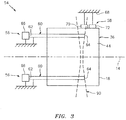
- FIG. 3 is a schematic illustration of a system 54 for controlling movement of one of the sleeve segments 44 and, thus, the translating sleeve 36.
- This control system 54 includes one or more sleeve actuator assemblies 56 and a locking apparatus 58.
- Each of the sleeve actuator assemblies 56 includes a sleeve actuator 60, which is configured to drive the sleeve segment 44 between the forward stowed position (see FIG. 1 ) and the aft deployed position (see FIG. 2 ).
- the sleeve actuator 60 may be configured as a linear actuator such as a hydraulic or pneumatic piston or a lead screw device.
- a forward end 62 of the sleeve actuator 60 is grounded.
- the forward end 62 may be attached to the stationary structure (e.g., 46 or 48; see FIG. 2 ) or the stationary portion 32.
- An aft end 64 of the sleeve actuator 60 is attached to the sleeve segment 44, or otherwise indirectly motively linked with the sleeve segment 44.
- Each of the sleeve actuator assemblies 56 also includes an actuator lock 66.
- This actuator lock 66 is configured to lock and unlock the sleeve actuator 60.
- the sleeve actuator 60 is locked, the translating sleeve 36 is in the stowed position (see FIG. 1 ) and the actuator lock 66 prevents the sleeve actuator 60 from actuating and, thus, moving out of the stowed position.
- the actuator lock 66 enables sleeve actuator 60 actuation.
- the actuator lock 66 is also operable to indirectly lock and unlock the sleeve segment 44 and, thereby, respectively prevent and enable axial translation of the sleeve segment 44.
- Various types and configurations of sleeve actuators and actuator locks are known in the art, and the present disclosure is not limited to any particular ones thereof.
- one or more turbine blades and/or fragments thereof (hereinafter collectively referred to as "projectiles") from a stage of the turbine may be ejected radially outward.
- the projectiles may collide with one or both of the sleeve actuators 400 within a rotor burst zone (RBZ) 402.
- rotor burst zone refers to a region in which a projectile may travel radially outward.
- a lower energy rotor burst zone may be defined by a +/- fifteen degree angle ⁇ .
- a higher energy rotor burst zone may be defined by about a +/- five degree angle ⁇ .
- the present disclosure is not limited to the foregoing exemplary values.
- the actuator locks 406 may no long be operable to lock and thereby prevent axial translation of a sleeve segment 408.
- the flow within a bypass flowpath and/or air flow outside of the propulsion system may cause the sleeve segment 408 to open during flight of the aircraft.
- the opening of the sleeve segment 408 may, in turn, cause blocker doors (not shown) to deploy within the bypass flowpath and thereby significantly reduce propulsion system thrust.
- the propulsion system may include a tertiary locking apparatus 410 (e.g., a backup / failsafe lock apparatus).
- a tertiary locking apparatus 410 may directly lock the translating sleeve 404 to ground; e.g., a track beam.
- the entire tertiary locking apparatus 410 is located outside of the rotor burst zone 402; e.g., axially aft of the actuator assemblies.
- While such placement may prevent disabling both the actuator locks 406 and the tertiary locking apparatus 410 during a single rotor burst event, such placement may require a length of the translating sleeve 404 to be extended axially aft to provide additional room for the tertiary locking apparatus 410.
- a modern nacelle and thrust reverser system may be designed to be more compact and thereby provide shorter aero lines. This may result in decreasing the axial length of the translating sleeve, which may create packaging challenges for locating an entire tertiary locking apparatus out of a rotor burst zone (e.g., a higher energy rotor burst zone).
- the locking apparatus 58 of FIG. 3 is configured and located in a manner to accommodate the foregoing challenges as described below.
- the locking apparatus 58 of FIG. 3 is configured as a tertiary, track lock.
- the locking apparatus 58 may be configured to directly lock the translating sleeve 36 to ground 68; e.g., the track beam.
- the locking apparatus 58 includes a lock actuator 70 (e.g., a motivator) and a lock 72.
- a housing 74 of the lock actuator 70 is attached to the ground 68 (e.g., the track beam) such that the housing 74 is axially stationary and anchored.
- the lock actuator 70 includes an actuator element 76 (e.g., a piston) having an axis 78, which may be generally parallel with the axial centerline 14.
- the actuator element 76 is configured to move along the axis 78 between a retracted, locked position (see FIG. 6 ) and an extended, unlocked position (see FIG. 7 ). When the actuator element 76 is in the locked position of FIG.
- a distal end 80 of the actuator element 76 may be completely disengaged (e.g., physically disconnected) from the lock 72. However, when the actuator element 76 is in the unlocked position of FIG. 7 , the distal end 80 of the actuator element 76 is engaged with (e.g., contacts) the lock 72. Of course, in other embodiments, the distal end 80 of the actuator element 76 may engage the lock 72 even in the locked position where, for example, the actuator element 76 only contacts the lock 72 (e.g., is not fastened, bonded or otherwise attached to the lock 72).
- a housing 82 of the lock 72 is also attached to the ground 68 (e.g., the track beam) such that the housing 82 is axially stationary and anchored.
- the lock 72 includes a locking element 84 (e.g., a lock pin or bolt) and a driver 86; see also FIG. 8 .
- the locking element 84 has an axis 88, which may be angularly offset from (e.g., perpendicular to) the axis 78.
- the locking element 84 is configured to move along the axis 88 between an extended, locked position (see FIG. 6 ) and a retracted, unlocked position (see FIG. 7 ). When the locking element 84 is in the locked position of FIG.
- the locking element 84 projects out from the housing 82 and provides an axial stop for the translating sleeve 36.
- a biasing element 87 e.g., a spring
- the locking element 84 may be configured with the locking element 84 to bias (e.g., push) the locking element 84 into the locked position of FIG. 6 .
- the locking element 84 is retracted at least partially back into the housing 82 and enables the translating sleeve 36 to move axially along the axial centerline 14.
- the driver 86 is configured to translate the movement along the axis 78 into movement along the axis 88. For example, when the actuator element 76 pushes the driver 86 along the axis 78, the driver 86 in turn pushes the locking element 84 along the axis 88.
- the driver 86 of FIGS. 6 and 7 is configured as a wedge element; however, various other driver configurations may be implemented for the lock 72; e.g., a gear system, etc.
- the entire lock 72 is located outside of a rotor burst zone 90 (e.g., a higher energy rotor burst zone) in which the aft end 64 of the sleeve actuator 60 is located. More particularly, the lock 72 is located aft of the sleeve actuator 60 such that the lock 72 is located an axial distance along the axial centerline 14 from the aft end 64 of the sleeve actuator 60. As a result, the sleeve actuator 60 does not axially overlap the lock 72 along the axial centerline 14.
- the lock actuator 70 may be located partially or completely within the rotor burst zone 90.
- the lock actuator 70 of FIG. 3 for example, is at least partially axially (or maybe completely) overlapped by the sleeve actuator 60 along the axial centerline 14.
- the locking apparatus 58 of FIG. 3 is configured such that an engagement between the lock 72 and the lock actuator 70 is severable as described above.
- the locking element 84 engages the driver 86 to unlock the lock 72
- the locking element 84 is disengaged and, thus, severed from and the driver 86 when the lock 72 is locked.
- the lock 72 may still be operable to lock the translating sleeve 36 in place.
- the locking actuator may be torn away or otherwise shifted by the projectile without also tearing away or otherwise shifting the lock 72.
- the lock 72 and the lock actuator 70 may be physically connected together by a frangible, severable linkage 92 (e.g., a link and/or joint).
- a frangible, severable linkage 92 e.g., a link and/or joint.
- a linkage 92 is a small diameter pushrod, which may include a stress concentrator (e.g., a cut) or other feature operable to promote severing the pushrod when subjected to a force over a predetermined value.
- the present disclosure is not limited to such an exemplary severable linkage.
Landscapes
- Engineering & Computer Science (AREA)
- Chemical & Material Sciences (AREA)
- Combustion & Propulsion (AREA)
- Mechanical Engineering (AREA)
- General Engineering & Computer Science (AREA)
- Aviation & Aerospace Engineering (AREA)
- Transmission Devices (AREA)
Abstract
Description
- This disclosure relates generally to a thrust reverser for an aircraft propulsion system and, more particularly, to a control system for locking and unlocking a translating sleeve of the thrust reverser.
- A thrust reverser for an aircraft propulsion system may include an axial translating sleeve. The translating sleeve may be driven axially between a forward stowed position and an aft deployed position by a set of actuators. Each of these actuators may be configured with a lock to prevent unintended deployment of the translating sleeve. The thrust reverser may also include a tertiary (e.g., backup) lock, which directly locks the translating sleeve to a stationary structure. Various types and configurations of tertiary locks are known in the art. While these known tertiary locks have various advantages, there is still room in the art for improvement.
- According to an aspect of the present disclosure, an assembly is provided for an aircraft propulsion system with an axial centerline. The assembly includes a translating sleeve, a sleeve actuator and a locking apparatus. The sleeve actuator is connected to the translating sleeve. The sleeve actuator is configured to move the translating sleeve along the axial centerline between a stowed position and a deployed position. The locking apparatus includes a lock and a lock actuator. The lock is configured as or otherwise includes a locking element. The lock actuator is configured to move the locking element between a locked position and an unlocked position. The locking element is configured to lock the translating sleeve in the stowed position when the locking element is in the locked position. A first portion of the locking apparatus axially overlaps the sleeve actuator along the axial centerline. A second portion of the locking apparatus does not axially overlap the sleeve actuator along the axial centerline.
- According to another aspect of the present disclosure, another assembly is provided for an aircraft propulsion system with an axial centerline. This assembly includes a translating sleeve, a sleeve actuator and a locking apparatus. The sleeve actuator is connected to the translating sleeve. The sleeve actuator is configured to axially translate the translating sleeve along the axial centerline between a stowed position and a deployed position. The locking apparatus includes a lock and a lock actuator. The lock is configured as or otherwise includes a locking element. The lock actuator is configured to move the locking element between a locked position and an unlocked position. The locking element is configured to lock the translating sleeve in the stowed position when the locking element is in the locked position. The lock actuator at least partially axially overlaps the sleeve actuator along the axial centerline. The lock is disposed an axial distance from the sleeve actuator along the axial centerline.
- According to still another aspect of the present disclosure, another assembly is provided for an aircraft propulsion system with an axial centerline. This assembly includes a translating sleeve, a sleeve actuator and a locking apparatus. The sleeve actuator is connected to the translating sleeve. The sleeve actuator is configured to axially translate the translating sleeve along the axial centerline between a stowed position and a deployed position. The locking apparatus includes a lock and a lock actuator. The lock is configured as or otherwise includes a locking element. The lock actuator is configured to move the locking element between a locked position and an unlocked position. The locking element is configured to lock the translating sleeve in the stowed position when the locking element is in the locked position. At least when the locking element is in the locked position. An engagement between the lock actuator and the lock is operable to sever without moving the locking element out of the locked position.
- At least when the locking element is in the locked position, an engagement between the lock actuator and the lock may be operable to sever without moving the locking element out of the locked position.
- The first portion may be configured as or otherwise include the lock. The second portion may be configured as or otherwise include at least a portion of the lock actuator.
- The lock may be disposed an axial distance along the axial centerline from the sleeve actuator.
- The sleeve actuator and the first portion may be at least partially in a rotor burst zone of the aircraft propulsion system. The second portion may be outside of the rotor burst zone.
- The lock may be disposed aft of the actuator along the axial centerline.
- An actuator element of the lock actuator may engage the lock when the locking element is in the locked position. The actuator element may be disengaged from the lock when the locking element is in the unlocked position.
- An actuator element of the lock actuator may be configured to drive the locking element from the unlocked position to the locked position. The actuator element may contact, but might not be attached to, the lock.
- The lock actuator may be connected to the lock through a frangible linkage.
- The assembly may also include a stationary structure. The locking apparatus may be secured to the stationary structure.
- The locking element may be configured as or otherwise include a lock pin.
- An actuator element of the lock actuator may be configured to drive the locking element from the unlocked position to the locked position. The actuator element may move along a first axis. The locking element may move along a second axis that is angularly offset from the first axis.
- The assembly may also include an actuator lock configured with the actuator. The actuator lock may be configured to lock the translating sleeve in the stowed position.
- The lock actuator may at least partially axially overlap the sleeve actuator along the axial centerline. The lock may be disposed an axial distance away from the sleeve actuator along the axial centerline.
- The foregoing features and the operation of the invention will become more apparent in light of the following description and the accompanying drawings.
-
-
FIG. 1 is a side diagrammatic illustration of a propulsion system with a translating sleeve in a stowed position. -
FIG. 2 is a side diagrammatic illustration of the propulsion system with the translating sleeve in a deployed position. -
FIG. 3 is a schematic illustration of a system for controlling movement of a segment of the translating sleeve. -
FIG. 4 is a schematic illustration of a prior art system for controlling movement of a segment of a translating sleeve. -
FIG. 5 is a side diagrammatic illustration of a locking apparatus for the control system ofFIG. 3 . -
FIG. 6 is a schematic illustration of the locking apparatus where the translating sleeve segment is locked. -
FIG. 7 is a schematic illustration of the locking apparatus where the translating sleeve segment is unlocked. -
FIG. 8 is a perspective illustration of a lock of the locking apparatus. -
FIG. 9 is a schematic illustration of an alternate embodiment locking apparatus. -
FIG. 1 illustrates anaircraft propulsion system 10 for an aircraft such as, but not limited to, a commercial airliner or cargo plane. Thepropulsion system 10 includes anacelle 12 and a gas turbine engine. This gas turbine engine may be configured as a high-bypass turbofan engine. Alternatively, the gas turbine engine may be configured as any other type of gas turbine engine capable of propelling the aircraft during flight. - The
nacelle 12 is configured to house and provide an aerodynamic cover for the gas turbine engine. Thenacelle 12 extends along anaxial centerline 14 between a nacelleforward end 16 and a nacelle aftend 18. Thenacelle 12 ofFIG. 1 includes anacelle inlet structure 20, one or more fan cowls 22 (one such cowl visible inFIG. 1 ) and a nacelle aftstructure 24, which is configured as part of or includes athrust reverser system 26. - The
inlet structure 20 is disposed at the nacelleforward end 16. Theinlet structure 20 is configured to direct a stream of air through aninlet opening 28 at the nacelleforward end 16 and into a fan section of the gas turbine engine. - The fan cowls 22 are disposed axially between the
inlet structure 20 and theaft structure 24. Eachfan cowl 22 ofFIG. 1 , in particular, is disposed at anaft end 30 of astationary portion 32 of thenacelle 12, and extends forward to theinlet structure 20. Eachfan cowl 22 is generally axially aligned with a fan section of the gas turbine engine. The fan cowls 22 are configured to provide an aerodynamic covering for afan case 34. Briefly, thisfan case 34 circumscribes the fan section and partially forms a forward outer peripheral boundary of a bypass flowpath of thepropulsion system 10. - The term "stationary portion" is used above to describe a portion of the
nacelle 12 that is stationary duringpropulsion system 10 operation (e.g., during takeoff, aircraft flight and landing). However, thestationary portion 32 may be otherwise movable for propulsion system inspection / maintenance; e.g., when thepropulsion system 10 is non-operational. Each of the fan cowls 22, for example, may be configured to provide access to components of the gas turbine engine such as thefan case 34 and/or peripheral equipment configured therewith for inspection, maintenance and/or otherwise. In particular, each offan cowls 22 may be pivotally mounted with theaircraft propulsion system 10 by, for example, a pivoting hinge system. Alternatively, thefan cowls 22 and theinlet structure 20 may be configured into a single axially translatable body for example, which may be referred to as a "fanlet". The present disclosure, of course, is not limited to the foregoing fan cowl configurations and/or access schemes. - The
aft structure 24 includes a translatingsleeve 36 for thethrust reverser system 26. The translatingsleeve 36 ofFIG. 1 is disposed at the nacelle aftend 18. This translatingsleeve 36 extends axially along theaxial centerline 14 between aforward end 38 thereof and the nacelle aftend 18. The translatingsleeve 36 is configured to partially form an aft outer peripheral boundary of the bypass flowpath. The translatingsleeve 36 may also be configured to form abypass nozzle 40 for the bypass flowpath with aninner structure 42 of the nacelle 12 (e.g., an inner fixed structure (IFS)), which nacelle inner structure houses a core of the gas turbine engine. - The translating
sleeve 36 ofFIG. 1 includes a pair of sleeve segments 44 (e.g., halves) arranged on opposing sides of the propulsion system 10 (one such sleeve segment visible inFIG. 1 ). The present disclosure, however, is not limited to such an exemplary translating sleeve configuration. For example, the translatingsleeve 36 may alternatively have a substantially tubular body. For example, the translatingsleeve 36 may extend more than three-hundred and thirty degrees (330°) around thecenterline 14. - Referring to
FIGS. 1 and2 , the translatingsleeve 36 is an axially translatable structure. Each translatingsleeve segment 44, for example, may be slidably connected to one or more stationary structures (e.g., apylon 46 and a lower bifurcation 48) through one or more respective track assemblies 50 (seeFIG. 2 ). Eachtrack assembly 50 may include a rail mated with a track beam; however, the present disclosure is not limited to the foregoing exemplary sliding connection configuration. - With the foregoing configuration, the translating
sleeve 36 may translate axially along theaxial centerline 14 and relative to thestationary portion 32. The translatingsleeve 36 may thereby move axially between a forward stowed position (seeFIG. 1 ) and an aft deployed position (seeFIG. 2 ). In the forward stowed position, the translatingsleeve 36 provides the functionality described above. In the aft deployed position, the translatingsleeve 36 at least partially (or substantially completely) uncovers at least one or more other components of thethrust reverser system 26 such as, but not limited to, one ormore cascade structures 52. In addition, as the translatingsleeve 36 moves from the stowed position to the deployed position, one or more blocker doors (not shown) arranged with the translatingsleeve 36 may be deployed to divert bypass air from the bypass flowpath and through thecascade structures 52 to provide reverse thrust. -
FIG. 3 is a schematic illustration of asystem 54 for controlling movement of one of thesleeve segments 44 and, thus, the translatingsleeve 36. Thiscontrol system 54 includes one or moresleeve actuator assemblies 56 and alocking apparatus 58. - Each of the
sleeve actuator assemblies 56 includes asleeve actuator 60, which is configured to drive thesleeve segment 44 between the forward stowed position (seeFIG. 1 ) and the aft deployed position (seeFIG. 2 ). Thesleeve actuator 60, for example, may be configured as a linear actuator such as a hydraulic or pneumatic piston or a lead screw device. Aforward end 62 of thesleeve actuator 60 is grounded. For example, theforward end 62 may be attached to the stationary structure (e.g., 46 or 48; seeFIG. 2 ) or thestationary portion 32. Anaft end 64 of thesleeve actuator 60 is attached to thesleeve segment 44, or otherwise indirectly motively linked with thesleeve segment 44. - Each of the
sleeve actuator assemblies 56 also includes anactuator lock 66. Thisactuator lock 66 is configured to lock and unlock thesleeve actuator 60. When thesleeve actuator 60 is locked, the translatingsleeve 36 is in the stowed position (seeFIG. 1 ) and theactuator lock 66 prevents thesleeve actuator 60 from actuating and, thus, moving out of the stowed position. When thesleeve actuator 60 is unlocked, theactuator lock 66 enablessleeve actuator 60 actuation. Since theaft end 64 of thesleeve actuator 60 is attached to thesleeve segment 44, theactuator lock 66 is also operable to indirectly lock and unlock thesleeve segment 44 and, thereby, respectively prevent and enable axial translation of thesleeve segment 44. Various types and configurations of sleeve actuators and actuator locks are known in the art, and the present disclosure is not limited to any particular ones thereof. - Referring to
FIG. 4 , in an unlikely event of a turbine failure during propulsion system operation, one or more turbine blades and/or fragments thereof (hereinafter collectively referred to as "projectiles") from a stage of the turbine may be ejected radially outward. In such an unlikely event, the projectiles may collide with one or both of thesleeve actuators 400 within a rotor burst zone (RBZ) 402. The term "rotor burst zone" refers to a region in which a projectile may travel radially outward. A lower energy rotor burst zone may be defined by a +/- fifteen degree angle θ. A higher energy rotor burst zone may be defined by about a +/- five degree angle θ. Of course, the present disclosure is not limited to the foregoing exemplary values. - If a projectile collision damages both sleeve actuators 400 (e.g., cuts through the sleeve actuators or disconnects the sleeve actuators from, for example, the translating sleeve 404), the actuator locks 406 may no long be operable to lock and thereby prevent axial translation of a
sleeve segment 408. As a result, the flow within a bypass flowpath and/or air flow outside of the propulsion system may cause thesleeve segment 408 to open during flight of the aircraft. The opening of thesleeve segment 408 may, in turn, cause blocker doors (not shown) to deploy within the bypass flowpath and thereby significantly reduce propulsion system thrust. - To prevent deployment of the translating sleeve 404 (e.g., one or more of the sleeve segments 408), the propulsion system may include a tertiary locking apparatus 410 (e.g., a backup / failsafe lock apparatus). Such a
tertiary locking apparatus 410 may directly lock the translatingsleeve 404 to ground; e.g., a track beam. To ensure thistertiary locking apparatus 410 does not fail during a projectile collision as described above, the entiretertiary locking apparatus 410 is located outside of the rotor burstzone 402; e.g., axially aft of the actuator assemblies. While such placement may prevent disabling both the actuator locks 406 and thetertiary locking apparatus 410 during a single rotor burst event, such placement may require a length of the translatingsleeve 404 to be extended axially aft to provide additional room for thetertiary locking apparatus 410. - In an effort to increase propulsion system efficiency, a modern nacelle and thrust reverser system may be designed to be more compact and thereby provide shorter aero lines. This may result in decreasing the axial length of the translating sleeve, which may create packaging challenges for locating an entire tertiary locking apparatus out of a rotor burst zone (e.g., a higher energy rotor burst zone). The locking
apparatus 58 ofFIG. 3 is configured and located in a manner to accommodate the foregoing challenges as described below. - The locking
apparatus 58 ofFIG. 3 is configured as a tertiary, track lock. The lockingapparatus 58, for example, may be configured to directly lock the translatingsleeve 36 to ground 68; e.g., the track beam. - Referring to
FIGS. 5-8 , the lockingapparatus 58 includes a lock actuator 70 (e.g., a motivator) and alock 72. Ahousing 74 of thelock actuator 70 is attached to the ground 68 (e.g., the track beam) such that thehousing 74 is axially stationary and anchored. Referring toFIGS. 6 and 7 , thelock actuator 70 includes an actuator element 76 (e.g., a piston) having anaxis 78, which may be generally parallel with theaxial centerline 14. Theactuator element 76 is configured to move along theaxis 78 between a retracted, locked position (seeFIG. 6 ) and an extended, unlocked position (seeFIG. 7 ). When theactuator element 76 is in the locked position ofFIG. 6 , adistal end 80 of theactuator element 76 may be completely disengaged (e.g., physically disconnected) from thelock 72. However, when theactuator element 76 is in the unlocked position ofFIG. 7 , thedistal end 80 of theactuator element 76 is engaged with (e.g., contacts) thelock 72. Of course, in other embodiments, thedistal end 80 of theactuator element 76 may engage thelock 72 even in the locked position where, for example, theactuator element 76 only contacts the lock 72 (e.g., is not fastened, bonded or otherwise attached to the lock 72). - A
housing 82 of thelock 72 is also attached to the ground 68 (e.g., the track beam) such that thehousing 82 is axially stationary and anchored. Thelock 72 includes a locking element 84 (e.g., a lock pin or bolt) and adriver 86; see alsoFIG. 8 . The lockingelement 84 has anaxis 88, which may be angularly offset from (e.g., perpendicular to) theaxis 78. The lockingelement 84 is configured to move along theaxis 88 between an extended, locked position (seeFIG. 6 ) and a retracted, unlocked position (seeFIG. 7 ). When the lockingelement 84 is in the locked position ofFIG. 6 , the lockingelement 84 projects out from thehousing 82 and provides an axial stop for the translatingsleeve 36. For example, a biasing element 87 (e.g., a spring) may be configured with the lockingelement 84 to bias (e.g., push) the lockingelement 84 into the locked position ofFIG. 6 . When the lockingelement 84 is in the unlocked position ofFIG. 7 , the lockingelement 84 is retracted at least partially back into thehousing 82 and enables the translatingsleeve 36 to move axially along theaxial centerline 14. - The
driver 86 is configured to translate the movement along theaxis 78 into movement along theaxis 88. For example, when theactuator element 76 pushes thedriver 86 along theaxis 78, thedriver 86 in turn pushes the lockingelement 84 along theaxis 88. Thedriver 86 ofFIGS. 6 and 7 is configured as a wedge element; however, various other driver configurations may be implemented for thelock 72; e.g., a gear system, etc. - Referring again to
FIG. 3 , theentire lock 72 is located outside of a rotor burst zone 90 (e.g., a higher energy rotor burst zone) in which theaft end 64 of thesleeve actuator 60 is located. More particularly, thelock 72 is located aft of thesleeve actuator 60 such that thelock 72 is located an axial distance along theaxial centerline 14 from theaft end 64 of thesleeve actuator 60. As a result, thesleeve actuator 60 does not axially overlap thelock 72 along theaxial centerline 14. Thelock actuator 70, in contrast, may be located partially or completely within the rotor burstzone 90. Thelock actuator 70 ofFIG. 3 , for example, is at least partially axially (or maybe completely) overlapped by thesleeve actuator 60 along theaxial centerline 14. - In order to prevent unintended deployment of the translating sleeve 36 (e.g., one or more of the sleeve segments 44) after a projectile is ejected within the rotor burst
zone 90, the lockingapparatus 58 ofFIG. 3 is configured such that an engagement between thelock 72 and thelock actuator 70 is severable as described above. For example, in the embodiment shown inFIGS. 5-7 , while the lockingelement 84 engages thedriver 86 to unlock thelock 72, the lockingelement 84 is disengaged and, thus, severed from and thedriver 86 when thelock 72 is locked. Thus, even if thelock actuator 70 is damage by a projectile, thelock 72 may still be operable to lock the translatingsleeve 36 in place. For example, the locking actuator may be torn away or otherwise shifted by the projectile without also tearing away or otherwise shifting thelock 72. - Referring to
FIG. 9 , in some embodiments, thelock 72 and thelock actuator 70 may be physically connected together by a frangible, severable linkage 92 (e.g., a link and/or joint). An example of such alinkage 92 is a small diameter pushrod, which may include a stress concentrator (e.g., a cut) or other feature operable to promote severing the pushrod when subjected to a force over a predetermined value. The present disclosure, however, is not limited to such an exemplary severable linkage. - While various embodiments of the present invention have been disclosed, it will be apparent to those of ordinary skill in the art that many more embodiments and implementations are possible within the scope of the invention. For example, the present invention as described herein includes several aspects and embodiments that include particular features. Although these features may be described individually, it is within the scope of the present invention that some or all of these features may be combined with any one of the aspects and remain within the scope of the invention. Accordingly, the present invention is not to be restricted except in light of the attached claims and their equivalents.
Claims (15)
- An assembly for an aircraft propulsion system (10) with an axial centerline (14), comprising:a translating sleeve (36);a sleeve actuator (60) connected to the translating sleeve (36), the sleeve actuator (60) configured to move the translating sleeve (36) along the axial centerline (14) between a stowed position and a deployed position; anda locking apparatus (58) including a lock (72) and a lock actuator (70), the lock (72) comprising a locking element (84), the lock actuator (70) configured to move the locking element (84) between a locked position and an unlocked position, and the locking element (84) configured to lock the translating sleeve (36) in the stowed position when the locking element (84) is in the locked position;wherein a first portion (72) of the locking apparatus (58) axially overlaps the sleeve actuator (60) along the axial centerline (14), and a second portion of the locking apparatus (58) does not axially overlap the sleeve actuator (60) along the axial centerline (14).
- The assembly of claim 1, wherein the first portion comprises the lock (72), and the second portion comprises at least a portion of the lock actuator (70).
- The assembly of claim 1 or 2, wherein the lock (72) is disposed an axial distance along the axial centerline (14) from the sleeve actuator (60).
- The assembly of any preceding claim, wherein
the sleeve actuator (60) and the first portion (72) are at least partially in a rotor burst zone (90) of the aircraft propulsion system (10); and
the second portion is outside of the rotor burst zone (90). - The assembly of any preceding claim, wherein the lock (72) is disposed aft of the sleeve actuator (60) along the axial centerline (14).
- The assembly of any preceding claim, further comprising a stationary structure (46,48), wherein the locking apparatus (58) is secured to the stationary structure (46,48).
- The assembly of any preceding claim, wherein the locking element (84) comprises a lock pin (84).
- The assembly of any preceding claim, wherein
an actuator element (76) of the lock actuator (70) is configured to drive the locking element (84) from the unlocked position to the locked position;
the actuator element (76) moves along a first axis (78); and
the locking element (84) moves along a second axis (88) that is angularly offset from the first axis (78). - The assembly of any preceding claim, further comprising an actuator lock (66) configured with the sleeve actuator (60), wherein the actuator lock (66) is configured to lock the translating sleeve (36) in the stowed position.
- An assembly for an aircraft propulsion system (10) with an axial centerline (14), comprising:a translating sleeve (36);a sleeve actuator (60) connected to the translating sleeve (36), the sleeve actuator (60) configured to axially translate the translating sleeve (36) along the axial centerline (14) between a stowed position and a deployed position; anda locking apparatus (58) including a lock (72) and a lock actuator (70), the lock (72) comprising a locking element (84), the lock actuator (70) configured to move the locking element (84) between a locked position and an unlocked position, and the locking element (84) configured to lock the translating sleeve (36) in the stowed position when the locking element (84) is in the locked position;wherein the lock actuator (70) at least partially axially overlaps the sleeve actuator (60) along the axial centerline (14), and the lock (72) is disposed an axial distance from the sleeve actuator (60) along the axial centerline (14).
- The assembly of any preceding claim, wherein, at least when the locking element (84) is in the locked position, an engagement between the lock actuator (70) and the lock (72) is operable to sever without moving the locking element (84) out of the locked position.
- An assembly for an aircraft propulsion system (10) with an axial centerline (14), comprising:a translating sleeve (36);a sleeve actuator (60) connected to the translating sleeve (36), the sleeve actuator (60) configured to axially translate the translating sleeve (36) along the axial centerline (14) between a stowed position and a deployed position; anda locking apparatus (58) including a lock (72) and a lock actuator (70), the lock (72) comprising a locking element (84), the lock actuator (70) configured to move the locking element (84) between a locked position and an unlocked position, and the locking element (84) configured to lock the translating sleeve (36) in the stowed position when the locking element (84) is in the locked position;wherein, at least when the locking element (84) is in the locked position, an engagement between the lock actuator (70) and the lock (72) is operable to sever without moving the locking element (84) out of the locked position;wherein, optionally, the lock actuator (70) at least partially axially overlaps the sleeve actuator (60) along the axial centerline (14), and the lock (72) is disposed an axial distance away from the sleeve actuator (60) along the axial centerline (14).
- The assembly of any of claims 1 to 9 or claim 12, wherein an or the actuator element (76) of the lock actuator (70) engages the lock (72) when the locking element (84) is in the locked position, and the actuator element (76) is disengaged from the lock (72) when the locking element (84) is in the unlocked position.
- The assembly of any of claims 1 to 9 or claim 12 or 13, wherein
an or the actuator element (76) of the lock actuator (70) is configured to drive the locking element (84) from the unlocked position to the locked position; and
the actuator element (76) contacts, but is not attached to, the lock (72). - The assembly of any of claims 1 to 9 or 12, wherein the lock actuator (70) is connected to the lock (72) through a frangible linkage (92).
Applications Claiming Priority (1)
| Application Number | Priority Date | Filing Date | Title |
|---|---|---|---|
| US15/470,339 US10724476B2 (en) | 2017-03-27 | 2017-03-27 | Locking apparatus for a thrust reverser translating sleeve |
Publications (2)
| Publication Number | Publication Date |
|---|---|
| EP3404246A1 true EP3404246A1 (en) | 2018-11-21 |
| EP3404246B1 EP3404246B1 (en) | 2021-03-03 |
Family
ID=61832317
Family Applications (1)
| Application Number | Title | Priority Date | Filing Date |
|---|---|---|---|
| EP18164412.1A Active EP3404246B1 (en) | 2017-03-27 | 2018-03-27 | Locking apparatus for a thrust reverser translating sleeve |
Country Status (3)
| Country | Link |
|---|---|
| US (1) | US10724476B2 (en) |
| EP (1) | EP3404246B1 (en) |
| CN (1) | CN108657446B (en) |
Families Citing this family (5)
| Publication number | Priority date | Publication date | Assignee | Title |
|---|---|---|---|---|
| US10724476B2 (en) * | 2017-03-27 | 2020-07-28 | Rohr, Inc. | Locking apparatus for a thrust reverser translating sleeve |
| EP3406859B1 (en) * | 2017-05-22 | 2023-03-01 | Goodrich Actuation Systems Limited | Thrust reverser tertiary locking system |
| US11434848B2 (en) | 2019-11-05 | 2022-09-06 | Rohr, Inc. | Drive system for translating structure |
| US11781503B2 (en) | 2022-01-19 | 2023-10-10 | Honeywell International Inc. | Translating cowl thrust reverser primary lock system |
| US20250314218A1 (en) * | 2024-04-08 | 2025-10-09 | Rohr, Inc. | Variable area nozzle assembly |
Citations (4)
| Publication number | Priority date | Publication date | Assignee | Title |
|---|---|---|---|---|
| US6625972B1 (en) * | 2001-08-30 | 2003-09-30 | The Boeing Company | Thrust reverser sleeve lock |
| US20090326783A1 (en) * | 2008-06-30 | 2009-12-31 | Honeywell International Inc. | Fluid-powered thrust reverser actuation system speed control |
| US20130062433A1 (en) * | 2010-04-20 | 2013-03-14 | Aircelle | Nacelle for an aircraft engine with variable cross-section nozzle |
| US9109541B2 (en) * | 2012-10-31 | 2015-08-18 | Rohr, Inc. | Lock for a translating sleeve of a nacelle |
Family Cites Families (13)
| Publication number | Priority date | Publication date | Assignee | Title |
|---|---|---|---|---|
| US6021636A (en) | 1997-07-25 | 2000-02-08 | Alliedsignal Inc. | Lightweight tertiary thrust reverser lock assembly with a blocking member |
| US6584763B2 (en) | 2001-08-01 | 2003-07-01 | Rohr, Inc. | Lock for the translating sleeve of a turbofan engine thrust reverser |
| US7409820B2 (en) | 2004-11-16 | 2008-08-12 | Honeywell International Inc. | Electrical thrust reverser tertiary lock system including a voltage limiting circuit |
| GB0706270D0 (en) * | 2007-03-30 | 2007-05-09 | Goodrich Actuation Systems Ltd | Actuator arrangement |
| US9188081B2 (en) * | 2012-04-10 | 2015-11-17 | Honeywell International Inc. | Thrust reverser actuator with primary lock |
| US9303590B2 (en) * | 2012-05-22 | 2016-04-05 | Spirit Aerosystems, Inc. | Variable area fan nozzle actuation system |
| FR3008741B1 (en) | 2013-07-17 | 2017-04-28 | Aircelle Sa | ELECTRICAL THRUST REVERSING SYSTEM FOR AN AIRCRAFT ENGINE NACELLE AND AN AIRCRAFT ENGINE NACELLE SO EQUIPEE |
| FR3014842B1 (en) * | 2013-12-17 | 2017-12-01 | Sagem Defense Securite | TELESCOPIC ACTUATOR AND AIRCRAFT ENGINE COMPRISING SUCH ACTUATOR |
| FR3020040B1 (en) * | 2014-04-17 | 2018-06-29 | Societe Lorraine De Construction Aeronautique | PROPULSIVE ASSEMBLY FOR AIRCRAFT |
| US9567943B2 (en) | 2015-05-15 | 2017-02-14 | Rohr, Inc. | Pivoting track lock |
| US10041443B2 (en) * | 2015-06-09 | 2018-08-07 | The Boeing Company | Thrust reverser apparatus and method |
| US9850849B2 (en) | 2015-07-07 | 2017-12-26 | Rohr, Inc. | Thrust reverser tertiary lock |
| US10724476B2 (en) * | 2017-03-27 | 2020-07-28 | Rohr, Inc. | Locking apparatus for a thrust reverser translating sleeve |
-
2017
- 2017-03-27 US US15/470,339 patent/US10724476B2/en active Active
-
2018
- 2018-03-27 CN CN201810258861.8A patent/CN108657446B/en active Active
- 2018-03-27 EP EP18164412.1A patent/EP3404246B1/en active Active
Patent Citations (4)
| Publication number | Priority date | Publication date | Assignee | Title |
|---|---|---|---|---|
| US6625972B1 (en) * | 2001-08-30 | 2003-09-30 | The Boeing Company | Thrust reverser sleeve lock |
| US20090326783A1 (en) * | 2008-06-30 | 2009-12-31 | Honeywell International Inc. | Fluid-powered thrust reverser actuation system speed control |
| US20130062433A1 (en) * | 2010-04-20 | 2013-03-14 | Aircelle | Nacelle for an aircraft engine with variable cross-section nozzle |
| US9109541B2 (en) * | 2012-10-31 | 2015-08-18 | Rohr, Inc. | Lock for a translating sleeve of a nacelle |
Also Published As
| Publication number | Publication date |
|---|---|
| EP3404246B1 (en) | 2021-03-03 |
| CN108657446A (en) | 2018-10-16 |
| US20180274485A1 (en) | 2018-09-27 |
| CN108657446B (en) | 2023-06-23 |
| US10724476B2 (en) | 2020-07-28 |
Similar Documents
| Publication | Publication Date | Title |
|---|---|---|
| EP3244053B1 (en) | Thrust reverser system with hidden blocker doors | |
| EP3404246B1 (en) | Locking apparatus for a thrust reverser translating sleeve | |
| EP2937551B1 (en) | Nacelle comprising a thrust reverser | |
| EP3626959B1 (en) | Thrust reverser with blocker door folding linkage | |
| EP3244051B1 (en) | Gas turbine engine with thrust reverser assembly and method of operating | |
| EP3228853B1 (en) | Thrust reverser actuator | |
| US10087842B2 (en) | Turbojet engine nacelle reinforcing structure | |
| US6625972B1 (en) | Thrust reverser sleeve lock | |
| EP2921686B1 (en) | A blocker door lock mechanism of a thrust reverser for a turbofan engine | |
| EP1288479B1 (en) | Thrust reverser sleeve lock | |
| US10550797B2 (en) | Turbine engines with variable area nozzle | |
| EP3517766B1 (en) | Translating lock for pivot door thrust reverser | |
| US11913406B2 (en) | Hidden door thrust reverser system for an aircraft propulsion system | |
| EP2574766A2 (en) | VAFN actuation system with improved drive coupling and brake | |
| US20130075494A1 (en) | Vafn systems with nozzle locking assemblies | |
| US20170283081A1 (en) | Securing a translating fanlet for an aircraft propulsion system nacelle | |
| EP4428357A1 (en) | Thrust reverser with blocker door lock | |
| CA3152380A1 (en) | Thrust reverser comprising primary latches offset with respect to a plane of symmetry of the movable hood | |
| EP4123152B1 (en) | Thrust reverser system latch assembly and method of operating same |
Legal Events
| Date | Code | Title | Description |
|---|---|---|---|
| PUAI | Public reference made under article 153(3) epc to a published international application that has entered the european phase |
Free format text: ORIGINAL CODE: 0009012 |
|
| STAA | Information on the status of an ep patent application or granted ep patent |
Free format text: STATUS: THE APPLICATION HAS BEEN PUBLISHED |
|
| AK | Designated contracting states |
Kind code of ref document: A1 Designated state(s): AL AT BE BG CH CY CZ DE DK EE ES FI FR GB GR HR HU IE IS IT LI LT LU LV MC MK MT NL NO PL PT RO RS SE SI SK SM TR |
|
| AX | Request for extension of the european patent |
Extension state: BA ME |
|
| STAA | Information on the status of an ep patent application or granted ep patent |
Free format text: STATUS: REQUEST FOR EXAMINATION WAS MADE |
|
| 17P | Request for examination filed |
Effective date: 20190521 |
|
| RBV | Designated contracting states (corrected) |
Designated state(s): AL AT BE BG CH CY CZ DE DK EE ES FI FR GB GR HR HU IE IS IT LI LT LU LV MC MK MT NL NO PL PT RO RS SE SI SK SM TR |
|
| STAA | Information on the status of an ep patent application or granted ep patent |
Free format text: STATUS: EXAMINATION IS IN PROGRESS |
|
| 17Q | First examination report despatched |
Effective date: 20191023 |
|
| GRAP | Despatch of communication of intention to grant a patent |
Free format text: ORIGINAL CODE: EPIDOSNIGR1 |
|
| STAA | Information on the status of an ep patent application or granted ep patent |
Free format text: STATUS: GRANT OF PATENT IS INTENDED |
|
| INTG | Intention to grant announced |
Effective date: 20200928 |
|
| GRAS | Grant fee paid |
Free format text: ORIGINAL CODE: EPIDOSNIGR3 |
|
| GRAA | (expected) grant |
Free format text: ORIGINAL CODE: 0009210 |
|
| STAA | Information on the status of an ep patent application or granted ep patent |
Free format text: STATUS: THE PATENT HAS BEEN GRANTED |
|
| AK | Designated contracting states |
Kind code of ref document: B1 Designated state(s): AL AT BE BG CH CY CZ DE DK EE ES FI FR GB GR HR HU IE IS IT LI LT LU LV MC MK MT NL NO PL PT RO RS SE SI SK SM TR |
|
| REG | Reference to a national code |
Ref country code: GB Ref legal event code: FG4D |
|
| REG | Reference to a national code |
Ref country code: AT Ref legal event code: REF Ref document number: 1367466 Country of ref document: AT Kind code of ref document: T Effective date: 20210315 Ref country code: CH Ref legal event code: EP |
|
| REG | Reference to a national code |
Ref country code: DE Ref legal event code: R096 Ref document number: 602018013228 Country of ref document: DE |
|
| REG | Reference to a national code |
Ref country code: IE Ref legal event code: FG4D |
|
| REG | Reference to a national code |
Ref country code: LT Ref legal event code: MG9D |
|
| PG25 | Lapsed in a contracting state [announced via postgrant information from national office to epo] |
Ref country code: HR Free format text: LAPSE BECAUSE OF FAILURE TO SUBMIT A TRANSLATION OF THE DESCRIPTION OR TO PAY THE FEE WITHIN THE PRESCRIBED TIME-LIMIT Effective date: 20210303 Ref country code: FI Free format text: LAPSE BECAUSE OF FAILURE TO SUBMIT A TRANSLATION OF THE DESCRIPTION OR TO PAY THE FEE WITHIN THE PRESCRIBED TIME-LIMIT Effective date: 20210303 Ref country code: GR Free format text: LAPSE BECAUSE OF FAILURE TO SUBMIT A TRANSLATION OF THE DESCRIPTION OR TO PAY THE FEE WITHIN THE PRESCRIBED TIME-LIMIT Effective date: 20210604 Ref country code: BG Free format text: LAPSE BECAUSE OF FAILURE TO SUBMIT A TRANSLATION OF THE DESCRIPTION OR TO PAY THE FEE WITHIN THE PRESCRIBED TIME-LIMIT Effective date: 20210603 Ref country code: LT Free format text: LAPSE BECAUSE OF FAILURE TO SUBMIT A TRANSLATION OF THE DESCRIPTION OR TO PAY THE FEE WITHIN THE PRESCRIBED TIME-LIMIT Effective date: 20210303 Ref country code: NO Free format text: LAPSE BECAUSE OF FAILURE TO SUBMIT A TRANSLATION OF THE DESCRIPTION OR TO PAY THE FEE WITHIN THE PRESCRIBED TIME-LIMIT Effective date: 20210603 |
|
| REG | Reference to a national code |
Ref country code: NL Ref legal event code: MP Effective date: 20210303 |
|
| REG | Reference to a national code |
Ref country code: AT Ref legal event code: MK05 Ref document number: 1367466 Country of ref document: AT Kind code of ref document: T Effective date: 20210303 |
|
| PG25 | Lapsed in a contracting state [announced via postgrant information from national office to epo] |
Ref country code: RS Free format text: LAPSE BECAUSE OF FAILURE TO SUBMIT A TRANSLATION OF THE DESCRIPTION OR TO PAY THE FEE WITHIN THE PRESCRIBED TIME-LIMIT Effective date: 20210303 Ref country code: LV Free format text: LAPSE BECAUSE OF FAILURE TO SUBMIT A TRANSLATION OF THE DESCRIPTION OR TO PAY THE FEE WITHIN THE PRESCRIBED TIME-LIMIT Effective date: 20210303 Ref country code: PL Free format text: LAPSE BECAUSE OF FAILURE TO SUBMIT A TRANSLATION OF THE DESCRIPTION OR TO PAY THE FEE WITHIN THE PRESCRIBED TIME-LIMIT Effective date: 20210303 Ref country code: SE Free format text: LAPSE BECAUSE OF FAILURE TO SUBMIT A TRANSLATION OF THE DESCRIPTION OR TO PAY THE FEE WITHIN THE PRESCRIBED TIME-LIMIT Effective date: 20210303 |
|
| PG25 | Lapsed in a contracting state [announced via postgrant information from national office to epo] |
Ref country code: NL Free format text: LAPSE BECAUSE OF FAILURE TO SUBMIT A TRANSLATION OF THE DESCRIPTION OR TO PAY THE FEE WITHIN THE PRESCRIBED TIME-LIMIT Effective date: 20210303 |
|
| PG25 | Lapsed in a contracting state [announced via postgrant information from national office to epo] |
Ref country code: SM Free format text: LAPSE BECAUSE OF FAILURE TO SUBMIT A TRANSLATION OF THE DESCRIPTION OR TO PAY THE FEE WITHIN THE PRESCRIBED TIME-LIMIT Effective date: 20210303 Ref country code: AT Free format text: LAPSE BECAUSE OF FAILURE TO SUBMIT A TRANSLATION OF THE DESCRIPTION OR TO PAY THE FEE WITHIN THE PRESCRIBED TIME-LIMIT Effective date: 20210303 Ref country code: CZ Free format text: LAPSE BECAUSE OF FAILURE TO SUBMIT A TRANSLATION OF THE DESCRIPTION OR TO PAY THE FEE WITHIN THE PRESCRIBED TIME-LIMIT Effective date: 20210303 Ref country code: EE Free format text: LAPSE BECAUSE OF FAILURE TO SUBMIT A TRANSLATION OF THE DESCRIPTION OR TO PAY THE FEE WITHIN THE PRESCRIBED TIME-LIMIT Effective date: 20210303 |
|
| REG | Reference to a national code |
Ref country code: CH Ref legal event code: PL |
|
| PG25 | Lapsed in a contracting state [announced via postgrant information from national office to epo] |
Ref country code: IS Free format text: LAPSE BECAUSE OF FAILURE TO SUBMIT A TRANSLATION OF THE DESCRIPTION OR TO PAY THE FEE WITHIN THE PRESCRIBED TIME-LIMIT Effective date: 20210703 Ref country code: PT Free format text: LAPSE BECAUSE OF FAILURE TO SUBMIT A TRANSLATION OF THE DESCRIPTION OR TO PAY THE FEE WITHIN THE PRESCRIBED TIME-LIMIT Effective date: 20210705 Ref country code: RO Free format text: LAPSE BECAUSE OF FAILURE TO SUBMIT A TRANSLATION OF THE DESCRIPTION OR TO PAY THE FEE WITHIN THE PRESCRIBED TIME-LIMIT Effective date: 20210303 Ref country code: SK Free format text: LAPSE BECAUSE OF FAILURE TO SUBMIT A TRANSLATION OF THE DESCRIPTION OR TO PAY THE FEE WITHIN THE PRESCRIBED TIME-LIMIT Effective date: 20210303 |
|
| REG | Reference to a national code |
Ref country code: DE Ref legal event code: R097 Ref document number: 602018013228 Country of ref document: DE |
|
| REG | Reference to a national code |
Ref country code: BE Ref legal event code: MM Effective date: 20210331 |
|
| PLBE | No opposition filed within time limit |
Free format text: ORIGINAL CODE: 0009261 |
|
| STAA | Information on the status of an ep patent application or granted ep patent |
Free format text: STATUS: NO OPPOSITION FILED WITHIN TIME LIMIT |
|
| PG25 | Lapsed in a contracting state [announced via postgrant information from national office to epo] |
Ref country code: ES Free format text: LAPSE BECAUSE OF FAILURE TO SUBMIT A TRANSLATION OF THE DESCRIPTION OR TO PAY THE FEE WITHIN THE PRESCRIBED TIME-LIMIT Effective date: 20210303 Ref country code: AL Free format text: LAPSE BECAUSE OF FAILURE TO SUBMIT A TRANSLATION OF THE DESCRIPTION OR TO PAY THE FEE WITHIN THE PRESCRIBED TIME-LIMIT Effective date: 20210303 Ref country code: CH Free format text: LAPSE BECAUSE OF NON-PAYMENT OF DUE FEES Effective date: 20210331 Ref country code: DK Free format text: LAPSE BECAUSE OF FAILURE TO SUBMIT A TRANSLATION OF THE DESCRIPTION OR TO PAY THE FEE WITHIN THE PRESCRIBED TIME-LIMIT Effective date: 20210303 Ref country code: IE Free format text: LAPSE BECAUSE OF NON-PAYMENT OF DUE FEES Effective date: 20210327 Ref country code: MC Free format text: LAPSE BECAUSE OF FAILURE TO SUBMIT A TRANSLATION OF THE DESCRIPTION OR TO PAY THE FEE WITHIN THE PRESCRIBED TIME-LIMIT Effective date: 20210303 Ref country code: LI Free format text: LAPSE BECAUSE OF NON-PAYMENT OF DUE FEES Effective date: 20210331 Ref country code: LU Free format text: LAPSE BECAUSE OF NON-PAYMENT OF DUE FEES Effective date: 20210327 |
|
| 26N | No opposition filed |
Effective date: 20211206 |
|
| PG25 | Lapsed in a contracting state [announced via postgrant information from national office to epo] |
Ref country code: SI Free format text: LAPSE BECAUSE OF FAILURE TO SUBMIT A TRANSLATION OF THE DESCRIPTION OR TO PAY THE FEE WITHIN THE PRESCRIBED TIME-LIMIT Effective date: 20210303 |
|
| PG25 | Lapsed in a contracting state [announced via postgrant information from national office to epo] |
Ref country code: IT Free format text: LAPSE BECAUSE OF FAILURE TO SUBMIT A TRANSLATION OF THE DESCRIPTION OR TO PAY THE FEE WITHIN THE PRESCRIBED TIME-LIMIT Effective date: 20210303 |
|
| PG25 | Lapsed in a contracting state [announced via postgrant information from national office to epo] |
Ref country code: IS Free format text: LAPSE BECAUSE OF FAILURE TO SUBMIT A TRANSLATION OF THE DESCRIPTION OR TO PAY THE FEE WITHIN THE PRESCRIBED TIME-LIMIT Effective date: 20210703 |
|
| PG25 | Lapsed in a contracting state [announced via postgrant information from national office to epo] |
Ref country code: BE Free format text: LAPSE BECAUSE OF NON-PAYMENT OF DUE FEES Effective date: 20210331 |
|
| PG25 | Lapsed in a contracting state [announced via postgrant information from national office to epo] |
Ref country code: CY Free format text: LAPSE BECAUSE OF FAILURE TO SUBMIT A TRANSLATION OF THE DESCRIPTION OR TO PAY THE FEE WITHIN THE PRESCRIBED TIME-LIMIT Effective date: 20210303 |
|
| PG25 | Lapsed in a contracting state [announced via postgrant information from national office to epo] |
Ref country code: HU Free format text: LAPSE BECAUSE OF FAILURE TO SUBMIT A TRANSLATION OF THE DESCRIPTION OR TO PAY THE FEE WITHIN THE PRESCRIBED TIME-LIMIT; INVALID AB INITIO Effective date: 20180327 |
|
| PG25 | Lapsed in a contracting state [announced via postgrant information from national office to epo] |
Ref country code: MK Free format text: LAPSE BECAUSE OF FAILURE TO SUBMIT A TRANSLATION OF THE DESCRIPTION OR TO PAY THE FEE WITHIN THE PRESCRIBED TIME-LIMIT Effective date: 20210303 |
|
| PG25 | Lapsed in a contracting state [announced via postgrant information from national office to epo] |
Ref country code: TR Free format text: LAPSE BECAUSE OF FAILURE TO SUBMIT A TRANSLATION OF THE DESCRIPTION OR TO PAY THE FEE WITHIN THE PRESCRIBED TIME-LIMIT Effective date: 20210303 |
|
| PG25 | Lapsed in a contracting state [announced via postgrant information from national office to epo] |
Ref country code: MT Free format text: LAPSE BECAUSE OF FAILURE TO SUBMIT A TRANSLATION OF THE DESCRIPTION OR TO PAY THE FEE WITHIN THE PRESCRIBED TIME-LIMIT Effective date: 20210303 |
|
| P01 | Opt-out of the competence of the unified patent court (upc) registered |
Free format text: CASE NUMBER: UPC_APP_0017146_3404246/2025 Effective date: 20251211 |
|
| PGFP | Annual fee paid to national office [announced via postgrant information from national office to epo] |
Ref country code: GB Payment date: 20260219 Year of fee payment: 9 |
|
| PGFP | Annual fee paid to national office [announced via postgrant information from national office to epo] |
Ref country code: DE Payment date: 20260219 Year of fee payment: 9 |
|
| PGFP | Annual fee paid to national office [announced via postgrant information from national office to epo] |
Ref country code: FR Payment date: 20260220 Year of fee payment: 9 |