EP3404018A1 - Process for preparing methionine - Google Patents
Process for preparing methionine Download PDFInfo
- Publication number
- EP3404018A1 EP3404018A1 EP17171060.1A EP17171060A EP3404018A1 EP 3404018 A1 EP3404018 A1 EP 3404018A1 EP 17171060 A EP17171060 A EP 17171060A EP 3404018 A1 EP3404018 A1 EP 3404018A1
- Authority
- EP
- European Patent Office
- Prior art keywords
- methionine
- alkali metal
- solution
- process solution
- potassium
- Prior art date
- Legal status (The legal status is an assumption and is not a legal conclusion. Google has not performed a legal analysis and makes no representation as to the accuracy of the status listed.)
- Withdrawn
Links
- 229930182817 methionine Natural products 0.000 title claims abstract description 46
- FFEARJCKVFRZRR-BYPYZUCNSA-N L-methionine Chemical compound CSCC[C@H](N)C(O)=O FFEARJCKVFRZRR-BYPYZUCNSA-N 0.000 title claims abstract description 44
- 238000004519 manufacturing process Methods 0.000 title claims abstract description 8
- 238000000034 method Methods 0.000 claims abstract description 50
- 239000011734 sodium Substances 0.000 claims abstract description 34
- 229910052700 potassium Inorganic materials 0.000 claims abstract description 18
- 239000011591 potassium Substances 0.000 claims abstract description 15
- ZLMJMSJWJFRBEC-UHFFFAOYSA-N Potassium Chemical compound [K] ZLMJMSJWJFRBEC-UHFFFAOYSA-N 0.000 claims abstract description 14
- -1 alkali metal hydrogencarbonate Chemical class 0.000 claims abstract description 14
- 229910052708 sodium Inorganic materials 0.000 claims abstract description 14
- 229910052783 alkali metal Inorganic materials 0.000 claims abstract description 13
- SBKRXUMXMKBCLD-SCSAIBSYSA-N (R)-5-[2-(methylthio)ethyl]hydantoin Chemical compound CSCC[C@H]1NC(=O)NC1=O SBKRXUMXMKBCLD-SCSAIBSYSA-N 0.000 claims abstract description 11
- DGAQECJNVWCQMB-PUAWFVPOSA-M Ilexoside XXIX Chemical compound C[C@@H]1CC[C@@]2(CC[C@@]3(C(=CC[C@H]4[C@]3(CC[C@@H]5[C@@]4(CC[C@@H](C5(C)C)OS(=O)(=O)[O-])C)C)[C@@H]2[C@]1(C)O)C)C(=O)O[C@H]6[C@@H]([C@H]([C@@H]([C@H](O6)CO)O)O)O.[Na+] DGAQECJNVWCQMB-PUAWFVPOSA-M 0.000 claims abstract description 10
- 238000005904 alkaline hydrolysis reaction Methods 0.000 claims abstract description 10
- SBKRXUMXMKBCLD-UHFFFAOYSA-N 5-(2-methylsulfanylethyl)imidazolidine-2,4-dione Chemical compound CSCCC1NC(=O)NC1=O SBKRXUMXMKBCLD-UHFFFAOYSA-N 0.000 claims abstract description 6
- 150000008044 alkali metal hydroxides Chemical class 0.000 claims abstract description 6
- 229910000288 alkali metal carbonate Inorganic materials 0.000 claims abstract description 4
- 150000008041 alkali metal carbonates Chemical class 0.000 claims abstract description 4
- 239000000243 solution Substances 0.000 claims description 45
- CURLTUGMZLYLDI-UHFFFAOYSA-N Carbon dioxide Chemical compound O=C=O CURLTUGMZLYLDI-UHFFFAOYSA-N 0.000 claims description 25
- 229910002092 carbon dioxide Inorganic materials 0.000 claims description 15
- 239000001569 carbon dioxide Substances 0.000 claims description 10
- 238000001556 precipitation Methods 0.000 claims description 6
- 239000007864 aqueous solution Substances 0.000 claims description 3
- 238000004064 recycling Methods 0.000 claims description 3
- 238000000926 separation method Methods 0.000 claims description 3
- 229960004452 methionine Drugs 0.000 description 37
- UIIMBOGNXHQVGW-UHFFFAOYSA-M Sodium bicarbonate Chemical compound [Na+].OC([O-])=O UIIMBOGNXHQVGW-UHFFFAOYSA-M 0.000 description 18
- XLYOFNOQVPJJNP-UHFFFAOYSA-N water Substances O XLYOFNOQVPJJNP-UHFFFAOYSA-N 0.000 description 14
- BWHMMNNQKKPAPP-UHFFFAOYSA-L potassium carbonate Chemical compound [K+].[K+].[O-]C([O-])=O BWHMMNNQKKPAPP-UHFFFAOYSA-L 0.000 description 13
- KWYUFKZDYYNOTN-UHFFFAOYSA-M Potassium hydroxide Chemical compound [OH-].[K+] KWYUFKZDYYNOTN-UHFFFAOYSA-M 0.000 description 12
- 229960003975 potassium Drugs 0.000 description 11
- 238000006243 chemical reaction Methods 0.000 description 10
- 238000006460 hydrolysis reaction Methods 0.000 description 10
- 229940091173 hydantoin Drugs 0.000 description 9
- 230000007062 hydrolysis Effects 0.000 description 9
- 239000011736 potassium bicarbonate Substances 0.000 description 9
- 229910000028 potassium bicarbonate Inorganic materials 0.000 description 9
- TYJJADVDDVDEDZ-UHFFFAOYSA-M potassium hydrogencarbonate Chemical compound [K+].OC([O-])=O TYJJADVDDVDEDZ-UHFFFAOYSA-M 0.000 description 9
- 229910000030 sodium bicarbonate Inorganic materials 0.000 description 9
- QGZKDVFQNNGYKY-UHFFFAOYSA-N Ammonia Chemical compound N QGZKDVFQNNGYKY-UHFFFAOYSA-N 0.000 description 8
- WJRBRSLFGCUECM-UHFFFAOYSA-N hydantoin Chemical compound O=C1CNC(=O)N1 WJRBRSLFGCUECM-UHFFFAOYSA-N 0.000 description 8
- 239000012065 filter cake Substances 0.000 description 7
- 108010085203 methionylmethionine Proteins 0.000 description 7
- 229910000027 potassium carbonate Inorganic materials 0.000 description 7
- CDBYLPFSWZWCQE-UHFFFAOYSA-L Sodium Carbonate Chemical compound [Na+].[Na+].[O-]C([O-])=O CDBYLPFSWZWCQE-UHFFFAOYSA-L 0.000 description 6
- HEMHJVSKTPXQMS-UHFFFAOYSA-M Sodium hydroxide Chemical compound [OH-].[Na+] HEMHJVSKTPXQMS-UHFFFAOYSA-M 0.000 description 6
- LELOWRISYMNNSU-UHFFFAOYSA-N hydrogen cyanide Chemical compound N#C LELOWRISYMNNSU-UHFFFAOYSA-N 0.000 description 6
- 235000011181 potassium carbonates Nutrition 0.000 description 5
- 159000000001 potassium salts Chemical class 0.000 description 5
- BDAGIHXWWSANSR-UHFFFAOYSA-M Formate Chemical compound [O-]C=O BDAGIHXWWSANSR-UHFFFAOYSA-M 0.000 description 4
- 229910021529 ammonia Inorganic materials 0.000 description 4
- ZYTPOUNUXRBYGW-UHFFFAOYSA-N methionyl-methionine Chemical compound CSCCC(N)C(=O)NC(C(O)=O)CCSC ZYTPOUNUXRBYGW-UHFFFAOYSA-N 0.000 description 4
- XAEFZNCEHLXOMS-UHFFFAOYSA-M potassium benzoate Chemical compound [K+].[O-]C(=O)C1=CC=CC=C1 XAEFZNCEHLXOMS-UHFFFAOYSA-M 0.000 description 4
- 238000010926 purge Methods 0.000 description 4
- 235000017557 sodium bicarbonate Nutrition 0.000 description 4
- 239000007787 solid Substances 0.000 description 4
- QTBSBXVTEAMEQO-UHFFFAOYSA-M Acetate Chemical compound CC([O-])=O QTBSBXVTEAMEQO-UHFFFAOYSA-M 0.000 description 3
- ZYTPOUNUXRBYGW-YUMQZZPRSA-N Met-Met Chemical compound CSCC[C@H]([NH3+])C(=O)N[C@H](C([O-])=O)CCSC ZYTPOUNUXRBYGW-YUMQZZPRSA-N 0.000 description 3
- 239000006227 byproduct Substances 0.000 description 3
- 239000000706 filtrate Substances 0.000 description 3
- 235000015497 potassium bicarbonate Nutrition 0.000 description 3
- 229940086066 potassium hydrogencarbonate Drugs 0.000 description 3
- 229910000029 sodium carbonate Inorganic materials 0.000 description 3
- HGINCPLSRVDWNT-UHFFFAOYSA-N Acrolein Chemical compound C=CC=O HGINCPLSRVDWNT-UHFFFAOYSA-N 0.000 description 2
- LSDPWZHWYPCBBB-UHFFFAOYSA-N Methanethiol Chemical compound SC LSDPWZHWYPCBBB-UHFFFAOYSA-N 0.000 description 2
- PMZURENOXWZQFD-UHFFFAOYSA-L Sodium Sulfate Chemical compound [Na+].[Na+].[O-]S([O-])(=O)=O PMZURENOXWZQFD-UHFFFAOYSA-L 0.000 description 2
- 230000015572 biosynthetic process Effects 0.000 description 2
- 238000000975 co-precipitation Methods 0.000 description 2
- 238000001816 cooling Methods 0.000 description 2
- 239000013078 crystal Substances 0.000 description 2
- 238000002474 experimental method Methods 0.000 description 2
- 239000007789 gas Substances 0.000 description 2
- 239000011521 glass Substances 0.000 description 2
- BDAGIHXWWSANSR-UHFFFAOYSA-N methanoic acid Natural products OC=O BDAGIHXWWSANSR-UHFFFAOYSA-N 0.000 description 2
- WFIZEGIEIOHZCP-UHFFFAOYSA-M potassium formate Chemical compound [K+].[O-]C=O WFIZEGIEIOHZCP-UHFFFAOYSA-M 0.000 description 2
- IREPZTZSVPKCAR-WCCKRBBISA-M sodium;(2s)-2-amino-4-methylsulfanylbutanoate Chemical compound [Na+].CSCC[C@H](N)C([O-])=O IREPZTZSVPKCAR-WCCKRBBISA-M 0.000 description 2
- CLUWOWRTHNNBBU-UHFFFAOYSA-N 3-methylthiopropanal Chemical compound CSCCC=O CLUWOWRTHNNBBU-UHFFFAOYSA-N 0.000 description 1
- OSWFIVFLDKOXQC-UHFFFAOYSA-N 4-(3-methoxyphenyl)aniline Chemical compound COC1=CC=CC(C=2C=CC(N)=CC=2)=C1 OSWFIVFLDKOXQC-UHFFFAOYSA-N 0.000 description 1
- BVKZGUZCCUSVTD-UHFFFAOYSA-M Bicarbonate Chemical compound OC([O-])=O BVKZGUZCCUSVTD-UHFFFAOYSA-M 0.000 description 1
- 238000006150 Bucherer-Bergs reaction Methods 0.000 description 1
- BVKZGUZCCUSVTD-UHFFFAOYSA-L Carbonate Chemical compound [O-]C([O-])=O BVKZGUZCCUSVTD-UHFFFAOYSA-L 0.000 description 1
- 238000007059 Strecker synthesis reaction Methods 0.000 description 1
- LSNNMFCWUKXFEE-UHFFFAOYSA-N Sulfurous acid Chemical compound OS(O)=O LSNNMFCWUKXFEE-UHFFFAOYSA-N 0.000 description 1
- 239000000654 additive Substances 0.000 description 1
- 230000000996 additive effect Effects 0.000 description 1
- 239000003513 alkali Substances 0.000 description 1
- 150000001340 alkali metals Chemical class 0.000 description 1
- 150000001413 amino acids Chemical class 0.000 description 1
- 239000008346 aqueous phase Substances 0.000 description 1
- 244000309464 bull Species 0.000 description 1
- 238000003763 carbonization Methods 0.000 description 1
- 239000003153 chemical reaction reagent Substances 0.000 description 1
- 239000013530 defoamer Substances 0.000 description 1
- 230000008030 elimination Effects 0.000 description 1
- 238000003379 elimination reaction Methods 0.000 description 1
- 235000019253 formic acid Nutrition 0.000 description 1
- 238000004128 high performance liquid chromatography Methods 0.000 description 1
- 150000001469 hydantoins Chemical class 0.000 description 1
- 238000004255 ion exchange chromatography Methods 0.000 description 1
- 238000009533 lab test Methods 0.000 description 1
- 244000144972 livestock Species 0.000 description 1
- 238000010907 mechanical stirring Methods 0.000 description 1
- FFEARJCKVFRZRR-UHFFFAOYSA-N methionine Chemical compound CSCCC(N)C(O)=O FFEARJCKVFRZRR-UHFFFAOYSA-N 0.000 description 1
- 239000000203 mixture Substances 0.000 description 1
- 239000012452 mother liquor Substances 0.000 description 1
- 238000006386 neutralization reaction Methods 0.000 description 1
- 230000003472 neutralizing effect Effects 0.000 description 1
- CDWZRHFHYAOGGK-WCCKRBBISA-M potassium;(2s)-2-amino-4-methylsulfanylbutanoate Chemical compound [K+].CSCC[C@H](N)C([O-])=O CDWZRHFHYAOGGK-WCCKRBBISA-M 0.000 description 1
- 239000002244 precipitate Substances 0.000 description 1
- 238000002360 preparation method Methods 0.000 description 1
- 239000000047 product Substances 0.000 description 1
- 239000012429 reaction media Substances 0.000 description 1
- 159000000000 sodium salts Chemical class 0.000 description 1
- 229910052938 sodium sulfate Inorganic materials 0.000 description 1
- 235000011152 sodium sulphate Nutrition 0.000 description 1
- 239000000126 substance Substances 0.000 description 1
- 239000000725 suspension Substances 0.000 description 1
- 238000003786 synthesis reaction Methods 0.000 description 1
Images


Classifications
-
- C—CHEMISTRY; METALLURGY
- C07—ORGANIC CHEMISTRY
- C07C—ACYCLIC OR CARBOCYCLIC COMPOUNDS
- C07C319/00—Preparation of thiols, sulfides, hydropolysulfides or polysulfides
- C07C319/26—Separation; Purification; Stabilisation; Use of additives
- C07C319/28—Separation; Purification
-
- C—CHEMISTRY; METALLURGY
- C07—ORGANIC CHEMISTRY
- C07C—ACYCLIC OR CARBOCYCLIC COMPOUNDS
- C07C319/00—Preparation of thiols, sulfides, hydropolysulfides or polysulfides
- C07C319/14—Preparation of thiols, sulfides, hydropolysulfides or polysulfides of sulfides
- C07C319/20—Preparation of thiols, sulfides, hydropolysulfides or polysulfides of sulfides by reactions not involving the formation of sulfide groups
Definitions
- the present invention relates to a process for preparing methionine, comprising the alkaline hydrolysis of 5-(2-methylmercaptoethyl)-hydantoin (methionine hydantoin) in an aqueous process solution comprising alkali metal hydroxide and/or alkali metal carbonate and/or alkali metal hydrogencarbonate wherein the alkali metal cations in the process solution are potassium and sodium having a K/Na molar ratio range from 99/1 to 20/80.
- the amino acid methionine is currently industrially produced worldwide in large amounts and is of considerable commercial importance. Methionine is employed in many fields, such as pharmaceutical, health and fitness products, but particularly as feedstuff additive in many feedstuffs for various livestock.
- methionine is produced chemically via the Bucherer-Bergs reaction, which is a variant of the Strecker synthesis.
- the starting substances 3-methylmercaptopropanal prepared from 2-propenal and methylmercaptan
- hydrocyanic acid hydrocyanic acid
- ammonia and carbon dioxide are reacted to give 5-(2-methylmercaptoethyl)hydantoin (methionine hydantoin) and this is subsequently hydrolysed by alkali with potassium carbonate and potassium hydrogen carbonate to give potassium methioninate.
- Methionine is finally liberated from its potassium salt by treatment with carbon dioxide ("carbonation reaction"), which may be filtered off as a precipitate from the mother liquor containing potassium carbonate and potassium hydrogen carbonate ( US 5,770,769 ).
- carbonation reaction may be filtered off as a precipitate from the mother liquor containing potassium carbonate and potassium hydrogen carbonate ( US 5,770,769 ).
- the precipitated methionine is then recrystallized from an aqueous solution, filtered off and dried.
- the methionine so obtained has a purity greater than 99 % and a potassium content of less than 0.5 %.
- the ammonia, potassium carbonate and potassium hydrogen carbonate reagents and also carbon dioxide are generally recycled in industrial methionine production.
- Potassium formate forms from the residues of hydrogen cyanide being present in the methionine hydantoin solution and alkaline potassium salts from the hydantoin hydrolysis ( WO2013030068A2 ).
- a further by-product of the methionine synthesis is the dipeptide methionylmethionine ( EP 1 564 208 A1 ).
- the excessive enrichment of by-products in the hydantoin hydrolysis circulation must be avoided since otherwise disruptions in crystal formation occur downstream.
- a scheme of the hydantoin hydrolysis circulation is shown in figure 1 .
- a typical process solution recycled to the hydantoin hydrolysis circulation comprises approximately 10 to 16 % by weight potassium, 5 to 10 % by weight methionine, 3 to 5 % by weight methionylmethionine, 0.5 to 2.0 % by weight formate, and 0.2 to 0.3 % by weight acetate.
- Methionate and potassium may be partially recovered from the purge stream by precipitation with carbon dioxide in form of methionine and potassium carbonate, respectively, filtered off and fed back to the process solution.
- the final purge solution comprises approximately 2 to 6 % by weight methionine, 4 to 8 % by weight methionylmethionine and 6 to 14 % by weight potassium in the form of potassium salts, 1 to 1.7 % by weight formate, and 0.3 to 0.5 % by weight acetate.
- the object of the present invention is to provide a process for preparing methionine, comprising the alkaline hydrolysis of 5-(2-methylmercaptoethyl)-hydantoin (methionine hydantoin) in an aqueous process solution comprising potassium hydroxide and/or carbonate and/or hydrogencarbonate to form methionine potassium salt, precipitation of methionine by means of carbon dioxide, separation of the precipitated methionine from the process solution, concentration of the process solution and recycling of the process solution to the alkaline hydrolysis of methionine hydantoin, wherein the potassium cations in the process solution are partly replaced by sodium cations in order to avoid losses of the relatively expensive potassium salts in the purge solution stream.
- a process for preparing methionine comprising the alkaline hydrolysis of 5-(2-methylmercaptoethyl)-hydantoin (methionine hydantoin) in an aqueous process solution comprising alkali metal hydroxide and/or alkali metal carbonate and/or alkali metal hydrogencarbonate to form methionine alkali metal salt, precipitation of methionine by means of carbon dioxide, separation of the precipitated methionine from the process solution, concentration of the process solution and recycling of the process solution in the alkaline hydrolysis of methionine hydantoin once more forwarded to the process solution, wherein the alkali metal cations in the process solution are potassium and sodium having a K/Na molar ratio range from 99/1 to 20/80.
- the process solution is re-concentrated to its typical starting concentrations of the hydantoin hydrolysis circulation, i.e. comprising approximately 5 to 16 % by weight alkali metal, 5 to 8 % by weight methionine, 3 to 5 % by weight methionylmethionine, 0.7 to 1.1 % by weight formate, and 0.2 to 0.3 % by weight acetate.
- a part of the process solution may continuously be exchanged by fresh alkali metal hydroxide solution.
- the K/Na molar ratio in the process solution preferably ranges from 90/10 to 20/80. Ideally, the K/Na molar ratio in the process solution ranges from 70/30 to 50/50.
- the precipitated methionine is then recrystallized from an aqueous solution, filtered off and dried.
- the methionine so obtained has a purity greater than 99 % and a potassium content lower than 0.3 % and a sodium content lower than 0.1 %, in particular the potassium content in the crystalline methionine ranges from 0.05 - 0.3 % and the sodium content ranges from 0.01 - 0.1 %.
- the methionine content in the filter cake can be considered being constant for molar ratios K/Na 100/0 to 0/100.
- the Na-content in the filter cake is slightly increasing for molar ratios K/Na 100/0 to 20/80 up to 3,92 g which can be explained by process solution being attached to and incorporated into the filter cake.
- K/Na 10/90 and 0/100 significantly higher Na content 9.34 - 19.67 g) was observed in the filter cake indicating that NaHCO 3 is also partially precipitated.
- a 1000 ml beaker was placed in an ice bath and KOH (40% in water, 354.2 g, 2.53 mol), NaOH (40% in water, 11.2 g, 0.28 mol), D,L-methionine (159.7 g, 1.07 mol), DL-methionyl-DL-methionine (29.9 g, 0.11 mol) and formic acid (50% in water, 41.4 g, 0.45 mol) were dissolved in 200 ml DI-water and stirred for 45 min. The solution was then warmed to 20 °C, transferred to a 1000 ml volumetric flask and filled up with DI-water to 1000 ml total volume.
- the filter cake was transferred to 3000 ml beaker via spatula and residual solids in the frit were rinsed into the beaker via DI-water. Additional DI-water was added until the solids have been dissolved. The solution was then transferred to a 3 l glass bottle and balanced. Moreover, the residual solids in the autoclave were also rinsed with DI-water collected in a glass bottle as so-called "Holdup" and balanced.
Landscapes
- Chemical & Material Sciences (AREA)
- Organic Chemistry (AREA)
- Chemical Kinetics & Catalysis (AREA)
- Organic Low-Molecular-Weight Compounds And Preparation Thereof (AREA)
Abstract
The present invention relates to a process for preparing methionine, comprising the alkaline hydrolysis of 5-(2-methylmercaptoethyl)-hydantoin (methionine hydantoin) in an aqueous process solution comprising alkali metal hydroxide and/or alkali metal carbonate and/or alkali metal hydrogencarbonate wherein the alkali metal cations in the process solution are potassium and sodium having a K/Na molar ratio range from 99/1 to 20/80.
Description
- The present invention relates to a process for preparing methionine, comprising the alkaline hydrolysis of 5-(2-methylmercaptoethyl)-hydantoin (methionine hydantoin) in an aqueous process solution comprising alkali metal hydroxide and/or alkali metal carbonate and/or alkali metal hydrogencarbonate wherein the alkali metal cations in the process solution are potassium and sodium having a K/Na molar ratio range from 99/1 to 20/80.
- The amino acid methionine is currently industrially produced worldwide in large amounts and is of considerable commercial importance. Methionine is employed in many fields, such as pharmaceutical, health and fitness products, but particularly as feedstuff additive in many feedstuffs for various livestock.
- On an industrial scale, methionine is produced chemically via the Bucherer-Bergs reaction, which is a variant of the Strecker synthesis. Here, the starting substances 3-methylmercaptopropanal (prepared from 2-propenal and methylmercaptan), hydrocyanic acid (hydrogen cyanide), ammonia and carbon dioxide are reacted to give 5-(2-methylmercaptoethyl)hydantoin (methionine hydantoin) and this is subsequently hydrolysed by alkali with potassium carbonate and potassium hydrogen carbonate to give potassium methioninate. Methionine is finally liberated from its potassium salt by treatment with carbon dioxide ("carbonation reaction"), which may be filtered off as a precipitate from the mother liquor containing potassium carbonate and potassium hydrogen carbonate (
US 5,770,769 ). The precipitated methionine is then recrystallized from an aqueous solution, filtered off and dried. The methionine so obtained has a purity greater than 99 % and a potassium content of less than 0.5 %. - The ammonia, potassium carbonate and potassium hydrogen carbonate reagents and also carbon dioxide are generally recycled in industrial methionine production. However, it is necessary to continuously exchange a part of the aqueous process solution of this hydantoin hydrolysis circulation for fresh potassium hydroxide, essentially to remove ("purge") inactivated potassium salt from the circulation in the form of potassium formate. Potassium formate forms from the residues of hydrogen cyanide being present in the methionine hydantoin solution and alkaline potassium salts from the hydantoin hydrolysis (
WO2013030068A2 ). A further by-product of the methionine synthesis is the dipeptide methionylmethionine (EP 1 564 208 A1 ). In general, the excessive enrichment of by-products in the hydantoin hydrolysis circulation must be avoided since otherwise disruptions in crystal formation occur downstream. A scheme of the hydantoin hydrolysis circulation is shown infigure 1 . - A typical process solution recycled to the hydantoin hydrolysis circulation comprises approximately 10 to 16 % by weight potassium, 5 to 10 % by weight methionine, 3 to 5 % by weight methionylmethionine, 0.5 to 2.0 % by weight formate, and 0.2 to 0.3 % by weight acetate.
- Methionate and potassium may be partially recovered from the purge stream by precipitation with carbon dioxide in form of methionine and potassium carbonate, respectively, filtered off and fed back to the process solution. However, there is still a considerable loss of the relatively expensive potassium salts. The final purge solution comprises approximately 2 to 6 % by weight methionine, 4 to 8 % by weight methionylmethionine and 6 to 14 % by weight potassium in the form of potassium salts, 1 to 1.7 % by weight formate, and 0.3 to 0.5 % by weight acetate.
- With the aim to recycle the excess of sodium carbonate
Capelle and Rey (WO 2016/170252 A1 ) propose a method for producing methionine by alkaline hydrolysis of methionine hydantoin in aqueous phase, eliminating ammonia and carbon dioxide from the hydrolysis medium, and neutralising the methionine sodium salt obtained, wherein after the elimination of ammonia and carbon dioxide the reaction medium is concentrated in order to precipitate sodium carbonate which is filtered off and recycled for alkaline hydrolysis in the presence of sodium hydroxide and sodium carbonate. However, in this method the neutralisation of the methionine sodium salt is achieved with sulphurous acid still leading to large amounts of sodium sulphate as side product which has to be removed from the process. - In the carbonation reaction, i.e. reaction of the alkali metal salt of methionine with carbon dioxide to form methionine and alkali metal hydrogencarbonate (
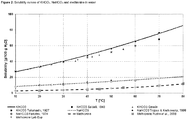
Figure 1 ), methionine is precipitated and removed from the process solution. However, due to the low difference in the solubility of sodium hydrogencarbonate and methionine (Figure 2 ), large quantities of sodium hydrogencarbonate are co-precipitated with methionine in case that sodium salt of methionine is used in this reaction. Therefore, in the carbonisation reaction the potassium salt of methionine is used, meaning that potassium hydroxide usually is added to the hydantoin hydrolysis circulation process. - The object of the present invention is to provide a process for preparing methionine, comprising the alkaline hydrolysis of 5-(2-methylmercaptoethyl)-hydantoin (methionine hydantoin) in an aqueous process solution comprising potassium hydroxide and/or carbonate and/or hydrogencarbonate to form methionine potassium salt, precipitation of methionine by means of carbon dioxide, separation of the precipitated methionine from the process solution, concentration of the process solution and recycling of the process solution to the alkaline hydrolysis of methionine hydantoin, wherein the potassium cations in the process solution are partly replaced by sodium cations in order to avoid losses of the relatively expensive potassium salts in the purge solution stream.
- It was found that in the process solution resulting from the hydantoin hydrolysis reaction a large part of potassium can be replaced by sodium without the undesired co-precipitation of sodium hydrogencarbonate in the carbonation reaction.
- This object is achieved by a process for preparing methionine, comprising the alkaline hydrolysis of 5-(2-methylmercaptoethyl)-hydantoin (methionine hydantoin) in an aqueous process solution comprising alkali metal hydroxide and/or alkali metal carbonate and/or alkali metal hydrogencarbonate to form methionine alkali metal salt, precipitation of methionine by means of carbon dioxide, separation of the precipitated methionine from the process solution, concentration of the process solution and recycling of the process solution in the alkaline hydrolysis of methionine hydantoin once more forwarded to the process solution, wherein the alkali metal cations in the process solution are potassium and sodium having a K/Na molar ratio range from 99/1 to 20/80.
- During the concentration step the process solution is re-concentrated to its typical starting concentrations of the hydantoin hydrolysis circulation, i.e. comprising approximately 5 to 16 % by weight alkali metal, 5 to 8 % by weight methionine, 3 to 5 % by weight methionylmethionine, 0.7 to 1.1 % by weight formate, and 0.2 to 0.3 % by weight acetate.
- In the process according to the present invention a part of the process solution may continuously be exchanged by fresh alkali metal hydroxide solution.
- In the process according to the present invention the K/Na molar ratio in the process solution preferably ranges from 90/10 to 20/80. Ideally, the K/Na molar ratio in the process solution ranges from 70/30 to 50/50.
- In the process according to the present invention the precipitated methionine is then recrystallized from an aqueous solution, filtered off and dried. The methionine so obtained has a purity greater than 99 % and a potassium content lower than 0.3 % and a sodium content lower than 0.1 %, in particular the potassium content in the crystalline methionine ranges from 0.05 - 0.3 % and the sodium content ranges from 0.01 - 0.1 %.
-
-
Figure 1 shows a scheme of the hydantoin hydrolysis circulation. -
Figure 2 shows the solubility curves of KHCO3, NaHCO3 and methionine in water. The measured values stem from the following sources.
Solubility of KHCO3:- Seidell, 1940: Seidel, A.; Solubility Data Ser., 1940.
- Gmelin: Gmelins Handbuch, 22, 1938.
- Takahashi, 1927: Takahashi, G.; Bull. Imp. Seric. Stn. Tokyo 29, 1927, 165.
- Trypuc & Kielkowska, 1998: Trypuc, M.; Kielkowska, U.; J. Chem. Eng. Data 43 (2), 1998, 201-204. Fedotev, 1904: Fedotev, P. P., Z. Phys. Chem. 49, 1904, 168.
- Fuchs et al., 2006: Fuchs et al., 2006, Ind. Eng. Chem. Res., 45, 6578-6584.
Lab Exp: Results of own laboratory experiments (in accordance to Fuchs et al., 2006).
-
Figure 3 shows the composition of the raw filter cake for different molar ratios K/Na in the process solution (Example 1). - In the carbonation reaction the potassium salt of methionine (K-Met) accompanied by 0.5 equivalents of potassium carbonate is reacted with CO2. KHCO3 is formed and methionine (H-Met) is precipitated (Equations 1 and 2).
K-Met + CO2 + H2O -> H-Met(s) + KHCO3 (Equation 1)
K2CO3 + CO2 + H2O -> 2 KHCO3 (Equation 2)
- Due to the significantly lower solubility of NaHCO3 compared to KHCO3 (
Figure 2 ) the molar ratio of K/Na has to be carefully tuned in order to avoid undesired precipitation of NaHCO3 crystals in the carbonation reactor. - Thus, a series of experiments was carried out in the laboratory to investigate the carbonation reaction with synthetic process solutions for different molar ratios K/Na. The overall alkaline concentration (sum parameter of K and Na) is maintained constant meaning that for a molar ratio K/Na = 70/30 compared to K/Na = 100/0 the potassium concentration is lowered by 30 % and replaced equimolar by sodium. The results of this study are summarized in
Figure 3 . - The methionine content in the filter cake can be considered being constant for molar ratios K/
Na 100/0 to 0/100. The Na-content in the filter cake is slightly increasing for molar ratios K/Na 100/0 to 20/80 up to 3,92 g which can be explained by process solution being attached to and incorporated into the filter cake. However, for molar ratios K/Na 10/90 and 0/100 significantly higher Na content 9.34 - 19.67 g) was observed in the filter cake indicating that NaHCO3 is also partially precipitated. - Thus, it is possible to run the carbonation reaction up to molar ratios K/
Na 20/80 without coprecipitations of sodium hydrogencarbonate. - Experimental procedure for the preparation of a process solution with a molar ratio K/Na of 90/10
- A 1000 ml beaker was placed in an ice bath and KOH (40% in water, 354.2 g, 2.53 mol), NaOH (40% in water, 11.2 g, 0.28 mol), D,L-methionine (159.7 g, 1.07 mol), DL-methionyl-DL-methionine (29.9 g, 0.11 mol) and formic acid (50% in water, 41.4 g, 0.45 mol) were dissolved in 200 ml DI-water and stirred for 45 min. The solution was then warmed to 20 °C, transferred to a 1000 ml volumetric flask and filled up with DI-water to 1000 ml total volume.
- 1100 g of the solution was then transferred to a 2 I Büchi laboratory autoclave and 0.32 g of Defoamer EG2007 were added. Cooling of the autoclave to 30 °C was realized via cooling jacket and cryostat. Mechanical stirring was initiated and the autoclave was pressurized with CO2 gas to 2 barg. The CO2 gas feedstream was adjusted to maintain 2 barg until pH 8 was reached and temperature was maintained at 30 °C. Pressure was released from the autoclave and the suspension was transferred to a vacuum filter frit and sucked dry for 15 min at 940 mbar absolute pressure. The filtrate was collected in a 100 ml glas bottle and diluted with DI-water to avoid precipitation of solids afterwards and balanced subsequently. The filter cake was transferred to 3000 ml beaker via spatula and residual solids in the frit were rinsed into the beaker via DI-water. Additional DI-water was added until the solids have been dissolved. The solution was then transferred to a 3 l glass bottle and balanced. Moreover, the residual solids in the autoclave were also rinsed with DI-water collected in a glass bottle as so-called "Holdup" and balanced.
- The synthetic process solution, the filter cake dissolved in DI-water, the filtrate and the "Holdup" were analysed for their K and Na content via IPC-OES, Met- & Met-Met via HPLC and formate via ion chromatography and the results are summarized in Table 1.
Table 1: Carbonation reaction of synthetic process solution with molar ratio K/Na of 90/10. Quantity g % Met g Met % Met-Met g Met-Met % K g K % Na g Na Start 1099,85 14,14 155,52 2,58 28,38 8,2 90,19 0,59 6,489 Filtrate 1001,1 4,14 41,45 2,25 22,52 7,1 71,08 0,51 5,106 Cake 2930,1 3,47 101,67 0,120 3,52 0,3 8,79 0,02 0,586 Holdup 498,8 1,88 9,38 0,25 1,25 0,75 3,74 0,05 0,249 m F+C+H [g] 152,50 27,29 83,61 5,94 Accuracy [%] 98,06 96,16 92,71 91,55
Claims (6)
- A process for preparing methionine, comprising the alkaline hydrolysis of 5-(2-methylmercaptoethyl)-hydantoin (methionine hydantoin) in an aqueous process solution comprising alkali metal hydroxide and/or alkali metal carbonate and/or alkali metal hydrogencarbonate to form methionine alkali metal salt, precipitation of methionine by means of carbon dioxide, separation of the precipitated methionine from the process solution, concentration of the process solution and recycling of the process solution in the alkaline hydrolysis of methionine hydantoin once more forwarded to the process solution, wherein the alkali metal cations in the process solution are potassium and sodium having a K/Na molar ratio range from 99/1 to 20/80.
- The process as claimed in claim 1, wherein a part of the process solution is continuously exchanged by fresh alkali metal hydroxide solution.
- The process as claimed in claim 1 or 2, wherein the K/Na molar ratio in the process solution ranges from 90/10 to 20/80.
- The process as claimed in claim 3, wherein the K/Na molar ratio in the process solution ranges from 70/30 to 50/50.
- The process as claimed in any of claims 1 to 4, wherein the precipitated methionine is recrystallized from an aqueous solution, filtered off and dried and wherein the crystalline methionine so obtained has a purity greater than 99 % and a potassium content lower than 0.3 % and a sodium content lower than 0.1 %
- The process as claimed in claim 5, wherein the potassium content in the crystalline methionine ranges from 0.05 - 0.3 % and the sodium content ranges from 0.01 - 0.1 %.
Priority Applications (7)
| Application Number | Priority Date | Filing Date | Title |
|---|---|---|---|
| EP17171060.1A EP3404018A1 (en) | 2017-05-15 | 2017-05-15 | Process for preparing methionine |
| JP2019559812A JP7431581B2 (en) | 2017-05-15 | 2018-05-08 | Method for producing methionine |
| PCT/EP2018/061799 WO2018210615A1 (en) | 2017-05-15 | 2018-05-08 | Process for preparing methionine |
| EP18721400.2A EP3625211B1 (en) | 2017-05-15 | 2018-05-08 | Process for preparing methionine |
| US16/605,075 US10919848B2 (en) | 2017-05-15 | 2018-05-08 | Process for preparing methionine |
| CN201880028831.6A CN110678446B (en) | 2017-05-15 | 2018-05-08 | Method for producing methionine |
| SG11201909687Q SG11201909687QA (en) | 2017-05-15 | 2018-05-08 | Process for preparing methionine |
Applications Claiming Priority (1)
| Application Number | Priority Date | Filing Date | Title |
|---|---|---|---|
| EP17171060.1A EP3404018A1 (en) | 2017-05-15 | 2017-05-15 | Process for preparing methionine |
Publications (1)
| Publication Number | Publication Date |
|---|---|
| EP3404018A1 true EP3404018A1 (en) | 2018-11-21 |
Family
ID=58778869
Family Applications (1)
| Application Number | Title | Priority Date | Filing Date |
|---|---|---|---|
| EP17171060.1A Withdrawn EP3404018A1 (en) | 2017-05-15 | 2017-05-15 | Process for preparing methionine |
Country Status (1)
| Country | Link |
|---|---|
| EP (1) | EP3404018A1 (en) |
Citations (5)
| Publication number | Priority date | Publication date | Assignee | Title |
|---|---|---|---|---|
| US4272631A (en) * | 1980-02-25 | 1981-06-09 | Diamond Shamrock Corporation | Hydrolysis of 5-(beta-methylmercaptoethyl)-hydantoin |
| US5770769A (en) | 1995-12-18 | 1998-06-23 | Degussa Aktiengesellschaft | Process for the preparation of D,L-methionine or the salt thereof |
| EP1564208A1 (en) | 2004-02-14 | 2005-08-17 | Degussa Ag | Process for producing methionine |
| WO2013030068A2 (en) | 2011-08-30 | 2013-03-07 | Evonik Degussa Gmbh | Method for producing a methionine salt |
| WO2016170252A1 (en) | 2015-04-21 | 2016-10-27 | Adisseo France S.A.S. | Method for making methionine |
-
2017
- 2017-05-15 EP EP17171060.1A patent/EP3404018A1/en not_active Withdrawn
Patent Citations (5)
| Publication number | Priority date | Publication date | Assignee | Title |
|---|---|---|---|---|
| US4272631A (en) * | 1980-02-25 | 1981-06-09 | Diamond Shamrock Corporation | Hydrolysis of 5-(beta-methylmercaptoethyl)-hydantoin |
| US5770769A (en) | 1995-12-18 | 1998-06-23 | Degussa Aktiengesellschaft | Process for the preparation of D,L-methionine or the salt thereof |
| EP1564208A1 (en) | 2004-02-14 | 2005-08-17 | Degussa Ag | Process for producing methionine |
| WO2013030068A2 (en) | 2011-08-30 | 2013-03-07 | Evonik Degussa Gmbh | Method for producing a methionine salt |
| WO2016170252A1 (en) | 2015-04-21 | 2016-10-27 | Adisseo France S.A.S. | Method for making methionine |
Non-Patent Citations (7)
| Title |
|---|
| FEDOTEV, P. P., Z. PHYS. CHEM., vol. 49, 1904, pages 168 |
| FUCHS ET AL., IND. ENG. CHEM. RES., vol. 45, 2006, pages 6578 - 6584 |
| FUCHS ET AL., LAB EXP: RESULTS OF OWN LABORATORY EXPERIMENTS, 2006 |
| GMELIN: "Gmelins Handbuch", 1938, pages: 22 |
| SEIDEL, A., SOLUBILITY DATA SER., 1940 |
| TAKAHASHI, G., BULL. IMP. SERIC. STN. TOKYO, vol. 29, 1927, pages 165 |
| TRYPUC, M.; KIELKOWSKA, U., J. CHEM. ENG. DATA, vol. 43, no. 2, 1998, pages 201 - 204 |
Similar Documents
| Publication | Publication Date | Title |
|---|---|---|
| US10494335B2 (en) | Method for making methionine | |
| EP2186796B1 (en) | Process for producing methionine | |
| JPWO2003045904A1 (en) | Method for producing methionine | |
| ZA200502074B (en) | Method and device for producing formates and the use thereof | |
| EP3625211B1 (en) | Process for preparing methionine | |
| EP3404018A1 (en) | Process for preparing methionine | |
| EP1394148B1 (en) | Process for the preparation of alpha-amino acids by hydrolysis of hydantoins at elevated presssure and elevated temperature | |
| EP3431465A1 (en) | Process for preparing methionine | |
| US20230348370A1 (en) | Process for making taurine | |
| EP2784063A1 (en) | Method for producing beta-mercaptocarboxylic acid | |
| US20260085038A1 (en) | Process for obtaining mixtures containing methionine and potassium hydrogencarbonate | |
| US20240083858A1 (en) | Process for the diastereomerically pure preparation of dl/ld-methionylmethionine | |
| KR20230148825A (en) | Method and application for producing 2-hydroxy-4-methylthiobutyronitrile or selenium equivalent thereof | |
| US20230109446A1 (en) | Process sulfonation to produce taurine | |
| US20230104350A1 (en) | Process sulfonation of aminoethylene sulfonic ester with carbon dioxide addition to produce taurine | |
| CN116102475A (en) | A kind of methionine composition and preparation method thereof | |
| EP3617187B1 (en) | Methionine production method and production equipment | |
| CN111757867B (en) | Demethylation of methyl esters of methionine and its hydroxy analogues | |
| IT201800009372A1 (en) | PROCESS FOR THE SYNTHESIS OF CARGLUMIC ACID | |
| CN119317633A (en) | Recovery of methionylmethionine from aqueous media containing alkali metal ions | |
| JPH03232847A (en) | Production of glycine |
Legal Events
| Date | Code | Title | Description |
|---|---|---|---|
| PUAI | Public reference made under article 153(3) epc to a published international application that has entered the european phase |
Free format text: ORIGINAL CODE: 0009012 |
|
| AK | Designated contracting states |
Kind code of ref document: A1 Designated state(s): AL AT BE BG CH CY CZ DE DK EE ES FI FR GB GR HR HU IE IS IT LI LT LU LV MC MK MT NL NO PL PT RO RS SE SI SK SM TR |
|
| AX | Request for extension of the european patent |
Extension state: BA ME |
|
| STAA | Information on the status of an ep patent application or granted ep patent |
Free format text: STATUS: THE APPLICATION IS DEEMED TO BE WITHDRAWN |
|
| 18D | Application deemed to be withdrawn |
Effective date: 20190522 |