EP3402140A1 - Varying a per-hop-bandwidth constraint in multi-path label switched paths - Google Patents
Varying a per-hop-bandwidth constraint in multi-path label switched paths Download PDFInfo
- Publication number
- EP3402140A1 EP3402140A1 EP18165174.6A EP18165174A EP3402140A1 EP 3402140 A1 EP3402140 A1 EP 3402140A1 EP 18165174 A EP18165174 A EP 18165174A EP 3402140 A1 EP3402140 A1 EP 3402140A1
- Authority
- EP
- European Patent Office
- Prior art keywords
- per
- router
- lsp
- hop bandwidth
- resource reservation
- Prior art date
- Legal status (The legal status is an assumption and is not a legal conclusion. Google has not performed a legal analysis and makes no representation as to the accuracy of the status listed.)
- Granted
Links
Images





Classifications
-
- H—ELECTRICITY
- H04—ELECTRIC COMMUNICATION TECHNIQUE
- H04L—TRANSMISSION OF DIGITAL INFORMATION, e.g. TELEGRAPHIC COMMUNICATION
- H04L45/00—Routing or path finding of packets in data switching networks
- H04L45/20—Hop count for routing purposes, e.g. TTL
-
- H—ELECTRICITY
- H04—ELECTRIC COMMUNICATION TECHNIQUE
- H04L—TRANSMISSION OF DIGITAL INFORMATION, e.g. TELEGRAPHIC COMMUNICATION
- H04L45/00—Routing or path finding of packets in data switching networks
- H04L45/50—Routing or path finding of packets in data switching networks using label swapping, e.g. multi-protocol label switch [MPLS]
-
- H—ELECTRICITY
- H04—ELECTRIC COMMUNICATION TECHNIQUE
- H04L—TRANSMISSION OF DIGITAL INFORMATION, e.g. TELEGRAPHIC COMMUNICATION
- H04L45/00—Routing or path finding of packets in data switching networks
- H04L45/02—Topology update or discovery
- H04L45/10—Routing in connection-oriented networks, e.g. X.25 or ATM
-
- H—ELECTRICITY
- H04—ELECTRIC COMMUNICATION TECHNIQUE
- H04L—TRANSMISSION OF DIGITAL INFORMATION, e.g. TELEGRAPHIC COMMUNICATION
- H04L45/00—Routing or path finding of packets in data switching networks
- H04L45/16—Multipoint routing
-
- H—ELECTRICITY
- H04—ELECTRIC COMMUNICATION TECHNIQUE
- H04L—TRANSMISSION OF DIGITAL INFORMATION, e.g. TELEGRAPHIC COMMUNICATION
- H04L45/00—Routing or path finding of packets in data switching networks
- H04L45/24—Multipath
-
- H—ELECTRICITY
- H04—ELECTRIC COMMUNICATION TECHNIQUE
- H04L—TRANSMISSION OF DIGITAL INFORMATION, e.g. TELEGRAPHIC COMMUNICATION
- H04L45/00—Routing or path finding of packets in data switching networks
- H04L45/34—Source routing
-
- H—ELECTRICITY
- H04—ELECTRIC COMMUNICATION TECHNIQUE
- H04L—TRANSMISSION OF DIGITAL INFORMATION, e.g. TELEGRAPHIC COMMUNICATION
- H04L45/00—Routing or path finding of packets in data switching networks
- H04L45/58—Association of routers
-
- H—ELECTRICITY
- H04—ELECTRIC COMMUNICATION TECHNIQUE
- H04L—TRANSMISSION OF DIGITAL INFORMATION, e.g. TELEGRAPHIC COMMUNICATION
- H04L45/00—Routing or path finding of packets in data switching networks
- H04L45/66—Layer 2 routing, e.g. in Ethernet based MAN's
-
- H—ELECTRICITY
- H04—ELECTRIC COMMUNICATION TECHNIQUE
- H04L—TRANSMISSION OF DIGITAL INFORMATION, e.g. TELEGRAPHIC COMMUNICATION
- H04L47/00—Traffic control in data switching networks
- H04L47/10—Flow control; Congestion control
- H04L47/12—Avoiding congestion; Recovering from congestion
- H04L47/125—Avoiding congestion; Recovering from congestion by balancing the load, e.g. traffic engineering
-
- H—ELECTRICITY
- H04—ELECTRIC COMMUNICATION TECHNIQUE
- H04L—TRANSMISSION OF DIGITAL INFORMATION, e.g. TELEGRAPHIC COMMUNICATION
- H04L47/00—Traffic control in data switching networks
- H04L47/70—Admission control; Resource allocation
-
- H—ELECTRICITY
- H04—ELECTRIC COMMUNICATION TECHNIQUE
- H04L—TRANSMISSION OF DIGITAL INFORMATION, e.g. TELEGRAPHIC COMMUNICATION
- H04L47/00—Traffic control in data switching networks
- H04L47/70—Admission control; Resource allocation
- H04L47/72—Admission control; Resource allocation using reservation actions during connection setup
- H04L47/724—Admission control; Resource allocation using reservation actions during connection setup at intermediate nodes, e.g. resource reservation protocol [RSVP]
-
- H—ELECTRICITY
- H04—ELECTRIC COMMUNICATION TECHNIQUE
- H04L—TRANSMISSION OF DIGITAL INFORMATION, e.g. TELEGRAPHIC COMMUNICATION
- H04L47/00—Traffic control in data switching networks
- H04L47/70—Admission control; Resource allocation
- H04L47/72—Admission control; Resource allocation using reservation actions during connection setup
- H04L47/726—Reserving resources in multiple paths to be used simultaneously
-
- H—ELECTRICITY
- H04—ELECTRIC COMMUNICATION TECHNIQUE
- H04L—TRANSMISSION OF DIGITAL INFORMATION, e.g. TELEGRAPHIC COMMUNICATION
- H04L47/00—Traffic control in data switching networks
- H04L47/70—Admission control; Resource allocation
- H04L47/74—Admission control; Resource allocation measures in reaction to resource unavailability
- H04L47/748—Negotiation of resources, e.g. modification of a request
-
- H—ELECTRICITY
- H04—ELECTRIC COMMUNICATION TECHNIQUE
- H04L—TRANSMISSION OF DIGITAL INFORMATION, e.g. TELEGRAPHIC COMMUNICATION
- H04L47/00—Traffic control in data switching networks
- H04L47/70—Admission control; Resource allocation
- H04L47/82—Miscellaneous aspects
- H04L47/825—Involving tunnels, e.g. MPLS
Definitions
- the disclosure relates to computer networks and, more particularly, to engineering traffic flows within computer networks.
- the term "link” is often used to refer to the connection between two devices on a computer network.
- the link may be a physical medium, such as a copper wire, a coaxial cable, any of a host of different fiber optic lines or a wireless connection.
- network devices may define "virtual" or “logical” links, and map the virtual links to the physical links. As networks grow in size and complexity, the traffic on any given link may approach a maximum bandwidth capacity for the link, thereby leading to congestion and loss.
- Multi-protocol Label Switching is a mechanism used to engineer traffic patterns within Internet Protocol (IP) networks.
- IP Internet Protocol
- MPLS Multi-protocol Label Switching
- a source device can request a path through a network, i.e., a Label Switched Path (LSP).
- LSP Label Switched Path
- An LSP defines a distinct path through the network to carry MPLS packets from the source device to a destination device.
- a short label associated with a particular LSP is affixed to packets that travel through the network via the LSP.
- Routers along the path cooperatively perform MPLS operations to forward the MPLS packets along the established path.
- LSPs may be used for a variety of traffic engineering purposes including bandwidth management and quality of service (QoS).
- QoS quality of service
- LDP label distribution protocol
- LSRs label switching routers
- RSVP-TE Resource Reservation Protocol with Traffic Engineering extensions
- RSVP-TE uses constraint information, such as bandwidth availability, to compute and establish LSPs within a network.
- RSVP-TE may use bandwidth availability information accumulated by a link-state interior routing protocol, such as the Intermediate System - Intermediate System (ISIS) protocol or the Open Shortest Path First (OSPF) protocol.
- ISIS Intermediate System - Intermediate System
- OSPF Open Shortest Path First
- RSVP-TE establishes LSPs from an ingress device to an egress device.
- RSVP Resource Reservation Protocol
- RFC 3209 " RSVP-TE: Extensions to RSVP for LSP Tunnels," IETF, December 2001 , hereby incorporated by reference, and referred to herein as "RFC 3209.”
- RSVP objects to define LSPs is described in RFC 2210, " The Use of RSVP with IETF Integrated Services, IETF, September 1997 , hereby incorporated by reference, and referred to herein as "RFC 2210.”
- the disclosure is directed toward techniques for establishing a multi-path label switched path (referred to as "multiple path LSP," or simply "MP-LSP") that permits a sub-label-switched paths (sub-LSPs) of the MP-LSP to define a bandwidth constraint that can vary at any hop along a path of the MP-LSP.
- MP-LSP multi-path label switched path
- an ingress router may permit two or more sub-LSPs of a MP-LSP to have varying incoming and outgoing bandwidths at a common transit router when a decrease in bandwidth at one of the sub-LSPs is satisfied by an increase at another sub-LSP.
- a method comprises computing, by an ingress router, a plurality of paths for a plurality of sub-LSPs of a MP-LSP.
- Computing the plurality of paths comprises determining, for a common transit router, a plurality of incoming per-hop bandwidth constraints for the plurality of paths and a plurality of outgoing per-hop bandwidth constraints for the plurality of paths.
- a sum of a quantity of bandwidth to be reserved by the plurality of incoming per-hop bandwidth constraints corresponds to a sum of a quantity of bandwidth to be reserved by the plurality of outgoing per-hop bandwidth constraints.
- a respective incoming per-hop bandwidth constraint of the plurality of incoming per-hop bandwidth constraints has a different value than a respective outgoing per-hop bandwidth constraint of the plurality of outgoing per-hop bandwidth constraints.
- the method further includes outputting, by the ingress router, for each path of the plurality of paths, a respective resource reservation request message to establish a respective sub-LSP of the plurality of sub-LSPs.
- Each respective resource reservation request message includes an indication of an explicit route, a tunnel identifier indicating the MP-LSP, an identifier for the respective sub-LSP, an indication of a per-hop bandwidth constraint that corresponds to a respective incoming per-hop bandwidth constraint of the plurality of incoming per-hop bandwidth constraints, and one or more instructions to modify the indication of the per-hop bandwidth constraint.
- the one or more instructions includes an instruction to modify the indication of the per-hop bandwidth constraint at the common transit router to correspond to a respective outgoing per-hop bandwidth constraint of the plurality of outgoing per-hop bandwidth constraints.
- a router comprises one or more processors implemented in circuitry.
- the one or more processors are configured to compute a plurality of paths for a plurality of sub-LSPs of a MP-LSP.
- Computing the plurality of paths comprises determining, for a common transit router, a plurality of incoming per-hop bandwidth constraints for the plurality of paths and a plurality of outgoing per-hop bandwidth constraints for the plurality of paths.
- a sum of a quantity of bandwidth to be reserved by the plurality of incoming per-hop bandwidth constraints corresponds to a sum of a quantity of bandwidth to be reserved by the plurality of outgoing per-hop bandwidth constraints.
- a respective incoming per-hop bandwidth constraint of the plurality of incoming per-hop bandwidth constraints has a different value than a respective outgoing per-hop bandwidth constraint of the plurality of outgoing per-hop bandwidth constraints.
- the one or more processors are further configured to output, for each path of the plurality of paths, a respective resource reservation request message to establish a respective sub-LSP of the plurality of sub-LSPs.
- Each respective resource reservation request message includes an indication of an explicit route, a tunnel identifier indicating the MP-LSP, an identifier for the respective sub-LSP, an indication of a per-hop bandwidth constraint that corresponds to a respective incoming per-hop bandwidth constraint of the plurality of incoming per-hop bandwidth constraints, and one or more instructions to modify the indication of the per-hop bandwidth constraint.
- the one or more instructions includes an instruction to modify the indication of the per-hop bandwidth constraint at the common transit router to correspond to a respective outgoing per-hop bandwidth constraint of the plurality of outgoing per-hop bandwidth constraints.
- a computer-readable storage medium comprises instructions for causing a programmable processor to compute a plurality of paths for a plurality of sub-LSPs of a MP-LSP.
- Computing the plurality of paths comprises determining, for a common transit router, a plurality of incoming per-hop bandwidth constraints for the plurality of paths and a plurality of outgoing per-hop bandwidth constraints for the plurality of paths.
- a sum of a quantity of bandwidth to be reserved by the plurality of incoming per-hop bandwidth constraints corresponds to a sum of a quantity of bandwidth to be reserved by the plurality of outgoing per-hop bandwidth constraints.
- a respective incoming per-hop bandwidth constraint of the plurality of incoming per-hop bandwidth constraints has a different value than a respective outgoing per-hop bandwidth constraint of the plurality of outgoing per-hop bandwidth constraints.
- the instructions further cause the programmable processor to output, for each path of the plurality of paths, a respective resource reservation request message to establish a respective sub-LSP of the plurality of sub-LSPs.
- Each respective resource reservation request message includes an indication of an explicit route, a tunnel identifier indicating the MP-LSP, an identifier for the respective sub-LSP, an indication of a per-hop bandwidth constraint that corresponds to a respective incoming per-hop bandwidth constraint of the plurality of incoming per-hop bandwidth constraints, and one or more instructions to modify the indication of the per-hop bandwidth constraint.
- the one or more instructions includes an instruction to modify the indication of the per-hop bandwidth constraint at the common transit router to correspond to a respective outgoing per-hop bandwidth constraint of the plurality of outgoing per-hop bandwidth constraints.
- a method comprises receiving, by a transit router, for a path for a sub-LSP of a MP-LSP, a resource reservation request message to establish the sub-LSP.
- the resource reservation request message including an indication of an explicit route, a tunnel identifier indicating the MP-LSP, an indication of a per-hop bandwidth constraint that corresponds to a first per-hop bandwidth constraint, and one or more instructions to modify the indication of the per-hop bandwidth constraint.
- the one or more instructions including an instruction to modify the indication of the per-hop bandwidth constraint at the transit router to correspond to a second per-hop bandwidth constraint that has a different value than the first per-hop bandwidth constraint.
- the method further includes modifying, by the transit router, the indication of the per-hop bandwidth constraint to correspond to the second per-hop bandwidth constraint; and outputting, by the transit router, after modifying the indication of the per-hop bandwidth constraint, the resource reservation request message.
- a router comprises one or more processors implemented in circuitry.
- the one or more processors are configured to receive, for a sub-LSP of a MP-LSP, a resource reservation request message to establish the sub-LSP.
- the resource reservation request message includes an indication of an explicit route, a tunnel identifier indicating the MP-LSP, an indication of a per-hop bandwidth constraint that corresponds to a first per-hop bandwidth constraint, and one or more instructions to modify the indication of the per-hop bandwidth constraint.
- the one or more instructions includes an instruction to modify the indication of the per-hop bandwidth constraint at the transit router to correspond to a second per-hop bandwidth constraint that has a different value than the first per-hop bandwidth constraint.
- the one or more processors are further configured to modify the indication of the per-hop bandwidth constraint to correspond to the second per-hop bandwidth constraint and output, after modifying the indication of the per-hop bandwidth constraint, the resource reservation request message.
- a computer-readable storage medium comprises instructions for causing a programmable processor to receive, for a sub-LSP of a MP-LSP, a resource reservation request message to establish the sub-LSP.
- the resource reservation request message includes an indication of an explicit route, a tunnel identifier indicating the MP-LSP, an indication of a per-hop bandwidth constraint that corresponds to a first per-hop bandwidth constraint, and one or more instructions to modify the indication of the per-hop bandwidth constraint.
- the instructions further cause the programmable processor to modify the indication of the per-hop bandwidth constraint at the transit router to correspond to a second per-hop bandwidth constraint that has a different value than the first per-hop bandwidth constraint.
- the one or more processors are further configured to modify the indication of the per-hop bandwidth constraint to correspond to the second per-hop bandwidth constraint and output, after modifying the indication of the per-hop bandwidth constraint, the resource reservation request message.
- a device may be configured to use a variety of protocols to establish label switched paths (LSP).
- LSP label switched paths
- a device may establish a LSP having reserved bandwidth using the Resource Reservation Protocol with Traffic Engineering extensions (RSVP-TE).
- RSVP-TE Resource Reservation Protocol with Traffic Engineering extensions
- the techniques described herein include extensions to the RSVP-TE protocol that enable a router to send resource reservation request messages for establishing a sub-LSP specifying a bandwidth constraint that may vary per hop along the sub-LSP.
- an ingress router may permit a bandwidth constraint to vary at a hop along a sub-LSP.
- the ingress router may establish a first sub-LSP extending between the ingress router and an egress router and a second sub-LSP extending between the ingress router and the egress router.
- the first and second sub-LSPs both include a hop at a common transit router.
- techniques described herein permit the ingress router to vary a bandwidth constraint of the first and second sub-LSPs at a hop corresponding to the common transit router.
- the ingress router may establish the first sub-LSP specifying a single per-hop bandwidth constraint with an instruction for the common transit router to increase the single per-hop bandwidth constraint for the first sub-LSP by 30 megabytes per second and establish the second sub-LSP specifying a single per-hop bandwidth constraint with an instruction for the common transit router to decrease the single per-hop bandwidth constraint for the second sub-LSP by 30 megabytes per second.
- the techniques described herein include extensions to the RSVP-TE protocol that enable routers to establish a MP-LSP that permits varying bandwidth at sub-LSPs of the MP-LSP. For example, rather than requiring a router to split a single sub-LSP that extends between an ingress router and an egress router into multiple sub-LSPs, the techniques permit a resource reservation request message to include an instruction to modify an indication of the per-hop bandwidth constraint of a sub-LSP at a hop between an ingress router and an egress router for the MP-LSP. This may reduce the need for additional sub-LSPs in the network, thereby potentially reducing an amount of computing resources for sending signaling messages and storing state for the additional sub-LSPs.
- the techniques may provide one or more advantages.
- the techniques may allow devices within the network to make better use of the available bandwidth on various paths across the network. Said differently, being able to vary a per-hop-bandwidth constraint when setting up a sub-LSP may facilitate better network utilization by splitting traffic for a MP-LSP at transit routers and allowing different bandwidth values to be reserved per-hop along the MP-LSP.
- the techniques described herein for variable per-hop bandwidth signaling may reduce the amount of state needed to be maintained in the network, because the techniques would potentially establish fewer sub-LSPs between a pair of endpoints as compared to techniques that do not use variable per-hop bandwidth signaling.
- FIG. 1 is a block diagram illustrating a system 10 that includes an example computer network 14 having MP-LSP 16 established over links 22A-22F (collectively, links 22) of network 14 between an ingress router 12A and an egress router 12B.
- MP-LSP 16 may include a RSVP-TE LSP.
- routers 12A-12G (collectively, routers 12) use a modified RSVP-TE protocol that has been extended to enable a varying per-hop bandwidth constraint for sub-LSPs of the MP-LSP, as described herein.
- An ingress router 12A may be configured to establish MP-LSP 16 having sub-LSPs 18A-18B (collectively, sub-LSPs 18) of the MP-LSP.
- MP-LSP 16 may be viewed as a point-to-point tunnel between a single ingress and a single egress that is constructed to contain multiple, intermediate sub-LSPs. Packets are sent from router 12A (also referred to as "ingress router 12A") to router 12B (also referred to as "egress router 12B”) via one of the sub-LSPs 18.
- router 12A also referred to as "ingress router 12A”
- egress router 12B also referred to as "egress router 12B”
- Network 14 may include a greater number of routers than are shown in FIG. 1 .
- the ultimate sources of the network traffic may comprise one or more devices and/or any public or private network or the Internet (not shown) that provides traffic to ingress router 12A in network 14.
- the ultimate destinations of the network traffic may comprise one or more destination devices and/or network (not shown) that may include LANs or wide area networks (WANs) that comprise a plurality of devices.
- destination devices may include personal computers, laptops, workstations, personal digital assistants (PDAs), wireless devices, network-ready appliances, file servers, print servers or other devices that access the source via network 14.
- PDAs personal digital assistants
- RSVP-TE may enable ingress router 12A to calculate paths for multiple sub-LSPs 18 towards egress router(s) 12B, and to send multiple resource reservation request messages for MP-LSP 16 to downstream routers 12 along selected ones of the sub-LSPs 18. Because sub-LSPs 18 may be permitted to have varying bandwidth at different hops between routers 12, routers 12 may be required to store less state in network 14 than if separate smaller LSPs (not shown) having constant bandwidth were constructed for each path extending between egress router 12A and ingress router 12B.
- Network 14 may be configured to establish LSPs connecting routers 12 that are not associated with MP-LSP 16.
- LSPs 17 may have reserved bandwidth between routers 12 of network 14.
- LSP 17A reserves a bandwidth (e.g., 50 megabytes per second) on link 22A that extends between router 12A and 12C
- LSP 17B reserves a bandwidth (e.g., 50 megabytes per second) on link 22E that extends between router 12A and 12G
- LSP 17C reserves a bandwidth (e.g., 70 megabytes per second) on link 22C that extends between router 12G and 12D
- LSP 17D reserves a bandwidth (e.g., 30 megabytes per second) on link 22F that extends between router 12G and 12B.
- RSVP-TE may enable ingress router 12A to calculate paths for multiple sub-LSPs towards egress router(s) 12B that account for the previously reserved bandwidths of LSPs 17 while signaling the new sub-LSPs with varying per-hop bandwidths.
- ingress router 12A uses the extended RSVP-TE protocol to compute some or all of the available sub-LSPs to egress router 12B that satisfy certain constraints on the tunnel imposed by the network administrator. Constraints imposed may include, for example, bandwidth, link color, Shared Risk Link Group (SRLG), and the like. For example, a network administrator may wish to configure MP-LSP 16 for network traffic of 100 megabytes per second. RSVP-TE uses constraint information about links within network 14, such as bandwidth availability, to compute the sub-LSPs.
- PCE Path Computation Engine
- RSVP-TE may use bandwidth availability information accumulated by a link-state interior routing protocol, such as the Intermediate System - Intermediate System (ISIS) protocol or the Open Shortest Path First (OSPF) protocol.
- ISIS Intermediate System - Intermediate System
- OSPF Open Shortest Path First
- the ingress router 12A executing RSVP-TE as extended herein computes multiple sub-LSPs for which certain constraints, including bandwidth, provide the requisite bandwidth availability in sum. This is described in further detail in the examples below.
- an external entity such as a PCE may compute the sub-LSPs that ingress router 12A can then establish to establish MP-LSP 16.
- ingress router 12A may signal P2P sub-LSPs (associated components of MP-LSP 16) such that a hop of the sub-LSP may have a different bandwidth requested when compared to other hops. Additionally, ingress router 12A may include an accounting mechanism such that when computing MP-LSP 16, at every hop along a sub-LSP, a sum of a quantity of bandwidth to be reserved by incoming per-hop bandwidth constraints for MP-LSP 16 correspond (e.g., are equal) to a sum of a quantity of bandwidth to be reserved by outgoing per-hop bandwidth constraints.
- ingress router 12A may determine total incoming and outgoing per-hop bandwidth constraints for MP-LSP 16. Specifically, in this example, ingress router 12A may decrease a per-hop bandwidth constraint from router 12C to router 12G of 50 megabytes per second to a per-hop bandwidth constraint from router 12G to router 12D of 30 megabytes per second. In this example, ingress router 12A may determine total incoming and outgoing per-hop bandwidth constraints for MP-LSP 16 that include an increase in reserved bandwidth on sub-LSP 18B.
- ingress router 12A may increase a per-hop bandwidth constraint from ingress router 12A to router 12G of 50 megabytes per second to a per-hop bandwidth constraint from router 12G to egress router 12B of 70 megabytes per second. In this manner, ingress router 12A matches total incoming per-hop bandwidth constraints (e.g., 100 megabytes per second) at a hop at router 12G with total outgoing per-hop bandwidth constraints (e.g., 100 megabytes per second) at the hop at router 12G, while permitting varying bandwidth at sub-LSPs 18 of MP-LSP 16.
- total incoming per-hop bandwidth constraints e.g., 100 megabytes per second
- total outgoing per-hop bandwidth constraints e.g., 100 megabytes per second
- routers 12 may be configured to use extensions to the RSVP-TE protocol that enable routers 12 to establish MP-LSP 16 when some routers of routers 12 are not specifically configured for the extensions to the RSVP-TE protocol.
- routers 12 may advertise the capability described in this document (e.g., per node capability advertisement).
- ingress router 12A may initiate LSP signaling with a varying per-hop bandwidth constraint while requiring capable devices to perform a varying-per-hop bandwidth constraint signaling and while not necessarily requiring incapable devices to perform varying per-hop bandwidth constraint-signaling.
- ingress router 12A may establish MP-LSP 16 that instructs router 12G to vary a bandwidth constraint at a hop corresponding to router 12G.
- ingress router 12A may establish MP-LSP 16 because MP-LSP 16 does not vary a bandwidth constraint at a hop corresponding to router 12C.
- the existing standards may allow ingress router 12A to specify an unvarying per-hop bandwidth constraint in a sender traffic specifier (TSPEC) object, also referred to as "SENDER_TSPEC," of a resource reservation request message.
- TSPEC sender traffic specifier
- FIG. 8 An example of a TSPEC object is illustrated in FIG. 8 .
- ingress router 12A may generate one or more instructions for one or more modifications to the unvarying per-hop bandwidth constraint by encoding the one or more modifications in a sender TSPEC modification object, also referred to as "SENDER_TSPEC_MODS object.”
- An example of a TSPEC modification object is illustrated in FIGs. 8 and 9 .
- routers 12 that are not specifically configured for extensions to the RSVP-TE protocol that permit a respective router to vary bandwidth constraints at a hop, may be used to establish MP-LSP 16 using a sender TSPEC object while ignoring the sender TSPEC modification object, thereby permitting routers 12 to establish MP-LSP 16 when some routers of routers 12 are not specifically configured for the extensions to the RSVP-TE protocol.
- Router 12A may be configured as a single ingress for MP-LSP 16 that supports certain constraint requirements specified in the request, including, for instance, an overall bandwidth constraint of one hundred megabytes per second of network traffic.
- RSVP-TE executing on router 12A may be configured to compute the sub-LSPs to egress router 12B using constraint information about links within network 14. The constraint information may be collected by router 12A executing a link-state protocol.
- Such constraint information may include a per-node-capability-advertisement (e.g., advertised capability information).
- This advertisement capability may be advertised prior to generating resource reservation request messages to establish MP-LSP 16.
- router 12A may (initiate and) receive a per-node-capability-advertisement such that that if a sub-LSP of MP-LSP 16 is established by routers 12, per-hop bandwidth constraints may be honored by all routers 12 that are listed in an explicit route object. Otherwise, ingress router 12A may configure a sub-LSP of MP-LSP 16 for which ingress router 12A requests a router that is not configured to modify per-hop bandwidth constraints to modify a certain per-hop bandwidth constraint.
- routers 12 may advertise the per-hop bandwidth constraint capability using IGP-TE extensions. For example, ingress router 12A may advertise the per-hop bandwidth constraint capability by including the capability information in IGP-TE messages exchanged by the routers 12.
- Ingress routers requesting a varying per-hop bandwidth constraint from a capable node is discussed in the following.
- the ingress device e.g., ingress router 12A
- the ingress device e.g., ingress router 12A
- CSPF constrained shortest path first
- router 12A in response to the request, computes paths for sub-LSP 18A along links 22A-22D toward egress router 12B. Ingress router 12A also identifies sub-LSP 18B along links 22E-22F toward egress router 12B. At this time, based on network state data maintained by the RSVP protocol, ingress router 12A may determine the amount of bandwidth available for reservation along both sub-LSPs 18A, 18B, and may output multiple resource reservation request messages so as to establish two sub-LSPs that together satisfy the overall bandwidth requirements.
- ingress router 12A may determine that 50 megabytes per second of bandwidth is available for reservation along sub-LSP 18A between ingress router 12A and transit router 12G and that 50 megabytes per second of bandwidth can be reserved. In this example, router 12A may determine that 30 megabytes per second of bandwidth is available for reservation along sub-LSP 18A between transit router 12G and egress router 12B and that 70 megabytes per second of bandwidth can be reserved along sub-LSP 18B between transit router 12G and egress router 12B.
- sub-LSPs 18A and 18B can accommodate the required total of 100 megabytes per second of network traffic for MP-LSP 16. That is, for example, a sum of a quantity of bandwidth to be reserved by incoming per-hop bandwidth constraints for transit router 12G may correspond (e.g., is equal) to a sum of a quantity of bandwidth to be reserved by outgoing per-hop bandwidth constraints for transit router 12G, while, for each path of paths for MP-LSP 16, a respective incoming per-hop bandwidth constraint for transit router 12G has a different value than a respective outgoing per-hop bandwidth constraint for transit router 12G.
- a path for sub-LSP 18A may include incoming per-hop bandwidth constraint for transit router 12G of 50 megabytes per second that has a different value than an outgoing per-hop bandwidth constraint for transit router 12G of 30 megabytes per second.
- a path for sub-LSP 18B may include incoming per-hop bandwidth constraint for transit router 12G of 50 megabytes per second that has a different value than an outgoing per-hop bandwidth constraint for transit router 12G of 70 megabytes per second.
- a sum of a quantity of bandwidth to be reserved by incoming per-hop bandwidth constraints for transit router 12G of 100 megabytes per second corresponds to a sum of a quantity of bandwidth to be reserved by outgoing per-hop bandwidth constraints for transit router 12G of 100 megabytes per second.
- Ingress router 12A may compute other sub-LSPs to egress router 12B, but may select only the best sub-LSPs that are able to accommodate the total bandwidth requested. In some embodiments, ingress router 12A may be configured with an upper limit on the number of sub-LSPs that can be computed and/or selected.
- ingress router 12A may compute paths for sub-LSPs 18 of MP-LSP 16. To compute the paths, ingress router 12A determines, for router 12G, an incoming per-hop bandwidth constraints for the paths and outgoing per-hop bandwidth constraints for the paths.
- a sum of a quantity of bandwidth to be reserved by the incoming per-hop bandwidth constraints may correspond to a sum of a quantity of bandwidth to be reserved by the outgoing per-hop bandwidth constraints.
- a first sum of a quantity of bandwidth may correspond to a second sum of a quantity of bandwidth when the first sum is equal to the second sum.
- a respective incoming per-hop bandwidth constraint of the incoming per-hop bandwidth constraints has a different value than a respective outgoing per-hop bandwidth constraint of the outgoing per-hop bandwidth constraints.
- ingress router 12A may determine an incoming per-hop bandwidth constraint for a portion of the path from router 12C to router 12G of 50 megabytes per second and an outgoing per-hop bandwidth constraint for a portion of the path from router 12G to router 12D of 30 megabytes per second. In this example, ingress router 12A may determine an incoming per-hop bandwidth constraint for a portion of the path from router 12A to router 12G of 50 megabytes per second and an outgoing per-hop bandwidth constraint for a portion of the path from router 12G to router 12B of 70 megabytes per second.
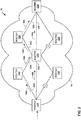
- FIG. 2 is a block diagram illustrating example resource reservation request messages 19A and 19B (collectively, resource reservation request messages 19) sent by routers 12 within computer network 14 for establishing a MP-LSP having a varying per-hop bandwidth constraint.
- ingress router 12A in response to computing sub-LSPs 18 of MP-LPS 16 ( FIG. 1 ), ingress router 12A outputs corresponding resource reservation request messages 19 to establish sub-LSPs 18.
- routers 12 coordinate to send resource reservation request messages 19 to establish sub-LSPs 18 configured for reserving bandwidth from ingress router 12A to egress router 12B.
- ingress router 12A may be configured as the single ingress for an MP-LSP tunnel that, on the whole, supports certain constraint requirements specified in the request, including an overall bandwidth constraint of network traffic.
- Ingress router 12A may be configured to compute, using RSVP-TE, sub-LSPs 18 to egress router 12B using constraint information about links 22 within network 14.
- routers 12 may coordinate to send multiple resource reservation request messages 19 to establish sub-LSPs 18 of FIG. 1 from ingress router 12A to egress router 12B, where each of the sub-LSPs is part of MP-LSP 16 of FIG. 1 .
- the extended RSVP-TE protocol of router 12A outputs resource reservation request message 19A for establishing sub-LSP 18A ( FIG. 1 ).
- resource reservation request message 19A may include an EXPLICIT_ROUTE object that defines each downstream hop along sub-LSP 18A.
- the EXPLICIT_ROUTE object included in resource reservation request message 19A may define a sequence of downstream hops for sub-LSP 18A that includes router 12A, router 12C, router 12G, router 12D, and router 12B.
- router 12C determines that a next downstream hop indicated by the EXPLICIT_ROUTE object included in resource reservation request message 19A is router 12G and may forward resource reservation request message 19A to router 12G.
- resource reservation request message 19B may include an EXPLICIT_ROUTE object that defines each downstream hop along sub-LSP 18B.
- the EXPLICIT_ROUTE object included in resource reservation request message 19B may define a sequence of downstream hops for sub-LSP 18B that includes router 12A, router 12G, and router 12B.
- router 12G may determine that a next downstream hop indicated by the EXPLICIT_ROUTE object included in resource reservation request message 19B is router 12B and may forward resource reservation request message 19B to router 12B.
- each of routers 12 may allocate, for each of resource reservation request messages 19, one or more resources of the transit router to satisfy a per-hop bandwidth constraint of the instruction to modify the indication of the per-hop bandwidth constraint. For example, router 12G may extract a per-hop bandwidth constraint from an indication of the per-hop bandwidth constraint of resource reservation request message 19A and may reserve an amount of bandwidth that satisfies (e.g., is equal to) the per-hop bandwidth constraint extracted from the indication of the per-hop bandwidth constraint.
- router 12G may reserve 50 megabytes per second for sub-LSP 18A when a SENDER_TSPEC object of resource reservation request message 19A includes a token-bucket "rate” field and a "burst” field indicating 50 megabytes per second.
- router 12G may reserve the amount of bandwidth requested in the received resource reservation request message 19B.
- router 12G may reserve 50 megabytes per second for sub-LSP 18B when a SENDER_TSPEC object of resource reservation request message 19B includes a token-bucket "rate” field and a "burst” field indicating 50 megabytes per second.
- ingress router 12A outputs resource reservation request message 19A to router 12C and resource reservation request message 19B to router 12G in accordance with the computed paths (e.g., sub-LSPs 18) for MP-LSP 16 of FIG. 1 .
- resource reservation request messages 19 each include an indication of a per-hop bandwidth constraint that corresponds to 50 megabytes per second.
- ingress router 12A generates and sends, for sub-LSP 18A, resource reservation request message 19A that includes an EXPLICIT_ROUTE object, SESSION_ATTRIBUTE object that includes an extended tunnel ID for MP-LSP 16, and a SENDER_TSPEC object that includes a token-bucket "rate” field and a "burst” field indicating 50 megabytes per second.
- ingress router 12A generates and sends, for sub-LSP 18B, resource reservation request message 19B that includes an EXPLICIT_ROUTE object, SESSION_ATTRIBUTE object that includes an extended tunnel ID for MP-LSP 16, and a SENDER_TSPEC object that includes a token-bucket "rate” field and a "burst” field indicating 50 megabytes per second.
- resource reservation request message 19A may in this example include an instruction to modify the indication of the per-hop bandwidth constraint from 50 megabytes per second to 30 megabytes per second at router 12G and resource reservation request message 19B includes an instruction to modify the indication of the per-hop bandwidth constraint from 50 megabytes per second to 70 megabytes per second at router 12G.
- ingress router 12A generates and sends, for sub-LSP 18A, resource reservation request message 19A that further includes a SENDER_TSPEC_MODS object that includes an address (e.g., IPV4, IPV6, etc.) of router 12G and a corresponding bandwidth mod value that includes a token-bucket "rate” field and a "burst” field indicating 30 megabytes per second.
- SENDER_TSPEC_MODS object that includes an address (e.g., IPV4, IPV6, etc.) of router 12G and a corresponding bandwidth mod value that includes a token-bucket "rate” field and a "burst” field indicating 30 megabytes per second.
- ingress router 12A generates and sends, for sub-LSP 18B, resource reservation request message 19B that further includes a SENDER_TSPEC_MODS object that includes an address (e.g., IPV4, IPV6, etc.) of router 12G and a corresponding bandwidth mod value that includes a token-bucket "rate” field and a "burst” field indicating 70 megabytes per second.
- SENDER_TSPEC_MODS object that includes an address (e.g., IPV4, IPV6, etc.) of router 12G and a corresponding bandwidth mod value that includes a token-bucket "rate” field and a "burst” field indicating 70 megabytes per second.
- router 12C may reserve the amount of bandwidth requested in the received resource reservation request message 19A. For example, router 12C may reserve 50 megabytes per second for sub-LSP 18A when a SENDER_TSPEC object of resource reservation request message 19A includes a token-bucket "rate” field and a "burst” field indicating 50 megabytes per second.
- Router 12C may determine whether to modify the indication of the per-hop bandwidth constraint of resource reservation request message 19A. For example, router 12C may determine to not modify the indication of the per-hop bandwidth constraint of resource reservation request message 19A when a SENDER_TSPEC_MODS object of resource reservation request message 19A does not include an address corresponding to router 12C. In instances where router 12C is not configured for extensions for modifying an indication of the per-hop bandwidth constraint, router 12C may ignore the bandwidth modifications field and may reserve the amount of bandwidth requested in the received resource reservation request message 19A. For instance, router 12C may ignore a SENDER_TSPEC_MODS object of resource reservation request message 19A. In any case, router 12C may forward resource reservation request message 19A to router 12G. For example, in response to determining that the EXPLICIT_ROUTE object included in resource reservation request message 19A indicates a next downstream hop is to router 12G, router 12C may forward resource reservation request message 19A to router 12G.
- router 12G may reserve the amount of bandwidth requested in the received resource reservation request message 19A. For example, router 12G may reserve 50 megabytes per second for sub-LSP 18A when a SENDER_TSPEC object of resource reservation request message 19A includes a token-bucket "rate” field and a "burst” field indicating 50 megabytes per second.
- Router 12G may determine whether to modify the indication of the per-hop bandwidth constraint of resource reservation request message 19A. For example, router 12G may determine to modify the indication of the per-hop bandwidth constraint of resource reservation request message 19A when a SENDER_TSPEC_MODS object of resource reservation request message 19A includes an address corresponding to router 12G. In response to determining to modify the indication of the per-hop bandwidth constraint of resource reservation request message 19A, router 12G may modify resource reservation request message 19A according to the instruction to modify the indication of the per-hop bandwidth constraint.
- router 12G may modify the a token-bucket "rate” field and a "burst" field of the SENDER_TSPEC object of resource reservation request message 19A to indicate 30 megabytes per second when the SENDER_TSPEC_MODS object of resource reservation request message 19A indicates a token-bucket "rate” field and a "burst” field of 30 megabytes per second.
- Router 12G may forward the modified resource reservation request message 19A to router 12D. For example, in response to determining that the EXPLICIT_ROUTE object included in resource reservation request message 19A indicates a next downstream hop is to router 12D, router 12G may forward resource reservation request message 19A to router 12D.
- router 12D may reserve the amount of bandwidth requested in the received resource reservation request message 19A. For example, router 12D may reserve 30 megabytes per second for sub-LSP 18A when a SENDER_TSPEC object of resource reservation request message 19A includes a token-bucket "rate" field and a "burst" field indicating 30 megabytes per second.
- Router 12C may determine whether to modify the indication of the per-hop bandwidth constraint of resource reservation request message 19A. For example, router 12D may determine to not modify the indication of the per-hop bandwidth constraint of resource reservation request message 19A when a SENDER_TSPEC_MODS object of resource reservation request message 19A does not include an address corresponding to router 12D.
- router 12D may ignore the bandwidth modifications field and may reserve the amount of bandwidth requested in the received resource reservation request message 19A. For instance, router 12D may ignore a SENDER_TSPEC_MODS object of resource reservation request message 19A. In any case, router 12D may forward resource reservation request message 19A to router 12B. For example, in response to determining that the EXPLICIT_ROUTE object included in resource reservation request message 19A indicates a next downstream hop is to router 12B, router 12D may forward resource reservation request message 19A to router 12B.
- router 12G may reserve the amount of bandwidth requested in the received resource reservation request message 19B. For example, router 12G may reserve 50 megabytes per second for sub-LSP 18B when a SENDER_TSPEC object of resource reservation request message 19B includes a token-bucket "rate” field and a "burst” field indicating 50 megabytes per second.
- Router 12G may determine whether to modify the indication of the per-hop bandwidth constraint of resource reservation request message 19B. For example, router 12G may determine to modify the indication of the per-hop bandwidth constraint of resource reservation request message 19B when a SENDER_TSPEC_MODS object of resource reservation request message 19B includes an address corresponding to router 12G. In response to determining to modify the indication of the per-hop bandwidth constraint of resource reservation request message 19B, router 12G may modify resource reservation request message 19B according to the instruction to modify the indication of the per-hop bandwidth constraint.
- router 12G may modify the a token-bucket "rate” field and a "burst” field of the SENDER_TSPEC object of resource reservation request message 19B to indicate 70 megabytes per second when the SENDER_TSPEC_MODS object of resource reservation request message 19B indicates a token-bucket "rate” field and a "burst” field of 70 megabytes per second.
- Router 12G may forward resource reservation request message 19B to router 12B.
- router 12G may forward resource reservation request message 19B to router 12B.
- router 12B may reserve the amount of bandwidth requested in the received resource reservation request messages 19. For example, router 12B may reserve 30 megabytes per second for sub-LSP 18A when a SENDER_TSPEC object of resource reservation request message 19A includes a token-bucket "rate” field and a "burst” field indicating 30 megabytes per second. In this example, router 12B may reserve 70 megabytes per second for sub-LSP 18B when a SENDER_TSPEC object of resource reservation request message 19B includes a token-bucket "rate” field and a "burst” field indicating 70 megabytes per second.
- Router 12B may determine that router 12B corresponds to a final downstream hop for sub-LSP 18A. For example, router 12B may determine that router 12B corresponds to a final downstream hop for sub-LSP 18A in response to determining that the EXPLICIT_ROUTE object included in resource reservation request message 19A indicates a final downstream hop is to router 12B. Similarly, router 12B may determine that router 12B corresponds to a final downstream hop for sub-LSP 18B. For example, router 12B may determine that router 12B corresponds to a final downstream hop for sub-LSP 18B in response to determining that the EXPLICIT_ROUTE object included in resource reservation request message 19B indicates a final downstream hop is to router 12B.
- router 12B may generate a resource reservation reply message as discussed in FIG. 3 . Additionally, for both sub-LSP 18A and sub-LSP 18B, rather than router 12G immediately sending a resource reservation reply messages to router 12C and router 12A indicating that router 12G has reserved the requested amounts of bandwidth, router 12G may be configured to wait to send any resource reservation reply messages until after confirming that router 12G has first received resource reservation reply messages from downstream routers along the sub-LSPs, in accordance with the techniques of this disclosure. That is, router 12G may wait to send resource reservation reply messages until router 12G has received replies to both the resource reservation request message 19A sent to router 12D and the resource reservation request message 19B sent to router 12B.
- router 12A may determine, for a second common transit router (not shown), incoming per-hop bandwidth constraints for the paths and outgoing per-hop bandwidth constraints for the paths.
- a sum of a quantity of bandwidth to be reserved by the incoming per-hop bandwidth constraints for the second common transit router may correspond to a sum of a quantity of bandwidth to be reserved by the outgoing per-hop bandwidth constraints for the second common transit router.
- a respective incoming per-hop bandwidth constraint of the incoming per-hop bandwidth constraints for the second common transit router may have a different value than a respective outgoing per-hop bandwidth constraint of the incoming per-hop bandwidth constraints for the second common transit router.
- ingress router 12A may generate, for each path of the paths, a respective resource reservation request message such that the one or more instructions further include an instruction to modify the indication of the per-hop bandwidth constraint at the second common transit router to correspond to a respective outgoing per-hop bandwidth constraint of the outgoing per-hop bandwidth constraints for the second common transit router.
- FIG. 3 is a block diagram illustrating example resource reservation reply message sent by routers 12 within computer network 14 for establishing MP-LSP 16 ( FIG. 1 ) having a varying per-hop bandwidth constraint.
- routers 12 may output resource reservation reply messages 21A and 21B (collectively, resource reservation reply messages 21) messages to upstream routers.
- a transit router may perform admission control on a per sub-LSP basis.
- a transit router needs to take preventive action to mitigate following problems.
- Ingress router 12A may miscompute per-hop bandwidth constraints such that the associated sub-LSPs 18 ( FIG. 1 ) violate a per-hop bandwidth constraint.
- ingress router 12A may miscompute per-hop bandwidth constraint when sub-LSPs 18A reduces a bandwidth constraint by 30 megabytes per second and sub-LSPs 18B increases a bandwidth constraint by only 20 megabytes per second.
- a transit router that is capable of handling a varying per-hop bandwidth constraint may refrain from sending resource reservation reply messages 21 for a given sub-LSP until the bandwidth constraint change of each sub-LSP has been met by another sub-LSP of MP-LSP 16.
- ingress router 12A has initiated signaling of sub-LSPs 18 (the count of which will not be known to a transit router T upfront), with ⁇ incoming bandwidth, outgoing bandwidth, next-hop> requirements at T represented by the following 3-tuples t1: ⁇ 100, 175, B>, t2: ⁇ 200, 125, C>.
- ingress router 12A outputs a SENDER_TSPEC object of resource reservation request message 19A that includes a token-bucket "rate” field and a "burst” field indicating 100 megabytes per second and a SENDER_TSPEC_MODS object of resource reservation request message 19A indicates an instruction (e.g., a SENDER_TSPEC_MODS object) to modify the SENDER_TSPEC object of resource reservation request message 19A, at router 12G, to have a token-bucket "rate” field and a "burst” field indicating 175 megabytes per second.
- an instruction e.g., a SENDER_TSPEC_MODS object
- ingress router 12A outputs a SENDER_TSPEC object of resource reservation request message 19B that includes a token-bucket "rate” field and a "burst” field indicating 200 megabytes per second and a SENDER_TSPEC_MODS object of resource reservation request message 19B indicates an instruction (e.g., a SENDER_TSPEC_MODS object) to modify the SENDER_TSPEC object of resource reservation request message 19B, at router 12G, to have a token-bucket "rate” field and a "burst” field indicating 125 megabytes per second.
- an instruction e.g., a SENDER_TSPEC_MODS object
- resource reservation request messages 19 for sub-LSPs 18 may be sent individually.
- resource reservation request message 19A for sub-LSP 18A may be sent independently from resource reservation request message 19B for sub-LSP 18B.
- router 12G would receive the 2 "3-tuple"s listed above separately. On receipt of such a tuple in resource reservation request messages 19 ( FIG. 2 ), router 12G may forward resource reservation request messages 19 based on assuming admission-control for the individual sub-LSPs can be met.
- router 12G When router 12G, receives resource reservation reply message 21A from router 12D corresponding to tuple "t1", router 12G should delay sending a resource reservation reply message 21A upstream corresponding to the tuple "t1", until router 12G has also received resource reservation reply message 21B from router 12B corresponding to tuple "t2".
- router 12B in response to determining that router 12B corresponds to a last downstream hop of an explicit route for sub-LSP 18A of MP-LSP 16 ( FIG. 1 ), router 12B outputs, via link 22D, resource reservation reply message 21A to router 12D to indicate an acknowledgment of resource reservation request message 19A ( FIG. 2 ). For example, in response to determining that the EXPLICIT_ROUTE object included in resource reservation request message 19A indicates a next upstream hop is to router 12D, router 12B may forward resource reservation reply message 21A to router 12D. Router 12D outputs, via link 22C, resource reservation reply message 21A to router 12G to indicate an acknowledgment of resource reservation request message 19A ( FIG. 2 ). For example, in response to determining that the EXPLICIT_ROUTE object included in resource reservation request message 19A indicates a next upstream hop is to router 12G, router 12D may forward resource reservation reply message 21A to router 12G.
- router 12B in response to determining that router 12B corresponds to a last downstream hop of an explicit route for sub-LSP 18B of MP-LSP 16 ( FIG. 1 ), router 12B outputs, via link 22F, resource reservation reply message 21B to router 12G to indicate an acknowledgment of resource reservation request message 19B ( FIG. 2 ). For example, in response to determining that the EXPLICIT_ROUTE object included in resource reservation request message 19B indicates a next upstream hop is to router 12G, router 12B may forward resource reservation reply message 21B to router 12G.
- router 12G may determine that not all of the expected resource reservation reply messages have been received for MP-LSP 16. In response to determining that not all of the expected resource reservation reply messages have been received for MP-LSP 16, router 12G may delay sending a resource reservation reply message 21 upstream for MP-LSP 16. For example, in response to determining that resource reservation reply message 21A has been received and that resource reservation reply message 21B has not been received, router 12G may delay sending resource reservation reply message 21A upstream for MP-LSP 16 until router 12G has also received resource reservation reply message 21B from router 12B.
- router 12G may delay sending resource reservation reply message 21B upstream for MP-LSP 16 until router 12G has also received resource reservation reply message 21A from router 12D.
- router 12G Upon receipt of both resource reservation reply message 21A from router 12D and resource reservation reply message 21B from router 12B, router 12G determines that all of the expected resource reservation reply messages have been received for MP-LSP 16, and outputs, via link 22B, resource reservation reply message 21A to router 12C to indicate an acknowledgment of resource reservation request message 19A ( FIG. 2 ). Router 12C outputs, via link 22A, resource reservation reply message 21A to router 12A to indicate the requested amounts of bandwidth have been reserved to satisfy resource reservation request message 19A ( FIG. 2 ).
- router 12G determines that all of the expected resource reservation reply messages have been received for MP-LSP 16, and outputs, via link 22E, resource reservation reply message 21B to router 12A to indicate the requested amounts of bandwidth have been reserved to satisfy resource reservation request message 19B ( FIG. 2 ).
- ingress router 12A may forward network traffic indicating sub-LSPs 18 of MP-LSP 16.
- FIG. 4 is a block diagram illustrating an example router 40 capable of supporting RSVP-TE with MP-LSP extensions in accordance with the techniques described herein.
- Router 40 may correspond to any of routers 12 of FIGS. 1-3 .
- Router 40 includes interface cards 54A-54N (collectively, IFCs 54) for receiving packets via input links 56A-56N (collectively, input links 56) and sending packets via output links 57A-57N (collectively, output links 57).
- IFCs 54 are interconnected by a high-speed switch (not shown) and links 56, 57.
- router 40 comprises switch fabric, switchgear, a configurable network switch or hub, and the like.
- Links 56, 57 comprise any form of communication path, such as electrical paths within an integrated circuit, external data busses, optical links, network connections, wireless connections, or other type of communication path.
- IFCs 54 are coupled to input links 56 and output links 57 via a number of interface ports (not shown).
- control unit 42 determines via which of output links 57 to send the packet.
- Control unit 42 includes routing component 44 and forwarding component 46.
- Routing component 44 determines one or more routes through a network, e.g., through interconnected devices such as other routers.
- Control unit 42 provides an operating environment for protocols 48, which are typically implemented as executable software instructions.
- protocols 48 include RSVP-TE 48A and interior gateway protocol (IGP) 48B. Examples of IGP 48B may include, but are not limited to, the Intermediate System - Intermediate System (ISIS) or the Open Shortest Path First (OSPF) protocol.
- Router 40 uses RSVP-TE 48A to set up LSPs.
- RSVP-TE 48A is programmatically extended to allow for a varying per-hop bandwidth constraint.
- Protocols 48 may include other routing protocols in addition to or instead of RSVP-TE 48A and LDP 46B, such as other Multi-protocol Label Switching (MPLS) protocols; or routing protocols, such as the OSPF, routing information protocol (RIP), border gateway protocol (BGP), interior routing protocols, or other network protocols.
- MPLS Multi-protocol Label Switching
- routing protocols such as the OSPF, routing information protocol (RIP), border gateway protocol (BGP), interior routing protocols, or other network protocols.
- routing component 44 By executing the routing protocols, routing component 44 identifies existing routes through the network and determines new routes through the network. Routing component 44 stores routing information in a routing information base (RIB) 50 that includes, for example, known routes through the network. Forwarding component 46 stores forwarding information that includes destinations of output links 57.
- RDB routing information base
- RSVP-TE 48A sends a capabilities advertisement that indicates router 40 is programmatically extended to allow for a varying per-hop bandwidth constraint.
- router 40 may receive capabilities advertisements from other router and store state indicating which routers 12 ( FIG. 1 ) are programmatically extended to allow for a varying per-hop bandwidth constraint. For example, router 40 may send or receive information about these capabilities in a TLV of a link state advertisement sent or received by OSPF or IS-IS with traffic engineering extensions.
- a system administrator 66 may provide configuration information to router 40 via user interface 64 included within control unit 42.
- the system administrator may configure router 40 or install software to extend RSVP-TE 48A as described herein.
- system administrator 66 may configure RSVP-TE 48A to traffic-engineer an MP-LSP from an ingress router to an egress router.
- a path computation element (PCE) 67 may alternatively or additionally provide configuration information to router 40, e.g., may compute the sub-paths and provide them to router 40.
- RSVP-TE 48A The extensions to RSVP-TE 48A described herein enable router 40 to calculate paths for multiple sub-LSPs towards an egress router of an overall RSVP-TE LSP that have a varying per-hop bandwidth constraint and to send multiple resource reservation request messages for the MP-LSP to downstream routers along selected ones of the sub-LSPs. Because the sub-LSPs are all part of the same MP-LSP, router 40 may be required to store less state versus networks that maintain separate LSPs that have a constant per-hop bandwidth constraint since the number of sub-LSPs maybe fewer due to the use of varying per-hop-bandwidth. RSVP-TE 48A may, in some examples, configure forwarding component 46 to reflect a varying per-hop bandwidth constraint for the MP-LSP.
- router 40 uses extended RSVP-TE 48A to compute paths for sub-LSPs of the MP-LSP to the egress router that satisfy certain constraints on the tunnel imposed by the network administrator. Constraints imposed may include, for example, bandwidth, link color, Shared Risk Link Group (SRLG), and the like. For example, the network administrator may wish to configure a MP-LSP that can handle 100 megabytes per second of network traffic. RSVP-TE 48A uses constraint information about links within network 14, such as bandwidth availability, to compute the sub-LSPs.
- RSVP-TE 48A uses constraint information about links within network 14, such as bandwidth availability, to compute the sub-LSPs.
- RSVP-TE 48A may use bandwidth availability information accumulated by a link-state interior routing protocol, such as the Intermediate System - Intermediate System (ISIS) protocol or the Open Shortest Path First (OSPF) protocol, e.g., ISIS or OSPF with traffic-engineering extensions.
- RSVP-TE 48 may use a constrained shortest path first (CSPF) algorithm to compute the paths based on the link bandwidth availability. Where the network topology requires it, RSVP-TE 48A computes multiple sub-LSPs for which certain constraints, including bandwidth, provide the requisite bandwidth availability in sum.
- RSVP-TE 48A takes into account the capabilities of other routers in the network when computing the paths, including the capability of processing resource reservation requests having a SENDER_TSPEC_MODS field as described herein.
- RSVP-TE 48A generates and sends resource reservation request messages for establishing sub-LSPs (including MP-LSPs) as described above with reference to FIGS. 1-3 .
- Routing component 44 may access reservation ("RESV") tracking state 62 to initiate tracking of whether all resource reservation reply message for a respective MP-LSP has been received by router 40. For example, routing component 44 may add an entry in RESV tracking state 62 associated with a MP-LSP for each sub-LSP indicated in resource reservation request messages indicating the MP-LSP.
- RESV reservation
- label allocation module 70 Upon router 40 receiving a resource reservation request messages from a neighboring router, label allocation module 70 allocates MPLS labels used for establishing the LSPs. Router 40 distributes the labels and reserves bandwidth on links using RSVP-TE 48A to generate resource reservation reply messages as described above. Routing component 44 maintains label allocations 60 which specify how label allocation module 70 has allocated the MPLS labels. For example, label allocations 60 may indicate label bindings to particular forwarding equivalence classes (FECs) associated with LSPs within network 14. Label allocation module 70 may then update FIB 52 of forwarding component 46 with the labels to be applied when forwarding packets on LSPs.
- FECs forwarding equivalence classes
- RSVP-TE 48A may also be extended to recognize resource reservation request messages and resource reservation reply messages sent that contain a varying per-hop bandwidth constraint.
- RSVP-TE 48A may be extended to recognize a received resource reservation request messages and resource reservation reply messages as one of a set of messages that collectively are used in the network to establish a MP-LSP based on an indicator (e.g., a special field or bit) set in the resource reservation request messages and resource reservation reply messages, for example.
- an indicator e.g., a special field or bit
- RSVP-TE 48A may be extended to recognize a received resource reservation request messages and resource reservation reply messages as one of a set of messages that collectively are used in the network to establish a particular MP-LSP when each received resource reservation request message of the received resource reservation request messages includes a SESSION_OBJECT that includes a particular extended tunnel identifier corresponding to the particular MP-LSP.
- routing component 44 may update an entry in RESV tracking state 62 associated with the resource reservation reply message and determine whether all resource reservation reply message for a respective MP-LSP has been received by router 40. For example, routing component 44 may update an entry in RESV tracking state 62 associated with a MP-LSP for each sub-LSP indicated in resource reservation request messages indicating the MP-LSP. In this example, routing component 44 may determine that all resource reservation reply message for a respective MP-LSP have been received by router 40 when RESV tracking state 62 indicates that a resource reservation reply message has been received for each one of the entries in RESV tracking state 62 that is associated with the MP-LSP.
- router 40 may initiate a new packet flow of data traffic onto the MP-LSP. For example, when router 40 receives packets of a new packet flow, forwarding component 46 identifies one of output links 57 through which to forward packets of the new packet flow, and also identifies an MPLS label to apply to the packets of the packet flow. After forwarding component 46 has selected one of output links 57 and an MPLS label for a packet flow, forwarding component 46 forwards all packets of the packet flow along the selected one of output links 57 using the selected MPLS label. Forwarding component 46 may refer to link monitoring module 68 to determine whether network traffic is appropriately allocated across output links 57 before assigning a new packet flow to the one of output links 57.
- forwarding component 46 determines whether output links 57 are loaded with the proper bandwidth allocation, e.g., as configured by RSVP-TE 48A during establishment of the MP-LSP. In one example, forwarding component 46 determines a bandwidth utilization for each of output links 57. In another example, forwarding component 46 determines whether a number of packet flows assigned to a particular one of output links 57 has exceeded a threshold. In another example, forwarding component 46 determines a number of packets per second being sent over each of output links 57. In another example, forwarding component 46 determines a number of megabytes per second being sent over each of output links 57.
- forwarding component 46 may utilize a combination of the above-described techniques, or other techniques for determining link congestion. In any case, forwarding component 46 may determine whether usage of output links 57 is consistent with the requirements specified by RSVP-TE 48A for the sub-LSPs running on the output links 57. Forwarding component 46 may also determine when one of the links fails. Forwarding component 46 updates a hash map such that traffic is diverted from the failed link onto other remaining links.
- RSVP-TE 48A outputs resource reservation request messages and resource reservation reply messages for a varying per-hop bandwidth constraint. For example, RSVP-TE 48A outputs resource reservation request message that include an indication of an explicit route for a respective sub-LSP, a tunnel identifier indicating the MP-LSP, an indication of a per-hop bandwidth constraint, and an one or more instructions to modify the indication of the per-hop bandwidth constraint. In some examples, RSVP-TE 48A outputs resource reservation request message that may include further information, such as, but not limited to, objects, descriptors, or other information. In some examples, RSVP-TE 48A outputs resource reservation request message that may omit information, such as, but not limited to, an one or more instructions to modify the indication of the per-hop bandwidth constraint.
- router 40 illustrated in FIG. 4 is shown for example purposes only. The techniques of this disclosure are not limited to this architecture. In other examples, router 40 may be configured differently. In one example, for example, some of the functionally of control unit 42 may be distributed within IFCs 54. In some examples, control unit 42 may include a routing engine that performs routing functions and maintains routing information base (RIB) 50, and a forwarding engine that performs packet forwarding based on a forwarding information base (FIB), generated in accordance with the RIB 50.
- RIB routing information base
- FIB forwarding information base
- Control unit 42 may include one or more processors (not shown in FIG. 4 ) that execute software instructions, such as those used to define a software or computer program, stored to a computer-readable storage medium (again, not shown in FIG. 4 ), such as non-transitory computer-readable mediums including a storage device (e.g., a disk drive, or an optical drive) and/or a memory such as random-access memory (RAM) (including various forms of dynamic RAM (DRAM), e.g., DDR2 SDRAM, or static RAM (SRAM)), Flash memory, another form of fixed or removable storage medium that can be used to carry or store desired program code and program data in the form of instructions or data structures and that can be accessed by a processor, or any other type of volatile or non-volatile memory that stores instructions to cause the one or more processors to perform techniques described herein.
- processors not shown in FIG. 4
- software instructions such as those used to define a software or computer program
- a computer-readable storage medium such as non-transitory
- control unit 42 may include dedicated hardware, such as one or more integrated circuits, one or more Application Specific Integrated Circuits (ASICs), one or more Application Specific Special Processors (ASSPs), one or more Field Programmable Gate Arrays (FPGAs), or any combination of one or more of the foregoing examples of dedicated hardware, for performing the techniques described herein.
- dedicated hardware such as one or more integrated circuits, one or more Application Specific Integrated Circuits (ASICs), one or more Application Specific Special Processors (ASSPs), one or more Field Programmable Gate Arrays (FPGAs), or any combination of one or more of the foregoing examples of dedicated hardware, for performing the techniques described herein.
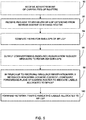
- FIG. 5 is a flowchart illustrating example operation of an ingress router in establishing a MP-LSP having a varying per-hop bandwidth constraint.
- Router 12A may receive an advertisement of capabilities of routers 12 (90).
- ingress router 12 A may receive an indication that router 12G is configured with extensions to RSVP-TE that enable it to process RSVP-TE PATH messages that specify varying per-hop bandwidth constraints.
- router 12 may store the received capabilities information for later use in computing paths.
- Router 12A may receive a request to traffic-engineer an overall RSVP-TE LSP (e.g., MP-LSP of FIG. 1 ) that satisfies certain constraints.
- RSVP-TE LSP e.g., MP-LSP of FIG. 1
- ingress router 12A may receive a request to establish a MP-LSP extending from ingress router 12A to an egress router 12B (92).
- Constraints imposed may include, for example, bandwidth, link color, Shared Risk Link Group (SRLG), and the like.
- SRLG Shared Risk Link Group
- RSVP-TE 48A uses constraint information about links 22 within network 14, such as bandwidth availability, to compute the sub-LSPs that satisfy the overall constraints for the MP-LSP.
- RSVP-TE 48A may use bandwidth availability information accumulated by IGP 48B. RSVP-TE 48A computes sub-LSPs 18 for which certain constraints, including bandwidth, provide the requisite bandwidth availability in sum. RSVP-TE 48A may be configured with an upper limit on how many sub-LSPs can be computed and/or selected.
- RSVP-TE 48A may compute paths for sub-LSPs of a MP-LSP (94). For example, to compute the paths, RSVP-TE 48A may determine, for sub-LSP 18A, an incoming per-hop bandwidth constraint at transit router 12G of 50 megabytes per second and an outgoing per-hop bandwidth constraint at transit router 12G of 30 megabytes per second. In this example, RSVP-TE 48A may compute, for sub-LSP 18B, a path such that an incoming per-hop bandwidth constraint at transit router 12G is 50 megabytes per second and an outgoing per-hop bandwidth constraint at transit router 12G of 70 megabytes per second.
- RSVP-TE 48A For each one of sub-LSPs 18, RSVP-TE 48A outputs a corresponding plurality of resource reservation request messages to establish sub-LSPs (96). For example, RSVP-TE 48A generates and sends, for sub-LSP 18A, resource reservation request message 19A that indicates an explicit route of sub-LSP 18A, a tunnel identifier indicating MP-LSP, and an indication of a per-hop bandwidth constraint.
- RSVP-TE 48A generates and sends, for sub-LSP 18A, resource reservation request message 19A that includes an EXPLICIT_ROUTE object, SESSION_ATTRIBUTE object that includes an extended tunnel ID for MP-LSP 16, and a SENDER_TSPEC object that includes a token-bucket "rate” field and a "burst” field indicating 50 megabytes per second.
- RSVP-TE 48A generates and sends, for sub-LSP 18B, resource reservation request message 19B that indicates an explicit route of sub-LSP 18B, a tunnel identifier indicating the MP-LSP, and an indication of a per-hop bandwidth constraint.
- RSVP-TE 48A generates and sends, for sub-LSP 18B, resource reservation request message 19B that includes an EXPLICIT_ROUTE object, SESSION_ATTRIBUTE object that includes an extended tunnel ID for MP-LSP 16, and a SENDER_TSPEC object that includes a token-bucket "rate” field and a "burst” field indicating 50 megabytes per second.
- resource reservation request messages 19A for sub-LSP 18A further includes an instruction to modify the indication of the per-hop bandwidth constraint at router 12G from 50 megabytes per second to 30 megabytes per second and resource reservation request message 19B for sub-LSP 18B further includes an instruction to modify the indication of the per-hop bandwidth constraint at router 12G from 50 megabytes per second to 70 megabytes per second.
- RSVP-TE 48A generates and sends, for sub-LSP 18A, resource reservation request message 19A that further includes a SENDER_TSPEC_MODS object that includes an address (e.g., IPV4, IPV6, etc.) of router 12G and a corresponding bandwidth mod value that includes a token-bucket "rate” field and a "burst” field indicating 30 megabytes per second.
- SENDER_TSPEC_MODS object that includes an address (e.g., IPV4, IPV6, etc.) of router 12G and a corresponding bandwidth mod value that includes a token-bucket "rate” field and a "burst” field indicating 30 megabytes per second.
- RSVP-TE 48A generates and sends, for sub-LSP 18B, resource reservation request message 19B that further includes a SENDER_TSPEC_MODS object that includes an address (e.g., IPV4, IPV6, etc.) of router 12G and a corresponding bandwidth mod value that includes a token-bucket "rate” field and a "burst” field indicating 70 megabytes per second.
- SENDER_TSPEC_MODS object that includes an address (e.g., IPV4, IPV6, etc.) of router 12G and a corresponding bandwidth mod value that includes a token-bucket "rate” field and a "burst” field indicating 70 megabytes per second.
- router 12B Upon receiving resource reservation request message 19A for sub-LSP 18A, router 12B forwards resource reservation reply message 21A to router 12D, which forwards resource reservation reply message 21A to router 12G. Similarly, upon receiving resource reservation request message 19B for sub-LSP 18A, router 12B forwards resource reservation reply message 21B to router 12G. Upon receiving resource reservation reply messages 21, router 12G forwards resource reservation reply message 21A to router 12C, which forwards resource reservation reply message 21A to router 12A, and forwards resource reservation reply message 21B to router 12A.
- RSVP-TE 48A configures forwarding component 46 of ingress router 12A to indicate labels allocated to the MP-LSP (98). For example, in response to receiving resource reservation reply messages 21 ( FIG. 3 ) indicating an acknowledgment, RSVP-TE 48A configures forwarding component 46 of ingress router 12A to indicate labels allocated to MP-LSP 16 to be used for forwarding network traffic to corresponding next hops along sub-LSPs 18 of MP-LSP 16. Once configured, ingress router 12A may forward network traffic using the MP-LSP (100). For example, RSVP-TE 48A forwards network traffic indicating the labels allocated to the MP-LSP.
- FIG. 6 is a flowchart illustrating example operations of a transit router 12G for establishing a MP-LSP having a varying per-hop bandwidth constraint.
- Transit router 12G may optionally output advertised capability information that indicates whether router 12G is configured to modify a per-hop bandwidth constraint of a resource reservation request message (110).
- transit router 12G may output, to router 12A, advertised capability information that indicates transit router 12G is configured to modify the indication of the per-hop bandwidth constraint.
- ingress router 12A may generate resource reservation request messages that account for the advertised capabilities of transit router 12G. For instance, in response to transit router 12G advertised capabilities for variable bandwidth, ingress router 12A may generate a resource reservation request message that modifies a bandwidth of a sub-LSP at transit router 12G as discussed below.
- Transit router 12G receives resource reservation request messages 19 for sub-LSPs 18 of MP-LSP 16 (112). For example, transit router 12G receives resource reservation request messages 19 that each indicates a reservation of 50 megabytes per second of bandwidth. For instance, transit router 12G receives, for sub-LSP 18A, resource reservation request message 19A that includes an EXPLICIT_ROUTE object, SESSION_ATTRIBUTE object that includes an extended tunnel ID for MP-LSP 16, and a SENDER_TSPEC object that includes a token-bucket "rate” field and a "burst" field indicating 50 megabytes per second.
- transit router 12G receives, for sub-LSP 18B, resource reservation request message 19B that includes an EXPLICIT_ROUTE object, SESSION_ATTRIBUTE object that includes an extended tunnel ID for MP-LSP 16, and a SENDER_TSPEC object that includes a token-bucket "rate” field and a "burst” field indicating 50 megabytes per second.
- resource reservation request message 19A may further include an instruction to modify the indication of the per-hop bandwidth constraint from 50 megabytes per second to 30 megabytes per second at transit router 12G and resource reservation request message 19B further includes an instruction to modify the indication of the per-hop bandwidth constraint from 50 megabytes per second to 70 megabytes per second at router 12G.
- transit router 12G receives, for sub-LSP 18A, resource reservation request message 19A that further includes a SENDER_TSPEC_MODS object that includes an address (e.g., IPV4, IPV6, etc.) of transit router 12G and a corresponding bandwidth mod value that includes a token-bucket "rate” field and a "burst” field indicating 30 megabytes per second.
- transit router 12G receives, for sub-LSP 18B, resource reservation request message 19B that further includes a SENDER_TSPEC_MODS object that includes an address (e.g., IPV4, IPV6, etc.) of router 12G and a corresponding bandwidth mod value that includes a token-bucket "rate” field and a "burst” field indicating 70 megabytes per second.
- SENDER_TSPEC_MODS object that includes an address (e.g., IPV4, IPV6, etc.) of router 12G and a corresponding bandwidth mod value that includes a token-bucket "rate” field and a "burst” field indicating 70 megabytes per second.
- transit router 12G may reserve the amount of bandwidth requested in the received resource reservation request messages 19. For example, transit router 12G may reserve 50 megabytes per second for sub-LSP 18A when a SENDER_TSPEC object of resource reservation request message 19A includes a token-bucket "rate” field and a "burst” field indicating 50 megabytes per second and may reserve 50 megabytes per second for sub-LSP 18B when a SENDER_TSPEC object of resource reservation request message 19B includes a token-bucket "rate” field and a "burst” field indicating 50 megabytes per second.
- transit router 12G modifies an indication of the per-hop bandwidth constraint of each one of the respective resource reservation request messages (114). For example, upon receiving resource reservation request message 19A, transit router 12G modifies an indication of a per-hop bandwidth constraint of resource reservation request message 19A to indicate 30 megabytes per second of bandwidth according to the instruction to modify the indication of the per-hop bandwidth constraint from 50 megabytes per second to 30 megabytes per second at transit router 12G. For instance, transit router 12G modifies, for sub-LSP 18A, a SENDER_TSPEC object of resource reservation request message 19A to include a token-bucket "rate" field and a "burst" field indicating 30 megabytes per second.
- transit router 12G modifies an indication of a per-hop bandwidth constraint of resource reservation request message 19B to indicate 70 megabytes per second of bandwidth according to the instruction to modify the indication of the per-hop bandwidth constraint of from 50 megabytes per second to 70 megabytes per second at router 12G.
- transit router 12G modifies, for sub-LSP 18B, a SENDER_TSPEC object of resource reservation request message 19B to include a token-bucket "rate" field and a "burst” field indicating 70 megabytes per second.
- transit router 12G Upon modifying the indications of per-hop bandwidth constraints of resource reservation request messages 19, transit router 12G outputs the resource reservation request messages (116). For example, transit router 12G forwards the resource reservation request message 19A to router 12D and forwards the resource reservation request message 19B to router 12B. For instance, transit router 12G sends, to router 12D, for sub-LSP 18A, resource reservation request message 19A that includes an EXPLICIT_ROUTE object, SESSION_ATTRIBUTE object that includes an extended tunnel ID for MP-LSP 16, and a SENDER_TSPEC object that includes a token-bucket "rate” field and a "burst” field indicating 30 megabytes per second.
- EXPLICIT_ROUTE object SESSION_ATTRIBUTE object that includes an extended tunnel ID for MP-LSP 16
- SENDER_TSPEC object that includes a token-bucket "rate” field and a "burst” field indicating 30 megabytes per second.
- transit router 12G sends, to router 12B, for sub-LSP 18B, resource reservation request message 19B that includes an EXPLICIT_ROUTE object, SESSION_ATTRIBUTE object that includes an extended tunnel ID for MP-LSP 16, and a SENDER_TSPEC object that includes a token-bucket "rate” field and a "burst” field indicating 70 megabytes per second.
- Transit router 12G outputs a resource reservation reply message 21 for each of resource reservation request messages 19 received by transit router 12G only when the transit router has received all of the corresponding resource reservation reply messages 19 (118). For example, when transit router 12G receives resource reservation reply message 21A from router 12D, transit router 12G may delay sending a resource reservation reply message 21A upstream, until transit router 12G has also received resource reservation reply message 21B from router 12B. Once configured, transit router 12G may forward network traffic indicating the labels allocated to the MP-LSP 16 (120).
- FIG. 7 is a block diagram illustrating an example resource reservation request message 150 that signals a varying per-hop bandwidth constraint.
- ingress router 12A FIG. 1
- resource reservation request messages 150 may be an example of each one of resource reservation request messages 19.
- RSVP-TE 48A FIG. 4
- resource reservation request message 150 may be formatted per RFC 3209, " RSVP-TE: Extensions to RSVP for LSP Tunnels," IETF, December 2001 , hereby incorporated by reference, and referred to herein as "RFC 3209.
- resource reservation request message 150 may be a RSVP-TE path message as defined by RFC 3209.
- resource reservation request message 150 may include information defined in RFC 3209, such as, but not limited to, a common header, integrity object, session object 151, RSVP hop object, time values, explicit route object 152, label request object, session attribute object 154, policy data object, and sender descriptor 160.
- Session object 151 may include a tunnel identifier indicating the MP-LSP for resource reservation request message 150.
- ingress router 12A may generate session object 151 to include a tunnel identifier assigned to MP-LSP 16 ( FIG. 1 ).
- ingress router 12A may generate session object 151 to include an extended tunnel identifier that includes an internet protocol address assigned to ingress router 12A.
- Routers 12 may be configured to extract a tunnel identifier indicating the MP-LSP from resource reservation request message 150.
- Session object 151 may include an identifier for the respective sub-LSP for resource reservation request message 150.
- ingress router 12A may generate session object 151 to include a tunnel identifier that includes an identifier for the respective sub-LSP.
- ingress router 12A may generate session object 151 to include an extended tunnel identifier that includes an identifier for the respective sub-LSP.
- Routers 12 may be configured to extract an identifier for the respective sub-LSP from resource reservation request message 150.
- Explicit route object 152 may indicate an explicit route for a respective sub-LSP.
- ingress router 12A FIG. 1
- routers 12 may be configured to extract explicit route object 152 from resource reservation request message 150.
- FIG. 8 is a block diagram illustrating an example sender descriptor 160 of resource reservation request message 150 of FIG. 7 that signals a varying per-hop bandwidth constraint.
- ingress router 12A FIG. 1
- RSVP-TE 48A FIG. 4
- RSVP-TE 48A FIG. 4
- sender descriptor 160 may in some respects be formatted per RFC 3209.
- resource reservation request message 150 may include information defined in RFC 3209, such as, but not limited to, a sender template, sender TSPEC object 162, advertising specification (ADSPEC) object, and record route object.
- sender descriptor 160 includes sender TSPEC modification object 170.
- Sender TSPEC object 162 may include an indication of a per-hop bandwidth constraint.
- ingress router 12A FIG. 1
- routers 12 may be configured to extract sender TSPEC object 162 from sender descriptor 160 of resource reservation request message 150.
- Sender TSPEC object 162 may be formatted per RFC 2210, " The Use of RSVP with IETF Integrated Services, IETF, September 1997 .
- ingress router 12A ( FIG. 1 ) may generate sender TSPEC object 162 to include a reservation protocol (RSVP) TSPEC object that indicates the per-hop bandwidth constraint.
- RSVP reservation protocol
- sender TSPEC object 162 may generate sender TSPEC object 162 to include a token-bucket "rate” field and a "burst” field.
- routers 12 may be configured to extract a token-bucket "rate” field and a "burst” field from sender TSPEC object 162.
- FIG. 9 is a block diagram illustrating an example sender TSPEC modification object 170 of sender descriptor 160 of FIG. 8 that signals a varying per-hop bandwidth constraint.
- Sender TSPEC modification object 170 may include one or more instructions to modify the indication of the per-hop bandwidth constraint.
- sender TSPEC modification object 170 may include one or more instructions to modify a token-bucket "rate" field and/or a "burst" field of sender TSPEC object 162.
- sender TSPEC modification object 170 may include an indication of a number of bandwidth modifications 172, one or more indications of a hop for a bandwidth modification 174A-174N (collectively, hop indications 174), and one or more indications of a bandwidth modification 176A-176N (collectively, bandwidth indications 176).
- Number of bandwidth modifications 172 may indicate the number of times (N) that sender TSPEC object 162 ( FIG. 8 ) is to be modified while resource reservation request message 150 ( FIG. 7 ) is being sent from an ingress router towards an egress router.
- the number of times (N) may generally be less than a number of hops indicated in explicit route object 152 ( FIG. 7 ).
- ingress router 12A may generate number of bandwidth modifications 172 to only indicate one or more hops where a change in bandwidth occurs.
- ingress router 12A ( FIG. 1 ) may generate sender TSPEC modification object 170 to include number of bandwidth modifications 172.
- routers 12 may be configured to extract number of bandwidth modifications 172 from sender TSPEC modification object 170.
- Hop indications 174 may define a hop along the explicit route for the respective sub-LSP to modify the indication of the per-hop bandwidth constraint.
- hop indications 174 may specify internet protocol address assigned to a transit router.
- ingress router 12A may generate hop indication 174A to include an internet protocol address assigned to transit router 12G.
- an internet protocol address may refer to an IPv4 address, IPv6 address, or another internet protocol address.
- routers 12 may be configured to extract an internet protocol address of hop indications 174 from sender TSPEC modification object 170.
- Bandwidth indications 176 may define a modified bandwidth at a hop along the explicit route for the respective sub-LSP to modify the indication of the per-hop bandwidth constraint.
- bandwidth indications 176 may specify a token-bucket "rate” field and a "burst” field for sender TSPEC object 162 ( FIG. 8 ).
- ingress router 12A may generate bandwidth indication 176A to include a token-bucket "rate” field and a "burst” field.
- routers 12 may be configured to extract a token-bucket "rate” field and a "burst” field of bandwidth indications 176 from sender TSPEC modification object 170.
- sender TSPEC modification object 170 may indicate two or more modifications of bandwidth at respective hops along the explicit route for the respective sub-LSP.
- hop indications 174A-174N may define two or more hops along the explicit route for the respective sub-LSP to modify the indication of the per-hop bandwidth constraint while bandwidth indications 176A-176N may define a corresponding modification to bandwidth.
- hop indications 174 and bandwidth indications 176 may form an instruction to modify sender TSPEC object 162 ( FIG. 8 ) at two or more hops along an explicit route for a respective sub-LSP.
- sender TSPEC modification object 170 may appear in resource reservation request message 150 ( FIG. 7 ) only if resource reservation request message 150 ( FIG. 7 ) includes explicit route object 152 ( FIG. 7 ) and if all hops in explicit route object 152 are specified as strict hops.
- Sender TSPEC modification object 170 is an optional object which the ingress router may include only when configuring network 14 ( FIG. 1 ) for a varying per-hop bandwidth constraint.
- the class-num for sender TSPEC modification object 170 may be of the form of "11bbbbbb" to indicate that nodes that are not capable of processing sender TSPEC modification object 170 should forward sender TSPEC modification object 170 unmodified.
- processors including one or more microprocessors, digital signal processors (DSPs), application specific integrated circuits (ASICs), field programmable gate arrays (FPGAs), or any other equivalent integrated or discrete logic circuitry, as well as any combinations of such components.
- DSPs digital signal processors
- ASICs application specific integrated circuits
- FPGAs field programmable gate arrays
- processors may generally refer to any of the foregoing logic circuitry, alone or in combination with other logic circuitry, or any other equivalent circuitry.
- a control unit comprising hardware may also perform one or more of the techniques of this disclosure.
- Such hardware, software, and firmware may be implemented within the same device or within separate devices to support the various operations and functions described in this disclosure.
- any of the described units, modules or components may be implemented together or separately as discrete but interoperable logic devices. Depiction of different features as modules or units is intended to highlight different functional aspects and does not necessarily imply that such modules or units must be realized by separate hardware or software components. Rather, functionality associated with one or more modules or units may be performed by separate hardware or software components, or integrated within common or separate hardware or software components.
- Computer-readable medium such as a computer-readable storage medium, containing instructions. Instructions embedded or encoded in a computer-readable medium may cause a programmable processor, or other processor, to perform the method, e.g., when the instructions are executed.
- Computer-readable media may include non-transitory computer-readable storage media and transient communication media.
- Computer readable storage media which is tangible and non-transient, may include random access memory (RAM), read only memory (ROM), programmable read only memory (PROM), erasable programmable read only memory (EPROM), electronically erasable programmable read only memory (EEPROM), flash memory, a hard disk, a CD-ROM, a floppy disk, a cassette, magnetic media, optical media, or other computer-readable storage media.
- RAM random access memory
- ROM read only memory
- PROM programmable read only memory
- EPROM erasable programmable read only memory
- EEPROM electronically erasable programmable read only memory
- flash memory a hard disk, a CD-ROM, a floppy disk, a cassette, magnetic media, optical media, or other computer-readable storage media.
- computer-readable storage media refers to physical storage media, and not signals, carrier waves, or other transient media.
- transient communication media refers to electrical impulses, electromagnetic waves, optical signals or any other suitable transitory medium.
- sub-LSP sub-label-switched path
- MP-LSP multi-path label-switched path
- the techniques include computing, by an ingress router, a plurality of paths for a plurality of sub-LSPs of a MP-LSP and outputting, by the ingress router, for each path of the plurality of paths, a respective resource reservation request message to establish a respective sub-LSP of the plurality of sub-LSPs, each respective resource reservation request message including an indication of an explicit route, a tunnel identifier indicating the MP-LSP, an identifier for the respective sub-LSP, an indication of a per-hop bandwidth constraint that corresponds to a respective incoming per-hop bandwidth constraint of the plurality of incoming per-hop bandwidth constraints, and one or more instructions to modify the indication of the per-hop bandwidth constraint.
Landscapes
- Engineering & Computer Science (AREA)
- Computer Networks & Wireless Communication (AREA)
- Signal Processing (AREA)
- Data Exchanges In Wide-Area Networks (AREA)
Abstract
Description
- This application claims the benefit of
U.S. Patent Application No. 15/590,711, filed May 9, 2017 - The disclosure relates to computer networks and, more particularly, to engineering traffic flows within computer networks.
- The term "link" is often used to refer to the connection between two devices on a computer network. The link may be a physical medium, such as a copper wire, a coaxial cable, any of a host of different fiber optic lines or a wireless connection. In addition, network devices may define "virtual" or "logical" links, and map the virtual links to the physical links. As networks grow in size and complexity, the traffic on any given link may approach a maximum bandwidth capacity for the link, thereby leading to congestion and loss.
- Multi-protocol Label Switching (MPLS) is a mechanism used to engineer traffic patterns within Internet Protocol (IP) networks. By utilizing MPLS, a source device can request a path through a network, i.e., a Label Switched Path (LSP). An LSP defines a distinct path through the network to carry MPLS packets from the source device to a destination device. A short label associated with a particular LSP is affixed to packets that travel through the network via the LSP. Routers along the path cooperatively perform MPLS operations to forward the MPLS packets along the established path. LSPs may be used for a variety of traffic engineering purposes including bandwidth management and quality of service (QoS).
- A variety of protocols exist for establishing LSPs. For example, one such protocol is the label distribution protocol (LDP). Procedures for LDP by which label switching routers (LSRs) distribute labels to support MPLS forwarding along normally routed paths are described in RFC 3036, "LDP Specification," Internet Engineering Task Force (IETF), hereby incorporated by reference. Another type of protocol is a resource reservation protocol, such as the Resource Reservation Protocol with Traffic Engineering extensions (RSVP-TE). RSVP-TE uses constraint information, such as bandwidth availability, to compute and establish LSPs within a network. RSVP-TE may use bandwidth availability information accumulated by a link-state interior routing protocol, such as the Intermediate System - Intermediate System (ISIS) protocol or the Open Shortest Path First (OSPF) protocol. RSVP-TE establishes LSPs from an ingress device to an egress device. The use of RSVP (Resource Reservation Protocol), including extensions to establish LSPs in MPLS are described in RFC 3209, "RSVP-TE: Extensions to RSVP for LSP Tunnels," IETF, December 2001, hereby incorporated by reference, and referred to herein as "RFC 3209." The use of RSVP objects to define LSPs is described in RFC 2210, "The Use of RSVP with IETF Integrated Services, IETF, September 1997, hereby incorporated by reference, and referred to herein as "RFC 2210."
- The invention is defined in the appended claims. In general, the disclosure is directed toward techniques for establishing a multi-path label switched path (referred to as "multiple path LSP," or simply "MP-LSP") that permits a sub-label-switched paths (sub-LSPs) of the MP-LSP to define a bandwidth constraint that can vary at any hop along a path of the MP-LSP. For example, an ingress router may permit two or more sub-LSPs of a MP-LSP to have varying incoming and outgoing bandwidths at a common transit router when a decrease in bandwidth at one of the sub-LSPs is satisfied by an increase at another sub-LSP.
- In one example aspect, a method comprises computing, by an ingress router, a plurality of paths for a plurality of sub-LSPs of a MP-LSP. Computing the plurality of paths comprises determining, for a common transit router, a plurality of incoming per-hop bandwidth constraints for the plurality of paths and a plurality of outgoing per-hop bandwidth constraints for the plurality of paths. A sum of a quantity of bandwidth to be reserved by the plurality of incoming per-hop bandwidth constraints corresponds to a sum of a quantity of bandwidth to be reserved by the plurality of outgoing per-hop bandwidth constraints. For each path of the plurality of paths, a respective incoming per-hop bandwidth constraint of the plurality of incoming per-hop bandwidth constraints has a different value than a respective outgoing per-hop bandwidth constraint of the plurality of outgoing per-hop bandwidth constraints. The method further includes outputting, by the ingress router, for each path of the plurality of paths, a respective resource reservation request message to establish a respective sub-LSP of the plurality of sub-LSPs. Each respective resource reservation request message includes an indication of an explicit route, a tunnel identifier indicating the MP-LSP, an identifier for the respective sub-LSP, an indication of a per-hop bandwidth constraint that corresponds to a respective incoming per-hop bandwidth constraint of the plurality of incoming per-hop bandwidth constraints, and one or more instructions to modify the indication of the per-hop bandwidth constraint. The one or more instructions includes an instruction to modify the indication of the per-hop bandwidth constraint at the common transit router to correspond to a respective outgoing per-hop bandwidth constraint of the plurality of outgoing per-hop bandwidth constraints.
- In another example aspect, a router comprises one or more processors implemented in circuitry. The one or more processors are configured to compute a plurality of paths for a plurality of sub-LSPs of a MP-LSP. Computing the plurality of paths comprises determining, for a common transit router, a plurality of incoming per-hop bandwidth constraints for the plurality of paths and a plurality of outgoing per-hop bandwidth constraints for the plurality of paths. A sum of a quantity of bandwidth to be reserved by the plurality of incoming per-hop bandwidth constraints corresponds to a sum of a quantity of bandwidth to be reserved by the plurality of outgoing per-hop bandwidth constraints. For each path of the plurality of paths, a respective incoming per-hop bandwidth constraint of the plurality of incoming per-hop bandwidth constraints has a different value than a respective outgoing per-hop bandwidth constraint of the plurality of outgoing per-hop bandwidth constraints. The one or more processors are further configured to output, for each path of the plurality of paths, a respective resource reservation request message to establish a respective sub-LSP of the plurality of sub-LSPs. Each respective resource reservation request message includes an indication of an explicit route, a tunnel identifier indicating the MP-LSP, an identifier for the respective sub-LSP, an indication of a per-hop bandwidth constraint that corresponds to a respective incoming per-hop bandwidth constraint of the plurality of incoming per-hop bandwidth constraints, and one or more instructions to modify the indication of the per-hop bandwidth constraint. The one or more instructions includes an instruction to modify the indication of the per-hop bandwidth constraint at the common transit router to correspond to a respective outgoing per-hop bandwidth constraint of the plurality of outgoing per-hop bandwidth constraints.
- In another example aspect, a computer-readable storage medium comprises instructions for causing a programmable processor to compute a plurality of paths for a plurality of sub-LSPs of a MP-LSP. Computing the plurality of paths comprises determining, for a common transit router, a plurality of incoming per-hop bandwidth constraints for the plurality of paths and a plurality of outgoing per-hop bandwidth constraints for the plurality of paths. A sum of a quantity of bandwidth to be reserved by the plurality of incoming per-hop bandwidth constraints corresponds to a sum of a quantity of bandwidth to be reserved by the plurality of outgoing per-hop bandwidth constraints. For each path of the plurality of paths, a respective incoming per-hop bandwidth constraint of the plurality of incoming per-hop bandwidth constraints has a different value than a respective outgoing per-hop bandwidth constraint of the plurality of outgoing per-hop bandwidth constraints. The instructions further cause the programmable processor to output, for each path of the plurality of paths, a respective resource reservation request message to establish a respective sub-LSP of the plurality of sub-LSPs. Each respective resource reservation request message includes an indication of an explicit route, a tunnel identifier indicating the MP-LSP, an identifier for the respective sub-LSP, an indication of a per-hop bandwidth constraint that corresponds to a respective incoming per-hop bandwidth constraint of the plurality of incoming per-hop bandwidth constraints, and one or more instructions to modify the indication of the per-hop bandwidth constraint. The one or more instructions includes an instruction to modify the indication of the per-hop bandwidth constraint at the common transit router to correspond to a respective outgoing per-hop bandwidth constraint of the plurality of outgoing per-hop bandwidth constraints.
- In another example aspect, a method comprises receiving, by a transit router, for a path for a sub-LSP of a MP-LSP, a resource reservation request message to establish the sub-LSP. The resource reservation request message including an indication of an explicit route, a tunnel identifier indicating the MP-LSP, an indication of a per-hop bandwidth constraint that corresponds to a first per-hop bandwidth constraint, and one or more instructions to modify the indication of the per-hop bandwidth constraint. The one or more instructions including an instruction to modify the indication of the per-hop bandwidth constraint at the transit router to correspond to a second per-hop bandwidth constraint that has a different value than the first per-hop bandwidth constraint. The method further includes modifying, by the transit router, the indication of the per-hop bandwidth constraint to correspond to the second per-hop bandwidth constraint; and outputting, by the transit router, after modifying the indication of the per-hop bandwidth constraint, the resource reservation request message.
- In another example aspect, a router comprises one or more processors implemented in circuitry. The one or more processors are configured to receive, for a sub-LSP of a MP-LSP, a resource reservation request message to establish the sub-LSP. The resource reservation request message includes an indication of an explicit route, a tunnel identifier indicating the MP-LSP, an indication of a per-hop bandwidth constraint that corresponds to a first per-hop bandwidth constraint, and one or more instructions to modify the indication of the per-hop bandwidth constraint. The one or more instructions includes an instruction to modify the indication of the per-hop bandwidth constraint at the transit router to correspond to a second per-hop bandwidth constraint that has a different value than the first per-hop bandwidth constraint. The one or more processors are further configured to modify the indication of the per-hop bandwidth constraint to correspond to the second per-hop bandwidth constraint and output, after modifying the indication of the per-hop bandwidth constraint, the resource reservation request message.
- In another example aspect, a computer-readable storage medium comprises instructions for causing a programmable processor to receive, for a sub-LSP of a MP-LSP, a resource reservation request message to establish the sub-LSP. The resource reservation request message includes an indication of an explicit route, a tunnel identifier indicating the MP-LSP, an indication of a per-hop bandwidth constraint that corresponds to a first per-hop bandwidth constraint, and one or more instructions to modify the indication of the per-hop bandwidth constraint. The instructions further cause the programmable processor to modify the indication of the per-hop bandwidth constraint at the transit router to correspond to a second per-hop bandwidth constraint that has a different value than the first per-hop bandwidth constraint. The one or more processors are further configured to modify the indication of the per-hop bandwidth constraint to correspond to the second per-hop bandwidth constraint and output, after modifying the indication of the per-hop bandwidth constraint, the resource reservation request message.
- The details of one or more examples are set forth in the accompanying drawings and the description below. Other features, objects, and advantages will be apparent from the description and drawings, and from the claims.
-
-
FIG. 1 is a block diagram illustrating an example computer network having a MP-LSP established over the network between an ingress router and an egress router. -
FIG. 2 is a block diagram illustrating example resource reservation request messages sent by routers within the computer network for establishing a MP-LSP having a varying per-hop bandwidth constraint. -
FIG. 3 is a block diagram illustrating example resource reservation reply message sent by routers within the computer network for establishing a MP-LSP having a varying per-hop bandwidth constraint. -
FIG. 4 is a block diagram illustrating an example router capable of supporting RSVP-TE with MP-LSP extensions in accordance with the techniques described herein. -
FIG. 5 is a flowchart illustrating example operation of an ingress router in establishing a MP-LSP having a varying per-hop bandwidth constraint. -
FIG. 6 is a flowchart illustrating example operation of a transit router in establishing a MP-LSP having a varying per-hop bandwidth constraint. -
FIG. 7 is a block diagram illustrating an example resource reservation request message that signals a varying per-hop bandwidth constraint. -
FIG. 8 is a block diagram illustrating an example sender descriptor of the resource reservation request message ofFIG. 7 that signals a varying per-hop bandwidth constraint. -
FIG. 9 is a block diagram illustrating an example sender traffic specifier (TSPEC) modification object of the sender descriptor ofFIG. 8 that signals a varying per-hop bandwidth constraint. - In general, a device (e.g., a router) may be configured to use a variety of protocols to establish label switched paths (LSP). For example, a device may establish a LSP having reserved bandwidth using the Resource Reservation Protocol with Traffic Engineering extensions (RSVP-TE). The techniques described herein include extensions to the RSVP-TE protocol that enable a router to send resource reservation request messages for establishing a sub-LSP specifying a bandwidth constraint that may vary per hop along the sub-LSP.
- In some systems, an ingress router may permit a bandwidth constraint to vary at a hop along a sub-LSP. For example, the ingress router may establish a first sub-LSP extending between the ingress router and an egress router and a second sub-LSP extending between the ingress router and the egress router. In this example, the first and second sub-LSPs both include a hop at a common transit router. As such, techniques described herein permit the ingress router to vary a bandwidth constraint of the first and second sub-LSPs at a hop corresponding to the common transit router. For instance, the ingress router may establish the first sub-LSP specifying a single per-hop bandwidth constraint with an instruction for the common transit router to increase the single per-hop bandwidth constraint for the first sub-LSP by 30 megabytes per second and establish the second sub-LSP specifying a single per-hop bandwidth constraint with an instruction for the common transit router to decrease the single per-hop bandwidth constraint for the second sub-LSP by 30 megabytes per second.
- The techniques described herein include extensions to the RSVP-TE protocol that enable routers to establish a MP-LSP that permits varying bandwidth at sub-LSPs of the MP-LSP. For example, rather than requiring a router to split a single sub-LSP that extends between an ingress router and an egress router into multiple sub-LSPs, the techniques permit a resource reservation request message to include an instruction to modify an indication of the per-hop bandwidth constraint of a sub-LSP at a hop between an ingress router and an egress router for the MP-LSP. This may reduce the need for additional sub-LSPs in the network, thereby potentially reducing an amount of computing resources for sending signaling messages and storing state for the additional sub-LSPs.
- The techniques may provide one or more advantages. For example, the techniques may allow devices within the network to make better use of the available bandwidth on various paths across the network. Said differently, being able to vary a per-hop-bandwidth constraint when setting up a sub-LSP may facilitate better network utilization by splitting traffic for a MP-LSP at transit routers and allowing different bandwidth values to be reserved per-hop along the MP-LSP. In addition, the techniques described herein for variable per-hop bandwidth signaling may reduce the amount of state needed to be maintained in the network, because the techniques would potentially establish fewer sub-LSPs between a pair of endpoints as compared to techniques that do not use variable per-hop bandwidth signaling.
-
FIG. 1 is a block diagram illustrating asystem 10 that includes anexample computer network 14 having MP-LSP 16 established overlinks 22A-22F (collectively, links 22) ofnetwork 14 between aningress router 12A and anegress router 12B. For example, MP-LSP 16 may include a RSVP-TE LSP. In the example ofFIG. 1 ,routers 12A-12G (collectively, routers 12) use a modified RSVP-TE protocol that has been extended to enable a varying per-hop bandwidth constraint for sub-LSPs of the MP-LSP, as described herein. Aningress router 12A may be configured to establish MP-LSP 16 having sub-LSPs 18A-18B (collectively, sub-LSPs 18) of the MP-LSP. MP-LSP 16 may be viewed as a point-to-point tunnel between a single ingress and a single egress that is constructed to contain multiple, intermediate sub-LSPs. Packets are sent fromrouter 12A (also referred to as "ingress router 12A") torouter 12B (also referred to as "egress router 12B") via one of the sub-LSPs 18. -
Network 14 may include a greater number of routers than are shown inFIG. 1 . The ultimate sources of the network traffic may comprise one or more devices and/or any public or private network or the Internet (not shown) that provides traffic toingress router 12A innetwork 14. The ultimate destinations of the network traffic may comprise one or more destination devices and/or network (not shown) that may include LANs or wide area networks (WANs) that comprise a plurality of devices. For example, destination devices may include personal computers, laptops, workstations, personal digital assistants (PDAs), wireless devices, network-ready appliances, file servers, print servers or other devices that access the source vianetwork 14. - The extensions to RSVP-TE described herein may enable
ingress router 12A to calculate paths for multiple sub-LSPs 18 towards egress router(s) 12B, and to send multiple resource reservation request messages for MP-LSP 16 to downstream routers 12 along selected ones of the sub-LSPs 18. Because sub-LSPs 18 may be permitted to have varying bandwidth at different hops between routers 12, routers 12 may be required to store less state innetwork 14 than if separate smaller LSPs (not shown) having constant bandwidth were constructed for each path extending betweenegress router 12A andingress router 12B. -
Network 14 may be configured to establish LSPs connecting routers 12 that are not associated with MP-LSP 16. For example, as shown inFIG. 1 ,other LSPs 17A-17D ("LSPs 17") may have reserved bandwidth between routers 12 ofnetwork 14. Specifically,LSP 17A reserves a bandwidth (e.g., 50 megabytes per second) onlink 22A that extends betweenrouter LSP 17B reserves a bandwidth (e.g., 50 megabytes per second) onlink 22E that extends betweenrouter LSP 17C reserves a bandwidth (e.g., 70 megabytes per second) onlink 22C that extends betweenrouter LSP 17D reserves a bandwidth (e.g., 30 megabytes per second) onlink 22F that extends betweenrouter ingress router 12A to calculate paths for multiple sub-LSPs towards egress router(s) 12B that account for the previously reserved bandwidths of LSPs 17 while signaling the new sub-LSPs with varying per-hop bandwidths. - In some examples, in response to a network administrator or an external Path Computation Engine (PCE) device initiating set-up of MP-
LSP 16 fromrouter 12A torouter 12B,ingress router 12A uses the extended RSVP-TE protocol to compute some or all of the available sub-LSPs toegress router 12B that satisfy certain constraints on the tunnel imposed by the network administrator. Constraints imposed may include, for example, bandwidth, link color, Shared Risk Link Group (SRLG), and the like. For example, a network administrator may wish to configure MP-LSP 16 for network traffic of 100 megabytes per second. RSVP-TE uses constraint information about links withinnetwork 14, such as bandwidth availability, to compute the sub-LSPs. For example, RSVP-TE may use bandwidth availability information accumulated by a link-state interior routing protocol, such as the Intermediate System - Intermediate System (ISIS) protocol or the Open Shortest Path First (OSPF) protocol. Theingress router 12A executing RSVP-TE as extended herein computes multiple sub-LSPs for which certain constraints, including bandwidth, provide the requisite bandwidth availability in sum. This is described in further detail in the examples below. Although described for purposes of example as an ingress router computing the sub-LSPs, in some examples, an external entity such as a PCE may compute the sub-LSPs thatingress router 12A can then establish to establish MP-LSP 16. - As described in further detail,
ingress router 12A may signal P2P sub-LSPs (associated components of MP-LSP 16) such that a hop of the sub-LSP may have a different bandwidth requested when compared to other hops. Additionally,ingress router 12A may include an accounting mechanism such that when computing MP-LSP 16, at every hop along a sub-LSP, a sum of a quantity of bandwidth to be reserved by incoming per-hop bandwidth constraints for MP-LSP 16 correspond (e.g., are equal) to a sum of a quantity of bandwidth to be reserved by outgoing per-hop bandwidth constraints. - For example,
ingress router 12A may determine total incoming and outgoing per-hop bandwidth constraints for MP-LSP 16. Specifically, in this example,ingress router 12A may decrease a per-hop bandwidth constraint fromrouter 12C torouter 12G of 50 megabytes per second to a per-hop bandwidth constraint fromrouter 12G torouter 12D of 30 megabytes per second. In this example,ingress router 12A may determine total incoming and outgoing per-hop bandwidth constraints for MP-LSP 16 that include an increase in reserved bandwidth onsub-LSP 18B. Specifically, in this example,ingress router 12A may increase a per-hop bandwidth constraint fromingress router 12A torouter 12G of 50 megabytes per second to a per-hop bandwidth constraint fromrouter 12G toegress router 12B of 70 megabytes per second. In this manner,ingress router 12A matches total incoming per-hop bandwidth constraints (e.g., 100 megabytes per second) at a hop atrouter 12G with total outgoing per-hop bandwidth constraints (e.g., 100 megabytes per second) at the hop atrouter 12G, while permitting varying bandwidth at sub-LSPs 18 of MP-LSP 16. - Additionally, routers 12 may be configured to use extensions to the RSVP-TE protocol that enable routers 12 to establish MP-
LSP 16 when some routers of routers 12 are not specifically configured for the extensions to the RSVP-TE protocol. For example, as described in further detail, routers 12 may advertise the capability described in this document (e.g., per node capability advertisement). In some examples,ingress router 12A may initiate LSP signaling with a varying per-hop bandwidth constraint while requiring capable devices to perform a varying-per-hop bandwidth constraint signaling and while not necessarily requiring incapable devices to perform varying per-hop bandwidth constraint-signaling. For example, in response to receiving advertised capability information indicating thatrouter 12G is configured for extensions to the RSVP-TE protocol that permitrouter 12G to vary a bandwidth constraint atrouter 12G and thatrouter 12C is not configured for the extensions,ingress router 12A may establish MP-LSP 16 that instructsrouter 12G to vary a bandwidth constraint at a hop corresponding torouter 12G. In this example, althoughrouter 12C is not specifically configured to support varying a bandwidth constraint atrouter 12C, routers 12 may establish MP-LSP 16 because MP-LSP 16 does not vary a bandwidth constraint at a hop corresponding torouter 12C. - More specifically, the existing standards may allow
ingress router 12A to specify an unvarying per-hop bandwidth constraint in a sender traffic specifier (TSPEC) object, also referred to as "SENDER_TSPEC," of a resource reservation request message. An example of a TSPEC object is illustrated inFIG. 8 . In accordance with one or more techniques described herein,ingress router 12A may generate one or more instructions for one or more modifications to the unvarying per-hop bandwidth constraint by encoding the one or more modifications in a sender TSPEC modification object, also referred to as "SENDER_TSPEC_MODS object." An example of a TSPEC modification object is illustrated inFIGs. 8 and9 . In this way, routers 12 that are not specifically configured for extensions to the RSVP-TE protocol that permit a respective router to vary bandwidth constraints at a hop, may be used to establish MP-LSP 16 using a sender TSPEC object while ignoring the sender TSPEC modification object, thereby permitting routers 12 to establish MP-LSP 16 when some routers of routers 12 are not specifically configured for the extensions to the RSVP-TE protocol. -
Router 12A may be configured as a single ingress for MP-LSP 16 that supports certain constraint requirements specified in the request, including, for instance, an overall bandwidth constraint of one hundred megabytes per second of network traffic. RSVP-TE executing onrouter 12A may be configured to compute the sub-LSPs toegress router 12B using constraint information about links withinnetwork 14. The constraint information may be collected byrouter 12A executing a link-state protocol. - Such constraint information may include a per-node-capability-advertisement (e.g., advertised capability information). This advertisement capability may be advertised prior to generating resource reservation request messages to establish MP-
LSP 16. For example,router 12A may (initiate and) receive a per-node-capability-advertisement such that that if a sub-LSP of MP-LSP 16 is established by routers 12, per-hop bandwidth constraints may be honored by all routers 12 that are listed in an explicit route object. Otherwise,ingress router 12A may configure a sub-LSP of MP-LSP 16 for whichingress router 12A requests a router that is not configured to modify per-hop bandwidth constraints to modify a certain per-hop bandwidth constraint. In some examples, routers 12 may advertise the per-hop bandwidth constraint capability using IGP-TE extensions. For example,ingress router 12A may advertise the per-hop bandwidth constraint capability by including the capability information in IGP-TE messages exchanged by the routers 12. - Ingress routers requesting a varying per-hop bandwidth constraint from a capable node (e.g., routers 12) is discussed in the following. By virtue of the per-node-capability advertisement, the ingress device (e.g.,
ingress router 12A) may determine compatibility information indicating which nodes are capable of processing a varying per-hop bandwidth constraint object in a resource reservation request message. As such, the ingress device (e.g.,ingress router 12A) may compute a constrained shortest path first (CSPF) for a MP-LSP (e.g., MP-LSP 16) and its sub-LSPs (e.g., sub-LSPs 18) using the compatibility information. - In the example of
FIG. 1 , in response to the request,router 12A computes paths forsub-LSP 18A alonglinks 22A-22D towardegress router 12B.Ingress router 12A also identifiessub-LSP 18B alonglinks 22E-22F towardegress router 12B. At this time, based on network state data maintained by the RSVP protocol,ingress router 12A may determine the amount of bandwidth available for reservation along both sub-LSPs 18A, 18B, and may output multiple resource reservation request messages so as to establish two sub-LSPs that together satisfy the overall bandwidth requirements. In this example,ingress router 12A may determine that 50 megabytes per second of bandwidth is available for reservation alongsub-LSP 18A betweeningress router 12A andtransit router 12G and that 50 megabytes per second of bandwidth can be reserved. In this example,router 12A may determine that 30 megabytes per second of bandwidth is available for reservation alongsub-LSP 18A betweentransit router 12G andegress router 12B and that 70 megabytes per second of bandwidth can be reserved alongsub-LSP 18B betweentransit router 12G andegress router 12B. - Together, sub-LSPs 18A and 18B can accommodate the required total of 100 megabytes per second of network traffic for MP-
LSP 16. That is, for example, a sum of a quantity of bandwidth to be reserved by incoming per-hop bandwidth constraints fortransit router 12G may correspond (e.g., is equal) to a sum of a quantity of bandwidth to be reserved by outgoing per-hop bandwidth constraints fortransit router 12G, while, for each path of paths for MP-LSP 16, a respective incoming per-hop bandwidth constraint fortransit router 12G has a different value than a respective outgoing per-hop bandwidth constraint fortransit router 12G. For instance, a path forsub-LSP 18A may include incoming per-hop bandwidth constraint fortransit router 12G of 50 megabytes per second that has a different value than an outgoing per-hop bandwidth constraint fortransit router 12G of 30 megabytes per second. Similarly, a path forsub-LSP 18B may include incoming per-hop bandwidth constraint fortransit router 12G of 50 megabytes per second that has a different value than an outgoing per-hop bandwidth constraint fortransit router 12G of 70 megabytes per second. In this instance, a sum of a quantity of bandwidth to be reserved by incoming per-hop bandwidth constraints fortransit router 12G of 100 megabytes per second corresponds to a sum of a quantity of bandwidth to be reserved by outgoing per-hop bandwidth constraints fortransit router 12G of 100 megabytes per second. -
Ingress router 12A may compute other sub-LSPs toegress router 12B, but may select only the best sub-LSPs that are able to accommodate the total bandwidth requested. In some embodiments,ingress router 12A may be configured with an upper limit on the number of sub-LSPs that can be computed and/or selected. - In operation,
ingress router 12A may compute paths for sub-LSPs 18 of MP-LSP 16. To compute the paths,ingress router 12A determines, forrouter 12G, an incoming per-hop bandwidth constraints for the paths and outgoing per-hop bandwidth constraints for the paths. A sum of a quantity of bandwidth to be reserved by the incoming per-hop bandwidth constraints may correspond to a sum of a quantity of bandwidth to be reserved by the outgoing per-hop bandwidth constraints. As used herein, a first sum of a quantity of bandwidth may correspond to a second sum of a quantity of bandwidth when the first sum is equal to the second sum. For each path of the paths, a respective incoming per-hop bandwidth constraint of the incoming per-hop bandwidth constraints has a different value than a respective outgoing per-hop bandwidth constraint of the outgoing per-hop bandwidth constraints. - For example,
ingress router 12A may determine an incoming per-hop bandwidth constraint for a portion of the path fromrouter 12C torouter 12G of 50 megabytes per second and an outgoing per-hop bandwidth constraint for a portion of the path fromrouter 12G torouter 12D of 30 megabytes per second. In this example,ingress router 12A may determine an incoming per-hop bandwidth constraint for a portion of the path fromrouter 12A torouter 12G of 50 megabytes per second and an outgoing per-hop bandwidth constraint for a portion of the path fromrouter 12G torouter 12B of 70 megabytes per second. -
FIG. 2 is a block diagram illustrating example resourcereservation request messages computer network 14 for establishing a MP-LSP having a varying per-hop bandwidth constraint. As shown inFIG. 2 , in response to computing sub-LSPs 18 of MP-LPS 16 (FIG. 1 ),ingress router 12A outputs corresponding resource reservation request messages 19 to establish sub-LSPs 18. As shown, routers 12 coordinate to send resource reservation request messages 19 to establish sub-LSPs 18 configured for reserving bandwidth fromingress router 12A toegress router 12B. Further,ingress router 12A may be configured as the single ingress for an MP-LSP tunnel that, on the whole, supports certain constraint requirements specified in the request, including an overall bandwidth constraint of network traffic.Ingress router 12A may be configured to compute, using RSVP-TE, sub-LSPs 18 toegress router 12B using constraint information about links 22 withinnetwork 14. - In response to a single request to establish a MP-LSP from
router 12A torouter 12B (e.g., a request from an administrator or from another network device, such as a device upstream fromrouter 12A), routers 12 may coordinate to send multiple resource reservation request messages 19 to establish sub-LSPs 18 ofFIG. 1 fromingress router 12A toegress router 12B, where each of the sub-LSPs is part of MP-LSP 16 ofFIG. 1 . For example, the extended RSVP-TE protocol ofrouter 12A outputs resourcereservation request message 19A for establishingsub-LSP 18A (FIG. 1 ). In this example, resourcereservation request message 19A may include an EXPLICIT_ROUTE object that defines each downstream hop alongsub-LSP 18A. For instance, the EXPLICIT_ROUTE object included in resourcereservation request message 19A may define a sequence of downstream hops forsub-LSP 18A that includesrouter 12A,router 12C,router 12G,router 12D, androuter 12B. As such, upon receipt of resourcereservation request message 19A,router 12C determines that a next downstream hop indicated by the EXPLICIT_ROUTE object included in resourcereservation request message 19A isrouter 12G and may forward resourcereservation request message 19A torouter 12G. Similarly, resourcereservation request message 19B may include an EXPLICIT_ROUTE object that defines each downstream hop alongsub-LSP 18B. For instance, the EXPLICIT_ROUTE object included in resourcereservation request message 19B may define a sequence of downstream hops forsub-LSP 18B that includesrouter 12A,router 12G, androuter 12B. As such, upon receipt of resourcereservation request message 19A,router 12G may determine that a next downstream hop indicated by the EXPLICIT_ROUTE object included in resourcereservation request message 19B isrouter 12B and may forward resourcereservation request message 19B torouter 12B. - Upon receiving resource reservation request messages 19, each of routers 12 may allocate, for each of resource reservation request messages 19, one or more resources of the transit router to satisfy a per-hop bandwidth constraint of the instruction to modify the indication of the per-hop bandwidth constraint. For example,
router 12G may extract a per-hop bandwidth constraint from an indication of the per-hop bandwidth constraint of resourcereservation request message 19A and may reserve an amount of bandwidth that satisfies (e.g., is equal to) the per-hop bandwidth constraint extracted from the indication of the per-hop bandwidth constraint. For instance,router 12G may reserve 50 megabytes per second forsub-LSP 18A when a SENDER_TSPEC object of resourcereservation request message 19A includes a token-bucket "rate" field and a "burst" field indicating 50 megabytes per second. Similarly,router 12G may reserve the amount of bandwidth requested in the received resourcereservation request message 19B. For instance,router 12G may reserve 50 megabytes per second forsub-LSP 18B when a SENDER_TSPEC object of resourcereservation request message 19B includes a token-bucket "rate" field and a "burst" field indicating 50 megabytes per second. - In operation,
ingress router 12A outputs resourcereservation request message 19A torouter 12C and resourcereservation request message 19B torouter 12G in accordance with the computed paths (e.g., sub-LSPs 18) for MP-LSP 16 ofFIG. 1 . In this example, resource reservation request messages 19 each include an indication of a per-hop bandwidth constraint that corresponds to 50 megabytes per second. For instance,ingress router 12A generates and sends, forsub-LSP 18A, resourcereservation request message 19A that includes an EXPLICIT_ROUTE object, SESSION_ATTRIBUTE object that includes an extended tunnel ID for MP-LSP 16, and a SENDER_TSPEC object that includes a token-bucket "rate" field and a "burst" field indicating 50 megabytes per second. Similarly, for instance,ingress router 12A generates and sends, forsub-LSP 18B, resourcereservation request message 19B that includes an EXPLICIT_ROUTE object, SESSION_ATTRIBUTE object that includes an extended tunnel ID for MP-LSP 16, and a SENDER_TSPEC object that includes a token-bucket "rate" field and a "burst" field indicating 50 megabytes per second. - However, in accordance with the techniques of this disclosure, resource
reservation request message 19A may in this example include an instruction to modify the indication of the per-hop bandwidth constraint from 50 megabytes per second to 30 megabytes per second atrouter 12G and resourcereservation request message 19B includes an instruction to modify the indication of the per-hop bandwidth constraint from 50 megabytes per second to 70 megabytes per second atrouter 12G. For instance,ingress router 12A generates and sends, forsub-LSP 18A, resourcereservation request message 19A that further includes a SENDER_TSPEC_MODS object that includes an address (e.g., IPV4, IPV6, etc.) ofrouter 12G and a corresponding bandwidth mod value that includes a token-bucket "rate" field and a "burst" field indicating 30 megabytes per second. In this instance,ingress router 12A generates and sends, forsub-LSP 18B, resourcereservation request message 19B that further includes a SENDER_TSPEC_MODS object that includes an address (e.g., IPV4, IPV6, etc.) ofrouter 12G and a corresponding bandwidth mod value that includes a token-bucket "rate" field and a "burst" field indicating 70 megabytes per second. - Upon receiving resource
reservation request message 19A,router 12C may reserve the amount of bandwidth requested in the received resourcereservation request message 19A. For example,router 12C may reserve 50 megabytes per second forsub-LSP 18A when a SENDER_TSPEC object of resourcereservation request message 19A includes a token-bucket "rate" field and a "burst" field indicating 50 megabytes per second. -
Router 12C may determine whether to modify the indication of the per-hop bandwidth constraint of resourcereservation request message 19A. For example,router 12C may determine to not modify the indication of the per-hop bandwidth constraint of resourcereservation request message 19A when a SENDER_TSPEC_MODS object of resourcereservation request message 19A does not include an address corresponding torouter 12C. In instances whererouter 12C is not configured for extensions for modifying an indication of the per-hop bandwidth constraint,router 12C may ignore the bandwidth modifications field and may reserve the amount of bandwidth requested in the received resourcereservation request message 19A. For instance,router 12C may ignore a SENDER_TSPEC_MODS object of resourcereservation request message 19A. In any case,router 12C may forward resourcereservation request message 19A torouter 12G. For example, in response to determining that the EXPLICIT_ROUTE object included in resourcereservation request message 19A indicates a next downstream hop is torouter 12G,router 12C may forward resourcereservation request message 19A torouter 12G. - Upon receiving resource
reservation request message 19A,router 12G may reserve the amount of bandwidth requested in the received resourcereservation request message 19A. For example,router 12G may reserve 50 megabytes per second forsub-LSP 18A when a SENDER_TSPEC object of resourcereservation request message 19A includes a token-bucket "rate" field and a "burst" field indicating 50 megabytes per second. -
Router 12G may determine whether to modify the indication of the per-hop bandwidth constraint of resourcereservation request message 19A. For example,router 12G may determine to modify the indication of the per-hop bandwidth constraint of resourcereservation request message 19A when a SENDER_TSPEC_MODS object of resourcereservation request message 19A includes an address corresponding torouter 12G. In response to determining to modify the indication of the per-hop bandwidth constraint of resourcereservation request message 19A,router 12G may modify resourcereservation request message 19A according to the instruction to modify the indication of the per-hop bandwidth constraint. For instance,router 12G may modify the a token-bucket "rate" field and a "burst" field of the SENDER_TSPEC object of resourcereservation request message 19A to indicate 30 megabytes per second when the SENDER_TSPEC_MODS object of resourcereservation request message 19A indicates a token-bucket "rate" field and a "burst" field of 30 megabytes per second.Router 12G may forward the modified resourcereservation request message 19A torouter 12D. For example, in response to determining that the EXPLICIT_ROUTE object included in resourcereservation request message 19A indicates a next downstream hop is torouter 12D,router 12G may forward resourcereservation request message 19A torouter 12D. - Upon receiving resource
reservation request message 19A,router 12D may reserve the amount of bandwidth requested in the received resourcereservation request message 19A. For example,router 12D may reserve 30 megabytes per second forsub-LSP 18A when a SENDER_TSPEC object of resourcereservation request message 19A includes a token-bucket "rate" field and a "burst" field indicating 30 megabytes per second.Router 12C may determine whether to modify the indication of the per-hop bandwidth constraint of resourcereservation request message 19A. For example,router 12D may determine to not modify the indication of the per-hop bandwidth constraint of resourcereservation request message 19A when a SENDER_TSPEC_MODS object of resourcereservation request message 19A does not include an address corresponding torouter 12D. In instances whererouter 12D is not configured for extensions for modifying a requested amount of bandwidth,router 12D may ignore the bandwidth modifications field and may reserve the amount of bandwidth requested in the received resourcereservation request message 19A. For instance,router 12D may ignore a SENDER_TSPEC_MODS object of resourcereservation request message 19A. In any case,router 12D may forward resourcereservation request message 19A torouter 12B. For example, in response to determining that the EXPLICIT_ROUTE object included in resourcereservation request message 19A indicates a next downstream hop is torouter 12B,router 12D may forward resourcereservation request message 19A torouter 12B. - Similarly, upon receiving resource
reservation request message 19B,router 12G may reserve the amount of bandwidth requested in the received resourcereservation request message 19B. For example,router 12G may reserve 50 megabytes per second forsub-LSP 18B when a SENDER_TSPEC object of resourcereservation request message 19B includes a token-bucket "rate" field and a "burst" field indicating 50 megabytes per second. -
Router 12G may determine whether to modify the indication of the per-hop bandwidth constraint of resourcereservation request message 19B. For example,router 12G may determine to modify the indication of the per-hop bandwidth constraint of resourcereservation request message 19B when a SENDER_TSPEC_MODS object of resourcereservation request message 19B includes an address corresponding torouter 12G. In response to determining to modify the indication of the per-hop bandwidth constraint of resourcereservation request message 19B,router 12G may modify resourcereservation request message 19B according to the instruction to modify the indication of the per-hop bandwidth constraint. For instance,router 12G may modify the a token-bucket "rate" field and a "burst" field of the SENDER_TSPEC object of resourcereservation request message 19B to indicate 70 megabytes per second when the SENDER_TSPEC_MODS object of resourcereservation request message 19B indicates a token-bucket "rate" field and a "burst" field of 70 megabytes per second.Router 12G may forward resourcereservation request message 19B torouter 12B. For example, in response to determining that the EXPLICIT_ROUTE object included in resourcereservation request message 19A indicates a next downstream hop is torouter 12B,router 12G may forward resourcereservation request message 19B torouter 12B. - Upon receiving resource reservation request messages 19,
router 12B may reserve the amount of bandwidth requested in the received resource reservation request messages 19. For example,router 12B may reserve 30 megabytes per second forsub-LSP 18A when a SENDER_TSPEC object of resourcereservation request message 19A includes a token-bucket "rate" field and a "burst" field indicating 30 megabytes per second. In this example,router 12B may reserve 70 megabytes per second forsub-LSP 18B when a SENDER_TSPEC object of resourcereservation request message 19B includes a token-bucket "rate" field and a "burst" field indicating 70 megabytes per second. -
Router 12B may determine thatrouter 12B corresponds to a final downstream hop forsub-LSP 18A. For example,router 12B may determine thatrouter 12B corresponds to a final downstream hop forsub-LSP 18A in response to determining that the EXPLICIT_ROUTE object included in resourcereservation request message 19A indicates a final downstream hop is torouter 12B. Similarly,router 12B may determine thatrouter 12B corresponds to a final downstream hop forsub-LSP 18B. For example,router 12B may determine thatrouter 12B corresponds to a final downstream hop forsub-LSP 18B in response to determining that the EXPLICIT_ROUTE object included in resourcereservation request message 19B indicates a final downstream hop is torouter 12B. - Upon determining that
router 12B corresponds to a final downstream hop for sub-LSPs 18,router 12B may generate a resource reservation reply message as discussed inFIG. 3 . Additionally, for bothsub-LSP 18A andsub-LSP 18B, rather thanrouter 12G immediately sending a resource reservation reply messages torouter 12C androuter 12A indicating thatrouter 12G has reserved the requested amounts of bandwidth,router 12G may be configured to wait to send any resource reservation reply messages until after confirming thatrouter 12G has first received resource reservation reply messages from downstream routers along the sub-LSPs, in accordance with the techniques of this disclosure. That is,router 12G may wait to send resource reservation reply messages untilrouter 12G has received replies to both the resourcereservation request message 19A sent torouter 12D and the resourcereservation request message 19B sent torouter 12B. - Although the above examples illustrate a single common transit router, other examples may include two or more common transit routers along MP-
LSP 16. For example, to compute paths,router 12A may determine, for a second common transit router (not shown), incoming per-hop bandwidth constraints for the paths and outgoing per-hop bandwidth constraints for the paths. In this example, a sum of a quantity of bandwidth to be reserved by the incoming per-hop bandwidth constraints for the second common transit router may correspond to a sum of a quantity of bandwidth to be reserved by the outgoing per-hop bandwidth constraints for the second common transit router. In this example, for each path of the paths, a respective incoming per-hop bandwidth constraint of the incoming per-hop bandwidth constraints for the second common transit router may have a different value than a respective outgoing per-hop bandwidth constraint of the incoming per-hop bandwidth constraints for the second common transit router. In this example,ingress router 12A may generate, for each path of the paths, a respective resource reservation request message such that the one or more instructions further include an instruction to modify the indication of the per-hop bandwidth constraint at the second common transit router to correspond to a respective outgoing per-hop bandwidth constraint of the outgoing per-hop bandwidth constraints for the second common transit router. -
FIG. 3 is a block diagram illustrating example resource reservation reply message sent by routers 12 withincomputer network 14 for establishing MP-LSP 16 (FIG. 1 ) having a varying per-hop bandwidth constraint. In the example ofFIG. 3 , in response to receiving resource reservation request messages 19 (FIG. 2 ), routers 12 may output resourcereservation reply messages - A transit router (e.g.,
router 12G) may perform admission control on a per sub-LSP basis. However, a transit router needs to take preventive action to mitigate following problems.Ingress router 12A may miscompute per-hop bandwidth constraints such that the associated sub-LSPs 18 (FIG. 1 ) violate a per-hop bandwidth constraint. For example,ingress router 12A may miscompute per-hop bandwidth constraint when sub-LSPs 18A reduces a bandwidth constraint by 30 megabytes per second and sub-LSPs 18B increases a bandwidth constraint by only 20 megabytes per second. - To mitigate the above, in some examples, a transit router (e.g.,
router 12G) that is capable of handling a varying per-hop bandwidth constraint may refrain from sending resource reservation reply messages 21 for a given sub-LSP until the bandwidth constraint change of each sub-LSP has been met by another sub-LSP of MP-LSP 16. To illustrate, supposeingress router 12A has initiated signaling of sub-LSPs 18 (the count of which will not be known to a transit router T upfront), with <incoming bandwidth, outgoing bandwidth, next-hop> requirements at T represented by the following 3-tuples t1: <100, 175, B>, t2: <200, 125, C>. - Said differently, suppose
ingress router 12A outputs a SENDER_TSPEC object of resourcereservation request message 19A that includes a token-bucket "rate" field and a "burst" field indicating 100 megabytes per second and a SENDER_TSPEC_MODS object of resourcereservation request message 19A indicates an instruction (e.g., a SENDER_TSPEC_MODS object) to modify the SENDER_TSPEC object of resourcereservation request message 19A, atrouter 12G, to have a token-bucket "rate" field and a "burst" field indicating 175 megabytes per second. Similarly, supposeingress router 12A outputs a SENDER_TSPEC object of resourcereservation request message 19B that includes a token-bucket "rate" field and a "burst" field indicating 200 megabytes per second and a SENDER_TSPEC_MODS object of resourcereservation request message 19B indicates an instruction (e.g., a SENDER_TSPEC_MODS object) to modify the SENDER_TSPEC object of resourcereservation request message 19B, atrouter 12G, to have a token-bucket "rate" field and a "burst" field indicating 125 megabytes per second. - Because sub-LSPs 18 are separate individual sub-LSPs of MP-
LSP 16, resource reservation request messages 19 for sub-LSPs 18 may be sent individually. For example, resourcereservation request message 19A forsub-LSP 18A may be sent independently from resourcereservation request message 19B forsub-LSP 18B. As such,router 12G would receive the 2 "3-tuple"s listed above separately. On receipt of such a tuple in resource reservation request messages 19 (FIG. 2 ),router 12G may forward resource reservation request messages 19 based on assuming admission-control for the individual sub-LSPs can be met. Whenrouter 12G, receives resourcereservation reply message 21A fromrouter 12D corresponding to tuple "t1",router 12G should delay sending a resourcereservation reply message 21A upstream corresponding to the tuple "t1", untilrouter 12G has also received resourcereservation reply message 21B fromrouter 12B corresponding to tuple "t2". - In the example of
FIG. 3 , in response to determining thatrouter 12B corresponds to a last downstream hop of an explicit route forsub-LSP 18A of MP-LSP 16 (FIG. 1 ),router 12B outputs, vialink 22D, resourcereservation reply message 21A torouter 12D to indicate an acknowledgment of resourcereservation request message 19A (FIG. 2 ). For example, in response to determining that the EXPLICIT_ROUTE object included in resourcereservation request message 19A indicates a next upstream hop is torouter 12D,router 12B may forward resourcereservation reply message 21A torouter 12D.Router 12D outputs, vialink 22C, resourcereservation reply message 21A torouter 12G to indicate an acknowledgment of resourcereservation request message 19A (FIG. 2 ). For example, in response to determining that the EXPLICIT_ROUTE object included in resourcereservation request message 19A indicates a next upstream hop is torouter 12G,router 12D may forward resourcereservation reply message 21A torouter 12G. - Similarly, in response to determining that
router 12B corresponds to a last downstream hop of an explicit route forsub-LSP 18B of MP-LSP 16 (FIG. 1 ),router 12B outputs, vialink 22F, resourcereservation reply message 21B torouter 12G to indicate an acknowledgment of resourcereservation request message 19B (FIG. 2 ). For example, in response to determining that the EXPLICIT_ROUTE object included in resourcereservation request message 19B indicates a next upstream hop is torouter 12G,router 12B may forward resourcereservation reply message 21B torouter 12G. - Upon receipt of only one of resource reservation reply messages,
router 12G may determine that not all of the expected resource reservation reply messages have been received for MP-LSP 16. In response to determining that not all of the expected resource reservation reply messages have been received for MP-LSP 16,router 12G may delay sending a resource reservation reply message 21 upstream for MP-LSP 16. For example, in response to determining that resourcereservation reply message 21A has been received and that resourcereservation reply message 21B has not been received,router 12G may delay sending resourcereservation reply message 21A upstream for MP-LSP 16 untilrouter 12G has also received resourcereservation reply message 21B fromrouter 12B. Similarly, in response to determining that resourcereservation reply message 21A has not been received and that resourcereservation reply message 21B has been received,router 12G may delay sending resourcereservation reply message 21B upstream for MP-LSP 16 untilrouter 12G has also received resourcereservation reply message 21A fromrouter 12D. - Upon receipt of both resource
reservation reply message 21A fromrouter 12D and resourcereservation reply message 21B fromrouter 12B,router 12G determines that all of the expected resource reservation reply messages have been received for MP-LSP 16, and outputs, vialink 22B, resourcereservation reply message 21A torouter 12C to indicate an acknowledgment of resourcereservation request message 19A (FIG. 2 ).Router 12C outputs, vialink 22A, resourcereservation reply message 21A torouter 12A to indicate the requested amounts of bandwidth have been reserved to satisfy resourcereservation request message 19A (FIG. 2 ). Similarly, upon receipt of resourcereservation reply message 21A fromrouter 12D and resourcereservation reply message 21B fromrouter 12B,router 12G determines that all of the expected resource reservation reply messages have been received for MP-LSP 16, and outputs, vialink 22E, resourcereservation reply message 21B torouter 12A to indicate the requested amounts of bandwidth have been reserved to satisfy resourcereservation request message 19B (FIG. 2 ). Upon receipt of resource reservation reply messages 21 for MP-LSP 16,ingress router 12A may forward network traffic indicating sub-LSPs 18 of MP-LSP 16. -
FIG. 4 is a block diagram illustrating anexample router 40 capable of supporting RSVP-TE with MP-LSP extensions in accordance with the techniques described herein.Router 40 may correspond to any of routers 12 ofFIGS. 1-3 .Router 40 includesinterface cards 54A-54N (collectively, IFCs 54) for receiving packets viainput links 56A-56N (collectively, input links 56) and sending packets viaoutput links 57A-57N (collectively, output links 57). IFCs 54 are interconnected by a high-speed switch (not shown) and links 56, 57. In one example,router 40 comprises switch fabric, switchgear, a configurable network switch or hub, and the like. Links 56, 57 comprise any form of communication path, such as electrical paths within an integrated circuit, external data busses, optical links, network connections, wireless connections, or other type of communication path. IFCs 54 are coupled to input links 56 and output links 57 via a number of interface ports (not shown). - When
router 40 receives a packet via one of input links 56,control unit 42 determines via which of output links 57 to send the packet.Control unit 42 includesrouting component 44 and forwardingcomponent 46.Routing component 44 determines one or more routes through a network, e.g., through interconnected devices such as other routers.Control unit 42 provides an operating environment forprotocols 48, which are typically implemented as executable software instructions. As illustrated,protocols 48 include RSVP-TE 48A and interior gateway protocol (IGP) 48B. Examples ofIGP 48B may include, but are not limited to, the Intermediate System - Intermediate System (ISIS) or the Open Shortest Path First (OSPF) protocol.Router 40 uses RSVP-TE 48A to set up LSPs. As described herein, RSVP-TE 48A is programmatically extended to allow for a varying per-hop bandwidth constraint.Protocols 48 may include other routing protocols in addition to or instead of RSVP-TE 48A and LDP 46B, such as other Multi-protocol Label Switching (MPLS) protocols; or routing protocols, such as the OSPF, routing information protocol (RIP), border gateway protocol (BGP), interior routing protocols, or other network protocols. - By executing the routing protocols,
routing component 44 identifies existing routes through the network and determines new routes through the network.Routing component 44 stores routing information in a routing information base (RIB) 50 that includes, for example, known routes through the network.Forwarding component 46 stores forwarding information that includes destinations of output links 57. - In some examples, RSVP-
TE 48A sends a capabilities advertisement that indicatesrouter 40 is programmatically extended to allow for a varying per-hop bandwidth constraint. In some examples,router 40 may receive capabilities advertisements from other router and store state indicating which routers 12 (FIG. 1 ) are programmatically extended to allow for a varying per-hop bandwidth constraint. For example,router 40 may send or receive information about these capabilities in a TLV of a link state advertisement sent or received by OSPF or IS-IS with traffic engineering extensions. - In some examples, a system administrator 66 (also referred to as "
ADMIN 66") may provide configuration information torouter 40 viauser interface 64 included withincontrol unit 42. For example, the system administrator may configurerouter 40 or install software to extend RSVP-TE 48A as described herein. As another example,system administrator 66 may configure RSVP-TE 48A to traffic-engineer an MP-LSP from an ingress router to an egress router. As a further example, a path computation element (PCE) 67 may alternatively or additionally provide configuration information torouter 40, e.g., may compute the sub-paths and provide them torouter 40. - The extensions to RSVP-
TE 48A described herein enablerouter 40 to calculate paths for multiple sub-LSPs towards an egress router of an overall RSVP-TE LSP that have a varying per-hop bandwidth constraint and to send multiple resource reservation request messages for the MP-LSP to downstream routers along selected ones of the sub-LSPs. Because the sub-LSPs are all part of the same MP-LSP,router 40 may be required to store less state versus networks that maintain separate LSPs that have a constant per-hop bandwidth constraint since the number of sub-LSPs maybe fewer due to the use of varying per-hop-bandwidth. RSVP-TE 48A may, in some examples, configure forwardingcomponent 46 to reflect a varying per-hop bandwidth constraint for the MP-LSP. - In response to the network administrator initiating set-up of the MP-LSP,
router 40 uses extended RSVP-TE 48A to compute paths for sub-LSPs of the MP-LSP to the egress router that satisfy certain constraints on the tunnel imposed by the network administrator. Constraints imposed may include, for example, bandwidth, link color, Shared Risk Link Group (SRLG), and the like. For example, the network administrator may wish to configure a MP-LSP that can handle 100 megabytes per second of network traffic. RSVP-TE 48A uses constraint information about links withinnetwork 14, such as bandwidth availability, to compute the sub-LSPs. For example, RSVP-TE 48A may use bandwidth availability information accumulated by a link-state interior routing protocol, such as the Intermediate System - Intermediate System (ISIS) protocol or the Open Shortest Path First (OSPF) protocol, e.g., ISIS or OSPF with traffic-engineering extensions. For example, RSVP-TE 48 may use a constrained shortest path first (CSPF) algorithm to compute the paths based on the link bandwidth availability. Where the network topology requires it, RSVP-TE 48A computes multiple sub-LSPs for which certain constraints, including bandwidth, provide the requisite bandwidth availability in sum. In some examples, RSVP-TE 48A takes into account the capabilities of other routers in the network when computing the paths, including the capability of processing resource reservation requests having a SENDER_TSPEC_MODS field as described herein. - RSVP-
TE 48A generates and sends resource reservation request messages for establishing sub-LSPs (including MP-LSPs) as described above with reference toFIGS. 1-3 .Routing component 44 may access reservation ("RESV") trackingstate 62 to initiate tracking of whether all resource reservation reply message for a respective MP-LSP has been received byrouter 40. For example,routing component 44 may add an entry inRESV tracking state 62 associated with a MP-LSP for each sub-LSP indicated in resource reservation request messages indicating the MP-LSP. - Upon
router 40 receiving a resource reservation request messages from a neighboring router,label allocation module 70 allocates MPLS labels used for establishing the LSPs.Router 40 distributes the labels and reserves bandwidth on links using RSVP-TE 48A to generate resource reservation reply messages as described above.Routing component 44 maintainslabel allocations 60 which specify howlabel allocation module 70 has allocated the MPLS labels. For example,label allocations 60 may indicate label bindings to particular forwarding equivalence classes (FECs) associated with LSPs withinnetwork 14.Label allocation module 70 may then update FIB 52 of forwardingcomponent 46 with the labels to be applied when forwarding packets on LSPs. - RSVP-
TE 48A may also be extended to recognize resource reservation request messages and resource reservation reply messages sent that contain a varying per-hop bandwidth constraint. For example, RSVP-TE 48A may be extended to recognize a received resource reservation request messages and resource reservation reply messages as one of a set of messages that collectively are used in the network to establish a MP-LSP based on an indicator (e.g., a special field or bit) set in the resource reservation request messages and resource reservation reply messages, for example. This special field or bit indicates to the receiving router that other messages received that identify the MP-LSP are not in error but instead are to be associated with one another as establishing sub-LSPs for a MP-LSP that must satisfy overall constraints, thereby allowing the receiving router to determine whether the receiving router is a merge-point or a branch-point for intermediate sub-LSPs of the MP-LSP. In some examples, RSVP-TE 48A may be extended to recognize a received resource reservation request messages and resource reservation reply messages as one of a set of messages that collectively are used in the network to establish a particular MP-LSP when each received resource reservation request message of the received resource reservation request messages includes a SESSION_OBJECT that includes a particular extended tunnel identifier corresponding to the particular MP-LSP. - Upon receipt of a resource reservation reply message,
routing component 44 may update an entry inRESV tracking state 62 associated with the resource reservation reply message and determine whether all resource reservation reply message for a respective MP-LSP has been received byrouter 40. For example,routing component 44 may update an entry inRESV tracking state 62 associated with a MP-LSP for each sub-LSP indicated in resource reservation request messages indicating the MP-LSP. In this example,routing component 44 may determine that all resource reservation reply message for a respective MP-LSP have been received byrouter 40 whenRESV tracking state 62 indicates that a resource reservation reply message has been received for each one of the entries inRESV tracking state 62 that is associated with the MP-LSP. - Upon determining that all resource reservation reply message for a respective MP-LSP have been received by router 40 (which may be, for example, an ingress router),
router 40 may initiate a new packet flow of data traffic onto the MP-LSP. For example, whenrouter 40 receives packets of a new packet flow, forwardingcomponent 46 identifies one of output links 57 through which to forward packets of the new packet flow, and also identifies an MPLS label to apply to the packets of the packet flow. After forwardingcomponent 46 has selected one of output links 57 and an MPLS label for a packet flow, forwardingcomponent 46 forwards all packets of the packet flow along the selected one of output links 57 using the selected MPLS label.Forwarding component 46 may refer to link monitoring module 68 to determine whether network traffic is appropriately allocated across output links 57 before assigning a new packet flow to the one of output links 57. - In some examples, where the packet flows are assigned to be forwarded on a sub-LSP, forwarding
component 46 determines whether output links 57 are loaded with the proper bandwidth allocation, e.g., as configured by RSVP-TE 48A during establishment of the MP-LSP. In one example, forwardingcomponent 46 determines a bandwidth utilization for each of output links 57. In another example, forwardingcomponent 46 determines whether a number of packet flows assigned to a particular one of output links 57 has exceeded a threshold. In another example, forwardingcomponent 46 determines a number of packets per second being sent over each of output links 57. In another example, forwardingcomponent 46 determines a number of megabytes per second being sent over each of output links 57. In other examples, forwardingcomponent 46 may utilize a combination of the above-described techniques, or other techniques for determining link congestion. In any case, forwardingcomponent 46 may determine whether usage of output links 57 is consistent with the requirements specified by RSVP-TE 48A for the sub-LSPs running on the output links 57.Forwarding component 46 may also determine when one of the links fails.Forwarding component 46 updates a hash map such that traffic is diverted from the failed link onto other remaining links. - RSVP-
TE 48A outputs resource reservation request messages and resource reservation reply messages for a varying per-hop bandwidth constraint. For example, RSVP-TE 48A outputs resource reservation request message that include an indication of an explicit route for a respective sub-LSP, a tunnel identifier indicating the MP-LSP, an indication of a per-hop bandwidth constraint, and an one or more instructions to modify the indication of the per-hop bandwidth constraint. In some examples, RSVP-TE 48A outputs resource reservation request message that may include further information, such as, but not limited to, objects, descriptors, or other information. In some examples, RSVP-TE 48A outputs resource reservation request message that may omit information, such as, but not limited to, an one or more instructions to modify the indication of the per-hop bandwidth constraint. - The architecture of
router 40 illustrated inFIG. 4 is shown for example purposes only. The techniques of this disclosure are not limited to this architecture. In other examples,router 40 may be configured differently. In one example, for example, some of the functionally ofcontrol unit 42 may be distributed within IFCs 54. In some examples,control unit 42 may include a routing engine that performs routing functions and maintains routing information base (RIB) 50, and a forwarding engine that performs packet forwarding based on a forwarding information base (FIB), generated in accordance with theRIB 50. -
Control unit 42 may include one or more processors (not shown inFIG. 4 ) that execute software instructions, such as those used to define a software or computer program, stored to a computer-readable storage medium (again, not shown inFIG. 4 ), such as non-transitory computer-readable mediums including a storage device (e.g., a disk drive, or an optical drive) and/or a memory such as random-access memory (RAM) (including various forms of dynamic RAM (DRAM), e.g., DDR2 SDRAM, or static RAM (SRAM)), Flash memory, another form of fixed or removable storage medium that can be used to carry or store desired program code and program data in the form of instructions or data structures and that can be accessed by a processor, or any other type of volatile or non-volatile memory that stores instructions to cause the one or more processors to perform techniques described herein. Alternatively, or in addition,control unit 42 may include dedicated hardware, such as one or more integrated circuits, one or more Application Specific Integrated Circuits (ASICs), one or more Application Specific Special Processors (ASSPs), one or more Field Programmable Gate Arrays (FPGAs), or any combination of one or more of the foregoing examples of dedicated hardware, for performing the techniques described herein. -
FIG. 5 is a flowchart illustrating example operation of an ingress router in establishing a MP-LSP having a varying per-hop bandwidth constraint. For purposes of example,FIG. 5 will be explained with reference to routers 12 ofFIG. 1 androuter 40 ofFIG. 4 .Router 12A may receive an advertisement of capabilities of routers 12 (90). For example,ingress router 12 A may receive an indication thatrouter 12G is configured with extensions to RSVP-TE that enable it to process RSVP-TE PATH messages that specify varying per-hop bandwidth constraints. Although not shown, router 12 may store the received capabilities information for later use in computing paths. -
Router 12A may receive a request to traffic-engineer an overall RSVP-TE LSP (e.g., MP-LSP ofFIG. 1 ) that satisfies certain constraints. For example,ingress router 12A may receive a request to establish a MP-LSP extending fromingress router 12A to anegress router 12B (92). Constraints imposed may include, for example, bandwidth, link color, Shared Risk Link Group (SRLG), and the like. For example, the network administrator may wish to configure an MP-LSP that can handle 100 megabytes per second of network traffic. RSVP-TE 48A uses constraint information about links 22 withinnetwork 14, such as bandwidth availability, to compute the sub-LSPs that satisfy the overall constraints for the MP-LSP. For example, RSVP-TE 48A may use bandwidth availability information accumulated byIGP 48B. RSVP-TE 48A computes sub-LSPs 18 for which certain constraints, including bandwidth, provide the requisite bandwidth availability in sum. RSVP-TE 48A may be configured with an upper limit on how many sub-LSPs can be computed and/or selected. - RSVP-
TE 48A may compute paths for sub-LSPs of a MP-LSP (94). For example, to compute the paths, RSVP-TE 48A may determine, forsub-LSP 18A, an incoming per-hop bandwidth constraint attransit router 12G of 50 megabytes per second and an outgoing per-hop bandwidth constraint attransit router 12G of 30 megabytes per second. In this example, RSVP-TE 48A may compute, forsub-LSP 18B, a path such that an incoming per-hop bandwidth constraint attransit router 12G is 50 megabytes per second and an outgoing per-hop bandwidth constraint attransit router 12G of 70 megabytes per second. - For each one of sub-LSPs 18, RSVP-
TE 48A outputs a corresponding plurality of resource reservation request messages to establish sub-LSPs (96). For example, RSVP-TE 48A generates and sends, forsub-LSP 18A, resourcereservation request message 19A that indicates an explicit route ofsub-LSP 18A, a tunnel identifier indicating MP-LSP, and an indication of a per-hop bandwidth constraint. For instance, RSVP-TE 48A generates and sends, forsub-LSP 18A, resourcereservation request message 19A that includes an EXPLICIT_ROUTE object, SESSION_ATTRIBUTE object that includes an extended tunnel ID for MP-LSP 16, and a SENDER_TSPEC object that includes a token-bucket "rate" field and a "burst" field indicating 50 megabytes per second.
In this example, RSVP-TE 48A generates and sends, forsub-LSP 18B, resourcereservation request message 19B that indicates an explicit route ofsub-LSP 18B, a tunnel identifier indicating the MP-LSP, and an indication of a per-hop bandwidth constraint. For instance, RSVP-TE 48A generates and sends, forsub-LSP 18B, resourcereservation request message 19B that includes an EXPLICIT_ROUTE object, SESSION_ATTRIBUTE object that includes an extended tunnel ID for MP-LSP 16, and a SENDER_TSPEC object that includes a token-bucket "rate" field and a "burst" field indicating 50 megabytes per second. - Moreover, in this example, resource
reservation request messages 19A forsub-LSP 18A further includes an instruction to modify the indication of the per-hop bandwidth constraint atrouter 12G from 50 megabytes per second to 30 megabytes per second and resourcereservation request message 19B forsub-LSP 18B further includes an instruction to modify the indication of the per-hop bandwidth constraint atrouter 12G from 50 megabytes per second to 70 megabytes per second. For instance, RSVP-TE 48A generates and sends, forsub-LSP 18A, resourcereservation request message 19A that further includes a SENDER_TSPEC_MODS object that includes an address (e.g., IPV4, IPV6, etc.) ofrouter 12G and a corresponding bandwidth mod value that includes a token-bucket "rate" field and a "burst" field indicating 30 megabytes per second. In this instance, RSVP-TE 48A generates and sends, forsub-LSP 18B, resourcereservation request message 19B that further includes a SENDER_TSPEC_MODS object that includes an address (e.g., IPV4, IPV6, etc.) ofrouter 12G and a corresponding bandwidth mod value that includes a token-bucket "rate" field and a "burst" field indicating 70 megabytes per second. - Upon receiving resource
reservation request message 19A forsub-LSP 18A,router 12B forwards resourcereservation reply message 21A torouter 12D, which forwards resourcereservation reply message 21A torouter 12G. Similarly, upon receiving resourcereservation request message 19B forsub-LSP 18A,router 12B forwards resourcereservation reply message 21B torouter 12G. Upon receiving resource reservation reply messages 21,router 12G forwards resourcereservation reply message 21A torouter 12C, which forwards resourcereservation reply message 21A torouter 12A, and forwards resourcereservation reply message 21B torouter 12A. - In response to receiving resource reservation reply messages indicating an acknowledgment, RSVP-
TE 48A configures forwardingcomponent 46 ofingress router 12A to indicate labels allocated to the MP-LSP (98). For example, in response to receiving resource reservation reply messages 21 (FIG. 3 ) indicating an acknowledgment, RSVP-TE 48A configures forwardingcomponent 46 ofingress router 12A to indicate labels allocated to MP-LSP 16 to be used for forwarding network traffic to corresponding next hops along sub-LSPs 18 of MP-LSP 16. Once configured,ingress router 12A may forward network traffic using the MP-LSP (100). For example, RSVP-TE 48A forwards network traffic indicating the labels allocated to the MP-LSP. -
FIG. 6 is a flowchart illustrating example operations of atransit router 12G for establishing a MP-LSP having a varying per-hop bandwidth constraint. For purposes of example,FIG. 6 will be explained with reference to routers 12 ofFIG. 1 androuter 40 ofFIG. 4 .Transit router 12G may optionally output advertised capability information that indicates whetherrouter 12G is configured to modify a per-hop bandwidth constraint of a resource reservation request message (110). For example,transit router 12G may output, torouter 12A, advertised capability information that indicatestransit router 12G is configured to modify the indication of the per-hop bandwidth constraint. In such examples,ingress router 12A may generate resource reservation request messages that account for the advertised capabilities oftransit router 12G. For instance, in response totransit router 12G advertised capabilities for variable bandwidth,ingress router 12A may generate a resource reservation request message that modifies a bandwidth of a sub-LSP attransit router 12G as discussed below. -
Transit router 12G receives resource reservation request messages 19 for sub-LSPs 18 of MP-LSP 16 (112). For example,transit router 12G receives resource reservation request messages 19 that each indicates a reservation of 50 megabytes per second of bandwidth. For instance,transit router 12G receives, forsub-LSP 18A, resourcereservation request message 19A that includes an EXPLICIT_ROUTE object, SESSION_ATTRIBUTE object that includes an extended tunnel ID for MP-LSP 16, and a SENDER_TSPEC object that includes a token-bucket "rate" field and a "burst" field indicating 50 megabytes per second. In this instance, For instance,transit router 12G receives, forsub-LSP 18B, resourcereservation request message 19B that includes an EXPLICIT_ROUTE object, SESSION_ATTRIBUTE object that includes an extended tunnel ID for MP-LSP 16, and a SENDER_TSPEC object that includes a token-bucket "rate" field and a "burst" field indicating 50 megabytes per second. - However, resource
reservation request message 19A may further include an instruction to modify the indication of the per-hop bandwidth constraint from 50 megabytes per second to 30 megabytes per second attransit router 12G and resourcereservation request message 19B further includes an instruction to modify the indication of the per-hop bandwidth constraint from 50 megabytes per second to 70 megabytes per second atrouter 12G. For instance,transit router 12G receives, forsub-LSP 18A, resourcereservation request message 19A that further includes a SENDER_TSPEC_MODS object that includes an address (e.g., IPV4, IPV6, etc.) oftransit router 12G and a corresponding bandwidth mod value that includes a token-bucket "rate" field and a "burst" field indicating 30 megabytes per second. In this instance,transit router 12G receives, forsub-LSP 18B, resourcereservation request message 19B that further includes a SENDER_TSPEC_MODS object that includes an address (e.g., IPV4, IPV6, etc.) ofrouter 12G and a corresponding bandwidth mod value that includes a token-bucket "rate" field and a "burst" field indicating 70 megabytes per second. - Although not shown, upon receiving resource reservation request messages 19,
transit router 12G may reserve the amount of bandwidth requested in the received resource reservation request messages 19. For example,transit router 12G may reserve 50 megabytes per second forsub-LSP 18A when a SENDER_TSPEC object of resourcereservation request message 19A includes a token-bucket "rate" field and a "burst" field indicating 50 megabytes per second and may reserve 50 megabytes per second forsub-LSP 18B when a SENDER_TSPEC object of resourcereservation request message 19B includes a token-bucket "rate" field and a "burst" field indicating 50 megabytes per second. - For each of the resource reservation request messages 19,
transit router 12G modifies an indication of the per-hop bandwidth constraint of each one of the respective resource reservation request messages (114). For example, upon receiving resourcereservation request message 19A,transit router 12G modifies an indication of a per-hop bandwidth constraint of resourcereservation request message 19A to indicate 30 megabytes per second of bandwidth according to the instruction to modify the indication of the per-hop bandwidth constraint from 50 megabytes per second to 30 megabytes per second attransit router 12G. For instance,transit router 12G modifies, forsub-LSP 18A, a SENDER_TSPEC object of resourcereservation request message 19A to include a token-bucket "rate" field and a "burst" field indicating 30 megabytes per second. - Similarly, in this example, upon receiving resource
reservation request message 19B,transit router 12G modifies an indication of a per-hop bandwidth constraint of resourcereservation request message 19B to indicate 70 megabytes per second of bandwidth according to the instruction to modify the indication of the per-hop bandwidth constraint of from 50 megabytes per second to 70 megabytes per second atrouter 12G. For instance,transit router 12G modifies, forsub-LSP 18B, a SENDER_TSPEC object of resourcereservation request message 19B to include a token-bucket "rate" field and a "burst" field indicating 70 megabytes per second. - Upon modifying the indications of per-hop bandwidth constraints of resource reservation request messages 19,
transit router 12G outputs the resource reservation request messages (116). For example,transit router 12G forwards the resourcereservation request message 19A torouter 12D and forwards the resourcereservation request message 19B torouter 12B. For instance,transit router 12G sends, torouter 12D, forsub-LSP 18A, resourcereservation request message 19A that includes an EXPLICIT_ROUTE object, SESSION_ATTRIBUTE object that includes an extended tunnel ID for MP-LSP 16, and a SENDER_TSPEC object that includes a token-bucket "rate" field and a "burst" field indicating 30 megabytes per second. In this instance,transit router 12G sends, torouter 12B, forsub-LSP 18B, resourcereservation request message 19B that includes an EXPLICIT_ROUTE object, SESSION_ATTRIBUTE object that includes an extended tunnel ID for MP-LSP 16, and a SENDER_TSPEC object that includes a token-bucket "rate" field and a "burst" field indicating 70 megabytes per second. -
Transit router 12G outputs a resource reservation reply message 21 for each of resource reservation request messages 19 received bytransit router 12G only when the transit router has received all of the corresponding resource reservation reply messages 19 (118). For example, whentransit router 12G receives resourcereservation reply message 21A fromrouter 12D,transit router 12G may delay sending a resourcereservation reply message 21A upstream, untiltransit router 12G has also received resourcereservation reply message 21B fromrouter 12B. Once configured,transit router 12G may forward network traffic indicating the labels allocated to the MP-LSP 16 (120). -
FIG. 7 is a block diagram illustrating an example resourcereservation request message 150 that signals a varying per-hop bandwidth constraint. For example,ingress router 12A (FIG. 1 ) may generate resourcereservation request message 150. For instance, resourcereservation request messages 150 may be an example of each one of resource reservation request messages 19. In some examples, RSVP-TE 48A (FIG. 4 ) may generate resourcereservation request message 150. - As shown in
FIG. 7 , resourcereservation request message 150 may be formatted per RFC 3209, "RSVP-TE: Extensions to RSVP for LSP Tunnels," IETF, December 2001, hereby incorporated by reference, and referred to herein as "RFC 3209. For example, resourcereservation request message 150 may be a RSVP-TE path message as defined by RFC 3209. For instance, resourcereservation request message 150 may include information defined in RFC 3209, such as, but not limited to, a common header, integrity object,session object 151, RSVP hop object, time values,explicit route object 152, label request object,session attribute object 154, policy data object, andsender descriptor 160. -
Session object 151 may include a tunnel identifier indicating the MP-LSP for resourcereservation request message 150. For example,ingress router 12A (FIG. 1 ) may generatesession object 151 to include a tunnel identifier assigned to MP-LSP 16 (FIG. 1 ). In some examples,ingress router 12A (FIG. 1 ) may generatesession object 151 to include an extended tunnel identifier that includes an internet protocol address assigned toingress router 12A. Routers 12 may be configured to extract a tunnel identifier indicating the MP-LSP from resourcereservation request message 150. -
Session object 151 may include an identifier for the respective sub-LSP for resourcereservation request message 150. For example,ingress router 12A (FIG. 1 ) may generatesession object 151 to include a tunnel identifier that includes an identifier for the respective sub-LSP. In some examples,ingress router 12A (FIG. 1 ) may generatesession object 151 to include an extended tunnel identifier that includes an identifier for the respective sub-LSP. Routers 12 may be configured to extract an identifier for the respective sub-LSP from resourcereservation request message 150. -
Explicit route object 152 may indicate an explicit route for a respective sub-LSP. For example,ingress router 12A (FIG. 1 ) may generateexplicit route object 152 to indicate an internet protocol address for each hop along the explicit route for a respective sub-LSP. In some examples, routers 12 may be configured to extractexplicit route object 152 from resourcereservation request message 150. -
FIG. 8 is a block diagram illustrating anexample sender descriptor 160 of resourcereservation request message 150 ofFIG. 7 that signals a varying per-hop bandwidth constraint. For example,ingress router 12A (FIG. 1 ) may generate resourcereservation request message 150 to includesender descriptor 160. In some examples, RSVP-TE 48A (FIG. 4 ) may generate resourcereservation request message 150 to includesender descriptor 160. - As shown in
FIG. 8 ,sender descriptor 160 may in some respects be formatted per RFC 3209. For example, resourcereservation request message 150 may include information defined in RFC 3209, such as, but not limited to, a sender template,sender TSPEC object 162, advertising specification (ADSPEC) object, and record route object. In accordance with the techniques of this disclosure,sender descriptor 160 includes senderTSPEC modification object 170. -
Sender TSPEC object 162 may include an indication of a per-hop bandwidth constraint. For example,ingress router 12A (FIG. 1 ) may generatesender descriptor 160 of resourcereservation request message 150 to includesender TSPEC object 162. In some examples, routers 12 may be configured to extract sender TSPEC object 162 fromsender descriptor 160 of resourcereservation request message 150.Sender TSPEC object 162 may be formatted per RFC 2210, "The Use of RSVP with IETF Integrated Services, IETF, September 1997. For example,ingress router 12A (FIG. 1 ) may generatesender TSPEC object 162 to include a reservation protocol (RSVP) TSPEC object that indicates the per-hop bandwidth constraint. For instance,ingress router 12A (FIG. 1 ) may generatesender TSPEC object 162 to include a token-bucket "rate" field and a "burst" field. In some instances, routers 12 may be configured to extract a token-bucket "rate" field and a "burst" field fromsender TSPEC object 162. -
FIG. 9 is a block diagram illustrating an example senderTSPEC modification object 170 ofsender descriptor 160 ofFIG. 8 that signals a varying per-hop bandwidth constraint. SenderTSPEC modification object 170 may include one or more instructions to modify the indication of the per-hop bandwidth constraint. For instance, senderTSPEC modification object 170 may include one or more instructions to modify a token-bucket "rate" field and/or a "burst" field ofsender TSPEC object 162. As shown, senderTSPEC modification object 170 may include an indication of a number ofbandwidth modifications 172, one or more indications of a hop for abandwidth modification 174A-174N (collectively, hop indications 174), and one or more indications of abandwidth modification 176A-176N (collectively, bandwidth indications 176). - Number of
bandwidth modifications 172 may indicate the number of times (N) that sender TSPEC object 162 (FIG. 8 ) is to be modified while resource reservation request message 150 (FIG. 7 ) is being sent from an ingress router towards an egress router. The number of times (N) may generally be less than a number of hops indicated in explicit route object 152 (FIG. 7 ). For example, rather than generate senderTSPEC modification object 170 to indicate a bandwidth at each hop,ingress router 12A (FIG. 1 ) may generate number ofbandwidth modifications 172 to only indicate one or more hops where a change in bandwidth occurs. For instance,ingress router 12A (FIG. 1 ) may generate senderTSPEC modification object 170 to include number ofbandwidth modifications 172. In some instances, routers 12 may be configured to extract number ofbandwidth modifications 172 from senderTSPEC modification object 170. - Hop indications 174 may define a hop along the explicit route for the respective sub-LSP to modify the indication of the per-hop bandwidth constraint. For example, hop indications 174 may specify internet protocol address assigned to a transit router. For instance, to generate an instruction to modify the indication of the per-hop bandwidth constraint at a hop at
transit router 12G (FIG. 1 ),ingress router 12A (FIG. 1 ) may generatehop indication 174A to include an internet protocol address assigned totransit router 12G. As used herein, an internet protocol address may refer to an IPv4 address, IPv6 address, or another internet protocol address. In some instances, routers 12 may be configured to extract an internet protocol address of hop indications 174 from senderTSPEC modification object 170. - Bandwidth indications 176 may define a modified bandwidth at a hop along the explicit route for the respective sub-LSP to modify the indication of the per-hop bandwidth constraint. For example, bandwidth indications 176 may specify a token-bucket "rate" field and a "burst" field for sender TSPEC object 162 (
FIG. 8 ). For instance, to generate an instruction to modify the indication of the per-hop bandwidth constraint at a hop attransit router 12G (FIG. 1 ),ingress router 12A (FIG. 1 ) may generatebandwidth indication 176A to include a token-bucket "rate" field and a "burst" field. In some instances, routers 12 may be configured to extract a token-bucket "rate" field and a "burst" field of bandwidth indications 176 from senderTSPEC modification object 170. - As shown, sender
TSPEC modification object 170 may indicate two or more modifications of bandwidth at respective hops along the explicit route for the respective sub-LSP. For example,hop indications 174A-174N may define two or more hops along the explicit route for the respective sub-LSP to modify the indication of the per-hop bandwidth constraint whilebandwidth indications 176A-176N may define a corresponding modification to bandwidth. In this manner, hop indications 174 and bandwidth indications 176 may form an instruction to modify sender TSPEC object 162 (FIG. 8 ) at two or more hops along an explicit route for a respective sub-LSP. - In some examples, sender
TSPEC modification object 170 may appear in resource reservation request message 150 (FIG. 7 ) only if resource reservation request message 150 (FIG. 7 ) includes explicit route object 152 (FIG. 7 ) and if all hops inexplicit route object 152 are specified as strict hops. SenderTSPEC modification object 170 is an optional object which the ingress router may include only when configuring network 14 (FIG. 1 ) for a varying per-hop bandwidth constraint. The class-num for senderTSPEC modification object 170 may be of the form of "11bbbbbb" to indicate that nodes that are not capable of processing senderTSPEC modification object 170 should forward senderTSPEC modification object 170 unmodified. - The techniques described in this disclosure may be implemented, at least in part, in hardware, software, firmware or any combination thereof. For example, various aspects of the described techniques may be implemented within one or more processors, including one or more microprocessors, digital signal processors (DSPs), application specific integrated circuits (ASICs), field programmable gate arrays (FPGAs), or any other equivalent integrated or discrete logic circuitry, as well as any combinations of such components. The term "processor" or "processing circuitry" may generally refer to any of the foregoing logic circuitry, alone or in combination with other logic circuitry, or any other equivalent circuitry. A control unit comprising hardware may also perform one or more of the techniques of this disclosure.
- Such hardware, software, and firmware may be implemented within the same device or within separate devices to support the various operations and functions described in this disclosure. In addition, any of the described units, modules or components may be implemented together or separately as discrete but interoperable logic devices. Depiction of different features as modules or units is intended to highlight different functional aspects and does not necessarily imply that such modules or units must be realized by separate hardware or software components. Rather, functionality associated with one or more modules or units may be performed by separate hardware or software components, or integrated within common or separate hardware or software components.
- The techniques described in this disclosure may also be embodied or encoded in a computer-readable medium, such as a computer-readable storage medium, containing instructions. Instructions embedded or encoded in a computer-readable medium may cause a programmable processor, or other processor, to perform the method, e.g., when the instructions are executed. Computer-readable media may include non-transitory computer-readable storage media and transient communication media. Computer readable storage media, which is tangible and non-transient, may include random access memory (RAM), read only memory (ROM), programmable read only memory (PROM), erasable programmable read only memory (EPROM), electronically erasable programmable read only memory (EEPROM), flash memory, a hard disk, a CD-ROM, a floppy disk, a cassette, magnetic media, optical media, or other computer-readable storage media. The term "computer-readable storage media" refers to physical storage media, and not signals, carrier waves, or other transient media. The term "transient communication media" refers to electrical impulses, electromagnetic waves, optical signals or any other suitable transitory medium.
- In addition to or as an alternative to the above, the following embodiments are described. The features described in any of the following embodiments may be utilized with any of the embodiments described herein.
- Example 1. A method comprising: computing, by an ingress router, a plurality of paths for a plurality of sub-label-switched paths (sub-LSPs) of a multi-path label-switched path (MP-LSP), wherein computing the plurality of paths comprises determining, for a common transit router, a plurality of incoming per-hop bandwidth constraints for the plurality of paths and a plurality of outgoing per-hop bandwidth constraints for the plurality of paths, wherein a sum of a quantity of bandwidth to be reserved by the plurality of incoming per-hop bandwidth constraints corresponds to a sum of a quantity of bandwidth to be reserved by the plurality of outgoing per-hop bandwidth constraints, and wherein, for each path of the plurality of paths, a respective incoming per-hop bandwidth constraint of the plurality of incoming per-hop bandwidth constraints has a different value than a respective outgoing per-hop bandwidth constraint of the plurality of outgoing per-hop bandwidth constraints; and outputting, by the ingress router, for each path of the plurality of paths, a respective resource reservation request message to establish a respective sub-LSP of the plurality of sub-LSPs, each respective resource reservation request message including an indication of an explicit route, a tunnel identifier indicating the MP-LSP, an identifier for the respective sub-LSP, an indication of a per-hop bandwidth constraint that corresponds to a respective incoming per-hop bandwidth constraint of the plurality of incoming per-hop bandwidth constraints, and one or more instructions to modify the indication of the per-hop bandwidth constraint, the one or more instructions including an instruction to modify the indication of the per-hop bandwidth constraint at the common transit router to correspond to a respective outgoing per-hop bandwidth constraint of the plurality of outgoing per-hop bandwidth constraints.
- Example 2. The method of example 1, further comprising: in response to receiving, by the ingress router, for each sub-LSP of the MP-LSP, a resource reservation reply message indicating an acknowledgment by a plurality of transit routers arranged at a respective sub-LSP of the MP-LSP and the egress router, forwarding, by the ingress router, network traffic indicating the MP-LSP.
- Example 3. The method of any combination of examples 1-2, further comprising: receiving, by the ingress router, advertised capability information for the common transit router indicating that the common transit router is configured to modify, for each path of the plurality of paths, the indication of the per-hop bandwidth constraint, wherein computing the plurality of paths is based on the advertised capability information.
- Example 4. The method of any combination of examples 1-3, wherein the one or more instructions are a plurality of instructions, each instruction of the plurality of instructions indicating a modification of the indication of the per-hop bandwidth constraint by a respective common transit router of a plurality of common transit routers, the method further comprising: generating, by the ingress router, for each path of the plurality of paths, the respective resource reservation request message such that the one or more instructions include an indication of a number of times that the indication of the per-hop bandwidth constraint is to be modified by the plurality of instructions.
- Example 5. The method of any combination of examples 1-4, further comprising: generating, by the ingress router, for each path of the plurality of paths, the respective resource reservation request message such that the one or more instructions indicate a hop that corresponds to the common transit router using an internet protocol address assigned to the common transit router.
- Example 6. The method of any combination of examples 1-5, further comprising: generating, by the ingress router, for each path of the plurality of paths, the respective resource reservation request message to comprise a resource reservation protocol traffic engineering (RSVP-TE) path message.
- Example 7. The method of any combination of examples 1-6, further comprising: generating, by the ingress router, for each path of the plurality of paths, the respective resource reservation request message to include a reservation protocol (RSVP) sender traffic specifier (TSPEC) object that includes the indication of the per-hop bandwidth constraint.
- Example 8. The method of any combination of examples 1-7, further comprising: generating, by the ingress router, for each path of the plurality of paths, the respective resource reservation request message such that the indication of the per-hop bandwidth constraint indicates a single token bucket rate for the respective sub-LSP and a single peak data rate for the respective sub-LSP.
- Example 9. The method of any combination of examples 1-8, wherein: the common transit router is a first common transit router; and computing the plurality of paths further comprises determining, for a second common transit router, a plurality of incoming per-hop bandwidth constraints for the plurality of paths and a plurality of outgoing per-hop bandwidth constraints for the plurality of paths, wherein a sum of a quantity of bandwidth to be reserved by the plurality of incoming per-hop bandwidth constraints for the second common transit router corresponds to a sum of a quantity of bandwidth to be reserved by the plurality of outgoing per-hop bandwidth constraints for the second common transit router, and wherein, for each path of the plurality of paths, a respective incoming per-hop bandwidth constraint of the plurality of incoming per-hop bandwidth constraints for the second common transit router has a different value than a respective outgoing per-hop bandwidth constraint of the plurality of incoming per-hop bandwidth constraints for the second common transit router, the method further comprising: generating, by the ingress router, for each path of the plurality of paths, the respective resource reservation request message such that the one or more instructions further include an instruction to modify the indication of the per-hop bandwidth constraint at the second common transit router to correspond to a respective outgoing per-hop bandwidth constraint of the plurality of outgoing per-hop bandwidth constraints for the second common transit router.
- Example 10. A router comprising one or more processors implemented in circuitry, the one or more processors being configured to: compute a plurality of paths for a plurality of sub-label-switched paths (sub-LSPs) of a multi-path label-switched path (MP-LSP), wherein computing the plurality of paths comprises determining, for a common transit router, a plurality of incoming per-hop bandwidth constraints for the plurality of paths and a plurality of outgoing per-hop bandwidth constraints for the plurality of paths, wherein a sum of a quantity of bandwidth to be reserved by the plurality of incoming per-hop bandwidth constraints corresponds to a sum of a quantity of bandwidth to be reserved by the plurality of outgoing per-hop bandwidth constraints, and wherein, for each path of the plurality of paths, a respective incoming per-hop bandwidth constraint of the plurality of incoming per-hop bandwidth constraints has a different value than a respective outgoing per-hop bandwidth constraint of the plurality of outgoing per-hop bandwidth constraints; and output, for each path of the plurality of paths, a respective resource reservation request message to establish a respective sub-LSP of the plurality of sub-LSPs, each respective resource reservation request message including an indication of an explicit route, a tunnel identifier indicating the MP-LSP, an identifier for the respective sub-LSP, an indication of a per-hop bandwidth constraint that corresponds to a respective incoming per-hop bandwidth constraint of the plurality of incoming per-hop bandwidth constraints, and one or more instructions to modify the indication of the per-hop bandwidth constraint, the one or more instructions including an instruction to modify the indication of the per-hop bandwidth constraint at the common transit router to correspond to a respective outgoing per-hop bandwidth constraint of the plurality of outgoing per-hop bandwidth constraints.
- Example 11. The router of example 10, wherein the one or more processors are further configured to: in response to receiving, by the ingress router, for each sub-LSP of the MP-LSP, a resource reservation reply message indicating an acknowledgment by a plurality of transit routers arranged at a respective sub-LSP of the MP-LSP and the egress router, forward network traffic indicating the MP-LSP.
- Example 12. The router of any combination of examples 10-11, wherein the one or more processors are further configured to: receive advertised capability information for the common transit router indicating that the common transit router is configured to modify, for each path of the plurality of paths, the indication of the per-hop bandwidth constraint, wherein, to compute the plurality of paths, the one or more processors are configured to compute the plurality of paths based on the advertised capability information.
- Example 13. The router of any combination of examples 10-12, wherein the one or more instructions are a plurality of instructions, each instruction of the plurality of instructions indicating a modification of the indication of the per-hop bandwidth constraint by a respective common transit router of a plurality of common transit routers and wherein the one or more processors are further configured to: generate, for each path of the plurality of paths, the respective resource reservation request message such that the one or more instructions include an indication of a number of times that the indication of the per-hop bandwidth constraint is to be modified by the plurality of instructions.
- Example 14. The router of any combination of examples 10-13, wherein the one or more processors are further configured to: generate, for each path of the plurality of paths, the respective resource reservation request message such that the one or more instructions indicate a hop that corresponds to the common transit router using an internet protocol address assigned to the common transit router.
- Example 15. The router of any combination of examples 10-14, wherein the one or more processors are further configured to: generate, for each path of the plurality of paths, the respective resource reservation request message to comprise a resource reservation protocol traffic engineering (RSVP-TE) path message; and generate, for each path of the plurality of paths, the respective resource reservation request message to include a reservation protocol (RSVP) sender traffic specifier (TSPEC) object that includes the indication of the per-hop bandwidth constraint.
- Example 16. A method comprising: receiving, by a transit router, for a sub-label-switched path (sub-LSP) of a multi-path label-switched path (MP-LSP), a resource reservation request message to establish the sub-LSP, the resource reservation request message including an indication of an explicit route, a tunnel identifier indicating the MP-LSP, an indication of a per-hop bandwidth constraint that corresponds to a first per-hop bandwidth constraint, and one or more instructions to modify the indication of the per-hop bandwidth constraint, the one or more instructions including an instruction to modify the indication of the per-hop bandwidth constraint at the transit router to correspond to a second per-hop bandwidth constraint that has a different value than the first per-hop bandwidth constraint; modifying, by the transit router, the indication of the per-hop bandwidth constraint to correspond to the second per-hop bandwidth constraint; and outputting, by the transit router, after modifying the indication of the per-hop bandwidth constraint, the resource reservation request message.
- Example 17. The method of example 16, wherein receiving the resource reservation request message comprises receiving a plurality of resource reservation request messages for a plurality of sub-LSPs of the MP-LSP, the method further comprising: outputting, by the transit router, a resource reservation reply message for each of the plurality of resource reservation request messages received by the transit router only when the transit router has received a corresponding plurality of resource reservation reply messages that acknowledge resource reservations for all of the plurality of resource reservation request messages output by the transit router.
- Example 18. The method of any combination of examples 16-17, further comprising: extracting, by the transit router, the first per-hop bandwidth constraint from the indication of the per-hop bandwidth constraint; and allocating, by the transit router, for the sub-LSP, one or more resources of the transit router to satisfy the first per-hop bandwidth constraint extracted from the indication of the per-hop bandwidth constraint.
- Example 19. The method of any combination of examples 16-18, further comprising: outputting, by the transit router, to an ingress router for the MP-LSP, advertised capability information for the transit router prior to receiving the resource reservation request message.
- Example 20. The method of any combination of examples 16-19, further comprising: extracting, by the transit router, from the one or more instructions, an indication of a number of times that the indication of the per-hop bandwidth constraint is to be modified by the one or more instructions.
- Example 21. The method of any combination of examples 16-20, further comprising: extracting, by the transit router, an internet protocol address assigned to the transit router from the instruction to modify the indication of the per-hop bandwidth constraint at the transit router.
- Example 22. The method of any combination of examples 16-21, wherein the resource reservation request message comprises a resource reservation protocol traffic engineering (RSVP-TE) path message.
- Example 23. The method of any combination of examples 16-22, wherein the resource reservation request message comprises a reservation protocol (RSVP) sender traffic specifier (TSPEC) object that includes the indication of the per-hop bandwidth constraint.
- Example 24. The method of any combination of examples 16-23, wherein the indication of the per-hop bandwidth constraint indicates a single token bucket rate for the sub-LSP and a single peak data rate for the sub-LSP.
- Example 25. A router comprising one or more processors implemented in circuitry, the one or more processors being configured to: receive, for a sub-label-switched path (sub-LSP) of a multi-path label-switched path (MP-LSP), a resource reservation request message to establish the sub-LSP, the resource reservation request message including an indication of an explicit route, a tunnel identifier indicating the MP-LSP, an indication of a per-hop bandwidth constraint that corresponds to a first per-hop bandwidth constraint, and one or more instructions to modify the indication of the per-hop bandwidth constraint, the one or more instructions including an instruction to modify the indication of the per-hop bandwidth constraint at the transit router to correspond to a second per-hop bandwidth constraint that has a different value than the first per-hop bandwidth constraint; modify the indication of the per-hop bandwidth constraint to correspond to the second per-hop bandwidth constraint; and output, after modifying the indication of the per-hop bandwidth constraint, the resource reservation request message.
- Example 26. The router of example 25, wherein, to receive the resource reservation request message, the one or more processors are further configured to receive a plurality of resource reservation request messages for a plurality of sub-LSPs of the MP-LSP, the one or more processors being further configured to: output a resource reservation reply message for each of the plurality of resource reservation request messages received by the transit router only when the transit router has received a corresponding plurality of resource reservation reply messages that acknowledge resource reservations for all of the plurality of resource reservation request messages output by the transit router.
- Example 27. The router of any combination of examples 25-26, wherein the one or more processors are further configured to: extract the first per-hop bandwidth constraint from the indication of the per-hop bandwidth constraint; and allocate, for the sub-LSP, one or more resources of the transit router to satisfy the first per-hop bandwidth constraint extracted from the indication of the per-hop bandwidth constraint.
- Example 28. The router of any combination of examples 25-27, wherein the one or more processors are further configured to: output, to an ingress router for the MP-LSP, advertised capability information for the transit router prior to receiving the resource reservation request message.
- Example 29. The router of any combination of examples 25-28, wherein the one or more processors are further configured to: extract, from the one or more instructions, an indication of a number of times that the indication of the per-hop bandwidth constraint is to be modified by the one or more instructions.
- Example 30. The router of any combination of examples 25-29, wherein the one or more processors are further configured to: extract an internet protocol address assigned to the transit router from the instruction to modify the indication of the per-hop bandwidth constraint at the transit router.
- Thus, from one perspective, there has now been described techniques for varying a bandwidth constraint at one or more hops along a path of a sub-label-switched path (sub-LSP) of a multi-path label-switched path (MP-LSP). The techniques include computing, by an ingress router, a plurality of paths for a plurality of sub-LSPs of a MP-LSP and outputting, by the ingress router, for each path of the plurality of paths, a respective resource reservation request message to establish a respective sub-LSP of the plurality of sub-LSPs, each respective resource reservation request message including an indication of an explicit route, a tunnel identifier indicating the MP-LSP, an identifier for the respective sub-LSP, an indication of a per-hop bandwidth constraint that corresponds to a respective incoming per-hop bandwidth constraint of the plurality of incoming per-hop bandwidth constraints, and one or more instructions to modify the indication of the per-hop bandwidth constraint.
- Moreover, any of the specific features set forth in any of the embodiments described above may be combined into a beneficial embodiment of the described techniques. That is, any of the specific features are generally applicable to all embodiments of the description. Various examples have been described. These and other examples are within the scope of the following claims.
Claims (15)
- A method comprising:computing, by an ingress router, a plurality of paths for a plurality of sub-label-switched paths (sub-LSPs) of a multi-path label-switched path (MP-LSP), wherein computing the plurality of paths comprises determining, for a common transit router, a plurality of incoming per-hop bandwidth constraints for the plurality of paths
and a plurality of outgoing per-hop bandwidth constraints for the plurality of paths, wherein a sum of a quantity of bandwidth to be reserved by the plurality of incoming per-hop bandwidth constraints corresponds to a sum of a quantity of bandwidth to be reserved by the plurality of outgoing per-hop bandwidth constraints, and wherein, for each path of the plurality of paths, a respective incoming per-hop bandwidth constraint of the plurality of incoming per-hop bandwidth constraints has a different value than a respective outgoing per-hop bandwidth constraint of the plurality of outgoing per-hop bandwidth constraints; andoutputting, by the ingress router, for each path of the plurality of paths, a respective resource reservation request message to establish a respective sub-LSP of the plurality of sub-LSPs, each respective resource reservation request message including an indication of an explicit route, a tunnel identifier indicating the MP-LSP, an identifier for the respective sub-LSP, an indication of a per-hop bandwidth constraint that corresponds to a respective incoming per-hop bandwidth constraint of the plurality of incoming per-hop bandwidth constraints, and one or more instructions to modify the indication of the per-hop bandwidth constraint, the one or more instructions including an instruction to modify the indication of the per-hop bandwidth constraint at the common transit router to correspond to a respective outgoing per-hop bandwidth constraint of the plurality of outgoing per-hop bandwidth constraints. - The method of claim 1, further comprising:
in response to receiving, by the ingress router, for each sub-LSP of the MP-LSP, a resource reservation reply message indicating an acknowledgment by a plurality of transit routers arranged at a respective sub-LSP of the MP-LSP and the egress router, forwarding, by the ingress router, network traffic indicating the MP-LSP. - The method of any combination of claims 1-2, further comprising:receiving, by the ingress router, advertised capability information for the common transit router indicating that the common transit router is configured to modify, for each path of the plurality of paths, the indication of the per-hop bandwidth constraint,wherein computing the plurality of paths is based on the advertised capability information.
- The method of any combination of claims 1-3, wherein the one or more instructions are a plurality of instructions, each instruction of the plurality of instructions indicating a modification of the indication of the per-hop bandwidth constraint by a respective common transit router of a plurality of common transit routers, the method further comprising:
generating, by the ingress router, for each path of the plurality of paths, the respective resource reservation request message such that the one or more instructions include an indication of a number of times that the indication of the per-hop bandwidth constraint is to be modified by the plurality of instructions. - The method of any combination of claims 1-4, further comprising:
generating, by the ingress router, for each path of the plurality of paths, the respective resource reservation request message such that the one or more instructions indicate a hop that corresponds to the common transit router using an internet protocol address assigned to the common transit router. - The method of any combination of claims 1-5, further comprising:
generating, by the ingress router, for each path of the plurality of paths, the respective resource reservation request message to comprise a resource reservation protocol traffic engineering (RSVP-TE) path message. - The method of any combination of claims 1-6, further comprising:
generating, by the ingress router, for each path of the plurality of paths, the respective resource reservation request message to include a reservation protocol (RSVP) sender traffic specifier (TSPEC) object that includes the indication of the per-hop bandwidth constraint. - The method of any combination of claims 1-7, further comprising:
generating, by the ingress router, for each path of the plurality of paths, the respective resource reservation request message such that the indication of the per-hop bandwidth constraint indicates a single token bucket rate for the respective sub-LSP and a single peak data rate for the respective sub-LSP. - The method of any combination of claims 1-8, wherein:the common transit router is a first common transit router; andcomputing the plurality of paths further comprises determining, for a second common transit router, a plurality of incoming per-hop bandwidth constraints for the plurality of paths and a plurality of outgoing per-hop bandwidth constraints for the plurality of paths, wherein a sum of a quantity of bandwidth to be reserved by the plurality of incoming per-hop bandwidth constraints for the second common transit router corresponds to a sum of a quantity of bandwidth to be reserved by the plurality of outgoing per-hop bandwidth constraints for the second common transit router, and wherein, for each path of the plurality of paths, a respective incoming per-hop bandwidth constraint of the plurality of incoming per-hop bandwidth constraints for the second common transit router has a different value than a respective outgoing per-hop bandwidth constraint of the plurality of incoming per-hop bandwidth constraints for the second common transit router, the method further comprising:
generating, by the ingress router, for each path of the plurality of paths, the respective resource reservation request message such that the one or more instructions further include an instruction to modify the indication of the per-hop bandwidth constraint at the second common transit router to correspond to a respective outgoing per-hop bandwidth constraint of the plurality of outgoing per-hop bandwidth constraints for the second common transit router. - A router comprising one or more processors implemented in circuitry, the one or more processors being configured to:compute a plurality of paths for a plurality of sub-label-switched paths (sub-LSPs) of a multi-path label-switched path (MP-LSP), wherein computing the plurality of paths comprises determining, for a common transit router, a plurality of incoming per-hop bandwidth constraints for the plurality of paths and a plurality of outgoing per-hop bandwidth constraints for the plurality of paths, wherein a sum of a quantity of bandwidth to be reserved by the plurality of incoming per-hop bandwidth constraints corresponds to a sum of a quantity of bandwidth to be reserved by the plurality of outgoing per-hop bandwidth constraints, and wherein, for each path of the plurality of paths, a respective incoming per-hop bandwidth constraint of the plurality of incoming per-hop bandwidth constraints has a different value than a respective outgoing per-hop bandwidth constraint of the plurality of outgoing per-hop bandwidth constraints; andoutput, for each path of the plurality of paths, a respective resource reservation request message to establish a respective sub-LSP of the plurality of sub-LSPs, each respective resource reservation request message including an indication of an explicit route, a tunnel identifier indicating the MP-LSP, an identifier for the respective sub-LSP, an indication of a per-hop bandwidth constraint that corresponds to a respective incoming per-hop bandwidth constraint of the plurality of incoming per-hop bandwidth constraints, and one or more instructions to modify the indication of the per-hop bandwidth constraint, the one or more instructions including an instruction to modify the indication of the per-hop bandwidth constraint at the common transit router to correspond to a respective outgoing per-hop bandwidth constraint of the plurality of outgoing per-hop bandwidth constraints.
- The router of claim 10, comprising means for performing any of the methods of claims 2-9.
- A method comprising:receiving, by a transit router, for a sub-label-switched path (sub-LSP) of a multi-path label-switched path (MP-LSP), a resource reservation request message to establish the sub-LSP, the resource reservation request message including an indication of an explicit route, a tunnel identifier indicating the MP-LSP, an indication of a per-hop bandwidth constraint that corresponds to a first per-hop bandwidth constraint, and one or more instructions to modify the indication of the per-hop bandwidth constraint, the one or more instructions including an instruction to modify the indication of the per-hop bandwidth constraint at the transit router to correspond to a second per-hop bandwidth constraint that has a different value than the first per-hop bandwidth constraint;modifying, by the transit router, the indication of the per-hop bandwidth constraint to correspond to the second per-hop bandwidth constraint; andoutputting, by the transit router, after modifying the indication of the per-hop bandwidth constraint, the resource reservation request message.
- The method of claim 12, wherein receiving the resource reservation request message comprises receiving a plurality of resource reservation request messages for a plurality of sub-LSPs of the MP-LSP, the method further comprising:
outputting, by the transit router, a resource reservation reply message for each of the plurality of resource reservation request messages received by the transit router only when the transit router has received a corresponding plurality of resource reservation reply messages that acknowledge resource reservations for all of the plurality of resource reservation request messages output by the transit router. - The method of any combination of claims 12-13, further comprising:extracting, by the transit router, the first per-hop bandwidth constraint from the indication of the per-hop bandwidth constraint; andallocating, by the transit router, for the sub-LSP, one or more resources of the transit router to satisfy the first per-hop bandwidth constraint extracted from the indication of the per-hop bandwidth constraint.
- A router comprising one or more processors implemented in circuitry, the one or more processors being configured to:receive, for a sub-label-switched path (sub-LSP) of a multi-path label-switched path (MP-LSP), a resource reservation request message to establish the sub-LSP, the resource reservation request message including an indication of an explicit route, a tunnel identifier indicating the MP-LSP, an indication of a per-hop bandwidth constraint that corresponds to a first per-hop bandwidth constraint, and one or more instructions to modify the indication of the per-hop bandwidth constraint, the one or more instructions including an instruction to modify the indication of the per-hop bandwidth constraint at the transit router to correspond to a second per-hop bandwidth constraint that has a different value than the first per-hop bandwidth constraint;modify the indication of the per-hop bandwidth constraint to correspond to the second per-hop bandwidth constraint; andoutput, after modifying the indication of the per-hop bandwidth constraint, the resource reservation request message.
Applications Claiming Priority (1)
| Application Number | Priority Date | Filing Date | Title |
|---|---|---|---|
| US15/590,711 US10230621B2 (en) | 2017-05-09 | 2017-05-09 | Varying a per-hop-bandwidth constraint in multi-path label switched paths |
Publications (2)
| Publication Number | Publication Date |
|---|---|
| EP3402140A1 true EP3402140A1 (en) | 2018-11-14 |
| EP3402140B1 EP3402140B1 (en) | 2020-11-04 |
Family
ID=61868327
Family Applications (1)
| Application Number | Title | Priority Date | Filing Date |
|---|---|---|---|
| EP18165174.6A Active EP3402140B1 (en) | 2017-05-09 | 2018-03-29 | Varying a per-hop-bandwidth constraint in multi-path label switched paths |
Country Status (3)
| Country | Link |
|---|---|
| US (1) | US10230621B2 (en) |
| EP (1) | EP3402140B1 (en) |
| CN (1) | CN108881017B (en) |
Cited By (1)
| Publication number | Priority date | Publication date | Assignee | Title |
|---|---|---|---|---|
| EP3771162A1 (en) * | 2019-07-24 | 2021-01-27 | Juniper Networks, Inc. | Guaranteed bandwidth for segment routed (sr) paths |
Families Citing this family (4)
| Publication number | Priority date | Publication date | Assignee | Title |
|---|---|---|---|---|
| JP6926734B2 (en) * | 2017-07-03 | 2021-08-25 | 富士通株式会社 | Route control device and route control method |
| US11411869B1 (en) * | 2020-05-11 | 2022-08-09 | Cisco Technology, Inc. | Designated forwarder selection for multihomed hosts in an ethernet virtual private network |
| CN113225255A (en) * | 2021-03-31 | 2021-08-06 | 福建奇点时空数字科技有限公司 | SDN random route hopping method based on trigger generation mechanism |
| WO2022220854A1 (en) * | 2021-06-28 | 2022-10-20 | Futurewei Technologies, Inc. | Granularity aware end-to-end bandwidth reservation and routing path selection |
Citations (1)
| Publication number | Priority date | Publication date | Assignee | Title |
|---|---|---|---|---|
| EP2224649A1 (en) * | 2009-02-25 | 2010-09-01 | Juniper Networks, Inc. | Load balancing network traffic on a label switched path using resource reservation protocol with traffic engineering |
Family Cites Families (37)
| Publication number | Priority date | Publication date | Assignee | Title |
|---|---|---|---|---|
| US4199663A (en) | 1978-11-06 | 1980-04-22 | The Boeing Company | Autonomous terminal data communications system |
| US6091725A (en) | 1995-12-29 | 2000-07-18 | Cisco Systems, Inc. | Method for traffic management, traffic prioritization, access control, and packet forwarding in a datagram computer network |
| US6243667B1 (en) | 1996-05-28 | 2001-06-05 | Cisco Systems, Inc. | Network flow switching and flow data export |
| US6118760A (en) | 1997-06-30 | 2000-09-12 | Sun Microsystems, Inc. | Management of entries in a network element forwarding memory |
| DE60045552D1 (en) | 1999-06-30 | 2011-03-03 | Apptitude Inc | METHOD AND DEVICE TO MONITOR THE NETWORK TRANSPORT |
| DE50105272D1 (en) | 2000-03-10 | 2005-03-17 | Siemens Ag | Method for distributing a traffic load of a communication network and communication network for implementing the method |
| US6653005B1 (en) | 2000-05-10 | 2003-11-25 | University Of Central Florida | Portable hydrogen generator-fuel cell apparatus |
| US7319700B1 (en) | 2000-12-29 | 2008-01-15 | Juniper Networks, Inc. | Communicating constraint information for determining a path subject to such constraints |
| US6980550B1 (en) | 2001-01-16 | 2005-12-27 | Extreme Networks, Inc | Method and apparatus for server load balancing |
| US7149217B2 (en) | 2001-08-14 | 2006-12-12 | Extreme Networks | Load-sharing technique for distributing multi-protocol label switching protocol encapsulated flows across multiple physical links |
| US6909713B2 (en) | 2001-09-05 | 2005-06-21 | Intel Corporation | Hash-based data frame distribution for web switches |
| US7212526B2 (en) | 2002-01-18 | 2007-05-01 | Hitachi, Ltd. | Method and apparatus for composing virtual links in a label switched network |
| US20030137971A1 (en) | 2002-01-22 | 2003-07-24 | Mark Gibson | Telecommunications system and method |
| JP3957570B2 (en) | 2002-06-17 | 2007-08-15 | 日本電気株式会社 | Router device |
| JP4452176B2 (en) | 2002-06-24 | 2010-04-21 | インターナショナル・ビジネス・マシーンズ・コーポレーション | Load balancing in data networks |
| US7039018B2 (en) | 2002-07-17 | 2006-05-02 | Intel Corporation | Technique to improve network routing using best-match and exact-match techniques |
| US7206861B1 (en) | 2002-07-29 | 2007-04-17 | Juniper Networks, Inc. | Network traffic distribution across parallel paths |
| US7277386B1 (en) | 2002-11-12 | 2007-10-02 | Juniper Networks, Inc. | Distribution of label switched packets |
| US6970464B2 (en) | 2003-04-01 | 2005-11-29 | Cisco Technology, Inc. | Method for recursive BGP route updates in MPLS networks |
| US8590032B2 (en) | 2003-12-10 | 2013-11-19 | Aventail Llc | Rule-based routing to resources through a network |
| US8312145B2 (en) | 2003-12-22 | 2012-11-13 | Rockstar Consortium US L.P. | Traffic engineering and bandwidth management of bundled links |
| US7477642B2 (en) | 2004-02-03 | 2009-01-13 | Redback Networks, Inc. | MPLS traffic engineering for point-to-multipoint label switched paths |
| US8107363B1 (en) | 2004-05-21 | 2012-01-31 | Rockstar Bidco, LP | Method and apparatus for accelerating failover of VPN traffic in an MPLS provider network |
| US7496105B2 (en) | 2004-11-05 | 2009-02-24 | Cisco Technology, Inc. | System and method for retrieving computed paths from a path computation element using encrypted objects |
| KR100693052B1 (en) * | 2005-01-14 | 2007-03-12 | 삼성전자주식회사 | Apparatus and method for fast rerouting of MPLS multicast |
| US9306831B2 (en) | 2005-02-14 | 2016-04-05 | Cisco Technology, Inc. | Technique for efficient load balancing of TE-LSPs |
| US20070109015A1 (en) | 2005-11-15 | 2007-05-17 | Alcatel | Switched integrated circuit connection architectures and techniques |
| US7733784B2 (en) | 2005-12-07 | 2010-06-08 | Electronics And Telecommunications Research Institute | Apparatus and method of selecting label switched path in network management system |
| US7710872B2 (en) | 2005-12-14 | 2010-05-04 | Cisco Technology, Inc. | Technique for enabling traffic engineering on CE-CE paths across a provider network |
| US20070174483A1 (en) * | 2006-01-20 | 2007-07-26 | Raj Alex E | Methods and apparatus for implementing protection for multicast services |
| US7623466B2 (en) | 2006-04-20 | 2009-11-24 | Alcatel Lucent | Symmetric connection detection |
| JP4732972B2 (en) | 2006-06-30 | 2011-07-27 | 株式会社エヌ・ティ・ティ・ドコモ | Ad hoc network, node, route control method, and route control program |
| CN101155124B (en) * | 2006-09-27 | 2011-09-14 | 华为技术有限公司 | Method for implementing fast multicast rerouting |
| US7808898B2 (en) | 2007-08-14 | 2010-10-05 | Hewlett-Packard Development Company, L.P. | Flow estimator |
| US8351418B2 (en) | 2009-02-19 | 2013-01-08 | Futurewei Technologies, Inc. | System and method for point to multipoint inter-domain multiprotocol label switching traffic engineering path calculation |
| US8259585B1 (en) | 2009-04-17 | 2012-09-04 | Juniper Networks, Inc. | Dynamic link load balancing |
| US8830826B2 (en) * | 2010-10-15 | 2014-09-09 | Futurewei Technologies, Inc. | System and method for computing a backup egress of a point-to-multi-point label switched path |
-
2017
- 2017-05-09 US US15/590,711 patent/US10230621B2/en active Active
-
2018
- 2018-03-29 EP EP18165174.6A patent/EP3402140B1/en active Active
- 2018-03-30 CN CN201810288711.1A patent/CN108881017B/en active Active
Patent Citations (1)
| Publication number | Priority date | Publication date | Assignee | Title |
|---|---|---|---|---|
| EP2224649A1 (en) * | 2009-02-25 | 2010-09-01 | Juniper Networks, Inc. | Load balancing network traffic on a label switched path using resource reservation protocol with traffic engineering |
Non-Patent Citations (4)
| Title |
|---|
| "RFC 2210", September 1997, IETF, article "The Use of RSVP with IETF Integrated Services" |
| "RFC 3209", December 2001, IETF, article "RSVP-TE: Extensions to RSVP for LSP Tunnels" |
| JUNIPER: "Maximize bandwidth Utilization with Juniper Networks TE+", 31 October 2015 (2015-10-31), XP055496857, Retrieved from the Internet <URL:https://www.juniper.net/assets/us/en/local/pdf/whitepapers/2000587-en.pdf> [retrieved on 20180802] * |
| K KOMEPLLA ET AL: "Multi-path Label Switched Paths Signaled Using RSVP-TE rev.06", 9 March 2015 (2015-03-09), XP055496895, Retrieved from the Internet <URL:https://tools.ietf.org/html/draft-kompella-mpls-rsvp-ecmp-06#section-2.1> [retrieved on 20180802] * |
Cited By (4)
| Publication number | Priority date | Publication date | Assignee | Title |
|---|---|---|---|---|
| EP3771162A1 (en) * | 2019-07-24 | 2021-01-27 | Juniper Networks, Inc. | Guaranteed bandwidth for segment routed (sr) paths |
| CN112311675A (en) * | 2019-07-24 | 2021-02-02 | 瞻博网络公司 | Guaranteed bandwidth for Segment Routing (SR) paths |
| US11070463B2 (en) | 2019-07-24 | 2021-07-20 | Juniper Networks, Inc. | Guaranteed bandwidth for segment routed (SR) paths |
| CN112311675B (en) * | 2019-07-24 | 2022-05-27 | 瞻博网络公司 | Guaranteed bandwidth for Segment Routing (SR) paths |
Also Published As
| Publication number | Publication date |
|---|---|
| CN108881017A (en) | 2018-11-23 |
| EP3402140B1 (en) | 2020-11-04 |
| CN108881017B (en) | 2020-12-18 |
| US10230621B2 (en) | 2019-03-12 |
| US20180331941A1 (en) | 2018-11-15 |
Similar Documents
| Publication | Publication Date | Title |
|---|---|---|
| CN101815035B (en) | Load balancing network traffic on a label switched path using resource reservation protocol RSVP with traffic engineering TE | |
| US7787380B1 (en) | Resource reservation protocol with traffic engineering point to multi-point label switched path hierarchy | |
| US9001672B2 (en) | System, method and apparatus conforming path cost criteria across multiple ABRs | |
| US8817591B2 (en) | Inter-domain signaling to update remote path computation elements after a call set-up failure | |
| US9923798B1 (en) | Dynamic load balancing of network traffic on a multi-path label switched path using resource reservation protocol with traffic engineering | |
| US8767741B1 (en) | Upstream label assignment for the resource reservation protocol with traffic engineering | |
| EP3748921B1 (en) | Packet processing method and router | |
| US10659290B1 (en) | RSVP local protection signaling reduction | |
| EP3402140B1 (en) | Varying a per-hop-bandwidth constraint in multi-path label switched paths | |
| US9300564B2 (en) | Ordered flooding requests for path computation elements | |
| US10313234B2 (en) | RSVP make-before-break label reuse | |
| EP2713567A1 (en) | Maintaining load balancing after service application with a netwok device | |
| CN113395735B (en) | Message transmission method, device and network equipment | |
| US7839862B1 (en) | Upstream label assignment for the label distribution protocol | |
| US9294416B2 (en) | Method of and apparatus for configuring quality of service | |
| EP3493492B1 (en) | Rsvp make-before-break label reuse | |
| Le Faucheur | IETF Internet Draft Expires: April, 2003 Document: draft-ietf-tewg-diff-te-proto-02. txt October, 2002 | |
| Le Faucheur et al. | IETF Internet Draft Expires: August, 2002 Document: draft-ietf-tewg-diff-te-proto-00. txt February, 2002 | |
| Le Faucheur | IETF Internet Draft Expires: March, 2004 Document: draft-ietf-tewg-diff-te-proto-05. txt September, 2003 | |
| Le Faucheur et al. | IETF Internet Draft Expires: December, 2002 Document: draft-ietf-tewg-diff-te-proto-01. txt June, 2002 |
Legal Events
| Date | Code | Title | Description |
|---|---|---|---|
| PUAI | Public reference made under article 153(3) epc to a published international application that has entered the european phase |
Free format text: ORIGINAL CODE: 0009012 |
|
| STAA | Information on the status of an ep patent application or granted ep patent |
Free format text: STATUS: THE APPLICATION HAS BEEN PUBLISHED |
|
| AK | Designated contracting states |
Kind code of ref document: A1 Designated state(s): AL AT BE BG CH CY CZ DE DK EE ES FI FR GB GR HR HU IE IS IT LI LT LU LV MC MK MT NL NO PL PT RO RS SE SI SK SM TR |
|
| AX | Request for extension of the european patent |
Extension state: BA ME |
|
| STAA | Information on the status of an ep patent application or granted ep patent |
Free format text: STATUS: REQUEST FOR EXAMINATION WAS MADE |
|
| 17P | Request for examination filed |
Effective date: 20190514 |
|
| RBV | Designated contracting states (corrected) |
Designated state(s): AL AT BE BG CH CY CZ DE DK EE ES FI FR GB GR HR HU IE IS IT LI LT LU LV MC MK MT NL NO PL PT RO RS SE SI SK SM TR |
|
| STAA | Information on the status of an ep patent application or granted ep patent |
Free format text: STATUS: EXAMINATION IS IN PROGRESS |
|
| 17Q | First examination report despatched |
Effective date: 20190909 |
|
| GRAP | Despatch of communication of intention to grant a patent |
Free format text: ORIGINAL CODE: EPIDOSNIGR1 |
|
| STAA | Information on the status of an ep patent application or granted ep patent |
Free format text: STATUS: GRANT OF PATENT IS INTENDED |
|
| INTG | Intention to grant announced |
Effective date: 20200528 |
|
| GRAS | Grant fee paid |
Free format text: ORIGINAL CODE: EPIDOSNIGR3 |
|
| GRAA | (expected) grant |
Free format text: ORIGINAL CODE: 0009210 |
|
| STAA | Information on the status of an ep patent application or granted ep patent |
Free format text: STATUS: THE PATENT HAS BEEN GRANTED |
|
| AK | Designated contracting states |
Kind code of ref document: B1 Designated state(s): AL AT BE BG CH CY CZ DE DK EE ES FI FR GB GR HR HU IE IS IT LI LT LU LV MC MK MT NL NO PL PT RO RS SE SI SK SM TR |
|
| REG | Reference to a national code |
Ref country code: GB Ref legal event code: FG4D |
|
| REG | Reference to a national code |
Ref country code: CH Ref legal event code: EP |
|
| REG | Reference to a national code |
Ref country code: AT Ref legal event code: REF Ref document number: 1332249 Country of ref document: AT Kind code of ref document: T Effective date: 20201115 |
|
| REG | Reference to a national code |
Ref country code: DE Ref legal event code: R096 Ref document number: 602018009284 Country of ref document: DE |
|
| REG | Reference to a national code |
Ref country code: IE Ref legal event code: FG4D |
|
| REG | Reference to a national code |
Ref country code: NL Ref legal event code: MP Effective date: 20201104 |
|
| REG | Reference to a national code |
Ref country code: AT Ref legal event code: MK05 Ref document number: 1332249 Country of ref document: AT Kind code of ref document: T Effective date: 20201104 |
|
| PG25 | Lapsed in a contracting state [announced via postgrant information from national office to epo] |
Ref country code: RS Free format text: LAPSE BECAUSE OF FAILURE TO SUBMIT A TRANSLATION OF THE DESCRIPTION OR TO PAY THE FEE WITHIN THE PRESCRIBED TIME-LIMIT Effective date: 20201104 Ref country code: PT Free format text: LAPSE BECAUSE OF FAILURE TO SUBMIT A TRANSLATION OF THE DESCRIPTION OR TO PAY THE FEE WITHIN THE PRESCRIBED TIME-LIMIT Effective date: 20210304 Ref country code: FI Free format text: LAPSE BECAUSE OF FAILURE TO SUBMIT A TRANSLATION OF THE DESCRIPTION OR TO PAY THE FEE WITHIN THE PRESCRIBED TIME-LIMIT Effective date: 20201104 Ref country code: NO Free format text: LAPSE BECAUSE OF FAILURE TO SUBMIT A TRANSLATION OF THE DESCRIPTION OR TO PAY THE FEE WITHIN THE PRESCRIBED TIME-LIMIT Effective date: 20210204 Ref country code: GR Free format text: LAPSE BECAUSE OF FAILURE TO SUBMIT A TRANSLATION OF THE DESCRIPTION OR TO PAY THE FEE WITHIN THE PRESCRIBED TIME-LIMIT Effective date: 20210205 |
|
| PG25 | Lapsed in a contracting state [announced via postgrant information from national office to epo] |
Ref country code: AT Free format text: LAPSE BECAUSE OF FAILURE TO SUBMIT A TRANSLATION OF THE DESCRIPTION OR TO PAY THE FEE WITHIN THE PRESCRIBED TIME-LIMIT Effective date: 20201104 Ref country code: ES Free format text: LAPSE BECAUSE OF FAILURE TO SUBMIT A TRANSLATION OF THE DESCRIPTION OR TO PAY THE FEE WITHIN THE PRESCRIBED TIME-LIMIT Effective date: 20201104 Ref country code: PL Free format text: LAPSE BECAUSE OF FAILURE TO SUBMIT A TRANSLATION OF THE DESCRIPTION OR TO PAY THE FEE WITHIN THE PRESCRIBED TIME-LIMIT Effective date: 20201104 Ref country code: LV Free format text: LAPSE BECAUSE OF FAILURE TO SUBMIT A TRANSLATION OF THE DESCRIPTION OR TO PAY THE FEE WITHIN THE PRESCRIBED TIME-LIMIT Effective date: 20201104 Ref country code: IS Free format text: LAPSE BECAUSE OF FAILURE TO SUBMIT A TRANSLATION OF THE DESCRIPTION OR TO PAY THE FEE WITHIN THE PRESCRIBED TIME-LIMIT Effective date: 20210304 Ref country code: SE Free format text: LAPSE BECAUSE OF FAILURE TO SUBMIT A TRANSLATION OF THE DESCRIPTION OR TO PAY THE FEE WITHIN THE PRESCRIBED TIME-LIMIT Effective date: 20201104 Ref country code: BG Free format text: LAPSE BECAUSE OF FAILURE TO SUBMIT A TRANSLATION OF THE DESCRIPTION OR TO PAY THE FEE WITHIN THE PRESCRIBED TIME-LIMIT Effective date: 20210204 |
|
| REG | Reference to a national code |
Ref country code: LT Ref legal event code: MG9D |
|
| PG25 | Lapsed in a contracting state [announced via postgrant information from national office to epo] |
Ref country code: HR Free format text: LAPSE BECAUSE OF FAILURE TO SUBMIT A TRANSLATION OF THE DESCRIPTION OR TO PAY THE FEE WITHIN THE PRESCRIBED TIME-LIMIT Effective date: 20201104 |
|
| PG25 | Lapsed in a contracting state [announced via postgrant information from national office to epo] |
Ref country code: SM Free format text: LAPSE BECAUSE OF FAILURE TO SUBMIT A TRANSLATION OF THE DESCRIPTION OR TO PAY THE FEE WITHIN THE PRESCRIBED TIME-LIMIT Effective date: 20201104 Ref country code: EE Free format text: LAPSE BECAUSE OF FAILURE TO SUBMIT A TRANSLATION OF THE DESCRIPTION OR TO PAY THE FEE WITHIN THE PRESCRIBED TIME-LIMIT Effective date: 20201104 Ref country code: CZ Free format text: LAPSE BECAUSE OF FAILURE TO SUBMIT A TRANSLATION OF THE DESCRIPTION OR TO PAY THE FEE WITHIN THE PRESCRIBED TIME-LIMIT Effective date: 20201104 Ref country code: LT Free format text: LAPSE BECAUSE OF FAILURE TO SUBMIT A TRANSLATION OF THE DESCRIPTION OR TO PAY THE FEE WITHIN THE PRESCRIBED TIME-LIMIT Effective date: 20201104 Ref country code: SK Free format text: LAPSE BECAUSE OF FAILURE TO SUBMIT A TRANSLATION OF THE DESCRIPTION OR TO PAY THE FEE WITHIN THE PRESCRIBED TIME-LIMIT Effective date: 20201104 Ref country code: RO Free format text: LAPSE BECAUSE OF FAILURE TO SUBMIT A TRANSLATION OF THE DESCRIPTION OR TO PAY THE FEE WITHIN THE PRESCRIBED TIME-LIMIT Effective date: 20201104 |
|
| REG | Reference to a national code |
Ref country code: DE Ref legal event code: R097 Ref document number: 602018009284 Country of ref document: DE |
|
| PG25 | Lapsed in a contracting state [announced via postgrant information from national office to epo] |
Ref country code: DK Free format text: LAPSE BECAUSE OF FAILURE TO SUBMIT A TRANSLATION OF THE DESCRIPTION OR TO PAY THE FEE WITHIN THE PRESCRIBED TIME-LIMIT Effective date: 20201104 |
|
| PLBE | No opposition filed within time limit |
Free format text: ORIGINAL CODE: 0009261 |
|
| STAA | Information on the status of an ep patent application or granted ep patent |
Free format text: STATUS: NO OPPOSITION FILED WITHIN TIME LIMIT |
|
| 26N | No opposition filed |
Effective date: 20210805 |
|
| PG25 | Lapsed in a contracting state [announced via postgrant information from national office to epo] |
Ref country code: NL Free format text: LAPSE BECAUSE OF FAILURE TO SUBMIT A TRANSLATION OF THE DESCRIPTION OR TO PAY THE FEE WITHIN THE PRESCRIBED TIME-LIMIT Effective date: 20201104 Ref country code: AL Free format text: LAPSE BECAUSE OF FAILURE TO SUBMIT A TRANSLATION OF THE DESCRIPTION OR TO PAY THE FEE WITHIN THE PRESCRIBED TIME-LIMIT Effective date: 20201104 Ref country code: MC Free format text: LAPSE BECAUSE OF FAILURE TO SUBMIT A TRANSLATION OF THE DESCRIPTION OR TO PAY THE FEE WITHIN THE PRESCRIBED TIME-LIMIT Effective date: 20201104 Ref country code: IT Free format text: LAPSE BECAUSE OF FAILURE TO SUBMIT A TRANSLATION OF THE DESCRIPTION OR TO PAY THE FEE WITHIN THE PRESCRIBED TIME-LIMIT Effective date: 20201104 |
|
| REG | Reference to a national code |
Ref country code: CH Ref legal event code: PL |
|
| REG | Reference to a national code |
Ref country code: DE Ref legal event code: R079 Ref document number: 602018009284 Country of ref document: DE Free format text: PREVIOUS MAIN CLASS: H04L0012707000 Ipc: H04L0045240000 |
|
| PG25 | Lapsed in a contracting state [announced via postgrant information from national office to epo] |
Ref country code: SI Free format text: LAPSE BECAUSE OF FAILURE TO SUBMIT A TRANSLATION OF THE DESCRIPTION OR TO PAY THE FEE WITHIN THE PRESCRIBED TIME-LIMIT Effective date: 20201104 |
|
| REG | Reference to a national code |
Ref country code: BE Ref legal event code: MM Effective date: 20210331 |
|
| PG25 | Lapsed in a contracting state [announced via postgrant information from national office to epo] |
Ref country code: LU Free format text: LAPSE BECAUSE OF NON-PAYMENT OF DUE FEES Effective date: 20210329 Ref country code: LI Free format text: LAPSE BECAUSE OF NON-PAYMENT OF DUE FEES Effective date: 20210331 Ref country code: CH Free format text: LAPSE BECAUSE OF NON-PAYMENT OF DUE FEES Effective date: 20210331 Ref country code: IE Free format text: LAPSE BECAUSE OF NON-PAYMENT OF DUE FEES Effective date: 20210329 |
|
| PG25 | Lapsed in a contracting state [announced via postgrant information from national office to epo] |
Ref country code: IS Free format text: LAPSE BECAUSE OF FAILURE TO SUBMIT A TRANSLATION OF THE DESCRIPTION OR TO PAY THE FEE WITHIN THE PRESCRIBED TIME-LIMIT Effective date: 20210304 |
|
| PG25 | Lapsed in a contracting state [announced via postgrant information from national office to epo] |
Ref country code: BE Free format text: LAPSE BECAUSE OF NON-PAYMENT OF DUE FEES Effective date: 20210331 |
|
| P01 | Opt-out of the competence of the unified patent court (upc) registered |
Effective date: 20230520 |
|
| PG25 | Lapsed in a contracting state [announced via postgrant information from national office to epo] |
Ref country code: CY Free format text: LAPSE BECAUSE OF FAILURE TO SUBMIT A TRANSLATION OF THE DESCRIPTION OR TO PAY THE FEE WITHIN THE PRESCRIBED TIME-LIMIT Effective date: 20201104 |
|
| PG25 | Lapsed in a contracting state [announced via postgrant information from national office to epo] |
Ref country code: HU Free format text: LAPSE BECAUSE OF FAILURE TO SUBMIT A TRANSLATION OF THE DESCRIPTION OR TO PAY THE FEE WITHIN THE PRESCRIBED TIME-LIMIT; INVALID AB INITIO Effective date: 20180329 |
|
| PG25 | Lapsed in a contracting state [announced via postgrant information from national office to epo] |
Ref country code: MK Free format text: LAPSE BECAUSE OF FAILURE TO SUBMIT A TRANSLATION OF THE DESCRIPTION OR TO PAY THE FEE WITHIN THE PRESCRIBED TIME-LIMIT Effective date: 20201104 |
|
| PG25 | Lapsed in a contracting state [announced via postgrant information from national office to epo] |
Ref country code: TR Free format text: LAPSE BECAUSE OF FAILURE TO SUBMIT A TRANSLATION OF THE DESCRIPTION OR TO PAY THE FEE WITHIN THE PRESCRIBED TIME-LIMIT Effective date: 20201104 |
|
| PG25 | Lapsed in a contracting state [announced via postgrant information from national office to epo] |
Ref country code: MT Free format text: LAPSE BECAUSE OF FAILURE TO SUBMIT A TRANSLATION OF THE DESCRIPTION OR TO PAY THE FEE WITHIN THE PRESCRIBED TIME-LIMIT Effective date: 20201104 |
|
| PGFP | Annual fee paid to national office [announced via postgrant information from national office to epo] |
Ref country code: GB Payment date: 20260220 Year of fee payment: 9 |
|
| PGFP | Annual fee paid to national office [announced via postgrant information from national office to epo] |
Ref country code: DE Payment date: 20260219 Year of fee payment: 9 |
|
| PGFP | Annual fee paid to national office [announced via postgrant information from national office to epo] |
Ref country code: FR Payment date: 20260219 Year of fee payment: 9 |