EP3401624A1 - Air conditioning unit with current based ice and snow detection and method for operating such an air conditioning unit - Google Patents
Air conditioning unit with current based ice and snow detection and method for operating such an air conditioning unit Download PDFInfo
- Publication number
- EP3401624A1 EP3401624A1 EP17170851.4A EP17170851A EP3401624A1 EP 3401624 A1 EP3401624 A1 EP 3401624A1 EP 17170851 A EP17170851 A EP 17170851A EP 3401624 A1 EP3401624 A1 EP 3401624A1
- Authority
- EP
- European Patent Office
- Prior art keywords
- air conditioning
- functional
- conductor element
- electric energy
- conditioning unit
- Prior art date
- Legal status (The legal status is an assumption and is not a legal conclusion. Google has not performed a legal analysis and makes no representation as to the accuracy of the status listed.)
- Pending
Links
- 238000004378 air conditioning Methods 0.000 title claims abstract description 55
- 238000001514 detection method Methods 0.000 title claims abstract description 25
- 238000000034 method Methods 0.000 title claims description 9
- 239000004020 conductor Substances 0.000 claims abstract description 79
- 238000010438 heat treatment Methods 0.000 claims abstract description 24
- 238000005259 measurement Methods 0.000 claims abstract description 24
- 239000012530 fluid Substances 0.000 claims abstract description 18
- 238000010257 thawing Methods 0.000 claims abstract description 12
- 238000001816 cooling Methods 0.000 claims abstract description 11
- 238000001704 evaporation Methods 0.000 claims abstract description 6
- 239000007788 liquid Substances 0.000 claims abstract description 6
- 239000000463 material Substances 0.000 claims description 8
- 238000005485 electric heating Methods 0.000 claims description 2
- 239000000203 mixture Substances 0.000 claims description 2
- 230000009286 beneficial effect Effects 0.000 description 10
- 230000003247 decreasing effect Effects 0.000 description 2
- 244000090125 Solidago odora Species 0.000 description 1
- 238000009825 accumulation Methods 0.000 description 1
- 230000001419 dependent effect Effects 0.000 description 1
- 230000000977 initiatory effect Effects 0.000 description 1
- 238000002844 melting Methods 0.000 description 1
- 230000008018 melting Effects 0.000 description 1
- 239000002184 metal Substances 0.000 description 1
- 230000003746 surface roughness Effects 0.000 description 1
- 239000006200 vaporizer Substances 0.000 description 1
- 238000009736 wetting Methods 0.000 description 1
Images

Classifications
-
- F—MECHANICAL ENGINEERING; LIGHTING; HEATING; WEAPONS; BLASTING
- F25—REFRIGERATION OR COOLING; COMBINED HEATING AND REFRIGERATION SYSTEMS; HEAT PUMP SYSTEMS; MANUFACTURE OR STORAGE OF ICE; LIQUEFACTION SOLIDIFICATION OF GASES
- F25D—REFRIGERATORS; COLD ROOMS; ICE-BOXES; COOLING OR FREEZING APPARATUS NOT OTHERWISE PROVIDED FOR
- F25D21/00—Defrosting; Preventing frosting; Removing condensed or defrost water
- F25D21/02—Detecting the presence of frost or condensate
-
- F—MECHANICAL ENGINEERING; LIGHTING; HEATING; WEAPONS; BLASTING
- F24—HEATING; RANGES; VENTILATING
- F24F—AIR-CONDITIONING; AIR-HUMIDIFICATION; VENTILATION; USE OF AIR CURRENTS FOR SCREENING
- F24F11/00—Control or safety arrangements
- F24F11/30—Control or safety arrangements for purposes related to the operation of the system, e.g. for safety or monitoring
- F24F11/41—Defrosting; Preventing freezing
-
- F—MECHANICAL ENGINEERING; LIGHTING; HEATING; WEAPONS; BLASTING
- F24—HEATING; RANGES; VENTILATING
- F24F—AIR-CONDITIONING; AIR-HUMIDIFICATION; VENTILATION; USE OF AIR CURRENTS FOR SCREENING
- F24F2221/00—Details or features not otherwise provided for
- F24F2221/54—Heating and cooling, simultaneously or alternatively
Definitions
- the present invention refers according to claim 1 to an air conditioning unit and according to claim 14 to a method for operating an air conditioning unit.
- defrost is a big problem for the heating mode when air conditioner tries heating, in heating mode, heat transferred to the outside and the heat of outdoor unit of air conditioner will be dramatically decreased and goes to freeze in anytime otherwise condenser will be freezed then the heat cannot be transferred, performance and indoor unit pressure for heating will be decreased. So sensing building up of ice or snow is very important and needed.
- NTCs temperature sensors
- Document US4305259A discloses a frost sensor circuit which employs a thermistor to sense the amount of frost present on the cooling coils of a refrigerator, air conditioner, or the like, and to inhibit defrosting that would otherwise occur at regular intervals, in those cases where the frost present is not enough to justify a defrost function thereby to limit defrost heating to those cycles requiring it, thus saving electrical energy. This is done by mounting the thermistor at or on the coils to collect the same amount of frost as the coils and to have the defrost cycle control energize the same for a timed interval, melting the frost thereon and thereby determining the amount of frost build-up.
- Document US3465535A discloses a frost detector for detecting the accumulation of frost on a surface of an evaporator during cooling operation of said evaporator comprising: sending means for converting electrical energy to vibratory energy; receiving means for converting vibratory energy to electrical energy; a metal wire connecting said sending and receiving means for conducting vibrations from said sending means to said receiving means; said wire being positioned adjacent said evaporator surface so that the build-up of frost on said surface reduces the vibratory energy at said receiver means to thereby cause a reduction in the electrical energy output thereof and means responsive to said reduction in electrical output energy for initiating a defrosting of said evaporator.
- the air conditioning unit is preferably for buildings respectively a stationary air conditioning unit.
- the inventive cooling unit in particularly air conditioning unit, preferably comprises at least an air conditioning means for heating and/or cooling of air, wherein the air conditioning means comprises a functional fluid and functional means, in particular a condenser means for condensing said functional fluid or an evaporator for evaporating said functional fluid or a heat-exchanger for transferring thermal energy from the functional liquid to the surrounding or vice versa, a frost detection means for detecting ice or snow inside or at the outside of the functional means, wherein the frost detection means comprises at least one conductor element for conducting electric energy from a source to an electric energy conducting part of the functional means, wherein the conductor element is arranged spaced apart and in close vicinity, in particularly less distance than 10mm, to the electric energy conducting part of the functional means, wherein the conductor element and the electric energy conducting part become short-circuited due to growth of
- the conductor element has a rod-like shape and is arranged in parallel to the electric energy conducting part of the functional means.
- This embodiment is beneficial since a conductive rod can be provided in a reliable and cheap manner.
- the distance between the conductor element and functional means can be set up in a very precise manner. Building up of ice or snow in a gap between the conductor element and the functional means causes setting up of an electric connection between the functional means and an electric source, thus current flowing in said connection can be measured.
- the conductor element has according to a further preferred embodiment of the present invention a ring-like shape and is arranged around an electric energy conducting rod-like or electric energy conducting pipe-like member of the functional means.
- This embodiment is also beneficial since a ring member surrounds the pipe-like or rod-like element of the functional means, thus ice or snow growth can be detected along the circumferential surface of said element.
- This embodiment is further beneficial since the size of the connection caused by grown ice or snow and therefore current flow can be analyzed in a predefined dependency.
- the conductor element has according to a further preferred embodiment of the present invention a preferably straight rod-like shape and is arranged in an aligned manner to the electric energy conducting part of the functional means, wherein the distance between one end of the conductor element and the electric energy conducting part of the functional means and the distance between another end of the conductor element and the electric energy conducting part of the functional means differ from each other.
- This embodiment is beneficial since the size of the connection caused by grown ice or snow and therefore current flow can be analyzed in a predefined dependency.
- the conductor element has according to a further embodiment of the present invention a ring-like shape and is arranged in a none-coaxial manner around an electric energy conducting rod-like or electric energy conducting pipe-like member of the functional means.
- This embodiment is beneficial since the size of the connection caused by grown ice or snow and therefore current flow can be analyzed in a predefined dependency.
- the conductor element has a heterogenous structure, wherein the thickness, material composition and/or shape varies along a longitudinal axis or a circumferential direction.
- This embodiment is beneficial since due to one, two, three or multiple of these features the growth and/or shape and/or position and/or size of the ice or snow connection can be affected.
- Current flow can be analyzed in a predefined dependency of one, two, three or multiple of said features.
- a conductive rod, ring or any conductive material is preferably located at the bottom (efficient place of the condenser) of the outdoor unit condenser and is preferably arranged my means of plastic holders holding the conductor element in an optimum distance to condenser and nearly but no contact. While starting icing, conductive rod is short-circuited with condenser through icing and it initiates defrosting algorithm by sensing current flow from source to ground by current sense circuit.
- signals or data provided by a measurement and/or detecting unit can preferably be analyzed with respect to the individual conducting elements. It is further conceivable that signals or data representing current flow of multiple or all of the conducting elements or the entirety of the conducting elements is analyzed in a predefined manner.
- Signals or data provided by the measurement and/or detecting unit are according to a further preferred embodiment of the present invention processed by means of a predefined algorithm, wherein triggering of defrosting is caused in dependency of the processed signals or data.
- Signals or data provided by the measurement and/or detecting unit are preferably processed in dependency of the position and/or features of the respective conductor element.
- Features can be, e.g. size, shape, material, distance to functional means, etc.
- the air conditioning unit comprises according to the present invention at least one heating means, in particularly an electric heating means, for defrosting of one or multiple functional means.
- the heating means is preferably operated in multiple steps or in a step less manner.
- the conducting means is according to a further preferred embodiment of the present invention positioned by means of at least one electrically isolated holding member, wherein the isolated holding member has an electrical conductivity of less than 10 -5 S/m (siemens per meter), in particular of less than 10 -6 S/m or of less than 10 -7 S/m or of less than 10 -8 S/m.
- the electric conductivity of the holding member is preferably lower than the electric conductivity of ice or snow.
- the minimal distance between the conductor element and the electric energy conducting part of the functional means is according to a further preferred embodiment of the present invention below 5mm, in particular below 3mm or below 2mm or below 1 mm, in particular between 0,001 mm and 10mm or between 0,1 mm and 5mm or between 0,5mm and 3mm.
- the before mentioned object is also solved by a method for operating a stationary air conditioning unit according to claim 14.
- the before mentioned method preferably comprises at least the steps: Providing an air conditioning means for heating and cooling of air, wherein the air conditioning means comprises a functional fluid and functional means, in particular a condenser means for condensing said functional fluid or an evaporator for evaporating said functional fluid or a heat-exchanger for transferring thermal energy from the functional liquid to the surrounding or vice versa, providing a frost detection means for detecting ice or snow inside or at the outside of the functional means, wherein the frost detection means comprises at least one conductor element for conducting electric energy from a source to an electric energy conducting part of the functional means, wherein the conductor element is arranged spaced apart and in close vicinity, in particularly less distance than 10mm, to the electric energy conducting part of the functional means, operating the air conditioning means to provide heated air for heating a predefined zone, wherein the conductor element and the electric energy conducting part become short-circuited due to growth of
- the present invention provides a method of sensing ice and snow by using any conductive material.
- the defrost operation causes a reduction of the operation level of the functional means. This embodiment is beneficial since no further heating means are required.
- Air conditioners are the main usage of this invention. Moreover, the invention can preferably be used by any other defrost application area.
- Fig. 1 a shows an outer part 20 of an air conditioning unit 1.
- At least one conductor element 41 is arranged in close vicinity to the outer part 20. In case growth of ice or snow starts the ice or snow forms a connection between the outer part 20 and conductor element 41. Thus, current can flow through conductor element 41 to outer part 20 and outer part 20 is preferably connected to ground.
- Current is provided by a source 70. Between the source 70 and conductor element 41 preferably at least one current limiter 40 and one current measurment and/or detecting unit 60 is provided. The current measurement and/or detecting unit is preferably arranged closer to the source 70 than the current limiter 40.
- Fig. 1 b shows a similar structure than fig. 1 a.
- the conductor element 41 is shaped like a ring and positioned around a pipe or piston or rod-like element 71.
- One or multiple electrically isolated holder means 72 is/are holding the conductor element 41 in a distance to the pipe or piston or rod-like element 71.
- the ring 41 is electrically connected via connection 44 with a source 70, wherein a current limiter 40 and/or a current measurement and detection unit 60 is preferably arranged between the source 70 and ring 41.
- a current limiter 40 and/or a current measurement and detection unit 60 is preferably arranged between the source 70 and ring 41.
- the main concept of this invention is to sense frost anywhere in particularly on functional means (condenser, exchanger, evaporator coil etc.) so, the conductor element/s, in particular conductive rod or ring, is/are used to sense a defrost sequence.
- frost growth starts on condenser the conductive element respectively rod or ring is very close to this material, so it is short circuited by icing and current is sensed by a circuit that can sense the current flowing from source to ground. So, a signal or data is outputted that represents the information that frost is present on at least one functional means, in particular on condenser or evaporator etc.
- Fig. 2a shows schematically a cross-sectional view of a part of an air conditioning unit 1.
- a rod-like or ring-like conductor element 41 is arranged in a condenser 8, wherein an electrically isolated holding means 54 positions the conducting means 41 in a defined distance 49 to the condenser 8.
- Fig. 2b shows exemplarily that multiple conductor elements 41, 42, 43 can be provided.
- Preferably are all conductor elements or multiple conductor elements or the majority of the conductor elements connected to the same source and/or current measurement and detecting unit.
- each conductor element is connected via an individual connection to an individual source, current limiter and current measurement and/or detecting unit.
- multiple conductor elements of the same type are provided.
- One type maybe as described with respect to fig. 1 a
- another type is described with respect to fig. 1 b.
- each type might be arranged with a heterogenous distance profile with respect to the functional means of the air conditioning unit 1.
- a further type of conductors comprises multiple materials forming different parts of the surface of the respective conductor element, preferably having different electrical conductivity and/or surface roughness and/or wetting properties and/or surface shape.
- the present invention refers to an air conditioning unit 1, in particularly for buildings.
- the inventive air conditioning unit preferably comprises at least an air conditioning means for heating and/or cooling of air, wherein the air conditioning means comprises a functional fluid and functional means 8, 10, in particular a condenser means 8 for condensing said functional fluid or an evaporator 10 for evaporating said functional fluid or a heat-exchanger for transferring thermal energy from the functional liquid to the surrounding or vice versa, a frost detection means 2 for detecting ice or snow inside or at the outside of the functional means, wherein the frost detection means 2 comprises at least one conductor element 41 for conducting electric energy from a source 70 to an electric energy conducting part 71 of the functional means 8, 10, wherein the conductor element 41 is arranged spaced apart and in close vicinity, in particularly less distance than 10 mm, to the electric energy conducting part 71 of the functional means 8, 10, wherein the conductor element 41 and the electric energy conducting part 71 become short-circuited due to growth of ice or snow, and a current measurement
Landscapes
- Engineering & Computer Science (AREA)
- Chemical & Material Sciences (AREA)
- Combustion & Propulsion (AREA)
- Mechanical Engineering (AREA)
- General Engineering & Computer Science (AREA)
- Physics & Mathematics (AREA)
- Thermal Sciences (AREA)
- Investigating Or Analyzing Materials By The Use Of Electric Means (AREA)
- Air Conditioning Control Device (AREA)
Abstract
Description
- The present invention refers according to
claim 1 to an air conditioning unit and according to claim 14 to a method for operating an air conditioning unit. - In air conditioning, defrost is a big problem for the heating mode when air conditioner tries heating, in heating mode, heat transferred to the outside and the heat of outdoor unit of air conditioner will be dramatically decreased and goes to freeze in anytime otherwise condenser will be freezed then the heat cannot be transferred, performance and indoor unit pressure for heating will be decreased. So sensing building up of ice or snow is very important and needed.
- In traditional manners, temperature sensors (NTCs) are used to sense cooling situations to start defrosting algorithm, NTCs sense ambient and pipe temperature but cannot be truly precise due to humidity for different temperature, else 0°C, 10°C or -10°C so as a result inadequate results can be obtained.
- Document
US4305259A discloses a frost sensor circuit which employs a thermistor to sense the amount of frost present on the cooling coils of a refrigerator, air conditioner, or the like, and to inhibit defrosting that would otherwise occur at regular intervals, in those cases where the frost present is not enough to justify a defrost function thereby to limit defrost heating to those cycles requiring it, thus saving electrical energy. This is done by mounting the thermistor at or on the coils to collect the same amount of frost as the coils and to have the defrost cycle control energize the same for a timed interval, melting the frost thereon and thereby determining the amount of frost build-up. - Document
US3465535A discloses a frost detector for detecting the accumulation of frost on a surface of an evaporator during cooling operation of said evaporator comprising: sending means for converting electrical energy to vibratory energy; receiving means for converting vibratory energy to electrical energy; a metal wire connecting said sending and receiving means for conducting vibrations from said sending means to said receiving means; said wire being positioned adjacent said evaporator surface so that the build-up of frost on said surface reduces the vibratory energy at said receiver means to thereby cause a reduction in the electrical energy output thereof and means responsive to said reduction in electrical output energy for initiating a defrosting of said evaporator. - Thus, it is the object of the present invention to provide an advanced air conditioning unit and a method for operating an air conditioning unit in such a manner that building up of snow and ice can be detected in a reliable manner.
- The before mentioned object is solved by a cooling unit, in particular refrigerator or air conditioning unit according to
claim 1. The air conditioning unit is preferably for buildings respectively a stationary air conditioning unit. The inventive cooling unit, in particularly air conditioning unit, preferably comprises at least an air conditioning means for heating and/or cooling of air, wherein the air conditioning means comprises a functional fluid and functional means, in particular a condenser means for condensing said functional fluid or an evaporator for evaporating said functional fluid or a heat-exchanger for transferring thermal energy from the functional liquid to the surrounding or vice versa, a frost detection means for detecting ice or snow inside or at the outside of the functional means, wherein the frost detection means comprises at least one conductor element for conducting electric energy from a source to an electric energy conducting part of the functional means, wherein the conductor element is arranged spaced apart and in close vicinity, in particularly less distance than 10mm, to the electric energy conducting part of the functional means, wherein the conductor element and the electric energy conducting part become short-circuited due to growth of ice or snow, and a current measurement and/or detection unit for measuring and/or detecting current flow via the conductor element, wherein the measurement and/or detecting unit triggers defrosting in dependency of the measured and/or detected current flow. - This solution is beneficial, since it gives exact results with respect to sensing frost by using conductive material (e.g. rod or ring etc.).
- Further preferred embodiments are subject matter of the following specification parts and/or the dependent claims.
- According to a preferred embodiment of the present invention the conductor element has a rod-like shape and is arranged in parallel to the electric energy conducting part of the functional means. This embodiment is beneficial since a conductive rod can be provided in a reliable and cheap manner. Furthermore, due to mechanical positioning the distance between the conductor element and functional means can be set up in a very precise manner. Building up of ice or snow in a gap between the conductor element and the functional means causes setting up of an electric connection between the functional means and an electric source, thus current flowing in said connection can be measured.
- The conductor element has according to a further preferred embodiment of the present invention a ring-like shape and is arranged around an electric energy conducting rod-like or electric energy conducting pipe-like member of the functional means. This embodiment is also beneficial since a ring member surrounds the pipe-like or rod-like element of the functional means, thus ice or snow growth can be detected along the circumferential surface of said element. This embodiment is further beneficial since the size of the connection caused by grown ice or snow and therefore current flow can be analyzed in a predefined dependency.
- The conductor element has according to a further preferred embodiment of the present invention a preferably straight rod-like shape and is arranged in an aligned manner to the electric energy conducting part of the functional means, wherein the distance between one end of the conductor element and the electric energy conducting part of the functional means and the distance between another end of the conductor element and the electric energy conducting part of the functional means differ from each other. This embodiment is beneficial since the size of the connection caused by grown ice or snow and therefore current flow can be analyzed in a predefined dependency.
- The conductor element has according to a further embodiment of the present invention a ring-like shape and is arranged in a none-coaxial manner around an electric energy conducting rod-like or electric energy conducting pipe-like member of the functional means. This embodiment is beneficial since the size of the connection caused by grown ice or snow and therefore current flow can be analyzed in a predefined dependency.
- According to another embodiment of the present invention the conductor element has a heterogenous structure, wherein the thickness, material composition and/or shape varies along a longitudinal axis or a circumferential direction. This embodiment is beneficial since due to one, two, three or multiple of these features the growth and/or shape and/or position and/or size of the ice or snow connection can be affected. Current flow can be analyzed in a predefined dependency of one, two, three or multiple of said features.
- Thus, a conductive rod, ring or any conductive material is preferably located at the bottom (efficient place of the condenser) of the outdoor unit condenser and is preferably arranged my means of plastic holders holding the conductor element in an optimum distance to condenser and nearly but no contact. While starting icing, conductive rod is short-circuited with condenser through icing and it initiates defrosting algorithm by sensing current flow from source to ground by current sense circuit.
- Multiple conductor elements are provided and individually connected to the current measurement and/or detection unit according to a further preferred embodiment of the present invention. This embodiment is beneficial since growth of ice or snow can be detected in multiple positions and/or on/in multiple functional means. Furthermore, signals or data provided by a measurement and/or detecting unit can preferably be analyzed with respect to the individual conducting elements. It is further conceivable that signals or data representing current flow of multiple or all of the conducting elements or the entirety of the conducting elements is analyzed in a predefined manner.
- Signals or data provided by the measurement and/or detecting unit are according to a further preferred embodiment of the present invention processed by means of a predefined algorithm, wherein triggering of defrosting is caused in dependency of the processed signals or data. Signals or data provided by the measurement and/or detecting unit are preferably processed in dependency of the position and/or features of the respective conductor element. Features can be, e.g. size, shape, material, distance to functional means, etc.
- The air conditioning unit comprises according to the present invention at least one heating means, in particularly an electric heating means, for defrosting of one or multiple functional means. This embodiment is beneficial since the throughput of the air conditioning means is not affected since there is no need to lower the power level. The heating means is preferably operated in multiple steps or in a step less manner. Preferably are multiple heating means provided, wherein at least two heating means can be operated independently from each other, wherein each of said two heating means is operated in dependency of the signals or data provided by the measurement and/or detection means.
- The conducting means is according to a further preferred embodiment of the present invention positioned by means of at least one electrically isolated holding member, wherein the isolated holding member has an electrical conductivity of less than 10-5S/m (siemens per meter), in particular of less than 10-6S/m or of less than 10-7S/m or of less than 10-8S/m. Thus, the electric conductivity of the holding member is preferably lower than the electric conductivity of ice or snow.
- The minimal distance between the conductor element and the electric energy conducting part of the functional means is according to a further preferred embodiment of the present invention below 5mm, in particular below 3mm or below 2mm or below 1 mm, in particular between 0,001 mm and 10mm or between 0,1 mm and 5mm or between 0,5mm and 3mm.
- The before mentioned object is also solved by a method for operating a stationary air conditioning unit according to claim 14. The before mentioned method preferably comprises at least the steps: Providing an air conditioning means for heating and cooling of air, wherein the air conditioning means comprises a functional fluid and functional means, in particular a condenser means for condensing said functional fluid or an evaporator for evaporating said functional fluid or a heat-exchanger for transferring thermal energy from the functional liquid to the surrounding or vice versa, providing a frost detection means for detecting ice or snow inside or at the outside of the functional means, wherein the frost detection means comprises at least one conductor element for conducting electric energy from a source to an electric energy conducting part of the functional means, wherein the conductor element is arranged spaced apart and in close vicinity, in particularly less distance than 10mm, to the electric energy conducting part of the functional means, operating the air conditioning means to provide heated air for heating a predefined zone, wherein the conductor element and the electric energy conducting part become short-circuited due to growth of ice or snow, measuring and/or detecting by means of a current measurement and/or detection unit current flowing through the conductor element, triggering defrost operation in dependency of the measured and/or detected current flow.
- Thus, the present invention provides a method of sensing ice and snow by using any conductive material.
- According to a further embodiment of the present invention the defrost operation causes a reduction of the operation level of the functional means. This embodiment is beneficial since no further heating means are required.
- Air conditioners are the main usage of this invention. Moreover, the invention can preferably be used by any other defrost application area.
- Further benefits, goals and features of the present invention will be described by the following specification of the attached figures, in which exemplarily components of the invention are illustrated. Components of the systems, devices and methods according to the inventions, which match at least essentially with respect to their function can be marked with the same reference sign, wherein such components do not have to be marked or described multiple times with respect to said figures.
- In the following the invention is just exemplarily described with respect to the attached figures.
-
- Fig. 1a
- shows schematically an electric connection between a source and an outdoor unit of an air condition unit, wherein the connection is setup by short circuiting a rod-like conductor element and the outdoor unit by means of grown ice or snow;
- Fig. 1b
- shows schematically an electric connection between a source and a cooled element of an outdoor unit of an air condition unit, wherein the connection is setup by short circuiting a ring-like conductor element and the outdoor unit by means of grown ice or snow;
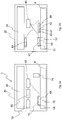
- Fig. 2a
- schematically a preferred arrangement inside an air conditioning means, wherein a rod-like conductor element is arranged in such a manner that a gap between the rod-like conductor element and a functional means of the air conditioning unit is set up; and
- Fig. 2b
- schematically a further preferred arrangement inside an air conditioning means, wherein multiple rod-like conductor elements are arranged in such a manner that gaps between the rod-like conductor elements and functional means of the air conditioning unit are set up, wherein the individual conductor elements have exemplarily different features.
-
Fig. 1 a shows anouter part 20 of anair conditioning unit 1. At least oneconductor element 41 is arranged in close vicinity to theouter part 20. In case growth of ice or snow starts the ice or snow forms a connection between theouter part 20 andconductor element 41. Thus, current can flow throughconductor element 41 toouter part 20 andouter part 20 is preferably connected to ground. Current is provided by asource 70. Between thesource 70 andconductor element 41 preferably at least onecurrent limiter 40 and one current measurment and/or detectingunit 60 is provided. The current measurement and/or detecting unit is preferably arranged closer to thesource 70 than thecurrent limiter 40. -
Fig. 1 b shows a similar structure thanfig. 1 a. However theconductor element 41 is shaped like a ring and positioned around a pipe or piston or rod-like element 71. One or multiple electrically isolated holder means 72 is/are holding theconductor element 41 in a distance to the pipe or piston or rod-like element 71. Thering 41 is electrically connected viaconnection 44 with asource 70, wherein acurrent limiter 40 and/or a current measurement anddetection unit 60 is preferably arranged between thesource 70 andring 41. Thus, current can be measured respectively detected as long as the connection betweenconductor element 41 and the functional means is established. - Therefore, the main concept of this invention is to sense frost anywhere in particularly on functional means (condenser, exchanger, evaporator coil etc.) so, the conductor element/s, in particular conductive rod or ring, is/are used to sense a defrost sequence. When frost growth starts on condenser the conductive element respectively rod or ring is very close to this material, so it is short circuited by icing and current is sensed by a circuit that can sense the current flowing from source to ground. So, a signal or data is outputted that represents the information that frost is present on at least one functional means, in particular on condenser or evaporator etc.
-
Fig. 2a shows schematically a cross-sectional view of a part of anair conditioning unit 1. A rod-like or ring-like conductor element 41 is arranged in acondenser 8, wherein an electrically isolated holding means 54 positions the conducting means 41 in a defineddistance 49 to thecondenser 8. -
Fig. 2b shows exemplarily thatmultiple conductor elements fig. 1 a , another type is described with respect tofig. 1 b. Furthermore, each type might be arranged with a heterogenous distance profile with respect to the functional means of theair conditioning unit 1. A further type of conductors comprises multiple materials forming different parts of the surface of the respective conductor element, preferably having different electrical conductivity and/or surface roughness and/or wetting properties and/or surface shape. - Thus, the present invention refers to an
air conditioning unit 1, in particularly for buildings. The inventive air conditioning unit preferably comprises at least an air conditioning means for heating and/or cooling of air, wherein the air conditioning means comprises a functional fluid andfunctional means evaporator 10 for evaporating said functional fluid or a heat-exchanger for transferring thermal energy from the functional liquid to the surrounding or vice versa, a frost detection means 2 for detecting ice or snow inside or at the outside of the functional means, wherein the frost detection means 2 comprises at least oneconductor element 41 for conducting electric energy from asource 70 to an electricenergy conducting part 71 of thefunctional means conductor element 41 is arranged spaced apart and in close vicinity, in particularly less distance than 10 mm, to the electricenergy conducting part 71 of thefunctional means conductor element 41 and the electricenergy conducting part 71 become short-circuited due to growth of ice or snow, and a current measurement and/ordetection unit 60 for measuring and/or detecting current flow via theconductor element 41, wherein the measurement and/or detectingunit 60 triggers defrosting in dependency of the measured and/or detected current flow. -
- 1
- air conditioning unit
- 8
- condenser
- 10
- vaporizer
- 20
- housing
- 40
- current limiter
- 41
- conductor element
- 42
- further conductor element
- 43
- additional conductor element
- 44
- connection for transferring electric energy
- 46
- first material
- 47
- second material
- 48
- third material
- 49
- gap
- 50
- alternative gap
- 51
- first end of conductor element
- 52
- second end of conductor element
- 60
- current measurement and/or detection unit
- 70
- source
- 71
- cooled part of functional means
- 72
- isolated holding member
- 74
- heating means
Claims (15)
- Air conditioning unit (1), in particularly for buildings,
at least comprising
an air conditioning means for heating and/or cooling of air,
wherein the air conditioning means comprises a functional fluid and functional means (8, 10), in particular a condenser means (8) for condensing said functional fluid or an evaporator (10) for evaporating said functional fluid or a heat-exchanger for transferring thermal energy from the functional liquid to the surrounding or vice versa,
a frost detection means (2) for detecting ice or snow inside or at the outside of the functional means,wherein the frost detection means (2) comprises at least one conductor element (41) for conducting electric energy from a source (70) to an electric energy conducting part (71) of the functional means (8, 10),and wherein the conductor element (41) is arranged spaced apart and in close vicinity, in particularly less distance than 10mm, to the electric energy conducting part (71) of the functional means (8, 10), wherein the conductor element (41) and the electric energy conducting part (71) become short-circuited due to growth of ice or snow,and a current measurement and/or detection unit (60) for measuring and/or detecting current flow via the conductor element (41), wherein the measurement and/or detecting unit (60) triggers defrosting in dependency of the measured and/or detected current flow. - Air conditioning unit according to claim 1,
characterized in that
the conductor element (41) has a rod-like shape and is arranged in parallel to the electric energy conducting part (71) of the functional means (8, 10). - Air conditioning unit according to claim 1,
characterized in that
the conductor element (41) has a ring-like shape and is arranged around an electric energy conducting rod-like or electric energy conducting pipe-like member of the functional means. - Air conditioning unit according to claim 1,
characterized in that
the conductor element (41) has a preferably straight rod-like shape and is arranged in an aligned manner to the electric energy conducting part (71) of the functional means (8, 10), wherein the distance between one end (50) of the conductor element (41) and the electric energy conducting part (71) of the functional means (8, 10) and the distance between another end (52) of the conductor element (41) and the electric energy conducting part (71) of the functional means (8, 10) differ from each other. - Air conditioning unit according to claim 1,
characterized in that
the conductor element (41) has a ring-like shape and is arranged in a none-coaxial manner around an electric energy conducting rod-like or electric energy conducting pipe-like member of the functional means (8, 10). - Air conditioning unit according to any of the proceeding claims,
characterized in that
the conductor element (41) has a heterogenous structure,
wherein the thickness, material composition and/or shape varies along a longitudinal axis or a circumferential direction. - Air conditioning unit according to any of the proceeding claims,
characterized in that
multiple conductor elements are provided and individually connected to the current measurement and/or detection unit. - Air conditioning unit according to any of the proceeding claims,
characterized in that
signals or data provided by the measurement and/or detecting unit (60) are processed by means of a predefined algorithm, wherein triggering of defrosting is caused in dependency of the processed signals or data. - Air conditioning unit according to claim 8,
characterized in that
signals or data provided by the measurement and/or detecting unit (60) are processed in dependency of the position and/or features of the respective conductor element (41). - Air conditioning unit according to any of the proceeding claims,
characterized in that
the air conditioning unit (1) comprises at least one heating means (74), in particularly an electric heating means, for defrosting of one or multiple functional means (8, 10). - Air conditioning unit according to claim 10,
characterized in that
multiple heating means (74) are provided, wherein at least two heating means (74) can be operated independently from each other, wherein each of said two heating means is operated in dependency of the signals or data provided by the current measurement and/or detection unit (60). - Air conditioning unit according to any of the proceeding claims,
characterized in that
the conducting means (41) is positioned by means of at least one electrically isolated holding member, wherein the isolated holding member has an electrical conductivity of less than 10-5S/m (siemens per meter), in particular of less than 10-6S/m or of less than 10-7S/m or of less than 10-8S/m. - Air conditioning unit according to any of the proceeding claims,
characterized in that
the minimal distance between the conductor element (41) and the electric energy conducting part (71) of the functional means is below 5mm, in particular below 3mm or below 2mm or below 1 mm. - Method for operating a stationary air conditioning unit,
at least comprising the steps:Providing an air conditioning means (1) for heating and cooling of air,wherein the air conditioning means (1) comprises a functional fluid and functional means (8, 10), in particular a condenser means (8) for condensing said functional fluid or an evaporator (10) for evaporating said functional fluid or a heat-exchanger for transferring thermal energy from the functional liquid to the surrounding or vice versa,Providing a frost detection means (2) for detecting ice or snow inside or at the outside of the functional means (8, 10),wherein the frost detection means (2) comprises at least one conductor element (41) for conducting electric energy from a source (70) to an electric energy conducting part of the functional means (8, 10),wherein the conductor element (41) is arranged spaced apart and in close vicinity, in particularly below a distance of 10mm, to the electric energy conducting part of the functional means,Operating the air conditioning means (1) to provide heated air for heating a predefined zone,
wherein the conductor element (41) and the electric energy conducting part become short-circuited due to growth of ice or snow,Measuring and/or detecting by means of a current measurement and/or detection unit (60) current flowing through the conductor element (41),Triggering defrost operation in dependency of the measured and/or detected current flow. - Method according to claim 14,
characterized in that
the defrost operation causes a reduction of the operation level of the functional means (8, 10).
Priority Applications (2)
| Application Number | Priority Date | Filing Date | Title |
|---|---|---|---|
| EP17170851.4A EP3401624A1 (en) | 2017-05-12 | 2017-05-12 | Air conditioning unit with current based ice and snow detection and method for operating such an air conditioning unit |
| TR2017/07618A TR201707618A2 (en) | 2017-05-12 | 2017-05-25 | Air conditioning unit with current based ice and snow detection and method for operating such an air conditioning unit. |
Applications Claiming Priority (1)
| Application Number | Priority Date | Filing Date | Title |
|---|---|---|---|
| EP17170851.4A EP3401624A1 (en) | 2017-05-12 | 2017-05-12 | Air conditioning unit with current based ice and snow detection and method for operating such an air conditioning unit |
Publications (1)
| Publication Number | Publication Date |
|---|---|
| EP3401624A1 true EP3401624A1 (en) | 2018-11-14 |
Family
ID=58707400
Family Applications (1)
| Application Number | Title | Priority Date | Filing Date |
|---|---|---|---|
| EP17170851.4A Pending EP3401624A1 (en) | 2017-05-12 | 2017-05-12 | Air conditioning unit with current based ice and snow detection and method for operating such an air conditioning unit |
Country Status (2)
| Country | Link |
|---|---|
| EP (1) | EP3401624A1 (en) |
| TR (1) | TR201707618A2 (en) |
Citations (9)
| Publication number | Priority date | Publication date | Assignee | Title |
|---|---|---|---|---|
| US3465535A (en) | 1968-05-01 | 1969-09-09 | Gen Electric | Frost detector for refrigerant evaporators |
| JPS5045748U (en) * | 1973-08-22 | 1975-05-08 | ||
| JPS5226646A (en) * | 1975-08-26 | 1977-02-28 | Hoshizaki Electric Co Ltd | Automatic defrost controlling system of ereezing device etc |
| DE2641600A1 (en) * | 1976-09-16 | 1978-03-23 | Stiebel Eltron Gmbh & Co Kg | Deicer initiator for heat pump - has electrode scanning evaporator surface for ice connected to initiator |
| US4305259A (en) | 1980-04-03 | 1981-12-15 | Eaton Corporation | Frost sensor employing self-heating thermistor as sensor element |
| JPS6065581U (en) * | 1983-10-13 | 1985-05-09 | オリオン機械株式会社 | Defrost device for gas cooler |
| US20070209446A1 (en) * | 2006-03-10 | 2007-09-13 | Stewart Bradley C | Frozen material detection using electric field sensor |
| US20100269519A1 (en) * | 2007-03-14 | 2010-10-28 | Khosla Ronald R | Retrofittable air conditioner to refrigeration conversion unit |
| KR20160004004A (en) * | 2014-07-02 | 2016-01-12 | (주)뉴로시스 | Control System for Defrosting of Refrigerator |
-
2017
- 2017-05-12 EP EP17170851.4A patent/EP3401624A1/en active Pending
- 2017-05-25 TR TR2017/07618A patent/TR201707618A2/en unknown
Patent Citations (9)
| Publication number | Priority date | Publication date | Assignee | Title |
|---|---|---|---|---|
| US3465535A (en) | 1968-05-01 | 1969-09-09 | Gen Electric | Frost detector for refrigerant evaporators |
| JPS5045748U (en) * | 1973-08-22 | 1975-05-08 | ||
| JPS5226646A (en) * | 1975-08-26 | 1977-02-28 | Hoshizaki Electric Co Ltd | Automatic defrost controlling system of ereezing device etc |
| DE2641600A1 (en) * | 1976-09-16 | 1978-03-23 | Stiebel Eltron Gmbh & Co Kg | Deicer initiator for heat pump - has electrode scanning evaporator surface for ice connected to initiator |
| US4305259A (en) | 1980-04-03 | 1981-12-15 | Eaton Corporation | Frost sensor employing self-heating thermistor as sensor element |
| JPS6065581U (en) * | 1983-10-13 | 1985-05-09 | オリオン機械株式会社 | Defrost device for gas cooler |
| US20070209446A1 (en) * | 2006-03-10 | 2007-09-13 | Stewart Bradley C | Frozen material detection using electric field sensor |
| US20100269519A1 (en) * | 2007-03-14 | 2010-10-28 | Khosla Ronald R | Retrofittable air conditioner to refrigeration conversion unit |
| KR20160004004A (en) * | 2014-07-02 | 2016-01-12 | (주)뉴로시스 | Control System for Defrosting of Refrigerator |
Also Published As
| Publication number | Publication date |
|---|---|
| TR201707618A2 (en) | 2018-11-21 |
Similar Documents
| Publication | Publication Date | Title |
|---|---|---|
| EP2409095B1 (en) | Microprocessor controlled defrost termination | |
| US9562757B2 (en) | Removal of an accumulated frozen substance from a cooling unit | |
| JP5933021B2 (en) | Liquid level detection device and refrigeration cycle device | |
| EP3304016B1 (en) | Fixing element with integrated sensing element for sensing a difference of temperature | |
| CN105299985A (en) | Temperature regulating system and method of deicing the temperature regulating system | |
| EP2924817B1 (en) | Slipring with Active Cooling | |
| CA1233212A (en) | Measuring device for detecting a liquid component in refrigerant | |
| US7473868B2 (en) | Fail safe HVAC temperature and medium presence sensor | |
| JPWO2014118904A1 (en) | Liquid level detection device and refrigeration air conditioner | |
| US5691466A (en) | Liquid-sensing apparatus and method | |
| JP2013096772A (en) | Liquid level detecting device | |
| US4755062A (en) | Process and measuring probe for the determination of ice or snow formation | |
| JP2014055980A (en) | Liquid level detector and freezing air conditioner having the same | |
| US20160018154A1 (en) | Sensor for coil defrost in a refrigeration system evaporator | |
| CN210292111U (en) | Outdoor machine of air conditioner | |
| EP3123084B1 (en) | Device and method for determining the filling height of liquid refrigerant in a container | |
| EP3339773B1 (en) | Excitation based ice detection unit, refrigerator with ice detection unit and method for defrosting of a refrigerator | |
| CN107421084B (en) | Temperature sensing bulb support for air conditioner indoor unit and air conditioner indoor unit | |
| CN103512103A (en) | Frost sensing device of outdoor unit of air-conditioner | |
| TR201707618A2 (en) | Air conditioning unit with current based ice and snow detection and method for operating such an air conditioning unit. | |
| US10088369B2 (en) | Arrangement of a temperature sensor with an electrically insulating covering | |
| US7028544B2 (en) | Mass flowmeter for measuring by the CT method | |
| US11340003B2 (en) | Thermal monitoring for cooling systems | |
| CN221425189U (en) | Control structure and refrigerating system for intelligently controlling cold air electromechanical defrosting of refrigeration house | |
| JP2011231991A (en) | Frost formation detector and frost formation determining device |
Legal Events
| Date | Code | Title | Description |
|---|---|---|---|
| PUAI | Public reference made under article 153(3) epc to a published international application that has entered the european phase |
Free format text: ORIGINAL CODE: 0009012 |
|
| STAA | Information on the status of an ep patent application or granted ep patent |
Free format text: STATUS: THE APPLICATION HAS BEEN PUBLISHED |
|
| AK | Designated contracting states |
Kind code of ref document: A1 Designated state(s): AL AT BE BG CH CY CZ DE DK EE ES FI FR GB GR HR HU IE IS IT LI LT LU LV MC MK MT NL NO PL PT RO RS SE SI SK SM TR |
|
| AX | Request for extension of the european patent |
Extension state: BA ME |
|
| STAA | Information on the status of an ep patent application or granted ep patent |
Free format text: STATUS: REQUEST FOR EXAMINATION WAS MADE |
|
| 17P | Request for examination filed |
Effective date: 20190514 |
|
| RBV | Designated contracting states (corrected) |
Designated state(s): AL AT BE BG CH CY CZ DE DK EE ES FI FR GB GR HR HU IE IS IT LI LT LU LV MC MK MT NL NO PL PT RO RS SE SI SK SM TR |
|
| RIC1 | Information provided on ipc code assigned before grant |
Ipc: F25D 21/02 20060101AFI20201013BHEP Ipc: F24F 11/41 20180101ALI20201013BHEP |
|
| GRAP | Despatch of communication of intention to grant a patent |
Free format text: ORIGINAL CODE: EPIDOSNIGR1 |
|
| STAA | Information on the status of an ep patent application or granted ep patent |
Free format text: STATUS: GRANT OF PATENT IS INTENDED |
|
| INTG | Intention to grant announced |
Effective date: 20201123 |