EP3401345A1 - Composition for polyurethane foam - Google Patents
Composition for polyurethane foam Download PDFInfo
- Publication number
- EP3401345A1 EP3401345A1 EP16883842.3A EP16883842A EP3401345A1 EP 3401345 A1 EP3401345 A1 EP 3401345A1 EP 16883842 A EP16883842 A EP 16883842A EP 3401345 A1 EP3401345 A1 EP 3401345A1
- Authority
- EP
- European Patent Office
- Prior art keywords
- polyurethane foam
- polyol
- composition
- tolylene diisocyanate
- toner
- Prior art date
- Legal status (The legal status is an assumption and is not a legal conclusion. Google has not performed a legal analysis and makes no representation as to the accuracy of the status listed.)
- Granted
Links
Images

Classifications
-
- C—CHEMISTRY; METALLURGY
- C08—ORGANIC MACROMOLECULAR COMPOUNDS; THEIR PREPARATION OR CHEMICAL WORKING-UP; COMPOSITIONS BASED THEREON
- C08G—MACROMOLECULAR COMPOUNDS OBTAINED OTHERWISE THAN BY REACTIONS ONLY INVOLVING UNSATURATED CARBON-TO-CARBON BONDS
- C08G18/00—Polymeric products of isocyanates or isothiocyanates
-
- C—CHEMISTRY; METALLURGY
- C08—ORGANIC MACROMOLECULAR COMPOUNDS; THEIR PREPARATION OR CHEMICAL WORKING-UP; COMPOSITIONS BASED THEREON
- C08G—MACROMOLECULAR COMPOUNDS OBTAINED OTHERWISE THAN BY REACTIONS ONLY INVOLVING UNSATURATED CARBON-TO-CARBON BONDS
- C08G18/00—Polymeric products of isocyanates or isothiocyanates
- C08G18/06—Polymeric products of isocyanates or isothiocyanates with compounds having active hydrogen
- C08G18/28—Polymeric products of isocyanates or isothiocyanates with compounds having active hydrogen characterised by the compounds used containing active hydrogen
- C08G18/65—Low-molecular-weight compounds having active hydrogen with high-molecular-weight compounds having active hydrogen
- C08G18/66—Compounds of groups C08G18/42, C08G18/48, or C08G18/52
- C08G18/6666—Compounds of group C08G18/48 or C08G18/52
- C08G18/667—Compounds of group C08G18/48 or C08G18/52 with compounds of group C08G18/32 or polyamines of C08G18/38
- C08G18/6674—Compounds of group C08G18/48 or C08G18/52 with compounds of group C08G18/32 or polyamines of C08G18/38 with compounds of group C08G18/3203
- C08G18/6677—Compounds of group C08G18/48 or C08G18/52 with compounds of group C08G18/32 or polyamines of C08G18/38 with compounds of group C08G18/3203 having at least three hydroxy groups
-
- C—CHEMISTRY; METALLURGY
- C08—ORGANIC MACROMOLECULAR COMPOUNDS; THEIR PREPARATION OR CHEMICAL WORKING-UP; COMPOSITIONS BASED THEREON
- C08G—MACROMOLECULAR COMPOUNDS OBTAINED OTHERWISE THAN BY REACTIONS ONLY INVOLVING UNSATURATED CARBON-TO-CARBON BONDS
- C08G18/00—Polymeric products of isocyanates or isothiocyanates
- C08G18/06—Polymeric products of isocyanates or isothiocyanates with compounds having active hydrogen
- C08G18/28—Polymeric products of isocyanates or isothiocyanates with compounds having active hydrogen characterised by the compounds used containing active hydrogen
- C08G18/40—High-molecular-weight compounds
- C08G18/4009—Two or more macromolecular compounds not provided for in one single group of groups C08G18/42 - C08G18/64
- C08G18/4018—Mixtures of compounds of group C08G18/42 with compounds of group C08G18/48
-
- C—CHEMISTRY; METALLURGY
- C08—ORGANIC MACROMOLECULAR COMPOUNDS; THEIR PREPARATION OR CHEMICAL WORKING-UP; COMPOSITIONS BASED THEREON
- C08G—MACROMOLECULAR COMPOUNDS OBTAINED OTHERWISE THAN BY REACTIONS ONLY INVOLVING UNSATURATED CARBON-TO-CARBON BONDS
- C08G18/00—Polymeric products of isocyanates or isothiocyanates
- C08G18/06—Polymeric products of isocyanates or isothiocyanates with compounds having active hydrogen
- C08G18/28—Polymeric products of isocyanates or isothiocyanates with compounds having active hydrogen characterised by the compounds used containing active hydrogen
- C08G18/40—High-molecular-weight compounds
- C08G18/42—Polycondensates having carboxylic or carbonic ester groups in the main chain
-
- C—CHEMISTRY; METALLURGY
- C08—ORGANIC MACROMOLECULAR COMPOUNDS; THEIR PREPARATION OR CHEMICAL WORKING-UP; COMPOSITIONS BASED THEREON
- C08G—MACROMOLECULAR COMPOUNDS OBTAINED OTHERWISE THAN BY REACTIONS ONLY INVOLVING UNSATURATED CARBON-TO-CARBON BONDS
- C08G18/00—Polymeric products of isocyanates or isothiocyanates
- C08G18/06—Polymeric products of isocyanates or isothiocyanates with compounds having active hydrogen
- C08G18/28—Polymeric products of isocyanates or isothiocyanates with compounds having active hydrogen characterised by the compounds used containing active hydrogen
- C08G18/40—High-molecular-weight compounds
- C08G18/42—Polycondensates having carboxylic or carbonic ester groups in the main chain
- C08G18/4205—Polycondensates having carboxylic or carbonic ester groups in the main chain containing cyclic groups
- C08G18/4208—Polycondensates having carboxylic or carbonic ester groups in the main chain containing cyclic groups containing aromatic groups
- C08G18/4211—Polycondensates having carboxylic or carbonic ester groups in the main chain containing cyclic groups containing aromatic groups derived from aromatic dicarboxylic acids and dialcohols
- C08G18/4213—Polycondensates having carboxylic or carbonic ester groups in the main chain containing cyclic groups containing aromatic groups derived from aromatic dicarboxylic acids and dialcohols from terephthalic acid and dialcohols
-
- C—CHEMISTRY; METALLURGY
- C08—ORGANIC MACROMOLECULAR COMPOUNDS; THEIR PREPARATION OR CHEMICAL WORKING-UP; COMPOSITIONS BASED THEREON
- C08G—MACROMOLECULAR COMPOUNDS OBTAINED OTHERWISE THAN BY REACTIONS ONLY INVOLVING UNSATURATED CARBON-TO-CARBON BONDS
- C08G18/00—Polymeric products of isocyanates or isothiocyanates
- C08G18/06—Polymeric products of isocyanates or isothiocyanates with compounds having active hydrogen
- C08G18/28—Polymeric products of isocyanates or isothiocyanates with compounds having active hydrogen characterised by the compounds used containing active hydrogen
- C08G18/40—High-molecular-weight compounds
- C08G18/48—Polyethers
-
- C—CHEMISTRY; METALLURGY
- C08—ORGANIC MACROMOLECULAR COMPOUNDS; THEIR PREPARATION OR CHEMICAL WORKING-UP; COMPOSITIONS BASED THEREON
- C08G—MACROMOLECULAR COMPOUNDS OBTAINED OTHERWISE THAN BY REACTIONS ONLY INVOLVING UNSATURATED CARBON-TO-CARBON BONDS
- C08G18/00—Polymeric products of isocyanates or isothiocyanates
- C08G18/06—Polymeric products of isocyanates or isothiocyanates with compounds having active hydrogen
- C08G18/70—Polymeric products of isocyanates or isothiocyanates with compounds having active hydrogen characterised by the isocyanates or isothiocyanates used
- C08G18/72—Polyisocyanates or polyisothiocyanates
- C08G18/74—Polyisocyanates or polyisothiocyanates cyclic
- C08G18/76—Polyisocyanates or polyisothiocyanates cyclic aromatic
-
- C—CHEMISTRY; METALLURGY
- C08—ORGANIC MACROMOLECULAR COMPOUNDS; THEIR PREPARATION OR CHEMICAL WORKING-UP; COMPOSITIONS BASED THEREON
- C08G—MACROMOLECULAR COMPOUNDS OBTAINED OTHERWISE THAN BY REACTIONS ONLY INVOLVING UNSATURATED CARBON-TO-CARBON BONDS
- C08G18/00—Polymeric products of isocyanates or isothiocyanates
- C08G18/06—Polymeric products of isocyanates or isothiocyanates with compounds having active hydrogen
- C08G18/70—Polymeric products of isocyanates or isothiocyanates with compounds having active hydrogen characterised by the isocyanates or isothiocyanates used
- C08G18/72—Polyisocyanates or polyisothiocyanates
- C08G18/74—Polyisocyanates or polyisothiocyanates cyclic
- C08G18/76—Polyisocyanates or polyisothiocyanates cyclic aromatic
- C08G18/7614—Polyisocyanates or polyisothiocyanates cyclic aromatic containing only one aromatic ring
- C08G18/7621—Polyisocyanates or polyisothiocyanates cyclic aromatic containing only one aromatic ring being toluene diisocyanate including isomer mixtures
-
- G—PHYSICS
- G03—PHOTOGRAPHY; CINEMATOGRAPHY; ANALOGOUS TECHNIQUES USING WAVES OTHER THAN OPTICAL WAVES; ELECTROGRAPHY; HOLOGRAPHY
- G03G—ELECTROGRAPHY; ELECTROPHOTOGRAPHY; MAGNETOGRAPHY
- G03G15/00—Apparatus for electrographic processes using a charge pattern
-
- G—PHYSICS
- G03—PHOTOGRAPHY; CINEMATOGRAPHY; ANALOGOUS TECHNIQUES USING WAVES OTHER THAN OPTICAL WAVES; ELECTROGRAPHY; HOLOGRAPHY
- G03G—ELECTROGRAPHY; ELECTROPHOTOGRAPHY; MAGNETOGRAPHY
- G03G15/00—Apparatus for electrographic processes using a charge pattern
- G03G15/06—Apparatus for electrographic processes using a charge pattern for developing
- G03G15/08—Apparatus for electrographic processes using a charge pattern for developing using a solid developer, e.g. powder developer
-
- C—CHEMISTRY; METALLURGY
- C08—ORGANIC MACROMOLECULAR COMPOUNDS; THEIR PREPARATION OR CHEMICAL WORKING-UP; COMPOSITIONS BASED THEREON
- C08G—MACROMOLECULAR COMPOUNDS OBTAINED OTHERWISE THAN BY REACTIONS ONLY INVOLVING UNSATURATED CARBON-TO-CARBON BONDS
- C08G2110/00—Foam properties
- C08G2110/0008—Foam properties flexible
-
- C—CHEMISTRY; METALLURGY
- C08—ORGANIC MACROMOLECULAR COMPOUNDS; THEIR PREPARATION OR CHEMICAL WORKING-UP; COMPOSITIONS BASED THEREON
- C08G—MACROMOLECULAR COMPOUNDS OBTAINED OTHERWISE THAN BY REACTIONS ONLY INVOLVING UNSATURATED CARBON-TO-CARBON BONDS
- C08G2110/00—Foam properties
- C08G2110/0041—Foam properties having specified density
- C08G2110/005—< 50kg/m3
-
- C—CHEMISTRY; METALLURGY
- C08—ORGANIC MACROMOLECULAR COMPOUNDS; THEIR PREPARATION OR CHEMICAL WORKING-UP; COMPOSITIONS BASED THEREON
- C08G—MACROMOLECULAR COMPOUNDS OBTAINED OTHERWISE THAN BY REACTIONS ONLY INVOLVING UNSATURATED CARBON-TO-CARBON BONDS
- C08G2110/00—Foam properties
- C08G2110/0083—Foam properties prepared using water as the sole blowing agent
-
- C—CHEMISTRY; METALLURGY
- C08—ORGANIC MACROMOLECULAR COMPOUNDS; THEIR PREPARATION OR CHEMICAL WORKING-UP; COMPOSITIONS BASED THEREON
- C08G—MACROMOLECULAR COMPOUNDS OBTAINED OTHERWISE THAN BY REACTIONS ONLY INVOLVING UNSATURATED CARBON-TO-CARBON BONDS
- C08G2190/00—Compositions for sealing or packing joints
Definitions
- the present invention relates to a composition for polyurethane foam, and particularly to a toner sealing material obtained by foaming a composition for polyurethane foam to form a polyurethane foam.
- Polyurethane foam has soft mechanical characteristics and excellent processability, and thus is used as various sealing materials, for example, toner sealing materials and water barrier sealing materials.
- members including polyurethane foam have attract attentions in image forming devices such as a dry electrophotographic device as members applied to various uses such as charging, development, transfer, toner supply, and cleaning.
- image forming device members having elasticity, such as a charging roller, a development roller, a transfer roller, a toner supply roller, and a cleaning roller.
- a uniformly charged image carrier is selectively exposed to light to form a latent image, the latent image is developed with toner, and the formed toner image is transferred to a recording medium, whereby an image is recorded.
- toner must be supplied at suitable times.
- the toner supply is performed by using a toner cartridge including an image carrier, a charging unit, a developing unit, a cleaning unit, and the like integrated therein. Users can perform supply of toner, exchange of an image carrier finishing the service life, or the like by detaching and attaching the cartridge in the device main body, enabling easy maintenance.
- the process cartridge method is adopted in many image forming devices, leak of toner causes a defective image.
- a toner sealing material is thus mounted, for example, on a contact surface of a resin molded article, for example, between frames of a cartridge body or between a developing sleeve and a developing frame of a developing unit. Also, a toner sealing material is provided in a gap between an end portion of an image carrier and a waste toner reservoir of a cleaning unit, on the image carrier end portion side, so as to prevent waste toner from leaking.
- toner sealing material as an interior member of an image forming device including a polyurethane foam excellent in the sealing property, that is attached on the periphery of, for example, a toner container or an image forming unit and thereby exhibits a function of preventing leak and diffusion of toner from, for example, contact surfaces of members.
- Polyurethane foams for use in toner sealing materials are required to have low air permeability and fine cell structure.
- PTL 1 discloses a toner sealing material obtained by foaming a polyurethane foam raw material containing a polyol, an isocyanate, a catalyst, and a foam stabilizer, in which the polyol is a dimer acid polyol, the proportion of diphenylmethane diisocyanate in the isocyanate is 55 to 75% by mass, the catalyst contains a reactive amine, and the polyurethane foam raw material contains 0.2 to 0.5 parts by mass of the reactive amine and 3 to 5 parts by mass of the foam stabilizer based on 100 parts by mass of the polyol.
- This realizes a toner sealing material having a good toner sealing performance and not causing defects or faults due to adhesion, transfer, and the like of a silicone foam stabilizer or an amine-based catalyst in formulation of a composition for polyurethane foam.
- a problem that the present invention is to solve is to provide a composition for polyurethane foam that can increase tensile strength of a polyurethane foam, and decrease compression residual strain and coefficient of hysteresis loss thereof, thereby achieving an excellent restorability, while ensuring an excellent toner sealing property of the polyurethane foam.
- the present inventors have found that the above problem can be solved by specifying, in a composition for polyurethane foam produced by blending a polyol, tolylene diisocyanate, a foaming agent, a foam stabilizer, and a crosslinking agent, the composition of the polyol, the composition of the tolylene diisocyanate, and the functionality of the crosslinking agent.
- the present invention has been completed based on the findings.
- the present invention provides the following inventions of [1] to [3].
- composition for a polyurethane foam which has, while ensuring an excellent toner sealing property derived from a polyurethane foam, increased tensile strength, and reduced compression residual strain and coefficient of hysteresis loss, thereby exhibiting excellent restorability.
- a to B representing the numerical limitation means a numerical range including the end points A and B.
- Parts by mass and “% by mass” have the same meanings as “parts by weight” and “% by weight”, respectively.
- composition for polyurethane foam of the present invention will be explained.
- the composition for polyurethane foam of the present invention is a composition produced by blending a polyol containing a polyester polyol and a polyether polyol, tolylene diisocyanate, a foaming agent, and a foam stabilizer, the polyester polyol containing a phthalate ester polyol, the tolylene diisocyanate having a compositional mass ratio (2,4-tolylene diisocyanate/2,6-tolylene diisocyanate) of (65/35) to (70/30).
- the composition for polyurethane foam contains a polyol, and the polyol contains a polyester polyol and a polyether polyol.
- the polyol contained in the composition for polyurethane foam of the present invention preferably has a mass ratio of the polyester polyol to the polyether polyol (polyester polyol/polyether polyol) of (70/30) to (30/70), more preferably has a mass ratio of (60/40) to (40/60), and particularly preferably has a mass ratio of (50/50).
- a mass ratio of the polyester polyol to the polyether polyol in the above range is preferred in terms of providing an urethane foam having both the tensile strength and the restorability.
- An amount of the polyester polyol not exceeding the mass ratio (70/30) is preferred in terms of providing a polyurethane foam having good restorability, and an amount of the polyester polyol not less than mass ratio (30/70) is preferred in terms of providing a polyurethane foam having high elongation and high strength.
- the polyester polyol contains a phthalate ester polyol.
- a phthalate ester polyol By the use of a phthalate ester polyol, the hydrogen bond between ester bonds in the phthalate ester polyol provides increased tensile strength and increased elongation at break of a polyurethane foam. An effect of forming finer cells in the polyurethane foam is also exhibited due to high viscosity.
- the whole of the polyester polyol according to the present invention is preferably phthalate ester polyols.
- the phthalate ester polyol according to the present invention is not particularly limited, but the polyester polyol preferably contains as a main component at least one phthalate ester polyol selected from phthalic anhydride (o-phthalic acid), m-phthalic acid (isophthalic acid), p-phthalic acid (terephthalic acid), and derivatives thereof.
- phthalic anhydride o-phthalic acid
- m-phthalic acid isophthalic acid
- p-phthalic acid terephthalic acid
- the "main component”, as used herein, means that at least one phthalate ester polyol selected from phthalic anhydride (o-phthalic acid), m-phthalic acid (isophthalic acid), p-phthalic acid (terephthalic acid), and derivatives thereof is contained at 50% by mass or more, preferably contained at 60% by mass or more, more preferably contained at 70% by mass or more, and further preferably contained at 80% by mass or more, in the whole of the polyester polyol.
- phthalic anhydride o-phthalic acid
- m-phthalic acid isophthalic acid
- p-phthalic acid p-phthalic acid
- derivatives thereof is contained at 50% by mass or more, preferably contained at 60% by mass or more, more preferably contained at 70% by mass or more, and further preferably contained at 80% by mass or more, in the whole of the polyester polyol.
- the phthalate ester polyol according to the present invention preferably has a hydroxyl value of 50.0 to 65.0 mg-KOH/g, and more preferably has a hydroxyl value of 54.0 to 58.0 mg-KOH/g.
- the phthalate ester polyols may each be used alone or may be used in combination of two or more thereof.
- polyester polyols used besides the phthalate ester polyol include polyester polyols obtained by polycondensation of aliphatic dicarboxylic acids having 3 to 20 carbon atoms, such as malonic acid, succinic acid, adipic acid, suberic acid, sebacic acid, and brassylic acid, aromatic dicarboxylic acids other than phthalic acid, and the like and aliphatic glycols having 1 to 6 carbon atoms, such as ethylene glycol, diethylene glycol, and propylene glycol, and the like.
- aliphatic dicarboxylic acids having 3 to 20 carbon atoms such as malonic acid, succinic acid, adipic acid, suberic acid, sebacic acid, and brassylic acid, aromatic dicarboxylic acids other than phthalic acid, and the like
- aliphatic glycols having 1 to 6 carbon atoms such as ethylene glycol, diethylene glycol, and propylene glycol, and the like.
- a suitable polyether polyol in the present invention is, but not limited to, a polyether polyol obtained by ring-opening polymerization of an alkylene oxide from the viewpoint of reactivity.
- alkylene oxides include propylene oxide (PO) and ethylene oxide (EO).
- PO propylene oxide
- EO ethylene oxide
- the alkylene oxides may each be used alone or may be used in combination of two or more thereof.
- polyether polyol homopolymers of PO, homopolymers of EO, and polyether polyols obtained by copolymerization of PO and EO may be used. Copolymerization here may be random copolymerization or block copolymerization.
- polymerization initiators examples include pentaerythritol, glycerol, ethylene diamine, Mannich, tolylene diamine, and sucrose. Also, the polymerization initiators may each be used alone or may be used in combination of two or more thereof.
- the present invention uses tolylene diisocyanate as an isocyanate compound, and preferably uses only tolylene diisocyanate as an isocyanate compound.
- the tolylene diisocyanate is required to have a compositional mass ratio (2,4-tolylene diisocyanate/2,6-tolylene diisocyanate) of (65/35) to (70/30).
- a compositional mass ratio in this range the polyurethane foam has high elongation and high strength, as well as increased restorability.
- an amount of 2,6-tolylene diisocyanate not smaller than the compositional mass ratio (70/30) of tolylene diisocyanate is preferred in terms of maintaining stable foamability, and an amount of 2,6-tolylene diisocyanate not larger than (65/35) is preferred in terms of forming finer cells in the resulting polyurethane foam to ensure good sealing performance.
- an isocyanate index of the tolylene diisocyanate may be 100 or less or may be more than 100, but is preferably 90 to 110.
- the isocyanate index is in this range, the resulting foam has an appropriate hardness and is excellent in mechanical properties, such as compression residual strain.
- the isocyanate index refers to an equivalent ratio in percent of isocyanate groups of the polyisocyanate to active hydrogen groups of the polyol, water as a foaming agent, and the like. Accordingly, an isocyanate index more than 100 means that the polyisocyanate is excessive relative to the polyol and the like.
- the composition for polyurethane foam of the present invention contains a foaming agent.
- the foaming agent is for foaming a polyurethane resin into a polyurethane foam.
- the foaming agent preferably contains water, and the foaming agent more preferably consists only of water.
- the amount of water blended is 2.5 to 5.0 parts by mass based on 100 parts by mass of the polyol. When the amount of water falls within the above range, foaming by a foaming reaction appropriately occurs to produce a toner sealing material having a low density.
- the composition for production of polyurethane foam of the present invention contains a foam stabilizer.
- the foam stabilizer is used as needed for smoothly promoting foaming by a foaming agent.
- foam stabilizer those commonly used in production of a flexible polyurethane foam can be used.
- foam stabilizers include silicone compounds, anionic surfactants, such as sodium dodecylbenzenesulfonate and sodium lauryl sulfate, polyether siloxanes, and phenol compounds. Silicone compounds are suitably used as a silicone-based foam stabilizer because of high foam-stabilizing ability and capability of forming fine cells in a polyurethane foam and lowering air permeability.
- the amount of the foam stabilizer blended is preferably 1.0 to 5.0 parts by mass based on 100 parts by mass of the polyol, more preferably 1.0 to 4.5 parts by mass, and further preferably 3.5 to 4.5 parts by mass.
- the amount of the foam stabilizer is 1.0 parts by mass or more, the foam stabilizing effect in foaming of a foam raw material is sufficiently exhibited and a urethane foam having fine cells and low air permeability, thus having a good toner sealing property can be obtained.
- the amount is 5.0 parts by mass or less, the form stabilizing effect can be appropriately exhibited to thereby produce a polyurethane foam having ensured foamability and desired open cells.
- a reactive silicone foam stabilizer is preferably blended in the composition for polyurethane foam.
- a silicone is reacted with an isocyanate or a polyol and is thereby incorporated in bonds, making vaporization difficult.
- the reactive silicone foam stabilizer (sometimes abbreviated to "reactive silicone") means a silicone compound (polysiloxane compound) having at least one reactive group selected from the group consisting of an amino group, an epoxy group, a hydroxy group, a mercapto group, and a carboxy group at an end of the main chain or in a side chain.
- the reactive silicone foam stabilizer is preferably selected from compounds in which a reactive group selected from the group consisting of an amino group, an epoxy group, a hydroxy group, a mercapto group, and a carboxy, or a group having the reactive group, is introduced in a side chain or an end of the main chain of a silicone compound such as dimethyl silicone, a methylphenyl silicone, or methyl hydrogen silicone.
- a reactive silicone having a hydroxy group or a carboxy group as a reactive group is preferred, and a reactive silicone having a carboxy group is more preferred.
- reactive silicone foam stabilizer commercially available products may be used, and examples thereof include various reactive silicones manufactured by Shin-Etsu Silicone Co., Ltd., Dow Corning Toray Co., Ltd., Momentive Performance Materials, Inc., and other manufacturers.
- Specific examples of reactive silicones having carboxy groups include CF1218 (from Dow Corning Toray Co., Ltd.) and X22-3701 (from Shin-Etsu Silicone Co., Ltd.).
- reactive silicones having hydroxy groups include SF 8427, BY 16-201, and SF 8428 (all from Dow Corning Toray Co., Ltd.), and X-22-4039 and X-22-4015 (both from Shin-Etsu Silicone Co., Ltd.).
- the composition for polyurethane foam may contain a nonreactive silicone in addition to the reactive silicone, and may use only a nonreactive silicone without the reactive silicone.
- the nonreactive silicone is not particularly limited as long as it contains no reactive group, and may be a modified nonreactive silicone, such as a polyether-modified, an aralkyl-modified, or a long chain alkyl-modified silicone.
- a nonreactive silicone commercially available products may be used, and may be appropriated selected from various products sold by Shin-Etsu Silicone Co., Ltd., Dow Corning Toray Co., Ltd., Momentive Performance Materials, Inc., and other manufacturers.
- the reactive silicone has a weight average molecular weight of 14,000 or more, sufficiently low air permeability can be obtained.
- a crosslinking agent may be blended, as desired, in the composition for polyurethane foam in the present invention.
- the crosslinking agent is preferably a bi- or higher functional crosslinking agent, more preferably a bi- to hexafunctional crosslinking agent, further preferably a bi- to pentafunctional crosslinking agent, furthermore preferably a bi- to tetrafunctional crosslinking agent, and particularly preferably a trifunctional crosslinking agent.
- trifunctional crosslinking agents include trifunctional crosslinking agents having a trimethylol propane backbone. The use of a trifunctional crosslinking agent with a trimethylol propane backbone leads to reduced air permeability and an increased toner sealing property.
- Examples of functional groups of the tri- or higher functional crosslinking agent with a trimethylol propane backbone include a hydroxy group, an amino group, a cyano group, an epoxy group, a carboxy group, and a formyl group, and among them, a hydroxy group is preferred.
- trifunctional crosslinking agents is "DM82162" (Okahata Sangyo Co., Ltd.), and examples of trifunctional crosslinking agents with a trimethylol propane backbone include “ACTCOL (registered trademark) T880” (from Mitsui Chemicals Inc.), trimethylol propane EO-modified triacrylate “TMP” series (Miramer M3130, Miramer M3160, Miramer M3190) (from Toyo Chemicals Co., Ltd.), and trimethylol propane PO-modified triacrylate (Miramer M360) (from Toyo Chemicals Co., Ltd.).
- ACTCOL registered trademark
- T880 trimethylol propane EO-modified triacrylate
- TMP trimethylol propane PO-modified triacrylate
- Miramer M360 trimethylol propane PO-modified triacrylate
- the amount of the bi- or higher functional crosslinking agent, in particular, the trifunctional crosslinking agent blended is preferably 0.1 to 3.0 parts by mass based on 100 parts by mass of the polyol from the viewpoint of improved restorability.
- the bi- or higher functional crosslinking agent, in particular, the trifunctional crosslinking agent is blended in an amount in the range of 0.1 to 3.0 parts by mass based on 100 parts by mass of the polyol, the crosslinking density of the polyurethane foam is increased and a toner sealing property is increased.
- the use of such a trifunctional crosslinking agent leads to an increased reaction rate of the composition for polyurethane foam, resulting in fine cells and reduced air permeability of the polyurethane foam.
- the composition for production of polyurethane foam of the present invention may contain a catalyst as desired.
- the catalyst is for promoting the reaction of the polyol and tolylene diisocyanate into an urethane and the foaming reaction of tolylene diisocyanate with water as a foaming agent, and may be appropriately selected from conventionally known compounds.
- the catalyst according to the present invention one or more compounds are selected from amine-based catalysts and organic metal catalysts.
- an amine-based catalyst can be blended as a catalyst in the composition for polyurethane foam.
- the amine-based catalysts may each be used alone or may be used in combination of two or more thereof.
- the amine-based catalysts are roughly classified into reactive amine catalysts having a functional group reactive with an isocyanate group and nonreactive amine catalysts not having such a reactive functional group.
- amine compounds having at least one hydroxy group are preferred, and examples thereof include N,N-dimethylaminoethoxyethanol, N,N-dimethylaminohexanol, N,N-dimethylaminoethoxyethanol, monoethanolamine, diethanolamine, triethanolamine, dimethylaminoethanol, N,N,N'-trimethylaminoethylethanolamine, N-methyl-N'-(2-hydroxyethyl)-piperazine, and N-(2-hydroxyethyl)morpholine.
- nonreactive amine catalysts include triethylamine, tripropylamine, tributylamine, hexadecyldimethylamine, N-methylmorpholine, N-ethylmorpholine, N-octadecylmorpholine, diethyltriamine, N,N,N',N'-tetramethylhexane diamine, N,N,N',N'-tetramethylpropane diamine, N,N,N',N",N"-pentamethyldiethylene triamine, N,N',N'-trimethylaminoethylpiperazine, N,N-dimethylcyclohexylamine, N,N,N',N'-tetramethylethylene diamine, and triethylene diamine.
- the amount of the amine-based catalyst blended is preferably 0.1 to 0.4 parts by mass based on 100 parts by mass of the polyol.
- the amount of the amine-based catalyst is in the above range, the reaction into urethane and the foaming reaction can be promoted in a sufficient and well-balanced manner.
- the composition for polyurethane foam of the present invention preferably contains a reactive amine catalyst.
- a reactive amine reacts with isocyanates. Accordingly, when a reactive amine is used as a catalyst, the vaporization, bleeding-out, scattering, and the like of the amine catalyst is unlikely to occur even under, for example, a wet heat condition, and thereby the occurrence of defects due to adhesion of such a catalyst component can be prevented, leading to increased printing performance.
- an organic metal catalyst may be blended as a catalyst in the composition for polyurethane foam.
- the organic metal catalyst carboxylic acid metal salts and the like can be used, and examples of the metal salts include tin salts and bismuth salts. More specific examples of organic metal catalysts include stannous octoate, bismuth octoate, stannous oleate, dibutyl tin diacetate, dibutyl tin dilaurate, dibutyl tin thiocarboxylate, dibutyl tin dimaleate, and dioctyl tin thiocarboxylate.
- the amount of the organic metal catalyst blended is preferably 0.1 to 0.4 parts by mass based on 100 parts by mass of the polyol.
- An amount of the organic metal catalyst in the above range is preferred in terms of producing a urethane foam having appropriate mechanical strength without providing a closed-cell foam or without an insufficient conversion into a resin.
- a flame retardant, a filler, an stabilizer, a colorant, a plasticizer, and the like may be blended according to common methods, as needed.
- a polyurethane foam is produced by reacting and foaming components (raw materials) of the composition for polyurethane foam of the present invention according to common methods.
- Reaction of raw materials of a polyurethane foam is complicated and mainly includes an addition polymerization reaction of a polyol and a polyisocyanate into a urethane, a crosslinking reaction of the reaction product and the like and the polyisocyanate, and a foaming reaction of the polyisocyanate and water as a foaming agent.
- a one-shot method in which a polyol, a polyisocyanate, and the other components are directly reacted is preferred, and a slab-foaming method in which reaction and foaming are performed under normal temperature and atmospheric pressure is preferred.
- a composition for polyurethane foam prepared by mixing and stirring through a one-shot method is ejected onto a belt conveyer, and while moving the belt conveyer, the composition for polyurethane foam naturally foams and cures under normal temperature and atmospheric pressure.
- a polyurethane foam produced by using the composition for polyurethane foam of the present invention preferably has a tensile strength of 55 kPa or more as measured according to JIS K 6400-5: 2012, and more preferably 70 kPa or more.
- the elongation at break is preferably 80% or more as measured according to JIS K 6400-5: 2012, and more preferably 100% or more.
- the compression residual strain is preferably 8.6% or less as measured according to JIS K 6400-4: 2004, more preferably 6.0% or less, and further preferably 5.0% or less.
- a compression residual strain of 5.0% or less leads to increased restorability of the polyurethane foam and thus is preferred.
- the coefficient of hysteresis loss is preferably 70% or less as measured according to JIS K 6400-2: 2012, more preferably 65% or less, and further preferably 60% or less.
- a coefficient of hysteresis loss of 60% or less leads to increased restorability of the polyurethane foam and thus is preferred.
- the polyurethane foam in the present invention preferably has an apparent density of 20 to 50 kg/m 3 as measured according to JIS K 6400-1: 2004.
- the apparent density is 20 kg/m 3 or more, the polyurethane foam is excellent in mechanical strength.
- an apparent density of 50 kg/m 3 or less leads to light weight.
- the apparent density of the polyurethane foam is more preferably 20 to 40 kg/m 3 .
- the air permeability is preferably 3.0 cm 3 /cm 2 /sec or less as measured at a foam thickness of 10 mm according to JIS L 1096: 2010 8.26.1 A method (Frazier method).
- An air permeability of 3.0 cm 3 /cm 2 /sec or less leads to an increased toner sealing property.
- the air permeability is more preferably 1.5 cm 3 /cm 2 /sec or less.
- the number of cells is preferably 40/25 mm or more as measured according to JIS K 6400-1: 2004 annex 1, more preferably 45/25 mm or more, and further preferably 50/25 mm or more.
- the air permeability is 3.0 cm 3 /cm 2 /sec or less and the cell number is 50/25 mm or more, the toner sealing property is increased.
- the toner sealing material of the present invention is produced by foaming the composition for polyurethane foam to form a polyurethane foam.
- the toner sealing material is suitably used in image forming devices and the like.
- a toner sealing material produced by using the composition for polyurethane foam of the present invention maintains low compression residual strain for a long period of time and sufficiently prevents toner from leaking.
- the toner sealing material has a good sealing property, and leak of toner can be sufficiently prevented only by providing the toner sealing material on a contact surface, for example, between cartridge body frames and appropriately compressing it.
- the toner sealing material is advantageous also from the viewpoint of cost reduction.
- the toner sealing material of the present invention is used, for example, by being provided, for example, between frames of a toner cartridge body so that toner filled in the toner cartridge body incorporated into an image forming device, printer, are prevented from leaking out of the cartridge body.
- Printing with the printer is performed by allowing the toner to adhere onto a photosensitive drum via a developing cylinder, and transferring the toner adhered on the photosensitive drum onto a paper by a transfer roller.
- the toner sometimes leaks from a point, for example, between toner cartridge body frames particularly after a long-term use.
- the toner sealing material of the present invention is provided, for example, between the frames, however, the toner leakage is sufficiently prevented.
- the apparent density, elongation at break, tensile strength, compression residual strain, coefficient of hysteresis loss, air permeability, number of cells, toner sealing property, number average molecular weight, and hydroxyl value were determined according to the following methods.
- Measurement according to JIS K 6400-1: 2004 annex 1 was performed to count a number of cells through observation with a stereomicroscope.
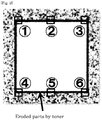
- a hole of 10 mm length and 10 mm width was punched in a sample, a toner was placed in the hole, and the sample was assembled between two acrylic plates under 50% compression. After storage for 30 minutes, the assembly was vertically shaken 20 times at room temperature. The degrees of erosion by the toner were measured at 6 points shown in Fig. 2 with a vernier caliper. An erosion by the toner of 2.0 mm or less in average was judged as pass, and an erosion by the toner exceeding 2.0 mm in average was judged as fail.
- Polyurethane foam raw materials shown in Table 1 were mixed and foamed by a one-shot method and a slab-foaming method under atmospheric pressure at 20°C to produce 21 polyurethane foams.
- the obtained polyurethane foams were subjected to the evaluations as described above.
- the results are shown in Table 1.
- the numerical values in the rows of formulation of composition in Table 1 are in parts by mass except for the mass ratio.
- the toner sealing materials produced from polyurethane foams of Examples 1 to 20 were able to show increased tensile strength of the polyurethane foam, reduced compression residual strain and coefficient of hysteresis loss thereof, while ensuring an excellent toner sealing property of the polyurethane foam, as compared with the toner sealing material produced from the polyurethane foam of Comparative Example 1.
- the toner sealing materials of Examples 1 to 20 was able to exhibit excellent restorability.
- Polyurethane foams obtained from the composition for polyurethane foam of the present invention are largely improved in tensile strength, compression residual strain, and coefficient of hysteresis loss and are superior in restorability, while ensuring an excellent toner sealing property, and thus are suitably used as toner sealing materials of various image forming devices such as a dry electrophotographic device.
Landscapes
- Chemical & Material Sciences (AREA)
- Health & Medical Sciences (AREA)
- Chemical Kinetics & Catalysis (AREA)
- Medicinal Chemistry (AREA)
- Polymers & Plastics (AREA)
- Organic Chemistry (AREA)
- Physics & Mathematics (AREA)
- General Physics & Mathematics (AREA)
- Polyurethanes Or Polyureas (AREA)
- Electrophotography Configuration And Component (AREA)
Abstract
Description
- The present invention relates to a composition for polyurethane foam, and particularly to a toner sealing material obtained by foaming a composition for polyurethane foam to form a polyurethane foam.
- Polyurethane foam has soft mechanical characteristics and excellent processability, and thus is used as various sealing materials, for example, toner sealing materials and water barrier sealing materials.
- With recent progress in electrophotography, members including polyurethane foam have attract attentions in image forming devices such as a dry electrophotographic device as members applied to various uses such as charging, development, transfer, toner supply, and cleaning. Such members including polyurethane foam have been used as image forming device members having elasticity, such as a charging roller, a development roller, a transfer roller, a toner supply roller, and a cleaning roller.
- In image forming devices such as various types of printers, a uniformly charged image carrier is selectively exposed to light to form a latent image, the latent image is developed with toner, and the formed toner image is transferred to a recording medium, whereby an image is recorded. In such a device, toner must be supplied at suitable times. The toner supply is performed by using a toner cartridge including an image carrier, a charging unit, a developing unit, a cleaning unit, and the like integrated therein. Users can perform supply of toner, exchange of an image carrier finishing the service life, or the like by detaching and attaching the cartridge in the device main body, enabling easy maintenance. Although the process cartridge method is adopted in many image forming devices, leak of toner causes a defective image. A toner sealing material is thus mounted, for example, on a contact surface of a resin molded article, for example, between frames of a cartridge body or between a developing sleeve and a developing frame of a developing unit. Also, a toner sealing material is provided in a gap between an end portion of an image carrier and a waste toner reservoir of a cleaning unit, on the image carrier end portion side, so as to prevent waste toner from leaking.
- Besides the roller members as described above, there is a toner sealing material, as an interior member of an image forming device including a polyurethane foam excellent in the sealing property, that is attached on the periphery of, for example, a toner container or an image forming unit and thereby exhibits a function of preventing leak and diffusion of toner from, for example, contact surfaces of members. Polyurethane foams for use in toner sealing materials are required to have low air permeability and fine cell structure.
- As one example of a technique directed to a member for image forming devices including a polyurethane foam,
PTL 1 discloses a toner sealing material obtained by foaming a polyurethane foam raw material containing a polyol, an isocyanate, a catalyst, and a foam stabilizer, in which the polyol is a dimer acid polyol, the proportion of diphenylmethane diisocyanate in the isocyanate is 55 to 75% by mass, the catalyst contains a reactive amine, and the polyurethane foam raw material contains 0.2 to 0.5 parts by mass of the reactive amine and 3 to 5 parts by mass of the foam stabilizer based on 100 parts by mass of the polyol. This realizes a toner sealing material having a good toner sealing performance and not causing defects or faults due to adhesion, transfer, and the like of a silicone foam stabilizer or an amine-based catalyst in formulation of a composition for polyurethane foam. - PTL 1:
JP-A-2013-29592 - Although the invention disclosed in
PTL 1 has made it possible to lower air permeability and develop an excellent toner sealing property, it is desirable to further increase the tensile strength and restorability while ensuring the sealing property of a toner sealing material of a polyurethane foam. - Accordingly, a problem that the present invention is to solve is to provide a composition for polyurethane foam that can increase tensile strength of a polyurethane foam, and decrease compression residual strain and coefficient of hysteresis loss thereof, thereby achieving an excellent restorability, while ensuring an excellent toner sealing property of the polyurethane foam.
- As a result of intensive studies, the present inventors have found that the above problem can be solved by specifying, in a composition for polyurethane foam produced by blending a polyol, tolylene diisocyanate, a foaming agent, a foam stabilizer, and a crosslinking agent, the composition of the polyol, the composition of the tolylene diisocyanate, and the functionality of the crosslinking agent. The present invention has been completed based on the findings.
- Specifically, the present invention provides the following inventions of [1] to [3].
- [1] A composition for polyurethane foam, which is produced by blending a polyol containing a polyester polyol and a polyether polyol, tolylene diisocyanate, a foaming agent, and a foam stabilizer, wherein the polyester polyol contains a phthalate ester polyol, and the tolylene diisocyanate has a compositional mass ratio (2,4-tolylene diisocyanate/2,6-tolylene diisocyanate) of (65/35) to (70/30).
- [2] A toner sealing material, which is formed of a polyurethane foam produced by foaming the composition for polyurethane foam according to [1].
- [3] An image forming device including the toner sealing material according to [2].
- According to the present invention, there is provided a composition for a polyurethane foam which has, while ensuring an excellent toner sealing property derived from a polyurethane foam, increased tensile strength, and reduced compression residual strain and coefficient of hysteresis loss, thereby exhibiting excellent restorability.
-
-
Fig. 1 is a schematic view showing a state, in a method for measuring a toner sealing property, where a sample of a polyurethane foam that has a punched hole of 10 mm length and 10 mm width in which a toner is placed, is assembled between two acrylic plates under 50% compression. -
Fig. 2 is a schematic view for explaining that a degree of toner erosion is determined by measuring the lengths of parts eroded by the toner at 6 points shown inFig. 2 with a a vernier caliper in the method for measuring a toner sealing property. - The present invention will be described in detail below.
- In the present invention, "A to B" representing the numerical limitation means a numerical range including the end points A and B.
- "Parts by mass" and "% by mass" have the same meanings as "parts by weight" and "% by weight", respectively.
- In the present invention, a combination of preferred embodiments is a more preferred embodiment.
- Hereinafter, the composition for polyurethane foam of the present invention will be explained.
- The composition for polyurethane foam of the present invention is a composition produced by blending a polyol containing a polyester polyol and a polyether polyol, tolylene diisocyanate, a foaming agent, and a foam stabilizer, the polyester polyol containing a phthalate ester polyol, the tolylene diisocyanate having a compositional mass ratio (2,4-tolylene diisocyanate/2,6-tolylene diisocyanate) of (65/35) to (70/30).
- In the present invention, the composition for polyurethane foam contains a polyol, and the polyol contains a polyester polyol and a polyether polyol.
- The polyol contained in the composition for polyurethane foam of the present invention preferably has a mass ratio of the polyester polyol to the polyether polyol (polyester polyol/polyether polyol) of (70/30) to (30/70), more preferably has a mass ratio of (60/40) to (40/60), and particularly preferably has a mass ratio of (50/50). A mass ratio of the polyester polyol to the polyether polyol in the above range is preferred in terms of providing an urethane foam having both the tensile strength and the restorability. An amount of the polyester polyol not exceeding the mass ratio (70/30) is preferred in terms of providing a polyurethane foam having good restorability, and an amount of the polyester polyol not less than mass ratio (30/70) is preferred in terms of providing a polyurethane foam having high elongation and high strength.
- In the present invention, the polyester polyol contains a phthalate ester polyol. By the use of a phthalate ester polyol, the hydrogen bond between ester bonds in the phthalate ester polyol provides increased tensile strength and increased elongation at break of a polyurethane foam. An effect of forming finer cells in the polyurethane foam is also exhibited due to high viscosity. From the viewpoints, the whole of the polyester polyol according to the present invention is preferably phthalate ester polyols.
- The phthalate ester polyol according to the present invention is not particularly limited, but the polyester polyol preferably contains as a main component at least one phthalate ester polyol selected from phthalic anhydride (o-phthalic acid), m-phthalic acid (isophthalic acid), p-phthalic acid (terephthalic acid), and derivatives thereof. The "main component", as used herein, means that at least one phthalate ester polyol selected from phthalic anhydride (o-phthalic acid), m-phthalic acid (isophthalic acid), p-phthalic acid (terephthalic acid), and derivatives thereof is contained at 50% by mass or more, preferably contained at 60% by mass or more, more preferably contained at 70% by mass or more, and further preferably contained at 80% by mass or more, in the whole of the polyester polyol.
- The phthalate ester polyol according to the present invention preferably has a hydroxyl value of 50.0 to 65.0 mg-KOH/g, and more preferably has a hydroxyl value of 54.0 to 58.0 mg-KOH/g.
- The phthalate ester polyols may each be used alone or may be used in combination of two or more thereof.
- In the present invention, polyester polyols used besides the phthalate ester polyol include polyester polyols obtained by polycondensation of aliphatic dicarboxylic acids having 3 to 20 carbon atoms, such as malonic acid, succinic acid, adipic acid, suberic acid, sebacic acid, and brassylic acid, aromatic dicarboxylic acids other than phthalic acid, and the like and aliphatic glycols having 1 to 6 carbon atoms, such as ethylene glycol, diethylene glycol, and propylene glycol, and the like.
- A suitable polyether polyol in the present invention is, but not limited to, a polyether polyol obtained by ring-opening polymerization of an alkylene oxide from the viewpoint of reactivity. Examples of such alkylene oxides include propylene oxide (PO) and ethylene oxide (EO). The alkylene oxides may each be used alone or may be used in combination of two or more thereof.
- As the polyether polyol, homopolymers of PO, homopolymers of EO, and polyether polyols obtained by copolymerization of PO and EO may be used. Copolymerization here may be random copolymerization or block copolymerization.
- Examples of polymerization initiators include pentaerythritol, glycerol, ethylene diamine, Mannich, tolylene diamine, and sucrose. Also, the polymerization initiators may each be used alone or may be used in combination of two or more thereof.
- The present invention uses tolylene diisocyanate as an isocyanate compound, and preferably uses only tolylene diisocyanate as an isocyanate compound.
- The tolylene diisocyanate is required to have a compositional mass ratio (2,4-tolylene diisocyanate/2,6-tolylene diisocyanate) of (65/35) to (70/30). With a compositional mass ratio in this range, the polyurethane foam has high elongation and high strength, as well as increased restorability. Furthermore, an amount of 2,6-tolylene diisocyanate not smaller than the compositional mass ratio (70/30) of tolylene diisocyanate is preferred in terms of maintaining stable foamability, and an amount of 2,6-tolylene diisocyanate not larger than (65/35) is preferred in terms of forming finer cells in the resulting polyurethane foam to ensure good sealing performance.
- When the (2,4-tolylene diisocyanate/2,6-tolylene diisocyanate) is (less than 65/more than 35), the balance between the foaming rate and the resin formation rate is lost due to the influence of the molecular structure of 2,6-tolylene diisocyanate, resulting in a number of cells in the urethane foam less than 50/25 mm. This is not preferred since a sufficient sealing property is then not obtained. When the (2,4-tolylene diisocyanate/2,6-tolylene diisocyanate) is (more than 70/less than 30), 2,6-tolylene diisocyanate is deficient and the balance between the foaming rate and the resin formation rate is lost. This is not preferred since foaming and molding of a polyurethane foam is then difficult.
- In the present invention, an isocyanate index of the tolylene diisocyanate may be 100 or less or may be more than 100, but is preferably 90 to 110. When the isocyanate index is in this range, the resulting foam has an appropriate hardness and is excellent in mechanical properties, such as compression residual strain. The isocyanate index, as used herein, refers to an equivalent ratio in percent of isocyanate groups of the polyisocyanate to active hydrogen groups of the polyol, water as a foaming agent, and the like. Accordingly, an isocyanate index more than 100 means that the polyisocyanate is excessive relative to the polyol and the like.
- The composition for polyurethane foam of the present invention contains a foaming agent. The foaming agent is for foaming a polyurethane resin into a polyurethane foam. In the present invention, the foaming agent preferably contains water, and the foaming agent more preferably consists only of water. The amount of water blended is 2.5 to 5.0 parts by mass based on 100 parts by mass of the polyol. When the amount of water falls within the above range, foaming by a foaming reaction appropriately occurs to produce a toner sealing material having a low density.
- The composition for production of polyurethane foam of the present invention contains a foam stabilizer. The foam stabilizer is used as needed for smoothly promoting foaming by a foaming agent. As the foam stabilizer, those commonly used in production of a flexible polyurethane foam can be used. Specific examples of foam stabilizers include silicone compounds, anionic surfactants, such as sodium dodecylbenzenesulfonate and sodium lauryl sulfate, polyether siloxanes, and phenol compounds. Silicone compounds are suitably used as a silicone-based foam stabilizer because of high foam-stabilizing ability and capability of forming fine cells in a polyurethane foam and lowering air permeability.
- The amount of the foam stabilizer blended is preferably 1.0 to 5.0 parts by mass based on 100 parts by mass of the polyol, more preferably 1.0 to 4.5 parts by mass, and further preferably 3.5 to 4.5 parts by mass. When the amount of the foam stabilizer is 1.0 parts by mass or more, the foam stabilizing effect in foaming of a foam raw material is sufficiently exhibited and a urethane foam having fine cells and low air permeability, thus having a good toner sealing property can be obtained. On the other hand, when the amount is 5.0 parts by mass or less, the form stabilizing effect can be appropriately exhibited to thereby produce a polyurethane foam having ensured foamability and desired open cells.
- In the present invention, a reactive silicone foam stabilizer is preferably blended in the composition for polyurethane foam. With a reactive silicone foam stabilizer blended, a silicone is reacted with an isocyanate or a polyol and is thereby incorporated in bonds, making vaporization difficult. As used herein, the reactive silicone foam stabilizer (sometimes abbreviated to "reactive silicone") means a silicone compound (polysiloxane compound) having at least one reactive group selected from the group consisting of an amino group, an epoxy group, a hydroxy group, a mercapto group, and a carboxy group at an end of the main chain or in a side chain.
- The reactive silicone foam stabilizer is preferably selected from compounds in which a reactive group selected from the group consisting of an amino group, an epoxy group, a hydroxy group, a mercapto group, and a carboxy, or a group having the reactive group, is introduced in a side chain or an end of the main chain of a silicone compound such as dimethyl silicone, a methylphenyl silicone, or methyl hydrogen silicone. Among them, a reactive silicone having a hydroxy group or a carboxy group as a reactive group is preferred, and a reactive silicone having a carboxy group is more preferred.
- As the reactive silicone foam stabilizer, commercially available products may be used, and examples thereof include various reactive silicones manufactured by Shin-Etsu Silicone Co., Ltd., Dow Corning Toray Co., Ltd., Momentive Performance Materials, Inc., and other manufacturers. Specific examples of reactive silicones having carboxy groups include CF1218 (from Dow Corning Toray Co., Ltd.) and X22-3701 (from Shin-Etsu Silicone Co., Ltd.). Specific examples of reactive silicones having hydroxy groups include SF 8427, BY 16-201, and SF 8428 (all from Dow Corning Toray Co., Ltd.), and X-22-4039 and X-22-4015 (both from Shin-Etsu Silicone Co., Ltd.).
- In the present invention, the composition for polyurethane foam may contain a nonreactive silicone in addition to the reactive silicone, and may use only a nonreactive silicone without the reactive silicone. The nonreactive silicone is not particularly limited as long as it contains no reactive group, and may be a modified nonreactive silicone, such as a polyether-modified, an aralkyl-modified, or a long chain alkyl-modified silicone. As a nonreactive silicone, commercially available products may be used, and may be appropriated selected from various products sold by Shin-Etsu Silicone Co., Ltd., Dow Corning Toray Co., Ltd., Momentive Performance Materials, Inc., and other manufacturers.
- When the reactive silicone has a weight average molecular weight of 14,000 or more, sufficiently low air permeability can be obtained.
- A crosslinking agent may be blended, as desired, in the composition for polyurethane foam in the present invention. The crosslinking agent is preferably a bi- or higher functional crosslinking agent, more preferably a bi- to hexafunctional crosslinking agent, further preferably a bi- to pentafunctional crosslinking agent, furthermore preferably a bi- to tetrafunctional crosslinking agent, and particularly preferably a trifunctional crosslinking agent. Examples of trifunctional crosslinking agents include trifunctional crosslinking agents having a trimethylol propane backbone. The use of a trifunctional crosslinking agent with a trimethylol propane backbone leads to reduced air permeability and an increased toner sealing property.
- Examples of functional groups of the tri- or higher functional crosslinking agent with a trimethylol propane backbone include a hydroxy group, an amino group, a cyano group, an epoxy group, a carboxy group, and a formyl group, and among them, a hydroxy group is preferred.
- An example of trifunctional crosslinking agents is "DM82162" (Okahata Sangyo Co., Ltd.), and examples of trifunctional crosslinking agents with a trimethylol propane backbone include "ACTCOL (registered trademark) T880" (from Mitsui Chemicals Inc.), trimethylol propane EO-modified triacrylate "TMP" series (Miramer M3130, Miramer M3160, Miramer M3190) (from Toyo Chemicals Co., Ltd.), and trimethylol propane PO-modified triacrylate (Miramer M360) (from Toyo Chemicals Co., Ltd.).
- In the composition for polyurethane foam of the present invention, the amount of the bi- or higher functional crosslinking agent, in particular, the trifunctional crosslinking agent blended is preferably 0.1 to 3.0 parts by mass based on 100 parts by mass of the polyol from the viewpoint of improved restorability. When the bi- or higher functional crosslinking agent, in particular, the trifunctional crosslinking agent is blended in an amount in the range of 0.1 to 3.0 parts by mass based on 100 parts by mass of the polyol, the crosslinking density of the polyurethane foam is increased and a toner sealing property is increased. In addition, the use of such a trifunctional crosslinking agent leads to an increased reaction rate of the composition for polyurethane foam, resulting in fine cells and reduced air permeability of the polyurethane foam.
- The composition for production of polyurethane foam of the present invention may contain a catalyst as desired. The catalyst is for promoting the reaction of the polyol and tolylene diisocyanate into an urethane and the foaming reaction of tolylene diisocyanate with water as a foaming agent, and may be appropriately selected from conventionally known compounds. As the catalyst according to the present invention, one or more compounds are selected from amine-based catalysts and organic metal catalysts.
- In the present invention, an amine-based catalyst can be blended as a catalyst in the composition for polyurethane foam. The amine-based catalysts may each be used alone or may be used in combination of two or more thereof.
- The amine-based catalysts are roughly classified into reactive amine catalysts having a functional group reactive with an isocyanate group and nonreactive amine catalysts not having such a reactive functional group.
- As the reactive amine catalyst, amine compounds having at least one hydroxy group are preferred, and examples thereof include N,N-dimethylaminoethoxyethanol, N,N-dimethylaminohexanol, N,N-dimethylaminoethoxyethanol, monoethanolamine, diethanolamine, triethanolamine, dimethylaminoethanol, N,N,N'-trimethylaminoethylethanolamine, N-methyl-N'-(2-hydroxyethyl)-piperazine, and N-(2-hydroxyethyl)morpholine.
- In addition, examples of nonreactive amine catalysts include triethylamine, tripropylamine, tributylamine, hexadecyldimethylamine, N-methylmorpholine, N-ethylmorpholine, N-octadecylmorpholine, diethyltriamine, N,N,N',N'-tetramethylhexane diamine, N,N,N',N'-tetramethylpropane diamine, N,N,N',N",N"-pentamethyldiethylene triamine, N,N',N'-trimethylaminoethylpiperazine, N,N-dimethylcyclohexylamine, N,N,N',N'-tetramethylethylene diamine, and triethylene diamine.
- In the present invention, the amount of the amine-based catalyst blended is preferably 0.1 to 0.4 parts by mass based on 100 parts by mass of the polyol. When the amount of the amine-based catalyst is in the above range, the reaction into urethane and the foaming reaction can be promoted in a sufficient and well-balanced manner.
- In the case where an amine-based catalyst is blended, the composition for polyurethane foam of the present invention preferably contains a reactive amine catalyst. A reactive amine reacts with isocyanates. Accordingly, when a reactive amine is used as a catalyst, the vaporization, bleeding-out, scattering, and the like of the amine catalyst is unlikely to occur even under, for example, a wet heat condition, and thereby the occurrence of defects due to adhesion of such a catalyst component can be prevented, leading to increased printing performance.
- In the present invention, an organic metal catalyst may be blended as a catalyst in the composition for polyurethane foam. As the organic metal catalyst, carboxylic acid metal salts and the like can be used, and examples of the metal salts include tin salts and bismuth salts. More specific examples of organic metal catalysts include stannous octoate, bismuth octoate, stannous oleate, dibutyl tin diacetate, dibutyl tin dilaurate, dibutyl tin thiocarboxylate, dibutyl tin dimaleate, and dioctyl tin thiocarboxylate.
- The amount of the organic metal catalyst blended is preferably 0.1 to 0.4 parts by mass based on 100 parts by mass of the polyol. An amount of the organic metal catalyst in the above range is preferred in terms of producing a urethane foam having appropriate mechanical strength without providing a closed-cell foam or without an insufficient conversion into a resin.
- In the composition for polyurethane foam, a flame retardant, a filler, an stabilizer, a colorant, a plasticizer, and the like may be blended according to common methods, as needed.
- A polyurethane foam is produced by reacting and foaming components (raw materials) of the composition for polyurethane foam of the present invention according to common methods.
- Reaction of raw materials of a polyurethane foam is complicated and mainly includes an addition polymerization reaction of a polyol and a polyisocyanate into a urethane, a crosslinking reaction of the reaction product and the like and the polyisocyanate, and a foaming reaction of the polyisocyanate and water as a foaming agent.
- In production of a polyurethane foam, a one-shot method in which a polyol, a polyisocyanate, and the other components are directly reacted is preferred, and a slab-foaming method in which reaction and foaming are performed under normal temperature and atmospheric pressure is preferred.
- In a slab-foaming method of the present invention, for example, a composition for polyurethane foam prepared by mixing and stirring through a one-shot method is ejected onto a belt conveyer, and while moving the belt conveyer, the composition for polyurethane foam naturally foams and cures under normal temperature and atmospheric pressure.
- A polyurethane foam produced by using the composition for polyurethane foam of the present invention preferably has a tensile strength of 55 kPa or more as measured according to JIS K 6400-5: 2012, and more preferably 70 kPa or more.
- The elongation at break is preferably 80% or more as measured according to JIS K 6400-5: 2012, and more preferably 100% or more.
- The compression residual strain is preferably 8.6% or less as measured according to JIS K 6400-4: 2004, more preferably 6.0% or less, and further preferably 5.0% or less. A compression residual strain of 5.0% or less leads to increased restorability of the polyurethane foam and thus is preferred.
- The coefficient of hysteresis loss is preferably 70% or less as measured according to JIS K 6400-2: 2012, more preferably 65% or less, and further preferably 60% or less. A coefficient of hysteresis loss of 60% or less leads to increased restorability of the polyurethane foam and thus is preferred.
- The polyurethane foam in the present invention preferably has an apparent density of 20 to 50 kg/m3 as measured according to JIS K 6400-1: 2004. When the apparent density is 20 kg/m3 or more, the polyurethane foam is excellent in mechanical strength. On the other hand, an apparent density of 50 kg/m3 or less leads to light weight.
- The apparent density of the polyurethane foam is more preferably 20 to 40 kg/m3.
- The air permeability is preferably 3.0 cm3/cm2/sec or less as measured at a foam thickness of 10 mm according to JIS L 1096: 2010 8.26.1 A method (Frazier method). An air permeability of 3.0 cm3/cm2/sec or less leads to an increased toner sealing property. The air permeability is more preferably 1.5 cm3/cm2/sec or less.
- The number of cells is preferably 40/25 mm or more as measured according to JIS K 6400-1: 2004
annex 1, more preferably 45/25 mm or more, and further preferably 50/25 mm or more. When the air permeability is 3.0 cm3/cm2/sec or less and the cell number is 50/25 mm or more, the toner sealing property is increased. - The toner sealing material of the present invention is produced by foaming the composition for polyurethane foam to form a polyurethane foam. The toner sealing material is suitably used in image forming devices and the like.
- A toner sealing material produced by using the composition for polyurethane foam of the present invention maintains low compression residual strain for a long period of time and sufficiently prevents toner from leaking. In addition, while having softness with a low hardness, the toner sealing material has a good sealing property, and leak of toner can be sufficiently prevented only by providing the toner sealing material on a contact surface, for example, between cartridge body frames and appropriately compressing it. Thus, it is possible to achieve a simple structure of members such as a toner cartridge body frame, and also possible to reduce the required resin amount. Accordingly, the toner sealing material is advantageous also from the viewpoint of cost reduction.
- The toner sealing material of the present invention is used, for example, by being provided, for example, between frames of a toner cartridge body so that toner filled in the toner cartridge body incorporated into an image forming device, printer, are prevented from leaking out of the cartridge body. Printing with the printer is performed by allowing the toner to adhere onto a photosensitive drum via a developing cylinder, and transferring the toner adhered on the photosensitive drum onto a paper by a transfer roller. In this case, the toner sometimes leaks from a point, for example, between toner cartridge body frames particularly after a long-term use. When the toner sealing material of the present invention is provided, for example, between the frames, however, the toner leakage is sufficiently prevented.
- Next, the present invention will be described in more detail with reference to Examples, but the present invention is by no means limited to the Examples. Unless otherwise specified, parts and % in Examples and Comparative Examples described below mean parts by mass and % by mass, respectively.
- In the Examples and Comparative Examples, the apparent density, elongation at break, tensile strength, compression residual strain, coefficient of hysteresis loss, air permeability, number of cells, toner sealing property, number average molecular weight, and hydroxyl value were determined according to the following methods.
- It was measured according to JIS K 6400-1: 2004.
- It was measured according to JIS K 6400-5: 2012.
- It was measured according to JIS K 6400-5: 2012.
- It was measured according to JIS K 6400-4: 2004.
- It was measured according to JIS K 6400-2: 2012.
- It was measured at a foam thickness of 10 mm according to JIS L 1096: 2010, 8.26.1 A method (Frazier method).
- Measurement according to JIS K 6400-1: 2004
annex 1 was performed to count a number of cells through observation with a stereomicroscope. - As shown in
Fig. 1 , a hole of 10 mm length and 10 mm width was punched in a sample, a toner was placed in the hole, and the sample was assembled between two acrylic plates under 50% compression. After storage for 30 minutes, the assembly was vertically shaken 20 times at room temperature. The degrees of erosion by the toner were measured at 6 points shown inFig. 2 with a vernier caliper. An erosion by the toner of 2.0 mm or less in average was judged as pass, and an erosion by the toner exceeding 2.0 mm in average was judged as fail. - It was determined in terms of standard polyethylene by GPC.
- It was measured according to JIS K 1557-1: 2007.
- Components used in the Examples and Comparative Examples are as follows.
- * Polyol A: phthalate ester polyol, from Mitsui Chemicals Inc.: tradename "ACTCOL (registered trademark) 3P-56D" (hydroxyl value: 54.0-58.0 mg-KOH/g, viscosity (25°C): 10,000-20,000 mPa·s)
- * Polyol B: polyether polyol, from Sanyo Chemical Industries, Ltd.: tradename "SANNIX (registered trademark) GP-3000V" (number average molecular weight: 3,000)
- * Polyol C: polyether polyol, from Sanyo Chemical Industries, Ltd.: tradename "SANNIX (registered trademark) GP-4000V"
- * Polyol D: dimer acid polyester polyol, from Hitachi Chemical Co., Ltd.: tradename "Teslac 2458" (number average molecular weight: 2,500, hydroxyl value: 70 to 75 mg-KOH/g)
- * Isocyanate A: tolylene diisocyanate, from Mitsui Chemicals Inc.: tradename "COSMONATE (registered trademark) T-80" [compositional mass ratio (2,4-tolylene diisocyanate/2,6-tolylene diisocyanate): (80/20)]
- * Isocyanate B: tolylene diisocyanate, from Mitsui Chemicals Inc.: tradename "COSMONATE (registered trademark) T-65" [compositional mass ratio (2,4-tolylene diisocyanate/2,6-tolylene diisocyanate): (65/35)]
- * Isocyanate C: methylene bis(4,1-phenylene)=diisocyanate, from Sumika Bayer Urethane Co., Ltd., tradename "44V-20B"
- * Reactive amine catalyst: from Air Products Japan, Inc., tradename "DABCO (registered trademark) NE300"
- * Foaming agent: water
- * Crosslinking agent A: trifunctional crosslinking agent, from Okahata Sangyo Co., Ltd., tradename "DM82162"
- * Crosslinking agent B: trifunctional crosslinking agent, from Mitsui Chemicals Inc., tradename "ACTCOL (registered trademark) T880" (number average molecular weight: 224, hydroxyl value: 880 mg-KOH/g)
- * Crosslinking agent C: trifunctional crosslinking agent, from Toyo Chemical Co., Ltd., tradename "trimethylol propane"
- * Crosslinking agent D: bifunctional crosslinking agent, from Mitsui Chemicals Inc. "diethylene glycol, DEG"
- * Foam stabilizer A: reactive silicone foam stabilizer, carboxy-modified organosilicone, from Dow Corning Toray Co., Ltd., tradename "CF1218" (weight average molecular weight: 14,400)
- * Foam stabilizer B: silicone foam stabilizer, from Momentive Performance Materials Japan LLC, tradename "NIAX SILICONE (registered trademark) L-5340" (weight average molecular weight: 13,000)
- Polyurethane foam raw materials shown in Table 1 were mixed and foamed by a one-shot method and a slab-foaming method under atmospheric pressure at 20°C to produce 21 polyurethane foams. The obtained polyurethane foams were subjected to the evaluations as described above. The results are shown in Table 1. The numerical values in the rows of formulation of composition in Table 1 are in parts by mass except for the mass ratio.

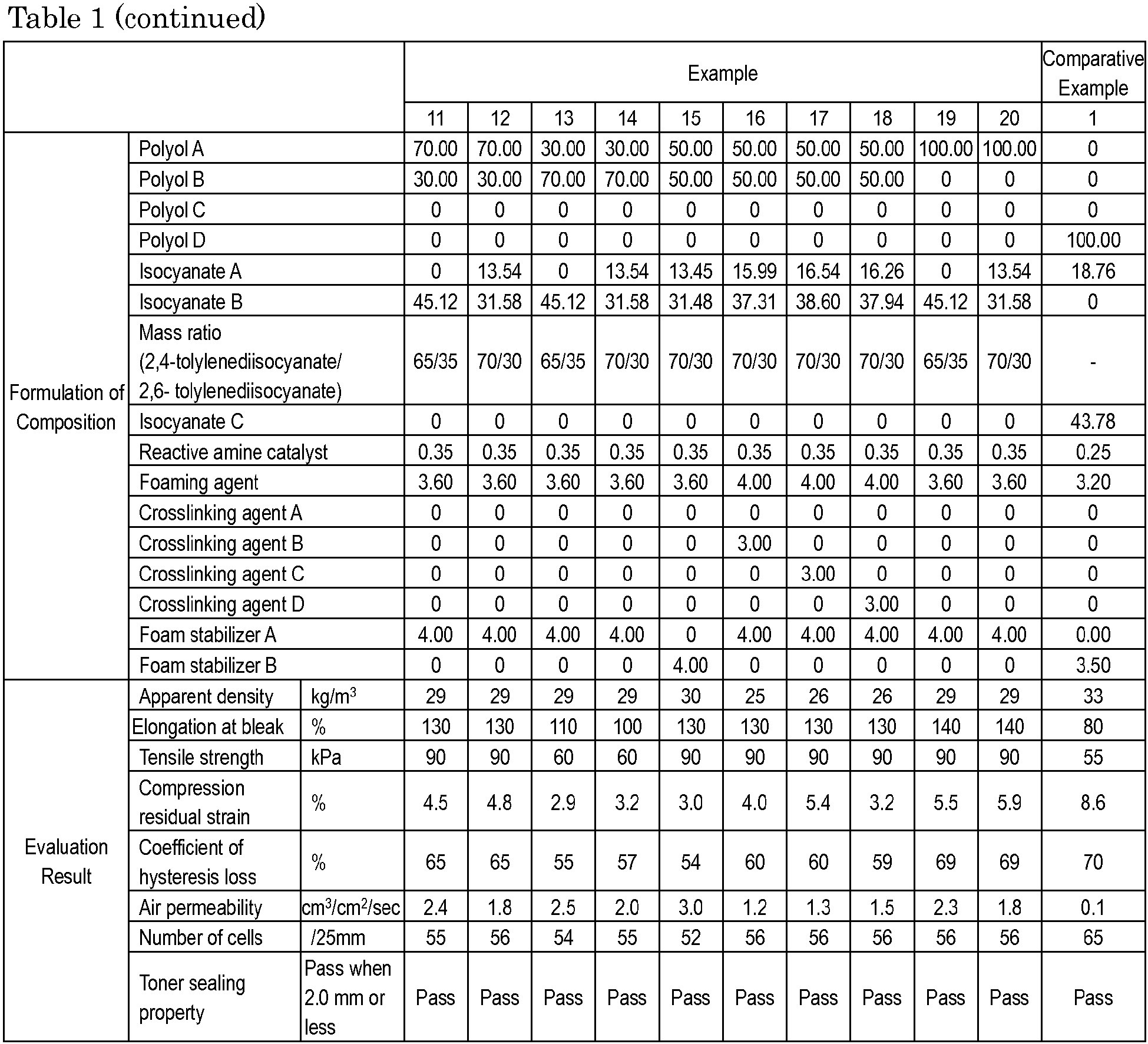
- As is clear from Table 1, the toner sealing materials produced from polyurethane foams of Examples 1 to 20 were able to show increased tensile strength of the polyurethane foam, reduced compression residual strain and coefficient of hysteresis loss thereof, while ensuring an excellent toner sealing property of the polyurethane foam, as compared with the toner sealing material produced from the polyurethane foam of Comparative Example 1. Thus, the toner sealing materials of Examples 1 to 20 was able to exhibit excellent restorability.
- Polyurethane foams obtained from the composition for polyurethane foam of the present invention are largely improved in tensile strength, compression residual strain, and coefficient of hysteresis loss and are superior in restorability, while ensuring an excellent toner sealing property, and thus are suitably used as toner sealing materials of various image forming devices such as a dry electrophotographic device.
Claims (8)
- A composition for polyurethane foam, which is produced by blending a polyol comprising a polyester polyol and a polyether polyol, tolylene diisocyanate, a foaming agent, and a foam stabilizer, wherein the polyester polyol comprises a phthalate ester polyol, and the tolylene diisocyanate has a compositional mass ratio (2,4-tolylene diisocyanate/2,6-tolylene diisocyanate) of (65/35) to (70/30).
- The composition for polyurethane foam according to claim 1, which has a mass ratio of the polyester polyol to the polyether polyol (polyester polyol/polyether polyol) of (70/30) to (30/70).
- The composition for polyurethane foam according to claim 1 or 2, wherein the foam stabilizer comprises a reactive silicone foam stabilizer.
- The composition for polyurethane foam according to any one of claims 1 to 3, which is produced by further blending a bi- or higher functional crosslinking agent.
- The composition for polyurethane foam according to claim 4, wherein an amount of the bi- or higher functional crosslinking agent blended is from 0.1 to 3.0 parts by mass based on 100 parts by mass of the polyol.
- The composition for polyurethane foam according to claim 4 or 5, wherein the bi- or higher functional crosslinking agent is a trifunctional crosslinking agent.
- A toner sealing material, which is formed of a polyurethane foam produced by foaming the composition for polyurethane foam of any one of claims 1 to 6.
- An image forming device comprising the toner sealing material of claim 7.
Applications Claiming Priority (2)
| Application Number | Priority Date | Filing Date | Title |
|---|---|---|---|
| JP2016002590A JP2017122191A (en) | 2016-01-08 | 2016-01-08 | Composition for polyurethane foam |
| PCT/JP2016/088725 WO2017119343A1 (en) | 2016-01-08 | 2016-12-26 | Composition for polyurethane foam |
Publications (3)
| Publication Number | Publication Date |
|---|---|
| EP3401345A1 true EP3401345A1 (en) | 2018-11-14 |
| EP3401345A4 EP3401345A4 (en) | 2019-01-16 |
| EP3401345B1 EP3401345B1 (en) | 2020-03-25 |
Family
ID=59274200
Family Applications (1)
| Application Number | Title | Priority Date | Filing Date |
|---|---|---|---|
| EP16883842.3A Active EP3401345B1 (en) | 2016-01-08 | 2016-12-26 | Composition for polyurethane foam |
Country Status (5)
| Country | Link |
|---|---|
| US (1) | US20200262963A1 (en) |
| EP (1) | EP3401345B1 (en) |
| JP (1) | JP2017122191A (en) |
| CN (1) | CN108473656A (en) |
| WO (1) | WO2017119343A1 (en) |
Families Citing this family (3)
| Publication number | Priority date | Publication date | Assignee | Title |
|---|---|---|---|---|
| JP7019354B2 (en) * | 2017-09-12 | 2022-02-15 | アキレス株式会社 | Laminate |
| KR102906677B1 (en) * | 2021-04-20 | 2025-12-31 | 이노악 코포레이션 | Polyurethane foam and toner seal absence |
| JP7618279B2 (en) * | 2023-04-07 | 2025-01-21 | サンユレック株式会社 | Polyurethane resin composition |
Family Cites Families (15)
| Publication number | Priority date | Publication date | Assignee | Title |
|---|---|---|---|---|
| JPS4930309B1 (en) * | 1966-08-31 | 1974-08-12 | ||
| JPS4630309B1 (en) * | 1967-03-16 | 1971-09-03 | ||
| JP3006418B2 (en) * | 1994-07-20 | 2000-02-07 | 株式会社ブリヂストン | Speaker edge material |
| KR100479694B1 (en) * | 1996-03-04 | 2005-07-21 | 가부시끼가이샤 이노아꾸 코포레이션 | Polyurethane foam for sealants and doors for conditioners using it |
| JP4166294B2 (en) * | 1996-03-04 | 2008-10-15 | 株式会社イノアックコーポレーション | Polyurethane foam for sealing material and door for air conditioner using the same |
| JP4766794B2 (en) * | 2001-08-07 | 2011-09-07 | 株式会社イノアックコーポレーション | Flexible polyurethane foam and toner seal material using the same |
| JP2006028283A (en) * | 2004-07-14 | 2006-02-02 | Sakamoto Yakuhin Kogyo Co Ltd | Flexible foamed polyurethane foam and method for producing the same |
| JP2007016070A (en) * | 2005-07-05 | 2007-01-25 | Inoac Corp | Polyurethane foam and waterproof gasket |
| JP5230987B2 (en) * | 2007-09-28 | 2013-07-10 | 株式会社イノアックコーポレーション | Soft polyurethane foam for skin material integrated foam molding |
| JP2011052104A (en) * | 2009-09-01 | 2011-03-17 | Bridgestone Corp | Highly flame-retardant polyurethane foam |
| JP2011121998A (en) * | 2009-12-08 | 2011-06-23 | Bridgestone Corp | Polyurethane foam for frame lamination |
| JP5644116B2 (en) * | 2010-01-21 | 2014-12-24 | 株式会社ブリヂストン | High flame retardant polyurethane foam |
| JP5644189B2 (en) * | 2010-06-03 | 2014-12-24 | 株式会社ブリヂストン | High flame retardant polyurethane foam |
| JP5492714B2 (en) * | 2010-09-09 | 2014-05-14 | 株式会社ブリヂストン | Polyurethane foam |
| JP5759297B2 (en) | 2011-07-27 | 2015-08-05 | 株式会社ブリヂストン | Toner seal material |
-
2016
- 2016-01-08 JP JP2016002590A patent/JP2017122191A/en not_active Ceased
- 2016-12-26 CN CN201680078086.7A patent/CN108473656A/en active Pending
- 2016-12-26 US US16/067,891 patent/US20200262963A1/en not_active Abandoned
- 2016-12-26 WO PCT/JP2016/088725 patent/WO2017119343A1/en not_active Ceased
- 2016-12-26 EP EP16883842.3A patent/EP3401345B1/en active Active
Also Published As
| Publication number | Publication date |
|---|---|
| WO2017119343A1 (en) | 2017-07-13 |
| JP2017122191A (en) | 2017-07-13 |
| US20200262963A1 (en) | 2020-08-20 |
| EP3401345B1 (en) | 2020-03-25 |
| EP3401345A4 (en) | 2019-01-16 |
| CN108473656A (en) | 2018-08-31 |
Similar Documents
| Publication | Publication Date | Title |
|---|---|---|
| EP3401345B1 (en) | Composition for polyurethane foam | |
| JP2010134255A (en) | Toner supply roller | |
| EP3696244B1 (en) | Water blocking material | |
| JP5102991B2 (en) | Toner supply roller and manufacturing method thereof | |
| JP4647116B2 (en) | Shape memory polyurethane foam | |
| JP5331037B2 (en) | Soft polyurethane foam for toner seal and toner seal material using the same | |
| JP4250548B2 (en) | Toner supply roller | |
| JP4509736B2 (en) | Toner supply roller | |
| JP2006064937A (en) | Toner supply roller | |
| JP5046593B2 (en) | Toner supply roller | |
| JP4807871B2 (en) | Toner supply roller | |
| JP2006308661A (en) | Toner supply roller, process cartridge and image forming apparatus | |
| JP4807870B2 (en) | Toner supply roller | |
| JP7116663B2 (en) | Polyurethane foam and its manufacturing method | |
| JP2009020198A (en) | Toner supply roller | |
| JP5191149B2 (en) | Ink holder | |
| JP3981816B2 (en) | Toner supply roll | |
| JP7829109B1 (en) | Elastic body for blades, and cleaning blade having this elastic body. | |
| JP4976747B2 (en) | Method for producing polyurethane foam | |
| JP2008033100A (en) | Toner supply roller | |
| JP5391113B2 (en) | Soft polyurethane foam for toner seal and toner seal material using the same | |
| JP2006153951A (en) | Member for image forming apparatus | |
| JP2007178556A (en) | Toner supply roller | |
| JP2009237465A (en) | Toner supply roller | |
| JP2009014981A (en) | Toner supply roller |
Legal Events
| Date | Code | Title | Description |
|---|---|---|---|
| STAA | Information on the status of an ep patent application or granted ep patent |
Free format text: STATUS: THE INTERNATIONAL PUBLICATION HAS BEEN MADE |
|
| PUAI | Public reference made under article 153(3) epc to a published international application that has entered the european phase |
Free format text: ORIGINAL CODE: 0009012 |
|
| STAA | Information on the status of an ep patent application or granted ep patent |
Free format text: STATUS: REQUEST FOR EXAMINATION WAS MADE |
|
| 17P | Request for examination filed |
Effective date: 20180703 |
|
| AK | Designated contracting states |
Kind code of ref document: A1 Designated state(s): AL AT BE BG CH CY CZ DE DK EE ES FI FR GB GR HR HU IE IS IT LI LT LU LV MC MK MT NL NO PL PT RO RS SE SI SK SM TR |
|
| AX | Request for extension of the european patent |
Extension state: BA ME |
|
| A4 | Supplementary search report drawn up and despatched |
Effective date: 20181219 |
|
| RIC1 | Information provided on ipc code assigned before grant |
Ipc: C08G 18/42 20060101ALI20181213BHEP Ipc: C08G 18/00 20060101ALI20181213BHEP Ipc: C08G 101/00 20060101ALI20181213BHEP Ipc: C08G 18/66 20060101ALI20181213BHEP Ipc: C08G 18/76 20060101AFI20181213BHEP Ipc: C08G 18/48 20060101ALI20181213BHEP Ipc: C08G 18/40 20060101ALI20181213BHEP Ipc: G03G 15/00 20060101ALI20181213BHEP Ipc: G03G 15/08 20060101ALI20181213BHEP |
|
| DAV | Request for validation of the european patent (deleted) | ||
| DAX | Request for extension of the european patent (deleted) | ||
| GRAP | Despatch of communication of intention to grant a patent |
Free format text: ORIGINAL CODE: EPIDOSNIGR1 |
|
| STAA | Information on the status of an ep patent application or granted ep patent |
Free format text: STATUS: GRANT OF PATENT IS INTENDED |
|
| INTG | Intention to grant announced |
Effective date: 20191021 |
|
| GRAS | Grant fee paid |
Free format text: ORIGINAL CODE: EPIDOSNIGR3 |
|
| GRAA | (expected) grant |
Free format text: ORIGINAL CODE: 0009210 |
|
| STAA | Information on the status of an ep patent application or granted ep patent |
Free format text: STATUS: THE PATENT HAS BEEN GRANTED |
|
| AK | Designated contracting states |
Kind code of ref document: B1 Designated state(s): AL AT BE BG CH CY CZ DE DK EE ES FI FR GB GR HR HU IE IS IT LI LT LU LV MC MK MT NL NO PL PT RO RS SE SI SK SM TR |
|
| REG | Reference to a national code |
Ref country code: GB Ref legal event code: FG4D |
|
| REG | Reference to a national code |
Ref country code: AT Ref legal event code: REF Ref document number: 1248463 Country of ref document: AT Kind code of ref document: T Effective date: 20200415 Ref country code: IE Ref legal event code: FG4D |
|
| REG | Reference to a national code |
Ref country code: DE Ref legal event code: R096 Ref document number: 602016032775 Country of ref document: DE |
|
| PG25 | Lapsed in a contracting state [announced via postgrant information from national office to epo] |
Ref country code: NO Free format text: LAPSE BECAUSE OF FAILURE TO SUBMIT A TRANSLATION OF THE DESCRIPTION OR TO PAY THE FEE WITHIN THE PRESCRIBED TIME-LIMIT Effective date: 20200625 Ref country code: RS Free format text: LAPSE BECAUSE OF FAILURE TO SUBMIT A TRANSLATION OF THE DESCRIPTION OR TO PAY THE FEE WITHIN THE PRESCRIBED TIME-LIMIT Effective date: 20200325 Ref country code: FI Free format text: LAPSE BECAUSE OF FAILURE TO SUBMIT A TRANSLATION OF THE DESCRIPTION OR TO PAY THE FEE WITHIN THE PRESCRIBED TIME-LIMIT Effective date: 20200325 |
|
| PG25 | Lapsed in a contracting state [announced via postgrant information from national office to epo] |
Ref country code: LV Free format text: LAPSE BECAUSE OF FAILURE TO SUBMIT A TRANSLATION OF THE DESCRIPTION OR TO PAY THE FEE WITHIN THE PRESCRIBED TIME-LIMIT Effective date: 20200325 Ref country code: SE Free format text: LAPSE BECAUSE OF FAILURE TO SUBMIT A TRANSLATION OF THE DESCRIPTION OR TO PAY THE FEE WITHIN THE PRESCRIBED TIME-LIMIT Effective date: 20200325 Ref country code: GR Free format text: LAPSE BECAUSE OF FAILURE TO SUBMIT A TRANSLATION OF THE DESCRIPTION OR TO PAY THE FEE WITHIN THE PRESCRIBED TIME-LIMIT Effective date: 20200626 Ref country code: BG Free format text: LAPSE BECAUSE OF FAILURE TO SUBMIT A TRANSLATION OF THE DESCRIPTION OR TO PAY THE FEE WITHIN THE PRESCRIBED TIME-LIMIT Effective date: 20200625 Ref country code: HR Free format text: LAPSE BECAUSE OF FAILURE TO SUBMIT A TRANSLATION OF THE DESCRIPTION OR TO PAY THE FEE WITHIN THE PRESCRIBED TIME-LIMIT Effective date: 20200325 |
|
| REG | Reference to a national code |
Ref country code: NL Ref legal event code: MP Effective date: 20200325 |
|
| REG | Reference to a national code |
Ref country code: LT Ref legal event code: MG4D |
|
| PG25 | Lapsed in a contracting state [announced via postgrant information from national office to epo] |
Ref country code: NL Free format text: LAPSE BECAUSE OF FAILURE TO SUBMIT A TRANSLATION OF THE DESCRIPTION OR TO PAY THE FEE WITHIN THE PRESCRIBED TIME-LIMIT Effective date: 20200325 |
|
| PG25 | Lapsed in a contracting state [announced via postgrant information from national office to epo] |
Ref country code: PT Free format text: LAPSE BECAUSE OF FAILURE TO SUBMIT A TRANSLATION OF THE DESCRIPTION OR TO PAY THE FEE WITHIN THE PRESCRIBED TIME-LIMIT Effective date: 20200818 Ref country code: LT Free format text: LAPSE BECAUSE OF FAILURE TO SUBMIT A TRANSLATION OF THE DESCRIPTION OR TO PAY THE FEE WITHIN THE PRESCRIBED TIME-LIMIT Effective date: 20200325 Ref country code: EE Free format text: LAPSE BECAUSE OF FAILURE TO SUBMIT A TRANSLATION OF THE DESCRIPTION OR TO PAY THE FEE WITHIN THE PRESCRIBED TIME-LIMIT Effective date: 20200325 Ref country code: SM Free format text: LAPSE BECAUSE OF FAILURE TO SUBMIT A TRANSLATION OF THE DESCRIPTION OR TO PAY THE FEE WITHIN THE PRESCRIBED TIME-LIMIT Effective date: 20200325 Ref country code: RO Free format text: LAPSE BECAUSE OF FAILURE TO SUBMIT A TRANSLATION OF THE DESCRIPTION OR TO PAY THE FEE WITHIN THE PRESCRIBED TIME-LIMIT Effective date: 20200325 Ref country code: IS Free format text: LAPSE BECAUSE OF FAILURE TO SUBMIT A TRANSLATION OF THE DESCRIPTION OR TO PAY THE FEE WITHIN THE PRESCRIBED TIME-LIMIT Effective date: 20200725 Ref country code: SK Free format text: LAPSE BECAUSE OF FAILURE TO SUBMIT A TRANSLATION OF THE DESCRIPTION OR TO PAY THE FEE WITHIN THE PRESCRIBED TIME-LIMIT Effective date: 20200325 Ref country code: CZ Free format text: LAPSE BECAUSE OF FAILURE TO SUBMIT A TRANSLATION OF THE DESCRIPTION OR TO PAY THE FEE WITHIN THE PRESCRIBED TIME-LIMIT Effective date: 20200325 |
|
| REG | Reference to a national code |
Ref country code: AT Ref legal event code: MK05 Ref document number: 1248463 Country of ref document: AT Kind code of ref document: T Effective date: 20200325 |
|
| REG | Reference to a national code |
Ref country code: DE Ref legal event code: R097 Ref document number: 602016032775 Country of ref document: DE |
|
| PG25 | Lapsed in a contracting state [announced via postgrant information from national office to epo] |
Ref country code: ES Free format text: LAPSE BECAUSE OF FAILURE TO SUBMIT A TRANSLATION OF THE DESCRIPTION OR TO PAY THE FEE WITHIN THE PRESCRIBED TIME-LIMIT Effective date: 20200325 Ref country code: AT Free format text: LAPSE BECAUSE OF FAILURE TO SUBMIT A TRANSLATION OF THE DESCRIPTION OR TO PAY THE FEE WITHIN THE PRESCRIBED TIME-LIMIT Effective date: 20200325 Ref country code: IT Free format text: LAPSE BECAUSE OF FAILURE TO SUBMIT A TRANSLATION OF THE DESCRIPTION OR TO PAY THE FEE WITHIN THE PRESCRIBED TIME-LIMIT Effective date: 20200325 Ref country code: DK Free format text: LAPSE BECAUSE OF FAILURE TO SUBMIT A TRANSLATION OF THE DESCRIPTION OR TO PAY THE FEE WITHIN THE PRESCRIBED TIME-LIMIT Effective date: 20200325 |
|
| PLBE | No opposition filed within time limit |
Free format text: ORIGINAL CODE: 0009261 |
|
| STAA | Information on the status of an ep patent application or granted ep patent |
Free format text: STATUS: NO OPPOSITION FILED WITHIN TIME LIMIT |
|
| PG25 | Lapsed in a contracting state [announced via postgrant information from national office to epo] |
Ref country code: PL Free format text: LAPSE BECAUSE OF FAILURE TO SUBMIT A TRANSLATION OF THE DESCRIPTION OR TO PAY THE FEE WITHIN THE PRESCRIBED TIME-LIMIT Effective date: 20200325 |
|
| 26N | No opposition filed |
Effective date: 20210112 |
|
| PG25 | Lapsed in a contracting state [announced via postgrant information from national office to epo] |
Ref country code: SI Free format text: LAPSE BECAUSE OF FAILURE TO SUBMIT A TRANSLATION OF THE DESCRIPTION OR TO PAY THE FEE WITHIN THE PRESCRIBED TIME-LIMIT Effective date: 20200325 |
|
| REG | Reference to a national code |
Ref country code: CH Ref legal event code: PL |
|
| PG25 | Lapsed in a contracting state [announced via postgrant information from national office to epo] |
Ref country code: MC Free format text: LAPSE BECAUSE OF FAILURE TO SUBMIT A TRANSLATION OF THE DESCRIPTION OR TO PAY THE FEE WITHIN THE PRESCRIBED TIME-LIMIT Effective date: 20200325 |
|
| REG | Reference to a national code |
Ref country code: BE Ref legal event code: MM Effective date: 20201231 |
|
| PG25 | Lapsed in a contracting state [announced via postgrant information from national office to epo] |
Ref country code: IE Free format text: LAPSE BECAUSE OF NON-PAYMENT OF DUE FEES Effective date: 20201226 Ref country code: LU Free format text: LAPSE BECAUSE OF NON-PAYMENT OF DUE FEES Effective date: 20201226 |
|
| PG25 | Lapsed in a contracting state [announced via postgrant information from national office to epo] |
Ref country code: LI Free format text: LAPSE BECAUSE OF NON-PAYMENT OF DUE FEES Effective date: 20201231 Ref country code: CH Free format text: LAPSE BECAUSE OF NON-PAYMENT OF DUE FEES Effective date: 20201231 |
|
| PG25 | Lapsed in a contracting state [announced via postgrant information from national office to epo] |
Ref country code: TR Free format text: LAPSE BECAUSE OF FAILURE TO SUBMIT A TRANSLATION OF THE DESCRIPTION OR TO PAY THE FEE WITHIN THE PRESCRIBED TIME-LIMIT Effective date: 20200325 Ref country code: MT Free format text: LAPSE BECAUSE OF FAILURE TO SUBMIT A TRANSLATION OF THE DESCRIPTION OR TO PAY THE FEE WITHIN THE PRESCRIBED TIME-LIMIT Effective date: 20200325 Ref country code: CY Free format text: LAPSE BECAUSE OF FAILURE TO SUBMIT A TRANSLATION OF THE DESCRIPTION OR TO PAY THE FEE WITHIN THE PRESCRIBED TIME-LIMIT Effective date: 20200325 |
|
| PG25 | Lapsed in a contracting state [announced via postgrant information from national office to epo] |
Ref country code: MK Free format text: LAPSE BECAUSE OF FAILURE TO SUBMIT A TRANSLATION OF THE DESCRIPTION OR TO PAY THE FEE WITHIN THE PRESCRIBED TIME-LIMIT Effective date: 20200325 Ref country code: AL Free format text: LAPSE BECAUSE OF FAILURE TO SUBMIT A TRANSLATION OF THE DESCRIPTION OR TO PAY THE FEE WITHIN THE PRESCRIBED TIME-LIMIT Effective date: 20200325 |
|
| PG25 | Lapsed in a contracting state [announced via postgrant information from national office to epo] |
Ref country code: BE Free format text: LAPSE BECAUSE OF NON-PAYMENT OF DUE FEES Effective date: 20201231 |
|
| REG | Reference to a national code |
Ref country code: GB Ref legal event code: 732E Free format text: REGISTERED BETWEEN 20220728 AND 20220803 |
|
| REG | Reference to a national code |
Ref country code: DE Ref legal event code: R081 Ref document number: 602016032775 Country of ref document: DE Owner name: ARCHEM INC., JP Free format text: FORMER OWNER: BRIDGESTONE CORPORATION, TOKYO, JP |
|
| REG | Reference to a national code |
Ref country code: DE Ref legal event code: R082 Ref document number: 602016032775 Country of ref document: DE |
|
| PGFP | Annual fee paid to national office [announced via postgrant information from national office to epo] |
Ref country code: DE Payment date: 20251211 Year of fee payment: 10 |
|
| PGFP | Annual fee paid to national office [announced via postgrant information from national office to epo] |
Ref country code: GB Payment date: 20251219 Year of fee payment: 10 |
|
| PGFP | Annual fee paid to national office [announced via postgrant information from national office to epo] |
Ref country code: FR Payment date: 20251229 Year of fee payment: 10 |