EP3401306B1 - Dezocine analogue - Google Patents
Dezocine analogue Download PDFInfo
- Publication number
- EP3401306B1 EP3401306B1 EP17735813.2A EP17735813A EP3401306B1 EP 3401306 B1 EP3401306 B1 EP 3401306B1 EP 17735813 A EP17735813 A EP 17735813A EP 3401306 B1 EP3401306 B1 EP 3401306B1
- Authority
- EP
- European Patent Office
- Prior art keywords
- compound
- nmr
- 400mhz
- acid
- solution
- Prior art date
- Legal status (The legal status is an assumption and is not a legal conclusion. Google has not performed a legal analysis and makes no representation as to the accuracy of the status listed.)
- Active
Links
- 0 *C(CC*CCC1C2)(C1N)c1c2ccc(O)c1 Chemical compound *C(CC*CCC1C2)(C1N)c1c2ccc(O)c1 0.000 description 6
- UYXCMTVGTOCSBW-AREMUKBSSA-N CC(C)(C)C(Oc1cc([C@]2(C)C(NC(OC(C)(C)C)=O)=C(C3)C=CC=CC2)c3c(F)c1)=O Chemical compound CC(C)(C)C(Oc1cc([C@]2(C)C(NC(OC(C)(C)C)=O)=C(C3)C=CC=CC2)c3c(F)c1)=O UYXCMTVGTOCSBW-AREMUKBSSA-N 0.000 description 1
- NCFUEDJEJWIVAS-KPMCYMKJSA-N CC(C)(CCCC(C)(C)C(Oc1cc([C@@](C)(CCCCC[C@H]2C3)[C@H]2N)c3c(F)c1)=O)C(Oc1cc([C@@](C)(CCCCC[C@H]2C3)[C@H]2N)c3c(F)c1)=O Chemical compound CC(C)(CCCC(C)(C)C(Oc1cc([C@@](C)(CCCCC[C@H]2C3)[C@H]2N)c3c(F)c1)=O)C(Oc1cc([C@@](C)(CCCCC[C@H]2C3)[C@H]2N)c3c(F)c1)=O NCFUEDJEJWIVAS-KPMCYMKJSA-N 0.000 description 1
- PTSLHUDJKNYNGF-UHFFFAOYSA-N CC(C)c1cc(O)cc(C2(C)CCCCC34)c1C3C4C2N Chemical compound CC(C)c1cc(O)cc(C2(C)CCCCC34)c1C3C4C2N PTSLHUDJKNYNGF-UHFFFAOYSA-N 0.000 description 1
- JVDLBUFREOAUQJ-UHFFFAOYSA-N CC(CCCCCC1C2)(C1N)c1c2c(F)cc(OC)c1 Chemical compound CC(CCCCCC1C2)(C1N)c1c2c(F)cc(OC)c1 JVDLBUFREOAUQJ-UHFFFAOYSA-N 0.000 description 1
- TZSDFMRMFQDVPJ-UHFFFAOYSA-N CC(c1c2F)=CCCc1ccc2OC Chemical compound CC(c1c2F)=CCCc1ccc2OC TZSDFMRMFQDVPJ-UHFFFAOYSA-N 0.000 description 1
- FZKFWVNDYHGWDQ-UHFFFAOYSA-N CC1(CCCCC2)c3cc(OC)cc(Cl)c3CC2C1N Chemical compound CC1(CCCCC2)c3cc(OC)cc(Cl)c3CC2C1N FZKFWVNDYHGWDQ-UHFFFAOYSA-N 0.000 description 1
- DYIWPPSNJSVFED-UHFFFAOYSA-N CC1c2cc(OC)ccc2CCC1=O Chemical compound CC1c2cc(OC)ccc2CCC1=O DYIWPPSNJSVFED-UHFFFAOYSA-N 0.000 description 1
- WLVAKXXLWOTRFX-ZNCVFPSASA-N CCCCCC(C)(C)CC(Oc1cc([C@@](C)(CCCCC[C@H]2C3)[C@H]2N)c3c(F)c1)=O Chemical compound CCCCCC(C)(C)CC(Oc1cc([C@@](C)(CCCCC[C@H]2C3)[C@H]2N)c3c(F)c1)=O WLVAKXXLWOTRFX-ZNCVFPSASA-N 0.000 description 1
- QEPFZYIJDFJWCF-UHFFFAOYSA-N CCc1cc(O)cc(C2(C)CCCCC34)c1C3C4C2N Chemical compound CCc1cc(O)cc(C2(C)CCCCC34)c1C3C4C2N QEPFZYIJDFJWCF-UHFFFAOYSA-N 0.000 description 1
- VBEYKVATSOPMDF-GTTSAUCSSA-N C[C@@](CCCCC[C@@H]1C2)([C@@H]1N)c1c2c(F)cc(O)c1 Chemical compound C[C@@](CCCCC[C@@H]1C2)([C@@H]1N)c1c2c(F)cc(O)c1 VBEYKVATSOPMDF-GTTSAUCSSA-N 0.000 description 1
- VBEYKVATSOPMDF-CIISACIHSA-N C[C@@]1(CCCCC2)c3cc(O)cc(F)c3C[C@H]2[C@@H]1N Chemical compound C[C@@]1(CCCCC2)c3cc(O)cc(F)c3C[C@H]2[C@@H]1N VBEYKVATSOPMDF-CIISACIHSA-N 0.000 description 1
- LIUNPESACCJBBH-UCVSDAKESA-N C[C@@]1(CCCC[C@H]2C3)c4cc(OC(CCCCCCC(Oc5cc([C@@](C)(CCCCC(C6)C66C7)[C@H]6N)c7c(F)c5)=O)=O)cc(F)c4CC23[C@@H]1N Chemical compound C[C@@]1(CCCC[C@H]2C3)c4cc(OC(CCCCCCC(Oc5cc([C@@](C)(CCCCC(C6)C66C7)[C@H]6N)c7c(F)c5)=O)=O)cc(F)c4CC23[C@@H]1N LIUNPESACCJBBH-UCVSDAKESA-N 0.000 description 1
- PHVQHKVVQHEGAO-VCIFKQKPSA-N C[C@](CCCCCC1C2)([C@H]1N)c1c2c(F)cc(OC(C2CCCCC2)=O)c1 Chemical compound C[C@](CCCCCC1C2)([C@H]1N)c1c2c(F)cc(OC(C2CCCCC2)=O)c1 PHVQHKVVQHEGAO-VCIFKQKPSA-N 0.000 description 1
- IKFBELLROMIUDO-CIISACIHSA-N C[C@](CCCCC[C@H]1C2)([C@H]1N)c1c2c(Cl)cc(O)c1 Chemical compound C[C@](CCCCC[C@H]1C2)([C@H]1N)c1c2c(Cl)cc(O)c1 IKFBELLROMIUDO-CIISACIHSA-N 0.000 description 1
Classifications
-
- C—CHEMISTRY; METALLURGY
- C07—ORGANIC CHEMISTRY
- C07C—ACYCLIC OR CARBOCYCLIC COMPOUNDS
- C07C215/00—Compounds containing amino and hydroxy groups bound to the same carbon skeleton
- C07C215/46—Compounds containing amino and hydroxy groups bound to the same carbon skeleton having hydroxy groups bound to carbon atoms of at least one six-membered aromatic ring and amino groups bound to acyclic carbon atoms or to carbon atoms of rings other than six-membered aromatic rings of the same carbon skeleton
- C07C215/64—Compounds containing amino and hydroxy groups bound to the same carbon skeleton having hydroxy groups bound to carbon atoms of at least one six-membered aromatic ring and amino groups bound to acyclic carbon atoms or to carbon atoms of rings other than six-membered aromatic rings of the same carbon skeleton with rings other than six-membered aromatic rings being part of the carbon skeleton
-
- A—HUMAN NECESSITIES
- A61—MEDICAL OR VETERINARY SCIENCE; HYGIENE
- A61P—SPECIFIC THERAPEUTIC ACTIVITY OF CHEMICAL COMPOUNDS OR MEDICINAL PREPARATIONS
- A61P25/00—Drugs for disorders of the nervous system
- A61P25/04—Centrally acting analgesics, e.g. opioids
-
- A—HUMAN NECESSITIES
- A61—MEDICAL OR VETERINARY SCIENCE; HYGIENE
- A61P—SPECIFIC THERAPEUTIC ACTIVITY OF CHEMICAL COMPOUNDS OR MEDICINAL PREPARATIONS
- A61P43/00—Drugs for specific purposes, not provided for in groups A61P1/00-A61P41/00
-
- C—CHEMISTRY; METALLURGY
- C07—ORGANIC CHEMISTRY
- C07C—ACYCLIC OR CARBOCYCLIC COMPOUNDS
- C07C217/00—Compounds containing amino and etherified hydroxy groups bound to the same carbon skeleton
- C07C217/54—Compounds containing amino and etherified hydroxy groups bound to the same carbon skeleton having etherified hydroxy groups bound to carbon atoms of at least one six-membered aromatic ring and amino groups bound to acyclic carbon atoms or to carbon atoms of rings other than six-membered aromatic rings of the same carbon skeleton
- C07C217/74—Compounds containing amino and etherified hydroxy groups bound to the same carbon skeleton having etherified hydroxy groups bound to carbon atoms of at least one six-membered aromatic ring and amino groups bound to acyclic carbon atoms or to carbon atoms of rings other than six-membered aromatic rings of the same carbon skeleton with rings other than six-membered aromatic rings being part of the carbon skeleton
-
- C—CHEMISTRY; METALLURGY
- C07—ORGANIC CHEMISTRY
- C07C—ACYCLIC OR CARBOCYCLIC COMPOUNDS
- C07C219/00—Compounds containing amino and esterified hydroxy groups bound to the same carbon skeleton
- C07C219/26—Compounds containing amino and esterified hydroxy groups bound to the same carbon skeleton having esterified hydroxy groups bound to carbon atoms of at least one six-membered aromatic ring and amino groups bound to acyclic carbon atoms or to carbon atoms of rings other than six-membered aromatic rings of the same carbon skeleton
-
- C—CHEMISTRY; METALLURGY
- C07—ORGANIC CHEMISTRY
- C07C—ACYCLIC OR CARBOCYCLIC COMPOUNDS
- C07C255/00—Carboxylic acid nitriles
- C07C255/49—Carboxylic acid nitriles having cyano groups bound to carbon atoms of six-membered aromatic rings of a carbon skeleton
- C07C255/58—Carboxylic acid nitriles having cyano groups bound to carbon atoms of six-membered aromatic rings of a carbon skeleton containing cyano groups and singly-bound nitrogen atoms, not being further bound to other hetero atoms, bound to the carbon skeleton
- C07C255/59—Carboxylic acid nitriles having cyano groups bound to carbon atoms of six-membered aromatic rings of a carbon skeleton containing cyano groups and singly-bound nitrogen atoms, not being further bound to other hetero atoms, bound to the carbon skeleton the carbon skeleton being further substituted by singly-bound oxygen atoms
-
- C—CHEMISTRY; METALLURGY
- C07—ORGANIC CHEMISTRY
- C07C—ACYCLIC OR CARBOCYCLIC COMPOUNDS
- C07C255/00—Carboxylic acid nitriles
- C07C255/63—Carboxylic acid nitriles containing cyano groups and nitrogen atoms further bound to other hetero atoms, other than oxygen atoms of nitro or nitroso groups, bound to the same carbon skeleton
-
- C—CHEMISTRY; METALLURGY
- C07—ORGANIC CHEMISTRY
- C07D—HETEROCYCLIC COMPOUNDS
- C07D313/00—Heterocyclic compounds containing rings of more than six members having one oxygen atom as the only ring hetero atom
- C07D313/16—Eight-membered rings
- C07D313/20—Eight-membered rings condensed with carbocyclic rings or ring systems
-
- C—CHEMISTRY; METALLURGY
- C07—ORGANIC CHEMISTRY
- C07B—GENERAL METHODS OF ORGANIC CHEMISTRY; APPARATUS THEREFOR
- C07B2200/00—Indexing scheme relating to specific properties of organic compounds
- C07B2200/07—Optical isomers
-
- C—CHEMISTRY; METALLURGY
- C07—ORGANIC CHEMISTRY
- C07C—ACYCLIC OR CARBOCYCLIC COMPOUNDS
- C07C2601/00—Systems containing only non-condensed rings
- C07C2601/02—Systems containing only non-condensed rings with a three-membered ring
-
- C—CHEMISTRY; METALLURGY
- C07—ORGANIC CHEMISTRY
- C07C—ACYCLIC OR CARBOCYCLIC COMPOUNDS
- C07C2601/00—Systems containing only non-condensed rings
- C07C2601/12—Systems containing only non-condensed rings with a six-membered ring
- C07C2601/14—The ring being saturated
-
- C—CHEMISTRY; METALLURGY
- C07—ORGANIC CHEMISTRY
- C07C—ACYCLIC OR CARBOCYCLIC COMPOUNDS
- C07C2603/00—Systems containing at least three condensed rings
- C07C2603/56—Ring systems containing bridged rings
- C07C2603/58—Ring systems containing bridged rings containing three rings
- C07C2603/76—Ring systems containing bridged rings containing three rings containing at least one ring with more than six ring members
- C07C2603/80—Ring systems containing bridged rings containing three rings containing at least one ring with more than six ring members containing eight-membered rings
Definitions
- Disclosed in the present invention is a Dezocine analogue, and particularly disclosed are compounds represented by formula (I), (II) and (III), a pharmaceutically acceptable salt or tautomer thereof.
- Dezocine the chemical name of which is (-)-[5R-(5 ⁇ ,11 ⁇ ,13S13-amino-5,6,7,8,9,10,11,12-octahydro-5-methyl-5,11-methan Tavernzocyclodecen-3-ol, is a typical opioid alkaloid analgesic developed by the Swedish company Astra. This type of drugs work by agonizing the opioid receptor. The analgesic effect of Dezocine is stronger than Pentazocine and Dezocine is not only a ⁇ receptor agonist but also a ⁇ antagonist. Dezocine is less addictive and is suitable for the treatment of moderate to severe pain after surgery, visceral colic, and pain of terminal cancer patients. With favourable tolerability and safety, Dezocine is expected to become an opioid alkaloid analgesic with good market prospects.
- US 4 001 331A discloses dodecines and analogues thereof having analgestic and anti-inflammatory activity and having the following general formula:
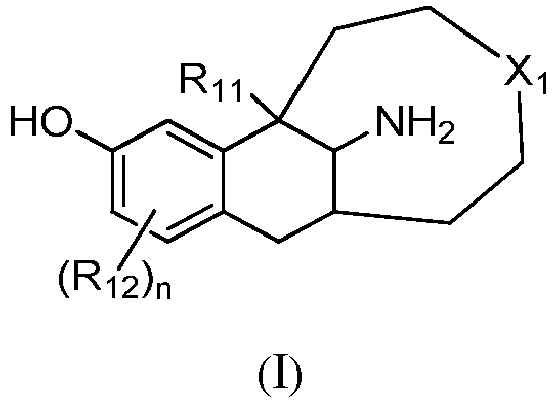
- the present invention provides a compound represented by formula (1-7), (I-8), (I-9), (II-1) (II-2), (II-3), (III-1), (III-2) or (III-3), a pharmaceutically acceptable salt or a tautomer thereof wherein,
- L is selected from (CH 2 ) 4 , (CH 2 ) 5 , (CH 2 ) 6 , (CH 2 ) 7 , (CH 2 ) 8 , (CH 2 ) 9 , (CH 2 ) 10 ,
- R 23 is selected from
- the present invention also provides a compound selected from the group consisting of
- the present invention also provides a compound selected from the group consisting of
- the present invention also provides a pharmaceutical composition
- a pharmaceutical composition comprising a therapeutically effective dose of the compound represented by formula (I), (II) and (III) or the pharmaceutically acceptable salt thereof and a pharmaceutically acceptable carrier.
- the present invention also provides the compound or the pharmaceutically acceptable salt thereof or the pharmaceutical composition for use in analgesic therapy.
- C 1-6 is selected from C 1 , C 2 , C 3 , C 4 , C 5 and C 6 ;
- C 3-7 is selected from C 3 , C 4 , C 5 , C 6 and C 7 .
- C 1-12 alkyl or heteroalkyl, C 3-12 cyclo-group or heterocyclohydrocarbyl, C 1-12 alkyl or heteroalkyl substituted by C 3-12 cyclohydrocarbyl or heterocyclohydrocarbyl include but not limited to:
- pharmaceutically acceptable salt refers to salts of the compounds of the present invention that are prepared from the compounds having particular substituents of the present invention with relatively non-toxic acids or bases.
- base addition salts can be obtained by bringing the neutral form of these compounds into contact with a sufficient amount of base in pure solution or suitable inert solvent.
- Pharmaceutically acceptable base addition salts include salts of sodium, potassium, calcium, ammonium, organic amine or magnesium or similar salts.
- acid addition salts can be obtained by bringing the neutral form of these compounds into contact with a sufficient amount of acid in pure solution or suitable inert solvent.
- Examples of pharmaceutically acceptable acid addition salts include inorganic acid salts, wherein said inorganic acids include, for example, hydrochloric acid, hydrobromic acid, nitric acid, carbonic acid, bicarbonate, phosphoric acid, monohydrogen phosphate, dihydrogen phosphate, sulfuric acid, hydrogen sulfate, hydroiodic acid, phosphorous acid, and the like; and organic acid salts, wherein said organic acids include, for example, acetic acid, propionic acid, isobutyric acid, maleic acid, malonic acid, benzoic acid, succinic acid, suberic acid, fumaric acid, lactic acid, mandelic acid, phthalic acid, benzenesulfonic acid, p-toluenesulfonic acid, citric acid, tartaric acid, and methanesulfonic acid, and the like; and salts of amino acid (such as arginine and the like), and salts of organic acids such as glucuronic acid and the like
- the neutral form of the compound is thereby regenerated.
- the difference between the parent form of a compound and its various salt forms lies in certain physical properties, such as different solubility in polar solvents.
- “Pharmaceutically acceptable salt” used in this document belongs to derivatives of the compounds of the present invention, wherein, the parent compound is modified by forming salt with acid or base.
- pharmaceutically acceptable salts include but are not limited to: inorganic acids or organic acid salts of basic moietys such as amines, alkali metal or organic salts of acidic moietys such as carboxylic acids, and the like.
- Pharmaceutically acceptable salts include conventional non-toxic salts or quaternary ammonium salts of the parent compound, such as the salts formed by non-toxic inorganic acids or organic acids.
- the conventional non-toxic salts include but are not limited to those salts derived from inorganic acids and organic acids, wherein said inorganic acids or organic acids are selected from 2-acetoxybenzoic acid, 2-hydroxyethanesulfonic acid, acetic acid, ascorbic acid, benzenesulfonic acid, benzoic acid, bicarbonate, carbonic acid, citric acid, edetic acid, ethanedisulfonic acid, ethanesulfonic acid, fumaric acid, glucoheptose, gluconic acid, glutamic acid, glycolic acid, hydrobromic acid, hydrochloric acid, hydroiodide, hydroxyl, hydroxynaphthalene, isethionic acid, lactic acid, lactose, dodecyl sulfonic acid, maleic acid, malic acid, mandelic acid, methanesulfonic acid, nitric acid, oxalic acid, pamoic acid, pantothenic acid
- the pharmaceutically acceptable salts of the present invention can be synthesized from the parent compound that contains an acidic or basic moiety by conventional chemical methods.
- such salts can be prepared by reacting the free acid or base forms of these compounds with a stoichiometric amount of appropriate base or acid in water or an organic solvent or a mixture of the two.
- non-aqueous media such as ether, ethyl acetate, ethanol, isopropanol or acetonitrile are preferred.
- the compounds provided by the present invention also exist in prodrug forms.
- Prodrugs of the compounds described herein are those compounds that readily undergo chemical changes under physiological conditions to to be converted into the compounds of the present invention. Additionally, prodrugs can be converted to the compounds of the present invention by chemical or biochemical methods in vivo environment.
- Certain compounds of the present invention can exist in unsolvated forms or solvated forms, including hydrated forms. In general, the solvated forms are equivalent to unsolvated forms, and both are encompassed within the scope of the present invention. Certain compounds of the present invention can have asymmetric carbon atoms (optical centers) or double bonds. Racemate, diastereomer, geometric isomer and individual isomer are all included within the scope of the present invention.
- the compounds of the present invention can have particular geometric or stereoisomeric forms.
- the present invention contemplates all such compounds, including cis and trans isomers, (-)- and (+)-enantiomers, ( R )- and ( S )-enantiomers, diastereoisomers, ( D )-isomers, ( L )-isomers, and racemic mixtures and other mixtures, for example, enantiomer or diastereoisomer enriched mixtures, all of which belong to the scope of the present invention.
- the substituents such as alkyl can have additional asymmetric carbon atoms. All these isomers and mixtures thereof are included within the scope of the present invention.
- Optically active ( R )- and ( S )-isomers, or D and L isomers can be prepared using chiral synthesis or chiral reagents or other conventional techniques. If one kind of enantiomer of certain compound of the present invention is to be obtained, the pure desired enantiomer can be obtained by asymmetric synthesis or derivative action of chiral auxiliary followed by separating the resulting diastereomeric mixture and cleaving the auxiliary group.
- the compound when the molecule contains a basic functional group (such as amino) or acidic functional group (such as carboxyl), the compound reacts with an appropriate optically active acid or base to form a salt of diastereomeric isomer which is then subjected to diastereomeric resolution through conventional methods in the art to give pure enantiomer.
- the enantiomers and diastereoisomers are generally separated through chromatography which uses a chiral stationary phase and optionally combines with a chemical derivative method (for example, generating carbamate generated from amine).
- the compounds of the present invention can contain unnatural proportions of atomic isotopes at one or more of the atoms that constitute the compounds.
- the compounds can be radiolabeled with radioactive isotopes, such as tritium ( 3 H), iodine-125 ( 125 I) or C-14 ( 14 C). All isotopic variations of the compounds of the present invention, whether radioactive or not, are encompassed within the scope of the present invention.
- pharmaceutically acceptable carrier refers to any agent or carrier medium which is capable of delivering an effective amount of the active substances of the present invention, does not interfere with the biological activity of the active substances and has no toxic side effects on the host or patient.
- the representative carrier includes water, oil, vegetable and mineral, cream base, lotion base, ointment base and the like. These bases include suspending agents, thickeners, penetration enhancers and the like. Their formulations are well known to the skilled in the cosmetic field or topical pharmaceutical field. The additional informations about the carrier can be referred to Remington: The Science and Practice of Pharmacy, 21st Ed, Lippincott, Williams & Wilkins (2005 ).
- excipient generally refers to a carrier, a diluent and/or a medium required for formulating an effective pharmaceutical composition.
- an "effective dose” or “therapeutically effective dose” refers to a nontoxic but sufficient amount to achieve the desired effect of the drug or agent.
- an "effective dose” of an active substance in the composition refers to an amount required for achieving the desired effect when combining with another active substance in the composition.
- An effective amount varies from person to person and is determined depending on the age and general condition of the recipient as well as the specific active substance. The appropriate effective amount in an individual case can be determined by the skilled in the art based on routine experiment.
- active ingredient refers to a chemical entity which can effectively treat the target disorder, disease or condition.
- substituted means one or more hydrogen atoms on a specific atom are substituted with substituents, including deuterium and hydrogen variants, as long as the valence of the specific atom is normal and the substituted compound is stable.
- it means two hydrogen atoms are substituted.
- Positions on an aromatic ring can not be substituted with a ketone.
- optionally substituted means an atom can be replaced by a substituent or not, unless otherwise specified, the type and number of the substituents may be arbitary as long as being chemically achievable.
- variable such as R
- the definition of the variable at each occurrence is independent.
- the group can be optionally substituted with up to two R, wherein the definition of R at each occurrence is independent.
- a combination of substituents and/or variants thereof is allowed only when the combination results in a stable compound.
- linking group When the number of a linking group is 0, such as -(CRR) 0 -, it means that the linking group is a single bond.
- one of the variables When one of the variables is selected from a single bond, it means that the two groups linked by the single bond are connected directly. For example, when L in A-L-Z represents a single bond, the structure of A-L-Z is actually A-Z.
- substituents When a bond of a substituent can be cross-linked to two atoms on a ring, such substituent can be bonded to any atom of the ring.
- substituents When the enumerative substituent do not indicate by which atom it is linked to a compound included in the general chemical formula but not specifically mentioned, such substituent can be bonded by any of its atoms.
- a combination of substituents and/or variants thereof is allowed only when such combination can result in a stable compound.
- the structural unit means that it can be substituted at any position on cyclohexyl or cyclohexadiene.
- halo or halogen by itself or as part of another substituent refers to a fluorine, chlorine, bromine or iodine atom.
- haloalkyl is meant to include monohaloalkyl and polyhaloalkyl.
- halo(C 1 -C 4 )alkyl is intended to include, but not limited to, trifluoromethyl, 2,2,2-trifluoroethyl, 4-chlorobutyl, 3-bromopropyl and the like.
- haloalkyl examples include, but not limited to: trifluoromethyl, trichloromethyl, pentafluoroethyl and pentachloroethyl.
- Alkoxy represents any alkyl defined above having a specified number of carbon atoms attached by an oxygen bridge.
- C 1-6 alkoxy includes C 1 , C 2 , C 3 , C 4 , C 5 and C 6 alkoxy.
- alkoxy include, but not limited to: methoxy, ethoxy, n -propoxy, isopropoxy, n -butoxy, sec-butoxy, tert -butoxy, n -pentyloxy and S -pentoxy.
- Cycloalkyl includes a saturated cyclic group, such as cyclopropyl, cyclobutyl or cyclopentyl. 3-7 cycloalkyl includes C 3 , C 4 , C 5 , C 6 and C 7 cycloalkyl.
- Alkenyl includes a linear or branched hydrocarbon chain, wherein one or more carbon-carbon double bonds can be present in any stable site on the chain, such as vinyl and propenyl.
- halo or halogen refers to fluorine, chlorine, bromine and iodine.
- hetero means a heteroatom or a heteroatom group (i.e., an atom group containing a heteroatom), including all atoms except carbon (C) and hydrogen (H), and also including atom groups containing the above heteroatoms.
- ring represents a substituted or unsubstituted cycloalkyl, heterocycloalkyl, cycloalkenyl, heterocycloalkenyl, cycloalkynyl, heterocycloalkynyl, aryl or heteroaryl.
- the so-called ring includes a single ring, a double ring, a spiral ring, a ring system having two rings sharing one bond or a bridged ring.
- the number of atoms on the ring is usually defined as the member number of the ring, for example, a "5-7 membered ring" means that 5 to 7 atoms are arranged in a circle.
- the ring optionally contains 1 to 3 heteroatoms.
- a "5-7 membered ring” includes, for example, phenyl, pyridinyl and piperidinyl; on the other hand, the term “5-7 membered heterocycloalkyl ring” includes pyridyl and piperidinyl, but excluding phenyl.
- the term "ring” also includes a ring system containing at least one ring, wherein each ring independently meets the above definition.
- heterocycle or “heterocyclo” means stable monocyclic, bicyclic or tricyclic rings containing heteroatoms or heteroatom groups, which can be saturated, partially unsaturated or unsaturated (aromatic) and can contain carbon atoms and 1, 2, 3 or 4 ring heteroatoms independently selected from N, O and S, wherein the above any heterocycle can be fused to a benzene ring to form a bicyclic ring.
- Nitrogen and sulfur heteroatoms can optionally be oxidized (i.e., NO and S (O) p).
- Nitrogen atom can be substituted or unsubstituted (i.e., N or NR, wherein R is H or other substituents already defined herein).
- the heterocycle can be attached to the pendant group of any heteroatom or carbon atom to form a stable structure. If the resulting compound is stable, the heterocycle described herein may have a substitution on a carbon or nitrogen position. Nitrogen atom in the heterocycle is optionally quaternized. In a preferred embodiment, when the total number of S and O atoms in the heterocycle is more than 1, these heteroatoms are not adjacent to each other. In another preferred embodiment, the total number of S and O atoms in the heterocycle is not more than 1.
- aromatic heterocyclic group refers to a stable 5-, 6- or 7-membered monocyclic or bicyclic or 7-, 8-, 9- or 10-membered bicyclic heterocyclic aromatic ring which contains carbon atoms and 1, 2, 3 or 4 ring heteroatoms independently selected from N, O and S.
- Nitrogen atom can be substituted or unsubstituted (i.e., N or NR, wherein R is H or other substituents already defined herein).
- Nitrogen and sulfur heteroatoms may optionally be oxidized (i.e., NO and S (O) p). It is worth noting that the total number of S and O atoms in an aromatic heterocycle is not more than one.
- Bridged ring is also included in the definition of heterocycle.
- a bridged ring is formed when one or more atoms (ie, C, O, N or S) link two non-adjacent carbon or nitrogen atoms.
- a preferred bridged ring includes, but not limited to: one carbon atom, two carbon atoms, one nitrogen atom, two nitrogen atoms and one carbon-nitrogen group. It is worth noting that a bridge always converts a monocyclic ring to a tricyclic ring. In a bridged ring, the substituents on the ring may also be present on the bridge.
- heterocyclic compounds include, but are not limited to: acridinyl, azocinyl, benzimidazolyl, benzofuranyl, benzomercaptofuranyl, benzomercaptophenyl, benzoxazolyl, benzoxazolinyl, benzothiazolyl, benzotriazolyl, benzotetrazolyl, benzoisoxazolyl, benzoisothiazolyl, benzoimidazolinyl, carbazolyl, 4a H -carbazolyl, carbolinyl, chromanyl, chromene, cinnolinyl decahydroquinolinyl, 2 H ,6 H -1,5,2-dithiazinyl, dihydrofuro[2,3- b ]tetrahydrofuranyl, furanyl, furazanyl, imidazolidinyl, imidazolinyl, imidazolyl, 1 H -ind
- hydrocarbyl or subordinate concept thereof (such as alkyl, alkenyl, alkynyl, and phenyl, etc.), by itself or as part of another substituent, means a linear, branched chain or cyclic hydrocarbon radicals or any combinations thereof.
- C 1 -C 12 indicates 1 to 12 carbon atoms
- C 1-12 is selected from C 1 , C 2 , C 3 , C 4 , C 5 , C 6 , C 7 , C 8 , C 9 , C 10 , C 11 and C 12
- C 3-12 is selected from C 3 , C 4 , C 5 , C 6 , C 7 , C 8 , C 9 , C 10 , C 11 and C 12 ).
- hydrocarbyl includes, but is not limited to aliphatic hydrocarbyl and aromatic hydrocarbyl.
- the aliphatic hydrocarbyl includes linear and cyclic hydrocarbyl, specifically includes but not limited to an alkyl, alkenyl, and alkynyl.
- the aromatic hydrocarbyl includes but is not limited to 6-12 membered aromatic hydrocarbyl such as phenyl, naphthyl and the like.
- alkyl means a linear or branched radical or a combination thereof which can be fully saturated, mono- or polyunsaturated, and can include a divalent or multivalent radical.
- saturated hydrocarbyl radicals include, but are not limited to, methyl, ethyl, n -propyl, isopropyl, n -butyl, tert -butyl, isobutyl, sec -butyl, cyclohexyl, (cyclohexyl)methyl, cyclopropylmethyl, and homologs or isomers of n -amyl, n -hexyl, n -heptyl, n -octyl and other atom groups.
- the unsaturated alkyl has one or more double or triple bonds.
- unsaturated alkyl examples include but are not limited to, vinyl, 2-propenyl, butenyl, crotyl, 2-isopentenyl, 2-(butadienyl), 2,4-pentadienyl, 3-(1,4-pentadienyl), ethynyl, 1- and 3-propynyl, 3-butynyl, and more advanced homologs and isomers.
- heterohydrocarbyl or subordinate concept thereof (such as heteroalkyl, heteroalkenyl, heteroalkynyl, and heteroaryl, etc.), by itself or as part of another substitutent, means a stable linear, branched or cyclic hydrocarbon radical or any combinations thereof, which have a specified number of carbon atoms and at least one heteroatom.
- heteroalkyl by itself or in combination with another term represents a stable linear chain, branched hydrocarbon radical or combinations thereof which have a specified number of carbon atoms and at least one hetero atom.
- a heteroatom is selected from B, O, N and S, wherein nitrogen and sulfur atoms are optionally oxidized and the nitrogen atom is optionally quaternized.
- Heteroatom or heteroatom radicals can be located at any interior position in a heterohydrocarbyl, including the position where the hydrocarbyl attaches to the rest part of the molecule.
- terms "alkoxy”, “alkylamino” and “alkylthio” (or thioalkyl) are used by their conventional meanings and refer to those alkyl groups connected to the rest part of the molecule via an oxygen atom, an amino or a sulfur atom respectively.
- Up to two consecutive heteroatoms can be present, such as, -CH 2 -NH-OCH 3 .
- alkoxy alkylamino and “alkylthio” (or thioalkyl) are used by their conventional meanings and refer to those alkyl groups connected to the remainder of the molecule via an oxygen atom, an amino or a sulfur atom respectively.
- cyclohydrocarbyl "heterocyclohydrocarbyl” or the subordinate concept thereof (such as aryl, heteroaryl, cycloalkyl, heterocycloalkyl, cycloalkenyl, heterocycloalkenyl, cycloalkynyl, heterocycloalkynyl, etc.) by itself or in combination with another term represents cyclized “hydrocarbyl” or "heterohydrocarbyl”.
- heterohydrocarbyl or heterocyclohydrocarbyl e.g. heteroalkyl, and heterocycloalkyl
- one heteroatom can occupy the position where the heterocycle attaches to the remainder position of the molecule.
- cycloalkyl examples include, but are not limited to, cyclopentyl, cyclohexyl, 1-cyclohexenyl, 3-cyclohexenyl, cycloheptyl and the like.
- heterocycloalkyl examples include 1-(1,2,5,6-tetrahydropyridyl), 1-piperidinyl, 2-piperidinyl, 3-piperidinyl, 4-morpholinyl, 3-morpholinyl, tetrahydrofuran-2-yl, tetrahydrofuran-3 -yl, tetrahydro-thiophen-2-yl, tetrahydro-thiophen-3 -yl, 1-piperazinyl and 2-piperazinyl.
- alkyl is used to denote a linear chain or branched saturated hydrocarbon group, can be mono-substituted (such as -CH 2 F) or poly-substituted (such as -CF 3 ), can be monovalent (such as methyl), divalent (such as methylene) or multivalent (such as methenyl).
- alkyl examples include methyl (Me), ethyl (Et), propyl (such as n -propyl and isopropyl), butyl (such as n -butyl, isobutyl, s-butyl, t -butyl), pentyl (such as n -pentyl, isopentyl, neopentyl) and the like.
- alkenyl refers to an alkyl group having one or more carbon-carbon double bonds at any position on the chain, can be mono-substituted or poly-substituted, and can be monovalent, divalent or multivalent. Examples of alkenyl include ethenyl, propenyl, butenyl, pentenyl, hexenyl, butadienyl, pentadienyl, hexadienyl, and the like.
- alkynyl refers to an alkyl group having one or more carbon-carbon triple bonds at any position on the chain, can be mono-substituted or poly-substituted, and can be monovalent, divalent or multivalent.
- alkynyl groups include ethynyl, propynyl, butynyl, pentynyl, hexynyl, and the like.
- cycloalkyl includes any stable cyclic or polycyclic hydrocarbyl, and any carbon atom is saturated, can be mono-substituted or poly-substituted, can be monovalent, divalent or multivalent.
- examples of these cycloalkyl include, but are not limited to, cyclopropyl, norbornanyl, [2.2.2]bicyclooctane, [4.4.0]bicyclodecanyl and the like.
- cycloalkenyl includes any stable cyclic or polycyclic hydrocarbyl haing one or more unsaturated carbon-carbon single bonds at any position on the ring, can be mono-substituted or poly-substituted, and can be monovalent, divalent or multivalent.
- examples of these cycloalkenyl include, but are not limited to, cyclopentenyl, cyclohexenyl and the like.
- cycloalkynyl includes any stable cyclic or polycyclic hydrocarbyl having one or more carbon-carbon triple bonds at any position on the ring, can be mono-substituted or poly-substituted, and can be monovalent, divalent or multivalent.
- halo or “halogen” by itself or as part of another substituent refers to fluorine, chlorine, bromine or iodine atom.
- haloalkyl is meant to include monohaloalkyl and polyhaloalkyl.
- halo(C 1 -C 4 )alkyl is intended to include, but not limited to, trifluoromethyl, 2,2,2-trifluoroethyl, 4-chlorobutyl, 3-bromopropyl and the like.
- haloalkyl include, but not limited to: trifluoromethyl, trichloromethyl, pentafluoroethyl and pentachloroethyl.
- Alkoxy represents any alkyl defined above having a specified number of carbon atoms attached by an oxygen bridge.
- C 1-6 alkoxy includes C 1 , C 2 , C 3 , C 4 , C 5 and C 6 alkoxy.
- Examples of alkoxy include, but not limited to: methoxy, ethoxy, n -propoxy, isopropoxy, n -butoxy, sec -butoxy, tert -butoxy, n -pentyloxy and S -pentoxy.
- aryl means a polyunsaturated aromatic substituent, can be mono-, di- or poly-substituted, can be a monovalent, divalent or multivalent, can be a single ring or multiple rings (such as one to three rings; wherein at least one ring is aromatic), which are fused together or linked covalently.
- heteroaryl refers to an aryl (or ring) containing one to four heteroatoms. In an illustrative example, the heteroatom is selected from B, O, N and S, wherein nitrogen and sulfur atoms are optionally oxidized and the nitrogen atom is optionally quaternized.
- a heteroaryl may attach to the rest part of a molecule via a heteroatom.
- Non-limiting examples of aryl or heteroaryl include phenyl, naphthyl, biphenyl, pyrrolyl, pyrazolyl, imidazolyl, pyrazinyl, oxazolyl, phenyl-oxazolyl, isoxazolyl, thiazolyl, furanyl, thienyl, pyridyl, pyrimidinyl benzothiazolyl, purinyl, benzimidazolyl, indolyl, isoquinolyl, quinoxalinyl, quinolyl, 1-naphthyl, 2-naphthyl, 4-biphenyl, 1-pyrrolyl, 2-pyrrolyl, 3-pyrrolyl, 3-pyrazolyl, 2-imidazolyl, 4-imidazolyl, pyrazinyl, 2-oxazolyl, 4-oxazolyl, 2-phenyl-4-oxazolyl, 5-oxazolyl
- aryl when combined with other terms (such as aryloxy, arylthio, arylalkyl), the aryl includes all the aryl and heteroaryl rings as defined above.
- aralkyl is meant to include those radicals (such as benzyl, phenethyl, pyridylmethyl, and the like) where an aryl is attached to an alkyl including an alkyl where the carbon atom (such as methylene) has been replaced by an atom such as oxygen, for example, phenoxymethyl, 2-pyridyloxy, 3-(1-naphthyloxy)propyl, and the like.
- leaving group refers to a functional group or atom which can be substituted by another functional group or atom through a substitution reaction (such as an affinity substitution reaction).
- representative leaving groups include triflate; chlorine, bromine and iodine; sulfonate groups, such as mesylate, tosylate, p -bromobenzenesulfonate, p -toluenesulfonates and the like; acyloxy, such as acetoxy, trifluoroacetoxy and the like.
- protecting group includes, but is not limited to "nitrogen protecting group", “hydroxyl protecting group” or “sulphur protecting group.”
- amino protecting group means a protecting group suitable for blocking side reactions on nitrogen of the amino.
- Representative amino protecting groups include, but are not limited to: formyl; acyl, such as alkanoyl (e.g.
- acetyl, trichloroacetyl or trifluoroacetyl alkoxycarbonyl, such as tert -butoxycarbonyl (Boc); arylmethoxycarbonyl such as benzyloxycarbonyl (Cbz) and 9-fluorenylmethoxycarbonyl (Fmoc); arylmethyl such as benzyl (Bn), trityl (Tr), 1,1-bis-(4'-methoxyphenyl)methyl; silyl such as trimethylsilyl (TMS) and tert-butyldimethylsilyl (TBS) and the like.
- alkoxycarbonyl such as tert -butoxycarbonyl (Boc); arylmethoxycarbonyl such as benzyloxycarbonyl (Cbz) and 9-fluorenylmethoxycarbonyl (Fmoc); arylmethyl such as benzyl (Bn), t
- hydroxy protecting group refers to a protecting group suitable for blocking side reactions on the hydroxyl group.
- Representative hydroxy protecting groups include, but are not limited to: alkyl such as methyl, ethyl and t-butyl; acyl, e.g. alkanoyl (e.g. acetyl); arylmethyl such as benzyl (Bn), p -methoxybenzyl (PMB), 9-fluorenylmethyl (Fm), and diphenylmethyl (benzhydryl, DPM); silyl such as trimethylsilyl (TMS) and tert-butyl dimethyl silyl (TBS) and the like.
- alkyl such as methyl, ethyl and t-butyl
- acyl e.g. alkanoyl (e.g. acetyl)
- arylmethyl such as benzyl (Bn), p -methoxybenzyl (PMB), 9-
- the compounds of the present invention can be prepared by a variety of synthetic methods well known to the skilled, including the following specific embodiments, the embodiments formed by the following specific embodiments in combination with other chemical synthesis methods and the equivalent replacement well known to the skilled in the art.
- the preferred embodiments include, but are not limited to the examples of the present invention.
- the present invention employs the following abbreviations:aq represents water; eq represents equivalent and equal; Tol represents toluene; mCPBA represents m-chloroperoxybenzoic acid; TBAB represents tetrabutylammonium bromide; THF represents tetrahydrofuran; DMF represents N,N-dimethylformamide; Pd(dppf)Cl 2 represents [1,1'-bis(diphenylphosphino)ferrocene]dichloropalladium; Pd 2 (dba) 3 represents tris(dibenzylideneacetone)dipalladium; AC 2 O represents acetic anhydride; NBS represents N-bromosuccinimide; MeCN represents acetonitrile; Boc represents tert-butyl carbonyl group, which is an amine protecting group; BOC 2 O represents di-tert -butyl dicarbonate; DCM represents dichloromethane; NCS represents N-chloros
- tetrabutylammonium bromide (492.79mg, 1.86mmol) was added to a mixture solution of compound 1-3 (5.00g, 18.58mmol) and 1,5-dibromopentane (12.82g, 55.73mmol) in toluene (50mL) at 25°C.
- 35% aqueous solution of NaOH 36g, 315.80mmol was slowly added dropwise.
- the reaction mixture was stirred at 0°C for 2 hours, then warmed to 25°C and stirred for 14 hours.
- the aqueous phase was extracted with ethyl acetate (100mL x 3).
- NBS (142mg, 0.803mmol) was added to a solution of compound 12-1 (220mg, 0.730mmol) in acetonitrile (7mL) at room temperature. After being stirred at room temperature for 2 hours, the reaction was quenched with addition of 30mL water. The aqueous phase was extracted with ethyl acetate (20mL x 3). The combined organic was washed with saturated brine (50mL), dried over anhydrous Na 2 SO 4 , filtered, and concentrated in vacuo to give crude product 12-2 (275mg) as a yellow oil. MS ( m / z ): 379.9 (M+1).
- BBr 3 (0.2mL) was added to a solution of compound 12-3 (50mg, 0.143mmol) in dichloromethane (1mL) at room temperature .
- the reaction solution was stirred at 0°C for 1 hour, then 20mL was added to quench the reaction and the pH was adjusted to 9 with saturated aqueous solution of K 2 CO 3 .
- the aqueous phase was extracted with dichloromethane (10mL x 3).
- the combined organic phase was washed with saturated brine (20mL), dried over anhydrous Na 2 SO 4 , filtered and concentrated in vacuo. The residue was purified by HPLC preparative column to give 12 (5mg, yield: 10.80 %).
- DMAP (50mg) was added to a mixed solution of compound 2-7 (500mg, 1.93mmol), Boc 2 O (780mg, 3.86mmol) and triethylamine (585mg, 5.79mmol) in dichloromethane (20mL) at room temperature. After the reaction mixture was stirred at room temperature for 2 hours, 20mL water was added to quench the reaction. The aqueous phase was extracted with dichloromethane (20mL x 3). The combined organic phase was washed with saturated brine (20mL), dried over anhydrous Na 2 SO 4 , filtered and concentrated in vacuo.
- NBS (163mg, 0.919mmol) was added to a solution of compound 13-1 (300 mg, 0.836 mmol) in acetonitrile (5mL) at 25°C. After the reaction mixture was stirred at 25°C for 2 hours, 20mL water was added to quench the reaction. The aqueous phase was extracted with ethyl acetate (20mL x 3). The combined organic phases were washed with saturated brine (20mL), dried over anhydrous Na 2 SO 4 , filtered and concentrated in vacuo to give crude product 13-2 (439mg) as a yellow solid.
- BBr 3 (75mg, 0.30mmol) was added to a solution of compound 13-4 (40mg, 0.10mmol) in dichloromethane (2mL) at 0°C. After being warmed to room temperature, the reaction solution was stirred for 2 hours. After the reaction was complete, 10mL saturated sodium bicarbonate solution was added to quench the reaction. The aqueous phase was extracted with dichloromethane (10mL x 5). The combined organic phase was washed with saturated brine (50mL), dried over anhydrous Na 2 SO 4 , filtered and concentrated in vacuo. The residue was purified by HPLC preparative column to give the hydrochloride salt of product 13 (14mg, yield: 50.0%).
- BBr 3 (0.2mL) was added to a solution of compound 16-1 (88mg, 0.3mmol) in dichloromethane (1mL) at 0°C. After being stirred at 0°C for 2 hours, the reaction was quenched by the addition of 10mL saturated potassium carbonate solution. The aqueous phase was extracted with dichloromethane/methanol mixed solution (8:1, 10mL x 3). The combined organic phase was washed with saturated brine (50mL), dried over anhydrous Na 2 SO 4 , filtered and concentrated in vacuo. The residue was purified by HPLC preparative column to give the hydrochloride salt of product 16 (20mg, yield: 23.81%).
- the prepared solution A (1mL) was added to a solution of compound 13-2 (50mg, 0.139mmol), Zn(CN) 2 (16mg, 0.139mmol) and Zn (0.5mg, 0.008mmol) in dimethylacetamide. Then, the reaction solution was heated to 90°C and stirred overnight. After being cooled to room temperature, the reaction solution was filtered. The filtrate was poured into 10mL water. The aqueous phase was extracted with ethyl acetate (10mL x 4). The combined organic phase was washed with saturated brine (30mL), dried over anhydrous Na 2 SO 4 , filtered and concentrated in vacuo.
- compound 28-2 (900.0mg, 4.05mmol) was dissolved in THF (5.00mL), then the reaction system was purged with nitrogen for 3 times, then potassium tert -butoxide (545.27mg, 4.86mmol) was added. After being stirred at the same temperature for 1 hour, the reaction solution was slowly added to a solution of 1,4-cis dibutylene (1.01g, 8.10mmol) in THF (5.00mL). After reacting at 25°C for 12 hours, t -BuOK (545.27mg, 4.86mmol) was added, then the temperature was raised to 60°C, and the reaction was continued for 6 hours, the reaction solution was slowly poured into water (10mL) to be quenched.
- Periodic acid (3.29g, 14.45mmol) was added to acetonitrile (45mL) and the solution was vigorously stirred at 15°C for 15 minutes. Then the solution was cooled to 0°C and added with 42-5 (1.10g, 5.78mmol) and PCC (25mg, 115.60 ⁇ mol, 0.02 eq ). The mixture was heated to 15°C, and stirred for 16 hours. After the precipitate was filtered off, the filtrate was poured into 50mL half-saturated brine, and the aqueous phase was extracted with ethyl acetate (30mL x 3).
- Fluorescence imaging plate reader FLIPR was used to detect changes of intracellular calcium signals. EC50 and IC50 values of the compounds were used as indicators to evaluate the activation or inhibition of the compounds on ⁇ , ⁇ , and ⁇ opioid receptors.
- Cell lines HEK293- ⁇ , HEK293- ⁇ and HEK293- ⁇ , stable-transfected cell lines HEK293- ⁇ , HEK293- ⁇ and HEK293- ⁇ ; Cell culture media (DMEM, Invitrogen #11965118, 10% fetal bovine serum Invitrogen #10099141, Geneticin Selective Antibiotic (G418) 300 ⁇ g/mL, Invitrogen #10131027, Blasticidin-S HCL 2ug/mL Invitrogen #A1113902) Pancreatic enzyme (Invitrogen, #25200-072) DPBS (Hyclone, #SH30028.01B) Fluo-4 Direct (Invitrogen# F10471) HBSS (Invitrogen #14025126) HEPES (Invitrogen #15630130) 384 Cell plate(Greiner # 781946) 384 Compound plate(Greiner # 781280) CO 2 incubator(Thermo#371) Centrifuge
- the compounds of the present invention have agonistic and antagonistic dual effect on the Mu receptor, and weaker antagonistic effect on the Kapp receptor.
- test compound Mixing the test compound with an appropriate amount of physiological saline solution of 20% polyethylene glycol 400, followed by vortex and sonicate, and adjusting the pH to 4 - 5 with hydrochloric acid to obtain 5mg/mL approximately clear solution, filtering the solution by microporous filtering film to be used. Selecting 6 to 9 weeks old SD rats (Shanghai Sleek Laboratory Animal Co., Ltd.) and intravenously injecting the test compound solution at a dose of 1mg/kg. Collecting whole blood in certain time to prepare and obtain plasma. Analyzing drug concentrations by LC-MS/MS method and calculating pharmacokinetic parameters using Phoenix WinNonlin software (Pharsight, USA).
- test compound Mixing the test compound with an appropriate amount of sesame oil, followed by vortex and sonicate, to prepare and obtain 25 ⁇ mol/mL homogeneous suspension.
- Intravenous injection pharmacokinetic data indicates that: the compounds of the present invention have a higher B/P ratio than dezocine and are easier to penetrate the blood-brain barrier.
- Table 3 Results of intramuscular injection pharmacokinetic test of Compound 21 Compound number Compound 21 C max (nM) 1753 T max (hr) 0.50 t 1/2 (hr) 4.20 AUC 0-last (nM.hr) 3989 MRT 0 -last (hr) 2.82 Note: the dose was 40 ⁇ mol/kg. Table 4.
Landscapes
- Chemical & Material Sciences (AREA)
- Organic Chemistry (AREA)
- Health & Medical Sciences (AREA)
- Life Sciences & Earth Sciences (AREA)
- General Health & Medical Sciences (AREA)
- General Chemical & Material Sciences (AREA)
- Medicinal Chemistry (AREA)
- Nuclear Medicine, Radiotherapy & Molecular Imaging (AREA)
- Bioinformatics & Cheminformatics (AREA)
- Pharmacology & Pharmacy (AREA)
- Engineering & Computer Science (AREA)
- Animal Behavior & Ethology (AREA)
- Chemical Kinetics & Catalysis (AREA)
- Public Health (AREA)
- Veterinary Medicine (AREA)
- Pain & Pain Management (AREA)
- Biomedical Technology (AREA)
- Neurology (AREA)
- Neurosurgery (AREA)
- Pharmaceuticals Containing Other Organic And Inorganic Compounds (AREA)
- Organic Low-Molecular-Weight Compounds And Preparation Thereof (AREA)
- Pyrane Compounds (AREA)
- Acyclic And Carbocyclic Compounds In Medicinal Compositions (AREA)
Description
- Disclosed in the present invention is a Dezocine analogue, and particularly disclosed are compounds represented by formula (I), (II) and (III), a pharmaceutically acceptable salt or tautomer thereof.


- Dezocine, the chemical name of which is (-)-[5R-(5α,11α,13S13-amino-5,6,7,8,9,10,11,12-octahydro-5-methyl-5,11-methan obenzocyclodecen-3-ol, is a typical opioid alkaloid analgesic developed by the Swedish company Astra. This type of drugs work by agonizing the opioid receptor. The analgesic effect of Dezocine is stronger than Pentazocine and Dezocine is not only a κ receptor agonist but also a µ antagonist. Dezocine is less addictive and is suitable for the treatment of moderate to severe pain after surgery, visceral colic, and pain of terminal cancer patients. With favourable tolerability and safety, Dezocine is expected to become an opioid alkaloid analgesic with good market prospects.
- The structure of Dezocine is as follows:

-
US 4 001 331A discloses dodecines and analogues thereof having analgestic and anti-inflammatory activity and having the following general formula:
- The present invention provides a compound represented by formula (1-7), (I-8), (I-9), (II-1) (II-2), (II-3), (III-1), (III-2) or (III-3), a pharmaceutically acceptable salt or a tautomer thereof


- R12 is selected from the group consisting of F, Cl, and Me;
- R22, R32 are each independently selected from the group consisting of F, Cl, and Me;
- R11, R21, R31 are each independently selected from the group consisting of Me,

- R23 is selected from the group consisting of C1-12 alkyl, C1-12 heteroalkyl, C3-7 cycloalkyl, and 3-7 membered heterocycloalkyl, each of which is optionally substituted by 1, 2, or 3 R;
- L is selected from the group consisting of C1-12 alkyl, C1-12 heteroalkyl, C3-7 cycloalkyl, and 3-7 membered heterocycloalkyl, each of which is optionally substituted by 1, 2, or 3 R;
- said "hetero" represents O, S, or N, the number of which is selected from 1, 2 or 3;
- said R is selected from F, Cl, Br, I, CN, OH, NH2, C1-3 alkyl, or C1-3 heteroalkyl;
- said C1-3 alkyl or C1-3 heteroalkyl is each optionally substituted by 1, 2, or 3 substituent(s) selected from the group consisting of F, Cl, Br, I, CN, OH, and NH2;
- two geminal or ortho R optionally connect to the same atom forming 3-6 cycloalkyl or heterocycloalkyl.
- In some embodiments of the present invention, L is selected from (CH2)4, (CH2)5, (CH2)6, (CH2)7, (CH2)8, (CH2)9, (CH2)10,


- In some embodiments of the present invention, R23 is selected from


- Some other embodiments of the present invention are derived from any combination of the above-mentioned variables.
- The present invention also provides a compound selected from the group consisting of


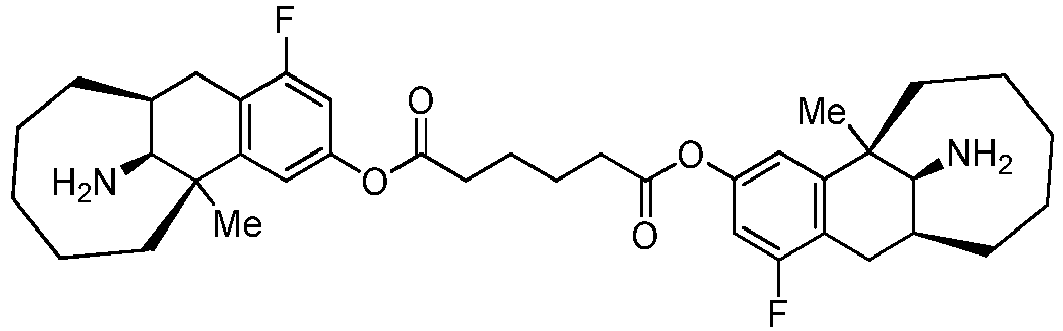




- The present invention also provides a compound selected from the group consisting of


- The present invention also provides a pharmaceutical composition comprising a therapeutically effective dose of the compound represented by formula (I), (II) and (III) or the pharmaceutically acceptable salt thereof and a pharmaceutically acceptable carrier.
- The present invention also provides the compound or the pharmaceutically acceptable salt thereof or the pharmaceutical composition for use in analgesic therapy.
- Unless otherwise indicated, the following terms and phrases used in this document are intended to have the following meanings. A specific term or phrase should not be considered indefinite or unclear in the absence of a particular definition, but should be understood in the ordinary sense. When a trade name appears herein, it is intended to refer to its corresponding commodity or active ingredient thereof.
- C1-6 is selected from C1, C2, C3, C4, C5 and C6; C3-7 is selected from C3, C4, C5, C6 and C7.
- C1-12 alkyl or heteroalkyl, C3-12 cyclo-group or heterocyclohydrocarbyl, C1-12 alkyl or heteroalkyl substituted by C3-12 cyclohydrocarbyl or heterocyclohydrocarbyl include but not limited to:
- C1-12 alkyl, C1-12 alkylamino, N,N-di(C1-12 alkyl) amino, C1-12 alkoxy, C1-12 alkanoyl, C1-12 alkoxycarbonyl, C1-12 alkylsulfonyl, C1-12 alkylsulfinyl, C3-12 cycloalkyl, C3-12 cycloalkylamino, C3-12 heterocycloalkylamino, C3-12 cycloalkyloxy, C3-12 cycloalkyl acyl, C3-12 cycloalkyloxycarbonyl, C3-12 cycloalkylsulfonyl, C3-12 cycloalkylsulfinyl, 5-12 membered aryl or heteroaryl, 5-12 membered aralkyl or heteroaralkyl;
- methyl, ethyl, n-propyl, isopropyl, -CH2C(CH3)(CH3)(OH), cyclopropyl, cyclobutyl, propyl methylene, cyclopropionyl, benzyloxy, trifluoromethyl, aminomethyl, hydroxymethyl, methoxy, formyl, methoxycarbonyl, methylsulfonyl, methylsulfinyl, ethoxy, acetyl, ethanesulfonyl, ethoxycarbonyl, dimethylamino, diethylamino, dimethylaminocarbonyl, diethylaminocarbonyl;
- N(CH3)2, NH(CH3), -CH2CF3, -CH2CH2CF3, -CH2CH2F, -CH2CH2S(=O)2CH3, -CH2CH2CN, -CH2CH(OH)(CH3)2, -CH2CH(F)(CH3)2, -CH2CH2F, -CH2CF3, -CH2CH2CF3, -CH2CH2NH2, -CH2CH2OH, -CH2CH2OCH3, -CH2CH2CH2OCH3, -CH2CH2N(CH3)2, -S(=O)2CH3, -CH2CH2S(=O)2CH3; and
- phenyl, thiazolyl, biphenyl, naphthyl, cyclopentyl, furyl, 3-pyrrolinyl, pyrrolidinyl, 1,3-oxopentyl, pyrazolyl, 2-pyrazolinyl, pyrazolidinyl, imidazolyl, oxazolyl, thiazolyl, 1,2,3-azolyl, 1,2,3-triazolyl, 1,2,4-triazolyl , 1,3,4-thiadiazolyl, 4H-pyranyl, pyridyl, piperidinyl, 1,4-dioxanyl, morpholinyl, pyridazinyl, pyrimidinyl, pyrazinyl, piperazinyl, 1,3,5-trithianyl, 1,3,5-triazinyl, benzofuranyl, benzothiophenyl, indolyl, benzimidazolyl, benzothiazolyl, purinyl, quinolyl, isoquinolyl, cinnolinyl or quinoxalinyl;
- The term "pharmaceutically acceptable" is used herein in terms of those compounds, materials, compositions, and/or dosage forms, which are suitable for use in contact with human and animal tissues within the scope of reliable medical judgment, with no excessive toxicity, irritation, allergic reactions or other problems or complications, commensurate with a reasonable benefit/risk ratio.
- The term "pharmaceutically acceptable salt" refers to salts of the compounds of the present invention that are prepared from the compounds having particular substituents of the present invention with relatively non-toxic acids or bases. When compounds of the present invention contain relatively acidic functional groups, base addition salts can be obtained by bringing the neutral form of these compounds into contact with a sufficient amount of base in pure solution or suitable inert solvent. Pharmaceutically acceptable base addition salts include salts of sodium, potassium, calcium, ammonium, organic amine or magnesium or similar salts. When compounds of the present invention contain relatively basic functional groups, acid addition salts can be obtained by bringing the neutral form of these compounds into contact with a sufficient amount of acid in pure solution or suitable inert solvent. Examples of pharmaceutically acceptable acid addition salts include inorganic acid salts, wherein said inorganic acids include, for example, hydrochloric acid, hydrobromic acid, nitric acid, carbonic acid, bicarbonate, phosphoric acid, monohydrogen phosphate, dihydrogen phosphate, sulfuric acid, hydrogen sulfate, hydroiodic acid, phosphorous acid, and the like; and organic acid salts, wherein said organic acids include, for example, acetic acid, propionic acid, isobutyric acid, maleic acid, malonic acid, benzoic acid, succinic acid, suberic acid, fumaric acid, lactic acid, mandelic acid, phthalic acid, benzenesulfonic acid, p-toluenesulfonic acid, citric acid, tartaric acid, and methanesulfonic acid, and the like; and salts of amino acid (such as arginine and the like), and salts of organic acids such as glucuronic acid and the like (refer to Berge et al., "Pharmaceutical Salts", Journal of Pharmaceutical Science 66: 1-19 (1977 )). Certain specific compounds of the present invention contain basic and acidic functional groups that can be converted to any base or acid addition salt.
- Preferably, through bringing the salt into contact with base or acid in a conventional manner, then separating the parent compound, the neutral form of the compound is thereby regenerated. The difference between the parent form of a compound and its various salt forms lies in certain physical properties, such as different solubility in polar solvents.
- "Pharmaceutically acceptable salt" used in this document belongs to derivatives of the compounds of the present invention, wherein, the parent compound is modified by forming salt with acid or base. Examples of pharmaceutically acceptable salts include but are not limited to: inorganic acids or organic acid salts of basic moietys such as amines, alkali metal or organic salts of acidic moietys such as carboxylic acids, and the like. Pharmaceutically acceptable salts include conventional non-toxic salts or quaternary ammonium salts of the parent compound, such as the salts formed by non-toxic inorganic acids or organic acids. The conventional non-toxic salts include but are not limited to those salts derived from inorganic acids and organic acids, wherein said inorganic acids or organic acids are selected from 2-acetoxybenzoic acid, 2-hydroxyethanesulfonic acid, acetic acid, ascorbic acid, benzenesulfonic acid, benzoic acid, bicarbonate, carbonic acid, citric acid, edetic acid, ethanedisulfonic acid, ethanesulfonic acid, fumaric acid, glucoheptose, gluconic acid, glutamic acid, glycolic acid, hydrobromic acid, hydrochloric acid, hydroiodide, hydroxyl, hydroxynaphthalene, isethionic acid, lactic acid, lactose, dodecyl sulfonic acid, maleic acid, malic acid, mandelic acid, methanesulfonic acid, nitric acid, oxalic acid, pamoic acid, pantothenic acid, phenylacetic acid, phosphoric acid, polygalactanal acid, propionic acid, salicylic acid, stearic acid, subacetic acid, succinic acid, sulfamic acid, sulfanilic acid, sulfuric acid, tannin, tartaric acid and p-toluenesulfonic acid.
- The pharmaceutically acceptable salts of the present invention can be synthesized from the parent compound that contains an acidic or basic moiety by conventional chemical methods. In general, such salts can be prepared by reacting the free acid or base forms of these compounds with a stoichiometric amount of appropriate base or acid in water or an organic solvent or a mixture of the two. Generally, non-aqueous media such as ether, ethyl acetate, ethanol, isopropanol or acetonitrile are preferred.
- In addition to salt forms, the compounds provided by the present invention also exist in prodrug forms. Prodrugs of the compounds described herein are those compounds that readily undergo chemical changes under physiological conditions to to be converted into the compounds of the present invention. Additionally, prodrugs can be converted to the compounds of the present invention by chemical or biochemical methods in vivo environment.
- Certain compounds of the present invention can exist in unsolvated forms or solvated forms, including hydrated forms. In general, the solvated forms are equivalent to unsolvated forms, and both are encompassed within the scope of the present invention. Certain compounds of the present invention can have asymmetric carbon atoms (optical centers) or double bonds. Racemate, diastereomer, geometric isomer and individual isomer are all included within the scope of the present invention.
- The graphic representations of racemic, ambiscalemic and scalemic or enantiomerically pure compounds used herein are taken from Maehr J. Chem. Ed. 1985, 62, 114-120 . In 1985, 62: 114-120. Unless otherwise specified, the absolute configuration of a stereogenic center is represented using wedge and dashed bonds (
 ), and the relative configuration of a stereogenic center is represented by
 . When the compounds described herein contain olefinic double bond or other geometric asymmetric centers, they include E, Z geometric isomers unless otherwise specified. Likewise, all tautomeric forms are included within the scope of the present invention.
- The compounds of the present invention can have particular geometric or stereoisomeric forms. The present invention contemplates all such compounds, including cis and trans isomers, (-)- and (+)-enantiomers, (R)- and (S)-enantiomers, diastereoisomers, (D)-isomers, (L)-isomers, and racemic mixtures and other mixtures, for example, enantiomer or diastereoisomer enriched mixtures, all of which belong to the scope of the present invention. The substituents such as alkyl can have additional asymmetric carbon atoms. All these isomers and mixtures thereof are included within the scope of the present invention.
- Optically active (R)- and (S)-isomers, or D and L isomers can be prepared using chiral synthesis or chiral reagents or other conventional techniques. If one kind of enantiomer of certain compound of the present invention is to be obtained, the pure desired enantiomer can be obtained by asymmetric synthesis or derivative action of chiral auxiliary followed by separating the resulting diastereomeric mixture and cleaving the auxiliary group. Alternatively, when the molecule contains a basic functional group (such as amino) or acidic functional group (such as carboxyl), the compound reacts with an appropriate optically active acid or base to form a salt of diastereomeric isomer which is then subjected to diastereomeric resolution through conventional methods in the art to give pure enantiomer. In addition, the enantiomers and diastereoisomers are generally separated through chromatography which uses a chiral stationary phase and optionally combines with a chemical derivative method (for example, generating carbamate generated from amine).
- The compounds of the present invention can contain unnatural proportions of atomic isotopes at one or more of the atoms that constitute the compounds. For example, the compounds can be radiolabeled with radioactive isotopes, such as tritium (3H), iodine-125 (125I) or C-14 (14C). All isotopic variations of the compounds of the present invention, whether radioactive or not, are encompassed within the scope of the present invention.
- The term "pharmaceutically acceptable carrier" refers to any agent or carrier medium which is capable of delivering an effective amount of the active substances of the present invention, does not interfere with the biological activity of the active substances and has no toxic side effects on the host or patient. The representative carrier includes water, oil, vegetable and mineral, cream base, lotion base, ointment base and the like. These bases include suspending agents, thickeners, penetration enhancers and the like. Their formulations are well known to the skilled in the cosmetic field or topical pharmaceutical field. The additional informations about the carrier can be referred to Remington: The Science and Practice of Pharmacy, 21st Ed, Lippincott, Williams & Wilkins (2005 ).
- The term "excipient" generally refers to a carrier, a diluent and/or a medium required for formulating an effective pharmaceutical composition.
- For drug or pharmacologically active agent, the term "effective dose" or "therapeutically effective dose" refers to a nontoxic but sufficient amount to achieve the desired effect of the drug or agent. For oral dosage forms of the present invention, an "effective dose" of an active substance in the composition refers to an amount required for achieving the desired effect when combining with another active substance in the composition. An effective amount varies from person to person and is determined depending on the age and general condition of the recipient as well as the specific active substance. The appropriate effective amount in an individual case can be determined by the skilled in the art based on routine experiment.
- The term "active ingredient", "therapeutic agent", "active substance" or "active agent" refers to a chemical entity which can effectively treat the target disorder, disease or condition.
- The term "substituted" means one or more hydrogen atoms on a specific atom are substituted with substituents, including deuterium and hydrogen variants, as long as the valence of the specific atom is normal and the substituted compound is stable. When the substituent is a ketone (that is =O), it means two hydrogen atoms are substituted. Positions on an aromatic ring can not be substituted with a ketone. The term "optionally substituted" means an atom can be replaced by a substituent or not, unless otherwise specified, the type and number of the substituents may be arbitary as long as being chemically achievable.
- When any variable (such as R) occurs in the composition or structure of the compound more than one time, the definition of the variable at each occurrence is independent. Thus, for example, if a group is substituted with 0-2 R, the group can be optionally substituted with up to two R, wherein the definition of R at each occurrence is independent. Moreover, a combination of substituents and/or variants thereof is allowed only when the combination results in a stable compound.
- When the number of a linking group is 0, such as -(CRR)0-, it means that the linking group is a single bond.
- When one of the variables is selected from a single bond, it means that the two groups linked by the single bond are connected directly. For example, when L in A-L-Z represents a single bond, the structure of A-L-Z is actually A-Z.
- When a substituent is vacant, it means that the substituent does not exist. For example, when X is vacant in A-X, the structure of A-X is actually A.
- When a bond of a substituent can be cross-linked to two atoms on a ring, such substituent can be bonded to any atom of the ring. When the enumerative substituent do not indicate by which atom it is linked to a compound included in the general chemical formula but not specifically mentioned, such substituent can be bonded by any of its atoms. A combination of substituents and/or variants thereof is allowed only when such combination can result in a stable compound. For example, the structural unit

- Unless otherwise specified, the term "halo" or "halogen" by itself or as part of another substituent refers to a fluorine, chlorine, bromine or iodine atom. Furthermore, the term "haloalkyl" is meant to include monohaloalkyl and polyhaloalkyl. For example, the term "halo(C1-C4)alkyl" is intended to include, but not limited to, trifluoromethyl, 2,2,2-trifluoroethyl, 4-chlorobutyl, 3-bromopropyl and the like.
- Examples of haloalkyl include, but not limited to: trifluoromethyl, trichloromethyl, pentafluoroethyl and pentachloroethyl. "Alkoxy" represents any alkyl defined above having a specified number of carbon atoms attached by an oxygen bridge. C1-6 alkoxy includes C1, C2, C3, C4, C5 and C6 alkoxy. Examples of alkoxy include, but not limited to: methoxy, ethoxy, n-propoxy, isopropoxy, n-butoxy, sec-butoxy, tert-butoxy, n-pentyloxy and S-pentoxy. "Cycloalkyl" includes a saturated cyclic group, such as cyclopropyl, cyclobutyl or cyclopentyl. 3-7 cycloalkyl includes C3, C4, C5, C6 and C7 cycloalkyl. "Alkenyl" includes a linear or branched hydrocarbon chain, wherein one or more carbon-carbon double bonds can be present in any stable site on the chain, such as vinyl and propenyl.
- The term "halo" or "halogen" refers to fluorine, chlorine, bromine and iodine.
- Unless otherwise specified, the term "hetero" means a heteroatom or a heteroatom group (i.e., an atom group containing a heteroatom), including all atoms except carbon (C) and hydrogen (H), and also including atom groups containing the above heteroatoms. The related examples include oxygen (O), nitrogen (N), sulfur (S), silicon (Si), germanium (Ge), aluminum (Al), boron (B), -O-, -S-, =O, =S, -C(=O)O-, -C(=O)-, -C(=S)-, -S(=O), -S(=O)2-, and optionally substituted -C(=O)N(H)-, -N(H)-, -C(=NH)-, -S(=O)2N(H)- or -S(=O)N(H)-.
- Unless otherwise specified, the term "ring" represents a substituted or unsubstituted cycloalkyl, heterocycloalkyl, cycloalkenyl, heterocycloalkenyl, cycloalkynyl, heterocycloalkynyl, aryl or heteroaryl. The so-called ring includes a single ring, a double ring, a spiral ring, a ring system having two rings sharing one bond or a bridged ring. The number of atoms on the ring is usually defined as the member number of the ring, for example, a "5-7 membered ring" means that 5 to 7 atoms are arranged in a circle. Unless otherwise specified, the ring optionally contains 1 to 3 heteroatoms. Therefore, a "5-7 membered ring" includes, for example, phenyl, pyridinyl and piperidinyl; on the other hand, the term "5-7 membered heterocycloalkyl ring" includes pyridyl and piperidinyl, but excluding phenyl. The term "ring" also includes a ring system containing at least one ring, wherein each ring independently meets the above definition.
- Unless otherwise specified, the term "heterocycle" or "heterocyclo" means stable monocyclic, bicyclic or tricyclic rings containing heteroatoms or heteroatom groups, which can be saturated, partially unsaturated or unsaturated (aromatic) and can contain carbon atoms and 1, 2, 3 or 4 ring heteroatoms independently selected from N, O and S, wherein the above any heterocycle can be fused to a benzene ring to form a bicyclic ring. Nitrogen and sulfur heteroatoms can optionally be oxidized (i.e., NO and S (O) p). Nitrogen atom can be substituted or unsubstituted (i.e., N or NR, wherein R is H or other substituents already defined herein). The heterocycle can be attached to the pendant group of any heteroatom or carbon atom to form a stable structure. If the resulting compound is stable, the heterocycle described herein may have a substitution on a carbon or nitrogen position. Nitrogen atom in the heterocycle is optionally quaternized. In a preferred embodiment, when the total number of S and O atoms in the heterocycle is more than 1, these heteroatoms are not adjacent to each other. In another preferred embodiment, the total number of S and O atoms in the heterocycle is not more than 1. As used herein, the term "aromatic heterocyclic group" or "heteroaryl" refers to a stable 5-, 6- or 7-membered monocyclic or bicyclic or 7-, 8-, 9- or 10-membered bicyclic heterocyclic aromatic ring which contains carbon atoms and 1, 2, 3 or 4 ring heteroatoms independently selected from N, O and S. Nitrogen atom can be substituted or unsubstituted (i.e., N or NR, wherein R is H or other substituents already defined herein). Nitrogen and sulfur heteroatoms may optionally be oxidized (i.e., NO and S (O) p). It is worth noting that the total number of S and O atoms in an aromatic heterocycle is not more than one. Bridged ring is also included in the definition of heterocycle. A bridged ring is formed when one or more atoms (ie, C, O, N or S) link two non-adjacent carbon or nitrogen atoms. A preferred bridged ring includes, but not limited to: one carbon atom, two carbon atoms, one nitrogen atom, two nitrogen atoms and one carbon-nitrogen group. It is worth noting that a bridge always converts a monocyclic ring to a tricyclic ring. In a bridged ring, the substituents on the ring may also be present on the bridge.
- Examples of the heterocyclic compounds include, but are not limited to: acridinyl, azocinyl, benzimidazolyl, benzofuranyl, benzomercaptofuranyl, benzomercaptophenyl, benzoxazolyl, benzoxazolinyl, benzothiazolyl, benzotriazolyl, benzotetrazolyl, benzoisoxazolyl, benzoisothiazolyl, benzoimidazolinyl, carbazolyl, 4aH-carbazolyl, carbolinyl, chromanyl, chromene, cinnolinyl decahydroquinolinyl, 2H,6H-1,5,2-dithiazinyl, dihydrofuro[2,3-b]tetrahydrofuranyl, furanyl, furazanyl, imidazolidinyl, imidazolinyl, imidazolyl, 1H-indazolyl, indolenyl, indolinyl, indolizinyl, indolyl, 3H-indolyl, isobenzofuranyl, isoindolyl, isoindolinyl, isoquinolinyl, isothiazolyl, isoxazolyl, methylenedioxyphenyl, morpholinyl, naphthyridinyl, octahydro-isoquinolinyl, oxadiazolyl, 1,2,3-oxadiazolyl, 1,2,4-oxadiazolyl, 1,2,5-oxadiazolyl, 1,3,4-oxadiazolyl, oxazolidinyl, oxazolyl, hydroxindolyl, pyrimidinyl, phenanthridinyl, phenanthrolinyl, phenazine, phenothiazine, benzoxanthinyl, phenoloxazinyl, phthalazinyl, piperazinyl, piperidinyl, piperidonyl, 4-piperidonyl, piperonyl, pteridinyl, purinyl, pyranyl, pyrazinyl, pyrazolidinyl, pyrazolinyl, pyrazolyl, pyridazinyl, pyrido-oxazolyl, pyrido-imidazolyl, pyrido-thiazolyl, pyridinyl, pyrrolidinyl, pyrrolinyl, 2H-pyrrolyl, pyrrolyl, quinazolinyl, quinolinyl, 4H-quinolizinyl, quinoxalinyl, quinuclidinyl, tetrahydrofuranyl, tetrahydroisoquinolinyl, tetrahydroquinolinyl, tetrazolyl, 6H-1,2,5-thiadiazinyl, 1,2,3-thiadiazolyl, 1,2,4-thiadiazolyl, 1,2,5-thiadiazolyl, 1,3,4-thiadiazolyl, thianthrenyl, thiazolyl, isothiazolylthienyl, thienyl, thieno-oxazolyl, thieno-thiazolyl, thieno-imidazolyl, triazinyl, 1,2,3-triazolyl, 1,2,4-triazolyl, 1,2,5-triazolyl, 1,3,4-triazolyl and xanthenyl. Also included are fused-ring compounds and spiro compounds.
- Unless otherwise specified, the term "hydrocarbyl" or subordinate concept thereof (such as alkyl, alkenyl, alkynyl, and phenyl, etc.), by itself or as part of another substituent, means a linear, branched chain or cyclic hydrocarbon radicals or any combinations thereof. They can be fully saturated, mono- or polyunsaturated, can be mono-, di- or poly-substituted, can be a monovalent (such as methyl), divalent (such as methylene) or multivalent (such as methenyl), can also includes divalent or multivalent radicals and have a specified number of carbon atoms (for example, C1-C12 indicates 1 to 12 carbon atoms, C1-12 is selected from C1, C2, C3, C4, C5, C6, C7, C8, C9, C10, C11 and C12; C3-12 is selected from C3, C4, C5, C6, C7, C8, C9, C10, C11 and C12). The term "hydrocarbyl" includes, but is not limited to aliphatic hydrocarbyl and aromatic hydrocarbyl. The aliphatic hydrocarbyl includes linear and cyclic hydrocarbyl, specifically includes but not limited to an alkyl, alkenyl, and alkynyl. The aromatic hydrocarbyl includes but is not limited to 6-12 membered aromatic hydrocarbyl such as phenyl, naphthyl and the like. In some embodiments, the term "alkyl" means a linear or branched radical or a combination thereof which can be fully saturated, mono- or polyunsaturated, and can include a divalent or multivalent radical. Examples of saturated hydrocarbyl radicals include, but are not limited to, methyl, ethyl, n-propyl, isopropyl, n-butyl, tert-butyl, isobutyl, sec-butyl, cyclohexyl, (cyclohexyl)methyl, cyclopropylmethyl, and homologs or isomers of n-amyl, n-hexyl, n-heptyl, n-octyl and other atom groups. The unsaturated alkyl has one or more double or triple bonds. Examples of unsaturated alkyl include but are not limited to, vinyl, 2-propenyl, butenyl, crotyl, 2-isopentenyl, 2-(butadienyl), 2,4-pentadienyl, 3-(1,4-pentadienyl), ethynyl, 1- and 3-propynyl, 3-butynyl, and more advanced homologs and isomers.
- Unless otherwise specified, the term "heterohydrocarbyl" or subordinate concept thereof (such as heteroalkyl, heteroalkenyl, heteroalkynyl, and heteroaryl, etc.), by itself or as part of another substitutent, means a stable linear, branched or cyclic hydrocarbon radical or any combinations thereof, which have a specified number of carbon atoms and at least one heteroatom. In some embodiments, the term "heteroalkyl" by itself or in combination with another term represents a stable linear chain, branched hydrocarbon radical or combinations thereof which have a specified number of carbon atoms and at least one hetero atom. In a typical embodiment, a heteroatom is selected from B, O, N and S, wherein nitrogen and sulfur atoms are optionally oxidized and the nitrogen atom is optionally quaternized. Heteroatom or heteroatom radicals can be located at any interior position in a heterohydrocarbyl, including the position where the hydrocarbyl attaches to the rest part of the molecule. But terms "alkoxy", "alkylamino" and "alkylthio" (or thioalkyl) are used by their conventional meanings and refer to those alkyl groups connected to the rest part of the molecule via an oxygen atom, an amino or a sulfur atom respectively. Examples include, but are not limited to, -CH2-CH2-O-CH3, -CH2-CH2-NH-CH3, -CH2-CH2-N(CH3)-CH3, -CH2-S-CH2-CH3, -CH2-CH2, -S(O)-CH3, -CH2-CH2-S(O)2-CH3, -CH=CH-O-CH3, -CH2-CH=N-OCH3 and - CH=CH-N(CH3)-CH3. Up to two consecutive heteroatoms can be present, such as, -CH2-NH-OCH3.
- Terms "alkoxy", "alkylamino" and "alkylthio" (or thioalkyl) are used by their conventional meanings and refer to those alkyl groups connected to the remainder of the molecule via an oxygen atom, an amino or a sulfur atom respectively.
- Unless otherwise specified, the term "cyclohydrocarbyl", "heterocyclohydrocarbyl" or the subordinate concept thereof (such as aryl, heteroaryl, cycloalkyl, heterocycloalkyl, cycloalkenyl, heterocycloalkenyl, cycloalkynyl, heterocycloalkynyl, etc.) by itself or in combination with another term represents cyclized "hydrocarbyl" or "heterohydrocarbyl". Furthermore, for heterohydrocarbyl or heterocyclohydrocarbyl (e.g. heteroalkyl, and heterocycloalkyl), one heteroatom can occupy the position where the heterocycle attaches to the remainder position of the molecule. Examples of cycloalkyl include, but are not limited to, cyclopentyl, cyclohexyl, 1-cyclohexenyl, 3-cyclohexenyl, cycloheptyl and the like. Non-limiting examples of heterocycloalkyl include 1-(1,2,5,6-tetrahydropyridyl), 1-piperidinyl, 2-piperidinyl, 3-piperidinyl, 4-morpholinyl, 3-morpholinyl, tetrahydrofuran-2-yl, tetrahydrofuran-3 -yl, tetrahydro-thiophen-2-yl, tetrahydro-thiophen-3 -yl, 1-piperazinyl and 2-piperazinyl.
- Unless otherwise specified, the term "alkyl" is used to denote a linear chain or branched saturated hydrocarbon group, can be mono-substituted (such as -CH2F) or poly-substituted (such as -CF3), can be monovalent (such as methyl), divalent (such as methylene) or multivalent (such as methenyl). Examples of alkyl include methyl (Me), ethyl (Et), propyl (such as n-propyl and isopropyl), butyl (such as n-butyl, isobutyl, s-butyl, t-butyl), pentyl (such as n-pentyl, isopentyl, neopentyl) and the like.
- Unless otherwise specified, "alkenyl" refers to an alkyl group having one or more carbon-carbon double bonds at any position on the chain, can be mono-substituted or poly-substituted, and can be monovalent, divalent or multivalent. Examples of alkenyl include ethenyl, propenyl, butenyl, pentenyl, hexenyl, butadienyl, pentadienyl, hexadienyl, and the like.
- Unless otherwise specified, "alkynyl" refers to an alkyl group having one or more carbon-carbon triple bonds at any position on the chain, can be mono-substituted or poly-substituted, and can be monovalent, divalent or multivalent. Examples of alkynyl groups include ethynyl, propynyl, butynyl, pentynyl, hexynyl, and the like.
- Unless otherwise specified, cycloalkyl includes any stable cyclic or polycyclic hydrocarbyl, and any carbon atom is saturated, can be mono-substituted or poly-substituted, can be monovalent, divalent or multivalent. Examples of these cycloalkyl include, but are not limited to, cyclopropyl, norbornanyl, [2.2.2]bicyclooctane, [4.4.0]bicyclodecanyl and the like.
- Unless otherwise specified, cycloalkenyl includes any stable cyclic or polycyclic hydrocarbyl haing one or more unsaturated carbon-carbon single bonds at any position on the ring, can be mono-substituted or poly-substituted, and can be monovalent, divalent or multivalent. Examples of these cycloalkenyl include, but are not limited to, cyclopentenyl, cyclohexenyl and the like.
- Unless otherwise specified, cycloalkynyl includes any stable cyclic or polycyclic hydrocarbyl having one or more carbon-carbon triple bonds at any position on the ring, can be mono-substituted or poly-substituted, and can be monovalent, divalent or multivalent.
- Unless otherwise specified, the term "halo" or "halogen" by itself or as part of another substituent refers to fluorine, chlorine, bromine or iodine atom. Furthermore, the term "haloalkyl" is meant to include monohaloalkyl and polyhaloalkyl. For example, the term "halo(C1-C4)alkyl" is intended to include, but not limited to, trifluoromethyl, 2,2,2-trifluoroethyl, 4-chlorobutyl, 3-bromopropyl and the like. Examples of haloalkyl include, but not limited to: trifluoromethyl, trichloromethyl, pentafluoroethyl and pentachloroethyl.
- "Alkoxy" represents any alkyl defined above having a specified number of carbon atoms attached by an oxygen bridge. C1-6 alkoxy includes C1, C2, C3, C4, C5 and C6 alkoxy. Examples of alkoxy include, but not limited to: methoxy, ethoxy, n-propoxy, isopropoxy, n-butoxy, sec-butoxy, tert-butoxy, n-pentyloxy and S-pentoxy.
- Unless otherwise specified, the term "aryl" means a polyunsaturated aromatic substituent, can be mono-, di- or poly-substituted, can be a monovalent, divalent or multivalent, can be a single ring or multiple rings (such as one to three rings; wherein at least one ring is aromatic), which are fused together or linked covalently. The term "heteroaryl" refers to an aryl (or ring) containing one to four heteroatoms. In an illustrative example, the heteroatom is selected from B, O, N and S, wherein nitrogen and sulfur atoms are optionally oxidized and the nitrogen atom is optionally quaternized. A heteroaryl may attach to the rest part of a molecule via a heteroatom. Non-limiting examples of aryl or heteroaryl include phenyl, naphthyl, biphenyl, pyrrolyl, pyrazolyl, imidazolyl, pyrazinyl, oxazolyl, phenyl-oxazolyl, isoxazolyl, thiazolyl, furanyl, thienyl, pyridyl, pyrimidinyl benzothiazolyl, purinyl, benzimidazolyl, indolyl, isoquinolyl, quinoxalinyl, quinolyl, 1-naphthyl, 2-naphthyl, 4-biphenyl, 1-pyrrolyl, 2-pyrrolyl, 3-pyrrolyl, 3-pyrazolyl, 2-imidazolyl, 4-imidazolyl, pyrazinyl, 2-oxazolyl, 4-oxazolyl, 2-phenyl-4-oxazolyl, 5-oxazolyl, 3-isoxazolyl, 4-isoxazolyl, 5-isoxazolyl, 2-thiazolyl, 4-thiazolyl, 5-thiazolyl, 2-furyl, 3-furyl, 2-thienyl, 3-thienyl, 2-pyridyl, 3-pyridyl, 4-pyridyl, 2-pyrimidyl, 4-pyrimidyl, 5-benzothiazolyl, purinyl, 2-benzimidazolyl, 5-indolyl, 1-isoquinolyl, 5-isoquinolyl, 2-quinoxalinyl, 5-quinoxalinyl, 3-quinolyl and 6-quinolyl. The substituents of any of the above aryl and heteroaryl ring systems are selected from the acceptable substituents described below.
- For the sake of convenience, when combined with other terms (such as aryloxy, arylthio, arylalkyl), the aryl includes all the aryl and heteroaryl rings as defined above. Thus, the term "aralkyl" is meant to include those radicals (such as benzyl, phenethyl, pyridylmethyl, and the like) where an aryl is attached to an alkyl including an alkyl where the carbon atom (such as methylene) has been replaced by an atom such as oxygen, for example, phenoxymethyl, 2-pyridyloxy, 3-(1-naphthyloxy)propyl, and the like.
- The term "leaving group" refers to a functional group or atom which can be substituted by another functional group or atom through a substitution reaction (such as an affinity substitution reaction). For example, representative leaving groups include triflate; chlorine, bromine and iodine; sulfonate groups, such as mesylate, tosylate, p-bromobenzenesulfonate, p-toluenesulfonates and the like; acyloxy, such as acetoxy, trifluoroacetoxy and the like.
- The term "protecting group" includes, but is not limited to "nitrogen protecting group", "hydroxyl protecting group" or "sulphur protecting group." The term "amino protecting group" means a protecting group suitable for blocking side reactions on nitrogen of the amino. Representative amino protecting groups include, but are not limited to: formyl; acyl, such as alkanoyl (e.g. acetyl, trichloroacetyl or trifluoroacetyl); alkoxycarbonyl, such as tert-butoxycarbonyl (Boc); arylmethoxycarbonyl such as benzyloxycarbonyl (Cbz) and 9-fluorenylmethoxycarbonyl (Fmoc); arylmethyl such as benzyl (Bn), trityl (Tr), 1,1-bis-(4'-methoxyphenyl)methyl; silyl such as trimethylsilyl (TMS) and tert-butyldimethylsilyl (TBS) and the like. The term "hydroxy protecting group" refers to a protecting group suitable for blocking side reactions on the hydroxyl group. Representative hydroxy protecting groups include, but are not limited to: alkyl such as methyl, ethyl and t-butyl; acyl, e.g. alkanoyl (e.g. acetyl); arylmethyl such as benzyl (Bn), p-methoxybenzyl (PMB), 9-fluorenylmethyl (Fm), and diphenylmethyl (benzhydryl, DPM); silyl such as trimethylsilyl (TMS) and tert-butyl dimethyl silyl (TBS) and the like.
- The compounds of the present invention can be prepared by a variety of synthetic methods well known to the skilled, including the following specific embodiments, the embodiments formed by the following specific embodiments in combination with other chemical synthesis methods and the equivalent replacement well known to the skilled in the art. The preferred embodiments include, but are not limited to the examples of the present invention.
- All solvents used in the present invention are commercially available.
- The present invention employs the following abbreviations:aq represents water; eq represents equivalent and equal; Tol represents toluene; mCPBA represents m-chloroperoxybenzoic acid; TBAB represents tetrabutylammonium bromide; THF represents tetrahydrofuran; DMF represents N,N-dimethylformamide; Pd(dppf)Cl2 represents [1,1'-bis(diphenylphosphino)ferrocene]dichloropalladium; Pd2(dba)3 represents tris(dibenzylideneacetone)dipalladium; AC2O represents acetic anhydride; NBS represents N-bromosuccinimide; MeCN represents acetonitrile; Boc represents tert-butyl carbonyl group, which is an amine protecting group; BOC2O represents di-tert-butyl dicarbonate; DCM represents dichloromethane; NCS represents N-chlorosuccinimide; NFSI represents N-fluoro-N-(phenylsulfonyl)benzenesulfonamide; BuLi represents n-butyllithium; TEA represents triethylamine; Pd/C represents palladium on carbon catalyst; AcOH represents glacial acetic acid; AcONa represents sodium acetate; Pd(OAc)2 represents palladium acetate; xPhos represents 2-dicyclohexylphosphino-2',4',6' -triisopropylbiphenyl; DMA represents dimethylacetamide.
- Compounds are named manually or by ChemDraw® software, the commercially available compounds use their vendor directory names.
- The present invention will be specifically described below by way of examples, but the scope of the present invention is not limited thereto.
-

- Under nitrogen atmosphere, a solution of MeMgBr in ether (16.33mL, 48.99mmol) was slowly added dropwise to a solution of compound 1-1 (5.00g, 19.60mmol) in toluene (100mL) at 0°C. After the reaction temperature was slowly raised to 25°C, the mixture was further stirred for 3 hours. The reaction was quenched with saturated NH4Cl solution (100mL) and the aqueous phase was extracted with ethyl acetate (150mL x 3). The combined organic phase was washed with saturated brine (50mL), dried over anhydrous Na2SO4 and concentrated in vacuo to approximately 100mL. The remaining solution was added with aqueous HCl (6M, 20mL), the mixture was stirred vigorously at 25°C for 3 hours and extracted with ethyl acetate (200mL x 3). The combined organic phase was washed with saturated brine (100mL), dried over anhydrous Na2SO4 and concentrated in vacuo. The residue was purified by silica gel column chromatography (eluent: petroleum ether/ethyl acetate = 30/1 to 20/1) to give product 1-2 as a colorless oil (4.00g, yield: 80.62%). 1H NMR (400MHz, CDCl3): δ 6.97 (d, J=2.4 Hz, 1H), 6.79 (d, J=2.4 Hz, 1H), 5.92 (dt, J 1=1.2 Hz, J 2=4.4 Hz, 1H), 3.82 (s, 3H), 2.84 (t, J=8.0 Hz, 2H), 2.27 (ddt, J 1=2.0 Hz, J 2=4.4 Hz, J 3=8.0 Hz, 2H), 2.04 (q, J=1.6 Hz, 3H).
- The following compounds were synthesized according to a method similar to that of compound 1-2:
Coumpound number Structure Spectrogram 2-2 
1H NMR (400MHz, CDCl3): δ 7.06 - 7.04 (d, J=8.0 Hz, 1H), 6.82 - 6.81 (d, J=2.4 Hz, 1H), 6.71 - 6.68 (dd, J 1=2.8 Hz, J 2=2.4 Hz, 1H), 5.89 - 5.87 (m, 1H), 3.81 (s, 1H), 2.72 - 2.66 (m, 2H), 2.24 - 2.22 (m, 2H), 2.05 - 2.04 (m, 3H). 3-2 
1H NMR (400MHz, CDCl3): δ 6.77 (d, J=2.8 Hz, 1H), 6.73 (d, J=2.0 Hz, 1H), 5.92 (s, 1H), 3.81 (s, 3H), 2.82 (t, J=8.0 Hz, 2H), 2.23 - 2.28 (m, 2H), 2.03 (d, J=1.6 Hz, 3H). 4-2 
1H NMR (400MHz, CDCl3): δ 6.84 (t, J=8.4 Hz, 1H), 6.74 (t, J=8.0 Hz, 1H), 5.88 - 5.90 (m, 1H), 3.87 (s,3H), 2.64 (t, J=7.2 Hz, 2H), 2.15 - 2.22 (m, 5H). 5-2 
1H NMR (400MHz, CDCl3): δ 6.82 (s, 1H), 6.72 (s, 1H), 5.78 (m, 1H), 3.92 (s, 3H), 3.91 (s, 3H), 2.73 (t, J=8.0 Hz, 2H), 2.27 (ddt, J 1=2.0 Hz, J 2=4.4 Hz, J 3=8.0 Hz, 2H), 2.06 (s, 3H). 6-2 
1H NMR (400MHz, CDCl3): δ 6.63 (dd, J 1=2.4 Hz, J 2=10.0 Hz, 1H), 6.54 (dd, J 1=2.4 Hz, J 2=10.8 Hz, 1H), 5.93 (t, J=4.4 Hz, 1H), 3.84 (s, 3H), 2.75 - 2.67 (m, 2H), 2.23 (td, J 1=2.0 Hz, J 2=6.4 Hz, 2H), 2.03 (q, J=1.6 Hz, 3H). 7-2 
1H NMR (400MHz, CDCl3): δ 7.01 (d, J=1.6 Hz, 1H), 6.90 (s, 1H), 5.91-5.85 (m, 1H), 3.82 (s, 3H), 2.70 (t, J=8.0 Hz, 2H), 2.27 (ddt, J 1=2.0 Hz, J 2=4.4 Hz, J 3=8.0 Hz, 2H), 2.01 (s, 3H). - M-chloroperoxybenzoic acid (4.1g, 18.96mmol) was added to a solution of compound 1-2 (4.00g, 15.80mmol) in dichloromethane (80mL) at 0°C. The mixture was stirred at 0°C for 30 minutes, and then the reaction was quenched by sequential addition of Na2SO3 and saturated solution of NaHCO3 (1:1, 15mL). The aqueous phase was extracted with dichloromethane (100mL x 3). The combined organic phase was washed with saturated brine (50mL), dried over anhydrous Na2SO4, filtered and concentrated in vacuo to approximately 50mL. Boron trifluoride etherate complex (0.2mL) was added to the remaining solution at 0°C and the mixture was further stirred at 0°C for 1 hour. After the reaction was quenched by addition of saturated solution of Na2CO3 (10mL), the aqueous phase was extracted with dichloromethane (100mL x 3). The combined organic phase was washed with saturated brine (100mL), dried over anhydrous Na2SO4, filtered and concentrated in vacuo. The residue was purified by silica gel column chromatography (eluent: petroleum ether/ethyl acetate = 30/1 to 20/1) to give product 1-3 as a white solid (3.00g, yield: 70.05%). 1H NMR (400MHz, CDCl3): δ 7.04-7.05 (d, J=2.8 Hz, 1H), 6.74-6.73 (d, J=2.8 Hz, 1H), 3.81 (s, 3H), 3.51 (m, 1H), 3.31 - 3.29 (m, 1H), 3.11 (m, 1H), 2.64 - 2.51 (m, 2H), 1.47 (d, J=7.2 Hz, 3H).
- The following compounds were synthesized according to a method similar to that of compound 1-3:
Compound number Structure Spectrogram 2-3 
1H NMR (400MHz, CDCl3): δ 7.15- 7.11 (dd, J 1=2.8 Hz, J 2=2.4 Hz, 1H), 6.77 - 6.75 (m, 2H), 3.81 (s, 3H), 3.53 - 3.49 (m, 1H), 3.05 - 3.01 (m, 2H), 2.64 - 2.59 (m, 1H), 2.52- 2.48 (m, 1H), 1.48- 1.46 (d, J=6.8 Hz, 3H). 3-3 
1H NMR (400MHz, CDCl3): δ 6.85 (d, J=2.4 Hz, 1H), 6.67 (d, J=2.0 Hz, 1H), 3.82 (s, 3H), 3.54 - 3.45 (m, 1H), 3.48 - 3.25 (m, 1H), 3.24 - 3.23 (m, 1H), 3.09 - 3.05 (m, 1H), 2.61 - 2.45 (m, 2H), 1.45 (d, J=7.2 Hz, 3H). 4-3 
1H NMR (400MHz, CDCl3): δ 6.92 (d, J=8.4 Hz, 1H), 6.83 (t, J=8.0 Hz, 1H), 3.89 (s, 3H), 3.79 - 3.75 (m, 1H), 3.18 - 3.07 (m, 1H), 3.01 - 2.91 (m, 1H), 2.77 - 2.73 (m, 1H), 2.52 - 2.48 (m, 1H), 1.43 (d, J=7.6 Hz, 3H). 5-3 
1H NMR (400MHz, CDCl3): δ 6.74 (m, 2H), 3.90 (s, 6H), 3.49 - 3.41 (m, 1H), 3.10 - 3.05 (m, 2H), 2.65 - 2.49 (m, 2H), 1.47 (d, J=7.2 Hz, 3H). 6-3 
1H NMR(400MHz, CDCl3) δ 6.57 - 6.48 (m, 2H), 3.79 (s, 3H), 3.49 (d, J=7.2 Hz, 1H), 3.22 - 3.05 (m, 1H), 3.03 - 2.86 (m, 1H), 2.67 - 2.37 (m, 2H), 1.45 (s 3H). 7-3 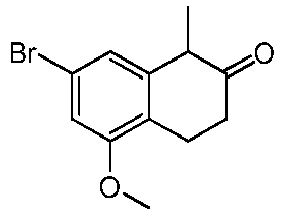
1HNMR (400MHz, CDCl3): δ 6.96 (s, 1H), 6.91 (s, 1H), 3.84 (s, 3H), 3.51 - 3.41 (m, 1H), 3.17 - 3.10 (m, 1H), 2.96 - 2.88 (m, 1H), 2.64 - 2.42 (m, 2H), 1.47 (d, J=7.2 Hz, 3H). - Under nitrogen atmosphere, tetrabutylammonium bromide (492.79mg, 1.86mmol) was added to a mixture solution of compound 1-3 (5.00g, 18.58mmol) and 1,5-dibromopentane (12.82g, 55.73mmol) in toluene (50mL) at 25°C. After the mixture was cooled to 0°C under an ice bath, 35% aqueous solution of NaOH (36g, 315.80mmol) was slowly added dropwise. The reaction mixture was stirred at 0°C for 2 hours, then warmed to 25°C and stirred for 14 hours. The aqueous phase was extracted with ethyl acetate (100mL x 3). The combined organic phase was washed with saturated brine (100mL), dried over anhydrous Na2SO4, filtered and concentrated in vacuo. The residue was purified by silica gel column chromatography (eluent: petroleum ether/ethyl acetate = 30/1 to 20/1) to give product 1-4 as a colorless oil (4.50g, yield: 57.9%). 1H NMR (400MHz, CDCl3): δ 7.07 (d, J=2.4 Hz, 1H), 6.81 (d, J=2.4 Hz, 1H), 3.83 (s, 3H), 3.33 (t, J=6.8 Hz, 2H), 3.26 - 3.14 (m, 1H), 3.09 - 2.98 (m, 1H), 2.77 - 2.65 (m, 1H), 2.65 - 2.55 (m, 1H), 2.14 (ddd, J 1=13.2 Hz, J 2=12.0 Hz, J 3=4.4 Hz, 1H), 1.76 (quin, J=7.2 Hz, 2H), 1.65 (dd, J 1=12.4 Hz, J 2=4.4 Hz, 1H), 1.40 (s, 3H), 1.38 - 1.30 (m, 2H), 1.08 - 0.83 (m, 2H).
- The following compounds were synthesized according to a method similar to that of compound 1-4:
Compound number Structure Spectrogram 2-4 
1H NMR (400MHz, CDCl3): δ 7.09 (d, J=8.4 Hz, 1H), 6.81 (d, J=2.4 Hz, 1H), 6.76 (dd, J 1= 2.4 Hz, J 2=8.4 Hz, 1H), 3.82 (s, 3H), 3.31 (t, J=6.8 Hz, 2H), 3.01 - 2.96 (m, 2H), 2.73 - 2.64 (m, 1H), 2.61 - 2.53 (m, 1H), 2.16 - 2.06 (m, 1H), 1.74 (quin, J=7.2 Hz, 2H), 1.68 - 1.59 (m, 1H), 1.39 (s, 3H), 1.35 - 1.27 (m, 2H), 1.03 - 0.88 (m, 2H). 3-4 
1H NMR (400MHz, CDCl3): δ 6.87 (d, J=2.4 Hz, 1H), 6.74 (d, J=2.4 Hz, 1H), 3.84 (s, 3H), 3.41 - 3.29 (m, 1H), 3.24 - 3.10 (m, 1H), 3.05 - 2.95 (m, 1H), 2.70 - 2.50 (m, 2 H), 2.15 - 2.05 (m, 1H), 1.79 - 1.50 (m, 3H), 1.41 - 1.24 (m, 5H), 1.00 - 0.83 (m, 2H). 4-4 
1H NMR (400MHz, CDCl3): δ 6.93 - 6.80 (m, 2H), 3.89 (s, 3H), 3.31 (t, J=7.2 Hz, 2H), 3.04 - 2.88 (m, 2H), 2.82 - 2.71 (m, 1H), 2.58 - 2.50 (m, 1H), 2.25 - 2.21 (m, 1H), 2.08 - 1.94 (m, 1H), 1.74 (m, 2H), 1.51 (s, 3H), 1.44 - 1.25 (m, 2H), 1.05 - 0.98 (m, 1H), 0.87 - 0.73 (m, 1H). 5-4 
1H NMR (400MHz, CDCl3): δ 6.74 (s, 1H), 6.65 (s, 1H), 3.89 (s, 6H), 3.31 (t, J=6.8 Hz, 2H), 3.05 - 2.95 (m, 2H), 2.72 - 2.57 (m, 2H), 2.14 (ddd, J 1=13.2 Hz, J 2=12.0 Hz, J 3=4.4 Hz, 1H), 1.80 - 1.7 (m, 2H), 1.65 - 1.55 (m, 1H), 1.49 - 1.25 (m, 5H), 1.08 - 0.83 (m, 2H). 6-4 
1H NMR (400MHz, CDCl3): δ 6.68 - 6.47 (m, 2H), 3.83 (s, 3H), 3.33 (t, J=6.8 Hz, 2H), 3.06 (s, 1H), 2.97 - 2.83 (m, 1H), 2.73 - 2.48 (m, 2H), 2.13 (dd, J 1=4.8 Hz, J 2=13.2 Hz, 1H), 1.82 - 1.71 (m, 2H), 1.69 - 1.59 (m, 1H), 1.41 (s, 3H), 1.30 (s, 2H), 1.09 - 0.83 (m, 2H). 7-4 
1H NMR (400MHz, CDCl3): δ 6.98 (s, 1H), 6.84 (s, 1H), 3.80 (s, 3H), 3.26 (t, J=6.8 Hz, 2H), 3.10 - 3.01 (m, 1H), 2.81 - 2.75 (m, 1H), 2.65 - 2.45 (m, 2H), 2.14 (ddd, J 1=13.2 Hz, J 2=12.0 Hz, J 3=4.4 Hz, 1H), 1.80 - 1.6 (m, 3H), 1.40 (s, 3H), 1.38-1.30 (m, 2H), 1.08 - 0.83 (m, 2H). 8-1 
1H NMR (400MHz, CDCl3): δ 7.10 (d, J=8.4 Hz, 1H), 6.82 - 6.75 (m, 2H), 3.82 (s, 3H), 3.60 - 3.34 (m, 2H), 3.33 - 3.31 (m, 2H), 3.23 - 3.20 (m, 2H), 3.10 - 3.00 (m, 1H), 3.00 - 2.90 (m, 1H), 2.75 - 2.66 (m, 2H), 2.66 - 2.54 (m, 1H), 1.92 - 1.87 (m, 1H), 1.43 (s, 3H). - Under nitrogen atmosphere, NaH (60%wt, 688.6mg, 17.23mmol) was added to a solution of compound 1-4 (4.00g, 9.57mmol) in DMF (80mL) at 25°C. The reaction mixture was stirred at room temperature for 10 minutes, then heated to 60°C and stirred for 1 hour. After being cooled to room temperature, the reaction solution was poured into ice water (400mL). The aqueous phase was extracted with ethyl acetate (400mL x 3). The combined organic phase was washed with saturated brine (300mL), dried over anhydrous Na2SO4, filtered and concentrated in vacuo. The residue was purified by silica gel column chromatography (eluent: petroleum ether/ethyl acetate = 30/1 to 20/1) to give product 1-5 (1.50g, yield: 46.48%). 1H NMR (400MHz, CDCl3): δ 7.06 (d, J=2.4 Hz, 1H), 6.81 (d, J=2.4 Hz, 1H), 3.82 (s, 3H), 3.26 (dd, J 1=4.4 Hz, J 2=16.8 Hz, 1H), 3.08 - 2.99 (m, 1H), 2.79 (dd, J 1=4.0 Hz, J 2=9.6 Hz, 1H), 2.45 - 2.35 (m, 1H), 1.94 - 1.83 (m, 1H), 1.82 - 1.72 (m, 2H), 1.70 - 1.48 (m, 4H), 1.42 - 1.30 (m, 5H).
- The following compounds were synthesized according to a method similar to that of compound 1-5:
Compound number Structure Spectrogram 2-5 
1H NMR (400MHz, CDCl3): δ 7.07 (d, J=8.0 Hz, 1H), 6.81 (d, J=2.4 Hz, 1H), 6.74 (dd, J 1=2.4 Hz, J2 =8.0 Hz, 1H), 3.85 - 3.79 (m, 3H), 3.08 - 2.97 (m, 2H), 2.76 (qd, J 1=5.2 Hz, J 2=9.6 Hz, 1H), 2.48 - 2.36 (m, 1H), 1.95 - 1.85 (m, 1H), 1.79 - 1.70 (m, 2H), 1.65 - 1.50 (m, 4H), 1.37 (s, 3H), 1.34 - 1.24 (m, 2H). 3-5 
1H NMR (400MHz, CDCl3): δ 6.85 (d, J=2.0 Hz, 1H), 6.74 (d, J=2.8 Hz, 1H), 3.21 (dd, J 1=17.2 Hz, J 2=4.8 Hz, 1H), 3.01 (dd, J 1=16.4 Hz, J 2=5.6 Hz, 1H), 2.79 - 2.70 (m, 1H), 2.45 - 2.30 (m, 1H), 1.95 - 1.70 (m, 3H), 1.64 - 1.45 (m, 3H), 1.29 - 1.26 (m, 5H). 4-5 
MS (m/z): 276.9 (M+1). 5-5 
1H NMR (400MHz, CDCl3): δ 6.73 (s, 1H), 6.64 (s, 1H), 3.88 (s, 6H), 3.12 - 3.03 (m, 1H), 2.98 - 2.90 (m, 1H), 2.81 - 2.72 (m, 1H), 2.41 - 2.29 (m, 1H), 2.00 - 1.86 (m, 1H), 1.82 - 1.71 (m, 2H), 1.66 - 1.47 (m, 4H), 1.36 (s, 3H), 1.35 - 1.28 (m, 2H), 0.92 - 0.81 (m, 1H). 6-5 
MS (m/z): 277.0 (M+1). 7-5 
1H NMR (400MHz, CDCl3): δ D7.03 (d, J=1.6 Hz, 1H), 6.90 (d, J=1.6 Hz, 1H), 3.85 (s, 3H), 3.15 (dd, J 1=3.6 Hz, J 2=17.6 Hz, 1H), 2.87 - 2.75 (m, 2H), 2.40 - 2.30 (m, 1H), 1.94 - 1.72 (m, 3H), 1.70 - 1.48 (m, 4H), 1.42 - 1.30 (m, 5H). 8-2 
1H NMR (400MHz, CDCl3): δ 7.09 (d, J=8.4 Hz, 1H), 6.82 (d, J=2.4 Hz, 1H), 6.78 - 6.75 (m, 1H), 3.82 (s, 3H), 3.80 - 3.71 (m, 2H), 3.49 - 3.46 (m, 1H), 3.35 - 3.25 (m, 1H), 3.08 - 3.06 (m, 1H), 3.00 - 2.98 (m, 1H), 2.98 - 2.84 (m, 1H), 2.50 - 2.43 (m, 1H), 2.12 - 2.08 (m, 2H), 2.05 - 1.90 (m, 1H), 1.40 (s, 3H). - Under nitrogen atmosphere, the mixed solution of compound 1-5 (400.00mg, 1.19mmol), MeB(OH)2 (142.47mg, 2.38mmol), K2CO3 (493.41mg, 3.57mmol) and Pd(dppf)Cl2 (87.07mg, 119.00µmol) in dioxane (8mL) was heated to 100°C and the mixture was stirred for 2 hours. After being cooled down, the reaction solution was diluted with 50mL water. The aqueous phase was extracted with ethyl acetate (50mL x 3). The combined organic phase was washed with saturated brine (30mL), dried over anhydrous Na2SO4, filtered and concentrated in vacuo. The residue was purified by silica gel column chromatography (eluent: petroleum ether/ethyl acetate = 20/1) to give product 1-6 as a yellow oil (250.00 mg, yield 77.13%). 1H NMR (400MHz, CDCl3): δ 6.66 (m, 2H), 3.80 (s, 3H), 2.94 (dq, J 1=5.2 Hz, J 2=16.4 Hz, 2H), 2.76 (dd, J 1=4.4 Hz, J 2=9.6 Hz, 1H), 2.40 (ddd, J 1=2.0 Hz, J 2=8.0 Hz, J 3=14.4 Hz, 1H), 2.28 (s, 3H), 1.98 - 1.85 (m, 1H), 1.81 - 1.67 (m, 2H), 1.65 - 1.46 (m, 3H), 1.41 - 1.29 (m, 5H).
- The following compounds were synthesized according to a method similar to that of compound 1-6:
Compound number Structure Spectrogram 9-1 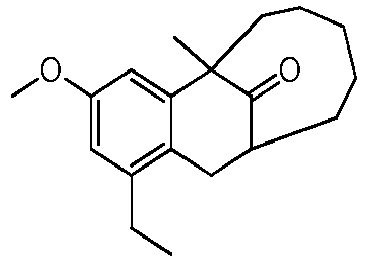
1H NMR (400MHz, CDCl3): δ 6.71 - 6.63 (m, 2H), 3.08 - 2.98 (m, 1H), 2.94 (d, J=5.6 Hz, 1H), 2.76 (d, J=5.2 Hz, 1H), 2.63 (dd, J 1=4.0 Hz, J 2=7.6 Hz, 2H), 2.40 (br. s., 1H), 2.00 - 1.82 (m, 1H), 1.81 - 1.66 (m, 3H), 1.65 - 1.44 (m, 5H), 1.39 - 1.29 (m, 6H), 1.20 (t, J=7.6 Hz, 3H). 10-1 
1H NMR (400MHz, CDCl3): δ 6.76 (d, J=2.4 Hz, 1H), 6.63 (d, J=2.4 Hz, 1H), 5.22 (s, 1H), 4.86 (s, 1H), 3.83 (s, 3H), 3.08-2.95 (m, 2H), 2.75 (m, 1H), 2.48 (m, 1H), 2.03 (s, 3H), 1.87 (m, 2H), 1.84 - 1.59 (m, 6H), 1.39- 1.29 (m, 7H). 11-1 
1H NMR (400MHz, CDCl3): δ 7.46 - 7.40 (m, 2H), 7.39 - 7.34 (m, 1H), 7.33 - 7.28 (m, 2H), 6.86 (d, J=2.8 Hz, 1H), 6.73 (d, J=2.8 Hz, 1H), 3.83 (s, 3H), 2.93 - 2.87 (m, 2H), 2.69 - 2.60 (m, 1H), 2.57 - 2.47 (m, 1H), 1.90 - 1.72 (m, 2H), 1.69 - 1.45 (m, 6H), 1.45 - 1.41 (m, 3H), 1.41 - 1.22 (m, 2H). - The mixed solution of compound 1-6 (250.00mg, 0.92mmol) and NH2OH-HCl 63.78mg, 0.92 mmol) in pyridine (8mL) was heated at reflux for 24 hours. After being cooled to 25°C, the reaction solution was poured into ice water (100mL). The aqueous phase was acidified with dilute hydrochloric acid (1M) and extracted with dichloromethane (100mL x 3). The combined organic phase was washed with saturated brine (100mL), dried over anhydrous Na2SO4, filtered and concentrated in vacuo. The residue was recrystallized from ethyl acetate to give product 1-6 (118.00mg, yield 44.73%). 1H NMR(400MHz, CDCl3): 6.75 (d, J=2.8 Hz, 1H), 6.64 (d, J=2.4 Hz, 1H), 3.81 (s, 3H), 3.76 (d, J=7.2 Hz, 1H), 2.92 - 2.77 (m, 2H), 2.36 - 2.30 (m, 1H), 2.28 (s, 3H), 2.15 - 2.03 (m, 1H), 1.69 - 1.55 (m, 8H), 1.54 (s, 3H).
- The following compounds were synthesized according to a method similar to that of compound 1-7:
Compound number Structure Spectrogram 2-6 
1H NMR (400MHz, CDCl3): δ 7.05 - 7.03 (d, J=8.0 Hz, 1H), 6.85 - 6.83 (d, J=2.4 Hz, 1H), 6.73 - 6.70 (dd, J 1=2.8 Hz, J 2=2.8 Hz, 1H), 3.80 (s, 3H), 3.80 - 3.73 (m, 1H), 3.01 - 2.96 (m, 1H), 2.89 - 2.83 (m, 1H), 2.32 - 2.31 (m, 1H), 2.09 - 2.05 (m, 1H), 1.80 - 1.70 (m, 1H), 1.62 - 1.57 (m, 5H), 1.55 (s, 3H). 3-6 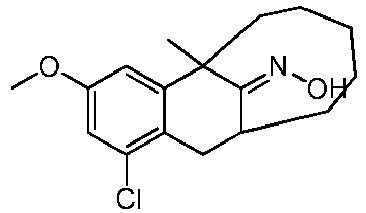
MS (m/z): 307.9 (M+1). 4-6 
MS (m/z): 292.1 (M+1). 5-6 
MS (m/z): 304.1 (M+1) 6-6 
1H NMR (400MHz, CDCl3): δ 6.68 (d, J=1.6 Hz, 1H), 6.51 (dd, J 1=2.4 Hz, J 2=11.2 Hz, 1H), 3.80 (m, 4H), 3.01 - 2.79 (m, 2H), 2.35 - 2.21 (m, 1H), 2.16 - 2.02 (m, 1H), 1.68 - 1.55 (m, 12H), 1.53 (s, 3H). 8-3 
MS (w/z):276.0 (M+1). 9-2 
1H NMR (400MHz, CDCl3): δ 6.74 (d, J=2.4 Hz, 1H), 6.63 (d, J=2.4 Hz, 1H), 3.80 (s, 3H), 3.77 - 3.67 (m, 1H), 3.11 - 2.92 (m, 1H), 2.88 (dd, J 1=4.4 Hz, J 2=7.2 Hz, 2H), 2.62 (q, J=7.6 Hz, 2H), 2.38 - 2.22 (m, 1H), 1.58 (m, 11H), 1.19 (t, J=7.6 Hz, 3H). 10-2 
MS (m/z): 314.0 (M+1). 11-2 
MS (m/z): 349.9 (M+1). - Under nitrogen atmosphere, Raney-Ni (0.5g, 50% wt) was added to a solution of compound 1-7 (100.00mg, 347.95µmol) in ethanol (15mL). The reaction system was evacuated and purged with H2 for three times. Then the reaction solution was heated to 70°C under H2 atmosphere (345 kPa (50 psi)) and stirred for 48 hours. The reaction mixture was filtered under suction and the filtrate was concentrated in vacuo to give crude product 1-8 (80mg) which was used directly in the next step without further purification. MS (m/z): 274.0 (M+1).
- The following compounds were synthesized according to a method similar to that of compound 1-8:
Compound number Structure Spectrogram 2-7 
1H NMR (400MHz, CDCl3): δ 7.01- 6.99 (d, J=8.8 Hz, 1H), 6.79 - 6.78 (d, J=2.8 Hz, 1H), 6.73 - 6.70 (dd, J 1=2.4 Hz, J 2=2.8 Hz, 1H), 3.77 (s, 3H), 3.15 - 3.08 (m, 2H), 2.70 - 2.66 (d, J=16.4 Hz, 1H), 2.29 - 2.21 (m, 1H), 2.03 - 1.95 (m, 1H), 1.78 - 1.75 (m, 3H), 1.53 - 1.37 (m, 4H), 1.37 (s, 3H), 1.11 - 1.08 (m, 1H), 0.90 - 0.83 (m, 2H). 3-7 
MS (m/z): 294.0 (M+1). 4-7 
1H NMR (400MHz, CDCl3): δ 6.84 - 6.78 (m, 2H), 3.86 (s, 3H), 3.19 -3.09 (m, 2H), 2.71 - 2.65 (m, 1H), 2.24 - 2.15 (m, 1H), 2.09 - 1.95 (m, 2H), 1.90 - 1.45 (m, 9H), 1.31 - 1.20 (m, 1H), 0.98 - 0.79 (m, 3H). 5-7 
MS (m/z): 289.9 (M+1). 6-7 
MS (m/z): 278.2 (M+1). 8-4 
1H NMR (400MHz, CDCl3): δ 6.99 (d, J=8.4 Hz, 1H), 6.80 (d, J=2.4 Hz, 1H), 6.72 - 6.69 (m, 1H), 3.81 - 3.78 (m, 4H), 3.68 - 3.65 (m, 1H), 3.31 - 3.25 (m, 1H), 3.12 - 3.06 (m, 3H), 2.60 - 2.56 (m, 1H), 2.26 - 2.23 (m, 2H), 2.05 (brs, 2H), 1.74 - 1.71 (m, 3H), 1.34 (s, 3H). 9-3 
MS (m/z): 289.1 (M+1). 10-3 
MS (m/z): 302.0 (M+1). 11-3 
MS (m/z): 336.1 (M+1). - The mixture of crude compound 1-8 (80.00mg) and aqueous hydrobromic acid (5mL, 48% wt) was heated to 100°C and stirred for 1 hour. After being cooled to room temperature, the reaction mixture was concentrated in vacuo. The residue was purified by HPLC preparative column to give product 1 (50mg, two-step yield: 55.39%). NMR (400MHz, CD3OD) : δ 6.58 (s, 1H), 3.65 (d, J=5.2 Hz, 1H), 2.99 - 2.89 (m, 1H), 2.81 - 2.70 (m, 1H), 2.57 (d, J=5.2 Hz, 1H), 2.23 (s, 3H), 2.02 - 1.88 (m, 2H), 1.80 - 1.64 (m, 2H), 1.64 - 1.50 (m, 3H), 1.46 (s, 3H), 1.20 (d, J=12.0 Hz, 1H), 1.04 - 0.78 (m, 2H). MS (m/z): 260.0 (M+1).
- Compounds 2∼6 and Compounds 8∼11 were prepared according to method of Compound 1 (Compounds 4, 5, and 8 to 11 not forming part of the present invention):
Compound number Structure Spectrogram Compound 2 (Reference compound) 
1H-NMR (CD3OD, 400 MHz): δ 6.90 - 6.88 (d, J=8.0 Hz, 1H), 6.68 (s, 1H), 6.58 - 6.55 (d, J=8.4 Hz, 1H), 3.13 - 3.07 (m, 2H), 2.66 - 2.62 (d, J=16.4 Hz, 1H), 2.28 - 2.24 (m, 1H), 1.96 - 1.93 (m, 1H), 1.77 - 1.73 (m, 3H), 1.54 - 1.50 (m, 1H), 1.49 - 1.46 (m, 2H), 1.34 (s, 3H), 1.09 - 1.07 (m, 1H), 0.93 - 0.90 (m, 2H). MS (m/z): 246.1 (M+1). Coumpond 3 
1H NMR (400MHz, CD3OD): δ 6.79 (d, J=2.4 Hz, 1H), 6.68 (d, J=2.0 Hz, 1H), 3.64 - 3.63 (m, 1H), 3.05 - 2.90 (m, 2H), 2.58 - 2.50 (m, 1H), 2.02 - 1.91 (m, 2H), 1.70 - 1.45 (m, 8H), 1.20 - 1.17 (m, 1H), 0.92 - 0.82 (m, 2H). MS (m/z): 280.1 (M+1). Compound 4 
1H NMR (400MHz, CD3OD): δ 6.85 - 6.79 (m, 2H), 3.65 - 3.63 (m, 1H), 3.26 - 3.20 (m, 2H), 2.80 - 2.76 (m, 1H), 2.45 - 2.35 (m, 1H), 2.26 - 2.19 (m, 1H), 2.04 - 1.96 (m, 1H), 1.71 - 1.45 (m, 7H), 1.25 - 1.14 (m, 1H), 0.91 - 0.80 (m, 2H). MS (m/z): 263.9 (M+1). Compound 5 
1H NMR (400MHz, CD3OD): δ 6.67 (s, 1H), 6.54 (s, 1H), 3.62 (d, J=5.2 Hz, 1H), 3.17 (dd, J 1=7.2 Hz, J 2=16.8 Hz, 1H), 2.65 (d, J=16.8 Hz, 1H), 2.46 (br. s., 1H), 2.05 - 1.82 (m, 2H), 1.77 - 1.64 (m, 2H), 1.63 - 1.48 (m, 3H), 1.44 (s, 3H), 1.19 (d, J=11.6 Hz, 1H), 1.08 - 0.84 (m, 2H). MS (m/z): 262.0 (M+1). Compound 6 
1H NMR (400MHz, CD3OD): δ 6.56 (s, 1H), 6.36 (dd, J 1=2.4 Hz, J 2=11.2 Hz, 1H), 3.67 (d, J=5.2 Hz, 1H), 2.95 -2.80 (m, 2H), 2.60 - 2.51 (m, 1H), 2.05 - 1.91 (m, 2H), 1.84 - 1.55 (m, 5H), 1.48 (s, 3H), 1.28 -1.15 (m, 1H), 1.02 - 0.80 (m, 2H). MS (m/z): 264.0 (M+1). Compound 8 
1H NMR (400MHz, CD3OD): δ 6.95 (d, J=8.4 Hz, 1H), 6.77 (d, J=2.8 Hz, 1H), 6.65 - 6.63 (m, 1H), 3.77 - 3.74 (m, 2H), 3.60 - 3.55 (m, 2H), 3.40 - 3.30 (m, 1H), 3.09 - 3.04 (m, 1H), 2.70 - 2.66 (m, 1H), 2.45 - 2.35 (m, 1H), 2.18 - 2.14 (m, 1H), 2.03 - 1.99 (m, 2H), 1.63 - 1.62 (m, 1H), 1.39 (s, 3H). MS (m/z): 248.0 (M+1). Compound 9 
1H NMR (400MHz, CD3OD): δ 6.59 (d, J=1.6 Hz, 1H), 3.66 (d, J=5.2 Hz, 1H), 3.06 - 2.94 (m, 1H), 2.91 - 2.80 (m, 1H), 2.70 - 2.48 (m, 3H), 2.04 - 1.90 (m, 2H), 1.79 - 1.65 (m, 2H), 1.64 - 1.50 (m, 3H), 1.47 (s, 3H), 1.22 (t, J=7.6 Hz, 4H), 1.06 - 0.78 (m, 2H). MS (m/z): 274.0 (M+1). Compound 10 
1H NMR (400MHz, CD3OD): δ 6.69 (d, J=2.4 Hz, 1H), 6.57 (d, J=2.4 Hz, 1H), 3.66 (d, J=5.2 Hz, 1H), 3.17 (quin, J=6.8 Hz, 1H), 3.08 - 2.86 (m, 2H), 2.55 (br. s., 1H), 2.06 - 1.87 (m, 2H), 1.80 - 1.65 (m, 2H), 1.64 - 1.49 (m, 3H), 1.47 (s, 3H), 1.23 (t, J=6.4 Hz, 7H), 1.08 - 0.82 (m, 2H). MS (m/z): 288.0 (M+1). Compound 11 
1H NMR (400MHz, CD3OD): δ 7.47 - 7.39 (m, 2H), 7.39 - 7.32 (m, 1H), 7.26 (d, J=6.8 Hz, 2H), 6.77 (d, J=2.4 Hz, 1H), 6.58 (d, J=2.4 Hz, 1H), 3.70 (d, J=5.2 Hz, 1H), 2.98 (dd, J 1=7.2 Hz, J 2=17.2 Hz, 1H), 2.53 (d, J=17.2 Hz, 1H), 2.39 (br. s., 1H), 2.06 - 1.96 (m, 1H), 1.85 - 1.69 (m, 2H), 1.67 - 1.57 (m, 3H), 1.55 (s, 3H), 1.53 - 1.42 (m, 1H), 1.21 (d, J=10.4 Hz, 1H), 1.10 - 0.84 (m, 2H). -

- Under nitrogen atmosphere, the mixture of compound 7-5 (100.00mg, 296.52umol), potassium hydroxide (83.19mg, 1.48mmol), di-tert-butyl[2-(2,4,6-triisopropylphenyl)phenyl]phosphine (25.18mg, 59.30µmol) and Pd2(dba)3 (27.15mg, 29.65µmol) in water (3mL) and dioxane (4mL) was heated to 100°C and stirred for 3.5 hours. After being cooled down, the reaction solution was diluted by 20mL water . The aqueous phase was extracted with ethyl acetate (30mL x 3). The combined organic phase was washed with saturated brine (30mL), dried over anhydrous Na2SO4, filtered and concentrated in vacuo. The residue was purified by silica gel column chromatography (eluent: petroleum ether/ethyl acetate = 10/1 to 5/1) to give 7-6 (60.00mg, yield 73.76%). 1H NMR (400MHz, CDCl3): δ 6.35 (dd, J 1=2.0 Hz, J 2=12.4 Hz, 1H), 3.83 (s, 3H), 3.52 (s, 1H), 3.10 (dd, J 1=4.0 Hz, J 2=16.8 Hz, 1H), 2.91 - 2.81 (m, 1H), 2.75 (dd, J 1=4.0 Hz, J 2=9.6 Hz, 1H), 2.44 - 2.32 (m, 1H), 1.99 - 1.85 (m, 1H), 1.82 - 1.69 (m, 2H), 1.68 - 1.48 (m, 5H), 1.44 - 1.24 (m, 5H).
- The mixed solution of compound 7-6 (70.00mg, 255.15µmol) and NH2OH-HCl (88.65mg, 1.28mmol) in pyridine (5mL) was heated at reflux for 24 hours. After being cooled to 25°C, the reaction mixture was poured into ice water (20mL). The aqueous phase was acidified with dilute hydrochloric acid (1M) and extracted with dichloromethane (20mL x 3). The combined organic phase was washed with saturated brine (20mL), dried over anhydrous Na2SO4, filtered and concentrated in vacuo to give crude producrt 7-7 (68mg). MS (m/z): 290.0 (M+1).
- Under nitrogen atmosphere, Raney-Ni (1.00g) was added to a solution of compound 7-7 (78.00mg, 269.55umol) in ethanol (20mL). The reaction system was evacuated and purged with H2 for three times. Then the reaction solution was heated to 70°C under H2 atmosphere and stirred for 48 hours. The reaction mixture was filtered under suction and the filtrate was concentrated in vacuo. The residue was purified by silica gel column chromatography (eluent: petroleum ether/ethyl acetate = 1/1) to give 7 (30.00mg, yield 40.42%). 1H NMR (400MHz, CD3OD):δ 6.33 (s, 1H), 3.81 (s, 2H), 3.67 - 3.56 (m, 1H), 2.91 (s, 1H), 2.84 - 2.70 (m, 1H), 2.56 - 2.41 (m, 1H), 2.00 - 1.85 (m, 2H), 1.77 - 1.47 (m, 5H), 1.45 (s, 3H), 1.19 (d, J=12.4 Hz, 1H), 1.03 - 0.79 (m, 2H). MS (m/z): 276.1 (M+1).
-

- Ac2O (1142 mg, 8.525 mmol) was added dropwise to a solution of compound 2-7 (552mg, 2.131mmol) in pyridine (15mL) at room temperature. Then, the reaction solution was stirred at room temperature for 12 hours. After the reaction was complete, the reaction solution was poured into 100mL water and extracted with ethyl acetate (100mL x 3). The combined organic phase was washed with saturated brine (50mL), dried over anhydrous Na2SO4, filtered and concentrated in vacuo to give crude product 12-1 (737mg) as a yellow oil. MS (m/z): 302.2 (M+1).
- NBS (142mg, 0.803mmol) was added to a solution of compound 12-1 (220mg, 0.730mmol) in acetonitrile (7mL) at room temperature. After being stirred at room temperature for 2 hours, the reaction was quenched with addition of 30mL water. The aqueous phase was extracted with ethyl acetate (20mL x 3). The combined organic was washed with saturated brine (50mL), dried over anhydrous Na2SO4, filtered, and concentrated in vacuo to give crude product 12-2 (275mg) as a yellow oil. MS (m/z): 379.9 (M+1).
- Under nitrogen atmosphere, BBr3 (0.2mL) was added to a solution of compound 12-2 (145mg, 0.382mmol) in dichloromethane (2mL) at 0°C. The reaction solution was stirred at 0°C for 1 hour, then 20 mL saturated aqueous solution of K2CO3 was added to quench the reaction. The aqueous phase was extracted with dichloromethane (10mL x 3). The combined organic was washed with saturated brine (50mL), dried over anhydrous Na2SO4, filtered and concentrated in vacuo to give crude product 12-2 (127mg) as a yellow oil. MS (m/z): 365.9 (M+1).
- BBr3 (0.2mL) was added to a solution of compound 12-3 (50mg, 0.143mmol) in dichloromethane (1mL) at room temperature . The reaction solution was stirred at 0°C for 1 hour, then 20mL was added to quench the reaction and the pH was adjusted to 9 with saturated aqueous solution of K2CO3. The aqueous phase was extracted with dichloromethane (10mL x 3). The combined organic phase was washed with saturated brine (20mL), dried over anhydrous Na2SO4, filtered and concentrated in vacuo. The residue was purified by HPLC preparative column to give 12 (5mg, yield: 10.80 %). 1H NMR (400MHz, CDCl3): δ 8.84 (br. s., 3H), 7.23 (s, 1H), 6.89 (s, 1H), 3.70 (br. s., 1H), 3.18 (d, J=11.2 Hz, 1H), 2.83 (br. s., 1H), 2.69 (d, J=17.2 Hz, 1H), 2.23 - 1.98 (m, 3H), 1.89 (br. s., 2H), 1.63 (br. s., 6H), 0.88 (br. s., 2H). MS (m/z): 323.9 (M+1).
-

- DMAP (50mg) was added to a mixed solution of compound 2-7 (500mg, 1.93mmol), Boc2O (780mg, 3.86mmol) and triethylamine (585mg, 5.79mmol) in dichloromethane (20mL) at room temperature. After the reaction mixture was stirred at room temperature for 2 hours, 20mL water was added to quench the reaction. The aqueous phase was extracted with dichloromethane (20mL x 3). The combined organic phase was washed with saturated brine (20mL), dried over anhydrous Na2SO4, filtered and concentrated in vacuo. The residue was purified by silica gel column chromatography (eluent: petroleum ether/ethyl acetate = 5/1) to give product 13-1 as a colorless oil (203mg, yield: 29.29%). 1H NMR (400MHz, CDCl3): δ 7.04 - 6.96 (m, 1H), 6.75 (d, J=2.4 Hz, 1H), 6.70 (dd, J 1=2.4 Hz, J 2=8.4 Hz, 1H), 4.95 (d, J=10.4 Hz, 1H), 4.10 (dd, J 1=5.2 Hz, J 2=10.4 Hz, 1H), 3.82 - 3.76 (m, 3H), 3.17 (dd, J 1=6.8 Hz, J 2=16.4 Hz, 1H), 2.62 (d, J=16.4 Hz, 1H), 1.91 - 1.51 (m, 8H), 1.48 (s, 9H), 1.36 - 1.30 (m, 3H), 0.98 (d, J=6.4 Hz, 2H).
- NBS (163mg, 0.919mmol) was added to a solution of compound 13-1 (300 mg, 0.836 mmol) in acetonitrile (5mL) at 25°C. After the reaction mixture was stirred at 25°C for 2 hours, 20mL water was added to quench the reaction. The aqueous phase was extracted with ethyl acetate (20mL x 3). The combined organic phases were washed with saturated brine (20mL), dried over anhydrous Na2SO4, filtered and concentrated in vacuo to give crude product 13-2 (439mg) as a yellow solid. 1H NMR (400MHz, CDCl3): δ 7.28 (s, 1H), 6.73 (s, 1H), 4.94 (d, J=10.4 Hz, 1H), 4.16 - 4.07 (m, 1H), 3.88 (s, 3H), 3.19 (dd, J 1=6.8 Hz, J 2=16.8 Hz, 1H), 2.61 (d, J=16.8 Hz, 1H), 1.84 - 1.68 (m, 4H), 1.67 - 1.56 (m, 4H), 1.51 (s, 9H), 1.35 (s, 3H), 1.01 (d, J=6.8 Hz, 2H).
- Under nitrogen atmosphere, the mixed solution of compound 13-2 (60mg, 0.14mmol), isopropenylboronic acid pinacol ester (69mg, 0.41mmol), K2CO3 (56mg, 0.41mmol) and Pd(dppf)Cl2 (11mg, 0.013mmol) in dioxane (2mL) was heated at reflux overnight. After being cooled down, the reaction solution was filtered to remove precipitate. The filtrate was concentrated in vacuo. The residue was purified by thin-layer chromatography (eluent: petroleum ether/ethyl acetate = 15/1) to give 13-3 as a brown oil (39mg, yield: 71.0%). 1H NMR (400MHz, CDCl3): δ 6.90 (s, 1H), 6.70 (s, 1H), 5.12 - 5.13 (m, 2H), 4.93 - 4.96 (m, 1H), 4.08 - 4.12 (m, 1H), 3.83 (s, 3H), 3.16 - 3.20 (m, 1H), 2.89 - 2.96 (m, 1H), 2.58 - 2.62 (m, 1H), 2.32 (s, 1H), 2.13 (s, 3H), 1.52 - 1.84 (m, 13H), 1.26 - 1.33 (m, 3H), 1.20 - 1.30 (m, 1H), 0.98 - 1.00 (m, 4H).
- The following compounds were synthesized according to a method similar to that of compound 13-3:
Compound number Structure Spectrogram 14-1 
MS (m/z): 317.9 (M+1-56). 15-1 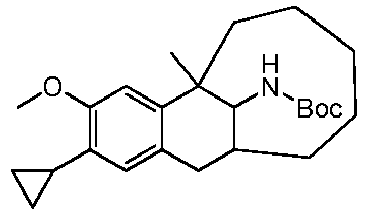
1H NMR (400MHz, CDCl3): δ 6.65 (s, 1H), 6.51 (s, 1H), 3.84 (s, 3H), 3.22 - 3.11 (m, 1H), 2.35 - 2.25 (m, 1H), 2.14 - 2.13 (m, 1H), 2.00 - 1.55 (m, 2H), 1.74 - 1.49 (m, 15H), 1.35 - 1.15 (m, 5H), 1.00 - 0.80 (m, 5H), 0.75 - 0.50 (m, 2H). - Under hydrogen atmosphere (345 kPa (50 psi)), a mixed solution of compound 13-3 and Pd/C (3.9mg) in ethanol (2mL) was heated at reflux for 2 hours. After being cooled down, the reaction solution was filtered. The filtrate was concentrated in vacuo to give crude product 13-4 (40mg). 1H NMR (400MHz, CDCl3): δ 6.90 (s, 1H), 6.64 (s, 1H), 4.96 - 4.93 (m, 1H), 4.12 - 4.08 (m, 1H), 3.80 (s, 3H), 3.27 - 3.15 (m, 2H), 2.65 - 2.58 (m, 1H), 2.32 (brs, 1H), 1.83 - 1.62 (m, 6H), 1.50 - 1.25 (m, 19H), 1.00 - 0.98 (m, 3H).
- BBr3 (75mg, 0.30mmol) was added to a solution of compound 13-4 (40mg, 0.10mmol) in dichloromethane (2mL) at 0°C. After being warmed to room temperature, the reaction solution was stirred for 2 hours. After the reaction was complete, 10mL saturated sodium bicarbonate solution was added to quench the reaction. The aqueous phase was extracted with dichloromethane (10mL x 5). The combined organic phase was washed with saturated brine (50mL), dried over anhydrous Na2SO4, filtered and concentrated in vacuo. The residue was purified by HPLC preparative column to give the hydrochloride salt of product 13 (14mg, yield: 50.0%). 1H NMR (400MHz, CD3OD): δ 6.89 (s, 1H), 6.63 (s, 1H), 3.61 (d, J=5.2 Hz, 1H), 3.25 - 3.15 (m, 2H), 2.75 - 2.71 (m, 1H), 2.44 (brs, 1H), 1.93 - 1.91 (m, 2H), 1.70 - 1.45 (m, 8H), 1.23 - 1.15 (m, 7H), 0.97 - 0.92 (m, 2H),. MS (m/z): 288.0 (M+1).
- Compounds 14 and 15 (not forming part of the present invention) were prepared according to a method similiar to that of compound 4
Compound number Structure Spectrogram Compound 14 
1H NMR (400MHz, CDCl3): δ 7.96 (br. s., 3H), 6.86 (s, 1H), 6.63 (s, 1H), 3.66 (br. s., 1H), 3.14 (dd, J 1=6.4 Hz, J 2=16.4 Hz, 1H), 2.70 (br. s., 1H), 2.58 (br. s., 1H), 2.22 (s, 3H), 1.97 - 1.63 (m, 6H), 1.59 - 1.54 (m, 1H), 1.49 (s, 3H), 1.14 (d, J=11.6 Hz, 1H), 0.93 (br. s., 2H). MS (m/z): 260.0 (M+1). Compound 15 
1H NMR (400MHz, CD3OD): δ 6.78 (s, 1H), 6.62 (s, 1H), 5.98 -5.92 (m, 1H), 5.00 - 4.89 (m, 3H), 3.60 - 3.58 (m, 1H), 3.16 - 3.10 (m, 1H), 2.70 - 2.66 (m, 1H), 2.40 - 2.39 (m, 1H), 1.91 - 1.84 (m, 2H), 1.70 - 1.45 (m, 8H), 1.25 - 1.05 (m, 2H), 1.00 - 0.75 (m, 2H). MS (m/z): 286.1 (M+1). -

- Concentrated hydrochloric acid (0.2mL) was added dropwise to a solution of compound 13-1 (100mg, 0.28mmol) and NCS (37mg, 0.28mmol) in acetonitrile (2mL) at 25°C. After being stirred at 25°C for 2 hours, the reaction was quenched by the addition of 10mL water . The aqueous phase was extracted with ethyl acetate (10mL x 4). The combined organic phase was washed with saturated brine (10mL), dried over anhydrous Na2SO4, filtered and concentrated in vacuo to give the crude product 16-1 (88mg) as a yellow oil. MS (m/z): 293.9 (M+1).
- BBr3 (0.2mL) was added to a solution of compound 16-1 (88mg, 0.3mmol) in dichloromethane (1mL) at 0°C. After being stirred at 0°C for 2 hours, the reaction was quenched by the addition of 10mL saturated potassium carbonate solution. The aqueous phase was extracted with dichloromethane/methanol mixed solution (8:1, 10mL x 3). The combined organic phase was washed with saturated brine (50mL), dried over anhydrous Na2SO4, filtered and concentrated in vacuo. The residue was purified by HPLC preparative column to give the hydrochloride salt of product 16 (20mg, yield: 23.81%). 1H NMR (400MHz, CDCl3): δ 8.11 (br. s., 3H), 7.11 (s, 1H), 6.90 (s, 1H), 3.64 (br. s., 1H), 3.17 (dd, J 1=6.4 Hz, J 2=16.4 Hz, 1H), 2.72 (d, J=17.2 Hz, 1H), 2.62 (br. s., 1H), 1.98 - 1.81 (m, 5H), 1.62 (br. s., 2H), 1.53 (s, 3H), 1.27 - 1.17 (m, 1H), 0.92 (br. s., 2H). MS (m/z): 279.9 (M+1).
-

- A solution of n-butyllithium in tetrahydrofuran (1mL, 2.5mmol) was added to a solution of compound 13-2 (190.00mg, 433.39µmol) in tetrahydrofuran (3mL) at -78°C . After being stirred at -78°C for 1 hour, the reaction mixture was added with a solution of NFSI (273.33mg, 866.78µmοl) in THF (3mL), and stirred at -78°C for another 4 hours. Then 20mL saturated aqueous ammonium chloride solution was added to quench the reaction. The aqueous phase was extracted with ethyl acetate (10mL x 4). The combined organic phase was washed with saturated brine (10mL), dried over anhydrous Na2SO4, filtered and concentrated in vacuo. The residue was purified by HPLC preparative column to give product 17-1 as a colorless oil (20.00mg, yield: 12.22%). MS (m/z): 322.1 (M+1-56).
- BBr3 (39.38mg, 158.94µmol) was added to a solution of compound 17-1 (20.00mg, 52.98µmol) in dichloromethane (1mL) at room temperature. After being stirred at room temperature for 2 hours, the reaction was quenched by addition of 10mL water. The aqueous phase was adjusted to pH = 9 with saturated potassium carbonate solution and extracted with dichloromethane (10mL x 5). The combined organic phases were washed with saturated brine (50mL), dried over anhydrous Na2SO4, filtered and concentrated in vacuo. The residue was purified by HPLC preparative column to give the hydrochloride salt of product 17 (11mg, yield: 77.84%). 1H NMR (400MHz, CD3OD): δ 6.88 - 6.80 (m, 2H), 3.66 (d, J=5.2 Hz, 1H), 3.21 (dd, J 1=7.2 Hz, J 2=16.8 Hz, 1H), 2.74 (d, J=17.2 Hz, 1H), 2.47 (d, J=5.6 Hz, 1H), 2.02 - 1.88 (m, 2H), 1.78 - 1.66 (m, 2H), 1.65 - 1.51 (m, 3H), 1.47 (s, 3H), 1.25 - 1.15 (m, 1H), 1.01 - 0.83 (m, 2H). MS (m/z): 264.0 (M+1).
-

- Under nitrogen atmosphere, triethylamine (90.01mg, 889.56µmol) and Pd(dppf)Cl2 (21.70mg, 29.65µmol) were added to a solution of compound 1-5 (100.00mg, 296.52µmol) in methanol (30mL). The reaction system was evacuated and purged with CO for three times. Then the reaction solution was heated to 70°C under CO atmosphere (345 kPa (50 psi)) and stirred for 24 hours. The reaction mixture was filtered under suction and the filtrate was concentrated in vacuo. The residue was purified by silica gel column chromatography (eluent: petroleum ether/ethyl acetate = 10/1) to give product 18-1 (70.00mg, yield: 74.61%). 1H NMR (400MHz, CDCl3): δ 7.27 (d, J=2.8 Hz, 1H), 6.99 (d, J=2.8 Hz, 1H), 3.91 (s, 3H), 3.85 (s, 3H), 3.44 (dd, J 1=4.4 Hz, J 2=17.2 Hz, 1H), 3.22 (dd, J 1=5.6 Hz, J 2=17.2 Hz, 1H), 2.75 (td, J 1=5.2 Hz, J 2=9.6 Hz, 1H), 2.51 - 2.31 (m, 1H), 1.94 - 1.64 (m, 4H), 1.35 (s, 3H), 1.33 - 1.23 (m, 3H).
- The mixed solution of compound 18-1 (70.00mg, 221.25µmol) and NH2OH-HCl (76.87mg, 1.11mmol) in pyridine (4mL) was heated at reflux for 24 hours. After being cooled to room temperature, the reaction solution was poured into ice water (100mL). The aqueous phase was acidified with dilute hydrochloric acid (1M) and extracted with dichloromethane (100mL x 3). The combined organic phase was washed with saturated brine (100mL), dried over anhydrous Na2SO4, filtered and concentrated in vacuo. The residue was purified by thin layer chromatography (eluent: petroleum ether/ethyl acetate = 10/1) to give product 18-2 (45.00mg, yield: 61.37%) as a white solid. MS (m/z): 332.5 (M+1).
- Under nitrogen atmosphere, Raney-Ni (1.0g, 50%wt) was added to a solution of compound 18-2 (45.00mg, 135.78µmol) in ethanol (20mL). The reaction system was evacuated and purged with H2 for three times. Then the reaction solution was heated to 70°C under H2 atmosphere (345 kPa (50 psi)) and stirred for 48 hours. The reaction mixture was filtered under suction and the filtrate was concentrated in vacuo to give crude product 18-3 (50mg) which was used directly in the next step without further purification. MS (m/z): 318.1 (M+1).
- Under nitrogen atmosphere, lithium tetrahydroaluminate (15.42mg, 406.41µmol) was slowly added to a solution of compound 18-3 (43.00mg, 135.47µmol) in tetrahydrofuran (20mL) at 0°C. After being stirred at 0°C for 2 hours, the reaction was quenched by the successive addition of water (45mg) and 15% aqueous sodium hydroxide solution (15mg). After filtration, the filtrate was concentrated in vacuo to give crude product 18-4 (35mg) which was used directly in the next step without further purification. MS (m/z): 209.0 (M+1).
- Under nitrogen atmosphere, BBr3 (90.89mg, 362.82µmol) was slowly added to a solution of compound 18-4 (35.00mg, 120.94µmol) in dichloromethane (5mL) at -78°C. After being warmed to 0°C, the reaction solution was stirred for 1 hour. Then, water (30mL) was added to quench the reaction. The aqueous phase was extracted with dichloromethane (30mL x 3). The combined organic phase was washed with saturated brine (30mL), dried over anhydrous Na2SO4, filtered and concentrated in vacuo to give crude product 18-5 (35.00mg) which was used directly in the next step without further purification. MS (m/z): 399.9 (M+1)
- The mixed solution of compound 18-5 (63.00mg, 178.82µmol) and sodium acetate (73.34mg, 894.10µmol) in acetic acid (3mL) was heated to reflux and stirred for 1h. After being cooled down, the reaction solution was poured into 20mL ice water to be diluted. The aqueous phase was extracted with dichloromethane (20mL x 3). The combined organic phase was washed with saturated brine (20mL), dried over anhydrous Na2SO4, filtered and concentrated in vacuo to give the crude product. The crude product was purified by HPLC preparative column to give product 18-6 as a white solid (20.00mg, yield: 33.18%). MS (m/z): 318.1 (M+1).
- The solution of compound 18-6 (10.00mg, 31.50µmol) and lithium hydroxide (73.77mg, 157.50µmol) in ethanol (2mL) was stirred at 25°C for 16 hours. After the reaction solution was concentrated in vacuo, 20mL water was added and the mixture was acidified to pH = 2 with dilute hydrochloric acid. The aqueous phase was extracted with dichloromethane (20mL x 3). The combined organic phase was washed with saturated brine (20mL), dried over anhydrous Na2SO4, filtered and concentrated in vacuo to give the crude product. The crude product was purified by HPLC preparative column to give product 18 (6.00mg, yield: 60.55%). 1H NMR (400MHz, CD3OD): δ 6.84 (d, J=2.4 Hz, 1H), 6.67 (d, J=2.4 Hz, 1H), 4.69 - 4.50 (m, 3H), 3.65 (d, J=5.6 Hz, 1H), 3.08 - 2.82 (m, 2H), 2.54 (d, J=6.0 Hz, 1H), 1.95 (dd, J 1=7.2 Hz, J 2=15.6 Hz, 2H), 1.81 - 1.64 (m, 2H), 1.64 - 1.50 (m, 3H), 1.47 (s, 3H), 1.20 (d, J=11.6 Hz, 1H), 1.04 - 0.82 (m, 2H). MS (m/z): 276.0 (M+1).
-

- Under nitrogen atmosphere, Pd(OAc)2 (0.15g) and xPhos (0.62g) were added to a mixed solution of concentrated sulfuric acid (24µL) and dimethylacetamide (10mL), then the mixture was heated to 80°C and stirred for 30 minutes to obtain a dark solution A.
- In another flask, the prepared solution A (1mL) was added to a solution of compound 13-2 (50mg, 0.139mmol), Zn(CN)2 (16mg, 0.139mmol) and Zn (0.5mg, 0.008mmol) in dimethylacetamide. Then, the reaction solution was heated to 90°C and stirred overnight. After being cooled to room temperature, the reaction solution was filtered. The filtrate was poured into 10mL water. The aqueous phase was extracted with ethyl acetate (10mL x 4). The combined organic phase was washed with saturated brine (30mL), dried over anhydrous Na2SO4, filtered and concentrated in vacuo. The residue was purified by thin layer chromatography (eluent: petroleum ether/ethyl acetate = 5/1) to give product 19-1 (18.0mg, yield: 40.91%). MS (m/z): 328.9 (M+1-56).
- BBr3 (27mg, 0.109mmol) was slowly added to a solution of compound 19-1 (14mg, 0.036mmol) in dichloromethane (2mL) at room temperature. After being stirred at room temperature for 5 hours, the reaction was quenched by addition of water (10mL). The aqueous phase was basified with potassium carbonate to pH = 9 and extracted with dichloromethane (10mL x 4). The combined organic phase was washed with saturated brine (10mL), dried over anhydrous Na2SO4, filtered, and concentrated in vacuo to give the crude product. The crude product was purified by HPLC preparative column to give product 19 (8mg, yield: 80.0%). 1H NMR (400MHz, CD3OD): δ 7.01 (s, 1H), 6.67 (s, 1H), 3.08 - 2.98 (m, 2H), 2.61 (d, J=16.0 Hz, 1H), 2.27 - 2.19 (m, 1H), 2.00 - 1.92 (m, 1H), 1.80 - 1.72 (m, 3H), 1.71 - 1.58 (m, 2H), 1.51 (dd, J 1=6.4 Hz, J 2=13.6 Hz, 2H), 1.36 - 1.31 (m, 3H), 1.12 - 0.94 (m, 3H). MS (m/z): 271.1 (M+1).
-

- Concentrated hydrochloric acid (0.4mL) was added dropwise to a solution of compound 13-1 (80mg, 0.223mmol) and NCS (74mg, 0.557mmol) in acetonitrile (2mL) at 25°C. After being stirred at 25°C for 5 hours, the reaction was quenched by addition of 10mL water. The aqueous phase was extracted with ethyl acetate (10mL x 4). The combined organic phase was washed with saturated brine (10mL), dried over anhydrous Na2SO4, filtered and concentrated in vacuo. The residue was purified by thin layer chromatography (eluent: petroleum ether/ethyl acetate = 5/1) to give product 20-1 as a colorless oil (40.0mg, yield: 54.79%). MS (m/z): 328.1 (M+1).
- BBr3 (91mg, 0.367mmol) was slowly added to the a solution of compound 20-1 (14mg, 0.036mmol) in dichloromethane (2mL) at 0°C. After being stirred at 0° C for 5 hours, the reaction was quenched by addition of water (10mL). The aqueous phase was basified with potassium carbonate to pH = 9 and extracted with dichloromethane (10mL x 4). The combined organic phase was washed with saturated brine (10mL), dried over anhydrous Na2SO4, filtered, and concentrated in vacuo to give the crude product. The crude product was separated and purified by HPLC preparative column to give product 20 (3.0mg, yield: 7.89%). 1H NMR (400MHz, CD3OD): δ 7.19 (s, 1H), 4.64 (br. s., 1H), 3.63 (d, J=4.8 Hz, 1H), 2.83 (d, J=17.2 Hz, 1H), 2.60 (dd, J 1=7.6 Hz, J 2=16.4 Hz, 1H), 2.40 (d, J=6.4 Hz, 1H), 2.06 - 1.96 (m, 1H), 1.74 (s, 3H), 1.69 (br. s., 2H), 1.63 - 1.52 (m, 2H), 1.35 - 1.16 (m, 2H), 0.95 (d, J=12.8 Hz, 1H), 0.87 - 0.76 (m, 1H). MS (m/z): 314.1 (M+1).
-

- Compound 6 (700.00mg, 2.66mmol) was separated by SFC to give compound 21 (150mg) and 22 (160mg).
- SFC separation condition: Instrument: Thar 80; Column: Chiralpak AD 250×30mm I.D.,5um; Mobile phase: Supercritical CO2/IPA(0.1%NH3H2O) = 65/35 at 50 mL/min; Column Temp: 38°C; Nozzle Pressure: 100Bar; Nozzle Temp: 60°C; Evaporator Temp: 20°C; Trimmer Temp: 25°C; Wavelength: 220nm.
- Compound 21 1H NMR (400MHz, CD3OD): δ 6.54 (s, 1H), 6.36 (dd, J 1=2.4 Hz, J 2=11.2 Hz, 1H), 3.09 (d, J=5.2 Hz, 1H), 2.80 (d, J=4.4 Hz, 2H), 2.39 - 2.27 (m, 1H), 2.05 - 1.91 (m, 1H), 1.84 - 1.48 (m, 6H), 1.35 (s, 3H), 1.30 - 1.21 (m, 1H), 1.02 - 0.80 (m, 2H). MS (m/z): 264.0 (M+1). [α]20D = -43.8 (C=3.1, CH3OH).
- Compound 22 1H NMR (400MHz, CD3OD): δ 6.56 (s, 1H), 6.36 (dd, J 1=2.4 Hz, J 2=11.2 Hz, 1H), 3.67 (d, J=5.2 Hz, 1H), 2.95 - 2.80 (m, 2H), 2.60 - 2.51 (m, 1H), 2.05 - 1.91 (m, 2H), 1.84 - 1.55 (m, 5H), 1.48 (s, 3H), 1.28 -1.15 (m, 1H), 1.02 - 0.80 (m, 2H). MS (m/z): 264.0 (M+1). [α]20D = +39.8 (C=2.0, CH3OH).
- Compounds 23-26 were isolated referring to the SFC separation method described above:
Compound number Structure Spectrogram Compound 23 
1H NMR (400MHz, CD3OD): δ 6.72 (d, J=2.4 Hz, 1H), 6.67 (d, J=2.0 Hz, 1H), 2.96 - 2.84 (m, 2H), 2.45 (brs, 1H), 1.94 - 1.75 (m, 4H), 1.42 - 1.25 (m, 4H), 1.58 - 1.54 (m, 3H), 1.19 - 1.10 (m, 1H), 0.95 - 0.75 (m, 2H). Compound 24 
1H NMR (400MHz, CD3OD): δ 6.72 (d, J=2.4 Hz, 1H), 6.67 (d, J=2.0 Hz, 1H), 3.18 - 3.16 (m, 1H), 2.96 - 2.82 (m, 2H), 2.38 (brs, 1H), 1.94 - 1.90 (m, 1H), 1.77 - 1.70 (m, 2H), 1.62 - 1.45 (m, 3H), 1.35 (s, 1H), 1.16 - 1.10 (m, 1H), 0.95 - 0.75 (m, 2H). Compound 25 
1H NMR (400MHz, CD3OD): δ 6.92 (d, J=8.4 Hz, 1H), 6.75 (d, J=2.0 Hz, 1H), 6.61 (dd, J 1=2.0 Hz, J 2=2.0 Hz, 1H), 3.76 - 3.69 (m, 2H), 3.52 - 3.45 (m, 1H), 3.44 - 3.40 (m, 1H), 3.30 - 3.25 (m, 1H), 3.07 - 3.04 (m, 1H), 2.63 (d, J=16.0 Hz, 1H), 2.33 (brs, 1H), 2.05 - 2.02 (m, 2H), 1.99 - 1.85 (m, 1H), 1.63 - 1.52 (m, 1H), 1.36 (s, 3H). Compound 26 
1H NMR (400MHz, CD3OD): δ 6.93 (d, J=8.8 Hz, 1H), 6.75 (d, J=2.4 Hz, 1H), 6.61 (dd, J 1=2.0 Hz, J 2=2.0 Hz, 1H), 3.77 - 3.70 (m, 2H), 3.52 - 3.45 (m, 1H), 3.45 - 3.43 (m, 1H), 3.27 - 3.26 (m, 1H), 3.07 - 3.05 (m, 1H), 2.64 (d, J=15.6 Hz, 1H), 2.35 (brs, 1H), 2.06 - 2.03 (m, 2H), 2.03 - 1.92 (m, 1H), 1.64 - 1.52 (m, 1H), 1.36 (s, 3H) -

- Under nitrogen atmosphere, the mixture of compound 7 (16.00mg, 58.10µmol) and aqueous hydrobromic acid (48%wt, 3mL) was heated to 100°C and stirred for 1 hour. After being cooled to room temperature, the reaction solution was concentrated in vacuo. The residue was purified by HPLC preparative column to give product 27 (8.00mg, yield: 46.23%). 1H NMR (400MHz, CD3OD): δ 6.27-6.20 (m, 1H), 3.61 (d, J=5.2 Hz, 1H), 2.90 (s, 1H), 2.80 (d, J=7.2 Hz, 1H), 2.59-2.45 (m, 1H), 2.04-1.83 (m, 2H), 1.76-1.48 (m, 5H), 1.44 (s, 3H), 1.31-1.12 (m, 1H), 1.05-0.88 (m, 2H). MS (m/z): 262.1 (M+1).
-

- Compound 1-1 (2.00g, 10.30mmol) was dissolved in toluene (5.00mL) and a solution of EtMgBr in tetrahydrofuran (13.73mL, 3M, 41.19mmol) was added dropwise at -78°C. After the dropwise addition was complete, the temperature was slowly raised to 25°C and the reaction was continued for 2 hours. After the reaction was complete, water (10mL) was added to quench the reaction, then HCl (10mL, 4M) was added. The temperature was raised to 60°C, and the reaction was continued under stirring for 3 hours. After being cooled down, the reaction solution was extracted with dichloromethane (10mL x 2). The combined organic phase was washed with saturated brine (10mL), dried over anhydrous Na2SO4, filtered and concentrated in vacuo. The residue was purified by silica gel column chromatography (eluent: petroleum ether/ethyl acetate = 10/1) to give product 28-1 as a pale yellow oil (1.50g, yield: 70.6%). 1H NMR (400 MHz, CDCl3) δ 6.64 (dd, J 1=10.2 Hz, J 2= 2.4 Hz, 1 H), 6.52 (dd, J 1=10.8 Hz, J 2=2.4 Hz, 1 H), 5.92 (t, J=4.4 Hz, 1 H), 3.82 (s, 3 H), 2.68 (t, J=8.4 Hz, 2 H), 2.40 (dd, J 1=7.2 Hz, J 2=1.2 Hz, 2 H), 2.01 - 2.27 (m, 2 H), 1.14 (t, J=7.2 Hz, 3 H)
- Compound 28-1 (1.50g, 7.27mmol) was dissolved in dichloromethane (4.00mL), m-CPBA (1.51g, 8.73mmol) was added in portions under an ice bath, the internal temperature was maintained within 0-5°C, and the mixture was stirred for another 2 hours. The reaction was quenched by successive addition of saturated Na2SO3 (10mL) and NaHCO3 (5mL). The reaction solution was extracted with dichloromethane (10mL x 2) and the combined organic phase was dried over anhydrous Na2SO4 and filtered. BF3.Et2O (103.22mg, 727.24µmol) was added to the filtered solution under an ice bath, and the mixture was stirred at the same temperature for 0.5 hours. The reaction was quenched by addtion of saturated NaHCO3 (10mL) and the aqueous phase was extracted with dichloromethane (10mL x 2). The combined organic phase was washed with saturated brine (10mL x 2), dried over sodium sulfate, filtered and concentrated in vacuo. The residue was purified by silica gel column chromatography (eluent: petroleum ether/ethyl acetate = 20/1 to 10/1) to give the product 28-2 as a pale yellow oil (1.00g, yield: 61.9%). MS (m/z): 222.9 (M+1). 1H NMR (400 MHz, CDCl3) δ 6.54 (dd, J 1=11.04 Hz, J 2=2.40 Hz, 1 H), 6.49 (d, J=2.24 Hz, 1 H), 3.79 (s, 3 H), 3.30 (t, J=6.64 Hz, 1 H), 3.08 (s, 1 H), 2.86 - 3.01 (m, 1 H), 2.57 - 2.71 (m, 1 H), 2.33 - 2.53 (m, 1 H), 1.84 - 1.94 (m, 2 H), 0.89 (t, J=7.20 Hz, 3 H).
- Under an ice bath, compound 28-2 (900.0mg, 4.05mmol) was dissolved in THF (5.00mL), then the reaction system was purged with nitrogen for 3 times, then potassium tert-butoxide (545.27mg, 4.86mmol) was added. After being stirred at the same temperature for 1 hour, the reaction solution was slowly added to a solution of 1,4-cis dibutylene (1.01g, 8.10mmol) in THF (5.00mL). After reacting at 25°C for 12 hours, t-BuOK (545.27mg, 4.86mmol) was added, then the temperature was raised to 60°C, and the reaction was continued for 6 hours, the reaction solution was slowly poured into water (10mL) to be quenched. The aqueous phase was extracted with dichloromethane (10mL x 2). The combined organic phase was washed with saturated brine (10mL x 2), dried over anhydrous sodium sulfate, filtered and concentrated in vacuo. The residue was purified by silica gel column chromatography (eluent: petroleum ether/ethyl acetate = 10/1) to give product 28-3 as a pale yellow oil (800.00mg, yield: 72.1%). MS (m/z): 275.1 (M+1). 1H NMR (400 MHz, CDCl3) δ 6.46 - 6.55 (m, 2 H), 5.64 - 5.76 (m, 1 H), 5.32 - 5.45 (m, 1 H), 3.79 (s, 3 H), 3.02 - 3.12 (m, 1 H), 2.95 - 3.00 (m, 2 H), 2.52 (dd, J 1 = 13.6 Hz, J 2=7.2 Hz, 1 H), 2.42 (dd, J 1=15.6 Hz, J 2=7.6 Hz, 1 H), 2.12 (dd, J 1=15.6 Hz, J 2=2.4 Hz, 1 H), 1.70 (dd, J 1=13.6 Hz, J 2=7.2 Hz, 1 H), 1.13 - 1.31 (m, 2 H), 0.61 (t, J=7.2 Hz, 3 H).
- Compound 28-3 (700.00mg, 2.55mmol) was dissolved in pyridine (5.00mL) and hydroxylamine hydrochloride (1.06g, 15.30mmol) was added. After being warmed to 100°C and reacted for 12 hours, the reaction was quenched by additon of water (5mL) and the aqueous phase was extracted with dichloromethane (10mL x 2). The combined organic phase was washed with water (5mL x 2). The organic phase was adjusted to pH 5 - 6 with dilute hydrochloric acid, then washed with water (5mL x 2). The organic phase was dried over anhydrous sodium sulfate, filtered and concentrated in vacuo. Ethyl acetate (1 mL) was added to the residue, then the mixture was allowed to stand overnight, white precipitate was precipitated. The mixture was filtered to give compound 28-4 as a white solid (600.00mg, yield: 81.3%). MS (m/z): 289.9 (M+1). 1H NMR (400 MHz, CD3OD) δ 6.65 (s, 1 H), 6.50 (dd, J 1=11.6 Hz, J 2=2.4 Hz, 1 H), 5.58 (ddd, J 1=11.2, J 2=7.6, J 3=3.6 Hz, 1 H), 5.17 - 5.35 (m, 1 H), 3.77 (s, 3 H), 2.76 - 2.85 (m, 1 H), 2.71 (d, J=7.2 Hz, 1 H), 2.53 - 2.62 (m, 1 H), 2.44 - 2.53 (m, 1 H), 2.26 - 2.41 (m, 2 H), 2.17 - 2.26 (m, 1 H), 1.88-2.01 (m, 1 H), 0.66 (t, J=7.2 Hz, 3 H).
- Compound 28-4 (400.00mg, 1.38mmol) was dissolved in ethanol (5.00mL) then Raney nickel (236.45mg) and NH3.H2O (4.84mg, 138.00µmol) were added. After the reaction system was purged with nitrogen for 3 times, hydrogen gas was introduced. The reaction was carried out under 345 kPa (50 psi)) at 70°C for 12 hours. The reaction solution was filtered through celite and concentrated in vacuo to give crude product 28-5 (500.00mg) as a pale yellow oil. MS (m/z): 277.9 (M+1). 1H NMR (400 MHz, CD3OD) δ 6.66 (br, 1 H), 6.53 (d, J=10.8 Hz, 1 H), 3.77 (br, 3 H), 2.66 - 2.81 (m, 2 H), 1.82 - 2.13 (m, 4 H), 1.32 - 1.72 (m, 6 H), 1.05 - 1.22 (m, 2 H), 0.58 (t, J=6.8 Hz, 3 H).
- Compound 28-5 (450.00mg, 1.62mmol) was dissolved in hydrobromic acid (2.00mL) and the reaction solution was stirred at 100°C for 3 hours. After being cooled down, the reaction solution was concentrated in vacuo to give the crude product. The crude product was purified by HPLC preparative column to give trifluoroacetate salt of 28-6. Compound 28-6 was separated by SFC to give compound 28 (30mg) at the first peak and compound 29 (35mg) at the second peak.
- SFC separation condition: Instrument: Thar 80; Column: Chiralpak AD 250×30mm I.D., 5um; Mobile phase: Supercritical CO2/IPA(0.1%NH3H2O) = 65/35 at 50 mL/min; Column Temp: 38°C; Nozzle Pressure: 100Bar; Nozzle Temp: 60°C; Evaporator Temp: 20°C; Trimmer Temp: 25°C; Wavelength: 220nm.
- Compound 28: MS (m/z): 263.9 (M+1).1H NMR(400 MHz, CD3OD) δ 6.55 (d, J=1.6 Hz, 1 H), 6.35 (dd, J 1=11.2 Hz, J 2=2.4 Hz, 1 H), 3.27 (d, J=3.2 Hz, 1 H), 2.61 - 2.79 (m, 2 H), 2.31 - 2.44 (m, 1 H), 1.78 - 2.13 (m, 3 H), 1.26 - 1.74 (m, 6 H), 1.05 - 1.22 (m, 1 H), 0.52 - 0.65 (m, 3 H).
- Compound 29: MS (m/z): 263.9 (M+1).1H NMR(400 MHz, CD3OD) δ 6.58 (s, 1 H), 6.44 (dd, J 1=11.2 Hz, J 2=2.4 Hz, 1 H), 3.79 (d, J=3.2 Hz, 1 H), 2.75 - 2.93 (m, 2 H), 2.60 (br. s., 1 H), 1.68 - 2.07 (m, 5 H), 1.27 - 1.67 (m, 2 H), 1.09 - 1.26 (m, 2 H), 0.67 (t, J=7.28 Hz, 3 H).
-

- Compound 1-1 (2.00g, 10.30mmol) was dissolved in toluene (10.00mL) and a solution of PrMgBr in tetrahydrofuran (7.73mL, 2M, 15.46mmol) was added dropwise at -78°C. After the dropwise addition was complete, the temperature was slowly raised to 25°C and the reaction was continued for 2 hours. After the reaction was complete, the reaction was quenched by the addition of water (10mL), then HCl (25.75mL, 4 M) was added. The temperature was raised to 60°C and the reaction was continued for 3 hours under stirring. After being cooled down, the reaction solution was extracted with dichloromethane (10mL x 2). The combined organic phase was dried over anhydrous sodium sulfate, filtered, and the combined organic phase was washed with saturated brine (20mL), dried over anhydrous Na2SO4, filtered, and concentrated in vacuo. The residue was purified by silica gel column chromatography (eluent: petroleum ether/ethyl acetate = 10/1) to give product 30-1 (1.50g, yield: 66.2%) as a colorless oil. 1H NMR (400 MHz, CDCl3) δ = 6.72 (s, 1H), 6.65 (d, J=2.0 Hz, 1H), 6.56 (dd, J 1=2.4 Hz, J 2=11.2 Hz, 1H), 6.48 (dd, J 1=2.4 Hz, J 2=11.2 Hz, 1H), 5.91 (t, J=4.4 Hz, 1H), 5.23 (t, J=3.2 Hz, 1H), 3.81 - 3.78 (m, 6H), 2.84 (br. s., 1H), 2.68 (t, J=7.2 Hz, 3H), 2.61 - 2.43 (m, 1H), 2.37 (t, J=7.2 Hz, 2H), 2.32 - 2.03 (m, 5H), 1.96 - 1.74 (m, 1H), 1.58 - 1.51 (m, 4H), 1.07 (t, J=7.6 Hz, 1H), 0.95 (t, J=7.2 Hz, 3H)
- Compound 30-1 (1.50g, 6.81mmol) was dissolved in dichloromethane (5.00mL), then Na2CO3 (1.08g, 10.21mmol) and m-CPBA (1.41g, 8.17mmol) were added successively under an ice bath, the internal temperature was maintained within 0-5°C, and the reaction was stirred for 1 hour. The reaction was quenched by addition of saturated Na2SO3 (5mL) solution. The aqueous phase was extracted with dichloromethane (10mL x 3), then the combined organic phase was dried over anhydrous Na2SO4 and filtered. The residue obtained after concentration in vacuo was dissolved in dichloromethane (10.00mL). BF3.Et2O (150.17mg, 1.06mmol) was added to the dichloromethane solution under an ice bath, and the mixture was stirred at the same temperature for 0.5 hours. The reaction was quenched by addition of saturated NaHCO3 (10mL) solution. The aqueous phase was extracted with dichloromethane (10mL x 3). The combined organic phase was washed with saturated brine (10mL x 2), dried over sodium sulfate, filtered and concentrated in vacuo. The residue was purified by silica gel column chromatography (eluent: petroleum ether/ethyl acetate = 10/1) to give product 30-2 as a pale yellow oil (0.4g, yield: 16%). MS (m/z): 236.8 (M+1). 1H NMR (400 MHz, CDCl3) δ 6.53 (dd, J=2.4, 11.2 Hz, 1H), 6.48 (d, J=2.0 Hz, 1H), 3.79 (s, 3H), 3.37 (t, J=6.8 Hz, 1H), 3.20 - 2.87 (m, 2H), 2.72 - 2.37 (m, 2H), 1.87 - 1.73 (m, 2H), 1.37 - 1.19 (m, 2H), 0.91 (t, J=7.2 Hz, 3H).
- Compound 30-2 (300.0mg, 1.27mmol) was dissolved in THF (5.00mL) under an ice bath and the reaction system was purged with nitrogen for three times, then potassium tert-butoxide (170.96mg, 1.52mmol) was added. After being stirred at the same temperature for 1 hour, the reaction solution was slowly added to a solution of 1,4-cis dibutylene (238.07mg, 1.90mmol) in THF (5.00mL). After the mixture reacted at 25°C for 12 hours, t-BuOK (170.96mg. 1.52mmol) was added, then the temperature was raised to 60°C and the reaction was continued for 6 hours, the reaction solution was slowly poured into water (5mL) to be quenched. The aqueous phase was extracted with dichloromethane (10mL x 2). The combined organic phase was dried over anhydrous sodium sulfate, filtered and concentrated in vacuo. The residue was purified by thin layer chromatography (eluent: petroleum ether/ethyl acetate = 10/1) to give product 30-3 as a pale yellow oil (200.00mg, yield: 54.61 %). 1H NMR (400 MHz, CDCl3) δ 6.53 (d, J=2.4 Hz, 1H), 6.49 (dd, J 1=2.0 Hz, J 2=11.2 Hz, 1H), 5.77 - 5.63 (m, 1H), 5.50 - 5.25 (m, 1H), 3.79 - 3.77 (m, 3H), 3.64 (s, 1H), 3.57 (s, 1H), 3.06 (d, J=5.6 Hz, 1H), 2.99 - 2.91 (m, 2H), 2.54 - 2.36 (m, 2H), 2.33 - 2.22 (m, 2H), 2.13 (d, J=2.0 Hz, 1H), 1.12 - 0.93 (m, 1H), 0.85 - 0.82 (m, 3H).
- Compound 30-3 (200.00mg, 0.69mmol) was dissolved in ethanol (5.00mL), then hydroxylamine hydrochloride (481.9mg, 6.94mmol) and pyridine (548.62mg, 6.94mmol) were successively added. The reaction solution was heated to 80°C and reacted for 12 hours. After the reaction was complete, the reaction was quenched by addition of water (10mL) and the aqueous phase was extracted with dichloromethane (5mL x 2). The combined organic phase was washed successively with dilute hydrochloric acid (1M, 5mL x 2) and saturated brine (10mL x 2). The organic phase was dried over anhydrous sodium sulfate, filtered and concentrated in vacuo. The residue was purified by thin layer chromatography (eluent: petroleum ether/ethyl acetate = 10/1) to give product 30-4 as a white solid (150.00mg, yield: 71.29 %). MS (m/z): 304.1 (M+1). 1H NMR (400 MHz, CD3OD) δ 8.29 (s, 1H), 6.60 (s, 1H), 6.46 (dd, J=2.4, 11.2 Hz, 1H), 5.70 - 5.52 (m, 1H), 5.30 (d, J=3.2 Hz, 1H), 4.24 (d, J=4.8 Hz, 1H), 3.78 (s, 3H), 2.88 - 2.62 (m, 2H), 2.51 - 2.20 (m, 5H), 1.90 - 1.75 (m, 1H), 1.38 - 1.24 (m, 2H), 0.95 - 0.86 (m, 1H), 0.85 (d, J=4.8 Hz, 3H).
- Compound 30-4 (150.00mg, 494.45umol) was dissolved in ethanol (2.00mL), then Raney Nickel (84.72mg) and NH3.H2O (100.00µL) were added. After the reaction system was purged with nitrogen for three times, hydrogen gas was introduced. The reaction was carried out under 345 kPa (50 psi) at 80°C for 12 hours. The reaction solution was filtered through celite and concentrated in vacuo to give crude product 30-5 (180mg) as a pale yellow oil. 1H NMR (400 MHz, CD3OD) δ 6.67 (br. s., 1H), 6.54 - 6.47 (m, 1H), 3.77 (s, 3H), 3.28 - 3.22 (m, 1H), 2.81 - 2.67 (m, 2H), 2.41 - 2.27 (m, 1H), 2.08 - 1.84 (m, 5H), 1.59 - 1.27 (m, 7H), 1.20 (t, J=7.2 Hz, 3H).
- Compound 30-5 (150mg, 514.76µmοl) was dissolved in hydrobromic acid (5.00mL) and the reaction solution was stirred at 100°C for 5 hours. After being cooled down, the reaction solution was concentrated in vacuo to give the crude product. The crude product was purified by HPLC preparative column to give product 30 as a yellow oil (31.71mg, yield: 22.21%). MS (m/z): 278.0 (M+1). 1H NMR (400MHz, CD3OD) δ 6.60 (s, 1H), 6.43 (dd, J=2.4, 11.2 Hz, 1H), 3.79 (d, J=2.8 Hz, 1H), 2.88 - 2.73 (m, 2H), 2.59 (dd, J 1=2.8 Hz, J 2=5.0 Hz, 1H), 2.05 - 1.94 (m, 1H), 1.93 - 1.67 (m, 4H), 1.65 - 1.29 (m, 4H), 1.18 (td, J 1=5.2 Hz, J 2=10.0 Hz, 2H), 0.92 - 0.76 (m, 4H).
-

- Compound 1-1 (5.00g, 25.75mmol) was dissolved in dichloromethane (20.00mL), then trifluoromethanesulfonic anhydride (8.72g, 30.90mmol) and sodium carbonate (5.46g, 51.50mmol) were successively added, the reaction solution was stirred at 25°C for 12 hours. After the reaction was complete, water (30mL) was added to quench the reaction. The aqueous phase was extracted with dichloromethane (30mL x 2). The combined organic phase was washed with saturated brine (30mL x 2), dried over anhydrous sodium sulfate and concentrated in vacuo. The residue was purified by thin layer chromatography (eluent: petroleum ether/ethyl acetate = 10/1) to give product 31-1 (7.50 g, yield: 89.28%) as a pale yellow oil. 1H NMR (400MHz, CDCl3) δ 6.74 (d, J=2.0 Hz, 1H), 6.60 (dd, J 1=2.4 Hz, J 2=10.8 Hz, 1H), 6.08 (t, J=4.8 Hz, 1H), 3.80 (s, 3H), 2.88 - 2.73 (m, 2H), 2.52 (dt, J 1=4.8 Hz, J 2=8.4 Hz, 2H).
- Compound 31-1 (3.00g, 9.20mmol) was dissolved in toluene (20.00mL), then isobutylboronic acid (4.69g, 46.00mmol), Pd(PPh3)4 (531.56mg, 460.00µmοl), KF (1.28g, 22.08mmol) and Cs2CO3 (2.40g, 7.36mmol) were successively added. The reaction system was purged with nitrogen for three times, then the reaction solution was stirred at 80°C for 12 hours. After being cooled down, the reaction solution was filtered through celite and the filtrate was diluted with 20mL water. The aqueous phase was extracted with dichloromethane (20mL x 2). The combined organic phase was washed with 20mL saturated brine, dried over anhydrous sodium sulfate, filtered, and concentrated in vacuo. The residue was purified by thin layer chromatography (eluent: petroleum ether/ethyl acetate = 10/1) to give compound 31-2 (600.00mg, yield: 27.83%) as a colorless oil. 1H NMR (400MHz, CDCl3) δ 6.62 (d, J=2.0 Hz, 1H), 6.48 (dd, J 1=11.2 Hz, J 2=2.4 Hz, 1H), 5.88 (t, J=4.4 Hz, 1H), 3.82 - 3.78 (m, 3H), 2.69 (t, J=8.0 Hz, 2H), 2.28 - 2.25 (m, 2H), 2.24 - 2.20 (m, 2H), 1.93 - 1.73 (m, 2H), 0.91 (d, J=6.4 Hz, 6H).
- Compound 31-2 (600.00mg, 2.56mmol) was dissolved in dichloromethane (2.00mL), then Na2CO3 (407.11mg, 3.84mol) and m-CPBA (530.28mg, 3.07mmol) were successively added under an ice bath, the internal temperature was maintained within 0 - 5°C and the mixture was stirred for 1 hour. The reaction was quenched by addition of saturated Na2SO3 (5mL) solution. The aqueous phase was extracted with dichloromethane (10mL x 3) and the combined organic phase was dried over anhydrous Na2SO4 and filtered. The residue obtained after concentration in vacuo was dissolved in dichloromethane (5.00mL). BF3.Et2O (68.04mg, 479.00µmol) was added to the dichloromethane solution under an ice bath, and the mixture was stirred at the same temperature for 0.5 hours. The reaction was quenched by addition of saturated NaHCO3 (3mL) and the aqueous phase was extracted with dichloromethane (5mL x 3). The combined organic phase was washed with saturated brine (10mL x 2), dried over sodium sulfate, filtered and concentrated in vacuo. The residue was purified by silica gel column chromatography (eluent: petroleum ether/ethyl acetate = 10/1) to give product 31-3 as a pale yellow oil (0.4g, yield: 33.36%). MS (m/z): 251.0 (M+1). 1H NMR (400 MHz, CDCl3) δ 6.53 (dd, J 1=2.4 Hz, J 2=11.2 Hz, 1H), 6.46 (s, 1H), 3.79 (s, 3H), 3.44 (t, J=7.2 Hz, 1H), 3.21 - 2.93 (m, 2H), 2.69 (td, J 1=5.6 Hz, J 2=17.2 Hz, 1H), 2.51 - 2.29 (m, 1H), 1.74 - 1.67 (m, 1H), 1.65 - 1.53 (m, 3H), 0.95 (t, J=6.8 Hz, 6H).
- Compound 31-3 (300.00mg, 1.20mmol) was dissolved in THF (2.00mL) under an ice bath. After the reaction system was purged with nitrogen for three times, potassium tert-butoxide (161.38mg, 1.44mmol) was added. After the reaction solution was stirred at the same temperature for 1 hour, the reaction solution was slowly added to a solution of 1,4-cis dibutylene (225.00mg, 1.80mmol) in THF (2.00mL). After reacting at 25°C for 12 hours, t-BuOK (161.38mg, 1.44mmol) was added, then the temperature was raised to 60°C and the reaction was continued for 6 hours, the reaction solution was slowly poured into water (10mL) to be quenched. The aqueous phase was extracted with dichloromethane (10mL x 2). The combined organic phase was dried over anhydrous sodium sulfate, filtered and concentrated in vacuo. The residue was seperated and purified by thin layer chromatography (eluent: petroleum ether/ethyl acetate = 10/1) to give product 31-4 as a pale yellow oil (200.00mg, yield: 55.12%). 1H NMR (400 MHz, CDCl3) δ 6.49 (s, 2H), 5.71 - 5.61 (m, 1H), 5.37 - 5.26 (m, 1H), 3.77 (s, 3H), 3.14 - 3.04 (m, 1H), 3.03 - 2.97 (m, 2H), 2.56 (dd, J 1=8.4 Hz, J 2=13.6 Hz, 1H), 2.40 (dd, J 1=7.6 Hz, J 2=15.6 Hz, 1H), 2.32 - 2.24 (m, 2H), 2.13 - 2.03 (m, 1H), 1.70 (dd, J 1=5.6 Hz, J 2=13.6 Hz, 1H), 1.46 - 1.30 (m, 1H), 0.74 - 0.59 (m, 6H).
- Compound 31-4 (200.00mg, 661.42µmοl) was dissolved in ethanol (1.00mL), then hydroxylamine hydrochloride (459.62mg, 6.61mmol) and pyridine (523.18mg, 6.61mmol) were successively added. The reaction was heated to 80°C and reacted for 12 hours, then quenched by addition of water (10mL). The aqueous phase was extracted with dichloromethane (5mL x 2). The combined organic phase was washed successively with dilute hydrochloric acid (1M, 5mL x 2) and saturated brine (10mL x 2). The organic phase was dried over anhydrous sodium sulfate, filtered and concentrated in vacuo. The residue was purified by thin layer chromatography (eluent: petroleum ether/ethyl acetate = 10/1) to give product 31-5 as a white solid (150.00mg, yield: 71.45%). MS (m/z): 318.1 (M+1). 1H NMR (400 MHz, CD3OD) δ 6.58 (s, 1H), 6.46 (dd, J 1=2.4 Hz, J 2=11.2 Hz, 1H), 5.61 - 5.51 (m, 1H), 5.23 (br. s., 1H), 4.31 - 4.05 (m, 1H), 3.78 (s, 3H), 2.95 - 2.70 (m, 2H), 2.59 - 2.38 (m, 3H), 2.31 - 2.15 (m, 2H), 1.78 (dd, J 1=6.4 Hz, J 2=13.6 Hz, 1H), 1.63 - 1.58 (m, 1H), 0.78 (d, J=6.4 Hz, 3H), 0.58 (d, J=6.8 Hz, 3H).
- Compound 31-5 (150.00mg, 472.59umol) was dissolved in ethanol (2.00mL), then Raney nickel (80.97mg) and NH3.H2O (100.00µL) were added. After the reaction system was purged with nitrogen for three times, hydrogen gas was introduced. The reaction was carried out under 345 kPa (50 psi) at 80°C for 12 hours. The reaction solution was filtered through celite and concentrated in vacuo to give the crude product 31-6 (130mg) as a pale yellow oil. MS (m/z): 306.1 (M+1). 1H NMR (400 MHz, CD3OD) δ 6.71 (s, 1H), 6.52 (dd, J=2.4, 11.2 Hz, 1H), 3.78 (s, 3H), 2.79 - 2.72 (m, 2H), 2.47 - 2.29 (m, 1H), 2.13 - 1.92 (m, 3H), 1.88 - 1.37 (m, 8H), 1.17 (d, J=6.4 Hz, 1H), 0.92 (d, J=6.8 Hz, 3H), 0.51 (d, J=6.8 Hz, 3H).
- Compound 31-6 (100.00mg, 327.41µmοl) was dissolved in hydrobromic acid (2.00mL) and the solution was stirred at 100°C for 5 hours. After being cooled down, the reaction solution was concentrated in vacuo to give the crude product. The crude product was purified by HPLC preparative column to give product 31 as yellow oil (9.12mg, yield: 9.56 %). MS (m/z): 292.0 (M+1). 1H NMR (400MHz, CD3OD) δ 6.66 (d, J=1.6 Hz, 1H), 6.47 (dd, J 1=2.4 Hz, J 2=11.2 Hz, 1H), 3.72 (d, J=2.4 Hz, 1H), 2.8 (d, J=7.2 Hz, 1H), 2.64 (br. s., 1H), 2.57 - 2.43 (m, 1H), 2.15 - 1.88 (m, 4H), 1.84 - 1.70 (m, 1H), 1.68 - 1.41 (m, 5H), 1.19 (d, J=6.4 Hz, 3H), 1.13 (dt, J 1=4.4 Hz, J 2=7.5 Hz, 1H), 1.06 (d, J=6.4 Hz, 3H).
-

- Compound 6-3 (1.50g, 7.20mmol) was dissolved in THF (10.00mL) under an ice bath, and the reaction system was purged with nitrogen for three times, then potassium tert-butoxide (969.98mg, 8.64mmol) was added. After being stirred at the same temperature for 1 hour, the reaction solution was slowly added to a solution of 1,4-cis dibutylene (1.80g, 14.41mmol) in THF (5.00mL). After reacting at 25°C for 12 hours, t-BuOK (1.21g, 10.81mmol) was added, then the temperature was raised to 60°C and the reaction was continued for 6 hours. The reaction solution was slowly poured into water (5mL) to be quenched. The aqueous phase was extracted with dichloromethane (5mL x 2). The combined organic phase was washed with saturated brine, dried over sodium sulfate, filtered and concentrated in vacuo. The residue was purified by silica gel column chromatography (eluent: petroleum ether/ethyl acetate = 10/1) to give product 32-1 as a pale yellow oil (1.2g, yield: 64.0%). MS (m/z): 260.9 (M+1). 1H NMR (400 MHz, CDCl3) δ 6.57 (s, 1 H), 6.45 - 6.51 (m, 1 H), 5.80 (ddd, J 1=14.8 Hz, J 2=7.6 Hz, J 3=3.2 Hz, 1 H), 5.38 - 5.59 (m, 1 H), 3.78 (s, 3 H), 3.02 - 3.07 (m, 1 H), 2.93 - 3.01 (m, 1 H), 2.34 - 2.47 (m, 2 H), 2.26 (br. s., 1 H), 2.09 - 2.18 (m, 1 H), 1.56 (s, 3 H).
- Compound 32-1 (900.00mg, 3.46mmol) was dissolved in pyridine (5.00mL), and hydroxylamine hydrochloride (2.40g, 34.60mmol) was added, then the temperature was raised to 100°C and the reaction was continued for 12 hours. After the reaction was complete, the reaction was quenched by addition of water (10mL) and the aqueous phase was extracted with dichloromethane (10mL x 2). The combined organic phase was adjusted to pH 5 - 6 with hydrochloric acid and washed twice with water. The organic phase was dried over anhydrous sodium sulfate, filtered and concentrated in vacuo. Ethyl acetate (2mL) was added and then the mixture was allowed to stand overnight, precipitate was precipitated. The mixture was filtered to give compound 32-2 as a white solid (400.00mg, yield: 81.3%). MS (m/z): 275.9 (M+1). 1H NMR (400 MHz, CD3OD) δ 6.70 (br. s., 2 H), 6.55 (dd, J=11.2, 2.4 Hz, 1 H), 6.44 - 6.50 (m, 1 H), 5.67 (td, J 1=7.6 Hz, J 2=3.64 Hz, 1 H), 5.32 (td, J 1=7.6 Hz, J 2=4.4 Hz, 1 H), 4.05 - 4.37 (m, 2 H), 3.75 (s, 3 H), 3.78 (s, 3 H), 2.74 - 2.80 (m, 3 H), 2.41 - 2.57 (m, 2 H), 2.18 - 2.32 (m, 2 H), 2.03 - 2.16 (m, 2 H), 1.60 (s, 3 H), 1.44 (s, 3 H), 0.77 - 1.24 (m, 3 H).
- Compound 32-2 (350.00mg, 1.27mmol) was dissolved in ethanol (2.00mL), then Raney nickel (217.60mg), NH3.H2O (4.45mg, 127.00µmol) was added. After the reaction system was purged with nitrogen for three times, hydrogen gas was introduced. The reaction was carried out under 345 kPa (50 psi) at 70°C for 12 hours. The reaction solution was filtered through celite and concentrated in vacuo to give the crude product 32-3 (500.00mg) as a pale yellow oil. MS (m/z): 263.9 (M+1). 1H NMR (400 MHz, CD3OD) δ 6.71 (d, J=19.2 Hz, 1 H), 6.47 - 6.57 (m, 1 H), 3.77 (d, J=2.8 Hz, 3 H), 2.98 - 3.07 (m, 1 H), 2.71 - 2.95 (m, 1 H), 2.32 - 2.54 (m, 1 H), 1.79 - 2.14 (m, 2 H), 1.38 - 1.73 (m, 4 H), 1.35 (d, J=9.2 Hz, 3 H), 0.84 - 1.18 (m, 1 H).
- Compound 32-3 (450.00mg, 1.71mmol) was dissolved in hydrobromic acid (2.00mL) and the reaction solution was stirred at 100°C for 2 hours. After being cooled down, the reaction solution was concentrated in vacuo to give the crude product. The crude product was purified by HPLC preparative column to give two epimers as 32 (40mg, yield: 9.38%) and 33 (45mg, yield: 10.56%).
- Compound 32: MS (m/z): 249.9 (M+1). 1H NMR (400 MHz, CD3OD) δ 6.66 (d, J=1.24 Hz, 1 H), 6.43 (dd, J 1=11.2 Hz, J 2=2.4 Hz, 1 H), 3.60 (d, J=3.2 Hz, 1 H), 2.72 - 3.02 (m, 2 H), 2.57 (br. s., 1 H), 1.77 - 2.08 (m, 3 H), 1.44 - 1.68 (m, 3 H), 1.42 (s, 3 H), 1.35 - 1.41 (m, 1 H), 1.02 - 1.22 (m, 1 H),
- Compound 33: MS (m/z): 249.9 (M+1). 1H NMR (400 MHz, CD3OD) δ 6.63 (d, J=1.20 Hz, 1 H), 6.45 (dd, J 1=11.2 Hz, J 2=2.24 Hz, 1 H), 3.59 (d, J=3.2 Hz, 1 H), 2.68 - 2.76 (m, 2 H), 2.48 - 2.61 (m, 1 H), 2.17 (s, 1 H), 1.89 - 2.05 (m, 1 H), 1.61 - 1.82 (m, 2 H), 1.44 - 1.59 (m, 2 H), 1.36 - 1.43 (m, 3 H), 1.14 - 1.28 (m, 1 H), 0.89 - 1.07 (m, 1 H).
-

- Compound 21 (3g, 11.39mmol) and triethylamine (1.38g, 13.67mmol) were dissolved in DMF (10mL), then (Boc)2O (2.98g, 13.67mmol) was added. The reaction solution was stirred at 15°C for 1 hour, then poured into water to be quenched, and the aqueous phase was extracted with ethyl acetate (20mL x 2). The combined organic phase was washed with water (20mL) and saturated brine (20mL), dried over anhydrous sodium sulfate, filtered and concentrated in vacuo to give the crude product as a brown oil. The crude product was purified by silica gel column chromatography (eluent: dichloromethane/methanol = 100/1 to 20/1) to give product 34-1 (2.9g) as a brown oil. MS (m/z): 308.1 (M-56+1). 1H NMR (400MHz, CDCl3) δ 6.50 (s, 1H), 6.43 (dd, J1 =2.0 Hz, J2 =10.4 Hz, 1H), 5.44 (br. s., 1H), 4.95 (d, J=10.4 Hz, 1H), 4.05 (dd, J1 =5.2 Hz, J2 =10.4 Hz, 1H), 2.89 - 2.73 (m, 2H), 2.36 (br. s., 1H), 1.87 - 1.49 (m, 15H), 1.29 (s, 3H), 1.01 - 0.81 (m., 3H).
- Compound 34-1 (363mg, 998.71µmol) was dissolved in dichloromethane (2mL), then adipoyl chloride (73mg, 399.48µmol) and triethylamine (60mg, 599.22µmol) were added. The reaction solution was stirred at 15°C for 2 hours, then poured into water to be quenched, and the aqueous phase was extracted with ethyl acetate (20mL x 2). The combined organic phase was washed with saturated brine, dried over anhydrous sodium sulfate, filtered and concentrated in vacuo to give the crude product as a dark yellow oil. The crude product was purified by silica gel column chromatography (eluent: petroleum ether/ethyl acetate = 10/1 to 6/1) to give product 34-2 (250mg) as a pale yellow oil. MS (m/z): 859.8 (M+1).
- The following compound was prepared according to a method similiar to that of compound 34-2:
Compound number Structure Spectrogram 35-2 
MS (m/z):887.5 (M+23). - Compound 34-2 (250mg, 298.67µmοl) was dissolved in dichloromethane (10mL) and trifluoroacetic acid (1.5 mL) was added dropwise. After the addition was complete, the mixture was stirred at 15°C for 1 hour. Saturated aqueous NaHCO3 solution was added to quench the reaction, the pH was adjusted to approximately 7, and the aqueous phase was extracted with ethyl acetate (20mL x 2). The combined organic phase was washed with water (20mL) and saturated brine (20mL), dried over anhydrous sodium sulfate, filtered and concentrated in vacuo to give the crude product as a dark yellow oil. The crude product was purified by high performance liquid phase preparative column (formic acid system) to give the formate salt of compound 34 (32mg, yield: 16.8%). MS m/z: 659.6 [M+23]+. 1H NMR (400MHz, CDCl3) δ 8.40 - 8.26 (m, 2H), 6.73 (s, 2H), 6.69 (d, J=9.6 Hz, 2H), 3.35 (br. s., 2H), 2.88 (br. s., 4H), 2.60 - 2.46 (br. s., 6H), 1.84 - 1.78 (m, 10H), 1.72 - 1.48 (m, 10H), 1.38 (s, 6H), 1.13 - 0.98 (m, 2H), 0.79 (br. s., 2H).
- The following compound was prepared according to a method similiar to that of compound 34:
Compound number Structure Spectrogram Compound 35 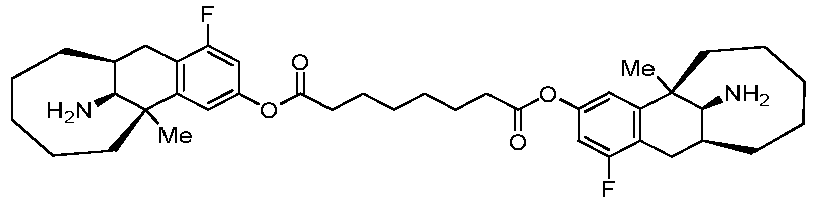
1H NMR (400MHz, CDCl3): δ 8.42 (br. s., 1H), 6.76 - 6.60 (m, 4H), 3.42 - 3.31 (m, 2H), 2.95 - 2.77 (m, 4H), 2.60 - 2.40 (m, 6H), 1.88 - 1.44 (br. s., 22H), 1.38 (s, 6H), 1.05 (q, J=11.6 Hz, 2H), 0.79 (br. s., 4H), MS m/z: 333.4 [M/2+1]+, 665.4[M+1]+ -

- Dezocine (1.00g, 4.08mmol) and triethylamine (824.84mg, 8.15mmol) were dissolved in DMF (8mL), then (Boc)2O (1.07g, 4.89mmol) was added. After being stirred at 25°C for 1.5 hours, the reaction solution was poured into water to be quenched and the aqueous phase was extracted with dichloromethane (15mL x 4). The combined organic phases were washed with saturated brine, dried over anhydrous sodium sulfate, filtered and concentrated in vacuo to give the crude product. The crude product was purified by silica gel column chromatography (eluent: petroleum ether/ethyl acetate = 8/1) to give product 36-1 (2.9 g). 1H NMR (400MHz, CD3OD): δ 6.92 (d, J=8.4 Hz, 1H), 6.68 (d, J=2.4 Hz, 1H), 6.60 (dd, J1 =2.4, Hz, J2 =8.4 Hz, 1H), 6.14 (d, J=9.6 Hz, 1H), 4.04 (dd, J1 = 5.2 Hz, J2 = 10.4 Hz, 1H), 3.15 (dd, J1 =7.2 Hz, J2 =16.4 Hz, 1H), 2.65 (d, J=16.4 Hz, 1H), 2.24 (br. s., 1H), 1.82 - 1.68 (m, 4H), 1.51 (s, 12H), 1.29 (s, 3H), 1.23 - 1.11 (m, 1H), 1.08 - 0.97 (m, 1H), 0.95 - 0.85 (m, 2H).
- Compound 36-1 (100.00mg, 289.46µmol) and adipic acid (19.21mg, 131.45µmol) were dissolved in dichloromethane (2mL) and the solution was cooled to 25°C, 4-dimethylaminopyridine (73mg, 399.48µmol) and 1-(3-dimethylaminopropyl)-3-ethylcarbodiimide hydrochloride (63.00mg, 328.63µmol) were successively added. The reaction solution was stirred at 0°C for 5 hours, then poured into water to be quenched and the aqueous phase was extracted with dichloromethane (10mL x 3). The combined organic phases were washed with saturated brine, dried over anhydrous sodium sulfate, filtered and concentrated in vacuo to give the crude product 36-2 (108mg). The crude product was used in the next step without further purification. MS (m/z): 823.5 (M+1).
- The following compounds were prepared by similiar method with Compound 36-2:
Compound number Structure Spectrogram 37-1 
MS (m/z): 879.6 (M+23). 38-1 
MS (m/z): 915.5 (M+23). 39-1 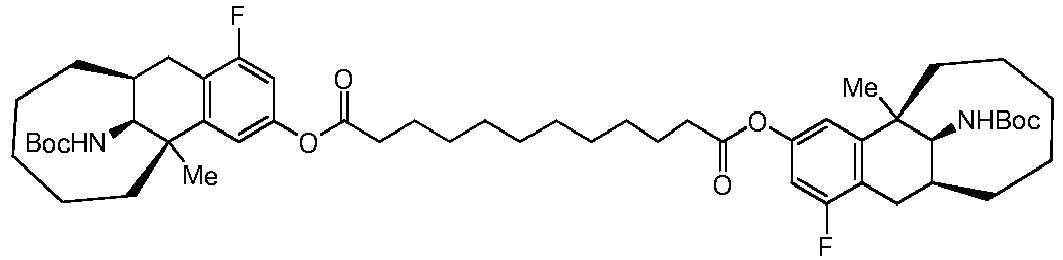
MS (m/z): 943.5 (M+23). 40-1 
MS (m/z): 929.5 (M+23). 41-1 
MS (m/z): 885.5 (M+23). - Compound 36-2 (108.0mg, 134.82µmοl) was dissolved in dichloromethane (2mL), then trifluoroacetic acid (15.4mg, 134.82µmol) was added at 10°C. The reaction solution was stirred at 10°C for 4 hours, then quenched by addition of 5% NaHCO3 aqueous solution. The pH was adjusted to approximately 7, and the aqueous phase was extracted with dichloromethane (10mL x 4). The combined organic phases were washed with saturated brine, dried over anhydrous sodium sulfate, filtered and concentrated in vacuo to give the crude product. The crude product was purified by high performance liquid preparative column (neutral system) to give compound 36 as a colorless oil (27mg, yield: 31.8%). MS (m/z): 601.4 (M+1). 1H NMR (400MHz, CDCl3): δ 7.07 (d, J= 8.4 Hz, 2H), 6.92 (d, J= 2.4 Hz, 2H), 6.83 (dd, J1 = 2.4 Hz, J2 = 8.4 Hz, 2H), 3.21 - 3.11 (m, 4H), 2.70 (d, J= 17.2 Hz, 2H), 2.63 (br. s., 4H), 2.24 (br. s., 2H), 2.06 - 1.96 (m, 2H), 2.01 - 1.88 (m, 4H), 1.79 - 1.53 (m, 12H), 1.35 (s, 6H), 1.06 - 0.94 (m, 2H), 0.91 - 0.72 (m, 4H).
- The following compounds were prepared by similiar method with Compound 36:
Compound number Structure Spectrogram Compound 37 
MS (m/z): 657.5 (M+1). 1H NMR (400MHz, CDCl3): δ 7.07 (d, J= 8.3 Hz, 2H), 6.91 (d, J= 2.4 Hz, 2H), 6.82 (dd, J1 = 2.4 Hz, J2 = 8.4 Hz, 2H), 3.19 - 3.10 (m, 4H), 2.70 (d, J= 16.8 Hz, 2H), 2.54 (t, J= 7.6 Hz, 4H), 2.24 (br. s., 2H), 2.05 - 1.96 (m, 2H), 1.82 - 1.61 (m, 12H), 1.56 - 1.42 (m, 12H), 1.35 (s, 6H), 1.07 - 0.95 (m, 2H), 0.92 - 0.75 (m, 4H). Compound 38 
MS (m/z): 715.4 (M+1). 1H NMR (400MHz, CDCl3): δ 6.75 - 6.61 (m, 4H), 3.35 (d, J=4.4 Hz, 3H), 2.93 - 2.80 (m, 4H), 2.58 - 2.40 (m, 6H), 1.79 - 1.45 (m, 18H), 1.45 - 1.27 (m, 14H), 1.07 - 1.04 (m, 2H), 0.81 - 0.78 (m, 4H). Compound 39 
MS (m/z): 721.4 (M+1). 1H NMR (400MHz, CDCl3): δ 6.79 (s, 2H), 6.75 - 6.68 (m, 2H), 3.61 (br. s., 2H), 2.31 - 2.95 (m, 4H), 2.60 - 2.57 (m, 6H), 2.23 - 2.05 (m, 4H), 1.95 - 1.90 (m, 6H), 1.81 - 1.73 (m, 4H), 1.68 - 1.56 (m, 10H), 1.49 - 1.19 (m, 14H), 0.86 (br. s., 4H) Compound 40 
MS (m/z): 729.4 (M+1). 1H NMR (400MHz, CDCl3): δ 6.84 (s, 2H), 6.72 (dd, J1 =2.0 Hz, J2 =10.0 Hz, 2H), 3.60 (br. s., 2H), 3.04 - 2.91 (m, 4H), 2.55 (br. s., 2H), 1.98 - 1.90 (m, 4H), 1.85 - 1.44 (s, 22H), 1.36 (s, 12H), 1.24 - 1.12 (m, 2H), 0.86 - 0.82 (m, 4H). Compound 41 
MS (m/z): 663.4 (M+1). 1H NMR (400MHz, CDCl3): δ 6.73 (s, 2H), 6.69 - 6.64 (m, 2H), 3.22 (d, J=5.2 Hz, 2H), 2.94 - 2.82 (m, 4H), 2.40 (br. s., 2H), 2.28 (d, J=7.6 Hz, 4H), 2.02 - 1.48 (m, 22H), 1.37 (s, 6H), 1.11 - 0.96 (m, 2H), 0.84 - 0.81 (m, 2H). -

- Compound 42-1 (20.00g, 192.03mmol) was dissolved in ethyl acetate (200mL). Triethylamine (8.16g, 80.65mmol) and triphenylchloromethane (11.24g, 40.33mmol) were successively added under stirring. The solution was slowly heated to reflux, then stirred for 5 hours. After being cooled down, the reaction solution was quenched by being poured into 100mL water and the aqueous phase was extracted with ethyl acetate (50mL x 3). The combined organic phases were washed with 30mL water and 30mL saturated brine, dried over anhydrous sodium sulfate, filtered, and concentrated in vacuo to give the crude product. The crude product was purified by silica gel column chromatography (eluent: petroleum ether/ethyl acetate = 20/1 to 3/1) to give 42-2 (20g) as a colorless liquid. 1H NMR (400MHz, CDCl3) δ 7.46 - 7.20 (m, 15H), 3.63 (t, J=6.4 Hz, 2H), 3.07 (t, J=6.4 Hz, 2H), 1.76 - 1.38 (m, 6H).
- Compound 42-2 (12.00g, 34.64mmol) was dissolved in dichloromethane (200mL), then 4-dimethylaminopyridine (846mg, 6.93mmol), triethylamine (4.56g, 45.03mmol) and p-toluenesulfonyl chloride (7.92g, 41.56mmol) were successively added. After being stirred at 15°C for 16 hours, the reaction solution was quenched by being poured into 100mL water and the aqueous phase was extracted with dichloromethane (50mL x 2). The combined organic phases were washed with 50mL water and 50mL saturated brine, dried over anhydrous sodium sulfate, filtered and concentrated in vacuo to give the crude product. The crude product was purified by silica gel column chromatography (eluent: petroleum ether/ethyl acetate = 20/1 to 3/1) to give compound 42-3 as a pale yellow viscous liquid (12g, yield: 69.2%). 1H NMR (400MHz, CDCl3) δ 7.78 (d, J=8.4 Hz, 2H), 7.45 - 7.17 (m, 17H), 4.00 (t, J=6.4 Hz, 2H), 3.01 (t, J=6.4 Hz, 2H), 2.43 (s, 3H), 1.67 - 1.49 (m, 4H), 1.45 - 1.34 (m, 2H).
- Compound 42-2 (7.00g, 20.20mmol) was dissolved in THF (50mL). Sodium hydride (1.62g, 40.40mmol, 60% purity) was added at 0°C. The solution was heated to 15°C, and stirred for 15 minutes. A solution of 42-3 (12.03g, 24.04mmol) in DMF (100mL) was added. After being stirred at 15°C for 16 hours, the reaction solution was quenched by being poured into 100mL water, then the aqueous phase was extracted with ethyl acetate (50mL x 3). The combined organic phases were washed with 20mL water and 30mL saturated brine, dried over anhydrous sodium sulfate, filtered, and concentrated in vacuo to give the crude product. The crude product was purified by silica gel column chromatography (eluent: petroleum ether/ethyl acetate = 20/1 to 5/1) to give compound 42-4 as a colorless liquid (12.0g). MS m/z: 697.5 (M+23). 1H NMR (400MHz, CDCl3) δ 7.48 - 7.20 (m, 30H), 3.38 (t, J=6.8 Hz, 4H), 3.08 (t, J=6.4 Hz, 4H), 1.71 - 1.60 (m, 4H), 1.59 - 1.49 (m, 4H), 1.48 - 1.37 (m, 4H).
- Compound 42-4 (12.0g, 17.78mmol) was dissolved in the mixed solution of THF (50mL) and methanol (50mL), then p-toluenesulfonic acid (612mg, 3.56mmol) was added. After being stirred at 15°C for 16 hours, the reaction solution was concentrated directly under vacuum to give the crude product. The crude product was purified by silica gel column chromatograph (eluent: dichloromethane/methanol = 20/1 to 10/1) to give compound 42-5 as a pale yellow liquid (2.50g, yield: 73.9%). 1H NMR (400MHz, CDCl3) δ 3.64 (t, J=6.4 Hz, 4H), 3.42 (t, J=6.4 Hz, 4H), 1.84 - 1.55 (m, 8H), 1.49 - 1.36 (m, 4H).
- Periodic acid (3.29g, 14.45mmol) was added to acetonitrile (45mL) and the solution was vigorously stirred at 15°C for 15 minutes. Then the solution was cooled to 0°C and added with 42-5 (1.10g, 5.78mmol) and PCC (25mg, 115.60µmol, 0.02eq). The mixture was heated to 15°C, and stirred for 16 hours. After the precipitate was filtered off, the filtrate was poured into 50mL half-saturated brine, and the aqueous phase was extracted with ethyl acetate (30mL x 3). The combined organic phases were washed with 40mL saturated aqueous NaHSO3 solution and 30mL saturated brine respectively, dried over anhydrous sodium sulfate, filtered, and concentrated in vacuo to give the crude product 42-6 (800.0mg) as a pale yellow solid. The crude product was directly used in the next step without further purification. 1H NMR (400MHz, CDCl3) δ 3.47 - 3.41 (m, 4H), 2.47 - 2.37 (m, 4H), 1.83 - 1.57 (m, 8H).
- Compound 42-6 (300mg, 1.37mmol) was dissolved in dichloromethane (20mL). 4-dimethylaminopyridine (167mg, 1.37mmol), 34-1 (1.07g, 2.95mmol) and 1-(3-dimethylaminopropyl)-3-ethylcarbodiimide hydrochloride (735mg, 3.84mmol) were successively added. The reaction solution was stirred at 15°C for 16 hours, then quenched by being poured into 30mL water, and the aqueous phase was extracted with dichloromethane (20mL x 3). The combined organic phases were washed with 10mL water and 10mL saturated brine, dried over anhydrous sodium sulfate, filtered and concentrated in vacuo to give the crude product. The crude product was purified by silica gel column chromatography (eluent: petroleum ether/ethyl acetate = 10/1 to 3/1) to give compound 42-7 as a colorless viscous solid (323mg, yield: 26.0%). MS m/z: 931.7 (M+23).
- Compound 42-7 (430mg, 472.97µmοl) was dissolved in dichloromethane (10mL), then trifluoroacetic acid (1.8mL) was added. After reacting at 15°C for 16 hours, the reaction solution was poured to 50mL ethyl acetate to be dilutedpoured into, then a saturated aqueous solution of sodium bicarbonate was slowly added to adjust the pH to approximately 7, and the aqueous phase was extracted with ethyl acetate (30mL x 3). The combined organic phases were washed with 20mL water and 20mL saturated brine, dried over anhydrous sodium sulfate, filtered, and concentrated in vacuo to give the crude product. The crude product was purified by high performance liquid phase preparative column (HCl system) to give the hydrochloride salt of compound 42 (200mg, yield: 54.1%). MS m/z: 709.3 (M+1). 1H NMR (400MHz, CDCl3) δ 6.94 (s, 2H), 6.82 (d, J=9.8 Hz, 2H), 3.73 (d, J=4.4 Hz, 2H), 3.53 (t, J=6.0 Hz, 4H), 3.11 - 2.91 (m, 4H), 2.72 - 2.55 (m, 6H), 2.04 - 1.92 (m, 4H), 1.85 - 1.68 (m, 12H), 1.61 (d, J=9.2 Hz, 6H), 1.51 (s, 6H), 1.30 - 1.20 (m, 2H), 0.90 - 0.75 (m, 4H).
-

- Compound 34-1 (200mg, 550µmol) was dissolved in dichloromethane (10mL), then hexanoyl chloride (74mg, 550µmol) and triethylamine (83mg, 825µmol) were added. The reaction solution was stirred at 15°C for 2 hours, then poured into water to be quenched, and the aqueous phase was extracted with ethyl acetate (20mL x 2). The combined organic phases were washed with water (20mL) and saturated brine (20mL), dried over anhydrous sodium sulfate, filtered and concentrated in vacuo to give the crude product as a dark yellow oil. The crude product was purified by silica gel column chromatography (eluent: petroleum ether/ethyl acetate = 20/1 to 10/1) to give product 43-1 as a white solid (180mg, yield: 70.9%). MS (m/z): 484.3 (M+23).
- The following compounds were prepared by similiar method with Compound 43-1:
Compound number Structure Spectrogram 44-1 
MS (m/z): 512.1 (M+23). 45-1 
MS (m/z): 540.5 (M+23). 46-1 
MS (m/z): 554.5 (M+23). 47-1 
MS (m/z): 470.4 (M+23). 48-1 
MS (m/z): 498.4 (M+23). 49-1 
MS (m/z): 496.2 (M+23). - Compound 43-1 (150mg, 324µmol) was dissolved in dichloromethane (5mL), then trifluoroacetic acid 500µL) was added dropwise. After the addition was completed, stirring was continued at 15°C for 2 hours. The reaction solution was diluted with 20mL dichloromethane, then saturated aqueous NaHCO3 was added to adjust the pH to approximately 7. The mixture was let stand to portion, and the organic phase was washed with water (10mL) and saturated brine (10mL), dried over anhydrous sodium sulfate, filtered and concentrated in vacuo to give the crude product as a pale yellow oil. The crude product was purified by high performance liquid phase preparative column (formic acid system) to obtain the formate salt of product 43 (58mg, yield: 49.4%). MS (m/z): 362.1 (M+1). 1H NMR (400MHz, CD3OD) δ 8.54 (s, 1H), 6.92 (s, 1H), 6.81 (dd, J 1=2.0 Hz, J2 =10.0 Hz, 1H), 3.63 (d, J=5.2 Hz, 1H), 3.05 - 2.95 (m, 2H), 2.65 - 2.51 (m, 3H), 2.01 - 1.90 (m, 2H), 1.86 - 1.55 (m, 7H), 1.48 (s, 3H), 1.45 - 1.37 (m, 4H), 1.28 - 1.13 (m, 1H), 0.97 (t, J=7.2 Hz, 3H), 0.92 - 0.79 (m, 2H).
- The following compounds were prepared by similiar method with Compound 43:
Compound number Structure Spectrogram Compound 44 
MS (m/z): 390.2 (M+1). 1H NMR (400MHz, CD3OD) δ 8.37 (br.s., 1H), 6.93 (s, 1H), 6.82 (dd, J1 =2.0 Hz, J2 =10.0 Hz, 1H), 3.68 (d, J=5.2 Hz, 1H), 3.05 - 2.98 (m, 2H), 2.65 - 2.54 (m, 3H), 2.00 - 1.92 (m, 2H), 1.83 - 1.70 (m, 4H), 1.68 - 1.55 (m, 3H), 1.50 (s, 3H), 1.46 - 1.30 (m, 8H), 1.26 - 1.20 (m, 1H), 0.98 - 0.90 (m, 5H) Compound 45 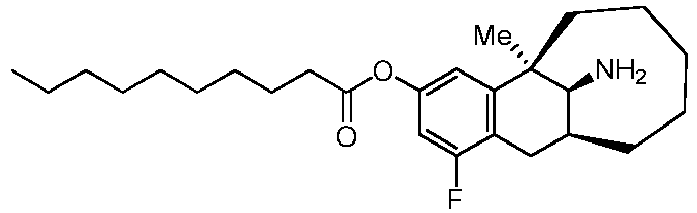
MS (m/z): 459.2 (M+42). 1H NMR (400MHz, CDCl3) δ 8.45 (s, 1H), 6.75 - 6.62 (m, 2H), 3.45 (d, J=4.8 Hz, 1H), 2.95 - 2.81 (m, 2H), 2.62 - 2.41 (m, 3H), 1.90 - 1.76 (m, 3H), 1.73 - 1.62 (m, 3H), 1.60 - 1.46 (m, 3H), 1.40 (s, 3H), 1.38 - 1.15 (m, 12H), 1.14 - 0.97 (m, 1H), 0.89 - 0.66 (m, 5H) Compound 46 
MS (m/z): 432.4 (M+1). 1H NMR (400MHz, CD3OD) δ 8.51 (br. s., 1H), 6.85 (s, 1H), 6.77 (dd, J1 =2.0 Hz, J2 =10.0 Hz, 1H), 3.70 (d, J=4.8 Hz, 1H), 3.11 - 2.93 (m, 2H), 2.58 (br. s., 1H), 2.07 - 1.91 (m, 2H), 1.85 - 1.58 (m, 7H), 1.50 (s, 3H), 1.43 - 1.29 (m, 18H), 1.28 - 1.13 (m, 1H), 0.99 - 0.78 (m, 5H). Compound 47 
MS (m/z): 348.6 (M+1). 1H NMR (400MHz, CDCl3) δ 8.45 (br. s., 1H), 6.74 - 6.61 (m, 2H), 3.51 (d, J=4.8 Hz, 1H), 2.99 - 2.81 (m, 2H), 2.58 (br. s., 1H), 1.94 - 1.66 (m, 4H), 1.65 - 1.50 (m, 3H), 1.48 (s, 3H), 1.32 (s, 9H), 1.22 - 1.04 (m, 1H), 0.93 - 0.70 (m, 2H) Compound 48 
MS (m/z): 376.3 (M+1). 1H NMR (400MHz, CD3OD) δ 6.85 (s, 1H), 6.79 - 6.72 (m, 1H), 3.63 (d, J=4.8 Hz, 1H), 3.08 - 2.92 (m, 2H), 2.56 (br. s., 1H), 1.96 - 1.90 (m, 2H), 1.87 - 1.54 (m, 8H), 1.49 (s, 3H), 1.45 - 1.36 (m, 2H), 1.33 (s, 6H), 1.26 - 1.14 (m, 1H), 1.00 (t, J=7.2 Hz, 3H), 0.95 - 0.77 (m, 2H). Compound 49 
MS (m/z): 374.3 (M+1). 1H NMR (400MHz, CD3OD) δ 8.55 (s, 1H), 6.91 (s, 1H), 6.80 (dd, J1 =1.6 Hz, J2 =10.0 Hz, 1H), 3.68 (d, J=4.8 Hz, 1H), 3.10 - 2.92 (m, 2H), 2.69 - 2.51 (m, 2H), 2.07 (d, J=12.4 Hz, 2H), 1.95 - 1.82 (m, 2H), 1.88 - 1.78 (m, 3H), 1.77 - 1.67 (m, 2H), 1.66 - 1.52 (m, 5H), 1.49 (s, 3H), 1.46 - 1.14 (m, 4H), 0.99 - 0.75 (m, 2H). -

- Compound 50-1 (2g, 17mmol) was dissolved in THF (25mL), then TMSCl (2.28g, 21mmol) and CuI (333mg, 1.75mmol) were added under N2. The solution was cooled to -15°C, added with n-pentylmagnesium bromide solution (20.4mmol, 38.8mL), then heated to 20°C and stirred for 16 hours. The reaction was quenched by addition of saturated aqueous ammonium chloride (50mL) and the aqueous phase was extracted with ethyl acetate (20mL x 3). The combined organic phases were washed with water (20mL) and saturated brine (20mL), dried over anhydrous sodium sulfate, filtered and concentrated in vacuo to give crude product 50-2 (3.30g) as a yellow oil. The crude product was used directly in the next step without further purification. 1H NMR (400MHz, CDCl3) δ 3.64 (s, 3H), 2.17 (s, 2H) 1.35-1.24 (m, 8H), 0.98 (s, 6H), 0.88 (t, J=7.2 Hz, 3H).
- Compound 50-2 (3.3g, 17.71mmol) was dissolved in methanol (10mL), then a solution of potassium hydroxide (1g, 17.82mmol) in water (2mL) was added. After stirring at 20°C for 16 hours, dilute hydrochloric acid solution (2M, 10mL) was added to adjust the pH to approximately 4, followed by addition of ethyl acetate (50mL), then the mixture was let stand to portion. The organic phase was washed twice with saturated brine (20mL), dried over anhydrous sodium sulfate, filtered and concentrated in vacuo to give the crude product 50-3 (2.5g) as a pale yellow oil. The crude product was used directly in the next step without further purification. 1H NMR (400MHz, CDCl3) δ 2.23 (s, 2H), 1.34-1.24 (m, 8H), 1.02 (s, 6H), 0.89 (t, J=7.2 Hz, 3H).
- Compound 50-3 (150mg, 870.78µmol) was dissolved in dichloromethane (10mL), then oxalyl chloride (221mg, 1.74mmol) and DMF (6mg, 87µmol) were successively added. After being stirred at 20°C for 0.5 h, the reaction solution was concentrated in vacuo to give crude product 50-4 (170.00mg) as a white solid. The crude product was used directly in the next step without further purification.
- Compound 34-1 (220mg, 605.28umol) was dissolved in dichloromethane (5mL), followed by successive addition of 50-4 (115mg, 605.28umol) and triethylamine (122mg, 1.21mmol). After being stirred at 20°C for 1 hour, the reaction solution was directly concentrated under vacuum to give the crude product as a dark yellow oil. The crude product was purified by silica gel preparative plate (developing solvent: petroleum ether/ethyl acetate = 20/1) to give product 50-5 as a white solid (210 mg, yield: 67.0%). MS (m/z): 540.4 (M+1).
- Compound 50-5 (210mg, 405µmol) was dissolved in dichloromethane (5mL), then trifluoroacetic acid (500µL) was added. After being stirred at 20°C for 16 hours, the reaction solution was diluted with 20mL methylene chloride, then saturated aqueous NaHCO3 solution was added to adjust the pH to approximately 7 and the mixture was let stand to portion. The organic phase was washed with water (10mL) and saturated brine (10mL), dried over anhydrous sodium sulfate, filtered, and concentrated in vacuo to give the crude product as pale yellow oil. The crude product was purified by high performance liquid phase preparative column (formic acid system) to obtain the formate salt of compound 50 (85.00mg, yield: 50.2%). MS (m/z): 418.4 (M+1). 1H NMR (400MHz, CD3OD) δ 8.55 (br. s., 1H), 6.88 (s, 1H), 6.79 (dd, J=2.0, 10.0 Hz, 1H), 3.64 (d, J=4.4 Hz, 1H), 3.08 - 2.93 (m, 2H), 2.56 (br. s., 1H), 2.48 (s, 2H), 2.03 - 1.89 (m, 2H), 1.87 - 1.54 (m, 5H), 1.49 (s, 3H), 1.44 - 1.16 (m, 9H), 1.11 (s, 6H), 0.93 (t, J=7.2 Hz, 3H), 0.89 - 0.77 (m, 2H).
-

- Magnesium sulfate (27.96g, 232.32mmol) was added to dichloromethane (100mL), then concentrated sulfuric acid (5.70g, 58.08mmol) was added. After vigorous stirring for 15 minutes, cyclopropanecarboxylic acid (5.00g, 58.08mmol) and tert-butanol (21.52g, 290.39mmol) were added. After stirring at 25°C for 12 hours, saturated sodium carbonate solution was added until magnesium sulfate was dissolved. Dichloromethane (50mL) was added and the mixture was let stand to portion. The organic phase was washed with saturated brine (50mL x 3), dried over anhydrous sodium sulfate, filtered and concentrated in vacuo to give 51-2 as a light yellow oily liquid (4.20g, yield: 50.9%). 1HNMR (400MHz, CDCl3) δ 1.56 - 1.47 (m, 1H), 1.45 (s, 9H), 0.93 - 0.89 (m, 3H), 0.80 - 0.72 (m, 2H).
- Compound 51-2 (3.70g, 26.02mmol) was dissolved in tetrahydrofuran (5mL). After the solution was cooled to -78°C, diisopropylaminolithium in tetrahydrofuran and n-heptane (2M, 15.61m L) was slowly added. After stirring for 0.5 hour at this temperature, 1-bromohexane (5.15 g, 31.22 mmol) was slowly added. After the addition was completed, the temperature was slowly raised to 25°C and the reaction solution was stirred at this temperature for 12 hours. The reaction was quenched by addition of 10mL water and the aqueous phase was extracted with 10mL dichloromethane. The organic phase was washed with saturated brine (10mL x 3), dried over anhydrous sodium sulfate, filtered, and concentrated in vacuo to give 51-3 (4.20g) as a brown oily liquid. The crude product was directly used in the next step without further purification.
- Compound 51-3 (4.2g, 18.5mmol) was dissolved in dichloromethane (10mL), then trifluoroacetic acid (2.54g, 22.27mmol) was added. After stirring at 25°C for 3 hours, 10ml water and 10ml dichloromethane were added. The mixture was let stand to portion, and the organic phase was further mixed with 10mL saturated sodium carbonate solution and stirred. The aqueous phase was back-extracted with 10ml dichloromethane, acidified with 5ml of concentrated hydrochloric acid, and the aqueous phase was extracted with 10ml dichloromethane. The organic phase was washed with saturated brine (10mL x 3), dried over anhydrous sodium sulfate, filtered and concentrated in vacuo to give 51-4 as a yellow oily liquid (800mg, yield: 25.3%). 1H NMR (400MHz, CDCl3) δ 1.54 - 1.41 (m, 4H), 1.36 - 1.22 (m, 8H), 0.88 (t, J=6.8 Hz, 3H), 0.75 (q, J=3.6 Hz, 2H).
- Compound 51-4 (140.52mg, 825.38µmοl) was dissolved in dichloromethane (2ml), then a drop of DMF and oxalyl chloride (125.72mg, 990.45µmοl) were added. After being stirred at 25°C for 0.5 hours, the reaction solution was directly concentrated under vacuum. The residue was dissolved in dichloromethane (2mL) and added to a solution of 34-1 (200.00mg, 550.25µmοl) in dichloromethane (2mL). After being stirred at 25°C for 12 hours, the reaction solution was quenched by addition of dichloromethane (5mL) and water (5mL). The mixture was let stand to portion, and the organic phase was washed with saturated brine (10mL x 3), dried over anhydrous sodium sulfate, filtered, and concentrated in vacuo to give the crude product 51-5 (400mg) as a yellow oil. MS m/z: 460.3 (M-56+1).
- Compound 51-5 (350mg, 678.69µmοl) was dissolved in dichloromethane (3ml), then trifluoroacetic acid (462mg, 4.05mmol) was added. After reacting at 25°C for 2 hours, a saturated aqueous sodium bicarbonate solution was added to adjust the pH to approximately 7. The organic phase was washed with saturated brine (5ml x 3), dried over anhydrous sodium sulfate, filtered, and concentrated in vacuo to give the crude product. The crude product was purified by high performance liquid phase preparative column (formic acid system) to obtain the formate salt of compound 51 (120mg, yield: 37.2%). MS (m/z): 416.3 (M+1). 1H NMR (400MHz, CD3OD) δ 8.55 (s, 1H), 6.88 (s, 1H), 6.80 - 6.74 (m, 1H), 3.66 (d, J=5.2 Hz, 1H), 3.13 - 2.87 (m, 2H), 2.71 - 2.45 (m, 1H), 2.09 - 1.87 (m, 2H), 1.85 - 1.53 (m, 9H), 1.49 (s, 3H), 1.42 - 1.29 (m, 8H), 1.27 - 1.07 (m, 1H), 0.98 - 0.76 (m, 7H).
-

- Compound 52-1 (5.0g, 48.93mmol) was dissolved in THF (30mL). Sodium hydride (196mg, 4.89mmol, 60% purity) and methyl acrylate (6.30g, 73.18mmol) were successively added at 0°C. The solution was slowly heated to reflux, and stirred for 16 hours. After being cooled down, the reaction solution was poured into 40mL water to be quenched, and the aqueous phase was extracted with ethyl acetate (30mL x 3). The combined organic phases were washed with 20mL water and 20mL saturated brine, dried over anhydrous sodium sulfate, filtered and concentrated in vacuo to give the crude product. The crude product was purified by silica gel column chromatography (eluent: petroleum ether/ethyl acetate = 50/1 to 30/1) to give the crude product 52-2 (2.20g) as a colorless liquid. 1H NMR (400MHz, CDCl3) δ 3.71 - 3.67 (m, 5H), 3.43 (t, J=6.8 Hz, 2H), 2.59 (t, J=6.4 Hz, 2H), 1.72 - 1.19 (m, 8H), 0.95 - 0.83 (m, 3H).
- Compound 52-2 (1.00g, 5.31mmol) was dissolved in a mixed solution of THF (30mL) and H2O (30mL), then Na2CO3 (2.25g, 21.25mmol) was added. After being heated to 50°C, the reaction solution was stirred for 3 hours. The reaction solution was poured into 2N aqueous NaOH solution (20mL) to be quenched. The aqueous phase was washed with dichloromethane (40mL), adjusted to pH 2 with 6N HCl, then extracted with dichloromethane (30mL x 3). The combined organic phases were washed with 10mL saturated brine, dried over anhydrous sodium sulfate, filtered, and concentrated in vacuo to give 52-3 as a light yellow liquid (240mg, yield: 25.9%). 1H NMR (400MHz, CDCl3) δ 3.70 (t, J=6.4 Hz, 2H), 3.46 (t, J=6.8 Hz, 2H), 2.63 (t, J=6.4 Hz, 2H), 1.63 - 1.51 (m, 2H), 1.38 - 1.22 (m, 6H), 0.88 (t, J=6.8 Hz, 3H).
- Compound 52-3 (300mg, 1.72mmol) was dissolved in dichloromethane (15mL), then 4-dimethylaminopyridine (210mg, 1.72mmol), 34-1 (750mg, 2.06mmol) and 1-(3-dimethylaminopropyl)-3-ethylcarbodiimide hydrochloride (320mg, 2.06mmol) were successively added. After being stirred at 15°C for 2 hours, the reaction was poured into 40 mL water to be quenched and the aqueous phase was extracted with dichloromethane (15mL x 3). The combined organic phases were washed with saturated brine (15mL), dried over anhydrous sodium sulfate, filtered, and concentrated in vacuo to give the crude product. The crude product was purified by silica gel column chromatography (eluent: petroleum ether/ethyl acetate = 15/1 to 5/1) to give 52-4 (775mg, yield: 86.0%) as a colorless viscous solid. MS m/z: 420.4 (M-100+1). 1H NMR (400MHz, CDCl3) δ 6.75 - 6.68 (m, 2H), 4.92 (d, J=10.4 Hz, 1H), 4.22 - 3.98 (m, 1H), 3.80 (t, J=6.4 Hz, 2H), 3.49 (t, J=6.8 Hz, 2H), 2.90 - 2.85 (m, 2H), 2.81 (t, J=6.4 Hz, 2H), 2.40 (br. s., 1H), 1.84 - 1.53 (m, 10H), 1.49 (s, 9H), 1.40 - 1.24 (m, 9H), 1.10 - 0.80 (m, 5H).
- Compound 52-4 (700mg, 1.35mmol) was dissolved in dichloromethane (10mL), then trifluoroacetic acid (2.0mL) was added. After being stirred at 15°C for 3 hours, the reaction solurion was poured into 60mL ethyl acetate to be diluted, then saturated aqueous sodium bicarbonate solution was slowly added to adjust the pH to approximately 7, and the aqueous phase was extracted with ethyl acetate (30mL x 3). The combined organic phases were washed with 20mL water and 20mL saturated brine, dried over anhydrous sodium sulfate, filtered, and concentrated in vacuo to give the crude product. The crude product was purified by high performance liquid preparative column to obtain the hydrochloride salt of compound 52 (250mg, yield: 44.1%). MS m/z: 420.6 (M+1). 1H NMR (400MHz, CDCl3) δ 8.91 (br. s., 2H), 6.84 - 6.66 (m, 2H), 3.79 (t, J=6.4 Hz, 2H), 3.75 - 3.61 (m, 1H), 3.48 (t, J=6.8 Hz, 2H), 3.00 -2.85 (m, 3H), 2.81 (t, J=6.4 Hz, 2H), 2.29 - 2.00 (m, 2H), 1.98 - 1.81 (m, 2H), 1.71 - 1.50 (m, 9H), 1.44 - 1.19 (m, 6H), 0.96 - 0.70 (m, 5H).
- Fluorescence imaging plate reader FLIPR was used to detect changes of intracellular calcium signals. EC50 and IC50 values of the compounds were used as indicators to evaluate the activation or inhibition of the compounds on µ, κ, and δ opioid receptors.
- Cell lines: HEK293-µ, HEK293-κ and HEK293-δ, stable-transfected cell lines HEK293-µ, HEK293-κ and HEK293-δ; Cell culture media (DMEM, Invitrogen #11965118, 10% fetal bovine serum Invitrogen #10099141, Geneticin Selective Antibiotic (G418) 300µg/mL, Invitrogen #10131027, Blasticidin-S HCL 2ug/mL Invitrogen #A1113902)
Pancreatic enzyme (Invitrogen, #25200-072)
DPBS (Hyclone, #SH30028.01B)
Fluo-4 Direct (Invitrogen# F10471)
HBSS (Invitrogen #14025126)
HEPES (Invitrogen #15630130)
384 Cell plate(Greiner # 781946)
384 Compound plate(Greiner # 781280)
CO2 incubator(Thermo#371)
Centrifuge (Eppendorf #5810R)
Vi-cell Cell Counter (Beckman Coulter)
POD 810 Plate Assembler Automatic Microplate Pretreatment System
Labcyte FLIPR, Molecular Device -
- 1) Preheating medium, pancreatic enzyme, and DPBS in a 37°C water bath. Aspirating the culture medium from the cell culture flask and washing it with 10mL DPBS;
- 2) Adding the preheated pancreatic enzyme solution to the cell culture flask, rotating the flask slightly to make the pancreatic enzymes evenly cover the cell surface of the flask, and then puting it into a 37°C, 5% CO2 incubator to digest for 1-2 minutes;
- 3) Suspending the cells with 10-15 mL culture medium in each T150cm2 cell culture flask, centrifugating at 800rpm for 5 minutes, and resuspending the cells with 10mL culture medium, aspirating 1mL cell resuspension to be counted with Vi-cell;
- 4) Diluting HEK293-µ, HEK293-κ and HEK293-δ cells to 5×10⁵ /mL with culture medium, use multichannel pipette to add diluted cells into 384 plate (Greiner #781946) (50µL/well, 25000 cells/well for HEK293-µ, HEK293-κ and HEK293-δ cells). Placing the cell plate in a 37°C, 5% CO2 incubator overnight.
-
- 1) Diluting the compound to 20mM with DMSO, 3 fold diluted, 8 gradients, double reduplicative wells, and adding it to the compound plate using an Echo ultrasonic liquid handler device (Echo liquid handler).
-
- 1) Washing off the cell culture medium in 384 plate with vacuum pump, adding 20µL Fluo-4 Direct fluorescent dye, then incubating in a 37°C, 5% CO2 incubator for 50 minutes, followed by equilibrating at room temperature for 10 minutes.
- 2) EC50 test: Adding 20uL HBSS buffer (containing 20mM HEPES) to the compound plate, mixing well and centrifugating. Placing the cell plate and compound plate into FLIPR and reading the fluorescence value.
- 3) After the EC50 test, placing the cell plate into a 37°C, 5% CO2 incubator to be incubated for 25 minutes. Calculating the EC80 value with the EC50 value of the positive agonist, preparing 4 × EC80 solution, adding it to the 384 compound plate by multichannel pipette, and mixing well and centrifugating.
- 4) IC50 test: In FLIPR, successively placing 4 × EC80 plate, cell plate, FLIPR tip, running the program and reading the fluorescence value.
-
Table 1. In vitro activity test results Test sample Mu receptor Kapp receptor Delt receptor EC50 (uM) IC50 (uM) EC50 (uM) IC50 (uM) EC50 (uM) IC50 (uM) Compound 1 E A E B E C Compound 2 A B E C E E Compound 3 B B E B E C Compound 4 B B E C E E Compound 5 C D C D E E Compound 6 A B E C E C Compound 7 E C E C E E Compound 8 B C E C E E Compound 9 E C E C E E Compound 10 E D E D E E Compound 11 E E D E E E Compound 12 D D E E E E Compound 13 D D D D E E Compound 14 D D E D E E Compound 15 E E D E E E Hydrochloride of Compound 16 D C E C E E Hydrochloride of Compound 17 C C E D E E Compound 18 E C E E E E Compound 19 E E E E E E Compound 20 E D E D E E Compound 21 A A E C E C Compound 22 C B E C E D Compound 23 A A E C E E Compound 24 D B E C E C Compound 25 B C E C E C Compound 26 E D E E E E Compound 27 E C E D E E Compound 28 A B E B E C Compound 29 A B E C E D Compound 30 B B E B E D Compound 31 D D E D E E Compound 32 B B B B E C Compound 33 B C B B C C Note: A≤0.1 uM; 0.1 uM<B≤1 uM; 1 uM<C≤10 uM; 10 uM<D≤100 uM; E>100 uM. - In vitro activity tests demonstrated: the compounds of the present invention have agonistic and antagonistic dual effect on the Mu receptor, and weaker antagonistic effect on the Kapp receptor.
- Through the in vivo drug metabolism test in rats, values such as Cmax, t1/2, AUC, MRT and B/P ratio of the compound in vivo were used as indicators to evaluate the metabolism of the compound in rats.
- Mixing the test compound with an appropriate amount of physiological saline solution of 20% polyethylene glycol 400, followed by vortex and sonicate, and adjusting the pH to 4 - 5 with hydrochloric acid to obtain 5mg/mL approximately clear solution, filtering the solution by microporous filtering film to be used. Selecting 6 to 9 weeks old SD rats (Shanghai Sleek Laboratory Animal Co., Ltd.) and intravenously injecting the test compound solution at a dose of 1mg/kg. Collecting whole blood in certain time to prepare and obtain plasma. Analyzing drug concentrations by LC-MS/MS method and calculating pharmacokinetic parameters using Phoenix WinNonlin software (Pharsight, USA).
- Intravenously injecting the test compound solution in the same manner as example 1 at a dose of 1mg/kg. Executing animals with carbon dioxide 15 minutes and 2 hours after dosing, collecting whole blood and brain tissue sample, centrifugating the whole blood to obtain plasma, and homogenizing the brain tissue with triple volumes of deionized water. Analyzing drug concentration of the plasma and brain homogenate samples by LC-MS/MS method, and calculating the concentration ratio of brain tissue to plasma (B/P ratio).
- Mixing the test compound with an appropriate amount of sesame oil, followed by vortex and sonicate, to prepare and obtain 25µmol/mL homogeneous suspension. Selecting 6 to 9 weeks old SD rats (Shanghai Sleek Laboratory Animal Co., Ltd.), intramuscularly injecting the suspension of the test compound at a dose of 20µmol/kg or 40 µmol/kg. Collecting whole blood in certain time, adding precipitant (acetonitrile, methanol and analytical internal standard) and centrifugating. Analyzing drug concentration (if the test drug is a prodrug, drug concentrations of the prodrug and hydrolyzed parent drug are simultaneously analyzed) of the supernatant solution by LC-MS/MS method, and calculating pharmacokinetic parameters using Phoenix WinNonlin software (Pharsight, USA).
Table 2. Results of intravenous pharmacokinetics test of dezocine and analogues thereof Compound number Dezocine Compound 21 Compound 23 C0(nM) 684 493 362 T 1/2 (hr) 1.26 1.42 1.60 Vdss (L/kg) 12.2 16.2 20.6 Cl (mL/min/kg) 139 155 165 AUC0-last (nM.hr) 485 387 341 MRT0-last (hr) 1.22 1.35 1.65 B/P ratio (0.25h/2h) 9.29/12.9 13.3/19.8 16.7/27.9 Note: All compounds were administered at dose of 1mg/kg. - Intravenous injection pharmacokinetic data indicates that: the compounds of the present invention have a higher B/P ratio than dezocine and are easier to penetrate the blood-brain barrier.
Table 3. Results of intramuscular injection pharmacokinetic test of Compound 21 Compound number Compound 21 C max (nM) 1753 T max(hr) 0.50 t 1/2 (hr) 4.20 AUC0-last (nM.hr) 3989 MRT0-last (hr) 2.82 Note: the dose was 40µmol/kg. Table 4. Results of intramuscular injection of Compound 21 carboxylic diester prodrug Compound number Compound 34 Compound 35 Compound 38 Compound 34 Parent compound 21 Compound 25 Parent compound 21 Compound 38 Parent compound 21 Cmax (nM) 3.91 399 ND 222 ND 192 Tmax (hr) 0.25 2.33 ND 4.33 ND 2.17 t1/2 (hr) ND 7.2 ND 5.51 ND 33.7 AUC0-last (nM.hr) 2.95 3699 ND 2660 ND 3235 MRT0-last (hr) 0.539 8.12 ND 9.15 ND 18.0 Note: All compounds were administered at dose of 20µmol/kg. Every 20µmol carboxylic diester prodrug theoretically hydrolyzes 40µmol active ingredient of compound 21. ND = cannot be determined (parameters cannot be determined because the end-elimination phase cannot be fully defined). Table 5. Results of intramuscular injection of Compound 21 carboxylic monoester prodrug Compound number Compound 43 Compound 44 Compound 45 Compound 43 Parent compound 21 Compound 44 Parent compound 21 Compound 45 Parent compound 21 Cmax (nM) ND 322 ND 130 ND 48.3 Tmax (hr) ND 2.67 ND 3.33 ND 10.0 t1/2 (hr) ND 4.07 ND 11.9 ND 39.8 AUC0-last (nM.hr) ND 2286 ND 1692 ND 1547 MRT0-last (hr) ND 5.89 ND 13.0 ND 21.9 Note: All compounds were administered at dose of 40µmol/kg. Every 40µmol carboxylic acid monoester prodrug theoretically hydrolyzes 40µmol active ingredient of compound 21. ND = cannot be determined (parameters cannot be determined because the end-elimination phase cannot be fully defined). - The results of intramuscular injection pharmacokinetic test showed that: after the sesame oil suspensions of carboxylic diester prodrug and carboxylic monoester prodrug of Compound 21 were administered by intramuscular injection, both of them can be slowly released in vivo, followed by beimg quickly hydrolyzed to the parent drug compound 21, which can significantly prolong the retention time of the parent drug compound 21 in rats, and reduce the Cmax so as to achieve the purpose of prolonging the drug action time and improving the safety.
Claims (7)
- A compound represented by formula (1-7), (1-8), (1-9), (II-1), (II-2), (II-3), (III-1), (III-2) or (III-3), a pharmaceutically acceptable salt or tautomer thereof,


 R12 is F, Cl or Me;each of R22 and R32 is independently selected from the group consisting of F, Cl and Me;each of R11, R21 and R31 is independently selected from the group consisting of Me,
 R23 is selected from the group consisting of C1-12 alkyl, C1-12 heteroalkyl, C3-7 cycloalkyl, and 3-7 membered heterocycloalkyl, each of which is optionally substituted by 1, 2, or 3 R;L is selected from the group consisting of C1-12 alkyl, C1-12 heteroalkyl, C3-7 cycloalkyl, or 3-7 membered heterocycloalkyl, each of which is optionally substituted by 1, 2, or 3 R;said "hetero" represents O, S, or N, the number of which is selected from 1, 2 or 3 in any of the above cases;said R is selected from F, Cl, Br, I, CN, OH, NH2, C1-3 alkyl, or C1-3 heteroalkyl;said C1-3 alkyl or C1-3 heteroalkyl are each optionally substituted by 1, 2, or 3 substituents selected from the group consisting of F, Cl, Br, I, CN, OH, NH2; two geminal or ortho R optionally connect to the same atom forming 3-6 membered cycloalkyl or heterocycloalkyl.
 - The compound, the pharmaceutically acceptable salt or tautomer thereof according to claim 1, wherein L is selected from (CH2)4, (CH2)5, (CH2)6,


- The compound, the pharmaceutically acceptable salt or tautomer thereof according to claim 1, wherein R23 is selected from



- A compound selected from the group consisting of


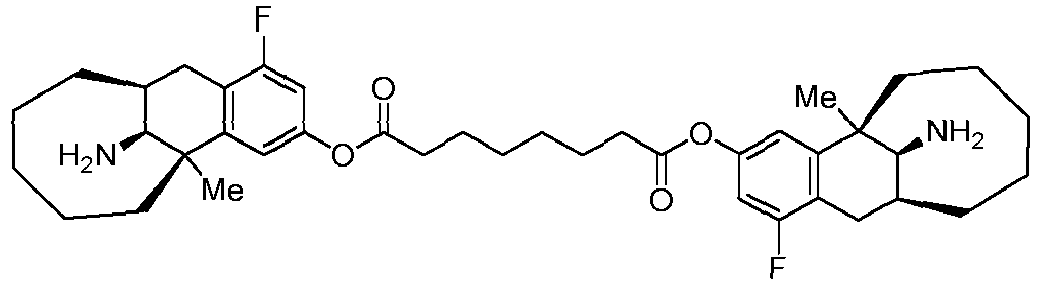


- The compound according to claim 1, wherein the pharmaceutically acceptable salt of the compound is selected from the group consisting of


- The compound, the pharmaceutically acceptable salt or tautomer thereof according to any of claims 1-5 for use in analgesic therapy.
- A pharmaceutical composition comprising a therapeutically effective dose of the coumpound, the pharmaceutically acceptable salt or tautomer thereof according to any of claims 1-5.
Applications Claiming Priority (2)
| Application Number | Priority Date | Filing Date | Title |
|---|---|---|---|
| CN201610003868 | 2016-01-04 | ||
| PCT/CN2017/070126 WO2017118375A1 (en) | 2016-01-04 | 2017-01-04 | Dezocine analogue |
Publications (3)
| Publication Number | Publication Date |
|---|---|
| EP3401306A1 EP3401306A1 (en) | 2018-11-14 |
| EP3401306A4 EP3401306A4 (en) | 2019-03-13 |
| EP3401306B1 true EP3401306B1 (en) | 2020-09-30 |
Family
ID=59273706
Family Applications (1)
| Application Number | Title | Priority Date | Filing Date |
|---|---|---|---|
| EP17735813.2A Active EP3401306B1 (en) | 2016-01-04 | 2017-01-04 | Dezocine analogue |
Country Status (7)
| Country | Link |
|---|---|
| US (1) | US10414718B2 (en) |
| EP (1) | EP3401306B1 (en) |
| JP (1) | JP6605157B2 (en) |
| CN (2) | CN108602757B (en) |
| ES (1) | ES2836429T3 (en) |
| HK (1) | HK1255145B (en) |
| WO (1) | WO2017118375A1 (en) |
Families Citing this family (9)
| Publication number | Priority date | Publication date | Assignee | Title |
|---|---|---|---|---|
| EP3608306B1 (en) * | 2017-07-03 | 2022-05-25 | Shandong Danhong Pharmaceutical Co., Ltd. | Crystal form and amorphous form of dezocine analogue hydrochloride |
| JP6850371B2 (en) * | 2017-07-04 | 2021-03-31 | シャンドン ダンホン ファーマスーティカル カンパニー リミテッドShandong Danhong Pharmaceutical Co., Ltd. | Suspension of sustained release containing dezosin analog ester and method for producing the same |
| CN108299173B (en) * | 2018-01-26 | 2021-01-12 | 扬子江药业集团有限公司 | Asymmetric synthesis method of dezocine key intermediate |
| CN111601793B (en) * | 2018-04-24 | 2023-06-16 | 上海海雁医药科技有限公司 | Pharmaceutically acceptable salts and polymorphs of benzobicycloalkane derivatives and applications thereof |
| CN115043742A (en) * | 2021-03-08 | 2022-09-13 | 南京大美生物制药有限公司 | Preparation method of dezocine |
| CN115043715A (en) * | 2021-03-08 | 2022-09-13 | 南京大美生物制药有限公司 | A kind of preparation method of 1-(5-bromopentyl)-7-methoxy-1-methyl-tetralone |
| CN115490581A (en) * | 2021-06-18 | 2022-12-20 | 扬子江药业集团江苏海慈生物药业有限公司 | A kind of opioid important intermediate related substance and its preparation method and application |
| CN116969906A (en) * | 2022-04-21 | 2023-10-31 | 江苏恩华药业股份有限公司 | Bridged amino tetrahydronaphthalene compound and preparation method and application thereof |
| CN116478060B (en) * | 2023-03-07 | 2025-03-14 | 杭州同舟生物技术有限公司 | Dezocine hapten and artificial antigen as well as preparation methods and applications thereof |
Family Cites Families (18)
| Publication number | Priority date | Publication date | Assignee | Title |
|---|---|---|---|---|
| US3976693A (en) * | 1970-12-03 | 1976-08-24 | American Home Products Corporation | Benzobicycloalkanone oximes |
| ZA717697B (en) | 1970-12-03 | 1973-06-27 | American Home Prod | Benzobicycloalkane amines |
| US3836670A (en) * | 1971-11-19 | 1974-09-17 | American Home Prod | Benzobicycloalkane amines for inducing analgesia |
| US4001326A (en) * | 1972-06-14 | 1977-01-04 | American Home Products Corporation | Benzobicycloalkane imines |
| US3957872A (en) * | 1972-06-14 | 1976-05-18 | American Home Products Corporation | Benzobicycloalkane amine n-oxides and the salts thereof |
| US3931328A (en) * | 1972-06-14 | 1976-01-06 | American Home Products Corporation | Benzobicycloalkane ketones |
| US4001331A (en) * | 1972-06-14 | 1977-01-04 | American Home Products Corporation | Benzobicycloalkane |
| US3937736A (en) * | 1972-06-14 | 1976-02-10 | American Home Products Corporation | Benzobicycloalkane amines |
| US3869512A (en) * | 1973-02-20 | 1975-03-04 | American Home Prod | Dibenzobicycloalkane amines and related compounds |
| US3979434A (en) * | 1973-12-03 | 1976-09-07 | American Home Products Corporation | Benzobicycloalkane amines |
| US3976696A (en) * | 1973-12-03 | 1976-08-24 | American Home Products Corporation | Benzobicycloalkane amines |
| US4049701A (en) * | 1975-02-26 | 1977-09-20 | American Home Products Corporation | Benzobicycloalkane amines |
| US4034041A (en) | 1975-03-13 | 1977-07-05 | American Home Products Corporation | 1,3-Bridged amino tetralins |
| KR101677126B1 (en) * | 2008-05-20 | 2016-11-22 | 노이로제스엑스, 인코포레이티드 | Carbonate prodrugs and methods of using the same |
| KR20110134510A (en) * | 2009-04-02 | 2011-12-14 | 샤이어 엘엘씨 | Novel Dicarboxylic Acid Linked Amino Acids and Peptide Prodrugs and Their Uses |
| CN102503840B (en) | 2011-12-15 | 2013-06-19 | 扬子江药业集团江苏海慈生物药业有限公司 | Preparation method of dezocine |
| US10577346B2 (en) * | 2016-11-17 | 2020-03-03 | Shanghai Haiyan Pharmaceutical Technology Co., Ltd. | Benzobicycloalkane derivatives, their preparation and pharmaceutical use thereof |
| EP3608306B1 (en) * | 2017-07-03 | 2022-05-25 | Shandong Danhong Pharmaceutical Co., Ltd. | Crystal form and amorphous form of dezocine analogue hydrochloride |
-
2017
- 2017-01-04 WO PCT/CN2017/070126 patent/WO2017118375A1/en not_active Ceased
- 2017-01-04 US US16/066,852 patent/US10414718B2/en active Active
- 2017-01-04 JP JP2018553293A patent/JP6605157B2/en active Active
- 2017-01-04 ES ES17735813T patent/ES2836429T3/en active Active
- 2017-01-04 EP EP17735813.2A patent/EP3401306B1/en active Active
- 2017-01-04 CN CN201780005759.0A patent/CN108602757B/en active Active
- 2017-01-04 CN CN201910477714.4A patent/CN110054568B/en active Active
- 2017-01-04 HK HK18114230.1A patent/HK1255145B/en unknown
Non-Patent Citations (1)
| Title |
|---|
| None * |
Also Published As
| Publication number | Publication date |
|---|---|
| JP6605157B2 (en) | 2019-11-13 |
| US20190010114A1 (en) | 2019-01-10 |
| CN110054568B (en) | 2020-01-14 |
| CN110054568A (en) | 2019-07-26 |
| WO2017118375A1 (en) | 2017-07-13 |
| ES2836429T3 (en) | 2021-06-25 |
| JP2019502754A (en) | 2019-01-31 |
| EP3401306A1 (en) | 2018-11-14 |
| CN108602757B (en) | 2019-07-05 |
| HK1255145B (en) | 2020-04-09 |
| EP3401306A4 (en) | 2019-03-13 |
| US10414718B2 (en) | 2019-09-17 |
| CN108602757A (en) | 2018-09-28 |
Similar Documents
| Publication | Publication Date | Title |
|---|---|---|
| US10414718B2 (en) | Dezocine analogue | |
| EP3712150B1 (en) | Macrocyclic compound serving as wee1 inhibitor and applications thereof | |
| EP3536698B1 (en) | Lanosterol prodrug compound and use thereof | |
| TWI899502B (en) | Glutarimide compounds and applications thereof | |
| US20240166610A1 (en) | Substituted pyridazine phenol derivatives | |
| EP3656769A1 (en) | Aryl-phosphorus-oxygen compound as egfr kinase inhibitor | |
| EP3848367A1 (en) | Tricyclic compounds acting on crbn proteins | |
| HK1255145A1 (en) | Dezocine analogue | |
| JP7237010B2 (en) | HDAC6 Selective Inhibitor and its Production Method and Use | |
| US11124523B2 (en) | 2,6-dioxaspiro [4,5] decane derivatives and preparation method therefor and pharmaceutical applications thereof | |
| EP3738961B1 (en) | Heterocyclic compound as csf-1r inhibitor and use thereof | |
| CN110461855B (en) | Azetidine derivatives | |
| CA3082437A1 (en) | Smac mimetics used as iap inhibitors and use thereof | |
| EP3434668A1 (en) | Indolo-substituted-piperidine compounds as estrogen receptor degrading agent | |
| CN109803951B (en) | Sulfonamides as cccDNA inhibitors | |
| HK40004496A (en) | Dezocine analogue | |
| HK40004496B (en) | Dezocine analogue | |
| EP3498715A1 (en) | Anti-hcmv virus compound | |
| HK40022836B (en) | Macrocyclic compound as a wee1 inhibitor and applications thereof | |
| CN119365476A (en) | Cyclopentyl adenosine derivative and pharmaceutical application thereof | |
| HK40034314A (en) | Heterocyclic compound as csf-1r inhibitor and use thereof | |
| HK40022836A (en) | Macrocyclic compound as a wee1 inhibitor and applications thereof | |
| WO2017202376A1 (en) | Sulfamide derivative | |
| HK40009263A (en) | Azetidine derivative | |
| HK40009413B (en) | Hdac6 selective inhibitors, preparation method therefor, and application thereof |
Legal Events
| Date | Code | Title | Description |
|---|---|---|---|
| STAA | Information on the status of an ep patent application or granted ep patent |
Free format text: STATUS: THE INTERNATIONAL PUBLICATION HAS BEEN MADE |
|
| PUAI | Public reference made under article 153(3) epc to a published international application that has entered the european phase |
Free format text: ORIGINAL CODE: 0009012 |
|
| STAA | Information on the status of an ep patent application or granted ep patent |
Free format text: STATUS: REQUEST FOR EXAMINATION WAS MADE |
|
| 17P | Request for examination filed |
Effective date: 20180730 |
|
| AK | Designated contracting states |
Kind code of ref document: A1 Designated state(s): AL AT BE BG CH CY CZ DE DK EE ES FI FR GB GR HR HU IE IS IT LI LT LU LV MC MK MT NL NO PL PT RO RS SE SI SK SM TR |
|
| AX | Request for extension of the european patent |
Extension state: BA ME |
|
| RIC1 | Information provided on ipc code assigned before grant |
Ipc: C07C 255/59 20060101ALI20181102BHEP Ipc: C07C 219/26 20060101ALI20181102BHEP Ipc: A61K 31/135 20060101ALI20181102BHEP Ipc: C07D 313/20 20060101ALI20181102BHEP Ipc: C07C 217/74 20060101ALI20181102BHEP Ipc: A61P 25/04 20060101ALI20181102BHEP Ipc: C07C 215/64 20060101AFI20181102BHEP |
|
| A4 | Supplementary search report drawn up and despatched |
Effective date: 20190207 |
|
| RIC1 | Information provided on ipc code assigned before grant |
Ipc: A61P 25/04 20060101ALI20190201BHEP Ipc: C07D 313/20 20060101ALI20190201BHEP Ipc: C07C 215/64 20060101AFI20190201BHEP Ipc: A61K 31/135 20060101ALI20190201BHEP Ipc: C07C 255/59 20060101ALI20190201BHEP Ipc: C07C 219/26 20060101ALI20190201BHEP Ipc: C07C 217/74 20060101ALI20190201BHEP |
|
| DAV | Request for validation of the european patent (deleted) | ||
| DAX | Request for extension of the european patent (deleted) | ||
| STAA | Information on the status of an ep patent application or granted ep patent |
Free format text: STATUS: EXAMINATION IS IN PROGRESS |
|
| 17Q | First examination report despatched |
Effective date: 20191125 |
|
| GRAP | Despatch of communication of intention to grant a patent |
Free format text: ORIGINAL CODE: EPIDOSNIGR1 |
|
| STAA | Information on the status of an ep patent application or granted ep patent |
Free format text: STATUS: GRANT OF PATENT IS INTENDED |
|
| INTG | Intention to grant announced |
Effective date: 20200515 |
|
| GRAS | Grant fee paid |
Free format text: ORIGINAL CODE: EPIDOSNIGR3 |
|
| GRAA | (expected) grant |
Free format text: ORIGINAL CODE: 0009210 |
|
| STAA | Information on the status of an ep patent application or granted ep patent |
Free format text: STATUS: THE PATENT HAS BEEN GRANTED |
|
| AK | Designated contracting states |
Kind code of ref document: B1 Designated state(s): AL AT BE BG CH CY CZ DE DK EE ES FI FR GB GR HR HU IE IS IT LI LT LU LV MC MK MT NL NO PL PT RO RS SE SI SK SM TR |
|
| REG | Reference to a national code |
Ref country code: GB Ref legal event code: FG4D Ref country code: CH Ref legal event code: EP |
|
| REG | Reference to a national code |
Ref country code: AT Ref legal event code: REF Ref document number: 1318661 Country of ref document: AT Kind code of ref document: T Effective date: 20201015 Ref country code: DE Ref legal event code: R096 Ref document number: 602017024604 Country of ref document: DE Ref country code: CH Ref legal event code: NV Representative=s name: DENNEMEYER AG, CH |
|
| REG | Reference to a national code |
Ref country code: IE Ref legal event code: FG4D |
|
| REG | Reference to a national code |
Ref country code: SE Ref legal event code: TRGR |
|
| PG25 | Lapsed in a contracting state [announced via postgrant information from national office to epo] |
Ref country code: BG Free format text: LAPSE BECAUSE OF FAILURE TO SUBMIT A TRANSLATION OF THE DESCRIPTION OR TO PAY THE FEE WITHIN THE PRESCRIBED TIME-LIMIT Effective date: 20201230 Ref country code: HR Free format text: LAPSE BECAUSE OF FAILURE TO SUBMIT A TRANSLATION OF THE DESCRIPTION OR TO PAY THE FEE WITHIN THE PRESCRIBED TIME-LIMIT Effective date: 20200930 Ref country code: FI Free format text: LAPSE BECAUSE OF FAILURE TO SUBMIT A TRANSLATION OF THE DESCRIPTION OR TO PAY THE FEE WITHIN THE PRESCRIBED TIME-LIMIT Effective date: 20200930 Ref country code: GR Free format text: LAPSE BECAUSE OF FAILURE TO SUBMIT A TRANSLATION OF THE DESCRIPTION OR TO PAY THE FEE WITHIN THE PRESCRIBED TIME-LIMIT Effective date: 20201231 Ref country code: NO Free format text: LAPSE BECAUSE OF FAILURE TO SUBMIT A TRANSLATION OF THE DESCRIPTION OR TO PAY THE FEE WITHIN THE PRESCRIBED TIME-LIMIT Effective date: 20201230 |
|
| REG | Reference to a national code |
Ref country code: AT Ref legal event code: MK05 Ref document number: 1318661 Country of ref document: AT Kind code of ref document: T Effective date: 20200930 |
|
| PG25 | Lapsed in a contracting state [announced via postgrant information from national office to epo] |
Ref country code: LV Free format text: LAPSE BECAUSE OF FAILURE TO SUBMIT A TRANSLATION OF THE DESCRIPTION OR TO PAY THE FEE WITHIN THE PRESCRIBED TIME-LIMIT Effective date: 20200930 Ref country code: RS Free format text: LAPSE BECAUSE OF FAILURE TO SUBMIT A TRANSLATION OF THE DESCRIPTION OR TO PAY THE FEE WITHIN THE PRESCRIBED TIME-LIMIT Effective date: 20200930 |
|
| REG | Reference to a national code |
Ref country code: NL Ref legal event code: MP Effective date: 20200930 |
|
| REG | Reference to a national code |
Ref country code: LT Ref legal event code: MG4D |
|
| PG25 | Lapsed in a contracting state [announced via postgrant information from national office to epo] |
Ref country code: LT Free format text: LAPSE BECAUSE OF FAILURE TO SUBMIT A TRANSLATION OF THE DESCRIPTION OR TO PAY THE FEE WITHIN THE PRESCRIBED TIME-LIMIT Effective date: 20200930 Ref country code: CZ Free format text: LAPSE BECAUSE OF FAILURE TO SUBMIT A TRANSLATION OF THE DESCRIPTION OR TO PAY THE FEE WITHIN THE PRESCRIBED TIME-LIMIT Effective date: 20200930 Ref country code: PT Free format text: LAPSE BECAUSE OF FAILURE TO SUBMIT A TRANSLATION OF THE DESCRIPTION OR TO PAY THE FEE WITHIN THE PRESCRIBED TIME-LIMIT Effective date: 20210201 Ref country code: RO Free format text: LAPSE BECAUSE OF FAILURE TO SUBMIT A TRANSLATION OF THE DESCRIPTION OR TO PAY THE FEE WITHIN THE PRESCRIBED TIME-LIMIT Effective date: 20200930 Ref country code: SM Free format text: LAPSE BECAUSE OF FAILURE TO SUBMIT A TRANSLATION OF THE DESCRIPTION OR TO PAY THE FEE WITHIN THE PRESCRIBED TIME-LIMIT Effective date: 20200930 Ref country code: EE Free format text: LAPSE BECAUSE OF FAILURE TO SUBMIT A TRANSLATION OF THE DESCRIPTION OR TO PAY THE FEE WITHIN THE PRESCRIBED TIME-LIMIT Effective date: 20200930 |
|
| PG25 | Lapsed in a contracting state [announced via postgrant information from national office to epo] |
Ref country code: AL Free format text: LAPSE BECAUSE OF FAILURE TO SUBMIT A TRANSLATION OF THE DESCRIPTION OR TO PAY THE FEE WITHIN THE PRESCRIBED TIME-LIMIT Effective date: 20200930 Ref country code: AT Free format text: LAPSE BECAUSE OF FAILURE TO SUBMIT A TRANSLATION OF THE DESCRIPTION OR TO PAY THE FEE WITHIN THE PRESCRIBED TIME-LIMIT Effective date: 20200930 Ref country code: IS Free format text: LAPSE BECAUSE OF FAILURE TO SUBMIT A TRANSLATION OF THE DESCRIPTION OR TO PAY THE FEE WITHIN THE PRESCRIBED TIME-LIMIT Effective date: 20210130 Ref country code: PL Free format text: LAPSE BECAUSE OF FAILURE TO SUBMIT A TRANSLATION OF THE DESCRIPTION OR TO PAY THE FEE WITHIN THE PRESCRIBED TIME-LIMIT Effective date: 20200930 |
|
| REG | Reference to a national code |
Ref country code: ES Ref legal event code: FG2A Ref document number: 2836429 Country of ref document: ES Kind code of ref document: T3 Effective date: 20210625 |
|
| PG25 | Lapsed in a contracting state [announced via postgrant information from national office to epo] |
Ref country code: NL Free format text: LAPSE BECAUSE OF FAILURE TO SUBMIT A TRANSLATION OF THE DESCRIPTION OR TO PAY THE FEE WITHIN THE PRESCRIBED TIME-LIMIT Effective date: 20200930 Ref country code: SK Free format text: LAPSE BECAUSE OF FAILURE TO SUBMIT A TRANSLATION OF THE DESCRIPTION OR TO PAY THE FEE WITHIN THE PRESCRIBED TIME-LIMIT Effective date: 20200930 |
|
| REG | Reference to a national code |
Ref country code: DE Ref legal event code: R097 Ref document number: 602017024604 Country of ref document: DE |
|
| PLBE | No opposition filed within time limit |
Free format text: ORIGINAL CODE: 0009261 |
|
| STAA | Information on the status of an ep patent application or granted ep patent |
Free format text: STATUS: NO OPPOSITION FILED WITHIN TIME LIMIT |
|
| PG25 | Lapsed in a contracting state [announced via postgrant information from national office to epo] |
Ref country code: DK Free format text: LAPSE BECAUSE OF FAILURE TO SUBMIT A TRANSLATION OF THE DESCRIPTION OR TO PAY THE FEE WITHIN THE PRESCRIBED TIME-LIMIT Effective date: 20200930 Ref country code: MC Free format text: LAPSE BECAUSE OF FAILURE TO SUBMIT A TRANSLATION OF THE DESCRIPTION OR TO PAY THE FEE WITHIN THE PRESCRIBED TIME-LIMIT Effective date: 20200930 |
|
| 26N | No opposition filed |
Effective date: 20210701 |
|
| PG25 | Lapsed in a contracting state [announced via postgrant information from national office to epo] |
Ref country code: LU Free format text: LAPSE BECAUSE OF NON-PAYMENT OF DUE FEES Effective date: 20210104 |
|
| PG25 | Lapsed in a contracting state [announced via postgrant information from national office to epo] |
Ref country code: SI Free format text: LAPSE BECAUSE OF FAILURE TO SUBMIT A TRANSLATION OF THE DESCRIPTION OR TO PAY THE FEE WITHIN THE PRESCRIBED TIME-LIMIT Effective date: 20200930 |
|
| PG25 | Lapsed in a contracting state [announced via postgrant information from national office to epo] |
Ref country code: IE Free format text: LAPSE BECAUSE OF NON-PAYMENT OF DUE FEES Effective date: 20210104 |
|
| PG25 | Lapsed in a contracting state [announced via postgrant information from national office to epo] |
Ref country code: IS Free format text: LAPSE BECAUSE OF FAILURE TO SUBMIT A TRANSLATION OF THE DESCRIPTION OR TO PAY THE FEE WITHIN THE PRESCRIBED TIME-LIMIT Effective date: 20210130 |
|
| PG25 | Lapsed in a contracting state [announced via postgrant information from national office to epo] |
Ref country code: CY Free format text: LAPSE BECAUSE OF FAILURE TO SUBMIT A TRANSLATION OF THE DESCRIPTION OR TO PAY THE FEE WITHIN THE PRESCRIBED TIME-LIMIT Effective date: 20200930 |
|
| PG25 | Lapsed in a contracting state [announced via postgrant information from national office to epo] |
Ref country code: HU Free format text: LAPSE BECAUSE OF FAILURE TO SUBMIT A TRANSLATION OF THE DESCRIPTION OR TO PAY THE FEE WITHIN THE PRESCRIBED TIME-LIMIT; INVALID AB INITIO Effective date: 20170104 |
|
| PG25 | Lapsed in a contracting state [announced via postgrant information from national office to epo] |
Ref country code: MK Free format text: LAPSE BECAUSE OF FAILURE TO SUBMIT A TRANSLATION OF THE DESCRIPTION OR TO PAY THE FEE WITHIN THE PRESCRIBED TIME-LIMIT Effective date: 20200930 |
|
| PG25 | Lapsed in a contracting state [announced via postgrant information from national office to epo] |
Ref country code: TR Free format text: LAPSE BECAUSE OF FAILURE TO SUBMIT A TRANSLATION OF THE DESCRIPTION OR TO PAY THE FEE WITHIN THE PRESCRIBED TIME-LIMIT Effective date: 20200930 |
|
| PG25 | Lapsed in a contracting state [announced via postgrant information from national office to epo] |
Ref country code: MT Free format text: LAPSE BECAUSE OF FAILURE TO SUBMIT A TRANSLATION OF THE DESCRIPTION OR TO PAY THE FEE WITHIN THE PRESCRIBED TIME-LIMIT Effective date: 20200930 |
|
| PGFP | Annual fee paid to national office [announced via postgrant information from national office to epo] |
Ref country code: ES Payment date: 20250328 Year of fee payment: 9 |
|
| PGFP | Annual fee paid to national office [announced via postgrant information from national office to epo] |
Ref country code: GB Payment date: 20251219 Year of fee payment: 10 |
|
| PGFP | Annual fee paid to national office [announced via postgrant information from national office to epo] |
Ref country code: FR Payment date: 20251219 Year of fee payment: 10 |
|
| PGFP | Annual fee paid to national office [announced via postgrant information from national office to epo] |
Ref country code: BE Payment date: 20251219 Year of fee payment: 10 |
|
| PGFP | Annual fee paid to national office [announced via postgrant information from national office to epo] |
Ref country code: SE Payment date: 20251219 Year of fee payment: 10 |
|
| REG | Reference to a national code |
Ref country code: CH Ref legal event code: U11 Free format text: ST27 STATUS EVENT CODE: U-0-0-U10-U11 (AS PROVIDED BY THE NATIONAL OFFICE) Effective date: 20260201 |
|
| PGFP | Annual fee paid to national office [announced via postgrant information from national office to epo] |
Ref country code: DE Payment date: 20251219 Year of fee payment: 10 |
|
| PGFP | Annual fee paid to national office [announced via postgrant information from national office to epo] |
Ref country code: IT Payment date: 20251219 Year of fee payment: 10 |
|
| PGFP | Annual fee paid to national office [announced via postgrant information from national office to epo] |
Ref country code: CH Payment date: 20260201 Year of fee payment: 10 |