EP3400938B1 - Novel n-(1,2,3-triazolmethyl)isatin and n-(1,2,3-triazolmethyl)-3-hydroxy-3-aryloxindoles with cytotoxic and anti-tumor activity - Google Patents
Novel n-(1,2,3-triazolmethyl)isatin and n-(1,2,3-triazolmethyl)-3-hydroxy-3-aryloxindoles with cytotoxic and anti-tumor activity Download PDFInfo
- Publication number
- EP3400938B1 EP3400938B1 EP18169956.2A EP18169956A EP3400938B1 EP 3400938 B1 EP3400938 B1 EP 3400938B1 EP 18169956 A EP18169956 A EP 18169956A EP 3400938 B1 EP3400938 B1 EP 3400938B1
- Authority
- EP
- European Patent Office
- Prior art keywords
- compounds
- nmr
- mhz
- triazolmethyl
- isatin
- Prior art date
- Legal status (The legal status is an assumption and is not a legal conclusion. Google has not performed a legal analysis and makes no representation as to the accuracy of the status listed.)
- Active
Links
- 0 C*(C)C1=CC=CCC1(C)OC Chemical compound C*(C)C1=CC=CCC1(C)OC 0.000 description 3
- PUUONSHOOPBHHW-UHFFFAOYSA-N O=C(c1ccccc1N1Cc2c[n](Cc3ccccc3)nn2)C1=O Chemical compound O=C(c1ccccc1N1Cc2c[n](Cc3ccccc3)nn2)C1=O PUUONSHOOPBHHW-UHFFFAOYSA-N 0.000 description 1
- RAAVOZJRYWWDNN-UHFFFAOYSA-N OC(c1ccccc1N1Cc2c[n](Cc3ccccc3)nn2)(C1=O)c(cc1)ccc1Br Chemical compound OC(c1ccccc1N1Cc2c[n](Cc3ccccc3)nn2)(C1=O)c(cc1)ccc1Br RAAVOZJRYWWDNN-UHFFFAOYSA-N 0.000 description 1
Classifications
-
- A—HUMAN NECESSITIES
- A61—MEDICAL OR VETERINARY SCIENCE; HYGIENE
- A61K—PREPARATIONS FOR MEDICAL, DENTAL OR TOILETRY PURPOSES
- A61K31/00—Medicinal preparations containing organic active ingredients
- A61K31/33—Heterocyclic compounds
- A61K31/395—Heterocyclic compounds having nitrogen as a ring hetero atom, e.g. guanethidine or rifamycins
- A61K31/41—Heterocyclic compounds having nitrogen as a ring hetero atom, e.g. guanethidine or rifamycins having five-membered rings with two or more ring hetero atoms, at least one of which being nitrogen, e.g. tetrazole
- A61K31/4192—1,2,3-Triazoles
-
- A—HUMAN NECESSITIES
- A61—MEDICAL OR VETERINARY SCIENCE; HYGIENE
- A61P—SPECIFIC THERAPEUTIC ACTIVITY OF CHEMICAL COMPOUNDS OR MEDICINAL PREPARATIONS
- A61P35/00—Antineoplastic agents
Definitions
- the invention relates to the use of novel chiral N- (1,2,3-triazolmethyl)-3-hydroxy-3-aryloxindoles and N -(1,2,3-triazolmethyl)-isatin derivatives with cytotoxic and anti-tumor activity.
- the present invention relates to the use of novel chiral N- (1,2,3-triazolmethyl)-3-hydroxy-3-aryloxindoles and N- (1,2,3-triazolmethyl)-isatin derivatives with cytotoxic and anti-tumor activity.
- most drugs either on the market or in the pipeline are chiral, and generally exist in one enantiomeric form, as in most cases only one of the enantiomers is effective, in some cases the other enantiomer nullifies the effect of the active enantiomer, or it may have very harmful effects on the organism (NG, 2004).
- 3-Substituted 3-hydroxyoxindoles exhibit broad ranging biological activities, that include SSR-149415 an orally active non-peptide vasopressin receptor antagonist (Gal et al . 2002 ), AG-041R a gastrin/CCK-B receptor antagonist and effective in repairing cartilage defects (Ochi et al . 2001), an N -methyl-spiro[2.3']oxindolespiro[3.2"]-5,6-dimethoxy-1"-indanone-4-(arylsubstituted) pyrrolidine which was identified as an acetylcholinesterase (AChE) inhibitor (Ali et al . 2010) and NITD609 an antimalarial drug candidate 1
- SSR-149415 an orally active non-peptide vasopressin receptor antagonist
- AG-041R a gastrin/CCK-B receptor antagonist and effective in repairing cartilage defects
- the present invention provides new families of N- (1,2,3-triazolmethyl)-3-hydroxy-3-aryloxindoles and N- (1,2,3-triazolmethyl)-isatin derivatives with anti-cancer properties.
- R, R 1 , R 2 and R 3 represent; H, alkyl, aryl, vinyl, allyl, alkoxyl, halogen (F, Br, Cl), OH, CN, CHO and CO 2 H
- R 4 represents a linear alkyl group with 1-6 carbons, a cycloheteroalkyl group, like: an aryl group or heteroaryl group, that includes, a substituted phenyl group (containing alkoxyl, halogen (F, Br, Cl), OH, CN, CHO, CO 2 H), 2- and 4-pyridine, pyrimidine, pyridazine, thiophene, furane, pyran, benzoyl, pyrrole.
- the compounds of formula ( I ) are obtained from compounds of formula ( II ).
- the compounds of formula ( I ) are obtained from isatin compounds of formula ( II ) by metal catalysed addition of arylboronic acids, esters or trifluoroborate reagents (Burke and Marques 2016).
- the substrates of formula ( II ) are obtained from N-propargyl isatin precursors and then subjected to the Sharpless-Meldal dipolar cycloadditon click-reaction with appropriate organic azides (Rostovtsev et al. 2002, Torn ⁇ e et al. 2002). These reactions are conducted under standard copper catalysed conditions (Burke and Marques 2016) (Scheme 1).
- the asymmetric catalytic arylation of ( II ) to ( I ) is achieved using an appropriate chiral transition metal containing catalyst that contains either Rh (preferable), Pd, Ru, Ir or Cu.
- the reactions are normally conducted by simply adding the pre-catalyst and the chiral ligand to the substrate (like) in a flask under an inert gas atmosphere in the presence of a borane reagent and a base (Scheme 1).
- Rh catalyzed reactions generally the following commercially available pre-catalysts are used: [Rh(COD)Cl] 2 , [Rh(COD)OH] 2 , [Rh(nbd)Cl] 2 , Rh(COD) 2 BF 4 , [Rh(C 2 H 4 ) 2 Cl] 2 , Rh(acac)(coe) 2 and Rh(acac)(eth) 2 .
- the quantity of pre-catalyst varies between 1 and 10 mol%.
- the chiral ligands that can be used include: ( R )- and ( S )-BINAP, TolBINAP, DIOP, DIPAMP, DioxPhos, DeguPhos, Xylyl-P-Phos, ( R )-Phanephos, ( R ) - ShiP , ( R )-SIPHOS, ( R, R )-Chiraphos, C 3 -TunePhos, TangPhos, BINAPINE, BINAPHANE, PhanePhos, Synphos, DuanPhos, Walphos, Josiphos, Naud, SchmalzPhos, QuinNap, phosphoramidite derivatives (MonoPhosTM) etc, chiral NHCs, dienes like; C 2 -Symmetric Bicyclo[2.2.2]octadiene and derivatives, chiral sulfinamide-alkene ligands and oxazoline based ligands, like
- the base the following are generally used: triethylamine, K 2 CO 3 , Na 2 CO 3 , CaCO 3 , Ba(OH) 2 , KOAc, DIPEA, K 3 PO 4 , NMM, DBU, KOH, KF, Cs 2 CO 3 and KOtBu.
- the quantity of base used ranges from 0.1 to 2 equivalents.
- Various commercial arylboronic acids, arylboronic esters and trifluoroborate salts can be used.
- the borane loading ranges from 1 to 3 equivalents.
- reaction solvents can be used: toluene, dimethyl ether, diethyl ether, dichloroethane, THF, 1,4-dioxane, acetone, acetonitrile, methanol, ethanol, isopropanol, 1,2-dichloroethane, DMF, DMA and NMP.
- the reactions were run under an inert atmosphere (e.g. under dry nitrogen or argon).
- the reactions are generally run at temperatures of between 25 °C and 100 °C. High conversions of up to 99% and enantioselectivities of 97% ee can be achieved.
- the reaction times varied from between 10 and 24 hours.
- cytotoxicity was evaluated by means of the antiproliferative assay MTT, which is a high-throughput method widely used for the screening of new drugs that is based on the ability of the mitochondrial dehydrogenases to reduce a water soluble yellow dye, namely 3-(4,5-dimethylthiazol-2-yl)-2,5-diphenyl tetrazolium bromide, to form a water insoluble blue formazan (McCauley et al. , 2013 ).
- doxorubicin shows severe systemic toxicity, which has limited its use in the clinical treatment of cancer (Xu et al .
- ISATIN-BENZYL is the most promising one reaching IC 50 s of 1 and 5 ⁇ M in the OCI-LY-10 and SU-DHL-2 cell lines (Table 3).
- Table 3 IC 50 values obtained from MTT assay with a 72h exposure time on lymphoma cell lines.
- N -propargyl isatin derivative N -propargyl isatin derivative
- CuI 0.2 equiv.
- DIPEA 0.4 equiv.
- HOAc 0.4 equiv.
- CH 2 Cl 2 CH 2 Cl 2
- the reaction mixture was stirred at room temperature for 18 h, and monitored by TLC.
- the reaction mixture was filtered with a sinitered glass funnel with a celite layer and washed with CH 2 Cl 2 .
- the solvent was evaporated on a rotary evaporator and the crude product mixture was purified by silica gel chromatography using a gradient of Hexane/AcOEt (5/1)-(1/1)- AcOEt.
- Rh(acac) (C 2 H 4 ) 2 1.2 mg, 0.005 mmol, 3 mol%), ( R )-BINAP (5.9 mg, 0.010 mmol, 6 mol%) and CH 2 Cl 2 (1 mL).
- Rh(acac) C 2 H 4 ) 2
- R )-BINAP 5.9 mg, 0.010 mmol, 6 mol%)
- CH 2 Cl 2 1 mL
- N- triazole isatin substrate (0.16 mmol)
- the arylboronic acid (0.32 mmol, 2 equiv.)
- methanol (2 mL)
- DIPEA 14.6 ⁇ L, 0.08 mmol, 0.5 equiv.
- the mixture was stirred at 60°C during 18 h.
- the methanol was evaporated in rotary evaporator.
- the crude product was purified by silica gel chromatography using Hexane/AcOEt (1/1) as eluent to afford the desired product (1)-(12).
- the crude product was filtered in a porous plate glass filter with a layer of celite and a layer of silica gel and eluted with Et 2 O. The solvent was evaporated and the crude mixture was analysed by HPLC.
- SW480 colon adenocarcinoma cells were cultured in 200 ⁇ l culture medium per well (DMEM medium), supplemented with 10% newborn calf serum and 1% amphotericin-penicillin-streptomycin solution in 96-well plates and incubated at 37 °C under a 5% CO 2 atmosphere. The cells were grown for 24h and then exposed to different concentrations of the tested drugs (dissolved in culture medium) for 24h. Hydrogen peroxide was used as a positive control. The cells were washed with the culture medium, incubated with MTT (500 ⁇ g/ml) for a further period of 3 hours.
- MTT 500 ⁇ g/ml
- IC50 values that is, the concentrations which produced 50% inhibition of cell viability were calculated from MTT data using the GraphPadPrism Software Inc. (version 6.01) (USA).
- DMSO dimethyl sulphoxide
- the panel of lymphoma cell lines comprised models derived from diffuse large B-cell lymphoma (n. 4) cell lines derived from DLBCL of the germinal center B-cell type (GCB-DLBCL), such as VAL and DOHH-2, and derived of the activated B-cell type (ABC-DLBCL) such as OCI-LY-10 and SU-DHL-2.
- GCB-DLBCL germinal center B-cell type
- ABSC-DLBCL activated B-cell type
- DMSO dimethyl sulphoxide
- MTT (Sigma-Aldrich Chemie GmbH, Buchs, Switzerland) was prepared as a 5 mg/ml stock in PBS and filter-sterilized. MTT solution (22 ⁇ L) was added to each well and tissue culture plates were incubated at 37°C for 4 hours. Cells were then lysed with 25% SDS lysis buffer and absorbance was read at 570 nm using an AD340 plate reader (Beckman Coulter International SA, Switzerland). Absorbance values were expressed in percentage of proliferating cells in comparison with control cells (control corresponds to 100%).
Landscapes
- Health & Medical Sciences (AREA)
- Life Sciences & Earth Sciences (AREA)
- Chemical & Material Sciences (AREA)
- Veterinary Medicine (AREA)
- Medicinal Chemistry (AREA)
- Animal Behavior & Ethology (AREA)
- General Health & Medical Sciences (AREA)
- Pharmacology & Pharmacy (AREA)
- Public Health (AREA)
- Chemical Kinetics & Catalysis (AREA)
- Organic Chemistry (AREA)
- Nuclear Medicine, Radiotherapy & Molecular Imaging (AREA)
- General Chemical & Material Sciences (AREA)
- Epidemiology (AREA)
- Pharmaceuticals Containing Other Organic And Inorganic Compounds (AREA)
- Indole Compounds (AREA)
Description
- The invention relates to the use of novel chiral N-(1,2,3-triazolmethyl)-3-hydroxy-3-aryloxindoles and N-(1,2,3-triazolmethyl)-isatin derivatives with cytotoxic and anti-tumor activity.
- The present invention relates to the use of novel chiral N-(1,2,3-triazolmethyl)-3-hydroxy-3-aryloxindoles and N-(1,2,3-triazolmethyl)-isatin derivatives with cytotoxic and anti-tumor activity.
At the present time, most drugs either on the market or in the pipeline are chiral, and generally exist in one enantiomeric form, as in most cases only one of the enantiomers is effective, in some cases the other enantiomer nullifies the effect of the active enantiomer, or it may have very harmful effects on the organism (NG, 2004). 3-Substituted 3-hydroxyoxindoles exhibit broad ranging biological activities, that include SSR-149415 an orally active non-peptide vasopressin receptor antagonist (Gal et al. 2002), AG-041R a gastrin/CCK-B receptor antagonist and effective in repairing cartilage defects (Ochi et al. 2001), an N-methyl-spiro[2.3']oxindolespiro[3.2"]-5,6-dimethoxy-1"-indanone-4-(arylsubstituted) pyrrolidine which was identified as an acetylcholinesterase (AChE) inhibitor (Ali et al. 2010) and NITD609 an antimalarial drug candidate 1 - (Rottmann et al. 2010). We have developed a family of 3-substituted-2-hydroxy oxindole compounds which manifest good butyrylcholinesterase inhibition (Totobenazara et al. 2016). On the other hand many biologically active compounds contain a 1,2,3-triazole moiety (Burke and Marques 2015, Thirumurugan et al. 2013, Tron et al. 2007 and Totobenazara and Burke 2015). For example; carboxyamido-triazole (CAI), a signal transduction inhibitor used in cancer treatment (Perabo et al. 2004), the β-lactam antibiotic tazobactum (Yang et al., 1999) and the cephalosporin celfatrizine (Neu and Fu, 1979).
The synthesis of these molecules has previously been discussed in the provisional patent application109598 (Burke and Marques 2016 - Document "Enantioselective Rhodium (I)-Catalyzed additions of Arylboronic Acids to N-1,2,3-Triazole-Isatin Derivatives: Acessing N-(1,2,3-Triazolmethyl)-3-hydroxy-3-aryloxindoles", Chemcatchem, vol. 8, no. 22, 2016, discloses a catalytic asymmetric route to produce unknown families of N-(1,2,3-Triazolmethyl)-3-hydroxy-3-phenyloxindoles using rhodium catalysts. In this document, the anti-tumor activity of such compounds is already predicted. However, the document does not present activity data or mentions which types of tumor cells can be inhibited with the compounds.
- Thus, the present invention provides new families of N-(1,2,3-triazolmethyl)-3-hydroxy-3-aryloxindoles and N-(1,2,3-triazolmethyl)-isatin derivatives with anti-cancer properties.
- It is the goal of this application to report the use of new families of N-(1,2,3-triazolmethyl)-3-hydroxy-3-aryloxindoles and N-(1,2,3-triazolmethyl)-isatin derivatives which have potent activity against colon adenocarcinoma and lymphoma cells.
Thus, this application describes compounds of formula (I)


- Where R' is alkoxyl, halogen (F, Br, Cl), OH, CN, CHO and CO2H,
- R5 represents an aryl group.
- All these compounds can be accessed in one enantiomeric form - either pure or enriched.
- The compounds of formula (I) are obtained from compounds of formula (II).

- Introduction of the 1,2,3-triazole unit in (II) is easily accomplished using the highly efficient Sharpless-Meldal Click reaction.
Considering that these compounds contain two potent pharmacophores, namely a 3-aryl-3-hydroxyoxindole and a 1,2,3-triazole unit, they have been shown to exhibit potent cytotoxic activity against SW480 tumor cells. - It is the goal of this application to report the use of chiral N-(1,2,3-triazolmethyl)-3-hydroxy-3-aryloxindoles and N-(1,2,3-triazolmethyl)-isatin derivatives with cytotoxic and anti-tumor activity.
The compounds of formula (I) are obtained from isatin compounds of formula (II) by metal catalysed addition of arylboronic acids, esters or trifluoroborate reagents (Burke and Marques 2016). - The substrates of formula (II) are obtained from N-propargyl isatin precursors and then subjected to the Sharpless-Meldal dipolar cycloadditon click-reaction with appropriate organic azides (Rostovtsev et al. 2002, Tornøe et al. 2002). These reactions are conducted under standard copper catalysed conditions (Burke and Marques 2016) (Scheme 1).

- The asymmetric catalytic arylation of (II) to (I) is achieved using an appropriate chiral transition metal containing catalyst that contains either Rh (preferable), Pd, Ru, Ir or Cu. The reactions are normally conducted by simply adding the pre-catalyst and the chiral ligand to the substrate (like) in a flask under an inert gas atmosphere in the presence of a borane reagent and a base (Scheme 1).
In the case of the Rh catalyzed reactions generally the following commercially available pre-catalysts are used: [Rh(COD)Cl]2, [Rh(COD)OH]2, [Rh(nbd)Cl]2, Rh(COD)2BF4, [Rh(C2H4)2Cl]2, Rh(acac)(coe)2 and Rh(acac)(eth)2.
The quantity of pre-catalyst varies between 1 and 10 mol%. The chiral ligands that can be used include: (R)- and (S)-BINAP, TolBINAP, DIOP, DIPAMP, DioxPhos, DeguPhos, Xylyl-P-Phos, (R)-Phanephos, (R)-ShiP, (R)-SIPHOS, (R, R)-Chiraphos, C3-TunePhos, TangPhos, BINAPINE, BINAPHANE, PhanePhos, Synphos, DuanPhos, Walphos, Josiphos, Naud, SchmalzPhos, QuinNap, phosphoramidite derivatives (MonoPhos™) etc, chiral NHCs, dienes like; C2 -Symmetric Bicyclo[2.2.2]octadiene and derivatives, chiral sulfinamide-alkene ligands and oxazoline based ligands, like: PyBox, Pyrox, Quinox.
The quantity of chiral ligand varies between 1 and 10 mol%. - In the case of the base, the following are generally used: triethylamine, K2CO3, Na2CO3, CaCO3, Ba(OH)2, KOAc, DIPEA, K3PO4, NMM, DBU, KOH, KF, Cs2CO3 and KOtBu.
The quantity of base used ranges from 0.1 to 2 equivalents. Various commercial arylboronic acids, arylboronic esters and trifluoroborate salts can be used.
The borane loading ranges from 1 to 3 equivalents.
The following reaction solvents can be used: toluene, dimethyl ether, diethyl ether, dichloroethane, THF, 1,4-dioxane, acetone, acetonitrile, methanol, ethanol, isopropanol, 1,2-dichloroethane, DMF, DMA and NMP. - The reactions were run under an inert atmosphere (e.g. under dry nitrogen or argon).
The reactions are generally run at temperatures of between 25 °C and 100 °C. High conversions of up to 99% and enantioselectivities of 97% ee can be achieved. The reaction times varied from between 10 and 24 hours. - On the basis of previous studies with an analogous compound (Totobenazara et al. 2016) in the case of the reactions using BINAP the (S)-configuration was tentatively assigned to the newly created stereocenter when (R)-BINAP was used and the (R)-configuration when (S)-BINAP was used.
- Some examples are shown in Table 1 and Figure 1.
Table 1. Rhodium-catalysed asymmetric addition of phenylboronic acid to N-triazole-benzyl isatin derivative to give (1). 
Entry[a] Chiral Ligand Base Conversion[b] /% ee[c]/% 1 (R)-BINAP DIPEA 89 87 (S) 2 (R)-BINAP NEt3 <10 94 (S) 3 (R)-BINAP KOtBu 16 97 (S) 4 (S)-BINAP DIPEA 31[g] 74 (R) 5 (R)-Tolyl-BINAP DIPEA <10 21 6 (R)-MonoPhos DIPEA 77 rac 7 NHC Chiral DIPEA 46 rac 8 (S,S)-Diene DIPEA <5 22 9 (R)-PhanePhos DIPEA <10 13 10[d] (R)-BINAP NEt3 <10 56 (S) [a] Reaction conditions: 3 mol% Rh(acac) (C2H4)2, 6 mol% Chiral Ligand (see ligand structure in Scheme 4), CH2Cl2, 1h, rt; 0.16 mmol (2a), 0.32 mmol PhB(OH)2, 0.08 mmol Base, MeOH (2 mL), 60°C, 18h. [b] and [c] Determined by HLPC with chiral stationary phase. [d] Toluene was used as solvent. [e] Acetone was used as solvent. [f] Reaction run at room temperature. [g] Isolated yield. 
- One of the main strategies for the treatment of cancer is chemotherapy (De Santis et al. 2014). There are two main factors that made the development of new chemotherapeutic agents crucial: the side effects of the current anticancer drugs used in the clinic and the appearance of tumour cell resistance.
A first step facing at tackling this challenging goal is the evaluation of the cytotoxic activity of the new synthesized drugs. In our case, cytotoxicity was evaluated by means of the antiproliferative assay MTT, which is a high-throughput method widely used for the screening of new drugs that is based on the ability of the mitochondrial dehydrogenases to reduce a water soluble yellow dye, namely 3-(4,5-dimethylthiazol-2-yl)-2,5-diphenyl tetrazolium bromide, to form a water insoluble blue formazan (McCauley et al., 2013). Cytotoxic studies using the MTT assay with colon adenocarcinoma cells (SW480 cell line) showed that a number of these compounds showed better anti-proliferative activity that the bench-mark doxorubicin (Dox) (Table 2 entry 17) which is a known DNA intercalator and which is commonly used to treat some leukemias and Hodgkin's lymphoma, including cancers of the bladder, breast, stomach, lung, ovaries, thyroid, soft tissue sarcoma, multiple myeloma, and others (Rossi, 2013) (Table 2). However, doxorubicin shows severe systemic toxicity, which has limited its use in the clinical treatment of cancer (Xu et al. 2003), and thus there is a need for alternative drugs to be used on their own or in combination with doxorubicin.
The best inhibition was obtained with (S)-2 (Table 2, entry 2). Overall the (S) series gave better inhibition results.Table 2 IC50 values obtained from MTT assay with a 24h exposure time Entry Compound Enantiopurity (ee%) IC50 µM 1 ISATIN-MENTHOL 13.7 2 ISATIN-BENZYL 84.4 3 (S) -1 80 63 4 (S) -2 88 12.8 5 (S) -3 78 25.9 6 (S) -4 87 48.9 7 (S) -5 75 33.0 8 (S) -6 76 52.8 9 (S) -7 91 34.1 10 (S) -8 85 >200 11 (S) -9 82 >200 12 (R) - 1 74 82.6 13 (R) -2 86 18.6 14 (R) - 3 76 49.1 15 (R) -4 87 76.4 16 (R) - 5 89 86.4 17 (R) -6 94 210.2 18 (R) -7 92 42.5 19 Dox 65.30 (Xu et al. 2003) 
- A set of ten compounds was tested against four lymphoma cell lines belonging to Germinal Center B-cell-like Diffuse Large B-Cell lymphoma, GCB-DLBCL and Activated B-Cell-like Diffuse Large B-Cell lymphoma, ABC-DLBCL (Table 3). Compounds were tested in triplicates as single agents, for 72 hours by using a large range of concentrations. Among all compounds, ISATIN-MENTHOL and ISATIN-BENZYL showed the best anti-lymphoma activity against two ABC-DLBCL cell lines (OCI-LY-10) and (SU-DHL-2). In particular, ISATIN-BENZYL is the most promising one reaching IC50s of 1 and 5 µM in the OCI-LY-10 and SU-DHL-2 cell lines (Table 3).
Table 3. IC50 values obtained from MTT assay with a 72h exposure time on lymphoma cell lines. GCB-DLBC cell lines IC50, µM ABC-DLBC cell lines IC50, µM Entry Compound DOHH-2 VAL OCI-LY-10 SU-DHL-2 1 ISATIN-MENTHOL >20 >20 7 15 2 ISATIN-BENZYL >20 >20 1 5 3 (R) - 1 >20 >20 >20 >20 4 (R) - 2 >20 >20 >20 >20 5 (S) -2 >20 >20 >20 19 6 (R) - 3 >20 >20 >20 >20 7 (S) -3 >20 >20 >20 >20 8 (R) - 5 >20 >20 >20 >20 9 (S) -7 19 >20 >20 19 - To a solution of isatin or its derivative in DMF was added NaH (1.5 equiv.) at 0 °C and the mixture was stirred for about 10 min. A purple solution can be seen in the reaction flask. The mixture was left stirring at room temperature for one additional hour, and then the propargyl bromide (1.1 equiv.) was added dropwise. The mixture was stirred for 12h at room temperature. The DMF was removed under reduced pressure and AcOEt and H2O were added. The aqueous layer was extracted with AcOEt (3×30 mL) and the combined organic layers were washed with brine, dried over MgSO4 and evaporated to give the desired N-propargyl products.
-

- Orange solid (50% yield). 1H NMR (CDCl3, 400 MHz) δ: 2.32-2.33 (m, 1H, CH), 4.55 (s, 2H, CH2), 7.14-7.21 (m, 2H, Ar), 7.64-7.68 (m, 2H, Ar). 13C NMR (CDCl3, 100 MHz) δ: 29.56, 73.46, 75.80, 111.21, 117.79, 124.32, 125.57, 138.56, 149.72, 157.27, 182.65.
-

- Orange solid (21% yield) . 1H NMR (CDCl3, 400 MHz) δ: 2.29 (s, 1H, CH), 2.35 (s, 3H, CH3), 4.51 (s, 2H, CH2), 7.01-7.03 (d, J= 8 Hz, 1H, Ar), 7.43-7.45 (m, 2H, Ar). 13C NMR (CDCl3, 100 MHz) δ: 20.86, 29.56, 73.33, 75.93, 111.02, 117.83, 125.93, 134.23, 138.98, 147.57, 157.45, 182.94.
-
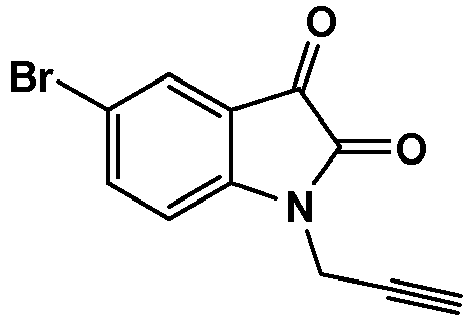
- Orange solid (30% yield) . 1H NMR (CDCl3, 400 MHz) δ: 2.33 (s, 1H, CH), 4.53 (s, 2H, CH2), 7.04-7.06 (d, J= 8 Hz, 1H, Ar), 7.29-7.35 (m, 1H, Ar), 7.75 (s, 1H, Ar). 13C NMR (CDCl3, 100 MHz) δ: 29.71, 73.91, 75.35, 112.98, 117.29, 118.95, 128.37, 140.78, 148.40, 156.53, 181.51.
- In a round-bottomed flask were added N-propargyl isatin derivative, the azide (1 equiv.), CuI (0.02 equiv.), DIPEA (0.04 equiv.), HOAc (0.04 equiv.) and CH2Cl2. The mixture was stirred at room temperature for 18 h, and monitored by TLC. The reaction mixture was filtered with a sinitered glass funnel with a celite layer and washed with CH2Cl2. The solvent was evaporated on a rotary evaporator and the crude product mixture was purified by silica gel chromatography using a gradient of Hexane/AcOEt (5/1)-(1/1)- AcOEt.
-

- Orange solid (80% yield). m.p.= 137.2-138.8°C. 1H NMR ((CD3)2CO, 400 MHz) δ: 5.02 (s, 2H, CH2), 5.60 (s, 2H, CH2), 7.13-7.17 (t, J= 8 Hz, 1H, Ar), 7.22-7.24 (d, J= 8 Hz, 1H, Ar), 7.32-7.36 (m, 5H, Ar), 7.54-7.56 (d, J= 8 Hz, 1H, Ar), 7.62-7.66 (t, J= 8 Hz, 1H, Ar), 8.04 (s, 1H, =CH). 13C NMR ((CD3)2CO, 100 MHz) δ: 36.06, 54.26, 112.21, 118.70, 124.04, 124.29, 125.14, 128.87, 129.11, 129.66, 136.86, 138.93, 143.06, 151.67, 158.53, 184.13.
-

- Orange solid (20% yield). m.p. = 104.2-105.7°C. 1H NMR ((CD3)2CO, 400 MHz) δ: 0.86-0.90 (t, J= 8Hz, 3H, CH3), 1.25-1.31 (q, J= 8 Hz, 2H, CH2), 1.79-1.86 (m, 2H, CH2), 4.35-4.39 (t, J= 8 Hz, 2H, CH2), 5.02 (s, 2H, CH2), 7.13-7.16 (t, 1H, Ar), 7.23-7.25 (d, J= 8 Hz, 1H, Ar), 7.53-7.55 (d, J= 8 Hz, 1H, Ar), 7.62-7.66 (t, J= 8 Hz, 1H, Ar), 8.02 (s, 1H, =CH). 13C NMR ((CD3)2CO, 100 MHz) δ: 13.65 (CH3), 20.18 (CH2), 32.88 (CH2), 36.04 (CH2), 50.36 (CH2), 112.21 (CH), 118.60 (C), 123.79 (CH), 124.28 (CH), 125.13 (CH), 138.94 (CH), 142.51 (C), 151.64 (C), 158.49 (C=O), 184.16 (C=O). MS (ESI) m/z: 285.0 [M]+.
-

- Orange oil (10% yield). 1H NMR ((CD3)2SO, 400 MHz) δ: 1.17-1.23 (m, 1H, CH2), 1.34-1.37 (m, 2H, CH2), 1.62-1.79 (m, 5H, CH2), 1.98-2.01 (m, 2H, CH2), 4.39-4.45 (m, 1H, CH), 4.94 (s, 2H, CH2), 7.10-7.17 (m, 2H, Ar), 7.55-7.57 (d, J= 8 Hz, 1H, Ar), 7.61-7.65 (t, J= 8 Hz, 1H, Ar), 8.20 (s, 1H, =CH). 13C NMR ((CD3)2SO, 100 MHz) δ: 24.54 (CH2), 24.67 (CH2), 32.83 (CH2), 35.17 (CH2), 59.05 (CH), 111.17 (CH), 117.62 (C), 121.52 (CH), 123.36 (CH), 124.45 (CH), 138.09 (CH), 141.16 (C), 150.25 (C), 157.80 (C=O), 183.15 (C=O). MS (ESI) m/z: 311.1 [M]+.
-

- Orange solid (30% yield). m.p.= 155.2-156.7°C. 1H NMR (CDCl3, 400 MHz) δ: 0.69-0.71 (d, J= 8 Hz, 3H, CH3), 0.76-0.78 (d, J= 8 Hz, 3H, CH3), 0.81-0.83 (d, J= 8 Hz, 3H, CH3), 0.97-1.04 (m, 2H, CH2), 1.31-1.45 (m, 2H, CH2), 1.65-1.68 (m, 1H, CH), 1.78-1.90 (m, 4H, CH2, CH), 4.97 (s, 1H, CH), 4.99 (s, 2H, CH2), 7.07-7.11 (t, J= 8 Hz, 1H, Ar), 7.33-7.35 (d, J= 8 Hz, 1H, Ar), 7.55-7.58 (m, 2H, Ar), 7.68 (s, 1H, =CH). 13C NMR (CDCl3, 100 MHz) δ: 20.48 (CH3), 21.14 (CH3), 22.28 (CH3), 24.82 (CH2), 26.35 (CH), 29.10 (CH), 34.55 (CH2), 35.49 (CH2), 40.63 (CH2), 46.70 (CH), 59.62 (CH), 111.82 (CH), 117.57 (C), 124.04 (CH), 125.33 (CH), 138.70 (CH), 140.60 (C), 150.48 (C), 158.05 (C=O), 183.34 (C=O). MS (ESI) m/z: 367.2 [M]+.
-

- Orange solid (67% yield). m.p.= 143.1-144.0°C. 1H NMR (CDCl3, 400 MHz) δ: 2.30 (s, 3H, CH3), 4.96 (s, 2H, CH2), 5.47 (s, 2H, CH2), 7.18-7.20 (d, J= 8 Hz, 1H, Ar), 7.24-7.26 (m, 2H, Ar), 7.35-7.37 (m, 5H, Ar), 7.50 (s, 1H, =CH) . 13C NMR (CDCl3, 100 MHz) δ: 20.80 (CH3) , 35.52 (CH2), 54.54 (CH2), 111.46 (CH), 117.64 (C), 122.90 (CH), 125.76 (CH), 128.40 (CH), 129.12 (CH), 129.35 (CH), 134.02 (C), 134.13 (C), 139.16 (CH), 142.34 (C), 148.17 (C), 158.17 (C=O), 183.47 (C=O). MS (ESI) m/z: 333.1 [M]+.
-

- Orange solid (62% yield). m.p.= 173.1-175.0°C. 1H NMR (CDCl3, 400 MHz) δ: 4.96 (s, 2H, CH2), 5.47 (s, 2H, CH2), 7.24-7.28 (m, 3H, Ar), 7.36 (m, 3H, Ar), 7.52 (s, 1H, =CH), 7.66-7.69 (m, 2H, Ar) . 13C NMR (CDCl3, 100 MHz) δ: 35.55 (CH2), 54.57 (CH2), 113.54 (CH), 117.07 (C), 118.75 (C), 122.97 (CH), 128.14 (CH), 128.43 (CH), 129.17 (CH), 129.37 (CH), 134.04 (C), 140.93 (CH), 141.80 (C), 149.04 (C), 157.27 (C=O), 182.08 (C=O). MS (ESI) m/z: 397.0 [M]+.
- In a round-bottomed flask under inert atmosphere were added Rh(acac) (C2H4)2 (1.2 mg, 0.005 mmol, 3 mol%), (R)-BINAP (5.9 mg, 0.010 mmol, 6 mol%) and CH2Cl2 (1 mL). The mixture was stirred at room temperature for 1 hour, then the solvent was removed on a rotary evaporator. Under an inert atmosphere the following were added sequentially to the flask: N-triazole isatin substrate (0.16 mmol), the arylboronic acid (0.32 mmol, 2 equiv.), methanol (2 mL) and DIPEA (14.6 µL, 0.08 mmol, 0.5 equiv.). The mixture was stirred at 60°C during 18 h. The methanol was evaporated in rotary evaporator. To determine the isolated yields, the crude product was purified by silica gel chromatography using Hexane/AcOEt (1/1) as eluent to afford the desired product (1)-(12). To determine the conversions, the crude product was filtered in a porous plate glass filter with a layer of celite and a layer of silica gel and eluted with Et2O. The solvent was evaporated and the crude mixture was analysed by HPLC.
-

- White solid. m.p.= 156.8-157.7 °C. 1H NMR (CDCl3, 400 MHz) δ: 3.47 (s br, 1H, OH), 4.99 (s, 2H, CH2), 5.37-5.49 (q, J= 16 Hz, 2H, CH2), 7.04-7.07 (t, 1H, Ar), 7.19-7.34 (m, 13H, Ar), 7.42 (s, 1H, =CH). 13C NMR (CDCl3, 100 MHz) δ: 35.82, 54.38, 78.00, 110.18, 122.62, 123.86, 125.03, 125.41, 128.21, 128.45, 128.73, 128.96, 129.27, 130.14, 131.58, 134.39, 140.01, 142.18, 143.00, 177.34. HRMS (ESI): m/z calcd for C24H20N4O2 396.15863, found for C24H21N4O2 [M] + 397.16590. HPLC: Daicel Chiralpak IA, n-hexane/i-propanol = 80/20, 1.0 mL/min, 210 nm, retention time: 22.707 min (minor), 33.933 min (major).
-

- Pale orange solid. m.p.= 75.4-76.0 °C. 1H NMR (CDCl3, 400 MHz) δ: 5.03 (s, 2H, CH2), 5.30 (s br, 1H, OH), 5.37-5.48 (q, J= 16 Hz, 2H, CH2), 7.05.7.08 (t, 1H, Ar), 7.19-7.35 (m, 9H, Ar), 7.44-7.48 (m, 3H, Ar), 7.69-7.71 (d, J= 8 Hz, 1H, Ar), 7.75-7.78 (m, 2H, Ar), 7.88 (s, 1H, =CH). 13C NMR (CDCl3, 100 MHz) δ: 35.89, 54.40, 78.21, 110.28, 122.65, 123.15, 123.93, 124.48, 125.12, 126.49, 126.54, 127.71, 128.22, 128.42, 128.73, 128.97, 129.28, 130.27, 131.50, 133.16, 133.21, 134.38, 137.30, 142.26, 143.02, 177.28. MS (ESI) m/z: 447.2 [M]+. HPLC: Daicel Chiralpak IA, n-hexane/i-propanol = 80/20, 1.0 mL/min, 210 nm, retention time: 35.513 min (minor), 39.607 min (major).
-

- Pale orange oil. 1H NMR ((CD3)2CO, 400 MHz) δ: 4.91-5.07 (q, J= 16 Hz, 2H, CH2), 5.58 (s, 2H, CH2), 5.89 (s br, 1H, OH), 7.01-7.06 (m, 3H, Ar), 7.17-7.22 (m, 2H, Ar), 7.28-7.35 (m, 6H, Ar), 7.41-7.44 (m, 2H, Ar), 7.92 (s, 1H, =CH). 13C NMR ((CD3)2CO, 100 MHz) δ: 35.89, 54.15, 77.85, 110.50, 115.48, 115.70, 123.75, 123.77, 125.36, 128.53, 128.62, 128.76, 129.04, 129.60, 130.26, 133.41, 136.78, 138.29, 138.32, 143.40, 143.57, 161.86, 164.29, 177.05. MS (ESI) m/z: 415.1 [M]+. HPLC: Daicel Chiralpak IA, n-hexane/i-propanol = 80/20, 1.0 mL/min, 210 nm, retention time: 19.673 min (minor), 23.127 min (major).
-

- Pale orange solid. m.p.= 130.4-131.8 °C. 1H NMR ((CD3)2SO, 400 MHz) δ: 3.71 (s, 3H, OMe), 4.87-5.02 (q, J= 16 Hz, 2H, CH2), 5.57 (s, 2H, CH2), 6.68 (s, 1H, OH), 6.82-6.84 (d, J= 8 Hz, 2H, Ar), 7.01-7.04 (t, 1H, Ar), 7.13-7.19 (m, 4H, Ar), 7.26-7.37 (m, 6H, Ar), 8.10 (s, 1H, =CH). 13C NMR ((CD3)2SO, 100 MHz) δ: 34.81, 52.79, 55.11, 76.60, 109.46, 113.50, 122.77, 123.52, 124.45, 126.74, 127.87, 128.15, 128.76, 129.10, 133.13, 133.26, 136.03, 142.06, 142.31, 158.73, 176.53. MS (ESI) m/z: 427.1 [M]+. HPLC: Daicel Chiralpak IA, n-hexane/i-propanol = 80/20, 1.0 mL/min, 210 nm, retention time: 32.767 min (minor), 38.927 min (major).
-

- White solid. m.p.= 147.8-148.3 °C. 1H NMR (CDCl3, 400 MHz) δ: 4.98 (s, 2H, CH2), 5.39-5.50 (q, J= 16 Hz, 2H, CH2), 7.06-7.12 (m, 2H, Ar), 7.17-7.21 (m, 4H, Ar), 7.30-7.40 (m, 7H, Ar). 13C NMR (CDCl3, 100 MHz) δ: 35.85, 54.43, 75.96, 110.27, 122.57, 123.14, 123.77, 124.88, 125.65, 127.06, 128.24, 129.01, 129.31, 130.32, 130.57, 134.37, 140.76, 141.95, 143.00, 176.54. MS (ESI) m/z: 403.1 [M]+. HPLC: Daicel Chiralpak IA, n-hexane/i-propanol = 80/20, 1.0 mL/min, 210 nm, retention time: 26.960 min (minor), 34.227 min (major).
-

- White solid. m.p.= 212.1-213.9 °C. 1H NMR ((CD3)2SO, 400 MHz) δ: 4.88-5.01 (q, J= 16 Hz, 2H, CH2), 5.57 (s, 2H, CH2), 6.56-6.58 (d, J= 8 Hz, 1H, Ar), 6.63-6.65 (d, J= 8 Hz, 1H, Ar), 6.68 (s, 1H, Ar), 6.80 (s, 1H, Ar), 7.01-7.05 (m, 2H, Ar), 7.11-7.16 (m, 2H, Ar), 7.26-7.37 (m, 6H, Ar), 8.10 (s, 1H, OH), 9.39 (s, 1H, OH). 13C NMR ((CD3)2SO, 100 MHz) δ: 34.83, 52.80, 76.89, 109.46, 112.55, 114.47, 115.93, 122.78, 123.57, 124.42, 127.89, 128.15, 128.77, 129.07, 129.12, 133.17, 136.01, 142.13, 142.28, 142.69, 157.19, 176.30. MS (ESI) m/z: 413.1 [M]+. HPLC: Daicel Chiralpak IA, n-hexane/i-propanol = 80/20, 1.0 mL/min, 210 nm, retention time: 40.500 min (minor), 44.553 min (major).
-

- White solid. m.p.= 149.1-150.9 °C. 1H NMR (CDCl3, 400 MHz) δ: 4.88-4.98 (q, J= 16 Hz, 2H, CH2), 5.35-5.47 (q, J= 16 Hz, 2H, CH2), 7.08-7.10 (d, J= 8 Hz, 1H, Ar), 7.20-7.21 (m, 2H, Ar), 7.29 (m, 4H, Ar), 7.34 (m, 4H, Ar), 7.41-7.42 (m, 2H, Ar, =CH), 7.50-7.54 (t, J= 8 Hz, 1H, Ar), 8.24-8.26 (d, J= 8 Hz, 1H, Ar) . 13C NMR (CDCl3, 100 MHz) δ: 35.76, 54.45, 77.92, 111.79, 116.59, 125.32, 128.12, 128.26, 128.71, 128.87, 129.03, 129.30, 132.90, 133.62, 134.28, 135.76, 139.37, 141.18, 142.50, 176.88. MS (ESI) m/z: 477.1 [M]+2. HPLC: Daicel Chiralpak IA, n-hexane/i-propanol = 80/20, 1.0 mL/min, 210 nm, retention time: 24.347 min (minor), 47.020 min (major).
-

- White solid. m.p.= 153.8-155.0 °C. 1H NMR (CDCl3, 400 MHz) δ: 2.30 (s, 3H, CH3), 4.96 (s, 2H, CH2), 5.34-5.46 (q, J= 16 Hz, 2H, CH2), 7.02-7.08 (m, 3H, Ar), 7.16-7.33 (m, 10H, Ar), 7.41 (s, 1H, =CH) . 13C NMR (CDCl3, 100 MHz) δ: 21.23, 35.79, 54.34, 77.89, 110.12, 122.65, 123.80, 124.97, 125.36, 128.19, 128.91, 129.24, 129.41, 130.03, 131.69, 134.43, 137.07, 138.25, 142.15,143.04, 177.47. MS (ESI) m/z: 411.2 [M]+. HPLC: Daicel Chiralpak IA, n-hexane/i-propanol = 80/20, 1.0 mL/min, 210 nm, retention time: 22.273 min (minor), 29.020 min (major).
-

- Pale yellow oil. 1H NMR ((CD3)2CO, 400 MHz) δ: 0.88-0.91 (t, 3H, CH3), 1.24-1.32 (m, 2H, CH2), 1.77-1.85 (m, 2H, CH2), 4.32-4.36 (t, J= 8 Hz, 2H, CH2), 4.92-5.08 (q, J= 16 Hz, 2H, CH2), 5.88 (s br, 1H, OH), 7.01-7.05 (t, J= 8 Hz, 1H, Ar), 7.18-7.21 (m, 2H, Ar), 7.26-7.31 (m, 4H, Ar), 7.42-7.44 (d, J= 8 Hz, 2H, Ar), 7.87 (s, 1H, =CH) . 13C NMR ((CD3)2CO, 100 MHz) δ: 13.68, 20.13, 32.86, 35.88, 50.27, 78.32, 110.42, 123.49, 123.62, 125.33, 126.38, 128.39, 128.88, 130.07, 133.79, 142.29, 143.13, 143.43, 177.28. MS (ESI) m/z: 363.2 [M]+. HPLC: Daicel Chiralpak IA, n-hexane/i-propanol = 80/20, 1.0 mL/min, 210 nm, retention time: 14.820 min (minor), 19.087 min (major).
-
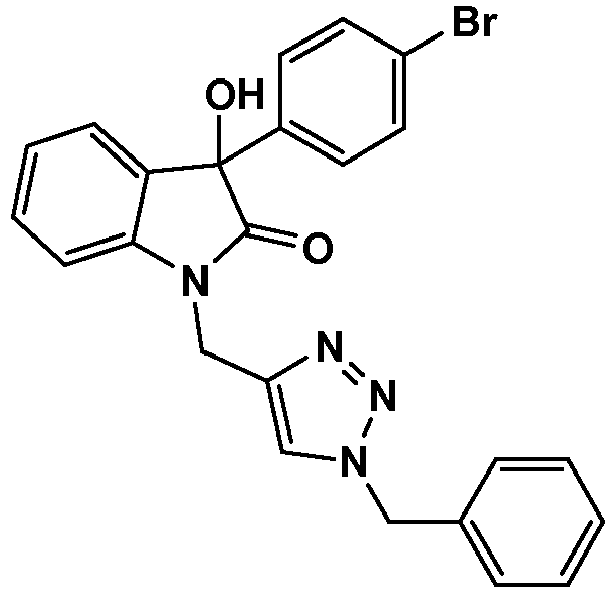
- Pale yellow solid. m.p.= 152.1-153.0 °C. 1H NMR (CDCl3, 400 MHz) δ: 4.97 (s, 2H, CH2), 5.38-5.50 (q, J= 16 Hz, 2H, CH2), 7.05-7.09 (t, J= 8 Hz, 1H, Ar), 7.16-7.22 (m, 6H, Ar), 7.31-7.41 (m, 7H, Ar). 13C NMR (CDCl3, 100 MHz) δ: 35.81, 54.46, 77.64, 110.32, 122.54, 122.65, 124.02, 124.96, 127.29, 128.27, 129.07, 129.33, 130.44, 131.09, 131.84, 134.33, 139.05, 142.18, 142.84, 176.79. MS (ESI) m/z: 477.1 [M]+2. HPLC: Daicel Chiralpak IA, n-hexane/i-propanol = 80/20, 1.0 mL/min, 210 nm, retention time: 25.140 min (minor), 27.453 min (major).
-

- White solid. m.p.= 163.7-164.3 °C. 1H NMR (CDCl3, 400 MHz) δ: 2.25 (s, 3H, CH3), 3.44 (s br, 1H, OH), 4.96 (s, 2H, CH2), 5.34-5.47 (q, J= 16 Hz, 2H, CH2), 7.05-7.08 (m, 3H, Ar), 7.20 (m, 2H, Ar), 7.28-7.33 (m, 8H, Ar), 7.41 (s, 1H, =CH). 13C NMR (CDCl3, 100 MHz) δ: 21.16, 35.86, 54.36, 78.14, 109.98, 122.61, 125.35, 125.69, 128.20, 128.38, 128.72, 128.93, 129.25, 130.40, 131.56, 133.59, 134.42, 139.71, 140.19, 143.10, 177.32. MS (ESI) m/z: 411.2 [M]+. HPLC: Daicel Chiralpak IA, n-hexane/i-propanol = 80/20, 1.0 mL/min, 210 nm, retention time: 24.727 min (minor), 31.080 min (major).
-

- Pale yellow solid. m.p.= 141.4-142.8 °C. 1H NMR (CDCl3, 400 MHz) δ: 4.98 (s, 2H, CH2), 5.39-5.50 (q, J= 12 Hz, 2H, CH2), 7.05-7.09 (t, J= 8 Hz, 1H, Ar), 7.21-7.23 (m, 8H, Ar), 7.31-7.35 (m, 4H, Ar), 7.41 (s, 1H, =CH). 13C NMR (CDCl3, 100 MHz) δ: 35.82, 54.46, 77.59, 110.32, 122.54, 124.01, 124.97, 126.99, 128.26, 128.90, 129.07, 129.33, 130.43, 131.14, 134.33, 134.45, 138.50, 142.19, 142.86, 176.87. MS (ESI) m/z: 431.1 [M]+. HPLC: Daicel Chiralpak IA, n-hexane/i-propanol = 80/20, 1.0 mL/min, 210 nm, retention time: 20.447 min (major), 23.687 min (minor).
- Approximately 5 × 10³ SW480 colon adenocarcinoma cells were cultured in 200 µl culture medium per well (DMEM medium), supplemented with 10% newborn calf serum and 1% amphotericin-penicillin-streptomycin solution in 96-well plates and incubated at 37 °C under a 5% CO2 atmosphere. The cells were grown for 24h and then exposed to different concentrations of the tested drugs (dissolved in culture medium) for 24h. Hydrogen peroxide was used as a positive control. The cells were washed with the culture medium, incubated with MTT (500 µg/ml) for a further period of 3 hours. At the end of the incubation, the medium was removed, then carefully washed with PBS and 200 µl DMSO were added to each well. Absorbance was read at 570 nm in a microplate reader. Four replicates per dose were included. The IC50 values, that is, the concentrations which produced 50% inhibition of cell viability were calculated from MTT data using the GraphPadPrism Software Inc. (version 6.01) (USA).
- Compounds were dissolved in dimethyl sulphoxide (DMSO) to obtain a stock concentration of 20 mM.
- Cell lines. The panel of lymphoma cell lines comprised models derived from diffuse large B-cell lymphoma (n. 4) cell lines derived from DLBCL of the germinal center B-cell type (GCB-DLBCL), such as VAL and DOHH-2, and derived of the activated B-cell type (ABC-DLBCL) such as OCI-LY-10 and SU-DHL-2.
- Proliferation MTT assay.
- Cells were seeded in 96-well plates (non-tissue culture treated) at a density of 10,000 cells for all cell lines. Each compound was dissolved in dimethyl sulphoxide (DMSO). For treatment of cells, compounds were serially diluted in the appropriate tissue culture medium, at a range of 20 µM - 19 nM following a 1:2 dilution factor and added to cells (in three replicates). Cells were incubated for 72 hours at 37 °C, 5% CO2. DMSO alone was added to negative control (untreated) cells. Wells containing medium only were included on each plate and served as blanks for absorbance readings. MTT (Sigma-Aldrich Chemie GmbH, Buchs, Switzerland) was prepared as a 5 mg/ml stock in PBS and filter-sterilized. MTT solution (22µL) was added to each well and tissue culture plates were incubated at 37°C for 4 hours. Cells were then lysed with 25% SDS lysis buffer and absorbance was read at 570 nm using an AD340 plate reader (Beckman Coulter International SA, Switzerland). Absorbance values were expressed in percentage of proliferating cells in comparison with control cells (control corresponds to 100%).
-
- DIPEA
- Diisopropylethylamine
- DMA
- Dimethylacetamide
- DMF
- Dimethylforamide
- DMSO
- Dimethylsulfoxide
- ee
- Enantiomeric excess
- NHC
- N-Heterocyclic Carbene ligands
- MTT
- 3-(4,5-Dimethylthiazolyl-2)-2,5-diphenyltetrazoliumbromide
- NMP
- N-Methylpiperidine
- THF
- Tetrahydofuran
-
- M. A. Ali, R. Ismail, T. S. Choon, Y. K. Yoon, A. C. Wei, S. Pandian, R. S. Kumar, H. Osman, E. Manogaran, Bioorg. Med. Chem. Lett. 2010, 20, 7064.
- Burke, A.J.; Marques, C.S. Chiral Non-racemic N-(1,2,3-triazolmethyl)-3-hydroxy-3-aryloxindoles, Prov. Patent Application,
109598, 26 Aug 2016 - C.E. DeSantis, C. C. Lin, A.B. Mariotto, R.L. Siegel, K. D. Stein, J. L., Kramer, R. Alteri, A.S. Robbins, A. Jemal, Cancer J. Clin. 2014, 64, 252.
- C. S.-L. Gal, J. Wagnon, J. Simiand, G. Griebel, C. Lacour, G. Guillon, C. Barberis, G. Brossard, P. Soubrié , D. Nisato, M. Pascal, R. Pruss, B. Scatton, J.-P. Maffrand, G. Le Fur, J. Pharmacol. Exp. Ther., 2002, 300, 1122.
- L. Kelland, Nat. Rev. Cancer 2007, 7, 8, 573.
- H.C. Neu, K.P. Fu, Antimicrob. Agents and Chemotherapy, 1979, 209.
- R. Ng, Drugs - From Discovery to Approval, John Wiley & Sons, Inc, Hoboken, New Jersey, 2004 .
J. McCauley, A. Zivanovic, D. Skropeta, Methods Mol. Biol. 2013, 1055, 191. - M. Ochi, K. Kawasaki, H. Kataoka, Y. Uchio, H. Nishi, Biochem. Biophys. Res. Commun. 2001, 283, 1118.
- F.G.E. Perabo, A. Wirger, S. Kamp, H. Lindner, D.H. Schmidt, S.C. Müller, E.C. Kohn, Anticancer Res. 2004, 24, 2869.
- S. Rossi, (ed.), Australian Medicines Handbook, Adelaide: The Australian Medicines Handbook Unit Trust, 2013 .
- V.V. Rostovtsev, L.G. Green, V.V. Fokin, K.B. Sharpless, Angew. Chem. Int. Ed. 2002, 41, 2596.
- M. Rottmann, C. McNamara, B. K. S. Yeung, M. C. S. Lee, B. Zou, B. Russell, P. Seitz, D. M. Plouffe, N. V. Dharia, J. Tan, S. B. Cohen, K. R. Spencer, G. E. González-Páez, S. B. Lakshminarayana, A. Goh, R. Suwanarusk, T. Jegla, E. K. Schmitt, H.-P. Beck, R. Brun, F. Nosten, L. Renia, V.
- Dartois, T. H. Keller, D. A. Fidock, E. A. Winzeler, T. T. Diagana, Science, 2010, 329, 1175.
- P. Thirumurugan, D. Matosiuk, K. Jozwiak, Chem. Rev. 2013, 113, 4905.
- C.W. Tornøe, C. Christensen, M. Meldal, J. Org. Chem. 2002, 67, 3057.
- J. Totobenazara, A.J. Burke, Tetrahedron Letters, 2015, 56, 2853.
- J. Totobenazara, A.A. San Juan, P. Bacalhau, C.S. Marques, A. Goth, M. R. Martins, A. T. Caldeira, A.J. Burke, ChemistrySelect, 2016, 1, 3580.
- Y. Yang, B.A., Rasmussen, D.M. Shlaes, Pharmacol Ther., 1999, 83, 141 .
- G.C. Tron, T.Pirali, R.A. Billington, P.L. Canonico, G. Sorba, A.A. Genazzani, Med. Res. Rev. 2008, 28, 278.
- C. Widakowich, G. de Castro, E. de Azambuja, P. Dinh, A. Awada, Oncologist 2007, 12, 1443.
- L.-H. Xu, C.-S. Deng, Y.-Q. Zhu, S-Q. Liu, D.-Z. Liu, World J. Gastroenterol, 2003, 9, 1241.
Claims (4)
- Compounds of formula (I) and (II) for use in the inhibition of colon adenocarcinoma and lymphoma cells, wherein
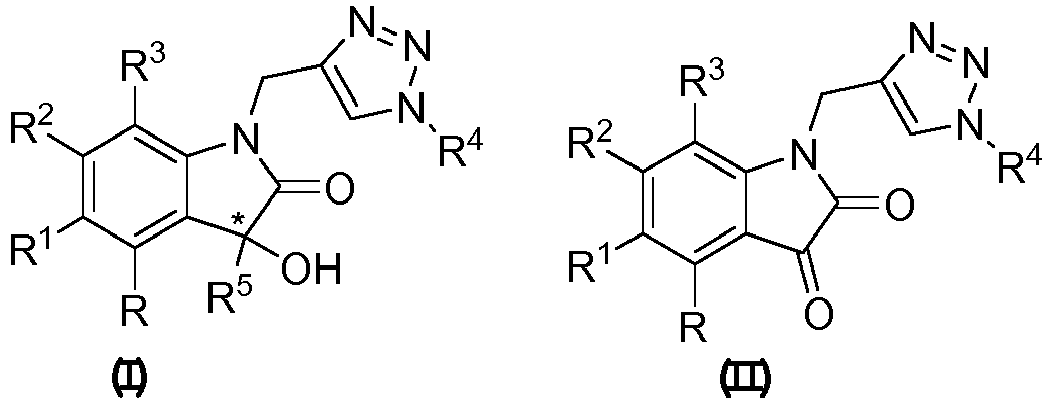 R, R1, R2 and R3 represent; H, alkyl, aryl, vinyl, allyl, alkoxyl, halogen (F, Br, Cl), OH, CN, CHO and CO2H,R4 represents a linear alkyl group with 1-6 carbons, a cycloheteroalkyl group, like:


A benzyl group where R' is an alkoxyl, halogen (F, Br, Cl), OH, CN, CHO and CO2H,R5 represents an aryl group.
 - Compounds for the use in the inhibition of colon adenocarcinoma and lymphoma cells according to the previous claim, wherein the compounds are used as the appropriate individual enantiomers.
- Compounds for the use in the inhibition of colon adenocarcinoma and lymphoma cells according to claim 1, wherein the compounds are used as a racemic mixture.
- Compounds for use in the inhibition of colon adenocarcinoma and lymphoma cells according to claim 1, wherein the lymphoma cell lines include B-cell lymphoma (n. 4) derived from DLBCL of the germinal center B-cell type (GCB-DLBCL), such as VAL and DOHH-2, and derived from the activated B-cell type (ABC-DLBCL) such as OCI-LY-10 and SU-DHL-2.
Applications Claiming Priority (1)
| Application Number | Priority Date | Filing Date | Title |
|---|---|---|---|
| PT110063A PT110063A (en) | 2017-05-08 | 2017-05-08 | NEW N- (1,2,3-TRIAZOLE-METHYL) ISATIN AND N- (1,2,3-TRIAZOLE-METHYL) -3-HYDROXY-3-ARYL-OXINDOLES DERIVATIVES WITH CYTOTOXIC AND ANTI-TUMOR ACTIVITY |
Publications (2)
| Publication Number | Publication Date |
|---|---|
| EP3400938A1 EP3400938A1 (en) | 2018-11-14 |
| EP3400938B1 true EP3400938B1 (en) | 2020-09-09 |
Family
ID=62089688
Family Applications (1)
| Application Number | Title | Priority Date | Filing Date |
|---|---|---|---|
| EP18169956.2A Active EP3400938B1 (en) | 2017-05-08 | 2018-04-27 | Novel n-(1,2,3-triazolmethyl)isatin and n-(1,2,3-triazolmethyl)-3-hydroxy-3-aryloxindoles with cytotoxic and anti-tumor activity |
Country Status (2)
| Country | Link |
|---|---|
| EP (1) | EP3400938B1 (en) |
| PT (2) | PT110063A (en) |
Families Citing this family (2)
| Publication number | Priority date | Publication date | Assignee | Title |
|---|---|---|---|---|
| CN115043849B (en) * | 2022-05-20 | 2023-08-15 | 贵州大学 | Cyclic lactone skeleton spliced indanedione double spiro compound and its preparation method and application |
| CN116621767B (en) * | 2023-02-23 | 2024-05-31 | 中山大学 | A kind of indigo carmine derivative and its preparation method and application |
-
2017
- 2017-05-08 PT PT110063A patent/PT110063A/en unknown
-
2018
- 2018-04-27 PT PT181699562T patent/PT3400938T/en unknown
- 2018-04-27 EP EP18169956.2A patent/EP3400938B1/en active Active
Non-Patent Citations (1)
| Title |
|---|
| None * |
Also Published As
| Publication number | Publication date |
|---|---|
| PT110063A (en) | 2018-11-08 |
| EP3400938A1 (en) | 2018-11-14 |
| PT3400938T (en) | 2020-12-16 |
Similar Documents
| Publication | Publication Date | Title |
|---|---|---|
| Seregin et al. | Multisubstituted N-fused heterocycles via transition metal-catalyzed cycloisomerization protocols | |
| EP3782995B1 (en) | Spiro condensed imidazoline-2,4-dione derivatives as histone acetyltransferase inhibitors for the treatment of cancer diseases | |
| Ge et al. | Synthesis of substituted benzo [ij] imidazo [2, 1, 5-de] quinolizine by rhodium (iii)-catalyzed multiple C–H activation and annulations | |
| Dangroo et al. | Synthesis of α-santonin derived acetyl santonous acid triazole derivatives and their bioevaluation for T and B-cell proliferation | |
| He et al. | Access to polycyclic azepino [5, 4, 3-cd] indoles via a gold-catalyzed post-Ugi dearomatization cascade | |
| CN103992334A (en) | Indolone spiral tetrahydrothiopyran antitumour derivatives and preparation method thereof | |
| CN101792438B (en) | Method for synthesizing 1-substituted-1,2,3-tolyltriazole | |
| Bathula et al. | Diverse synthesis of natural product inspired fused and spiro-heterocyclic scaffolds via ring distortion and ring construction strategies | |
| CN106565742B (en) | Indolone spiral shell tetrahydro thio-pyrylium analog derivative and its preparation method and application | |
| CN102516152B (en) | Alpha-difluoro carbonyl substituted chiral tert-alcohol compound, its synthetic method and application thereof | |
| EP3400938A1 (en) | Novel n-(1,2,3-triazolmethyl)isatin and n-(1,2,3-triazolmethyl)-3-hydroxy-3-aryloxindoles with cytotoxic and anti-tumor activity | |
| Boger et al. | Total synthesis of (+)-and (-)-CPI-CDPI2:(+)-(3bR, 4aS)-and (-)-(3bS, 4aR)-deoxy-CC-1065 | |
| RS51351B (en) | 1,4-DIHYDROPYRIDINE-CONDENSED HTEROCYCLES, PROCEDURES FOR THEIR PRODUCTION, USE AND THE COMPOSITIONS CONTAINING THEM | |
| CN107235992A (en) | Indolone spiral shell thiophane class compound and its salt, preparation method and application | |
| CA2730071A1 (en) | Antineoplastic derivatives of 4-oxo-l, 4-dihydro-quinolin?, preparation thereof, and therapeutic use thereof | |
| Oh et al. | Catalyst-free assembly of a polyfunctionalized 1, 2, 4-triazole-fused N-heterocycle, 6-acylated pyrrolo [1, 2-a][1, 2, 4] triazolo [5, 1-c] pyrazine | |
| Bangade et al. | Solid-phase reactive chromatography (SPRC): a sustainable method for the synthesis of benzimidazol-diphenyl-2-imino-thiazolidine-4-ols (hemiaminals) which are active against lung cancer | |
| Zhao et al. | Copper-catalyzed synthesis of pyrazolo [5, 1-a] isoquinoline derivatives from 2-gem-dipyrazolylvinylbromobenzenes | |
| Keivanloo et al. | One-pot synthesis of biologically active 1, 2, 3-trisubstituted pyrrolo [2, 3-b] quinoxalines through a palladium-catalyzed reaction with internal alkyne moieties | |
| CN108440526B (en) | A kind of chiral barbiturate spirotetrahydroquinoline compound and preparation method thereof | |
| Sekar et al. | An expedient ruthenium (ii) catalyzed multicomponent access to phthalazinones bearing trisubstituted alkenes | |
| Raju et al. | Regioselective Palladium (II)-Catalyzed Desulfitative Heck-Type Reaction: Access to α-Benzyl-β-keto Esters from Baylis–Hillman Adducts and Sodium Sulfinates | |
| CN110862396A (en) | Synthesis method of pyrrolo [3,4-c ] carbazole-1, 3(2H,6H) -diketone compound | |
| CN107573276B (en) | A kind of synthetic method of 3-ethyl-5-hydroxy-1,3-diaryl indolinone | |
| Strakova et al. | Resolution, absolute configuration, and synthetic transformations of 7-amino-tetrahydroindazolones |
Legal Events
| Date | Code | Title | Description |
|---|---|---|---|
| PUAI | Public reference made under article 153(3) epc to a published international application that has entered the european phase |
Free format text: ORIGINAL CODE: 0009012 |
|
| STAA | Information on the status of an ep patent application or granted ep patent |
Free format text: STATUS: THE APPLICATION HAS BEEN PUBLISHED |
|
| AK | Designated contracting states |
Kind code of ref document: A1 Designated state(s): AL AT BE BG CH CY CZ DE DK EE ES FI FR GB GR HR HU IE IS IT LI LT LU LV MC MK MT NL NO PL PT RO RS SE SI SK SM TR |
|
| AX | Request for extension of the european patent |
Extension state: BA ME |
|
| STAA | Information on the status of an ep patent application or granted ep patent |
Free format text: STATUS: REQUEST FOR EXAMINATION WAS MADE |
|
| 17P | Request for examination filed |
Effective date: 20190222 |
|
| RBV | Designated contracting states (corrected) |
Designated state(s): AL AT BE BG CH CY CZ DE DK EE ES FI FR GB GR HR HU IE IS IT LI LT LU LV MC MK MT NL NO PL PT RO RS SE SI SK SM TR |
|
| GRAP | Despatch of communication of intention to grant a patent |
Free format text: ORIGINAL CODE: EPIDOSNIGR1 |
|
| STAA | Information on the status of an ep patent application or granted ep patent |
Free format text: STATUS: GRANT OF PATENT IS INTENDED |
|
| RIC1 | Information provided on ipc code assigned before grant |
Ipc: A61P 35/00 20060101ALI20200316BHEP Ipc: A61K 31/4192 20060101AFI20200316BHEP |
|
| INTG | Intention to grant announced |
Effective date: 20200407 |
|
| GRAS | Grant fee paid |
Free format text: ORIGINAL CODE: EPIDOSNIGR3 |
|
| GRAA | (expected) grant |
Free format text: ORIGINAL CODE: 0009210 |
|
| STAA | Information on the status of an ep patent application or granted ep patent |
Free format text: STATUS: THE PATENT HAS BEEN GRANTED |
|
| AK | Designated contracting states |
Kind code of ref document: B1 Designated state(s): AL AT BE BG CH CY CZ DE DK EE ES FI FR GB GR HR HU IE IS IT LI LT LU LV MC MK MT NL NO PL PT RO RS SE SI SK SM TR |
|
| REG | Reference to a national code |
Ref country code: GB Ref legal event code: FG4D |
|
| REG | Reference to a national code |
Ref country code: AT Ref legal event code: REF Ref document number: 1310697 Country of ref document: AT Kind code of ref document: T Effective date: 20200915 Ref country code: CH Ref legal event code: EP |
|
| REG | Reference to a national code |
Ref country code: DE Ref legal event code: R096 Ref document number: 602018007506 Country of ref document: DE |
|
| REG | Reference to a national code |
Ref country code: IE Ref legal event code: FG4D |
|
| REG | Reference to a national code |
Ref country code: PT Ref legal event code: SC4A Ref document number: 3400938 Country of ref document: PT Date of ref document: 20201216 Kind code of ref document: T Free format text: AVAILABILITY OF NATIONAL TRANSLATION Effective date: 20201207 |
|
| REG | Reference to a national code |
Ref country code: LT Ref legal event code: MG4D |
|
| PG25 | Lapsed in a contracting state [announced via postgrant information from national office to epo] |
Ref country code: NO Free format text: LAPSE BECAUSE OF FAILURE TO SUBMIT A TRANSLATION OF THE DESCRIPTION OR TO PAY THE FEE WITHIN THE PRESCRIBED TIME-LIMIT Effective date: 20201209 Ref country code: HR Free format text: LAPSE BECAUSE OF FAILURE TO SUBMIT A TRANSLATION OF THE DESCRIPTION OR TO PAY THE FEE WITHIN THE PRESCRIBED TIME-LIMIT Effective date: 20200909 Ref country code: LT Free format text: LAPSE BECAUSE OF FAILURE TO SUBMIT A TRANSLATION OF THE DESCRIPTION OR TO PAY THE FEE WITHIN THE PRESCRIBED TIME-LIMIT Effective date: 20200909 Ref country code: BG Free format text: LAPSE BECAUSE OF FAILURE TO SUBMIT A TRANSLATION OF THE DESCRIPTION OR TO PAY THE FEE WITHIN THE PRESCRIBED TIME-LIMIT Effective date: 20201209 Ref country code: SE Free format text: LAPSE BECAUSE OF FAILURE TO SUBMIT A TRANSLATION OF THE DESCRIPTION OR TO PAY THE FEE WITHIN THE PRESCRIBED TIME-LIMIT Effective date: 20200909 Ref country code: FI Free format text: LAPSE BECAUSE OF FAILURE TO SUBMIT A TRANSLATION OF THE DESCRIPTION OR TO PAY THE FEE WITHIN THE PRESCRIBED TIME-LIMIT Effective date: 20200909 |
|
| REG | Reference to a national code |
Ref country code: AT Ref legal event code: MK05 Ref document number: 1310697 Country of ref document: AT Kind code of ref document: T Effective date: 20200909 |
|
| REG | Reference to a national code |
Ref country code: NL Ref legal event code: MP Effective date: 20200909 |
|
| PG25 | Lapsed in a contracting state [announced via postgrant information from national office to epo] |
Ref country code: LV Free format text: LAPSE BECAUSE OF FAILURE TO SUBMIT A TRANSLATION OF THE DESCRIPTION OR TO PAY THE FEE WITHIN THE PRESCRIBED TIME-LIMIT Effective date: 20200909 Ref country code: RS Free format text: LAPSE BECAUSE OF FAILURE TO SUBMIT A TRANSLATION OF THE DESCRIPTION OR TO PAY THE FEE WITHIN THE PRESCRIBED TIME-LIMIT Effective date: 20200909 Ref country code: PL Free format text: LAPSE BECAUSE OF FAILURE TO SUBMIT A TRANSLATION OF THE DESCRIPTION OR TO PAY THE FEE WITHIN THE PRESCRIBED TIME-LIMIT Effective date: 20200909 |
|
| PG25 | Lapsed in a contracting state [announced via postgrant information from national office to epo] |
Ref country code: EE Free format text: LAPSE BECAUSE OF FAILURE TO SUBMIT A TRANSLATION OF THE DESCRIPTION OR TO PAY THE FEE WITHIN THE PRESCRIBED TIME-LIMIT Effective date: 20200909 Ref country code: RO Free format text: LAPSE BECAUSE OF FAILURE TO SUBMIT A TRANSLATION OF THE DESCRIPTION OR TO PAY THE FEE WITHIN THE PRESCRIBED TIME-LIMIT Effective date: 20200909 Ref country code: CZ Free format text: LAPSE BECAUSE OF FAILURE TO SUBMIT A TRANSLATION OF THE DESCRIPTION OR TO PAY THE FEE WITHIN THE PRESCRIBED TIME-LIMIT Effective date: 20200909 Ref country code: SM Free format text: LAPSE BECAUSE OF FAILURE TO SUBMIT A TRANSLATION OF THE DESCRIPTION OR TO PAY THE FEE WITHIN THE PRESCRIBED TIME-LIMIT Effective date: 20200909 |
|
| PG25 | Lapsed in a contracting state [announced via postgrant information from national office to epo] |
Ref country code: IS Free format text: LAPSE BECAUSE OF FAILURE TO SUBMIT A TRANSLATION OF THE DESCRIPTION OR TO PAY THE FEE WITHIN THE PRESCRIBED TIME-LIMIT Effective date: 20210109 Ref country code: ES Free format text: LAPSE BECAUSE OF FAILURE TO SUBMIT A TRANSLATION OF THE DESCRIPTION OR TO PAY THE FEE WITHIN THE PRESCRIBED TIME-LIMIT Effective date: 20200909 Ref country code: AL Free format text: LAPSE BECAUSE OF FAILURE TO SUBMIT A TRANSLATION OF THE DESCRIPTION OR TO PAY THE FEE WITHIN THE PRESCRIBED TIME-LIMIT Effective date: 20200909 Ref country code: AT Free format text: LAPSE BECAUSE OF FAILURE TO SUBMIT A TRANSLATION OF THE DESCRIPTION OR TO PAY THE FEE WITHIN THE PRESCRIBED TIME-LIMIT Effective date: 20200909 |
|
| REG | Reference to a national code |
Ref country code: DE Ref legal event code: R097 Ref document number: 602018007506 Country of ref document: DE |
|
| PG25 | Lapsed in a contracting state [announced via postgrant information from national office to epo] |
Ref country code: SK Free format text: LAPSE BECAUSE OF FAILURE TO SUBMIT A TRANSLATION OF THE DESCRIPTION OR TO PAY THE FEE WITHIN THE PRESCRIBED TIME-LIMIT Effective date: 20200909 |
|
| PLBE | No opposition filed within time limit |
Free format text: ORIGINAL CODE: 0009261 |
|
| STAA | Information on the status of an ep patent application or granted ep patent |
Free format text: STATUS: NO OPPOSITION FILED WITHIN TIME LIMIT |
|
| 26N | No opposition filed |
Effective date: 20210610 |
|
| PG25 | Lapsed in a contracting state [announced via postgrant information from national office to epo] |
Ref country code: DK Free format text: LAPSE BECAUSE OF FAILURE TO SUBMIT A TRANSLATION OF THE DESCRIPTION OR TO PAY THE FEE WITHIN THE PRESCRIBED TIME-LIMIT Effective date: 20200909 Ref country code: SI Free format text: LAPSE BECAUSE OF FAILURE TO SUBMIT A TRANSLATION OF THE DESCRIPTION OR TO PAY THE FEE WITHIN THE PRESCRIBED TIME-LIMIT Effective date: 20200909 |
|
| PG25 | Lapsed in a contracting state [announced via postgrant information from national office to epo] |
Ref country code: IT Free format text: LAPSE BECAUSE OF FAILURE TO SUBMIT A TRANSLATION OF THE DESCRIPTION OR TO PAY THE FEE WITHIN THE PRESCRIBED TIME-LIMIT Effective date: 20200909 |
|
| REG | Reference to a national code |
Ref country code: DE Ref legal event code: R119 Ref document number: 602018007506 Country of ref document: DE |
|
| PG25 | Lapsed in a contracting state [announced via postgrant information from national office to epo] |
Ref country code: MC Free format text: LAPSE BECAUSE OF FAILURE TO SUBMIT A TRANSLATION OF THE DESCRIPTION OR TO PAY THE FEE WITHIN THE PRESCRIBED TIME-LIMIT Effective date: 20200909 |
|
| PG25 | Lapsed in a contracting state [announced via postgrant information from national office to epo] |
Ref country code: LU Free format text: LAPSE BECAUSE OF NON-PAYMENT OF DUE FEES Effective date: 20210427 |
|
| REG | Reference to a national code |
Ref country code: BE Ref legal event code: MM Effective date: 20210430 |
|
| PG25 | Lapsed in a contracting state [announced via postgrant information from national office to epo] |
Ref country code: DE Free format text: LAPSE BECAUSE OF NON-PAYMENT OF DUE FEES Effective date: 20211103 Ref country code: CH Free format text: LAPSE BECAUSE OF NON-PAYMENT OF DUE FEES Effective date: 20210430 Ref country code: LI Free format text: LAPSE BECAUSE OF NON-PAYMENT OF DUE FEES Effective date: 20210430 Ref country code: FR Free format text: LAPSE BECAUSE OF NON-PAYMENT OF DUE FEES Effective date: 20210430 |
|
| PG25 | Lapsed in a contracting state [announced via postgrant information from national office to epo] |
Ref country code: IE Free format text: LAPSE BECAUSE OF NON-PAYMENT OF DUE FEES Effective date: 20210427 |
|
| PG25 | Lapsed in a contracting state [announced via postgrant information from national office to epo] |
Ref country code: IS Free format text: LAPSE BECAUSE OF FAILURE TO SUBMIT A TRANSLATION OF THE DESCRIPTION OR TO PAY THE FEE WITHIN THE PRESCRIBED TIME-LIMIT Effective date: 20210109 |
|
| PG25 | Lapsed in a contracting state [announced via postgrant information from national office to epo] |
Ref country code: BE Free format text: LAPSE BECAUSE OF NON-PAYMENT OF DUE FEES Effective date: 20210430 |
|
| GBPC | Gb: european patent ceased through non-payment of renewal fee |
Effective date: 20220427 |
|
| PG25 | Lapsed in a contracting state [announced via postgrant information from national office to epo] |
Ref country code: GB Free format text: LAPSE BECAUSE OF NON-PAYMENT OF DUE FEES Effective date: 20220427 |
|
| PG25 | Lapsed in a contracting state [announced via postgrant information from national office to epo] |
Ref country code: NL Free format text: LAPSE BECAUSE OF NON-PAYMENT OF DUE FEES Effective date: 20200923 Ref country code: CY Free format text: LAPSE BECAUSE OF FAILURE TO SUBMIT A TRANSLATION OF THE DESCRIPTION OR TO PAY THE FEE WITHIN THE PRESCRIBED TIME-LIMIT Effective date: 20200909 |
|
| PG25 | Lapsed in a contracting state [announced via postgrant information from national office to epo] |
Ref country code: HU Free format text: LAPSE BECAUSE OF FAILURE TO SUBMIT A TRANSLATION OF THE DESCRIPTION OR TO PAY THE FEE WITHIN THE PRESCRIBED TIME-LIMIT; INVALID AB INITIO Effective date: 20180427 Ref country code: GR Free format text: LAPSE BECAUSE OF FAILURE TO SUBMIT A TRANSLATION OF THE DESCRIPTION OR TO PAY THE FEE WITHIN THE PRESCRIBED TIME-LIMIT Effective date: 20200909 |
|
| PG25 | Lapsed in a contracting state [announced via postgrant information from national office to epo] |
Ref country code: MK Free format text: LAPSE BECAUSE OF FAILURE TO SUBMIT A TRANSLATION OF THE DESCRIPTION OR TO PAY THE FEE WITHIN THE PRESCRIBED TIME-LIMIT Effective date: 20200909 |
|
| PG25 | Lapsed in a contracting state [announced via postgrant information from national office to epo] |
Ref country code: TR Free format text: LAPSE BECAUSE OF FAILURE TO SUBMIT A TRANSLATION OF THE DESCRIPTION OR TO PAY THE FEE WITHIN THE PRESCRIBED TIME-LIMIT Effective date: 20200909 |
|
| PG25 | Lapsed in a contracting state [announced via postgrant information from national office to epo] |
Ref country code: MT Free format text: LAPSE BECAUSE OF FAILURE TO SUBMIT A TRANSLATION OF THE DESCRIPTION OR TO PAY THE FEE WITHIN THE PRESCRIBED TIME-LIMIT Effective date: 20200909 |
|
| PGFP | Annual fee paid to national office [announced via postgrant information from national office to epo] |
Ref country code: PT Payment date: 20251113 Year of fee payment: 9 |