EP3400101B1 - Methods for gas phase oxidative desulphurization of hydrocarbons using cuznal catalysts promoted with vib metal oxides - Google Patents
Methods for gas phase oxidative desulphurization of hydrocarbons using cuznal catalysts promoted with vib metal oxides Download PDFInfo
- Publication number
- EP3400101B1 EP3400101B1 EP17704558.0A EP17704558A EP3400101B1 EP 3400101 B1 EP3400101 B1 EP 3400101B1 EP 17704558 A EP17704558 A EP 17704558A EP 3400101 B1 EP3400101 B1 EP 3400101B1
- Authority
- EP
- European Patent Office
- Prior art keywords
- catalytic composition
- precipitate
- composition
- oxide
- hours
- Prior art date
- Legal status (The legal status is an assumption and is not a legal conclusion. Google has not performed a legal analysis and makes no representation as to the accuracy of the status listed.)
- Active
Links
Images



Classifications
-
- C—CHEMISTRY; METALLURGY
- C07—ORGANIC CHEMISTRY
- C07C—ACYCLIC OR CARBOCYCLIC COMPOUNDS
- C07C7/00—Purification; Separation; Use of additives
- C07C7/148—Purification; Separation; Use of additives by treatment giving rise to a chemical modification of at least one compound
- C07C7/14833—Purification; Separation; Use of additives by treatment giving rise to a chemical modification of at least one compound with metals or their inorganic compounds
- C07C7/1485—Purification; Separation; Use of additives by treatment giving rise to a chemical modification of at least one compound with metals or their inorganic compounds oxides; hydroxides; salts
-
- B—PERFORMING OPERATIONS; TRANSPORTING
- B01—PHYSICAL OR CHEMICAL PROCESSES OR APPARATUS IN GENERAL
- B01D—SEPARATION
- B01D53/00—Separation of gases or vapours; Recovering vapours of volatile solvents from gases; Chemical or biological purification of waste gases, e.g. engine exhaust gases, smoke, fumes, flue gases, aerosols
- B01D53/34—Chemical or biological purification of waste gases
- B01D53/46—Removing components of defined structure
- B01D53/48—Sulfur compounds
-
- B—PERFORMING OPERATIONS; TRANSPORTING
- B01—PHYSICAL OR CHEMICAL PROCESSES OR APPARATUS IN GENERAL
- B01D—SEPARATION
- B01D53/00—Separation of gases or vapours; Recovering vapours of volatile solvents from gases; Chemical or biological purification of waste gases, e.g. engine exhaust gases, smoke, fumes, flue gases, aerosols
- B01D53/34—Chemical or biological purification of waste gases
- B01D53/74—General processes for purification of waste gases; Apparatus or devices specially adapted therefor
- B01D53/86—Catalytic processes
- B01D53/8603—Removing sulfur compounds
- B01D53/8606—Removing sulfur compounds only one sulfur compound other than sulfur oxides or hydrogen sulfide
-
- B—PERFORMING OPERATIONS; TRANSPORTING
- B01—PHYSICAL OR CHEMICAL PROCESSES OR APPARATUS IN GENERAL
- B01J—CHEMICAL OR PHYSICAL PROCESSES, e.g. CATALYSIS OR COLLOID CHEMISTRY; THEIR RELEVANT APPARATUS
- B01J21/00—Catalysts comprising the elements, oxides, or hydroxides of magnesium, boron, aluminium, carbon, silicon, titanium, zirconium, or hafnium
- B01J21/02—Boron or aluminium; Oxides or hydroxides thereof
-
- B—PERFORMING OPERATIONS; TRANSPORTING
- B01—PHYSICAL OR CHEMICAL PROCESSES OR APPARATUS IN GENERAL
- B01J—CHEMICAL OR PHYSICAL PROCESSES, e.g. CATALYSIS OR COLLOID CHEMISTRY; THEIR RELEVANT APPARATUS
- B01J23/00—Catalysts comprising metals or metal oxides or hydroxides, not provided for in group B01J21/00
- B01J23/002—Mixed oxides other than spinels, e.g. perovskite
-
- B—PERFORMING OPERATIONS; TRANSPORTING
- B01—PHYSICAL OR CHEMICAL PROCESSES OR APPARATUS IN GENERAL
- B01J—CHEMICAL OR PHYSICAL PROCESSES, e.g. CATALYSIS OR COLLOID CHEMISTRY; THEIR RELEVANT APPARATUS
- B01J23/00—Catalysts comprising metals or metal oxides or hydroxides, not provided for in group B01J21/00
- B01J23/005—Spinels
-
- B—PERFORMING OPERATIONS; TRANSPORTING
- B01—PHYSICAL OR CHEMICAL PROCESSES OR APPARATUS IN GENERAL
- B01J—CHEMICAL OR PHYSICAL PROCESSES, e.g. CATALYSIS OR COLLOID CHEMISTRY; THEIR RELEVANT APPARATUS
- B01J23/00—Catalysts comprising metals or metal oxides or hydroxides, not provided for in group B01J21/00
- B01J23/70—Catalysts comprising metals or metal oxides or hydroxides, not provided for in group B01J21/00 of the iron group metals or copper
- B01J23/76—Catalysts comprising metals or metal oxides or hydroxides, not provided for in group B01J21/00 of the iron group metals or copper combined with metals, oxides or hydroxides provided for in groups B01J23/02 - B01J23/36
- B01J23/80—Catalysts comprising metals or metal oxides or hydroxides, not provided for in group B01J21/00 of the iron group metals or copper combined with metals, oxides or hydroxides provided for in groups B01J23/02 - B01J23/36 with zinc, cadmium or mercury
-
- B—PERFORMING OPERATIONS; TRANSPORTING
- B01—PHYSICAL OR CHEMICAL PROCESSES OR APPARATUS IN GENERAL
- B01J—CHEMICAL OR PHYSICAL PROCESSES, e.g. CATALYSIS OR COLLOID CHEMISTRY; THEIR RELEVANT APPARATUS
- B01J23/00—Catalysts comprising metals or metal oxides or hydroxides, not provided for in group B01J21/00
- B01J23/70—Catalysts comprising metals or metal oxides or hydroxides, not provided for in group B01J21/00 of the iron group metals or copper
- B01J23/76—Catalysts comprising metals or metal oxides or hydroxides, not provided for in group B01J21/00 of the iron group metals or copper combined with metals, oxides or hydroxides provided for in groups B01J23/02 - B01J23/36
- B01J23/84—Catalysts comprising metals or metal oxides or hydroxides, not provided for in group B01J21/00 of the iron group metals or copper combined with metals, oxides or hydroxides provided for in groups B01J23/02 - B01J23/36 with arsenic, antimony, bismuth, vanadium, niobium, tantalum, polonium, chromium, molybdenum, tungsten, manganese, technetium or rhenium
- B01J23/85—Chromium, molybdenum or tungsten
- B01J23/88—Molybdenum
- B01J23/885—Molybdenum and copper
-
- B—PERFORMING OPERATIONS; TRANSPORTING
- B01—PHYSICAL OR CHEMICAL PROCESSES OR APPARATUS IN GENERAL
- B01J—CHEMICAL OR PHYSICAL PROCESSES, e.g. CATALYSIS OR COLLOID CHEMISTRY; THEIR RELEVANT APPARATUS
- B01J23/00—Catalysts comprising metals or metal oxides or hydroxides, not provided for in group B01J21/00
- B01J23/70—Catalysts comprising metals or metal oxides or hydroxides, not provided for in group B01J21/00 of the iron group metals or copper
- B01J23/76—Catalysts comprising metals or metal oxides or hydroxides, not provided for in group B01J21/00 of the iron group metals or copper combined with metals, oxides or hydroxides provided for in groups B01J23/02 - B01J23/36
- B01J23/84—Catalysts comprising metals or metal oxides or hydroxides, not provided for in group B01J21/00 of the iron group metals or copper combined with metals, oxides or hydroxides provided for in groups B01J23/02 - B01J23/36 with arsenic, antimony, bismuth, vanadium, niobium, tantalum, polonium, chromium, molybdenum, tungsten, manganese, technetium or rhenium
- B01J23/85—Chromium, molybdenum or tungsten
- B01J23/88—Molybdenum
- B01J23/887—Molybdenum containing in addition other metals, oxides or hydroxides provided for in groups B01J23/02 - B01J23/36
- B01J23/8873—Zinc, cadmium or mercury
-
- B—PERFORMING OPERATIONS; TRANSPORTING
- B01—PHYSICAL OR CHEMICAL PROCESSES OR APPARATUS IN GENERAL
- B01J—CHEMICAL OR PHYSICAL PROCESSES, e.g. CATALYSIS OR COLLOID CHEMISTRY; THEIR RELEVANT APPARATUS
- B01J23/00—Catalysts comprising metals or metal oxides or hydroxides, not provided for in group B01J21/00
- B01J23/70—Catalysts comprising metals or metal oxides or hydroxides, not provided for in group B01J21/00 of the iron group metals or copper
- B01J23/76—Catalysts comprising metals or metal oxides or hydroxides, not provided for in group B01J21/00 of the iron group metals or copper combined with metals, oxides or hydroxides provided for in groups B01J23/02 - B01J23/36
- B01J23/84—Catalysts comprising metals or metal oxides or hydroxides, not provided for in group B01J21/00 of the iron group metals or copper combined with metals, oxides or hydroxides provided for in groups B01J23/02 - B01J23/36 with arsenic, antimony, bismuth, vanadium, niobium, tantalum, polonium, chromium, molybdenum, tungsten, manganese, technetium or rhenium
- B01J23/85—Chromium, molybdenum or tungsten
- B01J23/888—Tungsten
- B01J23/8885—Tungsten containing also molybdenum
-
- B—PERFORMING OPERATIONS; TRANSPORTING
- B01—PHYSICAL OR CHEMICAL PROCESSES OR APPARATUS IN GENERAL
- B01J—CHEMICAL OR PHYSICAL PROCESSES, e.g. CATALYSIS OR COLLOID CHEMISTRY; THEIR RELEVANT APPARATUS
- B01J35/00—Catalysts, in general, characterised by their form or physical properties
- B01J35/19—Catalysts containing parts with different compositions
-
- B—PERFORMING OPERATIONS; TRANSPORTING
- B01—PHYSICAL OR CHEMICAL PROCESSES OR APPARATUS IN GENERAL
- B01J—CHEMICAL OR PHYSICAL PROCESSES, e.g. CATALYSIS OR COLLOID CHEMISTRY; THEIR RELEVANT APPARATUS
- B01J35/00—Catalysts, in general, characterised by their form or physical properties
- B01J35/40—Catalysts, in general, characterised by their form or physical properties characterised by dimensions, e.g. grain size
-
- B—PERFORMING OPERATIONS; TRANSPORTING
- B01—PHYSICAL OR CHEMICAL PROCESSES OR APPARATUS IN GENERAL
- B01J—CHEMICAL OR PHYSICAL PROCESSES, e.g. CATALYSIS OR COLLOID CHEMISTRY; THEIR RELEVANT APPARATUS
- B01J35/00—Catalysts, in general, characterised by their form or physical properties
- B01J35/40—Catalysts, in general, characterised by their form or physical properties characterised by dimensions, e.g. grain size
- B01J35/45—Nanoparticles
-
- B—PERFORMING OPERATIONS; TRANSPORTING
- B01—PHYSICAL OR CHEMICAL PROCESSES OR APPARATUS IN GENERAL
- B01J—CHEMICAL OR PHYSICAL PROCESSES, e.g. CATALYSIS OR COLLOID CHEMISTRY; THEIR RELEVANT APPARATUS
- B01J35/00—Catalysts, in general, characterised by their form or physical properties
- B01J35/50—Catalysts, in general, characterised by their form or physical properties characterised by their shape or configuration
-
- B—PERFORMING OPERATIONS; TRANSPORTING
- B01—PHYSICAL OR CHEMICAL PROCESSES OR APPARATUS IN GENERAL
- B01J—CHEMICAL OR PHYSICAL PROCESSES, e.g. CATALYSIS OR COLLOID CHEMISTRY; THEIR RELEVANT APPARATUS
- B01J35/00—Catalysts, in general, characterised by their form or physical properties
- B01J35/60—Catalysts, in general, characterised by their form or physical properties characterised by their surface properties or porosity
- B01J35/61—Surface area
- B01J35/613—10-100 m2/g
-
- B—PERFORMING OPERATIONS; TRANSPORTING
- B01—PHYSICAL OR CHEMICAL PROCESSES OR APPARATUS IN GENERAL
- B01J—CHEMICAL OR PHYSICAL PROCESSES, e.g. CATALYSIS OR COLLOID CHEMISTRY; THEIR RELEVANT APPARATUS
- B01J35/00—Catalysts, in general, characterised by their form or physical properties
- B01J35/60—Catalysts, in general, characterised by their form or physical properties characterised by their surface properties or porosity
- B01J35/63—Pore volume
- B01J35/633—Pore volume less than 0.5 ml/g
-
- B—PERFORMING OPERATIONS; TRANSPORTING
- B01—PHYSICAL OR CHEMICAL PROCESSES OR APPARATUS IN GENERAL
- B01J—CHEMICAL OR PHYSICAL PROCESSES, e.g. CATALYSIS OR COLLOID CHEMISTRY; THEIR RELEVANT APPARATUS
- B01J35/00—Catalysts, in general, characterised by their form or physical properties
- B01J35/60—Catalysts, in general, characterised by their form or physical properties characterised by their surface properties or porosity
- B01J35/63—Pore volume
- B01J35/635—0.5-1.0 ml/g
-
- B—PERFORMING OPERATIONS; TRANSPORTING
- B01—PHYSICAL OR CHEMICAL PROCESSES OR APPARATUS IN GENERAL
- B01J—CHEMICAL OR PHYSICAL PROCESSES, e.g. CATALYSIS OR COLLOID CHEMISTRY; THEIR RELEVANT APPARATUS
- B01J35/00—Catalysts, in general, characterised by their form or physical properties
- B01J35/60—Catalysts, in general, characterised by their form or physical properties characterised by their surface properties or porosity
- B01J35/64—Pore diameter
- B01J35/647—2-50 nm
-
- B—PERFORMING OPERATIONS; TRANSPORTING
- B01—PHYSICAL OR CHEMICAL PROCESSES OR APPARATUS IN GENERAL
- B01J—CHEMICAL OR PHYSICAL PROCESSES, e.g. CATALYSIS OR COLLOID CHEMISTRY; THEIR RELEVANT APPARATUS
- B01J35/00—Catalysts, in general, characterised by their form or physical properties
- B01J35/70—Catalysts, in general, characterised by their form or physical properties characterised by their crystalline properties, e.g. semi-crystalline
-
- B—PERFORMING OPERATIONS; TRANSPORTING
- B01—PHYSICAL OR CHEMICAL PROCESSES OR APPARATUS IN GENERAL
- B01J—CHEMICAL OR PHYSICAL PROCESSES, e.g. CATALYSIS OR COLLOID CHEMISTRY; THEIR RELEVANT APPARATUS
- B01J37/00—Processes, in general, for preparing catalysts; Processes, in general, for activation of catalysts
- B01J37/02—Impregnation, coating or precipitation
- B01J37/0201—Impregnation
-
- B—PERFORMING OPERATIONS; TRANSPORTING
- B01—PHYSICAL OR CHEMICAL PROCESSES OR APPARATUS IN GENERAL
- B01J—CHEMICAL OR PHYSICAL PROCESSES, e.g. CATALYSIS OR COLLOID CHEMISTRY; THEIR RELEVANT APPARATUS
- B01J37/00—Processes, in general, for preparing catalysts; Processes, in general, for activation of catalysts
- B01J37/02—Impregnation, coating or precipitation
- B01J37/0236—Drying, e.g. preparing a suspension, adding a soluble salt and drying
-
- B—PERFORMING OPERATIONS; TRANSPORTING
- B01—PHYSICAL OR CHEMICAL PROCESSES OR APPARATUS IN GENERAL
- B01J—CHEMICAL OR PHYSICAL PROCESSES, e.g. CATALYSIS OR COLLOID CHEMISTRY; THEIR RELEVANT APPARATUS
- B01J37/00—Processes, in general, for preparing catalysts; Processes, in general, for activation of catalysts
- B01J37/02—Impregnation, coating or precipitation
- B01J37/03—Precipitation; Co-precipitation
- B01J37/031—Precipitation
-
- B—PERFORMING OPERATIONS; TRANSPORTING
- B01—PHYSICAL OR CHEMICAL PROCESSES OR APPARATUS IN GENERAL
- B01J—CHEMICAL OR PHYSICAL PROCESSES, e.g. CATALYSIS OR COLLOID CHEMISTRY; THEIR RELEVANT APPARATUS
- B01J37/00—Processes, in general, for preparing catalysts; Processes, in general, for activation of catalysts
- B01J37/08—Heat treatment
-
- C—CHEMISTRY; METALLURGY
- C07—ORGANIC CHEMISTRY
- C07C—ACYCLIC OR CARBOCYCLIC COMPOUNDS
- C07C7/00—Purification; Separation; Use of additives
- C07C7/148—Purification; Separation; Use of additives by treatment giving rise to a chemical modification of at least one compound
- C07C7/14808—Purification; Separation; Use of additives by treatment giving rise to a chemical modification of at least one compound with non-metals as element
-
- C—CHEMISTRY; METALLURGY
- C10—PETROLEUM, GAS OR COKE INDUSTRIES; TECHNICAL GASES CONTAINING CARBON MONOXIDE; FUELS; LUBRICANTS; PEAT
- C10G—CRACKING HYDROCARBON OILS; PRODUCTION OF LIQUID HYDROCARBON MIXTURES, e.g. BY DESTRUCTIVE HYDROGENATION, OLIGOMERISATION, POLYMERISATION; RECOVERY OF HYDROCARBON OILS FROM OIL-SHALE, OIL-SAND, OR GASES; REFINING MIXTURES MAINLY CONSISTING OF HYDROCARBONS; REFORMING OF NAPHTHA; MINERAL WAXES
- C10G27/00—Refining of hydrocarbon oils in the absence of hydrogen, by oxidation
- C10G27/04—Refining of hydrocarbon oils in the absence of hydrogen, by oxidation with oxygen or compounds generating oxygen
-
- B—PERFORMING OPERATIONS; TRANSPORTING
- B01—PHYSICAL OR CHEMICAL PROCESSES OR APPARATUS IN GENERAL
- B01D—SEPARATION
- B01D2251/00—Reactants
- B01D2251/10—Oxidants
- B01D2251/102—Oxygen
-
- B—PERFORMING OPERATIONS; TRANSPORTING
- B01—PHYSICAL OR CHEMICAL PROCESSES OR APPARATUS IN GENERAL
- B01D—SEPARATION
- B01D2255/00—Catalysts
- B01D2255/20—Metals or compounds thereof
- B01D2255/207—Transition metals
- B01D2255/20761—Copper
-
- B—PERFORMING OPERATIONS; TRANSPORTING
- B01—PHYSICAL OR CHEMICAL PROCESSES OR APPARATUS IN GENERAL
- B01D—SEPARATION
- B01D2255/00—Catalysts
- B01D2255/20—Metals or compounds thereof
- B01D2255/207—Transition metals
- B01D2255/20769—Molybdenum
-
- B—PERFORMING OPERATIONS; TRANSPORTING
- B01—PHYSICAL OR CHEMICAL PROCESSES OR APPARATUS IN GENERAL
- B01D—SEPARATION
- B01D2255/00—Catalysts
- B01D2255/20—Metals or compounds thereof
- B01D2255/207—Transition metals
- B01D2255/20792—Zinc
-
- B—PERFORMING OPERATIONS; TRANSPORTING
- B01—PHYSICAL OR CHEMICAL PROCESSES OR APPARATUS IN GENERAL
- B01D—SEPARATION
- B01D2255/00—Catalysts
- B01D2255/20—Metals or compounds thereof
- B01D2255/209—Other metals
-
- B—PERFORMING OPERATIONS; TRANSPORTING
- B01—PHYSICAL OR CHEMICAL PROCESSES OR APPARATUS IN GENERAL
- B01D—SEPARATION
- B01D2255/00—Catalysts
- B01D2255/20—Metals or compounds thereof
- B01D2255/209—Other metals
- B01D2255/2092—Aluminium
-
- B—PERFORMING OPERATIONS; TRANSPORTING
- B01—PHYSICAL OR CHEMICAL PROCESSES OR APPARATUS IN GENERAL
- B01D—SEPARATION
- B01D2255/00—Catalysts
- B01D2255/90—Physical characteristics of catalysts
- B01D2255/92—Dimensions
- B01D2255/9202—Linear dimensions
-
- B—PERFORMING OPERATIONS; TRANSPORTING
- B01—PHYSICAL OR CHEMICAL PROCESSES OR APPARATUS IN GENERAL
- B01D—SEPARATION
- B01D2255/00—Catalysts
- B01D2255/90—Physical characteristics of catalysts
- B01D2255/92—Dimensions
- B01D2255/9205—Porosity
-
- B—PERFORMING OPERATIONS; TRANSPORTING
- B01—PHYSICAL OR CHEMICAL PROCESSES OR APPARATUS IN GENERAL
- B01D—SEPARATION
- B01D2255/00—Catalysts
- B01D2255/90—Physical characteristics of catalysts
- B01D2255/92—Dimensions
- B01D2255/9207—Specific surface
-
- B—PERFORMING OPERATIONS; TRANSPORTING
- B01—PHYSICAL OR CHEMICAL PROCESSES OR APPARATUS IN GENERAL
- B01D—SEPARATION
- B01D2256/00—Main component in the product gas stream after treatment
- B01D2256/24—Hydrocarbons
-
- B—PERFORMING OPERATIONS; TRANSPORTING
- B01—PHYSICAL OR CHEMICAL PROCESSES OR APPARATUS IN GENERAL
- B01D—SEPARATION
- B01D2257/00—Components to be removed
- B01D2257/30—Sulfur compounds
- B01D2257/306—Organic sulfur compounds, e.g. mercaptans
-
- B—PERFORMING OPERATIONS; TRANSPORTING
- B01—PHYSICAL OR CHEMICAL PROCESSES OR APPARATUS IN GENERAL
- B01J—CHEMICAL OR PHYSICAL PROCESSES, e.g. CATALYSIS OR COLLOID CHEMISTRY; THEIR RELEVANT APPARATUS
- B01J2235/00—Indexing scheme associated with group B01J35/00, related to the analysis techniques used to determine the catalysts form or properties
- B01J2235/15—X-ray diffraction
-
- B—PERFORMING OPERATIONS; TRANSPORTING
- B01—PHYSICAL OR CHEMICAL PROCESSES OR APPARATUS IN GENERAL
- B01J—CHEMICAL OR PHYSICAL PROCESSES, e.g. CATALYSIS OR COLLOID CHEMISTRY; THEIR RELEVANT APPARATUS
- B01J2523/00—Constitutive chemical elements of heterogeneous catalysts
- B01J2523/10—Constitutive chemical elements of heterogeneous catalysts of Group I (IA or IB) of the Periodic Table
- B01J2523/17—Copper
-
- B—PERFORMING OPERATIONS; TRANSPORTING
- B01—PHYSICAL OR CHEMICAL PROCESSES OR APPARATUS IN GENERAL
- B01J—CHEMICAL OR PHYSICAL PROCESSES, e.g. CATALYSIS OR COLLOID CHEMISTRY; THEIR RELEVANT APPARATUS
- B01J2523/00—Constitutive chemical elements of heterogeneous catalysts
- B01J2523/20—Constitutive chemical elements of heterogeneous catalysts of Group II (IIA or IIB) of the Periodic Table
- B01J2523/27—Zinc
-
- B—PERFORMING OPERATIONS; TRANSPORTING
- B01—PHYSICAL OR CHEMICAL PROCESSES OR APPARATUS IN GENERAL
- B01J—CHEMICAL OR PHYSICAL PROCESSES, e.g. CATALYSIS OR COLLOID CHEMISTRY; THEIR RELEVANT APPARATUS
- B01J2523/00—Constitutive chemical elements of heterogeneous catalysts
- B01J2523/30—Constitutive chemical elements of heterogeneous catalysts of Group III (IIIA or IIIB) of the Periodic Table
- B01J2523/31—Aluminium
-
- C—CHEMISTRY; METALLURGY
- C10—PETROLEUM, GAS OR COKE INDUSTRIES; TECHNICAL GASES CONTAINING CARBON MONOXIDE; FUELS; LUBRICANTS; PEAT
- C10G—CRACKING HYDROCARBON OILS; PRODUCTION OF LIQUID HYDROCARBON MIXTURES, e.g. BY DESTRUCTIVE HYDROGENATION, OLIGOMERISATION, POLYMERISATION; RECOVERY OF HYDROCARBON OILS FROM OIL-SHALE, OIL-SAND, OR GASES; REFINING MIXTURES MAINLY CONSISTING OF HYDROCARBONS; REFORMING OF NAPHTHA; MINERAL WAXES
- C10G2300/00—Aspects relating to hydrocarbon processing covered by groups C10G1/00 - C10G99/00
- C10G2300/20—Characteristics of the feedstock or the products
- C10G2300/201—Impurities
- C10G2300/202—Heteroatoms content, i.e. S, N, O, P
Definitions
- This invention relates to Cu/Zn/Al catalysts which are promoted with at least one oxide of a Group VIB metal, such as Mo or W.
- the resulting catalysts are effective in gas phase, oxidative desulphurization of sulfur containing hydrocarbons, especially gaseous hydrocarbons.
- the catalysts contain a second promoter, which is an acid forming oxide of B, Si, or P.
- cerium can be promoted in CU/Zn/Al containing catalysts, which are useful in ODS processes.
- the catalysts are described as amorphous oxides, with a spinel phase and highly dispersed crystalline CuO and ZnO.
- the invention relates to a method for gaseous oxidative desulfurization of a sulfur containing hydrocarbon feedstock using a catalyst which comprises from 10 to 50 wt.% CuO, from 5 to less than 20 wt.% ZnO, and from 20 to 70 wt.% Al 2 O 3 , which also contains one or more Group VIB metal oxides, and preferably an acid forming oxide as described supra, which anionically modifies the surface of the catalytic composition, generally by modifying Al 2 O 3 .
- the total amount of promoters can be present in an amount up to 20 wt.% of the catalyst.
- the catalysts are prepared by either impregnating a co-precipitated CuZnAl oxide base, or an impregnated CuZn/Al 2 O 3 oxide base.
- One or more of Group VIB metal oxides can also be mixed with a wet, co-precipitated CuZnAl oxide base.
- the catalysts promoted with oxides of VIB metals and with acid forming oxides showed enhanced catalytic performance in ODS processes. When promoted with oxides of both Mo and B, e.g., the catalysts displayed higher total sulfur removal rates, significantly higher ODS selectivity, and excellent reactivity with refractory organosulfur compounds, such as 4, 6-DMDBT.
- the catalyst described supra is also part of the invention, as are processes for making the catalyst.
- a CuZnAl composition was prepared via the precipitation method. See, e.g., published U.S. Patent Application 2013/0026072 , incorporated by reference, for information on the method.
- solution A 0.2 moles of Cu(NO 3 ) 2 , 0.01 moles Zn(NO 3 ) 2 and 0.235 moles of Al(NO 3 ) 3 were dissolved in 500 ml of distilled water. This solution will be referred to as "solution A.”
- the pH of solution A was 2.3.
- Solution B was made by dissolving 19.08g of Na 2 CO 3 (0.18 moles) and 48 g ofNaOH (1.2 moles) together, in 600 ml of distilled water.
- the pH of solution B was 13.
- Solution A was heated to 65°C, and then Solution B was added thereto at a rate of about 5 ml/minute, with constant agitation, until all of Solution B was added.
- the resulting mixture had a pH of 11.
- a precipitate formed and the precipitation slurry was aged for 6 hours at precipitation conditions (65°C, pH 11), and was then cooled to room temperature and filtered with a Buchner funnel. The precipitate was repeatedly washed with distilled water and filtered until pH neutral.
- Example 1 The composition prepared in Example 1 was then treated to incorporate molybdenum oxide (MoO 3 ), therein, via the well known incipient wetness method.
- MoO 3 molybdenum oxide
- Example 1 The calcined, powdered composition of Example 1 was placed in a rotating impregnation drum, and a 0.2 mol/l solution of (NH 4 ) 6 Mo 7 O 24 was fed into the rotating drum. The volume of solution used was 10% more than the calculated water capacity of the CuZnAl composition. The impregnated sample was left in the rotating drum for 20-30 minutes to permit even distribution of the liquid in the powder. The sample was then dried at 110°C, for 12 hours, and calcined at 500°C, for 4 hours. A dark brown solid resulted, and was labeled as V636.
- the atomic ratio of Cu:Zn:Al was (2.5-3):1:(2.5-3).
- the post-calcination composition had a specific surface area of 35-85 m 2 /g, a pore volume average of 0.15-0.35 cm 3 /g, and an average pore diameter of 10-20 nm. It contained crystalline CuO, ZnO, and traces of MoO 3 , and an x-ray amorphous phase.
- "X ray amorphous phase,” as used herein means that, when the product was observed via high resolution transmission electron microscopy (“HRTEM” hereafter), crystalline particles of from 2-10 nm, and more usually, 2-5 nm were observed.
- HRTEM high resolution transmission electron microscopy
- composition of the Example are set forth in Table 1, infra.
- Catalytic compositions are granulated by any known method: extrusion, granulation or tabletting by pressing.
- the resulting composition was identical to that of Example 1, except it contained 0.9 - 1 wt.% of B.
- the amount of B in the final composition labeled as V637, can range from 0.3-1.5 wt.%.
- the catalytic compositions prepared in the examples, supra, were tested for their ability to oxidatively desulfurize a model fuel, dibenzothiophene in toluene.
- the temperature ranged from 325 - 450°C.
- promoters habitually disperse into the catalyst system during ODS reactions. Further, the addition of these promoters changes the redox nature of the catalyst system, which appears to enhance the catalytic performance.
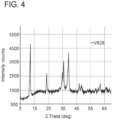
- Figure 4 shows the powder XRD pattern of the dried base CuZnAl catalyst, V628 (after oven drying and before calcination).
- the XRD pattern shows the presence of a mixed aurichalcite-like phase and a tenornite CuO phase.
- Figure 5 shows the XRD powder pattern of catalyst V649 at three distinctive states of ODS reaction: fresh (after calcination), spent, and regenerated.
- the XRD pattern of fresh V649 shows three crystalline phases, i.e., CuO, a highly-dispersed solid solution of spinel phase, and a minor molybdenum oxide phase.
- Figure 5 one also observes sharp diffraction peaks of a well crystallized phase metallic copper phase in the XRD pattern of the spent sample.
- the XRD pattern of the regenerated catalyst is similar to that of the fresh catalyst except that no crystalline MoO 3 phase was identified in the regenerated material. This may indicate that MoO 3 existing in the fresh oxide is redispersed during ODS reactivity testing and remains dispersed during regeneration.
- the catalytic compositions comprise oxides of copper, zinc, and aluminum in defined weight percent ranges, and a Group VIB metal oxide promoter.
- the compositions exhibit an X-ray amorphous oxides phase with crystalline oxides of Zn, Cu, and promoter. Even more preferably, a second promoter, i.e., an acidic oxide of Si, B, or P is added.
- compositions contain defined amounts of the metallic oxides.
- the weight percentages permitted by the invention are 5 to less than 20 weight percent zinc oxide, from 10 to 50 weight, percent copper oxide, and from 20 to 70 weight percent of aluminum oxide.
- the promoter is present in an amount up to 20 wt.%.
- the aforementioned structure has a lattice parameter corresponding to spinel, according to BRTEM data and the chemical formula Cu x Zn 1-x Al 2 O 4 , found from EDX analysis which is in accordance with the standard formula for spinels, i.e., "MAl 2 O 4 ,” where "M” signifies a metal, herein Zn or Cu, or combination of metals, herein Zn and Cu.
- X ranges from 0.1 to 0.6, more preferably, from 0.2 to 0.5.
- composition of the invention preferably are granular in nature, and may be formed into various embodiments such as a cylinder, a sphere, a trilobe, or a quatrolobe, preferably via processes discussed infra.
- the granules of the compositions preferably have diameters ranging from 1 mm to 4 mm.
- compositions preferably have specific surface areas ranging from 10 m 2 /g to 100 m 2 /g, more preferably 50 m 2 /g to 100 m 2 /g, with pores ranging from 8 nm to 12 nm, more preferably, 8 nm to 10 nm.
- the weight percentages are: 20-45 CuO, 10->20 ZnO, and 20-70 Al 2 O 3 , and most preferably 30-45 CuO, 12->20 ZnO, and 20-40 Al 2 O 3 .
- the catalytic compositions of the invention are made by preparing an aqueous solution of the nitrates of Cu, Zn, and Al, and then combining this solution with an aqueous alkaline solution which contains NaOH, and/or one or more of (NH 4 ) 2 CO 3 , Na 2 CO 3 and NH 4 HCO3.
- the precipitate may be aged prior to the filtering and washing, as elaborated in the examples.
- the binder may be, e.g., polyethylene oxide, polyvinyl alcohol, aluminum pseudoboehmite, silica gel, or mixtures thereof.
- the binder may be added in amounts ranging from about 1 wt.% to about 20 wt.% of the precipitate, preferably from 1 - 10 wt.% or in the case of hydroxides 3 - 20 wt.%.
- the resulting mixture may be extruded through, e.g., a forming die, and then dried, preferably at room temperature, for 24 hours, followed by drying at about 100°C for 2-4 hours.
- the extrusion product is then heated slowly, e.g., by increasing temperatures by 2-5°C every minute until a temperature of 500°C is reached, followed by calcinations at 500°C for 2-4 hours.
- compositions are used by combining them with a sulfur containing hydrocarbon, in gaseous form, together with an oxygen source, such as pure O 2 , for a time sufficient for at least a portion of the sulfur to be oxidized to, e.g., SO 2 .
- oxygen source is preferably pure oxygen, but may be air, or any other oxygen source.
- the materials recited supra are combined at conditions which include pressure of from 1-30 bars, temperature of from 300°C to 600°C, with a weight hourly space velocity of from 1-20 h -1 , gas hourly space velocity of from 1,000 - 20,000 h -1 , with an oxygen carbon molar ratio of from 0.01 to 0.1, and a molar ratio of oxygen and sulfur of from 1 to 150.
- the pressure ranges from 1-10 bars, most preferably 1-5 bars
- the temperature is preferably from 300 - 500°C.
- the gas hourly space velocity is preferably 5,000 - 15,000 h -1 , most preferably 5,000 to 10,000 h -1 , while the preferred molar ration of O 2 /C ranges from 0.02 - 0.1, and most preferably from 0.05 - 0.1, while that of O 2 /S is from 10 - 120, and most preferably, from 20 - 50. Additionally, it is preferred that oxidation take place with the exclusion of hydrogen gas,
- the feedstock e.g., the sulfur containing hydrocarbon
- the feedstock will vary, but preferably is one with a boiling point above 36°C, and even more preferably, above 565°C.
- the catalytic compositions are used in the form of, e.g., fixed beds, ebullated beds, moving beds, or fluidized beds.
Landscapes
- Chemical & Material Sciences (AREA)
- Engineering & Computer Science (AREA)
- Organic Chemistry (AREA)
- Chemical Kinetics & Catalysis (AREA)
- Materials Engineering (AREA)
- Oil, Petroleum & Natural Gas (AREA)
- General Chemical & Material Sciences (AREA)
- Analytical Chemistry (AREA)
- Environmental & Geological Engineering (AREA)
- Biomedical Technology (AREA)
- Health & Medical Sciences (AREA)
- Water Supply & Treatment (AREA)
- Inorganic Chemistry (AREA)
- Physics & Mathematics (AREA)
- Thermal Sciences (AREA)
- Catalysts (AREA)
- Nanotechnology (AREA)
- Production Of Liquid Hydrocarbon Mixture For Refining Petroleum (AREA)
- Enzymes And Modification Thereof (AREA)
Description
- This invention relates to Cu/Zn/Al catalysts which are promoted with at least one oxide of a Group VIB metal, such as Mo or W. The resulting catalysts are effective in gas phase, oxidative desulphurization of sulfur containing hydrocarbons, especially gaseous hydrocarbons. In preferred embodiments, the catalysts contain a second promoter, which is an acid forming oxide of B, Si, or P.
- Gas phase oxidation of sulfur containing hydrocarbons, to remove the sulfur, is a well known process. Examples of such processes are shown in, e.g.,
U.S. 20130199968 ,U.S. 20130028822 , andU.S. 20130026072 , all of which are incorporated by reference herein.U.S. 20130026072 , e.g., describes a process for making catalysts which are useful in oxidative desulphurization ('072" hereafter). - The '072 disclosure teaches that cerium can be promoted in CU/Zn/Al containing catalysts, which are useful in ODS processes. The catalysts are described as amorphous oxides, with a spinel phase and highly dispersed crystalline CuO and ZnO.
- The process described in '072, as noted infra serves as the basis for new catalysts. Indeed, notwithstanding the various catalysts and catalytic processes for ODS, due to issues with hydrocarbon feedstocks, the desired level of desulfurization is not achieved. Also, when molecular oxygen is used as oxidant, it is difficult to control oxidation of the fuel while converting the sulfur components in the fuel oils used. Hence, there is a continuous need for new catalysts useful in ODS.
- The invention relates to a method for gaseous oxidative desulfurization of a sulfur containing hydrocarbon feedstock using a catalyst which comprises from 10 to 50 wt.% CuO, from 5 to less than 20 wt.% ZnO, and from 20 to 70 wt.% Al2O3, which also contains one or more Group VIB metal oxides, and preferably an acid forming oxide as described supra, which anionically modifies the surface of the catalytic composition, generally by modifying Al2O3. The total amount of promoters can be present in an amount up to 20 wt.% of the catalyst.
- The catalysts, as will be elaborated upon, infra, are prepared by either impregnating a co-precipitated CuZnAl oxide base, or an impregnated CuZn/Al2O3 oxide base. One or more of Group VIB metal oxides can also be mixed with a wet, co-precipitated CuZnAl oxide base. The catalysts promoted with oxides of VIB metals and with acid forming oxides showed enhanced catalytic performance in ODS processes. When promoted with oxides of both Mo and B, e.g., the catalysts displayed higher total sulfur removal rates, significantly higher ODS selectivity, and excellent reactivity with refractory organosulfur compounds, such as 4, 6-DMDBT.
- The catalyst described supra is also part of the invention, as are processes for making the catalyst.
-
-
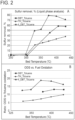
Figures 1a and 1b present data for various catalysts made in accordance with the invention, tested to show the role of temperature on total sulfur removal. -
Figures 2a and 2b show the amount of sulfur removed from a model fuel feed with different types of organosulfur compounds, using the catalysts of the invention. -
Figure 3 displays TPR profiles for various catalysts in accordance with the invention. -
Figure 4 depicts crystalline structures of a precursor of a catalyst of the invention. -
Figure 5 shows powder X-ray diffraction pattern for fresh, spent, and regenerated catalyst V628, described infra. - The process of the invention will be further described with reference to the disclosure which follows.
- A CuZnAl composition was prepared via the precipitation method. See, e.g., published
U.S. Patent Application 2013/0026072 , incorporated by reference, for information on the method. - To elaborate, 0.2 moles of Cu(NO3)2, 0.01 moles Zn(NO3)2 and 0.235 moles of Al(NO3)3 were dissolved in 500 ml of distilled water. This solution will be referred to as "solution A." The pH of solution A was 2.3. "Solution B" was made by dissolving 19.08g of Na2CO3 (0.18 moles) and 48 g ofNaOH (1.2 moles) together, in 600 ml of distilled water. The pH of solution B was 13.
- Solution A was heated to 65°C, and then Solution B was added thereto at a rate of about 5 ml/minute, with constant agitation, until all of Solution B was added. The resulting mixture had a pH of 11.
- A precipitate formed and the precipitation slurry was aged for 6 hours at precipitation conditions (65°C, pH 11), and was then cooled to room temperature and filtered with a Buchner funnel. The precipitate was repeatedly washed with distilled water and filtered until pH neutral.
- Analysis, using well known techniques, showed that 99% of the Cu, Zn, and Al had precipitated. The precipitate was dried at 110°C for 12 hours, calcined at 500°C for 4 hours, and ground to a fine powder.
- Two batches of base CuZnAl compositions, labeled as V628 and N543, were prepared. Properties of the compositions of the Example are set forth in Table 1, infra.
- The composition prepared in Example 1 was then treated to incorporate molybdenum oxide (MoO3), therein, via the well known incipient wetness method.
- The calcined, powdered composition of Example 1 was placed in a rotating impregnation drum, and a 0.2 mol/l solution of (NH4)6Mo7O24 was fed into the rotating drum. The volume of solution used was 10% more than the calculated water capacity of the CuZnAl composition. The impregnated sample was left in the rotating drum for 20-30 minutes to permit even distribution of the liquid in the powder. The sample was then dried at 110°C, for 12 hours, and calcined at 500°C, for 4 hours. A dark brown solid resulted, and was labeled as V636. Analysis of the calcined product revealed 34-37 wt.% of elemental Cu, 14-14.8 wt.% of elemental Zn, 12-13.5 wt.% of elemental Al, and 3.56 wt.% of elemental Mo. Note that by changing the concentration of (NH4)6Mo7O24, the amount of Mo can vary from 2 wt.% to 8 wt.%. It is to be noted that when reference is made to wt.% in these examples, it is by reference to the pure element, not the oxide.
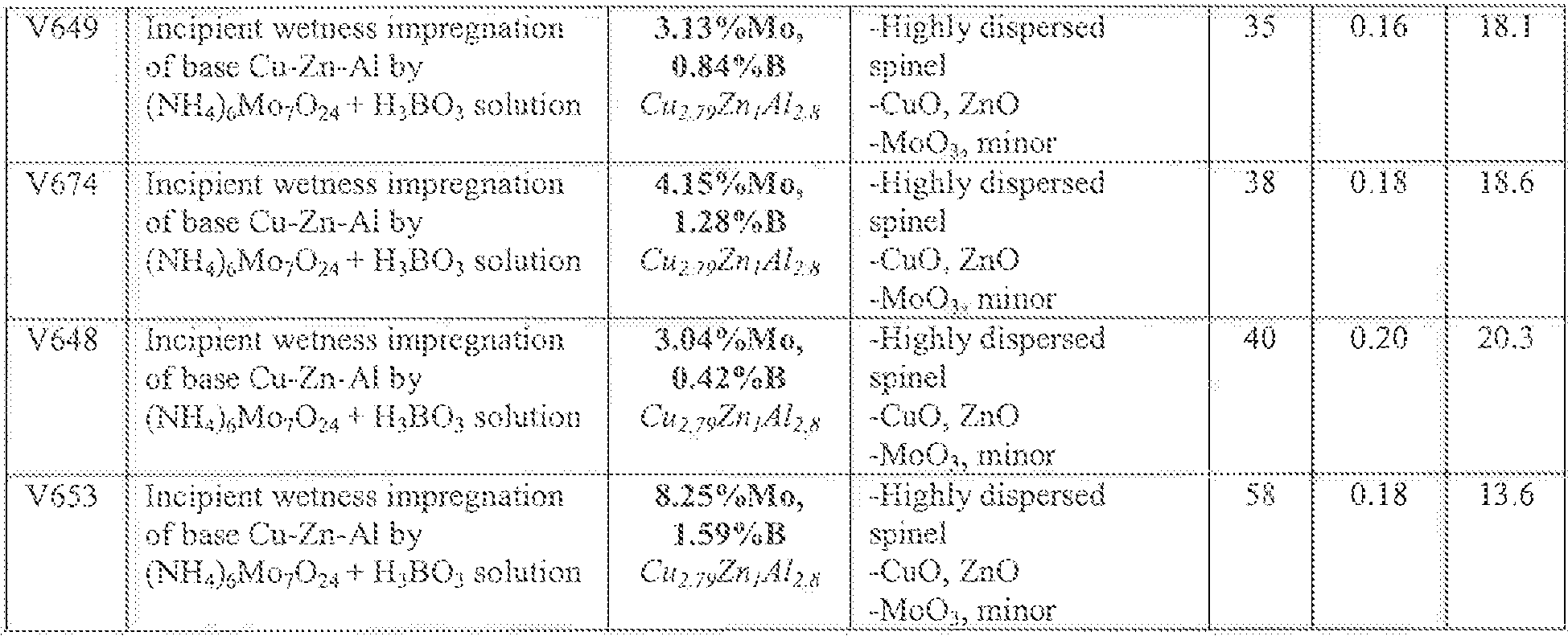
- The atomic ratio of Cu:Zn:Al was (2.5-3):1:(2.5-3). The post-calcination composition had a specific surface area of 35-85 m2/g, a pore volume average of 0.15-0.35 cm3/g, and an average pore diameter of 10-20 nm. It contained crystalline CuO, ZnO, and traces of MoO3, and an x-ray amorphous phase. "X ray amorphous phase," as used herein means that, when the product was observed via high resolution transmission electron microscopy ("HRTEM" hereafter), crystalline particles of from 2-10 nm, and more usually, 2-5 nm were observed. The lattice parameters (7.896Å), were very close to those of spinels.
- Properties of the composition of the Example are set forth in Table 1, infra.
- Catalytic compositions are granulated by any known method: extrusion, granulation or tabletting by pressing.
- This example parallels Example 2 except boron (B) was used instead of Mo. The (NH4)6Mo7O24 solution was replaced by a 0.5 mol/l H3BO3 solution.
- The resulting composition was identical to that of Example 1, except it contained 0.9 - 1 wt.% of B. By varying the concentration of H3BO3, the amount of B in the final composition, labeled as V637, can range from 0.3-1.5 wt.%.
- In this example, both MoO3 and B2O3 were added to the CuZnAl composition of Example 1.
- A solution containing (NH4)6Mo7O24 (0.22 mol/l) and H3BO3 (0.5 mol/l) was added to CuZnAl, again as in the prior examples. Drying, calcining, granulation and analysis also took place as per the prior examples.
- Four batches of MoO3 and B2O3 added compositions were prepared, and labeled as V649, V674, V648, and V653 respectively. All properties were as given in Example 1, supra.

- The catalytic compositions prepared in the examples, supra, were tested for their ability to oxidatively desulfurize a model fuel, dibenzothiophene in toluene. An oxygen:sulfur mole ratio of 120, a GHSV of 3,000hr-1, a WHSV of 6hr-1, and temperatures in the range of 250-430°C, were used.
- The results, presented in
Figure 1 show that the various additives functioned as promoters, enhancing sulfur conversion. Sulfur removal via conversion to SO2 as high as 70 wt.% was secured. Catalyst V653, which is modified by both Mo and B, and with a composition set forth in Table 1 showed superior oxidative desulfurization reactivity.Figures 2a and 2b show the impact of organosulfur type on oxidative desulfurization reactivity of catalyst V649, also described in Table 1, supra. - in the examples shown in
Figures 1 and2 , the temperature ranged from 325 - 450°C. - While not wishing to be bound to any particular theory, it is noted that the promoters habitually disperse into the catalyst system during ODS reactions. Further, the addition of these promoters changes the redox nature of the catalyst system, which appears to enhance the catalytic performance.
- This can be seen in
Figure 3 . Specifically, reduction profiles of CuZnAl catalysts with and without modifiers, referred to supra are shown. -
Figure 4 shows the powder XRD pattern of the dried base CuZnAl catalyst, V628 (after oven drying and before calcination). The XRD pattern shows the presence of a mixed aurichalcite-like phase and a tenornite CuO phase. -
Figure 5 shows the XRD powder pattern of catalyst V649 at three distinctive states of ODS reaction: fresh (after calcination), spent, and regenerated. The XRD pattern of fresh V649shows three crystalline phases, i.e., CuO, a highly-dispersed solid solution of spinel phase, and a minor molybdenum oxide phase. InFigure 5 , one also observes sharp diffraction peaks of a well crystallized phase metallic copper phase in the XRD pattern of the spent sample. To regenerate the catalyst, it was placed in a flow of H2 containing gas (10% H2), at 350°C for one hour, followed by purging at room temperature, followed by oxidation in an oxygen containing mixture at 350°C for one hour, at GHSV 500-3000 hr-1. The XRD pattern of the regenerated catalyst is similar to that of the fresh catalyst except that no crystalline MoO3 phase was identified in the regenerated material. This may indicate that MoO3 existing in the fresh oxide is redispersed during ODS reactivity testing and remains dispersed during regeneration. - The foregoing examples describe features of the invention which include a catalytic composition useful, e.g., in oxidative removal of sulfur from gaseous, sulfur containing hydrocarbons, as well as processes for making the compositions, and their use.
- The catalytic compositions comprise oxides of copper, zinc, and aluminum in defined weight percent ranges, and a Group VIB metal oxide promoter. The compositions exhibit an X-ray amorphous oxides phase with crystalline oxides of Zn, Cu, and promoter. Even more preferably, a second promoter, i.e., an acidic oxide of Si, B, or P is added.
- As noted, supra, the compositions contain defined amounts of the metallic oxides. The weight percentages permitted by the invention are 5 to less than 20 weight percent zinc oxide, from 10 to 50 weight, percent copper oxide, and from 20 to 70 weight percent of aluminum oxide. The promoter is present in an amount up to 20 wt.%.
- The aforementioned structure has a lattice parameter corresponding to spinel, according to BRTEM data and the chemical formula CuxZn1-xAl2O4, found from EDX analysis which is in accordance with the standard formula for spinels, i.e., "MAl2O4," where "M" signifies a metal, herein Zn or Cu, or combination of metals, herein Zn and Cu. Preferably, X ranges from 0.1 to 0.6, more preferably, from 0.2 to 0.5.
- The composition of the invention preferably are granular in nature, and may be formed into various embodiments such as a cylinder, a sphere, a trilobe, or a quatrolobe, preferably via processes discussed infra. The granules of the compositions preferably have diameters ranging from 1 mm to 4 mm.
- The compositions preferably have specific surface areas ranging from 10 m2/g to 100 m2/g, more preferably 50 m2/g to 100 m2/g, with pores ranging from 8 nm to 12 nm, more preferably, 8 nm to 10 nm. In preferred embodiments, the weight percentages are: 20-45 CuO, 10->20 ZnO, and 20-70 Al2O3, and most preferably 30-45 CuO, 12->20 ZnO, and 20-40 Al2O3.
- The catalytic compositions of the invention are made by preparing an aqueous solution of the nitrates of Cu, Zn, and Al, and then combining this solution with an aqueous alkaline solution which contains NaOH, and/or one or more of (NH4)2CO3, Na2CO3 and NH4HCO3.
- These solutions are combined at a temperature which may range from about 50°C to about 65°C, and at a pH of from about 6.5 to about 14. The resulting hydroxides, carbonates, and/or hydroxycarbonates precipitate and are then filtered, washed, and dried, for at least four hours, at a temperature of at least 100°C, and calcined at an elevated temperature of at least 400°C. Promoter is then added to the composition, preferably via incipient wetness. After this, the resulting dried material is calcined, for about 2-4 hours, at a temperature of at least 450°C, to form the composition described herein.
- The precipitate may be aged prior to the filtering and washing, as elaborated in the examples.
- It is frequently desirable to form composites of the catalytic composition, and this is preferably done by adding a binder to the compositions prior to calcination. The binder may be, e.g., polyethylene oxide, polyvinyl alcohol, aluminum pseudoboehmite, silica gel, or mixtures thereof. The binder may be added in amounts ranging from about 1 wt.% to about 20 wt.% of the precipitate, preferably from 1 - 10 wt.% or in the case of hydroxides 3 - 20 wt.%. The resulting mixture may be extruded through, e.g., a forming die, and then dried, preferably at room temperature, for 24 hours, followed by drying at about 100°C for 2-4 hours. The extrusion product is then heated slowly, e.g., by increasing temperatures by 2-5°C every minute until a temperature of 500°C is reached, followed by calcinations at 500°C for 2-4 hours.
- In practice, the compositions are used by combining them with a sulfur containing hydrocarbon, in gaseous form, together with an oxygen source, such as pure O2, for a time sufficient for at least a portion of the sulfur to be oxidized to, e.g., SO2. The oxygen source is preferably pure oxygen, but may be air, or any other oxygen source. Preferably, the materials recited supra are combined at conditions which include pressure of from 1-30 bars, temperature of from 300°C to 600°C, with a weight hourly space velocity of from 1-20 h-1, gas hourly space velocity of from 1,000 - 20,000 h-1, with an oxygen carbon molar ratio of from 0.01 to 0.1, and a molar ratio of oxygen and sulfur of from 1 to 150. Preferably, the pressure ranges from 1-10 bars, most preferably 1-5 bars, the temperature is preferably from 300 - 500°C. The gas hourly space velocity is preferably 5,000 - 15,000 h-1, most preferably 5,000 to 10,000 h-1, while the preferred molar ration of O2/C ranges from 0.02 - 0.1, and most preferably from 0.05 - 0.1, while that of O2/S is from 10 - 120, and most preferably, from 20 - 50. Additionally, it is preferred that oxidation take place with the exclusion of hydrogen gas,
- The feedstock, e.g., the sulfur containing hydrocarbon, will vary, but preferably is one with a boiling point above 36°C, and even more preferably, above 565°C.
- In practice, the catalytic compositions are used in the form of, e.g., fixed beds, ebullated beds, moving beds, or fluidized beds.
- Other features of the invention will be clear to the skilled artisan and need not be reiterated here.
- The terms and expression which have been employed are used as terms of description and not of limitation, and there is no intention in the use of such terms and expression of excluding any equivalents of the features shown and described or portions thereof, it being recognized that various modifications are possible within the scope of the invention.
Claims (24)
- A method for oxidizing sulfur in a sulfur containing hydrocarbon, comprising contacting a gaseous hydrocarbon to a catalytic composition in the presence of an oxygen containing gas, said catalytic composition comprising CuO in an amount ranging from 10 weight percent (wt.%) to 50 wt.%, ZnO in an amount ranging from 5 wt.% to less than 20 wt.%, Al2O3 in an amount ranging from 20 wt.% to 70 wt.%, and at least one first promoter selected from the group consisting of a Group VIB metal oxide, wherein said catalytic composition has an X-ray amorphous oxide phase with a formula CuxZn1-xAl2O4 wherein x ranges from 0 to 1, crystalline ZnO and CuO.
- The method of claim 1, wherein said promoter is Mo of W.
- The method of claim 1, wherein said catalytic composition comprises an acidic oxide of Si, B, or P as second promoter.
- The method of claim 1, wherein said hydrocarbon is a gaseous hydrocarbon.
- The method of claim 1, wherein said oxygen containing gas is pure oxygen.
- The method of claim 1, comprising oxidizing said hydrocarbon in the absence of hydrogen gas.
- The method of claim 1, comprising oxidizing said hydrocarbon at a temperature greater than 300°C.
- The method of claim 3, wherein said acidic oxide is B2O3.
- A catalyst composition useful in oxidative desulfurization of a sulfur containing hydrocarbon, comprising:
CuO in an amount ranging from 10 weight percent to 50 wt.%, ZnO in an amount ranging from 5 wt.% to less than 20 wt.%, Al2O3 in an amount ranging from 20 wt.% to 70 wt.%, and at least one Group VIB metal oxide promoter, in an amount up to 20 wt.% of said catalytic composition. - The catalytic composition of claim 9, further comprising Mo or W.
- The catalytic composition of claim 9, further comprising an acidic oxide of Si, B, or P.
- The catalytic composition of claim 9, further comprising B2O3.
- The catalytic composition of claim 9, in granular form wherein granules of said composition have a diameter of from 1 mm to 4 mm.
- The catalytic composition of claim 9, having a BET specific surface area of from 10 m2/g to 100 m2/g.
- The catalytic composition of claim 9, wherein pores of the granules of said composition have a diameter of from 8 nm to 12 nm.
- The catalytic composition of claim 9, wherein pores of the granules of said composition have a volume of from about 0.1 cm3/g to about 0.5 cm3/g.
- The catalytic composition of claim 9, comprising from 20 wt.% to 45 wt.% CuO, from 10 wt.% to less than 20 wt.% ZnO, and from 20 wt.% to 70 wt.% of Al2O3.
- The catalytic composition of claim 17, comprising from 30 wt.% to 45 wt.% CuO, from 12 wt.% to less than 20 wt.% ZnO, and from 20 wt.% to 40 wt.% Al2O3.
- The catalytic composition of claim 9, wherein X in CuxZn1-xAl2O4 is from 0.1 to 0.6.
- A process for making the catalytic composition of claim 9, comprising:(i) combining an aqueous solution containing each of copper nitrate, zinc nitrate, and aluminum nitrate with an alkaline solution containing NaOH and/or at least one of (NH4)2CO3, Na2CO3 and NH4HCO3, at a temperature of from 50°C to 65°C, and a pH of from 6.5 to 14, to form a precipitate containing at least one of (a) a carbonate containing Cu, Zn, and Al, (b) a hydroxide containing Cu, Zn, and Al, and (c) a hydroxycarbonate containing Cu, Zn, and Al;(ii) aging said precipitate;(iii) filtering and washing said precipitate;(iv) drying said precipitate for at least 10 hours, at a temperature of at least 100°C;(v) calcining the said dried precipitate for at least 4 hours at a temperature of at least 400°C;(vi) adding a solution containing at least one Group VIB oxide to said precipitate;(vii) impregnating said Group VIB oxide in said precipitate via incipient wetness, and(viii) calcinating said precipitate for from 2 to 4 hours, at a temperature of at least 450 - 500°C.
- The process of claim 20, wherein said aqueous solution further comprises cerium nitrate, and said carbonate, hydroxide, and hydrocarbonate contain Ce.
- The process of claim 20, wherein said precipitate comprises hydroxides, said process further comprising combining said precipitate with a binder selected from the group consisting of polyethylene oxide, polyvinyl alcohol, a sol of aluminum pseudoboehmite, silica gel, and mixtures thereof, said binder being added in an amount ranging from 3 to 20 weight percent of said precipitate, to form an extrudable mixture, extruding said mixture through a die to form an extrudate, drying said extrudate for 24 hours at room temperature, followed by drying at 100°C for from 2-4 hours, and raising temperature to 500°C, at a rate of from 2-5°C / minute, to calcine said extrudate for from 2-4 hours.
- The process of claim 20, comprising adding a solution containing a water soluble Mo(VI) or W(VI) compound to provide an MoOs or WO3 phase upon calcination.
- The process of claim 20, comprising adding a solution containing a water soluble compounds of at least one of Mo(VI) or B(III) to provide MoOs or B2O3 upon calcination.
Applications Claiming Priority (2)
| Application Number | Priority Date | Filing Date | Title |
|---|---|---|---|
| US14/987,141 US10882801B2 (en) | 2016-01-04 | 2016-01-04 | Methods for gas phase oxidative desulphurization of hydrocarbons using CuZnAl catalysts promoted with group VIB metal oxides |
| PCT/US2017/012017 WO2017120130A1 (en) | 2016-01-04 | 2017-01-03 | Methods for gas phase oxidative desulphurization of hydrocarbons using cuznal catalysts promoted with vib metal oxides |
Publications (2)
| Publication Number | Publication Date |
|---|---|
| EP3400101A1 EP3400101A1 (en) | 2018-11-14 |
| EP3400101B1 true EP3400101B1 (en) | 2023-04-05 |
Family
ID=58016782
Family Applications (1)
| Application Number | Title | Priority Date | Filing Date |
|---|---|---|---|
| EP17704558.0A Active EP3400101B1 (en) | 2016-01-04 | 2017-01-03 | Methods for gas phase oxidative desulphurization of hydrocarbons using cuznal catalysts promoted with vib metal oxides |
Country Status (7)
| Country | Link |
|---|---|
| US (2) | US10882801B2 (en) |
| EP (1) | EP3400101B1 (en) |
| JP (1) | JP6843143B2 (en) |
| KR (1) | KR102092284B1 (en) |
| CN (1) | CN108430623B (en) |
| SG (1) | SG11201804364SA (en) |
| WO (1) | WO2017120130A1 (en) |
Families Citing this family (7)
| Publication number | Priority date | Publication date | Assignee | Title |
|---|---|---|---|---|
| US10384197B2 (en) | 2016-07-26 | 2019-08-20 | Saudi Arabian Oil Company | Additives for gas phase oxidative desulfurization catalysts |
| US11174441B2 (en) | 2018-10-22 | 2021-11-16 | Saudi Arabian Oil Company | Demetallization by delayed coking and gas phase oxidative desulfurization of demetallized residual oil |
| US10703998B2 (en) | 2018-10-22 | 2020-07-07 | Saudi Arabian Oil Company | Catalytic demetallization and gas phase oxidative desulfurization of residual oil |
| US10894923B2 (en) | 2018-10-22 | 2021-01-19 | Saudi Arabian Oil Company | Integrated process for solvent deasphalting and gas phase oxidative desulfurization of residual oil |
| CN112742203B (en) * | 2019-10-30 | 2023-09-05 | 中国石油化工股份有限公司 | Gas desulfurizing agent, preparation method thereof and gas desulfurizing method |
| US11278871B2 (en) * | 2020-03-13 | 2022-03-22 | Toyota Motor Engineering & Manufacturing North America, Inc. | Direct no decomposition catalyst |
| CN121222434B (en) * | 2025-12-02 | 2026-04-03 | 湖北荟煌科技股份有限公司 | A method for preparing a desulfurization purification catalyst |
Family Cites Families (19)
| Publication number | Priority date | Publication date | Assignee | Title |
|---|---|---|---|---|
| IN147123B (en) * | 1976-10-19 | 1979-11-17 | Standard Oil Co Ohio | |
| US4085065A (en) * | 1976-10-19 | 1978-04-18 | The Standard Oil Company (Ohio) | Process for the preparation of unsaturated acids from unsaturated aldehydes |
| CN1037778C (en) * | 1992-11-28 | 1998-03-18 | 大阪瓦斯株式会社 | Method for desulfurization of hydrocarbon |
| DE4419486C2 (en) * | 1994-06-03 | 1996-09-05 | Daimler Benz Ag | Catalyst, process for its preparation and use of the catalyst |
| US7427581B2 (en) * | 1999-12-14 | 2008-09-23 | China Petroleum & Chemical Corporation | Desulfurization process and novel bimetallic sorbent systems for same |
| US6693057B1 (en) * | 2002-03-22 | 2004-02-17 | Sud-Chemie Inc. | Water gas shift catalyst |
| AU2003293874A1 (en) * | 2002-12-19 | 2004-07-14 | Basf Aktiengesellschaft | Method for removing sulfur compounds from gases containing hydrocarbons |
| US7749376B2 (en) * | 2005-08-15 | 2010-07-06 | Sud-Chemie Inc. | Process for sulfur adsorption using copper-containing catalyst |
| CN104136116B (en) * | 2011-07-27 | 2017-02-08 | 沙特阿拉伯石油公司 | For from gaseous hydrocarbon remove sulphur compound catalyst composition, manufacture their method and uses thereof |
| US20130026072A1 (en) | 2011-07-27 | 2013-01-31 | Abdennour Bourane | Catalytic compositions useful in removal of sulfur compounds from gaseous hydrocarbons, processes for making these and uses thereof |
| CN103028365B (en) * | 2011-09-29 | 2014-12-31 | 中国石油化工股份有限公司 | Gas desulfurization sorbent and preparation method thereof and desulfurization method of sulfur-containing gas |
| FR2984760B1 (en) * | 2011-12-22 | 2014-01-17 | IFP Energies Nouvelles | HYDROCONVERSION USING CATALYST COMPRISING AT LEAST ONE ZEOLITHE AND METALS OF GROUP VIII AND VIB AND PREPARATION OF CATALYST |
| US8906227B2 (en) * | 2012-02-02 | 2014-12-09 | Suadi Arabian Oil Company | Mild hydrodesulfurization integrating gas phase catalytic oxidation to produce fuels having an ultra-low level of organosulfur compounds |
| US9043572B2 (en) * | 2012-07-16 | 2015-05-26 | International Business Machines Corporation | Automatically preventing large block writes from starving small block writes in a storage device |
| KR101409293B1 (en) * | 2012-11-09 | 2014-06-27 | 한국과학기술연구원 | Cu/Zn/Al catalyst comprising copper nano particles of high surface area and method for preparing the same |
| US8920635B2 (en) * | 2013-01-14 | 2014-12-30 | Saudi Arabian Oil Company | Targeted desulfurization process and apparatus integrating gas phase oxidative desulfurization and hydrodesulfurization to produce diesel fuel having an ultra-low level of organosulfur compounds |
| WO2014191874A1 (en) * | 2013-05-28 | 2014-12-04 | Saudi Basic Industries Corporation | Promoted molybdenum catalyst composition for production of aromatics from methane |
| CN104437518B (en) * | 2013-09-22 | 2017-03-29 | 中国石油化工股份有限公司 | A kind of catalyst for selectively hydrodesulfurizing and its preparation and application |
| CN104560250B (en) * | 2013-10-28 | 2018-06-08 | 中国石油化工股份有限公司 | Cleanser and preparation method thereof |
-
2016
- 2016-01-04 US US14/987,141 patent/US10882801B2/en active Active
-
2017
- 2017-01-03 WO PCT/US2017/012017 patent/WO2017120130A1/en not_active Ceased
- 2017-01-03 SG SG11201804364SA patent/SG11201804364SA/en unknown
- 2017-01-03 JP JP2018534151A patent/JP6843143B2/en not_active Expired - Fee Related
- 2017-01-03 KR KR1020187021408A patent/KR102092284B1/en not_active Expired - Fee Related
- 2017-01-03 CN CN201780005042.6A patent/CN108430623B/en not_active Expired - Fee Related
- 2017-01-03 EP EP17704558.0A patent/EP3400101B1/en active Active
-
2021
- 2021-01-04 US US17/140,667 patent/US11603341B2/en active Active
Also Published As
| Publication number | Publication date |
|---|---|
| KR20180100149A (en) | 2018-09-07 |
| JP2019505633A (en) | 2019-02-28 |
| WO2017120130A1 (en) | 2017-07-13 |
| US20170190641A1 (en) | 2017-07-06 |
| US20210230084A1 (en) | 2021-07-29 |
| CN108430623A (en) | 2018-08-21 |
| EP3400101A1 (en) | 2018-11-14 |
| US11603341B2 (en) | 2023-03-14 |
| CN108430623B (en) | 2021-11-05 |
| US10882801B2 (en) | 2021-01-05 |
| SG11201804364SA (en) | 2018-07-30 |
| KR102092284B1 (en) | 2020-03-24 |
| JP6843143B2 (en) | 2021-03-17 |
Similar Documents
| Publication | Publication Date | Title |
|---|---|---|
| US11603341B2 (en) | Methods for gas phase oxidative desulphurization of hydrocarbons using CuZnAl catalysts promoted with group VIB metals | |
| JP5258910B2 (en) | Preparation of desulfurization substances | |
| JP5246980B2 (en) | Mixed metal catalyst composition, process for its production and use | |
| US6534437B2 (en) | Process for preparing a mixed metal catalyst composition | |
| KR101373988B1 (en) | A bulk catalyst comprising nickel tungsten metal oxidic particles | |
| JP5160705B2 (en) | Novel mixed metal catalyst, its preparation by coprecipitation and its use | |
| JP5022570B2 (en) | Hydrotreatment and hydroconversion process for petroleum fractions containing doped spherical supported catalysts and metals | |
| JP2003340281A (en) | Process for hydrorefining and / or hydroconversion of hydrocarbon feed using catalyst | |
| ITMI20110510A1 (en) | TRANSITIONAL METAL MIXED OXIDES, TREATMENT CATALYSTS OBTAINED BY THEM, AND PREPARATION PROCESS | |
| RU2279313C2 (en) | Mixed metallic catalyst containing combustible binder | |
| CA3029930C (en) | Hydrotreatment catalysts and process for preparing said catalysts | |
| KR101353807B1 (en) | A bulk catalyst comprising metal oxidic particles of group vi and viii and a process for the manufacture therof | |
| NL8403724A (en) | METHOD FOR THE HYDROGEN TREATMENT OF HYDROCARBONS. | |
| TWI432261B (en) | A bulk catalyst comprising nickel tungsten metal oxidic particles |
Legal Events
| Date | Code | Title | Description |
|---|---|---|---|
| STAA | Information on the status of an ep patent application or granted ep patent |
Free format text: STATUS: UNKNOWN |
|
| STAA | Information on the status of an ep patent application or granted ep patent |
Free format text: STATUS: THE INTERNATIONAL PUBLICATION HAS BEEN MADE |
|
| PUAI | Public reference made under article 153(3) epc to a published international application that has entered the european phase |
Free format text: ORIGINAL CODE: 0009012 |
|
| STAA | Information on the status of an ep patent application or granted ep patent |
Free format text: STATUS: REQUEST FOR EXAMINATION WAS MADE |
|
| 17P | Request for examination filed |
Effective date: 20180803 |
|
| AK | Designated contracting states |
Kind code of ref document: A1 Designated state(s): AL AT BE BG CH CY CZ DE DK EE ES FI FR GB GR HR HU IE IS IT LI LT LU LV MC MK MT NL NO PL PT RO RS SE SI SK SM TR |
|
| AX | Request for extension of the european patent |
Extension state: BA ME |
|
| DAV | Request for validation of the european patent (deleted) | ||
| DAX | Request for extension of the european patent (deleted) | ||
| GRAP | Despatch of communication of intention to grant a patent |
Free format text: ORIGINAL CODE: EPIDOSNIGR1 |
|
| STAA | Information on the status of an ep patent application or granted ep patent |
Free format text: STATUS: GRANT OF PATENT IS INTENDED |
|
| INTG | Intention to grant announced |
Effective date: 20221020 |
|
| GRAS | Grant fee paid |
Free format text: ORIGINAL CODE: EPIDOSNIGR3 |
|
| GRAA | (expected) grant |
Free format text: ORIGINAL CODE: 0009210 |
|
| STAA | Information on the status of an ep patent application or granted ep patent |
Free format text: STATUS: THE PATENT HAS BEEN GRANTED |
|
| RAP3 | Party data changed (applicant data changed or rights of an application transferred) |
Owner name: BORESKOV INSTITUTE OF CATALYSIS Owner name: SAUDI ARABIAN OIL COMPANY |
|
| AK | Designated contracting states |
Kind code of ref document: B1 Designated state(s): AL AT BE BG CH CY CZ DE DK EE ES FI FR GB GR HR HU IE IS IT LI LT LU LV MC MK MT NL NO PL PT RO RS SE SI SK SM TR |
|
| REG | Reference to a national code |
Ref country code: GB Ref legal event code: FG4D |
|
| REG | Reference to a national code |
Ref country code: DE Ref legal event code: R096 Ref document number: 602017067403 Country of ref document: DE |
|
| REG | Reference to a national code |
Ref country code: CH Ref legal event code: EP |
|
| REG | Reference to a national code |
Ref country code: AT Ref legal event code: REF Ref document number: 1557833 Country of ref document: AT Kind code of ref document: T Effective date: 20230415 |
|
| REG | Reference to a national code |
Ref country code: IE Ref legal event code: FG4D |
|
| REG | Reference to a national code |
Ref country code: NL Ref legal event code: FP |
|
| P01 | Opt-out of the competence of the unified patent court (upc) registered |
Effective date: 20230529 |
|
| REG | Reference to a national code |
Ref country code: LT Ref legal event code: MG9D |
|
| REG | Reference to a national code |
Ref country code: AT Ref legal event code: MK05 Ref document number: 1557833 Country of ref document: AT Kind code of ref document: T Effective date: 20230405 |
|
| PG25 | Lapsed in a contracting state [announced via postgrant information from national office to epo] |
Ref country code: SE Free format text: LAPSE BECAUSE OF FAILURE TO SUBMIT A TRANSLATION OF THE DESCRIPTION OR TO PAY THE FEE WITHIN THE PRESCRIBED TIME-LIMIT Effective date: 20230405 Ref country code: PT Free format text: LAPSE BECAUSE OF FAILURE TO SUBMIT A TRANSLATION OF THE DESCRIPTION OR TO PAY THE FEE WITHIN THE PRESCRIBED TIME-LIMIT Effective date: 20230807 Ref country code: NO Free format text: LAPSE BECAUSE OF FAILURE TO SUBMIT A TRANSLATION OF THE DESCRIPTION OR TO PAY THE FEE WITHIN THE PRESCRIBED TIME-LIMIT Effective date: 20230705 Ref country code: ES Free format text: LAPSE BECAUSE OF FAILURE TO SUBMIT A TRANSLATION OF THE DESCRIPTION OR TO PAY THE FEE WITHIN THE PRESCRIBED TIME-LIMIT Effective date: 20230405 Ref country code: AT Free format text: LAPSE BECAUSE OF FAILURE TO SUBMIT A TRANSLATION OF THE DESCRIPTION OR TO PAY THE FEE WITHIN THE PRESCRIBED TIME-LIMIT Effective date: 20230405 |
|
| PG25 | Lapsed in a contracting state [announced via postgrant information from national office to epo] |
Ref country code: RS Free format text: LAPSE BECAUSE OF FAILURE TO SUBMIT A TRANSLATION OF THE DESCRIPTION OR TO PAY THE FEE WITHIN THE PRESCRIBED TIME-LIMIT Effective date: 20230405 Ref country code: PL Free format text: LAPSE BECAUSE OF FAILURE TO SUBMIT A TRANSLATION OF THE DESCRIPTION OR TO PAY THE FEE WITHIN THE PRESCRIBED TIME-LIMIT Effective date: 20230405 Ref country code: LV Free format text: LAPSE BECAUSE OF FAILURE TO SUBMIT A TRANSLATION OF THE DESCRIPTION OR TO PAY THE FEE WITHIN THE PRESCRIBED TIME-LIMIT Effective date: 20230405 Ref country code: LT Free format text: LAPSE BECAUSE OF FAILURE TO SUBMIT A TRANSLATION OF THE DESCRIPTION OR TO PAY THE FEE WITHIN THE PRESCRIBED TIME-LIMIT Effective date: 20230405 Ref country code: IS Free format text: LAPSE BECAUSE OF FAILURE TO SUBMIT A TRANSLATION OF THE DESCRIPTION OR TO PAY THE FEE WITHIN THE PRESCRIBED TIME-LIMIT Effective date: 20230805 Ref country code: HR Free format text: LAPSE BECAUSE OF FAILURE TO SUBMIT A TRANSLATION OF THE DESCRIPTION OR TO PAY THE FEE WITHIN THE PRESCRIBED TIME-LIMIT Effective date: 20230405 Ref country code: GR Free format text: LAPSE BECAUSE OF FAILURE TO SUBMIT A TRANSLATION OF THE DESCRIPTION OR TO PAY THE FEE WITHIN THE PRESCRIBED TIME-LIMIT Effective date: 20230706 |
|
| PG25 | Lapsed in a contracting state [announced via postgrant information from national office to epo] |
Ref country code: FI Free format text: LAPSE BECAUSE OF FAILURE TO SUBMIT A TRANSLATION OF THE DESCRIPTION OR TO PAY THE FEE WITHIN THE PRESCRIBED TIME-LIMIT Effective date: 20230405 |
|
| REG | Reference to a national code |
Ref country code: DE Ref legal event code: R097 Ref document number: 602017067403 Country of ref document: DE |
|
| PG25 | Lapsed in a contracting state [announced via postgrant information from national office to epo] |
Ref country code: SK Free format text: LAPSE BECAUSE OF FAILURE TO SUBMIT A TRANSLATION OF THE DESCRIPTION OR TO PAY THE FEE WITHIN THE PRESCRIBED TIME-LIMIT Effective date: 20230405 |
|
| PG25 | Lapsed in a contracting state [announced via postgrant information from national office to epo] |
Ref country code: SM Free format text: LAPSE BECAUSE OF FAILURE TO SUBMIT A TRANSLATION OF THE DESCRIPTION OR TO PAY THE FEE WITHIN THE PRESCRIBED TIME-LIMIT Effective date: 20230405 Ref country code: SK Free format text: LAPSE BECAUSE OF FAILURE TO SUBMIT A TRANSLATION OF THE DESCRIPTION OR TO PAY THE FEE WITHIN THE PRESCRIBED TIME-LIMIT Effective date: 20230405 Ref country code: RO Free format text: LAPSE BECAUSE OF FAILURE TO SUBMIT A TRANSLATION OF THE DESCRIPTION OR TO PAY THE FEE WITHIN THE PRESCRIBED TIME-LIMIT Effective date: 20230405 Ref country code: EE Free format text: LAPSE BECAUSE OF FAILURE TO SUBMIT A TRANSLATION OF THE DESCRIPTION OR TO PAY THE FEE WITHIN THE PRESCRIBED TIME-LIMIT Effective date: 20230405 Ref country code: DK Free format text: LAPSE BECAUSE OF FAILURE TO SUBMIT A TRANSLATION OF THE DESCRIPTION OR TO PAY THE FEE WITHIN THE PRESCRIBED TIME-LIMIT Effective date: 20230405 Ref country code: CZ Free format text: LAPSE BECAUSE OF FAILURE TO SUBMIT A TRANSLATION OF THE DESCRIPTION OR TO PAY THE FEE WITHIN THE PRESCRIBED TIME-LIMIT Effective date: 20230405 |
|
| PLBE | No opposition filed within time limit |
Free format text: ORIGINAL CODE: 0009261 |
|
| STAA | Information on the status of an ep patent application or granted ep patent |
Free format text: STATUS: NO OPPOSITION FILED WITHIN TIME LIMIT |
|
| 26N | No opposition filed |
Effective date: 20240108 |
|
| PG25 | Lapsed in a contracting state [announced via postgrant information from national office to epo] |
Ref country code: SI Free format text: LAPSE BECAUSE OF FAILURE TO SUBMIT A TRANSLATION OF THE DESCRIPTION OR TO PAY THE FEE WITHIN THE PRESCRIBED TIME-LIMIT Effective date: 20230405 |
|
| PG25 | Lapsed in a contracting state [announced via postgrant information from national office to epo] |
Ref country code: SI Free format text: LAPSE BECAUSE OF FAILURE TO SUBMIT A TRANSLATION OF THE DESCRIPTION OR TO PAY THE FEE WITHIN THE PRESCRIBED TIME-LIMIT Effective date: 20230405 Ref country code: IT Free format text: LAPSE BECAUSE OF FAILURE TO SUBMIT A TRANSLATION OF THE DESCRIPTION OR TO PAY THE FEE WITHIN THE PRESCRIBED TIME-LIMIT Effective date: 20230405 |
|
| REG | Reference to a national code |
Ref country code: DE Ref legal event code: R119 Ref document number: 602017067403 Country of ref document: DE |
|
| PG25 | Lapsed in a contracting state [announced via postgrant information from national office to epo] |
Ref country code: MC Free format text: LAPSE BECAUSE OF FAILURE TO SUBMIT A TRANSLATION OF THE DESCRIPTION OR TO PAY THE FEE WITHIN THE PRESCRIBED TIME-LIMIT Effective date: 20230405 |
|
| PG25 | Lapsed in a contracting state [announced via postgrant information from national office to epo] |
Ref country code: MC Free format text: LAPSE BECAUSE OF FAILURE TO SUBMIT A TRANSLATION OF THE DESCRIPTION OR TO PAY THE FEE WITHIN THE PRESCRIBED TIME-LIMIT Effective date: 20230405 |
|
| REG | Reference to a national code |
Ref country code: CH Ref legal event code: PL |
|
| REG | Reference to a national code |
Ref country code: NL Ref legal event code: MM Effective date: 20240201 |
|
| PG25 | Lapsed in a contracting state [announced via postgrant information from national office to epo] |
Ref country code: LU Free format text: LAPSE BECAUSE OF NON-PAYMENT OF DUE FEES Effective date: 20240103 |
|
| GBPC | Gb: european patent ceased through non-payment of renewal fee |
Effective date: 20240103 |
|
| PG25 | Lapsed in a contracting state [announced via postgrant information from national office to epo] |
Ref country code: LU Free format text: LAPSE BECAUSE OF NON-PAYMENT OF DUE FEES Effective date: 20240103 |
|
| PG25 | Lapsed in a contracting state [announced via postgrant information from national office to epo] |
Ref country code: DE Free format text: LAPSE BECAUSE OF NON-PAYMENT OF DUE FEES Effective date: 20240801 |
|
| PG25 | Lapsed in a contracting state [announced via postgrant information from national office to epo] |
Ref country code: GB Free format text: LAPSE BECAUSE OF NON-PAYMENT OF DUE FEES Effective date: 20240103 |
|
| PG25 | Lapsed in a contracting state [announced via postgrant information from national office to epo] |
Ref country code: BE Free format text: LAPSE BECAUSE OF NON-PAYMENT OF DUE FEES Effective date: 20240131 |
|
| PG25 | Lapsed in a contracting state [announced via postgrant information from national office to epo] |
Ref country code: FR Free format text: LAPSE BECAUSE OF NON-PAYMENT OF DUE FEES Effective date: 20240131 |
|
| PG25 | Lapsed in a contracting state [announced via postgrant information from national office to epo] |
Ref country code: NL Free format text: LAPSE BECAUSE OF NON-PAYMENT OF DUE FEES Effective date: 20240201 |
|
| PG25 | Lapsed in a contracting state [announced via postgrant information from national office to epo] |
Ref country code: CH Free format text: LAPSE BECAUSE OF NON-PAYMENT OF DUE FEES Effective date: 20240131 |
|
| PG25 | Lapsed in a contracting state [announced via postgrant information from national office to epo] |
Ref country code: NL Free format text: LAPSE BECAUSE OF NON-PAYMENT OF DUE FEES Effective date: 20240201 Ref country code: GB Free format text: LAPSE BECAUSE OF NON-PAYMENT OF DUE FEES Effective date: 20240103 Ref country code: FR Free format text: LAPSE BECAUSE OF NON-PAYMENT OF DUE FEES Effective date: 20240131 Ref country code: DE Free format text: LAPSE BECAUSE OF NON-PAYMENT OF DUE FEES Effective date: 20240801 Ref country code: CH Free format text: LAPSE BECAUSE OF NON-PAYMENT OF DUE FEES Effective date: 20240131 Ref country code: BE Free format text: LAPSE BECAUSE OF NON-PAYMENT OF DUE FEES Effective date: 20240131 |
|
| REG | Reference to a national code |
Ref country code: BE Ref legal event code: MM Effective date: 20240131 |
|
| PG25 | Lapsed in a contracting state [announced via postgrant information from national office to epo] |
Ref country code: BG Free format text: LAPSE BECAUSE OF FAILURE TO SUBMIT A TRANSLATION OF THE DESCRIPTION OR TO PAY THE FEE WITHIN THE PRESCRIBED TIME-LIMIT Effective date: 20230405 |
|
| PG25 | Lapsed in a contracting state [announced via postgrant information from national office to epo] |
Ref country code: BG Free format text: LAPSE BECAUSE OF FAILURE TO SUBMIT A TRANSLATION OF THE DESCRIPTION OR TO PAY THE FEE WITHIN THE PRESCRIBED TIME-LIMIT Effective date: 20230405 |
|
| PG25 | Lapsed in a contracting state [announced via postgrant information from national office to epo] |
Ref country code: IE Free format text: LAPSE BECAUSE OF NON-PAYMENT OF DUE FEES Effective date: 20240103 |
|
| PG25 | Lapsed in a contracting state [announced via postgrant information from national office to epo] |
Ref country code: IE Free format text: LAPSE BECAUSE OF NON-PAYMENT OF DUE FEES Effective date: 20240103 |
|
| PG25 | Lapsed in a contracting state [announced via postgrant information from national office to epo] |
Ref country code: CY Free format text: LAPSE BECAUSE OF FAILURE TO SUBMIT A TRANSLATION OF THE DESCRIPTION OR TO PAY THE FEE WITHIN THE PRESCRIBED TIME-LIMIT; INVALID AB INITIO Effective date: 20170103 |
|
| PG25 | Lapsed in a contracting state [announced via postgrant information from national office to epo] |
Ref country code: HU Free format text: LAPSE BECAUSE OF FAILURE TO SUBMIT A TRANSLATION OF THE DESCRIPTION OR TO PAY THE FEE WITHIN THE PRESCRIBED TIME-LIMIT; INVALID AB INITIO Effective date: 20170103 |
|
| PG25 | Lapsed in a contracting state [announced via postgrant information from national office to epo] |
Ref country code: TR Free format text: LAPSE BECAUSE OF FAILURE TO SUBMIT A TRANSLATION OF THE DESCRIPTION OR TO PAY THE FEE WITHIN THE PRESCRIBED TIME-LIMIT Effective date: 20230405 |