EP3399717A1 - Media presentation description delta file for http streaming - Google Patents
Media presentation description delta file for http streaming Download PDFInfo
- Publication number
- EP3399717A1 EP3399717A1 EP18166396.4A EP18166396A EP3399717A1 EP 3399717 A1 EP3399717 A1 EP 3399717A1 EP 18166396 A EP18166396 A EP 18166396A EP 3399717 A1 EP3399717 A1 EP 3399717A1
- Authority
- EP
- European Patent Office
- Prior art keywords
- mpd
- client
- delta file
- delta
- server
- Prior art date
- Legal status (The legal status is an assumption and is not a legal conclusion. Google has not performed a legal analysis and makes no representation as to the accuracy of the status listed.)
- Granted
Links
Images



Classifications
-
- H—ELECTRICITY
- H04—ELECTRIC COMMUNICATION TECHNIQUE
- H04L—TRANSMISSION OF DIGITAL INFORMATION, e.g. TELEGRAPHIC COMMUNICATION
- H04L67/00—Network arrangements or protocols for supporting network services or applications
- H04L67/34—Network arrangements or protocols for supporting network services or applications involving the movement of software or configuration parameters
-
- H—ELECTRICITY
- H04—ELECTRIC COMMUNICATION TECHNIQUE
- H04L—TRANSMISSION OF DIGITAL INFORMATION, e.g. TELEGRAPHIC COMMUNICATION
- H04L65/00—Network arrangements, protocols or services for supporting real-time applications in data packet communication
- H04L65/1066—Session management
- H04L65/1083—In-session procedures
-
- H—ELECTRICITY
- H04—ELECTRIC COMMUNICATION TECHNIQUE
- H04L—TRANSMISSION OF DIGITAL INFORMATION, e.g. TELEGRAPHIC COMMUNICATION
- H04L65/00—Network arrangements, protocols or services for supporting real-time applications in data packet communication
- H04L65/60—Network streaming of media packets
-
- H—ELECTRICITY
- H04—ELECTRIC COMMUNICATION TECHNIQUE
- H04L—TRANSMISSION OF DIGITAL INFORMATION, e.g. TELEGRAPHIC COMMUNICATION
- H04L67/00—Network arrangements or protocols for supporting network services or applications
- H04L67/01—Protocols
- H04L67/02—Protocols based on web technology, e.g. hypertext transfer protocol [HTTP]
Definitions
- HTTP Streaming The 3 rd Generation Partnership Project (3GPP) has developed a feature known as HTTP Streaming, whereby mobile telephones, personal digital assistants, handheld or laptop computers, desktop computers, set-top boxes, network appliances, and similar devices can receive streaming media content via the hypertext transfer protocol (HTTP).
- HTTP hypertext transfer protocol
- Any device that can receive HTTP Streaming data will be referred to herein as a client.
- Content that might be provided to such client devices via HTTP can include streaming video, streaming audio, and other multimedia content.
- the content is prepared and then stored on a standard web server for later streaming via HTTP.
- live or nearly live streaming might be used, whereby content is placed on a web server at or near the time the content is created. In either case, clients can use standard web browsing technology to receive the streamed content at any desired time.
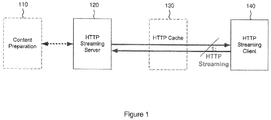
- Figure 1 illustrates a typical system architecture for adaptive HTTP streaming.
- a content preparation phase 110 a media presentation is prepared for HTTP streaming.
- the content is then stored on an HTTP streaming server 120 and/or possibly in an HTTP cache 130.
- An HTTP streaming client 140 might use an HTTP GET request or a similar message to download the media presentation from the server 120 or the cache 130.
- the media presentation might be described in an extensible markup language (XML) document, which in the 3GPP specifications is called a Media Presentation Description (MPD).
- the MPD contains metadata informing the client of the formats in which the media content is encoded, such as the bitrates, codecs, screen resolutions, and languages.
- Each different combination of such parameters can be referred to as a representation of the content, and multiple different representations may describe the same content. This allows the client to choose a particular representation based possibly on its screen resolution, the current channel bandwidth, the current channel reception conditions, the language preference of the user, and other parameters.
- an MPD describing an entire presentation might be provided to the client, and the client might use the metadata in the MPD throughout the presentation.
- the parameters related to a streaming session may change during the course of the session. For example, the client may move into an area with poor reception, and the data rate may slow down. In such a case, the client may need to switch to a representation with a lower bit rate.
- the client device may choose to switch the display of the streamed content from portrait to landscape mode, in which case a different representation may be required.
- a media presentation may be broken down into segments, and a portion of the MPD may describe each segment. That is, with HTTP Streaming, the media may be downloaded one segment at a time so that play-out of live content does not fall too far behind live encoding and so that the client can switch to a different content encoding adaptively according to channel conditions or other factors, as described above.
- the segments are addressable with the information in the "Url" XML element in the MPD.
- the "Url” element contains the URL of the segment and may be restricted by a "range” attribute that could be used with the Ranges header of an HTTP GET request.
- a new segment of content may be added at regular intervals, such as every ten seconds, and corresponding new information may be added to the MPD as each new segment of content is added. Therefore, the size of the MPD may grow as the streaming of the content progresses.
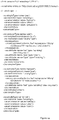
- ExampleMPD.xml An example MPD is illustrated in Figure 2 and can be referred to as "exampleMPD.xml".
- Multiple portions 210 of the example MPD each describe a segment of the media presentation. In the interest of saving space in the figure, only two such portions 210 are shown, but in an actual MPD a large number of such portions may be present.
- the file size of exampleMPD.xml is 52 kilobytes.
- the MPD on the server is updated every time a new segment is added, which for the example is every ten seconds.
- One possible solution to this large bandwidth consumption could be to compress the MPD with a compression application.
- the client typically downloads the MPD every ten seconds or so in order to find out the location of the latest segment encoded, and the MPD grows with each new segment that is added to the streamed content. Compression of the MPD does not adequately resolve the problem of a growing MPD. Further, the resource cost of compressing and uncompressing the MPD for every segment may be significant.
- the client downloads only the information that has actually changed since the last download of MPD information.
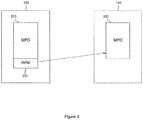
- the server 120 includes an MPD 310 that describes a media presentation available from the server 120.
- the client 140 also includes an MPD 320, and the client's MPD 320 should be synchronized with the server's MPD 310 so that the client 140 has up-to-date information about the media presentation.
- a delta file 330 is created (perhaps by the content provider) that includes the information that has changed since the last update of the MPD.
- the client 140 can download the delta file 330 whenever a new segment is added to the presentation rather than downloading the entire MPD every time a new segment is added. That is, once the client 140 has downloaded the entire MPD 310, the client 140 can merely download the delta file 330 whenever the delta file 330 is updated.
- the server 120 is a standard web server compliant with HTTP 1.1 or higher. That is, the server 120 does not have capabilities such as XML Configuration Access Protocol (XCAP) functionality or Session Initiation Protocol (SIP) functionality.
- XCAP XML Configuration Access Protocol
- SIP Session Initiation Protocol
- XML Path Language is a language defined by the World Wide Web Consortium (W3C) for defining parts of an XML document.
- RFC 5261 describes element schema types for "patches” or changes to an XML document that use XPath selectors.
- the "patches” defined in RFC 5261 are ⁇ add>, ⁇ replace>, and ⁇ remove>. These can be used to describe changes to elements or attributes.
- These element schema types can be used in an XML Schema which describes XML "delta files” (XML files that describe changes to an XML document). In an embodiment, it is therefore possible to describe to the client only what has changed in the latest update to the MPD.
- Clients that are just tuning in could still download the complete MPD. However, other clients could download only a delta file to find out what has been changed after the latest update.
- the MPD itself can contain a "minimum update" duration that indicates the frequency with which the MPD may possibly be updated. So if the MPD is updated every 10 seconds, the client would download the complete MPD when it first tunes in, and thereafter could just download the delta file. It is possible to create several types of delta files. In other embodiments, languages other than XPath could be used to identify a point in the MPD.
- the "delta” consists of three parts.
- the fact that the change to the MPD consists of something added is indicated by the ⁇ add> element.
- the "sel" attribute indicates where the element is to be added.
- the value of the "sel” attribute is an XPath expression indicating where in the MPD the element is to be added. In this case, it is added as the last child node of SegmentInfo.
- the element that was added is the text within the ⁇ add> element. Therefore, as an example, the changes made to the MPD could be described with the following three delta expressions:
- the "sel" attribute contains the XPath expression and the text within the ⁇ add> element contains the element added to the MPD.
- the second example above has a total size of 362 bytes. So instead of each client having to download or receive something on the order of 52 kilobytes every ten seconds as in the example of Figure 2 , now each client only has to download or receive 362 bytes. This is less than 1/100 th of the size and therefore is much more bandwidth efficient. This could save computational resources as well by clients not having to compress and uncompress every ten seconds.
- the location of the delta files could be obtained by the client in the same way that the client determines the location of the MPD.
- the delta file location could be referenced within the MPD.
- the MPD can include an indicator that indicates that the MPD supports the use of delta files. That is, in order to make use of the delta files, the client may need to know that the delta files are available. The client might be made aware of this fact by an indicator in the MPD. For example, an element in the MPD might indicate that delta files are being used to describe updates to the MPD. Attributes of the element might indicate how many delta files are stored, the names of the delta files, the frequency with which the delta files are updated, and/or other information. In other embodiments, the indicator might indicate that the updates are available in some other form, as described below.
- the client has various means of knowing that it has not missed a delta update.
- the MPD can contain a "minimum update" duration that indicates the frequency with which the MPD may possibly be updated. If there is a minimum update duration described in the MPD, then the client knows that the MPD will not be updated more frequently than that duration, and the client need not seek the delta files at a frequency greater than that duration. So if the MPD is updated every ten seconds, the client would download the complete MPD when it first tunes in, and thereafter would just download the delta file every ten seconds. If the client continues to download delta files every ten seconds, the client can be assured that it has not missed a delta file.
- a delta file can be made available on the server to the client. If the client updates at the frequency of the minimumUpdatePeriod, then it knows that it will not miss a delta file update. Also, previous versions of the delta file can be stored so that the client need not request the delta file at the minimum update frequency.
- the delta file can have filename delta.xml. The previous version of delta.xml can be stored in delta-1.xml and the previous version of delta1.xml can be stored in a file named delta-2.xml. delta.xml (and thus delta-1.xml and delta-2.xml) contains sequence numbers so that the client can know if it has missed a version.
- the delta files could be given filenames that are numbered sequentially, and the client could confirm that it has not missed a number in the sequence.
- multiple delta files could be created. For instance, if the minimum update happens to be ten seconds, then "delta_10" could be a delta file that specifies what has changed in the most recent version of the MPD relative to the immediately preceding version of the MPD, "delta_20” could be a delta file that specifies what has changed in the two most recent version of the MPD, and so on.
- the client could download the delta_10 file
- the client could download the delta_20 file
- the client could download the delta_20 file, and so on.
- the client could download a delta_20 file and remain in synchronization with the MPD on the server.
- a standard naming convention for the delta files could be used, or the names of the files could be placed in the MPD.
- the delta files might be given different version numbers, version names, or sequence numbers that indicate which update in a plurality of updates the delta files represent.
- the delta files would not necessarily need to be created in a periodic manner.
- the delta files might be given names such as "revision1" for a first revision to the original MPD, "revision2” for a revision that includes all updates since "revision1”, “revision3” for a revision that includes all updates since "revision2", and so on.
- the revisions would not necessarily be generated at intervals that correspond to the intervals at which the content described by the MPD is updated.
- the delta files might be created at some other periodic interval or might be created without any regular periodicity. If the client wished to update its MPD, the client could simply download all delta files with revision numbers greater than the revision number of the most recent delta file that it downloaded. The client would not need to download the delta files with any regular frequency.
- the client could download the entire MPD again. Thereafter, the client might resume downloading only the delta files.
- Add Element and DeleteElement commands can describe the most common deltas, such as segment descriptions added or deleted from the MPD, many other commands are possible. For example AddSibling, AddChild, AddParent, DeleteSibling DeleteChild, DeleteParent, AddAttribute, ReplaceAttribute, RemoveAttribute, etc.
- a ⁇ delta> tag could be placed near the top or bottom of the MPD, so that a client could use a partial GET, or a similar message, to download only a portion of the MPD, That is, information that has changed in the MPD since the last update of the MPD could be placed between the opening and closing ⁇ delta> tags. The client could then retrieve only the information inside the delta tags and could ignore the remainder of the MPD.
- HTTP Adaptive Streaming is currently client controlled and, as described above, the server is a standard web server. However, in the future, the server may include additional functionality. Therefore, in an embodiment, the client could initially download the MPD, and then updates in the form of a delta file or in some other form could be pushed to the client by the server instead of the client checking the server for updates.
- XCAP could be used to provide the MPD to the client.
- no delta files would need to be prepared, Instead, a predictable or known identifier or sequence number could be given to each segment of metadata in the MPD.
- the client could directly access the MPD file on an XCAP-enabled server and use XCAP GET to point to the element in the MPD that follows the most recent element that the client downloaded. The client could then retrieve a specified number of elements starting at that point.
- the XCAP mechanisms to access XML documents are described in RFC 4825.
- the server could use an XCAP-based message to push MPD updates to the client.
- a subscription/notification model could be used to notify the client of changes to the MPD. That is, the client could subscribe to be notified of changes to the MPD, and the server could notify the client of any changes when the changes occur.
- the subscription/notification model can be implemented using SIP:SUBSCRIBE/SIP:NOTIFY or using XDCP (XML Document Command Protocol), which is an alternate mechanism to SIP that is based on HTTP. Both of these mechanisms are described in the OMA XDM (XML Document Management) 2.1 Enabler specifications.
- OMA XDM XML Document Management
- an indicator could be included in the MPD to indicate that the server supports the use of updates to the MPD. That is, similar to the indicator described above that indicates the support of delta files, an indicator could indicate that the server has the capability to push MPD updates to the client, the capability to use XCAP to provide MPD updates to the client, the capability to use a subscription/notification model to inform the client of MPD updates, or other capabilities for providing MPD updates to the client.
- the client could then have appropriate functionality to interpret the indicator and take appropriate actions to receive updates of the MPD without receiving the entire MPD.
- Figures 4a and 4b illustrate an example of a delta schema that might be used for the delta files discussed above.
- Figure 5 illustrates an embodiment of a method 500 for obtaining media presentation description information.
- a client obtains information related to a change in a first MPD on a server.
- the client updates a second MPD on the client with the information related to the change.
- an element can be added to the MPD to indicate support for delta files.
- the name of the element added to the MPD might be “delta”.
- the element “delta” can contain an attribute named “numberOfStored Deltas", which takes a positive integer value.
- the name of the delta file might be “delta.xml” and its previous version might be “delta-1.xml”.
- the previous version of "delta-1.xml” might be “delta-2.xml”, etc. So if the value of the attribute "numberOfStoredDeltas" is "3", then the client knows that the files delta.xml, delta-1.xml, and delta-2.xml exist on the server.
- the schema in Figure 4 could be used for the delta files.
- the value of the "sel" attribute in any ⁇ add>, ⁇ replace>, or ⁇ remove> element can be a valid XPath expression.
- the schema contains an attribute "xpathVersion” indicating the version of XPath to be used. The default value is "1.0". If another version of XPath is used, it could be indicated via the value of the "xpathVersion” attribute. If the client, upon downloading a delta file, finds an error in the XPath expression in a "sel" attribute, it can download the entire MPD.
- FIG. 6 illustrates an example of a system 1300 that includes a processing component 1310 suitable for implementing one or more embodiments disclosed herein.
- the system 1300 might include network connectivity devices 1320, random access memory (RAM) 1330, read only memory (ROM) 1340, secondary storage 1350, and input/output (I/O) devices 1360. These components might communicate with one another via a bus 1370. In some cases, some of these components may not be present or may be combined in various combinations with one another or with other components not shown.
- DSP digital signal processor
- the processor 1310 executes instructions, codes, computer programs, or scripts that it might access from the network connectivity devices 1320, RAM 1330, ROM 1340, or secondary storage 1350 (which might include various disk-based systems such as hard disk, floppy disk, or optical disk). While only one CPU 1310 is shown, multiple processors may be present. Thus, while instructions may be discussed as being executed by a processor, the instructions may be executed simultaneously, serially, or otherwise by one or multiple processors.
- the processor 1310 may be implemented as one or more CPU chips.
- the network connectivity devices 1320 may take the form of modems, modem banks, Ethernet devices, universal serial bus (USB) interface devices, serial interfaces, token ring devices, fiber distributed data interface (FDDI) devices, wireless local area network (WLAN) devices, radio transceiver devices such as code division multiple access (CDMA) devices, global system for mobile communications (GSM) radio transceiver devices, worldwide interoperability for microwave access (WiMAX) devices, and/or other well-known devices for connecting to networks.
- These network connectivity devices 1320 may enable the processor 1310 to communicate with the Internet or one or more telecommunications networks or other networks from which the processor 1310 might receive information or to which the processor 1310 might output information.
- the network connectivity devices 1320 might also include one or more transceiver components 1325 capable of transmitting and/or receiving data wirelessly.
- the RAM 1330 might be used to store volatile data and perhaps to store instructions that are executed by the processor 1310.
- the ROM 1340 is a non-volatile memory device that typically has a smaller memory capacity than the memory capacity of the secondary storage 1350. ROM 1340 might be used to store instructions and perhaps data that are read during execution of the instructions. Access to both RAM 1330 and ROM 1340 is typically faster than to secondary storage 1350.
- the secondary storage 1350 is typically comprised of one or more disk drives or tape drives and might be used for non-volatile storage of data or as an over-flow data storage device if RAM 1330 is not large enough to hold all working data. Secondary storage 1350 may be used to store programs that are loaded into RAM 1330 when such programs are selected for execution.
- the I/O devices 1360 may include liquid crystal displays (LCDs), touch screen displays, keyboards, keypads, switches, dials, mice, track balls, voice recognizers, card readers, paper tape readers, printers, video monitors, or other well-known input/output devices.
- the transceiver 1325 might be considered to be a component of the I/O devices 1360 instead of or in addition to being a component of the network connectivity devices 1320.
- a method for obtaining media presentation description information includes a client obtaining information related to a change in a first MPD on a server. The method further includes the client updating a second MPD on the client with the information related to the change.
- a client in another embodiment, includes a processor configured such that the client obtains information related to a change in a first MPD on a server, and configured such that the client updates a second MPD on the client with the information related to the change.
Landscapes
- Engineering & Computer Science (AREA)
- Computer Networks & Wireless Communication (AREA)
- Signal Processing (AREA)
- Multimedia (AREA)
- Business, Economics & Management (AREA)
- General Business, Economics & Management (AREA)
- Information Transfer Between Computers (AREA)
- Information Retrieval, Db Structures And Fs Structures Therefor (AREA)
- Two-Way Televisions, Distribution Of Moving Picture Or The Like (AREA)
Abstract
Description
- The 3rd Generation Partnership Project (3GPP) has developed a feature known as HTTP Streaming, whereby mobile telephones, personal digital assistants, handheld or laptop computers, desktop computers, set-top boxes, network appliances, and similar devices can receive streaming media content via the hypertext transfer protocol (HTTP). Any device that can receive HTTP Streaming data will be referred to herein as a client. Content that might be provided to such client devices via HTTP can include streaming video, streaming audio, and other multimedia content. In some cases, the content is prepared and then stored on a standard web server for later streaming via HTTP. In other cases, live or nearly live streaming might be used, whereby content is placed on a web server at or near the time the content is created. In either case, clients can use standard web browsing technology to receive the streamed content at any desired time.
- For a more complete understanding of this disclosure, reference is now made to the following brief description, taken in connection with the accompanying drawings and detailed description, wherein like reference numerals represent like parts.
-
Figure 1 is a system architecture for adaptive HTTP streaming. -
Figure 2 is an example of a media presentation description document according to an embodiment of the disclosure. -
Figure 3 is a system architecture for adaptive HTTP streaming according to an embodiment of the disclosure, -
Figures 4a and4b illustrate a delta schema according to an embodiment of the disclosure. -
Figure 5 is a flow chart illustrating a method for obtaining media presentation description information according to an embodiment of the disclosure. -
Figure 6 illustrates a processor and related components suitable for implementing the several embodiments of the present disclosure. - It should be understood at the outset that although illustrative implementations of one or more embodiments of the present disclosure are provided below, the disclosed systems and/or methods may be implemented using any number of techniques, whether currently known or in existence. The disclosure should in no way be limited to the illustrative implementations, drawings, and techniques illustrated below, including the exemplary designs and implementations illustrated and described herein, but may be modified within the scope of the appended claims along with their full scope of equivalents.
-
Figure 1 illustrates a typical system architecture for adaptive HTTP streaming. In acontent preparation phase 110, a media presentation is prepared for HTTP streaming. The content is then stored on anHTTP streaming server 120 and/or possibly in anHTTP cache 130. AnHTTP streaming client 140 might use an HTTP GET request or a similar message to download the media presentation from theserver 120 or thecache 130. - The media presentation might be described in an extensible markup language (XML) document, which in the 3GPP specifications is called a Media Presentation Description (MPD). The MPD contains metadata informing the client of the formats in which the media content is encoded, such as the bitrates, codecs, screen resolutions, and languages. Each different combination of such parameters can be referred to as a representation of the content, and multiple different representations may describe the same content. This allows the client to choose a particular representation based possibly on its screen resolution, the current channel bandwidth, the current channel reception conditions, the language preference of the user, and other parameters.
- In cases where live streaming is not used, an MPD describing an entire presentation might be provided to the client, and the client might use the metadata in the MPD throughout the presentation. In live streaming cases, however, it may not be possible to provide the metadata about the entire media stream prior to the commencement of the streaming, because the metadata may not be known yet. Also, the parameters related to a streaming session may change during the course of the session. For example, the client may move into an area with poor reception, and the data rate may slow down. In such a case, the client may need to switch to a representation with a lower bit rate. In another example, the client device may choose to switch the display of the streamed content from portrait to landscape mode, in which case a different representation may be required.
- For these reasons, it may not be possible to provide the client with an MPD describing an entire presentation. In such cases, a media presentation may be broken down into segments, and a portion of the MPD may describe each segment. That is, with HTTP Streaming, the media may be downloaded one segment at a time so that play-out of live content does not fall too far behind live encoding and so that the client can switch to a different content encoding adaptively according to channel conditions or other factors, as described above.
- The segments are addressable with the information in the "Url" XML element in the MPD. The "Url" element contains the URL of the segment and may be restricted by a "range" attribute that could be used with the Ranges header of an HTTP GET request. A new segment of content may be added at regular intervals, such as every ten seconds, and corresponding new information may be added to the MPD as each new segment of content is added. Therefore, the size of the MPD may grow as the streaming of the content progresses.
- An example MPD is illustrated in
Figure 2 and can be referred to as "exampleMPD.xml".Multiple portions 210 of the example MPD each describe a segment of the media presentation. In the interest of saving space in the figure, only twosuch portions 210 are shown, but in an actual MPD a large number of such portions may be present. In this example, it can be assumed that there are three periods of ten minutes duration, for a total of 30 minutes of content. Each period contains three different encodings or representations, and each representation contains segments of ten seconds duration. Therefore, there are 60 segments for each representation in a period and a total of 540 different segments. The file size of exampleMPD.xml is 52 kilobytes. For a live media presentation, the MPD on the server is updated every time a new segment is added, which for the example is every ten seconds. - In this example, it is assumed that only three different content encodings or representations are provided in a period. In other cases, a server could contain a greater number of different resolutions, multiple different bitrates, multiple languages, etc. So instead of the three different encodings of the example, a much greater number of representations could be available. Also, in the example MPD, only 30 minutes of content are described. Another MPD might describe, for example, a sporting event that is three hours or more in length.
- In a second example, it might be assumed that 15 representations and 2.5 hours of content are described in the MPD. Compared to the first example of three representations and 30 minutes of content, the size of the MPD stored on the server has been multiplied by 25 (i.e., five times as many representations multiplied by five times the duration of the content). Therefore, in the second example, an MPD of about 1.3 megabytes of data (52 kilobytes times 25) would need to be stored on the server and provided and/or obtained every ten seconds. Providing and/or obtaining such a large file so frequently to perhaps hundreds of clients could consume large quantities of bandwidth.
- One possible solution to this large bandwidth consumption could be to compress the MPD with a compression application. However, in the case of live streaming, the client typically downloads the MPD every ten seconds or so in order to find out the location of the latest segment encoded, and the MPD grows with each new segment that is added to the streamed content. Compression of the MPD does not adequately resolve the problem of a growing MPD. Further, the resource cost of compressing and uncompressing the MPD for every segment may be significant.
- Most of the information in the MPD remains unchanged when the MPD is updated. For example, every time a new segment is added within a period, only a "Url" element is added to each representation. For instance, in the MPD of
Figure 2 , there are up to 540 different "Url" elements, and every ten seconds only three are being added. The other information in the MPD typically stays the same. - In an embodiment, the client downloads only the information that has actually changed since the last download of MPD information. This is illustrated in
Figure 3 , where theserver 120 includes anMPD 310 that describes a media presentation available from theserver 120. Theclient 140 also includes anMPD 320, and the client'sMPD 320 should be synchronized with the server'sMPD 310 so that theclient 140 has up-to-date information about the media presentation. Adelta file 330 is created (perhaps by the content provider) that includes the information that has changed since the last update of the MPD. Theclient 140 can download thedelta file 330 whenever a new segment is added to the presentation rather than downloading the entire MPD every time a new segment is added. That is, once theclient 140 has downloaded theentire MPD 310, theclient 140 can merely download thedelta file 330 whenever thedelta file 330 is updated. - In an embodiment, the
server 120 is a standard web server compliant with HTTP 1.1 or higher. That is, theserver 120 does not have capabilities such as XML Configuration Access Protocol (XCAP) functionality or Session Initiation Protocol (SIP) functionality. - XML Path Language (XPath) is a language defined by the World Wide Web Consortium (W3C) for defining parts of an XML document. RFC 5261 describes element schema types for "patches" or changes to an XML document that use XPath selectors. The "patches" defined in RFC 5261 are <add>, <replace>, and <remove>. These can be used to describe changes to elements or attributes. These element schema types can be used in an XML Schema which describes XML "delta files" (XML files that describe changes to an XML document). In an embodiment, it is therefore possible to describe to the client only what has changed in the latest update to the MPD. Clients that are just tuning in could still download the complete MPD. However, other clients could download only a delta file to find out what has been changed after the latest update. The MPD itself can contain a "minimum update" duration that indicates the frequency with which the MPD may possibly be updated. So if the MPD is updated every 10 seconds, the client would download the complete MPD when it first tunes in, and thereafter could just download the delta file. It is possible to create several types of delta files. In other embodiments, languages other than XPath could be used to identify a point in the MPD.
- The following is an example of an XPath expression that indicates the element to which the URL element in the representation of Period 3 with 239K bandwidth is appended:
//Period[3]/*[@bandwidth='239000']/SegmentInfo]
      <add sel="//Period[3]/Representation[@bandwidth='239000']SegmentInfo"><Url
      sourceURL="p3rep1.3gp" range="17642842-17943394"/></add>
      AppendElement
      //Period[3]/Representation[@bandwidth='239000']/SegmentInfo/Url[last()]
      <Url sourceURL="p3rep1.3gp" range="17642842-17943394"/>
      AppendElement
      //Period[3]/Representation[@bandwidth='478000']/SegmentInfo/Url[last()]
      <Url sourceURL="p3rep2.3gp" range="35284728-35885833"/>
      AppendElement
      //Period[3]/Representation[@bandwidth='892000']/SegmentInfo/Url[last()]
      <Url sourceURL="p3rep3.3gp" range="65844317-66966044"/>
      <addsel="//Period[3]/*[@bandwidth='239000']SegmentInfo">
      <Url sourceURL="p3rep1.3gp" range="17642842-17943394"/></add>
      <add sel="//Period[3]/*[@bandwidth='478000']SegmentInfo">
      <UrlsourceURL="p3rep2.3gp"range="35284728-35885833"/></add>
      <add sel="//Period[3]/*[@bandwidth='892000']SegmentInfo">
      <Url sourceURL="p3rep3,3gp" range="65844317-66966044"/></add>
- 1. A method for obtaining media presentation description information, comprising:
- a client obtaining information related to a change in a first Media Presentation Description (MPD) on a server; and
- the client updating a second MPD on the client with the information related to the change.
- 2. The method of clause 1, wherein the server is a standard web server compliant with hypertext transfer protocol (HTTP) standard 1.1 and greater.
- 3. The method of clause 1, wherein the information related to the change is stored in a delta file comprising at least one of:
- the information related to the change;
- a command specifying an action to be taken with the information related to the change; and
- an expression describing where in the second MPD the command is to be applied.
- 4. The method of clause 3, wherein the expression is an XPath expression.
- 5. The method of clause 3, wherein the client obtains the entire first MPD after initiating a session associated with the first MPD and obtains the delta file at periodic intervals after obtaining the entire first MPD.
- 6. The method of clause 3, wherein a plurality of delta files are available to the client, each of the plurality of delta files containing a different amount of information related to the change, and wherein the client selects one or more of the plurality of delta files.
- 7. The method of clause 6, wherein a sequence or version number is used to determine which of the plurality of delta files to select.
- 8. The method of clause 3, wherein, when the client fails to obtain the delta file or identifies errors in the delta file, the client obtains the entire first MPD and thereafter obtains the delta file.
- 9. The method of clause 1, wherein the information related to the change is stored within an extensible markup language (XML) tag within the first MPD, and wherein the client retrieves only the elements within the tag when the client wishes to update the second MPD.
- 10. The method of clause 1, wherein an identifier compliant with the XML Configuration Access Protocol (XCAP) is associated with the information related to the change, and wherein an XCAP-based message is used to access the information related to the change to the client.
- 11. The method of clause 1, wherein the client receives the information related to the change upon the information related to the change being pushed to the client by the server.
- 12. The method of clause 1, wherein the client subscribes to receive the information related to the change and is notified when the information related to the change becomes available.
- 13. The method of clause 1, wherein the first MPD includes an indicator indicating that the first MPD supports providing an update of the first MPD to the client without providing the entire first MPD to the client.
- 14. The method of clause 13, wherein the indicator indicates at least one of:
- the use of a delta file to provide the information related to the change;
- the use of an XCAP message to access the information related to the change;
- the use of a push from the server to provide the information related to the change; and
- the use of a subscription/notification model to access the information related to the change.
- 15. A client, comprising:
a processor configured such that the client obtains information related to a change in a first Media Presentation Description (MPD) on a server, and configured such that the client updates a second MPD on the client with the information related to the change. - 16. The client of clause 15, wherein the server is a standard web server compliant with hypertext transfer protocol (HTTP) standard 1.1 and greater.
- 17. The client of clause 15, wherein the information related to the change is stored in a delta file comprising at least one of:
- the information related to the change;
- a command specifying an action to be taken with the information related to the change; and
- an expression describing where in the second MPD the command is to be applied.
- 18. The client of clause 17, wherein the expression is an XPath expression.
- 19. The client of clause 17, wherein the client obtains the entire first MPD after initiating a session associated with the first MPD and obtains the delta file at periodic intervals after obtaining the entire first MPD.
- 20. The client of clause 17, wherein a plurality of delta files are available to the client, each of the plurality of delta files containing a different amount of information related to the change, and wherein the client selects one of the plurality of delta files.
- 21. The client of clause 20, wherein a sequence or version number is used to determine which of the plurality of delta files to select.
- 22. The client of clause 17, wherein, when the client fails to obtain the delta file or identifies errors in the delta file, the client obtains the entire first MPD and thereafter obtains the delta file.
- 23. The client of clause 15, wherein the information related to the change is stored within an extensible markup language (XML) tag within the first MPD, and wherein the client retrieves only the elements within the tag when the client wishes to update the second MPD.
- 24. The client of clause 15, wherein an identifier compliant with the XML Configuration Access Protocol (XCAP) is associated with the information related to the change, and wherein an XCAP-based message is used to access the information related to the change to the client.
- 25. The client of clause 15, wherein the client receives the information related to the change upon the information related to the change being pushed to the client by the server.
- 26. The client of clause 15, wherein the client subscribes to receive the information related to the change and is notified when the information related to the change becomes available.
- 27. The client of clause 15, wherein the first MPD includes an indicator indicating that the first MPD supports providing an update of the first MPD to the client without providing the entire first MPD to the client.
- 28. The client of clause 27, wherein the indicator indicates at least one of:
- the use of a delta file to provide the information related to the change;
- the use of an XCAP message to access the information related to the change;
- the use of a push from the server to provide the information related to the change; and
- the use of a subscription/notification model to access the information related to the change.
Claims (15)
- A method comprising:receiving, at a client (140), a media presentation description MPD that includes an Extensible Markup Language XML element that indicates support, by a server (120), of MPD delta files, wherein the name of an MPD delta file can be determined according to a standard naming convention; andsending, by the client (140), a hypertext transfer protocol HTTP GET request for the MPD delta file, wherein the MPD delta file includes a change to the MPD.
- The method of claim 1, wherein the MPD delta file further comprises a change command and a location at which the change command is applied.
- The method of claim 2, wherein the change command comprises one of:an add command;a delete command; ora replace command.
- The method of claim 2, wherein the location is given by an XPATH expression.
- The method of claim 1 further comprising sending, by the client (140), a second HTTP GET request for a second MPD based on a failure of the HTTP GET request for the MPD delta file.
- The method of claim 1, wherein the XML element comprises an XML attribute indicative of an availability of the MPD delta file.
- The method of claim 1, wherein the client (140) subscribes to receive the MPD delta file and the client (140) is notified when the MPD delta file becomes available.
- A client device configured to perform the steps of any of method claims 1-7.
- A method, comprising:
transmitting, from a server (120) a media presentation description, MPD, that includes an Extensible Markup Language, XML, element that indicates support, by the server (120), of MPD delta files, wherein the name of an MPD delta file can be determined according to a standard naming convention; and
receiving, by the server (120) a hypertext transfer protocol HTTP GET request for the MPD delta file, wherein the MPD delta file includes a change to the MPD. - The method of claim 9, wherein the MPD delta file further comprises a change command and a location at which the change command is applied.
- The method of claim 10, wherein the change command comprises one of:an add command;a delete command; ora replace command.
- The method of claim 10, wherein the location is given by an XPATH expression.
- The method of claim 9, wherein the XML element comprises an XML attribute indicative of an availability of the MPD delta file.
- The method of claim 9, further comprising receiving a second HTTP GET request for a second MPD delta file.
- A server (120) configured to perform the steps of any of method claims 9-14.
Applications Claiming Priority (3)
| Application Number | Priority Date | Filing Date | Title |
|---|---|---|---|
| US12/815,269 US9497290B2 (en) | 2010-06-14 | 2010-06-14 | Media presentation description delta file for HTTP streaming |
| PCT/US2011/039910 WO2011159558A1 (en) | 2010-06-14 | 2011-06-10 | Media presentation description delta file for http streaming |
| EP11727599.0A EP2580902B1 (en) | 2010-06-14 | 2011-06-10 | Media presentation description delta file for http streaming |
Related Parent Applications (2)
| Application Number | Title | Priority Date | Filing Date |
|---|---|---|---|
| EP11727599.0A Division EP2580902B1 (en) | 2010-06-14 | 2011-06-10 | Media presentation description delta file for http streaming |
| EP11727599.0A Division-Into EP2580902B1 (en) | 2010-06-14 | 2011-06-10 | Media presentation description delta file for http streaming |
Publications (2)
| Publication Number | Publication Date |
|---|---|
| EP3399717A1 true EP3399717A1 (en) | 2018-11-07 |
| EP3399717B1 EP3399717B1 (en) | 2021-04-21 |
Family
ID=44278772
Family Applications (2)
| Application Number | Title | Priority Date | Filing Date |
|---|---|---|---|
| EP18166396.4A Active EP3399717B1 (en) | 2010-06-14 | 2011-06-10 | Media presentation description delta file for http streaming |
| EP11727599.0A Active EP2580902B1 (en) | 2010-06-14 | 2011-06-10 | Media presentation description delta file for http streaming |
Family Applications After (1)
| Application Number | Title | Priority Date | Filing Date |
|---|---|---|---|
| EP11727599.0A Active EP2580902B1 (en) | 2010-06-14 | 2011-06-10 | Media presentation description delta file for http streaming |
Country Status (12)
| Country | Link |
|---|---|
| US (1) | US9497290B2 (en) |
| EP (2) | EP3399717B1 (en) |
| JP (1) | JP5658820B2 (en) |
| KR (1) | KR101447389B1 (en) |
| CN (1) | CN103069770B (en) |
| AU (1) | AU2011268005B2 (en) |
| BR (1) | BR112012032038B8 (en) |
| CA (1) | CA2802233C (en) |
| ES (1) | ES2694516T3 (en) |
| PL (1) | PL2580902T3 (en) |
| TW (1) | TWI472206B (en) |
| WO (1) | WO2011159558A1 (en) |
Families Citing this family (76)
| Publication number | Priority date | Publication date | Assignee | Title |
|---|---|---|---|---|
| US6307487B1 (en) | 1998-09-23 | 2001-10-23 | Digital Fountain, Inc. | Information additive code generator and decoder for communication systems |
| US7068729B2 (en) | 2001-12-21 | 2006-06-27 | Digital Fountain, Inc. | Multi-stage code generator and decoder for communication systems |
| US9240810B2 (en) | 2002-06-11 | 2016-01-19 | Digital Fountain, Inc. | Systems and processes for decoding chain reaction codes through inactivation |
| EP1552617A2 (en) | 2002-10-05 | 2005-07-13 | Digital Fountain, Inc. | Systematic encoding and decoding of chain reaction codes |
| EP1743431A4 (en) | 2004-05-07 | 2007-05-02 | Digital Fountain Inc | File download and streaming system |
| KR101292851B1 (en) | 2006-02-13 | 2013-08-02 | 디지털 파운튼, 인크. | Streaming and buffering using variable fec overhead and protection periods |
| US9270414B2 (en) | 2006-02-21 | 2016-02-23 | Digital Fountain, Inc. | Multiple-field based code generator and decoder for communications systems |
| US7971129B2 (en) | 2006-05-10 | 2011-06-28 | Digital Fountain, Inc. | Code generator and decoder for communications systems operating using hybrid codes to allow for multiple efficient users of the communications systems |
| US9419749B2 (en) | 2009-08-19 | 2016-08-16 | Qualcomm Incorporated | Methods and apparatus employing FEC codes with permanent inactivation of symbols for encoding and decoding processes |
| US9432433B2 (en) | 2006-06-09 | 2016-08-30 | Qualcomm Incorporated | Enhanced block-request streaming system using signaling or block creation |
| US9380096B2 (en) | 2006-06-09 | 2016-06-28 | Qualcomm Incorporated | Enhanced block-request streaming system for handling low-latency streaming |
| US9209934B2 (en) | 2006-06-09 | 2015-12-08 | Qualcomm Incorporated | Enhanced block-request streaming using cooperative parallel HTTP and forward error correction |
| US9386064B2 (en) | 2006-06-09 | 2016-07-05 | Qualcomm Incorporated | Enhanced block-request streaming using URL templates and construction rules |
| US9178535B2 (en) | 2006-06-09 | 2015-11-03 | Digital Fountain, Inc. | Dynamic stream interleaving and sub-stream based delivery |
| CN101802797B (en) | 2007-09-12 | 2013-07-17 | 数字方敦股份有限公司 | Generating and communicating source identification information to enable reliable communications |
| US9281847B2 (en) | 2009-02-27 | 2016-03-08 | Qualcomm Incorporated | Mobile reception of digital video broadcasting—terrestrial services |
| US9288010B2 (en) | 2009-08-19 | 2016-03-15 | Qualcomm Incorporated | Universal file delivery methods for providing unequal error protection and bundled file delivery services |
| US9917874B2 (en) | 2009-09-22 | 2018-03-13 | Qualcomm Incorporated | Enhanced block-request streaming using block partitioning or request controls for improved client-side handling |
| US8805963B2 (en) | 2010-04-01 | 2014-08-12 | Apple Inc. | Real-time or near real-time streaming |
| GB201105502D0 (en) * | 2010-04-01 | 2011-05-18 | Apple Inc | Real time or near real time streaming |
| US8782268B2 (en) * | 2010-07-20 | 2014-07-15 | Microsoft Corporation | Dynamic composition of media |
| US9596447B2 (en) | 2010-07-21 | 2017-03-14 | Qualcomm Incorporated | Providing frame packing type information for video coding |
| EP2604012B1 (en) | 2010-08-10 | 2017-10-04 | Telefonaktiebolaget LM Ericsson (publ) | A method in a media client, a media client, a control entity and a method in a control entity |
| US8806050B2 (en) | 2010-08-10 | 2014-08-12 | Qualcomm Incorporated | Manifest file updates for network streaming of coded multimedia data |
| WO2012059376A1 (en) * | 2010-11-02 | 2012-05-10 | Telefonaktiebolaget L M Ericsson (Publ) | Methods and devices for media description delivery |
| WO2012093202A1 (en) * | 2011-01-07 | 2012-07-12 | Nokia Corporation | Method and apparatus for signaling presentation |
| US9661104B2 (en) * | 2011-02-07 | 2017-05-23 | Blackberry Limited | Method and apparatus for receiving presentation metadata |
| US9270299B2 (en) | 2011-02-11 | 2016-02-23 | Qualcomm Incorporated | Encoding and decoding using elastic codes with flexible source block mapping |
| EP2924989A1 (en) * | 2011-03-16 | 2015-09-30 | Electronics and Telecommunications Research Institute | Apparatus and method for providing streaming content using representations |
| US20120278495A1 (en) * | 2011-04-26 | 2012-11-01 | Research In Motion Limited | Representation grouping for http streaming |
| JP2013038766A (en) * | 2011-07-12 | 2013-02-21 | Sharp Corp | Transmitter, transmitter control method, control program, and recording medium |
| JP2013021574A (en) * | 2011-07-12 | 2013-01-31 | Sharp Corp | Generation device, distribution server, generation method, reproduction device, reproduction method, reproduction system, generation program, reproduction program, recording medium, and data structure |
| WO2013019261A1 (en) * | 2011-08-01 | 2013-02-07 | Intel Corporation | MULTI-HOP SINGLE SIGN-ON (SSO) FOR IDENTITY PROVIDER (IdP) ROAMING/PROXY |
| US9253233B2 (en) | 2011-08-31 | 2016-02-02 | Qualcomm Incorporated | Switch signaling methods providing improved switching between representations for adaptive HTTP streaming |
| US9843844B2 (en) | 2011-10-05 | 2017-12-12 | Qualcomm Incorporated | Network streaming of media data |
| ES2586818T3 (en) | 2011-12-29 | 2016-10-19 | Koninklijke Kpn N.V. | Content flow control initially treated in a network |
| US9294226B2 (en) * | 2012-03-26 | 2016-03-22 | Qualcomm Incorporated | Universal object delivery and template-based file delivery |
| US9130843B2 (en) * | 2012-05-18 | 2015-09-08 | Alcatel Lucent | Method and apparatus for improving HTTP adaptive streaming performance using TCP modifications at content source |
| CN104429093B (en) | 2012-07-09 | 2018-01-05 | 华为技术有限公司 | HTTP dynamic self-adapting streaming media clients and its session management implementation |
| US8949206B2 (en) * | 2012-10-04 | 2015-02-03 | Ericsson Television Inc. | System and method for creating multiple versions of a descriptor file |
| JP6161260B2 (en) * | 2012-11-14 | 2017-07-12 | キヤノン株式会社 | TRANSMISSION DEVICE, RECEPTION DEVICE, TRANSMISSION METHOD, RECEPTION METHOD, AND PROGRAM |
| CN103020181A (en) * | 2012-11-29 | 2013-04-03 | 乐视致新电子科技(天津)有限公司 | Method and system for loading and playing information |
| US20140156865A1 (en) * | 2012-11-30 | 2014-06-05 | Futurewei Technologies, Inc. | Generic Substitution Parameters in DASH |
| TWI469606B (en) * | 2012-12-10 | 2015-01-11 | Hon Hai Prec Ind Co Ltd | System and method for streaming media sharing and providing |
| JP6139872B2 (en) * | 2012-12-10 | 2017-05-31 | キヤノン株式会社 | Information processing apparatus and control method therefor, program, storage medium, and video processing system |
| US9654533B2 (en) * | 2013-01-17 | 2017-05-16 | Electronics And Telecommunications Research Institute | Method of adaptively delivering media based on reception status information from media client and apparatus using the same |
| CN104937583B (en) * | 2013-01-18 | 2018-09-28 | 华为技术有限公司 | A method and device for self-adapting media content |
| CN105027499B (en) * | 2013-04-04 | 2021-05-28 | 苹果公司 | Peer-to-peer (P2P) content distribution based on Internet Protocol (IP) Multimedia Subsystem (IMS) |
| KR101798741B1 (en) | 2013-04-19 | 2017-11-16 | 후아웨이 테크놀러지 컴퍼니 리미티드 | Media quality information signaling in dynamic adaptive video streaming over hypertext transfer protocol |
| US9444863B2 (en) * | 2013-06-06 | 2016-09-13 | Intel Corporation | Manager for DASH media streaming |
| CN108447509B (en) * | 2013-07-05 | 2022-03-15 | 华为技术有限公司 | A method and device for generating multimedia files |
| JP6419173B2 (en) * | 2013-07-12 | 2018-11-07 | キヤノン株式会社 | An Adaptive Data Streaming Method with Push Message Control |
| JP2016522621A (en) * | 2013-07-15 | 2016-07-28 | ホアウェイ・テクノロジーズ・カンパニー・リミテッド | Just-in-time dereference of remote elements in dynamic adaptive streaming over hypertext transfer protocol |
| US9258747B2 (en) * | 2013-09-17 | 2016-02-09 | Intel IP Corporation | User equipment and methods for fast handover failure recovery in 3GPP LTE network |
| US9436454B1 (en) | 2013-10-01 | 2016-09-06 | Google Inc. | Scalable systems and methods for providing ordered update delivery |
| JP6357827B2 (en) * | 2014-03-26 | 2018-07-18 | 日本電気株式会社 | Cache update control device, cache update control method, and cache update control program |
| WO2015170565A1 (en) * | 2014-05-07 | 2015-11-12 | ソニー株式会社 | Receiving device, transmission device, data communication method, and data processing method |
| CA2953310A1 (en) * | 2014-07-07 | 2016-01-14 | Sony Corporation | Reception device, reception method, transmission device, and transmission method |
| US10084838B2 (en) | 2014-10-29 | 2018-09-25 | DLVR, Inc. | Generating and using manifest files including content delivery network authentication data |
| US10142386B2 (en) | 2014-10-29 | 2018-11-27 | DLVR, Inc. | Determining manifest file data used in adaptive streaming video delivery |
| CN106537930B (en) * | 2015-02-12 | 2019-09-13 | 华为技术有限公司 | A client for implementing a multimedia streaming service presentation method |
| EP3291569A4 (en) * | 2015-04-30 | 2018-10-10 | Sony Corporation | Reception device, transmission device, and data processing method |
| RU2609081C2 (en) * | 2015-06-29 | 2017-01-30 | Общество С Ограниченной Ответственностью "Яндекс" | Method (versions) and system (versions) of document processing in distributed architecture |
| US10009659B2 (en) * | 2016-03-31 | 2018-06-26 | Disney Enterprises, Inc. | System and method for hybrid push-based streaming |
| JP6669402B2 (en) * | 2016-05-26 | 2020-03-18 | キヤノン株式会社 | Communication device, system, information processing method and program |
| EP3930234B1 (en) | 2016-08-11 | 2023-09-06 | Telefonaktiebolaget LM Ericsson (publ) | Improved adaptive bit rate streaming of live content |
| WO2018028985A1 (en) * | 2016-08-11 | 2018-02-15 | Telefonaktiebolaget Lm Ericsson (Publ) | Improved adaptive bit rate streaming of live content with manifest update push notification or long poll |
| US10528331B2 (en) | 2017-04-20 | 2020-01-07 | International Business Machines Corporation | Optimizing a cache of compiled expressions by removing variability |
| US11226731B1 (en) * | 2018-01-24 | 2022-01-18 | Snap Inc. | Simulated interactive panoramas |
| US10771842B2 (en) * | 2018-04-09 | 2020-09-08 | Hulu, LLC | Supplemental content insertion using differential media presentation descriptions for video streaming |
| US10904642B2 (en) * | 2018-06-21 | 2021-01-26 | Mediatek Singapore Pte. Ltd. | Methods and apparatus for updating media presentation data |
| CN109450977B (en) * | 2018-10-09 | 2021-12-14 | 创新先进技术有限公司 | Method and device for pushing and updating cached data |
| US11606592B2 (en) | 2019-10-01 | 2023-03-14 | Tencent America LLC | Playlist events for combining multiple media timelines and content-insertion in dash streaming |
| US11184420B2 (en) * | 2020-01-06 | 2021-11-23 | Tencent America LLC | Methods and apparatuses for dynamic adaptive streaming over HTTP |
| CN111818145B (en) * | 2020-06-29 | 2021-03-23 | 苏州好玩友网络科技有限公司 | File transmission method, device, system, equipment and storage medium |
| KR20240052834A (en) * | 2021-10-01 | 2024-04-23 | 바이트댄스 아이엔씨 | Video processing methods, devices and media |
Family Cites Families (18)
| Publication number | Priority date | Publication date | Assignee | Title |
|---|---|---|---|---|
| JP3912121B2 (en) | 2002-01-22 | 2007-05-09 | 日本ビクター株式会社 | Content distribution service method and content distribution system |
| JP3969173B2 (en) | 2002-05-09 | 2007-09-05 | 日本電気株式会社 | Server / multiple client differential notification system |
| JP2004102871A (en) | 2002-09-12 | 2004-04-02 | Victor Co Of Japan Ltd | Shared contents updating system and user terminal device |
| JP2007095082A (en) | 2002-09-26 | 2007-04-12 | Victor Co Of Japan Ltd | Reception program for structured data |
| EP2290974A3 (en) * | 2002-12-17 | 2012-06-20 | Sony Pictures Entertaining Inc. | Method and apparatus for access control in an overlapping multiserver network environment |
| US8209680B1 (en) * | 2003-04-11 | 2012-06-26 | Vmware, Inc. | System and method for disk imaging on diverse computers |
| US7225208B2 (en) * | 2003-09-30 | 2007-05-29 | Iron Mountain Incorporated | Systems and methods for backing up data files |
| US20130097302A9 (en) * | 2003-10-01 | 2013-04-18 | Robert Khedouri | Audio visual player apparatus and system and method of content distribution using the same |
| EP1533695B1 (en) * | 2003-11-19 | 2013-08-07 | TELEFONAKTIEBOLAGET LM ERICSSON (publ) | Updating data in a mobile terminal |
| US20050268215A1 (en) | 2004-06-01 | 2005-12-01 | Microsoft Corporation | Method and apparatus for viewing and interacting with a spreadsheet from within a web browser |
| US7653302B2 (en) * | 2005-03-24 | 2010-01-26 | Syabas Technology Inc. | Techniques for transmitting personal data and metadata among computing devices |
| US20070022198A1 (en) * | 2005-07-19 | 2007-01-25 | Samsung Electronics Co., Ltd. | Method and system for pushing asynchronous notifications to networked devices |
| KR101008121B1 (en) * | 2006-02-10 | 2011-01-13 | 후아웨이 테크놀러지 컴퍼니 리미티드 | WLML Document Management Method and System |
| US7644111B2 (en) * | 2006-05-02 | 2010-01-05 | Microsoft Corporation | Framework for content representation and delivery |
| GB0702594D0 (en) * | 2006-05-05 | 2007-03-21 | Omnifone Ltd | User interface |
| US9432433B2 (en) * | 2006-06-09 | 2016-08-30 | Qualcomm Incorporated | Enhanced block-request streaming system using signaling or block creation |
| JP5298626B2 (en) | 2007-10-17 | 2013-09-25 | ソニー株式会社 | Network system, network home appliance, content / metadata synchronization processing method, and computer program |
| US8914835B2 (en) * | 2009-10-28 | 2014-12-16 | Qualcomm Incorporated | Streaming encoded video data |
-
2010
- 2010-06-14 US US12/815,269 patent/US9497290B2/en active Active
-
2011
- 2011-06-10 PL PL11727599T patent/PL2580902T3/en unknown
- 2011-06-10 CA CA2802233A patent/CA2802233C/en active Active
- 2011-06-10 ES ES11727599.0T patent/ES2694516T3/en active Active
- 2011-06-10 EP EP18166396.4A patent/EP3399717B1/en active Active
- 2011-06-10 WO PCT/US2011/039910 patent/WO2011159558A1/en not_active Ceased
- 2011-06-10 EP EP11727599.0A patent/EP2580902B1/en active Active
- 2011-06-10 JP JP2013515396A patent/JP5658820B2/en active Active
- 2011-06-10 AU AU2011268005A patent/AU2011268005B2/en active Active
- 2011-06-10 BR BR112012032038A patent/BR112012032038B8/en active IP Right Grant
- 2011-06-10 CN CN201180039108.6A patent/CN103069770B/en active Active
- 2011-06-10 KR KR1020137000689A patent/KR101447389B1/en active Active
- 2011-06-14 TW TW100120757A patent/TWI472206B/en active
Non-Patent Citations (2)
| Title |
|---|
| QUALCOMM INCORPORATED ET AL: "Essential Corrections to 3GPP Adaptive HTTP Streaming", 3GPP DRAFT; S4-100355_CR_26234-0169REV2-ADAPTIVEHTTPSTREAMING-REL-9, 3RD GENERATION PARTNERSHIP PROJECT (3GPP), MOBILE COMPETENCE CENTRE ; 650, ROUTE DES LUCIOLES ; F-06921 SOPHIA-ANTIPOLIS CEDEX ; FRANCE, vol. SA WG4, no. Vancouver, Canada; 20100426, 30 April 2010 (2010-04-30), XP050437994 * |
| URPALAINEN NOKIA J: "An Extensible Markup Language (XML) Patch Operations Framework Utilizing XML Path Language (XPath) Selectors; rfc5261.txt", AN EXTENSIBLE MARKUP LANGUAGE (XML) PATCH OPERATIONS FRAMEWORK UTILIZING XML PATH LANGUAGE (XPATH) SELECTORS; RFC5261.TXT, INTERNET ENGINEERING TASK FORCE, IETF; STANDARD, INTERNET SOCIETY (ISOC) 4, RUE DES FALAISES CH- 1205 GENEVA, SWITZERLAND, 1 September 2008 (2008-09-01), XP015060259 * |
Also Published As
| Publication number | Publication date |
|---|---|
| CN103069770B (en) | 2015-09-09 |
| JP2013535057A (en) | 2013-09-09 |
| JP5658820B2 (en) | 2015-01-28 |
| TWI472206B (en) | 2015-02-01 |
| EP3399717B1 (en) | 2021-04-21 |
| US20110307581A1 (en) | 2011-12-15 |
| EP2580902A1 (en) | 2013-04-17 |
| US9497290B2 (en) | 2016-11-15 |
| BR112012032038A2 (en) | 2016-11-08 |
| TW201220792A (en) | 2012-05-16 |
| KR20130062321A (en) | 2013-06-12 |
| AU2011268005A1 (en) | 2013-01-10 |
| CA2802233C (en) | 2017-04-25 |
| AU2011268005B2 (en) | 2014-06-12 |
| CN103069770A (en) | 2013-04-24 |
| BR112012032038B8 (en) | 2022-05-17 |
| PL2580902T3 (en) | 2019-01-31 |
| BR112012032038B1 (en) | 2022-04-19 |
| CA2802233A1 (en) | 2011-12-22 |
| WO2011159558A1 (en) | 2011-12-22 |
| ES2694516T3 (en) | 2018-12-21 |
| EP2580902B1 (en) | 2018-08-08 |
| KR101447389B1 (en) | 2014-10-06 |
Similar Documents
| Publication | Publication Date | Title |
|---|---|---|
| EP2580902B1 (en) | Media presentation description delta file for http streaming | |
| CN103299595B (en) | Method and apparatus for updating HTTP content description | |
| US20120278495A1 (en) | Representation grouping for http streaming | |
| US8510375B2 (en) | Apparatus and methods for time mapping media segments in streaming media files | |
| CN103443741B (en) | For receiving the method and apparatus that metadata is presented | |
| CN109842613B (en) | Method and apparatus for providing and receiving media data and storage medium | |
| GB2534849A (en) | Client-driven push of resources by a server device | |
| HK1260242A1 (en) | Media presentation description delta file for http streaming | |
| HK1260242B (en) | Media presentation description delta file for http streaming | |
| GB2575189A (en) | Adaptive client-driven push of resources by a server device | |
| WO2012148388A1 (en) | Representation grouping for http streaming | |
| HK1192337A (en) | Method and apparatus for receiving presentation metadata | |
| HK1192337B (en) | Method and apparatus for receiving presentation metadata |
Legal Events
| Date | Code | Title | Description |
|---|---|---|---|
| PUAI | Public reference made under article 153(3) epc to a published international application that has entered the european phase |
Free format text: ORIGINAL CODE: 0009012 |
|
| STAA | Information on the status of an ep patent application or granted ep patent |
Free format text: STATUS: THE APPLICATION HAS BEEN PUBLISHED |
|
| AC | Divisional application: reference to earlier application |
Ref document number: 2580902 Country of ref document: EP Kind code of ref document: P |
|
| AK | Designated contracting states |
Kind code of ref document: A1 Designated state(s): AL AT BE BG CH CY CZ DE DK EE ES FI FR GB GR HR HU IE IS IT LI LT LU LV MC MK MT NL NO PL PT RO RS SE SI SK SM TR |
|
| STAA | Information on the status of an ep patent application or granted ep patent |
Free format text: STATUS: REQUEST FOR EXAMINATION WAS MADE |
|
| 17P | Request for examination filed |
Effective date: 20190501 |
|
| RBV | Designated contracting states (corrected) |
Designated state(s): AL AT BE BG CH CY CZ DE DK EE ES FI FR GB GR HR HU IE IS IT LI LT LU LV MC MK MT NL NO PL PT RO RS SE SI SK SM TR |
|
| STAA | Information on the status of an ep patent application or granted ep patent |
Free format text: STATUS: EXAMINATION IS IN PROGRESS |
|
| 17Q | First examination report despatched |
Effective date: 20190618 |
|
| REG | Reference to a national code |
Ref country code: HK Ref legal event code: DE Ref document number: 1260242 Country of ref document: HK |
|
| GRAP | Despatch of communication of intention to grant a patent |
Free format text: ORIGINAL CODE: EPIDOSNIGR1 |
|
| STAA | Information on the status of an ep patent application or granted ep patent |
Free format text: STATUS: GRANT OF PATENT IS INTENDED |
|
| INTG | Intention to grant announced |
Effective date: 20201201 |
|
| GRAS | Grant fee paid |
Free format text: ORIGINAL CODE: EPIDOSNIGR3 |
|
| GRAA | (expected) grant |
Free format text: ORIGINAL CODE: 0009210 |
|
| STAA | Information on the status of an ep patent application or granted ep patent |
Free format text: STATUS: THE PATENT HAS BEEN GRANTED |
|
| AC | Divisional application: reference to earlier application |
Ref document number: 2580902 Country of ref document: EP Kind code of ref document: P |
|
| AK | Designated contracting states |
Kind code of ref document: B1 Designated state(s): AL AT BE BG CH CY CZ DE DK EE ES FI FR GB GR HR HU IE IS IT LI LT LU LV MC MK MT NL NO PL PT RO RS SE SI SK SM TR |
|
| REG | Reference to a national code |
Ref country code: GB Ref legal event code: FG4D |
|
| REG | Reference to a national code |
Ref country code: CH Ref legal event code: EP |
|
| REG | Reference to a national code |
Ref country code: DE Ref legal event code: R096 Ref document number: 602011070790 Country of ref document: DE Ref country code: IE Ref legal event code: FG4D |
|
| REG | Reference to a national code |
Ref country code: AT Ref legal event code: REF Ref document number: 1385809 Country of ref document: AT Kind code of ref document: T Effective date: 20210515 |
|
| REG | Reference to a national code |
Ref country code: NL Ref legal event code: FP |
|
| REG | Reference to a national code |
Ref country code: LT Ref legal event code: MG9D |
|
| REG | Reference to a national code |
Ref country code: AT Ref legal event code: MK05 Ref document number: 1385809 Country of ref document: AT Kind code of ref document: T Effective date: 20210421 |
|
| PG25 | Lapsed in a contracting state [announced via postgrant information from national office to epo] |
Ref country code: FI Free format text: LAPSE BECAUSE OF FAILURE TO SUBMIT A TRANSLATION OF THE DESCRIPTION OR TO PAY THE FEE WITHIN THE PRESCRIBED TIME-LIMIT Effective date: 20210421 Ref country code: HR Free format text: LAPSE BECAUSE OF FAILURE TO SUBMIT A TRANSLATION OF THE DESCRIPTION OR TO PAY THE FEE WITHIN THE PRESCRIBED TIME-LIMIT Effective date: 20210421 Ref country code: LT Free format text: LAPSE BECAUSE OF FAILURE TO SUBMIT A TRANSLATION OF THE DESCRIPTION OR TO PAY THE FEE WITHIN THE PRESCRIBED TIME-LIMIT Effective date: 20210421 Ref country code: BG Free format text: LAPSE BECAUSE OF FAILURE TO SUBMIT A TRANSLATION OF THE DESCRIPTION OR TO PAY THE FEE WITHIN THE PRESCRIBED TIME-LIMIT Effective date: 20210721 Ref country code: AT Free format text: LAPSE BECAUSE OF FAILURE TO SUBMIT A TRANSLATION OF THE DESCRIPTION OR TO PAY THE FEE WITHIN THE PRESCRIBED TIME-LIMIT Effective date: 20210421 |
|
| REG | Reference to a national code |
Ref country code: DE Ref legal event code: R079 Ref document number: 602011070790 Country of ref document: DE Free format text: PREVIOUS MAIN CLASS: H04L0029060000 Ipc: H04L0065000000 |
|
| PG25 | Lapsed in a contracting state [announced via postgrant information from national office to epo] |
Ref country code: GR Free format text: LAPSE BECAUSE OF FAILURE TO SUBMIT A TRANSLATION OF THE DESCRIPTION OR TO PAY THE FEE WITHIN THE PRESCRIBED TIME-LIMIT Effective date: 20210722 Ref country code: IS Free format text: LAPSE BECAUSE OF FAILURE TO SUBMIT A TRANSLATION OF THE DESCRIPTION OR TO PAY THE FEE WITHIN THE PRESCRIBED TIME-LIMIT Effective date: 20210821 Ref country code: SE Free format text: LAPSE BECAUSE OF FAILURE TO SUBMIT A TRANSLATION OF THE DESCRIPTION OR TO PAY THE FEE WITHIN THE PRESCRIBED TIME-LIMIT Effective date: 20210421 Ref country code: RS Free format text: LAPSE BECAUSE OF FAILURE TO SUBMIT A TRANSLATION OF THE DESCRIPTION OR TO PAY THE FEE WITHIN THE PRESCRIBED TIME-LIMIT Effective date: 20210421 Ref country code: PT Free format text: LAPSE BECAUSE OF FAILURE TO SUBMIT A TRANSLATION OF THE DESCRIPTION OR TO PAY THE FEE WITHIN THE PRESCRIBED TIME-LIMIT Effective date: 20210823 Ref country code: PL Free format text: LAPSE BECAUSE OF FAILURE TO SUBMIT A TRANSLATION OF THE DESCRIPTION OR TO PAY THE FEE WITHIN THE PRESCRIBED TIME-LIMIT Effective date: 20210421 Ref country code: LV Free format text: LAPSE BECAUSE OF FAILURE TO SUBMIT A TRANSLATION OF THE DESCRIPTION OR TO PAY THE FEE WITHIN THE PRESCRIBED TIME-LIMIT Effective date: 20210421 Ref country code: NO Free format text: LAPSE BECAUSE OF FAILURE TO SUBMIT A TRANSLATION OF THE DESCRIPTION OR TO PAY THE FEE WITHIN THE PRESCRIBED TIME-LIMIT Effective date: 20210721 |
|
| REG | Reference to a national code |
Ref country code: DE Ref legal event code: R097 Ref document number: 602011070790 Country of ref document: DE |
|
| PG25 | Lapsed in a contracting state [announced via postgrant information from national office to epo] |
Ref country code: DK Free format text: LAPSE BECAUSE OF FAILURE TO SUBMIT A TRANSLATION OF THE DESCRIPTION OR TO PAY THE FEE WITHIN THE PRESCRIBED TIME-LIMIT Effective date: 20210421 Ref country code: CZ Free format text: LAPSE BECAUSE OF FAILURE TO SUBMIT A TRANSLATION OF THE DESCRIPTION OR TO PAY THE FEE WITHIN THE PRESCRIBED TIME-LIMIT Effective date: 20210421 Ref country code: MC Free format text: LAPSE BECAUSE OF FAILURE TO SUBMIT A TRANSLATION OF THE DESCRIPTION OR TO PAY THE FEE WITHIN THE PRESCRIBED TIME-LIMIT Effective date: 20210421 Ref country code: RO Free format text: LAPSE BECAUSE OF FAILURE TO SUBMIT A TRANSLATION OF THE DESCRIPTION OR TO PAY THE FEE WITHIN THE PRESCRIBED TIME-LIMIT Effective date: 20210421 Ref country code: ES Free format text: LAPSE BECAUSE OF FAILURE TO SUBMIT A TRANSLATION OF THE DESCRIPTION OR TO PAY THE FEE WITHIN THE PRESCRIBED TIME-LIMIT Effective date: 20210421 Ref country code: EE Free format text: LAPSE BECAUSE OF FAILURE TO SUBMIT A TRANSLATION OF THE DESCRIPTION OR TO PAY THE FEE WITHIN THE PRESCRIBED TIME-LIMIT Effective date: 20210421 Ref country code: SK Free format text: LAPSE BECAUSE OF FAILURE TO SUBMIT A TRANSLATION OF THE DESCRIPTION OR TO PAY THE FEE WITHIN THE PRESCRIBED TIME-LIMIT Effective date: 20210421 Ref country code: SM Free format text: LAPSE BECAUSE OF FAILURE TO SUBMIT A TRANSLATION OF THE DESCRIPTION OR TO PAY THE FEE WITHIN THE PRESCRIBED TIME-LIMIT Effective date: 20210421 |
|
| REG | Reference to a national code |
Ref country code: CH Ref legal event code: PL |
|
| PLBE | No opposition filed within time limit |
Free format text: ORIGINAL CODE: 0009261 |
|
| STAA | Information on the status of an ep patent application or granted ep patent |
Free format text: STATUS: NO OPPOSITION FILED WITHIN TIME LIMIT |
|
| REG | Reference to a national code |
Ref country code: BE Ref legal event code: MM Effective date: 20210630 |
|
| 26N | No opposition filed |
Effective date: 20220124 |
|
| PG25 | Lapsed in a contracting state [announced via postgrant information from national office to epo] |
Ref country code: LU Free format text: LAPSE BECAUSE OF NON-PAYMENT OF DUE FEES Effective date: 20210610 |
|
| PG25 | Lapsed in a contracting state [announced via postgrant information from national office to epo] |
Ref country code: LI Free format text: LAPSE BECAUSE OF NON-PAYMENT OF DUE FEES Effective date: 20210630 Ref country code: IE Free format text: LAPSE BECAUSE OF NON-PAYMENT OF DUE FEES Effective date: 20210610 Ref country code: CH Free format text: LAPSE BECAUSE OF NON-PAYMENT OF DUE FEES Effective date: 20210630 |
|
| PG25 | Lapsed in a contracting state [announced via postgrant information from national office to epo] |
Ref country code: IS Free format text: LAPSE BECAUSE OF FAILURE TO SUBMIT A TRANSLATION OF THE DESCRIPTION OR TO PAY THE FEE WITHIN THE PRESCRIBED TIME-LIMIT Effective date: 20210821 Ref country code: AL Free format text: LAPSE BECAUSE OF FAILURE TO SUBMIT A TRANSLATION OF THE DESCRIPTION OR TO PAY THE FEE WITHIN THE PRESCRIBED TIME-LIMIT Effective date: 20210421 |
|
| PG25 | Lapsed in a contracting state [announced via postgrant information from national office to epo] |
Ref country code: IT Free format text: LAPSE BECAUSE OF FAILURE TO SUBMIT A TRANSLATION OF THE DESCRIPTION OR TO PAY THE FEE WITHIN THE PRESCRIBED TIME-LIMIT Effective date: 20210421 Ref country code: BE Free format text: LAPSE BECAUSE OF NON-PAYMENT OF DUE FEES Effective date: 20210630 |
|
| PG25 | Lapsed in a contracting state [announced via postgrant information from national office to epo] |
Ref country code: CY Free format text: LAPSE BECAUSE OF FAILURE TO SUBMIT A TRANSLATION OF THE DESCRIPTION OR TO PAY THE FEE WITHIN THE PRESCRIBED TIME-LIMIT Effective date: 20210421 |
|
| PG25 | Lapsed in a contracting state [announced via postgrant information from national office to epo] |
Ref country code: HU Free format text: LAPSE BECAUSE OF FAILURE TO SUBMIT A TRANSLATION OF THE DESCRIPTION OR TO PAY THE FEE WITHIN THE PRESCRIBED TIME-LIMIT; INVALID AB INITIO Effective date: 20110610 |
|
| PG25 | Lapsed in a contracting state [announced via postgrant information from national office to epo] |
Ref country code: MK Free format text: LAPSE BECAUSE OF FAILURE TO SUBMIT A TRANSLATION OF THE DESCRIPTION OR TO PAY THE FEE WITHIN THE PRESCRIBED TIME-LIMIT Effective date: 20210421 |
|
| REG | Reference to a national code |
Ref country code: DE Ref legal event code: R081 Ref document number: 602011070790 Country of ref document: DE Owner name: MALIKIE INNOVATIONS LTD., IE Free format text: FORMER OWNER: BLACKBERRY LIMITED, WATERLOO, ONTARIO, CA |
|
| REG | Reference to a national code |
Ref country code: GB Ref legal event code: 732E Free format text: REGISTERED BETWEEN 20240530 AND 20240605 |
|
| PG25 | Lapsed in a contracting state [announced via postgrant information from national office to epo] |
Ref country code: MT Free format text: LAPSE BECAUSE OF FAILURE TO SUBMIT A TRANSLATION OF THE DESCRIPTION OR TO PAY THE FEE WITHIN THE PRESCRIBED TIME-LIMIT Effective date: 20210421 |
|
| PGFP | Annual fee paid to national office [announced via postgrant information from national office to epo] |
Ref country code: DE Payment date: 20250626 Year of fee payment: 15 |
|
| PGFP | Annual fee paid to national office [announced via postgrant information from national office to epo] |
Ref country code: GB Payment date: 20250617 Year of fee payment: 15 |
|
| PGFP | Annual fee paid to national office [announced via postgrant information from national office to epo] |
Ref country code: NL Payment date: 20250624 Year of fee payment: 15 |
|
| PGFP | Annual fee paid to national office [announced via postgrant information from national office to epo] |
Ref country code: FR Payment date: 20250624 Year of fee payment: 15 |
|
| PG25 | Lapsed in a contracting state [announced via postgrant information from national office to epo] |
Ref country code: TR Free format text: LAPSE BECAUSE OF FAILURE TO SUBMIT A TRANSLATION OF THE DESCRIPTION OR TO PAY THE FEE WITHIN THE PRESCRIBED TIME-LIMIT Effective date: 20210421 |