EP3398976B1 - Hybrid supported metallocene catalyst, method for preparing olefin polymer by using same, and olefin polymer having improved melt strength - Google Patents
Hybrid supported metallocene catalyst, method for preparing olefin polymer by using same, and olefin polymer having improved melt strength Download PDFInfo
- Publication number
- EP3398976B1 EP3398976B1 EP16881880.5A EP16881880A EP3398976B1 EP 3398976 B1 EP3398976 B1 EP 3398976B1 EP 16881880 A EP16881880 A EP 16881880A EP 3398976 B1 EP3398976 B1 EP 3398976B1
- Authority
- EP
- European Patent Office
- Prior art keywords
- olefin polymer
- group
- compound
- chemical formula
- metallocene
- Prior art date
- Legal status (The legal status is an assumption and is not a legal conclusion. Google has not performed a legal analysis and makes no representation as to the accuracy of the status listed.)
- Active
Links
Images

Classifications
-
- C—CHEMISTRY; METALLURGY
- C08—ORGANIC MACROMOLECULAR COMPOUNDS; THEIR PREPARATION OR CHEMICAL WORKING-UP; COMPOSITIONS BASED THEREON
- C08F—MACROMOLECULAR COMPOUNDS OBTAINED BY REACTIONS ONLY INVOLVING CARBON-TO-CARBON UNSATURATED BONDS
- C08F4/00—Polymerisation catalysts
- C08F4/42—Metals; Metal hydrides; Metallo-organic compounds; Use thereof as catalyst precursors
- C08F4/44—Metals; Metal hydrides; Metallo-organic compounds; Use thereof as catalyst precursors selected from light metals, zinc, cadmium, mercury, copper, silver, gold, boron, gallium, indium, thallium, rare earths or actinides
- C08F4/60—Metals; Metal hydrides; Metallo-organic compounds; Use thereof as catalyst precursors selected from light metals, zinc, cadmium, mercury, copper, silver, gold, boron, gallium, indium, thallium, rare earths or actinides together with refractory metals, iron group metals, platinum group metals, manganese, rhenium technetium or compounds thereof
- C08F4/62—Refractory metals or compounds thereof
- C08F4/64—Titanium, zirconium, hafnium or compounds thereof
- C08F4/659—Component covered by group C08F4/64 containing a transition metal-carbon bond
- C08F4/6592—Component covered by group C08F4/64 containing a transition metal-carbon bond containing at least one cyclopentadienyl ring, condensed or not, e.g. an indenyl or a fluorenyl ring
-
- C—CHEMISTRY; METALLURGY
- C08—ORGANIC MACROMOLECULAR COMPOUNDS; THEIR PREPARATION OR CHEMICAL WORKING-UP; COMPOSITIONS BASED THEREON
- C08F—MACROMOLECULAR COMPOUNDS OBTAINED BY REACTIONS ONLY INVOLVING CARBON-TO-CARBON UNSATURATED BONDS
- C08F4/00—Polymerisation catalysts
- C08F4/42—Metals; Metal hydrides; Metallo-organic compounds; Use thereof as catalyst precursors
- C08F4/44—Metals; Metal hydrides; Metallo-organic compounds; Use thereof as catalyst precursors selected from light metals, zinc, cadmium, mercury, copper, silver, gold, boron, gallium, indium, thallium, rare earths or actinides
- C08F4/60—Metals; Metal hydrides; Metallo-organic compounds; Use thereof as catalyst precursors selected from light metals, zinc, cadmium, mercury, copper, silver, gold, boron, gallium, indium, thallium, rare earths or actinides together with refractory metals, iron group metals, platinum group metals, manganese, rhenium technetium or compounds thereof
- C08F4/62—Refractory metals or compounds thereof
- C08F4/64—Titanium, zirconium, hafnium or compounds thereof
- C08F4/659—Component covered by group C08F4/64 containing a transition metal-carbon bond
- C08F4/6592—Component covered by group C08F4/64 containing a transition metal-carbon bond containing at least one cyclopentadienyl ring, condensed or not, e.g. an indenyl or a fluorenyl ring
- C08F4/65922—Component covered by group C08F4/64 containing a transition metal-carbon bond containing at least one cyclopentadienyl ring, condensed or not, e.g. an indenyl or a fluorenyl ring containing at least two cyclopentadienyl rings, fused or not
- C08F4/65925—Component covered by group C08F4/64 containing a transition metal-carbon bond containing at least one cyclopentadienyl ring, condensed or not, e.g. an indenyl or a fluorenyl ring containing at least two cyclopentadienyl rings, fused or not two cyclopentadienyl rings being mutually non-bridged
-
- B—PERFORMING OPERATIONS; TRANSPORTING
- B01—PHYSICAL OR CHEMICAL PROCESSES OR APPARATUS IN GENERAL
- B01J—CHEMICAL OR PHYSICAL PROCESSES, e.g. CATALYSIS OR COLLOID CHEMISTRY; THEIR RELEVANT APPARATUS
- B01J31/00—Catalysts comprising hydrides, coordination complexes or organic compounds
- B01J31/16—Catalysts comprising hydrides, coordination complexes or organic compounds containing coordination complexes
- B01J31/22—Organic complexes
- B01J31/2282—Unsaturated compounds used as ligands
- B01J31/2295—Cyclic compounds, e.g. cyclopentadienyls
-
- C—CHEMISTRY; METALLURGY
- C08—ORGANIC MACROMOLECULAR COMPOUNDS; THEIR PREPARATION OR CHEMICAL WORKING-UP; COMPOSITIONS BASED THEREON
- C08F—MACROMOLECULAR COMPOUNDS OBTAINED BY REACTIONS ONLY INVOLVING CARBON-TO-CARBON UNSATURATED BONDS
- C08F10/00—Homopolymers and copolymers of unsaturated aliphatic hydrocarbons having only one carbon-to-carbon double bond
-
- C—CHEMISTRY; METALLURGY
- C08—ORGANIC MACROMOLECULAR COMPOUNDS; THEIR PREPARATION OR CHEMICAL WORKING-UP; COMPOSITIONS BASED THEREON
- C08F—MACROMOLECULAR COMPOUNDS OBTAINED BY REACTIONS ONLY INVOLVING CARBON-TO-CARBON UNSATURATED BONDS
- C08F210/00—Copolymers of unsaturated aliphatic hydrocarbons having only one carbon-to-carbon double bond
- C08F210/16—Copolymers of ethene with alpha-alkenes, e.g. EP rubbers
-
- C—CHEMISTRY; METALLURGY
- C08—ORGANIC MACROMOLECULAR COMPOUNDS; THEIR PREPARATION OR CHEMICAL WORKING-UP; COMPOSITIONS BASED THEREON
- C08F—MACROMOLECULAR COMPOUNDS OBTAINED BY REACTIONS ONLY INVOLVING CARBON-TO-CARBON UNSATURATED BONDS
- C08F4/00—Polymerisation catalysts
- C08F4/42—Metals; Metal hydrides; Metallo-organic compounds; Use thereof as catalyst precursors
- C08F4/44—Metals; Metal hydrides; Metallo-organic compounds; Use thereof as catalyst precursors selected from light metals, zinc, cadmium, mercury, copper, silver, gold, boron, gallium, indium, thallium, rare earths or actinides
- C08F4/60—Metals; Metal hydrides; Metallo-organic compounds; Use thereof as catalyst precursors selected from light metals, zinc, cadmium, mercury, copper, silver, gold, boron, gallium, indium, thallium, rare earths or actinides together with refractory metals, iron group metals, platinum group metals, manganese, rhenium technetium or compounds thereof
- C08F4/62—Refractory metals or compounds thereof
- C08F4/64—Titanium, zirconium, hafnium or compounds thereof
- C08F4/642—Component covered by group C08F4/64 with an organo-aluminium compound
-
- C—CHEMISTRY; METALLURGY
- C08—ORGANIC MACROMOLECULAR COMPOUNDS; THEIR PREPARATION OR CHEMICAL WORKING-UP; COMPOSITIONS BASED THEREON
- C08F—MACROMOLECULAR COMPOUNDS OBTAINED BY REACTIONS ONLY INVOLVING CARBON-TO-CARBON UNSATURATED BONDS
- C08F4/00—Polymerisation catalysts
- C08F4/42—Metals; Metal hydrides; Metallo-organic compounds; Use thereof as catalyst precursors
- C08F4/44—Metals; Metal hydrides; Metallo-organic compounds; Use thereof as catalyst precursors selected from light metals, zinc, cadmium, mercury, copper, silver, gold, boron, gallium, indium, thallium, rare earths or actinides
- C08F4/60—Metals; Metal hydrides; Metallo-organic compounds; Use thereof as catalyst precursors selected from light metals, zinc, cadmium, mercury, copper, silver, gold, boron, gallium, indium, thallium, rare earths or actinides together with refractory metals, iron group metals, platinum group metals, manganese, rhenium technetium or compounds thereof
- C08F4/62—Refractory metals or compounds thereof
- C08F4/64—Titanium, zirconium, hafnium or compounds thereof
- C08F4/642—Component covered by group C08F4/64 with an organo-aluminium compound
- C08F4/6428—Component covered by group C08F4/64 with an organo-aluminium compound with an aluminoxane, i.e. a compound containing an Al-O-Al- group
-
- C—CHEMISTRY; METALLURGY
- C08—ORGANIC MACROMOLECULAR COMPOUNDS; THEIR PREPARATION OR CHEMICAL WORKING-UP; COMPOSITIONS BASED THEREON
- C08F—MACROMOLECULAR COMPOUNDS OBTAINED BY REACTIONS ONLY INVOLVING CARBON-TO-CARBON UNSATURATED BONDS
- C08F4/00—Polymerisation catalysts
- C08F4/42—Metals; Metal hydrides; Metallo-organic compounds; Use thereof as catalyst precursors
- C08F4/44—Metals; Metal hydrides; Metallo-organic compounds; Use thereof as catalyst precursors selected from light metals, zinc, cadmium, mercury, copper, silver, gold, boron, gallium, indium, thallium, rare earths or actinides
- C08F4/60—Metals; Metal hydrides; Metallo-organic compounds; Use thereof as catalyst precursors selected from light metals, zinc, cadmium, mercury, copper, silver, gold, boron, gallium, indium, thallium, rare earths or actinides together with refractory metals, iron group metals, platinum group metals, manganese, rhenium technetium or compounds thereof
- C08F4/62—Refractory metals or compounds thereof
- C08F4/64—Titanium, zirconium, hafnium or compounds thereof
- C08F4/659—Component covered by group C08F4/64 containing a transition metal-carbon bond
- C08F4/6592—Component covered by group C08F4/64 containing a transition metal-carbon bond containing at least one cyclopentadienyl ring, condensed or not, e.g. an indenyl or a fluorenyl ring
- C08F4/65922—Component covered by group C08F4/64 containing a transition metal-carbon bond containing at least one cyclopentadienyl ring, condensed or not, e.g. an indenyl or a fluorenyl ring containing at least two cyclopentadienyl rings, fused or not
- C08F4/65927—Component covered by group C08F4/64 containing a transition metal-carbon bond containing at least one cyclopentadienyl ring, condensed or not, e.g. an indenyl or a fluorenyl ring containing at least two cyclopentadienyl rings, fused or not two cyclopentadienyl rings being mutually bridged
-
- B—PERFORMING OPERATIONS; TRANSPORTING
- B01—PHYSICAL OR CHEMICAL PROCESSES OR APPARATUS IN GENERAL
- B01J—CHEMICAL OR PHYSICAL PROCESSES, e.g. CATALYSIS OR COLLOID CHEMISTRY; THEIR RELEVANT APPARATUS
- B01J2231/00—Catalytic reactions performed with catalysts classified in B01J31/00
- B01J2231/10—Polymerisation reactions involving at least dual use catalysts, e.g. for both oligomerisation and polymerisation
- B01J2231/12—Olefin polymerisation or copolymerisation
-
- C—CHEMISTRY; METALLURGY
- C08—ORGANIC MACROMOLECULAR COMPOUNDS; THEIR PREPARATION OR CHEMICAL WORKING-UP; COMPOSITIONS BASED THEREON
- C08F—MACROMOLECULAR COMPOUNDS OBTAINED BY REACTIONS ONLY INVOLVING CARBON-TO-CARBON UNSATURATED BONDS
- C08F10/00—Homopolymers and copolymers of unsaturated aliphatic hydrocarbons having only one carbon-to-carbon double bond
- C08F10/02—Ethene
-
- C—CHEMISTRY; METALLURGY
- C08—ORGANIC MACROMOLECULAR COMPOUNDS; THEIR PREPARATION OR CHEMICAL WORKING-UP; COMPOSITIONS BASED THEREON
- C08F—MACROMOLECULAR COMPOUNDS OBTAINED BY REACTIONS ONLY INVOLVING CARBON-TO-CARBON UNSATURATED BONDS
- C08F10/00—Homopolymers and copolymers of unsaturated aliphatic hydrocarbons having only one carbon-to-carbon double bond
- C08F10/04—Monomers containing three or four carbon atoms
- C08F10/06—Propene
-
- C—CHEMISTRY; METALLURGY
- C08—ORGANIC MACROMOLECULAR COMPOUNDS; THEIR PREPARATION OR CHEMICAL WORKING-UP; COMPOSITIONS BASED THEREON
- C08F—MACROMOLECULAR COMPOUNDS OBTAINED BY REACTIONS ONLY INVOLVING CARBON-TO-CARBON UNSATURATED BONDS
- C08F10/00—Homopolymers and copolymers of unsaturated aliphatic hydrocarbons having only one carbon-to-carbon double bond
- C08F10/04—Monomers containing three or four carbon atoms
- C08F10/08—Butenes
-
- C—CHEMISTRY; METALLURGY
- C08—ORGANIC MACROMOLECULAR COMPOUNDS; THEIR PREPARATION OR CHEMICAL WORKING-UP; COMPOSITIONS BASED THEREON
- C08F—MACROMOLECULAR COMPOUNDS OBTAINED BY REACTIONS ONLY INVOLVING CARBON-TO-CARBON UNSATURATED BONDS
- C08F10/00—Homopolymers and copolymers of unsaturated aliphatic hydrocarbons having only one carbon-to-carbon double bond
- C08F10/14—Monomers containing five or more carbon atoms
-
- C—CHEMISTRY; METALLURGY
- C08—ORGANIC MACROMOLECULAR COMPOUNDS; THEIR PREPARATION OR CHEMICAL WORKING-UP; COMPOSITIONS BASED THEREON
- C08F—MACROMOLECULAR COMPOUNDS OBTAINED BY REACTIONS ONLY INVOLVING CARBON-TO-CARBON UNSATURATED BONDS
- C08F2500/00—Characteristics or properties of obtained polyolefins; Use thereof
- C08F2500/01—High molecular weight, e.g. >800,000 Da.
-
- C—CHEMISTRY; METALLURGY
- C08—ORGANIC MACROMOLECULAR COMPOUNDS; THEIR PREPARATION OR CHEMICAL WORKING-UP; COMPOSITIONS BASED THEREON
- C08F—MACROMOLECULAR COMPOUNDS OBTAINED BY REACTIONS ONLY INVOLVING CARBON-TO-CARBON UNSATURATED BONDS
- C08F2500/00—Characteristics or properties of obtained polyolefins; Use thereof
- C08F2500/04—Broad molecular weight distribution, i.e. Mw/Mn > 6
-
- C—CHEMISTRY; METALLURGY
- C08—ORGANIC MACROMOLECULAR COMPOUNDS; THEIR PREPARATION OR CHEMICAL WORKING-UP; COMPOSITIONS BASED THEREON
- C08F—MACROMOLECULAR COMPOUNDS OBTAINED BY REACTIONS ONLY INVOLVING CARBON-TO-CARBON UNSATURATED BONDS
- C08F2500/00—Characteristics or properties of obtained polyolefins; Use thereof
- C08F2500/07—High density, i.e. > 0.95 g/cm3
-
- C—CHEMISTRY; METALLURGY
- C08—ORGANIC MACROMOLECULAR COMPOUNDS; THEIR PREPARATION OR CHEMICAL WORKING-UP; COMPOSITIONS BASED THEREON
- C08F—MACROMOLECULAR COMPOUNDS OBTAINED BY REACTIONS ONLY INVOLVING CARBON-TO-CARBON UNSATURATED BONDS
- C08F2500/00—Characteristics or properties of obtained polyolefins; Use thereof
- C08F2500/11—Melt tension or melt strength
-
- C—CHEMISTRY; METALLURGY
- C08—ORGANIC MACROMOLECULAR COMPOUNDS; THEIR PREPARATION OR CHEMICAL WORKING-UP; COMPOSITIONS BASED THEREON
- C08F—MACROMOLECULAR COMPOUNDS OBTAINED BY REACTIONS ONLY INVOLVING CARBON-TO-CARBON UNSATURATED BONDS
- C08F2500/00—Characteristics or properties of obtained polyolefins; Use thereof
- C08F2500/12—Melt flow index or melt flow ratio
-
- C—CHEMISTRY; METALLURGY
- C08—ORGANIC MACROMOLECULAR COMPOUNDS; THEIR PREPARATION OR CHEMICAL WORKING-UP; COMPOSITIONS BASED THEREON
- C08F—MACROMOLECULAR COMPOUNDS OBTAINED BY REACTIONS ONLY INVOLVING CARBON-TO-CARBON UNSATURATED BONDS
- C08F2500/00—Characteristics or properties of obtained polyolefins; Use thereof
- C08F2500/18—Bulk density
-
- C—CHEMISTRY; METALLURGY
- C08—ORGANIC MACROMOLECULAR COMPOUNDS; THEIR PREPARATION OR CHEMICAL WORKING-UP; COMPOSITIONS BASED THEREON
- C08F—MACROMOLECULAR COMPOUNDS OBTAINED BY REACTIONS ONLY INVOLVING CARBON-TO-CARBON UNSATURATED BONDS
- C08F2500/00—Characteristics or properties of obtained polyolefins; Use thereof
- C08F2500/19—Shear ratio or shear ratio index
-
- C—CHEMISTRY; METALLURGY
- C08—ORGANIC MACROMOLECULAR COMPOUNDS; THEIR PREPARATION OR CHEMICAL WORKING-UP; COMPOSITIONS BASED THEREON
- C08F—MACROMOLECULAR COMPOUNDS OBTAINED BY REACTIONS ONLY INVOLVING CARBON-TO-CARBON UNSATURATED BONDS
- C08F4/00—Polymerisation catalysts
- C08F4/42—Metals; Metal hydrides; Metallo-organic compounds; Use thereof as catalyst precursors
- C08F4/44—Metals; Metal hydrides; Metallo-organic compounds; Use thereof as catalyst precursors selected from light metals, zinc, cadmium, mercury, copper, silver, gold, boron, gallium, indium, thallium, rare earths or actinides
- C08F4/60—Metals; Metal hydrides; Metallo-organic compounds; Use thereof as catalyst precursors selected from light metals, zinc, cadmium, mercury, copper, silver, gold, boron, gallium, indium, thallium, rare earths or actinides together with refractory metals, iron group metals, platinum group metals, manganese, rhenium technetium or compounds thereof
- C08F4/62—Refractory metals or compounds thereof
- C08F4/64—Titanium, zirconium, hafnium or compounds thereof
- C08F4/659—Component covered by group C08F4/64 containing a transition metal-carbon bond
- C08F4/65912—Component covered by group C08F4/64 containing a transition metal-carbon bond in combination with an organoaluminium compound
-
- C—CHEMISTRY; METALLURGY
- C08—ORGANIC MACROMOLECULAR COMPOUNDS; THEIR PREPARATION OR CHEMICAL WORKING-UP; COMPOSITIONS BASED THEREON
- C08F—MACROMOLECULAR COMPOUNDS OBTAINED BY REACTIONS ONLY INVOLVING CARBON-TO-CARBON UNSATURATED BONDS
- C08F4/00—Polymerisation catalysts
- C08F4/42—Metals; Metal hydrides; Metallo-organic compounds; Use thereof as catalyst precursors
- C08F4/44—Metals; Metal hydrides; Metallo-organic compounds; Use thereof as catalyst precursors selected from light metals, zinc, cadmium, mercury, copper, silver, gold, boron, gallium, indium, thallium, rare earths or actinides
- C08F4/60—Metals; Metal hydrides; Metallo-organic compounds; Use thereof as catalyst precursors selected from light metals, zinc, cadmium, mercury, copper, silver, gold, boron, gallium, indium, thallium, rare earths or actinides together with refractory metals, iron group metals, platinum group metals, manganese, rhenium technetium or compounds thereof
- C08F4/62—Refractory metals or compounds thereof
- C08F4/64—Titanium, zirconium, hafnium or compounds thereof
- C08F4/659—Component covered by group C08F4/64 containing a transition metal-carbon bond
- C08F4/65916—Component covered by group C08F4/64 containing a transition metal-carbon bond supported on a carrier, e.g. silica, MgCl2, polymer
Definitions
- the present invention relates to a hybrid metallocene-supported catalyst, and a method of preparing an olefin polymer using the same.
- a metallocene compound is a compound in which a transition metal or a transition metal halide compound is coordinate-bonded with a ligand such as a cyclopentadienyl group (Cp), an indenyl group, or a cycloheptadienyl group, and has a sandwich structure as its basic form.
- a ligand such as a cyclopentadienyl group (Cp), an indenyl group, or a cycloheptadienyl group
- a metallocene catalyst is a single-site catalyst including the above metallocene compound and a co-catalyst such as methylaluminoxane.
- a polymer obtained by the polymerization using the metallocene catalyst has a narrow molecular weight distribution and a uniform comonomer distribution.
- the metallocene catalyst has higher copolymerization activity than a Ziegler-Natta catalyst.
- the metallocene catalyst can be used to obtain polymers having different stereoregularity depending on the structure of the ligand even when the same monomer is used.
- EP 1300425 A2 discloses a catalyst component for addition polymerization, which is different compared to the one of the present invention, a process for producing the catalyst compound and a process for producing addition polymer.
- US 2010/0016526 A1 relates to a process for the preparation of multimodal polyethylene resins by using mixed indenoindolyl catalysts.
- An object of the present invention is to provide a hybrid metallocene-supported catalyst which can be used to improve the melt strength of an olefin polymer.
- Another object of the present invention is to provide a method of preparing an olefin polymer having improved melt strength.
- An object of the present disclosure is to provide an olefin polymer having improved melt strength.
- a hybrid metallocene-supported catalyst including: a carrier; at least one first metallocene compound supported in the carrier, among compounds represented by Chemical Formula 1; at least one second metallocene compound supported in the carrier, among compounds represented by Chemical Formula 2; and a co-catalyst compound supported in the carrier.
- M is any one of titanium (Ti), zirconium (Zr), and hafnium (Hf)
- X is one of halogen, an alkyl group of C1-10 , and an alkenyl group of C 2-10
- R 1 -*, R 2 -*, R 3 -*, R 4 -*, R 5 -*, R 6 -*, R 7 -*, R 8 -*, R 9 -*, R 10 -* are each independently one of H-*, an alkyl group of C 2-10 , a cycloalkyl group of C 3-6 , and an aryl group of C 6-14 .
- M is any one of titanium (Ti), and zirconium (Zr)
- X is any one of halogen, an alkyl group of C1-10 , and an alkenyl group of C 2-10
- Q is any one of carbon (C), silicon (Si), germanium (Ge), and tin (Sn)
- R 1 -*, R 2 -*, R 3 -*, R 4 -*, R 5 -*, R 6 -*, R 7 -*, R 8 -*, R 9 -*, R 10 -*, R 11 -*, and R 12 -* are each independently one of *-H-, an alkyl group of C 2-10 , a cycloalkyl group of C 3-6 , and an aryl group of C 6-14
- R 13 -* and R 14 -* are each independently an alkyl group of C 1-10 .
- a method of preparing an olefin polymer including: polymerizing olefin monomers in the presence of the hybrid metallocene-supported catalyst.
- an olefin polymer having a molecular weight distribution of 2 to 5, a weight average molecular weight of 100 x 10 3 g/mol to 200 x 10 3 g/mol, wherein a ratio of melt strength measured at 190°C to the weight average molecular weight is more than 0.85 x 10 - is described, but is not part of the invention.
- the hybrid metallocene-supported catalyst according to an embodiment of the present invention can be used to improve the melt strength of an olefin polymer.
- the method of preparing an olefin polymer according to another embodiment of the present invention can provide an olefin polymer having improved melt strength.
- the olefin polymer according to still another embodiment of the present disclosure has improved melt strength.
- C A-B means that the number of carbon atoms is A or more and B or less, and "A to B” means A or more and B or less.
- a hybrid metallocene-supported catalyst includes: a carrier; at least one first metallocene compound supported in the carrier, among compounds represented by Chemical Formula 1; at least one second metallocene compound supported in the carrier, among compounds represented by Chemical Formula 2; and a co-catalyst compound supported in the carrier.
- M is any one of titanium (Ti), zirconium (Zr), and hafnium (Hf)
- X is one of halogen, an alkyl group of C1-10 , and an alkenyl group of C 2-10
- R 1 -*, R 2 -*, R 3 -*, R 4 -*, R 5 -*, R 6 -*, R 7 -*, R 8 -*, R 9 -*, R 10 -* are each independently one of H-*, an alkyl group of C 2-10 , a cycloalkyl group of C 3-6 , and an aryl group of C 6-14 .
- Rm-*s (m is 1 to 10)
- two adjacent R n -* and R n+1 -* (n is 1 to 9) form an unsubstituted or substituted single or multiple ring compound of C 1-15 with an alky group of C 1-4
- Rm-*s other than R n -* and R n+1 -* are each independently one of H-*, an alkyl group of C 2-10 , a cycloalkyl group of C 3-6 , and an aryl group of C 6-14 .
- the unsubstituted or substituted single ring compound of C 1-15 with an alky group of C 1-4 may be an aliphatic cyclic compound or an aromatic cyclic compound
- the unsubstituted or substituted multiple ring compound of C 1-15 with an alky group of C 1-4 may be an aliphatic cyclic compound, an aromatic cyclic compound, or a hybrid cyclic compound of the aliphatic cyclic compound and the aromatic cyclic compound.
- the first metallocene compound may be at least one of compounds represented by Chemical Formulae 1-1 to 1-24.
- Me-* is a methyl group
- Bu-* is a butyl group
- Ph-* is a phenyl group
- Tol-* is a toluene group or a methylphenyl group
- Naph-* is a naphthalene group.
- M is any one of titanium (Ti), and zirconium (Zr), X is any one of halogen, an alkyl group of C1-10 , and an alkenyl group of C 2-10 .
- *-Q-* is any one of carbon (C), silicon (Si), germanium (Ge), and tin (Sn)
- R 1 -*, R 2 -*, R 3 -*, R 4 -*, R 5 -*, R 6 -*, R 7 -*, R 8 -*, R 9 -*, R 10 -*, R 11 -*, and R 12 -* are each independently one of *-H-, an alkyl group of C 2-10 , a cycloalkyl group of C 3-6 , and an aryl group of C 6-14
- R 13 -* and R 14 -* are each independently an alkyl group of C 1-10 .
- Rm-*s (m is 1 to 12)
- two adjacent R n -* and R n+1 -* (n is 1 to 11) may form an unsubstituted or substituted single or multiple ring compound of C 1-15 with an alky group of C 1-4 .
- Rm-*s other than R n -* and R n+1 -* are each independently one of *-H-, an alkyl group of C 2-10 , a cycloalkyl group of C 3-6 , and an aryl group of C 6-14 .
- the unsubstituted or substituted single ring compound of C 1-15 with an alky group of C 1-4 may be an aliphatic cyclic compound or an aromatic cyclic compound
- the unsubstituted or substituted multiple ring compound of C 1-15 with an alky group of C 1-4 may be an aliphatic cyclic compound, an aromatic cyclic compound, or a hybrid cyclic compound of the aliphatic cyclic compound and the aromatic cyclic compound.
- one or more carbon atoms may be substituted with one of nitrogen (N), oxygen (O), and sulfur (S).
- the second metallocene compound may be at least one of compounds represented by Chemical Formulae 2-1 to 2-20.
- Ph-* is a phenyl group.
- the first metallocene compound and the second metallocene compound may be used together with the co-catalyst compound to be used as a polymerization catalyst for preparing an olefin polymer.
- the co-catalyst compound is not particularly limited as long as it is widely used in the field of metallocene catalysts.
- the co-catalyst compound may be at least one of at least one of compounds represented by Chemical Formula 3 and at least one of compounds represented by Chemical Formula 4.
- Ra-* is halogen-*, or a unsubstituted or substituted alkyl group of C 1-20 , cycloalkyl group of C 3-6 , or aryl group of C 6-14 with halogen, and n is an integer of 2 or more.
- D is aluminum or boron
- Rb-* to Rd-* are the same as or different from each other and are each independently halogen-*, or a unsubstituted or substituted alkyl group of C 1-20 , cycloalkyl group of C 3-6 , or aryl group of C 6-14 with halogen
- n is an integer of 2 or more.
- the carrier is not particularly limited as long as it can support the first metallocene compound, the second metallocene compound, and the co-catalyst compound.
- the carrier may be carbon, silica, alumina, zeolite, or magnesium chloride.
- a physical adsorption method or a chemical adsorption method may be used as a method of supporting the first metallocene compound, the second metallocene compound and the co-catalyst compound on the carrier.
- the physical adsorption method may be a method of contacting the carrier with a solution in which the first metallocene compound, the second metallocene compound, and the co-catalyst compound are dissolved and drying the solution, or may be a method including the steps of contacting the carrier with a solution in which the first metallocene compound and the second metallocene compound are dissolved and drying the solution to prepare a carrier supported with the first metallocene compound and the second metallocene compound; contacting the carrier with a solution in which the co-catalyst compound is dissolved and drying the solution to prepare a carrier supported with the co-catalyst compound; and mixing these carriers.
- the chemical adsorption method may be a method of supporting the co-catalyst compound on the surface of the carrier and then supporting the co-catalyst compound with the first metallocene compound and the second metallocene compound, or may be a method of covalent-bonding a functional group of the surface of the carrier (for example, in the case of silica, a hydroxyl group (-OH) of the surface of silica) with the first metallocene compound and the second metallocene compound.
- a functional group of the surface of the carrier for example, in the case of silica, a hydroxyl group (-OH) of the surface of silica
- the sum of the amount of the first metallocene compound to be supported and the amount of the second metallocene compound to be supported may be 0.5 parts by weight to 3.0 parts by weight based on 1 g of the carrier, and the amount of the co-catalyst compound to be supported is 20 parts by weight to 30 parts by weight based on 1 g of the carrier.
- a method of preparing an olefin polymer according to another embodiment of the present invention includes the step of polymerizing olefin monomers in the presence of the hybrid metallocene-supported catalyst.
- Examples of the olefin monomers may include ethylene, propylene, 1-butene, 1-pentene, 4-methyl-1-pentene, 1-hexene, 1-heptene, 1-octene, 1-decene, 1-undecene, 1-dodecene, 1-tetradecene, and 1-hexadecene.
- the olefin polymer may be a homopolymer or a copolymer.
- the copolymer may be, for example, a copolymer of ethylene and ⁇ -olefin.
- the ⁇ -olefin may be, for example, at least one selected from 1-butene, 1-hexene, and 1-octene.
- the olefin polymer may be prepared by, for example, a gas phase polymerization method, a solution polymerization method, or a slurry polymerization method.
- solvents to be used may include: aliphatic hydrocarbon solvents of C 5-12 such as pentane, hexane, heptane, nonane, decane, and isomers thereof; aromatic hydrocarbon solvents such as toluene and benzene; hydrocarbon solvents substituted with chlorine atoms such as dichloromethane and chlorobenzene; and mixtures thereof.
- An olefin polymer according to the present disclosure has a molecular weight distribution of 2 to 5 and a weight average molecular weight of 100 x 10 3 g/mol to 200 x 10 3 g/mol.
- the ratio of melt strength measured at 190°C to the weight average molecular weight is 0.85 x 10 -3 or more, preferably 0.90 x 10 -3 or more, and more preferably 0.95 x 10 -3 or more.
- the measured melt strength may be 125 cN or more, and preferably 140 cN or more.
- the slope of a graph relating to a shear rate and tan ⁇ is -0.20 or more in a shear rate range of 0.1 rad/s to 100 rad/s.
- the slope of Han plot is 1.24 or less in a loss modulus range of 104 dyne/cm 3 to 106 dyne/cm 3 .
- the density of the olefin polymer may be more than 0.920 kg/cm 3 and less than 0.950 kg/cm 3
- the melt index of the olefin polymer measured at 190°C may be more than 1.0 g/10min and less than 1.5 g/10min
- the value obtained by dividing the extrusion amount of the olefin polymer for 10 minutes at a load of 21.6 kg by the extrusion amount of the olefin polymer for 10 minutes at a load of 2.16 kg may be more than 20 and less than 40.
- indene 5 g, 0.043 mol
- hexane 150 mL
- a 2.5 M n-butyl lithium (n-BuLi) hexane solution 17 mL, 0.043 mol
- the white suspension was filtered by a glass filter to obtain a white solid, the white solid was sufficiently dried, and then 5.2 g of an indene lithium salt was obtained in a yield of 99%.
- cyclopentadienyl zirconium trichloride (CpZrCl 3 ) (2.24 g, 8.53 mmol) was slowly dissolved in ether (30 mL), and then cooled to -30°C to obtain an ether solution. Then, an indene lithium salt (105 g, 8.53 mmol) dissolved in ether (30 mL) was slowly dropped into this ether solution, and was then stirred overnight to obtain a yellow suspension. Then, under reduced pressure, ether was removed from the yellow suspension, and then the resulting yellow suspension was extracted with methylene chloride (50 mL) to obtain extracts. The extracts passed through a celite to remove lithium chloride (LiCl), and then dried to obtain 2.82 g of a refined first metallocene compound in a yield of 97%.
- CpZrCl 3 cyclopentadienyl zirconium trichloride
- 2-methyl-7-phenyl-1H-indene (2.14 g, 1 equivalent) was introduced into 50 mL of hexane, a 1.6 M n-butyl lithium (n-BuLi) hexane solution (7.8 mL, 1.2 equivalents) was slowly added thereto at -30°C, the temperature was raised to room temperature, and then the mixed solution was stirred at room temperature for 12 hours to obtain a solid. The obtained solid was filtered, washed with hexane, and then dried under vacuum to obtain 2-methyl-4-phenyl-indenyl lithium (1.5 g, 2 equivalents). Then, 20 mL of toluene and 5 mL of tetrahydrofuran
- Step C synthesis of rac-dimethylsilylbis(2-methyl-4-phenylindenyl)zirconium dichloride
- a 10% methyl aluminum oxane (MAO) solution (methyl aluminum oxane: 1188 g) was added to the 2.862 g of the first metallocene compound and 3.469 g of the second metallocene compound, and the mixed solution was stirred at room temperature for 1 hour.
- 300 g of silica was put into the reactor, and then 900 mL of refined toluene was additionally put into the reactor, followed by stirring.
- the first metallocene compound, the second metallocene compound, and methyl aluminum oxane were added to the mixed solution while stirring in the reactor.
- the reactor was heated to about 60°C, followed by stirring for 2 hours.
- a second hybrid metallocene-supported catalyst was prepared in the same manner as in the preparation example of the first hybrid metallocene-supported catalyst, except that 2.389 g of the first metallocene compound was used and 4.387 g of the second metallocene compound was used.
- the first hybrid metallocene-supported catalyst was introduced into a single gas phase polymerization process to prepare a polyolefin copolymer.
- 1-hexene was used as a comonomer. Operation conditions are summarized in Table 1.
- the second hybrid metallocene-supported catalyst was introduced into a single gas phase polymerization process to prepare a polyolefin copolymer.
- 1-hexene was used as a comonomer.
- Operation conditions are summarized in Table 1. [Table 1] Operation conditions First olefin polymer Second olefin polymer Ethylene partial pressure (K/G) 15.0 15.1 Operation temperature (°C) 92.0 92.0 Hydrogen molar ratio / ethylene molar ratio (%) 0.066 0.102 1-Hexene molar ratio / ethylene molar ratio (%) 0.35 0.43 Melt index (g/10min) 0.67 0.72 Melt flow rate (MFR) 50.17 75.9 Density (g/cc) 0.9418 0.9407
- Example 1 is a first olefin polymer
- Example 2 is a second olefin polymer.
- DX900 which is a commercial pipe product manufactured by SK Innovation Co., Ltd., was used.
- C910A which is a commercial pipe product manufactured by Hanwha TOTAL Petrochemical Co., Ltd., was used.
- HDPE 7303 which is a commercial bottle cap product manufactured by SK Innovation Co., Ltd., was used.
- Measurement of dynamic viscoelastic properties depending on frequency variation Measurement of rheological properties was performed using a rheometer (Advanced Rheometric Expansion System, ARES). The frequency range was 0.1 to 500 rad/s, the experimental temperature was 190°C, the measurement was performed under a nitrogen atmosphere, and the strain was 10%.
- ARES Advanced Rheometric Expansion System
- the slope of log(tan ⁇ ) at a shear rate ( ⁇ ) of 0.1 rad/s to 100 rad/s is a slope of log(tan ⁇ ) and log(w).
- the slope of log(tan ⁇ ) in Example 1 is calculated by Equation 1.
- Han plot compares the slopes of log(G') with respect to a predetermined log(G") range (for example, values of log(G") of 4.4 and 5.8).
- M.S. tends to be high although Mw is low. Generally, as Mw increases, M.S. tends to increase. However, Examples 1 and 2 have similar Mw to Comparative Examples 1, 2, and 3 and have higher M.S. than Comparative Examples 1, 2, and 3. Further, Examples 1 and 2 have lower Mw to Comparative Examples 4 and 5, but have higher M.S. than Comparative Examples 4 and 5. Examples 1 and 2 exhibit equivalent workability to Comparative Examples. Meanwhile, the elasticity of a material increases as the scope of tan ⁇ increases, and the miscibility in a resin is improved as the slope of Han plot approximates to 2.
- Examples 1 and 2 have elasticity and miscibility equivalent to or better than those of Comparative Examples.
- Examples 1 and 2 have melt strength better than that of Comparative Examples while having elasticity and miscibility equivalent to or better than those of Comparative Examples.
Landscapes
- Chemical & Material Sciences (AREA)
- Chemical Kinetics & Catalysis (AREA)
- Organic Chemistry (AREA)
- Health & Medical Sciences (AREA)
- Medicinal Chemistry (AREA)
- Polymers & Plastics (AREA)
- Engineering & Computer Science (AREA)
- Materials Engineering (AREA)
- Crystallography & Structural Chemistry (AREA)
- Inorganic Chemistry (AREA)
- Transition And Organic Metals Composition Catalysts For Addition Polymerization (AREA)
Description
- The present invention relates to a hybrid metallocene-supported catalyst, and a method of preparing an olefin polymer using the same.
- A metallocene compound is a compound in which a transition metal or a transition metal halide compound is coordinate-bonded with a ligand such as a cyclopentadienyl group (Cp), an indenyl group, or a cycloheptadienyl group, and has a sandwich structure as its basic form.
- A metallocene catalyst is a single-site catalyst including the above metallocene compound and a co-catalyst such as methylaluminoxane. A polymer obtained by the polymerization using the metallocene catalyst has a narrow molecular weight distribution and a uniform comonomer distribution. The metallocene catalyst has higher copolymerization activity than a Ziegler-Natta catalyst.
- The metallocene catalyst can be used to obtain polymers having different stereoregularity depending on the structure of the ligand even when the same monomer is used.
EP 1300425 A2 discloses a catalyst component for addition polymerization, which is different compared to the one of the present invention, a process for producing the catalyst compound and a process for producing addition polymer.
US 2010/0016526 A1 relates to a process for the preparation of multimodal polyethylene resins by using mixed indenoindolyl catalysts. - An object of the present invention is to provide a hybrid metallocene-supported catalyst which can be used to improve the melt strength of an olefin polymer.
- Another object of the present invention is to provide a method of preparing an olefin polymer having improved melt strength.
- An object of the present disclosure is to provide an olefin polymer having improved melt strength.
- In an aspect of the present invention, there is provided a hybrid metallocene-supported catalyst, including: a carrier; at least one first metallocene compound supported in the carrier, among compounds represented by Chemical Formula 1; at least one second metallocene compound supported in the carrier, among compounds represented by Chemical Formula 2; and a co-catalyst compound supported in the carrier.

- In
Chemical Formula 1, in *-MX2-*, M is any one of titanium (Ti), zirconium (Zr), and hafnium (Hf), X is one of halogen, an alkyl group of C1-10, and an alkenyl group of C2-10, and R1-*, R2-*, R3-*, R4-*, R5-*, R6-*, R7-*, R8-*, R9-*, R10-* are each independently one of H-*, an alkyl group of C2-10, a cycloalkyl group of C3-6, and an aryl group of C6-14.
- In
Chemical Formula 2, in *-MX2-*, M is any one of titanium (Ti), and zirconium (Zr), X is any one of halogen, an alkyl group of C1-10, and an alkenyl group of C2-10, Q is any one of carbon (C), silicon (Si), germanium (Ge), and tin (Sn), R1-*, R2-*, R3-*, R4-*, R5-*, R6-*, R7-*, R8-*, R9-*, R10-*, R11-*, and R12-*are each independently one of *-H-, an alkyl group of C2-10, a cycloalkyl group of C3-6, and an aryl group of C6-14, and R13-* and R14-* are each independently an alkyl group of C1-10. - In another aspect of the present invention, there is provided a method of preparing an olefin polymer, including: polymerizing olefin monomers in the presence of the hybrid metallocene-supported catalyst.
- In the present disclosure, an olefin polymer, having a molecular weight distribution of 2 to 5, a weight average molecular weight of 100 x 103 g/mol to 200 x 103 g/mol, wherein a ratio of melt strength measured at 190°C to the weight average molecular weight is more than 0.85 x 10- is described, but is not part of the invention.
- Other details are included in the detailed description and the drawings.
- The hybrid metallocene-supported catalyst according to an embodiment of the present invention can be used to improve the melt strength of an olefin polymer.
- The method of preparing an olefin polymer according to another embodiment of the present invention can provide an olefin polymer having improved melt strength.
- The olefin polymer according to still another embodiment of the present disclosure has improved melt strength.
- The above and other subjects, features and advantages of the present invention will be more apparent from the following detailed description taken in conjunction with the accompanying drawings, in which:
-
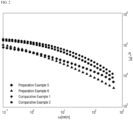
FIG. 1 is a graph of melt strength (F) to pull-off speed. -
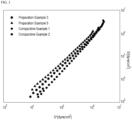
FIG. 2 is a graph of shear viscosity (*η) to shear rate (ω). -
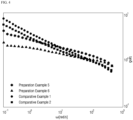
FIG. 3 is a graph of storage modulus (G') to loss modulus (G"). -
FIG. 4 is a graph of tan δ to shear rate (ω). - The aspects and features of the present invention and methods for achieving the aspects and features will be apparent by referring to the embodiments to be described in detail with reference to the accompanying drawings.
- It will be understood that, although the terms "first," "second," etc. may be used herein to describe various elements, these elements should not be limited by these terms. These terms are only used to distinguish one element from another element. For instance, a first element discussed below could be termed a second element without departing from the teachings of the present invention. Similarly, the second element could also be termed the first element.
- In the present specification, the term "CA-B" means that the number of carbon atoms is A or more and B or less, and "A to B" means A or more and B or less.
- In the present specification, the " * " means a bonding site.
- Hereinafter, embodiments of the present invention will be described in detail with reference to Preparation Examples and Comparative Examples.
- A hybrid metallocene-supported catalyst according to an embodiment includes: a carrier; at least one first metallocene compound supported in the carrier, among compounds represented by Chemical Formula 1; at least one second metallocene compound supported in the carrier, among compounds represented by Chemical Formula 2; and a co-catalyst compound supported in the carrier.


-
InChemical Formula 1, in *-MX2-*, M is any one of titanium (Ti), zirconium (Zr), and hafnium (Hf), X is one of halogen, an alkyl group of C1-10, and an alkenyl group of C2-10, and R1-*, R2-*, R3-*, R4-*, R5-*, R6-*, R7-*, R8-*, R9-*, R10-* are each independently one of H-*, an alkyl group of C2-10, a cycloalkyl group of C3-6, and an aryl group of C6-14. - In
Chemical Formula 1, among Rm-*s (m is 1 to 10), two adjacent Rn-* and Rn+1-* (n is 1 to 9) form an unsubstituted or substituted single or multiple ring compound of C1-15 with an alky group of C1-4, and Rm-*s other than Rn-* and Rn+1-* are each independently one of H-*, an alkyl group of C2-10, a cycloalkyl group of C3-6, and an aryl group of C6-14. The unsubstituted or substituted single ring compound of C1-15 with an alky group of C1-4may be an aliphatic cyclic compound or an aromatic cyclic compound, and the unsubstituted or substituted multiple ring compound of C1-15 with an alky group of C1-4 may be an aliphatic cyclic compound, an aromatic cyclic compound, or a hybrid cyclic compound of the aliphatic cyclic compound and the aromatic cyclic compound. - The first metallocene compound may be at least one of compounds represented by Chemical Formulae 1-1 to 1-24.


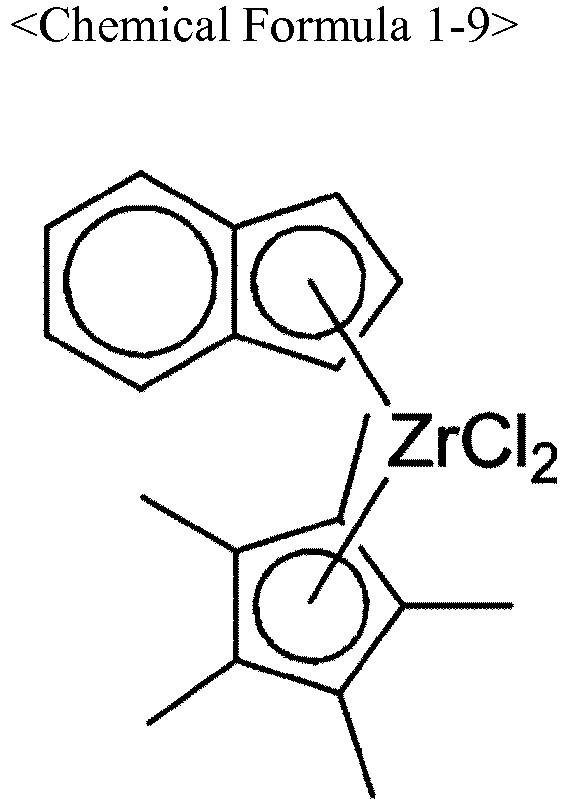








- In Chemical Formulae 1-1 to 1-24, Me-* is a methyl group, Bu-* is a butyl group, Ph-* is a phenyl group, Tol-* is a toluene group or a methylphenyl group, and Naph-* is a naphthalene group.


- In
Chemical Formula 2, in *-MX2-*, M is any one of titanium (Ti), and zirconium (Zr), X is any one of halogen, an alkyl group of C1-10, and an alkenyl group of C2-10. In Chemical Formula 2, *-Q-* is any one of carbon (C), silicon (Si), germanium (Ge), and tin (Sn), R1-*, R2-*, R3-*, R4-*, R5-*, R6-*, R7-*, R8-*, R9-*, R10-*, R11-*, and R12-* are each independently one of *-H-, an alkyl group of C2-10, a cycloalkyl group of C3-6, and an aryl group of C6-14, and R13-* and R14-* are each independently an alkyl group of C1-10. - In
Chemical Formula 2, among Rm-*s (m is 1 to 12), two adjacent Rn-* and Rn+1-* (n is 1 to 11) may form an unsubstituted or substituted single or multiple ring compound of C1-15 with an alky group of C1-4. In this case, Rm-*s other than Rn-* and Rn+1-* are each independently one of *-H-, an alkyl group of C2-10, a cycloalkyl group of C3-6, and an aryl group of C6-14. The unsubstituted or substituted single ring compound of C1-15 with an alky group of C1-4may be an aliphatic cyclic compound or an aromatic cyclic compound, and the unsubstituted or substituted multiple ring compound of C1-15 with an alky group of C1-4may be an aliphatic cyclic compound, an aromatic cyclic compound, or a hybrid cyclic compound of the aliphatic cyclic compound and the aromatic cyclic compound. - Further, in
Chemical Formula 2, in the alkyl group of C1-20 or the unsubstituted or substituted single or multiple ring compound of C1-15 with an alky group of C1-4, one or more carbon atoms may be substituted with one of nitrogen (N), oxygen (O), and sulfur (S). - The second metallocene compound may be at least one of compounds represented by Chemical Formulae 2-1 to 2-20.
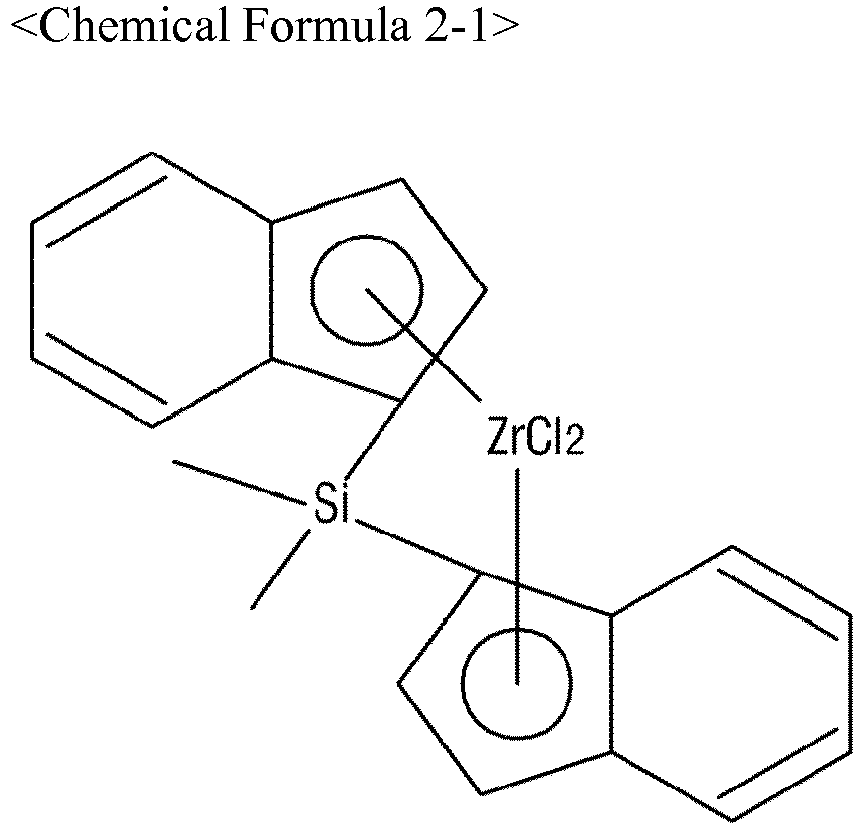


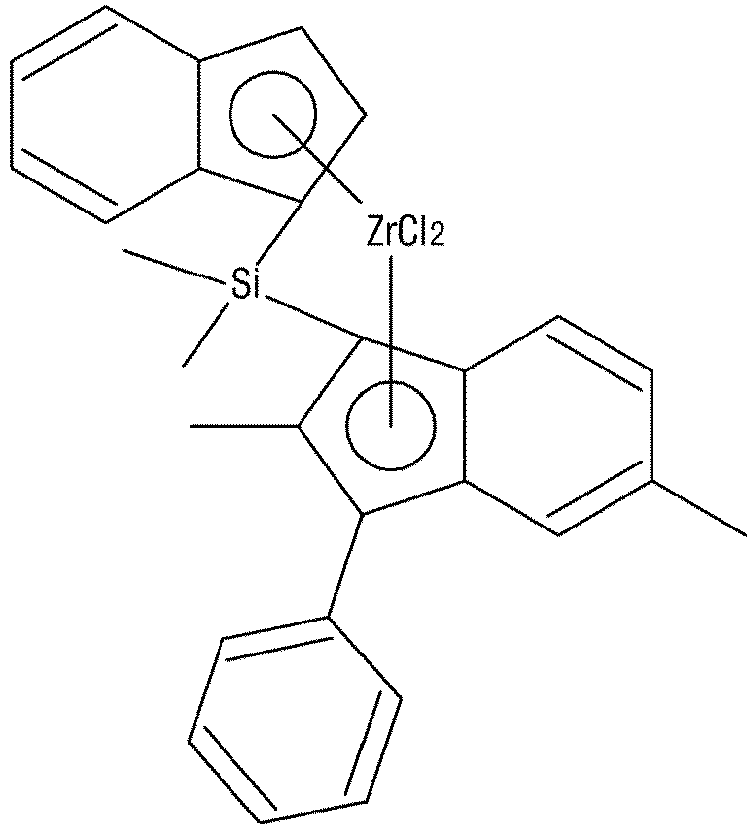
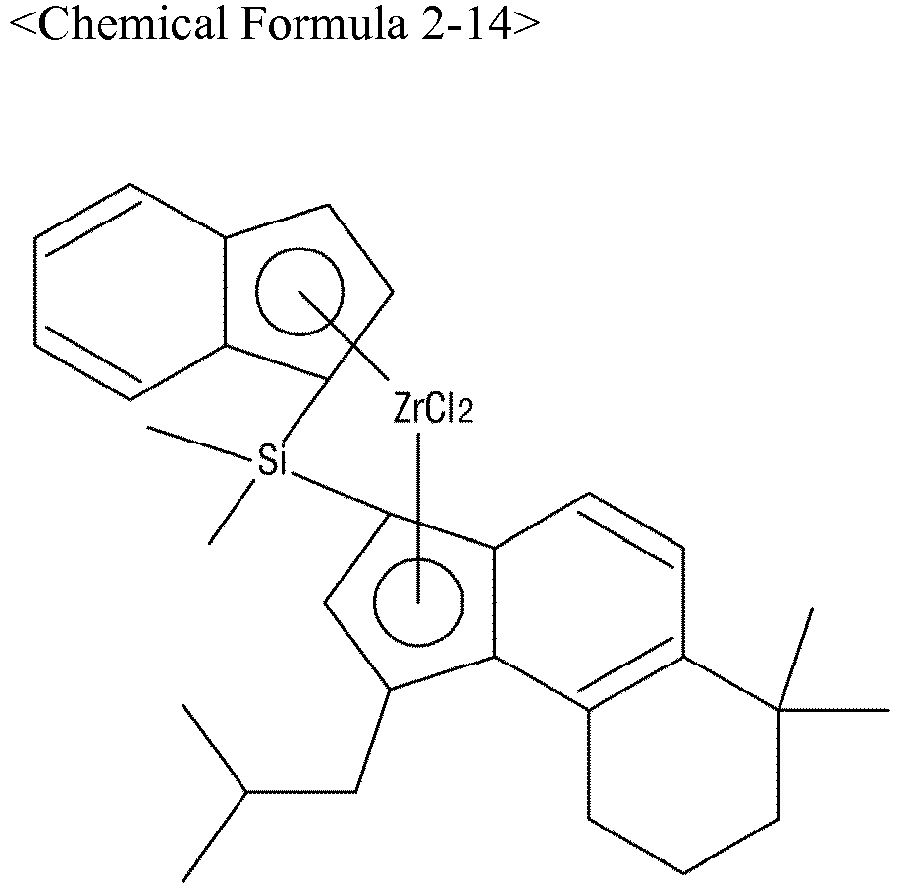


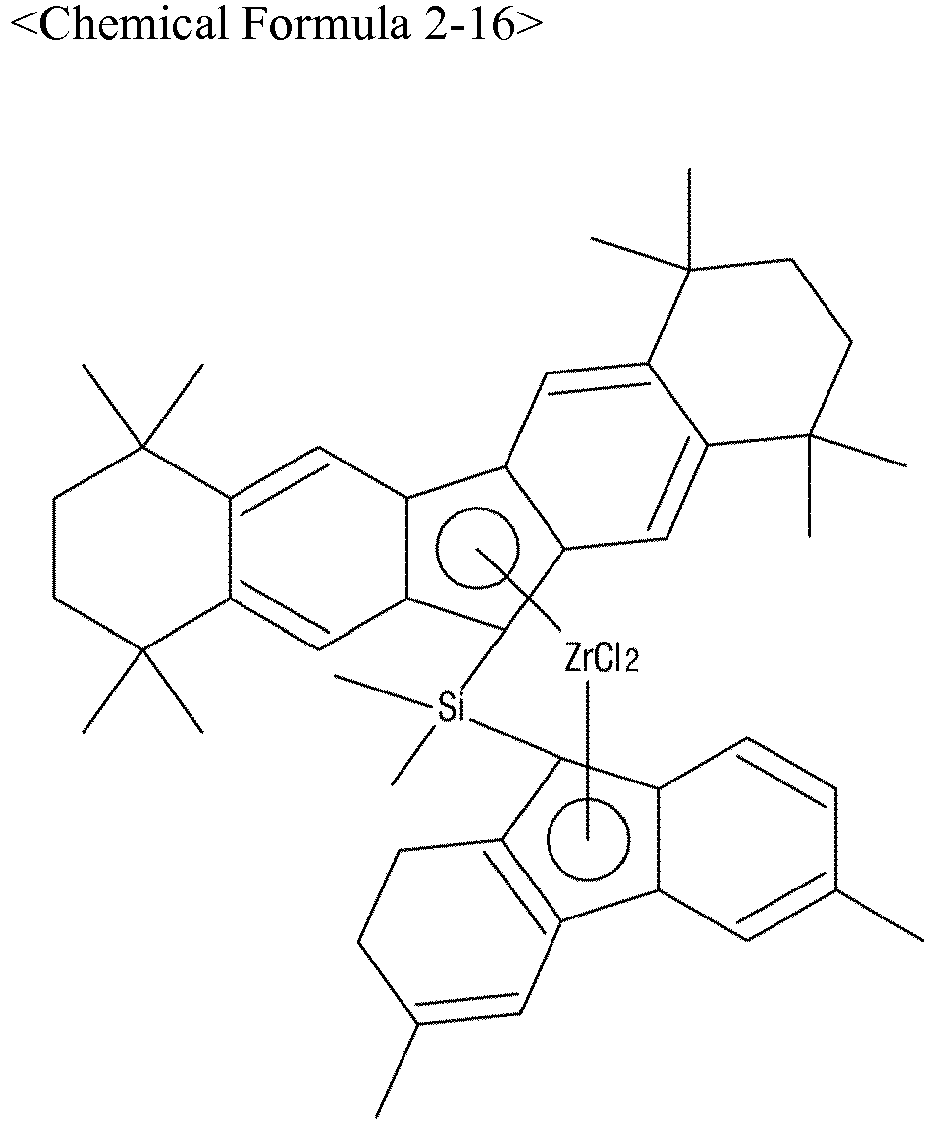

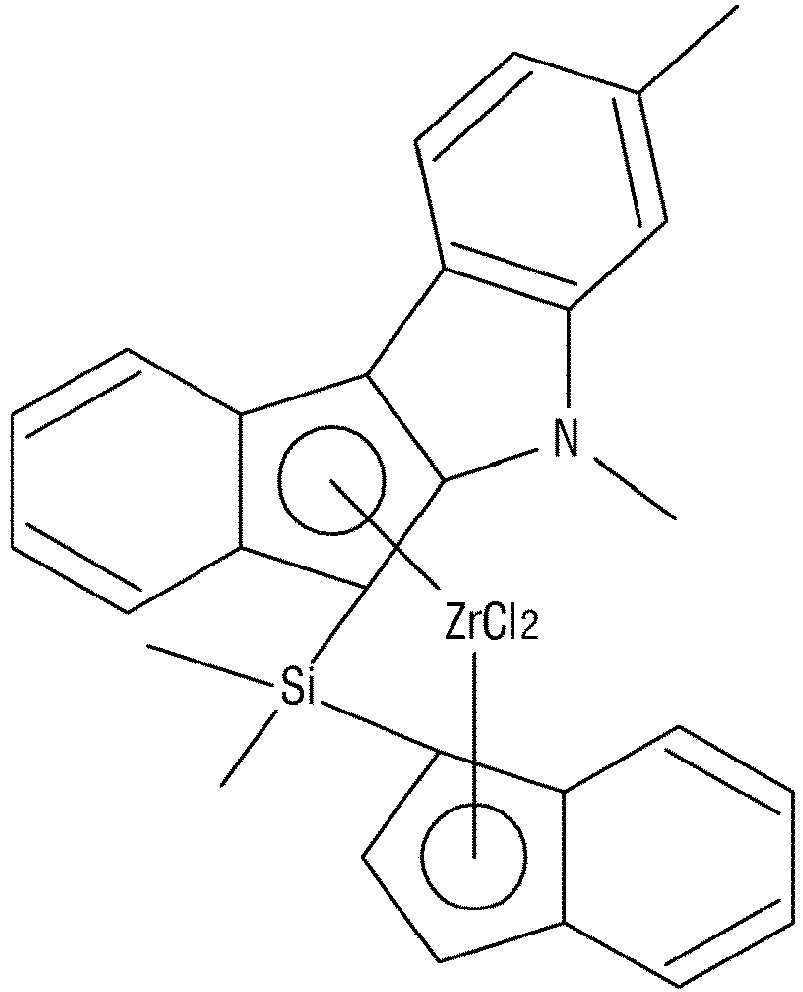


- In Chemical Formulae 2-1 to 2-20, Ph-* is a phenyl group.
- The first metallocene compound and the second metallocene compound may be used together with the co-catalyst compound to be used as a polymerization catalyst for preparing an olefin polymer.
- The co-catalyst compound is not particularly limited as long as it is widely used in the field of metallocene catalysts. For example, the co-catalyst compound may be at least one of at least one of compounds represented by Chemical Formula 3 and at least one of compounds represented by Chemical Formula 4.

- In Chemical Formula 3, Ra-* is halogen-*, or a unsubstituted or substituted alkyl group of C1-20, cycloalkyl group of C3-6, or aryl group of C6-14with halogen, and n is an integer of 2 or more.

- In Chemical Formula 4, D is aluminum or boron, Rb-* to Rd-* are the same as or different from each other and are each independently halogen-*, or a unsubstituted or substituted alkyl group of C1-20, cycloalkyl group of C3-6, or aryl group of C6-14 with halogen, and n is an integer of 2 or more.
- The carrier is not particularly limited as long as it can support the first metallocene compound, the second metallocene compound, and the co-catalyst compound. For example, the carrier may be carbon, silica, alumina, zeolite, or magnesium chloride.
- As a method of supporting the first metallocene compound, the second metallocene compound and the co-catalyst compound on the carrier, a physical adsorption method or a chemical adsorption method may be used.
- For example, the physical adsorption method may be a method of contacting the carrier with a solution in which the first metallocene compound, the second metallocene compound, and the co-catalyst compound are dissolved and drying the solution, or may be a method including the steps of contacting the carrier with a solution in which the first metallocene compound and the second metallocene compound are dissolved and drying the solution to prepare a carrier supported with the first metallocene compound and the second metallocene compound; contacting the carrier with a solution in which the co-catalyst compound is dissolved and drying the solution to prepare a carrier supported with the co-catalyst compound; and mixing these carriers.
- For example, the chemical adsorption method may be a method of supporting the co-catalyst compound on the surface of the carrier and then supporting the co-catalyst compound with the first metallocene compound and the second metallocene compound, or may be a method of covalent-bonding a functional group of the surface of the carrier (for example, in the case of silica, a hydroxyl group (-OH) of the surface of silica) with the first metallocene compound and the second metallocene compound.
- The sum of the amount of the first metallocene compound to be supported and the amount of the second metallocene compound to be supported may be 0.5 parts by weight to 3.0 parts by weight based on 1 g of the carrier, and the amount of the co-catalyst compound to be supported is 20 parts by weight to 30 parts by weight based on 1 g of the carrier.
- Meanwhile, a method of preparing an olefin polymer according to another embodiment of the present invention includes the step of polymerizing olefin monomers in the presence of the hybrid metallocene-supported catalyst.
- Examples of the olefin monomers may include ethylene, propylene, 1-butene, 1-pentene, 4-methyl-1-pentene, 1-hexene, 1-heptene, 1-octene, 1-decene, 1-undecene, 1-dodecene, 1-tetradecene, and 1-hexadecene. The olefin polymer may be a homopolymer or a copolymer. The copolymer may be, for example, a copolymer of ethylene and α-olefin. The α-olefin may be, for example, at least one selected from 1-butene, 1-hexene, and 1-octene.
- The olefin polymer may be prepared by, for example, a gas phase polymerization method, a solution polymerization method, or a slurry polymerization method. When the olefin polymer is prepared by a solution polymerization method or a slurry polymerization method, examples of solvents to be used may include: aliphatic hydrocarbon solvents of C5-12 such as pentane, hexane, heptane, nonane, decane, and isomers thereof; aromatic hydrocarbon solvents such as toluene and benzene; hydrocarbon solvents substituted with chlorine atoms such as dichloromethane and chlorobenzene; and mixtures thereof.
- An olefin polymer according to the present disclosure has a molecular weight distribution of 2 to 5 and a weight average molecular weight of 100 x 103 g/mol to 200 x 103 g/mol. Here, the ratio of melt strength measured at 190°C to the weight average molecular weight is 0.85 x 10⁻³ or more, preferably 0.90 x 10⁻³ or more, and more preferably 0.95 x 10⁻³ or more.
- The measured melt strength may be 125 cN or more, and preferably 140 cN or more. The slope of a graph relating to a shear rate and tan δ is -0.20 or more in a shear rate range of 0.1 rad/s to 100 rad/s. The slope of Han plot is 1.24 or less in a loss modulus range of 104 dyne/cm3 to 106 dyne/cm3. The density of the olefin polymer may be more than 0.920 kg/cm3and less than 0.950 kg/cm3, the melt index of the olefin polymer measured at 190°C may be more than 1.0 g/10min and less than 1.5 g/10min, and the value obtained by dividing the extrusion amount of the olefin polymer for 10 minutes at a load of 21.6 kg by the extrusion amount of the olefin polymer for 10 minutes at a load of 2.16 kg may be more than 20 and less than 40.
- Hereinafter, Preparation Examples of the hybrid metallocene-supported catalyst according to an embodiment of the present invention and Preparation Examples of the olefin polymer according to another embodiment of the present invention will be described in detail.
-

- In a dry box, indene (5 g, 0.043 mol) was dissolved in hexane (150 mL), sufficiently mixed, and then cooled to -30°C to obtain a hexane solution. Then, a 2.5 M n-butyl lithium (n-BuLi) hexane solution (17 mL, 0.043 mol) was dropped into this hexane solution, and was stirred overnight at room temperature to obtain a white suspension. The white suspension was filtered by a glass filter to obtain a white solid, the white solid was sufficiently dried, and then 5.2 g of an indene lithium salt was obtained in a yield of 99%.

- In a dry box, cyclopentadienyl zirconium trichloride (CpZrCl3) (2.24 g, 8.53 mmol) was slowly dissolved in ether (30 mL), and then cooled to -30°C to obtain an ether solution. Then, an indene lithium salt (105 g, 8.53 mmol) dissolved in ether (30 mL) was slowly dropped into this ether solution, and was then stirred overnight to obtain a yellow suspension. Then, under reduced pressure, ether was removed from the yellow suspension, and then the resulting yellow suspension was extracted with methylene chloride (50 mL) to obtain extracts. The extracts passed through a celite to remove lithium chloride (LiCl), and then dried to obtain 2.82 g of a refined first metallocene compound in a yield of 97%.
-

- 7-Bromo-2-methyl-1H-indene (7 g, 1 equivalent) and [1,3-bis-(diphenylphosphino) propane] nickel (II) chloride (Ni (dppp) Cl2) (363 mg, 0.02 equivalents) were introduced into ether (100mL), a 3.0 M phenylmagnesium bromide (PhMgBr) ether solution (8.23 g, 1.05 equivalents) was added thereto for 1 hour, and then the mixed solution was refluxed and stirred at 50°C for 12 hours while gradually raising temperature.
- After completion of the reaction, the solution was immersed in an ice bath, and 1 N hydrochloric acid was added thereto to lower the hydrogen ion concentration index to pH 4. Then, an organic layer was extracted from the solution, treated with magnesium sulfide (MgSO4) to remove water, and then dried to obtain 6.68 g (yield: 97%) of 2-methyl-7-phenyl-1H-indene which is a white solid.
- [1H-NMR (CDCl3, 300 MHz), 7.61-7.12 (m, 8H), 6.54 (s, 1H), 3.38 (s, 2H), 2.14 (s, 3H)]
- 2-methyl-7-phenyl-1H-indene (2.14 g, 1 equivalent) was introduced into 50 mL of hexane, a 1.6 M n-butyl lithium (n-BuLi) hexane solution (7.8 mL, 1.2 equivalents) was slowly added thereto at -30°C, the temperature was raised to room temperature, and then the mixed solution was stirred at room temperature for 12 hours to obtain a solid. The obtained solid was filtered, washed with hexane, and then dried under vacuum to obtain 2-methyl-4-phenyl-indenyl lithium (1.5 g, 2 equivalents). Then, 20 mL of toluene and 5 mL of tetrahydrofuran
- (THF) were introduced into the obtained 2-methyl-4-phenyl-indenyl lithium (1.5 g, 2 equivalents), dimethyldichlorosilane (456 mg, 1 equivalent) was slowly added thereto at -30°C, the temperature was raised to 80°C, and then the mixed solution was stirred at 80°C for 2 hours. After completion of the reaction, a solvent was removed, and an organic layer was extracted using a mixed solution of ether and water and treated with magnesium sulfide (MgSO4) to remove water. 1.3 g (yield: 80%) of dimethylbis(2-methyl-4-phenylindenyl)silane was obtained using column chromatography. At this time, a mixed solution of hexane and methylene chloride having a volume ratio of 20: 1 was used as a mobile phase.
- [1H-NMR (CDCl3, 300 MHz), 7.56-7.14 (m, 16H), 6.80 (m, 2H), 3.80(S, 2H), 2.25 (s, 3H), 2.17 (s, 3H), 0.17(m, 6H)]
- A 1.6 M n-butyl lithium (n-BuLi) hexane solution (4 mL, 2.1 equivalents) was slowly added to a solution in which dimethyl-bis(2-methyl-4-phenylindenyl)silane (1.4 g, 1 equivalent) was dissolved in 20 mL of ether at -30°C, the temperature was slowly raised to room temperature, and then the mixed solution was stirred at room temperature for 12 hours. Then, a solvent was dried to obtain a solid. The solid was washed with hexane, and dried under vacuum to obtain a dilithium salt. Then, a solution of the dilithium salt (1g, 2 equivalents) and ether (100 mL) was slowly added to zirconium chloride (ZrCl4) (484 mg, 1 equivalent) at -30°C, the temperature was slowly raised, and then the mixed solution was stirred for 4 hours. After completion of the reaction, a solvent was removed, and 130 mg (yield: 10%) of rac-dimethylsilylbis(2-methyl-4-phenylindenyl)zirconium dichloride was obtained by a recrystallization method using methylene chloride as a recrystallization solvent.
- [1H-NMR (CDCl3, 300 MHz), 7.68-7.10 (m, 16H), 6.95 (s, 2H), 2.26 (s, 6H), 1.34(s, 6H)]
- When the first and second metallocene compound and methyl aluminum oxane (MAO) as a co-catalyst react with moisture or oxygen in the air, activity is lost. Therefore, all experiments were carried out using a glove box and a Schlenk technique under nitrogen conditions. A 10 L supported catalyst reactor was used in a state of being washed to remove foreign mater, dried at 110°C for 3 hours, sealed, and then dried in vacuum to completely moisture.
- A 10% methyl aluminum oxane (MAO) solution (methyl aluminum oxane: 1188 g) was added to the 2.862 g of the first metallocene compound and 3.469 g of the second metallocene compound, and the mixed solution was stirred at room temperature for 1 hour. 300 g of silica was put into the reactor, and then 900 mL of refined toluene was additionally put into the reactor, followed by stirring. After completion of stirring for 1 hour, the first metallocene compound, the second metallocene compound, and methyl aluminum oxane were added to the mixed solution while stirring in the reactor. The reactor was heated to about 60°C, followed by stirring for 2 hours.
- After the precipitation reaction, a supernatant was removed.
- A second hybrid metallocene-supported catalyst was prepared in the same manner as in the preparation example of the first hybrid metallocene-supported catalyst, except that 2.389 g of the first metallocene compound was used and 4.387 g of the second metallocene compound was used.
- The first hybrid metallocene-supported catalyst was introduced into a single gas phase polymerization process to prepare a polyolefin copolymer. 1-hexene was used as a comonomer. Operation conditions are summarized in Table 1.
- The second hybrid metallocene-supported catalyst was introduced into a single gas phase polymerization process to prepare a polyolefin copolymer. 1-hexene was used as a comonomer. Operation conditions are summarized in Table 1.
[Table 1] Operation conditions First olefin polymer Second olefin polymer Ethylene partial pressure (K/G) 15.0 15.1 Operation temperature (°C) 92.0 92.0 Hydrogen molar ratio / ethylene molar ratio (%) 0.066 0.102 1-Hexene molar ratio / ethylene molar ratio (%) 0.35 0.43 Melt index (g/10min) 0.67 0.72 Melt flow rate (MFR) 50.17 75.9 Density (g/cc) 0.9418 0.9407 - The densities, melt indexes, melt flow rates, molecular weights, molecular weight distributions, melt strengths, and rheological properties of the olefin polymers according to Examples and Comparative Examples below were measured. The measurement results of the physical properties are summarized in Tables 2 and 3 below. In Tables 2 and 3, Example 1 is a first olefin polymer, and Example 2 is a second olefin polymer.
- DX900, which is a commercial pipe product manufactured by SK Innovation Co., Ltd., was used.
- SP988, which is a commercial pipe product manufactured by LG Chem Co., Ltd., was used.
- C910A, which is a commercial pipe product manufactured by Hanwha TOTAL Petrochemical Co., Ltd., was used.
- HDPE 7303, which is a commercial bottle cap product manufactured by SK Innovation Co., Ltd., was used.
- A commercial LG ME2500 product manufactured by LG Chem Co., Ltd., was used.
-
- 1) Density was measured according to ASTM 1505.
- 2) Melt index (I2, 2.16 kg), which is an extrusion amount for 10 min at a load of 2.16 kg, was measured at 190°C according to ASTM 1238.
- 3) Melt flow rate: a rate obtained by dividing flow index (I21, a load of 21.6 kg) by melt index (I2, a load of 2.16 kg)
- 4) Molecular weight and molecular weight distribution (PDI): number average molecular weight (Mn), weight average molecular weight (Mw), and Z average molecular weight were measured using gel permeation chromatography (GPC-FTIR) at 160°C. Molecular weight distribution (PDI, Mw/Mn) is expressed by a ratio of weight average molecular weight to number average molecular weight.
- 5) Melt strength
Measurement of melt strength was performed on a Gotfert Rheotens attached to a Gottfert Rheotester 2000 Capillary Rheometer. A polymer was extruded through a capillary having a flat inlet angle with a capillary diameter of 2.0 mm and an aspect ratio (capillary length / capillary diameter) of 10. After equilibrating a sample at 190°C for 5 minutes, a piston was allowed to move at a constant speed of 0.32 mm/s. Experimental temperature was 190°C. The sample was stretched in a set with an accelerating nip located 100 mm below a die by using an acceleration of 2.4 mm/s2. Tensile strength was recorded as a function of a winding speed of a nip roll. - 6) Measurement of rheological properties
- Measurement of dynamic viscoelastic properties depending on frequency variation (Dynamic frequency sweep test): Measurement of rheological properties was performed using a rheometer (Advanced Rheometric Expansion System, ARES). The frequency range was 0.1 to 500 rad/s, the experimental temperature was 190°C, the measurement was performed under a nitrogen atmosphere, and the strain was 10%.
[Table 2] Density (Kg/cm3) Melt index (I2) (g/10min) MFR Mw (x103 g/mol) Example 1 0.9437 1.1 30.7 138.9 Example 2 0.9443 1.1 37.6 145.2 Comparative Example 1 0.9384 0.6 25.1 140.1 Comparative Example 2 0.9438 0.7 35.0 150.0 Comparative Example 3 0.9556 2.4 28.5 135.6 Comparative Example 4 0.9523 2.1 37.4 248.2 Comparative Example 5 0.9538 2.1 28.5 208.5 [Table 3] PDI Melt strength (M.S) (cN) Slope of log(tanδ) at shear rate (ω) of 0.1 to 100 rad/s Slope of logG"-ogG' plot (Han plot) Melt strength (x10-3 cN·mol/g) Example 1 2.53 141.1 -0.18 1.24 1.02 Example 2 3.05 143.6 -0.13 1.20 0.99 Comparative Example 1 3.07 82.4 -0.31 1.41 0.59 Comparative 2.88 122.0 -0.27 1.40 0.81 Example 2 Comparative Example 3 5.5 63.7 -0.34 1.42 0.47 Comparative Example 4 21.3 53.1 -0.15 1.26 0.21 Comparative Example 5 7.2 84.3 -0.28 1.38 0.40 - The slope of log(tanδ) at a shear rate (ω) of 0.1 rad/s to 100 rad/s is a slope of log(tanδ) and log(w). For example, the slope of log(tanδ) in Example 1 is calculated by
Equation 1. -

- Han plot compares the slopes of log(G') with respect to a predetermined log(G") range (for example, values of log(G") of 4.4 and 5.8). For example, the slope of Han plot in Example 1 is calculated by
Equation 2.
- Referring to
FIGS. 1 to 4 and Tables 2 to 3, in Examples 1 and 2, M.S. tends to be high although Mw is low. Generally, as Mw increases, M.S. tends to increase. However, Examples 1 and 2 have similar Mw to Comparative Examples 1, 2, and 3 and have higher M.S. than Comparative Examples 1, 2, and 3. Further, Examples 1 and 2 have lower Mw to Comparative Examples 4 and 5, but have higher M.S. than Comparative Examples 4 and 5. Examples 1 and 2 exhibit equivalent workability to Comparative Examples. Meanwhile, the elasticity of a material increases as the scope of tan δ increases, and the miscibility in a resin is improved as the slope of Han plot approximates to 2. Further, as the proportion of long chain branches in the resin increases, the miscibility in the resin deteriorates, so that the slope of Han plot approximates to 1. When long chain branches are introduced into the resin, the elasticity of a material may increase, and the miscibility in the resin may slightly deteriorate. It can be found that Examples 1 and 2 have elasticity and miscibility equivalent to or better than those of Comparative Examples. Examples 1 and 2 have melt strength better than that of Comparative Examples while having elasticity and miscibility equivalent to or better than those of Comparative Examples.
Claims (4)
- A hybrid metallocene-supported catalyst, comprising:a carrier;at least one first metallocene compound supported in the carrier, among compounds represented by Chemical Formula 1;at least one second metallocene compound supported in the carrier, among compounds represented by Chemical Formula 2; anda co-catalyst compound supported in the carrier:
 in Chemical Formula 1, in *-MX2-*, M is any one of titanium (Ti), zirconium (Zr), and hafnium (Hf), X is one of halogen, an alkyl group of C1-10, and an alkenyl group of C2-10, and R1-*, R2-*, R3-*, R4-*, R5-*, R6-*, R7-*, R8-*, R9-*, R10-* are each independently one of H-*, an alkyl group of C2-10, a cycloalkyl group of C3-6, and an aryl group of C6-14,
 in Chemical Formula 2, in *-MX2-*, M is any one of titanium (Ti), and zirconium (Zr), X is any one of halogen, an alkyl group of C1-10, and an alkenyl group of C2-10, Q is any one of carbon (C), silicon (Si), germanium (Ge), and tin (Sn), R1-*, R2-*, R3-*, R4-*, R5-*, R6-*, R7-*, R8-*, R9-*, R10-*, R11-*, and R12-*are each independently one of *-H-, an alkyl group of C2-10, a cycloalkyl group of C3-6, and an aryl group of C6-14, and R13-* and R14-* are each independently an alkyl group of C1-10.
 - The hybrid metallocene-supported catalyst of claim 1,wherein the co-catalyst compound is at least one of at least one first co-catalyst compound among compounds represented by Chemical Formula 3 and at least one second co-catalyst compound among compounds represented by Chemical Formula 4:


 in Chemical Formula 3, Ra-* is halogen-*, or a unsubstituted or substituted alkyl group of C1-20, cycloalkyl group of C3-6, or aryl group of C6-14 with halogen, and n is an integer of 2 or more; and in Chemical Formula 4, D is aluminum or boron, Rb-* to Rd-* are the same as or different from each other and are each independently halogen-*, or a unsubstituted or substituted alkyl group of C1-20, cycloalkyl group of C3-6, or aryl group of C6-14 with halogen, and n is an integer of 2 or more.
 - A method of preparing an olefin polymer, comprising:
polymerizing olefin monomers in the presence of the hybrid metallocene-supported catalyst according to any one of claims 1 to 2. - The method of claim 3,
wherein the olefin monomer is at least one selected from ethylene, propylene, 1-butene, 1-hexene, and 1-octene.
Priority Applications (1)
| Application Number | Priority Date | Filing Date | Title |
|---|---|---|---|
| EP24190281.6A EP4428166A3 (en) | 2015-12-31 | 2016-03-29 | Hybrid supported metallocene catalyst, method for preparing olefin polymer by using same, and olefin polymer having improved melt strength |
Applications Claiming Priority (2)
| Application Number | Priority Date | Filing Date | Title |
|---|---|---|---|
| KR20150190739 | 2015-12-31 | ||
| PCT/KR2016/003178 WO2017115927A1 (en) | 2015-12-31 | 2016-03-29 | Hybrid supported metallocene catalyst, method for preparing olefin polymer by using same, and olefin polymer having improved melt strength |
Related Child Applications (2)
| Application Number | Title | Priority Date | Filing Date |
|---|---|---|---|
| EP24190281.6A Division EP4428166A3 (en) | 2015-12-31 | 2016-03-29 | Hybrid supported metallocene catalyst, method for preparing olefin polymer by using same, and olefin polymer having improved melt strength |
| EP24190281.6A Division-Into EP4428166A3 (en) | 2015-12-31 | 2016-03-29 | Hybrid supported metallocene catalyst, method for preparing olefin polymer by using same, and olefin polymer having improved melt strength |
Publications (3)
| Publication Number | Publication Date |
|---|---|
| EP3398976A1 EP3398976A1 (en) | 2018-11-07 |
| EP3398976A4 EP3398976A4 (en) | 2020-02-26 |
| EP3398976B1 true EP3398976B1 (en) | 2025-01-22 |
Family
ID=58496262
Family Applications (2)
| Application Number | Title | Priority Date | Filing Date |
|---|---|---|---|
| EP24190281.6A Pending EP4428166A3 (en) | 2015-12-31 | 2016-03-29 | Hybrid supported metallocene catalyst, method for preparing olefin polymer by using same, and olefin polymer having improved melt strength |
| EP16881880.5A Active EP3398976B1 (en) | 2015-12-31 | 2016-03-29 | Hybrid supported metallocene catalyst, method for preparing olefin polymer by using same, and olefin polymer having improved melt strength |
Family Applications Before (1)
| Application Number | Title | Priority Date | Filing Date |
|---|---|---|---|
| EP24190281.6A Pending EP4428166A3 (en) | 2015-12-31 | 2016-03-29 | Hybrid supported metallocene catalyst, method for preparing olefin polymer by using same, and olefin polymer having improved melt strength |
Country Status (6)
| Country | Link |
|---|---|
| US (1) | US10934370B2 (en) |
| EP (2) | EP4428166A3 (en) |
| JP (1) | JP7004656B2 (en) |
| KR (1) | KR101713065B1 (en) |
| CN (1) | CN108431053B (en) |
| WO (1) | WO2017115927A1 (en) |
Families Citing this family (7)
| Publication number | Priority date | Publication date | Assignee | Title |
|---|---|---|---|---|
| KR101711788B1 (en) | 2016-03-09 | 2017-03-14 | 한화케미칼 주식회사 | Hybride catalyst compositon, preparation method thereof, and manufactured polyolefin using the same |
| KR101723774B1 (en) | 2016-07-28 | 2017-04-18 | 한화케미칼 주식회사 | High density ethylene polymer with excellent processability using supported hybrid metallocene catalyst and methods for producing the same |
| US12258432B2 (en) | 2019-08-16 | 2025-03-25 | Lg Chem, Ltd. | Hybrid supported metallocene catalyst and method for preparing polypropylene using the same |
| KR102733546B1 (en) | 2020-08-04 | 2024-11-21 | 주식회사 엘지화학 | Transition metal compound, method for preparing the same, and catalyst composition comprising the same |
| KR102611686B1 (en) * | 2020-12-17 | 2023-12-08 | 한화솔루션 주식회사 | Polyolefin and Process for Preparing the Same |
| KR102613125B1 (en) * | 2020-12-23 | 2023-12-14 | 한화솔루션 주식회사 | Mixed Catalytic Composition, Catalyst Comprising the Composition, Process for Preparing a Polyolefin Using the Catalyst |
| CN121420001A (en) * | 2023-05-23 | 2026-01-27 | 埃克森美孚技术与工程公司 | Polyethylene, catalysts used for their polymerization, and their membranes |
Family Cites Families (26)
| Publication number | Priority date | Publication date | Assignee | Title |
|---|---|---|---|---|
| CA2168883C (en) * | 1993-08-06 | 2000-07-04 | Moses Olukayode Jejelowo | Polymerization catalysts, their production and use |
| JP3695331B2 (en) | 1997-10-22 | 2005-09-14 | チッソ株式会社 | Metallocene supported catalyst, method for producing the same, and method for producing olefin polymer |
| GB9800245D0 (en) * | 1998-01-07 | 1998-03-04 | Bp Chem Int Ltd | Novel polymers |
| KR100380018B1 (en) | 1998-04-09 | 2003-10-04 | 주식회사 엘지화학 | Supported metallocene catalyst and olefin polymerization method using the catalyst |
| US6420580B1 (en) * | 1999-11-05 | 2002-07-16 | Univation Technologies, Llc | Catalyst compositions and method of polymerization therewith |
| US6734265B1 (en) * | 2000-10-06 | 2004-05-11 | Univation Technologies, Llc. | Linear low density polyethylenes with high melt strength and high melt index ratio |
| CN1151184C (en) * | 2000-11-03 | 2004-05-26 | 中国石油化工股份有限公司 | Metallocene catalyst for polymerizing or copolymerizing ethylene and its preparing process and application |
| MY137183A (en) | 2001-03-16 | 2009-01-30 | Dow Global Technologies Inc | Method of making interpolymers and products made therefrom |
| JP4020862B2 (en) * | 2001-07-19 | 2007-12-12 | ユニベーション・テクノロジーズ・エルエルシー | Mixed metallocene catalyst system containing comonomer minor incorporation catalyst and comonomer major incorporation catalyst |
| SG96700A1 (en) | 2001-09-27 | 2003-06-16 | Sumitomo Chemical Co | Catalyst component for addition polymerization, process for producing catalyst for addition polymerization and process for producing addition polymer |
| US6730751B2 (en) * | 2002-07-16 | 2004-05-04 | Fina Technology, Inc. | Polymerization of polyethylene having high molecular weight |
| CA2465479A1 (en) | 2003-04-28 | 2004-10-28 | Tosoh Corporation | Polyethylene composition and process for producing same |
| US7119153B2 (en) | 2004-01-21 | 2006-10-10 | Jensen Michael D | Dual metallocene catalyst for producing film resins with good machine direction (MD) elmendorf tear strength |
| US7897689B2 (en) * | 2004-03-17 | 2011-03-01 | Dow Global Technologies Inc. | Functionalized ethylene/α-olefin interpolymer compositions |
| US7226886B2 (en) | 2005-09-15 | 2007-06-05 | Chevron Phillips Chemical Company, L.P. | Polymerization catalysts and process for producing bimodal polymers in a single reactor |
| JP5414971B2 (en) * | 2005-12-28 | 2014-02-12 | 日本ポリエチレン株式会社 | Film made of ethylene resin composition |
| US7619047B2 (en) | 2006-02-22 | 2009-11-17 | Chevron Phillips Chemical Company, Lp | Dual metallocene catalysts for polymerization of bimodal polymers |
| US7829641B2 (en) | 2008-07-16 | 2010-11-09 | Equistar Chemicals, Lp | Process for the preparation of multimodal polyethylene resins |
| KR101050791B1 (en) | 2009-10-19 | 2011-07-20 | 주식회사 엘지화학 | Method for preparing hybrid supported metallocene catalyst and hybrid supported metallocene catalyst prepared using the same |
| EP2330136B1 (en) * | 2009-12-07 | 2013-08-28 | Borealis AG | Process for the preparation of an unsupported, solid metallocene catalyst system and its use in polymerization of olefins |
| US8932975B2 (en) * | 2010-09-07 | 2015-01-13 | Chevron Phillips Chemical Company Lp | Catalyst systems and methods of making and using same |
| EP2733173A1 (en) * | 2012-11-20 | 2014-05-21 | Total Research & Technology Feluy | Polypropylene polymer presenting improved strain hardening behaviour |
| US9346897B2 (en) * | 2013-05-14 | 2016-05-24 | Chevron Phillips Chemical Company Lp | Peroxide treated metallocene-based polyolefins with improved melt strength |
| KR101617870B1 (en) * | 2014-09-05 | 2016-05-03 | 주식회사 엘지화학 | Olefin based polymer having excellent processibility |
| WO2016036204A1 (en) * | 2014-09-05 | 2016-03-10 | 주식회사 엘지화학 | Olefin-based polymer with excellent processability |
| KR101924198B1 (en) * | 2015-12-23 | 2018-11-30 | 주식회사 엘지화학 | Low density polyethylene copolymer having superior film processibility and transmittance |
-
2016
- 2016-03-29 US US16/066,907 patent/US10934370B2/en active Active
- 2016-03-29 JP JP2018534578A patent/JP7004656B2/en active Active
- 2016-03-29 EP EP24190281.6A patent/EP4428166A3/en active Pending
- 2016-03-29 WO PCT/KR2016/003178 patent/WO2017115927A1/en not_active Ceased
- 2016-03-29 EP EP16881880.5A patent/EP3398976B1/en active Active
- 2016-03-29 CN CN201680077296.4A patent/CN108431053B/en active Active
- 2016-05-20 KR KR1020160061892A patent/KR101713065B1/en active Active
Also Published As
| Publication number | Publication date |
|---|---|
| EP3398976A4 (en) | 2020-02-26 |
| CN108431053A (en) | 2018-08-21 |
| KR101713065B1 (en) | 2017-03-23 |
| EP4428166A2 (en) | 2024-09-11 |
| WO2017115927A1 (en) | 2017-07-06 |
| JP2019500473A (en) | 2019-01-10 |
| US20190023816A1 (en) | 2019-01-24 |
| EP3398976A1 (en) | 2018-11-07 |
| CN108431053B (en) | 2021-03-30 |
| JP7004656B2 (en) | 2022-02-04 |
| EP4428166A3 (en) | 2024-12-11 |
| US10934370B2 (en) | 2021-03-02 |
Similar Documents
| Publication | Publication Date | Title |
|---|---|---|
| US10934370B2 (en) | Hybrid supported metallogen catalyst, method for preparing olefin polymer by using same, and olefin polymer having improved melt strength | |
| RU2670752C9 (en) | Olefin based polymer with excellent processing ability | |
| CN106661160B (en) | Ethylene/α -olefin copolymer having excellent processability | |
| EP3372620B1 (en) | Catalyst composition for synthesizing olefin copolymer, and method for preparing olefin copolymer | |
| CN114174352A (en) | Catalyst system | |
| RU2671499C1 (en) | Ethylene/alpha-olefin copolymers, characterized by excellent processability | |
| EP3225638B1 (en) | Ethylene/ -olefin copolymer having excellent processability and surface characteristics | |
| CN108137739B (en) | Olefin polymer and method for producing the same | |
| CN111902438B (en) | Ethylene/alpha-olefin copolymer and process for producing the same | |
| CN106232638A (en) | Polyolefins with Excellent Environmental Stress Cracking Resistance | |
| WO2016167547A1 (en) | Ethylene/alpha-olefin copolymer having excellent environmental stress cracking resistance | |
| EP3078682B1 (en) | Olefin-based polymer having excellent processability | |
| WO2016167568A1 (en) | Ethylene/α-olefin copolymer having excellent processability | |
| EP3363820A1 (en) | Hybrid supported metallocene catalyst, and method for preparing polyolefin by using same | |
| KR102211603B1 (en) | Catalyst composition for polymerizing olefin copolymer and preparation method of olefin copolymer | |
| KR102724460B1 (en) | Supported hybrid metallocene catalyst, and preparation method of polyolefin using the same | |
| KR20160121045A (en) | High density polyethylene copolymer for blow molding | |
| EP3702379B1 (en) | Propylene random copolymer | |
| KR20200090039A (en) | Preparation method of ethylene-alpha olefin copolymer and manufacturing method of injection molded article | |
| KR102389323B1 (en) | Polypropylene | |
| WO2026024944A1 (en) | Metallocene catalyst compounds for producing polyolefins | |
| KR20260065517A (en) | High density polyethylene and film comprising the same | |
| WO2019124805A1 (en) | Olefin polymer, preparation method therefor and film using same |
Legal Events
| Date | Code | Title | Description |
|---|---|---|---|
| STAA | Information on the status of an ep patent application or granted ep patent |
Free format text: STATUS: THE INTERNATIONAL PUBLICATION HAS BEEN MADE |
|
| PUAI | Public reference made under article 153(3) epc to a published international application that has entered the european phase |
Free format text: ORIGINAL CODE: 0009012 |
|
| STAA | Information on the status of an ep patent application or granted ep patent |
Free format text: STATUS: REQUEST FOR EXAMINATION WAS MADE |
|
| 17P | Request for examination filed |
Effective date: 20180726 |
|
| AK | Designated contracting states |
Kind code of ref document: A1 Designated state(s): AL AT BE BG CH CY CZ DE DK EE ES FI FR GB GR HR HU IE IS IT LI LT LU LV MC MK MT NL NO PL PT RO RS SE SI SK SM TR |
|
| AX | Request for extension of the european patent |
Extension state: BA ME |
|
| DAV | Request for validation of the european patent (deleted) | ||
| DAX | Request for extension of the european patent (deleted) | ||
| RIC1 | Information provided on ipc code assigned before grant |
Ipc: C08F 4/6592 20060101AFI20190910BHEP Ipc: C08F 210/14 20060101ALN20190910BHEP Ipc: C08F 210/16 20060101ALI20190910BHEP |
|
| A4 | Supplementary search report drawn up and despatched |
Effective date: 20200127 |
|
| RIC1 | Information provided on ipc code assigned before grant |
Ipc: C08F 210/14 20060101ALN20200121BHEP Ipc: C08F 210/16 20060101ALI20200121BHEP Ipc: C08F 4/6592 20060101AFI20200121BHEP |
|
| STAA | Information on the status of an ep patent application or granted ep patent |
Free format text: STATUS: EXAMINATION IS IN PROGRESS |
|
| 17Q | First examination report despatched |
Effective date: 20231026 |
|
| GRAP | Despatch of communication of intention to grant a patent |
Free format text: ORIGINAL CODE: EPIDOSNIGR1 |
|
| STAA | Information on the status of an ep patent application or granted ep patent |
Free format text: STATUS: GRANT OF PATENT IS INTENDED |
|
| RIC1 | Information provided on ipc code assigned before grant |
Ipc: C08F 210/14 20060101ALN20241028BHEP Ipc: C08F 210/16 20060101ALI20241028BHEP Ipc: C08F 4/6592 20060101AFI20241028BHEP |
|
| INTG | Intention to grant announced |
Effective date: 20241107 |
|
| GRAS | Grant fee paid |
Free format text: ORIGINAL CODE: EPIDOSNIGR3 |
|
| GRAA | (expected) grant |
Free format text: ORIGINAL CODE: 0009210 |
|
| STAA | Information on the status of an ep patent application or granted ep patent |
Free format text: STATUS: THE PATENT HAS BEEN GRANTED |
|
| AK | Designated contracting states |
Kind code of ref document: B1 Designated state(s): AL AT BE BG CH CY CZ DE DK EE ES FI FR GB GR HR HU IE IS IT LI LT LU LV MC MK MT NL NO PL PT RO RS SE SI SK SM TR |
|
| P01 | Opt-out of the competence of the unified patent court (upc) registered |
Free format text: CASE NUMBER: APP_65532/2024 Effective date: 20241212 |
|
| REG | Reference to a national code |
Ref country code: GB Ref legal event code: FG4D |
|
| REG | Reference to a national code |
Ref country code: CH Ref legal event code: EP |
|
| REG | Reference to a national code |
Ref country code: IE Ref legal event code: FG4D |
|
| REG | Reference to a national code |
Ref country code: DE Ref legal event code: R096 Ref document number: 602016091045 Country of ref document: DE |
|
| REG | Reference to a national code |
Ref country code: NL Ref legal event code: MP Effective date: 20250122 |
|
| PG25 | Lapsed in a contracting state [announced via postgrant information from national office to epo] |
Ref country code: NL Free format text: LAPSE BECAUSE OF FAILURE TO SUBMIT A TRANSLATION OF THE DESCRIPTION OR TO PAY THE FEE WITHIN THE PRESCRIBED TIME-LIMIT Effective date: 20250122 |
|
| PG25 | Lapsed in a contracting state [announced via postgrant information from national office to epo] |
Ref country code: RS Free format text: LAPSE BECAUSE OF FAILURE TO SUBMIT A TRANSLATION OF THE DESCRIPTION OR TO PAY THE FEE WITHIN THE PRESCRIBED TIME-LIMIT Effective date: 20250422 |
|
| PG25 | Lapsed in a contracting state [announced via postgrant information from national office to epo] |
Ref country code: FI Free format text: LAPSE BECAUSE OF FAILURE TO SUBMIT A TRANSLATION OF THE DESCRIPTION OR TO PAY THE FEE WITHIN THE PRESCRIBED TIME-LIMIT Effective date: 20250122 |
|
| PG25 | Lapsed in a contracting state [announced via postgrant information from national office to epo] |
Ref country code: PL Free format text: LAPSE BECAUSE OF FAILURE TO SUBMIT A TRANSLATION OF THE DESCRIPTION OR TO PAY THE FEE WITHIN THE PRESCRIBED TIME-LIMIT Effective date: 20250122 |
|
| PG25 | Lapsed in a contracting state [announced via postgrant information from national office to epo] |
Ref country code: ES Free format text: LAPSE BECAUSE OF FAILURE TO SUBMIT A TRANSLATION OF THE DESCRIPTION OR TO PAY THE FEE WITHIN THE PRESCRIBED TIME-LIMIT Effective date: 20250122 |
|
| REG | Reference to a national code |
Ref country code: LT Ref legal event code: MG9D |
|
| PG25 | Lapsed in a contracting state [announced via postgrant information from national office to epo] |
Ref country code: NO Free format text: LAPSE BECAUSE OF FAILURE TO SUBMIT A TRANSLATION OF THE DESCRIPTION OR TO PAY THE FEE WITHIN THE PRESCRIBED TIME-LIMIT Effective date: 20250422 Ref country code: IS Free format text: LAPSE BECAUSE OF FAILURE TO SUBMIT A TRANSLATION OF THE DESCRIPTION OR TO PAY THE FEE WITHIN THE PRESCRIBED TIME-LIMIT Effective date: 20250522 |
|
| REG | Reference to a national code |
Ref country code: AT Ref legal event code: MK05 Ref document number: 1761432 Country of ref document: AT Kind code of ref document: T Effective date: 20250122 |
|
| PG25 | Lapsed in a contracting state [announced via postgrant information from national office to epo] |
Ref country code: HR Free format text: LAPSE BECAUSE OF FAILURE TO SUBMIT A TRANSLATION OF THE DESCRIPTION OR TO PAY THE FEE WITHIN THE PRESCRIBED TIME-LIMIT Effective date: 20250122 |
|
| PG25 | Lapsed in a contracting state [announced via postgrant information from national office to epo] |
Ref country code: PT Free format text: LAPSE BECAUSE OF FAILURE TO SUBMIT A TRANSLATION OF THE DESCRIPTION OR TO PAY THE FEE WITHIN THE PRESCRIBED TIME-LIMIT Effective date: 20250522 Ref country code: LV Free format text: LAPSE BECAUSE OF FAILURE TO SUBMIT A TRANSLATION OF THE DESCRIPTION OR TO PAY THE FEE WITHIN THE PRESCRIBED TIME-LIMIT Effective date: 20250122 |
|
| PG25 | Lapsed in a contracting state [announced via postgrant information from national office to epo] |
Ref country code: GR Free format text: LAPSE BECAUSE OF FAILURE TO SUBMIT A TRANSLATION OF THE DESCRIPTION OR TO PAY THE FEE WITHIN THE PRESCRIBED TIME-LIMIT Effective date: 20250423 Ref country code: BG Free format text: LAPSE BECAUSE OF FAILURE TO SUBMIT A TRANSLATION OF THE DESCRIPTION OR TO PAY THE FEE WITHIN THE PRESCRIBED TIME-LIMIT Effective date: 20250122 |
|
| PG25 | Lapsed in a contracting state [announced via postgrant information from national office to epo] |
Ref country code: AT Free format text: LAPSE BECAUSE OF FAILURE TO SUBMIT A TRANSLATION OF THE DESCRIPTION OR TO PAY THE FEE WITHIN THE PRESCRIBED TIME-LIMIT Effective date: 20250122 |
|
| PG25 | Lapsed in a contracting state [announced via postgrant information from national office to epo] |
Ref country code: SE Free format text: LAPSE BECAUSE OF FAILURE TO SUBMIT A TRANSLATION OF THE DESCRIPTION OR TO PAY THE FEE WITHIN THE PRESCRIBED TIME-LIMIT Effective date: 20250122 |
|
| PG25 | Lapsed in a contracting state [announced via postgrant information from national office to epo] |
Ref country code: SM Free format text: LAPSE BECAUSE OF FAILURE TO SUBMIT A TRANSLATION OF THE DESCRIPTION OR TO PAY THE FEE WITHIN THE PRESCRIBED TIME-LIMIT Effective date: 20250122 |
|
| PG25 | Lapsed in a contracting state [announced via postgrant information from national office to epo] |
Ref country code: DK Free format text: LAPSE BECAUSE OF FAILURE TO SUBMIT A TRANSLATION OF THE DESCRIPTION OR TO PAY THE FEE WITHIN THE PRESCRIBED TIME-LIMIT Effective date: 20250122 |
|
| PG25 | Lapsed in a contracting state [announced via postgrant information from national office to epo] |
Ref country code: MC Free format text: LAPSE BECAUSE OF FAILURE TO SUBMIT A TRANSLATION OF THE DESCRIPTION OR TO PAY THE FEE WITHIN THE PRESCRIBED TIME-LIMIT Effective date: 20250122 |
|
| PG25 | Lapsed in a contracting state [announced via postgrant information from national office to epo] |
Ref country code: IT Free format text: LAPSE BECAUSE OF FAILURE TO SUBMIT A TRANSLATION OF THE DESCRIPTION OR TO PAY THE FEE WITHIN THE PRESCRIBED TIME-LIMIT Effective date: 20250122 |
|
| PG25 | Lapsed in a contracting state [announced via postgrant information from national office to epo] |
Ref country code: EE Free format text: LAPSE BECAUSE OF FAILURE TO SUBMIT A TRANSLATION OF THE DESCRIPTION OR TO PAY THE FEE WITHIN THE PRESCRIBED TIME-LIMIT Effective date: 20250122 Ref country code: CZ Free format text: LAPSE BECAUSE OF FAILURE TO SUBMIT A TRANSLATION OF THE DESCRIPTION OR TO PAY THE FEE WITHIN THE PRESCRIBED TIME-LIMIT Effective date: 20250122 |
|
| REG | Reference to a national code |
Ref country code: DE Ref legal event code: R097 Ref document number: 602016091045 Country of ref document: DE |
|
| PG25 | Lapsed in a contracting state [announced via postgrant information from national office to epo] |
Ref country code: RO Free format text: LAPSE BECAUSE OF FAILURE TO SUBMIT A TRANSLATION OF THE DESCRIPTION OR TO PAY THE FEE WITHIN THE PRESCRIBED TIME-LIMIT Effective date: 20250122 |
|
| REG | Reference to a national code |
Ref country code: CH Ref legal event code: H13 Free format text: ST27 STATUS EVENT CODE: U-0-0-H10-H13 (AS PROVIDED BY THE NATIONAL OFFICE) Effective date: 20251023 |
|
| PG25 | Lapsed in a contracting state [announced via postgrant information from national office to epo] |
Ref country code: SK Free format text: LAPSE BECAUSE OF FAILURE TO SUBMIT A TRANSLATION OF THE DESCRIPTION OR TO PAY THE FEE WITHIN THE PRESCRIBED TIME-LIMIT Effective date: 20250122 |
|
| PG25 | Lapsed in a contracting state [announced via postgrant information from national office to epo] |
Ref country code: LU Free format text: LAPSE BECAUSE OF NON-PAYMENT OF DUE FEES Effective date: 20250329 |
|
| PLBE | No opposition filed within time limit |
Free format text: ORIGINAL CODE: 0009261 |
|
| STAA | Information on the status of an ep patent application or granted ep patent |
Free format text: STATUS: NO OPPOSITION FILED WITHIN TIME LIMIT |
|
| REG | Reference to a national code |
Ref country code: BE Ref legal event code: MM Effective date: 20250331 |
|
| 26N | No opposition filed |
Effective date: 20251023 |
|
| PGFP | Annual fee paid to national office [announced via postgrant information from national office to epo] |
Ref country code: FR Payment date: 20251231 Year of fee payment: 11 |
|
| PG25 | Lapsed in a contracting state [announced via postgrant information from national office to epo] |
Ref country code: BE Free format text: LAPSE BECAUSE OF NON-PAYMENT OF DUE FEES Effective date: 20250331 |
|
| PG25 | Lapsed in a contracting state [announced via postgrant information from national office to epo] |
Ref country code: CH Free format text: LAPSE BECAUSE OF NON-PAYMENT OF DUE FEES Effective date: 20250331 |
|
| PG25 | Lapsed in a contracting state [announced via postgrant information from national office to epo] |
Ref country code: IE Free format text: LAPSE BECAUSE OF NON-PAYMENT OF DUE FEES Effective date: 20250329 |
|
| PGFP | Annual fee paid to national office [announced via postgrant information from national office to epo] |
Ref country code: GB Payment date: 20260106 Year of fee payment: 11 |
|
| PGFP | Annual fee paid to national office [announced via postgrant information from national office to epo] |
Ref country code: DE Payment date: 20260102 Year of fee payment: 11 |