EP3397681B1 - Stabilised polyolefin film - Google Patents
Stabilised polyolefin film Download PDFInfo
- Publication number
- EP3397681B1 EP3397681B1 EP16820283.6A EP16820283A EP3397681B1 EP 3397681 B1 EP3397681 B1 EP 3397681B1 EP 16820283 A EP16820283 A EP 16820283A EP 3397681 B1 EP3397681 B1 EP 3397681B1
- Authority
- EP
- European Patent Office
- Prior art keywords
- olefin
- film according
- tocopherol
- component
- polyolefin composition
- Prior art date
- Legal status (The legal status is an assumption and is not a legal conclusion. Google has not performed a legal analysis and makes no representation as to the accuracy of the status listed.)
- Active
Links
Classifications
-
- C—CHEMISTRY; METALLURGY
- C08—ORGANIC MACROMOLECULAR COMPOUNDS; THEIR PREPARATION OR CHEMICAL WORKING-UP; COMPOSITIONS BASED THEREON
- C08K—Use of inorganic or non-macromolecular organic substances as compounding ingredients
- C08K5/00—Use of organic ingredients
- C08K5/04—Oxygen-containing compounds
- C08K5/15—Heterocyclic compounds having oxygen in the ring
- C08K5/151—Heterocyclic compounds having oxygen in the ring having one oxygen atom in the ring
- C08K5/1545—Six-membered rings
-
- C—CHEMISTRY; METALLURGY
- C08—ORGANIC MACROMOLECULAR COMPOUNDS; THEIR PREPARATION OR CHEMICAL WORKING-UP; COMPOSITIONS BASED THEREON
- C08K—Use of inorganic or non-macromolecular organic substances as compounding ingredients
- C08K5/00—Use of organic ingredients
- C08K5/04—Oxygen-containing compounds
- C08K5/09—Carboxylic acids; Metal salts thereof; Anhydrides thereof
- C08K5/098—Metal salts of carboxylic acids
Definitions
- the invention relates to a a film prepared using a stabilized polyolefin composition consisting of a copolymer of ethylene and at least one ⁇ -olefin and ⁇ -tocopherol.
- the stabilization of polyolefin composition is known in the art.
- Suitable stabilisers known in the art are for example synthetic (poly)phenolic compounds such as tetrakis[methylene-3-(3',5')-di-t-butyl-4-hydroxyphenyl)propionate] methane; octadecyl 3,5-di-t-butyl-4-hydroxyhydrocinnamate; 1,1,3-tris(2-methyl-4-hydroxy-5-t-butylphenyl) butane; 1,3,5-trimethyl-2,4,6-tris(3,5-di-t-butyl-4-hydroxybenzyl)benzene, bis-[3,3-bis-(4'-hydroxy-3'-t-butylphenyl butanoic acid]-glycol ester; tris(3,5-di-t-butyl-4-hydroxy benzyl)isocyanurate; 1,3,5-tris(4-t-butyl-2,6-dimethyl-3-hydroxy-benzyl)isocyanur
- the stabilized polyolefin compounds may be processed via for example injection moulding, blow moulding, extrusion moulding, compression moulding or thin-walled injection moulding techniques.
- the obtained products may be applied in a huge amount of applications for example in food contact packaging applications, biomedical applications, health care applications or pharmaceutical applications.
- antioxidants are already an issue in for example food- and water contact applications, in medical and pharmaceutical devices.
- processors are looking for improved ways to protect their products.
- the invention is a film prepared using a stabilized polyolefin composition that consists of:
- Additional advantages of the stabilizer composition according to the invention are the presence of less discoloration of the material after recycling.
- stabilizer composition according to the invention results in improved processing stability and/or improved organoleptic properties.
- the stabilized polyolefin composition is efficiently stabilized, while limiting and/or avoiding the use of toxic substances. This may especially for example allow to improve processing stability, especially by reducing cross-linking during extrusion and/or multiple extrusions. This may also for example allow to reduce yellowness increases during extrusion and/or multiple extrusions.
- a further advantage is that the stabilizer composition according to the invention results in improved organoleptic properties. Moreover, the risk related to and/or the amount of compound(s) possibly migrating out of the stabilized polyolefin composition may be reduced.
- Component A is a copolymer of ethylene with at least one ⁇ -olefin, being a linear low density polyethylene (LLDPE).
- LLDPE linear low density polyethylene
- a copolymer of ethylene with at least one ⁇ -olefin may thereby preferably be a copolymer comprising ethylene and at least one ⁇ -olefin or a copolymer of ethylene and only one ⁇ -olefin.
- Linear low-density polyethylene may for example be obtained by polymerizing ethylene with at least one ⁇ -olefin, which may be selected from 1-butene, 1-pentene, 4-methyl-1-pentene, 1-hexene, 1-heptene and/or 1-octene, preferably 1-butene.
- the linear low-density polyethylene (LLDPE) used according to the invention is produced using at least one Ziegler-Natta catalyst comprising Mg and at least one or one of Ti, Hf or Zr. This may further contribute to an improved stabilization.
- the polymerized ⁇ -olefin may for example account for between 0.05 w% and 15 w%, preferably between 0.1 w% and 12 w%, further preferred between 1 w% and 10 w% , further preferred between 0.1 w% and 5 w% or between > 5 w% and ⁇ 10 w% compared to the total weight of the linear low density polyethylene.
- the copolymer of ethylene and at least one ⁇ -olefin has a density as determined according to ISO 1183-1 (2012), method A between 913 kg/m 3 and 923 kg/m 3 , further preferred between > 915 kg/m 3 and ⁇ 921 or ⁇ 920 kg/m 3 . This may lead to mechanical properties suitable for the use for film applications.
- a copolymer of ethylene and at least one ⁇ -olefin may for example have an MFI represented by the corresponding melt mass flow rate (MFR) as measured according to ISO 1131-1 (2011) at 190°C and at a load of 2.16 kg of between 0.1 dg/min and 10 dg/min, preferably between 0.5 dg/min and 5 dg/min, further preferred between 0.5 dg/min and 3 dg/min, even further preferred >0.5 dg/min and ⁇ 2 dg/min, even further preferred >0.7 dg/min and ⁇ 1.5 dg/min. This may lead to a processability suitable for the use for film applications.
- MFR melt mass flow rate
- a copolymer of ethylene and at least one ⁇ -olefin, especially LLDPE, as used according to the invention may for example have an Mw/Mn between 4 and 12, preferably between 4.5 and 11, further preferred between 4.7 and 10, further preferred between 5 and 8, further preferred between > 5 and ⁇ 7, further preferred between > 5.5 and ⁇ 6.5 and/or have an Mz/Mw between 4 and 12, preferably between 4.5 and 11, further preferred between 4.7 and 10, further preferred between 5 and 8, further preferred between > 5 and ⁇ 7, further preferred between > 5.8 and ⁇ 6.8. This may further contribute to an improved stabilization.
- LLDPE may preferably be produced using a gas phase or slurry process.
- the production processes of polyethylenes are summarised in " Handbook of Polyethylene” by Andrew Peacock (2000; Dekker; ISBN 0824795466) at pages 43-66 .
- Component B is ⁇ -tocopherol.
- the ⁇ -tocopherol may be preferably synthetic ⁇ -tocopherol.
- a suitable example of ⁇ -tocopherol and/or synthetic ⁇ -tocopherol according to the invention may be is Irganox E 201 (supplied by BASF) which is a racemic mixture of equal amounts of all eight possible stereoisomers of ⁇ -tocopherol (RRR, SSS, RRS, RSR, SSR, SRS, SRR, RSS) and is referred to as dl- ⁇ -tocopherol or all-rac-alpha-tocopherol.
- ⁇ -tocopherol may for example allow to achieve efficient stabilization with relatively low loadings of ⁇ -tocopherol.
- the stabilized polyolefin composition may preferably not comprise other tocopherols and/or comprise no tocotrienol and/or no natural vitamin E and/or no other antioxidant and/or no other compound comprising at least one phenolic motif.
- the stabilized polyolefin composition may preferably comprise only ⁇ -tocopherol as antioxidant. This may allow an efficient stabilization of the stabilized polyolefin composition, while reducing the risk associated with and/or the amount of compounds that may migrate out of the stabilized polyolefin composition. This may thus reduce possible health hazards.
- the amount of component B ranges between 170 ppm and 300 ppm by weight, relative to the component A. This may allow an efficient stabilization of the stabilized polyolefin composition, while reducing the risk associated with and/or the amount of compounds that may migrate out of the stabilized polyolefin composition. This may thus reduce possible health hazards and may further contribute to an improved stabilization.
- Another advantage of the stabilized polyolefin composition may be an improved color retention after recycling.
- the increase of MFR between the 1 st and the 6 th extrusion may preferably for example be between > 0 and ⁇ 0.5 g/10min, preferably between > 0 and ⁇ 0.2 g/10min and/or the increase of yellowness index may preferably for example be between the 3 rd and the 6 th extrusion may be > 0 and ⁇ 0.7, preferably > 0 and ⁇ 0.5, and/or the OIT after the 6 th extrusion may preferably for example be between 2. 5 and 18 min.
- That the stabilized polyolefin composition consists of the components listed above may thereby means that no other antioxidant and/or no other stearate or hydrotalcite and/or no other compound/component is present.
- composition is used in the production of specific articles being films, especially for packaging applications such as food and/or beverage packaging applications, for biomedical applications for example in-vivo applications, health care applications and/or pharmaceutical applications, medical applications, especially films for biomedical and/or health care, and/or pharmaceutical and/or medical applications.
- a Leistritz Micro 27/GL24 Schnecke 10 was used under air. Multiple-pass extrusion involves repeatedly passing the polymer through an extruder and then collecting the samples after each pass. After the compounding extrusion (first extrusion step), the pellets were re-extruded five more times with samples being taken after each pass through the extruder.
- Melt stability was characterized after each extrusion step using melt flow index measurements (MFI) by measuring the melt flow rate after each extruder pass. MFI was measured by applying a standard load of 2.16 kg at a melt temperature of 190°C, in accordance with ASTM D 1238-13. Results are shown below in Fig. 1.
- MFI melt flow index measurements
- Yellowness index data was obtained from instrumental color measurements with following equipment and under the following conditions:
- Table 1 shows a comparison between a stabilized polyolefin compositions according to the invention (III) and comparative examples I, II, C1 and C2.
- Table 1 Concentration versus LLDPE C1 No additives 0 I ⁇ -tocopherol 50 ppm Ib ⁇ -tocopherol 75 ppm II ⁇ -tocopherol 100 ppm IIb ⁇ -tocopherol 150 ppm III ⁇ -tocopherol 200 ppm C2 Irganox 1076 + Irgafos 168 200 ppm + 800 ppm
- Irganox 1076 is thereby octadecyl 3,5-di-t-butyl-4-hydroxyhydrocinnamate and Irgafos 168 is thereby tris (2,4-di-t-butylphenyl) phosphite.
- compositions I to III with comparative examples C1 and C2 shows that processing stability for the compositions I to III is better than for C1 and/or comparable or better than for C2, in that the MFR does not significantly decrease after two consecutive extrusions, preferably even after 3 consecutive extrusions and for composition II and III even after 6 consecutive extrusions. This means that cross-linking occurring during extrusion may be reduced.
- OIT can be increased for the compositions III compared to I, II, C1 and C2. Furthermore, an increased OIT may also be maintained over several consecutive extrusions.
Landscapes
- Chemical & Material Sciences (AREA)
- Health & Medical Sciences (AREA)
- Chemical Kinetics & Catalysis (AREA)
- Medicinal Chemistry (AREA)
- Polymers & Plastics (AREA)
- Organic Chemistry (AREA)
- Compositions Of Macromolecular Compounds (AREA)
Description
- The invention relates to a a film prepared using a stabilized polyolefin composition consisting of a copolymer of ethylene and at least one α-olefin and α-tocopherol.
- The stabilization of polyolefin composition is known in the art.
- Suitable stabilisers known in the art are for example synthetic (poly)phenolic compounds such as tetrakis[methylene-3-(3',5')-di-t-butyl-4-hydroxyphenyl)propionate] methane; octadecyl 3,5-di-t-butyl-4-hydroxyhydrocinnamate; 1,1,3-tris(2-methyl-4-hydroxy-5-t-butylphenyl) butane; 1,3,5-trimethyl-2,4,6-tris(3,5-di-t-butyl-4-hydroxybenzyl)benzene, bis-[3,3-bis-(4'-hydroxy-3'-t-butylphenyl butanoic acid]-glycol ester; tris(3,5-di-t-butyl-4-hydroxy benzyl)isocyanurate; 1,3,5-tris(4-t-butyl-2,6-dimethyl-3-hydroxy-benzyl)isocyanurate; 5-di-t-butyl-4-hydroxy hydrocinnamic acid triester with 1,3,5-tris(2-hydroxyethyl)-s-triazine-2,4,6(1H, 3H, 5H)trione; p-cresol/dicyclopentadiene butylated reaction product and 2,6-bis(2'-bis-hydroxy-3'-t-butyl-5'-methyl-phenyl-4-methyl-phenol).
- The stabilized polyolefin compounds may be processed via for example injection moulding, blow moulding, extrusion moulding, compression moulding or thin-walled injection moulding techniques. The obtained products may be applied in a huge amount of applications for example in food contact packaging applications, biomedical applications, health care applications or pharmaceutical applications.
- Most of the synthetic (poly)phenolic antioxidants used are strictly regulated by governments because they are suffering from serious limitations. Synthetic antioxidants can thereby diffuse into the surrounding medium. This can in turn lead to contamination of food and/or other human-used products with potentially toxic by-product substances. This problem may arise simply because some antioxidants are toxic above a certain level of concentration.
- Accordingly, the use of such antioxidants is already an issue in for example food- and water contact applications, in medical and pharmaceutical devices. With increased consumer concerns about the amount of chemicals in their foods, processors are looking for improved ways to protect their products.
- There is a continuous need to provide improved stabilized polyolefin compositions having no dangerous effects when dispersed in the environment and/or which also fulfill all requirements related to processing or short term heat stabilization and/or which shows low yellowness increase during multiple extrusion.
- The invention is a film prepared using a stabilized polyolefin composition that consists of:
- A. a copolymer of ethylene and at least one α-olefin,
- B. between 170 and 300 ppm by weight of α-tocopherol relative to the component A.
- The use of this package results in the ability to introduce a bio-based antioxidant package with excellent resistance to oxidative degradation.
- Additional advantages of the stabilizer composition according to the invention are the presence of less discoloration of the material after recycling.
- Furthermore the stabilizer composition according to the invention results in improved processing stability and/or improved organoleptic properties.
- The stabilized polyolefin composition is efficiently stabilized, while limiting and/or avoiding the use of toxic substances. This may especially for example allow to improve processing stability, especially by reducing cross-linking during extrusion and/or multiple extrusions. This may also for example allow to reduce yellowness increases during extrusion and/or multiple extrusions.
- A further advantage is that the stabilizer composition according to the invention results in improved organoleptic properties. Moreover, the risk related to and/or the amount of compound(s) possibly migrating out of the stabilized polyolefin composition may be reduced.
- Component A is a copolymer of ethylene with at least one α-olefin, being a linear low density polyethylene (LLDPE). A copolymer of ethylene with at least one α-olefin may thereby preferably be a copolymer comprising ethylene and at least one α-olefin or a copolymer of ethylene and only one α-olefin.
- Linear low-density polyethylene (LLDPE) may for example be obtained by polymerizing ethylene with at least one α-olefin, which may be selected from 1-butene, 1-pentene, 4-methyl-1-pentene, 1-hexene, 1-heptene and/or 1-octene, preferably 1-butene.
- The linear low-density polyethylene (LLDPE) used according to the invention is produced using at least one Ziegler-Natta catalyst comprising Mg and at least one or one of Ti, Hf or Zr. This may further contribute to an improved stabilization.
- For example, the polymerized α-olefin may for example account for between 0.05 w% and 15 w%, preferably between 0.1 w% and 12 w%, further preferred between 1 w% and 10 w% , further preferred between 0.1 w% and 5 w% or between > 5 w% and < 10 w% compared to the total weight of the linear low density polyethylene.
- The copolymer of ethylene and at least one α-olefin has a density as determined according to ISO 1183-1 (2012), method A between 913 kg/m3 and 923 kg/m3, further preferred between > 915 kg/m3 and < 921 or < 920 kg/m3. This may lead to mechanical properties suitable for the use for film applications.
- A copolymer of ethylene and at least one α-olefin may for example have an MFI represented by the corresponding melt mass flow rate (MFR) as measured according to ISO 1131-1 (2011) at 190°C and at a load of 2.16 kg of between 0.1 dg/min and 10 dg/min, preferably between 0.5 dg/min and 5 dg/min, further preferred between 0.5 dg/min and 3 dg/min, even further preferred >0.5 dg/min and < 2 dg/min, even further preferred >0.7 dg/min and < 1.5 dg/min. This may lead to a processability suitable for the use for film applications.
- A copolymer of ethylene and at least one α-olefin, especially LLDPE, as used according to the invention may for example have an Mw/Mn between 4 and 12, preferably between 4.5 and 11, further preferred between 4.7 and 10, further preferred between 5 and 8, further preferred between > 5 and < 7, further preferred between > 5.5 and < 6.5 and/or have an Mz/Mw between 4 and 12, preferably between 4.5 and 11, further preferred between 4.7 and 10, further preferred between 5 and 8, further preferred between > 5 and < 7, further preferred between > 5.8 and < 6.8. This may further contribute to an improved stabilization.
- LLDPE may preferably be produced using a gas phase or slurry process. The production processes of polyethylenes are summarised in "Handbook of Polyethylene" by Andrew Peacock (2000; Dekker; ISBN 0824795466) at pages 43-66.
- Component B is α-tocopherol.
- According to the invention the α-tocopherol may be preferably synthetic α-tocopherol.
- A suitable example of α-tocopherol and/or synthetic α-tocopherol according to the invention may be is Irganox E 201 (supplied by BASF) which is a racemic mixture of equal amounts of all eight possible stereoisomers of α-tocopherol (RRR, SSS, RRS, RSR, SSR, SRS, SRR, RSS) and is referred to as dl-α-tocopherol or all-rac-alpha-tocopherol.
- The use of α-tocopherol according to the invention may for example allow to achieve efficient stabilization with relatively low loadings of α-tocopherol.
- The stabilized polyolefin composition may preferably not comprise other tocopherols and/or comprise no tocotrienol and/or no natural vitamin E and/or no other antioxidant and/or no other compound comprising at least one phenolic motif. The stabilized polyolefin composition may preferably comprise only α-tocopherol as antioxidant. This may allow an efficient stabilization of the stabilized polyolefin composition, while reducing the risk associated with and/or the amount of compounds that may migrate out of the stabilized polyolefin composition. This may thus reduce possible health hazards.
- The amount of component B ranges between 170 ppm and 300 ppm by weight, relative to the component A. This may allow an efficient stabilization of the stabilized polyolefin composition, while reducing the risk associated with and/or the amount of compounds that may migrate out of the stabilized polyolefin composition. This may thus reduce possible health hazards and may further contribute to an improved stabilization.
- Another advantage of the stabilized polyolefin composition may be an improved color retention after recycling.
- In a stabilized polyolefin composition according to the invention, the increase of MFR between the 1st and the 6th extrusion may preferably for example be between > 0 and <0.5 g/10min, preferably between > 0 and <0.2 g/10min and/or the increase of yellowness index may preferably for example be between the 3rd and the 6th extrusion may be > 0 and <0.7, preferably > 0 and < 0.5, and/or the OIT after the 6th extrusion may preferably for example be between 2. 5 and 18 min.
- That the stabilized polyolefin composition consists of the components listed above may thereby means that no other antioxidant and/or no other stearate or hydrotalcite and/or no other compound/component is present.
- The composition is used in the production of specific articles being films, especially for packaging applications such as food and/or beverage packaging applications, for biomedical applications for example in-vivo applications, health care applications and/or pharmaceutical applications, medical applications, especially films for biomedical and/or health care, and/or pharmaceutical and/or medical applications.
- The invention will now be elucidated by way of the following examples without however being limited thereto.
- The following compounds were used:
- linear low density polyethylene (LLDPE): SABIC® LLDPE 118NE (without additives (no stabilizers, no acid scavengers)
- α-tocopherol purchased from BASF (Irganox® E 201)
- calcium stearate PLC (vegetable based) supplied by Faci S.p.A.
- A Leistritz Micro 27/GL24 Schnecke 10 was used under air. Multiple-pass extrusion involves repeatedly passing the polymer through an extruder and then collecting the samples after each pass. After the compounding extrusion (first extrusion step), the pellets were re-extruded five more times with samples being taken after each pass through the extruder.
- Melt stability was characterized after each extrusion step using melt flow index measurements (MFI) by measuring the melt flow rate after each extruder pass. MFI was measured by applying a standard load of 2.16 kg at a melt temperature of 190°C, in accordance with ASTM D 1238-13. Results are shown below in Fig. 1.
-
- Oxidation Induction Time (OIT) has been measured after each extrusion step according to ISO 11357-6: Plastics -- Differential scanning calorimetry (DSC) -- Part 6: Determination of oxidation induction time (isothermal OIT) in duplicate.
- Temperature: 200°C
- Heating rate: 20°C/min
- Results are shown below in Fig. 2.
- Yellowness index data was obtained from instrumental color measurements with following equipment and under the following conditions:
- Spectrophotometer CM-5 (Konica Minolta)
- Light source D65
- 10° viewing angle
- Diffuse illumination (8° viewing)
- Reflectance, SCE (Specular component excluded)
- Conforms to ASTM E313 (96) standard
- Results are reported in Table 2 below.
- Table 1 shows a comparison between a stabilized polyolefin compositions according to the invention (III) and comparative examples I, II, C1 and C2.
Table 1 Concentration versus LLDPE C1 No additives 0 I α-tocopherol 50 ppm Ib α-tocopherol 75 ppm II α-tocopherol 100 ppm IIb α-tocopherol 150 ppm III α-tocopherol 200 ppm C2 Irganox 1076 + Irgafos 168 200 ppm + 800 ppm - Irganox 1076 is thereby octadecyl 3,5-di-t-butyl-4-hydroxyhydrocinnamate and Irgafos 168 is thereby tris (2,4-di-t-butylphenyl) phosphite.

- Comparison of compositions I to III with comparative examples C1 and C2 shows that processing stability for the compositions I to III is better than for C1 and/or comparable or better than for C2, in that the MFR does not significantly decrease after two consecutive extrusions, preferably even after 3 consecutive extrusions and for composition II and III even after 6 consecutive extrusions. This means that cross-linking occurring during extrusion may be reduced.
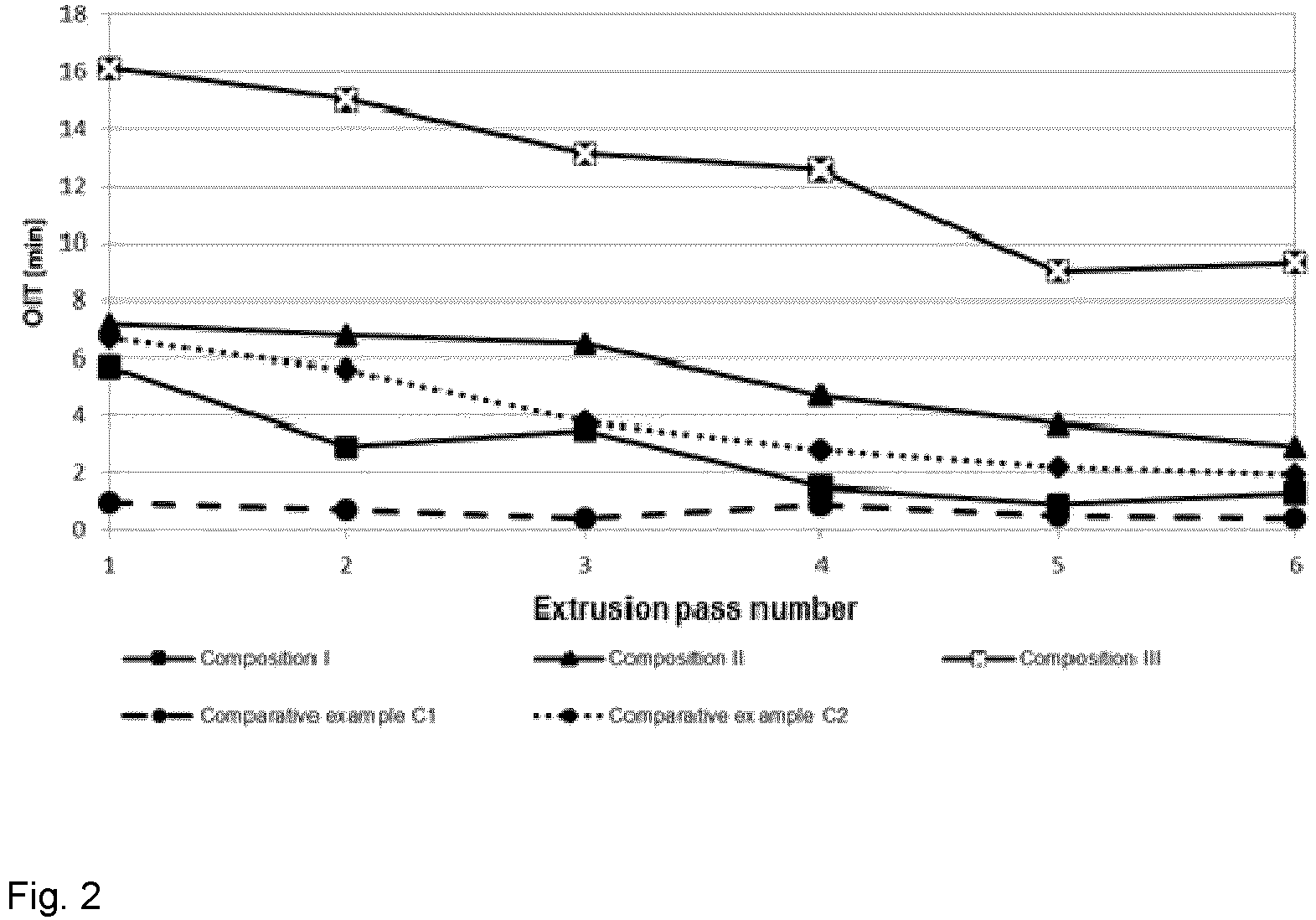
- Moreover, OIT can be increased for the compositions III compared to I, II, C1 and C2. Furthermore, an increased OIT may also be maintained over several consecutive extrusions.
Claims (7)
- A film prepared using a stabilized polyolefin composition, wherein the stabilized polyolefin composition consists of:A) a copolymer of ethylene and at least one α-olefin, wherein the copolymer of ethylene and at least one α-olefin is a linear low-density polyethylene (LLDPE) produced using at least one Ziegler-Natta catalyst comprising Mg and at least one of Ti, Hf or Zr, having a density as determined in accordance with ISO 1183-1 (2012), method A, of ≥ 913 kg/m3 and ≤ 923 kg/m3, andB) between 170 and 300 ppm by weight of α-tocopherol relative to the component A.
- A film according claim 1, wherein component A has a melt mass flow rate as measured according to ISO 1131-1 (2011) at 190°C and a load of 2.16 kg of between 0.5 dg/min and 3 dg/min.
- A film according to any one of claims 1-2, wherein component A has an Mw/Mn of between 4 and 12.
- A film according to any one of claims 1-3, wherein component A has an Mz/Mw of between 4 and 12.
- A film according to any one of claims 1-4, wherein the α-olefin is selected from 1-butene, 1-pentene, 4-methyl-1-pentene, 1-heptene, and 1-octene.
- A film according to any one of claims 1-4, wherein the α-olefin is 1-butene.
- A film according to any one of claims 1-4, wherein the linear low density polyethylene comprises between 0.05 wt% and 15 wt% of polymerized α-olefin compared to the total weight of the linear low density polyethylene.
Applications Claiming Priority (2)
| Application Number | Priority Date | Filing Date | Title |
|---|---|---|---|
| EP15202911 | 2015-12-29 | ||
| PCT/EP2016/082545 WO2017114782A1 (en) | 2015-12-29 | 2016-12-23 | Stabilised polyolefin composition |
Publications (2)
| Publication Number | Publication Date |
|---|---|
| EP3397681A1 EP3397681A1 (en) | 2018-11-07 |
| EP3397681B1 true EP3397681B1 (en) | 2024-12-04 |
Family
ID=55068887
Family Applications (1)
| Application Number | Title | Priority Date | Filing Date |
|---|---|---|---|
| EP16820283.6A Active EP3397681B1 (en) | 2015-12-29 | 2016-12-23 | Stabilised polyolefin film |
Country Status (2)
| Country | Link |
|---|---|
| EP (1) | EP3397681B1 (en) |
| WO (1) | WO2017114782A1 (en) |
Families Citing this family (2)
| Publication number | Priority date | Publication date | Assignee | Title |
|---|---|---|---|---|
| EP3526040A1 (en) * | 2016-10-14 | 2019-08-21 | SABIC Global Technologies B.V. | Packaging material |
| WO2018069540A1 (en) * | 2016-10-14 | 2018-04-19 | Sabic Global Technologies B.V. | Sterilizable packaging material |
Citations (1)
| Publication number | Priority date | Publication date | Assignee | Title |
|---|---|---|---|---|
| US5132344A (en) * | 1988-10-21 | 1992-07-21 | Bp Chemicals Limited | Stabilized polyethylene composition |
Family Cites Families (3)
| Publication number | Priority date | Publication date | Assignee | Title |
|---|---|---|---|---|
| CA2146034A1 (en) * | 1994-05-12 | 1995-11-13 | Kenneth W. Willcox | Polymer stabilization |
| EP0878502A2 (en) * | 1997-05-05 | 1998-11-18 | Ciba SC Holding AG | Formulations of Vitamin E for stabilisation of polymeric organic materials |
| US20160075860A1 (en) * | 2013-05-24 | 2016-03-17 | Dow Global Technologies Llc | An ethylene-based composition |
-
2016
- 2016-12-23 EP EP16820283.6A patent/EP3397681B1/en active Active
- 2016-12-23 WO PCT/EP2016/082545 patent/WO2017114782A1/en not_active Ceased
Patent Citations (1)
| Publication number | Priority date | Publication date | Assignee | Title |
|---|---|---|---|---|
| US5132344A (en) * | 1988-10-21 | 1992-07-21 | Bp Chemicals Limited | Stabilized polyethylene composition |
Non-Patent Citations (1)
| Title |
|---|
| KARSTEN BEUTNER ET AL: "Polyethylene", RÖMPP ONLINE 4.0, 1 December 2009 (2009-12-01), pages 1 - 6, XP055614634, Retrieved from the Internet <URL:https://roempp.thieme.de/roempp4.0/do/data/RD-16-03243> [retrieved on 20190822] * |
Also Published As
| Publication number | Publication date |
|---|---|
| EP3397681A1 (en) | 2018-11-07 |
| WO2017114782A1 (en) | 2017-07-06 |
Similar Documents
| Publication | Publication Date | Title |
|---|---|---|
| TWI428382B (en) | Color stabilized polyolefin | |
| WO2013118749A1 (en) | Polyethylene-based resin composition for container lid, and container lid | |
| EP3411433B1 (en) | Pipe produced with a polymer composition comprising a polyethylene | |
| EP3074460A1 (en) | Stabilised polyolefin composition | |
| EP3397681A1 (en) | Stabilised polyolefin composition | |
| KR20010072370A (en) | High clarity polyethylene compositions | |
| EP4479472A1 (en) | Polyethylene glycol-based polymer processing aids | |
| US11091611B2 (en) | Polyolefin composition | |
| US20060047029A1 (en) | Additive package comprising optical brighteners | |
| EP3649190B1 (en) | Polyethylene composition | |
| WO2023149984A1 (en) | Polyethylene glycol-based polymer processing aids | |
| EP3775018B1 (en) | Polypropylene composition for use in bopp application, a process for preparing bopp films and said bopp film | |
| WO2014108382A1 (en) | Polyethylene composition | |
| EP3436262B1 (en) | Single use reactor systems and methods | |
| WO2014190298A1 (en) | An ethylene-based composition | |
| EP2167551B1 (en) | Ethylene polymer composition | |
| US20250084248A1 (en) | Polyethylene glycol-based polymer processing aids | |
| EP4476285A1 (en) | Polyethylene glycol-based polymer processing aids | |
| EP3526040A1 (en) | Packaging material | |
| EP3526039A1 (en) | Sterilizable packaging material | |
| EP3378890A1 (en) | Polyolefin stabilizers with reduced fragmentation |
Legal Events
| Date | Code | Title | Description |
|---|---|---|---|
| STAA | Information on the status of an ep patent application or granted ep patent |
Free format text: STATUS: UNKNOWN |
|
| STAA | Information on the status of an ep patent application or granted ep patent |
Free format text: STATUS: THE INTERNATIONAL PUBLICATION HAS BEEN MADE |
|
| PUAI | Public reference made under article 153(3) epc to a published international application that has entered the european phase |
Free format text: ORIGINAL CODE: 0009012 |
|
| STAA | Information on the status of an ep patent application or granted ep patent |
Free format text: STATUS: REQUEST FOR EXAMINATION WAS MADE |
|
| 17P | Request for examination filed |
Effective date: 20180619 |
|
| AK | Designated contracting states |
Kind code of ref document: A1 Designated state(s): AL AT BE BG CH CY CZ DE DK EE ES FI FR GB GR HR HU IE IS IT LI LT LU LV MC MK MT NL NO PL PT RO RS SE SI SK SM TR |
|
| AX | Request for extension of the european patent |
Extension state: BA ME |
|
| DAV | Request for validation of the european patent (deleted) | ||
| DAX | Request for extension of the european patent (deleted) | ||
| STAA | Information on the status of an ep patent application or granted ep patent |
Free format text: STATUS: EXAMINATION IS IN PROGRESS |
|
| 17Q | First examination report despatched |
Effective date: 20200417 |
|
| GRAP | Despatch of communication of intention to grant a patent |
Free format text: ORIGINAL CODE: EPIDOSNIGR1 |
|
| STAA | Information on the status of an ep patent application or granted ep patent |
Free format text: STATUS: GRANT OF PATENT IS INTENDED |
|
| GRAJ | Information related to disapproval of communication of intention to grant by the applicant or resumption of examination proceedings by the epo deleted |
Free format text: ORIGINAL CODE: EPIDOSDIGR1 |
|
| GRAP | Despatch of communication of intention to grant a patent |
Free format text: ORIGINAL CODE: EPIDOSNIGR1 |
|
| GRAJ | Information related to disapproval of communication of intention to grant by the applicant or resumption of examination proceedings by the epo deleted |
Free format text: ORIGINAL CODE: EPIDOSDIGR1 |
|
| INTG | Intention to grant announced |
Effective date: 20240627 |
|
| STAA | Information on the status of an ep patent application or granted ep patent |
Free format text: STATUS: EXAMINATION IS IN PROGRESS |
|
| GRAP | Despatch of communication of intention to grant a patent |
Free format text: ORIGINAL CODE: EPIDOSNIGR1 |
|
| STAA | Information on the status of an ep patent application or granted ep patent |
Free format text: STATUS: GRANT OF PATENT IS INTENDED |
|
| INTG | Intention to grant announced |
Effective date: 20240715 |
|
| INTC | Intention to grant announced (deleted) | ||
| INTG | Intention to grant announced |
Effective date: 20240730 |
|
| GRAS | Grant fee paid |
Free format text: ORIGINAL CODE: EPIDOSNIGR3 |
|
| GRAA | (expected) grant |
Free format text: ORIGINAL CODE: 0009210 |
|
| STAA | Information on the status of an ep patent application or granted ep patent |
Free format text: STATUS: THE PATENT HAS BEEN GRANTED |
|
| AK | Designated contracting states |
Kind code of ref document: B1 Designated state(s): AL AT BE BG CH CY CZ DE DK EE ES FI FR GB GR HR HU IE IS IT LI LT LU LV MC MK MT NL NO PL PT RO RS SE SI SK SM TR |
|
| REG | Reference to a national code |
Ref country code: GB Ref legal event code: FG4D |
|
| REG | Reference to a national code |
Ref country code: CH Ref legal event code: EP |
|
| REG | Reference to a national code |
Ref country code: DE Ref legal event code: R096 Ref document number: 602016090522 Country of ref document: DE |
|
| REG | Reference to a national code |
Ref country code: IE Ref legal event code: FG4D |
|
| P01 | Opt-out of the competence of the unified patent court (upc) registered |
Free format text: CASE NUMBER: APP_3369/2025 Effective date: 20250121 |
|
| REG | Reference to a national code |
Ref country code: LT Ref legal event code: MG9D |
|
| REG | Reference to a national code |
Ref country code: NL Ref legal event code: MP Effective date: 20241204 |
|
| PG25 | Lapsed in a contracting state [announced via postgrant information from national office to epo] |
Ref country code: HR Free format text: LAPSE BECAUSE OF FAILURE TO SUBMIT A TRANSLATION OF THE DESCRIPTION OR TO PAY THE FEE WITHIN THE PRESCRIBED TIME-LIMIT Effective date: 20241204 |
|
| PG25 | Lapsed in a contracting state [announced via postgrant information from national office to epo] |
Ref country code: FI Free format text: LAPSE BECAUSE OF FAILURE TO SUBMIT A TRANSLATION OF THE DESCRIPTION OR TO PAY THE FEE WITHIN THE PRESCRIBED TIME-LIMIT Effective date: 20241204 |
|
| PG25 | Lapsed in a contracting state [announced via postgrant information from national office to epo] |
Ref country code: BG Free format text: LAPSE BECAUSE OF FAILURE TO SUBMIT A TRANSLATION OF THE DESCRIPTION OR TO PAY THE FEE WITHIN THE PRESCRIBED TIME-LIMIT Effective date: 20241204 |
|
| PG25 | Lapsed in a contracting state [announced via postgrant information from national office to epo] |
Ref country code: ES Free format text: LAPSE BECAUSE OF FAILURE TO SUBMIT A TRANSLATION OF THE DESCRIPTION OR TO PAY THE FEE WITHIN THE PRESCRIBED TIME-LIMIT Effective date: 20241204 |
|
| PG25 | Lapsed in a contracting state [announced via postgrant information from national office to epo] |
Ref country code: NO Free format text: LAPSE BECAUSE OF FAILURE TO SUBMIT A TRANSLATION OF THE DESCRIPTION OR TO PAY THE FEE WITHIN THE PRESCRIBED TIME-LIMIT Effective date: 20250304 |
|
| PG25 | Lapsed in a contracting state [announced via postgrant information from national office to epo] |
Ref country code: GR Free format text: LAPSE BECAUSE OF FAILURE TO SUBMIT A TRANSLATION OF THE DESCRIPTION OR TO PAY THE FEE WITHIN THE PRESCRIBED TIME-LIMIT Effective date: 20250305 Ref country code: LV Free format text: LAPSE BECAUSE OF FAILURE TO SUBMIT A TRANSLATION OF THE DESCRIPTION OR TO PAY THE FEE WITHIN THE PRESCRIBED TIME-LIMIT Effective date: 20241204 |
|
| PG25 | Lapsed in a contracting state [announced via postgrant information from national office to epo] |
Ref country code: RS Free format text: LAPSE BECAUSE OF FAILURE TO SUBMIT A TRANSLATION OF THE DESCRIPTION OR TO PAY THE FEE WITHIN THE PRESCRIBED TIME-LIMIT Effective date: 20250304 |
|
| PG25 | Lapsed in a contracting state [announced via postgrant information from national office to epo] |
Ref country code: NL Free format text: LAPSE BECAUSE OF FAILURE TO SUBMIT A TRANSLATION OF THE DESCRIPTION OR TO PAY THE FEE WITHIN THE PRESCRIBED TIME-LIMIT Effective date: 20241204 |
|
| REG | Reference to a national code |
Ref country code: AT Ref legal event code: MK05 Ref document number: 1748124 Country of ref document: AT Kind code of ref document: T Effective date: 20241204 |
|
| PG25 | Lapsed in a contracting state [announced via postgrant information from national office to epo] |
Ref country code: SM Free format text: LAPSE BECAUSE OF FAILURE TO SUBMIT A TRANSLATION OF THE DESCRIPTION OR TO PAY THE FEE WITHIN THE PRESCRIBED TIME-LIMIT Effective date: 20241204 |
|
| PG25 | Lapsed in a contracting state [announced via postgrant information from national office to epo] |
Ref country code: PL Free format text: LAPSE BECAUSE OF FAILURE TO SUBMIT A TRANSLATION OF THE DESCRIPTION OR TO PAY THE FEE WITHIN THE PRESCRIBED TIME-LIMIT Effective date: 20241204 |
|
| PG25 | Lapsed in a contracting state [announced via postgrant information from national office to epo] |
Ref country code: IS Free format text: LAPSE BECAUSE OF FAILURE TO SUBMIT A TRANSLATION OF THE DESCRIPTION OR TO PAY THE FEE WITHIN THE PRESCRIBED TIME-LIMIT Effective date: 20250404 |
|
| PG25 | Lapsed in a contracting state [announced via postgrant information from national office to epo] |
Ref country code: PT Free format text: LAPSE BECAUSE OF FAILURE TO SUBMIT A TRANSLATION OF THE DESCRIPTION OR TO PAY THE FEE WITHIN THE PRESCRIBED TIME-LIMIT Effective date: 20250404 |
|
| PG25 | Lapsed in a contracting state [announced via postgrant information from national office to epo] |
Ref country code: EE Free format text: LAPSE BECAUSE OF FAILURE TO SUBMIT A TRANSLATION OF THE DESCRIPTION OR TO PAY THE FEE WITHIN THE PRESCRIBED TIME-LIMIT Effective date: 20241204 |
|
| PG25 | Lapsed in a contracting state [announced via postgrant information from national office to epo] |
Ref country code: AT Free format text: LAPSE BECAUSE OF FAILURE TO SUBMIT A TRANSLATION OF THE DESCRIPTION OR TO PAY THE FEE WITHIN THE PRESCRIBED TIME-LIMIT Effective date: 20241204 Ref country code: RO Free format text: LAPSE BECAUSE OF FAILURE TO SUBMIT A TRANSLATION OF THE DESCRIPTION OR TO PAY THE FEE WITHIN THE PRESCRIBED TIME-LIMIT Effective date: 20241204 |
|
| PG25 | Lapsed in a contracting state [announced via postgrant information from national office to epo] |
Ref country code: SK Free format text: LAPSE BECAUSE OF FAILURE TO SUBMIT A TRANSLATION OF THE DESCRIPTION OR TO PAY THE FEE WITHIN THE PRESCRIBED TIME-LIMIT Effective date: 20241204 |
|
| PG25 | Lapsed in a contracting state [announced via postgrant information from national office to epo] |
Ref country code: CZ Free format text: LAPSE BECAUSE OF FAILURE TO SUBMIT A TRANSLATION OF THE DESCRIPTION OR TO PAY THE FEE WITHIN THE PRESCRIBED TIME-LIMIT Effective date: 20241204 |
|
| PG25 | Lapsed in a contracting state [announced via postgrant information from national office to epo] |
Ref country code: IT Free format text: LAPSE BECAUSE OF FAILURE TO SUBMIT A TRANSLATION OF THE DESCRIPTION OR TO PAY THE FEE WITHIN THE PRESCRIBED TIME-LIMIT Effective date: 20241204 |
|
| REG | Reference to a national code |
Ref country code: CH Ref legal event code: PL |
|
| PG25 | Lapsed in a contracting state [announced via postgrant information from national office to epo] |
Ref country code: LU Free format text: LAPSE BECAUSE OF NON-PAYMENT OF DUE FEES Effective date: 20241223 |
|
| REG | Reference to a national code |
Ref country code: DE Ref legal event code: R097 Ref document number: 602016090522 Country of ref document: DE |
|
| PG25 | Lapsed in a contracting state [announced via postgrant information from national office to epo] |
Ref country code: SE Free format text: LAPSE BECAUSE OF FAILURE TO SUBMIT A TRANSLATION OF THE DESCRIPTION OR TO PAY THE FEE WITHIN THE PRESCRIBED TIME-LIMIT Effective date: 20241204 |
|
| PG25 | Lapsed in a contracting state [announced via postgrant information from national office to epo] |
Ref country code: MC Free format text: LAPSE BECAUSE OF FAILURE TO SUBMIT A TRANSLATION OF THE DESCRIPTION OR TO PAY THE FEE WITHIN THE PRESCRIBED TIME-LIMIT Effective date: 20241204 |
|
| REG | Reference to a national code |
Ref country code: BE Ref legal event code: MM Effective date: 20241231 |
|
| PG25 | Lapsed in a contracting state [announced via postgrant information from national office to epo] |
Ref country code: DK Free format text: LAPSE BECAUSE OF FAILURE TO SUBMIT A TRANSLATION OF THE DESCRIPTION OR TO PAY THE FEE WITHIN THE PRESCRIBED TIME-LIMIT Effective date: 20241204 |
|
| PLBE | No opposition filed within time limit |
Free format text: ORIGINAL CODE: 0009261 |
|
| STAA | Information on the status of an ep patent application or granted ep patent |
Free format text: STATUS: NO OPPOSITION FILED WITHIN TIME LIMIT |
|
| PG25 | Lapsed in a contracting state [announced via postgrant information from national office to epo] |
Ref country code: BE Free format text: LAPSE BECAUSE OF NON-PAYMENT OF DUE FEES Effective date: 20241231 |
|
| PG25 | Lapsed in a contracting state [announced via postgrant information from national office to epo] |
Ref country code: CH Free format text: LAPSE BECAUSE OF NON-PAYMENT OF DUE FEES Effective date: 20241231 |
|
| PG25 | Lapsed in a contracting state [announced via postgrant information from national office to epo] |
Ref country code: IE Free format text: LAPSE BECAUSE OF NON-PAYMENT OF DUE FEES Effective date: 20241223 |
|
| 26N | No opposition filed |
Effective date: 20250905 |
|
| PGFP | Annual fee paid to national office [announced via postgrant information from national office to epo] |
Ref country code: GB Payment date: 20251229 Year of fee payment: 10 |
|
| PGFP | Annual fee paid to national office [announced via postgrant information from national office to epo] |
Ref country code: FR Payment date: 20251226 Year of fee payment: 10 |
|
| PGFP | Annual fee paid to national office [announced via postgrant information from national office to epo] |
Ref country code: DE Payment date: 20251229 Year of fee payment: 10 |
|
| PG25 | Lapsed in a contracting state [announced via postgrant information from national office to epo] |
Ref country code: CY Free format text: LAPSE BECAUSE OF FAILURE TO SUBMIT A TRANSLATION OF THE DESCRIPTION OR TO PAY THE FEE WITHIN THE PRESCRIBED TIME-LIMIT Effective date: 20241204 |