EP3396924A1 - Real-time processing of iot data - Google Patents
Real-time processing of iot data Download PDFInfo
- Publication number
- EP3396924A1 EP3396924A1 EP18167189.2A EP18167189A EP3396924A1 EP 3396924 A1 EP3396924 A1 EP 3396924A1 EP 18167189 A EP18167189 A EP 18167189A EP 3396924 A1 EP3396924 A1 EP 3396924A1
- Authority
- EP
- European Patent Office
- Prior art keywords
- data
- physical processor
- individual
- instructions
- data packets
- Prior art date
- Legal status (The legal status is an assumption and is not a legal conclusion. Google has not performed a legal analysis and makes no representation as to the accuracy of the status listed.)
- Granted
Links
Images


Classifications
-
- G—PHYSICS
- G06—COMPUTING OR CALCULATING; COUNTING
- G06N—COMPUTING ARRANGEMENTS BASED ON SPECIFIC COMPUTATIONAL MODELS
- G06N20/00—Machine learning
-
- G—PHYSICS
- G06—COMPUTING OR CALCULATING; COUNTING
- G06F—ELECTRIC DIGITAL DATA PROCESSING
- G06F18/00—Pattern recognition
- G06F18/20—Analysing
- G06F18/24—Classification techniques
- G06F18/241—Classification techniques relating to the classification model, e.g. parametric or non-parametric approaches
- G06F18/2411—Classification techniques relating to the classification model, e.g. parametric or non-parametric approaches based on the proximity to a decision surface, e.g. support vector machines
-
- G—PHYSICS
- G11—INFORMATION STORAGE
- G11B—INFORMATION STORAGE BASED ON RELATIVE MOVEMENT BETWEEN RECORD CARRIER AND TRANSDUCER
- G11B27/00—Editing; Indexing; Addressing; Timing or synchronising; Monitoring; Measuring tape travel
-
- H—ELECTRICITY
- H04—ELECTRIC COMMUNICATION TECHNIQUE
- H04L—TRANSMISSION OF DIGITAL INFORMATION, e.g. TELEGRAPHIC COMMUNICATION
- H04L65/00—Network arrangements, protocols or services for supporting real-time applications in data packet communication
- H04L65/60—Network streaming of media packets
- H04L65/70—Media network packetisation
-
- H—ELECTRICITY
- H04—ELECTRIC COMMUNICATION TECHNIQUE
- H04L—TRANSMISSION OF DIGITAL INFORMATION, e.g. TELEGRAPHIC COMMUNICATION
- H04L65/00—Network arrangements, protocols or services for supporting real-time applications in data packet communication
- H04L65/60—Network streaming of media packets
- H04L65/75—Media network packet handling
- H04L65/765—Media network packet handling intermediate
-
- H—ELECTRICITY
- H04—ELECTRIC COMMUNICATION TECHNIQUE
- H04L—TRANSMISSION OF DIGITAL INFORMATION, e.g. TELEGRAPHIC COMMUNICATION
- H04L67/00—Network arrangements or protocols for supporting network services or applications
- H04L67/01—Protocols
- H04L67/12—Protocols specially adapted for proprietary or special-purpose networking environments, e.g. medical networks, sensor networks, networks in vehicles or remote metering networks
-
- H—ELECTRICITY
- H04—ELECTRIC COMMUNICATION TECHNIQUE
- H04L—TRANSMISSION OF DIGITAL INFORMATION, e.g. TELEGRAPHIC COMMUNICATION
- H04L67/00—Network arrangements or protocols for supporting network services or applications
- H04L67/50—Network services
- H04L67/56—Provisioning of proxy services
- H04L67/564—Enhancement of application control based on intercepted application data
-
- H—ELECTRICITY
- H04—ELECTRIC COMMUNICATION TECHNIQUE
- H04N—PICTORIAL COMMUNICATION, e.g. TELEVISION
- H04N19/00—Methods or arrangements for coding, decoding, compressing or decompressing digital video signals
- H04N19/10—Methods or arrangements for coding, decoding, compressing or decompressing digital video signals using adaptive coding
- H04N19/169—Methods or arrangements for coding, decoding, compressing or decompressing digital video signals using adaptive coding characterised by the coding unit, i.e. the structural portion or semantic portion of the video signal being the object or the subject of the adaptive coding
- H04N19/17—Methods or arrangements for coding, decoding, compressing or decompressing digital video signals using adaptive coding characterised by the coding unit, i.e. the structural portion or semantic portion of the video signal being the object or the subject of the adaptive coding the unit being an image region, e.g. an object
- H04N19/172—Methods or arrangements for coding, decoding, compressing or decompressing digital video signals using adaptive coding characterised by the coding unit, i.e. the structural portion or semantic portion of the video signal being the object or the subject of the adaptive coding the unit being an image region, e.g. an object the region being a picture, frame or field
-
- H—ELECTRICITY
- H04—ELECTRIC COMMUNICATION TECHNIQUE
- H04N—PICTORIAL COMMUNICATION, e.g. TELEVISION
- H04N19/00—Methods or arrangements for coding, decoding, compressing or decompressing digital video signals
- H04N19/42—Methods or arrangements for coding, decoding, compressing or decompressing digital video signals characterised by implementation details or hardware specially adapted for video compression or decompression, e.g. dedicated software implementation
- H04N19/436—Methods or arrangements for coding, decoding, compressing or decompressing digital video signals characterised by implementation details or hardware specially adapted for video compression or decompression, e.g. dedicated software implementation using parallelised computational arrangements
-
- H—ELECTRICITY
- H04—ELECTRIC COMMUNICATION TECHNIQUE
- H04N—PICTORIAL COMMUNICATION, e.g. TELEVISION
- H04N19/00—Methods or arrangements for coding, decoding, compressing or decompressing digital video signals
- H04N19/46—Embedding additional information in the video signal during the compression process
-
- H—ELECTRICITY
- H04—ELECTRIC COMMUNICATION TECHNIQUE
- H04N—PICTORIAL COMMUNICATION, e.g. TELEVISION
- H04N21/00—Selective content distribution, e.g. interactive television or video on demand [VOD]
- H04N21/80—Generation or processing of content or additional data by content creator independently of the distribution process; Content per se
- H04N21/83—Generation or processing of protective or descriptive data associated with content; Content structuring
- H04N21/845—Structuring of content, e.g. decomposing content into time segments
-
- H—ELECTRICITY
- H04—ELECTRIC COMMUNICATION TECHNIQUE
- H04W—WIRELESS COMMUNICATION NETWORKS
- H04W4/00—Services specially adapted for wireless communication networks; Facilities therefor
- H04W4/70—Services for machine-to-machine communication [M2M] or machine type communication [MTC]
Definitions
- IoT Internet of Things
- Processing of data from IoT devices may involve sending data from an IoT device to an edge device communicably coupled to the IoT device, and then to a server on a cloud network communicably coupled to the edge device.
- Processing data from a plurality of IoT devices may incur network latency and computation latency issues.
- the foregoing disclosure describes a number of example implementations for real-time processing of Internet of Things ("IoT") data.
- the disclosed examples may include systems, devices, computer-readable storage media, and methods for real-time processing of IoT data.
- IoT Internet of Things
- certain examples are described with reference to the components illustrated in FIGS. 1-4 .
- the functionality of the illustrated components may overlap, however, and may be present in a fewer or greater number of elements and components.
- IoT Internet of Things
- Processing of data from IoT devices may involve sending data from an IoT device to an edge device communicably coupled to the IoT device, and then to a server on a cloud network communicably coupled to the edge device.
- Processing data from a plurality of IoT devices may incur network latency and computation latency issues.
- Live video feeds may be timely and costly to process.
- IoT cameras are able to generate megabytes of visual data every second. Due to their geographical location, offloading the entire set of data captured by an IoT device in real time to an edge device and then to a server device in the cloud may not be possible and may incur significant delays, in addition to incurring a significant bandwidth cost. Reducing the resolution for real-time transfer is also not ideal, as it makes the processing and analysis of that data more difficult.
- Existing solutions to process complex data from IoT devices are either built into hardware (thus increasing the cost and complexity of the hardware involved) or edge devices perform minimal lightweight processing before the data is sent to a server in the cloud network.
- a technical solution to these technical challenges may efficiently process complex data from IoT devices on the connected edge devices and distribute the data and processed results to servers in the cloud network.
- a technical solution to these technical challenges may leverage an architecture pipeline in the edge device to process and derive insights from the complex data.
- the technical solution may receive, by a first physical processor of an edge computing device, a set of data from a first IoT device communicably coupled to the edge device.
- the set of data may be split into a set of individual data packets and processed by a second physical process of the edge device.
- the set of individual data packets may be processed, for example, by concurrently applying, by a plurality of instances of the second physical processor of the edge computing device, a learning model to each of a corresponding plurality of data packets from the set of individual data packets, and annotating, by a subset of the plurality of instances of the second physical processor, a corresponding subset of the plurality of data packets with a corresponding output from the concurrent application of the learning model.
- FIG. 1 is an example environment in which various examples may be implemented as a system that facilitates real-time processing of IoT data.
- system that facilitates real-time processing of IoT data may include various components such as a set of edge devices (e.g., edge devices 100, 100B, ..., 100N), a set of IoT devices 101A, 101B, ..., 101N, 102A, 102B, ..., 102N, a cloud server 50, and/or other devices communicably coupled to the set of edge devices.
- a set of edge devices e.g., edge devices 100, 100B, ..., 100N
- IoT devices 101A, 101B, ..., 101N, 102A, 102B, ..., 102N e.g., a cloud server 50, and/or other devices communicably coupled to the set of edge devices.
- Each edge device may communicate to and/or receive data from a cloud server 50, a set of IoT devices (e.g., devices 101A, 101B, ..., 101N), a set of other edge devices (e.g., edge devices 101B, ..., 101N), and/or other components in a network.
- a cloud server 50 e.g., a set of IoT devices (e.g., devices 101A, 101B, ..., 101N), a set of other edge devices (e.g., edge devices 101B, ..., 101N), and/or other components in a network.
- An edge device may comprise an access point, network switch, or other hardware device on a network that comprises a first physical processor (e.g., physical processor 110) and a second physical processor (e.g., second physical processor 115) that implement machine readable instructions to facilitate communication in the network.
- Physical processor 110 may be at least one central processing unit (CPU), microprocessor, and/or other hardware device suitable for performing the functionality described in relation to FIG. 1A .
- Second physical processor 115 may be at least one graphics processing unit (GPU), microprocessor, and/or other hardware device suitable for performing the functionality described in relation to FIG. 1A .
- Cloud server 50 may be any server in a cloud network communicably coupled to an edge device that facilitates processing and/or storage of IoT data.
- IoT devices 101A, 101B, ..., 101N may be any IoT devices that are connected to the edge device.
- IoT devices may be low-end devices that may be publicly deployed in a widespread manner.
- a low-end IoT device may comprise, for example, an IoT device that does not include complex hardware, separate security modules, or any specialized combination of hardware and programming that may facilitate analytical functionality by the IoT device.
- the IoT devices may comprise one or multiple types of IoT devices on the network. Types of IoT devices may comprise, for example, cameras, traffic signals, coffee makers, air quality sensors, thermostats, printers, lightbulbs, other sensors, and/or any other IoT device.
- a system that facilitates real-time processing of IoT data and the various components described herein may be implemented in hardware and/or a combination of hardware and programming that configures hardware. Furthermore, in FIG. 1 and other Figures described herein, different numbers of components or entities than depicted may be used.
- a system that facilitates real-time processing of IoT data may comprise a set of edge devices, with at least one edge device being connected to an IoT device.
- FIG. 1A is a block diagram depicting an example edge device for facilitating real-time processing of IoT data.
- the example edge device 100 may comprise the edge device 100 of FIG. 1 .
- Edge device which facilitates real-time processing of data from IoT devices 101A, 101B, ..., 101N, may comprise a physical processor 110, a data receiving engine 130, a data splitting engine 140, a processing engine 150, and/or other engines.
- processing engine 150 may comprise a concurrent application engine 151, annotation engine 152, and/or other engines.
- engine refers to a combination of hardware and programming that performs a designated function. As is illustrated with respect to FIGS.
- each engine may include one or both of a physical processor and a machine-readable storage medium, while the programming is instructions or code stored on the machine-readable storage medium and executable by the physical processor to perform the designated function.
- data receiving engine 130, data splitting engine 140 may include first physical processor 110
- data processing engine 150 may include second physical processor 115.
- data receiving engine 230, data splitting engine 240, decoding engine 260, and transmission engine 270 may include first physical processor 210
- data processing engine 250 may include second physical processor 215.
- Data receiving engine 130 may receive a set of data from a first IoT device (e.g., IoT device 101A) communicably coupled to the edge device 100.
- the set of data may comprise a set of individual data packets.
- the data receiving engine 130 may receive the set of data at a bandwidth rate.
- the set of data may comprise video data that includes a set of frames.
- the data receiving engine may receive the set of data at a frame rate.
- the data receiving engine 130 may decode the set of data from a video encoding performed by the IoT device (e.g., IoT device 101A) and may re-encode the video data to an encoding supported by the edge device 100 and/or servers 50 in the network.
- the data receiving engine 130 may receive a set of video data encoded in an HLS format and transmitted from the IoT device (e.g., IoT device 101A) using an RTMP protocol.
- the data receiving engine 130 may decode the set of video data and re-encode the set of video data to a supported format (e.g., FFMPEG, and/or other predetermined format).
- Data receiving engine may perform other pre-processing of the set of data as well.
- the data splitting engine 140 may split the set of data into a set of individual data packets. In some examples, the data splitting engine 140 may split the data responsive to performing pre-processing on the data. In examples in which the set of data comprise video data, the data splitting engine 140 may split the video data into a set of frames. In these examples, the data splitting engine 140 may split the video data into a set of frames responsive to decoding the video data. Responsive to splitting the set of data, data splitting engine 140 may then cause the split data to be sent to the processing engine 150.
- Processing engine 150 may process the set of individual data packets.
- the processing engine 150 may determine a number of the plurality of instances of the second physical processor 115 to use in parallel to process the set of individual data packets.
- the processing engine 150 may determine the number of the plurality of instances based on a bandwidth rate at which the data packets are being received, based on a number of processor cores available via the physical processor 115, based on a predetermined or required output rate of the data packets, based on a frame rate of the set of data (where the set of data comprises video data), and/or based on other factors.
- a non-transitory machine-readable storage medium comprises instructions to cause the second physical processor to determine a number of the plurality of instances for processing the set of individual data packets based on a frame rate of the set of video data.
- the processing engine 150 may determine the learning model to apply to the set of data.
- the processing engine 150 may determine the model based on a single model being stored in the storage medium 120. In examples in which multiple models may be stored in the storage medium 120, the processing engine 150 may determine the learning model to apply based on a set of characteristics of the set of data, on a type of analysis to be performed on the set of data, on a data type, a data source, and/or based on other factors. In some examples, the processing engine 150 may apply multiple learning models, where each model may be applied to a different subset of the set of data, or multiple models may be applied to the same subsets of the set of data based on the factors. In some examples, the learning model may comprise a regional-based convolutional neural network and/or other type of learning model. In some examples, the processing model may receive updated learning models from the server 50 and/or other device in the network.
- the processing engine 150 may apply the same learning model to each of the individual data packets processed by an instance of the physical processor 115.
- processing engine 150 may comprise concurrent application engine 151, annotation engine 152, and/or other engines.
- the concurrent application engine 151 may concurrently apply, by a plurality of instances of the second physical processor 115, a learning model to each of a corresponding plurality of data packets from the set of individual data packets (or individual frames in examples in the set of data comprises video data).
- the processing engine 150 may load second physical processor 115 with a plurality of instances of the learning model, such that each of a set of cores of the second physical processor 115 may apply a respective instance of the learning model to a corresponding individual data packet (or individual frame).
- the concurrent application engine 151 may receive a next data packet (or individual frame)of the set of individual data packet (or individual frame)for processing. For example, as data arrives in series via the data receiving engine 130 and is split by the data splitting engine 140 and transmitted to the processing engine 150, the processing engine 150 may send the next individual data packet (or individual frame) to a next unutilized instance of the second physical processor 115 for processing, may determine a next instance of the second physical processor 115 based on a load balancing algorithm, and/or may otherwise determine a next instance of the second physical processor 115.
- a non-transitory machine-readable storage medium comprises instructions to cause the second physical processor to, responsive to an instance of the second physical processor applying the learning model to an individual data packet, receive, by the instance, a next data packet of the set of individual data packets for processing
- the annotation engine 152 may annotate, by a subset of the plurality of instances of the second physical processor 115, a corresponding subset of the plurality of data packets (or individual frames) with a corresponding output from the concurrent application of the learning model.
- the annotation engine 152 may annotate a data packet by adding a visual effect, text, metadata, and/or other information to an individual data packet (or individual frame).
- the annotation engine 152 may determine the information to annotate to the individual data packet (or individual frame)based on the learning model being applied, based on inputs from an administrator or user of the network, based on a set of characteristics of the set of data, and/or based on other factors.
- instructions to cause the second physical processor to annotate a data packet comprise instructions to cause the second physical processor to add visual effects to an individual data packet.
- the processing engine 150 may re-order the plurality of data packets to match an order in which the set of individual data packets (or individual frames) were processed.
- the processing time of data packets (or individual frames) by the instances of the second physical processor 115 may not be constant (e.g., due to different packet (or frame) size, packet (or frame) data, and/or other factors).
- the processing engine 150 may output the processed data packets (or frames) in an order that may not be the same as the order in which the individual data packets (or frames) were input.
- the processing engine 150 may perform in-memory sorting (and/or other types of sorting) on the output data packets (or frames) to place them in the original order in which they were processed.
- the second physical processor implements machine readable instructions to cause the system to: responsive to annotating each of the plurality of frames, re-order the plurality of frames to match an order in which the set of individual frames were processed.
- a non-transitory machine-readable storage comprises instructions to cause the second physical processor to, responsive to annotating each of the plurality of data packets, re-order the plurality of data packets to match an order in which the set of individual data packets were processed.
- the processing engine 150 may transmit the annotated, re-ordered plurality of data packets (or frames) to a server (e.g., server 50) communicably coupled to the edge device 100.
- a server e.g., server 50
- the processing engine 150 may perform analytics or processing on the data packets (or frames).
- the processing engine 150 may re-encode the annotated, re-ordered plurality of frames to a predetermined format.
- the processing engine 150 may also performing further processing such as object detection, object tracking, object counting, visual click-through analysis for displays, augmented reality facilitation, prediction and estimation, and/or other processing.
- Storage medium 120 may represent any memory accessible to the edge device 100 that can be used to store and retrieve data.
- Storage medium 120 and/or other databases communicably coupled to the edge device may comprise random access memory (RAM), read-only memory (ROM), electrically-erasable programmable read-only memory (EEPROM), cache memory, floppy disks, hard disks, optical disks, tapes, solid state drives, flash drives, portable compact disks, and/or other storage media for storing computer-executable instructions and/or data.
- the edge device 100 that facilitates real-time processing of IoT data may access storage medium 120 locally or remotely via a network.
- Storage medium 120 may include a database to organize and store data.
- the database may reside in a single or multiple physical device(s) and in a single or multiple physical location(s).
- the database may store a plurality of types of data and/or files and associated data or file description, administrative information, or any other data.
- FIG. 1B is a block diagram depicting an example edge device 200 that facilitates real-time processing of IoT data.
- example edge device 200 may comprise edge device 100 of FIG. 1 .
- Edge device 200, which may facilitate real-time processing of IoT data may comprise a physical processor 210, data receiving engine 230, a data splitting engine 240, a processing engine 250, a decoding engine 260, a data transmission engine 270, and/or other engines.
- processing engine 250 may comprise concurrent application engine 251, annotation engine 252, and/or other engines.
- engines 230-270 represent engines 130-152, respectively.
- FIG. 2A is a block diagram depicting an example machine-readable storage medium 320 comprising instructions executable by a processor for real-time processing of IoT data.
- engines 130-152 were described as combinations of hardware and programming. Engines 130-152 may be implemented in a number of fashions.
- the programming may be processor executable instructions 330-352 stored on a machine-readable storage medium 320 and the hardware may include a first processor 310 and a second processor 315 for executing those instructions.
- machine-readable storage medium 320 can be said to store program instructions or code that when executed by first processor 310 and second processor 315 implements an edge device that facilitates real-time processing of IoT data of FIG. 1 .
- the executable program instructions in machine-readable storage medium 320 are depicted as data receiving instructions 330, data splitting instructions 340, processing instructions 350, and/or other instructions.
- data processing instructions 350 may comprise concurrent application instructions 351, annotation instructions 352, and/or other instructions.
- Instructions 330-351 represent program instructions that, when executed, cause first processor 310 and second processor 215 to implement engines 130-152, respectively.
- FIG. 2B is a block diagram depicting an example machine-readable storage medium 420 comprising instructions executable by a processor for real-time processing of IoT data.
- engines 230-270 were described as combinations of hardware and programming. Engines 230-270 may be implemented in a number of fashions.
- the programming may be processor executable instructions 430-470 stored on a machine-readable storage medium 420 and the hardware may include a first processor 410 and a second processor 415 for executing those instructions.
- machine-readable storage medium 420 can be said to store program instructions or code that when executed by first processor 410 and second processor 415 implements an edge device that facilitates real-time processing of IoT data of FIG. 2B .
- the executable program instructions in machine-readable storage medium 420 are depicted as data receiving instructions 430, data splitting instructions 440, processing instructions 450, decoding instructions 460, data transmission instructions 470, and/or other instructions.
- data processing instructions 450 may comprise concurrent application instructions 451, annotation instructions 452, and/or other instructions.
- Instructions 430-370 represent program instructions that, when executed, cause first processor 410 and second processor 415 to implement engines 220-270, respectively.
- Machine-readable storage medium 320 may be any electronic, magnetic, optical, or other physical storage device that contains or stores executable instructions.
- machine-readable storage medium 320 (or machine-readable storage medium 420) may be a non-transitory storage medium, where the term "non-transitory" does not encompass transitory propagating signals.
- Machine-readable storage medium 320 (or machine-readable storage medium 420) may be implemented in a single device or distributed across devices.
- processor 310 and processor 315 may represent any number of physical processors capable of executing instructions stored by machine-readable storage medium 320 (or machine-readable storage medium 420).
- Processor 310 and processor 315 may be integrated in a single device or distributed across devices. Further, machine-readable storage medium 320 (or machine-readable storage medium 420) may be fully or partially integrated in the same device as processor 310 and processor 315 (or processor 410 and processor 415), or it may be separate but accessible to that device and processor 310 and processor 315 (or processor 410 and processor 415).
- the program instructions may be part of an installation package that when installed can be executed by processor 310 and processor 315 (or processor 410 and processor 415) to implement an edge device that facilitates real-time processing of IoT data.
- machine-readable storage medium 320 (or machine-readable storage medium 420) may be a portable medium such as a floppy disk, CD, DVD, or flash drive or a memory maintained by a server from which the installation package can be downloaded and installed.
- the program instructions may be part of an application or applications already installed.
- machine-readable storage medium 320 (or machine-readable storage medium 420) may include a hard disk, optical disk, tapes, solid state drives, RAM, ROM, EEPROM, or the like.
- Processor 310 may be at least one central processing unit (CPU), microprocessor, and/or other hardware device suitable for retrieval and execution of instructions stored in machine-readable storage medium 320.
- Processor 310 may fetch, decode, and execute program instructions 330-340, and/or other instructions.
- processor 310 may include at least one electronic circuit comprising a number of electronic components for performing the functionality of at least one of instructions 330-340, and/or other instructions.
- Processor 315 may be at least one graphics processing unit (GPU), microprocessor, and/or other hardware device suitable for retrieval and execution of instructions stored in machine-readable storage medium 320.
- GPU graphics processing unit
- Processor 315 may fetch, decode, and execute program instructions 350-352, and/or other instructions.
- processor 315 may include at least one electronic circuit comprising a number of electronic components for performing the functionality of at least one of instructions 350-352, and/or other instructions.
- Processor 410 may be at least one central processing unit (CPU), microprocessor, and/or other hardware device suitable for retrieval and execution of instructions stored in machine-readable storage medium 420.
- Processor 410 may fetch, decode, and execute program instructions 430-440, 460-470, and/or other instructions.
- processor 410 may include at least one electronic circuit comprising a number of electronic components for performing the functionality of at least one of instructions 430-440, 460-470, and/or other instructions.
- Processor 415 may be at least one graphics processing unit (GPU), microprocessor, and/or other hardware device suitable for retrieval and execution of instructions stored in machine-readable storage medium 420.
- GPU graphics processing unit
- Processor 415 may fetch, decode, and execute program instructions 450-452, and/or other instructions.
- processor 415 may include at least one electronic circuit comprising a number of electronic components for performing the functionality of at least one of instructions 450-452, and/or other instructions.
- FIG. 3 is a flow diagram depicting an example method for real-time processing of IoT data.
- the various processing blocks and/or data flows depicted in FIG. 3 (and in the other drawing figures such as FIGS. 3A, 3B , 4, 4A ) are described in greater detail herein.
- the described processing blocks may be accomplished using some or all of the system components described in detail above and, in some implementations, various processing blocks may be performed in different sequences and various processing blocks may be omitted. Additional processing blocks may be performed along with some or all of the processing blocks shown in the depicted flow diagrams. Some processing blocks may be performed simultaneously. Accordingly, the method of FIG. 3 as illustrated (and described in greater detail below) is meant be an example and, as such, should not be viewed as limiting.
- the method of FIG. 3 may be implemented in the form of executable instructions stored on a machine-readable storage medium, such as storage medium 420, and/or in the form of electronic circuitry.
- a set of data may be received from a first IoT device communicably coupled to the edge device.
- the edge device 100 (and/or the data receiving engine 130, the data receiving instructions 330, or other resource of the edge device 100) may receive the set of data packet from the IoT device.
- the edge device 100 may receive the set of data from the IoT device in a manner similar or the same as that described above in relation to the execution of the data receiving engine 130, the data receiving instructions 330, and/or other resource of the edge device 100.
- the set of data may be split into a set of individual data packets.
- the edge device 100 (and/or the data splitting engine 140, the data splitting instructions 340 or other resource of the edge device 100) may split the data.
- the edge device 100 may split the data in a manner similar or the same as that described above in relation to the execution of the data splitting engine 140, the data splitting instructions 340, and/or other resource of the edge device 100.
- the set of individual data packets may be processed.
- the edge device 100 (and/or the processing engine 150, the processing instructions 350 or other resource of the edge device 100) may process the individual data packets.
- the edge device 100 may process the individual data packets in a manner similar or the same as that described above in relation to the execution of the processing engine 150, the processing instructions 350, and/or other resource of the edge device 100.
- operation 520 may comprise operations 521 and 522.
- a plurality of instances of the second physical processor of the edge computing device may concurrently apply a learning model to each of a corresponding plurality of data packets from the set of individual data packets.
- the edge device 100 and/or the concurrent application engine 151, the concurrent application instructions 351, or other resource of the edge device 100
- the edge device 100 may concurrently apply, by the plurality of instances of the second physical processor of the edge computing device a learning model to each of the corresponding plurality of data packets from the set of individual data packets in a manner similar or the same as that described above in relation to the execution of the concurrent application engine 151, the concurrent application instructions 351, and/or other resource of the edge device 100.
- a subset of the plurality of instances of the second physical processor may annotate a corresponding subset of the plurality of data packets with a corresponding output from the concurrent application of the learning model.
- the edge device 100 (and/or the annotation engine 152, the annotation instructions 352, or other resource of the edge device 100) may annotate the corresponding subset of the plurality of data packets with the corresponding output from the concurrent application of the learning model.
- the edge device 100 may annotate the corresponding subset of the plurality of data packets with the corresponding output from the concurrent application of the learning model in a manner similar or the same as that described above in relation to the execution of the annotation engine 152, the annotation instructions 352, and/or other resource of the edge device 100.
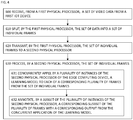
- FIG. 4 is a flow diagram depicting an example method for real-time processing of IoT data.
- the method of FIG. 4 as illustrated (and described in greater detail below) is meant to be an example and, as such, should not be viewed as limiting.
- the method of FIG. 4 may be implemented in the form of executable instructions stored on a machine-readable storage medium, such as storage medium 420, and/or in the form of electronic circuitry.
- a set of video data may be received from a first IoT device communicably coupled to the edge device.
- the edge device 100 (and/or the data receiving engine 230, the data receiving instructions 430, or other resource of the edge device 100) may receive the set of video data from the IoT device.
- the edge device 100 may receive the set of video data from the IoT device in a manner similar or the same as that described above in relation to the execution of the data receiving engine 230, the data receiving instructions 430, and/or other resource of the edge device 100.
- the set of data may be split into a set of individual frames.
- the edge device 100 (and/or the data splitting engine 240, the data splitting instructions 440, or other resource of the edge device 100) may split the data.
- the edge device 100 may split the data in a manner similar or the same as that described above in relation to the execution of the data splitting engine 240, the data splitting instructions 440, and/or other resource of the edge device 100.
- the set of individual frames may be transmitted to a second physical processor.
- the edge device 100 (and/or the data splitting engine 240, the data splitting instructions 440, or other resource of the edge device 100) may transmit the set of individual frames.
- the edge device 100 may transmit the individual frames in a manner similar or the same as that described above in relation to the execution of the data splitting engine 240, the data splitting instructions 440, and/or other resource of the edge device 100.
- the set of individual frames may be processed.
- the edge device 100 (and/or the processing engine 250, the processing instructions 450 or other resource of the edge device 100) may process the individual frames.
- the edge device 100 may process the individual frames in a manner similar or the same as that described above in relation to the execution of the processing instructions 450, the processing instructions 450, and/or other resource of the edge device 100.
- operation 630 may comprise operations 631 and 632.
- a plurality of instances of the second physical processor of the edge computing device may concurrently apply a learning model to each of a corresponding plurality of frames from the set of individual frames.
- the edge device 100 and/or the concurrent application instructions 451, the concurrent application instructions 451, or other resource of the edge device 100
- the edge device 100 may concurrently apply, by the plurality of instances of the second physical processor of the edge computing device a learning model to each of the corresponding plurality of frames from the set of individual frames in a manner similar or the same as that described above in relation to the execution of the concurrent application engine 251, the concurrent application instructions 451, and/or other resource of the edge device 100.
- a subset of the plurality of instances of the second physical processor may annotate a corresponding subset of the plurality of frames with a corresponding output from the concurrent application of the learning model.
- the edge device 100 (and/or the annotation engine 252, the annotation instructions 452, or other resource of the edge device 100) may annotate the corresponding subset of the plurality of frames with the corresponding output from the concurrent application of the learning model.
- the edge device 100 may annotate the corresponding subset of the plurality of frames with the corresponding output from the concurrent application of the learning model in a manner similar or the same as that described above in relation to the execution of the annotation engine 242, the annotation instructions 452, and/or other resource of the edge device 100.
- the foregoing disclosure describes a number of example implementations for real-time processing of IoT data.
- the disclosed examples may include systems, devices, computer-readable storage media, and methods for real-time processing of IoT data.
- certain examples are described with reference to the components illustrated in FIGS. 1-4 .
- the functionality of the illustrated components may overlap, however, and may be present in a fewer or greater number of elements and components.
Landscapes
- Engineering & Computer Science (AREA)
- Signal Processing (AREA)
- Multimedia (AREA)
- Computer Networks & Wireless Communication (AREA)
- Theoretical Computer Science (AREA)
- Computing Systems (AREA)
- Software Systems (AREA)
- Medical Informatics (AREA)
- Data Mining & Analysis (AREA)
- Artificial Intelligence (AREA)
- General Engineering & Computer Science (AREA)
- General Physics & Mathematics (AREA)
- Physics & Mathematics (AREA)
- Evolutionary Computation (AREA)
- Computer Vision & Pattern Recognition (AREA)
- Mathematical Physics (AREA)
- Health & Medical Sciences (AREA)
- General Health & Medical Sciences (AREA)
- Bioinformatics & Cheminformatics (AREA)
- Bioinformatics & Computational Biology (AREA)
- Evolutionary Biology (AREA)
- Life Sciences & Earth Sciences (AREA)
- Information Transfer Between Computers (AREA)
- Data Exchanges In Wide-Area Networks (AREA)
Abstract
Description
- The use of Internet of Things ("IoT") devices is increasing at a rapid pace, with a corresponding increase in the amount of data being processed by these devices. Processing of data from IoT devices may involve sending data from an IoT device to an edge device communicably coupled to the IoT device, and then to a server on a cloud network communicably coupled to the edge device. Processing data from a plurality of IoT devices may incur network latency and computation latency issues.
- The following detailed description references the drawings, wherein:
-
FIG. 1 is a block diagram depicting an example environment in which various examples may be implemented as a system that facilitates real-time processing of IoT data. -
FIG. 1A is a block diagram depicting an example edge device for real-time processing of IoT data. -
FIG. 1B is a block diagram depicting an example edge device for real-time processing of IoT data. -
FIG. 2A is a block diagram depicting an example edge device for real-time processing of IoT data. -
FIG. 2B is a block diagram depicting an example edge device for real-time processing of IoT data. -
FIG. 3 is a flow diagram depicting an example method for real-time processing of IoT data. -
FIG. 4 is a flow diagram depicting an example method for real-time processing of IoT data. - The following detailed description refers to the accompanying drawings. Wherever possible, the same reference numbers are used in the drawings and the following description to refer to the same or similar parts. It is to be expressly understood, however, that the drawings are for the purpose of illustration and description only. While several examples are described in this document, modifications, adaptations, and other implementations are possible. Accordingly, the following detailed description does not limit the disclosed examples. Instead, the proper scope of the disclosed examples may be defined by the appended claims.
- The terminology used herein is for the purpose of describing particular embodiments only and is not intended to be limiting. As used herein, the singular forms "a," "an," and "the" are intended to include the plural forms as well, unless the context clearly indicates otherwise. The term "plurality," as used herein, is defined as two, or more than two. The term "another," as used herein, is defined as at least a second or more. The term "coupled," as used herein, is defined as connected, whether directly without any intervening elements or indirectly with at least one intervening elements, unless otherwise indicated. Two elements can be coupled mechanically, electrically, or communicatively linked through a communication channel, pathway, network, or system. The term "and/or" as used herein refers to and encompasses any and all possible combinations of one or more of the associated listed items. It will also be understood that, although the terms first, second, third, etc. may be used herein to describe various elements, these elements should not be limited by these terms, as these terms are only used to distinguish one element from another unless stated otherwise or the context indicates otherwise. As used herein, the term "includes" means includes but not limited to, the term "including" means including but not limited to. The term "based on" means based at least in part on.
- The foregoing disclosure describes a number of example implementations for real-time processing of Internet of Things ("IoT") data. The disclosed examples may include systems, devices, computer-readable storage media, and methods for real-time processing of IoT data. For purposes of explanation, certain examples are described with reference to the components illustrated in
FIGS. 1-4 . The functionality of the illustrated components may overlap, however, and may be present in a fewer or greater number of elements and components. - Further, all or part of the functionality of illustrated elements may co-exist or be distributed among several geographically dispersed locations. Moreover, the disclosed examples may be implemented in various environments and are not limited to the illustrated examples. Further, the sequence of operations described in connection with
FIGS. 3-4 are examples and are not intended to be limiting. Additional or fewer operations or combinations of operations may be used or may vary without departing from the scope of the disclosed examples. Furthermore, implementations consistent with the disclosed examples need not perform the sequence of operations in any particular order. Thus, the present disclosure merely sets forth possible examples of implementations, and many variations and modifications may be made to the described examples. All such modifications and variations are intended to be included within the scope of this disclosure and protected by the following claims. - The use of Internet of Things ("IoT") devices is increasing at a rapid pace, with a corresponding increase in the amount of data being processed by these devices. Processing of data from IoT devices may involve sending data from an IoT device to an edge device communicably coupled to the IoT device, and then to a server on a cloud network communicably coupled to the edge device. Processing data from a plurality of IoT devices may incur network latency and computation latency issues.
- Of note is the increase in live video feeds from IoT devices. Live video feeds, and other data with similarly high payloads may be timely and costly to process. For example, IoT cameras are able to generate megabytes of visual data every second. Due to their geographical location, offloading the entire set of data captured by an IoT device in real time to an edge device and then to a server device in the cloud may not be possible and may incur significant delays, in addition to incurring a significant bandwidth cost. Reducing the resolution for real-time transfer is also not ideal, as it makes the processing and analysis of that data more difficult. Existing solutions to process complex data from IoT devices are either built into hardware (thus increasing the cost and complexity of the hardware involved) or edge devices perform minimal lightweight processing before the data is sent to a server in the cloud network.
- A technical solution to these technical challenges may efficiently process complex data from IoT devices on the connected edge devices and distribute the data and processed results to servers in the cloud network. In particular, a technical solution to these technical challenges may leverage an architecture pipeline in the edge device to process and derive insights from the complex data.
- Examples discussed herein address these technical challenges by providing a technical solution that provides real-time processing of IoT data. For example, the technical solution may receive, by a first physical processor of an edge computing device, a set of data from a first IoT device communicably coupled to the edge device. The set of data may be split into a set of individual data packets and processed by a second physical process of the edge device. The set of individual data packets may be processed, for example, by concurrently applying, by a plurality of instances of the second physical processor of the edge computing device, a learning model to each of a corresponding plurality of data packets from the set of individual data packets, and annotating, by a subset of the plurality of instances of the second physical processor, a corresponding subset of the plurality of data packets with a corresponding output from the concurrent application of the learning model.
-
FIG. 1 is an example environment in which various examples may be implemented as a system that facilitates real-time processing of IoT data. In some examples, system that facilitates real-time processing of IoT data may include various components such as a set of edge devices (e.g.,edge devices IoT devices cloud server 50, and/or other devices communicably coupled to the set of edge devices. Each edge device (e.g., edge device 100) may communicate to and/or receive data from acloud server 50, a set of IoT devices (e.g.,devices edge devices 101B, ..., 101N), and/or other components in a network. - An edge device may comprise an access point, network switch, or other hardware device on a network that comprises a first physical processor (e.g., physical processor 110) and a second physical processor (e.g., second physical processor 115) that implement machine readable instructions to facilitate communication in the network.
Physical processor 110 may be at least one central processing unit (CPU), microprocessor, and/or other hardware device suitable for performing the functionality described in relation toFIG. 1A . Secondphysical processor 115 may be at least one graphics processing unit (GPU), microprocessor, and/or other hardware device suitable for performing the functionality described in relation toFIG. 1A . -
Cloud server 50 may be any server in a cloud network communicably coupled to an edge device that facilitates processing and/or storage of IoT data. -
IoT devices - According to various implementations, a system that facilitates real-time processing of IoT data and the various components described herein may be implemented in hardware and/or a combination of hardware and programming that configures hardware. Furthermore, in
FIG. 1 and other Figures described herein, different numbers of components or entities than depicted may be used. In some examples, a system that facilitates real-time processing of IoT data may comprise a set of edge devices, with at least one edge device being connected to an IoT device. -
FIG. 1A is a block diagram depicting an example edge device for facilitating real-time processing of IoT data. In some examples, theexample edge device 100 may comprise theedge device 100 ofFIG. 1 . Edge device, which facilitates real-time processing of data fromIoT devices physical processor 110, adata receiving engine 130, adata splitting engine 140, aprocessing engine 150, and/or other engines. In some examples,processing engine 150 may comprise aconcurrent application engine 151,annotation engine 152, and/or other engines. The term "engine", as used herein, refers to a combination of hardware and programming that performs a designated function. As is illustrated with respect toFIGS. 1A-1B , the hardware of each engine, for example, may include one or both of a physical processor and a machine-readable storage medium, while the programming is instructions or code stored on the machine-readable storage medium and executable by the physical processor to perform the designated function. With respect toFIG. 1A ,data receiving engine 130,data splitting engine 140 may include firstphysical processor 110, anddata processing engine 150 may include secondphysical processor 115. With respect toFIG. 1B ,data receiving engine 230,data splitting engine 240,decoding engine 260, andtransmission engine 270 may include firstphysical processor 210, anddata processing engine 250 may include secondphysical processor 215. -
Data receiving engine 130 may receive a set of data from a first IoT device (e.g.,IoT device 101A) communicably coupled to theedge device 100. The set of data may comprise a set of individual data packets. Thedata receiving engine 130 may receive the set of data at a bandwidth rate. In some examples, the set of data may comprise video data that includes a set of frames. In these examples, the data receiving engine may receive the set of data at a frame rate. In these examples, thedata receiving engine 130 may decode the set of data from a video encoding performed by the IoT device (e.g.,IoT device 101A) and may re-encode the video data to an encoding supported by theedge device 100 and/orservers 50 in the network. For example, thedata receiving engine 130 may receive a set of video data encoded in an HLS format and transmitted from the IoT device (e.g.,IoT device 101A) using an RTMP protocol. Thedata receiving engine 130 may decode the set of video data and re-encode the set of video data to a supported format (e.g., FFMPEG, and/or other predetermined format). Data receiving engine may perform other pre-processing of the set of data as well. - The
data splitting engine 140 may split the set of data into a set of individual data packets. In some examples, thedata splitting engine 140 may split the data responsive to performing pre-processing on the data. In examples in which the set of data comprise video data, thedata splitting engine 140 may split the video data into a set of frames. In these examples, thedata splitting engine 140 may split the video data into a set of frames responsive to decoding the video data. Responsive to splitting the set of data,data splitting engine 140 may then cause the split data to be sent to theprocessing engine 150. -
Processing engine 150 may process the set of individual data packets. Theprocessing engine 150 may determine a number of the plurality of instances of the secondphysical processor 115 to use in parallel to process the set of individual data packets. Theprocessing engine 150 may determine the number of the plurality of instances based on a bandwidth rate at which the data packets are being received, based on a number of processor cores available via thephysical processor 115, based on a predetermined or required output rate of the data packets, based on a frame rate of the set of data (where the set of data comprises video data), and/or based on other factors. In an example, a non-transitory machine-readable storage medium according to this disclosure comprises instructions to cause the second physical processor to determine a number of the plurality of instances for processing the set of individual data packets based on a frame rate of the set of video data. - In some examples, the
processing engine 150 may determine the learning model to apply to the set of data. Theprocessing engine 150 may determine the model based on a single model being stored in thestorage medium 120. In examples in which multiple models may be stored in thestorage medium 120, theprocessing engine 150 may determine the learning model to apply based on a set of characteristics of the set of data, on a type of analysis to be performed on the set of data, on a data type, a data source, and/or based on other factors. In some examples, theprocessing engine 150 may apply multiple learning models, where each model may be applied to a different subset of the set of data, or multiple models may be applied to the same subsets of the set of data based on the factors. In some examples, the learning model may comprise a regional-based convolutional neural network and/or other type of learning model. In some examples, the processing model may receive updated learning models from theserver 50 and/or other device in the network. - The
processing engine 150 may apply the same learning model to each of the individual data packets processed by an instance of thephysical processor 115. - In some examples,
processing engine 150 may compriseconcurrent application engine 151,annotation engine 152, and/or other engines. - The
concurrent application engine 151 may concurrently apply, by a plurality of instances of the secondphysical processor 115, a learning model to each of a corresponding plurality of data packets from the set of individual data packets (or individual frames in examples in the set of data comprises video data). For example, theprocessing engine 150 may load secondphysical processor 115 with a plurality of instances of the learning model, such that each of a set of cores of the secondphysical processor 115 may apply a respective instance of the learning model to a corresponding individual data packet (or individual frame). Responsive to an instance of the secondphysical processor 115 applying the learning model to an individual data packet (or individual frame), theconcurrent application engine 151 may receive a next data packet (or individual frame)of the set of individual data packet (or individual frame)for processing. For example, as data arrives in series via thedata receiving engine 130 and is split by thedata splitting engine 140 and transmitted to theprocessing engine 150, theprocessing engine 150 may send the next individual data packet (or individual frame) to a next unutilized instance of the secondphysical processor 115 for processing, may determine a next instance of the secondphysical processor 115 based on a load balancing algorithm, and/or may otherwise determine a next instance of the secondphysical processor 115. In an example, a non-transitory machine-readable storage medium according to this disclosure comprises instructions to cause the second physical processor to, responsive to an instance of the second physical processor applying the learning model to an individual data packet, receive, by the instance, a next data packet of the set of individual data packets for processing - The
annotation engine 152 may annotate, by a subset of the plurality of instances of the secondphysical processor 115, a corresponding subset of the plurality of data packets (or individual frames) with a corresponding output from the concurrent application of the learning model. In some examples, theannotation engine 152 may annotate a data packet by adding a visual effect, text, metadata, and/or other information to an individual data packet (or individual frame). Theannotation engine 152 may determine the information to annotate to the individual data packet (or individual frame)based on the learning model being applied, based on inputs from an administrator or user of the network, based on a set of characteristics of the set of data, and/or based on other factors. In an example of a non-transitory machine-readable storage medium according to this disclosure, instructions to cause the second physical processor to annotate a data packet comprise instructions to cause the second physical processor to add visual effects to an individual data packet. - In some examples, responsive to annotating each of the plurality of data packets (or individual frames), the
processing engine 150 may re-order the plurality of data packets to match an order in which the set of individual data packets (or individual frames) were processed. In these examples, the processing time of data packets (or individual frames) by the instances of the secondphysical processor 115 may not be constant (e.g., due to different packet (or frame) size, packet (or frame) data, and/or other factors). As such, theprocessing engine 150 may output the processed data packets (or frames) in an order that may not be the same as the order in which the individual data packets (or frames) were input. In these examples, theprocessing engine 150 may perform in-memory sorting (and/or other types of sorting) on the output data packets (or frames) to place them in the original order in which they were processed. In an example, the second physical processor implements machine readable instructions to cause the system to: responsive to annotating each of the plurality of frames, re-order the plurality of frames to match an order in which the set of individual frames were processed. In an example, a non-transitory machine-readable storage according to this disclosure comprises instructions to cause the second physical processor to, responsive to annotating each of the plurality of data packets, re-order the plurality of data packets to match an order in which the set of individual data packets were processed. - Responsive to re-ordering the plurality of data packets (or individual frames), the
processing engine 150 may transmit the annotated, re-ordered plurality of data packets (or frames) to a server (e.g., server 50) communicably coupled to theedge device 100. In some examples, prior to transmitting the annotated, re-ordered plurality of data packets (or frames), theprocessing engine 150 may perform analytics or processing on the data packets (or frames). In examples in which the set of data comprises video data, theprocessing engine 150 may re-encode the annotated, re-ordered plurality of frames to a predetermined format. In these examples, theprocessing engine 150 may also performing further processing such as object detection, object tracking, object counting, visual click-through analysis for displays, augmented reality facilitation, prediction and estimation, and/or other processing. - In performing their respective functions, engines 130-152 may access storage medium120 and/or other suitable database(s).
Storage medium 120 may represent any memory accessible to theedge device 100 that can be used to store and retrieve data.Storage medium 120 and/or other databases communicably coupled to the edge device may comprise random access memory (RAM), read-only memory (ROM), electrically-erasable programmable read-only memory (EEPROM), cache memory, floppy disks, hard disks, optical disks, tapes, solid state drives, flash drives, portable compact disks, and/or other storage media for storing computer-executable instructions and/or data. Theedge device 100 that facilitates real-time processing of IoT data may accessstorage medium 120 locally or remotely via a network. -
Storage medium 120 may include a database to organize and store data. The database may reside in a single or multiple physical device(s) and in a single or multiple physical location(s). The database may store a plurality of types of data and/or files and associated data or file description, administrative information, or any other data. -
FIG. 1B is a block diagram depicting anexample edge device 200 that facilitates real-time processing of IoT data. In some examples,example edge device 200 may compriseedge device 100 ofFIG. 1 .Edge device 200, which may facilitate real-time processing of IoT data may comprise aphysical processor 210,data receiving engine 230, adata splitting engine 240, aprocessing engine 250, adecoding engine 260, adata transmission engine 270, and/or other engines. In some examples,processing engine 250 may compriseconcurrent application engine 251,annotation engine 252, and/or other engines. In some examples, engines 230-270 represent engines 130-152, respectively. -
FIG. 2A is a block diagram depicting an example machine-readable storage medium 320 comprising instructions executable by a processor for real-time processing of IoT data. - In the foregoing discussion, engines 130-152 were described as combinations of hardware and programming. Engines 130-152 may be implemented in a number of fashions. Referring to
FIG. 2A , the programming may be processor executable instructions 330-352 stored on a machine-readable storage medium 320 and the hardware may include afirst processor 310 and asecond processor 315 for executing those instructions. Thus, machine-readable storage medium 320 can be said to store program instructions or code that when executed byfirst processor 310 andsecond processor 315 implements an edge device that facilitates real-time processing of IoT data ofFIG. 1 . - In
FIG. 2A , the executable program instructions in machine-readable storage medium 320 are depicted asdata receiving instructions 330,data splitting instructions 340, processinginstructions 350, and/or other instructions. In some examples,data processing instructions 350 may compriseconcurrent application instructions 351,annotation instructions 352, and/or other instructions. Instructions 330-351 represent program instructions that, when executed, causefirst processor 310 andsecond processor 215 to implement engines 130-152, respectively. -
FIG. 2B is a block diagram depicting an example machine-readable storage medium 420 comprising instructions executable by a processor for real-time processing of IoT data. - In the foregoing discussion, engines 230-270 were described as combinations of hardware and programming. Engines 230-270 may be implemented in a number of fashions. Referring to
FIG. 2B , the programming may be processor executable instructions 430-470 stored on a machine-readable storage medium 420 and the hardware may include afirst processor 410 and asecond processor 415 for executing those instructions. Thus, machine-readable storage medium 420 can be said to store program instructions or code that when executed byfirst processor 410 andsecond processor 415 implements an edge device that facilitates real-time processing of IoT data ofFIG. 2B . - In
FIG. 2B , the executable program instructions in machine-readable storage medium 420 are depicted asdata receiving instructions 430,data splitting instructions 440, processinginstructions 450, decodinginstructions 460,data transmission instructions 470, and/or other instructions. In some examples,data processing instructions 450 may compriseconcurrent application instructions 451,annotation instructions 452, and/or other instructions.. Instructions 430-370 represent program instructions that, when executed, causefirst processor 410 andsecond processor 415 to implement engines 220-270, respectively. - Machine-readable storage medium 320 (or machine-readable storage medium 420) may be any electronic, magnetic, optical, or other physical storage device that contains or stores executable instructions. In some implementations, machine-readable storage medium 320 (or machine-readable storage medium 420) may be a non-transitory storage medium, where the term "non-transitory" does not encompass transitory propagating signals. Machine-readable storage medium 320 (or machine-readable storage medium 420) may be implemented in a single device or distributed across devices. Likewise,
processor 310 and processor 315 (orprocessor 410 and processor 415) may represent any number of physical processors capable of executing instructions stored by machine-readable storage medium 320 (or machine-readable storage medium 420).Processor 310 and processor 315 (orprocessor 410 and processor 415) may be integrated in a single device or distributed across devices. Further, machine-readable storage medium 320 (or machine-readable storage medium 420) may be fully or partially integrated in the same device asprocessor 310 and processor 315 (orprocessor 410 and processor 415), or it may be separate but accessible to that device andprocessor 310 and processor 315 (orprocessor 410 and processor 415). - In one example, the program instructions may be part of an installation package that when installed can be executed by
processor 310 and processor 315 (orprocessor 410 and processor 415) to implement an edge device that facilitates real-time processing of IoT data. In this case, machine-readable storage medium 320 (or machine-readable storage medium 420) may be a portable medium such as a floppy disk, CD, DVD, or flash drive or a memory maintained by a server from which the installation package can be downloaded and installed. In another example, the program instructions may be part of an application or applications already installed. Here, machine-readable storage medium 320 (or machine-readable storage medium 420) may include a hard disk, optical disk, tapes, solid state drives, RAM, ROM, EEPROM, or the like. -
Processor 310 may be at least one central processing unit (CPU), microprocessor, and/or other hardware device suitable for retrieval and execution of instructions stored in machine-readable storage medium 320.Processor 310 may fetch, decode, and execute program instructions 330-340, and/or other instructions. As an alternative or in addition to retrieving and executing instructions,processor 310 may include at least one electronic circuit comprising a number of electronic components for performing the functionality of at least one of instructions 330-340, and/or other instructions. -
Processor 315 may be at least one graphics processing unit (GPU), microprocessor, and/or other hardware device suitable for retrieval and execution of instructions stored in machine-readable storage medium 320.Processor 315 may fetch, decode, and execute program instructions 350-352, and/or other instructions. As an alternative or in addition to retrieving and executing instructions,processor 315 may include at least one electronic circuit comprising a number of electronic components for performing the functionality of at least one of instructions 350-352, and/or other instructions. -
Processor 410 may be at least one central processing unit (CPU), microprocessor, and/or other hardware device suitable for retrieval and execution of instructions stored in machine-readable storage medium 420.Processor 410 may fetch, decode, and execute program instructions 430-440, 460-470, and/or other instructions. As an alternative or in addition to retrieving and executing instructions,processor 410 may include at least one electronic circuit comprising a number of electronic components for performing the functionality of at least one of instructions 430-440, 460-470, and/or other instructions. -
Processor 415 may be at least one graphics processing unit (GPU), microprocessor, and/or other hardware device suitable for retrieval and execution of instructions stored in machine-readable storage medium 420.Processor 415 may fetch, decode, and execute program instructions 450-452, and/or other instructions. As an alternative or in addition to retrieving and executing instructions,processor 415 may include at least one electronic circuit comprising a number of electronic components for performing the functionality of at least one of instructions 450-452, and/or other instructions. -
FIG. 3 is a flow diagram depicting an example method for real-time processing of IoT data. The various processing blocks and/or data flows depicted inFIG. 3 (and in the other drawing figures such asFIGS. 3A, 3B ,4, 4A ) are described in greater detail herein. The described processing blocks may be accomplished using some or all of the system components described in detail above and, in some implementations, various processing blocks may be performed in different sequences and various processing blocks may be omitted. Additional processing blocks may be performed along with some or all of the processing blocks shown in the depicted flow diagrams. Some processing blocks may be performed simultaneously. Accordingly, the method ofFIG. 3 as illustrated (and described in greater detail below) is meant be an example and, as such, should not be viewed as limiting. The method ofFIG. 3 may be implemented in the form of executable instructions stored on a machine-readable storage medium, such asstorage medium 420, and/or in the form of electronic circuitry. - In an
operation 500, a set of data may be received from a first IoT device communicably coupled to the edge device. For example, the edge device 100 (and/or thedata receiving engine 130, thedata receiving instructions 330, or other resource of the edge device 100) may receive the set of data packet from the IoT device. Theedge device 100 may receive the set of data from the IoT device in a manner similar or the same as that described above in relation to the execution of thedata receiving engine 130, thedata receiving instructions 330, and/or other resource of theedge device 100. - In an
operation 510, the set of data may be split into a set of individual data packets. For example, the edge device 100 (and/or thedata splitting engine 140, thedata splitting instructions 340 or other resource of the edge device 100) may split the data. Theedge device 100 may split the data in a manner similar or the same as that described above in relation to the execution of thedata splitting engine 140, thedata splitting instructions 340, and/or other resource of theedge device 100. - In an
operation 520, the set of individual data packets may be processed. For example, the edge device 100 (and/or theprocessing engine 150, the processinginstructions 350 or other resource of the edge device 100) may process the individual data packets. Theedge device 100 may process the individual data packets in a manner similar or the same as that described above in relation to the execution of theprocessing engine 150, the processinginstructions 350, and/or other resource of theedge device 100. - In some examples,
operation 520 may compriseoperations 521 and 522. - In an
operation 521, a plurality of instances of the second physical processor of the edge computing device may concurrently apply a learning model to each of a corresponding plurality of data packets from the set of individual data packets. For example, the edge device 100 (and/or theconcurrent application engine 151, theconcurrent application instructions 351, or other resource of the edge device 100) may concurrently apply, by the plurality of instances of the second physical processor of the edge computing device a learning model to each of the corresponding plurality of data packets from the set of individual data packets. Theedge device 100 may concurrently apply, by the plurality of instances of the second physical processor of the edge computing device a learning model to each of the corresponding plurality of data packets from the set of individual data packets in a manner similar or the same as that described above in relation to the execution of theconcurrent application engine 151, theconcurrent application instructions 351, and/or other resource of theedge device 100. - In an operation 522, a subset of the plurality of instances of the second physical processor may annotate a corresponding subset of the plurality of data packets with a corresponding output from the concurrent application of the learning model. For example, the edge device 100 (and/or the
annotation engine 152, theannotation instructions 352, or other resource of the edge device 100) may annotate the corresponding subset of the plurality of data packets with the corresponding output from the concurrent application of the learning model. Theedge device 100 may annotate the corresponding subset of the plurality of data packets with the corresponding output from the concurrent application of the learning model in a manner similar or the same as that described above in relation to the execution of theannotation engine 152, theannotation instructions 352, and/or other resource of theedge device 100. -
FIG. 4 is a flow diagram depicting an example method for real-time processing of IoT data. The method ofFIG. 4 as illustrated (and described in greater detail below) is meant to be an example and, as such, should not be viewed as limiting. The method ofFIG. 4 may be implemented in the form of executable instructions stored on a machine-readable storage medium, such asstorage medium 420, and/or in the form of electronic circuitry. - In an
operation 600, a set of video data may be received from a first IoT device communicably coupled to the edge device. For example, the edge device 100 (and/or thedata receiving engine 230, thedata receiving instructions 430, or other resource of the edge device 100) may receive the set of video data from the IoT device. Theedge device 100 may receive the set of video data from the IoT device in a manner similar or the same as that described above in relation to the execution of thedata receiving engine 230, thedata receiving instructions 430, and/or other resource of theedge device 100. - In an
operation 610, the set of data may be split into a set of individual frames. For example, the edge device 100 (and/or thedata splitting engine 240, thedata splitting instructions 440, or other resource of the edge device 100) may split the data. Theedge device 100 may split the data in a manner similar or the same as that described above in relation to the execution of thedata splitting engine 240, thedata splitting instructions 440, and/or other resource of theedge device 100. - In an
operation 620, the set of individual frames may be transmitted to a second physical processor. For example, the edge device 100 (and/or thedata splitting engine 240, thedata splitting instructions 440, or other resource of the edge device 100) may transmit the set of individual frames. Theedge device 100 may transmit the individual frames in a manner similar or the same as that described above in relation to the execution of thedata splitting engine 240, thedata splitting instructions 440, and/or other resource of theedge device 100. - In an
operation 630, the set of individual frames may be processed. For example, the edge device 100 (and/or theprocessing engine 250, the processinginstructions 450 or other resource of the edge device 100) may process the individual frames. Theedge device 100 may process the individual frames in a manner similar or the same as that described above in relation to the execution of the processinginstructions 450, the processinginstructions 450, and/or other resource of theedge device 100. - In some examples,
operation 630 may compriseoperations 631 and 632. - In an
operation 631, a plurality of instances of the second physical processor of the edge computing device may concurrently apply a learning model to each of a corresponding plurality of frames from the set of individual frames. For example, the edge device 100 (and/or theconcurrent application instructions 451, theconcurrent application instructions 451, or other resource of the edge device 100) may concurrently apply, by the plurality of instances of the second physical processor of the edge computing device a learning model to each of the corresponding plurality of frames from the set of individual frames. Theedge device 100 may concurrently apply, by the plurality of instances of the second physical processor of the edge computing device a learning model to each of the corresponding plurality of frames from the set of individual frames in a manner similar or the same as that described above in relation to the execution of theconcurrent application engine 251, theconcurrent application instructions 451, and/or other resource of theedge device 100. - In an operation 632, a subset of the plurality of instances of the second physical processor may annotate a corresponding subset of the plurality of frames with a corresponding output from the concurrent application of the learning model. For example, the edge device 100 (and/or the
annotation engine 252, theannotation instructions 452, or other resource of the edge device 100) may annotate the corresponding subset of the plurality of frames with the corresponding output from the concurrent application of the learning model. Theedge device 100 may annotate the corresponding subset of the plurality of frames with the corresponding output from the concurrent application of the learning model in a manner similar or the same as that described above in relation to the execution of the annotation engine 242, theannotation instructions 452, and/or other resource of theedge device 100. - The foregoing disclosure describes a number of example implementations for real-time processing of IoT data. The disclosed examples may include systems, devices, computer-readable storage media, and methods for real-time processing of IoT data. For purposes of explanation, certain examples are described with reference to the components illustrated in
FIGS. 1-4 . The functionality of the illustrated components may overlap, however, and may be present in a fewer or greater number of elements and components. - Further, all or part of the functionality of illustrated elements may co-exist or be distributed among several geographically dispersed locations. Moreover, the disclosed examples may be implemented in various environments and are not limited to the illustrated examples. Further, the sequence of operations described in connection with
FIGS. 3-4 are examples and are not intended to be limiting. Additional or fewer operations or combinations of operations may be used or may vary without departing from the scope of the disclosed examples. Furthermore, implementations consistent with the disclosed examples need not perform the sequence of operations in any particular order. - Thus, the present disclosure merely sets forth possible examples of implementations, and many variations and modifications may be made to the described examples. All such modifications and variations are intended to be included within the scope of this disclosure and protected by the following claims.
Claims (15)
- A method for real-time processing of IoT data, the method comprising:receiving, by a first physical processor of an edge computing device, a set of data from a first IoT device communicably coupled to the edge device;splitting, by the first physical processor, the set of data into a set of individual data packets;processing, by a second physical processor of the edge device, the set of individual data packets by:concurrently applying, by a plurality of instances of the second physical processor of the edge computing device, a learning model to each of a corresponding plurality of data packets from the set of individual data packets;annotating, by a subset of the plurality of instances of the second physical processor, a corresponding subset of the plurality of data packets with a corresponding output from the concurrent application of the learning model.
- The method of claim 1, wherein the set of data comprises a set of video data, and wherein the set of data is split responsive to decoding the set of video data.
- The method of claim 2, further comprising:
determining a number of the plurality of instances for processing the set of individual data packets based on a frame rate of the set of video data - The method of claim 2, wherein annotating a data packet comprises adding visual effects to an individual data packet.
- The method of claim 1, further comprising:
responsive to an instance of the second physical processor applying the learning model to an individual data packet, receiving, by the instance, a next data packet of the set of individual data packets for processing. - The method of claim 1, further comprising:
responsive to annotating each of the plurality of data packets, re-ordering the plurality of data packets to match an order in which the set of individual data packets were processed - The method of claim 6, further comprising:
responsive to re-ordering the plurality of data packets, transmitting the annotated, re-ordered plurality of data packets to a server communicably coupled to the edge device. - The method of claim 1, further comprising:
determining the learning model to apply based on a set of characteristics of the set of data. - A non-transitory machine-readable storage medium comprising instructions executable by a physical processor of an edge device for real-time processing of IoT data, the machine-readable storage medium comprising:instructions to cause a first physical processor to receive a set of data from a first IoT device communicably coupled to the edge device;instructions to cause the first physical processor to split the set of data into a set of individual data packets;instructions to cause a second physical processor to process the set of individual data packets by:concurrently applying, by a plurality of instances of the second physical processor of the edge computing device, a learning model to each of a corresponding plurality of data packets from the set of individual data packets;annotating, by a subset of the plurality of instances of the second physical processor, a corresponding subset of the plurality of data packets with a corresponding output from the concurrent application of the learning model; andinstructions to transmit the processed set of individual data packets to a server communicably coupled to the edge device.
- The non-transitory machine-readable storage medium of claim 9,
wherein the set of data comprises a set of video data, and
wherein the instructions to cause the first processor to split the set of data comprises instructions to split the set of data responsive to decoding the received set of data, and
wherein the storage medium further comprises:
instructions to cause the processed set of individual data packets to be re-encoded. - A system for real-time processing of IoT data, the system comprising:
a first physical processor of an edge device that implements machine readable instructions that cause the system to:receive a set of video data from a first IoT device communicably coupled to the edge device;split the set of data into a set of individual frames;transmit the set of individual frames to a second physical processor of the edge device, wherein the second physical processor is to implement machine readable instructions that cause the system to:
process the set of individual frames by:concurrently applying, by a plurality of instances of the second physical processor, a learning model to each of a corresponding plurality of frames from the set of individual frames;annotating, by each of the plurality of instances of the second physical processor, each of the plurality of frames with a corresponding output from the concurrent application of the learning model. - The system of claim 11, wherein the first physical processor implements machine readable instructions to cause the system to:split the set of data into the set of individual frames responsive to decoding the received set of data; andre-encode the processed set of data.
- The system of claim 11, wherein the second physical processor implements machine readable instructions to cause the system to:
determine a number of the plurality of instances for processing the set of individual frames based on a frame rate of the set of video data. - The system of claim 11, wherein the second physical processor implements machine readable instructions to cause the system to:
annotate an individual frame by adding visual effects to the individual frame. - The system of claim 11, wherein the second physical processor implements machine readable instructions to cause the system to:
responsive to an instance of the second physical processor applying the learning model to an individual frame, receive, by the instance, a next frame of the set of frames for processing.
Applications Claiming Priority (1)
| Application Number | Priority Date | Filing Date | Title |
|---|---|---|---|
| US15/582,235 US10397594B2 (en) | 2017-04-28 | 2017-04-28 | Real-time processing of IoT data |
Publications (2)
| Publication Number | Publication Date |
|---|---|
| EP3396924A1 true EP3396924A1 (en) | 2018-10-31 |
| EP3396924B1 EP3396924B1 (en) | 2020-10-07 |
Family
ID=62091653
Family Applications (1)
| Application Number | Title | Priority Date | Filing Date |
|---|---|---|---|
| EP18167189.2A Active EP3396924B1 (en) | 2017-04-28 | 2018-04-13 | Real-time processing of iot data |
Country Status (3)
| Country | Link |
|---|---|
| US (1) | US10397594B2 (en) |
| EP (1) | EP3396924B1 (en) |
| CN (1) | CN108810085B (en) |
Families Citing this family (12)
| Publication number | Priority date | Publication date | Assignee | Title |
|---|---|---|---|---|
| US11108575B2 (en) * | 2017-07-26 | 2021-08-31 | Amazon Technologies, Inc. | Training models for IOT devices |
| US11902396B2 (en) | 2017-07-26 | 2024-02-13 | Amazon Technologies, Inc. | Model tiering for IoT device clusters |
| US10980085B2 (en) | 2017-07-26 | 2021-04-13 | Amazon Technologies, Inc. | Split predictions for IoT devices |
| US10225360B1 (en) | 2018-01-24 | 2019-03-05 | Veeva Systems Inc. | System and method for distributing AR content |
| US20200175419A1 (en) * | 2018-12-04 | 2020-06-04 | Akamai Technologies, Inc. | Multi-machine based collaborative learning |
| JP7283155B2 (en) * | 2019-03-19 | 2023-05-30 | 富士フイルムビジネスイノベーション株式会社 | Data collection system and data collection method |
| US11057495B2 (en) * | 2019-05-01 | 2021-07-06 | Ciena Corporation | Selecting where to process data associated with Internet of Things (IoT) devices |
| US10887187B2 (en) | 2019-05-14 | 2021-01-05 | At&T Mobility Ii Llc | Integration of a device platform with a core network or a multi-access edge computing environment |
| CN113473126B (en) * | 2020-03-31 | 2023-03-17 | 阿里巴巴集团控股有限公司 | Video stream processing method and device, electronic equipment and computer readable medium |
| US11463250B2 (en) | 2020-12-14 | 2022-10-04 | Kyndryl, Inc. | Sharing data among different service providers at edge level through collaboration channels |
| CN112767722B (en) * | 2020-12-31 | 2022-05-24 | 北京北大千方科技有限公司 | Control method and device of traffic signal machine, computer equipment and storage medium |
| US12422792B1 (en) | 2021-05-25 | 2025-09-23 | Amazon Technologies, Inc. | Individual machine configuration based on overall process performance and latent metrics |
Citations (2)
| Publication number | Priority date | Publication date | Assignee | Title |
|---|---|---|---|---|
| WO2014186719A1 (en) * | 2013-05-16 | 2014-11-20 | Convida Wireless, Llc | Data annotation as a service for iot systems |
| WO2016162678A1 (en) * | 2015-04-07 | 2016-10-13 | Ipv Limited | A method for collaborative comments or metadata annotation of video |
Family Cites Families (20)
| Publication number | Priority date | Publication date | Assignee | Title |
|---|---|---|---|---|
| US7587454B2 (en) * | 2004-12-08 | 2009-09-08 | Nice Systems Ltd. | Video streaming parameter optimization and QoS |
| US8625884B2 (en) * | 2009-08-18 | 2014-01-07 | Behavioral Recognition Systems, Inc. | Visualizing and updating learned event maps in surveillance systems |
| JP2015501459A (en) | 2011-09-19 | 2015-01-15 | タタ コンサルタンシー サービシズ リミテッドTATA Consultancy Services Limited | Computing platform for the development and deployment of sensor-driven vehicle telemetry applications and services |
| US9086878B2 (en) * | 2012-06-29 | 2015-07-21 | Broadcom Corporation | Oversubscribing to a packet processing device to adjust power consumption |
| WO2014171938A1 (en) * | 2013-04-17 | 2014-10-23 | Empire Technology Development, Llc | Datacenter border-issued analytics for monitoring federated services |
| US9722815B2 (en) * | 2013-07-10 | 2017-08-01 | Sunil Mukundan | Edge-gateway multipath method and system |
| EP3036938A4 (en) | 2013-08-23 | 2017-04-12 | Samsung Electronics Co., Ltd. | Mobile software defined networking (mobisdn) |
| US20150134954A1 (en) | 2013-11-14 | 2015-05-14 | Broadcom Corporation | Sensor management system in an iot network |
| US9838454B2 (en) * | 2014-04-23 | 2017-12-05 | Cisco Technology, Inc. | Policy-based payload delivery for transport protocols |
| US9031138B1 (en) * | 2014-05-01 | 2015-05-12 | Google Inc. | Method and system to combine multiple encoded videos for decoding via a video docoder |
| AU2015255652B2 (en) | 2014-05-09 | 2018-03-29 | Google Llc | Systems and methods for using eye signals with secure mobile communications |
| WO2015195643A1 (en) | 2014-06-16 | 2015-12-23 | Coldlight Solutions, Llc | An architecture and methodology for performing autonomous analytics over multiple actual and virtual devices |
| US10932476B2 (en) | 2014-07-07 | 2021-03-02 | Contra Vision Limited | Combined vessel lid and tea bag receptacle and method of using |
| WO2016059122A1 (en) | 2014-10-14 | 2016-04-21 | Osr Enterprises Ag | Device, system and method for processing data |
| US9736349B2 (en) | 2014-12-24 | 2017-08-15 | Intel Corporation | Adaptive video end-to-end network with local abstraction |
| US10362113B2 (en) | 2015-07-02 | 2019-07-23 | Prasenjit Bhadra | Cognitive intelligence platform for distributed M2M/ IoT systems |
| EP3329373A1 (en) * | 2015-07-29 | 2018-06-06 | B+B Smartworx Limited | An edge network device for a data network and a method of processing data in a data network |
| US10324773B2 (en) | 2015-09-17 | 2019-06-18 | Salesforce.Com, Inc. | Processing events generated by internet of things (IoT) |
| CN105744381B (en) * | 2016-02-18 | 2019-05-07 | 四川长虹电器股份有限公司 | Based on the DTV STB method annotated to TV programme scene |
| US10460255B2 (en) * | 2016-07-29 | 2019-10-29 | Splunk Inc. | Machine learning in edge analytics |
-
2017
- 2017-04-28 US US15/582,235 patent/US10397594B2/en active Active
-
2018
- 2018-04-13 EP EP18167189.2A patent/EP3396924B1/en active Active
- 2018-04-27 CN CN201810394933.1A patent/CN108810085B/en active Active
Patent Citations (2)
| Publication number | Priority date | Publication date | Assignee | Title |
|---|---|---|---|---|
| WO2014186719A1 (en) * | 2013-05-16 | 2014-11-20 | Convida Wireless, Llc | Data annotation as a service for iot systems |
| WO2016162678A1 (en) * | 2015-04-07 | 2016-10-13 | Ipv Limited | A method for collaborative comments or metadata annotation of video |
Non-Patent Citations (1)
| Title |
|---|
| FUJISAWA KAZUKI ET AL: "Automatic Content Curation System for Multiple Live Sport Video Streams", 2015 IEEE INTERNATIONAL SYMPOSIUM ON MULTIMEDIA (ISM), IEEE, 14 December 2015 (2015-12-14), pages 541 - 546, XP032886824, DOI: 10.1109/ISM.2015.17 * |
Also Published As
| Publication number | Publication date |
|---|---|
| EP3396924B1 (en) | 2020-10-07 |
| US10397594B2 (en) | 2019-08-27 |
| US20180316928A1 (en) | 2018-11-01 |
| CN108810085B (en) | 2021-10-15 |
| CN108810085A (en) | 2018-11-13 |
Similar Documents
| Publication | Publication Date | Title |
|---|---|---|
| US10397594B2 (en) | Real-time processing of IoT data | |
| US12407735B2 (en) | Inclusion of time-series geospatial markers in analyses employing a cyber-decision platform | |
| KR102876339B1 (en) | Device and method for generating metadata describing unstructured data objects at the storage edge | |
| US11243973B2 (en) | Automated scalable contextual data collection and extraction system | |
| US10572818B2 (en) | Horizontal decision tree learning from very high rate data streams with horizontal parallel conflict resolution | |
| US11350184B2 (en) | Providing advanced playback and control functionality to video client | |
| US20190188315A1 (en) | Systems and methods for fast and effective grouping of stream of information into cloud storage files | |
| US20150134776A1 (en) | Injected analytics service for web distributed interfaces | |
| US8666985B2 (en) | Hardware accelerated application-based pattern matching for real time classification and recording of network traffic | |
| EP2729900B1 (en) | Transcoding detection and adjustment of content for optimal display | |
| CN109857908B (en) | Method and apparatus for matching videos | |
| MX2020012092A (en) | System and method of geographic data aggregation and analysis. | |
| US20210089918A1 (en) | Systems and methods for cooperative machine learning | |
| US10623450B2 (en) | Access to data on a remote device | |
| US20170142454A1 (en) | Third-party video pushing method and system | |
| US8856445B2 (en) | Byte caching with chunk sizes based on data type | |
| EP2752853B1 (en) | Worklist with playlist and query for video composition by sequentially selecting segments from servers depending on local content availability | |
| CN113438503B (en) | Video file restoring method, device, computer equipment and storage medium | |
| CN119316408A (en) | File uploading method, device, computer device and storage device | |
| US20150331917A1 (en) | Recording medium having stored therein transmission order determination program, transmission order determination device, and transmission order determination method | |
| KR20240172537A (en) | Method and system for self-supervised distributed learning of vision transducer based model using masked sampling distillation with no label | |
| US11811871B2 (en) | Cloud-based authority to enhance point-to-point data transfer with machine learning | |
| US9705833B2 (en) | Event driven dynamic multi-purpose internet mail extensions (MIME) parser | |
| WO2025190068A1 (en) | Scoring method for mobile application service, and storage medium and electronic device |
Legal Events
| Date | Code | Title | Description |
|---|---|---|---|
| PUAI | Public reference made under article 153(3) epc to a published international application that has entered the european phase |
Free format text: ORIGINAL CODE: 0009012 |
|
| STAA | Information on the status of an ep patent application or granted ep patent |
Free format text: STATUS: THE APPLICATION HAS BEEN PUBLISHED |
|
| AK | Designated contracting states |
Kind code of ref document: A1 Designated state(s): AL AT BE BG CH CY CZ DE DK EE ES FI FR GB GR HR HU IE IS IT LI LT LU LV MC MK MT NL NO PL PT RO RS SE SI SK SM TR |
|
| AX | Request for extension of the european patent |
Extension state: BA ME |
|
| RAP1 | Party data changed (applicant data changed or rights of an application transferred) |
Owner name: HEWLETT PACKARD ENTERPRISE DEVELOPMENT LP |
|
| STAA | Information on the status of an ep patent application or granted ep patent |
Free format text: STATUS: REQUEST FOR EXAMINATION WAS MADE |
|
| 17P | Request for examination filed |
Effective date: 20190521 |
|
| RBV | Designated contracting states (corrected) |
Designated state(s): AL AT BE BG CH CY CZ DE DK EE ES FI FR GB GR HR HU IE IS IT LI LT LU LV MC MK MT NL NO PL PT RO RS SE SI SK SM TR |
|
| STAA | Information on the status of an ep patent application or granted ep patent |
Free format text: STATUS: EXAMINATION IS IN PROGRESS |
|
| 17Q | First examination report despatched |
Effective date: 20191107 |
|
| GRAP | Despatch of communication of intention to grant a patent |
Free format text: ORIGINAL CODE: EPIDOSNIGR1 |
|
| STAA | Information on the status of an ep patent application or granted ep patent |
Free format text: STATUS: GRANT OF PATENT IS INTENDED |
|
| RIC1 | Information provided on ipc code assigned before grant |
Ipc: H04W 4/70 20180101ALI20200615BHEP Ipc: H04N 21/80 20110101ALI20200615BHEP Ipc: H04N 21/845 20110101ALI20200615BHEP Ipc: H04L 29/08 20060101ALI20200615BHEP Ipc: H04L 29/06 20060101AFI20200615BHEP |
|
| INTG | Intention to grant announced |
Effective date: 20200708 |
|
| GRAS | Grant fee paid |
Free format text: ORIGINAL CODE: EPIDOSNIGR3 |
|
| GRAA | (expected) grant |
Free format text: ORIGINAL CODE: 0009210 |
|
| STAA | Information on the status of an ep patent application or granted ep patent |
Free format text: STATUS: THE PATENT HAS BEEN GRANTED |
|
| AK | Designated contracting states |
Kind code of ref document: B1 Designated state(s): AL AT BE BG CH CY CZ DE DK EE ES FI FR GB GR HR HU IE IS IT LI LT LU LV MC MK MT NL NO PL PT RO RS SE SI SK SM TR |
|
| REG | Reference to a national code |
Ref country code: GB Ref legal event code: FG4D |
|
| REG | Reference to a national code |
Ref country code: CH Ref legal event code: EP Ref country code: AT Ref legal event code: REF Ref document number: 1322391 Country of ref document: AT Kind code of ref document: T Effective date: 20201015 |
|
| REG | Reference to a national code |
Ref country code: IE Ref legal event code: FG4D |
|
| REG | Reference to a national code |
Ref country code: DE Ref legal event code: R096 Ref document number: 602018008386 Country of ref document: DE |
|
| REG | Reference to a national code |
Ref country code: NL Ref legal event code: MP Effective date: 20201007 |
|
| REG | Reference to a national code |
Ref country code: AT Ref legal event code: MK05 Ref document number: 1322391 Country of ref document: AT Kind code of ref document: T Effective date: 20201007 |
|
| PG25 | Lapsed in a contracting state [announced via postgrant information from national office to epo] |
Ref country code: GR Free format text: LAPSE BECAUSE OF FAILURE TO SUBMIT A TRANSLATION OF THE DESCRIPTION OR TO PAY THE FEE WITHIN THE PRESCRIBED TIME-LIMIT Effective date: 20210108 Ref country code: NO Free format text: LAPSE BECAUSE OF FAILURE TO SUBMIT A TRANSLATION OF THE DESCRIPTION OR TO PAY THE FEE WITHIN THE PRESCRIBED TIME-LIMIT Effective date: 20210107 Ref country code: FI Free format text: LAPSE BECAUSE OF FAILURE TO SUBMIT A TRANSLATION OF THE DESCRIPTION OR TO PAY THE FEE WITHIN THE PRESCRIBED TIME-LIMIT Effective date: 20201007 Ref country code: RS Free format text: LAPSE BECAUSE OF FAILURE TO SUBMIT A TRANSLATION OF THE DESCRIPTION OR TO PAY THE FEE WITHIN THE PRESCRIBED TIME-LIMIT Effective date: 20201007 Ref country code: PT Free format text: LAPSE BECAUSE OF FAILURE TO SUBMIT A TRANSLATION OF THE DESCRIPTION OR TO PAY THE FEE WITHIN THE PRESCRIBED TIME-LIMIT Effective date: 20210208 |
|
| REG | Reference to a national code |
Ref country code: LT Ref legal event code: MG4D |
|
| PG25 | Lapsed in a contracting state [announced via postgrant information from national office to epo] |
Ref country code: AT Free format text: LAPSE BECAUSE OF FAILURE TO SUBMIT A TRANSLATION OF THE DESCRIPTION OR TO PAY THE FEE WITHIN THE PRESCRIBED TIME-LIMIT Effective date: 20201007 Ref country code: ES Free format text: LAPSE BECAUSE OF FAILURE TO SUBMIT A TRANSLATION OF THE DESCRIPTION OR TO PAY THE FEE WITHIN THE PRESCRIBED TIME-LIMIT Effective date: 20201007 Ref country code: SE Free format text: LAPSE BECAUSE OF FAILURE TO SUBMIT A TRANSLATION OF THE DESCRIPTION OR TO PAY THE FEE WITHIN THE PRESCRIBED TIME-LIMIT Effective date: 20201007 Ref country code: LV Free format text: LAPSE BECAUSE OF FAILURE TO SUBMIT A TRANSLATION OF THE DESCRIPTION OR TO PAY THE FEE WITHIN THE PRESCRIBED TIME-LIMIT Effective date: 20201007 Ref country code: IS Free format text: LAPSE BECAUSE OF FAILURE TO SUBMIT A TRANSLATION OF THE DESCRIPTION OR TO PAY THE FEE WITHIN THE PRESCRIBED TIME-LIMIT Effective date: 20210207 Ref country code: PL Free format text: LAPSE BECAUSE OF FAILURE TO SUBMIT A TRANSLATION OF THE DESCRIPTION OR TO PAY THE FEE WITHIN THE PRESCRIBED TIME-LIMIT Effective date: 20201007 Ref country code: BG Free format text: LAPSE BECAUSE OF FAILURE TO SUBMIT A TRANSLATION OF THE DESCRIPTION OR TO PAY THE FEE WITHIN THE PRESCRIBED TIME-LIMIT Effective date: 20210107 |
|
| PG25 | Lapsed in a contracting state [announced via postgrant information from national office to epo] |
Ref country code: NL Free format text: LAPSE BECAUSE OF FAILURE TO SUBMIT A TRANSLATION OF THE DESCRIPTION OR TO PAY THE FEE WITHIN THE PRESCRIBED TIME-LIMIT Effective date: 20201007 Ref country code: HR Free format text: LAPSE BECAUSE OF FAILURE TO SUBMIT A TRANSLATION OF THE DESCRIPTION OR TO PAY THE FEE WITHIN THE PRESCRIBED TIME-LIMIT Effective date: 20201007 |
|
| REG | Reference to a national code |
Ref country code: DE Ref legal event code: R097 Ref document number: 602018008386 Country of ref document: DE |
|
| PG25 | Lapsed in a contracting state [announced via postgrant information from national office to epo] |
Ref country code: SM Free format text: LAPSE BECAUSE OF FAILURE TO SUBMIT A TRANSLATION OF THE DESCRIPTION OR TO PAY THE FEE WITHIN THE PRESCRIBED TIME-LIMIT Effective date: 20201007 Ref country code: CZ Free format text: LAPSE BECAUSE OF FAILURE TO SUBMIT A TRANSLATION OF THE DESCRIPTION OR TO PAY THE FEE WITHIN THE PRESCRIBED TIME-LIMIT Effective date: 20201007 Ref country code: EE Free format text: LAPSE BECAUSE OF FAILURE TO SUBMIT A TRANSLATION OF THE DESCRIPTION OR TO PAY THE FEE WITHIN THE PRESCRIBED TIME-LIMIT Effective date: 20201007 Ref country code: LT Free format text: LAPSE BECAUSE OF FAILURE TO SUBMIT A TRANSLATION OF THE DESCRIPTION OR TO PAY THE FEE WITHIN THE PRESCRIBED TIME-LIMIT Effective date: 20201007 Ref country code: SK Free format text: LAPSE BECAUSE OF FAILURE TO SUBMIT A TRANSLATION OF THE DESCRIPTION OR TO PAY THE FEE WITHIN THE PRESCRIBED TIME-LIMIT Effective date: 20201007 Ref country code: RO Free format text: LAPSE BECAUSE OF FAILURE TO SUBMIT A TRANSLATION OF THE DESCRIPTION OR TO PAY THE FEE WITHIN THE PRESCRIBED TIME-LIMIT Effective date: 20201007 |
|
| PLBE | No opposition filed within time limit |
Free format text: ORIGINAL CODE: 0009261 |
|
| STAA | Information on the status of an ep patent application or granted ep patent |
Free format text: STATUS: NO OPPOSITION FILED WITHIN TIME LIMIT |
|
| PG25 | Lapsed in a contracting state [announced via postgrant information from national office to epo] |
Ref country code: DK Free format text: LAPSE BECAUSE OF FAILURE TO SUBMIT A TRANSLATION OF THE DESCRIPTION OR TO PAY THE FEE WITHIN THE PRESCRIBED TIME-LIMIT Effective date: 20201007 |
|
| 26N | No opposition filed |
Effective date: 20210708 |
|
| PG25 | Lapsed in a contracting state [announced via postgrant information from national office to epo] |
Ref country code: IT Free format text: LAPSE BECAUSE OF FAILURE TO SUBMIT A TRANSLATION OF THE DESCRIPTION OR TO PAY THE FEE WITHIN THE PRESCRIBED TIME-LIMIT Effective date: 20201007 Ref country code: AL Free format text: LAPSE BECAUSE OF FAILURE TO SUBMIT A TRANSLATION OF THE DESCRIPTION OR TO PAY THE FEE WITHIN THE PRESCRIBED TIME-LIMIT Effective date: 20201007 |
|
| REG | Reference to a national code |
Ref country code: DE Ref legal event code: R079 Ref document number: 602018008386 Country of ref document: DE Free format text: PREVIOUS MAIN CLASS: H04L0029060000 Ipc: H04L0065000000 |
|
| PG25 | Lapsed in a contracting state [announced via postgrant information from national office to epo] |
Ref country code: SI Free format text: LAPSE BECAUSE OF FAILURE TO SUBMIT A TRANSLATION OF THE DESCRIPTION OR TO PAY THE FEE WITHIN THE PRESCRIBED TIME-LIMIT Effective date: 20201007 Ref country code: MC Free format text: LAPSE BECAUSE OF FAILURE TO SUBMIT A TRANSLATION OF THE DESCRIPTION OR TO PAY THE FEE WITHIN THE PRESCRIBED TIME-LIMIT Effective date: 20201007 |
|
| PG25 | Lapsed in a contracting state [announced via postgrant information from national office to epo] |
Ref country code: LU Free format text: LAPSE BECAUSE OF NON-PAYMENT OF DUE FEES Effective date: 20210413 |
|
| REG | Reference to a national code |
Ref country code: BE Ref legal event code: MM Effective date: 20210430 |
|
| PG25 | Lapsed in a contracting state [announced via postgrant information from national office to epo] |
Ref country code: FR Free format text: LAPSE BECAUSE OF NON-PAYMENT OF DUE FEES Effective date: 20210430 Ref country code: LI Free format text: LAPSE BECAUSE OF NON-PAYMENT OF DUE FEES Effective date: 20210430 Ref country code: CH Free format text: LAPSE BECAUSE OF NON-PAYMENT OF DUE FEES Effective date: 20210430 |
|
| PG25 | Lapsed in a contracting state [announced via postgrant information from national office to epo] |
Ref country code: IE Free format text: LAPSE BECAUSE OF NON-PAYMENT OF DUE FEES Effective date: 20210413 |
|
| PGFP | Annual fee paid to national office [announced via postgrant information from national office to epo] |
Ref country code: GB Payment date: 20220323 Year of fee payment: 5 |
|
| PG25 | Lapsed in a contracting state [announced via postgrant information from national office to epo] |
Ref country code: IS Free format text: LAPSE BECAUSE OF FAILURE TO SUBMIT A TRANSLATION OF THE DESCRIPTION OR TO PAY THE FEE WITHIN THE PRESCRIBED TIME-LIMIT Effective date: 20210207 |
|
| PG25 | Lapsed in a contracting state [announced via postgrant information from national office to epo] |
Ref country code: BE Free format text: LAPSE BECAUSE OF NON-PAYMENT OF DUE FEES Effective date: 20210430 |
|
| REG | Reference to a national code |
Ref country code: DE Ref legal event code: R081 Ref document number: 602018008386 Country of ref document: DE Owner name: HEWLETT PACKARD ENTERPRISE DEVELOPMENT LP, SPR, US Free format text: FORMER OWNER: HEWLETT PACKARD ENTERPRISE DEVELOPMENT LP, HOUSTON, TEX., US |
|
| PG25 | Lapsed in a contracting state [announced via postgrant information from national office to epo] |
Ref country code: CY Free format text: LAPSE BECAUSE OF FAILURE TO SUBMIT A TRANSLATION OF THE DESCRIPTION OR TO PAY THE FEE WITHIN THE PRESCRIBED TIME-LIMIT Effective date: 20201007 |
|
| PG25 | Lapsed in a contracting state [announced via postgrant information from national office to epo] |
Ref country code: HU Free format text: LAPSE BECAUSE OF FAILURE TO SUBMIT A TRANSLATION OF THE DESCRIPTION OR TO PAY THE FEE WITHIN THE PRESCRIBED TIME-LIMIT; INVALID AB INITIO Effective date: 20180413 |
|
| GBPC | Gb: european patent ceased through non-payment of renewal fee |
Effective date: 20230413 |
|
| PG25 | Lapsed in a contracting state [announced via postgrant information from national office to epo] |
Ref country code: GB Free format text: LAPSE BECAUSE OF NON-PAYMENT OF DUE FEES Effective date: 20230413 |
|
| PG25 | Lapsed in a contracting state [announced via postgrant information from national office to epo] |
Ref country code: GB Free format text: LAPSE BECAUSE OF NON-PAYMENT OF DUE FEES Effective date: 20230413 |
|
| PG25 | Lapsed in a contracting state [announced via postgrant information from national office to epo] |
Ref country code: MK Free format text: LAPSE BECAUSE OF FAILURE TO SUBMIT A TRANSLATION OF THE DESCRIPTION OR TO PAY THE FEE WITHIN THE PRESCRIBED TIME-LIMIT Effective date: 20201007 |
|
| PG25 | Lapsed in a contracting state [announced via postgrant information from national office to epo] |
Ref country code: MT Free format text: LAPSE BECAUSE OF FAILURE TO SUBMIT A TRANSLATION OF THE DESCRIPTION OR TO PAY THE FEE WITHIN THE PRESCRIBED TIME-LIMIT Effective date: 20201007 |
|
| PGFP | Annual fee paid to national office [announced via postgrant information from national office to epo] |
Ref country code: DE Payment date: 20250428 Year of fee payment: 8 |
|
| PG25 | Lapsed in a contracting state [announced via postgrant information from national office to epo] |
Ref country code: TR Free format text: LAPSE BECAUSE OF FAILURE TO SUBMIT A TRANSLATION OF THE DESCRIPTION OR TO PAY THE FEE WITHIN THE PRESCRIBED TIME-LIMIT Effective date: 20201007 |