EP3396895A1 - Positioning and measurement apparatus, data storage apparatus, data utilization apparatus, positioning and measurement program, data storage program, and data utilization program - Google Patents
Positioning and measurement apparatus, data storage apparatus, data utilization apparatus, positioning and measurement program, data storage program, and data utilization program Download PDFInfo
- Publication number
- EP3396895A1 EP3396895A1 EP16878690.3A EP16878690A EP3396895A1 EP 3396895 A1 EP3396895 A1 EP 3396895A1 EP 16878690 A EP16878690 A EP 16878690A EP 3396895 A1 EP3396895 A1 EP 3396895A1
- Authority
- EP
- European Patent Office
- Prior art keywords
- information
- measurement
- unit
- dimensional position
- data
- Prior art date
- Legal status (The legal status is an assumption and is not a legal conclusion. Google has not performed a legal analysis and makes no representation as to the accuracy of the status listed.)
- Granted
Links
Images












Classifications
-
- G—PHYSICS
- G06—COMPUTING OR CALCULATING; COUNTING
- G06K—GRAPHICAL DATA READING; PRESENTATION OF DATA; RECORD CARRIERS; HANDLING RECORD CARRIERS
- G06K7/00—Methods or arrangements for sensing record carriers, e.g. for reading patterns
- G06K7/10—Methods or arrangements for sensing record carriers, e.g. for reading patterns by electromagnetic radiation, e.g. optical sensing; by corpuscular radiation
- G06K7/10009—Methods or arrangements for sensing record carriers, e.g. for reading patterns by electromagnetic radiation, e.g. optical sensing; by corpuscular radiation sensing by radiation using wavelengths larger than 0.1 mm, e.g. radio-waves or microwaves
- G06K7/10366—Methods or arrangements for sensing record carriers, e.g. for reading patterns by electromagnetic radiation, e.g. optical sensing; by corpuscular radiation sensing by radiation using wavelengths larger than 0.1 mm, e.g. radio-waves or microwaves the interrogation device being adapted for miscellaneous applications
-
- G—PHYSICS
- G06—COMPUTING OR CALCULATING; COUNTING
- G06F—ELECTRIC DIGITAL DATA PROCESSING
- G06F21/00—Security arrangements for protecting computers, components thereof, programs or data against unauthorised activity
- G06F21/10—Protecting distributed programs or content, e.g. vending or licensing of copyrighted material ; Digital rights management [DRM]
- G06F21/16—Program or content traceability, e.g. by watermarking
-
- G—PHYSICS
- G01—MEASURING; TESTING
- G01B—MEASURING LENGTH, THICKNESS OR SIMILAR LINEAR DIMENSIONS; MEASURING ANGLES; MEASURING AREAS; MEASURING IRREGULARITIES OF SURFACES OR CONTOURS
- G01B21/00—Measuring arrangements or details thereof, where the measuring technique is not covered by the other groups of this subclass, unspecified or not relevant
- G01B21/20—Measuring arrangements or details thereof, where the measuring technique is not covered by the other groups of this subclass, unspecified or not relevant for measuring contours or curvatures, e.g. determining profile
-
- G—PHYSICS
- G01—MEASURING; TESTING
- G01C—MEASURING DISTANCES, LEVELS OR BEARINGS; SURVEYING; NAVIGATION; GYROSCOPIC INSTRUMENTS; PHOTOGRAMMETRY OR VIDEOGRAMMETRY
- G01C15/00—Surveying instruments or accessories not provided for in groups G01C1/00 - G01C13/00
-
- G—PHYSICS
- G01—MEASURING; TESTING
- G01C—MEASURING DISTANCES, LEVELS OR BEARINGS; SURVEYING; NAVIGATION; GYROSCOPIC INSTRUMENTS; PHOTOGRAMMETRY OR VIDEOGRAMMETRY
- G01C7/00—Tracing profiles
-
- G—PHYSICS
- G01—MEASURING; TESTING
- G01S—RADIO DIRECTION-FINDING; RADIO NAVIGATION; DETERMINING DISTANCE OR VELOCITY BY USE OF RADIO WAVES; LOCATING OR PRESENCE-DETECTING BY USE OF THE REFLECTION OR RERADIATION OF RADIO WAVES; ANALOGOUS ARRANGEMENTS USING OTHER WAVES
- G01S17/00—Systems using the reflection or reradiation of electromagnetic waves other than radio waves, e.g. lidar systems
- G01S17/87—Combinations of systems using electromagnetic waves other than radio waves
-
- G—PHYSICS
- G01—MEASURING; TESTING
- G01S—RADIO DIRECTION-FINDING; RADIO NAVIGATION; DETERMINING DISTANCE OR VELOCITY BY USE OF RADIO WAVES; LOCATING OR PRESENCE-DETECTING BY USE OF THE REFLECTION OR RERADIATION OF RADIO WAVES; ANALOGOUS ARRANGEMENTS USING OTHER WAVES
- G01S17/00—Systems using the reflection or reradiation of electromagnetic waves other than radio waves, e.g. lidar systems
- G01S17/88—Lidar systems specially adapted for specific applications
- G01S17/89—Lidar systems specially adapted for specific applications for mapping or imaging
-
- G—PHYSICS
- G06—COMPUTING OR CALCULATING; COUNTING
- G06K—GRAPHICAL DATA READING; PRESENTATION OF DATA; RECORD CARRIERS; HANDLING RECORD CARRIERS
- G06K7/00—Methods or arrangements for sensing record carriers, e.g. for reading patterns
- G06K7/0013—Methods or arrangements for sensing record carriers, e.g. for reading patterns by galvanic contacts, e.g. card connectors for ISO-7816 compliant smart cards or memory cards, e.g. SD card readers
-
- H—ELECTRICITY
- H04—ELECTRIC COMMUNICATION TECHNIQUE
- H04L—TRANSMISSION OF DIGITAL INFORMATION, e.g. TELEGRAPHIC COMMUNICATION
- H04L9/00—Cryptographic mechanisms or cryptographic arrangements for secret or secure communications; Network security protocols
- H04L9/08—Key distribution or management, e.g. generation, sharing or updating, of cryptographic keys or passwords
-
- H—ELECTRICITY
- H04—ELECTRIC COMMUNICATION TECHNIQUE
- H04L—TRANSMISSION OF DIGITAL INFORMATION, e.g. TELEGRAPHIC COMMUNICATION
- H04L9/00—Cryptographic mechanisms or cryptographic arrangements for secret or secure communications; Network security protocols
- H04L9/08—Key distribution or management, e.g. generation, sharing or updating, of cryptographic keys or passwords
- H04L9/0816—Key establishment, i.e. cryptographic processes or cryptographic protocols whereby a shared secret becomes available to two or more parties, for subsequent use
- H04L9/0819—Key transport or distribution, i.e. key establishment techniques where one party creates or otherwise obtains a secret value, and securely transfers it to the other(s)
- H04L9/0825—Key transport or distribution, i.e. key establishment techniques where one party creates or otherwise obtains a secret value, and securely transfers it to the other(s) using asymmetric-key encryption or public key infrastructure [PKI], e.g. key signature or public key certificates
-
- H—ELECTRICITY
- H04—ELECTRIC COMMUNICATION TECHNIQUE
- H04L—TRANSMISSION OF DIGITAL INFORMATION, e.g. TELEGRAPHIC COMMUNICATION
- H04L9/00—Cryptographic mechanisms or cryptographic arrangements for secret or secure communications; Network security protocols
- H04L9/08—Key distribution or management, e.g. generation, sharing or updating, of cryptographic keys or passwords
- H04L9/0861—Generation of secret information including derivation or calculation of cryptographic keys or passwords
- H04L9/0866—Generation of secret information including derivation or calculation of cryptographic keys or passwords involving user or device identifiers, e.g. serial number, physical or biometrical information, DNA, hand-signature or measurable physical characteristics
-
- H—ELECTRICITY
- H04—ELECTRIC COMMUNICATION TECHNIQUE
- H04L—TRANSMISSION OF DIGITAL INFORMATION, e.g. TELEGRAPHIC COMMUNICATION
- H04L9/00—Cryptographic mechanisms or cryptographic arrangements for secret or secure communications; Network security protocols
- H04L9/30—Public key, i.e. encryption algorithm being computationally infeasible to invert or user's encryption keys not requiring secrecy
-
- H—ELECTRICITY
- H04—ELECTRIC COMMUNICATION TECHNIQUE
- H04L—TRANSMISSION OF DIGITAL INFORMATION, e.g. TELEGRAPHIC COMMUNICATION
- H04L9/00—Cryptographic mechanisms or cryptographic arrangements for secret or secure communications; Network security protocols
- H04L9/32—Cryptographic mechanisms or cryptographic arrangements for secret or secure communications; Network security protocols including means for verifying the identity or authority of a user of the system or for message authentication, e.g. authorization, entity authentication, data integrity or data verification, non-repudiation, key authentication or verification of credentials
-
- H—ELECTRICITY
- H04—ELECTRIC COMMUNICATION TECHNIQUE
- H04L—TRANSMISSION OF DIGITAL INFORMATION, e.g. TELEGRAPHIC COMMUNICATION
- H04L9/00—Cryptographic mechanisms or cryptographic arrangements for secret or secure communications; Network security protocols
- H04L9/32—Cryptographic mechanisms or cryptographic arrangements for secret or secure communications; Network security protocols including means for verifying the identity or authority of a user of the system or for message authentication, e.g. authorization, entity authentication, data integrity or data verification, non-repudiation, key authentication or verification of credentials
- H04L9/3247—Cryptographic mechanisms or cryptographic arrangements for secret or secure communications; Network security protocols including means for verifying the identity or authority of a user of the system or for message authentication, e.g. authorization, entity authentication, data integrity or data verification, non-repudiation, key authentication or verification of credentials involving digital signatures
-
- G—PHYSICS
- G06—COMPUTING OR CALCULATING; COUNTING
- G06F—ELECTRIC DIGITAL DATA PROCESSING
- G06F2221/00—Indexing scheme relating to security arrangements for protecting computers, components thereof, programs or data against unauthorised activity
- G06F2221/21—Indexing scheme relating to G06F21/00 and subgroups addressing additional information or applications relating to security arrangements for protecting computers, components thereof, programs or data against unauthorised activity
- G06F2221/2111—Location-sensitive, e.g. geographical location, GPS
Definitions
- the present invention relates to a moving-type positioning and measurement apparatus which acquires three-dimensional position information, a data storage apparatus which stores three-dimensional position information, and a data utilization apparatus which utilizes three-dimensional position information.
- the invention is directed to accuracy assurance and falsification prevention of three-dimensional position information which is stored in a data storage apparatus.
- the moving-type positioning and measurement apparatus is an apparatus which acquires three-dimensional position information about, for example, a terrain, a building, a construction, a road, a bridge, a tunnel, and a sign while moving with, for example, a vehicle.
- the three-dimensional position information is data including three-dimensional coordinate values, such as latitude, longitude, and altitude.
- Examples of a measurement system which acquires three-dimensional position information include an aircraft-mounted laser measurement apparatus and a vehicle-mounted laser measurement apparatus.
- Three-dimensional position information about, for example, a terrain, a building, a construction, a road, a bridge, a tunnel, and a sign is acquired by these measurement systems.
- Examples of the vehicle-mounted laser measurement apparatus include a mobile mapping system (MMS) which acquires three-dimensional point group data representing a three-dimensional shape of a surrounding terrestrial object during movement on the road.
- MMS mobile mapping system
- a vehicle used in the MMS is equipped with a positioning apparatus and a measurement apparatus.
- a specific positioning apparatus is a global positioning system (GPS)
- a specific measurement apparatus is a laser scanner and an inertial measurement unit (IMU).
- Patent Literature 1 An MMS is disclosed in Patent Literature 1.
- measurement and calculation are performed about the self-location and attitude of the vehicle by a combination of a GPS and an IMU. Moreover, the relative position of a terrestrial object shape is measured by a laser scanner. Then, three-dimensional point group data configured with latitude, longitude, and altitude is calculated about the terrestrial object shape as three-dimensional position information.
- the range of measurement and the accuracy of data vary with industries. More specifically, while a narrow range is measured with high accuracy in the surveying industry, a wide range is measured with not so high accuracy in the cartographic industry.
- Non-Patent Literature 1 is a final report of the project in the year of 2014 of the Council on Competitiveness-Nippon, and the final report describes that the latest and high-accuracy three-dimensional position information is required to be stored in a common platform and the mechanism of managing pieces of data with the uniform degree of accuracy is also required.
- Patent Literature 1 Japanese Patent JP 4 344 869B2
- Non-Patent Literature 1 Final Report of Project in the Year of 2014 of the Council on Competitiveness-Nippon, "Service and Preparation of a Common Platform Using Three-dimensional Position Information", Council on Competitiveness-Nippon
- a measurement apparatus such as an MMS enables accurately measuring a wide range in a short amount of time.
- the accuracy of a measurement result varies according to the manufacturer, grade, and calibration state of the measurement apparatus, and the accuracy of a measurement result also varies according to a measurer who uses the measurement apparatus and a measuring condition. Therefore, generally, an error amount is assigned to measured data.
- the falsified measured data may be used in, for example, building construction work or road construction work.
- An object of the invention is to provide a positioning and measurement apparatus which increases the reliability of measured data itself by preventing falsification of three-dimensional position information and additional information thereof. Moreover, an object of the invention is to provide a data storage apparatus which manages three-dimensional position information and delivers the managed three-dimensional position information to users. Furthermore, an object of the invention is to provide a data utilization apparatus which utilizes three-dimensional position information delivered from the data storage apparatus.
- a positioning and measurement apparatus includes:
- the additional information is associated with the three-dimensional position information, so that the accuracy of the three-dimensional position information can be identified by the additional information.
- a positioning and measurement data system 100 is described based on FIG. 1 to FIG. 21 .
- a configuration of the positioning and measurement data system 100 is described based on FIG. 1 .
- the positioning and measurement data system 100 is a system which acquires, stores, and utilizes three-dimensional position information for identifying the position of a terrestrial object.
- the positioning and measurement data system 100 includes a positioning and measurement apparatus 200, a data storage apparatus 300, and a data utilization apparatus 400.
- the positioning and measurement apparatus 200 is mounted on a movable body. More specifically, the positioning and measurement apparatus 200 is mounted on a vehicle. A vehicle on which the positioning and measurement apparatus 200 is mounted is referred to as a measurement vehicle.
- the positioning and measurement apparatus 200 receives a positioning signal to measure the position of the positioning and measurement apparatus 200 itself and also acquires three-dimensional position information.
- a specific positioning signal is a global positioning system (GPS) signal.
- the positioning and measurement apparatus 200 is an apparatus equivalent to, for example, an aircraft-mounted laser measurement apparatus, a ship-mounted laser measurement apparatus, a vehicle-mounted laser measurement apparatus, or a mobile mapping system (MMS).
- MMS mobile mapping system
- Three-dimensional position information which is acquired by the positioning and measurement apparatus 200 is equivalent to three-dimensional point group data which is acquired by the MMS.
- the three-dimensional point group data is data representing a three-dimensional shape of a surrounding terrestrial object.
- the data storage apparatus 300 determines the accuracy of three-dimensional position information acquired by the positioning and measurement apparatus 200, and records, stores, and manages the three-dimensional position information and the accuracy thereof.
- the data storage apparatus 300 is an apparatus equivalent to, for example, a data server or a data cloud.
- the data utilization apparatus 400 is mounted on a movable body. More specifically, the data utilization apparatus 400 is mounted on a vehicle. A vehicle on which the data utilization apparatus 400 is mounted is referred to as a utilization vehicle.
- the data utilization apparatus 400 utilizes three-dimensional position information, and also detects a difference between the three-dimensional position information and the current status.
- the data utilization apparatus 400 is an apparatus equivalent to, for example, a car navigation system or an autonomous driving apparatus.
- a certificate authority is present which safely generates, manages, and delivers a key used for cryptographic processing.
- the arrow leading from the positioning and measurement apparatus 200 to the data storage apparatus 300 and the arrow leading from the data storage apparatus 300 to the data utilization apparatus 400 mainly indicate the flow of three-dimensional position information.
- the arrow leading from the data utilization apparatus 400 to the data storage apparatus 300 and the arrow leading from the data storage apparatus 300 to the positioning and measurement apparatus 200 mainly indicate the flow of information about a difference between three-dimensional position information and the current status.
- Exchanging of information is performed using wired communication, wireless communication, or a medium.
- the positioning and measurement apparatus 200 transmits encrypted information data 110 to the data storage apparatus 300, and receives encrypted instruction data 140 from the data storage apparatus 300.
- the data storage apparatus 300 receives the encrypted information data 110 from the positioning and measurement apparatus 200. Moreover, the data storage apparatus 300 receives request data 129 from the data utilization apparatus 400, and transmits encrypted information data 120 to the data utilization apparatus 400. Furthermore, the data storage apparatus 300 receives encrypted difference data 130 from the data utilization apparatus 400, and transmits the encrypted instruction data 140 to the positioning and measurement apparatus 200.
- the contents of the encrypted information data 110, the request data 129, the encrypted information data 120, the encrypted difference data 130, and the encrypted instruction data 140 are described below.
- a configuration of the positioning and measurement apparatus 200 is described based on FIG. 2 .
- the positioning and measurement apparatus 200 includes a measurement instrument 201 and a card reader 207.
- a specific measurement instrument 201 includes a positioning reinforcement signal receiver 202, a positioning signal receiver 203, an inertial measurement device 204, an odometer 205, and a laser scanner 206.
- the positioning reinforcement signal receiver 202 is a receiver which receives a positioning reinforcement signal including information for increasing the positioning accuracy.
- the positioning signal receiver 203 is a receiver which receives a positioning signal transmitted from a positioning satellite.
- a specific positioning satellite is a GPS satellite.
- the inertial measurement device 204 is a device which measures an angular velocity and an acceleration.
- the odometer 205 is a device which measures the distance traveled until now.
- the laser scanner 206 radiates laser light and detects laser light reflected from a terrestrial object to measure the distance to the terrestrial object and the azimuth direction thereof. Such measurement is referred to as laser measurement.
- a portion at which the laser light is reflected of the terrestrial object is referred to as a measurement point.
- the laser light reflected at the measurement point is referred to as reflected light.
- a specific terrestrial object includes, for example, a building, a construction, a road, a bridge, a tunnel, and a sign.
- the card reader 207 is a device which reads information from an integrated circuit (IC) card.
- the card reader 207 includes a contact type and a non-contact type, and the type of the card reader 207 is selected according to the type of an IC card.
- the positioning and measurement apparatus 200 further includes a three-dimensional position information generation unit 210, an additional information acquisition unit 220, an information encryption unit 231, and an information transmission unit 232.
- the three-dimensional position information generation unit 210 includes a position calculation unit 211, an attitude calculation unit 212, and a point group generation unit 213.
- the additional information acquisition unit 220 includes a time acquisition unit 221 and an authentication unit 222. The functions of these units are described below.
- All of the measurement instrument 201, the three-dimensional position information generation unit 210, the additional information acquisition unit 220, the information encryption unit 231, the information transmission unit 232, the card reader 207, an instruction receiving unit 241, an instruction decryption unit 242, an instruction display unit 243, and a memory unit 290 can be mounted on a movable body, such as a vehicle, an aircraft, or a ship.
- the measurement instrument 201, the additional information acquisition unit 220, the information encryption unit 231, the information transmission unit 232, the card reader 207, the instruction receiving unit 241, the instruction decryption unit 242, the instruction display unit 243, and the memory unit 290 can be mounted on a specific movable body, such as a vehicle, an aircraft, or a ship, and the three-dimensional position information generation unit 210 can be placed in, for example, a computer server Y located outside the specific movable body.
- output signals of the respective devices (the positioning reinforcement signal receiver 202, the positioning signal receiver 203, the inertial measurement device 204, the odometer 205, and the laser scanner 206) of the measurement instrument 201 are directly transmitted to the information encryption unit 231.
- the output signals of the respective devices of the measurement instrument 201 and an output signal of the additional information acquisition unit 220 are sent to the information encryption unit 231, and an encryption processing result from the information encryption unit 231 is sent to the information transmission unit 232.
- the encryption processing result is transmitted from the information transmission unit 232, is then received by an information receiving unit Z1 of the computer server Y, is then decrypted by an information decryption unit Z2, and is then input to the three-dimensional position information generation unit 210.
- the three-dimensional position information generation unit 210 acquires pieces of information from the respective devices of the measurement instrument 201 via the information transmission unit 232, the information receiving unit Z1, and the information decryption unit Z2, and performs processing in the position calculation unit 211, the attitude calculation unit 212, and the point group generation unit 213.
- the three-dimensional position information generation unit 210 sends an output signal of the point group generation unit 213 to an information encryption unit W1. Furthermore, the information encryption unit W1 receives an output signal of the additional information acquisition unit 220 decrypted by the information decryption unit Z2. The information encryption unit W1 performs encryption processing on the output signal of the point group generation unit 213 and the output signal of the additional information acquisition unit 220, and sends a result of the encryption processing to an information transmission unit W2.
- the information transmission unit W2 sends the result of the encryption processing performed by the information encryption unit W1 to an information receiving unit 311 of the data storage apparatus 300.
- the information encryption unit W1 operates in a similar way to that in the information encryption unit 231.
- the information transmission unit W2 operates in a similar way to that in the information transmission unit 232.
- the information receiving unit Z1 operates in a similar way to that in the information receiving unit 311.
- the information decryption unit Z2 operates in a similar way to that in an information decryption unit 312.
- the computer server Y can be incorporated in the data storage apparatus 300.
- the information encryption unit W1 and the information transmission unit W2 can be omitted
- the information receiving unit Z1 functions as the information receiving unit 311 of the data storage apparatus 300
- the information decryption unit Z2 functions as the information decryption unit 312 of the data storage apparatus 300.
- the positioning and measurement apparatus 200 further includes the instruction receiving unit 241, the instruction decryption unit 242, an instruction display unit 243, and a control unit 244. The functions of these units are described below.
- the positioning and measurement apparatus 200 further includes the memory unit 290.
- the memory unit 290 stores data which is used, generated, or input and output by the positioning and measurement apparatus 200. More specifically, for example, a user information database 291 is stored in the memory unit 290. The content of the user information database 291 is described below.
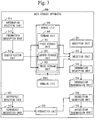
- a configuration of the data storage apparatus 300 is described based on FIG. 3 .
- the data storage apparatus 300 includes the information receiving unit 311, the information decryption unit 312, a classification unit 313, a working unit 320, a reception unit 331, a selection unit 332, an information encryption unit 333, and an information transmission unit 334. The functions of these units are described below.
- the data storage apparatus 300 further includes a difference receiving unit 341, a difference decryption unit 342, an instruction unit 343, an instruction encryption unit 344, and an instruction transmission unit 345.
- a difference receiving unit 341 receives a difference from the difference storage apparatus 300 and a difference from the difference storage apparatus 300 and a difference transmission unit 345.
- a difference decryption unit 342 receives a difference from the difference storage apparatus 300 and a difference transmission unit 345.
- an instruction unit 343, an instruction encryption unit 344, and an instruction transmission unit 345 The functions of these units are described below.
- the data storage apparatus 300 further includes a memory unit 390.
- the memory unit 390 stores data which is used, generated, or input and output by the data storage apparatus 300.
- the memory unit 390 includes a storage unit 380.
- the storage unit 380 includes a first storage unit 381, a second storage unit 382, and a third storage unit 383.
- a configuration of the data utilization apparatus 400 is described based on FIG. 4 .
- the data utilization apparatus 400 includes a request unit 411, an information receiving unit 412, an information decryption unit 413, and an information display unit 414. The functions of these units are described below.
- the data utilization apparatus 400 further includes a terrestrial object detection unit 421, a difference calculation unit 422, a difference encryption unit 423, a difference transmission unit 424, and a driving unit 430.
- the functions of these units are described below.
- the data utilization apparatus 400 further includes a memory unit 490.
- the memory unit 490 stores data which is used, generated, or input and output by the data utilization apparatus 400.
- three-dimensional position information 491 is stored in the memory unit 490.
- the data utilization apparatus 400 further includes a sensor 401.
- a specific sensor 401 includes, for example, a camera, a laser scanner, and a positioning apparatus.
- An operation of the positioning and measurement data system 100 is equivalent to a data management method.
- a procedure of the data management method is equivalent to a procedure of a data management program.
- An operation of the positioning and measurement apparatus 200 is equivalent to a positioning and measurement method.
- a procedure of the positioning and measurement method is equivalent to a procedure of a positioning and measurement program.
- An operation of the data storage apparatus 300 is equivalent to a data storage method. Moreover, a procedure of the data storage method is equivalent to a procedure of a data storage program.
- An operation of the data utilization apparatus 400 is equivalent to a data utilization method. Moreover, a procedure of the data utilization method is equivalent to a procedure of a data utilization program.
- a positioning and measurement method (measurement) used for the positioning and measurement apparatus 200 to perform measurement is described based on FIG. 5 .
- Step Sill is measurement processing.
- step Sill the measurement instrument 201 performs measurement to acquire measured data.
- the positioning reinforcement signal receiver 202, the positioning signal receiver 203, the inertial measurement device 204, the odometer 205, and the laser scanner 206 operate in the following way.
- the positioning reinforcement signal receiver 202 receives a positioning reinforcement signal and then outputs positioning reinforcement data.
- the positioning reinforcement data includes the content of the positioning reinforcement signal and the measurement date and time at which the positioning reinforcement signal was received.
- the positioning reinforcement data is one of pieces of measured data.
- the positioning signal receiver 203 receives a positioning signal and then outputs positioning data.
- the positioning data includes a result obtained by receiving a positioning signal, such as three-dimensional coordinate values and a pseudo-distance, and the measurement date and time at which the positioning signal was received.
- the positioning data is one of pieces of measured data.
- the inertial measurement device 204 measures the angular velocity and acceleration of the measurement vehicle and then outputs inertial measurement data.
- the inertial measurement data includes the angular velocity of the measurement vehicle, the acceleration of the measurement vehicle, and the measurement date and time at which the measurement was performed.
- the inertial measurement data is one of pieces of measured data.
- the odometer 205 measures the travel distance of the measurement vehicle and then outputs distance data.
- the distance data includes the travel distance of the measurement vehicle and the measurement date and time at which the measurement was performed.
- the distance data is one of pieces of measured data.
- the laser scanner 206 performs laser measurement and then outputs distance azimuth direction data.
- the distance azimuth direction data includes a distance from the laser scanner 206 to each measurement point, an azimuth direction from the laser scanner 206 to each measurement point, and the measurement date and time at which the laser measurement was performed.
- the distance azimuth direction data is one of pieces of measured data.
- Step S112 is three-dimensional position information generation processing.
- step S112 the three-dimensional position information generation unit 210 generates three-dimensional position information using the measured data acquired by the measurement instrument 201.
- the position calculation unit 211 the attitude calculation unit 212, and the point group generation unit 213 operate in the following way.
- the position calculation unit 211 calculates the coordinate values of the measurement vehicle using the positioning reinforcement data, the positioning data, the inertial measurement data, and the distance data. Then, the position calculation unit 211 generates position information which is data indicating the coordinate values of the measurement vehicle.
- the method for calculating the coordinate values of the measurement vehicle is related art and, therefore, the description thereof is omitted.
- the attitude calculation unit 212 calculates an attitude angle of the measurement vehicle using the positioning data, the inertial measurement data, and the distance data. Then, the attitude calculation unit 212 generates attitude information which is data indicating the attitude angle of the measurement vehicle.
- the method for calculating the attitude angle of the measurement vehicle is related art and, therefore, the description thereof is omitted.
- the point group generation unit 213 calculates three-dimensional coordinate values of each portion of a terrestrial object using the distance azimuth direction data, the position information, and the attitude information. Then, the point group generation unit 213 generates three-dimensional position information which is data including the three-dimensional coordinate values of each portion of the terrestrial object.
- the method for calculating the three-dimensional coordinate values of each portion of the terrestrial object is related art and, therefore, the description thereof is omitted.
- Step S113 is additional information acquisition processing.
- step S113 the additional information acquisition unit 220 acquires additional information.
- the additional information is at least any one or some of authenticated user information, instrument information, measurement information, and algorithm information.
- the authenticated user information is information about an authenticated user.
- the instrument information is information about the measurement instrument 201.
- the measurement information is information about the measurement performed to acquire measured data.
- the algorithm information is information specifying an algorithm for generating three-dimensional position information and an algorithm for acquiring the measurement date and time.
- the time acquisition unit 221, the card reader 207, the authentication unit 222, and the additional information acquisition unit 220 operate in the following way.
- the time acquisition unit 221 acquires the measurement date and time from any one of the positioning reinforcement data, the positioning data, the inertial measurement data, and the distance data.
- the card reader 207 When a user card is inserted into the card reader 207, the card reader 207 reads a user identifier from the inserted user card.
- the user card is an integrated circuit (IC) card issued to a user, with which a user identifier is previously registered.
- IC integrated circuit
- the authentication unit 222 determines whether the same user identifier as the read-out user identifier is registered with the user information database 291.
- the authentication unit 222 acquires user information associated with the corresponding user identifier from the user information database 291.
- the user information database 291 is data including user information about each user to be authenticated.
- the authentication unit 222 generates authenticated user information using the read-out user identifier and the acquired user information.
- the authenticated user information includes at least any one of the name of an authenticated user, a user identifier for identifying the authenticated user, affiliation information indicating an affiliation of the authenticated user, and qualification information indicating a qualification which the authenticated user has.
- the additional information acquisition unit 220 acquires instrument information.
- the instrument information includes at least any one of the model number of the measurement instrument 201, the grade of the measurement instrument 201, the manufacturer name of a manufacture which manufactured the measurement instrument 201, the individual number of the measurement instrument 201, the date of manufacture of the measurement instrument 201, and calibration information about the measurement instrument 201.
- the calibration information about the measurement instrument 201 includes at least any one of the calibration date and time of the measurement instrument 201, a calibration method employed for the measurement instrument 201, and identification information about a business operator which calibrated the measurement instrument 201.
- the instrument information is acquired from the measurement instrument 201. Moreover, the instrument information can be previously set to the user card by a certificate authority.
- the calibration information about the measurement instrument 201 which is stored in the memory unit 290, is acquired from the memory unit 290.
- the additional information acquisition unit 220 acquires measurement information.
- the measurement information includes at least any one of the measurement date and time, the measurement location, the weather during measurement, the situation of the measurement location, the measurement cumulative time, and the number of captured satellites.
- the measurement cumulative time is a time obtained by cumulating times for which measurement was performed.
- the number of captured satellites is the number of positioning satellites captured during measurement.
- the measurement date and time is acquired by the time acquisition unit 221.
- the weather during measurement and the situation of the location are acquired from the Internet.
- the measurement cumulative time is calculated by cumulating measurement times, which are times for which measurement was performed.
- the measurement time is acquired from the measurement instrument 201.
- the number of captured satellites, which is included in the positioning data, is acquired from the positioning data.
- the measurement information can include measurement accuracy information.
- the measurement accuracy information is information indicating measurement accuracy.
- the measurement accuracy is obtained by calculating some kind of precision index indicating the measurement accuracy about position orientation obtained by the positioning signal receiver 203 based on, for example, the number of positioning satellites captured by the positioning signal receiver 203 (the number of positioning satellites which would have been captured by the positioning signal receiver 203) and the geometric arrangement of positioning satellites.
- a precision index for example, a geometrical dilution of precision (GDOP), a horizontal dilution of precision (HDOP), and a position dilution of precision (PDOP), which indicate the degree of influence on the positioning precision by the arrangement of GPS satellites in the sky, can be used.
- GDOP geometrical dilution of precision
- HDOP horizontal dilution of precision
- PDOP position dilution of precision
- the additional information acquisition unit 220 acquires algorithm information.
- the algorithm information is information specifying at least any one of a position calculation algorithm, an attitude calculation algorithm, a position information generation algorithm, and a measurement date and time acquisition algorithm.
- the algorithm information includes at least any one of an algorithm identifier, implementer information, and processing sequence information.
- the position calculation algorithm is an algorithm which is executed by the position calculation unit 211, and is an algorithm for calculating the coordinate values of the measurement vehicle.
- the attitude calculation algorithm is an algorithm which is executed by the attitude calculation unit 212, and is an algorithm for calculating the attitude angle of the measurement vehicle.
- the position information generation algorithm is an algorithm which is executed by the three-dimensional position information generation unit 210, and is an algorithm for generating three-dimensional position information.
- the measurement date and time acquisition algorithm is an algorithm which is executed by the time acquisition unit 221, and is an algorithm for acquiring the measurement date and time from the measured data.
- the algorithm identifier is an identifier for identifying an algorithm.
- the implementer information is information about a person who implemented an algorithm.
- the processing sequence information is information indicating the sequence of processing included in an algorithm.
- the algorithm information is automatically input to the additional information acquisition unit 220 from each of the position calculation unit 211, the attitude calculation unit 212, the three-dimensional position information generation unit 210, and the time acquisition unit 221 according to the respective algorithms executed by them. Furthermore, in a case where the three-dimensional position information generation unit 210 is placed in a server instrument which is different from a movable body on which the measurement instrument 201 is mounted, the algorithm information can be automatically input from the server instrument to the additional information acquisition unit 220 via the instruction receiving unit 241.
- Step S114 is information encryption processing.
- step S 114 the information encryption unit 231 encrypts a set of the generated three-dimensional position information and the acquired additional information.
- Encrypting a set of the three-dimensional position information and the additional information enables associating the additional information with the three-dimensional position information.
- the information encryption unit 231 encrypts a set of the generated three-dimensional position information and the acquired additional information by using at least any one of the following (1) to (7).
- a key required for encryption is safely distributed from a certificate authority.
- the function encryption is also referred to as functional encryption.
- the detection encryption is also referred to as falsification detection encryption.
- the decompression term is a time limit by which decompression of data can be performed.
- the decompression can be replaced by decryption.
- Step S115 is information transmission processing.
- step S115 the information transmission unit 232 transmits encrypted information data 110 to the data storage apparatus 300.
- the encrypted information data 110 is data obtained by encrypting a set of the generated three-dimensional position information and the acquired additional information.
- a data storage method (storage) used for the data storage apparatus 300 to store three-dimensional position information is described based on FIG. 7 .
- Step S121 is receiving processing.
- step S121 the information receiving unit 311 receives the encrypted information data 110 transmitted from the positioning and measurement apparatus 200.
- Step S122 is information decryption processing.
- step S122 the information decryption unit 312 performs decryption on the received encrypted information data 110.
- the information decryption unit 312 performs decryption and verification such as those described as follows.
- the information decryption unit 312 performs signature verification.
- the information decryption unit 312 performs decryption using a device-specific common key.
- the information decryption unit 312 performs digest verification using a device-specific common key.
- the information decryption unit 312 performs decryption and signature verification using a public key having an access right.
- the information decryption unit 312 performs falsification detection and decryption.
- the information decryption unit 312 performs decryption using a key corresponding to the current date and time.
- step S123 the information decryption unit 312 evaluates a decryption result. If the decryption result is normal, processing proceeds to step S124.
- Step S124 is classification processing.
- step S124 the classification unit 313 classifies the decrypted three-dimensional position information based on the decrypted additional information.
- the classification unit 313 performs ranking on the decrypted three-dimensional position information based on the decrypted additional information.
- the ranking is performed in the following way.
- the classification unit 313 calculates a score based on the additional information.
- the score represents a high or low degree of accuracy of the three-dimensional position information. More specifically, the classification unit 313 acquires, from a score table, scores corresponding to respective pieces of information, i.e., information included in the authenticated user information, information included in the instrument information, information included in the measurement information, and information included in the algorithm information.
- the classification unit 313 calculates the sum of the acquired scores.
- the score table which is a table in which information and a score are associated with each other, is previously stored in the memory unit 390.
- the classification unit 313 acquires, from a ranking table, a rank value representing a rank corresponding to the calculated score.
- the ranking table which is a table in which a range of scores and a rank value are associated with each other, is previously stored in the memory unit 390.
- Step S125 is storage processing.
- step S125 the classification unit 313 stores the classified three-dimensional position information in the storage unit 380.
- the three-dimensional position information is assumed to be safely stored with use of, for example, encryption or access control.
- the classification unit 313 stores three-dimensional position information and additional information thereof in the storage unit 380 on a rank-by-rank basis.
- the rank information is information indicating a rank
- specific rank information is a rank value.
- Three-dimensional position information of the first rank is stored in the first storage unit 381, three-dimensional position information of the second rank is stored in the second storage unit 382, and three-dimensional position information of the third rank is stored in the third storage unit 383.
- Step S126 is working processing.
- step S126 the working unit 320 works three-dimensional position information according to an instruction from an administrator.
- the three-dimensional position information is edited into the format of road map data for use in a car navigation system.
- position information about, for example, parking lots, traffic lights, and traffic lanes is appended to the three-dimensional position information.
- a data storage method (provision) used for the data storage apparatus 300 to provide three-dimensional position information to the data utilization apparatus 400 is described based on FIG. 8 .
- Step S131 is reception processing.
- step S131 the reception unit 331 receives request data 129 transmitted from the data utilization apparatus 400.
- the request data 129 includes regional information and rank information.
- Step S132 is selection processing.
- step S132 the selection unit 332 selects three-dimensional position information from the storage unit 380 based on the request data 129.
- the selection unit 332 selects a storage unit corresponding to the rank information included in the request data 129. Then, the selection unit 332 selects three-dimensional position information about a region specified by the regional information included in the request data 129 from the selected storage unit.
- Step S133 is information encryption processing.
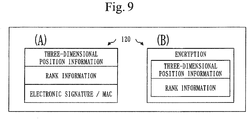
- step S133 the information encryption unit 333 encrypts a set of the selected three-dimensional position information and the rank information about the selected three-dimensional position information.
- the encryption method is similar to that in step S114.
- Step S134 is information transmission processing.
- step S134 the information transmission unit 334 transmits encrypted information data 120 to the data utilization apparatus 400, which has transmitted the request data 129.
- the encrypted information data 120 is data obtained by encrypting a set of the selected three-dimensional position information and the rank information about the selected three-dimensional position information.
- a data utilization method (utilization) used for the data utilization apparatus 400 to utilize three-dimensional position information is described based on FIG. 10 .
- Step S141 is request processing.
- step S141 the request unit 411 transmits request data 129 for requesting three-dimensional position information to the data storage apparatus 300.
- the user inputs regional information and rank information to the data utilization apparatus 400 using an input interface.
- the request unit 411 generates request data 129 including the input regional information and rank information, and transmits the generated request data 129 to the data storage apparatus 300.
- Step S142 is information receiving processing.
- step S142 the information receiving unit 412 receives the encrypted information data 120 transmitted from the data storage apparatus 300.
- Step S143 is information decryption processing.
- step S143 the information decryption unit 413 performs decryption on the received encrypted information data 120.
- the three-dimensional position information and the rank information are decrypted.
- the decryption method is similar to that in step S122.
- step S144 the information decryption unit 413 evaluates a decryption result.
- step S145 If the decryption result is normal, processing proceeds to step S145 and step S146.
- Step S145 is information display processing.
- step S145 the information display unit 414 displays the decrypted three-dimensional position information, the decrypted rank information, and the decryption result.
- Step S146 is driving processing.
- step S146 the driving unit 430 automatically drives the utilization vehicle utilizing the decrypted three-dimensional position information.
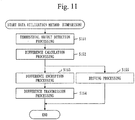
- a data utilization method (comparison) used for the data utilization apparatus 400 to compare the three-dimensional position information with the current status is described based on FIG. 11 .
- Step S151 is terrestrial object detection processing.
- step S151 the terrestrial object detection unit 421 detects a terrestrial object present around the utilization vehicle.
- the sensor 401 observes the surrounding area of the utilization vehicle to output observed data.
- the observed data is data including information obtained by observation.
- the terrestrial object detection unit 421 detects a terrestrial object present around the utilization vehicle by using the observed data.
- the terrestrial object detection unit 421 detects a terrestrial object in the following way.
- the laser scanner which is one element of the sensor 401, performs laser measurement to output distance azimuth direction data.
- the distance azimuth direction data includes the luminance of the detected reflected light.
- the positioning device which is one element of the sensor 401, calculates the position and attitude of the utilization vehicle to output position attitude data.
- the terrestrial object detection unit 421 generates three-dimensional point group data in the MMS using the distance azimuth direction data and the position attitude data.
- the three-dimensional point group data includes three-dimensional coordinate values and reflection luminance for each measurement point.
- the terrestrial object detection unit 421 identifies a terrestrial object present at a measurement point based on the reflection luminance of the measurement point, and identifies the position of the terrestrial object based on the three-dimensional coordinate values of the measurement point.
- the detected terrestrial object includes, for example, a guardrail, a sign, a center line, a pedestrian crosswalk, and a traffic light.
- Step S152 is difference calculation processing.
- step S152 the difference calculation unit 422 calculates a difference between the position of the detected terrestrial object and the position of a terrestrial object identified by the three-dimensional position information.
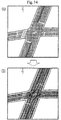
- FIG. 12 illustrates a point group image obtained by imaging three-dimensional point group data or three-dimensional position information.
- the point group image is an image in which points of colors corresponding to the reflection luminances of the respective measurement points are drawn at the portions corresponding to the three-dimensional coordinate values of the respective measurement points.
- FIG. 13 illustrates a picture of the point group image illustrated in FIG. 12 .
- white lines of the road are detected based on the reflection luminances.
- a terrestrial object which is not present on a map represented by the three-dimensional position information is detected from the three-dimensional point group data. More specifically, for example, a new road or a depression on the road is detected.
- center lines, traffic lanes, and stop lines can be detected from such a point group image. Then, traveling lines and nodes can be specified based on the detection result.
- the traveling line is a path along which the vehicle travels.
- the traveling line is three-dimensional information obtained by adding information about a height direction to planar information.
- the node is a spot at which the traveling line changes.
- Step S153 is difference encryption processing.
- step S153 the difference encryption unit 423 encrypts difference information indicating the calculated difference.
- the encryption method is similar to that in step S114.
- Step S154 is difference transmission processing.
- step S154 the difference transmission unit 424 transmits encrypted difference data 130 to the data storage apparatus 300.
- the encrypted difference data 130 is data obtained by encrypting the difference information.
- step S155 is described.
- Step S155 is driving processing.
- step S155 the driving unit 430 automatically drives the utilization vehicle by utilizing the position of the detected terrestrial object, the three-dimensional position information, and the difference information.
- a data storage method (instruction) used for the data storage apparatus 300 to instruct the positioning and measurement apparatus 200 to perform remeasurement is described based on FIG. 16 .
- Step S161 is difference receiving processing.
- step S161 the difference receiving unit 341 receives the encrypted difference data 130 transmitted from the data utilization apparatus 400.
- Step S162 is difference decryption processing.
- step S162 the difference decryption unit 342 performs decryption on the received encrypted difference data 130.
- the decryption method is similar to that in step S122.
- step S163 the difference decryption unit 342 evaluates a decryption result. If the decryption result is normal, processing proceeds to step S164.
- Step S164 is determination processing.
- step S164 the instruction unit 343 determines whether to instruct the positioning and measurement apparatus 200 to perform remeasurement based on the decrypted difference information.
- the instruction unit 343 compares the number of pieces of information included in the difference information with a difference threshold value. Then, if the number of pieces of information included in the difference information is greater than the difference threshold value, the instruction unit 343 determines to issue an instruction for remeasurement.
- the number of pieces of information included in the difference information is equivalent to the number of portions at which a difference occurred.
- the difference threshold value is a previously determined value.
- the instruction unit 343 If an instruction for remeasurement is to be issued, the instruction unit 343 generates instruction information for issuing an instruction for remeasurement. More specifically, the instruction unit 343 specifies a portion at which a difference occurred based on the difference information, and generates instruction information including information indicating the specified portion. After that, processing proceeds to step S165.
- Step S165 is instruction encryption processing.
- step S165 the instruction encryption unit 344 encrypts the generated instruction information.
- the encryption method is similar to that in step S114.
- Step S166 is instruction transmission processing.
- step S166 the instruction transmission unit 345 transmits encrypted instruction data 140 to the positioning and measurement apparatus 200.
- the encrypted instruction data 140 is data obtained by encrypting the generated instruction information.
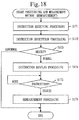
- a positioning and measurement method (remeasurement) used for the positioning and measurement apparatus 200 to perform remeasurement is described based on FIG. 18 .
- Step S171 is instruction receiving processing.
- step S171 the instruction receiving unit 241 receives the encrypted instruction data 140 transmitted from the data storage apparatus 300.
- Step S172 is instruction decryption processing.
- step S172 the instruction decryption unit 242 performs decryption on the received encrypted instruction data 140.
- the decryption method is similar to that in step S122.
- step S173 the instruction decryption unit 242 evaluates a decryption result. If the decryption result is normal, processing proceeds to step S174.
- Step S174 is instruction display processing.
- step S174 the instruction display unit 243 displays the decrypted instruction information.
- step S175 the user of the positioning and measurement apparatus 200 determines a portion which needs remeasurement based on the displayed instruction information and moves the measurement vehicle to the portion. Then, the user inputs an instruction for remeasurement to the positioning and measurement apparatus 200. More specifically, the user presses a start button for measurement.
- Step S176 is remeasurement processing.
- step S176 the measurement instrument 201 performs measurement to acquire measured data.
- a hardware configuration of the positioning and measurement apparatus 200 is described based on FIG. 19 .
- the positioning and measurement apparatus 200 is a computer including hardware such as a processor 901, a memory 902, an auxiliary storage device 903, a communication device 904, a display device 907, the measurement instrument 201, and the card reader 207.
- the processor 901 is connected to the other pieces of hardware via signal lines.
- the processor 901 is an integrated circuit (IC) which performs processing, and controls the other pieces of hardware. More specifically, the processor 901 is a CPU, a DSP, or a GPU.
- CPU is an abbreviation for central processing unit
- DSP is an abbreviation for digital signal processor
- GPU is an abbreviation for graphics processing unit.
- the memory 902 is a volatile storage device.
- the memory 902 is called a main storage device or a main memory. More specifically, the memory 902 is a random access memory (RAM).
- RAM random access memory
- the auxiliary storage device 903 is a non-volatile storage device. More specifically, the auxiliary storage device 903 is a ROM, an HDD, or a flash memory. ROM is an abbreviation for read-only memory, and HDD is an abbreviation for hard disk drive.
- the communication device 904 includes a receiver 905 and a transmitter 906. More specifically, the communication device 904 is a communication chip or a network interface card (NIC).
- NIC network interface card
- the display device 907 is a display which displays information. More specifically, the display device 907 is a liquid crystal display.
- a program for implementing the functions of "units” including the three-dimensional position information generation unit 210, the additional information acquisition unit 220, the information encryption unit 231, the instruction decryption unit 242, and the instruction display unit 243 is stored in the auxiliary storage device 903.
- the program for implementing the functions of "units” is loaded onto the memory 902 and is then executed by the processor 901.
- an operating system is stored in the auxiliary storage device 903. At least a part of the OS is loaded onto the memory 902 and is then executed by the processor 901.
- the processor 901 executes the program for implementing the functions of "units" while executing the OS.
- Data obtained by executing the program for implementing the functions of "units" is stored in a storage device such as the memory 902, the auxiliary storage device 903, a register included in the processor 901, or a cache memory included in the processor 901. These storage devices function as the memory unit 290.
- the positioning and measurement apparatus 200 can include a plurality of processors 901, and the plurality of processors 901 can execute the program for implementing the functions of "units" in cooperation with each other.
- the communication device 904 functions as a communication unit which communicates data
- the receiver 905 functions as the instruction receiving unit 241
- the transmitter 906 functions as the information transmission unit 232.
- the display device 907 functions as the instruction display unit 243.
- processing circuitry Hardware obtained by integrating the processor 901, the memory 902, and the auxiliary storage device 903 is referred to as a "processing circuitry".
- the program for implementing the functions of "units" can be stored in a non-volatile storage medium, such as a magnetic disc, an optical disc, or a flash memory.
- a hardware configuration of the data storage apparatus 300 is described based on FIG. 20 .
- the data storage apparatus 300 is a computer including hardware such as a processor 901, a memory 902, an auxiliary storage device 903, a communication device 904, and a display device 907.
- the processor 901 is connected to the other pieces of hardware via signal lines.
- a program for implementing the functions of "units” including the information decryption unit 312, the classification unit 313, the working unit 320, the selection unit 332, the information encryption unit 333, the difference decryption unit 342, the instruction unit 343, and the instruction encryption unit 344 is stored in the auxiliary storage device 903.
- the program for implementing the functions of "units” is loaded onto the memory 902 and is then executed by the processor 901.
- the data storage apparatus 300 can include a plurality of processors 901, and the plurality of processors 901 can execute the program for implementing the functions of "units" in cooperation with each other.
- a storage device such as the memory 902 or the auxiliary storage device 903 functions as the memory unit 390.
- the communication device 904 functions as a communication unit which communicates data
- the receiver 905 functions as the information receiving unit 311, the reception unit 331, and the difference receiving unit 341
- the transmitter 906 functions as the information transmission unit 334 and the instruction transmission unit 345.
- the display device 907 functions as a display unit which displays information.
- a hardware configuration of the data utilization apparatus 400 is described based on FIG. 21 .
- the data utilization apparatus 400 is a computer including hardware such as a processor 901, a memory 902, an auxiliary storage device 903, a communication device 904, a display device 907, and the sensor 401.
- the processor 901 is connected to the other pieces of hardware via signal lines.
- a program for implementing the functions of "units” including the request unit 411, the information decryption unit 413, the terrestrial object detection unit 421, the difference calculation unit 422, the difference encryption unit 423, and the driving unit 430 is stored in the auxiliary storage device 903.
- the program for implementing the functions of "units” is loaded onto the memory 902 and is then executed by the processor 901.
- the data utilization apparatus 400 can include a plurality of processors 901, and the plurality of processors 901 can execute the program for implementing the functions of "units" in cooperation with each other.
- a storage device such as the memory 902 or the auxiliary storage device 903 functions as the memory unit 490.
- the communication device 904 functions as a communication unit which communicates data
- the receiver 905 functions as the information receiving unit 412
- the transmitter 906 functions as the request unit 411 and the difference transmission unit 424.
- the display device 907 functions as the information display unit 414.
- Encrypting a set of three-dimensional position information acquired by a measurement apparatus such as an MMS and additional information appended to the three-dimensional position information enables preventing falsification of the three-dimensional position information and the additional information. Moreover, it enables increasing the reliability of measured data itself.
- three-dimensional position information that is based on measured data, the accuracy of which varies according to the technical skill of a user, can be finely classified and managed based on the accuracy. Since the accuracy of three-dimensional position information is made uniform by classification, assuring the accuracy of three-dimensional position information is enabled.
- pieces of measured data different in accuracy have been acquired by measurement being performed by different measurement apparatuses
- pieces of three-dimensional position information that are based on the respective pieces of measured data are classified by ranks of accuracy, assuring the accuracy of three-dimensional position information is enabled.
- pieces of measured data different in accuracy have been acquired by measurement being performed in different measurement environments, pieces of three-dimensional position information that are based on the respective pieces of measured data are classified by ranks of accuracy, assuring the accuracy of three-dimensional position information is enabled.
- Encrypting three-dimensional position information enables assuring confidentiality, completeness, authenticity, and transmission source confirmation, so that falsification, identity theft, repeat attack, and transmission denial can be prevented.
- the pieces of three-dimensional position information are classified based on the additional information, pieces of three-dimensional position information corresponding to the respective transmission destinations can be delivered.
- three-dimensional position information is ranked, three-dimensional position information appropriate for a request from each transmission destination can be provided. Moreover, management of three-dimensional position information is facilitated.
- Three-dimensional position information is acquired by the positioning and measurement apparatus 200. Moreover, information equivalent to the latest three-dimensional position information is acquired by the data utilization apparatus 400.
- Detecting a difference between the latest three-dimensional position information and the past three-dimensional position information enables capturing a change in a terrestrial object which triggers updating of three-dimensional position information.
- Acquisition of three-dimensional position information is performed during movement with, for example, a vehicle
- storage of three-dimensional position information is performed by a server or in cloud storage
- utilization of three-dimensional position information is performed during movement with, for example, a vehicle. This enables efficient acquisition, storage, and utilization of three-dimensional position information.
- Authentication using an IC card enables simplifying procedures for user authentication.
- the configuration of the positioning and measurement data system 100 is the same as that in the Embodiment 1.
- a configuration of the positioning and measurement apparatus 200 is described based on FIG. 22 .
- the positioning and measurement apparatus 200 includes a biometric reader 208 instead of the card reader 207 described in the Embodiment 1.
- the biometric reader 208 is a device which reads biological information from the user.
- Specific biological information includes, for example, a finger print, an iris, a vein, and a genome.
- the authentication unit 222 performs biometric authentication with respect to biological information read by the biometric reader 208.
- the configuration of the data storage apparatus 300 and the configuration of the data utilization apparatus 400 are the same as those in the Embodiment 1.
- the flow of processing for the positioning and measurement method (measurement) employed by the positioning and measurement apparatus 200 is the same as that in the Embodiment 1.
- the biometric reader 208 and the authentication unit 222 operate in the following way.
- the biometric reader 208 reads biological information about the user.
- the authentication unit 222 determines whether biological information which matches the read biological information is registered with the user information database 291.
- the authentication unit 222 acquires user information associated with the above biological information from the user information database 291.
- the acquired user information serves as authenticated user information.
- the positioning and measurement method (remeasurement) employed by the positioning and measurement apparatus 200 is the same as that in the Embodiment 1.
- the data storage method employed by the data storage apparatus 300 is the same as that in the Embodiment 1.
- the data utilization method employed by the data utilization apparatus 400 is the same as that in the Embodiment 1.
- Authentication using biological information enables increasing the reliability of user authentication. In particular, it enables preventing identity theft of users. As a result, the reliability of authenticated user information, which is one of pieces of additional information, increases, and, therefore, the reliability of three-dimensional position information associated with the user information increases.
- the functions of the positioning and measurement apparatus 200, the data storage apparatus 300, and the data utilization apparatus 400 can be implemented by hardware.
- FIG. 23 illustrates a configuration in which the function of the positioning and measurement apparatus 200 is implemented by hardware.
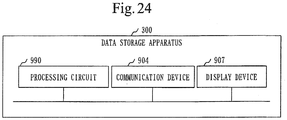
- FIG. 24 illustrates a configuration in which the function of the data storage apparatus 300 is implemented by hardware.
- FIG. 25 illustrates a configuration in which the function of the data utilization apparatus 400 is implemented by hardware.
- Each of the positioning and measurement apparatus 200, the data storage apparatus 300, and the data utilization apparatus 400 includes a processing circuit 990.
- the processing circuit 990 is also called a processing circuitry.
- the processing circuit 990 is a dedicated electronic circuit which implements the functions of "units" described in each embodiment.
- the "unit” also includes a storage unit.
- the processing circuit 990 is a single circuit, a composite circuit, a programmed processor, a parallel programmed processor, a logic IC, a GA, an ASIC, an FPGA, or their combination.
- GA is an abbreviation for Gate Array
- ASIC is an abbreviation for Application Specific Integrated Circuit
- FPGA is an abbreviation for Field Programmable Gate Array.
- each of the positioning and measurement apparatus 200, the data storage apparatus 300, and the data utilization apparatus 400 can include a plurality of processing circuits 990, and the plurality of processing circuits 990 can implement the functions of "units" in cooperation with each other.
- each of the positioning and measurement apparatus 200, the data storage apparatus 300, and the data utilization apparatus 400 can be implemented by a combination of software and hardware.
- a part of "units” can be implemented by software, and the remaining part of the "units" can be implemented by hardware.
Landscapes
- Engineering & Computer Science (AREA)
- Physics & Mathematics (AREA)
- General Physics & Mathematics (AREA)
- Computer Networks & Wireless Communication (AREA)
- Computer Security & Cryptography (AREA)
- Radar, Positioning & Navigation (AREA)
- Remote Sensing (AREA)
- Signal Processing (AREA)
- Electromagnetism (AREA)
- Theoretical Computer Science (AREA)
- Artificial Intelligence (AREA)
- Computer Vision & Pattern Recognition (AREA)
- Health & Medical Sciences (AREA)
- Toxicology (AREA)
- Multimedia (AREA)
- Computing Systems (AREA)
- General Health & Medical Sciences (AREA)
- Software Systems (AREA)
- Technology Law (AREA)
- Computer Hardware Design (AREA)
- General Engineering & Computer Science (AREA)
- Length Measuring Devices With Unspecified Measuring Means (AREA)
- Length Measuring Devices By Optical Means (AREA)
- Position Fixing By Use Of Radio Waves (AREA)
- Navigation (AREA)
Abstract
Description
- The present invention relates to a moving-type positioning and measurement apparatus which acquires three-dimensional position information, a data storage apparatus which stores three-dimensional position information, and a data utilization apparatus which utilizes three-dimensional position information.
- In particular, the invention is directed to accuracy assurance and falsification prevention of three-dimensional position information which is stored in a data storage apparatus.
- The moving-type positioning and measurement apparatus is an apparatus which acquires three-dimensional position information about, for example, a terrain, a building, a construction, a road, a bridge, a tunnel, and a sign while moving with, for example, a vehicle.
- The three-dimensional position information is data including three-dimensional coordinate values, such as latitude, longitude, and altitude.
- Examples of a measurement system which acquires three-dimensional position information include an aircraft-mounted laser measurement apparatus and a vehicle-mounted laser measurement apparatus.
- Three-dimensional position information about, for example, a terrain, a building, a construction, a road, a bridge, a tunnel, and a sign is acquired by these measurement systems.
- Examples of the vehicle-mounted laser measurement apparatus include a mobile mapping system (MMS) which acquires three-dimensional point group data representing a three-dimensional shape of a surrounding terrestrial object during movement on the road.
- A vehicle used in the MMS is equipped with a positioning apparatus and a measurement apparatus. A specific positioning apparatus is a global positioning system (GPS), and a specific measurement apparatus is a laser scanner and an inertial measurement unit (IMU).
- An MMS is disclosed in
Patent Literature 1. - In the disclosed MMS, measurement and calculation are performed about the self-location and attitude of the vehicle by a combination of a GPS and an IMU. Moreover, the relative position of a terrestrial object shape is measured by a laser scanner. Then, three-dimensional point group data configured with latitude, longitude, and altitude is calculated about the terrestrial object shape as three-dimensional position information.
- In recent years, three-dimensional position information has become used in a diversity of industries, and there is a movement to collectively manage and utilize data acquired by, for example, an MMS.
- However, the range of measurement and the accuracy of data vary with industries. More specifically, while a narrow range is measured with high accuracy in the surveying industry, a wide range is measured with not so high accuracy in the cartographic industry.
- Therefore, if management of pieces of data acquired in respective industries is able to be unified, overlapping of measuring ranges between industries is eliminated, so that measurement work is made more efficient and management of the acquired data is facilitated.
- Even in the Council on Competitiveness-Nippon, the utilization of three-dimensional position information in the fields of, for example, an autonomous driving system, social infrastructure operation and maintenance, and IT agriculture is assumed, and the concept of a platform for unifying management of three-dimensional position information needed for the respective utilization fields is being promoted. Such a platform is called a data platform or common platform.
- Non-Patent Literature 1 is a final report of the project in the year of 2014 of the Council on Competitiveness-Nippon, and the final report describes that the latest and high-accuracy three-dimensional position information is required to be stored in a common platform and the mechanism of managing pieces of data with the uniform degree of accuracy is also required.
- Patent Literature 1: Japanese Patent
JP 4 344 869B2 - Non-Patent Literature 1: Final Report of Project in the Year of 2014 of the Council on Competitiveness-Nippon, "Service and Preparation of a Common Platform Using Three-dimensional Position Information", Council on Competitiveness-Nippon
- Using a measurement apparatus such as an MMS enables accurately measuring a wide range in a short amount of time.
- However, the accuracy of a measurement result varies according to the manufacturer, grade, and calibration state of the measurement apparatus, and the accuracy of a measurement result also varies according to a measurer who uses the measurement apparatus and a measuring condition. Therefore, generally, an error amount is assigned to measured data.
- However, since there is no uniform criterion for error amounts, the error amount to be assigned to measured data varies with manufacturers.
- Moreover, since no countermeasures are taken against falsification prevention of measured data, measured data the accuracy of which is actually poor may be disguised as measured data the accuracy of which is high. Furthermore, since falsification of data for proving the measurement date and time is also possible, old measured data which was acquired many years ago may be disguised as the latest measured data. Then, the falsified measured data may be used in, for example, building construction work or road construction work.
- On the other hand, to collectively manage and utilize three-dimensional position information acquired by a measurement apparatus such as an MMS, it is important that the reliability of measured data be ensured.
- However, since the current status is vulnerable to falsification of measured data, it is difficult to collectively manage and utilize three-dimensional position information.
- An object of the invention is to provide a positioning and measurement apparatus which increases the reliability of measured data itself by preventing falsification of three-dimensional position information and additional information thereof. Moreover, an object of the invention is to provide a data storage apparatus which manages three-dimensional position information and delivers the managed three-dimensional position information to users. Furthermore, an object of the invention is to provide a data utilization apparatus which utilizes three-dimensional position information delivered from the data storage apparatus.
- A positioning and measurement apparatus according to the present invention includes:
- a three-dimensional position information generation unit to generate three-dimensional position information using measured data acquired by a measurement instrument;
- an additional information acquisition unit to acquire, as additional information, at least any one of authenticated user information, which is information about an authenticated user, instrument information, which is information about the measurement instrument, and measurement information, which is information about measurement performed to acquire the measured data; and
- an information encryption unit to encrypt a set of the generated three-dimensional position information and the acquired additional information.
- According to the invention, since a set of three-dimensional position information and additional information is encrypted, falsification of the three-dimensional position information and additional information can be prevented.
- Furthermore, since a set of three-dimensional position information and additional information is encrypted, the additional information is associated with the three-dimensional position information, so that the accuracy of the three-dimensional position information can be identified by the additional information.
- Therefore, the reliability of three-dimensional position information can be increased.
-
- FIG. 1
- is a configuration diagram of a positioning and
measurement data system 100 in anEmbodiment 1. - FIG. 2
- is a configuration diagram of a positioning and
measurement apparatus 200 in theEmbodiment 1. - FIG. 3
- is a configuration diagram of a
data storage apparatus 300 in theEmbodiment 1. - FIG. 4
- is a configuration diagram of a
data utilization apparatus 400 in theEmbodiment 1. - FIG. 5
- is a flowchart of a positioning and measurement method (measurement) in the
Embodiment 1. - FIG. 6
- is an image diagram of encrypted
information data 110 in theEmbodiment 1. - FIG. 7
- is a flowchart of a data storage method (storage) in the
Embodiment 1. - FIG. 8
- is a flowchart of a data storage method (provision) in the
Embodiment 1. - FIG. 9
- is an image diagram of
encrypted information data 120 in theEmbodiment 1. - FIG. 10
- is a flowchart of a data utilization method (utilization) in the
Embodiment 1. - FIG. 11
- is a flowchart of a data utilization method (comparison) in the
Embodiment 1. - FIG. 12
- is a diagram illustrating a point group image in the
Embodiment 1. - FIG. 13
- is a diagram illustrating a picture of the point group image in the
Embodiment 1. - FIG. 14
- is a diagram illustrating a picture of a point group image in the
Embodiment 1. - FIG. 15
- is an image diagram of
encrypted difference data 130 in theEmbodiment 1. - FIG. 16
- is a flowchart of a data storage method (instruction) in the
Embodiment 1. - FIG. 17
- is an image diagram of
encrypted instruction data 140 in theEmbodiment 1. - FIG. 18
- is a flowchart of a positioning and measurement method (remeasurement) in the
Embodiment 1. - FIG. 19
- is a hardware configuration diagram of the positioning and
measurement apparatus 200 in theEmbodiment 1. - FIG. 20
- is a hardware configuration diagram of the
data storage apparatus 300 in theEmbodiment 1. - FIG. 21
- is a hardware configuration diagram of the
data utilization apparatus 400 in theEmbodiment 1. - FIG. 22
- is a configuration diagram of a positioning and
measurement apparatus 200 in anEmbodiment 2. - FIG. 23
- is a diagram illustrating another example of a hardware configuration of a positioning and
measurement apparatus 200 in the embodiments. - FIG. 24
- is a diagram illustrating another example of a hardware configuration of a
data storage apparatus 300 in the embodiments. - FIG. 25
- is a diagram illustrating another example of a hardware configuration of a
data utilization apparatus 400 in the embodiments. - A positioning and
measurement data system 100 is described based onFIG. 1 to FIG. 21 . - A configuration of the positioning and
measurement data system 100 is described based onFIG. 1 . - The positioning and
measurement data system 100 is a system which acquires, stores, and utilizes three-dimensional position information for identifying the position of a terrestrial object. - The positioning and
measurement data system 100 includes a positioning andmeasurement apparatus 200, adata storage apparatus 300, and adata utilization apparatus 400. - The positioning and
measurement apparatus 200 is mounted on a movable body. More specifically, the positioning andmeasurement apparatus 200 is mounted on a vehicle. A vehicle on which the positioning andmeasurement apparatus 200 is mounted is referred to as a measurement vehicle. - While the measurement vehicle is moving, the positioning and
measurement apparatus 200 receives a positioning signal to measure the position of the positioning andmeasurement apparatus 200 itself and also acquires three-dimensional position information. A specific positioning signal is a global positioning system (GPS) signal. - The positioning and
measurement apparatus 200 is an apparatus equivalent to, for example, an aircraft-mounted laser measurement apparatus, a ship-mounted laser measurement apparatus, a vehicle-mounted laser measurement apparatus, or a mobile mapping system (MMS). - Three-dimensional position information which is acquired by the positioning and
measurement apparatus 200 is equivalent to three-dimensional point group data which is acquired by the MMS. The three-dimensional point group data is data representing a three-dimensional shape of a surrounding terrestrial object. - The
data storage apparatus 300 determines the accuracy of three-dimensional position information acquired by the positioning andmeasurement apparatus 200, and records, stores, and manages the three-dimensional position information and the accuracy thereof. - The
data storage apparatus 300 is an apparatus equivalent to, for example, a data server or a data cloud. - The
data utilization apparatus 400 is mounted on a movable body. More specifically, thedata utilization apparatus 400 is mounted on a vehicle. A vehicle on which thedata utilization apparatus 400 is mounted is referred to as a utilization vehicle. - While the utilization vehicle is moving, the
data utilization apparatus 400 utilizes three-dimensional position information, and also detects a difference between the three-dimensional position information and the current status. - The
data utilization apparatus 400 is an apparatus equivalent to, for example, a car navigation system or an autonomous driving apparatus. - Although not illustrated, a certificate authority is present which safely generates, manages, and delivers a key used for cryptographic processing.
- Arrows illustrated in the figure indicate exchanging of information.
- The arrow leading from the positioning and
measurement apparatus 200 to thedata storage apparatus 300 and the arrow leading from thedata storage apparatus 300 to thedata utilization apparatus 400 mainly indicate the flow of three-dimensional position information. - The arrow leading from the
data utilization apparatus 400 to thedata storage apparatus 300 and the arrow leading from thedata storage apparatus 300 to the positioning andmeasurement apparatus 200 mainly indicate the flow of information about a difference between three-dimensional position information and the current status. - Exchanging of information is performed using wired communication, wireless communication, or a medium.
- The positioning and
measurement apparatus 200 transmitsencrypted information data 110 to thedata storage apparatus 300, and receivesencrypted instruction data 140 from thedata storage apparatus 300. - The
data storage apparatus 300 receives theencrypted information data 110 from the positioning andmeasurement apparatus 200. Moreover, thedata storage apparatus 300 receivesrequest data 129 from thedata utilization apparatus 400, and transmitsencrypted information data 120 to thedata utilization apparatus 400. Furthermore, thedata storage apparatus 300 receivesencrypted difference data 130 from thedata utilization apparatus 400, and transmits theencrypted instruction data 140 to the positioning andmeasurement apparatus 200. - The contents of the
encrypted information data 110, therequest data 129, theencrypted information data 120, theencrypted difference data 130, and theencrypted instruction data 140 are described below. - A configuration of the positioning and
measurement apparatus 200 is described based onFIG. 2 . - The positioning and
measurement apparatus 200 includes ameasurement instrument 201 and acard reader 207. - A
specific measurement instrument 201 includes a positioningreinforcement signal receiver 202, apositioning signal receiver 203, aninertial measurement device 204, anodometer 205, and alaser scanner 206. - The positioning
reinforcement signal receiver 202 is a receiver which receives a positioning reinforcement signal including information for increasing the positioning accuracy. - The
positioning signal receiver 203 is a receiver which receives a positioning signal transmitted from a positioning satellite. A specific positioning satellite is a GPS satellite. - The
inertial measurement device 204 is a device which measures an angular velocity and an acceleration. - The
odometer 205 is a device which measures the distance traveled until now. - The
laser scanner 206 radiates laser light and detects laser light reflected from a terrestrial object to measure the distance to the terrestrial object and the azimuth direction thereof. Such measurement is referred to as laser measurement. A portion at which the laser light is reflected of the terrestrial object is referred to as a measurement point. The laser light reflected at the measurement point is referred to as reflected light. A specific terrestrial object includes, for example, a building, a construction, a road, a bridge, a tunnel, and a sign. - The
card reader 207 is a device which reads information from an integrated circuit (IC) card. Thecard reader 207 includes a contact type and a non-contact type, and the type of thecard reader 207 is selected according to the type of an IC card. - The positioning and
measurement apparatus 200 further includes a three-dimensional positioninformation generation unit 210, an additionalinformation acquisition unit 220, aninformation encryption unit 231, and aninformation transmission unit 232. - The three-dimensional position
information generation unit 210 includes aposition calculation unit 211, anattitude calculation unit 212, and a pointgroup generation unit 213. The additionalinformation acquisition unit 220 includes atime acquisition unit 221 and anauthentication unit 222. The functions of these units are described below. - All of the
measurement instrument 201, the three-dimensional positioninformation generation unit 210, the additionalinformation acquisition unit 220, theinformation encryption unit 231, theinformation transmission unit 232, thecard reader 207, aninstruction receiving unit 241, aninstruction decryption unit 242, aninstruction display unit 243, and amemory unit 290 can be mounted on a movable body, such as a vehicle, an aircraft, or a ship. - Furthermore, the
measurement instrument 201, the additionalinformation acquisition unit 220, theinformation encryption unit 231, theinformation transmission unit 232, thecard reader 207, theinstruction receiving unit 241, theinstruction decryption unit 242, theinstruction display unit 243, and thememory unit 290 can be mounted on a specific movable body, such as a vehicle, an aircraft, or a ship, and the three-dimensional positioninformation generation unit 210 can be placed in, for example, a computer server Y located outside the specific movable body. In this case, output signals of the respective devices (the positioningreinforcement signal receiver 202, thepositioning signal receiver 203, theinertial measurement device 204, theodometer 205, and the laser scanner 206) of themeasurement instrument 201 are directly transmitted to theinformation encryption unit 231. - Then, the output signals of the respective devices of the
measurement instrument 201 and an output signal of the additionalinformation acquisition unit 220 are sent to theinformation encryption unit 231, and an encryption processing result from theinformation encryption unit 231 is sent to theinformation transmission unit 232. The encryption processing result is transmitted from theinformation transmission unit 232, is then received by an information receiving unit Z1 of the computer server Y, is then decrypted by an information decryption unit Z2, and is then input to the three-dimensional positioninformation generation unit 210. - At this time, the three-dimensional position
information generation unit 210 acquires pieces of information from the respective devices of themeasurement instrument 201 via theinformation transmission unit 232, the information receiving unit Z1, and the information decryption unit Z2, and performs processing in theposition calculation unit 211, theattitude calculation unit 212, and the pointgroup generation unit 213. - Moreover, the three-dimensional position
information generation unit 210 sends an output signal of the pointgroup generation unit 213 to an information encryption unit W1. Furthermore, the information encryption unit W1 receives an output signal of the additionalinformation acquisition unit 220 decrypted by the information decryption unit Z2. The information encryption unit W1 performs encryption processing on the output signal of the pointgroup generation unit 213 and the output signal of the additionalinformation acquisition unit 220, and sends a result of the encryption processing to an information transmission unit W2. - The information transmission unit W2 sends the result of the encryption processing performed by the information encryption unit W1 to an
information receiving unit 311 of thedata storage apparatus 300. Here, the information encryption unit W1 operates in a similar way to that in theinformation encryption unit 231. The information transmission unit W2 operates in a similar way to that in theinformation transmission unit 232. The information receiving unit Z1 operates in a similar way to that in theinformation receiving unit 311. The information decryption unit Z2 operates in a similar way to that in aninformation decryption unit 312. - Furthermore, the computer server Y can be incorporated in the
data storage apparatus 300. In this case, the information encryption unit W1 and the information transmission unit W2 can be omitted, the information receiving unit Z1 functions as theinformation receiving unit 311 of thedata storage apparatus 300, and the information decryption unit Z2 functions as theinformation decryption unit 312 of thedata storage apparatus 300. - The positioning and
measurement apparatus 200 further includes theinstruction receiving unit 241, theinstruction decryption unit 242, aninstruction display unit 243, and acontrol unit 244. The functions of these units are described below. - The positioning and
measurement apparatus 200 further includes thememory unit 290. - The
memory unit 290 stores data which is used, generated, or input and output by the positioning andmeasurement apparatus 200. More specifically, for example, auser information database 291 is stored in thememory unit 290. The content of theuser information database 291 is described below. - A configuration of the
data storage apparatus 300 is described based onFIG. 3 . - The
data storage apparatus 300 includes theinformation receiving unit 311, theinformation decryption unit 312, aclassification unit 313, a workingunit 320, areception unit 331, aselection unit 332, aninformation encryption unit 333, and aninformation transmission unit 334. The functions of these units are described below. - The
data storage apparatus 300 further includes adifference receiving unit 341, adifference decryption unit 342, aninstruction unit 343, aninstruction encryption unit 344, and aninstruction transmission unit 345. The functions of these units are described below. - The
data storage apparatus 300 further includes amemory unit 390. - The
memory unit 390 stores data which is used, generated, or input and output by thedata storage apparatus 300. Thememory unit 390 includes astorage unit 380. Thestorage unit 380 includes afirst storage unit 381, asecond storage unit 382, and athird storage unit 383. - A configuration of the
data utilization apparatus 400 is described based onFIG. 4 . - The
data utilization apparatus 400 includes arequest unit 411, aninformation receiving unit 412, aninformation decryption unit 413, and aninformation display unit 414. The functions of these units are described below. - The
data utilization apparatus 400 further includes a terrestrialobject detection unit 421, adifference calculation unit 422, adifference encryption unit 423, adifference transmission unit 424, and adriving unit 430. The functions of these units are described below. - The
data utilization apparatus 400 further includes amemory unit 490. - The
memory unit 490 stores data which is used, generated, or input and output by thedata utilization apparatus 400. - More specifically, for example, three-
dimensional position information 491 is stored in thememory unit 490. - The
data utilization apparatus 400 further includes asensor 401. - A
specific sensor 401 includes, for example, a camera, a laser scanner, and a positioning apparatus. - An operation of the positioning and
measurement data system 100 is equivalent to a data management method. Moreover, a procedure of the data management method is equivalent to a procedure of a data management program. - An operation of the positioning and
measurement apparatus 200 is equivalent to a positioning and measurement method. Moreover, a procedure of the positioning and measurement method is equivalent to a procedure of a positioning and measurement program. - An operation of the
data storage apparatus 300 is equivalent to a data storage method. Moreover, a procedure of the data storage method is equivalent to a procedure of a data storage program. - An operation of the
data utilization apparatus 400 is equivalent to a data utilization method. Moreover, a procedure of the data utilization method is equivalent to a procedure of a data utilization program. - A positioning and measurement method (measurement) used for the positioning and
measurement apparatus 200 to perform measurement is described based onFIG. 5 . - Step Sill is measurement processing.
- In step Sill, the
measurement instrument 201 performs measurement to acquire measured data. - More specifically, the positioning
reinforcement signal receiver 202, thepositioning signal receiver 203, theinertial measurement device 204, theodometer 205, and thelaser scanner 206 operate in the following way. - The positioning
reinforcement signal receiver 202 receives a positioning reinforcement signal and then outputs positioning reinforcement data. The positioning reinforcement data includes the content of the positioning reinforcement signal and the measurement date and time at which the positioning reinforcement signal was received. The positioning reinforcement data is one of pieces of measured data. - The
positioning signal receiver 203 receives a positioning signal and then outputs positioning data. The positioning data includes a result obtained by receiving a positioning signal, such as three-dimensional coordinate values and a pseudo-distance, and the measurement date and time at which the positioning signal was received. The positioning data is one of pieces of measured data. - The
inertial measurement device 204 measures the angular velocity and acceleration of the measurement vehicle and then outputs inertial measurement data. The inertial measurement data includes the angular velocity of the measurement vehicle, the acceleration of the measurement vehicle, and the measurement date and time at which the measurement was performed. The inertial measurement data is one of pieces of measured data. - The
odometer 205 measures the travel distance of the measurement vehicle and then outputs distance data. The distance data includes the travel distance of the measurement vehicle and the measurement date and time at which the measurement was performed. The distance data is one of pieces of measured data. - The
laser scanner 206 performs laser measurement and then outputs distance azimuth direction data. The distance azimuth direction data includes a distance from thelaser scanner 206 to each measurement point, an azimuth direction from thelaser scanner 206 to each measurement point, and the measurement date and time at which the laser measurement was performed. The distance azimuth direction data is one of pieces of measured data. - Step S112 is three-dimensional position information generation processing.
- In step S112, the three-dimensional position
information generation unit 210 generates three-dimensional position information using the measured data acquired by themeasurement instrument 201. - More specifically, the
position calculation unit 211, theattitude calculation unit 212, and the pointgroup generation unit 213 operate in the following way. - The
position calculation unit 211 calculates the coordinate values of the measurement vehicle using the positioning reinforcement data, the positioning data, the inertial measurement data, and the distance data. Then, theposition calculation unit 211 generates position information which is data indicating the coordinate values of the measurement vehicle. The method for calculating the coordinate values of the measurement vehicle is related art and, therefore, the description thereof is omitted. - The
attitude calculation unit 212 calculates an attitude angle of the measurement vehicle using the positioning data, the inertial measurement data, and the distance data. Then, theattitude calculation unit 212 generates attitude information which is data indicating the attitude angle of the measurement vehicle. The method for calculating the attitude angle of the measurement vehicle is related art and, therefore, the description thereof is omitted. - The point
group generation unit 213 calculates three-dimensional coordinate values of each portion of a terrestrial object using the distance azimuth direction data, the position information, and the attitude information. Then, the pointgroup generation unit 213 generates three-dimensional position information which is data including the three-dimensional coordinate values of each portion of the terrestrial object. The method for calculating the three-dimensional coordinate values of each portion of the terrestrial object is related art and, therefore, the description thereof is omitted. - Step S113 is additional information acquisition processing.
- In step S113, the additional
information acquisition unit 220 acquires additional information. - The additional information is at least any one or some of authenticated user information, instrument information, measurement information, and algorithm information.
- The authenticated user information is information about an authenticated user.
- The instrument information is information about the
measurement instrument 201. - The measurement information is information about the measurement performed to acquire measured data.
- The algorithm information is information specifying an algorithm for generating three-dimensional position information and an algorithm for acquiring the measurement date and time.
- More specifically, the
time acquisition unit 221, thecard reader 207, theauthentication unit 222, and the additionalinformation acquisition unit 220 operate in the following way. - The
time acquisition unit 221 acquires the measurement date and time from any one of the positioning reinforcement data, the positioning data, the inertial measurement data, and the distance data. - When a user card is inserted into the
card reader 207, thecard reader 207 reads a user identifier from the inserted user card. The user card is an integrated circuit (IC) card issued to a user, with which a user identifier is previously registered. - Next, the
authentication unit 222 determines whether the same user identifier as the read-out user identifier is registered with theuser information database 291. - If the corresponding user identifier is registered with the
user information database 291, theauthentication unit 222 acquires user information associated with the corresponding user identifier from theuser information database 291. Theuser information database 291 is data including user information about each user to be authenticated. - Then, the
authentication unit 222 generates authenticated user information using the read-out user identifier and the acquired user information. - The authenticated user information includes at least any one of the name of an authenticated user, a user identifier for identifying the authenticated user, affiliation information indicating an affiliation of the authenticated user, and qualification information indicating a qualification which the authenticated user has.
- The additional
information acquisition unit 220 acquires instrument information. - The instrument information includes at least any one of the model number of the
measurement instrument 201, the grade of themeasurement instrument 201, the manufacturer name of a manufacture which manufactured themeasurement instrument 201, the individual number of themeasurement instrument 201, the date of manufacture of themeasurement instrument 201, and calibration information about themeasurement instrument 201. - The calibration information about the
measurement instrument 201 includes at least any one of the calibration date and time of themeasurement instrument 201, a calibration method employed for themeasurement instrument 201, and identification information about a business operator which calibrated themeasurement instrument 201. - Except for the calibration information about the
measurement instrument 201, the instrument information is acquired from themeasurement instrument 201. Moreover, the instrument information can be previously set to the user card by a certificate authority. - The calibration information about the
measurement instrument 201, which is stored in thememory unit 290, is acquired from thememory unit 290. - The additional
information acquisition unit 220 acquires measurement information. - The measurement information includes at least any one of the measurement date and time, the measurement location, the weather during measurement, the situation of the measurement location, the measurement cumulative time, and the number of captured satellites. The measurement cumulative time is a time obtained by cumulating times for which measurement was performed. The number of captured satellites is the number of positioning satellites captured during measurement.
- The measurement date and time is acquired by the
time acquisition unit 221. - The weather during measurement and the situation of the location are acquired from the Internet.
- The measurement cumulative time is calculated by cumulating measurement times, which are times for which measurement was performed. The measurement time is acquired from the
measurement instrument 201. - The number of captured satellites, which is included in the positioning data, is acquired from the positioning data.
- The measurement information can include measurement accuracy information. The measurement accuracy information is information indicating measurement accuracy. The measurement accuracy is obtained by calculating some kind of precision index indicating the measurement accuracy about position orientation obtained by the
positioning signal receiver 203 based on, for example, the number of positioning satellites captured by the positioning signal receiver 203 (the number of positioning satellites which would have been captured by the positioning signal receiver 203) and the geometric arrangement of positioning satellites. - As such a precision index, for example, a geometrical dilution of precision (GDOP), a horizontal dilution of precision (HDOP), and a position dilution of precision (PDOP), which indicate the degree of influence on the positioning precision by the arrangement of GPS satellites in the sky, can be used.
- The additional
information acquisition unit 220 acquires algorithm information. - The algorithm information is information specifying at least any one of a position calculation algorithm, an attitude calculation algorithm, a position information generation algorithm, and a measurement date and time acquisition algorithm. The algorithm information includes at least any one of an algorithm identifier, implementer information, and processing sequence information.
- The position calculation algorithm is an algorithm which is executed by the
position calculation unit 211, and is an algorithm for calculating the coordinate values of the measurement vehicle. - The attitude calculation algorithm is an algorithm which is executed by the
attitude calculation unit 212, and is an algorithm for calculating the attitude angle of the measurement vehicle. - The position information generation algorithm is an algorithm which is executed by the three-dimensional position
information generation unit 210, and is an algorithm for generating three-dimensional position information. - The measurement date and time acquisition algorithm is an algorithm which is executed by the
time acquisition unit 221, and is an algorithm for acquiring the measurement date and time from the measured data. - The algorithm identifier is an identifier for identifying an algorithm.
- The implementer information is information about a person who implemented an algorithm.
- The processing sequence information is information indicating the sequence of processing included in an algorithm.
- The algorithm information is automatically input to the additional
information acquisition unit 220 from each of theposition calculation unit 211, theattitude calculation unit 212, the three-dimensional positioninformation generation unit 210, and thetime acquisition unit 221 according to the respective algorithms executed by them. Furthermore, in a case where the three-dimensional positioninformation generation unit 210 is placed in a server instrument which is different from a movable body on which themeasurement instrument 201 is mounted, the algorithm information can be automatically input from the server instrument to the additionalinformation acquisition unit 220 via theinstruction receiving unit 241. - Step S114 is information encryption processing.
- In
step S 114, theinformation encryption unit 231 encrypts a set of the generated three-dimensional position information and the acquired additional information. - Encrypting a set of the three-dimensional position information and the additional information enables associating the additional information with the three-dimensional position information.
- More specifically, the
information encryption unit 231 encrypts a set of the generated three-dimensional position information and the acquired additional information by using at least any one of the following (1) to (7). A key required for encryption is safely distributed from a certificate authority. - (1) Electronic signature by public key encryption
- (2) Common key encryption using a device-specific common key
The device-specific common key is a specific common key generated in a predetermined procedure by using a device-specific number and secret information. - (3) Digest generation by common key encryption using a device-specific common key The digest means a message digest or a message authentication code (MAC).
- (4) Function encryption to assign access right
- The function encryption is also referred to as functional encryption.
- (5) Function encryption to assign an electronic signature
- (6) Detection encryption to detect falsification
- The detection encryption is also referred to as falsification detection encryption.
- (7) Fixed-decompression-term encryption to assign a decompression term
- The decompression term is a time limit by which decompression of data can be performed. The decompression can be replaced by decryption.
- Step S115 is information transmission processing.
- In step S115, the
information transmission unit 232 transmitsencrypted information data 110 to thedata storage apparatus 300. - The
encrypted information data 110 is data obtained by encrypting a set of the generated three-dimensional position information and the acquired additional information. - (A) of
FIG. 6 illustrates an image ofencrypted information data 110 which is generated by appending an electronic signature or an MAC to a set of the three-dimensional position information and the additional information. - (B) of
FIG. 6 illustrates an image ofencrypted information data 110 which is generated by encrypting a set of the three-dimensional position information and the additional information with common key encryption, function encryption, detection encryption, or fixed-decompression-term encryption. - A data storage method (storage) used for the
data storage apparatus 300 to store three-dimensional position information is described based onFIG. 7 . - Step S121 is receiving processing.
- In step S121, the
information receiving unit 311 receives theencrypted information data 110 transmitted from the positioning andmeasurement apparatus 200. - Step S122 is information decryption processing.
- In step S122, the
information decryption unit 312 performs decryption on the receivedencrypted information data 110. - When decryption is normally completed, the three-dimensional position information and the additional information are decrypted.
- More specifically, the
information decryption unit 312 performs decryption and verification such as those described as follows. - In a case where an electronic signature is included in the
encrypted information data 110, theinformation decryption unit 312 performs signature verification. - In a case where the encryption method to be used is common key encryption, the
information decryption unit 312 performs decryption using a device-specific common key. - In a case where a digest is included in the
encrypted information data 110, theinformation decryption unit 312 performs digest verification using a device-specific common key. - In a case where the encryption method to be used is function encryption, the
information decryption unit 312 performs decryption and signature verification using a public key having an access right. - In a case where the encryption method to be used is falsification detection encryption, the
information decryption unit 312 performs falsification detection and decryption. - In a case where the encryption method to be used is fixed-decompression-term encryption, the
information decryption unit 312 performs decryption using a key corresponding to the current date and time. - In step S123, the
information decryption unit 312 evaluates a decryption result. If the decryption result is normal, processing proceeds to step S124. - If the decryption result is abnormal, processing for the data storage method (storage) ends.
- Step S124 is classification processing.
- In step S124, the
classification unit 313 classifies the decrypted three-dimensional position information based on the decrypted additional information. - More specifically, the
classification unit 313 performs ranking on the decrypted three-dimensional position information based on the decrypted additional information. - The ranking is performed in the following way.
- The
classification unit 313 calculates a score based on the additional information. The score represents a high or low degree of accuracy of the three-dimensional position information. More specifically, theclassification unit 313 acquires, from a score table, scores corresponding to respective pieces of information, i.e., information included in the authenticated user information, information included in the instrument information, information included in the measurement information, and information included in the algorithm information. - Then, the
classification unit 313 calculates the sum of the acquired scores. The score table, which is a table in which information and a score are associated with each other, is previously stored in thememory unit 390. - Then, the
classification unit 313 acquires, from a ranking table, a rank value representing a rank corresponding to the calculated score. The ranking table, which is a table in which a range of scores and a rank value are associated with each other, is previously stored in thememory unit 390. - Step S125 is storage processing.
- In step S125, the
classification unit 313 stores the classified three-dimensional position information in thestorage unit 380. The three-dimensional position information is assumed to be safely stored with use of, for example, encryption or access control. - More specifically, the
classification unit 313 stores three-dimensional position information and additional information thereof in thestorage unit 380 on a rank-by-rank basis. The rank information is information indicating a rank, and specific rank information is a rank value. - Three-dimensional position information of the first rank is stored in the
first storage unit 381, three-dimensional position information of the second rank is stored in thesecond storage unit 382, and three-dimensional position information of the third rank is stored in thethird storage unit 383. - Step S126 is working processing.
- In step S126, the working
unit 320 works three-dimensional position information according to an instruction from an administrator. - More specifically, the three-dimensional position information is edited into the format of road map data for use in a car navigation system. Moreover, position information about, for example, parking lots, traffic lights, and traffic lanes is appended to the three-dimensional position information.
- A data storage method (provision) used for the
data storage apparatus 300 to provide three-dimensional position information to thedata utilization apparatus 400 is described based onFIG. 8 . - Step S131 is reception processing.
- In step S131, the
reception unit 331 receivesrequest data 129 transmitted from thedata utilization apparatus 400. - The
request data 129 includes regional information and rank information. - Step S132 is selection processing.
- In step S132, the
selection unit 332 selects three-dimensional position information from thestorage unit 380 based on therequest data 129. - More specifically, the
selection unit 332 selects a storage unit corresponding to the rank information included in therequest data 129. Then, theselection unit 332 selects three-dimensional position information about a region specified by the regional information included in therequest data 129 from the selected storage unit. - Step S133 is information encryption processing.
- In step S133, the
information encryption unit 333 encrypts a set of the selected three-dimensional position information and the rank information about the selected three-dimensional position information. - The encryption method is similar to that in step S114.
- Step S134 is information transmission processing.
- In step S134, the
information transmission unit 334 transmitsencrypted information data 120 to thedata utilization apparatus 400, which has transmitted therequest data 129. - The
encrypted information data 120 is data obtained by encrypting a set of the selected three-dimensional position information and the rank information about the selected three-dimensional position information. - (A) of
FIG. 9 illustrates an image ofencrypted information data 120 which is generated by appending an electronic signature or an MAC to a set of the three-dimensional position information and the rank information. - (B) of
FIG. 9 illustrates an image ofencrypted information data 120 which is generated by encrypting a set of the three-dimensional position information and the rank information with common key encryption, function encryption, detection encryption, or fixed-decompression-term encryption. - A data utilization method (utilization) used for the
data utilization apparatus 400 to utilize three-dimensional position information is described based onFIG. 10 . - Step S141 is request processing.
- In step S141, the
request unit 411 transmitsrequest data 129 for requesting three-dimensional position information to thedata storage apparatus 300. - More specifically, the user inputs regional information and rank information to the
data utilization apparatus 400 using an input interface. Then, therequest unit 411 generatesrequest data 129 including the input regional information and rank information, and transmits the generatedrequest data 129 to thedata storage apparatus 300. - Step S142 is information receiving processing.
- In step S142, the
information receiving unit 412 receives theencrypted information data 120 transmitted from thedata storage apparatus 300. - Step S143 is information decryption processing.
- In step S143, the
information decryption unit 413 performs decryption on the receivedencrypted information data 120. - In a case where decryption is normally completed, the three-dimensional position information and the rank information are decrypted.
- The decryption method is similar to that in step S122.
- In step S144, the
information decryption unit 413 evaluates a decryption result. - If the decryption result is normal, processing proceeds to step S145 and step S146.
- If the decryption result is abnormal, processing for the data utilization method ends.
- Step S145 is information display processing.
- In step S145, the
information display unit 414 displays the decrypted three-dimensional position information, the decrypted rank information, and the decryption result. - Step S146 is driving processing.
- In step S146, the driving
unit 430 automatically drives the utilization vehicle utilizing the decrypted three-dimensional position information. - A data utilization method (comparison) used for the
data utilization apparatus 400 to compare the three-dimensional position information with the current status is described based onFIG. 11 . - Step S151 is terrestrial object detection processing.
- In step S151, the terrestrial
object detection unit 421 detects a terrestrial object present around the utilization vehicle. - More specifically, the
sensor 401 observes the surrounding area of the utilization vehicle to output observed data. The observed data is data including information obtained by observation. Then, the terrestrialobject detection unit 421 detects a terrestrial object present around the utilization vehicle by using the observed data. - More specifically, the terrestrial
object detection unit 421 detects a terrestrial object in the following way. - The laser scanner, which is one element of the
sensor 401, performs laser measurement to output distance azimuth direction data. The distance azimuth direction data includes the luminance of the detected reflected light. - Moreover, the positioning device, which is one element of the
sensor 401, calculates the position and attitude of the utilization vehicle to output position attitude data. - Next, the terrestrial
object detection unit 421 generates three-dimensional point group data in the MMS using the distance azimuth direction data and the position attitude data. The three-dimensional point group data includes three-dimensional coordinate values and reflection luminance for each measurement point. - Then, the terrestrial
object detection unit 421 identifies a terrestrial object present at a measurement point based on the reflection luminance of the measurement point, and identifies the position of the terrestrial object based on the three-dimensional coordinate values of the measurement point. - The detected terrestrial object includes, for example, a guardrail, a sign, a center line, a pedestrian crosswalk, and a traffic light.
- Step S152 is difference calculation processing.
- In step S152, the
difference calculation unit 422 calculates a difference between the position of the detected terrestrial object and the position of a terrestrial object identified by the three-dimensional position information. -
FIG. 12 illustrates a point group image obtained by imaging three-dimensional point group data or three-dimensional position information. The point group image is an image in which points of colors corresponding to the reflection luminances of the respective measurement points are drawn at the portions corresponding to the three-dimensional coordinate values of the respective measurement points. -
FIG. 13 illustrates a picture of the point group image illustrated inFIG. 12 . - Referring to
FIG. 12 andFIG. 13 , for example, white lines of the road are detected based on the reflection luminances. - If the road condition varies, a terrestrial object which is not present on a map represented by the three-dimensional position information is detected from the three-dimensional point group data. More specifically, for example, a new road or a depression on the road is detected.
- (A) of
FIG. 14 illustrates a picture obtained by illustrating a point group image in a case where the position of the point of view is directly above the road. - For example, center lines, traffic lanes, and stop lines can be detected from such a point group image. Then, traveling lines and nodes can be specified based on the detection result. The traveling line is a path along which the vehicle travels. The traveling line is three-dimensional information obtained by adding information about a height direction to planar information. The node is a spot at which the traveling line changes.
- (B) of
FIG. 14 illustrates a picture obtained by illustrating a point group image to which traveling lines and nodes are added. The added lines represent traveling lines, and the added circles represent nodes. - While, in usual surveying, identification at the level of a traffic lane is impossible, performing measurement with a movable body enables measuring the real world in real time.
- Referring back to
FIG. 11 , the description proceeds from step S153. Step S153 is difference encryption processing. - In step S153, the
difference encryption unit 423 encrypts difference information indicating the calculated difference. - The encryption method is similar to that in step S114.
- Step S154 is difference transmission processing.
- In step S154, the
difference transmission unit 424 transmitsencrypted difference data 130 to thedata storage apparatus 300. - The
encrypted difference data 130 is data obtained by encrypting the difference information. - (A) of
FIG. 15 illustrates an image ofencrypted difference data 130 which is generated by appending an electronic signature or an MAC to the difference information. - (B) of
FIG. 15 illustrates an image ofencrypted difference data 130 which is generated by encrypting the difference information with common key encryption, function encryption, detection encryption, or fixed-decompression-term encryption. - Referring back to
FIG. 11 , step S155 is described. - Step S155 is driving processing.
- In step S155, the driving
unit 430 automatically drives the utilization vehicle by utilizing the position of the detected terrestrial object, the three-dimensional position information, and the difference information. - A data storage method (instruction) used for the
data storage apparatus 300 to instruct the positioning andmeasurement apparatus 200 to perform remeasurement is described based onFIG. 16 . - Step S161 is difference receiving processing.
- In step S161, the
difference receiving unit 341 receives theencrypted difference data 130 transmitted from thedata utilization apparatus 400. - Step S162 is difference decryption processing.
- In step S162, the
difference decryption unit 342 performs decryption on the receivedencrypted difference data 130. - When decryption is normally completed, the difference information is decrypted.
- The decryption method is similar to that in step S122.
- In step S163, the
difference decryption unit 342 evaluates a decryption result. If the decryption result is normal, processing proceeds to step S164. - If the decryption result is abnormal, processing for the data storage method (instruction) ends.
- Step S164 is determination processing.
- In step S164, the
instruction unit 343 determines whether to instruct the positioning andmeasurement apparatus 200 to perform remeasurement based on the decrypted difference information. - More specifically, the
instruction unit 343 compares the number of pieces of information included in the difference information with a difference threshold value. Then, if the number of pieces of information included in the difference information is greater than the difference threshold value, theinstruction unit 343 determines to issue an instruction for remeasurement. The number of pieces of information included in the difference information is equivalent to the number of portions at which a difference occurred. The difference threshold value is a previously determined value. - If an instruction for remeasurement is to be issued, the
instruction unit 343 generates instruction information for issuing an instruction for remeasurement. More specifically, theinstruction unit 343 specifies a portion at which a difference occurred based on the difference information, and generates instruction information including information indicating the specified portion. After that, processing proceeds to step S165. - If an instruction for remeasurement is not to be issued, processing for the data storage method (instruction) ends.
- Step S165 is instruction encryption processing.
- In step S165, the
instruction encryption unit 344 encrypts the generated instruction information. - The encryption method is similar to that in step S114.
- Step S166 is instruction transmission processing.
- In step S166, the
instruction transmission unit 345 transmitsencrypted instruction data 140 to the positioning andmeasurement apparatus 200. - The
encrypted instruction data 140 is data obtained by encrypting the generated instruction information. - (A) of
FIG. 17 illustrates an image ofencrypted instruction data 140 which is generated by appending an electronic signature or an MAC to the instruction information. - (B) of
FIG. 17 illustrates an image ofencrypted instruction data 140 which is generated by encrypting the instruction information with common key encryption, function encryption, detection encryption, or fixed-decompression-term encryption. - A positioning and measurement method (remeasurement) used for the positioning and
measurement apparatus 200 to perform remeasurement is described based onFIG. 18 . - Step S171 is instruction receiving processing.
- In step S171, the
instruction receiving unit 241 receives theencrypted instruction data 140 transmitted from thedata storage apparatus 300. - Step S172 is instruction decryption processing.
- In step S172, the
instruction decryption unit 242 performs decryption on the receivedencrypted instruction data 140. - When decryption is normally completed, the instruction information is decrypted.
- The decryption method is similar to that in step S122.
- In step S173, the
instruction decryption unit 242 evaluates a decryption result. If the decryption result is normal, processing proceeds to step S174. - If the decryption result is abnormal, processing for the positioning and measurement method (remeasurement) ends.
- Step S174 is instruction display processing.
- In step S174, the
instruction display unit 243 displays the decrypted instruction information. - In step S175, the user of the positioning and
measurement apparatus 200 determines a portion which needs remeasurement based on the displayed instruction information and moves the measurement vehicle to the portion. Then, the user inputs an instruction for remeasurement to the positioning andmeasurement apparatus 200. More specifically, the user presses a start button for measurement. - If the instruction for remeasurement is input, processing proceeds to S176.
- Step S176 is remeasurement processing.
- In step S176, the
measurement instrument 201 performs measurement to acquire measured data. - Subsequent operations are the same as in the positioning and measurement method (measurement).
- A hardware configuration of the positioning and
measurement apparatus 200 is described based onFIG. 19 . - The positioning and
measurement apparatus 200 is a computer including hardware such as aprocessor 901, amemory 902, anauxiliary storage device 903, acommunication device 904, adisplay device 907, themeasurement instrument 201, and thecard reader 207. Theprocessor 901 is connected to the other pieces of hardware via signal lines. - The
processor 901 is an integrated circuit (IC) which performs processing, and controls the other pieces of hardware. More specifically, theprocessor 901 is a CPU, a DSP, or a GPU. CPU is an abbreviation for central processing unit, DSP is an abbreviation for digital signal processor, and GPU is an abbreviation for graphics processing unit. - The
memory 902 is a volatile storage device. Thememory 902 is called a main storage device or a main memory. More specifically, thememory 902 is a random access memory (RAM). - The
auxiliary storage device 903 is a non-volatile storage device. More specifically, theauxiliary storage device 903 is a ROM, an HDD, or a flash memory. ROM is an abbreviation for read-only memory, and HDD is an abbreviation for hard disk drive. - The
communication device 904 includes areceiver 905 and atransmitter 906. More specifically, thecommunication device 904 is a communication chip or a network interface card (NIC). - The
display device 907 is a display which displays information. More specifically, thedisplay device 907 is a liquid crystal display. - A program for implementing the functions of "units" including the three-dimensional position
information generation unit 210, the additionalinformation acquisition unit 220, theinformation encryption unit 231, theinstruction decryption unit 242, and theinstruction display unit 243 is stored in theauxiliary storage device 903. The program for implementing the functions of "units" is loaded onto thememory 902 and is then executed by theprocessor 901. - Furthermore, an operating system (OS) is stored in the
auxiliary storage device 903. At least a part of the OS is loaded onto thememory 902 and is then executed by theprocessor 901. - Thus, the
processor 901 executes the program for implementing the functions of "units" while executing the OS. - Data obtained by executing the program for implementing the functions of "units" is stored in a storage device such as the
memory 902, theauxiliary storage device 903, a register included in theprocessor 901, or a cache memory included in theprocessor 901. These storage devices function as thememory unit 290. - Furthermore, the positioning and
measurement apparatus 200 can include a plurality ofprocessors 901, and the plurality ofprocessors 901 can execute the program for implementing the functions of "units" in cooperation with each other. - The
communication device 904 functions as a communication unit which communicates data, thereceiver 905 functions as theinstruction receiving unit 241, and thetransmitter 906 functions as theinformation transmission unit 232. - The
display device 907 functions as theinstruction display unit 243. - Hardware obtained by integrating the
processor 901, thememory 902, and theauxiliary storage device 903 is referred to as a "processing circuitry". - "Unit" can be replaced with "processing" or "process". The function of a "unit" can be implemented by firmware.
- The program for implementing the functions of "units" can be stored in a non-volatile storage medium, such as a magnetic disc, an optical disc, or a flash memory.
- A hardware configuration of the
data storage apparatus 300 is described based onFIG. 20 . - The
data storage apparatus 300 is a computer including hardware such as aprocessor 901, amemory 902, anauxiliary storage device 903, acommunication device 904, and adisplay device 907. Theprocessor 901 is connected to the other pieces of hardware via signal lines. - The functions of these pieces of hardware are similar to the functions of pieces of hardware of the positioning and
measurement apparatus 200. - A program for implementing the functions of "units" including the
information decryption unit 312, theclassification unit 313, the workingunit 320, theselection unit 332, theinformation encryption unit 333, thedifference decryption unit 342, theinstruction unit 343, and theinstruction encryption unit 344 is stored in theauxiliary storage device 903. The program for implementing the functions of "units" is loaded onto thememory 902 and is then executed by theprocessor 901. - Furthermore, the
data storage apparatus 300 can include a plurality ofprocessors 901, and the plurality ofprocessors 901 can execute the program for implementing the functions of "units" in cooperation with each other. - A storage device such as the
memory 902 or theauxiliary storage device 903 functions as thememory unit 390. - The
communication device 904 functions as a communication unit which communicates data, thereceiver 905 functions as theinformation receiving unit 311, thereception unit 331, and thedifference receiving unit 341, and thetransmitter 906 functions as theinformation transmission unit 334 and theinstruction transmission unit 345. - The
display device 907 functions as a display unit which displays information. - A hardware configuration of the
data utilization apparatus 400 is described based onFIG. 21 . - The
data utilization apparatus 400 is a computer including hardware such as aprocessor 901, amemory 902, anauxiliary storage device 903, acommunication device 904, adisplay device 907, and thesensor 401. Theprocessor 901 is connected to the other pieces of hardware via signal lines. - Except for the
sensor 401, the functions of these pieces of hardware are similar to the functions of pieces of hardware of the positioning andmeasurement apparatus 200. - A program for implementing the functions of "units" including the
request unit 411, theinformation decryption unit 413, the terrestrialobject detection unit 421, thedifference calculation unit 422, thedifference encryption unit 423, and thedriving unit 430 is stored in theauxiliary storage device 903. The program for implementing the functions of "units" is loaded onto thememory 902 and is then executed by theprocessor 901. - Furthermore, the
data utilization apparatus 400 can include a plurality ofprocessors 901, and the plurality ofprocessors 901 can execute the program for implementing the functions of "units" in cooperation with each other. - A storage device such as the
memory 902 or theauxiliary storage device 903 functions as thememory unit 490. - The
communication device 904 functions as a communication unit which communicates data, thereceiver 905 functions as theinformation receiving unit 412, and thetransmitter 906 functions as therequest unit 411 and thedifference transmission unit 424. - The
display device 907 functions as theinformation display unit 414. - Encrypting a set of three-dimensional position information acquired by a measurement apparatus such as an MMS and additional information appended to the three-dimensional position information enables preventing falsification of the three-dimensional position information and the additional information. Moreover, it enables increasing the reliability of measured data itself.
- Since authenticated user information is included in the additional information, the technical skill of a user who generates three-dimensional position information can be objectively evaluated.
- Moreover, three-dimensional position information that is based on measured data, the accuracy of which varies according to the technical skill of a user, can be finely classified and managed based on the accuracy. Since the accuracy of three-dimensional position information is made uniform by classification, assuring the accuracy of three-dimensional position information is enabled.
- Since instrument information is included in the additional information, the performance of a measurement instrument can be objectively evaluated.
- Moreover, since, even if pieces of measured data different in accuracy have been acquired by measurement being performed by different measurement apparatuses, pieces of three-dimensional position information that are based on the respective pieces of measured data are classified by ranks of accuracy, assuring the accuracy of three-dimensional position information is enabled.
- Since measurement information is included in the additional information, a measurement environment can be objectively evaluated.
- Moreover, since, even if pieces of measured data different in accuracy have been acquired by measurement being performed in different measurement environments, pieces of three-dimensional position information that are based on the respective pieces of measured data are classified by ranks of accuracy, assuring the accuracy of three-dimensional position information is enabled.
- Encrypting three-dimensional position information enables assuring confidentiality, completeness, authenticity, and transmission source confirmation, so that falsification, identity theft, repeat attack, and transmission denial can be prevented.
- Since, even in a case where pieces of three-dimensional position information that are needed due to the difference in the respective attributes of a great number of users which serve as transmission destinations of three-dimensional position information vary with the transmission destinations, the pieces of three-dimensional position information are classified based on the additional information, pieces of three-dimensional position information corresponding to the respective transmission destinations can be delivered.
- Since three-dimensional position information is ranked, three-dimensional position information appropriate for a request from each transmission destination can be provided. Moreover, management of three-dimensional position information is facilitated.
- Three-dimensional position information is acquired by the positioning and
measurement apparatus 200. Moreover, information equivalent to the latest three-dimensional position information is acquired by thedata utilization apparatus 400. - Since an instruction for remeasurement to update measured data and three-dimensional position information is issued based on a difference between the latest three-dimensional position information and the past three-dimensional position information, the user of the positioning and
measurement apparatus 200 is allowed to perform measurement work at required timing. - Detecting a difference between the latest three-dimensional position information and the past three-dimensional position information enables capturing a change in a terrestrial object which triggers updating of three-dimensional position information.
- Acquisition of three-dimensional position information is performed during movement with, for example, a vehicle, storage of three-dimensional position information is performed by a server or in cloud storage, and utilization of three-dimensional position information is performed during movement with, for example, a vehicle. This enables efficient acquisition, storage, and utilization of three-dimensional position information.
- Authentication using an IC card enables simplifying procedures for user authentication.
- An embodiment which performs biometric authentication instead of card authentication is described based on
FIG. 22 . However, descriptions that overlap those in theEmbodiment 1 are omitted or simplified. - The configuration of the positioning and
measurement data system 100 is the same as that in theEmbodiment 1. - A configuration of the positioning and
measurement apparatus 200 is described based onFIG. 22 . - The positioning and
measurement apparatus 200 includes abiometric reader 208 instead of thecard reader 207 described in theEmbodiment 1. - The
biometric reader 208 is a device which reads biological information from the user. Specific biological information includes, for example, a finger print, an iris, a vein, and a genome. - The
authentication unit 222 performs biometric authentication with respect to biological information read by thebiometric reader 208. - The other constituent elements are the same as those in the
Embodiment 1. - The configuration of the
data storage apparatus 300 and the configuration of thedata utilization apparatus 400 are the same as those in theEmbodiment 1. - The flow of processing for the positioning and measurement method (measurement) employed by the positioning and
measurement apparatus 200 is the same as that in theEmbodiment 1. - However, in the additional information acquisition processing (S113), the
biometric reader 208 and theauthentication unit 222 operate in the following way. - When a part of the body of the user is held over the
biometric reader 208, thebiometric reader 208 reads biological information about the user. - Next, the
authentication unit 222 determines whether biological information which matches the read biological information is registered with theuser information database 291. - If the above biological information is registered with the
user information database 291, theauthentication unit 222 acquires user information associated with the above biological information from theuser information database 291. The acquired user information serves as authenticated user information. - The positioning and measurement method (remeasurement) employed by the positioning and
measurement apparatus 200 is the same as that in theEmbodiment 1. - The data storage method employed by the
data storage apparatus 300 is the same as that in theEmbodiment 1. - The data utilization method employed by the
data utilization apparatus 400 is the same as that in theEmbodiment 1. - Authentication using biological information enables increasing the reliability of user authentication. In particular, it enables preventing identity theft of users. As a result, the reliability of authenticated user information, which is one of pieces of additional information, increases, and, therefore, the reliability of three-dimensional position information associated with the user information increases.
- In each embodiment, the functions of the positioning and
measurement apparatus 200, thedata storage apparatus 300, and thedata utilization apparatus 400 can be implemented by hardware. -
FIG. 23 illustrates a configuration in which the function of the positioning andmeasurement apparatus 200 is implemented by hardware. -
FIG. 24 illustrates a configuration in which the function of thedata storage apparatus 300 is implemented by hardware. -
FIG. 25 illustrates a configuration in which the function of thedata utilization apparatus 400 is implemented by hardware. - Each of the positioning and
measurement apparatus 200, thedata storage apparatus 300, and thedata utilization apparatus 400 includes aprocessing circuit 990. Theprocessing circuit 990 is also called a processing circuitry. - The
processing circuit 990 is a dedicated electronic circuit which implements the functions of "units" described in each embodiment. The "unit" also includes a storage unit. - More specifically, the
processing circuit 990 is a single circuit, a composite circuit, a programmed processor, a parallel programmed processor, a logic IC, a GA, an ASIC, an FPGA, or their combination. GA is an abbreviation for Gate Array, ASIC is an abbreviation for Application Specific Integrated Circuit, and FPGA is an abbreviation for Field Programmable Gate Array. - Furthermore, each of the positioning and
measurement apparatus 200, thedata storage apparatus 300, and thedata utilization apparatus 400 can include a plurality ofprocessing circuits 990, and the plurality ofprocessing circuits 990 can implement the functions of "units" in cooperation with each other. - The function of each of the positioning and
measurement apparatus 200, thedata storage apparatus 300, and thedata utilization apparatus 400 can be implemented by a combination of software and hardware. Thus, a part of "units" can be implemented by software, and the remaining part of the "units" can be implemented by hardware. - Each embodiment is merely an example of a desirable embodiment, and is not intended to limit the technical scope of the invention. Each embodiment can be carried out in part, or can be carried out in combination with another embodiment.
- The procedures described with use of flowcharts and so on are examples of the procedures of a method and a program in the invention.
-
- 100
- positioning and measurement data system
- 110
- encrypted information data
- 120
- encrypted information data
- 129
- request data
- 130
- encrypted difference data
- 140
- encrypted instruction data
- 200
- positioning and measurement apparatus
- 201
- measurement instrument
- 202
- positioning reinforcement signal receiver
- 203
- positioning signal receiver
- 204
- inertial measurement device
- 205
- odometer
- 206
- laser scanner
- 207
- card reader
- 208
- biometric reader
- 210
- three-dimensional position information generation unit
- 211
- position calculation unit
- 212
- attitude calculation unit
- 213
- point group generation unit
- 220
- additional information acquisition unit
- 221
- time acquisition unit
- 222
- authentication unit
- 231
- information encryption unit
- 232
- information transmission unit
- 241
- instruction receiving unit
- 242
- instruction decryption unit
- 243
- instruction display unit
- 244
- control unit
- 290
- memory unit
- 291
- user information database
- 300
- data storage apparatus
- 311
- information receiving unit
- 312
- information decryption unit
- 313
- classification unit
- 320
- working unit
- 331
- reception unit
- 332
- selection unit
- 333
- information encryption unit
- 334
- information transmission unit
- 341
- difference receiving unit
- 342
- difference decryption unit
- 343
- instruction unit
- 344
- instruction encryption unit
- 345
- instruction transmission unit
- 380
- storage unit
- 381
- first storage unit
- 382
- second storage unit
- 383
- third storage unit
- 390
- memory unit
- 400
- data utilization apparatus
- 401
- sensor
- 411
- request unit
- 412
- information receiving unit
- 413
- information decryption unit
- 414
- information display unit
- 421
- terrestrial object detection unit
- 422
- difference calculation unit
- 423
- difference encryption unit
- 424
- difference transmission unit
- 430
- driving unit
- 490
- memory unit
- 491
- three-dimensional position information
- 901
- processor
- 902
- memory
- 903
- auxiliary storage device
- 904
- communication device
- 905
- receiver
- 906
- transmitter
- 990
- processing circuit.
Claims (18)
- A positioning and measurement apparatus comprising:a three-dimensional position information generation unit to generate three-dimensional position information using measured data acquired by a measurement instrument;an additional information acquisition unit to acquire, as additional information, at least any one of authenticated user information, which is information about an authenticated user, instrument information, which is information about the measurement instrument, and measurement information, which is information about measurement performed to acquire the measured data; andan information encryption unit to encrypt a set of the generated three-dimensional position information and the acquired additional information.
- The positioning and measurement apparatus according to claim 1,
wherein the authenticated user information is acquired by using a user identifier which is read by a card reader from a user card in which the user identifier is registered. - The positioning and measurement apparatus according to claim 1,
wherein the authenticated user information includes at least any one of a user name of the authenticated user, a user identifier for identifying the authenticated user, affiliation information indicating an affiliation of the authenticated user, and qualification information indicating a qualification which the authenticated user has. - The positioning and measurement apparatus according to claim 1,
wherein the instrument information includes at least any one of a model number of the measurement instrument, a grade of the measurement instrument, a manufacturer name of a manufacture which manufactured the measurement instrument, an individual number of the measurement instrument, a date of manufacture of the measurement instrument, calibration date and time of the measurement instrument, a calibration method employed for the measurement instrument, and identification information about a business operator which calibrated the measurement instrument. - The positioning and measurement apparatus according to claim 1,
wherein the measurement information includes at least any one of measurement date and time, a measurement location, a weather during measurement, a situation of the measurement location, a measurement cumulative time, a number of complementary satellites, and measurement accuracy information. - The positioning and measurement apparatus according to claim 1,
wherein the measurement instrument is mounted on a movable body,
wherein the three-dimensional position information generation unit calculates coordinate values of the movable body using the measured data, calculates an attitude angle of the movable body using the measured data, and generates the three-dimensional position information using the calculated coordinate values, the calculated attitude angle, and distance azimuth direction data included in the measured data, and
wherein the additional information acquisition unit includes, as the additional information, algorithm information specifying at least any one of an algorithm for calculating the coordinate values of the movable body, an algorithm for calculating the attitude angle of the movable body, an algorithm for generating the three-dimensional position information, and an algorithm for acquiring the measurement date and time from the measured data. - The positioning and measurement apparatus according to claim 6,
wherein the algorithm information includes at least any one of an algorithm identifier for identifying an algorithm, implementer information which is information about a person who implemented an algorithm, and processing sequence information indicating a sequence of processing included in an algorithm. - The positioning and measurement apparatus according to claim 1,
wherein the information encryption unit encrypts a set of the generated three-dimensional position information and the acquired additional information by using at least any one of an electronic signature by public key encryption, common key encryption using a device-specific common key, digest generation by common key encryption using a device-specific common key, function encryption to assign access right, function encryption to assign an electronic signature, detection encryption to detect falsification, and fixed-decompression-term encryption to assign a decompression term. - A data storage apparatus comprising:an information decryption unit to perform decryption on data generated by encrypting a set of three-dimensional position information and additional information appended to the three-dimensional position information;a classification unit to classify the decrypted three-dimensional position information based on the decrypted additional information; anda storage unit to store the classified three-dimensional position information,wherein the three-dimensional position information is information generated by using measured data acquired by a measurement instrument, andwherein the additional information is at least any one of user information, which is information about an authenticated user, instrument information, which is information about the measurement instrument, and measurement information, which is information about measurement performed to acquire the measured data.
- The data storage apparatus according to claim 9,
wherein the classification unit ranks the decrypted three-dimensional position information based on the decrypted additional information, and
wherein the storage unit stores the decrypted three-dimensional position information on a rank-by-rank basis. - The data storage apparatus according to claim 9,
wherein the stored three-dimensional position information is information for identifying a position of a terrestrial object, and
wherein the data storage apparatus further comprises:a difference decryption unit to perform decryption on data generated by encrypting difference information indicating a difference between the position of the terrestrial object identified by the stored three-dimensional position information and a position of the terrestrial object taken after generation of the stored three-dimensional position information;a determination unit to determine necessity or unnecessity of remeasurement for re-identifying a position of the terrestrial object based on the decrypted difference information; anda transmission unit to transmit instruction information for issuing an instruction for remeasurement in a case where it is determined that remeasurement is necessary. - The data storage apparatus according to claim 9,
wherein the user information includes at least any one of a user name of the authenticated user, a user identifier for identifying the authenticated user, affiliation information indicating an affiliation of the authenticated user, and qualification information indicating a qualification which the authenticated user has. - The data storage apparatus according to claim 9,
wherein the instrument information includes at least any one of a model number of the measurement instrument, a grade of the measurement instrument, a manufacturer name of a manufacture which manufactured the measurement instrument, an individual number of the measurement instrument, a date of manufacture on which the measurement instrument was manufactured, calibration date and time at which the measurement instrument was calibrated, a calibration method employed for the measurement instrument, and a business operator name of a business operator which calibrated the measurement instrument. - The data storage apparatus according to claim 9,
wherein the measurement information includes at least any one of measurement date and time, a measurement location, a weather when measurement was performed, a situation of the location at which measurement was performed, a cumulative time obtained by cumulating times for which measurement was performed, and a number of complementary satellites which is a number of positioning satellites complemented during measurement. - A data utilization apparatus comprising:a terrestrial object detection unit to detect a terrestrial object;a difference calculation unit to calculate a difference between a position of the detected terrestrial object and a position of a terrestrial object identified by existing three-dimensional position information; anda difference encryption unit to encrypt difference information indicating the calculated difference.
- A positioning and measurement program for causing a computer to function as:a three-dimensional position information generation unit to generate three-dimensional position information using measured data acquired by a measurement instrument;an additional information acquisition unit to acquire, as additional information, at least any one of authenticated user information, which is information about an authenticated user, instrument information, which is information about the measurement instrument, and measurement information, which is information about measurement performed to acquire the measured data; andan information encryption unit to encrypt a set of the generated three-dimensional position information and the acquired additional information.
- A data storage program for causing a computer to function as:an information decryption unit to perform decryption on data generated by encrypting a set of three-dimensional position information and additional information appended to the three-dimensional position information;a classification unit to classify the decrypted three-dimensional position information based on the decrypted additional information; anda storage unit to store the classified three-dimensional position information,wherein the three-dimensional position information is information generated by using measured data acquired by a measurement instrument, andwherein the additional information is at least any one of user information, which is information about an authenticated user, instrument information, which is information about the measurement instrument, and measurement information, which is information about measurement performed to acquire the measured data.
- A data utilization program for causing a computer to function as:a terrestrial object detection unit to detect a terrestrial object;a difference calculation unit to calculate a difference between a position of the detected terrestrial object and a position of a terrestrial object identified by existing three-dimensional position information; anda difference encryption unit to encrypt difference information indicating the calculated difference.
Applications Claiming Priority (2)
| Application Number | Priority Date | Filing Date | Title |
|---|---|---|---|
| JP2015253982 | 2015-12-25 | ||
| PCT/JP2016/087930 WO2017110801A1 (en) | 2015-12-25 | 2016-12-20 | Positioning and measurement apparatus, data storage apparatus, data utilization apparatus, positioning and measurement program, data storage program, and data utilization program |
Publications (3)
| Publication Number | Publication Date |
|---|---|
| EP3396895A1 true EP3396895A1 (en) | 2018-10-31 |
| EP3396895A4 EP3396895A4 (en) | 2019-07-24 |
| EP3396895B1 EP3396895B1 (en) | 2025-12-24 |
Family
ID=59090418
Family Applications (1)
| Application Number | Title | Priority Date | Filing Date |
|---|---|---|---|
| EP16878690.3A Active EP3396895B1 (en) | 2015-12-25 | 2016-12-20 | Data storage apparatus and data storage program |
Country Status (6)
| Country | Link |
|---|---|
| US (1) | US20180373910A1 (en) |
| EP (1) | EP3396895B1 (en) |
| JP (3) | JP6619453B2 (en) |
| KR (1) | KR20180084100A (en) |
| TW (1) | TWI640186B (en) |
| WO (1) | WO2017110801A1 (en) |
Families Citing this family (10)
| Publication number | Priority date | Publication date | Assignee | Title |
|---|---|---|---|---|
| JP6541924B1 (en) | 2017-11-22 | 2019-07-10 | 三菱電機株式会社 | Map collection system, map server device, in-vehicle device, and map collection method |
| US11796343B2 (en) | 2017-11-27 | 2023-10-24 | Mitsubishi Electric Corporation | Map maintenance system and map maintenance method |
| JP2020056657A (en) * | 2018-10-01 | 2020-04-09 | パイオニア株式会社 | Information processing device |
| EP3761285A1 (en) * | 2019-07-01 | 2021-01-06 | Fujitsu Limited | Smart object knowledge sharing |
| US20230194720A1 (en) * | 2020-05-27 | 2023-06-22 | Nec Corporation | Scheduling system, scheduling device, scheduling method, and computer readable medium |
| CN112856098B (en) * | 2021-01-23 | 2022-05-31 | 北京埃彼咨能源科技有限公司 | Combined three-dimensional magnetic flux leakage imaging internal detector |
| JP7179897B2 (en) * | 2021-03-31 | 2022-11-29 | 株式会社パスコ | Measurement system, information processing device and information processing method |
| JP7118490B1 (en) * | 2021-12-13 | 2022-08-16 | 株式会社センシンロボティクス | Information processing system, information processing method, program, mobile object, management server |
| JP7228298B1 (en) | 2021-12-13 | 2023-02-24 | 株式会社センシンロボティクス | Information processing system, information processing method, program, mobile object, management server |
| CN121713181A (en) * | 2023-08-25 | 2026-03-20 | 株式会社堀场制作所 | Subject testing system, information processing method, and computer program |
Family Cites Families (22)
| Publication number | Priority date | Publication date | Assignee | Title |
|---|---|---|---|---|
| JPH08327360A (en) * | 1995-06-02 | 1996-12-13 | Toyo Umpanki Co Ltd | Vehicle direction correction method and apparatus thereof |
| US6526352B1 (en) * | 2001-07-19 | 2003-02-25 | Intelligent Technologies International, Inc. | Method and arrangement for mapping a road |
| JP3664346B2 (en) * | 1997-01-07 | 2005-06-22 | テルモ株式会社 | Ladies thermometer |
| JP3085662B2 (en) * | 1997-11-27 | 2000-09-11 | 鹿島建設株式会社 | Mobile safety management system using GPS |
| US6901260B1 (en) * | 2000-03-03 | 2005-05-31 | Lucent Technologies Inc. | Differential GPS and/or glonass with wireless communications capability |
| US7093131B1 (en) * | 2000-09-29 | 2006-08-15 | Seiko Epson Corporation | Information authenticating apparatus and authenticating station |
| JP2004085239A (en) * | 2002-08-23 | 2004-03-18 | Nippon Dentsu Co Ltd | Position authentication device and work inspection report system |
| JP4380151B2 (en) * | 2002-12-20 | 2009-12-09 | 株式会社デンソー | Map evaluation system and map evaluation device |
| US7821421B2 (en) * | 2003-07-07 | 2010-10-26 | Sensomatix Ltd. | Traffic information system |
| JP4642431B2 (en) * | 2003-11-13 | 2011-03-02 | パナソニック株式会社 | Map display device, map display system, map display method and program |
| JP2005354490A (en) * | 2004-06-11 | 2005-12-22 | Nippon Telegr & Teleph Corp <Ntt> | Method and system for verifying presence of personal digital assistant user and device used therefor |
| JP4672383B2 (en) * | 2005-01-28 | 2011-04-20 | 三菱電機株式会社 | 3D map distribution database construction device and 3D map distribution system |
| US8214139B2 (en) * | 2008-01-25 | 2012-07-03 | Garmin Switzerland Gmbh | Position source selection |
| JP2009187183A (en) * | 2008-02-05 | 2009-08-20 | Nec Corp | Authentication check system, portable terminal, authentication check server, authentication check method, and program |
| US9843810B2 (en) * | 2008-04-18 | 2017-12-12 | Tomtom Global Content B.V. | Method of using laser scanned point clouds to create selective compression masks |
| KR101080042B1 (en) * | 2009-09-02 | 2011-11-04 | (주)경봉 | Traffic information system and method using simultaneous measurement |
| EP2372302A1 (en) * | 2010-03-26 | 2011-10-05 | Leica Geosystems AG | Measuring method for a surface measuring machine |
| US9679362B2 (en) * | 2010-12-30 | 2017-06-13 | Tomtom Global Content B.V. | System and method for generating textured map object images |
| JP6131735B2 (en) * | 2013-06-24 | 2017-05-24 | 富士電機株式会社 | Data management apparatus, data management method, and data management program |
| US9098754B1 (en) * | 2014-04-25 | 2015-08-04 | Google Inc. | Methods and systems for object detection using laser point clouds |
| CN104714240B (en) * | 2015-03-26 | 2017-04-19 | 清华大学 | Method for judging accuracy of GPS position information |
| JP6041936B2 (en) * | 2015-06-29 | 2016-12-14 | 三菱重工業株式会社 | Display device and display system |
-
2016
- 2016-12-20 US US15/780,120 patent/US20180373910A1/en not_active Abandoned
- 2016-12-20 JP JP2017558152A patent/JP6619453B2/en not_active Expired - Fee Related
- 2016-12-20 EP EP16878690.3A patent/EP3396895B1/en active Active
- 2016-12-20 KR KR1020187016934A patent/KR20180084100A/en not_active Withdrawn
- 2016-12-20 WO PCT/JP2016/087930 patent/WO2017110801A1/en not_active Ceased
- 2016-12-23 TW TW105142911A patent/TWI640186B/en not_active IP Right Cessation
-
2019
- 2019-10-17 JP JP2019190242A patent/JP6968134B2/en not_active Expired - Fee Related
-
2021
- 2021-09-03 JP JP2021144276A patent/JP7170803B2/en active Active
Also Published As
| Publication number | Publication date |
|---|---|
| EP3396895A4 (en) | 2019-07-24 |
| WO2017110801A1 (en) | 2017-06-29 |
| JP7170803B2 (en) | 2022-11-14 |
| JP2021192049A (en) | 2021-12-16 |
| JP6968134B2 (en) | 2021-11-17 |
| KR20180084100A (en) | 2018-07-24 |
| TWI640186B (en) | 2018-11-01 |
| EP3396895B1 (en) | 2025-12-24 |
| JP2020016665A (en) | 2020-01-30 |
| JPWO2017110801A1 (en) | 2018-04-19 |
| JP6619453B2 (en) | 2019-12-11 |
| TW201737657A (en) | 2017-10-16 |
| US20180373910A1 (en) | 2018-12-27 |
Similar Documents
| Publication | Publication Date | Title |
|---|---|---|
| EP3396895B1 (en) | Data storage apparatus and data storage program | |
| US11656088B2 (en) | Method and apparatus for estimating a location of a vehicle | |
| US20190243002A1 (en) | Methods and systems for detecting signal spoofing | |
| US20180154901A1 (en) | Method and system for localizing a vehicle | |
| JP5501101B2 (en) | POSITIONING DEVICE, POSITIONING METHOD, AND POSITIONING PROGRAM | |
| US11796324B2 (en) | Vehicle control device | |
| JP2011215973A (en) | Scene matching reference data generation system and position measurement system | |
| US11796343B2 (en) | Map maintenance system and map maintenance method | |
| US20190360820A1 (en) | Method and device for executing at least one measure for increasing the safety of a vehicle | |
| Štern et al. | Positioning performance assessment of geodetic, automotive, and smartphone gnss receivers in standardized road scenarios | |
| CN111902697A (en) | Travel support system, travel support method, and travel support program | |
| US20220113139A1 (en) | Object recognition device, object recognition method and program | |
| EP3716244A1 (en) | Map collecting system, map server device, vehicle-mounted device, and map collecting method | |
| US11405751B2 (en) | Method, apparatus, and computer program product for anonymizing trajectories including endogenous events | |
| US20170229012A1 (en) | Method of quickly detecting road distress | |
| CN112585629A (en) | Server, vehicle, distributed transaction certification system and distributed transaction certification method | |
| CN112219136B (en) | Reliable method for determining the position of a receiving device | |
| US20240168172A1 (en) | Positioning Method, Apparatus, and Device, and Storage Medium | |
| RU2662401C2 (en) | Method and device for determining value of parameter dependent on motion | |
| CN111801549A (en) | A method for selecting a finite or empty set of hypotheses for possible locations of a vehicle | |
| JP7493572B2 (en) | Base Station and Remote Management Device | |
| EP4281944B1 (en) | Robust lane-boundary association for road map generation | |
| WO2020021596A1 (en) | Vehicle position estimation device and vehicle position estimation method | |
| Tanuja et al. | Positioning based on global navigation satellite system | |
| CN121418810A (en) | Driving assistance devices, decryption devices, encryption systems, encryption methods, and decryption methods |
Legal Events
| Date | Code | Title | Description |
|---|---|---|---|
| STAA | Information on the status of an ep patent application or granted ep patent |
Free format text: STATUS: THE INTERNATIONAL PUBLICATION HAS BEEN MADE |
|
| PUAI | Public reference made under article 153(3) epc to a published international application that has entered the european phase |
Free format text: ORIGINAL CODE: 0009012 |
|
| STAA | Information on the status of an ep patent application or granted ep patent |
Free format text: STATUS: REQUEST FOR EXAMINATION WAS MADE |
|
| 17P | Request for examination filed |
Effective date: 20180619 |
|
| AK | Designated contracting states |
Kind code of ref document: A1 Designated state(s): AL AT BE BG CH CY CZ DE DK EE ES FI FR GB GR HR HU IE IS IT LI LT LU LV MC MK MT NL NO PL PT RO RS SE SI SK SM TR |
|
| AX | Request for extension of the european patent |
Extension state: BA ME |
|
| DAV | Request for validation of the european patent (deleted) | ||
| DAX | Request for extension of the european patent (deleted) | ||
| A4 | Supplementary search report drawn up and despatched |
Effective date: 20190621 |
|
| RIC1 | Information provided on ipc code assigned before grant |
Ipc: H04L 9/08 20060101AFI20190614BHEP Ipc: G01C 15/00 20060101ALI20190614BHEP Ipc: G01B 21/20 20060101ALI20190614BHEP Ipc: G01C 7/00 20060101ALI20190614BHEP Ipc: G01S 17/89 20060101ALI20190614BHEP Ipc: H04L 9/32 20060101ALI20190614BHEP |
|
| STAA | Information on the status of an ep patent application or granted ep patent |
Free format text: STATUS: EXAMINATION IS IN PROGRESS |
|
| 17Q | First examination report despatched |
Effective date: 20210507 |
|
| REG | Reference to a national code |
Ref legal event code: R079 Ipc: G06F0021160000 Ref country code: DE Ref legal event code: R079 Ref document number: 602016094408 Country of ref document: DE Free format text: PREVIOUS MAIN CLASS: H04L0009080000 Ipc: G06F0021160000 |
|
| GRAP | Despatch of communication of intention to grant a patent |
Free format text: ORIGINAL CODE: EPIDOSNIGR1 |
|
| STAA | Information on the status of an ep patent application or granted ep patent |
Free format text: STATUS: GRANT OF PATENT IS INTENDED |
|
| RIC1 | Information provided on ipc code assigned before grant |
Ipc: G06F 21/16 20130101AFI20250626BHEP |
|
| INTG | Intention to grant announced |
Effective date: 20250725 |
|
| GRAS | Grant fee paid |
Free format text: ORIGINAL CODE: EPIDOSNIGR3 |
|
| GRAA | (expected) grant |
Free format text: ORIGINAL CODE: 0009210 |
|
| STAA | Information on the status of an ep patent application or granted ep patent |
Free format text: STATUS: THE PATENT HAS BEEN GRANTED |
|
| AK | Designated contracting states |
Kind code of ref document: B1 Designated state(s): AL AT BE BG CH CY CZ DE DK EE ES FI FR GB GR HR HU IE IS IT LI LT LU LV MC MK MT NL NO PL PT RO RS SE SI SK SM TR |
|
| REG | Reference to a national code |
Ref country code: CH Ref legal event code: F10 Free format text: ST27 STATUS EVENT CODE: U-0-0-F10-F00 (AS PROVIDED BY THE NATIONAL OFFICE) Effective date: 20251224 Ref country code: GB Ref legal event code: FG4D |
|
| REG | Reference to a national code |
Ref country code: DE Ref legal event code: R096 Ref document number: 602016094408 Country of ref document: DE |
|
| REG | Reference to a national code |
Ref country code: LT Ref legal event code: MG9D |
|
| PG25 | Lapsed in a contracting state [announced via postgrant information from national office to epo] |
Ref country code: NO Free format text: LAPSE BECAUSE OF FAILURE TO SUBMIT A TRANSLATION OF THE DESCRIPTION OR TO PAY THE FEE WITHIN THE PRESCRIBED TIME-LIMIT Effective date: 20260324 |
|
| PG25 | Lapsed in a contracting state [announced via postgrant information from national office to epo] |
Ref country code: FI Free format text: LAPSE BECAUSE OF FAILURE TO SUBMIT A TRANSLATION OF THE DESCRIPTION OR TO PAY THE FEE WITHIN THE PRESCRIBED TIME-LIMIT Effective date: 20251224 Ref country code: HR Free format text: LAPSE BECAUSE OF FAILURE TO SUBMIT A TRANSLATION OF THE DESCRIPTION OR TO PAY THE FEE WITHIN THE PRESCRIBED TIME-LIMIT Effective date: 20251224 |
|
| PG25 | Lapsed in a contracting state [announced via postgrant information from national office to epo] |
Ref country code: RS Free format text: LAPSE BECAUSE OF FAILURE TO SUBMIT A TRANSLATION OF THE DESCRIPTION OR TO PAY THE FEE WITHIN THE PRESCRIBED TIME-LIMIT Effective date: 20260324 |
|
| PG25 | Lapsed in a contracting state [announced via postgrant information from national office to epo] |
Ref country code: LV Free format text: LAPSE BECAUSE OF FAILURE TO SUBMIT A TRANSLATION OF THE DESCRIPTION OR TO PAY THE FEE WITHIN THE PRESCRIBED TIME-LIMIT Effective date: 20251224 |
|
| REG | Reference to a national code |
Ref country code: NL Ref legal event code: MP Effective date: 20251224 |
|
| PG25 | Lapsed in a contracting state [announced via postgrant information from national office to epo] |
Ref country code: BG Free format text: LAPSE BECAUSE OF FAILURE TO SUBMIT A TRANSLATION OF THE DESCRIPTION OR TO PAY THE FEE WITHIN THE PRESCRIBED TIME-LIMIT Effective date: 20251224 |