EP3396001A1 - Austenitic stainless steel having improved processability - Google Patents
Austenitic stainless steel having improved processability Download PDFInfo
- Publication number
- EP3396001A1 EP3396001A1 EP16879334.7A EP16879334A EP3396001A1 EP 3396001 A1 EP3396001 A1 EP 3396001A1 EP 16879334 A EP16879334 A EP 16879334A EP 3396001 A1 EP3396001 A1 EP 3396001A1
- Authority
- EP
- European Patent Office
- Prior art keywords
- stainless steel
- austenitic stainless
- less
- work hardening
- excluding
- Prior art date
- Legal status (The legal status is an assumption and is not a legal conclusion. Google has not performed a legal analysis and makes no representation as to the accuracy of the status listed.)
- Granted
Links
Images
Classifications
-
- C—CHEMISTRY; METALLURGY
- C22—METALLURGY; FERROUS OR NON-FERROUS ALLOYS; TREATMENT OF ALLOYS OR NON-FERROUS METALS
- C22C—ALLOYS
- C22C38/00—Ferrous alloys, e.g. steel alloys
- C22C38/18—Ferrous alloys, e.g. steel alloys containing chromium
- C22C38/40—Ferrous alloys, e.g. steel alloys containing chromium with nickel
- C22C38/42—Ferrous alloys, e.g. steel alloys containing chromium with nickel with copper
-
- C—CHEMISTRY; METALLURGY
- C21—METALLURGY OF IRON
- C21D—MODIFYING THE PHYSICAL STRUCTURE OF FERROUS METALS; GENERAL DEVICES FOR HEAT TREATMENT OF FERROUS OR NON-FERROUS METALS OR ALLOYS; MAKING METAL MALLEABLE, e.g. BY DECARBURISATION OR TEMPERING
- C21D6/00—Heat treatment of ferrous alloys
- C21D6/004—Heat treatment of ferrous alloys containing Cr and Ni
-
- C—CHEMISTRY; METALLURGY
- C21—METALLURGY OF IRON
- C21D—MODIFYING THE PHYSICAL STRUCTURE OF FERROUS METALS; GENERAL DEVICES FOR HEAT TREATMENT OF FERROUS OR NON-FERROUS METALS OR ALLOYS; MAKING METAL MALLEABLE, e.g. BY DECARBURISATION OR TEMPERING
- C21D8/00—Modifying the physical properties of ferrous metals or ferrous alloys by deformation combined with, or followed by, heat treatment
- C21D8/02—Modifying the physical properties of ferrous metals or ferrous alloys by deformation combined with, or followed by, heat treatment during manufacturing of plates or strips
-
- C—CHEMISTRY; METALLURGY
- C21—METALLURGY OF IRON
- C21D—MODIFYING THE PHYSICAL STRUCTURE OF FERROUS METALS; GENERAL DEVICES FOR HEAT TREATMENT OF FERROUS OR NON-FERROUS METALS OR ALLOYS; MAKING METAL MALLEABLE, e.g. BY DECARBURISATION OR TEMPERING
- C21D8/00—Modifying the physical properties of ferrous metals or ferrous alloys by deformation combined with, or followed by, heat treatment
- C21D8/02—Modifying the physical properties of ferrous metals or ferrous alloys by deformation combined with, or followed by, heat treatment during manufacturing of plates or strips
- C21D8/0221—Modifying the physical properties of ferrous metals or ferrous alloys by deformation combined with, or followed by, heat treatment during manufacturing of plates or strips characterised by the working steps
- C21D8/0226—Hot rolling
-
- C—CHEMISTRY; METALLURGY
- C21—METALLURGY OF IRON
- C21D—MODIFYING THE PHYSICAL STRUCTURE OF FERROUS METALS; GENERAL DEVICES FOR HEAT TREATMENT OF FERROUS OR NON-FERROUS METALS OR ALLOYS; MAKING METAL MALLEABLE, e.g. BY DECARBURISATION OR TEMPERING
- C21D8/00—Modifying the physical properties of ferrous metals or ferrous alloys by deformation combined with, or followed by, heat treatment
- C21D8/02—Modifying the physical properties of ferrous metals or ferrous alloys by deformation combined with, or followed by, heat treatment during manufacturing of plates or strips
- C21D8/0221—Modifying the physical properties of ferrous metals or ferrous alloys by deformation combined with, or followed by, heat treatment during manufacturing of plates or strips characterised by the working steps
- C21D8/0236—Cold rolling
-
- C—CHEMISTRY; METALLURGY
- C22—METALLURGY; FERROUS OR NON-FERROUS ALLOYS; TREATMENT OF ALLOYS OR NON-FERROUS METALS
- C22C—ALLOYS
- C22C38/00—Ferrous alloys, e.g. steel alloys
-
- C—CHEMISTRY; METALLURGY
- C22—METALLURGY; FERROUS OR NON-FERROUS ALLOYS; TREATMENT OF ALLOYS OR NON-FERROUS METALS
- C22C—ALLOYS
- C22C38/00—Ferrous alloys, e.g. steel alloys
- C22C38/001—Ferrous alloys, e.g. steel alloys containing N
-
- C—CHEMISTRY; METALLURGY
- C22—METALLURGY; FERROUS OR NON-FERROUS ALLOYS; TREATMENT OF ALLOYS OR NON-FERROUS METALS
- C22C—ALLOYS
- C22C38/00—Ferrous alloys, e.g. steel alloys
- C22C38/02—Ferrous alloys, e.g. steel alloys containing silicon
-
- C—CHEMISTRY; METALLURGY
- C22—METALLURGY; FERROUS OR NON-FERROUS ALLOYS; TREATMENT OF ALLOYS OR NON-FERROUS METALS
- C22C—ALLOYS
- C22C38/00—Ferrous alloys, e.g. steel alloys
- C22C38/04—Ferrous alloys, e.g. steel alloys containing manganese
-
- C—CHEMISTRY; METALLURGY
- C22—METALLURGY; FERROUS OR NON-FERROUS ALLOYS; TREATMENT OF ALLOYS OR NON-FERROUS METALS
- C22C—ALLOYS
- C22C38/00—Ferrous alloys, e.g. steel alloys
- C22C38/18—Ferrous alloys, e.g. steel alloys containing chromium
- C22C38/40—Ferrous alloys, e.g. steel alloys containing chromium with nickel
- C22C38/58—Ferrous alloys, e.g. steel alloys containing chromium with nickel with more than 1.5% by weight of manganese
Definitions
- the present invention relates to an austenitic stainless steel having increased workability, and more particularly to an austenitic stainless steel having increased workability without defects, such as delayed fracture, when worked into a complicated shape.
- the present invention relates to stainless steel used in a sink bowl, etc. More particularly, the present invention relates to stainless steel having excellent workability without the occurrence of delayed fracture upon working into a sink bowl.
- Stainless steel is generally used in sink bowls for kitchens. Here, specific general-purpose stainless steels are used. Such stainless steels are widely used because they do not have problems in being molded into general sink bowl shapes.
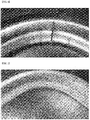
- FIG. 1 is a photograph of a corner of a sink bowl, made of a conventional austenitic stainless steel, after being processed.
- Delayed fracture which occurs after a certain period after working a steel sheet, mainly occurs in parts, which have been subjected to a large amount of processing, along processed shapes.
- austenitic stainless steel Although austenitic stainless steel generally has high workability, it exhibits delayed fracture, such as an aging crack, when a working rate thereof exceeds the limit. Such cracks occur after several minutes to several months after deep drawing of austenitic stainless steel. The cracks linearly proceed in a deep drawing direction, but, microscopically, proceed in a zigzag shape regardless of grains/grain boundaries of the austenitic stainless steel.
- the present invention provides stainless steel having excellent workability without the occurrence of defects, such as delayed fracture, when worked into a complicated shape.
- Patent Document 0001 Korean Patent Application Publication No. 10-2014-0131214
- Embodiments of the present invention provide an austenitic stainless steel pipe having excellent workability, without the occurrence of delayed fracture, when worked into a sink bowl.
- an austenitic stainless steel with increased workability including, based on % by weight, silicon (Si): 0.1 to 0.65 %, manganese (Mn): 0.2 to 3.0 %, nickel (Ni): 6.5 to 10.0 %, chromium (Cr): 16.5 to 20.0 %, copper (Cu): 6.0 % or less (excluding 0), the sum of carbon (C) and nitrogen (N): 0.08 % or less (excluding 0), and the remainder being Fe and unavoidable impurities, wherein the austenitic stainless steel has a work hardening rate of 1500 MPa or less within a true strain range of 0.15 to 0.4.
- the austenitic stainless steel may include carbon (C) and nitrogen (N) in an amount of 0.05 % or less (excluding 0).
- the austenitic stainless steel may include carbon (C) and nitrogen (N) in an amount of 0.03 % or less (excluding 0).
- the austenitic stainless steel may have an ASTM grain size number of 8 or less.
- the austenitic stainless steel may have a ferritic or martensitic phase fraction of less than 1 %.
- Embodiments of the present invention provide an austenitic stainless steel, the true strain and work hardening rate of which are controlled, to be capable of preventing the occurrence of delayed fracture in a molded corner, which has been subjected to a large amount of processing, when worked into a sink bowl, etc.
- An austenitic stainless steel with increased workability includes, based on % by weight, silicon (Si): 0.1 to 0.65 %, manganese (Mn): 0.2 to 3.0 %, nickel (Ni): 6.5 to 10.0 %, chromium (Cr): 16.5 to 20.0 %, copper (Cu): 6.0 % or less (excluding 0), the sum of carbon (C) and nitrogen (N): 0.08 % or less (excluding 0), and the remainder being Fe and unavoidable impurities and has a work hardening rate of 1500 MPa or less within a true strain range of 0.15 to 0.4 .
- An austenitic stainless steel with increased workability includes, based on % by weight, silicon (Si): 0.1 to 0.65 %, manganese (Mn): 0.2 to 3.0 %, nickel (Ni): 6.5 to 10.0 %, chromium (Cr): 16.5 to 20.0 %, copper (Cu): 6.0 % or less (excluding 0), the sum of carbon (C) and nitrogen (N): 0.08 % or less (excluding 0), and the remainder being Fe and unavoidable impurities.
- Silicon (Si) is added in an amount range of 0.1 to 0.65 % by weight.
- Si is an element essentially added for deoxidation.
- the content of Si is limited to 0.1 % or more.
- Si is a solid solution strengthening element, strength is increased to harden a material and Si combines with oxygen to form an inclusion, whereby corrosion resistance is decreased. Accordingly, an upper limit of Si is limited to 0.65 %.
- Manganese (Mn) is added in an amount range of 0.2 to 3.0 % by weight.
- Mn which is essentially added for deoxidation, increases the stability of an austenitic phase, reduces a generation amount of ferrite or martensite, and lowers a work hardening rate, is added in an amount of 0.2 % or more.
- Mn as a solid solution strengthening element, is added in too high a content, the strength of a steel may increase and the corrosion resistance of a material may be decreased. Accordingly, an upper limit of Mn is limited to 3.0 %.
- Nickel (Ni) is added in an amount range of 6.5 to 10.0 % by weight.
- Ni When Ni is added along with chromium (Cr), corrosion resistance, such as pitting corrosion resistance, may be effectively improved. In addition, when the content of Ni increases, the softening and work hardening rate of an austenite steel may be decreased. In addition, Ni, which increases the stability of an austenitic phase and reduces a ferrite or martensite generation amount in a steel pipe, is added in an amount of 6.5 % or more so as to maintain austenite balance.
- Cr chromium
- Ni is excessively high, the cost of steel increases. Accordingly, an upper limit of Ni is limited to 10.0 %.
- Chromium (Cr) is added in an amount range of 16.5 to 20.0 % by weight.
- Cr which is an essential element in increasing the corrosion resistance of stainless steel, should be added in an amount of 16.5 % or more for general purposes.
- an upper limit of Cr is limited to 20.0 %.
- Copper (Cu) is added in an amount range of 6.0 % by weight or less (excluding 0).
- an upper limit of Cu is limited to 6.0 %.
- the sum of carbon (C) and nitrogen (N) should be added in an amount of 0.08 % by weight or less (excluding 0).
- C and N which are interstitial solid solution strengthening elements, harden austenitic stainless steel.
- C and N which are interstitial solid solution strengthening elements, harden austenitic stainless steel.
- a modified organic martensite generated during processing is hardened, whereby a work hardening degree of a material increases.
- the content of C and N should be limited.
- the content of the sum of C and N is limited to 0.08 % or less.
- the content of C and N may be preferably 0.05 % or less (excluding 0), more preferably 0.03 % or less (excluding 0).
- the austenitic stainless steel has a work hardening rate of 1,500 MPa or less in a true strain range of 0.15 to 0.4.
- FIG. 2 is a photograph of a corner of a sink bowl after working an austenitic stainless steel according to an embodiment of the present invention.
- FIG. 2 illustrates that, when the stainless steel manufactured by the method proposed in the present invention is applied to a sink bowl worked into the same shape as that illustrated in FIG. 1 , delayed fracture is not exhibited also in a molded corner of the sink bowl which has been subjected to a large amount of processing.
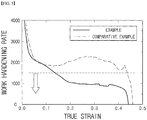
- FIG. 3 is a graph illustrating a correlation between the true strain and the work hardening rate of an austenitic stainless steel according to an embodiment of the present invention.
- FIG. 3 illustrates true strain-dependent work hardening rates of a conventional stainless steel and stainless steel of the present invention which have been subjected to a uniaxial tensile test. It can be observed that, in a true strain range of 0.15 to 0.4, the conventional stainless steel exhibits an increased work hardening rate of 1,500 MPa or more, whereas an increased work hardening rate of the stainless steel according to the present invention is maintained at 1,500 MPa or less.
- Work hardening is quantitatively expressed as a work hardening rate which is a ratio of a true stress change in stainless steel to a true strain change in the stainless steel. Referring to FIG. 3 , it can be confirmed that, in the case of the conventional stainless steel, a work hardening rate is 1,500 MPa or more in a true strain range of 0.15 to 0.4.
- a work hardening rate is controlled to 1,500 MPa or less in a true strain range of 0.15 to 0.4 in the present invention, whereby delayed fracture does not occur also after processing and, accordingly, a stainless steel having excellent workability is obtained.
- a plate was worked into a tensile specimen according to JIS13B and JIS5 standards, and then the processed tensile specimen was subjected to a uniaxial tensile test until it was broken.
- the work hardening rate was calculated using a true strain value and a true stress value obtained through this test.
- the standard for the tensile test is not specifically limited, and the standards are only provided as examples.
- a plate may be worked into a sink bowl shape or in a simple cup shape with a diameter of 50 mm and a height of 100 mm
- the stainless steel may have an ASTM grain size number of 8 or less.
- the grain size is measured at a longitudinal cross section of the stainless steel pipe.
- the stainless steel may have a ferritic phase fraction of less than 1 %, and a martensitic phase fraction of less than 1 %. That is, the stainless steel has a ferrite or martensite fraction of less than 1 %, as measured by a magnetization method.
- An austenitic stainless steel slab including ingredients of each of Inventive Examples 1 to 11 and Comparative Examples 1 and 2 as summarized in Table 1 below was manufactured through continuous casting. Subsequently, the austenitic stainless steel slab was subjected to hot rolling, and cold rolling into a total reduction ratio of 50 %, thereby manufacturing a cold-rolled steel sheet.
- Tables 1 and 2 show that delayed fracture does not occur in stainless steels manufactured according to the ingredient ranges and work hardening rates proposed in the present invention. On the other hand, it can be confirmed that, in the case of Comparative Examples 1 and 2 in which conventional stainless steels are used, a work hardening rate is not 1,500 MPa or less and delayed fracture occurs under the same conditions.
- FIG. 1 is a photograph of a corner of a sink bowl after working an austenitic stainless steel according to Comparative Example 1
- FIG. 2 is a photograph of a corner of a sink bowl after working an austenitic stainless steel according to Inventive Example 1
- FIG. 3 is a graph illustrating a correlation between the true strain and the work hardening rate of an austenitic stainless steel according to each of Comparative Example 1 and Inventive Example 1.
- the austenitic stainless steels according to the present invention do not exhibit delayed fracture, also after being processed, within the true strain and work hardening rate ranges.
- Austenitic stainless steel according to embodiments of the present invention has industrial applicability in that it is applicable to a sink bowl for kitchens, etc.
Landscapes
- Chemical & Material Sciences (AREA)
- Engineering & Computer Science (AREA)
- Mechanical Engineering (AREA)
- Materials Engineering (AREA)
- Metallurgy (AREA)
- Organic Chemistry (AREA)
- Physics & Mathematics (AREA)
- Thermal Sciences (AREA)
- Crystallography & Structural Chemistry (AREA)
- Heat Treatment Of Steel (AREA)
Abstract
Description
- The present invention relates to an austenitic stainless steel having increased workability, and more particularly to an austenitic stainless steel having increased workability without defects, such as delayed fracture, when worked into a complicated shape.
- The present invention relates to stainless steel used in a sink bowl, etc. More particularly, the present invention relates to stainless steel having excellent workability without the occurrence of delayed fracture upon working into a sink bowl.
- Stainless steel is generally used in sink bowls for kitchens. Here, specific general-purpose stainless steels are used. Such stainless steels are widely used because they do not have problems in being molded into general sink bowl shapes.
- However, to enhance market competitiveness, many attempts have recently been made to design a sink bowl in various and complicated shapes. In this case, when conventionally used stainless steels are directly applied, a molded sink bowl may exhibit delayed fracture as illustrated in
FIG. 1. FIG. 1 is a photograph of a corner of a sink bowl, made of a conventional austenitic stainless steel, after being processed. - Delayed fracture, which occurs after a certain period after working a steel sheet, mainly occurs in parts, which have been subjected to a large amount of processing, along processed shapes.
- Although austenitic stainless steel generally has high workability, it exhibits delayed fracture, such as an aging crack, when a working rate thereof exceeds the limit. Such cracks occur after several minutes to several months after deep drawing of austenitic stainless steel. The cracks linearly proceed in a deep drawing direction, but, microscopically, proceed in a zigzag shape regardless of grains/grain boundaries of the austenitic stainless steel.
- Therefore, the present invention provides stainless steel having excellent workability without the occurrence of defects, such as delayed fracture, when worked into a complicated shape.
- (Patent Document 0001) Korean Patent Application Publication No.
10-2014-0131214 - Embodiments of the present invention provide an austenitic stainless steel pipe having excellent workability, without the occurrence of delayed fracture, when worked into a sink bowl.
- In accordance with an aspect of the present invention, the above and other objects can be accomplished by the provision of an austenitic stainless steel with increased workability including, based on % by weight, silicon (Si): 0.1 to 0.65 %, manganese (Mn): 0.2 to 3.0 %, nickel (Ni): 6.5 to 10.0 %, chromium (Cr): 16.5 to 20.0 %, copper (Cu): 6.0 % or less (excluding 0), the sum of carbon (C) and nitrogen (N): 0.08 % or less (excluding 0), and the remainder being Fe and unavoidable impurities, wherein the austenitic stainless steel has a work hardening rate of 1500 MPa or less within a true strain range of 0.15 to 0.4.
- In accordance with an embodiment of the present invention, the austenitic stainless steel may include carbon (C) and nitrogen (N) in an amount of 0.05 % or less (excluding 0).
- In accordance with an embodiment of the present invention, the austenitic stainless steel may include carbon (C) and nitrogen (N) in an amount of 0.03 % or less (excluding 0).
- In accordance with an embodiment of the present invention, the austenitic stainless steel may have an ASTM grain size number of 8 or less.
- In accordance with an embodiment of the present invention, the austenitic stainless steel may have a ferritic or martensitic phase fraction of less than 1 %.
- Embodiments of the present invention provide an austenitic stainless steel, the true strain and work hardening rate of which are controlled, to be capable of preventing the occurrence of delayed fracture in a molded corner, which has been subjected to a large amount of processing, when worked into a sink bowl, etc.
-
-
FIG. 1 is a photograph of a corner of a sink bowl after working a conventional austenitic stainless steel. -
FIG. 2 is a photograph of a corner of a sink bowl after working an austenitic stainless steel according to an embodiment of the present invention. -
FIG. 3 is a graph illustrating a correlation between the true strain and the work hardening rate of an austenitic stainless steel according to an embodiment of the present invention. - An austenitic stainless steel with increased workability according to an embodiment of the present invention includes, based on % by weight, silicon (Si): 0.1 to 0.65 %, manganese (Mn): 0.2 to 3.0 %, nickel (Ni): 6.5 to 10.0 %, chromium (Cr): 16.5 to 20.0 %, copper (Cu): 6.0 % or less (excluding 0), the sum of carbon (C) and nitrogen (N): 0.08 % or less (excluding 0), and the remainder being Fe and unavoidable impurities and has a work hardening rate of 1500 MPa or less within a true strain range of 0.15 to 0.4 .
- Hereinafter, embodiments of the present invention will be described in detail with reference to the accompanying drawings. The following embodiments are provided to fully convey the spirit of the present invention to a person having ordinary skill in the art to which the present invention belongs. The present invention is not limited to the embodiments shown herein but may be embodied in other forms. For the sake of clarity of the present invention, portions, which are unrelated to the present invention, are omitted, and the sizes of components may be slightly exaggerated to help understanding of the present invention.
- An austenitic stainless steel with increased workability according to an embodiment of the present invention includes, based on % by weight, silicon (Si): 0.1 to 0.65 %, manganese (Mn): 0.2 to 3.0 %, nickel (Ni): 6.5 to 10.0 %, chromium (Cr): 16.5 to 20.0 %, copper (Cu): 6.0 % or less (excluding 0), the sum of carbon (C) and nitrogen (N): 0.08 % or less (excluding 0), and the remainder being Fe and unavoidable impurities.
- Hereinafter, reasons behind numerical limitations of ingredients constituting the austenitic stainless steel with increased workability of the present invention are described.
- Silicon (Si) is added in an amount range of 0.1 to 0.65 % by weight.
- Si is an element essentially added for deoxidation. When the content of Si is too low, the cost of a steelmaking process is high. Accordingly, the content of Si is limited to 0.1 % or more.
- However, when the content of Si is too high, since Si is a solid solution strengthening element, strength is increased to harden a material and Si combines with oxygen to form an inclusion, whereby corrosion resistance is decreased. Accordingly, an upper limit of Si is limited to 0.65 %.
- Manganese (Mn) is added in an amount range of 0.2 to 3.0 % by weight.
- Mn, which is essentially added for deoxidation, increases the stability of an austenitic phase, reduces a generation amount of ferrite or martensite, and lowers a work hardening rate, is added in an amount of 0.2 % or more.
- However, when Mn, as a solid solution strengthening element, is added in too high a content, the strength of a steel may increase and the corrosion resistance of a material may be decreased. Accordingly, an upper limit of Mn is limited to 3.0 %.
- Nickel (Ni) is added in an amount range of 6.5 to 10.0 % by weight.
- When Ni is added along with chromium (Cr), corrosion resistance, such as pitting corrosion resistance, may be effectively improved. In addition, when the content of Ni increases, the softening and work hardening rate of an austenite steel may be decreased. In addition, Ni, which increases the stability of an austenitic phase and reduces a ferrite or martensite generation amount in a steel pipe, is added in an amount of 6.5 % or more so as to maintain austenite balance.
- However, when the content of Ni is excessively high, the cost of steel increases. Accordingly, an upper limit of Ni is limited to 10.0 %.
- Chromium (Cr) is added in an amount range of 16.5 to 20.0 % by weight.
- Cr, which is an essential element in increasing the corrosion resistance of stainless steel, should be added in an amount of 16.5 % or more for general purposes.
- However, when Cr, as a solid solution strengthening element, is added in too high a content, costs increase. Accordingly, an upper limit of Cr is limited to 20.0 %.
- Copper (Cu) is added in an amount range of 6.0 % by weight or less (excluding 0).
- Since Cu lowers the softening and work hardening rate of an austenite steel and a ferrite or martensite generation amount in steel, it is preferred to add the same.
- However, when Cu is added in too high a content, hot workability may be decreased, an austenitic phase may be rather hardened, costs may increase, and manufacturing difficulties may increase. Accordingly, an upper limit of Cu is limited to 6.0 %.
- The sum of carbon (C) and nitrogen (N) should be added in an amount of 0.08 % by weight or less (excluding 0).
- C and N, which are interstitial solid solution strengthening elements, harden austenitic stainless steel. When the content of C and N is high, a modified organic martensite generated during processing is hardened, whereby a work hardening degree of a material increases.
- Accordingly, the content of C and N should be limited. In the present invention, the content of the sum of C and N is limited to 0.08 % or less. To prevent hardening of a material, the content of C and N may be preferably 0.05 % or less (excluding 0), more preferably 0.03 % or less (excluding 0).
- In addition, the austenitic stainless steel has a work hardening rate of 1,500 MPa or less in a true strain range of 0.15 to 0.4.
-
FIG. 2 is a photograph of a corner of a sink bowl after working an austenitic stainless steel according to an embodiment of the present invention.FIG. 2 illustrates that, when the stainless steel manufactured by the method proposed in the present invention is applied to a sink bowl worked into the same shape as that illustrated inFIG. 1 , delayed fracture is not exhibited also in a molded corner of the sink bowl which has been subjected to a large amount of processing. -
FIG. 3 is a graph illustrating a correlation between the true strain and the work hardening rate of an austenitic stainless steel according to an embodiment of the present invention.FIG. 3 illustrates true strain-dependent work hardening rates of a conventional stainless steel and stainless steel of the present invention which have been subjected to a uniaxial tensile test. It can be observed that, in a true strain range of 0.15 to 0.4, the conventional stainless steel exhibits an increased work hardening rate of 1,500 MPa or more, whereas an increased work hardening rate of the stainless steel according to the present invention is maintained at 1,500 MPa or less. - When stainless steel is worked, work hardening occurs. Since delayed fracture occurs when an amount of processing is large, work hardening was examined in a true strain range of 0.15 to 0.4 in the present invention.
- Work hardening is quantitatively expressed as a work hardening rate which is a ratio of a true stress change in stainless steel to a true strain change in the stainless steel. Referring to
FIG. 3 , it can be confirmed that, in the case of the conventional stainless steel, a work hardening rate is 1,500 MPa or more in a true strain range of 0.15 to 0.4. - Referring to
FIG. 3 , a work hardening rate is controlled to 1,500 MPa or less in a true strain range of 0.15 to 0.4 in the present invention, whereby delayed fracture does not occur also after processing and, accordingly, a stainless steel having excellent workability is obtained. - To calculate a work hardening rate, a plate was worked into a tensile specimen according to JIS13B and JIS5 standards, and then the processed tensile specimen was subjected to a uniaxial tensile test until it was broken. The work hardening rate was calculated using a true strain value and a true stress value obtained through this test. The standard for the tensile test is not specifically limited, and the standards are only provided as examples. To test delayed fracture, a plate may be worked into a sink bowl shape or in a simple cup shape with a diameter of 50 mm and a height of 100 mm
- For example, the stainless steel may have an ASTM grain size number of 8 or less. The grain size is measured at a longitudinal cross section of the stainless steel pipe.
- For example, the stainless steel may have a ferritic phase fraction of less than 1 %, and a martensitic phase fraction of less than 1 %. That is, the stainless steel has a ferrite or martensite fraction of less than 1 %, as measured by a magnetization method.
- Hereinafter, the present invention will be described in detail by describing exemplary embodiments of the invention.
- An austenitic stainless steel slab including ingredients of each of Inventive Examples 1 to 11 and Comparative Examples 1 and 2 as summarized in Table 1 below was manufactured through continuous casting. Subsequently, the austenitic stainless steel slab was subjected to hot rolling, and cold rolling into a total reduction ratio of 50 %, thereby manufacturing a cold-rolled steel sheet.
[Table 1] Ingredients (% by weight) C Si Mn Ni Cr Cu N Inventive Example 1 0.012 0.3 0.7 7.8 16.9 3.01 0.008 Inventive Example 2 0.010 0.3 1.2 9.6 16.8 0.00 0.010 Inventive Example 3 0.010 0.3 1.2 8.7 16.9 3.00 0.010 Inventive Example 4 0.010 0.3 1.2 9.6 16.9 2.98 0.010 Inventive Example 5 0.009 0.6 1.2 7.5 17.0 2.98 0.010 Inventive Example 6 0.010 0.3 1.8 7.6 16.8 3.00 0.010 Inventive Example 7 0.010 0.3 1.1 7.6 17.2 3.03 0.010 Inventive Example 8 0.010 0.3 2.2 7.6 16.9 3.00 0.010 Inventive Example 9 0.012 0.3 0.7 7.8 16.9 3.01 0.008 Inventive Example 10 0.010 0.3 1.2 9.6 16.8 0.00 0.010 Inventive Example 11 0.010 0.6 1.2 7.6 16.9 5.00 0.010 Comparative Example 1 0.040 0.6 1.2 8.1 18.1 0.00 0.040 Comparative Example 2 0.030 0.6 1.2 7.6 16.9 5.00 0.030 - Subsequently, the cold-rolled steel sheet was worked into a sink bowl, and a work hardening rate of the steel sheet was measured. After working the steel sheet into a sink bowl, the occurrence of delayed fracture was observed with the naked eye. Results are summarized in Table 2 below.
[Table 2] Work hardening rate (MPa) Delayed fracture Inventive Example 1 1033 X Inventive Example 2 1020 X Inventive Example 3 1029 X Inventive Example 4 1433 X Inventive Example 5 1604 X Inventive Example 6 961 X Inventive Example 7 1193 X Inventive Example 8 1204 X Inventive Example 9 1036 X Inventive Example 10 1013 X Inventive Example 11 992 X Comparative Example 1 2106 ○ Comparative Example 2 1601 ○ - Tables 1 and 2 show that delayed fracture does not occur in stainless steels manufactured according to the ingredient ranges and work hardening rates proposed in the present invention. On the other hand, it can be confirmed that, in the case of Comparative Examples 1 and 2 in which conventional stainless steels are used, a work hardening rate is not 1,500 MPa or less and delayed fracture occurs under the same conditions.
-
FIG. 1 is a photograph of a corner of a sink bowl after working an austenitic stainless steel according to Comparative Example 1,FIG. 2 is a photograph of a corner of a sink bowl after working an austenitic stainless steel according to Inventive Example 1, andFIG. 3 is a graph illustrating a correlation between the true strain and the work hardening rate of an austenitic stainless steel according to each of Comparative Example 1 and Inventive Example 1. - Referring to
FIGS. 1 to 3 and Table 2, it can be confirmed that the austenitic stainless steels according to the present invention do not exhibit delayed fracture, also after being processed, within the true strain and work hardening rate ranges. - While the present invention has been described with reference to exemplary embodiments, it is to be understood that the invention is not limited thereto. Those skilled in the art will understand that various changes and modifications may be made within the spirit and scope of the appended claims.
- Austenitic stainless steel according to embodiments of the present invention has industrial applicability in that it is applicable to a sink bowl for kitchens, etc.
Claims (5)
- An austenitic stainless steel with increased workability, comprising, based on % by weight, silicon (Si): 0.1 to 0.65 %, manganese (Mn): 0.2 to 3.0 %, nickel (Ni): 6.5 to 10.0 %, chromium (Cr): 16.5 to 20.0 %, copper (Cu): 6.0 % or less (excluding 0), the sum of carbon (C) and nitrogen (N): 0.08 % or less (excluding 0), and the remainder being Fe and unavoidable impurities, wherein the austenitic stainless steel has a work hardening rate of 1500 MPa or less within a true strain range of 0.15 to 0.4.
- The austenitic stainless steel according to claim 1, comprising carbon (C) and nitrogen (N) in an amount of 0.05 % or less (excluding 0).
- The austenitic stainless steel according to claim 2, comprising carbon (C) and nitrogen (N) in an amount of 0.03 % or less (excluding 0).
- The austenitic stainless steel according to claim 1, wherein the austenitic stainless steel has an ASTM grain size number of 8 or less.
- The austenitic stainless steel according to claim 1, wherein the austenitic stainless steel has a ferritic or martensitic phase fraction of less than 1 %.
Applications Claiming Priority (2)
| Application Number | Priority Date | Filing Date | Title |
|---|---|---|---|
| KR1020150184668A KR101756701B1 (en) | 2015-12-23 | 2015-12-23 | Austenitic stainless steel with increased workability |
| PCT/KR2016/015024 WO2017111467A1 (en) | 2015-12-23 | 2016-12-21 | Austenitic stainless steel having improved processability |
Publications (3)
| Publication Number | Publication Date |
|---|---|
| EP3396001A1 true EP3396001A1 (en) | 2018-10-31 |
| EP3396001A4 EP3396001A4 (en) | 2019-01-23 |
| EP3396001B1 EP3396001B1 (en) | 2021-09-22 |
Family
ID=59090781
Family Applications (1)
| Application Number | Title | Priority Date | Filing Date |
|---|---|---|---|
| EP16879334.7A Active EP3396001B1 (en) | 2015-12-23 | 2016-12-21 | Austenitic stainless steel having improved processability |
Country Status (7)
| Country | Link |
|---|---|
| US (1) | US20190010588A1 (en) |
| EP (1) | EP3396001B1 (en) |
| JP (1) | JP6796134B2 (en) |
| KR (1) | KR101756701B1 (en) |
| CN (1) | CN108291289B (en) |
| MY (1) | MY189629A (en) |
| WO (1) | WO2017111467A1 (en) |
Families Citing this family (4)
| Publication number | Priority date | Publication date | Assignee | Title |
|---|---|---|---|---|
| KR102268906B1 (en) * | 2019-07-17 | 2021-06-25 | 주식회사 포스코 | Austenitic stainless steel with imporoved strength and method for manufacturing the same |
| JP7576935B2 (en) * | 2020-07-06 | 2024-11-01 | 日鉄ステンレス株式会社 | Manufacturing method of non-magnetic stainless steel sheet and steel material for machine parts |
| KR20220169655A (en) * | 2021-06-21 | 2022-12-28 | 주식회사 포스코 | Austenitic stainless steel and manufacturing nmethod thereof |
| CN118460926B (en) * | 2024-05-21 | 2025-11-21 | 山西太钢不锈钢股份有限公司 | Easy-to-process high-hardening austenitic stainless steel and manufacturing method thereof |
Family Cites Families (14)
| Publication number | Priority date | Publication date | Assignee | Title |
|---|---|---|---|---|
| JP3839108B2 (en) * | 1996-10-14 | 2006-11-01 | 日新製鋼株式会社 | Austenitic stainless steel with excellent workability after punching |
| DE60141866D1 (en) * | 2000-08-01 | 2010-05-27 | Nisshin Steel Co Ltd | Stainless steel fuel filler neck |
| ES2250443T3 (en) * | 2000-08-01 | 2006-04-16 | Nisshin Steel Co., Ltd. | STAINLESS STEEL FUEL TANK FOR CAR. |
| JP2002097555A (en) * | 2000-09-25 | 2002-04-02 | Nisshin Steel Co Ltd | Forming made of stainless steel |
| JP2003221660A (en) * | 2002-01-31 | 2003-08-08 | Nisshin Steel Co Ltd | Fuel tank for vehicle made from hot-dip aluminized stainless steel sheet |
| JP2004238700A (en) * | 2003-02-07 | 2004-08-26 | Nisshin Steel Co Ltd | Austenitic stainless steel sheet suitable for press molded product with high surface smoothness |
| JP2008169423A (en) * | 2007-01-10 | 2008-07-24 | Nisshin Steel Co Ltd | Austenitic stainless steel sheet for bending |
| JP5355905B2 (en) * | 2007-04-10 | 2013-11-27 | 新日鐵住金ステンレス株式会社 | Structural member for automobile, two-wheeled vehicle or railway vehicle having excellent shock absorption characteristics, shape freezing property and flange section cutting ability, and method for producing the same |
| JP5388589B2 (en) * | 2008-01-22 | 2014-01-15 | 新日鐵住金ステンレス株式会社 | Ferritic / austenitic stainless steel sheet for structural members with excellent workability and shock absorption characteristics and method for producing the same |
| WO2012004464A1 (en) * | 2010-07-07 | 2012-01-12 | Arcelormittal Investigación Y Desarrollo Sl | Austenitic-ferritic stainless steel having improved machinability |
| JP6016331B2 (en) * | 2011-03-29 | 2016-10-26 | 新日鐵住金ステンレス株式会社 | Austenitic stainless steel with excellent corrosion resistance and brazing |
| KR20140131214A (en) * | 2013-05-03 | 2014-11-12 | 주식회사 포스코 | Austenitic stainless steel with high age cracking resistance |
| JP5896089B1 (en) * | 2014-04-17 | 2016-03-30 | 新日鐵住金株式会社 | Austenitic stainless steel and manufacturing method thereof |
| KR101659186B1 (en) * | 2014-12-26 | 2016-09-23 | 주식회사 포스코 | Austenitic stainless steels with increased flexibility |
-
2015
- 2015-12-23 KR KR1020150184668A patent/KR101756701B1/en active Active
-
2016
- 2016-12-21 MY MYPI2018000974A patent/MY189629A/en unknown
- 2016-12-21 WO PCT/KR2016/015024 patent/WO2017111467A1/en not_active Ceased
- 2016-12-21 US US16/065,710 patent/US20190010588A1/en not_active Abandoned
- 2016-12-21 EP EP16879334.7A patent/EP3396001B1/en active Active
- 2016-12-21 JP JP2018529145A patent/JP6796134B2/en active Active
- 2016-12-21 CN CN201680070348.5A patent/CN108291289B/en active Active
Also Published As
| Publication number | Publication date |
|---|---|
| JP2019501289A (en) | 2019-01-17 |
| KR101756701B1 (en) | 2017-07-12 |
| EP3396001A4 (en) | 2019-01-23 |
| MY189629A (en) | 2022-02-22 |
| JP6796134B2 (en) | 2020-12-02 |
| WO2017111467A1 (en) | 2017-06-29 |
| CN108291289A (en) | 2018-07-17 |
| KR20170075840A (en) | 2017-07-04 |
| EP3396001B1 (en) | 2021-09-22 |
| CN108291289B (en) | 2020-10-02 |
| US20190010588A1 (en) | 2019-01-10 |
Similar Documents
| Publication | Publication Date | Title |
|---|---|---|
| KR101177540B1 (en) | AUSTENITIC HIGH Mn STAINLESS STEEL EXCELLENT IN WORKABILITY | |
| EP3239341A1 (en) | Austenitic stainless steel having excellent flexibility | |
| EP1956108A1 (en) | High-strength steel excellent in delayed fracture resistance characteristics and metal bolts | |
| EP3280826B1 (en) | A method of producing a tube of a duplex stainless steel | |
| EP2508639A1 (en) | Fine grained austenitic stainless steel sheet exhibiting excellent stress corrosion cracking resistance and processability | |
| EP3396000A1 (en) | Austenitic stainless steel pipe exhibiting excellent wrinkle resistance | |
| JP5347600B2 (en) | Austenitic stainless steel and method for producing austenitic stainless steel sheet | |
| EP3396001B1 (en) | Austenitic stainless steel having improved processability | |
| EP1746176B1 (en) | Shaped steel article with excellent delayed fracture resistance and tensile strength of 1600 MPa class or more and methods of production of the same | |
| KR102096190B1 (en) | Moldable lightweight steel with improved mechanical properties and method for manufacturing semi-finished products from the steel | |
| JPWO2017002147A1 (en) | Ferritic stainless steel sheet and manufacturing method thereof | |
| JP7256792B2 (en) | Austenitic stainless steel drawing products with excellent workability and resistance to age cracking | |
| CN104685086B (en) | Ferrite series stainless steel plate | |
| EP3559295B1 (en) | An object comprising a duplex stainless steel and the use thereof | |
| CN105917016A (en) | Ferritic stainless steel and method for producing same | |
| JP5291479B2 (en) | Duplex stainless steel and steel and steel products using the same | |
| EP4177368A1 (en) | Austenitic stainless steel with improved deep drawability | |
| EP3397406B1 (en) | A process of producing a duplex stainless steel tube | |
| KR20170075034A (en) | Lean duplex stainless steel and method of manufacturing the same | |
| KR20100069875A (en) | Austenitic stainless steel having excellent hot workability with high manganese | |
| US20200123629A1 (en) | Method of producing tube of duplex stainless steel | |
| JP2007314837A (en) | Age-hardening ferritic stainless steel sheet and age-treated steel using the same | |
| EP3851552A1 (en) | High-strength ferritic stainless steel for clamp and method for manufacturing same | |
| KR101820526B1 (en) | Lean duplex stainless steel having excellent bending workability | |
| EP2980242B1 (en) | Case hardening steel |
Legal Events
| Date | Code | Title | Description |
|---|---|---|---|
| STAA | Information on the status of an ep patent application or granted ep patent |
Free format text: STATUS: THE INTERNATIONAL PUBLICATION HAS BEEN MADE |
|
| PUAI | Public reference made under article 153(3) epc to a published international application that has entered the european phase |
Free format text: ORIGINAL CODE: 0009012 |
|
| STAA | Information on the status of an ep patent application or granted ep patent |
Free format text: STATUS: REQUEST FOR EXAMINATION WAS MADE |
|
| 17P | Request for examination filed |
Effective date: 20180525 |
|
| AK | Designated contracting states |
Kind code of ref document: A1 Designated state(s): AL AT BE BG CH CY CZ DE DK EE ES FI FR GB GR HR HU IE IS IT LI LT LU LV MC MK MT NL NO PL PT RO RS SE SI SK SM TR |
|
| AX | Request for extension of the european patent |
Extension state: BA ME |
|
| A4 | Supplementary search report drawn up and despatched |
Effective date: 20190102 |
|
| RIC1 | Information provided on ipc code assigned before grant |
Ipc: C22C 38/58 20060101AFI20181218BHEP Ipc: C21D 8/02 20060101ALI20181218BHEP Ipc: C22C 38/00 20060101ALI20181218BHEP Ipc: C22C 38/04 20060101ALI20181218BHEP Ipc: C22C 38/02 20060101ALI20181218BHEP Ipc: C21D 6/00 20060101ALI20181218BHEP Ipc: C22C 38/42 20060101ALI20181218BHEP |
|
| DAV | Request for validation of the european patent (deleted) | ||
| DAX | Request for extension of the european patent (deleted) | ||
| RIN1 | Information on inventor provided before grant (corrected) |
Inventor name: JO, GYU JIN Inventor name: CHAE, DONG CHUL Inventor name: YU, JEE HYUN Inventor name: CHOI, JEOM YONG Inventor name: KANG, HYUNG GU |
|
| GRAP | Despatch of communication of intention to grant a patent |
Free format text: ORIGINAL CODE: EPIDOSNIGR1 |
|
| STAA | Information on the status of an ep patent application or granted ep patent |
Free format text: STATUS: GRANT OF PATENT IS INTENDED |
|
| RIC1 | Information provided on ipc code assigned before grant |
Ipc: C22C 38/04 20060101ALI20210325BHEP Ipc: C22C 38/02 20060101ALI20210325BHEP Ipc: C21D 8/02 20060101ALI20210325BHEP Ipc: C21D 6/00 20060101ALI20210325BHEP Ipc: C22C 38/00 20060101ALI20210325BHEP Ipc: C22C 38/42 20060101ALI20210325BHEP Ipc: C22C 38/58 20060101AFI20210325BHEP |
|
| INTG | Intention to grant announced |
Effective date: 20210416 |
|
| GRAS | Grant fee paid |
Free format text: ORIGINAL CODE: EPIDOSNIGR3 |
|
| GRAA | (expected) grant |
Free format text: ORIGINAL CODE: 0009210 |
|
| STAA | Information on the status of an ep patent application or granted ep patent |
Free format text: STATUS: THE PATENT HAS BEEN GRANTED |
|
| AK | Designated contracting states |
Kind code of ref document: B1 Designated state(s): AL AT BE BG CH CY CZ DE DK EE ES FI FR GB GR HR HU IE IS IT LI LT LU LV MC MK MT NL NO PL PT RO RS SE SI SK SM TR |
|
| REG | Reference to a national code |
Ref country code: GB Ref legal event code: FG4D |
|
| REG | Reference to a national code |
Ref country code: IE Ref legal event code: FG4D |
|
| REG | Reference to a national code |
Ref country code: DE Ref legal event code: R096 Ref document number: 602016064157 Country of ref document: DE |
|
| REG | Reference to a national code |
Ref country code: CH Ref legal event code: EP Ref country code: AT Ref legal event code: REF Ref document number: 1432391 Country of ref document: AT Kind code of ref document: T Effective date: 20211015 |
|
| REG | Reference to a national code |
Ref country code: LT Ref legal event code: MG9D |
|
| REG | Reference to a national code |
Ref country code: NL Ref legal event code: MP Effective date: 20210922 |
|
| PG25 | Lapsed in a contracting state [announced via postgrant information from national office to epo] |
Ref country code: BG Free format text: LAPSE BECAUSE OF FAILURE TO SUBMIT A TRANSLATION OF THE DESCRIPTION OR TO PAY THE FEE WITHIN THE PRESCRIBED TIME-LIMIT Effective date: 20211222 Ref country code: LT Free format text: LAPSE BECAUSE OF FAILURE TO SUBMIT A TRANSLATION OF THE DESCRIPTION OR TO PAY THE FEE WITHIN THE PRESCRIBED TIME-LIMIT Effective date: 20210922 Ref country code: FI Free format text: LAPSE BECAUSE OF FAILURE TO SUBMIT A TRANSLATION OF THE DESCRIPTION OR TO PAY THE FEE WITHIN THE PRESCRIBED TIME-LIMIT Effective date: 20210922 Ref country code: HR Free format text: LAPSE BECAUSE OF FAILURE TO SUBMIT A TRANSLATION OF THE DESCRIPTION OR TO PAY THE FEE WITHIN THE PRESCRIBED TIME-LIMIT Effective date: 20210922 Ref country code: NO Free format text: LAPSE BECAUSE OF FAILURE TO SUBMIT A TRANSLATION OF THE DESCRIPTION OR TO PAY THE FEE WITHIN THE PRESCRIBED TIME-LIMIT Effective date: 20211222 Ref country code: SE Free format text: LAPSE BECAUSE OF FAILURE TO SUBMIT A TRANSLATION OF THE DESCRIPTION OR TO PAY THE FEE WITHIN THE PRESCRIBED TIME-LIMIT Effective date: 20210922 Ref country code: RS Free format text: LAPSE BECAUSE OF FAILURE TO SUBMIT A TRANSLATION OF THE DESCRIPTION OR TO PAY THE FEE WITHIN THE PRESCRIBED TIME-LIMIT Effective date: 20210922 |
|
| REG | Reference to a national code |
Ref country code: AT Ref legal event code: MK05 Ref document number: 1432391 Country of ref document: AT Kind code of ref document: T Effective date: 20210922 |
|
| PG25 | Lapsed in a contracting state [announced via postgrant information from national office to epo] |
Ref country code: LV Free format text: LAPSE BECAUSE OF FAILURE TO SUBMIT A TRANSLATION OF THE DESCRIPTION OR TO PAY THE FEE WITHIN THE PRESCRIBED TIME-LIMIT Effective date: 20210922 Ref country code: GR Free format text: LAPSE BECAUSE OF FAILURE TO SUBMIT A TRANSLATION OF THE DESCRIPTION OR TO PAY THE FEE WITHIN THE PRESCRIBED TIME-LIMIT Effective date: 20211223 |
|
| PG25 | Lapsed in a contracting state [announced via postgrant information from national office to epo] |
Ref country code: AT Free format text: LAPSE BECAUSE OF FAILURE TO SUBMIT A TRANSLATION OF THE DESCRIPTION OR TO PAY THE FEE WITHIN THE PRESCRIBED TIME-LIMIT Effective date: 20210922 |
|
| PG25 | Lapsed in a contracting state [announced via postgrant information from national office to epo] |
Ref country code: IS Free format text: LAPSE BECAUSE OF FAILURE TO SUBMIT A TRANSLATION OF THE DESCRIPTION OR TO PAY THE FEE WITHIN THE PRESCRIBED TIME-LIMIT Effective date: 20220122 Ref country code: SK Free format text: LAPSE BECAUSE OF FAILURE TO SUBMIT A TRANSLATION OF THE DESCRIPTION OR TO PAY THE FEE WITHIN THE PRESCRIBED TIME-LIMIT Effective date: 20210922 Ref country code: RO Free format text: LAPSE BECAUSE OF FAILURE TO SUBMIT A TRANSLATION OF THE DESCRIPTION OR TO PAY THE FEE WITHIN THE PRESCRIBED TIME-LIMIT Effective date: 20210922 Ref country code: PT Free format text: LAPSE BECAUSE OF FAILURE TO SUBMIT A TRANSLATION OF THE DESCRIPTION OR TO PAY THE FEE WITHIN THE PRESCRIBED TIME-LIMIT Effective date: 20220124 Ref country code: PL Free format text: LAPSE BECAUSE OF FAILURE TO SUBMIT A TRANSLATION OF THE DESCRIPTION OR TO PAY THE FEE WITHIN THE PRESCRIBED TIME-LIMIT Effective date: 20210922 Ref country code: NL Free format text: LAPSE BECAUSE OF FAILURE TO SUBMIT A TRANSLATION OF THE DESCRIPTION OR TO PAY THE FEE WITHIN THE PRESCRIBED TIME-LIMIT Effective date: 20210922 Ref country code: ES Free format text: LAPSE BECAUSE OF FAILURE TO SUBMIT A TRANSLATION OF THE DESCRIPTION OR TO PAY THE FEE WITHIN THE PRESCRIBED TIME-LIMIT Effective date: 20210922 Ref country code: EE Free format text: LAPSE BECAUSE OF FAILURE TO SUBMIT A TRANSLATION OF THE DESCRIPTION OR TO PAY THE FEE WITHIN THE PRESCRIBED TIME-LIMIT Effective date: 20210922 Ref country code: CZ Free format text: LAPSE BECAUSE OF FAILURE TO SUBMIT A TRANSLATION OF THE DESCRIPTION OR TO PAY THE FEE WITHIN THE PRESCRIBED TIME-LIMIT Effective date: 20210922 Ref country code: AL Free format text: LAPSE BECAUSE OF FAILURE TO SUBMIT A TRANSLATION OF THE DESCRIPTION OR TO PAY THE FEE WITHIN THE PRESCRIBED TIME-LIMIT Effective date: 20210922 |
|
| REG | Reference to a national code |
Ref country code: DE Ref legal event code: R097 Ref document number: 602016064157 Country of ref document: DE |
|
| PG25 | Lapsed in a contracting state [announced via postgrant information from national office to epo] |
Ref country code: MC Free format text: LAPSE BECAUSE OF FAILURE TO SUBMIT A TRANSLATION OF THE DESCRIPTION OR TO PAY THE FEE WITHIN THE PRESCRIBED TIME-LIMIT Effective date: 20210922 Ref country code: DK Free format text: LAPSE BECAUSE OF FAILURE TO SUBMIT A TRANSLATION OF THE DESCRIPTION OR TO PAY THE FEE WITHIN THE PRESCRIBED TIME-LIMIT Effective date: 20210922 |
|
| PLBE | No opposition filed within time limit |
Free format text: ORIGINAL CODE: 0009261 |
|
| REG | Reference to a national code |
Ref country code: CH Ref legal event code: PL |
|
| STAA | Information on the status of an ep patent application or granted ep patent |
Free format text: STATUS: NO OPPOSITION FILED WITHIN TIME LIMIT |
|
| 26N | No opposition filed |
Effective date: 20220623 |
|
| REG | Reference to a national code |
Ref country code: DE Ref legal event code: R081 Ref document number: 602016064157 Country of ref document: DE Owner name: POSCO CO., LTD, POHANG-SI, KR Free format text: FORMER OWNER: POSCO, POHANG-SI, GYEONGSANGBUK-DO, KR Ref country code: DE Ref legal event code: R081 Ref document number: 602016064157 Country of ref document: DE Owner name: POSCO CO., LTD, POHANG- SI, KR Free format text: FORMER OWNER: POSCO, POHANG-SI, GYEONGSANGBUK-DO, KR Ref country code: DE Ref legal event code: R081 Ref document number: 602016064157 Country of ref document: DE Owner name: POSCO HOLDINGS INC., KR Free format text: FORMER OWNER: POSCO, POHANG-SI, GYEONGSANGBUK-DO, KR |
|
| REG | Reference to a national code |
Ref country code: BE Ref legal event code: MM Effective date: 20211231 |
|
| PG25 | Lapsed in a contracting state [announced via postgrant information from national office to epo] |
Ref country code: LU Free format text: LAPSE BECAUSE OF NON-PAYMENT OF DUE FEES Effective date: 20211221 Ref country code: IE Free format text: LAPSE BECAUSE OF NON-PAYMENT OF DUE FEES Effective date: 20211221 |
|
| REG | Reference to a national code |
Ref country code: GB Ref legal event code: 732E Free format text: REGISTERED BETWEEN 20221027 AND 20221102 |
|
| PG25 | Lapsed in a contracting state [announced via postgrant information from national office to epo] |
Ref country code: SI Free format text: LAPSE BECAUSE OF FAILURE TO SUBMIT A TRANSLATION OF THE DESCRIPTION OR TO PAY THE FEE WITHIN THE PRESCRIBED TIME-LIMIT Effective date: 20210922 Ref country code: BE Free format text: LAPSE BECAUSE OF NON-PAYMENT OF DUE FEES Effective date: 20211231 |
|
| PG25 | Lapsed in a contracting state [announced via postgrant information from national office to epo] |
Ref country code: LI Free format text: LAPSE BECAUSE OF NON-PAYMENT OF DUE FEES Effective date: 20211231 Ref country code: CH Free format text: LAPSE BECAUSE OF NON-PAYMENT OF DUE FEES Effective date: 20211231 |
|
| PG25 | Lapsed in a contracting state [announced via postgrant information from national office to epo] |
Ref country code: IT Free format text: LAPSE BECAUSE OF FAILURE TO SUBMIT A TRANSLATION OF THE DESCRIPTION OR TO PAY THE FEE WITHIN THE PRESCRIBED TIME-LIMIT Effective date: 20210922 |
|
| REG | Reference to a national code |
Ref country code: DE Ref legal event code: R081 Ref document number: 602016064157 Country of ref document: DE Owner name: POSCO CO., LTD, POHANG-SI, KR Free format text: FORMER OWNER: POSCO HOLDINGS INC., SEOUL, KR Ref country code: DE Ref legal event code: R081 Ref document number: 602016064157 Country of ref document: DE Owner name: POSCO CO., LTD, POHANG- SI, KR Free format text: FORMER OWNER: POSCO HOLDINGS INC., SEOUL, KR |
|
| PG25 | Lapsed in a contracting state [announced via postgrant information from national office to epo] |
Ref country code: CY Free format text: LAPSE BECAUSE OF FAILURE TO SUBMIT A TRANSLATION OF THE DESCRIPTION OR TO PAY THE FEE WITHIN THE PRESCRIBED TIME-LIMIT Effective date: 20210922 |
|
| PG25 | Lapsed in a contracting state [announced via postgrant information from national office to epo] |
Ref country code: SM Free format text: LAPSE BECAUSE OF FAILURE TO SUBMIT A TRANSLATION OF THE DESCRIPTION OR TO PAY THE FEE WITHIN THE PRESCRIBED TIME-LIMIT Effective date: 20210922 Ref country code: HU Free format text: LAPSE BECAUSE OF FAILURE TO SUBMIT A TRANSLATION OF THE DESCRIPTION OR TO PAY THE FEE WITHIN THE PRESCRIBED TIME-LIMIT; INVALID AB INITIO Effective date: 20161221 |
|
| PG25 | Lapsed in a contracting state [announced via postgrant information from national office to epo] |
Ref country code: MK Free format text: LAPSE BECAUSE OF FAILURE TO SUBMIT A TRANSLATION OF THE DESCRIPTION OR TO PAY THE FEE WITHIN THE PRESCRIBED TIME-LIMIT Effective date: 20210922 |
|
| PG25 | Lapsed in a contracting state [announced via postgrant information from national office to epo] |
Ref country code: MT Free format text: LAPSE BECAUSE OF FAILURE TO SUBMIT A TRANSLATION OF THE DESCRIPTION OR TO PAY THE FEE WITHIN THE PRESCRIBED TIME-LIMIT Effective date: 20210922 |
|
| PG25 | Lapsed in a contracting state [announced via postgrant information from national office to epo] |
Ref country code: TR Free format text: LAPSE BECAUSE OF FAILURE TO SUBMIT A TRANSLATION OF THE DESCRIPTION OR TO PAY THE FEE WITHIN THE PRESCRIBED TIME-LIMIT Effective date: 20210922 |
|
| PGFP | Annual fee paid to national office [announced via postgrant information from national office to epo] |
Ref country code: DE Payment date: 20251105 Year of fee payment: 10 |
|
| PGFP | Annual fee paid to national office [announced via postgrant information from national office to epo] |
Ref country code: GB Payment date: 20251105 Year of fee payment: 10 |
|
| PGFP | Annual fee paid to national office [announced via postgrant information from national office to epo] |
Ref country code: FR Payment date: 20251111 Year of fee payment: 10 |