EP3395344A1 - Medicine - Google Patents
Medicine Download PDFInfo
- Publication number
- EP3395344A1 EP3395344A1 EP16878768.7A EP16878768A EP3395344A1 EP 3395344 A1 EP3395344 A1 EP 3395344A1 EP 16878768 A EP16878768 A EP 16878768A EP 3395344 A1 EP3395344 A1 EP 3395344A1
- Authority
- EP
- European Patent Office
- Prior art keywords
- heart failure
- compound
- medicament
- present
- salts
- Prior art date
- Legal status (The legal status is an assumption and is not a legal conclusion. Google has not performed a legal analysis and makes no representation as to the accuracy of the status listed.)
- Granted
Links
Images
Classifications
-
- A—HUMAN NECESSITIES
- A61—MEDICAL OR VETERINARY SCIENCE; HYGIENE
- A61K—PREPARATIONS FOR MEDICAL, DENTAL OR TOILETRY PURPOSES
- A61K31/00—Medicinal preparations containing organic active ingredients
- A61K31/33—Heterocyclic compounds
- A61K31/395—Heterocyclic compounds having nitrogen as a ring hetero atom, e.g. guanethidine or rifamycins
- A61K31/495—Heterocyclic compounds having nitrogen as a ring hetero atom, e.g. guanethidine or rifamycins having six-membered rings with two or more nitrogen atoms as the only ring heteroatoms, e.g. piperazine or tetrazines
- A61K31/505—Pyrimidines; Hydrogenated pyrimidines, e.g. trimethoprim
- A61K31/519—Pyrimidines; Hydrogenated pyrimidines, e.g. trimethoprim ortho- or peri-condensed with heterocyclic rings
-
- A—HUMAN NECESSITIES
- A61—MEDICAL OR VETERINARY SCIENCE; HYGIENE
- A61K—PREPARATIONS FOR MEDICAL, DENTAL OR TOILETRY PURPOSES
- A61K45/00—Medicinal preparations containing active ingredients not provided for in groups A61K31/00 - A61K41/00
- A61K45/06—Mixtures of active ingredients without chemical characterisation, e.g. antiphlogistics and cardiaca
-
- A—HUMAN NECESSITIES
- A61—MEDICAL OR VETERINARY SCIENCE; HYGIENE
- A61P—SPECIFIC THERAPEUTIC ACTIVITY OF CHEMICAL COMPOUNDS OR MEDICINAL PREPARATIONS
- A61P9/00—Drugs for disorders of the cardiovascular system
- A61P9/04—Inotropic agents, i.e. stimulants of cardiac contraction; Drugs for heart failure
Definitions
- the present invention relates to a medicament for preventing or treating heart failure.
- Heart failure is a disease characterized by a disease state where cardiac output decreases due to dysfunction of cardiomyocytes and a disease state caused by physical burden brought by a mechanism of maintaining cardiac output. Cardiomyocytes play a role in contraction and relaxation. For the contraction and relaxation, Ca 2+ ions are required.
- Contraction of cardiomyocytes proceeds through stages of : an action potential propagating to the transverse tubules to depolarize the transverse tubule membrane; allowing Ca 2+ ions to flow into cells from a potential-dependent Type L Ca 2+ channel of the transverse tubules; the inflow Ca 2+ ions binding to a Ca 2+ release channel (ryanodine receptor or RYR) of the sarcoplasmic reticulum to release Ca 2+ ions from the sarcoplasmic reticulum to the cytoplasm; and the released Ca 2+ ions within the cell binding to troponin C to induce contraction of the cardiomyocytes.
- RYR ryanodine receptor
- relaxation of cardiomyocytes proceeds by taking Ca 2+ ions into the sarcoplasmic reticulum via a Ca 2+ release pump (SERCA) to reduce the cytoplasmic level of Ca 2+ ions and dissociate the Ca 2+ ions from the troponin C. Accordingly, if something goes wrong in any one of the stages and Ca 2+ ions are not released into the cytoplasm, cardiomyocytes fail to work, with the result that heart failure occurs.
- SERCA Ca 2+ release pump
- a therapeutic drug for heart failure e.g., a cardiotonic drug such as ⁇ blocker, anti-aldosterone drug, a diuretic drug and digitalis
- an angiotensin converting enzyme inhibitor and angiotensin II antagonist are used in clinical sites for improvement of short-term symptoms and hemodynamic stabilization.
- these drugs are insufficient to improve the re-hospitalization rate and long-term life prognosis.
- Ca 2+ ions (hereinafter also referred to simply as calcium) play an essential role in maintaining/regulating functions of various cells including not only nerve and muscle but also endocrine cells and exocrine cells. Therefore, the blood calcium level is precisely controlled to fall within a narrow range.
- Parathyroid hormone (PTH) plays a central role in maintaining the blood calcium level. Thus, secretion of PTH from the parathyroid gland must be controlled sensitively in response to a change in blood calcium level.
- blood PTH level rapidly changes in accordance therewith. Brown et al., pointed out the possibility of the existence of the mechanism where the extracellular calcium concentration is sensed by parathyroid cells and the information thereof is transmitted to the cells.
- CaSR calcium-sensing receptor
- the calcium receptor has the N terminal of 600 amino acids in full length and is constituted of a large-terminal extracellular region having 7 transmembrane regions similarly to other G protein-coupled receptors and an intracellular region having the C terminal consisting of 200 or less amino acids.
- phospholipase (PL)-C is activated and then the level of inositol triphosphate (IP 3 ) increases, with the result that the intracellular calcium concentration increases. In this mechanism, PTH secretion is presumably suppressed. If the extracellular calcium concentration is maintained at a high level, the intracellular calcium concentration subsequently and continuously increases. Conceivably, calcium flow-in from outside the cell is also promoted. If the extracellular calcium concentration increases, PL-A 2 and D are activated. These are probably activated via, e.g., protein kinase (PK)-C, which is simultaneously activated via a calcium receptor. The calcium receptor suppresses adenylyl cyclase via Gi protein or arachidonic acid production through PL-A 2 activation to reduce intracellular cyclic AMP level ( Bone, 20, 303-309 (1997 )).
- PK protein kinase
- Non patent literatures 2 and 3 it is described that cardiac function is improved by treatment with parathyroid hormone; whereas, in Non patent literature 4, it is described that cardiac function is exacerbated by treatment with parathyroid hormone.
- the relationship between a parathyroid hormone therapy and improvement of cardiac function has not yet been sufficiently revealed.
- Non patent literature 5 it is described that cardiac hypertrophy is improved by a CaSR inhibitor, i.e., Calhex231, in a transverse aortic constriction (TAC) model; however, it is not elucidated that the drug is effective or not after cardiac function deteriorates.
- Non patent literature 6 discloses that, if Calhex231 is administered, more specifically, if the drug is administered after the cardiac load is given, cardiac hypofunction is not improved.
- Non patent literature 7 it is described that a CaSR antagonist invalidates a cardioprotective effect in an ischemia preconditioning model. Thus, the relationship of CaSR inhibition with improvement of cardiac hypofunction or improvement of survival rate has not yet been sufficiently elucidated.
- the present invention provides a medicament for preventing or treating heart failure.
- the present inventors found that a compound selected from the group consisting of compound A, compound B, compound C and salts thereof is effective in preventing and/or treating heart failure.
- the present invention was achieved based on the finding.
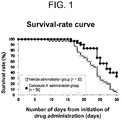
- Figure 1 shows the Kaplan-Meier curve of a heart failure model animal to which compound A' or a vehicle was administered.
- the term "subject” refers to a mammal, for example, a human.
- a “subject with heart failure” refers to a subject suffering from heart failure. If the subject is a human, the subject is referred to as a "patient”. If the subject with heart failure is a human, the subject is referred to as "heart failure patient”.
- the term “pharmaceutically acceptable salt” refers to an acid addition salt or base addition salt, which is an acceptable salt if it is administered in a living body.
- heart failure refers to a state where output of blood from the heart (hereinafter referred to as "cardiac output”) deteriorates and/or a symptom produced by regulatory mechanism of suppressing deterioration in cardiac output and means a physical condition where a sufficient blood circulation volume cannot be ensured.
- treatment of heart failure refers to improving the state where cardiac output deteriorates and/or the symptom produced by a regulatory mechanism of suppressing deterioration in cardiac output.
- a ⁇ blocker and an anti-aldosterone drug are used as a heart failure treatment for improvement of the short-term symptoms and hemodynamics stabilization; however, in the present invention, a decrease of ejection fraction can be suppressed and a survival rate can be improved without using these drugs.
- heart failure more specifically, e.g., deterioration in cardiac output
- ejection fraction which is a cardiac function evaluation index
- EF cardiac function evaluation index
- Table 1 NYHA Heart Failure Classification Class Patient's symptom Class I Patients have cardiac disease but without resulting limitation of physical activity. Ordinary physical activity does not cause undue fatigue, palpitations, dyspnea, or anginal pain. Class II Patients have cardiac disease resulting in slight limitation of physical activity. They are comfortable at rest. Ordinary physical activity results in fatigue, palpitations, dyspnea, or anginal pain. Class III Patients have cardiac disease resulting in marked limitation of physical activity. They are comfortable at rest. Less than ordinary physical activity results in fatigue, palpitations, dyspnea, or anginal pain.
- Class IV Patients have cardiac disease resulting in an inability to carry on any physical activity without discomfort. Symptoms of cardiac insufficiency or of the anginal syndrome may be present even at rest. If any physical activity is undertaken, discomfort is increased. * Class IIs: slight limitation of physical activity Class IIm: Medium limitation of physical activity
- the clinical condition of heart failure is classified into four stages depending on the severity thereof.
- myocardial infarction refers to ischemic condition (necrosis) of heart muscle, which is caused by a decrease in blood supply to cardiomyocytes due to, e.g., emboli, produced within blood vessel. Because of this, myocardial infarction is treated or prevented by removing emboli or inhibiting embolization; more specifically, by administration of a thrombolytic agent or an antithrombocytic agent, an anti-coagulation method, an anti-ischemic therapy or a hyperlipemia treatment.
- heart failure refers to a state where cardiac output deteriorates and/or the symptom produced by a regulatory mechanism of suppressing deterioration in cardiac output, and treated by e.g., a cardiotonic agent and/or a diuretic agent.
- therapies differ since the disease states differ.
- heart failure is a different disease from myocardial infarction.
- deterioration in cardiac output in a subject with myocardial infarction is included in "heart failure" and can be treated by the present invention. More specifically, some of the subjects with myocardial infarction presumably have heart failure other than myocardial infarction.
- a disease state caused by heart failure in subjects with myocardial infarction can be prevented or treated.
- compensated heart failure generally refers to a state produced in vivo by a regulatory mechanism (compensation mechanism) for maintaining blood circulation in response to deterioration in cardiac output caused by heart failure. Accordingly, compensated heart failure can be prevented or treated by the present invention. Examples of the compensation include compensation according to the Frank-Starling law, compensation by myocardial remodeling and nervous humoral compensation.
- Concentric hypertrophy herein is a compensation mechanism of maintaining normal contractility against an increase in afterload.
- the heart muscle of the left ventricle is reduced in retractility due to concentric hypertrophy, even if the circulating blood volume is low, ventricular diastolic pressure increases and congestion occurs.
- acute heart failure generally refers to a disease state where an organic and/or functional abnormality occurs in the heart; compensation mechanism by a cardiac pump (function) immediately fails to work; ventricular end-diastolic pressure rises; and perfusion into major organs fails, with the result that symptoms and signs abruptly emerge from these phenomena or are exacerbated.
- the "acute heart failure” herein includes an acute exacerbation period of chronic heart failure.
- the acute heart failure is roughly divided into the following six disease states: acute decompensated heart failure, hypertensive acute heart failure, acute cardiogenic pulmonary edema, cardiogenic shock, high-output heart failure and acute right heart failure.
- acute heart failure can be prevented or treated.
- chronic heart failure generally refers to a state where the cardiac output deteriorates by a chronic myocardial damage and a blood volume satisfying oxygen demand by peripheral organs is neither absolutely nor relatively pumped out, with the result that the lung, systemic venous system or both of them are congested and a problem occurs in daily life.
- Some of the subjects with chronic heart failure have both heart failure and chronic myocardial damage in combination. Of them, heart failure can be prevented or treated in the present invention.
- acute decompensated heart failure generally refers to a new-type acute heart failure, which is associated with mild signs and symptoms of heart failure and fails to satisfy diagnostic criteria such as cardiogenic shock, pulmonary edema and hypertensive acute heart failure, or referred to one with acute exacerbation of chronic heart failure.
- hypotensive acute heart failure refers to a disease state caused by hypertension and associated with signs and symptoms of heart failure, acute lung congestion or pulmonary edema.
- acute cardiogenic pulmonary edema refers to a disease state where dyspnea and orthotic respiration are observed and rale and pulmonary edema are associated.
- cardiogenic shock refers to a serious disease state where microcirculation of the peripheral and systemic major organs is significantly damaged by heart pump failure and sequentially tissue hypoperfusion is developed.
- high output heart failure refers to a disease state caused by e.g., thyrotoxicosis, anemia, shunt disease, beriberi heart, Paget's disease and iatrogenic factors and associated with lung congestion although the limbs are warm.
- acute right heart failure refers to a disease state of low blood pressure or low cardiac output associated with elevated venous pressure or hepatomegaly.
- acute decompensated heart failure can be prevented or treated.
- Heart failure includes ischemic heart failure and non-ischemic heart failure.
- Ischemic heart failure refers to heart failure caused by losing balance between oxygen demand and supply in the heart muscle. Ischemic heart failure includes those caused by angina pectoris and arteriosclerosis. In the present invention, ischemic heart failure can be prevented or treated.
- Non-ischemic heart failure is heart failure except ischemic heart failure. Also in the present invention, non-ischemic heart failure can be treated.
- Congestive heart failure generally refers to a disease state where cardiac output deteriorates with swelling in pulmonary and peripheral tissue.
- Congestive heart failure includes heart failures caused by, for example, arrhythmia, ischemic heart disease, acute myocardial infarction, hypertension, cardiac myopathy, myocarditis, congenital heart disease, and other diseases.
- Congestive heart failure includes acute heart failure and chronic heart failure. Congestive heart failure can be also prevented or treated by the present invention.
- Examples of the symptoms of chronic heart failure include increased fatigue, shortness of breath with motion, anorexia, hypanakinesia, cough, palpitation, lower-leg edema, swelling, body weight gain with swelling, and dyspnea during sleep.
- the present invention can treat at least one state selected from the above states.
- Examples of the symptoms of acute heart failure include sudden onset of symptoms of chronic heart failure as mentioned above, dyspnea and muzziness.
- the present invention can treat at least one state selected from e.g., these states.
- a disease state of heart failure in a subject can be prevented or treated by administering a compound selected from the group consisting of compound A, compound B, compound C and salts thereof to the subject.
- a medicament comprising a compound selected from compound A, B and C and salts thereof, for use in preventing or treating heart failure.
- Compound A is represented by the following formula:
- Compound B is represented by the following formula:
- Compound C is represented by the following formula:
- compound A, B and C and salts thereof can be used for preventing or treating heart failure.
- a medicament for use in preventing or treating heart failure and particularly a medicament for use in increasing cardiac output or preventing or treating decrease of cardiac output in a subject with heart failure comprising a compound selected from the group consisting of compound A, B and C and salts thereof.
- compound A, B and C and salts thereof can be used for preventing or treating deterioration in cardiac output in a subject with heart failure.
- the medicament of the present invention may be a cardioprotective drug comprising a compound selected from compound A, B and C and salts thereof.
- the medicament of the present invention can be used in preventing or treating ischemic heart failure or non-ischemic heart failure. In a specific embodiment of the present invention, the medicament of the present invention can be used in preventing or treating non-ischemic heart failure. In a further specific embodiment of the present invention, the medicament of the present invention can be used in treating non-ischemic heart failure.
- the medicament of the present invention can be used in preventing or treating decompensated heart failure. In a specific embodiment of the present invention, the medicament of the present invention can be used in preventing or treating acute heart failure. In a specific embodiment of the present invention, the medicament of the present invention can be used in preventing or treating acute decompensated heart failure. In a further specific embodiment of the present invention, the medicament of the present invention can be used in preventing or treating acute decompensated heart failure.
- compound A, B and C and salts thereof improve a decrease of ejection fraction in a subject with heart failure or increases ejection fraction.
- the medicament of the present invention may be a medicament (improving drug) comprising a compound selected from compound A, B and C and salts thereof, for improving a decrease of ejection fraction and death caused by a decrease of ejection fraction in a subject with heart failure.
- compound A, B and C and salts thereof can suppress exacerbation of cardiac function or further exacerbation thereof in a subject with heart failure.
- the medicament of the present invention may be a medicament comprising a compound selected from compound A, B and C and salts thereof for use in suppressing exacerbation of cardiac function or further exacerbation thereof in a subject with heart failure.
- the medicament of the present invention may be a medicament comprising a compound selected from compound A, B and C and salts thereof for protecting the heart in a subject with heart failure.
- compound A, B and C and salts thereof can reduce cardiac load and suppress cardiac hypertrophy, interstitial fibrosis and an increase of apoptosis in a subject with heart failure.
- the medicament of the present invention may be a medicament comprising a compound selected from compound A, B and C and salts thereof, for use in treating at least one (disease) state selected from an increase of cardiac load, cardiac hypertrophy, interstitial fibrosis and/or an increase of cardiomyocyte apoptosis, in a subject with heart failure.
- a disease state selected from an increase of cardiac load, cardiac hypertrophy, interstitial fibrosis and/or an increase of cardiomyocyte apoptosis, in a subject with heart failure.
- the medicament of the present invention can be used in preventing or treating Class I, II, III or IV-stage heart failure according to the NYHA classification. In a specific embodiment of the present invention, the medicament of the present invention can be used in preventing or treating A, B, C or D-stage heart failure according to the AHA/ACC stage classification
- Compound A, B and C and salts thereof may be a solvate or not.
- the solvate may be a solvent such as ethanol and water. If the solvent to be comprised is water, the solvate is a hydrate.
- the hydrate includes not only a stoichiometric hydrate but also hydrates different in water content.
- Compound A, B and C and salts thereof may be labeled with an isotope (e.g., 3H, 13C, 14C, 18F, 35S, 125I).
- an isotope e.g., 3H, 13C, 14C, 18F, 35S, 125I.
- Compound A, B and C and salts thereof may be in the form of a pharmaceutically acceptable co-crystal or co-crystalline salt.
- the co-crystal or co-crystal salt herein refers to a crystalline substance constituted of two types or more solids distinctive at room temperature and having mutually different physical properties (for example, structure, melting point, heat of fusion, hygroscopicity, solubility and stability).
- the co-crystal or co-crystalline salt can be produced by a co-crystallization method known per se.
- Examples of the salts of compound A, B and C include a salt with an inorganic base, an ammonium salt, a salt with an organic base, a salt with an inorganic acid, a salt with an organic acid and a salt with a basic or acidic amino acid.
- the salt with an inorganic base include an alkali metal salt such as a sodium salt and a potassium salt; an alkaline earth metal salt such as a calcium salt, a magnesium salt, a barium salt; and an aluminum salt.
- an alkali metal salt such as a sodium salt and a potassium salt
- an alkaline earth metal salt such as a calcium salt, a magnesium salt, a barium salt
- an aluminum salt such as aluminum salt.
- salt with an organic base examples include salts with trimethylamine, triethylamine, pyridine, picoline, ethanolamine, diethanolamine, triethanolamine, dicyclohexylamine and N, N'-dibenzylethylenediamine.
- salt with an inorganic acid examples include salts with hydrochloric acid, hydrobromic acid, nitric acid, sulfuric acid and phosphoric acid.
- the salt with an organic acid include salts with formic acid, acetic acid, trifluoroacetic acid, fumaric acid, oxalic acid, tartaric acid, maleic acid, citric acid, succinic acid, malic acid, methanesulfonic acid, benzenesulfonic acid and p-toluenesulfonic acid.
- salt with a basic amino acid examples include salts with arginine, lysine and ornithine.
- salt with an acidic amino acid include salts with aspartic acid and glutamic acid.
- a pharmaceutically acceptable salt is preferable.
- a salt of compound A can be a p-toluenesulfonate (tosylate) (hereinafter referred to also as “compound A'”).
- a salt of compound B can be a hydrochloride (hereinafter referred to also as “compound B'”).
- a salt of compound C can be a p-toluenesulfonate (tosylate) (hereinafter referred to also as "compound C'").
- a compound selected from compound A, compound A', compound B, compound B', compound C and compound C' can be used for preventing or treating heart failure.
- compound A or compound A' can be used for preventing or treating heart failure.
- compound A' can be used for preventing or treating heart failure.
- Compound A, B and C and salts thereof can be prepared by a method known per se (for example, method described in WO2004/017908 and Yoshida M. et al., Bioorg. Med. Chem., 19: 1881-1894, 2011 , the contents of which are incorporated in the specification in their entirety by reference).
- the dosage varies depending on e.g., the subject to be administered, administration route, disease and symptoms.
- the dosage falls within the range of about 0.1 mg to about 500 mg in terms of compound A, B or C and preferably about 1 mg to about 100 mg.
- the dosage can be selected from the range of about 0.01 mg to about 100 mg and preferably about 0.1 mg to about 10 mg.
- the dosage is administered in a single dose or several doses (for example, one to three per day).
- the medicament of the present invention may comprise one compound selected from compound A, B and C and salts thereof, and a pharmaceutically acceptable carrier.
- various organic or inorganic carrier substances routinely used as a drug substance are used and blended as an excipient, a lubricant, a binder or a disintegrator in a solid preparation; a solvent, a solubilizer, a suspending agent, a tonicity agent, a buffer or a soothing agent in a liquid preparation.
- a formulation additive such as a preservative, an antioxidant, a stabilizer, colorants or a sweetener can be used.
- the medicament of the present invention can be a medicament for parenteral administration or oral administration.
- the medicament of the present invention can be a medicament for oral administration.
- the medicament of the present invention can be used in combination with another drug such as a drug for heart failure, for example, at least one of the following drugs:
- the medicament (drug) to be blended or used in combination with the medicament of the present invention includes both a medicament which is formulated as a single preparation comprising a compound selected from compound A, B and C and salts thereof and a drug used in combination (combination drug), and a medicament which is formulated as separate preparations: a preparation comprising a compound selected from compound A, B and C and salts thereof and a preparation comprising a combination drug (for example, combined medicament).
- a combination drug for example, combined medicament
- the combined medicament of the present invention can be formulated by a method similar to that in the above-mentioned medicament comprising a compound selected from compound A, B and C and salts thereof by separately or simultaneously mixing a compound selected from compound A, B and C and salts thereof and a combination drug with or without a pharmaceutically acceptable carrier.
- the dosage of the combined medicament of the present invention per day varies depending on, e.g., the symptom; the age, sex, body weight and difference in sensitivity of the subject to be administered; timing and interval of administration, the feature, prescription and type of the medicament; and type of active ingredient and is not particularly limited.
- a compound selected from compound A, B and C and salts thereof and a combination drug may be administering at the same timing. Further, a combination drug is first administered, and then, a compound selected from compound A, B and C and salts thereof may be administered. Alternatively, a compound selected from compound A, B and C and salts thereof is first administered, and then, a combination drug may be administered. In the case of administering them at time intervals, the time interval varies depending on the active ingredient, dosage form and the administration method.
- a method of administering a compound selected from compound A, B and C and salts thereof within one minute to three days, preferably 10 minutes to one day, more preferably 15 minutes to 1 hour after a combination drug is administered is mentioned as an approach.
- a method of administering a combination drug within one minute to one day, preferably 10 minutes to 6 hours, more preferably 15 minutes to one hour after the compound is administered is mentioned as an approach.
- the individual contents of the compound selected from compound A, B and C and salts thereof and the combination drug vary depending on the dosage form of the preparation of the combined medicament; however, the contents usually fall in the range of about 0.01 to 90 wt% relative, preferably about 0.1 to 50 wt% and further preferably about 0.5 to 20 wt% to the total amount of the preparation.
- the content of the carrier in the combined medicament is usually about 0 to 99.8 wt%, preferably about 10 to 99.8 wt% and further preferably about 10 to 90 wt% relative to the total amount of the preparation.
- the preparation comprising a combination drug can be produced in the same manner as in the compound selected from compound A, B and C and salts thereof, and put in use.
- the medicament of the present invention may be either a solid preparation such as a powder, a granule, a tablet or a capsule, or a liquid such as a syrup or an emulsion.
- the medicament of the present invention can be produced in accordance with a routine method including mixing, kneading, granulating, tableting, coating, sterilizing and emulsifying, depending on the dosage form of the preparation.
- a routine method including mixing, kneading, granulating, tableting, coating, sterilizing and emulsifying, depending on the dosage form of the preparation.
- each section of General Rules for Preparations of the Japanese Pharmacopoeia for example, can be referred.
- the medicament of the present invention may be formed as a sustained release agent comprising an active ingredient and a biodegradable polymer compound.
- a medicament for preventing or treating heart failure in the subject in need thereof comprising a compound selected from compound A, B and C and salts thereof and to be used in combination with a combination drug.
- a method for preventing or treating heart failure in a subject in need thereof including administering a compound selected from compound A, B and C and salts thereof to the subject.
- a heart failure to be treated can be any one of the diseases or disease states already described as those to be treated by the medicament of the present invention.
- a medicament comprising a compound selected from compound A, B and C and salts thereof may be administered.
- Heart failure to be treated by the medicament can be any one of the diseases or conditions already described as those to be treated by the medicament of the present invention.
- the compound to be administered or the compound to be compriseed in the medicament is a tosylate of compound A.
- Compound A' was prepared in accordance with the method known in the art and described in WO2004/017908 and Yoshida M. et al., Bioorg. Med. Chem., 19: 1881-1894, 2011 .
- Calsequestrin (CSQ) cardiac specific transgenic mice (CSQ-Tg mice), which were reported in Larry R. Jones et al., J. Clin. Invest. 101: 1385-1393, 1998 , were obtained from University of Pennsylvania, breeded in our company and put in use.
- administration of a medicament was started on and after the mice reached 5 weeks old.
- the animals were raised in the conditions: room temperature: 20 to 26°c, humidity: 40 to 70%, illumination time: 12 hours/day (7:00-19:00) by giving a solid feed (CE-2, manufactured by CLEA Japan, Inc.) and tap water.
- CE-2 manufactured by CLEA Japan, Inc.
- Table 4 Left atrial weight Average value (mg) Standard deviation (mg) Vehicle administration group 12.6 4.4 Compound A' administration group 8.4 1.0
- lung weight (Lung), left-ventricle weight (LV) and body weight (BW) were individually measured and were standardized with the BW.
- Table 5 Average value ⁇ standard deviation LV/BW Lung/BW Vehicle administration group 9.3 ⁇ 1.6 8.1 ⁇ 1.3
- QD body weight/day once per day
- compound A' improves ejection fraction in a subject with heart failure and can treat heart failure in this mechanism. It was found that compound A' at least has an effect of reducing cardiac load of the heart in failure and an effect of improving cardiac function or inhibiting exacerbation of cardiac function by suppressing myocardial hypertrophy, interstitial fibrosis, apoptosis and the like. Based on this, it is interpreted that compound A' has not only a therapeutic effect but also a preventive effect on heart failure.
- the present invention there is provided a medicament for preventing or treating heart failure.
- the invention is useful.
Landscapes
- Health & Medical Sciences (AREA)
- Veterinary Medicine (AREA)
- Chemical & Material Sciences (AREA)
- Medicinal Chemistry (AREA)
- Pharmacology & Pharmacy (AREA)
- Life Sciences & Earth Sciences (AREA)
- Animal Behavior & Ethology (AREA)
- General Health & Medical Sciences (AREA)
- Public Health (AREA)
- Engineering & Computer Science (AREA)
- Bioinformatics & Cheminformatics (AREA)
- Cardiology (AREA)
- Epidemiology (AREA)
- Hospice & Palliative Care (AREA)
- Heart & Thoracic Surgery (AREA)
- Chemical Kinetics & Catalysis (AREA)
- General Chemical & Material Sciences (AREA)
- Nuclear Medicine, Radiotherapy & Molecular Imaging (AREA)
- Organic Chemistry (AREA)
- Pharmaceuticals Containing Other Organic And Inorganic Compounds (AREA)
Abstract
Description
- The present invention relates to a medicament for preventing or treating heart failure.
- Heart failure is a disease characterized by a disease state where cardiac output decreases due to dysfunction of cardiomyocytes and a disease state caused by physical burden brought by a mechanism of maintaining cardiac output. Cardiomyocytes play a role in contraction and relaxation. For the contraction and relaxation, Ca2+ ions are required. Contraction of cardiomyocytes proceeds through stages of : an action potential propagating to the transverse tubules to depolarize the transverse tubule membrane; allowing Ca2+ ions to flow into cells from a potential-dependent Type L Ca2+ channel of the transverse tubules; the inflow Ca2+ ions binding to a Ca2+ release channel (ryanodine receptor or RYR) of the sarcoplasmic reticulum to release Ca2+ ions from the sarcoplasmic reticulum to the cytoplasm; and the released Ca2+ ions within the cell binding to troponin C to induce contraction of the cardiomyocytes. Further, relaxation of cardiomyocytes proceeds by taking Ca2+ ions into the sarcoplasmic reticulum via a Ca2+ release pump (SERCA) to reduce the cytoplasmic level of Ca2+ ions and dissociate the Ca2+ ions from the troponin C. Accordingly, if something goes wrong in any one of the stages and Ca2+ ions are not released into the cytoplasm, cardiomyocytes fail to work, with the result that heart failure occurs.
- As a therapeutic drug for heart failure, e.g., a cardiotonic drug such as β blocker, anti-aldosterone drug, a diuretic drug and digitalis, an angiotensin converting enzyme inhibitor and angiotensin II antagonist are used in clinical sites for improvement of short-term symptoms and hemodynamic stabilization. However, these drugs are insufficient to improve the re-hospitalization rate and long-term life prognosis. In recent years, it has been desired to provide a novel heart-failure therapeutic drug for improving re-hospitalization rate and long-term life prognosis.
- Ca2+ ions (hereinafter also referred to simply as calcium) play an essential role in maintaining/regulating functions of various cells including not only nerve and muscle but also endocrine cells and exocrine cells. Therefore, the blood calcium level is precisely controlled to fall within a narrow range. Parathyroid hormone (PTH) plays a central role in maintaining the blood calcium level. Thus, secretion of PTH from the parathyroid gland must be controlled sensitively in response to a change in blood calcium level. Actually, when blood calcium level changes, blood PTH level rapidly changes in accordance therewith. Brown et al., pointed out the possibility of the existence of the mechanism where the extracellular calcium concentration is sensed by parathyroid cells and the information thereof is transmitted to the cells. In 1993, they successfully cloned a calcium-sensing receptor (CaSR; hereinafter simply referred to as a calcium receptor) from the bovine parathyroid gland and determined the properties thereof (Nature, 366, 575-580 (1993)).
- The calcium receptor has the N terminal of 600 amino acids in full length and is constituted of a large-terminal extracellular region having 7 transmembrane regions similarly to other G protein-coupled receptors and an intracellular region having the C terminal consisting of 200 or less amino acids.
- If the extracellular calcium concentration increases, phospholipase (PL)-C is activated and then the level of inositol triphosphate (IP3) increases, with the result that the intracellular calcium concentration increases. In this mechanism, PTH secretion is presumably suppressed. If the extracellular calcium concentration is maintained at a high level, the intracellular calcium concentration subsequently and continuously increases. Conceivably, calcium flow-in from outside the cell is also promoted. If the extracellular calcium concentration increases, PL-A2 and D are activated. These are probably activated via, e.g., protein kinase (PK)-C, which is simultaneously activated via a calcium receptor. The calcium receptor suppresses adenylyl cyclase via Gi protein or arachidonic acid production through PL-A2 activation to reduce intracellular cyclic AMP level (Bone, 20, 303-309 (1997)).
- It is known that (5R)-N-[1-ethyl-1-(4-ethylphenyl)propyl]-2,7,7-trimethyl-5-phenyl-4,5,6,7-tetrahydropyrazolo[1,5-a]pyrimidine-3-carboxamide (hereinafter referred to also as "compound A"), (5R)-N-[1-ethyl-1-(4-methoxyphenyl)propyl]-2,7,7-trimethyl-5-phenyl-4,5,6,7-tetrahydropyrazolo[1,5-a]pyrimidine-3-carboxamide (hereinafter referred to also as "compound B") and (5R)-N-[1-ethyl-1-(4-ethylphenyl)propyl]-5-(2-fluorophenyl)-2,7,7-trimethyl-4,5,6,7-tetrahydropyrazolo[1,5-a]pyrimidine-3-carboxamide (hereinafter referred to also as "compound C") are involved in regulation of the activity of the calcium-sensing receptor (CaSR) and regulation of parathyroid hormone (PTH) (Patent literature 1 and Patent literature 2). Also, Non patent literature 1 discloses that compound A serves as an antagonist to CaSR (Non patent literature 1).
- In
Non patent literatures - In
Non patent literature 5, it is described that cardiac hypertrophy is improved by a CaSR inhibitor, i.e., Calhex231, in a transverse aortic constriction (TAC) model; however, it is not elucidated that the drug is effective or not after cardiac function deteriorates. Non patent literature 6 discloses that, if Calhex231 is administered, more specifically, if the drug is administered after the cardiac load is given, cardiac hypofunction is not improved. Further, in Non patent literature 7, it is described that a CaSR antagonist invalidates a cardioprotective effect in an ischemia preconditioning model. Thus, the relationship of CaSR inhibition with improvement of cardiac hypofunction or improvement of survival rate has not yet been sufficiently elucidated. -
- Patent literature 1:
WO2004/017908 - Patent literature 2: Japanese Patent Laid-Open No.
2005-239611 -
- Non patent literature 1: Bioorganic & Medicinal Chemistry 19: 1881-1894, 2011
- Non patent literature 2: Cardiovascular research, 77: 722-731, 2008
- Non patent literature 3: Cardiovascular research, 93: 330-339, 2012
- Non patent literature 4: Experimental and molecular medicament 42, 61-68, 2010
- Non patent literature 5: Cell Physiol. Biochem., 36: 1597-1612, 2015
- Non patent literature 6: Cell Physiol. Biochem., 33: 557-568, 2014
- Non patent literature 7: Am. J. Physiol. Heart Circ. Physiol., 299: H1309-H1317, 2010
- The present invention provides a medicament for preventing or treating heart failure.
- The present inventors found that a compound selected from the group consisting of compound A, compound B, compound C and salts thereof is effective in preventing and/or treating heart failure. The present invention was achieved based on the finding.
- More specifically, according to the present invention, the following inventions are provided.
- [1] A medicament for preventing or treating heart failure, comprising a compound selected from the group consisting of (5R)-N-[1-ethyl-1-(4-ethylphenyl)propyl]-2,7,7-trimethyl-5-phenyl-4,5,6,7-tetrahydropyrazolo[1,5-a]pyrimidine-3-carboxamide, (5R)-N-[1-ethyl-1-(4-methoxyphenyl)propyl]-2,7,7-trimethyl-5-phenyl-4,5,6,7-tetrahydropyrazolo[1,5-a]pyrimidine-3-carboxamide, (5R)-N-[1-ethyl-1-(4-ethylphenyl)propyl]-5-(2-fluorophenyl)-2,7,7-trimethyl-4,5,6,7-tetrahydropyrazolo[1,5-a]pyrimidine-3-carboxamide and salts thereof.
- [2] The medicament according to the above [1], for treating heart failure.
- [3] The medicament according to the above [1], wherein heart failure is acute decompensated heart failure.
- [1a] A method for preventing or treating heart failure in a mammal characterized by administering, to a mammal, a compound selected from the group consisting of (5R)-N-[1-ethyl-1-(4-ethylphenyl)propyl]-2,7,7-trimethyl-5-phenyl-4,5,6,7-tetrahydropyrazolo[1,5-a]pyrimidine-3-carboxamide, (5R)-N-[1-ethyl-1-(4-methoxyphenyl)propyl]-2,7,7-trimethyl-5-phenyl-4,5,6,7-tetrahydropyrazolo[1,5-a]pyrimidine-3-carboxamide, (5R)-N-[1-ethyl-1-(4-ethylphenyl)propyl]-5-(2-fluorophenyl)-2,7,7-trimethyl-4,5,6,7-tetrahydropyrazolo[1,5-a]pyrimidine-3-carboxamide and salts thereof.
- [2a] The method according to the above [1a], for treating heart failure.
- [3a] The method according to the above [1a], wherein the heart failure is acute decompensated heart failure.
- [1b] A compound for preventing or treating heart failure, selected from the group consisting of (5R)-N-[1-ethyl-1-(4-ethylphenyl)propyl]-2,7,7-trimethyl-5-phenyl-4,5,6,7-tetrahydropyrazolo[1,5-a]pyrimidine-3-carboxamide, (5R)-N-[1-ethyl-1-(4-methoxyphenyl)propyl]-2,7,7-trimethyl-5-phenyl-4,5,6,7-tetrahydropyrazolo[1,5-a]pyrimidine-3-carboxamide, (5R)-N-[1-ethyl-1-(4-ethylphenyl)propyl]-5-(2-fluorophenyl)-2,7,7-trimethyl-4,5,6,7-tetrahydropyrazolo[1,5-a]pyrimidine-3-carboxamide and salts thereof.
- [2b] The compound according to the above [1b], for treating heart failure.
- [3b] The compound according to the above [1b], wherein the heart failure is acute decompensated heart failure.
- [1c] Use of a compound selected from the group consisting of (5R)-N-[1-ethyl-1-(4-ethylphenyl)propyl]-2,7,7-trimethyl-5-phenyl-4,5,6,7-tetrahydropyrazolo[1,5-a]pyrimidine-3-carboxamide, (5R)-N-[1-ethyl-1-(4-methoxyphenyl)propyl]-2,7,7-trimethyl-5-phenyl-4,5,6,7-tetrahydropyrazolo[1,5-a]pyrimidine-3-carboxamide, (5R)-N-[1-ethyl-1-(4-ethylphenyl)propyl]-5-(2-fluorophenyl)-2,7,7-trimethyl-4,5,6,7-tetrahydropyrazolo[1,5-a]pyrimidine-3-carboxamide and salts thereof, for producing a prophylactic or therapeutic agent for heart failure.
- [2c] Use according to the above [1c], for treating heart failure.
- [3c] Use according to the above [1c], wherein the heart failure is acute decompensated heart failure.
- According to the present invention, it is possible to prevent or treat heart failure.
- [
Figure 1] Figure 1 shows the Kaplan-Meier curve of a heart failure model animal to which compound A' or a vehicle was administered. - In the specification, the term "subject" refers to a mammal, for example, a human. In the specification, a "subject with heart failure" refers to a subject suffering from heart failure. If the subject is a human, the subject is referred to as a "patient". If the subject with heart failure is a human, the subject is referred to as "heart failure patient".
- In the specification, the term "pharmaceutically acceptable salt" refers to an acid addition salt or base addition salt, which is an acceptable salt if it is administered in a living body.
- In the specification, the term "heart failure" refers to a state where output of blood from the heart (hereinafter referred to as "cardiac output") deteriorates and/or a symptom produced by regulatory mechanism of suppressing deterioration in cardiac output and means a physical condition where a sufficient blood circulation volume cannot be ensured. In the specification, the term "treatment of heart failure" refers to improving the state where cardiac output deteriorates and/or the symptom produced by a regulatory mechanism of suppressing deterioration in cardiac output. As a heart failure treatment for improvement of the short-term symptoms and hemodynamics stabilization, e.g., a β blocker and an anti-aldosterone drug are used; however, in the present invention, a decrease of ejection fraction can be suppressed and a survival rate can be improved without using these drugs. Thus, in the present invention, heart failure (more specifically, e.g., deterioration in cardiac output) can be prevented or treated.
- In the specification, the term "ejection fraction" (EF), which is a cardiac function evaluation index, is a value obtained by dividing blood volume (ejection volume) fed by the heart per beat by the left ventricular volume at the time of cardiac dilatation. In a subject with heart failure (heart failure patient), a decrease of ejection fraction is observed. Thus, improvement of ejection fraction is one of the goals for heart failure treatment.
- The clinical condition of heart failure is classified into four stages depending on the severity thereof by the New York Heart Association (NYHA). [Table 1]
Table 1: NYHA Heart Failure Classification Class Patient's symptom Class I Patients have cardiac disease but without resulting limitation of physical activity. Ordinary physical activity does not cause undue fatigue, palpitations, dyspnea, or anginal pain. Class II Patients have cardiac disease resulting in slight limitation of physical activity. They are comfortable at rest. Ordinary physical activity results in fatigue, palpitations, dyspnea, or anginal pain. Class III Patients have cardiac disease resulting in marked limitation of physical activity. They are comfortable at rest. Less than ordinary physical activity results in fatigue, palpitations, dyspnea, or anginal pain. Class IV Patients have cardiac disease resulting in an inability to carry on any physical activity without discomfort. Symptoms of cardiac insufficiency or of the anginal syndrome may be present even at rest. If any physical activity is undertaken, discomfort is increased. * Class IIs: slight limitation of physical activity Class IIm: Medium limitation of physical activity - According to the AHA/ACC stage classification (American Heart Association/American College of Cardiology), the clinical condition of heart failure is classified into four stages depending on the severity thereof.
-
Table 2: AHA/ACC stage classification of heart failure Stage Definition A Risk factor is present; however, no cardiac dysfunction is observed B Cardiac contractile dysfunction of left ventricle with no symptom C Symptomatic heart failure D Intractable heart failure - The correspondence relationship between the NYHA classification and the AHA/ACC stage classification is roughly as follows.
-
Table 3: Correspondence relationship between the NYHA classification and the AHA/ACC stage classification NYHA class AHA/ACC stage class - A Class I B Class II C Class III Class IV Class IV D - In the specification, the term "heart failure" is a disease state different from that of myocardial infarction, and the type of medicament to be used for treatment differs from that of myocardial infarction. More specifically, myocardial infarction refers to ischemic condition (necrosis) of heart muscle, which is caused by a decrease in blood supply to cardiomyocytes due to, e.g., emboli, produced within blood vessel. Because of this, myocardial infarction is treated or prevented by removing emboli or inhibiting embolization; more specifically, by administration of a thrombolytic agent or an antithrombocytic agent, an anti-coagulation method, an anti-ischemic therapy or a hyperlipemia treatment. In contrast, heart failure refers to a state where cardiac output deteriorates and/or the symptom produced by a regulatory mechanism of suppressing deterioration in cardiac output, and treated by e.g., a cardiotonic agent and/or a diuretic agent. Likewise, since the disease states differ, therapies differ. To reiterate, heart failure is a different disease from myocardial infarction. Note that, in the specification, deterioration in cardiac output in a subject with myocardial infarction is included in "heart failure" and can be treated by the present invention. More specifically, some of the subjects with myocardial infarction presumably have heart failure other than myocardial infarction. In the present invention, a disease state caused by heart failure in subjects with myocardial infarction can be prevented or treated.
- In the specification, the term "compensated heart failure" generally refers to a state produced in vivo by a regulatory mechanism (compensation mechanism) for maintaining blood circulation in response to deterioration in cardiac output caused by heart failure. Accordingly, compensated heart failure can be prevented or treated by the present invention. Examples of the compensation include compensation according to the Frank-Starling law, compensation by myocardial remodeling and nervous humoral compensation.
- In the compensation according to the Frank-Starling law, compensation mechanism functions such that deterioration in cardiac output is improved by increasing preload, and increased cardiac output per beat thereby. However, the compensation effect is limited by an increase of arterial pressure. As a result, preload further increases, symptoms such as lung congestion and peripheral edema, are developed.
- When pressure load is applied to cardiomyocytes, the wall thickness of the heart increases and the diameter of the heart ventricle decreases, that is, concentric hypertrophy develops. Concentric hypertrophy herein is a compensation mechanism of maintaining normal contractility against an increase in afterload. However, when the heart muscle of the left ventricle is reduced in retractility due to concentric hypertrophy, even if the circulating blood volume is low, ventricular diastolic pressure increases and congestion occurs.
- Due to volume overload on cardiomyocytes, the inner cavity of the heart is enlarged to develop eccentric hypertrophy. In the eccentric hypertrophy, retractility of the ventricle is enhanced and preload decreases and the cardiac output comes to deteriorate.
- As described above, if compensation by myocardial remodeling is excessive, heart failure may exacerbate.
- When cardiac output of blood deteriorates due to heart failure, arterial pressure decreases. If so, the sympathetic nerve is activated to release a catecholamine. The catecholamine increases heart rate and cardiac contractility and induces vasoconstriction and renin secretion. When arterial pressure decreases, the pressure of afferent glomerular arteriole of kidney decreases, with the result that secretion of renin from juxtaglomerular cells is accelerated. Renin promotes production of angiotensin II, contracts the artery and increase afterload. Angiotensin II also promotes resorption of sodium ions and water in the kidney, and thus, blood volume increases and preload increases. Angiotensin II further promotes secretion of a catecholamine. This reaction transiently improves blood circulation in a subject with heart failure; however, if sympathetic stimulation lasts for a long term, responsiveness to stimulation becomes poor and the compensation system will not work.
- In the present invention, the term "acute heart failure" generally refers to a disease state where an organic and/or functional abnormality occurs in the heart; compensation mechanism by a cardiac pump (function) immediately fails to work; ventricular end-diastolic pressure rises; and perfusion into major organs fails, with the result that symptoms and signs abruptly emerge from these phenomena or are exacerbated. The "acute heart failure" herein includes an acute exacerbation period of chronic heart failure. The acute heart failure is roughly divided into the following six disease states: acute decompensated heart failure, hypertensive acute heart failure, acute cardiogenic pulmonary edema, cardiogenic shock, high-output heart failure and acute right heart failure. In the present invention, acute heart failure can be prevented or treated.
- In the present invention, the term "chronic heart failure" generally refers to a state where the cardiac output deteriorates by a chronic myocardial damage and a blood volume satisfying oxygen demand by peripheral organs is neither absolutely nor relatively pumped out, with the result that the lung, systemic venous system or both of them are congested and a problem occurs in daily life. Some of the subjects with chronic heart failure have both heart failure and chronic myocardial damage in combination. Of them, heart failure can be prevented or treated in the present invention.
- In the specification, the term "acute decompensated heart failure" generally refers to a new-type acute heart failure, which is associated with mild signs and symptoms of heart failure and fails to satisfy diagnostic criteria such as cardiogenic shock, pulmonary edema and hypertensive acute heart failure, or referred to one with acute exacerbation of chronic heart failure.
- In the specification, the term "hypertensive acute heart failure" refers to a disease state caused by hypertension and associated with signs and symptoms of heart failure, acute lung congestion or pulmonary edema.
- In the specification, the term "acute cardiogenic pulmonary edema" refers to a disease state where dyspnea and orthotic respiration are observed and rale and pulmonary edema are associated.
- In the specification, the term "cardiogenic shock" refers to a serious disease state where microcirculation of the peripheral and systemic major organs is significantly damaged by heart pump failure and sequentially tissue hypoperfusion is developed.
- In the specification, the term "high output heart failure" refers to a disease state caused by e.g., thyrotoxicosis, anemia, shunt disease, beriberi heart, Paget's disease and iatrogenic factors and associated with lung congestion although the limbs are warm.
- In the specification, the term "acute right heart failure" refers to a disease state of low blood pressure or low cardiac output associated with elevated venous pressure or hepatomegaly.
- In the present invention, acute decompensated heart failure can be prevented or treated.
- Heart failure includes ischemic heart failure and non-ischemic heart failure.
- Ischemic heart failure refers to heart failure caused by losing balance between oxygen demand and supply in the heart muscle. Ischemic heart failure includes those caused by angina pectoris and arteriosclerosis. In the present invention, ischemic heart failure can be prevented or treated.
- Non-ischemic heart failure is heart failure except ischemic heart failure. Also in the present invention, non-ischemic heart failure can be treated.
- In the specification, "congestive heart failure" generally refers to a disease state where cardiac output deteriorates with swelling in pulmonary and peripheral tissue. Congestive heart failure includes heart failures caused by, for example, arrhythmia, ischemic heart disease, acute myocardial infarction, hypertension, cardiac myopathy, myocarditis, congenital heart disease, and other diseases. Congestive heart failure includes acute heart failure and chronic heart failure. Congestive heart failure can be also prevented or treated by the present invention.
- Examples of the symptoms of chronic heart failure include increased fatigue, shortness of breath with motion, anorexia, hypanakinesia, cough, palpitation, lower-leg edema, swelling, body weight gain with swelling, and dyspnea during sleep. The present invention can treat at least one state selected from the above states. Examples of the symptoms of acute heart failure include sudden onset of symptoms of chronic heart failure as mentioned above, dyspnea and muzziness. The present invention can treat at least one state selected from e.g., these states.
- In the present invention, a disease state of heart failure in a subject can be prevented or treated by administering a compound selected from the group consisting of compound A, compound B, compound C and salts thereof to the subject.
- According to the present invention, there is provided a medicament comprising a compound selected from compound A, B and C and salts thereof, for use in preventing or treating heart failure.
- Compound A is represented by the following formula:

- Compound B is represented by the following formula:

- Compound C is represented by the following formula:
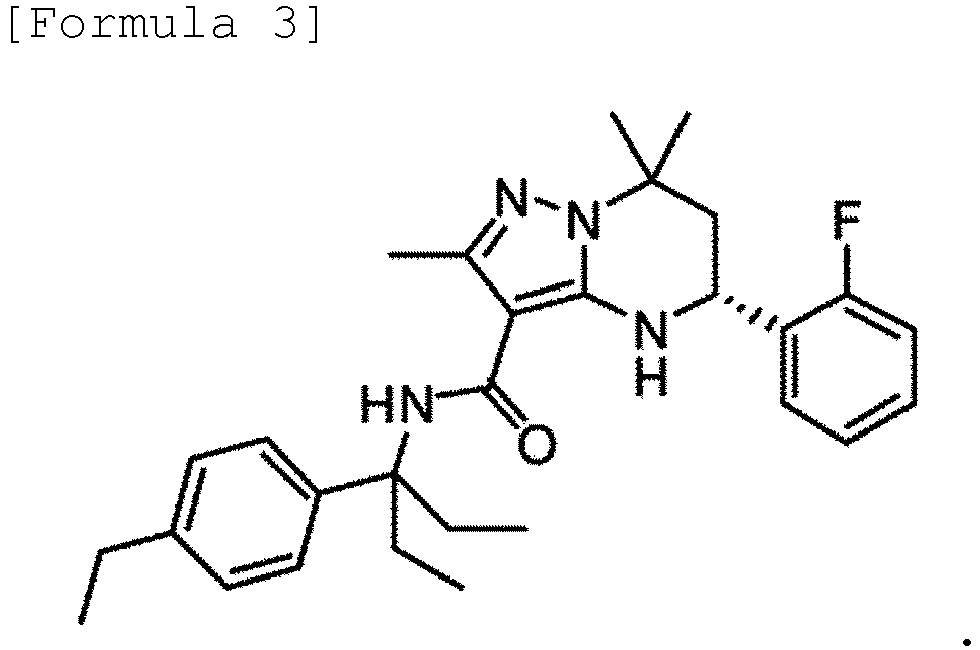
- In the present invention, compound A, B and C and salts thereof can be used for preventing or treating heart failure. According to the present invention, there is provided a medicament for use in preventing or treating heart failure and particularly a medicament for use in increasing cardiac output or preventing or treating decrease of cardiac output in a subject with heart failure, comprising a compound selected from the group consisting of compound A, B and C and salts thereof.
- In the present invention, compound A, B and C and salts thereof can be used for preventing or treating deterioration in cardiac output in a subject with heart failure. Accordingly, the medicament of the present invention may be a cardioprotective drug comprising a compound selected from compound A, B and C and salts thereof.
- In a specific embodiment of the present invention, the medicament of the present invention can be used in preventing or treating ischemic heart failure or non-ischemic heart failure. In a specific embodiment of the present invention, the medicament of the present invention can be used in preventing or treating non-ischemic heart failure. In a further specific embodiment of the present invention, the medicament of the present invention can be used in treating non-ischemic heart failure.
- In a specific embodiment of the present invention, the medicament of the present invention can be used in preventing or treating decompensated heart failure. In a specific embodiment of the present invention, the medicament of the present invention can be used in preventing or treating acute heart failure. In a specific embodiment of the present invention, the medicament of the present invention can be used in preventing or treating acute decompensated heart failure. In a further specific embodiment of the present invention, the medicament of the present invention can be used in preventing or treating acute decompensated heart failure.
- In the present invention, compound A, B and C and salts thereof improve a decrease of ejection fraction in a subject with heart failure or increases ejection fraction. The medicament of the present invention may be a medicament (improving drug) comprising a compound selected from compound A, B and C and salts thereof, for improving a decrease of ejection fraction and death caused by a decrease of ejection fraction in a subject with heart failure.
- In the present invention, compound A, B and C and salts thereof can suppress exacerbation of cardiac function or further exacerbation thereof in a subject with heart failure. The medicament of the present invention may be a medicament comprising a compound selected from compound A, B and C and salts thereof for use in suppressing exacerbation of cardiac function or further exacerbation thereof in a subject with heart failure. The medicament of the present invention may be a medicament comprising a compound selected from compound A, B and C and salts thereof for protecting the heart in a subject with heart failure. In the present invention, compound A, B and C and salts thereof can reduce cardiac load and suppress cardiac hypertrophy, interstitial fibrosis and an increase of apoptosis in a subject with heart failure. The medicament of the present invention may be a medicament comprising a compound selected from compound A, B and C and salts thereof, for use in treating at least one (disease) state selected from an increase of cardiac load, cardiac hypertrophy, interstitial fibrosis and/or an increase of cardiomyocyte apoptosis, in a subject with heart failure.
- In a specific embodiment of the present invention, the medicament of the present invention can be used in preventing or treating Class I, II, III or IV-stage heart failure according to the NYHA classification. In a specific embodiment of the present invention, the medicament of the present invention can be used in preventing or treating A, B, C or D-stage heart failure according to the AHA/ACC stage classification
- Compound A, B and C and salts thereof may be a solvate or not. The solvate may be a solvent such as ethanol and water. If the solvent to be comprised is water, the solvate is a hydrate. The hydrate includes not only a stoichiometric hydrate but also hydrates different in water content.
- Compound A, B and C and salts thereof may be labeled with an isotope (e.g., 3H, 13C, 14C, 18F, 35S, 125I).
- Deuterides of compound A, B and C and salts thereof obtained by converting 1H with 2H (D) are also included.
- Compound A, B and C and salts thereof may be in the form of a pharmaceutically acceptable co-crystal or co-crystalline salt. The co-crystal or co-crystal salt herein refers to a crystalline substance constituted of two types or more solids distinctive at room temperature and having mutually different physical properties (for example, structure, melting point, heat of fusion, hygroscopicity, solubility and stability). The co-crystal or co-crystalline salt can be produced by a co-crystallization method known per se.
- Examples of the salts of compound A, B and C include a salt with an inorganic base, an ammonium salt, a salt with an organic base, a salt with an inorganic acid, a salt with an organic acid and a salt with a basic or acidic amino acid.
- Preferable examples of the salt with an inorganic base include an alkali metal salt such as a sodium salt and a potassium salt; an alkaline earth metal salt such as a calcium salt, a magnesium salt, a barium salt; and an aluminum salt.
- Preferable examples of the salt with an organic base include salts with trimethylamine, triethylamine, pyridine, picoline, ethanolamine, diethanolamine, triethanolamine, dicyclohexylamine and N, N'-dibenzylethylenediamine.
- Preferable examples of the salt with an inorganic acid include salts with hydrochloric acid, hydrobromic acid, nitric acid, sulfuric acid and phosphoric acid.
- Preferable examples of the salt with an organic acid include salts with formic acid, acetic acid, trifluoroacetic acid, fumaric acid, oxalic acid, tartaric acid, maleic acid, citric acid, succinic acid, malic acid, methanesulfonic acid, benzenesulfonic acid and p-toluenesulfonic acid.
- Preferable examples of the salt with a basic amino acid include salts with arginine, lysine and ornithine.
- Preferable examples of the salt with an acidic amino acid include salts with aspartic acid and glutamic acid.
- Of these salts, a pharmaceutically acceptable salt is preferable.
- In a specific embodiment of the present invention, a salt of compound A can be a p-toluenesulfonate (tosylate) (hereinafter referred to also as "compound A'"). In a specific embodiment of the present invention, a salt of compound B can be a hydrochloride (hereinafter referred to also as "compound B'"). In a specific embodiment of the present invention, a salt of compound C can be a p-toluenesulfonate (tosylate) (hereinafter referred to also as "compound C'").
- In a specific embodiment of the present invention, a compound selected from compound A, compound A', compound B, compound B', compound C and compound C' can be used for preventing or treating heart failure. In a specific embodiment of the present invention, compound A or compound A' can be used for preventing or treating heart failure. In a specific embodiment of the present invention, compound A' can be used for preventing or treating heart failure.
- Compound A, B and C and salts thereof can be prepared by a method known per se (for example, method described in
WO2004/017908 and Yoshida M. et al., Bioorg. Med. Chem., 19: 1881-1894, 2011, the contents of which are incorporated in the specification in their entirety by reference). - The dosage varies depending on e.g., the subject to be administered, administration route, disease and symptoms. For example, in the case of oral administration to a human (body weight about 50 kg), the dosage falls within the range of about 0.1 mg to about 500 mg in terms of compound A, B or C and preferably about 1 mg to about 100 mg. In the case of parenteral administration, the dosage can be selected from the range of about 0.01 mg to about 100 mg and preferably about 0.1 mg to about 10 mg. The dosage is administered in a single dose or several doses (for example, one to three per day).
- The medicament of the present invention may comprise one compound selected from compound A, B and C and salts thereof, and a pharmaceutically acceptable carrier.
- As the pharmaceutically acceptable carrier, various organic or inorganic carrier substances routinely used as a drug substance are used and blended as an excipient, a lubricant, a binder or a disintegrator in a solid preparation; a solvent, a solubilizer, a suspending agent, a tonicity agent, a buffer or a soothing agent in a liquid preparation. If necessary, a formulation additive such as a preservative, an antioxidant, a stabilizer, colorants or a sweetener can be used.
- In an embodiment, the medicament of the present invention can be a medicament for parenteral administration or oral administration. The medicament of the present invention can be a medicament for oral administration.
- The medicament of the present invention can be used in combination with another drug such as a drug for heart failure, for example, at least one of the following drugs:
- (1) Therapeutic agent for heart failure
- (i) β receptor antagonist (β blocker)
Carvedilol, metoprolol, atenolol, etc. - (ii) Diuretic agent
Hydrochlorothiazide, spironolactone, furosemide, indapamide, bendrofluazide, cyclopenthiazide, bumetanide, ethacrynic acid, etc. - (iii) Cardiotonic drug
Digitalis, digoxin, dobutamine, etc. - (iv) Anti-aldosterone drug
Spironolactone, eplerenone - (v) Heart rate lowering drug
Ivabradine, etc. - (vi) Intravenous cardiotonic drug
h-ANP, etc. - (vii) Angiotensin-converting enzyme inhibitor Captopril, enalapril, delapril, etc.
- (viii) Angiotensin II antagonist
Candesartan cilexetil, candesartan, losartan, eprosartan, valsartan, telmisartan, irbesartan, tasosartan, olmesartan, olmesartan medoxomil, azilsartan, azilsartan medoxomil, etc. - (ix) Others
Relaxin, etc.
- (i) β receptor antagonist (β blocker)
- (2) Others
- (x) Ca-sensitivity enhancing agent
MCC-135, etc. - (xi) Ca channel antagonist
Nifedipine, diltiazem, verapamil, lomerizine hydrochloride, amlodipine besylate, etc. - (xii) Antiplatelet drug, anticoagulant
Heparin, aspirin, warfarin, dabigatran, rivaroxaban, pixaban, edoxaban, etc. - (xiii) HMG-CoA reductase inhibitor
Atorvastatin, simvastatin, etc. - (xiv) Uric acid lowering drug
Probenecid, allopurinol, febuxostat, etc. - (xv) Alpha blocking agent
Doxazosin, etc. - (xvi) Oral adsorbent
Kremezin, etc. - (xvii) Hyperkalemia therapeutic agent
Calcicol, etc. - (xviii) Hyperphosphatemia therapeutic agent
Sevelamer, lanthanum carbonate, etc. - (xix) Metabolic acidosis ameliorating drug
Sodium bicarbonate, etc. - (xx) Activated vitamin
- (x) Ca-sensitivity enhancing agent
- The medicament (drug) to be blended or used in combination with the medicament of the present invention includes both a medicament which is formulated as a single preparation comprising a compound selected from compound A, B and C and salts thereof and a drug used in combination (combination drug), and a medicament which is formulated as separate preparations: a preparation comprising a compound selected from compound A, B and C and salts thereof and a preparation comprising a combination drug (for example, combined medicament). Hereinafter, these will be collectively referred to simply as a combined medicament of the present invention.
- The combined medicament of the present invention can be formulated by a method similar to that in the above-mentioned medicament comprising a compound selected from compound A, B and C and salts thereof by separately or simultaneously mixing a compound selected from compound A, B and C and salts thereof and a combination drug with or without a pharmaceutically acceptable carrier. The dosage of the combined medicament of the present invention per day varies depending on, e.g., the symptom; the age, sex, body weight and difference in sensitivity of the subject to be administered; timing and interval of administration, the feature, prescription and type of the medicament; and type of active ingredient and is not particularly limited.
- In administering a combined medicament of the present invention, a compound selected from compound A, B and C and salts thereof and a combination drug may be administering at the same timing. Further, a combination drug is first administered, and then, a compound selected from compound A, B and C and salts thereof may be administered. Alternatively, a compound selected from compound A, B and C and salts thereof is first administered, and then, a combination drug may be administered. In the case of administering them at time intervals, the time interval varies depending on the active ingredient, dosage form and the administration method. For example, if a combination drug is first administered, a method of administering a compound selected from compound A, B and C and salts thereof within one minute to three days, preferably 10 minutes to one day, more preferably 15 minutes to 1 hour after a combination drug is administered, is mentioned as an approach. If a compound selected from compound A, B and C and salts thereof is first administered, a method of administering a combination drug within one minute to one day, preferably 10 minutes to 6 hours, more preferably 15 minutes to one hour after the compound is administered, is mentioned as an approach.
- In combined medicament of the present invention comprising a compound selected from compound A, B and C and salts thereof concomitantly with a combination drug, the individual contents of the compound selected from compound A, B and C and salts thereof and the combination drug vary depending on the dosage form of the preparation of the combined medicament; however, the contents usually fall in the range of about 0.01 to 90 wt% relative, preferably about 0.1 to 50 wt% and further preferably about 0.5 to 20 wt% to the total amount of the preparation.
- The content of the carrier in the combined medicament is usually about 0 to 99.8 wt%, preferably about 10 to 99.8 wt% and further preferably about 10 to 90 wt% relative to the total amount of the preparation.
- In the case of a combined medicament, comprising a compound selected from compound A, B and C and salts thereof and a combination drug as separate preparations, the preparation comprising a combination drug can be produced in the same manner as in the compound selected from compound A, B and C and salts thereof, and put in use.
- The medicament of the present invention may be either a solid preparation such as a powder, a granule, a tablet or a capsule, or a liquid such as a syrup or an emulsion.
- The medicament of the present invention can be produced in accordance with a routine method including mixing, kneading, granulating, tableting, coating, sterilizing and emulsifying, depending on the dosage form of the preparation. Here, as to the production of the preparation, each section of General Rules for Preparations of the Japanese Pharmacopoeia, for example, can be referred. The medicament of the present invention may be formed as a sustained release agent comprising an active ingredient and a biodegradable polymer compound.
- In an embodiment of the present invention, there is provided a medicament for preventing or treating heart failure in the subject in need thereof, comprising a compound selected from compound A, B and C and salts thereof and to be used in combination with a combination drug.
- In another aspect of the present invention, there is provided a method for preventing or treating heart failure in a subject in need thereof, including administering a compound selected from compound A, B and C and salts thereof to the subject. In the method of the present invention, a heart failure to be treated can be any one of the diseases or disease states already described as those to be treated by the medicament of the present invention. In the method of the present invention, in the case where a compound selected from compound A, B and C and salts thereof is administered, a medicament comprising a compound selected from compound A, B and C and salts thereof may be administered.
- In another aspect of the present invention, there is provided use of a compound selected from compound A, B and C and salts thereof for producing a medicament for preventing or treating heart failure in a subject in need thereof. Heart failure to be treated by the medicament can be any one of the diseases or conditions already described as those to be treated by the medicament of the present invention.
- According to a specific embodiment of the present invention, the compound to be administered or the compound to be compriseed in the medicament is a tosylate of compound A.
- Compound A' was prepared in accordance with the method known in the art and described in
WO2004/017908 and Yoshida M. et al., Bioorg. Med. Chem., 19: 1881-1894, 2011. - Calsequestrin (CSQ) cardiac specific transgenic mice (CSQ-Tg mice), which were reported in Larry R. Jones et al., J. Clin. Invest. 101: 1385-1393, 1998, were obtained from University of Pennsylvania, breeded in our company and put in use. In tests, using male and female mice, administration of a medicament was started on and after the mice reached 5 weeks old. The animals were raised in the conditions: room temperature: 20 to 26°c, humidity: 40 to 70%, illumination time: 12 hours/day (7:00-19:00) by giving a solid feed (CE-2, manufactured by CLEA Japan, Inc.) and tap water. In the CSQ-Tg mice, as already reported, Ca2+ intracellular release was suppressed; myocardial contraction declined and cardiac output decreased. Cardiac hypertrophy and heart failure developed.
- In this example, using CSQ-Tg mice as a heart failure model animal, the atrial weight reduction effect of compound A' was evaluated.
- Compound A' was suspended (10 mL/kg) in a 0.5 % aqueous methylcellulose solution (hereinafter in Examples, sometimes referred to as a "vehicle") and orally administered to CSQ-Tg male mice of 5 weeks old with heart failure in a dosage of 30 mg/kg body weight/day once per day (QD) for 14 days (n = 7). To negative control (vehicle administration group) mice, a 0.5 % aqueous methylcellulose solution was administered (n = 9). Thereafter, the atrial weight of the mice was measured. The results were as shown in Table 4.
[Table 4] Left atrial weight Average value (mg) Standard deviation (mg) Vehicle administration group 12.6 4.4 Compound A' administration group 8.4 1.0 - As shown from Table 4, it was found that, in the Compound A' administration group, the left atrial weight (mg) decreases, and significant difference was confirmed by the t-test (p < 0.05). From the results, it was demonstrated that compound A' has an improvement effect (atrial weight reduction effect) on heart remodeling in heart failure.
- In this example, the effect of compound A' in improving left ventricular hypertrophy and lung weight increase caused by heart failure was examined.
- Compound A' was suspended in a 0.5 % aqueous methylcellulose solution (10 mL/kg) and orally administered to CSQ-Tg female mice of 5 weeks old with heart failure in a dosage of 30 mg/kg body weight/day once per day (QD) for 14 days (n = 10). To negative control (vehicle administration group) mice, a 0.5 % aqueous methylcellulose solution was administered (n = 10). Thereafter, lung weight (Lung), left-ventricle weight (LV) and body weight (BW) were individually measured and were standardized with the BW. The results were as shown in Table 5.
[Table 5] Average value ± standard deviation LV/BW Lung/BW Vehicle administration group 9.3±1.6 8.1±1.3 Compound A' administration group 7.9±1.0 6.8±1.3 - As shown in Table 5, in the Compound A' administration group, the lung weight and left ventricular weight both statistically significantly decreased (t-test, both p < 0.05). From the results, it was demonstrated that compound A' improves left ventricular hypertrophy and lung weight increase.
- In this example, effect of compound A' on survival rate of heart failure model animals was examined.
- Compound A' was orally administered to CSQ-Tg female mice (n = 30) of 5 weeks old in a dosage of 30 mg/kg body weight/day once per day (QD) for 30 days. To negative control (vehicle administration group) mice, a 0.5 % aqueous methylcellulose solution was administered (n = 30). The results were as shown in
Figure 1 . - As shown in
Figure 1 , the survival rate of the compound A' administration group was significantly improved compared to the vehicle group (log-rank test, p < 0.001). From this, it was demonstrated that compound A' improves the condition of heart failure. This is the effect of compound A' in improving death of decreased cardiac function by overexpression of Calsequestrin. - From the above results of Examples, it is understood that compound A' improves ejection fraction in a subject with heart failure and can treat heart failure in this mechanism. It was found that compound A' at least has an effect of reducing cardiac load of the heart in failure and an effect of improving cardiac function or inhibiting exacerbation of cardiac function by suppressing myocardial hypertrophy, interstitial fibrosis, apoptosis and the like. Based on this, it is interpreted that compound A' has not only a therapeutic effect but also a preventive effect on heart failure.
- According to the present invention, there is provided a medicament for preventing or treating heart failure. Thus, the invention is useful.
- The contents of cited literatures such as scientific literatures, Japanese Patents and Japanese Patent Applications are incorporated herein in their entirety by reference to the same extents that they are specifically described.
- This application claims for the priority based on Japan Japanese Patent Application No.
2015-253809 (filed on December 25, 2015
Claims (3)
- A medicament for preventing or treating heart failure, comprising a compound selected from the group consisting of (5R)-N-[1-ethyl-1-(4-ethylphenyl)propyl]-2,7,7-trimethyl-5-phenyl-4,5,6,7-tetrahydropyrazolo[1,5-a]pyrimidine-3-carboxamide, (5R)-N-[1-ethyl-1-(4-methoxyphenyl)propyl]-2,7,7-trimethyl-5-phenyl-4,5,6,7-tetrahydropyrazolo[1,5-a]pyrimidine-3-carboxamide, (5R)-N-[1-ethyl-1-(4-ethylphenyl)propyl]-5-(2-fluorophenyl)-2,7,7-trimethyl-4,5,6,7-tetrahydropyrazolo[1,5-a]pyrimidine-3-carboxamide and salts thereof.
- The medicament according to Claim 1, for treating heart failure.
- The medicament according to Claim 1, wherein the heart failure is acute decompensated heart failure.
Applications Claiming Priority (2)
| Application Number | Priority Date | Filing Date | Title |
|---|---|---|---|
| JP2015253809 | 2015-12-25 | ||
| PCT/JP2016/088121 WO2017110881A1 (en) | 2015-12-25 | 2016-12-21 | Medicine |
Publications (3)
| Publication Number | Publication Date |
|---|---|
| EP3395344A1 true EP3395344A1 (en) | 2018-10-31 |
| EP3395344A4 EP3395344A4 (en) | 2019-09-04 |
| EP3395344B1 EP3395344B1 (en) | 2022-03-16 |
Family
ID=59089453
Family Applications (1)
| Application Number | Title | Priority Date | Filing Date |
|---|---|---|---|
| EP16878768.7A Active EP3395344B1 (en) | 2015-12-25 | 2016-12-21 | Medicine for treating heart failure |
Country Status (7)
| Country | Link |
|---|---|
| US (1) | US10849902B2 (en) |
| EP (1) | EP3395344B1 (en) |
| JP (1) | JP6839097B2 (en) |
| CN (1) | CN108601784A (en) |
| CA (1) | CA3009609C (en) |
| ES (1) | ES2913088T3 (en) |
| WO (1) | WO2017110881A1 (en) |
Cited By (3)
| Publication number | Priority date | Publication date | Assignee | Title |
|---|---|---|---|---|
| US10919891B2 (en) | 2017-04-27 | 2021-02-16 | Takeda Pharmaceutical Company Limited | Heterocyclic compound |
| US11033550B2 (en) | 2016-03-28 | 2021-06-15 | Takeda Pharmaceutical Company Limited | Medicament |
| US12202832B2 (en) | 2017-04-27 | 2025-01-21 | Takeda Pharmaceutical Company Limited | Heterocyclic compounds having a calcium-sensing receptor antagonistic activity |
Family Cites Families (9)
| Publication number | Priority date | Publication date | Assignee | Title |
|---|---|---|---|---|
| CN1771231B (en) * | 2002-08-26 | 2011-05-25 | 武田药品工业株式会社 | Calcium receptor modulating compounds and uses thereof |
| EP1572113B1 (en) | 2002-08-26 | 2017-05-17 | Takeda Pharmaceutical Company Limited | Calcium receptor modulating compound and use thereof |
| US7205322B2 (en) | 2003-02-12 | 2007-04-17 | Bristol-Myers Squibb Company | Thiazolidine compounds as calcium sensing receptor modulators |
| JP2005239611A (en) * | 2004-02-25 | 2005-09-08 | Takeda Chem Ind Ltd | Pyrazolopyrimidine derivative and its application |
| WO2007102531A1 (en) | 2006-03-08 | 2007-09-13 | Takeda Pharmaceutical Company Limited | Pharmaceutical combination |
| JP6126135B2 (en) | 2012-02-03 | 2017-05-10 | サノフイ | Condensed pyrrole carboxamide and its use as a medicament |
| JP6249952B2 (en) | 2012-10-16 | 2017-12-20 | 武田薬品工業株式会社 | Heterocyclic compounds |
| CN104910118B (en) | 2014-03-13 | 2017-07-04 | 中国科学院上海药物研究所 | One marcumar class compound and its production and use |
| CN109069510A (en) * | 2016-03-28 | 2018-12-21 | 武田药品工业株式会社 | drug |
-
2016
- 2016-12-21 CA CA3009609A patent/CA3009609C/en active Active
- 2016-12-21 CN CN201680076074.0A patent/CN108601784A/en active Pending
- 2016-12-21 JP JP2017558193A patent/JP6839097B2/en active Active
- 2016-12-21 ES ES16878768T patent/ES2913088T3/en active Active
- 2016-12-21 WO PCT/JP2016/088121 patent/WO2017110881A1/en not_active Ceased
- 2016-12-21 US US16/065,362 patent/US10849902B2/en active Active
- 2016-12-21 EP EP16878768.7A patent/EP3395344B1/en active Active
Cited By (3)
| Publication number | Priority date | Publication date | Assignee | Title |
|---|---|---|---|---|
| US11033550B2 (en) | 2016-03-28 | 2021-06-15 | Takeda Pharmaceutical Company Limited | Medicament |
| US10919891B2 (en) | 2017-04-27 | 2021-02-16 | Takeda Pharmaceutical Company Limited | Heterocyclic compound |
| US12202832B2 (en) | 2017-04-27 | 2025-01-21 | Takeda Pharmaceutical Company Limited | Heterocyclic compounds having a calcium-sensing receptor antagonistic activity |
Also Published As
| Publication number | Publication date |
|---|---|
| US10849902B2 (en) | 2020-12-01 |
| CA3009609C (en) | 2023-09-26 |
| JP6839097B2 (en) | 2021-03-03 |
| ES2913088T3 (en) | 2022-05-31 |
| CA3009609A1 (en) | 2017-06-29 |
| WO2017110881A1 (en) | 2017-06-29 |
| CN108601784A (en) | 2018-09-28 |
| EP3395344A4 (en) | 2019-09-04 |
| EP3395344B1 (en) | 2022-03-16 |
| US20200054637A1 (en) | 2020-02-20 |
| JPWO2017110881A1 (en) | 2018-10-11 |
Similar Documents
| Publication | Publication Date | Title |
|---|---|---|
| Licata et al. | Effects of high-dose furosemide and small-volume hypertonic saline solution infusion in comparison with a high dose of furosemide as bolus in refractory congestive heart failure: long-term effects | |
| JP2022020624A (en) | NEP inhibitors for the treatment of diseases characterized by atrial enlargement or remodeling | |
| JP4173098B2 (en) | Drug containing chymase inhibitor and ACE inhibitor as active ingredient | |
| KR20180127493A (en) | Use of FimoBenz for reduced cardiac size and / or delayed clinical symptom onset in patients with asymptomatic heart failure due to mitral valve disease | |
| EP2370070B1 (en) | Pimobendan for use in the treatment of hypertrophic cardiomyopathy in cats. | |
| EP3395344B1 (en) | Medicine for treating heart failure | |
| EP2832357A1 (en) | Selective AT2 receptor agonists for use in treatment of cachexia | |
| US20170065608A1 (en) | Prophylactic or therapeutic agent for neuropathic pain associated with guillain-barre syndrome | |
| JP2024507414A (en) | ROCK2 inhibitor for the treatment of viral infections | |
| WO2003084527A1 (en) | Severe sepsis preventive therapeutic agent | |
| EP2636414A1 (en) | Preventive or therapeutic agent for pain associated with herpes zoster in acute phase | |
| Pöss et al. | Pharmacological treatment of acute heart failure: current treatment and new targets | |
| JP2009532498A (en) | Combination of organic compounds | |
| HK1262939A1 (en) | Medicine | |
| HK1262939B (en) | Medicine for treating heart failure | |
| US20240300904A1 (en) | Pyridazinones for the treatment or prevention of hypertension | |
| CZ300888B6 (en) | Cortisol antagonist-containing medicament for treating heart failure | |
| CN100477995C (en) | Fortifier | |
| CN117412750A (en) | Piperidinourea derivatives used as inotropic agents | |
| JPWO2019131308A1 (en) | Arrhythmia treatment with 9-β-D-arabinofuranosyl hypoxanthine | |
| Butterworth | Cardiovascular drugs | |
| US20080306146A1 (en) | Dosing Regimens for Cox-2 Inhibitor | |
| CN117462556A (en) | Application of carbazole derivative Y16 in the preparation of drugs for the treatment of cardiovascular diseases | |
| JP2007314568A (en) | Thiobenzimidazole derivatives | |
| US20180311241A1 (en) | Pharmaceutical synergistic combination |
Legal Events
| Date | Code | Title | Description |
|---|---|---|---|
| STAA | Information on the status of an ep patent application or granted ep patent |
Free format text: STATUS: THE INTERNATIONAL PUBLICATION HAS BEEN MADE |
|
| PUAI | Public reference made under article 153(3) epc to a published international application that has entered the european phase |
Free format text: ORIGINAL CODE: 0009012 |
|
| STAA | Information on the status of an ep patent application or granted ep patent |
Free format text: STATUS: REQUEST FOR EXAMINATION WAS MADE |
|
| 17P | Request for examination filed |
Effective date: 20180621 |
|
| AK | Designated contracting states |
Kind code of ref document: A1 Designated state(s): AL AT BE BG CH CY CZ DE DK EE ES FI FR GB GR HR HU IE IS IT LI LT LU LV MC MK MT NL NO PL PT RO RS SE SI SK SM TR |
|
| AX | Request for extension of the european patent |
Extension state: BA ME |
|
| DAV | Request for validation of the european patent (deleted) | ||
| DAX | Request for extension of the european patent (deleted) | ||
| A4 | Supplementary search report drawn up and despatched |
Effective date: 20190805 |
|
| RIC1 | Information provided on ipc code assigned before grant |
Ipc: A61K 31/519 20060101AFI20190730BHEP Ipc: A61K 45/06 20060101ALI20190730BHEP Ipc: A61P 9/04 20060101ALI20190730BHEP |
|
| REG | Reference to a national code |
Ref country code: HK Ref legal event code: DE Ref document number: 1262939 Country of ref document: HK |
|
| STAA | Information on the status of an ep patent application or granted ep patent |
Free format text: STATUS: EXAMINATION IS IN PROGRESS |
|
| 17Q | First examination report despatched |
Effective date: 20210426 |
|
| GRAP | Despatch of communication of intention to grant a patent |
Free format text: ORIGINAL CODE: EPIDOSNIGR1 |
|
| STAA | Information on the status of an ep patent application or granted ep patent |
Free format text: STATUS: GRANT OF PATENT IS INTENDED |
|
| INTG | Intention to grant announced |
Effective date: 20211111 |
|
| GRAS | Grant fee paid |
Free format text: ORIGINAL CODE: EPIDOSNIGR3 |
|
| GRAA | (expected) grant |
Free format text: ORIGINAL CODE: 0009210 |
|
| STAA | Information on the status of an ep patent application or granted ep patent |
Free format text: STATUS: THE PATENT HAS BEEN GRANTED |
|
| AK | Designated contracting states |
Kind code of ref document: B1 Designated state(s): AL AT BE BG CH CY CZ DE DK EE ES FI FR GB GR HR HU IE IS IT LI LT LU LV MC MK MT NL NO PL PT RO RS SE SI SK SM TR |
|
| REG | Reference to a national code |
Ref country code: GB Ref legal event code: FG4D |
|
| REG | Reference to a national code |
Ref country code: CH Ref legal event code: EP |
|
| REG | Reference to a national code |
Ref country code: DE Ref legal event code: R096 Ref document number: 602016070154 Country of ref document: DE |
|
| REG | Reference to a national code |
Ref country code: IE Ref legal event code: FG4D |
|
| REG | Reference to a national code |
Ref country code: AT Ref legal event code: REF Ref document number: 1475411 Country of ref document: AT Kind code of ref document: T Effective date: 20220415 |
|
| REG | Reference to a national code |
Ref country code: ES Ref legal event code: FG2A Ref document number: 2913088 Country of ref document: ES Kind code of ref document: T3 Effective date: 20220531 |
|
| REG | Reference to a national code |
Ref country code: LT Ref legal event code: MG9D |
|
| REG | Reference to a national code |
Ref country code: NL Ref legal event code: MP Effective date: 20220316 |
|
| PG25 | Lapsed in a contracting state [announced via postgrant information from national office to epo] |
Ref country code: SE Free format text: LAPSE BECAUSE OF FAILURE TO SUBMIT A TRANSLATION OF THE DESCRIPTION OR TO PAY THE FEE WITHIN THE PRESCRIBED TIME-LIMIT Effective date: 20220316 Ref country code: RS Free format text: LAPSE BECAUSE OF FAILURE TO SUBMIT A TRANSLATION OF THE DESCRIPTION OR TO PAY THE FEE WITHIN THE PRESCRIBED TIME-LIMIT Effective date: 20220316 Ref country code: NO Free format text: LAPSE BECAUSE OF FAILURE TO SUBMIT A TRANSLATION OF THE DESCRIPTION OR TO PAY THE FEE WITHIN THE PRESCRIBED TIME-LIMIT Effective date: 20220616 Ref country code: LT Free format text: LAPSE BECAUSE OF FAILURE TO SUBMIT A TRANSLATION OF THE DESCRIPTION OR TO PAY THE FEE WITHIN THE PRESCRIBED TIME-LIMIT Effective date: 20220316 Ref country code: HR Free format text: LAPSE BECAUSE OF FAILURE TO SUBMIT A TRANSLATION OF THE DESCRIPTION OR TO PAY THE FEE WITHIN THE PRESCRIBED TIME-LIMIT Effective date: 20220316 Ref country code: BG Free format text: LAPSE BECAUSE OF FAILURE TO SUBMIT A TRANSLATION OF THE DESCRIPTION OR TO PAY THE FEE WITHIN THE PRESCRIBED TIME-LIMIT Effective date: 20220616 |
|
| REG | Reference to a national code |
Ref country code: AT Ref legal event code: MK05 Ref document number: 1475411 Country of ref document: AT Kind code of ref document: T Effective date: 20220316 |
|
| PG25 | Lapsed in a contracting state [announced via postgrant information from national office to epo] |
Ref country code: LV Free format text: LAPSE BECAUSE OF FAILURE TO SUBMIT A TRANSLATION OF THE DESCRIPTION OR TO PAY THE FEE WITHIN THE PRESCRIBED TIME-LIMIT Effective date: 20220316 Ref country code: GR Free format text: LAPSE BECAUSE OF FAILURE TO SUBMIT A TRANSLATION OF THE DESCRIPTION OR TO PAY THE FEE WITHIN THE PRESCRIBED TIME-LIMIT Effective date: 20220617 Ref country code: FI Free format text: LAPSE BECAUSE OF FAILURE TO SUBMIT A TRANSLATION OF THE DESCRIPTION OR TO PAY THE FEE WITHIN THE PRESCRIBED TIME-LIMIT Effective date: 20220316 |
|
| PG25 | Lapsed in a contracting state [announced via postgrant information from national office to epo] |
Ref country code: NL Free format text: LAPSE BECAUSE OF FAILURE TO SUBMIT A TRANSLATION OF THE DESCRIPTION OR TO PAY THE FEE WITHIN THE PRESCRIBED TIME-LIMIT Effective date: 20220316 |
|
| PG25 | Lapsed in a contracting state [announced via postgrant information from national office to epo] |
Ref country code: SM Free format text: LAPSE BECAUSE OF FAILURE TO SUBMIT A TRANSLATION OF THE DESCRIPTION OR TO PAY THE FEE WITHIN THE PRESCRIBED TIME-LIMIT Effective date: 20220316 Ref country code: SK Free format text: LAPSE BECAUSE OF FAILURE TO SUBMIT A TRANSLATION OF THE DESCRIPTION OR TO PAY THE FEE WITHIN THE PRESCRIBED TIME-LIMIT Effective date: 20220316 Ref country code: RO Free format text: LAPSE BECAUSE OF FAILURE TO SUBMIT A TRANSLATION OF THE DESCRIPTION OR TO PAY THE FEE WITHIN THE PRESCRIBED TIME-LIMIT Effective date: 20220316 Ref country code: PT Free format text: LAPSE BECAUSE OF FAILURE TO SUBMIT A TRANSLATION OF THE DESCRIPTION OR TO PAY THE FEE WITHIN THE PRESCRIBED TIME-LIMIT Effective date: 20220718 Ref country code: EE Free format text: LAPSE BECAUSE OF FAILURE TO SUBMIT A TRANSLATION OF THE DESCRIPTION OR TO PAY THE FEE WITHIN THE PRESCRIBED TIME-LIMIT Effective date: 20220316 Ref country code: CZ Free format text: LAPSE BECAUSE OF FAILURE TO SUBMIT A TRANSLATION OF THE DESCRIPTION OR TO PAY THE FEE WITHIN THE PRESCRIBED TIME-LIMIT Effective date: 20220316 Ref country code: AT Free format text: LAPSE BECAUSE OF FAILURE TO SUBMIT A TRANSLATION OF THE DESCRIPTION OR TO PAY THE FEE WITHIN THE PRESCRIBED TIME-LIMIT Effective date: 20220316 |
|
| PG25 | Lapsed in a contracting state [announced via postgrant information from national office to epo] |
Ref country code: PL Free format text: LAPSE BECAUSE OF FAILURE TO SUBMIT A TRANSLATION OF THE DESCRIPTION OR TO PAY THE FEE WITHIN THE PRESCRIBED TIME-LIMIT Effective date: 20220316 Ref country code: IS Free format text: LAPSE BECAUSE OF FAILURE TO SUBMIT A TRANSLATION OF THE DESCRIPTION OR TO PAY THE FEE WITHIN THE PRESCRIBED TIME-LIMIT Effective date: 20220716 Ref country code: AL Free format text: LAPSE BECAUSE OF FAILURE TO SUBMIT A TRANSLATION OF THE DESCRIPTION OR TO PAY THE FEE WITHIN THE PRESCRIBED TIME-LIMIT Effective date: 20220316 |
|
| REG | Reference to a national code |
Ref country code: DE Ref legal event code: R097 Ref document number: 602016070154 Country of ref document: DE |
|
| PLBE | No opposition filed within time limit |
Free format text: ORIGINAL CODE: 0009261 |
|
| STAA | Information on the status of an ep patent application or granted ep patent |
Free format text: STATUS: NO OPPOSITION FILED WITHIN TIME LIMIT |
|
| PG25 | Lapsed in a contracting state [announced via postgrant information from national office to epo] |
Ref country code: DK Free format text: LAPSE BECAUSE OF FAILURE TO SUBMIT A TRANSLATION OF THE DESCRIPTION OR TO PAY THE FEE WITHIN THE PRESCRIBED TIME-LIMIT Effective date: 20220316 |
|
| 26N | No opposition filed |
Effective date: 20221219 |
|
| PG25 | Lapsed in a contracting state [announced via postgrant information from national office to epo] |
Ref country code: SI Free format text: LAPSE BECAUSE OF FAILURE TO SUBMIT A TRANSLATION OF THE DESCRIPTION OR TO PAY THE FEE WITHIN THE PRESCRIBED TIME-LIMIT Effective date: 20220316 |
|
| P01 | Opt-out of the competence of the unified patent court (upc) registered |
Effective date: 20230505 |
|
| REG | Reference to a national code |
Ref country code: BE Ref legal event code: MM Effective date: 20221231 |
|
| PG25 | Lapsed in a contracting state [announced via postgrant information from national office to epo] |
Ref country code: LU Free format text: LAPSE BECAUSE OF NON-PAYMENT OF DUE FEES Effective date: 20221221 |
|
| PG25 | Lapsed in a contracting state [announced via postgrant information from national office to epo] |
Ref country code: IE Free format text: LAPSE BECAUSE OF NON-PAYMENT OF DUE FEES Effective date: 20221221 |
|
| PG25 | Lapsed in a contracting state [announced via postgrant information from national office to epo] |
Ref country code: BE Free format text: LAPSE BECAUSE OF NON-PAYMENT OF DUE FEES Effective date: 20221231 |
|
| PG25 | Lapsed in a contracting state [announced via postgrant information from national office to epo] |
Ref country code: HU Free format text: LAPSE BECAUSE OF FAILURE TO SUBMIT A TRANSLATION OF THE DESCRIPTION OR TO PAY THE FEE WITHIN THE PRESCRIBED TIME-LIMIT; INVALID AB INITIO Effective date: 20161221 |
|
| PG25 | Lapsed in a contracting state [announced via postgrant information from national office to epo] |
Ref country code: CY Free format text: LAPSE BECAUSE OF FAILURE TO SUBMIT A TRANSLATION OF THE DESCRIPTION OR TO PAY THE FEE WITHIN THE PRESCRIBED TIME-LIMIT Effective date: 20220316 |
|
| PG25 | Lapsed in a contracting state [announced via postgrant information from national office to epo] |
Ref country code: MK Free format text: LAPSE BECAUSE OF FAILURE TO SUBMIT A TRANSLATION OF THE DESCRIPTION OR TO PAY THE FEE WITHIN THE PRESCRIBED TIME-LIMIT Effective date: 20220316 |
|
| PG25 | Lapsed in a contracting state [announced via postgrant information from national office to epo] |
Ref country code: MC Free format text: LAPSE BECAUSE OF FAILURE TO SUBMIT A TRANSLATION OF THE DESCRIPTION OR TO PAY THE FEE WITHIN THE PRESCRIBED TIME-LIMIT Effective date: 20220316 |
|
| PG25 | Lapsed in a contracting state [announced via postgrant information from national office to epo] |
Ref country code: MC Free format text: LAPSE BECAUSE OF FAILURE TO SUBMIT A TRANSLATION OF THE DESCRIPTION OR TO PAY THE FEE WITHIN THE PRESCRIBED TIME-LIMIT Effective date: 20220316 |
|
| PG25 | Lapsed in a contracting state [announced via postgrant information from national office to epo] |
Ref country code: MT Free format text: LAPSE BECAUSE OF FAILURE TO SUBMIT A TRANSLATION OF THE DESCRIPTION OR TO PAY THE FEE WITHIN THE PRESCRIBED TIME-LIMIT Effective date: 20220316 |
|
| PG25 | Lapsed in a contracting state [announced via postgrant information from national office to epo] |
Ref country code: TR Free format text: LAPSE BECAUSE OF FAILURE TO SUBMIT A TRANSLATION OF THE DESCRIPTION OR TO PAY THE FEE WITHIN THE PRESCRIBED TIME-LIMIT Effective date: 20220316 |
|
| REG | Reference to a national code |
Ref country code: CH Ref legal event code: U11 Free format text: ST27 STATUS EVENT CODE: U-0-0-U10-U11 (AS PROVIDED BY THE NATIONAL OFFICE) Effective date: 20260101 |
|
| PGFP | Annual fee paid to national office [announced via postgrant information from national office to epo] |
Ref country code: DE Payment date: 20251211 Year of fee payment: 10 |
|
| PGFP | Annual fee paid to national office [announced via postgrant information from national office to epo] |
Ref country code: GB Payment date: 20251219 Year of fee payment: 10 |
|
| PGFP | Annual fee paid to national office [announced via postgrant information from national office to epo] |
Ref country code: IT Payment date: 20251223 Year of fee payment: 10 |
|
| PGFP | Annual fee paid to national office [announced via postgrant information from national office to epo] |
Ref country code: FR Payment date: 20251229 Year of fee payment: 10 |
|
| PGFP | Annual fee paid to national office [announced via postgrant information from national office to epo] |
Ref country code: ES Payment date: 20260130 Year of fee payment: 10 |
|
| PGFP | Annual fee paid to national office [announced via postgrant information from national office to epo] |
Ref country code: CH Payment date: 20260101 Year of fee payment: 10 |