EP3395310A1 - Method for evaluating fit of disposable diaper, system for evaluating fit of disposable diaper, and program for evaluating fit of disposable diaper - Google Patents
Method for evaluating fit of disposable diaper, system for evaluating fit of disposable diaper, and program for evaluating fit of disposable diaper Download PDFInfo
- Publication number
- EP3395310A1 EP3395310A1 EP16889372.5A EP16889372A EP3395310A1 EP 3395310 A1 EP3395310 A1 EP 3395310A1 EP 16889372 A EP16889372 A EP 16889372A EP 3395310 A1 EP3395310 A1 EP 3395310A1
- Authority
- EP
- European Patent Office
- Prior art keywords
- disposable diaper
- evaluation
- wearing state
- image
- pattern
- Prior art date
- Legal status (The legal status is an assumption and is not a legal conclusion. Google has not performed a legal analysis and makes no representation as to the accuracy of the status listed.)
- Ceased
Links
Images





Classifications
-
- A—HUMAN NECESSITIES
- A61—MEDICAL OR VETERINARY SCIENCE; HYGIENE
- A61F—FILTERS IMPLANTABLE INTO BLOOD VESSELS; PROSTHESES; DEVICES PROVIDING PATENCY TO, OR PREVENTING COLLAPSING OF, TUBULAR STRUCTURES OF THE BODY, e.g. STENTS; ORTHOPAEDIC, NURSING OR CONTRACEPTIVE DEVICES; FOMENTATION; TREATMENT OR PROTECTION OF EYES OR EARS; BANDAGES, DRESSINGS OR ABSORBENT PADS; FIRST-AID KITS
- A61F13/00—Bandages or dressings; Absorbent pads
- A61F13/15—Absorbent pads, e.g. sanitary towels, swabs or tampons for external or internal application to the body; Supporting or fastening means therefor; Tampon applicators
- A61F13/84—Accessories, not otherwise provided for, for absorbent pads
-
- A—HUMAN NECESSITIES
- A61—MEDICAL OR VETERINARY SCIENCE; HYGIENE
- A61F—FILTERS IMPLANTABLE INTO BLOOD VESSELS; PROSTHESES; DEVICES PROVIDING PATENCY TO, OR PREVENTING COLLAPSING OF, TUBULAR STRUCTURES OF THE BODY, e.g. STENTS; ORTHOPAEDIC, NURSING OR CONTRACEPTIVE DEVICES; FOMENTATION; TREATMENT OR PROTECTION OF EYES OR EARS; BANDAGES, DRESSINGS OR ABSORBENT PADS; FIRST-AID KITS
- A61F13/00—Bandages or dressings; Absorbent pads
- A61F13/15—Absorbent pads, e.g. sanitary towels, swabs or tampons for external or internal application to the body; Supporting or fastening means therefor; Tampon applicators
- A61F13/15203—Properties of the article, e.g. stiffness or absorbency
-
- A—HUMAN NECESSITIES
- A61—MEDICAL OR VETERINARY SCIENCE; HYGIENE
- A61F—FILTERS IMPLANTABLE INTO BLOOD VESSELS; PROSTHESES; DEVICES PROVIDING PATENCY TO, OR PREVENTING COLLAPSING OF, TUBULAR STRUCTURES OF THE BODY, e.g. STENTS; ORTHOPAEDIC, NURSING OR CONTRACEPTIVE DEVICES; FOMENTATION; TREATMENT OR PROTECTION OF EYES OR EARS; BANDAGES, DRESSINGS OR ABSORBENT PADS; FIRST-AID KITS
- A61F13/00—Bandages or dressings; Absorbent pads
- A61F13/15—Absorbent pads, e.g. sanitary towels, swabs or tampons for external or internal application to the body; Supporting or fastening means therefor; Tampon applicators
- A61F13/45—Absorbent pads, e.g. sanitary towels, swabs or tampons for external or internal application to the body; Supporting or fastening means therefor; Tampon applicators characterised by the shape
- A61F13/49—Absorbent pads, e.g. sanitary towels, swabs or tampons for external or internal application to the body; Supporting or fastening means therefor; Tampon applicators characterised by the shape specially adapted to be worn around the waist, e.g. diapers or nappies
-
- A—HUMAN NECESSITIES
- A61—MEDICAL OR VETERINARY SCIENCE; HYGIENE
- A61F—FILTERS IMPLANTABLE INTO BLOOD VESSELS; PROSTHESES; DEVICES PROVIDING PATENCY TO, OR PREVENTING COLLAPSING OF, TUBULAR STRUCTURES OF THE BODY, e.g. STENTS; ORTHOPAEDIC, NURSING OR CONTRACEPTIVE DEVICES; FOMENTATION; TREATMENT OR PROTECTION OF EYES OR EARS; BANDAGES, DRESSINGS OR ABSORBENT PADS; FIRST-AID KITS
- A61F13/00—Bandages or dressings; Absorbent pads
- A61F13/15—Absorbent pads, e.g. sanitary towels, swabs or tampons for external or internal application to the body; Supporting or fastening means therefor; Tampon applicators
- A61F13/45—Absorbent pads, e.g. sanitary towels, swabs or tampons for external or internal application to the body; Supporting or fastening means therefor; Tampon applicators characterised by the shape
- A61F13/49—Absorbent pads, e.g. sanitary towels, swabs or tampons for external or internal application to the body; Supporting or fastening means therefor; Tampon applicators characterised by the shape specially adapted to be worn around the waist, e.g. diapers or nappies
- A61F13/49007—Form-fitting, self-adjusting disposable diapers
- A61F13/49009—Form-fitting, self-adjusting disposable diapers with elastic means
- A61F13/49011—Form-fitting, self-adjusting disposable diapers with elastic means the elastic means is located at the waist region
-
- A—HUMAN NECESSITIES
- A61—MEDICAL OR VETERINARY SCIENCE; HYGIENE
- A61F—FILTERS IMPLANTABLE INTO BLOOD VESSELS; PROSTHESES; DEVICES PROVIDING PATENCY TO, OR PREVENTING COLLAPSING OF, TUBULAR STRUCTURES OF THE BODY, e.g. STENTS; ORTHOPAEDIC, NURSING OR CONTRACEPTIVE DEVICES; FOMENTATION; TREATMENT OR PROTECTION OF EYES OR EARS; BANDAGES, DRESSINGS OR ABSORBENT PADS; FIRST-AID KITS
- A61F13/00—Bandages or dressings; Absorbent pads
- A61F13/15—Absorbent pads, e.g. sanitary towels, swabs or tampons for external or internal application to the body; Supporting or fastening means therefor; Tampon applicators
- A61F13/56—Supporting or fastening means
- A61F13/5622—Supporting or fastening means specially adapted for diapers or the like
- A61F13/5633—Supporting or fastening means specially adapted for diapers or the like open type diaper
-
- G—PHYSICS
- G06—COMPUTING OR CALCULATING; COUNTING
- G06T—IMAGE DATA PROCESSING OR GENERATION, IN GENERAL
- G06T7/00—Image analysis
- G06T7/60—Analysis of geometric attributes
-
- A—HUMAN NECESSITIES
- A61—MEDICAL OR VETERINARY SCIENCE; HYGIENE
- A61F—FILTERS IMPLANTABLE INTO BLOOD VESSELS; PROSTHESES; DEVICES PROVIDING PATENCY TO, OR PREVENTING COLLAPSING OF, TUBULAR STRUCTURES OF THE BODY, e.g. STENTS; ORTHOPAEDIC, NURSING OR CONTRACEPTIVE DEVICES; FOMENTATION; TREATMENT OR PROTECTION OF EYES OR EARS; BANDAGES, DRESSINGS OR ABSORBENT PADS; FIRST-AID KITS
- A61F13/00—Bandages or dressings; Absorbent pads
- A61F13/15—Absorbent pads, e.g. sanitary towels, swabs or tampons for external or internal application to the body; Supporting or fastening means therefor; Tampon applicators
- A61F13/45—Absorbent pads, e.g. sanitary towels, swabs or tampons for external or internal application to the body; Supporting or fastening means therefor; Tampon applicators characterised by the shape
- A61F13/49—Absorbent pads, e.g. sanitary towels, swabs or tampons for external or internal application to the body; Supporting or fastening means therefor; Tampon applicators characterised by the shape specially adapted to be worn around the waist, e.g. diapers or nappies
- A61F2013/49088—Absorbent pads, e.g. sanitary towels, swabs or tampons for external or internal application to the body; Supporting or fastening means therefor; Tampon applicators characterised by the shape specially adapted to be worn around the waist, e.g. diapers or nappies characterized by the leg opening
- A61F2013/49092—Absorbent pads, e.g. sanitary towels, swabs or tampons for external or internal application to the body; Supporting or fastening means therefor; Tampon applicators characterised by the shape specially adapted to be worn around the waist, e.g. diapers or nappies characterized by the leg opening comprising leg cuffs
- A61F2013/49093—Absorbent pads, e.g. sanitary towels, swabs or tampons for external or internal application to the body; Supporting or fastening means therefor; Tampon applicators characterised by the shape specially adapted to be worn around the waist, e.g. diapers or nappies characterized by the leg opening comprising leg cuffs having multiple barriers
-
- A—HUMAN NECESSITIES
- A61—MEDICAL OR VETERINARY SCIENCE; HYGIENE
- A61F—FILTERS IMPLANTABLE INTO BLOOD VESSELS; PROSTHESES; DEVICES PROVIDING PATENCY TO, OR PREVENTING COLLAPSING OF, TUBULAR STRUCTURES OF THE BODY, e.g. STENTS; ORTHOPAEDIC, NURSING OR CONTRACEPTIVE DEVICES; FOMENTATION; TREATMENT OR PROTECTION OF EYES OR EARS; BANDAGES, DRESSINGS OR ABSORBENT PADS; FIRST-AID KITS
- A61F13/00—Bandages or dressings; Absorbent pads
- A61F13/15—Absorbent pads, e.g. sanitary towels, swabs or tampons for external or internal application to the body; Supporting or fastening means therefor; Tampon applicators
- A61F13/84—Accessories, not otherwise provided for, for absorbent pads
- A61F2013/8488—Accessories, not otherwise provided for, for absorbent pads including testing apparatus
-
- A—HUMAN NECESSITIES
- A61—MEDICAL OR VETERINARY SCIENCE; HYGIENE
- A61F—FILTERS IMPLANTABLE INTO BLOOD VESSELS; PROSTHESES; DEVICES PROVIDING PATENCY TO, OR PREVENTING COLLAPSING OF, TUBULAR STRUCTURES OF THE BODY, e.g. STENTS; ORTHOPAEDIC, NURSING OR CONTRACEPTIVE DEVICES; FOMENTATION; TREATMENT OR PROTECTION OF EYES OR EARS; BANDAGES, DRESSINGS OR ABSORBENT PADS; FIRST-AID KITS
- A61F13/00—Bandages or dressings; Absorbent pads
- A61F13/15—Absorbent pads, e.g. sanitary towels, swabs or tampons for external or internal application to the body; Supporting or fastening means therefor; Tampon applicators
- A61F13/84—Accessories, not otherwise provided for, for absorbent pads
- A61F2013/8488—Accessories, not otherwise provided for, for absorbent pads including testing apparatus
- A61F2013/8491—Accessories, not otherwise provided for, for absorbent pads including testing apparatus including test methods
-
- A—HUMAN NECESSITIES
- A61—MEDICAL OR VETERINARY SCIENCE; HYGIENE
- A61F—FILTERS IMPLANTABLE INTO BLOOD VESSELS; PROSTHESES; DEVICES PROVIDING PATENCY TO, OR PREVENTING COLLAPSING OF, TUBULAR STRUCTURES OF THE BODY, e.g. STENTS; ORTHOPAEDIC, NURSING OR CONTRACEPTIVE DEVICES; FOMENTATION; TREATMENT OR PROTECTION OF EYES OR EARS; BANDAGES, DRESSINGS OR ABSORBENT PADS; FIRST-AID KITS
- A61F13/00—Bandages or dressings; Absorbent pads
- A61F13/15—Absorbent pads, e.g. sanitary towels, swabs or tampons for external or internal application to the body; Supporting or fastening means therefor; Tampon applicators
- A61F13/84—Accessories, not otherwise provided for, for absorbent pads
- A61F2013/8497—Accessories, not otherwise provided for, for absorbent pads having decorations or indicia means
-
- G—PHYSICS
- G06—COMPUTING OR CALCULATING; COUNTING
- G06T—IMAGE DATA PROCESSING OR GENERATION, IN GENERAL
- G06T2207/00—Indexing scheme for image analysis or image enhancement
- G06T2207/10—Image acquisition modality
- G06T2207/10004—Still image; Photographic image
-
- G—PHYSICS
- G16—INFORMATION AND COMMUNICATION TECHNOLOGY [ICT] SPECIALLY ADAPTED FOR SPECIFIC APPLICATION FIELDS
- G16Z—INFORMATION AND COMMUNICATION TECHNOLOGY [ICT] SPECIALLY ADAPTED FOR SPECIFIC APPLICATION FIELDS, NOT OTHERWISE PROVIDED FOR
- G16Z99/00—Subject matter not provided for in other main groups of this subclass
Definitions
- the present disclosure relates to an evaluation method of a wearing state of a disposable diaper, an evaluation system of a wearing state of a disposable diaper, and a non-transitory computer-readable storage medium with a program for evaluating a wearing state of a disposable diaper.
- Disposable diapers are conventionally known as absorbent articles that absorb excreta such as urine. When these disposable diapers are used, a size adapted to the size of the body is selected to be fitted to the body with elastic members.
- PTL 1 describes a method of recognizing the degree of elasticity by visually specifying the degree of change of a display object (a picture of a rabbit) 9 incorporated in elastic members 8.
- the present disclosure has been made in view of the above circumstances and an objective thereof is to more precisely understand a wearing state of a disposable diaper.
- a principal aspect of the present disclosure to achieve the above advantage is an evaluation method of a wearing state of a disposable diaper including an elastic region in a waist portion or leg-surrounding portions, the evaluation method including: an evaluation image acquiring process in which a terminal including a photographing function acquires an image including at least a part of the elastic region as an evaluation image in the wearing state of the disposable diaper; and an evaluation process of evaluating the wearing state of the disposable diaper based on a degree of deformation of the evaluation image.
- the wearing state of the diaper can be more precisely based on the degree of deformation of at least a part of the elastic region.
- an evaluation method of a wearing state of a disposable diaper including an elastic region in a waist portion or leg-surrounding portions including: an evaluation image acquiring process in which a terminal including a photographing function acquires an image including at least a part of the elastic region as an evaluation image in the wearing state of the disposable diaper; and an evaluation process of evaluating the wearing state of the disposable diaper based on a degree of deformation of the evaluation image.
- the wearing state of the diaper can be understood more precisely based on the degree of deformation of at least a part of the elastic region.
- a pattern is provided in at least a part of the elastic region, and the terminal acquires an image including at least a part of the pattern as the evaluation image in the evaluation image acquiring process.
- the wearing state of the diaper can be understood more precisely based on the degree of deformation of a pattern provided in at least a part of the elastic region.
- the disposable diaper includes a lengthwise direction and a lateral direction intersecting with the lengthwise direction, and the pattern is formed by repeating a predetermined design three times or more along the lateral direction.
- an average value of degrees of deformation of a plurality of evaluation images can be evaluated, and a part in which the evaluation image is easily acquired can also be increased, thus enabling the more precise understanding of the wearing state of the diaper.
- the pattern is formed by repeating the predetermined design at a predetermined pitch, and the predetermined pitch is larger than a maximum pitch of wrinkles that are formed in the elastic region in a state in which the elastic region is contracted by a predetermined ratio with respect to a maximum stretched state.
- elastic members are provided in the elastic region, and the pattern includes a plurality of colored portions provided in the elastic members.
- the pattern has a predetermined length in the lengthwise direction of the disposable diaper.
- the pattern including a first part that is disposed outside an absorbent body in the lateral direction of the disposable diaper and the image including the first part as the evaluation image is acquired in the evaluation image acquiring process.
- the degree of deformation of the elastic members can be more precisely evaluated.
- the degree of deformation of the elastic members can be more precisely evaluated.
- the pattern includes a predetermined design
- the predetermined design has a shape symmetric with respect to the lengthwise direction and the lateral direction of the disposable diaper in a state in which the elastic region is contracted by a predetermined ratio with respect to a maximum stretched state.
- the wearing state of the disposable diaper is easily evaluated even by visually recognizing a predetermined design.
- a picture pattern that can be visibly recognized through an exterior sheet is provided in a leak-proof sheet provided on a skin side of the exterior sheet disposed on the most non-skin side of the disposable diaper, and an image including at least a part of the picture pattern as the evaluation image is acquired in the evaluation image acquiring process.
- the wearing state can be evaluated by using a picture pattern used for design.
- the pattern is provided on an exterior sheet disposed on the most non-skin side of the disposable diaper, and a picture pattern that can be visibly recognized through the exterior sheet is provided on a leak-proof sheet provided on a skin side of the exterior sheet.
- the pattern for evaluating the wearing state is easily distinguished from the picture pattern used for design.
- this evaluation method of a wearing state of a disposable diaper it is preferable that, in the evaluation image acquiring process, another image including at least a part of the elastic region as another evaluation image is acquired after the image including the evaluation image is acquired, and a wearing state of the disposable diaper is evaluated based on degrees of deformation of the evaluation image and the other evaluation image.
- an influence due to meals can be reduced, and thus the wearing state can be evaluated more precisely.
- this evaluation method of a wearing state of a disposable diaper it is preferable that an elapsed time since the wearer had a meal is acquired, and a wearing state of the disposable diaper is evaluated based on a degree of deformation of the evaluation image and the elapsed time.
- evaluation information for each type is provided in the disposable diaper, the evaluation information being used for evaluating a wearing state of the disposable diaper for the each type of the disposable diaper, and a degree of deformation of the evaluation image is evaluated using the evaluation information in the evaluation process.
- the evaluation in accordance with the type of disposable diaper in the wearing state is performed, and thus the wearing state of the disposable diaper can be evaluated more precisely.
- the terminal includes a mark image acquiring process that acquires a mark image including the mark, and a degree of deformation of the evaluation image is evaluated in the evaluation process by using the evaluation information corresponding to the type specified by the mark image.
- the disposable diaper in the wearing state can be more easily specified, and thus the wearing state of the disposable diaper can be more precisely evaluated.
- the pattern includes information for specifying a type of the disposable diaper, and the type of the disposable diaper is specified using the evaluation image.
- the type of disposable diaper can also be specified by using the evaluation image.
- the disposable diaper includes an absorbent main body, and in a thickness direction, the mark is provided at a position overlapping with the absorbent main body and a position in which an elastic member is not provided.
- the possibility of changes of the shape of the mark due to elasticity of the elastic members can be reduced.
- the type of disposable diaper can be more precisely acquired.
- the disposable diaper includes a lengthwise direction and a lateral direction intersecting with the lengthwise direction, the disposable diaper is an open-type disposable diaper including a first waist portion, a second waist portion and an absorbent main body, a fastening tape is provided in each end portion in the lateral direction in the second waist portion, a target region for allowing the fastening tape to be fastened is provided in the first waist portion, and it is evaluated in the evaluation process whether the fastening tape has been fastened to an appropriate position with respect to the target region based on a degree of deformation of the evaluation image.
- the disposable diaper According to such an evaluation method of a wearing state of a disposable diaper, it can be evaluated whether the fastening tapes are fastened at appropriated positions in the target region in an open-type disposable diaper by using the degree of deformation of the evaluation image. Accordingly, the disposable diaper can be worn more appropriately.
- the disposable diaper includes a lengthwise direction and a lateral direction intersecting with the lengthwise direction, the disposable diaper is an open-type disposable diaper including a first waist portion, a second waist portion and an absorbent main body, a fastening tape is provided in each end portion in the lateral direction in the second waist portion, a target region for allowing the fastening tape to be fastened is provided in the first waist portion, an image including a fastening position of the fastening tape with respect to the target region as a fastening image is acquired, and a wearing state of the disposable diaper is evaluated in the evaluation process based on the fastening position specified by the fastening image and a degree of deformation of the evaluation image.
- the wearing state of the disposable diaper can be appropriately evaluated based on the fastening position and the degree of deformation of the evaluation image.
- An evaluation system of a wearing state of a disposable diaper including an elastic region in a waist portion or leg-surrounding portions, the evaluation system including: a terminal including a photographing function for acquiring an image including at least a part of the elastic region as an evaluation image in the wearing state of the disposable diaper, and an evaluation unit evaluating a wearing state of the disposable diaper based on a degree of deformation of the evaluation image.
- the wearing state of the diaper can be understood more precisely based on the degree of deformation of at least a part of the elastic region.
- a non-transitory computer-readable storage medium with a program for evaluating a wearing state of a disposable diaper including an elastic region in a waist portion or leg-surrounding portions instructing a computer system including a terminal that has at least a photographing function to perform the following processes: a process to acquire an image including at least a part of the elastic region as an evaluation image in the wearing state of the disposable diaper; and a process to evaluate a wearing state of the disposable diaper based on a degree of deformation of the evaluation image.
- the wearing state of the diaper can be understood more precisely based on the degree of deformation of at least a part of the elastic region.
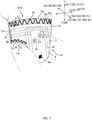
- FIG. 1 is a perspective image view of a diaper 1 according to a first embodiment
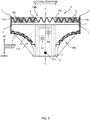
- FIG. 2A is a schematic front view when the diaper 1 in a stretched state is seen from an abdominal side
- FIG. 2B is an A-A cross-sectional view of FIG. 2A
- the diaper 1 includes a "lengthwise direction", a "lateral direction” intersecting with the lengthwise direction, and a "thickness direction” intersecting with the lengthwise direction and the lateral direction.
- the "thickness direction” is also a front-rear direction when the diaper 1 is worn, and includes an “abdominal side” and a “back side”.
- a line C-C of FIG. 2A shows a center in the lateral direction.
- the "stretched state” is a state in which the diaper 1 is stretched until it is free from wrinkles, and specifically, is a state in which a member (for example, an outer sheet 5) constituting the diaper 1 is stretched until the dimension of the member corresponds to a dimension of its member single body or until the dimension of the member becomes a length close to the member single body.
- the diaper 1 includes an outer sheet 5 (also referred to as an "exterior sheet") positioned in a non-skin side of the wearer, and an inner sheet 7 overlapped on and joined to the outer sheet 5 from a skin side of the wearer in the thickness direction.
- the diaper 1 also includes a liquid-absorbent absorbent main body 3 that is overlapped on and joined to the inner sheet 7 from the skin side and absorbs excreta such as urine.
- the outer sheet 5 and the inner sheet 7 are made of nonwoven fabric, for example.
- the outer sheet 5 is configured so that an upper end part 10e thereof is folded to the skin side to cover an end region in the lengthwise direction of the absorbent main body 3.
- an exterior member 10 is also referred to as an exterior member 10.
- the exterior member 10 forms an exterior shape of the diaper 1 in an opened state and has a substantially hourglass planar shape in plan view (not shown).
- the exterior member 10 is folded in two from the opened state by using a substantially center position in the lengthwise direction as a folding position, and end portions 10s, 10s in the lateral direction are formed by joining end portions of an abdominal side 10A in the lateral direction and end portions of a back side 10C in the lateral direction of the exterior member 10, thus forming a pull-on diaper 1 having a waist opening portion 1HB and a pair of leg opening portions 1HL.
- the absorbent main body 3 has a substantially rectangular shape in plan view, and its longitudinal direction is placed at a center in the lateral direction from the abdominal side 10A to the back side 10C.
- the absorbent main body 3 includes an absorbent body 3d that absorbs liquid to hold it, a liquid-permeable surface sheet 3s that covers the absorbent body 3d from the skin side and allows excreta such as urine to be permeated, and a liquid-impermeable back face sheet 3b that covers the absorbent body 3d from the non-skin side and prevents liquid from leaking from the non-skin side.
- the absorbent body 3d is formed by shaping liquid absorbent fibers such as pulp fibers into a predetermined shape such as a substantially rectangular parallelepiped, and includes superabsorbent polymers therein. Further, barrier cuff portions that prevent lateral leakage may be provided in respective edges of the absorbent main body 3 in the lateral direction.
- a two-dimensional bar code mark 6m that specifies the type of disposable diaper is printed on the outer sheet 5 positioned so as to overlap with the absorbent main body 3.
- This mark 6m is printed by causing ink drops to be ejected from a printer such as a common ink-jet printer to the outer sheet 5 side and causing the ink to land in the exterior member 10.
- a leak-proof sheet 6 that is smaller than the absorbent main body 3 and larger than the absorbent body 3d is disposed between the outer sheet 5 and the inner sheet 7 at the center of the diaper 1 in the lateral direction.
- the leak-proof sheet 6 is a liquid-impermeable sheet such as a film, thus enabling prevention of liquid leakage from the absorbent body 3d.
- Picture patterns 6d are printed on the respective non-skin sides of the abdominal side and back side of the leak-proof sheet 6, and such patterns make the impression of the diaper 1 soft and gorgeous.
- the picture patterns 6d of the leak-proof sheet 6 can be visually recognized through the outer sheet 5.
- the picture patterns 6d look slightly lighter in appearance than an after-mentioned waist pattern 4b and leg-surrounding patterns 4L, so that the picture patterns each having an impression that the outline became soft can be visually recognized.
- the wearing state of the diaper is evaluated, it becomes easy to distinguish the picture patterns 6d from the waist pattern 4b and the leg-surrounding patterns 4L.
- Elastic members 8 imparting elasticity to the diaper 1 are disposed at appropriated positions of the exterior member 10. As illustrated in FIG. 2A and FIG. 2B , elastic members (elastic strings) 8B, 8F and 8L are disposed so as to be interposed between the outer sheet 5 and the inner sheet 7. Regions in which each elastic member 8B, 8F, 8L are disposed constitute elastic regions B, F, L, respectively.
- a plurality of waist elastic members 8B, 8B are provided along the lateral direction, respectively.
- a part of the regions of the waist elastic members 8B, 8B is bonded and fixed to the outer sheet 5 and the inner sheet 7 while being stretched in the lateral direction to form a waist elastic region B imparting elasticity to the waist opening portion 1HB. This allows the diaper 1 to be fitted to the waist of the wearer and reduces a possibility of slip-down.
- FIG. 3 is a diagram illustrating the waist pattern 4B and leg-surrounding patterns 4L of the diaper 1.
- FIG. 3 is an image view that has omitted the elastic members 8 or the like, and illustrates after-mentioned regions X, Y, Z with solid lines even though they are virtual regions.
- the waist pattern 4B is printed by causing ink drops to be ejected from a printer such as a common ink-jet printer to the outer sheet 5 side and causing the ink to land in the exterior member 10.
- the waist pattern 4B is preferably printed on the outer side of the absorbent body 3d in the lateral direction of the diaper 1, and is more preferably printed on the outer side of the absorbent main body 3.
- the waist pattern 4B is preferably provided in a region X (a first part) shown in FIG. 3 (a part hatched with right-downward oblique lines shown in FIG. 3 ).
- the waist pattern 4B is preferably printed on the upper side of the absorbent body 3d in the lengthwise direction, and is more preferably printed on the upper side of the absorbent main body 3.
- the waist pattern 4B is preferably provided in a region Y (a second part) in FIG. 3 (a rectangle area surrounded by lower-case letters y in FIG. 3 ). Accordingly, the waist pattern 4B is disposed in a part in which elasticity of the elastic members 8 are not limited by the absorbent body 3d, thus enabling a more precise evaluation of the degree of deformation of the elastic members.
- a plurality of lower-waist elastic members 8F, 8F is provided along the lateral direction respectively, also in the lower side of the waist elastic region B in the lengthwise direction.
- a part of the lower-waist elastic members 8F, 8F is bonded and fixed to the outer sheet 5 and the inner sheet 7 while being stretched in the lateral direction to form a lower-waist elastic region F that imparts elasticity in the lateral direction to a region between the waist opening part 1HB and a lower part in the lengthwise direction.
- leg-surrounding elastic members 8L, 8L is provided at edge portions 10eL, 10eL that form the leg opening portions 1HL in edge portions of the exterior member 10, respectively.
- a part of the leg-surrounding elastic members 8L, 8L is bonded and fixed to the outer sheet 5 and the inner sheet 7 while being stretched along the edge portions 10eL, 10eL to form leg-surrounding elastic regions L that impart elasticity to the leg opening portions 1HL, 1HL. This can prevent the occurrence of a problem such as leakage of excreta to the outside of the diaper 1 from a clearance between the legs of a wearer and the leg opening portions 1HL.
- a leg-surrounding pattern 4L that is a wavy pattern alternatively curved upward and downward is printed in the same manner as the waist elastic region B.
- This leg-surrounding pattern 4L is preferably printed on an upper part of the leg opening portions 1HL in the abdominal side 10A or the back side 10C, and is preferably provided in a region Z (a third part) shown in FIG. 3 (a part hatched with left-downward oblique lines shown in FIG. 3 ).
- the leg-surrounding pattern 4L can be more easily visually recognized by providing it in the region Z.
- a caregiver or the like evaluates a wearing state of the diaper 1 of a wearer (infant) using a terminal 110.
- a method of evaluating whether the type of diaper in the wearing state has been appropriately chosen, especially about sizes, by using the waist pattern 4B printed on the diaper 1 will be described.
- the waist elastic members 8B in the diaper 1 properly fit the waist.
- the waist elastic members 8B may tightly fit the waist too much or the fitting to the waist may be insufficient.
- FIG. 4 is a diagram illustrating an overall configuration example of an evaluation system 100 of a wearing state of a diaper.
- the terminal 110 is, for example, a smartphone or a tablet terminal including a photographing function such as a camera, which can communicate with a server 102 through a wire or wireless network 103.
- the evaluation system 100 of the wearing state of the diaper sends an image of the wearer wearing the diaper 1, which has been acquired by the terminal 110, to the server 102 through the network 103, and the server 102 that performs an evaluation process as an evaluation unit sends an evaluation result to the terminal 110 to display it on the screen of the terminal 110.
- the evaluation method of the wearing state of the diaper will be described in detail below.
- FIG. 5 is a diagram illustrating a flow of an evaluation method of a wearing state of a diaper in the present embodiment.
- the user of the terminal 110 photographs the diaper 1 worn by the wearer including the waist pattern 4B and the leg-surrounding patterns 4L from the side by using a camera (not shown) of the terminal 110 at the timing when the diaper of the wearer is exchanged with new one (S11, evaluation image acquiring process).
- the waist pattern 4B and the leg-surrounding patterns 4L are preferably photographed from the side of the diaper 1. Specifically, the region X and the region Z on one side in the lateral direction of the diaper 1 shown in FIG. 3 are photographed.
- the evaluation of the wearing state of the diaper in the present embodiment is performed by evaluating the tightening condition of the waist elastic members 8B. However, if the elasticity of the elastic members 8 is limited by the absorbent body 3d and the absorbent main body 3, it becomes difficult to correctly evaluate the wearing state. Thus, in order to evaluate the degree of deformation of the elastic members 8 more precisely, it is preferable to photograph the diaper 1 from the side.
- the distance in the photographed image differs from the actual distances (P, T) of the diaper 1.
- a distance on the image between the one vertex and the other vertex adjacent to the one vertex in the lateral direction on the upper side of the waveform of the waist pattern 4B is referred to as "r”
- a distance in the lengthwise direction on the image between the upper vertex and the lower vertex of the waveform is referred to as "t”.
- the distance on the image can be determined by multiplying the size of one pixel by the number of pixels.
- the mark 6m of the diaper 1 is photographed from the abdominal (front) side of the diaper 1 by using the camera of the terminal 110 (S12, mark image acquiring process).
- S12 mark image acquiring process
- the image of the diaper 1 in the wearing state including the waist pattern 4B and the leg-surrounding pattern 4L and the image of the diaper 1 in the wearing state including the mark 6m are sent to the server 102 through the network 103 (S13), and the server 102 receives these images (S14).
- the server 102 evaluates the wearing state of the diaper 1 based on a pattern image as an evaluation image included in the image of the diaper 1 in the wearing state including the waist pattern 4B and the leg-surrounding pattern 4L, and a mark image as an evaluation image included in the image of the diaper 1 in the wearing state including the mark 6m (S15, evaluation process). This evaluation will be described later in detail.
- the server 102 sends an evaluation result to the terminal 110 (S16), and the terminal 110 receives the sent evaluation result (S17).
- the terminal 110 displays the received evaluation result on the screen of the terminal 110 (S18), so that the user of the terminal 110 can know the evaluation of the wearing state of the diaper 1 of the wearer by seeing the screen of the terminal 110.
- FIG. 6 is a diagram illustrating a flow of the evaluation method of the wearing state in the server 102.
- an evaluation method using the pattern image of the waist pattern 4b out of the pattern images (evaluation images) will be described.
- the server 102 uses the received mark image to specify the type of diaper (S151).
- the type of diaper refers to a size specified with respect to a specific product name, such as an M size of a "product A", in which the product A is a product name.
- a description follows regarding the evaluation method of the wearing state in a case in which the diaper 1 is an M size of the product A as an example.
- FIG. 7 is a diagram illustrating data of the distance Ps between the characteristic points s-s of the waist pattern in the maximum stretched state that responds to the type of diaper.
- FIG. 8A is a diagram illustrating the distance Ps between the characteristic points s-s in the maximum stretched state.
- the maximum stretched state refers to a stretched state where each type of diapers is stretched until wrinkles disappear.
- a distance between one characteristic point s of the upper vertexes of the waveform and another characteristic point s adjacent to the one characteristic point s in the lateral direction is defined as P.
- pattern images (evaluation images), as illustrated in FIG. 8A , of each type of diaper in the maximum stretched state are stored.
- the distance Ps between the characteristic points s-s of the pattern image in this maximum stretched state is an indicator for calculating a degree of deformation of the pattern image described below.
- the Ps in the maximum stretched state is b [cm].
- the distance in the lengthwise direction from the upper vertex to the lower vertex of the waveform of the pattern image in the maximum stretched state is Ts.
- the distance Ps and the distance Ts are actual distance data.
- the distance P between the characteristic points s-s of the diaper 1 in the wearing state is specified by using the received pattern image (S153)
- the distance P between the characteristic points s-s is calculated by using the distance t on the image and the distance Ts in the lengthwise direction in the maximum stretched state.
- the waist elastic members 8B are elastic strings having elasticity in the lateral direction and low elasticity in the lengthwise direction, thus allowing the waist elastic members 8B to be used for comparing the actual distance with the distance on the image.
- FIG. 8B is a diagram illustrating the distance P between the characteristic points s-s in the stretched state of 81%. As illustrated in FIG. 8B , when the ratio R is 81%, the elastic members 8 are stretched too much, and the waist of the wearer may be excessively tightened. Thus, it is evaluated that the diaper 1 is "too small” for the wearer.
- FIG. 8C is a diagram illustrating the distance P between the characteristic points s-s in the stretched state of 75%. As illustrated in FIG. 8C , when the ratio R is 75%, the elastic members 8 are moderately stretched, and thus, it is evaluated that the diaper 1 is "appropriate” for the wearer.
- FIG. 8D is a diagram illustrating the distance P between the characteristic points s-s in the stretched state of 69%. As illustrated in FIG. 8D , when the ratio R is 69%, the tightening around the waist due to the elastic members 8 is insufficient. Accordingly, the diaper 1 may not appropriately fit the waist of the wearer. Thus, it is evaluated that the diaper 1 is "too big" for the wearer.
- the server 102 sends any one of "too small” (S155y), “appropriate” (S156y), or “too big” (S157) to the terminal 110 as an evaluation result (S16), and thus the user of the terminal 110 can easily know whether the size of the diaper 1 is suitable or not for the wearer.
- the server 102 may receive a plurality of pattern images and make an evaluation from an average value of respective calculated results.
- the size of the waist remarkably changes before and after the meal, and accordingly, if only the results immediately after exchanging the diaper are used, a bias may occur.
- the evaluation may be made by using an average value of respective stretch ratios of the pattern image immediately after the meal and the pattern image after one hour has passed since the meal.
- the evaluation may be made by an average value of the calculated results using the pattern images at predetermined time intervals such as not only a meal time, but also at the time of exchanging the diaper, one hour after the diaper exchange or the like. Accordingly, the wearing state of the diaper can be evaluated more precisely.
- an elapsed time since the wearer had a meal is inputted into the terminal 110 by using a predetermined program or the like, and the input results are sent to the server 102, so that the server 102 may correct the changes in the size of the waist due to meals. This can reduce influence caused by changes in the waist portion due to meals.
- the waist pattern image has been described as an evaluation image in the above.
- the waist elastic region is a part where the degree of elasticity most largely changes in the diaper 1
- the wearing state of the diaper can be evaluated more precisely by using the waist pattern 4B to evaluate the wearing state.
- the wearing state is evaluated by the degree of elasticity of the leg-surrounding pattern 4L, thus enabling the evaluation of the wearing state without being affected by changes in waist due to meals or the like. Accordingly, the evaluation may be made by using only either one of the waist pattern 4B or the leg-surrounding pattern 4L, or, the evaluation may be made by using both the waist pattern 4B and the leg-surrounding pattern 4L. Even more accurate evaluation of the wearing state can be made by using both of them.
- the waist pattern 4B is preferably formed by repeating a predetermined design three times or more along the lateral direction.
- the waist pattern 4B of the present embodiment is a wavy pattern curving in an up-down direction, and is formed by repeating a design three times or more along the lateral direction, the design being made of a curved line provided between the characteristic point s that is an upper vertex and the characteristic point s that is an upper vertex adjacent to the prior characteristic point s in the lateral direction as shown in FIG. 2A or the like.
- This can acquire the distance P between the characteristic points s-s at two or more points, and the determination of the average value of these two or more P values can result in an acquisition of the more precise degree of deformation of the elastic member.
- the leg-surrounding pattern 4L is also preferably formed by repeating a predetermined design three times or more.
- the waist pattern 4B and the leg-surrounding pattern 4L are preferably formed by repeating a larger design than the maximum pitch of wrinkles formed in the exterior member 10 due to the elastic members 8. This can reduce the possibility that the design is hidden by wrinkles formed in the exterior member 10, and evaluate the wearing state of the diaper more easily and precisely.
- the waist pattern 4B and the leg-surrounding pattern 4L each preferably have a predetermined length not only in the lateral direction but also in the lengthwise direction.
- differences in the degree of elasticity between the elastic members 8 in the lengthwise direction can be corrected. For example, the average values of the distance between the upper vertexes and the distance between the lower vertexes are calculated, and then these average values may be compared with the foregoing distance Ps.
- the shape of the waist of an infant is rounded when seen from the lateral direction, and thus a part in which the elastic members 8 stretch too much and a part in which the elastic members 8 does not stretch may occur even in the up-down direction in the waist elastic region B.
- the waist pattern 4B and the leg-surrounding pattern 4L each having a predetermined length also in the lengthwise direction, a bias in the degree of elasticity in the lengthwise direction is taken into consideration, and thus the wearing state of the diaper can be evaluated more precisely.
- each design is not necessarily continuous. Each design may be repeated at predetermined intervals.
- FIG. 9A, FIG. 9B and FIG. 9C illustrate another example of the waist pattern 4B.
- FIG. 9A is a diagram illustrating a waist pattern made of a plurality of circular designs
- FIG. 9B is a diagram illustrating a waist pattern made of a plurality of square-shaped designs
- FIG. 9C is a diagram illustrating a waist pattern made of a plurality of rhombus-shaped designs.
- the diaper 1 is in a stretched state of 75% with respect to the maximum stretched state. The diaper 1 becomes the most appropriate wearing state when the diaper 1 is in the stretched state of 75%.
- each design has a shape symmetric with respect to the lengthwise direction and the lateral direction in the 75% contracted state. That is, in the stretched state of 75%, the design in FIG. 9A becomes a perfect circle, the design in FIG. 9B becomes a square, and the design in FIG.
- FIG. 10 is an image view of the diaper 2 according to the second embodiment.
- the diaper 2 includes a longitudinal direction, a lateral direction, and a thickness direction that are orthogonal to one another, and includes a front waist region 2a covering the abdominal side portion of the wearer, a back waist region 2c covering the back side portion, and a crotch region 2b positioned between the front waist region 2a and the back waist regions 2c.
- the diaper 2 includes an absorbent main body between a liquid-permeable inner sheet and a liquid-impermeable outer sheet.
- the absorbent main body is disposed from the front waist region 2a to the back waist region 2c in the longitudinal direction, and includes an absorbent body that absorbs and holds excreta, and a liquid-permeable covering material that covers the absorbent body.
- a plurality of elastic strings (not shown) extensible in the lateral direction are provided in the back waist region 1c to improve a fitting property around the waist, and the region in which the elastic strings are provided is referred to as a back waist elastic region.
- a back waist pattern 24 that is a wavy pattern curving upward and downward alternatively is printed on the most non-skin side of the back waist region 2c over the entire region from one end to the other end of the back waist region 2c in the lateral direction.
- the back waist pattern 24 is used for evaluating the wearing state of the diaper 2.
- the back waist pattern 24 is printed on the non-skin side of the exterior member using a printer such as an inkjet printer, in the same manner as the waist pattern 4B and the leg-surrounding pattern 4L in the first embodiment.
- a mark 26m such as a two-dimensional bar code that specifies the type of the disposable diaper is printed in the same manner as the first embodiment.
- This mark 26m is preferably printed on a part in which the elastic members are not placed in the crotch region 2b so as to be more accurately read.
- a pair of fastening tapes 20 extending to both outer sides in the lateral direction is provided.
- a target region 22 having a rectangular planar shape is provided, and the fastening tapes 20 is configured to be capable of being fastened to and detached from the target region 22.
- the diaper 2 When the diaper 2 is worn, the diaper 2 is first folded in two in the longitudinal direction while being brought into contact with the wearer, and then a pair of fastening tapes 20 and its peripheral portions are folded toward the center side in the width direction to fasten the pair of fastening tapes 20 to the target region 22 in the front waist region 2a. Accordingly, as illustrated in FIG. 10 , the waist opening portion 2HB and a pair of leg opening portions 2HL are formed. It should be noted that the diaper 2 may also include a barrier cuff (not shown) or the like, appropriately.
- An evaluation method of a wearing state of the diaper 2 evaluates a wearing state of the diaper 2 worn by an infant who is a wearer by using the terminal 110 possessed by a caregiver or the like of the wearer in the same manner as the first embodiment.
- it is evaluated whether the diaper 2 has been worn at a proper position, and whether the size of the diaper 2 is appropriate.
- the elements in common with those in the first embodiment will be denoted by the same reference numerals.
- the diaper 2 in the wearing state including the back waist pattern 24 is photographed by using a camera of the terminal 110 in the same manner as the first embodiment.
- Infants wearing tape-type disposable diapers such as the diaper 2 are often in a sleeping state, and thus photographing the back side portion of the diaper may be difficult. Accordingly, photographing the diaper from the side, which can be photographed even when the wearer sleeps, is preferable.
- the diaper 2 including target tapes 20, the target region 22 and the mark 26m is photographed from the abdominal side (front side) by using the camera of the terminal 110. At this time, not only the mark 26m but also the target tapes and the target region 22 are photographed simultaneously. This can save time and reduce the amount of information to be sent to the server 102.
- the terminal 110 sends, through the network 103, an image of the diaper 2 in the wearing state including the back waist pattern 24, and an image of the diaper 2 including the target tapes 20, the target region 22 and the mark 26m, and then the server 102 receives them.
- the server 102 evaluates the wearing state of the diaper 2 based on a pattern image included in the image of the diaper 2 in the wearing state including the back waist pattern 24, a tape position image and a mark image included in an image of the diaper 2 including the target tapes 20, the target region 22 and the mark 26m.
- the server 102 firstly specifies the type of diaper by using the mark image in the same manner as the first embodiment.
- the diaper 2 is opened to specify a length T that is a length from the lateral end of the target tape 20 on one side to the lateral end of the target tape 20 on the other side in the lateral direction in the stretched state.
- a description follows regarding a case in which the diaper 2 is a product E having an M size and a length T of k [cm] as an example.
- a distance Ps2 between the characteristic points in the back waist pattern image in the maximum stretched state of the product E having an M size is specified in the same manner as the first embodiment.
- This distance Ps2 is a specified reference value obtained by specifying the type of diaper, and is a distance between the characteristic points s-s in the back waist pattern image in the maximum stretched state.
- a distance S from the lateral end of one fastening tape 20 to the lateral end of another fastening tape 20 is specified by using the received tape position image, each fastening tape being fastened in the target region 22 of the diaper 2 in the wearing state.
- This distance S becomes a value within a predetermined range (h ⁇ S ⁇ j, h and j being positive numbers) when the diaper 2 is appropriately worn.
- it is evaluated whether the size of the diaper 2 is appropriate or not, and whether the fastening tapes 20 are fastened at correct positions or not by using the stretch ratio R and the distance S.
- the stretch ratio R is 75% and the distance S between the fastening tapes 20 satisfies h ⁇ S ⁇ j, it is evaluated that the wearing state of the diaper 2 is "appropriate".
- the fastening positions of the fastening tapes 20 may be incorrect because the distance S is large despite improper stretch of the elastic members.
- the evaluation of the wearing state of the diaper 2 in such a case is that "the tapes should be fixed more inward".
- the evaluation of the wearing state of the diaper 2 is that "the diaper 2 is too small", because the elastic members are excessively stretched although the tapes are appropriately positioned.
- the evaluation of the type of diaper and the evaluation of the wearing method in the diaper 2 can be made based on the relationship between the stretch ratio R and the distance S. Consequently, the user of the terminal 110 can allow infants to wear the diaper more appropriately by using this evaluation method even if the wearing state of the diaper cannot be decided.
- the mark 6m and the mark 26m that are two-dimensional bar codes for specifying the type of disposable diaper are printed.
- the present disclosure is not limited thereto.
- the mark is not limited to the two-dimensional bar code, and other identifiers such as a usual linear bar code may be utilized.
- the mark 6m may be used as size notation of diaper.
- the mark 6m may be used as size notation of diaper.
- blue color may specify the product
- "M” may specify the size. Accordingly, a type for specifying the type of diaper is not required to be provided separately. This can reduce the number of operations and realize an easier evaluation.
- the type of disposable diaper may be specified by using evaluation images such as the waist pattern 4B and the leg-surrounding pattern 4L, which include information for specifying the type of disposable diaper in advance. For example, the shape of pattern or the color of pattern may be changed for each type of diaper. Accordingly, identifiers for specifying the type of diaper are not required to be provided separately. This can reduce the number of operations and realize an easier evaluation.
- the specification of the type of disposable diaper may be performed by a direct input to the terminal 110 by a user of the terminal 110, or by displaying a selection screen on the terminal 110 to allow the user to select the type.
- the waist pattern 4B and the leg-surrounding pattern 4L are printed by using a printer such as an inkjet printer.
- a printer such as an inkjet printer.
- the present disclosure is not limited thereto. Printing methods such as offset printing and flexographic printing may be used appropriately.
- FIG. 9D is a diagram in a case where a part of the waist elastic members 8B is colored. As illustrated in FIG. 9D , a part of the elastic members 8 may be colored, and the colored part of the elastic members 8 may be photographed as an evaluation target.
- the elastic strings are used for the elastic members 8, elastic films, elastic nonwoven fabric or the like may also be used. A part of or all of the elastic films or the elastic nonwoven fabric may be colored and photographed so that a pattern image (evaluation image) can be formed. Accordingly, the degree of deformation of the elastic members can be directly evaluated.
- the pattern to be an object of photographing for an evaluation image is provided by printing the waist pattern 4B (leg-surrounding pattern 4L)on the waist portion (leg-surrounding portions) of the diaper 1.
- pattern image is provided by printing the waist pattern 4B (leg-surrounding pattern 4L)on the waist portion (leg-surrounding portions) of the diaper 1.
- An image in which at least a part of the picture pattern 6d printed on the leak-proof sheet 6 is photographed maybe used as an evaluation image. This can evaluate the wearing state of the diaper without newly printing a pattern for evaluation on the diaper 1.
- the distance P in the lateral direction from one vertex to another vertex of the actual wavy waist pattern 4B is calculated by using the distance T from the upper vertex to the lower vertex of the waveform of the waist pattern 4B, and the distance t on the image.
- the distance on the image and the actual distance may be compared by using one except the pattern such as the waist pattern 4B.
- an actual distance U in the lengthwise direction from an upper end to a lower end of one of flower patters that are picture patterns 6d and a distance u on the image in the lengthwise direction from an upper end to a lower end of one of flower patters that are picture patterns 6d in FIG. 2A may be used for calculation. Accordingly, when the actual distance and the distance on the image are compared by using the part except the pattern used for evaluating the degree of elasticity, the pattern used for evaluating the degree of elasticity does not necessarily have a length in the lengthwise direction.
- the pattern image was acquired by photographing the diaper worn by the wearer as a still image.
- the present disclosure is not limited thereto.
- the diaper worn by the wearer is photographed as a moving image, and the server 102 may extract the pattern image from the moving image to evaluate it. If the subject moves a lot like infants, it may be difficult to acquire still images. Thus, the wearing state can be more easily evaluated by making moving images.
- the terminal 110 and the server 102 are communicated via the network 103, the server 102 performs each processing and data management as an evaluation unit, and the terminal 110 serves as a display, so that the terminal 110 and the server 102 are combined as a computer system.
- the present disclosure is not limited thereto.
- the terminal 110 and the server 102 may share processing and data management, respectively.
- the terminal 110 may perform all processing and data management as a computer system.
- the foregoing embodiment can be achieved in such a manner in which the program causes the computer system including a microprocessor to execute the above-mentioned various processing.
- all processing may be prepared as a program, or a part of processing may be processed by hardware and the remaining processing may be prepared as a program.
- non-transitory computer readable medium storing an executable program thereon.
- the non-transitory computer readable medium include magnetic recording media (such as flexible disks, magnetic tapes, and hard disk drives), CD-ROM (Read Only Memory) or the like.
- the target wearers of the diaper 1 according to the foregoing embodiment are infants. However, the present disclosure is not limited thereto. The target wearers may be adults.
Landscapes
- Health & Medical Sciences (AREA)
- Engineering & Computer Science (AREA)
- General Health & Medical Sciences (AREA)
- Public Health (AREA)
- Heart & Thoracic Surgery (AREA)
- Vascular Medicine (AREA)
- Life Sciences & Earth Sciences (AREA)
- Animal Behavior & Ethology (AREA)
- Epidemiology (AREA)
- Biomedical Technology (AREA)
- Veterinary Medicine (AREA)
- Physics & Mathematics (AREA)
- Geometry (AREA)
- Computer Vision & Pattern Recognition (AREA)
- General Physics & Mathematics (AREA)
- Theoretical Computer Science (AREA)
- Absorbent Articles And Supports Therefor (AREA)
- Orthopedics, Nursing, And Contraception (AREA)
Abstract

Description
- The present disclosure relates to an evaluation method of a wearing state of a disposable diaper, an evaluation system of a wearing state of a disposable diaper, and a non-transitory computer-readable storage medium with a program for evaluating a wearing state of a disposable diaper.
- Disposable diapers are conventionally known as absorbent articles that absorb excreta such as urine. When these disposable diapers are used, a size adapted to the size of the body is selected to be fitted to the body with elastic members.
PTL 1 describes a method of recognizing the degree of elasticity by visually specifying the degree of change of a display object (a picture of a rabbit) 9 incorporated in elastic members 8. - [PTL 1] Japanese Unexamined Patent Application Publication No.
2005-111175 - However, in a
disposable diaper 20 shown inPTL 1, since the degree of change of the display object 9 is visually observed, which means that the degree of elasticity is sensuously determined, there is a possibility that it may be difficult to determine whether the degree of elasticity of the elastic members 8 is appropriate or not. - The present disclosure has been made in view of the above circumstances and an objective thereof is to more precisely understand a wearing state of a disposable diaper.
- A principal aspect of the present disclosure to achieve the above advantage is
an evaluation method of a wearing state of a disposable diaper including an elastic region in a waist portion or leg-surrounding portions, the evaluation method including: an evaluation image acquiring process in which a terminal including a photographing function acquires an image including at least a part of the elastic region as an evaluation image in the wearing state of the disposable diaper; and an evaluation process of evaluating the wearing state of the disposable diaper based on a degree of deformation of the evaluation image. - Other features of the present disclosure will be made clear through the present specification with reference to the accompanying drawings present disclosure.
- According to the present disclosure, the wearing state of the diaper can be more precisely based on the degree of deformation of at least a part of the elastic region.
-
- [
FIG. 1] FIG. 1 is a perspective image view of adiaper 1 according to a first embodiment. - [
FIG. 2] FIG. 2A is a schematic front view when thediaper 1 being in a stretched state is seen from an abdominal side.FIG. 2B is a A-A cross-sectional view ofFIG. 2A . - [
FIG. 3] FIG. 3 is a diagram illustrating awaist pattern 4B and leg-surroundingpatterns 4L of thediaper 1. - [
FIG. 4] FIG. 4 is a diagram illustrating an overall configuration example of anevaluation system 100 of a wearing state of a diaper. - [
FIG. 5] FIG. 5 is a diagram illustrating a flow of an evaluation method of a wearing state of a diaper in a present embodiment. - [
FIG. 6] FIG. 6 is a diagram illustrating a flow of an evaluation method of a wearing state in aserver 102. - [
FIG. 7] FIG. 7 is a diagram illustrating data of a distance Ps between characteristic points s-s of a waist pattern in a maximum stretched state corresponding to each type of diaper. - [
FIG. 8] FIG. 8A is a diagram illustrating a distance Ps between characteristic points s-s in a maximum stretched state.FIG. 8B is a diagram illustrating a distance P between the characteristic points s-s in the stretched state of 81%.FIG. 8C is a diagram illustrating a distance P between the characteristic points s-s in the stretched state of 75%.FIG. 8D is a diagram illustrating a distance P between the characteristic points s-s in the stretched state of 69%. - [
FIG. 9] FIG. 9A is a diagram illustrating a waist pattern made of a plurality of circular designs.FIG. 9B is a diagram illustrating a waist pattern made of a plurality of square-shaped designs.FIG. 9C is a diagram illustrating a waist pattern made of a plurality of rhombus-shaped designs.FIG. 9D is a diagram in a case where a part of waistelastic members 8B is colored. - [
FIG. 10] FIG. 10 is an image view of adiaper 2 according to a second embodiment. - At least the following matters will be made clear by the description in the present specification and the accompanying drawings.
- Disclosed is an evaluation method of a wearing state of a disposable diaper including an elastic region in a waist portion or leg-surrounding portions, the evaluation method including: an evaluation image acquiring process in which a terminal including a photographing function acquires an image including at least a part of the elastic region as an evaluation image in the wearing state of the disposable diaper; and an evaluation process of evaluating the wearing state of the disposable diaper based on a degree of deformation of the evaluation image.
- According to such an evaluation method of a wearing state of a disposable diaper, the wearing state of the diaper can be understood more precisely based on the degree of deformation of at least a part of the elastic region.
- In this evaluation method of a wearing state of a disposable diaper, it is preferable that a pattern is provided in at least a part of the elastic region, and the terminal acquires an image including at least a part of the pattern as the evaluation image in the evaluation image acquiring process.
- According to such an evaluation method of a wearing state of a disposable diaper, the wearing state of the diaper can be understood more precisely based on the degree of deformation of a pattern provided in at least a part of the elastic region.
- In this evaluation method of a wearing state of a disposable diaper, it is preferable that the disposable diaper includes a lengthwise direction and a lateral direction intersecting with the lengthwise direction, and the pattern is formed by repeating a predetermined design three times or more along the lateral direction.
- According to such an evaluation method of a wearing state of a disposable diaper, for example, an average value of degrees of deformation of a plurality of evaluation images can be evaluated, and a part in which the evaluation image is easily acquired can also be increased, thus enabling the more precise understanding of the wearing state of the diaper.
- In this evaluation method of a wearing state of a disposable diaper, it is preferable that the pattern is formed by repeating the predetermined design at a predetermined pitch, and the predetermined pitch is larger than a maximum pitch of wrinkles that are formed in the elastic region in a state in which the elastic region is contracted by a predetermined ratio with respect to a maximum stretched state.
- According to such an evaluation method of a wearing state of a disposable diaper, the possibility that the pattern is hidden by wrinkles can be reduced.
- In this evaluation method of a wearing state of a disposable diaper, it is preferable that elastic members are provided in the elastic region, and the pattern includes a plurality of colored portions provided in the elastic members.
- According to such an evaluation method of a wearing state of a disposable diaper, it is possible to directly evaluate the degree of deformation of the elastic members.
- In this evaluation method of a wearing state of a disposable diaper, it is preferable that the pattern has a predetermined length in the lengthwise direction of the disposable diaper.
- According to such an evaluation method of a wearing state of a disposable diaper, since the size of the waist of the wearer is not necessarily constant, a pattern having a predetermined length in the lengthwise direction is provided, and thus the wearing state of the diaper can be more precisely understood.
- In this evaluation method of a wearing state of a disposable diaper, it is preferable that the pattern including a first part that is disposed outside an absorbent body in the lateral direction of the disposable diaper, and the image including the first part as the evaluation image is acquired in the evaluation image acquiring process.
- According to such an evaluation method of a wearing state of a disposable diaper, the degree of deformation of the elastic members can be more precisely evaluated.
- In this evaluation method of a wearing state of a disposable diaper, it is preferable that the pattern including a second part that is disposed on an upper side of an absorbent body in the lengthwise direction of the disposable diaper, and the image including the second part as the evaluation image is acquired in the evaluation image acquiring process.
- According to such an evaluation method of a wearing state of a disposable diaper, the degree of deformation of the elastic members can be more precisely evaluated.
- In this evaluation method of a wearing state of a disposable diaper, it is preferable that the pattern including a third part that is disposed in each of upper portions of leg opening portions of the disposable diaper in the lengthwise direction of the disposable diaper, and the image including the third part as the evaluation image is acquired in the evaluation image acquiring process.
- According to such an evaluation method of a wearing state of a disposable diaper, the possibility that the pattern is hidden by the legs of the wearer can be reduced.
- In this evaluation method of a wearing state of a disposable diaper, it is preferable that the pattern includes a predetermined design, the predetermined design has a shape symmetric with respect to the lengthwise direction and the lateral direction of the disposable diaper in a state in which the elastic region is contracted by a predetermined ratio with respect to a maximum stretched state.
- According to such an evaluation method of a wearing state of a disposable diaper, the wearing state of the disposable diaper is easily evaluated even by visually recognizing a predetermined design.
- In this evaluation method of a wearing state of a disposable diaper, it is preferable that a picture pattern that can be visibly recognized through an exterior sheet is provided in a leak-proof sheet provided on a skin side of the exterior sheet disposed on the most non-skin side of the disposable diaper, and an image including at least a part of the picture pattern as the evaluation image is acquired in the evaluation image acquiring process.
- According to such an evaluation method of a wearing state of a disposable diaper, the wearing state can be evaluated by using a picture pattern used for design.
- In this evaluation method of a wearing state of a disposable diaper, it is preferable that the pattern is provided on an exterior sheet disposed on the most non-skin side of the disposable diaper, and a picture pattern that can be visibly recognized through the exterior sheet is provided on a leak-proof sheet provided on a skin side of the exterior sheet.
- According to such an evaluation method of a wearing state of a disposable diaper, the pattern for evaluating the wearing state is easily distinguished from the picture pattern used for design.
- In this evaluation method of a wearing state of a disposable diaper, it is preferable that, in the evaluation image acquiring process, another image including at least a part of the elastic region as another evaluation image is acquired after the image including the evaluation image is acquired, and a wearing state of the disposable diaper is evaluated based on degrees of deformation of the evaluation image and the other evaluation image.
- According to such an evaluation method of a wearing state of a disposable diaper, for example, an influence due to meals can be reduced, and thus the wearing state can be evaluated more precisely.
- In this evaluation method of a wearing state of a disposable diaper, it is preferable that an elapsed time since the wearer had a meal is acquired, and a wearing state of the disposable diaper is evaluated based on a degree of deformation of the evaluation image and the elapsed time.
- According to such an evaluation method of a wearing state of a disposable diaper, an influence due to meals can be reduced.
- In this evaluation method of a wearing state of a disposable diaper, it is preferable that evaluation information for each type is provided in the disposable diaper, the evaluation information being used for evaluating a wearing state of the disposable diaper for the each type of the disposable diaper, and a degree of deformation of the evaluation image is evaluated using the evaluation information in the evaluation process.
- According to such an evaluation method of a wearing state of a disposable diaper, the evaluation in accordance with the type of disposable diaper in the wearing state is performed, and thus the wearing state of the disposable diaper can be evaluated more precisely.
- In this evaluation method of a wearing state of a disposable diaper, it is preferable that a mark for specifying a type of the disposable diaper is provided in the disposable diaper, the terminal includes a mark image acquiring process that acquires a mark image including the mark, and a degree of deformation of the evaluation image is evaluated in the evaluation process by using the evaluation information corresponding to the type specified by the mark image.
- According to such an evaluation method of a wearing state of a disposable diaper, the disposable diaper in the wearing state can be more easily specified, and thus the wearing state of the disposable diaper can be more precisely evaluated.
- In this evaluation method of a wearing state of a disposable diaper, it is preferable that the pattern includes information for specifying a type of the disposable diaper, and the type of the disposable diaper is specified using the evaluation image.
- According to such an evaluation method of a wearing state of a disposable diaper, the type of disposable diaper can also be specified by using the evaluation image.
- In this evaluation method of a wearing state of a disposable diaper, it is preferable that the disposable diaper includes an absorbent main body, and in a thickness direction, the mark is provided at a position overlapping with the absorbent main body and a position in which an elastic member is not provided.
- According to such an evaluation method of a wearing state of a disposable diaper, the possibility of changes of the shape of the mark due to elasticity of the elastic members can be reduced. Thus, the type of disposable diaper can be more precisely acquired.
- In this evaluation method of a wearing state of a disposable diaper, it is preferable that the disposable diaper includes a lengthwise direction and a lateral direction intersecting with the lengthwise direction, the disposable diaper is an open-type disposable diaper including a first waist portion, a second waist portion and an absorbent main body, a fastening tape is provided in each end portion in the lateral direction in the second waist portion, a target region for allowing the fastening tape to be fastened is provided in the first waist portion, and it is evaluated in the evaluation process whether the fastening tape has been fastened to an appropriate position with respect to the target region based on a degree of deformation of the evaluation image.
- According to such an evaluation method of a wearing state of a disposable diaper, it can be evaluated whether the fastening tapes are fastened at appropriated positions in the target region in an open-type disposable diaper by using the degree of deformation of the evaluation image. Accordingly, the disposable diaper can be worn more appropriately.
- In this evaluation method of a wearing state of a disposable diaper, it is preferable that the disposable diaper includes a lengthwise direction and a lateral direction intersecting with the lengthwise direction, the disposable diaper is an open-type disposable diaper including a first waist portion, a second waist portion and an absorbent main body, a fastening tape is provided in each end portion in the lateral direction in the second waist portion, a target region for allowing the fastening tape to be fastened is provided in the first waist portion, an image including a fastening position of the fastening tape with respect to the target region as a fastening image is acquired, and a wearing state of the disposable diaper is evaluated in the evaluation process based on the fastening position specified by the fastening image and a degree of deformation of the evaluation image.
- According to such an evaluation method of a wearing state of a disposable diaper, the wearing state of the disposable diaper can be appropriately evaluated based on the fastening position and the degree of deformation of the evaluation image.
- An evaluation system of a wearing state of a disposable diaper including an elastic region in a waist portion or leg-surrounding portions, the evaluation system including: a terminal including a photographing function for acquiring an image including at least a part of the elastic region as an evaluation image in the wearing state of the disposable diaper, and an evaluation unit evaluating a wearing state of the disposable diaper based on a degree of deformation of the evaluation image.
- According to such an evaluation system of a wearing state of a disposable diaper, the wearing state of the diaper can be understood more precisely based on the degree of deformation of at least a part of the elastic region.
- A non-transitory computer-readable storage medium with a program for evaluating a wearing state of a disposable diaper including an elastic region in a waist portion or leg-surrounding portions, the program instructing a computer system including a terminal that has at least a photographing function to perform the following processes: a process to acquire an image including at least a part of the elastic region as an evaluation image in the wearing state of the disposable diaper; and a process to evaluate a wearing state of the disposable diaper based on a degree of deformation of the evaluation image.
- According to such a non-transitory computer-readable storage medium with a program for evaluating a wearing state of a disposable diaper, the wearing state of the diaper can be understood more precisely based on the degree of deformation of at least a part of the elastic region.
- A configuration of a pull-on disposable diaper (hereinafter, also referred to as a "
diaper 1") mainly for infants will be firstly described.FIG. 1 is a perspective image view of adiaper 1 according to a first embodiment,FIG. 2A is a schematic front view when thediaper 1 in a stretched state is seen from an abdominal side, andFIG. 2B is an A-A cross-sectional view ofFIG. 2A . As illustrated inFIG. 1 ,FIG. 2A and FIG. 2B , thediaper 1 includes a "lengthwise direction", a "lateral direction" intersecting with the lengthwise direction, and a "thickness direction" intersecting with the lengthwise direction and the lateral direction. The "thickness direction" is also a front-rear direction when thediaper 1 is worn, and includes an "abdominal side" and a "back side". A line C-C ofFIG. 2A shows a center in the lateral direction. It should be noted that the "stretched state" is a state in which thediaper 1 is stretched until it is free from wrinkles, and specifically, is a state in which a member (for example, an outer sheet 5) constituting thediaper 1 is stretched until the dimension of the member corresponds to a dimension of its member single body or until the dimension of the member becomes a length close to the member single body. - The
diaper 1 includes an outer sheet 5 (also referred to as an "exterior sheet") positioned in a non-skin side of the wearer, and aninner sheet 7 overlapped on and joined to theouter sheet 5 from a skin side of the wearer in the thickness direction. Thediaper 1 also includes a liquid-absorbent absorbentmain body 3 that is overlapped on and joined to theinner sheet 7 from the skin side and absorbs excreta such as urine. Theouter sheet 5 and theinner sheet 7 are made of nonwoven fabric, for example. Furthermore, as illustrated inFIG. 2B , theouter sheet 5 is configured so that anupper end part 10e thereof is folded to the skin side to cover an end region in the lengthwise direction of the absorbentmain body 3. Hereinafter, by combining theouter sheet 5 and theinner sheet 7, it is also referred to as anexterior member 10. - The
exterior member 10 forms an exterior shape of thediaper 1 in an opened state and has a substantially hourglass planar shape in plan view (not shown). Theexterior member 10 is folded in two from the opened state by using a substantially center position in the lengthwise direction as a folding position, and endportions abdominal side 10A in the lateral direction and end portions of aback side 10C in the lateral direction of theexterior member 10, thus forming a pull-ondiaper 1 having a waist opening portion 1HB and a pair of leg opening portions 1HL. - The absorbent
main body 3 has a substantially rectangular shape in plan view, and its longitudinal direction is placed at a center in the lateral direction from theabdominal side 10A to theback side 10C. The absorbentmain body 3 includes anabsorbent body 3d that absorbs liquid to hold it, a liquid-permeable surface sheet 3s that covers theabsorbent body 3d from the skin side and allows excreta such as urine to be permeated, and a liquid-impermeableback face sheet 3b that covers theabsorbent body 3d from the non-skin side and prevents liquid from leaking from the non-skin side. Theabsorbent body 3d is formed by shaping liquid absorbent fibers such as pulp fibers into a predetermined shape such as a substantially rectangular parallelepiped, and includes superabsorbent polymers therein. Further, barrier cuff portions that prevent lateral leakage may be provided in respective edges of the absorbentmain body 3 in the lateral direction. - In the
exterior member 10, a two-dimensionalbar code mark 6m that specifies the type of disposable diaper is printed on theouter sheet 5 positioned so as to overlap with the absorbentmain body 3. Thismark 6m is printed by causing ink drops to be ejected from a printer such as a common ink-jet printer to theouter sheet 5 side and causing the ink to land in theexterior member 10. - A leak-
proof sheet 6 that is smaller than the absorbentmain body 3 and larger than theabsorbent body 3d is disposed between theouter sheet 5 and theinner sheet 7 at the center of thediaper 1 in the lateral direction. The leak-proof sheet 6 is a liquid-impermeable sheet such as a film, thus enabling prevention of liquid leakage from theabsorbent body 3d.Picture patterns 6d are printed on the respective non-skin sides of the abdominal side and back side of the leak-proof sheet 6, and such patterns make the impression of thediaper 1 soft and gorgeous. Thepicture patterns 6d of the leak-proof sheet 6 can be visually recognized through theouter sheet 5. Accordingly, thepicture patterns 6d look slightly lighter in appearance than an after-mentioned waist pattern 4b and leg-surroundingpatterns 4L, so that the picture patterns each having an impression that the outline became soft can be visually recognized. Thus, when the wearing state of the diaper is evaluated, it becomes easy to distinguish thepicture patterns 6d from the waist pattern 4b and the leg-surroundingpatterns 4L. - Elastic members 8 imparting elasticity to the
diaper 1 are disposed at appropriated positions of theexterior member 10. As illustrated inFIG. 2A and FIG. 2B , elastic members (elastic strings) 8B, 8F and 8L are disposed so as to be interposed between theouter sheet 5 and theinner sheet 7. Regions in which eachelastic member - In
upper end parts abdominal side 10A and backside 10C), a plurality of waistelastic members elastic members outer sheet 5 and theinner sheet 7 while being stretched in the lateral direction to form a waist elastic region B imparting elasticity to the waist opening portion 1HB. This allows thediaper 1 to be fitted to the waist of the wearer and reduces a possibility of slip-down. - In the waist elastic region B, a
waist pattern 4B is printed over the entire region in the lateral direction of the waist elastic region B, thewaist pattern 4B being a wavy pattern alternately curved on the upper side and the lower side. Thewaist pattern 4B is used for evaluating the wearing state of thediaper 1.FIG. 3 is a diagram illustrating thewaist pattern 4B and leg-surroundingpatterns 4L of thediaper 1.FIG. 3 is an image view that has omitted the elastic members 8 or the like, and illustrates after-mentioned regions X, Y, Z with solid lines even though they are virtual regions. Thewaist pattern 4B is printed by causing ink drops to be ejected from a printer such as a common ink-jet printer to theouter sheet 5 side and causing the ink to land in theexterior member 10. - The
waist pattern 4B is preferably printed on the outer side of theabsorbent body 3d in the lateral direction of thediaper 1, and is more preferably printed on the outer side of the absorbentmain body 3. In other words, thewaist pattern 4B is preferably provided in a region X (a first part) shown inFIG. 3 (a part hatched with right-downward oblique lines shown inFIG. 3 ). Moreover, thewaist pattern 4B is preferably printed on the upper side of theabsorbent body 3d in the lengthwise direction, and is more preferably printed on the upper side of the absorbentmain body 3. In other words , thewaist pattern 4B is preferably provided in a region Y (a second part) inFIG. 3 (a rectangle area surrounded by lower-case letters y inFIG. 3 ). Accordingly, thewaist pattern 4B is disposed in a part in which elasticity of the elastic members 8 are not limited by theabsorbent body 3d, thus enabling a more precise evaluation of the degree of deformation of the elastic members. - A plurality of lower-waist
elastic members elastic members outer sheet 5 and theinner sheet 7 while being stretched in the lateral direction to form a lower-waist elastic region F that imparts elasticity in the lateral direction to a region between the waist opening part 1HB and a lower part in the lengthwise direction. - Furthermore, a plurality of leg-surrounding
elastic members exterior member 10, respectively. A part of the leg-surroundingelastic members outer sheet 5 and theinner sheet 7 while being stretched along the edge portions 10eL, 10eL to form leg-surrounding elastic regions L that impart elasticity to the leg opening portions 1HL, 1HL. This can prevent the occurrence of a problem such as leakage of excreta to the outside of thediaper 1 from a clearance between the legs of a wearer and the leg opening portions 1HL. - In the leg-surrounding elastic region L, a leg-surrounding
pattern 4L that is a wavy pattern alternatively curved upward and downward is printed in the same manner as the waist elastic region B. This leg-surroundingpattern 4L is preferably printed on an upper part of the leg opening portions 1HL in theabdominal side 10A or theback side 10C, and is preferably provided in a region Z (a third part) shown inFIG. 3 (a part hatched with left-downward oblique lines shown inFIG. 3 ). When thediaper 1 is worn, the lower parts of the leg opening portions 1HL may not be visually recognized due to the legs of the wearer. Thus, the leg-surroundingpattern 4L can be more easily visually recognized by providing it in the region Z. - In an evaluation method of a wearing state of the diaper according to the present embodiment, a caregiver or the like evaluates a wearing state of the
diaper 1 of a wearer (infant) using aterminal 110. Hereinafter, a method of evaluating whether the type of diaper in the wearing state has been appropriately chosen, especially about sizes, by using thewaist pattern 4B printed on thediaper 1 will be described. When the appropriate diaper has been chosen, the waistelastic members 8B in thediaper 1 properly fit the waist. However, when the type of diaper has been chosen incorrectly, the waistelastic members 8B may tightly fit the waist too much or the fitting to the waist may be insufficient. -
FIG. 4 is a diagram illustrating an overall configuration example of anevaluation system 100 of a wearing state of a diaper. The terminal 110 is, for example, a smartphone or a tablet terminal including a photographing function such as a camera, which can communicate with aserver 102 through a wire orwireless network 103. Theevaluation system 100 of the wearing state of the diaper sends an image of the wearer wearing thediaper 1, which has been acquired by the terminal 110, to theserver 102 through thenetwork 103, and theserver 102 that performs an evaluation process as an evaluation unit sends an evaluation result to the terminal 110 to display it on the screen of the terminal 110. The evaluation method of the wearing state of the diaper will be described in detail below. -
FIG. 5 is a diagram illustrating a flow of an evaluation method of a wearing state of a diaper in the present embodiment. First, the user of the terminal 110 photographs thediaper 1 worn by the wearer including thewaist pattern 4B and the leg-surroundingpatterns 4L from the side by using a camera (not shown) of the terminal 110 at the timing when the diaper of the wearer is exchanged with new one (S11, evaluation image acquiring process). - The
waist pattern 4B and the leg-surroundingpatterns 4L are preferably photographed from the side of thediaper 1. Specifically, the region X and the region Z on one side in the lateral direction of thediaper 1 shown inFIG. 3 are photographed. The evaluation of the wearing state of the diaper in the present embodiment is performed by evaluating the tightening condition of the waistelastic members 8B. However, if the elasticity of the elastic members 8 is limited by theabsorbent body 3d and the absorbentmain body 3, it becomes difficult to correctly evaluate the wearing state. Thus, in order to evaluate the degree of deformation of the elastic members 8 more precisely, it is preferable to photograph thediaper 1 from the side. In photographing thewaist pattern 4B and the leg-surroundingpattern 4L, there is no need to photograph the entire area of thewaist pattern 4B and the leg-surroundingpattern 4L, and it is sufficient to photograph at least a part of eachwaist pattern 4B and each leg-surroundingpattern 4L. At this time, a distance between one vertex and another vertex adjacent to the one vertex in the lateral direction on the upper side of a waveform of thewaist pattern 4B of thediaper 1 inFIG. 1 is referred to as "P", and a distance in the lengthwise direction between an upper vertex and an lower vertex of the waveform is referred to as "T". - The distance in the photographed image differs from the actual distances (P, T) of the
diaper 1. In the photographed image, a distance on the image between the one vertex and the other vertex adjacent to the one vertex in the lateral direction on the upper side of the waveform of thewaist pattern 4B is referred to as "r", and a distance in the lengthwise direction on the image between the upper vertex and the lower vertex of the waveform is referred to as "t". The distance on the image can be determined by multiplying the size of one pixel by the number of pixels. - Then, the
mark 6m of thediaper 1 is photographed from the abdominal (front) side of thediaper 1 by using the camera of the terminal 110 (S12, mark image acquiring process). By photographing thismark 6m from the front side of thediaper 1, identifiers such as two-dimensional bar codes can be more precisely read. - Next, the image of the
diaper 1 in the wearing state including thewaist pattern 4B and the leg-surroundingpattern 4L and the image of thediaper 1 in the wearing state including themark 6m are sent to theserver 102 through the network 103 (S13), and theserver 102 receives these images (S14). - The
server 102 evaluates the wearing state of thediaper 1 based on a pattern image as an evaluation image included in the image of thediaper 1 in the wearing state including thewaist pattern 4B and the leg-surroundingpattern 4L, and a mark image as an evaluation image included in the image of thediaper 1 in the wearing state including themark 6m (S15, evaluation process). This evaluation will be described later in detail. - The
server 102 sends an evaluation result to the terminal 110 (S16), and the terminal 110 receives the sent evaluation result (S17). The terminal 110 displays the received evaluation result on the screen of the terminal 110 (S18), so that the user of the terminal 110 can know the evaluation of the wearing state of thediaper 1 of the wearer by seeing the screen of the terminal 110. - In the following, the flow of the evaluation of the wearing state in the server 102 (S15) will be described.
FIG. 6 is a diagram illustrating a flow of the evaluation method of the wearing state in theserver 102. Here, an evaluation method using the pattern image of the waist pattern 4b out of the pattern images (evaluation images) will be described. - First, the
server 102 uses the received mark image to specify the type of diaper (S151). "The type of diaper" as used herein refers to a size specified with respect to a specific product name, such as an M size of a "product A", in which the product A is a product name. A description follows regarding the evaluation method of the wearing state in a case in which thediaper 1 is an M size of the product A as an example. - Then, a distance Ps between characteristic points s-s corresponding to the specified type of diaper is specified (S152) .
FIG. 7 is a diagram illustrating data of the distance Ps between the characteristic points s-s of the waist pattern in the maximum stretched state that responds to the type of diaper.FIG. 8A is a diagram illustrating the distance Ps between the characteristic points s-s in the maximum stretched state. Here, "the maximum stretched state" refers to a stretched state where each type of diapers is stretched until wrinkles disappear. In the waveform pattern of the present embodiment, a distance between one characteristic point s of the upper vertexes of the waveform and another characteristic point s adjacent to the one characteristic point s in the lateral direction is defined as P. In theserver 102, pattern images (evaluation images), as illustrated inFIG. 8A , of each type of diaper in the maximum stretched state are stored. The distance Ps between the characteristic points s-s of the pattern image in this maximum stretched state is an indicator for calculating a degree of deformation of the pattern image described below. As illustrated inFIG. 7 , when thediaper 1 of the present embodiment is an M size of the product A, the Ps in the maximum stretched state is b [cm]. Furthermore, the distance in the lengthwise direction from the upper vertex to the lower vertex of the waveform of the pattern image in the maximum stretched state is Ts. The distance Ps and the distance Ts are actual distance data. - Next, the distance P between the characteristic points s-s of the
diaper 1 in the wearing state is specified by using the received pattern image (S153) The distance P of thediaper 1 can be calculated by P = r x (Ts/t). In other words, the distance P between the characteristic points s-s is calculated by using the distance t on the image and the distance Ts in the lengthwise direction in the maximum stretched state. In the present embodiment, the waistelastic members 8B are elastic strings having elasticity in the lateral direction and low elasticity in the lengthwise direction, thus allowing the waistelastic members 8B to be used for comparing the actual distance with the distance on the image. - A stretch ratio R of the
diaper 1 is calculated by R = P/Ps (%) (S154) by using the calculated distance P to perform an evaluation based on the stretch ratio R. If the product is a M size of the "product A" in the present embodiment, the most appropriate stretch ratio R is 75%, and the range of the stretch ratio suitable for wearing is 70% ≤ R ≤ 80%. - First, it is determined whether the ratio R is greater than 80% (S155). When the ratio R is greater than 80% (R>80 is YES), the elastic members 8 are greatly stretched more than the suitable stretch ratio for wearing, and accordingly, it is evaluated that the
diaper 1 in the wearing state is "too small" (S155y). For example,FIG. 8B is a diagram illustrating the distance P between the characteristic points s-s in the stretched state of 81%. As illustrated inFIG. 8B , when the ratio R is 81%, the elastic members 8 are stretched too much, and the waist of the wearer may be excessively tightened. Thus, it is evaluated that thediaper 1 is "too small" for the wearer. - When the ratio R is less than 80% (R > 80 is NO), it is determined whether the ratio R is 70% ≤ R ≤ 80% (S156) . When the ratio R is 70% ≤ R ≤80% (70% ≤ R ≤ 80% is YES), it is evaluated that the
diaper 1 is "appropriate" because the stretch ratio of thediaper 1 is suitable for wearing (S156y) . For example,FIG. 8C is a diagram illustrating the distance P between the characteristic points s-s in the stretched state of 75%. As illustrated inFIG. 8C , when the ratio R is 75%, the elastic members 8 are moderately stretched, and thus, it is evaluated that thediaper 1 is "appropriate" for the wearer. - When the ratio R is not 70% ≤ R ≤ 80% (70% ≤ R ≤ 80% is NO), the ratio R is less than 70%, and the tightening around the waist is insufficient. Thus, it is evaluated that the
diaper 1 in the wearing state is "too big" (S157). For example,FIG. 8D is a diagram illustrating the distance P between the characteristic points s-s in the stretched state of 69%. As illustrated inFIG. 8D , when the ratio R is 69%, the tightening around the waist due to the elastic members 8 is insufficient. Accordingly, thediaper 1 may not appropriately fit the waist of the wearer. Thus, it is evaluated that thediaper 1 is "too big" for the wearer. - The
server 102 sends any one of "too small" (S155y), "appropriate" (S156y), or "too big" (S157) to the terminal 110 as an evaluation result (S16), and thus the user of the terminal 110 can easily know whether the size of thediaper 1 is suitable or not for the wearer. - In the evaluation of the wearing state by the server 102 (S15), the
server 102 may receive a plurality of pattern images and make an evaluation from an average value of respective calculated results. Especially for infants, the size of the waist remarkably changes before and after the meal, and accordingly, if only the results immediately after exchanging the diaper are used, a bias may occur. For example, even if the evaluation of the wearing state of the diaper is "too small" immediately after the meal, there is a case where it is evaluated that thediaper 1 is "appropriate" when the infant is hungry. In order to reduce variations of such evaluation results, the evaluation may be made by using an average value of respective stretch ratios of the pattern image immediately after the meal and the pattern image after one hour has passed since the meal. Furthermore, the evaluation may be made by an average value of the calculated results using the pattern images at predetermined time intervals such as not only a meal time, but also at the time of exchanging the diaper, one hour after the diaper exchange or the like. Accordingly, the wearing state of the diaper can be evaluated more precisely. - Moreover, an elapsed time since the wearer had a meal is inputted into the terminal 110 by using a predetermined program or the like, and the input results are sent to the
server 102, so that theserver 102 may correct the changes in the size of the waist due to meals. This can reduce influence caused by changes in the waist portion due to meals. - The waist pattern image has been described as an evaluation image in the above. In addition, the same applies to a leg-surrounding pattern image. Since the waist elastic region is a part where the degree of elasticity most largely changes in the
diaper 1, the wearing state of the diaper can be evaluated more precisely by using thewaist pattern 4B to evaluate the wearing state. Furthermore, the wearing state is evaluated by the degree of elasticity of the leg-surroundingpattern 4L, thus enabling the evaluation of the wearing state without being affected by changes in waist due to meals or the like. Accordingly, the evaluation may be made by using only either one of thewaist pattern 4B or the leg-surroundingpattern 4L, or, the evaluation may be made by using both thewaist pattern 4B and the leg-surroundingpattern 4L. Even more accurate evaluation of the wearing state can be made by using both of them. - The
waist pattern 4B is preferably formed by repeating a predetermined design three times or more along the lateral direction. Thewaist pattern 4B of the present embodiment is a wavy pattern curving in an up-down direction, and is formed by repeating a design three times or more along the lateral direction, the design being made of a curved line provided between the characteristic point s that is an upper vertex and the characteristic point s that is an upper vertex adjacent to the prior characteristic point s in the lateral direction as shown inFIG. 2A or the like. This can acquire the distance P between the characteristic points s-s at two or more points, and the determination of the average value of these two or more P values can result in an acquisition of the more precise degree of deformation of the elastic member. It should be noted that the leg-surroundingpattern 4L is also preferably formed by repeating a predetermined design three times or more. - Moreover, the
waist pattern 4B and the leg-surroundingpattern 4L are preferably formed by repeating a larger design than the maximum pitch of wrinkles formed in theexterior member 10 due to the elastic members 8. This can reduce the possibility that the design is hidden by wrinkles formed in theexterior member 10, and evaluate the wearing state of the diaper more easily and precisely. - The
waist pattern 4B and the leg-surroundingpattern 4L each preferably have a predetermined length not only in the lateral direction but also in the lengthwise direction. By providing the reference points s at the upper vertex and the lower vertex of the waveform, differences in the degree of elasticity between the elastic members 8 in the lengthwise direction can be corrected. For example, the average values of the distance between the upper vertexes and the distance between the lower vertexes are calculated, and then these average values may be compared with the foregoing distance Ps. In particular, the shape of the waist of an infant is rounded when seen from the lateral direction, and thus a part in which the elastic members 8 stretch too much and a part in which the elastic members 8 does not stretch may occur even in the up-down direction in the waist elastic region B. Thus, by providing thewaist pattern 4B and the leg-surroundingpattern 4L each having a predetermined length also in the lengthwise direction, a bias in the degree of elasticity in the lengthwise direction is taken into consideration, and thus the wearing state of the diaper can be evaluated more precisely. - Further, in the
waist pattern 4B and the leg-surroundingpattern 4L, each design is not necessarily continuous. Each design may be repeated at predetermined intervals.FIG. 9A, FIG. 9B and FIG. 9C illustrate another example of thewaist pattern 4B.FIG. 9A is a diagram illustrating a waist pattern made of a plurality of circular designs,FIG. 9B is a diagram illustrating a waist pattern made of a plurality of square-shaped designs, andFIG. 9C is a diagram illustrating a waist pattern made of a plurality of rhombus-shaped designs. InFIG. 9A, FIG. 9B and FIG. 9C , thediaper 1 is in a stretched state of 75% with respect to the maximum stretched state. Thediaper 1 becomes the most appropriate wearing state when thediaper 1 is in the stretched state of 75%. - In
FIG. 9A , the plurality of circular designs is arranged at predetermined intervals along the lateral direction. InFIG. 9B , the plurality of square-shaped designs is arranged at predetermined intervals along the lateral direction. InFIG. 9C , the plurality of rhombus-shaped designs is arranged at predetermined intervals along the lateral direction. As illustrated inFIG. 9A, FIG. 9B and FIG. 9C , each design has a shape symmetric with respect to the lengthwise direction and the lateral direction in the 75% contracted state. That is, in the stretched state of 75%, the design inFIG. 9A becomes a perfect circle, the design inFIG. 9B becomes a square, and the design inFIG. 9C becomes a rhombus having an internal angle of 90º. Accordingly, if the state of each pattern is close to the state illustrated inFIG. 9A, FIG. 9B, or FIG. 9C even before using the terminal 110, the appropriate wearing state of thediaper 1 can be visually recognized. Furthermore, even if the wearing state cannot be decided visually, the appropriate evaluation can be obtained by acquiring the evaluation result from theserver 102, thus enabling the wearing state of the diaper to be appropriate. - In a second embodiment, a case of using a tape-type disposable diaper (hereinafter, also referred to as a "
diaper 2") mainly intended to be worn by infants will be described.FIG. 10 is an image view of thediaper 2 according to the second embodiment. - The
diaper 2 includes a longitudinal direction, a lateral direction, and a thickness direction that are orthogonal to one another, and includes afront waist region 2a covering the abdominal side portion of the wearer, aback waist region 2c covering the back side portion, and acrotch region 2b positioned between thefront waist region 2a and theback waist regions 2c. - The
diaper 2 includes an absorbent main body between a liquid-permeable inner sheet and a liquid-impermeable outer sheet. The absorbent main body is disposed from thefront waist region 2a to theback waist region 2c in the longitudinal direction, and includes an absorbent body that absorbs and holds excreta, and a liquid-permeable covering material that covers the absorbent body. Moreover, a plurality of elastic strings (not shown) extensible in the lateral direction are provided in the back waist region 1c to improve a fitting property around the waist, and the region in which the elastic strings are provided is referred to as a back waist elastic region. - In the back waist elastic region, a
back waist pattern 24 that is a wavy pattern curving upward and downward alternatively is printed on the most non-skin side of theback waist region 2c over the entire region from one end to the other end of theback waist region 2c in the lateral direction. Theback waist pattern 24 is used for evaluating the wearing state of thediaper 2. Theback waist pattern 24 is printed on the non-skin side of the exterior member using a printer such as an inkjet printer, in the same manner as thewaist pattern 4B and the leg-surroundingpattern 4L in the first embodiment. - On the non-skin side of the outer sheet in the
crotch region 2b, amark 26m such as a two-dimensional bar code that specifies the type of the disposable diaper is printed in the same manner as the first embodiment. Thismark 26m is preferably printed on a part in which the elastic members are not placed in thecrotch region 2b so as to be more accurately read. - In
back waist region 2c, a pair offastening tapes 20 extending to both outer sides in the lateral direction is provided. On the non-skin side surface of the exterior sheet in the front waist region 1a, atarget region 22 having a rectangular planar shape is provided, and thefastening tapes 20 is configured to be capable of being fastened to and detached from thetarget region 22. - When the
diaper 2 is worn, thediaper 2 is first folded in two in the longitudinal direction while being brought into contact with the wearer, and then a pair offastening tapes 20 and its peripheral portions are folded toward the center side in the width direction to fasten the pair offastening tapes 20 to thetarget region 22 in thefront waist region 2a. Accordingly, as illustrated inFIG. 10 , the waist opening portion 2HB and a pair of leg opening portions 2HL are formed. It should be noted that thediaper 2 may also include a barrier cuff (not shown) or the like, appropriately. - An evaluation method of a wearing state of the
diaper 2 according to the present embodiment evaluates a wearing state of thediaper 2 worn by an infant who is a wearer by using the terminal 110 possessed by a caregiver or the like of the wearer in the same manner as the first embodiment. A description follows regarding a method of evaluating the wearing state of thediaper 2 by using theback waist pattern 24 printed in thediaper 2. In the present embodiment, it is evaluated whether thediaper 2 has been worn at a proper position, and whether the size of thediaper 2 is appropriate. In the following description, the elements in common with those in the first embodiment will be denoted by the same reference numerals. - First, the
diaper 2 in the wearing state including theback waist pattern 24 is photographed by using a camera of the terminal 110 in the same manner as the first embodiment. Infants wearing tape-type disposable diapers such as thediaper 2 are often in a sleeping state, and thus photographing the back side portion of the diaper may be difficult. Accordingly, photographing the diaper from the side, which can be photographed even when the wearer sleeps, is preferable. - Then, the
diaper 2 includingtarget tapes 20, thetarget region 22 and themark 26m is photographed from the abdominal side (front side) by using the camera of the terminal 110. At this time, not only themark 26m but also the target tapes and thetarget region 22 are photographed simultaneously. This can save time and reduce the amount of information to be sent to theserver 102. - The terminal 110 sends, through the
network 103, an image of thediaper 2 in the wearing state including theback waist pattern 24, and an image of thediaper 2 including thetarget tapes 20, thetarget region 22 and themark 26m, and then theserver 102 receives them. - The
server 102 evaluates the wearing state of thediaper 2 based on a pattern image included in the image of thediaper 2 in the wearing state including theback waist pattern 24, a tape position image and a mark image included in an image of thediaper 2 including thetarget tapes 20, thetarget region 22 and themark 26m. - The
server 102 firstly specifies the type of diaper by using the mark image in the same manner as the first embodiment. When the type of diaper is specified, thediaper 2 is opened to specify a length T that is a length from the lateral end of thetarget tape 20 on one side to the lateral end of thetarget tape 20 on the other side in the lateral direction in the stretched state. A description follows regarding a case in which thediaper 2 is a product E having an M size and a length T of k [cm] as an example. - A distance Ps2 between the characteristic points in the back waist pattern image in the maximum stretched state of the product E having an M size is specified in the same manner as the first embodiment. This distance Ps2 is a specified reference value obtained by specifying the type of diaper, and is a distance between the characteristic points s-s in the back waist pattern image in the maximum stretched state.
- Next, a distance P2 between the characteristic points of the
diaper 2 in the wearing state is specified by using the received pattern image, and the stretch ratio R of thediaper 2 is calculated by R = P2/Ps2 (%). The most proper stretch ratio of the product E having a M size is a case of R = 75%, and a range of the stretch ratio suitable for wearing is 70% ≤ R ≤ 80%. For this reason, it can be found that, when the ratio R is greater than 80% (R > 80%), the elastic members in theback waist region 2c are excessively stretched, and when the ratio R is less than 70% (R < 70%), the elastic members in theback waist region 2c do not stretch appropriately. - Then, a distance S from the lateral end of one
fastening tape 20 to the lateral end of anotherfastening tape 20 is specified by using the received tape position image, each fastening tape being fastened in thetarget region 22 of thediaper 2 in the wearing state. This distance S becomes a value within a predetermined range (h < S <j, h and j being positive numbers) when thediaper 2 is appropriately worn. In the present embodiment, it is evaluated whether the size of thediaper 2 is appropriate or not, and whether thefastening tapes 20 are fastened at correct positions or not by using the stretch ratio R and the distance S. - For example, in the present embodiment, when the stretch ratio R is 75% and the distance S between the
fastening tapes 20 satisfies h < S < j, it is evaluated that the wearing state of thediaper 2 is "appropriate". - When the stretch ratio R is 67%, and the distance S between the
fastening tapes 20 is larger than j (S > j), the fastening positions of thefastening tapes 20 may be incorrect because the distance S is large despite improper stretch of the elastic members. The evaluation of the wearing state of thediaper 2 in such a case is that "the tapes should be fixed more inward". - When the stretch ratio R is 83% and the distance S between the
fastening tapes 20 satisfies h < S < j, the evaluation of the wearing state of thediaper 2 is that "thediaper 2 is too small", because the elastic members are excessively stretched although the tapes are appropriately positioned. - In this way, in a case of the open-type disposable diaper such as the
diaper 2, the evaluation of the type of diaper and the evaluation of the wearing method in thediaper 2 can be made based on the relationship between the stretch ratio R and the distance S. Consequently, the user of the terminal 110 can allow infants to wear the diaper more appropriately by using this evaluation method even if the wearing state of the diaper cannot be decided. - Although the embodiment of the present disclosure has been described as stated above, the aforementioned embodiments are for facilitating understanding of the present disclosure, and are not limiting of the present disclosure, and are not to be interpreted as limiting the present disclosure. The present disclosure can of course be altered and improved without departing from the gist thereof, and equivalents are intended to be embraced therein. For example, modifications as will be described below are possible.
- In the aforementioned embodiment, the
mark 6m and themark 26m that are two-dimensional bar codes for specifying the type of disposable diaper are printed. However, the present disclosure is not limited thereto. The mark is not limited to the two-dimensional bar code, and other identifiers such as a usual linear bar code may be utilized. - As the other identifiers, the
mark 6m may be used as size notation of diaper. For example, by using a blue "M" mark provided as size notation of diaper, blue color may specify the product, and "M" may specify the size. Accordingly, a type for specifying the type of diaper is not required to be provided separately. This can reduce the number of operations and realize an easier evaluation. - The type of disposable diaper may be specified by using evaluation images such as the
waist pattern 4B and the leg-surroundingpattern 4L, which include information for specifying the type of disposable diaper in advance. For example, the shape of pattern or the color of pattern may be changed for each type of diaper. Accordingly, identifiers for specifying the type of diaper are not required to be provided separately. This can reduce the number of operations and realize an easier evaluation. - Moreover, the specification of the type of disposable diaper may be performed by a direct input to the terminal 110 by a user of the terminal 110, or by displaying a selection screen on the terminal 110 to allow the user to select the type.
- In the aforementioned embodiment, the
waist pattern 4B and the leg-surroundingpattern 4L are printed by using a printer such as an inkjet printer. However, the present disclosure is not limited thereto. Printing methods such as offset printing and flexographic printing may be used appropriately. - Moreover, in the foregoing embodiment, the
waist pattern 4B and the leg-surroundingpattern 4L are provided by printing the pattern of thediaper 1. However, the present disclosure is not limited thereto.FIG. 9D is a diagram in a case where a part of the waistelastic members 8B is colored. As illustrated inFIG. 9D , a part of the elastic members 8 may be colored, and the colored part of the elastic members 8 may be photographed as an evaluation target. In the present embodiment, although the elastic strings are used for the elastic members 8, elastic films, elastic nonwoven fabric or the like may also be used. A part of or all of the elastic films or the elastic nonwoven fabric may be colored and photographed so that a pattern image (evaluation image) can be formed. Accordingly, the degree of deformation of the elastic members can be directly evaluated. - Moreover, in the foregoing embodiment, the pattern to be an object of photographing for an evaluation image (pattern image) is provided by printing the
waist pattern 4B (leg-surroundingpattern 4L)on the waist portion (leg-surrounding portions) of thediaper 1. However, the present disclosure is not limited thereto. An image in which at least a part of thepicture pattern 6d printed on the leak-proof sheet 6 is photographed maybe used as an evaluation image. This can evaluate the wearing state of the diaper without newly printing a pattern for evaluation on thediaper 1. - Moreover, in the foregoing embodiment, the distance P in the lateral direction from one vertex to another vertex of the actual
wavy waist pattern 4B is calculated by using the distance T from the upper vertex to the lower vertex of the waveform of thewaist pattern 4B, and the distance t on the image. However, the present disclosure is not limited thereto. The distance on the image and the actual distance may be compared by using one except the pattern such as thewaist pattern 4B. For example, an actual distance U in the lengthwise direction from an upper end to a lower end of one of flower patters that arepicture patterns 6d and a distance u on the image in the lengthwise direction from an upper end to a lower end of one of flower patters that arepicture patterns 6d inFIG. 2A may be used for calculation. Accordingly, when the actual distance and the distance on the image are compared by using the part except the pattern used for evaluating the degree of elasticity, the pattern used for evaluating the degree of elasticity does not necessarily have a length in the lengthwise direction. - Moreover, in the foregoing embodiment, the pattern image was acquired by photographing the diaper worn by the wearer as a still image. However, the present disclosure is not limited thereto. The diaper worn by the wearer is photographed as a moving image, and the
server 102 may extract the pattern image from the moving image to evaluate it. If the subject moves a lot like infants, it may be difficult to acquire still images. Thus, the wearing state can be more easily evaluated by making moving images. - In the foregoing embodiment, the terminal 110 and the
server 102 are communicated via thenetwork 103, theserver 102 performs each processing and data management as an evaluation unit, and the terminal 110 serves as a display, so that the terminal 110 and theserver 102 are combined as a computer system. However, the present disclosure is not limited thereto. The terminal 110 and theserver 102 may share processing and data management, respectively. Also, the terminal 110 may perform all processing and data management as a computer system. - The foregoing embodiment can be achieved in such a manner in which the program causes the computer system including a microprocessor to execute the above-mentioned various processing. In this case, all processing may be prepared as a program, or a part of processing may be processed by hardware and the remaining processing may be prepared as a program.
- Furthermore, it is possible to provide a program to a computer by using a non-transitory computer readable medium storing an executable program thereon. Examples of the non-transitory computer readable medium include magnetic recording media (such as flexible disks, magnetic tapes, and hard disk drives), CD-ROM (Read Only Memory) or the like.
- The target wearers of the
diaper 1 according to the foregoing embodiment are infants. However, the present disclosure is not limited thereto. The target wearers may be adults. -
- 1 diaper (disposable diaper), 1HB waist opening portion, 1HL leg opening portions,
- 3 absorbent main body, 3d absorbent body, 3s surface sheet,
- 3b back face sheet,
- 4B waist pattern, 4L leg-surrounding pattern,
- 5 outer sheet (exterior sheet), 7 inner sheet,
- 6 leak-proof sheet, 6d picture pattern, 6m mark (two-dimensional bar code),
- 8 elastic member, 8B waist elastic member, 8F lower-waist elastic member, 8L leg-surrounding elastic member,
- 10 exterior member, 10A abdominal side, 10C back side,
- 10e upper end part, 10eL edge portion, 10s end portion in the lateral direction,
- B waist elastic region, F lower-waist elastic region, L leg-surrounding elastic region,
- 2 diaper, 2HB waist opening portion, 2HL leg opening portions, 2a front waist region, 2b crotch region, 2c back waist region,
- 20 target tape, 22 target region,
- 24 back waist pattern,
- 100 evaluation system of wearing state of diaper
- 110 terminal, 101a screen,
- 102 server, 103 network
Claims (22)
- An evaluation method of a wearing state of a disposable diaper including an elastic region in a waist portion or leg-surrounding portions, the evaluation method comprising:an evaluation image acquiring process in which a terminal including a photographing function acquires an image including at least a part of the elastic region as an evaluation image in the wearing state of the disposable diaper; andan evaluation process of evaluating the wearing state of the disposable diaper based on a degree of deformation of the evaluation image.
- The evaluation method of a wearing state of a disposable diaper according to claim 1, wherein
a pattern is provided in at least a part of the elastic region, and
the terminal acquires an image including at least a part of the pattern as the evaluation image in the evaluation image acquiring process. - The evaluation method of a wearing state of a disposable diaper according to claim 2, wherein
the disposable diaper includes a lengthwise direction and a lateral direction intersecting with the lengthwise direction, and
the pattern is formed by repeating a predetermined design three times or more along the lateral direction. - The evaluation method of a wearing state of a disposable diaper according to claim 3, wherein
the pattern is formed by repeating the predetermined design at a predetermined pitch, and
the predetermined pitch is larger than a maximum pitch of wrinkles that are formed in the elastic region in a state in which the elastic region is contracted by a predetermined ratio with respect to a maximum stretched state. - The evaluation method of a wearing state of a disposable diaper according to any one of claims 2 to 4, wherein
elastic members are provided in the elastic region, and
the pattern includes a plurality of colored portions provided in the elastic members. - The evaluation method of a wearing state of a disposable diaper according to any one of claims 2 to 5, wherein
the pattern has a predetermined length in the lengthwise direction of the disposable diaper. - The evaluation method of a wearing state of a disposable diaper according to any one of claims 2 to 6, wherein
the pattern including a first part that is disposed outside an absorbent body in the lateral direction of the disposable diaper, and
the image including the first part as the evaluation image is acquired in the evaluation image acquiring process. - The evaluation method of a wearing state of a disposable diaper according to any one of claims 2 to 7, wherein
the pattern including a second part that is disposed on an upper side of an absorbent body in the lengthwise direction of the disposable diaper, and
the image including the second part as the evaluation image is acquired in the evaluation image acquiring process. - The evaluation method of a wearing state of a disposable diaper according to any one of claims 2 to 8, wherein
the pattern including a third part that is disposed in each of upper portions of leg opening portions of the disposable diaper in the lengthwise direction of the disposable diaper, and
the image including the third part as the evaluation image is acquired in the evaluation image acquiring process. - The evaluation method of a wearing state of a disposable diaper according to any one of claims 2 to 9, wherein
the pattern includes a predetermined design,
the predetermined design has a shape symmetric with respect to the lengthwise direction and the lateral direction of the disposable diaper in a state in which the elastic region is contracted by a predetermined ratio with respect to a maximum stretched state. - The evaluation method of a wearing state of a disposable diaper according to any one of claims 2 to 10, wherein
a picture pattern that can be visibly recognized through an exterior sheet is provided in a leak-proof sheet provided on a skin side of the exterior sheet disposed on the most non-skin side of the disposable diaper, and
an image including at least a part of the picture pattern as the evaluation image is acquired in the evaluation image acquiring process. - The evaluation method of a wearing state of a disposable diaper according to any one of claims 2 to 10, wherein
the pattern is provided on an exterior sheet disposed on the most non-skin side of the disposable diaper, and
a picture pattern that can be visibly recognized through the exterior sheet is provided on a leak-proof sheet provided on a skin side of the exterior sheet. - The evaluation method of a wearing state of a disposable diaper according to any one of claims 1 to 12, wherein
in the evaluation image acquiring process, another image including at least a part of the elastic region as another evaluation image is acquired after the image including the evaluation image is acquired, and
a wearing state of the disposable diaper is evaluated based on degrees of deformation of the evaluation image and the other evaluation image. - The evaluation method of a wearing state of a disposable diaper according to any one of claims 1 to 12, wherein
an elapsed time since the wearer had a meal is acquired, and
a wearing state of the disposable diaper is evaluated based on a degree of deformation of the evaluation image and the elapsed time. - The evaluation method of a wearing state of a disposable diaper according to any one of claims 1 to 14, wherein
evaluation information for each type is provided in the disposable diaper, the evaluation information being used for evaluating a wearing state of the disposable diaper for the each type of the disposable diaper, and
a degree of deformation of the evaluation image is evaluated using the evaluation information in the evaluation process. - The evaluation method of a wearing state of a disposable diaper according to claim 15, wherein
a mark for specifying a type of the disposable diaper is provided in the disposable diaper,
the terminal includes a mark image acquiring process that acquires a mark image including the mark, and
a degree of deformation of the evaluation image is evaluated in the evaluation process by using the evaluation information corresponding to the type specified by the mark image. - The evaluation method of a wearing state of a disposable diaper according to any one of claims 2 to 15, wherein
the pattern includes information for specifying a type of the disposable diaper, and
the type of the disposable diaper is specified using the evaluation image. - The evaluation method of a wearing state of a disposable diaper according to claim 17, wherein
the disposable diaper includes an absorbent main body, and
in a thickness direction,
the mark is provided at a position overlapping with the absorbent main body and a position in which an elastic member is not provided. - The evaluation method of a wearing state of a disposable diaper according to any one of claims 1 to 18, wherein,
the disposable diaper includes a lengthwise direction and a lateral direction intersecting with the lengthwise direction,
the disposable diaper is an open-type disposable diaper including a first waist portion, a second waist portion and an absorbent main body,
a fastening tape is provided in each end portion in the lateral direction in the second waist portion,
a target region for allowing the fastening tape to be fastened is provided in the first waist portion, and
it is evaluated in the evaluation process whether the fastening tape has been fastened to an appropriate position with respect to the target region based on a degree of deformation of the evaluation image. - The evaluation method of a wearing state of a disposable diaper according to any one of claims 1 to 19, wherein,
the disposable diaper includes a lengthwise direction and a lateral direction intersecting with the lengthwise direction,
the disposable diaper is an open-type disposable diaper including a first waist portion, a second waist portion and an absorbent main body,
a fastening tape is provided in each end portion in the lateral direction in the second waist portion,
a target region for allowing the fastening tape to be fastened is provided in the first waist portion,
an image including a fastening position of the fastening tape with respect to the target region as a fastening image is acquired, and
a wearing state of the disposable diaper is evaluated in the evaluation process based on the fastening position specified by the fastening image and a degree of deformation of the evaluation image. - An evaluation system of a wearing state of a disposable diaper including an elastic region in a waist portion or leg-surrounding portions, the evaluation system comprising:a terminal including a photographing function for acquiring an image including at least a part of the elastic region as an evaluation image in the wearing state of the disposable diaper, andan evaluation unit evaluating a wearing state of the disposable diaper based on a degree of deformation of the evaluation image.
- A non-transitory computer-readable storage medium with a program for evaluating a wearing state of a disposable diaper including an elastic region in a waist portion or leg-surrounding portions, the program instructing a computer system including a terminal that has at least a photographing function to perform the following processes:a process to acquire an image including at least a part of the elastic region as an evaluation image in the wearing state of the disposable diaper; anda process to evaluate a wearing state of the disposable diaper based on a degree of deformation of the evaluation image.
Applications Claiming Priority (2)
| Application Number | Priority Date | Filing Date | Title |
|---|---|---|---|
| JP2016017121A JP6427511B2 (en) | 2016-02-01 | 2016-02-01 | Method of evaluating wearing condition of disposable diaper, evaluation system of wearing condition of disposable diaper, and program for evaluating wearing condition of disposable diaper |
| PCT/JP2016/083250 WO2017134889A1 (en) | 2016-02-01 | 2016-11-09 | Method for evaluating fit of disposable diaper, system for evaluating fit of disposable diaper, and program for evaluating fit of disposable diaper |
Publications (2)
| Publication Number | Publication Date |
|---|---|
| EP3395310A1 true EP3395310A1 (en) | 2018-10-31 |
| EP3395310A4 EP3395310A4 (en) | 2018-12-26 |
Family
ID=59501029
Family Applications (1)
| Application Number | Title | Priority Date | Filing Date |
|---|---|---|---|
| EP16889372.5A Ceased EP3395310A4 (en) | 2016-02-01 | 2016-11-09 | Method for evaluating fit of disposable diaper, system for evaluating fit of disposable diaper, and program for evaluating fit of disposable diaper |
Country Status (6)
| Country | Link |
|---|---|
| US (1) | US10881558B2 (en) |
| EP (1) | EP3395310A4 (en) |
| JP (1) | JP6427511B2 (en) |
| CN (1) | CN108601687A (en) |
| TW (1) | TWI740872B (en) |
| WO (1) | WO2017134889A1 (en) |
Families Citing this family (11)
| Publication number | Priority date | Publication date | Assignee | Title |
|---|---|---|---|---|
| CN111512620B (en) * | 2017-12-26 | 2021-06-15 | 尤妮佳股份有限公司 | Information collection program, information communication terminal, and information collection method |
| WO2020164061A1 (en) | 2019-02-14 | 2020-08-20 | The Procter & Gamble Company | Pant-type wearable article |
| WO2020164062A1 (en) * | 2019-02-14 | 2020-08-20 | The Procter & Gamble Company | Pant-type wearable article |
| WO2020164060A1 (en) | 2019-02-14 | 2020-08-20 | The Procter & Gamble Company | Pant-type wearable article |
| JP7396861B2 (en) * | 2019-11-05 | 2023-12-12 | ユニ・チャーム株式会社 | Display control device, display control method, and display control program |
| JP7561520B2 (en) * | 2020-05-25 | 2024-10-04 | ユニ・チャーム株式会社 | Information providing device, information providing method, and information providing program |
| WO2022059751A1 (en) * | 2020-09-18 | 2022-03-24 | 花王株式会社 | Method for evaluating effect of absorbent article on gait |
| CN115472287A (en) * | 2021-06-11 | 2022-12-13 | 宝洁公司 | Digital imaging analysis of biological features detected in physical media |
| US11875468B2 (en) | 2021-06-29 | 2024-01-16 | The Procter & Gamble Company | Three-dimensional (3D) image modeling systems and methods for determining respective mid-section dimensions of individuals |
| US12541784B2 (en) | 2022-06-09 | 2026-02-03 | The Procter & Gamble Company | Artificial intelligence based system and methods for predicting skin analytics of individuals |
| JP7241221B1 (en) * | 2022-06-14 | 2023-03-16 | ユニ・チャーム株式会社 | Absorbent article performance evaluation method |
Family Cites Families (19)
| Publication number | Priority date | Publication date | Assignee | Title |
|---|---|---|---|---|
| JP4493315B2 (en) * | 2003-10-10 | 2010-06-30 | スリーエム イノベイティブ プロパティズ カンパニー | Fastening elements and disposable diapers |
| US7704589B2 (en) | 2004-09-30 | 2010-04-27 | Kimberly-Clark Worldwide, Inc. | Absorbent garment with color changing fit indicator |
| JP4345930B2 (en) * | 2005-01-28 | 2009-10-14 | Ykk株式会社 | Appearance inspection equipment for articles |
| US7806880B2 (en) * | 2005-03-18 | 2010-10-05 | The Procter & Gamble Company | Pull-on wearable article with informational image |
| US8737704B2 (en) * | 2006-08-08 | 2014-05-27 | The Procter And Gamble Company | Methods for analyzing absorbent articles |
| EP2056764A2 (en) | 2006-08-08 | 2009-05-13 | The Procter and Gamble Company | Method of evaluating performance characteristics of articles |
| US7896858B2 (en) * | 2006-12-04 | 2011-03-01 | The Procter & Gamble Company | Absorbent articles comprising graphics |
| WO2010044715A1 (en) * | 2008-10-16 | 2010-04-22 | Sca Hygiene Products Ab | Absorbent article with elastic side panels |
| JP5506188B2 (en) * | 2008-12-25 | 2014-05-28 | ユニ・チャーム株式会社 | Wearing goods group |
| JP5405933B2 (en) * | 2009-07-29 | 2014-02-05 | 花王株式会社 | Absorbent articles |
| US20120173249A1 (en) * | 2010-12-30 | 2012-07-05 | Kimberly-Clark Worldwide, Inc. | Absorbent Article With Integrated Machine Readable Code |
| US20120220969A1 (en) * | 2011-02-25 | 2012-08-30 | Seungjin Jang | Health monitoring apparatus and method |
| US8740869B2 (en) * | 2011-03-11 | 2014-06-03 | Kimberly-Clark Worldwide, Inc. | Personal care articles with tactile visual cues |
| US20140372177A1 (en) | 2011-06-08 | 2014-12-18 | The Procter & Gamble Company | Method of collecting information regarding absorbent articles |
| US9013714B2 (en) * | 2011-12-06 | 2015-04-21 | The Procter & Gamble Company | Method of analyzing video or image data of an absorbent article |
| JP5728406B2 (en) * | 2012-01-30 | 2015-06-03 | 楽天株式会社 | Clothes image processing system, clothes image processing method, program |
| JP6026644B2 (en) * | 2012-04-23 | 2016-11-16 | ザ プロクター アンド ギャンブル カンパニー | Fit display for pull-on absorbent articles |
| JP5249458B1 (en) * | 2012-09-28 | 2013-07-31 | ユニ・チャーム株式会社 | Disposable diapers |
| US10008039B1 (en) * | 2015-12-02 | 2018-06-26 | A9.Com, Inc. | Augmented reality fitting approach |
-
2016
- 2016-02-01 JP JP2016017121A patent/JP6427511B2/en active Active
- 2016-11-09 US US16/073,808 patent/US10881558B2/en not_active Expired - Fee Related
- 2016-11-09 EP EP16889372.5A patent/EP3395310A4/en not_active Ceased
- 2016-11-09 WO PCT/JP2016/083250 patent/WO2017134889A1/en not_active Ceased
- 2016-11-09 CN CN201680080814.8A patent/CN108601687A/en active Pending
- 2016-12-21 TW TW105142509A patent/TWI740872B/en not_active IP Right Cessation
Also Published As
| Publication number | Publication date |
|---|---|
| WO2017134889A1 (en) | 2017-08-10 |
| JP2017136110A (en) | 2017-08-10 |
| TWI740872B (en) | 2021-10-01 |
| JP6427511B2 (en) | 2018-11-21 |
| EP3395310A4 (en) | 2018-12-26 |
| US20190060142A1 (en) | 2019-02-28 |
| US10881558B2 (en) | 2021-01-05 |
| CN108601687A (en) | 2018-09-28 |
| TW201735884A (en) | 2017-10-16 |
Similar Documents
| Publication | Publication Date | Title |
|---|---|---|
| US10881558B2 (en) | Evaluation method of wearing state of disposable diaper, evaluation system of wearing state of disposable diaper, and non-transitory computer-readable storage medium with a program for evaluating wearing state of disposable diaper | |
| ES2347545T3 (en) | ABSORBENT ARTICLE DISPOSABLE WITH PARTIAL TEXTURE, COLOR OR DESIGN. | |
| ES2372530T3 (en) | DISPOSABLE ARTICLE WITH USEFUL SIGNS. | |
| US20200368080A1 (en) | Disposable diaper for pet and method for manufacturing disposable diaper for pet | |
| US8225540B2 (en) | Wristband and use method thereof | |
| CN106456404B (en) | Disposable diaper having a disposable diaper | |
| US20240342014A1 (en) | Disposable diaper for pet and method for manufacturing disposable diaper for pet | |
| US20110203727A1 (en) | Absorbent Articles Comprising Graphics | |
| CN211911995U (en) | Absorbent article | |
| WO2019021494A1 (en) | Disposable nappy, and package for disposable nappy | |
| JP3222578U (en) | Disposable diapers | |
| WO2019167435A1 (en) | Diaper for low-weight infants | |
| US20120150138A1 (en) | Mesh underpants and method of putting on same | |
| JP2018068898A (en) | Absorbent article | |
| AU2015265235A1 (en) | Disposable diaper | |
| JP6986494B2 (en) | Absorbent article | |
| US20200368079A1 (en) | Disposable diaper for pet, method for manufacturing disposable diaper for pet and package of the disposable diapers for pet | |
| JP7721315B2 (en) | Excretion detection system, disposable diaper, and excrement detection program | |
| US20240390196A1 (en) | Disposable undergarment fastening system | |
| JP2016221236A (en) | Disposable diaper | |
| Ranga et al. | Unusual cause of suprasternal swelling: Cervical extension with herniation of mediastinal thymus |
Legal Events
| Date | Code | Title | Description |
|---|---|---|---|
| STAA | Information on the status of an ep patent application or granted ep patent |
Free format text: STATUS: THE INTERNATIONAL PUBLICATION HAS BEEN MADE |
|
| PUAI | Public reference made under article 153(3) epc to a published international application that has entered the european phase |
Free format text: ORIGINAL CODE: 0009012 |
|
| STAA | Information on the status of an ep patent application or granted ep patent |
Free format text: STATUS: REQUEST FOR EXAMINATION WAS MADE |
|
| 17P | Request for examination filed |
Effective date: 20180724 |
|
| AK | Designated contracting states |
Kind code of ref document: A1 Designated state(s): AL AT BE BG CH CY CZ DE DK EE ES FI FR GB GR HR HU IE IS IT LI LT LU LV MC MK MT NL NO PL PT RO RS SE SI SK SM TR |
|
| AX | Request for extension of the european patent |
Extension state: BA ME |
|
| A4 | Supplementary search report drawn up and despatched |
Effective date: 20181123 |
|
| RIC1 | Information provided on ipc code assigned before grant |
Ipc: A61F 13/49 20060101AFI20181119BHEP Ipc: A61F 13/15 20060101ALI20181119BHEP |
|
| DAV | Request for validation of the european patent (deleted) | ||
| DAX | Request for extension of the european patent (deleted) | ||
| STAA | Information on the status of an ep patent application or granted ep patent |
Free format text: STATUS: EXAMINATION IS IN PROGRESS |
|
| 17Q | First examination report despatched |
Effective date: 20200123 |
|
| REG | Reference to a national code |
Ref country code: DE Ref legal event code: R003 |
|
| STAA | Information on the status of an ep patent application or granted ep patent |
Free format text: STATUS: THE APPLICATION HAS BEEN REFUSED |
|
| 18R | Application refused |
Effective date: 20210619 |