EP3392619A1 - Audible prompts in a vehicle navigation system - Google Patents
Audible prompts in a vehicle navigation system Download PDFInfo
- Publication number
- EP3392619A1 EP3392619A1 EP18167513.3A EP18167513A EP3392619A1 EP 3392619 A1 EP3392619 A1 EP 3392619A1 EP 18167513 A EP18167513 A EP 18167513A EP 3392619 A1 EP3392619 A1 EP 3392619A1
- Authority
- EP
- European Patent Office
- Prior art keywords
- audio signal
- navigation prompt
- audible navigation
- audible
- signal representative
- Prior art date
- Legal status (The legal status is an assumption and is not a legal conclusion. Google has not performed a legal analysis and makes no representation as to the accuracy of the status listed.)
- Granted
Links
Images

Classifications
-
- H—ELECTRICITY
- H04—ELECTRIC COMMUNICATION TECHNIQUE
- H04S—STEREOPHONIC SYSTEMS
- H04S7/00—Indicating arrangements; Control arrangements, e.g. balance control
- H04S7/30—Control circuits for electronic adaptation of the sound field
- H04S7/302—Electronic adaptation of stereophonic sound system to listener position or orientation
-
- H—ELECTRICITY
- H04—ELECTRIC COMMUNICATION TECHNIQUE
- H04R—LOUDSPEAKERS, MICROPHONES, GRAMOPHONE PICK-UPS OR LIKE ACOUSTIC ELECTROMECHANICAL TRANSDUCERS; ELECTRIC HEARING AIDS; PUBLIC ADDRESS SYSTEMS
- H04R3/00—Circuits for transducers
-
- G—PHYSICS
- G01—MEASURING; TESTING
- G01C—MEASURING DISTANCES, LEVELS OR BEARINGS; SURVEYING; NAVIGATION; GYROSCOPIC INSTRUMENTS; PHOTOGRAMMETRY OR VIDEOGRAMMETRY
- G01C21/00—Navigation; Navigational instruments not provided for in groups G01C1/00 - G01C19/00
- G01C21/26—Navigation; Navigational instruments not provided for in groups G01C1/00 - G01C19/00 specially adapted for navigation in a road network
- G01C21/34—Route searching; Route guidance
- G01C21/36—Input/output arrangements for on-board computers
- G01C21/3626—Details of the output of route guidance instructions
- G01C21/3629—Guidance using speech or audio output, e.g. text-to-speech
-
- G—PHYSICS
- G08—SIGNALLING
- G08G—TRAFFIC CONTROL SYSTEMS
- G08G1/00—Traffic control systems for road vehicles
- G08G1/09—Arrangements for giving variable traffic instructions
- G08G1/0962—Arrangements for giving variable traffic instructions having an indicator mounted inside the vehicle, e.g. giving voice messages
- G08G1/0968—Systems involving transmission of navigation instructions to the vehicle
- G08G1/096855—Systems involving transmission of navigation instructions to the vehicle where the output is provided in a suitable form to the driver
- G08G1/096872—Systems involving transmission of navigation instructions to the vehicle where the output is provided in a suitable form to the driver where instructions are given per voice
-
- H—ELECTRICITY
- H04—ELECTRIC COMMUNICATION TECHNIQUE
- H04R—LOUDSPEAKERS, MICROPHONES, GRAMOPHONE PICK-UPS OR LIKE ACOUSTIC ELECTROMECHANICAL TRANSDUCERS; ELECTRIC HEARING AIDS; PUBLIC ADDRESS SYSTEMS
- H04R3/00—Circuits for transducers
- H04R3/04—Circuits for transducers for correcting frequency response
-
- H—ELECTRICITY
- H04—ELECTRIC COMMUNICATION TECHNIQUE
- H04R—LOUDSPEAKERS, MICROPHONES, GRAMOPHONE PICK-UPS OR LIKE ACOUSTIC ELECTROMECHANICAL TRANSDUCERS; ELECTRIC HEARING AIDS; PUBLIC ADDRESS SYSTEMS
- H04R5/00—Stereophonic arrangements
- H04R5/02—Spatial or constructional arrangements of loudspeakers
-
- H—ELECTRICITY
- H04—ELECTRIC COMMUNICATION TECHNIQUE
- H04R—LOUDSPEAKERS, MICROPHONES, GRAMOPHONE PICK-UPS OR LIKE ACOUSTIC ELECTROMECHANICAL TRANSDUCERS; ELECTRIC HEARING AIDS; PUBLIC ADDRESS SYSTEMS
- H04R5/00—Stereophonic arrangements
- H04R5/04—Circuit arrangements, e.g. for selective connection of amplifier inputs/outputs to loudspeakers, for loudspeaker detection, or for adaptation of settings to personal preferences or hearing impairments
-
- H—ELECTRICITY
- H04—ELECTRIC COMMUNICATION TECHNIQUE
- H04S—STEREOPHONIC SYSTEMS
- H04S3/00—Systems employing more than two channels, e.g. quadraphonic
- H04S3/008—Systems employing more than two channels, e.g. quadraphonic in which the audio signals are in digital form, i.e. employing more than two discrete digital channels
-
- H—ELECTRICITY
- H04—ELECTRIC COMMUNICATION TECHNIQUE
- H04R—LOUDSPEAKERS, MICROPHONES, GRAMOPHONE PICK-UPS OR LIKE ACOUSTIC ELECTROMECHANICAL TRANSDUCERS; ELECTRIC HEARING AIDS; PUBLIC ADDRESS SYSTEMS
- H04R2420/00—Details of connection covered by H04R, not provided for in its groups
- H04R2420/03—Connection circuits to selectively connect loudspeakers or headphones to amplifiers
-
- H—ELECTRICITY
- H04—ELECTRIC COMMUNICATION TECHNIQUE
- H04R—LOUDSPEAKERS, MICROPHONES, GRAMOPHONE PICK-UPS OR LIKE ACOUSTIC ELECTROMECHANICAL TRANSDUCERS; ELECTRIC HEARING AIDS; PUBLIC ADDRESS SYSTEMS
- H04R2499/00—Aspects covered by H04R or H04S not otherwise provided for in their subgroups
- H04R2499/10—General applications
- H04R2499/13—Acoustic transducers and sound field adaptation in vehicles
-
- H—ELECTRICITY
- H04—ELECTRIC COMMUNICATION TECHNIQUE
- H04S—STEREOPHONIC SYSTEMS
- H04S2400/00—Details of stereophonic systems covered by H04S but not provided for in its groups
- H04S2400/01—Multi-channel, i.e. more than two input channels, sound reproduction with two speakers wherein the multi-channel information is substantially preserved
Definitions
- the present disclosure is directed to signal processing arrangement of audible prompts in a vehicle navigation system.
- a navigation system is known to provide an acoustic route overview which presents audible prompts for turn-by-turn directions to a user and guide them to a desired destination.
- the navigation system typically includes a global positioning system (GPS) that tracks the changing locations of the vehicle on the surface of the earth in real time.
- GPS global positioning system
- the navigation system presents an acoustic route overview that is audibly reproduced on at least one loudspeaker in the vehicle.
- the turn-by-turn route may also include distance information as well as information related to the curvature or sharpness of an upcoming turn. For example, a computer voice will announce "slight left turn in point five miles" or "hard right turn in one hundred feet" as navigation prompts issued by the navigation system. The user will only hear the command and listen to the instructions by hearing the command.
- the audio signal associated with the navigation prompt and instruction is processed, based on the localization and distance information supplied by a navigation system, to generate an audio signal that, when played by an audio system in the vehicle, emulates the localization and distance information.
- the audio signal may be adjusted to add a sense of direction and distance to the audible prompt such that direction and distance information can be audibly detected, or perceived, by the user. The effect is that a user receives a sense of the position upon hearing the audible prompt within the vehicle interior.
- FIG. 1 is a block diagram of a vehicle 100 having an audio system, also called a digital signal processing system (DSP) 102 that may include any, or a combination of, sound processing systems and methods described herein.
- the vehicle 100 may include doors 104a-d, front seats 106a, 106b and a rear seat 108.
- the vehicle may have more or fewer doors than what is shown in FIG. 1 .
- the vehicle may be a car, truck, boat, motorcycle.
- the particular seat configuration may also have more or fewer seats, such as no backseat or an additional third-row seating.
- the DSP 102 supports the use of various sources for audio, such as a radio, CD player, DVD player, mobile devices and the like which are not shown in FIG. 1 .
- the audio system, or digital signal processing system 102 improves the reproduction of sound by controlling the amplitude phase and mixing ratios between discrete and passive decoder surround signals that are projected through loudspeakers, also called speakers.
- the vehicle may have one or more front speakers 110 and one or more rear speakers 112.
- the vehicle may have rear-facing speakers 114.
- the rear-facing speakers may be positioned in the front seats 106a, b, to face passengers in the rear seat 108.
- Most audio systems also include one or more microphones 116 mounted throughout the vehicle interior.
- a navigation source 118 provides localization and distance information to the DSP 102.
- the navigation source 118 may be a vehicle navigation system, a portable GPS, a smart phone or tablet, or other device capable of supplying localization and distance information to the DSP 102.
- the localization and distance information is associated with a vehicle location and destination.
- the DSP 102 produces a sound field by controlling the amplitude, phase, and mixing ratios of output signals by applying a set of tuning parameters to the audio system.
- the spatial sound field reproduction is controlled re-orientation of the direct, passive and active mixing and steering parameters in the vehicle environment.
- the mixing and steering ratios may be adaptively modified as a function of noise and other environmental factors. Information from vehicle sensors, microphones or other transducers may be used to control the mixing and steering parameters.
- the DSP for example, may be a full-sphere surround sound system, such as an ambisonics engine, or a surround sound system such as a Quantum Logic system.
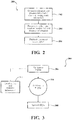
- FIG. 2 is a flow chart representative of one or more embodiments of a signal processing arrangement 200 for playing navigation prompts in a vehicle audio system.
- a route is calculated and audible prompts are played through the vehicle audio system at whatever equalizer settings the vehicle audio system has been set to, based on a user's preference for the audio.
- the navigation system generates a route that includes turn-by-turn instructions to be presented to the user.
- the audible prompts are an audio signal that may include a notification such as a bell or a chime, and localization and distance information played by way of the audio system.
- the audio signal is processed, based on the localization and distance information, in a manner that allows the user to hear the location and distance associated with each prompt. For example, an upcoming turn to the right will be heard on a right side of the user. In another example, a prompt indicating the turn to the right is to be made in 0.5 miles may be heard at a lower volume and with a depth that emulates the 0.5 mile distance while a turn to the right that is to be made in 400 feet will be heard at a higher volume with a depth that emulates the much closer distance. In this regard, the user is able to add a sense of direction and distance to the audible prompt.
- localization and distance information 202 may be obtained from a navigation source, such as the navigation system associated with the vehicle, and processed 204 in a manner that produces an audio signal that, when played 206, emulates the direction and distance of the prompt.
- the audio signal to be played 206 may be modified to include settings that create a sense of direction and a sense of distance for the user when output at speakers and with a depth within the vehicle.
- the source for localization and distance information may be the navigation system itself, a GPS on the vehicle, a portable device such as a smart phone or tablet, sensors and/or processors associated with other vehicle systems.
- the navigation prompt may be a voice prompt, or a tone, chime, any other indicator, or a combination of an indicator and a voice prompt.
- the audio signal associated with the navigation prompt and instruction is processed 204 based on the localization and distance information to generate an audio signal that, when played 206 by the audio system in the vehicle to emulate the obtained localization and distance information.
- the audio signal may be adjusted to add a sense of direction and distance to the audible prompt such that direction and distance information can be audibly detected, or perceived, by the user. The effect is that a user receives a sense of the position upon hearing the audible prompt within the vehicle interior.
- the localization information is representative of a direction of the upcoming instruction such as a left or right turn.
- the audio signal associated with the prompt may be played such that it is placed in a direction of the vehicle interior to represent the localization direction of the upcoming instruction. This may be accomplished by adjusting the left to right, front to rear speaker output. This is incorporated into playback of the audible prompt by playing the prompt through predetermined speakers in the vehicle, for example, the right side speakers. This may also be accomplished by way of producing an inter-aural level difference between left and right, as controlled by a panner, and an inter-aural time difference to make the sound appear to be coming from a left or right side.
- the distance information is representative of a distance associated with the upcoming instruction such as 0.5 miles or 500 feet.
- the audio signal of the prompt emulates the distance associated with the upcoming prompt by adding depth to the audio signal in the form of reflections. Depth may be added to the audio signal by providing a sense of spatial hearing in the audio. For example, sound pressure level decreases in volume over distance and frequency spectrum dissipates over distance. Knowing the distance information allows the DSP to manipulate the audio signal in a manner that the sound pressure level and frequency spectrum will emulate the distance associated with the prompt.
- FIG. 3 is a block diagram of a method 300 for implementing the signal processing arrangement.
- Localization and distance information 302 is received by a full sphere surround sound system having an upmixer 304.
- Ambisonics is a full-sphere surround sound technique that places sound anywhere in a 360° spherical location using a plurality of speakers positioned above, below and in a horizontal plane of a listener. Full-sphere surround sound is also capable of adding in early reflections to the audio signal for distance effect.
- the audio signal for an upcoming navigation prompt 306 is processed by the upmixer 304.
- the upmixer 304 also uses the localization and distance information 302 to process the audio output signal.
- the audio output signal is output to the speaker equalizer 308 to be played by the vehicle audio system.
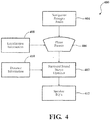
- FIG. 4 is a block diagram of a method 400 for implementing the signal processing arrangement using a more traditional surround sound technology stereo upmixer 402, such as Quantum Logic surround sound processor.
- An audio signal associated with an upcoming navigation prompt 404 is received by a phase panner 406.
- the panner 406 also receives localization, or direction, information 408 associated with the upcoming navigation prompt.
- the direction information 408 is used by the panner 406 to modify the audio signal associated with the upcoming navigation prompt 404 to emulate a direction associated with the upcoming prompt.
- the panner 406 knows that the upcoming prompt direction is a right turn, so the panner can modify the audio signal to be played so that the audio is perceived to be coming from a right side of the user, emulating direction by associating the direction of the prompt with the playback of the prompt.
- Distance information 410 is supplied to the stereo upmixer 402 and the audio signal is further adjusted to add in early reflections to add a sense of depth to the audio signal.
- the audio signal is output to the speaker equalizers 412. The user will not only hear the prompt, but they will detect the distance and direction of the upcoming prompt based on the perceived audio when the prompt is played.
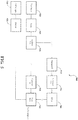
- FIG. 5 is a block diagram of a method 500 for implementing the signal processing arrangement that sends the prompts directly to vehicle audio system speakers.
- An input 502 includes an audio signal associated with the navigation prompt including direction information and distance information.
- a gain 504 is applied to the input 502 and the audio signal is split 506 because not all of the speaker outputs need to be subjected to the signal processing using distance and direction information.
- the audio signal for speakers not subjected to the processing will be separated by splitter 506 and sent to a stereo upmixer 508 and a summer 510.
- the audio signal for speakers that are to be subjected to the processing will be separated in the splitter 506 and passed through filters 512.
- the filters 512 are high and low shelf filters that add reflections to the audio signal. The added reflections are based on the direction and distance information in the navigation input 502.
- a stereo upmixer 514 splits the audio signal to multiple speakers each with an associated gain to provide an audio signal that, when output, emulates the direction information associated with the upcoming navigation instruction.
- a delay 516 is added to the audio signal to provide a sense of depth based on the distance information in the navigation input 502. This output is summed at summer 510.
- FIG. 5 Also shown in FIG. 5 is the normal audio input 518 from the vehicle audio system that is subjected to a ducker 520 when the navigation prompts are to be played by the vehicle audio system.
- the ducker 520 will reduce or mute the playback of any other audio that isn't associated with the navigation prompt being played through the audio system in the vehicle.
- any method or process claims may be executed in any order and are not limited to the specific order presented in the claims.
- the components and/or elements recited in any apparatus claims may be assembled or otherwise operationally configured in a variety of permutations and are accordingly not limited to the specific configuration recited in the claims.
Landscapes
- Engineering & Computer Science (AREA)
- Radar, Positioning & Navigation (AREA)
- Physics & Mathematics (AREA)
- Remote Sensing (AREA)
- Signal Processing (AREA)
- Acoustics & Sound (AREA)
- Automation & Control Theory (AREA)
- General Physics & Mathematics (AREA)
- Multimedia (AREA)
- Health & Medical Sciences (AREA)
- General Health & Medical Sciences (AREA)
- Audiology, Speech & Language Pathology (AREA)
- Navigation (AREA)
- Stereophonic System (AREA)
Abstract
Description
- This application claims the benefit of
U.S. Provisional Application Serial No. 62/486,403, filed April 17, 2017 - The present disclosure is directed to signal processing arrangement of audible prompts in a vehicle navigation system.
- A navigation system is known to provide an acoustic route overview which presents audible prompts for turn-by-turn directions to a user and guide them to a desired destination. The navigation system typically includes a global positioning system (GPS) that tracks the changing locations of the vehicle on the surface of the earth in real time. When a user enters a desired destination, the navigation system presents an acoustic route overview that is audibly reproduced on at least one loudspeaker in the vehicle. The turn-by-turn route may also include distance information as well as information related to the curvature or sharpness of an upcoming turn. For example, a computer voice will announce "slight left turn in point five miles" or "hard right turn in one hundred feet" as navigation prompts issued by the navigation system. The user will only hear the command and listen to the instructions by hearing the command.
- There is a need for enhanced audible prompts in a navigation system that will help a user better understand a command relative to localization and distance information associated with the upcoming command as the information is applied to an audio treatment of the voice prompt.
- Before a navigation prompt, such as a chime or a computer aided voice, interrupts normal audible playing of an audio mode to announce an upcoming instruction, the audio signal associated with the navigation prompt and instruction is processed, based on the localization and distance information supplied by a navigation system, to generate an audio signal that, when played by an audio system in the vehicle, emulates the localization and distance information. The audio signal may be adjusted to add a sense of direction and distance to the audible prompt such that direction and distance information can be audibly detected, or perceived, by the user. The effect is that a user receives a sense of the position upon hearing the audible prompt within the vehicle interior.
-
-
FIG. 1 is a block diagram of a vehicle having an audio system and a navigation system; -
FIG. 2 is a flow chart of one or more embodiments of a signal processing arrangement of audible prompts in a navigation system; -
FIG. 3 is a method for implementing the signal processing arrangement; -
FIG. 4 is a method for implementing the signal processing arrangement; and -
FIG. 5 is a method for implementing the signal processing arrangement. - Elements and steps in the figures are illustrated for simplicity and clarity and have not necessarily been rendered according to any particular sequence. For example, steps that may be performed concurrently or in different order are illustrated in the figures to help to improve understanding of embodiments of the present disclosure.
- While various aspects of the present disclosure are described with reference to a particular illustrative embodiment, the present disclosure is not limited to such embodiments, and additional modifications, applications, and embodiments may be implemented without departing from the present disclosure. In the figures, like reference numbers will be used to illustrate the same components. Those skilled in the art will recognize that the various components set forth herein may be altered without varying from the scope of the present disclosure. All references to circuits or other electrical devices and the functionality provided by each are not intended to be limited to only what is illustrated and described herein. Such circuits and other electrical devices may be combined with or separated based on implementation. Further, controllers, processors, integrated circuits, memory devices, may be configured to execute a program that is embodied in a non-transitory computer readable medium that may be programmed to perform any number of functions.
-
FIG. 1 is a block diagram of a vehicle 100 having an audio system, also called a digital signal processing system (DSP) 102 that may include any, or a combination of, sound processing systems and methods described herein. The vehicle 100 may includedoors 104a-d,front seats rear seat 108. The vehicle may have more or fewer doors than what is shown inFIG. 1 . For example, the vehicle may be a car, truck, boat, motorcycle. The particular seat configuration may also have more or fewer seats, such as no backseat or an additional third-row seating. The DSP 102 supports the use of various sources for audio, such as a radio, CD player, DVD player, mobile devices and the like which are not shown inFIG. 1 . The audio system, or digitalsignal processing system 102 improves the reproduction of sound by controlling the amplitude phase and mixing ratios between discrete and passive decoder surround signals that are projected through loudspeakers, also called speakers. Typically, the vehicle may have one or morefront speakers 110 and one or morerear speakers 112. The vehicle may have rear-facingspeakers 114. The rear-facing speakers may be positioned in thefront seats 106a, b, to face passengers in therear seat 108. Most audio systems also include one ormore microphones 116 mounted throughout the vehicle interior. Anavigation source 118 provides localization and distance information to the DSP 102. Thenavigation source 118 may be a vehicle navigation system, a portable GPS, a smart phone or tablet, or other device capable of supplying localization and distance information to the DSP 102. The localization and distance information is associated with a vehicle location and destination. - The
DSP 102 produces a sound field by controlling the amplitude, phase, and mixing ratios of output signals by applying a set of tuning parameters to the audio system. The spatial sound field reproduction is controlled re-orientation of the direct, passive and active mixing and steering parameters in the vehicle environment. The mixing and steering ratios may be adaptively modified as a function of noise and other environmental factors. Information from vehicle sensors, microphones or other transducers may be used to control the mixing and steering parameters. The DSP, for example, may be a full-sphere surround sound system, such as an ambisonics engine, or a surround sound system such as a Quantum Logic system. -
FIG. 2 is a flow chart representative of one or more embodiments of asignal processing arrangement 200 for playing navigation prompts in a vehicle audio system. Typically a user enters a destination into a navigation system, a route is calculated and audible prompts are played through the vehicle audio system at whatever equalizer settings the vehicle audio system has been set to, based on a user's preference for the audio. The navigation system generates a route that includes turn-by-turn instructions to be presented to the user. The audible prompts are an audio signal that may include a notification such as a bell or a chime, and localization and distance information played by way of the audio system. The audio signal is processed, based on the localization and distance information, in a manner that allows the user to hear the location and distance associated with each prompt. For example, an upcoming turn to the right will be heard on a right side of the user. In another example, a prompt indicating the turn to the right is to be made in 0.5 miles may be heard at a lower volume and with a depth that emulates the 0.5 mile distance while a turn to the right that is to be made in 400 feet will be heard at a higher volume with a depth that emulates the much closer distance. In this regard, the user is able to add a sense of direction and distance to the audible prompt. - In order to accomplish this, localization and
distance information 202 may be obtained from a navigation source, such as the navigation system associated with the vehicle, and processed 204 in a manner that produces an audio signal that, when played 206, emulates the direction and distance of the prompt. The audio signal to be played 206 may be modified to include settings that create a sense of direction and a sense of distance for the user when output at speakers and with a depth within the vehicle. The source for localization and distance information may be the navigation system itself, a GPS on the vehicle, a portable device such as a smart phone or tablet, sensors and/or processors associated with other vehicle systems. The navigation prompt may be a voice prompt, or a tone, chime, any other indicator, or a combination of an indicator and a voice prompt. - Before a navigation prompt, such as a chime or a computer aided voice, interrupts the normal audible playing of an audio mode to announce an upcoming instruction, the audio signal associated with the navigation prompt and instruction is processed 204 based on the localization and distance information to generate an audio signal that, when played 206 by the audio system in the vehicle to emulate the obtained localization and distance information. The audio signal may be adjusted to add a sense of direction and distance to the audible prompt such that direction and distance information can be audibly detected, or perceived, by the user. The effect is that a user receives a sense of the position upon hearing the audible prompt within the vehicle interior.
- The localization information is representative of a direction of the upcoming instruction such as a left or right turn. The audio signal associated with the prompt may be played such that it is placed in a direction of the vehicle interior to represent the localization direction of the upcoming instruction. This may be accomplished by adjusting the left to right, front to rear speaker output. This is incorporated into playback of the audible prompt by playing the prompt through predetermined speakers in the vehicle, for example, the right side speakers. This may also be accomplished by way of producing an inter-aural level difference between left and right, as controlled by a panner, and an inter-aural time difference to make the sound appear to be coming from a left or right side.
- The distance information is representative of a distance associated with the upcoming instruction such as 0.5 miles or 500 feet. The audio signal of the prompt emulates the distance associated with the upcoming prompt by adding depth to the audio signal in the form of reflections. Depth may be added to the audio signal by providing a sense of spatial hearing in the audio. For example, sound pressure level decreases in volume over distance and frequency spectrum dissipates over distance. Knowing the distance information allows the DSP to manipulate the audio signal in a manner that the sound pressure level and frequency spectrum will emulate the distance associated with the prompt.
-
FIG. 3 is a block diagram of amethod 300 for implementing the signal processing arrangement. Localization anddistance information 302 is received by a full sphere surround sound system having anupmixer 304. Ambisonics is a full-sphere surround sound technique that places sound anywhere in a 360° spherical location using a plurality of speakers positioned above, below and in a horizontal plane of a listener. Full-sphere surround sound is also capable of adding in early reflections to the audio signal for distance effect. The audio signal for anupcoming navigation prompt 306 is processed by theupmixer 304. Theupmixer 304 also uses the localization anddistance information 302 to process the audio output signal. The audio output signal is output to thespeaker equalizer 308 to be played by the vehicle audio system. -
FIG. 4 is a block diagram of amethod 400 for implementing the signal processing arrangement using a more traditional surround soundtechnology stereo upmixer 402, such as Quantum Logic surround sound processor. An audio signal associated with anupcoming navigation prompt 404 is received by aphase panner 406. Thepanner 406 also receives localization, or direction,information 408 associated with the upcoming navigation prompt. Thedirection information 408 is used by thepanner 406 to modify the audio signal associated with theupcoming navigation prompt 404 to emulate a direction associated with the upcoming prompt. For example, thepanner 406 knows that the upcoming prompt direction is a right turn, so the panner can modify the audio signal to be played so that the audio is perceived to be coming from a right side of the user, emulating direction by associating the direction of the prompt with the playback of the prompt.Distance information 410 is supplied to thestereo upmixer 402 and the audio signal is further adjusted to add in early reflections to add a sense of depth to the audio signal. The audio signal is output to thespeaker equalizers 412. The user will not only hear the prompt, but they will detect the distance and direction of the upcoming prompt based on the perceived audio when the prompt is played. -
FIG. 5 is a block diagram of amethod 500 for implementing the signal processing arrangement that sends the prompts directly to vehicle audio system speakers. Aninput 502 includes an audio signal associated with the navigation prompt including direction information and distance information. Again 504 is applied to theinput 502 and the audio signal is split 506 because not all of the speaker outputs need to be subjected to the signal processing using distance and direction information. The audio signal for speakers not subjected to the processing will be separated bysplitter 506 and sent to astereo upmixer 508 and asummer 510. - The audio signal for speakers that are to be subjected to the processing will be separated in the
splitter 506 and passed throughfilters 512. Thefilters 512 are high and low shelf filters that add reflections to the audio signal. The added reflections are based on the direction and distance information in thenavigation input 502. Astereo upmixer 514 splits the audio signal to multiple speakers each with an associated gain to provide an audio signal that, when output, emulates the direction information associated with the upcoming navigation instruction. Adelay 516 is added to the audio signal to provide a sense of depth based on the distance information in thenavigation input 502. This output is summed atsummer 510. - Also shown in
FIG. 5 is thenormal audio input 518 from the vehicle audio system that is subjected to aducker 520 when the navigation prompts are to be played by the vehicle audio system. Theducker 520 will reduce or mute the playback of any other audio that isn't associated with the navigation prompt being played through the audio system in the vehicle. - In the foregoing specification, the present disclosure has been described with reference to specific exemplary embodiments. Various modifications and changes may be made, however, without departing from the scope of the present disclosure as set forth in the claims. The specification and figures are illustrative, rather than restrictive, and modifications are intended to be included within the scope of the present disclosure. Accordingly, the scope of the present disclosure should be determined by the claims and their legal equivalents rather than by merely the examples described.
- For example, the steps recited in any method or process claims may be executed in any order and are not limited to the specific order presented in the claims. Additionally, the components and/or elements recited in any apparatus claims may be assembled or otherwise operationally configured in a variety of permutations and are accordingly not limited to the specific configuration recited in the claims.
- Benefits, other advantages and solutions to problems have been described above with regard to particular embodiments; however, any benefit, advantage, solution to problem or any element that may cause any particular benefit, advantage or solution to occur or to become more pronounced are not to be construed as critical, required or essential features or components of any or all the claims.
- The terms "comprise", "comprises", "comprising", "having", "including", "includes" or any variation thereof, are intended to reference a non-exclusive inclusion, such that a process, method, article, composition or apparatus that comprises a list of elements does not include only those elements recited, but may also include other elements not expressly listed or inherent to such process, method, article, composition or apparatus. Other combinations and/or modifications of the above-described structures, arrangements, applications, proportions, elements, materials or components used in the practice of the present disclosure, in addition to those not specifically recited, may be varied or otherwise particularly adapted to specific environments, manufacturing specifications, design parameters or other operating requirements without departing from the general principles of the same.
Claims (14)
- A method for playing audible prompts from a navigation system, the method carried out on a device having a processing unit including a non-transitory computer-readable storage medium capable of executing instructions of a software program, the method comprising the steps of:receiving, at the processing unit, an audio signal representative of an audible navigation prompt;receiving, at the processing unit, a signal representative of a direction associated with the audible navigation prompt;receiving, at the processing unit, a signal representative of a distance associated with the audible navigation prompt;processing the audio signal representative of the audible navigation prompt to emulate the direction and the distance associated with the audible navigation prompt; andplaying the processed audio signal representative of the audible navigation prompt using a vehicle audio system.
- The method as claimed in claim 1, wherein the vehicle audio system further comprises a full-sphere surround sound system and wherein the step of processing the audio signal further comprises the steps of:modifying the audio signal to emulate a direction determined from the signal representative of the direction associated with the audible navigation prompt; andadding reflections to the audio signal based on the distance associated with the audible navigation prompt.
- The method as claimed in claim 2, wherein the step of modifying the audio signal to emulate a direction further comprises, at least one of the following:- playing the audio signal at predetermined speakers in the vehicle audio system, and- producing an inter-aural level difference and an inter-aural time difference.
- The method as claimed in claim 2 or 3, wherein the step of adding reflections to the audio signal further comprises at least one of the following:- adjusting a sound pressure level of the audio signal, and- adjusting a frequency spectrum of the audio signal.
- The method as claimed in any of the preceding claims, wherein the vehicle audio system further comprises a surround sound system having a panner and wherein the step of processing the audio signal further comprises:modifying the audio signal such that the panner creates a perception of the direction determined from the signal representative of the direction associated with the audible navigation prompt; andmodifying the audio signal to include reflections to emulate a distance determined from the signal representative of the distance associated with the audible navigation prompt.
- The method as claimed in any of the preceding claims, wherein the processed audio signal representative of the audible navigation is played using predetermined speakers of the vehicle audio system.
- The method as claimed in any of the preceding claims, further comprising the step of splitting the audio signal representative of an audible navigation prompt into a first audio signal and a second audio signal, the second audio signal is subjected to processing using direction and distance associated with the audible navigation prompt to only be output at predetermined speakers, each predetermined speaker having an associated gain.
- A computer readable medium comprising a program, which, when executed by at least one processor, performs operations comprising:receiving, an audio signal representative of an audible navigation prompt;receiving a navigation signal representative of a direction associated with the audible navigation prompt;receiving a navigation signal representative of a distance associated with the audible navigation prompt;modifying the audio signal representative of the audible navigation prompt to emulate the direction and the distance associated with the audible navigation prompt; andplaying the processed audio signal representative of the audible navigation prompt using a vehicle audio system.
- The program as claimed in claim 8, which, when executed by at least one processor, performs operations further comprising modifying the audio signal representative of the audible navigation prompt to emulate the direction and the distance associated with the audible navigation prompt by at least one of the following:- adding delay to the audio signal, and- splitting the audio signal to multiple speakers, each speaker having an associated gain.
- The program as claimed in claim 8 or 9, which, when executed by at least one processor, performs operations further comprising modifying the audio signal to emulate a distance determined from the signal representative of the direction associated with the audible navigation prompt by adding depth to the audio signal.
- The program as claimed in claim 10, which, when executed by at least one processor, performs operations further comprising adding depth to the audio signal by incorporating reflections into the audio signal.
- The program as claimed in any of claims 8 to 11, which, when executed by at least one processor, performs operations further comprising modifying the audio signal representative of the audible navigation prompt to emulate the direction and the distance associated with the audible navigation prompt by at least one of the following- producing an inter-aural level difference and an inter-aural time difference,- adjusting left-to-right and front-to-rear speaker outputs,- adjusting a sound pressure level, and- adjusting a frequency spectrum dissipation.
- The program as claimed in any of claims 8 to 12, which, when executed by at least one processor, performs operations further comprising splitting the audio signal representative of an audible navigation prompt into a first audio signal and a second audio signal, the second audio signal only is subjected to processing using direction and distance associated with the audible navigation prompt to only be output at predetermined speakers, each predetermined speaker having an associated gain.
- The program as claimed in claim 13, which, when executed by at least one processor, performs operations further comprising ducking the first audio signal when playing the audio signal processed using direction and distance information.
Applications Claiming Priority (1)
| Application Number | Priority Date | Filing Date | Title |
|---|---|---|---|
| US201762486403P | 2017-04-17 | 2017-04-17 |
Publications (2)
| Publication Number | Publication Date |
|---|---|
| EP3392619A1 true EP3392619A1 (en) | 2018-10-24 |
| EP3392619B1 EP3392619B1 (en) | 2020-02-12 |
Family
ID=62002547
Family Applications (1)
| Application Number | Title | Priority Date | Filing Date |
|---|---|---|---|
| EP18167513.3A Active EP3392619B1 (en) | 2017-04-17 | 2018-04-16 | Audible prompts in a vehicle navigation system |
Country Status (3)
| Country | Link |
|---|---|
| US (1) | US10440493B2 (en) |
| EP (1) | EP3392619B1 (en) |
| CN (1) | CN108737930B (en) |
Families Citing this family (7)
| Publication number | Priority date | Publication date | Assignee | Title |
|---|---|---|---|---|
| WO2020033595A1 (en) | 2018-08-07 | 2020-02-13 | Pangissimo, LLC | Modular speaker system |
| US11277708B1 (en) | 2020-10-26 | 2022-03-15 | Here Global B.V. | Method, apparatus and computer program product for temporally based dynamic audio shifting |
| US12095828B2 (en) | 2021-12-30 | 2024-09-17 | Harman International Industries, Incorporated | In-vehicle communications and media mixing |
| CN116968633A (en) * | 2022-04-29 | 2023-10-31 | 伟摩有限责任公司 | Spatial audio for pathfinding |
| CN114999201A (en) * | 2022-05-25 | 2022-09-02 | 浙江极氪智能科技有限公司 | Navigation guidance method, device, device and storage medium |
| CN114882721B (en) * | 2022-05-27 | 2023-05-09 | 中国第一汽车股份有限公司 | Vehicle navigation information playing method and device, electronic equipment and storage medium |
| CN119620996A (en) * | 2023-09-14 | 2025-03-14 | 华为技术有限公司 | Navigation audio playback method, electronic device and readable medium |
Citations (9)
| Publication number | Priority date | Publication date | Assignee | Title |
|---|---|---|---|---|
| US20050128106A1 (en) * | 2003-11-28 | 2005-06-16 | Fujitsu Ten Limited | Navigation apparatus |
| WO2005098365A1 (en) * | 2004-03-31 | 2005-10-20 | Pioneer Corporation | Navigation system |
| US20070219718A1 (en) * | 2006-03-17 | 2007-09-20 | General Motors Corporation | Method for presenting a navigation route |
| US20080215239A1 (en) * | 2007-03-02 | 2008-09-04 | Samsung Electronics Co., Ltd. | Method of direction-guidance using 3d sound and navigation system using the method |
| US20090093957A1 (en) * | 2007-10-03 | 2009-04-09 | Kinpo Electronics, Inc. | Navigation device with power saving mechanism and method thereof |
| US20090216441A1 (en) * | 2005-03-31 | 2009-08-27 | The University Of Waikato ,A University | Method and system for indicating the location of an object |
| US20110066365A1 (en) * | 2009-09-15 | 2011-03-17 | Microsoft Corporation | Audio output configured to indicate a direction |
| US20130158856A1 (en) * | 2011-12-15 | 2013-06-20 | Qualcomm Incorporated | Navigational soundscaping |
| US20150030159A1 (en) * | 2013-07-25 | 2015-01-29 | Nokia Corporation | Audio processing apparatus |
Family Cites Families (4)
| Publication number | Priority date | Publication date | Assignee | Title |
|---|---|---|---|---|
| EP1761110A1 (en) * | 2005-09-02 | 2007-03-07 | Ecole Polytechnique Fédérale de Lausanne | Method to generate multi-channel audio signals from stereo signals |
| KR20090128068A (en) * | 2008-06-10 | 2009-12-15 | 엘지전자 주식회사 | Navigation device and its control method |
| JP5776962B2 (en) * | 2011-01-26 | 2015-09-09 | 日本電気株式会社 | Navigation device |
| EP2878515B1 (en) * | 2013-11-29 | 2017-03-08 | Harman Becker Automotive Systems GmbH | Generating an audio signal with a configurable distance cue |
-
2018
- 2018-03-30 US US15/941,556 patent/US10440493B2/en active Active
- 2018-04-16 EP EP18167513.3A patent/EP3392619B1/en active Active
- 2018-04-17 CN CN201810341980.XA patent/CN108737930B/en active Active
Patent Citations (9)
| Publication number | Priority date | Publication date | Assignee | Title |
|---|---|---|---|---|
| US20050128106A1 (en) * | 2003-11-28 | 2005-06-16 | Fujitsu Ten Limited | Navigation apparatus |
| WO2005098365A1 (en) * | 2004-03-31 | 2005-10-20 | Pioneer Corporation | Navigation system |
| US20090216441A1 (en) * | 2005-03-31 | 2009-08-27 | The University Of Waikato ,A University | Method and system for indicating the location of an object |
| US20070219718A1 (en) * | 2006-03-17 | 2007-09-20 | General Motors Corporation | Method for presenting a navigation route |
| US20080215239A1 (en) * | 2007-03-02 | 2008-09-04 | Samsung Electronics Co., Ltd. | Method of direction-guidance using 3d sound and navigation system using the method |
| US20090093957A1 (en) * | 2007-10-03 | 2009-04-09 | Kinpo Electronics, Inc. | Navigation device with power saving mechanism and method thereof |
| US20110066365A1 (en) * | 2009-09-15 | 2011-03-17 | Microsoft Corporation | Audio output configured to indicate a direction |
| US20130158856A1 (en) * | 2011-12-15 | 2013-06-20 | Qualcomm Incorporated | Navigational soundscaping |
| US20150030159A1 (en) * | 2013-07-25 | 2015-01-29 | Nokia Corporation | Audio processing apparatus |
Non-Patent Citations (1)
| Title |
|---|
| PAVEL ZAHORIK ET AL: "Auditory Distance Perception in Humans: A Summary of Past and Present Research", ACTA ACUSTICA UNITED WITH ACUSTICA VOL. 91 (2005), 30 June 2005 (2005-06-30), pages 409 - 420, XP055499698, Retrieved from the Internet <URL:https://www.researchgate.net/publication/229068125_Auditory_distance_perception_in_humans_A_summary_of_past_and_present_research> [retrieved on 20180814] * |
Also Published As
| Publication number | Publication date |
|---|---|
| CN108737930A (en) | 2018-11-02 |
| US20180302736A1 (en) | 2018-10-18 |
| US10440493B2 (en) | 2019-10-08 |
| EP3392619B1 (en) | 2020-02-12 |
| CN108737930B (en) | 2022-01-04 |
Similar Documents
| Publication | Publication Date | Title |
|---|---|---|
| EP3392619B1 (en) | Audible prompts in a vehicle navigation system | |
| US10257613B2 (en) | Managing telephony and entertainment audio in a vehicle audio platform | |
| US9397630B2 (en) | Directional based audio response to an external environment emergency signal | |
| US20140050325A1 (en) | Multi-dimensional parametric audio system and method | |
| CN104380763B (en) | For the apparatus and method for the loudspeaker for driving the sound system in vehicle | |
| US10375503B2 (en) | Apparatus and method for driving an array of loudspeakers with drive signals | |
| US20120121113A1 (en) | Directional control of sound in a vehicle | |
| JP6866470B2 (en) | Entertainment audio processing | |
| US10255912B2 (en) | Isolation and enhancement of short duration speech prompts in an automotive system | |
| US11654835B2 (en) | Rear seat display device | |
| EP2850611A1 (en) | Noise dependent signal processing for in-car communication systems with multiple acoustic zones | |
| US20250358583A1 (en) | Immersive audio fading | |
| CN109104674B (en) | Listener-oriented sound field reconstruction method, audio equipment, storage medium and device | |
| CN114882721A (en) | Vehicle navigation information playing method and device, electronic equipment and storage medium | |
| US10536795B2 (en) | Vehicle audio system with reverberant content presentation | |
| JP7842872B2 (en) | Audio processing methods for immersive audio playback | |
| US20250247665A1 (en) | Headrest speaker, method and system for audio processing thereof | |
| KR20240158523A (en) | Method and Apparatus for Controlling Audio Volume of Vehicle based on Sound Loudness of Each Seat | |
| CN117652161A (en) | Audio processing methods for playback of immersive audio | |
| JP2012203275A (en) | On-vehicle acoustic device |
Legal Events
| Date | Code | Title | Description |
|---|---|---|---|
| PUAI | Public reference made under article 153(3) epc to a published international application that has entered the european phase |
Free format text: ORIGINAL CODE: 0009012 |
|
| STAA | Information on the status of an ep patent application or granted ep patent |
Free format text: STATUS: THE APPLICATION HAS BEEN PUBLISHED |
|
| AK | Designated contracting states |
Kind code of ref document: A1 Designated state(s): AL AT BE BG CH CY CZ DE DK EE ES FI FR GB GR HR HU IE IS IT LI LT LU LV MC MK MT NL NO PL PT RO RS SE SI SK SM TR |
|
| AX | Request for extension of the european patent |
Extension state: BA ME |
|
| STAA | Information on the status of an ep patent application or granted ep patent |
Free format text: STATUS: REQUEST FOR EXAMINATION WAS MADE |
|
| 17P | Request for examination filed |
Effective date: 20190412 |
|
| RBV | Designated contracting states (corrected) |
Designated state(s): AL AT BE BG CH CY CZ DE DK EE ES FI FR GB GR HR HU IE IS IT LI LT LU LV MC MK MT NL NO PL PT RO RS SE SI SK SM TR |
|
| RIC1 | Information provided on ipc code assigned before grant |
Ipc: H04R 5/04 20060101ALI20190813BHEP Ipc: H04S 7/00 20060101ALI20190813BHEP Ipc: G08G 1/0968 20060101ALI20190813BHEP Ipc: H04S 3/00 20060101ALI20190813BHEP Ipc: G01C 21/36 20060101AFI20190813BHEP Ipc: H04R 3/04 20060101ALI20190813BHEP Ipc: H04R 5/02 20060101ALI20190813BHEP |
|
| GRAP | Despatch of communication of intention to grant a patent |
Free format text: ORIGINAL CODE: EPIDOSNIGR1 |
|
| STAA | Information on the status of an ep patent application or granted ep patent |
Free format text: STATUS: GRANT OF PATENT IS INTENDED |
|
| INTG | Intention to grant announced |
Effective date: 20191002 |
|
| RIN1 | Information on inventor provided before grant (corrected) |
Inventor name: TRESTAIN, CHRISTOPHER, MICHAEL |
|
| GRAS | Grant fee paid |
Free format text: ORIGINAL CODE: EPIDOSNIGR3 |
|
| GRAA | (expected) grant |
Free format text: ORIGINAL CODE: 0009210 |
|
| STAA | Information on the status of an ep patent application or granted ep patent |
Free format text: STATUS: THE PATENT HAS BEEN GRANTED |
|
| AK | Designated contracting states |
Kind code of ref document: B1 Designated state(s): AL AT BE BG CH CY CZ DE DK EE ES FI FR GB GR HR HU IE IS IT LI LT LU LV MC MK MT NL NO PL PT RO RS SE SI SK SM TR |
|
| REG | Reference to a national code |
Ref country code: GB Ref legal event code: FG4D |
|
| REG | Reference to a national code |
Ref country code: CH Ref legal event code: EP |
|
| REG | Reference to a national code |
Ref country code: AT Ref legal event code: REF Ref document number: 1232713 Country of ref document: AT Kind code of ref document: T Effective date: 20200215 |
|
| REG | Reference to a national code |
Ref country code: IE Ref legal event code: FG4D |
|
| REG | Reference to a national code |
Ref country code: DE Ref legal event code: R096 Ref document number: 602018002335 Country of ref document: DE |
|
| PG25 | Lapsed in a contracting state [announced via postgrant information from national office to epo] |
Ref country code: RS Free format text: LAPSE BECAUSE OF FAILURE TO SUBMIT A TRANSLATION OF THE DESCRIPTION OR TO PAY THE FEE WITHIN THE PRESCRIBED TIME-LIMIT Effective date: 20200212 Ref country code: NO Free format text: LAPSE BECAUSE OF FAILURE TO SUBMIT A TRANSLATION OF THE DESCRIPTION OR TO PAY THE FEE WITHIN THE PRESCRIBED TIME-LIMIT Effective date: 20200512 Ref country code: FI Free format text: LAPSE BECAUSE OF FAILURE TO SUBMIT A TRANSLATION OF THE DESCRIPTION OR TO PAY THE FEE WITHIN THE PRESCRIBED TIME-LIMIT Effective date: 20200212 |
|
| REG | Reference to a national code |
Ref country code: LT Ref legal event code: MG4D |
|
| REG | Reference to a national code |
Ref country code: NL Ref legal event code: MP Effective date: 20200212 |
|
| PG25 | Lapsed in a contracting state [announced via postgrant information from national office to epo] |
Ref country code: HR Free format text: LAPSE BECAUSE OF FAILURE TO SUBMIT A TRANSLATION OF THE DESCRIPTION OR TO PAY THE FEE WITHIN THE PRESCRIBED TIME-LIMIT Effective date: 20200212 Ref country code: GR Free format text: LAPSE BECAUSE OF FAILURE TO SUBMIT A TRANSLATION OF THE DESCRIPTION OR TO PAY THE FEE WITHIN THE PRESCRIBED TIME-LIMIT Effective date: 20200513 Ref country code: BG Free format text: LAPSE BECAUSE OF FAILURE TO SUBMIT A TRANSLATION OF THE DESCRIPTION OR TO PAY THE FEE WITHIN THE PRESCRIBED TIME-LIMIT Effective date: 20200512 Ref country code: LV Free format text: LAPSE BECAUSE OF FAILURE TO SUBMIT A TRANSLATION OF THE DESCRIPTION OR TO PAY THE FEE WITHIN THE PRESCRIBED TIME-LIMIT Effective date: 20200212 Ref country code: IS Free format text: LAPSE BECAUSE OF FAILURE TO SUBMIT A TRANSLATION OF THE DESCRIPTION OR TO PAY THE FEE WITHIN THE PRESCRIBED TIME-LIMIT Effective date: 20200612 Ref country code: SE Free format text: LAPSE BECAUSE OF FAILURE TO SUBMIT A TRANSLATION OF THE DESCRIPTION OR TO PAY THE FEE WITHIN THE PRESCRIBED TIME-LIMIT Effective date: 20200212 |
|
| PG25 | Lapsed in a contracting state [announced via postgrant information from national office to epo] |
Ref country code: NL Free format text: LAPSE BECAUSE OF FAILURE TO SUBMIT A TRANSLATION OF THE DESCRIPTION OR TO PAY THE FEE WITHIN THE PRESCRIBED TIME-LIMIT Effective date: 20200212 |
|
| PG25 | Lapsed in a contracting state [announced via postgrant information from national office to epo] |
Ref country code: RO Free format text: LAPSE BECAUSE OF FAILURE TO SUBMIT A TRANSLATION OF THE DESCRIPTION OR TO PAY THE FEE WITHIN THE PRESCRIBED TIME-LIMIT Effective date: 20200212 Ref country code: SK Free format text: LAPSE BECAUSE OF FAILURE TO SUBMIT A TRANSLATION OF THE DESCRIPTION OR TO PAY THE FEE WITHIN THE PRESCRIBED TIME-LIMIT Effective date: 20200212 Ref country code: CZ Free format text: LAPSE BECAUSE OF FAILURE TO SUBMIT A TRANSLATION OF THE DESCRIPTION OR TO PAY THE FEE WITHIN THE PRESCRIBED TIME-LIMIT Effective date: 20200212 Ref country code: SM Free format text: LAPSE BECAUSE OF FAILURE TO SUBMIT A TRANSLATION OF THE DESCRIPTION OR TO PAY THE FEE WITHIN THE PRESCRIBED TIME-LIMIT Effective date: 20200212 Ref country code: EE Free format text: LAPSE BECAUSE OF FAILURE TO SUBMIT A TRANSLATION OF THE DESCRIPTION OR TO PAY THE FEE WITHIN THE PRESCRIBED TIME-LIMIT Effective date: 20200212 Ref country code: PT Free format text: LAPSE BECAUSE OF FAILURE TO SUBMIT A TRANSLATION OF THE DESCRIPTION OR TO PAY THE FEE WITHIN THE PRESCRIBED TIME-LIMIT Effective date: 20200705 Ref country code: DK Free format text: LAPSE BECAUSE OF FAILURE TO SUBMIT A TRANSLATION OF THE DESCRIPTION OR TO PAY THE FEE WITHIN THE PRESCRIBED TIME-LIMIT Effective date: 20200212 Ref country code: LT Free format text: LAPSE BECAUSE OF FAILURE TO SUBMIT A TRANSLATION OF THE DESCRIPTION OR TO PAY THE FEE WITHIN THE PRESCRIBED TIME-LIMIT Effective date: 20200212 Ref country code: ES Free format text: LAPSE BECAUSE OF FAILURE TO SUBMIT A TRANSLATION OF THE DESCRIPTION OR TO PAY THE FEE WITHIN THE PRESCRIBED TIME-LIMIT Effective date: 20200212 |
|
| REG | Reference to a national code |
Ref country code: DE Ref legal event code: R097 Ref document number: 602018002335 Country of ref document: DE |
|
| REG | Reference to a national code |
Ref country code: AT Ref legal event code: MK05 Ref document number: 1232713 Country of ref document: AT Kind code of ref document: T Effective date: 20200212 |
|
| PG25 | Lapsed in a contracting state [announced via postgrant information from national office to epo] |
Ref country code: MC Free format text: LAPSE BECAUSE OF FAILURE TO SUBMIT A TRANSLATION OF THE DESCRIPTION OR TO PAY THE FEE WITHIN THE PRESCRIBED TIME-LIMIT Effective date: 20200212 |
|
| PLBE | No opposition filed within time limit |
Free format text: ORIGINAL CODE: 0009261 |
|
| STAA | Information on the status of an ep patent application or granted ep patent |
Free format text: STATUS: NO OPPOSITION FILED WITHIN TIME LIMIT |
|
| 26N | No opposition filed |
Effective date: 20201113 |
|
| PG25 | Lapsed in a contracting state [announced via postgrant information from national office to epo] |
Ref country code: AT Free format text: LAPSE BECAUSE OF FAILURE TO SUBMIT A TRANSLATION OF THE DESCRIPTION OR TO PAY THE FEE WITHIN THE PRESCRIBED TIME-LIMIT Effective date: 20200212 Ref country code: LU Free format text: LAPSE BECAUSE OF NON-PAYMENT OF DUE FEES Effective date: 20200416 Ref country code: FR Free format text: LAPSE BECAUSE OF NON-PAYMENT OF DUE FEES Effective date: 20200430 Ref country code: IT Free format text: LAPSE BECAUSE OF FAILURE TO SUBMIT A TRANSLATION OF THE DESCRIPTION OR TO PAY THE FEE WITHIN THE PRESCRIBED TIME-LIMIT Effective date: 20200212 |
|
| REG | Reference to a national code |
Ref country code: BE Ref legal event code: MM Effective date: 20200430 |
|
| PG25 | Lapsed in a contracting state [announced via postgrant information from national office to epo] |
Ref country code: PL Free format text: LAPSE BECAUSE OF FAILURE TO SUBMIT A TRANSLATION OF THE DESCRIPTION OR TO PAY THE FEE WITHIN THE PRESCRIBED TIME-LIMIT Effective date: 20200212 Ref country code: BE Free format text: LAPSE BECAUSE OF NON-PAYMENT OF DUE FEES Effective date: 20200430 Ref country code: SI Free format text: LAPSE BECAUSE OF FAILURE TO SUBMIT A TRANSLATION OF THE DESCRIPTION OR TO PAY THE FEE WITHIN THE PRESCRIBED TIME-LIMIT Effective date: 20200212 |
|
| PG25 | Lapsed in a contracting state [announced via postgrant information from national office to epo] |
Ref country code: IE Free format text: LAPSE BECAUSE OF NON-PAYMENT OF DUE FEES Effective date: 20200416 |
|
| PG25 | Lapsed in a contracting state [announced via postgrant information from national office to epo] |
Ref country code: LI Free format text: LAPSE BECAUSE OF NON-PAYMENT OF DUE FEES Effective date: 20210430 Ref country code: CH Free format text: LAPSE BECAUSE OF NON-PAYMENT OF DUE FEES Effective date: 20210430 |
|
| PG25 | Lapsed in a contracting state [announced via postgrant information from national office to epo] |
Ref country code: TR Free format text: LAPSE BECAUSE OF FAILURE TO SUBMIT A TRANSLATION OF THE DESCRIPTION OR TO PAY THE FEE WITHIN THE PRESCRIBED TIME-LIMIT Effective date: 20200212 Ref country code: MT Free format text: LAPSE BECAUSE OF FAILURE TO SUBMIT A TRANSLATION OF THE DESCRIPTION OR TO PAY THE FEE WITHIN THE PRESCRIBED TIME-LIMIT Effective date: 20200212 Ref country code: CY Free format text: LAPSE BECAUSE OF FAILURE TO SUBMIT A TRANSLATION OF THE DESCRIPTION OR TO PAY THE FEE WITHIN THE PRESCRIBED TIME-LIMIT Effective date: 20200212 |
|
| PG25 | Lapsed in a contracting state [announced via postgrant information from national office to epo] |
Ref country code: MK Free format text: LAPSE BECAUSE OF FAILURE TO SUBMIT A TRANSLATION OF THE DESCRIPTION OR TO PAY THE FEE WITHIN THE PRESCRIBED TIME-LIMIT Effective date: 20200212 Ref country code: AL Free format text: LAPSE BECAUSE OF FAILURE TO SUBMIT A TRANSLATION OF THE DESCRIPTION OR TO PAY THE FEE WITHIN THE PRESCRIBED TIME-LIMIT Effective date: 20200212 |
|
| P01 | Opt-out of the competence of the unified patent court (upc) registered |
Effective date: 20230527 |
|
| PGFP | Annual fee paid to national office [announced via postgrant information from national office to epo] |
Ref country code: DE Payment date: 20250319 Year of fee payment: 8 |
|
| PGFP | Annual fee paid to national office [announced via postgrant information from national office to epo] |
Ref country code: GB Payment date: 20260319 Year of fee payment: 9 |