EP3392334A1 - Method for preparing adherent-type cells acclimated to suspension culture, method for inducing epithelial-mesenchymal transition in adherent-type epithelial cells, and use for methods - Google Patents
Method for preparing adherent-type cells acclimated to suspension culture, method for inducing epithelial-mesenchymal transition in adherent-type epithelial cells, and use for methods Download PDFInfo
- Publication number
- EP3392334A1 EP3392334A1 EP16875795.3A EP16875795A EP3392334A1 EP 3392334 A1 EP3392334 A1 EP 3392334A1 EP 16875795 A EP16875795 A EP 16875795A EP 3392334 A1 EP3392334 A1 EP 3392334A1
- Authority
- EP
- European Patent Office
- Prior art keywords
- cells
- epithelial
- adherent
- alicyclic structure
- containing polymer
- Prior art date
- Legal status (The legal status is an assumption and is not a legal conclusion. Google has not performed a legal analysis and makes no representation as to the accuracy of the status listed.)
- Withdrawn
Links
- 210000004027 cell Anatomy 0.000 title claims abstract description 193
- 238000000034 method Methods 0.000 title claims abstract description 98
- 230000007705 epithelial mesenchymal transition Effects 0.000 title claims abstract description 50
- 238000004114 suspension culture Methods 0.000 title claims abstract description 49
- 210000002919 epithelial cell Anatomy 0.000 title claims abstract description 32
- 230000001939 inductive effect Effects 0.000 title claims abstract description 27
- 229920000642 polymer Polymers 0.000 claims abstract description 145
- 230000001464 adherent effect Effects 0.000 claims abstract description 99
- 125000002723 alicyclic group Chemical group 0.000 claims abstract description 93
- 108090000623 proteins and genes Proteins 0.000 claims abstract description 55
- 102000004169 proteins and genes Human genes 0.000 claims abstract description 28
- 238000012258 culturing Methods 0.000 claims abstract description 18
- 108020004707 nucleic acids Proteins 0.000 claims abstract description 13
- 102000039446 nucleic acids Human genes 0.000 claims abstract description 13
- 150000007523 nucleic acids Chemical class 0.000 claims abstract description 13
- 239000007788 liquid Substances 0.000 claims abstract description 12
- 210000004978 chinese hamster ovary cell Anatomy 0.000 claims description 33
- 241001465754 Metazoa Species 0.000 claims description 8
- 239000000411 inducer Substances 0.000 claims description 8
- 125000003518 norbornenyl group Chemical group C12(C=CC(CC1)C2)* 0.000 claims 2
- 239000000178 monomer Substances 0.000 description 46
- JFNLZVQOOSMTJK-KNVOCYPGSA-N norbornene Chemical compound C1[C@@H]2CC[C@H]1C=C2 JFNLZVQOOSMTJK-KNVOCYPGSA-N 0.000 description 33
- 102000003951 Erythropoietin Human genes 0.000 description 15
- 108090000394 Erythropoietin Proteins 0.000 description 15
- 229940105423 erythropoietin Drugs 0.000 description 15
- 239000002609 medium Substances 0.000 description 15
- OXCMYAYHXIHQOA-UHFFFAOYSA-N potassium;[2-butyl-5-chloro-3-[[4-[2-(1,2,4-triaza-3-azanidacyclopenta-1,4-dien-5-yl)phenyl]phenyl]methyl]imidazol-4-yl]methanol Chemical compound [K+].CCCCC1=NC(Cl)=C(CO)N1CC1=CC=C(C=2C(=CC=CC=2)C2=N[N-]N=N2)C=C1 OXCMYAYHXIHQOA-UHFFFAOYSA-N 0.000 description 15
- 239000000047 product Substances 0.000 description 15
- 239000004793 Polystyrene Substances 0.000 description 13
- -1 monocyclic cycloolefin Chemical class 0.000 description 13
- 229920002223 polystyrene Polymers 0.000 description 13
- 238000013518 transcription Methods 0.000 description 11
- 230000035897 transcription Effects 0.000 description 11
- 239000000654 additive Substances 0.000 description 10
- 230000008859 change Effects 0.000 description 10
- 238000004381 surface treatment Methods 0.000 description 10
- 230000000996 additive effect Effects 0.000 description 9
- 238000007142 ring opening reaction Methods 0.000 description 9
- 239000000523 sample Substances 0.000 description 9
- 102000000905 Cadherin Human genes 0.000 description 8
- 108050007957 Cadherin Proteins 0.000 description 8
- 239000003814 drug Substances 0.000 description 8
- 238000004519 manufacturing process Methods 0.000 description 8
- 239000000243 solution Substances 0.000 description 8
- 101150002621 EPO gene Proteins 0.000 description 7
- 241000700605 Viruses Species 0.000 description 7
- 239000013612 plasmid Substances 0.000 description 7
- 238000007151 ring opening polymerisation reaction Methods 0.000 description 7
- XLYOFNOQVPJJNP-UHFFFAOYSA-N water Substances O XLYOFNOQVPJJNP-UHFFFAOYSA-N 0.000 description 7
- 230000000052 comparative effect Effects 0.000 description 6
- 239000012228 culture supernatant Substances 0.000 description 6
- HGCIXCUEYOPUTN-UHFFFAOYSA-N cyclohexene Chemical compound C1CCC=CC1 HGCIXCUEYOPUTN-UHFFFAOYSA-N 0.000 description 6
- 229940079593 drug Drugs 0.000 description 6
- 230000014509 gene expression Effects 0.000 description 6
- 125000001424 substituent group Chemical group 0.000 description 6
- 239000000725 suspension Substances 0.000 description 6
- 229920002554 vinyl polymer Polymers 0.000 description 6
- 239000004215 Carbon black (E152) Substances 0.000 description 5
- 102000010834 Extracellular Matrix Proteins Human genes 0.000 description 5
- 108010037362 Extracellular Matrix Proteins Proteins 0.000 description 5
- 125000000753 cycloalkyl group Chemical group 0.000 description 5
- 150000001993 dienes Chemical class 0.000 description 5
- 210000002744 extracellular matrix Anatomy 0.000 description 5
- 239000001963 growth medium Substances 0.000 description 5
- 229930195733 hydrocarbon Natural products 0.000 description 5
- 150000002848 norbornenes Chemical group 0.000 description 5
- 230000001954 sterilising effect Effects 0.000 description 5
- 238000004659 sterilization and disinfection Methods 0.000 description 5
- 108091032973 (ribonucleotides)n+m Proteins 0.000 description 4
- 108050000637 N-cadherin Proteins 0.000 description 4
- 102000009618 Transforming Growth Factors Human genes 0.000 description 4
- 108010009583 Transforming Growth Factors Proteins 0.000 description 4
- 108010065472 Vimentin Proteins 0.000 description 4
- 102000013127 Vimentin Human genes 0.000 description 4
- 238000012644 addition polymerization Methods 0.000 description 4
- 238000004458 analytical method Methods 0.000 description 4
- 239000003054 catalyst Substances 0.000 description 4
- 238000007334 copolymerization reaction Methods 0.000 description 4
- 125000004122 cyclic group Chemical group 0.000 description 4
- 230000003247 decreasing effect Effects 0.000 description 4
- 230000009477 glass transition Effects 0.000 description 4
- 239000002245 particle Substances 0.000 description 4
- 239000002685 polymerization catalyst Substances 0.000 description 4
- 229920005989 resin Polymers 0.000 description 4
- 239000011347 resin Substances 0.000 description 4
- 210000005048 vimentin Anatomy 0.000 description 4
- BRZYSWJRSDMWLG-DJWUNRQOSA-N (2r,3r,4r,5r)-2-[(1s,2s,3r,4s,6r)-4,6-diamino-3-[(2s,3r,4r,5s,6r)-3-amino-4,5-dihydroxy-6-[(1r)-1-hydroxyethyl]oxan-2-yl]oxy-2-hydroxycyclohexyl]oxy-5-methyl-4-(methylamino)oxane-3,5-diol Chemical compound O1C[C@@](O)(C)[C@H](NC)[C@@H](O)[C@H]1O[C@@H]1[C@@H](O)[C@H](O[C@@H]2[C@@H]([C@@H](O)[C@H](O)[C@@H]([C@@H](C)O)O2)N)[C@@H](N)C[C@H]1N BRZYSWJRSDMWLG-DJWUNRQOSA-N 0.000 description 3
- CURLTUGMZLYLDI-UHFFFAOYSA-N Carbon dioxide Chemical compound O=C=O CURLTUGMZLYLDI-UHFFFAOYSA-N 0.000 description 3
- 108010067306 Fibronectins Proteins 0.000 description 3
- 102000016359 Fibronectins Human genes 0.000 description 3
- 102000011782 Keratins Human genes 0.000 description 3
- 108010076876 Keratins Proteins 0.000 description 3
- 108010022394 Threonine synthase Proteins 0.000 description 3
- YXFVVABEGXRONW-UHFFFAOYSA-N Toluene Chemical compound CC1=CC=CC=C1 YXFVVABEGXRONW-UHFFFAOYSA-N 0.000 description 3
- GLNADSQYFUSGOU-GPTZEZBUSA-J Trypan blue Chemical compound [Na+].[Na+].[Na+].[Na+].C1=C(S([O-])(=O)=O)C=C2C=C(S([O-])(=O)=O)C(/N=N/C3=CC=C(C=C3C)C=3C=C(C(=CC=3)\N=N\C=3C(=CC4=CC(=CC(N)=C4C=3O)S([O-])(=O)=O)S([O-])(=O)=O)C)=C(O)C2=C1N GLNADSQYFUSGOU-GPTZEZBUSA-J 0.000 description 3
- 239000004019 antithrombin Substances 0.000 description 3
- 125000003118 aryl group Chemical group 0.000 description 3
- 125000004432 carbon atom Chemical group C* 0.000 description 3
- 210000003850 cellular structure Anatomy 0.000 description 3
- 150000001875 compounds Chemical class 0.000 description 3
- 150000001925 cycloalkenes Chemical group 0.000 description 3
- URYYVOIYTNXXBN-UPHRSURJSA-N cyclooctene Chemical compound C1CCC\C=C/CC1 URYYVOIYTNXXBN-UPHRSURJSA-N 0.000 description 3
- 239000004913 cyclooctene Substances 0.000 description 3
- 238000012637 gene transfection Methods 0.000 description 3
- 239000012510 hollow fiber Substances 0.000 description 3
- 230000006698 induction Effects 0.000 description 3
- 238000005259 measurement Methods 0.000 description 3
- 229910052751 metal Inorganic materials 0.000 description 3
- 239000002184 metal Substances 0.000 description 3
- 239000000203 mixture Substances 0.000 description 3
- 230000003204 osmotic effect Effects 0.000 description 3
- 239000002504 physiological saline solution Substances 0.000 description 3
- 230000000379 polymerizing effect Effects 0.000 description 3
- XWJBRBSPAODJER-UHFFFAOYSA-N 1,7-octadiene Chemical compound C=CCCCCC=C XWJBRBSPAODJER-UHFFFAOYSA-N 0.000 description 2
- LIKMAJRDDDTEIG-UHFFFAOYSA-N 1-hexene Chemical compound CCCCC=C LIKMAJRDDDTEIG-UHFFFAOYSA-N 0.000 description 2
- XDTMQSROBMDMFD-UHFFFAOYSA-N Cyclohexane Chemical compound C1CCCCC1 XDTMQSROBMDMFD-UHFFFAOYSA-N 0.000 description 2
- 102000004269 Granulocyte Colony-Stimulating Factor Human genes 0.000 description 2
- 108010017080 Granulocyte Colony-Stimulating Factor Proteins 0.000 description 2
- 108700011259 MicroRNAs Proteins 0.000 description 2
- 206010028980 Neoplasm Diseases 0.000 description 2
- PXHVJJICTQNCMI-UHFFFAOYSA-N Nickel Chemical compound [Ni] PXHVJJICTQNCMI-UHFFFAOYSA-N 0.000 description 2
- KDLHZDBZIXYQEI-UHFFFAOYSA-N Palladium Chemical compound [Pd] KDLHZDBZIXYQEI-UHFFFAOYSA-N 0.000 description 2
- PPBRXRYQALVLMV-UHFFFAOYSA-N Styrene Chemical compound C=CC1=CC=CC=C1 PPBRXRYQALVLMV-UHFFFAOYSA-N 0.000 description 2
- RTAQQCXQSZGOHL-UHFFFAOYSA-N Titanium Chemical compound [Ti] RTAQQCXQSZGOHL-UHFFFAOYSA-N 0.000 description 2
- QCWXUUIWCKQGHC-UHFFFAOYSA-N Zirconium Chemical compound [Zr] QCWXUUIWCKQGHC-UHFFFAOYSA-N 0.000 description 2
- 239000006096 absorbing agent Substances 0.000 description 2
- YRKCREAYFQTBPV-UHFFFAOYSA-N acetylacetone Natural products CC(=O)CC(C)=O YRKCREAYFQTBPV-UHFFFAOYSA-N 0.000 description 2
- 230000009471 action Effects 0.000 description 2
- 239000000556 agonist Substances 0.000 description 2
- 125000004453 alkoxycarbonyl group Chemical group 0.000 description 2
- 125000000217 alkyl group Chemical group 0.000 description 2
- 125000002947 alkylene group Chemical group 0.000 description 2
- 125000001118 alkylidene group Chemical group 0.000 description 2
- 239000005557 antagonist Substances 0.000 description 2
- 239000007864 aqueous solution Substances 0.000 description 2
- 229960000074 biopharmaceutical Drugs 0.000 description 2
- 201000011510 cancer Diseases 0.000 description 2
- 229910002092 carbon dioxide Inorganic materials 0.000 description 2
- 238000004113 cell culture Methods 0.000 description 2
- 210000004748 cultured cell Anatomy 0.000 description 2
- 238000005520 cutting process Methods 0.000 description 2
- ZXIJMRYMVAMXQP-UHFFFAOYSA-N cycloheptene Chemical compound C1CCC=CCC1 ZXIJMRYMVAMXQP-UHFFFAOYSA-N 0.000 description 2
- MGNZXYYWBUKAII-UHFFFAOYSA-N cyclohexa-1,3-diene Chemical compound C1CC=CC=C1 MGNZXYYWBUKAII-UHFFFAOYSA-N 0.000 description 2
- ZSWFCLXCOIISFI-UHFFFAOYSA-N cyclopentadiene Chemical compound C1C=CC=C1 ZSWFCLXCOIISFI-UHFFFAOYSA-N 0.000 description 2
- LPIQUOYDBNQMRZ-UHFFFAOYSA-N cyclopentene Chemical compound C1CC=CC1 LPIQUOYDBNQMRZ-UHFFFAOYSA-N 0.000 description 2
- 230000007423 decrease Effects 0.000 description 2
- 238000002474 experimental method Methods 0.000 description 2
- 230000006870 function Effects 0.000 description 2
- 239000003102 growth factor Substances 0.000 description 2
- 150000004820 halides Chemical class 0.000 description 2
- 229940088597 hormone Drugs 0.000 description 2
- 239000005556 hormone Substances 0.000 description 2
- 230000001771 impaired effect Effects 0.000 description 2
- 208000015181 infectious disease Diseases 0.000 description 2
- 239000004615 ingredient Substances 0.000 description 2
- 238000002347 injection Methods 0.000 description 2
- 239000007924 injection Substances 0.000 description 2
- 229910052500 inorganic mineral Inorganic materials 0.000 description 2
- NOESYZHRGYRDHS-UHFFFAOYSA-N insulin Chemical compound N1C(=O)C(NC(=O)C(CCC(N)=O)NC(=O)C(CCC(O)=O)NC(=O)C(C(C)C)NC(=O)C(NC(=O)CN)C(C)CC)CSSCC(C(NC(CO)C(=O)NC(CC(C)C)C(=O)NC(CC=2C=CC(O)=CC=2)C(=O)NC(CCC(N)=O)C(=O)NC(CC(C)C)C(=O)NC(CCC(O)=O)C(=O)NC(CC(N)=O)C(=O)NC(CC=2C=CC(O)=CC=2)C(=O)NC(CSSCC(NC(=O)C(C(C)C)NC(=O)C(CC(C)C)NC(=O)C(CC=2C=CC(O)=CC=2)NC(=O)C(CC(C)C)NC(=O)C(C)NC(=O)C(CCC(O)=O)NC(=O)C(C(C)C)NC(=O)C(CC(C)C)NC(=O)C(CC=2NC=NC=2)NC(=O)C(CO)NC(=O)CNC2=O)C(=O)NCC(=O)NC(CCC(O)=O)C(=O)NC(CCCNC(N)=N)C(=O)NCC(=O)NC(CC=3C=CC=CC=3)C(=O)NC(CC=3C=CC=CC=3)C(=O)NC(CC=3C=CC(O)=CC=3)C(=O)NC(C(C)O)C(=O)N3C(CCC3)C(=O)NC(CCCCN)C(=O)NC(C)C(O)=O)C(=O)NC(CC(N)=O)C(O)=O)=O)NC(=O)C(C(C)CC)NC(=O)C(CO)NC(=O)C(C(C)O)NC(=O)C1CSSCC2NC(=O)C(CC(C)C)NC(=O)C(NC(=O)C(CCC(N)=O)NC(=O)C(CC(N)=O)NC(=O)C(NC(=O)C(N)CC=1C=CC=CC=1)C(C)C)CC1=CN=CN1 NOESYZHRGYRDHS-UHFFFAOYSA-N 0.000 description 2
- 239000003446 ligand Substances 0.000 description 2
- 239000003550 marker Substances 0.000 description 2
- 239000002679 microRNA Substances 0.000 description 2
- 239000011707 mineral Substances 0.000 description 2
- 238000010899 nucleation Methods 0.000 description 2
- 235000016709 nutrition Nutrition 0.000 description 2
- 239000006174 pH buffer Substances 0.000 description 2
- YWAKXRMUMFPDSH-UHFFFAOYSA-N pentene Chemical compound CCCC=C YWAKXRMUMFPDSH-UHFFFAOYSA-N 0.000 description 2
- 230000005855 radiation Effects 0.000 description 2
- 125000003808 silyl group Chemical group [H][Si]([H])([H])[*] 0.000 description 2
- 150000003384 small molecules Chemical class 0.000 description 2
- 239000002904 solvent Substances 0.000 description 2
- 239000010936 titanium Substances 0.000 description 2
- 229910052719 titanium Inorganic materials 0.000 description 2
- 229940088594 vitamin Drugs 0.000 description 2
- 239000011782 vitamin Substances 0.000 description 2
- 229930003231 vitamin Natural products 0.000 description 2
- 235000013343 vitamin Nutrition 0.000 description 2
- 150000003722 vitamin derivatives Chemical class 0.000 description 2
- 229910052726 zirconium Inorganic materials 0.000 description 2
- 239000004711 α-olefin Substances 0.000 description 2
- HSXHQSIOZSTGKP-BXFWGDTBSA-N (1Z,5Z,9Z,13Z)-cyclohexadeca-1,5,9,13-tetraene Chemical compound C1C\C=C/CC\C=C/CC\C=C/CC\C=C/1 HSXHQSIOZSTGKP-BXFWGDTBSA-N 0.000 description 1
- RDAFFINKUCJOJK-UYIJSCIWSA-N (1z,5e)-cyclodeca-1,5-diene Chemical compound C1CC\C=C/CC\C=C\C1 RDAFFINKUCJOJK-UYIJSCIWSA-N 0.000 description 1
- LCSLWNXVIDKVGD-KQQUZDAGSA-N (3e,7e)-deca-3,7-diene Chemical compound CC\C=C\CC\C=C\CC LCSLWNXVIDKVGD-KQQUZDAGSA-N 0.000 description 1
- JBVMSEMQJGGOFR-FNORWQNLSA-N (4e)-4-methylhexa-1,4-diene Chemical compound C\C=C(/C)CC=C JBVMSEMQJGGOFR-FNORWQNLSA-N 0.000 description 1
- PRBHEGAFLDMLAL-GQCTYLIASA-N (4e)-hexa-1,4-diene Chemical compound C\C=C\CC=C PRBHEGAFLDMLAL-GQCTYLIASA-N 0.000 description 1
- OJOWICOBYCXEKR-KRXBUXKQSA-N (5e)-5-ethylidenebicyclo[2.2.1]hept-2-ene Chemical compound C1C2C(=C/C)/CC1C=C2 OJOWICOBYCXEKR-KRXBUXKQSA-N 0.000 description 1
- FMZITCJWMYHQFG-UHFFFAOYSA-N 1,2,3,4,4a,5,8,8a-octahydro-2-methyl-1,4:5,8-dimethanonaphthalene Chemical compound C1C(C23)C=CC1C3C1CC2CC1C FMZITCJWMYHQFG-UHFFFAOYSA-N 0.000 description 1
- 238000011925 1,2-addition Methods 0.000 description 1
- VYXHVRARDIDEHS-UHFFFAOYSA-N 1,5-cyclooctadiene Chemical compound C1CC=CCCC=C1 VYXHVRARDIDEHS-UHFFFAOYSA-N 0.000 description 1
- 239000004912 1,5-cyclooctadiene Substances 0.000 description 1
- SDRZFSPCVYEJTP-UHFFFAOYSA-N 1-ethenylcyclohexene Chemical compound C=CC1=CCCCC1 SDRZFSPCVYEJTP-UHFFFAOYSA-N 0.000 description 1
- HECLRDQVFMWTQS-RGOKHQFPSA-N 1755-01-7 Chemical compound C1[C@H]2[C@@H]3CC=C[C@@H]3[C@@H]1C=C2 HECLRDQVFMWTQS-RGOKHQFPSA-N 0.000 description 1
- JKMHFZQWWAIEOD-UHFFFAOYSA-N 2-[4-(2-hydroxyethyl)piperazin-1-yl]ethanesulfonic acid Chemical compound OCC[NH+]1CCN(CCS([O-])(=O)=O)CC1 JKMHFZQWWAIEOD-UHFFFAOYSA-N 0.000 description 1
- QKNYBSVHEMOAJP-UHFFFAOYSA-N 2-amino-2-(hydroxymethyl)propane-1,3-diol;hydron;chloride Chemical compound Cl.OCC(N)(CO)CO QKNYBSVHEMOAJP-UHFFFAOYSA-N 0.000 description 1
- XUFPYLQWLKKGDQ-UHFFFAOYSA-N 4,4a,9,9a-tetrahydro-1,4-methano-1h-fluorene Chemical compound C12CC3=CC=CC=C3C1C1C=CC2C1 XUFPYLQWLKKGDQ-UHFFFAOYSA-N 0.000 description 1
- YRIYXMAKROEVBQ-UHFFFAOYSA-N 5,5-dimethylbicyclo[2.2.1]hept-2-ene Chemical compound C1C2C(C)(C)CC1C=C2 YRIYXMAKROEVBQ-UHFFFAOYSA-N 0.000 description 1
- INYHZQLKOKTDAI-UHFFFAOYSA-N 5-ethenylbicyclo[2.2.1]hept-2-ene Chemical compound C1C2C(C=C)CC1C=C2 INYHZQLKOKTDAI-UHFFFAOYSA-N 0.000 description 1
- QHJIJNGGGLNBNJ-UHFFFAOYSA-N 5-ethylbicyclo[2.2.1]hept-2-ene Chemical compound C1C2C(CC)CC1C=C2 QHJIJNGGGLNBNJ-UHFFFAOYSA-N 0.000 description 1
- PCBPVYHMZBWMAZ-UHFFFAOYSA-N 5-methylbicyclo[2.2.1]hept-2-ene Chemical compound C1C2C(C)CC1C=C2 PCBPVYHMZBWMAZ-UHFFFAOYSA-N 0.000 description 1
- VSQLAQKFRFTMNS-UHFFFAOYSA-N 5-methylhexa-1,4-diene Chemical compound CC(C)=CCC=C VSQLAQKFRFTMNS-UHFFFAOYSA-N 0.000 description 1
- CJQNJRMLJAAXOS-UHFFFAOYSA-N 5-prop-1-enylbicyclo[2.2.1]hept-2-ene Chemical compound C1C2C(C=CC)CC1C=C2 CJQNJRMLJAAXOS-UHFFFAOYSA-N 0.000 description 1
- BKAMOLOYKIIDTC-UHFFFAOYSA-N 7-bromotetracyclo[9.2.1.02,10.03,8]tetradeca-3(8),4,6,12-tetraene Chemical compound BrC1=CC=CC2=C1CC1C(C=C3)CC3C12 BKAMOLOYKIIDTC-UHFFFAOYSA-N 0.000 description 1
- OGQJJJQFRYERLA-UHFFFAOYSA-N 7-chlorotetracyclo[9.2.1.02,10.03,8]tetradeca-3(8),4,6,12-tetraene Chemical compound ClC1=CC=CC2=C1CC1C(C=C3)CC3C12 OGQJJJQFRYERLA-UHFFFAOYSA-N 0.000 description 1
- AGKXEJXQWQZXOC-UHFFFAOYSA-N 9,10-dimethyltetracyclo[6.2.1.13,6.02,7]dodec-4-ene Chemical compound C1C(C23)C=CC1C3C1CC2C(C)C1C AGKXEJXQWQZXOC-UHFFFAOYSA-N 0.000 description 1
- WWNWBBMZKNMEQC-UHFFFAOYSA-N 9-ethyl-10-methyltetracyclo[6.2.1.13,6.02,7]dodec-4-ene Chemical compound C1C(C23)C=CC1C3C1CC2C(C)C1CC WWNWBBMZKNMEQC-UHFFFAOYSA-N 0.000 description 1
- KHSZMMJXGLONRH-UHFFFAOYSA-N 9-ethylidene-10-methyltetracyclo[6.2.1.13,6.02,7]dodec-4-ene Chemical compound C1C(C23)C=CC1C3C1CC2C(C)C1=CC KHSZMMJXGLONRH-UHFFFAOYSA-N 0.000 description 1
- QTBSBXVTEAMEQO-UHFFFAOYSA-M Acetate Chemical compound CC([O-])=O QTBSBXVTEAMEQO-UHFFFAOYSA-M 0.000 description 1
- 206010067484 Adverse reaction Diseases 0.000 description 1
- BVKZGUZCCUSVTD-UHFFFAOYSA-M Bicarbonate Chemical compound OC([O-])=O BVKZGUZCCUSVTD-UHFFFAOYSA-M 0.000 description 1
- 108091003079 Bovine Serum Albumin Proteins 0.000 description 1
- BHPQYMZQTOCNFJ-UHFFFAOYSA-N Calcium cation Chemical compound [Ca+2] BHPQYMZQTOCNFJ-UHFFFAOYSA-N 0.000 description 1
- BVKZGUZCCUSVTD-UHFFFAOYSA-L Carbonate Chemical compound [O-]C([O-])=O BVKZGUZCCUSVTD-UHFFFAOYSA-L 0.000 description 1
- DLNFUUDOQNVGMU-UHFFFAOYSA-N Cc1cccc2C3C4CC(C=C4)C3Cc12 Chemical compound Cc1cccc2C3C4CC(C=C4)C3Cc12 DLNFUUDOQNVGMU-UHFFFAOYSA-N 0.000 description 1
- 102000008186 Collagen Human genes 0.000 description 1
- 108010035532 Collagen Proteins 0.000 description 1
- 102000007644 Colony-Stimulating Factors Human genes 0.000 description 1
- 108010071942 Colony-Stimulating Factors Proteins 0.000 description 1
- 241000699802 Cricetulus griseus Species 0.000 description 1
- 102000004127 Cytokines Human genes 0.000 description 1
- 108090000695 Cytokines Proteins 0.000 description 1
- 239000006144 Dulbecco’s modified Eagle's medium Substances 0.000 description 1
- 239000006145 Eagle's minimal essential medium Substances 0.000 description 1
- 102000004190 Enzymes Human genes 0.000 description 1
- 108090000790 Enzymes Proteins 0.000 description 1
- VGGSQFUCUMXWEO-UHFFFAOYSA-N Ethene Chemical compound C=C VGGSQFUCUMXWEO-UHFFFAOYSA-N 0.000 description 1
- 239000005977 Ethylene Substances 0.000 description 1
- IAYPIBMASNFSPL-UHFFFAOYSA-N Ethylene oxide Chemical compound C1CO1 IAYPIBMASNFSPL-UHFFFAOYSA-N 0.000 description 1
- 102000001690 Factor VIII Human genes 0.000 description 1
- 108010054218 Factor VIII Proteins 0.000 description 1
- 206010064571 Gene mutation Diseases 0.000 description 1
- 102000051325 Glucagon Human genes 0.000 description 1
- 108060003199 Glucagon Proteins 0.000 description 1
- WQZGKKKJIJFFOK-GASJEMHNSA-N Glucose Natural products OC[C@H]1OC(O)[C@H](O)[C@@H](O)[C@@H]1O WQZGKKKJIJFFOK-GASJEMHNSA-N 0.000 description 1
- 239000007995 HEPES buffer Substances 0.000 description 1
- 229920000209 Hexadimethrine bromide Polymers 0.000 description 1
- 239000000854 Human Growth Hormone Substances 0.000 description 1
- 102000002265 Human Growth Hormone Human genes 0.000 description 1
- 108010000521 Human Growth Hormone Proteins 0.000 description 1
- 102000004877 Insulin Human genes 0.000 description 1
- 108090001061 Insulin Proteins 0.000 description 1
- 102000006992 Interferon-alpha Human genes 0.000 description 1
- 108010047761 Interferon-alpha Proteins 0.000 description 1
- 102000003996 Interferon-beta Human genes 0.000 description 1
- 108090000467 Interferon-beta Proteins 0.000 description 1
- 102000008070 Interferon-gamma Human genes 0.000 description 1
- 108010074328 Interferon-gamma Proteins 0.000 description 1
- 102000014150 Interferons Human genes 0.000 description 1
- 108010050904 Interferons Proteins 0.000 description 1
- 102000015696 Interleukins Human genes 0.000 description 1
- 108010063738 Interleukins Proteins 0.000 description 1
- 206010027476 Metastases Diseases 0.000 description 1
- ZOKXTWBITQBERF-UHFFFAOYSA-N Molybdenum Chemical compound [Mo] ZOKXTWBITQBERF-UHFFFAOYSA-N 0.000 description 1
- 229910002651 NO3 Inorganic materials 0.000 description 1
- NHNBFGGVMKEFGY-UHFFFAOYSA-N Nitrate Chemical compound [O-][N+]([O-])=O NHNBFGGVMKEFGY-UHFFFAOYSA-N 0.000 description 1
- 102000007399 Nuclear hormone receptor Human genes 0.000 description 1
- 108020005497 Nuclear hormone receptor Proteins 0.000 description 1
- CBENFWSGALASAD-UHFFFAOYSA-N Ozone Chemical compound [O-][O+]=O CBENFWSGALASAD-UHFFFAOYSA-N 0.000 description 1
- 229910019142 PO4 Inorganic materials 0.000 description 1
- 230000006819 RNA synthesis Effects 0.000 description 1
- 238000003559 RNA-seq method Methods 0.000 description 1
- 239000012980 RPMI-1640 medium Substances 0.000 description 1
- 239000008156 Ringer's lactate solution Substances 0.000 description 1
- KJTLSVCANCCWHF-UHFFFAOYSA-N Ruthenium Chemical compound [Ru] KJTLSVCANCCWHF-UHFFFAOYSA-N 0.000 description 1
- 102000006747 Transforming Growth Factor alpha Human genes 0.000 description 1
- 101800004564 Transforming growth factor alpha Proteins 0.000 description 1
- 230000006838 adverse reaction Effects 0.000 description 1
- 230000002776 aggregation Effects 0.000 description 1
- 238000004220 aggregation Methods 0.000 description 1
- XYLMUPLGERFSHI-UHFFFAOYSA-N alpha-Methylstyrene Chemical compound CC(=C)C1=CC=CC=C1 XYLMUPLGERFSHI-UHFFFAOYSA-N 0.000 description 1
- 230000004075 alteration Effects 0.000 description 1
- 150000001413 amino acids Chemical class 0.000 description 1
- 239000003963 antioxidant agent Substances 0.000 description 1
- 230000003078 antioxidant effect Effects 0.000 description 1
- 239000002216 antistatic agent Substances 0.000 description 1
- WQZGKKKJIJFFOK-VFUOTHLCSA-N beta-D-glucose Chemical compound OC[C@H]1O[C@@H](O)[C@H](O)[C@@H](O)[C@@H]1O WQZGKKKJIJFFOK-VFUOTHLCSA-N 0.000 description 1
- 125000002619 bicyclic group Chemical group 0.000 description 1
- BMAXQTDMWYDIJX-UHFFFAOYSA-N bicyclo[2.2.1]hept-2-ene-5-carbonitrile Chemical compound C1C2C(C#N)CC1C=C2 BMAXQTDMWYDIJX-UHFFFAOYSA-N 0.000 description 1
- 230000033228 biological regulation Effects 0.000 description 1
- 238000000071 blow moulding Methods 0.000 description 1
- 239000007975 buffered saline Substances 0.000 description 1
- 229910001424 calcium ion Inorganic materials 0.000 description 1
- 238000003490 calendering Methods 0.000 description 1
- 230000009400 cancer invasion Effects 0.000 description 1
- CREMABGTGYGIQB-UHFFFAOYSA-N carbon carbon Chemical compound C.C CREMABGTGYGIQB-UHFFFAOYSA-N 0.000 description 1
- 239000001569 carbon dioxide Substances 0.000 description 1
- 239000011203 carbon fibre reinforced carbon Substances 0.000 description 1
- 238000005266 casting Methods 0.000 description 1
- 239000006143 cell culture medium Substances 0.000 description 1
- 230000004663 cell proliferation Effects 0.000 description 1
- 239000006285 cell suspension Substances 0.000 description 1
- 230000005754 cellular signaling Effects 0.000 description 1
- 239000003153 chemical reaction reagent Substances 0.000 description 1
- 239000003638 chemical reducing agent Substances 0.000 description 1
- 239000003795 chemical substances by application Substances 0.000 description 1
- 230000003749 cleanliness Effects 0.000 description 1
- 230000015271 coagulation Effects 0.000 description 1
- 238000005345 coagulation Methods 0.000 description 1
- 229920001436 collagen Polymers 0.000 description 1
- 239000003086 colorant Substances 0.000 description 1
- 230000006835 compression Effects 0.000 description 1
- 238000007906 compression Methods 0.000 description 1
- 239000000470 constituent Substances 0.000 description 1
- 229920001577 copolymer Polymers 0.000 description 1
- 238000003851 corona treatment Methods 0.000 description 1
- 238000012136 culture method Methods 0.000 description 1
- CFBGXYDUODCMNS-UHFFFAOYSA-N cyclobutene Chemical compound C1CC=C1 CFBGXYDUODCMNS-UHFFFAOYSA-N 0.000 description 1
- ZOLLIQAKMYWTBR-RYMQXAEESA-N cyclododecatriene Chemical compound C/1C\C=C\CC\C=C/CC\C=C\1 ZOLLIQAKMYWTBR-RYMQXAEESA-N 0.000 description 1
- UVJHQYIOXKWHFD-UHFFFAOYSA-N cyclohexa-1,4-diene Chemical compound C1C=CCC=C1 UVJHQYIOXKWHFD-UHFFFAOYSA-N 0.000 description 1
- GVRWIAHBVAYKIZ-UHFFFAOYSA-N dec-3-ene Chemical compound CCCCCCC=CCC GVRWIAHBVAYKIZ-UHFFFAOYSA-N 0.000 description 1
- 238000000354 decomposition reaction Methods 0.000 description 1
- 230000002950 deficient Effects 0.000 description 1
- 238000011161 development Methods 0.000 description 1
- 230000018109 developmental process Effects 0.000 description 1
- 230000004069 differentiation Effects 0.000 description 1
- HANKSFAYJLDDKP-UHFFFAOYSA-N dihydrodicyclopentadiene Chemical compound C12CC=CC2C2CCC1C2 HANKSFAYJLDDKP-UHFFFAOYSA-N 0.000 description 1
- LOKCTEFSRHRXRJ-UHFFFAOYSA-I dipotassium trisodium dihydrogen phosphate hydrogen phosphate dichloride Chemical compound P(=O)(O)(O)[O-].[K+].P(=O)(O)([O-])[O-].[Na+].[Na+].[Cl-].[K+].[Cl-].[Na+] LOKCTEFSRHRXRJ-UHFFFAOYSA-I 0.000 description 1
- 238000001599 direct drying Methods 0.000 description 1
- 239000006185 dispersion Substances 0.000 description 1
- 230000003828 downregulation Effects 0.000 description 1
- 230000000694 effects Effects 0.000 description 1
- 238000010894 electron beam technology Methods 0.000 description 1
- 230000002708 enhancing effect Effects 0.000 description 1
- 210000003743 erythrocyte Anatomy 0.000 description 1
- LDLDYFCCDKENPD-UHFFFAOYSA-N ethenylcyclohexane Chemical compound C=CC1CCCCC1 LDLDYFCCDKENPD-UHFFFAOYSA-N 0.000 description 1
- 238000001125 extrusion Methods 0.000 description 1
- 239000012091 fetal bovine serum Substances 0.000 description 1
- 210000002950 fibroblast Anatomy 0.000 description 1
- 239000000706 filtrate Substances 0.000 description 1
- 238000001914 filtration Methods 0.000 description 1
- 239000006081 fluorescent whitening agent Substances 0.000 description 1
- 238000005227 gel permeation chromatography Methods 0.000 description 1
- 229960004666 glucagon Drugs 0.000 description 1
- MASNOZXLGMXCHN-ZLPAWPGGSA-N glucagon Chemical compound C([C@@H](C(=O)N[C@H](C(=O)N[C@@H](CCC(N)=O)C(=O)N[C@@H](CC=1C2=CC=CC=C2NC=1)C(=O)N[C@@H](CC(C)C)C(=O)N[C@@H](CCSC)C(=O)N[C@@H](CC(N)=O)C(=O)N[C@@H]([C@@H](C)O)C(O)=O)C(C)C)NC(=O)[C@H](CC(O)=O)NC(=O)[C@H](CCC(N)=O)NC(=O)[C@H](C)NC(=O)[C@H](CCCNC(N)=N)NC(=O)[C@H](CCCNC(N)=N)NC(=O)[C@H](CO)NC(=O)[C@H](CC(O)=O)NC(=O)[C@H](CC(C)C)NC(=O)[C@H](CC=1C=CC(O)=CC=1)NC(=O)[C@H](CCCCN)NC(=O)[C@H](CO)NC(=O)[C@H](CC=1C=CC(O)=CC=1)NC(=O)[C@H](CC(O)=O)NC(=O)[C@H](CO)NC(=O)[C@@H](NC(=O)[C@H](CC=1C=CC=CC=1)NC(=O)[C@@H](NC(=O)CNC(=O)[C@H](CCC(N)=O)NC(=O)[C@H](CO)NC(=O)[C@@H](N)CC=1NC=NC=1)[C@@H](C)O)[C@@H](C)O)C1=CC=CC=C1 MASNOZXLGMXCHN-ZLPAWPGGSA-N 0.000 description 1
- 239000008103 glucose Substances 0.000 description 1
- 238000010438 heat treatment Methods 0.000 description 1
- 238000005984 hydrogenation reaction Methods 0.000 description 1
- 230000001976 improved effect Effects 0.000 description 1
- 238000011534 incubation Methods 0.000 description 1
- 238000003780 insertion Methods 0.000 description 1
- 230000037431 insertion Effects 0.000 description 1
- 229940125396 insulin Drugs 0.000 description 1
- 229940079322 interferon Drugs 0.000 description 1
- 229960003130 interferon gamma Drugs 0.000 description 1
- 229960001388 interferon-beta Drugs 0.000 description 1
- 230000001788 irregular Effects 0.000 description 1
- 239000004611 light stabiliser Substances 0.000 description 1
- 239000000463 material Substances 0.000 description 1
- 239000011159 matrix material Substances 0.000 description 1
- 108020004999 messenger RNA Proteins 0.000 description 1
- 230000009401 metastasis Effects 0.000 description 1
- AEBDJCUTXUYLDC-UHFFFAOYSA-N methyl 5-methylbicyclo[2.2.1]hept-2-ene-5-carboxylate Chemical compound C1C2C(C(=O)OC)(C)CC1C=C2 AEBDJCUTXUYLDC-UHFFFAOYSA-N 0.000 description 1
- RMAZRAQKPTXZNL-UHFFFAOYSA-N methyl bicyclo[2.2.1]hept-2-ene-5-carboxylate Chemical compound C1C2C(C(=O)OC)CC1C=C2 RMAZRAQKPTXZNL-UHFFFAOYSA-N 0.000 description 1
- 108091057188 miR-369 stem-loop Proteins 0.000 description 1
- 239000007758 minimum essential medium Substances 0.000 description 1
- 238000002156 mixing Methods 0.000 description 1
- 229910052750 molybdenum Inorganic materials 0.000 description 1
- 239000011733 molybdenum Substances 0.000 description 1
- 229910052759 nickel Inorganic materials 0.000 description 1
- 108020004017 nuclear receptors Proteins 0.000 description 1
- 229910052762 osmium Inorganic materials 0.000 description 1
- SYQBFIAQOQZEGI-UHFFFAOYSA-N osmium atom Chemical compound [Os] SYQBFIAQOQZEGI-UHFFFAOYSA-N 0.000 description 1
- 210000001672 ovary Anatomy 0.000 description 1
- 238000004806 packaging method and process Methods 0.000 description 1
- 229910052763 palladium Inorganic materials 0.000 description 1
- 230000037361 pathway Effects 0.000 description 1
- NRNCYVBFPDDJNE-UHFFFAOYSA-N pemoline Chemical compound O1C(N)=NC(=O)C1C1=CC=CC=C1 NRNCYVBFPDDJNE-UHFFFAOYSA-N 0.000 description 1
- RGSFGYAAUTVSQA-UHFFFAOYSA-N pentamethylene Natural products C1CCCC1 RGSFGYAAUTVSQA-UHFFFAOYSA-N 0.000 description 1
- NBIIXXVUZAFLBC-UHFFFAOYSA-K phosphate Chemical compound [O-]P([O-])([O-])=O NBIIXXVUZAFLBC-UHFFFAOYSA-K 0.000 description 1
- 239000010452 phosphate Substances 0.000 description 1
- 239000002953 phosphate buffered saline Substances 0.000 description 1
- 239000000049 pigment Substances 0.000 description 1
- 238000009832 plasma treatment Methods 0.000 description 1
- 239000004014 plasticizer Substances 0.000 description 1
- 229910001414 potassium ion Inorganic materials 0.000 description 1
- 239000002243 precursor Substances 0.000 description 1
- 238000002360 preparation method Methods 0.000 description 1
- 230000019525 primary metabolic process Effects 0.000 description 1
- 230000008569 process Effects 0.000 description 1
- 230000002062 proliferating effect Effects 0.000 description 1
- 230000035755 proliferation Effects 0.000 description 1
- 230000002035 prolonged effect Effects 0.000 description 1
- 230000001737 promoting effect Effects 0.000 description 1
- 230000006798 recombination Effects 0.000 description 1
- 238000005215 recombination Methods 0.000 description 1
- 229910052707 ruthenium Inorganic materials 0.000 description 1
- 238000005070 sampling Methods 0.000 description 1
- 230000024053 secondary metabolic process Effects 0.000 description 1
- 210000002966 serum Anatomy 0.000 description 1
- 229910001415 sodium ion Inorganic materials 0.000 description 1
- 238000009987 spinning Methods 0.000 description 1
- 210000004085 squamous epithelial cell Anatomy 0.000 description 1
- 210000000710 stratified squamous epithelial cell Anatomy 0.000 description 1
- 239000006228 supernatant Substances 0.000 description 1
- 238000012360 testing method Methods 0.000 description 1
- XBFJAVXCNXDMBH-UHFFFAOYSA-N tetracyclo[6.2.1.1(3,6).0(2,7)]dodec-4-ene Chemical compound C1C(C23)C=CC1C3C1CC2CC1 XBFJAVXCNXDMBH-UHFFFAOYSA-N 0.000 description 1
- ZRKFYGHZFMAOKI-QMGMOQQFSA-N tgfbeta Chemical group C([C@H](NC(=O)[C@H](C(C)C)NC(=O)CNC(=O)[C@H](CCC(O)=O)NC(=O)[C@H](CCCNC(N)=N)NC(=O)[C@H](CC(N)=O)NC(=O)[C@H](CC(C)C)NC(=O)[C@H]([C@@H](C)O)NC(=O)[C@H](CCC(O)=O)NC(=O)[C@H]([C@@H](C)O)NC(=O)[C@H](CC(C)C)NC(=O)CNC(=O)[C@H](C)NC(=O)[C@H](CO)NC(=O)[C@H](CCC(N)=O)NC(=O)[C@@H](NC(=O)[C@H](C)NC(=O)[C@H](C)NC(=O)[C@@H](NC(=O)[C@H](CC(C)C)NC(=O)[C@@H](N)CCSC)C(C)C)[C@@H](C)CC)C(=O)N[C@@H]([C@@H](C)O)C(=O)N[C@@H](C(C)C)C(=O)N[C@@H](CC=1C=CC=CC=1)C(=O)N[C@@H](C)C(=O)N1[C@@H](CCC1)C(=O)N[C@@H]([C@@H](C)O)C(=O)N[C@@H](CC(N)=O)C(=O)N[C@@H](CCC(O)=O)C(=O)N[C@@H](C)C(=O)N[C@@H](CC=1C=CC=CC=1)C(=O)N[C@@H](CCCNC(N)=N)C(=O)N[C@@H](C)C(=O)N[C@@H](CC(C)C)C(=O)N1[C@@H](CCC1)C(=O)N1[C@@H](CCC1)C(=O)N[C@@H](CCCNC(N)=N)C(=O)N[C@@H](CCC(O)=O)C(=O)N[C@@H](CCCNC(N)=N)C(=O)N[C@@H](CO)C(=O)N[C@@H](CCCNC(N)=N)C(=O)N[C@@H](CC(C)C)C(=O)N[C@@H](CC(C)C)C(O)=O)C1=CC=C(O)C=C1 ZRKFYGHZFMAOKI-QMGMOQQFSA-N 0.000 description 1
- 229920005992 thermoplastic resin Polymers 0.000 description 1
- 230000001988 toxicity Effects 0.000 description 1
- 231100000419 toxicity Toxicity 0.000 description 1
- 238000010361 transduction Methods 0.000 description 1
- 230000026683 transduction Effects 0.000 description 1
- 239000012096 transfection reagent Substances 0.000 description 1
- 230000009466 transformation Effects 0.000 description 1
- 229910052723 transition metal Inorganic materials 0.000 description 1
- 150000003624 transition metals Chemical class 0.000 description 1
- 210000000682 transitional epithelial cell Anatomy 0.000 description 1
- 239000003656 tris buffered saline Substances 0.000 description 1
- WFKWXMTUELFFGS-UHFFFAOYSA-N tungsten Chemical compound [W] WFKWXMTUELFFGS-UHFFFAOYSA-N 0.000 description 1
- 229910052721 tungsten Inorganic materials 0.000 description 1
- 239000010937 tungsten Substances 0.000 description 1
- 238000009281 ultraviolet germicidal irradiation Methods 0.000 description 1
- 230000003827 upregulation Effects 0.000 description 1
- 238000007666 vacuum forming Methods 0.000 description 1
- 150000003682 vanadium compounds Chemical class 0.000 description 1
- 210000003501 vero cell Anatomy 0.000 description 1
- 230000029663 wound healing Effects 0.000 description 1
Images

Classifications
-
- C—CHEMISTRY; METALLURGY
- C12—BIOCHEMISTRY; BEER; SPIRITS; WINE; VINEGAR; MICROBIOLOGY; ENZYMOLOGY; MUTATION OR GENETIC ENGINEERING
- C12M—APPARATUS FOR ENZYMOLOGY OR MICROBIOLOGY; APPARATUS FOR CULTURING MICROORGANISMS FOR PRODUCING BIOMASS, FOR GROWING CELLS OR FOR OBTAINING FERMENTATION OR METABOLIC PRODUCTS, i.e. BIOREACTORS OR FERMENTERS
- C12M23/00—Constructional details, e.g. recesses, hinges
- C12M23/20—Material Coatings
-
- C—CHEMISTRY; METALLURGY
- C12—BIOCHEMISTRY; BEER; SPIRITS; WINE; VINEGAR; MICROBIOLOGY; ENZYMOLOGY; MUTATION OR GENETIC ENGINEERING
- C12N—MICROORGANISMS OR ENZYMES; COMPOSITIONS THEREOF; PROPAGATING, PRESERVING, OR MAINTAINING MICROORGANISMS; MUTATION OR GENETIC ENGINEERING; CULTURE MEDIA
- C12N5/00—Undifferentiated human, animal or plant cells, e.g. cell lines; Tissues; Cultivation or maintenance thereof; Culture media therefor
- C12N5/06—Animal cells or tissues; Human cells or tissues
- C12N5/0602—Vertebrate cells
- C12N5/0652—Cells of skeletal and connective tissues; Mesenchyme
- C12N5/0662—Stem cells
- C12N5/0668—Mesenchymal stem cells from other natural sources
-
- C—CHEMISTRY; METALLURGY
- C08—ORGANIC MACROMOLECULAR COMPOUNDS; THEIR PREPARATION OR CHEMICAL WORKING-UP; COMPOSITIONS BASED THEREON
- C08F—MACROMOLECULAR COMPOUNDS OBTAINED BY REACTIONS ONLY INVOLVING CARBON-TO-CARBON UNSATURATED BONDS
- C08F232/00—Copolymers of cyclic compounds containing no unsaturated aliphatic radicals in a side chain, and having one or more carbon-to-carbon double bonds in a carbocyclic ring system
-
- C—CHEMISTRY; METALLURGY
- C08—ORGANIC MACROMOLECULAR COMPOUNDS; THEIR PREPARATION OR CHEMICAL WORKING-UP; COMPOSITIONS BASED THEREON
- C08G—MACROMOLECULAR COMPOUNDS OBTAINED OTHERWISE THAN BY REACTIONS ONLY INVOLVING UNSATURATED CARBON-TO-CARBON BONDS
- C08G61/00—Macromolecular compounds obtained by reactions forming a carbon-to-carbon link in the main chain of the macromolecule
- C08G61/02—Macromolecular compounds containing only carbon atoms in the main chain of the macromolecule, e.g. polyxylylenes
- C08G61/04—Macromolecular compounds containing only carbon atoms in the main chain of the macromolecule, e.g. polyxylylenes only aliphatic carbon atoms
- C08G61/06—Macromolecular compounds containing only carbon atoms in the main chain of the macromolecule, e.g. polyxylylenes only aliphatic carbon atoms prepared by ring-opening of carbocyclic compounds
- C08G61/08—Macromolecular compounds containing only carbon atoms in the main chain of the macromolecule, e.g. polyxylylenes only aliphatic carbon atoms prepared by ring-opening of carbocyclic compounds of carbocyclic compounds containing one or more carbon-to-carbon double bonds in the ring
-
- C—CHEMISTRY; METALLURGY
- C12—BIOCHEMISTRY; BEER; SPIRITS; WINE; VINEGAR; MICROBIOLOGY; ENZYMOLOGY; MUTATION OR GENETIC ENGINEERING
- C12N—MICROORGANISMS OR ENZYMES; COMPOSITIONS THEREOF; PROPAGATING, PRESERVING, OR MAINTAINING MICROORGANISMS; MUTATION OR GENETIC ENGINEERING; CULTURE MEDIA
- C12N5/00—Undifferentiated human, animal or plant cells, e.g. cell lines; Tissues; Cultivation or maintenance thereof; Culture media therefor
- C12N5/10—Cells modified by introduction of foreign genetic material
- C12N5/12—Fused cells, e.g. hybridomas
- C12N5/16—Animal cells
-
- C—CHEMISTRY; METALLURGY
- C12—BIOCHEMISTRY; BEER; SPIRITS; WINE; VINEGAR; MICROBIOLOGY; ENZYMOLOGY; MUTATION OR GENETIC ENGINEERING
- C12M—APPARATUS FOR ENZYMOLOGY OR MICROBIOLOGY; APPARATUS FOR CULTURING MICROORGANISMS FOR PRODUCING BIOMASS, FOR GROWING CELLS OR FOR OBTAINING FERMENTATION OR METABOLIC PRODUCTS, i.e. BIOREACTORS OR FERMENTERS
- C12M23/00—Constructional details, e.g. recesses, hinges
- C12M23/02—Form or structure of the vessel
-
- C—CHEMISTRY; METALLURGY
- C12—BIOCHEMISTRY; BEER; SPIRITS; WINE; VINEGAR; MICROBIOLOGY; ENZYMOLOGY; MUTATION OR GENETIC ENGINEERING
- C12N—MICROORGANISMS OR ENZYMES; COMPOSITIONS THEREOF; PROPAGATING, PRESERVING, OR MAINTAINING MICROORGANISMS; MUTATION OR GENETIC ENGINEERING; CULTURE MEDIA
- C12N2501/00—Active agents used in cell culture processes, e.g. differentation
- C12N2501/10—Growth factors
- C12N2501/15—Transforming growth factor beta (TGF-β)
-
- C—CHEMISTRY; METALLURGY
- C12—BIOCHEMISTRY; BEER; SPIRITS; WINE; VINEGAR; MICROBIOLOGY; ENZYMOLOGY; MUTATION OR GENETIC ENGINEERING
- C12N—MICROORGANISMS OR ENZYMES; COMPOSITIONS THEREOF; PROPAGATING, PRESERVING, OR MAINTAINING MICROORGANISMS; MUTATION OR GENETIC ENGINEERING; CULTURE MEDIA
- C12N2506/00—Differentiation of animal cells from one lineage to another; Differentiation of pluripotent cells
- C12N2506/13—Differentiation of animal cells from one lineage to another; Differentiation of pluripotent cells from connective tissue cells, from mesenchymal cells
-
- C—CHEMISTRY; METALLURGY
- C12—BIOCHEMISTRY; BEER; SPIRITS; WINE; VINEGAR; MICROBIOLOGY; ENZYMOLOGY; MUTATION OR GENETIC ENGINEERING
- C12N—MICROORGANISMS OR ENZYMES; COMPOSITIONS THEREOF; PROPAGATING, PRESERVING, OR MAINTAINING MICROORGANISMS; MUTATION OR GENETIC ENGINEERING; CULTURE MEDIA
- C12N5/00—Undifferentiated human, animal or plant cells, e.g. cell lines; Tissues; Cultivation or maintenance thereof; Culture media therefor
- C12N5/06—Animal cells or tissues; Human cells or tissues
- C12N5/0602—Vertebrate cells
- C12N5/0681—Cells of the genital tract; Non-germinal cells from gonads
- C12N5/0682—Cells of the female genital tract, e.g. endometrium; Non-germinal cells from ovaries, e.g. ovarian follicle cells
Definitions
- the present invention relates to a method for preparing adherent cells acclimated to suspension culture.
- the present invention also relates to a method for inducing epithelial-mesenchymal transition of adherent epithelial cells.
- Biopharmaceuticals are recombinant drugs produced by genetic recombination technology.
- recombinant drugs that include a protein (e.g., an antibody used for cancer treatment or rheumatism treatment, or erythropoietin (EPO) (i.e., a hormone that increases the production of red blood cells)) as a component are known.
- a protein e.g., an antibody used for cancer treatment or rheumatism treatment, or erythropoietin (EPO) (i.e., a hormone that increases the production of red blood cells)
- the recombinant drugs since the recombinant drugs must be administered in high doses when used for treatment, and require high production cost, the recombinant drugs have not been used widely. Therefore, it has been desired to produce the recombinant drugs with improved productivity.
- the recombinant drugs are produced by transferring the gene of the desired protein into CHO (Chinese Hamster Ovary) cells (i.e., adherent cells) to biosynthesize the desired protein in the recombinant CHO cells prepared so as to grow in a suspended state.
- CHO Choinese Hamster Ovary
- adherent cells i.e., adherent cells
- an average doubling time of those derived from adherent cells is prolonged in a suspension culture system.
- acclimation of the cells to a suspension culture environment is required for enhancing a proliferative ability.
- Patent Literature 1 discloses a method that cultures recombinant CHO cells in a suspended state, wherein a gene that encodes the desired protein and a plasmid that has a dihydrofolate reductase gene are transferred into CHO cells, and the resulting recombinant CHO cells are repeatedly cultured at a cell density lower than a normal cell density.
- this method has a problem in that repeated culture that causes the CHO cells to be in a suspended state takes time (about 8 weeks). Moreover, it takes more time and cost to manage and check the culture state (e.g., gene mutation and cell alteration) as the subculture period increases.
- the culture state e.g., gene mutation and cell alteration
- Patent Literature 2 discloses a method for producing human antithrombin, wherein recombinant CHO cells in a suspended state obtained by transferring a human antithrombin gene and a dihydrofolate reductase gene into dihydrofolate reductase gene-deficient cells, are cultured in a suspended state using a hollow fiber-type culture apparatus to produce human antithrombin.
- this method has a problem in terms of cost since the hollow fiber-type culture apparatus is complex and expensive. Moreover, when the hollow fiber size is increased to implement mass culture, the culture medium easily becomes non-uniform since the replacement of the medium is non-uniform at each end of the hollow fiber. As a result, the pH and the like of the medium change, and stress is applied to the cells within the hollow fibers, whereby the productivity of the desired protein may decrease.
- epithelial-mesenchymal transition is a process that characteristics of a epithelial cell is transformed to those of a mesenchymal cell, which is observed in vital phenomena such as development, wound healing, cancer invasion and metastasis.
- the epithelial-mesenchymal transition causes change in certain proteins expressed by the cells. Such proteins are referred to as epithelial-mesenchymal transition markers, and classified into proteins in which expression levels are increased (up regulation) and decreased (down regulation) due to induction of epithelial-mesenchymal transition.
- N-cadherin and vimentin are known as proteins with the increased expression level
- E-cadherin and cytokeratin are known as proteins with the decreased expression level
- Patent Document 3 since the epithelial-mesenchymal transition is induced by growth factors such as TGF, the growth factors such as TGF are known as epithelial-mesenchymal transition inducers (Non-Patent Document 1).
- NPL 1 Massague J, Cell, July 2008, vol. 134, the second issue, pages 215-230
- An object of the invention is to provide a method for preparing adherent cells acclimated to suspension culture, which survive even in a suspended state, without requiring a special operation, a method for producing a nucleic acid or a protein using the adherent cells acclimated to suspension culture, which have been adjusted by the preparation method, a promotor for suspension culture acclimation of the adherent cells, which is composed of an alicyclic structure-containing polymer formed article, use of the alicyclic structure-containing polymer formed article for acclimating the adherent cells to suspension culture, and a vessel for suspension culture acclimation of the adherent cells.
- an object of the invention is to provide a method for inducing epithelial-mesenchymal transition to the adherent epithelial cells only by contact manipulation of the adherent epithelial cells, a method for producing a nucleic acid or a protein using cells after epithelial-mesenchymal transition by the induction method, an inducer for epithelial-mesenchymal transition of the adherent epithelial cells, which is composed of an alicyclic structure-containing polymer formed article, use of the alicyclic structure-containing polymer formed article for inducing the epithelial-mesenchymal transition of the adherent epithelial cells, and a vessel for inducing epithelial-mesenchymal transition of the adherent epithelial cells.
- Several aspects of the invention provide methods for preparing adherent cells (see (1) to (5)), methods for producing a nucleic acid or a protein encoded by a foreign gene (see (6) and (15), a promotor for suspension culture acclimation of the adherent cells (see (7)), use of an alicyclic structure-containing polymer formed article (see (8) and (17)), vessels for suspension culture acclimation (see (9) and (10)), methods for inducing epithelial-mesenchymal transition (see (11) to (14)), an inducer for epithelial-mesenchymal transition of adherent epithelial cells (see (16)), and vessels for inducing epithelial-mesenchymal transition of the adherent epithelial cells (see (18) and (19)).
- the method according to the invention is a method for preparing the adherent cells, culturing the adherent cells in contact with an alicyclic structure-containing polymer formed article for acclimating the adherent cells to suspension culture in a liquid medium.
- the adherent cells When the adherent cells are acclimated to suspension culture, the adherent cells are compatible with a culture environment, and thus the average doubling time of the adherent cells acclimated to suspension culture is shortened compared to an average doubling time in a case of suspension culture of adherent cells that have not been acclimated to suspension.
- the adherent cells according to the invention are not particularly limited, and may be arbitrarily selected taking account of the object (intended use).
- the adherent cells refer to cells that can survive and grow by adhering to an extracellular matrix under normal culture condition.
- adherent cells include epithelial cells and fibroblasts.
- they may be genetically engineered cells, such as recombinant adherent cells prepared by incorporating a foreign gene into these cells.
- specific examples of the adherent cells include CHO cells, VERO cells, NIH3T3 cells, HEK293 cells and the like. Above all, the CHO cells are preferable because they can be easily acclimated to suspension.
- the cells used in the method for inducing epithelial-mesenchymal transition according to the invention may be simple squamous epithelial cells, stratified squamous epithelial cells, columnar epithelial cells, ciliated (pseudostratified ciliated) epithelial cells, transitional epithelial cells, epithelial cells classified into cubical epithelial cells and the like, or epithelial cell-like cells having the morphologies similar to those of the above-mentioned epithelial cells.
- the CHO cells and the HEK293 cells are mentioned as examples of the epithelial cells.
- the foreign gene may be arbitrarily selected taking account of the object (intended use).
- Specific examples of the foreign gene include a gene that encodes a physiologically active protein (e.g., cytokine and hormone) such as erythropoietin (hereinafter referred to as EPO), interferon (interferon ⁇ , interferon ⁇ , and interferon ⁇ ), granulocyte-colony stimulating factor (G-CSF), interleukin, granulocytic-macrophage colony-stimulating factor (GM-CSF), human-growth hormone, insulin, glucagon (HGF), blood coagulation factor VIII, and a human antibody; a gene that encodes a nucleic acid (RNA) such as microRNA e.g. miR-369 and as a precursor of the microRNA, which inhibits RNA synthesis of a certain target (e.g. cancer cell) and expected as a candidate for a next-generation nucleic acid medicine; and the like.
- a liquid medium is used when culturing the cells.
- a liquid medium is normally used that has a pH buffer action, has an osmotic pressure suitable for the cells, includes nutritional ingredients for the cells, and does not have toxicity to the cells.
- Examples of a component that has a pH buffer action include Tris hydrochloride, a phosphate, a carbonate, and the like.
- the osmotic pressure of the liquid medium is normally adjusted using an aqueous solution that includes potassium ions, sodium ions, calcium ions, glucose, and the like at an adjusted concentration so that the osmotic pressure of the liquid medium is almost equal to that of the cells.
- an aqueous solution include physiological saline such as phosphate buffered saline, Tris-buffered saline, and HEPES-buffered saline; a Ringer's solution such as Ringer's lactate solution, Ringer's acetate solution, and Ringer's bicarbonate solution; and the like.
- Examples of the nutritional ingredients for the cells include an amino acid, a nucleic acid, a vitamin, a mineral, and the like.
- a commercially-available product such as RPMI-1640, HAM, ⁇ -MEM, DMEM, EMEM, F-12, F-10, and M-199 may be used as the liquid medium.
- An additive may be added to the liquid medium.
- the additive include an inducer such as a protein, a low-molecular-weight compound having differentiation-inducing activity, a mineral, a metal, a vitamin component, and the like.
- the additive to be used examples include a ligand, an agonist, and an antagonist that act on a cell surface acceptor; a ligand, an agonist, and an antagonist that act on a nuclear receptor; an extracellular matrix such as collagen and fibronectin; part of the extracellular matrix, and a compound that imitates the extracellular matrix; a component that acts on a protein that is involved in a cell signaling pathway; a component that acts on a primary or secondary metabolism enzyme within the cells; a component that affects intranuclear or intramitochondrial gene expression; DNA and RNA that can be introduced into the cells in combination with a virus vector or the like; and the like.
- additives may be used either alone or in combination.
- the cell culture conditions are not particularly limited.
- the cell culture conditions may be appropriately determined taking account of the cells and the object.
- the cells may be cultured using a humidified incubator that contains carbon dioxide at a concentration of about 5%, and is maintained at a constant temperature within the range from 20°C to 37°C.
- the alicyclic structure-containing polymer formed article used in connection with the invention is obtained by forming an alicyclic structure-containing polymer so as to have an arbitrary shape.
- alicyclic structure-containing polymer refers to a resin that includes an alicyclic structure in either or both of the main chain and the side chain. Particularly, it is preferable that the alicyclic structure-containing polymer includes an alicyclic structure in the main chain from viewpoint of mechanical strength, heat resistance, and the like.
- the alicyclic structure examples include a saturated cyclic hydrocarbon (cycloalkane) structure, an unsaturated cyclic hydrocarbon (cycloalkene) structure, and the like, it is preferable that the alicyclic structure-containing polymer contains a cycloalkane structure or a cycloalkene structure from the viewpoint of mechanical strength, heat resistance, and the like. It is most preferable that the alicyclic structure-containing polymer contains a cycloalkane structure.
- the number of carbon atoms included in the alicyclic structure is not particularly limited, but is normally 4 to 30, preferably 5 to 20, and more preferably 5 to 15. When the number of carbon atoms included in the alicyclic structure is within the above range, the alicyclic structure-containing polymer exhibits mechanical strength, heat resistance, and formability in a highly balanced manner, which is suitable.
- the content of an alicyclic structure-containing repeating unit in the alicyclic structure-containing polymer may be appropriately selected taking account of the intended use, but is normally 30 wt% or more, preferably 50 wt% or more, and still more preferably 70 wt% or more. If the content of the alicyclic structure-containing repeating unit in the alicyclic structure-containing polymer is too low, the alicyclic structure-containing polymer may exhibit poor heat resistance, which is not preferable.
- a repeating unit that may be included in the alicyclic structure-containing polymer in addition to the alicyclic structure-containing repeating unit is not particularly limited, and is appropriately selected taking account of the intended use.
- the alicyclic structure-containing polymer examples include (1) a norbornene-based polymer, (2) a monocyclic cycloolefin-based polymer, (3) a cyclic conjugated diene-based polymer, (4) a vinyl alicyclic hydrocarbon polymer, hydrogenated products of the polymers (1) to (4), and the like.
- the hydrogenated product of the hydrogenated norbornene-based polymer is preferable from the viewpoint of heat resistance, mechanical strength, and the like.
- norbornene-based polymer refers to a polymer that is obtained by polymerizing a norbornene-based monomer (i.e., a monomer that includes a norbornene skeleton). Norbornene-based polymers are roughly classified into a norbornene-based polymer obtained by ring-opening polymerization, and a norbornene-based polymer obtained by addition polymerization.
- Examples of the norbornene-based polymer obtained by ring-opening polymerization include a ring-opening polymer of a norbornene-based monomer, a ring-opening polymer of a norbornene-based monomer and a monomer that can undergo ring-opening copolymerization with the norbornene-based monomer, hydrogenated products thereof, and the like.
- Examples of the norbornene-based polymer obtained by addition polymerization include an addition polymer of a norbornene-based monomer, an addition polymer of a norbornene-based monomer and a monomer that can undergo addition copolymerization with the norbornene-based monomer, and the like.
- a hydrogenated ring-opening polymer of a norbornene-based monomer, an addition polymer of a norbornene-based monomer and another monomer copolymerizable therewith, and a saturated norbornene-based polymer such as a hydrogenated product of the addition polymer are preferable from the viewpoint of heat resistance, mechanical strength, and the like.
- a polymer having no polar group is preferable because it facilitates suspension of the cells.
- norbornene-based monomer examples include a bicyclic norbornene-based monomer such as bicyclo[2.2.1]hept-2-ene (trivial name: norbornene), 5-methylbicyclo[2.2.1]hept-2-ene, 5,5-dimethylbicyclo[2.2.1]hept-2-ene, 5-ethylbicyclo[2.2.1]hept-2-ene, 5-ethylidenebicyclo[2.2.1]hept-2-ene, 5-vinylbicyclo[2.2.1]hept-2-ene, 5-propenylbicyclo[2.2.1]hept-2-ene, 5-methoxycarbonylbicyclo[2.2.1]hept-2-ene, 5-cyanobicyclo[2.2.1]hept-2-ene, and 5-methyl-5-methoxycarbonylbicyclo[2.2.1]hept-2-ene; a tricyclic norbornene-based monomer such as tricyclo[4.3.0 1,6 .1 2,5
- Examples of the additional monomer that can undergo ring-opening copolymerization with the norbornene-based monomer include a monocyclic cycloolefin-based monomer such as cyclohexene, cycloheptene, cyclooctene, 1,4-cyclohexadiene, 1,5-cyclooctadiene, 1,5-cyclodecadiene, 1,5,9-cyclododecatriene, and 1,5,9,13-cyclohexadecatetraene.
- a monocyclic cycloolefin-based monomer such as cyclohexene, cycloheptene, cyclooctene, 1,4-cyclohexadiene, 1,5-cyclooctadiene, 1,5-cyclodecadiene, 1,5,9-cyclododecatriene, and 1,5,9,13-cyclohexadecatetraene.
- These monomers may be substituted with one substituent, or may be substituted with two or more substituents.
- substituents include an alkyl group, an alkylene group, an aryl group, a silyl group, an alkoxycarbonyl group, an alkylidene group, and the like.
- Examples of the additional monomer that can undergo addition copolymerization with the norbornene-based monomer include an ⁇ -olefin-based monomer having 2 to 20 carbon atoms, such as ethylene, propylene, 1-butene, 1-pentene, and 1-hexene; a cycloolefin-based monomer such as cyclobutene, cyclopentene, cyclohexene, cyclooctene, and tetracyclo[9.2.1.0 2,10 .0 3,8 ]tetradeca-3,5,7,12-tetraene (also referred to as 3a,5,6,7a-tetrahydro-4,7-methano-1H-indene); a non-conjugated diene-based monomer such as 1,4-hexadiene, 4-methyl-1,4-hexadiene, 5-methyl-1,4-hexadiene, and 1,7-octadiene; and the like.
- an ⁇ -olefin-based monomer is preferable, and ethylene is more preferable.
- These monomers may be substituted with one substituent, or may be substituted with two or more substituents.
- substituents include an alkyl group, an alkylene group, an aryl group, a silyl group, an alkoxycarbonyl group, an alkylidene group, and the like.
- a ring-opening polymer of a norbornene-based monomer, or a ring-opening polymer of a norbornene-based monomer and a monomer that can undergo ring-opening copolymerization with the norbornene-based monomer may be obtained by polymerizing the monomer component in the presence of a known ring-opening polymerization catalyst.
- Examples of the usable ring-opening polymerization catalyst include a catalyst that includes a halide of a metal (e.g., ruthenium or osmium), a nitrate or an acetylacetone compound, and a reducing agent, or alternatively a catalyst that includes a halide or an acetylacetone compound of a metal (e.g., titanium, zirconium, tungsten, or molybdenum), and an organoaluminum compound.
- a catalyst that includes a halide of a metal e.g., ruthenium or osmium
- a nitrate or an acetylacetone compound e.g., a reducing agent
- a catalyst that includes a halide or an acetylacetone compound of a metal e.g., titanium, zirconium, tungsten, or molybdenum
- organoaluminum compound e.g., titanium,
- a hydrogenated ring-opening polymer of a norbornene-based monomer may normally be obtained by adding a known hydrogenation catalyst that includes a transition metal (e.g., nickel or palladium) to a solution including the ring-opening polymer, and hydrogenating the carbon-carbon unsaturated bonds of the ring-opening polymer.
- a known hydrogenation catalyst that includes a transition metal (e.g., nickel or palladium)
- An addition polymer of a norbornene-based monomer, or an addition polymer of a norbornene-based monomer and a monomer that can undergo addition copolymerization with the norbornene-based monomer may be obtained by polymerizing the monomer component in the presence of a known addition polymerization catalyst.
- a known addition polymerization catalyst include a catalyst that includes a titanium, zirconium, or vanadium compound and an organoaluminum compound.
- Examples of the usable monocyclic cycloolefin-based polymer include an addition polymer of a monocyclic cycloolefin-based monomer (e.g., cyclohexene, cycloheptene, or cyclooctene).
- a monocyclic cycloolefin-based monomer e.g., cyclohexene, cycloheptene, or cyclooctene.
- Examples of the cyclic conjugated diene-based polymer and the hydrogenated product thereof include a 1,2-addition polymer or a 1,4-addition polymer of a cyclic conjugated diene-based monomer (e.g., cyclopentadiene or cyclohexadiene), a hydrogenated product thereof, and the like.
- a 1,2-addition polymer or a 1,4-addition polymer of a cyclic conjugated diene-based monomer e.g., cyclopentadiene or cyclohexadiene
- Examples of the vinyl alicyclic hydrocarbon polymer and the hydrogenated product thereof include a polymer of a vinyl alicyclic hydrocarbon-based monomer (e.g., vinylcyclohexene or vinylcyclohexane), and a hydrogenated product thereof; a hydrogenated product obtained by hydrogenating the aromatic ring of a polymer of a vinyl aromatic-based monomer (e.g., styrene or ⁇ -methylstyrene); and the like.
- the vinyl alicyclic hydrocarbon polymer may be a copolymer of the above monomer and an additional monomer that can undergo copolymerization with the above monomer.
- Each of these alicyclic structure-containing polymers may be used either alone or in combination.
- the molecular weight of the alicyclic structure-containing polymer is not particularly limited.
- the polystyrene-equivalent weight average molecular weight of the alicyclic structure-containing polymer determined by gel permeation chromatography using a cyclohexane solution (or a toluene solution when the polymer does not dissolve in cyclohexane) is normally 5,000 or more, preferably 5,000 to 500,000, more preferably 8,000 to 200,000, and particularly preferably 10,000 to 100,000.
- the weight average molecular weight of the alicyclic structure-containing polymer is within the above range, the alicyclic structure-containing polymer exhibits mechanical strength and formability in a highly balanced manner, which is suitable.
- the glass transition temperature of the alicyclic structure-containing polymer may be appropriately selected taking account of the intended use.
- the glass transition temperature of the alicyclic structure-containing polymer is normally 50 to 300°C, preferably 100 to 280°C, more preferably 115 to 250°C, and still more preferably 130 to 200°C.
- the glass transition temperature of the alicyclic structure-containing polymer is within the above range, the alicyclic structure-containing polymer exhibits heat resistance and formability in a highly balanced manner, which is suitable.
- the glass transition temperature of the alicyclic structure-containing polymer refers to a value measured in accordance with JIS K 7121.
- thermoplastic resin material such as a soft polymer, an antioxidant, a UV absorber, a light stabilizer, a near-infrared absorber, a release agent, a coloring agent such as dye and pigment, a plasticizer, an antistatic agent, and a fluorescent whitening agent, may be added to the alicyclic structure-containing polymer in an amount that is normally employed.
- an additional polymer other than the soft polymer may be mixed with the alicyclic structure-containing polymer.
- the additional polymer is normally mixed with the alicyclic structure-containing polymer in a ratio of 200 parts by weight or less, preferably 150 parts by weight or less, and more preferably 100 parts by weight or less, based on 100 parts by weight of the alicyclic structure-containing polymer.
- the cells may be suspended to only a small extent. Therefore, it is preferable to add (mix) the additive and the additional polymer within such a range that the properties of the alicyclic structure-containing polymer are not impaired.
- the additive and the additional polymer may be mixed with the alicyclic structure-containing polymer using an arbitrary method as long as the additive is sufficiently dispersed in the polymer.
- the additive and the additional polymer may be added in an arbitrary order.
- the mixing method include a method that mixes (kneads) the resin in a molten state using a mixer, a single-screw kneader, a twin-screw kneader, a roll, a Brabender, an extruder, or the like, a method that dissolves the resin in an appropriate solvent to effect dispersion, and removes the solvent using a coagulation method, a casting method, or a direct drying method, and the like.
- the resulting mixture is normally extruded in the shape of a rod in a molten state, and cut to have an appropriate length using a strand cutter, and pelletized for use.
- a forming method that is used when forming the alicyclic structure-containing polymer may be arbitrarily selected taking account of the shape of the alicyclic structure-containing polymer formed article that is used when brought into contact with cells.
- the forming method include an injection forming method, an extrusion method, a cast forming method, an inflation forming method, a blow forming method, a vacuum forming method, a press forming method, a compression forming method, a rotational forming method, a calendering method, a roll forming method, a cutting method, a spinning method, and the like. Note that these methods may be used in combination, and a post-treatment such as stretching may optionally be performed after forming.
- the shape of the alicyclic structure-containing polymer formed article in contact with the cells is not particularly limited; including a plate-like shape, a sheet-like shape, or the like.
- the surface of the alicyclic structure-containing polymer formed article may be either flat or irregular.
- it may be a vessel that includes a formed article having such a shape as a part of the constituent member, a vessel constituted entirely of the alicyclic structure-containing polymer formed article, or a vessel composed of a laminate of the alicyclic structure-containing polymer formed article and another polymer formed article.
- shape of the vessel include culture vessels such as a dish, a plate, a bag, a tube, a scaffold, a cup and ajar fermenter.
- the alicyclic structure-containing polymer formed article obtained in such a way is a promotor for suspension culture acclimation according to the invention which has a function of promoting acclimation of the adherent cells to suspension culture.
- the formed article is normally sterilized before bringing the formed article into contact with the cultured cells.
- the sterilization method is not particularly limited.
- a known sterilization method may be selected taking account of the shape of the formed article and the cells to be cultured. Examples thereof include methods that are normally employed in the medical field such as a heating method such as a high-pressure steam method and a dry heat method; a radiation method that applies radiation such as ⁇ -rays or an electron beam, and an irradiation method that applies high-frequency waves; a gas method that brings a gas such as ethylene oxide gas (EOG) into contact with the sterilization target; and a filtration method that utilizes a sterilization filter. It is preferable to use a gas method since a change in surface state occurs to only a small extent.
- a heating method such as a high-pressure steam method and a dry heat method
- a radiation method that applies radiation such as ⁇ -rays or an electron beam, and an irradiation method that applies high-frequency waves
- a gas method that brings a gas such as ethylene oxide gas (EOG) into contact with the sterilization
- the alicyclic structure-containing polymer formed article used in connection with the present invention may be any formed article in which at least the surface in contact with the cells is made of an alicyclic structure-containing polymer, and the whole formed article does not have to be made of the alicyclic structure-containing polymer.
- a water contact angle of the surface in contact with the cells is normally 85° to 110°, preferably 85° to 105°, and particularly preferably 85° to 100°.
- the surfaces of these formed articles may also be subjected to a conventional surface treatment (e.g., plasma treatment, corona discharge treatment, ozone treatment, and UV irradiation treatment) other than the sterilization treatment, for a culture vessel.
- a conventional surface treatment e.g., plasma treatment, corona discharge treatment, ozone treatment, and UV irradiation treatment
- these surface treatment operations are not substantially carried out.
- a rate of change [X (%)] in the water contact angle of the formed article surface (surface in contact with the cells in the ring structure-containing polymer formed article) after the surface treatment operation is within a range of ⁇ 20%, and preferably ⁇ 10% in both cases without and even with these surface treatment operations.
- X % water contact angle after surface treatment operation ⁇ water contact angle before surface treatment / water contact angle before surface treatment ⁇ 100
- any method may be adopted depending on the shape of the alicyclic structure-containing polymer formed article.
- a vessel such as a petri dish, a bag and a bottle, in which at least one surface is made of the alicyclic structure-containing polymer
- the cells are cultured so that the cells adhere to the surface made of the alicyclic structure-containing polymer.
- the cells adhering to the surface made of the alicyclic structure-containing polymer in early phase of seeding are naturally released in a few days and survive in a suspended state. That is, the cells surviving in this suspended state are the adherent cells acclimated to suspension culture.
- adherent cells acclimated to suspension culture by the method according to the invention are continuously statically cultured as they are, a cell aggregation is formed in some cases, but they can be dissociated by oscillating with a conventional suspension culture type system and used as adherent cells acclimated to a single suspension culture.
- adherent cells can be cultured at a high density in a suspended state, and thus the method is preferably used when producing a nucleic acid or a protein in the cells.
- the cells are brought into contact with the alicyclic structure-containing polymer formed article, so that a large amount of proteins can be produced.
- the transcription level of an epithelial-mesenchymal transformer such as TGF, HGF and FGF is increased, and there is observed change in a transcription level of an epithelial-mesenchymal transition marker, such as decreased E-cadherin, and increased N-cadherin and vimentin. That is, as described above, epithelial-mesenchymal transition can be induced in the adherent cells by culturing the adherent epithelial cells in contact with the alicyclic structure-containing polymer formed article.
- the alicyclic structure-containing polymer formed article functions as an epithelial-mesenchymal transformer.
- epithelial-mesenchymal transition can be caused only by culturing the cells using the vessel according to the invention without requiring a special operation.
- the EPO gene sequence was inserted into the insertion site of the expression gene of a vector pLXRN (manufactured by Chlontech) including a gene resistant to an antibiotic G418 to obtain a plasmid pLXRN-EPO.
- the presence of the EPO gene in the obtained plasmid was determined by analyzing the base sequence.
- the obtained plasmid pLXRN-EPO and a plasmid pVSV-G were transduced into GP293T cells (manufactured by Clontech) (packaging cells) to prepare virus particles including the EPO gene.
- Lipofectamine manufactured by Invitorogen was used as a gene transfection reagent for transfecting the plasmid pLXRN-EPO into the cells, and the gene transfection operation was performed in accordance with the manufacturer's instruction manual.
- the GP293T cells subjected to the gene transfection operation were cultured, and the culture supernatant was removed, and filtered through a filter. 8 ⁇ g/ml of polybrene (manufactured by Santa Cruz) was added to the filtrate to prepare a culture supernatant sample including the virus particles including the EPO gene.
- the culture supernatant sample including the virus particles including the EPO gene was added, and cultured for 8 hours to infect the CHO cells with the virus particles including the EPO gene.
- the culture medium was replaced with a CHO cell culture medium, and recombinant EPO-producing CHO cells were cultured.
- Infection with the virus was checked by genomic PCR. Specifically, the genome was first extracted from the CHO cells subjected to the infection operation using an InstaGene matrix (manufactured by BioRad) to determine that the pLXRN-EPO sequence was introduced into the genome by PCR. Primers pLXRN-seq-F (5'-CGCCTCCGTCTGAATTTTT) and pLXRN-seq-R (TCCCTATGCAAAAGCGAAAC) were used for PCR.
- EPO-producing CHO cells To select the CHO cells which were infected with the virus and in which the EPO gene was introduced into the genome, an antibiotic G418 was added to the culture medium, and the mixture was cultured.
- the CHO cells resistant to the antibiotic G418 were selected using a reagent to screen recombinant EPO-producing CHO cells (hereinafter referred to as "EPO-producing CHO cells").
- a dish having a diameter of 3 cm was produced by an injection forming method using, as an alicyclic structure-containing polymer, a hydrogenated norbornene-based ring-opening polymer [ZEONEX (registered trademark) 790R, manufactured by Zeon Corporation, hereinafter referred to as "790R”].
- the resulting dish is hereinafter referred to as "790R dish”.
- the bottom surface (side in contact with the cells) of the 790R dish had a water contact angle of 90°.
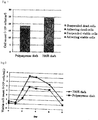
- the EPO-producing CHO cells were seeded onto a Ham's medium (liquid medium) containing 10% fetal bovine serum at a cell density of 0.624 ⁇ 10 4 cells/cm 2 using the 790R dish as a culture vessel, and cultured at 37°C for 7 days in a 5% CO 2 atmosphere.
- a Ham's medium liquid medium
- 10% fetal bovine serum at a cell density of 0.624 ⁇ 10 4 cells/cm 2
- the cells adhering to the suspended cells were counted by the following method.
- Cells in a suspended state the culture supernatant was removed and centrifuged, and from this sample, only the medium supernatant was removed, the resulting cell component was reacted with trypan blue. After the cell component was reacted for about 3 minutes, the sample was stained with trypan blue to measure the viable cell count and the dead cell count. The cell counts were measured using a cell counter.
- the culture supernatant was removed, washed with physiological saline, and then the cells were released from the dish by trypsinization. After released, in a serum-containing culture medium, these cell samples were stained with trypan blue to measure the viable cell count and the dead cell count. The cell counts were measured using the same device as well.
- Example 1 Cells were cultured and counted in the same manner as in Example 1, except that a polystyrene dish [Falcon (registered trademark) dish (model number: 353001 manufactured by Becton, Dickinson and Company)] was used instead of the 790R dish in Example 1.
- a polystyrene dish [Falcon (registered trademark) dish (model number: 353001 manufactured by Becton, Dickinson and Company)] was used instead of the 790R dish in Example 1.
- Example 1 The results of Example 1 and Comparative Example 1 as preculture steps are shown in Figure 1 .
- the suspended EPO-producing CHO cells were observed in an appearance ratio of about 80% based on the total cell count in the 790R dish, and most of them were viable cells.
- the polystyrene dish most cells were adhering to the bottom surface, and suspended cells were present in a single cell state, and most of them were in a dead state.
- a suspension culture apparatus manufactured by ABLE Corporation
- Suspension culture was started by the same manipulation as in Example 2, except that a polystyrene dish was used in the preculture step in Example 2.
- Example 2 The results of Example 2 and Comparative Example 2 as suspension culture steps are shown in Figure 2 .
- the EPO-producing CHO cells precultured in the 790R dish grew more than the EPO-producing CHO cells precultured in the polystyrene dish, and the cell samples precultured in the 790R dish were considered to be samples acclimated to the suspended cell system.
- the adhering cells statically cultured in the polystyrene dish had an average doubling time of 15.6 hours, which was the shortest among the compared cell samples.
- the cell samples precultured in the 790R dish showed a shorter average doubling time compared to the cell samples precultured in the polystyrene dish, and the cell samples precultured in the 790R dish were considered to be transformed to a suspension culture-acclimated state.
- CHO cells in a culture vessel after culture for 8 days in the same manner as in Example 1 and the CHO cells in a culture vessel after culture for 8 days in the same manner as in Comparative Example 1 were collected, and all collected cells were lysed by Trizol (manufactured by Invitrogen Corporation).
- An RNA was sampled from the lysed sample. The sampling method was in accordance with the product manual. Subsequently, the collected RNA was analyzed with (HiSeq (registered trademark), manufactured by Illumina, Inc.).
- RNA-Seq analysis was performed on the obtained data of the transcription level by (CLC Genomics Workbench, manufactured by CLC bio), and a transcription level of an mRNA was digitized as an RPKM value.
- EDGE analysis was performed on the obtained RPKM value by (CLC Genomics Workbench, manufactured by CLC bio), and the transcription level of the cell group cultured in the 790R dish was compared with the transcription level of the cell group cultured in the polystyrene dish to obtain a Fold Change value (ratio of the transcription level in the 790R dish to the transcription level in the polystyrene dish).
- a Fold Change value ratio of the transcription level in the 790R dish to the transcription level in the polystyrene dish.
Landscapes
- Health & Medical Sciences (AREA)
- Chemical & Material Sciences (AREA)
- Life Sciences & Earth Sciences (AREA)
- Engineering & Computer Science (AREA)
- Organic Chemistry (AREA)
- Bioinformatics & Cheminformatics (AREA)
- Genetics & Genomics (AREA)
- Wood Science & Technology (AREA)
- Zoology (AREA)
- Biomedical Technology (AREA)
- Biotechnology (AREA)
- General Health & Medical Sciences (AREA)
- Microbiology (AREA)
- Biochemistry (AREA)
- General Engineering & Computer Science (AREA)
- Polymers & Plastics (AREA)
- Medicinal Chemistry (AREA)
- Chemical Kinetics & Catalysis (AREA)
- Cell Biology (AREA)
- Developmental Biology & Embryology (AREA)
- Immunology (AREA)
- Clinical Laboratory Science (AREA)
- Sustainable Development (AREA)
- Rheumatology (AREA)
- Micro-Organisms Or Cultivation Processes Thereof (AREA)
- Apparatus Associated With Microorganisms And Enzymes (AREA)
Abstract
Description
- The present invention relates to a method for preparing adherent cells acclimated to suspension culture. The present invention also relates to a method for inducing epithelial-mesenchymal transition of adherent epithelial cells.
- In recent years, biopharmaceuticals with low adverse reactions have been actively researched instead of pharmaceuticals composed of low-molecular-weight compounds. Biopharmaceuticals are recombinant drugs produced by genetic recombination technology. For example, recombinant drugs that include a protein (e.g., an antibody used for cancer treatment or rheumatism treatment, or erythropoietin (EPO) (i.e., a hormone that increases the production of red blood cells)) as a component are known.
- However, since the recombinant drugs must be administered in high doses when used for treatment, and require high production cost, the recombinant drugs have not been used widely. Therefore, it has been desired to produce the recombinant drugs with improved productivity.
- For example, the recombinant drugs are produced by transferring the gene of the desired protein into CHO (Chinese Hamster Ovary) cells (i.e., adherent cells) to biosynthesize the desired protein in the recombinant CHO cells prepared so as to grow in a suspended state. Generally, an average doubling time of those derived from adherent cells is prolonged in a suspension culture system. Thus, acclimation of the cells to a suspension culture environment is required for enhancing a proliferative ability.
- As a method for acclimating an adherent cell to suspension culture, for example, Patent Literature 1 discloses a method that cultures recombinant CHO cells in a suspended state, wherein a gene that encodes the desired protein and a plasmid that has a dihydrofolate reductase gene are transferred into CHO cells, and the resulting recombinant CHO cells are repeatedly cultured at a cell density lower than a normal cell density.
- However, this method has a problem in that repeated culture that causes the CHO cells to be in a suspended state takes time (about 8 weeks). Moreover, it takes more time and cost to manage and check the culture state (e.g., gene mutation and cell alteration) as the subculture period increases.
- In addition,
Patent Literature 2 discloses a method for producing human antithrombin, wherein recombinant CHO cells in a suspended state obtained by transferring a human antithrombin gene and a dihydrofolate reductase gene into dihydrofolate reductase gene-deficient cells, are cultured in a suspended state using a hollow fiber-type culture apparatus to produce human antithrombin. - However, this method has a problem in terms of cost since the hollow fiber-type culture apparatus is complex and expensive. Moreover, when the hollow fiber size is increased to implement mass culture, the culture medium easily becomes non-uniform since the replacement of the medium is non-uniform at each end of the hollow fiber. As a result, the pH and the like of the medium change, and stress is applied to the cells within the hollow fibers, whereby the productivity of the desired protein may decrease.
- Incidentally, epithelial-mesenchymal transition (transformation); (EMT) is a process that characteristics of a epithelial cell is transformed to those of a mesenchymal cell, which is observed in vital phenomena such as development, wound healing, cancer invasion and metastasis. The epithelial-mesenchymal transition causes change in certain proteins expressed by the cells. Such proteins are referred to as epithelial-mesenchymal transition markers, and classified into proteins in which expression levels are increased (up regulation) and decreased (down regulation) due to induction of epithelial-mesenchymal transition. For example, N-cadherin and vimentin are known as proteins with the increased expression level, and E-cadherin and cytokeratin are known as proteins with the decreased expression level (Patent Document 3). In addition, since the epithelial-mesenchymal transition is induced by growth factors such as TGF, the growth factors such as TGF are known as epithelial-mesenchymal transition inducers (Non-Patent Document 1).
-
- PTL 1: Japanese Patent Laid-Open No.
2-009388 - PTL 2: Japanese Patent Laid-Open No.
2005-073509 - PTL 3:
WO 2006/101925 , brochure - NPL 1: Massague J, Cell, July 2008, vol. 134, the second issue, pages 215-230
- As described above, several techniques have been proposed to acclimate adherent cells to suspension culture. However, a method that can more efficiently and inexpensively acclimate the cells is desired.
- The invention has been made in view of the above situation. An object of the invention is to provide a method for preparing adherent cells acclimated to suspension culture, which survive even in a suspended state, without requiring a special operation, a method for producing a nucleic acid or a protein using the adherent cells acclimated to suspension culture, which have been adjusted by the preparation method, a promotor for suspension culture acclimation of the adherent cells, which is composed of an alicyclic structure-containing polymer formed article, use of the alicyclic structure-containing polymer formed article for acclimating the adherent cells to suspension culture, and a vessel for suspension culture acclimation of the adherent cells.
- Also, an object of the invention is to provide a method for inducing epithelial-mesenchymal transition to the adherent epithelial cells only by contact manipulation of the adherent epithelial cells, a method for producing a nucleic acid or a protein using cells after epithelial-mesenchymal transition by the induction method, an inducer for epithelial-mesenchymal transition of the adherent epithelial cells, which is composed of an alicyclic structure-containing polymer formed article, use of the alicyclic structure-containing polymer formed article for inducing the epithelial-mesenchymal transition of the adherent epithelial cells, and a vessel for inducing epithelial-mesenchymal transition of the adherent epithelial cells.
- The inventors conducted extensive studies in order to solve the above problem. As a result, the inventors have found that it is possible to allow adherent cells that originally require an extracellular matrix to proliferate in a suspension culture system i.e. capable to acclimate the adherent cells by culturing the adherent cells in contact with an alicyclic structure-containing polymer formed article. This finding has led to the completion of the invention related to suspension acclimation of the adherent cells. Furthermore, the inventors have found that the characteristics of the cells are transformed to mesenchymal cell-like characteristics by bringing the cells into contact with the alicyclic structure-containing polymer formed article. This finding has led to the completion of the invention related to induction of epithelial-mesenchymal transition of the adherent epithelial cells.
- Several aspects of the invention provide methods for preparing adherent cells (see (1) to (5)), methods for producing a nucleic acid or a protein encoded by a foreign gene (see (6) and (15), a promotor for suspension culture acclimation of the adherent cells (see (7)), use of an alicyclic structure-containing polymer formed article (see (8) and (17)), vessels for suspension culture acclimation (see (9) and (10)), methods for inducing epithelial-mesenchymal transition (see (11) to (14)), an inducer for epithelial-mesenchymal transition of adherent epithelial cells (see (16)), and vessels for inducing epithelial-mesenchymal transition of the adherent epithelial cells (see (18) and (19)).
-
- (1) A method for preparing adherent cells acclimated to suspension culture, including a step of culturing the adherent cells in contact with an alicyclic structure-containing polymer formed article.
- (2) The method for preparing the adherent cells according to (1), wherein the adherent cells are genetically recombinant adherent cells that express a foreign gene.
- (3) The method for preparing the adherent cells according to (2), wherein the foreign gene is a gene that encodes a protein.
- (4) The method for preparing the adherent cells according to any one of (1) to (3), wherein the adherent cells are animal-derived cells.
- (5) The method for preparing the adherent cells according to (4), wherein the animal-derived cells are CHO cells.
-
- (6) A method of producing a nucleic acid or a protein encoded by a foreign gene by culturing the adherent cells acclimated to suspension culture in accordance with the method for preparing the adherent cells according to any one of (1) to (5).
- (7) A promotor for suspension culture acclimation of the adherent cells, composed of an alicyclic structure-containing polymer formed article.
- (8) Use of an alicyclic structure-containing polymer formed article for acclimating adherent cells to suspension culture in a liquid medium.
- (9) A vessel for suspension culture acclimation of adherent cells, having at least a bottom surface composed of an alicyclic structure-containing polymer formed article.
- (10) The vessel for suspension culture acclimation according to (9), wherein the alicyclic structure-containing polymer is a saturated norbornene-based polymer.
-
- (11) A method for inducing epithelial-mesenchymal transition, including a step of culturing adherent epithelial cells in contact with an alicyclic structure-containing polymer formed article.
- (12) The method for inducing epithelial-mesenchymal transition according to (11), wherein the adherent epithelial cells are genetically recombinant adherent cells that express a foreign gene.
- (13) The method for inducing epithelial-mesenchymal transition according to (11) or (12), wherein the adherent epithelial cells are animal-derived cells.
- (14) The method for inducing epithelial-mesenchymal transition according to (13), wherein the animal-derived cell is a CHO cell.
- (15) A method of producing a nucleic acid or a protein encoded by the foreign gene, by culturing the adherent cells after epithelial-mesenchymal transition in accordance with the method for inducing epithelial-mesenchymal transition according to any one of (12) to (14).
-
- (16) An inducer for epithelial-mesenchymal transition of the adherent epithelial cells, composed of an alicyclic structure-containing polymer formed article.
- (17) Use of an alicyclic structure-containing polymer formed article for inducing epithelial-mesenchymal transition of adherent epithelial cells.
- (18) A vessels for inducing epithelial-mesenchymal transition of adherent epithelial cells, having at least a bottom surface composed of an alicyclic structure-containing polymer formed article.
- (19) The vessels for inducing epithelial-mesenchymal transition according to (18), wherein the alicyclic structure-containing polymer is a saturated norbornene-based polymer.
-
-
FIG. 1 is a graph illustrating results of measuring cell counts of EPO-producing CHO cells precultured by the method according to the invention. -
FIG. 2 is a graph illustrating total cell counts with respect to the number of days elapsed when all of the precultured cells that mainly include the suspension culture-acclimated CHO cells prepared by the method according to the invention are cultured in a suspension culture system. -
FIG. 3 is a graph illustrating average doubling times of each precultured sample from the first day to the third day of culture (in a proliferation phase of viable cells), calculated from data of the whole cells cultured in the suspension culture system by the method according to the invention. - The method according to the invention is a method for preparing the adherent cells, culturing the adherent cells in contact with an alicyclic structure-containing polymer formed article for acclimating the adherent cells to suspension culture in a liquid medium.
- When the adherent cells are acclimated to suspension culture, the adherent cells are compatible with a culture environment, and thus the average doubling time of the adherent cells acclimated to suspension culture is shortened compared to an average doubling time in a case of suspension culture of adherent cells that have not been acclimated to suspension.
- The adherent cells according to the invention are not particularly limited, and may be arbitrarily selected taking account of the object (intended use).
- In the present invention, the adherent cells refer to cells that can survive and grow by adhering to an extracellular matrix under normal culture condition. Examples of adherent cells include epithelial cells and fibroblasts. In addition, they may be genetically engineered cells, such as recombinant adherent cells prepared by incorporating a foreign gene into these cells. Specific examples of the adherent cells include CHO cells, VERO cells, NIH3T3 cells, HEK293 cells and the like. Above all, the CHO cells are preferable because they can be easily acclimated to suspension.
- In the present invention, cells that can express a foreign gene through transduction of a vector (e.g., phage and plasmid) into these adherent cells are used. Note that, among the adherent cells, the cells used in the method for inducing epithelial-mesenchymal transition according to the invention may be simple squamous epithelial cells, stratified squamous epithelial cells, columnar epithelial cells, ciliated (pseudostratified ciliated) epithelial cells, transitional epithelial cells, epithelial cells classified into cubical epithelial cells and the like, or epithelial cell-like cells having the morphologies similar to those of the above-mentioned epithelial cells. Among the above-described specific examples, the CHO cells and the HEK293 cells are mentioned as examples of the epithelial cells.
- The foreign gene may be arbitrarily selected taking account of the object (intended use). Specific examples of the foreign gene include a gene that encodes a physiologically active protein (e.g., cytokine and hormone) such as erythropoietin (hereinafter referred to as EPO), interferon (interferon α, interferon β, and interferon γ), granulocyte-colony stimulating factor (G-CSF), interleukin, granulocytic-macrophage colony-stimulating factor (GM-CSF), human-growth hormone, insulin, glucagon (HGF), blood coagulation factor VIII, and a human antibody; a gene that encodes a nucleic acid (RNA) such as microRNA e.g. miR-369 and as a precursor of the microRNA, which inhibits RNA synthesis of a certain target (e.g. cancer cell) and expected as a candidate for a next-generation nucleic acid medicine; and the like.
- When the alicyclic structure-containing polymer formed article is brought into contact with a culture of such genetically recombinant cells, the production volume of the physiologically active protein increases.
- A liquid medium is used when culturing the cells.
- A liquid medium is normally used that has a pH buffer action, has an osmotic pressure suitable for the cells, includes nutritional ingredients for the cells, and does not have toxicity to the cells.
- Examples of a component that has a pH buffer action include Tris hydrochloride, a phosphate, a carbonate, and the like.
- The osmotic pressure of the liquid medium is normally adjusted using an aqueous solution that includes potassium ions, sodium ions, calcium ions, glucose, and the like at an adjusted concentration so that the osmotic pressure of the liquid medium is almost equal to that of the cells. Specific examples of such an aqueous solution include physiological saline such as phosphate buffered saline, Tris-buffered saline, and HEPES-buffered saline; a Ringer's solution such as Ringer's lactate solution, Ringer's acetate solution, and Ringer's bicarbonate solution; and the like.
- Examples of the nutritional ingredients for the cells include an amino acid, a nucleic acid, a vitamin, a mineral, and the like.
- A commercially-available product such as RPMI-1640, HAM, α-MEM, DMEM, EMEM, F-12, F-10, and M-199 may be used as the liquid medium.
- An additive may be added to the liquid medium. Examples of the additive include an inducer such as a protein, a low-molecular-weight compound having differentiation-inducing activity, a mineral, a metal, a vitamin component, and the like.
- Examples of the additive to be used include a ligand, an agonist, and an antagonist that act on a cell surface acceptor; a ligand, an agonist, and an antagonist that act on a nuclear receptor; an extracellular matrix such as collagen and fibronectin; part of the extracellular matrix, and a compound that imitates the extracellular matrix; a component that acts on a protein that is involved in a cell signaling pathway; a component that acts on a primary or secondary metabolism enzyme within the cells; a component that affects intranuclear or intramitochondrial gene expression; DNA and RNA that can be introduced into the cells in combination with a virus vector or the like; and the like.
- These additives may be used either alone or in combination.
- The cell culture conditions are not particularly limited. The cell culture conditions may be appropriately determined taking account of the cells and the object.
- For example, the cells may be cultured using a humidified incubator that contains carbon dioxide at a concentration of about 5%, and is maintained at a constant temperature within the range from 20°C to 37°C.
- The alicyclic structure-containing polymer formed article used in connection with the invention is obtained by forming an alicyclic structure-containing polymer so as to have an arbitrary shape.
- The term "alicyclic structure-containing polymer" used herein refers to a resin that includes an alicyclic structure in either or both of the main chain and the side chain. Particularly, it is preferable that the alicyclic structure-containing polymer includes an alicyclic structure in the main chain from viewpoint of mechanical strength, heat resistance, and the like.
- Examples of the alicyclic structure include a saturated cyclic hydrocarbon (cycloalkane) structure, an unsaturated cyclic hydrocarbon (cycloalkene) structure, and the like, it is preferable that the alicyclic structure-containing polymer contains a cycloalkane structure or a cycloalkene structure from the viewpoint of mechanical strength, heat resistance, and the like. It is most preferable that the alicyclic structure-containing polymer contains a cycloalkane structure.
- The number of carbon atoms included in the alicyclic structure is not particularly limited, but is normally 4 to 30, preferably 5 to 20, and more preferably 5 to 15. When the number of carbon atoms included in the alicyclic structure is within the above range, the alicyclic structure-containing polymer exhibits mechanical strength, heat resistance, and formability in a highly balanced manner, which is suitable.
- The content of an alicyclic structure-containing repeating unit in the alicyclic structure-containing polymer may be appropriately selected taking account of the intended use, but is normally 30 wt% or more, preferably 50 wt% or more, and still more preferably 70 wt% or more. If the content of the alicyclic structure-containing repeating unit in the alicyclic structure-containing polymer is too low, the alicyclic structure-containing polymer may exhibit poor heat resistance, which is not preferable. A repeating unit that may be included in the alicyclic structure-containing polymer in addition to the alicyclic structure-containing repeating unit is not particularly limited, and is appropriately selected taking account of the intended use.
- Specific examples of the alicyclic structure-containing polymer include (1) a norbornene-based polymer, (2) a monocyclic cycloolefin-based polymer, (3) a cyclic conjugated diene-based polymer, (4) a vinyl alicyclic hydrocarbon polymer, hydrogenated products of the polymers (1) to (4), and the like. Among these, the hydrogenated product of the hydrogenated norbornene-based polymer is preferable from the viewpoint of heat resistance, mechanical strength, and the like.
- The term "norbornene-based polymer" used herein refers to a polymer that is obtained by polymerizing a norbornene-based monomer (i.e., a monomer that includes a norbornene skeleton). Norbornene-based polymers are roughly classified into a norbornene-based polymer obtained by ring-opening polymerization, and a norbornene-based polymer obtained by addition polymerization.
- Examples of the norbornene-based polymer obtained by ring-opening polymerization include a ring-opening polymer of a norbornene-based monomer, a ring-opening polymer of a norbornene-based monomer and a monomer that can undergo ring-opening copolymerization with the norbornene-based monomer, hydrogenated products thereof, and the like. Examples of the norbornene-based polymer obtained by addition polymerization include an addition polymer of a norbornene-based monomer, an addition polymer of a norbornene-based monomer and a monomer that can undergo addition copolymerization with the norbornene-based monomer, and the like. Among these, a hydrogenated ring-opening polymer of a norbornene-based monomer, an addition polymer of a norbornene-based monomer and another monomer copolymerizable therewith, and a saturated norbornene-based polymer such as a hydrogenated product of the addition polymer are preferable from the viewpoint of heat resistance, mechanical strength, and the like. Above all, a polymer having no polar group is preferable because it facilitates suspension of the cells.
- Examples of the norbornene-based monomer include a bicyclic norbornene-based monomer such as bicyclo[2.2.1]hept-2-ene (trivial name: norbornene), 5-methylbicyclo[2.2.1]hept-2-ene, 5,5-dimethylbicyclo[2.2.1]hept-2-ene, 5-ethylbicyclo[2.2.1]hept-2-ene, 5-ethylidenebicyclo[2.2.1]hept-2-ene, 5-vinylbicyclo[2.2.1]hept-2-ene, 5-propenylbicyclo[2.2.1]hept-2-ene, 5-methoxycarbonylbicyclo[2.2.1]hept-2-ene, 5-cyanobicyclo[2.2.1]hept-2-ene, and 5-methyl-5-methoxycarbonylbicyclo[2.2.1]hept-2-ene; a tricyclic norbornene-based monomer such as tricyclo[4.3.01,6.12,5]deca-3,7-diene (trivial name: dicyclopentadiene), 2-methyldicyclopentadiene, 2,3-dimethyldicyclopentadiene, and 2,3-dihydroxydicyclopentadiene; a tetracyclic norbornene-based monomer such as tetracyclo[4.4.0.12,5.17,10]-3-dodecene (tetracyclododecene), tetracyclo[4.4.0.12,5.17,10]-3-dodecene, 8-methyltetracyclo[4.4.0.12,5.17,10]-3-dodecene, 8-ethyltetracyclo[4.4.0.12,5.17,10]-3-dodecene,8-ethylidenetetracyclo[4.4.0.12,5.17,10]-3-dodecene, 8,9-dimethyltetracyclo[4.4.0.12,5.17,10]-3-dodecene, 8-ethyl-9-methyltetracyclo[4.4.0.12,5.17,10]-3-dodecene, 8-ethylidene-9-methyltetracyclo[4.4.0.12,5.17,10]-3-dodecene, 8-methyl-8-carboxymethyltetracyclo[4.4.0.12,5.17,10]-3-dodecene,7,8-benzotricyclo[4.3.0.12,5]dec-3-ene (trivial name: methanotetrahydrofluorene (also referred to as 1,4-methano-1,4,4a,9a-tetrahydrofluorene)), 1,4-methano-8-methyl-1,4,4a,9a-tetrahydrofluorene, 1,4-methano-8-chloro-1,4,4a,9a-tetrahydrofluorene, and 1,4-methano-8-bromo-1,4,4a,9a-tetrahydrofluorene; and the like.
- Examples of the additional monomer that can undergo ring-opening copolymerization with the norbornene-based monomer include a monocyclic cycloolefin-based monomer such as cyclohexene, cycloheptene, cyclooctene, 1,4-cyclohexadiene, 1,5-cyclooctadiene, 1,5-cyclodecadiene, 1,5,9-cyclododecatriene, and 1,5,9,13-cyclohexadecatetraene.
- These monomers may be substituted with one substituent, or may be substituted with two or more substituents. Examples of the substituent include an alkyl group, an alkylene group, an aryl group, a silyl group, an alkoxycarbonyl group, an alkylidene group, and the like.
- Examples of the additional monomer that can undergo addition copolymerization with the norbornene-based monomer include an α-olefin-based monomer having 2 to 20 carbon atoms, such as ethylene, propylene, 1-butene, 1-pentene, and 1-hexene; a cycloolefin-based monomer such as cyclobutene, cyclopentene, cyclohexene, cyclooctene, and tetracyclo[9.2.1.02,10.03,8]tetradeca-3,5,7,12-tetraene (also referred to as 3a,5,6,7a-tetrahydro-4,7-methano-1H-indene); a non-conjugated diene-based monomer such as 1,4-hexadiene, 4-methyl-1,4-hexadiene, 5-methyl-1,4-hexadiene, and 1,7-octadiene; and the like.
- Among these, an α-olefin-based monomer is preferable, and ethylene is more preferable.
- These monomers may be substituted with one substituent, or may be substituted with two or more substituents. Examples of the substituent include an alkyl group, an alkylene group, an aryl group, a silyl group, an alkoxycarbonyl group, an alkylidene group, and the like.
- A ring-opening polymer of a norbornene-based monomer, or a ring-opening polymer of a norbornene-based monomer and a monomer that can undergo ring-opening copolymerization with the norbornene-based monomer, may be obtained by polymerizing the monomer component in the presence of a known ring-opening polymerization catalyst. Examples of the usable ring-opening polymerization catalyst include a catalyst that includes a halide of a metal (e.g., ruthenium or osmium), a nitrate or an acetylacetone compound, and a reducing agent, or alternatively a catalyst that includes a halide or an acetylacetone compound of a metal (e.g., titanium, zirconium, tungsten, or molybdenum), and an organoaluminum compound.
- A hydrogenated ring-opening polymer of a norbornene-based monomer may normally be obtained by adding a known hydrogenation catalyst that includes a transition metal (e.g., nickel or palladium) to a solution including the ring-opening polymer, and hydrogenating the carbon-carbon unsaturated bonds of the ring-opening polymer.
- An addition polymer of a norbornene-based monomer, or an addition polymer of a norbornene-based monomer and a monomer that can undergo addition copolymerization with the norbornene-based monomer, may be obtained by polymerizing the monomer component in the presence of a known addition polymerization catalyst. Examples of the usable addition polymerization catalyst include a catalyst that includes a titanium, zirconium, or vanadium compound and an organoaluminum compound.
- Examples of the usable monocyclic cycloolefin-based polymer include an addition polymer of a monocyclic cycloolefin-based monomer (e.g., cyclohexene, cycloheptene, or cyclooctene).
- Examples of the cyclic conjugated diene-based polymer and the hydrogenated product thereof include a 1,2-addition polymer or a 1,4-addition polymer of a cyclic conjugated diene-based monomer (e.g., cyclopentadiene or cyclohexadiene), a hydrogenated product thereof, and the like.
- Examples of the vinyl alicyclic hydrocarbon polymer and the hydrogenated product thereof include a polymer of a vinyl alicyclic hydrocarbon-based monomer (e.g., vinylcyclohexene or vinylcyclohexane), and a hydrogenated product thereof; a hydrogenated product obtained by hydrogenating the aromatic ring of a polymer of a vinyl aromatic-based monomer (e.g., styrene or α-methylstyrene); and the like. The vinyl alicyclic hydrocarbon polymer may be a copolymer of the above monomer and an additional monomer that can undergo copolymerization with the above monomer.
- Each of these alicyclic structure-containing polymers may be used either alone or in combination.
- The molecular weight of the alicyclic structure-containing polymer is not particularly limited. The polystyrene-equivalent weight average molecular weight of the alicyclic structure-containing polymer determined by gel permeation chromatography using a cyclohexane solution (or a toluene solution when the polymer does not dissolve in cyclohexane) is normally 5,000 or more, preferably 5,000 to 500,000, more preferably 8,000 to 200,000, and particularly preferably 10,000 to 100,000. When the weight average molecular weight of the alicyclic structure-containing polymer is within the above range, the alicyclic structure-containing polymer exhibits mechanical strength and formability in a highly balanced manner, which is suitable.
- The glass transition temperature of the alicyclic structure-containing polymer may be appropriately selected taking account of the intended use. The glass transition temperature of the alicyclic structure-containing polymer is normally 50 to 300°C, preferably 100 to 280°C, more preferably 115 to 250°C, and still more preferably 130 to 200°C. When the glass transition temperature of the alicyclic structure-containing polymer is within the above range, the alicyclic structure-containing polymer exhibits heat resistance and formability in a highly balanced manner, which is suitable.
- Note that the glass transition temperature of the alicyclic structure-containing polymer refers to a value measured in accordance with JIS K 7121.
- An additive that is normally used for a thermoplastic resin material, such as a soft polymer, an antioxidant, a UV absorber, a light stabilizer, a near-infrared absorber, a release agent, a coloring agent such as dye and pigment, a plasticizer, an antistatic agent, and a fluorescent whitening agent, may be added to the alicyclic structure-containing polymer in an amount that is normally employed.
- In addition, an additional polymer other than the soft polymer (hereinafter referred to as "additional polymer") may be mixed with the alicyclic structure-containing polymer. The additional polymer is normally mixed with the alicyclic structure-containing polymer in a ratio of 200 parts by weight or less, preferably 150 parts by weight or less, and more preferably 100 parts by weight or less, based on 100 parts by weight of the alicyclic structure-containing polymer.
- If the ratio of the additive or the additional polymer is too large based on the alicyclic structure-containing polymer, the cells may be suspended to only a small extent. Therefore, it is preferable to add (mix) the additive and the additional polymer within such a range that the properties of the alicyclic structure-containing polymer are not impaired.
- The additive and the additional polymer may be mixed with the alicyclic structure-containing polymer using an arbitrary method as long as the additive is sufficiently dispersed in the polymer. The additive and the additional polymer may be added in an arbitrary order. Examples of the mixing method include a method that mixes (kneads) the resin in a molten state using a mixer, a single-screw kneader, a twin-screw kneader, a roll, a Brabender, an extruder, or the like, a method that dissolves the resin in an appropriate solvent to effect dispersion, and removes the solvent using a coagulation method, a casting method, or a direct drying method, and the like.
- When the resin is mixed (kneaded) using a twin-screw kneader, the resulting mixture (kneaded product) is normally extruded in the shape of a rod in a molten state, and cut to have an appropriate length using a strand cutter, and pelletized for use.
- A forming method that is used when forming the alicyclic structure-containing polymer may be arbitrarily selected taking account of the shape of the alicyclic structure-containing polymer formed article that is used when brought into contact with cells. Examples of the forming method include an injection forming method, an extrusion method, a cast forming method, an inflation forming method, a blow forming method, a vacuum forming method, a press forming method, a compression forming method, a rotational forming method, a calendering method, a roll forming method, a cutting method, a spinning method, and the like. Note that these methods may be used in combination, and a post-treatment such as stretching may optionally be performed after forming.
- The shape of the alicyclic structure-containing polymer formed article in contact with the cells is not particularly limited; including a plate-like shape, a sheet-like shape, or the like. The surface of the alicyclic structure-containing polymer formed article may be either flat or irregular. Furthermore, it may be a vessel that includes a formed article having such a shape as a part of the constituent member, a vessel constituted entirely of the alicyclic structure-containing polymer formed article, or a vessel composed of a laminate of the alicyclic structure-containing polymer formed article and another polymer formed article.
- Specific examples of shape of the vessel include culture vessels such as a dish, a plate, a bag, a tube, a scaffold, a cup and ajar fermenter.
- In addition, the alicyclic structure-containing polymer formed article obtained in such a way is a promotor for suspension culture acclimation according to the invention which has a function of promoting acclimation of the adherent cells to suspension culture.
- When implementing the invention, the formed article is normally sterilized before bringing the formed article into contact with the cultured cells.
- The sterilization method is not particularly limited. A known sterilization method may be selected taking account of the shape of the formed article and the cells to be cultured. Examples thereof include methods that are normally employed in the medical field such as a heating method such as a high-pressure steam method and a dry heat method; a radiation method that applies radiation such as γ-rays or an electron beam, and an irradiation method that applies high-frequency waves; a gas method that brings a gas such as ethylene oxide gas (EOG) into contact with the sterilization target; and a filtration method that utilizes a sterilization filter. It is preferable to use a gas method since a change in surface state occurs to only a small extent.
- The alicyclic structure-containing polymer formed article used in connection with the present invention may be any formed article in which at least the surface in contact with the cells is made of an alicyclic structure-containing polymer, and the whole formed article does not have to be made of the alicyclic structure-containing polymer.
- In this alicyclic structure-containing polymer formed article, a water contact angle of the surface in contact with the cells is normally 85° to 110°, preferably 85° to 105°, and particularly preferably 85° to 100°.
- Note that the term "water contact angle" used herein refers to a value obtained by cutting the bottom surface of the dish using a circle cutter having a diameter of 30 mm to prepare a specimen, measuring the radius r and the height h of a liquid droplet at the center of the specimen and the four vertices of a 20×20 mm square formed around the center of the specimen (i.e., at five measurement points) using a known automatic contact angle meter ("LCD-400S" manufactured by Kyowa Interface Science Co., Ltd. in Examples of this patent application), and calculating the value 0 using the expressions "tanθ1=h/r" and "θ=2arctan(h/r)" (θ/2 method).
- The surfaces of these formed articles may also be subjected to a conventional surface treatment (e.g., plasma treatment, corona discharge treatment, ozone treatment, and UV irradiation treatment) other than the sterilization treatment, for a culture vessel. Note that, to suppress an increase in cost due to the surface treatment operation; to prevent a situation in which cleanliness is impaired due to partial decomposition of the surface of the formed article during the surface treatment; and to prevent a decrease in an ability of cell suspension or epithelial-mesenchymal transition; and the like, it is preferable that these surface treatment operations are not substantially carried out. Herein, the phrase "these surface treatment operations are not substantially carried out" means that a rate of change [X (%)] in the water contact angle of the formed article surface (surface in contact with the cells in the ring structure-containing polymer formed article) after the surface treatment operation, as defined by the following equation, is within a range of ±20%, and preferably ±10% in both cases without and even with these surface treatment operations.

- For a method for culturing the cultured cells in contact with the alicyclic structure-containing polymer formed article, any method may be adopted depending on the shape of the alicyclic structure-containing polymer formed article. Normally using a vessel such as a petri dish, a bag and a bottle, in which at least one surface is made of the alicyclic structure-containing polymer, the cells are cultured so that the cells adhere to the surface made of the alicyclic structure-containing polymer. The cells adhering to the surface made of the alicyclic structure-containing polymer in early phase of seeding, are naturally released in a few days and survive in a suspended state. That is, the cells surviving in this suspended state are the adherent cells acclimated to suspension culture.
- When the adherent cells acclimated to suspension culture by the method according to the invention are continuously statically cultured as they are, a cell aggregation is formed in some cases, but they can be dissociated by oscillating with a conventional suspension culture type system and used as adherent cells acclimated to a single suspension culture.
- As described above, in the culture method according to the invention, even adherent cells can be cultured at a high density in a suspended state, and thus the method is preferably used when producing a nucleic acid or a protein in the cells.
- For example, during culture of recombinant cells capable of expressing a foreign gene that encodes a protein, the cells are brought into contact with the alicyclic structure-containing polymer formed article, so that a large amount of proteins can be produced.
- Thus, in the adherent cells in contact with the alicyclic structure-containing polymer formed article, the transcription level of an epithelial-mesenchymal transformer such as TGF, HGF and FGF is increased, and there is observed change in a transcription level of an epithelial-mesenchymal transition marker, such as decreased E-cadherin, and increased N-cadherin and vimentin. That is, as described above, epithelial-mesenchymal transition can be induced in the adherent cells by culturing the adherent epithelial cells in contact with the alicyclic structure-containing polymer formed article.
- That is, the alicyclic structure-containing polymer formed article functions as an epithelial-mesenchymal transformer. When the alicyclic structure-containing polymer formed article is a culture vessel, epithelial-mesenchymal transition can be caused only by culturing the cells using the vessel according to the invention without requiring a special operation.
- The invention is further described below by way of examples. Note that the invention is not limited to the following examples.
- The EPO gene sequence was inserted into the insertion site of the expression gene of a vector pLXRN (manufactured by Chlontech) including a gene resistant to an antibiotic G418 to obtain a plasmid pLXRN-EPO. The presence of the EPO gene in the obtained plasmid was determined by analyzing the base sequence.
- The obtained plasmid pLXRN-EPO and a plasmid pVSV-G (manufactured by Clontech) were transduced into GP293T cells (manufactured by Clontech) (packaging cells) to prepare virus particles including the EPO gene.
- Note that Lipofectamine (manufactured by Invitorogen) was used as a gene transfection reagent for transfecting the plasmid pLXRN-EPO into the cells, and the gene transfection operation was performed in accordance with the manufacturer's instruction manual.
- The GP293T cells subjected to the gene transfection operation were cultured, and the culture supernatant was removed, and filtered through a filter. 8 µg/ml of polybrene (manufactured by Santa Cruz) was added to the filtrate to prepare a culture supernatant sample including the virus particles including the EPO gene.
- Then, removing the culture solution of the cultured CHO cell sample in advance, the culture supernatant sample including the virus particles including the EPO gene was added, and cultured for 8 hours to infect the CHO cells with the virus particles including the EPO gene.
- After performing incubation for 8 hours, the culture medium was replaced with a CHO cell culture medium, and recombinant EPO-producing CHO cells were cultured.
- Infection with the virus was checked by genomic PCR. Specifically, the genome was first extracted from the CHO cells subjected to the infection operation using an InstaGene matrix (manufactured by BioRad) to determine that the pLXRN-EPO sequence was introduced into the genome by PCR. Primers pLXRN-seq-F (5'-CGCCTCCGTCTGAATTTTT) and pLXRN-seq-R (TCCCTATGCAAAAGCGAAAC) were used for PCR.
- To select the CHO cells which were infected with the virus and in which the EPO gene was introduced into the genome, an antibiotic G418 was added to the culture medium, and the mixture was cultured. The CHO cells resistant to the antibiotic G418 were selected using a reagent to screen recombinant EPO-producing CHO cells (hereinafter referred to as "EPO-producing CHO cells").
- A dish having a diameter of 3 cm was produced by an injection forming method using, as an alicyclic structure-containing polymer, a hydrogenated norbornene-based ring-opening polymer [ZEONEX (registered trademark) 790R, manufactured by Zeon Corporation, hereinafter referred to as "790R"]. The resulting dish is hereinafter referred to as "790R dish". The bottom surface (side in contact with the cells) of the 790R dish had a water contact angle of 90°.
- The EPO-producing CHO cells were seeded onto a Ham's medium (liquid medium) containing 10% fetal bovine serum at a cell density of 0.624×10⁴ cells/cm2 using the 790R dish as a culture vessel, and cultured at 37°C for 7 days in a 5% CO2 atmosphere.
- The cells adhering to the suspended cells were counted by the following method.
- Cells in a suspended state: the culture supernatant was removed and centrifuged, and from this sample, only the medium supernatant was removed, the resulting cell component was reacted with trypan blue. After the cell component was reacted for about 3 minutes, the sample was stained with trypan blue to measure the viable cell count and the dead cell count. The cell counts were measured using a cell counter.
- Cells adhering to the bottom surface of the dish: the culture supernatant was removed, washed with physiological saline, and then the cells were released from the dish by trypsinization. After released, in a serum-containing culture medium, these cell samples were stained with trypan blue to measure the viable cell count and the dead cell count. The cell counts were measured using the same device as well.
- Cells were cultured and counted in the same manner as in Example 1, except that a polystyrene dish [Falcon (registered trademark) dish (model number: 353001 manufactured by Becton, Dickinson and Company)] was used instead of the 790R dish in Example 1.
- The results of Example 1 and Comparative Example 1 as preculture steps are shown in
Figure 1 . - In the preculture period (for 7 days after seeding), the suspended EPO-producing CHO cells were observed in an appearance ratio of about 80% based on the total cell count in the 790R dish, and most of them were viable cells. On the other hand, in the polystyrene dish, most cells were adhering to the bottom surface, and suspended cells were present in a single cell state, and most of them were in a dead state.
- The suspended EPO-producing CHO cells and the EPO-producing CHO cells remaining in an adhering state, which had appeared in the 790R dish preculture step, were collected in tubes. Note that, for the cells adhering in this step, the culture supernatant in the dish was removed, washed with physiological saline, and then the cells were released and collected from the dish by trypsinization. Each cell was mixed in a sterile tube, centrifuged, then the culture medium was removed, and only the cell component was suspended in another medium. The medium containing the suspended cells was added to a culture vessel of a suspension culture apparatus (manufactured by ABLE Corporation), and the suspension culture was started.
- Suspension culture was started by the same manipulation as in Example 2, except that a polystyrene dish was used in the preculture step in Example 2.
- The results of Example 2 and Comparative Example 2 as suspension culture steps are shown in
Figure 2 . - The EPO-producing CHO cells precultured in the 790R dish grew more than the EPO-producing CHO cells precultured in the polystyrene dish, and the cell samples precultured in the 790R dish were considered to be samples acclimated to the suspended cell system.
- Furthermore, on the first day to the third day (Day 1 to 3) of the culture in the cell proliferation phase in the suspension culture system of Example 2 and Comparative Example 2, an average doubling time of each cell sample was calculated from the cell count measurement results obtained from the test of the suspension culture system. The results are shown in
Figure 3 . - Moreover, for comparison, an average doubling time of the cells statically cultured in the polystyrene dish, i.e. cells cultured in an adhering state was also measured.
- As shown in
Figure 3 , the adhering cells statically cultured in the polystyrene dish had an average doubling time of 15.6 hours, which was the shortest among the compared cell samples. The cell samples precultured in the 790R dish showed a shorter average doubling time compared to the cell samples precultured in the polystyrene dish, and the cell samples precultured in the 790R dish were considered to be transformed to a suspension culture-acclimated state. - The CHO cells in a culture vessel after culture for 8 days in the same manner as in Example 1 and the CHO cells in a culture vessel after culture for 8 days in the same manner as in Comparative Example 1 were collected, and all collected cells were lysed by Trizol (manufactured by Invitrogen Corporation). An RNA was sampled from the lysed sample. The sampling method was in accordance with the product manual. Subsequently, the collected RNA was analyzed with (HiSeq (registered trademark), manufactured by Illumina, Inc.).
- The experiment was carried out twice, while the NGS analysis condition was changed in each experiment. Both analyses were carried out by a paired-end method. Each read number was about 30 million or 50 million. As a reference, public information (GCF_000223135.1_CriGri_1.0_ma.fa.fai) was used.
- RNA-Seq analysis was performed on the obtained data of the transcription level by (CLC Genomics Workbench, manufactured by CLC bio), and a transcription level of an mRNA was digitized as an RPKM value.
- EDGE analysis was performed on the obtained RPKM value by (CLC Genomics Workbench, manufactured by CLC bio), and the transcription level of the cell group cultured in the 790R dish was compared with the transcription level of the cell group cultured in the polystyrene dish to obtain a Fold Change value (ratio of the transcription level in the 790R dish to the transcription level in the polystyrene dish). Here, if the Fold Change value is a positive integer, the transcription level in the 790R dish is higher, and if the Fold Change value is a negative integer, the transcription level in the polystyrene dish is higher, and the larger the absolute value is, the larger the difference between them is.
- The obtained results are shown in Tables 1 and 2.
TABLE 1 Inducer Fold Change TGF-α 4.938 TGF-β group 2.195 HGF 4.301 FGF group 37.334 - The results in Table 1 show that transcription levels of TGF, HGF, and FGF as epithelial-mesenchymal transition inducers in the cell samples cultured in the 790R dish are increased compared to the cell samples cultured in the polystyrene dish.
TABLE 2 Regulation EMT marker Polystyrene vs. 790R Fold Change Down E-cadherin -9.498 Down Cytokeratin -1.973 Up N-cadherin 15.148 Up Vimentin 2.946 Up Fibronectin 1.489 - The results in Table 2 show that, as epithelial-mesenchymal transition markers, E-cadherin and cytokeratin are decreased and N-cadherin, vimentin and fibronectin are increased in the cell samples cultured in the 790R dish, compared to the cell sample cultured in the polystyrene dish.
- The results in Tables 1 and 2 suggest that epithelial-mesenchymal transition was induced in the cells cultured by the method according to the invention.
Claims (19)
- A method for preparing adherent cells acclimated to suspension culture, including a step of culturing the adherent cells in contact with an alicyclic structure-containing polymer formed article.
- The method for preparing the adherent cells according to claim 1, wherein the adherent cells are genetically recombinant adherent cells that express a foreign gene.
- The method for preparing the adherent cells according to claim 2, wherein the foreign gene is a gene that encodes a protein.
- The method for preparing the adherent cells according to any one of claims 1 to 3, wherein the adherent cells are animal-derived cells.
- The method for preparing the adherent cells according to claim 4, wherein the animal-derived cells are CHO cells.
- A method of producing a nucleic acid or a protein encoded by a foreign gene by culturing the adherent cells acclimated to suspension culture in accordance with the method for preparing the adherent cells according to any one of claims 1 to 5.
- A promotor for suspension culture acclimation of the adherent cells, composed of an alicyclic structure-containing polymer formed article.
- Use of an alicyclic structure-containing polymer formed article for acclimating an adherent cells to suspension culture in a liquid medium.
- A vessel for suspension culture acclimation of an adherent cells, having at least a bottom surface composed of an alicyclic structure-containing polymer formed article.
- The vessel for suspension culture acclimation according to claim 9, wherein the alicyclic structure-containing polymer is a saturated norbornene-based polymer.
- A method for inducing epithelial-mesenchymal transition, including a step of culturing adherent epithelial cells in contact with an alicyclic structure-containing polymer formed article.
- The method for inducing epithelial-mesenchymal transition according to claim 11, wherein the adherent epithelial cells are genetically recombinant adherent cells that express a foreign gene.
- The method for inducing epithelial-mesenchymal transition according to claim 11 or 12, wherein the adherent epithelial cells are animal-derived cells.
- The method for inducing epithelial-mesenchymal transition according to claim 13, wherein the animal-derived cell is a CHO cell.
- A method of producing a nucleic acid or a protein encoded by the foreign gene, by culturing the adherent cells after epithelial-mesenchymal transition in accordance with the method for inducing epithelial-mesenchymal transition according to any one of claims 12 to 14.
- An inducer for epithelial-mesenchymal transition of the adherent epithelial cells, composed of an alicyclic structure-containing polymer formed article.
- Use of an alicyclic structure-containing polymer formed article for inducing epithelial-mesenchymal transition of adherent epithelial cells.
- A vessels for inducing epithelial-mesenchymal transition of adherent epithelial cells, having at least a bottom surface composed of an alicyclic structure-containing polymer formed article.
- The vessels for inducing epithelial-mesenchymal transition according to claim 18, wherein the alicyclic structure-containing polymer is a saturated norbornene-based polymer.
Applications Claiming Priority (3)
| Application Number | Priority Date | Filing Date | Title |
|---|---|---|---|
| JP2015247270 | 2015-12-18 | ||
| JP2016211700 | 2016-10-28 | ||
| PCT/JP2016/087606 WO2017104821A1 (en) | 2015-12-18 | 2016-12-16 | Method for preparing adherent-type cells acclimated to suspension culture, method for inducing epithelial-mesenchymal transition in adherent-type epithelial cells, and use for methods |
Publications (2)
| Publication Number | Publication Date |
|---|---|
| EP3392334A1 true EP3392334A1 (en) | 2018-10-24 |
| EP3392334A4 EP3392334A4 (en) | 2019-10-30 |
Family
ID=59056671
Family Applications (1)
| Application Number | Title | Priority Date | Filing Date |
|---|---|---|---|
| EP16875795.3A Withdrawn EP3392334A4 (en) | 2015-12-18 | 2016-12-16 | Method for preparing adherent-type cells acclimated to suspension culture, method for inducing epithelial-mesenchymal transition in adherent-type epithelial cells, and use for methods |
Country Status (5)
| Country | Link |
|---|---|
| US (1) | US20180355321A1 (en) |
| EP (1) | EP3392334A4 (en) |
| JP (1) | JP6988480B2 (en) |
| CN (1) | CN108291198A (en) |
| WO (1) | WO2017104821A1 (en) |
Families Citing this family (1)
| Publication number | Priority date | Publication date | Assignee | Title |
|---|---|---|---|---|
| US20220034868A1 (en) * | 2018-09-28 | 2022-02-03 | Zeon Corporation | Cardiotoxicity assessment method |
Family Cites Families (13)
| Publication number | Priority date | Publication date | Assignee | Title |
|---|---|---|---|---|
| JP2576200B2 (en) | 1988-03-09 | 1997-01-29 | 味の素株式会社 | Method for producing bioactive protein |
| JP4391523B2 (en) * | 2003-04-30 | 2009-12-24 | オーロラ ディスカバリー インコーポレイティッド | Multiwell plate providing high density storage and assay platform |
| JP2005073509A (en) | 2003-08-28 | 2005-03-24 | Nihon Pharmaceutical Co Ltd | Method for producing human antithrombin |
| CA2601157A1 (en) | 2005-03-16 | 2006-09-28 | Osi Pharmaceuticals, Inc. | Biological markers predictive of anti-cancer response to epidermal growth factor receptor kinase inhibitors |
| JP2009106160A (en) * | 2007-10-26 | 2009-05-21 | Nipro Corp | Cell culture container and cell culture method |
| JP5024004B2 (en) * | 2007-12-03 | 2012-09-12 | ニプロ株式会社 | Adherent cell culture container and method for culturing adherent cells |
| CA2821888C (en) * | 2010-12-15 | 2019-03-26 | Kyowa Kirin Co., Ltd. | Method for producing proteins |
| WO2013099901A1 (en) * | 2011-12-28 | 2013-07-04 | Jsr株式会社 | Cell adhesion inhibitor |
| US20150238586A1 (en) * | 2012-08-15 | 2015-08-27 | California Stem Cell, Inc. | Rapid Method Production High Purity Cancer Stem Cells and Population of High Purity Cancer Stem Cells |
| WO2014138455A1 (en) * | 2013-03-07 | 2014-09-12 | California Stem Cell, Inc. | Individualized high purity hepatocellular carcinoma stem cells, methods and use of the same |
| US20140065655A1 (en) * | 2012-09-05 | 2014-03-06 | Scivax Corporation | Screening method for substance acting on maintenance of epithelial properties of cell |
| KR102470046B1 (en) * | 2014-06-26 | 2022-11-22 | 니폰 제온 가부시키가이샤 | Method for culturing adhesive cells, culture vessel, and method for producing protein |
| KR102412034B1 (en) * | 2014-06-26 | 2022-06-21 | 니폰 제온 가부시키가이샤 | Cultured cell differentiation promotion method and cultured cell differentiation promoter |
-
2016
- 2016-12-16 WO PCT/JP2016/087606 patent/WO2017104821A1/en not_active Ceased
- 2016-12-16 US US15/781,250 patent/US20180355321A1/en not_active Abandoned
- 2016-12-16 CN CN201680071272.8A patent/CN108291198A/en active Pending
- 2016-12-16 EP EP16875795.3A patent/EP3392334A4/en not_active Withdrawn
- 2016-12-16 JP JP2017556475A patent/JP6988480B2/en active Active
Also Published As
| Publication number | Publication date |
|---|---|
| US20180355321A1 (en) | 2018-12-13 |
| JP6988480B2 (en) | 2022-01-05 |
| WO2017104821A1 (en) | 2017-06-22 |
| JPWO2017104821A1 (en) | 2018-10-04 |
| EP3392334A4 (en) | 2019-10-30 |
| CN108291198A (en) | 2018-07-17 |
Similar Documents
| Publication | Publication Date | Title |
|---|---|---|
| US20170130203A1 (en) | Method for culturing adhesive cells, culture vessel, and method for producing protein | |
| EP3162891B1 (en) | Cultured cell differentiation promotion method and cultured cell differentiation promoter | |
| JP2019004884A (en) | Medical device, cell culture method and fluorine-containing cyclic olefin polymer composition | |
| JP2018201403A (en) | Methods for culturing stem cells | |
| EP3392334A1 (en) | Method for preparing adherent-type cells acclimated to suspension culture, method for inducing epithelial-mesenchymal transition in adherent-type epithelial cells, and use for methods | |
| EP3392335A1 (en) | Method for culturing adherent cells | |
| JP6806058B2 (en) | Extracellular matrix production promoting method, cell culturing method, and extracellular matrix production promoting agent | |
| TWI727925B (en) | Method for culturing adherent cells, culturing container and method for producing protein | |
| JP6716887B2 (en) | Adhesive cell culture method and protein production method | |
| JP2016146819A (en) | Method for enhancing phosphorylation of ERK or AKT in cultured cells, and method for culturing cells | |
| EP3399023A1 (en) | Method for promoting differentiation of cultured cells and cultured cell differentiation-promoting agent | |
| WO2022163653A1 (en) | Vector, recombinant vertebrate cell to which vector is introduced, method for producing same, and method for producing target protein | |
| de Castro Sobral | Towards the development of a 3D cell model to study interactions between glioma cells and microglia | |
| JP2024140707A (en) | Cultivation vessel for adherent cells and method for culturing adherent cells using the same | |
| JP2023062597A (en) | Cardiotoxicity evaluation method |
Legal Events
| Date | Code | Title | Description |
|---|---|---|---|
| STAA | Information on the status of an ep patent application or granted ep patent |
Free format text: STATUS: THE INTERNATIONAL PUBLICATION HAS BEEN MADE |
|
| PUAI | Public reference made under article 153(3) epc to a published international application that has entered the european phase |
Free format text: ORIGINAL CODE: 0009012 |
|
| STAA | Information on the status of an ep patent application or granted ep patent |
Free format text: STATUS: REQUEST FOR EXAMINATION WAS MADE |
|
| 17P | Request for examination filed |
Effective date: 20180627 |
|
| AK | Designated contracting states |
Kind code of ref document: A1 Designated state(s): AL AT BE BG CH CY CZ DE DK EE ES FI FR GB GR HR HU IE IS IT LI LT LU LV MC MK MT NL NO PL PT RO RS SE SI SK SM TR |
|
| AX | Request for extension of the european patent |
Extension state: BA ME |
|
| DAV | Request for validation of the european patent (deleted) | ||
| DAX | Request for extension of the european patent (deleted) | ||
| RIC1 | Information provided on ipc code assigned before grant |
Ipc: C08G 61/08 20060101ALI20190621BHEP Ipc: C12M 3/00 20060101ALI20190621BHEP Ipc: C12N 5/16 20060101ALI20190621BHEP Ipc: C12N 5/07 20100101AFI20190621BHEP Ipc: C08F 232/00 20060101ALI20190621BHEP |
|
| A4 | Supplementary search report drawn up and despatched |
Effective date: 20191001 |
|
| RIC1 | Information provided on ipc code assigned before grant |
Ipc: C12N 5/16 20060101ALI20190925BHEP Ipc: C08G 61/08 20060101ALI20190925BHEP Ipc: C08F 232/00 20060101ALI20190925BHEP Ipc: C12M 3/00 20060101ALI20190925BHEP Ipc: C12N 5/07 20100101AFI20190925BHEP |
|
| STAA | Information on the status of an ep patent application or granted ep patent |
Free format text: STATUS: THE APPLICATION HAS BEEN WITHDRAWN |
|
| 18W | Application withdrawn |
Effective date: 20200722 |