EP3392259A1 - Substituted cyclopentadienyl cobalt complex and method for production thereof, and cobalt-containing thin film and method for production thereof - Google Patents
Substituted cyclopentadienyl cobalt complex and method for production thereof, and cobalt-containing thin film and method for production thereof Download PDFInfo
- Publication number
- EP3392259A1 EP3392259A1 EP16875596.5A EP16875596A EP3392259A1 EP 3392259 A1 EP3392259 A1 EP 3392259A1 EP 16875596 A EP16875596 A EP 16875596A EP 3392259 A1 EP3392259 A1 EP 3392259A1
- Authority
- EP
- European Patent Office
- Prior art keywords
- cobalt
- group
- thin film
- carbon atoms
- diene
- Prior art date
- Legal status (The legal status is an assumption and is not a legal conclusion. Google has not performed a legal analysis and makes no representation as to the accuracy of the status listed.)
- Granted
Links
- 0 C1C2NCC*C12 Chemical compound C1C2NCC*C12 0.000 description 3
- XIIJQOYMVIJNEP-UHFFFAOYSA-N C1C2C(C3)C3CC12 Chemical compound C1C2C(C3)C3CC12 XIIJQOYMVIJNEP-UHFFFAOYSA-N 0.000 description 1
- XAZKFISIRYLAEE-UHFFFAOYSA-N CC1CC(C)CC1 Chemical compound CC1CC(C)CC1 XAZKFISIRYLAEE-UHFFFAOYSA-N 0.000 description 1
Images

Classifications
-
- C—CHEMISTRY; METALLURGY
- C07—ORGANIC CHEMISTRY
- C07F—ACYCLIC, CARBOCYCLIC OR HETEROCYCLIC COMPOUNDS CONTAINING ELEMENTS OTHER THAN CARBON, HYDROGEN, HALOGEN, OXYGEN, NITROGEN, SULFUR, SELENIUM OR TELLURIUM
- C07F17/00—Metallocenes
- C07F17/02—Metallocenes of metals of Groups 8, 9 or 10 of the Periodic Table
-
- C—CHEMISTRY; METALLURGY
- C07—ORGANIC CHEMISTRY
- C07F—ACYCLIC, CARBOCYCLIC OR HETEROCYCLIC COMPOUNDS CONTAINING ELEMENTS OTHER THAN CARBON, HYDROGEN, HALOGEN, OXYGEN, NITROGEN, SULFUR, SELENIUM OR TELLURIUM
- C07F15/00—Compounds containing elements of Groups 8, 9, 10 or 18 of the Periodic Table
- C07F15/06—Cobalt compounds
-
- C—CHEMISTRY; METALLURGY
- C07—ORGANIC CHEMISTRY
- C07F—ACYCLIC, CARBOCYCLIC OR HETEROCYCLIC COMPOUNDS CONTAINING ELEMENTS OTHER THAN CARBON, HYDROGEN, HALOGEN, OXYGEN, NITROGEN, SULFUR, SELENIUM OR TELLURIUM
- C07F17/00—Metallocenes
-
- C—CHEMISTRY; METALLURGY
- C07—ORGANIC CHEMISTRY
- C07F—ACYCLIC, CARBOCYCLIC OR HETEROCYCLIC COMPOUNDS CONTAINING ELEMENTS OTHER THAN CARBON, HYDROGEN, HALOGEN, OXYGEN, NITROGEN, SULFUR, SELENIUM OR TELLURIUM
- C07F19/00—Metal compounds according to more than one of main groups C07F1/00 - C07F17/00
-
- C—CHEMISTRY; METALLURGY
- C23—COATING METALLIC MATERIAL; COATING MATERIAL WITH METALLIC MATERIAL; CHEMICAL SURFACE TREATMENT; DIFFUSION TREATMENT OF METALLIC MATERIAL; COATING BY VACUUM EVAPORATION, BY SPUTTERING, BY ION IMPLANTATION OR BY CHEMICAL VAPOUR DEPOSITION, IN GENERAL; INHIBITING CORROSION OF METALLIC MATERIAL OR INCRUSTATION IN GENERAL
- C23C—COATING METALLIC MATERIAL; COATING MATERIAL WITH METALLIC MATERIAL; SURFACE TREATMENT OF METALLIC MATERIAL BY DIFFUSION INTO THE SURFACE, BY CHEMICAL CONVERSION OR SUBSTITUTION; COATING BY VACUUM EVAPORATION, BY SPUTTERING, BY ION IMPLANTATION OR BY CHEMICAL VAPOUR DEPOSITION, IN GENERAL
- C23C16/00—Chemical coating by decomposition of gaseous compounds, without leaving reaction products of surface material in the coating, i.e. chemical vapour deposition [CVD] processes
- C23C16/06—Chemical coating by decomposition of gaseous compounds, without leaving reaction products of surface material in the coating, i.e. chemical vapour deposition [CVD] processes characterised by the deposition of metallic material
- C23C16/18—Chemical coating by decomposition of gaseous compounds, without leaving reaction products of surface material in the coating, i.e. chemical vapour deposition [CVD] processes characterised by the deposition of metallic material from metallo-organic compounds
-
- H—ELECTRICITY
- H10—SEMICONDUCTOR DEVICES; ELECTRIC SOLID-STATE DEVICES NOT OTHERWISE PROVIDED FOR
- H10D—INORGANIC ELECTRIC SEMICONDUCTOR DEVICES
- H10D62/00—Semiconductor bodies, or regions thereof, of devices having potential barriers
- H10D62/80—Semiconductor bodies, or regions thereof, of devices having potential barriers characterised by the materials
- H10D62/83—Semiconductor bodies, or regions thereof, of devices having potential barriers characterised by the materials being Group IV materials, e.g. B-doped Si or undoped Ge
-
- H—ELECTRICITY
- H10—SEMICONDUCTOR DEVICES; ELECTRIC SOLID-STATE DEVICES NOT OTHERWISE PROVIDED FOR
- H10D—INORGANIC ELECTRIC SEMICONDUCTOR DEVICES
- H10D64/00—Electrodes of devices having potential barriers
- H10D64/01—Manufacture or treatment
- H10D64/011—Manufacture or treatment of electrodes ohmically coupled to a semiconductor
-
- H—ELECTRICITY
- H10—SEMICONDUCTOR DEVICES; ELECTRIC SOLID-STATE DEVICES NOT OTHERWISE PROVIDED FOR
- H10D—INORGANIC ELECTRIC SEMICONDUCTOR DEVICES
- H10D64/00—Electrodes of devices having potential barriers
- H10D64/01—Manufacture or treatment
- H10D64/011—Manufacture or treatment of electrodes ohmically coupled to a semiconductor
- H10D64/0111—Manufacture or treatment of electrodes ohmically coupled to a semiconductor to Group IV semiconductors
- H10D64/0112—Manufacture or treatment of electrodes ohmically coupled to a semiconductor to Group IV semiconductors using conductive layers comprising silicides
-
- H—ELECTRICITY
- H10—SEMICONDUCTOR DEVICES; ELECTRIC SOLID-STATE DEVICES NOT OTHERWISE PROVIDED FOR
- H10D—INORGANIC ELECTRIC SEMICONDUCTOR DEVICES
- H10D64/00—Electrodes of devices having potential barriers
- H10D64/01—Manufacture or treatment
- H10D64/013—Manufacture or treatment of electrodes having a conductor capacitively coupled to a semiconductor by an insulator
- H10D64/01302—Manufacture or treatment of electrodes having a conductor capacitively coupled to a semiconductor by an insulator the insulator being formed after the semiconductor body, the semiconductor being silicon
- H10D64/01304—Manufacture or treatment of electrodes having a conductor capacitively coupled to a semiconductor by an insulator the insulator being formed after the semiconductor body, the semiconductor being silicon characterised by the conductor
- H10D64/01318—Manufacture or treatment of electrodes having a conductor capacitively coupled to a semiconductor by an insulator the insulator being formed after the semiconductor body, the semiconductor being silicon characterised by the conductor the conductor comprising a layer of alloy material, compound material or organic material contacting the insulator, e.g. TiN
- H10D64/0132—Manufacture or treatment of electrodes having a conductor capacitively coupled to a semiconductor by an insulator the insulator being formed after the semiconductor body, the semiconductor being silicon characterised by the conductor the conductor comprising a layer of alloy material, compound material or organic material contacting the insulator, e.g. TiN the conductor being a metallic silicide
-
- H—ELECTRICITY
- H10—SEMICONDUCTOR DEVICES; ELECTRIC SOLID-STATE DEVICES NOT OTHERWISE PROVIDED FOR
- H10D—INORGANIC ELECTRIC SEMICONDUCTOR DEVICES
- H10D64/00—Electrodes of devices having potential barriers
- H10D64/60—Electrodes characterised by their materials
- H10D64/62—Electrodes ohmically coupled to a semiconductor
-
- H—ELECTRICITY
- H10—SEMICONDUCTOR DEVICES; ELECTRIC SOLID-STATE DEVICES NOT OTHERWISE PROVIDED FOR
- H10D—INORGANIC ELECTRIC SEMICONDUCTOR DEVICES
- H10D64/00—Electrodes of devices having potential barriers
- H10D64/60—Electrodes characterised by their materials
- H10D64/66—Electrodes having a conductor capacitively coupled to a semiconductor by an insulator, e.g. MIS electrodes
- H10D64/667—Electrodes having a conductor capacitively coupled to a semiconductor by an insulator, e.g. MIS electrodes the conductor comprising a layer of alloy material, compound material or organic material contacting the insulator, e.g. TiN workfunction layers
- H10D64/668—Electrodes having a conductor capacitively coupled to a semiconductor by an insulator, e.g. MIS electrodes the conductor comprising a layer of alloy material, compound material or organic material contacting the insulator, e.g. TiN workfunction layers the layer being a silicide, e.g. TiSi2
-
- H—ELECTRICITY
- H10—SEMICONDUCTOR DEVICES; ELECTRIC SOLID-STATE DEVICES NOT OTHERWISE PROVIDED FOR
- H10P—GENERIC PROCESSES OR APPARATUS FOR THE MANUFACTURE OR TREATMENT OF DEVICES COVERED BY CLASS H10
- H10P14/00—Formation of materials, e.g. in the shape of layers or pillars
- H10P14/40—Formation of materials, e.g. in the shape of layers or pillars of conductive or resistive materials
- H10P14/42—Formation of materials, e.g. in the shape of layers or pillars of conductive or resistive materials using a gas or vapour
-
- H—ELECTRICITY
- H10—SEMICONDUCTOR DEVICES; ELECTRIC SOLID-STATE DEVICES NOT OTHERWISE PROVIDED FOR
- H10P—GENERIC PROCESSES OR APPARATUS FOR THE MANUFACTURE OR TREATMENT OF DEVICES COVERED BY CLASS H10
- H10P14/00—Formation of materials, e.g. in the shape of layers or pillars
- H10P14/40—Formation of materials, e.g. in the shape of layers or pillars of conductive or resistive materials
- H10P14/42—Formation of materials, e.g. in the shape of layers or pillars of conductive or resistive materials using a gas or vapour
- H10P14/43—Chemical deposition, e.g. chemical vapour deposition [CVD]
-
- H—ELECTRICITY
- H10—SEMICONDUCTOR DEVICES; ELECTRIC SOLID-STATE DEVICES NOT OTHERWISE PROVIDED FOR
- H10P—GENERIC PROCESSES OR APPARATUS FOR THE MANUFACTURE OR TREATMENT OF DEVICES COVERED BY CLASS H10
- H10P14/00—Formation of materials, e.g. in the shape of layers or pillars
- H10P14/40—Formation of materials, e.g. in the shape of layers or pillars of conductive or resistive materials
- H10P14/42—Formation of materials, e.g. in the shape of layers or pillars of conductive or resistive materials using a gas or vapour
- H10P14/43—Chemical deposition, e.g. chemical vapour deposition [CVD]
- H10P14/432—Chemical deposition, e.g. chemical vapour deposition [CVD] using selective deposition
-
- H—ELECTRICITY
- H10—SEMICONDUCTOR DEVICES; ELECTRIC SOLID-STATE DEVICES NOT OTHERWISE PROVIDED FOR
- H10P—GENERIC PROCESSES OR APPARATUS FOR THE MANUFACTURE OR TREATMENT OF DEVICES COVERED BY CLASS H10
- H10P14/00—Formation of materials, e.g. in the shape of layers or pillars
- H10P14/60—Formation of materials, e.g. in the shape of layers or pillars of insulating materials
- H10P14/63—Formation of materials, e.g. in the shape of layers or pillars of insulating materials characterised by the formation processes
- H10P14/6326—Deposition processes
- H10P14/6328—Deposition from the gas or vapour phase
- H10P14/6334—Deposition from the gas or vapour phase using decomposition or reaction of gaseous or vapour phase compounds, i.e. chemical vapour deposition
-
- H—ELECTRICITY
- H10—SEMICONDUCTOR DEVICES; ELECTRIC SOLID-STATE DEVICES NOT OTHERWISE PROVIDED FOR
- H10P—GENERIC PROCESSES OR APPARATUS FOR THE MANUFACTURE OR TREATMENT OF DEVICES COVERED BY CLASS H10
- H10P14/00—Formation of materials, e.g. in the shape of layers or pillars
- H10P14/60—Formation of materials, e.g. in the shape of layers or pillars of insulating materials
- H10P14/69—Inorganic materials
- H10P14/692—Inorganic materials composed of oxides, glassy oxides or oxide-based glasses
- H10P14/6938—Inorganic materials composed of oxides, glassy oxides or oxide-based glasses the material containing at least one metal element, e.g. metal oxides, metal oxynitrides or metal oxycarbides
- H10P14/6939—Inorganic materials composed of oxides, glassy oxides or oxide-based glasses the material containing at least one metal element, e.g. metal oxides, metal oxynitrides or metal oxycarbides characterised by the metal
-
- H—ELECTRICITY
- H10—SEMICONDUCTOR DEVICES; ELECTRIC SOLID-STATE DEVICES NOT OTHERWISE PROVIDED FOR
- H10W—GENERIC PACKAGES, INTERCONNECTIONS, CONNECTORS OR OTHER CONSTRUCTIONAL DETAILS OF DEVICES COVERED BY CLASS H10
- H10W20/00—Interconnections in chips, wafers or substrates
- H10W20/01—Manufacture or treatment
- H10W20/031—Manufacture or treatment of conductive parts of the interconnections
- H10W20/064—Manufacture or treatment of conductive parts of the interconnections by modifying the conductivity of conductive parts, e.g. by alloying
- H10W20/066—Manufacture or treatment of conductive parts of the interconnections by modifying the conductivity of conductive parts, e.g. by alloying by forming silicides of refractory metals
-
- H—ELECTRICITY
- H10—SEMICONDUCTOR DEVICES; ELECTRIC SOLID-STATE DEVICES NOT OTHERWISE PROVIDED FOR
- H10W—GENERIC PACKAGES, INTERCONNECTIONS, CONNECTORS OR OTHER CONSTRUCTIONAL DETAILS OF DEVICES COVERED BY CLASS H10
- H10W20/00—Interconnections in chips, wafers or substrates
- H10W20/40—Interconnections external to wafers or substrates, e.g. back-end-of-line [BEOL] metallisations or vias connecting to gate electrodes
- H10W20/41—Interconnections external to wafers or substrates, e.g. back-end-of-line [BEOL] metallisations or vias connecting to gate electrodes characterised by their conductive parts
- H10W20/425—Barrier, adhesion or liner layers
Definitions
- the present invention relates to a cobalt complex useful as a raw material in the manufacture of semiconductor elements and a production method therefor, and cobalt-containing thin film produced using this cobalt complex and a production method therefor.
- cobalt has high conductivity and a high work function, can form a conductive silicide, and has excellent lattice matching with copper, it has gathered attention as a raw material for gate electrodes in semiconductor elements such as transistors, for contacts on diffusion layers in source-drain sections, and for copper wiring sheet layers/liner layers.
- semiconductor elements such as transistors
- contacts on diffusion layers in source-drain sections and for copper wiring sheet layers/liner layers.
- next-generation semiconductor elements highly miniaturized three-dimensional designs are being used to further improve memory capacity and responsiveness. Therefore, in order to use cobalt as a material in next-generation semiconductor elements, a technique is needed to form a cobalt-containing thin film evenly on a three-dimensional substrate to a thickness ranging from several nanometers to tens nanometers.
- vapor phase deposition method based on chemical reaction such as atomic layer deposition method (ALD method) or chemical vapor deposition method (CVD method) is strongly expected.
- ALD method atomic layer deposition method
- CVD method chemical vapor deposition method
- CoSi 2 obtained by forming a cobalt film and then subjecting the film to silicidation is being considered as gate electrodes and as contacts on diffusion layers in the source-drain sections of next-generation semiconductor elements.
- a barrier metal such as titanium nitride or tantalum nitride is expected to be used underneath.
- Non-Patent Documents 1 and 2 mention dicarbonyl [ ⁇ 5 -(1-diethylmethylsilyloxy-2,3,4,5-tetraphenyl)cyclopentadienyl]cobalt and dicarbonyl[ ⁇ 5 -(1-dimethyl(phenyl)silyloxy-3,4-diphenyl-2,5-dimethyl(phenyl)silyl)cyclopentadienyl]cobalt as compounds having a structure resembling a cobalt complex (1) of the present invention from the viewpoint of having an ⁇ 5 -silyloxycyclopentadienyl ligand, but these differ from a cobalt complex of the present invention from the viewpoint of having a phenyl group. Also, neither of these documents mentions the use of these complexes as a material in the production of a cobalt-containing thin film.
- An object of the present invention is to provide a cobalt complex that is useful as a raw material in the production of a cobalt-containing thin film under conditions in which no oxidizing gas is used.
- a cobalt complex represented by Formula (1) was a useful material for the production of a cobalt-containing thin film under conditions in which no oxidizing gas is used, that is, under conditions in which a reducing gas is used.
- a cobalt-containing thin film can be produced under conditions in which a reducing gas is used as a reaction gas by using a cobalt complex (1) of the present invention as a raw material.
- FIG. 1 is a diagram showing the CVD device used in Examples 8, 9 and 16-33 and in Comparative Example 1.
- R 1 is a silyloxy group represented by Formula (2)
- R 2 may be a hydrogen atom, an alkyl group having from 1 to 6 carbon atoms, or a silyloxy group represented by Formula (2)
- R 3 , R 4 and R 5 may be a hydrogen atom or an alkyl group having from 1 to 6 carbon atoms.
- the alkyl groups having from 1 to 6 carbon atoms that are represented by R 6 , R 7 and R 8 in Formula (2) may be linear, branched or cyclic. Specific examples include a methyl group, ethyl group, propyl group, isopropyl group, cyclopropyl group, butyl group, isobutyl group, sec-butyl group, tert-butyl group, cyclobutyl group, pentyl group, 1-ethylpropyl group, 1-methylbutyl group, 2-methylbutyl group, isopentyl group, neopentyl group, tert-pentyl group, cyclopentyl group, cyclobutylmethyl group, hexyl group, 1-methylpentyl group, 2-methylpentyl group, 3-methylpentyl group, 4-methylpentyl group, 1,1-dimethylbutyl group, 1,2-dimethylbutyl group, 1,3-dimethylbut
- R 6 , R 7 and R 8 are preferably an alkyl group having from 1 to 4 carbon atoms, and more preferably a methyl group, ethyl group or tert-butyl group.
- Me, Et, Pr, i Pr, Bu, i Bu, s Bu and t Bu represent, respectively, methyl group, ethyl group, propyl group, isopropyl group, butyl group, isobutyl group, sec-butyl group, and tert-butyl group.
- the silyloxy group represented by R 1 is preferably (2-1), (2-2), (2-5) or (2-11) and more preferably (2-1).
- the alkyl group having from 1 to 6 carbon atoms that is represented by R 2 may be linear, branched or cyclic. Specific examples include a methyl group, ethyl group, propyl group, isopropyl group, cyclopropyl group, butyl group, isobutyl group, sec-butyl group, tert-butyl group, cyclobutyl group, pentyl group, 1-ethylpropyl group, 1-methylbutyl group, 2-methylbutyl group, isopentyl group, neopentyl group, tert-pentyl group, cyclopentyl group, cyclobutylmethyl group, hexyl group, 1-methylpentyl group, 2-methylpentyl group, 3-methylpentyl group, 4-methylpentyl group, 1,1-dimethylbutyl group, 1,2-dimethylbutyl group, 1,3-dimethylbutyl group, 2,2-dimethylbut
- R 2 is preferably a hydrogen atom, an alkyl group having from 1 to 4 carbon atoms or a silyloxy group represented by (2-1), (2-2), (2-5) or (2-11), more preferably a hydrogen atom, a methyl group, an ethyl group, (2-1), (2-2) or (2-11), and even more preferably a hydrogen atom, a methyl group or (2-1).
- the alkyl group having from 1 to 6 carbon atoms that is represented by R 3 , R 4 and R 5 may be linear, branched or cyclic. Specific examples include a methyl group, ethyl group, propyl group, isopropyl group, cyclopropyl group, butyl group, isobutyl group, sec-butyl group, tert-butyl group, cyclobutyl group, pentyl group, 1-ethylpropyl group, 1-methylbutyl group, 2-methylbutyl group, isopentyl group, neopentyl group, tert-pentyl group, cyclopentyl group, cyclobutylmethyl group, hexyl group, 1-methylpentyl group, 2-methylpentyl group, 3-methylpentyl group, 4-methylpentyl group, 1,1-dimethylbutyl group, 1,2-dimethylbutyl group, 1,3-dimethylbutyl group
- R 3 , R 4 and R 5 is preferably a hydrogen atom or an alkyl group having from 1 to 4 carbon atoms, more preferably a hydrogen atom, methyl group, ethyl group, propyl group, isopropyl group, butyl group, isobutyl group, sec-butyl group, or tert-butyl group, even more preferably a hydrogen atom, methyl group, or tert-butyl group, and still more preferably a hydrogen atom or a methyl group.
- a diene represented by L may be a linear diene or a cyclic diene.
- the linear dienes among the dienes having from 4 to 10 carbon atoms that are represented by L can be any linear diene able to coordinate with cobalt in the s-cis type ⁇ 4 bonding mode.
- Examples include buta-1,3-diene (butadiene), 2-methylbuta-1,3-diene (isoprene), 2,3-dimethylbuta-1,3-diene, 2-methylpenta-1,3-diene, 2,3-dimethylpenta-1,3-diene, penta-1,3-diene, hexa-2,4-diene, 3-methylpenta-1,3-diene, 3-methylene-pent-1-ene, hexa-1,3-diene, hepta-1,3-diene, octa-1,3-diene, nona-1,3-diene, deca-1,3-diene, 4-methyl-3-methylene-pent-1-ene, and 2-cyclohexyl-1,3-buta
- the cyclic dienes among the dienes having from 4 to 10 carbon atoms that are represented by L can be any cyclic diene able to coordinate with cobalt in the s-cis type ⁇ 4 bonding mode or ⁇ 2 : ⁇ 2 bonding mode.
- Examples include cyclohexa-1,3-diene, methylcyclohexa-1,3-diene, ethylcyclohexa-1,3-diene, propylcyclohexa-1,3-diene, isopropylcyclohexa-1,3-diene, butylcyclohexa-1,3-diene, isobutylcyclohexa-1,3-diene, sec-butylcyclohexa-1,3-diene, tert-butylcyclohexa-1,3-diene, pentylcyclohexa-1,3-diene, hexylcyclohexa-1,3-diene, cyclohexylcyclohexa-1,3-diene, ⁇ -phellandrene, ⁇ -terpinene, ⁇ -terpinene, norbornadiene, 1,5-cyclooctadiene, and dimethyl-1,5-cycloocta
- the diene represented by L is preferably a diene having from 4 to 8 carbon atoms, and more preferably butadiene, isoprene, 2,3-dimethylbuta-1,3-diene, 2-methylpenta-1,3-diene, cyclohexa-1,3-diene, norbornadiene, and 1,5-cyclooctadiene.
- (1-1), (1-2), (1-3), (1-9), (1-17), (1-18), (1-19), (1-20), (1-21), (1-27), (1-35), (1-36), (1-37), (1-38), (1-39), (1-45), (1-53), (1-54), (1-55), (1-56), (1-57), (1-63), (1-71), (1-72), (1-73), (1-74), (1-75), (1-81), (1-90), (1-91), (1-92), (1-93), (1-94), (1-100), (1-108), (1-109), (1-110), (1-111), (1-112), (1-118), (1-126), (1-127), (1-128), (1-129), (1-130), (1-136), (1-144) and (1-145) are preferred, and (1-1), (1-3), (1-19), (1-21), (1-37), (1-39), (1-55), (1-57), (1-73), (1-75), (1-92), (1-94), (1-
- Production Method 1 is a method for producing a cobalt complex (1) in which a trisphosphine complex represented by Formula (3) is reacted with lithium cyclopentadienide represented by Formula (4), and the product is reacted with a diene having from 4 to 10 carbon atoms.
- R 1 , R 2 , R 3 , R 4 and R 5 have the same meaning as in Formula (1).
- R 9 , R 10 and R 11 each individually represent a phenyl group, tolyl group, alkyl group having from 1 to 6 carbon atoms or an alkyloxy group having from 1 to 6 carbon atoms.
- X represents a halogen atom.
- R 9 , R 10 , R 11 and X in Formula (3) An alkyl group having from 1 to 6 carbon atoms that is represented by R 9 , R 10 and R 11 may be linear, branched or cyclic.
- Specific examples include a methyl group, ethyl group, propyl group, isopropyl group, cyclopropyl group, butyl group, isobutyl group, sec-butyl group, tert-butyl group, cyclobutyl group, pentyl group, 1-ethylpropyl group, 1-methylbutyl group, 2-methylbutyl group, isopentyl group, neopentyl group, tert-pentyl group, cyclopentyl group, cyclobutylmethyl group, hexyl group, 1-methylpentyl group, 2-methylpentyl group, 3-methylpentyl group, 4-methylpentyl group, 1,1-dimethylbutyl group, 1,2-dimethylbutyl group, 1,3-dimethylbutyl group, 2,2-dimethylbutyl group, 2,3-dimethylbutyl group, 3,3-dimethylbutyl group, cyclohexy
- An alkyloxy group having from 1 to 6 carbon atoms that is represented by R 9 , R 10 and R 11 may be linear, branched or cyclic. Specific examples include a methoxy group, ethoxy group, propyloxy group, isopropyloxy group, cyclopropyloxy group, butoxy group, isobutyloxy group, sec-butyloxy group, tert-butyloxy group, cyclobutyloxy group, pentyloxy group, 1-ethylpropyloxy group, 1-methylbutyloxy group, 2-methylbutyloxy group, isopentyloxy group, neopentyloxy group, tert-pentyloxy group, cyclopentyloxy group, cyclobutylmethyloxy group, hexyloxy group, 1-methylpentyloxy group, 2-methylpentyloxy group, 3-methylpentyloxy group, 4-methylpentyl group oxy, 1,1-dimethylbutyl
- the tolyl group represented by R 9 , R 10 and R 11 may be an ortho-tolyl group (2-methylphenyl group), a meta-tolyl group (3-methylphenyl group) or a para-tolyl group (4-methylphenyl group).
- R 9 , R 10 and R 11 are preferably a phenyl group, an alkyl group having from 1 to 4 carbon groups, or an isopropyloxy group, are more preferably a phenyl group, methyl group or isopropyloxy group, and are even more preferably a phenyl group.
- the halogen atom represented by X may be a chlorine atom, a bromine atom or an iodine atom. From the viewpoint of a high yield, a chlorine atom is preferred.
- trisphosphine complexes (3) that can be used in Production Method 1 include chlorotris(triphenylphosphine)cobalt, bromotris(triphenylphosphine)cobalt, iodotris(triphenylphosphine)cobalt, chlorotris(tris(2-methylphenyl)phosphine)cobalt, bromotris(tris(2-methylphenyl)phosphine)cobalt, iodotris(tris(2-methylphenyl)phosphine)cobalt, chlorotris(tris(3-methylphenyl)phosphine)cobalt, bromotris(tris(3-methylphenyl)phosphine)cobalt, iodotris(tris(3-methylphenyl)phosphine)cobalt, chlorotris(tris(4-methylphenyl)phosphine)cobalt, bromotris(tris
- chlorotris(triphenylphosphine)cobalt From the viewpoint of low cost chlorotris(triphenylphosphine)cobalt, chlorotris(trimethylphosphine)cobalt, chlorotris(triethylphosphine)cobalt, chlorotris(tripropylphosphine)cobalt, chlorotris(tributylphosphine)cobalt and chlorotris(triisopropyl phosphite)cobalt are preferred, chlorotris(triphenylphosphine)cobalt, chlorotris(trimethylphosphine)cobalt, chlorotris(triethylphosphine)cobalt and chlorotris(triisopropylphosphite)cobalt are more preferred, and chlorotris(triphenylphosphine)cobalt is even more preferred.
- a trisphosphine complex (3) that can be used in Production Method 1 can be obtained using the methods described in Chemische Berichte, vol. 108, p. 944 (1975 ), Inorganic Syntheses, vol. 26, p. 190 (1989 ), and Journal of the American Chemical Society, vol. 99, p. 739 (1977 ).
- lithium cyclopentadienide (4) that can be used in Production Method 1 include the following.
- the lithium cyclopentadienide (4) used in Production Method 1 can be obtained by reacting and lithiating a substituted cyclopentadiene (5) with a lithiating agent.
- the substituted cyclopentadiene (5) may have the structure represented by Formula (5), but may also be an isomer represented by Formulas (5a), (5b), (5c) or (5d), or a mixture of any one of compounds represented by Formula (5) or Formulas (5a) to (5d).
- R 1 , R 2 , R 3 , R 4 and R 5 have the same meaning as R 1 , R 2 , R 3 , R 4 and R 5 in Formula (1).
- Formulas (5) and (5a) to (5d) are referred to collectively herein as Formula (5).
- lithiating agents examples include alkyl lithiums such as methyl lithium, ethyl lithium, propyl lithium and butyl lithium, aryl lithiums such as phenyl lithium and tolyl lithium, and lithium dialkylamides such as lithium dimethylamide, lithium diethylamide and lithium diisopropylamide. From the viewpoint of a high yield, butyl lithium, lithium diethylamide and lithium diisopropylamide are preferred, and lithium diisopropylamide is especially preferred.
- the substituted cyclopentadienide (5) and the lithiating agent are preferably reacted in an organic solvent.
- organic solvents There are no restrictions on the organic solvents that can be used as long as they do not impair the reaction.
- aliphatic hydrocarbons such as pentane, hexane, heptane, octane, cyclohexane, methylcyclohexane, ethylcyclohexane and petroleum ether, aromatic hydrocarbons such as benzene, toluene, xylene and ethylbenzene, and ethers such as diethyl ether, diisopropyl ether, dibutyl ether, cyclopentyl methyl ether (CPME), cyclopentylethyl ether (CPEE), tert-butyl methyl ether (MTBE), tetrahydrofuran (THF), dioxane and 1,2-dimethoxyethane.
- aromatic hydrocarbons such as benzene, toluene, xylene and ethylbenzene
- ethers such as diethyl ether, diisopropyl ether, di
- the substituted cyclopentadienide (5) and the lithiating agent are preferably reacted in an inert gas atmosphere.
- inert gases include nitrogen, helium, neon, argon, krypton and xenon. Nitrogen or argon is preferred.
- the reaction temperature and the reaction time can be any reaction temperature and reaction time commonly used by those skilled in the art to produce organic lithium compounds.
- a high yield of lithium cyclopentadienide (4) can be obtained by selecting a reaction temperature in a range from -80°C to 120°C and selecting a reaction time in a range from 10 minutes to 120 hours.
- a lithium cyclopentadienide (4) obtained by reacting a substituted cyclopentadiene (5) with a lithiating agent can be refined or left unrefined for use as a raw material in Production Method 1.
- a lithium cyclopentadienide (4) is refined, it can be refined using a refining method commonly used by those skilled in the art to refine organic lithium compounds. Specific examples of refining methods include filtration, extraction, decantation and crystallization.
- Production Method 1 is preferably carried out in an inert gas atmosphere.
- inert gases include helium, neon, argon, krypton, xenon and nitrogen gas.
- Nitrogen gas or argon is preferred from the viewpoint of low cost.
- Production Method 1 is preferably carried out in an organic solvent.
- organic solvents include aliphatic hydrocarbons such as pentane, hexane, heptane, octane, cyclohexane, methylcyclohexane, ethylcyclohexane and petroleum ether, aromatic hydrocarbons such as benzene, toluene, xylene, ethylbenzene, propylbenzene, isopropylbenzene, butylbenzene, isobutylbenzene, sec-butylbenzene, tert-butylbenzene, and 1,3,5-trimethylbenzene (mesitylene), and ethers such as diethyl ether, diisopropylether, dibutyl ether, cyclopentyl methyl
- organic solvents can be used alone or in mixtures of two or more at any ratio.
- the organic solvent is preferably hexane, heptane, toluene or ether, and more preferably CPME, MTBE, diethyl ether or THF.
- reaction temperature and the reaction time used in Production Method 1 can be any reaction temperature and reaction time commonly used by those skilled in the art to produce organic metal complexes.
- a high yield of cobalt complex (1) can be obtained by selecting a reaction temperature in a range from -80°C to 120°C and selecting a reaction time in a range from 10 minutes to 120 hours.
- a cobalt complex (1) obtained using Production Method 1 can be refined using a refining method commonly used by those skilled on the art to refine organic metal compounds.
- refining methods include filtration, extraction, centrifugation, decantation, distillation, sublimation, crystallization and column chromatography.
- An alkyl halogen can be added during the refining step of Production Method 1 to remove phosphine compound byproducts.
- the alkyl halide that is used as long as it does not impair the reaction. Examples include methyl chloride, ethyl chloride, propyl chloride, isopropyl chloride, butyl chloride, isobutyl chloride, tert-butyl chloride, methyl bromide, ethyl bromide, propyl bromide, isopropyl bromide, butyl bromide, isobutyl bromide, tert-butyl bromide, methyl iodide, ethyl iodide, propyl iodide, isopropyl iodide, butyl iodide, isobutyl iodide and tert-butyl iodide.
- methyl iodide or ethyl iodide is preferred.
- a vapor phase deposition method based on a chemical reaction means a method for creating a cobalt-containing thin film by decomposing a vaporized cobalt complex (1) on a substrate.
- this method can be a CVD method such as the thermal CVD method, plasma CVD method or photo CVD method, or the ALD method.
- a CVD method is preferred from the viewpoint of a good film-forming speed and the ALD method is preferred from the viewpoint of a good step coverage.
- the cobalt complex (1) when a cobalt-containing thin film is formed using a CVD method or the ALD method, the cobalt complex (1) can be vaporized and supplied to a reaction chamber, and the cobalt complex (1) can be decomposed on a substrate mounted inside the reaction chamber to form a cobalt-containing thin film on the substrate.
- the method used to decompose the cobalt complex (1) can be any method commonly used by those skilled in the art to create a metal-containing thin film. Specific examples include reacting the cobalt complex (1) with a reaction gas or applying heat, plasma or light to the cobalt complex (1).
- the reaction gas can be a reducing gas or an oxidizing gas.
- a reducing gas is preferred as the reaction gas because it can prevent deterioration in the substrate when film is formed on a substrate made from a material susceptible to oxidation such as a metal or metal nitride.
- reducing gases include ammonia, hydrogen, monosilane, hydrazine, formic acid; a borane-amine complex such as a borane-dimethylamine complex or borane-trimethylamine complex; an unsaturated hydrocarbon having from 4 to 7 carbon atoms such as 1-butene, 2-butene, isobutene, 1-pentene, 2-pentene, 2-methyl-1-butene, 2-methyl-2-butene, 3-methyl-1-butene, 1-hexene, 2-hexene, 3-hexene, 2-methyl-1-pentene, 2-methyl-2-pentene, 4-methyl-2-pentene, 4-methyl-1-pentene, 3-methyl-1-pentene, 3-methyl-2-pentene, 2-ethyl-1-butene, 2,3-dimethyl-1-butene, 2,3-dimethyl-2-butene, 3,3-dimethyl-1-butene, 1,3-butadiene, 1,3-pentadiene
- the reducing gas is preferably ammonia, hydrogen, formic acid, 1,3-cyclohexadiene, 1,4-cyclohexadiene, ⁇ -terpinene, ⁇ -terpinene, ⁇ -terpinene or limonene.
- an oxidizing gas specific examples include oxygen, ozone, water vapor, hydrogen peroxide, laughing gas, hydrogen chloride, nitric acid gas and acetate. Oxygen, ozone or water vapor is preferred.
- the amount of reaction gas used depends on the reactivity of the materials and the capacity of the reaction chamber.
- sccm is the unit used to indicate the flow rate of a gas.
- 1 sccm indicates movement of the gas at a speed of 2.68 mmol/h.
- the cobalt-containing thin film can be produced using any decomposition method.
- a combination of decomposition methods can also be used.
- the method used to supply the cobalt complex (1) to the reaction chamber can be any method commonly used by those skilled in the art, including bubbling and liquid vaporization supply systems.
- the carrier gas and diluent gas used to produce a cobalt-containing thin film using a CVD method or the ALD method are preferably nitrogen gas or an inert gas such as helium, neon, argon, krypton or xenon. From an economic viewpoint, nitrogen gas or argon is preferred.
- the flow rate of the carrier gas and the diluent gas depends on the capacity of the reaction chamber. When the capacity of the reaction chamber is from 1 to 10 L, there are no particular restrictions on the flow rate of the carrier gas, and a flow rate of 1 to 10,000 sccm is preferred from an economic viewpoint.
- the substrate temperature when a cobalt-containing thin film is formed using a CVD method or the ALD method depends on whether heat, plasma or light is used and the type of reaction gas being used. For example, when light or plasma is not used and the reaction gas is ammonia or a cyclic unsaturated hydrocarbon, there are no restrictions on the substrate temperature, and a substrate temperature from 200°C to 1000°C is preferred from an economic viewpoint. From the viewpoint of a good film forming speed, a substrate temperature from 250°C to 800°C is preferred and a substrate temperature from 300°C to 800°C is more preferred. When light, plasma, ozone or hydrogen peroxide are used, a cobalt-containing thin film can be produced at a temperature below 200°C.
- Examples of a cobalt-containing thin film obtained using the cobalt-containing thin film production method of the present invention include metallic cobalt thin film, cobalt oxide thin film, cobalt nitride thin film, and cobalt oxynitride thin film.
- a cobalt-containing composite thin film can be obtained by heat-treating the substrate at a predetermined temperature.
- a cobalt silicide thin film such as Co 2 Si, CoSi or CoSi 2 can be obtained by performing heat treatment at a temperature from 300°C to 900°C.
- a cobalt-containing composite thin film When combined with another metal material, a cobalt-containing composite thin film can be obtained.
- a cobalt silicide thin film can be obtained by combining a cobalt complex (1) of the present invention with a silicon material.
- silicon materials include monosilane, disilane, trisilane, tetraethoxysilane, dimethyldimethoxysilane, bis(tert-butylamino)silane, bis(diethylamino)silane and tris(dimethylamino)silane.
- a cobalt-containing composite thin film can also be obtained by combining a cobalt complex (1) of the present invention with a metal material containing a typical metal such as aluminum or magnesium, a transition metal such as titanium, zirconium, hafnium, niobium, tantalum or tungsten, or a rare earth metal such as lanthanum or neodymium.
- a cobalt-containing composite thin film is formed using a CVD method or the ALD method, a cobalt complex (1) of the present invention and another metal material can be supplied separately to the reaction chamber or can be mixed together and then supplied to the reaction chamber.
- a cobalt-containing thin film of the present invention When a cobalt-containing thin film of the present invention is used as a constituent element, a high-performance semiconductor device can be manufactured with improved reliability and responsiveness.
- semiconductor devices include semiconductor memory devices such as DRAM, FeRAM, PRAM, MRAM, ReRAM and flash memory, and field effect transistors.
- constituent elements include gate electrodes for transistors, contacts on diffusion layers in source-drain sections, and copper wiring sheet layers/liner layers.
- a cobalt-containing thin film was produced with the thermal CVD method using the ( ⁇ 5 -3-methyl-1-trimethylsilyloxycyclopentadienyl)( ⁇ 4 -2-methylbuta-1,3-diene)cobalt synthesized in Example 1 as the material.
- a schematic view of the device used to produce the thin film is shown in FIG. 1 . The following were the thin film production conditions.
- Carrier gas flow rate 20 sccm; ammonia gas flow rate: 120 sccm; diluent gas flow rate: 60 sccm; substrate: Ru; film formation time: 1 hour; reaction chamber pressure: 1.3 kPa; material canister temperature: 63°C; material vapor pressure: 13.3 Pa; material canister internal pressure: 13.3 kPa; material feed rate: 0.02 sccm; substrate temperature: 250°C.
- a cobalt-containing thin film was produced with the thermal CVD method using the ( ⁇ 5 -3-methyl-1-trimethylsilyloxycyclopentadienyl)( ⁇ 4 -2-methylbuta-1,3-diene)cobalt synthesized in Example 1 as the material.
- a schematic view of the device used to produce the thin film is shown in FIG. 1 . The following were the thin film production conditions.
- Carrier gas flow rate 20 sccm; ammonia gas flow rate: 120 sccm; diluent gas flow rate: 60 sccm; substrate: Ru; film formation time: 1 hour; reaction chamber pressure: 1.3 kPa; material canister temperature: 63°C; material vapor pressure: 13.3 Pa; material canister internal pressure: 13.3 kPa; material feed rate: 0.02 sccm; substrate temperature: 200°C.
- Argon was used as the carrier gas and the diluent gas. When the thin film produced in this manner was verified using fluorescent X-ray analysis, characteristic X rays based on cobalt were detected.
- a cobalt-containing thin film was produced with the thermal CVD method using bis (ethylcyclopentadienyl)cobalt (Co( ⁇ 5 -C 5 H 4 CH 2 CH 3 ) 2 ) as the material.
- a schematic view of the device used to produce the thin film is shown in FIG. 1 . The following were the thin film production conditions.
- Carrier gas flow rate 20 sccm; ammonia gas flow rate: 120 sccm; diluent gas flow rate: 60 sccm; substrate: Si; film formation time: 1 hour; reaction chamber pressure: 1.3 kPa; material canister temperature: 48°C; material vapor pressure: 13.3 Pa; material canister internal pressure: 13.3 kPa; material feed rate: 0.020 sccm; substrate temperature: 250°C.
- Argon was used as the carrier gas and the diluent gas. When the thin film produced in this manner was verified using fluorescent X-ray analysis, characteristic X rays based on cobalt were not detected.
- cobalt complexes (1) of the present invention are materials that can be used to produce a cobalt-containing thin film at a low temperature of 250°C or less without using an oxidizing gas and without using light or plasma. These materials can be used to form a thin film in a wide range of applications.
- THF 1,2,4,5-tetramethyl-3-trimethylsilyloxy-1,3-cyclopentadiene synthesized in Reference Example 6, and then 85.0 mL (1.5 mol/L, 128 mmol) of a THF solution of lithium diisopropylamide was added at 0°C. After stirring the mixture for 1 hour at 25°C, it was added to a suspension prepared by mixing 111 g (126 mmol) of chlorotris(triphenylphosphine)cobalt and 500 mL of toluene at 25°C.
- a cobalt-containing thin film was produced with the thermal CVD method using the ( ⁇ 5 -trimethylsilyloxycyclopentadienyl)( ⁇ 4 -2-methylbuta-1,3-diene)cobalt synthesized in Example 11 as the material.
- a schematic view of the device used to produce the thin film is shown in FIG. 1 . The following were the thin film production conditions.
- Carrier gas flow rate 20 seem; ammonia gas flow rate: 120 sccm; diluent gas flow rate: 60 seem; substrate: Ru; film formation time: 1 hour; reaction chamber pressure: 1.3 kPa; material canister temperature: 51°C; material vapor pressure: 13.3 Pa; material canister internal pressure: 13.3 kPa; material feed rate: 0.02 seem; substrate temperature: 250°C.
- Argon was used as the carrier gas and the diluent gas. When the thin film produced in this manner was verified using fluorescent X-ray analysis, characteristic X rays based on cobalt were detected.
- a cobalt-containing thin film was produced with the thermal CVD method using the ( ⁇ 5 -trimethylsilyloxycyclopentadienyl)( ⁇ 4 -2-methylbuta-1,3-diene)cobalt synthesized in Example 11 as the material.
- a schematic view of the device used to produce the thin film is shown in FIG. 1 . The following were the thin film production conditions.
- Carrier gas flow rate 20 seem; ammonia gas flow rate: 120 seem; diluent gas flow rate: 60 seem; substrate: Ir; film formation time: 1 hour; reaction chamber pressure: 1.3 kPa; material canister temperature: 51°C; material vapor pressure: 13.3 Pa; material canister internal pressure: 13.3 kPa; material feed rate: 0.02 seem; substrate temperature: 250°C.
- Argon was used as the carrier gas and the diluent gas. When the thin film produced in this manner was verified using fluorescent X-ray analysis, characteristic X rays based on cobalt were detected.
- a cobalt-containing thin film was produced with the thermal CVD method using the ( ⁇ 5 -3-methyl-1-trimethylsilyloxycyclopentadienyl)( ⁇ 4 -2-methylbuta-1,3-diene)cobalt synthesized in Example 1 as the material.
- a schematic view of the device used to produce the thin film is shown in FIG. 1 . The following were the thin film production conditions.
- Carrier gas flow rate 20 seem; 1,3-cyclohexadiene flow rate: 5 seem; diluent gas flow rate: 25 seem; substrate: Ru; film formation time: 1 hour; reaction chamber pressure: 1.3 kPa; material canister temperature: 63°C; material vapor pressure: 13.3 Pa; material canister internal pressure: 13.3 kPa; material feed rate: 0.02 seem; substrate temperature: 300°C.
- Argon was used as the carrier gas and the diluent gas. When the thin film produced in this manner was verified using fluorescent X-ray analysis, characteristic X rays based on cobalt were detected.
- a cobalt-containing thin film was produced with the thermal CVD method using the ( ⁇ 5 -3-methyl-1-trimethylsilyloxycyclopentadienyl)( ⁇ 4 -2-methylbuta-1,3-diene)cobalt synthesized in Example 1 as the material.
- a schematic view of the device used to produce the thin film is shown in FIG. 1 . The following were the thin film production conditions.
- Carrier gas flow rate 20 seem; 1,3-cyclohexadiene flow rate: 5 seem; diluent gas flow rate: 25 seem; substrate: Ir; film formation time: 1 hour; reaction chamber pressure: 1.3 kPa; material canister temperature: 63°C; material vapor pressure: 13.3 Pa; material canister internal pressure: 13.3 kPa; material feed rate: 0.02 seem; substrate temperature: 300°C.
- Argon was used as the carrier gas and the diluent gas. When the thin film produced in this manner was verified using fluorescent X-ray analysis, characteristic X rays based on cobalt were detected.
- a cobalt-containing thin film was produced with the thermal CVD method using the ( ⁇ 5 -3-methyl-1-trimethylsilyloxycyclopentadienyl)( ⁇ 4 -2-methylbuta-1,3-diene)cobalt synthesized in Example 1 as the material.
- a schematic view of the device used to produce the thin film is shown in FIG. 1 . The following were the thin film production conditions.
- Carrier gas flow rate 20 seem; ⁇ -terpinene flow rate: 2 seem; diluent gas flow rate: 28 seem; substrate: Ru; film formation time: 1 hour; reaction chamber pressure: 1.3 kPa; material canister temperature: 63°C; material vapor pressure: 13.3 Pa; material canister internal pressure: 13.3 kPa; material feed rate: 0.02 seem; substrate temperature: 300°C.
- Argon was used as the carrier gas and the diluent gas. When the thin film produced in this manner was verified using fluorescent X-ray analysis, characteristic X rays based on cobalt were detected.
- a cobalt-containing thin film was produced with the thermal CVD method using the ( ⁇ 5 -3-methyl-1-trimethylsilyloxycyclopentadienyl)( ⁇ 4 -2-methylbuta-1,3-diene)cobalt synthesized in Example 1 as the material.
- a schematic view of the device used to produce the thin film is shown in FIG. 1 . The following were the thin film production conditions.
- Carrier gas flow rate 20 seem; ⁇ -terpinene flow rate: 2 seem; diluent gas flow rate: 28 seem; substrate: Ir; film formation time: 1 hour; reaction chamber pressure: 1.3 kPa; material canister temperature: 63°C; material vapor pressure: 13.3 Pa; material canister internal pressure: 13.3 kPa; material feed rate: 0.02 seem; substrate temperature: 300°C.
- Argon was used as the carrier gas and the diluent gas. When the thin film produced in this manner was verified using fluorescent X-ray analysis, characteristic X rays based on cobalt were detected.
- a cobalt-containing thin film was produced with the thermal CVD method using the ( ⁇ 5 -3-methyl-1-trimethylsilyloxycyclopentadienyl)( ⁇ 4 -2-methylbuta-1,3-diene)cobalt synthesized in Example 1 as the material.
- a schematic view of the device used to produce the thin film is shown in FIG. 1 . The following were the thin film production conditions.
- Carrier gas flow rate 20 seem; limonene flow rate: 3 seem; diluent gas flow rate: 27 seem; substrate: Ru; film formation time: 1 hour; reaction chamber pressure: 1.3 kPa; material canister temperature: 63°C; material vapor pressure: 13.3 Pa; material canister internal pressure: 13.3 kPa; material feed rate: 0.02 seem; substrate temperature: 325°C.
- Argon was used as the carrier gas and the diluent gas. When the thin film produced in this manner was verified using fluorescent X-ray analysis, characteristic X rays based on cobalt were detected.
- a cobalt-containing thin film was produced with the thermal CVD method using the ( ⁇ 5 -3-methyl-1-trimethylsilyloxycyclopentadienyl)( ⁇ 4 -2-methylbuta-1,3-diene)cobalt synthesized in Example 1 as the material.
- a schematic view of the device used to produce the thin film is shown in FIG. 1 . The following were the thin film production conditions.
- Carrier gas flow rate 20 seem; limonene flow rate: 3 seem; diluent gas flow rate: 27 seem; substrate: Ir; film formation time: 1 hour; reaction chamber pressure: 1.3 kPa; material canister temperature: 63°C; material vapor pressure: 13.3 Pa; material canister internal pressure: 13.3 kPa; material feed rate: 0.02 seem; substrate temperature: 325°C.
- Argon was used as the carrier gas and the diluent gas. When the thin film produced in this manner was verified using fluorescent X-ray analysis, characteristic X rays based on cobalt were detected.
- a cobalt-containing thin film was produced with the thermal CVD method using the ( ⁇ 5 -3-methyl-1-trimethylsilyloxycyclopentadienyl)( ⁇ 4 -2-methylbuta-1,3-diene)cobalt synthesized in Example 1 as the material.
- a schematic view of the device used to produce the thin film is shown in FIG. 1 . The following were the thin film production conditions.
- Carrier gas flow rate 20 seem; ammonia gas flow rate: 5 seem; 1,3-cyclohexadiene flow rate: 5 seem; diluent gas flow rate: 20 sccm; substrate: Ru; film formation time: 1 hour; reaction chamber pressure: 1.3 kPa; material canister temperature: 63°C; material vapor pressure: 13.3 Pa; material canister internal pressure: 13.3 kPa; material feed rate: 0.02 seem; substrate temperature: 300°C. Argon was used as the carrier gas and the diluent gas. When the thin film produced in this manner was verified using fluorescent X-ray analysis, characteristic X rays based on cobalt were detected.
- a cobalt-containing thin film was produced with the thermal CVD method using the ( ⁇ 5 -3-methyl-1-trimethylsilyloxycyclopentadienyl)( ⁇ 4 -2-methylbuta-1,3-diene)cobalt synthesized in Example 1 as the material.
- a schematic view of the device used to produce the thin film is shown in FIG. 1 . The following were the thin film production conditions.
- Carrier gas flow rate 20 seem; ammonia gas flow rate: 5 seem; 1,3-cyclohexadiene flow rate: 5 seem; diluent gas flow rate: 20 seem; substrate: Ir; film formation time: 1 hour; reaction chamber pressure: 1.3 kPa; material canister temperature: 63°C; material vapor pressure: 13.3 Pa; material canister internal pressure: 13.3 kPa; material feed rate: 0.02 seem; substrate temperature: 300°C.
- Argon was used as the carrier gas and the diluent gas. When the thin film produced in this manner was verified using fluorescent X-ray analysis, characteristic X rays based on cobalt were detected.
- a cobalt-containing thin film was produced with the thermal CVD method using the ( ⁇ 5 -3-methyl-1-trimethylsilyloxycyclopentadienyl)( ⁇ 4 -2-methylbuta-1,3-diene)cobalt synthesized in Example 1 as the material.
- a schematic view of the device used to produce the thin film is shown in FIG. 1 . The following were the thin film production conditions.
- Carrier gas flow rate 20 seem; ammonia gas flow rate: 10 seem; ⁇ -terpinene flow rate: 2 seem; diluent gas flow rate: 18 seem; substrate: Ru; film formation time: 1 hour; reaction chamber pressure: 1.3 kPa; material canister temperature: 63°C; material vapor pressure: 13.3 Pa; material canister internal pressure: 13.3 kPa; material feed rate: 0.02 seem; substrate temperature: 300°C.
- Argon was used as the carrier gas and the diluent gas. When the thin film produced in this manner was verified using fluorescent X-ray analysis, characteristic X rays based on cobalt were detected.
- a cobalt-containing thin film was produced with the thermal CVD method using the ( ⁇ 5 -3-methyl-1-trimethylsilyloxycyclopentadienyl)( ⁇ 4 -2-methylbuta-1,3-diene)cobalt synthesized in Example 1 as the material.
- a schematic view of the device used to produce the thin film is shown in FIG. 1 . The following were the thin film production conditions.
- Carrier gas flow rate 20 sccm; ammonia gas flow rate: 10 seem; ⁇ -terpinene flow rate: 2 seem; diluent gas flow rate: 18 seem; substrate: Ir; film formation time: 1 hour; reaction chamber pressure: 1.3 kPa; material canister temperature: 63°C; material vapor pressure: 13.3 Pa; material canister internal pressure: 13.3 kPa; material feed rate: 0.02 seem; substrate temperature: 300°C.
- Argon was used as the carrier gas and the diluent gas. When the thin film produced in this manner was verified using fluorescent X-ray analysis, characteristic X rays based on cobalt were detected.
- a cobalt-containing thin film was produced with the thermal CVD method using the [ ⁇ 5 -1-methyl-2,3-bis(trimethylsilyloxy)cyclopentadienyl]( ⁇ 4 -2-methylbuta-1,3-diene)cobalt synthesized in Example 14 as the material.
- a schematic view of the device used to produce the thin film is shown in FIG. 1 . The following were the thin film production conditions.
- Carrier gas flow rate 20 seem; 1,3-cyclohexadiene flow rate: 7.5 seem; diluent gas flow rate: 30 seem; substrate: Ru; film formation time: 1 hour; reaction chamber pressure: 1.3 kPa; material canister temperature: 84°C; material vapor pressure: 54.8 Pa; material canister internal pressure: 6.7 kPa; material feed rate: 0.17 seem; substrate temperature: 300°C.
- Argon was used as the carrier gas and the diluent gas. When the thin film produced in this manner was verified using fluorescent X-ray analysis, characteristic X rays based on cobalt were detected.
- a cobalt-containing thin film was produced with the thermal CVD method using the [ ⁇ 5 -1-methyl-2,3-bis(trimethylsilyloxy)cyclopentadienyl]( ⁇ 4 -2-methylbuta-1,3-diene)cobalt synthesized in Example 14 as the material.
- a schematic view of the device used to produce the thin film is shown in FIG. 1 . The following were the thin film production conditions.
- Carrier gas flow rate 20 seem; 1,3-cyclohexadiene flow rate: 7.5 seem; diluent gas flow rate: 30 seem; substrate: Ir; film formation time: 1 hour; reaction chamber pressure: 1.3 kPa; material canister temperature: 84°C; material vapor pressure: 54.8 Pa; material canister internal pressure: 6.7 kPa; material feed rate: 0.17 seem; substrate temperature: 300°C.
- Argon was used as the carrier gas and the diluent gas. When the thin film produced in this manner was verified using fluorescent X-ray analysis, characteristic X rays based on cobalt were detected.
- a cobalt-containing thin film was produced with the thermal CVD method using the ( ⁇ 5 -1-methyl-3-trimethylsilyloxycyclopentadienyl)( ⁇ 4 -cyclohexa-1,3-diene)cobalt synthesized in Example 15 as the material.
- a schematic view of the device used to produce the thin film is shown in FIG. 1 . The following were the thin film production conditions.
- Carrier gas flow rate 20 seem; 1,3-cyclohexadiene flow rate: 7.5 seem; diluent gas flow rate: 30 seem; substrate: Ru; film formation time: 1 hour; reaction chamber pressure: 1.3 kPa; material canister temperature: 80°C; material vapor pressure: 13.3 Pa; material canister internal pressure: 13.3 kPa; material feed rate: 0.02 seem; substrate temperature: 300°C.
- Argon was used as the carrier gas and the diluent gas. When the thin film produced in this manner was verified using fluorescent X-ray analysis, characteristic X rays based on cobalt were detected.
- a cobalt-containing thin film was produced with the thermal CVD method using the ( ⁇ 5 -1-methyl-3-trimethylsilyloxycyclopentadienyl)( ⁇ 4 -cyclohexa-1,3-diene)cobalt synthesized in Example 15 as the material.
- a schematic view of the device used to produce the thin film is shown in FIG. 1 . The following were the thin film production conditions.
- Carrier gas flow rate 20 seem; 1,3-cyclohexadiene flow rate: 7.5 seem; diluent gas flow rate: 30 seem; substrate: Ir; film formation time: 1 hour; reaction chamber pressure: 1.3 kPa; material canister temperature: 80°C; material vapor pressure: 13.3 Pa; material canister internal pressure: 13.3 kPa; material feed rate: 0.02 seem; substrate temperature: 300°C.
- Argon was used as the carrier gas and the diluent gas. When the thin film produced in this manner was verified using fluorescent X-ray analysis, characteristic X rays based on cobalt were detected.
- a cobalt-containing thin film was produced with the thermal CVD method using the ( ⁇ 5 -1-methyl-3-trimethylsilyloxycyclopentadienyl)( ⁇ 4 -cyclohexa-1,3-diene)cobalt synthesized in Example 15 as the material.
- a schematic view of the device used to produce the thin film is shown in FIG. 1 . The following were the thin film production conditions.
- Carrier gas flow rate 20 seem; ammonia gas flow rate: 5 seem; 1,3-cyclohexadiene flow rate: 6 seem; diluent gas flow rate: 25 seem; substrate: Ru; film formation time: 1 hour; reaction chamber pressure: 1.3 kPa; material canister temperature: 80°C; material vapor pressure: 13.3 Pa; material canister internal pressure: 13.3 kPa; material feed rate: 0.02 seem; substrate temperature: 300°C.
- Argon was used as the carrier gas and the diluent gas. When the thin film produced in this manner was verified using fluorescent X-ray analysis, characteristic X rays based on cobalt were detected.
- a cobalt-containing thin film was produced with the thermal CVD method using the ( ⁇ 5 -1-methyl-3-trimethylsilyloxycyclopentadienyl)( ⁇ 4 -cyclohexa-1,3-diene)cobalt synthesized in Example 15 as the material.
- a schematic view of the device used to produce the thin film is shown in FIG. 1 . The following were the thin film production conditions.
- Carrier gas flow rate 20 seem; ammonia gas flow rate: 5 seem; 1,3-cyclohexadiene flow rate: 6 seem; diluent gas flow rate: 25 seem; substrate: Ir; film formation time: 1 hour; reaction chamber pressure: 1.3 kPa; material canistertemperature: 80°C; material vapor pressure: 13.3 Pa; material canister internal pressure: 13.3 kPa; material feed rate: 0.02 seem; substrate temperature: 300°C.
- Argon was used as the carrier gas and the diluent gas. When the thin film produced in this manner was verified using fluorescent X-ray analysis, characteristic X rays based on cobalt were detected.
- cobalt complexes (1) of the present invention are materials that can be used to produce a cobalt-containing thin film without using an oxidizing gas and without using light or plasma.
Landscapes
- Chemical & Material Sciences (AREA)
- Organic Chemistry (AREA)
- Chemical Kinetics & Catalysis (AREA)
- General Chemical & Material Sciences (AREA)
- Engineering & Computer Science (AREA)
- Materials Engineering (AREA)
- Mechanical Engineering (AREA)
- Metallurgy (AREA)
- Chemical Vapour Deposition (AREA)
- Electrodes Of Semiconductors (AREA)
- Internal Circuitry In Semiconductor Integrated Circuit Devices (AREA)
- Semiconductor Memories (AREA)
Abstract
Description
- The present invention relates to a cobalt complex useful as a raw material in the manufacture of semiconductor elements and a production method therefor, and cobalt-containing thin film produced using this cobalt complex and a production method therefor.
- Because cobalt has high conductivity and a high work function, can form a conductive silicide, and has excellent lattice matching with copper, it has gathered attention as a raw material for gate electrodes in semiconductor elements such as transistors, for contacts on diffusion layers in source-drain sections, and for copper wiring sheet layers/liner layers. In next-generation semiconductor elements, highly miniaturized three-dimensional designs are being used to further improve memory capacity and responsiveness. Therefore, in order to use cobalt as a material in next-generation semiconductor elements, a technique is needed to form a cobalt-containing thin film evenly on a three-dimensional substrate to a thickness ranging from several nanometers to tens nanometers. As a technique for preparing a metal thin film on a three-dimensional substrate, utilization of vapor phase deposition method based on chemical reaction such as atomic layer deposition method (ALD method) or chemical vapor deposition method (CVD method) is strongly expected. CoSi2 obtained by forming a cobalt film and then subjecting the film to silicidation is being considered as gate electrodes and as contacts on diffusion layers in the source-drain sections of next-generation semiconductor elements. When cobalt is used as a copper wiring sheet layer/liner layer, a barrier metal such as titanium nitride or tantalum nitride is expected to be used underneath. When silicon or a barrier metal is oxidized in the production of a cobalt-containing thin film, problems such as poor conduction with the transistor due to an increase in the resistance value occur. In order to avoid this problem, there is a demand for a material that enables fabrication of a cobalt-containing thin film under the condition that no oxidizing gas such as oxygen or ozone is used as the decomposition gas.
- Non-Patent Documents 1 and 2 mention dicarbonyl [η5-(1-diethylmethylsilyloxy-2,3,4,5-tetraphenyl)cyclopentadienyl]cobalt and dicarbonyl[η5-(1-dimethyl(phenyl)silyloxy-3,4-diphenyl-2,5-dimethyl(phenyl)silyl)cyclopentadienyl]cobalt as compounds having a structure resembling a cobalt complex (1) of the present invention from the viewpoint of having an η5-silyloxycyclopentadienyl ligand, but these differ from a cobalt complex of the present invention from the viewpoint of having a phenyl group. Also, neither of these documents mentions the use of these complexes as a material in the production of a cobalt-containing thin film.
-
- Non-Patent Document 1: Journal of Organometallic Chemistry, Vol. 586, p. 48 (1999)
- Non-Patent Document 2:Organometallics, Vol. 33, p. 5622, Supporting Information (2014)
- An object of the present invention is to provide a cobalt complex that is useful as a raw material in the production of a cobalt-containing thin film under conditions in which no oxidizing gas is used.
- As a result of conducting extensive research to solve this problem, the present inventors discovered that a cobalt complex represented by Formula (1) was a useful material for the production of a cobalt-containing thin film under conditions in which no oxidizing gas is used, that is, under conditions in which a reducing gas is used.
- The following is a summary of the present invention.
- (1) A cobalt complex represented by Formula (1)


- (2) A cobalt complex according to (1), wherein R3, R4 and R5 are each independently a hydrogen atom or a methyl group.
- (3) A cobalt complex according to (1) or (2), wherein R6, R7 and R8 are each independently an alkyl group having from 1 to 4 carbon atoms.
- (4) A method for producing a cobalt complex according to any of (1) to (3), the method comprising the steps of: reacting a trisphosphine complex represented by Formula (3)


- (5) A method for producing a cobalt-containing thin film using, as a raw material in a vapor phase deposition method based on a chemical reaction, a cobalt complex represented by Formula (1)


- (6) A method for producing a cobalt-containing thin film according to (5), wherein the vapor phase deposition method based on a chemical reaction is the chemical vapor phase deposition method.
- (7) A method for producing a cobalt-containing thin film according to (5) or (6), wherein a decomposition gas is used in the vapor phase deposition method based on a chemical reaction.
- (8) A method for producing a cobalt-containing thin film according to (7), wherein a reductive gas is used as the decomposition gas.
- (9) A method for producing a cobalt-containing thin film according to any of (5) to (8), wherein the cobalt-containing thin film is a metal cobalt thin film.
- (10) A cobalt-containing thin film produced using a method for producing a cobalt-containing thin film according to any of (5) to (9).
- (11) A semiconductor device using a cobalt-containing thin film according to (10) as at least one of a transistor gate electrode, a contact on a diffusion layer in a source-drain section, and a copper wiring sheet layer/liner layer.
- A cobalt-containing thin film can be produced under conditions in which a reducing gas is used as a reaction gas by using a cobalt complex (1) of the present invention as a raw material.
- [
FIG. 1 ]
FIG. 1 is a diagram showing the CVD device used in Examples 8, 9 and 16-33 and in Comparative Example 1. - The following is a more detailed description of the present invention. First, the definition of R1, R2, R3, R4, R5, R6, R7 and R8 in Formulas (1) and (2) will be explained.
- R1 is a silyloxy group represented by Formula (2), and R2 may be a hydrogen atom, an alkyl group having from 1 to 6 carbon atoms, or a silyloxy group represented by Formula (2). R3, R4 and R5 may be a hydrogen atom or an alkyl group having from 1 to 6 carbon atoms.
- The alkyl groups having from 1 to 6 carbon atoms that are represented by R6, R7 and R8 in Formula (2) may be linear, branched or cyclic. Specific examples include a methyl group, ethyl group, propyl group, isopropyl group, cyclopropyl group, butyl group, isobutyl group, sec-butyl group, tert-butyl group, cyclobutyl group, pentyl group, 1-ethylpropyl group, 1-methylbutyl group, 2-methylbutyl group, isopentyl group, neopentyl group, tert-pentyl group, cyclopentyl group, cyclobutylmethyl group, hexyl group, 1-methylpentyl group, 2-methylpentyl group, 3-methylpentyl group, 4-methylpentyl group, 1,1-dimethylbutyl group, 1,2-dimethylbutyl group, 1,3-dimethylbutyl group, 2,2-dimethylbutyl group, 2,3-dimethylbutyl group, 3,3-dimethylbutyl group, cyclohexyl group, cyclopentylmethyl group, 1-cyclobutylethyl group, and 2-cyclobutylethyl group. In view of the fact that the cobalt complex (1) of the present invention has vapor pressure and thermal stability suitable for CVD material and ALD material, R6, R7 and R8 are preferably an alkyl group having from 1 to 4 carbon atoms, and more preferably a methyl group, ethyl group or tert-butyl group.
- The following are specific examples of a silyloxy group represented by Formula (2).

- In the present specification, Me, Et, Pr, iPr, Bu, iBu, sBu and tBu represent, respectively, methyl group, ethyl group, propyl group, isopropyl group, butyl group, isobutyl group, sec-butyl group, and tert-butyl group.
- The silyloxy group represented by R1 is preferably (2-1), (2-2), (2-5) or (2-11) and more preferably (2-1).
- The alkyl group having from 1 to 6 carbon atoms that is represented by R2 may be linear, branched or cyclic. Specific examples include a methyl group, ethyl group, propyl group, isopropyl group, cyclopropyl group, butyl group, isobutyl group, sec-butyl group, tert-butyl group, cyclobutyl group, pentyl group, 1-ethylpropyl group, 1-methylbutyl group, 2-methylbutyl group, isopentyl group, neopentyl group, tert-pentyl group, cyclopentyl group, cyclobutylmethyl group, hexyl group, 1-methylpentyl group, 2-methylpentyl group, 3-methylpentyl group, 4-methylpentyl group, 1,1-dimethylbutyl group, 1,2-dimethylbutyl group, 1,3-dimethylbutyl group, 2,2-dimethylbutyl group, 2,3-dimethylbutyl group, 3,3-dimethylbutyl group, cyclohexyl group, cyclopentylmethyl group, 1-cyclobutylethyl group, and 2-cyclobutylethyl group.
- In view of the fact that the cobalt complex (1) of the present invention has vapor pressure and thermal stability suitable for CVD material and ALD material, R2 is preferably a hydrogen atom, an alkyl group having from 1 to 4 carbon atoms or a silyloxy group represented by (2-1), (2-2), (2-5) or (2-11), more preferably a hydrogen atom, a methyl group, an ethyl group, (2-1), (2-2) or (2-11), and even more preferably a hydrogen atom, a methyl group or (2-1).
- The alkyl group having from 1 to 6 carbon atoms that is represented by R3, R4 and R5 may be linear, branched or cyclic. Specific examples include a methyl group, ethyl group, propyl group, isopropyl group, cyclopropyl group, butyl group, isobutyl group, sec-butyl group, tert-butyl group, cyclobutyl group, pentyl group, 1-ethylpropyl group, 1-methylbutyl group, 2-methylbutyl group, isopentyl group, neopentyl group, tert-pentyl group, cyclopentyl group, cyclobutylmethyl group, hexyl group, 1-methylpentyl group, 2-methylpentyl group, 3-methylpentyl group, 4-methylpentyl group, 1,1-dimethylbutyl group, 1,2-dimethylbutyl group, 1,3-dimethylbutyl group, 2,2-dimethylbutyl group, 2,3-dimethylbutyl group, 3,3-dimethylbutyl group, cyclohexyl group, cyclopentylmethyl group, 1-cyclobutylethyl group and 2-cyclobutylethyl group.
- In view of the fact that the cobalt complex (1) of the present invention has vapor pressure and thermal stability suitable for CVD material and ALD material, R3, R4 and R5 is preferably a hydrogen atom or an alkyl group having from 1 to 4 carbon atoms, more preferably a hydrogen atom, methyl group, ethyl group, propyl group, isopropyl group, butyl group, isobutyl group, sec-butyl group, or tert-butyl group, even more preferably a hydrogen atom, methyl group, or tert-butyl group, and still more preferably a hydrogen atom or a methyl group.
- The following is a description of the dienes having from 4 to 10 carbon atoms that are represented by L. A diene represented by L may be a linear diene or a cyclic diene.
- The linear dienes among the dienes having from 4 to 10 carbon atoms that are represented by L can be any linear diene able to coordinate with cobalt in the s-cis type η4 bonding mode. Examples include buta-1,3-diene (butadiene), 2-methylbuta-1,3-diene (isoprene), 2,3-dimethylbuta-1,3-diene, 2-methylpenta-1,3-diene, 2,3-dimethylpenta-1,3-diene, penta-1,3-diene, hexa-2,4-diene, 3-methylpenta-1,3-diene, 3-methylene-pent-1-ene, hexa-1,3-diene, hepta-1,3-diene, octa-1,3-diene, nona-1,3-diene, deca-1,3-diene, 4-methyl-3-methylene-pent-1-ene, and 2-cyclohexyl-1,3-butadiene.
- The cyclic dienes among the dienes having from 4 to 10 carbon atoms that are represented by L can be any cyclic diene able to coordinate with cobalt in the s-cis type η4 bonding mode or η2:η2 bonding mode. Examples include cyclohexa-1,3-diene, methylcyclohexa-1,3-diene, ethylcyclohexa-1,3-diene, propylcyclohexa-1,3-diene, isopropylcyclohexa-1,3-diene, butylcyclohexa-1,3-diene, isobutylcyclohexa-1,3-diene, sec-butylcyclohexa-1,3-diene, tert-butylcyclohexa-1,3-diene, pentylcyclohexa-1,3-diene, hexylcyclohexa-1,3-diene, cyclohexylcyclohexa-1,3-diene, α-phellandrene, α-terpinene, γ-terpinene, norbornadiene, 1,5-cyclooctadiene, and dimethyl-1,5-cyclooctadiene.
- In view of the fact that the cobalt complex (1) of the present invention has vapor pressure and thermal stability suitable for CVD material and ALD material, the diene represented by L is preferably a diene having from 4 to 8 carbon atoms, and more preferably butadiene, isoprene, 2,3-dimethylbuta-1,3-diene, 2-methylpenta-1,3-diene, cyclohexa-1,3-diene, norbornadiene, and 1,5-cyclooctadiene.
- The following are specific examples of cobalt complexes (1) of the present invention.


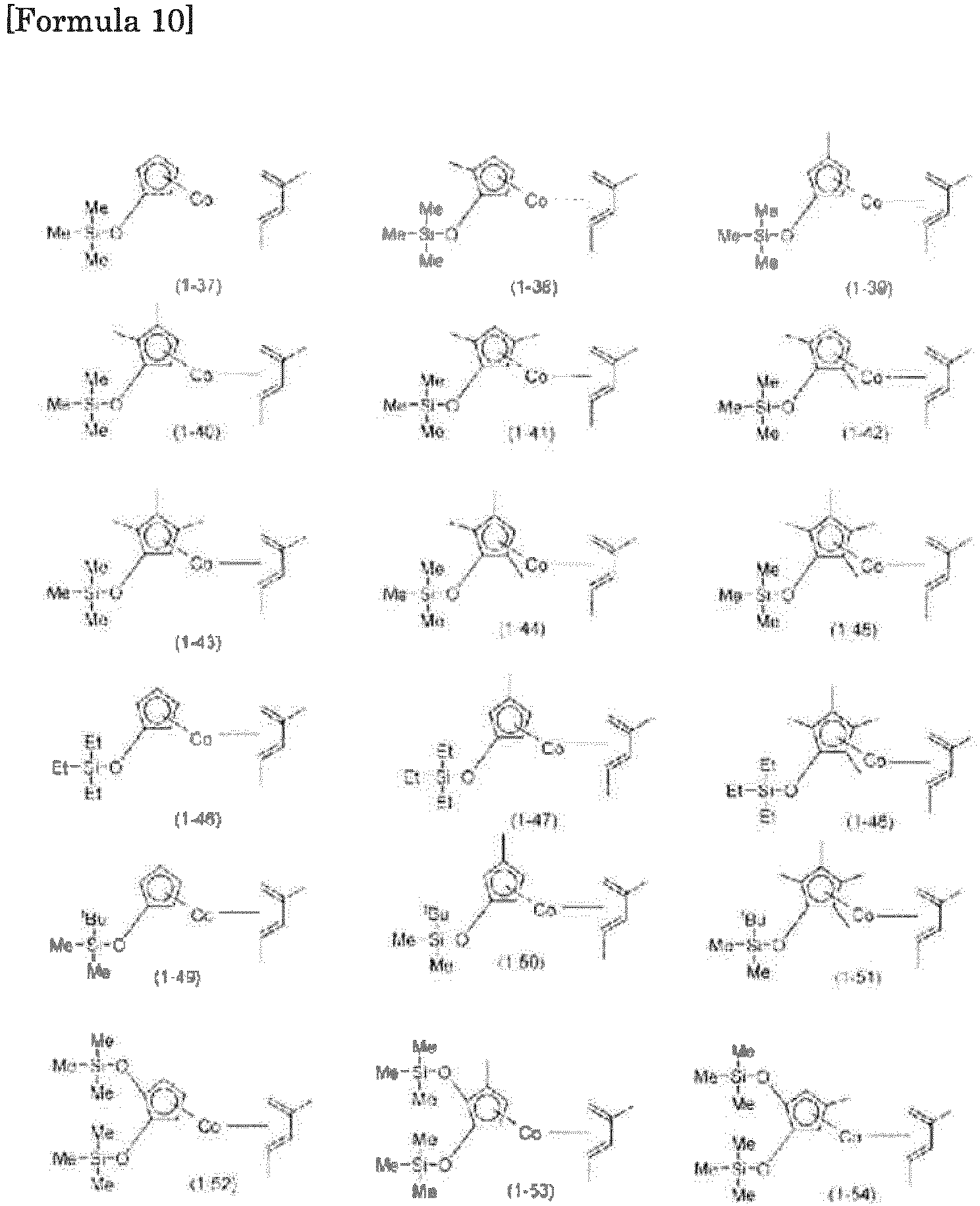


- From the viewpoint of vapor pressure and thermal stability suitable for a CVD material or an ALD material, (1-1), (1-2), (1-3), (1-9), (1-17), (1-18), (1-19), (1-20), (1-21), (1-27), (1-35), (1-36), (1-37), (1-38), (1-39), (1-45), (1-53), (1-54), (1-55), (1-56), (1-57), (1-63), (1-71), (1-72), (1-73), (1-74), (1-75), (1-81), (1-90), (1-91), (1-92), (1-93), (1-94), (1-100), (1-108), (1-109), (1-110), (1-111), (1-112), (1-118), (1-126), (1-127), (1-128), (1-129), (1-130), (1-136), (1-144) and (1-145) are preferred, and (1-1), (1-3), (1-19), (1-21), (1-37), (1-39), (1-55), (1-57), (1-73), (1-75), (1-92), (1-94), (1-110), (1-112), (1-128) and (1-130) are especially preferred.
- The following is a description of methods for producing a cobalt complex (1) of the present invention. Production Method 1 is a method for producing a cobalt complex (1) in which a trisphosphine complex represented by Formula (3) is reacted with lithium cyclopentadienide represented by Formula (4), and the product is reacted with a diene having from 4 to 10 carbon atoms.
-

- (In this formula, R1, R2, R3, R4 and R5 have the same meaning as in Formula (1). R9, R10 and R11 each individually represent a phenyl group, tolyl group, alkyl group having from 1 to 6 carbon atoms or an alkyloxy group having from 1 to 6 carbon atoms. X represents a halogen atom.)
- The following is an explanation of the definition of R9, R10, R11 and X in Formula (3). An alkyl group having from 1 to 6 carbon atoms that is represented by R9, R10 and R11 may be linear, branched or cyclic. Specific examples include a methyl group, ethyl group, propyl group, isopropyl group, cyclopropyl group, butyl group, isobutyl group, sec-butyl group, tert-butyl group, cyclobutyl group, pentyl group, 1-ethylpropyl group, 1-methylbutyl group, 2-methylbutyl group, isopentyl group, neopentyl group, tert-pentyl group, cyclopentyl group, cyclobutylmethyl group, hexyl group, 1-methylpentyl group, 2-methylpentyl group, 3-methylpentyl group, 4-methylpentyl group, 1,1-dimethylbutyl group, 1,2-dimethylbutyl group, 1,3-dimethylbutyl group, 2,2-dimethylbutyl group, 2,3-dimethylbutyl group, 3,3-dimethylbutyl group, cyclohexyl group, cyclopentylmethyl group, 1-cyclobutylethyl group, and 2-cyclobutylethyl group.
- An alkyloxy group having from 1 to 6 carbon atoms that is represented by R9, R10 and R11 may be linear, branched or cyclic. Specific examples include a methoxy group, ethoxy group, propyloxy group, isopropyloxy group, cyclopropyloxy group, butoxy group, isobutyloxy group, sec-butyloxy group, tert-butyloxy group, cyclobutyloxy group, pentyloxy group, 1-ethylpropyloxy group, 1-methylbutyloxy group, 2-methylbutyloxy group, isopentyloxy group, neopentyloxy group, tert-pentyloxy group, cyclopentyloxy group, cyclobutylmethyloxy group, hexyloxy group, 1-methylpentyloxy group, 2-methylpentyloxy group, 3-methylpentyloxy group, 4-methylpentyl group oxy, 1,1-dimethylbutyloxy group, 1,2-dimethylbutyloxy group, 1,3-dimethylbutyloxy group, 2,2-dimethylbutyloxy group, 2,3-dimethylbutyloxy group, 3,3-dimethylbutyloxy group, cyclohexyloxy group, cyclopentylmethyloxy group, 1-cyclobutylethyloxy group, and 2-cyclobutylethyloxy group.
- The tolyl group represented by R9, R10 and R11 may be an ortho-tolyl group (2-methylphenyl group), a meta-tolyl group (3-methylphenyl group) or a para-tolyl group (4-methylphenyl group).
- From the viewpoint of a high yield of cobalt complex (1), R9, R10 and R11 are preferably a phenyl group, an alkyl group having from 1 to 4 carbon groups, or an isopropyloxy group, are more preferably a phenyl group, methyl group or isopropyloxy group, and are even more preferably a phenyl group.
- The halogen atom represented by X may be a chlorine atom, a bromine atom or an iodine atom. From the viewpoint of a high yield, a chlorine atom is preferred.
- Examples of trisphosphine complexes (3) that can be used in Production Method 1 include chlorotris(triphenylphosphine)cobalt, bromotris(triphenylphosphine)cobalt, iodotris(triphenylphosphine)cobalt, chlorotris(tris(2-methylphenyl)phosphine)cobalt, bromotris(tris(2-methylphenyl)phosphine)cobalt, iodotris(tris(2-methylphenyl)phosphine)cobalt, chlorotris(tris(3-methylphenyl)phosphine)cobalt, bromotris(tris(3-methylphenyl)phosphine)cobalt, iodotris(tris(3-methylphenyl)phosphine)cobalt, chlorotris(tris(4-methylphenyl)phosphine)cobalt, bromotris(tris(4-methylphenyl)phosphine)cobalt, iodotris(tris(4-methylphenyl)phosphine)cobalt, chlorotris(tris(methyldiphenylphosphine)cobalt, bromotris(tris(methyldiphenylphosphine)cobalt, iodotris(tris(methyldiphenylphosphine)cobalt, chlorotris(tris(dimethylphenylphosphine)cobalt, bromotris(tris(dimethylphenylphosphine)cobalt, iodotris(tris(dimethylphenylphosphine)cobalt, chlorotris(trimethylphosphine)cobalt, bromotris(trimethylphosphine)cobalt, iodotris(trimethylphosphine)cobalt, chlorotris(triethylphosphine)cobalt, bromotris(triethylphosphine)cobalt, iodotris(triethylphosphine)cobalt, chlorotris(tripropylphosphine)cobalt, bromotris(tripropylphosphine)cobalt, iodotris(tripropylphosphine)cobalt, chlorotris(triisopropylphosphine)cobalt, bromotris(triisopropylphosphine)cobalt, iodotris(triisopropylphosphine)cobalt, chlorotris(tributylphosphine)cobalt, bromotris(tributylphosphine)cobalt, iodotris(tributylphosphine)cobalt, chlorotris(triisobutylphosphine)cobalt, bromotris(triisobutylphosphine)cobalt, iodotris(triisobutylphosphine)cobalt, chlorotris(trimethylphosphite)cobalt, bromotris(trimethylphosphite)cobalt, iodotris(trimethylphosphite)cobalt, chlorotris(triethylphosphite)cobalt, bromotris(triethylphosphite)cobalt, iodotris(triethylphosphite)cobalt, chlorotris(tripropylphosphite)cobalt, bromotris(tripropylphosphite)cobalt, iodotris(tripropylphosphite)cobalt, chlorotris(triisopropylphosphite)cobalt, bromotris(triisopropyl phosphite)cobalt, iodotris(triisopropylphosphite)cobalt, chlorotris(tributylphosphite)cobalt, bromotris(tributylphosphite)cobalt, iodotris(tributylphosphite)cobalt, chlorotris(triisobutylphosphite)cobalt, bromotris(triisobutylphosphite)cobalt, iodotris(triisobutylphosphite)cobalt, chlorotris(tri sec-butylphosphite)cobalt, bromotris(tri sec-butylphosphite)cobalt, and iodotris(tri sec-butylphosphite)cobalt. From the viewpoint of low cost chlorotris(triphenylphosphine)cobalt, chlorotris(trimethylphosphine)cobalt, chlorotris(triethylphosphine)cobalt, chlorotris(tripropylphosphine)cobalt, chlorotris(tributylphosphine)cobalt and chlorotris(triisopropyl phosphite)cobalt are preferred, chlorotris(triphenylphosphine)cobalt, chlorotris(trimethylphosphine)cobalt, chlorotris(triethylphosphine)cobalt and chlorotris(triisopropylphosphite)cobalt are more preferred, and chlorotris(triphenylphosphine)cobalt is even more preferred.
- A trisphosphine complex (3) that can be used in Production Method 1 can be obtained using the methods described in Chemische Berichte, vol. 108, p. 944 (1975), Inorganic Syntheses, vol. 26, p. 190 (1989), and Journal of the American Chemical Society, vol. 99, p. 739 (1977).
- Examples of lithium cyclopentadienide (4) that can be used in Production Method 1 include the following.


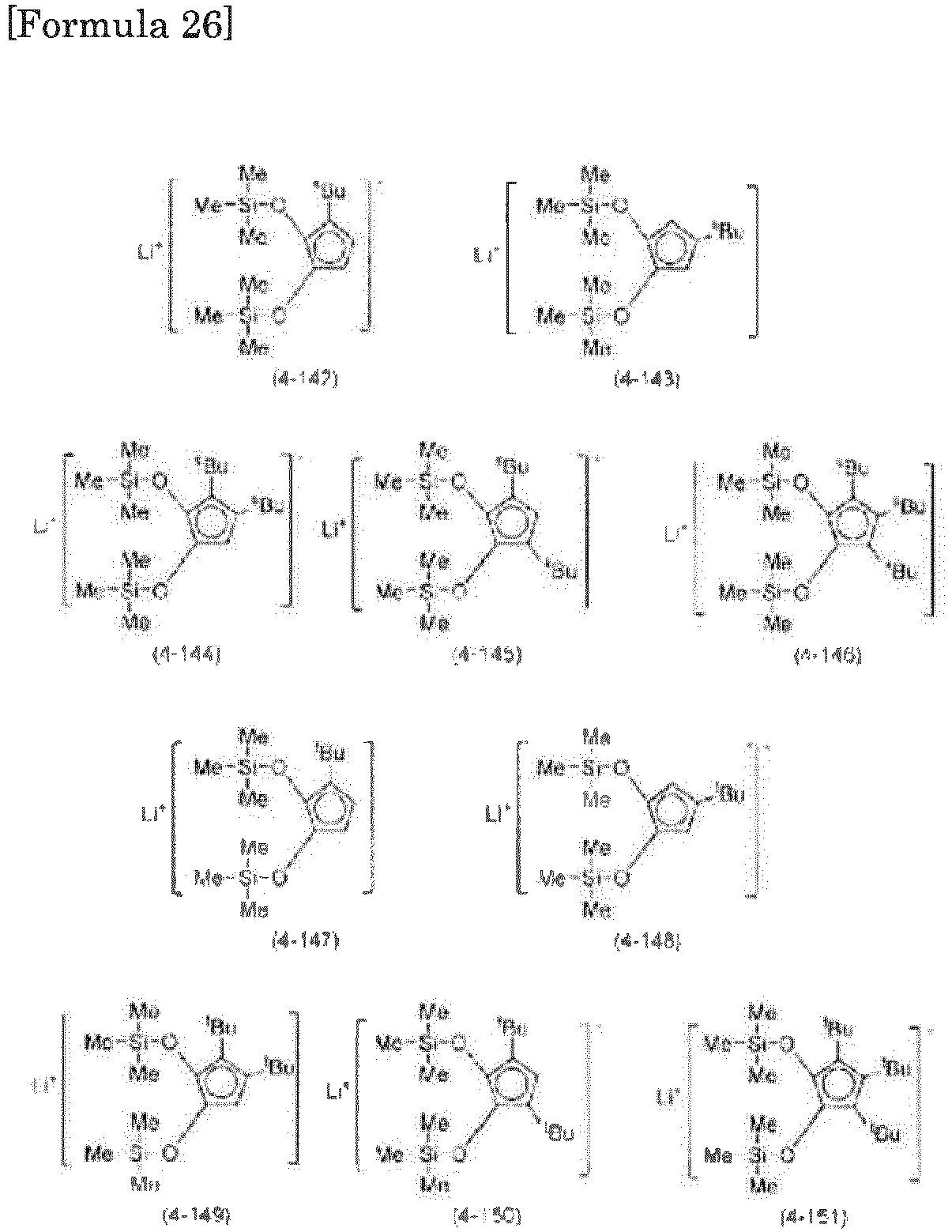
- From the viewpoint of obtaining a cobalt complex (1) having vapor pressure and thermal stability suitable for a CVD material or an ALD material, (4-1), (4-2), (4-3), (4-4), (4-5), (4-6), (4-7), (4-8), (4-9), (4-10), (4-11), (4-12), (4-13), (4-14), (4-15), (4-16), (4-17), (4-18), (4-28), (4-29), (4-30), (4-31), (4-32), (4-33), (4-34), (4-35), (4-36), (4-93), (4-94), (4-95), (4-96), (4-97) or (4-98) is preferred, (4-1), (4-2), (4-3), (4-4), (4-5), (4-6), (4-7), (4-8), (4-9), (4-93), (4-94), (4-95), (4-96), (4-97) or (4-98) is more preferred, and (4-1), (4-3), (4-93) or (4-94) is even more preferred.
- The lithium cyclopentadienide (4) used in Production Method 1 can be obtained by reacting and lithiating a substituted cyclopentadiene (5) with a lithiating agent.
- The substituted cyclopentadiene (5) may have the structure represented by Formula (5), but may also be an isomer represented by Formulas (5a), (5b), (5c) or (5d), or a mixture of any one of compounds represented by Formula (5) or Formulas (5a) to (5d).

- (In these formulas, R1, R2, R3, R4 and R5 have the same meaning as R1, R2, R3, R4 and R5 in Formula (1).)
- For the sake of simplicity, Formulas (5) and (5a) to (5d) are referred to collectively herein as Formula (5).
- These substituted cyclopentadienes (5) can be obtained using the methods described in Reference Examples 1-3 in the present specification, Organometallics, vol. 16, p. 5950 (1997), Acta Chemica Scandinavica, vol. 43, p. 188 (1989), Chemical Communication, p. 2123 (1996), Journal of Organometallic Chemistry, vol. 544, p. 133 (1997), and Journal of Organometallic Chemistry, vol. 558, p. 231 (1998).
- The following are examples of substituted cyclopentadienes (5).


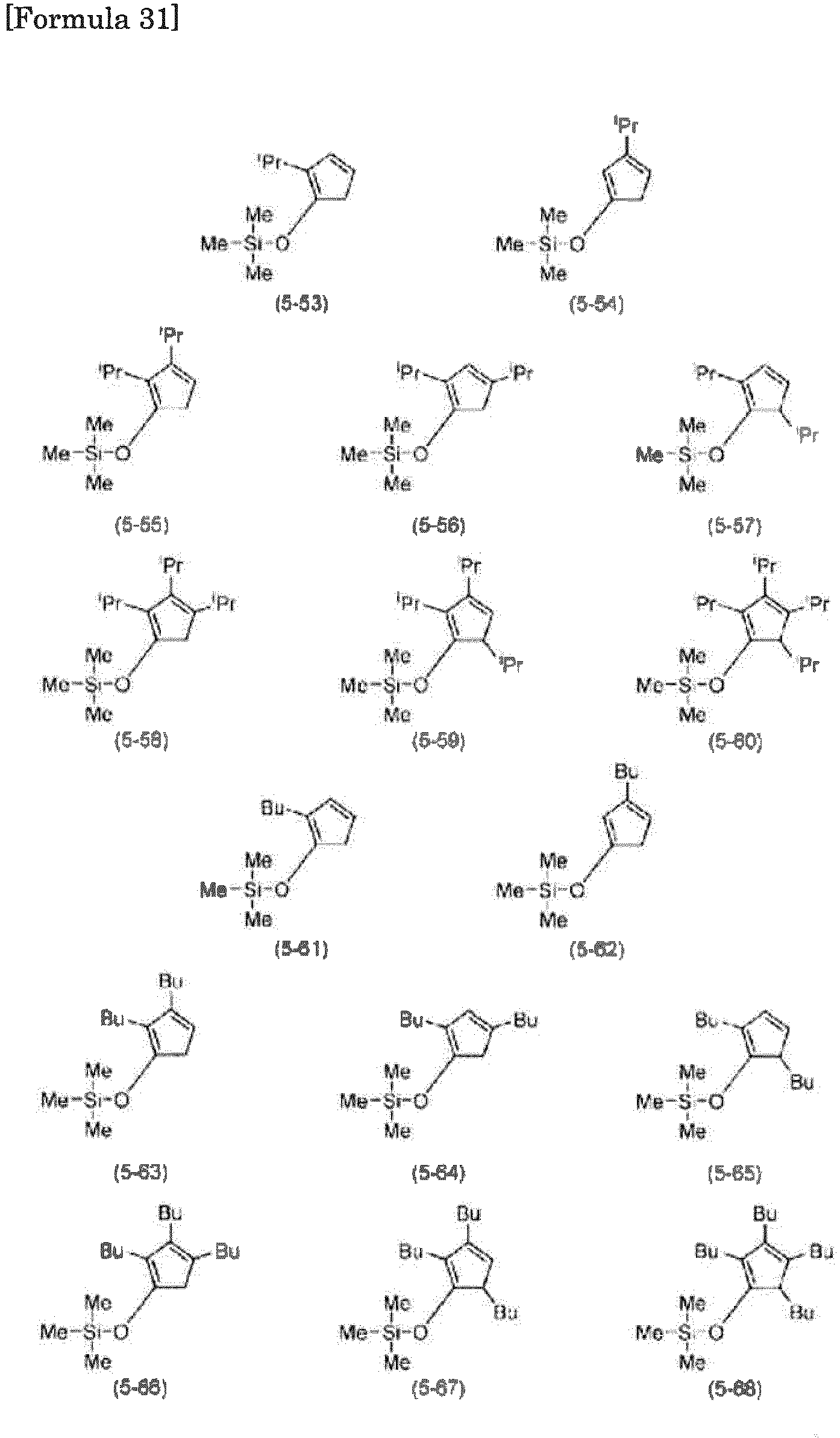


- From the viewpoint of obtaining a cobalt complex (1) having vapor pressure and thermal stability suitable for a CVD material or an ALD material, (5-1), (5-2), (5-3), (5-4), (5-5), (5-6), (5-7), (5-8), (5-9), (5-10), (5-11), (5-12), (5-13), (5-14), (5-15), (5-16), (5-17), (5-18), (5-28), (5-29), (5-30), (5-31), (5-32), (5-33), (5-34), (5-35), (5-36), (5-93), (5-94), (5-95), (5-96), (5-97) or (5-98) is preferred, (5-1), (5-2), (5-3), (5-4), (5-5), (5-6), (5-7), (5-8), (5-9), (5-93), (5-94), (5-95), (5-96), (5-97) or (5-98) is more preferred, and (5-1), (5-3), (5-93) or (5-94) is even more preferred.
- Examples of lithiating agents that can be used include alkyl lithiums such as methyl lithium, ethyl lithium, propyl lithium and butyl lithium, aryl lithiums such as phenyl lithium and tolyl lithium, and lithium dialkylamides such as lithium dimethylamide, lithium diethylamide and lithium diisopropylamide. From the viewpoint of a high yield, butyl lithium, lithium diethylamide and lithium diisopropylamide are preferred, and lithium diisopropylamide is especially preferred.
- From the viewpoint of a high yield of lithium cyclopentadienide (4), the substituted cyclopentadienide (5) and the lithiating agent are preferably reacted in an organic solvent. There are no restrictions on the organic solvents that can be used as long as they do not impair the reaction. Specific examples include aliphatic hydrocarbons such as pentane, hexane, heptane, octane, cyclohexane, methylcyclohexane, ethylcyclohexane and petroleum ether, aromatic hydrocarbons such as benzene, toluene, xylene and ethylbenzene, and ethers such as diethyl ether, diisopropyl ether, dibutyl ether, cyclopentyl methyl ether (CPME), cyclopentylethyl ether (CPEE), tert-butyl methyl ether (MTBE), tetrahydrofuran (THF), dioxane and 1,2-dimethoxyethane. These organic solvents can be used alone or in mixtures of two or more at any ratio.
- From the viewpoint of a high yield of lithium cyclopentadienide (4), the substituted cyclopentadienide (5) and the lithiating agent are preferably reacted in an inert gas atmosphere. Specific examples of inert gases include nitrogen, helium, neon, argon, krypton and xenon. Nitrogen or argon is preferred. There are no particular restrictions on the reaction temperature and the reaction time. These can be any reaction temperature and reaction time commonly used by those skilled in the art to produce organic lithium compounds. Specifically, a high yield of lithium cyclopentadienide (4) can be obtained by selecting a reaction temperature in a range from -80°C to 120°C and selecting a reaction time in a range from 10 minutes to 120 hours.
- A lithium cyclopentadienide (4) obtained by reacting a substituted cyclopentadiene (5) with a lithiating agent can be refined or left unrefined for use as a raw material in Production Method 1. When a lithium cyclopentadienide (4) is refined, it can be refined using a refining method commonly used by those skilled in the art to refine organic lithium compounds. Specific examples of refining methods include filtration, extraction, decantation and crystallization.
- From the viewpoint of a high yield of cobalt complex (1), Production Method 1 is preferably carried out in an inert gas atmosphere. Specific examples of inert gases include helium, neon, argon, krypton, xenon and nitrogen gas. Nitrogen gas or argon is preferred from the viewpoint of low cost.
- From the viewpoint of a high yield of cobalt complex (1), Production Method 1 is preferably carried out in an organic solvent. There are no restrictions on the organic solvents that can be used as long as they do not impair the reaction. Specific examples include aliphatic hydrocarbons such as pentane, hexane, heptane, octane, cyclohexane, methylcyclohexane, ethylcyclohexane and petroleum ether, aromatic hydrocarbons such as benzene, toluene, xylene, ethylbenzene, propylbenzene, isopropylbenzene, butylbenzene, isobutylbenzene, sec-butylbenzene, tert-butylbenzene, and 1,3,5-trimethylbenzene (mesitylene), and ethers such as diethyl ether, diisopropylether, dibutyl ether, cyclopentyl methyl ether (CPME), cyclopentylethyl ether (CPEE), tert-butyl methyl ether (MTBE), tetrahydrofuran (THF), dioxane and 1,2-dimethoxyethane. These organic solvents can be used alone or in mixtures of two or more at any ratio. From the viewpoint of a high yield of cobalt complex (1), the organic solvent is preferably hexane, heptane, toluene or ether, and more preferably CPME, MTBE, diethyl ether or THF.
- There are no particular restrictions on the reaction temperature and the reaction time used in Production Method 1. These can be any reaction temperature and reaction time commonly used by those skilled in the art to produce organic metal complexes. Specifically, a high yield of cobalt complex (1) can be obtained by selecting a reaction temperature in a range from -80°C to 120°C and selecting a reaction time in a range from 10 minutes to 120 hours.
- There are no particular restrictions on the molar ratios of the trisphosphine complex (3), lithium cyclopentadienide (4) and diene used in Production Method 1. From the viewpoint of a high yield of cobalt complex (1), use of from 0.9 to 1.5 mol. eq. lithium cyclopentadienide (4) and from 1.0 to 10.0 mol. eq. diene per mol. eq. of trisphosphine complex (3) is preferred, and use of from 1.0 to 1.2 mol. eq. lithium cyclopentadienide (4) and from 2.0 to 5.0 mol. eq. diene per mol. eq. of trisphosphine complex (3) is especially preferred.
- A cobalt complex (1) obtained using Production Method 1 can be refined using a refining method commonly used by those skilled on the art to refine organic metal compounds. Specific examples of refining methods include filtration, extraction, centrifugation, decantation, distillation, sublimation, crystallization and column chromatography.
- An alkyl halogen can be added during the refining step of Production Method 1 to remove phosphine compound byproducts. There are no particular restrictions on the alkyl halide that is used as long as it does not impair the reaction. Examples include methyl chloride, ethyl chloride, propyl chloride, isopropyl chloride, butyl chloride, isobutyl chloride, tert-butyl chloride, methyl bromide, ethyl bromide, propyl bromide, isopropyl bromide, butyl bromide, isobutyl bromide, tert-butyl bromide, methyl iodide, ethyl iodide, propyl iodide, isopropyl iodide, butyl iodide, isobutyl iodide and tert-butyl iodide. From the viewpoint of low cost, methyl iodide or ethyl iodide is preferred. There are no particular restrictions on the amount of alkyl halide used. The amount is preferably from 1.0 to 20.0 mol. eq. and more preferably from 1.0 to 5.0 mol. eq. alkyl halide per mol. eq. of trisphosphine complex (3) from the viewpoint of=a high yield of a cobalt complex (1) of the present invention.
- The following is a detailed description of the method used to produce a cobalt-containing thin film using, as a raw material in a vapor phase deposition method based on a chemical reaction, a cobalt complex (1) of the present invention. In the present specification, a vapor phase deposition method based on a chemical reaction means a method for creating a cobalt-containing thin film by decomposing a vaporized cobalt complex (1) on a substrate. Specifically, this method can be a CVD method such as the thermal CVD method, plasma CVD method or photo CVD method, or the ALD method. A CVD method is preferred from the viewpoint of a good film-forming speed and the ALD method is preferred from the viewpoint of a good step coverage. For example, when a cobalt-containing thin film is formed using a CVD method or the ALD method, the cobalt complex (1) can be vaporized and supplied to a reaction chamber, and the cobalt complex (1) can be decomposed on a substrate mounted inside the reaction chamber to form a cobalt-containing thin film on the substrate. The method used to decompose the cobalt complex (1) can be any method commonly used by those skilled in the art to create a metal-containing thin film. Specific examples include reacting the cobalt complex (1) with a reaction gas or applying heat, plasma or light to the cobalt complex (1).
- When a reaction gas is used, the reaction gas can be a reducing gas or an oxidizing gas. A reducing gas is preferred as the reaction gas because it can prevent deterioration in the substrate when film is formed on a substrate made from a material susceptible to oxidation such as a metal or metal nitride. Specific examples of reducing gases include ammonia, hydrogen, monosilane, hydrazine, formic acid; a borane-amine complex such as a borane-dimethylamine complex or borane-trimethylamine complex; an unsaturated hydrocarbon having from 4 to 7 carbon atoms such as 1-butene, 2-butene, isobutene, 1-pentene, 2-pentene, 2-methyl-1-butene, 2-methyl-2-butene, 3-methyl-1-butene, 1-hexene, 2-hexene, 3-hexene, 2-methyl-1-pentene, 2-methyl-2-pentene, 4-methyl-2-pentene, 4-methyl-1-pentene, 3-methyl-1-pentene, 3-methyl-2-pentene, 2-ethyl-1-butene, 2,3-dimethyl-1-butene, 2,3-dimethyl-2-butene, 3,3-dimethyl-1-butene, 1,3-butadiene, 1,3-pentadiene, 1,4-pentadiene, isoprene, 1,3-hexadiene, 2,4-hexadiene, 2-methyl-1,3-pentadiene, 3-methyl-1,3-pentadiene, 4-methyl-1,3-pentadiene, 2-ethyl-1,3-butadiene, 3-methyl-1,4-pentadiene or 2,3-dimethyl-1,3-butadiene; or a cyclic unsaturated hydrocarbon having from 6 to 10 carbon atoms such as 1,3-cyclohexadiene, 1,4-cyclohexadiene, 1-methyl-1,3-cyclohexadiene, 2-methyl-1,3-cyclohexadiene, 5-methyl-1,3-cyclohexadiene, 3-methyl-1,4-cyclohexadiene, α-phellandrene, β-phellandrene, α-terpinene, β-terpinene, γ-terpinene or limonene. From the viewpoint of fewer restrictions due to the specifications of the film-forming device and ease of handling, the reducing gas is preferably ammonia, hydrogen, formic acid, 1,3-cyclohexadiene, 1,4-cyclohexadiene, α-terpinene, β-terpinene, γ-terpinene or limonene. When an oxidizing gas is used, specific examples include oxygen, ozone, water vapor, hydrogen peroxide, laughing gas, hydrogen chloride, nitric acid gas and acetate. Oxygen, ozone or water vapor is preferred. The amount of reaction gas used depends on the reactivity of the materials and the capacity of the reaction chamber. When the capacity of the reaction chamber is from 1 to 10 L, there are no particular restrictions on the flow rate of the reaction gas. From an economic viewpoint, a flow rate from 1 to 10,000 sccm is preferred. In the present specification, sccm is the unit used to indicate the flow rate of a gas. When converted to an ideal gas, 1 sccm indicates movement of the gas at a speed of 2.68 mmol/h.
- When a cobalt-containing thin film is produced using a CVD method or the ALD method, the cobalt-containing thin film can be produced using any decomposition method. A combination of decomposition methods can also be used. The method used to supply the cobalt complex (1) to the reaction chamber can be any method commonly used by those skilled in the art, including bubbling and liquid vaporization supply systems.
- The carrier gas and diluent gas used to produce a cobalt-containing thin film using a CVD method or the ALD method are preferably nitrogen gas or an inert gas such as helium, neon, argon, krypton or xenon. From an economic viewpoint, nitrogen gas or argon is preferred. The flow rate of the carrier gas and the diluent gas depends on the capacity of the reaction chamber. When the capacity of the reaction chamber is from 1 to 10 L, there are no particular restrictions on the flow rate of the carrier gas, and a flow rate of 1 to 10,000 sccm is preferred from an economic viewpoint.
- The substrate temperature when a cobalt-containing thin film is formed using a CVD method or the ALD method depends on whether heat, plasma or light is used and the type of reaction gas being used. For example, when light or plasma is not used and the reaction gas is ammonia or a cyclic unsaturated hydrocarbon, there are no restrictions on the substrate temperature, and a substrate temperature from 200°C to 1000°C is preferred from an economic viewpoint. From the viewpoint of a good film forming speed, a substrate temperature from 250°C to 800°C is preferred and a substrate temperature from 300°C to 800°C is more preferred. When light, plasma, ozone or hydrogen peroxide are used, a cobalt-containing thin film can be produced at a temperature below 200°C.
- Examples of a cobalt-containing thin film obtained using the cobalt-containing thin film production method of the present invention include metallic cobalt thin film, cobalt oxide thin film, cobalt nitride thin film, and cobalt oxynitride thin film. After a metallic cobalt thin film has been created, a cobalt-containing composite thin film can be obtained by heat-treating the substrate at a predetermined temperature. For example, when a metallic cobalt thin film has been created on a silicon substrate, a cobalt silicide thin film such as Co2Si, CoSi or CoSi2 can be obtained by performing heat treatment at a temperature from 300°C to 900°C. When combined with another metal material, a cobalt-containing composite thin film can be obtained. For example, a cobalt silicide thin film can be obtained by combining a cobalt complex (1) of the present invention with a silicon material. Examples of silicon materials include monosilane, disilane, trisilane, tetraethoxysilane, dimethyldimethoxysilane, bis(tert-butylamino)silane, bis(diethylamino)silane and tris(dimethylamino)silane. A cobalt-containing composite thin film can also be obtained by combining a cobalt complex (1) of the present invention with a metal material containing a typical metal such as aluminum or magnesium, a transition metal such as titanium, zirconium, hafnium, niobium, tantalum or tungsten, or a rare earth metal such as lanthanum or neodymium. When a cobalt-containing composite thin film is formed using a CVD method or the ALD method, a cobalt complex (1) of the present invention and another metal material can be supplied separately to the reaction chamber or can be mixed together and then supplied to the reaction chamber.
- When a cobalt-containing thin film of the present invention is used as a constituent element, a high-performance semiconductor device can be manufactured with improved reliability and responsiveness. Examples of semiconductor devices include semiconductor memory devices such as DRAM, FeRAM, PRAM, MRAM, ReRAM and flash memory, and field effect transistors. Examples of constituent elements include gate electrodes for transistors, contacts on diffusion layers in source-drain sections, and copper wiring sheet layers/liner layers.
- The following is a more detailed description of the present invention with reference to examples. The present invention, however, is not limited to these examples. The compounds described in Reference Examples 1-6, Examples 1-7 and Examples 10-15 were all produced in an argon atmosphere. The THF, diethyl ether, dichloromethane and hexane are dehydrated products of Kanto Chemical Co., Ltd.
-

- 8.18 g (85.1 mmol) of 3-methyl-2-cyclopentenone and 9.47 g (93.6 mmol) of triethyl amine were dissolved in 100 mL of hexane, and 18.91 g (85.1 mmol) of trifluoromethane sulfoxy(trimethyl)silane was dropped under ice-cooled conditions. Afterwards, the reaction mixture was stirred for 2 hours at 25°C. The resulting insoluble matter was filtered off using celite and the filtrate was concentrated under reduced pressure. The resulting crude material was distilled under reduced pressure (distillation temperature: 59-60°C, back pressure: 1.1×10³Pa) to obtain 10.97 g of a 1-methyl-3-trimethylsilyloxy-1,3-cyclopentadiene as a colorless liquid. The yield was 77%.
1HNMR (500 MHz, C6D6, δ/ppm): 6.06 (m, 1H), 5.09 (m, 1H), 2.64 (m, 2H), 1.79 (s, 3H), 0.21 (s, 9H). -

- 6.3 g (56.2 mmol) of 2-hydroxy-3-methyl-2-cyclopentenone and 11.8 g (117.7 mmol) of triethyl amine were dissolved in a mixed solvent of 100 mL hexane and 50 mL of THF, and 25.1 g (112.9 mmol) of trifluoromethanesulfoxy(trimethyl)silane was dropped under ice-cooled conditions. After stirring the reaction mixture for 2 hours at 25°C, the solvent was removed under reduced pressure. The resulting product was distilled under reduced pressure (distillation temperature: 90°C, back pressure: 2.4 × 10²Pa) to obtain 8.98 g of a 1-methyl-2,3-bis(trimethylsilyloxy)-1,3-cyclopentadiene as a colorless liquid. The yield was 62%.
1HNMR (400 MHz, CDCl3, δ/ppm): 4.85 (t, J = 2.1 Hz, 1H), 2.47 (d, J = 2.1 Hz, 2H), 1.70 (s, 3H), 0.13 (s, 9H), 0.08 (s, 9H). -

- A hexane solution of buthyllithium (2.65 M, 60.0 mL) was added to 17.2 g (170 mmol) of diisopropylamine in 40 mL of THF at -70°C, and the reaction mixture was stirred for 15 minutes at 25°C to prepare a lithium diisopropylamide (LDA) solution. Then, 50 mL of THF and 21.3 g (154 mmol) of 2,3,4,5-tetramethyl-2-cyclopentenone were added to an another vessel the contents were cooled to -70°C, and the lithium diisopropylamide solution was added. The reaction mixture was stirred for 6 hours at 25°C and concentrated under reduced pressure. Next, 50 mL of THF and 50 mL of hexane were added to the residue, the solution was cooled to -70°C, a hexane (20 mL) solution of 26.4 g (175 mmol) of chloro (tert-butyl) dimethylsilane was added, and the reaction mixture was stirred for 2 hours at 25°C. The resulting insoluble matter was filtered off using celite and the filtrate was concentrated under reduced pressure. The resulting viscous liquid was distilled under reduced pressure (distillation temperature: 72°C, back pressure: 6.0 × 101Pa) to obtain 30.4 g of a 1,3,4,5-tetramethyl-2-tert-butyldimethylsilyloxy-1,3-cyclopentadiene as a colorless liquid. The yield was 78%.
1HNMR (500 MHz, C6D6, δ/ppm): 2.39 (q, J = 7.3 Hz, 1H), 1.81 (s, 3H), 1.80 (s, 3H), 1.74 (s, 3H), 1.06 (s, 9H), 0.98 (d, J = 7.3 Hz, 3H), 0.15 (s, 6H). -

- 30 mL of THF was added to 8.10 g (47.9 mmol) of the 1-methyl-3-trimethylsilyloxy-1,3-cyclopentadiene prepared in Reference Example 1, and then 32 mL (1.5 mol/L, 48.0 mmol) of a THF solution of lithium diisopropylamide was added at 0°C. After stirring the mixture for 1 hour at 25°C, it was added to a suspension prepared by adding 200 mL of toluene to 42.2 g (47.7 mmol) of chlorotris(triphenylphosphine)cobalt. After stirring the mixture for 2 hours, 9.70 g (142 mmol) of 2-methylbuta-1,3-diene was added. After stirring the mixture for 13 hours at 25°C, 36.3 g (256 mmol) of iodomethane was added. After stirring the reaction mixture for 2 hours at 25°C, the solvent was removed under reduced pressure. Next, 200 mL of hexane was added to the remaining oily substance, and the suspension was stirred vigorously at 25°C. After filtering the resulting suspension, the solvent was removed from the filtrate under reduced pressure. The remaining liquid was distilled under reduced pressure (distillation temperature: 120°C, back pressure: 14 Pa) to obtain 5.70 g of (η5-3-methyl-1-trimethylsilyloxycyclopentadienyl)(η4-2-methylbuta-1,3-diene)cobalt as a red liquid (yield: 40%).
1H-NMR (400 MHz, C6D6, δ/ppm) 4.91 (m, 1H), 4.68 (br, 1H), 4.56 (br, 1H), 4.17 (br, 1H), 2.08 (br, 3H), 1.59 (s, 3H), 1.51 (brs, 2H), 0.15 (s, 9H), 0.01 (br, 2H).
13C-NMR (100 MHz, C6D6, δ/ppm): 93.4, 87.4, 79.1, 74.4, 72.2, 70.4, 38.0, 35.8, 30.5, 22.9, 14.2, 0.16. -

- 10 mL of THF was added to 1.33 g (7.90 mmol) of the 1-methyl-3-trimethylsilyloxy-1,3-cyclopentadiene prepared in Reference Example 1, and then 5.3 mL (1.5 mol/L, 7.95 mmol) of a THF solution of lithium diisopropylamide was added at 0°C. After stirring the mixture for 1 hour at 25°C, it was added to a suspension prepared by adding 50 mL of toluene to 6.98 g (7.92 mmol) of chlorotris(triphenylphosphine)cobalt. After stirring the mixture for 3 hours, 2.20 g (26.8 mmol) of 2,3-dimethylbuta-1,3-diene was added. After stirring the mixture for 2 hours at 25°C, 4.60 g (32.4 mmol) of iodomethane was added. After stirring the reaction mixture for 15 hours at 25°C, the solvent was removed under reduced pressure. Next, 100 mL of hexane was added to the remaining oily substance, and the suspension was stirred vigorously at 25°C. After filtering the resulting suspension, the solvent was removed from the filtrate under reduced pressure. The remaining liquid was distilled under reduced pressure(distillation temperature: 133°C, back pressure: 41 Pa) to obtain 1.35 g of (η5-3-methyl-1-trimethylsilyloxycyclopentadienyl)(η4-2,3-dimethylbuta-1,3-diene)cobalt as a red liquid (yield: 56%).
1H-NMR (400 MHz, C6D6, δ/ppm) 4.46 (br, 1H), 4.43 (br, 1H), 4.08 (br, 1H), 2.08 (s, 3H), 2.05 (s, 3H) 1.61 (br, 2H), 1.57 (s, 3H), 0.16 (s, 9H), -0.10 (br, 1H), -0.15 (br, 1H).
13C-NMR (100 MHz, C6D6, δ/ppm): 90.4, 90.3, 86.6, 74.7, 72.5, 70.2, 39.4, 38.2, 30.5, 19.8, 19.7, 13.8, 0.2. -

- 30 mL of THF was added to 9.06 g (53.8 mmol) of the 1-methyl-3-trimethylsilyloxy-1,3-cyclopentadiene prepared in Reference Example 1, and then 36.0 mL (1.5 mol/L, 54.0 mmol) of a THF solution of lithium diisopropylamide was added at 0°C. After stirring the mixture for 1 hour at 25°C, it was added to a suspension prepared by adding 200 mL of toluene to 47.5 g (53.9 mmol) of chlorotris(triphenylphosphine)cobalt. After stirring the mixture for 1 hour, 10.6 g (129 mmol) of 2-methylpenta-1,3-diene was added. After stirring the mixture for 17 hours at 25°C, 29.7 g (209 mmol) of iodomethane was added. After stirring the reaction mixture for 3 hours at 25°C, the solvent was removed under reduced pressure. Next, 200 mL of hexane was added to the remaining oily substance, and the suspension was stirred vigorously at 25°C. After filtering the resulting suspension, the solvent was removed from the filtrate under reduced pressure. The remaining liquid was distilled under reduced pressure (distillation temperature: 110°C, back pressure: 19 Pa) to obtain 6.12 g of (η5-3-methyl-1-trimethylsilyloxycyclopentadienyl)(η4-2-methylpenta-1,3-diene)cobalt as a red liquid (yield: 37%).
1H-NMR (400 MHz, C6D6, δ/ppm) 4.44 (br, 1H), 4.34 (br, 1H), 4.03 (br, 1H), 3.43 (br, 1H), 1.83 (s, 3H), 1.37 (br, 3H), 1.25 (br, 1H), 0.94 (br, 3H), 0.15 (br, 1H), -0.05 (s, 9H), -0.33 (br, 1H).
13C-NMR (100 MHz, C6D6, δ/ppm): 90.8, 86.8, 83.0, 77.2, 73.7, 72.4, 67.3, 46.8, 38.3, 23.1, 19.0, 14.2, 0.10. -

- 20 mL of THF was added to 1.61 g (9.57 mmol) of the 1-methyl-3-trimethylsilyloxy-1,3-cyclopentadiene prepared in Reference Example 1, and then 6.4 mL (1.5 mol/L, 9.60 mmol) of a THF solution of lithium diisopropylamide was added at 0°C. After stirring the mixture for 1 hour at 25°C, it was added to a suspension prepared by adding 100 mL of toluene to 8.49 g (9.63 mmol) of chlorotris(triphenylphosphine)cobalt. After stirring the mixture for 2 hours, 3.90 g (36.1 mmol) of 1,5-cyclooctadiene was added. After stirring the mixture for 1 hour at 25°C, 6.52 g (45.9 mmol) of iodomethane was added. After stirring the reaction mixture for 15 hours at 25°C, the solvent was removed under reduced pressure. Next, 200 mL of hexane was added to the remaining oily substance, and the suspension was stirred vigorously at 25°C. After filtering the resulting suspension, the solvent was removed from the filtrate under reduced pressure. The remaining liquid was distilled under reduced pressure (distillation temperature: 140°C, back pressure: 5 Pa) to obtain 1.20 g of (η5-3-methyl-1-trimethylsilyloxycyclopentadienyl)(η4-1,5-cyclooctadiene)cobalt as a red liquid (yield: 38%).
1H-NMR (400 MHz, C6D6, δ/ppm) 4.87 (br, 1H), 4.60 (br, 1H), 3.92 (br, 1H), 3.30 (m, 2H), 3.20 (m, 2H), 2.57 (m, 4H), 1.85 (m, 4H), 1.24 (s, 3H), 0.11 (s, 9H).
13C-NMR (100 MHz, C6D6, δ/ppm): 88.2, 78.4, 76.0, 74.4, 67.9, 67.1, 32.9, 32.3, 12.4, 0.20. -

- 20 mL of THF was added to 2.47 g (14.7 mmol) of the 1-methyl-3-trimethylsilyloxy-1,3-cyclopentadiene prepared in Reference Example 1, and then 9.8 mL (1.5 mol/L, 14.7 mmol) of a THF solution of lithium diisopropylamide was added at 0°C. After stirring the mixture for 1 hour at 25°C, it was added to a suspension prepared by adding 100 mL of toluene to 12.9 g (14.6 mmol) of chlorotris(triphenylphosphine)cobalt. After stirring the mixture for 24 hours, 4.90 g (53.2 mmol) of 2,5-norbornadiene was added. After stirring the mixture for 16 hours at 25°C, 11.9 g (83.8 mmol) of iodomethane was added. After stirring the reaction mixture for 24 hours at 25°C, the solvent was removed under reduced pressure. Next, 200 mL of hexane was added to the remaining oily substance, and the suspension was stirred vigorously at 25°C. After filtering the resulting suspension, the solvent was removed from the filtrate under reduced pressure. The remaining liquid was distilled under reduced pressure (distillation temperature: 100°C, back pressure: 3 Pa) to obtain 1.53 g of (η5-3-methyl-1-trimethylsilyloxycyclopentadienyl)(η4-2,5-norbornadiene)cobalt as a red liquid (yield: 31%).
1H-NMR (400 MHz, C6D6, δ/ppm) 5.15 (br, 1H), 4.57 (br, 1H), 4.33 (br, 1H), 3.30 (br, 2H), 2.64 (s, 4H)1.18 (s, 3H), 0.95 (br, 2H), 0.10 (s, 9H).
13C-NMR (100 MHz, C6D6, δ/ppm): 85.8, 75.8, 74.8, 72.1, 55.0, 44.3, 28.9, 28.5, 12.4, 0.2. -

- 10 mL of THF was added to 2.17 g (8.46 mmol) of the 1-methyl-2,3-bis (trimethylsilyloxy)-1,3-cyclopentadiene prepared in Reference Example 2, and then 5.6 mL (1.5 mol/L, 8.40 mmol) of a THF solution of lithium diisopropylamide was added at 0°C. After stirring the mixture for 1 hour at 25°C, it was added to a suspension prepared by adding 100 mL of toluene to 7.45 g (8.45 mmol) of chlorotris(triphenylphosphine)cobalt. After stirring the mixture for 1 hour, 2.90 g (35.3 mmol) of 2,3-dimethylbuta-1,3-diene was added. After stirring the mixture for 1 hour at 25°C, 6.23 g (39.9 mmol) of iodomethane was added. After stirring the reaction mixture for 14 hours at 25°C, the solvent was removed under reduced pressure. Next, 100 mL of hexane was added to the remaining oily substance, and the suspension was stirred vigorously at 25°C. The resulting suspension was filtered to obtain 2.12 g of (η5-1-methyl-2,3-bis (trimethylsilyloxy)cyclopentadienyl)(η4-2,3-dimethylbuta-1,3-diene)cobalt as a red liquid (yield: 64%).
1H-NMR (400 MHz, C6D6, δ/ppm) 4.60 (br, 1H), 3.82 (br, 1H), 2.08 (s, 3H), 2.04 (s, 3H), 1.71 (br, 1H), 1.62 (s, 3H), 1.59 (br, 1H), 0.25 (s, 9H), 0.23 (s, 9H), -0.17 (br, 1H), -0.26 (br, 1H).
13C-NMR (100 MHz, C6D6, δ/ppm): 116.5, 113.0, 90.3, 89.7, 77.6, 65.6, 62.2, 40.0, 36.1, 18.6, 17.9, 10.0, 0.99, 0.50. -

- 10 mL of THF was added to 2.10 g (8.32 mmol) of the 1,3,4,5-tetramethyl-2-tert-butyldimethylsilyloxy-1,3-cyclopentadiene prepared in Reference Example 3, and then 5.5 mL (1.5 mol/L, 8.25 mmol) of a THF solution of lithium diisopropylamide was added at 0°C. After stirring the mixture for 1 hour at 25°C, it was added to a suspension prepared by adding 100 mL of tolueneto 7.33 g (8.32 mmol) of chlorotris(triphenylphosphine)cobalt. After stirring the mixture for 1 hour, 2.90 g (35.3 mmol) of 2,3-dimethylbuta-1,3-diene was added. After stirring the mixture for 1 hour at 25°C, 6.52 g (45.9 mmol) of iodomethane was added. After stirring the reaction mixture for 14 hours at 25°C, the solvent was removed under reduced pressure. Next, 100 mL of hexane was added to the remaining oily substance, and the suspension was stirred vigorously at 25°C. The resulting suspension was filtered to obtain 2.77 g of (η5-1,3,4,5-tetramethyl-2-tert-butyldimethylsilyloxycyclopentadienyl)(η4-2,3-dimethylbuta-1,3-diene)cobalt as a red liquid (yield: 85%).
1H-NMR (400 MHz, C6D6, δ/ppm) 1.92 (s, 6H), 1.81 (s, 6H), 1.79 (s, 6H), 1.22 (br, 2H), 1.01 (s, 9H), 0.05 (s, 6H), -0.33 (br, 2H). - A cobalt-containing thin film was produced with the thermal CVD method using the (η5-3-methyl-1-trimethylsilyloxycyclopentadienyl)(η4-2-methylbuta-1,3-diene)cobalt synthesized in Example 1 as the material. A schematic view of the device used to produce the thin film is shown in
FIG. 1 . The following were the thin film production conditions. - Carrier gas flow rate: 20 sccm; ammonia gas flow rate: 120 sccm; diluent gas flow rate: 60 sccm; substrate: Ru; film formation time: 1 hour; reaction chamber pressure: 1.3 kPa; material canister temperature: 63°C; material vapor pressure: 13.3 Pa; material canister internal pressure: 13.3 kPa; material feed rate: 0.02 sccm; substrate temperature: 250°C. Argon was used as the carrier gas and the diluent gas. When the thin film produced in this manner was verified using fluorescent X-ray analysis, characteristic X rays based on cobalt were=detected.
- A cobalt-containing thin film was produced with the thermal CVD method using the (η5-3-methyl-1-trimethylsilyloxycyclopentadienyl)(η4-2-methylbuta-1,3-diene)cobalt synthesized in Example 1 as the material. A schematic view of the device used to produce the thin film is shown in
FIG. 1 . The following were the thin film production conditions. - Carrier gas flow rate: 20 sccm; ammonia gas flow rate: 120 sccm; diluent gas flow rate: 60 sccm; substrate: Ru; film formation time: 1 hour; reaction chamber pressure: 1.3 kPa; material canister temperature: 63°C; material vapor pressure: 13.3 Pa; material canister internal pressure: 13.3 kPa; material feed rate: 0.02 sccm; substrate temperature: 200°C. Argon was used as the carrier gas and the diluent gas. When the thin film produced in this manner was verified using fluorescent X-ray analysis, characteristic X rays based on cobalt were detected.
- A cobalt-containing thin film was produced with the thermal CVD method using bis (ethylcyclopentadienyl)cobalt (Co(η5-C5H4CH2CH3)2) as the material. A schematic view of the device used to produce the thin film is shown in
FIG. 1 . The following were the thin film production conditions. - Carrier gas flow rate: 20 sccm; ammonia gas flow rate: 120 sccm; diluent gas flow rate: 60 sccm; substrate: Si; film formation time: 1 hour; reaction chamber pressure: 1.3 kPa; material canister temperature: 48°C; material vapor pressure: 13.3 Pa; material canister internal pressure: 13.3 kPa; material feed rate: 0.020 sccm; substrate temperature: 250°C. Argon was used as the carrier gas and the diluent gas. When the thin film produced in this manner was verified using fluorescent X-ray analysis, characteristic X rays based on cobalt were not detected.
- It is clear from the results for Example 8, Example 9 and Comparative Example 1 that cobalt complexes (1) of the present invention are materials that can be used to produce a cobalt-containing thin film at a low temperature of 250°C or less without using an oxidizing gas and without using light or plasma. These materials can be used to form a thin film in a wide range of applications.
-

- 4.55 g (55.4 mmol) of 2-cyclopentenone and 6.13 g (60.6 mmol) of triethylamine were dissolved in 30 mL of hexane, and 12.9 g (58.1 mmol) of trifluoromethanesulfoxy (trimethyl)silane was dropped under ice-cooled conditions. Afterwards, the reaction mixture was stirred for 30 minutes at 25°C. The resulting insoluble matter was filtered off using celite and the filtrate was concentrated under reduced pressure. The resulting crude material was distilled under reduced pressure (distillation temperature: 45°C, back pressure: 1.8 × 10³Pa) to obtain 4.11 g of a 2-trimethylsilyloxy-1,3-cyclopentadiene as a colorless liquid. The yield was 48%.
1H-NMR (400 MHz, C6D6, δ/ppm): 6.39-6.42 (m, 1H), 6.20-6.22 (m, 1H), 5.22-5.24 (m, 1H), 2.74 (m, 2H), 0.19 (s, 9H). -

- 6.07 g (63.1 mmol) of 2-methyl-2-cyclopentenone and 7.30 g (72.1 mmol) of triethylamine were dissolved in 50 mL of hexane, and 14.1 g (63.6 mmol) of trifluoromethanesulfoxy(trimethyl)silane was dropped under ice-cooled conditions. Afterwards, the reaction mixture was stirred for 18 hours at 25°C. The resulting insoluble matter was filtered off using celite and the filtrate was concentrated under reduced pressure. The resulting crude material was distilled under reduced pressure (distillation temperature: 51°C, back pressure: 1.8 × 10³Pa) to obtain 4.37 g of a 2-methyl-3-trimethylsilyloxy-1,3-cyclopentadiene as a colorless liquid. The yield was 41%.
1H-NMR (400 MHz, C6D6, δ/ppm): 5.95 (m, 1H), 5.20 (m, 1H), 2.72 (m, 2H), 1.96 (brs, 3H), 0.20 (s, 9H). -

- 50 mL of THF was added to 23.3 g (169 mmol) of 2,3,4,5-tetramethyl-2-cyclopentenone, and 115 ml of a THF solution of lithium diisopropylamide (1.5 mol/L, 173 mmol) was added to the resulting solution at -70°C. The reaction mixture was stirred for 4 hours at 25°C and concentrated under reduced pressure. Next, 50 mL of THF and 50 mL of hexane were added to the residue, the solution was cooled to -70°C, a hexane (20 mL) solution of 18.9 g (174 mmol) of chlorotrimethylsilane was added, and the reaction mixture was stirred for 15 hours at 25°C. The resulting insoluble matter was filtered off using celite and the filtrate was concentrated under reduced pressure. The resulting viscous liquid wasdistilled under reduced pressure (distillation temperature: 78°C, back pressure: 1.8 × 10³Pa) to obtain 26.5 g of a 1,2,4,5-tetramethyl-3-trimethylsilyloxy-1,3-cyclopentadiene as a yellow liquid. The yield was 75%.
1H-NMR (400 MHz, C6D6, δ/ppm): 2.40 (q, J=7.2 Hz, 1H), 1.81 (s, 3H), 1.79 (s, 3H), 1.74 (s, 3H), 0.98 (d, J = 7.2 Hz, 3H), 0.20 (s, 9H). -

- 10 mL of THF was added to 745 mg (4.82 mmol) of the 2-trimethylsilyloxy-1,3-cyclopentadiene synthesized in Reference Example 4, and then 3.2 mL (1.5 mol/L, 4.80 mmol) of a THF solution of lithium diisopropylamide was added at 0°C. After stirring the mixture for 2 hours at 25°C, it was added to a suspension prepared by mixing 3.78 g (4.28 mmol) of chlorotris(triphenylphosphine)cobalt and 30 mL of toluene. After stirring the mixture for 2 hours at 25°C, 1.09 g (13.3 mmol) of 2,3-dimethylbuta-1,3-diene was added. After stirring the mixture for 2 hours at 25°C, 1.89 g (13.3 mmol) of iodomethane was added and the reaction mixture was stirred for 17 hours at 25°C. The resulting suspension was filtered and the filtrate was concentrated under reduced pressure. The remaining liquid was distilled under reduced pressure (distillation temperature: 72°C, back pressure: 15 Pa) to obtain 209 mg of a (η5-trimethylsilyloxycyclopentadienyl)(η4-2,3-dimethylbuta-1,3-diene) cobalt as a red liquid (yield: 17%).
1H-NMR (400 MHz, C6D6, δ): 4.48 (m, 2H), 4.16 (m, 2H), 2.09 (s, 6H), 1.80 (brs, 2H), 0.14 (s, 9H), -0.21 (brs, 2H).
13C-NMR (100 MHz, C6D6, δ): 126.8, 91.3, 74.0, 71.4, 37.1, 20.0, 0.13. -

- 40 mL of THF was added to 10.9 g (71.0 mmol) of the 2-trimethylsilyloxy-1,3-cyclopentadiene synthesized in Reference Example 4, and then 48.0 mL (1.5 mol/L, 72.0 mmol) of a THF solution of lithium diisopropylamide was added at 0°C. After stirring the mixture for 2 hours at 25°C, it was added to a suspension prepared by mixing 63.2 g (71.7 mmol) of chlorotris(triphenylphosphine)cobalt and 500 mL of toluene at 25°C. After stirring the mixture for 2 hours at 25°C, 17.3 g (253 mmol) of 2-methylbuta-1,3-diene was added. After stirring the mixture for 18 hours at 25°C, 30.8 g (217 mmol) of iodomethane was added and the reaction mixture was stirred for 1 hour at 25°C. The resulting suspension was filtered and the filtrate was concentrated under reduced pressure. The remaining liquid was distilled under reduced pressure (distillation temperature: 72°C, back pressure: 62 Pa) to obtain 5.11 g of a (η5-trimethylsilyloxycyclopentadienyl)(η4-2-methylbuta-1,3-diene) cobalt as a red liquid (yield: 26%).
1H-NMR (400 MHz, C6D6, δ): 4.97 (m, 1H), 4.73 (m, 1H), 4.52 (m, 1H), 4.17 (m, 1H), 4.05 (m, 1H), 2.08 (s, 3H), 1.83 (br, 1H), 1.72 (br, 1H), 0.14 (s, 9H), -0.07 (br, 1H), - 0.17 (br, 1H).
13C-NMR (100 MHz, C6D6, δ): 127.3, 94.1, 78.9, 73.6, 73.0, 71.1, 70.5, 36.5, 33.0, 23.1, 0.09. -

- 40 mL of THF was added to 4.30 g (25.6 mmol) of the 2-methyl-3-trimethylsilyloxy-1,3-cyclopentadiene synthesized in Reference Example 5, and then 17.0 mL (1.5 mol/L, 25.5 mmol) of a THF solution of lithium diisopropylamide was added at 0°C. After stirring the mixture for 1 hour at 25°C, it was added to a suspension prepared by mixing 22.5 g (25.5 mmol) of chlorotris(triphenylphosphine)cobalt and 200 mL of toluene at 25°C. After stirring the mixture for 2 hours at 25°C, 5.45 g (80.0 mmol) of 2-methylbuta-1,3-diene was added. After stirring the mixture for 1 hour at 25°C, 11.4 g (80.3 mmol) of iodomethane was added and the reaction mixture was stirred for 16 hours at 25°C. The resulting suspension was filtered and the filtrate was concentrated under reduced pressure. The remaining liquid was distilled under reduced pressure (distillation temperature: 69°C, back pressure: 41 Pa) to obtain 2.17 g of a (η5-methyl-2-trimethylsilyloxycyclopentadienyl)(η4-2-methylbuta-1,3-diene) cobalt as a red liquid (yield: 29%).
1H-NMR (400 MHz, C6D6, δ): 4.56-4.89 (m, 2H), 4.00-4.24 (m, 2H), 2.02 (s, 3H), 1.79 (br, 1H), 1.72(brs, 4H), 0.15 (s, 9H), -0.11 (br, 1H), -0.18 (br, 1H). -

- 150 mL of THF was added to 26.5 g (126 mmol) of the 1,2,4,5-tetramethyl-3-trimethylsilyloxy-1,3-cyclopentadiene synthesized in Reference Example 6, and then 85.0 mL (1.5 mol/L, 128 mmol) of a THF solution of lithium diisopropylamide was added at 0°C. After stirring the mixture for 1 hour at 25°C, it was added to a suspension prepared by mixing 111 g (126 mmol) of chlorotris(triphenylphosphine)cobalt and 500 mL of toluene at 25°C. After stirring the mixture for 1 hour at 25°C, 34.0 g (500 mmol) of 2-methylbuta-1,3-diene was added. After stirring the mixture for 16 hours at 25°C, 53.6 g (377 mmol) of iodomethane was added and the reaction mixture was stirred for 5 hours at 25°C. The resulting suspension was filtered and the filtrate was concentrated under reduced pressure. The remaining liquid was distilled under reduced pressure (distillation temperature: 82°C, back pressure: 42 Pa) to obtain 4.75 g of a (η5-1,2,3,4-tetramethyl-5-trimethylsilyloxycyclopentadienyl)(η4-2-methylbuta-1,3-diene)cobalt as a red liquid (yield: 11%).
1H-NMR (400 MHz, C6D6, δ): 4.33 (m, 1H), 1.93 (s, 3H), 1.90 (s, 3H), 1.87 (s, 3H), 1.73 (s, 3H), 1.66 (s, 3H), 1.41 (m, 1H), 1.24 (br, 1H), 0.14(brs, 9H), -0.16 (m, 1H), - 0.23 (br, 1H). -

- 200 mL of THF was added to 19.6 g (76.4 mmol) of the 1-methyl-2,3-bis (trimethylsilyloxy)-1,3-cyclopentadiene synthesized in Reference Example 2, and then 55.0 mL (1.5 mol/L, 82.5 mmol) of a THF solution of lithium diisopropylamide was added at 0°C. After stirring the mixture for 1 hour at 25°C, it was added to a suspension prepared by mixing 67.0 g (76.0 mmol) of chlorotris(triphenylphosphine)cobalt and 500 mL of toluene at 25°C. After stirring the mixture for 2 hours at 25°C, 17.0 g (250 mmol) of 2-methylbuta-1,3-diene was added. After stirring the mixture for 2 hours at 25°C, 34.2 g (241 mmol) of iodomethane was added and the reaction mixture was stirred for 17 hours at 25°C. The resulting suspension was filtered and the filtrate was concentrated under reduced pressure. The remaining liquid was distilled under reduced pressure (distillation temperature: 96°C, back pressure: 26 Pa) to obtain 15.4 g of a [η5-1-methyl-2,3-bis(trimethylsilyloxy)cyclopentadienyl](η4-2-methylbuta-1,3-diene)cobalt as a red liquid (yield: 53%).
1H-NMR (400 MHz, C6D6, δ): 4.68 (br, 1H), 4.57 (br, 1H), 3.55 (br, 1H), 2.11 (brs, 3H), 1.79 (br, 1H), 1.74 (br, 1H), 1.70 (brs, 3H), 0.25 (brs, 18H), 0.00 (br, 1H), -0.14 (br, 1H). -

- 100 mL of THF was added to 17.2 g (102 mmol) of the 1-methyl-3-trimethylsilyloxy-1,3-cyclopentadiene synthesized in Reference Example 1, and then 70 mL (1.5 mol/L, 105 mmol) of a THF solution of lithium diisopropylamide was added at 0°C. After stirring the mixture for 2 hours at 25°C, it was added to a suspension prepared by adding 250 mL of toluene to 91.8 g (104 mmol) of chlorotris(triphenylphosphine)cobalt. After stirring the mixture for 2 hours, 10.7 g (133 mmol) of cyclohexa-1,3-diene was added. After stirring the mixture for 20 hours at 25°C, 45.6 g (321 mmol) of iodomethane was added. After stirring the mixture for 2 hours at 25°C, the solvent was removed under reduced pressure. Next, 250 mL of hexane was added to the remaining oily substance, and the suspension was stirred vigorously at 25°C. After filtering the resulting suspension, the solvent was removed from the filtrate under reduced pressure. The remaining liquid was distilled under reduced pressure (distillation temperature: 92°C, back pressure: 24 Pa) to obtain 8.55 g of (η5-1-methyl-3-trimethylsilyloxycyclopentadienyl)(η4-cyclohexa-1,3-diene)cobalt as a red liquid (yield: 27%).
1H-NMR (400 MHz, C6D6, δ/ppm) 4.97 (m, 1H), 4.88 (m, 1H), 4.80 (m, 1H), 4.36 (m, 1H), 4.02 (m, 1H), 2.89 (m, 1H), 2.71 (m, 1H), 1.73 (s, 3H), 1.68-1.78 (m, 2H), 1.60-1.95 (m, 2H), 0.15 (s, 9H). - A cobalt-containing thin film was produced with the thermal CVD method using the (η5-trimethylsilyloxycyclopentadienyl)(η4-2-methylbuta-1,3-diene)cobalt synthesized in Example 11 as the material. A schematic view of the device used to produce the thin film is shown in
FIG. 1 . The following were the thin film production conditions. - Carrier gas flow rate: 20 seem; ammonia gas flow rate: 120 sccm; diluent gas flow rate: 60 seem; substrate: Ru; film formation time: 1 hour; reaction chamber pressure: 1.3 kPa; material canister temperature: 51°C; material vapor pressure: 13.3 Pa; material canister internal pressure: 13.3 kPa; material feed rate: 0.02 seem; substrate temperature: 250°C. Argon was used as the carrier gas and the diluent gas. When the thin film produced in this manner was verified using fluorescent X-ray analysis, characteristic X rays based on cobalt were detected.
- A cobalt-containing thin film was produced with the thermal CVD method using the (η5-trimethylsilyloxycyclopentadienyl)(η4-2-methylbuta-1,3-diene)cobalt synthesized in Example 11 as the material. A schematic view of the device used to produce the thin film is shown in
FIG. 1 . The following were the thin film production conditions. - Carrier gas flow rate: 20 seem; ammonia gas flow rate: 120 seem; diluent gas flow rate: 60 seem; substrate: Ir; film formation time: 1 hour; reaction chamber pressure: 1.3 kPa; material canister temperature: 51°C; material vapor pressure: 13.3 Pa; material canister internal pressure: 13.3 kPa; material feed rate: 0.02 seem; substrate temperature: 250°C. Argon was used as the carrier gas and the diluent gas. When the thin film produced in this manner was verified using fluorescent X-ray analysis, characteristic X rays based on cobalt were detected.
- A cobalt-containing thin film was produced with the thermal CVD method using the (η5-3-methyl-1-trimethylsilyloxycyclopentadienyl)(η4-2-methylbuta-1,3-diene)cobalt synthesized in Example 1 as the material. A schematic view of the device used to produce the thin film is shown in
FIG. 1 . The following were the thin film production conditions. - Carrier gas flow rate: 20 seem; 1,3-cyclohexadiene flow rate: 5 seem; diluent gas flow rate: 25 seem; substrate: Ru; film formation time: 1 hour; reaction chamber pressure: 1.3 kPa; material canister temperature: 63°C; material vapor pressure: 13.3 Pa; material canister internal pressure: 13.3 kPa; material feed rate: 0.02 seem; substrate temperature: 300°C. Argon was used as the carrier gas and the diluent gas. When the thin film produced in this manner was verified using fluorescent X-ray analysis, characteristic X rays based on cobalt were detected.
- A cobalt-containing thin film was produced with the thermal CVD method using the (η5-3-methyl-1-trimethylsilyloxycyclopentadienyl)(η4-2-methylbuta-1,3-diene)cobalt synthesized in Example 1 as the material. A schematic view of the device used to produce the thin film is shown in
FIG. 1 . The following were the thin film production conditions. - Carrier gas flow rate: 20 seem; 1,3-cyclohexadiene flow rate: 5 seem; diluent gas flow rate: 25 seem; substrate: Ir; film formation time: 1 hour; reaction chamber pressure: 1.3 kPa; material canister temperature: 63°C; material vapor pressure: 13.3 Pa; material canister internal pressure: 13.3 kPa; material feed rate: 0.02 seem; substrate temperature: 300°C. Argon was used as the carrier gas and the diluent gas. When the thin film produced in this manner was verified using fluorescent X-ray analysis, characteristic X rays based on cobalt were detected.
- A cobalt-containing thin film was produced with the thermal CVD method using the (η5-3-methyl-1-trimethylsilyloxycyclopentadienyl)(η4-2-methylbuta-1,3-diene)cobalt synthesized in Example 1 as the material. A schematic view of the device used to produce the thin film is shown in
FIG. 1 . The following were the thin film production conditions. - Carrier gas flow rate: 20 seem; α-terpinene flow rate: 2 seem; diluent gas flow rate: 28 seem; substrate: Ru; film formation time: 1 hour; reaction chamber pressure: 1.3 kPa; material canister temperature: 63°C; material vapor pressure: 13.3 Pa; material canister internal pressure: 13.3 kPa; material feed rate: 0.02 seem; substrate temperature: 300°C. Argon was used as the carrier gas and the diluent gas. When the thin film produced in this manner was verified using fluorescent X-ray analysis, characteristic X rays based on cobalt were detected.
- A cobalt-containing thin film was produced with the thermal CVD method using the (η5-3-methyl-1-trimethylsilyloxycyclopentadienyl)(η4-2-methylbuta-1,3-diene)cobalt synthesized in Example 1 as the material. A schematic view of the device used to produce the thin film is shown in
FIG. 1 . The following were the thin film production conditions. - Carrier gas flow rate: 20 seem; α-terpinene flow rate: 2 seem; diluent gas flow rate: 28 seem; substrate: Ir; film formation time: 1 hour; reaction chamber pressure: 1.3 kPa; material canister temperature: 63°C; material vapor pressure: 13.3 Pa; material canister internal pressure: 13.3 kPa; material feed rate: 0.02 seem; substrate temperature: 300°C. Argon was used as the carrier gas and the diluent gas. When the thin film produced in this manner was verified using fluorescent X-ray analysis, characteristic X rays based on cobalt were detected.
- A cobalt-containing thin film was produced with the thermal CVD method using the (η5-3-methyl-1-trimethylsilyloxycyclopentadienyl)(η4-2-methylbuta-1,3-diene)cobalt synthesized in Example 1 as the material. A schematic view of the device used to produce the thin film is shown in
FIG. 1 . The following were the thin film production conditions. - Carrier gas flow rate: 20 seem; limonene flow rate: 3 seem; diluent gas flow rate: 27 seem; substrate: Ru; film formation time: 1 hour; reaction chamber pressure: 1.3 kPa; material canister temperature: 63°C; material vapor pressure: 13.3 Pa; material canister internal pressure: 13.3 kPa; material feed rate: 0.02 seem; substrate temperature: 325°C. Argon was used as the carrier gas and the diluent gas. When the thin film produced in this manner was verified using fluorescent X-ray analysis, characteristic X rays based on cobalt were detected.
- A cobalt-containing thin film was produced with the thermal CVD method using the (η5-3-methyl-1-trimethylsilyloxycyclopentadienyl)(η4-2-methylbuta-1,3-diene)cobalt synthesized in Example 1 as the material. A schematic view of the device used to produce the thin film is shown in
FIG. 1 . The following were the thin film production conditions. - Carrier gas flow rate: 20 seem; limonene flow rate: 3 seem; diluent gas flow rate: 27 seem; substrate: Ir; film formation time: 1 hour; reaction chamber pressure: 1.3 kPa; material canister temperature: 63°C; material vapor pressure: 13.3 Pa; material canister internal pressure: 13.3 kPa; material feed rate: 0.02 seem; substrate temperature: 325°C. Argon was used as the carrier gas and the diluent gas. When the thin film produced in this manner was verified using fluorescent X-ray analysis, characteristic X rays based on cobalt were detected.
- A cobalt-containing thin film was produced with the thermal CVD method using the (η5-3-methyl-1-trimethylsilyloxycyclopentadienyl)(η4-2-methylbuta-1,3-diene)cobalt synthesized in Example 1 as the material. A schematic view of the device used to produce the thin film is shown in
FIG. 1 . The following were the thin film production conditions. - Carrier gas flow rate: 20 seem; ammonia gas flow rate: 5 seem; 1,3-cyclohexadiene flow rate: 5 seem; diluent gas flow rate: 20 sccm; substrate: Ru; film formation time: 1 hour; reaction chamber pressure: 1.3 kPa; material canister temperature: 63°C; material vapor pressure: 13.3 Pa; material canister internal pressure: 13.3 kPa; material feed rate: 0.02 seem; substrate temperature: 300°C. Argon was used as the carrier gas and the diluent gas. When the thin film produced in this manner was verified using fluorescent X-ray analysis, characteristic X rays based on cobalt were detected.
- A cobalt-containing thin film was produced with the thermal CVD method using the (η5-3-methyl-1-trimethylsilyloxycyclopentadienyl)(η4-2-methylbuta-1,3-diene)cobalt synthesized in Example 1 as the material. A schematic view of the device used to produce the thin film is shown in
FIG. 1 . The following were the thin film production conditions. - Carrier gas flow rate: 20 seem; ammonia gas flow rate: 5 seem; 1,3-cyclohexadiene flow rate: 5 seem; diluent gas flow rate: 20 seem; substrate: Ir; film formation time: 1 hour; reaction chamber pressure: 1.3 kPa; material canister temperature: 63°C; material vapor pressure: 13.3 Pa; material canister internal pressure: 13.3 kPa; material feed rate: 0.02 seem; substrate temperature: 300°C. Argon was used as the carrier gas and the diluent gas. When the thin film produced in this manner was verified using fluorescent X-ray analysis, characteristic X rays based on cobalt were detected.
- A cobalt-containing thin film was produced with the thermal CVD method using the (η5-3-methyl-1-trimethylsilyloxycyclopentadienyl)(η4-2-methylbuta-1,3-diene)cobalt synthesized in Example 1 as the material. A schematic view of the device used to produce the thin film is shown in
FIG. 1 . The following were the thin film production conditions. - Carrier gas flow rate: 20 seem; ammonia gas flow rate: 10 seem; α-terpinene flow rate: 2 seem; diluent gas flow rate: 18 seem; substrate: Ru; film formation time: 1 hour; reaction chamber pressure: 1.3 kPa; material canister temperature: 63°C; material vapor pressure: 13.3 Pa; material canister internal pressure: 13.3 kPa; material feed rate: 0.02 seem; substrate temperature: 300°C. Argon was used as the carrier gas and the diluent gas. When the thin film produced in this manner was verified using fluorescent X-ray analysis, characteristic X rays based on cobalt were detected.
- A cobalt-containing thin film was produced with the thermal CVD method using the (η5-3-methyl-1-trimethylsilyloxycyclopentadienyl)(η4-2-methylbuta-1,3-diene)cobalt synthesized in Example 1 as the material. A schematic view of the device used to produce the thin film is shown in
FIG. 1 . The following were the thin film production conditions. - Carrier gas flow rate: 20 sccm; ammonia gas flow rate: 10 seem; α-terpinene flow rate: 2 seem; diluent gas flow rate: 18 seem; substrate: Ir; film formation time: 1 hour; reaction chamber pressure: 1.3 kPa; material canister temperature: 63°C; material vapor pressure: 13.3 Pa; material canister internal pressure: 13.3 kPa; material feed rate: 0.02 seem; substrate temperature: 300°C. Argon was used as the carrier gas and the diluent gas. When the thin film produced in this manner was verified using fluorescent X-ray analysis, characteristic X rays based on cobalt were detected.
- A cobalt-containing thin film was produced with the thermal CVD method using the [η5-1-methyl-2,3-bis(trimethylsilyloxy)cyclopentadienyl](η4-2-methylbuta-1,3-diene)cobalt synthesized in Example 14 as the material. A schematic view of the device used to produce the thin film is shown in
FIG. 1 . The following were the thin film production conditions. - Carrier gas flow rate: 20 seem; 1,3-cyclohexadiene flow rate: 7.5 seem; diluent gas flow rate: 30 seem; substrate: Ru; film formation time: 1 hour; reaction chamber pressure: 1.3 kPa; material canister temperature: 84°C; material vapor pressure: 54.8 Pa; material canister internal pressure: 6.7 kPa; material feed rate: 0.17 seem; substrate temperature: 300°C. Argon was used as the carrier gas and the diluent gas. When the thin film produced in this manner was verified using fluorescent X-ray analysis, characteristic X rays based on cobalt were detected.
- A cobalt-containing thin film was produced with the thermal CVD method using the [η5-1-methyl-2,3-bis(trimethylsilyloxy)cyclopentadienyl](η4-2-methylbuta-1,3-diene)cobalt synthesized in Example 14 as the material. A schematic view of the device used to produce the thin film is shown in
FIG. 1 . The following were the thin film production conditions. - Carrier gas flow rate: 20 seem; 1,3-cyclohexadiene flow rate: 7.5 seem; diluent gas flow rate: 30 seem; substrate: Ir; film formation time: 1 hour; reaction chamber pressure: 1.3 kPa; material canister temperature: 84°C; material vapor pressure: 54.8 Pa; material canister internal pressure: 6.7 kPa; material feed rate: 0.17 seem; substrate temperature: 300°C. Argon was used as the carrier gas and the diluent gas. When the thin film produced in this manner was verified using fluorescent X-ray analysis, characteristic X rays based on cobalt were detected.
- A cobalt-containing thin film was produced with the thermal CVD method using the (η5-1-methyl-3-trimethylsilyloxycyclopentadienyl)(η4-cyclohexa-1,3-diene)cobalt synthesized in Example 15 as the material. A schematic view of the device used to produce the thin film is shown in
FIG. 1 . The following were the thin film production conditions. - Carrier gas flow rate: 20 seem; 1,3-cyclohexadiene flow rate: 7.5 seem; diluent gas flow rate: 30 seem; substrate: Ru; film formation time: 1 hour; reaction chamber pressure: 1.3 kPa; material canister temperature: 80°C; material vapor pressure: 13.3 Pa; material canister internal pressure: 13.3 kPa; material feed rate: 0.02 seem; substrate temperature: 300°C. Argon was used as the carrier gas and the diluent gas. When the thin film produced in this manner was verified using fluorescent X-ray analysis, characteristic X rays based on cobalt were detected.
- A cobalt-containing thin film was produced with the thermal CVD method using the (η5-1-methyl-3-trimethylsilyloxycyclopentadienyl)(η4-cyclohexa-1,3-diene)cobalt synthesized in Example 15 as the material. A schematic view of the device used to produce the thin film is shown in
FIG. 1 . The following were the thin film production conditions. - Carrier gas flow rate: 20 seem; 1,3-cyclohexadiene flow rate: 7.5 seem; diluent gas flow rate: 30 seem; substrate: Ir; film formation time: 1 hour; reaction chamber pressure: 1.3 kPa; material canister temperature: 80°C; material vapor pressure: 13.3 Pa; material canister internal pressure: 13.3 kPa; material feed rate: 0.02 seem; substrate temperature: 300°C. Argon was used as the carrier gas and the diluent gas. When the thin film produced in this manner was verified using fluorescent X-ray analysis, characteristic X rays based on cobalt were detected.
- A cobalt-containing thin film was produced with the thermal CVD method using the (η5-1-methyl-3-trimethylsilyloxycyclopentadienyl)(η4-cyclohexa-1,3-diene)cobalt synthesized in Example 15 as the material. A schematic view of the device used to produce the thin film is shown in
FIG. 1 . The following were the thin film production conditions. - Carrier gas flow rate: 20 seem; ammonia gas flow rate: 5 seem; 1,3-cyclohexadiene flow rate: 6 seem; diluent gas flow rate: 25 seem; substrate: Ru; film formation time: 1 hour; reaction chamber pressure: 1.3 kPa; material canister temperature: 80°C; material vapor pressure: 13.3 Pa; material canister internal pressure: 13.3 kPa; material feed rate: 0.02 seem; substrate temperature: 300°C. Argon was used as the carrier gas and the diluent gas. When the thin film produced in this manner was verified using fluorescent X-ray analysis, characteristic X rays based on cobalt were detected.
- A cobalt-containing thin film was produced with the thermal CVD method using the (η5-1-methyl-3-trimethylsilyloxycyclopentadienyl)(η4-cyclohexa-1,3-diene)cobalt synthesized in Example 15 as the material. A schematic view of the device used to produce the thin film is shown in
FIG. 1 . The following were the thin film production conditions. - Carrier gas flow rate: 20 seem; ammonia gas flow rate: 5 seem; 1,3-cyclohexadiene flow rate: 6 seem; diluent gas flow rate: 25 seem; substrate: Ir; film formation time: 1 hour; reaction chamber pressure: 1.3 kPa; material canistertemperature: 80°C; material vapor pressure: 13.3 Pa; material canister internal pressure: 13.3 kPa; material feed rate: 0.02 seem; substrate temperature: 300°C. Argon was used as the carrier gas and the diluent gas. When the thin film produced in this manner was verified using fluorescent X-ray analysis, characteristic X rays based on cobalt were detected.
- It is clear from the results for Examples 16-33 that cobalt complexes (1) of the present invention are materials that can be used to produce a cobalt-containing thin film without using an oxidizing gas and without using light or plasma.
-
- 1: Material canister
- 2: Constant temperature bath
- 3: Reaction chamber
- 4: Substrate
- 5: Reaction gas inlet
- 6: Dilution gas inlet
- 7: Carrier gas inlet
- 8: Mass flow controller
- 9: Mass Flow Controller
- 10: Mass flow controller
- 11: Oil rotary pump
- 12: Exhaust
- The present invention was described above in detail with reference to specific embodiments, but it should be clear to those skilled in the art that various changes and modifications are possible without departing from the spirit and scope of the present invention.
- The present application is based on a Japanese Patent Application filed on
December 16, 2015 (JP 2015-245678 June 30, 2016 (JP 2016-129885 October 18, 2016 (JP 2016-204107
Claims (11)
- A cobalt complex represented by Formula (1)


- A cobalt complex according to claim 1, wherein R3, R4 and R5 are each independently a hydrogen atom or a methyl group.
- A cobalt complex according to claim 1 or claim 2, wherein R6, R7 and R8 are each independently an alkyl group having from 1 to 4 carbon atoms.
- A method for producing a cobalt complex according to any of claims 1 to 3, the method comprising the steps of: reacting a trisphosphine complex represented by Formula (3)


- A method for producing a cobalt-containing thin film using, as a raw material in a vapor phase deposition method based on a chemical reaction, a cobalt complex represented by Formula (1)


- A method for producing a cobalt-containing thin film according to claim 5, wherein the vapor phase deposition method based on a chemical reaction is the chemical vapor phase deposition method.
- A method for producing a cobalt-containing thin film according to claim 5 or claim 6, wherein a decomposition gas is used in the vapor phase deposition method based on a chemical reaction.
- A method for producing a cobalt-containing thin film according to claim 7, wherein a reductive gas is used as the decomposition gas.
- A method for producing a cobalt-containing thin film according to any of claims 5 to 8, wherein the cobalt-containing thin film is a metal cobalt thin film.
- A cobalt-containing thin film produced using a method for producing a cobalt-containing thin film according to any of claims 5 to 9.
- A semiconductor device using a cobalt-containing thin film according to claim 10 as at least one of a transistor gate electrode, a contact on a diffusion layer in a source-drain section, and a copper wiring sheet layer/liner layer.
Applications Claiming Priority (4)
| Application Number | Priority Date | Filing Date | Title |
|---|---|---|---|
| JP2015245678 | 2015-12-16 | ||
| JP2016129885 | 2016-06-30 | ||
| JP2016204107 | 2016-10-18 | ||
| PCT/JP2016/086932 WO2017104619A1 (en) | 2015-12-16 | 2016-12-12 | Substituted cyclopentadienyl cobalt complex and method for production thereof, and cobalt-containing thin film and method for production thereof |
Publications (3)
| Publication Number | Publication Date |
|---|---|
| EP3392259A1 true EP3392259A1 (en) | 2018-10-24 |
| EP3392259A4 EP3392259A4 (en) | 2019-07-24 |
| EP3392259B1 EP3392259B1 (en) | 2023-06-07 |
Family
ID=59056629
Family Applications (1)
| Application Number | Title | Priority Date | Filing Date |
|---|---|---|---|
| EP16875596.5A Active EP3392259B1 (en) | 2015-12-16 | 2016-12-12 | Substituted cyclopentadienyl cobalt complex and method for production thereof |
Country Status (8)
| Country | Link |
|---|---|
| US (1) | US10336782B2 (en) |
| EP (1) | EP3392259B1 (en) |
| JP (1) | JP6808281B2 (en) |
| KR (1) | KR102681900B1 (en) |
| CN (1) | CN108473521B (en) |
| IL (1) | IL260056B (en) |
| TW (1) | TWI701254B (en) |
| WO (1) | WO2017104619A1 (en) |
Families Citing this family (4)
| Publication number | Priority date | Publication date | Assignee | Title |
|---|---|---|---|---|
| JP7378267B2 (en) * | 2018-11-12 | 2023-11-13 | 東ソー株式会社 | Cobalt complex, method for producing the same, and method for producing a cobalt-containing thin film |
| KR102123331B1 (en) * | 2018-12-19 | 2020-06-17 | 주식회사 한솔케미칼 | Cobalt precursors, preparation method thereof and process for the formation of thin films using the same |
| US12575392B2 (en) * | 2022-12-02 | 2026-03-10 | Applied Materials, Inc. | Method to deposit metal cap for interconnect |
| WO2024144090A1 (en) * | 2022-12-28 | 2024-07-04 | 에스케이트리켐 주식회사 | Precursor for forming metal-containing thin film, method for forming thin film using same, and device comprising thin film |
Family Cites Families (12)
| Publication number | Priority date | Publication date | Assignee | Title |
|---|---|---|---|---|
| US5245064A (en) * | 1992-08-14 | 1993-09-14 | Gassman Paul G | 1,2,3,4-tetraalkyl-5-perfluoroalkyl-cyclopentadiene, di-(perfluoroalkyl)-trialkylcyclopentadiene and transition metal complexes thereof |
| JP3384228B2 (en) * | 1996-03-01 | 2003-03-10 | 三菱マテリアル株式会社 | Metal complex and metal thin film forming method |
| EP1248806A1 (en) * | 2000-01-19 | 2002-10-16 | Borealis Technology Oy | Metallocene catalysts comprising monocyclic siloxy substituted cyclopentadienyl group(s) for the polymerisation of olefins |
| EP1156055A1 (en) * | 2000-05-16 | 2001-11-21 | Firmenich Sa | Process for the preparation of ruthenium compounds |
| WO2008111499A1 (en) * | 2007-03-12 | 2008-09-18 | Showa Denko K.K. | Cobalt-containing film-forming material and method for forming cobalt silicide film using the material |
| TWI426154B (en) * | 2007-05-21 | 2014-02-11 | 液態空氣喬治斯克勞帝方法研究開發股份有限公司 | Novel cobalt precursors for semiconductor applications |
| CN102675374A (en) * | 2011-03-10 | 2012-09-19 | 东营石大宏益化工有限公司 | Preparing method of bis (cyclopentadienyl) cobalt |
| WO2015077344A1 (en) * | 2013-11-19 | 2015-05-28 | The Trustees Of Princeton University | Hydroboration and borylation with cobalt catalysts |
| US9997362B2 (en) * | 2014-04-07 | 2018-06-12 | Entegris, Inc. | Cobalt CVD |
| TW201602120A (en) | 2014-06-09 | 2016-01-16 | 東曹股份有限公司 | Cobalt complex, method for producing same, and cobalt-containing thin film, and method for producing same |
| US10046318B2 (en) * | 2014-12-19 | 2018-08-14 | Dow Silicones Corporation | Ligand components, associated reaction products, activated reaction products, hydrosilylation catalysts and hydrosilylation curable compositions including the ligand components, and associated methods for preparing same |
| JP6501544B2 (en) | 2015-02-10 | 2019-04-17 | 東ソー株式会社 | Group 4 metal complex, method for producing the same, method for producing group 4 metal-containing thin film |
-
2016
- 2016-12-09 JP JP2016239566A patent/JP6808281B2/en active Active
- 2016-12-12 WO PCT/JP2016/086932 patent/WO2017104619A1/en not_active Ceased
- 2016-12-12 CN CN201680079068.0A patent/CN108473521B/en active Active
- 2016-12-12 US US16/061,049 patent/US10336782B2/en active Active
- 2016-12-12 KR KR1020187016913A patent/KR102681900B1/en active Active
- 2016-12-12 EP EP16875596.5A patent/EP3392259B1/en active Active
- 2016-12-14 TW TW105141306A patent/TWI701254B/en active
-
2018
- 2018-06-14 IL IL260056A patent/IL260056B/en unknown
Also Published As
| Publication number | Publication date |
|---|---|
| WO2017104619A1 (en) | 2017-06-22 |
| TW201728597A (en) | 2017-08-16 |
| EP3392259B1 (en) | 2023-06-07 |
| US10336782B2 (en) | 2019-07-02 |
| US20180362568A1 (en) | 2018-12-20 |
| JP6808281B2 (en) | 2021-01-06 |
| KR102681900B1 (en) | 2024-07-04 |
| TWI701254B (en) | 2020-08-11 |
| IL260056B (en) | 2022-03-01 |
| CN108473521A (en) | 2018-08-31 |
| EP3392259A4 (en) | 2019-07-24 |
| KR20180093940A (en) | 2018-08-22 |
| JP2018065777A (en) | 2018-04-26 |
| CN108473521B (en) | 2021-03-12 |
| IL260056A (en) | 2018-07-31 |
Similar Documents
| Publication | Publication Date | Title |
|---|---|---|
| US8357614B2 (en) | Ruthenium-containing precursors for CVD and ALD | |
| US20090199739A1 (en) | Organometallic compounds, processes for the preparation thereof and methods of use thereof | |
| EP3392259B1 (en) | Substituted cyclopentadienyl cobalt complex and method for production thereof | |
| JP2010163441A (en) | Organoruthenium compound and method for producing the same | |
| US20090200524A1 (en) | Organometallic compounds, processes for the preparation thereof and methods of use thereof | |
| KR102868731B1 (en) | Cobalt complex, method for producing the same, and method for producing a cobalt-containing thin film | |
| JP7670099B2 (en) | Titanium complex, its production method, and titanium-containing thin film production method | |
| JP6855122B2 (en) | Cobalt complex and its manufacturing method, cobalt-containing thin film and its manufacturing method | |
| JP6537365B2 (en) | Substituted cyclopentadienyl cobalt complex and method for producing the same, cobalt-containing thin film and method for producing the same | |
| JP6501544B2 (en) | Group 4 metal complex, method for producing the same, method for producing group 4 metal-containing thin film | |
| JP6584150B2 (en) | Cobalt complex and method for producing the same, cobalt-containing thin film and method for producing the same | |
| JP7615539B2 (en) | Titanium complex, its production method, and titanium-containing thin film production method | |
| WO2015190420A1 (en) | Cobalt complex and method for producing same, and cobalt-containing thin-film and method for producing same | |
| JP6436826B2 (en) | Cobalt complex and method for producing the same, cobalt-containing thin film and method for producing the same | |
| JP2017034103A (en) | Method for producing aluminum oxide film and raw material for producing aluminum oxide film | |
| JP2002161069A (en) | Organic copper compound, mixed solution containing the compound, and copper thin film prepared using the same |
Legal Events
| Date | Code | Title | Description |
|---|---|---|---|
| STAA | Information on the status of an ep patent application or granted ep patent |
Free format text: STATUS: THE INTERNATIONAL PUBLICATION HAS BEEN MADE |
|
| PUAI | Public reference made under article 153(3) epc to a published international application that has entered the european phase |
Free format text: ORIGINAL CODE: 0009012 |
|
| STAA | Information on the status of an ep patent application or granted ep patent |
Free format text: STATUS: REQUEST FOR EXAMINATION WAS MADE |
|
| 17P | Request for examination filed |
Effective date: 20180614 |
|
| AK | Designated contracting states |
Kind code of ref document: A1 Designated state(s): AL AT BE BG CH CY CZ DE DK EE ES FI FR GB GR HR HU IE IS IT LI LT LU LV MC MK MT NL NO PL PT RO RS SE SI SK SM TR |
|
| AX | Request for extension of the european patent |
Extension state: BA ME |
|
| DAV | Request for validation of the european patent (deleted) | ||
| DAX | Request for extension of the european patent (deleted) | ||
| A4 | Supplementary search report drawn up and despatched |
Effective date: 20190621 |
|
| RIC1 | Information provided on ipc code assigned before grant |
Ipc: H01L 21/28 20060101ALI20190614BHEP Ipc: C07F 15/06 20060101ALI20190614BHEP Ipc: C23C 16/18 20060101ALI20190614BHEP Ipc: C07F 19/00 20060101AFI20190614BHEP Ipc: H01L 21/285 20060101ALI20190614BHEP Ipc: C07F 17/00 20060101ALI20190614BHEP |
|
| STAA | Information on the status of an ep patent application or granted ep patent |
Free format text: STATUS: EXAMINATION IS IN PROGRESS |
|
| 17Q | First examination report despatched |
Effective date: 20210716 |
|
| GRAP | Despatch of communication of intention to grant a patent |
Free format text: ORIGINAL CODE: EPIDOSNIGR1 |
|
| STAA | Information on the status of an ep patent application or granted ep patent |
Free format text: STATUS: GRANT OF PATENT IS INTENDED |
|
| GRAJ | Information related to disapproval of communication of intention to grant by the applicant or resumption of examination proceedings by the epo deleted |
Free format text: ORIGINAL CODE: EPIDOSDIGR1 |
|
| INTG | Intention to grant announced |
Effective date: 20221006 |
|
| STAA | Information on the status of an ep patent application or granted ep patent |
Free format text: STATUS: EXAMINATION IS IN PROGRESS |
|
| INTC | Intention to grant announced (deleted) | ||
| GRAP | Despatch of communication of intention to grant a patent |
Free format text: ORIGINAL CODE: EPIDOSNIGR1 |
|
| STAA | Information on the status of an ep patent application or granted ep patent |
Free format text: STATUS: GRANT OF PATENT IS INTENDED |
|
| INTG | Intention to grant announced |
Effective date: 20230109 |
|
| GRAS | Grant fee paid |
Free format text: ORIGINAL CODE: EPIDOSNIGR3 |
|
| GRAA | (expected) grant |
Free format text: ORIGINAL CODE: 0009210 |
|
| STAA | Information on the status of an ep patent application or granted ep patent |
Free format text: STATUS: THE PATENT HAS BEEN GRANTED |
|
| AK | Designated contracting states |
Kind code of ref document: B1 Designated state(s): AL AT BE BG CH CY CZ DE DK EE ES FI FR GB GR HR HU IE IS IT LI LT LU LV MC MK MT NL NO PL PT RO RS SE SI SK SM TR |
|
| REG | Reference to a national code |
Ref country code: GB Ref legal event code: FG4D |
|
| P01 | Opt-out of the competence of the unified patent court (upc) registered |
Effective date: 20230316 |
|
| REG | Reference to a national code |
Ref country code: CH Ref legal event code: EP Ref country code: AT Ref legal event code: REF Ref document number: 1574769 Country of ref document: AT Kind code of ref document: T Effective date: 20230615 |
|
| REG | Reference to a national code |
Ref country code: DE Ref legal event code: R096 Ref document number: 602016080203 Country of ref document: DE |
|
| REG | Reference to a national code |
Ref country code: LT Ref legal event code: MG9D |
|
| REG | Reference to a national code |
Ref country code: NL Ref legal event code: MP Effective date: 20230607 |
|
| PG25 | Lapsed in a contracting state [announced via postgrant information from national office to epo] |
Ref country code: SE Free format text: LAPSE BECAUSE OF FAILURE TO SUBMIT A TRANSLATION OF THE DESCRIPTION OR TO PAY THE FEE WITHIN THE PRESCRIBED TIME-LIMIT Effective date: 20230607 Ref country code: NO Free format text: LAPSE BECAUSE OF FAILURE TO SUBMIT A TRANSLATION OF THE DESCRIPTION OR TO PAY THE FEE WITHIN THE PRESCRIBED TIME-LIMIT Effective date: 20230907 Ref country code: ES Free format text: LAPSE BECAUSE OF FAILURE TO SUBMIT A TRANSLATION OF THE DESCRIPTION OR TO PAY THE FEE WITHIN THE PRESCRIBED TIME-LIMIT Effective date: 20230607 |
|
| REG | Reference to a national code |
Ref country code: AT Ref legal event code: MK05 Ref document number: 1574769 Country of ref document: AT Kind code of ref document: T Effective date: 20230607 |
|
| PG25 | Lapsed in a contracting state [announced via postgrant information from national office to epo] |
Ref country code: RS Free format text: LAPSE BECAUSE OF FAILURE TO SUBMIT A TRANSLATION OF THE DESCRIPTION OR TO PAY THE FEE WITHIN THE PRESCRIBED TIME-LIMIT Effective date: 20230607 Ref country code: NL Free format text: LAPSE BECAUSE OF FAILURE TO SUBMIT A TRANSLATION OF THE DESCRIPTION OR TO PAY THE FEE WITHIN THE PRESCRIBED TIME-LIMIT Effective date: 20230607 Ref country code: LV Free format text: LAPSE BECAUSE OF FAILURE TO SUBMIT A TRANSLATION OF THE DESCRIPTION OR TO PAY THE FEE WITHIN THE PRESCRIBED TIME-LIMIT Effective date: 20230607 Ref country code: LT Free format text: LAPSE BECAUSE OF FAILURE TO SUBMIT A TRANSLATION OF THE DESCRIPTION OR TO PAY THE FEE WITHIN THE PRESCRIBED TIME-LIMIT Effective date: 20230607 Ref country code: HR Free format text: LAPSE BECAUSE OF FAILURE TO SUBMIT A TRANSLATION OF THE DESCRIPTION OR TO PAY THE FEE WITHIN THE PRESCRIBED TIME-LIMIT Effective date: 20230607 Ref country code: GR Free format text: LAPSE BECAUSE OF FAILURE TO SUBMIT A TRANSLATION OF THE DESCRIPTION OR TO PAY THE FEE WITHIN THE PRESCRIBED TIME-LIMIT Effective date: 20230908 |
|
| PG25 | Lapsed in a contracting state [announced via postgrant information from national office to epo] |
Ref country code: FI Free format text: LAPSE BECAUSE OF FAILURE TO SUBMIT A TRANSLATION OF THE DESCRIPTION OR TO PAY THE FEE WITHIN THE PRESCRIBED TIME-LIMIT Effective date: 20230607 |
|
| PG25 | Lapsed in a contracting state [announced via postgrant information from national office to epo] |
Ref country code: SK Free format text: LAPSE BECAUSE OF FAILURE TO SUBMIT A TRANSLATION OF THE DESCRIPTION OR TO PAY THE FEE WITHIN THE PRESCRIBED TIME-LIMIT Effective date: 20230607 |
|
| PG25 | Lapsed in a contracting state [announced via postgrant information from national office to epo] |
Ref country code: IS Free format text: LAPSE BECAUSE OF FAILURE TO SUBMIT A TRANSLATION OF THE DESCRIPTION OR TO PAY THE FEE WITHIN THE PRESCRIBED TIME-LIMIT Effective date: 20231007 |
|
| PG25 | Lapsed in a contracting state [announced via postgrant information from national office to epo] |
Ref country code: SM Free format text: LAPSE BECAUSE OF FAILURE TO SUBMIT A TRANSLATION OF THE DESCRIPTION OR TO PAY THE FEE WITHIN THE PRESCRIBED TIME-LIMIT Effective date: 20230607 Ref country code: SK Free format text: LAPSE BECAUSE OF FAILURE TO SUBMIT A TRANSLATION OF THE DESCRIPTION OR TO PAY THE FEE WITHIN THE PRESCRIBED TIME-LIMIT Effective date: 20230607 Ref country code: RO Free format text: LAPSE BECAUSE OF FAILURE TO SUBMIT A TRANSLATION OF THE DESCRIPTION OR TO PAY THE FEE WITHIN THE PRESCRIBED TIME-LIMIT Effective date: 20230607 Ref country code: PT Free format text: LAPSE BECAUSE OF FAILURE TO SUBMIT A TRANSLATION OF THE DESCRIPTION OR TO PAY THE FEE WITHIN THE PRESCRIBED TIME-LIMIT Effective date: 20231009 Ref country code: IS Free format text: LAPSE BECAUSE OF FAILURE TO SUBMIT A TRANSLATION OF THE DESCRIPTION OR TO PAY THE FEE WITHIN THE PRESCRIBED TIME-LIMIT Effective date: 20231007 Ref country code: EE Free format text: LAPSE BECAUSE OF FAILURE TO SUBMIT A TRANSLATION OF THE DESCRIPTION OR TO PAY THE FEE WITHIN THE PRESCRIBED TIME-LIMIT Effective date: 20230607 Ref country code: CZ Free format text: LAPSE BECAUSE OF FAILURE TO SUBMIT A TRANSLATION OF THE DESCRIPTION OR TO PAY THE FEE WITHIN THE PRESCRIBED TIME-LIMIT Effective date: 20230607 Ref country code: AT Free format text: LAPSE BECAUSE OF FAILURE TO SUBMIT A TRANSLATION OF THE DESCRIPTION OR TO PAY THE FEE WITHIN THE PRESCRIBED TIME-LIMIT Effective date: 20230607 |
|
| PG25 | Lapsed in a contracting state [announced via postgrant information from national office to epo] |
Ref country code: PL Free format text: LAPSE BECAUSE OF FAILURE TO SUBMIT A TRANSLATION OF THE DESCRIPTION OR TO PAY THE FEE WITHIN THE PRESCRIBED TIME-LIMIT Effective date: 20230607 |
|
| REG | Reference to a national code |
Ref country code: DE Ref legal event code: R097 Ref document number: 602016080203 Country of ref document: DE |
|
| PLBE | No opposition filed within time limit |
Free format text: ORIGINAL CODE: 0009261 |
|
| STAA | Information on the status of an ep patent application or granted ep patent |
Free format text: STATUS: NO OPPOSITION FILED WITHIN TIME LIMIT |
|
| PG25 | Lapsed in a contracting state [announced via postgrant information from national office to epo] |
Ref country code: DK Free format text: LAPSE BECAUSE OF FAILURE TO SUBMIT A TRANSLATION OF THE DESCRIPTION OR TO PAY THE FEE WITHIN THE PRESCRIBED TIME-LIMIT Effective date: 20230607 |
|
| PG25 | Lapsed in a contracting state [announced via postgrant information from national office to epo] |
Ref country code: SI Free format text: LAPSE BECAUSE OF FAILURE TO SUBMIT A TRANSLATION OF THE DESCRIPTION OR TO PAY THE FEE WITHIN THE PRESCRIBED TIME-LIMIT Effective date: 20230607 |
|
| 26N | No opposition filed |
Effective date: 20240308 |
|
| PG25 | Lapsed in a contracting state [announced via postgrant information from national office to epo] |
Ref country code: SI Free format text: LAPSE BECAUSE OF FAILURE TO SUBMIT A TRANSLATION OF THE DESCRIPTION OR TO PAY THE FEE WITHIN THE PRESCRIBED TIME-LIMIT Effective date: 20230607 Ref country code: IT Free format text: LAPSE BECAUSE OF FAILURE TO SUBMIT A TRANSLATION OF THE DESCRIPTION OR TO PAY THE FEE WITHIN THE PRESCRIBED TIME-LIMIT Effective date: 20230607 |
|
| REG | Reference to a national code |
Ref country code: CH Ref legal event code: PL |
|
| PG25 | Lapsed in a contracting state [announced via postgrant information from national office to epo] |
Ref country code: LU Free format text: LAPSE BECAUSE OF NON-PAYMENT OF DUE FEES Effective date: 20231212 |
|
| PG25 | Lapsed in a contracting state [announced via postgrant information from national office to epo] |
Ref country code: MC Free format text: LAPSE BECAUSE OF FAILURE TO SUBMIT A TRANSLATION OF THE DESCRIPTION OR TO PAY THE FEE WITHIN THE PRESCRIBED TIME-LIMIT Effective date: 20230607 |
|
| REG | Reference to a national code |
Ref country code: BE Ref legal event code: MM Effective date: 20231231 |
|
| PG25 | Lapsed in a contracting state [announced via postgrant information from national office to epo] |
Ref country code: MC Free format text: LAPSE BECAUSE OF FAILURE TO SUBMIT A TRANSLATION OF THE DESCRIPTION OR TO PAY THE FEE WITHIN THE PRESCRIBED TIME-LIMIT Effective date: 20230607 Ref country code: LU Free format text: LAPSE BECAUSE OF NON-PAYMENT OF DUE FEES Effective date: 20231212 |
|
| REG | Reference to a national code |
Ref country code: IE Ref legal event code: MM4A |
|
| PG25 | Lapsed in a contracting state [announced via postgrant information from national office to epo] |
Ref country code: IE Free format text: LAPSE BECAUSE OF NON-PAYMENT OF DUE FEES Effective date: 20231212 |
|
| PG25 | Lapsed in a contracting state [announced via postgrant information from national office to epo] |
Ref country code: BE Free format text: LAPSE BECAUSE OF NON-PAYMENT OF DUE FEES Effective date: 20231231 |
|
| PG25 | Lapsed in a contracting state [announced via postgrant information from national office to epo] |
Ref country code: CH Free format text: LAPSE BECAUSE OF NON-PAYMENT OF DUE FEES Effective date: 20231231 |
|
| PG25 | Lapsed in a contracting state [announced via postgrant information from national office to epo] |
Ref country code: IE Free format text: LAPSE BECAUSE OF NON-PAYMENT OF DUE FEES Effective date: 20231212 Ref country code: CH Free format text: LAPSE BECAUSE OF NON-PAYMENT OF DUE FEES Effective date: 20231231 Ref country code: BE Free format text: LAPSE BECAUSE OF NON-PAYMENT OF DUE FEES Effective date: 20231231 |
|
| PG25 | Lapsed in a contracting state [announced via postgrant information from national office to epo] |
Ref country code: BG Free format text: LAPSE BECAUSE OF FAILURE TO SUBMIT A TRANSLATION OF THE DESCRIPTION OR TO PAY THE FEE WITHIN THE PRESCRIBED TIME-LIMIT Effective date: 20230607 |
|
| PG25 | Lapsed in a contracting state [announced via postgrant information from national office to epo] |
Ref country code: BG Free format text: LAPSE BECAUSE OF FAILURE TO SUBMIT A TRANSLATION OF THE DESCRIPTION OR TO PAY THE FEE WITHIN THE PRESCRIBED TIME-LIMIT Effective date: 20230607 |
|
| PG25 | Lapsed in a contracting state [announced via postgrant information from national office to epo] |
Ref country code: CY Free format text: LAPSE BECAUSE OF FAILURE TO SUBMIT A TRANSLATION OF THE DESCRIPTION OR TO PAY THE FEE WITHIN THE PRESCRIBED TIME-LIMIT; INVALID AB INITIO Effective date: 20161212 |
|
| PG25 | Lapsed in a contracting state [announced via postgrant information from national office to epo] |
Ref country code: HU Free format text: LAPSE BECAUSE OF FAILURE TO SUBMIT A TRANSLATION OF THE DESCRIPTION OR TO PAY THE FEE WITHIN THE PRESCRIBED TIME-LIMIT; INVALID AB INITIO Effective date: 20161212 |
|
| PG25 | Lapsed in a contracting state [announced via postgrant information from national office to epo] |
Ref country code: TR Free format text: LAPSE BECAUSE OF FAILURE TO SUBMIT A TRANSLATION OF THE DESCRIPTION OR TO PAY THE FEE WITHIN THE PRESCRIBED TIME-LIMIT Effective date: 20230607 |
|
| PGFP | Annual fee paid to national office [announced via postgrant information from national office to epo] |
Ref country code: DE Payment date: 20251028 Year of fee payment: 10 |
|
| PGFP | Annual fee paid to national office [announced via postgrant information from national office to epo] |
Ref country code: GB Payment date: 20251030 Year of fee payment: 10 |
|
| PGFP | Annual fee paid to national office [announced via postgrant information from national office to epo] |
Ref country code: FR Payment date: 20251110 Year of fee payment: 10 |